EP3009546A2 - Bulletproof material - Google Patents
Bulletproof material Download PDFInfo
- Publication number
- EP3009546A2 EP3009546A2 EP14810682.6A EP14810682A EP3009546A2 EP 3009546 A2 EP3009546 A2 EP 3009546A2 EP 14810682 A EP14810682 A EP 14810682A EP 3009546 A2 EP3009546 A2 EP 3009546A2
- Authority
- EP
- European Patent Office
- Prior art keywords
- bulletproof material
- network
- fibrous layer
- bulletproof
- fibrous
- Prior art date
- Legal status (The legal status is an assumption and is not a legal conclusion. Google has not performed a legal analysis and makes no representation as to the accuracy of the status listed.)
- Granted
Links
Images


Classifications
-
- D—TEXTILES; PAPER
- D03—WEAVING
- D03D—WOVEN FABRICS; METHODS OF WEAVING; LOOMS
- D03D1/00—Woven fabrics designed to make specified articles
- D03D1/0035—Protective fabrics
- D03D1/0052—Antiballistic fabrics
-
- F—MECHANICAL ENGINEERING; LIGHTING; HEATING; WEAPONS; BLASTING
- F41—WEAPONS
- F41H—ARMOUR; ARMOURED TURRETS; ARMOURED OR ARMED VEHICLES; MEANS OF ATTACK OR DEFENCE, e.g. CAMOUFLAGE, IN GENERAL
- F41H5/00—Armour; Armour plates
- F41H5/02—Plate construction
- F41H5/04—Plate construction composed of more than one layer
- F41H5/0471—Layered armour containing fibre- or fabric-reinforced layers
- F41H5/0485—Layered armour containing fibre- or fabric-reinforced layers all the layers being only fibre- or fabric-reinforced layers
-
- B—PERFORMING OPERATIONS; TRANSPORTING
- B32—LAYERED PRODUCTS
- B32B—LAYERED PRODUCTS, i.e. PRODUCTS BUILT-UP OF STRATA OF FLAT OR NON-FLAT, e.g. CELLULAR OR HONEYCOMB, FORM
- B32B5/00—Layered products characterised by the non- homogeneity or physical structure, i.e. comprising a fibrous, filamentary, particulate or foam layer; Layered products characterised by having a layer differing constitutionally or physically in different parts
- B32B5/02—Layered products characterised by the non- homogeneity or physical structure, i.e. comprising a fibrous, filamentary, particulate or foam layer; Layered products characterised by having a layer differing constitutionally or physically in different parts characterised by structural features of a fibrous or filamentary layer
-
- B—PERFORMING OPERATIONS; TRANSPORTING
- B32—LAYERED PRODUCTS
- B32B—LAYERED PRODUCTS, i.e. PRODUCTS BUILT-UP OF STRATA OF FLAT OR NON-FLAT, e.g. CELLULAR OR HONEYCOMB, FORM
- B32B5/00—Layered products characterised by the non- homogeneity or physical structure, i.e. comprising a fibrous, filamentary, particulate or foam layer; Layered products characterised by having a layer differing constitutionally or physically in different parts
- B32B5/02—Layered products characterised by the non- homogeneity or physical structure, i.e. comprising a fibrous, filamentary, particulate or foam layer; Layered products characterised by having a layer differing constitutionally or physically in different parts characterised by structural features of a fibrous or filamentary layer
- B32B5/022—Non-woven fabric
-
- B—PERFORMING OPERATIONS; TRANSPORTING
- B32—LAYERED PRODUCTS
- B32B—LAYERED PRODUCTS, i.e. PRODUCTS BUILT-UP OF STRATA OF FLAT OR NON-FLAT, e.g. CELLULAR OR HONEYCOMB, FORM
- B32B5/00—Layered products characterised by the non- homogeneity or physical structure, i.e. comprising a fibrous, filamentary, particulate or foam layer; Layered products characterised by having a layer differing constitutionally or physically in different parts
- B32B5/02—Layered products characterised by the non- homogeneity or physical structure, i.e. comprising a fibrous, filamentary, particulate or foam layer; Layered products characterised by having a layer differing constitutionally or physically in different parts characterised by structural features of a fibrous or filamentary layer
- B32B5/024—Woven fabric
-
- B—PERFORMING OPERATIONS; TRANSPORTING
- B32—LAYERED PRODUCTS
- B32B—LAYERED PRODUCTS, i.e. PRODUCTS BUILT-UP OF STRATA OF FLAT OR NON-FLAT, e.g. CELLULAR OR HONEYCOMB, FORM
- B32B5/00—Layered products characterised by the non- homogeneity or physical structure, i.e. comprising a fibrous, filamentary, particulate or foam layer; Layered products characterised by having a layer differing constitutionally or physically in different parts
- B32B5/02—Layered products characterised by the non- homogeneity or physical structure, i.e. comprising a fibrous, filamentary, particulate or foam layer; Layered products characterised by having a layer differing constitutionally or physically in different parts characterised by structural features of a fibrous or filamentary layer
- B32B5/12—Layered products characterised by the non- homogeneity or physical structure, i.e. comprising a fibrous, filamentary, particulate or foam layer; Layered products characterised by having a layer differing constitutionally or physically in different parts characterised by structural features of a fibrous or filamentary layer characterised by the relative arrangement of fibres or filaments of different layers, e.g. the fibres or filaments being parallel or perpendicular to each other
-
- B—PERFORMING OPERATIONS; TRANSPORTING
- B32—LAYERED PRODUCTS
- B32B—LAYERED PRODUCTS, i.e. PRODUCTS BUILT-UP OF STRATA OF FLAT OR NON-FLAT, e.g. CELLULAR OR HONEYCOMB, FORM
- B32B5/00—Layered products characterised by the non- homogeneity or physical structure, i.e. comprising a fibrous, filamentary, particulate or foam layer; Layered products characterised by having a layer differing constitutionally or physically in different parts
- B32B5/22—Layered products characterised by the non- homogeneity or physical structure, i.e. comprising a fibrous, filamentary, particulate or foam layer; Layered products characterised by having a layer differing constitutionally or physically in different parts characterised by the presence of two or more layers which are next to each other and are fibrous, filamentary, formed of particles or foamed
-
- B—PERFORMING OPERATIONS; TRANSPORTING
- B32—LAYERED PRODUCTS
- B32B—LAYERED PRODUCTS, i.e. PRODUCTS BUILT-UP OF STRATA OF FLAT OR NON-FLAT, e.g. CELLULAR OR HONEYCOMB, FORM
- B32B5/00—Layered products characterised by the non- homogeneity or physical structure, i.e. comprising a fibrous, filamentary, particulate or foam layer; Layered products characterised by having a layer differing constitutionally or physically in different parts
- B32B5/22—Layered products characterised by the non- homogeneity or physical structure, i.e. comprising a fibrous, filamentary, particulate or foam layer; Layered products characterised by having a layer differing constitutionally or physically in different parts characterised by the presence of two or more layers which are next to each other and are fibrous, filamentary, formed of particles or foamed
- B32B5/24—Layered products characterised by the non- homogeneity or physical structure, i.e. comprising a fibrous, filamentary, particulate or foam layer; Layered products characterised by having a layer differing constitutionally or physically in different parts characterised by the presence of two or more layers which are next to each other and are fibrous, filamentary, formed of particles or foamed one layer being a fibrous or filamentary layer
- B32B5/26—Layered products characterised by the non- homogeneity or physical structure, i.e. comprising a fibrous, filamentary, particulate or foam layer; Layered products characterised by having a layer differing constitutionally or physically in different parts characterised by the presence of two or more layers which are next to each other and are fibrous, filamentary, formed of particles or foamed one layer being a fibrous or filamentary layer another layer next to it also being fibrous or filamentary
-
- D—TEXTILES; PAPER
- D03—WEAVING
- D03D—WOVEN FABRICS; METHODS OF WEAVING; LOOMS
- D03D11/00—Double or multi-ply fabrics not otherwise provided for
-
- D—TEXTILES; PAPER
- D03—WEAVING
- D03D—WOVEN FABRICS; METHODS OF WEAVING; LOOMS
- D03D13/00—Woven fabrics characterised by the special disposition of the warp or weft threads, e.g. with curved weft threads, with discontinuous warp threads, with diagonal warp or weft
-
- D—TEXTILES; PAPER
- D03—WEAVING
- D03D—WOVEN FABRICS; METHODS OF WEAVING; LOOMS
- D03D15/00—Woven fabrics characterised by the material, structure or properties of the fibres, filaments, yarns, threads or other warp or weft elements used
- D03D15/20—Woven fabrics characterised by the material, structure or properties of the fibres, filaments, yarns, threads or other warp or weft elements used characterised by the material of the fibres or filaments constituting the yarns or threads
- D03D15/242—Woven fabrics characterised by the material, structure or properties of the fibres, filaments, yarns, threads or other warp or weft elements used characterised by the material of the fibres or filaments constituting the yarns or threads inorganic, e.g. basalt
- D03D15/275—Carbon fibres
-
- D—TEXTILES; PAPER
- D03—WEAVING
- D03D—WOVEN FABRICS; METHODS OF WEAVING; LOOMS
- D03D15/00—Woven fabrics characterised by the material, structure or properties of the fibres, filaments, yarns, threads or other warp or weft elements used
- D03D15/20—Woven fabrics characterised by the material, structure or properties of the fibres, filaments, yarns, threads or other warp or weft elements used characterised by the material of the fibres or filaments constituting the yarns or threads
- D03D15/283—Woven fabrics characterised by the material, structure or properties of the fibres, filaments, yarns, threads or other warp or weft elements used characterised by the material of the fibres or filaments constituting the yarns or threads synthetic polymer-based, e.g. polyamide or polyester fibres
-
- D—TEXTILES; PAPER
- D03—WEAVING
- D03D—WOVEN FABRICS; METHODS OF WEAVING; LOOMS
- D03D15/00—Woven fabrics characterised by the material, structure or properties of the fibres, filaments, yarns, threads or other warp or weft elements used
- D03D15/50—Woven fabrics characterised by the material, structure or properties of the fibres, filaments, yarns, threads or other warp or weft elements used characterised by the properties of the yarns or threads
- D03D15/527—Woven fabrics characterised by the material, structure or properties of the fibres, filaments, yarns, threads or other warp or weft elements used characterised by the properties of the yarns or threads waterproof or water-repellent
-
- D—TEXTILES; PAPER
- D06—TREATMENT OF TEXTILES OR THE LIKE; LAUNDERING; FLEXIBLE MATERIALS NOT OTHERWISE PROVIDED FOR
- D06M—TREATMENT, NOT PROVIDED FOR ELSEWHERE IN CLASS D06, OF FIBRES, THREADS, YARNS, FABRICS, FEATHERS OR FIBROUS GOODS MADE FROM SUCH MATERIALS
- D06M13/00—Treating fibres, threads, yarns, fabrics or fibrous goods made from such materials, with non-macromolecular organic compounds; Such treatment combined with mechanical treatment
- D06M13/322—Treating fibres, threads, yarns, fabrics or fibrous goods made from such materials, with non-macromolecular organic compounds; Such treatment combined with mechanical treatment with compounds containing nitrogen
- D06M13/395—Isocyanates
-
- D—TEXTILES; PAPER
- D06—TREATMENT OF TEXTILES OR THE LIKE; LAUNDERING; FLEXIBLE MATERIALS NOT OTHERWISE PROVIDED FOR
- D06M—TREATMENT, NOT PROVIDED FOR ELSEWHERE IN CLASS D06, OF FIBRES, THREADS, YARNS, FABRICS, FEATHERS OR FIBROUS GOODS MADE FROM SUCH MATERIALS
- D06M15/00—Treating fibres, threads, yarns, fabrics, or fibrous goods made from such materials, with macromolecular compounds; Such treatment combined with mechanical treatment
- D06M15/19—Treating fibres, threads, yarns, fabrics, or fibrous goods made from such materials, with macromolecular compounds; Such treatment combined with mechanical treatment with synthetic macromolecular compounds
- D06M15/21—Macromolecular compounds obtained by reactions only involving carbon-to-carbon unsaturated bonds
- D06M15/327—Macromolecular compounds obtained by reactions only involving carbon-to-carbon unsaturated bonds of unsaturated alcohols or esters thereof
- D06M15/333—Macromolecular compounds obtained by reactions only involving carbon-to-carbon unsaturated bonds of unsaturated alcohols or esters thereof of vinyl acetate; Polyvinylalcohol
-
- D—TEXTILES; PAPER
- D06—TREATMENT OF TEXTILES OR THE LIKE; LAUNDERING; FLEXIBLE MATERIALS NOT OTHERWISE PROVIDED FOR
- D06M—TREATMENT, NOT PROVIDED FOR ELSEWHERE IN CLASS D06, OF FIBRES, THREADS, YARNS, FABRICS, FEATHERS OR FIBROUS GOODS MADE FROM SUCH MATERIALS
- D06M15/00—Treating fibres, threads, yarns, fabrics, or fibrous goods made from such materials, with macromolecular compounds; Such treatment combined with mechanical treatment
- D06M15/19—Treating fibres, threads, yarns, fabrics, or fibrous goods made from such materials, with macromolecular compounds; Such treatment combined with mechanical treatment with synthetic macromolecular compounds
- D06M15/37—Macromolecular compounds obtained otherwise than by reactions only involving carbon-to-carbon unsaturated bonds
- D06M15/564—Polyureas, polyurethanes or other polymers having ureide or urethane links; Precondensation products forming them
-
- F—MECHANICAL ENGINEERING; LIGHTING; HEATING; WEAPONS; BLASTING
- F41—WEAPONS
- F41H—ARMOUR; ARMOURED TURRETS; ARMOURED OR ARMED VEHICLES; MEANS OF ATTACK OR DEFENCE, e.g. CAMOUFLAGE, IN GENERAL
- F41H1/00—Personal protection gear
- F41H1/02—Armoured or projectile- or missile-resistant garments; Composite protection fabrics
-
- F—MECHANICAL ENGINEERING; LIGHTING; HEATING; WEAPONS; BLASTING
- F41—WEAPONS
- F41H—ARMOUR; ARMOURED TURRETS; ARMOURED OR ARMED VEHICLES; MEANS OF ATTACK OR DEFENCE, e.g. CAMOUFLAGE, IN GENERAL
- F41H5/00—Armour; Armour plates
- F41H5/02—Plate construction
- F41H5/04—Plate construction composed of more than one layer
-
- B—PERFORMING OPERATIONS; TRANSPORTING
- B32—LAYERED PRODUCTS
- B32B—LAYERED PRODUCTS, i.e. PRODUCTS BUILT-UP OF STRATA OF FLAT OR NON-FLAT, e.g. CELLULAR OR HONEYCOMB, FORM
- B32B2250/00—Layers arrangement
- B32B2250/20—All layers being fibrous or filamentary
-
- B—PERFORMING OPERATIONS; TRANSPORTING
- B32—LAYERED PRODUCTS
- B32B—LAYERED PRODUCTS, i.e. PRODUCTS BUILT-UP OF STRATA OF FLAT OR NON-FLAT, e.g. CELLULAR OR HONEYCOMB, FORM
- B32B2255/00—Coating on the layer surface
- B32B2255/02—Coating on the layer surface on fibrous or filamentary layer
-
- B—PERFORMING OPERATIONS; TRANSPORTING
- B32—LAYERED PRODUCTS
- B32B—LAYERED PRODUCTS, i.e. PRODUCTS BUILT-UP OF STRATA OF FLAT OR NON-FLAT, e.g. CELLULAR OR HONEYCOMB, FORM
- B32B2255/00—Coating on the layer surface
- B32B2255/26—Polymeric coating
-
- B—PERFORMING OPERATIONS; TRANSPORTING
- B32—LAYERED PRODUCTS
- B32B—LAYERED PRODUCTS, i.e. PRODUCTS BUILT-UP OF STRATA OF FLAT OR NON-FLAT, e.g. CELLULAR OR HONEYCOMB, FORM
- B32B2260/00—Layered product comprising an impregnated, embedded, or bonded layer wherein the layer comprises an impregnation, embedding, or binder material
- B32B2260/02—Composition of the impregnated, bonded or embedded layer
- B32B2260/021—Fibrous or filamentary layer
- B32B2260/023—Two or more layers
-
- B—PERFORMING OPERATIONS; TRANSPORTING
- B32—LAYERED PRODUCTS
- B32B—LAYERED PRODUCTS, i.e. PRODUCTS BUILT-UP OF STRATA OF FLAT OR NON-FLAT, e.g. CELLULAR OR HONEYCOMB, FORM
- B32B2260/00—Layered product comprising an impregnated, embedded, or bonded layer wherein the layer comprises an impregnation, embedding, or binder material
- B32B2260/04—Impregnation, embedding, or binder material
- B32B2260/046—Synthetic resin
-
- B—PERFORMING OPERATIONS; TRANSPORTING
- B32—LAYERED PRODUCTS
- B32B—LAYERED PRODUCTS, i.e. PRODUCTS BUILT-UP OF STRATA OF FLAT OR NON-FLAT, e.g. CELLULAR OR HONEYCOMB, FORM
- B32B2262/00—Composition or structural features of fibres which form a fibrous or filamentary layer or are present as additives
- B32B2262/02—Synthetic macromolecular fibres
- B32B2262/0253—Polyolefin fibres
-
- B—PERFORMING OPERATIONS; TRANSPORTING
- B32—LAYERED PRODUCTS
- B32B—LAYERED PRODUCTS, i.e. PRODUCTS BUILT-UP OF STRATA OF FLAT OR NON-FLAT, e.g. CELLULAR OR HONEYCOMB, FORM
- B32B2262/00—Composition or structural features of fibres which form a fibrous or filamentary layer or are present as additives
- B32B2262/02—Synthetic macromolecular fibres
- B32B2262/0261—Polyamide fibres
- B32B2262/0269—Aromatic polyamide fibres
-
- B—PERFORMING OPERATIONS; TRANSPORTING
- B32—LAYERED PRODUCTS
- B32B—LAYERED PRODUCTS, i.e. PRODUCTS BUILT-UP OF STRATA OF FLAT OR NON-FLAT, e.g. CELLULAR OR HONEYCOMB, FORM
- B32B2262/00—Composition or structural features of fibres which form a fibrous or filamentary layer or are present as additives
- B32B2262/10—Inorganic fibres
- B32B2262/106—Carbon fibres, e.g. graphite fibres
-
- B—PERFORMING OPERATIONS; TRANSPORTING
- B32—LAYERED PRODUCTS
- B32B—LAYERED PRODUCTS, i.e. PRODUCTS BUILT-UP OF STRATA OF FLAT OR NON-FLAT, e.g. CELLULAR OR HONEYCOMB, FORM
- B32B2307/00—Properties of the layers or laminate
- B32B2307/50—Properties of the layers or laminate having particular mechanical properties
- B32B2307/54—Yield strength; Tensile strength
-
- B—PERFORMING OPERATIONS; TRANSPORTING
- B32—LAYERED PRODUCTS
- B32B—LAYERED PRODUCTS, i.e. PRODUCTS BUILT-UP OF STRATA OF FLAT OR NON-FLAT, e.g. CELLULAR OR HONEYCOMB, FORM
- B32B2307/00—Properties of the layers or laminate
- B32B2307/50—Properties of the layers or laminate having particular mechanical properties
- B32B2307/558—Impact strength, toughness
-
- B—PERFORMING OPERATIONS; TRANSPORTING
- B32—LAYERED PRODUCTS
- B32B—LAYERED PRODUCTS, i.e. PRODUCTS BUILT-UP OF STRATA OF FLAT OR NON-FLAT, e.g. CELLULAR OR HONEYCOMB, FORM
- B32B2307/00—Properties of the layers or laminate
- B32B2307/70—Other properties
- B32B2307/718—Weight, e.g. weight per square meter
-
- B—PERFORMING OPERATIONS; TRANSPORTING
- B32—LAYERED PRODUCTS
- B32B—LAYERED PRODUCTS, i.e. PRODUCTS BUILT-UP OF STRATA OF FLAT OR NON-FLAT, e.g. CELLULAR OR HONEYCOMB, FORM
- B32B2571/00—Protective equipment
- B32B2571/02—Protective equipment defensive, e.g. armour plates or anti-ballistic clothing
-
- D—TEXTILES; PAPER
- D10—INDEXING SCHEME ASSOCIATED WITH SUBLASSES OF SECTION D, RELATING TO TEXTILES
- D10B—INDEXING SCHEME ASSOCIATED WITH SUBLASSES OF SECTION D, RELATING TO TEXTILES
- D10B2101/00—Inorganic fibres
- D10B2101/10—Inorganic fibres based on non-oxides other than metals
- D10B2101/12—Carbon; Pitch
-
- D—TEXTILES; PAPER
- D10—INDEXING SCHEME ASSOCIATED WITH SUBLASSES OF SECTION D, RELATING TO TEXTILES
- D10B—INDEXING SCHEME ASSOCIATED WITH SUBLASSES OF SECTION D, RELATING TO TEXTILES
- D10B2331/00—Fibres made from polymers obtained otherwise than by reactions only involving carbon-to-carbon unsaturated bonds, e.g. polycondensation products
- D10B2331/02—Fibres made from polymers obtained otherwise than by reactions only involving carbon-to-carbon unsaturated bonds, e.g. polycondensation products polyamides
- D10B2331/021—Fibres made from polymers obtained otherwise than by reactions only involving carbon-to-carbon unsaturated bonds, e.g. polycondensation products polyamides aromatic polyamides, e.g. aramides
-
- D—TEXTILES; PAPER
- D10—INDEXING SCHEME ASSOCIATED WITH SUBLASSES OF SECTION D, RELATING TO TEXTILES
- D10B—INDEXING SCHEME ASSOCIATED WITH SUBLASSES OF SECTION D, RELATING TO TEXTILES
- D10B2507/00—Sport; Military
Definitions
- the present invention relates to a bulletproof material, and more particularly to a bulletproof material having superior bulletproof performance and enhanced back-side deformation characteristics along with superior wearing sensation due to relatively light weight and soft texture.
- Bulletproof products protecting the human body from bullets or shells require satisfactory wearing sensation along with superior bulletproof performance.
- wearing sensation of bulletproof products was somewhat decreased so as to increase bulletproof performance.
- wearing sensation enhancement of bulletproof products generally caused bulletproof performance decrease.
- US Patent Laid-Open Publication No. 2011/0219943 suggests a composite fabric including all of a woven fabric composed of high-strength fiber and a unidirectional fabric composed of high-strength fiber, so as to increase bulletproof performance.
- the publication describes that the woven fabric of the composite fabric is preferably not coated with a matrix resin, and, if coating is performed, the woven fabric is preferably coated with a matrix resin having a chemical structure similar to that of the unidirectional fabric (see Paragraph No. [0054]).
- bulletproof products including all of the woven fabric and the unidirectional fabric exhibit superior bulletproof performance and further reduced back-side deformation due to bullet impact, compared to bulletproof products including only unidirectional fabrics (see Paragraph No. [0054]).
- the present invention has been made in view of the above problems, and it is an object of the present invention to provide a bulletproof material to prevent problems caused by technical limitations and drawbacks related to those described above.
- the above and other objects can be accomplished by the provision of a bulletproof material having a front side to be struck by a bullet and a back side at an opposite side of the front side, wherein the bulletproof material includes a plurality of first fibrous layers at the front side; and a second fibrous layer, wherein each of the first fibrous layers includes a network of high-strength fiber having a tenacity of 11 g/denier or more and a tensile modulus of 200 g/denier or more, and the second fibrous layer includes a network of carbon fiber.
- a bulletproof material according to the present invention is relatively light, but remarkably decreases back-side deformation when struck by bullets.
- the bulletproof material has relatively soft characteristics. Therefore, a bulletproof vest made of the bulletproof material has superior wearing sensation.
- high-strength fiber indicates a fiber having a tenacity of 11 g/denier or more and a tensile modulus of 200 g/denier or more.
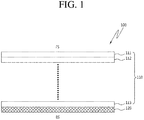
- FIG. 1 illustrates a sectional view of a bulletproof material according to Example 1 of the present invention.
- a bulletproof material 100 As shown in FIG. 1 , a bulletproof material 100 according to Example 1 of the present invention has a front side (FS) to be struck by bullets and a back side (BS) opposite to FS.
- the bulletproof material 100 includes a plurality of first fibrous layers 110 at the front side (FS) and a second fibrous layer 120 adjacent to the first fibrous layers 110.
- the bulletproof material 100 includes the first fibrous layers 110 in the proper number of plies and the second fibrous layer 120 in order to have a mass per unit satisfying lightening requirements of a bulletproof vest, for example, a mass per unit area of 3 to 6.8 kg/m 2 .
- the bulletproof material 100 includes 10 to 32-ply first fibrous layers 110 and a one-ply second fibrous layer 120.
- the first fibrous layers 110 at the front side (FS) includes a network of high-strength fiber having a tenacity of 11 g/denier or more and a tensile modulus of 200 g/denier or more.
- the high-strength fiber may be ultrahigh molecular weight polyethylene (UHMWPE) fiber or aramid fiber.
- the network of the high-strength fiber is an aramid woven fabric including aramid fiber as warp and weft.
- Each woven fabric has a mass per unit area of 150 to 500 g/m 2 .
- the mass per unit area is less than 150g/m 2 , gaps may be present between woven fabrics and thus bulletproof performance may be decreased.
- weaving is performed such that the mass per unit area is greater than 500g/m 2 , production efficiency may be decreased.
- aramid fiber Since the aramid fiber is vulnerable to moisture, bulletproof performance thereof may be decrease as time passes. So as to address such a problem, aramid woven fabrics of the first fibrous layers 110 may be coated with a water repellent including fluorocarbon, a cross-linking agent, and a hardness-enhancing resin.
- the fluorocarbon provides water repellency to the first fibrous layers 110.
- a hydroxylated perfluoroalkylethyl acrylate copolymer may be used as the fluorocarbon.
- the water repellent may further include, other than fluorocarbon, an isocyanate-based compound such as, for example, toluene diisocyanate or methylene diphenyl diisocyanate, as a cross-linking agent.
- the water repellent may further include a hardness-enhancing resin such as polyvinyl acetate.
- the water repellent may further include an antifoaming agent (e.g., dipropylene glycol) for removing bubbles and an emulsion stabilizer (e.g., malic acid).
- the water repellent may include 0.5 to 10% by weight of fluorocarbon, 0.5 to 10% by weight of the hardness-enhancing resin, 0.5 to 5% by weight of the cross-linking agent, 0.1 to 2% by weight of the antifoaming agent, 0.1 to 2% by weight of the emulsion stabilizer, and 73 to 98.3% by weight of water.
- the content of the hardness-enhancing resin is less than 0.5% by weight, back-side deformation characteristics of the bulletproof material 100 are hardly enhanced.
- the content of the hardness-enhancing resin is greater than 10% by weight, flexibility of the bulletproof material 100 is decreased and thus wearing sensation of a bulletproof vest made of the bulletproof material 100 is greatly decreased.
- a method such as padding, coating, immersing, spraying, brushing, or film-coating may be used.
- thermal treatment may be performed at 120 to 200 °C for 15 to 150 seconds.
- the network of the high-strength fiber of the first fibrous layers 110 may include a plurality of ultrahigh molecular-weight polyethylene fibers and/or aramid fibers arranged in one direction, and the network of the high-strength fiber may be coated with a composition including a polyurethane resin.
- first fibrous layers 111, 112, and 113 high-strength fibers are unidirectionally oriented in parallel.
- the high-strength fiber of the first fibrous layers 111, 112, and 113 is coated with a composition including the polyurethane resin and thus arrangements of the high-strength fibers may be maintained.
- the composition may be sprayed onto the high-strength fibers or applied to the high-strength fibers in a film type.
- the neighboring fibrous layers 111 and 112 may be cross-plied such that the high-strength fibers of the fibrous layers 111 and 112 adjacent to each other form an angle of about 90°.
- the cross-plied fibrous layers 111 and 112 form one unidirectional fabric.
- the unidirectional fabric may be composed of four fibrous layers respectively including unidirectionally oriented very-high-density polyethylene fiber or aramid fiber.
- the four fibrous layers may be cross-plied such that rotation angles between the high-strength fibers thereof are 0°/90°/0°/90°.
- the second fibrous layer 120 at the back side (BS) of the bulletproof material 100 includes a network of carbon fiber.
- the network of carbon fiber may be a woven fabric including carbon spun yarn as warp and weft.
- the second fibrous layer 120 has a mass per unit area of 110 to 480 g/m 2 .
- the mass per unit area is less than 110 g/m 2 , gaps may present between the second fibrous layer 120, thus causing bulletproof performance decrease.
- the second fibrous layer 120 is prepared such that the mass per unit area is greater than 480 g/m 2 , lightening of the bulletproof material 100 is hindered or bulletproof performance decrease (when the number of the first fibrous layers is decreased to adjust the mass per unit area of the bulletproof material to a proper state) may be caused.
- the front side (FS) of the bulletproof material 100 When physical impact from bullets is applied to the front side (FS) of the bulletproof material 100, the front side (FS) of the bulletproof material 100 is partially deformed. Such deformation is expanded to the back side (BS) of the bulletproof material 100, thus generating back-side deformation greater than allowable safe separation distance.
- BS back side
- a carbon fiber network of the second fibrous layer 120 at the back side (BS) of the bulletproof material 100 has an impact absorption force of almost O
- the carbon fiber network is broken and disperses impact around, when struck by bullets is applied.
- back-side deformation characteristics of the bulletproof material 100 may be enhanced.
- the carbon fiber network has relatively soft characteristics, compared to rigid materials such as a polypropylene film conventionally suggested, and thus, the carbon fiber network may provide superior wearing sensation to bulletproof vests, compared to the polypropylene film.
- the carbon fiber network may be coated with a composition including a phenol resin and a polyvinyl butyral resin.
- the composition may include 20 to 70% by weight of the phenol resin, 20 to 70% by weight of the polyvinyl butyral resin, and 1 to 10% by weight of a plasticizer.
- the plasticizer may be dioctyl phthalate (DOP), dioctyl adipate (DOA), tricresyl phosphate (TCP), or diisononyl phthalate (DINP).
- DOP dioctyl phthalate
- DOA dioctyl adipate
- TCP tricresyl phosphate
- DINP diisononyl phthalate
- the phenol resin of the composition further increases hardness of the second fibrous layer 120, and the polyvinyl butyral resin increases adhesion between the first fibrous layer 113 and the second fibrous layer 120.
- a method of coating the carbon fiber network with the composition there are a method of immersing the network in a solution including the composition and a method of laminating the composition on the carbon fiber network in a film type.
- the immersion method is described.
- the carbon fiber network is dipped in a composition diluted with a solvent (e.g., methanol) for 10 to 60 minutes.
- a solvent e.g., methanol
- the dipping may be repeated several times such that the entire carbon fiber network is uniformly immersed in the composition.
- the dilution solvent used for the dipping process is removed by dying.
- the carbon fiber network with the composition may be squeezed.
- the squeezing may be continuously performed using a pressing roller or discontinuously performed using a pressing plate.
- a polymer film is formed using the composition.
- the mass per unit area and thickness of the polymer film are formed such that the carbon fiber network has a mass per unit area of 100 to 400 g/m 2 and a weight ratio of the composition to the carbon fiber network is 10 to 20%.
- the polymer film is laminated on a side of the carbon fiber network. That is, on a side of the carbon fiber network, laying the polymer film, drying a carbon fiber network having the polymer film thereon at 20 to 60 °C for 1 to 7 minutes, and applying pressure to the carbon fiber network and the polymer film at 100 to 130°C are sequentially performed. Drying may be continuously performed using a chamber or the like.
- the carbon fiber network on the polymer film passes through chamber(s) maintained at 20 to 60 °C at a rate of 4 to 20 m/min.
- drying temperature is less than 20 °C, drying might not be smoothly performed.
- the drying temperature is greater than 60 °C, the composition of the polymer film is hardened and thus adhesion thereof to the first fibrous layer 113) may be decreased.
- the pressing may be continuously performed using a heated pressing roller or discontinuously performed using a pressing plate.
- a composite sheet is formed by passing the carbon fiber network coated with the composition, i.e., the second fibrous layer 120 with the first fibrous layer 113, through a high-temperature and high-press pressurizer. Subsequently, the composite sheet is bonded with the fibrous layers 111 and 112 through, for example, diamond stitching.
- a composite sheet of the first fibrous layer 113 and the second fibrous layer 120 may be formed by inserting the polymer film between the carbon fiber network and the first fibrous layer 113 and passing the same through a chamber maintained at about 50 °C, followed by pressing the same by means of a roller heated to about 160°C.
- Example 2 of the present invention a bulletproof material according to Example 2 of the present invention is described with reference to FIG. 2 .
- a bulletproof material 200 includes a plurality of first fibrous layers 210 at a front side (FS), a second fibrous layer 220 adjacent to the first fibrous layers 210, and the third fibrous layer 230 at a back side (BS).
- the second fibrous layer 220 is located between the first fibrous layers 210 and a third fibrous layer 230.
- the first and third fibrous layers 210 to 230 include an aramid woven fabric as a network of high-strength fiber.
- the aramid woven fabric may be coated with a water repellent including fluorocarbon, a cross-linking agent, and a hardness-enhancing resin.
- the cross-linking agent is an isocyanate-based compound and the hardness-enhancing resin is polyvinyl acetate.
- the second fibrous layer 220 includes a carbon fiber network.
- the carbon fiber network may be a woven fabric including carbon spun yarn as warp and weft, and may be coated with a composition including a phenol resin and a polyvinyl butyral resin.
- the bulletproof material 200 includes the first to third fibrous layers 210, 220, and 230 in the proper number of plies in order to have mass per unit area satisfying lightening requirements of a bulletproof vest, e.g., a mass per unit area of 3 to 6.8 kg/m 2 .
- One composite sheet is formed by passing the carbon fiber network coated with the composition, i.e., the second fibrous layer 220, along with the third fibrous layer 230 through a high-temperature and high-pressure pressurizer. Subsequently, the composite sheet may be bonded with the first fibrous layers 210 through, for example, diamond stitching, in an order as illustrated in FIG. 2 .
- a composite sheet of the second fibrous layer 220 and the third fibrous layer 230 may be formed by inserting the polymer film of the composition between the carbon fiber network and the third fibrous layer 230 and maintaining the same at about 50 °C, followed by pressing the same by means of a roller heated to about 160 °C.
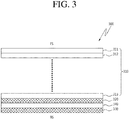
- Example 3 of the present invention a bulletproof material according to Example 3 of the present invention is described with reference to FIG. 3 .
- a bulletproof material 300 includes a plurality of first fibrous layers 310 at a front side (FS), a second fibrous layer 320 adjacent to the first fibrous layers 310, a third fibrous layer 330 at a back side (BS), and a fourth fibrous layer 340 between the second fibrous layer 320 and the second fibrous layer 330.
- FS front side
- BS back side
- fourth fibrous layer 340 between the second fibrous layer 320 and the second fibrous layer 330.
- the first and fourth fibrous layers 310 to 340 include an aramid woven fabric as a network of high-strength fiber.
- the aramid woven fabric may be coated with a water repellent including fluorocarbon, a cross-linking agent, and a hardness-enhancing resin.
- the cross-linking agent is an isocyanate-based compound and the hardness-enhancing resin is polyvinyl acetate.
- the second and third fibrous layers 320 and 330 include a carbon fiber network.
- the carbon fiber network may be a woven fabric including carbon spun yarn as warp and weft, and may be coated with a composition including a phenol resin and a polyvinyl butyral resin.
- the bulletproof material 300 includes the first to fourth fibrous layers 310, 320, 330, and 340 in the proper number of plies in order to have mass per unit area satisfying lightening requirements of a bulletproof vest, e.g., a mass per unit area of 3 to 6.8 kg/m 2 .
- the first to fourth fibrous layers 310, 320, 330, and 340 are bonded to each other through a method such as diamond stitching.
- a method of laminating/bonding the first to fourth fibrous layers 310, 320, 330, and 340 is similar to those of Examples 1 and 2. That is, a composite sheet of the first fibrous layer 313 and the second fibrous layer 320 and a composite sheet of the third fibrous layer 330 and the fourth fibrous layer 340 are respectively formed, and then, the composite sheets are laminated with the first fibrous layers 311 and 312 in a manner illustrated in FIG. 3 . Subsequently, they may be bonded to each other through diamond stitching.
- the process of coating the carbon fiber network, which constitutes each of the second and third fibrous layers 320 and 330, with the composition may be performed while forming each of the composite sheets.
- Example 4 of the present invention a bulletproof material according to Example 4 of the present invention is described with reference to FIG. 4 .
- a bulletproof material 400 includes a plurality of first fibrous layers 410 at a front side (FS), a second fibrous layer 420 at a back side (BS), and third and fourth fibrous layers 431 and 432 between the first fibrous layers 410 and the second fibrous layer 420.
- the first fibrous layers 410 include an aramid woven fabric as a network of high-strength fiber.
- the aramid woven fabric may be coated with a water repellent including fluorocarbon, a cross-linking agent, and a hardness-enhancing resin.
- the cross-linking agent is an isocyanate-based compound and the hardness-enhancing resin is polyvinyl acetate.
- the second fibrous layer 420 at a back side (BS) of the bulletproof material 400 includes a carbon fiber network.
- the carbon fiber network may be a woven fabric including carbon spun yarn as warp and weft, and may be coated with a composition including a phenol resin and a polyvinyl butyral resin.
- Each of the third and fourth fibrous layers 431 and 432 includes a plurality of high-strength fibers which are unidirectionally oriented, e.g., ultrahigh-molecular-weight polyethylene fibers or aramid fibers.
- High-strength fibers of the third and fourth fibrous layers 431 and 432 are coated with a composition including a polyurethane resin, and thus, arrangements of the high-strength fibers may be maintained.
- the composition may be sprayed onto the high-strength fiber or applied to the high-strength fibers in a film type.
- the third and fourth fibrous layers 431 and 432 adjacent to each other are cross-plied at an angle of about 90° to form one unidirectional fabric 430.
- one composite sheet is formed by passing the carbon fiber network coated with the composition, i.e., the second fibrous layer 420, along with the unidirectional fabric 430 through a high-temperature and high-pressure pressurizer.
- This composite sheet is laminated with the first fibrous layers 410 as illustrated in FIG. 4 , followed by bonding the same through, for example, diamond stitching.
- a composite sheet of the unidirectional fabric 430 and the second fibrous layer 420 may be formed by inserting the polymer film of the composition between the carbon fiber network and the unidirectional fabric 430 and maintaining the same at about 50 °C, followed by pressing the same by means of a roller heated to about 160°C.
- one or more unidirectional fabrics may be included between the composite sheet and the first fibrous layers 410.
- one first fibrous layer i.e., an aramid woven fabric
- one first fibrous layer may be further included between the unidirectional fabric 430 and the second fibrous layer 420.
- a composite sheet of the second fibrous layer 420 and the aramid woven fabric is first prepared using the methods described above, followed by being bonded to each other along with the first fibrous layers 410 and the unidirectional fabric(s) 430 through diamond stitching.
- the bulletproof material 400 according to Example 4 includes the plurality of the first fibrous layers 410 at a front side (FS), the second fibrous layer 420 at a back side (BS), and the third and fourth fibrous layers 431 and 432 between the first fibrous layers 410 and the second fibrous layer 420.
- the bulletproof materials 100, 200, 300, and 400 include the fibrous layer including the carbon fiber network at a back side (BS) or near a back side (BS), whereby impact by collision with bullets may be dispersed around.
- BS back side
- BS back side
- BS back side
- BS back side
- the carbon fiber network is relatively soft, compared to a rigid material such as a polypropylene film conventionally suggested to enhance back-side deformation characteristics, thus providing a bulletproof vest having wearing sensation far superior to the polypropylene film.
- Plain weaving was performed using aramid fiber (KOLON INDUSTRIES, HERA CRON ® HF 100) having a fineness of 840 denier as warp and weft to prepare an aramid woven fabric.
- aramid fiber KOLON INDUSTRIES, HERA CRON ® HF 100
- a fineness of 840 denier as warp and weft
- Each of a warp density and a weft density of the aramid woven fabric was 105 strands/cm.
- the woven fabric was treated with a scouring agent including Na 2 CO 3 at about 60 °C, followed by washing and drying.
- the scoured woven fabric was immersed in a water repellent.
- the water repellent included 3% by weight of hydroxylated perfluoroalkylethyl acrylate copolymer, 3% by weight of polyvinyl acetate, 3% by weight of toluene diisocyanate, 0.3% by weight of dipropylene glycol, 0.3% by weight of malic acid, and 90.4% by weight of water.
- the woven fabric impregnated with the water repellent was heat-treated at about 160 °C for 60 seconds to complete an aramid woven fabric.
- the aramid woven fabric has a mass per unit area of 200 g/m 2 .
- Plain weaving was performed using carbon spun yarn having a fineness Of 400 denier as warp and weft to prepare a carbon yarn fabric.
- a warp density and a weft density of the carbon yarn fabric were respectively 173 strands/cm.
- a polymer film including 48% by weight of a phenol resin, 48% by weight of a polyvinyl butyral resin, and 4% by weight of dioctyl phthalate (DOP) was inserted between the carbon yarn fabric and the aramid woven fabric prepared according to Preparation Example 1, and the resultant structure was passed through a chamber maintained at about 50 °C, followed by pressing by means of a roller heated to about 160°C.
- DOP dioctyl phthalate
- a carbon yarn fabric having a mass per unit area of 160 g/m 2 was prepared in the same manner as that exemplified in Preparation Example 2.
- a bundle of ultrahigh-molecular-weight polyethylene fibers having a fineness of 1500 denier [Dyneema ® , manufactured by DSM] was substantially arranged in one direction on the same plane and then coated by spraying with an adhesive.
- first and second fibrous layers were respectively prepared.
- the first and second fibrous layers were cross-plied at an angle of about 90°, thus completing a unidirectional ultrahigh-molecular-weight polyethylene fabric.
- the unidirectional ultrahigh-molecular-weight polyethylene fabric had a mass per unit area of 140 g/m 2 .
- 26-ply aramid woven fabrics prepared according to Preparation Example 1 and three-ply composite sheets including carbon yarn fabric prepared according to Preparation Example 2 were sequentially laminated and then bonded to each other through diamond stitching. As a result, a bulletproof material was completed.
- the total mass per unit area of the bulletproof material was 6.34 kg/m 2 .
- a polypropylene film having a mass per unit area of 100 g/m 2 was adhered onto a side of a bulletproof material obtained according to Comparative Example 1.
- V 50 Average speed (V 50 )(m/s) that indirectly indicates a bulletproof performance degree of a bulletproof material against fragments was measured according to a test method regulated by MIL-STD-662F using fragment simulated projectiles (FSP) regulated by MIL-P-46593A. Back side deformation was measured using 44 Mag. bullets that were applied to NIJ101.06 version Level IIIA.
Landscapes
- Engineering & Computer Science (AREA)
- Textile Engineering (AREA)
- General Engineering & Computer Science (AREA)
- Chemical & Material Sciences (AREA)
- Ceramic Engineering (AREA)
- Chemical Kinetics & Catalysis (AREA)
- Inorganic Chemistry (AREA)
- Aiming, Guidance, Guns With A Light Source, Armor, Camouflage, And Targets (AREA)
- Laminated Bodies (AREA)
- Professional, Industrial, Or Sporting Protective Garments (AREA)
- Woven Fabrics (AREA)
Abstract
Description
- The present invention relates to a bulletproof material, and more particularly to a bulletproof material having superior bulletproof performance and enhanced back-side deformation characteristics along with superior wearing sensation due to relatively light weight and soft texture.
- Bulletproof products protecting the human body from bullets or shells require satisfactory wearing sensation along with superior bulletproof performance. However, in general, wearing sensation of bulletproof products was somewhat decreased so as to increase bulletproof performance. In other words, wearing sensation enhancement of bulletproof products generally caused bulletproof performance decrease.
- It was published that a unidirectional fabric is used to lighten bulletproof products and increase bulletproof performance thereof.
-
US Patent Laid-Open Publication No. 2011/0219943 suggests a composite fabric including all of a woven fabric composed of high-strength fiber and a unidirectional fabric composed of high-strength fiber, so as to increase bulletproof performance. The publication describes that the woven fabric of the composite fabric is preferably not coated with a matrix resin, and, if coating is performed, the woven fabric is preferably coated with a matrix resin having a chemical structure similar to that of the unidirectional fabric (see Paragraph No. [0054]). In addition, bulletproof products including all of the woven fabric and the unidirectional fabric exhibit superior bulletproof performance and further reduced back-side deformation due to bullet impact, compared to bulletproof products including only unidirectional fabrics (see Paragraph No. [0054]). - Although the publication suggests a composite fabric having superior bulletproof characteristics, enhancement is still required in regard to back-side deformation characteristics (anti-trauma).
- For this reason, a method of adhering a polypropylene film to the rear side of a material was suggested to enhance back-side deformation characteristics of a bulletproof material. However, bulletproof vests made of the bulletproof material to which the polypropylene film is adhered have poor wearing sensation due to a rigid characteristic of the polypropylene film.
- Therefore, the present invention has been made in view of the above problems, and it is an object of the present invention to provide a bulletproof material to prevent problems caused by technical limitations and drawbacks related to those described above.
- It is an object of the present invention to provide a bulletproof material having superior bulletproof performance and enhanced back-side deformation characteristics along with superior wearing sensation due to relatively light weight and soft texture.
- Other characteristics and advantages of the present invention will be described below and partially obvious from described technologies. Alternatively, other characteristics and advantages of the present invention will be understood by implementing the present invention. Objects and other advantages of the present invention will realized and accomplished through structures specified by the detailed description and the accompanying claims.
- In accordance with an aspect of the present invention, the above and other objects can be accomplished by the provision of a bulletproof material having a front side to be struck by a bullet and a back side at an opposite side of the front side, wherein the bulletproof material includes a plurality of first fibrous layers at the front side; and a second fibrous layer, wherein each of the first fibrous layers includes a network of high-strength fiber having a tenacity of 11 g/denier or more and a tensile modulus of 200 g/denier or more, and the second fibrous layer includes a network of carbon fiber.
- It should be understood that the-above general description and detailed description below are provided to exemplify or describe the present invention and to provide more detailed description for inventions of the accompanying claims.
- A bulletproof material according to the present invention is relatively light, but remarkably decreases back-side deformation when struck by bullets. In addition, the bulletproof material has relatively soft characteristics. Therefore, a bulletproof vest made of the bulletproof material has superior wearing sensation.
- Hereinafter, other effects of the present invention and technical constitutions related to the same are described in detail.
- The above and other objects, features and other advantages of the present invention will be more clearly understood from the following detailed description taken in conjunction with the accompanying drawings, in which:
-
FIG. 1 illustrates is a sectional view of a bulletproof material according to Example 1 of the present invention; -
FIG. 2 illustrates a sectional view of a bulletproof material according to Example 2 of the present invention; -
FIG. 3 illustrates a sectional view of a bulletproof material according to Example 3 of the present invention; and -
FIG. 4 illustrates a sectional view of a bulletproof material according to Example 4 of the present invention. - Hereinafter, examples of a bulletproof material according to the present invention are described in detail with reference to the accompanying drawings.
- These examples are provided only for illustration of the present invention and should not be construed as limiting the scope of the present invention. In addition, those skilled in the art will appreciate that various modifications, additions and substitutions are possible, without departing from the scope and spirit of the invention. Therefore, the present invention includes inventions disclosed in the accompanying claims, and modifications and changes within the scope of equivalents thereof.
- An expression used in the present specification "high-strength fiber" indicates a fiber having a tenacity of 11 g/denier or more and a tensile modulus of 200 g/denier or more.
-
FIG. 1 illustrates a sectional view of a bulletproof material according to Example 1 of the present invention. - As shown in
FIG. 1 , abulletproof material 100 according to Example 1 of the present invention has a front side (FS) to be struck by bullets and a back side (BS) opposite to FS. Thebulletproof material 100 includes a plurality of firstfibrous layers 110 at the front side (FS) and a secondfibrous layer 120 adjacent to the firstfibrous layers 110. - The
bulletproof material 100 includes the firstfibrous layers 110 in the proper number of plies and the secondfibrous layer 120 in order to have a mass per unit satisfying lightening requirements of a bulletproof vest, for example, a mass per unit area of 3 to 6.8 kg/m2. According to Example 1 of the present invention, thebulletproof material 100 includes 10 to 32-ply firstfibrous layers 110 and a one-ply secondfibrous layer 120. - The first
fibrous layers 110 at the front side (FS) includes a network of high-strength fiber having a tenacity of 11 g/denier or more and a tensile modulus of 200 g/denier or more. The high-strength fiber may be ultrahigh molecular weight polyethylene (UHMWPE) fiber or aramid fiber. - According to Example 1 of the present invention, the network of the high-strength fiber is an aramid woven fabric including aramid fiber as warp and weft. Each woven fabric has a mass per unit area of 150 to 500 g/m2. When the mass per unit area is less than 150g/m2, gaps may be present between woven fabrics and thus bulletproof performance may be decreased. On the other hand, weaving is performed such that the mass per unit area is greater than 500g/m2, production efficiency may be decreased.
- Since the aramid fiber is vulnerable to moisture, bulletproof performance thereof may be decrease as time passes. So as to address such a problem, aramid woven fabrics of the first
fibrous layers 110 may be coated with a water repellent including fluorocarbon, a cross-linking agent, and a hardness-enhancing resin. - The fluorocarbon provides water repellency to the first
fibrous layers 110. A hydroxylated perfluoroalkylethyl acrylate copolymer may be used as the fluorocarbon. - Meanwhile, a water repellent ingredient such as fluorocarbon is removed from a network of high-strength fiber in the severe environments or after use for a long time, whereby properties of the high-strength fiber are deteriorated and bulletproof performance thereof may be rapidly decreased, due to moisture. Accordingly, in order to increase bonding between the high-strength fiber and the fluorocarbon, the water repellent may further include, other than fluorocarbon, an isocyanate-based compound such as, for example, toluene diisocyanate or methylene diphenyl diisocyanate, as a cross-linking agent.
- In addition, in order to suppress back-side deformation of the
bulletproof material 100, the water repellent may further include a hardness-enhancing resin such as polyvinyl acetate. - Selectively, the water repellent may further include an antifoaming agent (e.g., dipropylene glycol) for removing bubbles and an emulsion stabilizer (e.g., malic acid). In this case, the water repellent may include 0.5 to 10% by weight of fluorocarbon, 0.5 to 10% by weight of the hardness-enhancing resin, 0.5 to 5% by weight of the cross-linking agent, 0.1 to 2% by weight of the antifoaming agent, 0.1 to 2% by weight of the emulsion stabilizer, and 73 to 98.3% by weight of water.
- When the content of fluorocarbon is less than 0.5% by weight, it is difficult to anticipate desired water repellency. When the content of fluorocarbon is greater than 10% by weight, water repellency is not greatly increased and flexibility of the
bulletproof material 100 may be rather decreased. - When the content of the hardness-enhancing resin is less than 0.5% by weight, back-side deformation characteristics of the
bulletproof material 100 are hardly enhanced. When the content of the hardness-enhancing resin is greater than 10% by weight, flexibility of thebulletproof material 100 is decreased and thus wearing sensation of a bulletproof vest made of thebulletproof material 100 is greatly decreased. - When the content of the cross-linking agent is less than 0.5% by weight, it is difficult to maintain desired water repellency. When the content of the cross-linking agent is greater than 5% by weight, effects are not increased, but manufacturing costs increase.
- In order to apply the water repellent to the network of the high-strength fiber, a method such as padding, coating, immersing, spraying, brushing, or film-coating may be used. After applying the water repellent to the network, thermal treatment may be performed at 120 to 200 °C for 15 to 150 seconds.
- Selectively, the network of the high-strength fiber of the first
fibrous layers 110 may include a plurality of ultrahigh molecular-weight polyethylene fibers and/or aramid fibers arranged in one direction, and the network of the high-strength fiber may be coated with a composition including a polyurethane resin. In each of firstfibrous layers fibrous layers fibrous layers fibrous layers fibrous layers - Selectively, the unidirectional fabric may be composed of four fibrous layers respectively including unidirectionally oriented very-high-density polyethylene fiber or aramid fiber. In this case, the four fibrous layers may be cross-plied such that rotation angles between the high-strength fibers thereof are 0°/90°/0°/90°.
- The second
fibrous layer 120 at the back side (BS) of thebulletproof material 100 includes a network of carbon fiber. The network of carbon fiber may be a woven fabric including carbon spun yarn as warp and weft. - The second
fibrous layer 120 has a mass per unit area of 110 to 480 g/m2. When the mass per unit area is less than 110 g/m2, gaps may present between the secondfibrous layer 120, thus causing bulletproof performance decrease. On the other hand, when the secondfibrous layer 120 is prepared such that the mass per unit area is greater than 480 g/m2, lightening of thebulletproof material 100 is hindered or bulletproof performance decrease (when the number of the first fibrous layers is decreased to adjust the mass per unit area of the bulletproof material to a proper state) may be caused. - When physical impact from bullets is applied to the front side (FS) of the
bulletproof material 100, the front side (FS) of thebulletproof material 100 is partially deformed. Such deformation is expanded to the back side (BS) of thebulletproof material 100, thus generating back-side deformation greater than allowable safe separation distance. When the back-side deformation of thebulletproof material 100 is severe, a wearer may suffer fetal damage. - According to the present invention, since a carbon fiber network of the second
fibrous layer 120 at the back side (BS) of thebulletproof material 100 has an impact absorption force of almost O, the carbon fiber network is broken and disperses impact around, when struck by bullets is applied. As a result, back-side deformation characteristics of thebulletproof material 100 may be enhanced. In addition, in order to enhance the back-side deformation characteristics of thebulletproof material 100, the carbon fiber network has relatively soft characteristics, compared to rigid materials such as a polypropylene film conventionally suggested, and thus, the carbon fiber network may provide superior wearing sensation to bulletproof vests, compared to the polypropylene film. - Selectively, the carbon fiber network may be coated with a composition including a phenol resin and a polyvinyl butyral resin. In particular, the composition may include 20 to 70% by weight of the phenol resin, 20 to 70% by weight of the polyvinyl butyral resin, and 1 to 10% by weight of a plasticizer. The plasticizer may be dioctyl phthalate (DOP), dioctyl adipate (DOA), tricresyl phosphate (TCP), or diisononyl phthalate (DINP). The phenol resin of the composition further increases hardness of the second
fibrous layer 120, and the polyvinyl butyral resin increases adhesion between the firstfibrous layer 113 and the secondfibrous layer 120. - As examples of a method of coating the carbon fiber network with the composition, there are a method of immersing the network in a solution including the composition and a method of laminating the composition on the carbon fiber network in a film type.
- First, the immersion method is described. The carbon fiber network is dipped in a composition diluted with a solvent (e.g., methanol) for 10 to 60 minutes. The dipping may be repeated several times such that the entire carbon fiber network is uniformly immersed in the composition. Subsequently, the dilution solvent used for the dipping process is removed by dying. Selectively, before the drying, the carbon fiber network with the composition may be squeezed. The squeezing may be continuously performed using a pressing roller or discontinuously performed using a pressing plate.
- Here, the lamination method is described. A polymer film is formed using the composition. According to an embodiment of the present invention, the mass per unit area and thickness of the polymer film are formed such that the carbon fiber network has a mass per unit area of 100 to 400 g/m2 and a weight ratio of the composition to the carbon fiber network is 10 to 20%. Subsequently, the polymer film is laminated on a side of the carbon fiber network. That is, on a side of the carbon fiber network, laying the polymer film, drying a carbon fiber network having the polymer film thereon at 20 to 60 °C for 1 to 7 minutes, and applying pressure to the carbon fiber network and the polymer film at 100 to 130°C are sequentially performed. Drying may be continuously performed using a chamber or the like. In this case, the carbon fiber network on the polymer film passes through chamber(s) maintained at 20 to 60 °C at a rate of 4 to 20 m/min. When drying temperature is less than 20 °C, drying might not be smoothly performed. On the other hand, when the drying temperature is greater than 60 °C, the composition of the polymer film is hardened and thus adhesion thereof to the first fibrous layer 113) may be decreased. The pressing may be continuously performed using a heated pressing roller or discontinuously performed using a pressing plate.
- First, a composite sheet is formed by passing the carbon fiber network coated with the composition, i.e., the second
fibrous layer 120 with the firstfibrous layer 113, through a high-temperature and high-press pressurizer. Subsequently, the composite sheet is bonded with thefibrous layers - Selectively, the coating process and the composite sheet formation process may be simultaneously performed. That is, a composite sheet of the first
fibrous layer 113 and the secondfibrous layer 120 may be formed by inserting the polymer film between the carbon fiber network and the firstfibrous layer 113 and passing the same through a chamber maintained at about 50 °C, followed by pressing the same by means of a roller heated to about 160°C. - Hereinafter, a bulletproof material according to Example 2 of the present invention is described with reference to
FIG. 2 . - As illustrated in
FIG. 2 , abulletproof material 200 according to Example 2 of the present invention includes a plurality of firstfibrous layers 210 at a front side (FS), a secondfibrous layer 220 adjacent to the firstfibrous layers 210, and the thirdfibrous layer 230 at a back side (BS). In other words, the secondfibrous layer 220 is located between the firstfibrous layers 210 and a thirdfibrous layer 230. - According to Example 2 of the present invention, the first and third
fibrous layers 210 to 230 include an aramid woven fabric as a network of high-strength fiber. The aramid woven fabric may be coated with a water repellent including fluorocarbon, a cross-linking agent, and a hardness-enhancing resin. Here, the cross-linking agent is an isocyanate-based compound and the hardness-enhancing resin is polyvinyl acetate. - The second
fibrous layer 220 includes a carbon fiber network. The carbon fiber network may be a woven fabric including carbon spun yarn as warp and weft, and may be coated with a composition including a phenol resin and a polyvinyl butyral resin. - The
bulletproof material 200 includes the first to thirdfibrous layers - One composite sheet is formed by passing the carbon fiber network coated with the composition, i.e., the second
fibrous layer 220, along with the thirdfibrous layer 230 through a high-temperature and high-pressure pressurizer. Subsequently, the composite sheet may be bonded with the firstfibrous layers 210 through, for example, diamond stitching, in an order as illustrated inFIG. 2 . - Selectively, the coating process and the composite sheet formation process may be simultaneously performed. That is, a composite sheet of the second
fibrous layer 220 and the thirdfibrous layer 230 may be formed by inserting the polymer film of the composition between the carbon fiber network and the thirdfibrous layer 230 and maintaining the same at about 50 °C, followed by pressing the same by means of a roller heated to about 160 °C. - Hereinafter, a bulletproof material according to Example 3 of the present invention is described with reference to
FIG. 3 . - As illustrated in
FIG. 3 , abulletproof material 300 according to Example 2 of the present invention includes a plurality of firstfibrous layers 310 at a front side (FS), a secondfibrous layer 320 adjacent to the firstfibrous layers 310, a thirdfibrous layer 330 at a back side (BS), and a fourthfibrous layer 340 between the secondfibrous layer 320 and the secondfibrous layer 330. - According to Example 3 of the present invention, the first and fourth
fibrous layers 310 to 340 include an aramid woven fabric as a network of high-strength fiber. The aramid woven fabric may be coated with a water repellent including fluorocarbon, a cross-linking agent, and a hardness-enhancing resin. Here, the cross-linking agent is an isocyanate-based compound and the hardness-enhancing resin is polyvinyl acetate. - The second and third
fibrous layers - The
bulletproof material 300 includes the first to fourthfibrous layers fibrous layers - A method of laminating/bonding the first to fourth
fibrous layers fibrous layer 313 and the secondfibrous layer 320 and a composite sheet of the thirdfibrous layer 330 and the fourthfibrous layer 340 are respectively formed, and then, the composite sheets are laminated with the firstfibrous layers FIG. 3 . Subsequently, they may be bonded to each other through diamond stitching. - In addition, the process of coating the carbon fiber network, which constitutes each of the second and third
fibrous layers - Hereinafter, a bulletproof material according to Example 4 of the present invention is described with reference to
FIG. 4 . - As illustrated in
FIG. 4 , abulletproof material 400 according to Example 4 of the present invention includes a plurality of firstfibrous layers 410 at a front side (FS), a secondfibrous layer 420 at a back side (BS), and third and fourthfibrous layers fibrous layers 410 and the secondfibrous layer 420. - According to Example 4 of the present invention, the first
fibrous layers 410 include an aramid woven fabric as a network of high-strength fiber. The aramid woven fabric may be coated with a water repellent including fluorocarbon, a cross-linking agent, and a hardness-enhancing resin. Here, the cross-linking agent is an isocyanate-based compound and the hardness-enhancing resin is polyvinyl acetate. - The second
fibrous layer 420 at a back side (BS) of thebulletproof material 400 includes a carbon fiber network. The carbon fiber network may be a woven fabric including carbon spun yarn as warp and weft, and may be coated with a composition including a phenol resin and a polyvinyl butyral resin. - Each of the third and fourth
fibrous layers fibrous layers fibrous layers unidirectional fabric 430. - First, one composite sheet is formed by passing the carbon fiber network coated with the composition, i.e., the second
fibrous layer 420, along with theunidirectional fabric 430 through a high-temperature and high-pressure pressurizer. This composite sheet is laminated with the firstfibrous layers 410 as illustrated inFIG. 4 , followed by bonding the same through, for example, diamond stitching. - Selectively, the coating process and the composite sheet formation process may be simultaneously performed. That is, a composite sheet of the
unidirectional fabric 430 and the secondfibrous layer 420 may be formed by inserting the polymer film of the composition between the carbon fiber network and theunidirectional fabric 430 and maintaining the same at about 50 °C, followed by pressing the same by means of a roller heated to about 160°C. - Selectively, one or more unidirectional fabrics may be included between the composite sheet and the first fibrous layers 410.
- Although not shown, one first fibrous layer, i.e., an aramid woven fabric, may be further included between the
unidirectional fabric 430 and the secondfibrous layer 420. In this case, a composite sheet of the secondfibrous layer 420 and the aramid woven fabric is first prepared using the methods described above, followed by being bonded to each other along with the firstfibrous layers 410 and the unidirectional fabric(s) 430 through diamond stitching. - The
bulletproof material 400 according to Example 4 includes the plurality of the firstfibrous layers 410 at a front side (FS), the secondfibrous layer 420 at a back side (BS), and the third and fourthfibrous layers fibrous layers 410 and the secondfibrous layer 420. - As described above, the
bulletproof materials bulletproof materials - In addition, the carbon fiber network is relatively soft, compared to a rigid material such as a polypropylene film conventionally suggested to enhance back-side deformation characteristics, thus providing a bulletproof vest having wearing sensation far superior to the polypropylene film.
- Now, the present invention will be described in more detail with reference to the following examples and comparative examples. These examples are provided only for illustration of the present invention and should not be construed as limiting the scope and spirit of the present invention.
- Plain weaving was performed using aramid fiber (KOLON INDUSTRIES, HERA CRON® HF 100) having a fineness of 840 denier as warp and weft to prepare an aramid woven fabric. Each of a warp density and a weft density of the aramid woven fabric was 105 strands/cm. The woven fabric was treated with a scouring agent including Na2CO3 at about 60 °C, followed by washing and drying.
- Subsequently, the scoured woven fabric was immersed in a water repellent. The water repellent included 3% by weight of hydroxylated perfluoroalkylethyl acrylate copolymer, 3% by weight of polyvinyl acetate, 3% by weight of toluene diisocyanate, 0.3% by weight of dipropylene glycol, 0.3% by weight of malic acid, and 90.4% by weight of water. The woven fabric impregnated with the water repellent was heat-treated at about 160 °C for 60 seconds to complete an aramid woven fabric. The aramid woven fabric has a mass per unit area of 200 g/m2.
- Plain weaving was performed using carbon spun yarn having a fineness Of 400 denier as warp and weft to prepare a carbon yarn fabric. A warp density and a weft density of the carbon yarn fabric were respectively 173 strands/cm.
- Subsequently, a polymer film including 48% by weight of a phenol resin, 48% by weight of a polyvinyl butyral resin, and 4% by weight of dioctyl phthalate (DOP) was inserted between the carbon yarn fabric and the aramid woven fabric prepared according to Preparation Example 1, and the resultant structure was passed through a chamber maintained at about 50 °C, followed by pressing by means of a roller heated to about 160°C. As a result, a composite sheet including the carbon yarn fabric was completed. The composite sheet including the carbon yarn fabric had a mass per unit area of 380 g/m2.
- A carbon yarn fabric having a mass per unit area of 160 g/m2 was prepared in the same manner as that exemplified in Preparation Example 2.
- A bundle of ultrahigh-molecular-weight polyethylene fibers having a fineness of 1500 denier [Dyneema®, manufactured by DSM] was substantially arranged in one direction on the same plane and then coated by spraying with an adhesive. As a result, first and second fibrous layers were respectively prepared. Subsequently, the first and second fibrous layers were cross-plied at an angle of about 90°, thus completing a unidirectional ultrahigh-molecular-weight polyethylene fabric. The unidirectional ultrahigh-molecular-weight polyethylene fabric had a mass per unit area of 140 g/m2.
- 30-ply aramid woven fabrics prepared according to Preparation Example 1 and the one-ply composite sheet including carbon yarn fabric prepared according to Preparation Example 2 were sequentially laminated as illustrated in
FIG. 1 and then bonded to each other through diamond stitching. As a result, a bulletproof material was completed. The total mass per unit area of the bulletproof material was 6.38 kg/m2. - 28-ply aramid woven fabrics prepared according to Preparation Example 1 and two-ply composite sheets including carbon yarn fabric prepared according to Preparation Example 2 were sequentially laminated as illustrated in
FIG. 3 and then bonded to each other through diamond stitching. As a result, a bulletproof material was completed. The total mass per unit area of the bulletproof material was 6.36 kg/m2. - 26-ply aramid woven fabrics prepared according to Preparation Example 1 and three-ply composite sheets including carbon yarn fabric prepared according to Preparation Example 2 were sequentially laminated and then bonded to each other through diamond stitching. As a result, a bulletproof material was completed. The total mass per unit area of the bulletproof material was 6.34 kg/m2.
- 23-ply aramid woven fabrics prepared according to Preparation Example 1, 10-ply unidirectional ultrahigh-molecular-weight polyethylene fabrics prepared according to Preparation Example 4, and one-ply composite sheets including carbon yarn fabric prepared according to Preparation Example 2 were sequentially laminated and then bonded to each other through diamond stitching. As a result, a bulletproof material was completed. The total mass per unit area of the bulletproof material was 6.38 kg/m2.
- 31-ply aramid woven fabrics prepared according to Preparation Example 1 and a one-ply carbon yarn fabric prepared according to Preparation Example 3 were sequentially laminated as illustrated in
FIG. 3 and then bonded to each other through diamond stitching. As a result, a bulletproof material was completed. The total mass per unit area of the bulletproof material was 6.36 kg/m2. - 32-ply aramid woven fabrics prepared according to Preparation Example 1 were laminated alone and then bonded to each other through diamond stitching. As a result, a bulletproof material was completed. The mass per unit area of the bulletproof material was 6.4 kg/m2.
- 36-ply unidirectional ultrahigh-molecular-weight ethylene fabrics prepared according to Preparation Example 4 were laminated alone and then bonded to each other through diamond stitching. As a result, a bulletproof material was completed. The mass per unit area of the bulletproof material was 5.04 kg/m2.
- A polypropylene film having a mass per unit area of 100 g/m2 was adhered onto a side of a bulletproof material obtained according to Comparative Example 1.
- Bulletproof performance and back-side deformation characteristics of each of the bulletproof materials prepared according to the examples and the comparative examples, and wearing sensation of each of the bulletproof materials were measured according to the following methods. Results are summarized in Tables 1 and 2 below.
- Average speed (V50)(m/s) that indirectly indicates a bulletproof performance degree of a bulletproof material against fragments was measured according to a test method regulated by MIL-STD-662F using fragment simulated projectiles (FSP) regulated by MIL-P-46593A. Back side deformation was measured using 44 Mag. bullets that were applied to NIJ101.06 version Level IIIA.
- Firmness indicating stiffness of an individual bulletproof material, as a criterion of wearing sensation, was measured. A measurement method called "circular bend test" was performed based on ASTM D4032-94.
[Table 1] Average speed (V5)(m/s) Back-side deformation (mm) Example1 665 35 Example2 652 38 Example3 647 42 Example4 643 39 Example5 653 41 Comparative Example1 660 40 Comparative Example2 602 39 Comparative Example3 654 39 [Table 2] Firmness (N) Preparation Example 1 15 Preparation Example2 63 Preparation Example3 13 Preparation Example4 120
Claims (14)
- A bulletproof material having a front side to be struck by a bullet and a back side at an opposite side of the front side, the bulletproof material comprising:a plurality of first fibrous layers at the front side; anda second fibrous layer,wherein each of the first fibrous layers comprises a network of high-strength fiber having a tenacity of 11 g/denier or more and a tensile modulus of 200 g/denier or more, andthe second fibrous layer comprises a network of carbon fiber.
- The bulletproof material according to claim 1, wherein the network of the high-strength fiber is an aramid woven fabric comprising aramid fiber as warp and weft.
- The bulletproof material according to claim 2, wherein the network of the high-strength fiber is coated with a water repellent comprising fluorocarbon, a cross-linking agent and a hardness-enhancing resin, wherein the cross-linking agent is an isocyanate-based compound and the hardness-enhancing resin is polyvinyl acetate.
- The bulletproof material according to claim 1, wherein the network of the high-strength fiber comprises a plurality of unidirectionally oriented ultrahigh-molecular-weight polyethylene fibers.
- The bulletproof material according to claim 4, wherein the network of the high-strength fiber is coated with a composition comprising a polyurethane resin.
- The bulletproof material according to claim 1, wherein the carbon fiber network is a woven fabric comprising carbon spun yarn as warp and weft.
- The bulletproof material according to claim 6, wherein the carbon fiber network is coated with a composition comprising a phenol resin and a polyvinyl butyral resin.
- The bulletproof material according to claim 1, wherein the second fibrous layer is disposed at the back side.
- The bulletproof material according to claim 1, further comprising a third fibrous layer at the back side, wherein the third fibrous layer comprises an aramid woven fabric, and the second fibrous layer is disposed between the first fibrous layer and the third fibrous layer.
- The bulletproof material according to claim 9, wherein the network of the high-strength fiber is an aramid woven fabric,
the aramid woven fabrics of the first and third fibrous layers are coated with a water repellent comprising fluorocarbon, a cross-linking agent, and a hardness-enhancing resin, wherein the cross-linking agent is an isocyanate-based compound and the hardness-enhancing resin is polyvinyl acetate, and
the carbon fiber network of the second fibrous layer is coated with a composition comprising a phenol resin and a polyvinyl butyral resin. - The bulletproof material according to claim 1, further comprises a third fibrous layer at the back side; and a fourth fibrous layer between the second and third fibrous layers,
wherein the third fibrous layer comprises a network of carbon fiber, and
the fourth fibrous layer comprises an aramid woven fabric. - The bulletproof material according to claim 11, wherein the network of the high-strength fiber is an aramid woven fabric,
the aramid woven fabrics of the first and fourth fibrous layers are coated with a water repellent comprising fluorocarbon, a cross-linking agent, and a hardness-enhancing resin, wherein the cross-linking agent is an isocyanate-based compound and the hardness-enhancing resin is polyvinyl acetate, and
the carbon fiber networks of the second and third fibrous layers are coated with a composition comprising a phenol resin and a polyvinyl butyral resin. - The bulletproof material according to claim 1, further comprising third and fourth fibrous layers between the first fibrous layers and the second fibrous layer,
wherein the network of the high-strength fiber of the first fibrous layers is an aramid woven fabric, and
the third and fourth fibrous layers comprise a plurality of unidirectionally oriented ultrahigh-molecular-weight polyethylene fibers and are cross-plied to each other. - The bulletproof material according to claim 13, wherein the aramid woven fabric is coated with a water repellent comprising fluorocarbon, a cross-linking agent, and a hardness-enhancing resin, wherein the cross-linking agent is an isocyanate-based compound and the hardness-enhancing resin is polyvinyl acetate,
the ultrahigh-molecular-weight polyethylene fibers are coated with a composition comprising a polyurethane resin, and
the carbon fiber network is coated with a composition comprising a phenol resin and a polyvinyl butyral resin.
Applications Claiming Priority (2)
| Application Number | Priority Date | Filing Date | Title |
|---|---|---|---|
| KR1020130067366A KR101575397B1 (en) | 2013-06-12 | 2013-06-12 | Bulletproof Material |
| PCT/KR2014/005152 WO2014200276A2 (en) | 2013-06-12 | 2014-06-12 | Bulletproof material |
Publications (3)
| Publication Number | Publication Date |
|---|---|
| EP3009546A2 true EP3009546A2 (en) | 2016-04-20 |
| EP3009546A4 EP3009546A4 (en) | 2017-02-08 |
| EP3009546B1 EP3009546B1 (en) | 2018-05-30 |
Family
ID=52022872
Family Applications (1)
| Application Number | Title | Priority Date | Filing Date |
|---|---|---|---|
| EP14810682.6A Not-in-force EP3009546B1 (en) | 2013-06-12 | 2014-06-12 | Bulletproof material |
Country Status (7)
| Country | Link |
|---|---|
| US (1) | US20160116257A1 (en) |
| EP (1) | EP3009546B1 (en) |
| JP (1) | JP6220058B2 (en) |
| KR (1) | KR101575397B1 (en) |
| CN (1) | CN105452551B (en) |
| TR (1) | TR201809552T4 (en) |
| WO (1) | WO2014200276A2 (en) |
Families Citing this family (15)
| Publication number | Priority date | Publication date | Assignee | Title |
|---|---|---|---|---|
| CN107407544B (en) * | 2015-02-06 | 2020-09-29 | 帝斯曼知识产权资产管理有限公司 | Ballistic resistant sheet and use of said sheet |
| KR101757045B1 (en) | 2015-06-15 | 2017-07-12 | 서울시립대학교 산학협력단 | manufacture method of bulletproof glass using ferroelectrics |
| KR20170018637A (en) * | 2015-08-10 | 2017-02-20 | (주)이앤탄소렌터카 | Bulletproof film using the carbon material |
| CN105509569B (en) * | 2016-01-22 | 2017-11-07 | 重庆盾之王实业有限公司 | Nonmetal bulletproof shield manufacturing process |
| CN107059201B (en) * | 2017-01-04 | 2018-07-03 | 海丰名仕度高新科技服饰有限公司 | A kind of non-ignitable, acid and alkali-resistance, high temperature resistant bulletproof cloth and preparation method thereof |
| CN106702573B (en) * | 2017-01-04 | 2018-05-18 | 海丰名仕度高新科技服饰有限公司 | A kind of ultralight bulletproof cloth and preparation method thereof |
| CN106868689B (en) * | 2017-02-16 | 2018-09-11 | 中国科学院苏州纳米技术与纳米仿生研究所 | Shellproof composite cellulosic membrane of carbon nanotube and the preparation method and application thereof |
| CN107388898A (en) * | 2017-09-05 | 2017-11-24 | 江苏安卡新材料科技有限公司 | A kind of continous way resistance to blunt hinders bullet resistant material and preparation method thereof |
| JP6680448B1 (en) * | 2018-12-11 | 2020-04-15 | 関西ペイント株式会社 | Multi-layer coating method |
| KR102263817B1 (en) * | 2019-10-08 | 2021-06-14 | 한국과학기술연구원 | Manufacturing method of stab proof hybrid composite structure |
| WO2022177832A2 (en) | 2021-02-11 | 2022-08-25 | Tyr Tactical Llc | Soft body armor assembly |
| CN113237386B (en) * | 2021-04-21 | 2023-04-25 | 浙江天源网业有限公司 | Composite multilayer bulletproof stab-resistant fabric and preparation method thereof |
| US12398981B2 (en) * | 2021-11-23 | 2025-08-26 | Safe Life Defense, L.L.C. | Body armor panel for use with personal protective vest and system for assembling same |
| CN115265280A (en) * | 2022-04-13 | 2022-11-01 | 杭州巨力绝缘材料有限公司 | Carbon fiber bulletproof heating wallboard and manufacturing method |
| CN116659307A (en) * | 2023-06-09 | 2023-08-29 | 上海斯瑞科技有限公司 | A kind of multi-layer gradient structure soft body armor and its preparation method |
Family Cites Families (19)
| Publication number | Priority date | Publication date | Assignee | Title |
|---|---|---|---|---|
| JP2000028296A (en) | 1998-07-07 | 2000-01-28 | Toyota Autom Loom Works Ltd | Bulletproof material and bulletproof clothing |
| GB0013092D0 (en) * | 2000-05-30 | 2000-07-19 | Swift Technologies Limited | Component verification system |
| CN101291803A (en) * | 2005-10-17 | 2008-10-22 | 美利肯公司 | Puncture resistant composite |
| US7825048B2 (en) * | 2005-10-17 | 2010-11-02 | Milliken & Company | Puncture resistant composite |
| US20080024494A1 (en) * | 2006-07-25 | 2008-01-31 | Perumal Poopathy | Method and system for image based rendering large volumetric datasets |
| US7762175B1 (en) * | 2006-11-30 | 2010-07-27 | Honeywell International Inc. | Spaced lightweight composite armor |
| US8017529B1 (en) * | 2007-03-21 | 2011-09-13 | Honeywell International Inc. | Cross-plied composite ballistic articles |
| US7994074B1 (en) * | 2007-03-21 | 2011-08-09 | Honeywell International, Inc. | Composite ballistic fabric structures |
| US7875563B2 (en) * | 2007-03-28 | 2011-01-25 | Honeywell International Inc. | Method to create an environmentally resistant soft armor composite |
| US7964267B1 (en) * | 2007-04-13 | 2011-06-21 | Bae Systems Tensylon H.P.M., Inc. | Ballistic-resistant panel including high modulus ultra high molecular weight polyethylene tape |
| US8375839B2 (en) * | 2007-08-29 | 2013-02-19 | Supracor, Inc. | Lightweight armor and ballistic projectile defense apparatus |
| WO2009088564A1 (en) * | 2008-01-08 | 2009-07-16 | E. I. Du Pont De Nemours And Company | Liquid water resistant and water vapor permeable garments comprising hydrophobic treated nonwoven made from nanofibers |
| US20110113534A1 (en) * | 2009-11-17 | 2011-05-19 | E.I.Du Pont De Nemours And Company | Impact Resistant Composite Article |
| US8895138B2 (en) * | 2009-11-17 | 2014-11-25 | E I Du Pont De Nemours And Company | Impact resistant composite article |
| KR101229550B1 (en) * | 2011-02-14 | 2013-02-05 | 한국생산기술연구원 | Fabric Layer For Bulletproof Clothes |
| JP6014057B2 (en) * | 2011-03-14 | 2016-10-25 | スリーエム イノベイティブ プロパティズ カンパニー | Multi-layer nanostructured articles |
| KR101569558B1 (en) * | 2011-08-30 | 2015-11-27 | 코오롱인더스트리 주식회사 | Ballistic Fabric and Method for Manufacturing The Same |
| CN103042777B (en) * | 2011-10-14 | 2016-09-14 | 杜邦公司 | Composite bed compound of impact strength with improvement and its production and use |
| US10012480B2 (en) * | 2013-07-03 | 2018-07-03 | Angel Armor, Llc | Ballistic resistant panel for vehicle door |
-
2013
- 2013-06-12 KR KR1020130067366A patent/KR101575397B1/en active Active
-
2014
- 2014-06-12 WO PCT/KR2014/005152 patent/WO2014200276A2/en not_active Ceased
- 2014-06-12 TR TR2018/09552T patent/TR201809552T4/en unknown
- 2014-06-12 CN CN201480044105.5A patent/CN105452551B/en not_active Expired - Fee Related
- 2014-06-12 JP JP2016519441A patent/JP6220058B2/en active Active
- 2014-06-12 US US14/897,687 patent/US20160116257A1/en not_active Abandoned
- 2014-06-12 EP EP14810682.6A patent/EP3009546B1/en not_active Not-in-force
Also Published As
| Publication number | Publication date |
|---|---|
| EP3009546A4 (en) | 2017-02-08 |
| WO2014200276A2 (en) | 2014-12-18 |
| CN105452551B (en) | 2017-10-13 |
| CN105452551A (en) | 2016-03-30 |
| EP3009546B1 (en) | 2018-05-30 |
| TR201809552T4 (en) | 2018-07-23 |
| JP6220058B2 (en) | 2017-10-25 |
| KR101575397B1 (en) | 2015-12-07 |
| US20160116257A1 (en) | 2016-04-28 |
| WO2014200276A3 (en) | 2015-04-23 |
| KR20140145012A (en) | 2014-12-22 |
| JP2016526652A (en) | 2016-09-05 |
Similar Documents
| Publication | Publication Date | Title |
|---|---|---|
| EP3009546B1 (en) | Bulletproof material | |
| CN101678636B (en) | Inhibition of water penetration into ballistic materials | |
| ES2773470T3 (en) | Yarn and surface treated fabric with enhanced adhesion and physical properties and manufacturing procedure | |
| KR101569558B1 (en) | Ballistic Fabric and Method for Manufacturing The Same | |
| WO2011100832A1 (en) | High resin content ballistic materials | |
| JP2015525304A (en) | Hybrid fiber unidirectional tape and composite laminate | |
| JP2018087404A (en) | High performance laminated tape for bulletproofing and related products | |
| HRP20010088A2 (en) | Stab resistant material | |
| KR20180004743A (en) | Structures with breathable fabrics for the creation of ballistic protection and protection | |
| EP3071922B1 (en) | Composites and ballistic resistant armor articles containing the composites | |
| US10442167B2 (en) | Ballistic cloth using a unidirectional-oriented aramid sheet and polyethylene film and method for manufacturing the same | |
| JP2007063710A5 (en) | ||
| TR201809553A2 (en) | AN ADDITIONAL CONNECTION MODULE FOR BUSBAR | |
| KR101589786B1 (en) | Bulletproof Material | |
| JP4691159B2 (en) | Fabric with increased bulletproof performance coated with polymer stripes | |
| KR20140133522A (en) | High density unidirectional fabric for soft ballistics applications | |
| EP3115492B1 (en) | Method for manufacturing stab-resistant fabric using water punching | |
| KR101559513B1 (en) | Ballistic cloth using unidirectional aramid sheet and PE film, method of manufacturing the same | |
| CN104024516B (en) | Ballistic fabric and use the flak jackets that this ballistic fabric manufactures | |
| KR20200137218A (en) | Bulletproof-stabproof fabic based on thermoplastic polymer, manufacturing method therefo and bulletproof-stabproof fabic manufactured by the method | |
| KR20190125619A (en) | Bulletproof-stabproof fabic based on thermoplastic polymer, manufacturing method therefo and bulletproof-stabproof fabic manufactured by the method | |
| WO2020237360A1 (en) | A flexible body armor pad and a process for making a flexible body armor pad | |
| JP2003231233A (en) | Composite laminate and guard clothing | |
| KR101559511B1 (en) | Ballistic cloth using unidirectional aramid sheet and PE film of low softening point, method of manufacturing the same | |
| JP2008525243A (en) | Moisture-resistant PBO fiber, article thereof and method for producing the same |
Legal Events
| Date | Code | Title | Description |
|---|---|---|---|
| PUAI | Public reference made under article 153(3) epc to a published international application that has entered the european phase |
Free format text: ORIGINAL CODE: 0009012 |
|
| 17P | Request for examination filed |
Effective date: 20151221 |
|
| AK | Designated contracting states |
Kind code of ref document: A2 Designated state(s): AL AT BE BG CH CY CZ DE DK EE ES FI FR GB GR HR HU IE IS IT LI LT LU LV MC MK MT NL NO PL PT RO RS SE SI SK SM TR |
|
| AX | Request for extension of the european patent |
Extension state: BA ME |
|
| RAP1 | Party data changed (applicant data changed or rights of an application transferred) |
Owner name: KOLON INDUSTRIES, INC. |
|
| DAX | Request for extension of the european patent (deleted) | ||
| A4 | Supplementary search report drawn up and despatched |
Effective date: 20170109 |
|
| RIC1 | Information provided on ipc code assigned before grant |
Ipc: B32B 5/22 20060101ALI20170102BHEP Ipc: F41H 5/04 20060101ALI20170102BHEP Ipc: B32B 5/12 20060101ALI20170102BHEP Ipc: D03D 15/00 20060101ALI20170102BHEP Ipc: D03D 11/00 20060101ALI20170102BHEP Ipc: B32B 5/26 20060101ALI20170102BHEP Ipc: B32B 5/02 20060101ALI20170102BHEP Ipc: D03D 1/00 20060101AFI20170102BHEP Ipc: F41H 1/02 20060101ALI20170102BHEP |
|
| GRAP | Despatch of communication of intention to grant a patent |
Free format text: ORIGINAL CODE: EPIDOSNIGR1 |
|
| INTG | Intention to grant announced |
Effective date: 20171222 |
|
| RIN1 | Information on inventor provided before grant (corrected) |
Inventor name: KIM, JUNG HA Inventor name: LEE, CHANG BAE |
|
| GRAS | Grant fee paid |
Free format text: ORIGINAL CODE: EPIDOSNIGR3 |
|
| GRAA | (expected) grant |
Free format text: ORIGINAL CODE: 0009210 |
|
| AK | Designated contracting states |
Kind code of ref document: B1 Designated state(s): AL AT BE BG CH CY CZ DE DK EE ES FI FR GB GR HR HU IE IS IT LI LT LU LV MC MK MT NL NO PL PT RO RS SE SI SK SM TR |
|
| REG | Reference to a national code |
Ref country code: GB Ref legal event code: FG4D |
|
| REG | Reference to a national code |
Ref country code: CH Ref legal event code: EP |
|
| REG | Reference to a national code |
Ref country code: AT Ref legal event code: REF Ref document number: 1003712 Country of ref document: AT Kind code of ref document: T Effective date: 20180615 |
|
| REG | Reference to a national code |
Ref country code: DE Ref legal event code: R096 Ref document number: 602014026408 Country of ref document: DE |
|
| REG | Reference to a national code |
Ref country code: IE Ref legal event code: FG4D |
|
| REG | Reference to a national code |
Ref country code: FR Ref legal event code: PLFP Year of fee payment: 5 |
|
| REG | Reference to a national code |
Ref country code: NL Ref legal event code: MP Effective date: 20180530 |
|
| REG | Reference to a national code |
Ref country code: LT Ref legal event code: MG4D |
|
| PG25 | Lapsed in a contracting state [announced via postgrant information from national office to epo] |
Ref country code: SE Free format text: LAPSE BECAUSE OF FAILURE TO SUBMIT A TRANSLATION OF THE DESCRIPTION OR TO PAY THE FEE WITHIN THE PRESCRIBED TIME-LIMIT Effective date: 20180530 Ref country code: CY Free format text: LAPSE BECAUSE OF FAILURE TO SUBMIT A TRANSLATION OF THE DESCRIPTION OR TO PAY THE FEE WITHIN THE PRESCRIBED TIME-LIMIT Effective date: 20180530 Ref country code: LT Free format text: LAPSE BECAUSE OF FAILURE TO SUBMIT A TRANSLATION OF THE DESCRIPTION OR TO PAY THE FEE WITHIN THE PRESCRIBED TIME-LIMIT Effective date: 20180530 Ref country code: ES Free format text: LAPSE BECAUSE OF FAILURE TO SUBMIT A TRANSLATION OF THE DESCRIPTION OR TO PAY THE FEE WITHIN THE PRESCRIBED TIME-LIMIT Effective date: 20180530 Ref country code: BG Free format text: LAPSE BECAUSE OF FAILURE TO SUBMIT A TRANSLATION OF THE DESCRIPTION OR TO PAY THE FEE WITHIN THE PRESCRIBED TIME-LIMIT Effective date: 20180830 Ref country code: NO Free format text: LAPSE BECAUSE OF FAILURE TO SUBMIT A TRANSLATION OF THE DESCRIPTION OR TO PAY THE FEE WITHIN THE PRESCRIBED TIME-LIMIT Effective date: 20180830 Ref country code: FI Free format text: LAPSE BECAUSE OF FAILURE TO SUBMIT A TRANSLATION OF THE DESCRIPTION OR TO PAY THE FEE WITHIN THE PRESCRIBED TIME-LIMIT Effective date: 20180530 |
|
| PG25 | Lapsed in a contracting state [announced via postgrant information from national office to epo] |
Ref country code: RS Free format text: LAPSE BECAUSE OF FAILURE TO SUBMIT A TRANSLATION OF THE DESCRIPTION OR TO PAY THE FEE WITHIN THE PRESCRIBED TIME-LIMIT Effective date: 20180530 Ref country code: HR Free format text: LAPSE BECAUSE OF FAILURE TO SUBMIT A TRANSLATION OF THE DESCRIPTION OR TO PAY THE FEE WITHIN THE PRESCRIBED TIME-LIMIT Effective date: 20180530 Ref country code: LV Free format text: LAPSE BECAUSE OF FAILURE TO SUBMIT A TRANSLATION OF THE DESCRIPTION OR TO PAY THE FEE WITHIN THE PRESCRIBED TIME-LIMIT Effective date: 20180530 Ref country code: GR Free format text: LAPSE BECAUSE OF FAILURE TO SUBMIT A TRANSLATION OF THE DESCRIPTION OR TO PAY THE FEE WITHIN THE PRESCRIBED TIME-LIMIT Effective date: 20180831 |
|
| REG | Reference to a national code |
Ref country code: AT Ref legal event code: MK05 Ref document number: 1003712 Country of ref document: AT Kind code of ref document: T Effective date: 20180530 |
|
| PG25 | Lapsed in a contracting state [announced via postgrant information from national office to epo] |
Ref country code: NL Free format text: LAPSE BECAUSE OF FAILURE TO SUBMIT A TRANSLATION OF THE DESCRIPTION OR TO PAY THE FEE WITHIN THE PRESCRIBED TIME-LIMIT Effective date: 20180530 |
|
| PG25 | Lapsed in a contracting state [announced via postgrant information from national office to epo] |
Ref country code: SK Free format text: LAPSE BECAUSE OF FAILURE TO SUBMIT A TRANSLATION OF THE DESCRIPTION OR TO PAY THE FEE WITHIN THE PRESCRIBED TIME-LIMIT Effective date: 20180530 Ref country code: EE Free format text: LAPSE BECAUSE OF FAILURE TO SUBMIT A TRANSLATION OF THE DESCRIPTION OR TO PAY THE FEE WITHIN THE PRESCRIBED TIME-LIMIT Effective date: 20180530 Ref country code: PL Free format text: LAPSE BECAUSE OF FAILURE TO SUBMIT A TRANSLATION OF THE DESCRIPTION OR TO PAY THE FEE WITHIN THE PRESCRIBED TIME-LIMIT Effective date: 20180530 Ref country code: DK Free format text: LAPSE BECAUSE OF FAILURE TO SUBMIT A TRANSLATION OF THE DESCRIPTION OR TO PAY THE FEE WITHIN THE PRESCRIBED TIME-LIMIT Effective date: 20180530 Ref country code: RO Free format text: LAPSE BECAUSE OF FAILURE TO SUBMIT A TRANSLATION OF THE DESCRIPTION OR TO PAY THE FEE WITHIN THE PRESCRIBED TIME-LIMIT Effective date: 20180530 Ref country code: AT Free format text: LAPSE BECAUSE OF FAILURE TO SUBMIT A TRANSLATION OF THE DESCRIPTION OR TO PAY THE FEE WITHIN THE PRESCRIBED TIME-LIMIT Effective date: 20180530 Ref country code: CZ Free format text: LAPSE BECAUSE OF FAILURE TO SUBMIT A TRANSLATION OF THE DESCRIPTION OR TO PAY THE FEE WITHIN THE PRESCRIBED TIME-LIMIT Effective date: 20180530 |
|
| REG | Reference to a national code |
Ref country code: CH Ref legal event code: PL |
|
| PG25 | Lapsed in a contracting state [announced via postgrant information from national office to epo] |
Ref country code: IT Free format text: LAPSE BECAUSE OF FAILURE TO SUBMIT A TRANSLATION OF THE DESCRIPTION OR TO PAY THE FEE WITHIN THE PRESCRIBED TIME-LIMIT Effective date: 20180530 Ref country code: SM Free format text: LAPSE BECAUSE OF FAILURE TO SUBMIT A TRANSLATION OF THE DESCRIPTION OR TO PAY THE FEE WITHIN THE PRESCRIBED TIME-LIMIT Effective date: 20180530 |
|
| REG | Reference to a national code |
Ref country code: DE Ref legal event code: R097 Ref document number: 602014026408 Country of ref document: DE |
|
| REG | Reference to a national code |
Ref country code: BE Ref legal event code: MM Effective date: 20180630 |
|
| REG | Reference to a national code |
Ref country code: IE Ref legal event code: MM4A |
|
| PG25 | Lapsed in a contracting state [announced via postgrant information from national office to epo] |
Ref country code: MC Free format text: LAPSE BECAUSE OF FAILURE TO SUBMIT A TRANSLATION OF THE DESCRIPTION OR TO PAY THE FEE WITHIN THE PRESCRIBED TIME-LIMIT Effective date: 20180530 Ref country code: LU Free format text: LAPSE BECAUSE OF NON-PAYMENT OF DUE FEES Effective date: 20180612 |
|
| PLBE | No opposition filed within time limit |
Free format text: ORIGINAL CODE: 0009261 |
|
| STAA | Information on the status of an ep patent application or granted ep patent |
Free format text: STATUS: NO OPPOSITION FILED WITHIN TIME LIMIT |
|
| GBPC | Gb: european patent ceased through non-payment of renewal fee |
Effective date: 20180830 |
|
| PG25 | Lapsed in a contracting state [announced via postgrant information from national office to epo] |
Ref country code: CH Free format text: LAPSE BECAUSE OF NON-PAYMENT OF DUE FEES Effective date: 20180630 Ref country code: LI Free format text: LAPSE BECAUSE OF NON-PAYMENT OF DUE FEES Effective date: 20180630 Ref country code: IE Free format text: LAPSE BECAUSE OF NON-PAYMENT OF DUE FEES Effective date: 20180612 |
|
| 26N | No opposition filed |
Effective date: 20190301 |
|
| PG25 | Lapsed in a contracting state [announced via postgrant information from national office to epo] |
Ref country code: SI Free format text: LAPSE BECAUSE OF FAILURE TO SUBMIT A TRANSLATION OF THE DESCRIPTION OR TO PAY THE FEE WITHIN THE PRESCRIBED TIME-LIMIT Effective date: 20180530 Ref country code: BE Free format text: LAPSE BECAUSE OF NON-PAYMENT OF DUE FEES Effective date: 20180630 |
|
| PGFP | Annual fee paid to national office [announced via postgrant information from national office to epo] |
Ref country code: DE Payment date: 20190405 Year of fee payment: 6 |
|
| PGFP | Annual fee paid to national office [announced via postgrant information from national office to epo] |
Ref country code: FR Payment date: 20190410 Year of fee payment: 6 Ref country code: TR Payment date: 20190408 Year of fee payment: 6 |
|
| PG25 | Lapsed in a contracting state [announced via postgrant information from national office to epo] |
Ref country code: GB Free format text: LAPSE BECAUSE OF NON-PAYMENT OF DUE FEES Effective date: 20180830 |
|
| PG25 | Lapsed in a contracting state [announced via postgrant information from national office to epo] |
Ref country code: AL Free format text: LAPSE BECAUSE OF FAILURE TO SUBMIT A TRANSLATION OF THE DESCRIPTION OR TO PAY THE FEE WITHIN THE PRESCRIBED TIME-LIMIT Effective date: 20180530 |
|
| PG25 | Lapsed in a contracting state [announced via postgrant information from national office to epo] |
Ref country code: MT Free format text: LAPSE BECAUSE OF NON-PAYMENT OF DUE FEES Effective date: 20180612 |
|
| PG25 | Lapsed in a contracting state [announced via postgrant information from national office to epo] |
Ref country code: PT Free format text: LAPSE BECAUSE OF FAILURE TO SUBMIT A TRANSLATION OF THE DESCRIPTION OR TO PAY THE FEE WITHIN THE PRESCRIBED TIME-LIMIT Effective date: 20180530 |
|
| PG25 | Lapsed in a contracting state [announced via postgrant information from national office to epo] |
Ref country code: HU Free format text: LAPSE BECAUSE OF FAILURE TO SUBMIT A TRANSLATION OF THE DESCRIPTION OR TO PAY THE FEE WITHIN THE PRESCRIBED TIME-LIMIT; INVALID AB INITIO Effective date: 20140612 Ref country code: MK Free format text: LAPSE BECAUSE OF NON-PAYMENT OF DUE FEES Effective date: 20180530 |
|
| PG25 | Lapsed in a contracting state [announced via postgrant information from national office to epo] |
Ref country code: IS Free format text: LAPSE BECAUSE OF FAILURE TO SUBMIT A TRANSLATION OF THE DESCRIPTION OR TO PAY THE FEE WITHIN THE PRESCRIBED TIME-LIMIT Effective date: 20180930 |
|
| REG | Reference to a national code |
Ref country code: DE Ref legal event code: R119 Ref document number: 602014026408 Country of ref document: DE |
|
| PG25 | Lapsed in a contracting state [announced via postgrant information from national office to epo] |
Ref country code: FR Free format text: LAPSE BECAUSE OF NON-PAYMENT OF DUE FEES Effective date: 20200630 |
|
| PG25 | Lapsed in a contracting state [announced via postgrant information from national office to epo] |
Ref country code: DE Free format text: LAPSE BECAUSE OF NON-PAYMENT OF DUE FEES Effective date: 20210101 |
|
| PG25 | Lapsed in a contracting state [announced via postgrant information from national office to epo] |
Ref country code: TR Free format text: LAPSE BECAUSE OF NON-PAYMENT OF DUE FEES Effective date: 20200612 |