EP3008045B1 - Antibacterial thiazolecarboxylic acids - Google Patents
Antibacterial thiazolecarboxylic acids Download PDFInfo
- Publication number
- EP3008045B1 EP3008045B1 EP14732130.1A EP14732130A EP3008045B1 EP 3008045 B1 EP3008045 B1 EP 3008045B1 EP 14732130 A EP14732130 A EP 14732130A EP 3008045 B1 EP3008045 B1 EP 3008045B1
- Authority
- EP
- European Patent Office
- Prior art keywords
- thiazole
- carboxylic acid
- sulfonamido
- phenyl
- methyl
- Prior art date
- Legal status (The legal status is an assumption and is not a legal conclusion. Google has not performed a legal analysis and makes no representation as to the accuracy of the status listed.)
- Not-in-force
Links
- 239000002253 acid Substances 0.000 title claims description 11
- 150000007513 acids Chemical class 0.000 title 1
- 230000000844 anti-bacterial effect Effects 0.000 title 1
- 238000000034 method Methods 0.000 claims description 311
- 150000001875 compounds Chemical class 0.000 claims description 289
- 239000000203 mixture Substances 0.000 claims description 193
- 125000005843 halogen group Chemical group 0.000 claims description 93
- 125000001424 substituent group Chemical group 0.000 claims description 83
- 125000001997 phenyl group Chemical group [H]C1=C([H])C([H])=C(*)C([H])=C1[H] 0.000 claims description 82
- 125000004178 (C1-C4) alkyl group Chemical group 0.000 claims description 67
- 239000001257 hydrogen Substances 0.000 claims description 60
- 229910052739 hydrogen Inorganic materials 0.000 claims description 60
- -1 pyrazol-4-yl Chemical group 0.000 claims description 49
- 102000004190 Enzymes Human genes 0.000 claims description 45
- 108090000790 Enzymes Proteins 0.000 claims description 45
- 125000000217 alkyl group Chemical group 0.000 claims description 35
- 241000894006 Bacteria Species 0.000 claims description 31
- 125000004169 (C1-C6) alkyl group Chemical group 0.000 claims description 29
- 125000000623 heterocyclic group Chemical group 0.000 claims description 27
- 125000004435 hydrogen atom Chemical group [H]* 0.000 claims description 27
- 229910052757 nitrogen Inorganic materials 0.000 claims description 25
- 125000002496 methyl group Chemical group [H]C([H])([H])* 0.000 claims description 23
- 125000004043 oxo group Chemical group O=* 0.000 claims description 22
- RWRDLPDLKQPQOW-UHFFFAOYSA-N Pyrrolidine Chemical compound C1CCNC1 RWRDLPDLKQPQOW-UHFFFAOYSA-N 0.000 claims description 21
- RVJGOBZDAOESCP-UHFFFAOYSA-N 5-[(4-aminophenyl)sulfonylamino]-1,3-thiazole-4-carboxylic acid Chemical compound Nc1ccc(cc1)S(=O)(=O)Nc1scnc1C(O)=O RVJGOBZDAOESCP-UHFFFAOYSA-N 0.000 claims description 20
- 238000006460 hydrolysis reaction Methods 0.000 claims description 19
- UFHFLCQGNIYNRP-UHFFFAOYSA-N Hydrogen Chemical compound [H][H] UFHFLCQGNIYNRP-UHFFFAOYSA-N 0.000 claims description 18
- 239000003242 anti bacterial agent Substances 0.000 claims description 18
- 125000001797 benzyl group Chemical group [H]C1=C([H])C([H])=C(C([H])=C1[H])C([H])([H])* 0.000 claims description 18
- 125000004122 cyclic group Chemical group 0.000 claims description 18
- 230000007062 hydrolysis Effects 0.000 claims description 18
- 125000002023 trifluoromethyl group Chemical group FC(F)(F)* 0.000 claims description 18
- 229940088710 antibiotic agent Drugs 0.000 claims description 17
- 125000003118 aryl group Chemical group 0.000 claims description 17
- 125000004076 pyridyl group Chemical group 0.000 claims description 17
- 150000002431 hydrogen Chemical group 0.000 claims description 16
- 150000003839 salts Chemical class 0.000 claims description 16
- 108060004734 metallo-beta-lactamase Proteins 0.000 claims description 15
- 102000020235 metallo-beta-lactamase Human genes 0.000 claims description 15
- NQRYJNQNLNOLGT-UHFFFAOYSA-N Piperidine Chemical compound C1CCNCC1 NQRYJNQNLNOLGT-UHFFFAOYSA-N 0.000 claims description 14
- 125000002947 alkylene group Chemical group 0.000 claims description 14
- 230000003115 biocidal effect Effects 0.000 claims description 13
- 125000006570 (C5-C6) heteroaryl group Chemical group 0.000 claims description 12
- 125000004452 carbocyclyl group Chemical group 0.000 claims description 12
- 230000000694 effects Effects 0.000 claims description 12
- 229920006395 saturated elastomer Polymers 0.000 claims description 11
- 208000035143 Bacterial infection Diseases 0.000 claims description 10
- 208000022362 bacterial infectious disease Diseases 0.000 claims description 10
- 125000003460 beta-lactamyl group Chemical group 0.000 claims description 10
- 238000001514 detection method Methods 0.000 claims description 10
- 125000001072 heteroaryl group Chemical group 0.000 claims description 10
- 125000001313 C5-C10 heteroaryl group Chemical group 0.000 claims description 9
- 239000003782 beta lactam antibiotic agent Substances 0.000 claims description 9
- 125000004433 nitrogen atom Chemical group N* 0.000 claims description 9
- 239000002132 β-lactam antibiotic Substances 0.000 claims description 9
- 229940124586 β-lactam antibiotics Drugs 0.000 claims description 9
- 125000006656 (C2-C4) alkenyl group Chemical group 0.000 claims description 8
- 241000588921 Enterobacteriaceae Species 0.000 claims description 8
- YNAVUWVOSKDBBP-UHFFFAOYSA-N Morpholine Chemical group C1COCCN1 YNAVUWVOSKDBBP-UHFFFAOYSA-N 0.000 claims description 8
- 125000000449 nitro group Chemical group [O-][N+](*)=O 0.000 claims description 8
- HMVYYTRDXNKRBQ-UHFFFAOYSA-N 1,3-thiazole-4-carboxylic acid Chemical compound OC(=O)C1=CSC=N1 HMVYYTRDXNKRBQ-UHFFFAOYSA-N 0.000 claims description 7
- 125000004196 benzothienyl group Chemical group S1C(=CC2=C1C=CC=C2)* 0.000 claims description 7
- 125000003226 pyrazolyl group Chemical group 0.000 claims description 7
- 125000001544 thienyl group Chemical group 0.000 claims description 7
- 229930186147 Cephalosporin Natural products 0.000 claims description 6
- WTKZEGDFNFYCGP-UHFFFAOYSA-N Pyrazole Chemical compound C=1C=NNC=1 WTKZEGDFNFYCGP-UHFFFAOYSA-N 0.000 claims description 6
- 229940124587 cephalosporin Drugs 0.000 claims description 6
- 150000001780 cephalosporins Chemical class 0.000 claims description 6
- 125000000842 isoxazolyl group Chemical group 0.000 claims description 6
- 125000000956 methoxy group Chemical group [H]C([H])([H])O* 0.000 claims description 6
- 125000002971 oxazolyl group Chemical group 0.000 claims description 6
- 239000000546 pharmaceutical excipient Substances 0.000 claims description 6
- 125000004193 piperazinyl group Chemical group 0.000 claims description 6
- 125000003386 piperidinyl group Chemical group 0.000 claims description 6
- 125000002943 quinolinyl group Chemical group N1=C(C=CC2=CC=CC=C12)* 0.000 claims description 6
- 125000000175 2-thienyl group Chemical group S1C([*])=C([H])C([H])=C1[H] 0.000 claims description 5
- 125000001541 3-thienyl group Chemical group S1C([H])=C([*])C([H])=C1[H] 0.000 claims description 5
- PTGBODXIBLHCPC-UHFFFAOYSA-N 5-[[2-(2-hydroxyethylamino)pyrimidin-5-yl]sulfonylamino]-1,3-thiazole-4-carboxylic acid Chemical compound OCCNc1ncc(cn1)S(=O)(=O)Nc1scnc1C(O)=O PTGBODXIBLHCPC-UHFFFAOYSA-N 0.000 claims description 5
- 241000588747 Klebsiella pneumoniae Species 0.000 claims description 5
- 229930182555 Penicillin Natural products 0.000 claims description 5
- 125000002393 azetidinyl group Chemical group 0.000 claims description 5
- 229940041011 carbapenems Drugs 0.000 claims description 5
- 125000000753 cycloalkyl group Chemical group 0.000 claims description 5
- 125000002183 isoquinolinyl group Chemical group C1(=NC=CC2=CC=CC=C12)* 0.000 claims description 5
- 125000002757 morpholinyl group Chemical group 0.000 claims description 5
- 125000001624 naphthyl group Chemical group 0.000 claims description 5
- 150000002960 penicillins Chemical class 0.000 claims description 5
- 125000004497 pyrazol-5-yl group Chemical group N1N=CC=C1* 0.000 claims description 5
- 125000000391 vinyl group Chemical group [H]C([*])=C([H])[H] 0.000 claims description 5
- JTPYDAHKUAEJGF-UHFFFAOYSA-N 2-methyl-5-(quinolin-8-ylsulfonylamino)-1,3-thiazole-4-carboxylic acid Chemical compound S1C(C)=NC(C(O)=O)=C1NS(=O)(=O)C1=CC=CC2=CC=CN=C12 JTPYDAHKUAEJGF-UHFFFAOYSA-N 0.000 claims description 4
- HVFOLNGMDZITQH-UHFFFAOYSA-N 2-methyl-5-[(2,4,6-trimethylphenyl)sulfonylamino]-1,3-thiazole-4-carboxylic acid Chemical compound S1C(C)=NC(C(O)=O)=C1NS(=O)(=O)C1=C(C)C=C(C)C=C1C HVFOLNGMDZITQH-UHFFFAOYSA-N 0.000 claims description 4
- 125000002373 5 membered heterocyclic group Chemical group 0.000 claims description 4
- QFISSHUFLLJBAV-UHFFFAOYSA-N 5-(benzenesulfonamido)-2-methyl-1,3-thiazole-4-carboxylic acid Chemical compound S1C(C)=NC(C(O)=O)=C1NS(=O)(=O)C1=CC=CC=C1 QFISSHUFLLJBAV-UHFFFAOYSA-N 0.000 claims description 4
- STOALACBGCFBSI-UHFFFAOYSA-N 5-(piperidin-1-ylsulfonylamino)-1,3-thiazole-4-carboxylic acid Chemical compound N1=CSC(NS(=O)(=O)N2CCCCC2)=C1C(=O)O STOALACBGCFBSI-UHFFFAOYSA-N 0.000 claims description 4
- UCPCDKQHXJWAQA-UHFFFAOYSA-N 5-[(2-chlorophenyl)methylsulfonylamino]-2-methyl-1,3-thiazole-4-carboxylic acid Chemical compound S1C(C)=NC(C(O)=O)=C1NS(=O)(=O)CC1=CC=CC=C1Cl UCPCDKQHXJWAQA-UHFFFAOYSA-N 0.000 claims description 4
- BSQNHIPLLFIDLI-UHFFFAOYSA-N 5-[(2-chlorophenyl)sulfonylamino]-2-methyl-1,3-thiazole-4-carboxylic acid Chemical compound S1C(C)=NC(C(O)=O)=C1NS(=O)(=O)C1=CC=CC=C1Cl BSQNHIPLLFIDLI-UHFFFAOYSA-N 0.000 claims description 4
- IISYBFNCYCNIOH-UHFFFAOYSA-N 5-[(3,4-dichlorophenyl)methylsulfonylamino]-1,3-thiazole-4-carboxylic acid Chemical compound N1=CSC(NS(=O)(=O)CC=2C=C(Cl)C(Cl)=CC=2)=C1C(=O)O IISYBFNCYCNIOH-UHFFFAOYSA-N 0.000 claims description 4
- BAYHWXRRFTUTGX-UHFFFAOYSA-N 5-[(3,5-dichlorophenyl)methylsulfonylamino]-2-methyl-1,3-thiazole-4-carboxylic acid Chemical compound S1C(C)=NC(C(O)=O)=C1NS(=O)(=O)CC1=CC(Cl)=CC(Cl)=C1 BAYHWXRRFTUTGX-UHFFFAOYSA-N 0.000 claims description 4
- BADFFSQHAZXAST-UHFFFAOYSA-N 5-[2-(3,4-dihydro-2h-quinolin-1-yl)ethylsulfonylamino]-1,3-thiazole-4-carboxylic acid Chemical compound N1=CSC(NS(=O)(=O)CCN2C3=CC=CC=C3CCC2)=C1C(=O)O BADFFSQHAZXAST-UHFFFAOYSA-N 0.000 claims description 4
- 125000004008 6 membered carbocyclic group Chemical group 0.000 claims description 4
- 125000004070 6 membered heterocyclic group Chemical group 0.000 claims description 4
- 241000589517 Pseudomonas aeruginosa Species 0.000 claims description 4
- 125000003277 amino group Chemical group 0.000 claims description 4
- MDFFNEOEWAXZRQ-UHFFFAOYSA-N aminyl Chemical compound [NH2] MDFFNEOEWAXZRQ-UHFFFAOYSA-N 0.000 claims description 4
- 125000002619 bicyclic group Chemical group 0.000 claims description 4
- 125000005959 diazepanyl group Chemical group 0.000 claims description 4
- 125000002147 dimethylamino group Chemical group [H]C([H])([H])N(*)C([H])([H])[H] 0.000 claims description 4
- 239000003814 drug Substances 0.000 claims description 4
- 125000001495 ethyl group Chemical group [H]C([H])([H])C([H])([H])* 0.000 claims description 4
- 125000005842 heteroatom Chemical group 0.000 claims description 4
- 229910052760 oxygen Inorganic materials 0.000 claims description 4
- 150000002961 penems Chemical class 0.000 claims description 4
- 239000007793 ph indicator Substances 0.000 claims description 4
- 125000000719 pyrrolidinyl group Chemical group 0.000 claims description 4
- 229910052717 sulfur Inorganic materials 0.000 claims description 4
- IMSODMZESSGVBE-UHFFFAOYSA-N 2-Oxazoline Chemical compound C1CN=CO1 IMSODMZESSGVBE-UHFFFAOYSA-N 0.000 claims description 3
- 125000003349 3-pyridyl group Chemical group N1=C([H])C([*])=C([H])C([H])=C1[H] 0.000 claims description 3
- 125000000339 4-pyridyl group Chemical group N1=C([H])C([H])=C([*])C([H])=C1[H] 0.000 claims description 3
- PRQAEBKEHLRYPN-UHFFFAOYSA-N 5-(1,2,3,4-tetrahydronaphthalen-1-ylsulfonylamino)-1,3-thiazole-4-carboxylic acid Chemical compound N1=CSC(NS(=O)(=O)C2C3=CC=CC=C3CCC2)=C1C(=O)O PRQAEBKEHLRYPN-UHFFFAOYSA-N 0.000 claims description 3
- JXHFZEIRKJSIQB-UHFFFAOYSA-N 5-(1-benzothiophen-2-ylsulfonylamino)-1,3-thiazole-4-carboxylic acid Chemical compound N1=CSC(NS(=O)(=O)C=2SC3=CC=CC=C3C=2)=C1C(=O)O JXHFZEIRKJSIQB-UHFFFAOYSA-N 0.000 claims description 3
- RYFFXRHCZSWROL-UHFFFAOYSA-N 5-(1-benzothiophen-3-ylsulfonylamino)-1,3-thiazole-4-carboxylic acid Chemical compound N1=CSC(NS(=O)(=O)C=2C3=CC=CC=C3SC=2)=C1C(=O)O RYFFXRHCZSWROL-UHFFFAOYSA-N 0.000 claims description 3
- WWGVLEVAKABDDA-UHFFFAOYSA-N 5-(1-phenylethylsulfonylamino)-1,3-thiazole-4-carboxylic acid Chemical compound S1C=NC(C(O)=O)=C1NS(=O)(=O)C(C)C1=CC=CC=C1 WWGVLEVAKABDDA-UHFFFAOYSA-N 0.000 claims description 3
- FHAOVXHHHWQIQK-UHFFFAOYSA-N 5-(1-phenylpropylsulfonylamino)-1,3-thiazole-4-carboxylic acid Chemical compound S1C=NC(C(O)=O)=C1NS(=O)(=O)C(CC)C1=CC=CC=C1 FHAOVXHHHWQIQK-UHFFFAOYSA-N 0.000 claims description 3
- FHNIEGMEFYVMGO-UHFFFAOYSA-N 5-(2,3-dihydro-1H-isoindol-5-ylmethylsulfonylamino)-1,3-thiazole-4-carboxylic acid Chemical compound OC(=O)c1ncsc1NS(=O)(=O)Cc1ccc2CNCc2c1 FHNIEGMEFYVMGO-UHFFFAOYSA-N 0.000 claims description 3
- NGPIUBGXGHOJKL-UHFFFAOYSA-N 5-(2,3-dihydro-1h-inden-1-ylsulfonylamino)-1,3-thiazole-4-carboxylic acid Chemical compound N1=CSC(NS(=O)(=O)C2C3=CC=CC=C3CC2)=C1C(=O)O NGPIUBGXGHOJKL-UHFFFAOYSA-N 0.000 claims description 3
- VCGBTCPPHLKUOL-UHFFFAOYSA-N 5-(2,3-dihydroindol-1-ylsulfonylamino)-1,3-thiazole-4-carboxylic acid Chemical compound OC(=O)c1ncsc1NS(=O)(=O)N1CCc2ccccc12 VCGBTCPPHLKUOL-UHFFFAOYSA-N 0.000 claims description 3
- PIHHSQFJJDWSTD-UHFFFAOYSA-N 5-(2-phenoxyethylsulfonylamino)-1,3-thiazole-4-carboxylic acid Chemical compound N1=CSC(NS(=O)(=O)CCOC=2C=CC=CC=2)=C1C(=O)O PIHHSQFJJDWSTD-UHFFFAOYSA-N 0.000 claims description 3
- HKPMBYITUJIODU-UHFFFAOYSA-N 5-(2-phenylethylsulfonylamino)-1,3-thiazole-4-carboxylic acid Chemical compound N1=CSC(NS(=O)(=O)CCC=2C=CC=CC=2)=C1C(=O)O HKPMBYITUJIODU-UHFFFAOYSA-N 0.000 claims description 3
- OJPFLIROOPLJSR-UHFFFAOYSA-N 5-(2-pyridin-3-ylethylsulfonylamino)-1,3-thiazole-4-carboxylic acid Chemical compound OC(=O)c1ncsc1NS(=O)(=O)CCc1cccnc1 OJPFLIROOPLJSR-UHFFFAOYSA-N 0.000 claims description 3
- UWIIFBFXZHRSAK-UHFFFAOYSA-N 5-(3-phenylpropylsulfonylamino)-1,3-thiazole-4-carboxylic acid Chemical compound OC(=O)c1ncsc1NS(=O)(=O)CCCc1ccccc1 UWIIFBFXZHRSAK-UHFFFAOYSA-N 0.000 claims description 3
- XOXXLROXAKZQOM-UHFFFAOYSA-N 5-(benzenesulfonamido)-1,3-thiazole-4-carboxylic acid Chemical compound N1=CSC(NS(=O)(=O)C=2C=CC=CC=2)=C1C(=O)O XOXXLROXAKZQOM-UHFFFAOYSA-N 0.000 claims description 3
- BWIKQNMRBQJKRF-UHFFFAOYSA-N 5-(benzenesulfonamido)-2-ethyl-1,3-thiazole-4-carboxylic acid Chemical compound S1C(CC)=NC(C(O)=O)=C1NS(=O)(=O)C1=CC=CC=C1 BWIKQNMRBQJKRF-UHFFFAOYSA-N 0.000 claims description 3
- JISPYRFYCNJOFW-UHFFFAOYSA-N 5-(benzenesulfonamido)-2-phenyl-1,3-thiazole-4-carboxylic acid Chemical compound OC(=O)C=1N=C(C=2C=CC=CC=2)SC=1NS(=O)(=O)C1=CC=CC=C1 JISPYRFYCNJOFW-UHFFFAOYSA-N 0.000 claims description 3
- WOIDFNWUJYMZBR-UHFFFAOYSA-N 5-(benzylsulfonylamino)-1,3-thiazole-4-carboxylic acid Chemical compound N1=CSC(NS(=O)(=O)CC=2C=CC=CC=2)=C1C(=O)O WOIDFNWUJYMZBR-UHFFFAOYSA-N 0.000 claims description 3
- DEKXFFRGTQWVMS-UHFFFAOYSA-N 5-(benzylsulfonylamino)-2-methyl-1,3-thiazole-4-carboxylic acid Chemical compound S1C(C)=NC(C(O)=O)=C1NS(=O)(=O)CC1=CC=CC=C1 DEKXFFRGTQWVMS-UHFFFAOYSA-N 0.000 claims description 3
- ACPATKLLHQYNPG-UHFFFAOYSA-N 5-(cyclohexylmethylsulfonylamino)-1,3-thiazole-4-carboxylic acid Chemical compound N1=CSC(NS(=O)(=O)CC2CCCCC2)=C1C(=O)O ACPATKLLHQYNPG-UHFFFAOYSA-N 0.000 claims description 3
- YMDMQFVYIBSHGA-UHFFFAOYSA-N 5-(cyclopropylmethylsulfonylamino)-1,3-thiazole-4-carboxylic acid Chemical compound N1=CSC(NS(=O)(=O)CC2CC2)=C1C(=O)O YMDMQFVYIBSHGA-UHFFFAOYSA-N 0.000 claims description 3
- ZDKAVYTWYYXCPU-UHFFFAOYSA-N 5-(oxan-4-ylmethylsulfonylamino)-1,3-thiazole-4-carboxylic acid Chemical compound N1=CSC(NS(=O)(=O)CC2CCOCC2)=C1C(=O)O ZDKAVYTWYYXCPU-UHFFFAOYSA-N 0.000 claims description 3
- MVAVAAFGYBWMHV-UHFFFAOYSA-N 5-(phenylsulfamoylamino)-1,3-thiazole-4-carboxylic acid Chemical compound N1=CSC(NS(=O)(=O)NC=2C=CC=CC=2)=C1C(=O)O MVAVAAFGYBWMHV-UHFFFAOYSA-N 0.000 claims description 3
- YJMQNYZXLVNDQF-UHFFFAOYSA-N 5-(pyridin-2-ylsulfonylamino)-1,3-thiazole-4-carboxylic acid Chemical compound OC(=O)c1ncsc1NS(=O)(=O)c1ccccn1 YJMQNYZXLVNDQF-UHFFFAOYSA-N 0.000 claims description 3
- OLGRJQGVXXCIMN-UHFFFAOYSA-N 5-(pyridin-3-ylsulfonylamino)-1,3-thiazole-4-carboxylic acid Chemical compound N1=CSC(NS(=O)(=O)C=2C=NC=CC=2)=C1C(=O)O OLGRJQGVXXCIMN-UHFFFAOYSA-N 0.000 claims description 3
- DMANCBNZEYAWEJ-UHFFFAOYSA-N 5-(quinolin-6-ylsulfonylamino)-1,3-thiazole-4-carboxylic acid Chemical compound OC(=O)c1ncsc1NS(=O)(=O)c1ccc2ncccc2c1 DMANCBNZEYAWEJ-UHFFFAOYSA-N 0.000 claims description 3
- DADBVBTWZUYVAN-UHFFFAOYSA-N 5-(thiophen-2-ylsulfonylamino)-1,3-thiazole-4-carboxylic acid Chemical compound N1=CSC(NS(=O)(=O)C=2SC=CC=2)=C1C(=O)O DADBVBTWZUYVAN-UHFFFAOYSA-N 0.000 claims description 3
- ZBXIALRYZZDXBP-UHFFFAOYSA-N 5-(thiophen-3-ylsulfonylamino)-1,3-thiazole-4-carboxylic acid Chemical compound N1=CSC(NS(=O)(=O)C2=CSC=C2)=C1C(=O)O ZBXIALRYZZDXBP-UHFFFAOYSA-N 0.000 claims description 3
- NDRWPCGQIQEOBC-UHFFFAOYSA-N 5-[(1,2-dimethylimidazol-4-yl)sulfonylamino]-1,3-thiazole-4-carboxylic acid Chemical compound CN1C(C)=NC(S(=O)(=O)NC2=C(N=CS2)C(O)=O)=C1 NDRWPCGQIQEOBC-UHFFFAOYSA-N 0.000 claims description 3
- RZFVQCKAMCQHGQ-UHFFFAOYSA-N 5-[(1-ethyl-5-methylpyrazol-4-yl)sulfonylamino]-1,3-thiazole-4-carboxylic acid Chemical compound CCn1ncc(c1C)S(=O)(=O)Nc1scnc1C(O)=O RZFVQCKAMCQHGQ-UHFFFAOYSA-N 0.000 claims description 3
- SAQGJGQOYNVDRR-UHFFFAOYSA-N 5-[(1-methylimidazol-2-yl)sulfonylamino]-1,3-thiazole-4-carboxylic acid Chemical compound CN1C(=NC=C1)S(=O)(=O)NC1=C(N=CS1)C(=O)O SAQGJGQOYNVDRR-UHFFFAOYSA-N 0.000 claims description 3
- DDJAJFFUCMURKS-UHFFFAOYSA-N 5-[(1-methylpyrazol-3-yl)sulfonylamino]-1,3-thiazole-4-carboxylic acid Chemical compound CN1N=C(C=C1)S(=O)(=O)NC1=C(N=CS1)C(=O)O DDJAJFFUCMURKS-UHFFFAOYSA-N 0.000 claims description 3
- OVNUHMGKQXXYMF-UHFFFAOYSA-N 5-[(1-phenylmethoxycarbonylpiperidin-4-yl)methylsulfonylamino]-1,3-thiazole-4-carboxylic acid Chemical compound N1=CSC(NS(=O)(=O)CC2CCN(CC2)C(=O)OCC=2C=CC=CC=2)=C1C(=O)O OVNUHMGKQXXYMF-UHFFFAOYSA-N 0.000 claims description 3
- LTKNCUNRRKOWHW-UHFFFAOYSA-N 5-[(1-phenylmethoxycarbonylpiperidin-4-yl)sulfonylamino]-1,3-thiazole-4-carboxylic acid Chemical compound OC(=O)c1ncsc1NS(=O)(=O)C1CCN(CC1)C(=O)OCc1ccccc1 LTKNCUNRRKOWHW-UHFFFAOYSA-N 0.000 claims description 3
- XLHHSWFJFSFANN-UHFFFAOYSA-N 5-[(1-phenylpyrazol-4-yl)sulfonylamino]-1,3-thiazole-4-carboxylic acid Chemical compound C1(=CC=CC=C1)N1N=CC(=C1)S(=O)(=O)NC1=C(N=CS1)C(=O)O XLHHSWFJFSFANN-UHFFFAOYSA-N 0.000 claims description 3
- FEHNPOPSSTVGAT-UHFFFAOYSA-N 5-[(2,3,5-trichlorophenyl)methylsulfonylamino]-1,3-thiazole-4-carboxylic acid Chemical compound OC(=O)c1ncsc1NS(=O)(=O)Cc1cc(Cl)cc(Cl)c1Cl FEHNPOPSSTVGAT-UHFFFAOYSA-N 0.000 claims description 3
- CYWIPZZLZQJSJD-UHFFFAOYSA-N 5-[(2,3-dichloro-6-fluorophenyl)methylsulfonylamino]-1,3-thiazole-4-carboxylic acid Chemical compound OC(=O)c1ncsc1NS(=O)(=O)Cc1c(F)ccc(Cl)c1Cl CYWIPZZLZQJSJD-UHFFFAOYSA-N 0.000 claims description 3
- QRCVNSGDMZKLBV-UHFFFAOYSA-N 5-[(2,3-dichlorophenyl)methylsulfonylamino]-1,3-thiazole-4-carboxylic acid Chemical compound N1=CSC(NS(=O)(=O)CC=2C(=C(Cl)C=CC=2)Cl)=C1C(=O)O QRCVNSGDMZKLBV-UHFFFAOYSA-N 0.000 claims description 3
- JWHSJANPBQSUMO-UHFFFAOYSA-N 5-[(2,3-difluorophenyl)methylsulfonylamino]-1,3-thiazole-4-carboxylic acid Chemical compound OC(=O)c1ncsc1NS(=O)(=O)Cc1cccc(F)c1F JWHSJANPBQSUMO-UHFFFAOYSA-N 0.000 claims description 3
- BOPVYWCQBQPWCT-UHFFFAOYSA-N 5-[(2,4,6-trimethylphenyl)sulfonylamino]-1,3-thiazole-4-carboxylic acid Chemical compound CC1=CC(C)=CC(C)=C1S(=O)(=O)NC1=C(C(O)=O)N=CS1 BOPVYWCQBQPWCT-UHFFFAOYSA-N 0.000 claims description 3
- QTMOARQOTWAKHI-UHFFFAOYSA-N 5-[(2,4-dichlorophenyl)methylsulfonylamino]-1,3-thiazole-4-carboxylic acid Chemical compound OC(=O)c1ncsc1NS(=O)(=O)Cc1ccc(Cl)cc1Cl QTMOARQOTWAKHI-UHFFFAOYSA-N 0.000 claims description 3
- KIZNYOKCNWSJNE-UHFFFAOYSA-N 5-[(2,5-dichlorophenyl)methylsulfonylamino]-1,3-thiazole-4-carboxylic acid Chemical compound OC(=O)c1ncsc1NS(=O)(=O)Cc1cc(Cl)ccc1Cl KIZNYOKCNWSJNE-UHFFFAOYSA-N 0.000 claims description 3
- GQQTVDILCPSFIP-UHFFFAOYSA-N 5-[(2,5-dichlorothiophen-3-yl)sulfonylamino]-1,3-thiazole-4-carboxylic acid Chemical compound N1=CSC(NS(=O)(=O)C2=C(SC(Cl)=C2)Cl)=C1C(=O)O GQQTVDILCPSFIP-UHFFFAOYSA-N 0.000 claims description 3
- YYHBZTRULOCLFU-UHFFFAOYSA-N 5-[(2,5-dichlorothiophen-3-yl)sulfonylamino]-2-methyl-1,3-thiazole-4-carboxylic acid Chemical compound S1C(C)=NC(C(O)=O)=C1NS(=O)(=O)C1=C(Cl)SC(Cl)=C1 YYHBZTRULOCLFU-UHFFFAOYSA-N 0.000 claims description 3
- XLKQTTRCKNNSEX-UHFFFAOYSA-N 5-[(2,5-dimethylthiophen-3-yl)sulfonylamino]-1,3-thiazole-4-carboxylic acid Chemical compound S1C(C)=CC(S(=O)(=O)NC2=C(N=CS2)C(O)=O)=C1C XLKQTTRCKNNSEX-UHFFFAOYSA-N 0.000 claims description 3
- OZBALQVDIMYIRF-UHFFFAOYSA-N 5-[(2,6-dichlorophenyl)methylsulfonylamino]-1,3-thiazole-4-carboxylic acid Chemical compound OC(=O)c1ncsc1NS(=O)(=O)Cc1c(Cl)cccc1Cl OZBALQVDIMYIRF-UHFFFAOYSA-N 0.000 claims description 3
- XPQBDDSKRNKDHI-UHFFFAOYSA-N 5-[(2,6-dichlorophenyl)sulfonylamino]-1,3-thiazole-4-carboxylic acid Chemical compound N1=CSC(NS(=O)(=O)C=2C(=CC=CC=2Cl)Cl)=C1C(=O)O XPQBDDSKRNKDHI-UHFFFAOYSA-N 0.000 claims description 3
- ZFFMBVVKHIUOSX-UHFFFAOYSA-N 5-[(2-acetamidophenyl)methylsulfonylamino]-1,3-thiazole-4-carboxylic acid Chemical compound CC(=O)NC1=CC=CC=C1CS(=O)(=O)NC1=C(C(O)=O)N=CS1 ZFFMBVVKHIUOSX-UHFFFAOYSA-N 0.000 claims description 3
- IELGCLQMZHBISN-UHFFFAOYSA-N 5-[(2-aminophenyl)methylsulfonylamino]-1,3-thiazole-4-carboxylic acid Chemical compound NC1=CC=CC=C1CS(=O)(=O)NC1=C(C(O)=O)N=CS1 IELGCLQMZHBISN-UHFFFAOYSA-N 0.000 claims description 3
- KRVHFSZRMKEUDB-UHFFFAOYSA-N 5-[(2-bromophenyl)methylsulfonylamino]-1,3-thiazole-4-carboxylic acid Chemical compound N1=CSC(NS(=O)(=O)CC=2C(=CC=CC=2)Br)=C1C(=O)O KRVHFSZRMKEUDB-UHFFFAOYSA-N 0.000 claims description 3
- RVAOGBZWNWCIFW-UHFFFAOYSA-N 5-[(2-bromophenyl)methylsulfonylamino]-2-methyl-1,3-thiazole-4-carboxylic acid Chemical compound S1C(C)=NC(C(O)=O)=C1NS(=O)(=O)CC1=CC=CC=C1Br RVAOGBZWNWCIFW-UHFFFAOYSA-N 0.000 claims description 3
- ZVZIPSDQIZEGQR-UHFFFAOYSA-N 5-[(2-chloro-3-nitrophenyl)methylsulfonylamino]-1,3-thiazole-4-carboxylic acid Chemical compound ClC1=C(C=CC=C1[N+](=O)[O-])CS(=O)(=O)NC1=C(N=CS1)C(=O)O ZVZIPSDQIZEGQR-UHFFFAOYSA-N 0.000 claims description 3
- CZXMLAOGHORRPP-UHFFFAOYSA-N 5-[(2-chloro-4-fluorophenyl)methylsulfonylamino]-1,3-thiazole-4-carboxylic acid Chemical compound OC(=O)c1ncsc1NS(=O)(=O)Cc1ccc(F)cc1Cl CZXMLAOGHORRPP-UHFFFAOYSA-N 0.000 claims description 3
- IUXQAEIHBIKCMA-UHFFFAOYSA-N 5-[(2-chloro-6-fluorophenyl)methylsulfonylamino]-1,3-thiazole-4-carboxylic acid Chemical compound OC(=O)c1ncsc1NS(=O)(=O)Cc1c(F)cccc1Cl IUXQAEIHBIKCMA-UHFFFAOYSA-N 0.000 claims description 3
- PRDIZLBLSAFICG-UHFFFAOYSA-N 5-[(2-chloro-6-nitrophenyl)methylsulfonylamino]-1,3-thiazole-4-carboxylic acid Chemical compound OC(=O)c1ncsc1NS(=O)(=O)Cc1c(Cl)cccc1[N+]([O-])=O PRDIZLBLSAFICG-UHFFFAOYSA-N 0.000 claims description 3
- KTVKNSTYZIEYJB-UHFFFAOYSA-N 5-[(2-chlorophenyl)methylsulfamoylamino]-1,3-thiazole-4-carboxylic acid Chemical compound N1=CSC(NS(=O)(=O)NCC=2C(=CC=CC=2)Cl)=C1C(=O)O KTVKNSTYZIEYJB-UHFFFAOYSA-N 0.000 claims description 3
- XCBUPYKHXPCWAH-UHFFFAOYSA-N 5-[(2-chlorophenyl)methylsulfonylamino]-1,3-thiazole-4-carboxylic acid Chemical compound N1=CSC(NS(=O)(=O)CC=2C(=CC=CC=2)Cl)=C1C(=O)O XCBUPYKHXPCWAH-UHFFFAOYSA-N 0.000 claims description 3
- PHKJOFGVBAZMQE-UHFFFAOYSA-N 5-[(2-chlorophenyl)methylsulfonylamino]-2-(trifluoromethyl)-1,3-thiazole-4-carboxylic acid Chemical compound OC(=O)c1nc(sc1NS(=O)(=O)Cc1ccccc1Cl)C(F)(F)F PHKJOFGVBAZMQE-UHFFFAOYSA-N 0.000 claims description 3
- QHPAXVBVMWAGBC-UHFFFAOYSA-N 5-[(2-chlorophenyl)sulfonylamino]-1,3-thiazole-4-carboxylic acid Chemical compound N1=CSC(NS(=O)(=O)C=2C(=CC=CC=2)Cl)=C1C(=O)O QHPAXVBVMWAGBC-UHFFFAOYSA-N 0.000 claims description 3
- LQULSUHWJHWXLQ-UHFFFAOYSA-N 5-[(2-cyanophenyl)methylsulfonylamino]-1,3-thiazole-4-carboxylic acid Chemical compound OC(=O)c1ncsc1NS(=O)(=O)Cc1ccccc1C#N LQULSUHWJHWXLQ-UHFFFAOYSA-N 0.000 claims description 3
- ZVSCGRCICPSDQU-UHFFFAOYSA-N 5-[(2-fluorophenyl)methylsulfonylamino]-1,3-thiazole-4-carboxylic acid Chemical compound OC(=O)c1ncsc1NS(=O)(=O)Cc1ccccc1F ZVSCGRCICPSDQU-UHFFFAOYSA-N 0.000 claims description 3
- HNGRFEVZEZSFBI-UHFFFAOYSA-N 5-[(2-iodophenyl)methylsulfonylamino]-1,3-thiazole-4-carboxylic acid Chemical compound N1=CSC(NS(=O)(=O)CC=2C(=CC=CC=2)I)=C1C(=O)O HNGRFEVZEZSFBI-UHFFFAOYSA-N 0.000 claims description 3
- WEYJEUIKVYKNAZ-UHFFFAOYSA-N 5-[(2-methoxyphenyl)methylsulfonylamino]-1,3-thiazole-4-carboxylic acid Chemical compound COC1=CC=CC=C1CS(=O)(=O)NC1=C(C(O)=O)N=CS1 WEYJEUIKVYKNAZ-UHFFFAOYSA-N 0.000 claims description 3
- WUNYUIGFWKAYPH-UHFFFAOYSA-N 5-[(2-methoxyphenyl)sulfonylamino]-1,3-thiazole-4-carboxylic acid Chemical compound COC1=CC=CC=C1S(=O)(=O)NC1=C(C(O)=O)N=CS1 WUNYUIGFWKAYPH-UHFFFAOYSA-N 0.000 claims description 3
- JUOCMVGSTWDTBV-UHFFFAOYSA-N 5-[(2-methylphenyl)methylsulfonylamino]-1,3-thiazole-4-carboxylic acid Chemical compound CC1=CC=CC=C1CS(=O)(=O)NC1=C(C(O)=O)N=CS1 JUOCMVGSTWDTBV-UHFFFAOYSA-N 0.000 claims description 3
- XKMORVTVBAHKPA-UHFFFAOYSA-N 5-[(2-methylpyrazol-3-yl)sulfonylamino]-1,3-thiazole-4-carboxylic acid Chemical compound CN1N=CC=C1S(=O)(=O)NC1=C(N=CS1)C(=O)O XKMORVTVBAHKPA-UHFFFAOYSA-N 0.000 claims description 3
- OHSSSNKOWKPNCZ-UHFFFAOYSA-N 5-[(2-methylsulfonylphenyl)sulfonylamino]-1,3-thiazole-4-carboxylic acid Chemical compound CS(=O)(=O)C1=CC=CC=C1S(=O)(=O)NC1=C(C(O)=O)N=CS1 OHSSSNKOWKPNCZ-UHFFFAOYSA-N 0.000 claims description 3
- DYLJXXDAMLCUHT-UHFFFAOYSA-N 5-[(2-nitrophenyl)methylsulfonylamino]-1,3-thiazole-4-carboxylic acid Chemical compound N1=CSC(NS(=O)(=O)CC=2C(=CC=CC=2)[N+]([O-])=O)=C1C(=O)O DYLJXXDAMLCUHT-UHFFFAOYSA-N 0.000 claims description 3
- DLVDZJNDNIPDNI-UHFFFAOYSA-N 5-[(2-phenylphenyl)sulfonylamino]-1,3-thiazole-4-carboxylic acid Chemical compound N1=CSC(NS(=O)(=O)C=2C(=CC=CC=2)C=2C=CC=CC=2)=C1C(=O)O DLVDZJNDNIPDNI-UHFFFAOYSA-N 0.000 claims description 3
- RUIYOHHZRBXDNJ-UHFFFAOYSA-N 5-[(3,5-dichlorophenyl)methylsulfonylamino]-1,3-thiazole-4-carboxylic acid Chemical compound N1=CSC(NS(=O)(=O)CC=2C=C(Cl)C=C(Cl)C=2)=C1C(=O)O RUIYOHHZRBXDNJ-UHFFFAOYSA-N 0.000 claims description 3
- UDUMRVRDHAQATE-UHFFFAOYSA-N 5-[(3-bromophenyl)methylsulfonylamino]-1,3-thiazole-4-carboxylic acid Chemical compound N1=CSC(NS(=O)(=O)CC=2C=C(Br)C=CC=2)=C1C(=O)O UDUMRVRDHAQATE-UHFFFAOYSA-N 0.000 claims description 3
- VFNNDFLTMPPSLF-UHFFFAOYSA-N 5-[(3-bromothiophen-2-yl)sulfonylamino]-1,3-thiazole-4-carboxylic acid Chemical compound N1=CSC(NS(=O)(=O)C2=C(C=CS2)Br)=C1C(=O)O VFNNDFLTMPPSLF-UHFFFAOYSA-N 0.000 claims description 3
- QUSDFQOZQYKZAC-UHFFFAOYSA-N 5-[(3-cyanophenyl)methylsulfonylamino]-1,3-thiazole-4-carboxylic acid Chemical compound N1=CSC(NS(=O)(=O)CC=2C=C(C=CC=2)C#N)=C1C(=O)O QUSDFQOZQYKZAC-UHFFFAOYSA-N 0.000 claims description 3
- KQBDQETUGGAHRP-UHFFFAOYSA-N 5-[(3-methoxyphenyl)sulfonylamino]-1,3-thiazole-4-carboxylic acid Chemical compound COC1=CC=CC(S(=O)(=O)NC2=C(N=CS2)C(O)=O)=C1 KQBDQETUGGAHRP-UHFFFAOYSA-N 0.000 claims description 3
- HBXRENVFQCARSP-UHFFFAOYSA-N 5-[(4,5-dichlorothiophen-2-yl)sulfonylamino]-1,3-thiazole-4-carboxylic acid Chemical compound N1=CSC(NS(=O)(=O)C=2SC(Cl)=C(Cl)C=2)=C1C(=O)O HBXRENVFQCARSP-UHFFFAOYSA-N 0.000 claims description 3
- YHGPMDLHYNIBHL-UHFFFAOYSA-N 5-[(4-acetamidophenyl)methylsulfonylamino]-1,3-thiazole-4-carboxylic acid Chemical compound C(C)(=O)NC1=CC=C(C=C1)CS(=O)(=O)NC1=C(N=CS1)C(=O)O YHGPMDLHYNIBHL-UHFFFAOYSA-N 0.000 claims description 3
- GTPDZBBZXXEZCB-UHFFFAOYSA-N 5-[(4-acetamidophenyl)sulfonylamino]-1,3-thiazole-4-carboxylic acid Chemical compound C1=CC(NC(=O)C)=CC=C1S(=O)(=O)NC1=C(C(O)=O)N=CS1 GTPDZBBZXXEZCB-UHFFFAOYSA-N 0.000 claims description 3
- FQBRVUUOBDTFFE-UHFFFAOYSA-N 5-[(4-bromo-2,5-dichlorothiophen-3-yl)sulfonylamino]-1,3-thiazole-4-carboxylic acid Chemical compound N1=CSC(NS(=O)(=O)C=2C(=C(Cl)SC=2Cl)Br)=C1C(=O)O FQBRVUUOBDTFFE-UHFFFAOYSA-N 0.000 claims description 3
- LGMABXVQNOTNGW-UHFFFAOYSA-N 5-[(4-bromo-2-chlorophenyl)methylsulfonylamino]-1,3-thiazole-4-carboxylic acid Chemical compound OC(=O)c1ncsc1NS(=O)(=O)Cc1ccc(Br)cc1Cl LGMABXVQNOTNGW-UHFFFAOYSA-N 0.000 claims description 3
- WGRDZDHHGIMQGN-UHFFFAOYSA-N 5-[(4-cyanophenyl)sulfonylamino]-1,3-thiazole-4-carboxylic acid Chemical compound OC(=O)c1ncsc1NS(=O)(=O)c1ccc(cc1)C#N WGRDZDHHGIMQGN-UHFFFAOYSA-N 0.000 claims description 3
- XZIJKBIBBMBHRH-UHFFFAOYSA-N 5-[(4-methyl-2,3-dihydro-1,4-benzoxazin-7-yl)sulfonylamino]-1,3-thiazole-4-carboxylic acid Chemical compound C=1C=C2N(C)CCOC2=CC=1S(=O)(=O)NC=1SC=NC=1C(O)=O XZIJKBIBBMBHRH-UHFFFAOYSA-N 0.000 claims description 3
- URWUWGZZTWZKEX-UHFFFAOYSA-N 5-[(4-methylsulfonylphenyl)sulfonylamino]-1,3-thiazole-4-carboxylic acid Chemical compound CS(=O)(=O)c1ccc(cc1)S(=O)(=O)Nc1scnc1C(O)=O URWUWGZZTWZKEX-UHFFFAOYSA-N 0.000 claims description 3
- UDXFJXHSHAXPKO-UHFFFAOYSA-N 5-[(4-morpholin-4-ylphenyl)sulfonylamino]-1,3-thiazole-4-carboxylic acid Chemical compound OC(=O)c1ncsc1NS(=O)(=O)c1ccc(cc1)N1CCOCC1 UDXFJXHSHAXPKO-UHFFFAOYSA-N 0.000 claims description 3
- ZUQXHEPUIDZEOK-UHFFFAOYSA-N 5-[(4-nitrophenyl)methylsulfonylamino]-1,3-thiazole-4-carboxylic acid Chemical compound OC(=O)c1ncsc1NS(=O)(=O)Cc1ccc(cc1)[N+]([O-])=O ZUQXHEPUIDZEOK-UHFFFAOYSA-N 0.000 claims description 3
- HTBSUJLZKWQTTN-UHFFFAOYSA-N 5-[(4-nitrophenyl)sulfonylamino]-1,3-thiazole-4-carboxylic acid Chemical compound N1=CSC(NS(=O)(=O)C=2C=CC(=CC=2)[N+]([O-])=O)=C1C(=O)O HTBSUJLZKWQTTN-UHFFFAOYSA-N 0.000 claims description 3
- JUTIQUKXWYDDDF-UHFFFAOYSA-N 5-[(4-piperidin-4-ylphenyl)sulfonylamino]-1,3-thiazole-4-carboxylic acid Chemical compound OC(=O)c1ncsc1NS(=O)(=O)c1ccc(cc1)C1CCNCC1 JUTIQUKXWYDDDF-UHFFFAOYSA-N 0.000 claims description 3
- SUGHWAJOZIAEKU-UHFFFAOYSA-N 5-[(4-pyrazol-1-ylphenyl)sulfonylamino]-1,3-thiazole-4-carboxylic acid Chemical compound N1(N=CC=C1)C1=CC=C(C=C1)S(=O)(=O)NC1=C(N=CS1)C(=O)O SUGHWAJOZIAEKU-UHFFFAOYSA-N 0.000 claims description 3
- VCCANKIYBDVMAG-UHFFFAOYSA-N 5-[(4-pyrrolidin-3-yloxyphenyl)sulfonylamino]-1,3-thiazole-4-carboxylic acid Chemical compound OC(=O)c1ncsc1NS(=O)(=O)c1ccc(OC2CCNC2)cc1 VCCANKIYBDVMAG-UHFFFAOYSA-N 0.000 claims description 3
- ZGYWSPHFGTWXLX-UHFFFAOYSA-N 5-[(5-bromothiophen-2-yl)sulfonylamino]-1,3-thiazole-4-carboxylic acid Chemical compound N1=CSC(NS(=O)(=O)C=2SC(Br)=CC=2)=C1C(=O)O ZGYWSPHFGTWXLX-UHFFFAOYSA-N 0.000 claims description 3
- CLPWXVSKWLXKMP-UHFFFAOYSA-N 5-[(5-chlorothiophen-2-yl)sulfonylamino]-1,3-thiazole-4-carboxylic acid Chemical compound N1=CSC(NS(=O)(=O)C=2SC(Cl)=CC=2)=C1C(=O)O CLPWXVSKWLXKMP-UHFFFAOYSA-N 0.000 claims description 3
- OVDONYHTGKZZNM-UHFFFAOYSA-N 5-[(5-methyl-1-phenylpyrazol-4-yl)sulfonylamino]-1,3-thiazole-4-carboxylic acid Chemical compound CC1=C(S(=O)(=O)NC2=C(N=CS2)C(O)=O)C=NN1C1=CC=CC=C1 OVDONYHTGKZZNM-UHFFFAOYSA-N 0.000 claims description 3
- OJPWSCMRQRORJZ-UHFFFAOYSA-N 5-[(5-methylthiophen-2-yl)sulfonylamino]-1,3-thiazole-4-carboxylic acid Chemical compound S1C(C)=CC=C1S(=O)(=O)NC1=C(C(O)=O)N=CS1 OJPWSCMRQRORJZ-UHFFFAOYSA-N 0.000 claims description 3
- BFVIUWQJVBWMSA-UHFFFAOYSA-N 5-[(5-phenylthiophen-2-yl)sulfonylamino]-1,3-thiazole-4-carboxylic acid Chemical compound N1=CSC(NS(=O)(=O)C=2SC(=CC=2)C=2C=CC=CC=2)=C1C(=O)O BFVIUWQJVBWMSA-UHFFFAOYSA-N 0.000 claims description 3
- FRLSUYVJTWWHIQ-UHFFFAOYSA-N 5-[(6-acetamidopyridin-3-yl)sulfonylamino]-1,3-thiazole-4-carboxylic acid Chemical compound CC(=O)Nc1ccc(cn1)S(=O)(=O)Nc1scnc1C(O)=O FRLSUYVJTWWHIQ-UHFFFAOYSA-N 0.000 claims description 3
- VIFQUMLTEHODQR-UHFFFAOYSA-N 5-[(6-aminopyridin-3-yl)sulfonylamino]-1,3-thiazole-4-carboxylic acid Chemical compound Nc1ccc(cn1)S(=O)(=O)Nc1scnc1C(O)=O VIFQUMLTEHODQR-UHFFFAOYSA-N 0.000 claims description 3
- UXMIGXKNXGOEMC-UHFFFAOYSA-N 5-[(6-chloro-1,3-benzodioxol-5-yl)methylsulfonylamino]-1,3-thiazole-4-carboxylic acid Chemical compound ClC=1C(=CC2=C(OCO2)C1)CS(=O)(=O)NC1=C(N=CS1)C(=O)O UXMIGXKNXGOEMC-UHFFFAOYSA-N 0.000 claims description 3
- UCBNAOPQIHSVOC-UHFFFAOYSA-N 5-[(6-methoxypyridin-3-yl)sulfonylamino]-1,3-thiazole-4-carboxylic acid Chemical compound COc1ccc(cn1)S(=O)(=O)Nc1scnc1C(O)=O UCBNAOPQIHSVOC-UHFFFAOYSA-N 0.000 claims description 3
- OHHFKIXAUCSDKH-UHFFFAOYSA-N 5-[(6-piperazin-1-ylpyridin-3-yl)sulfonylamino]-1,3-thiazole-4-carboxylic acid Chemical compound N1(CCNCC1)C1=CC=C(C=N1)S(=O)(=O)NC1=C(N=CS1)C(=O)O OHHFKIXAUCSDKH-UHFFFAOYSA-N 0.000 claims description 3
- UXJYMODVBHQCAE-UHFFFAOYSA-N 5-[(6-piperidin-1-ylpyridin-3-yl)sulfonylamino]-1,3-thiazole-4-carboxylic acid Chemical compound N1(CCCCC1)C1=CC=C(C=N1)S(=O)(=O)NC1=C(N=CS1)C(=O)O UXJYMODVBHQCAE-UHFFFAOYSA-N 0.000 claims description 3
- BOKMBPCVPCMOEK-UHFFFAOYSA-N 5-[(6-piperidin-4-ylpyridin-3-yl)sulfonylamino]-1,3-thiazole-4-carboxylic acid Chemical compound OC(=O)c1ncsc1NS(=O)(=O)c1ccc(nc1)C1CCNCC1 BOKMBPCVPCMOEK-UHFFFAOYSA-N 0.000 claims description 3
- NSTMMIZYYLEPFI-UHFFFAOYSA-N 5-[(6-pyrrolidin-1-ylpyridin-3-yl)sulfonylamino]-1,3-thiazole-4-carboxylic acid Chemical compound N1(CCCC1)C1=CC=C(C=N1)S(=O)(=O)NC1=C(N=CS1)C(=O)O NSTMMIZYYLEPFI-UHFFFAOYSA-N 0.000 claims description 3
- JQCLTTCKDKQGAS-UHFFFAOYSA-N 5-[2-(1,3-dioxoisoindol-2-yl)ethylsulfonylamino]-1,3-thiazole-4-carboxylic acid Chemical compound N1=CSC(NS(=O)(=O)CCN2C(C3=CC=CC=C3C2=O)=O)=C1C(=O)O JQCLTTCKDKQGAS-UHFFFAOYSA-N 0.000 claims description 3
- QKCMFPXQOXMTKH-UHFFFAOYSA-N 5-[2-(2-chlorophenyl)ethylsulfonylamino]-1,3-thiazole-4-carboxylic acid Chemical compound N1=CSC(NS(=O)(=O)CCC=2C(=CC=CC=2)Cl)=C1C(=O)O QKCMFPXQOXMTKH-UHFFFAOYSA-N 0.000 claims description 3
- DUNVTEGGDUQJHQ-UHFFFAOYSA-N 5-[2-(2-methoxyphenyl)ethylsulfonylamino]-1,3-thiazole-4-carboxylic acid Chemical compound COC1=CC=CC=C1CCS(=O)(=O)NC1=C(C(O)=O)N=CS1 DUNVTEGGDUQJHQ-UHFFFAOYSA-N 0.000 claims description 3
- QPIGSHDZGCNJFO-UHFFFAOYSA-N 5-[2-(3-chlorophenyl)ethylsulfonylamino]-1,3-thiazole-4-carboxylic acid Chemical compound N1=CSC(NS(=O)(=O)CCC=2C=C(Cl)C=CC=2)=C1C(=O)O QPIGSHDZGCNJFO-UHFFFAOYSA-N 0.000 claims description 3
- QNRRZXSKJGSWKW-UHFFFAOYSA-N 5-[2-(3-methoxyphenyl)ethylsulfonylamino]-1,3-thiazole-4-carboxylic acid Chemical compound COC1=CC=CC(CCS(=O)(=O)NC2=C(N=CS2)C(O)=O)=C1 QNRRZXSKJGSWKW-UHFFFAOYSA-N 0.000 claims description 3
- ZAHIDWXIWNUOJO-UHFFFAOYSA-N 5-[2-(4-chlorophenyl)ethylsulfonylamino]-1,3-thiazole-4-carboxylic acid Chemical compound N1=CSC(NS(=O)(=O)CCC=2C=CC(Cl)=CC=2)=C1C(=O)O ZAHIDWXIWNUOJO-UHFFFAOYSA-N 0.000 claims description 3
- CHRYMSBUJJQHKB-UHFFFAOYSA-N 5-[2-(4-methoxyphenyl)ethylsulfonylamino]-1,3-thiazole-4-carboxylic acid Chemical compound C1=CC(OC)=CC=C1CCS(=O)(=O)NC1=C(C(O)=O)N=CS1 CHRYMSBUJJQHKB-UHFFFAOYSA-N 0.000 claims description 3
- UEHUSWZTCVNRIH-UHFFFAOYSA-N 5-[2-(N-methylanilino)ethylsulfonylamino]-1,3-thiazole-4-carboxylic acid Chemical compound CN(CCS(=O)(=O)Nc1scnc1C(O)=O)c1ccccc1 UEHUSWZTCVNRIH-UHFFFAOYSA-N 0.000 claims description 3
- LYFSGSDZBSKBIV-UHFFFAOYSA-N 5-[2-(n-acetylanilino)ethylsulfonylamino]-1,3-thiazole-4-carboxylic acid Chemical compound C=1C=CC=CC=1N(C(=O)C)CCS(=O)(=O)NC=1SC=NC=1C(O)=O LYFSGSDZBSKBIV-UHFFFAOYSA-N 0.000 claims description 3
- XKLRXEHUZWIOIV-UHFFFAOYSA-N 5-[2-[3-(trifluoromethyl)phenyl]ethylsulfonylamino]-1,3-thiazole-4-carboxylic acid Chemical compound N1=CSC(NS(=O)(=O)CCC=2C=C(C=CC=2)C(F)(F)F)=C1C(=O)O XKLRXEHUZWIOIV-UHFFFAOYSA-N 0.000 claims description 3
- ZAYXDCHRALUFFG-UHFFFAOYSA-N 5-[[1-[5-(trifluoromethyl)pyridin-2-yl]pyrazol-4-yl]sulfonylamino]-1,3-thiazole-4-carboxylic acid Chemical compound N1=CSC(NS(=O)(=O)C2=CN(N=C2)C=2N=CC(=CC=2)C(F)(F)F)=C1C(=O)O ZAYXDCHRALUFFG-UHFFFAOYSA-N 0.000 claims description 3
- JWCFVPWUBAXMDN-UHFFFAOYSA-N 5-[[1-[6-(trifluoromethyl)pyridin-3-yl]pyrazol-4-yl]sulfonylamino]-1,3-thiazole-4-carboxylic acid Chemical compound OC(=O)c1ncsc1NS(=O)(=O)c1cnn(c1)-c1ccc(nc1)C(F)(F)F JWCFVPWUBAXMDN-UHFFFAOYSA-N 0.000 claims description 3
- WZCPEYLIXJWAGO-UHFFFAOYSA-N 5-[[2,3-dichloro-6-(trifluoromethyl)phenyl]methylsulfonylamino]-1,3-thiazole-4-carboxylic acid Chemical compound OC(=O)c1ncsc1NS(=O)(=O)Cc1c(Cl)c(Cl)ccc1C(F)(F)F WZCPEYLIXJWAGO-UHFFFAOYSA-N 0.000 claims description 3
- YSOCVWOESNEOHL-UHFFFAOYSA-N 5-[[2-(trifluoromethyl)phenyl]methylsulfonylamino]-1,3-thiazole-4-carboxylic acid Chemical compound N1=CSC(NS(=O)(=O)CC=2C(=CC=CC=2)C(F)(F)F)=C1C(=O)O YSOCVWOESNEOHL-UHFFFAOYSA-N 0.000 claims description 3
- XRDMYCMNIXJXIU-UHFFFAOYSA-N 5-[[2-(trifluoromethyl)phenyl]sulfonylamino]-1,3-thiazole-4-carboxylic acid Chemical compound N1=CSC(NS(=O)(=O)C=2C(=CC=CC=2)C(F)(F)F)=C1C(=O)O XRDMYCMNIXJXIU-UHFFFAOYSA-N 0.000 claims description 3
- JBLCVPVNKOECOF-ZHACJKMWSA-N 5-[[2-[(e)-2-phenylethenyl]phenyl]methylsulfonylamino]-1,3-thiazole-4-carboxylic acid Chemical compound N1=CSC(NS(=O)(=O)CC=2C(=CC=CC=2)\C=C\C=2C=CC=CC=2)=C1C(=O)O JBLCVPVNKOECOF-ZHACJKMWSA-N 0.000 claims description 3
- MLOUKISENNHHIJ-BQYQJAHWSA-N 5-[[2-[(e)-3-(dimethylamino)-3-oxoprop-1-enyl]phenyl]methylsulfonylamino]-1,3-thiazole-4-carboxylic acid Chemical compound CN(C)C(=O)\C=C\C1=CC=CC=C1CS(=O)(=O)NC1=C(C(O)=O)N=CS1 MLOUKISENNHHIJ-BQYQJAHWSA-N 0.000 claims description 3
- TYHVROQGXRSPIJ-UHFFFAOYSA-N 5-[[2-chloro-5-(trifluoromethyl)phenyl]methylsulfonylamino]-1,3-thiazole-4-carboxylic acid Chemical compound OC(=O)c1ncsc1NS(=O)(=O)Cc1cc(ccc1Cl)C(F)(F)F TYHVROQGXRSPIJ-UHFFFAOYSA-N 0.000 claims description 3
- HGRZJJVPNHCKTC-UHFFFAOYSA-N 5-[[2-chloro-5-(trifluoromethyl)phenyl]sulfonylamino]-1,3-thiazole-4-carboxylic acid Chemical compound N1=CSC(NS(=O)(=O)C=2C(=CC=C(C=2)C(F)(F)F)Cl)=C1C(=O)O HGRZJJVPNHCKTC-UHFFFAOYSA-N 0.000 claims description 3
- XGHFNLOCCRSBLS-UHFFFAOYSA-N 5-[[3-(1H-pyrazol-5-yl)phenyl]sulfonylamino]-1,3-thiazole-4-carboxylic acid Chemical compound OC(=O)c1ncsc1NS(=O)(=O)c1cccc(c1)-c1ccn[nH]1 XGHFNLOCCRSBLS-UHFFFAOYSA-N 0.000 claims description 3
- ATAMTRNZPSOMSG-UHFFFAOYSA-N 5-[[3-(2-oxo-1,3-oxazolidin-3-yl)phenyl]sulfonylamino]-1,3-thiazole-4-carboxylic acid Chemical compound OC(=O)c1ncsc1NS(=O)(=O)c1cccc(c1)N1CCOC1=O ATAMTRNZPSOMSG-UHFFFAOYSA-N 0.000 claims description 3
- GTBXYFVAEZHVPY-UHFFFAOYSA-N 5-[[3-(2-oxopyrrolidin-1-yl)phenyl]sulfonylamino]-1,3-thiazole-4-carboxylic acid Chemical compound OC(=O)c1ncsc1NS(=O)(=O)c1cccc(c1)N1CCCC1=O GTBXYFVAEZHVPY-UHFFFAOYSA-N 0.000 claims description 3
- RLINKFPFUVXTFO-UHFFFAOYSA-N 5-[[3-(3-oxomorpholin-4-yl)phenyl]sulfonylamino]-1,3-thiazole-4-carboxylic acid Chemical compound OC(=O)c1ncsc1NS(=O)(=O)c1cccc(c1)N1CCOCC1=O RLINKFPFUVXTFO-UHFFFAOYSA-N 0.000 claims description 3
- BPURNULTFVSGOB-UHFFFAOYSA-N 5-[[3-(trifluoromethyl)phenyl]methylsulfamoylamino]-1,3-thiazole-4-carboxylic acid Chemical compound N1=CSC(NS(=O)(=O)NCC=2C=C(C=CC=2)C(F)(F)F)=C1C(=O)O BPURNULTFVSGOB-UHFFFAOYSA-N 0.000 claims description 3
- VRVCRFUOZVUGAS-UHFFFAOYSA-N 5-[[3-(trifluoromethyl)phenyl]methylsulfonylamino]-1,3-thiazole-4-carboxylic acid Chemical compound N1=CSC(NS(=O)(=O)CC=2C=C(C=CC=2)C(F)(F)F)=C1C(=O)O VRVCRFUOZVUGAS-UHFFFAOYSA-N 0.000 claims description 3
- BQVUSOXSMLWTSM-UHFFFAOYSA-N 5-[[3-(trifluoromethyl)phenyl]sulfonylamino]-1,3-thiazole-4-carboxylic acid Chemical compound N1=CSC(NS(=O)(=O)C=2C=C(C=CC=2)C(F)(F)F)=C1C(=O)O BQVUSOXSMLWTSM-UHFFFAOYSA-N 0.000 claims description 3
- SMTQSDHYWWMWNC-UHFFFAOYSA-N 5-[[4-(1,3-oxazol-5-yl)phenyl]sulfonylamino]-1,3-thiazole-4-carboxylic acid Chemical compound O1C=NC=C1C1=CC=C(C=C1)S(=O)(=O)NC1=C(N=CS1)C(=O)O SMTQSDHYWWMWNC-UHFFFAOYSA-N 0.000 claims description 3
- BNLMFKBTFHEXOO-UHFFFAOYSA-N 5-[[4-(1H-pyrazol-4-yl)phenyl]sulfonylamino]-1,3-thiazole-4-carboxylic acid Chemical compound N1N=CC(=C1)C1=CC=C(C=C1)S(=O)(=O)NC1=C(N=CS1)C(=O)O BNLMFKBTFHEXOO-UHFFFAOYSA-N 0.000 claims description 3
- AZGMVBSPEXCGPL-UHFFFAOYSA-N 5-[[4-(2-methylpyrazol-3-yl)phenyl]sulfonylamino]-1,3-thiazole-4-carboxylic acid Chemical compound CN1N=CC=C1C1=CC=C(S(=O)(=O)NC2=C(N=CS2)C(O)=O)C=C1 AZGMVBSPEXCGPL-UHFFFAOYSA-N 0.000 claims description 3
- SARCVFXCBGOKHQ-UHFFFAOYSA-N 5-[[4-(2-oxo-1,3-oxazolidin-3-yl)phenyl]sulfonylamino]-1,3-thiazole-4-carboxylic acid Chemical compound N1=CSC(NS(=O)(=O)C=2C=CC(=CC=2)N2C(OCC2)=O)=C1C(=O)O SARCVFXCBGOKHQ-UHFFFAOYSA-N 0.000 claims description 3
- IOFKAVINEVFLRI-UHFFFAOYSA-N 5-[[4-(2-oxopyrrolidin-1-yl)phenyl]sulfonylamino]-1,3-thiazole-4-carboxylic acid Chemical compound N1=CSC(NS(=O)(=O)C=2C=CC(=CC=2)N2C(CCC2)=O)=C1C(=O)O IOFKAVINEVFLRI-UHFFFAOYSA-N 0.000 claims description 3
- XRBFWQMRGZANFI-UHFFFAOYSA-N 5-[[4-(3-oxomorpholin-4-yl)phenyl]sulfonylamino]-1,3-thiazole-4-carboxylic acid Chemical compound N1=CSC(NS(=O)(=O)C=2C=CC(=CC=2)N2C(COCC2)=O)=C1C(=O)O XRBFWQMRGZANFI-UHFFFAOYSA-N 0.000 claims description 3
- MKGOMYYZRUOCKH-UHFFFAOYSA-N 5-[[4-(methylcarbamoylamino)phenyl]sulfonylamino]-1,3-thiazole-4-carboxylic acid Chemical compound CNC(=O)Nc1ccc(cc1)S(=O)(=O)Nc1scnc1C(O)=O MKGOMYYZRUOCKH-UHFFFAOYSA-N 0.000 claims description 3
- PELHYKPQKCQBPF-UHFFFAOYSA-N 5-[[4-(propanoylamino)phenyl]sulfonylamino]-1,3-thiazole-4-carboxylic acid Chemical compound CCC(=O)Nc1ccc(cc1)S(=O)(=O)Nc1scnc1C(O)=O PELHYKPQKCQBPF-UHFFFAOYSA-N 0.000 claims description 3
- KKSUCSVBMAEHIO-UHFFFAOYSA-N 5-[[4-(trifluoromethyl)phenyl]sulfonylamino]-1,3-thiazole-4-carboxylic acid Chemical compound N1=CSC(NS(=O)(=O)C=2C=CC(=CC=2)C(F)(F)F)=C1C(=O)O KKSUCSVBMAEHIO-UHFFFAOYSA-N 0.000 claims description 3
- VOYZZMRISPCOJD-UHFFFAOYSA-N 5-[[4-[(2-hydroxyacetyl)amino]phenyl]sulfonylamino]-1,3-thiazole-4-carboxylic acid Chemical compound OCC(=O)Nc1ccc(cc1)S(=O)(=O)Nc1scnc1C(O)=O VOYZZMRISPCOJD-UHFFFAOYSA-N 0.000 claims description 3
- WQLZKVIZVNVKRW-UHFFFAOYSA-N 5-[[4-[(2-methoxyacetyl)amino]phenyl]sulfonylamino]-1,3-thiazole-4-carboxylic acid Chemical compound COCC(=O)Nc1ccc(cc1)S(=O)(=O)Nc1scnc1C(O)=O WQLZKVIZVNVKRW-UHFFFAOYSA-N 0.000 claims description 3
- SPUGQILCCCKMSV-UHFFFAOYSA-N 5-[[4-[(5-methyl-1,2-oxazol-3-yl)amino]phenyl]sulfonylamino]-1,3-thiazole-4-carboxylic acid Chemical compound Cc1cc(Nc2ccc(cc2)S(=O)(=O)Nc2scnc2C(O)=O)no1 SPUGQILCCCKMSV-UHFFFAOYSA-N 0.000 claims description 3
- XJNOBFBZIQZMJB-UHFFFAOYSA-N 5-[[4-[(dimethylamino)methyl]phenyl]sulfonylamino]-1,3-thiazole-4-carboxylic acid Chemical compound CN(C)Cc1ccc(cc1)S(=O)(=O)Nc1scnc1C(O)=O XJNOBFBZIQZMJB-UHFFFAOYSA-N 0.000 claims description 3
- HIGSWXLKEZKLLZ-LJQANCHMSA-N 5-[[4-[1-[(2r)-2-amino-2-phenylacetyl]piperidin-4-yl]phenyl]sulfonylamino]-1,3-thiazole-4-carboxylic acid Chemical compound O=C([C@H](N)C=1C=CC=CC=1)N(CC1)CCC1C(C=C1)=CC=C1S(=O)(=O)NC=1SC=NC=1C(O)=O HIGSWXLKEZKLLZ-LJQANCHMSA-N 0.000 claims description 3
- BGESBQSXEHZLTR-UHFFFAOYSA-N 5-[[4-phenyl-5-(trifluoromethyl)thiophen-3-yl]sulfonylamino]-1,3-thiazole-4-carboxylic acid Chemical compound N1=CSC(NS(=O)(=O)C=2C(=C(SC=2)C(F)(F)F)C=2C=CC=CC=2)=C1C(=O)O BGESBQSXEHZLTR-UHFFFAOYSA-N 0.000 claims description 3
- JRKDKMRCZCYUHV-UHFFFAOYSA-N 5-[[5-[5-(trifluoromethyl)-1,2-oxazol-3-yl]thiophen-2-yl]sulfonylamino]-1,3-thiazole-4-carboxylic acid Chemical compound OC(=O)c1ncsc1NS(=O)(=O)c1ccc(s1)-c1cc(on1)C(F)(F)F JRKDKMRCZCYUHV-UHFFFAOYSA-N 0.000 claims description 3
- MPVPDSSNPBIDOG-UHFFFAOYSA-N 5-[[6-(1,2,3,6-tetrahydropyridin-4-yl)pyridin-3-yl]sulfonylamino]-1,3-thiazole-4-carboxylic acid Chemical compound N1CCC(=CC1)C1=CC=C(C=N1)S(=O)(=O)NC1=C(N=CS1)C(=O)O MPVPDSSNPBIDOG-UHFFFAOYSA-N 0.000 claims description 3
- SISFJCAKDRESRT-UHFFFAOYSA-N 5-[[6-(1,4-diazepan-1-yl)pyridin-3-yl]sulfonylamino]-1,3-thiazole-4-carboxylic acid Chemical compound OC(=O)c1ncsc1NS(=O)(=O)c1ccc(nc1)N1CCCNCC1 SISFJCAKDRESRT-UHFFFAOYSA-N 0.000 claims description 3
- DUHGGJBWESZCDS-UHFFFAOYSA-N 5-[[6-(3-aminoazetidin-1-yl)pyridin-3-yl]sulfonylamino]-1,3-thiazole-4-carboxylic acid Chemical compound NC1CN(C1)c1ccc(cn1)S(=O)(=O)Nc1scnc1C(O)=O DUHGGJBWESZCDS-UHFFFAOYSA-N 0.000 claims description 3
- WAOOGSRBRNWPMU-UHFFFAOYSA-N 5-[[6-(3-aminopiperidin-1-yl)pyridin-3-yl]sulfonylamino]-1,3-thiazole-4-carboxylic acid Chemical compound NC1CCCN(C1)c1ccc(cn1)S(=O)(=O)Nc1scnc1C(O)=O WAOOGSRBRNWPMU-UHFFFAOYSA-N 0.000 claims description 3
- ZYMDFTWTHJVSSW-UHFFFAOYSA-N 5-[[6-(3-aminopyrrolidin-1-yl)pyridin-3-yl]sulfonylamino]-1,3-thiazole-4-carboxylic acid Chemical compound NC1CCN(C1)c1ccc(cn1)S(=O)(=O)Nc1scnc1C(O)=O ZYMDFTWTHJVSSW-UHFFFAOYSA-N 0.000 claims description 3
- RZPSOUOELUAWNV-UHFFFAOYSA-N 5-[[6-(4-aminopiperidin-1-yl)pyridin-3-yl]sulfonylamino]-1,3-thiazole-4-carboxylic acid Chemical compound NC1CCN(CC1)c1ccc(cn1)S(=O)(=O)Nc1scnc1C(O)=O RZPSOUOELUAWNV-UHFFFAOYSA-N 0.000 claims description 3
- OYMBUQOFWRAZHV-UHFFFAOYSA-N 5-[[6-(4-methylpiperazin-1-yl)pyridin-3-yl]sulfonylamino]-1,3-thiazole-4-carboxylic acid Chemical compound CN1CCN(CC1)c1ccc(cn1)S(=O)(=O)Nc1scnc1C(O)=O OYMBUQOFWRAZHV-UHFFFAOYSA-N 0.000 claims description 3
- NXLSWIJHAQSGBI-UHFFFAOYSA-N 5-[[6-(methylamino)pyridin-3-yl]sulfonylamino]-1,3-thiazole-4-carboxylic acid Chemical compound CNc1ccc(cn1)S(=O)(=O)Nc1scnc1C(O)=O NXLSWIJHAQSGBI-UHFFFAOYSA-N 0.000 claims description 3
- UEMXCQXZUFAHLH-UHFFFAOYSA-N 5-[[6-(piperidin-4-ylamino)pyridin-3-yl]sulfonylamino]-1,3-thiazole-4-carboxylic acid Chemical compound OC(=O)c1ncsc1NS(=O)(=O)c1ccc(NC2CCNCC2)nc1 UEMXCQXZUFAHLH-UHFFFAOYSA-N 0.000 claims description 3
- FBLCQSFXTMMKFQ-UHFFFAOYSA-N 5-[[6-(trifluoromethyl)pyridin-3-yl]sulfonylamino]-1,3-thiazole-4-carboxylic acid Chemical compound N1=CSC(NS(=O)(=O)C=2C=NC(=CC=2)C(F)(F)F)=C1C(=O)O FBLCQSFXTMMKFQ-UHFFFAOYSA-N 0.000 claims description 3
- KKMJVNFUXARCFM-UHFFFAOYSA-N 5-[[6-[2-(dimethylamino)ethylamino]pyridin-3-yl]sulfonylamino]-1,3-thiazole-4-carboxylic acid Chemical compound CN(C)CCNc1ccc(cn1)S(=O)(=O)Nc1scnc1C(O)=O KKMJVNFUXARCFM-UHFFFAOYSA-N 0.000 claims description 3
- AWWUJYCIOPQUKM-UHFFFAOYSA-N 5-[[6-[4-(2,2,2-trifluoroethyl)piperazin-1-yl]pyridin-3-yl]sulfonylamino]-1,3-thiazole-4-carboxylic acid Chemical compound OC(=O)c1ncsc1NS(=O)(=O)c1ccc(nc1)N1CCN(CC(F)(F)F)CC1 AWWUJYCIOPQUKM-UHFFFAOYSA-N 0.000 claims description 3
- WGLSCUVZNHEIFG-UHFFFAOYSA-N 5-[[benzyl(methyl)sulfamoyl]amino]-1,3-thiazole-4-carboxylic acid Chemical compound S1C=NC(C(O)=O)=C1NS(=O)(=O)N(C)CC1=CC=CC=C1 WGLSCUVZNHEIFG-UHFFFAOYSA-N 0.000 claims description 3
- OPAHAMOWABDKHS-UHFFFAOYSA-N 5-[[methyl(phenyl)sulfamoyl]amino]-1,3-thiazole-4-carboxylic acid Chemical compound S1C=NC(C(O)=O)=C1NS(=O)(=O)N(C)C1=CC=CC=C1 OPAHAMOWABDKHS-UHFFFAOYSA-N 0.000 claims description 3
- 241000588626 Acinetobacter baumannii Species 0.000 claims description 3
- NOWKCMXCCJGMRR-UHFFFAOYSA-N Aziridine Chemical compound C1CN1 NOWKCMXCCJGMRR-UHFFFAOYSA-N 0.000 claims description 3
- 241000588724 Escherichia coli Species 0.000 claims description 3
- LUAAPVXVWBOARJ-UHFFFAOYSA-N OC(=O)c1ncsc1NS(=O)(=O)Cc1ccccc1-c1ccccc1 Chemical compound OC(=O)c1ncsc1NS(=O)(=O)Cc1ccccc1-c1ccccc1 LUAAPVXVWBOARJ-UHFFFAOYSA-N 0.000 claims description 3
- ZCQWOFVYLHDMMC-UHFFFAOYSA-N Oxazole Chemical compound C1=COC=N1 ZCQWOFVYLHDMMC-UHFFFAOYSA-N 0.000 claims description 3
- 125000004450 alkenylene group Chemical group 0.000 claims description 3
- 125000001188 haloalkyl group Chemical group 0.000 claims description 3
- 125000002924 primary amino group Chemical group [H]N([H])* 0.000 claims description 3
- 125000004289 pyrazol-3-yl group Chemical group [H]N1N=C(*)C([H])=C1[H] 0.000 claims description 3
- 125000000168 pyrrolyl group Chemical group 0.000 claims description 3
- 125000006296 sulfonyl amino group Chemical group [H]N(*)S(*)(=O)=O 0.000 claims description 3
- 125000004765 (C1-C4) haloalkyl group Chemical group 0.000 claims description 2
- MALIONKMKPITBV-UHFFFAOYSA-N 2-(3-chloro-4-hydroxyphenyl)-n-[2-(4-sulfamoylphenyl)ethyl]acetamide Chemical compound C1=CC(S(=O)(=O)N)=CC=C1CCNC(=O)CC1=CC=C(O)C(Cl)=C1 MALIONKMKPITBV-UHFFFAOYSA-N 0.000 claims description 2
- VSWICNJIUPRZIK-UHFFFAOYSA-N 2-piperideine Chemical compound C1CNC=CC1 VSWICNJIUPRZIK-UHFFFAOYSA-N 0.000 claims description 2
- 125000001054 5 membered carbocyclic group Chemical group 0.000 claims description 2
- TYMGREWMMXTFGW-UHFFFAOYSA-N 5-[(2-benzamidophenyl)methylsulfonylamino]-1,3-thiazole-4-carboxylic acid Chemical compound N1=CSC(NS(=O)(=O)CC=2C(=CC=CC=2)NC(=O)C=2C=CC=CC=2)=C1C(=O)O TYMGREWMMXTFGW-UHFFFAOYSA-N 0.000 claims description 2
- UQKZSSIRTBRAMK-UHFFFAOYSA-N 5-[[2-(trifluoromethoxy)phenyl]methylsulfonylamino]-1,3-thiazole-4-carboxylic acid Chemical compound N1=CSC(NS(=O)(=O)CC=2C(=CC=CC=2)OC(F)(F)F)=C1C(=O)O UQKZSSIRTBRAMK-UHFFFAOYSA-N 0.000 claims description 2
- NVEBBZZUXZMHNV-UHFFFAOYSA-N 5-[[3,5-bis(trifluoromethyl)phenyl]sulfonylamino]-1,3-thiazole-4-carboxylic acid Chemical compound N1=CSC(NS(=O)(=O)C=2C=C(C=C(C=2)C(F)(F)F)C(F)(F)F)=C1C(=O)O NVEBBZZUXZMHNV-UHFFFAOYSA-N 0.000 claims description 2
- 125000001960 7 membered carbocyclic group Chemical group 0.000 claims description 2
- 241000589513 Burkholderia cepacia Species 0.000 claims description 2
- VOPWNXZWBYDODV-UHFFFAOYSA-N Chlorodifluoromethane Chemical compound FC(F)Cl VOPWNXZWBYDODV-UHFFFAOYSA-N 0.000 claims description 2
- 201000008225 Klebsiella pneumonia Diseases 0.000 claims description 2
- 206010035717 Pneumonia klebsiella Diseases 0.000 claims description 2
- 241000947836 Pseudomonadaceae Species 0.000 claims description 2
- 125000003178 carboxy group Chemical group [H]OC(*)=O 0.000 claims description 2
- 125000004093 cyano group Chemical group *C#N 0.000 claims description 2
- BARMCZDRANHMOU-UHFFFAOYSA-N diazepane;piperazine Chemical compound C1CNCCN1.C1CCNNCC1 BARMCZDRANHMOU-UHFFFAOYSA-N 0.000 claims description 2
- VMWJCFLUSKZZDX-UHFFFAOYSA-N n,n-dimethylmethanamine Chemical compound [CH2]N(C)C VMWJCFLUSKZZDX-UHFFFAOYSA-N 0.000 claims description 2
- 125000004550 quinolin-6-yl group Chemical group N1=CC=CC2=CC(=CC=C12)* 0.000 claims description 2
- 230000009467 reduction Effects 0.000 claims description 2
- RRTMISHMSUQLSU-UHFFFAOYSA-N N1=CC(=CC=C1)CS(=O)(=O)NC1=C(N=CS1)C(=O)O.ClC1=C(C=CC=C1)C(C)S(=O)(=O)NC1=C(N=CS1)C(=O)O.ClC1=C(C=CC=C1)C(C)S(=O)(=O)NC1=C(N=CS1)C(=O)O Chemical compound N1=CC(=CC=C1)CS(=O)(=O)NC1=C(N=CS1)C(=O)O.ClC1=C(C=CC=C1)C(C)S(=O)(=O)NC1=C(N=CS1)C(=O)O.ClC1=C(C=CC=C1)C(C)S(=O)(=O)NC1=C(N=CS1)C(=O)O RRTMISHMSUQLSU-UHFFFAOYSA-N 0.000 claims 1
- CMKFPWRGQQAJSG-UHFFFAOYSA-N OC(C(=O)NC1=CC=C(C=C1)S(=O)(=O)NC1=C(N=CS1)C(=O)O)(C)C.C(C)(=O)NC1=C(C=C(C=C1)S(=O)(=O)NC1=C(N=CS1)C(=O)O)F Chemical compound OC(C(=O)NC1=CC=C(C=C1)S(=O)(=O)NC1=C(N=CS1)C(=O)O)(C)C.C(C)(=O)NC1=C(C=C(C=C1)S(=O)(=O)NC1=C(N=CS1)C(=O)O)F CMKFPWRGQQAJSG-UHFFFAOYSA-N 0.000 claims 1
- WIKGHDSCQSGNLY-UHFFFAOYSA-N OC(C(=O)NC1=CC=C(C=C1)S(=O)(=O)NC1=C(N=CS1)C(=O)O)CC1=CC=CC=C1.OC(C(=O)NC1=CC=C(C=C1)S(=O)(=O)NC1=C(N=CS1)C(=O)O)C1=CC=CC=C1 Chemical compound OC(C(=O)NC1=CC=C(C=C1)S(=O)(=O)NC1=C(N=CS1)C(=O)O)CC1=CC=CC=C1.OC(C(=O)NC1=CC=C(C=C1)S(=O)(=O)NC1=C(N=CS1)C(=O)O)C1=CC=CC=C1 WIKGHDSCQSGNLY-UHFFFAOYSA-N 0.000 claims 1
- XEKOWRVHYACXOJ-UHFFFAOYSA-N Ethyl acetate Chemical compound CCOC(C)=O XEKOWRVHYACXOJ-UHFFFAOYSA-N 0.000 description 306
- 239000000543 intermediate Substances 0.000 description 201
- WEVYAHXRMPXWCK-UHFFFAOYSA-N Acetonitrile Chemical compound CC#N WEVYAHXRMPXWCK-UHFFFAOYSA-N 0.000 description 135
- WYURNTSHIVDZCO-UHFFFAOYSA-N Tetrahydrofuran Chemical compound C1CCOC1 WYURNTSHIVDZCO-UHFFFAOYSA-N 0.000 description 112
- YMWUJEATGCHHMB-UHFFFAOYSA-N Dichloromethane Chemical compound ClCCl YMWUJEATGCHHMB-UHFFFAOYSA-N 0.000 description 102
- XLYOFNOQVPJJNP-UHFFFAOYSA-N water Substances O XLYOFNOQVPJJNP-UHFFFAOYSA-N 0.000 description 96
- 238000004895 liquid chromatography mass spectrometry Methods 0.000 description 94
- VYPSYNLAJGMNEJ-UHFFFAOYSA-N Silicium dioxide Chemical compound O=[Si]=O VYPSYNLAJGMNEJ-UHFFFAOYSA-N 0.000 description 88
- BDAGIHXWWSANSR-UHFFFAOYSA-N methanoic acid Natural products OC=O BDAGIHXWWSANSR-UHFFFAOYSA-N 0.000 description 84
- RTZKZFJDLAIYFH-UHFFFAOYSA-N Diethyl ether Chemical compound CCOCC RTZKZFJDLAIYFH-UHFFFAOYSA-N 0.000 description 82
- 239000000047 product Substances 0.000 description 82
- 239000002904 solvent Substances 0.000 description 82
- 239000007787 solid Substances 0.000 description 77
- OKKJLVBELUTLKV-UHFFFAOYSA-N Methanol Chemical compound OC OKKJLVBELUTLKV-UHFFFAOYSA-N 0.000 description 75
- IAZDPXIOMUYVGZ-WFGJKAKNSA-N Dimethyl sulfoxide Chemical compound [2H]C([2H])([2H])S(=O)C([2H])([2H])[2H] IAZDPXIOMUYVGZ-WFGJKAKNSA-N 0.000 description 74
- 239000000243 solution Substances 0.000 description 72
- DTQVDTLACAAQTR-UHFFFAOYSA-N Trifluoroacetic acid Chemical compound OC(=O)C(F)(F)F DTQVDTLACAAQTR-UHFFFAOYSA-N 0.000 description 70
- 238000006243 chemical reaction Methods 0.000 description 61
- YLQBMQCUIZJEEH-UHFFFAOYSA-N tetrahydrofuran Natural products C=1C=COC=1 YLQBMQCUIZJEEH-UHFFFAOYSA-N 0.000 description 57
- VEXZGXHMUGYJMC-UHFFFAOYSA-N Hydrochloric acid Chemical compound Cl VEXZGXHMUGYJMC-UHFFFAOYSA-N 0.000 description 54
- 239000012044 organic layer Substances 0.000 description 53
- 238000005160 1H NMR spectroscopy Methods 0.000 description 51
- 239000000377 silicon dioxide Substances 0.000 description 43
- OSWFIVFLDKOXQC-UHFFFAOYSA-N 4-(3-methoxyphenyl)aniline Chemical compound COC1=CC=CC(C=2C=CC(N)=CC=2)=C1 OSWFIVFLDKOXQC-UHFFFAOYSA-N 0.000 description 42
- 239000007832 Na2SO4 Substances 0.000 description 42
- PMZURENOXWZQFD-UHFFFAOYSA-L Sodium Sulfate Chemical compound [Na+].[Na+].[O-]S([O-])(=O)=O PMZURENOXWZQFD-UHFFFAOYSA-L 0.000 description 42
- 238000004587 chromatography analysis Methods 0.000 description 42
- 238000001704 evaporation Methods 0.000 description 42
- 230000008020 evaporation Effects 0.000 description 42
- 235000019253 formic acid Nutrition 0.000 description 42
- 229910052938 sodium sulfate Inorganic materials 0.000 description 42
- YXFVVABEGXRONW-UHFFFAOYSA-N Toluene Chemical compound CC1=CC=CC=C1 YXFVVABEGXRONW-UHFFFAOYSA-N 0.000 description 36
- IJGRMHOSHXDMSA-UHFFFAOYSA-N Atomic nitrogen Chemical compound N#N IJGRMHOSHXDMSA-UHFFFAOYSA-N 0.000 description 34
- XDTMQSROBMDMFD-UHFFFAOYSA-N Cyclohexane Chemical compound C1CCCCC1 XDTMQSROBMDMFD-UHFFFAOYSA-N 0.000 description 34
- HEDRZPFGACZZDS-MICDWDOJSA-N Trichloro(2H)methane Chemical class [2H]C(Cl)(Cl)Cl HEDRZPFGACZZDS-MICDWDOJSA-N 0.000 description 33
- IIEWJVIFRVWJOD-UHFFFAOYSA-N ethyl cyclohexane Natural products CCC1CCCCC1 IIEWJVIFRVWJOD-UHFFFAOYSA-N 0.000 description 33
- HEMHJVSKTPXQMS-UHFFFAOYSA-M Sodium hydroxide Chemical compound [OH-].[Na+] HEMHJVSKTPXQMS-UHFFFAOYSA-M 0.000 description 29
- CSNNHWWHGAXBCP-UHFFFAOYSA-L Magnesium sulfate Chemical compound [Mg+2].[O-][S+2]([O-])([O-])[O-] CSNNHWWHGAXBCP-UHFFFAOYSA-L 0.000 description 28
- 239000002585 base Substances 0.000 description 27
- FJDQFPXHSGXQBY-UHFFFAOYSA-L caesium carbonate Chemical compound [Cs+].[Cs+].[O-]C([O-])=O FJDQFPXHSGXQBY-UHFFFAOYSA-L 0.000 description 27
- 239000012267 brine Substances 0.000 description 26
- HPALAKNZSZLMCH-UHFFFAOYSA-M sodium;chloride;hydrate Chemical compound O.[Na+].[Cl-] HPALAKNZSZLMCH-UHFFFAOYSA-M 0.000 description 26
- CXNIUSPIQKWYAI-UHFFFAOYSA-N xantphos Chemical compound C=12OC3=C(P(C=4C=CC=CC=4)C=4C=CC=CC=4)C=CC=C3C(C)(C)C2=CC=CC=1P(C=1C=CC=CC=1)C1=CC=CC=C1 CXNIUSPIQKWYAI-UHFFFAOYSA-N 0.000 description 26
- 238000001914 filtration Methods 0.000 description 25
- XKRFYHLGVUSROY-UHFFFAOYSA-N Argon Chemical compound [Ar] XKRFYHLGVUSROY-UHFFFAOYSA-N 0.000 description 24
- WMFOQBRAJBCJND-UHFFFAOYSA-M Lithium hydroxide Chemical compound [Li+].[OH-] WMFOQBRAJBCJND-UHFFFAOYSA-M 0.000 description 21
- OFBQJSOFQDEBGM-UHFFFAOYSA-N Pentane Chemical compound CCCCC OFBQJSOFQDEBGM-UHFFFAOYSA-N 0.000 description 20
- KRKNYBCHXYNGOX-UHFFFAOYSA-N citric acid Chemical compound OC(=O)CC(O)(C(O)=O)CC(O)=O KRKNYBCHXYNGOX-UHFFFAOYSA-N 0.000 description 20
- RYHBNJHYFVUHQT-UHFFFAOYSA-N 1,4-Dioxane Chemical compound C1COCCO1 RYHBNJHYFVUHQT-UHFFFAOYSA-N 0.000 description 19
- LFQSCWFLJHTTHZ-UHFFFAOYSA-N Ethanol Chemical compound CCO LFQSCWFLJHTTHZ-UHFFFAOYSA-N 0.000 description 19
- PQVSTLUFSYVLTO-UHFFFAOYSA-N ethyl n-ethoxycarbonylcarbamate Chemical compound CCOC(=O)NC(=O)OCC PQVSTLUFSYVLTO-UHFFFAOYSA-N 0.000 description 19
- 239000010410 layer Substances 0.000 description 19
- 229940040692 lithium hydroxide monohydrate Drugs 0.000 description 19
- GLXDVVHUTZTUQK-UHFFFAOYSA-M lithium hydroxide monohydrate Substances [Li+].O.[OH-] GLXDVVHUTZTUQK-UHFFFAOYSA-M 0.000 description 19
- KEAYESYHFKHZAL-UHFFFAOYSA-N Sodium Chemical compound [Na] KEAYESYHFKHZAL-UHFFFAOYSA-N 0.000 description 18
- ZMANZCXQSJIPKH-UHFFFAOYSA-N Triethylamine Chemical compound CCN(CC)CC ZMANZCXQSJIPKH-UHFFFAOYSA-N 0.000 description 18
- 239000012312 sodium hydride Substances 0.000 description 18
- 229910000104 sodium hydride Inorganic materials 0.000 description 18
- CYPYTURSJDMMMP-WVCUSYJESA-N (1e,4e)-1,5-diphenylpenta-1,4-dien-3-one;palladium Chemical compound [Pd].[Pd].C=1C=CC=CC=1\C=C\C(=O)\C=C\C1=CC=CC=C1.C=1C=CC=CC=1\C=C\C(=O)\C=C\C1=CC=CC=C1.C=1C=CC=CC=1\C=C\C(=O)\C=C\C1=CC=CC=C1 CYPYTURSJDMMMP-WVCUSYJESA-N 0.000 description 17
- 239000003921 oil Substances 0.000 description 17
- IAZDPXIOMUYVGZ-UHFFFAOYSA-N Dimethylsulphoxide Chemical compound CS(C)=O IAZDPXIOMUYVGZ-UHFFFAOYSA-N 0.000 description 16
- JUJWROOIHBZHMG-UHFFFAOYSA-N Pyridine Chemical group C1=CC=NC=C1 JUJWROOIHBZHMG-UHFFFAOYSA-N 0.000 description 16
- 239000006196 drop Substances 0.000 description 16
- 235000002639 sodium chloride Nutrition 0.000 description 16
- 101000740455 Klebsiella pneumoniae Metallo-beta-lactamase type 2 Proteins 0.000 description 15
- 229910000024 caesium carbonate Inorganic materials 0.000 description 14
- 229910052943 magnesium sulfate Inorganic materials 0.000 description 14
- 239000011541 reaction mixture Substances 0.000 description 14
- 238000004007 reversed phase HPLC Methods 0.000 description 14
- 238000003786 synthesis reaction Methods 0.000 description 13
- CSCPPACGZOOCGX-UHFFFAOYSA-N Acetone Chemical compound CC(C)=O CSCPPACGZOOCGX-UHFFFAOYSA-N 0.000 description 12
- USFZMSVCRYTOJT-UHFFFAOYSA-N Ammonium acetate Chemical compound N.CC(O)=O USFZMSVCRYTOJT-UHFFFAOYSA-N 0.000 description 12
- 239000005695 Ammonium acetate Substances 0.000 description 12
- 229940043376 ammonium acetate Drugs 0.000 description 12
- 235000019257 ammonium acetate Nutrition 0.000 description 12
- 229910052786 argon Inorganic materials 0.000 description 12
- KDLHZDBZIXYQEI-UHFFFAOYSA-N Palladium Chemical compound [Pd] KDLHZDBZIXYQEI-UHFFFAOYSA-N 0.000 description 11
- 0 *C(C(O*)=O)S(N(*)*)(=O)=O Chemical compound *C(C(O*)=O)S(N(*)*)(=O)=O 0.000 description 10
- VHYFNPMBLIVWCW-UHFFFAOYSA-N 4-Dimethylaminopyridine Chemical compound CN(C)C1=CC=NC=C1 VHYFNPMBLIVWCW-UHFFFAOYSA-N 0.000 description 10
- 101710150697 Inositol monophosphatase 1 Proteins 0.000 description 10
- 101710126181 Insulin-like growth factor 2 mRNA-binding protein 1 Proteins 0.000 description 10
- 102100029083 Minor histocompatibility antigen H13 Human genes 0.000 description 10
- 230000015572 biosynthetic process Effects 0.000 description 10
- AZDIMLOSMFZQLP-UHFFFAOYSA-N ethyl 5-amino-1,3-thiazole-4-carboxylate Chemical compound CCOC(=O)C=1N=CSC=1N AZDIMLOSMFZQLP-UHFFFAOYSA-N 0.000 description 10
- 125000006239 protecting group Chemical group 0.000 description 10
- 239000000523 sample Substances 0.000 description 10
- 239000013543 active substance Substances 0.000 description 9
- 238000012746 preparative thin layer chromatography Methods 0.000 description 9
- 239000000725 suspension Substances 0.000 description 9
- SECXISVLQFMRJM-UHFFFAOYSA-N N-Methylpyrrolidone Chemical compound CN1CCCC1=O SECXISVLQFMRJM-UHFFFAOYSA-N 0.000 description 8
- 239000012298 atmosphere Substances 0.000 description 8
- 239000000706 filtrate Substances 0.000 description 8
- 238000009472 formulation Methods 0.000 description 8
- 239000007788 liquid Substances 0.000 description 8
- UMJSCPRVCHMLSP-UHFFFAOYSA-N pyridine Natural products COC1=CC=CN=C1 UMJSCPRVCHMLSP-UHFFFAOYSA-N 0.000 description 8
- VFTFKUDGYRBSAL-UHFFFAOYSA-N 15-crown-5 Chemical compound C1COCCOCCOCCOCCO1 VFTFKUDGYRBSAL-UHFFFAOYSA-N 0.000 description 7
- ZMXDDKWLCZADIW-UHFFFAOYSA-N N,N-Dimethylformamide Chemical compound CN(C)C=O ZMXDDKWLCZADIW-UHFFFAOYSA-N 0.000 description 7
- 239000004599 antimicrobial Substances 0.000 description 7
- 230000001580 bacterial effect Effects 0.000 description 7
- 229910052799 carbon Inorganic materials 0.000 description 7
- 125000004432 carbon atom Chemical group C* 0.000 description 7
- 239000003795 chemical substances by application Substances 0.000 description 7
- 238000002512 chemotherapy Methods 0.000 description 7
- 239000003112 inhibitor Substances 0.000 description 7
- 229960002260 meropenem Drugs 0.000 description 7
- DMJNNHOOLUXYBV-PQTSNVLCSA-N meropenem Chemical compound C=1([C@H](C)[C@@H]2[C@H](C(N2C=1C(O)=O)=O)[C@H](O)C)S[C@@H]1CN[C@H](C(=O)N(C)C)C1 DMJNNHOOLUXYBV-PQTSNVLCSA-N 0.000 description 7
- 238000002360 preparation method Methods 0.000 description 7
- 238000010992 reflux Methods 0.000 description 7
- 229910052727 yttrium Inorganic materials 0.000 description 7
- NLXLAEXVIDQMFP-UHFFFAOYSA-N Ammonia chloride Chemical class [NH4+].[Cl-] NLXLAEXVIDQMFP-UHFFFAOYSA-N 0.000 description 6
- WQDUMFSSJAZKTM-UHFFFAOYSA-N Sodium methoxide Chemical compound [Na+].[O-]C WQDUMFSSJAZKTM-UHFFFAOYSA-N 0.000 description 6
- 108010068385 carbapenemase Proteins 0.000 description 6
- UAOMVDZJSHZZME-UHFFFAOYSA-N diisopropylamine Chemical compound CC(C)NC(C)C UAOMVDZJSHZZME-UHFFFAOYSA-N 0.000 description 6
- 238000010790 dilution Methods 0.000 description 6
- 239000012895 dilution Substances 0.000 description 6
- 239000003960 organic solvent Substances 0.000 description 6
- LPNYRYFBWFDTMA-UHFFFAOYSA-N potassium tert-butoxide Chemical compound [K+].CC(C)(C)[O-] LPNYRYFBWFDTMA-UHFFFAOYSA-N 0.000 description 6
- 230000008569 process Effects 0.000 description 6
- 239000003826 tablet Substances 0.000 description 6
- KEQGZUUPPQEDPF-UHFFFAOYSA-N 1,3-dichloro-5,5-dimethylimidazolidine-2,4-dione Chemical compound CC1(C)N(Cl)C(=O)N(Cl)C1=O KEQGZUUPPQEDPF-UHFFFAOYSA-N 0.000 description 5
- QTBSBXVTEAMEQO-UHFFFAOYSA-N Acetic acid Chemical compound CC(O)=O QTBSBXVTEAMEQO-UHFFFAOYSA-N 0.000 description 5
- OKTJSMMVPCPJKN-UHFFFAOYSA-N Carbon Chemical compound [C] OKTJSMMVPCPJKN-UHFFFAOYSA-N 0.000 description 5
- DGAQECJNVWCQMB-PUAWFVPOSA-M Ilexoside XXIX Chemical compound C[C@@H]1CC[C@@]2(CC[C@@]3(C(=CC[C@H]4[C@]3(CC[C@@H]5[C@@]4(CC[C@@H](C5(C)C)OS(=O)(=O)[O-])C)C)[C@@H]2[C@]1(C)O)C)C(=O)O[C@H]6[C@@H]([C@H]([C@@H]([C@H](O6)CO)O)O)O.[Na+] DGAQECJNVWCQMB-PUAWFVPOSA-M 0.000 description 5
- NFHFRUOZVGFOOS-UHFFFAOYSA-N Pd(PPh3)4 Substances [Pd].C1=CC=CC=C1P(C=1C=CC=CC=1)C1=CC=CC=C1.C1=CC=CC=C1P(C=1C=CC=CC=1)C1=CC=CC=C1.C1=CC=CC=C1P(C=1C=CC=CC=1)C1=CC=CC=C1.C1=CC=CC=C1P(C=1C=CC=CC=1)C1=CC=CC=C1 NFHFRUOZVGFOOS-UHFFFAOYSA-N 0.000 description 5
- KWYUFKZDYYNOTN-UHFFFAOYSA-M Potassium hydroxide Chemical compound [OH-].[K+] KWYUFKZDYYNOTN-UHFFFAOYSA-M 0.000 description 5
- UIIMBOGNXHQVGW-UHFFFAOYSA-M Sodium bicarbonate Chemical class [Na+].OC([O-])=O UIIMBOGNXHQVGW-UHFFFAOYSA-M 0.000 description 5
- FAPWRFPIFSIZLT-UHFFFAOYSA-M Sodium chloride Chemical compound [Na+].[Cl-] FAPWRFPIFSIZLT-UHFFFAOYSA-M 0.000 description 5
- 150000001412 amines Chemical class 0.000 description 5
- 238000003556 assay Methods 0.000 description 5
- XTHPWXDJESJLNJ-UHFFFAOYSA-N chlorosulfonic acid Substances OS(Cl)(=O)=O XTHPWXDJESJLNJ-UHFFFAOYSA-N 0.000 description 5
- 238000001816 cooling Methods 0.000 description 5
- 239000006071 cream Substances 0.000 description 5
- 150000004292 cyclic ethers Chemical class 0.000 description 5
- SNRCKKQHDUIRIY-UHFFFAOYSA-L cyclopenta-1,4-dien-1-yl(diphenyl)phosphane;dichloromethane;dichloropalladium;iron(2+) Chemical compound [Fe+2].ClCCl.Cl[Pd]Cl.C1=C[CH-]C(P(C=2C=CC=CC=2)C=2C=CC=CC=2)=C1.C1=C[CH-]C(P(C=2C=CC=CC=2)C=2C=CC=CC=2)=C1 SNRCKKQHDUIRIY-UHFFFAOYSA-L 0.000 description 5
- 239000011521 glass Substances 0.000 description 5
- 229940083542 sodium Drugs 0.000 description 5
- LBUJPTNKIBCYBY-UHFFFAOYSA-N 1,2,3,4-tetrahydroquinoline Chemical compound C1=CC=C2CCCNC2=C1 LBUJPTNKIBCYBY-UHFFFAOYSA-N 0.000 description 4
- HZAXFHJVJLSVMW-UHFFFAOYSA-N 2-Aminoethan-1-ol Chemical compound NCCO HZAXFHJVJLSVMW-UHFFFAOYSA-N 0.000 description 4
- GLBXIEYJLZODHC-UHFFFAOYSA-N 5-[1-(2-chlorophenyl)ethylsulfonylamino]-1,3-thiazole-4-carboxylic acid Chemical compound CC(c1ccccc1Cl)S(=O)(=O)Nc1scnc1C(O)=O GLBXIEYJLZODHC-UHFFFAOYSA-N 0.000 description 4
- DLFVBJFMPXGRIB-UHFFFAOYSA-N Acetamide Chemical compound CC(N)=O DLFVBJFMPXGRIB-UHFFFAOYSA-N 0.000 description 4
- ATRRKUHOCOJYRX-UHFFFAOYSA-N Ammonium bicarbonate Chemical compound [NH4+].OC([O-])=O ATRRKUHOCOJYRX-UHFFFAOYSA-N 0.000 description 4
- PAYRUJLWNCNPSJ-UHFFFAOYSA-N Aniline Chemical compound NC1=CC=CC=C1 PAYRUJLWNCNPSJ-UHFFFAOYSA-N 0.000 description 4
- HEDRZPFGACZZDS-UHFFFAOYSA-N Chloroform Chemical compound ClC(Cl)Cl HEDRZPFGACZZDS-UHFFFAOYSA-N 0.000 description 4
- FXHOOIRPVKKKFG-UHFFFAOYSA-N N,N-Dimethylacetamide Chemical compound CN(C)C(C)=O FXHOOIRPVKKKFG-UHFFFAOYSA-N 0.000 description 4
- MZRVEZGGRBJDDB-UHFFFAOYSA-N N-Butyllithium Chemical compound [Li]CCCC MZRVEZGGRBJDDB-UHFFFAOYSA-N 0.000 description 4
- CZMRCDWAGMRECN-UGDNZRGBSA-N Sucrose Chemical compound O[C@H]1[C@H](O)[C@@H](CO)O[C@@]1(CO)O[C@@H]1[C@H](O)[C@@H](O)[C@H](O)[C@@H](CO)O1 CZMRCDWAGMRECN-UGDNZRGBSA-N 0.000 description 4
- 229930006000 Sucrose Natural products 0.000 description 4
- 239000001099 ammonium carbonate Substances 0.000 description 4
- 239000000969 carrier Substances 0.000 description 4
- 238000010511 deprotection reaction Methods 0.000 description 4
- 150000004820 halides Chemical class 0.000 description 4
- 150000002430 hydrocarbons Chemical group 0.000 description 4
- GSOSVVULSKVSLQ-JJVRHELESA-N imipenem hydrate Chemical compound O.C1C(SCCNC=N)=C(C(O)=O)N2C(=O)[C@H]([C@H](O)C)[C@H]21 GSOSVVULSKVSLQ-JJVRHELESA-N 0.000 description 4
- 230000002401 inhibitory effect Effects 0.000 description 4
- ZCSHNCUQKCANBX-UHFFFAOYSA-N lithium diisopropylamide Chemical compound [Li+].CC(C)[N-]C(C)C ZCSHNCUQKCANBX-UHFFFAOYSA-N 0.000 description 4
- 239000003208 petroleum Substances 0.000 description 4
- SIOXPEMLGUPBBT-UHFFFAOYSA-N picolinic acid Chemical compound OC(=O)C1=CC=CC=N1 SIOXPEMLGUPBBT-UHFFFAOYSA-N 0.000 description 4
- BWHMMNNQKKPAPP-UHFFFAOYSA-L potassium carbonate Chemical compound [K+].[K+].[O-]C([O-])=O BWHMMNNQKKPAPP-UHFFFAOYSA-L 0.000 description 4
- BDERNNFJNOPAEC-UHFFFAOYSA-N propan-1-ol Chemical compound CCCO BDERNNFJNOPAEC-UHFFFAOYSA-N 0.000 description 4
- 125000006413 ring segment Chemical group 0.000 description 4
- 239000011734 sodium Substances 0.000 description 4
- 229910052708 sodium Inorganic materials 0.000 description 4
- 239000000758 substrate Substances 0.000 description 4
- 239000005720 sucrose Substances 0.000 description 4
- 229960004793 sucrose Drugs 0.000 description 4
- WJUKOGPNGRUXMG-UHFFFAOYSA-N 1,2-dibromo-1,1,2,2-tetrachloroethane Chemical compound ClC(Cl)(Br)C(Cl)(Cl)Br WJUKOGPNGRUXMG-UHFFFAOYSA-N 0.000 description 3
- BSIMZHVOQZIAOY-SCSAIBSYSA-N 1-carbapenem-3-carboxylic acid Chemical compound OC(=O)C1=CC[C@@H]2CC(=O)N12 BSIMZHVOQZIAOY-SCSAIBSYSA-N 0.000 description 3
- YSUIQYOGTINQIN-UZFYAQMZSA-N 2-amino-9-[(1S,6R,8R,9S,10R,15R,17R,18R)-8-(6-aminopurin-9-yl)-9,18-difluoro-3,12-dihydroxy-3,12-bis(sulfanylidene)-2,4,7,11,13,16-hexaoxa-3lambda5,12lambda5-diphosphatricyclo[13.2.1.06,10]octadecan-17-yl]-1H-purin-6-one Chemical compound NC1=NC2=C(N=CN2[C@@H]2O[C@@H]3COP(S)(=O)O[C@@H]4[C@@H](COP(S)(=O)O[C@@H]2[C@@H]3F)O[C@H]([C@H]4F)N2C=NC3=C2N=CN=C3N)C(=O)N1 YSUIQYOGTINQIN-UZFYAQMZSA-N 0.000 description 3
- 125000004217 4-methoxybenzyl group Chemical group [H]C1=C([H])C(=C([H])C([H])=C1OC([H])([H])[H])C([H])([H])* 0.000 description 3
- WFDIJRYMOXRFFG-UHFFFAOYSA-N Acetic anhydride Chemical compound CC(=O)OC(C)=O WFDIJRYMOXRFFG-UHFFFAOYSA-N 0.000 description 3
- QGZKDVFQNNGYKY-UHFFFAOYSA-N Ammonia Chemical compound N QGZKDVFQNNGYKY-UHFFFAOYSA-N 0.000 description 3
- 229910000013 Ammonium bicarbonate Inorganic materials 0.000 description 3
- VHUUQVKOLVNVRT-UHFFFAOYSA-N Ammonium hydroxide Chemical compound [NH4+].[OH-] VHUUQVKOLVNVRT-UHFFFAOYSA-N 0.000 description 3
- UHOVQNZJYSORNB-UHFFFAOYSA-N Benzene Chemical compound C1=CC=CC=C1 UHOVQNZJYSORNB-UHFFFAOYSA-N 0.000 description 3
- QPLDLSVMHZLSFG-UHFFFAOYSA-N Copper oxide Chemical compound [Cu]=O QPLDLSVMHZLSFG-UHFFFAOYSA-N 0.000 description 3
- WSFSSNUMVMOOMR-UHFFFAOYSA-N Formaldehyde Chemical compound O=C WSFSSNUMVMOOMR-UHFFFAOYSA-N 0.000 description 3
- 108010010803 Gelatin Proteins 0.000 description 3
- SIKJAQJRHWYJAI-UHFFFAOYSA-N Indole Chemical compound C1=CC=C2NC=CC2=C1 SIKJAQJRHWYJAI-UHFFFAOYSA-N 0.000 description 3
- 235000010643 Leucaena leucocephala Nutrition 0.000 description 3
- 240000007472 Leucaena leucocephala Species 0.000 description 3
- SJRJJKPEHAURKC-UHFFFAOYSA-N N-Methylmorpholine Chemical compound CN1CCOCC1 SJRJJKPEHAURKC-UHFFFAOYSA-N 0.000 description 3
- BELBBZDIHDAJOR-UHFFFAOYSA-N Phenolsulfonephthalein Chemical compound C1=CC(O)=CC=C1C1(C=2C=CC(O)=CC=2)C2=CC=CC=C2S(=O)(=O)O1 BELBBZDIHDAJOR-UHFFFAOYSA-N 0.000 description 3
- WKDDRNSBRWANNC-UHFFFAOYSA-N Thienamycin Natural products C1C(SCCN)=C(C(O)=O)N2C(=O)C(C(O)C)C21 WKDDRNSBRWANNC-UHFFFAOYSA-N 0.000 description 3
- 229910052783 alkali metal Inorganic materials 0.000 description 3
- 229910000102 alkali metal hydride Inorganic materials 0.000 description 3
- 150000008046 alkali metal hydrides Chemical class 0.000 description 3
- 125000006242 amine protecting group Chemical group 0.000 description 3
- 235000012538 ammonium bicarbonate Nutrition 0.000 description 3
- 239000000908 ammonium hydroxide Substances 0.000 description 3
- 239000003054 catalyst Substances 0.000 description 3
- 230000008859 change Effects 0.000 description 3
- 239000013068 control sample Substances 0.000 description 3
- 125000000113 cyclohexyl group Chemical group [H]C1([H])C([H])([H])C([H])([H])C([H])(*)C([H])([H])C1([H])[H] 0.000 description 3
- 125000001511 cyclopentyl group Chemical group [H]C1([H])C([H])([H])C([H])([H])C([H])(*)C1([H])[H] 0.000 description 3
- 125000001559 cyclopropyl group Chemical group [H]C1([H])C([H])([H])C1([H])* 0.000 description 3
- 239000008273 gelatin Substances 0.000 description 3
- 229940014259 gelatin Drugs 0.000 description 3
- 229920000159 gelatin Polymers 0.000 description 3
- 235000019322 gelatine Nutrition 0.000 description 3
- 235000011852 gelatine desserts Nutrition 0.000 description 3
- RAXXELZNTBOGNW-UHFFFAOYSA-N imidazole Natural products C1=CNC=N1 RAXXELZNTBOGNW-UHFFFAOYSA-N 0.000 description 3
- 229960002182 imipenem Drugs 0.000 description 3
- 230000005764 inhibitory process Effects 0.000 description 3
- UEXQBEVWFZKHNB-UHFFFAOYSA-N intermediate 29 Natural products C1=CC(N)=CC=C1NC1=NC=CC=N1 UEXQBEVWFZKHNB-UHFFFAOYSA-N 0.000 description 3
- 239000012139 lysis buffer Substances 0.000 description 3
- 229910052763 palladium Inorganic materials 0.000 description 3
- YJVFFLUZDVXJQI-UHFFFAOYSA-L palladium(ii) acetate Chemical compound [Pd+2].CC([O-])=O.CC([O-])=O YJVFFLUZDVXJQI-UHFFFAOYSA-L 0.000 description 3
- 238000007911 parenteral administration Methods 0.000 description 3
- RZWZRACFZGVKFM-UHFFFAOYSA-N propanoyl chloride Chemical compound CCC(Cl)=O RZWZRACFZGVKFM-UHFFFAOYSA-N 0.000 description 3
- 108090000623 proteins and genes Proteins 0.000 description 3
- 238000000746 purification Methods 0.000 description 3
- VVDCRJGWILREQH-UHFFFAOYSA-N tert-butyl 4-(4,4,5,5-tetramethyl-1,3,2-dioxaborolan-2-yl)-3,6-dihydro-2h-pyridine-1-carboxylate Chemical compound C1N(C(=O)OC(C)(C)C)CCC(B2OC(C)(C)C(C)(C)O2)=C1 VVDCRJGWILREQH-UHFFFAOYSA-N 0.000 description 3
- QAEDZJGFFMLHHQ-UHFFFAOYSA-N trifluoroacetic anhydride Chemical compound FC(F)(F)C(=O)OC(=O)C(F)(F)F QAEDZJGFFMLHHQ-UHFFFAOYSA-N 0.000 description 3
- 238000004704 ultra performance liquid chromatography Methods 0.000 description 3
- NWONKYPBYAMBJT-UHFFFAOYSA-L zinc sulfate Chemical compound [Zn+2].[O-]S([O-])(=O)=O NWONKYPBYAMBJT-UHFFFAOYSA-L 0.000 description 3
- 229910000368 zinc sulfate Inorganic materials 0.000 description 3
- 239000011686 zinc sulphate Substances 0.000 description 3
- UAOUIVVJBYDFKD-XKCDOFEDSA-N (1R,9R,10S,11R,12R,15S,18S,21R)-10,11,21-trihydroxy-8,8-dimethyl-14-methylidene-4-(prop-2-enylamino)-20-oxa-5-thia-3-azahexacyclo[9.7.2.112,15.01,9.02,6.012,18]henicosa-2(6),3-dien-13-one Chemical compound C([C@@H]1[C@@H](O)[C@@]23C(C1=C)=O)C[C@H]2[C@]12C(N=C(NCC=C)S4)=C4CC(C)(C)[C@H]1[C@H](O)[C@]3(O)OC2 UAOUIVVJBYDFKD-XKCDOFEDSA-N 0.000 description 2
- LOGLVGABKVIWBC-UHFFFAOYSA-N (2-chlorophenyl)methanesulfonamide Chemical compound NS(=O)(=O)CC1=CC=CC=C1Cl LOGLVGABKVIWBC-UHFFFAOYSA-N 0.000 description 2
- GCTFTMWXZFLTRR-GFCCVEGCSA-N (2r)-2-amino-n-[3-(difluoromethoxy)-4-(1,3-oxazol-5-yl)phenyl]-4-methylpentanamide Chemical compound FC(F)OC1=CC(NC(=O)[C@H](N)CC(C)C)=CC=C1C1=CN=CO1 GCTFTMWXZFLTRR-GFCCVEGCSA-N 0.000 description 2
- DEVSOMFAQLZNKR-RJRFIUFISA-N (z)-3-[3-[3,5-bis(trifluoromethyl)phenyl]-1,2,4-triazol-1-yl]-n'-pyrazin-2-ylprop-2-enehydrazide Chemical compound FC(F)(F)C1=CC(C(F)(F)F)=CC(C2=NN(\C=C/C(=O)NNC=3N=CC=NC=3)C=N2)=C1 DEVSOMFAQLZNKR-RJRFIUFISA-N 0.000 description 2
- UWYZHKAOTLEWKK-UHFFFAOYSA-N 1,2,3,4-tetrahydroisoquinoline Chemical compound C1=CC=C2CNCCC2=C1 UWYZHKAOTLEWKK-UHFFFAOYSA-N 0.000 description 2
- IMFQYAJJXFXVMM-UHFFFAOYSA-N 1-(isothiocyanatomethyl)-4-methoxybenzene Chemical compound COC1=CC=C(CN=C=S)C=C1 IMFQYAJJXFXVMM-UHFFFAOYSA-N 0.000 description 2
- UNILWMWFPHPYOR-KXEYIPSPSA-M 1-[6-[2-[3-[3-[3-[2-[2-[3-[[2-[2-[[(2r)-1-[[2-[[(2r)-1-[3-[2-[2-[3-[[2-(2-amino-2-oxoethoxy)acetyl]amino]propoxy]ethoxy]ethoxy]propylamino]-3-hydroxy-1-oxopropan-2-yl]amino]-2-oxoethyl]amino]-3-[(2r)-2,3-di(hexadecanoyloxy)propyl]sulfanyl-1-oxopropan-2-yl Chemical compound O=C1C(SCCC(=O)NCCCOCCOCCOCCCNC(=O)COCC(=O)N[C@@H](CSC[C@@H](COC(=O)CCCCCCCCCCCCCCC)OC(=O)CCCCCCCCCCCCCCC)C(=O)NCC(=O)N[C@H](CO)C(=O)NCCCOCCOCCOCCCNC(=O)COCC(N)=O)CC(=O)N1CCNC(=O)CCCCCN\1C2=CC=C(S([O-])(=O)=O)C=C2CC/1=C/C=C/C=C/C1=[N+](CC)C2=CC=C(S([O-])(=O)=O)C=C2C1 UNILWMWFPHPYOR-KXEYIPSPSA-M 0.000 description 2
- QXOGPTXQGKQSJT-UHFFFAOYSA-N 1-amino-4-[4-(3,4-dimethylphenyl)sulfanylanilino]-9,10-dioxoanthracene-2-sulfonic acid Chemical compound Cc1ccc(Sc2ccc(Nc3cc(c(N)c4C(=O)c5ccccc5C(=O)c34)S(O)(=O)=O)cc2)cc1C QXOGPTXQGKQSJT-UHFFFAOYSA-N 0.000 description 2
- VBICKXHEKHSIBG-UHFFFAOYSA-N 1-monostearoylglycerol Chemical compound CCCCCCCCCCCCCCCCCC(=O)OCC(O)CO VBICKXHEKHSIBG-UHFFFAOYSA-N 0.000 description 2
- YBYIRNPNPLQARY-UHFFFAOYSA-N 1H-indene Chemical compound C1=CC=C2CC=CC2=C1 YBYIRNPNPLQARY-UHFFFAOYSA-N 0.000 description 2
- JKMHFZQWWAIEOD-UHFFFAOYSA-N 2-[4-(2-hydroxyethyl)piperazin-1-yl]ethanesulfonic acid Chemical compound OCC[NH+]1CCN(CCS([O-])(=O)=O)CC1 JKMHFZQWWAIEOD-UHFFFAOYSA-N 0.000 description 2
- VHCSBTPOPKFYIU-UHFFFAOYSA-N 2-chloroethanesulfonyl chloride Chemical compound ClCCS(Cl)(=O)=O VHCSBTPOPKFYIU-UHFFFAOYSA-N 0.000 description 2
- NYPYPOZNGOXYSU-UHFFFAOYSA-N 3-bromopyridine Chemical compound BrC1=CC=CN=C1 NYPYPOZNGOXYSU-UHFFFAOYSA-N 0.000 description 2
- GSDQYSSLIKJJOG-UHFFFAOYSA-N 4-chloro-2-(3-chloroanilino)benzoic acid Chemical compound OC(=O)C1=CC=C(Cl)C=C1NC1=CC=CC(Cl)=C1 GSDQYSSLIKJJOG-UHFFFAOYSA-N 0.000 description 2
- ZWKJVBPGRNEYQA-UHFFFAOYSA-N 5-(pyridin-3-ylmethylsulfonylamino)-1,3-thiazole-4-carboxylic acid Chemical compound OC(=O)c1ncsc1NS(=O)(=O)Cc1cccnc1 ZWKJVBPGRNEYQA-UHFFFAOYSA-N 0.000 description 2
- UBHLRKYKXOBUPF-UHFFFAOYSA-N 5-[(2-methylpyrimidin-5-yl)sulfonylamino]-1,3-thiazole-4-carboxylic acid Chemical compound Cc1ncc(cn1)S(=O)(=O)Nc1scnc1C(O)=O UBHLRKYKXOBUPF-UHFFFAOYSA-N 0.000 description 2
- GCPULGNBXDIBGT-UHFFFAOYSA-N 5-[(2-pyridin-4-ylpyrimidin-5-yl)sulfonylamino]-1,3-thiazole-4-carboxylic acid Chemical compound OC(=O)c1ncsc1NS(=O)(=O)c1cnc(nc1)-c1ccncc1 GCPULGNBXDIBGT-UHFFFAOYSA-N 0.000 description 2
- PZSJDZVDTSEJDS-UHFFFAOYSA-N 5-[(4-acetamido-3-fluorophenyl)sulfonylamino]-1,3-thiazole-4-carboxylic acid Chemical compound CC(=O)Nc1ccc(cc1F)S(=O)(=O)Nc1scnc1C(O)=O PZSJDZVDTSEJDS-UHFFFAOYSA-N 0.000 description 2
- ULPFCQTXUVNUIV-UHFFFAOYSA-N 5-[(6-methylpyridin-3-yl)sulfonylamino]-1,3-thiazole-4-carboxylic acid Chemical compound Cc1ccc(cn1)S(=O)(=O)Nc1scnc1C(O)=O ULPFCQTXUVNUIV-UHFFFAOYSA-N 0.000 description 2
- PSJCKGTYNOMBGW-UHFFFAOYSA-N 5-[[4-[(2-hydroxy-2-phenylacetyl)amino]phenyl]sulfonylamino]-1,3-thiazole-4-carboxylic acid Chemical compound OC(C(=O)Nc1ccc(cc1)S(=O)(=O)Nc1scnc1C(O)=O)c1ccccc1 PSJCKGTYNOMBGW-UHFFFAOYSA-N 0.000 description 2
- XGWWACYQWGKGSS-UHFFFAOYSA-N 5-amino-1,3-thiazole-2-carbothioamide Chemical compound NC(=S)C1=NC=C(N)S1 XGWWACYQWGKGSS-UHFFFAOYSA-N 0.000 description 2
- IJRKLHTZAIFUTB-UHFFFAOYSA-N 5-nitro-2-(2-phenylethylamino)benzoic acid Chemical compound OC(=O)C1=CC([N+]([O-])=O)=CC=C1NCCC1=CC=CC=C1 IJRKLHTZAIFUTB-UHFFFAOYSA-N 0.000 description 2
- 241000416162 Astragalus gummifer Species 0.000 description 2
- BGGALFIXXQOTPY-NRFANRHFSA-N C1(=C(C2=C(C=C1)N(C(C#N)=C2)C[C@@H](N1CCN(CC1)S(=O)(=O)C)C)C)CN1CCC(CC1)NC1=NC(=NC2=C1C=C(S2)CC(F)(F)F)NC Chemical compound C1(=C(C2=C(C=C1)N(C(C#N)=C2)C[C@@H](N1CCN(CC1)S(=O)(=O)C)C)C)CN1CCC(CC1)NC1=NC(=NC2=C1C=C(S2)CC(F)(F)F)NC BGGALFIXXQOTPY-NRFANRHFSA-N 0.000 description 2
- 239000004215 Carbon black (E152) Substances 0.000 description 2
- VEXZGXHMUGYJMC-UHFFFAOYSA-M Chloride anion Chemical compound [Cl-] VEXZGXHMUGYJMC-UHFFFAOYSA-M 0.000 description 2
- 102100032373 Coiled-coil domain-containing protein 85B Human genes 0.000 description 2
- 229910021595 Copper(I) iodide Inorganic materials 0.000 description 2
- FEWJPZIEWOKRBE-JCYAYHJZSA-N Dextrotartaric acid Chemical compound OC(=O)[C@H](O)[C@@H](O)C(O)=O FEWJPZIEWOKRBE-JCYAYHJZSA-N 0.000 description 2
- KCXVZYZYPLLWCC-UHFFFAOYSA-N EDTA Chemical compound OC(=O)CN(CC(O)=O)CCN(CC(O)=O)CC(O)=O KCXVZYZYPLLWCC-UHFFFAOYSA-N 0.000 description 2
- 101000740462 Escherichia coli Beta-lactamase TEM Proteins 0.000 description 2
- PEDCQBHIVMGVHV-UHFFFAOYSA-N Glycerine Chemical compound OCC(O)CO PEDCQBHIVMGVHV-UHFFFAOYSA-N 0.000 description 2
- 239000007821 HATU Substances 0.000 description 2
- 239000007995 HEPES buffer Substances 0.000 description 2
- 101000868814 Homo sapiens Coiled-coil domain-containing protein 85B Proteins 0.000 description 2
- LVDRREOUMKACNJ-BKMJKUGQSA-N N-[(2R,3S)-2-(4-chlorophenyl)-1-(1,4-dimethyl-2-oxoquinolin-7-yl)-6-oxopiperidin-3-yl]-2-methylpropane-1-sulfonamide Chemical compound CC(C)CS(=O)(=O)N[C@H]1CCC(=O)N([C@@H]1c1ccc(Cl)cc1)c1ccc2c(C)cc(=O)n(C)c2c1 LVDRREOUMKACNJ-BKMJKUGQSA-N 0.000 description 2
- POFVJRKJJBFPII-UHFFFAOYSA-N N-cyclopentyl-5-[2-[[5-[(4-ethylpiperazin-1-yl)methyl]pyridin-2-yl]amino]-5-fluoropyrimidin-4-yl]-4-methyl-1,3-thiazol-2-amine Chemical compound C1(CCCC1)NC=1SC(=C(N=1)C)C1=NC(=NC=C1F)NC1=NC=C(C=C1)CN1CCN(CC1)CC POFVJRKJJBFPII-UHFFFAOYSA-N 0.000 description 2
- AFBPFSWMIHJQDM-UHFFFAOYSA-N N-methylaniline Chemical compound CNC1=CC=CC=C1 AFBPFSWMIHJQDM-UHFFFAOYSA-N 0.000 description 2
- UFWIBTONFRDIAS-UHFFFAOYSA-N Naphthalene Chemical compound C1=CC=CC2=CC=CC=C21 UFWIBTONFRDIAS-UHFFFAOYSA-N 0.000 description 2
- 229910002666 PdCl2 Inorganic materials 0.000 description 2
- GLUUGHFHXGJENI-UHFFFAOYSA-N Piperazine Chemical compound C1CNCCN1 GLUUGHFHXGJENI-UHFFFAOYSA-N 0.000 description 2
- ZLMJMSJWJFRBEC-UHFFFAOYSA-N Potassium Chemical compound [K] ZLMJMSJWJFRBEC-UHFFFAOYSA-N 0.000 description 2
- KAESVJOAVNADME-UHFFFAOYSA-N Pyrrole Chemical compound C=1C=CNC=1 KAESVJOAVNADME-UHFFFAOYSA-N 0.000 description 2
- CDBYLPFSWZWCQE-UHFFFAOYSA-L Sodium Carbonate Chemical compound [Na+].[Na+].[O-]C([O-])=O CDBYLPFSWZWCQE-UHFFFAOYSA-L 0.000 description 2
- VMHLLURERBWHNL-UHFFFAOYSA-M Sodium acetate Chemical compound [Na+].CC([O-])=O VMHLLURERBWHNL-UHFFFAOYSA-M 0.000 description 2
- QAOWNCQODCNURD-UHFFFAOYSA-N Sulfuric acid Chemical compound OS(O)(=O)=O QAOWNCQODCNURD-UHFFFAOYSA-N 0.000 description 2
- YTPLMLYBLZKORZ-UHFFFAOYSA-N Thiophene Chemical compound C=1C=CSC=1 YTPLMLYBLZKORZ-UHFFFAOYSA-N 0.000 description 2
- 229920001615 Tragacanth Polymers 0.000 description 2
- PTFCDOFLOPIGGS-UHFFFAOYSA-N Zinc dication Chemical compound [Zn+2] PTFCDOFLOPIGGS-UHFFFAOYSA-N 0.000 description 2
- LJOOWESTVASNOG-UFJKPHDISA-N [(1s,3r,4ar,7s,8s,8as)-3-hydroxy-8-[2-[(4r)-4-hydroxy-6-oxooxan-2-yl]ethyl]-7-methyl-1,2,3,4,4a,7,8,8a-octahydronaphthalen-1-yl] (2s)-2-methylbutanoate Chemical compound C([C@H]1[C@@H](C)C=C[C@H]2C[C@@H](O)C[C@@H]([C@H]12)OC(=O)[C@@H](C)CC)CC1C[C@@H](O)CC(=O)O1 LJOOWESTVASNOG-UFJKPHDISA-N 0.000 description 2
- SPXSEZMVRJLHQG-XMMPIXPASA-N [(2R)-1-[[4-[(3-phenylmethoxyphenoxy)methyl]phenyl]methyl]pyrrolidin-2-yl]methanol Chemical compound C(C1=CC=CC=C1)OC=1C=C(OCC2=CC=C(CN3[C@H](CCC3)CO)C=C2)C=CC=1 SPXSEZMVRJLHQG-XMMPIXPASA-N 0.000 description 2
- 229960000583 acetic acid Drugs 0.000 description 2
- WETWJCDKMRHUPV-UHFFFAOYSA-N acetyl chloride Chemical compound CC(Cl)=O WETWJCDKMRHUPV-UHFFFAOYSA-N 0.000 description 2
- 239000012346 acetyl chloride Substances 0.000 description 2
- 230000001476 alcoholic effect Effects 0.000 description 2
- 235000010443 alginic acid Nutrition 0.000 description 2
- 229920000615 alginic acid Polymers 0.000 description 2
- DQPBABKTKYNPMH-UHFFFAOYSA-N amino hydrogen sulfate Chemical compound NOS(O)(=O)=O DQPBABKTKYNPMH-UHFFFAOYSA-N 0.000 description 2
- 238000007098 aminolysis reaction Methods 0.000 description 2
- 235000019270 ammonium chloride Nutrition 0.000 description 2
- SRSXLGNVWSONIS-UHFFFAOYSA-M benzenesulfonate Chemical compound [O-]S(=O)(=O)C1=CC=CC=C1 SRSXLGNVWSONIS-UHFFFAOYSA-M 0.000 description 2
- CSKNSYBAZOQPLR-UHFFFAOYSA-N benzenesulfonyl chloride Chemical compound ClS(=O)(=O)C1=CC=CC=C1 CSKNSYBAZOQPLR-UHFFFAOYSA-N 0.000 description 2
- IOJUPLGTWVMSFF-UHFFFAOYSA-N benzothiazole Chemical compound C1=CC=C2SC=NC2=C1 IOJUPLGTWVMSFF-UHFFFAOYSA-N 0.000 description 2
- MDKCFLQDBWCQCV-UHFFFAOYSA-N benzyl isothiocyanate Chemical compound S=C=NCC1=CC=CC=C1 MDKCFLQDBWCQCV-UHFFFAOYSA-N 0.000 description 2
- 102000006635 beta-lactamase Human genes 0.000 description 2
- 239000011230 binding agent Substances 0.000 description 2
- 229910052794 bromium Inorganic materials 0.000 description 2
- 239000002775 capsule Substances 0.000 description 2
- 125000002837 carbocyclic group Chemical group 0.000 description 2
- 239000011203 carbon fibre reinforced carbon Substances 0.000 description 2
- 239000000460 chlorine Substances 0.000 description 2
- 229910052801 chlorine Inorganic materials 0.000 description 2
- 229940127204 compound 29 Drugs 0.000 description 2
- 229940127271 compound 49 Drugs 0.000 description 2
- 229940125900 compound 59 Drugs 0.000 description 2
- LSXDOTMGLUJQCM-UHFFFAOYSA-M copper(i) iodide Chemical compound I[Cu] LSXDOTMGLUJQCM-UHFFFAOYSA-M 0.000 description 2
- 150000003983 crown ethers Chemical class 0.000 description 2
- 125000001995 cyclobutyl group Chemical group [H]C1([H])C([H])([H])C([H])(*)C1([H])[H] 0.000 description 2
- NXQGGXCHGDYOHB-UHFFFAOYSA-L cyclopenta-1,4-dien-1-yl(diphenyl)phosphane;dichloropalladium;iron(2+) Chemical compound [Fe+2].Cl[Pd]Cl.[CH-]1C=CC(P(C=2C=CC=CC=2)C=2C=CC=CC=2)=C1.[CH-]1C=CC(P(C=2C=CC=CC=2)C=2C=CC=CC=2)=C1 NXQGGXCHGDYOHB-UHFFFAOYSA-L 0.000 description 2
- LVTYICIALWPMFW-UHFFFAOYSA-N diisopropanolamine Chemical compound CC(O)CNCC(C)O LVTYICIALWPMFW-UHFFFAOYSA-N 0.000 description 2
- 229940043279 diisopropylamine Drugs 0.000 description 2
- 238000009826 distribution Methods 0.000 description 2
- 229940079593 drug Drugs 0.000 description 2
- 239000000839 emulsion Substances 0.000 description 2
- 150000002148 esters Chemical class 0.000 description 2
- WFUNYBAJYAWHLX-UHFFFAOYSA-N ethyl 2-(trifluoromethyl)-1,3-thiazole-4-carboxylate Chemical compound CCOC(=O)C1=CSC(C(F)(F)F)=N1 WFUNYBAJYAWHLX-UHFFFAOYSA-N 0.000 description 2
- QWWPUBQHZFHZSF-UHFFFAOYSA-N ethyl 2-methyl-1,3-thiazole-4-carboxylate Chemical compound CCOC(=O)C1=CSC(C)=N1 QWWPUBQHZFHZSF-UHFFFAOYSA-N 0.000 description 2
- HNDBOQZBZYRXMF-UHFFFAOYSA-N ethyl 5-amino-2-methyl-1,3-thiazole-4-carboxylate Chemical compound CCOC(=O)C=1N=C(C)SC=1N HNDBOQZBZYRXMF-UHFFFAOYSA-N 0.000 description 2
- 125000001153 fluoro group Chemical group F* 0.000 description 2
- 239000008187 granular material Substances 0.000 description 2
- 229910052736 halogen Inorganic materials 0.000 description 2
- 150000002367 halogens Chemical class 0.000 description 2
- 230000036541 health Effects 0.000 description 2
- 229930195733 hydrocarbon Natural products 0.000 description 2
- 238000005984 hydrogenation reaction Methods 0.000 description 2
- PQNFLJBBNBOBRQ-UHFFFAOYSA-N indane Chemical compound C1=CC=C2CCCC2=C1 PQNFLJBBNBOBRQ-UHFFFAOYSA-N 0.000 description 2
- 239000004615 ingredient Substances 0.000 description 2
- 238000001990 intravenous administration Methods 0.000 description 2
- AWJUIBRHMBBTKR-UHFFFAOYSA-N isoquinoline Chemical compound C1=NC=CC2=CC=CC=C21 AWJUIBRHMBBTKR-UHFFFAOYSA-N 0.000 description 2
- CFHGBZLNZZVTAY-UHFFFAOYSA-N lawesson's reagent Chemical compound C1=CC(OC)=CC=C1P1(=S)SP(=S)(C=2C=CC(OC)=CC=2)S1 CFHGBZLNZZVTAY-UHFFFAOYSA-N 0.000 description 2
- 239000000314 lubricant Substances 0.000 description 2
- HQKMJHAJHXVSDF-UHFFFAOYSA-L magnesium stearate Chemical compound [Mg+2].CCCCCCCCCCCCCCCCCC([O-])=O.CCCCCCCCCCCCCCCCCC([O-])=O HQKMJHAJHXVSDF-UHFFFAOYSA-L 0.000 description 2
- 238000004519 manufacturing process Methods 0.000 description 2
- 125000002950 monocyclic group Chemical group 0.000 description 2
- 238000000465 moulding Methods 0.000 description 2
- VLKZOEOYAKHREP-UHFFFAOYSA-N n-Hexane Chemical class CCCCCC VLKZOEOYAKHREP-UHFFFAOYSA-N 0.000 description 2
- LPOIGVZLNWEGJG-UHFFFAOYSA-N n-benzyl-5-(4-methylpiperazin-1-yl)-2-nitroaniline Chemical compound C1CN(C)CCN1C1=CC=C([N+]([O-])=O)C(NCC=2C=CC=CC=2)=C1 LPOIGVZLNWEGJG-UHFFFAOYSA-N 0.000 description 2
- 239000012299 nitrogen atmosphere Substances 0.000 description 2
- 239000002674 ointment Substances 0.000 description 2
- PIBWKRNGBLPSSY-UHFFFAOYSA-L palladium(II) chloride Chemical compound Cl[Pd]Cl PIBWKRNGBLPSSY-UHFFFAOYSA-L 0.000 description 2
- HXITXNWTGFUOAU-UHFFFAOYSA-N phenylboronic acid Chemical compound OB(O)C1=CC=CC=C1 HXITXNWTGFUOAU-UHFFFAOYSA-N 0.000 description 2
- 239000003495 polar organic solvent Substances 0.000 description 2
- 229920000036 polyvinylpyrrolidone Polymers 0.000 description 2
- 235000013855 polyvinylpyrrolidone Nutrition 0.000 description 2
- 229910000027 potassium carbonate Inorganic materials 0.000 description 2
- 230000003389 potentiating effect Effects 0.000 description 2
- 239000000843 powder Substances 0.000 description 2
- 238000002953 preparative HPLC Methods 0.000 description 2
- 102000004169 proteins and genes Human genes 0.000 description 2
- 238000000425 proton nuclear magnetic resonance spectrum Methods 0.000 description 2
- 229930195734 saturated hydrocarbon Natural products 0.000 description 2
- 239000001632 sodium acetate Substances 0.000 description 2
- 235000017281 sodium acetate Nutrition 0.000 description 2
- 239000011780 sodium chloride Substances 0.000 description 2
- LPXPTNMVRIOKMN-UHFFFAOYSA-M sodium nitrite Chemical compound [Na+].[O-]N=O LPXPTNMVRIOKMN-UHFFFAOYSA-M 0.000 description 2
- RYYKJJJTJZKILX-UHFFFAOYSA-M sodium octadecanoate Chemical compound [Na+].CCCCCCCCCCCCCCCCCC([O-])=O RYYKJJJTJZKILX-UHFFFAOYSA-M 0.000 description 2
- 239000011550 stock solution Substances 0.000 description 2
- NVBFHJWHLNUMCV-UHFFFAOYSA-N sulfamide Chemical compound NS(N)(=O)=O NVBFHJWHLNUMCV-UHFFFAOYSA-N 0.000 description 2
- 229940124530 sulfonamide Drugs 0.000 description 2
- 150000003456 sulfonamides Chemical class 0.000 description 2
- 150000003460 sulfonic acids Chemical class 0.000 description 2
- YBBRCQOCSYXUOC-UHFFFAOYSA-N sulfuryl dichloride Chemical class ClS(Cl)(=O)=O YBBRCQOCSYXUOC-UHFFFAOYSA-N 0.000 description 2
- 229940095064 tartrate Drugs 0.000 description 2
- 230000000699 topical effect Effects 0.000 description 2
- 235000010487 tragacanth Nutrition 0.000 description 2
- 239000000196 tragacanth Substances 0.000 description 2
- 229940116362 tragacanth Drugs 0.000 description 2
- VZCYOOQTPOCHFL-UHFFFAOYSA-N trans-butenedioic acid Natural products OC(=O)C=CC(O)=O VZCYOOQTPOCHFL-UHFFFAOYSA-N 0.000 description 2
- LWIHDJKSTIGBAC-UHFFFAOYSA-K tripotassium phosphate Chemical compound [K+].[K+].[K+].[O-]P([O-])([O-])=O LWIHDJKSTIGBAC-UHFFFAOYSA-K 0.000 description 2
- 239000003981 vehicle Substances 0.000 description 2
- 150000003952 β-lactams Chemical class 0.000 description 2
- LSPHULWDVZXLIL-UHFFFAOYSA-N (+/-)-Camphoric acid Chemical compound CC1(C)C(C(O)=O)CCC1(C)C(O)=O LSPHULWDVZXLIL-UHFFFAOYSA-N 0.000 description 1
- RBTCRFLJLUNCLL-UHFFFAOYSA-N (1-chloro-2-methyl-1-oxopropan-2-yl) acetate Chemical compound CC(=O)OC(C)(C)C(Cl)=O RBTCRFLJLUNCLL-UHFFFAOYSA-N 0.000 description 1
- AOSZTAHDEDLTLQ-AZKQZHLXSA-N (1S,2S,4R,8S,9S,11S,12R,13S,19S)-6-[(3-chlorophenyl)methyl]-12,19-difluoro-11-hydroxy-8-(2-hydroxyacetyl)-9,13-dimethyl-6-azapentacyclo[10.8.0.02,9.04,8.013,18]icosa-14,17-dien-16-one Chemical compound C([C@@H]1C[C@H]2[C@H]3[C@]([C@]4(C=CC(=O)C=C4[C@@H](F)C3)C)(F)[C@@H](O)C[C@@]2([C@@]1(C1)C(=O)CO)C)N1CC1=CC=CC(Cl)=C1 AOSZTAHDEDLTLQ-AZKQZHLXSA-N 0.000 description 1
- RDRCWHIGMBAULL-UHFFFAOYSA-N (2-bromophenyl)methanesulfonyl chloride Chemical compound ClS(=O)(=O)CC1=CC=CC=C1Br RDRCWHIGMBAULL-UHFFFAOYSA-N 0.000 description 1
- HZDNNJABYXNPPV-UHFFFAOYSA-N (2-chloro-2-oxoethyl) acetate Chemical compound CC(=O)OCC(Cl)=O HZDNNJABYXNPPV-UHFFFAOYSA-N 0.000 description 1
- FUEFNUGYRWQHTH-UHFFFAOYSA-N (2-nitrophenyl)methanesulfonyl chloride Chemical compound [O-][N+](=O)C1=CC=CC=C1CS(Cl)(=O)=O FUEFNUGYRWQHTH-UHFFFAOYSA-N 0.000 description 1
- HOBFSNNENNQQIU-SNVBAGLBSA-N (2r)-2-[(2-methylpropan-2-yl)oxycarbonylamino]-2-phenylacetic acid Chemical compound CC(C)(C)OC(=O)N[C@@H](C(O)=O)C1=CC=CC=C1 HOBFSNNENNQQIU-SNVBAGLBSA-N 0.000 description 1
- LNAZSHAWQACDHT-XIYTZBAFSA-N (2r,3r,4s,5r,6s)-4,5-dimethoxy-2-(methoxymethyl)-3-[(2s,3r,4s,5r,6r)-3,4,5-trimethoxy-6-(methoxymethyl)oxan-2-yl]oxy-6-[(2r,3r,4s,5r,6r)-4,5,6-trimethoxy-2-(methoxymethyl)oxan-3-yl]oxyoxane Chemical compound CO[C@@H]1[C@@H](OC)[C@H](OC)[C@@H](COC)O[C@H]1O[C@H]1[C@H](OC)[C@@H](OC)[C@H](O[C@H]2[C@@H]([C@@H](OC)[C@H](OC)O[C@@H]2COC)OC)O[C@@H]1COC LNAZSHAWQACDHT-XIYTZBAFSA-N 0.000 description 1
- STBLNCCBQMHSRC-BATDWUPUSA-N (2s)-n-[(3s,4s)-5-acetyl-7-cyano-4-methyl-1-[(2-methylnaphthalen-1-yl)methyl]-2-oxo-3,4-dihydro-1,5-benzodiazepin-3-yl]-2-(methylamino)propanamide Chemical compound O=C1[C@@H](NC(=O)[C@H](C)NC)[C@H](C)N(C(C)=O)C2=CC(C#N)=CC=C2N1CC1=C(C)C=CC2=CC=CC=C12 STBLNCCBQMHSRC-BATDWUPUSA-N 0.000 description 1
- DRYGYFAFCNDLEJ-UHFFFAOYSA-N (3,4-dichlorophenyl)methanesulfonyl chloride Chemical compound ClC1=CC=C(CS(Cl)(=O)=O)C=C1Cl DRYGYFAFCNDLEJ-UHFFFAOYSA-N 0.000 description 1
- ZWVWFWGJZPHCHF-UHFFFAOYSA-N (4-bromophenyl)methanesulfonyl chloride Chemical compound ClS(=O)(=O)CC1=CC=C(Br)C=C1 ZWVWFWGJZPHCHF-UHFFFAOYSA-N 0.000 description 1
- GCZOCVAKBHTGOL-ROMZVAKDSA-N (6r,7r)-7-[[(2z)-2-(2-amino-1,3-thiazol-4-yl)-2-(2-carboxypropan-2-yloxyimino)acetyl]amino]-8-oxo-3-(pyridin-1-ium-1-ylmethyl)-5-thia-1-azabicyclo[4.2.0]oct-2-ene-2-carboxylate;hydrate Chemical compound O.S([C@@H]1[C@@H](C(N1C=1C([O-])=O)=O)NC(=O)\C(=N/OC(C)(C)C(O)=O)C=2N=C(N)SC=2)CC=1C[N+]1=CC=CC=C1 GCZOCVAKBHTGOL-ROMZVAKDSA-N 0.000 description 1
- GHOKWGTUZJEAQD-ZETCQYMHSA-N (D)-(+)-Pantothenic acid Chemical compound OCC(C)(C)[C@@H](O)C(=O)NCCC(O)=O GHOKWGTUZJEAQD-ZETCQYMHSA-N 0.000 description 1
- CEKSPMMCISUSTR-UHFFFAOYSA-N 1,2,3,4,4a,5,6,7-octahydroquinoline Chemical compound C1CCC2CCCNC2=C1 CEKSPMMCISUSTR-UHFFFAOYSA-N 0.000 description 1
- IDPURXSQCKYKIJ-UHFFFAOYSA-N 1-(4-methoxyphenyl)methanamine Chemical compound COC1=CC=C(CN)C=C1 IDPURXSQCKYKIJ-UHFFFAOYSA-N 0.000 description 1
- CRRUGYDDEMGVDY-UHFFFAOYSA-N 1-bromoethylbenzene Chemical compound CC(Br)C1=CC=CC=C1 CRRUGYDDEMGVDY-UHFFFAOYSA-N 0.000 description 1
- HYZJCKYKOHLVJF-UHFFFAOYSA-N 1H-benzimidazole Chemical compound C1=CC=C2NC=NC2=C1 HYZJCKYKOHLVJF-UHFFFAOYSA-N 0.000 description 1
- 125000000453 2,2,2-trichloroethyl group Chemical group [H]C([H])(*)C(Cl)(Cl)Cl 0.000 description 1
- HGUFODBRKLSHSI-UHFFFAOYSA-N 2,3,7,8-tetrachloro-dibenzo-p-dioxin Chemical compound O1C2=CC(Cl)=C(Cl)C=C2OC2=C1C=C(Cl)C(Cl)=C2 HGUFODBRKLSHSI-UHFFFAOYSA-N 0.000 description 1
- GBBSAMQTQCPOBF-UHFFFAOYSA-N 2,4,6-trimethyl-1,3,5,2,4,6-trioxatriborinane Chemical compound CB1OB(C)OB(C)O1 GBBSAMQTQCPOBF-UHFFFAOYSA-N 0.000 description 1
- JJKSHSHZJOWSEC-UHFFFAOYSA-N 2,5-dichlorothiophene-3-sulfonyl chloride Chemical compound ClC1=CC(S(Cl)(=O)=O)=C(Cl)S1 JJKSHSHZJOWSEC-UHFFFAOYSA-N 0.000 description 1
- VRPJIFMKZZEXLR-UHFFFAOYSA-N 2-[(2-methylpropan-2-yl)oxycarbonylamino]acetic acid Chemical compound CC(C)(C)OC(=O)NCC(O)=O VRPJIFMKZZEXLR-UHFFFAOYSA-N 0.000 description 1
- QKNYBSVHEMOAJP-UHFFFAOYSA-N 2-amino-2-(hydroxymethyl)propane-1,3-diol;hydron;chloride Chemical compound Cl.OCC(N)(CO)CO QKNYBSVHEMOAJP-UHFFFAOYSA-N 0.000 description 1
- ZEYKLMDPUOVUCR-UHFFFAOYSA-N 2-chloro-5-(trifluoromethyl)benzenesulfonyl chloride Chemical compound FC(F)(F)C1=CC=C(Cl)C(S(Cl)(=O)=O)=C1 ZEYKLMDPUOVUCR-UHFFFAOYSA-N 0.000 description 1
- DMAOAJYJIATWJS-UHFFFAOYSA-N 2-chloropyrimidine-5-sulfonyl chloride Chemical compound ClC1=NC=C(S(Cl)(=O)=O)C=N1 DMAOAJYJIATWJS-UHFFFAOYSA-N 0.000 description 1
- FVMRGSCGAPOIFE-UHFFFAOYSA-N 2-hydroxy-2-methyl-N-[4-(1,3-thiazol-5-ylsulfamoyl)phenyl]propanamide Chemical compound OC(C(=O)NC1=CC=C(C=C1)S(=O)(=O)NC1=CN=CS1)(C)C FVMRGSCGAPOIFE-UHFFFAOYSA-N 0.000 description 1
- XABYVYNHNRZQCQ-UHFFFAOYSA-N 2-hydroxy-3-phenyl-N-[4-(1,3-thiazol-5-ylsulfamoyl)phenyl]propanamide Chemical compound OC(C(=O)NC1=CC=C(C=C1)S(=O)(=O)NC1=CN=CS1)CC1=CC=CC=C1 XABYVYNHNRZQCQ-UHFFFAOYSA-N 0.000 description 1
- LBLYYCQCTBFVLH-UHFFFAOYSA-M 2-methylbenzenesulfonate Chemical compound CC1=CC=CC=C1S([O-])(=O)=O LBLYYCQCTBFVLH-UHFFFAOYSA-M 0.000 description 1
- 229940080296 2-naphthalenesulfonate Drugs 0.000 description 1
- YRLORWPBJZEGBX-UHFFFAOYSA-N 3,4-dihydro-2h-1,4-benzoxazine Chemical compound C1=CC=C2NCCOC2=C1 YRLORWPBJZEGBX-UHFFFAOYSA-N 0.000 description 1
- QBWKPGNFQQJGFY-QLFBSQMISA-N 3-[(1r)-1-[(2r,6s)-2,6-dimethylmorpholin-4-yl]ethyl]-n-[6-methyl-3-(1h-pyrazol-4-yl)imidazo[1,2-a]pyrazin-8-yl]-1,2-thiazol-5-amine Chemical compound N1([C@H](C)C2=NSC(NC=3C4=NC=C(N4C=C(C)N=3)C3=CNN=C3)=C2)C[C@H](C)O[C@H](C)C1 QBWKPGNFQQJGFY-QLFBSQMISA-N 0.000 description 1
- IOPZDRHMPXFTIO-UHFFFAOYSA-N 3-methoxy-3-oxopropane-1-sulfinic acid;sodium Chemical compound [Na].COC(=O)CCS(O)=O IOPZDRHMPXFTIO-UHFFFAOYSA-N 0.000 description 1
- XMIIGOLPHOKFCH-UHFFFAOYSA-M 3-phenylpropionate Chemical compound [O-]C(=O)CCC1=CC=CC=C1 XMIIGOLPHOKFCH-UHFFFAOYSA-M 0.000 description 1
- WHSPCRQYXZDTLX-UHFFFAOYSA-N 4-[(dimethylamino)methyl]benzenesulfonamide Chemical compound CN(C)CC1=CC=C(S(N)(=O)=O)C=C1 WHSPCRQYXZDTLX-UHFFFAOYSA-N 0.000 description 1
- KMMHZIBWCXYAAH-UHFFFAOYSA-N 4-bromobenzenesulfonyl chloride Chemical compound ClS(=O)(=O)C1=CC=C(Br)C=C1 KMMHZIBWCXYAAH-UHFFFAOYSA-N 0.000 description 1
- RJWBTWIBUIGANW-UHFFFAOYSA-N 4-chlorobenzenesulfonic acid Chemical compound OS(=O)(=O)C1=CC=C(Cl)C=C1 RJWBTWIBUIGANW-UHFFFAOYSA-N 0.000 description 1
- PQOZDBIEDQALFA-UHFFFAOYSA-N 4-methyl-2,3-dihydro-1,4-benzoxazine-7-sulfonyl chloride Chemical compound ClS(=O)(=O)C1=CC=C2N(C)CCOC2=C1 PQOZDBIEDQALFA-UHFFFAOYSA-N 0.000 description 1
- JXRGUPLJCCDGKG-UHFFFAOYSA-N 4-nitrobenzenesulfonyl chloride Chemical compound [O-][N+](=O)C1=CC=C(S(Cl)(=O)=O)C=C1 JXRGUPLJCCDGKG-UHFFFAOYSA-N 0.000 description 1
- UTBULQCHEUWJNV-UHFFFAOYSA-N 4-phenylpiperidine Chemical compound C1CNCCC1C1=CC=CC=C1 UTBULQCHEUWJNV-UHFFFAOYSA-N 0.000 description 1
- PNHRCHFIHXDOBV-UHFFFAOYSA-N 5-[(4-chlorophenyl)methylsulfonylamino]-2-methyl-1,3-thiazole-4-carboxylic acid Chemical compound Cc1nc(C(O)=O)c(NS(=O)(=O)Cc2ccc(Cl)cc2)s1 PNHRCHFIHXDOBV-UHFFFAOYSA-N 0.000 description 1
- APJQGJSYXXCTGU-UHFFFAOYSA-N 5-[[4-[(2-hydroxy-2-methylpropanoyl)amino]phenyl]sulfonylamino]-1,3-thiazole-4-carboxylic acid Chemical compound CC(C)(O)C(=O)Nc1ccc(cc1)S(=O)(=O)Nc1scnc1C(O)=O APJQGJSYXXCTGU-UHFFFAOYSA-N 0.000 description 1
- CHHYPFIGGSJDGZ-UHFFFAOYSA-N 5-[[4-[(2-hydroxy-3-phenylpropanoyl)amino]phenyl]sulfonylamino]-1,3-thiazole-4-carboxylic acid Chemical compound OC(Cc1ccccc1)C(=O)Nc1ccc(cc1)S(=O)(=O)Nc1scnc1C(O)=O CHHYPFIGGSJDGZ-UHFFFAOYSA-N 0.000 description 1
- MECCUXSJRSWFEJ-UHFFFAOYSA-N 5-amino-1,3-thiazole-4-carbothioamide Chemical compound NC1=C(N=CS1)C(N)=S MECCUXSJRSWFEJ-UHFFFAOYSA-N 0.000 description 1
- AZYQIQWMHMYDPO-UHFFFAOYSA-N 5-bromo-1,3-thiazole-4-carboxylic acid Chemical compound OC(=O)C=1N=CSC=1Br AZYQIQWMHMYDPO-UHFFFAOYSA-N 0.000 description 1
- RPFAUCIXZGMCFN-UHFFFAOYSA-N 5-bromo-2-(trifluoromethyl)pyridine Chemical compound FC(F)(F)C1=CC=C(Br)C=N1 RPFAUCIXZGMCFN-UHFFFAOYSA-N 0.000 description 1
- NSGLNIQAWVNZFB-UHFFFAOYSA-N 6-(trifluoromethyl)pyridine-3-sulfonyl chloride Chemical compound FC(F)(F)C1=CC=C(S(Cl)(=O)=O)C=N1 NSGLNIQAWVNZFB-UHFFFAOYSA-N 0.000 description 1
- MFNXODBGVQIFPM-UHFFFAOYSA-N 6-aminopyridine-3-sulfonyl chloride Chemical compound NC1=CC=C(S(Cl)(=O)=O)C=N1 MFNXODBGVQIFPM-UHFFFAOYSA-N 0.000 description 1
- QXZKKHONVQGXAK-UHFFFAOYSA-N 6-chloropyridine-3-sulfonyl chloride Chemical compound ClC1=CC=C(S(Cl)(=O)=O)C=N1 QXZKKHONVQGXAK-UHFFFAOYSA-N 0.000 description 1
- OMLIVJOTRYWHNY-UHFFFAOYSA-N 6-methoxypyridine-3-sulfonyl chloride Chemical compound COC1=CC=C(S(Cl)(=O)=O)C=N1 OMLIVJOTRYWHNY-UHFFFAOYSA-N 0.000 description 1
- FHVDTGUDJYJELY-UHFFFAOYSA-N 6-{[2-carboxy-4,5-dihydroxy-6-(phosphanyloxy)oxan-3-yl]oxy}-4,5-dihydroxy-3-phosphanyloxane-2-carboxylic acid Chemical compound O1C(C(O)=O)C(P)C(O)C(O)C1OC1C(C(O)=O)OC(OP)C(O)C1O FHVDTGUDJYJELY-UHFFFAOYSA-N 0.000 description 1
- HGGAKXAHAYOLDJ-FHZUQPTBSA-N 6alpha-[(R)-1-hydroxyethyl]-2-[(R)-tetrahydrofuran-2-yl]pen-2-em-3-carboxylic acid Chemical compound S([C@@H]1[C@H](C(N1C=1C(O)=O)=O)[C@H](O)C)C=1[C@H]1CCCO1 HGGAKXAHAYOLDJ-FHZUQPTBSA-N 0.000 description 1
- HBAQYPYDRFILMT-UHFFFAOYSA-N 8-[3-(1-cyclopropylpyrazol-4-yl)-1H-pyrazolo[4,3-d]pyrimidin-5-yl]-3-methyl-3,8-diazabicyclo[3.2.1]octan-2-one Chemical class C1(CC1)N1N=CC(=C1)C1=NNC2=C1N=C(N=C2)N1C2C(N(CC1CC2)C)=O HBAQYPYDRFILMT-UHFFFAOYSA-N 0.000 description 1
- DGGKXQQCVPAUEA-UHFFFAOYSA-N 8-azabicyclo[3.2.1]octane Chemical compound C1CCC2CCC1N2 DGGKXQQCVPAUEA-UHFFFAOYSA-N 0.000 description 1
- QTBSBXVTEAMEQO-UHFFFAOYSA-M Acetate Chemical compound CC([O-])=O QTBSBXVTEAMEQO-UHFFFAOYSA-M 0.000 description 1
- 241000607528 Aeromonas hydrophila Species 0.000 description 1
- 229920001817 Agar Polymers 0.000 description 1
- GUBGYTABKSRVRQ-XLOQQCSPSA-N Alpha-Lactose Chemical compound O[C@@H]1[C@@H](O)[C@@H](O)[C@@H](CO)O[C@H]1O[C@@H]1[C@@H](CO)O[C@H](O)[C@H](O)[C@H]1O GUBGYTABKSRVRQ-XLOQQCSPSA-N 0.000 description 1
- 239000005995 Aluminium silicate Substances 0.000 description 1
- 108020004256 Beta-lactamase Proteins 0.000 description 1
- 241000167854 Bourreria succulenta Species 0.000 description 1
- CPELXLSAUQHCOX-UHFFFAOYSA-M Bromide Chemical compound [Br-] CPELXLSAUQHCOX-UHFFFAOYSA-M 0.000 description 1
- WKBOTKDWSSQWDR-UHFFFAOYSA-N Bromine atom Chemical compound [Br] WKBOTKDWSSQWDR-UHFFFAOYSA-N 0.000 description 1
- FERIUCNNQQJTOY-UHFFFAOYSA-M Butyrate Chemical compound CCCC([O-])=O FERIUCNNQQJTOY-UHFFFAOYSA-M 0.000 description 1
- FERIUCNNQQJTOY-UHFFFAOYSA-N Butyric acid Natural products CCCC(O)=O FERIUCNNQQJTOY-UHFFFAOYSA-N 0.000 description 1
- OKGMKPIEMPSIIQ-UHFFFAOYSA-N CC(C)(C)OC(c(nc[s]1)c1Br)=O Chemical compound CC(C)(C)OC(c(nc[s]1)c1Br)=O OKGMKPIEMPSIIQ-UHFFFAOYSA-N 0.000 description 1
- BXAGYTGABGYNSK-UHFFFAOYSA-N CC(C)(C)OC(c1c(NS(c2c[n](-c3cnc(C(F)(F)F)cc3)nc2)(=O)=O)[s]cn1)=O Chemical compound CC(C)(C)OC(c1c(NS(c2c[n](-c3cnc(C(F)(F)F)cc3)nc2)(=O)=O)[s]cn1)=O BXAGYTGABGYNSK-UHFFFAOYSA-N 0.000 description 1
- ANMGXDGIUAMDKQ-UHFFFAOYSA-N CC(N(CCN)c1ccccc1)=O Chemical compound CC(N(CCN)c1ccccc1)=O ANMGXDGIUAMDKQ-UHFFFAOYSA-N 0.000 description 1
- SIULLDWIXYYVCU-UHFFFAOYSA-N CC(Nc(cc1)ccc1I)=O Chemical compound CC(Nc(cc1)ccc1I)=O SIULLDWIXYYVCU-UHFFFAOYSA-N 0.000 description 1
- URXXVRGEJLUCNC-UHFFFAOYSA-N CC(Nc(ccc(N)c1)c1F)=O Chemical compound CC(Nc(ccc(N)c1)c1F)=O URXXVRGEJLUCNC-UHFFFAOYSA-N 0.000 description 1
- YJKLFHLNDQFCHQ-UHFFFAOYSA-N CC(c1ccccc1)S(CCC(OC)=O)(=O)=O Chemical compound CC(c1ccccc1)S(CCC(OC)=O)(=O)=O YJKLFHLNDQFCHQ-UHFFFAOYSA-N 0.000 description 1
- VZDMACWJJIVHIU-UHFFFAOYSA-N CC(c1ccccc1)S(Nc1c(C(OC)=O)nc[s]1)(=O)=O Chemical compound CC(c1ccccc1)S(Nc1c(C(OC)=O)nc[s]1)(=O)=O VZDMACWJJIVHIU-UHFFFAOYSA-N 0.000 description 1
- AKHHKEIWJGBOAS-UHFFFAOYSA-N CCOC(c1c(NS(Cc(cccc2)c2Br)(=O)=O)[s]cn1)=O Chemical compound CCOC(c1c(NS(Cc(cccc2)c2Br)(=O)=O)[s]cn1)=O AKHHKEIWJGBOAS-UHFFFAOYSA-N 0.000 description 1
- LOVJVAKYRIENSG-UHFFFAOYSA-N CCOC(c1c(NS(c2ccc(N)nc2)(=O)=O)[s]cn1)=O Chemical compound CCOC(c1c(NS(c2ccc(N)nc2)(=O)=O)[s]cn1)=O LOVJVAKYRIENSG-UHFFFAOYSA-N 0.000 description 1
- MWOODERJGVWYJE-UHFFFAOYSA-N CN(c1ccccc1)N Chemical compound CN(c1ccccc1)N MWOODERJGVWYJE-UHFFFAOYSA-N 0.000 description 1
- ZDALNJYMFJPASR-UHFFFAOYSA-N CN(c1ccccc1)S(C(C(OC)=O)c1cccnc1)(=O)=O Chemical compound CN(c1ccccc1)S(C(C(OC)=O)c1cccnc1)(=O)=O ZDALNJYMFJPASR-UHFFFAOYSA-N 0.000 description 1
- WSWPCNMLEVZGSM-UHFFFAOYSA-N COc1c(CCN)cccc1 Chemical compound COc1c(CCN)cccc1 WSWPCNMLEVZGSM-UHFFFAOYSA-N 0.000 description 1
- WJBMRZAHTUFBGE-UHFFFAOYSA-N COc1cccc(CCN)c1 Chemical compound COc1cccc(CCN)c1 WJBMRZAHTUFBGE-UHFFFAOYSA-N 0.000 description 1
- OYPRJOBELJOOCE-UHFFFAOYSA-N Calcium Chemical compound [Ca] OYPRJOBELJOOCE-UHFFFAOYSA-N 0.000 description 1
- DTFKRVXLBCAIOZ-UHFFFAOYSA-N Cc(cccc1)c1OC Chemical compound Cc(cccc1)c1OC DTFKRVXLBCAIOZ-UHFFFAOYSA-N 0.000 description 1
- PQJUONYRKFPEAE-UHFFFAOYSA-N Cc1cc(N)c(C)[s]1 Chemical compound Cc1cc(N)c(C)[s]1 PQJUONYRKFPEAE-UHFFFAOYSA-N 0.000 description 1
- ZAMOUSCENKQFHK-UHFFFAOYSA-N Chlorine atom Chemical compound [Cl] ZAMOUSCENKQFHK-UHFFFAOYSA-N 0.000 description 1
- KRKNYBCHXYNGOX-UHFFFAOYSA-K Citrate Chemical compound [O-]C(=O)CC(O)(CC([O-])=O)C([O-])=O KRKNYBCHXYNGOX-UHFFFAOYSA-K 0.000 description 1
- HZZVJAQRINQKSD-UHFFFAOYSA-N Clavulanic acid Natural products OC(=O)C1C(=CCO)OC2CC(=O)N21 HZZVJAQRINQKSD-UHFFFAOYSA-N 0.000 description 1
- 229940126657 Compound 17 Drugs 0.000 description 1
- RYGMFSIKBFXOCR-UHFFFAOYSA-N Copper Chemical compound [Cu] RYGMFSIKBFXOCR-UHFFFAOYSA-N 0.000 description 1
- 229920002261 Corn starch Polymers 0.000 description 1
- FBPFZTCFMRRESA-FSIIMWSLSA-N D-Glucitol Natural products OC[C@H](O)[C@H](O)[C@@H](O)[C@H](O)CO FBPFZTCFMRRESA-FSIIMWSLSA-N 0.000 description 1
- FBPFZTCFMRRESA-KVTDHHQDSA-N D-Mannitol Chemical compound OC[C@@H](O)[C@@H](O)[C@H](O)[C@H](O)CO FBPFZTCFMRRESA-KVTDHHQDSA-N 0.000 description 1
- RGHNJXZEOKUKBD-SQOUGZDYSA-M D-gluconate Chemical compound OC[C@@H](O)[C@@H](O)[C@H](O)[C@@H](O)C([O-])=O RGHNJXZEOKUKBD-SQOUGZDYSA-M 0.000 description 1
- 108020004414 DNA Proteins 0.000 description 1
- YZCKVEUIGOORGS-OUBTZVSYSA-N Deuterium Chemical compound [2H] YZCKVEUIGOORGS-OUBTZVSYSA-N 0.000 description 1
- 235000019739 Dicalciumphosphate Nutrition 0.000 description 1
- 108090000204 Dipeptidase 1 Proteins 0.000 description 1
- 241001360526 Escherichia coli ATCC 25922 Species 0.000 description 1
- 239000001856 Ethyl cellulose Substances 0.000 description 1
- ZZSNKZQZMQGXPY-UHFFFAOYSA-N Ethyl cellulose Chemical compound CCOCC1OC(OC)C(OCC)C(OCC)C1OC1C(O)C(O)C(OC)C(CO)O1 ZZSNKZQZMQGXPY-UHFFFAOYSA-N 0.000 description 1
- 241000400611 Eucalyptus deanei Species 0.000 description 1
- 244000166102 Eucalyptus leucoxylon Species 0.000 description 1
- 235000004694 Eucalyptus leucoxylon Nutrition 0.000 description 1
- VZCYOOQTPOCHFL-OWOJBTEDSA-N Fumaric acid Chemical compound OC(=O)\C=C\C(O)=O VZCYOOQTPOCHFL-OWOJBTEDSA-N 0.000 description 1
- CPELXLSAUQHCOX-UHFFFAOYSA-N Hydrogen bromide Chemical compound Br CPELXLSAUQHCOX-UHFFFAOYSA-N 0.000 description 1
- JUZNIMUFDBIJCM-ANEDZVCMSA-N Invanz Chemical compound O=C([C@H]1NC[C@H](C1)SC=1[C@H](C)[C@@H]2[C@H](C(N2C=1C(O)=O)=O)[C@H](O)C)NC1=CC=CC(C(O)=O)=C1 JUZNIMUFDBIJCM-ANEDZVCMSA-N 0.000 description 1
- XEEYBQQBJWHFJM-UHFFFAOYSA-N Iron Chemical compound [Fe] XEEYBQQBJWHFJM-UHFFFAOYSA-N 0.000 description 1
- CKLJMWTZIZZHCS-REOHCLBHSA-N L-aspartic acid Chemical compound OC(=O)[C@@H](N)CC(O)=O CKLJMWTZIZZHCS-REOHCLBHSA-N 0.000 description 1
- JVTAAEKCZFNVCJ-UHFFFAOYSA-M Lactate Chemical compound CC(O)C([O-])=O JVTAAEKCZFNVCJ-UHFFFAOYSA-M 0.000 description 1
- GUBGYTABKSRVRQ-QKKXKWKRSA-N Lactose Natural products OC[C@H]1O[C@@H](O[C@H]2[C@H](O)[C@@H](O)C(O)O[C@@H]2CO)[C@H](O)[C@@H](O)[C@H]1O GUBGYTABKSRVRQ-QKKXKWKRSA-N 0.000 description 1
- FYYHWMGAXLPEAU-UHFFFAOYSA-N Magnesium Chemical compound [Mg] FYYHWMGAXLPEAU-UHFFFAOYSA-N 0.000 description 1
- 229930195725 Mannitol Natural products 0.000 description 1
- 244000246386 Mentha pulegium Species 0.000 description 1
- 235000016257 Mentha pulegium Nutrition 0.000 description 1
- 235000004357 Mentha x piperita Nutrition 0.000 description 1
- AFVFQIVMOAPDHO-UHFFFAOYSA-M Methanesulfonate Chemical compound CS([O-])(=O)=O AFVFQIVMOAPDHO-UHFFFAOYSA-M 0.000 description 1
- AFVFQIVMOAPDHO-UHFFFAOYSA-N Methanesulfonic acid Chemical compound CS(O)(=O)=O AFVFQIVMOAPDHO-UHFFFAOYSA-N 0.000 description 1
- 229920000168 Microcrystalline cellulose Polymers 0.000 description 1
- KIFGBIWMLSIBLW-UHFFFAOYSA-N N-(1,3-thiazol-5-yl)-3,5-bis(trifluoromethyl)benzenesulfonamide Chemical compound FC(C=1C=C(C=C(C=1)C(F)(F)F)S(=O)(=O)NC1=CN=CS1)(F)F KIFGBIWMLSIBLW-UHFFFAOYSA-N 0.000 description 1
- GSCCALZHGUWNJW-UHFFFAOYSA-N N-Cyclohexyl-N-methylcyclohexanamine Chemical compound C1CCCCC1N(C)C1CCCCC1 GSCCALZHGUWNJW-UHFFFAOYSA-N 0.000 description 1
- WHNWPMSKXPGLAX-UHFFFAOYSA-N N-Vinyl-2-pyrrolidone Chemical compound C=CN1CCCC1=O WHNWPMSKXPGLAX-UHFFFAOYSA-N 0.000 description 1
- QBIAYSBZEKHFDR-UHFFFAOYSA-N N-[2-(1,3-thiazol-5-ylsulfamoylmethyl)phenyl]benzamide Chemical compound C(C1=CC=CC=C1)(=O)NC1=C(C=CC=C1)CS(=O)(=O)NC1=CN=CS1 QBIAYSBZEKHFDR-UHFFFAOYSA-N 0.000 description 1
- MBBZMMPHUWSWHV-BDVNFPICSA-N N-methylglucamine Chemical compound CNC[C@H](O)[C@@H](O)[C@H](O)[C@H](O)CO MBBZMMPHUWSWHV-BDVNFPICSA-N 0.000 description 1
- QAADZYUXQLUXFX-UHFFFAOYSA-N N-phenylmethylthioformamide Natural products S=CNCC1=CC=CC=C1 QAADZYUXQLUXFX-UHFFFAOYSA-N 0.000 description 1
- IGFBMQSUHFQVFE-UHFFFAOYSA-N NCc(cc(cc1)F)c1Cl Chemical compound NCc(cc(cc1)F)c1Cl IGFBMQSUHFQVFE-UHFFFAOYSA-N 0.000 description 1
- IYEKXNDKKWXQLE-ZHACJKMWSA-N NCc1c(/C=C/c2ccccc2)cccc1 Chemical compound NCc1c(/C=C/c2ccccc2)cccc1 IYEKXNDKKWXQLE-ZHACJKMWSA-N 0.000 description 1
- 238000005481 NMR spectroscopy Methods 0.000 description 1
- WLFGGJFWKXTOGJ-UHFFFAOYSA-N NN(CC1)c2c1cccc2 Chemical compound NN(CC1)c2c1cccc2 WLFGGJFWKXTOGJ-UHFFFAOYSA-N 0.000 description 1
- DOZKGIZEWCQWDM-UHFFFAOYSA-N Nc(c(Br)c([s]1)Cl)c1Cl Chemical compound Nc(c(Br)c([s]1)Cl)c1Cl DOZKGIZEWCQWDM-UHFFFAOYSA-N 0.000 description 1
- AKCRQHGQIJBRMN-UHFFFAOYSA-N Nc(cccc1)c1Cl Chemical compound Nc(cccc1)c1Cl AKCRQHGQIJBRMN-UHFFFAOYSA-N 0.000 description 1
- ZISOEBMQOZOEOG-UHFFFAOYSA-N Nc1c[n](-c2ccccc2)nc1 Chemical compound Nc1c[n](-c2ccccc2)nc1 ZISOEBMQOZOEOG-UHFFFAOYSA-N 0.000 description 1
- VSRMPDFIXWRWAK-UHFFFAOYSA-N Nc1ccc(-c2n[o]c(C(F)(F)F)c2)[s]1 Chemical compound Nc1ccc(-c2n[o]c(C(F)(F)F)c2)[s]1 VSRMPDFIXWRWAK-UHFFFAOYSA-N 0.000 description 1
- IBOZOWZSXZNIHI-UHFFFAOYSA-N Nc1ccc(C(F)(F)F)nc1 Chemical compound Nc1ccc(C(F)(F)F)nc1 IBOZOWZSXZNIHI-UHFFFAOYSA-N 0.000 description 1
- MIROPXUFDXCYLG-UHFFFAOYSA-N Nc1ccc(N)nc1 Chemical compound Nc1ccc(N)nc1 MIROPXUFDXCYLG-UHFFFAOYSA-N 0.000 description 1
- PVNIIMVLHYAWGP-UHFFFAOYSA-N Niacin Chemical compound OC(=O)C1=CC=CN=C1 PVNIIMVLHYAWGP-UHFFFAOYSA-N 0.000 description 1
- MUBZPKHOEPUJKR-UHFFFAOYSA-N Oxalic acid Chemical compound OC(=O)C(O)=O MUBZPKHOEPUJKR-UHFFFAOYSA-N 0.000 description 1
- CZPWVGJYEJSRLH-UHFFFAOYSA-N Pyrimidine Chemical compound C1=CN=CN=C1 CZPWVGJYEJSRLH-UHFFFAOYSA-N 0.000 description 1
- 229920002472 Starch Polymers 0.000 description 1
- 235000021355 Stearic acid Nutrition 0.000 description 1
- QAOWNCQODCNURD-UHFFFAOYSA-L Sulfate Chemical compound [O-]S([O-])(=O)=O QAOWNCQODCNURD-UHFFFAOYSA-L 0.000 description 1
- FZWLAAWBMGSTSO-UHFFFAOYSA-N Thiazole Chemical compound C1=CSC=N1 FZWLAAWBMGSTSO-UHFFFAOYSA-N 0.000 description 1
- ZMZDMBWJUHKJPS-UHFFFAOYSA-M Thiocyanate anion Chemical compound [S-]C#N ZMZDMBWJUHKJPS-UHFFFAOYSA-M 0.000 description 1
- DTQVDTLACAAQTR-UHFFFAOYSA-M Trifluoroacetate Chemical compound [O-]C(=O)C(F)(F)F DTQVDTLACAAQTR-UHFFFAOYSA-M 0.000 description 1
- HCHKCACWOHOZIP-UHFFFAOYSA-N Zinc Chemical compound [Zn] HCHKCACWOHOZIP-UHFFFAOYSA-N 0.000 description 1
- DRBWRJPFNOBNIO-KOLCDFICSA-N [(2r)-1-[(2r)-2-(pyridine-4-carbonylamino)propanoyl]pyrrolidin-2-yl]boronic acid Chemical compound N([C@H](C)C(=O)N1[C@@H](CCC1)B(O)O)C(=O)C1=CC=NC=C1 DRBWRJPFNOBNIO-KOLCDFICSA-N 0.000 description 1
- FAWXELMDRBUYDV-UHFFFAOYSA-N [O-][N+](c1ccccc1CI)=O Chemical compound [O-][N+](c1ccccc1CI)=O FAWXELMDRBUYDV-UHFFFAOYSA-N 0.000 description 1
- 238000002835 absorbance Methods 0.000 description 1
- DPXJVFZANSGRMM-UHFFFAOYSA-N acetic acid;2,3,4,5,6-pentahydroxyhexanal;sodium Chemical compound [Na].CC(O)=O.OCC(O)C(O)C(O)C(O)C=O DPXJVFZANSGRMM-UHFFFAOYSA-N 0.000 description 1
- 238000005903 acid hydrolysis reaction Methods 0.000 description 1
- 239000003929 acidic solution Substances 0.000 description 1
- 230000002378 acidificating effect Effects 0.000 description 1
- WNLRTRBMVRJNCN-UHFFFAOYSA-L adipate(2-) Chemical compound [O-]C(=O)CCCCC([O-])=O WNLRTRBMVRJNCN-UHFFFAOYSA-L 0.000 description 1
- 239000008272 agar Substances 0.000 description 1
- 150000001299 aldehydes Chemical class 0.000 description 1
- QBYJBZPUGVGKQQ-SJJAEHHWSA-N aldrin Chemical compound C1[C@H]2C=C[C@@H]1[C@H]1[C@@](C3(Cl)Cl)(Cl)C(Cl)=C(Cl)[C@@]3(Cl)[C@H]12 QBYJBZPUGVGKQQ-SJJAEHHWSA-N 0.000 description 1
- 229940072056 alginate Drugs 0.000 description 1
- 239000000783 alginic acid Substances 0.000 description 1
- 229960001126 alginic acid Drugs 0.000 description 1
- 150000004781 alginic acids Chemical class 0.000 description 1
- 150000001340 alkali metals Chemical class 0.000 description 1
- 239000002168 alkylating agent Substances 0.000 description 1
- 229940100198 alkylating agent Drugs 0.000 description 1
- AWUCVROLDVIAJX-UHFFFAOYSA-N alpha-glycerophosphate Natural products OCC(O)COP(O)(O)=O AWUCVROLDVIAJX-UHFFFAOYSA-N 0.000 description 1
- 239000004411 aluminium Substances 0.000 description 1
- 229910052782 aluminium Inorganic materials 0.000 description 1
- XAGFODPZIPBFFR-UHFFFAOYSA-N aluminium Chemical compound [Al] XAGFODPZIPBFFR-UHFFFAOYSA-N 0.000 description 1
- 235000012211 aluminium silicate Nutrition 0.000 description 1
- 239000012080 ambient air Substances 0.000 description 1
- 229940024606 amino acid Drugs 0.000 description 1
- 150000001413 amino acids Chemical class 0.000 description 1
- 229910021529 ammonia Inorganic materials 0.000 description 1
- 235000012501 ammonium carbonate Nutrition 0.000 description 1
- LSQZJLSUYDQPKJ-NJBDSQKTSA-N amoxicillin Chemical compound C1([C@@H](N)C(=O)N[C@H]2[C@H]3SC([C@@H](N3C2=O)C(O)=O)(C)C)=CC=C(O)C=C1 LSQZJLSUYDQPKJ-NJBDSQKTSA-N 0.000 description 1
- 229960003022 amoxicillin Drugs 0.000 description 1
- AVKUERGKIZMTKX-NJBDSQKTSA-N ampicillin Chemical compound C1([C@@H](N)C(=O)N[C@H]2[C@H]3SC([C@@H](N3C2=O)C(O)=O)(C)C)=CC=CC=C1 AVKUERGKIZMTKX-NJBDSQKTSA-N 0.000 description 1
- 229960000723 ampicillin Drugs 0.000 description 1
- 150000008064 anhydrides Chemical class 0.000 description 1
- SMWDFEZZVXVKRB-UHFFFAOYSA-N anhydrous quinoline Natural products N1=CC=CC2=CC=CC=C21 SMWDFEZZVXVKRB-UHFFFAOYSA-N 0.000 description 1
- 238000009635 antibiotic susceptibility testing Methods 0.000 description 1
- 239000007864 aqueous solution Substances 0.000 description 1
- 229940009098 aspartate Drugs 0.000 description 1
- XRWSZZJLZRKHHD-WVWIJVSJSA-N asunaprevir Chemical compound O=C([C@@H]1C[C@H](CN1C(=O)[C@@H](NC(=O)OC(C)(C)C)C(C)(C)C)OC1=NC=C(C2=CC=C(Cl)C=C21)OC)N[C@]1(C(=O)NS(=O)(=O)C2CC2)C[C@H]1C=C XRWSZZJLZRKHHD-WVWIJVSJSA-N 0.000 description 1
- 125000004567 azetidin-3-yl group Chemical group N1CC(C1)* 0.000 description 1
- HONIICLYMWZJFZ-UHFFFAOYSA-N azetidine Chemical compound C1CNC1 HONIICLYMWZJFZ-UHFFFAOYSA-N 0.000 description 1
- RFRXIWQYSOIBDI-UHFFFAOYSA-N benzarone Chemical compound CCC=1OC2=CC=CC=C2C=1C(=O)C1=CC=C(O)C=C1 RFRXIWQYSOIBDI-UHFFFAOYSA-N 0.000 description 1
- 229940077388 benzenesulfonate Drugs 0.000 description 1
- MXMZCLLIUQEKSN-UHFFFAOYSA-N benzimidazoline Chemical compound C1=CC=C2NCNC2=C1 MXMZCLLIUQEKSN-UHFFFAOYSA-N 0.000 description 1
- 125000003785 benzimidazolyl group Chemical group N1=C(NC2=C1C=CC=C2)* 0.000 description 1
- 229940050390 benzoate Drugs 0.000 description 1
- 125000000499 benzofuranyl group Chemical group O1C(=CC2=C1C=CC=C2)* 0.000 description 1
- WPYMKLBDIGXBTP-UHFFFAOYSA-N benzoic acid Chemical compound OC(=O)C1=CC=CC=C1 WPYMKLBDIGXBTP-UHFFFAOYSA-N 0.000 description 1
- PASDCCFISLVPSO-UHFFFAOYSA-N benzoyl chloride Chemical compound ClC(=O)C1=CC=CC=C1 PASDCCFISLVPSO-UHFFFAOYSA-N 0.000 description 1
- AGEZXYOZHKGVCM-UHFFFAOYSA-N benzyl bromide Chemical compound BrCC1=CC=CC=C1 AGEZXYOZHKGVCM-UHFFFAOYSA-N 0.000 description 1
- 239000003781 beta lactamase inhibitor Substances 0.000 description 1
- 229940126813 beta-lactamase inhibitor Drugs 0.000 description 1
- XMIIGOLPHOKFCH-UHFFFAOYSA-N beta-phenylpropanoic acid Natural products OC(=O)CCC1=CC=CC=C1 XMIIGOLPHOKFCH-UHFFFAOYSA-N 0.000 description 1
- MRMBZHPJVKCOMA-YJFSRANCSA-N biapenem Chemical compound C1N2C=NC=[N+]2CC1SC([C@@H]1C)=C(C([O-])=O)N2[C@H]1[C@@H]([C@H](O)C)C2=O MRMBZHPJVKCOMA-YJFSRANCSA-N 0.000 description 1
- 229960003169 biapenem Drugs 0.000 description 1
- 230000036765 blood level Effects 0.000 description 1
- GDTBXPJZTBHREO-UHFFFAOYSA-N bromine Substances BrBr GDTBXPJZTBHREO-UHFFFAOYSA-N 0.000 description 1
- 125000001246 bromo group Chemical group Br* 0.000 description 1
- 238000002815 broth microdilution Methods 0.000 description 1
- 239000000872 buffer Substances 0.000 description 1
- 239000011575 calcium Substances 0.000 description 1
- 229910052791 calcium Inorganic materials 0.000 description 1
- 239000001506 calcium phosphate Substances 0.000 description 1
- MIOPJNTWMNEORI-UHFFFAOYSA-N camphorsulfonic acid Chemical compound C1CC2(CS(O)(=O)=O)C(=O)CC1C2(C)C MIOPJNTWMNEORI-UHFFFAOYSA-N 0.000 description 1
- 150000001721 carbon Chemical group 0.000 description 1
- 239000001768 carboxy methyl cellulose Substances 0.000 description 1
- 150000001732 carboxylic acid derivatives Chemical class 0.000 description 1
- 150000001735 carboxylic acids Chemical class 0.000 description 1
- MLYYVTUWGNIJIB-BXKDBHETSA-N cefazolin Chemical compound S1C(C)=NN=C1SCC1=C(C(O)=O)N2C(=O)[C@@H](NC(=O)CN3N=NN=C3)[C@H]2SC1 MLYYVTUWGNIJIB-BXKDBHETSA-N 0.000 description 1
- 229960001139 cefazolin Drugs 0.000 description 1
- 229960000484 ceftazidime Drugs 0.000 description 1
- VOAZJEPQLGBXGO-SDAWRPRTSA-N ceftobiprole Chemical compound S1C(N)=NC(C(=N\O)\C(=O)N[C@@H]2C(N3C(=C(\C=C/4C(N([C@H]5CNCC5)CC\4)=O)CS[C@@H]32)C(O)=O)=O)=N1 VOAZJEPQLGBXGO-SDAWRPRTSA-N 0.000 description 1
- 229950004259 ceftobiprole Drugs 0.000 description 1
- VAAUVRVFOQPIGI-SPQHTLEESA-N ceftriaxone Chemical compound S([C@@H]1[C@@H](C(N1C=1C(O)=O)=O)NC(=O)\C(=N/OC)C=2N=C(N)SC=2)CC=1CSC1=NC(=O)C(=O)NN1C VAAUVRVFOQPIGI-SPQHTLEESA-N 0.000 description 1
- 229960004755 ceftriaxone Drugs 0.000 description 1
- 239000003153 chemical reaction reagent Substances 0.000 description 1
- 235000019693 cherries Nutrition 0.000 description 1
- 125000001309 chloro group Chemical group Cl* 0.000 description 1
- OEYIOHPDSNJKLS-UHFFFAOYSA-N choline Chemical compound C[N+](C)(C)CCO OEYIOHPDSNJKLS-UHFFFAOYSA-N 0.000 description 1
- 229960001231 choline Drugs 0.000 description 1
- VZWXIQHBIQLMPN-UHFFFAOYSA-N chromane Chemical compound C1=CC=C2CCCOC2=C1 VZWXIQHBIQLMPN-UHFFFAOYSA-N 0.000 description 1
- QZHPTGXQGDFGEN-UHFFFAOYSA-N chromene Chemical compound C1=CC=C2C=C[CH]OC2=C1 QZHPTGXQGDFGEN-UHFFFAOYSA-N 0.000 description 1
- 229940001468 citrate Drugs 0.000 description 1
- 229940090805 clavulanate Drugs 0.000 description 1
- HZZVJAQRINQKSD-PBFISZAISA-N clavulanic acid Chemical compound OC(=O)[C@H]1C(=C/CO)/O[C@@H]2CC(=O)N21 HZZVJAQRINQKSD-PBFISZAISA-N 0.000 description 1
- LQOLIRLGBULYKD-JKIFEVAISA-N cloxacillin Chemical compound N([C@@H]1C(N2[C@H](C(C)(C)S[C@@H]21)C(O)=O)=O)C(=O)C1=C(C)ON=C1C1=CC=CC=C1Cl LQOLIRLGBULYKD-JKIFEVAISA-N 0.000 description 1
- 229960003326 cloxacillin Drugs 0.000 description 1
- 239000008119 colloidal silica Substances 0.000 description 1
- 238000004040 coloring Methods 0.000 description 1
- 229940125961 compound 24 Drugs 0.000 description 1
- 229940125846 compound 25 Drugs 0.000 description 1
- 229940125878 compound 36 Drugs 0.000 description 1
- 239000007891 compressed tablet Substances 0.000 description 1
- 238000007906 compression Methods 0.000 description 1
- 230000006835 compression Effects 0.000 description 1
- 238000013270 controlled release Methods 0.000 description 1
- 239000010949 copper Substances 0.000 description 1
- 229910052802 copper Inorganic materials 0.000 description 1
- 239000008120 corn starch Substances 0.000 description 1
- 229940099112 cornstarch Drugs 0.000 description 1
- 230000008878 coupling Effects 0.000 description 1
- 238000010168 coupling process Methods 0.000 description 1
- 238000005859 coupling reaction Methods 0.000 description 1
- 125000000392 cycloalkenyl group Chemical group 0.000 description 1
- 125000000596 cyclohexenyl group Chemical group C1(=CCCCC1)* 0.000 description 1
- JBDSSBMEKXHSJF-UHFFFAOYSA-N cyclopentanecarboxylic acid Chemical compound OC(=O)C1CCCC1 JBDSSBMEKXHSJF-UHFFFAOYSA-N 0.000 description 1
- 125000002433 cyclopentenyl group Chemical group C1(=CCCC1)* 0.000 description 1
- 230000002939 deleterious effect Effects 0.000 description 1
- 230000014670 detection of bacterium Effects 0.000 description 1
- 229910052805 deuterium Inorganic materials 0.000 description 1
- NEFBYIFKOOEVPA-UHFFFAOYSA-K dicalcium phosphate Chemical compound [Ca+2].[Ca+2].[O-]P([O-])([O-])=O NEFBYIFKOOEVPA-UHFFFAOYSA-K 0.000 description 1
- 229940038472 dicalcium phosphate Drugs 0.000 description 1
- 229910000390 dicalcium phosphate Inorganic materials 0.000 description 1
- YVKBXDQXBUYRTM-UHFFFAOYSA-L dicyclohexyl(cyclopentyl)phosphane;iron;palladium(2+);dichloride Chemical compound [Cl-].[Cl-].[Fe].[Pd+2].C1CCCC1P(C1CCCCC1)C1CCCCC1.C1CCCC1P(C1CCCCC1)C1CCCCC1 YVKBXDQXBUYRTM-UHFFFAOYSA-L 0.000 description 1
- ZBCBWPMODOFKDW-UHFFFAOYSA-N diethanolamine Chemical compound OCCNCCO ZBCBWPMODOFKDW-UHFFFAOYSA-N 0.000 description 1
- 125000005044 dihydroquinolinyl group Chemical group N1(CC=CC2=CC=CC=C12)* 0.000 description 1
- 238000007865 diluting Methods 0.000 description 1
- 239000003085 diluting agent Substances 0.000 description 1
- 229940113088 dimethylacetamide Drugs 0.000 description 1
- 239000002270 dispersing agent Substances 0.000 description 1
- 239000012153 distilled water Substances 0.000 description 1
- AVAACINZEOAHHE-VFZPANTDSA-N doripenem Chemical compound C=1([C@H](C)[C@@H]2[C@H](C(N2C=1C(O)=O)=O)[C@H](O)C)S[C@@H]1CN[C@H](CNS(N)(=O)=O)C1 AVAACINZEOAHHE-VFZPANTDSA-N 0.000 description 1
- 229960000895 doripenem Drugs 0.000 description 1
- 239000002552 dosage form Substances 0.000 description 1
- 239000003937 drug carrier Substances 0.000 description 1
- 230000002255 enzymatic effect Effects 0.000 description 1
- 229960002770 ertapenem Drugs 0.000 description 1
- CCIVGXIOQKPBKL-UHFFFAOYSA-M ethanesulfonate Chemical compound CCS([O-])(=O)=O CCIVGXIOQKPBKL-UHFFFAOYSA-M 0.000 description 1
- DQYBDCGIPTYXML-UHFFFAOYSA-N ethoxyethane;hydrate Chemical compound O.CCOCC DQYBDCGIPTYXML-UHFFFAOYSA-N 0.000 description 1
- FPULFENIJDPZBX-UHFFFAOYSA-N ethyl 2-isocyanoacetate Chemical compound CCOC(=O)C[N+]#[C-] FPULFENIJDPZBX-UHFFFAOYSA-N 0.000 description 1
- GWNFQAKCJYEJEW-UHFFFAOYSA-N ethyl 3-[8-[[4-methyl-5-[(3-methyl-4-oxophthalazin-1-yl)methyl]-1,2,4-triazol-3-yl]sulfanyl]octanoylamino]benzoate Chemical compound CCOC(=O)C1=CC(NC(=O)CCCCCCCSC2=NN=C(CC3=NN(C)C(=O)C4=CC=CC=C34)N2C)=CC=C1 GWNFQAKCJYEJEW-UHFFFAOYSA-N 0.000 description 1
- QHLZYAIVDXLQRL-UHFFFAOYSA-N ethyl 5-amino-2-ethyl-1,3-thiazole-4-carboxylate Chemical compound CCOC(=O)C=1N=C(CC)SC=1N QHLZYAIVDXLQRL-UHFFFAOYSA-N 0.000 description 1
- NTACPCDBVTXTTE-UHFFFAOYSA-N ethyl 5-amino-2-phenyl-1,3-thiazole-4-carboxylate Chemical compound S1C(N)=C(C(=O)OCC)N=C1C1=CC=CC=C1 NTACPCDBVTXTTE-UHFFFAOYSA-N 0.000 description 1
- QKZGUSXVOYLZTM-UHFFFAOYSA-N ethyl 5-bromo-1,3-thiazole-4-carboxylate Chemical compound CCOC(=O)C=1N=CSC=1Br QKZGUSXVOYLZTM-UHFFFAOYSA-N 0.000 description 1
- 235000019325 ethyl cellulose Nutrition 0.000 description 1
- 229920001249 ethyl cellulose Polymers 0.000 description 1
- 239000003889 eye drop Substances 0.000 description 1
- 229940012356 eye drops Drugs 0.000 description 1
- 229960000379 faropenem Drugs 0.000 description 1
- 239000000945 filler Substances 0.000 description 1
- 239000000796 flavoring agent Substances 0.000 description 1
- 239000012530 fluid Substances 0.000 description 1
- 235000013355 food flavoring agent Nutrition 0.000 description 1
- 238000004108 freeze drying Methods 0.000 description 1
- 230000002068 genetic effect Effects 0.000 description 1
- 239000012362 glacial acetic acid Substances 0.000 description 1
- 229940050410 gluconate Drugs 0.000 description 1
- 235000011187 glycerol Nutrition 0.000 description 1
- 229960005150 glycerol Drugs 0.000 description 1
- 229940093915 gynecological organic acid Drugs 0.000 description 1
- 150000008282 halocarbons Chemical class 0.000 description 1
- MNWFXJYAOYHMED-UHFFFAOYSA-N heptanoic acid Chemical compound CCCCCCC(O)=O MNWFXJYAOYHMED-UHFFFAOYSA-N 0.000 description 1
- FUZZWVXGSFPDMH-UHFFFAOYSA-N hexanoic acid Chemical compound CCCCCC(O)=O FUZZWVXGSFPDMH-UHFFFAOYSA-N 0.000 description 1
- 235000001050 hortel pimenta Nutrition 0.000 description 1
- 150000007857 hydrazones Chemical class 0.000 description 1
- XMBWDFGMSWQBCA-UHFFFAOYSA-N hydrogen iodide Chemical compound I XMBWDFGMSWQBCA-UHFFFAOYSA-N 0.000 description 1
- ZMZDMBWJUHKJPS-UHFFFAOYSA-N hydrogen thiocyanate Natural products SC#N ZMZDMBWJUHKJPS-UHFFFAOYSA-N 0.000 description 1
- QAOWNCQODCNURD-UHFFFAOYSA-M hydrogensulfate Chemical compound OS([O-])(=O)=O QAOWNCQODCNURD-UHFFFAOYSA-M 0.000 description 1
- 230000003301 hydrolyzing effect Effects 0.000 description 1
- 239000001866 hydroxypropyl methyl cellulose Substances 0.000 description 1
- 235000010979 hydroxypropyl methyl cellulose Nutrition 0.000 description 1
- 229920003088 hydroxypropyl methyl cellulose Polymers 0.000 description 1
- UFVKGYZPFZQRLF-UHFFFAOYSA-N hydroxypropyl methyl cellulose Chemical compound OC1C(O)C(OC)OC(CO)C1OC1C(O)C(O)C(OC2C(C(O)C(OC3C(C(O)C(O)C(CO)O3)O)C(CO)O2)O)C(CO)O1 UFVKGYZPFZQRLF-UHFFFAOYSA-N 0.000 description 1
- MTNDZQHUAFNZQY-UHFFFAOYSA-N imidazoline Chemical compound C1CN=CN1 MTNDZQHUAFNZQY-UHFFFAOYSA-N 0.000 description 1
- 238000000338 in vitro Methods 0.000 description 1
- 238000001727 in vivo Methods 0.000 description 1
- 238000011065 in-situ storage Methods 0.000 description 1
- 125000003392 indanyl group Chemical group C1(CCC2=CC=CC=C12)* 0.000 description 1
- PZOUSPYUWWUPPK-UHFFFAOYSA-N indole Natural products CC1=CC=CC2=C1C=CN2 PZOUSPYUWWUPPK-UHFFFAOYSA-N 0.000 description 1
- RKJUIXBNRJVNHR-UHFFFAOYSA-N indolenine Natural products C1=CC=C2CC=NC2=C1 RKJUIXBNRJVNHR-UHFFFAOYSA-N 0.000 description 1
- 125000001041 indolyl group Chemical group 0.000 description 1
- 239000003701 inert diluent Substances 0.000 description 1
- 208000015181 infectious disease Diseases 0.000 description 1
- 239000002054 inoculum Substances 0.000 description 1
- 238000007918 intramuscular administration Methods 0.000 description 1
- 229910052740 iodine Inorganic materials 0.000 description 1
- 125000002346 iodo group Chemical group I* 0.000 description 1
- INQOMBQAUSQDDS-UHFFFAOYSA-N iodomethane Chemical compound IC INQOMBQAUSQDDS-UHFFFAOYSA-N 0.000 description 1
- SUMDYPCJJOFFON-UHFFFAOYSA-N isethionic acid Chemical compound OCCS(O)(=O)=O SUMDYPCJJOFFON-UHFFFAOYSA-N 0.000 description 1
- 239000012948 isocyanate Substances 0.000 description 1
- GWVMLCQWXVFZCN-UHFFFAOYSA-N isoindoline Chemical compound C1=CC=C2CNCC2=C1 GWVMLCQWXVFZCN-UHFFFAOYSA-N 0.000 description 1
- 125000004594 isoindolinyl group Chemical group C1(NCC2=CC=CC=C12)* 0.000 description 1
- 125000000904 isoindolyl group Chemical group C=1(NC=C2C=CC=CC12)* 0.000 description 1
- 125000001449 isopropyl group Chemical group [H]C([H])([H])C([H])(*)C([H])([H])[H] 0.000 description 1
- ZLTPDFXIESTBQG-UHFFFAOYSA-N isothiazole Chemical compound C=1C=NSC=1 ZLTPDFXIESTBQG-UHFFFAOYSA-N 0.000 description 1
- 230000000155 isotopic effect Effects 0.000 description 1
- CTAPFRYPJLPFDF-UHFFFAOYSA-N isoxazole Chemical compound C=1C=NOC=1 CTAPFRYPJLPFDF-UHFFFAOYSA-N 0.000 description 1
- 235000015110 jellies Nutrition 0.000 description 1
- 239000008274 jelly Substances 0.000 description 1
- NLYAJNPCOHFWQQ-UHFFFAOYSA-N kaolin Chemical compound O.O.O=[Al]O[Si](=O)O[Si](=O)O[Al]=O NLYAJNPCOHFWQQ-UHFFFAOYSA-N 0.000 description 1
- 229960000829 kaolin Drugs 0.000 description 1
- 229940001447 lactate Drugs 0.000 description 1
- 229940099584 lactobionate Drugs 0.000 description 1
- JYTUSYBCFIZPBE-AMTLMPIISA-N lactobionic acid Chemical compound OC(=O)[C@H](O)[C@@H](O)[C@@H]([C@H](O)CO)O[C@@H]1O[C@H](CO)[C@H](O)[C@H](O)[C@H]1O JYTUSYBCFIZPBE-AMTLMPIISA-N 0.000 description 1
- 239000008101 lactose Substances 0.000 description 1
- 229960001375 lactose Drugs 0.000 description 1
- 239000003446 ligand Substances 0.000 description 1
- 125000005647 linker group Chemical group 0.000 description 1
- 239000007937 lozenge Substances 0.000 description 1
- 239000011777 magnesium Substances 0.000 description 1
- 229910052749 magnesium Inorganic materials 0.000 description 1
- 235000019359 magnesium stearate Nutrition 0.000 description 1
- 230000014759 maintenance of location Effects 0.000 description 1
- 229940049920 malate Drugs 0.000 description 1
- VZCYOOQTPOCHFL-UPHRSURJSA-N maleic acid Chemical compound OC(=O)\C=C/C(O)=O VZCYOOQTPOCHFL-UPHRSURJSA-N 0.000 description 1
- 150000002688 maleic acid derivatives Chemical class 0.000 description 1
- BJEPYKJPYRNKOW-UHFFFAOYSA-N malic acid Chemical compound OC(=O)C(O)CC(O)=O BJEPYKJPYRNKOW-UHFFFAOYSA-N 0.000 description 1
- 235000010355 mannitol Nutrition 0.000 description 1
- 239000000594 mannitol Substances 0.000 description 1
- 229960001855 mannitol Drugs 0.000 description 1
- 239000000463 material Substances 0.000 description 1
- 229960003194 meglumine Drugs 0.000 description 1
- 229910052751 metal Inorganic materials 0.000 description 1
- 239000002184 metal Substances 0.000 description 1
- 229910052987 metal hydride Inorganic materials 0.000 description 1
- 150000004681 metal hydrides Chemical class 0.000 description 1
- 229910000000 metal hydroxide Inorganic materials 0.000 description 1
- 150000004692 metal hydroxides Chemical class 0.000 description 1
- VNWKTOKETHGBQD-UHFFFAOYSA-N methane Natural products C VNWKTOKETHGBQD-UHFFFAOYSA-N 0.000 description 1
- YBIPZPBGAGTBGK-UHFFFAOYSA-N methyl 2-chlorosulfonylacetate Chemical compound COC(=O)CS(Cl)(=O)=O YBIPZPBGAGTBGK-UHFFFAOYSA-N 0.000 description 1
- AUJMFWXVFMHABB-UHFFFAOYSA-N methyl 5-bromo-1,3-thiazole-4-carboxylate Chemical compound COC(=O)C=1N=CSC=1Br AUJMFWXVFMHABB-UHFFFAOYSA-N 0.000 description 1
- 229920000609 methyl cellulose Polymers 0.000 description 1
- HAMGRBXTJNITHG-UHFFFAOYSA-N methyl isocyanate Chemical compound CN=C=O HAMGRBXTJNITHG-UHFFFAOYSA-N 0.000 description 1
- OSWPMRLSEDHDFF-UHFFFAOYSA-N methyl salicylate Chemical compound COC(=O)C1=CC=CC=C1O OSWPMRLSEDHDFF-UHFFFAOYSA-N 0.000 description 1
- 239000001923 methylcellulose Substances 0.000 description 1
- 235000010981 methylcellulose Nutrition 0.000 description 1
- 235000019813 microcrystalline cellulose Nutrition 0.000 description 1
- 239000008108 microcrystalline cellulose Substances 0.000 description 1
- 229940016286 microcrystalline cellulose Drugs 0.000 description 1
- 239000002480 mineral oil Substances 0.000 description 1
- 235000010446 mineral oil Nutrition 0.000 description 1
- 150000007522 mineralic acids Chemical class 0.000 description 1
- 238000002156 mixing Methods 0.000 description 1
- 230000004048 modification Effects 0.000 description 1
- 238000012986 modification Methods 0.000 description 1
- 229940041009 monobactams Drugs 0.000 description 1
- VSEAAEQOQBMPQF-UHFFFAOYSA-N morpholin-3-one Chemical compound O=C1COCCN1 VSEAAEQOQBMPQF-UHFFFAOYSA-N 0.000 description 1
- 239000002324 mouth wash Substances 0.000 description 1
- KVKFRMCSXWQSNT-UHFFFAOYSA-N n,n'-dimethylethane-1,2-diamine Chemical compound CNCCNC KVKFRMCSXWQSNT-UHFFFAOYSA-N 0.000 description 1
- DBNQIOANXZVWIP-UHFFFAOYSA-N n,n-dimethyl-1,1-bis[(2-methylpropan-2-yl)oxy]methanamine Chemical compound CC(C)(C)OC(N(C)C)OC(C)(C)C DBNQIOANXZVWIP-UHFFFAOYSA-N 0.000 description 1
- 229940088644 n,n-dimethylacrylamide Drugs 0.000 description 1
- YLGYACDQVQQZSW-UHFFFAOYSA-N n,n-dimethylprop-2-enamide Chemical compound CN(C)C(=O)C=C YLGYACDQVQQZSW-UHFFFAOYSA-N 0.000 description 1
- 125000001280 n-hexyl group Chemical group C(CCCCC)* 0.000 description 1
- 125000004123 n-propyl group Chemical group [H]C([H])([H])C([H])([H])C([H])([H])* 0.000 description 1
- KVBGVZZKJNLNJU-UHFFFAOYSA-M naphthalene-2-sulfonate Chemical compound C1=CC=CC2=CC(S(=O)(=O)[O-])=CC=C21 KVBGVZZKJNLNJU-UHFFFAOYSA-M 0.000 description 1
- 229930014626 natural product Natural products 0.000 description 1
- 235000001968 nicotinic acid Nutrition 0.000 description 1
- 239000011664 nicotinic acid Substances 0.000 description 1
- 229910000069 nitrogen hydride Inorganic materials 0.000 description 1
- UMRZSTCPUPJPOJ-KNVOCYPGSA-N norbornane Chemical compound C1C[C@H]2CC[C@@H]1C2 UMRZSTCPUPJPOJ-KNVOCYPGSA-N 0.000 description 1
- 230000000269 nucleophilic effect Effects 0.000 description 1
- QIQXTHQIDYTFRH-UHFFFAOYSA-N octadecanoic acid Chemical compound CCCCCCCCCCCCCCCCCC(O)=O QIQXTHQIDYTFRH-UHFFFAOYSA-N 0.000 description 1
- OQCDKBAXFALNLD-UHFFFAOYSA-N octadecanoic acid Natural products CCCCCCCC(C)CCCCCCCCC(O)=O OQCDKBAXFALNLD-UHFFFAOYSA-N 0.000 description 1
- XULSCZPZVQIMFM-IPZQJPLYSA-N odevixibat Chemical compound C12=CC(SC)=C(OCC(=O)N[C@@H](C(=O)N[C@@H](CC)C(O)=O)C=3C=CC(O)=CC=3)C=C2S(=O)(=O)NC(CCCC)(CCCC)CN1C1=CC=CC=C1 XULSCZPZVQIMFM-IPZQJPLYSA-N 0.000 description 1
- 238000005580 one pot reaction Methods 0.000 description 1
- 150000007524 organic acids Chemical class 0.000 description 1
- 235000005985 organic acids Nutrition 0.000 description 1
- 150000007530 organic bases Chemical class 0.000 description 1
- AHHWIHXENZJRFG-UHFFFAOYSA-N oxetane Chemical compound C1COC1 AHHWIHXENZJRFG-UHFFFAOYSA-N 0.000 description 1
- 125000004430 oxygen atom Chemical group O* 0.000 description 1
- LSQZJLSUYDQPKJ-UHFFFAOYSA-N p-Hydroxyampicillin Natural products O=C1N2C(C(O)=O)C(C)(C)SC2C1NC(=O)C(N)C1=CC=C(O)C=C1 LSQZJLSUYDQPKJ-UHFFFAOYSA-N 0.000 description 1
- ZRSNZINYAWTAHE-UHFFFAOYSA-N p-methoxybenzaldehyde Chemical compound COC1=CC=C(C=O)C=C1 ZRSNZINYAWTAHE-UHFFFAOYSA-N 0.000 description 1
- LXNAVEXFUKBNMK-UHFFFAOYSA-N palladium(II) acetate Substances [Pd].CC(O)=O.CC(O)=O LXNAVEXFUKBNMK-UHFFFAOYSA-N 0.000 description 1
- 229940014662 pantothenate Drugs 0.000 description 1
- 235000019161 pantothenic acid Nutrition 0.000 description 1
- 239000011713 pantothenic acid Substances 0.000 description 1
- 235000010603 pastilles Nutrition 0.000 description 1
- 230000001717 pathogenic effect Effects 0.000 description 1
- JRKICGRDRMAZLK-UHFFFAOYSA-L peroxydisulfate Chemical compound [O-]S(=O)(=O)OOS([O-])(=O)=O JRKICGRDRMAZLK-UHFFFAOYSA-L 0.000 description 1
- 239000008194 pharmaceutical composition Substances 0.000 description 1
- 150000003016 phosphoric acids Chemical class 0.000 description 1
- UHZYTMXLRWXGPK-UHFFFAOYSA-N phosphorus pentachloride Chemical compound ClP(Cl)(Cl)(Cl)Cl UHZYTMXLRWXGPK-UHFFFAOYSA-N 0.000 description 1
- 229940075930 picrate Drugs 0.000 description 1
- OXNIZHLAWKMVMX-UHFFFAOYSA-M picrate anion Chemical compound [O-]C1=C([N+]([O-])=O)C=C([N+]([O-])=O)C=C1[N+]([O-])=O OXNIZHLAWKMVMX-UHFFFAOYSA-M 0.000 description 1
- 229960002292 piperacillin Drugs 0.000 description 1
- WCMIIGXFCMNQDS-IDYPWDAWSA-M piperacillin sodium Chemical compound [Na+].O=C1C(=O)N(CC)CCN1C(=O)N[C@H](C=1C=CC=CC=1)C(=O)N[C@@H]1C(=O)N2[C@@H](C([O-])=O)C(C)(C)S[C@@H]21 WCMIIGXFCMNQDS-IDYPWDAWSA-M 0.000 description 1
- 125000005936 piperidyl group Chemical group 0.000 description 1
- 229950010765 pivalate Drugs 0.000 description 1
- IUGYQRQAERSCNH-UHFFFAOYSA-N pivalic acid Chemical compound CC(C)(C)C(O)=O IUGYQRQAERSCNH-UHFFFAOYSA-N 0.000 description 1
- 239000004033 plastic Substances 0.000 description 1
- 229920003023 plastic Polymers 0.000 description 1
- 239000002798 polar solvent Substances 0.000 description 1
- 229920001184 polypeptide Polymers 0.000 description 1
- 229920001296 polysiloxane Polymers 0.000 description 1
- 239000001267 polyvinylpyrrolidone Substances 0.000 description 1
- 229910052700 potassium Inorganic materials 0.000 description 1
- 239000011591 potassium Substances 0.000 description 1
- 229940069328 povidone Drugs 0.000 description 1
- 239000002244 precipitate Substances 0.000 description 1
- 239000002243 precursor Substances 0.000 description 1
- 239000003755 preservative agent Substances 0.000 description 1
- 230000002335 preservative effect Effects 0.000 description 1
- 150000003141 primary amines Chemical class 0.000 description 1
- 108090000765 processed proteins & peptides Proteins 0.000 description 1
- 102000004196 processed proteins & peptides Human genes 0.000 description 1
- 239000000651 prodrug Substances 0.000 description 1
- 229940002612 prodrug Drugs 0.000 description 1
- 230000002035 prolonged effect Effects 0.000 description 1
- 125000003373 pyrazinyl group Chemical group 0.000 description 1
- 125000002098 pyridazinyl group Chemical group 0.000 description 1
- 125000004527 pyrimidin-4-yl group Chemical group N1=CN=C(C=C1)* 0.000 description 1
- 125000000714 pyrimidinyl group Chemical group 0.000 description 1
- 238000003908 quality control method Methods 0.000 description 1
- 239000011535 reaction buffer Substances 0.000 description 1
- 238000006722 reduction reaction Methods 0.000 description 1
- 238000005932 reductive alkylation reaction Methods 0.000 description 1
- 238000006268 reductive amination reaction Methods 0.000 description 1
- 230000002829 reductive effect Effects 0.000 description 1
- 229910052701 rubidium Inorganic materials 0.000 description 1
- ORIHZIZPTZTNCU-YVMONPNESA-N salicylaldoxime Chemical compound O\N=C/C1=CC=CC=C1O ORIHZIZPTZTNCU-YVMONPNESA-N 0.000 description 1
- 238000013207 serial dilution Methods 0.000 description 1
- 238000007493 shaping process Methods 0.000 description 1
- AWUCVROLDVIAJX-GSVOUGTGSA-N sn-glycerol 3-phosphate Chemical compound OC[C@@H](O)COP(O)(O)=O AWUCVROLDVIAJX-GSVOUGTGSA-N 0.000 description 1
- 229910000029 sodium carbonate Inorganic materials 0.000 description 1
- 235000019812 sodium carboxymethyl cellulose Nutrition 0.000 description 1
- 229920001027 sodium carboxymethylcellulose Polymers 0.000 description 1
- 229960002668 sodium chloride Drugs 0.000 description 1
- BEOOHQFXGBMRKU-UHFFFAOYSA-N sodium cyanoborohydride Chemical compound [Na+].[B-]C#N BEOOHQFXGBMRKU-UHFFFAOYSA-N 0.000 description 1
- CSMWJXBSXGUPGY-UHFFFAOYSA-L sodium dithionate Chemical compound [Na+].[Na+].[O-]S(=O)(=O)S([O-])(=O)=O CSMWJXBSXGUPGY-UHFFFAOYSA-L 0.000 description 1
- 229940075931 sodium dithionate Drugs 0.000 description 1
- 235000010288 sodium nitrite Nutrition 0.000 description 1
- 239000012321 sodium triacetoxyborohydride Substances 0.000 description 1
- 239000000600 sorbitol Substances 0.000 description 1
- 229960002920 sorbitol Drugs 0.000 description 1
- 235000010356 sorbitol Nutrition 0.000 description 1
- 241000894007 species Species 0.000 description 1
- 238000002798 spectrophotometry method Methods 0.000 description 1
- 235000015096 spirit Nutrition 0.000 description 1
- 239000008107 starch Substances 0.000 description 1
- 229940032147 starch Drugs 0.000 description 1
- 235000019698 starch Nutrition 0.000 description 1
- 239000008117 stearic acid Substances 0.000 description 1
- 238000007920 subcutaneous administration Methods 0.000 description 1
- 238000006467 substitution reaction Methods 0.000 description 1
- KDYFGRWQOYBRFD-UHFFFAOYSA-L succinate(2-) Chemical compound [O-]C(=O)CCC([O-])=O KDYFGRWQOYBRFD-UHFFFAOYSA-L 0.000 description 1
- 150000003443 succinic acid derivatives Chemical class 0.000 description 1
- BDHFUVZGWQCTTF-UHFFFAOYSA-M sulfonate Chemical compound [O-]S(=O)=O BDHFUVZGWQCTTF-UHFFFAOYSA-M 0.000 description 1
- 150000003457 sulfones Chemical class 0.000 description 1
- 239000001117 sulphuric acid Substances 0.000 description 1
- 235000011149 sulphuric acid Nutrition 0.000 description 1
- 239000006228 supernatant Substances 0.000 description 1
- 239000004094 surface-active agent Substances 0.000 description 1
- 235000020357 syrup Nutrition 0.000 description 1
- 239000006188 syrup Substances 0.000 description 1
- 239000000454 talc Substances 0.000 description 1
- 229910052623 talc Inorganic materials 0.000 description 1
- BVCKFLJARNKCSS-DWPRYXJFSA-N temocillin Chemical compound N([C@]1(OC)C(N2[C@H](C(C)(C)S[C@@H]21)C(O)=O)=O)C(=O)C(C(O)=O)C=1C=CSC=1 BVCKFLJARNKCSS-DWPRYXJFSA-N 0.000 description 1
- 229960001114 temocillin Drugs 0.000 description 1
- IQSYKHVFMYGJER-UHFFFAOYSA-N tert-butyl 2-isocyanoacetate Chemical compound CC(C)(C)OC(=O)C[N+]#[C-] IQSYKHVFMYGJER-UHFFFAOYSA-N 0.000 description 1
- IPISOFJLWYBCAV-UHFFFAOYSA-N tert-butyl 4-(4,4,5,5-tetramethyl-1,3,2-dioxaborolan-2-yl)pyrazole-1-carboxylate Chemical compound C1=NN(C(=O)OC(C)(C)C)C=C1B1OC(C)(C)C(C)(C)O1 IPISOFJLWYBCAV-UHFFFAOYSA-N 0.000 description 1
- 125000000999 tert-butyl group Chemical group [H]C([H])([H])C(*)(C([H])([H])[H])C([H])([H])[H] 0.000 description 1
- 125000003039 tetrahydroisoquinolinyl group Chemical group C1(NCCC2=CC=CC=C12)* 0.000 description 1
- 125000001712 tetrahydronaphthyl group Chemical group C1(CCCC2=CC=CC=C12)* 0.000 description 1
- CXWXQJXEFPUFDZ-UHFFFAOYSA-N tetralin Chemical compound C1=CC=C2CCCCC2=C1 CXWXQJXEFPUFDZ-UHFFFAOYSA-N 0.000 description 1
- 230000001225 therapeutic effect Effects 0.000 description 1
- 150000003557 thiazoles Chemical class 0.000 description 1
- 229930192474 thiophene Natural products 0.000 description 1
- OHKOGUYZJXTSFX-KZFFXBSXSA-N ticarcillin Chemical compound C=1([C@@H](C(O)=O)C(=O)N[C@H]2[C@H]3SC([C@@H](N3C2=O)C(O)=O)(C)C)C=CSC=1 OHKOGUYZJXTSFX-KZFFXBSXSA-N 0.000 description 1
- 229960004659 ticarcillin Drugs 0.000 description 1
- JOXIMZWYDAKGHI-UHFFFAOYSA-N toluene-4-sulfonic acid Chemical compound CC1=CC=C(S(O)(=O)=O)C=C1 JOXIMZWYDAKGHI-UHFFFAOYSA-N 0.000 description 1
- 238000011200 topical administration Methods 0.000 description 1
- 229910000404 tripotassium phosphate Inorganic materials 0.000 description 1
- 235000019798 tripotassium phosphate Nutrition 0.000 description 1
- ZDPHROOEEOARMN-UHFFFAOYSA-N undecanoic acid Chemical compound CCCCCCCCCCC(O)=O ZDPHROOEEOARMN-UHFFFAOYSA-N 0.000 description 1
- 239000001993 wax Substances 0.000 description 1
- 239000009637 wintergreen oil Substances 0.000 description 1
- 229910052725 zinc Inorganic materials 0.000 description 1
- 239000011701 zinc Substances 0.000 description 1
Classifications
-
- C—CHEMISTRY; METALLURGY
- C07—ORGANIC CHEMISTRY
- C07D—HETEROCYCLIC COMPOUNDS
- C07D277/00—Heterocyclic compounds containing 1,3-thiazole or hydrogenated 1,3-thiazole rings
- C07D277/02—Heterocyclic compounds containing 1,3-thiazole or hydrogenated 1,3-thiazole rings not condensed with other rings
- C07D277/20—Heterocyclic compounds containing 1,3-thiazole or hydrogenated 1,3-thiazole rings not condensed with other rings having two or three double bonds between ring members or between ring members and non-ring members
- C07D277/32—Heterocyclic compounds containing 1,3-thiazole or hydrogenated 1,3-thiazole rings not condensed with other rings having two or three double bonds between ring members or between ring members and non-ring members with hetero atoms or with carbon atoms having three bonds to hetero atoms with at the most one bond to halogen, e.g. ester or nitrile radicals, directly attached to ring carbon atoms
- C07D277/56—Carbon atoms having three bonds to hetero atoms with at the most one bond to halogen
-
- A—HUMAN NECESSITIES
- A61—MEDICAL OR VETERINARY SCIENCE; HYGIENE
- A61K—PREPARATIONS FOR MEDICAL, DENTAL OR TOILETRY PURPOSES
- A61K31/00—Medicinal preparations containing organic active ingredients
- A61K31/33—Heterocyclic compounds
- A61K31/395—Heterocyclic compounds having nitrogen as a ring hetero atom, e.g. guanethidine or rifamycins
- A61K31/41—Heterocyclic compounds having nitrogen as a ring hetero atom, e.g. guanethidine or rifamycins having five-membered rings with two or more ring hetero atoms, at least one of which being nitrogen, e.g. tetrazole
- A61K31/425—Thiazoles
- A61K31/426—1,3-Thiazoles
-
- A—HUMAN NECESSITIES
- A61—MEDICAL OR VETERINARY SCIENCE; HYGIENE
- A61K—PREPARATIONS FOR MEDICAL, DENTAL OR TOILETRY PURPOSES
- A61K31/00—Medicinal preparations containing organic active ingredients
- A61K31/33—Heterocyclic compounds
- A61K31/395—Heterocyclic compounds having nitrogen as a ring hetero atom, e.g. guanethidine or rifamycins
- A61K31/41—Heterocyclic compounds having nitrogen as a ring hetero atom, e.g. guanethidine or rifamycins having five-membered rings with two or more ring hetero atoms, at least one of which being nitrogen, e.g. tetrazole
- A61K31/425—Thiazoles
- A61K31/427—Thiazoles not condensed and containing further heterocyclic rings
-
- A—HUMAN NECESSITIES
- A61—MEDICAL OR VETERINARY SCIENCE; HYGIENE
- A61K—PREPARATIONS FOR MEDICAL, DENTAL OR TOILETRY PURPOSES
- A61K31/00—Medicinal preparations containing organic active ingredients
- A61K31/33—Heterocyclic compounds
- A61K31/395—Heterocyclic compounds having nitrogen as a ring hetero atom, e.g. guanethidine or rifamycins
- A61K31/435—Heterocyclic compounds having nitrogen as a ring hetero atom, e.g. guanethidine or rifamycins having six-membered rings with one nitrogen as the only ring hetero atom
- A61K31/44—Non condensed pyridines; Hydrogenated derivatives thereof
- A61K31/4427—Non condensed pyridines; Hydrogenated derivatives thereof containing further heterocyclic ring systems
- A61K31/4439—Non condensed pyridines; Hydrogenated derivatives thereof containing further heterocyclic ring systems containing a five-membered ring with nitrogen as a ring hetero atom, e.g. omeprazole
-
- A—HUMAN NECESSITIES
- A61—MEDICAL OR VETERINARY SCIENCE; HYGIENE
- A61K—PREPARATIONS FOR MEDICAL, DENTAL OR TOILETRY PURPOSES
- A61K31/00—Medicinal preparations containing organic active ingredients
- A61K31/33—Heterocyclic compounds
- A61K31/395—Heterocyclic compounds having nitrogen as a ring hetero atom, e.g. guanethidine or rifamycins
- A61K31/435—Heterocyclic compounds having nitrogen as a ring hetero atom, e.g. guanethidine or rifamycins having six-membered rings with one nitrogen as the only ring hetero atom
- A61K31/44—Non condensed pyridines; Hydrogenated derivatives thereof
- A61K31/445—Non condensed piperidines, e.g. piperocaine
- A61K31/4523—Non condensed piperidines, e.g. piperocaine containing further heterocyclic ring systems
- A61K31/454—Non condensed piperidines, e.g. piperocaine containing further heterocyclic ring systems containing a five-membered ring with nitrogen as a ring hetero atom, e.g. pimozide, domperidone
-
- A—HUMAN NECESSITIES
- A61—MEDICAL OR VETERINARY SCIENCE; HYGIENE
- A61K—PREPARATIONS FOR MEDICAL, DENTAL OR TOILETRY PURPOSES
- A61K31/00—Medicinal preparations containing organic active ingredients
- A61K31/33—Heterocyclic compounds
- A61K31/395—Heterocyclic compounds having nitrogen as a ring hetero atom, e.g. guanethidine or rifamycins
- A61K31/435—Heterocyclic compounds having nitrogen as a ring hetero atom, e.g. guanethidine or rifamycins having six-membered rings with one nitrogen as the only ring hetero atom
- A61K31/44—Non condensed pyridines; Hydrogenated derivatives thereof
- A61K31/445—Non condensed piperidines, e.g. piperocaine
- A61K31/4523—Non condensed piperidines, e.g. piperocaine containing further heterocyclic ring systems
- A61K31/4545—Non condensed piperidines, e.g. piperocaine containing further heterocyclic ring systems containing a six-membered ring with nitrogen as a ring hetero atom, e.g. pipamperone, anabasine
-
- A—HUMAN NECESSITIES
- A61—MEDICAL OR VETERINARY SCIENCE; HYGIENE
- A61K—PREPARATIONS FOR MEDICAL, DENTAL OR TOILETRY PURPOSES
- A61K31/00—Medicinal preparations containing organic active ingredients
- A61K31/33—Heterocyclic compounds
- A61K31/395—Heterocyclic compounds having nitrogen as a ring hetero atom, e.g. guanethidine or rifamycins
- A61K31/435—Heterocyclic compounds having nitrogen as a ring hetero atom, e.g. guanethidine or rifamycins having six-membered rings with one nitrogen as the only ring hetero atom
- A61K31/47—Quinolines; Isoquinolines
- A61K31/4709—Non-condensed quinolines and containing further heterocyclic rings
-
- A—HUMAN NECESSITIES
- A61—MEDICAL OR VETERINARY SCIENCE; HYGIENE
- A61K—PREPARATIONS FOR MEDICAL, DENTAL OR TOILETRY PURPOSES
- A61K31/00—Medicinal preparations containing organic active ingredients
- A61K31/33—Heterocyclic compounds
- A61K31/395—Heterocyclic compounds having nitrogen as a ring hetero atom, e.g. guanethidine or rifamycins
- A61K31/495—Heterocyclic compounds having nitrogen as a ring hetero atom, e.g. guanethidine or rifamycins having six-membered rings with two or more nitrogen atoms as the only ring heteroatoms, e.g. piperazine or tetrazines
- A61K31/505—Pyrimidines; Hydrogenated pyrimidines, e.g. trimethoprim
- A61K31/506—Pyrimidines; Hydrogenated pyrimidines, e.g. trimethoprim not condensed and containing further heterocyclic rings
-
- A—HUMAN NECESSITIES
- A61—MEDICAL OR VETERINARY SCIENCE; HYGIENE
- A61K—PREPARATIONS FOR MEDICAL, DENTAL OR TOILETRY PURPOSES
- A61K31/00—Medicinal preparations containing organic active ingredients
- A61K31/33—Heterocyclic compounds
- A61K31/395—Heterocyclic compounds having nitrogen as a ring hetero atom, e.g. guanethidine or rifamycins
- A61K31/535—Heterocyclic compounds having nitrogen as a ring hetero atom, e.g. guanethidine or rifamycins having six-membered rings with at least one nitrogen and one oxygen as the ring hetero atoms, e.g. 1,2-oxazines
- A61K31/5375—1,4-Oxazines, e.g. morpholine
- A61K31/5377—1,4-Oxazines, e.g. morpholine not condensed and containing further heterocyclic rings, e.g. timolol
-
- A—HUMAN NECESSITIES
- A61—MEDICAL OR VETERINARY SCIENCE; HYGIENE
- A61K—PREPARATIONS FOR MEDICAL, DENTAL OR TOILETRY PURPOSES
- A61K31/00—Medicinal preparations containing organic active ingredients
- A61K31/33—Heterocyclic compounds
- A61K31/395—Heterocyclic compounds having nitrogen as a ring hetero atom, e.g. guanethidine or rifamycins
- A61K31/535—Heterocyclic compounds having nitrogen as a ring hetero atom, e.g. guanethidine or rifamycins having six-membered rings with at least one nitrogen and one oxygen as the ring hetero atoms, e.g. 1,2-oxazines
- A61K31/5375—1,4-Oxazines, e.g. morpholine
- A61K31/538—1,4-Oxazines, e.g. morpholine ortho- or peri-condensed with carbocyclic ring systems
-
- A—HUMAN NECESSITIES
- A61—MEDICAL OR VETERINARY SCIENCE; HYGIENE
- A61K—PREPARATIONS FOR MEDICAL, DENTAL OR TOILETRY PURPOSES
- A61K31/00—Medicinal preparations containing organic active ingredients
- A61K31/33—Heterocyclic compounds
- A61K31/395—Heterocyclic compounds having nitrogen as a ring hetero atom, e.g. guanethidine or rifamycins
- A61K31/55—Heterocyclic compounds having nitrogen as a ring hetero atom, e.g. guanethidine or rifamycins having seven-membered rings, e.g. azelastine, pentylenetetrazole
- A61K31/551—Heterocyclic compounds having nitrogen as a ring hetero atom, e.g. guanethidine or rifamycins having seven-membered rings, e.g. azelastine, pentylenetetrazole having two nitrogen atoms, e.g. dilazep
-
- A—HUMAN NECESSITIES
- A61—MEDICAL OR VETERINARY SCIENCE; HYGIENE
- A61K—PREPARATIONS FOR MEDICAL, DENTAL OR TOILETRY PURPOSES
- A61K45/00—Medicinal preparations containing active ingredients not provided for in groups A61K31/00 - A61K41/00
- A61K45/06—Mixtures of active ingredients without chemical characterisation, e.g. antiphlogistics and cardiaca
-
- A—HUMAN NECESSITIES
- A61—MEDICAL OR VETERINARY SCIENCE; HYGIENE
- A61P—SPECIFIC THERAPEUTIC ACTIVITY OF CHEMICAL COMPOUNDS OR MEDICINAL PREPARATIONS
- A61P31/00—Antiinfectives, i.e. antibiotics, antiseptics, chemotherapeutics
-
- A—HUMAN NECESSITIES
- A61—MEDICAL OR VETERINARY SCIENCE; HYGIENE
- A61P—SPECIFIC THERAPEUTIC ACTIVITY OF CHEMICAL COMPOUNDS OR MEDICINAL PREPARATIONS
- A61P31/00—Antiinfectives, i.e. antibiotics, antiseptics, chemotherapeutics
- A61P31/04—Antibacterial agents
-
- A—HUMAN NECESSITIES
- A61—MEDICAL OR VETERINARY SCIENCE; HYGIENE
- A61P—SPECIFIC THERAPEUTIC ACTIVITY OF CHEMICAL COMPOUNDS OR MEDICINAL PREPARATIONS
- A61P43/00—Drugs for specific purposes, not provided for in groups A61P1/00-A61P41/00
-
- C—CHEMISTRY; METALLURGY
- C07—ORGANIC CHEMISTRY
- C07D—HETEROCYCLIC COMPOUNDS
- C07D417/00—Heterocyclic compounds containing two or more hetero rings, at least one ring having nitrogen and sulfur atoms as the only ring hetero atoms, not provided for by group C07D415/00
- C07D417/02—Heterocyclic compounds containing two or more hetero rings, at least one ring having nitrogen and sulfur atoms as the only ring hetero atoms, not provided for by group C07D415/00 containing two hetero rings
- C07D417/12—Heterocyclic compounds containing two or more hetero rings, at least one ring having nitrogen and sulfur atoms as the only ring hetero atoms, not provided for by group C07D415/00 containing two hetero rings linked by a chain containing hetero atoms as chain links
-
- C—CHEMISTRY; METALLURGY
- C07—ORGANIC CHEMISTRY
- C07D—HETEROCYCLIC COMPOUNDS
- C07D417/00—Heterocyclic compounds containing two or more hetero rings, at least one ring having nitrogen and sulfur atoms as the only ring hetero atoms, not provided for by group C07D415/00
- C07D417/14—Heterocyclic compounds containing two or more hetero rings, at least one ring having nitrogen and sulfur atoms as the only ring hetero atoms, not provided for by group C07D415/00 containing three or more hetero rings
Definitions
- the present invention relates to novel compounds and their use as inhibitors of metallo- ⁇ -lactamase (MBL) enzymes. More particularly, the invention relates to thiazole-4-carboxylic acid derivatives.
- MBL are resistance determinants of increasing clinical relevance. In fact, because of their broad range, potent carbapenemase activity and resistance to inhibitors, these enzymes can confer resistance to almost all ⁇ -lactam antibiotics.
- MBLs were first detected in the mid-1960s as carried by mobile DNA elements in species with only low pathogenic potential.
- genes encoding MBL spread among major Gram-negative bacteria during the 1990s and this has led to a health crisis arising from the international dissemination of carbapenem-resistant Enterobacteriaceae producing the VIM-type and NDM-type metallo- ⁇ -lactamases.
- Enterobacteriaceae include potent carbapenemase activity and resistance to clinical ⁇ -lactamase inhibitors (clavulanate and sulfones).
- the activity against ⁇ -lactams differs between the different metallo- ⁇ -lactamases, and substrate specificity might vary from a narrow range (eg, the CphA metallo- ⁇ -lactamase of Aeromonas hydrophila ) , to an extended range (eg, the VIM-type metallo- ⁇ -lactamases, which can degrade almost all classes of ⁇ -lactams apart from the monobactams).
- the subclass B1 comprises the IMP-type, the VIM-type, and the NDM-type enzymes.
- the IMP-type enzymes including IMP-1, were first detected in Japan in the late 1980s, and have since been reported worldwide in Enterobacteriaceae and in Gram-negative bacteria.
- the IMP-type enzymes have broad substrate specificity with a high affinity for cephalosporins and carbapenems, but they have little activity against Temocillin.
- VIM-type enzymes including VIM-2, were first discovered in Europe in the late 1990s and have since been reported worldwide. VIM-type enzymes were initially detected in P. aeruginosa and in other Gram-negative bacteria, but have since emerged in Enterobacteriaceae, and have become a major problem in some settings. More than 20 different VIM allotypes are known, each with a defined geographical distribution except for VIM-1 and VIM-2, which share a broader distribution than the IMP-type enzymes.
- the VIM-type metallo- ⁇ -lactamases show even broader substrate specificities than the IMP-types, being able to hydrolyse 6- ⁇ -methoxy-penicillins.
- the VIM-type enzymes are unique in the metallo- ⁇ -lactamases in that they have a high affinity for carbapenems.
- New Delhi metallo- ⁇ -lactamase 1 (NDM-1) is a novel metallo- ⁇ -lactamase identified initially in a patient hospitalized in New Delhi with an infection caused by Klebsiella pneumoniae. Subsequently, organisms in the Enterobacteriaceae family containing this new ⁇ -lactamase have been found widely distributed throughout India, Pakistan, and Bangladesh and are now occurring in the United Kingdom and in many other countries.
- NDM-1 The New Delhi metallo- ⁇ -lactamase 1 (NDM-1) is a polypeptide of 158 amino acids in length (Accession number AB571289) capable of hydrolyzing a wide range of ⁇ -lactam antibiotics including penicillins, cephalosporins and carbapenem antibiotics that are a mainstay for the treatment of antibiotic-resistant bacterial infections. Therefore there is an urgent need for identifying new compounds for detecting and/or inhibiting MBL bacteria.
- the present invention is based on the surprising finding by the present inventors that the compounds of general formula (I) are capable of inhibiting MBLs, including NDM-1, and are therefore useful for use in combination with ⁇ -lactam antibiotics.
- a compound of general formula (I) including all polymorphs thereof: wherein R 1 is hydrogen, halo, CN, R 12 , OR 12 , SR 12 or NR 12 R 13 wherein R 12 is C 1-6 alkyl optionally substituted with one or more substituent R a ; phenyl or 5- to 6-membered heteroaryl, either of which may optionally be substituted with one or more substituent R b ; or 3- to 6-membered cycloalkyl or 3- to 6-membered heterocyclyl, either of which is optionally substituted with one or more substituent R c ;
- A represents a cyclic group selected from a 6- to 10-membered aryl, 5- to 10-membered heteroaryl or a 3- to 10- membered carbocyclyl or heterocyclyl group; n is 0 to 4; each R 2 is independently selected from R 3 ; or C 1-4 alkyl, C 2-4 alkenyl, O(C 1-4 alkyl), S(C 1-4 alkyl), SO(C 1-4 alkyl) or SO 2 (C 1-4 alkyl), any of which may optionally be substituted with one or more substituent R 3 ; or C(O)OR 6 ; C(O)R 6 ; OR 5 , NR 4 R 5 ; NR 4 C(O)R 6 , NR 4 C(O)NR 5 R 6 or SO 2 NR 21 R 22 ; or when A is saturated or partially saturated, R 2 may also be oxo;
- compounds of general formula (I) are capable of inhibiting MBLs, including NDM-1, and are therefore useful for use in combination with ⁇ -lactam antibiotics.
- a variety of compounds have been used as inhibitors of metallo ⁇ -lactamase enzymes. For example heteroaromatic thiols ( Faridoon, H. et al, Bioorg Med Chem Letts, (2012), 22, 380 ); aliphatic thiols ( WO 00/76962 , Molland, C. et al, J Biol Chem, (2001), 276, 45015 and Payne, D.J.
- references to compounds of general formula (I) includes amorphous and crystalline forms, including all polymorphs, as well as isotopic variants, for example compounds of formula (I) in which one or more hydrogen atoms is replaced by deuterium, one or more carbon atoms is replaced by 14 C or one or more nitrogen atoms is replaced by 15 N.
- C 1-6 alkyl refers to a straight or branched saturated hydrocarbon chain having one to six carbon atoms. Examples include methyl, ethyl, n-propyl, isopropyl, t-butyl and n-hexyl.
- C 1-4 alkyl has a similar meaning to the above except that it refers to a straight or branched saturated hydrocarbon chain having one to four carbon atoms.
- haloalkyl refers to an alkyl group substituted with one or more halogen atoms, up to perhalo substitution. Examples include trifluoromethyl and 2,2,2-trichloroethyl.
- C 1-4 alkylene refers to a straight or branched hydrocarbon linking group having from one to four carbon atoms. Examples include -CH 2 -, -CH 2 CH 2 -, -CH 2 CH 2 CH 2 CH 2 , -CH(CH 3 )- and -CH(CH 2 CH 3 )-.
- C 2-4 alkenyl refers to a straight or branched hydrocarbon chain containing at least one carbon-carbon double bond and having two to four carbon atoms. Examples include ethenyl, propen-1-yl and propen-2-yl.
- 3- to 10-membered carbocyclyl refers to a nonaromatic cyclic group having three to ten ring atoms, which may be fully or partially saturated and which may be fused or bridged.
- cycloalkyl groups such as cyclopropyl, cyclopentyl and cyclohexyl as well as cycloalkenyl groups such as cyclopentenyl and cyclohexenyl.
- fused or bridged ring systems such as norbornane.
- 3- to 10-membered heterocyclyl refers to a cyclic group as defined above for 3- to 10-membered carbocyclyl, except that one or more ring atoms is replaced by a hetero atom selected from N, O and S.
- hetero atom selected from N, O and S.
- examples include aziridine, azetidine, pyrrolidine, imidazoline, piperidine, piperazine, morpholine, oxetane, tetrahydrofuran and oxazoline.
- Further examples include fused or bridged ring systems such as octahydroquinoline or nor-tropane.
- 6- to 10-membered aryl in the context of the present specification refers to a ring system with aromatic character having from 6 to 10 ring carbon atoms and containing one ring or two fused rings. Where an aryl group contains more than one ring, not all rings must be fully aromatic in character. Examples of aromatic moieties are benzene, naphthalene, tetrahydronaphthalene, indane and indene.
- 5- to 10-membered heteroaryl in the context of the specification refers to a ring system with aromatic character having from 5 to 10 ring atoms, at least one of which is a heteroatom selected from N, O and S, and containing one ring or two fused rings. Where a heteroaryl group contains more than one ring, not all rings must be fully aromatic in character. Examples of monocyclic heteroaryl groups include pyridine, pyrimidine, furan, thiophene, pyrrole, pyrazole, imidazole, oxazole, isoxazole, thiazole and isothiazole.
- bicyclic fully aromatic heteroaryl groups examples include quinoline, isoquinoline, indole, benzofuran, benzimidazole and benzothiazole.
- bicyclic heteroaryl groups in which one ring is not fully aromatic in character include dihydroquinolines, tetrahydroquinoline, tetrahydroisoquinoline, dihydro-1,4-benzoxazine, chromene, chromane, benzimidazoline, benzomorpholine, isoindoline and indoline.
- heteroaryl refers to a monocyclic heteroaryl group having 5 or 6 ring atoms.
- halo refers to fluoro, chloro, bromo or iodo.
- Salts of the compounds of general formula (I) may be pharmaceutically or veterinarily acceptable salts.
- Such salts include basic addition salts such as sodium, potassium, calcium, aluminium, zinc, magnesium and other metal salts as well as choline, diethanolamine, ethanolamine, ethyl diamine, meglumine and other well-known basic addition salts as summarised in Paulekuhn et al., (2007) J. Med. Chem. 50: 6665-6672 and/or known to those skilled in the art.
- pharmaceutically or veterinarily acceptable salts may also include salts of organic acids, especially carboxylic acids, including but not limited to acetate, trifluoroacetate, lactate, gluconate, citrate, tartrate, maleate, malate, pantothenate, adipate, alginate, aspartate, benzoate, butyrate, digluconate, cyclopentanate, glucoheptanate, glycerophosphate, oxalate, heptanoate, hexanoate, fumarate, nicotinate, pamoate, pectinate, 3-phenylpropionate, picrate, pivalate, proprionate, tartrate, lactobionate, pivolate, camphorate, undecanoate and succinate, organic sulfonic acids such as methanesulfonate, ethanesulfonate, 2-hydroxyethane sulfonate, camphorsulfonate, 2-naphthalate,
- Salts are suitably those which are pharmaceutically or veterinarily acceptable. However, salts which are not pharmaceutically or veterinarily acceptable may still be valuable as intermediates.
- R 1 is hydrogen, halo, CN, R 12 , OR 12 , SR 12 or NR 12 R 13 ; wherein R 12 is C 1-6 alkyl optionally substituted with one or more substituent R a ; or phenyl optionally substituted with one or more substituent R b and wherein R a , R b and R 13 are as defined above.
- R 1 is hydrogen or R 12 , wherein R 12 is C 1-6 alkyl optionally substituted with one or more substituent R a ; or phenyl optionally substituted with one or more substituent R b and wherein R a and R b are as defined above.
- R 1 is hydrogen, C 1-4 alkyl optionally substituted with one or more halo substituent or phenyl.
- the linker group Y is a single bond, -C 1-4 alkylene, -C 1-4 alkylene-O-, -C 1-4 alkylene-NR 8 -, -NR 8 - or -NR 8 (C 1-4 alkylene)-; wherein R 8 is hydrogen or methyl, but especially hydrogen and wherein alkylene chains are optionally substituted with one or more substituents R e as defined above.
- R e is halo; More usually, Y is a single bond, C 1-4 alkylene optionally substituted with one or more halo substituents, -NR 8 - or -N(R 8 )C 1-4 alkylene-, where R 8 is H or methyl and alkylene is optionally substituted with one or more halo substituents;.
- Y is a single bond, -CH 2 -, -(CH 2 ) 2 -, -(CH 2 ) 3 -, -CH(CH 3 )-, -CH(CH 2 CH 3 )-, -NH-, -N(CH 3 )--NHCH 2 - or -N(CH 3 )CH 2 -
- A represents 6- to 10-membered aryl, 3- to 8-membered cycloalkyl, 5- to 10-membered heteroaryl or 3- to 8-membered heterocyclyl, any of which may be substituted as defined above.
- A represents a phenyl, naphthyl, indanyl, tetrahydronaphthyl, cyclopropyl, cyclobutyl, cyclopentyl, cyclohexyl, thiophenyl, pyrrolyl, pyrazolyl, pyridyl, pyrimidinyl, pyrazinyl, pyridazinyl, benzothiophenyl, benzofuranyl, indolyl, isoindolyl, quinolinyl, isoquinolinyl, benzimidazolyl, tetrahyroquinolinyl, tetrahydroisoquinolinyl, isoindolinyl, benzomorpholinyl, piperidyl, morpholinyl, azetidinyl; any of which may be substituted as defined above.
- A may be selected from:
- A represents phenyl, cyclopropyl, cyclobutyl, cyclopentyl, cyclohexyl, thiophen-2-yl, thiophen-3-yl, 3-pyridyl, 4-pyridyl, pyrimidin-4-yl, benzothiophen-2-yl, benzothiophen-3-yl, benzimidazole-6-yl, tetrahydroquinoline-6-yl, tetrahydroisoquinoline-6-yl, pyrazol-3-yl, pyrazol-4-yl, pyrazol-5-yl, benzomorpholin-6-yl, isoindolin-1-yl, piperidine-4-yl, azetidin-3-yl, any of which may be substituted as defined above.
- A represents phenyl, pyridyl, pyrazolyl, thiophenyl or benzothiophenyl; especially phenyl, 3-pyridyl, 4-pyridyl, thiophen-2-yl, thiophen-3-yl, pyrazol-3-yl, pyrazol-4-yl, pyrazol-5-yl, benzothiophen-2-yl or benzothiophen-3-yl, any of which may be substituted as defined above.
- n is 0 to 3 and in some cases n is 1 to 3.
- each R 2 is independently selected from:
- R 2 is C 1-4 alkyl, C 2-4 alkenyl, O(C 1-4 alkyl), it is suitably unsubstituted or is substituted by an R 3 group selected from halo, phenyl, amino, methylamino or dimethylamino.
- R 5 groups include 5- or membered heterocyclic groups, for example pyrrolidine.
- suitable R 4 groups include hydrogen, and C 1-4 alkyl and suitable R 5 groups include hydrogen, and 5- or 6-membered heterocyclic groups such as oxazolyl, isoxazolyl and pyrrolyl and piperidinyl.
- R 4 is suitably hydrogen or methyl, especially hydrogen, and R 6 is C 1-4 alkyl optionally substituted with one or more R h , where each R h is independently, OH, NH 2 , phenyl, or OC 1-4 alkyl; or R 6 is phenyl.
- R 4 is suitably hydrogen or methyl, especially hydrogen, R 5 is suitably hydrogen and R 6 is suitably C 1-4 alkyl, for example methyl.
- R 6 may be C 1-4 alkyl substituted with phenyl and/or NH 2 .
- R 2 is a cyclic group, it may be, for example phenyl, pyridyl, pyrazolyl, oxazolyl, isoxazolyl, pyrrolidinyl, piperidinyl, piperazinyl, morpholinyl, diazepanyl or azetidinyl, any of which may be substituted by one or more substituents R 7 , where R 7 is as defined above but is especially halo, C 1-4 haloalkyl or NH 2 ; and wherein pyrazolyl, oxazolyl, isoxazolyl, pyrrolidinyl, piperidinyl, piperazinyl, morpholinyl, diazepanyl or azetidinyl may be substituted by one or more oxo groups in addition to or instead of an R 7 group.
- R 2 is halo, trifluoromethyl, nitro, methoxy, phenyl; or oxazoline, morpholine, pyrrolidine, piperidine, tetrahydropyridine, piperazine diazepan or aziridine any of which may optionally be substituted with an oxo group or with NH 2 or C 1-2 alkyl or haloalkyl; or oxazole, pyrazole, either of which may optionally be substituted with methyl; or NHC(O)C 1-2 alkyl, either of which may optionally be substituted by OH or methoxy; or NHC(O)NHCH 3 , NH 2 , NH(CH 3 ), CH 2 N(CH 3 ) 2 , SO 2 CH 3 ; or Ethenyl substituted with phenyl or C(O)N(CH 3 ) 2 .
- n is 1 to 3 and each R 2 is independently selected from halo, trifluoromethyl, nitro and methoxy.
- the cyclic group A is phenyl
- the phenyl group is substituted with one to three halo substituents R 2 .
- one of the halo substituents is at the 2-position.
- the phenyl group has a halo substituent at the 2-position.
- the phenyl group has a halo substituent at the 3-position.
- the phenyl group has a halo substituent at the 4-position.
- the phenyl group may also have one or two other substituents R 2 .
- the phenyl group has two halo substituents at the 2- and 5- positions.
- the phenyl group has two halo substituents at the 2- and 3- positions.
- the phenyl group has two halo substituents at the 3- and 5- positions.
- the phenyl group has two halo substituents at the 3- and 4- positions.
- the phenyl group has one or two halo substituents and an additional substituent selected form trifluoromethyl and nitro.
- a halo substituent is at the 2-position.
- the cyclic group is phenyl and is substituted with at least one trifluoromethyl group.
- the trifluroromethyl group is at the 2-position.
- the trifluroromethyl group is at the 3-position.
- the trifluoromethyl group is at the 4-position.
- the phenyl group may also have one or two other substituents R 2 .
- the cyclic group is phenyl and has an amino substituent.
- the amino group is at the 2-position.
- the amino group is at the 3-position.
- the amino group is at the 4-position.
- the cyclic group A is a 3- to 6-membered carbocyclic or heterocyclic ring optionally fused to a phenyl group.
- A may be pyazolyl or thiophenyl, especially pyrazol-4-yl, pyrazol-5-yl, thiophen-2-yl or thiophen-3-yl.
- A may be quinolinyl, isoquinolinyl or benzothiophenyl especially quinolin-6-yl or benzothiophen-2-yl.
- n is 0.
- the invention also encompasses racemic mixtures thereof. This applies in particular to Compounds 168 and 169 and to Compounds 172 and 173 above.
- the salt is a pharmaceutically or veterinarily acceptable salt.
- compounds of general formula (I) may be prepared from esters of general formula (II): wherein R 1 , R 11 , Y, A, n, and R 2 are as defined for general formula (I); and R 9 is C 1-6 alkyl or benzyl optionally substituted with methyl, methoxy, fluoro or trifluoromethyl, and especially benzyl substituted by one or two methoxy groups; either by hydrolysis with a suitable base, for example a group (I) metal hydroxide such as potassium hydroxide, sodium hydroxide or lithium hydroxide, with lithium hydroxide being particularly suitable; or by hydrolysis with a strong acid such as trifluoroacetic acid (TFA); or. by hydrogenation if R 9 is benzyl or substituted benzyl.
- a suitable base for example a group (I) metal hydroxide such as potassium hydroxide, sodium hydroxide or lithium hydroxide, with lithium hydroxide being particularly suitable
- a strong acid such as trifluoroacetic
- the compounds of general formula (II) may also be of use as prodrugs since they are metabolised in vivo to compounds of general formula (I).
- Base hydrolysis may be conducted in a suitable solvent, for example a polar solvent such a mixture of tetrahydrofuran and water at a temperature of 10-50°C, especially 15-25°C, for example room temperature.
- a suitable solvent for example a polar solvent such a mixture of tetrahydrofuran and water at a temperature of 10-50°C, especially 15-25°C, for example room temperature.
- Acid hydrolysis is typically carried out using aqueous TFA, for example 95% TFA.
- the reaction may be conducted at a temperature of 10-50°C, especially 15-25°C, for example room temperature.
- Compounds of general formula (II) in which R 11 is hydrogen may be synthesised by reacting a compound of general formula (III): wherein R 1 is as defined for general formula (I) and R 9 is as defined for general formula (II); with a compound of general formula (IV): wherein Y, n, R 2 and A are as defined for general formula (I); and X 1 is a leaving group, for example a halide, especially chloride.
- the reaction may be conducted in a polar organic solvent, typically a chlorinated solvent such as dichloromethane, and in the presence of a mild base, for example pyridine.
- a polar organic solvent typically a chlorinated solvent such as dichloromethane
- a mild base for example pyridine.
- the reaction is conducted at a temperature of about 15 to 30°C, usually at room temperature.
- a stronger base for example sodium hydride may be used.
- Tetrahydrofuran is a suitable solvent in such cases.
- preparation of a compound of general formula (II) from compounds of general formulae (III) and (IV) followed by hydrolysis to give a compound of general formula (I) may be carried out in one pot without purification of the ester of general formula (II).
- Compounds of general formula (II) in which R 11 is other than hydrogen may be prepared by reductive amination of the compound of general formula (III) prior to reaction with the compound of general formula (IV).
- the primary amine of general formula (III) can be alkylated using a reductive alkylation process.
- the amine can be treated with an aldehyde (such as formaldehyde or p-methoxy-benzaldehyde) and a borohydride (such as sodium triacetoxyborohydride, or sodium cyanoborohydride in a solvent (such as a halogenated hydrocarbon, for example dichloromethane, or an alcohol, for example ethanol) and, where necessary, in the presence of an acid (such as acetic acid).
- a solvent such as a halogenated hydrocarbon, for example dichloromethane, or an alcohol, for example ethanol
- an acid such as acetic acid
- compounds of general formula (II) in which R 11 is H may be treated with a base (such as sodium hydride or potassium t-butoxide) in an appropriate solvent (such as THF) in the presence of an alkylating agent of the general formula R 11 -X, where X is a suitable leaving group (such as methyl iodide or benzyl bromide) to give compounds of the general formula (II) in which R 11 is C 1-4 alkyl optionally substituted by halo or benzyl optionally substituted by halo.
- a mixture of the compound of formula (XXI) and chlorosulfonic acid may be heated to a temperature of 70-110°C, suitably 85-95°C for a prolonged period, suitably 12-24 hours.
- compounds of general formula (III) may be prepared from compounds of general formula (V): wherein R 1 is as defined for general formula (I) and R 9 is as defined for general formula (II); by reaction with Lawesson's reagent (2,4-bis(4-methoxyphenyl)-1,3,2,4-dithiadiphosphetane-2,4-disulfide).
- Lawesson's reagent 2,4-bis(4-methoxyphenyl)-1,3,2,4-dithiadiphosphetane-2,4-disulfide.
- the reaction may be carried out in a non-polar organic solvent, for example toluene, under an inert atmosphere such as nitrogen and at elevated temperature, for example 50 to 90°C, usually about 60-80°C.
- Compounds of general formula (V) in which R 1 is other than hydrogen may be prepared by reaction of a compound of general formula (VI): wherein R 9 is as defined for general formula (II); with a compound of general formula (VIIa): or (VIIb) wherein R 1 is as defined for general formula (I) and X 2 is a leaving group, for example a halide, particularly a chloride.
- the reaction may be carried out in the presence of an organic base such as pyridine or triethylamine and at a temperature of about 15 to 30°C, typically at room temperature.
- organic base such as pyridine or triethylamine
- the compounds of formula (V) may be prepared by reaction of a compound of general formula (VI) with a mixture of formic acid and a carboxlic acid halide or anhydride, for example acetyl chloride or acetic anhydride.
- Compounds of general formula (VI) may be prepared from compounds of general formula (VIII): wherein R 9 is as defined for general formula (II); by reaction with a base followed by sodium dithionate in aqueous solution.
- Suitable bases include alkali metal bases, for example sodium, potassium or lithium hydroxide, with sodium hydroxide being particularly suitable.
- the reaction may be carried out at a temperature of about 15 to 30°C, typically at room temperature.
- Compounds of general formula (VIII) may be prepared from compounds of general formula (IX): wherein R 9 is as defined for general formula (II); by reaction with sodium nitrite. Typically the reaction is conducted in acidic solution and at reduced temperature, for example -5 to 5°C.
- reaction may be carried out in the presence of a palladium or copper catalyst, for example Tris(dibenzylideneacetone)dipalladium(0) (Pd 2 dba 3 ) or cuprous iodide (Cul) at elevated temperature, typically 70 to 110°C, more usually 75 to 95°C, under an inert atmosphere, for example nitrogen or argon.
- a palladium or copper catalyst for example Tris(dibenzylideneacetone)dipalladium(0) (Pd 2 dba 3 ) or cuprous iodide (Cul) at elevated temperature, typically 70 to 110°C, more usually 75 to 95°C, under an inert atmosphere, for example nitrogen or argon.
- the reaction is suitably carried out in the presence of a ligand for palladium, for example 4,5-bis(diphenylphosphino)-9,9-dimethylxanthene (xantphos) and a base, for example caesium carbonate.
- a ligand for palladium for example 4,5-bis(diphenylphosphino)-9,9-dimethylxanthene (xantphos)
- a base for example caesium carbonate.
- reaction conditions used are similar to those described above for the reaction with the compound of general formula (XI).
- the base is suitably a strong non-nucleophilic base such as lithium diisopropylamide, which may be formed in situ from diisopropylamine and n- butyllithium at a temperature of -78°C and in a solvent such as dry tetrahydrofuran.
- the base is lithium diisopropylamide
- the reaction between the base and the compound of general formula (XII) may also be carried out at temperature of about -78°C, following which the 1,2-dibromotetrachloroethane may be added and the reaction mixture allowed to warm to about 10-30°C, typically 15-25°C, or room temperature.
- compounds of general formula (XI) and (XVI) may be prepared from compounds of general formula (IV) by an aminolysis reaction.
- Aminolysis reactions are well known and, for example, the preparation of primary sulfonamides by the reaction of sulfonyl chlorides with ammonia is described by Li et al, Synlett, (2006), 725 . In this case the reaction was carried out in tetrahydrofuran.
- An alternative procedure using dichloromethane as solvent is described by Hu et al, J.A.C.S., (2008), 130, 13820 and Yuriev et al (European Journal of Medicinal Chemistry 39, 385 ) carried out the reaction in water.
- compounds of general formula (XI) may be prepared from compounds of general formula (XIII): wherein Y, n, R 2 and A are as defined for general formula (I) and R 10 is C 1-6 alkyl; by reaction with a stoichiometric amount of sodium methoxide in an alcoholic solvent followed by excess hydroxylamine-O-sulfonic acid and sodium acetate.
- the reaction with sodium methoxide will be carried out at a temperature of 15 to 30°C, usually room temperature, following which the reaction mixture is cooled to about -5 to 5°C, typically about 0°C before the addition of the other reagents. Following the addition, the reaction mixture may again be allowed to warm to a temperature of 15 to 30°C, usually room temperature.
- This method is particularly suitable for the synthesis of compounds of general formula (XI) in which A is an aryl or heteroaryl group and Y is a straight or branched hydrocarbon chain.
- Compounds of general formula (XIII) may be prepared from compounds of general formula (XIV): X 4 -Y-A-(R 2 ) n (XIV) wherein Y, n, R 2 and A are as defined for general formula (I); X 4 is a leaving group for example a halo group such as Cl, Br or I or a sulfonate, for example phenyl sulfonate, toluene sulfonate or methylsulfonate; by reaction with sodium 3-alkoxy-3-oxopropane-1-sulfinate of formula (XV): where R 10 is as defined for general formula (XIII).
- the reaction may be carried out in an organic solvent such as dimethylsulfoxide at a temperature of 15 to 30°C, typically at room temperature.
- organic solvent such as dimethylsulfoxide
- Compounds of general formula (XI) may also be prepared from compounds of general formula (IV) as defined above by reaction with aqueous ammonium hydroxide.
- the compound of general formula (IV) may be dissolved in a water-miscible solvent such as acetone and added to the aqueous ammonium hydroxide with cooling (for example to about 0°C).
- the reaction may then be completed at a temperature of about 15 to 30°C, typically room temperature.
- This method is particularly suitable for the synthesis of compounds of general formula (XI) in which Y is a bond and A is an aryl or heteroaryl group.
- Compounds of general formula (IV) can also be converted to compounds of general formula (XI) by reaction with sulfamide.
- the reaction is typically carried out in a cyclic ether solvent such as dioxin at raised temperature, for example at the reflux temperature of the solvent.
- This method is particularly suitable for the synthesis of compounds of general formula (XI) in which Y is a bond and A is a carbocyclic or heterocyclic group.
- a further method for the synthesis of compounds of general formula (XI) in which Y is CH 2 is by the reaction of a compound of general formula (XXII): wherein A, R 2 and n are as defined for general formula (I) and Q 2 is an amine protecting group.
- Suitable protecting groups for amines are described T. W. Greene & P.G.M. Wuts, "Greene's Protective Groups in Organic Synthesis", Wiley-Interscience; 4th edition, 2006 .
- Suitable examples of protecting groups Q 2 include benzyl and substituted benzyl groups, for example benzyl and especially 4-methoxybenzyl.
- Compounds of general formula (XXII) may be prepared from compounds of general formula (XXIII): wherein A, R 2 and n are as defined for general formula (I); R 17 is C 1-4 alkyl and Q 3 is phenyl or substituted phenyl; by reaction with a compound of general formula (XXIV): Q 2 -NH 2 (XXIV) wherein Q 2 is as defined above for general formula (XXII).
- the reaction may be conducted in a basic solvent such as N -methylpyrrolidinone at elevated temperature, for example about 100-150°C.
- a basic solvent such as N -methylpyrrolidinone
- Compounds of general formula (XXIII) may be prepared from compounds of general formula (XXV): wherein A, R 2 and n are as defined for general formula (I); R 17 and Q 3 are as defined for general formula (XXIII); and R 18 is C 1-6 alkyl; by reaction with a base, for example sodium hydroxide. The reaction may take place in a water miscible solvent such as methanol and at a temperature of 40-60°C, typically 50°C.
- a compound of general formula (XXV) may be prepared from a compound of general formula (XXVI): wherein Q 3 and R 17 are as defined for general formula (XXIII) and R 18 is as defined for general formula (XXV); by reaction with a compound of general formula (XXVII) X 4 -A(R 2 ) n (XXVII) wherein A, R 2 and n are as defined for general formula (I) and X 4 is a leaving group, especially a halogen such as bromine; under basic conditions.
- the basic conditions may be catalysed by a palladium catalyst such as Pd(PPh 3 ) 4 and the basic conditions may be provided by the use of a metal hydride, for example sodium hydride and the reaction may be conducted under an inert atmosphere, for example nitrogen, at elevated temperature, typically abut 6-80°C.
- a palladium catalyst such as Pd(PPh 3 ) 4
- the basic conditions may be provided by the use of a metal hydride, for example sodium hydride and the reaction may be conducted under an inert atmosphere, for example nitrogen, at elevated temperature, typically abut 6-80°C.
- a compound of general formula (XXVI) may be prepared by the reaction of a compound of general formula (XXVIII): Q 3 -NHR 17 (XXVIII) wherein Q 3 and R 17 are as defined for general formula (XXIII); with a compound of general formula (XXIX): wherein R 18 is as defined for general formula (XXV); and and X 5 is a leaving group, especially a halogen such as chlorine.
- the reaction may take place in an organic solvent such as dichloromethane at a temperature of 15-30°C, typically room temperature.
- compounds of general formula (II) in which R 11 is hydrogen may also be prepared from compounds of general formula (XVII): wherein R 1 , Y, n, R 2 and A are as defined for general formula (I); R 9 is as defined for general formula (II) and Q 1 is an amine protecting group; with a strong acid.
- Suitable protecting groups for amines are described T. W. Greene & P.G.M. Wuts, "Greene's Protective Groups in Organic Synthesis", Wiley-Interscience; 4th edition, 2006 .
- Suitable examples of protecting groups Q 1 include benzyl and substituted benzyl groups, for example benzyl and 4-methoxybenzyl.
- the acid may be sulphuric acid and the reaction may be carried out in an organic solvent such as dichloromethane.
- the reaction mixture will be cooled to about 0°C while the acid is added but then allowed to warm to 15 to 30°C, suitably room temperature.
- Compounds of general formula (XVII) may be prepared from compounds of general formula (XVIII): wherein R 1 is as defined for general formula (I), R 9 is as defined for general formula (II) and Q 1 is as defined for general formula (XVII); by reaction with a compound of general formula (IV) as defined above.
- the compound of general formula (XVIII) may first be treated with a strong base such as an alkali metal hydride, typically sodium hydride, under anhydrous conditions, for example in a dry organic solvent, for example a cyclic ether such as tetrahydrofuran and following this, the compound of general formula (IV) may be added to the reaction mixture.
- a strong base such as an alkali metal hydride, typically sodium hydride
- the reaction may be carried out at a temperature of about 15-30°C, typically room temperature under anhydrous conditions, for example in a dry organic solvent such as tetrahydrofuran.
- the base may be an alkali metal alkoxide, for example sodium or potassium tert-butoxide.
- the compound of general formula (IX) is mixed with the base in the solvent, following which the compound of general formula (XIX) is added and the mixture stirred until the reaction is complete.
- Compounds of general formula (I) may be prepared by deprotection of a compound of general formula (XXX): wherein R 1 , Y, A, R 2 and n are as defined for general formula (I); R 9 is as defined for general formula (II) and Q 4 is an amine protecting group; under acid conditions, for example using trifluoroacetic acid (TFA).
- XXX compound of general formula (XXX): wherein R 1 , Y, A, R 2 and n are as defined for general formula (I); R 9 is as defined for general formula (II) and Q 4 is an amine protecting group; under acid conditions, for example using trifluoroacetic acid (TFA).
- Suitable protecting groups for amines are described T. W. Greene & P.G.M. Wuts, "Greene's Protective Groups in Organic Synthesis", Wiley-Interscience; 4th edition, 2006 .
- Suitable examples of protecting groups Q 4 include benzyl and substituted benzyl groups, for example benzyl and especially 4-methoxybenzyl.
- the protecting group is removed under acidic conditions, for example using TFA, which may be aqueous TFA, for example 95% TFA(aq).
- TFA which may be aqueous TFA, for example 95% TFA(aq).
- the deprotection reaction may be carried out at a temperature of about 15-30°C, typically room temperature.
- compounds of general formula (XXX) may be converted into other compounds of general formula (XXX) by modification of the moiety Y-A-(R 2 ) n .
- a cyclic group A-(R 2 ) n may be modified or replaced with an alternative group A-(R 2 ) n ,.
- a number of such processes are illustrated in the examples below.
- a compound of general formula (XXX) may be prepared by the reaction of a compound of general formula (XXXI): wherein R 1 is as defined for general formula (I); R 9 is as defined for general formula (II); and Q 4 is as defined for general formula (XXX); with a compound of general formula (IV) as defined above; and a base.
- the reaction is typically conducted under anhydrous conditions in a cyclic ether solvent such as tetrahydrofuran or a mixture of tetrahydrofuran and a crown ether such as 15-crown-5.
- Suitable bases include strong bases such as alkali metal hydrides, typically sodium hydride and the reaction may be carried out at 15-30°C, suitably at room temperature.
- a base typically an alkali metal alkoxide such as potassium tert-butoxide.
- the reaction may be carried out under anhydrous conditions and in an organic solvent such as a cyclic ether, typically tetahydrofuran.
- organic solvent such as a cyclic ether, typically tetahydrofuran.
- reaction is conducted in an alcoholic solvent such as n-propanol and at elevated temperature, for example 80-100°C, suitably 90°C.
- an alcoholic solvent such as n-propanol
- elevated temperature for example 80-100°C, suitably 90°C.
- a compound of general formula (XXXII) may be prepared from a compound of general formula (XXXI) as defined above by reaction with a base followed by 2-chloroethanesulfonyl chloride.
- Suitable bases include alkali metal hydrides such as sodium hydride and the reaction may be conducted at a temperature of about 15-30°C, or room temperature.
- the reaction is typically conducted under anhydrous conditions in a cyclic ether solvent such as tetrahydrofuran or a mixture of tetrahydrofuran and a crown ether such as 15-crown-5.
- the compound of general formula (I) are inhibitors or metallo- ⁇ -lactamase (MBL) enzymes and are therefore useful for removing or reducing resistance of Gram-negative bacteria to antibiotics.
- MBL metallo- ⁇ -lactamase
- a compound of general formula (I) or 5-(4-aminophenylsulfonamido)thiazole-4-carboxylic acid for use in medicine, particularly in the removal or reduction of antibiotic resistance in Gram-negative bacteria.
- the Gram-negative bacteria of which antibiotic resistance can be removed using the compounds of general formula (I) are bacteria which produce metallo- ⁇ -lactamases, which may be metallo- ⁇ -lactamases of subclasses B1, B2 or B3, for example IMP-type (including IMP-1), VIM-type (including VIM-1 and VIM-2) and NDM-type (including NDM-1) enzymes.
- Typical examples of such bacteria include Enterobacteriaceae (such as Klebsiella pneumonia and Escherichia coli ) , Pseudomonadaceae (such as Pseudomonas aeruginosa and Burkholderia cepacia ) and Acinetobacter baumannii..
- a product comprising a compound of general formula (I) or 5-(4-aminophenylsulfonamido)thiazole-4-carboxylic acid in combination with an antibiotic agent.
- a product comprising a compound of general formula (I) or 5-(4-aminophenylsulfonamido)thiazole-4-carboxylic acid in combination with an antibiotic agent for the treatment of a bacterial infection, particularly a bacterial infection which is resistant to treatment with the antibiotic when used alone.
- the compound of general formula (I) or 5-(4-aminophenylsulfonamido)thiazole-4-carboxylic acid may be administered simultaneously with the antibiotic or the two agents may be administered separately, either immediately after one another or at different times.
- the antibiotic agent may be a ⁇ -lactam antibiotic, for example an antibiotic selected from carbapenems, penicillins, cephalosporins and penems.
- carbapenem antibiotics examples include Imipenem, Meropenem, Ertapenem, Doripenem and Biapenem.
- penicillins examples include Amoxicillin, Ampicillin, Ticarcillin, Piperacillin and Cloxacillin
- cephalosporins examples include Cefazolin, Ceftriaxone, Ceftazidine and Ceftobiprole.
- penems examples include Faropenem.
- a method for the treatment of a bacterial infection comprising administering to a patient in need of such treatment an effective amount of a compound of general formula (I) or 5-(4-aminophenylsulfonamido)thiazole-4-carboxylic acid.
- the bacterial infection is typically a bacterial infection which is resistant to treatment with the antibiotic when used alone.
- Suitable antibiotics are as set out above.
- the compound of general formula (I) will generally be formulated for administration by a desired route.
- a pharmaceutical or veterinary composition comprising a compound of general formula (I) or 5-(4-aminophenylsulfonamido)thiazole-4-carboxylic acid and a pharmaceutically or veterinarily acceptable excipient or carrier.
- the composition may also comprise an antibiotic agent, especially an antibiotic agent as discussed above.
- each of the excipients and carriers must be acceptable in the sense of being compatible with the other ingredients of the formulation and not deleterious to the recipient.
- formulations include those suitable for oral, rectal, nasal, topical (including eye drops, buccal and sublingual), vaginal or parenteral (including subcutaneous, intramuscular, intravenous and intradermal) administration and may be prepared by any methods well known in the art of pharmacy.
- compositions for oral, parenteral or topical administration, especially oral or parenteral administration and more especially parenteral administration, especially intravenous administration.
- the composition may be prepared by bringing into association the above defined active agent with the carrier.
- the formulations are prepared by uniformly and intimately bringing into association the active agent with liquid carriers or finely divided solid carriers or both, and then if necessary shaping the product.
- the invention extends to methods for preparing a pharmaceutical composition comprising bringing a compound of general formula (I) or 5-(4-aminophenylsulfonamido)thiazole-4-carboxylic acid in conjunction or association with a pharmaceutically or veterinarily acceptable carrier or vehicle.
- Formulations for oral administration in the present invention may be presented as: discrete units such as capsules, sachets or tablets each containing a predetermined amount of the active agent; as a powder or granules; as a solution or a suspension of the active agent in an aqueous liquid or a non-aqueous liquid; or as an oil-in-water liquid emulsion or a water in oil liquid emulsion; or as a bolus etc.
- the term "acceptable carrier” includes vehicles such as common excipients e.g. binding agents, for example syrup, acacia, gelatin, sorbitol, tragacanth, polyvinylpyrrolidone (Povidone), methylcellulose, ethylcellulose, sodium carboxymethylcellulose, hydroxypropylmethylcellulose, sucrose and starch; fillers and carriers, for example corn starch, gelatin, lactose, sucrose, microcrystalline cellulose, kaolin, mannitol, dicalcium phosphate, sodium chloride and alginic acid; and lubricants such as magnesium stearate, sodium stearate and other metallic stearates, glycerol stearate, stearic acid, silicone fluid, talc waxes, oils and colloidal silica.
- Flavouring agents such as peppermint, oil of wintergreen, cherry flavouring and the like can also be used. It may be desirable
- a tablet may be made by compression or moulding, optionally with one or more accessory ingredients.
- Compressed tablets may be prepared by compressing in a suitable machine the active agent in a free flowing form such as a powder or granules, optionally mixed with a binder, lubricant, inert diluent, preservative, surface-active or dispersing agent.
- Moulded tablets may be made by moulding in a suitable machine a mixture of the powdered compound moistened with an inert liquid diluent.
- the tablets may optionally be coated or scored and may be formulated so as to provide slow or controlled release of the active agent.
- compositions suitable for oral administration include lozenges comprising the active agent in a flavoured base, usually sucrose and acacia or tragacanth; pastilles comprising the active agent in an inert base such as gelatin and glycerin, or sucrose and acacia; and mouthwashes comprising the active agent in a suitable liquid carrier.
- compounds of general formula (I) or 5-(4-aminophenylsulfonamido)thiazole-4-carboxylic acid may be made up into a cream, ointment, jelly, solution or suspension etc.
- Cream or ointment formulations that may be used for the drug are conventional formulations well known in the art, for example, as described in standard text books of pharmaceutics such as the British Pharmacopoeia.
- Parenteral formulations will generally be sterile.
- a process for the preparation of a pharmaceutical or veterinary composition comprising admixing a compound of general formula (I) or or 5-(4-aminophenylsulfonamido)thiazole-4-carboxylic acid, a pharmaceutically acceptable excipient or carrier and optionally an antibiotic agent.
- the dose of the compound will be about 0.01 to 100 mg/kg; so as to maintain the concentration of drug in the plasma at a concentration effective to inhibit MBL enzymes.
- the precise amount of a compound of general formula (I) or 5-(4-aminophenylsulfonamido)thiazole-4-carboxylic acid which is therapeutically effective, and the route by which such compound is best administered, is readily determined by one of ordinary skill in the art by comparing the blood level of the agent to the concentration required to have a therapeutic effect.
- the compounds of general formula (I) are inhibitors of MBL enzymes, they can also be used in a method for the detection of bacteria which express MBL enzymes, i.e. which are wholly or partially resistant to ⁇ lactam antibiotics.
- MBL enzyme activity may be detected by adding to the test sample a detection solution comprising a detector compound containing a ⁇ lactam ring, for example a ⁇ lactam antibiotic, including any of the compounds discussed above. If the test sample comprises bacteria which express an MBL enzyme, this enzyme will hydrolyse the ⁇ lactam ring of the detector compound.
- the hydrolysis can be detected in a number of ways including spectrophotometric methods.
- One simple way of detecting the hydrolysis reaction is to include in the detection solution a pH indicator which changes colour according to the acidity of its environment. Since the hydrolysis of the ⁇ lactam ring leads to the production of a carboxylic acid, the pH of the detection solution will change on contact with bacteria which produce MBL enzymes and this can be visualised using a pH indicator.
- suitable detector compounds include antibiotics, for example any of the compounds mentioned above as being suitable for use in combination with the compounds of general formula (I).
- the test sample may comprise bacteria suspected of expressing an MBL enzyme, for example a liquid sample comprising a suspension of such bacteria.
- the bacteria may express any MBL enzyme, for example an enzyme of subclass B1, B2 or B3.
- the enzyme expressed is of subclass B1, for example an IMP-type, VIM-type or NDM-type enzyme.
- a compound of general formula (I) is added to the test sample, typically at a concentration of between 10 nM and 10 ⁇ M.
- control sample is also provided which is identical to the test sample; no compound of general formula (I) is added to the control sample.
- the presence and amount of MBL enzyme in the sample can be determined by adding the detector compound to the test sample and to the control sample and detecting any difference in the degree of hydrolysis seen in the test and control samples.
- the presence of MBL enzyme can be determined by a difference in the colour of the test and control samples.
- kit for carrying out the method of determining whether bacteria express MBL enzymes comprising:
- the compound of general formula (I) may be any of the compounds described above; and the detector compound and the means for detecting hydrolysis are suitably the agents described above for the method of determining whether bacteria express MBL enzymes.
- Tables 1 and 2 set out the compounds synthesised in the examples.
- No Z Name 1 5-benzenesulfonamido-1,3-thiazole-4-carboxylic acid; 2 5- ⁇ [(3,5-dichlorophenyl)methyl]sulfonamido ⁇ -1,3-thiazole-4-carboxylic acid; 3 5-(2,4,6-trimethylphenylsulfonamido)thiazole-4-carboxylic acid; 4 5- ⁇ [3-(trifluoromethyl)phenyl]sulfonamido ⁇ -1,3-thiazole-4-carboxylic acid; 5 5-(phenylmethylsulfonamido)thiazole-4-carboxylic acid; 6 5-(3-methoxyphenylsulfonamido)thiazole-4-carboxylic acid; 7 5-(2-phen
- Preparative HPLC was carried out using either a XSELECT CSH Prep C18 OBD [(30x150mm), 5 ⁇ m)] column eluting with water/acetonitrile (+0.1% formic acid) at 60mL/min or a XSELECT CSH Prep C6 Phenyl OBD [(19x250mm), 5 ⁇ m] column eluting with water/acetonitrile (+0.1% formic acid) at 18mL/min.Product detection was achieved using either a Agilent 6120 series Single Quadrupole Mass Spectrometer or a UV, diode array (190-450nm).
- 5-Amino-thiazole-4-carboxylic acid ethyl ester (172mg, 1.0mmol) was suspended in pyridine (3mL). To this, 6-(trifluoromethyl)pyridine-3-sulfonyl chloride (330mg, 1.35mmol) was added and the mixture heated at 50°C for 3 hours. The mixture was diluted with water and extracted with ethyl acetate. The combined organic layers were dried with Na 2 SO 4 , filtered and concentrated in vacuo to dryness. The residue was purified by chromatography on silica eluting with 0-100% ethyl acetate/cyclohexane.
- N -methylaniline (4.1g, 34.28mmol) was dissolved in dichloromethane (50mL).
- dichloromethane 50mL
- a solution of methyl 2-(chlorosulfonyl)acetate (3.3g, 19.12mmol) in dichloromethane (20mL) was added drop wise at 0°C.
- the mixture was allowed to warm to room temperature and stirred for 18 hours.
- the mixture was diluted with dichloromethane.
- the organic layer was washed with water, 1N hydrochloric acid solution and brine.
- the organic layer was dried with Na 2 SO 4 , filtered and concentrated in vacuo to dryness.
- N -Boc-1,2,3,6-tetrahydropyridine-4-boronic acid pinacol ester (225mg, 0.727mmol), Pd(dppf)Cl 2 .DCM (25mg, 0.0303mmol) were added and the mixture heated at 95°C for 18 hours.
- the mixture was diluted with ethyl acetate, washed with water, brine, dried with MgSO 4 , filtered and concentrated in vacuo to dryness. The residue was purified by chromatography on silica eluting with 0-100% ethyl acetate/cyclohexane.
- Boc-D-alpha-phenylglycine (104mg, 0.41 mmol) and HATU (115mg, 0.3mmol) were dissolved in DMA (1.5mL) and stirred at room temperature for 15 minutes.
- a solution of Intermediate 41 (150mg, 0.28mmol) and NMM (56mg, 0.55mmol) in DMA (1.5mL) was added at room temperature and stirred for 15 hours.
- the solution was diluted with water and ethyl acetate.
- the organic layer was washed with brine, dried with MgSO 4 , filtered and concentrated in vacuo to dryness.
- the residue was treated with 95% TFA(aq) (5mL) at room temperature and stirred for 2 hours.
- Ethyl 2-methyl-1,3-thiazole-4-carboxylate [6436-59-5] (5.0g, 29.2mmol) was dissolved in acetonitrile (50mL). To this, NBS (5.7g, 32.03mmol) was added at room temperature and the mixture heated at reflux for 2 hours. To this, NBS (2.5g, 14.05mmol) was added and the mixture heated at reflux for 2 hours. To this, NBS (2.5g, 14.05mmol) was added and the mixture heated at reflux for 18 hours. The mixture was diluted with saturated sodium hydrogen carbonate solution and extracted with ethyl acetate. The organic layer was dried with MgSO 4 , filtered and concentrated in vacuo to dryness.
- 5-Amino-thiazole-4-carboxylic acid ethyl ester 400mg, 2.325mmol was dissolved in dichloromethane (5mL). To this, pyridine (0.74mL) was added at room temperature. To this, (2-nitrophenyl)methanesulfonyl chloride (0.115mL, 0.898mmol) was added at room temperature and stirred for 16 hours. The mixture was concentrated in vacuo, diluted with water and extracted with ethyl acetate. The organic layer was dried with Na 2 SO 4 , filtered and concentrated in vacuo to dryness and triturated with n-pentane.
- Example 32 The following compounds were prepared using a similar method as described in Example 32.
- Compound 125 was prepared using a similar method as described in Example 32.
- Compound 36 was prepared by hydrolysis of Intermediate 60 using the same method used to prepare Example 119 from Intermediate 59.
- Compound 174 was prepared by using Boc-glycine in place of the propionyl chloride used to prepare Example 32. A TFA deprotection was required prior to final purification.
- Compound 121 was prepared by reacting Intermediate 60 with methylisocyanate followed by hydrolysis as foe Example 32.
- the MBL enzyme VIM-2 is produced and purified as disclosed in Borgianni et al, Antimicrobial Agents & Chemotherapy, (2010), 54(8), 3197-3204 .
- the MBL enzyme IMP-1 is produced and purified as disclosed in Laraki et al, Antimicrobial Agents & Chemotherapy, (1999), 43(4), 902-906 .
- NDM-1 is produced and purified as disclosed in Yong et al, Antimicrobial Agents & Chemotherapy, (2009) 53(12), 5046-54 .
- Reaction buffers were prepared in a UV-transparent 96-well microplate, which buffer contains 10 mM HEPES pH 7.5, 50 ⁇ M ZnSO 4 , 20 ⁇ g/mL BSA. An amount of 75 ng of protein was added to each well.
- Spectrophometric assays are performed to determine NDM-1/VIM-2/IMP-1 carbapenemase activity using purified proteins (50 ng for NDM-1/VIM-2, 25 ng IMP-1) from NDM-1/VIM-2/IMP-1 expressing bacteria using 300 ⁇ m of imipenem as substrate in 10mM HEPES pH 7.5, 50 ⁇ M ZnSO 4 .
- MBL hydrolysis is measured at 299 nm for 10 minutes at 30°C as the absorbance changes due to the opening of beta-lactam ring of the antibiotic.
- the assays are performed with ethylenediaminetetraacetic acid (EDTA; 25 mM) as control to examine the complete inhibition of carbapenemase activity.
- EDTA ethylenediaminetetraacetic acid
- Example 34 Antibiotic activity of Meropenem on MBL expressing bacteria in the presence of the compounds of the invention
- MIC minimal inhibitory concentration
- the assay was performed according to the standard broth microdilution method described by the Clinical and Laboratory Standards Institute (CLSI-M7-A7- Methods for dilution antimicrobial susceptibility tests for bacteria that grow aerobically; Approved standard; CLSI, Wayne, PA, USA. 2006).
- This method involves the use of small volumes of broth dispensed in sterile, plastic 96-wells microdilution plates.
- the compounds were tested at a concentration of 100 ⁇ M and controls included the susceptibility tests for the three selected strains without the compounds and for the two reference strains E. coli ATCC 25922 and Pseudomonas aeruginosa ATCC 27853 as Quality Controls.
- meropenem 2-fold serial dilutions were prepared in MH broth at twice the desired final concentrations, e.g from 512 to 0.0037 ⁇ g/ml.
- the 96-wells microdilution plates were then filled with 0.05 mL of the meropenem dilutions.
- two wells were left free of antibiotic and filled with 0.05 mL of sterile MH broth to serve as growth controls.
- the bacterial inoculum was prepared by direct colony suspension from a 24h-agar plate in saline solution (NaCl 9g/L). The suspension was adjusted to a 0.5 MacFarland turbidity standard (1-2x10 8 CFU/mL) and then diluted 1:100 in MH broth. 0.05 mL of the bacterial dilution was then inoculated to each well giving a final volume of 0.1 mL and a final bacterial concentration of approximately 5x10 5 CFU/mL.
- Microdilution plates were incubated at 37°C in an ambient air incubator for 18-20h. MICs are then reported as the lowest concentration of meropenem (in mg/mL) that completely inhibits growth of the organism.
- Table 4 Compound No Strain NTBC020 NTBC023 NTBC039 66 16 8 8 69 16 4 1 101 32 8 1 67 1 16 8 104 16 4 2 94 16 8 4 124 4 4 0.25 144 16 8 1 118 4 8 4 163 16 32 16 138 32 16 1 111 4 8 0.25 147 8 16 4 1 32 64 16 41 64 16 4 48 4 2 0.25 170 16 1 0.25 172 64 8 8 173 128 8 8 8
- Example 35 kit for detecting bacteria expressing a MBL enzyme
- a kit as described herein comprises:
- the instructions of use are as follows.
- One calibrated amount of the tested bacterial strain is resuspended in the bacterial lysis buffer, vortexed for 1 minute and further incubated at room temperature for 30 minutes. This bacterial suspension is centrifuged at 10,000 ⁇ g at room temperature for 5 minutes. 30 ⁇ L of the supernatant, corresponding to the cell-free enzymatic suspension, are mixed in 96-well trays with 100 ⁇ L of the carbapenemase activity detection solution. In some of the wells the compound of the invention is added at a fixed concentration, preferably between 10 nM and 10 ⁇ M. The trays are incubated at 37°C for a maximum of 2 hours. The colour of the solution in each well is assessed visually or using a spectrophotometer at the appropriate wavelength.
- the detection technique is based on the variation of the pH of the solution due to hydrolysis of the ⁇ -lactam ring of imipenem by MBL enzymes.
- the colour of the detection solution turns from red to orange or yellow for tested strains that produce MBL enzymes.
- change of colour or absence of change indicates the presence or absence of MBL enzymes.
Landscapes
- Health & Medical Sciences (AREA)
- Chemical & Material Sciences (AREA)
- Pharmacology & Pharmacy (AREA)
- Veterinary Medicine (AREA)
- Public Health (AREA)
- General Health & Medical Sciences (AREA)
- Medicinal Chemistry (AREA)
- Animal Behavior & Ethology (AREA)
- Life Sciences & Earth Sciences (AREA)
- Epidemiology (AREA)
- Organic Chemistry (AREA)
- Nuclear Medicine, Radiotherapy & Molecular Imaging (AREA)
- General Chemical & Material Sciences (AREA)
- Chemical Kinetics & Catalysis (AREA)
- Communicable Diseases (AREA)
- Oncology (AREA)
- Bioinformatics & Cheminformatics (AREA)
- Engineering & Computer Science (AREA)
- Pharmaceuticals Containing Other Organic And Inorganic Compounds (AREA)
- Plural Heterocyclic Compounds (AREA)
- Medicines That Contain Protein Lipid Enzymes And Other Medicines (AREA)
- Thiazole And Isothizaole Compounds (AREA)
Description
- The present invention relates to novel compounds and their use as inhibitors of metallo-β-lactamase (MBL) enzymes. More particularly, the invention relates to thiazole-4-carboxylic acid derivatives.
- Bacteria in both clinical and non-clinical settings are becoming increasingly resistant to conventional antibiotics, and this resistance is becoming a serious clinical and epidemiological problem for human health. In Gram-negative bacteria, resistance to antibiotics often arises from the production by the organism of β-lactamases, especially metallo-β-lactamases (MBL).
- MBL are resistance determinants of increasing clinical relevance. In fact, because of their broad range, potent carbapenemase activity and resistance to inhibitors, these enzymes can confer resistance to almost all β-lactam antibiotics.
- MBLs were first detected in the mid-1960s as carried by mobile DNA elements in species with only low pathogenic potential. However, genes encoding MBL spread among major Gram-negative bacteria during the 1990s and this has led to a health crisis arising from the international dissemination of carbapenem-resistant Enterobacteriaceae producing the VIM-type and NDM-type metallo-β-lactamases.
- Functional features of these Enterobacteriaceae include potent carbapenemase activity and resistance to clinical β-lactamase inhibitors (clavulanate and sulfones). The activity against β-lactams differs between the different metallo-β-lactamases, and substrate specificity might vary from a narrow range (eg, the CphA metallo-β-lactamase of Aeromonas hydrophila), to an extended range (eg, the VIM-type metallo-β-lactamases, which can degrade almost all classes of β-lactams apart from the monobactams).
- There are three major structural subclasses of MBL which share substantial internal diversity. Members of the different subclasses differ not only in their high degree of sequence diversity, but also in the structure of their active sites. In enzymes of subclasses B1 and B3, the active site contains two zinc ions; in members of subclass B2, the active site contains only one zinc ion.
- Acquired metallo-β-lactamases have been detected in strains of Enterobacteriaceae, Pseudomonas aeruginosa, Acinetobacter baumannii, and other Gram-negative bacteria. Among acquired MBL, almost all the enzymes belong to subclass B1, which indicates an overall higher propensity for members of this subclass to be captured and spread with mobile genetic elements than for members of subclasses B2 and B3.
- As an example, the subclass B1 comprises the IMP-type, the VIM-type, and the NDM-type enzymes.
- The IMP-type enzymes, including IMP-1, were first detected in Japan in the late 1980s, and have since been reported worldwide in Enterobacteriaceae and in Gram-negative bacteria. The IMP-type enzymes have broad substrate specificity with a high affinity for cephalosporins and carbapenems, but they have little activity against Temocillin.
- The VIM-type enzymes, including VIM-2, were first discovered in Europe in the late 1990s and have since been reported worldwide. VIM-type enzymes were initially detected in P. aeruginosa and in other Gram-negative bacteria, but have since emerged in Enterobacteriaceae, and have become a major problem in some settings. More than 20 different VIM allotypes are known, each with a defined geographical distribution except for VIM-1 and VIM-2, which share a broader distribution than the IMP-type enzymes. The VIM-type metallo-β-lactamases show even broader substrate specificities than the IMP-types, being able to hydrolyse 6-α-methoxy-penicillins. Furthermore, the VIM-type enzymes are unique in the metallo-β-lactamases in that they have a high affinity for carbapenems.
- New Delhi metallo-β-lactamase 1 (NDM-1) is a novel metallo-β-lactamase identified initially in a patient hospitalized in New Delhi with an infection caused by Klebsiella pneumoniae. Subsequently, organisms in the Enterobacteriaceae family containing this new β-lactamase have been found widely distributed throughout India, Pakistan, and Bangladesh and are now occurring in the United Kingdom and in many other countries. The New Delhi metallo-β-lactamase 1 (NDM-1) is a polypeptide of 158 amino acids in length (Accession number AB571289) capable of hydrolyzing a wide range of β-lactam antibiotics including penicillins, cephalosporins and carbapenem antibiotics that are a mainstay for the treatment of antibiotic-resistant bacterial infections. Therefore there is an urgent need for identifying new compounds for detecting and/or inhibiting MBL bacteria.
- The present invention is based on the surprising finding by the present inventors that the compounds of general formula (I) are capable of inhibiting MBLs, including NDM-1, and are therefore useful for use in combination with β-lactam antibiotics.
- In a first aspect of the present invention there is provided a compound of general formula (I) including all polymorphs thereof:

R1 is hydrogen, halo, CN, R12, OR12, SR12 or NR12R13
wherein R12 is C1-6 alkyl optionally substituted with one or more substituent Ra; phenyl or 5- to 6-membered heteroaryl, either of which may optionally be substituted with one or more substituent Rb; or 3- to 6-membered cycloalkyl or 3- to 6-membered heterocyclyl, either of which is optionally substituted with one or more substituent Rc; - each R8 is independently halo, CN, OH or OC1-4 alkyl optionally substituted by one or more substituent selected from halo and OH;
- each Rb is independently halo, CN, OH or C1-4 alkyl or OC1-4 alkyl either of which may optionally substituted by one or more substituent selected from halo and OH;
- each Rc is independently halo, CN, OH, oxo or C1-4 alkyl or OC1-4 alkyl optionally substituted by one or more substituent selected from halo and OH;
- A represents a cyclic group selected from a 6- to 10-membered aryl, 5- to 10-membered heteroaryl or a 3- to 10- membered carbocyclyl or heterocyclyl group;
n is 0 to 4;
each R2 is independently selected from R3; or
C1-4 alkyl, C2-4 alkenyl, O(C1-4 alkyl), S(C1-4 alkyl), SO(C1-4 alkyl) or SO2(C1-4 alkyl), any of which may optionally be substituted with one or more substituent R3; or C(O)OR6; C(O)R6; OR5, NR4R5; NR4C(O)R6, NR4C(O)NR5R6 or SO2NR21R22; or when A is saturated or partially saturated, R2 may also be oxo; - each R3 is independently halo, nitro, CN, OH; or
- -C(O)OR14, -C(O)NR14R15 or -NR14R15; or
- phenyl optionally substituted with one or more substituent R7; or
- naphthyl optionally substituted with one or more substituent R7; or
- 5- to 10-membered heteroaryl optionally substituted with one or more substituent R7; or
- 3- to 8-membered carbocyclyl optionally substituted with one or more substituent R7; or
- each of R14 and R15 is independently H, or C1-6 alkyl optionally substituted with one or more substituents selected from halo and OH;
- each R7 is independently halo, CN, OH; or C1-4 alkyl or OC1-4 alkyl either of which may optionally substituted by one or more substituent selected from halo and OH; or NRjRk, wherein each Rj and Rk is independently H or C1-4 alkyl;
- each of R21 and R22 is hydrogen or C1-4 alkyl or R21 and R22 together with the nitrogen atom to which they are attached may form a 5- or 6-membered heterocyclic ring, optionally containing one further heteroatom selected from N, O and S and optionally substituted with C1-4 alkyl or halo;
- wherein phenyl and heteroaryl groups are optionally substituted by one or more substituent Rf and carbocyclyl and heterocyclyl groups are optionally substituted by one or more substituent Rg and wherein:
- each Rf is independently halo, CN, OH or C1-4 alkyl or OC1-4 alkyl either of which may optionally be substituted by one or more substituent selected from halo and OH;
- each Rg is independently halo, CN, OH, oxo or C1-4 alkyl or OC1-4 alkyl optionally substituted by one or more substituent selected from halo and OH;
- each Rh is independently halo, CN, OH, NH2, phenyl, pyridyl, COOH or OC1-4 alkyl optionally substituted by one or more substituent selected from halo and OH;
- each Ri is independently halo, CN, OH, NH2 or C1-4 alkyl or OC1-4 alkyl either of which may optionally be substituted by one or more substituent selected from halo and OH;
- As explained above, the present inventors have found that, surprisingly, compounds of general formula (I) are capable of inhibiting MBLs, including NDM-1, and are therefore useful for use in combination with β-lactam antibiotics. A variety of compounds have been used as inhibitors of metallo β-lactamase enzymes. For example heteroaromatic thiols (Faridoon, H. et al, Bioorg Med Chem Letts, (2012), 22, 380); aliphatic thiols (
WO 00/76962 - Adams and Slack (J. Chem. Soc. (Res), 1956, 1870-1877) describes a number of thiazole compounds derived from Chrysean (5-amino-2-thiocarbamoylthiazole) and isoChrysean (5-amino-4-thiocarbamoylthiazole).
- In the present invention, references to compounds of general formula (I) includes amorphous and crystalline forms, including all polymorphs, as well as isotopic variants, for example compounds of formula (I) in which one or more hydrogen atoms is replaced by deuterium, one or more carbon atoms is replaced by 14C or one or more nitrogen atoms is replaced by 15N.
- In the present specification "C1-6 alkyl" refers to a straight or branched saturated hydrocarbon chain having one to six carbon atoms. Examples include methyl, ethyl, n-propyl, isopropyl, t-butyl and n-hexyl.
- The term "C1-4 alkyl" has a similar meaning to the above except that it refers to a straight or branched saturated hydrocarbon chain having one to four carbon atoms.
- The term "haloalkyl" refers to an alkyl group substituted with one or more halogen atoms, up to perhalo substitution. Examples include trifluoromethyl and 2,2,2-trichloroethyl.
- "C1-4 alkylene" refers to a straight or branched hydrocarbon linking group having from one to four carbon atoms. Examples include -CH2-, -CH2CH2-, -CH2CH2CH2CH2, -CH(CH3)- and -CH(CH2CH3)-.
- "C2-4 alkenyl" refers to a straight or branched hydrocarbon chain containing at least one carbon-carbon double bond and having two to four carbon atoms. Examples include ethenyl, propen-1-yl and propen-2-yl.
- C2-4 alkenylene" refers to a straight or branched hydrocarbon linking group having from two to four carbon atoms and at least one carbon-carbon double bond. Examples include -CH=CH- and -CH(CH2CH=CH)-.
- In the present specification "3- to 10-membered carbocyclyl" refers to a nonaromatic cyclic group having three to ten ring atoms, which may be fully or partially saturated and which may be fused or bridged. Examples include cycloalkyl groups such as cyclopropyl, cyclopentyl and cyclohexyl as well as cycloalkenyl groups such as cyclopentenyl and cyclohexenyl. Further examples include fused or bridged ring systems such as norbornane.
- The term "3- to 10-membered heterocyclyl" refers to a cyclic group as defined above for 3- to 10-membered carbocyclyl, except that one or more ring atoms is replaced by a hetero atom selected from N, O and S. Examples include aziridine, azetidine, pyrrolidine, imidazoline, piperidine, piperazine, morpholine, oxetane, tetrahydrofuran and oxazoline. Further examples include fused or bridged ring systems such as octahydroquinoline or nor-tropane.
- The term "6- to 10-membered aryl" in the context of the present specification refers to a ring system with aromatic character having from 6 to 10 ring carbon atoms and containing one ring or two fused rings. Where an aryl group contains more than one ring, not all rings must be fully aromatic in character. Examples of aromatic moieties are benzene, naphthalene, tetrahydronaphthalene, indane and indene.
- The term "5- to 10-membered heteroaryl" in the context of the specification refers to a ring system with aromatic character having from 5 to 10 ring atoms, at least one of which is a heteroatom selected from N, O and S, and containing one ring or two fused rings. Where a heteroaryl group contains more than one ring, not all rings must be fully aromatic in character. Examples of monocyclic heteroaryl groups include pyridine, pyrimidine, furan, thiophene, pyrrole, pyrazole, imidazole, oxazole, isoxazole, thiazole and isothiazole. Examples of bicyclic fully aromatic heteroaryl groups include quinoline, isoquinoline, indole, benzofuran, benzimidazole and benzothiazole. Examples of bicyclic heteroaryl groups in which one ring is not fully aromatic in character include dihydroquinolines, tetrahydroquinoline, tetrahydroisoquinoline, dihydro-1,4-benzoxazine, chromene, chromane, benzimidazoline, benzomorpholine, isoindoline and indoline.
- Other terms are to be construed in a similar manner, for example, the term "5- to 6-membered heteroaryl" refers to a monocyclic heteroaryl group having 5 or 6 ring atoms.
- In the present specification, "halo" refers to fluoro, chloro, bromo or iodo.
- The term "oxo" refers to an oxygen atom attached via a double bond to a ring carbon atom of a fully or partially unsaturated carbocyclic or heterocyclic ring. Oxo is also represented herein as "=O" or "(O)".
- Salts of the compounds of general formula (I) may be pharmaceutically or veterinarily acceptable salts. Such salts include basic addition salts such as sodium, potassium, calcium, aluminium, zinc, magnesium and other metal salts as well as choline, diethanolamine, ethanolamine, ethyl diamine, meglumine and other well-known basic addition salts as summarised in Paulekuhn et al., (2007) J. Med. Chem. 50: 6665-6672 and/or known to those skilled in the art.
- Where appropriate, pharmaceutically or veterinarily acceptable salts may also include salts of organic acids, especially carboxylic acids, including but not limited to acetate, trifluoroacetate, lactate, gluconate, citrate, tartrate, maleate, malate, pantothenate, adipate, alginate, aspartate, benzoate, butyrate, digluconate, cyclopentanate, glucoheptanate, glycerophosphate, oxalate, heptanoate, hexanoate, fumarate, nicotinate, pamoate, pectinate, 3-phenylpropionate, picrate, pivalate, proprionate, tartrate, lactobionate, pivolate, camphorate, undecanoate and succinate, organic sulfonic acids such as methanesulfonate, ethanesulfonate, 2-hydroxyethane sulfonate, camphorsulfonate, 2-naphthalenesulfonate, benzenesulfonate, p-chlorobenzenesulfonate and p-toluenesulfonate; and inorganic acids such as hydrochloride, hydrobromide, hydroiodide, sulfate, bisulfate, hemisulfate, thiocyanate, persulfate, phosphoric and sulfonic acids.
- Salts are suitably those which are pharmaceutically or veterinarily acceptable. However, salts which are not pharmaceutically or veterinarily acceptable may still be valuable as intermediates.
- In certain embodiments, compounds in which R1 is methyl are excluded from the scope of general formula (I).
- In certain embodiments, compounds in which R1 is C1-6 alkyl are excluded from the scope of general formula (I).
- In certain embodiments, the following compounds are excluded from the scope of general formula (I):
- 5-{[(4-chlorophenyl)methyl]sulfonamido}-2-methyl-1,3-thiazole-4-carboxylic acid;
- 2-methyl-5-(quinoline-8-sulfonamido)-1,3-thiazole-4-carboxylic acid;
- 5-benzenesulfonamido-2-methyl-1,3-thiazole-4-carboxylic acid;
- 5-{[(3,5-dichlorophenyl)methyl]sulfonamido}-2-methyl-1,3-thiazole-4-carboxylic acid;
- 5-{[(2-chlorophenyl)methyl]sulfonamido}-2-methyl-1,3-thiazole-4-carboxylic acid; and
- 2-methyl-5-[(2,4,6-trimethylphenyl)sulfonamido]-1,3-thiazole-4-carboxylic acid.
- In certain embodiments, compounds in which R1 is phenyl or 5- to 6-membered heteroaryl are excluded from the scope of general formula (I).
- In certain compounds of general formula (I):
- Y is a single bond, -C1-4 alkylene, -C1-4 alkylene-O-, -C1-4 alkylene-N(R8)-, -N(R8)-, -C1-4 alkylene-C(O)N(R8)-, -C1-4 alkylene-N(R8)C(O)- or -N(R8)C1-4 alkylene-;
wherein R8 is hydrogen or C1-6 alkyl optionally substituted by one or more substituent Rd; and
C1-4 alkylene chains may optionally be substituted with one or more substituents Re; - each R2 is independently selected from R3; or
C1-4 alkyl, C2-4 alkenyl, O(C1-4 alkyl), S(C1-4 alkyl), SO(C1-4 alkyl) or SO2(C1-4 alkyl), any of which may optionally be substituted with one or more substituent R3; or C(O)OR6; C(O)R6; NR4R5 or NR4C(O)R6; - when R2 is C(O)OR6, R6 may be hydrogen or C1-6 alkyl optionally substituted with halo, CN, OH, or OC1-4 alkyl which may optionally substituted by one or more substituent selected from halo and OH;
- when R2 is C(O)R6, R6 may be phenyl or 5-6-membered heteroaryl or C1-6 alkyl optionally substituted with phenyl, wherein phenyl and heteroaryl groups may optionally be substituted with one or more substituent selected from halo, CN, OH or C1-4 alkyl or OC1-4 alkyl either of which may optionally be substituted by one or more substituent selected from halo and OH;
- when R2 is NR4R5 or NR4C(O)R6; R4 may be hydrogen or C1-6 alkyl optionally substituted with halo, CN, OH, or OC1-4 alkyl which may optionally substituted by one or more substituent selected from halo and OH; and R6 may be C1-6 alkyl optionally substituted with one or more substituent selected from halo, CN, OH or OC1-4 alkyl optionally substituted by one or more substituent selected from halo and OH; or R6 may be or phenyl or 5- to 6-membered heteroaryl either of which is optionally substituted with one or more substituent selected from halo, CN, OH or OC1-4 alkyl optionally substituted by one or more substituent selected from halo and OH;
- when R3 is a cyclic group optionally substituted with one or more substituent R7, each R7 may be independently halo, CN, OH; or C1-4 alkyl or OC1-4 alkyl either of which may optionally substituted by one or more substituent selected from halo and OH.
- In some suitable compounds of general formula (I), R1 is hydrogen, halo, CN, R12, OR12, SR12 or NR12R13;
wherein R12 is C1-6 alkyl optionally substituted with one or more substituent Ra; or phenyl optionally substituted with one or more substituent Rb and wherein Ra, Rb and R13 are as defined above. - More suitably, R1 is hydrogen or R12, wherein R12 is C1-6 alkyl optionally substituted with one or more substituent Ra; or phenyl optionally substituted with one or more substituent Rb and
wherein Ra and Rb are as defined above. - In particularly suitable compounds, R1 is hydrogen, C1-4 alkyl optionally substituted with one or more halo substituent or phenyl.
- In further embodiments, in the compounds of general formula (I), independently or in combination:
- R1 is hydrogen; and
- R11 is hydrogen.
- In some suitable compounds of general formula (I), the linker group Y is a single bond, -C1-4 alkylene, -C1-4 alkylene-O-, -C1-4 alkylene-NR8-, -NR8- or -NR8(C1-4 alkylene)-; wherein R8 is hydrogen or methyl, but especially hydrogen and wherein alkylene chains are optionally substituted with one or more substituents Re as defined above.
- Suitably, Re is halo;
More usually, Y is a single bond, C1-4 alkylene optionally substituted with one or more halo substituents, -NR8- or -N(R8)C1-4 alkylene-, where R8 is H or methyl and alkylene is optionally substituted with one or more halo substituents;. - In particularly suitable compounds, Y is a single bond, -CH2-, -(CH2)2-, -(CH2)3-, -CH(CH3)-, -CH(CH2CH3)-, -NH-, -N(CH3)--NHCH2- or -N(CH3)CH2-
- In some suitable compounds of general formula (I) A represents 6- to 10-membered aryl, 3- to 8-membered cycloalkyl, 5- to 10-membered heteroaryl or 3- to 8-membered heterocyclyl, any of which may be substituted as defined above.
- More suitably, A represents a phenyl, naphthyl, indanyl, tetrahydronaphthyl, cyclopropyl, cyclobutyl, cyclopentyl, cyclohexyl, thiophenyl, pyrrolyl, pyrazolyl, pyridyl, pyrimidinyl, pyrazinyl, pyridazinyl, benzothiophenyl, benzofuranyl, indolyl, isoindolyl, quinolinyl, isoquinolinyl, benzimidazolyl, tetrahyroquinolinyl, tetrahydroisoquinolinyl, isoindolinyl, benzomorpholinyl, piperidyl, morpholinyl, azetidinyl; any of which may be substituted as defined above.
- For example, A may be selected from:
- phenyl, pyridyl, pyrazole, thiophenyl, benzothiophenyl, quinolinyl or isoquinolinyl, any of which may be unsubstituted or substituted with one to four R2 groups as defined above; or
- a 5- or 6-membered carbocyclic or heterocyclic ring which may be unsubstituted or substituted with one to four R2 groups as defined above, for example by one or two oxo groups; or
- a 9- to 10-membered bicyclic aromatic ring which may be unsubstituted or substituted with one to four R2 groups as defined above for example with one to four substitutents selected from halo or, when the ring is partially saturated, with oxo.
- In particularly suitable compounds, A represents phenyl, cyclopropyl, cyclobutyl, cyclopentyl, cyclohexyl, thiophen-2-yl, thiophen-3-yl, 3-pyridyl, 4-pyridyl, pyrimidin-4-yl, benzothiophen-2-yl, benzothiophen-3-yl, benzimidazole-6-yl, tetrahydroquinoline-6-yl, tetrahydroisoquinoline-6-yl, pyrazol-3-yl, pyrazol-4-yl, pyrazol-5-yl, benzomorpholin-6-yl, isoindolin-1-yl, piperidine-4-yl, azetidin-3-yl, any of which may be substituted as defined above.
- In more still more suitable compounds of general formula (I), A represents phenyl, pyridyl, pyrazolyl, thiophenyl or benzothiophenyl; especially phenyl, 3-pyridyl, 4-pyridyl, thiophen-2-yl, thiophen-3-yl, pyrazol-3-yl, pyrazol-4-yl, pyrazol-5-yl, benzothiophen-2-yl or benzothiophen-3-yl, any of which may be substituted as defined above.
- Suitably, n is 0 to 3 and in some cases n is 1 to 3.
- In suitable compounds of general formula (I), each R2 is independently selected from:
- halo, nitro, cyano, OH or when A is saturated or partially saturated, oxo;
- C1-4 alkyl, C2-4 alkenyl, or O(C1-4 alkyl) any of which may optionally be substituted with one or more substituent R3 as defined above; or
- OR5, wherein R5 is as defined above; or
- NR4R5, where R4 and R5 are as defined above; or
- NR4C(O)R6, where R4 and R6 are as defined above; or
- NR4C(O)NR5R6, where R4, R5 and R6 are as defined above; or
- C(O)R6 or C(O)OR6, where R6 is as defined above; or
- SO2(C1-4 alkyl); or
- SO2NR21R22, wherein each of R21 and R22 is hydrogen or where R21 and R22 together with the nitrogen atom to which they are attached form a piperidine, pyrrolidine or morpholine ring or a piperazine ring optionally substituted on the other nitrogen atom with methyl or ethyl; or
- a cyclic group selected from phenyl, naphthyl, 5- to 10-membered heteroaryl or 3- to 8-membered heterocyclyl, any of which is optionally substituted with one or more substituent R7 as defined above.
- When R2 is C1-4 alkyl, C2-4 alkenyl, O(C1-4 alkyl), it is suitably unsubstituted or is substituted by an R3 group selected from halo, phenyl, amino, methylamino or dimethylamino.
- When R2 is OR5, suitable R5 groups include 5- or membered heterocyclic groups, for example pyrrolidine.
- When R2 is NR4R5, suitable R4 groups include hydrogen, and C1-4 alkyl and suitable R5 groups include hydrogen, and 5- or 6-membered heterocyclic groups such as oxazolyl, isoxazolyl and pyrrolyl and piperidinyl.
- When R2 is NR4C(O)R6, R4 is suitably hydrogen or methyl, especially hydrogen, and R6 is C1-4 alkyl optionally substituted with one or more Rh, where each Rh is independently, OH, NH2, phenyl, or OC1-4 alkyl; or R6 is phenyl.
- When R2 is NR4C(O)NR5R6, R4 is suitably hydrogen or methyl, especially hydrogen, R5 is suitably hydrogen and R6 is suitably C1-4 alkyl, for example methyl.
- When R2 is C(O)R6 or C(O)OR6, R6 may be C1-4 alkyl substituted with phenyl and/or NH2.
- When R2 is a cyclic group, it may be, for example phenyl, pyridyl, pyrazolyl, oxazolyl, isoxazolyl, pyrrolidinyl, piperidinyl, piperazinyl, morpholinyl, diazepanyl or azetidinyl, any of which may be substituted by one or more substituents R7, where R7 is as defined above but is especially halo, C1-4 haloalkyl or NH2; and wherein pyrazolyl, oxazolyl, isoxazolyl, pyrrolidinyl, piperidinyl, piperazinyl, morpholinyl, diazepanyl or azetidinyl may be substituted by one or more oxo groups in addition to or instead of an R7 group.
- In some suitable compounds of general formula (I):
- A is phenyl or pyridyl;
- n is 0 to 3; and
- R2 is halo, CF3; nitro, methoxy, phenyl, SO2-C1-4 alkyl; or
- C1-2 alkyl or ethenyl optionally substituted with phenyl or -C(O)NR14R15, where R14 and R15 are each independently H or methyl; or
- a 4- to 7-membered carbocyclic or heterocyclic ring optionally substituted with one or more R7 groups, where R7 is as defined above; NHR4, NHR5, NHC(O)R6 or NR4C(O)NR5R6 where R4, R5 and R6 are defined above.
- In these compounds, more suitably, R2 is halo, trifluoromethyl, nitro, methoxy, phenyl; or
oxazoline, morpholine, pyrrolidine, piperidine, tetrahydropyridine, piperazine diazepan or aziridine any of which may optionally be substituted with an oxo group or with NH2 or C1-2 alkyl or haloalkyl; or
oxazole, pyrazole, either of which may optionally be substituted with methyl; or NHC(O)C1-2 alkyl, either of which may optionally be substituted by OH or methoxy; or
NHC(O)NHCH3, NH2, NH(CH3), CH2N(CH3)2, SO2CH3; or
Ethenyl substituted with phenyl or C(O)N(CH3)2. - In a particularly suitable group of compounds where A is phenyl or pyridyl, n is 1 to 3 and each R2 is independently selected from halo, trifluoromethyl, nitro and methoxy.
- Compounds in which A is phenyl are often more suitable than compounds in which A is pyridyl.
- In some compounds of general formula (I), the cyclic group A is phenyl.
- In such compounds, in one embodiment, the phenyl group is substituted with one to three halo substituents R2. Suitably, one of the halo substituents is at the 2-position.
- In one embodiment, the phenyl group has a halo substituent at the 2-position.
- In an alternative embodiment, the phenyl group has a halo substituent at the 3-position.
- In an alternative embodiment the phenyl group has a halo substituent at the 4-position.
- Optionally in these embodiments the phenyl group may also have one or two other substituents R2.
- In yet another embodiment, the phenyl group has two halo substituents at the 2- and 5- positions.
- In yet another embodiment, the phenyl group has two halo substituents at the 2- and 3- positions.
- In yet another embodiment, the phenyl group has two halo substituents at the 3- and 5- positions.
- In yet another embodiment, the phenyl group has two halo substituents at the 3- and 4- positions.
- In yet another embodiment, the phenyl group has one or two halo substituents and an additional substituent selected form trifluoromethyl and nitro. Suitably, a halo substituent is at the 2-position.
- In an alternative embodiment, the cyclic group is phenyl and is substituted with at least one trifluoromethyl group.
- In one embodiment, the trifluroromethyl group is at the 2-position.
- In an alternative embodiment, the trifluroromethyl group is at the 3-position.
- In a further alternative embodiment, the trifluoromethyl group is at the 4-position.
- Optionally in these embodiments the phenyl group may also have one or two other substituents R2.
- In yet another embodiment, the cyclic group is phenyl and has an amino substituent.
- In one embodiment, the amino group is at the 2-position.
- In an alternative embodiment, the amino group is at the 3-position.
- In a further alternative embodiment, the amino group is at the 4-position.
- In other compounds of general formula (I), the cyclic group A is a 3- to 6-membered carbocyclic or heterocyclic ring optionally fused to a phenyl group.
- Typically, in such compounds, independently or in any combination:
- n is 0-2;
- at least one R2 is oxo, or when attached to a ring nitrogen atom is C(O)OR6, wherein R6 is benzyl.
- Alternatively, A may be pyazolyl or thiophenyl, especially pyrazol-4-yl, pyrazol-5-yl, thiophen-2-yl or thiophen-3-yl.
- Typically in such compounds, independently or in any combination:
- n is 1 to 3;
- R2 is halo, methyl, trifluoromethyl or phenyl or pyridyl, either of which may optionally be substituted with halo or trifluoromethyl, especially trifluoromethyl.
- Alternatively, A may be quinolinyl, isoquinolinyl or benzothiophenyl especially quinolin-6-yl or benzothiophen-2-yl. Typically in such compounds n is 0.
- Particularly suitable compounds of the present invention are as follows (where the numbers refer to the compound numbers in Tables 1 and 2 below):
- 1. 5-benzenesulfonamido-1,3-thiazole-4-carboxylic acid;
- 2. 5-{[(3,5-dichlorophenyl)methyl]sulfonamido}-1,3-thiazole-4-carboxylic acid;
- 3. 5-(2,4,6-trimethylphenylsulfonamido)thiazole-4-carboxylic acid;
- 4. 5-{[3-(trifluoromethyl)phenyl]sulfonamido}-1,3-thiazole-4-carboxylic acid;
- 5. 5-(phenylmethylsulfonamido)thiazole-4-carboxylic acid;
- 6. 5-(3-methoxyphenylsulfonamido)thiazole-4-carboxylic acid;
- 7. 5-(2-phenylethylsulfonamido)thiazole-4-carboxylic acid;
- 8. 5-(thiophene-2-sulfonamido)thiazole-4-carboxylic acid;
- 9. 5-(4,5-dichlorothiophene-2-sulfonamido)thiazole-4-carboxylic acid;
- 10. 5-(2,5-dichlorothiophene-3-sulfonamido)thiazole-4-carboxylic acid;
- 11. 5-(2-(trifluoromethyl)phenylsulfonamido)thiazole-4-carboxylic acid;
- 12. 5-(4-(trifluoromethyl)phenylsulfonamido)thiazole-4-carboxylic acid;
- 13. 5-(2-chloro-5-(trifluoromethyl)phenylsulfonamido)thiazole-4-carboxylic acid;
- 14. 5-(3,5-bis(trifluoromethyl)phenylsulfonamido)thiazole-4-carboxylic acid;
- 15. 5-({[2-(trifluoromethyl)phenyl]methyl}sulfonamido)-1,3-thiazole-4-carboxylic acid;
- 16. 5-{[(2-methylphenyl)methyl]sulfonamido}-1,3-thiazole-4-carboxylic acid;
- 17. 5-((2-nitrophenyl)methylsulfonamido)thiazole-4-carboxylic acid;
- 18. 5-{[(2-bromophenyl)methyl]sulfonamido}-1,3-thiazole-4-carboxylic acid;
- 19. 5-(5-chlorothiophene-2-sulfonamido)thiazole-4-carboxylic acid;
- 20. 5-(5-phenylthiophene-2-sulfonamido)thiazole-4-carboxylic acid;
- 21. 5-(thiophene-3-sulfonamido)thiazole-4-carboxylic acid;
- 22. 5-(2,5-dimethylthiophene-3-sulfonamido)thiazole-4-carboxylic acid;
- 23. 5-([1,1'-biphenyl]-2-ylsulfonamido)thiazole-4-carboxylic acid;
- 24. 5-((2-aminophenyl)methylsulfonamido)thiazole-4-carboxylic acid;
- 25. 5-((2-acetamidophenyl)methylsulfonamido)thiazole-4-carboxylic acid;
- 26. 5-((2-benzamidophenyl)methylsulfonamido)thiazole-4-carboxylic acid;
- 27. (E)-5-((2-styrylphenyl)methylsulfonamido)thiazole-4-carboxylic acid;
- 28. (E)-5-((2-(3-(dimethylamino)-3-oxoprop-1-en-1-yl)phenyl)methylsulfonamido)thiazole-4-carboxylic acid;
- 29. 5-([1,1'-biphenyl]-2-ylmethylsulfonamido)thiazole-4-carboxylic acid;
- 30. 5-((2-(trifluoromethoxy)phenyl)methylsulfonamido)thiazole-4-carboxylic acid;
- 31. 5-((3-(trifluoromethyl)phenyl)methylsulfonamido)thiazole-4-carboxylic acid;
- 32. 5-((3-bromophenyl)methylsulfonamido)thiazole-4-carboxylic acid;
- 33. 5-((3-cyanophenyl)methylsulfonamido)thiazole-4-carboxylic acid;
- 34. 5-((2-chlorophenyl)methylsulfonamido)thiazole-4-carboxylic acid;
- 35. 5-(4-nitrophenylsulfonamido)thiazole-4-carboxylic acid;
- 37. 5-({5-[5-(trifluoromethyl)-1,2-oxazol-3-yl]thiophen-2-yl}sulfonamido)-1,3-thiazole-4-carboxylic acid;
- 38. 5-(1-benzothiophene-2-sulfonamido)-1,3-thiazole-4-carboxylic acid;
- 39. 5-[(5-methylthiophen-2-yl)sulfonamido]-1,3-thiazole-4-carboxylic acid;
- 40. 5-[(5-bromothiophen-2-yl)sulfonamido]-1,3-thiazole-4-carboxylic acid;
- 41. 5-(1-benzothiophene-3-sulfonamido)-1,3-thiazole-4-carboxylic acid;
- 42. 5-[(4-bromo-2,5-dichlorothiophen-3-yl)sulfonamido]-1,3-thiazole-4-carboxylic acid;
- 43. 5-({[(2-chlorophenyl)methyl]sulfamoyl}amino)-1,3-thiazole-4-carboxylic acid;
- 44. 5-[({[3-(trifluoromethyl)phenyl]methyl}sulfamoyl)amino]-1,3-thiazole-4-carboxylic acid;
- 45. 5-[(3-bromothiophen-2-yl)sulfonamido]-1,3-thiazole-4-carboxylic acid;
- 46. 5-{[(2-iodophenyl)methyl]sulfonamido}-1,3-thiazole-4-carboxylic acid;
- 47. 5-{[4-phenyl-5-(trifluoromethyl)thiophen-3-yl]sulfonamido}-1,3-thiazole-4-carboxylic acid;
- 48. 5-{[(2,3-dichlorophenyl)methyl]sulfonamido}-1,3-thiazole-4-carboxylic acid;
- 49. 5-{[(3,4-dichlorophenyl)methyl]sulfonamido}-1,3-thiazole-4-carboxylic acid;
- 50. 5-benzylsulfonamido-2-methyl-1,3-thiazole-4-carboxylic acid;
- 51. 2-methyl-5-(quinoline-8-sulfonamido)-1,3-thiazole-4-carboxylic acid;
- 52. 5-benzenesulfonamido-2-methyl-1,3-thiazole-4-carboxylic acid;
- 53. 5-{[(3,5-dichlorophenyl)methyl]sulfonamido}-2-methyl-1,3-thiazole-4-carboxylic acid;
- 54. 5-[(2-chlorophenyl)sulfonamido]-2-methyl-1,3-thiazole-4-carboxylic acid;
- 55. 2-methyl-5-[(2,4,6-trimethylphenyl)sulfonamido]-1,3-thiazole-4-carboxylic acid;
- 56. 5-[(2,5-dichlorothiophen-3-yl)sulfonamido]-2-methyl-1,3-thiazole-4-carboxylic acid;
- 57. 5-{[(2-bromophenyl)methyl]sulfonamido}-2-methyl-1,3-thiazole-4-carboxylic acid;
- 58. 5-benzenesulfonamido-2-phenyl-1,3-thiazole-4-carboxylic acid;
- 59. 5-benzenesulfonamido-2-ethyl-1,3-thiazole-4-carboxylic acid;
- 60. 5-[(1-phenylethyl)sulfonamido]-1,3-thiazole-4-carboxylic acid;
- 61. 5-{[6-(trifluoromethyl)pyridin-3-yl]sulfonamido}-1,3-thiazole-4-carboxylic acid;
- 62. 5-[(2-phenoxyethyl)sulfonamido]-1,3-thiazole-4-carboxylic acid;
- 63. 5-{[2-(1,3-dioxo-2,3-dihydro-1H-isoindol-2-yl)ethyl]sulfonamido}-1,3-thiazole-4-carboxylic acid;
- 64. 5-{[2-(2-chlorophenyl)ethyl]sulfonamido}-1,3-thiazole-4-carboxylic acid;
- 65. 5-({1-[5-(trifluoromethyl)pyridin-2-yl]-1H-pyrazol-4-yl}sulfonamido)-1,3-thiazole-4-carboxylic acid;
- 66. 5-[(2-chlorophenyl)sulfonamido]-1,3-thiazole-4-carboxylic acid;
- 67. 5-(pyridine-3-sulfonamido)-1,3-thiazole-4-carboxylic acid;
- 68. 5-[(2,6-dichlorophenyl)sulfonamido]-1,3-thiazole-4-carboxylic acid;
- 69. 5-(cyclohexylmethyl)sulfonamido-1,3-thiazole-4-carboxylic acid;
- 70. 5-[(4-methyl-3,4-dihydro-2H-1,4-benzoxazin-7-yl)sulfonamido]-1,3-thiazole-4-carboxylic acid;
- 71. 5-[(1-phenylpropyl)sulfonamido]-1,3-thiazole-4-carboxylic acid;
- 72. 5-{[2-(4-methoxyphenyl)ethyl]sulfonamido}-1,3-thiazole-4-carboxylic acid;
- 73. 5-({2-[3-(trifluoromethyl)phenyl]ethyl}sulfonamido)-1,3-thiazole-4-carboxylic acid;
- 74. 5-{[2-(4-chlorophenyl)ethyl]sulfonamido}-1,3-thiazole-4-carboxylic acid;
- 75. 5-[(piperidine-1-sulfonyl)amino]-1,3-thiazole-4-carboxylic acid;
- 76. 5-[(phenylsulfamoyl)amino]-1,3-thiazole-4-carboxylic acid;
- 77. 5-{[benzyl(methyl)sulfamoyl]amino}-1,3-thiazole-4-carboxylic acid;
- 78. 5-[(4-acetamidophenyl)sulfonamido]-1,3-thiazole-4-carboxylic acid;
- 79. 5-[(2-methoxyphenyl)sulfonamido]-1,3-thiazole-4-carboxylic acid;
- 80. 5-(1,2,3,4-tetrahydronaphthalene-1-sulfonamido)-1,3-thiazole-4-carboxylic acid;
- 81. 5-[(5-methyl-1-phenyl-1H-pyrazol-4-yl)sulfonamido]-1,3-thiazole-4-carboxylic acid;
- 82. 5-(cyclopropylmethyl)sulfonamido-1,3-thiazole-4-carboxylic acid;
- 83. 5-{[(2-methoxyphenyl)methyl]sulfonamido}-1,3-thiazole-4-carboxylic acid;
- 84. 5-{[2-(2-methoxyphenyl)ethyl]sulfonamido}-1,3-thiazole-4-carboxylic acid;
- 85. 5-{[2-(3-methoxyphenyl)ethyl]sulfonamido}-1,3-thiazole-4-carboxylic acid;
- 86. 5-{[2-(3-chlorophenyl)ethyl]sulfonamido}-1,3-thiazole-4-carboxylic acid;
- 87. 5-[(2-methanesulfonylphenyl)sulfonamido]-1,3-thiazole-4-carboxylic acid;
- 88. 5-{[methyl(phenyl)sulfamoyl]amino}-1,3-thiazole-4-carboxylic acid;
- 89. 5-{[4-(morpholin-4-yl)phenyl]sulfonamido}-1,3-thiazole-4-carboxylic acid;
- 90. 5-[(4-cyanophenyl)sulfonamido]-1,3-thiazole-4-carboxylic acid;
- 91. 5-(pyridine-2-sulfonamido)-1,3-thiazole-4-carboxylic acid;
- 92. 5-[(1-methyl-1H-imidazol-2-yl)sulfonamido]-1,3-thiazole-4-carboxylic acid;
- 93. 5-[(6-methoxypyridin-3-yl)sulfonamido]-1,3-thiazole-4-carboxylic acid;
- 94. 5-{[4-(1H-pyrazol-1-yl)phenyl]sulfonamido}-1,3-thiazole-4-carboxylic acid;
- 95. 5-[(1-ethyl-5-methyl-1H-pyrazol-4-yl)sulfonamido]-1,3-thiazole-4-carboxylic acid;
- 96. 5-{[(2-chlorophenyl)methyl]sulfonamido}-2-(trifluoromethyl)-1,3-thiazole-4-carboxylic acid;
- 97. 5-{[(2-cyanophenyl)methyl]sulfonamido}-1,3-thiazole-4-carboxylic acid;
- 98. 5-[(1-methyl-1H-pyrazol-3-yl)sulfonamido]-1,3-thiazole-4-carboxylic acid;
- 99. 5-[(1-methyl-1H-pyrazol-5-yl)sulfonamido]-1,3-thiazole-4-carboxylic acid;
- 100. 5-({1-[(benzyloxy)carbonyl]piperidin-4-yl}sulfonamido)-1,3-thiazole-4-carboxylic acid;
- 101. 5-[(3-phenylpropyl)sulfonamido]-1,3-thiazole-4-carboxylic acid;
- 102. 5-{[(2-chlorophenyl)methyl]sulfonamido}-2-methyl-1,3-thiazole-4-carboxylic acid;
- 104. 5-(2,3-dihydro-1H-indene-1-sulfonamido)-1,3-thiazole-4-carboxylic acid;
- 105. 5-{[4-(1-methyl-1H-pyrazol-5-yl)phenyl]sulfonamido}-1,3-thiazole-4-carboxylic acid;
- 106. 5-{[2-(1,2,3,4-tetrahydroquinolin-1-yl)ethyl]sulfonamido}-1,3-thiazole-4-carboxylic acid;
- 107. 5-{[2-(N-phenylacetamido)ethyl]sulfonamido}-1,3-thiazole-4-carboxylic acid;
- 108. 5-{[4-(3-oxomorpholin-4-yl)phenyl]sulfonamido}-1,3-thiazole-4-carboxylic acid;
- 109. 5-{[4-(2-oxo-1,3-oxazolidin-3-yl)phenyl]sulfonamido}-1,3-thiazole-4-carboxylic acid;
- 110. 5-[(1,2-dimethyl-1H-imidazol-4-yl)sulfonamido]-1,3-thiazole-4-carboxylic acid;
- 111. 5-[(oxan-4-ylmethyl)sulfonamido]-1,3-thiazole-4-carboxylic acid;
- 112. 5-[({1-[(benzyloxy)carbonyl]piperidin-4-yl}methyl)sulfonamido]-1,3-thiazole-4-carboxylic acid;
- 113. 5-{[4-(2-oxopyrrolidin-1-yl)phenyl]sulfonamido}-1,3-thiazole-4-carboxylic acid;
- 114. 5-({1-[6-(trifluoromethyl)pyridin-3-yl]-1H-pyrazol-4-yl}sulfonamido)-1,3-thiazole-4-carboxylic acid;
- 115. 5-{[4-(1,3-oxazol-5-yl)phenyl]sulfonamido}-1,3-thiazole-4-carboxylic acid;
- 116. 5-{[4-(1H-pyrazol-4-yl)phenyl]sulfonamido}-1,3-thiazole-4-carboxylic acid;
- 117. 5-[(1-phenyl-1H-pyrazol-4-yl)sulfonamido]-1,3-thiazole-4-carboxylic acid;
- 118. 5-{[4-(piperidin-4-yl)phenyl]sulfonamido}-1,3-thiazole-4-carboxylic acid;
- 119. 5-[(4-propanamidophenyl)sulfonamido]-1,3-thiazole-4-carboxylic acid;
- 120. 5-{[4-(2-hydroxyacetamido)phenyl]sulfonamido}-1,3-thiazole-4-carboxylic acid;
- 121. 5-({4-[(methylcarbamoyl)amino]phenyl}sulfonamido)-1,3-thiazole-4-carboxylic acid;
- 122. 5-{[(2,4-dichlorophenyl)methyl]sulfonamido}-1,3-thiazole-4-carboxylic acid;
- 123. 5-{[(2-fluorophenyl)methyl]sulfonamido}-1,3-thiazole-4-carboxylic acid;
- 124. 5-{[(2,3-difluorophenyl)methyl]sulfonamido}-1,3-thiazole-4-carboxylic acid;
- 125. 5-{[4-(2-methoxyacetamido)phenyl]sulfonamido}-1,3-thiazole-4-carboxylic acid;
- 126. 5-{[(2,5-dichlorophenyl)methyl]sulfonamido}-1,3-thiazole-4-carboxylic acid;
- 127. 5-{[(2,6-dichlorophenyl)methyl]sulfonamido}-1,3-thiazole-4-carboxylic acid;
- 128. 5-{[(2-chloro-6-fluorophenyl)methyl]sulfonamido}-1,3-thiazole-4-carboxylic acid;
- 129. 5-{[(2-chloro-4-fluorophenyl)methyl]sulfonamido}-1,3-thiazole-4-carboxylic acid;
- 130. 5-({[2-chloro-5-(trifluoromethyl)phenyl]methyl}sulfonamido)-1,3-thiazole-4-carboxylic acid;
- 131. 5-({4-[(dimethylamino)methyl]phenyl}sulfonamido)-1,3-thiazole-4-carboxylic acid;
- 132. 5-{[(2,3,5-trichlorophenyl)methyl]sulfonamido}-1,3-thiazole-4-carboxylic acid;
- 133. 5-{[(2,3-dichloro-6-fluorophenyl)methyl]sulfonamido}-1,3-thiazole-4-carboxylic acid;
- 134. 5-({[2,3-dichloro-6-(trifluoromethyl)phenyl]methyl}sulfonamido)-1,3-thiazole-4-carboxylic acid;
- 135. 5-{[(4-bromo-2-chlorophenyl)methyl]sulfonamido}-1,3-thiazole-4-carboxylic acid;
- 136. 5-({2-[methyl(phenyl)amino]ethyl}sulfonamido)-1,3-thiazole-4-carboxylic acid;
- 137. 5-{[(4-nitrophenyl)methyl]sulfonamido}-1,3-thiazole-4-carboxylic acid;
- 138. 5-[6-(piperidin-1-yl)pyridin-3-ylsulfonamido]-1,3-thiazole-4-carboxylic acid;
- 139. 5-[6-(methylamino)pyridin-3-ylsulfonamido]-1,3-thiazole-4-carboxylic acid;
- 140. 5-[6-(4-methylpiperazin-1-yl)pyridin-3-ylsulfonamido]-1,3-thiazole-4-carboxylic acid;
- 141. 5-(6-acetamidopyridin-3-ylsulfonamido)-1,3-thiazole-4-carboxylic acid;
- 142. 5-{4-[(5-methyl-1,2-oxazol-3-yl)amino]phenylsulfonamido}-1,3-thiazole-4-carboxylic acid;
- 143. 5-(6-aminopyridin-3-ylsulfonamido)-1,3-thiazole-4-carboxylic acid; 144. 5-[(6-chloro-2H-1,3-benzodioxol-5-yl)methylsulfonamido]-1,3-thiazole-4-carboxylic acid;
- 145. 5-{[(2-chloro-6-nitrophenyl)methyl]sulfonamido}-1,3-thiazole-4-carboxylic acid;
- 146. 5-(quinoline-6-sulfonamido)-1,3-thiazole-4-carboxylic acid;
- 147. 5-[(2,3-dihydroindole-1-sulfonyl)amino]-1,3-thiazole-4-carboxylic acid;
- 148. 5-(4-methanesulfonylphenylsulfonamido)-1,3-thiazole-4-carboxylic acid;
- 149. 5-[3-(2-oxo-1,3-oxazolidin-3-yl)phenylsulfonamido]-1,3-thiazole-4-carboxylic acid;
- 150. 5-[3-(2H-pyrazol-3-yl)phenylsulfonamido]-1,3-thiazole-4-carboxylic acid;
- 151. 5-[2-(pyridin-3-yl)ethylsulfonamido]-1,3-thiazole-4-carboxylic acid;
- 152. 5-[3-(3-oxomorpholin-4-yl)phenylsulfonamido]-1,3-thiazole-4-carboxylic acid;
- 153. 5-[3-(2-oxopyrrolidin-1-yl)phenylsulfonamido]-1,3-thiazole-4-carboxylic acid;
- 154. 5-[6-(piperidin-4-ylamino)pyridin-3-ylsulfonamido]-1,3-thiazole-4-carboxylic acid;
- 155. 5-(6-{[2-(dimethylamino)ethyl]amino}pyridin-3-ylsulfonamido)-1,3-thiazole-4-carboxylic acid;
- 156. 5-[(4-acetamidophenyl)methylsulfonamido]-1,3-thiazole-4-carboxylic acid;
- 157. 5-[6-(piperazin-1-yl)pyridin-3-ylsulfonamido]-1,3-thiazole-4-carboxylic acid;
- 158. 5-[6-(4-aminopiperidin-1-yl)pyridin-3-ylsulfonamido]-1,3-thiazole-4-carboxylic acid;
- 159. 5-[6-(3-aminopyrrolidin-1-yl)pyridin-3-ylsulfonamido]-1,3-thiazole-4-carboxylic acid;
- 160. 5-[6-(pyrrolidin-1-yl)pyridin-3-ylsulfonamido]-1,3-thiazole-4-carboxylic acid;
- 161. 5-[6-(3-aminopiperidin-1-yl)pyridin-3-ylsulfonamido]-1,3-thiazole-4-carboxylic acid;
- 162. 5-[6-(1,4-diazepan-1-yl)pyridin-3-ylsulfonamido]-1,3-thiazole-4-carboxylic acid;
- 163. 5-[4-(pyrrolidin-3-yloxy)phenylsulfonamido]-1,3-thiazole-4-carboxylic acid;
- 164. 5-[6-(3-aminoazetidin-1-yl)pyridin-3-ylsulfonamido]-1,3-thiazole-4-carboxylic acid;
- 165. 5-[6-(piperidin-4-yl)pyridin-3-ylsulfonamido]-1,3-thiazole-4-carboxylic acid;
- 166. 5-[6-(1,2,3,6-tetrahydropyridin-4-yl)pyridin-3-ylsulfonamido]-1,3-thiazole-4-carboxylic acid;
- 167. 5-{6-[4-(2,2,2-trifluoroethyl)piperazin-1-yl]pyridin-3-ylsulfonamido}-1,3-thiazole-4-carboxylic acid;
- 168. 5-[1-(2-chlorophenyl)ethylsulfonylamino]thiazole-4-carboxylic acid (entantiomer 1)
- 169. 5-[1-(2-chlorophenyl)ethylsulfonylamino]thiazole-4-carboxylic acid (enantiomer 2)
- 170. 5-(3-pyridylmethylsulfonylamino)thiazole-4-carboxylic acid
- 171. 5-(isoindolin-5-ylmethylsulfonylamino)thiazole-4-carboxylic acid
- 172. S-5-[[4-[1-(2-amino-2-phenyl-acetyl)-4-piperidyl]phenyl]sulfonylamino] thiazole-4-carboxylic acid
- 173. R-5-[[4-[1-(2-amino-2-phenyl-acetyl)-4-piperidyl]phenyl]sulfonylamino] thiazole-4-carboxylic acid
- 174. 5-[[4-[(2-aminoacetyl)amino]phenyllsulfonylamino]thiazole-4-carboxylic acid
- 175. 5-[(4-acetamido-3-fluoro-phenyl)sulfonylamino]thiazole-4-carboxylic acid
- 176. 5-[[4-[(2-hydroxy-2-methylpropanoyl)amino]phenyl]sulfonylamino]thiazole-4-carboxylic acid
- 177. 5-[[4-[(2-hydroxy-2-phenylacetyl)amino]phenyl]sulfonylamino]thiazole-4-carboxylic acid
- 178. 5-[[4-[(2-hydroxy-3-phenylpropanoyl)amino]phenyl]sulfonylamino]thiazole-4-carboxylic acid
- 179. 5-[[2-(2-hydroxyethylamino)pyrimidin-5-yl]sulfonylamino]thiazole-4-carboxylic acid (X12)
- 180. 5-[(2-methylpyrimidin-5-yl)sulfonylamino]thiazole-4-carboxylic acid
- 181. 5-[[2-(4-pyridyl)pyrimidin-5-yl]sulfonylamino]thiazole-4-carboxylic acid
- 182. 5-[(6-methyl-3-pyridyl)sulfonylamino]thiazole-4-carboxylic acid
- 183. 5-[(2-chloro-3-nitro-phenyl)methylsulfonylamino]thiazole-4-carboxylic acid
- In the compounds above, where separate enantiomers are mentioned, the invention also encompasses racemic mixtures thereof. This applies in particular to Compounds 168 and 169 and to Compounds 172 and 173 above.
- Suitably, the salt is a pharmaceutically or veterinarily acceptable salt.
- Compounds of general formula (I) may be prepared according to the routes set out in Scheme 1.

- Thus, compounds of general formula (I) may be prepared from esters of general formula (II):

R9 is C1-6 alkyl or benzyl optionally substituted with methyl, methoxy, fluoro or trifluoromethyl, and especially benzyl substituted by one or two methoxy groups;
either by hydrolysis with a suitable base, for example a group (I) metal hydroxide such as potassium hydroxide, sodium hydroxide or lithium hydroxide, with lithium hydroxide being particularly suitable; or
by hydrolysis with a strong acid such as trifluoroacetic acid (TFA); or.
by hydrogenation if R9 is benzyl or substituted benzyl. - Described herein are compounds of general formula (II) as defined above. In addition to their use as precursors of the compounds of general formula (I), the compounds of general formula (II) may also be of use as prodrugs since they are metabolised in vivo to compounds of general formula (I).
- Base hydrolysis may be conducted in a suitable solvent, for example a polar solvent such a mixture of tetrahydrofuran and water at a temperature of 10-50°C, especially 15-25°C, for example room temperature.
- Acid hydrolysis is typically carried out using aqueous TFA, for example 95% TFA. The reaction may be conducted at a temperature of 10-50°C, especially 15-25°C, for example room temperature.
- Thus, described herein is a process for the preparation of a compound of general formula (I), the process comprising reacting a
compound of general formula (II) with a base or an acid. - Compounds of general formula (II) in which R11 is hydrogen may be synthesised by reacting a compound of general formula (III):

with a compound of general formula (IV):
X1 is a leaving group, for example a halide, especially chloride. - The reaction may be conducted in a polar organic solvent, typically a chlorinated solvent such as dichloromethane, and in the presence of a mild base, for example pyridine. Typically the reaction is conducted at a temperature of about 15 to 30°C, usually at room temperature.
- Alternatively, in cases where it is necessary to use less mild conditions, a stronger base, for example sodium hydride may be used. Tetrahydrofuran is a suitable solvent in such cases.
- In some cases, preparation of a compound of general formula (II) from compounds of general formulae (III) and (IV) followed by hydrolysis to give a compound of general formula (I) may be carried out in one pot without purification of the ester of general formula (II).
- Compounds of general formula (II) in which R11 is other than hydrogen may be prepared by reductive amination of the compound of general formula (III) prior to reaction with the compound of general formula (IV). For example, the primary amine of general formula (III) can be alkylated using a reductive alkylation process. For example, the amine can be treated with an aldehyde (such as formaldehyde or p-methoxy-benzaldehyde) and a borohydride (such as sodium triacetoxyborohydride, or sodium cyanoborohydride in a solvent (such as a halogenated hydrocarbon, for example dichloromethane, or an alcohol, for example ethanol) and, where necessary, in the presence of an acid (such as acetic acid). The products of such a reaction could be sulfonylated using a moiety of the general formula (IV) to give compounds of general formula (II).
- Alternatively, compounds of general formula (II) in which R11 is H may be treated with a base (such as sodium hydride or potassium t-butoxide) in an appropriate solvent (such as THF) in the presence of an alkylating agent of the general formula R11-X, where X is a suitable leaving group (such as methyl iodide or benzyl bromide) to give compounds of the general formula (II) in which R11 is C1-4 alkyl optionally substituted by halo or benzyl optionally substituted by halo.
(see Smith, March, March's Advanced Organic Chemistry, 5th Edition, Wiley: New York, 2001). - Many compounds of general formula (IV) are readily available or may be synthesised by known methods. Other compounds of general formula (IV) may be synthesised by the reaction of a compound of general formula (XXI):
H-Y-A-(R2)n (XXI)
wherein Y, n, R2 and A are as defined for general formula (I); and
Y is a bond or NH2;
by reaction with chlorosulfonic acid. - A mixture of the compound of formula (XXI) and chlorosulfonic acid may be heated to a temperature of 70-110°C, suitably 85-95°C for a prolonged period, suitably 12-24 hours.
- Compounds of general formula (XXI) are well known and are readily available or may be synthesised by known methods.
- The synthesis of compounds of general formula (III) is based on well-known literature procedures and is illustrated in Scheme I, where R9 is shown as ethyl.
- Thus, compounds of general formula (III) may be prepared from compounds of general formula (V):

by reaction with Lawesson's reagent (2,4-bis(4-methoxyphenyl)-1,3,2,4-dithiadiphosphetane-2,4-disulfide). The reaction may be carried out in a non-polar organic solvent, for example toluene, under an inert atmosphere such as nitrogen and at elevated temperature, for example 50 to 90°C, usually about 60-80°C. - Compounds of general formula (V) in which R1 is other than hydrogen may be prepared by reaction of a compound of general formula (VI):

with a compound of general formula (VIIa): or (VIIb)
- The reaction may be carried out in the presence of an organic base such as pyridine or triethylamine and at a temperature of about 15 to 30°C, typically at room temperature.
- When R1 is H, it is not possible to use this method because the compounds of formula (VIIa) - formyl chloride, and (Vllb) - formyl anhydride, are insufficiently stable. Therefore, when R1 is H, the compounds of formula (V) may be prepared by reaction of a compound of general formula (VI) with a mixture of formic acid and a carboxlic acid halide or anhydride, for example acetyl chloride or acetic anhydride.
- Compounds of general formula (VIIa) and (Vllb) are well known and are readily available or may be prepared by methods familiar to those of skill in the art.
- Compounds of general formula (VI) may be prepared from compounds of general formula (VIII):

by reaction with a base followed by sodium dithionate in aqueous solution. Suitable bases include alkali metal bases, for example sodium, potassium or lithium hydroxide, with sodium hydroxide being particularly suitable. The reaction may be carried out at a temperature of about 15 to 30°C, typically at room temperature. - Compounds of general formula (VIII) may be prepared from compounds of general formula (IX):
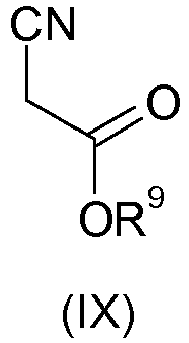
by reaction with sodium nitrite. Typically the reaction is conducted in acidic solution and at reduced temperature, for example -5 to 5°C. - An alternative method for the synthesis of compounds of general formula (II) in which R11 is hydrogen is by the reaction of a compound of general formula (X):

with a compound of general formula (XI):
- Typically the reaction may be carried out in the presence of a palladium or copper catalyst, for example Tris(dibenzylideneacetone)dipalladium(0) (Pd2dba3) or cuprous iodide (Cul) at elevated temperature, typically 70 to 110°C, more usually 75 to 95°C, under an inert atmosphere, for example nitrogen or argon.
- When Pd2dba3 is used as the catalyst, the reaction is suitably carried out in the presence of a ligand for palladium, for example 4,5-bis(diphenylphosphino)-9,9-dimethylxanthene (xantphos) and a base, for example caesium carbonate.
- Instead of the compound (XI) as shown above, the compound of general formula (X) may be reacted with a compound of general formula (XVI):

- The reaction conditions used are similar to those described above for the reaction with the compound of general formula (XI).
- Many compounds of general formula (X) are readily available. However, compounds of general formula (X) may also be synthesised from compounds of general formula (XII):

- The base is suitably a strong non-nucleophilic base such as lithium diisopropylamide, which may be formed in situ from diisopropylamine and n-butyllithium at a temperature of -78°C and in a solvent such as dry tetrahydrofuran. When the base is lithium diisopropylamide, the reaction between the base and the compound of general formula (XII) may also be carried out at temperature of about -78°C, following which the 1,2-dibromotetrachloroethane may be added and the reaction mixture allowed to warm to about 10-30°C, typically 15-25°C, or room temperature.
- In some cases, compounds of general formula (XI) and (XVI) may be prepared from compounds of general formula (IV) by an aminolysis reaction. Aminolysis reactions are well known and, for example, the preparation of primary sulfonamides by the reaction of sulfonyl chlorides with ammonia is described by Li et al, Synlett, (2006), 725. In this case the reaction was carried out in tetrahydrofuran. An alternative procedure using dichloromethane as solvent is described by Hu et al, J.A.C.S., (2008), 130, 13820 and Yuriev et al (European Journal of Medicinal Chemistry 39, 385) carried out the reaction in water.
- Alternatively, however, compounds of general formula (XI) may be prepared from compounds of general formula (XIII):

- This method is particularly suitable for the synthesis of compounds of general formula (XI) in which A is an aryl or heteroaryl group and Y is a straight or branched hydrocarbon chain.
- Compounds of general formula (XIII) may be prepared from compounds of general formula (XIV):
X4-Y-A-(R2)n (XIV)
wherein Y, n, R2 and A are as defined for general formula (I);
X4 is a leaving group for example a halo group such as Cl, Br or I or a sulfonate, for example phenyl sulfonate, toluene sulfonate or methylsulfonate;
by reaction with sodium 3-alkoxy-3-oxopropane-1-sulfinate of formula (XV):
- The reaction may be carried out in an organic solvent such as dimethylsulfoxide at a temperature of 15 to 30°C, typically at room temperature.
- The synthesis of sodium 3-alkoxy-3-oxopropane-1-sulfinates of formula (XV) and their conversion to sulfonamides of general formula (XI) is described by Baskin & Wang, Tet. Lett., 43, 8479-8483 (2002). Compounds of general formulae (XIV) are well known and are either readily available or may be prepared by methods well known to those of skill in the art.
- Compounds of general formula (XI) may also be prepared from compounds of general formula (IV) as defined above by reaction with aqueous ammonium hydroxide. The compound of general formula (IV) may be dissolved in a water-miscible solvent such as acetone and added to the aqueous ammonium hydroxide with cooling (for example to about 0°C). The reaction may then be completed at a temperature of about 15 to 30°C, typically room temperature.
- This method is particularly suitable for the synthesis of compounds of general formula (XI) in which Y is a bond and A is an aryl or heteroaryl group.
- Compounds of general formula (IV) can also be converted to compounds of general formula (XI) by reaction with sulfamide. The reaction is typically carried out in a cyclic ether solvent such as dioxin at raised temperature, for example at the reflux temperature of the solvent. This method is particularly suitable for the synthesis of compounds of general formula (XI) in which Y is a bond and A is a carbocyclic or heterocyclic group.
- A further method for the synthesis of compounds of general formula (XI) in which Y is CH2 is by the reaction of a compound of general formula (XXII):

- Suitable protecting groups for amines are described T. W. Greene & P.G.M. Wuts, "Greene's Protective Groups in Organic Synthesis", Wiley-Interscience; 4th edition, 2006. Suitable examples of protecting groups Q2 include benzyl and substituted benzyl groups, for example benzyl and especially 4-methoxybenzyl.
- Compounds of general formula (XXII) may be prepared from compounds of general formula (XXIII):

by reaction with a compound of general formula (XXIV):
Q2-NH2 (XXIV)
wherein Q2 is as defined above for general formula (XXII). - The reaction may be conducted in a basic solvent such as N-methylpyrrolidinone at elevated temperature, for example about 100-150°C.
- Compounds of general formula (XXIV) are either readily available or may be prepared by methods well known to those of skill in the art.
- Compounds of general formula (XXIII) may be prepared from compounds of general formula (XXV):

by reaction with a base, for example sodium hydroxide. The reaction may take place in a water miscible solvent such as methanol and at a temperature of 40-60°C, typically 50°C. - A compound of general formula (XXV) may be prepared from a compound of general formula (XXVI):
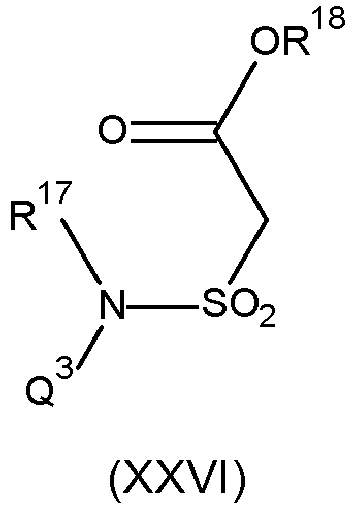
by reaction with a compound of general formula (XXVII)
X4-A(R2)n (XXVII)
wherein A, R2 and n are as defined for general formula (I) and X4 is a leaving group, especially a halogen such as bromine;
under basic conditions. - The basic conditions may be catalysed by a palladium catalyst such as Pd(PPh3)4 and the basic conditions may be provided by the use of a metal hydride, for example sodium hydride and the reaction may be conducted under an inert atmosphere, for example nitrogen, at elevated temperature, typically abut 6-80°C.
- A compound of general formula (XXVI) may be prepared by the reaction of a compound of general formula (XXVIII):
Q3-NHR17 (XXVIII)
wherein Q3 and R17 are as defined for general formula (XXIII);
with a compound of general formula (XXIX):
- The reaction may take place in an organic solvent such as dichloromethane at a temperature of 15-30°C, typically room temperature.
- Compounds of general formulae (XXVIII) and (XXIX) are readily available or may be prepared by methods familiar to those of skill in the art.
- As shown in Scheme 1, compounds of general formula (II) in which R11 is hydrogen may also be prepared from compounds of general formula (XVII):

with a strong acid. - Suitable protecting groups for amines are described T. W. Greene & P.G.M. Wuts, "Greene's Protective Groups in Organic Synthesis", Wiley-Interscience; 4th edition, 2006. Suitable examples of protecting groups Q1 include benzyl and substituted benzyl groups, for example benzyl and 4-methoxybenzyl.
- The acid may be sulphuric acid and the reaction may be carried out in an organic solvent such as dichloromethane. Typically, the reaction mixture will be cooled to about 0°C while the acid is added but then allowed to warm to 15 to 30°C, suitably room temperature.
- Compounds of general formula (XVII) may be prepared from compounds of general formula (XVIII):

by reaction with a compound of general formula (IV) as defined above. - The compound of general formula (XVIII) may first be treated with a strong base such as an alkali metal hydride, typically sodium hydride, under anhydrous conditions, for example in a dry organic solvent, for example a cyclic ether such as tetrahydrofuran and following this, the compound of general formula (IV) may be added to the reaction mixture.
- A compound of general formula (XVIII) may be prepared from a compound of general formula (IX) by reaction with an isothiocyanate compound of general formula (XIX):
S=C=N-Q1 (XIX)
wherein Q1 is as defined for general formula (XVII);
under basic conditions. - The reaction may be carried out at a temperature of about 15-30°C, typically room temperature under anhydrous conditions, for example in a dry organic solvent such as tetrahydrofuran. The base may be an alkali metal alkoxide, for example sodium or potassium tert-butoxide. Typically, the compound of general formula (IX) is mixed with the base in the solvent, following which the compound of general formula (XIX) is added and the mixture stirred until the reaction is complete.
- Compounds of general formulae (IX) and (XIX) are well known and are either readily available or may be prepared by methods well known to those of skill in the art.
- Compounds of general formula (I) may also be prepared by the methods shown in Scheme 2.

- Compounds of general formula (I) may be prepared by deprotection of a compound of general formula (XXX):

under acid conditions, for example using trifluoroacetic acid (TFA). - Suitable protecting groups for amines are described T. W. Greene & P.G.M. Wuts, "Greene's Protective Groups in Organic Synthesis", Wiley-Interscience; 4th edition, 2006. Suitable examples of protecting groups Q4 include benzyl and substituted benzyl groups, for example benzyl and especially 4-methoxybenzyl.
- The protecting group is removed under acidic conditions, for example using TFA, which may be aqueous TFA, for example 95% TFA(aq). The deprotection reaction may be carried out at a temperature of about 15-30°C, typically room temperature.
- As shown in Scheme 2, compounds of general formula (XXX) may be converted into other compounds of general formula (XXX) by modification of the moiety Y-A-(R2)n. For example a cyclic group A-(R2)n may be modified or replaced with an alternative group A-(R2)n,. A number of such processes are illustrated in the examples below.
- A compound of general formula (XXX) may be prepared by the reaction of a compound of general formula (XXXI):

with a compound of general formula (IV) as defined above; and a base. - The reaction is typically conducted under anhydrous conditions in a cyclic ether solvent such as tetrahydrofuran or a mixture of tetrahydrofuran and a crown ether such as 15-crown-5. Suitable bases include strong bases such as alkali metal hydrides, typically sodium hydride and the reaction may be carried out at 15-30°C, suitably at room temperature.
- A compound of general formula (XXXI) may be prepared from a compound of general formula (IX) as defined above by reaction with an isocyanate compound of general formula (XXXII):
Q4-N=C=S (XXXII)
wherein Q4 is as defined above for general formula (XXX);
in the presence of a base, typically an alkali metal alkoxide such as potassium tert-butoxide. - The reaction may be carried out under anhydrous conditions and in an organic solvent such as a cyclic ether, typically tetahydrofuran.
- Compounds of general formula (XXXII) are readily available or may be prepared by methods well known to those of skill in the art.
- An alternative method for the synthesis of a compound of general formula (XXX) in which Y is -CH2CH2- is by the reaction of a compound of general formula (XXXIII):

with a compound of general formula (XXI) as defined above in the presence of a 4-dimethylaminopyridine (DMAP). - Suitably the reaction is conducted in an alcoholic solvent such as n-propanol and at elevated temperature, for example 80-100°C, suitably 90°C.
- A compound of general formula (XXXII) may be prepared from a compound of general formula (XXXI) as defined above by reaction with a base followed by 2-chloroethanesulfonyl chloride. Suitable bases include alkali metal hydrides such as sodium hydride and the reaction may be conducted at a temperature of about 15-30°C, or room temperature. The reaction is typically conducted under anhydrous conditions in a cyclic ether solvent such as tetrahydrofuran or a mixture of tetrahydrofuran and a crown ether such as 15-crown-5.
- As already discussed, the compound of general formula (I) are inhibitors or metallo-β-lactamase (MBL) enzymes and are therefore useful for removing or reducing resistance of Gram-negative bacteria to antibiotics.
- Therefore, in a further aspect of the invention there is provided a compound of general formula (I) or 5-(4-aminophenylsulfonamido)thiazole-4-carboxylic acid for use in medicine, particularly in the removal or reduction of antibiotic resistance in Gram-negative bacteria.
- Also described is the use of a compound of general formula (I) or 5-(4-aminophenylsulfonamido)thiazole-4-carboxylic acid in the preparation of an agent for removing or reducing resistance of Gram-negative bacteria to antibiotics.
- Also described is a method for reducing or removing resistance of Gram-negative bacteria to antibiotics, the method comprising administering to a patient in need of such treatment an effective amount of a compound of general formula (I) or 5-(4-aminophenylsulfonamido)thiazole-4-carboxylic acid.
- The Gram-negative bacteria of which antibiotic resistance can be removed using the compounds of general formula (I) are bacteria which produce metallo-β-lactamases, which may be metallo-β-lactamases of subclasses B1, B2 or B3, for example IMP-type (including IMP-1), VIM-type (including VIM-1 and VIM-2) and NDM-type (including NDM-1) enzymes.
- Typical examples of such bacteria include Enterobacteriaceae (such as Klebsiella pneumonia and Escherichia coli), Pseudomonadaceae (such as Pseudomonas aeruginosa and Burkholderia cepacia) and Acinetobacter baumannii..
- In another aspect of the invention there is provided a product comprising a compound of general formula (I) or 5-(4-aminophenylsulfonamido)thiazole-4-carboxylic acid in combination with an antibiotic agent.
- In a further aspect of the invention, there is provided a product comprising a compound of general formula (I) or 5-(4-aminophenylsulfonamido)thiazole-4-carboxylic acid in combination with an antibiotic agent for the treatment of a bacterial infection, particularly a bacterial infection which is resistant to treatment with the antibiotic when used alone.
- In using the product, the compound of general formula (I) or 5-(4-aminophenylsulfonamido)thiazole-4-carboxylic acid may be administered simultaneously with the antibiotic or the two agents may be administered separately, either immediately after one another or at different times.
- The antibiotic agent may be a β-lactam antibiotic, for example an antibiotic selected from carbapenems, penicillins, cephalosporins and penems.
- Examples of carbapenem antibiotics include Imipenem, Meropenem, Ertapenem, Doripenem and Biapenem.
- Examples of penicillins include Amoxicillin, Ampicillin, Ticarcillin, Piperacillin and Cloxacillin
- Examples of cephalosporins include Cefazolin, Ceftriaxone, Ceftazidine and Ceftobiprole.
- Examples of penems include Faropenem.
- Further described is the use of a compound of general formula (I) or 5-(4-aminophenylsulfonamido)thiazole-4-carboxylic acid in the preparation of an agent for the treatment of a bacterial infection, particularly a bacterial infection which is resistant to treatment with the antibiotic when used alone.
- Also described is a method for the treatment of a bacterial infection, the method comprising administering to a patient in need of such treatment an effective amount of a compound of general formula (I) or 5-(4-aminophenylsulfonamido)thiazole-4-carboxylic acid. The bacterial infection is typically a bacterial infection which is resistant to treatment with the antibiotic when used alone.
- Suitable antibiotics are as set out above.
- The compound of general formula (I) will generally be formulated for administration by a desired route.
- In a further aspect of the invention, there is provided a pharmaceutical or veterinary composition comprising a compound of general formula (I) or 5-(4-aminophenylsulfonamido)thiazole-4-carboxylic acid and a pharmaceutically or veterinarily acceptable excipient or carrier.
- In some embodiments, the composition may also comprise an antibiotic agent, especially an antibiotic agent as discussed above.
- The excipient and/or the carrier, or, if more than one be present, each of the excipients and carriers, must be acceptable in the sense of being compatible with the other ingredients of the formulation and not deleterious to the recipient.
- The formulations include those suitable for oral, rectal, nasal, topical (including eye drops, buccal and sublingual), vaginal or parenteral (including subcutaneous, intramuscular, intravenous and intradermal) administration and may be prepared by any methods well known in the art of pharmacy.
- The route of administration will depend upon the condition to be treated but preferred compositions are formulated for oral, parenteral or topical administration, especially oral or parenteral administration and more especially parenteral administration, especially intravenous administration.
- The composition may be prepared by bringing into association the above defined active agent with the carrier. In general, the formulations are prepared by uniformly and intimately bringing into association the active agent with liquid carriers or finely divided solid carriers or both, and then if necessary shaping the product. The invention extends to methods for preparing a pharmaceutical composition comprising bringing a compound of general formula (I) or 5-(4-aminophenylsulfonamido)thiazole-4-carboxylic acid in conjunction or association with a pharmaceutically or veterinarily acceptable carrier or vehicle.
- Formulations for oral administration in the present invention may be presented as: discrete units such as capsules, sachets or tablets each containing a predetermined amount of the active agent; as a powder or granules; as a solution or a suspension of the active agent in an aqueous liquid or a non-aqueous liquid; or as an oil-in-water liquid emulsion or a water in oil liquid emulsion; or as a bolus etc.
- For compositions for oral administration (e.g. tablets and capsules), the term "acceptable carrier" includes vehicles such as common excipients e.g. binding agents, for example syrup, acacia, gelatin, sorbitol, tragacanth, polyvinylpyrrolidone (Povidone), methylcellulose, ethylcellulose, sodium carboxymethylcellulose, hydroxypropylmethylcellulose, sucrose and starch; fillers and carriers, for example corn starch, gelatin, lactose, sucrose, microcrystalline cellulose, kaolin, mannitol, dicalcium phosphate, sodium chloride and alginic acid; and lubricants such as magnesium stearate, sodium stearate and other metallic stearates, glycerol stearate, stearic acid, silicone fluid, talc waxes, oils and colloidal silica. Flavouring agents such as peppermint, oil of wintergreen, cherry flavouring and the like can also be used. It may be desirable to add a colouring agent to make the dosage form readily identifiable. Tablets may also be coated by methods well known in the art.
- A tablet may be made by compression or moulding, optionally with one or more accessory ingredients. Compressed tablets may be prepared by compressing in a suitable machine the active agent in a free flowing form such as a powder or granules, optionally mixed with a binder, lubricant, inert diluent, preservative, surface-active or dispersing agent. Moulded tablets may be made by moulding in a suitable machine a mixture of the powdered compound moistened with an inert liquid diluent. The tablets may optionally be coated or scored and may be formulated so as to provide slow or controlled release of the active agent.
- Other formulations suitable for oral administration include lozenges comprising the active agent in a flavoured base, usually sucrose and acacia or tragacanth; pastilles comprising the active agent in an inert base such as gelatin and glycerin, or sucrose and acacia; and mouthwashes comprising the active agent in a suitable liquid carrier.
- For topical application to the skin, compounds of general formula (I) or 5-(4-aminophenylsulfonamido)thiazole-4-carboxylic acid may be made up into a cream, ointment, jelly, solution or suspension etc. Cream or ointment formulations that may be used for the drug are conventional formulations well known in the art, for example, as described in standard text books of pharmaceutics such as the British Pharmacopoeia.
- Parenteral formulations will generally be sterile.
- Further described is a process for the preparation of
a pharmaceutical or veterinary composition, the process comprising admixing a compound of general formula (I) or or 5-(4-aminophenylsulfonamido)thiazole-4-carboxylic acid, a pharmaceutically acceptable excipient or carrier and optionally an antibiotic agent. - Typically, the dose of the compound will be about 0.01 to 100 mg/kg; so as to maintain the concentration of drug in the plasma at a concentration effective to inhibit MBL enzymes. The precise amount of a compound of general formula (I) or 5-(4-aminophenylsulfonamido)thiazole-4-carboxylic acid which is therapeutically effective, and the route by which such compound is best administered, is readily determined by one of ordinary skill in the art by comparing the blood level of the agent to the concentration required to have a therapeutic effect.
- Since the compounds of general formula (I) are inhibitors of MBL enzymes, they can also be used in a method for the detection of bacteria which express MBL enzymes, i.e. which are wholly or partially resistant to β lactam antibiotics.
- Therefore in a further aspect of the invention there is provided a method of determining whether bacteria express MBL enzymes, the method comprising
- i. contacting a test sample suspected of containing an MBL enzyme with a compound of general formula (I);
- ii. detecting MBL enzyme activity in the test sample.
- MBL enzyme activity may be detected by adding to the test sample a detection solution comprising a detector compound containing a β lactam ring, for example a β lactam antibiotic, including any of the compounds discussed above. If the test sample comprises bacteria which express an MBL enzyme, this enzyme will hydrolyse the β lactam ring of the detector compound.
- The hydrolysis can be detected in a number of ways including spectrophotometric methods. One simple way of detecting the hydrolysis reaction is to include in the detection solution a pH indicator which changes colour according to the acidity of its environment. Since the hydrolysis of the β lactam ring leads to the production of a carboxylic acid, the pH of the detection solution will change on contact with bacteria which produce MBL enzymes and this can be visualised using a pH indicator.
- As just described, suitable detector compounds include antibiotics, for example any of the compounds mentioned above as being suitable for use in combination with the compounds of general formula (I).
- The test sample may comprise bacteria suspected of expressing an MBL enzyme, for example a liquid sample comprising a suspension of such bacteria.
- The bacteria may express any MBL enzyme, for example an enzyme of subclass B1, B2 or B3. However, in many cases the enzyme expressed is of subclass B1, for example an IMP-type, VIM-type or NDM-type enzyme.
- Suitably, a compound of general formula (I) is added to the test sample, typically at a concentration of between 10 nM and 10 µM.
- Typically a control sample is also provided which is identical to the test sample; no compound of general formula (I) is added to the control sample.
- The presence and amount of MBL enzyme in the sample can be determined by adding the detector compound to the test sample and to the control sample and detecting any difference in the degree of hydrolysis seen in the test and control samples.
- For example, when a pH indicator is used as a means of detecting hydrolysis, the presence of MBL enzyme can be determined by a difference in the colour of the test and control samples.
- Further described is a kit for carrying out the method of determining whether bacteria express MBL enzymes, the kit comprising:
- i. a compound of general formula (I) as defined above;
- ii. a detector compound containing a β lactam ring; and
- iii. means for detecting hydrolysis of the β lactam ring of the detector compound.
- Suitably these agents will be provided in suitable containers. The compound of general formula (I) may be any of the compounds described above; and the detector compound and the means for detecting hydrolysis are suitably the agents described above for the method of determining whether bacteria express MBL enzymes.
- The invention will now be described in greater detail with reference to the following examples.
- Tables 1 and 2 set out the compounds synthesised in the examples.
Table 1 - Compounds of formula (IA), i.e. compounds of formula (I) in which R1 is H. 
No Z Name 1 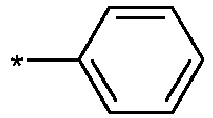
5-benzenesulfonamido-1,3-thiazole-4-carboxylic acid; 2 
5-{[(3,5-dichlorophenyl)methyl]sulfonamido}-1,3-thiazole-4-carboxylic acid; 3 
5-(2,4,6-trimethylphenylsulfonamido)thiazole-4-carboxylic acid; 4 
5-{[3-(trifluoromethyl)phenyl]sulfonamido}-1,3-thiazole-4-carboxylic acid; 5 
5-(phenylmethylsulfonamido)thiazole-4-carboxylic acid; 6 
5-(3-methoxyphenylsulfonamido)thiazole-4-carboxylic acid; 7 
5-(2-phenylethylsulfonamido)thiazole-4-carboxylic acid; 8 
5-(thiophene-2-sulfonamido)thiazole-4-carboxylic acid; 9 
5-(4,5-dichlorothiophene-2-sulfonamido)thiazole-4-carboxylic acid; 10 
5-(2,5-dichlorothiophene-3-sulfonamido)thiazole-4-carboxylic acid; 11 
5-(2-(trifluoromethyl)phenylsulfonamido)thiazole-4-carboxylic acid; 12 
5-(4-(trifluoromethyl)phenylsulfonamido)thiazole-4-carboxylic acid; 13 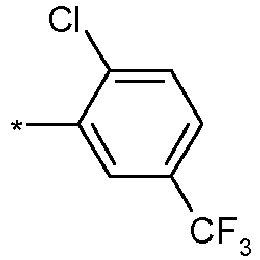
5-(2-chloro-5-(trifluoromethyl)phenylsulfonamido)thiazole-4-carboxylic acid; 14 
5-(3,5-bis(trifluoromethyl)phenylsulfonamido)thiazol e-4-carboxylic acid; 15 
5-({[2-(trifluoromethyl)phenyl]methyl}sulfonamido)-1,3-thiazole-4-carboxylic acid; 16 
5-{[(2-methylphenyl)methyl]sulfonamido}-1,3-thiazole-4-carboxylic acid; 17 
5-((2-nitrophenyl)methylsulfonamido)thiazole-4-carboxylic acid; 18 
5-{[(2-bromophenyl)methyl]sulfonamido}-1,3-thiazole-4-carboxylic acid; 19 
5-(5-chlorothiophene-2-sulfonamido)thiazole-4-carboxylic acid; 20 
5-(5-phenylthiophene-2-sulfonamido)thiazole-4-carboxylic acid; 21 
5-(thiophene-3-sulfonamido)thiazole-4-carboxylic acid; 22 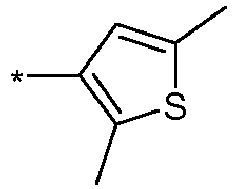
5-(2,5-dimethylthiophene-3-sulfonamido)thiazole-4-carboxylic acid; 23 
5-([1,1'-biphenyl]-2-ylsulfonamido)thiazole-4-carboxylic acid; 24 
5-((2-aminophenyl)methylsulfonamido)thiazole-4-carboxylic acid; 25 
5-((2-acetamidophenyl)methylsulfonamido)thiazole -4-carboxylic acid; 26 
5-((2-benzamidophenyl)methylsulfonamido)thiazol e-4-carboxylic acid; 27 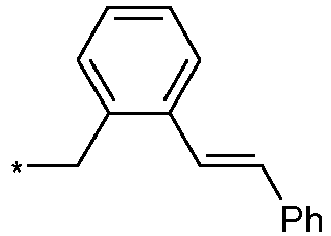
(E)-5-((2-styrylphenyl)methylsulfonamido)thiazole-4-carboxylic acid; 28 
(E)-5-((2-(3-(dimethylamino)-3-oxoprop-1-en-1-yl)phenyl)methylsulfonamido)thiazole-4-carboxylic acid; 29 
5-([1,1'-biphenyl]-2-ylmethylsulfonamido)thiazole-4-carboxylic acid; 30 
5-((2-(trifluoromethoxy)phenyl)methylsulfonamido)t hiazole-4-carboxylic acid; 31 
5-((3-(trifluoromethyl)phenyl)methylsulfonamido)thi azole-4-carboxylic acid; 32 
5-((3-bromophenyl)methylsulfonamido)thiazole-4-carboxylic acid; 33 
5-((3-cyanophenyl)methylsulfonamido)thiazole-4-carboxylic acid; 34 
5-((2-chlorophenyl)methylsulfonamido)thiazole-4-carboxylic acid; 35 
5-(4-nitrophenylsulfonamido)thiazole-4-carboxylic acid; 36 
5-(4-aminophenylsulfonamido)thiazole-4-carboxylic acid; 37 
5-({5-[5-(trifluoromethyl)-1,2-oxazol-3-yl]thiophen-2-yl}sulfonamido)-1,3-thiazole-4-carboxylic acid; 38 
5-(1-benzothiophene-2-sulfonamido)-1,3-thiazole-4-carboxylic acid; 39 
5-[(5-methylthiophen-2-yl)sulfonamido]-1,3-thiazole-4-carboxylic acid; 40 
5-[(5-bromothiophen-2-yl)sulfonamido]-1,3-thiazole-4-carboxylic acid; 41 
5-(1-benzothiophene-3-sulfonamido)-1,3-thiazole-4-carboxylic acid; 42 
5-[(4-bromo-2,5-dichlorothiophen-3-yl)sulfonamido]-1,3-thiazole-4-carboxylic acid; 43 
5-({[(2-chlorophenyl)methyl]sulfamoyl}amino)-1,3-thiazole-4-carboxylic acid; 44 
5-[({[3-(trifluoromethyl)phenyl]methyl}sulfamoyl)amin o]-1,3-thiazole-4-carboxylic acid; 45 
5-[(3-bromothiophen-2-yl)sulfonamido]-1,3-thiazole-4-carboxylic acid; 46 
5-{[(2-iodophenyl)methyl]sulfonamido}-1,3-thiazole-4-carboxylic acid; 47 
5-{[4-phenyl-5-(trifluoromethyl)thiophen-3-yl]sulfonamido}-1,3-thiazole-4-carboxylic acid; 48 
5-{[(2,3-dichlorophenyl)methyl]sulfonamido}-1,3-thiazole-4-carboxylic acid; 49 
5-{[(3,4-dichlorophenyl)methyl]sulfonamido}-1,3-thiazole-4-carboxylic acid; 60 
5-[(1-phenylethyl)sulfonamido]-1,3-thiazole-4-carboxylic acid; 61 
5-{[6-(trifluoromethyl)pyridin-3-yl]sulfonamido}-1,3-thiazole-4-carboxylic acid; 62 
5-[(2-phenoxyethyl)sulfonamido]-1,3-thiazole-4-carboxylic acid; 63 
5-{[2-(1,3-dioxo-2,3-dihydro-1H-isoindol-2-yl)ethyl]sulfonamido}-1,3-thiazole-4-carboxylic acid; 64 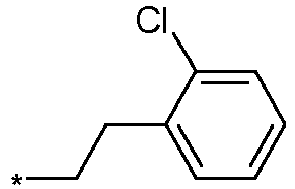
5-{[2-(2-chlorophenyl)ethyl]sulfonamido}-1,3-thiazole-4-carboxylic acid; 65 
5-({1-[5-(trifluoromethyl)pyridin-2-yl]-1H-pyrazol-4-yl}sulfonamido)-1,3-thiazole-4-carboxylic acid; 66 
5-[(2-chlorophenyl)sulfonamido]-1,3-thiazole-4-carboxylic acid; 67 
5-(pyridine-3-sulfonamido)-1,3-thiazole-4-carboxylic acid; 68 
5-[(2,6-dichlorophenyl)sulfonamido]-1,3-thiazole-4-carboxylic acid; 69 
5-(cyclohexylmethyl)sulfonamido-1,3-thiazole-4-carboxylic acid; 70 
5-[(4-methyl-3,4-dihydro-2H-1,4-benzoxazin-7-yl)sulfonamido]-1,3-thiazole-4-carboxylic acid; 71 
5-[(1-phenylpropyl)sulfonamido]-1,3-thiazole-4-carboxylic acid; 72 
5-{[2-(4-methoxyphenyl)ethyl]sulfonamido}-1,3-thiazole-4-carboxylic acid; 73 
5-({2-[3-(trifluoromethyl)phenyl]ethyl}sulfonamido)-1,3-thiazole-4-carboxylic acid; 74 
5-{[2-(4-chlorophenyl)ethyl]sulfonamido}-1,3-thiazole-4-carboxylic acid; 75 
5-[(piperidine-1-sulfonyl)amino]-1,3-thiazole-4-carboxylic acid; 76 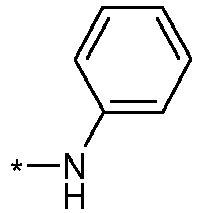
5-[(phenylsulfamoyl)amino]-1,3-thiazole-4-carboxylic acid; 77 
5-{[benzyl(methyl)sulfamoyl]amino}-1,3-thiazole-4-carboxylic acid; 78 
5-[(4-acetamidophenyl)sulfonamido]-1,3-thiazole-4-carboxylic acid; 79 
5-[(2-methoxyphenyl)sulfonamido]-1,3-thiazole-4-carboxylic acid; 80 
5-(1,2,3,4-tetrahydronaphthalene-1-sulfonamido)-1,3-thiazole-4-carboxylic acid; 81 
5-[(5-methyl-1-phenyl-1H-pyrazol-4-yl)sulfonamido]-1,3-thiazole-4-carboxylic acid; 82 
5-(cyclopropylmethyl)sulfonamido-1,3-thiazole-4-carboxylic acid; 83 
5-{[(2-methoxyphenyl)methyl]sulfonamido}-1,3-thiazole-4-carboxylic acid; 84 
5-{[2-(2-methoxyphenyl)ethyl]sulfonamido}-1,3-thiazole-4-carboxylic acid; 85 
5-{[2-(3-methoxyphenyl)ethyl]sulfonamido}-1,3-thiazole-4-carboxylic acid; 86 
5-{[2-(3-chlorophenyl)ethyl]sulfonamido}-1,3-thiazole-4-carboxylic acid; 87 
5-[(2-methanesulfonylphenyl)sulfonamido]-1,3-thiazole-4-carboxylic acid; 88 
5-{[methyl(phenyl)sulfamoyl]amino}-1,3-thiazole-4-carboxylic acid; 89 
5-{[4-(morpholin-4-yl)phenyl]sulfonamido}-1,3-thiazole-4-carboxylic acid; 90 
5-[(4-cyanophenyl)sulfonamido]-1,3-thiazole-4-carboxylic acid; 91 
5-(pyridine-2-sulfonamido)-1,3-thiazole-4-carboxylic acid; 92 
5-[(1-methyl-1H-imidazol-2-yl)sulfonamido]-1,3-thiazole-4-carboxylic acid; 93 
5-[(6-methoxypyridin-3-yl)sulfonamido]-1,3-thiazole-4-carboxylic acid; 94 
5-{[4-(1H-pyrazol-1-yl)phenyl]sulfonamido}-1,3-thiazole-4-carboxylic acid; 95 
5-[(1-ethyl-5-methyl-1H-pyrazol-4-yl)sulfonamido]-1,3-thiazole-4-carboxylic acid; 97 
5-{[(2-cyanophenyl)methyl]sulfonamido}-1,3-thiazole-4-carboxylic acid; 98 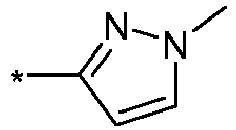
5-[(1-methyl-1H-pyrazol-3-yl)sulfonamido]-1,3-thiazole-4-carboxylic acid; 99 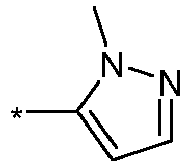
5-[(1-methyl-1H-pyrazol-5-yl)sulfonamido]-1,3-thiazole-4-carboxylic acid; 100 
5-({1-[(benzyloxy)carbonyl]piperidin-4-yl}sulfonamido)-1,3-thiazole-4-carboxylic acid; 101 
5-[(3-phenylpropyl)sulfonamido]-1,3-thiazole-4-carboxylic acid; 104 
5-(2,3-dihydro-1H-indene-1-sulfonamido)-1,3-thiazole-4-carboxylic acid; 105 
5-{[4-(1-methyl-1H-pyrazol-5-yl)phenyl]sulfonamido}-1,3-thiazole-4-carboxylic acid; 106 
5-{[2-(1,2,3,4-tetrahydroquinolin-1-yl)ethyl]sulfonamido}-1,3-thiazole-4-carboxylic acid; 107 
5-{[2-(N-phenylacetamido)ethyl]sulfonamido}-1,3-thiazole-4-carboxylic acid; 108 
5-{[4-(3-oxomorpholin-4-yl)phenyl]sulfonamido}-1,3-thiazole-4-carboxylic acid; 109 
5-{[4-(2-oxo-1,3-oxazolidin-3-yl)phenyl]sulfonamido}-1,3-thiazole-4-carboxylic acid; 110 
5-[(1,2-dimethyl-1H-imidazol-4-yl)sulfonamido]-1,3-thiazole-4-carboxylic acid; 111 
5-[(oxan-4-ylmethyl)sulfonamido]-1,3-thiazole-4-carboxylic acid; 112 
5-[({1-[(benzyloxy)carbonyl]piperidin-4-yl}methyl)sulfonamido]-1,3-thiazole-4-carboxylic acid; 113 
5-{[4-(2-oxopyrrolidin-1-yl)phenyl]sulfonamido}-1,3-thiazole-4-carboxylic acid; 114 
5-({1-[6-(trifluoromethyl)pyridin-3-yl]-1H-pyrazol-4-yl}sulfonamido)-1,3-thiazole-4-carboxylic acid; 115 
5-{[4-(1,3-oxazol-5-yl)phenyl]sulfonamido}-1,3-thiazole-4-carboxylic acid; 116 
5-{[4-(1H-pyrazol-4-yl)phenyl]sulfonamido}-1,3-thiazole-4-carboxylic acid; 117 
5-[(1-phenyl-1H-pyrazol-4-yl)sulfonamido]-1,3-thiazole-4-carboxylic acid; 118 
5-{[4-(piperidin-4-yl)phenyl]sulfonamido}-1,3-thiazole-4-carboxylic acid; 119 
5-[(4-propanamidophenyl)sulfonamido]-1,3-thiazole-4-carboxylic acid; 120 
5-{[4-(2-hydroxyacetamido)phenyl]sulfonamido}-1,3-thiazole-4-carboxylic acid; 121 
5-({4-[(methylcarbamoyl)amino]phenyl}sulfonamido )-1,3-thiazole-4-carboxylic acid; 122 
5-{[(2,4-dichlorophenyl)methyl]sulfonamido}-1,3-thiazole-4-carboxylic acid; 123 
5-{[(2-fluorophenyl)methyl]sulfonamido}-1,3-thiazole-4-carboxylic acid; 124 
5-{[(2,3-difluorophenyl)methyl]sulfonamido}-1,3-thiazole-4-carboxylic acid; 125 
5-{[4-(2-methoxyacetamido)phenyl]sulfonamido}-1,3-thiazole-4-carboxylic acid; 126 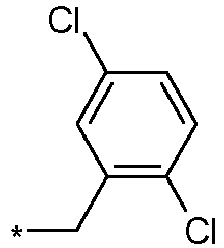
5-{[(2,5-dichlorophenyl)methyl]sulfonamido}-1,3-thiazole-4-carboxylic acid; 127 
5-{[(2,6-dichlorophenyl)methyl]sulfonamido}-1,3-thiazole-4-carboxylic acid; 128 
5-{[(2-chloro-6-fluorophenyl)methyl]sulfonamido}-1,3-thiazole-4-carboxylic acid; 129 
5-{[(2-chloro-4-fluorophenyl)methyl]sulfonamido}-1,3-thiazole-4-carboxylic acid; 130 
5-({[2-chloro-5-(trifluoromethyl)phenyl]methyl}sulfonamido)-1,3-thiazole-4-carboxylic acid; 131 
5-({4-[(dimethylamino)methyl]phenyl}sulfonamido)-1,3-thiazole-4-carboxylic acid; 132 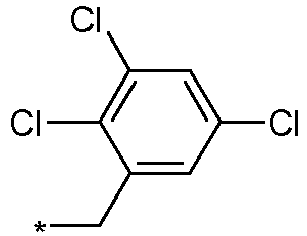
5-{[(2,3,5-trichlorophenyl)methyl]sulfonamido}-1,3-thiazole-4-carboxylic acid; 133 
5-{[(2,3-dichloro-6-fluorophenyl)methyl]sulfonamido}-1,3-thiazole-4-carboxylic acid; 134 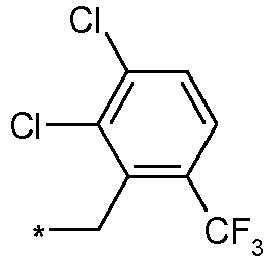
5-({[2,3-dichloro-6-(trifluoromethyl)phenyl]methyl}sulfonamido)-1,3-thiazole-4-carboxylic acid; 135 
5-{[(4-bromo-2-chlorophenyl)methyl]sulfonamido}-1,3-thiazole-4-carboxylic acid; 136 
5-({2-[methyl(phenyl)amino]ethyl}sulfonamido)-1,3-thiazole-4-carboxylic acid; 137 
5-{[(4-nitrophenyl)methyl]sulfonamido}-1,3-thiazole-4-carboxylic acid; 138 
5-[6-(piperidin-1-yl)pyridin-3-ylsulfonamido]-1,3-thiazole-4-carboxylic acid; 139 
5-[6-(methylamino)pyridin-3-ylsulfonamido]-1,3-thiazole-4-carboxylic acid; 140 
5-[6-(4-methylpiperazin-1-yl)pyridin-3-ylsulfonamido]-1,3-thiazole-4-carboxylic acid; 141 
5-(6-acetamidopyridin-3-ylsulfonamido)-1,3-thiazole-4-carboxylic acid; 142 
5-{4-[(5-methyl-1,2-oxazol-3-yl)amino]phenylsulfonamido}-1,3-thiazole-4-carboxylic acid; 143 
5-(6-aminopyridin-3-ylsulfonamido)-1,3-thiazole-4-carboxylic acid; 144 
5-[(6-chloro-2H-1,3-benzodioxol-5-yl)methylsulfonamido]-1,3-thiazole-4-carboxylic acid; 145 
5-{[(2-chloro-6-nitrophenyl)methyl]sulfonamido}-1,3-thiazole-4-carboxylic acid; 146 
5-(quinoline-6-sulfonamido)-1,3-thiazole-4-carboxylic acid; 147 
5-[(2,3-dihydroindole-1-sulfonyl)amino]-1,3-thiazole-4-carboxylic acid; 148 
5-(4-methanesulfonylphenylsulfonamido)-1,3-thiazole-4-carboxylic acid; 149 
5-[3-(2-oxo-1,3-oxazolidin-3-yl)phenylsulfonamido]-1,3-thiazole-4-carboxylic acid; 150 
5-[3-(2H-pyrazol-3-yl)phenylsulfonamido]-1,3-thiazole-4-carboxylic acid; 151 
5-[2-(pyridin-3-yl)ethylsulfonamido]-1,3-thiazole-4-carboxylic acid; 152 
5-[3-(3-oxomorpholin-4-yl)phenylsulfonamido]-1,3-thiazole-4-carboxylic acid; 153 
5-[3-(2-oxopyrrolidin-1-yl)phenylsulfonamido]-1,3-thiazole-4-carboxylic acid; 154 
5-[6-(piperidin-4-ylamino)pyridin-3-ylsulfonamido]-1,3-thiazole-4-carboxylic acid; 155 
5-(6-{[2-(dimethylamino)ethyl]amino}pyridin-3-ylsulfonamido)-1,3-thiazole-4-carboxylic acid; 156 
5-[(4-acetamidophenyl)methylsulfonamido]-1,3-thiazole-4-carboxylic acid; 157 
5-[6-(piperazin-1-yl)pyridin-3-ylsulfonamido]-1,3-thiazole-4-carboxylic acid; 158 
5-[6-(4-aminopiperidin-1-yl)pyridin-3-ylsulfonamido]-1,3-thiazole-4-carboxylic acid; 159 
5-[6-(3-aminopyrrolidin-1-yl)pyridin-3-ylsulfonamido]-1,3-thiazole-4-carboxylic acid; 160 
5-[6-(pyrrolidin-1-yl)pyridin-3-ylsulfonamido]-1,3-thiazole-4-carboxylic acid; 161 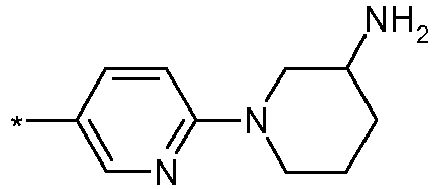
5-[6-(3-aminopiperidin-1-yl)pyridin-3-ylsulfonamido]-1,3-thiazole-4-carboxylic acid; 162 
5-[6-(1,4-diazepan-1-yl)pyridin-3-ylsulfonamido]-1,3-thiazole-4-carboxylic acid; 163 
5-[4-(pyrrolidin-3-yloxy)phenylsulfonamido]-1,3-thiazole-4-carboxylic acid; 164 
5-[6-(3-aminoazetidin-1-yl)pyridin-3-ylsulfonamido]-1,3-thiazole-4-carboxylic acid; 165 
5-[6-(piperidin-4-yl)pyridin-3-ylsulfonamido]-1,3-thiazole-4-carboxylic acid; 166 
5-[6-(1,2,3,6-tetrahydropyridin-4-yl)pyridin-3-ylsulfonamido]-1,3-thiazole-4-carboxylic acid; 167 
5-{6-[4-(2,2,2-trifluoroethyl)piperazin-1-yl]pyridin-3-ylsulfonamido}-1,3-thiazole-4-carboxylic acid X1 168 
5-[1-(2-chlorophenyl)ethylsulfonylamino]thiazole-4-carboxylic acid Enantiomer 1 X2 169 
5-[1-(2-chlorophenyl)ethylsulfonylamino]thiazole-4-carboxylic acid Enantiomer 2 X3 170 
5-(3-pyridylmethylsulfonylamino)thiazole-4-carboxylic acid X4 171 
5-(isoindolin-5-ylmethylsulfonylamino)thiazole-4-carboxylic acid X5 172 
S-5-[[4-[1-(2-amino-2-phenyl-acetyl)-4-piperidyl]phenyl]sulfonylamino]thiazole-4-carboxylic acid X6 173 
R-5-[[4-[1-(2-amino-2-phenyl-acetyl)-4-piperidyl]phenyl]sulfonylamino]thiazole-4-carboxylic acid X7 174 
5-[[4-[(2-aminoacetyl)amino]phenyllsulfonylamino]thia zole-4-carboxylic acid X8 175 
5-[(4-acetamido-3-fluorophenyl)sulfonylamino]thiazole-4-carboxylic acid X9 176 
5-[[4-[(2-hydroxy-2-methylpropanoyl)amino]phenyl]sulfonylamino]thiazol e-4-carboxylic acid X10 177 
5-[[4-[(2-hydroxy-2-phenylacetyl)amino]phenyl]sulfonylamino]thiazole-4-carboxylic acid X11 178 
5-[[4-[(2-hydroxy-3-phenylpropanoyl)amino]phenyl]sulfonylamino]thiazol e-4-carboxylic acid X12 179 
5-[[2-(2-hydroxyethylamino)pyrimidin-5-yl]sulfonylamino]thiazole-4-carboxylic acid X13 180 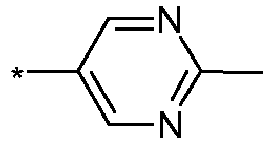
5-[(2-methylpyrimidin-5-yl)sulfonylamino]thiazole-4-carboxylic acid X14 181 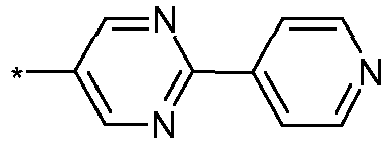
5-[[2-(4-pyridyl)pyrimidin-5-yl]sulfonylamino]thiazole-4-carboxylic acid X15 182 
5-[(6-methyl-3-pyridyl)sulfonylamino]thiazole-4-carboxylic acid 183 (ANT 753) 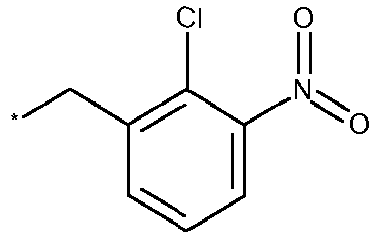
5-[(2-chloro-3-nitro-phenyl)methyl sulfonylamino]thiazole-4-carboxylic acid Table 2 - Compounds of general formula (I) where R1 is other than H No Structure Name 50 
5-benzylsulfonamido-2-methyl-1,3-thiazole-4-carboxylic acid; 51 
2-methyl-5-(quinoline-8-sulfonamido)-1,3-thiazole-4-carboxylic acid; 52 
5-benzenesulfonamido-2-methyl-1,3-thiazole-4-carboxylic acid 53 
5-{[(3,5-dichlorophenyl)methyl]sulfonamido}-2-methyl-1,3-thiazole-4-carboxylic acid 54 
5-[(2-chlorophenyl)sulfonamido]-2-methyl-1,3-thiazole-4-carboxylic acid 55 
2-methyl-5-[(2,4,6-trimethylphenyl)sulfonamido]-1,3-thiazole-4-carboxylic acid 56 
5-[(2,5-dichlorothiophen-3-yl)sulfonamido]-2-methyl-1,3-thiazole-4-carboxylic acid 57 
5-{[(2-bromophenyl)methyl]sulfonamido}-2-methyl-1,3-thiazole-4-carboxylic acid 58 
5-benzenesulfonamido-2-phenyl-1,3-thiazole-4-carboxylic acid 59 
5-benzenesulfonamido-2-ethyl-1,3-thiazole-4-carboxylic acid 102 
5-{[(2-chlorophenyl)methyl]sulfonamido}-2-methyl-1,3-thiazole-4-carboxylic acid 96 
5-{[(2-chlorophenyl)methyl]sulfonamido}-2-(trifluoromethyl)-1,3-thiazole-4-carboxylic acid; - Preparative HPLC was carried out using either a XSELECT CSH Prep C18 OBD [(30x150mm), 5µm)] column eluting with water/acetonitrile (+0.1% formic acid) at 60mL/min or a XSELECT CSH Prep C6 Phenyl OBD [(19x250mm), 5µm] column eluting with water/acetonitrile (+0.1% formic acid) at 18mL/min.Product detection was achieved using either a Agilent 6120 series Single Quadrupole Mass Spectrometer or a UV, diode array (190-450nm).
-
- Column: Acquity BEH C18, (2.1 x 100mm), 1.7µm; Flow 0.4mL/min
- Mobile Phase A: 0.1% formic acid (aq), B: 0.1% formic acid in acetonitrile
- Gradient: T/%B 0.0/5, 0.4/5, 6.0/ 95, 6.8/95, 7.0/5
-
- Column: Phenomenex Luna C18(2), (4.6 x 30mm), 3µm; Flow 2.0mL/min
- Mobile Phase A: 0.1% formic acid (aq), B: 0.1% formic acid in acetonitrile
- Gradient: T/%B 0.0/5, 0.5/5, 4.5/95, 5.5/95, 6.0/5
-
- Column: Phenomenex Luna C18(2), (4.6 x 30mm), 3µm; Flow 2.0mL/min
- Mobile Phase A: 0.1% formic acid (aq), B: 0.1% formic acid in acetonitrile
- Gradient: T/%B 0.0/5, 0.3/5, 4.3/95, 5.3/95, 5.8/5, 6.0/5
-
- Column: X-Bridge C18,(4.6 x 100mm), 3.5 µm; Flow
- Mobile Phase A: 5mM ammonium acetate (aq), B: acetonitrile
- Gradient: T/%B 0/5, 1/5, 2/15, 4.5/55, 6/95, 9.5/100, 10.5/5, 12/5
-
- Column: Acquity CSH-C18 (2.1 x 50mm), 1.7µm; Flow 0.4mL/min
- Mobile phase A: 0.1% formic acid (aq), B: 0.1% formic acid in acetonitrile
- Gradient: T/%B 0/2, 0.5/2, 1.2/45, 2.5/75, 3.2/100, 5.0/100, 5.01/2
-
- Column: XBridge BEH C18 (3.0 x 50mm), 2.5µm; Flow 0.7 mL/min
- Mobile Phase A: 0.05% TFA (aq), B: 0.05%TFA in acetonitrile
- Gradient: T/%B 0/10, 0.6/10, 2/90, 5/90, 5.01/10
-
- Column: XBridge BEH C18 (2.1 x 50mm), 1.7µm; Flow 0.5 mL/min
- Mobile Phase A: 0.05% TFA (aq), B: 0.05% TFA in acetonitrile
- Gradient: T/%B 0/10, 0.6/10, 2/90, 5/90, 5.01/10
-
- Column: XBridge C18 (4.6 x 100mm), 54µm; Flow 0.8mL/min
- Mobile phase A: 0.1% TFA (aq), B: acetonitrile
- Gradient: T/%B 0/10, 2/10, 4/80, 6/80, 7/98, 10.0/98, 10.1/10
-
- Column: Kinetex C18 (4.6 x 100mm), 5µm; Flow 0.8mL/min
- Mobile Phase A: 0.1% TFA (aq), B: acetonitrile
- Gradient: T/%B 0/2, 2/2, 5/80, 7/98, 12.0/98, 12.1/2
-
- Column: XBridge C18 (4.6 x 50mm), 2.5µm; Flow 1.3mL/min
- Mobile phase A: 0.1% formic acid (aq), B: 0.1% formic acid in acetonitrile
- Gradient: T/% B: 0/5, 0.5/5, 1/15, 3.3/98, 5.2/98, 5.5/5, 6.0/5
-
- Column: XBridge C18 (4.6 x 50mm), 2.5 µm; Flow 1.3mL/min
- Mobile phase A: 5mM ammonium bicarbonate (aq), B: 100% acetonitrile
- Gradient: T/% B: 0/5, 0.5/5, 1/15, 3.3/98, 5.2/98, 5.5/5, 6/5
-
- Column: Phenomenex Luna PFP(2)100A (4.6 x 150 mm), 5µm; Flow 1 mL/min
- Mobile phase A: 0.1% formic acid (aq), B: 0.075% formic acid in acetonitrile
- Gradient: T/%B 0/5, 0.5/5, 8/95, 10/95, 10.1/5, 11/5
-
- Column: Acquity BEH C18 (2.1 x 50mm), 1.7µm; Flow 0.6mL/min
- Mobile phase A: 0.1% formic acid (aq), B: 0.1% formic acid in acetonitrile
- Gradient: T/%B: 0/3, 0.4/3, 3.2/98, 3.8/98, 4.2/3, 4.5/3
-
- Column: Acquity UPLC BEH C18 (2.1 x 50mm), 1.7µm; Flow 0.5mL/min
- Mobile Phase A: 5mM ammonium acetate (aq), B: acetonitrile
- Gradient: T/%B: 0/2, 1.5/2, 2/15, 3/55, 4/95, 6/95, 6.5/2, 7/2
-
- Column: Xbridge C18 (4.6 x 50mm), 2.5µm; Flow 1.0 mL/min
- Mobile Phase A: 5 mM ammonium acetate (aq), B: acetonitrile
- Gradient: T/%B: 0/5, 1.0/5, 3.5/85, 4.5/100, 7.5/100, 7.51/5
-
- Column: Xterra MS C18 (4.6 x50 mm), 2.5µm; Flow 1.0 mL/min
- Mobile Phase A: 5mM ammonium acetate (aq), B: acetonitrile
- Gradient: T/%B: 0/5,1.5/5, 4.6/85, 6.0/98, 8.0/98, 8.1/5.
-
- Column: Acquity BEH C18 (2.1 x 50mm), 1.7µm; Flow 0.3mL/min
- Mobile Phase A: 0.1% formic acid (aq), B: 0.1% formic acid in acetonitrile
- Gradient: T%/B: 0/3, 2.5/98, 5/98, 5.1/3
-
- Column: Acquity BEH C18 (2.1 x 50mm),1.8µm; Flow 0.4mL/min
- Mobile Phase A: 0.025% TFA (aq), B: 0.025%TFA in acetonitrile
- Gradient: T/%B: 0/2, 0.8/2, 2.0/45, 3.0/75, 3.5/100, 5.0/100, 5.1/2
-
- Column: Acquity BEH C18 (2.1 x 50mm), 1.7µm; Flow 0.6 mL/min
- Mobile Phase A: 0.05% TFA (aq); B: acetonitrile
- Gradient: T/%B: 0/3, 0.2/3, 1/35, 2/98, 3.8/98, 3.9/3, 4/3
-
- Column: Kinetexy C18 (2.1 x 50mm), 1.7µm; Flow 0.4mL/min
- Mobile Phase A: 0.1% formic acid (aq), B: 0.1% formic acid in acetonitrile
- Gradient: T/%B: 0/2, 0.5/2,1.5/45, 2.5/75, 3.2/100, 4.0/100, 5.0/100, 5.1/2
-
- Column: Phenomenex kinetex C18 (4.6 x 100mm), 5µm; Flow 0.8 mL/min
- Mobile Phase A: 10mM ammonium bicarbonate (aq), B: acetonitrile
- Gradient: T/%B 0/10, 0.5/10, 1.8/55, 3.5/100, 6.8/100, 8.0/10
-
- Column:X-Bridge C18 (4.6 x 50mm), 3.5 µm; Flow
- Mobile Phase A: 10mM ammonium carbonate (aq), B: acetonitrile
- Gradient: T/%B: 0/10, 0.5/10, 1.8/85, 4.2/100, 6.5/100, 6.51/10.
-
- Column: Xbridge C18 (3.0 x 50 mm),3.5 µm; Flow 1.0 mL/min
- Mobile Phase A: 5mM ammonium acetate (aq), B: acetonitrile
- Gradient: T/%B: 0/10, 3/50, 5/90, 9/90, 9.1/10
-
- Column: X-bridge C18 (4.6 x 75mm), 3.5 µm; Flow 0.8 ml/min
- Mobile Phase A: 5mM ammonium acetate (aq), B: acetonitrile
- Gradient: T/%B: 0/5, 2.5/98, 8.0/98, 8.1/5
-
- Column: Acquity HSS T3 C18 (2.1 x 50mm), 1.8µm; Flow 0.4mL/min
- Mobile Phase A: 0.05% formic acid (aq) containing 3.75mM ammonium acetate, B: 0.04% formic acid in acetonitrile
- Gradient: T%/B: 0/2, 0.5/2, 1.2/45, 2.2/75, 3.5/100, 5/100, 5.01/2.
-
- Column: BEH Phenyl (2.1 x 50mm), 1.7µm; Flow 0.3 mL/min
- Mobile Phase A: 0.1% formic acid (aq), B: acetonitrile
- Gradient: T/%B: 0/3, 3/98, 7/98, 5.1/3
-
- Column: X-Bridge C18 (4.6 x 75mm), 3.5µm; Flow 0.8 mL/min
- Mobile Phase A: 0.05% formic acid (aq) containing 3.75mM ammonium acetate, B: 0.04% formic acid in acetonitrile
- Gradient: T/% B: 0/5,1.5/5, 3.5/98, 8.0/98, 8.1/5
-
- Column: Acquity BEH C18 (2.1 x 50mm), 1.7µm; Flow 0.4mL/min
- Mobile Phase A: 0.1% formic acid (aq), B: 0.1% formic acid in acetonitrile
- Gradient: T/%B: 0/2, 0.8/2, 2.0/45, 3.0/75, 3.5/100 5.0/100, 5.01/98.
-
- Column: X-Select CSH C18 (4.6 x 50mm), 5µm; Flow 0.4mL/min
- Mobile Phase A: 0.1% formic acid (aq), B: 0.1% formic acid in acetonitrile
- Gradient: T/%B: 0/5, 1/5, 2/75, 4.5/100, 6/100, 6.51/5.
-
- Column: X-Select C-18 (4.6 x 50mm), 3.5 µm; Flow 0.8mL/min
- Mobile phase A: 0.1% formic acid (aq), B: acetonitrile
- Gradient: T/%B: 0/5, 1/5, 5/85, 5.5/100, 8.5/100, 9.0/5.
-
- Column: Acquity UPLC BEH (2.1 x 100mm), 1.7µm; Flow 0.4mL/min
- Mobile Phase A: 0.1% formic acid (aq), B: 0.1% formic acid in acetonitrile
- Gradient: T/%B: 0/5, 0.8/5, 2/45, 3/75, 3.5/95, 4/100, 5.5/100, 6.01/5
-
- Column: BEH C18 (2.1 x 50mm), 1.7µm; Flow 0.5 mL/min
- Mobile Phase A: 0.1% formic acid (aq), B: 0.1% formic acid in acetonitrile
- Gradient: T/%B: 0.0/3, 0.2/3, 1/35, 2/98, 3.85/98, 3.9/3, 4/3
-
- Column: X-Bridge C18 (4.6 x 50mm), 2.5 µm; Flow
- Mobile Phase A: 10mM ammonium bicarbonate (aq), B: acetonitrile
- Gradient: T/%B: 0/10, 0.5/10, 1.8/85, 4.2/100, 8/100, 8.1/10
-
- Column: X-Bridge C18 (4.6 x 50mm), 3.5µm; Flow
- Mobile Phase A: 3.75mM ammonium acetate (aq), B: 0.04% formic acid in acetonitrile
- Gradient: T/%B: 0/10, 0.5/10, 1.8/85, 4.2/100, 8.0/100, 8.01/10
-
- Column: X-Bridge C18 (4.6 x 50mm), 3.5µm; Flow
- Mobile Phase A: 0.05% formic acid (aq) containing 3.75mM ammonium acetate, B: 0.04% formic acid in acetonitrile
- Gradient: T/%B: 0/5, 1.5/5, 5.0/85, 5.5/100, 7.0/100, 7.01/5
-
- Column: XBridge C18 (4.6 x 100mm), 3.5 µm; Flow 1.0mL/min
- Mobile Phase A: 5mM ammonium acetate (aq), B: acetonitrile
- Gradient: T/%B: 0/5, 1/5, 2/15, 4.5/55, 6/100, 9.5/100, 10.5/5, 12/5
-
- Column: Acquity BEH C18 (2.1 x 100mm), 1.7µm; Flow 0.5 mL/min
- Mobile Phase A: 0.05% formic acid (aq) containing 3.75mM ammonium acetate, B: 0.04% formic acid in acetonitrile
- Gradient: T/%B: 0/3, 0.2/3, 1/35, 2/98, 3.85/98, 3.90/3, 4/3
-
- Column: Acquity UPLC BEH C18 (2.1 x 50mm), 1.7µm; Flow 0.6mL/min
- Mobile phase A: 0.1% formic acid (aq), B: 0.1% formic acid in acetonitrile
- Gradient: T%/B: 0/5, 0.5/5, 1.7/35, 4.0/95, 5.2/95, 5.21/5
- 1H NMR spectra were obtained at 300 or 400 MHz in deuterated CDCl3 or DMSO-d6 solutions (reported in ppm), using chloroform as the reference standard (7.25ppm). When peak multiplicities are reported, the following abbreviations are used: s (singlet), d (doublet), t (triplet), m (multiplet), br (broadened), dd (doublet of doublets), dt (doublet of triplets), obs (obscured). Coupling constants, when given, are reported in hertz (Hz).
- The following abbreviations were used:
- DMF: dimethyl formamide
- DMSO: dimethyl sulfoxide
- IMS: industrial methylated spirits
- NMP: N-methylpyrrolidinone
- DMA: dimethyl acetamide
- Pd2dba3: tris(dibenzylidene-acetone)dipalladium(0)
- TTBP: tri-tert-butylphosphonium tetra-fluoroborate
- Pd(dppf)Cl2.DCM: [1,1'-Bis(diphenylphosphino)ferrocene]dichloro palladium(II); complex with dichloromethane
- Pd(PPh3)4: tetrakis(triphenylphosphine)palladium(0)
- Pd(OAc)2: palladium (II) acetate
- PdCl2(dcpf): [1,1'-Bis(di-cyclohexylphosphino)ferrocene]dichloro-palladium(II)
- DMAP: 4-dimethylaminopyridine
- NBS: N-bromosuccinimde
- HATU: 1-[bis(dimethylamino)methylene]-1H-1,2,3-triazolo[4,5-b]-pyridinium-3-oxide hexafluorophosphate
- TEA: triethylamine
- DIPA: diisopropylamine
- NMM: N-methylmorpholine
- TFA: trifluoroacetic acid
- TFAA: trifluoroacetic anhydride
- Xantphos: 4,5-Bis(diphenylphosphino)-9,9-dimethylxanthene
- Rt: retention time
- min: minutes.
- All sulfonyl chlorides whose synthesis is not described herein were commercially available or were prepared by literature methods.
-

- Intermediate 1 (107mg, 0.218mmol) was treated with 95% TFA(aq) (5mL) at room temperature and the mixture stirred for 60 minutes. The solvent was removed in vacuo and the residue purified by reverse phase HPLC. The fractions containing the desired product were combined and lyophilised to give Compound 93 (24.7mg) as an off-white solid.
1H NMR (DMSO-d6) δ: 8.58 (1H, d), 8.55 (1H, br s), 8.05 (1H, dd), 6.98 (1H, d), 3.91 (3H, s) LCMS (Method 1) Rt 2.89 min; m/z (M-H)- 314 -
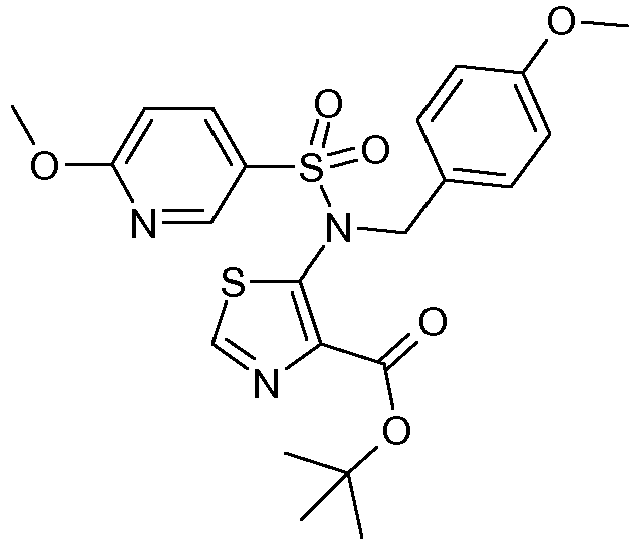
- Intermediate 2 (100mg, 0.312mmol) and 15-crown-5 (0.1mL) were dissolved in dry tetrahydrofuran (5mL). To this, sodium hydride (60% disp. in oil; 32mg, 0.78mmol) was added at room temperature and the mixture was stirred for 30 minutes. To this, 6-methoxypyridine-3-sulfonyl chloride (97mg, 0.468mmol) was added and the mixture stirred at room temperature for 18 hours. The reaction mixture was diluted with water and extracted with ethyl acetate. The organic solution was washed with brine, dried with Na2SO4, filtered and concentrated in vacuo to dryness. The residue was purified by chromatography on silica eluting with 0-50% ethyl acetate/cyclohexane. The fractions containing the desired product were combined and the solvents removed by evaporation in vacuo to give Intermediate 1 (107mg) as a yellow glass.
LCMS (Method 2) Rt 3.95 min; m/z(M+H)+ 492 -

- A suspension of potassium tert-butoxide (874mg, 7.79mmol) in dry tetrahydrofuran (10mL) was stirred vigorously at room temperature. To this, a solution of tert-butyl isocyanoacetate (1.0g, 7.08mmol) in dry tetrahydrofuran (5mL) was added drop wise and the mixture stirred at room temperature for 10 minutes. To this, a solution of 4-methoxybenzyl isothiocyanate (1.27g, 7.08mmol) in dry tetrahydrofuran (5mL) was added drop wise at room temperature. After 2 hours the solution was poured into saturated NaHCO3 solution and extracted with ethyl acetate. The organic layer was dried with Na2SO4, filtered and concentrated in vacuo to dryness. The residue was purified by chromatography on silica eluting with 0-50% ethyl acetate/cyclohexane. The fractions containing the desired product were combined and the solvent removed by evaporation in vacuo to give Intermediate 2 (852mg) as a pale yellow solid.
1H NMR (CDCl3) δ: 7.81 (1H, m), 7.73 (1H, br s), 7.31-7.23 (2H, m), 6.92-6.85 (2H, m), 4.35 (2H, d), 3.80 (3H, s), 1.61 (9H, s)
LCMS (Method 2) Rt 3.70 min; m/z(M+H)+ 321 - The following compounds were prepared using a similar method as described in Example 1. In the synthesis of Compound 171, the dihydroisoindole nitrogen was protected by Boc.
No Structure LCMS Method Rt (min) Mass [M-H]- 101 
Method 1 3.67 325 95 
Method 1 2.67 315 146 
Method 1 2.48 334 94 
Method 1 3.15 349 148 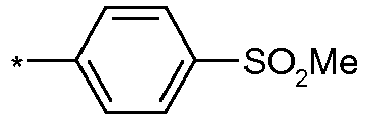
Method 1 2.58 361 82 
Method 1 2.58 261 171 
Method 1 1.73 324 182 
Method 1 2.66 298 -

- Intermediate 3 (55mg, 0.144mmol) was suspended in methanol (1mL) and tetrahydrofuran (1mL). To this, a solution of lithium hydroxide monohydrate (30mg, 0.714mmol) in water (2mL) was added and the mixture heated at 50°C for 18 hours. The mixture was cooled to room temperature and the solvents were removed in vacuo. The residue was diluted with water and acidified with 1M hydrochloric acid. The product was collected by filtration, washed with water and dried under vacuum to give Compound 61 (39mg) as an off white solid.
1H NMR (DMSO-d6) δ: 9.07 (1H, d), 8.48 (1H, s), 8.39 (1H, dd), 8.07 (1H, d) LCMS (Method 1) Rt 3.30 min; m/z(M-H)- 352 -

- 5-Amino-thiazole-4-carboxylic acid ethyl ester (172mg, 1.0mmol) was suspended in pyridine (3mL). To this, 6-(trifluoromethyl)pyridine-3-sulfonyl chloride (330mg, 1.35mmol) was added and the mixture heated at 50°C for 3 hours. The mixture was diluted with water and extracted with ethyl acetate. The combined organic layers were dried with Na2SO4, filtered and concentrated in vacuo to dryness. The residue was purified by chromatography on silica eluting with 0-100% ethyl acetate/cyclohexane. The fractions containing the desired product were combined and the solvent removed by evaporation in vacuo. The solid was triturated with diethyl ether to give Intermediate 3 (59mg) as an off white solid.
1H NMR (DMSO-d6) δ: 9.20 (1H, m), 8.42-8.31 (2H, m), 7.84 (1H, m), 4.41 (2H, q), 1.40 (3H, t) -

- Intermediate 4 (340mg, 0.821 mmol) was dissolved in tetrahydrofuran (1mL) and water (0.5mL). To this, lithium hydroxide monohydrate (86mg, 2.053mmol) was added at room temperature and stirred for 18 hours. To this, lithium hydroxide monohydrate (52mg, 1.24mmol) was added at room temperature and stirred for 16 hours. To this, lithium hydroxide monohydrate (52mg, 1.24mmol) was added at room temperature and stirred for 16 hours. The mixture was concentrated in vacuo, diluted with water and washed with diethyl ether. The aqueous layer was acidified with 1N hydrochloric acid solution. The product was collected by filtration, washed with diethyl ether and dried under vacuum to give Compound 13 (106mg) as a brown solid.
1H NMR (DMSO-d6) δ: 8.65-8.45 (3H, m), 8.15 (1H, t), 3.55-3.45 (2H, m), 3.40-3.30 (2H, m)
LCMS (Method 24) Rt 3.35 min; m/z(M-H)- 385 -

- 5-Amino-thiazole-4-carboxylic acid ethyl ester (250mg, 1.453mmol) and triethylamine (1.02mL, 7.265mmol) were dissolved in 1,4-dioxan (6mL). To this, 2-chloro-5-(trifluoromethyl)benzene-1-sulfonyl chloride (0.3mL, 1.744mmol) was added at room temperature and stirred for 16 hours. The mixture was concentrated in vacuo and extracted with ethyl acetate. The organic layer was washed with 1N hydrochloric acid solution and water. The organic layer was dried with Na2SO4, filtered and concentrated in vacuo. The residue was triturated with n-pentane, the product collected by filtration and dried under vacuum to give Intermediate 4 (340mg).
LCMS (Method 26) Rt 2.63 min; m/z(M+H)+ 415 - The following compounds were prepared using a similar method as described in Example 2.
No Structure LCMS Method Rt (min) Mass [M-H]- 66 
Method 1 3.13 317 68 
Method 1 3.28 351 79 
Method 1 3.15 313 62 
Method 1 3.26 327 63 
Method 1 2.81 380 67 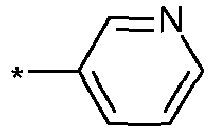
Method 1 2.14 284 61 
Method 1 3.30 352 81 
Method 1 3.35 363 65 
Method 1 3.99 418 89 
Method 1 3.12 368 122 
Method 4 5.33 365 123 
Method 13 1.63 317 124 
Method 13 1.67 335 126 
Method 13 2.02 365/367 127 
Method 13 1.96 365/367 128 
Method 13 1.86 349 129 
Method 13 1.92 349 78 
Method 1 2.59 340 87 
Method 9 5.88 363 33 
Method 34 ? 322 34 
Method 20 3.04 333 35 
Method 34 2.43 328 45 
Method 22 2.35 369 46 
Method 22 2.42 423 41 
Method 20 1.94 339 18 
Method 36 4.84 375 22 
Method 18 2.71 319 91 
Method 4 4.40 284 132 
Method 14 3.22 399/401 135 
Method 37 5.46 409/411 130 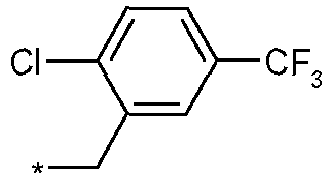
Method 13 2.06 399 145 
Method 14 3.02 378 48 
Method 22 2.45 365 1 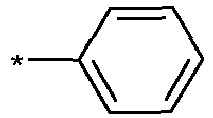
Method 23 3.40 285 2 
Method 24 3.29 367 4 
Method 23 4.28 351 5 
Method 24 3.19 297 8 
Method 27 2.70 289 16 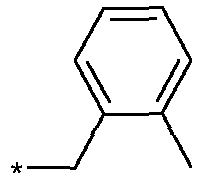
Method 17 1.37 311 92 
Method 5 1.72 287 110 
Method 10 1.53 303 133 
Method 36 5.30 383/385 134 
Method 36 5.63 433/435 90 
7 
10 
14 
-

- Intermediate 5 (137mg, 0.42mmol) was dissolved in methanol (2mL) and tetrahydrofuran (8mL). To this, lithium hydroxide monohydrate (176mg, 4.2mmol) was added and the mixture stirred at room temperature for 19 hours. The solvents were removed in vacuo and the residue partitioned between water and ethyl acetate. The aqueous layer was acidified to pH 3 with 10% citric acid solution and extracted with ethyl acetate. The organic layer was washed with brine, dried with Na2SO4, filtered and concentrated in vacuo to dryness. The residue was purified by reverse phase HPLC. The fractions containing the desired product were combined and lyophilised to give Compound 60 (44.1 mg) as an off white solid.
1H NMR (DMSO-d6) δ: 8.43 (1H, s), 7.40-7.33 (2H, m), 7.32-7.25 (3H, m), 4.83 (1H, q), 1.69 (3H, d) LCMS (Method 1) Rt 3.30 min; m/z(M-H)- 311 -

- A mixture of methyl 5-bromo-1,3-thiazole-4-carboxylate (112mg, 0.504mmol), Intermediate 6 (112mg, 0.605mmol), Pd2dba3 (46mg, 0.05mmol), xantphos (88mg, 0.151mmol), Cs2CO3 (230mg, 0.706mmol) and dry dioxan (5mL) was heated at 90°C under nitrogen for 20 hours. After cooling to room temperature, the mixture was partitioned between ethyl acetate and 10% citric acid solution. The organic layer was washed with brine, dried with Na2SO4, filtered and concentrated in vacuo to dryness. The residue was purified by chromatography on silica eluting with 0-100% ethyl acetate/cyclohexane. The fractions containing the desired product were combined and the solvents removed by evaporation in vacuo to give Intermediate 5 (137mg) as a brown gum.
LCMS (Method 2) Rt 3.08 min; m/z(M+H)+ 327 -

- Intermediate 7 (309mg, 1.2mmol) was dissolved in DMSO (2mL). To this, sodium methoxide (30% solution in methanol; 0.275mL, 1.2mmol) was added drop wise at room temperature and stirred for 15 minutes. To this, a solution of hydroxylamine-O-sulfonic acid (679mg, 6.0mmol) and sodium acetate (375mg, 4.56mmol) in water (5mL) was added drop wise at 0°C. The mixture was allowed to warm to room temperature overnight. The mixture was partitioned between ethyl acetate and water, separated and the aqueous layer extracted with ethyl acetate. The combined organic layers were washed with water, brine, dried with Na2SO4, filtered through a pad of silica and concentrated in vacuo to dryness. The residue was purified by chromatography on silica eluting with 0-100% ethyl acetate/cyclohexane. The fractions containing the desired product were combined and the solvents removed by evaporation in vacuo to give Intermediate 6 (112mg).
1H NMR (DMSO-d6) δ: 7.47-7.23 (5H, m), 6.76 (2H, s), 4.22 (1H, q), 1.63 (3H, d) -

- Sodium 1-methyl-3-sulfinopropanoate (282mg, 1.62mmol) was suspended in DMSO (2.5mL). To this, (1-bromoethyl)benzene (0.185mL, 1.35mmol) was added and the mixture stirred at room temperature for 18 hours. The mixture was poured into water (25mL) and extracted with diethyl ether. The organic layer was washed with brine, dried with Na2SO4, filtered and concentrated in vacuo to give Intermediate 7 (309mg) as an oil.
1H NMR (CDCl3) δ: 7.50-7.33 (5H, m), 4.23 (1H, q), 3.68 (3H, s), 3.18-2.94 (2H, m), 2.83-2.56 (2H, m), 1.80 (3H, d) - The following compounds were prepared using a similar method as described in Example 4.
- Compounds 168 and 169 were prepared by first preparing the racemic material and then separating by chiral HPL. Compound 168 was the first eluting isomer and Compound 169 was the second eluting isomer.
No Structure LCMS Method Rt (min) Mass [M-H]- 80 
Method 1 3.65 337 104 
Method 1 3.41 323 60 
Method 1 3.30 311 64 
Method 1 3.66 345 168 
Method 4 5.32 345 169 
Method 4 5.26 345 83 
Method 17 2.01 327 86 
Method 28 1.90 347 84 
Method 28 2.25 345 85 
Method 28 2.10 341 74 
Method 7 1.87 347 71 
Method 6 1.82 327 144 
Method 36 5.30 377 -

- Intermediate 8 (103mg, 0.269mmol) was suspended in dioxan (8mL), IMS (2mL) and water (2mL). To this, lithium hydroxide monohydrate (113mg, 2.69mmol) was added at room temperature and stirred for 24 hours. To this, lithium hydroxide monohydrate (113mg, 2.69mmol) was added and the mixture stirred at 70°C for 3 hours. The mixture was cooled to room temperature and the solvents removed in vacuo. The residue was diluted with water and made acid to pH 3 with 10% citric acid solution. The solid formed was collected by filtration, washed with water and dried under vacuum to give Compound 70 (71mg).
1H NMR (DMSO-d6) δ: 8.55 (1H, s), 7.09-7.02 (2H, m), 6.83-6.77 (1H, m), 4.27 (2H, t), 3.28 (2H, t), 2.83 (3H, s) LCMS (Method 1) Rt: 3.35 min; m/z(M-H)- 354 -

- Intermediate 9 (192mg, 0.405mmol) was dissolved in dichloromethane (5mL). To this, concentrated sulfuric acid (0.5mL) was added at 0°C and the mixture warmed to room temperature over 30 minutes. The mixture was diluted with dichloromethane and water (1:1) and neutralized with solid Na2CO3. The organic layer was washed with brine, dried with Na2SO4, filtered and concentrated in vacuo to dryness. The residue was purified by chromatography on silica eluting with 0-100% ethyl acetate/cyclohexane. The fractions containing the desired product were combined and the solvents removed by evaporation in vacuo to give Intermediate 8 (103mg).
LCMS (Method 2) Rt 3.35 min; m/z(M+H)+ 384 -

- Intermediate 10 (200mg, 0.762mmol) and 15-crown-5 (0.02mL) were dissolved in dry tetrahydrofuran (5mL). To this, sodium hydride (60% disp. in mineral oil; 43mg, 1.07mmol) was added at 0°C and the mixture was stirred for 5 minutes. To this, 4-methyl-3,4-dihydro-2H-1,4-benzoxazine-7-sulfonyl chloride (226mg, 0.914mmol) was added and the mixture stirred at room temperature for 18 hours. The mixture was diluted with saturated NaHCO3 solution and extracted with ethyl acetate. The organic layer was washed with brine, dried with Na2SO4, filtered and concentrated in vacuo to dryness. The residue was purified by chromatography on silica eluting with 0-100% ethyl acetate/cyclohexane. The fractions containing the desired product were combined and the solvents removed by evaporation in vacuo to give Intermediate 9 (137mg).
LCMS (Method 2) Rt 3.76 min; m/z(M+H)+ 474 -

- A suspension of potassium tert-butoxide (20.7g, 184mmol) in dry tetrahydrofuran (500mL) was stirred vigorously at room temperature. To this, ethyl isocyanoacetate (19.0g, 168mmol) was added drop wise at room temperature and the mixture stirred for 10 minutes. To this, benzyl isothiocyanate [(25g, 168mmol) was added drop wise at room temperature and the mixture stirred for 2 hours. The mixture was neutralized with glacial acetic acid and concentrated in vacuo. The residue was suspended in ethyl acetate. The organic layer was washed with water, saturated NaHCO3 and brine. The organic layer was dried with Na2SO4, filtered and concentrated in vacuo to dryness. The residue was purified by chromatography on silica eluting with 0-66% ethyl acetate/cyclohexane. The fractions containing the desired product were combined and the solvents removed by evaporation in vacuo to give Intermediate 10 (34.15g) as a brown oil.
1H NMR (CDCl3) δ: 7.89-7.74 (2H, m), 7.41-7.27 (5H, m), 4.45 (2H, d), 4.38 (2H, q), 1.41 (3H, t) - The following compounds were prepared using a similar method as described in Example 5.
No Structure LCMS Method Rt (min) Mass [M-H]- 69 
Method 1 3.79 303 -

- Intermediate 11 (158mg, 0.332mmol) was treated with 95% TFA(aq) (5mL) at room temperature and the mixture stirred for 3 hours. The solvent was removed in vacuo and the residue azeotroped with toluene to dryness. The residue was purified by reverse phase HPLC. The fractions containing the desired product were combined and lyophilised to give Compound 114 (44.8mg) as an off-white solid.
1H NMR (DMSO-d6) δ: 9.38 (1H, s), 9.33 (1H, d), 8.63-8.53 (2H, d), 8.22 (1H, s), 8.09 (1H, d) LCMS (Method 1) Rt 3.64 min; m/z(M-H)- 418 -
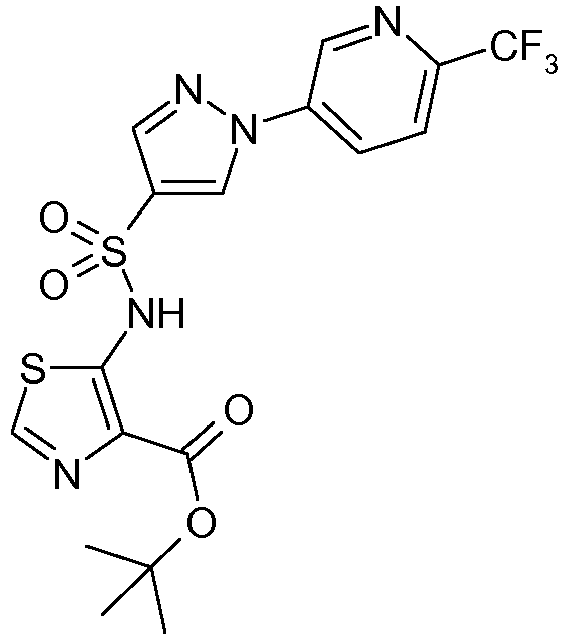
- A mixture of Intermediate 12 (113mg, 0.428mmol), Intermediate 13 (150mg, 0.514mmol), Pd2dba3 (39mg, 0.043mmol), xantphos (74mg, 0.128mmol), Cs2CO3 (195mg, 0.6mmol) and dry dioxan (5mL) was heated at 90°C under nitrogen for 20 hours. The mixture was cooled to room temperature and partitioned between ethyl acetate and 10% citric acid solution. The organic layer was washed with brine, dried with Na2SO4, filtered and concentrated in vacuo to dryness. The residue was purified by chromatography on silica eluting with 0-100% ethyl acetate/cyclohexane. The fractions containing the desired product were combined and the solvents removed by evaporation in vacuo to give Intermediate 11 (158mg).
LCMS (Method 2) Rt 3.86 min; m/z(M+H)+ 476 -

- 5-Bromothiazole-4-carboxylic acid (2.17g, 10.4mmol) was dissolved in dry dioxan (170mL) and heated at 100°C. To this, N,N-dimethyl-formamide di-tert-butyl acetal (13.68g, 67.28mmol) was added drop wise and the mixture stirred at 100°C for 1 hour. The mixture was cooled to room temperature and stirred for 18 hours. The volatile solvents were removed in vacuo and the residue partitioned between water and diethyl ether. The organic layer was washed with saturated NaHCO3, dried with Na2SO4, filtered and concentrated in vacuo to dryness. The residue was purified by chromatography on silica eluting with 0-20% ethyl acetate/cyclohexane. The fractions containing the desired product were combined and the solvents removed by evaporation in vacuo to give Intermediate 12 (2.8g) as a yellow solid.
1H NMR (CDCl3) δ: 8.76 (1H, s), 1.63 (9H, s)
LCMS (Method 2) Rt 3.23 min; m/z(M+H)+ 265 -

- Ammonium hydroxide solution (33% in water; 10mL) was cooled to 0°C. To this, a solution of Intermediate 14 (785mg, 2.52mmol) in acetone (5mL) was added drop wise and the mixture stirred for 15 minutes. The mixture was allowed to warm to room temperature and stirred for 1 hour. The volatile solvents were removed in vacuo and the resulting solid partitioned between ethyl acetate and water. The organic layer was dried with Na2SO4, filtered and concentrated in vacuo to dryness. The residue was purified by chromatography on silica eluting with 0-100% ethyl acetate/cyclohexane. The fractions containing the desired product were combined and the solvents removed by evaporation in vacuo to give Intermediate 13 (476mg) as a white solid.
LCMS (Method 2) Rt 2.67 min; m/z(M+H)+ 293 -

- A mixture of Intermediate 15 (1.19g, 5.58mmol) and chlorosulfonic acid (10mL) was heated at 90°C for 18 hours. The mixture was cooled to room temperature and poured onto ice/water. The mixture was extracted with dichloromethane, dried with Na2SO4, filtered and concentrated in vacuo to dryness. The residue was purified by chromatography on silica eluting with 0-100% dichloromethane/cyclohexane. The fractions containing the desired product were combined and the solvents removed by evaporation in vacuo to give Intermediate 14 (1.2g).
NMR (CDCl3) δ: 9.15 (1H, d), 8.65 (1H, s), 8.34-8.24 (2H, m), 7.90 (1H, d) -

- A mixture of 5-bromo-2-(trifluoromethyl)pyridine (2.0g, 8.85mmol), pyrazole (904mg, 13.28mmol), copper (II) oxide (63mg, 0.443mmol), salicylaldoxime (243mg, 1.77mmol), Cs2CO3 (4.62g, 14.16mmol) and acetonitrile (15mL) was heated at 82°C under nitrogen for 24 hours. After cooling to room temperature, the mixture was diluted with dichloromethane, filtered and concentrated in vacuo to dryness. The residue was extracted with dichloromethane, washed with water, dried with Na2SO4, filtered and concentrated in vacuo to dryness. The residue was purified by chromatography on silica eluting with 0-35% ethyl acetate/cyclohexane. The fractions containing the desired product were combined and the solvents removed by evaporation in vacuo to give Intermediate 15 (1.19g) as a white solid.
LCMS (Method 2) Rt 3.11 min; m/z(M+H)+ 214 - The following compounds were prepared using a similar method as described in Example 6.
No Structure LCMS Method Rt (min) Mass [M-H]- 117 
Method 1 3.41 349 137 
Method 1 3.64 342 -

- Intermediate 16 (161mg, 0.288mmol) was stirred with 95% TFA(aq) (3mL) at room temperature for 2 hours. The solvent was removed in vacuo and the residue azeotroped with toluene to dryness. The product was triturated with diethyl ether from methanol. The solid was collected by filtration, washed with diethyl ether and dried under vacuum to give Compound 108 (75.7mg) as a white solid.
1H NMR (DMSO-d6) δ: 8.55 (1H, s), 7.90-7.83 (2H, m), 7.70-7.63 (2H, m), 4.22 (2H, s), 3.99-3.94 (2H, m), 3.81-3.76 (2H, m) LCMS (Method 1) Rt 2.50 min; m/z(M-H)-382 -

- A mixture of Intermediate 17 (200mg, 0.371mmol), morpholin-3-one (45mg, 0.445mmol), Pd2dba3 (4mg, 0.004mmol), xantphos (7mg, 0.011mmol), Cs2CO3 (170mg, 0.519mmol) and dry dioxan (5mL) was heated at 100°C under nitrogen for 20 hours. After cooling to room temperature, the mixture was diluted with ethyl acetate, filtered to remove inorganic residues and concentrated in vacuo to dryness. The residue was purified by chromatography on silica eluting with 0-1% methanol/ethyl acetate. The fractions containing the desired product were combined and the solvents removed by evaporation in vacuo to give Intermediate 16 (161mg) as a yellow glass.
LCMS (Method 2) Rt 3.49 min; m/z(M+H)+ 560 -

- Intermediate 2 (2.0g, 6.24mmol) was dissolved in dry tetrahydrofuran (60mL). To this, sodium hydride (60% disp. in oil; 325mg, 8.11mmol) was added at room temperature and the mixture was stirred for 30 minutes. To this, 4-bromobenzenesulfonyl chloride (2.4g, 9.36mmol) was added and the mixture stirred at room temperature for 20 hours. Water was added, and the reaction mixture extracted with ethyl acetate. The organic layer was washed with brine, dried with Na2SO4, filtered and concentrated in vacuo to dryness. The residue was purified by chromatography on silica eluting with 10-25% ethyl acetate/cyclohexane. The fractions containing the desired product were combined and the solvent removed by evaporation in vacuo to give Intermediate 17 (2.02g).
LCMS (Method 2) Rt 3.95 min; m/z(M+H)+ 492 - The following compounds were prepared using a similar method as described in Example 7.
No Structure LCMS Method Rt (min) Mass [M-H]- 109 
Method 1 2.76 368 113 
Method 1 2.88 366 149 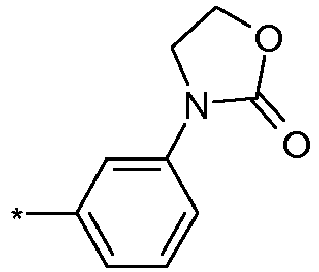
Method 1 2.78 368 152 
Method 1 2.52 382 153 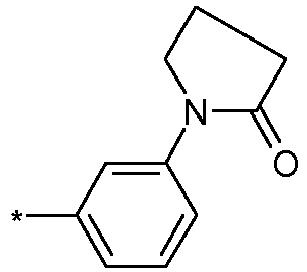
Method 1 2.85 366 142 
Method 1 3.41 379 175 
Method 1 2.64 358 -
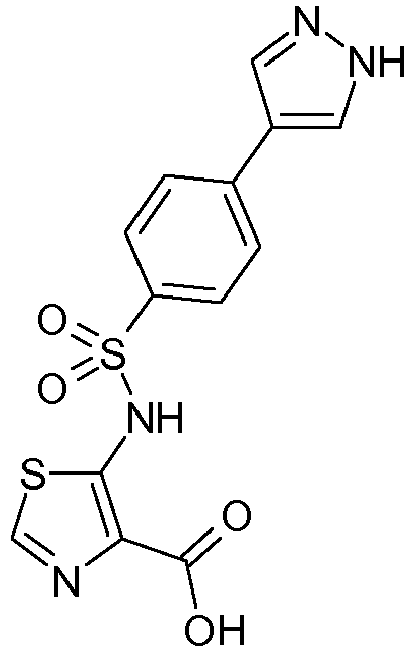
- Intermediate 18 (132mg, 0.251mmol) was treated with 95% TFA(aq) (4mL) and the mixture stirred at room temperature for 90 minutes. The solvent was removed in vacuo and the residue sonicated in methanol. The mixture was purified by reverse phase HPLC. The fractions containing the desired product were combined and lyophilised to give Compound 116 (6.5mg).
1H NMR (DMSO-d6) δ: 8.43 (1H, br s), 8.16 (2H, s), 7.81-7.73 (4H, m)
LCMS (Method 1) Rt 2.77 min; m/z(M-H)- 349 -

- A mixture of Intermediate 17 (200mg, 0.371mmol), 1-Boc-pyrazole-4-boronic acid pinacol ester (132mg, 0.45mmol), Pd(dppf)Cl2.DCM (15mg, 0.019mmol), Cs2CO3 (169mg, 0.519mmol), dioxan (4mL) and water (1mL) was heated at 90°C for 18 hours. The mixture was diluted with ethyl acetate. The organic layer was washed with water, brine, dried with Na2SO4, filtered and concentrated in vacuo to dryness. The residue was purified by chromatography on silica eluting with 0-100% ethyl acetate/cyclohexane. The fractions containing the desired product were combined and the solvents removed by evaporation in vacuo to give Intermediate 18 (1.19g) as a white solid.
LCMS (Method 2) Rt 3.51 min; m/z(M+H)+ 527 - The following compounds were prepared using a similar method as described in Example 8. Compound 118 wasprepared using 1-N-Boc-4-(4,4,5,5-tetramethyl-[1,3,2]dioxaborolan-2-yl)-3,6-dihydro-2H-pyridine, followed by hydrogenation prior to TFA deprotection.
No Structure LCMS Method Rt (min) Mass [M-H]- 115 
Method 1 2.93 350 105 
Method 1 3.01 363 150 
Method 1 2.90 349 118 
Method 1 2.09 366 -

- Intermediate 19 (136mg, 0.25mmol) was treated with 95% TFA(aq) (2mL) and the mixture stirred at room temperature for 2 hours. The solvent was removed in vacuo and the residue azeotroped with toluene to dryness. The residue was triturated with diethyl ether/pentane and the solid was purified by reverse phase HPLC. The fractions containing the desired product were combined and lyophilised to give Compound 138 (47.3mg) as a white solid.
1H NMR (DMSO-d6) δ: 8.53 (1H, s), 8.42 (1H, d), 7.76 (1H, dd), 6.88 (1H, d), 3.66-3.59 (4H, m), 1.66-1.57 (2H, m), 1.56-1.46 (4H, m) LCMS (Method 1) Rt 3.52 min; m/z(M-H)- 367 -

- A mixture of Intermediate 20 (125mg, 0.252mmol), piperidine (0.289mL, 2.92mmol) and acetonitrile (2mL) was heated by microwave irradiation for 10 minutes at 100°C. The solvent was removed in vacuo and the residue purified by chromatography on silica eluting with 5-50% ethyl acetate/cyclohexane. The fractions containing the desired product were combined and the solvents removed by evaporation in vacuo to give Intermediate 19 (136mg) as a colourless oil.
LCMS (Method 4) Rt 4.23 min; m/z(M+H)+ 545 -

- Intermediate 2 (1.2g, 3.73mmol) and 15-crown-5 (0.1mL) were dissolved in dry tetrahydrofuran (50mL). To this, sodium hydride (60% disp. in oil; 224mg, 5.6mmol) was added at room temperature and the mixture was stirred for 30 minutes. To this, 2-chloropyridine-5-sulfonyl chloride (950mg, 4.48mmol) was added and the mixture stirred at room temperature for 20 hours. The reaction mixture was diluted with water and extracted with ethyl acetate. The organic layer was washed with brine, dried with Na2SO4, filtered and concentrated in vacuo to dryness. The residue was purified by chromatography on silica eluting with 0-50% ethyl acetate/cyclohexane. The fractions containing the desired product were combined and the solvents removed by evaporation in vacuo to give Intermediate 20 (1.1g) as an orange solid.
LCMS (Method 2) Rt 4.00 min; m/z(M+H)+ 496 - The following compounds were prepared using a similar method as described in Example 9. Compounds 157, 162, 164, 154, 161, 158 and 159 were prepared using the appropriate mono-Boc protected di amines.
No Structure LCMS Method Rt (min) Mass [M-H]- 160 
Method 1 2.59 353 157 
Method 1 1.92 368 162 
Method 1 1.98 382 164 
Method 1 1.74 354 167 
Method 1 3.81 450 154 
Method 1 1.87 382 140 
Method 1 1.93 382 139 
Method 1 1.98 313 155 
Method 1 1.88 370 161 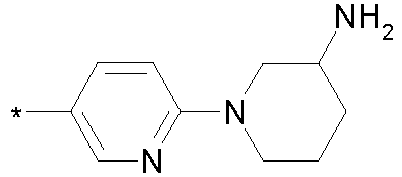
Method 1 2.06 382 158 
Method 1 2.01 382 159 
Method 1 1.83 368 -

- Intermediate 21 (116mg, 0.224mmol) was treated with 95% TFA(aq) (2mL) and the mixture stirred at room temperature for 1 hour. The solvent was removed in vacuo and the residue azeotroped with toluene to dryness. The residue was purified by reverse phase HPLC. The fractions containing the desired product were combined and the solvents removed by lyophilisation. The residue was then sonicated in methanol, filtered and dried under vacuum to give Compound 141 (19.1mg) as an off white solid.
1H NMR (DMSO-d6) δ: 10.96 (1H, s), 8.65 (1H, m), 8.57 (1H, br s), 8.22-8.11 (2H, m), 2.12 (3H, s) LCMS (Method 1) Rt 2.42 min; m/z(M-H)- 341 -

- A mixture of Intermediate 20 (125mg, 0.252mmol), acetamide (18mg, 0.302mmol), Pd2dba3 (2mg, 0.0025mmol), xantphos (5mg, 0.0076mmol), Cs2CO3 (115mg, 0.353mmol) and dry dioxan (5mL) was heated at 100°C under nitrogen for 20 hours. The mixture was diluted with ethyl acetate, washed with water, brine, dried with Na2SO4, filtered and concentrated in vacuo to dryness. The residue was purified by chromatography on silica eluting with 0-5% methanol/dichloromethane. The fractions containing the desired product were combined and the solvents removed by evaporation in vacuo to give Intermediate 21 (116mg) as an orange glass.
LCMS (Method 2) Rt 3.49 min; m/z(M+H)+ 519 -

- Intermediate 22 (66mg, 0.121 mmol) was treated with 95% TFA(aq) (2mL) and the mixture stirred at room temperature for 1 hour. The solvent was removed in vacuo and the residue soniciated with diethyl ether. After standing in diethyl ether for 18 hours the precipitate was isolated by filtration and dried under vacuum to give Compound 106 (20mg) as an off white solid.
1H NMR (DMSO-d6) δ: 8.56 (1H, s), 6.92-6.84 (2H, m), 6.52-6.42 (2H, m), 3.68-3.62 (2H, m), 3.53-3.48 (2H, m), 3.24-3.18 (2H, m), 2.65-2.59 (2H, m), 1.85-1.77 (2H, m) LCMS (Method 1) Rt 3.95 min; m/z(M-H)- 366 -

- A mixture of Intermediate 23 (100mg, 0.243mmol), 1,2,3,4-tetrahydro-quinoline (65mg, 0.488mmol) and DMAP (32mg, 0.243mmol) in n-propanol was heated at 90°C for 48 hours. The solvent was removed in vacuo to dryness. The residue was purified by chromatography on silica eluting with 0-50% ethyl acetate/cyclohexane. The fractions containing the desired product were combined and the solvents removed by evaporation in vacuo to give Intermediate 22 (66mg) as a gum.
1H NMR (CDCl3) δ: 8.57 (1H, s), 7.16-7.01 (3H, m), 6.98-6.92 (1H, m), 6.82-6.75 (2H, m), 6.66-6.57 (2H, m), 4.88 (2H, s), 3.92-3.83 (2H, m), 3.77 (3H, s), 3.46-3.38 (2H, m), 3.33-3.26 (2H, m), 2.78-2.69 (2H, m), 2.00-1.90 (2H, m), 1.65 (9H, s) -

- Intermediate 2 (1.0g, 3.12mmol) and 15-crown-5 (690mg, 3.12mmol) were dissolved in dry tetrahydrofuran (30mL). To this, sodium hydride (60% disp. in oil; 245mg, 6.14mmol) was added at room temperature and the mixture was stirred for 10 minutes. To this, 2-chloroethanesulfonyl chloride (760mg, 4.69mmol) was added at room temperature and the mixture stirred for 4 hours. The mixture was diluted with 10% citric acid solution and extracted with ethyl acetate. The organic layer was washed with brine, dried with Na2SO4, filtered and concentrated in vacuo to dryness. The residue was purified by chromatography on silica eluting with 0-50% ethyl acetate/cyclohexane. The fractions containing the desired product were combined and the solvents removed by evaporation in vacuo to give Intermediate 23 (360mg) as a yellow glass.
1H NMR (CDCl3) δ: 8.57 (1H, s), 7.19-7.11 (2H, m), 6.84-6.76 (2H, m), 6.70-6.57 (1H, m), 6.22 (1H, d), 5.98 (1H, d), 4.83 (2H, s), 3.78 (3H, s), 1.65 (9H, s) - The following compounds were prepared using a similar method as described in Example 11. Compound 107 was prepared by treating Intermediate 23 with aniline, following by treatment with acetyl chloride.
No Structure LCMS Method Rt (min) Mass [M-H]- 136 
Method 1 3.46 340 107 
Method 1 2.94 368 -

- Intermediate 24 (183mg, 0.56mmol) was dissolved in tetrahydrofuran (6mL) and methanol (3mL). To this, lithium hydroxide (2M; 1.5mL, 3.0mmol) was added at room temperature and the mixture heated at 55°C for 6 hours. The mixture was cooled to room temperature and stirred for 18 hours. The solvent was removed in vacuo. The residue was dissolved in water and extracted with ethyl acetate. The aqueous layer was acidified with 1M hydrochloric acid and extracted with ethyl acetate. The organic layer was washed with brine, dried with Na2SO4, filtered and concentrated in vacuo to dryness. The residue was purified by reverse phase HPLC. The fractions containing the desired product were combined and lyophilised to give Compound 106 (31.2mg) as a white solid.
1H NMR (DMSO-d6) δ: 10.53 (1H, s), 8.57 (1H, s), 7.30-7.23 (2H, m), 7.15-7.10 (2H, m), 7.09-7.03 (1H, m) LCMS (Method 1) Rt 2.93 min; m/z(M-H)- 298 -

- Intermediate 25 (1.12g, 5.84mmol) and 5-aminothiazole-4-carboxylic acid ethyl ester (0.9g, 5.84mmol) were combined in toluene (25mL). The mixture was stirred under a nitrogen atmosphere at 60°C for 1 hour and then at room temperature for 18 hours. The mixture was partitioned between 1M hydrochloric acid and ethyl acetate and the layers separated. The aqueous layer was extracted with ethyl acetate and the combined organic layers dried with Na2SO4, filtered and concentrated in vacuo to dryness. The residue was purified by chromatography on silica eluting with 0-70% ethyl acetate/cyclohexane. The fractions containing the desired product were combined and the solvents removed by evaporation in vacuo to give Intermediate 24 (298mg) as a cream solid.
LCMS (Method 2) Rt 3.09 min; m/z(M+H)+ 328 -

- Intermediate 26 (1.77g, 9.1mmol) and phosphorous pentachloride (1.70g, 8.2mmol) were combined in toluene (20mL). The mixture was stirred under a nitrogen atmosphere at reflux for 4 hours. After cooling to room temperature, the solid was removed by filtration. The filtrate was concentrated in vacuo to dryness to give Intermediate 25 (1.12g) as a yellow oil which was used without further purification.
-

- Aniline (2.28mL, 25mmol) and TEA (35mL, 250mmol) were dissolved in chloroform (50mL). Chlorosulfonic acid (1.45mL, 25mmol) was added drop wise at -5°C and the mixture stirred for 10 minutes. The mixture was concentrated in vacuo and the solid dissolved in sodium hydroxide solution (1M; 75mL, 75mmol). The mixture was concentrated in vacuo to dryness. The product was recrystallised from hot ethanol, collected by filtration and dried under vacuum to give Intermediate 26 (2.78g) as a white solid.
1H NMR (DMSO-d6) δ: 7.07-6.90 (4H, m), 6.61-6.50 (1H, m) - The following compounds were prepared using a similar method as described in Example 12.
No Structure LCMS Method Rt (min) Mass [M-H]- 43 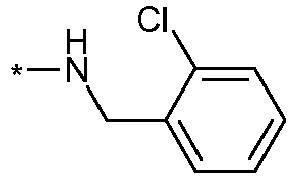
Method 1 3.24 346 44 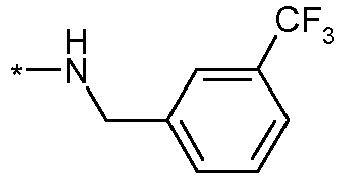
Method 1 3.62 380 -

- Intermediate 27 (0.195mg, 0.61mmol) was dissolved in tetrahydrofuran (3.6mL) and methanol (1.8mL). To this, lithium hydroxide (2M; 0.9mL, 1.8mmol) was added at room temperature and the mixture heated to 40°C under nitrogen for 17 hours. The solvents were removed in vacuo. The residue was dissolved in water and extracted with ethyl acetate. The aqueous layer was acidified with 1M hydrochloric acid and extracted with ethyl acetate. The organic layer was dried with Na2SO4, filtered and concentrated in vacuo to dryness. The product was purified by reverse phase HPLC. The fractions containing the desired product were combined and concentrated in vacuo to a minimal volume of water. The product was collected by filtration and dried under vacuum to give Compound 75 (37.6mg) as a white solid.
1H NMR (DMSO-d6) δ: 8.60 (1H, s), 3.17-3.10 (4H, m), 1.55-1.39 (6H, m)
LCMS (Method 1) Rt 3.20 min; m/z(M-H)- 290 -
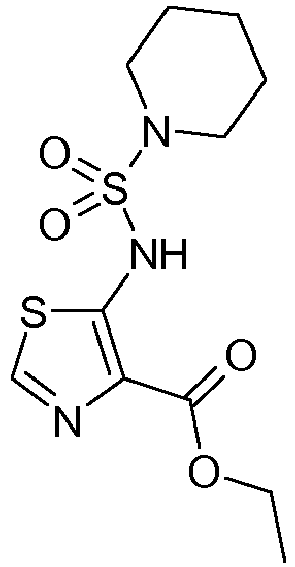
- A mixture of Intermediate 28 (1.01g, 6.15mmol), ethyl 5-bromothiazole-4-carboxylate (0.48g, 2.03mmol), Pd2dba3 (186mg, 0.2mmol), xantphos (353mg, 0.61mmol), Cs2CO3 (3.31 g, 10.2mmol) and dry dioxan (15mL) was heated at 100°C under argon for 17 hours. The mixture was concentrated in vacuo and partitioned between water and ethyl acetate. The aqueous layer was acidified with 1M hydrochloric acid and extracted with ethyl acetate. The organic layer was dried with Na2SO4, filtered and concentrated in vacuo to dryness. The residue was purified by chromatography on silica eluting with 0-50% ethyl acetate/cyclohexane. The fractions containing the desired product were combined and the solvents removed by evaporation in vacuo to give Intermediate 27 (202mg) as a yellow solid.
LCMS (Method 2) Rt 3.28 min; m/z(M+H)+ 320 -

- Piperidine (2.05mL, 20mmol) and sulfamide (1.92g, 20mmol) were dissolved in dioxan (20mL). The mixture was heated at reflux for 15 hours then concentrated in vacuo to dryness. The solid was collected by filtration from dilute hydrochloric acid, washed with water and dried under vacuum to give Intermediate 28 (1.64g) as an off white solid.
1H NMR (DMSO-d6) δ: 6.63 (2H, s), 3.01-2.84 (4H, m), 1.63-1.49 (4H, m), 1.48-1.35 (2H, m) - The following compounds were prepared using a similar method as described in Example 13.
No Structure LCMS Method Rt (min) Mass [M-H]- 77 
Method 1 3.69 326 88 
Method 1 3.39 312 147 
Method 1 3.52 324 -

- Intermediate 29 (49mg, 0.138mmol) was treated with 95% TFA(aq) (2mL) and the mixture stirred at room temperature for 3 hours. The solvent was removed in vacuo and the residue azeotroped with toluene to dryness. The residue was purified by reverse phase HPLC. The fractions containing the desired product were combined and lyophilised to give Compound 170 (5.2mg) as an off white solid.
1H NMR (DMSO-d6) δ: 8.65-8.53 (2H, m), 8.33 (1H, s), 7.98-7.91 (1H, m), 7.58-7.50 (1H, m), 4.70 (2H, s) LCMS (Method 1) Rt 1.49 min; m/z(M-H)- 298 -

- A mixture of Intermediate 30 (212mg, 1.23mmol), Pd2dba3 (47mg, 0.051 mmol), xantphos (89mg, 0.154mmol), Cs2CO3 (468mg, 1.44mmol) and Intermediate 12 (1.0mmol) in dry dioxan (5mL) was heated at 90°C under nitrogen for 18 hours. The mixture was extracted with ethyl acetate and washed with water. The organic layer was dried with Na2SO4, filtered and concentrated in vacuo to dryness. The product was purified by chromatography on silica eluting with 0-10% methanol/ethyl acetate. The fractions containing the desired product were combined and the solvents removed by evaporation in vacuo to give Intermediate 29 (49mg).
LCMS (Method 3) Rt 2.60 min; m/z(M+H)+ 356 -
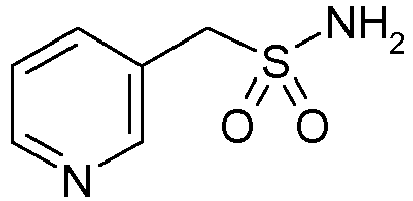
- Intermediate 31 (515mg, 1.76mmol) was treated with 95% TFA(aq) (2mL) at room temperature and the mixture heated at 60°C for 2 hours. The solvent was removed in vacuo and the residue azeotroped with toluene to dryness. The product was triturated with diethyl ether, collected by filtration and dried under vacuum to give Intermediate 30 (212mg) as an off white solid.
LCMS (Method 2) Rt 0.34 min; m/z(M+H)+ 173 -

- Intermediate 32 (500mg, 1.91mmol) was dissolved in NMP (5mL). To this, 4-methoxybenzylamine (1.25mL, 9.55mmol) was added at room temperature and the mixture heated to 130°C for 18 hours. The mixture was diluted with diethyl ether and washed with water. The aqueous layer was extracted with ethyl acetate and the combined organic layers dried with Na2SO4, filtered and concentrated in vacuo to dryness. The residue was purified by chromatography on silica eluting with 0-10% methanol/dichloromethane. The fractions containing the desired product were combined and the solvents removed by evaporation in vacuo to give Intermediate 31 (515mg) as a yellow solid.
LCMS (Method 2) Rt 2.04 min; m/z(M+H)+ 293 -

- Intermediate 33 (718mg, 2.24mmol) was dissolved in methanol (10mL). To this, 1N sodium hydroxide solution (11.2mL, 11.2mmol) was added at room temperature and the mixture heated at 50°C for 30 minutes. The mixture was diluted with ethyl acetate and washed with water. The organic layer was washed with brine and the combined aqueous layers extracted with ethyl acetate. The combined organic layers were dried with Na2SO4, filtered and concentrated in vacuo to give Intermediate 32 (500mg).
LCMS (Method 2) Rt 2.20 min; m/z(M+H)+ 263 -
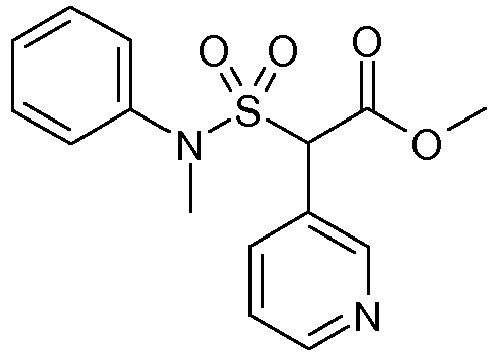
- Intermediate 34 (500mg, 2.06mmol), Pd(PPh3)4 (73mg, 0.063mmol), sodium hydride (60% disp. in oil; 190mg, 4.74mmol), 3-bromopyridine (250mg, 1.58mmol) and dry dioxan (15mL) were combined at room temperature and heated to 70°C under nitrogen for 18 hours. The mixture was diluted with ethyl acetate and washed with brine. The organic layer was dried with Na2SO4, filtered and concentrated in vacuo to dryness. The residue was purified by chromatography on silica eluting with 0-100% ethyl acetate/cyclohexane. The fractions containing the desired product were combined and the solvents removed by evaporation in vacuo to give Intermediate 33 (358mg).
LCMS (Method 2) Rt 2.76 min; m/z(M+H)+ 321 -
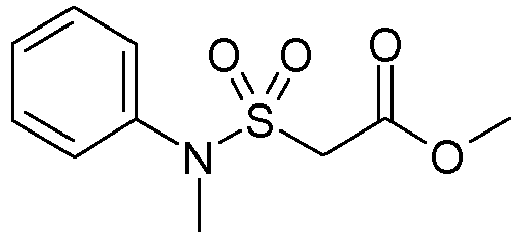
- N-methylaniline (4.1g, 34.28mmol) was dissolved in dichloromethane (50mL). To this, a solution of methyl 2-(chlorosulfonyl)acetate (3.3g, 19.12mmol) in dichloromethane (20mL) was added drop wise at 0°C. The mixture was allowed to warm to room temperature and stirred for 18 hours. The mixture was diluted with dichloromethane. The organic layer was washed with water, 1N hydrochloric acid solution and brine. The organic layer was dried with Na2SO4, filtered and concentrated in vacuo to dryness. The residue was purified by chromatography on silica eluting with 0-40% ethyl acetate/cyclohexane. The fractions containing the desired product were combined and the solvents removed by evaporation in vacuo to give Intermediate 34 (4.47g).
1H NMR (CDCl3) δ: 7.52-7.28 (5H, m), 3.96 (2H, s), 3.79 (3H, s), 3.41 (3H, s) -

- Intermediate 35 (20mg, 0.0409mmol) was treated with 95% TFA(aq) (2mL) at room temperature and the mixture stirred for 1 hour. The solvent was removed in vacuo and the residue azeotroped with toluene to dryness. The residue was purified by reverse phase HPLC. The fractions containing the desired product were combined and lyophilised to give Compound 151 (8mg) as an off white solid.
1H NMR (DMSO-d6) δ: 8.68 (1H, s), 8.61 (1H, d), 8.44 (1H, s), 8.15 (1H, d), 7.66 (1H, dd), 3.63 (2H, t), 3.15 (2H, t) (1001329)
LCMS (Method 1) Rt 1.41 min; m/z(M-H)- 312 -

- Intermediate 36 (90mg, 0.18mmol) was dissolved in ethanol (5mL). To this, Pd(OH)2 (20% on carbon, 10mg) was added and the mixture stirred at room temperature under a hydrogen atmosphere for 24 hours. Additional Pd(OH)2 (20 % on carbon, 10mg) was added and the mixture stirred under a hydrogen atmosphere for 24 hours. The reaction mixture was filtered and concentrated in vacuo to dryness. The residue was purified by chromatography on silica eluting with 0-100% ethyl acetate/cyclohexane. The fractions containing the desired product were combined and the solvents removed by evaporation in vacuo to give Intermediate 35 (20mg).
LCMS (Method 3) Rt 2.69 min; m/z(M+H)+ 490 -

- A mixture of Intermediate 23 (164mg, 0.4mmol), 3-bromopyridine (76mg, 0.48mmol), TTBP (26mg, 0.08mmol), Pd2dba3 (37mg, 0.04mmol), N,N-dicyclohexylmethylamine (156mg, 0.8mmol) and dioxan (4mL) was heated by microwave irradiation at 110°C for 1 hour then thermally at reflux for 6 hours. The mixture was diluted with ethyl acetate. The organic layer was washed with water, brine, dried with MgSO4, filtered and concentrated in vacuo to dryness. The residue was purified by chromatography on silica eluting with 0-100% ethyl acetate/cyclohexane. The fractions containing the desired product were combined and the solvents removed by evaporation in vacuo to give Intermediate 36 (100mg) as a gum.
1H NMR (CDCl3) δ: 8.71 (1H, d), 8.64 (1H, dd), 8.59 (1H, s), 7.77 (1H, dt), 7.41-7.30 (2H, m), 7.20-7.13 (2H, m), 6.99 (1H, d), 6.84-6.76 (2H, m), 4.87 (2H, s), 3.77 (3H, s), 1.56 (9H, s) -

- Intermediate 37 (165mg, 0.248mmol) was treated with 95% TFA(aq) (10mL) and the mixture stirred at room temperature for 2 hours. The solvent was removed in vacuo and the residue azeotroped with toluene to dryness. The residue was purified by reverse phase HPLC. The fractions containing the desired product were combined and lyophilised to give Compound 165 (11mg) as an off white solid.
1H NMR (DMSO-d6) δ: 8.81 (1H, d), 8.10 (1H, s), 8.03 (1H, dd), 7.40 (1H, d), 3.40-3.10 (2H, obs), 3.09-2.92 (3H, m), 2.03-1.92 (2H, m), 1.92-1.78 (2H, m)
LCMS (Method 1) Rt 1.85 min; m/z(M-H)- 367 -

- Intermediate 38 (200mg, 0.312mmol) was dissolved in ethanol (4mL). To this, Pd(OH)2 (20 % on carbon, 25mg) was added and the mixture stirred at room temperature under a hydrogen atmosphere for 24 hours. Additional Pd(OH)2 (20 % on carbon, 25mg) was added and the mixture stirred under a hydrogen atmosphere for 3 days. The reaction mixture was filtered and concentrated in vacuo to dryness to give Intermediate 37 (180mg).
1H NMR (CDCl3) δ: 8.87 (1H, d), 8.58 (1H, s), 7.92 (1H, dd), 7.28-7.21 (1H, obs), 7.14-7.06 (2H, m), 6.80-6.73 (2H, m), 4.92 (2H, s), 4.37-4.16 (2H, m), 3.77 (3H, s), 2.99-2.74 (3H, m), 1.98-1.82 (2H, m), 1.80-1.63 (2H, m), 1.48 (9H, s) -

- A mixture of Intermediate 20 (300mg, 0.606mmol), N-Boc-1,2,3,6-tetrahydropyridine-4-boronic acid pinacol ester (225mg, 0.727mmol), Pd(dppf)Cl2.DCM (25mg, 0.0303mmol), Cs2CO3 (276mg, 0.0848mmol), dioxan (6mL) and water (1mL) was heated at 95°C for 10 hours. N-Boc-1,2,3,6-tetrahydropyridine-4-boronic acid pinacol ester (225mg, 0.727mmol), Pd(dppf)Cl2.DCM (25mg, 0.0303mmol) were added and the mixture heated at 95°C for 18 hours. The mixture was diluted with ethyl acetate, washed with water, brine, dried with MgSO4, filtered and concentrated in vacuo to dryness. The residue was purified by chromatography on silica eluting with 0-100% ethyl acetate/cyclohexane. The fractions containing the desired product were combined and the solvents removed by evaporation in vacuo to give Intermediate 38 (1.19g) as a yellow gum.
1H NMR (CDCl3) δ: 8.86 (1H, d), 8.58 (1H, s), 7.93 (1H, dd), 7.43 (1H, d), 7.15-7.08 (2H, m), 6.83-6.74 (3H, m), 4.92 (2H, s), 4.21-4.15 (2H, m), 3.77 (3H, s), 3.69-3.60 (2H, m), 2.68-2.59 (2H, m), 1.50 (9H, s) -

- Intermediate 39 (55mg, 0.104mmol) was treated with 95% TFA(aq) (1.5mL) at room temperature and the mixture stirred for 2 hours. The solvent was removed in vacuo and the residue azeotroped with toluene to dryness. The residue was triturated with methanol and the solid was purified by reverse phase HPLC. The fractions containing the desired product were combined and lyophilised to give Compound 156 (15mg) as a white solid.
1H NMR (DMSO-d6) δ: 9.96 (1H, s), 8.40 (1H, s), 7.50 (2H, d), 7.20 (2H, d), 4.60 (2H, s), 2.03 (3H, s) LCMS (Method 1) Rt 2.46 min; m/z(M-H)- 354 -

- A mixture of Intermediate 40 (298mg, 0.538mmol), acetamide (38.2mg, 0.646mmol), Pd2dba3 (9.9mg, 0.0108mmol), xantphos (18.7mg, 0.0323mmol), Cs2CO3 (246mg, 0.754mmol) and dry dioxan (7.3mL) was heated at 100°C under argon for 19 hours. The mixture was filtered and the solid washed with dioxan, ethyl acetate and a small volume of water. The filtrate was concentrated in vacuo to dryness, diluted with ethyl acetate and washed with 0.25M hydrochloric acid. The aqueous layer was washed with ethyl acetate and the combined organic layers washed with brine, dried with MgSO4, filtered and concentrated in vacuo to dryness. The residue was purified by chromatography on silica eluting with 0-40% ethyl acetate/dichloromethane. The fractions containing the desired product were combined and the solvents removed by evaporation in vacuo to give Intermediate 39 (55mg) as a yellow glass.
LCMS (Method 3) Rt 3.11 min; m/z(M+H)+ 532 -

- Sodium hydride (60% disp. in oil; 73mg, 1.83mmol) was suspended in dry tetrahydrofuran (1.8mL) under nitrogen. To this, a solution of Intermediate 2 (450mg, 1.404mmol) in dry tetrahydrofuran (7.2mL) was added at room temperature and the mixture was stirred for 30 minutes. To this, a solution of (4-bromophenyl)methanesulfonyl chloride (492mg, 1.83mmol) in dry tetrahydrofuran (1.8mL) was added and the mixture stirred at room temperature for 72 hours. Water was added to the reaction mixture at 0°C and the mixture extracted with ethyl acetate. The organic layer was washed with brine, dried with MgSO4, filtered and concentrated in vacuo to dryness. The residue was purified by chromatography on silica eluting with 0-40% ethyl acetate/cyclohexane. The fractions containing the desired product were combined and the solvents removed by evaporation in vacuo to give Intermediate 40 (298mg) as a yellow solid.
LCMS (Method 3) Rt 4.14 min; m/z(M+H)+ 553 -

- Boc-D-alpha-phenylglycine (104mg, 0.41 mmol) and HATU (115mg, 0.3mmol) were dissolved in DMA (1.5mL) and stirred at room temperature for 15 minutes. To this, a solution of Intermediate 41 (150mg, 0.28mmol) and NMM (56mg, 0.55mmol) in DMA (1.5mL) was added at room temperature and stirred for 15 hours. The solution was diluted with water and ethyl acetate. The organic layer was washed with brine, dried with MgSO4, filtered and concentrated in vacuo to dryness. The residue was treated with 95% TFA(aq) (5mL) at room temperature and stirred for 2 hours. The solvent was removed in vacuo and the residue was triturated with ethyl acetate. The solid was purified by reverse phase HPLC. The fractions containing the desired product were combined and lyophilised to give Compound 172 (35mg) as a white solid.
1H NMR (DMSO-d6) δ: 8.51 (3H, br s), 8.09 (1H, d), 7.68 (1H, d), 7.59 (1H, d), 7.55-7.44 (5H, m), 7.30 (1H, d), 7.04 (1H, d), 5.67-5.54 (1H, m), 4.59-4.50 (1H, m), 3.97-3.75 (1H, m), 3.15-3.04 (1H, m), 2.85-2.63 (3H, m), 1.89-1.69 (1H, m), 1.65-1.39 (1H, m), 1.37-1.16 (1H, m) LCMS (Method 1) Rt 2.65 min; m/z(M-H)- 499 -

- Intermediate 42 (5.19g, 8.1mmol) was dissolved in methanol (50mL) and tetrahydrofuran (30mL). To this, a solution of potassium carbonate (5.6g, 40.5mmol) in water (15mL) was added at room temperature and stirred for 1.5 hours. The mixture was concentrated in vacuo, diluted with water and extracted with dichloromethane. The organic layer was washed with brine, dried with MgSO4, filtered and concentrated in vacuo to dryness. The residue was purified by chromatography on silica eluting with 0-10% 2M NH3 in methanol/dichloromethane. The fractions containing the desired product were combined, the solvents removed by evaporation in vacuo and the solid triturated with diethyl ether to give Intermediate 41 (2.60g).
1H NMR (CDCl3) δ: 8.55 (1H, s), 7.68 (2H, d), 7.32 (2H, d), 7.10 (2H, d), 6.76 (2H, d), 4.88 (2H, s), 3.76 (3H, s), 3.26-3.15 (2H, m), 2.81-2.61 (3H, m), 1.87-1.76 (2H, m), 1.72-1.54 (3H, m), 1.49 (9H, s) -

- Intermediate 2 (3.26g, 10.21mmol) and 15-crown-5 (224mg, 1.02mmol) were dissolved in dry tetrahydrofuran (90mL). To this, sodium hydride (60% disp. in oil; 610mg, 15.31 mmol) was added at room temperature and the mixture was stirred for 10 minutes. To this, Intermediate 43 (4.0g, 11.23mmol) was added and the mixture stirred at room temperature for 1 hour. The mixture was poured into 10% citric acid solution and extracted with ethyl acetate. The organic layer was dried with MgSO4, filtered and concentrated in vacuo to dryness. The residue was purified by chromatography on silica eluting with 0-100% ethyl acetate/cyclohexane. The fractions containing the desired product were combined and the solvents removed by evaporation in vacuo to give Intermediate 42 (5.19g) as a yellow solid.
1H NMR (CDCl3) δ: 8.56 (1H, s), 7.71 (2H, d), 7.30 (2H, d), 7.10 (2H, d), 6.76 (2H, d), 4.88 (2H, s), 4.79-4.66 (1H, m), 4.23-4.11 (1H, m), 3.76 (3H, s), 3.33-3.18 (1H, m), 2.97-2.79 (2H, m), 2.03-1.92 (2H, m), 1.81-1.62 (2H, m), 1.49 (9H, s) -

- Chlorosulfonic acid (19.63g. 167.8mmol) was cooled to 0°C. To this, a solution of Intermediate 44 (5.75g, 22.37mmol) in dichloromethane (50mL) was added drop wise and the mixture stirred at the same temperature for 1 hour. The mixture was stirred at room temperature for 2 hours then poured into water, filtered through celite and the filtrate extracted with ethyl acetate. The organic layer was dried with MgSO4, filtered and concentrated in vacuo to dryness. The residue was purified by chromatography on silica eluting with 0-40% ethyl acetate/cyclohexane. The fractions containing the desired product were combined and the solvents removed by evaporation in vacuo to give Intermediate 43 (3.27g).
1H NMR (CDCl3) δ: 8.01 (2H, d), 7.46 (2H, d), 4.80-4.70 (1H, m), 4.25-4.13 (1H, m), 3.34-3.21 (1H, m), 3.04-2.82 (2H, m), 2.09-1.96 (2H, m), 1.84-1.66 (2H, m) -

- 4-Phenylpiperidine (2.86g, 17.76mmol) and TEA (2.47mL, 17.76mmol) were dissolved in dichloromethane (40mL) and cooled to -78°C. To this, TFAA (2.46mL, 17.76mmol) was added drop wise and the mixture warmed to room temperature over 30 minutes. The mixture was diluted with water and the organic layer dried with MgSO4, filtered and concentrated in vacuo to dryness. The residue was purified by chromatography on silica eluting with 0-40% ethyl acetate/cyclohexane. The fractions containing the desired product were combined, the solvents removed by evaporation in vacuo to give Intermediate 44 (3.76g) as a white solid.
1H NMR (CDCl3) δ: 7.39-7.12 (5H, m), 4.76-4.62 (1H, m), 4.21-4.06 (1H, m), 3.32-3.16 (1H, m), 2.94-2.72 (2H, m), 2.06-1.90 (2H, m), 1.82-1.61 (2H, m) - The following compounds were prepared using a similar method as described in Example 18.
No Structure LCMS Method Rt (min) Mass [M-H]- 173 X6 
Method 1 2.65 499 -

- Intermediate 45 (110mg, 0.29mmol) was dissolved in tetrahydrofuran (3mL) and methanol (1mL). To this, lithium hydroxide solution (2M; 0.73mL, 1.47mmol) was added at room temperature and stirred for 3 hours. The mixture was heated at 40°C for 17 hours. The mixture was diluted with tetrahydrofuran and the solid formed was collected by filtration and dissolved in water. The solution was acidified with 1M hydrochloric acid and extracted with ethyl acetate. The organic layer was washed with brine, dried with MgSO4, filtered and concentrated in vacuo to dryness to give Compound 102 (68mg) as a white solid.
1H NMR (DMSO-d6) δ: 7.52-7.42 (2H, m), 7.41-7.28 (2H, m), 4.82 (2H, s), 2.48 (3H, s) LCMS (Method 1) Rt 3.46 min; m/z(M-H)- 345 -

- A mixture of Intermediate 46 (200mg, 0.8mmol), (2-chlorophenyl)-methanesulfonamide (160mg, 0.8mmol), Pd2dba3 (37mg, 0.04mmol), xantphos (69mg, 0.12mmol), Cs2CO3 (780mg, 2.4mmol) and dry dioxan (4mL) was heated at 80°C under argon for 20 hours. The mixture was diluted with water and extracted with ethyl acetate. The aqueous layer was acidified to pH2 with 1M hydrochloric acid and extracted with ethyl acetate. The organic layer was dried with MgSO4, filtered and concentrated in vacuo to dryness. The residue was purified by chromatography on silica eluting with 0-60% ethyl acetate/cyclohexane. The fractions containing the desired product were combined and the solvents removed by evaporation in vacuo to give Intermediate 45 (116mg) as a cream solid.
LCMS (Method 2) Rt 3.44 min; m/z(M+H)+ 375 -

- Ethyl 2-methyl-1,3-thiazole-4-carboxylate [6436-59-5] (5.0g, 29.2mmol) was dissolved in acetonitrile (50mL). To this, NBS (5.7g, 32.03mmol) was added at room temperature and the mixture heated at reflux for 2 hours. To this, NBS (2.5g, 14.05mmol) was added and the mixture heated at reflux for 2 hours. To this, NBS (2.5g, 14.05mmol) was added and the mixture heated at reflux for 18 hours. The mixture was diluted with saturated sodium hydrogen carbonate solution and extracted with ethyl acetate. The organic layer was dried with MgSO4, filtered and concentrated in vacuo to dryness. The residue was purified by chromatography on silica eluting with 0-50% ethyl acetate/cyclohexane. The fractions containing the desired product were combined and the solvents removed by evaporation in vacuo to give Intermediate 46 (1.58g) as a cream solid.
LCMS (Method 2) Rt 2.88 min; m/z(M+H)+ 250/252 -

- Intermediate 47 (100mg, 0.23mmol) was dissolved in tetrahydrofuran (2.4mL) and methanol (0.8mL). To this, lithium hydroxide solution (2M; 0.58mL, 1.17mmol) was added at room temperature and the mixture stirred for 5 hours. The mixture was heated at 40°C for 2 hours. The mixture was acidified with saturated citric acid solution and extracted with ethyl acetate. The organic layer was washed dried with MgSO4, filtered and concentrated in vacuo to dryness. The residue was purified by chromatography on silica eluting with 0-25% methanol/dichloromethane. The fractions containing the desired product were combined and the solvent removed by evaporation in vacuo to give Compound 96 (24.6mg) as an off white solid.
1H NMR (DMSO-d6) δ: 7.43-7.38 (1H, m), 7.33-7.28 (1H, m), 7.25-7.18 (2H, m), 4.40 (2H, s) LCMS (Method 1) Rt 4.38 min; m/z(M-H)- 399 -

- A mixture of (2-chlorophenyl)methanesulfonamide (150mg, 0.73mmol), Intermediate 48 (180mg, 0.59mmol), Pd2dba3 (27mg, 0.03mmol), xantphos (51mg, 0.089mmol), Cs2CO3 (580mg, 1.8mmol) and dry dioxan (3mL) was heated at 80°C under argon for 2 hours. The mixture was diluted with saturated citric acid solution and extracted with ethyl acetate. The organic layer was dried with Na2SO4, filtered and concentrated in vacuo to dryness. The residue was purified by chromatography on silica eluting with 0-20% ethyl acetate/cyclohexane. The fractions containing the desired product were combined and the solvents removed by evaporation in vacuo to give Intermediate 47 (103mg) as a tan solid.
LCMS (Method 2) Rt 4.35 min; m/z(M+H)- 427 -

- DIPA (0.35mL, 2.5mmol) was dissolved in dry tetrahydrofuran (5mL) and cooled to - 78°C under nitrogen. To this, n-butyllithium (1.6M in hexanes; 1.56mL, 2.5mmol) was added over 5 minutes and stirred for 2 minutes. The solution was warmed to room temperature then cooled to -78°C. To this, a solution of ethyl 2-(trifluoromethyl)thiazole-4-carboxylate [133046-46-5] (450mg, 2.0mmol) in dry tetrahydrofuran (4mL) was added over 5 minutes and stirred at the same temperature for 45 minutes. To this, a solution of 1,2-dibromotetrachloroethane (980mg, 3.0mmol) in dry tetrahydrofuran (3mL) was added over 5 minutes and warmed to room temperature over 2 hours. The reaction was quenched with saturated ammonium chloride solution. The mixture was diluted with water and extracted with dichloromethane. The organic layer was dried with MgSO4, filtered and concentrated in vacuo to dryness. The residue was purified by chromatography on silica eluting with 0-25% ethyl acetate/cyclohexane. The fractions containing the desired product were combined and the solvents removed by evaporation in vacuo to give Intermediate 48 (250mg) as an off white solid.
1H NMR (CDCl3) δ: 4.47 (2H, q), 1.44 (3H, t) -

- Intermediate 49 (60mg, 0.15mmol) was dissolved in tetrahydrofuran (1.5mL) and water (0.5mL). To this, lithium hydroxide monohydrate (38mg, 0.9mmol) was added at room temperature and the mixture stirred for 72 hours. The mixture was concentrated in vacuo, diluted with water and washed with diethyl ether. The aqueous layer was acidified with 1N hydrochloric acid solution. The product was collected by filtration, washed with n-pentane and dried under vacuum to give Compound 49 (16mg) as an off white solid..
1H NMR (DMSO-d6) δ: 8.30 (1H, s), 7.60-7.50 (2H, m), 7.35-7.25 (1H, m), 7.56 (1H, t), 4.58 (2H, s)
LCMS (Method 24) Rt 3.20 min; m/z(M-H)- 365 -

- Sodium hydride (60% disp. in oil; 52mg, 1.3mmol) was suspended in dry tetrahydrofuran (10mL) under argon. To this, 5-amino-thiazole-4-carboxylic acid ethyl ester (150mg, 0.87mmol) was added at 0°C and the mixture was stirred for 15 minutes. To this, 3,4-dichlorobenzylsulfonyl chloride (214mg, 0.87mmol) was added at 0°C and the mixture stirred at room temperature for 3 hours. The mixture was diluted with saturated ammonium chloride solution and extracted with ethyl acetate. The organic layer was washed with 1N hydrochloric acid solution, brine, dried with Na2SO4, filtered and concentrated in vacuo to dryness. The residue was purified by preparative TLC eluting with 50% ethyl acetate/petroleum ether to give Intermediate 49 (130mg) as a pale brown solid.
LCMS (Method 20) Rt: 2.46 min; m/z(M+H)+ 395 - The following compounds were prepared using a similar method as described in Example 21.
No Structure LCMS Method Rt (min) Mass [M-H]- 21 
Method 27 3.32 289 22 
Method 18 2.71 319 35 
Method 33 2.43 328 45 
Method 22 2.35 369 72 
3 
6 
9 
11 
12 
98 
99 
23 
38 
39 
40 
42 
47 
73 
20 
19 
167 
111 
112 
100 
-

- 5-Amino-2-methyl-thiazole-4-carboxylic acid ethyl ester (150mg, 0.806mmol) was dissolved in dichloromethane (3mL). To this, pyridine (0.195mL, 2.42mmol) was added at room temperature. To this, benzenesulfonyl chloride (171mg, 0.967mmol) was added at room temperature and stirred for 16 hours. The mixture was concentrated in vacuo, diluted with water and extracted with ethyl acetate. The organic layer was dried with Na2SO4, filtered and concentrated in vacuo to dryness. The residue was dissolved in tetrahydrofuran (3mL) and water (1mL). To this, lithium hydroxide monohydrate (101mg, 2.41 mmol) was added at room temperature and stirred for 12 hours. The mixture was concentrated in vacuo and diluted with water. The mixture was acidified with 1N hydrochloric acid solution. The product was collected by filtration, washed with diethyl ether and dried under vacuum to give Compound 52 (28mg).
1H NMR (DMSO-d6) δ: 7.85-7.75 (2H, m), 7.70-7.62 (1H, m), 7.62-7.54 (2H, m), 2.75 (3H, obs)
LCMS (Method 30) Rt 4.63 min; m/z(M-H)- 297 - The following compounds were prepared using a similar method as described in Example 22.
No Structure LCMS Method Rt (min) Mass [M-H]- 98 
Method 20 1.81 313 99 
Method 31 4.63 350 23 
Method 32 2.78 381 19 
Method 29 2.33 331 37 
Method 17 2.92 339 -

- Intermediate 50 (60mg, 0.149mmol) was dissolved in tetrahydrofuran (3mL) and water (1mL). To this, lithium hydroxide monohydrate (25mg, 0.596mmol) was added at room temperature and stirred for 48 hours. The mixture was concentrated in vacuo and diluted with water. The mixture was acidified with 1N hydrochloric acid solution. The product was collected by filtration, washed with n-pentane and dried under vacuum to give Compound 56 (35mg) as an off white solid.
1H NMR (DMSO-d6) δ: 7.20 (1H, s)
LCMS (Method 33) Rt 1.72 min; m/z(M+H)+ 373 -

- Sodium hydride (60% disp. in oil; 48mg, 1.21mmol) was suspended in dry tetrahydrofuran (5mL) under nitrogen. To this, 5-amino-2-methyl-thiazole-4-carboxylic acid ethyl ester (150mg, 0.806mmol) was added at 0°C and the mixture was stirred for 15 minutes. To this, 2,5-dichlorothiophene-3-sulfonyl chloride (243mg, 0.967mmol) was added at 0°C and the mixture stirred at room temperature for 4 hours. Water was added to the reaction mixture at 0°C and the mixture concentrated in vacuo. The residue was purified by preparative TLC eluting with 100% ethyl acetate to give Intermediate 50 (60mg) as an off white solid.
LCMS (Method 33) Rt 1.91 min; m/z(M+H)+ 401 - The following compounds were prepared using a similar method as described in Example 23 starting from 5-amino-2-phenyl-thiazole-4-carboxylic acid ethyl ester.
No Structure LCMS Method Rt (min) Mass [M-H]- 58 
Method 33 1.86 361 -

- Intermediate 51 (120mg, 0.352mmol) was dissolved in tetrahydrofuran (3mL) and water (1mL). To this, lithium hydroxide monohydrate (89mg, 2.12mmol) was added at room temperature and stirred for 16 hours. To this, lithium hydroxide monohydrate (44mg, 1.06mmol) was added at room temperature and stirred for 16 hours. The mixture was concentrated in vacuo and diluted with water. The mixture was acidified with 1N hydrochloric acid solution. The product was collected by filtration, washed with diethyl ether and dried under vacuum to give Compound 59 (52mg) as an off white solid.
1H NMR (DMSO-d6) δ: 13.5 (1H, br s), 7.75-7.65 (2H, m), 7.50-7.40 (3H, m), 2.68 (2H, q), 1.15 (3H, t)
LCMS (Method 24) Rt 3.07 min; m/z(M+H)+ 313 -

- 5-Amino-2-ethyl-thiazole-4-carboxylic acid ethyl ester (150mg, 0.749mmol) was dissolved in dichloromethane (4mL). To this, pyridine (177mg, 2.25mmol) was added at room temperature. To this, benzenesulfonyl chloride (0.115mL, 0.898mmol) was added at room temperature and stirred for 16 hours. The mixture was concentrated in vacuo and extracted with ethyl acetate. The organic layer was washed with water, 1N hydrochloric acid solution, dried with Na2SO4, filtered and concentrated in vacuo to dryness. The residue was purified by chromatography on silica eluting with 0-13% ethyl acetate/petroleum ether. The fractions containing the desired product were combined and the solvents removed by evaporation in vacuo to give Intermediate 51 (120mg) as a brown solid.
LCMS (Method 19) Rt 1.73 min; m/z(M+H)+ 341 - The following compounds were prepared using a similar method as described in Example 24.
No Structure LCMS Method Rt (min) Mass [M-H]- 57 
Method 19 1.36 391/393 -

- Intermediate 52 (85mg, 0.19mmol) was dissolved in tetrahydrofuran (3mL) and water (1mL). To this, lithium hydroxide monohydrate (48mg, 1.144mmol) was added at room temperature and stirred for 48 hours. The mixture was concentrated in vacuo and diluted with water. The mixture was acidified with 1N hydrochloric acid solution. The product was collected by filtration, washed with n-pentane and dried under vacuum to give Compound 26 (57mg).
1H NMR (DMSO-d6) δ: 9.90 (1H, s), 8.34 (1H, s), 7.95-7.88 (2H, m), 7.67-7.50 (4H, m), 7.40-7.30 (2H, m), 7.20-7.10 (1H, m), 4.78 (2H, s)
LCMS (Method 34) Rt 2.52 min; m/z(M-H)- 416 -

- Sodium hydride (60% disp. in oil; 35mg, 0.877mmol) was suspended in dry tetrahydrofuran (20mL) under nitrogen. To this, Intermediate 53 (200mg, 0.585mmol) was added at 0°C and the mixture was stirred for 15 minutes. To this, benzoyl chloride (82mg, 0.585mmol) was added at 0°C and the mixture stirred at room temperature for 4 hours. Water was added to the reaction mixture at 0°C and the mixture concentrated in vacuo. The mixture was extracted with ethyl acetate, dried with Na2SO4, filtered and concentrated in vacuo to dryness. The residue was purified by preparative TLC eluting with 50% ethyl acetate/petroleum ether to give Intermediate 52 (90mg).
LCMS (Method 33) Rt 1.74 min; m/z(M+H)+ 446 -

- 5-Amino-thiazole-4-carboxylic acid ethyl ester (400mg, 2.325mmol) was dissolved in dichloromethane (5mL). To this, pyridine (0.74mL) was added at room temperature. To this, (2-nitrophenyl)methanesulfonyl chloride (0.115mL, 0.898mmol) was added at room temperature and stirred for 16 hours. The mixture was concentrated in vacuo, diluted with water and extracted with ethyl acetate. The organic layer was dried with Na2SO4, filtered and concentrated in vacuo to dryness and triturated with n-pentane. The solid was dissolved in ethanol (15mL) and tetrahydrofuran (15mL). To this, Pd (10% on carbon, 250mg) was added at 0°C. The mixture was stirred at room temperature under a hydrogen atmosphere for 4 hours. The reaction mixture was filtered and concentrated in vacuo to dryness. The residue was triturated with n-pentane to give Intermediate 53 (600mg) as a white solid.
LCMS (Method 33) Rt 1.41 min; m/z(M+H)+ 342 - In the table below, Compound 25 was prepared using a similar method as described in Example 25. Compound 24 was prepared by hydrolysis of Intermediate 53 using the same method described to obtain Compound 26 from Intermediate 52. Compound 17 was obtained by hydrolysis of the nitro intermediate involved in the preparation of Intermediate 53.
No Structure LCMS Method Rt (min) Mass [M-H]- 17 
Method 17 1.26 344 24 
Method 19 0.92 314 25 
Method 18 1.65 356 -

- Intermediate 54 (70mg, 0.165mmol) was dissolved in tetrahydrofuran (3mL) and water (1.5mL). To this, lithium hydroxide monohydrate (42mg, 0.992mmol) was added at room temperature and stirred for 48 hours. The mixture was concentrated in vacuo, diluted with water and washed with diethyl ether. The aqueous layer was acidified with 1N hydrochloric acid solution. The product was collected by filtration, washed with n-pentane and dried under vacuum to give Compound 28 (40mg) as a brown solid.
1H NMR (DMSO-d6) δ: 8.40 (1H, s), 7.80-7.70 (2H, m), 7.40-7.25 (3H, m), 6.98 (1H, d), 4.85 (2H, s), 3.10 (3H, s), 2.85 (3H, s)
LCMS (Method 18) Rt 2.38 min; m/z(M+H)+ 396 -

- Intermediate 55 (150mg, 0.37mmol) was dissolved in DMF (2mL). To this, N,N-dimethyl acrylamide (44mg, 0.444mmol), Pd(OAc)2 (4mg, 0.018mmol) and potassium tert-butoxide (62mg, 0.555mmol) were added at room temperature. The mixture was heated at 100°C for 16 hours. The mixture was filtered and the filtrate concentrated in vacuo to dryness. The residue was purified by preparative TLC eluting with 5%methanol/dichloromethane to give Intermediate 54 (72mg).
LCMS (Method 33) Rt 1.45 min; m/z(M+H)+ 424 -

- 5-Amino-thiazole-4-carboxylic acid ethyl ester (400mg, 2.325mmol) was dissolved in dichloromethane (6mL). To this, pyridine (551mg, 6.976mmol) was added at room temperature. To this, (2-bromophenyl)methanesulfonyl chloride (0.115mL, 0.898mmol) was added at room temperature and stirred for 16 hours. The mixture was concentrated in vacuo and extracted with ethyl acetate. The organic layer was washed with water, dried with Na2SO4, filtered and concentrated in vacuo to give Intermediate 55 (582mg) as a yellow solid.
LCMS (Method 19) Rt 1.77 min; m/z(M+H)+ 405/407 - The following compounds were prepared using a similar method as described in Example 26.
No Structure LCMS Method Rt (min) Mass [M-H]- 27 
Method 35 3.2 399 -

- Intermediate 55 (150mg, 0.37mmol) was dissolved in 1,4-dioxan (7mL). To this, phenylboronic acid (54mg, 0.444mmol), PdCl2(dcpf) (14mg, 0.018mmol) and potassium phosphate tribasic (236mg, 1.111 mmol) were added at room temperature. The mixture was heated at 80°C under argon for 16 hours. The mixture was concentrated in vacuo and extracted with ethyl acetate. The organic layer was washed with water, dried with Na2SO4, filtered and the filtrate concentrated in vacuo to dryness. The residue (140mg, 0.348mmol) was dissolved in tetrahydrofuran (2mL). To this, sodium hydroxide (1N; 2mL) was added at room temperature and stirred at 40°C for 48 hours. The mixture was concentrated in vacuo and acidified with 1N hydrochloric acid solution. The mixture was concentrated in vacuo to dryness. The residue was purified by reverse phase HPLC. The fractions containing the desired product were combined and lyophilised to give Compound 29 (20mg) as a pale brown solid.
1H NMR (DMSO-d6) δ: 7.95 (1H, s), 7.55-7.50 (1H, m), 7.40-7.25 (7H, m), 7.20-7.15 (1H, m), 4.15 (2H, s)
LCMS (Method 29) Rt 2.72 min; m/z(M-H)- 373. -

- 5-Amino-thiazole-4-carboxylic acid ethyl ester (200mg, 0.909mmol) and 4-[(dimethylamino)methyl]benzene-1-sulfonamide (195mg, 0.909) were dissolved in acetonitrile (5mL). To this, copper (I) iodide (8.6mg, 0.0454mmol), N,N'-dimethylethylenediamine (40mg, 0.454mmol) and potassium carbonate (377mg, 2.727mmol) were added at room temperature under nitrogen. The mixture was heated at 90°C for 16 hours. The mixture was filtered and the filtrate concentrated in vacuo. The residue was diluted with water and extracted with 10% methanol/dichloromethane. The organic layer was dried with Na2SO4, filtered and concentrated in vacuo. The residue was purified by preparative TLC eluting with 100% ethyl acetate and concentrated in vacuo. The residue (60mg, 0.162mmol) was dissolved in tetrahydrofuran (1.5mL) and water (0.5mL). To this, lithium hydroxide monohydrate (21 mg, 0.468mmol) was added at room temperature and stirred for 16 hours. The mixture was concentrated in vacuo, diluted with water and washed with 10% methanol/dichloromethane. The aqueous layer was acidified with 1N hydrochloric acid solution. The product was collected by filtration and dried under vacuum to give Compound 131 (7mg) as a brown solid.
1H NMR (DMSO-d6)
LCMS (Method 11) Rt 2.40 min; m/z(M-H)- 340 -

- Intermediate 56 (90mg, 0.258mmol) was dissolved in tetrahydrofuran (2mL) and water (0.2mL). To this, trimethylboroxine (162mg, 1.293mmol), Pd(dppf)Cl2.DCM (31mg, 0.039mmol) and cesium carbonate (421mg, 1.293mmol) were added at room temperature. The mixture was heated at 85°C under argon for 16 hours. The mixture was filtered and the filtrate concentrated in vacuo. The residue was purified by preparative TLC eluting with 70% ethyl acetate/petroleum ether to give an off white solid. The solid (30mg, 0.091 mmol) was dissolved in tetrahydrofuran (1.5mL) and water (0.5mL). To this, lithium hydroxide monohydrate (31mg, 0.73mmol) was added at room temperature and stirred for 48 hours. The mixture was concentrated in vacuo, diluted with water and washed with diethyl ether. The aqueous layer was acidified with 1N hydrochloric acid solution. The product was collected by filtration, washed with diethyl ether and dried under vacuum to give Compound 180 X13 (10mg) as an off white solid.
1H NMR (DMSO-d6) δ: 8.99 (2H, s), 7.98 (1H, s), 2.61 (3H, s)
LCMS (Method 13) Rt 1.28 min; m/z(M-H)- 299 -
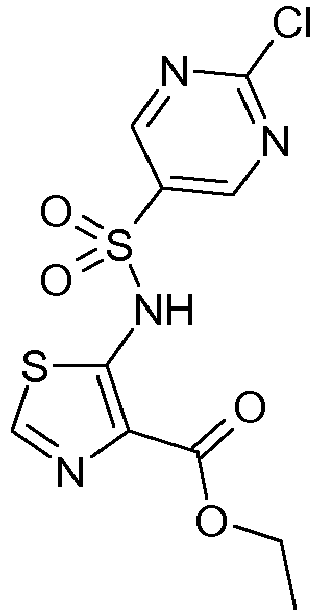
- 5-Amino-thiazole-4-carboxylic acid ethyl ester (600mg, 3.484mmol) was dissolved in acetone (20mL). To this, 2-chloro-pyrimidine-5-sulfonyl chloride (890mg, 4.181mmol) was added at 0°C under argon and stirred for 10 minutes. To this, sodium hydroxide solution (5N; 0.4mL) was added drop wise at 0°C and stirred for 1 hour; this addition was repeated 3 times. The mixture was concentrated in vacuo. The residue was purified by preparative TLC eluting with 100% ethyl acetate to give Intermediate 56 (156mg) as a yellow solid.
LCMS (Method 13) Rt 1.70 min; m/z(M+H)+ 349 - The following compounds were prepared using a similar method as described in Example 29.
No Structure LCMS Method Rt (min) Mass [M-H]- 166 
Method 1 1.89 365 181 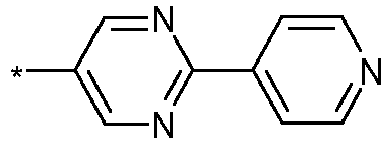
Method 13 1.31 364 -

- Intermediate 57 (80mg, 0.214mmol) was dissolved in tetrahydrofuran (1.5mL) and water (0.5mL). To this, lithium hydroxide monohydrate (71mg, 1.713mmol) was added at room temperature and stirred for 20 hours. The mixture was concentrated in vacuo, diluted with water and washed with n-pentane. The aqueous layer was acidified with 1N hydrochloric acid solution. The product was collected by filtration, washed with n-pentane and diethyl ether and dried under vacuum to give Compound 179 X12 (40mg) as an off white solid.
1H NMR (DMSO-d6) δ: 8.65-8.45 (3H, m), 8.15 (1H, t), 3.55-3.45 (2H, m), 3.40-3.30 (2H, m)
LCMS (Method 13) Rt 1.51 min; m/z(M+H)+ 346 -

- Intermediate 56 (100mg, 0.287mmol) was dissolved in acetonitrile (5mL) under argon. To this, ethanolamine (0.17mL, 0.287mmol) was added at room temperature and stirred at 50°C for 2 hours. The mixture was diluted with water and extracted with ethyl acetate. The organic layer was dried with Na2SO4, filtered and concentrated in vacuo. The residue was purified by preparative TLC eluting with 100% ethyl acetate to give Intermediate 57 (90mg) as a yellow solid.
LCMS (Method 13) Rt 1.85 min; m/z(M+H)+ 374 -

- Intermediate 58 (90mg, 0.274mmol) was dissolved in tetrahydrofuran (3mL) and water (1mL). To this, lithium hydroxide monohydrate (69mg, 1.645mmol) was added at room temperature and stirred for 48 hours. The mixture was concentrated in vacuo, diluted with water and washed with diethyl ether. The aqueous layer was acidified with 1N hydrochloric acid solution. The product was collected by filtration, washed with diethyl ether and dried under vacuum to give Compound 143 (30mg) as an off white solid.
1H NMR (DMSO-d6) δ: 8.40 (1H, s), 7.80-7.70 (2H, m), 7.40-7.25 (3H, m), 6.98 (1H, d), 4.85 (2H, s), 3.10 (3H, s), 2.85 (3H, s)
LCMS (Method 12) Rt 4.57 min; m/z(M+H)+ 301 -

- 5-Amino-thiazole-4-carboxylic acid ethyl ester (200mg, 1.161mmol) was dissolved in acetone (8mL). To this, 6-aminopyridine-3-sulfonyl chloride (268mg, 1.393mmol) was added at 0°C under argon and stirred for 10 minutes. To this, sodium hydroxide solution (5N; 0.4mL) was added drop wise at 0°C and stirred for 1 hour; this addition was repeated 2 times. The mixture was concentrated in vacuo. The residue was purified by preparative TLC eluting with 100% ethyl acetate to give Intermediate 58 (90mg) as a yellow solid.
LCMS (Method 13) Rt 1.52 min; m/z(M+H)+ 329 -

- Intermediate 59 (90mg, 0.234mmol) was dissolved in tetrahydrofuran (3mL) and water (1mL). To this, lithium hydroxide monohydrate (39mg, 0.936mmol) was added at room temperature and stirred for 36 hours. The mixture was concentrated in vacuo, diluted with water and washed with ethyl acetate. The aqueous layer was acidified with 1N hydrochloric acid solution. The product was collected by filtration, washed with diethyl ether and dried under vacuum to give Compound 226 (40mg) as a brown solid.
1H NMR (DMSO-d6) δ: 8.40 (1H, s), 7.80-7.70 (2H, m), 7.40-7.25 (3H, m), 6.98 (1H, d), 4.85 (2H, s), 3.10 (3H, s), 2.85 (3H, s)
LCMS (Method 36) Rt 4.54 min; m/z(M+H)+ 356 -

- Intermediate 60 (100mg, 0.305mmol) and triethylamine (0.125mL, 0.915mmol) were dissolved in dichloro-methane (4mL). To this, propionyl chloride (23mg, 0.244mmol) was added drop wise at 0°C and stirred for 1 hour. The mixture was poured onto ice/water and extracted with 10% methanol/dichloromethane. The organic layer was dried with Na2SO4, filtered and concentrated in vacuo. The residue was washed with 4N hydrochloric acid solution, collected by filtration and dried under vacuum to give Intermediate 59 (90mg) as a brown solid.
LCMS (Method 10) Rt 3.13 min; m/z(M+H)+ 384 -

- Intermediate 61 (3.3g, 9.235mmol) was dissolved in ethanol (40mL), tetrahydrofuran (40mL) and water (10mL) under argon. To this, iron powder (2.5g, 46.18mmol) and ammonium chloride (1.26g, 23.09mmol) was added at room temperature and heated at 80°C for 1 hour. The mixture was filtered hot and the residue washed with 10% methanol/dichloromethane. The filtrate was washed with water, dried with Na2SO4, filtered and concentrated in vacuo to give Intermediate 60 (2.2g).
LCMS (Method 19) Rt 1.46 min; m/z(M+H)+ 328 -

- Sodium hydride (60% disp. in oil; 2.79g, 69.68mmol) was suspended in dry tetrahydrofuran (60mL). To this, 5-amino-thiazole-4-carboxylic acid ethyl ester (4g, 23.23mmol) was added at 0°C and the mixture was stirred for 10 minutes. To this, 4-nitrobenzenesulfonyl chloride (6.2g, 27.87mmol) was added at 0°C and the mixture stirred at room temperature for 2 hours. The mixture was diluted with ammonium chloride solution and diethyl ether. The solid formed collected by filtration, washed with ether and dried under vacuum to give Intermediate 61 (3.2g) as a yellow solid.
LCMS (Method 37) Rt 1.56 min; m/z(M-H)- 356 - The following compounds were prepared using a similar method as described in Example 32. In the table below Compound 125 was prepared using a similar method as described in Example 32.
- Compound 36 was prepared by hydrolysis of Intermediate 60 using the same method used to prepare Example 119 from Intermediate 59.
- Compounds 120 and 176 were prepared using acetoxyacetylchloride and 2-acetoxyisobutyryl chloride respectively, in place of propionyl chloride used to prepare Example 32.
- Compound 174 was prepared by using Boc-glycine in place of the propionyl chloride used to prepare Example 32. A TFA deprotection was required prior to final purification.
- Compound 121 was prepared by reacting Intermediate 60 with methylisocyanate followed by hydrolysis as foe Example 32.

- The MBL enzyme VIM-2 is produced and purified as disclosed in Borgianni et al, Antimicrobial Agents & Chemotherapy, (2010), 54(8), 3197-3204.
- The MBL enzyme IMP-1 is produced and purified as disclosed in Laraki et al, Antimicrobial Agents & Chemotherapy, (1999), 43(4), 902-906.
- NDM-1 is produced and purified as disclosed in Yong et al, Antimicrobial Agents & Chemotherapy, (2009) 53(12), 5046-54.
- Reaction buffers were prepared in a UV-transparent 96-well microplate, which buffer contains 10 mM HEPES pH 7.5, 50 µM ZnSO4, 20 µg/mL BSA. An amount of 75 ng of protein was added to each well.
- Spectrophometric assays are performed to determine NDM-1/VIM-2/IMP-1 carbapenemase activity using purified proteins (50 ng for NDM-1/VIM-2, 25 ng IMP-1) from NDM-1/VIM-2/IMP-1 expressing bacteria using 300 µm of imipenem as substrate in 10mM HEPES pH 7.5, 50µM ZnSO4. MBL hydrolysis is measured at 299 nm for 10 minutes at 30°C as the absorbance changes due to the opening of beta-lactam ring of the antibiotic. The assays are performed with ethylenediaminetetraacetic acid (EDTA; 25 mM) as control to examine the complete inhibition of carbapenemase activity. A range of inhibitor concentrations are routinely assessed: from 0.1 to 50 µM (2-fold dilutions series) for NDM-1, VIM-2 and IMP-1 assays, delivering IC50 values to calculate Ki values for the inhibition of each enzyme, using the standard Cheng-Prusoff equation, Ki = IC50 / (1+([S]/Km)) and where the Km values for NDM-1, VIM-2 and IMP-1 are 70 µM, 9 µM and 25 µM respectively.
- The Ki values obtained for selected example compounds are shown in Table 3, where they are compared with the values for pyridine-2-carboxylic acid.
TABLE 3 Compound NDM-1 µM VIM-2 µM IMP-1 µM Pyridine-2-carboxylic acid 3.0 1.0 300 63 0.6 0.13 1.7 81 0.13 0.03 0.41 151 3.2 0.1 1.8 78 0.16 0.4 0.05 163 0.37 0.28 1.0 138 0.43 0.01 0.13 111 2.8 0.22 0.9 75 2.1 0.34 0.94 77 1.3 0.03 0.12 88 1.0 0.16 0.58 96 2.7 0.35 1.2 1 1.2 0.32 0.08 5 2.5 0.21 0.05 7 0.75 0.08 0.03 20 0.94 0.48 0.1 41 0.67 0.22 0.08 60 0.8 0.1 0.07 50 1.7 0.26 0.06 58 2.3 0.8 0.07 170 X3 4.2 0.46 172 X5 0.22 0.05 0.76 173 X6 0.18 0.04 0.33 - The minimal inhibitory concentration (MIC) of meropenem in presence of the inhibitor is routinely assessed against 3 representative clinical strains:
- NTBC020 strain: Escherichia coli producing NDM-1 + TEM-1 +CTX-M-15, (isolated in Australia in 2009);
- NTBC023 strain: Klebsiella pneumoniae producing VIM-1 + SHV-5,(isolated in France in 2002);
- NTBC062 strain: Klebsiella pneumoniae producing IMP-1+TEM-1, (isolated in France in 2012);
- The assay was performed according to the standard broth microdilution method described by the Clinical and Laboratory Standards Institute (CLSI-M7-A7- Methods for dilution antimicrobial susceptibility tests for bacteria that grow aerobically; Approved standard; CLSI, Wayne, PA, USA. 2006). This method involves the use of small volumes of broth dispensed in sterile, plastic 96-wells microdilution plates. The compounds were tested at a concentration of 100 µM and controls included the susceptibility tests for the three selected strains without the compounds and for the two reference strains E. coli ATCC 25922 and Pseudomonas aeruginosa ATCC 27853 as Quality Controls.
- From a stock solution at 20 mM in DMSO, compounds were prepared by diluting 0.04 mL of the compound solution in 0.04 mL of Mueller-Hinton (MH) broth (2-fold dilution). Then, 0.001 mL of the compound dilution was distributed in the 96-wells microdilution plates to give a final concentration of 100 µM for a final volume of 0.1 mL by well.
- From a meropenem stock solution at 10 mg/ml in water, meropenem 2-fold serial dilutions were prepared in MH broth at twice the desired final concentrations, e.g from 512 to 0.0037 µg/ml. The 96-wells microdilution plates were then filled with 0.05 mL of the meropenem dilutions. For each susceptibility test, two wells were left free of antibiotic and filled with 0.05 mL of sterile MH broth to serve as growth controls.
- The bacterial inoculum was prepared by direct colony suspension from a 24h-agar plate in saline solution (NaCl 9g/L). The suspension was adjusted to a 0.5 MacFarland turbidity standard (1-2x10⁸ CFU/mL) and then diluted 1:100 in MH broth. 0.05 mL of the bacterial dilution was then inoculated to each well giving a final volume of 0.1 mL and a final bacterial concentration of approximately 5x10⁵ CFU/mL.
- Microdilution plates were incubated at 37°C in an ambient air incubator for 18-20h. MICs are then reported as the lowest concentration of meropenem (in mg/mL) that completely inhibits growth of the organism.
- The results are shown in Table 4.
Table 4 Compound No Strain NTBC020 NTBC023 NTBC039 66 16 8 8 69 16 4 1 101 32 8 1 67 1 16 8 104 16 4 2 94 16 8 4 124 4 4 0.25 144 16 8 1 118 4 8 4 163 16 32 16 138 32 16 1 111 4 8 0.25 147 8 16 4 1 32 64 16 41 64 16 4 48 4 2 0.25 170 16 1 0.25 172 64 8 8 173 128 8 8 - A kit as described herein comprises:
- a bacterial lysis buffer, for example Tris-HCl 20 mmol/L lysis buffer,
- a carbapenemase activity detection solution, for example a solution made of 3 mg of imipenem monohydrate, pH 7.8, phenol red solution, and 0.1 mmol/L ZnSO4. The phenol red solution has been prepared by mixing 2 mL of a phenol red solution 0.5% (wt/vol) with 16.6 mL of distilled water. The pH value has then been adjusted to 7.8 by adding drops of 1 N NaOH,
- a compound of the invention, or a plurality of compounds of the invention,
- and instructions of use.
- The instructions of use are as follows.
- One calibrated amount of the tested bacterial strain is resuspended in the bacterial lysis buffer, vortexed for 1 minute and further incubated at room temperature for 30 minutes. This bacterial suspension is centrifuged at 10,000 × g at room temperature for 5 minutes. 30 µL of the supernatant, corresponding to the cell-free enzymatic suspension, are mixed in 96-well trays with 100 µL of the carbapenemase activity detection solution. In some of the wells the compound of the invention is added at a fixed concentration, preferably between 10 nM and 10 µM. The trays are incubated at 37°C for a maximum of 2 hours. The colour of the solution in each well is assessed visually or using a spectrophotometer at the appropriate wavelength.
- The detection technique is based on the variation of the pH of the solution due to hydrolysis of the β-lactam ring of imipenem by MBL enzymes. The colour of the detection solution turns from red to orange or yellow for tested strains that produce MBL enzymes. When a compound of the invention is added to the reaction solution, change of colour or absence of change indicates the presence or absence of MBL enzymes.
Y is a single bond, -C1-4 alkylene- or -C2-4 alkenylene-, either of which may be substituted with a group R17; or
-C1-4 alkylene-O-; -C1-4 alkylene-N(R8)-; -N(R8)-; -C1-4 alkylene-C(O)N(R8)-; -C1-4 alkylene-N(R8)C(O)- or -N(R8)C1-4 alkylene-;
wherein R17 is ORl, NRlRm, NRlC(O)Rm, C(O)NRlRm, C(O)ORm;
each Rl and Rm is independently H or C1-4 alkyl;
and R8 is hydrogen or C1-6 alkyl or -C(O)C1-6 alkyl either of which is optionally substituted by one or more substituent Rd; and
C1-4 alkylene chains may optionally be substituted with one or more substituents Re;
each Rd and Re is independently halo, CN, OH or OC1-4 alkyl optionally substituted by one or more substituent selected from halo and OH;
OC1-4 alkyl which may optionally substituted by one or more substituent selected from halo and OH;
wherein each Rj and Rk is independently H or C1-4 alkyl;
R5 is hydrogen, phenyl, 5- to 6-membered heteroaryl, 3- to 8-membered carbocyclyl or 3- to 8-membered heterocyclyl; or
C1-6 alkyl optionally substituted with phenyl, 5- to 6-membered heteroaryl, 3-to 8-membered carbocyclyl or 3- to 8-membered heterocyclyl;
or a salt thereof.
provided that the compound is not 5-(4-aminophenylsulfonamido)thiazole-4-carboxylic acid.
Claims (22)
- A compound of general formula (I) including all polymorphs thereof:
 R1 is hydrogen, halo, CN, R12, OR12, SR12 or NR12R13wherein R12 is C1-6 alkyl optionally substituted with one or more substituent Ra; phenyl or 5- to 6-membered heteroaryl, either of which may optionally be substituted with one or more substituent Rb; or 3- to 6-membered cycloalkyl or 3- to 6-membered heterocyclyl, either of which is optionally substituted with one or more substituent Rc;each Ra is independently halo, CN, OH or OC1-4 alkyl optionally substituted by one or more substituent selected from halo and OH;each Rb is independently halo, CN, OH or C1-4 alkyl or OC1-4 alkyl either of which may optionally substituted by one or more substituent selected from halo and OH; each Rc is independently halo, CN, OH, oxo or C1-4 alkyl or OC1-4 alkyl optionally substituted by one or more substituent selected from halo and OH;R13 is hydrogen or C1-6 alkyl optionally substituted with one or more substituent Ra as defined above;Y is a single bond, -C1-4 alkylene- or -C2-4 alkenylene-, either of which may be substituted with a group R17; or-C1-4 alkylene-O-; -C1-4 alkylene-N(R8)-; -N(R8)-; -C1-4 alkylene-C(O)N(R8)-; -C1-4 alkylene-N(R8)C(O)- or -N(R8)C1-4 alkylene-;wherein R17 is ORl, NRlRm, NRlC(O)Rm, C(O)NRlRm, C(O)ORm;each Rl and Rm is independently H or C1-4 alkyl;and R8 is hydrogen or C1-6 alkyl or -C(O)C1-6 alkyl either of which is optionally substituted by one or more substituent Rd; andC1-4 alkylene chains may optionally be substituted with one or more substituents Re;each Rd and Re is independently halo, CN, OH or OC1-4 alkyl optionally substituted by one or more substituent selected from halo and OH;A represents a cyclic group selected from a 6- to 10-membered aryl, 5- to 10-membered heteroaryl or a 3- to 10- membered carbocyclyl or heterocyclyl group;n is 0 to 4;each R2 is independently selected from R3; orC1-4 alkyl, C2-4 alkenyl, O(C1-4 alkyl), S(C1-4 alkyl), SO(C1-4 alkyl) or SO2(C1-4 alkyl), any of which may optionally be substituted with one or more substituent R3; or C(O)OR6; C(O)R6 ; OR5, NR4R5; NR4C(O)R6, NR4C(O)NR5R6 or SO2NR21R22; or when A is saturated or partially saturated, R2 may also be oxo;each R3 is independently halo, nitro, CN, OH; or-C(O)OR14, -C(O)NR14R15 or -NR14R15; orphenyl optionally substituted with one or more substituent R7; ornaphthyl optionally substituted with one or more substituent R7; or5- to 10-membered heteroaryl optionally substituted with one or more substituent R7; or3- to 8-membered carbocyclyl optionally substituted with one or more substituent R7; or3- to 8-membered heterocyclyl optionally substituted with one or more substituent selected from oxo and R7;each of R14 and R15 is independently H, or C1-6 alkyl optionally substituted with one or more substituents selected from halo and OH;each R7 is independently halo, CN, OH; or C1-4 alkyl or OC1-4 alkyl either of which may optionally substituted by one or more substituent selected from halo and OH; or NRjRk, wherein each Rj and Rk is independently H or C1-4 alkyl;each of R21 and R22 is hydrogen or C1-4 alkyl or R21 and R22 together with the nitrogen atom to which they are attached may form a 5- or 6-membered heterocyclic ring, optionally containing one further heteroatom selected from N, O and S and optionally substituted with C1-4 alkyl or halo;R4 is hydrogen or C1-6 alkyl optionally substituted with halo, CN, OH, NRjRk; or OC1-4 alkyl which may optionally substituted by one or more substituent selected from halo and OH;wherein each Rj and Rk is independently H or C1-4 alkyl;R5 is hydrogen, phenyl, 5- to 6-membered heteroaryl, 3- to 8-membered carbocyclyl or 3- to 8-membered heterocyclyl; orC1-6 alkyl optionally substituted with phenyl, 5- to 6-membered heteroaryl, 3- to 8-membered carbocyclyl or 3- to 8-membered heterocyclyl;wherein phenyl and heteroaryl groups are optionally substituted by one or more substituent Rf and carbocyclyl and heterocyclyl groups are optionally substituted by one or more substituent Rg and wherein:each Rf is independently halo, CN, OH or C1-4 alkyl or OC1-4 alkyl either of which may optionally be substituted by one or more substituent selected from halo and OH;each Rg is independently halo, CN, OH, oxo or C1-4 alkyl or OC1-4 alkyl optionally substituted by one or more substituent selected from halo and OH;R6 is C1-6 alkyl optionally substituted with one or more Rh, or phenyl or 5- to 6-membered heteroaryl either of which is optionally substituted with one or more substituent Ri;each Rh is independently halo, CN, OH, NH2, phenyl, pyridyl, COOH or OC1-4 alkyl optionally substituted by one or more substituent selected from halo and OH;each Ri is independently halo, CN, OH, NH2 or C1-4 alkyl or OC1-4 alkyl either of which may optionally be substituted by one or more substituent selected from halo and OH;R11 is hydrogen, C1-4 alkyl optionally substituted by halo or benzyl optionally substituted by halo;
or a salt thereof.provided that the compound is not 5-(4-aminophenylsulfonamido)thiazole-4-carboxylic acid. - A compound according to claim 1 wherein:(i) R1 is hydrogen, halo, CN, R12, OR12, SR12 or NR12R13; wherein R12 is C1-6 alkyl optionally substituted with one or more substituent Ra; or phenyl optionally substituted with one or more substituent Rb; and wherein Ra, Rc and R13 are as defined in claim 1; and/or(ii) Y is a single bond, -C1-4 alkylene, -C1-4 alkylene-O-, -C1-4 alkylene-NR8-, -NR8- or -NR8(C1-4 alkylene)-; wherein R8 is hydrogen or methyl and wherein alkylene chains are optionally substituted with one or more substituents Re as defined in claim 1; and/or(iii) A represents 6- to 10-membered aryl, 3- to 8-membered cycloalkyl, 5- to 10-membered heteroaryl or 3- to 8-membered heterocyclyl, any of which may be substituted as defined in claim 1; and/or(iv) n is 0 to 3.
- A compound according to claim 1 or claim 2 wherein:(i) R1 is hydrogen, C1-4 alkyl optionally substituted with one or more halo substituents, or phenyl; and/or(ii) Y is a single bond, -C1-4 alkylene, -C1-4 alkylene-O-, -C1-4 alkylene-NR8-, or-NR8(C1-4 alkylene)-; wherein R8 is hydrogen and wherein alkylene chains are optionally substituted with one or more substituents Re, wherein Re is halo; and/or(iii) A is selected from:(a) phenyl, pyridyl, pyrazole, thiophenyl, benzothiophenyl, quinolinyl or isoquinolinyl, any of which may be unsubstituted or substituted with one to four R2 groups as defined in claim 1; or(b) a 5- or 6-membered carbocyclic or heterocyclic ring which may be unsubstituted or substituted with one to four R2 groups as defined in claim 1, for example by one or two oxo groups; or(c) a 9- to 10-membered bicyclic aromatic ring which may be unsubstituted or substituted with one to four R2 groups as defined in claim 1 for example with one to four substitutents selected from halo or, when the ring is partially saturated, with oxo; and/or(iv) each R2 is independently selected from:(a) halo, nitro, cyano, OH or when A is saturated or partially saturated, oxo;(b) C1-4 alkyl, C2-4 alkenyl, or O(C1-4 alkyl) any of which may optionally be substituted with one or more substituent R3 as defined in claim 1; or(c) OR5, wherein R5 is as defined in claim 1; or(d) NR4R5, where R4 and R5 are as defined in claim 1; or(e) NR4C(O)R6, where R4 and R6 are as defined in claim 1; or(f) NR4C(O)NR5R6, where R4, R5 and R6 are as defined in claim 1; or(g) C(O)R6 or C(O)OR6, where R6 is as defined in claim 1; or(h) SO2(C1-4 alkyl); or(i) SO2NR21R22, wherein each of R21 and R22 is hydrogen or where R21 and R22 together with the nitrogen atom to which they are attached form a piperidine, pyrrolidine or morpholine ring or a piperazine ring optionally substituted on the other nitrogen atom with methyl or ethyl; or(j) a cyclic group selected from phenyl, naphthyl, 5- to 10-membered heteroaryl or 3- to 8-membered heterocyclyl, any of which is optionally substituted with one or more substituent R7 as defined in claim 1.
- A compound according to any one of the preceding claims wherein, independently or in combination:R1 is hydrogen; andR11 is hydrogen.
- A compound according to any one of the preceding claims wherein Y is a single bond, -CH2-, -(CH2)2-, -(CH2)3-, -CH(CH3)-, -CH(CH2 CH3)-, -NH-, -N(CH3)-NHCH2- or -N(CH3)CH2-.
- A compound according to any one of the preceding claims wherein A represents phenyl, pyridyl, pyrazolyl, thiophenyl or benzothiophenyl; especially phenyl, 3-pyridyl, 4-pyridyl, thiophen-2-yl, thiophen-3-yl, pyrazol-3-yl, pyrazol-4-yl, pyrazol-5-yl, benzothiophen-2-yl or benzothiophen-3-yl, any of which may be substituted as defined in claim 1.
- A compound according to any one of the preceding claims wherein:(i) R2 is C1-4 alkyl, C2-4 alkenyl, O(C1-4 alkyl) and is unsubstituted or is substituted by an R3 group selected from halo, phenyl, amino, methylamino or dimethylamino; or(ii) R2 is OR5, wherein R5 is a 5- or membered heterocyclic group, for example pyrrolidine; or(iii) R2 is NR4R5, wherein R4 is hydrogen, and C1-4 alkyl and R5 is hydrogen or a 5- or 6-membered heterocyclic group such as oxazolyl, isoxazolyl and pyrrolyl and piperidinyl; or(iv) R2 is NR4C(O)R6, wherein R4 is hydrogen or methyl, especially hydrogen, and R6 is C1-4 alkyl optionally substituted with one or more Rh, where each Rh is independently, OH, NH2, phenyl, or OC1-4 alkyl; or R6 is phenyl; or(v) R2 is NR4C(O)NR5R6, wherein R4 is hydrogen or methyl, especially hydrogen; and R5 is hydrogen and R6 is C1-4 alkyl, for example methyl; or(vi) R2 is C(O)R6 or C(O)OR6, wherein R6 is C1-4 alkyl substituted with phenyl and/or NH2; or(vii) R2 is a cyclic group selected from phenyl, pyridyl, pyrazolyl, oxazolyl, isoxazolyl, pyrrolidinyl, piperidinyl, piperazinyl, morpholinyl, diazepanyl or azetidinyl, any of which may be substituted by one or more substituents R7, where R7 is halo, C1-4 haloalkyl or NH2; and wherein pyrazolyl, oxazolyl, isoxazolyl, pyrrolidinyl, piperidinyl, piperazinyl, morpholinyl, diazepanyl or azetidinyl may be substituted by one or more oxo groups in addition to or instead of an R7 group; or(viii) R2 is halo.
- A compound according to any one of the preceding claims wherein:A is phenyl or pyridyl;n is 0 to 3; andR2 is halo, CF3; nitro, methoxy, phenyl, SO2-C1-4 alkyl; orC1-2 alkyl or ethenyl optionally substituted with phenyl or -C(O)NR14R15, where R14 and R15 are each independently H or methyl; ora 4- to 7-membered carbocyclic or heterocyclic ring optionally substituted with one or more R7 groups, where R7 is as defined above; NHR4; NHR5; NHC(O)R6; or NR4C(O)NR5R6, where R4, R5 and R6 are defined above;
- A compound according to claim 8 wherein R2 is:(i) halo, trifluoromethyl, nitro, methoxy, phenyl; or(ii) oxazoline, morpholine, pyrrolidine, piperidine, tetrahydropyridine, piperazine diazepan or aziridine, any of which may optionally be substituted with an oxo group or with NH2 or C1-2 alkyl or haloalkyl; or(iii) oxazole or pyrazole, either of which may optionally be substituted with methyl; or(iv) NHC(O)C1-2 alkyl, either of which may optionally be substituted by OH or methoxy; or(v) NHC(O)NHCH3, NH2, NH(CH3), CH2N(CH3)2, SO2CH3; or(vi) ethenyl substituted with phenyl or C(O)N(CH3)2.
- A compound according to any one of the preceding claims wherein:(i) A is phenyl optionally substituted with 1 to 3 halo substituents R2; or(ii) A is phenyl substituted with at least one trifluoromethyl group or amino group.
- A compound according to any one of claims 1 to 7 wherein:(i) A is a 3- to 6-membered carbocyclic or heterocyclic ring optionally fused to a phenyl group, optionally wherein:n is 0-2;at least one R2 is oxo, or when attached to a ring nitrogen atom is C(O)OR6, wherein R6 is benzyl; or(ii) A is pyazolyl or thiophenyl, especially pyrazol-4-yl, pyrazol-5-yl, thiophen-2-yl or thiophen-3-yl, optionally wherein:n is 1 to 3;R2 is halo, methyl, trifluoromethyl or phenyl or pyridyl, either of which may optionally be substituted with halo or trifluoromethyl, especially trifluoromethyl; or(iii) A is quinolinyl, isoquinolinyl or benzothiophenyl especially quinolin-6-yl or benzothiophen-2-yl and n is 0.
- A compound according to claim 1 wherein:- R1 is hydrogen;- R11 is hydrogen;- Y is a single bond, -CH2-, -(CH2)2-, -(CH2)3-, -CH(CH3)-, -CH(CH2 CH3)-, -NH-, -N(CH3)--NHCH2- or -N(CH3)CH2-;- A is phenyl or pyridyl;- n is 0 to 3; and- R2 is halo or -NHC(O)R6
wherein R6 is C1-4 alkyl optionally substituted with one or more Rh, wherein each Rh is independently OH, NH2, phenyl or OC1-4alkyl; or R6 is phenyl. - A compound according to claim 1 wherein:- R1 is hydrogen;- R11 is hydrogen;- Y is a single bond;- A is phenyl or pyridyl;- n is 1 to 3; and- R2 is halo, trifluoromethyl, nitro or methoxy.
- A compound according to claim 1 selected from:5-benzenesulfonamido-1,3-thiazole-4-carboxylic acid;5-{[(3,5-dichlorophenyl)methyl]sulfonamido}-1,3-thiazole-4-carboxylic acid;5-(2,4,6-trimethylphenylsulfonamido)thiazole-4-carboxylic acid;5-{[3-(trifluoromethyl)phenyl]sulfonamido}-1,3-thiazole-4-carboxylic acid;5-(phenylmethylsulfonamido)thiazole-4-carboxylic acid;5-(3-methoxyphenylsulfonamido)thiazole-4-carboxylic acid;5-(2-phenylethylsulfonamido)thiazole-4-carboxylic acid;5-(thiophene-2-sulfonamido)thiazole-4-carboxylic acid;5-(4,5-dichlorothiophene-2-sulfonamido)thiazole-4-carboxylic acid;5-(2,5-dichlorothiophene-3-sulfonamido)thiazole-4-carboxylic acid;5-(2-(trifluoromethyl)phenylsulfonamido)thiazole-4-carboxylic acid;5-(4-(trifluoromethyl)phenylsulfonamido)thiazole-4-carboxylic acid;5-(2-chloro-5-(trifluoromethyl)phenylsulfonamido)thiazole-4-carboxylic acid;5-(3,5-bis(trifluoromethyl)phenylsulfonamido)thiazole-4-carboxylic acid;5-({[2-(trifluoromethyl)phenyl]methyl}sulfonamido)-1,3-thiazole-4-carboxylic acid;5-{[(2-methylphenyl)methyl]sulfonamido}-1,3-thiazole-4-carboxylic acid;5-((2-nitrophenyl)methylsulfonamido)thiazole-4-carboxylic acid;5-{[(2-bromophenyl)methyl]sulfonamido}-1,3-thiazole-4-carboxylic acid;5-(5-chlorothiophene-2-sulfonamido)thiazole-4-carboxylic acid;5-(5-phenylthiophene-2-sulfonamido)thiazole-4-carboxylic acid;5-(thiophene-3-sulfonamido)thiazole-4-carboxylic acid;5-(2,5-dimethylthiophene-3-sulfonamido)thiazole-4-carboxylic acid;5-([1,1'-biphenyl]-2-ylsulfonamido)thiazole-4-carboxylic acid;5-((2-aminophenyl)methylsulfonamido)thiazole-4-carboxylic acid;5-((2-acetamidophenyl)methylsulfonamido)thiazole-4-carboxylic acid;5-((2-benzamidophenyl)methylsulfonamido)thiazole-4-carboxylic acid;(E)-5-((2-styrylphenyl)methylsulfonamido)thiazole-4-carboxylic acid;(E)-5-((2-(3-(dimethylamino)-3-oxoprop-1-en-1-yl)phenyl)methylsulfonamido)thiazole-4-carboxylic acid;5-([1,1'-biphenyl]-2-ylmethylsulfonamido)thiazole-4-carboxylic acid;5-((2-(trifluoromethoxy)phenyl)methylsulfonamido)thiazole-4-carboxylic acid;5-((3-(trifluoromethyl)phenyl)methylsulfonamido)thiazole-4-carboxylic acid;5-((3-bromophenyl)methylsulfonamido)thiazole-4-carboxylic acid;5-((3-cyanophenyl)methylsulfonamido)thiazole-4-carboxylic acid;5-((2-chlorophenyl)methylsulfonamido)thiazole-4-carboxylic acid;5-(4-nitrophenylsulfonamido)thiazole-4-carboxylic acid;5-({5-[5-(trifluoromethyl)-1,2-oxazol-3-yl]thiophen-2-yl}sulfonamido)-1,3-thiazole-4-carboxylic acid;5-(1-benzothiophene-2-sulfonamido)-1,3-thiazole-4-carboxylic acid;5-[(5-methylthiophen-2-yl)sulfonamido]-1,3-thiazole-4-carboxylic acid;5-[(5-bromothiophen-2-yl)sulfonamido]-1,3-thiazole-4-carboxylic acid;5-(1-benzothiophene-3-sulfonamido)-1,3-thiazole-4-carboxylic acid;5-[(4-bromo-2,5-dichlorothiophen-3-yl)sulfonamido]-1,3-thiazole-4-carboxylic acid;5-({[(2-chlorophenyl)methyl]sulfamoyl}amino)-1,3-thiazole-4-carboxylic acid;5-[({[3-(trifluoromethyl)phenyl]methyl}sulfamoyl)amino]-1,3-thiazole-4-carboxylic acid;5-[(3-bromothiophen-2-yl)sulfonamido]-1,3-thiazole-4-carboxylic acid;5-{[(2-iodophenyl)methyl]sulfonamido}-1,3-thiazole-4-carboxylic acid;5-{[4-phenyl-5-(trifluoromethyl)thiophen-3-yl]sulfonamido}-1,3-thiazole-4-carboxylic acid;5-{[(2,3-dichlorophenyl)methyl]sulfonamido}-1,3-thiazole-4-carboxylic acid;5-{[(3,4-dichlorophenyl)methyl]sulfonamido}-1,3-thiazole-4-carboxylic acid;5-benzylsulfonamido-2-methyl-1,3-thiazole-4-carboxylic acid;2-methyl-5-(quinoline-8-sulfonamido)-1,3-thiazole-4-carboxylic acid;5-benzenesulfonamido-2-methyl-1,3-thiazole-4-carboxylic acid;5-{[(3,5-dichlorophenyl)methyl]sulfonamido}-2-methyl-1,3-thiazole-4-carboxylic acid;5-[(2-chlorophenyl)sulfonamido]-2-methyl-1,3-thiazole-4-carboxylic acid;2-methyl-5-[(2,4,6-trimethylphenyl)sulfonamido]-1,3-thiazole-4-carboxylic acid;5-[(2,5-dichlorothiophen-3-yl)sulfonamido]-2-methyl-1,3-thiazole-4-carboxylic acid;5-{[(2-bromophenyl)methyl]sulfonamido}-2-methyl-1,3-thiazole-4-carboxylic acid;5-benzenesulfonamido-2-phenyl-1,3-thiazole-4-carboxylic acid;5-benzenesulfonamido-2-ethyl-1,3-thiazole-4-carboxylic acid;5-[(1-phenylethyl)sulfonamido]-1,3-thiazole-4-carboxylic acid;5-{[6-(trifluoromethyl)pyridin-3-yl]sulfonamido}-1,3-thiazole-4-carboxylic acid;5-[(2-phenoxyethyl)sulfonamido]-1,3-thiazole-4-carboxylic acid;5-{[2-(1,3-dioxo-2,3-dihydro-1H-isoindol-2-yl)ethyl]sulfonamido}-1,3-thiazole-4-carboxylic acid;5-{[2-(2-chlorophenyl)ethyl]sulfonamido}-1,3-thiazole-4-carboxylic acid;5-({1-[5-(trifluoromethyl)pyridin-2-yl]-1H-pyrazol-4-yl}sulfonamido)-1,3-thiazole-4-carboxylic acid;5-[(2-chlorophenyl)sulfonamido]-1,3-thiazole-4-carboxylic acid;5-(pyridine-3-sulfonamido)-1,3-thiazole-4-carboxylic acid;5-[(2,6-dichlorophenyl)sulfonamido]-1,3-thiazole-4-carboxylic acid;5-(cyclohexylmethyl)sulfonamido-1,3-thiazole-4-carboxylic acid;5-[(4-methyl-3,4-dihydro-2H-1,4-benzoxazin-7-yl)sulfonamido]-1,3-thiazole-4-carboxylic acid;5-[(1-phenylpropyl)sulfonamido]-1,3-thiazole-4-carboxylic acid;5-{[2-(4-methoxyphenyl)ethyl]sulfonamido}-1,3-thiazole-4-carboxylic acid;5-({2-[3-(trifluoromethyl)phenyl]ethyl}sulfonamido)-1,3-thiazole-4-carboxylic acid;5-{[2-(4-chlorophenyl)ethyl]sulfonamido}-1,3-thiazole-4-carboxylic acid;5-[(piperidine-1-sulfonyl)amino]-1,3-thiazole-4-carboxylic acid;5-[(phenylsulfamoyl)amino]-1,3-thiazole-4-carboxylic acid;5-{[benzyl(methyl)sulfamoyl]amino}-1,3-thiazole-4-carboxylic acid;5-[(4-acetamidophenyl)sulfonamido]-1,3-thiazole-4-carboxylic acid;5-[(2-methoxyphenyl)sulfonamido]-1,3-thiazole-4-carboxylic acid;5-(1,2,3,4-tetrahydronaphthalene-1-sulfonamido)-1,3-thiazole-4-carboxylic acid;5-[(5-methyl-1-phenyl-1H-pyrazol-4-yl)sulfonamido]-1,3-thiazole-4-carboxylic acid;5-(cyclopropylmethyl)sulfonamido-1,3-thiazole-4-carboxylic acid;5-{[(2-methoxyphenyl)methyl]sulfonamido}-1,3-thiazole-4-carboxylic acid;5-{[2-(2-methoxyphenyl)ethyl]sulfonamido}-1,3-thiazole-4-carboxylic acid;5-{[2-(3-methoxyphenyl)ethyl]sulfonamido}-1,3-thiazole-4-carboxylic acid;5-{[2-(3-chlorophenyl)ethyl]sulfonamido}-1,3-thiazole-4-carboxylic acid;5-[(2-methanesulfonylphenyl)sulfonamido]-1,3-thiazole-4-carboxylic acid;5-{[methyl(phenyl)sulfamoyl]amino}-1,3-thiazole-4-carboxylic acid;5-{[4-(morpholin-4-yl)phenyl]sulfonamido}-1,3-thiazole-4-carboxylic acid;5-[(4-cyanophenyl)sulfonamido]-1,3-thiazole-4-carboxylic acid;5-(pyridine-2-sulfonamido)-1,3-thiazole-4-carboxylic acid;5-[(1-methyl-1H-imidazol-2-yl)sulfonamido]-1,3-thiazole-4-carboxylic acid;5-[(6-methoxypyridin-3-yl)sulfonamido]-1,3-thiazole-4-carboxylic acid;5-{[4-(1H-pyrazol-1-yl)phenyl]sulfonamido}-1,3-thiazole-4-carboxylic acid;5-[(1-ethyl-5-methyl-1H-pyrazol-4-yl)sulfonamido]-1,3-thiazole-4-carboxylic acid;5-{[(2-chlorophenyl)methyl]sulfonamido}-2-(trifluoromethyl)-1,3-thiazole-4-carboxylic acid;5-{[(2-cyanophenyl)methyl]sulfonamido}-1,3-thiazole-4-carboxylic acid;5-[(1-methyl-1H-pyrazol-3-yl)sulfonamido]-1,3-thiazole-4-carboxylic acid;5-[(1-methyl-1H-pyrazol-5-yl)sulfonamido]-1,3-thiazole-4-carboxylic acid;5-({1-[(benzyloxy)carbonyl]piperidin-4-yl}sulfonamido)-1,3-thiazole-4-carboxylic acid;5-[(3-phenylpropyl)sulfonamido]-1,3-thiazole-4-carboxylic acid;5-{[(2-chlorophenyl)methyl]sulfonamido}-2-methyl-1,3-thiazole-4-carboxylic acid;5-(2,3-dihydro-1H-indene-1-sulfonamido)-1,3-thiazole-4-carboxylic acid;5-{[4-(1-methyl-1H-pyrazol-5-yl)phenyl]sulfonamido}-1,3-thiazole-4-carboxylic acid;5-{[2-(1,2,3,4-tetrahydroquinolin-1-yl)ethyl]sulfonamido}-1,3-thiazole-4-carboxylic acid;5-{[2-(N-phenylacetamido)ethyl]sulfonamido}-1,3-thiazole-4-carboxylic acid;5-{[4-(3-oxomorpholin-4-yl)phenyl]sulfonamido}-1,3-thiazole-4-carboxylic acid;5-{[4-(2-oxo-1,3-oxazolidin-3-yl)phenyl]sulfonamido}-1,3-thiazole-4-carboxylic acid;5-[(1,2-dimethyl-1H-imidazol-4-yl)sulfonamido]-1,3-thiazole-4-carboxylic acid;5-[(oxan-4-ylmethyl)sulfonamido]-1,3-thiazole-4-carboxylic acid;5-[({1-[(benzyloxy)carbonyl]piperidin-4-yl}methyl)sulfonamido]-1,3-thiazole-4-carboxylic acid;5-{[4-(2-oxopyrrolidin-1-yl)phenyl]sulfonamido}-1,3-thiazole-4-carboxylic acid;5-({1-[6-(trifluoromethyl)pyridin-3-yl]-1H-pyrazol-4-yl}sulfonamido)-1,3-thiazole-4-carboxylic acid;5-{[4-(1,3-oxazol-5-yl)phenyl]sulfonamido}-1,3-thiazole-4-carboxylic acid;5-{[4-(1H-pyrazol-4-yl)phenyl]sulfonamido}-1,3-thiazole-4-carboxylic acid;5-[(1-phenyl-1H-pyrazol-4-yl)sulfonamido]-1,3-thiazole-4-carboxylic acid;5-{[4-(piperidin-4-yl)phenyl]sulfonamido}-1,3-thiazole-4-carboxylic acid;5-[(4-propanamidophenyl)sulfonamido]-1,3-thiazole-4-carboxylic acid;5-{[4-(2-hydroxyacetamido)phenyl]sulfonamido}-1,3-thiazole-4-carboxylic acid;5-({4-[(methylcarbamoyl)amino]phenyl}sulfonamido)-1,3-thiazole-4-carboxylic acid;5-{[(2,4-dichlorophenyl)methyl]sulfonamido}-1,3-thiazole-4-carboxylic acid;5-{[(2-fluorophenyl)methyl]sulfonamido}-1,3-thiazole-4-carboxylic acid;5-{[(2,3-difluorophenyl)methyl]sulfonamido}-1,3-thiazole-4-carboxylic acid;5-{[4-(2-methoxyacetamido)phenyl]sulfonamido}-1,3-thiazole-4-carboxylic acid;5-{[(2,5-dichlorophenyl)methyl]sulfonamido}-1,3-thiazole-4-carboxylic acid;5-{[(2,6-dichlorophenyl)methyl]sulfonamido}-1,3-thiazole-4-carboxylic acid;5-{[(2-chloro-6-fluorophenyl)methyl]sulfonamido}-1,3-thiazole-4-carboxylic acid;5-{[(2-chloro-4-fluorophenyl)methyl]sulfonamido}-1,3-thiazole-4-carboxylic acid;5-({[2-chloro-5-(trifluoromethyl)phenyl]methyl}sulfonamido)-1,3-thiazole-4-carboxylic acid;5-({4-[(dimethylamino)methyl]phenyl}sulfonamido)-1,3-thiazole-4-carboxylic acid;5-{[(2,3,5-trichlorophenyl)methyl]sulfonamido}-1,3-thiazole-4-carboxylic acid;5-{[(2,3-dichloro-6-fluorophenyl)methyl]sulfonamido}-1,3-thiazole-4-carboxylic acid;5-({[2,3-dichloro-6-(trifluoromethyl)phenyl]methyl}sulfonamido)-1,3-thiazole-4-carboxylic acid;5-{[(4-bromo-2-chlorophenyl)methyl]sulfonamido}-1,3-thiazole-4-carboxylic acid;5-({2-[methyl(phenyl)amino]ethyl}sulfonamido)-1,3-thiazole-4-carboxylic acid;5-{[(4-nitrophenyl)methyl]sulfonamido}-1,3-thiazole-4-carboxylic acid;5-[6-(piperidin-1-yl)pyridin-3-ylsulfonamido]-1,3-thiazole-4-carboxylic acid;5-[6-(methylamino)pyridin-3-ylsulfonamido]-1,3-thiazole-4-carboxylic acid;5-[6-(4-methylpiperazin-1-yl)pyridin-3-ylsulfonamido]-1,3-thiazole-4-carboxylic acid;5-(6-acetamidopyridin-3-ylsulfonamido)-1,3-thiazole-4-carboxylic acid;5-{4-[(5-methyl-1,2-oxazol-3-yl)amino]phenylsulfonamido}-1,3-thiazole-4-carboxylic acid;5-(6-aminopyridin-3-ylsulfonamido)-1,3-thiazole-4-carboxylic acid;5-[(6-chloro-2H-1,3-benzodioxol-5-yl)methylsulfonamido]-1,3-thiazole-4-carboxylic acid;5-{[(2-chloro-6-nitrophenyl)methyl]sulfonamido}-1,3-thiazole-4-carboxylic acid;5-(quinoline-6-sulfonamido)-1,3-thiazole-4-carboxylic acid;5-[(2,3-dihydroindole-1-sulfonyl)amino]-1,3-thiazole-4-carboxylic acid;5-(4-methanesulfonylphenylsulfonamido)-1,3-thiazole-4-carboxylic acid;5-[3-(2-oxo-1,3-oxazolidin-3-yl)phenylsulfonamido]-1,3-thiazole-4-carboxylic acid;5-[3-(2H-pyrazol-3-yl)phenylsulfonamido]-1,3-thiazole-4-carboxylic acid;5-[2-(pyridin-3-yl)ethylsulfonamido]-1,3-thiazole-4-carboxylic acid;5-[3-(3-oxomorpholin-4-yl)phenylsulfonamido]-1,3-thiazole-4-carboxylic acid;5-[3-(2-oxopyrrolidin-1-yl)phenylsulfonamido]-1,3-thiazole-4-carboxylic acid;5-[6-(piperidin-4-ylamino)pyridin-3-ylsulfonamido]-1,3-thiazole-4-carboxylic acid;5-(6-{[2-(dimethylamino)ethyl]amino}pyridin-3-ylsulfonamido)-1,3-thiazole-4-carboxylic acid;5-[(4-acetamidophenyl)methylsulfonamido]-1,3-thiazole-4-carboxylic acid;5-[6-(piperazin-1-yl)pyridin-3-ylsulfonamido]-1,3-thiazole-4-carboxylic acid;5-[6-(4-aminopiperidin-1-yl)pyridin-3-ylsulfonamido]-1,3-thiazole-4-carboxylic acid;5-[6-(3-aminopyrrolidin-1-yl)pyridin-3-ylsulfonamido]-1,3-thiazole-4-carboxylic acid;5-[6-(pyrrolidin-1-yl)pyridin-3-ylsulfonamido]-1,3-thiazole-4-carboxylic acid;5-[6-(3-aminopiperidin-1-yl)pyridin-3-ylsulfonamido]-1,3-thiazole-4-carboxylic acid;5-[6-(1,4-diazepan-1-yl)pyridin-3-ylsulfonamido]-1,3-thiazole-4-carboxylic acid;5-[4-(pyrrolidin-3-yloxy)phenylsulfonamido]-1,3-thiazole-4-carboxylic acid;5-[6-(3-aminoazetidin-1-yl)pyridin-3-ylsulfonamido]-1,3-thiazole-4-carboxylic acid;5-[6-(piperidin-4-yl)pyridin-3-ylsulfonamido]-1,3-thiazole-4-carboxylic acid;5-[6-(1,2,3,6-tetrahydropyridin-4-yl)pyridin-3-ylsulfonamido]-1,3-thiazole-4-carboxylic acid;5-{6-[4-(2,2,2-trifluoroethyl)piperazin-1-yl]pyridin-3-ylsulfonamido}-1,3-thiazole-4-carboxylic acid;5-[1-(2-chlorophenyl)ethylsulfonylamino]thiazole-4-carboxylic acid5-[1-(2-chlorophenyl)ethylsulfonylamino]thiazole-4-carboxylic acid5-(3-pyridylmethylsulfonylamino)thiazole-4-carboxylic acid5-(isoindolin-5-ylmethylsulfonylamino)thiazole-4-carboxylic acidR-5-[[4-[1-(2-amino-2-phenyl-acetyl)-4-piperidyl]phenyl]sulfonylamino]thiazole-4-carboxylic acidS-5-[[4-[1-(2-amino-2-phenyl-acetyl)-4-piperidyl]phenyl]sulfonylamino]thiazole-4-carboxylic acid5-[[4-[(2-aminoacetyl)amino]phenyllsulfonylamino]thiazole-4-carboxylic acid5-[(4-acetamido-3-fluoro-phenyl)sulfonylamino]thiazole-4-carboxylic acid5-[[4-[(2-hydroxy-2-methyl-propanoyl)amino]phenyl]sulfonylamino]thiazole-4-carboxylic acid5-[[4-[(2-hydroxy-2-phenyl-acetyl)amino]phenyl]sulfonylamino]thiazole-4-carboxylic acid5-[[4-[(2-hydroxy-3-phenyl-propanoyl)amino]phenyl]sulfonylamino]thiazole-4-carboxylic acid5-[[2-(2-hydroxyethylamino)pyrimidin-5-yl]sulfonylamino]thiazole-4-carboxylic acid (X12)5-[(2-methylpyrimidin-5-yl)sulfonylamino]thiazole-4-carboxylic acid5-[[2-(4-pyridyl)pyrimidin-5-yl]sulfonylamino]thiazole-4-carboxylic acid5-[(6-methyl-3-pyridyl)sulfonylamino]thiazole-4-carboxylic acid5-[(2-chloro-3-nitro-phenyl)methylsulfonylamino]thiazole-4-carboxylic acidor a salt thereof.
- A compound according to any one of claims 1 to 14 or 5-(4-aminophenylsulfonamido)thiazole-4-carboxylic acid for use in medicine.
- A compound according to any one of claims 1 to 14 or 5-(4-aminophenylsulfonamido)thiazole-4-carboxylic acid for use in the removal or reduction of antibiotic resistance in Gram-negative bacteria.
- A product comprising a compound according to any one of claims 1 to 14 or 5-(4-aminophenylsulfonamido)thiazole-4-carboxylic acid in combination with an antibiotic agent.
- A product according to claim 17 for use in the treatment of a bacterial infection, particularly a bacterial infection which is resistant to treatment with the antibiotic when used alone.
- A product or product for use according to any one of claims 17 to 18 wherein the antibiotic agent is a β-lactam antibiotic selected from carbapenems, penicillins, cephalosporins and penems.
- A compound for use or product for use according to any one of claims 16, 18 or 19 wherein the Gram-negative bacteria are bacteria which produce metallo-β-lactamases and are selected from Enterobacteriaceae (such as Klebsiella pneumonia and Escherichia coli), Pseudomonadaceae (such as Pseudomonas aeruginosa and Burkholderia cepacia) and Acinetobacter baumannii.
- A pharmaceutical or veterinary composition comprising a compound according to any one of claims 1 to 14 or 5-(4-aminophenylsulfonamido)thiazole-4-carboxylic acid and (i) a pharmaceutically or veterinarily acceptable excipient or carrier, and optionally (ii) a β-lactam antibiotic selected from carbapenems, penicillins, cephalosporins, oxacephems, monobactums, and penems.
- A method of determining whether bacteria express MBL enzymes, the method comprising:i. contacting a test sample suspected of containing an MBL enzyme with a compound of general formula (I); andii. detecting MBL enzyme activity in the test sample,wherein(i) MBL enzyme activity is optionally detected by adding to the test sample a detection solution comprising a detector compound containing a β lactam ring and detecting hydrolysis of the β lactam ring in the detector compound, wherein optionally the detection solution further includes a pH indicator and which changes colour on hydrolysis of the β lactam ring in the detector compound, and/or(ii) the test sample comprises bacteria suspected of expressing an MBL enzyme.
Applications Claiming Priority (2)
| Application Number | Priority Date | Filing Date | Title |
|---|---|---|---|
| GBGB1310542.4A GB201310542D0 (en) | 2013-06-13 | 2013-06-13 | Compounds |
| PCT/EP2014/062281 WO2014198849A1 (en) | 2013-06-13 | 2014-06-12 | Antibacterial thiazolecarboxylic acids |
Publications (2)
| Publication Number | Publication Date |
|---|---|
| EP3008045A1 EP3008045A1 (en) | 2016-04-20 |
| EP3008045B1 true EP3008045B1 (en) | 2018-05-09 |
Family
ID=48914496
Family Applications (1)
| Application Number | Title | Priority Date | Filing Date |
|---|---|---|---|
| EP14732130.1A Not-in-force EP3008045B1 (en) | 2013-06-13 | 2014-06-12 | Antibacterial thiazolecarboxylic acids |
Country Status (6)
| Country | Link |
|---|---|
| US (1) | US9914712B2 (en) |
| EP (1) | EP3008045B1 (en) |
| JP (1) | JP6417410B2 (en) |
| CN (1) | CN105658631B (en) |
| GB (1) | GB201310542D0 (en) |
| WO (1) | WO2014198849A1 (en) |
Families Citing this family (28)
| Publication number | Priority date | Publication date | Assignee | Title |
|---|---|---|---|---|
| GB201310542D0 (en) | 2013-06-13 | 2013-07-31 | Antabio Sas | Compounds |
| GB2533136A (en) * | 2014-12-11 | 2016-06-15 | Antabio Sas | Compounds |
| WO2016175223A1 (en) * | 2015-04-28 | 2016-11-03 | 塩野義製薬株式会社 | Tricyclic compounds and uses thereof |
| WO2016206101A1 (en) | 2015-06-26 | 2016-12-29 | Merck Sharp & Dohme Corp. | Metallo-beta-lactamase inhibitors |
| KR102366077B1 (en) | 2016-05-20 | 2022-02-21 | 제논 파마슈티칼스 인크. | Benzenesulfonamide compounds and their use as therapeutic agents |
| CN107629022B (en) * | 2016-07-19 | 2024-11-12 | 上海医药工业研究院 | Antibacterial synergist and its preparation method and use |
| KR20190086772A (en) | 2016-12-09 | 2019-07-23 | 제논 파마슈티칼스 인크. | Benzenesulfonamide compounds and their use as therapeutic agents |
| EP3431474A1 (en) | 2017-07-21 | 2019-01-23 | Antabio SAS | Chemical compounds |
| CN110446708B (en) | 2017-07-21 | 2022-12-02 | 安塔比奥公司 | chemical compound |
| EA038487B1 (en) * | 2018-01-09 | 2021-09-06 | Антабио Сас | Thiazole derivatives, pharmaceutical composition comprising same and uses thereof |
| US11497731B2 (en) | 2018-05-14 | 2022-11-15 | National University Corporation Tokai National Higher Education And Research System | β-lactamase inhibitor |
| SG11202011298YA (en) * | 2018-05-16 | 2020-12-30 | Infex Therapeutics Ltd | Antibacterial compounds |
| EP3572411A1 (en) | 2018-05-21 | 2019-11-27 | Antabio SAS | Thiazole derivatives as metallo-beta-lactamase inhibitors |
| CN110563720B (en) * | 2018-06-06 | 2023-02-03 | 中国医药研究开发中心有限公司 | Sulfonamide compound, preparation method and medical application thereof |
| BR112020024729A2 (en) | 2018-06-13 | 2021-03-23 | Xenon Pharmaceuticals, Inc. | benzenesulfonamide compounds and their use as therapeutic agents |
| EP3670512A1 (en) | 2018-12-18 | 2020-06-24 | Antabio SAS | Diazabicyclooctanones as inhibitors of serine beta-lactamases |
| KR102790878B1 (en) | 2018-08-09 | 2025-04-02 | 앤타바이오 에스에이에스 | Diazabicyclooctanone as an inhibitor of serine beta-lactamase |
| US11905286B2 (en) | 2018-08-09 | 2024-02-20 | Antabio Sas | Diazabicyclooctanones as inhibitors of serine beta-lactamases |
| EP3608318A1 (en) | 2018-08-09 | 2020-02-12 | Antabio SAS | Diaazabicyclooctanone derivatives as antibacterials |
| CA3104913A1 (en) | 2018-08-31 | 2020-03-05 | Xenon Pharmaceuticals Inc. | Heteroaryl-substituted sulfonamide compounds and their use as sodium channel inhibitors |
| IL279810B2 (en) | 2018-08-31 | 2025-03-01 | Xenon Pharmaceuticals Inc | Heteroaryl-substituted sulfonamide compounds and their use as therapeutic agents |
| SG11202102791SA (en) | 2018-09-25 | 2021-04-29 | Antabio Sas | Indane derivatives for use in the treatment of bacterial infection |
| CN109503510B (en) * | 2019-01-03 | 2020-07-03 | 山东大学 | Antibacterial thiazole compound for preventing caries and preparation method thereof |
| NL2022854B1 (en) | 2019-04-03 | 2020-10-08 | Univ Leiden | Prodrug inhibitors |
| GB201916915D0 (en) * | 2019-11-20 | 2020-01-01 | Amr Centre Ltd | Compounds |
| CN116693467B (en) * | 2022-02-28 | 2025-02-14 | 四川大学 | A thiazolamide MBL inhibitor and its preparation method and use |
| AU2024371386A1 (en) * | 2023-10-31 | 2026-05-07 | Xenon Pharmaceuticals Inc. | Substituted aryl sulfonamides for use as sodium channel inhibitors |
| CN121370882B (en) * | 2025-12-25 | 2026-05-12 | 哈药集团技术中心 | Pharmaceutical composition of avibactam sodium and preparation method thereof |
Family Cites Families (6)
| Publication number | Priority date | Publication date | Assignee | Title |
|---|---|---|---|---|
| EP0050965A1 (en) | 1980-10-23 | 1982-05-05 | Takeda Chemical Industries, Ltd. | Beta-lactamase inhibitory composition |
| WO1982001551A1 (en) * | 1980-10-23 | 1982-05-13 | Takeda Chemical Industries Ltd | Beta-lactamase-inhibiting composition |
| CA2374555A1 (en) * | 1999-06-15 | 2000-12-21 | Merck & Co., Inc. | Thiol derivative, metallo-beta-lactamase inhibitors |
| US6936629B2 (en) * | 2001-12-21 | 2005-08-30 | Virochem Pharma Inc. | Compounds and methods for the treatment or prevention of flavivirus infections |
| WO2012088283A1 (en) | 2010-12-23 | 2012-06-28 | Baylor College Of Medicine | Small molecule compounds as broad-spectrum inhibitors of metallo-beta-lactamases |
| GB201310542D0 (en) | 2013-06-13 | 2013-07-31 | Antabio Sas | Compounds |
-
2013
- 2013-06-13 GB GBGB1310542.4A patent/GB201310542D0/en not_active Ceased
-
2014
- 2014-06-12 EP EP14732130.1A patent/EP3008045B1/en not_active Not-in-force
- 2014-06-12 CN CN201480044999.8A patent/CN105658631B/en active Active
- 2014-06-12 US US14/897,811 patent/US9914712B2/en active Active
- 2014-06-12 JP JP2016518495A patent/JP6417410B2/en not_active Expired - Fee Related
- 2014-06-12 WO PCT/EP2014/062281 patent/WO2014198849A1/en not_active Ceased
Non-Patent Citations (1)
| Title |
|---|
| None * |
Also Published As
| Publication number | Publication date |
|---|---|
| WO2014198849A1 (en) | 2014-12-18 |
| EP3008045A1 (en) | 2016-04-20 |
| US20160272601A1 (en) | 2016-09-22 |
| CN105658631A (en) | 2016-06-08 |
| JP2016520658A (en) | 2016-07-14 |
| CN105658631B (en) | 2019-06-18 |
| US9914712B2 (en) | 2018-03-13 |
| JP6417410B2 (en) | 2018-11-07 |
| GB201310542D0 (en) | 2013-07-31 |
Similar Documents
| Publication | Publication Date | Title |
|---|---|---|
| JP6417410B2 (en) | Antibacterial thiazolecarboxylic acid | |
| US10851080B2 (en) | Methods of treatment using pyrrolidinyl urea, thiourea, guanidine and cyanoguanidine compounds | |
| TWI639595B (en) | Novel imidazo[4,5-c]quinoline and imidazo[4,5-c][1,5]naphthyridine derivatives as inhibitors of LRRK2 (rich in leucine repeat kinase 2) | |
| KR102169426B1 (en) | Novel pyrazole derivative | |
| KR101244517B1 (en) | Modulators for amyloid beta | |
| US9790178B2 (en) | Pyrrolidinyl urea, thiourea, guanidine and cyanoguanidine compounds as TrkA kinase inhibitors | |
| WO2024002284A1 (en) | Five-membered and six-membered nitrogen-containing compound, and intermediate, preparation method and use thereof | |
| CN107922437B (en) | Bridged piperidine derivatives | |
| JP7176953B2 (en) | Inhibitors of metallo-beta-lactamases | |
| CN105189488A (en) | Carbazole compounds useful as bromodomain inhibitors | |
| AU2010289497A1 (en) | JAK2 inhibitors and their use for the treatment of myeloproliferative diseases and cancer | |
| TW202028203A (en) | Novel tricyclic compounds as anticancer agents | |
| CN111434662B (en) | Haloallylamine compound and application thereof | |
| JP2017518305A (en) | Histone deacetylase inhibitors and compositions and methods of their use | |
| CN107827841A (en) | Trifluoromethyl alcohol as Ror γ t conditioning agents | |
| JP7600228B2 (en) | Indazole carboxamides as kinase inhibitors | |
| GB2533136A (en) | Compounds | |
| CN115745910A (en) | Chemical compound | |
| WO2021107125A1 (en) | Compound having lysophosphatidic acid receptor agonistic activity and pharmaceutical use of said compound | |
| CN112513049A (en) | Heterocyclic compounds and their use in the prevention or treatment of bacterial infections | |
| KR880001010B1 (en) | Bicyclic pyrazolidinone and preparation method thereof | |
| HK40004540A (en) | N-pyrrolidinyl, n’-pyrazolyl- urea compounds as trka kinase inhibitors | |
| HK40004540B (en) | N-pyrrolidinyl, n’-pyrazolyl- urea compounds as trka kinase inhibitors | |
| HK1215438B (en) | N-pyrrolidinyl, n'-pyrazolyl- urea, thiourea, guanidine and cyanoguanidine compounds as trka kinase inhibitors | |
| HK1129305B (en) | Substituted 4-amino-pyrrolo-triazine derivatives |
Legal Events
| Date | Code | Title | Description |
|---|---|---|---|
| PUAI | Public reference made under article 153(3) epc to a published international application that has entered the european phase |
Free format text: ORIGINAL CODE: 0009012 |
|
| 17P | Request for examination filed |
Effective date: 20160111 |
|
| AK | Designated contracting states |
Kind code of ref document: A1 Designated state(s): AL AT BE BG CH CY CZ DE DK EE ES FI FR GB GR HR HU IE IS IT LI LT LU LV MC MK MT NL NO PL PT RO RS SE SI SK SM TR |
|
| AX | Request for extension of the european patent |
Extension state: BA ME |
|
| DAX | Request for extension of the european patent (deleted) | ||
| GRAP | Despatch of communication of intention to grant a patent |
Free format text: ORIGINAL CODE: EPIDOSNIGR1 |
|
| STAA | Information on the status of an ep patent application or granted ep patent |
Free format text: STATUS: GRANT OF PATENT IS INTENDED |
|
| INTG | Intention to grant announced |
Effective date: 20170217 |
|
| GRAJ | Information related to disapproval of communication of intention to grant by the applicant or resumption of examination proceedings by the epo deleted |
Free format text: ORIGINAL CODE: EPIDOSDIGR1 |
|
| STAA | Information on the status of an ep patent application or granted ep patent |
Free format text: STATUS: REQUEST FOR EXAMINATION WAS MADE |
|
| GRAP | Despatch of communication of intention to grant a patent |
Free format text: ORIGINAL CODE: EPIDOSNIGR1 |
|
| STAA | Information on the status of an ep patent application or granted ep patent |
Free format text: STATUS: GRANT OF PATENT IS INTENDED |
|
| INTC | Intention to grant announced (deleted) | ||
| INTG | Intention to grant announced |
Effective date: 20171124 |
|
| GRAS | Grant fee paid |
Free format text: ORIGINAL CODE: EPIDOSNIGR3 |
|
| GRAA | (expected) grant |
Free format text: ORIGINAL CODE: 0009210 |
|
| STAA | Information on the status of an ep patent application or granted ep patent |
Free format text: STATUS: THE PATENT HAS BEEN GRANTED |
|
| AK | Designated contracting states |
Kind code of ref document: B1 Designated state(s): AL AT BE BG CH CY CZ DE DK EE ES FI FR GB GR HR HU IE IS IT LI LT LU LV MC MK MT NL NO PL PT RO RS SE SI SK SM TR |
|
| REG | Reference to a national code |
Ref country code: GB Ref legal event code: FG4D |
|
| REG | Reference to a national code |
Ref country code: AT Ref legal event code: REF Ref document number: 997482 Country of ref document: AT Kind code of ref document: T Effective date: 20180515 Ref country code: CH Ref legal event code: EP |
|
| REG | Reference to a national code |
Ref country code: DE Ref legal event code: R096 Ref document number: 602014025227 Country of ref document: DE Ref country code: IE Ref legal event code: FG4D |
|
| REG | Reference to a national code |
Ref country code: FR Ref legal event code: PLFP Year of fee payment: 5 |
|
| REG | Reference to a national code |
Ref country code: NL Ref legal event code: FP |
|
| REG | Reference to a national code |
Ref country code: LT Ref legal event code: MG4D |
|
| PG25 | Lapsed in a contracting state [announced via postgrant information from national office to epo] |
Ref country code: NO Free format text: LAPSE BECAUSE OF FAILURE TO SUBMIT A TRANSLATION OF THE DESCRIPTION OR TO PAY THE FEE WITHIN THE PRESCRIBED TIME-LIMIT Effective date: 20180809 Ref country code: ES Free format text: LAPSE BECAUSE OF FAILURE TO SUBMIT A TRANSLATION OF THE DESCRIPTION OR TO PAY THE FEE WITHIN THE PRESCRIBED TIME-LIMIT Effective date: 20180509 Ref country code: SE Free format text: LAPSE BECAUSE OF FAILURE TO SUBMIT A TRANSLATION OF THE DESCRIPTION OR TO PAY THE FEE WITHIN THE PRESCRIBED TIME-LIMIT Effective date: 20180509 Ref country code: BG Free format text: LAPSE BECAUSE OF FAILURE TO SUBMIT A TRANSLATION OF THE DESCRIPTION OR TO PAY THE FEE WITHIN THE PRESCRIBED TIME-LIMIT Effective date: 20180809 Ref country code: FI Free format text: LAPSE BECAUSE OF FAILURE TO SUBMIT A TRANSLATION OF THE DESCRIPTION OR TO PAY THE FEE WITHIN THE PRESCRIBED TIME-LIMIT Effective date: 20180509 Ref country code: LT Free format text: LAPSE BECAUSE OF FAILURE TO SUBMIT A TRANSLATION OF THE DESCRIPTION OR TO PAY THE FEE WITHIN THE PRESCRIBED TIME-LIMIT Effective date: 20180509 |
|
| PG25 | Lapsed in a contracting state [announced via postgrant information from national office to epo] |
Ref country code: RS Free format text: LAPSE BECAUSE OF FAILURE TO SUBMIT A TRANSLATION OF THE DESCRIPTION OR TO PAY THE FEE WITHIN THE PRESCRIBED TIME-LIMIT Effective date: 20180509 Ref country code: HR Free format text: LAPSE BECAUSE OF FAILURE TO SUBMIT A TRANSLATION OF THE DESCRIPTION OR TO PAY THE FEE WITHIN THE PRESCRIBED TIME-LIMIT Effective date: 20180509 Ref country code: LV Free format text: LAPSE BECAUSE OF FAILURE TO SUBMIT A TRANSLATION OF THE DESCRIPTION OR TO PAY THE FEE WITHIN THE PRESCRIBED TIME-LIMIT Effective date: 20180509 Ref country code: GR Free format text: LAPSE BECAUSE OF FAILURE TO SUBMIT A TRANSLATION OF THE DESCRIPTION OR TO PAY THE FEE WITHIN THE PRESCRIBED TIME-LIMIT Effective date: 20180810 |
|
| REG | Reference to a national code |
Ref country code: AT Ref legal event code: MK05 Ref document number: 997482 Country of ref document: AT Kind code of ref document: T Effective date: 20180509 |
|
| PG25 | Lapsed in a contracting state [announced via postgrant information from national office to epo] |
Ref country code: DK Free format text: LAPSE BECAUSE OF FAILURE TO SUBMIT A TRANSLATION OF THE DESCRIPTION OR TO PAY THE FEE WITHIN THE PRESCRIBED TIME-LIMIT Effective date: 20180509 Ref country code: EE Free format text: LAPSE BECAUSE OF FAILURE TO SUBMIT A TRANSLATION OF THE DESCRIPTION OR TO PAY THE FEE WITHIN THE PRESCRIBED TIME-LIMIT Effective date: 20180509 Ref country code: RO Free format text: LAPSE BECAUSE OF FAILURE TO SUBMIT A TRANSLATION OF THE DESCRIPTION OR TO PAY THE FEE WITHIN THE PRESCRIBED TIME-LIMIT Effective date: 20180509 Ref country code: SK Free format text: LAPSE BECAUSE OF FAILURE TO SUBMIT A TRANSLATION OF THE DESCRIPTION OR TO PAY THE FEE WITHIN THE PRESCRIBED TIME-LIMIT Effective date: 20180509 Ref country code: CZ Free format text: LAPSE BECAUSE OF FAILURE TO SUBMIT A TRANSLATION OF THE DESCRIPTION OR TO PAY THE FEE WITHIN THE PRESCRIBED TIME-LIMIT Effective date: 20180509 Ref country code: PL Free format text: LAPSE BECAUSE OF FAILURE TO SUBMIT A TRANSLATION OF THE DESCRIPTION OR TO PAY THE FEE WITHIN THE PRESCRIBED TIME-LIMIT Effective date: 20180509 Ref country code: AT Free format text: LAPSE BECAUSE OF FAILURE TO SUBMIT A TRANSLATION OF THE DESCRIPTION OR TO PAY THE FEE WITHIN THE PRESCRIBED TIME-LIMIT Effective date: 20180509 |
|
| REG | Reference to a national code |
Ref country code: CH Ref legal event code: PL |
|
| REG | Reference to a national code |
Ref country code: DE Ref legal event code: R097 Ref document number: 602014025227 Country of ref document: DE |
|
| PG25 | Lapsed in a contracting state [announced via postgrant information from national office to epo] |
Ref country code: SM Free format text: LAPSE BECAUSE OF FAILURE TO SUBMIT A TRANSLATION OF THE DESCRIPTION OR TO PAY THE FEE WITHIN THE PRESCRIBED TIME-LIMIT Effective date: 20180509 |
|
| REG | Reference to a national code |
Ref country code: BE Ref legal event code: MM Effective date: 20180630 |
|
| PLBE | No opposition filed within time limit |
Free format text: ORIGINAL CODE: 0009261 |
|
| STAA | Information on the status of an ep patent application or granted ep patent |
Free format text: STATUS: NO OPPOSITION FILED WITHIN TIME LIMIT |
|
| REG | Reference to a national code |
Ref country code: IE Ref legal event code: MM4A |
|
| PG25 | Lapsed in a contracting state [announced via postgrant information from national office to epo] |
Ref country code: MC Free format text: LAPSE BECAUSE OF FAILURE TO SUBMIT A TRANSLATION OF THE DESCRIPTION OR TO PAY THE FEE WITHIN THE PRESCRIBED TIME-LIMIT Effective date: 20180509 Ref country code: LU Free format text: LAPSE BECAUSE OF NON-PAYMENT OF DUE FEES Effective date: 20180612 |
|
| 26N | No opposition filed |
Effective date: 20190212 |
|
| PG25 | Lapsed in a contracting state [announced via postgrant information from national office to epo] |
Ref country code: IE Free format text: LAPSE BECAUSE OF NON-PAYMENT OF DUE FEES Effective date: 20180612 Ref country code: CH Free format text: LAPSE BECAUSE OF NON-PAYMENT OF DUE FEES Effective date: 20180630 Ref country code: LI Free format text: LAPSE BECAUSE OF NON-PAYMENT OF DUE FEES Effective date: 20180630 |
|
| PG25 | Lapsed in a contracting state [announced via postgrant information from national office to epo] |
Ref country code: BE Free format text: LAPSE BECAUSE OF NON-PAYMENT OF DUE FEES Effective date: 20180630 Ref country code: SI Free format text: LAPSE BECAUSE OF FAILURE TO SUBMIT A TRANSLATION OF THE DESCRIPTION OR TO PAY THE FEE WITHIN THE PRESCRIBED TIME-LIMIT Effective date: 20180509 |
|
| PG25 | Lapsed in a contracting state [announced via postgrant information from national office to epo] |
Ref country code: AL Free format text: LAPSE BECAUSE OF FAILURE TO SUBMIT A TRANSLATION OF THE DESCRIPTION OR TO PAY THE FEE WITHIN THE PRESCRIBED TIME-LIMIT Effective date: 20180509 |
|
| PG25 | Lapsed in a contracting state [announced via postgrant information from national office to epo] |
Ref country code: MT Free format text: LAPSE BECAUSE OF NON-PAYMENT OF DUE FEES Effective date: 20180612 |
|
| PG25 | Lapsed in a contracting state [announced via postgrant information from national office to epo] |
Ref country code: TR Free format text: LAPSE BECAUSE OF FAILURE TO SUBMIT A TRANSLATION OF THE DESCRIPTION OR TO PAY THE FEE WITHIN THE PRESCRIBED TIME-LIMIT Effective date: 20180509 |
|
| PG25 | Lapsed in a contracting state [announced via postgrant information from national office to epo] |
Ref country code: PT Free format text: LAPSE BECAUSE OF FAILURE TO SUBMIT A TRANSLATION OF THE DESCRIPTION OR TO PAY THE FEE WITHIN THE PRESCRIBED TIME-LIMIT Effective date: 20180509 |
|
| PG25 | Lapsed in a contracting state [announced via postgrant information from national office to epo] |
Ref country code: HU Free format text: LAPSE BECAUSE OF FAILURE TO SUBMIT A TRANSLATION OF THE DESCRIPTION OR TO PAY THE FEE WITHIN THE PRESCRIBED TIME-LIMIT; INVALID AB INITIO Effective date: 20140612 Ref country code: MK Free format text: LAPSE BECAUSE OF NON-PAYMENT OF DUE FEES Effective date: 20180509 Ref country code: CY Free format text: LAPSE BECAUSE OF FAILURE TO SUBMIT A TRANSLATION OF THE DESCRIPTION OR TO PAY THE FEE WITHIN THE PRESCRIBED TIME-LIMIT Effective date: 20180509 |
|
| PG25 | Lapsed in a contracting state [announced via postgrant information from national office to epo] |
Ref country code: IS Free format text: LAPSE BECAUSE OF FAILURE TO SUBMIT A TRANSLATION OF THE DESCRIPTION OR TO PAY THE FEE WITHIN THE PRESCRIBED TIME-LIMIT Effective date: 20180909 |
|
| REG | Reference to a national code |
Ref country code: FR Ref legal event code: PLFP Year of fee payment: 10 |
|
| P01 | Opt-out of the competence of the unified patent court (upc) registered |
Effective date: 20230502 |
|
| PGFP | Annual fee paid to national office [announced via postgrant information from national office to epo] |
Ref country code: NL Payment date: 20230417 Year of fee payment: 10 |
|
| PGFP | Annual fee paid to national office [announced via postgrant information from national office to epo] |
Ref country code: IT Payment date: 20230510 Year of fee payment: 10 Ref country code: FR Payment date: 20230411 Year of fee payment: 10 Ref country code: DE Payment date: 20230418 Year of fee payment: 10 |
|
| PGFP | Annual fee paid to national office [announced via postgrant information from national office to epo] |
Ref country code: GB Payment date: 20230420 Year of fee payment: 10 |
|
| REG | Reference to a national code |
Ref country code: DE Ref legal event code: R119 Ref document number: 602014025227 Country of ref document: DE |
|
| REG | Reference to a national code |
Ref country code: NL Ref legal event code: MM Effective date: 20240701 |
|
| GBPC | Gb: european patent ceased through non-payment of renewal fee |
Effective date: 20240612 |
|
| PG25 | Lapsed in a contracting state [announced via postgrant information from national office to epo] |
Ref country code: NL Free format text: LAPSE BECAUSE OF NON-PAYMENT OF DUE FEES Effective date: 20240701 |
|
| PG25 | Lapsed in a contracting state [announced via postgrant information from national office to epo] |
Ref country code: NL Free format text: LAPSE BECAUSE OF NON-PAYMENT OF DUE FEES Effective date: 20240701 |
|
| PG25 | Lapsed in a contracting state [announced via postgrant information from national office to epo] |
Ref country code: DE Free format text: LAPSE BECAUSE OF NON-PAYMENT OF DUE FEES Effective date: 20250101 |
|
| PG25 | Lapsed in a contracting state [announced via postgrant information from national office to epo] |
Ref country code: FR Free format text: LAPSE BECAUSE OF NON-PAYMENT OF DUE FEES Effective date: 20240630 |
|
| PG25 | Lapsed in a contracting state [announced via postgrant information from national office to epo] |
Ref country code: GB Free format text: LAPSE BECAUSE OF NON-PAYMENT OF DUE FEES Effective date: 20240612 Ref country code: IT Free format text: LAPSE BECAUSE OF NON-PAYMENT OF DUE FEES Effective date: 20240612 |