EP3007175A1 - Hybrid reactor in-core detector assembly for core monitoring and protection - Google Patents
Hybrid reactor in-core detector assembly for core monitoring and protection Download PDFInfo
- Publication number
- EP3007175A1 EP3007175A1 EP13885782.6A EP13885782A EP3007175A1 EP 3007175 A1 EP3007175 A1 EP 3007175A1 EP 13885782 A EP13885782 A EP 13885782A EP 3007175 A1 EP3007175 A1 EP 3007175A1
- Authority
- EP
- European Patent Office
- Prior art keywords
- core
- detector
- detectors
- hybrid
- detector assembly
- Prior art date
- Legal status (The legal status is an assumption and is not a legal conclusion. Google has not performed a legal analysis and makes no representation as to the accuracy of the status listed.)
- Withdrawn
Links
- 238000012544 monitoring process Methods 0.000 title claims abstract description 33
- BASFCYQUMIYNBI-UHFFFAOYSA-N platinum Chemical compound [Pt] BASFCYQUMIYNBI-UHFFFAOYSA-N 0.000 claims abstract description 47
- 229910052720 vanadium Inorganic materials 0.000 claims abstract description 25
- 229910052697 platinum Inorganic materials 0.000 claims abstract description 24
- LEONUFNNVUYDNQ-UHFFFAOYSA-N vanadium atom Chemical compound [V] LEONUFNNVUYDNQ-UHFFFAOYSA-N 0.000 claims abstract description 24
- 239000003758 nuclear fuel Substances 0.000 claims description 5
- 229910052703 rhodium Inorganic materials 0.000 description 15
- 239000010948 rhodium Substances 0.000 description 15
- MHOVAHRLVXNVSD-UHFFFAOYSA-N rhodium atom Chemical compound [Rh] MHOVAHRLVXNVSD-UHFFFAOYSA-N 0.000 description 15
- 239000000463 material Substances 0.000 description 11
- 238000005253 cladding Methods 0.000 description 6
- 230000000779 depleting effect Effects 0.000 description 5
- 238000009835 boiling Methods 0.000 description 4
- 238000010586 diagram Methods 0.000 description 3
- 230000000694 effects Effects 0.000 description 3
- 239000002927 high level radioactive waste Substances 0.000 description 3
- 239000012212 insulator Substances 0.000 description 3
- 238000005259 measurement Methods 0.000 description 3
- 230000001681 protective effect Effects 0.000 description 2
- 239000012857 radioactive material Substances 0.000 description 2
- 239000007787 solid Substances 0.000 description 2
- 239000002699 waste material Substances 0.000 description 2
- BGKBQRFXFZEARY-UHFFFAOYSA-N [V].[Pt] Chemical compound [V].[Pt] BGKBQRFXFZEARY-UHFFFAOYSA-N 0.000 description 1
- 238000010521 absorption reaction Methods 0.000 description 1
- 230000000712 assembly Effects 0.000 description 1
- 238000000429 assembly Methods 0.000 description 1
- 239000002826 coolant Substances 0.000 description 1
- 239000000945 filler Substances 0.000 description 1
- 230000004907 flux Effects 0.000 description 1
- 238000004519 manufacturing process Methods 0.000 description 1
- 238000012986 modification Methods 0.000 description 1
- 230000004048 modification Effects 0.000 description 1
- 230000035484 reaction time Effects 0.000 description 1
- 230000035945 sensitivity Effects 0.000 description 1
Images

Classifications
-
- G—PHYSICS
- G21—NUCLEAR PHYSICS; NUCLEAR ENGINEERING
- G21C—NUCLEAR REACTORS
- G21C17/00—Monitoring; Testing ; Maintaining
- G21C17/10—Structural combination of fuel element, control rod, reactor core, or moderator structure with sensitive instruments, e.g. for measuring radioactivity, strain
-
- G—PHYSICS
- G21—NUCLEAR PHYSICS; NUCLEAR ENGINEERING
- G21D—NUCLEAR POWER PLANT
- G21D3/00—Control of nuclear power plant
- G21D3/04—Safety arrangements
-
- Y—GENERAL TAGGING OF NEW TECHNOLOGICAL DEVELOPMENTS; GENERAL TAGGING OF CROSS-SECTIONAL TECHNOLOGIES SPANNING OVER SEVERAL SECTIONS OF THE IPC; TECHNICAL SUBJECTS COVERED BY FORMER USPC CROSS-REFERENCE ART COLLECTIONS [XRACs] AND DIGESTS
- Y02—TECHNOLOGIES OR APPLICATIONS FOR MITIGATION OR ADAPTATION AGAINST CLIMATE CHANGE
- Y02E—REDUCTION OF GREENHOUSE GAS [GHG] EMISSIONS, RELATED TO ENERGY GENERATION, TRANSMISSION OR DISTRIBUTION
- Y02E30/00—Energy generation of nuclear origin
-
- Y—GENERAL TAGGING OF NEW TECHNOLOGICAL DEVELOPMENTS; GENERAL TAGGING OF CROSS-SECTIONAL TECHNOLOGIES SPANNING OVER SEVERAL SECTIONS OF THE IPC; TECHNICAL SUBJECTS COVERED BY FORMER USPC CROSS-REFERENCE ART COLLECTIONS [XRACs] AND DIGESTS
- Y02—TECHNOLOGIES OR APPLICATIONS FOR MITIGATION OR ADAPTATION AGAINST CLIMATE CHANGE
- Y02E—REDUCTION OF GREENHOUSE GAS [GHG] EMISSIONS, RELATED TO ENERGY GENERATION, TRANSMISSION OR DISTRIBUTION
- Y02E30/00—Energy generation of nuclear origin
- Y02E30/30—Nuclear fission reactors
Definitions
- the present invention relates to an in-core detector assembly, and more particularly, to a hybrid in-core detector assembly capable of carrying out a core monitoring function and a core protection function at the same time.
- An in-core detector used for carrying out core-monitoring of a nuclear power plant is divided into a movable type (for WH type nuclear power plants) and a fixed type (for OPR1000 nuclear power plants).
- the movable type in-core detector can measure three dimensional core power distribution accurately, but cannot carry out on-line measurement because measuring power distribution only periodically.
- the fixed type in-core detector can carry out on-line measurement, but must be replaced with a new one periodically because it is limited in the number of axial core detectors, is slow in reaction time and burns in a core.
- a fixed type in-core detector assembly which is used in the OPR1000 nuclear power plant is inserted and fixed into a guide tube located inside the center of a nuclear fuel assembly during normal operation, and monitors neutron flux distribution of a nuclear reactor core at rated thermal power of more than 20% in real time.
- 45 fixed-type in-core detector assemblies are mounted at in-core places of the nuclear reactor that it is judged that it is possible to monitor power distribution in the core.
- a conventional in-core detector assembly 10 includes five rhodium detectors 11, one background detector 12, two core exit thermocouples (core exit T/C) 13 which can measure coolant exit temperature of a core, a filler wire 14 which serves to fill a space between a central member assembly and the detector, an extension tube 15 disposed inside, and a sheath tube 16 disposed outside.
- core exit T/C core exit thermocouples
- each in-core detector assembly 10 is about 16 inches (40cm) in length and are respectively 10%, 30%, 50%, 70% and 90% as high as the nuclear fuel assembly to monitor power distribution of the core.
- a conventional core protection system requires a conservatism calculation because using an ex-core detector in order to calculate departure from nucleate boiling ratio and local power density which are main core safety parameters.
- the ex-core detector is used, because it is impossible to accurately measure three dimensional core power distribution which is the most important indicator for safe operation of the nuclear reactor, departure from nucleate boiling ratio and local power density are calculated using a virtual conservatism power distribution.
- a conventional rhodium in-core detector has several disadvantages in that it is a depleting type detector which has a lifespan of two to three cycles (three to four years) and it cannot be used in a safety system because it has uncertainty due to time delay of measurement signals.
- the conventional in-core detector serves as a core monitoring function, and the ex-core detector serves as a core protection function.
- the conventional rhodium in-core detector which has the lifespan of two to three cycles causes an increase of detector replacement costs and requires security of a space for storing high-level wastes. Accordingly, the conventional in-core detector increases burdens for operating nuclear power plants.
- a prior art discloses a hybrid-type in-core detector assembly including: a platinum-solid detector which has an emitter electrode formed in the middle of the inside of a cladding tube forming a collector electrode, an axial cable connected to one end of the emitter electrode for transferring a signal and an insulator filled in a space between the cladding tube and the emitter electrode to which the axial cable is connected; a vanadium detector which has an emitter electrode formed in the middle of the inside of a cladding tube forming a collector electrode, an axial cable connected to one end of the emitter electrode for transferring a signal and an insulator filled in a space between the cladding tube and the emitter electrode to which the axial cable is connected; and a background detector which has an axial cable formed inside a cladding tube forming a collector electrode for transferring a signal and an insulator filled in a space between the cladding tube and the axial cable.
- the platinum-solid detector, the vanadium detector and the background neutron which
- the present invention has been made in an effort to solve the above-mentioned problems occurring in the prior arts, and it is an object of the present invention to provide a hybrid in-core detector assembly, which can carry out a core monitoring function and a core protection function at the same time and can extend the lifespan of the detector by using non-depleting or low-depleting materials as emitter materials reacting to neutrons.
- the present invention provides a hybrid in-core detector assembly capable of carrying out a core monitoring function and a core protection function at the same time, the hybrid in-core detector assembly including: vanadium detectors and a background detector for carrying out the core monitoring function; platinum detectors for carrying out the core protection function; and one integrated core exit thermocouple.
- signals generated from the vanadium detectors are inputted into a core monitoring system and used to calculate three dimensional core power distribution to carry out the core monitoring function.
- the number of the vanadium detectors is five, and the five vanadium detectors have a predetermined length and are respectively 10%, 30%, 50%, 70% and 90% as high as a nuclear fuel assembly.
- signals generated from the platinum detectors are inputted into a core protection system to carry out the core protection function.
- the number of the platinum detectors is three, and the platinum detectors are arranged respectively to take charge of a third of the core.
- the hybrid in-core detector assembly according to the present invention can carry out a core monitoring function and a core protection function at the same time by using the vanadium detectors and the platinum detectors.
- the hybrid in-core detector assembly according to the present invention can directly measure the state of the core to enhance accuracy in calculation of three dimensional power distribution when an in-core detector based core protection system is applied because platinum capable of prompt responding is used as an emitter material. Therefore, the hybrid in-core detector assembly according to the present invention can contribute to power increase of nuclear power plants by removing conservatism when the ex-core detector is used and increasing margins in departure from nucleate boiling ratio and local power density.
- the hybrid in-core detector assembly according to the present invention can extend the lifespan of the detector by applying non-depleting or low-depleting materials, such as vanadium or platinum, as emitter materials reacting to neutrons. Therefore, the hybrid in-core detector assembly according to the present invention can reduce an amount of in-core detector wastes by a third of the prior arts after using high-level radioactive materials, and hence, it can secure a space for using high-level wastes and reduce nuclear plant workers'radiation exposure.
- non-depleting or low-depleting materials such as vanadium or platinum
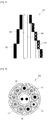
- FIG. 3 is a conceptual diagram of a structure of a hybrid in-core detector assembly for core monitoring and core protection according to a preferred embodiment of the present invention
- FIG. 4 is a sectional view of the structure of the hybrid in-core detector assembly for core monitoring and core protection according to the preferred embodiment of the present invention.
- Technical points of the hybrid in-core detector assembly for core monitoring and core protection is to carry out a core monitoring function and a core protection function at the same time and to extend the lifespan of the detector by using non-depleting or low-depleting materials as emitter materials reacting to neutrons.
- the hybrid in-core detector assembly 100 can carry out a core monitoring function and a core protection function at the same time, and includes: five vanadium detectors 110 and one background detector for carrying out the core monitoring function; three platinum detectors 130 for carrying out the core protection function; and one integrated core exit thermocouple 140.
- the reference numeral "150" designates a sheath tube disposed outside.
- the five vanadium detectors 110 and the one background detector 120 are disposed like the rhodium detector used in a conventional core operating limit supervisory system (COLSS).
- COLSS core operating limit supervisory system
- signals generated from the five vanadium detectors 110 are inputted into a core monitoring system and used to calculate three dimensional core power distribution to carry out the core monitoring function.
- the signals are used to accurately monitor core power distribution and provide information of local neutron distribution.
- the five vanadium detectors 110 are each 30 inches (76cm) in length and are respectively 10%, 30%, 50%, 70% and 90% as high as a nuclear fuel assembly.
- the three platinum detectors 130 are arranged respectively to take charge of a third of the core and can use three upper, middle and lower ex-core detector input algorithms. In this instance, signals generated from the platinum detectors 130 are inputted into the core protection system to carry out the core protection function.
- the conventional rhodium in-core detector includes the two separated core exit thermocouples, but the present invention includes one integrated core exit thermocouple 140.
- the core exit thermocouple 140 may be arranged in a central member assembly space of the conventional in-core detector.
- the hybrid in-core detector assembly 100 adopts a hybrid mode using the vanadium detectors 110 and the platinum detectors 130 to carry out the core monitoring function and the core protection function at the same time.
- the hybrid in-core detector assembly according to the present invention can directly measure the state of the core to enhance accuracy in calculation of three dimensional power distribution when an in-core detector based core protection system is applied because platinum capable of prompt responding is used as an emitter material. Therefore, the hybrid in-core detector assembly according to the present invention can contribute to power increase of nuclear power plants by removing conservatism when the ex-core detector is used and increasing margins in departure from nucleate boiling ratio and local power density.
- the hybrid in-core detector assembly according to the present invention can extend the lifespan of the detector by applying non-depleting or low-depleting materials, such as vanadium or platinum, as emitter materials reacting to neutrons. Therefore, the hybrid in-core detector assembly according to the present invention can reduce an amount of in-core detector wastes by a third of the prior arts after using high-level radioactive materials, and hence, it can secure a space for using high-level wastes and reduce nuclear plant workers'radiation exposure.
- non-depleting or low-depleting materials such as vanadium or platinum
- the following table 1 shows comparison of specifications and effect between the hybrid in-core detector assembly according to the present invention and the conventional rhodium detector.
- Table 1 Division Rhodium detector Hybrid in-core detector Effect Vanadium Platinum Emitter material Rh-45 V-51 Pt-105 Emitter diameter 0.0457cm 0.113cm 0.113cm Equal signal Responding time/use of filter 175sec/27sec ⁇ 500sec/several sec prompt Prompt responding time Lifespan of detector ⁇ 3 years > 10 years > 10 years Extension of lifespan
- the hybrid in-core detector assembly 100 for core monitoring and core protection it is preferable to evaluate the minimum current levels of the vanadium detectors 110 and the platinum detectors 130 which satisfy a signal-to-noise ratio using a sensitivity function of the detector and determine emitter diameters of the vanadium detectors 110 and the platinum detectors 130 in consideration of production of the in-core detector in order to decide mechanical configurations, such as a diameter, a length and so on.
- the hybrid in-core detector assembly 100 for core monitoring and core protection keeps the same outer diameter as the rhodium detector assembly but increases emitter diameters of the vanadium detectors 110 and the platinum detectors 130 2.5 times as large as that of the conventional rhodium detector to maintain the signal level of the conventional rhodium detector.
Landscapes
- Physics & Mathematics (AREA)
- Engineering & Computer Science (AREA)
- Plasma & Fusion (AREA)
- General Engineering & Computer Science (AREA)
- High Energy & Nuclear Physics (AREA)
- Business, Economics & Management (AREA)
- Emergency Management (AREA)
- Monitoring And Testing Of Nuclear Reactors (AREA)
- Measurement Of Radiation (AREA)
Abstract
Description
- The present invention relates to an in-core detector assembly, and more particularly, to a hybrid in-core detector assembly capable of carrying out a core monitoring function and a core protection function at the same time.
- The most important indicator for safe operation of a nuclear reactor is a power spike coefficient, and in order to monitor a value of the power peaking factor, a three dimensional core power distribution must be measured continuously and accurately. An in-core detector used for carrying out core-monitoring of a nuclear power plant is divided into a movable type (for WH type nuclear power plants) and a fixed type (for OPR1000 nuclear power plants).
- The movable type in-core detector can measure three dimensional core power distribution accurately, but cannot carry out on-line measurement because measuring power distribution only periodically. On the other hand, the fixed type in-core detector can carry out on-line measurement, but must be replaced with a new one periodically because it is limited in the number of axial core detectors, is slow in reaction time and burns in a core.
- In the meantime, a fixed type in-core detector assembly which is used in the OPR1000 nuclear power plant is inserted and fixed into a guide tube located inside the center of a nuclear fuel assembly during normal operation, and monitors neutron flux distribution of a nuclear reactor core at rated thermal power of more than 20% in real time. 45 fixed-type in-core detector assemblies are mounted at in-core places of the nuclear reactor that it is judged that it is possible to monitor power distribution in the core.
- As shown in
FIGS. 1 and 2 , a conventional in-core detector assembly 10 includes fiverhodium detectors 11, onebackground detector 12, two core exit thermocouples (core exit T/C) 13 which can measure coolant exit temperature of a core, afiller wire 14 which serves to fill a space between a central member assembly and the detector, anextension tube 15 disposed inside, and asheath tube 16 disposed outside. - Furthermore, the five
rhodium detectors 11 disposed inside each in-core detector assembly 10 are about 16 inches (40cm) in length and are respectively 10%, 30%, 50%, 70% and 90% as high as the nuclear fuel assembly to monitor power distribution of the core. - Meanwhile, a conventional core protection system requires a conservatism calculation because using an ex-core detector in order to calculate departure from nucleate boiling ratio and local power density which are main core safety parameters. In a case that the ex-core detector is used, because it is impossible to accurately measure three dimensional core power distribution which is the most important indicator for safe operation of the nuclear reactor, departure from nucleate boiling ratio and local power density are calculated using a virtual conservatism power distribution.
- Therefore, if three dimensional core power distribution is directly calculated using an in-core detector of a safety grade and is applied to the core protection system, a great shutdown margin or safety margin can be obtained. So, importance of the safety-grade in-core detector has been emphasized. However, a conventional rhodium in-core detector has several disadvantages in that it is a depleting type detector which has a lifespan of two to three cycles (three to four years) and it cannot be used in a safety system because it has uncertainty due to time delay of measurement signals.
- The conventional in-core detector serves as a core monitoring function, and the ex-core detector serves as a core protection function. In addition, the conventional rhodium in-core detector which has the lifespan of two to three cycles causes an increase of detector replacement costs and requires security of a space for storing high-level wastes. Accordingly, the conventional in-core detector increases burdens for operating nuclear power plants.
- In the meantime, a prior art discloses a hybrid-type in-core detector assembly including: a platinum-solid detector which has an emitter electrode formed in the middle of the inside of a cladding tube forming a collector electrode, an axial cable connected to one end of the emitter electrode for transferring a signal and an insulator filled in a space between the cladding tube and the emitter electrode to which the axial cable is connected; a vanadium detector which has an emitter electrode formed in the middle of the inside of a cladding tube forming a collector electrode, an axial cable connected to one end of the emitter electrode for transferring a signal and an insulator filled in a space between the cladding tube and the emitter electrode to which the axial cable is connected; and a background detector which has an axial cable formed inside a cladding tube forming a collector electrode for transferring a signal and an insulator filled in a space between the cladding tube and the axial cable. The platinum-solid detector, the vanadium detector and the background neutron detector are formed integrally.
- Accordingly, the present invention has been made in an effort to solve the above-mentioned problems occurring in the prior arts, and it is an object of the present invention to provide a hybrid in-core detector assembly, which can carry out a core monitoring function and a core protection function at the same time and can extend the lifespan of the detector by using non-depleting or low-depleting materials as emitter materials reacting to neutrons.
- To achieve the above objects, the present invention provides a hybrid in-core detector assembly capable of carrying out a core monitoring function and a core protection function at the same time, the hybrid in-core detector assembly including: vanadium detectors and a background detector for carrying out the core monitoring function; platinum detectors for carrying out the core protection function; and one integrated core exit thermocouple.
- Here, signals generated from the vanadium detectors are inputted into a core monitoring system and used to calculate three dimensional core power distribution to carry out the core monitoring function.
- Moreover, the number of the vanadium detectors is five, and the five vanadium detectors have a predetermined length and are respectively 10%, 30%, 50%, 70% and 90% as high as a nuclear fuel assembly.
- Furthermore, signals generated from the platinum detectors are inputted into a core protection system to carry out the core protection function.
- Additionally, the number of the platinum detectors is three, and the platinum detectors are arranged respectively to take charge of a third of the core.
- The hybrid in-core detector assembly according to the present invention can carry out a core monitoring function and a core protection function at the same time by using the vanadium detectors and the platinum detectors.
- Moreover, the hybrid in-core detector assembly according to the present invention can directly measure the state of the core to enhance accuracy in calculation of three dimensional power distribution when an in-core detector based core protection system is applied because platinum capable of prompt responding is used as an emitter material. Therefore, the hybrid in-core detector assembly according to the present invention can contribute to power increase of nuclear power plants by removing conservatism when the ex-core detector is used and increasing margins in departure from nucleate boiling ratio and local power density.
- Furthermore, the hybrid in-core detector assembly according to the present invention can extend the lifespan of the detector by applying non-depleting or low-depleting materials, such as vanadium or platinum, as emitter materials reacting to neutrons. Therefore, the hybrid in-core detector assembly according to the present invention can reduce an amount of in-core detector wastes by a third of the prior arts after using high-level radioactive materials, and hence, it can secure a space for using high-level wastes and reduce nuclear plant workers'radiation exposure.
-
-
FIG. 1 is a sectional view of a structure of a conventional rhodium in-core detector assembly. -
FIG. 2 is a conceptual diagram of the structure of the conventional rhodium in-core detector assembly. -
FIG. 3 is a conceptual diagram of a structure of a hybrid in-core detector assembly for core monitoring and core protection according to a preferred embodiment of the present invention. -
FIG. 4 is a sectional view of the structure of the hybrid in-core detector assembly for core monitoring and core protection according to the preferred embodiment of the present invention. - Reference will be now made in detail to the preferred embodiment of the present invention with reference to the attached drawings. In the description of the present invention, when it is judged that detailed descriptions of known functions or structures related with the present invention may make the essential points vague, the detailed descriptions of the known functions or structures will be omitted. Moreover, while preferred embodiments of the present invention will herein be described in detail, It should be understood that there is no intent to limit the technical idea of the present invention to the particular forms disclosed, but on the contrary, the embodiments of the invention can be changed and modified in various ways falling within the technical scope of the invention.
- Hereinafter, reference will be now made in detail to the preferred embodiment of the present invention with reference to the attached drawings.
-
FIG. 3 is a conceptual diagram of a structure of a hybrid in-core detector assembly for core monitoring and core protection according to a preferred embodiment of the present invention, andFIG. 4 is a sectional view of the structure of the hybrid in-core detector assembly for core monitoring and core protection according to the preferred embodiment of the present invention. - Technical points of the hybrid in-core detector assembly for core monitoring and core protection according to a preferred embodiment of the present invention is to carry out a core monitoring function and a core protection function at the same time and to extend the lifespan of the detector by using non-depleting or low-depleting materials as emitter materials reacting to neutrons.
- As shown in the drawings, the hybrid in-
core detector assembly 100 according to a preferred embodiment of the present invention can carry out a core monitoring function and a core protection function at the same time, and includes: fivevanadium detectors 110 and one background detector for carrying out the core monitoring function; threeplatinum detectors 130 for carrying out the core protection function; and one integratedcore exit thermocouple 140. The reference numeral "150" designates a sheath tube disposed outside. - That is, in order to carry out the core monitoring function, the five
vanadium detectors 110 and the onebackground detector 120 are disposed like the rhodium detector used in a conventional core operating limit supervisory system (COLSS). In this instance, signals generated from the fivevanadium detectors 110 are inputted into a core monitoring system and used to calculate three dimensional core power distribution to carry out the core monitoring function. In other words, the signals are used to accurately monitor core power distribution and provide information of local neutron distribution. The fivevanadium detectors 110 are each 30 inches (76cm) in length and are respectively 10%, 30%, 50%, 70% and 90% as high as a nuclear fuel assembly. - Moreover, in order to carry out the core protection function, the three
platinum detectors 130 are arranged respectively to take charge of a third of the core and can use three upper, middle and lower ex-core detector input algorithms. In this instance, signals generated from theplatinum detectors 130 are inputted into the core protection system to carry out the core protection function. - Furthermore, the conventional rhodium in-core detector includes the two separated core exit thermocouples, but the present invention includes one integrated
core exit thermocouple 140. In this instance, thecore exit thermocouple 140 may be arranged in a central member assembly space of the conventional in-core detector. - As described above, the hybrid in-
core detector assembly 100 according to the preferred embodiment of the present invention adopts a hybrid mode using thevanadium detectors 110 and theplatinum detectors 130 to carry out the core monitoring function and the core protection function at the same time. - In addition, the hybrid in-core detector assembly according to the present invention can directly measure the state of the core to enhance accuracy in calculation of three dimensional power distribution when an in-core detector based core protection system is applied because platinum capable of prompt responding is used as an emitter material. Therefore, the hybrid in-core detector assembly according to the present invention can contribute to power increase of nuclear power plants by removing conservatism when the ex-core detector is used and increasing margins in departure from nucleate boiling ratio and local power density.
- Moreover, the hybrid in-core detector assembly according to the present invention can extend the lifespan of the detector by applying non-depleting or low-depleting materials, such as vanadium or platinum, as emitter materials reacting to neutrons. Therefore, the hybrid in-core detector assembly according to the present invention can reduce an amount of in-core detector wastes by a third of the prior arts after using high-level radioactive materials, and hence, it can secure a space for using high-level wastes and reduce nuclear plant workers'radiation exposure.
- The following table 1 shows comparison of specifications and effect between the hybrid in-core detector assembly according to the present invention and the conventional rhodium detector.
[Table 1] Division Rhodium detector Hybrid in-core detector Effect Vanadium Platinum Emitter material Rh-45 V-51 Pt-105 Emitter diameter 0.0457cm 0.113cm 0.113cm Equal signal Responding time/use of filter 175sec/27sec ∼500sec/several sec prompt Prompt responding time Lifespan of detector < 3 years > 10 years > 10 years Extension of lifespan - In addition, in case of the hybrid in-
core detector assembly 100 for core monitoring and core protection according to the preferred embodiment of the present invention, it is preferable to evaluate the minimum current levels of thevanadium detectors 110 and theplatinum detectors 130 which satisfy a signal-to-noise ratio using a sensitivity function of the detector and determine emitter diameters of thevanadium detectors 110 and theplatinum detectors 130 in consideration of production of the in-core detector in order to decide mechanical configurations, such as a diameter, a length and so on. - Moreover, because vanadium and platinum are relatively small in neutron absorption cross section compared with rhodium, vanadium and platinum with identical standard are relatively small in detector signal compared with rhodium. Therefore, preferably, the hybrid in-
core detector assembly 100 for core monitoring and core protection according to the preferred embodiment of the present invention keeps the same outer diameter as the rhodium detector assembly but increases emitter diameters of thevanadium detectors 110 and theplatinum detectors 130 2.5 times as large as that of the conventional rhodium detector to maintain the signal level of the conventional rhodium detector. - In the meantime, while the hybrid in-core detector assembly for core monitoring and protection according to the present invention has been particularly shown and described with reference to the specific embodiments thereof, it will be understood by those of ordinary skill in the art that the scope of the present invention is not limited to the particular embodiments and various alternatives, changes and modifications may be made therein without departing from the technical idea and scope of the present invention.
- Therefore, it would be understood that the embodiments disclosed in the present invention and the attached drawings are not to limit the technical idea of the present invention but to describe the present invention, and the technical and protective scope of the present invention shall be defined by the illustrated embodiments and the attached drawings. It should be also understood that the protective scope of the present invention is interpreted by the following claims and all technical ideas within the equivalent scope belong to the technical scope of the present invention.
Claims (5)
- A hybrid in-core detector assembly (100) capable of carrying out a core monitoring function and a core protection function at the same time characterized that it comprises:- vanadium detectors (110) and a background detector (120) for carrying out the core monitoring function;- platinum detectors (130) for carrying out the core protection function; and- one integrated core exit thermocouple (140).
- The hybrid in-core detector assembly according to claim 1, wherein signals generated from the vanadium detectors (110) are inputted into a core monitoring system and used to calculate three dimensional core power distribution to carry out the core monitoring function.
- The hybrid in-core detector assembly according to claim 1, wherein the number of the vanadium detectors (110) is five, and the five vanadium detectors have a predetermined length and are respectively 10%, 30%, 50%, 70% and 90% as high as a nuclear fuel assembly.
- The hybrid in-core detector assembly according to claim 1, wherein signals generated from the platinum detectors (130) are inputted into a core protection system to carry out the core protection function.
- The hybrid in-core detector assembly according to claim 1, wherein the number of the platinum detectors (130) is three, and the platinum detectors are arranged respectively to take charge of a third of the core.
Applications Claiming Priority (1)
| Application Number | Priority Date | Filing Date | Title |
|---|---|---|---|
| PCT/KR2013/004693 WO2014192995A1 (en) | 2013-05-29 | 2013-05-29 | Hybrid reactor in-core detector assembly for core monitoring and protection |
Publications (2)
| Publication Number | Publication Date |
|---|---|
| EP3007175A1 true EP3007175A1 (en) | 2016-04-13 |
| EP3007175A4 EP3007175A4 (en) | 2017-02-01 |
Family
ID=51989002
Family Applications (1)
| Application Number | Title | Priority Date | Filing Date |
|---|---|---|---|
| EP13885782.6A Withdrawn EP3007175A4 (en) | 2013-05-29 | 2013-05-29 | Hybrid reactor in-core detector assembly for core monitoring and protection |
Country Status (3)
| Country | Link |
|---|---|
| EP (1) | EP3007175A4 (en) |
| CN (1) | CN105247620A (en) |
| WO (1) | WO2014192995A1 (en) |
Families Citing this family (5)
| Publication number | Priority date | Publication date | Assignee | Title |
|---|---|---|---|---|
| CN106782688B (en) * | 2015-11-20 | 2024-01-05 | 国家电投集团科学技术研究院有限公司 | Method of arranging detectors for core loaded 157-cartridge fuel assemblies |
| CN105513656A (en) * | 2015-11-30 | 2016-04-20 | 中广核工程有限公司 | System and method for monitoring reactor core parameters of nuclear power plant |
| CN110322976B (en) * | 2019-08-06 | 2020-11-24 | 中国核动力研究设计院 | Implementation method for reactor LPD and DNBR online protection and monitoring |
| CN111326269A (en) * | 2020-02-28 | 2020-06-23 | 中广核研究院有限公司 | A core measurement sensor based on self-sufficient energy detector and thermocouple |
| CN112652412B (en) * | 2020-12-18 | 2023-01-20 | 中广核研究院有限公司 | Nuclear power station neutron and temperature monitoring device |
Family Cites Families (4)
| Publication number | Priority date | Publication date | Assignee | Title |
|---|---|---|---|---|
| US5251242A (en) * | 1992-06-22 | 1993-10-05 | Westinghouse Electric Corp. | Bi-metallic, self powered, fixed incore detector, and method of calibrating same |
| US5745538A (en) * | 1995-10-05 | 1998-04-28 | Westinghouse Electric Corporation | Self-powered fixed incore detector |
| KR20080011782A (en) * | 2006-07-31 | 2008-02-11 | 한국전력공사 | Hybrid furnace instrument assembly and measuring method |
| KR100960788B1 (en) * | 2008-05-15 | 2010-06-01 | 한국전력공사 | Stationary Instrumentation |
-
2013
- 2013-05-29 WO PCT/KR2013/004693 patent/WO2014192995A1/en not_active Ceased
- 2013-05-29 EP EP13885782.6A patent/EP3007175A4/en not_active Withdrawn
- 2013-05-29 CN CN201380077019.XA patent/CN105247620A/en active Pending
Also Published As
| Publication number | Publication date |
|---|---|
| EP3007175A4 (en) | 2017-02-01 |
| WO2014192995A1 (en) | 2014-12-04 |
| CN105247620A (en) | 2016-01-13 |
Similar Documents
| Publication | Publication Date | Title |
|---|---|---|
| KR101484000B1 (en) | Hybrid Incore Detector Assembly for Core Monitoring And Protection using eXtended Length | |
| US8445839B2 (en) | Self-calibrating, highly accurate, long-lived, dual rhodium vanadium emitter nuclear in-core detector | |
| US8946645B2 (en) | Radiation-monitoring diagnostic hodoscope system for nuclear-power reactors | |
| US20130083879A1 (en) | In-core instrument thimble assembly | |
| JP2011059117A (en) | Neutron monitoring systems including gamma thermometers and methods of calibrating nuclear instruments using gamma thermometers | |
| JPH0659045A (en) | Fixed in-core detector device | |
| KR101376704B1 (en) | In-Core Instrument Assembly for Improvement of neutron flux detection sensitivity | |
| KR20160051988A (en) | Long-Lived In-Core Instrumentation Assembly | |
| EP3007176A1 (en) | Convergence reactor in-core detector assembly for core monitoring and protection | |
| US4363970A (en) | Self-powered neutron flux detector assembly | |
| EP2992532B1 (en) | Self-powered nuclear detector | |
| CN105247620A (en) | Hybrid reactor in-core detector assembly for core monitoring and protection | |
| KR101445557B1 (en) | Hybrid Incore Detector Assembly For Core Monitoring And Protection | |
| US11621091B2 (en) | Temperature measurement sensor using material with a temperature dependent neutron capture cross section | |
| KR20230109638A (en) | Radioisotope activity monitoring devices, systems and methods | |
| Gu et al. | Research on detection technology of 235U enrichment and loading uniformity for nuclear fuel rods | |
| Böck | Miniature detectors for reactor incore neutron flux monitoring | |
| JPH0587978A (en) | Device for measuring reactor output | |
| Hashemi-Tilehnoee et al. | Improving the performance of the power monitoring channel | |
| JP2012112862A (en) | Method and apparatus for measuring burn-up distribution of fuel assembly | |
| Loving | Neutron, temperature and gamma sensors for pressurized water reactors | |
| JPS6138830B2 (en) | ||
| Thacker | In-Core Flux/Power Distribution Detectors: A Comparison of Types | |
| Versluis | CE in-core instrumentation-functions and performance | |
| JP2708216B2 (en) | Burnup estimation method for damaged nuclear fuel elements |
Legal Events
| Date | Code | Title | Description |
|---|---|---|---|
| PUAI | Public reference made under article 153(3) epc to a published international application that has entered the european phase |
Free format text: ORIGINAL CODE: 0009012 |
|
| 17P | Request for examination filed |
Effective date: 20151218 |
|
| AK | Designated contracting states |
Kind code of ref document: A1 Designated state(s): AL AT BE BG CH CY CZ DE DK EE ES FI FR GB GR HR HU IE IS IT LI LT LU LV MC MK MT NL NO PL PT RO RS SE SI SK SM TR |
|
| AX | Request for extension of the european patent |
Extension state: BA ME |
|
| DAX | Request for extension of the european patent (deleted) | ||
| A4 | Supplementary search report drawn up and despatched |
Effective date: 20170105 |
|
| RIC1 | Information provided on ipc code assigned before grant |
Ipc: G21D 3/04 20060101ALI20161223BHEP Ipc: G21C 17/10 20060101AFI20161223BHEP |
|
| STAA | Information on the status of an ep patent application or granted ep patent |
Free format text: STATUS: THE APPLICATION IS DEEMED TO BE WITHDRAWN |
|
| 18D | Application deemed to be withdrawn |
Effective date: 20170804 |