EP3007164A2 - Noise abatement for aircraft components and systems in aircraft bays - Google Patents
Noise abatement for aircraft components and systems in aircraft bays Download PDFInfo
- Publication number
- EP3007164A2 EP3007164A2 EP15180518.1A EP15180518A EP3007164A2 EP 3007164 A2 EP3007164 A2 EP 3007164A2 EP 15180518 A EP15180518 A EP 15180518A EP 3007164 A2 EP3007164 A2 EP 3007164A2
- Authority
- EP
- European Patent Office
- Prior art keywords
- layer
- acoustic
- rtv
- batting material
- silicone
- Prior art date
- Legal status (The legal status is an assumption and is not a legal conclusion. Google has not performed a legal analysis and makes no representation as to the accuracy of the status listed.)
- Granted
Links
Images

Classifications
-
- E—FIXED CONSTRUCTIONS
- E04—BUILDING
- E04B—GENERAL BUILDING CONSTRUCTIONS; WALLS, e.g. PARTITIONS; ROOFS; FLOORS; CEILINGS; INSULATION OR OTHER PROTECTION OF BUILDINGS
- E04B1/00—Constructions in general; Structures which are not restricted either to walls, e.g. partitions, or floors or ceilings or roofs
- E04B1/62—Insulation or other protection; Elements or use of specified material therefor
- E04B1/74—Heat, sound or noise insulation, absorption, or reflection; Other building methods affording favourable thermal or acoustical conditions, e.g. accumulating of heat within walls
- E04B1/82—Heat, sound or noise insulation, absorption, or reflection; Other building methods affording favourable thermal or acoustical conditions, e.g. accumulating of heat within walls specifically with respect to sound only
- E04B1/84—Sound-absorbing elements
-
- G—PHYSICS
- G10—MUSICAL INSTRUMENTS; ACOUSTICS
- G10K—SOUND-PRODUCING DEVICES; METHODS OR DEVICES FOR PROTECTING AGAINST, OR FOR DAMPING, NOISE OR OTHER ACOUSTIC WAVES IN GENERAL; ACOUSTICS NOT OTHERWISE PROVIDED FOR
- G10K11/00—Methods or devices for transmitting, conducting or directing sound in general; Methods or devices for protecting against, or for damping, noise or other acoustic waves in general
- G10K11/16—Methods or devices for protecting against, or for damping, noise or other acoustic waves in general
- G10K11/162—Selection of materials
- G10K11/168—Plural layers of different materials, e.g. sandwiches
-
- B—PERFORMING OPERATIONS; TRANSPORTING
- B64—AIRCRAFT; AVIATION; COSMONAUTICS
- B64F—GROUND OR AIRCRAFT-CARRIER-DECK INSTALLATIONS SPECIALLY ADAPTED FOR USE IN CONNECTION WITH AIRCRAFT; DESIGNING, MANUFACTURING, ASSEMBLING, CLEANING, MAINTAINING OR REPAIRING AIRCRAFT, NOT OTHERWISE PROVIDED FOR; HANDLING, TRANSPORTING, TESTING OR INSPECTING AIRCRAFT COMPONENTS, NOT OTHERWISE PROVIDED FOR
- B64F1/00—Ground or aircraft-carrier-deck installations
- B64F1/26—Ground or aircraft-carrier-deck installations for reducing engine or jet noise; Protecting airports from jet erosion
Definitions
- the present disclosure relates to noise abatement in aircrafts, and, more specifically, to noise-damping material and an acoustic blanket for use in an aircraft.
- Aircraft parts e.g., pumps and motors
- Noise levels emanating from loud parts may cause passenger or bystander discomfort.
- standard insulating materials may not withstand some of the chemical and thermal conditions present in various aircraft compartments containing the loud aircraft parts.
- An acoustic absorption material may comprise an outer layer and a first layer of batting material proximate to the outer layer.
- a first layer of room temperature vulcanized silicone (RTV) may be proximate to the batting material.
- a second layer of batting material may be proximate to the first layer of RTV and opposite the first layer of batting material.
- a second layer of RTV may be proximate to the second layer of batting material and opposite the first layer of RTV.
- a third layer of batting material may be proximate to the second layer of RTV and opposite the second layer of batting material.
- a fibrous glass layer may be proximate the RTV layer and opposite the first layer of batting material.
- a silicone layer may be proximate to the fibrous glass layer and opposite the RTV layer.
- the first batting material may comprise an aramid fiber.
- the outer layer may comprise a silicone-coated glass cloth. The batting material may be coated in RTV.
- An acoustic blanket may comprise, a pad including an outer layer and a first layer of batting material proximate to the outer layer.
- a first layer of silicone may be proximate to the first layer of batting material.
- a strap may be around the pad configured to attach the blanket.
- the pad further comprises a second layer of batting material proximate to the first layer of silicone and opposite the first layer of batting material.
- a second layer of silicone may be proximate to the second layer of batting material and opposite the first layer of silicone.
- a third layer of batting material may be proximate to the second layer of silicone and opposite the second layer of batting material.
- the silicone may comprise a room temperature vulcanized silicone rubber (RTV).
- the strap may comprise a hook and loop fastener.
- the first batting material may comprise an aramid fiber.
- the outer layer may comprise a silicone-coated glass cloth. The batting material may be coated in RTV.
- any reference to attached, fixed, connected or the like may include permanent, removable, temporary, partial, full and/or any other possible attachment option. Additionally, any reference to without contact (or similar phrases) may also include reduced contact or minimal contact. Different cross-hatching is used throughout the figures to denote different parts but not necessarily to denote the same or different materials.
- any reference to singular includes plural embodiments, and any reference to more than one component or step may include a singular embodiment or step.
- Surface shading lines may be used throughout the figures to denote different parts but not necessarily to denote the same or different materials.
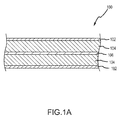
- FIG. 1A illustrates a multi-layered acoustic insulation for use in aircraft compartments, in accordance with various embodiments.
- Acoustic absorption material 100 may include an outer layer 102.
- Outer layer 102 may be a silicone-coated glass cloth or any other fabric resistant to high temperatures and chemicals.
- Outer layer 102 may be temperature rated from -65°F (-53°C) to 220°F (104°C) continuously with a maximum of 550°F (288°C) for short periods of time without physical deformation or degradation.
- Outer layer 102 may also be resistant to chemicals such as jet fuel, oils, and de-icing fluid without physical deformation or degradation.
- the fabric of outer layer 102 may be rated for an ambient temperature up to 500°F (260°C) while maintaining low temperature flexibility at temperatures down to -65°F (-53°).
- Outer layer 102 may have high abrasion resistance and be water, fungi, and chemical resistant.
- acoustic absorption material 100 may include an acoustic absorption batting material 104 proximate to outer layer 102.
- Acoustic absorption batting material 104 may be a material with chemical and thermal resistance properties such as a flame-resistant, aramid fiber (e.g., Nomex ®).
- Acoustic absorption batting material 104 may be a felt material having a thickness of a quarter-inch (6.4 mm) to an inch (25.4 mm) or greater (e.g., half-inch (1.27 cm) thick Nomex ® felt).
- Acoustic absorption batting material 104 may be affixed to outer layer 102 using adhesives, chemical and temperature resistant thread, rivets, screws, or other fasteners.
- Acoustic absorption batting material 104 may be stitched into outer layer 102 using a chemical and heat resistant thread, for example a para-aramid thread (e.g. Kevlar® thread). Acoustic absorption batting material 104 may have the chemical and heat resistant thread stitched around acoustic absorption batting material 104 to hold acoustic absorption batting material 104 floating in a fixed location between outer layers 102. Acoustic absorption batting material 104 may also be stitched directly to outer layer 102 with the chemical and heat resistant thread passing through acoustic absorption batting material 104 to fix acoustic absorption batting material 104 to outer layer 102.
- a chemical and heat resistant thread for example a para-aramid thread (e.g. Kevlar® thread).
- Acoustic absorption batting material 104 may have the chemical and heat resistant thread stitched around acoustic absorption batting material 104 to hold acoustic absorption batting material 104 floating in a fixed location between outer layers
- acoustic absorption material 100 may include a high-temperature, room temperature vulcanizing silicone rubber (RTV) 106.
- RTV 106 may retain its elastomeric properties from -65°F (-53°C) to 500°F (260°C) continuously and up to 600°F (316°C) for short periods of time.
- RTV 106 may be coated with, or replaced by, a fluorosilicone material.
- Acoustic absorption batting material 104 may also be dipped in RTV 106 and set in place over a surface so that acoustic absorption batting material 104 and RTV 106 are molded to a contour of the surface.
- RTV 106 may be stitched in place proximate to acoustic absorption batting material 104 using chemical and heat resistant thread. Outer layer 102, acoustic absorption batting material 104, and RTV 106 may be in varying orders and varying thicknesses. The thickness of RTV 106 may be varied to adjust the weight of acoustic absorption material 100.
- acoustic absorption batting material 104 may absorb a portion of the acoustic energy directed towards acoustic absorption material 100.
- RTV 106 acts as a barrier off which noise will reflect and allow the acoustic absorption material to absorb more acoustic energy.
- the RTV layers may also absorb acoustic energy with thicker RTV layers tending to being more effective absorbers of acoustic energy.
- Acoustic absorption material 100 may provide acoustic damping in thermally and chemically demanding applications.
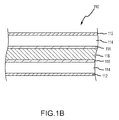
- FIG. 1B illustrates a multi-layered acoustic insulation for use in aircraft compartments, in accordance with various embodiments.
- Acoustic absorption material 110 may include an outer layer 112 similar to outer layer 102.
- Acoustic absorption material 110 may further include an acoustic absorption batting material 118 similar to acoustic absorption batting material 104.
- Acoustic absorption material 110 may also include RTV 116 similar to RTV 106.
- acoustic absorption material 110 may include a thin fibrous layer 114 (e.g., fiber glass) with outer layer 102 comprising a thin silicone layer over thin fibrous layer 114.
- Thin fibrous layer 114 may be affixed to outer layer 112 via adhesives, chemical and temperature resistant thread, rivets, screws, or other fasteners.
- FIG. 1C illustrates a multi-layered acoustic absorption material for use in aircraft compartments, in accordance with various embodiments.
- Acoustic absorption material 120 may include an outer layer 122 similar to outer layer 102.
- Acoustic absorption material 120 may further include an acoustic absorption batting material 124 similar to acoustic absorption batting material 104. More than one layer of acoustic absorption batting material 124 may be alternated with RTV 126.
- RTV 126 of acoustic absorption material 120 may be similar to RTV 106.
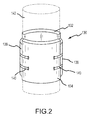
- FIG. 2 illustrates a perspective view of a blanket comprising multi-layered acoustic absorption material configured for use over a cylindrical pump, in accordance with various embodiments.
- Acoustic blanket 130 may be constructed of an acoustic absorption batting material, silicone layers, and silicone coated cloth, for example, acoustic absorption materials 100, 110, and 120 and arranged as described above with momentary reference to FIGs. 1A-1C . Acoustic blanket 130 may be stitched together with Kevlar thread.
- acoustic blanket 130 may include a rear pad 132 and a front pad 134 with side pads 136 and 138 extending between front pad 134 and rear pad 132.
- Front pad 134 and rear pad 132 may have a height greater than side pads 136 and 138.
- Front pad 134 and rear pad 132 may approximate the height of the component the pads are covering.
- the front pad and rear pad may have a height between 9 inches (23 cm) and 10 inches (25.4 cm) to cover a 9-inch-tall (23 cm) pump.
- Side pads 136 and 138 may be shorter to accommodate clearance of other parts.
- Straps 140 may attach acoustic blanket 130 to pump 142 or any other component requiring noise damping.
- acoustic blanket 130 may be designed in shape, thickness or other aspects to be compliant with aircraft conditions, including aircraft fluid resistance and thermal extremes. Acoustic blanket 130 may also be designed to fit snug to the component being abated to optimize acoustic absorption. The attachment of acoustic blanket 130 may be intended to be both installable and removable without having to remove surrounding components. Acoustic blanket 130 may be a stack up of acoustic absorption and dispersion materials. The core of the stack up is silicone or RTV (E.G., RTV 106 from FIG. 1A ), which is designed to disperse and absorb the bulk of airborne emissions.
- RTV silicone or RTV
- Acoustic blanket 130 may include an outer layer on each side comprising silicone-coated fiberglass or silicone-coated cloth that protects the stack up from fluid and particulate contamination.
- the silicone in the outer layer may provide an additional (although minor relative to other layers) absorption capability.
- quarter-inch-thick (6.4 mm) silicone may be cast and cut to size to fit acoustic blanket 130.
- a layer of acoustic absorption batting material e.g., acoustic absorption batting material 104 from FIG. 1A
- the acoustic absorption batting material may have excellent thermal and chemical resistance properties.
- the acoustic absorption batting material may be a felt made from a flame-resistant, aramid fiber. The felt may be selected due to its acoustic absorptive properties.
- the batting layer may be quarter-inch thick felt (6.4 mm), for example.
- the silicone layer may provide significant acoustic absorption capability, depending on the thickness of the silicone layer and the angle of incidence.
- acoustic blanket 130 may be fabricated with a quarter-inch thick (6.4 mm) silicone layer will be attached around the reservoir, a reduction between 10 to 31 dB is possible at a frequency of 500 Hz and 16 to 37 dB at a frequency of 1000 Hz.
- the fabric or outer layer of acoustic blanket 130 may be joined together using a para-aramid synthetic fiber (e.g., Kevlar®) thread.
- the thread may be sewn around the edges of acoustic blanket 130 and anywhere that access slots/flaps are required in acoustic blanket 130.
- the thread may be used in high temperature applications and is chemical and fungus resistant.
- the blanket materials consisting of the absorption batting and the inner silicone core are then inserted into the joined case.
- the thread seam exposed to the blanket exterior may be treated with a seal coating of high temperature RTV that bonds well to a variety of surfaces without the need for primers.
- the RTV seal coat may provide a barrier preventing moisture, de-icing fluids, and fuel from entering the acoustic blanket at the thread seam holes.
- Acoustic blanket 130 may be installed in the wheel well of an aircraft. Acoustic blanket 130 may be attached, for example, to an integrated cooling system pump to abate pump noise. Silicone in acoustic blanket 130 is generally solvent resistant. A fluorosilicone material may be substituted for RTV, or simply used to coat the base silicone material.
- acoustic blanket 130 may be attached to the pump using straps 140, which may comprise hook and loop fasteners (e.g., Velcro®) in conjunction with metal loops. Straps 140 may be sewn onto the fabric of the outer layer using the Kevlar thread and may be one inch (25.4 mm) thick.
- Straps 140 may be sewn onto the fabric of the outer layer using the Kevlar thread and may be one inch (25.4 mm) thick.
- Various attachment designs may be implemented, including a metal band clamp with belt loops made from the silicone fabric material used in acoustic blanket 130, metal bands around acoustic blanket 130, clamps, molding, or other suitable means of attachment.
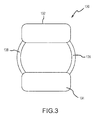
- FIG. 3 illustrates a top view of a blanket comprising multi-layered acoustic insulation configured for use over a cylindrical pump, in accordance with various embodiments.
- Acoustic blanket 130 may have a circular shape when viewed from above.
- Front pad 134 and rear pad 132 have greater thickness than side pads 136 and 138.
- Front pad 134 and rear pad 132 may comprise a thicker noise absorption (e.g., acoustic absorption material 110 or 120 from FIGs. 1B and 1C ) material including more layers or thicker layers than side pads 136 and 138.
- Side pads 136 and 138 may comprise a thinner material with fewer layers (e.g., acoustic absorption material 100 from FIG. 1A ).
- references to "various embodiments”, “one embodiment”, “an embodiment”, “an example embodiment”, etc. indicate that the embodiment described may include a particular feature, structure, or characteristic, but every embodiment may not necessarily include the particular feature, structure, or characteristic. Moreover, such phrases are not necessarily referring to the same embodiment. Further, when a particular feature, structure, or characteristic is described in connection with an embodiment, it is submitted that it is within the knowledge of one skilled in the art to affect such feature, structure, or characteristic in connection with other embodiments whether or not explicitly described. After reading the description, it will be apparent to one skilled in the relevant art(s) how to implement the disclosure in alternative embodiments.
Landscapes
- Physics & Mathematics (AREA)
- Engineering & Computer Science (AREA)
- Acoustics & Sound (AREA)
- Architecture (AREA)
- Multimedia (AREA)
- Mechanical Engineering (AREA)
- Aviation & Aerospace Engineering (AREA)
- Electromagnetism (AREA)
- Civil Engineering (AREA)
- Structural Engineering (AREA)
- Laminated Bodies (AREA)
- Soundproofing, Sound Blocking, And Sound Damping (AREA)
Abstract
Description
- The present disclosure relates to noise abatement in aircrafts, and, more specifically, to noise-damping material and an acoustic blanket for use in an aircraft.
- Aircraft parts (e.g., pumps and motors) may radiate energy in the form of noise during operation. Noise levels emanating from loud parts may cause passenger or bystander discomfort. However, standard insulating materials may not withstand some of the chemical and thermal conditions present in various aircraft compartments containing the loud aircraft parts.
- An acoustic absorption material may comprise an outer layer and a first layer of batting material proximate to the outer layer. A first layer of room temperature vulcanized silicone (RTV) may be proximate to the batting material. A second layer of batting material may be proximate to the first layer of RTV and opposite the first layer of batting material.
- In various embodiments, a second layer of RTV may be proximate to the second layer of batting material and opposite the first layer of RTV. A third layer of batting material may be proximate to the second layer of RTV and opposite the second layer of batting material. A fibrous glass layer may be proximate the RTV layer and opposite the first layer of batting material. A silicone layer may be proximate to the fibrous glass layer and opposite the RTV layer. The first batting material may comprise an aramid fiber. The outer layer may comprise a silicone-coated glass cloth. The batting material may be coated in RTV.
- An acoustic blanket may comprise, a pad including an outer layer and a first layer of batting material proximate to the outer layer. A first layer of silicone may be proximate to the first layer of batting material. A strap may be around the pad configured to attach the blanket.
- In various embodiments, the pad further comprises a second layer of batting material proximate to the first layer of silicone and opposite the first layer of batting material. A second layer of silicone may be proximate to the second layer of batting material and opposite the first layer of silicone. A third layer of batting material may be proximate to the second layer of silicone and opposite the second layer of batting material. The silicone may comprise a room temperature vulcanized silicone rubber (RTV). The strap may comprise a hook and loop fastener. The first batting material may comprise an aramid fiber. The outer layer may comprise a silicone-coated glass cloth. The batting material may be coated in RTV.
- The subject matter of the present disclosure is particularly pointed out and distinctly claimed in the concluding portion of the specification. A more complete understanding of the present disclosure, however, may best be obtained by referring to the detailed description and claims when considered in connection with the figures, wherein like numerals denote like elements.
-
FIG. 1A illustrates a multi-layered acoustic absorption material for use in aircraft compartments, in accordance with various embodiments; -
FIG. 1B illustrates a multi-layered acoustic absorption material for use in aircraft compartments, in accordance with various embodiments; -
FIG. 1C illustrates a multi-layered acoustic absorption material for use in aircraft compartments, in accordance with various embodiments; -
FIG. 2 illustrates a perspective view of an acoustic blanket comprising multi-layered acoustic insulation configured for use over a cylindrical pump, in accordance with various embodiments; and -
FIG. 3 illustrates a top view of an acoustic blanket comprising multi-layered acoustic insulation configured for use over a cylindrical pump, in accordance with various embodiments. - The detailed description of exemplary embodiments herein makes reference to the accompanying drawings, which show exemplary embodiments by way of illustration. While these exemplary embodiments are described in sufficient detail to enable those skilled in the art to practice the inventions, it should be understood that other embodiments may be realized and that logical changes and adaptations in design and construction may be made in accordance with this invention and the teachings herein. Thus, the detailed description herein is presented for purposes of illustration only and not of limitation. The scope of the invention is defined by the appended claims. For example, the steps recited in any of the method or process descriptions may be executed in any order and are not necessarily limited to the order presented. Furthermore, any reference to singular includes plural embodiments, and any reference to more than one component or step may include a singular embodiment or step. Also, any reference to attached, fixed, connected or the like may include permanent, removable, temporary, partial, full and/or any other possible attachment option. Additionally, any reference to without contact (or similar phrases) may also include reduced contact or minimal contact. Different cross-hatching is used throughout the figures to denote different parts but not necessarily to denote the same or different materials.
- Furthermore, any reference to singular includes plural embodiments, and any reference to more than one component or step may include a singular embodiment or step. Surface shading lines may be used throughout the figures to denote different parts but not necessarily to denote the same or different materials.
-
FIG. 1A illustrates a multi-layered acoustic insulation for use in aircraft compartments, in accordance with various embodiments.Acoustic absorption material 100 may include anouter layer 102.Outer layer 102 may be a silicone-coated glass cloth or any other fabric resistant to high temperatures and chemicals.Outer layer 102 may be temperature rated from -65°F (-53°C) to 220°F (104°C) continuously with a maximum of 550°F (288°C) for short periods of time without physical deformation or degradation.Outer layer 102 may also be resistant to chemicals such as jet fuel, oils, and de-icing fluid without physical deformation or degradation. The fabric ofouter layer 102 may be rated for an ambient temperature up to 500°F (260°C) while maintaining low temperature flexibility at temperatures down to -65°F (-53°).Outer layer 102 may have high abrasion resistance and be water, fungi, and chemical resistant. - In various embodiments,
acoustic absorption material 100 may include an acousticabsorption batting material 104 proximate toouter layer 102. Acousticabsorption batting material 104 may be a material with chemical and thermal resistance properties such as a flame-resistant, aramid fiber (e.g., Nomex ®). Acousticabsorption batting material 104 may be a felt material having a thickness of a quarter-inch (6.4 mm) to an inch (25.4 mm) or greater (e.g., half-inch (1.27 cm) thick Nomex ® felt). Acousticabsorption batting material 104 may be affixed toouter layer 102 using adhesives, chemical and temperature resistant thread, rivets, screws, or other fasteners. Acousticabsorption batting material 104 may be stitched intoouter layer 102 using a chemical and heat resistant thread, for example a para-aramid thread (e.g. Kevlar® thread). Acousticabsorption batting material 104 may have the chemical and heat resistant thread stitched around acousticabsorption batting material 104 to hold acousticabsorption batting material 104 floating in a fixed location betweenouter layers 102. Acousticabsorption batting material 104 may also be stitched directly toouter layer 102 with the chemical and heat resistant thread passing through acousticabsorption batting material 104 to fix acousticabsorption batting material 104 toouter layer 102. - In various embodiments,
acoustic absorption material 100 may include a high-temperature, room temperature vulcanizing silicone rubber (RTV) 106.RTV 106 may retain its elastomeric properties from -65°F (-53°C) to 500°F (260°C) continuously and up to 600°F (316°C) for short periods of time.RTV 106 may be coated with, or replaced by, a fluorosilicone material. Acousticabsorption batting material 104 may also be dipped inRTV 106 and set in place over a surface so that acousticabsorption batting material 104 andRTV 106 are molded to a contour of the surface.RTV 106 may be stitched in place proximate to acousticabsorption batting material 104 using chemical and heat resistant thread.Outer layer 102, acousticabsorption batting material 104, andRTV 106 may be in varying orders and varying thicknesses. The thickness ofRTV 106 may be varied to adjust the weight ofacoustic absorption material 100. - In various embodiments, acoustic
absorption batting material 104 may absorb a portion of the acoustic energy directed towardsacoustic absorption material 100.RTV 106 acts as a barrier off which noise will reflect and allow the acoustic absorption material to absorb more acoustic energy. The RTV layers may also absorb acoustic energy with thicker RTV layers tending to being more effective absorbers of acoustic energy.Acoustic absorption material 100 may provide acoustic damping in thermally and chemically demanding applications. -
FIG. 1B illustrates a multi-layered acoustic insulation for use in aircraft compartments, in accordance with various embodiments.Acoustic absorption material 110 may include anouter layer 112 similar toouter layer 102.Acoustic absorption material 110 may further include an acousticabsorption batting material 118 similar to acousticabsorption batting material 104.Acoustic absorption material 110 may also includeRTV 116 similar toRTV 106. - In various embodiments,
acoustic absorption material 110 may include a thin fibrous layer 114 (e.g., fiber glass) withouter layer 102 comprising a thin silicone layer over thinfibrous layer 114. Thinfibrous layer 114 may be affixed toouter layer 112 via adhesives, chemical and temperature resistant thread, rivets, screws, or other fasteners. -
FIG. 1C illustrates a multi-layered acoustic absorption material for use in aircraft compartments, in accordance with various embodiments.Acoustic absorption material 120 may include anouter layer 122 similar toouter layer 102.Acoustic absorption material 120 may further include an acousticabsorption batting material 124 similar to acousticabsorption batting material 104. More than one layer of acousticabsorption batting material 124 may be alternated withRTV 126.RTV 126 ofacoustic absorption material 120 may be similar toRTV 106. -
FIG. 2 illustrates a perspective view of a blanket comprising multi-layered acoustic absorption material configured for use over a cylindrical pump, in accordance with various embodiments.Acoustic blanket 130 may be constructed of an acoustic absorption batting material, silicone layers, and silicone coated cloth, for example,acoustic absorption materials FIGs. 1A-1C .Acoustic blanket 130 may be stitched together with Kevlar thread. - In various embodiments,
acoustic blanket 130 may include arear pad 132 and afront pad 134 withside pads front pad 134 andrear pad 132.Front pad 134 andrear pad 132 may have a height greater thanside pads Front pad 134 andrear pad 132 may approximate the height of the component the pads are covering. For example, the front pad and rear pad may have a height between 9 inches (23 cm) and 10 inches (25.4 cm) to cover a 9-inch-tall (23 cm) pump.Side pads Straps 140 may attachacoustic blanket 130 to pump 142 or any other component requiring noise damping. - In various embodiments,
acoustic blanket 130 may be designed in shape, thickness or other aspects to be compliant with aircraft conditions, including aircraft fluid resistance and thermal extremes.Acoustic blanket 130 may also be designed to fit snug to the component being abated to optimize acoustic absorption. The attachment ofacoustic blanket 130 may be intended to be both installable and removable without having to remove surrounding components.Acoustic blanket 130 may be a stack up of acoustic absorption and dispersion materials. The core of the stack up is silicone or RTV (E.G.,RTV 106 fromFIG. 1A ), which is designed to disperse and absorb the bulk of airborne emissions. On either side of the silicone, there is a layer of acoustic absorption batting material (e.g., acousticabsorption batting material 104 fromFIG. 1A ) designed to absorb scattered or dispersed airborne emissions that are not absorbed by the silicone.Acoustic blanket 130 may include an outer layer on each side comprising silicone-coated fiberglass or silicone-coated cloth that protects the stack up from fluid and particulate contamination. The silicone in the outer layer may provide an additional (although minor relative to other layers) absorption capability. - In various embodiments, quarter-inch-thick (6.4 mm) silicone may be cast and cut to size to fit
acoustic blanket 130. On either side of the silicone core, a layer of acoustic absorption batting material (e.g., acousticabsorption batting material 104 fromFIG. 1A ) may be affixed. The acoustic absorption batting material may have excellent thermal and chemical resistance properties. The acoustic absorption batting material may be a felt made from a flame-resistant, aramid fiber. The felt may be selected due to its acoustic absorptive properties. The batting layer may be quarter-inch thick felt (6.4 mm), for example. - In various embodiments, the silicone layer may provide significant acoustic absorption capability, depending on the thickness of the silicone layer and the angle of incidence. For example, in a pump application,
acoustic blanket 130 may be fabricated with a quarter-inch thick (6.4 mm) silicone layer will be attached around the reservoir, a reduction between 10 to 31 dB is possible at a frequency of 500 Hz and 16 to 37 dB at a frequency of 1000 Hz. - In various embodiments, the fabric or outer layer of
acoustic blanket 130 may be joined together using a para-aramid synthetic fiber (e.g., Kevlar®) thread. The thread may be sewn around the edges ofacoustic blanket 130 and anywhere that access slots/flaps are required inacoustic blanket 130. The thread may be used in high temperature applications and is chemical and fungus resistant. The blanket materials consisting of the absorption batting and the inner silicone core are then inserted into the joined case. The thread seam exposed to the blanket exterior may be treated with a seal coating of high temperature RTV that bonds well to a variety of surfaces without the need for primers. The RTV seal coat may provide a barrier preventing moisture, de-icing fluids, and fuel from entering the acoustic blanket at the thread seam holes. -
Acoustic blanket 130 may be installed in the wheel well of an aircraft.Acoustic blanket 130 may be attached, for example, to an integrated cooling system pump to abate pump noise. Silicone inacoustic blanket 130 is generally solvent resistant. A fluorosilicone material may be substituted for RTV, or simply used to coat the base silicone material. - In various embodiments,
acoustic blanket 130 may be attached to thepump using straps 140, which may comprise hook and loop fasteners (e.g., Velcro®) in conjunction with metal loops.Straps 140 may be sewn onto the fabric of the outer layer using the Kevlar thread and may be one inch (25.4 mm) thick. Various attachment designs may be implemented, including a metal band clamp with belt loops made from the silicone fabric material used inacoustic blanket 130, metal bands aroundacoustic blanket 130, clamps, molding, or other suitable means of attachment. -
FIG. 3 illustrates a top view of a blanket comprising multi-layered acoustic insulation configured for use over a cylindrical pump, in accordance with various embodiments.Acoustic blanket 130 may have a circular shape when viewed from above.Front pad 134 andrear pad 132 have greater thickness thanside pads Front pad 134 andrear pad 132 may comprise a thicker noise absorption (e.g.,acoustic absorption material FIGs. 1B and1C ) material including more layers or thicker layers thanside pads Side pads acoustic absorption material 100 fromFIG. 1A ). - Benefits, other advantages, and solutions to problems have been described herein with regard to specific embodiments. Furthermore, the connecting lines shown in the various figures contained herein are intended to represent exemplary functional relationships and/or physical couplings between the various elements. It should be noted that many alternative or additional functional relationships or physical connections may be present in a practical system. However, the benefits, advantages, solutions to problems, and any elements that may cause any benefit, advantage, or solution to occur or become more pronounced are not to be construed as critical, required, or essential features or elements of the inventions. The scope of the inventions is accordingly to be limited by nothing other than the appended claims, in which reference to an element in the singular is not intended to mean "one and only one" unless explicitly so stated, but rather "one or more." Moreover, where a phrase similar to "at least one of A, B, or C" is used in the claims, it is intended that the phrase be interpreted to mean that A alone may be present in an embodiment, B alone may be present in an embodiment, C alone may be present in an embodiment, or that any combination of the elements A, B and C may be present in a single embodiment; for example, A and B, A and C, B and C, or A and B and C.
- Systems, methods and apparatus are provided herein. In the detailed description herein, references to "various embodiments", "one embodiment", "an embodiment", "an example embodiment", etc., indicate that the embodiment described may include a particular feature, structure, or characteristic, but every embodiment may not necessarily include the particular feature, structure, or characteristic. Moreover, such phrases are not necessarily referring to the same embodiment. Further, when a particular feature, structure, or characteristic is described in connection with an embodiment, it is submitted that it is within the knowledge of one skilled in the art to affect such feature, structure, or characteristic in connection with other embodiments whether or not explicitly described. After reading the description, it will be apparent to one skilled in the relevant art(s) how to implement the disclosure in alternative embodiments.
- Furthermore, no element, component, or method step in the present disclosure is intended to be dedicated to the public regardless of whether the element, component, or method step is explicitly recited in the claims. No claim element herein is to be construed under the provisions of 35 U.S.C. 112(f), unless the element is expressly recited using the phrase "means for." As used herein, the terms "comprises", "comprising", or any other variation thereof, are intended to cover a non-exclusive inclusion, such that a process, method, article, or apparatus that comprises a list of elements does not include only those elements but may include other elements not expressly listed or inherent to such process, method, article, or apparatus.
Claims (15)
- An acoustic absorption material (100; 110; 120), comprising:an outer layer (102; 112; 122);a first layer of batting material (104; 118; 124) proximate to the outer layer (102; 112; 122);a first layer of room temperature vulcanized silicone (RTV) (106; 116; 126) proximate to the first layer of batting material (104; 118; 124).
- The acoustic absorption material of claim 1, further including a second layer of batting material (104; 118; 124) proximate to the first layer of RTV (106; 116; 126) and opposite the first layer of batting material (104; 118; 124).
- The acoustic absorption material of claim 2, further including:a second layer of RTV (106; 116; 126) proximate to the second layer of batting material (104; 118; 124) and opposite the first layer of RTV (106; 116; 126); anda third layer of batting material (104; 118; 124) proximate to the second layer of RTV (106; 116; 126) and opposite the second layer of batting material (104; 118; 124).
- The acoustic absorption material of claim 1, 2 or 3, further including:a fibrous glass layer (114) proximate the first layer of RTV (106; 116; 126) and opposite the first layer of batting material (104; 118; 124); anda silicone layer proximate to the fibrous glass layer (114) and opposite the first layer of RTV (106; 116; 126).
- The acoustic absorption material of any preceding claim, wherein the first layer of batting material (104; 118; 124) comprises an aramid fiber.
- The acoustic absorption material of any preceding claim, wherein the outer layer (102; 112; 122) comprises a silicone-coated glass cloth.
- The acoustic absorption material of any preceding claim, wherein the first layer of batting material (104; 118; 124) is coated in RTV (106; 116; 126).
- An acoustic blanket (130), comprising:a pad (132, 134, 136, 138), comprising:an outer layer (102; 112; 122),a first layer of batting material (104; 118; 124) proximate to the outer layer (102; 112; 122), anda first layer of silicone proximate to the first layer of batting material (104; 118; 124); anda strap (140) around the pad (132, 134, 136, 138) configured to attach the acoustic blanket (130).
- The acoustic blanket of claim 8, wherein the pad (132, 134, 136, 138) further comprises a second layer of batting material (104; 118; 124) proximate to the first layer of silicone and opposite the first layer of batting material (104; 118; 124).
- The acoustic blanket of claim 9, wherein the pad further comprises:a second layer of silicone proximate to the second layer of batting material (104; 118; 124) and opposite the first layer of silicone; anda third layer of batting material (104; 118; 124) proximate to the second layer of silicone and opposite the second layer of batting material (104; 118; 124).
- The acoustic blanket of claim 8, 9 or 10, wherein the first layer of silicone comprises a room temperature vulcanized silicone rubber (RTV) (106; 116; 126).
- The acoustic blanket of any of claims 8 to 11, wherein the strap (140) comprises a hook and loop fastener.
- The acoustic blanket of any of claims 8 to 12, wherein the first layer of batting material (104; 118; 124) comprises an aramid fiber.
- The acoustic blanket of any of claims 8 to 13, wherein the outer layer (102; 112; 122) comprises a silicone-coated glass cloth.
- The acoustic blanket of any of claims 8 to 14, wherein the first layer of batting material (104; 118; 124) is coated in RTV (106; 116; 126).
Applications Claiming Priority (1)
| Application Number | Priority Date | Filing Date | Title |
|---|---|---|---|
| US14/462,226 US9394685B2 (en) | 2014-08-18 | 2014-08-18 | Noise abatement for aircraft components and systems in aircraft bays |
Publications (3)
| Publication Number | Publication Date |
|---|---|
| EP3007164A2 true EP3007164A2 (en) | 2016-04-13 |
| EP3007164A3 EP3007164A3 (en) | 2016-08-03 |
| EP3007164B1 EP3007164B1 (en) | 2022-05-04 |
Family
ID=54010853
Family Applications (1)
| Application Number | Title | Priority Date | Filing Date |
|---|---|---|---|
| EP15180518.1A Active EP3007164B1 (en) | 2014-08-18 | 2015-08-11 | Noise abatement for aircraft components and systems in aircraft bays |
Country Status (2)
| Country | Link |
|---|---|
| US (1) | US9394685B2 (en) |
| EP (1) | EP3007164B1 (en) |
Families Citing this family (4)
| Publication number | Priority date | Publication date | Assignee | Title |
|---|---|---|---|---|
| KR101439067B1 (en) * | 2013-12-19 | 2014-09-05 | 현대자동차주식회사 | Noise absorbent fabric and manufacturing method for the same |
| US10059427B2 (en) * | 2014-03-25 | 2018-08-28 | Gulfstream Aerospace Corporation | Over-frame blanket assemblies and methods of installation in fuselage assemblies |
| US11530732B2 (en) * | 2019-04-02 | 2022-12-20 | Raytheon Company | Method of fabricating thin form factor vibration isolators with stable storage modulus properties over extended temperature ranges as standalone parts |
| US20250333916A1 (en) * | 2022-10-06 | 2025-10-30 | Supernal, Llc | Vertiport Having a Damping Material Layer |
Family Cites Families (11)
| Publication number | Priority date | Publication date | Assignee | Title |
|---|---|---|---|---|
| US3756345A (en) * | 1972-02-10 | 1973-09-04 | Honeywell Inc | Underwater acoustic device |
| US4241806A (en) * | 1978-10-10 | 1980-12-30 | Metzger Arthur C | Noise attenuation panel |
| US4384634A (en) * | 1979-12-18 | 1983-05-24 | United Technologies Corporation | Sound absorbing structure |
| US4476183A (en) * | 1983-11-21 | 1984-10-09 | Monsanto Company | Thermoformable laminate structure with improved acoustical absorption |
| US5767024A (en) * | 1996-04-03 | 1998-06-16 | Atd Corporation | Combined thermal and acoustic insulator |
| GB2324760A (en) * | 1997-04-29 | 1998-11-04 | Noisco Products Ltd | Acoustic composite material |
| DE10230294A1 (en) * | 2001-07-25 | 2003-02-13 | Etis Ag Teufen | Sound insulating element with a fiber mat for lining interior surfaces of housings and similar items comprises a cover made up of a damping membrane and a carrier layer located on opposite sides of the fiber mat |
| US20110314589A1 (en) * | 2001-08-27 | 2011-12-29 | Vito Robert A | Vibration dampening material |
| US6722466B1 (en) * | 2002-10-07 | 2004-04-20 | General Electric Company | Acoustic blanket for machinery and method for attenuating sound |
| US20040214008A1 (en) * | 2003-04-25 | 2004-10-28 | Dobrusky Scott R. | Flexible magnetic damping laminate with thermosetting adhesive layer |
| CN101675468B (en) * | 2007-03-30 | 2012-11-28 | 戈尔企业控股股份有限公司 | Improved ultrasonic attenuation materials |
-
2014
- 2014-08-18 US US14/462,226 patent/US9394685B2/en active Active
-
2015
- 2015-08-11 EP EP15180518.1A patent/EP3007164B1/en active Active
Non-Patent Citations (1)
| Title |
|---|
| None |
Also Published As
| Publication number | Publication date |
|---|---|
| EP3007164A3 (en) | 2016-08-03 |
| EP3007164B1 (en) | 2022-05-04 |
| US9394685B2 (en) | 2016-07-19 |
| US20160047119A1 (en) | 2016-02-18 |
Similar Documents
| Publication | Publication Date | Title |
|---|---|---|
| US9394685B2 (en) | Noise abatement for aircraft components and systems in aircraft bays | |
| ES2733352T3 (en) | Acoustic structure with internal thermal regulators | |
| US9193435B2 (en) | Condensation water-free insulation system for passenger aircraft | |
| US9175607B2 (en) | Apparatus and method for shielding a thrust reverser structure from engine heat | |
| US5654060A (en) | High temperature insulation system | |
| US8948580B2 (en) | Foam dam for appliance | |
| RU2561242C2 (en) | Coupling jacket and manifold for pipes | |
| US20180029719A1 (en) | Drag reducing liner assembly and methods of assembling the same | |
| WO2018071073A1 (en) | Non-newtonian materials in aircraft engine airfoils | |
| BRPI0405388B1 (en) | LEAK DETECTION SYSTEM AND METHOD FOR IMPROVING SENSOR TEMPERATURE DETECTION CAPABILITIES | |
| EP0107727A1 (en) | Heat insulating blanket. | |
| US20150176490A1 (en) | Aircraft Engine Anti-Icing (EAI) Barrier Assembly, System and Method | |
| US20130020434A1 (en) | Condensed Water Decreasing Insulation Package For Thermal And Acoustic Insulation Of A Vehicle Cabin | |
| WO1998030830A1 (en) | Wrappable sleeve | |
| BR102017013096B1 (en) | COVER ASSEMBLY, METHOD FOR MAINTAINING THE INTEGRITY OF A DUCT JOINT, AND VEHICLE | |
| US20170282764A1 (en) | Air distribution chamber for a vehicle seat | |
| JPS6296374A (en) | Structure for insulation | |
| CN111107989B (en) | Heat insulation board | |
| US7910504B2 (en) | Desert camouflage | |
| JP7377607B2 (en) | Heat and sound insulation blanket for aircraft | |
| US10106241B2 (en) | Aircraft and fuselage cooling structure | |
| US10428995B2 (en) | Heat-insulated pipe arrangement | |
| US20120126059A1 (en) | Sealing device between a cross member and insulation blanket provided at an aircraft fuselage | |
| CN104136318B (en) | Aircraft landing gear and method for reducing noise of aircraft landing gear | |
| US20230024924A1 (en) | Cold protection material |
Legal Events
| Date | Code | Title | Description |
|---|---|---|---|
| PUAI | Public reference made under article 153(3) epc to a published international application that has entered the european phase |
Free format text: ORIGINAL CODE: 0009012 |
|
| AK | Designated contracting states |
Kind code of ref document: A2 Designated state(s): AL AT BE BG CH CY CZ DE DK EE ES FI FR GB GR HR HU IE IS IT LI LT LU LV MC MK MT NL NO PL PT RO RS SE SI SK SM TR |
|
| AX | Request for extension of the european patent |
Extension state: BA ME |
|
| PUAL | Search report despatched |
Free format text: ORIGINAL CODE: 0009013 |
|
| AK | Designated contracting states |
Kind code of ref document: A3 Designated state(s): AL AT BE BG CH CY CZ DE DK EE ES FI FR GB GR HR HU IE IS IT LI LT LU LV MC MK MT NL NO PL PT RO RS SE SI SK SM TR |
|
| AX | Request for extension of the european patent |
Extension state: BA ME |
|
| RIC1 | Information provided on ipc code assigned before grant |
Ipc: G10K 11/168 20060101AFI20160630BHEP |
|
| STAA | Information on the status of an ep patent application or granted ep patent |
Free format text: STATUS: REQUEST FOR EXAMINATION WAS MADE |
|
| 17P | Request for examination filed |
Effective date: 20170131 |
|
| RBV | Designated contracting states (corrected) |
Designated state(s): AL AT BE BG CH CY CZ DE DK EE ES FI FR GB GR HR HU IE IS IT LI LT LU LV MC MK MT NL NO PL PT RO RS SE SI SK SM TR |
|
| STAA | Information on the status of an ep patent application or granted ep patent |
Free format text: STATUS: EXAMINATION IS IN PROGRESS |
|
| 17Q | First examination report despatched |
Effective date: 20200921 |
|
| GRAP | Despatch of communication of intention to grant a patent |
Free format text: ORIGINAL CODE: EPIDOSNIGR1 |
|
| STAA | Information on the status of an ep patent application or granted ep patent |
Free format text: STATUS: GRANT OF PATENT IS INTENDED |
|
| INTG | Intention to grant announced |
Effective date: 20211220 |
|
| GRAS | Grant fee paid |
Free format text: ORIGINAL CODE: EPIDOSNIGR3 |
|
| GRAA | (expected) grant |
Free format text: ORIGINAL CODE: 0009210 |
|
| STAA | Information on the status of an ep patent application or granted ep patent |
Free format text: STATUS: THE PATENT HAS BEEN GRANTED |
|
| AK | Designated contracting states |
Kind code of ref document: B1 Designated state(s): AL AT BE BG CH CY CZ DE DK EE ES FI FR GB GR HR HU IE IS IT LI LT LU LV MC MK MT NL NO PL PT RO RS SE SI SK SM TR |
|
| REG | Reference to a national code |
Ref country code: GB Ref legal event code: FG4D |
|
| REG | Reference to a national code |
Ref country code: CH Ref legal event code: EP |
|
| REG | Reference to a national code |
Ref country code: AT Ref legal event code: REF Ref document number: 1489960 Country of ref document: AT Kind code of ref document: T Effective date: 20220515 |
|
| REG | Reference to a national code |
Ref country code: DE Ref legal event code: R096 Ref document number: 602015078633 Country of ref document: DE |
|
| REG | Reference to a national code |
Ref country code: IE Ref legal event code: FG4D |
|
| REG | Reference to a national code |
Ref country code: LT Ref legal event code: MG9D |
|
| REG | Reference to a national code |
Ref country code: NL Ref legal event code: MP Effective date: 20220504 |
|
| REG | Reference to a national code |
Ref country code: AT Ref legal event code: MK05 Ref document number: 1489960 Country of ref document: AT Kind code of ref document: T Effective date: 20220504 |
|
| PG25 | Lapsed in a contracting state [announced via postgrant information from national office to epo] |
Ref country code: SE Free format text: LAPSE BECAUSE OF FAILURE TO SUBMIT A TRANSLATION OF THE DESCRIPTION OR TO PAY THE FEE WITHIN THE PRESCRIBED TIME-LIMIT Effective date: 20220504 Ref country code: PT Free format text: LAPSE BECAUSE OF FAILURE TO SUBMIT A TRANSLATION OF THE DESCRIPTION OR TO PAY THE FEE WITHIN THE PRESCRIBED TIME-LIMIT Effective date: 20220905 Ref country code: NO Free format text: LAPSE BECAUSE OF FAILURE TO SUBMIT A TRANSLATION OF THE DESCRIPTION OR TO PAY THE FEE WITHIN THE PRESCRIBED TIME-LIMIT Effective date: 20220804 Ref country code: NL Free format text: LAPSE BECAUSE OF FAILURE TO SUBMIT A TRANSLATION OF THE DESCRIPTION OR TO PAY THE FEE WITHIN THE PRESCRIBED TIME-LIMIT Effective date: 20220504 Ref country code: LT Free format text: LAPSE BECAUSE OF FAILURE TO SUBMIT A TRANSLATION OF THE DESCRIPTION OR TO PAY THE FEE WITHIN THE PRESCRIBED TIME-LIMIT Effective date: 20220504 Ref country code: HR Free format text: LAPSE BECAUSE OF FAILURE TO SUBMIT A TRANSLATION OF THE DESCRIPTION OR TO PAY THE FEE WITHIN THE PRESCRIBED TIME-LIMIT Effective date: 20220504 Ref country code: GR Free format text: LAPSE BECAUSE OF FAILURE TO SUBMIT A TRANSLATION OF THE DESCRIPTION OR TO PAY THE FEE WITHIN THE PRESCRIBED TIME-LIMIT Effective date: 20220805 Ref country code: FI Free format text: LAPSE BECAUSE OF FAILURE TO SUBMIT A TRANSLATION OF THE DESCRIPTION OR TO PAY THE FEE WITHIN THE PRESCRIBED TIME-LIMIT Effective date: 20220504 Ref country code: ES Free format text: LAPSE BECAUSE OF FAILURE TO SUBMIT A TRANSLATION OF THE DESCRIPTION OR TO PAY THE FEE WITHIN THE PRESCRIBED TIME-LIMIT Effective date: 20220504 Ref country code: BG Free format text: LAPSE BECAUSE OF FAILURE TO SUBMIT A TRANSLATION OF THE DESCRIPTION OR TO PAY THE FEE WITHIN THE PRESCRIBED TIME-LIMIT Effective date: 20220804 Ref country code: AT Free format text: LAPSE BECAUSE OF FAILURE TO SUBMIT A TRANSLATION OF THE DESCRIPTION OR TO PAY THE FEE WITHIN THE PRESCRIBED TIME-LIMIT Effective date: 20220504 |
|
| PG25 | Lapsed in a contracting state [announced via postgrant information from national office to epo] |
Ref country code: RS Free format text: LAPSE BECAUSE OF FAILURE TO SUBMIT A TRANSLATION OF THE DESCRIPTION OR TO PAY THE FEE WITHIN THE PRESCRIBED TIME-LIMIT Effective date: 20220504 Ref country code: PL Free format text: LAPSE BECAUSE OF FAILURE TO SUBMIT A TRANSLATION OF THE DESCRIPTION OR TO PAY THE FEE WITHIN THE PRESCRIBED TIME-LIMIT Effective date: 20220504 Ref country code: LV Free format text: LAPSE BECAUSE OF FAILURE TO SUBMIT A TRANSLATION OF THE DESCRIPTION OR TO PAY THE FEE WITHIN THE PRESCRIBED TIME-LIMIT Effective date: 20220504 Ref country code: IS Free format text: LAPSE BECAUSE OF FAILURE TO SUBMIT A TRANSLATION OF THE DESCRIPTION OR TO PAY THE FEE WITHIN THE PRESCRIBED TIME-LIMIT Effective date: 20220904 |
|
| PG25 | Lapsed in a contracting state [announced via postgrant information from national office to epo] |
Ref country code: SM Free format text: LAPSE BECAUSE OF FAILURE TO SUBMIT A TRANSLATION OF THE DESCRIPTION OR TO PAY THE FEE WITHIN THE PRESCRIBED TIME-LIMIT Effective date: 20220504 Ref country code: SK Free format text: LAPSE BECAUSE OF FAILURE TO SUBMIT A TRANSLATION OF THE DESCRIPTION OR TO PAY THE FEE WITHIN THE PRESCRIBED TIME-LIMIT Effective date: 20220504 Ref country code: RO Free format text: LAPSE BECAUSE OF FAILURE TO SUBMIT A TRANSLATION OF THE DESCRIPTION OR TO PAY THE FEE WITHIN THE PRESCRIBED TIME-LIMIT Effective date: 20220504 Ref country code: EE Free format text: LAPSE BECAUSE OF FAILURE TO SUBMIT A TRANSLATION OF THE DESCRIPTION OR TO PAY THE FEE WITHIN THE PRESCRIBED TIME-LIMIT Effective date: 20220504 Ref country code: DK Free format text: LAPSE BECAUSE OF FAILURE TO SUBMIT A TRANSLATION OF THE DESCRIPTION OR TO PAY THE FEE WITHIN THE PRESCRIBED TIME-LIMIT Effective date: 20220504 Ref country code: CZ Free format text: LAPSE BECAUSE OF FAILURE TO SUBMIT A TRANSLATION OF THE DESCRIPTION OR TO PAY THE FEE WITHIN THE PRESCRIBED TIME-LIMIT Effective date: 20220504 |
|
| REG | Reference to a national code |
Ref country code: DE Ref legal event code: R097 Ref document number: 602015078633 Country of ref document: DE |
|
| PLBE | No opposition filed within time limit |
Free format text: ORIGINAL CODE: 0009261 |
|
| STAA | Information on the status of an ep patent application or granted ep patent |
Free format text: STATUS: NO OPPOSITION FILED WITHIN TIME LIMIT |
|
| PG25 | Lapsed in a contracting state [announced via postgrant information from national office to epo] |
Ref country code: MC Free format text: LAPSE BECAUSE OF FAILURE TO SUBMIT A TRANSLATION OF THE DESCRIPTION OR TO PAY THE FEE WITHIN THE PRESCRIBED TIME-LIMIT Effective date: 20220504 Ref country code: AL Free format text: LAPSE BECAUSE OF FAILURE TO SUBMIT A TRANSLATION OF THE DESCRIPTION OR TO PAY THE FEE WITHIN THE PRESCRIBED TIME-LIMIT Effective date: 20220504 |
|
| REG | Reference to a national code |
Ref country code: CH Ref legal event code: PL |
|
| 26N | No opposition filed |
Effective date: 20230207 |
|
| PG25 | Lapsed in a contracting state [announced via postgrant information from national office to epo] |
Ref country code: LU Free format text: LAPSE BECAUSE OF NON-PAYMENT OF DUE FEES Effective date: 20220811 Ref country code: LI Free format text: LAPSE BECAUSE OF NON-PAYMENT OF DUE FEES Effective date: 20220831 Ref country code: CH Free format text: LAPSE BECAUSE OF NON-PAYMENT OF DUE FEES Effective date: 20220831 |
|
| REG | Reference to a national code |
Ref country code: BE Ref legal event code: MM Effective date: 20220831 |
|
| PG25 | Lapsed in a contracting state [announced via postgrant information from national office to epo] |
Ref country code: SI Free format text: LAPSE BECAUSE OF FAILURE TO SUBMIT A TRANSLATION OF THE DESCRIPTION OR TO PAY THE FEE WITHIN THE PRESCRIBED TIME-LIMIT Effective date: 20220504 |
|
| P01 | Opt-out of the competence of the unified patent court (upc) registered |
Effective date: 20230522 |
|
| PG25 | Lapsed in a contracting state [announced via postgrant information from national office to epo] |
Ref country code: IE Free format text: LAPSE BECAUSE OF NON-PAYMENT OF DUE FEES Effective date: 20220811 |
|
| PG25 | Lapsed in a contracting state [announced via postgrant information from national office to epo] |
Ref country code: BE Free format text: LAPSE BECAUSE OF NON-PAYMENT OF DUE FEES Effective date: 20220831 |
|
| PG25 | Lapsed in a contracting state [announced via postgrant information from national office to epo] |
Ref country code: IT Free format text: LAPSE BECAUSE OF FAILURE TO SUBMIT A TRANSLATION OF THE DESCRIPTION OR TO PAY THE FEE WITHIN THE PRESCRIBED TIME-LIMIT Effective date: 20220504 |
|
| PG25 | Lapsed in a contracting state [announced via postgrant information from national office to epo] |
Ref country code: HU Free format text: LAPSE BECAUSE OF FAILURE TO SUBMIT A TRANSLATION OF THE DESCRIPTION OR TO PAY THE FEE WITHIN THE PRESCRIBED TIME-LIMIT; INVALID AB INITIO Effective date: 20150811 |
|
| PG25 | Lapsed in a contracting state [announced via postgrant information from national office to epo] |
Ref country code: CY Free format text: LAPSE BECAUSE OF FAILURE TO SUBMIT A TRANSLATION OF THE DESCRIPTION OR TO PAY THE FEE WITHIN THE PRESCRIBED TIME-LIMIT Effective date: 20220504 |
|
| PG25 | Lapsed in a contracting state [announced via postgrant information from national office to epo] |
Ref country code: MK Free format text: LAPSE BECAUSE OF FAILURE TO SUBMIT A TRANSLATION OF THE DESCRIPTION OR TO PAY THE FEE WITHIN THE PRESCRIBED TIME-LIMIT Effective date: 20220504 |
|
| PG25 | Lapsed in a contracting state [announced via postgrant information from national office to epo] |
Ref country code: TR Free format text: LAPSE BECAUSE OF FAILURE TO SUBMIT A TRANSLATION OF THE DESCRIPTION OR TO PAY THE FEE WITHIN THE PRESCRIBED TIME-LIMIT Effective date: 20220504 |
|
| PG25 | Lapsed in a contracting state [announced via postgrant information from national office to epo] |
Ref country code: MT Free format text: LAPSE BECAUSE OF FAILURE TO SUBMIT A TRANSLATION OF THE DESCRIPTION OR TO PAY THE FEE WITHIN THE PRESCRIBED TIME-LIMIT Effective date: 20220504 |
|
| PG25 | Lapsed in a contracting state [announced via postgrant information from national office to epo] |
Ref country code: BG Free format text: LAPSE BECAUSE OF FAILURE TO SUBMIT A TRANSLATION OF THE DESCRIPTION OR TO PAY THE FEE WITHIN THE PRESCRIBED TIME-LIMIT Effective date: 20220504 |
|
| PG25 | Lapsed in a contracting state [announced via postgrant information from national office to epo] |
Ref country code: BG Free format text: LAPSE BECAUSE OF FAILURE TO SUBMIT A TRANSLATION OF THE DESCRIPTION OR TO PAY THE FEE WITHIN THE PRESCRIBED TIME-LIMIT Effective date: 20220504 |
|
| PGFP | Annual fee paid to national office [announced via postgrant information from national office to epo] |
Ref country code: DE Payment date: 20250724 Year of fee payment: 11 |
|
| PGFP | Annual fee paid to national office [announced via postgrant information from national office to epo] |
Ref country code: GB Payment date: 20250725 Year of fee payment: 11 |
|
| PGFP | Annual fee paid to national office [announced via postgrant information from national office to epo] |
Ref country code: FR Payment date: 20250723 Year of fee payment: 11 |