EP3007091A1 - Authentication information managing method, storage medium, and information processing device - Google Patents
Authentication information managing method, storage medium, and information processing device Download PDFInfo
- Publication number
- EP3007091A1 EP3007091A1 EP15187236.3A EP15187236A EP3007091A1 EP 3007091 A1 EP3007091 A1 EP 3007091A1 EP 15187236 A EP15187236 A EP 15187236A EP 3007091 A1 EP3007091 A1 EP 3007091A1
- Authority
- EP
- European Patent Office
- Prior art keywords
- specified
- password
- application
- input
- input field
- Prior art date
- Legal status (The legal status is an assumption and is not a legal conclusion. Google has not performed a legal analysis and makes no representation as to the accuracy of the status listed.)
- Granted
Links
Images




Classifications
-
- H—ELECTRICITY
- H04—ELECTRIC COMMUNICATION TECHNIQUE
- H04L—TRANSMISSION OF DIGITAL INFORMATION, e.g. TELEGRAPHIC COMMUNICATION
- H04L63/00—Network architectures or network communication protocols for network security
- H04L63/08—Network architectures or network communication protocols for network security for authentication of entities
- H04L63/083—Network architectures or network communication protocols for network security for authentication of entities using passwords
-
- G—PHYSICS
- G06—COMPUTING OR CALCULATING; COUNTING
- G06F—ELECTRIC DIGITAL DATA PROCESSING
- G06F21/00—Security arrangements for protecting computers, components thereof, programs or data against unauthorised activity
- G06F21/30—Authentication, i.e. establishing the identity or authorisation of security principals
- G06F21/31—User authentication
- G06F21/41—User authentication where a single sign-on provides access to a plurality of computers
-
- G—PHYSICS
- G06—COMPUTING OR CALCULATING; COUNTING
- G06F—ELECTRIC DIGITAL DATA PROCESSING
- G06F21/00—Security arrangements for protecting computers, components thereof, programs or data against unauthorised activity
- G06F21/30—Authentication, i.e. establishing the identity or authorisation of security principals
- G06F21/45—Structures or tools for the administration of authentication
-
- H—ELECTRICITY
- H04—ELECTRIC COMMUNICATION TECHNIQUE
- H04L—TRANSMISSION OF DIGITAL INFORMATION, e.g. TELEGRAPHIC COMMUNICATION
- H04L63/00—Network architectures or network communication protocols for network security
- H04L63/06—Network architectures or network communication protocols for network security for supporting key management in a packet data network
-
- H—ELECTRICITY
- H04—ELECTRIC COMMUNICATION TECHNIQUE
- H04L—TRANSMISSION OF DIGITAL INFORMATION, e.g. TELEGRAPHIC COMMUNICATION
- H04L63/00—Network architectures or network communication protocols for network security
- H04L63/08—Network architectures or network communication protocols for network security for authentication of entities
- H04L63/0892—Network architectures or network communication protocols for network security for authentication of entities by using authentication-authorization-accounting [AAA] servers or protocols
Definitions
- the present technology discussed herein is related to an authentication information managing method, an authentication information managing program, and an information processing device.
- SSO Single sign-on
- SAML security assertion markup language
- the password manager stores an application ID, a user ID, a password, and the IDs of input fields to which to perform input in association with each other, and when extracting the input fields of a corresponding application, automatically inputs the associated user ID and the associated password.
- the application ID is a unique ID such as "http://www.AAA.AAA" or the like.
- Japanese Laid-open Patent Publication No. 2014-48738 Japanese Laid-open Patent Publication No. 2013-257624
- Japanese Laid-open Patent Publication No. 2014-157578 Japanese Laid-open Patent Publication No. 2012-83878 .
- applications executed in a smart phone or applications executed in a virtual machine are highly independent, and these applications limit accesses from other applications to them. For this reason, password manager cannot detect IDs of input fields and may perform incorrect inputting such as inputting a password to an input field for user ID.
- an authentication information managing method performed by an information processing device, the authentication information managing method includes storing each of at least one application identifier, each of at least one user identifier, each of at least one password, and each of at least one distance in association with each other to a memory, each of the at least one distance indicating each distance between each input field for each of the at least one user identifier and each input field for each of the at least one password in each application identified by each of the at least one application identifier, when a specified application having a plurality of input fields is running and the specified application is identified by a specified application identifier of the at least one application identifier, detecting a first input field for a specified password among the plurality of input fields based on a specified attribution that is associated with the first input field, the specified attribution indicating that the first input field is used for a password and being detected from outside the specified application, the specified password being associated with the specified application identifier in the memory, inputting the specified password
- Embodiments of an authentication information managing method, an authentication information managing program, and an information processing device disclosed in the present application will hereinafter be described in detail with reference to the drawings. It is to be noted that the embodiments do not limit the present technology.
- FIG. 1 is a diagram of assistance in explaining a smart phone according to a first embodiment.
- a smart phone 10 to be described in the present embodiment is an example of a user terminal such as a mobile terminal, an information processing device, or the like.
- a mobile telephone, a server, a notebook personal computer, and the like can also perform similar processing.
- the smart phone 10 uses an already installed application, a web browser, or the like.
- the smart phone 10 can thus use various applications.
- the application makes a user ID and a password input to perform user authentication, and permits a user who permits the user authentication to use the application.
- an AAA application 1 displays, on the smart phone 10, a top screen including an input field 1a for inputting a user ID (which input field may hereinafter be described as an ID field) and an input field 1b for inputting a password (which input field may hereinafter be described as a password field).
- the AAA application 1 then performs user authentication using the user ID input to the ID field 1a and the password input to the password field 1b.
- the smart phone 10 manages user IDs and passwords of various kinds of applications by using software such as a password manager or the like.
- Such a smart phone 10 refers to a storage unit that stores an identifier identifying the application 1 and authentication information in association with each other. Then, when the identifier obtained from the application 1 is stored in the storage unit, the smart phone 10 detects an input field having the attribute of the authentication information from the application 1. Thereafter, the smart phone 10 refers to the storage unit, and inputs the authentication information stored in association with the identifier to the detected input field.
- the smart phone 10 After the smart phone 10 detects a field having a password attribute from an application screen, and inputs the password stored in advance, the smart phone 10 inputs the ID stored in advance to an ID field at an inter-field distance stored in advance.
- the smart phone 10 can thus realize automatic input of the authentication information even when it is difficult to detect IDs identifying the input fields.
- FIG. 2 is a diagram illustrating an example of hardware configuration of a smart phone according to the first embodiment.
- the smart phone illustrated in FIG. 2 may be the smart phone 10 illustrated in FIG. 1 .
- the smart phone 10 includes a communicating unit 11, a display unit 12, an audio input-output unit 13, a hard disk drive (HDD) 14, a memory 15, and a processor 20.
- the hardware cited here is an example.
- the smart phone 10 may include other hardware.
- the communicating unit 11 is a circuit or the like that performs radio communication with another device via an antenna 11a.
- the display unit 12 is a display, a touch panel, or the like that displays various kinds of information.
- the audio input-output unit 13 is a circuit or the like that outputs sound from a speaker and which subjects sound collected by a microphone to various kinds of processing.
- the HDD 14 is a storage device that stores databases, tables, and the like.
- the memory 15 is a storage device used to expand a program or the like.
- the processor 20 is an electronic circuit or the like that controls the whole of the smart phone 10. The processor 20 reads a program stored on the HDD 14, expands the program into the memory 15, and executes various kinds of software such as a password manager and the like.
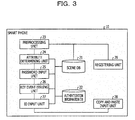
- FIG. 3 is a functional block diagram illustrating a functional configuration of a smart phone according to the first embodiment.
- the smart phone illustrated in FIG. 3 may be the smart phone 10 illustrated in FIG. 1 .
- the smart phone 10 includes a scene DB 21, an authentication information DB 22, a preprocessing unit 23, an attribute determining unit 24, a password input unit 25, a key event issuing unit 26, an ID input unit 27, a copy and paste input unit 28, and a registering unit 29.
- the scene DB 21 and the authentication information DB 22 are databases stored on the HDD 14 or the like.
- the preprocessing unit 23, the attribute determining unit 24, the password input unit 25, the key event issuing unit 26, the ID input unit 27, the copy and paste input unit 28, and the registering unit 29 are an example of an electronic circuit of the processor 20 or an example of processes executed by the processor 20.
- the scene DB 21 is a database that stores each piece of application field information, information for identifying authentication information to be input to each application, and the like.
- FIG. 4 is a diagram illustrating an example of information stored in a scene database (DB).
- the scene DB 21 stores a "scene ID,” a "field number,” a “password attribute,” an "ID-to-PWD distance,” and an “authentication information DB” in association with each other.
- the "scene ID” is an identifier identifying an application that requests authentication, and for example can be obtained from an authentication screen displayed by the application.
- the "field number” is the number of input fields possessed by the authentication screen displayed by the application.
- the "password attribute” is information indicating whether or not the authentication screen displayed by the application has an input field having a password attribute.
- the "ID-to-PWD distance” is information indicating a distance between the password field having the password attribute and an ID field for inputting a user ID.
- the "authentication information DB” is information identifying a record in the authentication information DB 22, and is for example key information (or a piece of key information).
- the "scene ID,” the "field number,” the "password attribute,” and the "ID-to-PWD distance” can be updated by an administrator or the like as appropriate, and can also be updated automatically by a distribution from a management server or the like.
- the authentication screen of an application identified by "AAA/.login” includes two input fields including an input field having the password attribute, and includes an ID field at a position at a distance "1" from the password field. Then, the information on the application and a record stored in the authentication information DB 22 are associated with each other by "AAA.”
- the authentication information DB 22 is a database that stores, for each application, a user ID and a password in association with each other.
- FIG. 5 is a diagram illustrating an example of information stored in an authentication information database (DB). As illustrated in FIG. 5 , the authentication information DB 22 stores an "application name,” a "user ID,” and a "password” in association with each other.
- the "application name” is an identifier identifying an application, and corresponds to an authentication information DB in FIG. 4 .
- the "user ID” represents an identifier identifying a user.
- the "password” represents a password associated with the user ID.
- FIG. 5 indicates that it is possible to log in to the application identified by "AAA” with an ID “XXXXX” and a password “YYYYY.”
- the preprocessing unit 23 is a processing unit that performs preprocessing before automatic input of authentication information is performed. For example, the preprocessing unit 23 determines whether or not an application being started, that is, an application displaying an authentication screen is an object for automatic input, activates the authentication screen, and places focus on an input field possessed by the authentication screen.
- the preprocessing unit 23 obtains a scene ID from the top screen.
- the preprocessing unit 23 obtains a uniform resource locator (URL) or the like when the top screen is displayed by a web browser, and obtains an application name, an ID specified by the application, or the like in the case of the application.
- URL uniform resource locator
- the preprocessing unit 23 determines that automatic input is possible, and inquires of a user whether or not to perform automatic input by displaying a screen inquiring whether or not to perform automatic input or the like. When the preprocessing unit 23 thereafter determines that automatic input is to be performed, the preprocessing unit 23 requests the attribute determining unit 24 to start processing. In addition, the preprocessing unit 23 can make a button appear within an input method editor (IME) to notify the user that automatic input is possible. In addition, the preprocessing unit 23 can change the IME automatically according to the displayed top screen, or can allow the user to select an IME to be used.
- IME input method editor
- the preprocessing unit 23 determines that automatic input is difficult, and inquires of the user whether or not to make a new registration by displaying a screen inquiring whether or not to make a new registration or making a button indicating a new registration appear within the IME, for example.
- the preprocessing unit 23 requests the registering unit 29 to start processing.
- the preprocessing unit 23 when an application is executed which performs user authentication processing that determines whether the user can use this password manager function (for example biometric authentication such as fingerprint authentication, face authentication, or the like), for example, after the preprocessing unit 23 requests the attribute determining unit 24 to start automatic input processing, the preprocessing unit 23 refocuses on the input field in the previous authentication screen. For example, when an active screen is changed before a start of automatic input, the preprocessing unit 23 reactivates the authentication screen for inputting authentication information, and then makes automatic input performed.
- biometric authentication such as fingerprint authentication, face authentication, or the like
- the attribute determining unit 24 is a processing unit that detects an input field having the password attribute from the screen displayed by the application when the scene ID obtained from the application being started is stored in the scene DB 21.
- the attribute determining unit 24 detects an input field having the password attribute from input fields possessed by the top screen of the application in an active state.
- the attribute determining unit 24 obtains an input field having the password attribute from a field attribute obtained from an operating system (OS) for the IME to determine an optimum keyboard type (numbers, alphabets, or characters) for the field, a logical configuration of the authentication screen prepared by the OS for audio output of the displayed screen, hypertext markup language (HTML), or the like.
- the password attribute is obtained from outside the application.
- the attribute determining unit 24 detects an input field having the password attribute, that is, a password field
- the attribute determining unit 24 requests the password input unit 25 to input a password.
- the password input unit 25 is a processing unit that inputs a password to the password field. For example, when the attribute determining unit 24 requests the password input unit 25 to input a password, the password input unit 25 obtains the scene ID from the preprocessing unit 23. Then, the password input unit 25 identifies the key information associated with the obtained scene ID from the scene DB 21, and identifies the password associated with the identified key information from the authentication information DB 22.
- the password input unit 25 inputs the identified password in the password field detected by the attribute determining unit 24.
- the password input unit 25 thereafter requests the key event issuing unit 26 to search for an ID field.
- the key event issuing unit 26 is a processing unit that issues a key event to search for an ID field from the top screen of the application. For example, the key event issuing unit 26 searches for an ID field on the top screen of the application, that is, on the authentication screen, from the ID-to-PWD distance stored in the scene DB 21 and the position of the password field detected by the attribute determining unit 24.
- the key event issuing unit 26 obtains the scene ID from the preprocessing unit 23. The key event issuing unit 26 then identifies the ID-to-PWD distance associated with the obtained scene ID from the scene DB 21. Thereafter, the key event issuing unit 26 issues a key event corresponding to the ID-to-PWD distance, and detects an ID field. When the key event issuing unit 26 detects an ID field, the key event issuing unit 26 requests the ID input unit 27 to input a user ID.
- the key event issuing unit 26 detects, as an ID field, an input field located the ID-to-PWD distance above or below the password field.
- the ID-to-PWD distance will be described in the following.
- FIG. 6 is a diagram of assistance in explaining an inter-field distance.
- FIG. 6 illustrates an example of a logical configuration of the top screen, in which example there are three pieces of "EditText” representing input fields.
- the input field "EditText” for inputting an ID is located two rows above the input field "EditText (password attribute)" having the password attribute.
- the distance between the password field and the ID field is "2.”
- the ID input unit 27 is a processing unit that inputs a user ID to an ID field. For example, when the key event issuing unit 26 requests the ID input unit 27 to input a user ID, the ID input unit 27 obtains the scene ID from the preprocessing unit 23. Then, the ID input unit 27 identifies the key information associated with the obtained scene ID from the scene DB 21, and identifies the user ID associated with the identified key information from the authentication information DB 22.
- the ID input unit 27 inputs the identified user ID to the ID field detected by the key event issuing unit 26.
- the ID input unit 27 thereafter makes user authentication started by depressing a login button or the like present on the top screen to which the user ID and the password have been input.
- the ID input unit 27 requests the copy and paste input unit 28 to assist in the input of authentication information.
- the copy and paste input unit 28 is a processing unit that performs input by copying and pasting. For example, when the ID input unit 27 requests the copy and paste input unit 28 to perform processing, the copy and paste input unit 28 displays a list of information associating user IDs and passwords used previously with one another on a display or the like. Then, the copy and paste input unit 28 copies a user ID and a password selected by the user, and pastes the user ID and the password to input fields selected by the user.
- the registering unit 29 is a processing unit that registers anew a user ID and a password. For example, when the preprocessing unit 23 requests the registering unit 29 to perform new registration processing, the registering unit 29 may obtain a user ID and a password input by the user from the top screen being displayed, or prepare a display screen dedicated to registration, prompt for input of an ID and a password within the screen, and obtain the ID and the password. In addition, in the input of a password in a new registration, a button for automatically creating a password in accordance with a password policy of the application on behalf of the user may be provided, and password input may be performed by pressing the button. Next, the registering unit 29 obtains the scene ID from the preprocessing unit 23, and identifies the record including the obtained scene ID from the scene DB 21. The registering unit 29 then determines whether or not an "authentication information DB" is registered in the identified record.
- the registering unit 29 retrieves a user ID and a password from the authentication information DB 22 using the "authentication information DB" as a key. Then, the registering unit 29 updates the retrieved user ID and the retrieved password with the new user ID and the new password obtained from the top screen.
- the registering unit 29 creates the "authentication information DB,” and stores the "authentication information DB” in the scene DB 21. Further, the registering unit 29 stores, in the authentication information DB 22, information associating the newly created “authentication information DB” with the user ID and the password obtained from the top screen.
- FIG. 7 is a flowchart illustrating a flow of preprocessing performed by a smart phone.
- the preprocessing unit 23 displays the top screen of the application (S101).
- the preprocessing unit 23 obtains the scene ID from the top screen of the application (S102). In parallel with processing S102, the preprocessing unit 23 checks the top screen of the application for attributes possessed by the top screen (S103), and determines whether or not there is a password attribute (S104).
- the preprocessing unit 23 requests the registering unit 29 to perform new registration processing (S106).
- the preprocessing unit 23 ends the processing.
- the preprocessing unit 23 can request the copy and paste input unit 28 to perform processing.
- the preprocessing unit 23 determines whether or not the application is an object of automatic input, according to whether or not the scene ID obtained in S102 is registered in the scene DB 21 (S107).
- the preprocessing unit 23 inquires whether or not to perform automatic input by displaying a confirmation screen or the like on the display (S109).
- the preprocessing unit 23 determines that automatic input is to be performed (S109: Yes)
- the preprocessing unit 23 performs automatic input processing (S110).
- the preprocessing unit 23 determines that automatic input is not to be performed (S109: No)
- the preprocessing unit 23 ends the processing.
- the preprocessing unit 23 can request the copy and paste input unit 28 to perform processing.
- the preprocessing unit 23 performs processing from S105 on down.
- FIG. 8 is a flowchart illustrating a flow of automatic input processing performed by a smart phone.
- the preprocessing unit 23 when the preprocessing unit 23 starts the automatic input processing, the preprocessing unit 23 changes to an IME according to the top screen of the application as a target or the like (S201). Next, when focus is not placed on an input field, that is, the target application, the preprocessing unit 23 refocuses on the target application (S202).
- the preprocessing unit 23 determines whether or not the ID-to-PWD distance corresponding to an obtained scene ID is recorded in the scene DB 21.
- the preprocessing unit 23 obtains the logical configuration of the screen (S204), analyzes the configuration, and calculates (obtains) the ID-to-PWD distance.
- the preprocessing unit 23 displays a list of information associating user IDs and passwords used previously with one another on the display or the like, and pastes a user ID and a password (S216).
- the attribute determining unit 24 selects an input field from the displayed top screen of the application (S206), obtains the attribute of the selected input field (S207), and determines whether or not the obtained attribute is the password attribute (S208).
- the attribute determining unit 24 determines that the obtained attribute is not the password attribute (S208: No)
- the attribute determining unit 24 searches for another input field using a key event issued by the key event issuing unit 26 (S209), and then repeats the processing from S206 on down.
- the key event issuing unit 26 obtains the ID-to-PWD distance corresponding to the obtained scene ID from the scene DB 21. Then, the key event issuing unit 26 moves upward or downward from the detected input field by the obtained distance, detects a next input field, and notifies a result of the detection to the attribute determining unit 24. Incidentally, the movement may be made in either of an upward direction and a downward direction. When an input field is detected in both of the directions, an attribute from one of the input fields is determined.
- the password input unit 25 inputs the password identified by using the scene DB 21 and the authentication information DB 22 to the detected password field (S210).
- the key event issuing unit 26 issues a key event, and retrieves an input field (S211). Then, the ID input unit 27 determines that the retrieved input field is an ID field, and inputs the user ID identified by using the scene DB 21 and the authentication information DB 22 to the detected ID field (S212).
- the ID input unit 27 ends the processing.
- the copy and paste input unit 28 determines whether or not automatic input can be performed by copying and pasting (S214).
- the copy and paste input unit 28 determines that there are other input fields. Then, the copy and paste input unit 28 determines whether the expiration date of the set of the user ID and the password with which authentication is permitted is exceeded. When the expiration date is not exceeded, the copy and paste input unit 28 determines that automatic input can be performed by copying and pasting. For example, the copy and paste input unit 28 determines whether automatic input can be performed by an auto-completion function.
- the copy and paste input unit 28 determines that automatic input can be performed by copying and pasting (S214: Yes)
- the copy and paste input unit 28 inputs the user ID and the password to the respective input fields by copying and pasting (S215).
- the copy and paste input unit 28 determines that it is difficult to perform automatic input by copying and pasting (S214: No), on the other hand, the copy and paste input unit 28 displays a list of information associating user IDs and passwords used previously with one another on the display or the like, and pastes a user ID and a password (S216). Incidentally, the order of the processing can be changed within a scope in which no contradiction occurs.
- FIG. 9 is a diagram of assistance in explaining automatic input processing performed by a smart phone.
- the smart phone illustrated in FIG. 9 may be the smart phone 10 illustrated in FIG. 1 .
- the smart phone 10 executes a password manager.
- the password manager detects a password field 1b having the password attribute from the authentication screen (S1).
- the password manager enters a password stored in advance to the detected password field 1b (S2).
- the password manager detects an ID field 1a according to an inter-field distance stored in advance (S3).
- the password manager thereafter enters a user ID stored in advance into the detected ID field 1a (S4).
- the smart phone 10 first detects an input field having the password attribute and inputs a password, and then inputs a user ID to an input field detected using an inter-field distance stored in advance. Therefore, the smart phone 10 can realize automatic input to a highly independent application in which it is difficult to detect the ID of an input field, or the like.
- the smart phone 10 manages the scene DB 21 and the authentication information DB 22 separately from each other, it suffices for the smart phone 10 to update the scene DB 21 even when the configuration of input fields of the application is changed. Therefore, even when a version upgrade of the application occurs, the smart phone 10 can suppress the occurrence of processing of reregistering authentication information, and follow a change in the configuration of the input fields.
- the smart phone 10 can reduce the occurrence of an error in the input of authentication information due to the change of the screens.
- the first embodiment has been described by taking as an example a case where information is managed in the scene DB 21 and the authentication information DB 22 as separate DBs.
- the information can also be managed in one DB. Accordingly, in a second embodiment, description will be made of an example in which authentication information is also managed by using a scene DB 21.
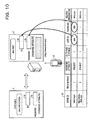
- FIG. 10 is a diagram of assistance in explaining automatic input processing performed by a smart phone according to the second embodiment.
- a smart phone 10 includes a scene DB 21 that stores a "scene ID,” a “field number,” a “password attribute,” an "ID-to-PWD distance,” a "user ID,” a “password,” and "related information” in association with each other.
- the information stored in this case includes "related information,” which is information different from the information of the first embodiment.
- the "related information” associates related scene IDs with each other. That is, in the example of FIG. 10 , the "related information" of a scene ID "AAA/.login” is “AAA.com,” and the “related information” of a scene ID "http://www/AAA.com” is “AAA.com.” It is thus understood that these scene IDs are associated with each other.
- the smart phone 10 accesses "http://www/AAA.com” using a web browser, and obtains an AAA page 2 as a top screen. Next, from the screen of the AAA page 2, the smart phone 10 obtains the scene ID "http://www/AAA.com," and detects an input field 2b having a password attribute.
- the smart phone 10 thereafter searches the scene DB 21 for a password associated with the scene ID "http://www/AAA.com.” However, the password is not registered yet. The smart phone 10 therefore searches the scene DB 21 for the related information associated with the scene ID "http://www/AAA.com.”
- the smart phone 10 identifies "AAA.com” as the related information associated with the scene ID "http://www/AAA.com.” Further, the smart phone 10 refers to the scene DB 21, and searches for another scene ID whose related information is "AAA.com.”
- the smart phone 10 identifies "AAA/.login” as a scene ID whose related information is "AAA.com,” other than "http://www/AAA.com.”
- the smart phone 10 identifies a password "BBB” associated with the newly identified scene ID "AAA/.login” from the scene DB 21, and inputs the password "BBB” to the password field 2b detected on the screen of the AAA page 2.
- the smart phone 10 refers to the scene DB 21, and identifies "1" as an ID-to-PWD distance associated with the target scene ID "http://www/AAA.com.” Then, the smart phone 10 detects an ID field 2a from the screen of the AAA page 2 using the distance "1.”
- the smart phone 10 identifies a user ID "AAA” associated with the newly identified scene ID "AAA/.login” from the scene DB 21, and inputs the user ID "AAA” to the ID field 2a detected on the screen of the AAA page 2.
- the smart phone 10 can thus input the user ID and the password of the related scene ID to make user authentication performed.
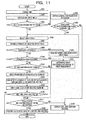
- FIG. 11 is a flowchart illustrating a flow of automatic input processing performed by a smart phone according to the second embodiment.
- the preprocessing unit 23 changes to an IME according to the top screen of an application as a target or the like (S301).
- the preprocessing unit 23 refocuses on the target application (S302).
- the preprocessing unit 23 determines whether the ID-to-PWD distance corresponding to an obtained scene ID is recorded in the scene DB 21.
- the preprocessing unit 23 obtains the logical configuration of the screen (S304), analyzes the configuration, and calculates (obtains) the ID-to-PWD distance.
- the preprocessing unit 23 displays a list of information associating user IDs and passwords used previously with one another on a display or the like, and pastes a user ID and a password (S319).
- an attribute determining unit 24 selects an input field from the displayed top screen of the application (S306), obtains the attribute of the selected input field (S307), and determines whether or not the obtained attribute is the password attribute (S308).
- the attribute determining unit 24 determines that the obtained attribute is not the password attribute (S308: No)
- the attribute determining unit 24 searches for another input field using a key event issued by a key event issuing unit 26 (S309), and repeats the processing from S306 on down.
- a password input unit 25 determines whether or not a password corresponding to the target scene ID is registered in the scene DB 21 (S310).
- the password input unit 25 determines that the password corresponding to the target scene ID is not registered (S310: No), on the other hand, the password input unit 25 refers to the scene DB 21, and determines whether or not another scene ID related to the target scene ID is registered (S312).
- the password input unit 25 inputs a password associated with the other related scene ID to the detected password field (S313).
- the key event issuing unit 26 issues a key event corresponding to the ID-to-PWD distance associated with the scene ID of the displayed top screen, and retrieves an input field (S314).
- an ID input unit 27 inputs a user ID associated with the other related scene ID to the detected input field (S315). Processing from S316 to S319, which is similar to the processing from S213 to S216 in the first embodiment, is thereafter performed.
- the smart phone 10 can automatically input the password and the user ID of a related scene ID.
- the convenience of the user can therefore be improved.
- the password and the user ID corresponding to the scene ID of the web page are not registered in the scene DB 21.
- the smart phone 10 can identify the application associated with the web page, and automatically input the user ID and the password associated with the identified application.
- the smart phone 10 can issue a key event in an arbitrary direction.
- the smart phone 10 can detect the ID field by moving in an upward direction by an ID-to-PWD distance from the password field.
- an example of the ID-to-PWD distance is 1, 2, or the like.
- the present technology is not limited to this.
- detailed settings can also be made, such as +1 in an upward direction, -1 in a downward direction, +1 to the left and +1 in the upward direction, and the like.
- the upward direction refers to a direction of going toward the top of the web page, for example.
- the respective configurations of the devices illustrated in the figures do not necessarily need to be physically configured as illustrated in the figures. That is, the respective configurations of the devices illustrated in the figures can be configured so as to be distributed or integrated in arbitrary units. Further, the whole or an arbitrary part of the processing functions performed in the respective devices can be implemented by a central processing unit (CPU) and a program analyzed and executed in the CPU, or can be implemented as hardware based on wired logic.
- CPU central processing unit
- the whole or a part of the processing described as being performed automatically can also be performed manually, or the whole or a part of the processing described as being performed manually can also be performed automatically by a publicly known method.
- the processing procedures, the control procedures, specific names, and information including various kinds of data and parameters that are illustrated in the document and the drawings can be changed arbitrarily unless otherwise specified.
- the smart phone 10 described in the present embodiments can perform functions similar to the processing described with reference to FIG. 3 , FIG. 10 , and the like by reading and executing an authentication information managing program.
- the smart phone 10 expands, into the memory, a program having functions similar to the functions of the attribute determining unit 24, the password input unit 25, the key event issuing unit 26, the ID input unit 27, the copy and paste input unit 28, and the registering unit 29.
- the smart phone 10 can perform processing similar to the processing of the foregoing embodiments by executing processes that perform processing similar to the processing of the attribute determining unit 24, the password input unit 25, the key event issuing unit 26, the ID input unit 27, the copy and paste input unit 28, and the registering unit 29.
- This program can be distributed via a network such as the Internet or the like.
- the program can be recorded on a computer readable recording medium such as a hard disk, a flexible disk (FD), a compact disk read only memory (CD-ROM), a magneto-optical disk (MO), a digital versatile disk (DVD), or the like, and executed by being read from the recording medium by a computer.
- a computer readable recording medium such as a hard disk, a flexible disk (FD), a compact disk read only memory (CD-ROM), a magneto-optical disk (MO), a digital versatile disk (DVD), or the like
- the various features may be implemented in hardware, or as software modules running on one or more processors.
- the invention also provides a computer program or a computer program product for carrying out any of the methods described herein, and a computer readable medium having stored thereon a program for carrying out any of the methods described herein.
- a computer program embodying the invention may be stored on a computer-readable medium, or it could, for
Landscapes
- Engineering & Computer Science (AREA)
- Computer Security & Cryptography (AREA)
- Computer Hardware Design (AREA)
- Theoretical Computer Science (AREA)
- General Engineering & Computer Science (AREA)
- General Physics & Mathematics (AREA)
- Physics & Mathematics (AREA)
- Software Systems (AREA)
- Computing Systems (AREA)
- Computer Networks & Wireless Communication (AREA)
- Signal Processing (AREA)
- Business, Economics & Management (AREA)
- Accounting & Taxation (AREA)
- User Interface Of Digital Computer (AREA)
- Telephone Function (AREA)
Abstract
Description
- The present technology discussed herein is related to an authentication information managing method, an authentication information managing program, and an information processing device.
- Services surrounding users have recently been increasing steadily, as is seen in a case of applications compatible with smart phones. In addition, many of the services perform authentication using a user identification (ID) and a password.
- Single sign-on (SSO) is known as a technology that integrates authentication. In SSO, there are OpenID, security assertion markup language (SAML), and the like implemented on a server side, and there are a password manager and the like on a client side.
- The password manager stores an application ID, a user ID, a password, and the IDs of input fields to which to perform input in association with each other, and when extracting the input fields of a corresponding application, automatically inputs the associated user ID and the associated password. In a case of a web browser, for example, the application ID is a unique ID such as "http://www.AAA.AAA" or the like.
- A related technology is disclosed in Japanese Laid-open Patent Publication No.
2014-48738 2013-257624 2014-157578 2012-83878 - However, the above techniques cause inputting errors for highly independent applications such as applications in a smart phone.
- For example, applications executed in a smart phone or applications executed in a virtual machine are highly independent, and these applications limit accesses from other applications to them. For this reason, password manager cannot detect IDs of input fields and may perform incorrect inputting such as inputting a password to an input field for user ID.
- It is desirable to input authentication information automatically.
- The invention is defined by the claims, to which reference should now be made.
- According to an embodiment of an aspect of the present invention, there is provided an authentication information managing method performed by an information processing device, the authentication information managing method includes storing each of at least one application identifier, each of at least one user identifier, each of at least one password, and each of at least one distance in association with each other to a memory, each of the at least one distance indicating each distance between each input field for each of the at least one user identifier and each input field for each of the at least one password in each application identified by each of the at least one application identifier, when a specified application having a plurality of input fields is running and the specified application is identified by a specified application identifier of the at least one application identifier, detecting a first input field for a specified password among the plurality of input fields based on a specified attribution that is associated with the first input field, the specified attribution indicating that the first input field is used for a password and being detected from outside the specified application, the specified password being associated with the specified application identifier in the memory, inputting the specified password to the first input field, detecting a second input field for a specified user identifier among the plurality of input fields based on a specified distance associated with the specified application identifier in the memory, the specified user identifier being associated with the specified application identifier in the memory, and inputting the specified user identifier to the second input field.
- According to embodiments of the authentication information managing method disclosed herein, an effect in which it is possible to input authentication information automatically.
- Embodiments of the invention are set out, by way of example only, with reference to the following drawings, in which:
-
FIG. 1 is a diagram of assistance in explaining a smart phone according to a first embodiment; -
FIG. 2 is a diagram illustrating an example of hardware configuration of a smart phone according to the first embodiment; -
FIG. 3 is a functional block diagram illustrating a functional configuration of a smart phone according to the first embodiment; -
FIG. 4 is a diagram illustrating an example of information stored in a scene database; -
FIG. 5 is a diagram illustrating an example of information stored in an authentication information database; -
FIG. 6 is a diagram of assistance in explaining an inter-field distance; -
FIG. 7 is a flowchart illustrating a flow of preprocessing performed by a smart phone; -
FIG. 8 is a flowchart illustrating a flow of automatic input processing performed by a smart phone; -
FIG. 9 is a diagram of assistance in explaining automatic input processing performed by a smart phone; -
FIG. 10 is a diagram of assistance in explaining automatic input processing performed by a smart phone according to a second embodiment; and -
FIG. 11 is a flowchart illustrating a flow of automatic input processing performed by a smart phone according to the second embodiment. - Embodiments of an authentication information managing method, an authentication information managing program, and an information processing device disclosed in the present application will hereinafter be described in detail with reference to the drawings. It is to be noted that the embodiments do not limit the present technology.
-
FIG. 1 is a diagram of assistance in explaining a smart phone according to a first embodiment. Asmart phone 10 to be described in the present embodiment is an example of a user terminal such as a mobile terminal, an information processing device, or the like. In addition to thesmart phone 10, a mobile telephone, a server, a notebook personal computer, and the like can also perform similar processing. - As illustrated in
FIG. 1 , thesmart phone 10 uses an already installed application, a web browser, or the like. Thesmart phone 10 can thus use various applications. In addition, when each application is accessed by the user terminal, the application makes a user ID and a password input to perform user authentication, and permits a user who permits the user authentication to use the application. - For example, as illustrated in
FIG. 1 , anAAA application 1 displays, on thesmart phone 10, a top screen including an input field 1a for inputting a user ID (which input field may hereinafter be described as an ID field) and aninput field 1b for inputting a password (which input field may hereinafter be described as a password field). TheAAA application 1 then performs user authentication using the user ID input to the ID field 1a and the password input to thepassword field 1b. - The
smart phone 10 manages user IDs and passwords of various kinds of applications by using software such as a password manager or the like. - Such a
smart phone 10 refers to a storage unit that stores an identifier identifying theapplication 1 and authentication information in association with each other. Then, when the identifier obtained from theapplication 1 is stored in the storage unit, thesmart phone 10 detects an input field having the attribute of the authentication information from theapplication 1. Thereafter, thesmart phone 10 refers to the storage unit, and inputs the authentication information stored in association with the identifier to the detected input field. - For example, after the
smart phone 10 detects a field having a password attribute from an application screen, and inputs the password stored in advance, thesmart phone 10 inputs the ID stored in advance to an ID field at an inter-field distance stored in advance. Thesmart phone 10 can thus realize automatic input of the authentication information even when it is difficult to detect IDs identifying the input fields. -
FIG. 2 is a diagram illustrating an example of hardware configuration of a smart phone according to the first embodiment. The smart phone illustrated inFIG. 2 may be thesmart phone 10 illustrated inFIG. 1 . As illustrated inFIG. 2 , thesmart phone 10 includes a communicatingunit 11, adisplay unit 12, an audio input-output unit 13, a hard disk drive (HDD) 14, amemory 15, and aprocessor 20. Incidentally, the hardware cited here is an example. Thesmart phone 10 may include other hardware. - The communicating
unit 11 is a circuit or the like that performs radio communication with another device via anantenna 11a. Thedisplay unit 12 is a display, a touch panel, or the like that displays various kinds of information. The audio input-output unit 13 is a circuit or the like that outputs sound from a speaker and which subjects sound collected by a microphone to various kinds of processing. - The HDD 14 is a storage device that stores databases, tables, and the like. The
memory 15 is a storage device used to expand a program or the like. Theprocessor 20 is an electronic circuit or the like that controls the whole of thesmart phone 10. Theprocessor 20 reads a program stored on theHDD 14, expands the program into thememory 15, and executes various kinds of software such as a password manager and the like. -
FIG. 3 is a functional block diagram illustrating a functional configuration of a smart phone according to the first embodiment. The smart phone illustrated inFIG. 3 may be thesmart phone 10 illustrated inFIG. 1 . As illustrated inFIG. 3 , thesmart phone 10 includes ascene DB 21, anauthentication information DB 22, apreprocessing unit 23, anattribute determining unit 24, apassword input unit 25, a key event issuing unit 26, anID input unit 27, a copy andpaste input unit 28, and a registeringunit 29. - The
scene DB 21 and theauthentication information DB 22 are databases stored on theHDD 14 or the like. The preprocessingunit 23, theattribute determining unit 24, thepassword input unit 25, the key event issuing unit 26, theID input unit 27, the copy andpaste input unit 28, and the registeringunit 29 are an example of an electronic circuit of theprocessor 20 or an example of processes executed by theprocessor 20. - The
scene DB 21 is a database that stores each piece of application field information, information for identifying authentication information to be input to each application, and the like.FIG. 4 is a diagram illustrating an example of information stored in a scene database (DB). - As illustrated in
FIG. 4 , thescene DB 21 stores a "scene ID," a "field number," a "password attribute," an "ID-to-PWD distance," and an "authentication information DB" in association with each other. The "scene ID" is an identifier identifying an application that requests authentication, and for example can be obtained from an authentication screen displayed by the application. The "field number" is the number of input fields possessed by the authentication screen displayed by the application. The "password attribute" is information indicating whether or not the authentication screen displayed by the application has an input field having a password attribute. - The "ID-to-PWD distance" is information indicating a distance between the password field having the password attribute and an ID field for inputting a user ID. The "authentication information DB" is information identifying a record in the
authentication information DB 22, and is for example key information (or a piece of key information). Incidentally, the "scene ID," the "field number," the "password attribute," and the "ID-to-PWD distance" can be updated by an administrator or the like as appropriate, and can also be updated automatically by a distribution from a management server or the like. - In the example of
FIG. 4 , the authentication screen of an application identified by "AAA/.login" includes two input fields including an input field having the password attribute, and includes an ID field at a position at a distance "1" from the password field. Then, the information on the application and a record stored in theauthentication information DB 22 are associated with each other by "AAA." - The
authentication information DB 22 is a database that stores, for each application, a user ID and a password in association with each other.FIG. 5 is a diagram illustrating an example of information stored in an authentication information database (DB). As illustrated inFIG. 5 , theauthentication information DB 22 stores an "application name," a "user ID," and a "password" in association with each other. - The "application name" is an identifier identifying an application, and corresponds to an authentication information DB in
FIG. 4 . The "user ID" represents an identifier identifying a user. The "password" represents a password associated with the user ID.FIG. 5 indicates that it is possible to log in to the application identified by "AAA" with an ID "XXXXX" and a password "YYYYY." - The preprocessing
unit 23 is a processing unit that performs preprocessing before automatic input of authentication information is performed. For example, the preprocessingunit 23 determines whether or not an application being started, that is, an application displaying an authentication screen is an object for automatic input, activates the authentication screen, and places focus on an input field possessed by the authentication screen. - For example, when the application is executed or web access is made, and the top screen of the application is displayed, the preprocessing
unit 23 obtains a scene ID from the top screen. To cite an example, the preprocessingunit 23 obtains a uniform resource locator (URL) or the like when the top screen is displayed by a web browser, and obtains an application name, an ID specified by the application, or the like in the case of the application. - When the obtained scene ID is stored in the
scene DB 21, the preprocessingunit 23 determines that automatic input is possible, and inquires of a user whether or not to perform automatic input by displaying a screen inquiring whether or not to perform automatic input or the like. When thepreprocessing unit 23 thereafter determines that automatic input is to be performed, the preprocessingunit 23 requests theattribute determining unit 24 to start processing. In addition, the preprocessingunit 23 can make a button appear within an input method editor (IME) to notify the user that automatic input is possible. In addition, the preprocessingunit 23 can change the IME automatically according to the displayed top screen, or can allow the user to select an IME to be used. - When the obtained scene ID is not stored in the
scene DB 21, on the other hand, the preprocessingunit 23 determines that automatic input is difficult, and inquires of the user whether or not to make a new registration by displaying a screen inquiring whether or not to make a new registration or making a button indicating a new registration appear within the IME, for example. When thepreprocessing unit 23 thereafter determines that a new registration is to be performed, the preprocessingunit 23 requests the registeringunit 29 to start processing. - In addition, when an application is executed which performs user authentication processing that determines whether the user can use this password manager function (for example biometric authentication such as fingerprint authentication, face authentication, or the like), for example, after the
preprocessing unit 23 requests theattribute determining unit 24 to start automatic input processing, the preprocessingunit 23 refocuses on the input field in the previous authentication screen. For example, when an active screen is changed before a start of automatic input, the preprocessingunit 23 reactivates the authentication screen for inputting authentication information, and then makes automatic input performed. - The
attribute determining unit 24 is a processing unit that detects an input field having the password attribute from the screen displayed by the application when the scene ID obtained from the application being started is stored in thescene DB 21. - For example, when the
attribute determining unit 24 is given an instruction to start automatic input from the preprocessingunit 23, theattribute determining unit 24 detects an input field having the password attribute from input fields possessed by the top screen of the application in an active state. To cite an example, theattribute determining unit 24 obtains an input field having the password attribute from a field attribute obtained from an operating system (OS) for the IME to determine an optimum keyboard type (numbers, alphabets, or characters) for the field, a logical configuration of the authentication screen prepared by the OS for audio output of the displayed screen, hypertext markup language (HTML), or the like. Namely, the password attribute is obtained from outside the application. When theattribute determining unit 24 detects an input field having the password attribute, that is, a password field, theattribute determining unit 24 requests thepassword input unit 25 to input a password. - The
password input unit 25 is a processing unit that inputs a password to the password field. For example, when theattribute determining unit 24 requests thepassword input unit 25 to input a password, thepassword input unit 25 obtains the scene ID from the preprocessingunit 23. Then, thepassword input unit 25 identifies the key information associated with the obtained scene ID from thescene DB 21, and identifies the password associated with the identified key information from theauthentication information DB 22. - Next, the
password input unit 25 inputs the identified password in the password field detected by theattribute determining unit 24. Thepassword input unit 25 thereafter requests the key event issuing unit 26 to search for an ID field. - The key event issuing unit 26 is a processing unit that issues a key event to search for an ID field from the top screen of the application. For example, the key event issuing unit 26 searches for an ID field on the top screen of the application, that is, on the authentication screen, from the ID-to-PWD distance stored in the
scene DB 21 and the position of the password field detected by theattribute determining unit 24. - For example, when the
password input unit 25 requests the key event issuing unit 26 to search for an ID field, the key event issuing unit 26 obtains the scene ID from the preprocessingunit 23. The key event issuing unit 26 then identifies the ID-to-PWD distance associated with the obtained scene ID from thescene DB 21. Thereafter, the key event issuing unit 26 issues a key event corresponding to the ID-to-PWD distance, and detects an ID field. When the key event issuing unit 26 detects an ID field, the key event issuing unit 26 requests theID input unit 27 to input a user ID. - To cite an example, the key event issuing unit 26 detects, as an ID field, an input field located the ID-to-PWD distance above or below the password field. The ID-to-PWD distance will be described in the following.
-
FIG. 6 is a diagram of assistance in explaining an inter-field distance.FIG. 6 illustrates an example of a logical configuration of the top screen, in which example there are three pieces of "EditText" representing input fields. In this case, the input field "EditText" for inputting an ID is located two rows above the input field "EditText (password attribute)" having the password attribute. Hence, the distance between the password field and the ID field is "2." - The
ID input unit 27 is a processing unit that inputs a user ID to an ID field. For example, when the key event issuing unit 26 requests theID input unit 27 to input a user ID, theID input unit 27 obtains the scene ID from the preprocessingunit 23. Then, theID input unit 27 identifies the key information associated with the obtained scene ID from thescene DB 21, and identifies the user ID associated with the identified key information from theauthentication information DB 22. - Next, the
ID input unit 27 inputs the identified user ID to the ID field detected by the key event issuing unit 26. TheID input unit 27 thereafter makes user authentication started by depressing a login button or the like present on the top screen to which the user ID and the password have been input. - Here, when the user authentication is rejected or when there is another input field, the
ID input unit 27 requests the copy andpaste input unit 28 to assist in the input of authentication information. - The copy and
paste input unit 28 is a processing unit that performs input by copying and pasting. For example, when theID input unit 27 requests the copy andpaste input unit 28 to perform processing, the copy andpaste input unit 28 displays a list of information associating user IDs and passwords used previously with one another on a display or the like. Then, the copy andpaste input unit 28 copies a user ID and a password selected by the user, and pastes the user ID and the password to input fields selected by the user. - The registering
unit 29 is a processing unit that registers anew a user ID and a password. For example, when thepreprocessing unit 23 requests the registeringunit 29 to perform new registration processing, the registeringunit 29 may obtain a user ID and a password input by the user from the top screen being displayed, or prepare a display screen dedicated to registration, prompt for input of an ID and a password within the screen, and obtain the ID and the password. In addition, in the input of a password in a new registration, a button for automatically creating a password in accordance with a password policy of the application on behalf of the user may be provided, and password input may be performed by pressing the button. Next, the registeringunit 29 obtains the scene ID from the preprocessingunit 23, and identifies the record including the obtained scene ID from thescene DB 21. The registeringunit 29 then determines whether or not an "authentication information DB" is registered in the identified record. - Here, when an "authentication information DB" is registered in the identified record, the registering
unit 29 retrieves a user ID and a password from theauthentication information DB 22 using the "authentication information DB" as a key. Then, the registeringunit 29 updates the retrieved user ID and the retrieved password with the new user ID and the new password obtained from the top screen. - When the "authentication information DB" is not registered in the identified record, on the other hand, the registering
unit 29 creates the "authentication information DB," and stores the "authentication information DB" in thescene DB 21. Further, the registeringunit 29 stores, in theauthentication information DB 22, information associating the newly created "authentication information DB" with the user ID and the password obtained from the top screen. - Description will next be made of preprocessing performed by the
smart phone 10.FIG. 7 is a flowchart illustrating a flow of preprocessing performed by a smart phone. - As illustrated in
FIG. 7 , when the application is started, the preprocessingunit 23 displays the top screen of the application (S101). - Then, the preprocessing
unit 23 obtains the scene ID from the top screen of the application (S102). In parallel with processing S102, the preprocessingunit 23 checks the top screen of the application for attributes possessed by the top screen (S103), and determines whether or not there is a password attribute (S104). - Then, when there is no password attribute (S104: No), and a given button or the like is pressed long (S105: Yes), the preprocessing
unit 23 requests the registeringunit 29 to perform new registration processing (S106). When there is no password attribute, and the given button or the like is not pressed long either (S105: No), on the other hand, the preprocessingunit 23 ends the processing. Alternatively, the preprocessingunit 23 can request the copy andpaste input unit 28 to perform processing. - When the top screen of the application has the password attribute (S104: Yes), on the other hand, the preprocessing
unit 23 determines whether or not the application is an object of automatic input, according to whether or not the scene ID obtained in S102 is registered in the scene DB 21 (S107). - Then, when the application is an object of automatic input (S108: Yes), the preprocessing
unit 23 inquires whether or not to perform automatic input by displaying a confirmation screen or the like on the display (S109). - Here, when the
preprocessing unit 23 determines that automatic input is to be performed (S109: Yes), the preprocessingunit 23 performs automatic input processing (S110). When thepreprocessing unit 23 determines that automatic input is not to be performed (S109: No), on the other hand, the preprocessingunit 23 ends the processing. Alternatively, the preprocessingunit 23 can request the copy andpaste input unit 28 to perform processing. - When the application is not an object of automatic input in S108 (S108: No), the preprocessing
unit 23 performs processing from S105 on down. - Description will next be made of automatic input processing performed by the
smart phone 10.FIG. 8 is a flowchart illustrating a flow of automatic input processing performed by a smart phone. - As illustrated in
FIG. 8 , when thepreprocessing unit 23 starts the automatic input processing, the preprocessingunit 23 changes to an IME according to the top screen of the application as a target or the like (S201). Next, when focus is not placed on an input field, that is, the target application, the preprocessingunit 23 refocuses on the target application (S202). - Then, the preprocessing
unit 23 determines whether or not the ID-to-PWD distance corresponding to an obtained scene ID is recorded in thescene DB 21. When the ID-to-PWD distance corresponding to the obtained scene ID is not recorded (S203: No), the preprocessingunit 23 obtains the logical configuration of the screen (S204), analyzes the configuration, and calculates (obtains) the ID-to-PWD distance. When it is difficult to calculate the ID-to-PWD distance (S205: No), the preprocessingunit 23 displays a list of information associating user IDs and passwords used previously with one another on the display or the like, and pastes a user ID and a password (S216). - When the ID-to-PWD distance is recorded (S203: Yes), or when the ID-to-PWD distance can be obtained (S205: Yes), on the other hand, the
attribute determining unit 24 selects an input field from the displayed top screen of the application (S206), obtains the attribute of the selected input field (S207), and determines whether or not the obtained attribute is the password attribute (S208). - Here, when the
attribute determining unit 24 determines that the obtained attribute is not the password attribute (S208: No), theattribute determining unit 24 searches for another input field using a key event issued by the key event issuing unit 26 (S209), and then repeats the processing from S206 on down. - For example, when the
attribute determining unit 24 requests the key event issuing unit 26 to issue a key event, the key event issuing unit 26 obtains the ID-to-PWD distance corresponding to the obtained scene ID from thescene DB 21. Then, the key event issuing unit 26 moves upward or downward from the detected input field by the obtained distance, detects a next input field, and notifies a result of the detection to theattribute determining unit 24. Incidentally, the movement may be made in either of an upward direction and a downward direction. When an input field is detected in both of the directions, an attribute from one of the input fields is determined. - When the
attribute determining unit 24 determines that the obtained attribute is the password attribute (S208: Yes), on the other hand, thepassword input unit 25 inputs the password identified by using thescene DB 21 and theauthentication information DB 22 to the detected password field (S210). - Thereafter, the key event issuing unit 26 issues a key event, and retrieves an input field (S211). Then, the
ID input unit 27 determines that the retrieved input field is an ID field, and inputs the user ID identified by using thescene DB 21 and theauthentication information DB 22 to the detected ID field (S212). - Thereafter, when there are no other input fields (S213: No), the
ID input unit 27 ends the processing. When there are other input fields (S213: Yes), on the other hand, the copy andpaste input unit 28 determines whether or not automatic input can be performed by copying and pasting (S214). - For example, when authentication processing is not permitted because of the presence of fields to which input is yet to be performed or the like, the copy and
paste input unit 28 determines that there are other input fields. Then, the copy andpaste input unit 28 determines whether the expiration date of the set of the user ID and the password with which authentication is permitted is exceeded. When the expiration date is not exceeded, the copy andpaste input unit 28 determines that automatic input can be performed by copying and pasting. For example, the copy andpaste input unit 28 determines whether automatic input can be performed by an auto-completion function. - Then, when the copy and
paste input unit 28 determines that automatic input can be performed by copying and pasting (S214: Yes), the copy andpaste input unit 28 inputs the user ID and the password to the respective input fields by copying and pasting (S215). - When the copy and
paste input unit 28 determines that it is difficult to perform automatic input by copying and pasting (S214: No), on the other hand, the copy andpaste input unit 28 displays a list of information associating user IDs and passwords used previously with one another on the display or the like, and pastes a user ID and a password (S216). Incidentally, the order of the processing can be changed within a scope in which no contradiction occurs. - Description will next be made of the above automatic input processing.
FIG. 9 is a diagram of assistance in explaining automatic input processing performed by a smart phone. The smart phone illustrated inFIG. 9 may be thesmart phone 10 illustrated inFIG. 1 . - As illustrated in
FIG. 9 , thesmart phone 10 executes a password manager. When the application is started, and an authentication screen including a scene ID stored in thescene DB 21 is displayed, the password manager detects apassword field 1b having the password attribute from the authentication screen (S1). - Then, the password manager enters a password stored in advance to the detected
password field 1b (S2). Next, the password manager detects an ID field 1a according to an inter-field distance stored in advance (S3). The password manager thereafter enters a user ID stored in advance into the detected ID field 1a (S4). - As described above, the
smart phone 10 first detects an input field having the password attribute and inputs a password, and then inputs a user ID to an input field detected using an inter-field distance stored in advance. Therefore, thesmart phone 10 can realize automatic input to a highly independent application in which it is difficult to detect the ID of an input field, or the like. - In addition, because the
smart phone 10 manages thescene DB 21 and theauthentication information DB 22 separately from each other, it suffices for thesmart phone 10 to update thescene DB 21 even when the configuration of input fields of the application is changed. Therefore, even when a version upgrade of the application occurs, thesmart phone 10 can suppress the occurrence of processing of reregistering authentication information, and follow a change in the configuration of the input fields. - In addition, even when a transition is made from the top screen of the application requesting authentication to the screen of another application, the
smart phone 10 returns to the top screen of the application requesting authentication, and then performs automatic input processing. Therefore, thesmart phone 10 can reduce the occurrence of an error in the input of authentication information due to the change of the screens. - The first embodiment has been described by taking as an example a case where information is managed in the
scene DB 21 and theauthentication information DB 22 as separate DBs. However, the present technology is not limited to this. The information can also be managed in one DB. Accordingly, in a second embodiment, description will be made of an example in which authentication information is also managed by using ascene DB 21. -
FIG. 10 is a diagram of assistance in explaining automatic input processing performed by a smart phone according to the second embodiment. As illustrated inFIG. 10 , asmart phone 10 includes ascene DB 21 that stores a "scene ID," a "field number," a "password attribute," an "ID-to-PWD distance," a "user ID," a "password," and "related information" in association with each other. - The information stored in this case includes "related information," which is information different from the information of the first embodiment. The "related information" associates related scene IDs with each other. That is, in the example of
FIG. 10 , the "related information" of a scene ID "AAA/.login" is "AAA.com," and the "related information" of a scene ID "http://www/AAA.com" is "AAA.com." It is thus understood that these scene IDs are associated with each other. - In such a state, the
smart phone 10 accesses "http://www/AAA.com" using a web browser, and obtains anAAA page 2 as a top screen. Next, from the screen of theAAA page 2, thesmart phone 10 obtains the scene ID "http://www/AAA.com," and detects aninput field 2b having a password attribute. - The
smart phone 10 thereafter searches thescene DB 21 for a password associated with the scene ID "http://www/AAA.com." However, the password is not registered yet. Thesmart phone 10 therefore searches thescene DB 21 for the related information associated with the scene ID "http://www/AAA.com." - Then, the
smart phone 10 identifies "AAA.com" as the related information associated with the scene ID "http://www/AAA.com." Further, thesmart phone 10 refers to thescene DB 21, and searches for another scene ID whose related information is "AAA.com." - Then, the
smart phone 10 identifies "AAA/.login" as a scene ID whose related information is "AAA.com," other than "http://www/AAA.com." - Further, the
smart phone 10 identifies a password "BBB" associated with the newly identified scene ID "AAA/.login" from thescene DB 21, and inputs the password "BBB" to thepassword field 2b detected on the screen of theAAA page 2. - Next, the
smart phone 10 refers to thescene DB 21, and identifies "1" as an ID-to-PWD distance associated with the target scene ID "http://www/AAA.com." Then, thesmart phone 10 detects anID field 2a from the screen of theAAA page 2 using the distance "1." - Thereafter, the
smart phone 10 identifies a user ID "AAA" associated with the newly identified scene ID "AAA/.login" from thescene DB 21, and inputs the user ID "AAA" to theID field 2a detected on the screen of theAAA page 2. - The
smart phone 10 can thus input the user ID and the password of the related scene ID to make user authentication performed. -
FIG. 11 is a flowchart illustrating a flow of automatic input processing performed by a smart phone according to the second embodiment. - As illustrated in
FIG. 11 , when apreprocessing unit 23 starts the automatic input processing, the preprocessingunit 23 changes to an IME according to the top screen of an application as a target or the like (S301). Next, when focus is not placed on an input field, that is, the target application, the preprocessingunit 23 refocuses on the target application (S302). - Then, the preprocessing
unit 23 determines whether the ID-to-PWD distance corresponding to an obtained scene ID is recorded in thescene DB 21. When the ID-to-PWD distance corresponding to the obtained scene ID is not recorded (S303: No), the preprocessingunit 23 obtains the logical configuration of the screen (S304), analyzes the configuration, and calculates (obtains) the ID-to-PWD distance. When it is difficult to calculate the ID-to-PWD distance (S305: No), the preprocessingunit 23 displays a list of information associating user IDs and passwords used previously with one another on a display or the like, and pastes a user ID and a password (S319). - When the ID-to-PWD distance is recorded (S303: Yes), or when the ID-to-PWD distance can be obtained (S305: Yes), on the other hand, an
attribute determining unit 24 selects an input field from the displayed top screen of the application (S306), obtains the attribute of the selected input field (S307), and determines whether or not the obtained attribute is the password attribute (S308). - Here, when the
attribute determining unit 24 determines that the obtained attribute is not the password attribute (S308: No), theattribute determining unit 24 searches for another input field using a key event issued by a key event issuing unit 26 (S309), and repeats the processing from S306 on down. - When the
attribute determining unit 24 determines that the obtained attribute is the password attribute (S308: Yes), on the other hand, apassword input unit 25 determines whether or not a password corresponding to the target scene ID is registered in the scene DB 21 (S310). - Here, when the
password input unit 25 determines that the password corresponding to the target scene ID is registered (S310: Yes), automatic input processing similar to the automatic input processing of the first embodiment is performed (S311). - When the
password input unit 25 determines that the password corresponding to the target scene ID is not registered (S310: No), on the other hand, thepassword input unit 25 refers to thescene DB 21, and determines whether or not another scene ID related to the target scene ID is registered (S312). - Here, when another related scene ID is registered (S312: Yes), the
password input unit 25 inputs a password associated with the other related scene ID to the detected password field (S313). - Next, the key event issuing unit 26 issues a key event corresponding to the ID-to-PWD distance associated with the scene ID of the displayed top screen, and retrieves an input field (S314).
- Then, an
ID input unit 27 inputs a user ID associated with the other related scene ID to the detected input field (S315). Processing from S316 to S319, which is similar to the processing from S213 to S216 in the first embodiment, is thereafter performed. - When it is determined in S312 that no other related scene ID is registered (S312: No), the processing from S317 on down is performed. Incidentally, the order of the processing can be changed within a scope in which no contradiction occurs.
- Thus, even when a password and a user ID corresponding to a scene ID are not registered, the
smart phone 10 can automatically input the password and the user ID of a related scene ID. The convenience of the user can therefore be improved. - For example, when logging in to a same shopping site, it is possible to log in from a web page, and it is also possible to log in from the application of the shopping site. However, when the user has logged in only from the application, and logs in from the web page for the first time, input is requested though the same user ID and the same password are used.
- Further, in such a case, the password and the user ID corresponding to the scene ID of the web page are not registered in the
scene DB 21. - Accordingly, by performing the above-described processing according to the second embodiment, the
smart phone 10 can identify the application associated with the web page, and automatically input the user ID and the password associated with the identified application. - Embodiments of the present technology have been described thus far. However, the present technology may be carried out in various different forms other than the foregoing embodiments.
- For example, the
smart phone 10 can issue a key event in an arbitrary direction. For example, because an ID field is generally present above a password field, thesmart phone 10 can detect the ID field by moving in an upward direction by an ID-to-PWD distance from the password field. - In addition, in the foregoing embodiments, description has been made of examples in which an example of the ID-to-PWD distance is 1, 2, or the like. However, the present technology is not limited to this. For example, detailed settings can also be made, such as +1 in an upward direction, -1 in a downward direction, +1 to the left and +1 in the upward direction, and the like. Incidentally, the upward direction refers to a direction of going toward the top of the web page, for example.
- In addition, in the foregoing embodiments, description has been made of an example in which a new registration is made when a given button is pressed long. However, this trigger can be changed arbitrarily. For example, a button or an operation requesting a new registration can be set in advance.
- In addition, the respective configurations of the devices illustrated in the figures do not necessarily need to be physically configured as illustrated in the figures. That is, the respective configurations of the devices illustrated in the figures can be configured so as to be distributed or integrated in arbitrary units. Further, the whole or an arbitrary part of the processing functions performed in the respective devices can be implemented by a central processing unit (CPU) and a program analyzed and executed in the CPU, or can be implemented as hardware based on wired logic.
- In addition, among the pieces of processing described in the present embodiments, the whole or a part of the processing described as being performed automatically can also be performed manually, or the whole or a part of the processing described as being performed manually can also be performed automatically by a publicly known method. In addition, the processing procedures, the control procedures, specific names, and information including various kinds of data and parameters that are illustrated in the document and the drawings can be changed arbitrarily unless otherwise specified.
- It is to be noted that the
smart phone 10 described in the present embodiments can perform functions similar to the processing described with reference toFIG. 3 ,FIG. 10 , and the like by reading and executing an authentication information managing program. For example, thesmart phone 10 expands, into the memory, a program having functions similar to the functions of theattribute determining unit 24, thepassword input unit 25, the key event issuing unit 26, theID input unit 27, the copy andpaste input unit 28, and the registeringunit 29. Then, thesmart phone 10 can perform processing similar to the processing of the foregoing embodiments by executing processes that perform processing similar to the processing of theattribute determining unit 24, thepassword input unit 25, the key event issuing unit 26, theID input unit 27, the copy andpaste input unit 28, and the registeringunit 29. - This program can be distributed via a network such as the Internet or the like. In addition, the program can be recorded on a computer readable recording medium such as a hard disk, a flexible disk (FD), a compact disk read only memory (CD-ROM), a magneto-optical disk (MO), a digital versatile disk (DVD), or the like, and executed by being read from the recording medium by a computer. In any of the above aspects, the various features may be implemented in hardware, or as software modules running on one or more processors. Features of one aspect may be applied to any of the other aspects. The invention also provides a computer program or a computer program product for carrying out any of the methods described herein, and a computer readable medium having stored thereon a program for carrying out any of the methods described herein. A computer program embodying the invention may be stored on a computer-readable medium, or it could, for example, be in the form of a signal such as a downloadable data signal provided from an Internet website, or it could be in any other form.
-
- 10 Smart phone
- 21 Scene DB
- 22 Authentication Information DB
- 23 Preprocessing unit
- 24 Attribute Determination unit
- 25 Password input unit
- 26 Key event issuing unit
- 27 ID input unit
- 28 Copy and paste input unit
- 29 Registering unit
Claims (9)
- An authentication information managing method performed by an information processing device, the authentication information managing method comprising:storing each of at least one application identifier, each of at least one user identifier, each of at least one password, and each of at least one distance in association with each other to a memory, each of the at least one distance indicating each distance between each input field for each of the at least one user identifier and each input field for each of the at least one password in each application identified by each of the at least one application identifier;when a specified application having a plurality of input fields is running and the specified application is identified by a specified application identifier of the at least one application identifier, detecting a first input field for a specified password among the plurality of input fields based on a specified attribution that is associated with the first input field, the specified attribution indicating that the first input field is used for a password and being detected from outside the specified application, the specified password being associated with the specified application identifier in the memory;inputting the specified password to the first input field;detecting a second input field for a specified user identifier among the plurality of input fields based on a specified distance associated with the specified application identifier in the memory, the specified user identifier being associated with the specified application identifier in the memory; andinputting the specified user identifier to the second input field.
- The authentication information managing method according to claim 1, wherein
a first table and a second table is stored in the memory,
each of the at least one user identifier, each of the at least one password, and each of at least one piece of key data are associated each other in the first table,
each of the at least one application identifier, each of the at least one distance, and each of the at least one piece of key data are associated each other in the second table,
the specified user identifier and the specified password are identified by a specified piece of key data among the at least one piece of key data in the first table, the specified key data being identified by the specified application identifier in the second table. - The authentication information managing method according to any of the preceding claims, further comprising:when the specified application is not identified by any of the at least one application identifier, identifying another specified application that is associated with the specified application, the other specified application being identified by another specified application identifier among the at least one application identifier, the other specified application having other plurality of input fields;detecting another first input field for another specified password among the other plurality of input fields based on another specified attribution that is associated with the other first input field, the specified attribution indicating that the other first input field is used for a password and being detected from outside the other specified application, the other specified password being associated with the other specified application identifier in the memory;inputting the other specified password to the other first input field;detecting another second input field for another specified user identifier among the other plurality of input fields based on another specified distance associated with the other specified application identifier in the memory, the other specified user identifier being associated with the other specified application identifier in the memory; andinputting the other specified user identifier to the other second input field.
- The authentication information managing method according to any of the preceding claims, wherein
when another specified application is started before detecting the first input field, the first input field is detected after switching a screen from the other specified application to the specified application. - The authentication information managing method according to any of the preceding claims, wherein
no attribution detected from outside the specified application is associated with the second input field. - The authentication information managing method according to any of the preceding claims, wherein
each distance is each logical distance. - The authentication information managing method according to any of the preceding claims, wherein
each distance is indicated by the number of key events. - A non-transitory computer-readable storage medium storing a program that causes an information processing device to execute a process, the information processing device including a memory, the process comprising:storing each of at least one application identifier, each of at least one user identifier, each of at least one password, and each of at least one distance in association with each other to a memory, each of the at least one distance indicating each distance between each input field for each of the at least one user identifier and each input field for each of the at least one password in each application identified by each of the at least one application identifier;when a specified application having a plurality of input fields is running and the specified application is identified by a specified application identifier of the at least one application identifier, detecting a first input field for a specified password among the plurality of input fields based on a specified attribution that is associated with the first input field, the specified attribution indicating that the first input field is used for a password and being detected from outside the specified application, the specified password being associated with the specified application identifier in the memory;inputting the specified password to the first input field;detecting a second input field for a specified user identifier among the plurality of input fields based on a specified distance associated with the specified application identifier in the memory, the specified user identifier being associated with the specified application identifier in the memory; andinputting the specified user identifier to the second input field.
- An information processing device comprising:a memory configured to store each of at least one application identifier, each of at least one user identifier, each of at least one password, and each of at least one distance in association with each other to a memory, each of the at least one distance indicating each distance between each input field for each of the at least one user identifier and each input field for each of the at least one password in each application identified by each of the at least one application identifier;when a specified application having a plurality of input fields is running and the specified application is identified by a specified application identifier of the at least one application identifier, a first unit configured to detect a first input field for a specified password among the plurality of input fields based on a specified attribution that is associated with the first input field, the specified attribution indicating that the first input field is used for a password and being detected from outside the specified application, the specified password being associated with the specified application identifier in the memory;a password input unit configured to input the specified password to the first input field;a second unit configured to detect a second input field for a specified user identifier among the plurality of input fields based on a specified distance associated with the specified application identifier in the memory, the specified user identifier being associated with the specified application identifier in the memory; andan identifier input unit configured to input the specified user identifier to the second input field.
Applications Claiming Priority (1)
| Application Number | Priority Date | Filing Date | Title |
|---|---|---|---|
| JP2014209487A JP6361441B2 (en) | 2014-10-10 | 2014-10-10 | Authentication information management method, authentication information management program, and information processing apparatus |
Publications (2)
| Publication Number | Publication Date |
|---|---|
| EP3007091A1 true EP3007091A1 (en) | 2016-04-13 |
| EP3007091B1 EP3007091B1 (en) | 2018-06-13 |
Family
ID=54252028
Family Applications (1)
| Application Number | Title | Priority Date | Filing Date |
|---|---|---|---|
| EP15187236.3A Not-in-force EP3007091B1 (en) | 2014-10-10 | 2015-09-28 | Authentication information managing method, storage medium, and information processing device |
Country Status (3)
| Country | Link |
|---|---|
| US (1) | US20160105413A1 (en) |
| EP (1) | EP3007091B1 (en) |
| JP (1) | JP6361441B2 (en) |
Families Citing this family (9)
| Publication number | Priority date | Publication date | Assignee | Title |
|---|---|---|---|---|
| JP6592828B2 (en) * | 2016-12-22 | 2019-10-23 | 京セラドキュメントソリューションズ株式会社 | Authentication setting system and image forming apparatus |
| JP6794849B2 (en) * | 2017-01-30 | 2020-12-02 | セイコーエプソン株式会社 | Authentication device and authentication program |
| JP6903934B2 (en) * | 2017-02-16 | 2021-07-14 | 株式会社リコー | Image processor, authentication method, and program |
| CN107368184B (en) * | 2017-05-12 | 2020-04-14 | 阿里巴巴集团控股有限公司 | Password input method and device in virtual reality scene |
| JP6785489B1 (en) * | 2019-10-09 | 2020-11-18 | 株式会社C−Rise | Information processing method, information processing device, information processing system and computer program |
| JP6933826B1 (en) * | 2021-04-12 | 2021-09-08 | 富士通クライアントコンピューティング株式会社 | Information processing equipment and programs |
| US20230037669A1 (en) * | 2021-08-06 | 2023-02-09 | Eagle Telemedicine, LLC | Systems and Methods of Automating Processes for Remote Work |
| US20230040682A1 (en) | 2021-08-06 | 2023-02-09 | Eagle Telemedicine, LLC | Systems and Methods of Automating Processes for Remote Work |
| US12609923B2 (en) | 2021-08-06 | 2026-04-21 | Eagle Telemedicine, LLC | Systems and methods for automating processes for remote work |
Citations (5)
| Publication number | Priority date | Publication date | Assignee | Title |
|---|---|---|---|---|
| JP2012083878A (en) | 2010-10-08 | 2012-04-26 | Sony Corp | Information processor, information processing method and program |
| JP2013257624A (en) | 2012-06-11 | 2013-12-26 | Hitachi Information & Control Solutions Ltd | Data input support device, method and program |
| JP2014048738A (en) | 2012-08-29 | 2014-03-17 | Kyocera Corp | Portable terminal device, program and password input method |
| US20140101772A1 (en) * | 2012-10-05 | 2014-04-10 | Panasonic Corporation | Input method, input apparatus, and input program |
| JP2014157578A (en) | 2013-02-18 | 2014-08-28 | Nec Casio Mobile Communications Ltd | Touch panel device, control method of touch panel device, and program |
Family Cites Families (7)
| Publication number | Priority date | Publication date | Assignee | Title |
|---|---|---|---|---|
| US6813603B1 (en) * | 2000-01-26 | 2004-11-02 | Korteam International, Inc. | System and method for user controlled insertion of standardized text in user selected fields while dictating text entries for completing a form |
| US7003727B2 (en) * | 2001-02-06 | 2006-02-21 | International Business Machines Corporation | User identification and password field determination |
| JP2003295969A (en) * | 2002-03-29 | 2003-10-17 | Fujitsu Ltd | Automatic information input program |
| JP5229871B2 (en) * | 2008-01-10 | 2013-07-03 | インターナショナル・ビジネス・マシーンズ・コーポレーション | Technology that supports user input of data |
| US9141779B2 (en) * | 2011-05-19 | 2015-09-22 | Microsoft Technology Licensing, Llc | Usable security of online password management with sensor-based authentication |
| JP5804904B2 (en) * | 2011-11-17 | 2015-11-04 | アルパイン株式会社 | Electronic equipment |
| JP5390035B1 (en) * | 2013-05-02 | 2014-01-15 | アイシステムサービス株式会社 | Input support program, management apparatus and management system |
-
2014
- 2014-10-10 JP JP2014209487A patent/JP6361441B2/en not_active Expired - Fee Related
-
2015
- 2015-09-23 US US14/862,572 patent/US20160105413A1/en not_active Abandoned
- 2015-09-28 EP EP15187236.3A patent/EP3007091B1/en not_active Not-in-force
Patent Citations (5)
| Publication number | Priority date | Publication date | Assignee | Title |
|---|---|---|---|---|
| JP2012083878A (en) | 2010-10-08 | 2012-04-26 | Sony Corp | Information processor, information processing method and program |
| JP2013257624A (en) | 2012-06-11 | 2013-12-26 | Hitachi Information & Control Solutions Ltd | Data input support device, method and program |
| JP2014048738A (en) | 2012-08-29 | 2014-03-17 | Kyocera Corp | Portable terminal device, program and password input method |
| US20140101772A1 (en) * | 2012-10-05 | 2014-04-10 | Panasonic Corporation | Input method, input apparatus, and input program |
| JP2014157578A (en) | 2013-02-18 | 2014-08-28 | Nec Casio Mobile Communications Ltd | Touch panel device, control method of touch panel device, and program |
Non-Patent Citations (1)
| Title |
|---|
| SAMUR ARAUJO ET AL: "Carbon: Domain-Independent Automatic Web Form Filling", 5 July 2010, WEB ENGINEERING, SPRINGER BERLIN HEIDELBERG, BERLIN, HEIDELBERG, PAGE(S) 292 - 306, ISBN: 978-3-642-13910-9, XP019145302 * |
Also Published As
| Publication number | Publication date |
|---|---|
| JP6361441B2 (en) | 2018-07-25 |
| EP3007091B1 (en) | 2018-06-13 |
| JP2016081144A (en) | 2016-05-16 |
| US20160105413A1 (en) | 2016-04-14 |
Similar Documents
| Publication | Publication Date | Title |
|---|---|---|
| EP3007091B1 (en) | Authentication information managing method, storage medium, and information processing device | |
| US10567841B2 (en) | Information interception processing method, terminal, and computer storage medium | |
| US10102306B2 (en) | Patching base document object model (DOM) with DOM-differentials to generate high fidelity replay of webpage user interactions | |
| JP4470069B2 (en) | Input assist device, input assist system, input assist method, and input assist program | |
| EP2831697B1 (en) | Client specific interactions with enterprise software systems | |
| US10616209B2 (en) | Preventing inter-application message hijacking | |
| US11004163B2 (en) | Terminal-implemented method, server-implemented method and terminal for acquiring certification document | |
| CN110022354A (en) | Mobile application integrated approach, device, computer equipment and storage medium based on http protocol | |
| RU2677563C2 (en) | Information display method, terminal and server | |
| CN113326418A (en) | Method and device for determining webpage information source and webpage quality | |
| JP2014075096A (en) | Input method, input device and input program | |
| CN112364270B (en) | Webpage element storage method, electronic equipment and storage medium | |
| US11449186B2 (en) | System and method for optimized generation of a single page application for multi-page applications | |
| CN111435326A (en) | Method and device for analyzing crash logs | |
| KR20180007792A (en) | Apparatus and method for providing data based on cloud service | |
| US10742639B1 (en) | System and method for improving login and registration efficiency to network-accessed data | |
| KR101883210B1 (en) | Service System And Operation Method For Single-Sign On | |
| KR101594149B1 (en) | User terminal apparatus, server apparatus and method for providing continuousplay service thereby | |
| JP6754079B2 (en) | Information processing equipment, information processing system, user authentication method, and user authentication program | |
| EP3224741A1 (en) | Efficiently discovering and surfacing content attributes | |
| RU2715287C1 (en) | Method, terminal and server for displaying information | |
| JP2024128547A (en) | Web content provision support device, web content provision support method, program, and recording medium | |
| CN117201024A (en) | An identity authentication method and authentication system | |
| CN118860819A (en) | Data statistics method, system, device, storage medium and electronic device | |
| CN117792688A (en) | Automatic login method, system, electronic equipment and storage medium |
Legal Events
| Date | Code | Title | Description |
|---|---|---|---|
| PUAI | Public reference made under article 153(3) epc to a published international application that has entered the european phase |
Free format text: ORIGINAL CODE: 0009012 |
|
| AK | Designated contracting states |
Kind code of ref document: A1 Designated state(s): AL AT BE BG CH CY CZ DE DK EE ES FI FR GB GR HR HU IE IS IT LI LT LU LV MC MK MT NL NO PL PT RO RS SE SI SK SM TR |
|
| AX | Request for extension of the european patent |
Extension state: BA ME |
|
| 17P | Request for examination filed |
Effective date: 20161006 |
|
| RBV | Designated contracting states (corrected) |
Designated state(s): AL AT BE BG CH CY CZ DE DK EE ES FI FR GB GR HR HU IE IS IT LI LT LU LV MC MK MT NL NO PL PT RO RS SE SI SK SM TR |
|
| STAA | Information on the status of an ep patent application or granted ep patent |
Free format text: STATUS: EXAMINATION IS IN PROGRESS |
|
| 17Q | First examination report despatched |
Effective date: 20170103 |
|
| GRAP | Despatch of communication of intention to grant a patent |
Free format text: ORIGINAL CODE: EPIDOSNIGR1 |
|
| STAA | Information on the status of an ep patent application or granted ep patent |
Free format text: STATUS: GRANT OF PATENT IS INTENDED |
|
| RIC1 | Information provided on ipc code assigned before grant |
Ipc: G06F 21/45 20130101ALI20180201BHEP Ipc: G06F 21/41 20130101AFI20180201BHEP Ipc: H04L 29/06 20060101ALI20180201BHEP |
|
| INTG | Intention to grant announced |
Effective date: 20180220 |
|
| GRAS | Grant fee paid |
Free format text: ORIGINAL CODE: EPIDOSNIGR3 |
|
| GRAA | (expected) grant |
Free format text: ORIGINAL CODE: 0009210 |
|
| STAA | Information on the status of an ep patent application or granted ep patent |
Free format text: STATUS: THE PATENT HAS BEEN GRANTED |
|
| AK | Designated contracting states |
Kind code of ref document: B1 Designated state(s): AL AT BE BG CH CY CZ DE DK EE ES FI FR GB GR HR HU IE IS IT LI LT LU LV MC MK MT NL NO PL PT RO RS SE SI SK SM TR |
|
| REG | Reference to a national code |
Ref country code: GB Ref legal event code: FG4D |
|
| REG | Reference to a national code |
Ref country code: CH Ref legal event code: EP Ref country code: AT Ref legal event code: REF Ref document number: 1009202 Country of ref document: AT Kind code of ref document: T Effective date: 20180615 |
|
| REG | Reference to a national code |
Ref country code: IE Ref legal event code: FG4D |
|
| REG | Reference to a national code |
Ref country code: DE Ref legal event code: R096 Ref document number: 602015012165 Country of ref document: DE |
|
| REG | Reference to a national code |
Ref country code: FR Ref legal event code: PLFP Year of fee payment: 4 |
|
| REG | Reference to a national code |
Ref country code: NL Ref legal event code: MP Effective date: 20180613 |
|
| REG | Reference to a national code |
Ref country code: LT Ref legal event code: MG4D |
|
| PG25 | Lapsed in a contracting state [announced via postgrant information from national office to epo] |
Ref country code: BG Free format text: LAPSE BECAUSE OF FAILURE TO SUBMIT A TRANSLATION OF THE DESCRIPTION OR TO PAY THE FEE WITHIN THE PRESCRIBED TIME-LIMIT Effective date: 20180913 Ref country code: CY Free format text: LAPSE BECAUSE OF FAILURE TO SUBMIT A TRANSLATION OF THE DESCRIPTION OR TO PAY THE FEE WITHIN THE PRESCRIBED TIME-LIMIT Effective date: 20180613 Ref country code: LT Free format text: LAPSE BECAUSE OF FAILURE TO SUBMIT A TRANSLATION OF THE DESCRIPTION OR TO PAY THE FEE WITHIN THE PRESCRIBED TIME-LIMIT Effective date: 20180613 Ref country code: ES Free format text: LAPSE BECAUSE OF FAILURE TO SUBMIT A TRANSLATION OF THE DESCRIPTION OR TO PAY THE FEE WITHIN THE PRESCRIBED TIME-LIMIT Effective date: 20180613 Ref country code: FI Free format text: LAPSE BECAUSE OF FAILURE TO SUBMIT A TRANSLATION OF THE DESCRIPTION OR TO PAY THE FEE WITHIN THE PRESCRIBED TIME-LIMIT Effective date: 20180613 Ref country code: SE Free format text: LAPSE BECAUSE OF FAILURE TO SUBMIT A TRANSLATION OF THE DESCRIPTION OR TO PAY THE FEE WITHIN THE PRESCRIBED TIME-LIMIT Effective date: 20180613 Ref country code: NO Free format text: LAPSE BECAUSE OF FAILURE TO SUBMIT A TRANSLATION OF THE DESCRIPTION OR TO PAY THE FEE WITHIN THE PRESCRIBED TIME-LIMIT Effective date: 20180913 |
|
| PG25 | Lapsed in a contracting state [announced via postgrant information from national office to epo] |
Ref country code: HR Free format text: LAPSE BECAUSE OF FAILURE TO SUBMIT A TRANSLATION OF THE DESCRIPTION OR TO PAY THE FEE WITHIN THE PRESCRIBED TIME-LIMIT Effective date: 20180613 Ref country code: RS Free format text: LAPSE BECAUSE OF FAILURE TO SUBMIT A TRANSLATION OF THE DESCRIPTION OR TO PAY THE FEE WITHIN THE PRESCRIBED TIME-LIMIT Effective date: 20180613 Ref country code: GR Free format text: LAPSE BECAUSE OF FAILURE TO SUBMIT A TRANSLATION OF THE DESCRIPTION OR TO PAY THE FEE WITHIN THE PRESCRIBED TIME-LIMIT Effective date: 20180914 Ref country code: LV Free format text: LAPSE BECAUSE OF FAILURE TO SUBMIT A TRANSLATION OF THE DESCRIPTION OR TO PAY THE FEE WITHIN THE PRESCRIBED TIME-LIMIT Effective date: 20180613 |
|
| REG | Reference to a national code |
Ref country code: AT Ref legal event code: MK05 Ref document number: 1009202 Country of ref document: AT Kind code of ref document: T Effective date: 20180613 |
|
| PG25 | Lapsed in a contracting state [announced via postgrant information from national office to epo] |
Ref country code: NL Free format text: LAPSE BECAUSE OF FAILURE TO SUBMIT A TRANSLATION OF THE DESCRIPTION OR TO PAY THE FEE WITHIN THE PRESCRIBED TIME-LIMIT Effective date: 20180613 |
|
| PG25 | Lapsed in a contracting state [announced via postgrant information from national office to epo] |
Ref country code: SK Free format text: LAPSE BECAUSE OF FAILURE TO SUBMIT A TRANSLATION OF THE DESCRIPTION OR TO PAY THE FEE WITHIN THE PRESCRIBED TIME-LIMIT Effective date: 20180613 Ref country code: RO Free format text: LAPSE BECAUSE OF FAILURE TO SUBMIT A TRANSLATION OF THE DESCRIPTION OR TO PAY THE FEE WITHIN THE PRESCRIBED TIME-LIMIT Effective date: 20180613 Ref country code: CZ Free format text: LAPSE BECAUSE OF FAILURE TO SUBMIT A TRANSLATION OF THE DESCRIPTION OR TO PAY THE FEE WITHIN THE PRESCRIBED TIME-LIMIT Effective date: 20180613 Ref country code: PL Free format text: LAPSE BECAUSE OF FAILURE TO SUBMIT A TRANSLATION OF THE DESCRIPTION OR TO PAY THE FEE WITHIN THE PRESCRIBED TIME-LIMIT Effective date: 20180613 Ref country code: AT Free format text: LAPSE BECAUSE OF FAILURE TO SUBMIT A TRANSLATION OF THE DESCRIPTION OR TO PAY THE FEE WITHIN THE PRESCRIBED TIME-LIMIT Effective date: 20180613 Ref country code: EE Free format text: LAPSE BECAUSE OF FAILURE TO SUBMIT A TRANSLATION OF THE DESCRIPTION OR TO PAY THE FEE WITHIN THE PRESCRIBED TIME-LIMIT Effective date: 20180613 Ref country code: IS Free format text: LAPSE BECAUSE OF FAILURE TO SUBMIT A TRANSLATION OF THE DESCRIPTION OR TO PAY THE FEE WITHIN THE PRESCRIBED TIME-LIMIT Effective date: 20181013 |
|
| PG25 | Lapsed in a contracting state [announced via postgrant information from national office to epo] |
Ref country code: SM Free format text: LAPSE BECAUSE OF FAILURE TO SUBMIT A TRANSLATION OF THE DESCRIPTION OR TO PAY THE FEE WITHIN THE PRESCRIBED TIME-LIMIT Effective date: 20180613 Ref country code: IT Free format text: LAPSE BECAUSE OF FAILURE TO SUBMIT A TRANSLATION OF THE DESCRIPTION OR TO PAY THE FEE WITHIN THE PRESCRIBED TIME-LIMIT Effective date: 20180613 |
|
| REG | Reference to a national code |
Ref country code: DE Ref legal event code: R097 Ref document number: 602015012165 Country of ref document: DE |
|
| PLBE | No opposition filed within time limit |
Free format text: ORIGINAL CODE: 0009261 |
|
| STAA | Information on the status of an ep patent application or granted ep patent |
Free format text: STATUS: NO OPPOSITION FILED WITHIN TIME LIMIT |
|
| PG25 | Lapsed in a contracting state [announced via postgrant information from national office to epo] |
Ref country code: MC Free format text: LAPSE BECAUSE OF FAILURE TO SUBMIT A TRANSLATION OF THE DESCRIPTION OR TO PAY THE FEE WITHIN THE PRESCRIBED TIME-LIMIT Effective date: 20180613 |
|
| REG | Reference to a national code |
Ref country code: CH Ref legal event code: PL |
|
| 26N | No opposition filed |
Effective date: 20190314 |
|
| PG25 | Lapsed in a contracting state [announced via postgrant information from national office to epo] |
Ref country code: SI Free format text: LAPSE BECAUSE OF FAILURE TO SUBMIT A TRANSLATION OF THE DESCRIPTION OR TO PAY THE FEE WITHIN THE PRESCRIBED TIME-LIMIT Effective date: 20180613 Ref country code: DK Free format text: LAPSE BECAUSE OF FAILURE TO SUBMIT A TRANSLATION OF THE DESCRIPTION OR TO PAY THE FEE WITHIN THE PRESCRIBED TIME-LIMIT Effective date: 20180613 |
|
| REG | Reference to a national code |
Ref country code: BE Ref legal event code: MM Effective date: 20180930 |
|
| REG | Reference to a national code |
Ref country code: IE Ref legal event code: MM4A |
|
| PG25 | Lapsed in a contracting state [announced via postgrant information from national office to epo] |
Ref country code: LU Free format text: LAPSE BECAUSE OF NON-PAYMENT OF DUE FEES Effective date: 20180928 |
|
| PG25 | Lapsed in a contracting state [announced via postgrant information from national office to epo] |
Ref country code: IE Free format text: LAPSE BECAUSE OF NON-PAYMENT OF DUE FEES Effective date: 20180928 |
|
| PG25 | Lapsed in a contracting state [announced via postgrant information from national office to epo] |
Ref country code: CH Free format text: LAPSE BECAUSE OF NON-PAYMENT OF DUE FEES Effective date: 20180930 Ref country code: LI Free format text: LAPSE BECAUSE OF NON-PAYMENT OF DUE FEES Effective date: 20180930 Ref country code: BE Free format text: LAPSE BECAUSE OF NON-PAYMENT OF DUE FEES Effective date: 20180930 |
|
| PGFP | Annual fee paid to national office [announced via postgrant information from national office to epo] |
Ref country code: FR Payment date: 20190815 Year of fee payment: 5 Ref country code: DE Payment date: 20190917 Year of fee payment: 5 |
|
| PG25 | Lapsed in a contracting state [announced via postgrant information from national office to epo] |
Ref country code: AL Free format text: LAPSE BECAUSE OF FAILURE TO SUBMIT A TRANSLATION OF THE DESCRIPTION OR TO PAY THE FEE WITHIN THE PRESCRIBED TIME-LIMIT Effective date: 20180613 |
|
| PGFP | Annual fee paid to national office [announced via postgrant information from national office to epo] |
Ref country code: GB Payment date: 20190703 Year of fee payment: 5 |
|
| PG25 | Lapsed in a contracting state [announced via postgrant information from national office to epo] |
Ref country code: MT Free format text: LAPSE BECAUSE OF NON-PAYMENT OF DUE FEES Effective date: 20180928 |
|
| PG25 | Lapsed in a contracting state [announced via postgrant information from national office to epo] |
Ref country code: TR Free format text: LAPSE BECAUSE OF FAILURE TO SUBMIT A TRANSLATION OF THE DESCRIPTION OR TO PAY THE FEE WITHIN THE PRESCRIBED TIME-LIMIT Effective date: 20180613 |
|
| PG25 | Lapsed in a contracting state [announced via postgrant information from national office to epo] |
Ref country code: PT Free format text: LAPSE BECAUSE OF FAILURE TO SUBMIT A TRANSLATION OF THE DESCRIPTION OR TO PAY THE FEE WITHIN THE PRESCRIBED TIME-LIMIT Effective date: 20180613 |
|
| PG25 | Lapsed in a contracting state [announced via postgrant information from national office to epo] |
Ref country code: HU Free format text: LAPSE BECAUSE OF FAILURE TO SUBMIT A TRANSLATION OF THE DESCRIPTION OR TO PAY THE FEE WITHIN THE PRESCRIBED TIME-LIMIT; INVALID AB INITIO Effective date: 20150928 Ref country code: MK Free format text: LAPSE BECAUSE OF NON-PAYMENT OF DUE FEES Effective date: 20180613 |
|
| REG | Reference to a national code |
Ref country code: DE Ref legal event code: R082 Ref document number: 602015012165 Country of ref document: DE Representative=s name: HL KEMPNER PATENTANWALT, RECHTSANWALT, SOLICIT, DE |
|
| REG | Reference to a national code |
Ref country code: DE Ref legal event code: R119 Ref document number: 602015012165 Country of ref document: DE |
|
| GBPC | Gb: european patent ceased through non-payment of renewal fee |
Effective date: 20200928 |
|
| PG25 | Lapsed in a contracting state [announced via postgrant information from national office to epo] |
Ref country code: DE Free format text: LAPSE BECAUSE OF NON-PAYMENT OF DUE FEES Effective date: 20210401 Ref country code: FR Free format text: LAPSE BECAUSE OF NON-PAYMENT OF DUE FEES Effective date: 20200930 |
|
| PG25 | Lapsed in a contracting state [announced via postgrant information from national office to epo] |
Ref country code: GB Free format text: LAPSE BECAUSE OF NON-PAYMENT OF DUE FEES Effective date: 20200928 |