EP3006572A1 - Method for predicting the response to treatment with radiotherapy combined with chemotherapy based on cisplatin - Google Patents
Method for predicting the response to treatment with radiotherapy combined with chemotherapy based on cisplatin Download PDFInfo
- Publication number
- EP3006572A1 EP3006572A1 EP14804898.6A EP14804898A EP3006572A1 EP 3006572 A1 EP3006572 A1 EP 3006572A1 EP 14804898 A EP14804898 A EP 14804898A EP 3006572 A1 EP3006572 A1 EP 3006572A1
- Authority
- EP
- European Patent Office
- Prior art keywords
- seq
- cancer
- methylation
- igfbp
- gene
- Prior art date
- Legal status (The legal status is an assumption and is not a legal conclusion. Google has not performed a legal analysis and makes no representation as to the accuracy of the status listed.)
- Granted
Links
- 238000000034 method Methods 0.000 title claims abstract description 83
- 238000001959 radiotherapy Methods 0.000 title claims abstract description 33
- 238000002512 chemotherapy Methods 0.000 title claims abstract description 31
- 229960004316 cisplatin Drugs 0.000 title claims abstract description 26
- DQLATGHUWYMOKM-UHFFFAOYSA-L cisplatin Chemical compound N[Pt](N)(Cl)Cl DQLATGHUWYMOKM-UHFFFAOYSA-L 0.000 title claims abstract description 26
- 230000004044 response Effects 0.000 title claims abstract description 19
- 230000011987 methylation Effects 0.000 claims abstract description 94
- 238000007069 methylation reaction Methods 0.000 claims abstract description 94
- 239000000523 sample Substances 0.000 claims abstract description 55
- 206010028980 Neoplasm Diseases 0.000 claims abstract description 35
- 201000011510 cancer Diseases 0.000 claims abstract description 33
- 238000001514 detection method Methods 0.000 claims abstract description 22
- 238000000338 in vitro Methods 0.000 claims abstract description 14
- 108090000965 Insulin-like growth factor binding protein 3 Proteins 0.000 claims abstract 11
- 108020004414 DNA Proteins 0.000 claims description 35
- 102000053602 DNA Human genes 0.000 claims description 32
- 206010058467 Lung neoplasm malignant Diseases 0.000 claims description 31
- 208000020816 lung neoplasm Diseases 0.000 claims description 30
- 201000005202 lung cancer Diseases 0.000 claims description 29
- 239000012472 biological sample Substances 0.000 claims description 22
- 239000002773 nucleotide Substances 0.000 claims description 18
- 125000003729 nucleotide group Chemical group 0.000 claims description 17
- 206010027540 Microcytosis Diseases 0.000 claims description 15
- 238000011002 quantification Methods 0.000 claims description 13
- 230000003321 amplification Effects 0.000 claims description 11
- 238000003199 nucleic acid amplification method Methods 0.000 claims description 11
- 238000003752 polymerase chain reaction Methods 0.000 claims description 10
- 206010006187 Breast cancer Diseases 0.000 claims description 9
- 208000026310 Breast neoplasm Diseases 0.000 claims description 9
- 239000012188 paraffin wax Substances 0.000 claims description 8
- 210000001519 tissue Anatomy 0.000 claims description 8
- 108700039691 Genetic Promoter Regions Proteins 0.000 claims description 7
- 208000032612 Glial tumor Diseases 0.000 claims description 7
- 206010018338 Glioma Diseases 0.000 claims description 7
- 206010033128 Ovarian cancer Diseases 0.000 claims description 7
- 206010061535 Ovarian neoplasm Diseases 0.000 claims description 7
- 201000010536 head and neck cancer Diseases 0.000 claims description 7
- 208000014829 head and neck neoplasm Diseases 0.000 claims description 7
- 108020004711 Nucleic Acid Probes Proteins 0.000 claims description 6
- 239000002853 nucleic acid probe Substances 0.000 claims description 6
- 210000003567 ascitic fluid Anatomy 0.000 claims description 5
- 210000004369 blood Anatomy 0.000 claims description 5
- 239000008280 blood Substances 0.000 claims description 5
- 230000017858 demethylation Effects 0.000 claims description 5
- 238000010520 demethylation reaction Methods 0.000 claims description 5
- 210000002751 lymph Anatomy 0.000 claims description 5
- 210000002381 plasma Anatomy 0.000 claims description 5
- 210000003296 saliva Anatomy 0.000 claims description 5
- 210000002966 serum Anatomy 0.000 claims description 5
- 210000002700 urine Anatomy 0.000 claims description 5
- DWAQJAXMDSEUJJ-UHFFFAOYSA-M Sodium bisulfite Chemical compound [Na+].OS([O-])=O DWAQJAXMDSEUJJ-UHFFFAOYSA-M 0.000 claims description 4
- 238000013461 design Methods 0.000 claims description 4
- 235000010267 sodium hydrogen sulphite Nutrition 0.000 claims description 4
- 230000002349 favourable effect Effects 0.000 claims description 3
- 238000002955 isolation Methods 0.000 claims description 3
- 230000004048 modification Effects 0.000 claims description 3
- 238000012986 modification Methods 0.000 claims description 3
- 238000009396 hybridization Methods 0.000 claims description 2
- 208000002154 non-small cell lung carcinoma Diseases 0.000 abstract description 5
- 201000010099 disease Diseases 0.000 abstract description 2
- 208000037265 diseases, disorders, signs and symptoms Diseases 0.000 abstract description 2
- 208000029729 tumor suppressor gene on chromosome 11 Diseases 0.000 abstract description 2
- 108091022911 insulin-like growth factor binding Proteins 0.000 description 63
- 238000007855 methylation-specific PCR Methods 0.000 description 20
- 108090000623 proteins and genes Proteins 0.000 description 20
- 102000028416 insulin-like growth factor binding Human genes 0.000 description 14
- 108010085238 Actins Proteins 0.000 description 11
- 102000007469 Actins Human genes 0.000 description 10
- 230000035945 sensitivity Effects 0.000 description 10
- 239000013641 positive control Substances 0.000 description 7
- 230000004083 survival effect Effects 0.000 description 7
- 108091034117 Oligonucleotide Proteins 0.000 description 6
- 108700020796 Oncogene Proteins 0.000 description 6
- 239000013642 negative control Substances 0.000 description 6
- 238000003556 assay Methods 0.000 description 5
- 210000004027 cell Anatomy 0.000 description 5
- 108700028369 Alleles Proteins 0.000 description 4
- 108091029523 CpG island Proteins 0.000 description 4
- 238000001369 bisulfite sequencing Methods 0.000 description 4
- 238000006243 chemical reaction Methods 0.000 description 4
- 230000001613 neoplastic effect Effects 0.000 description 4
- 102000039446 nucleic acids Human genes 0.000 description 4
- 108020004707 nucleic acids Proteins 0.000 description 4
- 150000007523 nucleic acids Chemical class 0.000 description 4
- BASFCYQUMIYNBI-UHFFFAOYSA-N platinum Chemical compound [Pt] BASFCYQUMIYNBI-UHFFFAOYSA-N 0.000 description 4
- 108091081024 Start codon Proteins 0.000 description 3
- 239000011230 binding agent Substances 0.000 description 3
- CTMZLDSMFCVUNX-VMIOUTBZSA-N cytidylyl-(3'->5')-guanosine Chemical compound O=C1N=C(N)C=CN1[C@H]1[C@H](O)[C@H](OP(O)(=O)OC[C@@H]2[C@H]([C@@H](O)[C@@H](O2)N2C3=C(C(N=C(N)N3)=O)N=C2)O)[C@@H](CO)O1 CTMZLDSMFCVUNX-VMIOUTBZSA-N 0.000 description 3
- 201000003445 large cell neuroendocrine carcinoma Diseases 0.000 description 3
- 238000011518 platinum-based chemotherapy Methods 0.000 description 3
- 238000011127 radiochemotherapy Methods 0.000 description 3
- XLYOFNOQVPJJNP-UHFFFAOYSA-N water Substances O XLYOFNOQVPJJNP-UHFFFAOYSA-N 0.000 description 3
- FWMNVWWHGCHHJJ-SKKKGAJSSA-N 4-amino-1-[(2r)-6-amino-2-[[(2r)-2-[[(2r)-2-[[(2r)-2-amino-3-phenylpropanoyl]amino]-3-phenylpropanoyl]amino]-4-methylpentanoyl]amino]hexanoyl]piperidine-4-carboxylic acid Chemical compound C([C@H](C(=O)N[C@H](CC(C)C)C(=O)N[C@H](CCCCN)C(=O)N1CCC(N)(CC1)C(O)=O)NC(=O)[C@H](N)CC=1C=CC=CC=1)C1=CC=CC=C1 FWMNVWWHGCHHJJ-SKKKGAJSSA-N 0.000 description 2
- 108010014303 DNA-directed DNA polymerase Proteins 0.000 description 2
- 102000016928 DNA-directed DNA polymerase Human genes 0.000 description 2
- 102000016911 Deoxyribonucleases Human genes 0.000 description 2
- 108010053770 Deoxyribonucleases Proteins 0.000 description 2
- QIGBRXMKCJKVMJ-UHFFFAOYSA-N Hydroquinone Chemical compound OC1=CC=C(O)C=C1 QIGBRXMKCJKVMJ-UHFFFAOYSA-N 0.000 description 2
- 102000009617 Inorganic Pyrophosphatase Human genes 0.000 description 2
- 108010009595 Inorganic Pyrophosphatase Proteins 0.000 description 2
- 108091028043 Nucleic acid sequence Proteins 0.000 description 2
- 206010061902 Pancreatic neoplasm Diseases 0.000 description 2
- 102000006382 Ribonucleases Human genes 0.000 description 2
- 108010083644 Ribonucleases Proteins 0.000 description 2
- 108700026226 TATA Box Proteins 0.000 description 2
- 102000006943 Uracil-DNA Glycosidase Human genes 0.000 description 2
- 108010072685 Uracil-DNA Glycosidase Proteins 0.000 description 2
- 230000000692 anti-sense effect Effects 0.000 description 2
- 230000008901 benefit Effects 0.000 description 2
- 239000000872 buffer Substances 0.000 description 2
- 229960004562 carboplatin Drugs 0.000 description 2
- 190000008236 carboplatin Chemical compound 0.000 description 2
- 125000003178 carboxy group Chemical group [H]OC(*)=O 0.000 description 2
- VHJLVAABSRFDPM-QWWZWVQMSA-N dithiothreitol Chemical compound SC[C@@H](O)[C@H](O)CS VHJLVAABSRFDPM-QWWZWVQMSA-N 0.000 description 2
- UYTPUPDQBNUYGX-UHFFFAOYSA-N guanine Chemical compound O=C1NC(N)=NC2=C1N=CN2 UYTPUPDQBNUYGX-UHFFFAOYSA-N 0.000 description 2
- 230000006607 hypermethylation Effects 0.000 description 2
- 208000015486 malignant pancreatic neoplasm Diseases 0.000 description 2
- 239000011159 matrix material Substances 0.000 description 2
- 239000000203 mixture Substances 0.000 description 2
- 229960001756 oxaliplatin Drugs 0.000 description 2
- DWAFYCQODLXJNR-BNTLRKBRSA-L oxaliplatin Chemical compound O1C(=O)C(=O)O[Pt]11N[C@@H]2CCCC[C@H]2N1 DWAFYCQODLXJNR-BNTLRKBRSA-L 0.000 description 2
- 208000008443 pancreatic carcinoma Diseases 0.000 description 2
- 229910052697 platinum Inorganic materials 0.000 description 2
- 238000004445 quantitative analysis Methods 0.000 description 2
- 239000013074 reference sample Substances 0.000 description 2
- 229960005399 satraplatin Drugs 0.000 description 2
- 190014017285 satraplatin Chemical compound 0.000 description 2
- 238000012163 sequencing technique Methods 0.000 description 2
- 238000013207 serial dilution Methods 0.000 description 2
- 206010041823 squamous cell carcinoma Diseases 0.000 description 2
- 238000003786 synthesis reaction Methods 0.000 description 2
- 238000002560 therapeutic procedure Methods 0.000 description 2
- 230000001988 toxicity Effects 0.000 description 2
- 231100000419 toxicity Toxicity 0.000 description 2
- 238000013518 transcription Methods 0.000 description 2
- 230000035897 transcription Effects 0.000 description 2
- 239000001226 triphosphate Substances 0.000 description 2
- 235000011178 triphosphate Nutrition 0.000 description 2
- ASJSAQIRZKANQN-CRCLSJGQSA-N 2-deoxy-D-ribose Chemical group OC[C@@H](O)[C@@H](O)CC=O ASJSAQIRZKANQN-CRCLSJGQSA-N 0.000 description 1
- LSNNMFCWUKXFEE-UHFFFAOYSA-M Bisulfite Chemical compound OS([O-])=O LSNNMFCWUKXFEE-UHFFFAOYSA-M 0.000 description 1
- 101000608669 Bos taurus Uveal autoantigen with coiled-coil domains and ankyrin repeats protein Proteins 0.000 description 1
- 230000006820 DNA synthesis Effects 0.000 description 1
- 102000004163 DNA-directed RNA polymerases Human genes 0.000 description 1
- 108090000626 DNA-directed RNA polymerases Proteins 0.000 description 1
- AHCYMLUZIRLXAA-SHYZEUOFSA-N Deoxyuridine 5'-triphosphate Chemical compound O1[C@H](COP(O)(=O)OP(O)(=O)OP(O)(O)=O)[C@@H](O)C[C@@H]1N1C(=O)NC(=O)C=C1 AHCYMLUZIRLXAA-SHYZEUOFSA-N 0.000 description 1
- 102000004190 Enzymes Human genes 0.000 description 1
- 108090000790 Enzymes Proteins 0.000 description 1
- 101001044927 Homo sapiens Insulin-like growth factor-binding protein 3 Proteins 0.000 description 1
- 102100022708 Insulin-like growth factor-binding protein 3 Human genes 0.000 description 1
- 102100034343 Integrase Human genes 0.000 description 1
- 102100025825 Methylated-DNA-protein-cysteine methyltransferase Human genes 0.000 description 1
- 108010092799 RNA-directed DNA polymerase Proteins 0.000 description 1
- 239000000654 additive Substances 0.000 description 1
- 208000009956 adenocarcinoma Diseases 0.000 description 1
- 201000008395 adenosquamous carcinoma Diseases 0.000 description 1
- 238000004458 analytical method Methods 0.000 description 1
- 239000002246 antineoplastic agent Substances 0.000 description 1
- 230000002759 chromosomal effect Effects 0.000 description 1
- 238000010367 cloning Methods 0.000 description 1
- 210000001072 colon Anatomy 0.000 description 1
- 238000002648 combination therapy Methods 0.000 description 1
- 239000013068 control sample Substances 0.000 description 1
- 230000001186 cumulative effect Effects 0.000 description 1
- 229940127089 cytotoxic agent Drugs 0.000 description 1
- 230000003247 decreasing effect Effects 0.000 description 1
- 230000001419 dependent effect Effects 0.000 description 1
- BFMYDTVEBKDAKJ-UHFFFAOYSA-L disodium;(2',7'-dibromo-3',6'-dioxido-3-oxospiro[2-benzofuran-1,9'-xanthene]-4'-yl)mercury;hydrate Chemical compound O.[Na+].[Na+].O1C(=O)C2=CC=CC=C2C21C1=CC(Br)=C([O-])C([Hg])=C1OC1=C2C=C(Br)C([O-])=C1 BFMYDTVEBKDAKJ-UHFFFAOYSA-L 0.000 description 1
- 229940079593 drug Drugs 0.000 description 1
- 239000003814 drug Substances 0.000 description 1
- 230000006565 epigenetic process Effects 0.000 description 1
- 239000012530 fluid Substances 0.000 description 1
- 239000011521 glass Substances 0.000 description 1
- PCHJSUWPFVWCPO-UHFFFAOYSA-N gold Chemical compound [Au] PCHJSUWPFVWCPO-UHFFFAOYSA-N 0.000 description 1
- 239000010931 gold Substances 0.000 description 1
- 229910052737 gold Inorganic materials 0.000 description 1
- 239000003112 inhibitor Substances 0.000 description 1
- 239000003999 initiator Substances 0.000 description 1
- 238000002372 labelling Methods 0.000 description 1
- 208000003849 large cell carcinoma Diseases 0.000 description 1
- 201000005296 lung carcinoma Diseases 0.000 description 1
- 208000037841 lung tumor Diseases 0.000 description 1
- 239000012528 membrane Substances 0.000 description 1
- 125000002496 methyl group Chemical group [H]C([H])([H])* 0.000 description 1
- 108040008770 methylated-DNA-[protein]-cysteine S-methyltransferase activity proteins Proteins 0.000 description 1
- 238000010606 normalization Methods 0.000 description 1
- -1 nucleotide triphosphates Chemical class 0.000 description 1
- 210000001672 ovary Anatomy 0.000 description 1
- 230000007170 pathology Effects 0.000 description 1
- 229950005566 picoplatin Drugs 0.000 description 1
- IIMIOEBMYPRQGU-UHFFFAOYSA-L picoplatin Chemical compound N.[Cl-].[Cl-].[Pt+2].CC1=CC=CC=N1 IIMIOEBMYPRQGU-UHFFFAOYSA-L 0.000 description 1
- 150000003057 platinum Chemical class 0.000 description 1
- 229920000642 polymer Polymers 0.000 description 1
- 102000040430 polynucleotide Human genes 0.000 description 1
- 108091033319 polynucleotide Proteins 0.000 description 1
- 239000002157 polynucleotide Substances 0.000 description 1
- 230000008569 process Effects 0.000 description 1
- 238000011158 quantitative evaluation Methods 0.000 description 1
- 238000003753 real-time PCR Methods 0.000 description 1
- 208000014212 sarcomatoid carcinoma Diseases 0.000 description 1
- 230000009291 secondary effect Effects 0.000 description 1
- 239000007787 solid Substances 0.000 description 1
- 238000000528 statistical test Methods 0.000 description 1
- 125000002264 triphosphate group Chemical class [H]OP(=O)(O[H])OP(=O)(O[H])OP(=O)(O[H])O* 0.000 description 1
Images



Classifications
-
- C—CHEMISTRY; METALLURGY
- C12—BIOCHEMISTRY; BEER; SPIRITS; WINE; VINEGAR; MICROBIOLOGY; ENZYMOLOGY; MUTATION OR GENETIC ENGINEERING
- C12Q—MEASURING OR TESTING PROCESSES INVOLVING ENZYMES, NUCLEIC ACIDS OR MICROORGANISMS; COMPOSITIONS OR TEST PAPERS THEREFOR; PROCESSES OF PREPARING SUCH COMPOSITIONS; CONDITION-RESPONSIVE CONTROL IN MICROBIOLOGICAL OR ENZYMOLOGICAL PROCESSES
- C12Q1/00—Measuring or testing processes involving enzymes, nucleic acids or microorganisms; Compositions therefor; Processes of preparing such compositions
- C12Q1/68—Measuring or testing processes involving enzymes, nucleic acids or microorganisms; Compositions therefor; Processes of preparing such compositions involving nucleic acids
- C12Q1/6876—Nucleic acid products used in the analysis of nucleic acids, e.g. primers or probes
- C12Q1/6883—Nucleic acid products used in the analysis of nucleic acids, e.g. primers or probes for diseases caused by alterations of genetic material
- C12Q1/6886—Nucleic acid products used in the analysis of nucleic acids, e.g. primers or probes for diseases caused by alterations of genetic material for cancer
-
- C—CHEMISTRY; METALLURGY
- C12—BIOCHEMISTRY; BEER; SPIRITS; WINE; VINEGAR; MICROBIOLOGY; ENZYMOLOGY; MUTATION OR GENETIC ENGINEERING
- C12Q—MEASURING OR TESTING PROCESSES INVOLVING ENZYMES, NUCLEIC ACIDS OR MICROORGANISMS; COMPOSITIONS OR TEST PAPERS THEREFOR; PROCESSES OF PREPARING SUCH COMPOSITIONS; CONDITION-RESPONSIVE CONTROL IN MICROBIOLOGICAL OR ENZYMOLOGICAL PROCESSES
- C12Q2600/00—Oligonucleotides characterized by their use
- C12Q2600/106—Pharmacogenomics, i.e. genetic variability in individual responses to drugs and drug metabolism
-
- C—CHEMISTRY; METALLURGY
- C12—BIOCHEMISTRY; BEER; SPIRITS; WINE; VINEGAR; MICROBIOLOGY; ENZYMOLOGY; MUTATION OR GENETIC ENGINEERING
- C12Q—MEASURING OR TESTING PROCESSES INVOLVING ENZYMES, NUCLEIC ACIDS OR MICROORGANISMS; COMPOSITIONS OR TEST PAPERS THEREFOR; PROCESSES OF PREPARING SUCH COMPOSITIONS; CONDITION-RESPONSIVE CONTROL IN MICROBIOLOGICAL OR ENZYMOLOGICAL PROCESSES
- C12Q2600/00—Oligonucleotides characterized by their use
- C12Q2600/154—Methylation markers
-
- C—CHEMISTRY; METALLURGY
- C12—BIOCHEMISTRY; BEER; SPIRITS; WINE; VINEGAR; MICROBIOLOGY; ENZYMOLOGY; MUTATION OR GENETIC ENGINEERING
- C12Q—MEASURING OR TESTING PROCESSES INVOLVING ENZYMES, NUCLEIC ACIDS OR MICROORGANISMS; COMPOSITIONS OR TEST PAPERS THEREFOR; PROCESSES OF PREPARING SUCH COMPOSITIONS; CONDITION-RESPONSIVE CONTROL IN MICROBIOLOGICAL OR ENZYMOLOGICAL PROCESSES
- C12Q2600/00—Oligonucleotides characterized by their use
- C12Q2600/156—Polymorphic or mutational markers
Definitions
- the present invention relates to a method to predict the response to treatment with radiotherapy combined with cisplatin-based chemotherapy in patients with cancer, preferably non-microcytic lung cancer, where said method is based on the detection of the presence of methylation in the IGFBP-3 gene.
- the method of the invention may be quantitative or semi-quantitative.
- the present invention also relates to a probe for the quantitative detection of methylation in the IGFBP-3 gene. Therefore, the invention falls within the field of cancer treatment.
- Combined radiotherapy and chemotherapy in a patient with cancer makes it possible to combine the benefits of both techniques and has allowed for increased survival in various types of cancer, for example, lung cancer; however, there is greater toxicity with said treatment ( Moreno-Jiménez M. et al. Rev Med Univ Navarra 51(4):13-33 ).
- cisplatin also called cis -diaminodichioropiatinum (II) (CDDP)
- II cis -diaminodichioropiatinum
- CDDP cis -diaminodichioropiatinum
- Cisplatin may be administered in therapy combined with radiotherapy, since multi-centre studies have shown a better overall response ( Curran W.J., Jr. et al. 2011 Journal of the National Cancer Institute 103:1452-60 ).
- platinum-based chemotherapeutic agents including cisplatin, cause the de novo promoter methylation of certain genes, thereby altering the expression thereof.
- Said genes include the gene that encodes the insulin-like growth factor binding protein ( IGFBP-3 ) ( Ibá ⁇ ez de Cáceres I. et al. 2010 Oncogene 29:1681-90 ).
- Hypermethylation of the 5' promoter region of the IGFBP-3 gene is an epigenetic process that takes place very frequently in human cancer (40%-60%) ( Chang Y.S. et al. 2002 Clin Cancer Res 8:3796-802 ; Ibá ⁇ ez de Cáceres I. et al. 2010 Oncogene 29:1681-90 ; Torng P.L. et al. 2009 Mol Cancer 8:120 ).
- Methylation of the IGFBP-3 gene may be detected using different techniques, such as, for example, bisulfite sequencing and the methylation-specific polymerase chain reaction (PCR) assay (MSP) ( Ibá ⁇ ez de Cáceres I. et al.
- PCR methylation-specific polymerase chain reaction
- the technical problem solved by the invention is that it provides a method to predict the response of a subject to treatment with radiotherapy combined with platinum-based chemotherapy.
- the present invention shows that the detection and/or quantification of the promoter region of the IGFBP-3 gene, specifically, the region between positions -584 and -492 of the promoter (positions numbered from the ATG initiator), is useful to predict the response of a subject with cancer to treatment with radiotherapy combined with platinum-based chemotherapy, as well as to design an individualised treatment for the subject.
- the method of the invention may be performed by using primer pairs that detect the presence of methylation and/or primer pairs that detect the absence of methylation, which in the present invention is called “semi-quantitative" detection. Moreover, it may also be performed by using a probe, which allows for "quantitative" detection.
- primer pairs that detect the presence of methylation and/or primer pairs that detect the absence of methylation which in the present invention is called "semi-quantitative" detection.
- a probe which allows for "quantitative” detection.
- the inventors have demonstrated that the use of a probe that detects positions -532 and -526 of the IGFBP-3 gene promoter makes it possible to quantify the degree of methylation of said gene.
- the use of the probe described in the invention makes it possible to predict whether or not a subject with cancer will respond to a combined treatment with platinum-based chemotherapy and radiotherapy with greater sensitivity and efficacy.
- a first aspect of the invention relates to a method to obtain useful data to predict the response of a subject with cancer to treatment with radiotherapy combined with cisplatin-based chemotherapy, which comprises detecting and/or quantifying the promoter methylation of the IGFBP-3 gene in a biological sample from said subject.
- the cancer is preferably lung cancer, ovarian cancer, head and neck cancer, glioma and breast cancer. More preferably, the lung cancer is non-microcytic lung cancer.
- non-microcytic lung cancer refers to a type of lung cancer or tumour that, according to the histological classification, comprises the subtypes squamous or epidermoid carcinoma, adenocarcinoma, adenosquamous carcinoma, sarcomatoid carcinoma and large-cell carcinoma.
- Treatment is understood to mean the set of means used to cure or relieve a disease.
- treatment with radiotherapy combined with cisplatin-based chemotherapy is understood to mean the sequential treatment that comprises, in the first place, treatment with cisplatin-based chemotherapy and, subsequently, treatment with radiotherapy in accordance with the specific criteria for each case known to persons skilled in the art.
- the chemotherapy may also be based on other platinum-derived drugs, such as, for example, carboplatin, oxaliplatin, satraplatin and picoplatin.
- Promoter methylation is understood to mean the presence of methyl groups at the 5' positions of the cytosines of the CpG island located before and next to a guanine (i.e. of a CG dinucleotide) in a gene promoter.
- Hypermethylation is understood to mean an increase in promoter methylation with respect to values considered to be normal by persons skilled in the art.
- Hypomethylation is understood to mean a decrease in promoter methylation with respect to values considered to be normal by persons skilled in the art.
- CpG island is understood to mean the gene promoter region that contains at least 500 base pairs, a proportion of CG dinucleotides (cytosine-guanine) greater than 50%.
- promoter or “promoter region” is understood to mean a nucleotide sequence that controls the transcription of a given gene; in the present invention, it is the IGFBP-3 gene.
- the IGFBP-3 (or IGFBP3) gene is defined as the gene that encodes the insulin-like growth factor binding protein. Said gene (Entrez ID: 3486) is located in the 7p12.3 chromosomal region and encodes two alternative transcripts that share the same promoter, NM_000598.4 and M_001013398.1.
- the CpG island of the IGFBP-3 gene is located at position - 518/+744 with respect to the first exon and encompasses 688 base pairs above the ATG site, including the gene promoter described (SEQ ID NO: 1).
- the detection and/or quantification may be performed by any method known to persons skilled in the art, such as, for example, without being limited thereto, polymerase chain reaction (PCR), methylation-specific PCR (MSP), quantitative MSP (QMSP or qMSP) or sequencing.
- PCR polymerase chain reaction
- MSP methylation-specific PCR
- QMSP quantitative MSP
- sequencing qMSP
- the DNA may have been subjected to a reaction with bisulfite prior to its detection and/or quantification.
- biological sample includes, without being limited thereto, biological tissues and/or fluids from an individual, obtained by any method designed for that purpose known to persons skilled in the art.
- the biological sample comprises deoxyribonucleic acid (DNA). Said DNA may or may not be methylated and may present different degrees of methylation.
- the presence of promoter methylation in the IGFBP-3 gene is indicative that the treatment to be administered is radiotherapy combined with cisplatin-based chemotherapy, whereas the absence of methylation in said promoter is indicative that the therapy to be administered is cisplatin-based chemotherapy only.
- a second aspect of the invention relates to an in vitro method to design an individualised treatment for a subject with cancer, which comprises detecting and/or quantifying the promoter methylation of the IGFBP-3 gene in a biological sample of said subject, such that the presence of methylation in said promoter is indicative that the treatment to be administered is radiotherapy combined with cisplatin-based chemotherapy.
- in vitro refers to the fact that the method of the invention is performed outside the subject's body.
- a preferred embodiment of the first and second aspects of the invention relates to the method wherein the detection and/or quantification of the promoter methylation of the IGFBP-3 gene are performed in the promoter region located between positions -584 and -492 of the promoter, both positions included (SEQ ID NO: 2).
- the location of positions -584 and -492 of the IGFBP-3 gene promoter is determined from the ATG start codon, in accordance with the method used by persons skilled in the art.
- Another, even more preferred embodiment of the first and second aspects of the invention relates to the method wherein the detection and/or quantification of the promoter methylation of the IGFBP-3 gene is performed at positions -532 and -526 from the ATG start codon. I.e. these positions correspond to positions 157 and 163 of SEQ ID NO: 1, and to positions 53 and 59 of SEQ ID NO: 2. Positions -532 and -526 are cytosines contained in CG dinucleotides.
- the polymerase chain reaction involves using the primer pairs SEQ ID NO: 3 (sense primer, with the sequence 5'-ttttacgaggtatatacgaatgc-3') and SEQ ID NO: 4 (anti-sense primer, with the sequence 5'-tctcgaaataaaatctccctacg-3') (primers designed for the detection of methylation), and/or SEQ ID NO: 5 (sense primer, with the sequence 5'-agaaagttttatgaggtatatatga-3') and SEQ ID NO: 6 (anti-sense primer, with the sequence 5'-cactctcaaaataaaatctccct-3') (primers designed for the detection of absence
- the term "primer” refers to an oligonucleotide that is capable of acting as the starting-point for DNA synthesis when it hybridises to the nucleic acid matrix.
- the primer is a deoxyribose oligonucleotide.
- the primers may be prepared by means of any suitable method, including, for example, without being limited thereto, the cloning and restriction of appropriate sequences and direct chemical synthesis.
- the primers may be designed such that they hybridise to specific nucleotide sequences in the nucleic acid matrix (specific primers) or randomly synthesised (arbitrary primers).
- the method of the invention may also be performed by using a probe, in which case it would be a quantitative method; on the contrary, if only the primers are used, but not a probe, it would be a semi-quantitative method.
- nucleic acid probe that comprises nucleotide sequence SEQ ID NO: 7 (5'-ccgatatcgaaaaact-3') is further used.
- the probe is nucleotide sequence SEQ ID NO: 7.
- the probe comprises a fluorophore, for example, FAMTM or VIC®, at the amino-terminal end and/or at the carboxy-terminal end.
- the probe comprises the fluorophore 6-FAMTM at the amino-terminal end and a non-fluorescent minor groove binder (MGB), MGB-NFQ, at the carboxyl terminal.
- MGB non-fluorescent minor groove binder
- nucleotide sequence SEQ ID NO: 7 we will refer to nucleotide sequence SEQ ID NO: 7 as the "probe of the invention”.
- the probe of the invention may be produced by means of methods known to persons skilled in the art. For example, it may be produced through chemical synthesis.
- the probe of the invention binds to the DNA of the IGFBP-3 gene promoter when it is methylated.
- a third aspect of the present invention relates to an in vitro method to predict the response of a subject with cancer to treatment with radiotherapy combined with cisplatin-based chemotherapy, characterised in that it comprises the following steps:
- the isolation of the DNA and the modification of the isolated deoxyribonucleic acid by means of sodium bisulfite are performed by methods known to persons skilled in the art.
- standard levels refers, for example, without being limited thereto, to the methylation levels obtained from a reference sample that presents a known degree of methylation.
- significant difference refers to the fact that there are statistical differences between the compared values, the statistical probability being at least greater than 0.05 (p > 0.05) or greater than 0.005 (p > 0.005), as obtained according to the statistical test applicable to each case.
- a preferred embodiment of the third method of the invention relates to the method wherein the reference sample and the study samples have been normalised prior to the comparison.
- Normalisation is understood to mean the use of a control sample that makes it possible to eliminate experimental variations between the different samples.
- a preferred embodiment of the third aspect of the invention relates to the method wherein the primers of step (c) are the primer pairs SEQ ID NO: 3 and SEQ ID NO: 4, and/or SEQ ID NO: 5 and SEQ ID NO: 6.
- An even more preferred embodiment of the third aspect of the invention relates to the method wherein the primers of step (c) are SEQ ID NO: 3 and SEQ ID NO: 4.
- step (c) further includes a probe and wherein the methylation is quantified in step (e).
- the probe comprises nucleotide sequence SEQ ID NO: 7. More preferably, the probe is nucleotide sequence SEQ ID NO: 7.
- the cancer is lung cancer, ovarian cancer, head and neck cancer, glioma or breast cancer.
- the lung cancer is non-microcytic lung cancer.
- a preferred embodiment of the first, second and third aspects of the invention relates to the method wherein the biological sample is selected from the group formed by tissue, blood, plasma, serum, lymph, broncho-alveolar lavage, saliva, urine and ascitic fluid.
- Another preferred embodiment of the first, second and third aspects of the invention relates to the method wherein the biological sample is fresh, frozen, fixed or fixed and embedded in paraffin.
- a fourth aspect of the present invention relates to a nucleic acid probe which comprises nucleotide sequence SEQ ID NO: 7.
- a preferred embodiment of the fourth aspect of the invention relates to a nucleic acid probe which is nucleotide sequence SEQ ID NO: 7.
- the probe which further comprises a fluorophore, for example FAMTM or VIC®, at the amino-terminal end and/or the carboxy-terminal end.
- the probe comprises the fluorophore 6-FAMTM at the amino-terminal end and a non-fluorescent minor groove binder" (MGB), MGB-NFQ, at the carboxyl terminal.
- MGB non-fluorescent minor groove binder
- a fifth aspect of the present invention relates to the in vitro use of the probe of the invention for the detection and/or quantification of the promoter methylation of the IGFBP-3 gene in a biological sample from a subject.
- a sixth aspect of the present invention relates to the in vitro use of the probe of the invention to determine the response of a subject to treatment with radiotherapy combined with cisplatin-based chemotherapy.
- a preferred embodiment of the fifth and sixth aspects of the invention relates to the use wherein the subject has cancer.
- the cancer is lung cancer, ovarian cancer, head and neck cancer, glioma and breast cancer. More preferably, the lung cancer is non-microcytic lung cancer.
- Another preferred embodiment of the fifth and sixth aspects of the invention relates to the use wherein the biological sample is selected from the group formed by tissue, blood, plasma, serum, lymph, broncho-alveolar lavage, saliva, urine and ascitic fluid.
- Another preferred embodiment of the fifth and sixth aspects of the invention relates to the use wherein the biological sample is fresh, frozen, fixed or fixed and embedded in paraffin.
- a seventh aspect of the invention relates to a kit that comprises the probe of the fourth aspect of the invention.
- a preferred embodiment of the seventh aspect of the invention relates to the kit which further comprises primers. More preferably, the primers are the primer pairs SEQ ID NO: 3 and SEQ ID NO: 4, and/or SEQ ID NO: 5 and SEQ ID NO: 6.
- the kit may further comprise at least one DNA polymerase, one reverse transcriptase, one RNA polymerase or one fluorophore.
- the kit may further comprise a mixture of de-oxynucleotide triphosphates (dNTPs), a mixture of nucleotide triphosphates (NTPs), deoxyribonuclease (DNase), ribonuclease (RNase) inhibitors, dithiothreitol (DTT), inorganic pyrophosphatase (iPP) and the necessary buffers for the enzymes supplied in the kit.
- dNTPs de-oxynucleotide triphosphates
- NTPs nucleotide triphosphates
- DNase deoxyribonuclease
- RNase ribonuclease
- iPP inorganic pyrophosphatase
- the probe or the primers may be located on a solid support, for example, without being limited thereto, glass, plastic, tubes, multiple-well plates, membranes or any other known support.
- An eighth aspect of the invention relates to the in vitro use of the kit of the seventh aspect of the invention to determine and/or quantify the promoter methylation of the IGFBP-3 gene in a biological sample from a subject.
- a ninth aspect of the invention relates to the in vitro use of the kit of the seventh aspect of the invention to predict the response of a subject to treatment with radiotherapy combined with cisplatin-based chemotherapy.
- a preferred embodiment of the eighth and ninth aspects of the invention relates to the use wherein the subject has cancer.
- the cancer is lung cancer, ovarian cancer, head and neck cancer, glioma or breast cancer. More preferably, the lung cancer is non-microcytic lung cancer.
- Another preferred embodiment of the eighth and ninth aspects of the invention relates to the use wherein the biological sample is selected from the group formed by tissue, blood, plasma, serum, lymph, broncho-alveolar lavage, saliva, urine and ascitic fluid.
- Another preferred embodiment of the eighth and ninth aspects of the invention relates to the use wherein the biological sample is fresh, frozen, fixed or fixed and embedded in paraffin.
- nucleotide sequence refers to polymers of nucleotides. Said nucleotides may or may not be chemically or biochemically modified.
- the genomic DNA sequence was first modified through the combined use of sodium bisulfite and hydroquinone.
- the modified DNA was amplified by means of fluorescence-based real-time PCR according to a previously described protocol ( Harden S.V. et al. 2003 Clin Cancer Res 8:1370-5 ).
- the oligos used in the present invention were previously described ( Ibá ⁇ ez de Cáceres I. et al. 2010 Oncogene 29: 1681-1690 ).
- the use of these oligos (also called “primers” in the present invention) makes it possible to identify the presence of methylation in the promoter zone of the IGFBP-3 gene by means of the methylation-specific PCR (MSP) technique, which is a semi-quantitative technique.
- MSP methylation-specific PCR
- the primers are the pair SEQ ID NO: 3 and SEQ ID NO: 4, which detects methylation; and the pair SEQ ID NO: 5 and SEQ ID NO: 6, which detects the absence of methylation.
- the use of the probe of the invention made it possible to quantifiy the promoter methylation of the IGFBP-3 gene by means of the quantitative MSP (QMSP) technique.
- QMSP- IGFBP-3 The product amplified by means of this technique (called “QMSP- IGFBP-3") is quantitatively detected by using the specific probe of the present invention (SEQ ID NO: 7), labelled with the fluorochrome FAMTM at the 5' end and with a non-fluorescent minor groove binder (MGB), NFQ, at the 3' end (6FAM5'-CCGATATCGAAAAAACT-3'MGB-NFQ). Following the binding, this probe generated a fluorescence signal, which made it possible to quantify the levels of the PCR-amplified methylated product.
- the quantification of the degree of methylation of the IGFBP-3 gene is exclusively dependent on the specificity of the probe of the invention and not on the QMSP technique itself.
- the QMSP technique described in the present invention to detect the methylation of the IGFBP-3 gene was called "QMSP- IGFBP - 3 ".
- the QMSP-/GFBP- 3 technique of the present invention is based on the fluorescence amplification of modified DNA, which makes it possible to quantify the promoter methylation of the IGFBP-3 gene in bisulfite-modified DNA samples.
- the relative levels of DNA with promoter methylation of the IGFBP-3 gene ("relative methylation levels") in each sample were determined as a ratio between the values obtained from the amplification of the selected region of the IGFBP-3 gene promoter and those obtained from the amplification of the ⁇ -actin gene, used as an endogenous reference.
- the ratio was multiplied by 1000 in order to facilitate its tabulation (gene of interest/reference gene x 1000), to obtain a methylation quotient (MQ) that represents the relative methylation level of the study sample, as has been described for other genes ( Eads C.A. et al. 2000 Nucleic Acid Res 28:E32 ; Eads C.A. et al. 1999 Cancer Res 59:2302-6 ).
- the amplifications were performed in 96-well plates in the StepOnePlus TM amplicon-detection system, from the company Applied Biosystems, with a final volume of 25 ⁇ l in each well, containing:
- Each plate contained the tumoural samples, numerous water blanks (NTCs), and positive and negative controls.
- DNA from the human cancer lines SW780 (bladder), HT29 (colon) and 41 MR (ovary) was used as a positive control, since these lines present promoter methylation of the IGFBP-3 gene.
- a sample was considered to be positive for methylation when the value of MQ is greater than 1.
- This value is obtained for the methlyated IGFBP-3 gene promoter in each sample, and is determined as a ratio between the values obtained from the amplification of the selected region of the IGFBP-3 gene promoter and those obtained from the amplification of the ⁇ -actin gene, used as an endogenous reference. The ratio is multiplied by 1000 in order to facilitate its tabulation (gene of interest/reference gene x 1000), to obtain a methylation quotient (MQ) that represents the relative methylation level of the study sample, as has been described for other genes, such as MGMT, APC, MLH1 and p16 ( Durr M.L. et al. PLoS One 2010 May 26;5(5):e10828 ).
- the design of the primers and the probe of the present invention are specific for the IGFBP-3 gene promoter region between positions -584 and - 492, both included, and makes it possible to amplify and, consequently, quantify the methylated DNA levels contained in the sample analysed for the IGFBP-3 gene, to a sensitivity of 1 methylated allele in a background of 10,000 non-methylated alleles (sensitivity 1:10,000) ( Figure 1 ).
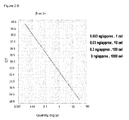
- the standard curves for the identification of the methylation of the IGFBP-3 gene meet the expected linearity and parallelism with respect to the standard curves for the ⁇ -actin reference gene. As an example, in Figure 2 , we show both curves obtained in the same experimental process.
- the new methodology was tested in the human cancer lines that served as controls, since they were the ones used for identification of the probe. Their methylation status for the IGFBP-3 gene was tested using both the bisulfite sequencing technique and the methylation-specific PCR technique (MSP).
- MSP methylation-specific PCR technique
- the left-hand panel shows a clear interpolation of the positive-control cell lines (SW780 and HT29) into the respective curves for the methylated IGFBP-3 gene and for ⁇ -actin, used as the non-methlyated endogenous control
- the right-hand panel shows that the negative-control lines (SKOV3, from breast cancer, and PANC1, from pancreas cancer), only interpolate into the curve for ⁇ -actin, used as the non-methylated endogenous control.
- Figure 4 we show, as an example, a gel from the MSP technique that includes positive controls (IVD), negative controls (C-) and water, which confirms that patients 2, 4 and 23 are methylated, and that the methylation in patients 15 and 27 is not detected by means of this technique, whereas, when using QMSP with the probe of the invention, we were able to detect presence of methylation in these patients.
- Table 1 Results obtained for MSP and for the qMSP of the present invention in tissues from patients.
- the technique is capable of identifying the presence of methylated DNA within a broad range ( Figure 5A ).
Landscapes
- Chemical & Material Sciences (AREA)
- Life Sciences & Earth Sciences (AREA)
- Health & Medical Sciences (AREA)
- Organic Chemistry (AREA)
- Proteomics, Peptides & Aminoacids (AREA)
- Engineering & Computer Science (AREA)
- Immunology (AREA)
- Pathology (AREA)
- Analytical Chemistry (AREA)
- Zoology (AREA)
- Genetics & Genomics (AREA)
- Wood Science & Technology (AREA)
- Physics & Mathematics (AREA)
- Biotechnology (AREA)
- Microbiology (AREA)
- Molecular Biology (AREA)
- Hospice & Palliative Care (AREA)
- Biophysics (AREA)
- Oncology (AREA)
- Biochemistry (AREA)
- Bioinformatics & Cheminformatics (AREA)
- General Engineering & Computer Science (AREA)
- General Health & Medical Sciences (AREA)
- Measuring Or Testing Involving Enzymes Or Micro-Organisms (AREA)
Abstract
Description
- The present invention relates to a method to predict the response to treatment with radiotherapy combined with cisplatin-based chemotherapy in patients with cancer, preferably non-microcytic lung cancer, where said method is based on the detection of the presence of methylation in the IGFBP-3 gene. The method of the invention may be quantitative or semi-quantitative. The present invention also relates to a probe for the quantitative detection of methylation in the IGFBP-3 gene. Therefore, the invention falls within the field of cancer treatment.
- Combined radiotherapy and chemotherapy in a patient with cancer makes it possible to combine the benefits of both techniques and has allowed for increased survival in various types of cancer, for example, lung cancer; however, there is greater toxicity with said treatment (Moreno-Jiménez M. et al. Rev Med Univ Navarra 51(4):13-33).
- In chemotherapy, cisplatin, also called cis-diaminodichioropiatinum (II) (CDDP), is the treatment of choice for various types of cancers, including non-microcytic lung cancer. Cisplatin may be administered in therapy combined with radiotherapy, since multi-centre studies have shown a better overall response (Curran W.J., Jr. et al. 2011 Journal of the National Cancer Institute 103:1452-60).
- It has been described that platinum-based chemotherapeutic agents, including cisplatin, cause the de novo promoter methylation of certain genes, thereby altering the expression thereof. Said genes include the gene that encodes the insulin-like growth factor binding protein (IGFBP-3) (Ibáñez de Cáceres I. et al. 2010 Oncogene 29:1681-90).
- Hypermethylation of the 5' promoter region of the IGFBP-3 gene is an epigenetic process that takes place very frequently in human cancer (40%-60%) (Chang Y.S. et al. 2002 Clin Cancer Res 8:3796-802; Ibáñez de Cáceres I. et al. 2010 Oncogene 29:1681-90; Torng P.L. et al. 2009 Mol Cancer 8:120). Methylation of the IGFBP-3 gene may be detected using different techniques, such as, for example, bisulfite sequencing and the methylation-specific polymerase chain reaction (PCR) assay (MSP) (Ibáñez de Cáceres I. et al. 2010 Oncogene 29:1681-90; Tomii K. et al. 2007 Int J Cancer 120:566-73; Ibáñez de Cáceres I. et al. 2006 Cancer Res 66:5021-8).
- At present, there is a clinical need to determine whether or not a patient will respond to a combined chemotherapy and radiotherapy treatment in order to adapt the treatment to each individual case, and thus prevent the secondary effects associated with the toxicity of the combined therapy and prevent overtreatment in patients who are not going to respond to it.
- The technical problem solved by the invention is that it provides a method to predict the response of a subject to treatment with radiotherapy combined with platinum-based chemotherapy.
- The present invention shows that the detection and/or quantification of the promoter region of the IGFBP-3 gene, specifically, the region between positions -584 and -492 of the promoter (positions numbered from the ATG initiator), is useful to predict the response of a subject with cancer to treatment with radiotherapy combined with platinum-based chemotherapy, as well as to design an individualised treatment for the subject.
- The method of the invention may be performed by using primer pairs that detect the presence of methylation and/or primer pairs that detect the absence of methylation, which in the present invention is called "semi-quantitative" detection. Moreover, it may also be performed by using a probe, which allows for "quantitative" detection. The studies that demonstrate the invention were performed both in cell lines and in surgical samples from patients.
- Moreover, the inventors have demonstrated that the use of a probe that detects positions -532 and -526 of the IGFBP-3 gene promoter makes it possible to quantify the degree of methylation of said gene. The use of the probe described in the invention makes it possible to predict whether or not a subject with cancer will respond to a combined treatment with platinum-based chemotherapy and radiotherapy with greater sensitivity and efficacy.
- As herein described, a first aspect of the invention relates to a method to obtain useful data to predict the response of a subject with cancer to treatment with radiotherapy combined with cisplatin-based chemotherapy, which comprises detecting and/or quantifying the promoter methylation of the IGFBP-3 gene in a biological sample from said subject.
- In the present invention, the cancer is preferably lung cancer, ovarian cancer, head and neck cancer, glioma and breast cancer. More preferably, the lung cancer is non-microcytic lung cancer.
- The terms "non-microcytic lung cancer", "non-microcytic pulmonary cancer", "non-microcytic lung carcinoma" (NMLC), "non-microcytic pulmonary carcinoma" (NMPC) and "non-small cell lung cancer" (NSCLC) refer to a type of lung cancer or tumour that, according to the histological classification, comprises the subtypes squamous or epidermoid carcinoma, adenocarcinoma, adenosquamous carcinoma, sarcomatoid carcinoma and large-cell carcinoma.
- "Treatment" is understood to mean the set of means used to cure or relieve a disease.
- In the present invention, "treatment with radiotherapy combined with cisplatin-based chemotherapy" is understood to mean the sequential treatment that comprises, in the first place, treatment with cisplatin-based chemotherapy and, subsequently, treatment with radiotherapy in accordance with the specific criteria for each case known to persons skilled in the art.
- In the present invention, the chemotherapy may also be based on other platinum-derived drugs, such as, for example, carboplatin, oxaliplatin, satraplatin and picoplatin.
- "Promoter methylation" is understood to mean the presence of methyl groups at the 5' positions of the cytosines of the CpG island located before and next to a guanine (i.e. of a CG dinucleotide) in a gene promoter.
- "Hypermethylation" is understood to mean an increase in promoter methylation with respect to values considered to be normal by persons skilled in the art. "Hypomethylation" is understood to mean a decrease in promoter methylation with respect to values considered to be normal by persons skilled in the art.
- In the present invention, "CpG island" is understood to mean the gene promoter region that contains at least 500 base pairs, a proportion of CG dinucleotides (cytosine-guanine) greater than 50%.
- In the present invention, "promoter" or "promoter region" is understood to mean a nucleotide sequence that controls the transcription of a given gene; in the present invention, it is the IGFBP-3 gene.
- In the present invention, the IGFBP-3 (or IGFBP3) gene is defined as the gene that encodes the insulin-like growth factor binding protein. Said gene (Entrez ID: 3486) is located in the 7p12.3 chromosomal region and encodes two alternative transcripts that share the same promoter, NM_000598.4 and M_001013398.1. The CpG island of the IGFBP-3 gene is located at position - 518/+744 with respect to the first exon and encompasses 688 base pairs above the ATG site, including the gene promoter described (SEQ ID NO: 1).
- In the present invention, the detection and/or quantification may be performed by any method known to persons skilled in the art, such as, for example, without being limited thereto, polymerase chain reaction (PCR), methylation-specific PCR (MSP), quantitative MSP (QMSP or qMSP) or sequencing. The DNA may have been subjected to a reaction with bisulfite prior to its detection and/or quantification.
- The term "biological sample" includes, without being limited thereto, biological tissues and/or fluids from an individual, obtained by any method designed for that purpose known to persons skilled in the art. The biological sample comprises deoxyribonucleic acid (DNA). Said DNA may or may not be methylated and may present different degrees of methylation.
- In the present invention, the terms "subject", "individual" and "patient" are used interchangeably.
- In the present invention, it has been demonstrated that the presence of promoter methylation in the IGFBP-3 gene is indicative that the treatment to be administered is radiotherapy combined with cisplatin-based chemotherapy, whereas the absence of methylation in said promoter is indicative that the therapy to be administered is cisplatin-based chemotherapy only.
- Therefore, a second aspect of the invention relates to an in vitro method to design an individualised treatment for a subject with cancer, which comprises detecting and/or quantifying the promoter methylation of the IGFBP-3 gene in a biological sample of said subject, such that the presence of methylation in said promoter is indicative that the treatment to be administered is radiotherapy combined with cisplatin-based chemotherapy.
- The term "in vitro" refers to the fact that the method of the invention is performed outside the subject's body.
- A preferred embodiment of the first and second aspects of the invention relates to the method wherein the detection and/or quantification of the promoter methylation of the IGFBP-3 gene are performed in the promoter region located between positions -584 and -492 of the promoter, both positions included (SEQ ID NO: 2).
- In the present invention, the location of positions -584 and -492 of the IGFBP-3 gene promoter is determined from the ATG start codon, in accordance with the method used by persons skilled in the art.
- Another, even more preferred embodiment of the first and second aspects of the invention relates to the method wherein the detection and/or quantification of the promoter methylation of the IGFBP-3 gene is performed at positions -532 and -526 from the ATG start codon. I.e. these positions correspond to positions 157 and 163 of SEQ ID NO: 1, and to positions 53 and 59 of SEQ ID NO: 2. Positions -532 and -526 are cytosines contained in CG dinucleotides.
- Another, even more preferred embodiment of the first and second aspects of the invention relates to the method wherein the detection and/or quantification of the promoter methylation of the IGFBP-3 gene are performed by means of a polymerase chain reaction. Preferably, the polymerase chain reaction involves using the primer pairs SEQ ID NO: 3 (sense primer, with the sequence 5'-ttttacgaggtatatacgaatgc-3') and SEQ ID NO: 4 (anti-sense primer, with the sequence 5'-tctcgaaataaaatctccctacg-3') (primers designed for the detection of methylation), and/or SEQ ID NO: 5 (sense primer, with the sequence 5'-agaaagttttatgaggtatatatga-3') and SEQ ID NO: 6 (anti-sense primer, with the sequence 5'-cactctcaaaataaaatctccct-3') (primers designed for the detection of absence of methylation). Preferably, the polymerase chain reaction involves using the primer pairs SEQ ID NO: 3 and SEQ ID NO: 4.
- As used herein, the term "primer" (also called "oligo") refers to an oligonucleotide that is capable of acting as the starting-point for DNA synthesis when it hybridises to the nucleic acid matrix. Preferably, the primer is a deoxyribose oligonucleotide. The primers may be prepared by means of any suitable method, including, for example, without being limited thereto, the cloning and restriction of appropriate sequences and direct chemical synthesis. The primers may be designed such that they hybridise to specific nucleotide sequences in the nucleic acid matrix (specific primers) or randomly synthesised (arbitrary primers).
- As specified above, the method of the invention may also be performed by using a probe, in which case it would be a quantitative method; on the contrary, if only the primers are used, but not a probe, it would be a semi-quantitative method.
- Therefore, another, even more preferred embodiment of the first and second aspects of the invention relates to the method wherein a nucleic acid probe that comprises nucleotide sequence SEQ ID NO: 7 (5'-ccgatatcgaaaaaact-3') is further used. Preferably, the probe is nucleotide sequence SEQ ID NO: 7. More preferably, the probe comprises a fluorophore, for example, FAM™ or VIC®, at the amino-terminal end and/or at the carboxy-terminal end. In an even more preferred embodiment, the probe comprises the fluorophore 6-FAM™ at the amino-terminal end and a non-fluorescent minor groove binder (MGB), MGB-NFQ, at the carboxyl terminal.
- In the present invention, we will refer to nucleotide sequence SEQ ID NO: 7 as the "probe of the invention".
- The probe of the invention may be produced by means of methods known to persons skilled in the art. For example, it may be produced through chemical synthesis.
- The probe of the invention binds to the DNA of the IGFBP-3 gene promoter when it is methylated.
- A third aspect of the present invention relates to an in vitro method to predict the response of a subject with cancer to treatment with radiotherapy combined with cisplatin-based chemotherapy, characterised in that it comprises the following steps:
- a. isolation of deoxyribonucleic acid in a biological sample isolated from a subject;
- b. modification of the isolated deoxyribonucleic acid by means of sodium bisulfite;
- c. hybridisation using specific primers;
- d. amplification of a sequence located between the primers described in step (c);
- e. detection of the promoter methylation of the IGFBP-3 gene;
- f. comparing the methylation of step (d) with standard levels;
- g. finding significant differences in the comparison of step (f);
- h. associating the significant differences of step (g) to promoter methylation or demethylation of the IGFBP-3 gene;
- i. associating the presence of methylation in step (h) with a favourable response to treatment with radiotherapy combined with cisplatin-based chemotherapy; or associating the demethylation in step (h) to an unfavourable response to treatment with radiotherapy combined with cisplatin-based chemotherapy.
- In the present invention, the isolation of the DNA and the modification of the isolated deoxyribonucleic acid by means of sodium bisulfite are performed by methods known to persons skilled in the art.
- As understood in the present invention, the term "standard levels" refers, for example, without being limited thereto, to the methylation levels obtained from a reference sample that presents a known degree of methylation.
- In the present invention, "significant difference" refers to the fact that there are statistical differences between the compared values, the statistical probability being at least greater than 0.05 (p > 0.05) or greater than 0.005 (p > 0.005), as obtained according to the statistical test applicable to each case.
- In the present invention, the terms "demethylation", "absence of methylation" and "lack of methylation" are used interchangeably.
- In the present invention, "favourable" is considered to be an increased survival of the individual following the treatment. "Unfavourable" is considered to be a decreased survival of the individual following the treatment.
- A preferred embodiment of the third method of the invention relates to the method wherein the reference sample and the study samples have been normalised prior to the comparison.
- "Normalisation" is understood to mean the use of a control sample that makes it possible to eliminate experimental variations between the different samples.
- A preferred embodiment of the third aspect of the invention relates to the method wherein the primers of step (c) are the primer pairs SEQ ID NO: 3 and SEQ ID NO: 4, and/or SEQ ID NO: 5 and SEQ ID NO: 6.
- An even more preferred embodiment of the third aspect of the invention relates to the method wherein the primers of step (c) are SEQ ID NO: 3 and SEQ ID NO: 4.
- Another, even more preferred embodiment of the third aspect of the invention relates to the method wherein step (c) further includes a probe and wherein the methylation is quantified in step (e). Preferably, the probe comprises nucleotide sequence SEQ ID NO: 7. More preferably, the probe is nucleotide sequence SEQ ID NO: 7.
- Another, even more preferred embodiment of the third aspect of the invention relates to the method wherein the cancer is lung cancer, ovarian cancer, head and neck cancer, glioma or breast cancer. Preferably, the lung cancer is non-microcytic lung cancer.
- A preferred embodiment of the first, second and third aspects of the invention relates to the method wherein the biological sample is selected from the group formed by tissue, blood, plasma, serum, lymph, broncho-alveolar lavage, saliva, urine and ascitic fluid.
- Another preferred embodiment of the first, second and third aspects of the invention relates to the method wherein the biological sample is fresh, frozen, fixed or fixed and embedded in paraffin.
- A fourth aspect of the present invention relates to a nucleic acid probe which comprises nucleotide sequence SEQ ID NO: 7.
- A preferred embodiment of the fourth aspect of the invention relates to a nucleic acid probe which is nucleotide sequence SEQ ID NO: 7.
- Another, even more preferred embodiment of the fourth aspect of the invention relates to the probe which further comprises a fluorophore, for example FAM™ or VIC®, at the amino-terminal end and/or the carboxy-terminal end. In an even more preferred embodiment, the probe comprises the fluorophore 6-FAM™ at the amino-terminal end and a non-fluorescent minor groove binder" (MGB), MGB-NFQ, at the carboxyl terminal.
- A fifth aspect of the present invention relates to the in vitro use of the probe of the invention for the detection and/or quantification of the promoter methylation of the IGFBP-3 gene in a biological sample from a subject.
- A sixth aspect of the present invention relates to the in vitro use of the probe of the invention to determine the response of a subject to treatment with radiotherapy combined with cisplatin-based chemotherapy.
- A preferred embodiment of the fifth and sixth aspects of the invention relates to the use wherein the subject has cancer. Preferably, the cancer is lung cancer, ovarian cancer, head and neck cancer, glioma and breast cancer. More preferably, the lung cancer is non-microcytic lung cancer.
- Another preferred embodiment of the fifth and sixth aspects of the invention relates to the use wherein the biological sample is selected from the group formed by tissue, blood, plasma, serum, lymph, broncho-alveolar lavage, saliva, urine and ascitic fluid.
- Another preferred embodiment of the fifth and sixth aspects of the invention relates to the use wherein the biological sample is fresh, frozen, fixed or fixed and embedded in paraffin.
- A seventh aspect of the invention relates to a kit that comprises the probe of the fourth aspect of the invention.
- A preferred embodiment of the seventh aspect of the invention relates to the kit which further comprises primers. More preferably, the primers are the primer pairs SEQ ID NO: 3 and SEQ ID NO: 4, and/or SEQ ID NO: 5 and SEQ ID NO: 6.
- The kit may further comprise at least one DNA polymerase, one reverse transcriptase, one RNA polymerase or one fluorophore. The kit may further comprise a mixture of de-oxynucleotide triphosphates (dNTPs), a mixture of nucleotide triphosphates (NTPs), deoxyribonuclease (DNase), ribonuclease (RNase) inhibitors, dithiothreitol (DTT), inorganic pyrophosphatase (iPP) and the necessary buffers for the enzymes supplied in the kit.
- In the present invention, the probe or the primers may be located on a solid support, for example, without being limited thereto, glass, plastic, tubes, multiple-well plates, membranes or any other known support.
- An eighth aspect of the invention relates to the in vitro use of the kit of the seventh aspect of the invention to determine and/or quantify the promoter methylation of the IGFBP-3 gene in a biological sample from a subject.
- A ninth aspect of the invention relates to the in vitro use of the kit of the seventh aspect of the invention to predict the response of a subject to treatment with radiotherapy combined with cisplatin-based chemotherapy.
- A preferred embodiment of the eighth and ninth aspects of the invention relates to the use wherein the subject has cancer. Preferably, the cancer is lung cancer, ovarian cancer, head and neck cancer, glioma or breast cancer. More preferably, the lung cancer is non-microcytic lung cancer.
- Another preferred embodiment of the eighth and ninth aspects of the invention relates to the use wherein the biological sample is selected from the group formed by tissue, blood, plasma, serum, lymph, broncho-alveolar lavage, saliva, urine and ascitic fluid.
- Another preferred embodiment of the eighth and ninth aspects of the invention relates to the use wherein the biological sample is fresh, frozen, fixed or fixed and embedded in paraffin.
- Herein, the terms "nucleotide sequence", "polynucleotide", "nucleic acid" and "oligonucleotide" are used interchangeably and refer to polymers of nucleotides. Said nucleotides may or may not be chemically or biochemically modified.
- Throughout the description and the claims, the word "comprises" and variants thereof are not intended to exclude other technical characteristics, additives, components or steps. For persons skilled in the art, other objects, advantages and characteristics of the invention will arise, partly from the description and partly from the practice of the invention. The following examples and figures are provided for illustrative purposes, and are not intended to limit the scope of the present invention.
-
-
Figure 1 shows the methylation status of each CpG position analysed in the CpG island that comprises the IGFBP-3 gene promoter and its frequency of methylation in non-tumoural or non-neoplastic DNA. The transcription start codon (ATG) and the TATA box (TATA) are indicated. A, tumoural DNA; B, non-neoplastic DNA from control tissue. The arrows show the location of the primers and the probe of the invention, which only detects the presence of methylated DNA. Black circles: high frequency of methylation, > 30%; grey circles: moderate frequency of methylation, 15%-30%; white circles: low frequency of methylation, 0%-15%. -
Figure 2 shows the standard quantitative curves for the IGFBP-3 (A) and β-actin (B) genes from four serial dilutions of bisulfite-modified DNA (3 ng-0.003 ng). The amplified product is quantitatively detected by using the probe of the invention, which generates a fluorescence signal that makes it possible to quantify the levels of PCR-amplified methylated product in a region of the IGFBP-3 gene promoter, and allows for the amplification and, consequently, the quantification of the methylated DNA levels contained in the sample analysed for the IGFBP-3 gene, to a sensitivity of 1 methylated allele in a background of 10,000 non-methylated alleles (sensitivity 1:10,000). The data for each sample are normalised with those obtained from interpolation into the β-actin curve. "approx", approximate; "cel" cell; CT, "cycle threshold". -
Figure 3 shows standard curves designed to identify the methylated IGFBP-3 gene. It shows the expected linearity between the standard curves for the identification of the methylated IGFBP-3 gene and the standard curves for the β-actin reference gene, and the interpolation of the positive-control DNAs (SW780 and HT29) (A) and the negative-control DNAs (SKOV3 and PANC1) (B). A, interpolation of the positive-control cell lines (SW780 and HT29) into the respective curves for the methylated IGFBP-3 gene and for β-actin as the non-methylated endogenous control, whereas (B) shows that the negative-control lines (SKOV3, from breast cancer, and PANC1, from pancreas cancer) only interpolate into the curve for β-actin as the non-methylated endogenous control. These results confirm the specificity of the methodology of the invention. -
Figure 4 shows a comparison of the sensitivity and specificity of the quantitative detection of the promoter methylation of the IGFBP-3 gene by means of the probe of the invention using QMSP and using the traditional MSP technique in a cohort of samples from patients with NMLC preserved in paraffin. It shows an example of a gel from the MSP technique that includes positive controls (IVD), negative controls (C-) and water, which confirms thatpatients patients -
Figure 5 shows the methylation levels of IGFBP-3 in a second cohort of 40 patients and ten non-neoplastic samples, and the Kaplan-Meier overall survival curve, represented in days, for patients with non-methylated IGFBP-3 subjected to a treatment with chemotherapy or chemotherapy-radiotherapy. (A), Methylation levels of IGFBP-3 in a second cohort of 40 patients and ten non-neoplastic samples, by means of the IGFBP-3/ACTB ratios. NSCLC-M: samples of non-microcytic lung cancer considered to be methylated for IGFBP-3; NSCLC-U: samples of non-microcytic lung cancer considered to be non-methylated for IGFBP-3. (B) Kaplan-Meier curves, comparing the methylation status of non-methylated IGFBP-3 with the cumulative survival, in days, of 40 patients with NMLC subjected to a treatment with chemotherapy or a combined treatment of chemotherapy-radiotherapy. Those patients whose survival could not be followed beyond the time indicated for the censoring were censored. "Radiotherapy +" means treatment with radiotherapy; "Radiotherapy -" means that there is no treatment with radiotherapy. - In order to evaluate the methylation status of the IGFBP-3 gene in each sample, the genomic DNA sequence was first modified through the combined use of sodium bisulfite and hydroquinone. The modified DNA was amplified by means of fluorescence-based real-time PCR according to a previously described protocol (Harden S.V. et al. 2003 Clin Cancer Res 8:1370-5).
- The oligos used in the present invention were previously described (Ibáñez de Cáceres I. et al. 2010 Oncogene 29: 1681-1690). The use of these oligos (also called "primers" in the present invention) makes it possible to identify the presence of methylation in the promoter zone of the IGFBP-3 gene by means of the methylation-specific PCR (MSP) technique, which is a semi-quantitative technique. The primers are the pair SEQ ID NO: 3 and SEQ ID NO: 4, which detects methylation; and the pair SEQ ID NO: 5 and SEQ ID NO: 6, which detects the absence of methylation.
- The use of the probe of the invention (SEQ ID NO: 7) made it possible to quantifiy the promoter methylation of the IGFBP-3 gene by means of the quantitative MSP (QMSP) technique.
- Numerous assays were performed on a panel of 26 human cancer cell lines, by modifying the DNA, eliminating the non-methylated cytosines and substituting them with uracils, followed by amplification and sequencing of the DNA area comprised between both oligos, in order to identify the CpG nucleotide positions most frequently methylated, in an unaltered, constant manner, when the gene is deactivated. This made it possible to identify the region-specific methylation for modified DNA between positions -584 and -492 of the IGFBP-3 gene promoter, and to select the adequate labeling at the 5' and 3' ends, in order to produce a probe that would prove effective for the technique. The product amplified by means of this technique (called "QMSP-IGFBP-3") is quantitatively detected by using the specific probe of the present invention (SEQ ID NO: 7), labelled with the fluorochrome FAM™ at the 5' end and with a non-fluorescent minor groove binder (MGB), NFQ, at the 3' end (6FAM5'-CCGATATCGAAAAAACT-3'MGB-NFQ). Following the binding, this probe generated a fluorescence signal, which made it possible to quantify the levels of the PCR-amplified methylated product. The quantification of the degree of methylation of the IGFBP-3 gene is exclusively dependent on the specificity of the probe of the invention and not on the QMSP technique itself. The QMSP technique described in the present invention to detect the methylation of the IGFBP-3 gene was called "QMSP-IGFBP-3".
- Therefore, the QMSP-/GFBP-3 technique of the present invention is based on the fluorescence amplification of modified DNA, which makes it possible to quantify the promoter methylation of the IGFBP-3 gene in bisulfite-modified DNA samples. The relative levels of DNA with promoter methylation of the IGFBP-3 gene ("relative methylation levels") in each sample were determined as a ratio between the values obtained from the amplification of the selected region of the IGFBP-3 gene promoter and those obtained from the amplification of the β-actin gene, used as an endogenous reference. The ratio was multiplied by 1000 in order to facilitate its tabulation (gene of interest/reference gene x 1000), to obtain a methylation quotient (MQ) that represents the relative methylation level of the study sample, as has been described for other genes (Eads C.A. et al. 2000 Nucleic Acid Res 28:E32; Eads C.A. et al. 1999 Cancer Res 59:2302-6).
- In our methylation analysis, the amplifications were performed in 96-well plates in the StepOnePlus™ amplicon-detection system, from the company Applied Biosystems, with a final volume of 25 µl in each well, containing:
- 600 nM of each primer designed for the amplification of the modified DNA methylated for the IGFBP-3 gene; 200 nM of specific probe; 2X TaqMan Universal Master Mix II, a reaction that contains AmpliTaq Gold® DNA Polymerase, Uracil-N glycosylase (UNG), dNTPs with dUTP, and ROX™ as a reference, jointly with an optimised buffer, all from the company Applied Biosystems; and modified DNA, where 3 µl of treated DNA were used for each QMSP reaction. The QMSP reaction conditions were the following: 1 2-minute cycle at 50°C; 1 10-minute cycle at 95°C and 50 15-second cycles at 95°C and 1-minute cycles at 60°C, in a final volume of 25 µl. The MSP conditions had been previously described (Ibáñez de Cáceres I., et al. 2012 Oncogene 29:1681-1690).
- Each plate contained the tumoural samples, numerous water blanks (NTCs), and positive and negative controls. DNA from the human cancer lines SW780 (bladder), HT29 (colon) and 41 MR (ovary) was used as a positive control, since these lines present promoter methylation of the IGFBP-3 gene. Serial dilutions of a pool of these modified DNAs, ranging from 30 ng/µl to 0.003 ng/µl, served as a control for the standard curves of β-actin and IGFBP-3 in each plate used for each assay.
- In each assay, the sensitivity and specificity were determined for a range of threshold values in both standard curves, and an ideal threshold was selected which would differentiate the true positive cases (regardless of the methylation levels in each sample) from the true negative cases. All the true negative cases in the technology that we present were validated as negative by means of the bisulfite sequencing (BS) and/or the methylation-specific PCR (MSP) techniques, which would correspond to 100% specificity.
- A sample was considered to be positive for methylation when the value of MQ is greater than 1. This value is obtained for the methlyated IGFBP-3 gene promoter in each sample, and is determined as a ratio between the values obtained from the amplification of the selected region of the IGFBP-3 gene promoter and those obtained from the amplification of the β-actin gene, used as an endogenous reference. The ratio is multiplied by 1000 in order to facilitate its tabulation (gene of interest/reference gene x 1000), to obtain a methylation quotient (MQ) that represents the relative methylation level of the study sample, as has been described for other genes, such as MGMT, APC, MLH1 and p16 (Durr M.L. et al. PLoS One 2010 May 26;5(5):e10828).
- The design of the primers and the probe of the present invention are specific for the IGFBP-3 gene promoter region between positions -584 and - 492, both included, and makes it possible to amplify and, consequently, quantify the methylated DNA levels contained in the sample analysed for the IGFBP-3 gene, to a sensitivity of 1 methylated allele in a background of 10,000 non-methylated alleles (sensitivity 1:10,000) (
Figure 1 ). The standard curves for the identification of the methylation of the IGFBP-3 gene meet the expected linearity and parallelism with respect to the standard curves for the β-actin reference gene. As an example, inFigure 2 , we show both curves obtained in the same experimental process. - The new methodology was tested in the human cancer lines that served as controls, since they were the ones used for identification of the probe. Their methylation status for the IGFBP-3 gene was tested using both the bisulfite sequencing technique and the methylation-specific PCR technique (MSP). In
Figure 3 , the left-hand panel shows a clear interpolation of the positive-control cell lines (SW780 and HT29) into the respective curves for the methylated IGFBP-3 gene and for β-actin, used as the non-methlyated endogenous control, whereas the right-hand panel shows that the negative-control lines (SKOV3, from breast cancer, and PANC1, from pancreas cancer), only interpolate into the curve for β-actin, used as the non-methylated endogenous control. These results confirm the specificity of the methodology presented in this invention (Figure 3 ). - Subsequently, the sensitivity and specificity of this new QMSP-IGFBP-3 technology was compared to the traditional MSP technique in two series of samples from patients with NMLC preserved in paraffin. The first cohort of patients demonstrated the specificity of the technique presented (QMSP-IGFBP-3), as compared to the traditional MSP technique (described in Ibáñez de Cáceres I. et al. 2010 Oncogene 29:1681-1690). In 28 of 32 patients with NMLC subjected to extirpation at the La Paz University Hospital, we found the same methylation status for the IGFBP-3 gene using both techniques, and the remaining 4 patients were rescued, because the presence of methylation was not found using the traditional MSP technique, and the samples were first identified as non-methylated, whereas, when using the probe of the invention, it was possible to identify the presence of a moderate degree of methylation in these 4 samples from patients, since the sensitivity increases by one order of magnitude (Table 1, with an asterisk). Moreover, this technique incorporates values for the degree of methylation, as it is a quantitative evaluation; this allows for continuous-variable correlation studies and the statistical value increases. In
Figure 4 , we show, as an example, a gel from the MSP technique that includes positive controls (IVD), negative controls (C-) and water, which confirms thatpatients patients Table 1. Results obtained for MSP and for the qMSP of the present invention in tissues from patients. Sample Anatomic Pathology TNM Stage MSP qMSP (RQ, relative methylation level) 1 Large-cell T2N1 2B M M (0.55) 2 Epidermoid T2N0 1B M M (0.15) 3 Epidermoid T2N1 2B U *M (12.95) 4 Epidermoid T3N0M0 2B M M (10.84) 5 Epidermoid T2N0M0 1B M M (3.9) 6 Adenocarcinom a T1N0M0 1A U U 7 Epidermoid T1N0M0 1A U U 8 Epidermoid T2N0 1B M M (0.22) 9 Large-cell T1N0M0 1A M M (0.046) 10 Adenocarcinom a Unknown Unknown M M (11.3) 11 Adenocarcinom a T2N0M0 1B M M (0.30) 12 Adenocarcinom a T1N0M0 1B M M (0.2) 13 Epidermoid T2N0M0 1B U U 14 Epidermoid T2N0 1B M M (54.9) 15 Adenocarcinom a T2N0 1B U * M (0.14) 16 Epidermoid T2N0M0 1B U U 17 Adenocarcinom a T2N0M0 1B U U 18 Adenocarcinom a T3N0 2B U U 19 Epidermoid T2N1 2B U * M (2.6) 20 Epidermoid T2N0 1B U U 21 Epidermoid T3N0 2B U U 22 Epidermoid T2N2 3A U U 23 Epidermoid T2N0 1B M M (4.9) 24 Epidermoid Unknown Unknown U U 25 Epidermoid T3N0 2A M M (91.6) 26 Epidermoid T2N1 2B U U 27 Epidermoid T2N1 2B U * M (0.7) 28 Adenocarcinom a T2N1 2B U U 29 Large-cell T2N0 1B U U 30 Epidermoid T2N1 2B U U 31 Adenocarcinom a T2N1 2B U U 32 Epidermoid T1N0 1A U U TNM, lung cancer classification. "RQ", relative quantification; U, non-methylated; M, methylated. - Moreover, in a second, confirmatory series with 40 tumour pieces embedded in paraffin from patients with NMLC subjected to extirpation at the Del Mar Hospital in Barcelona, we confirmed the sensitivity of the technique for the identification of the presence and the degree of methylation, and demonstrated, in the first place, that the range of values was similar to that obtained for the first cohort. All the patients interpolated into the curve of the non-methylated β-actin endogenous control, which guarantees the presence of the modified DNA under study, whereas 21 of the 40 patients also interpolated into the curve for the methylated IGFBP-3 gene, resulting in relative values for the presence of methylated DNA for the IGFBP-3 gene with different degrees of methylation (reflected in the value in parentheses and called "relative methylation level"), with approximate methylation quotient (MQ) values ranging between 0.01 and 100 (
Figure 5A ). The MQ values obtained are similar to those obtained for the initial cohort from the La Paz U H (Figure 4 and Table 1). In the second place, it was demonstrated that the absence of promoter methylation in the IGFBP-3 gene is indicative that the treatment to be administered is chemotherapy with cisplatin, instead of combined chemo-radiotherapy (Figure 5B ); for this reason, patients who present absence of methylation should not receive radiotherapy, since the overall survival rate of patients with non-methylated IGFBP-3 who receive only chemotherapy is greater than that of those who receive combined treatment with chemotherapy and radiotherapy. - Therefore, the technique is capable of identifying the presence of methylated DNA within a broad range (
Figure 5A ). These results meet an existing need, thus far unresolved in clinical practice, i.e. identifying which patients present a high probability of responding to a treatment with radiotherapy combined with chemotherapy based on platinum derivatives, such as cisplatin, carboplatin, oxaliplatin, satraplatin, etc.

Claims (38)
- Method to obtain useful data to predict the response of a subject with cancer to treatment with radiotherapy combined with cisplatin-based chemotherapy, which comprises detecting and/or quantifying the promoter methylation of the IGFBP-3 gene in a biological sample from said subject.
- In vitro method to design an individualised treatment for a subject with cancer, which comprises detecting and/or quantifying the promoter methylation of the IGFBP-3 gene in a biological sample from said subject, wherein the presence of methylation in said promoter is indicative that the treatment to be administered is radiotherapy combined with cisplatin-based chemotherapy.
- Method according to any one of claims 1 or 2, wherein the detection and/or quantification of the promoter methylation of the IGFBP-3 gene is performed in the promoter region, between positions -584 and -492 of the promoter, both included.
- Method according to any one of claims 1 to 3, wherein the detection and/or quantification of the promoter methylation of the IGFBP-3 gene are performed at positions -532 and -526 of the promoter.
- Method according to any one of claims 1 to 4, wherein the detection and/or quantification of the promoter methylation of the IGFBP-3 gene are performed by means of a polymerase chain reaction.
- Method according to claim 5, wherein the polymerase chain reaction comprises using the primer pairs SEQ ID NO: 3 and SEQ ID NO: 4, and/or SEQ ID NO: 5 and SEQ ID NO: 6.
- Method according to claim 6, wherein the polymerase chain reaction comprises using the primer pair SEQ ID NO: 3 and SEQ ID NO: 4.
- Method according to any of claims 6 or 7, wherein a nucleic acid probe is further used which comprises nucleotide sequence SEQ ID NO: 7.
- Method according to claim 8, wherein the probe is nucleotide sequence SEQ ID NO: 7.
- Method according to any of claims 8 or 9, wherein the probe comprises a fluorophore at the amino-terminal end and/or at the carboxy-terminal end.
- In vitro method to predict the response of a subject with cancer to treatment with radiotherapy combined with cisplatin-based chemotherapy, comprising the following steps:a. isolation of deoxyribonucleic acid in a biological sample isolated from a subject;b. modification of the isolated deoxyribonucleic acid by means of sodium bisulfite;c. hybridisation using specific primers;d. amplification of a sequence located between the primers described in step (c);e. detection of the promoter methylation of the IGFBP-3 gene;f. comparing the methylation of step (d) with standard levels;g. finding significant differences in the comparison of step (f);h. associating the significant differences of step (g) with a promoter methylation or demethylation of the IGFBP-3 gene;i. associating the presence of methylation of step (h) with a favourable response to treatment with radiotherapy combined with cisplatin-based chemotherapy; or associating the demethylation of step (h) with an unfavourable response to treatment with radiotherapy combined with cisplatin-based chemotherapy.
- Method according to claim 11, wherein the primers of step (c) are the primer pairs SEQ ID NO: 3 and SEQ ID NO: 4, and/or SEQ ID NO: 5 and SEQ ID NO: 6.
- Method according to claim 12, wherein the primers of step (c) are SEQ ID NO: 3 and SEQ ID NO: 4.
- Method according to any of claims 11 to 13, further comprising a probe in step (c) and quantifying the methylation of step (e).
- Method according to claim 14, wherein the probe comprises nucleotide sequence SEQ ID NO: 7.
- Method according to claim 15, wherein the probe is nucleotide sequence SEQ ID NO: 7.
- Method according to any of claims 1 to 16, wherein the subject has lung cancer, ovarian cancer, head and neck cancer, glioma or breast cancer.
- Method according to claim 17, wherein the lung cancer is non-microcytic lung cancer.
- Method according to any of claims 1 to 18, wherein the biological sample is selected from the group consisting of tissue, blood, plasma, serum, lymph, broncho-alveolar lavage, saliva, urine or ascitic fluid.
- Method according to any of claims 1 to 19, wherein the biological sample is fresh, frozen, fixed or fixed and embedded in paraffin.
- Nucleic acid probe which comprises nucleotide sequence SEQ ID NO: 7.
- Nucleic acid probe which is nucleotide sequence SEQ ID NO: 7.
- Probe according to any of claims 21 to 22, further comprising a fluorophore at the amino-terminal end and/or at the carboxy-terminal end.
- In vitro use of a probe according to any of claims 21 to 23, to detect and/or quantify the promoter methylation of the IGFBP-3 gene in a biological sample from a subject.
- In vitro use of a probe according to any of claims 21 to 24, to determine the response of a subject to treatment with radiotherapy combined with cisplatin-based chemotherapy.
- Use according to any of claims 24 or 25, wherein the subject has cancer.
- Use according to claim 26, wherein the cancer is lung cancer, ovarian cancer, head and neck cancer, glioma or breast cancer.
- Use according to claim 27, wherein the lung cancer is non-microcytic lung cancer.
- Use according to any of claims 24 to 28, wherein the biological sample is selected from the group consisting of tissue, blood, plasma, serum, lymph, broncho-alveolar lavage, saliva, urine or ascitic fluid.
- Use according to any of claims 24 to 29, wherein the biological sample is fresh, frozen, fixed or fixed and embedded in paraffin.
- Kit which comprises a probe according to any of claims 21 to 23.
- Kit according to claim 31, which further comprises primers.
- Kit according to claim 32, wherein the primers are the primer pairs SEQ ID NO: 3 and SEQ ID NO: 4, and/or SEQ ID NO: 5 and SEQ ID NO: 6.
- In vitro use of the kit according to any of claims 31 to 33, to determine and/or quantify the promoter methylation of the IGFBP-3 gene in a biological sample from a subject.
- In vitro use of the kit according to claim 34, to predict the response of a subject to treatment with radiotherapy combined with cisplatin-based chemotherapy.
- Use according to any of claims 34 or 35, wherein the subject has cancer.
- Use according to claim 36, wherein the cancer is lung cancer, ovarian cancer, head and neck cancer, glioma or breast cancer.
- Use according to claim 37, wherein the lung cancer is non-microcytic lung cancer.
Applications Claiming Priority (2)
| Application Number | Priority Date | Filing Date | Title |
|---|---|---|---|
| ES201330783A ES2527724B1 (en) | 2013-05-29 | 2013-05-29 | METHOD FOR PREACHING THE RESPONSE TO THE TREATMENT WITH RADIOTHERAPY COMBINED WITH CISPLATINO-BASED CHEMOTHERAPY |
| PCT/ES2014/070433 WO2014191600A1 (en) | 2013-05-29 | 2014-05-27 | Method for predicting the response to treatment with radiotherapy combined with chemotherapy based on cisplatin |
Publications (3)
| Publication Number | Publication Date |
|---|---|
| EP3006572A1 true EP3006572A1 (en) | 2016-04-13 |
| EP3006572A4 EP3006572A4 (en) | 2017-01-11 |
| EP3006572B1 EP3006572B1 (en) | 2018-12-19 |
Family
ID=51988058
Family Applications (1)
| Application Number | Title | Priority Date | Filing Date |
|---|---|---|---|
| EP14804898.6A Not-in-force EP3006572B1 (en) | 2013-05-29 | 2014-05-27 | Method for predicting the response to treatment with radiotherapy combined with chemotherapy based on cisplatin |
Country Status (4)
| Country | Link |
|---|---|
| US (1) | US10093984B2 (en) |
| EP (1) | EP3006572B1 (en) |
| ES (2) | ES2527724B1 (en) |
| WO (1) | WO2014191600A1 (en) |
Families Citing this family (1)
| Publication number | Priority date | Publication date | Assignee | Title |
|---|---|---|---|---|
| RU2681921C1 (en) * | 2017-12-01 | 2019-03-13 | Федеральное государственное бюджетное образовательное учреждение высшего образования "Сибирский государственный медицинский университет" Министерства здравоохранения Российской Федерации (ФГБОУ ВО СибГМУ Минздрава России) | Non-operable non-small cells lung cancer treatment method |
Family Cites Families (3)
| Publication number | Priority date | Publication date | Assignee | Title |
|---|---|---|---|---|
| JP2002502605A (en) * | 1998-02-09 | 2002-01-29 | ジェンセット | CDNA encoding secreted protein |
| AU2001276371A1 (en) * | 2000-06-30 | 2002-01-14 | Epigenomics Ag | Method and nucleic acids for analysing the methylation of genes implicated pharmacogenomics |
| US20040005294A1 (en) * | 2002-02-25 | 2004-01-08 | Ho-Young Lee | IGFBP-3 in the diagnosis and treatment of cancer |
-
2013
- 2013-05-29 ES ES201330783A patent/ES2527724B1/en not_active Expired - Fee Related
-
2014
- 2014-05-27 US US14/894,172 patent/US10093984B2/en not_active Expired - Fee Related
- 2014-05-27 ES ES14804898T patent/ES2716391T3/en active Active
- 2014-05-27 EP EP14804898.6A patent/EP3006572B1/en not_active Not-in-force
- 2014-05-27 WO PCT/ES2014/070433 patent/WO2014191600A1/en not_active Ceased
Also Published As
| Publication number | Publication date |
|---|---|
| WO2014191600A1 (en) | 2014-12-04 |
| US20160122828A1 (en) | 2016-05-05 |
| US10093984B2 (en) | 2018-10-09 |
| ES2527724A1 (en) | 2015-01-28 |
| ES2716391T3 (en) | 2019-06-12 |
| ES2527724B1 (en) | 2015-11-10 |
| EP3006572A4 (en) | 2017-01-11 |
| EP3006572B1 (en) | 2018-12-19 |
Similar Documents
| Publication | Publication Date | Title |
|---|---|---|
| AU2018229294B2 (en) | Detecting prostate cancer | |
| CN107003314B (en) | Compositions and methods for performing methylation detection assays | |
| EP2670861B1 (en) | Markers of melanoma and uses thereof | |
| US12359257B2 (en) | Liver cancer methylation markers and uses thereof | |
| CN104745681B (en) | Multielement genes composition and application thereof | |
| CN102575295B (en) | Can be used for the method for detection BRAF sudden change, primer, probe and test kit | |
| ES2538214T3 (en) | A method for nucleic acid methylation analysis | |
| US20190048422A1 (en) | Compositions and methods for detecting and diagnosing neoplasia | |
| CN107847515A (en) | Solid tumor methylation marker and application thereof | |
| CN104745575A (en) | Gene composition used for detecting cell proliferative abnormality or grading disease degree and application thereof | |
| CN101351563A (en) | Methods for predicting or monitoring patient response to ErbB receptor drugs | |
| WO2012143481A2 (en) | Prostate cancer markers | |
| CN116761899B (en) | Colorectal cancer molecular typing and survival risk gene groups and diagnostic products and applications | |
| WO2021143709A1 (en) | Reagent for detecting dna methylation and use thereof | |
| Kitano et al. | CpG island methylation of microRNAs is associated with tumor size and recurrence of non‐small‐cell lung cancer | |
| EP3350347B1 (en) | Methods and materials for detection of mutations | |
| US9708666B2 (en) | Prognostic molecular signature of sarcomas, and uses thereof | |
| US20240352537A1 (en) | Composition for diagnosing prostate cancer by using cpg methylation changes in specific genes, and use thereof | |
| CN110295218B (en) | Method for quantifying mutant allele burden of target gene | |
| US10093984B2 (en) | Probe for detecting and/or quantifying methylation of the promoter of the IGFBP-3 gene | |
| US9738935B2 (en) | Complex mutations in the epidermal growth factor receptor kinase domain | |
| Chang et al. | Gene expression and promoter polymorphisms of DNA methyltransferase 3B in nasopharyngeal carcinomas in Taiwanese people: a case-control study | |
| Kostrzewska-Poczekaj et al. | Recurrent amplification in the 22q11 region in laryngeal squamous cell carcinoma results in overexpression of the CRKL but not the MAPK1 oncogene | |
| US9994914B2 (en) | Mutation in the epidermal growth factor receptor kinase domain | |
| Qu et al. | A strategy for accurate quantification of 5-methylcytosine and 5-hydroxymethylcytosine at CpG sites within gene promoter |
Legal Events
| Date | Code | Title | Description |
|---|---|---|---|
| PUAI | Public reference made under article 153(3) epc to a published international application that has entered the european phase |
Free format text: ORIGINAL CODE: 0009012 |
|
| 17P | Request for examination filed |
Effective date: 20151218 |
|
| AK | Designated contracting states |
Kind code of ref document: A1 Designated state(s): AL AT BE BG CH CY CZ DE DK EE ES FI FR GB GR HR HU IE IS IT LI LT LU LV MC MK MT NL NO PL PT RO RS SE SI SK SM TR |
|
| AX | Request for extension of the european patent |
Extension state: BA ME |
|
| DAX | Request for extension of the european patent (deleted) | ||
| A4 | Supplementary search report drawn up and despatched |
Effective date: 20161212 |
|
| RIC1 | Information provided on ipc code assigned before grant |
Ipc: C12Q 1/68 20060101AFI20161206BHEP |
|
| STAA | Information on the status of an ep patent application or granted ep patent |
Free format text: STATUS: EXAMINATION IS IN PROGRESS |
|
| 17Q | First examination report despatched |
Effective date: 20180202 |
|
| REG | Reference to a national code |
Ref country code: DE Ref legal event code: R079 Ref document number: 602014038313 Country of ref document: DE Free format text: PREVIOUS MAIN CLASS: C12Q0001680000 Ipc: C12Q0001688600 |
|
| GRAJ | Information related to disapproval of communication of intention to grant by the applicant or resumption of examination proceedings by the epo deleted |
Free format text: ORIGINAL CODE: EPIDOSDIGR1 |
|
| STAA | Information on the status of an ep patent application or granted ep patent |
Free format text: STATUS: GRANT OF PATENT IS INTENDED |
|
| GRAP | Despatch of communication of intention to grant a patent |
Free format text: ORIGINAL CODE: EPIDOSNIGR1 |
|
| RIC1 | Information provided on ipc code assigned before grant |
Ipc: C12Q 1/6886 20180101AFI20180628BHEP |
|
| INTG | Intention to grant announced |
Effective date: 20180723 |
|
| GRAS | Grant fee paid |
Free format text: ORIGINAL CODE: EPIDOSNIGR3 |
|
| GRAA | (expected) grant |
Free format text: ORIGINAL CODE: 0009210 |
|
| STAA | Information on the status of an ep patent application or granted ep patent |
Free format text: STATUS: THE PATENT HAS BEEN GRANTED |
|
| AK | Designated contracting states |
Kind code of ref document: B1 Designated state(s): AL AT BE BG CH CY CZ DE DK EE ES FI FR GB GR HR HU IE IS IT LI LT LU LV MC MK MT NL NO PL PT RO RS SE SI SK SM TR |
|
| REG | Reference to a national code |
Ref country code: GB Ref legal event code: FG4D |
|
| REG | Reference to a national code |
Ref country code: CH Ref legal event code: EP |
|
| REG | Reference to a national code |
Ref country code: IE Ref legal event code: FG4D |
|
| REG | Reference to a national code |
Ref country code: DE Ref legal event code: R096 Ref document number: 602014038313 Country of ref document: DE |
|
| REG | Reference to a national code |
Ref country code: AT Ref legal event code: REF Ref document number: 1078757 Country of ref document: AT Kind code of ref document: T Effective date: 20190115 |
|
| REG | Reference to a national code |
Ref country code: NL Ref legal event code: MP Effective date: 20181219 |
|
| PG25 | Lapsed in a contracting state [announced via postgrant information from national office to epo] |
Ref country code: LV Free format text: LAPSE BECAUSE OF FAILURE TO SUBMIT A TRANSLATION OF THE DESCRIPTION OR TO PAY THE FEE WITHIN THE PRESCRIBED TIME-LIMIT Effective date: 20181219 Ref country code: LT Free format text: LAPSE BECAUSE OF FAILURE TO SUBMIT A TRANSLATION OF THE DESCRIPTION OR TO PAY THE FEE WITHIN THE PRESCRIBED TIME-LIMIT Effective date: 20181219 Ref country code: NO Free format text: LAPSE BECAUSE OF FAILURE TO SUBMIT A TRANSLATION OF THE DESCRIPTION OR TO PAY THE FEE WITHIN THE PRESCRIBED TIME-LIMIT Effective date: 20190319 Ref country code: FI Free format text: LAPSE BECAUSE OF FAILURE TO SUBMIT A TRANSLATION OF THE DESCRIPTION OR TO PAY THE FEE WITHIN THE PRESCRIBED TIME-LIMIT Effective date: 20181219 Ref country code: BG Free format text: LAPSE BECAUSE OF FAILURE TO SUBMIT A TRANSLATION OF THE DESCRIPTION OR TO PAY THE FEE WITHIN THE PRESCRIBED TIME-LIMIT Effective date: 20190319 Ref country code: HR Free format text: LAPSE BECAUSE OF FAILURE TO SUBMIT A TRANSLATION OF THE DESCRIPTION OR TO PAY THE FEE WITHIN THE PRESCRIBED TIME-LIMIT Effective date: 20181219 |
|
| REG | Reference to a national code |
Ref country code: LT Ref legal event code: MG4D |
|
| REG | Reference to a national code |
Ref country code: AT Ref legal event code: MK05 Ref document number: 1078757 Country of ref document: AT Kind code of ref document: T Effective date: 20181219 |
|
| PG25 | Lapsed in a contracting state [announced via postgrant information from national office to epo] |
Ref country code: RS Free format text: LAPSE BECAUSE OF FAILURE TO SUBMIT A TRANSLATION OF THE DESCRIPTION OR TO PAY THE FEE WITHIN THE PRESCRIBED TIME-LIMIT Effective date: 20181219 Ref country code: SE Free format text: LAPSE BECAUSE OF FAILURE TO SUBMIT A TRANSLATION OF THE DESCRIPTION OR TO PAY THE FEE WITHIN THE PRESCRIBED TIME-LIMIT Effective date: 20181219 Ref country code: GR Free format text: LAPSE BECAUSE OF FAILURE TO SUBMIT A TRANSLATION OF THE DESCRIPTION OR TO PAY THE FEE WITHIN THE PRESCRIBED TIME-LIMIT Effective date: 20190320 Ref country code: AL Free format text: LAPSE BECAUSE OF FAILURE TO SUBMIT A TRANSLATION OF THE DESCRIPTION OR TO PAY THE FEE WITHIN THE PRESCRIBED TIME-LIMIT Effective date: 20181219 |
|
| REG | Reference to a national code |
Ref country code: ES Ref legal event code: FG2A Ref document number: 2716391 Country of ref document: ES Kind code of ref document: T3 Effective date: 20190612 |
|
| PG25 | Lapsed in a contracting state [announced via postgrant information from national office to epo] |
Ref country code: NL Free format text: LAPSE BECAUSE OF FAILURE TO SUBMIT A TRANSLATION OF THE DESCRIPTION OR TO PAY THE FEE WITHIN THE PRESCRIBED TIME-LIMIT Effective date: 20181219 |
|
| PG25 | Lapsed in a contracting state [announced via postgrant information from national office to epo] |
Ref country code: PL Free format text: LAPSE BECAUSE OF FAILURE TO SUBMIT A TRANSLATION OF THE DESCRIPTION OR TO PAY THE FEE WITHIN THE PRESCRIBED TIME-LIMIT Effective date: 20181219 Ref country code: CZ Free format text: LAPSE BECAUSE OF FAILURE TO SUBMIT A TRANSLATION OF THE DESCRIPTION OR TO PAY THE FEE WITHIN THE PRESCRIBED TIME-LIMIT Effective date: 20181219 Ref country code: PT Free format text: LAPSE BECAUSE OF FAILURE TO SUBMIT A TRANSLATION OF THE DESCRIPTION OR TO PAY THE FEE WITHIN THE PRESCRIBED TIME-LIMIT Effective date: 20190419 |
|
| PG25 | Lapsed in a contracting state [announced via postgrant information from national office to epo] |
Ref country code: IS Free format text: LAPSE BECAUSE OF FAILURE TO SUBMIT A TRANSLATION OF THE DESCRIPTION OR TO PAY THE FEE WITHIN THE PRESCRIBED TIME-LIMIT Effective date: 20190419 Ref country code: SM Free format text: LAPSE BECAUSE OF FAILURE TO SUBMIT A TRANSLATION OF THE DESCRIPTION OR TO PAY THE FEE WITHIN THE PRESCRIBED TIME-LIMIT Effective date: 20181219 Ref country code: RO Free format text: LAPSE BECAUSE OF FAILURE TO SUBMIT A TRANSLATION OF THE DESCRIPTION OR TO PAY THE FEE WITHIN THE PRESCRIBED TIME-LIMIT Effective date: 20181219 Ref country code: EE Free format text: LAPSE BECAUSE OF FAILURE TO SUBMIT A TRANSLATION OF THE DESCRIPTION OR TO PAY THE FEE WITHIN THE PRESCRIBED TIME-LIMIT Effective date: 20181219 Ref country code: SK Free format text: LAPSE BECAUSE OF FAILURE TO SUBMIT A TRANSLATION OF THE DESCRIPTION OR TO PAY THE FEE WITHIN THE PRESCRIBED TIME-LIMIT Effective date: 20181219 |
|
| REG | Reference to a national code |
Ref country code: DE Ref legal event code: R097 Ref document number: 602014038313 Country of ref document: DE |
|
| PLBE | No opposition filed within time limit |
Free format text: ORIGINAL CODE: 0009261 |
|
| STAA | Information on the status of an ep patent application or granted ep patent |
Free format text: STATUS: NO OPPOSITION FILED WITHIN TIME LIMIT |
|
| PG25 | Lapsed in a contracting state [announced via postgrant information from national office to epo] |
Ref country code: DK Free format text: LAPSE BECAUSE OF FAILURE TO SUBMIT A TRANSLATION OF THE DESCRIPTION OR TO PAY THE FEE WITHIN THE PRESCRIBED TIME-LIMIT Effective date: 20181219 Ref country code: AT Free format text: LAPSE BECAUSE OF FAILURE TO SUBMIT A TRANSLATION OF THE DESCRIPTION OR TO PAY THE FEE WITHIN THE PRESCRIBED TIME-LIMIT Effective date: 20181219 |
|
| 26N | No opposition filed |
Effective date: 20190920 |
|
| REG | Reference to a national code |
Ref country code: CH Ref legal event code: PL |
|
| PG25 | Lapsed in a contracting state [announced via postgrant information from national office to epo] |
Ref country code: CH Free format text: LAPSE BECAUSE OF NON-PAYMENT OF DUE FEES Effective date: 20190531 Ref country code: MC Free format text: LAPSE BECAUSE OF FAILURE TO SUBMIT A TRANSLATION OF THE DESCRIPTION OR TO PAY THE FEE WITHIN THE PRESCRIBED TIME-LIMIT Effective date: 20181219 Ref country code: LI Free format text: LAPSE BECAUSE OF NON-PAYMENT OF DUE FEES Effective date: 20190531 |
|
| PGFP | Annual fee paid to national office [announced via postgrant information from national office to epo] |
Ref country code: DE Payment date: 20191202 Year of fee payment: 6 |
|
| REG | Reference to a national code |
Ref country code: BE Ref legal event code: MM Effective date: 20190531 |
|
| PG25 | Lapsed in a contracting state [announced via postgrant information from national office to epo] |
Ref country code: LU Free format text: LAPSE BECAUSE OF NON-PAYMENT OF DUE FEES Effective date: 20190527 Ref country code: SI Free format text: LAPSE BECAUSE OF FAILURE TO SUBMIT A TRANSLATION OF THE DESCRIPTION OR TO PAY THE FEE WITHIN THE PRESCRIBED TIME-LIMIT Effective date: 20181219 |
|
| PGFP | Annual fee paid to national office [announced via postgrant information from national office to epo] |
Ref country code: IT Payment date: 20191118 Year of fee payment: 6 Ref country code: FR Payment date: 20191113 Year of fee payment: 6 Ref country code: ES Payment date: 20191112 Year of fee payment: 6 |
|
| PG25 | Lapsed in a contracting state [announced via postgrant information from national office to epo] |
Ref country code: TR Free format text: LAPSE BECAUSE OF FAILURE TO SUBMIT A TRANSLATION OF THE DESCRIPTION OR TO PAY THE FEE WITHIN THE PRESCRIBED TIME-LIMIT Effective date: 20181219 |
|
| PG25 | Lapsed in a contracting state [announced via postgrant information from national office to epo] |
Ref country code: IE Free format text: LAPSE BECAUSE OF NON-PAYMENT OF DUE FEES Effective date: 20190527 |
|
| PGFP | Annual fee paid to national office [announced via postgrant information from national office to epo] |
Ref country code: GB Payment date: 20191112 Year of fee payment: 6 |
|
| PG25 | Lapsed in a contracting state [announced via postgrant information from national office to epo] |
Ref country code: BE Free format text: LAPSE BECAUSE OF NON-PAYMENT OF DUE FEES Effective date: 20190531 |
|
| REG | Reference to a national code |
Ref country code: DE Ref legal event code: R119 Ref document number: 602014038313 Country of ref document: DE |
|
| GBPC | Gb: european patent ceased through non-payment of renewal fee |
Effective date: 20200527 |
|
| PG25 | Lapsed in a contracting state [announced via postgrant information from national office to epo] |
Ref country code: GB Free format text: LAPSE BECAUSE OF NON-PAYMENT OF DUE FEES Effective date: 20200527 Ref country code: FR Free format text: LAPSE BECAUSE OF NON-PAYMENT OF DUE FEES Effective date: 20200531 |
|
| PG25 | Lapsed in a contracting state [announced via postgrant information from national office to epo] |
Ref country code: CY Free format text: LAPSE BECAUSE OF FAILURE TO SUBMIT A TRANSLATION OF THE DESCRIPTION OR TO PAY THE FEE WITHIN THE PRESCRIBED TIME-LIMIT Effective date: 20181219 Ref country code: DE Free format text: LAPSE BECAUSE OF NON-PAYMENT OF DUE FEES Effective date: 20201201 |
|
| PG25 | Lapsed in a contracting state [announced via postgrant information from national office to epo] |
Ref country code: HU Free format text: LAPSE BECAUSE OF FAILURE TO SUBMIT A TRANSLATION OF THE DESCRIPTION OR TO PAY THE FEE WITHIN THE PRESCRIBED TIME-LIMIT; INVALID AB INITIO Effective date: 20140527 Ref country code: MT Free format text: LAPSE BECAUSE OF FAILURE TO SUBMIT A TRANSLATION OF THE DESCRIPTION OR TO PAY THE FEE WITHIN THE PRESCRIBED TIME-LIMIT Effective date: 20181219 |
|
| REG | Reference to a national code |
Ref country code: ES Ref legal event code: FD2A Effective date: 20211004 |
|
| PG25 | Lapsed in a contracting state [announced via postgrant information from national office to epo] |
Ref country code: IT Free format text: LAPSE BECAUSE OF NON-PAYMENT OF DUE FEES Effective date: 20200527 |
|
| PG25 | Lapsed in a contracting state [announced via postgrant information from national office to epo] |
Ref country code: ES Free format text: LAPSE BECAUSE OF NON-PAYMENT OF DUE FEES Effective date: 20200528 |
|
| PG25 | Lapsed in a contracting state [announced via postgrant information from national office to epo] |
Ref country code: MK Free format text: LAPSE BECAUSE OF FAILURE TO SUBMIT A TRANSLATION OF THE DESCRIPTION OR TO PAY THE FEE WITHIN THE PRESCRIBED TIME-LIMIT Effective date: 20181219 |