EP3006452A1 - Bola-amphiphilic compounds and their uses for biomedical applications - Google Patents
Bola-amphiphilic compounds and their uses for biomedical applications Download PDFInfo
- Publication number
- EP3006452A1 EP3006452A1 EP14290302.0A EP14290302A EP3006452A1 EP 3006452 A1 EP3006452 A1 EP 3006452A1 EP 14290302 A EP14290302 A EP 14290302A EP 3006452 A1 EP3006452 A1 EP 3006452A1
- Authority
- EP
- European Patent Office
- Prior art keywords
- formula
- compound
- triazole
- group
- triazol
- Prior art date
- Legal status (The legal status is an assumption and is not a legal conclusion. Google has not performed a legal analysis and makes no representation as to the accuracy of the status listed.)
- Granted
Links
- 150000001875 compounds Chemical class 0.000 title claims abstract description 108
- 239000000499 gel Substances 0.000 claims abstract description 27
- 239000000560 biocompatible material Substances 0.000 claims abstract description 5
- 150000003852 triazoles Chemical class 0.000 claims description 50
- IQFYYKKMVGJFEH-XLPZGREQSA-N Thymidine Chemical compound O=C1NC(=O)C(C)=CN1[C@@H]1O[C@H](CO)[C@@H](O)C1 IQFYYKKMVGJFEH-XLPZGREQSA-N 0.000 claims description 39
- 239000000017 hydrogel Substances 0.000 claims description 31
- 125000002496 methyl group Chemical group [H]C([H])([H])* 0.000 claims description 31
- -1 cyclic carbohydrate Chemical class 0.000 claims description 26
- 229910052739 hydrogen Inorganic materials 0.000 claims description 26
- 239000000203 mixture Substances 0.000 claims description 23
- KDCGOANMDULRCW-UHFFFAOYSA-N Purine Natural products N1=CNC2=NC=NC2=C1 KDCGOANMDULRCW-UHFFFAOYSA-N 0.000 claims description 18
- HMFHBZSHGGEWLO-SOOFDHNKSA-N D-ribofuranose Chemical compound OC[C@H]1OC(O)[C@H](O)[C@@H]1O HMFHBZSHGGEWLO-SOOFDHNKSA-N 0.000 claims description 17
- CZPWVGJYEJSRLH-UHFFFAOYSA-N Pyrimidine Chemical compound C1=CN=CN=C1 CZPWVGJYEJSRLH-UHFFFAOYSA-N 0.000 claims description 17
- 210000004027 cell Anatomy 0.000 claims description 16
- 210000000130 stem cell Anatomy 0.000 claims description 15
- ASJSAQIRZKANQN-CRCLSJGQSA-N 2-deoxy-D-ribose Chemical group OC[C@@H](O)[C@@H](O)CC=O ASJSAQIRZKANQN-CRCLSJGQSA-N 0.000 claims description 14
- DWRXFEITVBNRMK-UHFFFAOYSA-N Beta-D-1-Arabinofuranosylthymine Natural products O=C1NC(=O)C(C)=CN1C1C(O)C(O)C(CO)O1 DWRXFEITVBNRMK-UHFFFAOYSA-N 0.000 claims description 14
- PYMYPHUHKUWMLA-LMVFSUKVSA-N Ribose Natural products OC[C@@H](O)[C@@H](O)[C@@H](O)C=O PYMYPHUHKUWMLA-LMVFSUKVSA-N 0.000 claims description 14
- HMFHBZSHGGEWLO-UHFFFAOYSA-N alpha-D-Furanose-Ribose Natural products OCC1OC(O)C(O)C1O HMFHBZSHGGEWLO-UHFFFAOYSA-N 0.000 claims description 14
- IQFYYKKMVGJFEH-UHFFFAOYSA-N beta-L-thymidine Natural products O=C1NC(=O)C(C)=CN1C1OC(CO)C(O)C1 IQFYYKKMVGJFEH-UHFFFAOYSA-N 0.000 claims description 14
- 229910052760 oxygen Inorganic materials 0.000 claims description 14
- 239000001301 oxygen Substances 0.000 claims description 14
- 229940104230 thymidine Drugs 0.000 claims description 14
- IGFXRKMLLMBKSA-UHFFFAOYSA-N purine Chemical compound N1=C[N]C2=NC=NC2=C1 IGFXRKMLLMBKSA-UHFFFAOYSA-N 0.000 claims description 13
- 125000001072 heteroaryl group Chemical group 0.000 claims description 11
- 239000002777 nucleoside Substances 0.000 claims description 11
- 125000001263 nucleosidyl group Chemical group 0.000 claims description 11
- 229920006395 saturated elastomer Polymers 0.000 claims description 11
- QVGXLLKOCUKJST-UHFFFAOYSA-N atomic oxygen Chemical group [O] QVGXLLKOCUKJST-UHFFFAOYSA-N 0.000 claims description 10
- 125000004433 nitrogen atom Chemical group N* 0.000 claims description 10
- 239000002168 alkylating agent Substances 0.000 claims description 9
- 229940100198 alkylating agent Drugs 0.000 claims description 9
- 230000015572 biosynthetic process Effects 0.000 claims description 9
- 238000012650 click reaction Methods 0.000 claims description 9
- RAXXELZNTBOGNW-UHFFFAOYSA-N imidazole Natural products C1=CNC=N1 RAXXELZNTBOGNW-UHFFFAOYSA-N 0.000 claims description 9
- OIRDTQYFTABQOQ-KQYNXXCUSA-N adenosine Chemical compound C1=NC=2C(N)=NC=NC=2N1[C@@H]1O[C@H](CO)[C@@H](O)[C@H]1O OIRDTQYFTABQOQ-KQYNXXCUSA-N 0.000 claims description 8
- JCVDICFLPGDHAT-DJLDLDEBSA-N 1-[(2r,4s,5r)-4-hydroxy-5-(hydroxymethyl)oxolan-2-yl]-3,5-dimethylpyrimidine-2,4-dione Chemical compound O=C1N(C)C(=O)C(C)=CN1[C@@H]1O[C@H](CO)[C@@H](O)C1 JCVDICFLPGDHAT-DJLDLDEBSA-N 0.000 claims description 7
- 125000000217 alkyl group Chemical group 0.000 claims description 7
- 239000001257 hydrogen Substances 0.000 claims description 7
- 229910052757 nitrogen Inorganic materials 0.000 claims description 7
- 150000003833 nucleoside derivatives Chemical class 0.000 claims description 7
- 229910052799 carbon Inorganic materials 0.000 claims description 6
- CPELXLSAUQHCOX-UHFFFAOYSA-M Bromide Chemical compound [Br-] CPELXLSAUQHCOX-UHFFFAOYSA-M 0.000 claims description 5
- 150000001720 carbohydrates Chemical class 0.000 claims description 5
- 239000006143 cell culture medium Substances 0.000 claims description 5
- 125000004430 oxygen atom Chemical group O* 0.000 claims description 5
- JKANAVGODYYCQF-UHFFFAOYSA-N prop-2-yn-1-amine Chemical compound NCC#C JKANAVGODYYCQF-UHFFFAOYSA-N 0.000 claims description 5
- MYMOFIZGZYHOMD-UHFFFAOYSA-N Dioxygen Chemical compound O=O MYMOFIZGZYHOMD-UHFFFAOYSA-N 0.000 claims description 4
- WQZGKKKJIJFFOK-GASJEMHNSA-N Glucose Chemical compound OC[C@H]1OC(O)[C@H](O)[C@@H](O)[C@@H]1O WQZGKKKJIJFFOK-GASJEMHNSA-N 0.000 claims description 4
- NYHBQMYGNKIUIF-UUOKFMHZSA-N Guanosine Chemical compound C1=NC=2C(=O)NC(N)=NC=2N1[C@@H]1O[C@H](CO)[C@@H](O)[C@H]1O NYHBQMYGNKIUIF-UUOKFMHZSA-N 0.000 claims description 4
- UFHFLCQGNIYNRP-UHFFFAOYSA-N Hydrogen Chemical compound [H][H] UFHFLCQGNIYNRP-UHFFFAOYSA-N 0.000 claims description 4
- DRTQHJPVMGBUCF-XVFCMESISA-N Uridine Chemical compound O[C@@H]1[C@H](O)[C@@H](CO)O[C@H]1N1C(=O)NC(=O)C=C1 DRTQHJPVMGBUCF-XVFCMESISA-N 0.000 claims description 4
- WQZGKKKJIJFFOK-UHFFFAOYSA-N alpha-D-glucopyranose Natural products OCC1OC(O)C(O)C(O)C1O WQZGKKKJIJFFOK-UHFFFAOYSA-N 0.000 claims description 4
- 125000005843 halogen group Chemical group 0.000 claims description 4
- 125000005842 heteroatom Chemical group 0.000 claims description 4
- WQZGKKKJIJFFOK-SVZMEOIVSA-N (+)-Galactose Chemical compound OC[C@H]1OC(O)[C@H](O)[C@@H](O)[C@H]1O WQZGKKKJIJFFOK-SVZMEOIVSA-N 0.000 claims description 3
- VEXZGXHMUGYJMC-UHFFFAOYSA-M Chloride anion Chemical compound [Cl-] VEXZGXHMUGYJMC-UHFFFAOYSA-M 0.000 claims description 3
- ZAMOUSCENKQFHK-UHFFFAOYSA-N Chlorine atom Chemical compound [Cl] ZAMOUSCENKQFHK-UHFFFAOYSA-N 0.000 claims description 3
- LKDRXBCSQODPBY-VRPWFDPXSA-N D-fructopyranose Chemical compound OCC1(O)OC[C@@H](O)[C@@H](O)[C@@H]1O LKDRXBCSQODPBY-VRPWFDPXSA-N 0.000 claims description 3
- WQZGKKKJIJFFOK-QTVWNMPRSA-N D-mannopyranose Chemical compound OC[C@H]1OC(O)[C@@H](O)[C@@H](O)[C@@H]1O WQZGKKKJIJFFOK-QTVWNMPRSA-N 0.000 claims description 3
- OVRNDRQMDRJTHS-CBQIKETKSA-N N-Acetyl-D-Galactosamine Chemical compound CC(=O)N[C@H]1[C@@H](O)O[C@H](CO)[C@H](O)[C@@H]1O OVRNDRQMDRJTHS-CBQIKETKSA-N 0.000 claims description 3
- OVRNDRQMDRJTHS-UHFFFAOYSA-N N-acelyl-D-glucosamine Natural products CC(=O)NC1C(O)OC(CO)C(O)C1O OVRNDRQMDRJTHS-UHFFFAOYSA-N 0.000 claims description 3
- MBLBDJOUHNCFQT-UHFFFAOYSA-N N-acetyl-D-galactosamine Natural products CC(=O)NC(C=O)C(O)C(O)C(O)CO MBLBDJOUHNCFQT-UHFFFAOYSA-N 0.000 claims description 3
- OVRNDRQMDRJTHS-FMDGEEDCSA-N N-acetyl-beta-D-glucosamine Chemical compound CC(=O)N[C@H]1[C@H](O)O[C@H](CO)[C@@H](O)[C@@H]1O OVRNDRQMDRJTHS-FMDGEEDCSA-N 0.000 claims description 3
- OVRNDRQMDRJTHS-OZRXBMAMSA-N N-acetyl-beta-D-mannosamine Chemical compound CC(=O)N[C@@H]1[C@H](O)O[C@H](CO)[C@@H](O)[C@@H]1O OVRNDRQMDRJTHS-OZRXBMAMSA-N 0.000 claims description 3
- MBLBDJOUHNCFQT-LXGUWJNJSA-N N-acetylglucosamine Natural products CC(=O)N[C@@H](C=O)[C@@H](O)[C@H](O)[C@H](O)CO MBLBDJOUHNCFQT-LXGUWJNJSA-N 0.000 claims description 3
- WTKZEGDFNFYCGP-UHFFFAOYSA-N Pyrazole Chemical compound C=1C=NNC=1 WTKZEGDFNFYCGP-UHFFFAOYSA-N 0.000 claims description 3
- 239000004480 active ingredient Substances 0.000 claims description 3
- 125000002355 alkine group Chemical group 0.000 claims description 3
- 150000001540 azides Chemical class 0.000 claims description 3
- SQVRNKJHWKZAKO-UHFFFAOYSA-N beta-N-Acetyl-D-neuraminic acid Natural products CC(=O)NC1C(O)CC(O)(C(O)=O)OC1C(O)C(O)CO SQVRNKJHWKZAKO-UHFFFAOYSA-N 0.000 claims description 3
- 239000000460 chlorine Substances 0.000 claims description 3
- 229910052801 chlorine Inorganic materials 0.000 claims description 3
- 210000003527 eukaryotic cell Anatomy 0.000 claims description 3
- 229960002737 fructose Drugs 0.000 claims description 3
- 229950006780 n-acetylglucosamine Drugs 0.000 claims description 3
- 150000003141 primary amines Chemical class 0.000 claims description 3
- SQVRNKJHWKZAKO-OQPLDHBCSA-N sialic acid Chemical compound CC(=O)N[C@@H]1[C@@H](O)C[C@@](O)(C(O)=O)OC1[C@H](O)[C@H](O)CO SQVRNKJHWKZAKO-OQPLDHBCSA-N 0.000 claims description 3
- 238000001356 surgical procedure Methods 0.000 claims description 3
- 150000003536 tetrazoles Chemical class 0.000 claims description 3
- KIUKXJAPPMFGSW-DNGZLQJQSA-N (2S,3S,4S,5R,6R)-6-[(2S,3R,4R,5S,6R)-3-Acetamido-2-[(2S,3S,4R,5R,6R)-6-[(2R,3R,4R,5S,6R)-3-acetamido-2,5-dihydroxy-6-(hydroxymethyl)oxan-4-yl]oxy-2-carboxy-4,5-dihydroxyoxan-3-yl]oxy-5-hydroxy-6-(hydroxymethyl)oxan-4-yl]oxy-3,4,5-trihydroxyoxane-2-carboxylic acid Chemical compound CC(=O)N[C@H]1[C@H](O)O[C@H](CO)[C@@H](O)[C@@H]1O[C@H]1[C@H](O)[C@@H](O)[C@H](O[C@H]2[C@@H]([C@@H](O[C@H]3[C@@H]([C@@H](O)[C@H](O)[C@H](O3)C(O)=O)O)[C@H](O)[C@@H](CO)O2)NC(C)=O)[C@@H](C(O)=O)O1 KIUKXJAPPMFGSW-DNGZLQJQSA-N 0.000 claims description 2
- UHDGCWIWMRVCDJ-UHFFFAOYSA-N 1-beta-D-Xylofuranosyl-NH-Cytosine Natural products O=C1N=C(N)C=CN1C1C(O)C(O)C(CO)O1 UHDGCWIWMRVCDJ-UHFFFAOYSA-N 0.000 claims description 2
- YKBGVTZYEHREMT-KVQBGUIXSA-N 2'-deoxyguanosine Chemical compound C1=NC=2C(=O)NC(N)=NC=2N1[C@H]1C[C@H](O)[C@@H](CO)O1 YKBGVTZYEHREMT-KVQBGUIXSA-N 0.000 claims description 2
- MXHRCPNRJAMMIM-SHYZEUOFSA-N 2'-deoxyuridine Chemical compound C1[C@H](O)[C@@H](CO)O[C@H]1N1C(=O)NC(=O)C=C1 MXHRCPNRJAMMIM-SHYZEUOFSA-N 0.000 claims description 2
- CKTSBUTUHBMZGZ-SHYZEUOFSA-N 2'‐deoxycytidine Chemical compound O=C1N=C(N)C=CN1[C@@H]1O[C@H](CO)[C@@H](O)C1 CKTSBUTUHBMZGZ-SHYZEUOFSA-N 0.000 claims description 2
- 239000002126 C01EB10 - Adenosine Substances 0.000 claims description 2
- 102000008186 Collagen Human genes 0.000 claims description 2
- 108010035532 Collagen Proteins 0.000 claims description 2
- MIKUYHXYGGJMLM-GIMIYPNGSA-N Crotonoside Natural products C1=NC2=C(N)NC(=O)N=C2N1[C@H]1O[C@@H](CO)[C@H](O)[C@@H]1O MIKUYHXYGGJMLM-GIMIYPNGSA-N 0.000 claims description 2
- UHDGCWIWMRVCDJ-PSQAKQOGSA-N Cytidine Natural products O=C1N=C(N)C=CN1[C@@H]1[C@@H](O)[C@@H](O)[C@H](CO)O1 UHDGCWIWMRVCDJ-PSQAKQOGSA-N 0.000 claims description 2
- NYHBQMYGNKIUIF-UHFFFAOYSA-N D-guanosine Natural products C1=2NC(N)=NC(=O)C=2N=CN1C1OC(CO)C(O)C1O NYHBQMYGNKIUIF-UHFFFAOYSA-N 0.000 claims description 2
- CKTSBUTUHBMZGZ-UHFFFAOYSA-N Deoxycytidine Natural products O=C1N=C(N)C=CN1C1OC(CO)C(O)C1 CKTSBUTUHBMZGZ-UHFFFAOYSA-N 0.000 claims description 2
- 102000003886 Glycoproteins Human genes 0.000 claims description 2
- 108090000288 Glycoproteins Proteins 0.000 claims description 2
- 229960005305 adenosine Drugs 0.000 claims description 2
- 239000007864 aqueous solution Substances 0.000 claims description 2
- DRTQHJPVMGBUCF-PSQAKQOGSA-N beta-L-uridine Natural products O[C@H]1[C@@H](O)[C@H](CO)O[C@@H]1N1C(=O)NC(=O)C=C1 DRTQHJPVMGBUCF-PSQAKQOGSA-N 0.000 claims description 2
- 238000002659 cell therapy Methods 0.000 claims description 2
- 229920001436 collagen Polymers 0.000 claims description 2
- 238000013270 controlled release Methods 0.000 claims description 2
- UHDGCWIWMRVCDJ-ZAKLUEHWSA-N cytidine Chemical compound O=C1N=C(N)C=CN1[C@H]1[C@H](O)[C@@H](O)[C@H](CO)O1 UHDGCWIWMRVCDJ-ZAKLUEHWSA-N 0.000 claims description 2
- MXHRCPNRJAMMIM-UHFFFAOYSA-N desoxyuridine Natural products C1C(O)C(CO)OC1N1C(=O)NC(=O)C=C1 MXHRCPNRJAMMIM-UHFFFAOYSA-N 0.000 claims description 2
- 229940029575 guanosine Drugs 0.000 claims description 2
- 229920002674 hyaluronan Polymers 0.000 claims description 2
- 229960003160 hyaluronic acid Drugs 0.000 claims description 2
- 230000002265 prevention Effects 0.000 claims description 2
- 108090000623 proteins and genes Proteins 0.000 claims description 2
- 102000004169 proteins and genes Human genes 0.000 claims description 2
- 229930195734 saturated hydrocarbon Natural products 0.000 claims description 2
- DRTQHJPVMGBUCF-UHFFFAOYSA-N uracil arabinoside Natural products OC1C(O)C(CO)OC1N1C(=O)NC(=O)C=C1 DRTQHJPVMGBUCF-UHFFFAOYSA-N 0.000 claims description 2
- 229940045145 uridine Drugs 0.000 claims description 2
- 125000001183 hydrocarbyl group Chemical group 0.000 claims 6
- 125000001425 triazolyl group Chemical group 0.000 claims 4
- 125000003535 D-glucopyranosyl group Chemical group [H]OC([H])([H])[C@@]1([H])OC([H])(*)[C@]([H])(O[H])[C@@]([H])(O[H])[C@]1([H])O[H] 0.000 claims 2
- 125000004432 carbon atom Chemical group C* 0.000 claims 2
- 238000004519 manufacturing process Methods 0.000 claims 2
- 150000002431 hydrogen Chemical group 0.000 claims 1
- 239000001963 growth medium Substances 0.000 abstract description 10
- 241001465754 Metazoa Species 0.000 abstract description 2
- 210000004102 animal cell Anatomy 0.000 abstract description 2
- 210000005260 human cell Anatomy 0.000 abstract description 2
- RWQNBRDOKXIBIV-UHFFFAOYSA-N thymine Chemical compound CC1=CNC(=O)NC1=O RWQNBRDOKXIBIV-UHFFFAOYSA-N 0.000 description 106
- 229940113082 thymine Drugs 0.000 description 55
- OKKJLVBELUTLKV-UHFFFAOYSA-N Methanol Chemical compound OC OKKJLVBELUTLKV-UHFFFAOYSA-N 0.000 description 45
- YMWUJEATGCHHMB-UHFFFAOYSA-N Dichloromethane Chemical compound ClCCl YMWUJEATGCHHMB-UHFFFAOYSA-N 0.000 description 37
- HEDRZPFGACZZDS-MICDWDOJSA-N Trichloro(2H)methane Chemical compound [2H]C(Cl)(Cl)Cl HEDRZPFGACZZDS-MICDWDOJSA-N 0.000 description 28
- 238000002360 preparation method Methods 0.000 description 28
- XLYOFNOQVPJJNP-UHFFFAOYSA-N water Substances O XLYOFNOQVPJJNP-UHFFFAOYSA-N 0.000 description 28
- 239000000243 solution Substances 0.000 description 26
- XEKOWRVHYACXOJ-UHFFFAOYSA-N Ethyl acetate Chemical compound CCOC(C)=O XEKOWRVHYACXOJ-UHFFFAOYSA-N 0.000 description 21
- VYPSYNLAJGMNEJ-UHFFFAOYSA-N Silicium dioxide Chemical compound O=[Si]=O VYPSYNLAJGMNEJ-UHFFFAOYSA-N 0.000 description 18
- YXFVVABEGXRONW-UHFFFAOYSA-N Toluene Chemical compound CC1=CC=CC=C1 YXFVVABEGXRONW-UHFFFAOYSA-N 0.000 description 18
- 238000001644 13C nuclear magnetic resonance spectroscopy Methods 0.000 description 17
- 238000005160 1H NMR spectroscopy Methods 0.000 description 17
- 239000000741 silica gel Substances 0.000 description 16
- 229910002027 silica gel Inorganic materials 0.000 description 16
- 239000007787 solid Substances 0.000 description 15
- 239000002904 solvent Substances 0.000 description 13
- 238000006243 chemical reaction Methods 0.000 description 12
- 239000000047 product Substances 0.000 description 12
- ARUVKPQLZAKDPS-UHFFFAOYSA-L copper(II) sulfate Chemical compound [Cu+2].[O-][S+2]([O-])([O-])[O-] ARUVKPQLZAKDPS-UHFFFAOYSA-L 0.000 description 11
- 238000004113 cell culture Methods 0.000 description 9
- 229910000365 copper sulfate Inorganic materials 0.000 description 9
- 150000002430 hydrocarbons Chemical group 0.000 description 9
- 235000010378 sodium ascorbate Nutrition 0.000 description 9
- PPASLZSBLFJQEF-RKJRWTFHSA-M sodium ascorbate Substances [Na+].OC[C@@H](O)[C@H]1OC(=O)C(O)=C1[O-] PPASLZSBLFJQEF-RKJRWTFHSA-M 0.000 description 9
- 229960005055 sodium ascorbate Drugs 0.000 description 9
- PPASLZSBLFJQEF-RXSVEWSESA-M sodium-L-ascorbate Chemical compound [Na+].OC[C@H](O)[C@H]1OC(=O)C(O)=C1[O-] PPASLZSBLFJQEF-RXSVEWSESA-M 0.000 description 9
- 238000003756 stirring Methods 0.000 description 9
- WYURNTSHIVDZCO-UHFFFAOYSA-N tetrahydrofuran Substances C1CCOC1 WYURNTSHIVDZCO-UHFFFAOYSA-N 0.000 description 9
- 239000007832 Na2SO4 Substances 0.000 description 8
- PMZURENOXWZQFD-UHFFFAOYSA-L Sodium Sulfate Chemical compound [Na+].[Na+].[O-]S([O-])(=O)=O PMZURENOXWZQFD-UHFFFAOYSA-L 0.000 description 8
- OKKJLVBELUTLKV-VMNATFBRSA-N methanol-d1 Chemical compound [2H]OC OKKJLVBELUTLKV-VMNATFBRSA-N 0.000 description 8
- 229910052938 sodium sulfate Inorganic materials 0.000 description 8
- 125000001494 2-propynyl group Chemical group [H]C#CC([H])([H])* 0.000 description 7
- 239000000284 extract Substances 0.000 description 7
- DALARRSRCNYWSO-UHFFFAOYSA-N 12-prop-2-ynoxydodecan-1-ol Chemical compound OCCCCCCCCCCCCOCC#C DALARRSRCNYWSO-UHFFFAOYSA-N 0.000 description 6
- IAZDPXIOMUYVGZ-WFGJKAKNSA-N Dimethyl sulfoxide Chemical compound [2H]C([2H])([2H])S(=O)C([2H])([2H])[2H] IAZDPXIOMUYVGZ-WFGJKAKNSA-N 0.000 description 6
- IAZDPXIOMUYVGZ-UHFFFAOYSA-N Dimethylsulphoxide Chemical compound CS(C)=O IAZDPXIOMUYVGZ-UHFFFAOYSA-N 0.000 description 6
- LFQSCWFLJHTTHZ-UHFFFAOYSA-N Ethanol Chemical compound CCO LFQSCWFLJHTTHZ-UHFFFAOYSA-N 0.000 description 6
- PXIPVTKHYLBLMZ-UHFFFAOYSA-N Sodium azide Chemical compound [Na+].[N-]=[N+]=[N-] PXIPVTKHYLBLMZ-UHFFFAOYSA-N 0.000 description 6
- DKGAVHZHDRPRBM-UHFFFAOYSA-N Tert-Butanol Chemical compound CC(C)(C)O DKGAVHZHDRPRBM-UHFFFAOYSA-N 0.000 description 6
- 238000002296 dynamic light scattering Methods 0.000 description 6
- 238000005259 measurement Methods 0.000 description 6
- VLKZOEOYAKHREP-UHFFFAOYSA-N n-Hexane Chemical compound CCCCCC VLKZOEOYAKHREP-UHFFFAOYSA-N 0.000 description 6
- YORCIIVHUBAYBQ-UHFFFAOYSA-N propargyl bromide Chemical compound BrCC#C YORCIIVHUBAYBQ-UHFFFAOYSA-N 0.000 description 6
- 125000003186 propargylic group Chemical group 0.000 description 6
- 238000000746 purification Methods 0.000 description 6
- 239000011734 sodium Substances 0.000 description 6
- 238000003786 synthesis reaction Methods 0.000 description 6
- DPKBAXPHAYBPRL-UHFFFAOYSA-M tetrabutylazanium;iodide Chemical compound [I-].CCCC[N+](CCCC)(CCCC)CCCC DPKBAXPHAYBPRL-UHFFFAOYSA-M 0.000 description 6
- RIOQSEWOXXDEQQ-UHFFFAOYSA-N triphenylphosphine Chemical compound C1=CC=CC=C1P(C=1C=CC=CC=1)C1=CC=CC=C1 RIOQSEWOXXDEQQ-UHFFFAOYSA-N 0.000 description 6
- 239000012267 brine Substances 0.000 description 5
- 238000004440 column chromatography Methods 0.000 description 5
- 231100000135 cytotoxicity Toxicity 0.000 description 5
- 230000003013 cytotoxicity Effects 0.000 description 5
- 238000002474 experimental method Methods 0.000 description 5
- HPALAKNZSZLMCH-UHFFFAOYSA-M sodium;chloride;hydrate Chemical compound O.[Na+].[Cl-] HPALAKNZSZLMCH-UHFFFAOYSA-M 0.000 description 5
- CIWBSHSKHKDKBQ-JLAZNSOCSA-N Ascorbic acid Chemical compound OC[C@H](O)[C@H]1OC(=O)C(O)=C1O CIWBSHSKHKDKBQ-JLAZNSOCSA-N 0.000 description 4
- 101000728679 Homo sapiens Apoptosis-associated speck-like protein containing a CARD Proteins 0.000 description 4
- KEAYESYHFKHZAL-UHFFFAOYSA-N Sodium Chemical compound [Na] KEAYESYHFKHZAL-UHFFFAOYSA-N 0.000 description 4
- 238000013019 agitation Methods 0.000 description 4
- 239000012043 crude product Substances 0.000 description 4
- 239000007788 liquid Substances 0.000 description 4
- 230000002503 metabolic effect Effects 0.000 description 4
- 239000003921 oil Substances 0.000 description 4
- BWHMMNNQKKPAPP-UHFFFAOYSA-L potassium carbonate Chemical compound [K+].[K+].[O-]C([O-])=O BWHMMNNQKKPAPP-UHFFFAOYSA-L 0.000 description 4
- 238000000518 rheometry Methods 0.000 description 4
- 239000012312 sodium hydride Substances 0.000 description 4
- 229910000104 sodium hydride Inorganic materials 0.000 description 4
- 238000012360 testing method Methods 0.000 description 4
- QFLWZFQWSBQYPS-AWRAUJHKSA-N (3S)-3-[[(2S)-2-[[(2S)-2-[5-[(3aS,6aR)-2-oxo-1,3,3a,4,6,6a-hexahydrothieno[3,4-d]imidazol-4-yl]pentanoylamino]-3-methylbutanoyl]amino]-3-(4-hydroxyphenyl)propanoyl]amino]-4-[1-bis(4-chlorophenoxy)phosphorylbutylamino]-4-oxobutanoic acid Chemical compound CCCC(NC(=O)[C@H](CC(O)=O)NC(=O)[C@H](Cc1ccc(O)cc1)NC(=O)[C@@H](NC(=O)CCCCC1SC[C@@H]2NC(=O)N[C@H]12)C(C)C)P(=O)(Oc1ccc(Cl)cc1)Oc1ccc(Cl)cc1 QFLWZFQWSBQYPS-AWRAUJHKSA-N 0.000 description 3
- LZHTUGCZNRVCGE-HBNTYKKESA-N 1-[(2r,4s,5r)-4-hydroxy-5-(hydroxymethyl)oxolan-2-yl]-5-methyl-3-prop-2-ynylpyrimidine-2,4-dione Chemical compound O=C1N(CC#C)C(=O)C(C)=CN1[C@@H]1O[C@H](CO)[C@@H](O)C1 LZHTUGCZNRVCGE-HBNTYKKESA-N 0.000 description 3
- 102100029647 Apoptosis-associated speck-like protein containing a CARD Human genes 0.000 description 3
- PLXBWHJQWKZRKG-UHFFFAOYSA-N Resazurin Chemical compound C1=CC(=O)C=C2OC3=CC(O)=CC=C3[N+]([O-])=C21 PLXBWHJQWKZRKG-UHFFFAOYSA-N 0.000 description 3
- 150000001721 carbon Chemical group 0.000 description 3
- 238000004587 chromatography analysis Methods 0.000 description 3
- 238000001816 cooling Methods 0.000 description 3
- LVMGIHIXFUCCIK-DVKNGEFBSA-N diazonio-[(2s,3r,4s,5s,6r)-2,3,4,5-tetrahydroxy-6-(hydroxymethyl)oxan-2-yl]azanide Chemical compound OC[C@H]1O[C@](O)([N-][N+]#N)[C@H](O)[C@@H](O)[C@@H]1O LVMGIHIXFUCCIK-DVKNGEFBSA-N 0.000 description 3
- 239000003814 drug Substances 0.000 description 3
- 238000005516 engineering process Methods 0.000 description 3
- 239000012909 foetal bovine serum Substances 0.000 description 3
- 150000004820 halides Chemical group 0.000 description 3
- 125000000623 heterocyclic group Chemical group 0.000 description 3
- 125000004435 hydrogen atom Chemical group [H]* 0.000 description 3
- 239000000543 intermediate Substances 0.000 description 3
- 239000002609 medium Substances 0.000 description 3
- 210000002901 mesenchymal stem cell Anatomy 0.000 description 3
- 238000000034 method Methods 0.000 description 3
- 239000002480 mineral oil Substances 0.000 description 3
- 235000010446 mineral oil Nutrition 0.000 description 3
- 239000013641 positive control Substances 0.000 description 3
- 230000008569 process Effects 0.000 description 3
- 230000035882 stress Effects 0.000 description 3
- 230000009974 thixotropic effect Effects 0.000 description 3
- 210000001519 tissue Anatomy 0.000 description 3
- 230000007704 transition Effects 0.000 description 3
- GKEHVJFBPNPCKI-XLPZGREQSA-N 1-[(2r,4s,5r)-5-(azidomethyl)-4-hydroxyoxolan-2-yl]-5-methylpyrimidine-2,4-dione Chemical compound O=C1NC(=O)C(C)=CN1[C@@H]1O[C@H](CN=[N+]=[N-])[C@@H](O)C1 GKEHVJFBPNPCKI-XLPZGREQSA-N 0.000 description 2
- 125000000954 2-hydroxyethyl group Chemical group [H]C([*])([H])C([H])([H])O[H] 0.000 description 2
- XKRFYHLGVUSROY-UHFFFAOYSA-N Argon Chemical compound [Ar] XKRFYHLGVUSROY-UHFFFAOYSA-N 0.000 description 2
- IJGRMHOSHXDMSA-UHFFFAOYSA-N Atomic nitrogen Chemical compound N#N IJGRMHOSHXDMSA-UHFFFAOYSA-N 0.000 description 2
- CKTPOTMJHXEHQF-UHFFFAOYSA-N C(CCCCCCCCCCCNC(=O)NCC#C)NC(=O)NCC#C Chemical compound C(CCCCCCCCCCCNC(=O)NCC#C)NC(=O)NCC#C CKTPOTMJHXEHQF-UHFFFAOYSA-N 0.000 description 2
- HEDRZPFGACZZDS-UHFFFAOYSA-N Chloroform Chemical compound ClC(Cl)Cl HEDRZPFGACZZDS-UHFFFAOYSA-N 0.000 description 2
- 239000006144 Dulbecco’s modified Eagle's medium Substances 0.000 description 2
- PXGOKWXKJXAPGV-UHFFFAOYSA-N Fluorine Chemical compound FF PXGOKWXKJXAPGV-UHFFFAOYSA-N 0.000 description 2
- SIKJAQJRHWYJAI-UHFFFAOYSA-N Indole Chemical compound C1=CC=C2NC=CC2=C1 SIKJAQJRHWYJAI-UHFFFAOYSA-N 0.000 description 2
- 231100000002 MTT assay Toxicity 0.000 description 2
- 238000000134 MTT assay Methods 0.000 description 2
- 238000000585 Mann–Whitney U test Methods 0.000 description 2
- 239000012901 Milli-Q water Substances 0.000 description 2
- KYQCOXFCLRTKLS-UHFFFAOYSA-N Pyrazine Chemical compound C1=CN=CC=N1 KYQCOXFCLRTKLS-UHFFFAOYSA-N 0.000 description 2
- JUJWROOIHBZHMG-UHFFFAOYSA-N Pyridine Chemical compound C1=CC=NC=C1 JUJWROOIHBZHMG-UHFFFAOYSA-N 0.000 description 2
- KAESVJOAVNADME-UHFFFAOYSA-N Pyrrole Chemical compound C=1C=CNC=1 KAESVJOAVNADME-UHFFFAOYSA-N 0.000 description 2
- CDBYLPFSWZWCQE-UHFFFAOYSA-L Sodium Carbonate Chemical compound [Na+].[Na+].[O-]C([O-])=O CDBYLPFSWZWCQE-UHFFFAOYSA-L 0.000 description 2
- ISAKRJDGNUQOIC-UHFFFAOYSA-N Uracil Natural products O=C1C=CNC(=O)N1 ISAKRJDGNUQOIC-UHFFFAOYSA-N 0.000 description 2
- 230000002152 alkylating effect Effects 0.000 description 2
- 235000010323 ascorbic acid Nutrition 0.000 description 2
- 239000011668 ascorbic acid Substances 0.000 description 2
- 229960005070 ascorbic acid Drugs 0.000 description 2
- BQRGNLJZBFXNCZ-UHFFFAOYSA-N calcein am Chemical compound O1C(=O)C2=CC=CC=C2C21C1=CC(CN(CC(=O)OCOC(C)=O)CC(=O)OCOC(C)=O)=C(OC(C)=O)C=C1OC1=C2C=C(CN(CC(=O)OCOC(C)=O)CC(=O)OCOC(=O)C)C(OC(C)=O)=C1 BQRGNLJZBFXNCZ-UHFFFAOYSA-N 0.000 description 2
- 125000003178 carboxy group Chemical group [H]OC(*)=O 0.000 description 2
- 229940125904 compound 1 Drugs 0.000 description 2
- 229910000366 copper(II) sulfate Inorganic materials 0.000 description 2
- 230000008878 coupling Effects 0.000 description 2
- 238000010168 coupling process Methods 0.000 description 2
- 238000005859 coupling reaction Methods 0.000 description 2
- 239000013058 crude material Substances 0.000 description 2
- OPTASPLRGRRNAP-UHFFFAOYSA-N cytosine Chemical compound NC=1C=CNC(=O)N=1 OPTASPLRGRRNAP-UHFFFAOYSA-N 0.000 description 2
- 238000004090 dissolution Methods 0.000 description 2
- 238000012377 drug delivery Methods 0.000 description 2
- 238000001035 drying Methods 0.000 description 2
- FCZCIXQGZOUIDN-UHFFFAOYSA-N ethyl 2-diethoxyphosphinothioyloxyacetate Chemical compound CCOC(=O)COP(=S)(OCC)OCC FCZCIXQGZOUIDN-UHFFFAOYSA-N 0.000 description 2
- 239000000706 filtrate Substances 0.000 description 2
- 239000011737 fluorine Substances 0.000 description 2
- 229910052731 fluorine Inorganic materials 0.000 description 2
- 230000006870 function Effects 0.000 description 2
- UYTPUPDQBNUYGX-UHFFFAOYSA-N guanine Chemical compound O=C1NC(N)=NC2=C1N=CN2 UYTPUPDQBNUYGX-UHFFFAOYSA-N 0.000 description 2
- 238000010438 heat treatment Methods 0.000 description 2
- FDGQSTZJBFJUBT-UHFFFAOYSA-N hypoxanthine Chemical compound O=C1NC=NC2=C1NC=N2 FDGQSTZJBFJUBT-UHFFFAOYSA-N 0.000 description 2
- 238000011534 incubation Methods 0.000 description 2
- 238000002347 injection Methods 0.000 description 2
- 239000007924 injection Substances 0.000 description 2
- 239000000463 material Substances 0.000 description 2
- 230000004060 metabolic process Effects 0.000 description 2
- 238000012544 monitoring process Methods 0.000 description 2
- 125000002950 monocyclic group Chemical group 0.000 description 2
- 231100000252 nontoxic Toxicity 0.000 description 2
- 230000003000 nontoxic effect Effects 0.000 description 2
- 238000010899 nucleation Methods 0.000 description 2
- 239000012044 organic layer Substances 0.000 description 2
- 230000010355 oscillation Effects 0.000 description 2
- 230000001582 osteoblastic effect Effects 0.000 description 2
- 239000002245 particle Substances 0.000 description 2
- 229910000027 potassium carbonate Inorganic materials 0.000 description 2
- 238000006702 propargylation reaction Methods 0.000 description 2
- 230000001172 regenerating effect Effects 0.000 description 2
- 239000000523 sample Substances 0.000 description 2
- 238000010186 staining Methods 0.000 description 2
- 238000003860 storage Methods 0.000 description 2
- 238000004809 thin layer chromatography Methods 0.000 description 2
- FYSNRJHAOHDILO-UHFFFAOYSA-N thionyl chloride Chemical compound ClS(Cl)=O FYSNRJHAOHDILO-UHFFFAOYSA-N 0.000 description 2
- GHYOCDFICYLMRF-UTIIJYGPSA-N (2S,3R)-N-[(2S)-3-(cyclopenten-1-yl)-1-[(2R)-2-methyloxiran-2-yl]-1-oxopropan-2-yl]-3-hydroxy-3-(4-methoxyphenyl)-2-[[(2S)-2-[(2-morpholin-4-ylacetyl)amino]propanoyl]amino]propanamide Chemical compound C1(=CCCC1)C[C@@H](C(=O)[C@@]1(OC1)C)NC([C@H]([C@@H](C1=CC=C(C=C1)OC)O)NC([C@H](C)NC(CN1CCOCC1)=O)=O)=O GHYOCDFICYLMRF-UTIIJYGPSA-N 0.000 description 1
- KSRDTSABQYNYMP-GASJEMHNSA-N (3r,4s,5s,6r)-2-azido-6-(hydroxymethyl)oxane-3,4,5-triol Chemical compound OC[C@H]1OC(N=[N+]=[N-])[C@H](O)[C@@H](O)[C@@H]1O KSRDTSABQYNYMP-GASJEMHNSA-N 0.000 description 1
- GFNDFCFPJQPVQL-UHFFFAOYSA-N 1,12-diisocyanatododecane Chemical compound O=C=NCCCCCCCCCCCCN=C=O GFNDFCFPJQPVQL-UHFFFAOYSA-N 0.000 description 1
- 125000001607 1,2,3-triazol-1-yl group Chemical group [*]N1N=NC([H])=C1[H] 0.000 description 1
- IANQTJSKSUMEQM-UHFFFAOYSA-N 1-benzofuran Chemical compound C1=CC=C2OC=CC2=C1 IANQTJSKSUMEQM-UHFFFAOYSA-N 0.000 description 1
- 238000001026 1H--1H correlation spectroscopy Methods 0.000 description 1
- QWENRTYMTSOGBR-UHFFFAOYSA-N 1H-1,2,3-Triazole Chemical compound C=1C=NNN=1 QWENRTYMTSOGBR-UHFFFAOYSA-N 0.000 description 1
- NSKCTPBWPZPFHW-UHFFFAOYSA-N 2,2,3,3,4,4,5,5,6,6,7,7,8,8,9,9-hexadecafluorodecane-1,10-diol Chemical compound OCC(F)(F)C(F)(F)C(F)(F)C(F)(F)C(F)(F)C(F)(F)C(F)(F)C(F)(F)CO NSKCTPBWPZPFHW-UHFFFAOYSA-N 0.000 description 1
- XILIYVSXLSWUAI-UHFFFAOYSA-N 2-(diethylamino)ethyl n'-phenylcarbamimidothioate;dihydrobromide Chemical compound Br.Br.CCN(CC)CCSC(N)=NC1=CC=CC=C1 XILIYVSXLSWUAI-UHFFFAOYSA-N 0.000 description 1
- XNMYNYSCEJBRPZ-UHFFFAOYSA-N 2-[(3-butyl-1-isoquinolinyl)oxy]-N,N-dimethylethanamine Chemical compound C1=CC=C2C(OCCN(C)C)=NC(CCCC)=CC2=C1 XNMYNYSCEJBRPZ-UHFFFAOYSA-N 0.000 description 1
- PUAQLLVFLMYYJJ-UHFFFAOYSA-N 2-aminopropiophenone Chemical compound CC(N)C(=O)C1=CC=CC=C1 PUAQLLVFLMYYJJ-UHFFFAOYSA-N 0.000 description 1
- LOJNBPNACKZWAI-UHFFFAOYSA-N 3-nitro-1h-pyrrole Chemical compound [O-][N+](=O)C=1C=CNC=1 LOJNBPNACKZWAI-UHFFFAOYSA-N 0.000 description 1
- OZFPSOBLQZPIAV-UHFFFAOYSA-N 5-nitro-1h-indole Chemical compound [O-][N+](=O)C1=CC=C2NC=CC2=C1 OZFPSOBLQZPIAV-UHFFFAOYSA-N 0.000 description 1
- VYDWQPKRHOGLPA-UHFFFAOYSA-N 5-nitroimidazole Chemical compound [O-][N+](=O)C1=CN=CN1 VYDWQPKRHOGLPA-UHFFFAOYSA-N 0.000 description 1
- 229930024421 Adenine Natural products 0.000 description 1
- GFFGJBXGBJISGV-UHFFFAOYSA-N Adenine Chemical compound NC1=NC=NC2=C1N=CN2 GFFGJBXGBJISGV-UHFFFAOYSA-N 0.000 description 1
- NLXLAEXVIDQMFP-UHFFFAOYSA-N Ammonia chloride Chemical compound [NH4+].[Cl-] NLXLAEXVIDQMFP-UHFFFAOYSA-N 0.000 description 1
- 241000203069 Archaea Species 0.000 description 1
- WKBOTKDWSSQWDR-UHFFFAOYSA-N Bromine atom Chemical compound [Br] WKBOTKDWSSQWDR-UHFFFAOYSA-N 0.000 description 1
- 102000029816 Collagenase Human genes 0.000 description 1
- 108060005980 Collagenase Proteins 0.000 description 1
- VMQMZMRVKUZKQL-UHFFFAOYSA-N Cu+ Chemical compound [Cu+] VMQMZMRVKUZKQL-UHFFFAOYSA-N 0.000 description 1
- 238000005698 Diels-Alder reaction Methods 0.000 description 1
- KCXVZYZYPLLWCC-UHFFFAOYSA-N EDTA Chemical compound OC(=O)CN(CC(O)=O)CCN(CC(O)=O)CC(O)=O KCXVZYZYPLLWCC-UHFFFAOYSA-N 0.000 description 1
- YLQBMQCUIZJEEH-UHFFFAOYSA-N Furan Chemical compound C=1C=COC=1 YLQBMQCUIZJEEH-UHFFFAOYSA-N 0.000 description 1
- 101000661600 Homo sapiens Steryl-sulfatase Proteins 0.000 description 1
- UGQMRVRMYYASKQ-UHFFFAOYSA-N Hypoxanthine nucleoside Natural products OC1C(O)C(CO)OC1N1C(NC=NC2=O)=C2N=C1 UGQMRVRMYYASKQ-UHFFFAOYSA-N 0.000 description 1
- 240000007839 Kleinhovia hospita Species 0.000 description 1
- OFOBLEOULBTSOW-UHFFFAOYSA-N Malonic acid Chemical compound OC(=O)CC(O)=O OFOBLEOULBTSOW-UHFFFAOYSA-N 0.000 description 1
- 125000003047 N-acetyl group Chemical group 0.000 description 1
- 238000005481 NMR spectroscopy Methods 0.000 description 1
- ZCQWOFVYLHDMMC-UHFFFAOYSA-N Oxazole Chemical compound C1=COC=N1 ZCQWOFVYLHDMMC-UHFFFAOYSA-N 0.000 description 1
- PCNDJXKNXGMECE-UHFFFAOYSA-N Phenazine Natural products C1=CC=CC2=NC3=CC=CC=C3N=C21 PCNDJXKNXGMECE-UHFFFAOYSA-N 0.000 description 1
- 229910000831 Steel Inorganic materials 0.000 description 1
- QAOWNCQODCNURD-UHFFFAOYSA-N Sulfuric acid Chemical compound OS(O)(=O)=O QAOWNCQODCNURD-UHFFFAOYSA-N 0.000 description 1
- 231100000644 Toxic injury Toxicity 0.000 description 1
- 229920004890 Triton X-100 Polymers 0.000 description 1
- 208000027418 Wounds and injury Diseases 0.000 description 1
- NHNYHKRWHCWHAJ-RKQHYHRCSA-N [(2r,3r,4s,5r,6r)-3,4,5-triacetyloxy-6-azidooxan-2-yl]methyl acetate Chemical compound CC(=O)OC[C@H]1O[C@@H](N=[N+]=[N-])[C@H](OC(C)=O)[C@@H](OC(C)=O)[C@@H]1OC(C)=O NHNYHKRWHCWHAJ-RKQHYHRCSA-N 0.000 description 1
- 238000002835 absorbance Methods 0.000 description 1
- 125000002252 acyl group Chemical group 0.000 description 1
- 229960000643 adenine Drugs 0.000 description 1
- 210000000577 adipose tissue Anatomy 0.000 description 1
- 230000032683 aging Effects 0.000 description 1
- 150000001335 aliphatic alkanes Chemical class 0.000 description 1
- 125000003545 alkoxy group Chemical group 0.000 description 1
- HSFWRNGVRCDJHI-UHFFFAOYSA-N alpha-acetylene Natural products C#C HSFWRNGVRCDJHI-UHFFFAOYSA-N 0.000 description 1
- 125000003277 amino group Chemical group 0.000 description 1
- 229910052786 argon Inorganic materials 0.000 description 1
- 125000003118 aryl group Chemical group 0.000 description 1
- 238000003556 assay Methods 0.000 description 1
- 238000000429 assembly Methods 0.000 description 1
- 230000000712 assembly Effects 0.000 description 1
- 125000004429 atom Chemical group 0.000 description 1
- 125000000852 azido group Chemical group *N=[N+]=[N-] 0.000 description 1
- 230000004888 barrier function Effects 0.000 description 1
- 125000002351 beta-D-glucopyranosyloxy group Chemical group 0.000 description 1
- 125000002619 bicyclic group Chemical group 0.000 description 1
- 125000002618 bicyclic heterocycle group Chemical group 0.000 description 1
- 230000008827 biological function Effects 0.000 description 1
- 239000012620 biological material Substances 0.000 description 1
- 230000017531 blood circulation Effects 0.000 description 1
- 230000010478 bone regeneration Effects 0.000 description 1
- GDTBXPJZTBHREO-UHFFFAOYSA-N bromine Substances BrBr GDTBXPJZTBHREO-UHFFFAOYSA-N 0.000 description 1
- 229910052794 bromium Inorganic materials 0.000 description 1
- KTUQUZJOVNIKNZ-UHFFFAOYSA-N butan-1-ol;hydrate Chemical compound O.CCCCO KTUQUZJOVNIKNZ-UHFFFAOYSA-N 0.000 description 1
- 239000004202 carbamide Substances 0.000 description 1
- 125000002837 carbocyclic group Chemical group 0.000 description 1
- 125000006297 carbonyl amino group Chemical group [H]N([*:2])C([*:1])=O 0.000 description 1
- 125000002915 carbonyl group Chemical group [*:2]C([*:1])=O 0.000 description 1
- 239000006285 cell suspension Substances 0.000 description 1
- 230000003833 cell viability Effects 0.000 description 1
- 238000005119 centrifugation Methods 0.000 description 1
- 239000003153 chemical reaction reagent Substances 0.000 description 1
- 238000002512 chemotherapy Methods 0.000 description 1
- 150000001805 chlorine compounds Chemical group 0.000 description 1
- VZWXIQHBIQLMPN-UHFFFAOYSA-N chromane Chemical compound C1=CC=C2CCCOC2=C1 VZWXIQHBIQLMPN-UHFFFAOYSA-N 0.000 description 1
- WCZVZNOTHYJIEI-UHFFFAOYSA-N cinnoline Chemical group N1=NC=CC2=CC=CC=C21 WCZVZNOTHYJIEI-UHFFFAOYSA-N 0.000 description 1
- 229960002424 collagenase Drugs 0.000 description 1
- 229940125773 compound 10 Drugs 0.000 description 1
- 229940125797 compound 12 Drugs 0.000 description 1
- 229940126214 compound 3 Drugs 0.000 description 1
- 229940125898 compound 5 Drugs 0.000 description 1
- 238000004320 controlled atmosphere Methods 0.000 description 1
- 125000004093 cyano group Chemical group *C#N 0.000 description 1
- 238000006352 cycloaddition reaction Methods 0.000 description 1
- 125000000753 cycloalkyl group Chemical group 0.000 description 1
- 229940104302 cytosine Drugs 0.000 description 1
- 231100000433 cytotoxic Toxicity 0.000 description 1
- 230000001472 cytotoxic effect Effects 0.000 description 1
- 230000006378 damage Effects 0.000 description 1
- DEZRYPDIMOWBDS-UHFFFAOYSA-N dcm dichloromethane Chemical compound ClCCl.ClCCl DEZRYPDIMOWBDS-UHFFFAOYSA-N 0.000 description 1
- 230000006196 deacetylation Effects 0.000 description 1
- 238000003381 deacetylation reaction Methods 0.000 description 1
- 238000001514 detection method Methods 0.000 description 1
- 238000011161 development Methods 0.000 description 1
- 230000018109 developmental process Effects 0.000 description 1
- UXGNZZKBCMGWAZ-UHFFFAOYSA-N dimethylformamide dmf Chemical compound CN(C)C=O.CN(C)C=O UXGNZZKBCMGWAZ-UHFFFAOYSA-N 0.000 description 1
- ZPWVASYFFYYZEW-UHFFFAOYSA-L dipotassium hydrogen phosphate Chemical compound [K+].[K+].OP([O-])([O-])=O ZPWVASYFFYYZEW-UHFFFAOYSA-L 0.000 description 1
- 229910000396 dipotassium phosphate Inorganic materials 0.000 description 1
- 239000006185 dispersion Substances 0.000 description 1
- CETRZFQIITUQQL-UHFFFAOYSA-N dmso dimethylsulfoxide Chemical compound CS(C)=O.CS(C)=O CETRZFQIITUQQL-UHFFFAOYSA-N 0.000 description 1
- 229940079593 drug Drugs 0.000 description 1
- 238000005538 encapsulation Methods 0.000 description 1
- GTSMOYLSFUBTMV-UHFFFAOYSA-N ethidium homodimer Chemical compound [H+].[H+].[Cl-].[Cl-].[Cl-].[Cl-].C12=CC(N)=CC=C2C2=CC=C(N)C=C2C(C)=[N+]1CCCNCCNCCC[N+](C1=CC(N)=CC=C1C1=CC=C(N)C=C11)=C1C1=CC=CC=C1 GTSMOYLSFUBTMV-UHFFFAOYSA-N 0.000 description 1
- 125000002534 ethynyl group Chemical group [H]C#C* 0.000 description 1
- 238000011156 evaluation Methods 0.000 description 1
- 238000001704 evaporation Methods 0.000 description 1
- 230000008020 evaporation Effects 0.000 description 1
- 230000005284 excitation Effects 0.000 description 1
- 238000001914 filtration Methods 0.000 description 1
- 238000003818 flash chromatography Methods 0.000 description 1
- 239000003269 fluorescent indicator Substances 0.000 description 1
- 238000001879 gelation Methods 0.000 description 1
- 238000001476 gene delivery Methods 0.000 description 1
- 230000012010 growth Effects 0.000 description 1
- 229910052736 halogen Inorganic materials 0.000 description 1
- 150000002367 halogens Chemical class 0.000 description 1
- 230000009931 harmful effect Effects 0.000 description 1
- 238000005570 heteronuclear single quantum coherence Methods 0.000 description 1
- 238000002114 high-resolution electrospray ionisation mass spectrometry Methods 0.000 description 1
- 102000050702 human PYCARD Human genes 0.000 description 1
- 230000002209 hydrophobic effect Effects 0.000 description 1
- 125000002887 hydroxy group Chemical group [H]O* 0.000 description 1
- 238000000099 in vitro assay Methods 0.000 description 1
- 238000011065 in-situ storage Methods 0.000 description 1
- PZOUSPYUWWUPPK-UHFFFAOYSA-N indole Natural products CC1=CC=CC2=C1C=CN2 PZOUSPYUWWUPPK-UHFFFAOYSA-N 0.000 description 1
- RKJUIXBNRJVNHR-UHFFFAOYSA-N indolenine Natural products C1=CC=C2CC=NC2=C1 RKJUIXBNRJVNHR-UHFFFAOYSA-N 0.000 description 1
- 208000014674 injury Diseases 0.000 description 1
- PNDPGZBMCMUPRI-UHFFFAOYSA-N iodine Chemical compound II PNDPGZBMCMUPRI-UHFFFAOYSA-N 0.000 description 1
- 238000002955 isolation Methods 0.000 description 1
- CTAPFRYPJLPFDF-UHFFFAOYSA-N isoxazole Chemical compound C=1C=NOC=1 CTAPFRYPJLPFDF-UHFFFAOYSA-N 0.000 description 1
- ZLVXBBHTMQJRSX-VMGNSXQWSA-N jdtic Chemical compound C1([C@]2(C)CCN(C[C@@H]2C)C[C@H](C(C)C)NC(=O)[C@@H]2NCC3=CC(O)=CC=C3C2)=CC=CC(O)=C1 ZLVXBBHTMQJRSX-VMGNSXQWSA-N 0.000 description 1
- 239000010410 layer Substances 0.000 description 1
- 239000002502 liposome Substances 0.000 description 1
- 239000006193 liquid solution Substances 0.000 description 1
- 239000012139 lysis buffer Substances 0.000 description 1
- 238000001819 mass spectrum Methods 0.000 description 1
- 238000002844 melting Methods 0.000 description 1
- 230000008018 melting Effects 0.000 description 1
- 239000012528 membrane Substances 0.000 description 1
- 125000000956 methoxy group Chemical group [H]C([H])([H])O* 0.000 description 1
- 239000003068 molecular probe Substances 0.000 description 1
- 239000002086 nanomaterial Substances 0.000 description 1
- 239000013642 negative control Substances 0.000 description 1
- 231100000956 nontoxicity Toxicity 0.000 description 1
- 102000039446 nucleic acids Human genes 0.000 description 1
- 108020004707 nucleic acids Proteins 0.000 description 1
- 150000007523 nucleic acids Chemical class 0.000 description 1
- 150000002903 organophosphorus compounds Chemical class 0.000 description 1
- 230000003534 oscillatory effect Effects 0.000 description 1
- WCPAKWJPBJAGKN-UHFFFAOYSA-N oxadiazole Chemical compound C1=CON=N1 WCPAKWJPBJAGKN-UHFFFAOYSA-N 0.000 description 1
- 125000005740 oxycarbonyl group Chemical group [*:1]OC([*:2])=O 0.000 description 1
- 239000008188 pellet Substances 0.000 description 1
- 125000005010 perfluoroalkyl group Chemical group 0.000 description 1
- 229920000642 polymer Polymers 0.000 description 1
- 239000012286 potassium permanganate Substances 0.000 description 1
- 239000000843 powder Substances 0.000 description 1
- 239000002244 precipitate Substances 0.000 description 1
- 230000000770 proinflammatory effect Effects 0.000 description 1
- 230000035755 proliferation Effects 0.000 description 1
- 230000001737 promoting effect Effects 0.000 description 1
- 125000002568 propynyl group Chemical group [*]C#CC([H])([H])[H] 0.000 description 1
- PBMFSQRYOILNGV-UHFFFAOYSA-N pyridazine Chemical compound C1=CC=NN=C1 PBMFSQRYOILNGV-UHFFFAOYSA-N 0.000 description 1
- UMJSCPRVCHMLSP-UHFFFAOYSA-N pyridine Natural products COC1=CC=CN=C1 UMJSCPRVCHMLSP-UHFFFAOYSA-N 0.000 description 1
- 229960005038 quinisocaine Drugs 0.000 description 1
- 239000011541 reaction mixture Substances 0.000 description 1
- 238000010992 reflux Methods 0.000 description 1
- 238000011160 research Methods 0.000 description 1
- 239000013557 residual solvent Substances 0.000 description 1
- 239000012266 salt solution Substances 0.000 description 1
- 150000003384 small molecules Chemical class 0.000 description 1
- 229910000029 sodium carbonate Inorganic materials 0.000 description 1
- 239000008279 sol Substances 0.000 description 1
- 239000008259 solid foam Substances 0.000 description 1
- 238000001228 spectrum Methods 0.000 description 1
- 238000005507 spraying Methods 0.000 description 1
- 239000007858 starting material Substances 0.000 description 1
- 239000010959 steel Substances 0.000 description 1
- 229960005322 streptomycin Drugs 0.000 description 1
- 210000004003 subcutaneous fat Anatomy 0.000 description 1
- 239000000126 substance Substances 0.000 description 1
- 125000001424 substituent group Chemical group 0.000 description 1
- 230000004083 survival effect Effects 0.000 description 1
- WHRNULOCNSKMGB-UHFFFAOYSA-N tetrahydrofuran thf Chemical compound C1CCOC1.C1CCOC1 WHRNULOCNSKMGB-UHFFFAOYSA-N 0.000 description 1
- CZDYPVPMEAXLPK-UHFFFAOYSA-N tetramethylsilane Chemical compound C[Si](C)(C)C CZDYPVPMEAXLPK-UHFFFAOYSA-N 0.000 description 1
- 238000011200 topical administration Methods 0.000 description 1
- 231100000331 toxic Toxicity 0.000 description 1
- 230000002588 toxic effect Effects 0.000 description 1
- 231100000419 toxicity Toxicity 0.000 description 1
- 230000001988 toxicity Effects 0.000 description 1
- 230000002792 vascular Effects 0.000 description 1
- 230000035899 viability Effects 0.000 description 1
- 125000000391 vinyl group Chemical group [H]C([*])=C([H])[H] 0.000 description 1
- 229920002554 vinyl polymer Polymers 0.000 description 1
- 238000005406 washing Methods 0.000 description 1
- HBOMLICNUCNMMY-XLPZGREQSA-N zidovudine Chemical compound O=C1NC(=O)C(C)=CN1[C@@H]1O[C@H](CO)[C@@H](N=[N+]=[N-])C1 HBOMLICNUCNMMY-XLPZGREQSA-N 0.000 description 1
- 229960002555 zidovudine Drugs 0.000 description 1
Images


Classifications
-
- C—CHEMISTRY; METALLURGY
- C07—ORGANIC CHEMISTRY
- C07H—SUGARS; DERIVATIVES THEREOF; NUCLEOSIDES; NUCLEOTIDES; NUCLEIC ACIDS
- C07H19/00—Compounds containing a hetero ring sharing one ring hetero atom with a saccharide radical; Nucleosides; Mononucleotides; Anhydro-derivatives thereof
- C07H19/02—Compounds containing a hetero ring sharing one ring hetero atom with a saccharide radical; Nucleosides; Mononucleotides; Anhydro-derivatives thereof sharing nitrogen
- C07H19/04—Heterocyclic radicals containing only nitrogen atoms as ring hetero atom
- C07H19/06—Pyrimidine radicals
-
- A—HUMAN NECESSITIES
- A61—MEDICAL OR VETERINARY SCIENCE; HYGIENE
- A61K—PREPARATIONS FOR MEDICAL, DENTAL OR TOILETRY PURPOSES
- A61K47/00—Medicinal preparations characterised by the non-active ingredients used, e.g. carriers or inert additives; Targeting or modifying agents chemically bound to the active ingredient
- A61K47/06—Organic compounds, e.g. natural or synthetic hydrocarbons, polyolefins, mineral oil, petrolatum or ozokerite
- A61K47/26—Carbohydrates, e.g. sugar alcohols, amino sugars, nucleic acids, mono-, di- or oligo-saccharides; Derivatives thereof, e.g. polysorbates, sorbitan fatty acid esters or glycyrrhizin
-
- A—HUMAN NECESSITIES
- A61—MEDICAL OR VETERINARY SCIENCE; HYGIENE
- A61K—PREPARATIONS FOR MEDICAL, DENTAL OR TOILETRY PURPOSES
- A61K9/00—Medicinal preparations characterised by special physical form
- A61K9/06—Ointments; Bases therefor; Other semi-solid forms, e.g. creams, sticks, gels
-
- C—CHEMISTRY; METALLURGY
- C07—ORGANIC CHEMISTRY
- C07H—SUGARS; DERIVATIVES THEREOF; NUCLEOSIDES; NUCLEOTIDES; NUCLEIC ACIDS
- C07H1/00—Processes for the preparation of sugar derivatives
-
- C—CHEMISTRY; METALLURGY
- C07—ORGANIC CHEMISTRY
- C07H—SUGARS; DERIVATIVES THEREOF; NUCLEOSIDES; NUCLEOTIDES; NUCLEIC ACIDS
- C07H19/00—Compounds containing a hetero ring sharing one ring hetero atom with a saccharide radical; Nucleosides; Mononucleotides; Anhydro-derivatives thereof
- C07H19/02—Compounds containing a hetero ring sharing one ring hetero atom with a saccharide radical; Nucleosides; Mononucleotides; Anhydro-derivatives thereof sharing nitrogen
- C07H19/04—Heterocyclic radicals containing only nitrogen atoms as ring hetero atom
- C07H19/06—Pyrimidine radicals
- C07H19/073—Pyrimidine radicals with 2-deoxyribosyl as the saccharide radical
-
- C—CHEMISTRY; METALLURGY
- C12—BIOCHEMISTRY; BEER; SPIRITS; WINE; VINEGAR; MICROBIOLOGY; ENZYMOLOGY; MUTATION OR GENETIC ENGINEERING
- C12N—MICROORGANISMS OR ENZYMES; COMPOSITIONS THEREOF; PROPAGATING, PRESERVING, OR MAINTAINING MICROORGANISMS; MUTATION OR GENETIC ENGINEERING; CULTURE MEDIA
- C12N5/00—Undifferentiated human, animal or plant cells, e.g. cell lines; Tissues; Cultivation or maintenance thereof; Culture media therefor
- C12N5/0068—General culture methods using substrates
-
- C—CHEMISTRY; METALLURGY
- C12—BIOCHEMISTRY; BEER; SPIRITS; WINE; VINEGAR; MICROBIOLOGY; ENZYMOLOGY; MUTATION OR GENETIC ENGINEERING
- C12N—MICROORGANISMS OR ENZYMES; COMPOSITIONS THEREOF; PROPAGATING, PRESERVING, OR MAINTAINING MICROORGANISMS; MUTATION OR GENETIC ENGINEERING; CULTURE MEDIA
- C12N2513/00—3D culture
-
- C—CHEMISTRY; METALLURGY
- C12—BIOCHEMISTRY; BEER; SPIRITS; WINE; VINEGAR; MICROBIOLOGY; ENZYMOLOGY; MUTATION OR GENETIC ENGINEERING
- C12N—MICROORGANISMS OR ENZYMES; COMPOSITIONS THEREOF; PROPAGATING, PRESERVING, OR MAINTAINING MICROORGANISMS; MUTATION OR GENETIC ENGINEERING; CULTURE MEDIA
- C12N2533/00—Supports or coatings for cell culture, characterised by material
- C12N2533/20—Small organic molecules
-
- C—CHEMISTRY; METALLURGY
- C12—BIOCHEMISTRY; BEER; SPIRITS; WINE; VINEGAR; MICROBIOLOGY; ENZYMOLOGY; MUTATION OR GENETIC ENGINEERING
- C12N—MICROORGANISMS OR ENZYMES; COMPOSITIONS THEREOF; PROPAGATING, PRESERVING, OR MAINTAINING MICROORGANISMS; MUTATION OR GENETIC ENGINEERING; CULTURE MEDIA
- C12N2539/00—Supports and/or coatings for cell culture characterised by properties
Definitions
- the invention relates to bola-amphiphilic compounds and their uses for biomedical applications.
- the invention particularly relates to the use of bola-amphiphilic compounds for providing low molecular weight gels (LMWG), useful, in particular, as culture media for cells, in particular isolated stem cells.
- LMWG low molecular weight gels
- Hydrogels which are non-toxic, easy to use, cytocompatible, injectable and degradable are valuable biomaterials as cell-culture media.
- biocompatible artificial matrixes that can be used for stem cell culture remains a great challenge in cell culture engineering and/or regenerative medicine.
- polymers often suffer from several limitations, including poor biocompatibility, toxicity, biodegradability, pro-inflammatory activity etc.
- small-molecule based hydrogels are currently emerging as a new powerful tool for regenerative medicine strategy capable of restoring biological and mechanical properties and/or function.
- the invention thus relates to new bola-amphiphilic compounds derived from nucleolipids and to a new generation of low molecular weight gels (LMWG) which are suitable for cell culture, in particular for stem cell culture.
- LMWG low molecular weight gels
- Bola-amphiphile based hydrogel matrixes exhibit the following requested properties: non-toxicity, easy to handle, injectability, and biocompatible rheology (thixotropic behavior).
- Bola-amphiphiles are composed of one or two hydrophobic chains covalently linked at both ends to hydrophilic head groups. This type of molecular architecture, which can be found in archaebacteria membranes, have been used in numerous applications which range from nanomaterial synthesis to drug or gene delivery.
- glycosyl-nucleosides-lipids (GNL) and glycosyl-nucleosides-fluorolipids (GNF) for forming LMWG has been reported.
- GNL have been reported as being useful for promoting internalization of GNL based liposomes into stem cells ( L. Latxague et al., Chem. Commun., 2011, 47, 12598-12600 ).
- GNF-based gels were reported as being only compatible with stem cell cultures where the stem cells formed aggregates, and clearly not compatible with the survival and growth of isolated stem cells ( S. Ziane et al., Eur. Cells and Math., 2012, 23, 147-160 ).
- GNBA glycosylated nucleoside based bola-amphiphile
- the invention thus relates to compound of formula (I) R 1 -X-A-X-R 2 (I) in which
- A is a C 4 -C 18 hydrocarbon chain, more preferably a C 12 hydrocarbon chain, linear or branched, saturated or unsaturated, which is unsubstituted or substituted by one or more C 1 -C 12 linear or branched alkyl groups;
- A is a C 4 -C 18 hydrocarbon chain, more preferably a C 12 hydrocarbon chain linear or branched, saturated or unsaturated, which is partially or completely halogenated.
- the invention relates to compound of formula (I) in which R 4 represents a nucleosidyl group.
- R 5 can be covalently linked to R 4 via -(CH 2 ) p - to the carbon atom at position 5' of the ribose or deoxyribose ring of the nucleoside, or, alternatively, to the oxygen atom at position 3' of the ribose or deoxyribose ring of the nucleoside.
- Heteroaryl group containing 1 to 4 oxygen or nitrogen atoms refers to a monocyclic or bicyclic, aromatic or partially unsaturated, carbocyclic group containing 5 to 12 atoms, interrupted by 1 to 4 oxygen or nitrogen atoms, which can be, for example, selected from furane, pyrrole, oxazole, oxadiazole, isoxazole, pyrazole, triazole, tetrazole, imidazole, pyridine, pyrimidine, pyridazine, pyrazine, benzofurane, indole, quinoleine, isoquinoleine, chromane, naphtyridine or benzodiazine groups, triazole being preferred.
- Hydrocarbon chain which is partially or completely halogenated » refers to a saturated or unsaturated alkyl chain in which some or all hydrogen atoms are replaced by halogen atoms, such as fluorine, iodine, chlorine or bromine, fluorine being preferred.
- Nucleosidyl group refers to a group consisting of a ribose or deoxyribose moiety which is linked to a purine or pyrimidine base, or to derivatives of said purine or pyrimidine base, or to a non-natural mono- or bicyclic heterocyclic base, all said bases being optionally substituted.
- the purine base can be, for example, selected from the group consisting of adenine, guanine and hypoxanthine.
- the pyrimidine base can be, for example, selected from the group consisting of thymine, uracile and cytosine, thymine being preferred.
- non-natural mono-or bicycle heterocyclic base is meant a universal base, such as, for example, 3-nitropyrrole, 4-nitroimidazole or 5-nitroindole.
- the purine or pyrimidine base, or the non-natural heterocyclic base can be substituted by at least one substituent chosen, for example, from a halogen, an amino group, a carboxy group, a carbonyl group, a carbonylamino group, a hydroxy, azido, cyano, alkyl, cycloalkyl, perfluoroalkyl, alkyloxy (for example, methoxy), oxycarbonyl, vinyl, ethynyl, propynyl, acyl group etc.
- substituent chosen, for example, from a halogen, an amino group, a carboxy group, a carbonyl group, a carbonylamino group, a hydroxy, azido, cyano, alkyl, cycloalkyl, perfluoroalkyl, alkyloxy (for example, methoxy), oxycarbonyl, vinyl, ethynyl, propynyl, acyl group etc.
- Residue of a cyclic carbohydrate or a derivative of the said carbohydrate » refers to a residue of a 5- or 6- membered osidic cycle, , which can be, for instance, selected from D-glucopyranose, D-galactopyranose, D-mannopyranose, D-fructopyranose or D-ribofuranose, or oligosaccharide-type glycans deriving therefrom, as well as their N-acetyl derivatives, such as, for instance, N-acetylglucosamine, N-acetylgalactosamine, N-acetylmannosamine or sialic acid, or a protected derivative thereof, D-glucopyranose being preferred.
- the invention relates to compounds of formula (I), in which at least one of the following conditions is fulfilled:
- Preferred compounds of formula (I) are those in which X is oxygen.
- compounds of formula (I) of interest are those in which X is -NH-C(O)-NH- or-C(O)-NH-.
- Preferred compounds of formula (I) are those in which:
- R 5 is covalently linked to R 4 via -(CH 2 ) p - to the carbon atom at position 5' of the ribose or deoxyribose ring.
- R 5 is covalently linked to R 4 via -(CH 2 ) p - to the oxygen atom at position 3' of the ribose or deoxyribose ring.
- the invention further relates to compounds of formula (IV) R 7 -X-A-X-(CH 2 ) n -R 3 -(CH 2 ) m -R 4 -R 7 (IV)
- formula (IV) R 7 -X-A-X-(CH 2 ) n -R 3 -(CH 2 ) m -R 4 -R 7 (IV)
- R is preferably chloride or bromide, and q is preferably 1.
- the compounds of formula (IV) are useful as synthesis intermediates for obtaining the compounds of formula (I) in which X is oxygen.
- Preferred compounds of formula (IV) are those in which
- the invention further relates to compounds of formula (V) R 4 -(CH 2 ) p -R 5 -R 6 (V) In which
- the compounds of formula (V) are useful as synthesis intermediates for obtaining the compounds of formula (I) in which X is -NH-C(O)-NH-or -C(O)-NH-.
- Preferred compounds of formula (V) are those in which
- the invention also relates to biocompatible hydrogels formed from at least one compound of formula (I).
- these hydrogels are formed from an aqueous solution of compounds of formula (I) which can contain, for example, 0.1 to 10 wt% of compound of formula (I), in particular 1 to 5 wt%.
- the biocompatible hydrogels according to the invention can comprise one or more compound(s) of formula (I), or a mixture of one or more compound(s) of formula (I) and one or more glycosyl-nucleoside(s)-lipid(s) (also called GNL) and/or glycosyl-nucleoside(s)-fluorolipid(s) (also called GNF).
- the biocompatible hydrogels according to the invention can also contain a mixture of one or more compound(s) of formula (I) with one or more protein(s) or glycoprotein(s), such as for example collagen or hyaluronic acid, and optionally, one or more GNL or GNF.
- Biocompatible is understood as a material which is well tolerated by the host organism and which does not cause any rejection, toxic reaction, injury or harmful effect on the biological functions of the host organism.
- biocompatible hydrogels according to the invention can be prepared, for example, by hating the compounds of formula (I) until dissolution, for example at a temperature of 40°C to 50°C, and allowing the solution to cool gradually to room temperature.
- the invention also relates to the use of hydrogels formed from compounds of formula (I) as cell culture media, in particular as culture media for animal or human cells.
- the hydrogels according to the invention are particularly suitable as culture media for eukaryotic cells, in particular for stem cell culture. Indeed, it has been surprisingly found that these hydrogels allow the culture of stem cells under isolated form, while when using existing LMWG, such as those formed from GNF, formation of clusters of stem cells was observed.
- the culture of isolated eukaryotic cells, in particular stem cells is highly valuable and promising in view of the extensive research which is currently carried out on stem cells.
- the hydrogels formed from compounds of formula (I) possess particular viscoelastic properties. Indeed, rheological studies on the variation of the storage modulus G' (also called elastic modulus) and the loss modulus G" (also called viscous modulus) as a function of the applied frequency were performed.
- G' describes the amount of energy which is stored and released in each oscillation, and G" corresponds to the energy which is dissipated at heat.
- the hydrogel formed from compounds of formula (I) possess a thixotropic behaviour, and thus can be delivered by a syringe, thus allowing surgical use. Actually, said hydrogel is able to regain its gel behaviour and strength after a high strain is applied thereto.
- hydrogel according to the invention can be used as biocompatible materials in the following biomedical applications:
- biocompatible hydrogel according to the invention can be used as biocompatible material for drug delivery, for instance :
- High resolution electronspray ionization mass spectra were performed by the CESAMO (Bordeaux, France) on a QSsat Elite mass spectrometer (Applied Biosystems). The instrument is equipped with an ESI source and spectra were recorded in negative mode. The electrospray needle was maintained at 4500 V and operated at room temperature. Samples were introduced by injection through a 10 ⁇ L sample loop into a 200 ⁇ L/min flow of methanol from the LC pump.
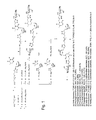
- Figure 1 shows the synthetic scheme used in the Preparations and Examples for compounds of formula (I) in which X is oxygen.
- Figure 2 shows the synthetic scheme used in the Preparations and Examples for compounds of formula (I) in which X is -NH-C(O)-NH-.
- Figure 3 shows DLS profiles of compound 11 (intensity-averaged diameter).
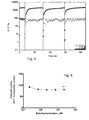
- Figure 4 shows the frequency sweep results for hydrogels obtained from compounds 5 and 6.
- Figure 5 shows the step-strain measurement of the hydrogel obtained from compound 6.
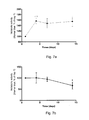
- Figure 6 shows the determination of the cytotoxicity of compound 6 by MTT test on human mesenchymal stem cells.
- Figure 7 shows the cytocompatibility of compound 6 by monitoring alamar blue metabolism in rat osteoblastic cells (A) or human stem cells ASCs (B) grown in compound 6-based gels.
- aqueous dispersions (Milli-Q water, 18 M ⁇ cm -1 ) containing 1.5 wt% of compounds 5 and 6 obtained in examples 1 and 2 were heated until dissolution (at 45°C) and gradually allowed to cool to room temperature unless otherwise stated.
- the resulting solid aggregate mass was stable to inversion of the container when the test tube was turned upside down, which shows that the compounds 5 and 6 form gels.
- Example 8 particle size measurement by Dynamic Light Scattering (DLS)
- the particle size measurements were performed by dynamic light-scattering (DLS) with a Zetasizer Nano ZS (Malvern Instruments, UK) apparatus.
- DLS dynamic light-scattering
- Zetasizer Nano ZS Zetasizer Nano ZS (Malvern Instruments, UK) apparatus.
- the solution of compound 11 of example 3 (30mg in 1 mL Milli-Q water) was extruded at 50nm to give objects with an average diameter of 5.9nm. This size corresponds to micellar systems (the length of GNBA 11 is about of 3.2nm in an extended conformation).
- the experiment was carried out twice.
- Figure 4 shows the frequency sweep results for hydrogels obtained from compound 5 and 6 (at 23.10mM) at a constant strain of 0.03%.
- Figure 5 shows the step-strain measurement of the hydrogel obtained from compound 6 at 1% (w/v) at a fixed angular frequency of 6.283rad.s -1 . This experiment was repeated at least three times to verify its reproducibility.
- the determination of gel-sol transition temperature can also be determinated by rheology.
- the hydrogel (3% product 6 of example 2, w/v) was heated progressively from 25 to 60 °C (3 °C/min).
- the oscillatory stress applied was set to 5 Pa at a constant frequency (1 Hz).
- the sol-gel transition point was taken as the temperature at which the gel became liquid. This melting temperature is reached at the intersection of the viscoelastic moduli (G' and G"). This value is of 46°C which is compatible with the cell culture at the gel state (37°C).
- Mesenchymal stem cells were isolated from human adipose tissue.
- Human subcutaneous fat was obtained from healthy patients aged 20 to 80 years old who underwent hip surgery in Bordeaux Pellegrin CHU (Bordeaux, France). Fat mass was separated from other tissues, washed with sterilized PBS, finely cut and incubated with 0.1 % (w/v) collagenase type I (Worthington, Lakewood, NJ, USA) at 37°C with gentle agitation for 1 h30. After filtration and centrifugation, the top liquid layer was removed and the remaining Stromal Vascular Fraction (SVF) was treated for 10 min with ELB (Erythocyte Lysis Buffer; 155mM NH 4 Cl (Sigma-Aldrich, St.
- ELB Erythocyte Lysis Buffer
- 155mM NH 4 Cl Sigma-Aldrich, St.
- D1-ORL-UVA (ATCC® CRL-12424) were cultured in DMEM (Invitrogen/Life Technologies) containing 10% FBS, and 1% Penicillin-Streptomycin (Invitrogen/Life Technologies). Culture medium was replaced every two days.
- the hydrogel obtained from compound 6 was prepared at a concentration of 3 % (w/v).
- the compound 6 powder was solubilized in PBS 1X under agitation (900rpm) at 25°C during 45 minutes. Then, when the gel was formed, it was left at room temperature, without agitation, during 3 to 4 hours. To allow cell seeding, the gel was heated during 30 minutes at 55°C. Once the liquid solution was obtained, it was rapidly cooled down to 37°C and thoroughly mixed with 10 ⁇ L cell suspension at a concentration of 1 million cells per mL of gel. Finally, the cellularized hydrogel was maintained under agitation (600rpm), at 25°C during 45 minutes. After this period, medium was been added (250 ⁇ L / tube) and tubes were incubated at controlled atmosphere (5 % CO 2 , 37°C)
- the cytotoxicity of compound 6 was evaluated by the measurement of the cell metabolic activity (MTT assay).
- Cells hASCs or D1
- Immunc 96 wells plate
- Product 6 was solubilized at concentrations from 5 ⁇ M to 5mM in culture media.
- MTT assay was performed after 72h of incubation.
- As a positive control the culture medium without GNBA was used.
- As a negative control Triton X100 was added in the culture medium. Results were expressed as a percentage of the metabolic activity of the positive control. Absorbance was measured at a wavelength of 570 nm with background subtraction at 630 nm.
- cytotoxicity of compound 6 was determined by MTT test to measure the metabolic activity of human mesenchymal stem cells (ASCs) 48 hours after incubation with increasing concentrations of compound 6. Results are shown as percentage of positive control consisting in BOLA-free cell culture medium. **: p ⁇ 0.01 (Mann-Whitney U-Test).
- Cytocompatibility was determined by monitoring alamar blue metabolism in rat osteoblastic cells (A) or human ASCs (B) grown in compound 6-based gels. Results are shown as percentage of the value obtained at day 1. *: p ⁇ 0.05 ; **: p ⁇ 0.01 (Mann-Whitney U-Test).
- Viability was assessed after 1, 4 and 7 days by using Live/Dead staining with calcein-AM and ethidium homodimer (Molecular Probes, Invitrogen, USA). Cells seeded within gels were incubated for 1 h at 37°C in Hank's medium supplemented with 1.25 ⁇ L calcein-AM and 5 ⁇ L EthD-1. Samples were observed with a Confocal microscope (Leica TCS SPE).
- Live/dead staining at 2 weeks showed a vast majority of green (living) cells.
Landscapes
- Chemical & Material Sciences (AREA)
- Health & Medical Sciences (AREA)
- Organic Chemistry (AREA)
- Life Sciences & Earth Sciences (AREA)
- Engineering & Computer Science (AREA)
- General Health & Medical Sciences (AREA)
- Biochemistry (AREA)
- Biotechnology (AREA)
- Genetics & Genomics (AREA)
- Molecular Biology (AREA)
- Public Health (AREA)
- Biomedical Technology (AREA)
- Epidemiology (AREA)
- Animal Behavior & Ethology (AREA)
- Medicinal Chemistry (AREA)
- Veterinary Medicine (AREA)
- Zoology (AREA)
- Wood Science & Technology (AREA)
- Bioinformatics & Cheminformatics (AREA)
- Pharmacology & Pharmacy (AREA)
- Cell Biology (AREA)
- Oil, Petroleum & Natural Gas (AREA)
- Microbiology (AREA)
- General Chemical & Material Sciences (AREA)
- Chemical Kinetics & Catalysis (AREA)
- General Engineering & Computer Science (AREA)
- Saccharide Compounds (AREA)
- Micro-Organisms Or Cultivation Processes Thereof (AREA)
- Materials For Medical Uses (AREA)
Abstract
Description
- The invention relates to bola-amphiphilic compounds and their uses for biomedical applications.
- The invention particularly relates to the use of bola-amphiphilic compounds for providing low molecular weight gels (LMWG), useful, in particular, as culture media for cells, in particular isolated stem cells.
- Hydrogels which are non-toxic, easy to use, cytocompatible, injectable and degradable are valuable biomaterials as cell-culture media.
- The development of biocompatible artificial matrixes that can be used for stem cell culture remains a great challenge in cell culture engineering and/or regenerative medicine. Most of gel scaffold developed so far involve polymeric materials derived from either natural sources or chemical synthesis. However, polymers often suffer from several limitations, including poor biocompatibility, toxicity, biodegradability, pro-inflammatory activity etc. Alternatively, small-molecule based hydrogels are currently emerging as a new powerful tool for regenerative medicine strategy capable of restoring biological and mechanical properties and/or function.
- The invention thus relates to new bola-amphiphilic compounds derived from nucleolipids and to a new generation of low molecular weight gels (LMWG) which are suitable for cell culture, in particular for stem cell culture. Bola-amphiphile based hydrogel matrixes exhibit the following requested properties: non-toxicity, easy to handle, injectability, and biocompatible rheology (thixotropic behavior).
- Bola-amphiphiles are composed of one or two hydrophobic chains covalently linked at both ends to hydrophilic head groups. This type of molecular architecture, which can be found in archaebacteria membranes, have been used in numerous applications which range from nanomaterial synthesis to drug or gene delivery.
- The use of glycosyl-nucleosides-lipids (GNL) and glycosyl-nucleosides-fluorolipids (GNF) for forming LMWG has been reported.
- GNL have been reported as being useful for promoting internalization of GNL based liposomes into stem cells (L. Latxague et al., Chem. Commun., 2011, 47, 12598-12600).
- GNL supramolecular assemblies for nucleic acid delivery and GNL-based gels were studied in G. Godeau et al., Chem. Commun., 2009, 1-3.
- GNF-based gels were reported as being only compatible with stem cell cultures where the stem cells formed aggregates, and clearly not compatible with the survival and growth of isolated stem cells (S. Ziane et al., Eur. Cells and Math., 2012, 23, 147-160).
- It has now been found that new glycosylated nucleoside based bola-amphiphile (GNBA) compounds exhibit particular physicochemical properties which render them particularly suitable for providing low molecular weight gels.
- The invention thus relates to compound of formula (I)
R1-X-A-X-R2 (I)
in which - X is oxygen, -NH-C(O)-NH- or -C(O)-NH-
- A is a C4-C30 hydrocarbon chain, linear or branched, saturated or unsaturated, which is unsubstituted or substituted by one or more C1-C12 linear or branched alkyl groups, or A represents a C4-C30 hydrocarbon chain, linear or branched, saturated or unsaturated, which is partially or completely halogenated;
- R1 and R2, identical or different, represent hydrogen or -(CH2)n-R3-(CH2)m-R4-(CH2)p-R5-R6
in which- n, m and p, identical or different, are 0 to 10;
- R3 represents a heteroaryl group comprising 1 to 4 oxygen or nitrogen atom(s);
- R4 represents a nucleosidyl group or does not exist;
- R5 represents a heteroaryl group comprising 1 to 4 heteroatom(s);
- R6 represents a residue of a cyclic carbohydrate or a derivative of the said carbohydrate;
- Preferably, A is a C4-C18 hydrocarbon chain, more preferably a C12 hydrocarbon chain, linear or branched, saturated or unsaturated, which is unsubstituted or substituted by one or more C1-C12 linear or branched alkyl groups;
- Alternatively, A is a C4-C18 hydrocarbon chain, more preferably a C12 hydrocarbon chain linear or branched, saturated or unsaturated, which is partially or completely halogenated.
- Preferably, the invention relates to compound of formula (I) in which R4 represents a nucleosidyl group.
- R5 can be covalently linked to R4 via -(CH2)p- to the carbon atom at position 5' of the ribose or deoxyribose ring of the nucleoside, or, alternatively, to the oxygen atom at position 3' of the ribose or deoxyribose ring of the nucleoside.
- « Heteroaryl group containing 1 to 4 oxygen or nitrogen atoms» refers to a monocyclic or bicyclic, aromatic or partially unsaturated, carbocyclic group containing 5 to 12 atoms, interrupted by 1 to 4 oxygen or nitrogen atoms, which can be, for example, selected from furane, pyrrole, oxazole, oxadiazole, isoxazole, pyrazole, triazole, tetrazole, imidazole, pyridine, pyrimidine, pyridazine, pyrazine, benzofurane, indole, quinoleine, isoquinoleine, chromane, naphtyridine or benzodiazine groups, triazole being preferred.
- « Hydrocarbon chain, which is partially or completely halogenated » refers to a saturated or unsaturated alkyl chain in which some or all hydrogen atoms are replaced by halogen atoms, such as fluorine, iodine, chlorine or bromine, fluorine being preferred.
- « Nucleosidyl group » refers to a group consisting of a ribose or deoxyribose moiety which is linked to a purine or pyrimidine base, or to derivatives of said purine or pyrimidine base, or to a non-natural mono- or bicyclic heterocyclic base, all said bases being optionally substituted.
- The purine base can be, for example, selected from the group consisting of adenine, guanine and hypoxanthine.
- The pyrimidine base can be, for example, selected from the group consisting of thymine, uracile and cytosine, thymine being preferred.
- By « non-natural mono-or bicycle heterocyclic base » is meant a universal base, such as, for example, 3-nitropyrrole, 4-nitroimidazole or 5-nitroindole.
- By « optionally substituted » is meant that the purine or pyrimidine base, or the non-natural heterocyclic base can be substituted by at least one substituent chosen, for example, from a halogen, an amino group, a carboxy group, a carbonyl group, a carbonylamino group, a hydroxy, azido, cyano, alkyl, cycloalkyl, perfluoroalkyl, alkyloxy (for example, methoxy), oxycarbonyl, vinyl, ethynyl, propynyl, acyl group etc.
- « Residue of a cyclic carbohydrate or a derivative of the said carbohydrate » refers to a residue of a 5- or 6- membered osidic cycle, , which can be, for instance, selected from D-glucopyranose, D-galactopyranose, D-mannopyranose, D-fructopyranose or D-ribofuranose, or oligosaccharide-type glycans deriving therefrom, as well as their N-acetyl derivatives, such as, for instance, N-acetylglucosamine, N-acetylgalactosamine, N-acetylmannosamine or sialic acid, or a protected derivative thereof, D-glucopyranose being preferred.
- In particular, the invention relates to compounds of formula (I), in which at least one of the following conditions is fulfilled:
- R3 and R5, identical or different, represent a heteroaryl group containing 1 to 4 nitrogen atoms selected from the group consisting of pyrazole, triazole, tetrazole and imidazole;
- R4 represents a nucleosidyl group selected from adenosine, deoxyadenosine, guanosine, deoxyguanosine, thymidine, deoxythymidine, uridine, deoxyuridine, cytidine and deoxycytidine.
- R6 represents a residue of a cyclic carbohydrate selected from D-glucopyranose, D-galactopyranose, D-mannopyranose, D-fructopyranose, D-ribofuranose, N-acetylglucosamine, N-acetylgalactosamine, N-acetylmannosamine and sialic acid or a protected derivative thereof.
- Preferred compounds of formula (I) are those in which X is oxygen.
- Alternatively, compounds of formula (I) of interest are those in which X is -NH-C(O)-NH- or-C(O)-NH-.
- Preferred compounds of formula (I) are those in which:
- A represents a C12 saturated hydrocarbon chain;
- R1 is hydrogen, or -(CH2)n-R3-(CH2)m-R4-(CH2)p-R5-R6;
- R2 is -(CH2)n-R3-(CH2)n-R4-(CH2)p-R5-R6;
- n = m = p = 1;
- R3 is a triazole group;
- R4 is thymidine;
- R5 is a triazole group, and
- R6 is β-D-glucopyranosyl or 2,3,4,6 tetra-O-protected -glucopyranosyl.
- Other preferred compounds are those in which
- A represents a C10 hydrocarbon chain which is partially fluorinated;
- R1 and R2are -(CH2)n-R3-(CH2)m-R4-(CH2)p-R5-R6;
- n = m = p = 1;
- R3 is a triazole group;
- R4 is thymidine;
- R5 is a triazole group, and
- R6 is β-D-glucopyranosyl or 2,3,4,6 tetra-O-protected-glucopyranosyl.
- According to a preferred embodiment, R5 is covalently linked to R4 via -(CH2)p- to the carbon atom at position 5' of the ribose or deoxyribose ring.
- Alternatively, R5 is covalently linked to R4 via -(CH2)p- to the oxygen atom at position 3' of the ribose or deoxyribose ring.
- Particularly preferred compounds of formula (I) are :
- 5'-[4-(12-hydroxydodecanyloxy)methyl)-1H-1,2,3-triazol-1-yl]-5'-deoxy-N3-(1-((β-D-glucopyranoside)-1H-1,2,3-triazol- 4-yl)methyl thymidine,
- 1,12-bis-dodecanyl-5'-[(4-oxymethyl)-1H-1,2,3-triazole-1-yl)]-N-3-[1-((β-D-glucopyranoside)-1H-1,2,3-triazole-4-yl)methyl]-5'-deoxy thymidine,
- 1,12-bis-dodecanyl-5'-[4-(oxymethyl)-1H-1,2,3-triazol-1-yl]-5'-deoxy-3'-O-1-((β-D-glucopyranoside)-1-H-1,2,3-triazol-4-yl)methyl thymidine,
- 1,10-bis-2,2,3,3,4,4,5,5,6,6,7,7,8,8,9,9-hexafluorodecanyl-5'-[4-(oxymethyl)-1H-1,2,3-triazol-1-yl]-N-3-[1-((β-D-glucopyranoside)-1H-1,2,3-triazol-4-yl)methyl]-5'-deoxythymidine, and
- 1,12-bis-dodecanyl-5'-[(4-methylurea)-1H-1,2,3-triazol-1-yl]-N-3-[1-((β-D-glucopyranoside)-1H-1,2,3-triazole-4-yl)methyl]-5'-deoxy thymidine.
- The compounds of formula (I) in which X is oxygen can be obtained by a process comprising the following steps:
- reacting an alkane-diol or a fluoroalkane-diol of formula R1-O-A-O-R2 at both ends with an alkylating agent of formula R-(CH2)q-C≡CH, where q is 1 or 2 and R is an halide, in particular chloride or bromide,
- reacting the resulting compound with the 5'-azido derivative of R4,
- reacting the purine or pyrimidine base or universal base moiety of R4 in the resulting compound with an alkylating agent of formula R-(CH2)q-C≡CH, where q and R are as defined above, in order to obtain the N-alkylated derivative of the purine or pyrimidine base or universal base of R4, and
- reacting the resulting compound with the 1-azido derivative of R6 (click-reaction).
- In order to obtain compounds of formula (I) in which X is oxygen and R3 and/or R5 are not triazoles, the skilled person is able to choose the appropriate cycloaddition reactions, such as Diels-Alder reactions, in order to obtain the desired R3 and/or R5 heterocycles.
- The following reaction conditions are preferred :
- the alkylating reactions are performed in the presence of sodium hydride;
- the click reaction is carried out with a 1:1 (v/v) mixture of water and dichloromethane with vigorous stirring at 40°C or a 1:1 (v/v) mixture of water and THF at 60-65°C with 10% CuSO4 and 20% ascorbic acid;
- If desired, the synthesis of unsymmetrical compounds of formula (I) where one of R1 and R2 represents hydrogen and the other is - (CH2)n-R3-(CH2)m-R4-(CH2)p-R5-R6 can be undertaken starting with monoalkylated starting materials clicked with with the 5'-azido derivative of R4. Subsequent reaction of the purine or pyrimidine base moiety present in the resulting compound with an alkylating agent of formula R-CH2-C≡CH followed by a second click reaction with the 1-azido derivative of R6 affords the desired unsymmetrical compound of formula (I).
- The compounds of formula (I) in which X is -NH-C(O)-NH- (bis-urea compounds) can be obtained by a process comprising the following steps:
- reacting a diisocyanatoalkane of formula OCN-A-NCO with NH2-CH2-C≡CH (propargylamine) or any primary amine containing a terminal alkyne group) in order to obtain a compound of formula (II) CH≡C-CH2-NH-C(O)-NH-A-NH-C(O)-NH-CH2-C≡CH (II),
- reacting a purine or pyrimidine base or a universal base with an alkylating agent of formula R-(CH2)q-C≡CH, where q is 1 or 2 and R is an halide, preferably bromide or chlorine, in order to obtain the N-alkylated derivative of the purine or pyrimidine base or universal base of R4,
- reacting the resulting compound with the 1-azido derivative of R6 (click-reaction),
- converting the 5'-OH group on the ribose or deoxyribose moiety of R4 into an azide, and subjecting the resulting compound to a second click-reaction with a compound of formula (II).
- The following reaction conditions are preferred :
- the alkylating reaction of the purine or pyrimidine base or universal base with R-CH2-C≡CH is carried out under basic conditions;
- the first click-reaction is Cu(I) catalyzed and is carried out in a 1:1 (v/v) mixture of water and tert-butanol, preferably at 60°C, and preferably with 10% CuSO4 and 20% ascorbic acid;
- the conversion of the 5'-OH group on the ribose or deoxyribose moiety of R4 into an azide can be carried ou by using an organophosphorous compound, such as, for example, triphenylphosphine (PPh3), a carbon halide such as, for example, tetrabromide (CBr4) and sodium azide (NaN3).
- The compounds of formula (I) in which X is -C(O)-NH- (bis-amide compounds) can be obtained by a process comprising the following steps:
- reacting an alkane diacid chloride prepared in situ from the corresponding dicarboxylic acid of formula HOOC-A-COOH and thionyl chloride, with NH2-CH2-C≡CH (propargylamine) or any primary amine containing a terminal alkyne group in order to obtain a compound of formula (III)
CH≡C-CH2-C(O)-NH-A- C(O)-NH-CH2-C≡CH (III).
- The invention further relates to compounds of formula (IV)
R7-X-A-X-(CH2)n-R3-(CH2)m-R4-R7 (IV)
In which - X is -NH-C(O)-NH-;
- A is a C4-C30 hydrocarbon chain, linear or branched, saturated or unsaturated, which is unsubstituted or substituted by one or more C1-C12 linear or branched alkyl groups, or A represents a C4-C30 hydrocarbon chain, linear or branched, saturated or unsaturated, which is partially or completely halogenated;
- R3 represents a heteroaryl group comprising 1 to 4 oxygen or nitrogen atom(s);
- R4 represents a nucleosidyl group;
- R7 is the residue of an alkylating agent of formula R-(CH2)q-C≡CH. where q is 1 or 2 and R is an halide, which is linked by a covalent bond with a nitrogen atom of the purine, pyrimidine or universal base moiety of R4 ;
- n and 1, identical or different, are 0 to 10.
- R is preferably chloride or bromide, and q is preferably 1.
- The compounds of formula (IV) are useful as synthesis intermediates for obtaining the compounds of formula (I) in which X is oxygen.
- All the preferred features mentioned above for A, R3 and R4 in formula (I) also apply to formula (IV).
- Preferred compounds of formula (IV) are those in which
- n=m=1
- R3 is a triazole group;
- R4 is thymidine;
- R7 is propargyl.
- In particular, compounds of formula (IV) of interest are :
- 5'-[4-((12-Propargyloxydodecanyloxy)methyl)-1H-1,2,3-triazol-1-yl]-5'-deoxy-N-3-propargylthymidine ,
- 1,12-bis-dodecanyl-5'-[(4-oxymethyl)-1H-1,2,3-triazol-1-yl)]-5'-deoxy-N-3-propargyl thymidine, and
- 1,10-bis-2,2,3,3,4,4,5,5,6,6,7,7,8,8,9,9-hexafluorodecanyl-5'-[4-(oxymethyl)-1H-1,2,3-triazol-1-yl]-N-3-propargyl-5'-deoxythymidine.
- The invention further relates to compounds of formula (V)
R4-(CH2)p-R5-R6 (V)
In which - X is -NH-C(O)-NH ;
- R4 represents a nucleosidyl group;
- R5 represents a heteroaryl group comprising 1 to 4 heteroatom(s), which is linked to R4 by a covalent bond with the carbon atom at position 5' of the ribose or deoxyribose ring of the nucleoside, or with the oxygen atom at position 3' of the ribose or deoxyribose ring of the nucleoside;
- R6 represents a residue of a cyclic carbohydrate or a derivative of the said carbohydrate;
- p is 0 to 10.
- The compounds of formula (V) are useful as synthesis intermediates for obtaining the compounds of formula (I) in which X is -NH-C(O)-NH-or -C(O)-NH-.
- All the preferred features mentioned above for R4, R5 and R7 in formula (I) also apply to formula (V).
- Preferred compounds of formula (V) are those in which
- p=1
- R3 is a triazole group;
- R5 is thymidine or
- R6 is a residue of 2,3,4,6 tetra-O-protected-glucopyranosyl.
- In particular, compounds of formula (V) of interest are :
- 5'-deoxy-N3-(1-(2,3,4,6-tetra-O-acetyl-β-D-glucopyranoside)-1H-1,2,3-triazol- 4-yl) thymidine, and
- 5'-Azido-N3-(1-(2,3,4,6-tetra-O-acetyl-β-D-glucopyranoside)-1H-1,2,3-triazol- 4-yl) thymidine.
- The invention also relates to biocompatible hydrogels formed from at least one compound of formula (I). In particular, these hydrogels are formed from an aqueous solution of compounds of formula (I) which can contain, for example, 0.1 to 10 wt% of compound of formula (I), in particular 1 to 5 wt%.
- The biocompatible hydrogels according to the invention can comprise one or more compound(s) of formula (I), or a mixture of one or more compound(s) of formula (I) and one or more glycosyl-nucleoside(s)-lipid(s) (also called GNL) and/or glycosyl-nucleoside(s)-fluorolipid(s) (also called GNF).
- The biocompatible hydrogels according to the invention can also contain a mixture of one or more compound(s) of formula (I) with one or more protein(s) or glycoprotein(s), such as for example collagen or hyaluronic acid, and optionally, one or more GNL or GNF.
- "Biocompatible" is understood as a material which is well tolerated by the host organism and which does not cause any rejection, toxic reaction, injury or harmful effect on the biological functions of the host organism.
- The biocompatible hydrogels according to the invention can be prepared, for example, by hating the compounds of formula (I) until dissolution, for example at a temperature of 40°C to 50°C, and allowing the solution to cool gradually to room temperature.
- All the preferred features mentioned above for the compounds of formula (I) also apply to the hydrogels formed therefrom.
- The invention also relates to the use of hydrogels formed from compounds of formula (I) as cell culture media, in particular as culture media for animal or human cells.
- The hydrogels according to the invention are particularly suitable as culture media for eukaryotic cells, in particular for stem cell culture. Indeed, it has been surprisingly found that these hydrogels allow the culture of stem cells under isolated form, while when using existing LMWG, such as those formed from GNF, formation of clusters of stem cells was observed. The culture of isolated eukaryotic cells, in particular stem cells, is highly valuable and promising in view of the extensive research which is currently carried out on stem cells. Advantageously, the hydrogels formed from compounds of formula (I) possess particular viscoelastic properties. Indeed, rheological studies on the variation of the storage modulus G' (also called elastic modulus) and the loss modulus G" (also called viscous modulus) as a function of the applied frequency were performed. G' describes the amount of energy which is stored and released in each oscillation, and G" corresponds to the energy which is dissipated at heat. Surprisingly, it has been found that the storage modulus G' is higher than the loss modulus G", which indicates the formation of a stable gel. Without wishing to be bound by theory, it can be hypothesized that this high elastic modulus plays a role in the adhesion and proliferation of isolated stem cells.
- In addition, it has been found that the hydrogel formed from compounds of formula (I) possess a thixotropic behaviour, and thus can be delivered by a syringe, thus allowing surgical use. Actually, said hydrogel is able to regain its gel behaviour and strength after a high strain is applied thereto.
- In particular, the hydrogel according to the invention can be used as biocompatible materials in the following biomedical applications:
- Tissue engineering, for instance by injecting gel-cell complexes : which can be used, for example, for bone regeneration;
- Cellular therapy, for instance by injecting gel-cell complexes in which the cells produce the active molecule(s)
- Prevention of adhesion formation after abdomino-pelvic surgery, for instance by injecting the gel which will remain at the application location and act as a barrier between adjacent tissues.
- Also, the biocompatible hydrogel according to the invention can be used as biocompatible material for drug delivery, for instance :
- for controlled-release delivery of an active ingredient which is entrapped into the gel, allowing the active ingredient to diffuse slowly near the injection site (topical administration, such as, for instance, for chemotherapy) and/or in the blood flow;
- for hosting delivery devices, such as, for instance for the encapsulation of electrically stimulable devices.
- The invention is non limitatively supported by the examples below.
- All commercially available reagents and solvents (Fluka, Sigma-Aldrich, Alfa-Aesar) were used without further purification.
- For reactions requiring anhydrous conditions, dry solvents were used (Sigma-Aldrich) under inert atmosphere (nitrogen or argon).
- Analytical thin layer chromatography (TLC) was performed on pre-coated silica gel F254 plates with fluorescent indicator (Merck). The detection of compounds was accomplished with UV light (254 nm) and by subsequent spraying with 10% conc. H2SO4 solution in ethanol, followed by heating, or 1% aqueous KMnO4 followed by heating.
- Column chromatography was performed with flash silica gel (0.04-0.063 mm, Merck) or with ready-to-use Chromabon RS 40 flash chromatography columns (Macherey-Nagel). All compounds were characterized using 1H and 13C Nuclear Magnetic Resonance (NMR) spectroscopy (Bruker Avance DPX-300 spectrometer, 1H at 300.13 MHz and 13C at 75.46 MHz). Assignments were made by 1H-1H COSY, DEPT and HSQC experiments. Chemical shifts (δ) are given in parts per million (ppm) relatively to tetramethylsilane or residual solvent peaks (CHCl3: 1H: 7.26, 13C: 77.0). Coupling constants J are given in Hertz (Hz); peak multiplicity is reported as follows: s = singlet, bs = broad singlet, d = doublet, t = triplet, m = multiplet.
- High resolution electronspray ionization mass spectra (HR ESI-MS) were performed by the CESAMO (Bordeaux, France) on a QSsat Elite mass spectrometer (Applied Biosystems). The instrument is equipped with an ESI source and spectra were recorded in negative mode. The electrospray needle was maintained at 4500 V and operated at room temperature. Samples were introduced by injection through a 10 µL sample loop into a 200 µL/min flow of methanol from the LC pump.
- The following abbreviations are used :
- DCM dichloromethane
- DMF dimethylformamide
- DMSO dimethylsulfoxide
- TBAI tetrabutylammonium iodide
- THF tetrahydrofuran
- The examples below, entitled "Preparation" describe the preparation of synthesis intermediates used for preparing the compounds of formula (I). The preparation of the compounds of formula (I) and their applications are then described as "Examples".
-
Figure 1 shows the synthetic scheme used in the Preparations and Examples for compounds of formula (I) in which X is oxygen. -
Figure 2 shows the synthetic scheme used in the Preparations and Examples for compounds of formula (I) in which X is -NH-C(O)-NH-. -
Figure 3 shows DLS profiles of compound 11 (intensity-averaged diameter). -
Figure 4 shows the frequency sweep results for hydrogels obtained fromcompounds -
Figure 5 shows the step-strain measurement of the hydrogel obtained fromcompound 6. -
Figure 6 shows the determination of the cytotoxicity ofcompound 6 by MTT test on human mesenchymal stem cells. -
Figure 7 shows the cytocompatibility ofcompound 6 by monitoring alamar blue metabolism in rat osteoblastic cells (A) or human stem cells ASCs (B) grown in compound 6-based gels. - To a cooled (0°C) solution of compound 1 (commercially available) (5g, 24.7 mmol) in anhydrous DMF (60 mL) was added sodium hydride in small portions (55% in mineral oil, 6.5 g, 148.2 mmol) under stirring. Propargyl bromide (80% w/w in toluene, 11 g, 74.1 mmol) was added followed by TBAI (0.91 g, 2.4 mmol), and stirring was continued for 15 hours at room temperature. The reaction was quenched with methanol (10 mL) and stirred a further 30 min. After addition of DCM (200 mL) the solution was washed with water (3x50 mL) then brine (50 mL), the organic layer dried (Na2SO4) and concentrated under reduced pressure.
Product 2 was isolated after purification on silica gel (hexane/ethyl acetate 100/0 then 97/3) as a colorless liquid. Yield: 4.48 g (65%). - 1H NMR (300 MHz, in CDCl3) δ 1.22-1.43 (m, 16H, CH2), 1.52-1.66 (m, 4H, CH 2CH2O), 2.43 (t, J= 2.4 Hz, 2H, CH propargyl), 3.52 (t, J= 6.6 Hz, 4H, CH2CH 2O), 4.15 (d, J= 2.4 Hz, 4H, CH2 propargyl).
- 13C NMR (75 MHz, in CDCl3) δ 26.08, 29.42, 29.50, 29.55 (CH2, CH2CH2O), 57.97 (CH2 propargyl), 70.31 (CH2O), 74.01 (CH propargyl).
- To a cooled (0°C) solution of compound 1 (commercially available) (4g, 20 mmol) in anhydrous DMF (100 mL) was added sodium hydride in small portions (55% in mineral oil, 2.5 g, 109 mmol) under stirring. Propargyl bromide (80% w/w in toluene, 9 g, 60 mmol) was added dropwise, and stirring was continued for 12 hours at low temperature. The reaction mixture was concentrated under reduced pressure. The resulting mixture was poured into water and extracted with DCM. The extracts were combined, washed with water (3x50 mL) then brine (50 mL). The organic layer was dried (Na2SO4) and concentrated under reduced pressure.
Product 7 was isolated after purification on silica gel (hexane/ethyl acetate 6/4) as a brown solid. Yield: 2.24 g (46%). - 1H NMR (300 MHz, in CDCl3) δ 1.19-1.30 (m, 16H, CH2), 1.46-1.59 (m, 4H, CH2CH2O), 2.37 (large s, 1 H, OH), 2.40 (t, J= 2.4 Hz, 1 H, CH propargyl), 3.46 (t, J= 6.6 Hz, 2H, CH2O), 3.56 (t, J= 6.7 Hz, 2H, CH2O), 4.08 (d, J= 2.4 Hz, CH2 propargyl).
- 13C NMR (75 MHz, in CDCl3) δ 25.74, 26.03 (CH2), 29.39, 29.43, 29.53, 29.58 (CH2 + CH2CH2O), 32.70 (CH2CH2O), 57.92 (CH2 propargyl), 62.72, 70.22 (CH2O), 74.13 (CH propargyl).
- To a solution of 2 obtained in Preparation 2 (1.50 g, 5.39 mmol) and 5'-azido-5'-deoxythymidine (3.02 g, 11.30 mmol) in 140 mL of THF/H2O (1:1) was added copper sulfate (172 mg, 1.07 mmol) followed by sodium ascorbate (427 mg, 2.15 mmol). The mixture was stirred at 60°C for 20 hours. After cooling to room temperature, the solvents were removed under reduced pressure. The resulting solid was washed with water until the washings were colorless, and then with ethanol. After drying under high vacuum, the resulting white solid was used in the next step without further purification. Yield: 4.00 g (91%).
- 1H NMR (300 MHz, in DMSO-d 6) δ 1.22 (s, 16H, 8CH2), 1.41-1.52 (m, 4H, CH2CH2O), 1.79 (s, 6H, CH3 thymine), 2.08-2.15 (m, 4H, H-2'), 3.35-3.41 (m, 4H, CH2O), 4.06-4.10 (m, 2H, H-4'), 4.24-4.29 (m, 2H, H-3'), 4.27 (s, 4H, OCH2-triazole), 4.57-4.74 (m, 4H, H-5'), 5.52 large s, 2H, OH thymine), 6.16 (t, J= 7.5 Hz, 2H, H-1'), 7.33 (s, 2H, H-6 thymine), 8.06 (s, 2H, CH triazole), 11.34 (s, 2H, NH thymine).
- 13C NMR (75 MHz, in DMSO-d 6) δ 12.53 (CH3 thymine), 6.11, 29.33, 29.48, 29.55CH2), 38.31 (C-2'), 51.51 (C-5'), 63.68 (CH2O-triazole), 70.01 (CH2O), 71.16 (C-3'), 84.40 (C1' and C-4'), 125.00 (CH triazole), 136.45 (C-6 thymine).
- To as solution of compound 3 obtained in Preparation 3(3.50 g, 4.30 mmol) in anhydrous DMF (120 mL) was added sodium carbonate (1.7 g, 12.92 mmol) followed by propargyl bromide (80% w/w in toluene, 1.92 g, 12.92 mmol) and TBAI (0.16 g, 043 mmol). The mixture was stirred at room temperature for 20 hours, then poured into DCM (200 mL) and washed with water (3x50 mL) and brine (50 mL). The organic extract was dried (Na2SO4) and concentrated under reduced pressure. The product was purified by column chromatography on silica gel eluting with DCM/MeOH (100:0 to 96:4) and obtained as a white solid foam. Yield: 3.07 g (77%).
- 1H NMR (300 MHz, in CDCl3) δ 1.27 (s, 16H, 8 CH2), 1.53-1.60 (m, 4H, 2 CH2CH2O), 1.94 (s, 6H, 2 CH3 thymine), 2.22 (t, 2H, J= 2.3 Hz, propargylic CH), 2.31-2.41 (m, 4H, 2 H-2'), 3.52 (t, 4H, J= 6.5 Hz, 2 CH2O), 4.23-4.27 (m, 2H, 2 H-4'), 4.53-4.59 (m, 2H, 2 H-3'), 4.61 (s, 4H, 2 CH2O triazole), 4.71 (s, 4H, 2 propargylic CH2), 4.70-4.77 (m, 4H, 2 H-5'), 6.23 (t, 2H, J= 6.6 Hz, 2 H-1'), 6.81 (s, 2H, 2 H-6 thymine), 7.68 (s, 2H, 2 H triazole).
- 13C NMR (75 MHz, in CDCl3) δ 13.16 (CH3 thymine), 29.22, 29.31, 29.34, 29.47 (CH2), 30.50 (propargyl CH2), 38.61 (C-2'), 51.11 (C-5'), 63.93 (OCH2 triazole), 71.14 (CH2O), 71.23 (C-3'), 77.25 (propargyl CH), 83.79 (C-4'), 86.85 (C-1'), 124.60 (CH triazole), 134.72 (C-6 thymine).
- To a degassed solution of
compound 7 obtained in Preparation 1 (2.23 g, 9.30 mmol) in 80 mL THF/H2O (1:1) was added 5'-azido-5'-deoxy thymidine (2.48 g, 9.30 mmol), copper sulfate (0.15 g, 0.93 mmol) and sodium ascorbate (0.37 g, 1.86 mmol). The mixture was stirred at 60°C for 3 hours. After removal of THF in vacuo, the aqueous mixture was filtered, the resulting yellow solid was washed with water, then purified by column chromatography on silica gel eluting with DCM/MeOH (9:1) to elute the product as a white solid. Yield: 3.88 g (82%). - 1H NMR (300 MHz, in MeOD @ 313K) δ 1.30-1.39 (m, 16H, CH2), 1.52-1.60 (m, 4H, CH2CH2O), 1.89 (d, J= 1.2 Hz, 3H, CH3 thymine), 2.23-2.29 (m, 2H, H-2'), 3.49-3.57 (m, 4H chain CH 2O + CH2OH), 4.16-4.21 (m, 1 H, H-4'), 4.39-4.43 (m, 1H, H-3'), 4.72-4.81 (m, 2H, H-5'), 6.20 (t, J= 6.7 Hz, H-1'), 7.20 (d, 1 H, H-6 thymine), 7.95 (s, 1 H, CH triazole).
- 13C NMR (75 MHz, in MeOD @ 313K) δ 10.95 (CH3 thymine), 25.51, 25.74, 29.06, 29.13, 29.22, 29.27, 32.25 (CH2), 38.26 (C-2'), 51.09 (C-5'), 61.64 (CH2OH or CH2CH2O), 63.27 (CH2O triazole), 70.38 (CH2CH2O or CH2OH), 70.98 (C-3'), 84.06 (C-4'), 85.46 (C-1'), 110.10 (C-5 thymine), 124.61 (CH triazole), 136.55 (C-6 thymine), 150.30 & 164.31 (C=O).
- HRMS: (M+Na) 530.2943 (calculated 530.2949)
- To a solution of compound 8 obtained in Preparation 5 (1.27 g, 25.0 mmol) in anhydrous DMF (60 mL) was added potassium carbonate (0.69 g, 50.0 mmol) and TBAI (0.09 g, 2.5 mmol), followed by propargyl bromide (80% w/w in toluene, 1.19 g, 50.0 mmol). The mixture was stirred at room temperature for 24 hours, then filtered, and the filtrate was concentrated under reduced pressure. The resulting yellow oil was poured into water (50 mL) and extracted with DCM (3x50 mL). The combined organic extracts were washed with water (50 mL), then brine (50 mL), dried (Na2SO4), and the solvent removed in vacuo. The crude product was purified by column chromatography on silica gel eluting with DCM/MeOH (95:5) to elute the title compound as a viscous yellow oil which crystalizes on standing (white solid). Yield: 1.20 g (87%).
- 1H NMR (300 MHz, in CDCl3) δ 1.26-1.34 (m, 16H, CH2), 1.51-1.62 (m, 4H, CH 2CH2OH + CH 2CH2O), 1.93 (d, J= 1.1 Hz, 3H, CH3 thymine), 2.20 (t, J= 2.4 Hz, 1 H, propagylic CH), 2.22-2.29 (m, 1 H, H-2'a), 2.35-2.44 (m, 1 H, H-2'b), 3.48-3.56 (m, 2H CH 2O), 3.65 (t, J= 6.6 Hz, 2H, CH 2OH), 4.18-4.23 (m, 1 H, H-4'), 4.45-4.51 (m, 1 H, H-3'), 4.59 (s, 2H triazole CH2O), 4.70-4.74 (m, 4H, H-5' + propargylic CH2), 6.25 (t, J= 6.6 Hz, H-1'), 6.74 (d, 1H, H-6 thymine), 7.68 (s, 1H, CH triazole).
- 13C NMR (75 MHz, in CDCl3) δ 12.93 (CH3 thymine), 25.68, 25.91, 29.30, 29.33, 29.41, 29.47 (CH2 + CH2CH2OH or CH2CH2O), 30.36 (propargylic CH2), 32.55 (CH2CH2O or CH2CH2OH), 38.58 (C-2'), 51.00 (C-5'), 62.49 (CH2OH), 63.85 (CH2 triazole), 70.65 (C-3'), 70.85 (propargylic CH), 70.99 (triazole CH2O), 83.77 (C-4'), 86.30 (C-1'), 124.48 (CH triazole), 134.83 (C-6 thymine).
- HRMS: (M+Na) 568.3098 (calculated 568.3105)
- To a cold (0°C) solution of compound 8 obtained in Preparation 5 (2 g, 3.66 mmol) in anhydrous DMF (100 mL) was added sodium hydride in one portion (55% in mineral oil, 0.90 g, 22 mmol). After 15 min, TBAI (0.135 g, 0.36 mmol) was added followed by propargyl bromide in small portions (80% w/w in toluene, 1.63 g, 11 mmol), and stirring continued for 5 hours at 0° then at room temperature overnight. The reaction was quenched with water (10 mL) with stirring and cooling on ice, and the solution was concentrated under reduced pressure. The brown residue was dissolved in water (200 mL) and extracted with DCM (3x100 mL) The combined organic extracts were washed with brine (3x100 mL) and aqueous 10% KCl solution (100 mL), dried (Na2SO4) and the solvent removed in vacuo. The crude product was purified by chromatography on silica gel eluting with ethyl acetate and obtained as a yellow oil. Yield : 0.87 g (40%).
- 1H NMR (300 MHz, in CDCl3) δ 1.23-1.27 (m, 16H, CH2), 1.48-1.56 (m, 4H, CH2CH2O), 1.89 (s, 3H, CH3 thymine), 2.08-2.17 (m, 1 H, H-2'a), 2.18 (m, 1 H thymine propagylic CH), 2.35-2.43 (m, 1 H, H-2'b), 2.51 (m, 1 H, chain propargylic CH), 3.48 (t, J= 6.7 Hz, 2H CH 2OCH2-triazole), 3.59 (t, J= 6.6 Hz, 2H, chain CH 2O-propargyl), 4.17-4.20 (m, 2H, propargylic CH2O), 4.24-4.30 (m, 1H, H-4'), 4.35-4.40 (m, 1H, H-3'), 4.57 (s, 2H CH2 triazole), 4.57-4.70 (m, 4H, H-5' + propargylic CH2N), 6.14 (t, J= 6.9 Hz, H-1'), 6.73 (s, 1H, H-6 thymine), 7.62 (s, 1 H, CH triazole).
- 13C NMR (75 MHz, in CDCl3) δ 13.06 (CH3 thymine), 25.73, 26.03, 29.49, 29.54 (CH2), 29.39 (CH2CH2O), 30.42 (thymine propargylic CH2), 32.76 (CH2CH2O propargyl), 36.23 (C-2'), 50.92 (C-5'), 57.41 (propargylic CH2O), 62.84 (chain CH2O-propargyl), 64.16 (CH2 triazole), 70.80 (thymine propargylic CH), 71.08 (chain CH2OCH2 triazole), 75.70 (chain propargylic CH), 78.26 (C-3'), 81.76 (C-4'), 86.69 (C-1'), 124.18 (CH triazole), 134.30 (C-6 thymine).
- HRMS: (M+Na) 606.3258 (calculated 606.3262)
- To a solution of 1,12-diisocyanatododecane (0.53 mL, 2 mmol) in anhydrous DCM (20 mL) was added slowly propargylamine (0.30 mL, 4.8 mmol). The mixture was stirred for 16 hours at room temperature. The precipitate was filtered and washed abundantly with DCM to remove the excess of propargylamine. After drying, the product was obtained as a white solid.
- Yield : (99%).
- 1H NMR (300 MHz, in DMSO-d6 @ 350 K) δ (ppm) 1.50-1.63 (m, 20H), 3.15 (t, J= 2.6 Hz, 2H), 3.20-3.26 (q, 4H), 4.03 (m, J= 2.6 Hz, 4H), 6.08-6.25 (large s, 4H).
- 13C NMR (75 MHz, DMSO-d6 , 350 K) δ (ppm) 26.82, 27.91, 28.05, 29.26, 29.32, 29.69, 30.34, 31.0, 31.09, 72.58, 83.05, 158.02.
- To a solution of thymidine (3 g, 12.39 mmol) in anhydrous DMF (20 mL) was added potassium carbonate (2.58 g, 18.58 mmol), propargyl bromide (80% w/w in toluene, 2.07 mL, 18.58 mmol). The reaction was stirred for 2 days at room temperature. After removal of DMF in vacuo, the residue was dissolved in ethyl acetate (100 mL) and then washed with water (3x30 mL). The organic extract was dried (Na2SO4) and concentrated under reduced pressure. The resulting oil was used in the next step without further purification. Yield : 3 g (86%).
- 1H NMR (300 MHz, in DMSO d6 ) δ 1.85 (s, 3H), 2.10-2.18 (m, 2H), 3.10 (s, 1 H), 3.59 (m, 2H), 3.79 (s, 1 H), 4.25 (m, 1 H), 4.53 (s, 2H), 5.04 (t, J = 6 Hz, 1 H), 5.27 (s, 1 H), 6.21 (t, J = 6 Hz, 1 H), 7.82 (s, 1 H).
- 13C NMR (75 MHz, in DMSO d6 ) δ 13.0, 30.3, 40.3, 62.0, 70.9, 71.1, 78.2, 86;0, 87.1, 116.9, 135.2, 150;2, 162.7.
- HRMS: (M+H) 281,1135 (calculated 281.1137)
-

- To a solution of 13 obtained in Preparation 9 (2.80 g, 10 mmol) and 2,3,4,6-tetra-O-acetyl-β-D-glucopyranosyl azide (3.73 g, 10 mmol) in 80 mL of tert-butanol/H2O (1:1) was added copper sulfate (159 mg, 1 mmol) and sodium ascorbate (396 mg, 2 mmol). The mixture was stirred at 60°C for 20 hours. The solvent was removed under reduced pressure and the residual solid was dissolved in ethyl acetate (150 mL) and then washed with water (3x50 mL). The organic extract was dried (Na2SO4) and concentrated under reduced pressure. The crude product was purified by chromatography on silica gel eluting with ethyl acetate and obtained as a white solid. Yield : 5.33 g (82%).
- 1H NMR (300 MHz, in CDCl3) δ 1.84-2.08 (m, 15H), 2.35 (m, 2H), 3.82-3.92 (m, 2H), 4.00 (m, 2H), 4.11-4.15 (dd, 1H), 4.25-4.31 (dd, 1H), 4.58 (m, 1 H), 5.19-5.31 (m, 3H), 5.36-5.48 (m, 2H), 5.85 (d, J= 8.8 Hz, 1 H), 6.23 (t, J= 6.4 Hz, 1 H), 7.52 (s, 1 H), 7.88 (s, 1 H).
- 13C NMR (75 MHz, in CDCl3) δ 12.47, 19.93, 20.32, 20.47, 35.18, 39.60, 61.00, 61.22, 67.03, 69.58, 70.15, 72.03, 74.14, 84.72, 85.45, 86.62, 99.37, 109.15, 122.30, 134.58, 142.94, 149.97, 162.53, 168.23, 168.77, 169.22, 169.99.
-

- To a solution of 14 obtained in Preparation 10 (1 g, 1.53 mmol) in anhydrous DMF (6 mL) was successively added PPh3 (0.48 g, 1.84 mmol), NaN3 (0.50 g, 7.65 mmol) and CBr4 (0.61 g, 1.84 mmol). After stirring for 24 hours, the reaction was quenched with methanol (1.5 mL) and stirred a further 30 min. The solvent was removed under reduced pressure and the product was isolated after purification on silica gel (DCM/
MeOH 100/0 then 97/3) as a white solid. Yield : 1.31 g (77%). - 1H NMR (300 MHz, in CDCl3) δ 1.72-1.97 (m, 15H), 2.10-2.17 (m, 1 H), 2.30-2.33 (m, 1 H), 3.49-3.65 (m, 2H), 4.00-4.22 (m, 3H), 4.25-4.31 (dd, 1 H), 4.38 (m, 1 H), 5.05-5.22 (m, 3H), 5.35-5.45 (m, 2H), 5.85 (d, J= 8.8 Hz, 1 H), 6.23 (t, J= 6.4 Hz, 1 H), 7.33 (s, 1 H), 7.85 (s, 1 H).
- 13C NMR (75 MHz, in CDCl3) δ 12.47, 19.98-20.53, 35.76, 39.97, 52.09, 61.50, 67.56, 70.06, 71.07, 72.58, 74.72, 84.44, 85.32, 110.17, 122.68, 134.04, 143.49, 150.44, 162.87, 168.68, 170.50.
- To a degassed solution of
compound 9 obtained in Preparation 6 (1.182 g, 2.0 mmol) and 1-azido-β-D-glucopyranose (0.534 g, 2.0 mmol) in 20 mL of THF/H2O (1:1) was added copper sulfate (32 mg, 0.2 mmol) followed by sodium ascorbate (80 mg, 0.4 mmol). The mixture was stirred at 60°C for 20 hours. After cooling to room temperature, the solvents were removed under reduced pressure. The resulting green solid was dissolved in methanol and filtered through celite, the resulting solution was concentrated under reduced pressure and applied to a column of silica gel. The product was eluted with DCM/MeOH (9:1 to 8:2). Yield : 0.84 g (55%). - 1H NMR (300 MHz, in MeOD) δ 1.28-1.35 (s, 18H, CH2), 1.51-1.60 (m, 4H, CH2CH2O), 1.94 (s, 3H, CH3 thymine), 2.28-2.32 (dd, J= 6.0 Hz, 2H, H-2'), 3.45-3.60 (m, 5H, H-3, H-4, H-5, CH2O), 3.66-3.72 (dd, J= 12.0, 5.2 Hz, 2H, H-6a), 3.84-3.91 (m, 2H, H-2, H-6b), 4.19-4.21 (m, 1 H, H-4'), 4.42-4.45 (m, 1 H, H-3'), 4.56 (s, 2H, CH2 triazole), 4.75-4.78 (m, 2H, H-5'), 5.22 (s, 2H, CH2-N triazole), 5.58 (d, J= 9.2 Hz, 1 H, H-1), 6.24 (dd, J= 6.0 Hz, 1H, H-1'), 7.31 (s, 1 H, H-6 thymine), 8.00 (s, 1 H, H triazole), 8.11 (s, 1 H, H triazole).
- 13C NMR (75 MHz, in MeOD) δ 11.80 (CH3 thymine), 25.56, 25.80, 29.23, 29.26, 32.27 (CH2 and CH2CH2O), 35.62 (CH2N triazole), 38.21 (C-2'), 51.21 (C-5'), 60.92 (C-6), 61.60 (CH2O), 63.14 (OCH2 triazole), 70.33 (CH2O), 69.41, 76.93, 79.67 (C-3 or C-4 or C-5), 71.00 (C-3'), 72.50 (C-2), 84.27 (C-4'), 86.53 (C-1'), 88.15 (C-1), 109.82 (C-5 thymine), 123.03, 124.82 (CH triazole), 135.47 (C-6 thymine), 143.12, 144.72 (C quat. triazole), 150.59, 163.37 (C=O thymine).
- HRMS: (M+Na) 773.3795 (calculated 773.3804)
- To a solution of 4 obtained in preparation 4 (200 mg, 0.225 mmol) and 1-azido-β-D-glucopyranose (111 mg, 0.540 mmol) in 12 mL of THF/H2O (1:1) was added copper sulfate (14 mg, 0.09 mmol) followed by sodium ascorbate (53 mg, 0.27 mmol). The mixture was irradiated under stirring in a microwave reactor (open vessel equipped with a reflux condenser) at 200W and 75°C for 5 min. The crude resulting mixture was concentrated under reduced pressure and purified by column chromatography on silica gel eluting with DCM/MeOH (8:2 to 7:3) to give 5 then 6. Yields: 5, 16 mg (9.5%); 6, 177 mg (58%).
- 1H NMR (300 MHz, in MeOD) δ 1.28-1.35 (s, 16H, CH2), 1.52-1.61 (m, 4H, CH2CH2O), 1.92 (s, 6H, CH3 thymine), 2.27-2.31 (dd, J= 6.0 Hz, 4H, H-2'), 3.48-3.60 (m, 10H, H-3, H-4, H-5, CH2O), 3.67-3.73 (dd, J= 12.0, 5.2 Hz, 2H, H-6a), 3.85-3.93 (m, 4H, H-2, H-6b), 4.17-4.22 (m, 2H, H-4'), 4.41-4.46 (m, 2H, H-3'), 4.56 (s, 4H, triazole CH2O), 4.74-4.77 (m, 4H, H-5'), 5.21 (s, 4H, triazole CH2N), 5.59 (d, J= 9.2 Hz, 2H, H-1), 6.23 (dd, J= 6.0 Hz, 2H, H-1'), 7.28 (s, 2H, H-6 thymine), 7.99 (s, 2H, H triazole), 8.13 (s, 2H, H triazole).
- 13C NMR (75 MHz, in MeOD) δ 11.80 (CH3 thymine), 25.76 (CH2), 29.23 (CH2CH2O), 35.67 (CH2N triazole), 38.21 (C-2'), 48.45 (C-5'), 60.95 (C-6), 63.16 (OCH2 triazole), 69.42, 76.98, 79.69 (C-3, C-4, C-5), 70.32 (CH2O), 70.98 (C-3'), 72.51 (C-2), 84.23 (C-4'), 86.63 (C-1'), 88.17 (C-1), 122.91, 124.79 (CH triazole), 135.44 (C-6 thymine).
- HRMS: (M+Na) 1321.5802 (calculated 1321.5783)
- To a degassed solution of
compound 10 obtained in Preparation 7 (0.87 g, 1.49 mmol) in 24 mL THF/H2O (6:4) was added 1-azido-β-D-glucopyranose (0.62 g, 3.00 mmol), copper sulfate (120.00 mg, 0.60 mmol) and sodium ascorbate (47.80 mg, 0.30 mmol). The mixture was stirred at 60°C for 3 hours. After removal of the solvents in vacuo, the resulting green solid was dissolved in methanol and filtered through celite, the resulting solution was concentrated under reduced pressure and applied to a column of silica gel. The product was eluted with DCM/MeOH (8:2). Yield : 0.81 g (54%). - 1H NMR (300 MHz, in MeOD) δ 1.30-1.33 (m, 16H, CH2), 1.50-1.62 (m, 4H, chain-CH2CH2O), 1.93 (d, J= 1.0 Hz, 3H, CH3 thymine), 2.26-2.47 (m, 1 H, H-2'), 3.49-3.60 (m, 10H, 2 chain-CH2O, H-3A, H-3B, H-4A, H-4B, H-5A, H-5B), 3.67-3.76 (2 dd, 2H, J= 11.6, 5.2 Hz, H-6A,a and H-6B,a), 3.85-3.97 (m, 4H, H-6A,b, H-6B,a and H-2A, H-2B), 4.33-4.37 (m, 2H, H-3' and H-4'), 4.56 (s, 2H, triazole-CH2O), 4.68-4.70 (d, J= 4.7 Hz, 2H, triazole-CH2O), 4.74-4.76 (m, 2H, H-5'), 5.22 (s, 2H, triazole-CH2N), 5.58 (d, J= 9.2 Hz, 1H, H-1 A or H-1 B), 5.65 (d, J= 9.2 Hz, 1 H, H-1 B or H-1A), 6.19 (t, J= 7.0 Hz, H-1'), 7.30 (d, 1 H, H-6 thymine), 7.98, 8.13 and 8.25 (3s, 1 H, CH triazole).
- 13C NMR (75 MHz, in MeOD) δ 11.75 (CH3 thymine), 25.55, 25.80, 29.18, 29.22, 29.26, 29.33 (CH2 and CH2CH2O), 32.26 (CH2CH2O), 32.50 (triazole-CH2-thymine), 51.07 (C-5'), 60.94 (C-6A, C-6B), 61.58 (chain-CH2O), 61.93 and 63.11 (triazole-CH2O), 69.40, 69.44 (C-3, C-4 or C-5 A and B), 70.36 (chain-CH2O), 72.49, 72.61 (C-2A, C-2B), 76.98, 77.01 (C-3, C-4 or C-5 A and B), 78.49, 82.12 (C-3', C-4'), 79.69, 79.74 (C-3, C-4 or C-5 A and B), 87.04 (C-1'), 88.17, 88.25 (C-1A, C-1B), 122.93, 123.18, 124.79 (CH triazole), 135.53 (C-6 thymine).
- HRMS: (M+Na) 1016.4648 (calculated 1016.4859).
-

- To a degassed solution of 7 obtained in preparation 1 (139.0 mg, 0.5 mmol) in 30 mL THF/H2O (2:1) was added 5'-azido-5'-deoxy-3'-O-1-((β-D-glucopyranoside tetraacetate)-1H-1,2,3-triazol-4-yl)methyl thymidine [L. Latxague, A. Patwa, E. Amigues, P. Barthélémy, Molecules 18 (2013) 12241-63], copper sulfate (15.9 mg, 0.1 mmol) and sodium ascorbate (39.6 mg, 0.2 mmol). The mixture was stirred at 65°C for 6 hours then overnight at rt. After removal of the solvents in vacuo, the remaining crude material was applied to a column of silica gel. The product was eluted with DCM/MeOH (95:5) then subjected to a Zemplen deacetylation. Yield: 301 mg (46%).
- 1H NMR (300 MHz, in MeOD @ 323K) δ 1.30 (s, 16H, CH2), 1.55-1.63 (m, 4H, CH2CH2O), 1.91 (s, 6H, CH3 thymine), 2.22-2.31 (m, 2H, H-2'a), 2.39-2.47 (m, 2H, H-2'b), 3.39 (t, J= 6.5 Hz, 4H, CH2CH 2O), 3.54-3.66 (m, 6H, H-3, 4, 5), 3.74-3.81 (m, 2H, H-6a), 3.91-4.00 (m, 4H, H-2, 6b), 4.34-4.39 (m, 4H, H-3', 4'), 4.60 (s, 4H, OCH2 triazole), 4.71-4.76 (m, 8H, H-5' and OCH2 triazole), 5.66 (d, J= 9.2 Hz, 2H, H-1), 6.18 (dd, J= 6.7 Hz, 2H, H-1'), 7.22 (s, 2H, H-6 thymine), 7.96 (s, 2H, H triazole), 8.21 (s, 2H, H triazole).
- 13C NMR (75 MHz, in MeOD @ 323K) δ 9.75 (CH3 thymine), 24.49 (CH2), 27.76, 27,89, 27,97 (CH2 and CH2CH2O), 34.39 (C-2'), 49.87 (C-5'), 59.91 (C-6), 60.97 and 62.07 (CH2 triazole), 68.47, 75.95, 78.55 (C,3, 4, 5), 69.20 (CH2CH2O), 71.49 (C-2), 77.42, 80.77 (C-3', 4'), 84.60 (C-1'), 87.08 (C-1), 109.44 (C-5 thymine), 121.88, 123.43 (CH triazole), 135.32 (C-6 thymine), 142.91, 143.87 (C-4 triazole), 149.51, 163.46 (C=O thymine).
-

- To a degassed solution of 1,10-bis-2,2,3,3,4,4,5,5,6,6,7,7,8,8,9,9-hexafluorodecanyl-5'-[4-(oxymethyl)-1 H-1,2,3-triazol-1-yl]-N-3-propargyl-5'-deoxythymidine obtained from commercial 2,2,3,3,4,4,5,5,6,6,7,7,8,8,9,9-hexadecafluoro-1,10-decanediol subjected to a similar set of reactions as shown in
Figure 1 , namely propargylation/azidothymidine coupling/nucleobase propargylation) (782.00 mg, 0.68 mmol) in 15 mL THF/H2O (2:1) was added 1-azido-1-deoxyglucopyranose, copper sulfate (26.90 mg, 0.14 mmol) and sodium ascorbate (43.40 mg, 0.27 mmol). The mixture was stirred at 60°C overnight. After removal of the solvents in vacuo, the remaining crude material was washed with water and the filtrate was concentrated under reduced pressure. The oily residue was applied to a column of silica gel. The product was eluted with DCM/MeOH (8:2 then 7:3). Yield: 514.00 mg (48%). - 1H NMR (300 MHz, in MeOD) d 1.91 (d, J= 1.1 Hz, 6H, CH3 thymine), 2.28-2.32 (t, J= 6.2 Hz, 4H, H-2'), 3.47-3.58 (m, 6H, H-2,3,5), 3.66-3.71 (dd, J= 5.1, 12.1 Hz, 2H, H-6a), 3.83-3.90 (m, 4H, H-4, 6b), 4.09-4.18 (t, J= 14.1 Hz, 4H, CH2CF2), 4.17-4.22 (m, 2H, H-4'), 4.40-4.45 (dd, J= 5.2 Hz, , 2H, H-3'), 4.74-4.79 (m, 8H, H-5' and OCH2 triazole), 5.20 (s, 4H, OCH2 triazole), 6.56 (d, J= 9.2 Hz, 2H, H-1), 6.20 (dd, J= 6.7 Hz, 2H, H-1'), 7.29 (d, 2H, H-6 thymine), 8.05 (s, 2H, H triazole), 8.10 (s, 2H, H-triazole).
- 13C NMR (75 MHz, in MeOD) d 10.14 (CH3 thymine), 34.15 (OCH2 triazole), 36.72 (C-2'), 49.76 (C-5'), 59.47 (C-6), 63.11 (OCH2 triazole), 64.97 (t, 2JC-F = 26.0 Hz, CH2CF2), 67.98, 75.54, 78.22 (C2, 3 or 5), 69.60 (C-3'), 71.05 (C-4), 82.80 (C-4'), 85.44 (C-1'), 86.72 (C-1), 108.26 (C-5 thymine), 121.36, 123.75 (CH triazole), 134.00 (C-6 thymine), 141.91 (C-4 triazole), 149.05 and 161.87 (C=O thymine).
- To a solution of 15 obtained in Preparation 11 (1 g, 1.47 mmol) in 36 mL of tert-butanol/H2O (1:1) was added
compound 12 obtained in Preparation 8 (243 mg, 0.67 mmol), copper sulfate (33 mg, 0.13 mmol) and sodium ascorbate (53 mg, 0.27 mmol). The mixture was stirred at 75°C for 20 hours. The solvent was removed under reduced pressure and the residual solid was dissolved in DCM (150 mL) and then washed with water (3x50 mL). The organic extract was dried (Na2SO4) and concentrated under reduced pressure. The crude product was purified by chromatography on silica gel eluting with ethyl acetate/MeOH (10:0 to 90:10) and obtained as a white solid. Yield : 0.90 g (78%). - 1H NMR (300 MHz, in DMSO-d6 ) δ 1.23-1.32 (m, 20H, chain CH2), 1.76-2.00 (m, 15H), 2.17 (m, 2H), 2.95 (q, 4H), 4.08 (m, 6H), 4.20-4.36 (m, 8H), 4.57-4.73 (m, 4H), 4.97-5.11 (q, 4H), 5.16 (t, 2H), 5.54 (m, 2H), 5.66 (t, 2H), 6.21 (t, 2H), 6.31 (d, 2H), 7.50 (s, 2H), 7.85 (s, 2H), 8.26 (s, 2H).
- 13C NMR (75 MHz, in DMSO-d6 ) δ 13.12, 20.32-20.96, 35.41, 36.36, 38.54, 51.53, 62.27, 67.97, 70.38, 71.18, 72.68, 72.85, 73.73, 84.20, 84.74, 85.72, 109.18, 123.07, 135.55, 143.81, 150.61, 158.32, 162.69, 168.68, 169.82, 170.03, 170.51.
- The aqueous dispersions (Milli-Q water, 18 MΩ·cm-1) containing 1.5 wt% of
compounds compounds - The particle size measurements were performed by dynamic light-scattering (DLS) with a Zetasizer Nano ZS (Malvern Instruments, UK) apparatus. The solution of
compound 11 of example 3 (30mg in 1 mL Milli-Q water) was extruded at 50nm to give objects with an average diameter of 5.9nm. This size corresponds to micellar systems (the length ofGNBA 11 is about of 3.2nm in an extended conformation). The experiment was carried out twice. - DLS profiles showing the intensity-averaged diameter of compound 11.are shown on
Figure 3 . - Rheological measurements were carried out on a Malvern Kinexus Pro+ rheometer with steel plate-plate geometry (20mm diameter). The lower plate is equipped with a Peltier temperature control system, and all samples were studied at 25 ± 0.01°C unless indicated otherwise. A solvent trap was used to ensure homogeneous temperature and to prevent water evaporation. A gap distance of 0.3mm was maintained between the plates. The gels based on compounds 5 (example 1) and 6 (example 2) (obtained in example were heated at 55°C and the liquid resulting was placed into the rheometer and subjected to sinusoidal oscillations. All the measurements were carried out within the linear viscoelastic regime (LVR). For this purpose the experimental conditions to achieve a linear viscoelastic regime were determined by performing an amplitude strain sweep from 0.01 to 10% at an angular frequency of 1 Hz (6.283rad.s-1).
-
Figure 4 shows the frequency sweep results for hydrogels obtained fromcompound 5 and 6 (at 23.10mM) at a constant strain of 0.03%. -
Figure 5 shows the step-strain measurement of the hydrogel obtained fromcompound 6 at 1% (w/v) at a fixed angular frequency of 6.283rad.s-1. This experiment was repeated at least three times to verify its reproducibility. - These results show the thixotropic behaviour of the hydrogel according to the invention. The mechanical energy which is provided destabilizes the gel, which is able to auto-regenerate when the mechanical stress stops, without causing aging of the sample (several stress/ restauration of G' and G" modulus were observed).
- The determination of gel-sol transition temperature can also be determinated by rheology. The hydrogel (3
% product 6 of example 2, w/v) was heated progressively from 25 to 60 °C (3 °C/min). The oscillatory stress applied was set to 5 Pa at a constant frequency (1 Hz). The sol-gel transition point was taken as the temperature at which the gel became liquid. This melting temperature is reached at the intersection of the viscoelastic moduli (G' and G"). This value is of 46°C which is compatible with the cell culture at the gel state (37°C). - The experiments were performed using
compound 6 of example 2, namely the 1,12-bis-dodecanyl-5'-[(4-oxymethyl)-1H-1,2,3-triazole-1-yl)]-N-3-[1-((β-D-glucopyranoside)-1H-1,2,3-triazole-4-yl)methyl]-5'-deoxy thymidine. - Mesenchymal stem cells were isolated from human adipose tissue. Human subcutaneous fat was obtained from healthy patients aged 20 to 80 years old who underwent hip surgery in Bordeaux Pellegrin CHU (Bordeaux, France). Fat mass was separated from other tissues, washed with sterilized PBS, finely cut and incubated with 0.1 % (w/v) collagenase type I (Worthington, Lakewood, NJ, USA) at 37°C with gentle agitation for 1 h30. After filtration and centrifugation, the top liquid layer was removed and the remaining Stromal Vascular Fraction (SVF) was treated for 10 min with ELB (Erythocyte Lysis Buffer; 155mM NH4Cl (Sigma-Aldrich, St. Louis, MO, USA), 5.7mM K2HPO4, 7.4mM K2HPO4-3H2O, 0.1 mm EDTA (all Sigma-Aldrich)), and then centrifuged. The pellet was resuspended in DMEM F12 medium (Invitrogen/Life Technologies, Sergy Pontoise, France) supplemented with 10% (v/v) Foetal Bovine Serum (FBS) (Lonza, Basel, Switzerland) and sequentially filtered through 100, 70 and 40µm cell strainer (BD Falcon, Franklin Lakes, NJ, USA). Cells were plated and cultivated at 37°C in 5%CO2. Culture medium was replaced every two days.
- D1-ORL-UVA (ATCC® CRL-12424) were cultured in DMEM (Invitrogen/Life Technologies) containing 10% FBS, and 1% Penicillin-Streptomycin (Invitrogen/Life Technologies). Culture medium was replaced every two days.
- For all in vitro assays, the hydrogel obtained from
compound 6 was prepared at a concentration of 3 % (w/v). Thecompound 6 powder was solubilized in PBS 1X under agitation (900rpm) at 25°C during 45 minutes. Then, when the gel was formed, it was left at room temperature, without agitation, during 3 to 4 hours. To allow cell seeding, the gel was heated during 30 minutes at 55°C. Once the liquid solution was obtained, it was rapidly cooled down to 37°C and thoroughly mixed with 10 µL cell suspension at a concentration of 1 million cells per mL of gel. Finally, the cellularized hydrogel was maintained under agitation (600rpm), at 25°C during 45 minutes. After this period, medium was been added (250µL / tube) and tubes were incubated at controlled atmosphere (5 % CO2, 37°C) - The cytotoxicity of
compound 6 was evaluated by the measurement of the cell metabolic activity (MTT assay). Cells (hASCs or D1) were seeded in a 96 wells plate (Nunc) at a density of 10 000 cells/cm2.Product 6 was solubilized at concentrations from 5µM to 5mM in culture media. - MTT assay was performed after 72h of incubation. As a positive control, the culture medium without GNBA was used. As a negative control, Triton X100 was added in the culture medium. Results were expressed as a percentage of the metabolic activity of the positive control. Absorbance was measured at a wavelength of 570 nm with background subtraction at 630 nm.
- The cytotoxicity of
compound 6 was determined by MTT test to measure the metabolic activity of human mesenchymal stem cells (ASCs) 48 hours after incubation with increasing concentrations ofcompound 6. Results are shown as percentage of positive control consisting in BOLA-free cell culture medium. **: p<0.01 (Mann-Whitney U-Test). - The results, represented on
Figure 6 , show thatcompound 6 is non toxic at concentrations up to approximately 1 mM. - Cell viability was also evaluated by using the Alamar Blue metabolic activity assay. Resazurin sodium salt solution (Sigma-Aldrich), suspended at a concentration of 0.1mg/ml in PBS 1X), was diluted at 1/10 (v/v) in the culture media. The solution was added to each well (250µL) and incubated during 3h at 37°C. After this time, the fluorescence was measured at wavelengths excitation 530 nm and emission 590 nm. Triplicate samples were analyzed for each experiment. The results are shown on
Figure 7A . - Cytocompatibility was determined by monitoring alamar blue metabolism in rat osteoblastic cells (A) or human ASCs (B) grown in compound 6-based gels. Results are shown as percentage of the value obtained at
day 1. *: p<0.05 ; **: p<0.01 (Mann-Whitney U-Test). - The results are shown on
Figure 7B . - Viability was assessed after 1, 4 and 7 days by using Live/Dead staining with calcein-AM and ethidium homodimer (Molecular Probes, Invitrogen, USA). Cells seeded within gels were incubated for 1 h at 37°C in Hank's medium supplemented with 1.25 µL calcein-AM and 5 µL EthD-1. Samples were observed with a Confocal microscope (Leica TCS SPE).
- Live/dead staining at 2 weeks showed a vast majority of green (living) cells.
- The results show that
compound 6 is not cytotoxic and has a god cytocompatibility when used as cell culture medium.
Claims (20)
- A compound of formula (I)
R1-X-A-X-R2 (I)
in which- X is oxygen, -NH-C(O)-NH- or -C(O)-NH-- A is a C4-C30 hydrocarbon chain, linear or branched, saturated or unsaturated, which is unsubstituted or substituted by one or more C1-C12 linear or branched alkyl groups, or A represents a C4-C30 hydrocarbon chain, linear or branched, saturated or unsaturated, which is partially or completely halogenated;- R1 and R2, identical or different, represent hydrogen or -(CH2)n-R3-(CH2)m-R4-(CH2)p-R5-R6
in which• n, m and p, identical or different, are 0 to 10;• R3 represents a heteroaryl group comprising 1 to 4 oxygen or nitrogen atom(s);• R4 represents a nucleosidyl group or does not exist• R5 represents a heteroaryl group comprising 1 to 4 heteroatom(s),;• R6 represents a residue of a cyclic carbohydrate or a derivative of the said carbohydrate;provided that R1 and R2 are not simultaneously hydrogen. - A compound of formula (I) according to claim 1, in which R4 is a nucleosidyl group.
- A compound of formula (I) according to claim 1, in which at least one of the following conditions is fulfilled:- R3 and R5, identical or different, represent a heteroaryl group containing 1 to 4 nitrogen atoms selected from the group consisting of pyrazole, triazole, tetrazole and imidazole;- R4 represents a nucleosidyl group selected from adenosine, deoxyadenosine, guanosine, deoxyguanosine, thymidine, deoxythymidine, uridine, deoxyuridine, cytidine and deoxycytidine.- R6 represents a residue of a cyclic carbohydrate selected from D-glucopyranose, D-galactopyranose, D-mannopyranose, D-fructopyranose D-ribofuranose, N-acetylglucosamine, N-acetylgalactosamine, N-acetylmannosamine and sialic acid or a protected derivative thereof.
- A compound of formula (I) according to claim 1, in which:- A represents a C12 saturated hydrocarbon chain;- R1 is hydrogen, or -(CH2)n-R3-(CH2)m-R4-(CH2)p-R5-R6;- R2 is -(CH2)n-R3-(CH2)m-R4-(CH2)p-R5-R6;- n = m = p = 1;- R3 is a triazole group;- R4 is thymidine;- R5 is a triazole group, and- R6 is D-glucopyranosyl or 2,3,4,6 tetra-O-protected-glucopyranosyl.
- A compound of formula (I) according to claim 1, in which:- A represents a C10 hydrocarbon chain which is partially fluorinated;- R1 and R2 are -(CH2)n-R3-(CH2)m-R4-(CH2)p-R5-R6;- n = m = p = 1;- R3 is a triazole group;- R4 is thymidine;- R5 is a triazole group, and
R6 is D-glucopyranosyl or 2,3,4,6 tetra-O-protected-glucopyranosyl. - A compound of formula (I) according to any one of claims 1 to 5, in which, R5 is covalently linked to R4 via -(CH2)p- to the carbon atom at position 5' of the ribose or deoxyribose ring.
- A compound of formula (I) according to any one of claims 1 to 45 in which R5 is covalently linked to R4 via -(CH2)p- to the oxygen atom at position 3' of the ribose or deoxyribose ring.
- A compound of formula (I) according to claim 1, which is selected from the group consisting of :5'-[4-(12-hydroxydodecanyloxy)methyl)-1H-1,2,3-triazol-1-yl]-5'-deoxy-N3-(1-((β-D-glucopyranoside)-1H-1,2,3-triazol- 4-yl)methyl thymidine,1,12-bis-dodecanyl-5'-[(4-oxymethyl)-1H-1,2,3-triazole-1-yl)]-N-3-[1-((β-D-glucopyranoside)-1H-1,2,3-triazole-4-yl)methyl]-5'-deoxy thymidine,1,12-bis-dodecanyl-5'-[4-(oxymethyl)-1H-1,2,3-triazol-1-yl]-5'-deoxy-3'-O-1-((b-D-glucopyranoside)-1-H-1,2,3-triazol-4-yl)methyl thymidine,1,10-bis-2,2,3,3,4,4,5,5,6,6,7,7,8,8,9,9-hexafluorodecanyl-5'-[4-(oxymethyl)-1H-1,2,3-triazol-1-yl]-N-3-[1-((b-D-glucopyranoside)-1H-1,2,3-triazol-4-yl)methyl]-5'-deoxythymidine, and1,12-bis-dodecanyl-5'-[(4-methylurea)-1H-1,2,3-triazol-1-yl]-N-3-[1-((β-D-glucopyranoside)-1H-1,2,3-triazole-4-yl)methyl]-5'-deoxy thymidine.
- A process for preparing a compound of formula (I) in which X is oxygen, comprising the following steps:- reacting an alkane-diol or a fluoroalkane-diol of formula R1-O-A-O-R2 at both ends with an alkylating agent of formula R-(CH2)q-C≡CH, where q is 1 or 2 and R is an halide, in particular chloride or bromide,- reacting the resulting compound with the 5'-azido derivative of R4,- reacting the purine or pyrimidine base or universal base moiety of R4 in the resulting compound with an alkylating agent of formula R-(CH2)q-C≡CH, where q and R is as defined above, in order to obtain the N-alkylated derivative of the purine or pyrimidine base or universal base of R4, and- reacting the resulting compound with the 1-azido derivative of R6 (click-reaction).
- A process for preparing a compound of formula (I) in which X is- NH-C(O)-NH-, comprising the following steps:- reacting a diisocyanatoalkane of formula OCN-A-NCO with NH2-CH2-C≡CH (propargylamine) or any primary amine containing a terminal alkyne group in order to obtain a compound of formula (II)
CH≡C-CH2-NH-C(O)-NH-A-NH-C(O)-NH-CH2-C≡CH (II),
- reacting a purine or pyrimidine base or a universal base with an alkylating agent of formula R-(CH2)q-C≡CH, where q is 1 or 2 and R is an halide, preferably bromide or chlorine, in order to obtain the N-alkylated derivative of the purine or pyrimidine base or universal base of R4,- reacting the resulting compound with the 1-azido derivative of R6 (click-reaction),- converting the 5'-OH group on the ribose or deoxyribose moiety of R4 into an azide, and subjecting the resulting compound to a second click-reaction with a compound of formula (II). - A compound of formula (IV)
R7-X-A-X-(CH2)n-R3-(CH2)m-R4-R7 (IV)
in which- X is -NH-C(O)-NH-;- A is a C4-C30 hydrocarbon chain, linear or branched, saturated or unsaturated, which is unsubstituted or substituted by one or more C1-C12 linear or branched alkyl groups, or A represents a C4-C30 hydrocarbon chain, linear or branched, saturated or unsaturated, which is partially or completely halogenated;- R3 represents a heteroaryl group comprising 1 to 4 oxygen or nitrogen atom(s);- R4 represents a nucleosidyl group;- R7 is the residue of an alkylating agent of formula R-(CH2)q-C≡CH where q is 1 or 2 and R is an halide;, which is linked by a covalent bond with a nitrogen atom of the purine, pyrimidine or universal base moiety of R4 ;- n and 1, identical or different, are 0 to 10. - A compound of formula (V)
R4-(CH2)p-R5-R6 (V)
in which- X is -NH-C(O)-NH ;- R4 represents a nucleosidyl group;- R5 represents a heteroaryl group comprising 1 to 4 heteroatom(s), which is linked to R4 by a covalent bond with the carbon atom at position 5' of the ribose or deoxyribose ring of the nucleoside, or with the oxygen atom at position 3' of the ribose or deoxyribose ring of the nucleoside;- R6 represents a residue of a cyclic carbohydrate or a derivative of the said carbohydrate;- p is 0 to 10. - Hydrogel formed from one or more compound(s) of formula (I) according to any one of claims 1 to 8.
- Hydrogel according to claim 13, characterized in that they are formed from an aqueous solution of compounds of formula (I) containing 0.1 to 10 wt% of compound of formula (I), in particular 1 to 5 wt%.
- Hydrogel according to claim 13 or 14, characterized in that comprise one or more compound(s) of formula (I), or a mixture of one or more compound(s) of formula (I) and one or more glycosyl-nucleoside(s)-lipid(s) (GNL) and/or glycosyl-nucleoside(s)-fluorolipid(s) (GNF), or else a mixture of one or more compound(s) of formula (I) with one or more protein(s) or glycoprotein(s), such as for example collagen or hyaluronic acid, where said mixture contains, optionally, one or more GNL or GNF.
- Use of a hydrogel according to claim 13 or 14 as cell culture media.
- Use according to claim 16, where the cells are eukaryotic cells.
- Use according to claim 16, where the cells are stem cells.
- Use of a hydrogel according to any one of claims 13 to 15 as a biocompatible material for tissue engineering, cellular therapy or prevention of adhesion formation after abdomino-pelvic surgery.
- Use of a hydrogel according to any one of claims 13 to 15 as a biocompatible material for controlled-release delivery of an active ingredient which is entrapped into the gel.
Priority Applications (7)
| Application Number | Priority Date | Filing Date | Title |
|---|---|---|---|
| EP14290302.0A EP3006452B1 (en) | 2014-10-06 | 2014-10-06 | Bola-amphiphilic compounds and their uses for biomedical applications |
| ES14290302.0T ES2660752T3 (en) | 2014-10-06 | 2014-10-06 | Ball-amphiphilic compounds and their uses for biomedical applications |
| US15/517,313 US10227372B2 (en) | 2014-10-06 | 2015-10-06 | Bola-amphiphilic compounds and their uses for biomedical applications |
| PCT/EP2015/073072 WO2016055493A1 (en) | 2014-10-06 | 2015-10-06 | Bola-amphiphilic compounds and their uses for biomedical applications |
| JP2017518337A JP2017531654A (en) | 2014-10-06 | 2015-10-06 | Bora amphiphiles and their use for biomedical applications |
| CA2962742A CA2962742A1 (en) | 2014-10-06 | 2015-10-06 | Bola-amphiphilic compounds and their uses for biomedical applications |
| US16/251,287 US10633409B2 (en) | 2014-10-06 | 2019-01-18 | Bola-amphiphilic compounds and their uses for biomedical applications |
Applications Claiming Priority (1)
| Application Number | Priority Date | Filing Date | Title |
|---|---|---|---|
| EP14290302.0A EP3006452B1 (en) | 2014-10-06 | 2014-10-06 | Bola-amphiphilic compounds and their uses for biomedical applications |
Publications (2)
| Publication Number | Publication Date |
|---|---|
| EP3006452A1 true EP3006452A1 (en) | 2016-04-13 |
| EP3006452B1 EP3006452B1 (en) | 2017-12-13 |
Family
ID=51830251
Family Applications (1)
| Application Number | Title | Priority Date | Filing Date |
|---|---|---|---|
| EP14290302.0A Not-in-force EP3006452B1 (en) | 2014-10-06 | 2014-10-06 | Bola-amphiphilic compounds and their uses for biomedical applications |
Country Status (6)
| Country | Link |
|---|---|
| US (2) | US10227372B2 (en) |
| EP (1) | EP3006452B1 (en) |
| JP (1) | JP2017531654A (en) |
| CA (1) | CA2962742A1 (en) |
| ES (1) | ES2660752T3 (en) |
| WO (1) | WO2016055493A1 (en) |
Cited By (1)
| Publication number | Priority date | Publication date | Assignee | Title |
|---|---|---|---|---|
| EP3871678A1 (en) * | 2020-02-26 | 2021-09-01 | Universite De Bordeaux | Pro-angiogenic compounds |
Families Citing this family (1)
| Publication number | Priority date | Publication date | Assignee | Title |
|---|---|---|---|---|
| CN106674212B (en) * | 2017-01-04 | 2019-08-09 | 云南大学 | Thiophenetriazole Bola (Bola) compound |
Citations (1)
| Publication number | Priority date | Publication date | Assignee | Title |
|---|---|---|---|---|
| WO2008103618A1 (en) * | 2007-02-22 | 2008-08-28 | University Of Utah Research Foundation | Synthesis of novel xylosides and potential uses thereof |
Family Cites Families (1)
| Publication number | Priority date | Publication date | Assignee | Title |
|---|---|---|---|---|
| FR2924430B1 (en) * | 2007-11-30 | 2010-03-19 | Univ Bordeaux 2 | PROCESS FOR THE PREPARATION OF NANOPARTICLES BASED ON FUNCTIONAL AMPHIPHILIC MOLECULES OR MACROMOLECULES AND THEIR USE |
-
2014
- 2014-10-06 ES ES14290302.0T patent/ES2660752T3/en active Active
- 2014-10-06 EP EP14290302.0A patent/EP3006452B1/en not_active Not-in-force
-
2015
- 2015-10-06 CA CA2962742A patent/CA2962742A1/en not_active Abandoned
- 2015-10-06 US US15/517,313 patent/US10227372B2/en not_active Expired - Fee Related
- 2015-10-06 WO PCT/EP2015/073072 patent/WO2016055493A1/en not_active Ceased
- 2015-10-06 JP JP2017518337A patent/JP2017531654A/en active Pending
-
2019
- 2019-01-18 US US16/251,287 patent/US10633409B2/en not_active Expired - Fee Related
Patent Citations (1)
| Publication number | Priority date | Publication date | Assignee | Title |
|---|---|---|---|---|
| WO2008103618A1 (en) * | 2007-02-22 | 2008-08-28 | University Of Utah Research Foundation | Synthesis of novel xylosides and potential uses thereof |
Non-Patent Citations (9)
| Title |
|---|
| G. GODEAU ET AL., CHEM. COMMUN., 2009, pages 1 - 3 |
| GUILHEM GODEAU ET AL: "Glycosyl-nucleoside-lipid based supramolecular assembly as a nanostructured material with nucleic acid delivery capabilities", CHEMICAL COMMUNICATIONS, no. 34, 1 January 2009 (2009-01-01), pages 5127, XP055044911, ISSN: 1359-7345, DOI: 10.1039/b906212b * |
| L. LATXAGUE ET AL., CHEM. COMMUN., vol. 47, 2011, pages 12598 - 12600 |
| L. LATXAGUE; A. PATWA; E. AMIGUES; P. BARTHÉLÉMY, MOLECULES, vol. 18, 2013, pages 12241 - 63 |
| LAURENT LATXAGUE ET AL: "Glycosylated nucleoside lipid promotes the liposome internalization in stem cells", CHEMICAL COMMUNICATIONS, vol. 47, no. 47, 1 January 2011 (2011-01-01), pages 12598, XP055161588, ISSN: 1359-7345, DOI: 10.1039/c1cc13948g * |
| LAURENT LATXAGUE ET AL: "Glycosyl-Nucleolipids as New Bioinspired Amphiphiles", MOLECULES, vol. 18, no. 10, 1 January 2013 (2013-01-01), pages 12241 - 12263, XP055161834, DOI: 10.3390/molecules181012241 * |
| NURAJE NURXAT ET AL: "Bolaamphiphilic molecules: Assembly and applications", PROGRESS IN POLYMER SCIENCE, PERGAMON PRESS, OXFORD, GB, vol. 38, no. 2, 15 September 2012 (2012-09-15), pages 302 - 343, XP028980022, ISSN: 0079-6700, DOI: 10.1016/J.PROGPOLYMSCI.2012.09.003 * |
| S. ZIANE ET AL., EUR. CELLS AND MATH., vol. 23, 2012, pages 147 - 160 |
| SOPHIA ZIANE ET AL: "A thermosensitive low molecular weight hydrogel as scaffold for tissue engineering", EUROPEAN CELLS & MATERIALS, 1 January 2012 (2012-01-01), Scotland, pages 147 - 160, XP055161597, Retrieved from the Internet <URL:http://www.ncbi.nlm.nih.gov/pubmed/22370797> [retrieved on 20150113] * |
Cited By (1)
| Publication number | Priority date | Publication date | Assignee | Title |
|---|---|---|---|---|
| EP3871678A1 (en) * | 2020-02-26 | 2021-09-01 | Universite De Bordeaux | Pro-angiogenic compounds |
Also Published As
| Publication number | Publication date |
|---|---|
| US10633409B2 (en) | 2020-04-28 |
| ES2660752T3 (en) | 2018-03-26 |
| JP2017531654A (en) | 2017-10-26 |
| US20190233460A1 (en) | 2019-08-01 |
| CA2962742A1 (en) | 2016-04-14 |
| US10227372B2 (en) | 2019-03-12 |
| US20170240583A1 (en) | 2017-08-24 |
| WO2016055493A1 (en) | 2016-04-14 |
| EP3006452B1 (en) | 2017-12-13 |
Similar Documents
| Publication | Publication Date | Title |
|---|---|---|
| CN115175894B (en) | Nanomaterials | |
| EP3523314A1 (en) | Cyclic dinucleotides containing benzimidazole, method for the production of same, and use of same to activate stimulator of interferon genes (sting)-dependent signaling pathways | |
| US6242428B1 (en) | Nucleoside analogs and uses in treating Plasmodium falciparum infection | |
| CZ392797A3 (en) | C-4 -modified inhibitors of adenosinekinase | |
| US20100151001A1 (en) | Ethynylated heterodinucleoside phosphate analogs, method for the production thereof, and use thereof | |
| BG66191B1 (en) | POLYSACCHARIDES WITH ANTITROMBOLIC ACTIVITY CONTAINING AT LEAST A CYVAL BIND WITH BIODINE OR DERIVATIVELY ON BIOTEIN | |
| US10633409B2 (en) | Bola-amphiphilic compounds and their uses for biomedical applications | |
| HUP0301875A2 (en) | Pyrrolo[2,3-d]pyrimidine nucleoside analogs | |
| EP0311100A2 (en) | Derivatives of dideoxycytidine, their preparation and pharmaceutical use | |
| Smellie et al. | Synthesis of putative chain terminators of mycobacterial arabinan biosynthesis | |
| JP4879398B2 (en) | Glyceryl nucleotides, their production and use | |
| AU3080899A (en) | Novel nucleoside analogs and uses in treating disease | |
| US20090209485A1 (en) | Modulating angiogenesis with nod factors such as glucosamine oligosaccharides | |
| BRPI0715269A2 (en) | compound, compound salt, pharmaceutical composition, method for the manufacture of a pharmaceutical composition, use of a compound and method for the treatment of a dysfunction in blood coagulation | |
| EP4003367B1 (en) | E-selectin antagonists for use in enhancing the survival of reconstituted, bone marrow-depleted hosts | |
| JP2021161109A (en) | Novel benzimidazole derivatives, preparation method thereof, and use thereof as anti-cancer agent | |
| EP4585684A1 (en) | Nucleic acid for transfection | |
| EP3871678A1 (en) | Pro-angiogenic compounds | |
| CN116217750B (en) | A dual-targeting molecule based on hyaluronic acid and glucose and its preparation method and application | |
| Zatsepin et al. | Efficient conjugation and preferential DNA binding of oligonucleotides containing 2′-O-(2-oxoethyl) arabinouridine | |
| JP4381002B2 (en) | Galactose disulfate derivative | |
| NL8100177A (en) | 5-Halovinyl-2',3'-di:deoxy-uridine derivs. - useful as antiviral agents against herpes simplex | |
| Barthélémy et al. | Glycosyl-nucleolipids as new bioinspired amphiphiles | |
| EA052307B1 (en) | NICOTINATE AND NICOTINAMIDE RIBOSIDE BASED COMPOUNDS AND THEIR DERIVATIVES | |
| HK40082129A (en) | Nanomaterial |
Legal Events
| Date | Code | Title | Description |
|---|---|---|---|
| PUAI | Public reference made under article 153(3) epc to a published international application that has entered the european phase |
Free format text: ORIGINAL CODE: 0009012 |
|
| AK | Designated contracting states |
Kind code of ref document: A1 Designated state(s): AL AT BE BG CH CY CZ DE DK EE ES FI FR GB GR HR HU IE IS IT LI LT LU LV MC MK MT NL NO PL PT RO RS SE SI SK SM TR |
|
| AX | Request for extension of the european patent |
Extension state: BA ME |
|
| 17P | Request for examination filed |
Effective date: 20161011 |
|
| RBV | Designated contracting states (corrected) |
Designated state(s): AL AT BE BG CH CY CZ DE DK EE ES FI FR GB GR HR HU IE IS IT LI LT LU LV MC MK MT NL NO PL PT RO RS SE SI SK SM TR |
|
| STAA | Information on the status of an ep patent application or granted ep patent |
Free format text: STATUS: REQUEST FOR EXAMINATION WAS MADE |
|
| R17P | Request for examination filed (corrected) |
Effective date: 20161011 |
|
| GRAP | Despatch of communication of intention to grant a patent |
Free format text: ORIGINAL CODE: EPIDOSNIGR1 |
|
| STAA | Information on the status of an ep patent application or granted ep patent |
Free format text: STATUS: GRANT OF PATENT IS INTENDED |
|
| INTG | Intention to grant announced |
Effective date: 20170622 |
|
| RIN1 | Information on inventor provided before grant (corrected) |
Inventor name: APPAVOO, ANANDA Inventor name: LATXAGUE, LAURENT Inventor name: CHASSANDE, OLIVIER Inventor name: EHRET, CAMILLE Inventor name: BARTHELEMY, PHILIPPE Inventor name: RAMIN, MICHAEL |
|
| GRAJ | Information related to disapproval of communication of intention to grant by the applicant or resumption of examination proceedings by the epo deleted |
Free format text: ORIGINAL CODE: EPIDOSDIGR1 |
|
| STAA | Information on the status of an ep patent application or granted ep patent |
Free format text: STATUS: REQUEST FOR EXAMINATION WAS MADE |
|
| GRAR | Information related to intention to grant a patent recorded |
Free format text: ORIGINAL CODE: EPIDOSNIGR71 |
|
| GRAS | Grant fee paid |
Free format text: ORIGINAL CODE: EPIDOSNIGR3 |
|
| STAA | Information on the status of an ep patent application or granted ep patent |
Free format text: STATUS: GRANT OF PATENT IS INTENDED |
|
| GRAA | (expected) grant |
Free format text: ORIGINAL CODE: 0009210 |
|
| STAA | Information on the status of an ep patent application or granted ep patent |
Free format text: STATUS: THE PATENT HAS BEEN GRANTED |
|
| INTC | Intention to grant announced (deleted) | ||
| INTG | Intention to grant announced |
Effective date: 20171107 |
|
| REG | Reference to a national code |
Ref country code: GB Ref legal event code: FG4D |
|
| REG | Reference to a national code |
Ref country code: AT Ref legal event code: REF Ref document number: 954255 Country of ref document: AT Kind code of ref document: T Effective date: 20171215 Ref country code: CH Ref legal event code: EP |
|
| REG | Reference to a national code |
Ref country code: IE Ref legal event code: FG4D |
|
| REG | Reference to a national code |
Ref country code: DE Ref legal event code: R096 Ref document number: 602014018424 Country of ref document: DE |
|
| REG | Reference to a national code |
Ref country code: CH Ref legal event code: NV Representative=s name: KIRKER AND CIE S.A., CH |
|
| REG | Reference to a national code |
Ref country code: ES Ref legal event code: FG2A Ref document number: 2660752 Country of ref document: ES Kind code of ref document: T3 Effective date: 20180326 |
|
| REG | Reference to a national code |
Ref country code: NL Ref legal event code: MP Effective date: 20171213 |
|
| PG25 | Lapsed in a contracting state [announced via postgrant information from national office to epo] |
Ref country code: FI Free format text: LAPSE BECAUSE OF FAILURE TO SUBMIT A TRANSLATION OF THE DESCRIPTION OR TO PAY THE FEE WITHIN THE PRESCRIBED TIME-LIMIT Effective date: 20171213 Ref country code: NO Free format text: LAPSE BECAUSE OF FAILURE TO SUBMIT A TRANSLATION OF THE DESCRIPTION OR TO PAY THE FEE WITHIN THE PRESCRIBED TIME-LIMIT Effective date: 20180313 Ref country code: SE Free format text: LAPSE BECAUSE OF FAILURE TO SUBMIT A TRANSLATION OF THE DESCRIPTION OR TO PAY THE FEE WITHIN THE PRESCRIBED TIME-LIMIT Effective date: 20171213 |
|
| REG | Reference to a national code |
Ref country code: AT Ref legal event code: MK05 Ref document number: 954255 Country of ref document: AT Kind code of ref document: T Effective date: 20171213 |
|
| PG25 | Lapsed in a contracting state [announced via postgrant information from national office to epo] |
Ref country code: GR Free format text: LAPSE BECAUSE OF FAILURE TO SUBMIT A TRANSLATION OF THE DESCRIPTION OR TO PAY THE FEE WITHIN THE PRESCRIBED TIME-LIMIT Effective date: 20180314 Ref country code: HR Free format text: LAPSE BECAUSE OF FAILURE TO SUBMIT A TRANSLATION OF THE DESCRIPTION OR TO PAY THE FEE WITHIN THE PRESCRIBED TIME-LIMIT Effective date: 20171213 Ref country code: LV Free format text: LAPSE BECAUSE OF FAILURE TO SUBMIT A TRANSLATION OF THE DESCRIPTION OR TO PAY THE FEE WITHIN THE PRESCRIBED TIME-LIMIT Effective date: 20171213 Ref country code: BG Free format text: LAPSE BECAUSE OF FAILURE TO SUBMIT A TRANSLATION OF THE DESCRIPTION OR TO PAY THE FEE WITHIN THE PRESCRIBED TIME-LIMIT Effective date: 20180313 Ref country code: RS Free format text: LAPSE BECAUSE OF FAILURE TO SUBMIT A TRANSLATION OF THE DESCRIPTION OR TO PAY THE FEE WITHIN THE PRESCRIBED TIME-LIMIT Effective date: 20171213 |
|
| PG25 | Lapsed in a contracting state [announced via postgrant information from national office to epo] |
Ref country code: NL Free format text: LAPSE BECAUSE OF FAILURE TO SUBMIT A TRANSLATION OF THE DESCRIPTION OR TO PAY THE FEE WITHIN THE PRESCRIBED TIME-LIMIT Effective date: 20171213 |
|
| PG25 | Lapsed in a contracting state [announced via postgrant information from national office to epo] |
Ref country code: SK Free format text: LAPSE BECAUSE OF FAILURE TO SUBMIT A TRANSLATION OF THE DESCRIPTION OR TO PAY THE FEE WITHIN THE PRESCRIBED TIME-LIMIT Effective date: 20171213 Ref country code: CZ Free format text: LAPSE BECAUSE OF FAILURE TO SUBMIT A TRANSLATION OF THE DESCRIPTION OR TO PAY THE FEE WITHIN THE PRESCRIBED TIME-LIMIT Effective date: 20171213 Ref country code: CY Free format text: LAPSE BECAUSE OF FAILURE TO SUBMIT A TRANSLATION OF THE DESCRIPTION OR TO PAY THE FEE WITHIN THE PRESCRIBED TIME-LIMIT Effective date: 20171213 Ref country code: EE Free format text: LAPSE BECAUSE OF FAILURE TO SUBMIT A TRANSLATION OF THE DESCRIPTION OR TO PAY THE FEE WITHIN THE PRESCRIBED TIME-LIMIT Effective date: 20171213 |
|
| PG25 | Lapsed in a contracting state [announced via postgrant information from national office to epo] |
Ref country code: AT Free format text: LAPSE BECAUSE OF FAILURE TO SUBMIT A TRANSLATION OF THE DESCRIPTION OR TO PAY THE FEE WITHIN THE PRESCRIBED TIME-LIMIT Effective date: 20171213 Ref country code: PL Free format text: LAPSE BECAUSE OF FAILURE TO SUBMIT A TRANSLATION OF THE DESCRIPTION OR TO PAY THE FEE WITHIN THE PRESCRIBED TIME-LIMIT Effective date: 20171213 Ref country code: IS Free format text: LAPSE BECAUSE OF FAILURE TO SUBMIT A TRANSLATION OF THE DESCRIPTION OR TO PAY THE FEE WITHIN THE PRESCRIBED TIME-LIMIT Effective date: 20180413 Ref country code: RO Free format text: LAPSE BECAUSE OF FAILURE TO SUBMIT A TRANSLATION OF THE DESCRIPTION OR TO PAY THE FEE WITHIN THE PRESCRIBED TIME-LIMIT Effective date: 20171213 Ref country code: SM Free format text: LAPSE BECAUSE OF FAILURE TO SUBMIT A TRANSLATION OF THE DESCRIPTION OR TO PAY THE FEE WITHIN THE PRESCRIBED TIME-LIMIT Effective date: 20171213 |
|
| REG | Reference to a national code |
Ref country code: DE Ref legal event code: R097 Ref document number: 602014018424 Country of ref document: DE |
|
| REG | Reference to a national code |
Ref country code: FR Ref legal event code: PLFP Year of fee payment: 5 |
|
| PLBE | No opposition filed within time limit |
Free format text: ORIGINAL CODE: 0009261 |
|
| STAA | Information on the status of an ep patent application or granted ep patent |
Free format text: STATUS: NO OPPOSITION FILED WITHIN TIME LIMIT |
|
| 26N | No opposition filed |
Effective date: 20180914 |
|
| PG25 | Lapsed in a contracting state [announced via postgrant information from national office to epo] |
Ref country code: DK Free format text: LAPSE BECAUSE OF FAILURE TO SUBMIT A TRANSLATION OF THE DESCRIPTION OR TO PAY THE FEE WITHIN THE PRESCRIBED TIME-LIMIT Effective date: 20171213 |
|
| PG25 | Lapsed in a contracting state [announced via postgrant information from national office to epo] |
Ref country code: SI Free format text: LAPSE BECAUSE OF FAILURE TO SUBMIT A TRANSLATION OF THE DESCRIPTION OR TO PAY THE FEE WITHIN THE PRESCRIBED TIME-LIMIT Effective date: 20171213 |
|
| PG25 | Lapsed in a contracting state [announced via postgrant information from national office to epo] |
Ref country code: LU Free format text: LAPSE BECAUSE OF NON-PAYMENT OF DUE FEES Effective date: 20181006 Ref country code: MC Free format text: LAPSE BECAUSE OF FAILURE TO SUBMIT A TRANSLATION OF THE DESCRIPTION OR TO PAY THE FEE WITHIN THE PRESCRIBED TIME-LIMIT Effective date: 20171213 |
|
| REG | Reference to a national code |
Ref country code: IE Ref legal event code: MM4A |
|
| PG25 | Lapsed in a contracting state [announced via postgrant information from national office to epo] |
Ref country code: IE Free format text: LAPSE BECAUSE OF NON-PAYMENT OF DUE FEES Effective date: 20181006 |
|
| PG25 | Lapsed in a contracting state [announced via postgrant information from national office to epo] |
Ref country code: MT Free format text: LAPSE BECAUSE OF NON-PAYMENT OF DUE FEES Effective date: 20181006 |
|
| PG25 | Lapsed in a contracting state [announced via postgrant information from national office to epo] |
Ref country code: TR Free format text: LAPSE BECAUSE OF FAILURE TO SUBMIT A TRANSLATION OF THE DESCRIPTION OR TO PAY THE FEE WITHIN THE PRESCRIBED TIME-LIMIT Effective date: 20171213 |
|
| PG25 | Lapsed in a contracting state [announced via postgrant information from national office to epo] |
Ref country code: PT Free format text: LAPSE BECAUSE OF FAILURE TO SUBMIT A TRANSLATION OF THE DESCRIPTION OR TO PAY THE FEE WITHIN THE PRESCRIBED TIME-LIMIT Effective date: 20171213 |
|
| PG25 | Lapsed in a contracting state [announced via postgrant information from national office to epo] |
Ref country code: HU Free format text: LAPSE BECAUSE OF FAILURE TO SUBMIT A TRANSLATION OF THE DESCRIPTION OR TO PAY THE FEE WITHIN THE PRESCRIBED TIME-LIMIT; INVALID AB INITIO Effective date: 20141006 Ref country code: LT Free format text: LAPSE BECAUSE OF FAILURE TO SUBMIT A TRANSLATION OF THE DESCRIPTION OR TO PAY THE FEE WITHIN THE PRESCRIBED TIME-LIMIT Effective date: 20171213 Ref country code: MK Free format text: LAPSE BECAUSE OF NON-PAYMENT OF DUE FEES Effective date: 20171213 |
|
| PG25 | Lapsed in a contracting state [announced via postgrant information from national office to epo] |
Ref country code: AL Free format text: LAPSE BECAUSE OF FAILURE TO SUBMIT A TRANSLATION OF THE DESCRIPTION OR TO PAY THE FEE WITHIN THE PRESCRIBED TIME-LIMIT Effective date: 20171213 |
|
| PGFP | Annual fee paid to national office [announced via postgrant information from national office to epo] |
Ref country code: FR Payment date: 20201028 Year of fee payment: 7 Ref country code: CH Payment date: 20201029 Year of fee payment: 7 Ref country code: IT Payment date: 20201030 Year of fee payment: 7 Ref country code: GB Payment date: 20201028 Year of fee payment: 7 Ref country code: ES Payment date: 20201117 Year of fee payment: 7 Ref country code: DE Payment date: 20201022 Year of fee payment: 7 |
|
| PGFP | Annual fee paid to national office [announced via postgrant information from national office to epo] |
Ref country code: BE Payment date: 20201023 Year of fee payment: 7 |
|
| REG | Reference to a national code |
Ref country code: DE Ref legal event code: R119 Ref document number: 602014018424 Country of ref document: DE |
|
| REG | Reference to a national code |
Ref country code: CH Ref legal event code: PL |
|
| REG | Reference to a national code |
Ref country code: BE Ref legal event code: MM Effective date: 20211031 |
|
| GBPC | Gb: european patent ceased through non-payment of renewal fee |
Effective date: 20211006 |
|
| PG25 | Lapsed in a contracting state [announced via postgrant information from national office to epo] |
Ref country code: GB Free format text: LAPSE BECAUSE OF NON-PAYMENT OF DUE FEES Effective date: 20211006 Ref country code: DE Free format text: LAPSE BECAUSE OF NON-PAYMENT OF DUE FEES Effective date: 20220503 Ref country code: BE Free format text: LAPSE BECAUSE OF NON-PAYMENT OF DUE FEES Effective date: 20211031 |
|
| PG25 | Lapsed in a contracting state [announced via postgrant information from national office to epo] |
Ref country code: LI Free format text: LAPSE BECAUSE OF NON-PAYMENT OF DUE FEES Effective date: 20211031 Ref country code: CH Free format text: LAPSE BECAUSE OF NON-PAYMENT OF DUE FEES Effective date: 20211031 |
|
| PG25 | Lapsed in a contracting state [announced via postgrant information from national office to epo] |
Ref country code: FR Free format text: LAPSE BECAUSE OF NON-PAYMENT OF DUE FEES Effective date: 20211031 |
|
| PG25 | Lapsed in a contracting state [announced via postgrant information from national office to epo] |
Ref country code: IT Free format text: LAPSE BECAUSE OF NON-PAYMENT OF DUE FEES Effective date: 20211006 |
|
| REG | Reference to a national code |
Ref country code: ES Ref legal event code: FD2A Effective date: 20221125 |
|
| PG25 | Lapsed in a contracting state [announced via postgrant information from national office to epo] |
Ref country code: ES Free format text: LAPSE BECAUSE OF NON-PAYMENT OF DUE FEES Effective date: 20211007 |