EP3006443A1 - Benzothiophene compound - Google Patents
Benzothiophene compound Download PDFInfo
- Publication number
- EP3006443A1 EP3006443A1 EP14807340.6A EP14807340A EP3006443A1 EP 3006443 A1 EP3006443 A1 EP 3006443A1 EP 14807340 A EP14807340 A EP 14807340A EP 3006443 A1 EP3006443 A1 EP 3006443A1
- Authority
- EP
- European Patent Office
- Prior art keywords
- compound
- pain
- salt
- methyl
- chloro
- Prior art date
- Legal status (The legal status is an assumption and is not a legal conclusion. Google has not performed a legal analysis and makes no representation as to the accuracy of the status listed.)
- Granted
Links
- 0 *C(N)=CC(*C1)=CC=C1N Chemical compound *C(N)=CC(*C1)=CC=C1N 0.000 description 8
- ADSZGZIRKNSSKK-YANFREPOSA-N C/C(/C=C)=C(/C=C1/C=C(C)SC1)\F Chemical compound C/C(/C=C)=C(/C=C1/C=C(C)SC1)\F ADSZGZIRKNSSKK-YANFREPOSA-N 0.000 description 1
- UDTLQNKTWDRQME-UHFFFAOYSA-N CC(C=C1C(B(O)[Mn])=CSC1C1)=C1C(F)[F]CF Chemical compound CC(C=C1C(B(O)[Mn])=CSC1C1)=C1C(F)[F]CF UDTLQNKTWDRQME-UHFFFAOYSA-N 0.000 description 1
- BOYAVULQZHWEAJ-LJQANCHMSA-N Cc([s]c1c2ccc(F)c1)c2-c(cc1C(O)=O)ccc1N1C[C@@H](CNC2CCC2)OCC1 Chemical compound Cc([s]c1c2ccc(F)c1)c2-c(cc1C(O)=O)ccc1N1C[C@@H](CNC2CCC2)OCC1 BOYAVULQZHWEAJ-LJQANCHMSA-N 0.000 description 1
Classifications
-
- A—HUMAN NECESSITIES
- A61—MEDICAL OR VETERINARY SCIENCE; HYGIENE
- A61K—PREPARATIONS FOR MEDICAL, DENTAL OR TOILETRY PURPOSES
- A61K31/00—Medicinal preparations containing organic active ingredients
- A61K31/33—Heterocyclic compounds
- A61K31/395—Heterocyclic compounds having nitrogen as a ring hetero atom, e.g. guanethidine or rifamycins
- A61K31/535—Heterocyclic compounds having nitrogen as a ring hetero atom, e.g. guanethidine or rifamycins having six-membered rings with at least one nitrogen and one oxygen as the ring hetero atoms, e.g. 1,2-oxazines
- A61K31/5375—1,4-Oxazines, e.g. morpholine
- A61K31/5377—1,4-Oxazines, e.g. morpholine not condensed and containing further heterocyclic rings, e.g. timolol
-
- A—HUMAN NECESSITIES
- A61—MEDICAL OR VETERINARY SCIENCE; HYGIENE
- A61K—PREPARATIONS FOR MEDICAL, DENTAL OR TOILETRY PURPOSES
- A61K31/00—Medicinal preparations containing organic active ingredients
- A61K31/33—Heterocyclic compounds
- A61K31/395—Heterocyclic compounds having nitrogen as a ring hetero atom, e.g. guanethidine or rifamycins
- A61K31/40—Heterocyclic compounds having nitrogen as a ring hetero atom, e.g. guanethidine or rifamycins having five-membered rings with one nitrogen as the only ring hetero atom, e.g. sulpiride, succinimide, tolmetin, buflomedil
- A61K31/4025—Heterocyclic compounds having nitrogen as a ring hetero atom, e.g. guanethidine or rifamycins having five-membered rings with one nitrogen as the only ring hetero atom, e.g. sulpiride, succinimide, tolmetin, buflomedil not condensed and containing further heterocyclic rings, e.g. cromakalim
-
- A—HUMAN NECESSITIES
- A61—MEDICAL OR VETERINARY SCIENCE; HYGIENE
- A61K—PREPARATIONS FOR MEDICAL, DENTAL OR TOILETRY PURPOSES
- A61K31/00—Medicinal preparations containing organic active ingredients
- A61K31/33—Heterocyclic compounds
- A61K31/395—Heterocyclic compounds having nitrogen as a ring hetero atom, e.g. guanethidine or rifamycins
- A61K31/435—Heterocyclic compounds having nitrogen as a ring hetero atom, e.g. guanethidine or rifamycins having six-membered rings with one nitrogen as the only ring hetero atom
- A61K31/44—Non condensed pyridines; Hydrogenated derivatives thereof
- A61K31/445—Non condensed piperidines, e.g. piperocaine
- A61K31/4523—Non condensed piperidines, e.g. piperocaine containing further heterocyclic ring systems
- A61K31/4535—Non condensed piperidines, e.g. piperocaine containing further heterocyclic ring systems containing a heterocyclic ring having sulfur as a ring hetero atom, e.g. pizotifen
-
- A—HUMAN NECESSITIES
- A61—MEDICAL OR VETERINARY SCIENCE; HYGIENE
- A61K—PREPARATIONS FOR MEDICAL, DENTAL OR TOILETRY PURPOSES
- A61K31/00—Medicinal preparations containing organic active ingredients
- A61K31/33—Heterocyclic compounds
- A61K31/395—Heterocyclic compounds having nitrogen as a ring hetero atom, e.g. guanethidine or rifamycins
- A61K31/55—Heterocyclic compounds having nitrogen as a ring hetero atom, e.g. guanethidine or rifamycins having seven-membered rings, e.g. azelastine, pentylenetetrazole
- A61K31/551—Heterocyclic compounds having nitrogen as a ring hetero atom, e.g. guanethidine or rifamycins having seven-membered rings, e.g. azelastine, pentylenetetrazole having two nitrogen atoms, e.g. dilazep
-
- A—HUMAN NECESSITIES
- A61—MEDICAL OR VETERINARY SCIENCE; HYGIENE
- A61P—SPECIFIC THERAPEUTIC ACTIVITY OF CHEMICAL COMPOUNDS OR MEDICINAL PREPARATIONS
- A61P19/00—Drugs for skeletal disorders
-
- A—HUMAN NECESSITIES
- A61—MEDICAL OR VETERINARY SCIENCE; HYGIENE
- A61P—SPECIFIC THERAPEUTIC ACTIVITY OF CHEMICAL COMPOUNDS OR MEDICINAL PREPARATIONS
- A61P19/00—Drugs for skeletal disorders
- A61P19/02—Drugs for skeletal disorders for joint disorders, e.g. arthritis, arthrosis
-
- A—HUMAN NECESSITIES
- A61—MEDICAL OR VETERINARY SCIENCE; HYGIENE
- A61P—SPECIFIC THERAPEUTIC ACTIVITY OF CHEMICAL COMPOUNDS OR MEDICINAL PREPARATIONS
- A61P21/00—Drugs for disorders of the muscular or neuromuscular system
-
- A—HUMAN NECESSITIES
- A61—MEDICAL OR VETERINARY SCIENCE; HYGIENE
- A61P—SPECIFIC THERAPEUTIC ACTIVITY OF CHEMICAL COMPOUNDS OR MEDICINAL PREPARATIONS
- A61P25/00—Drugs for disorders of the nervous system
-
- A—HUMAN NECESSITIES
- A61—MEDICAL OR VETERINARY SCIENCE; HYGIENE
- A61P—SPECIFIC THERAPEUTIC ACTIVITY OF CHEMICAL COMPOUNDS OR MEDICINAL PREPARATIONS
- A61P25/00—Drugs for disorders of the nervous system
- A61P25/02—Drugs for disorders of the nervous system for peripheral neuropathies
-
- A—HUMAN NECESSITIES
- A61—MEDICAL OR VETERINARY SCIENCE; HYGIENE
- A61P—SPECIFIC THERAPEUTIC ACTIVITY OF CHEMICAL COMPOUNDS OR MEDICINAL PREPARATIONS
- A61P25/00—Drugs for disorders of the nervous system
- A61P25/04—Centrally acting analgesics, e.g. opioids
-
- A—HUMAN NECESSITIES
- A61—MEDICAL OR VETERINARY SCIENCE; HYGIENE
- A61P—SPECIFIC THERAPEUTIC ACTIVITY OF CHEMICAL COMPOUNDS OR MEDICINAL PREPARATIONS
- A61P29/00—Non-central analgesic, antipyretic or antiinflammatory agents, e.g. antirheumatic agents; Non-steroidal antiinflammatory drugs [NSAID]
-
- A—HUMAN NECESSITIES
- A61—MEDICAL OR VETERINARY SCIENCE; HYGIENE
- A61P—SPECIFIC THERAPEUTIC ACTIVITY OF CHEMICAL COMPOUNDS OR MEDICINAL PREPARATIONS
- A61P43/00—Drugs for specific purposes, not provided for in groups A61P1/00-A61P41/00
-
- C—CHEMISTRY; METALLURGY
- C07—ORGANIC CHEMISTRY
- C07D—HETEROCYCLIC COMPOUNDS
- C07D409/00—Heterocyclic compounds containing two or more hetero rings, at least one ring having sulfur atoms as the only ring hetero atoms
- C07D409/02—Heterocyclic compounds containing two or more hetero rings, at least one ring having sulfur atoms as the only ring hetero atoms containing two hetero rings
- C07D409/10—Heterocyclic compounds containing two or more hetero rings, at least one ring having sulfur atoms as the only ring hetero atoms containing two hetero rings linked by a carbon chain containing aromatic rings
-
- C—CHEMISTRY; METALLURGY
- C07—ORGANIC CHEMISTRY
- C07D—HETEROCYCLIC COMPOUNDS
- C07D413/00—Heterocyclic compounds containing two or more hetero rings, at least one ring having nitrogen and oxygen atoms as the only ring hetero atoms
- C07D413/02—Heterocyclic compounds containing two or more hetero rings, at least one ring having nitrogen and oxygen atoms as the only ring hetero atoms containing two hetero rings
- C07D413/10—Heterocyclic compounds containing two or more hetero rings, at least one ring having nitrogen and oxygen atoms as the only ring hetero atoms containing two hetero rings linked by a carbon chain containing aromatic rings
Definitions
- the present invention relates to a benzothiophene compound useful as an active ingredient of a pharmaceutical composition, in particular, a pharmaceutical composition for treating visceral pain, inflammatory pain, osteoarthritis pain, neuropathic pain, or fibromyalgia.
- a pharmaceutical composition for treating visceral pain, inflammatory pain, osteoarthritis pain, neuropathic pain, or fibromyalgia in particular, a pharmaceutical composition for treating visceral pain, inflammatory pain, osteoarthritis pain, neuropathic pain, or fibromyalgia.
- an agent for preventing and/or treating inflammatory pain, osteoarthritis pain, neuropathic pain, or fibromyalgia comprising an intermediate conductance calcium-activated potassium channel activator (hereinafter referred to as an IK1 channel activator).
- a potassium channel activated by calcium is expressed in various animal cells, and plays an important role in the regulation of cell functions. That is, the potassium channel activated by calcium performs potassium excretion by opening the channel in response to an increase in intracellular calcium in excitable and non-excitable cells, and regulates membrane potentials by inducing after-hyperpolarization.
- the potassium channel activated by calcium is classified as a large conductance channel (BK), a small conductance channel (SK), and an intermediate conductance channel (IK).
- IK channel is expressed in lymphocytes, red blood cells, fibroblasts, vascular endothelial cells, airway epitheliums, an gastrointestinal tract, peripheral nerves, dorsal root ganglions, and the like and it was suggested that the IK channel is involved in diseases which target these ( Current Medicinal Chemistry, 2007, vol. 14, p. 1437-1457 ).
- IK1/SK dual opener improves visceral hypersensitivity and abnormal bowel movement ( Gastroenterology, 2008, vol. 134, Issue 4, Supplement 1, p. A-544, T1386 )
- IBS irritable bowel syndrome
- the invention provides a novel compound which is useful as an active ingredient of a drug, in particular, a pharmaceutical composition for preventing and/or treating visceral pain, inflammatory pain, osteoarthritis pain, neuropathic pain, or fibromyalgia.
- the invention relates to an agent for preventing or treating inflammatory pain, osteoarthritis pain, neuropathic pain, or fibromyalgia comprising an IK1 channel activator.
- the present inventors have conducted intensive studies on IK1 channel activators, and as a result, they have found that the benzothiophene compound of the invention has excellent effects, thereby completing the invention.
- the present invention relates to a compound of the formula (I) or a salt thereof, and a pharmaceutical composition comprising a compound of the formula (I) or a salt thereof and a pharmaceutically acceptable excipient.
- an IK1 channel activator is effective to inflammatory pain, osteoarthritis pain neuropathic pain, or fibromyalgia, thereby completing the invention.
- the present invention relates to an agent for preventing and/or treating inflammatory pain, osteoarthritis pain neuropathic pain, or fibromyalgia comprising an IK1 channel activator as an active ingredient.
- the present invention relates to a pharmaceutical composition for treating visceral pain, inflammatory pain, osteoarthritis pain, neuropathic pain, or fibromyalgia comprising a compound of the formula (I) or a salt thereof.
- the pharmaceutical composition includes an agent for treating visceral pain, inflammatory pain, osteoarthritis pain, neuropathic pain, or fibromyalgia comprising a compound of the formula (I) or a salt thereof.
- the present invention relates to:
- the term "subject” is a human being or another animal in need of prevention or treatment thereof, and according to a certain embodiment, a human being in need of prevention or treatment thereof.
- a compound of the formula (I) or the salt thereof has an IK1 channel activation effect, and can be used as an agent for preventing and/or treating visceral pain, inflammatory pain, osteoarthritis pain, neuropathic pain, or fibromyalgia.
- the IK1 channel activator can also be used as an agent for preventing and/or treating inflammatory pain, osteoarthritis pain, neuropathic pain, or fibromyalgia.
- the "lower alkyl” is linear or branched alkyl having 1 to 6 carbon atoms (also referred to as C 1-6 alkyl; the number of carbon is hereinafter referred in the same manner.), and examples thereof include methyl, ethyl, n-propyl, isopropyl, n-butyl, isobutyl, sec-butyl, tert-butyl, n-pentyl, n-hexyl, and the like.
- the lower alkyl is C 1-4 alkyl, in a further embodiment, the lower alkyl is methyl, ethyl, n-propyl, or tert-butyl, in a still further embodiment, the lower alkyl is methyl, in a still further embodiment, the lower alkyl is linear or branched alkyl having 4 carbon atoms (C 4 alkyl), and in a still further embodiment, the lower alkyl is tert-butyl.
- halo-lower alkyl is lower alkyl substituted with 1 to 5 halogen atoms. In another embodiment, the halo-lower alkyl is lower alkyl substituted with 1 to 3 halogen atoms, and in a further embodiment, the halo-lower alkyl is -CF 3 .
- the "lower alkylene” is a linear or branched C 1-6 alkylene, and examples thereof include methylene, ethylene, trimethylene, tetramethylene, pentamethylene, hexamethylene, propylene, methyl methylene, ethyl ethylene, 1,2-dimethyl ethylene, 1,1,2,2-tetramethyl ethylene, and the like.
- the lower alkylene is C 1-4 alkylene, in a further embodiment, the lower alkylene is C 4 alkylene, and in a still further embodiment, the lower alkylene is methylene.
- halogen means F, Cl, Br, or I.
- the "cycloalkyl” is a saturated hydrocarbon ring group having 3 to 10 carbon atoms (C 3-10 ), and may have a bridge. Examples thereof include cyclopropyl, cyclobutyl, cyclopentyl, cyclohexyl, cycloheptyl, cyclooctyl, adamantyl, and the like.
- the cycloalkyl is cycloalkyl having 3 to 8 carbon atoms (C 3-8 cycloalkyl), and in a further embodiment, the cycloalkyl is cyclobutyl.
- examples of other specific embodiments of the combination in (10) include the following (a) to (f).
- the compounds of the formula (I) may be present as geometric isomers depending on the types of their substituents. In the present specification, even in the cases the compounds of formula (I) appear only in one isomer form, the invention encompasses other isomers and also encompasses separated isomers or mixtures thereof.
- the compound of the formula (I) may have asymmetric carbon atoms or axial asymmetry, and optical isomers based thereon may be present.
- the invention also includes a separated optical isomer of the compound of the formula (I) or a mixture thereof.
- the invention also encompasses a pharmaceutically acceptable prodrug of the compound represented by the formula (I).
- the pharmaceutically acceptable prodrug is a compound having a group which can be converted into an amino group, a hydroxyl group, a carboxyl group, or the like by solvolysis or under physiological conditions.
- groups described in Prog. Med., 1985, vol. 5, p. 2157-2161 , and " Pharmaceutical Research and Development, Drug Design” (Hirokawa Publishing Company), 1990, vol. 7, p. 163-198 can be exemplified.
- the salts of the compound of the formula (I) is a pharmaceutically acceptable salt of the compound of the formula (I), and the compound of the formula (I) may form an acid addition salt or a salt with a base depending on the types of their substituents.
- the salt include the acid addition salts of inorganic acids such as hydrochloric acid, hydrobromic acid, hydroiodic acid, sulfuric acid, nitric acid, phosphoric acid, and the like, and organic acids such as formic acid, acetic acid, propionic acid, oxalic acid, malonic acid, succinic acid, fumaric acid, maleic acid, lactic acid, malic acid, mandelic acid, tartaric acid, dibenzoyl tartaric acid, ditoluoyl tartaric acid, citric acid, methane sulfonic acid, ethane sulfonic acid, benzene sulfonic acid, p-toluene sulfonic acid, aspartic acid, glutamic acid, and the like, salts of inorganic bases such as sodium, potassium, magnesium, calcium, aluminum, and the like, and organic bases such as methylamine, ethylamine, ethanolamine, lysine, ornith, or
- the invention also encompasses various hydrates or solvates of the compound of the formula (I) or a salt thereof, and crystal polymorphism substances.
- the invention also encompasses compounds labeled with various radioactive or non-radioactive isotopes.
- the compound of the formula (I) and a salt thereof can be prepared by applying various known synthetic methods, using the characteristics based on the basic structure thereof or the types of substituents. At that time, it may be effective in a preparation technology that the functional group is substituted with a suitable protecting group (group which can be easily converted into the functional group) at the stage from a starting material to an intermediate depending on the types of functional groups.
- a suitable protecting group group which can be easily converted into the functional group
- the prodrug of the compound of the formula (I) can be prepared by further carrying out a reaction by introducing a specific group at the stage from a starting material to an intermediate in the same manner as that of the above-described protecting group, or using the obtained compound of the formula (I).
- the reaction can be carried out by applying methods known to those skilled in the art such as general esterification, amidation, dehydration, or the like.
- the compound of the formula (I) includes (i) the compound of the formula (I), in which R 5 is lower alkyl (hereinafter referred to as a compound of the formula (I-1)), and (ii) the compound of the formula (I), in which R 5 is -H (hereinafter referred to as a compound of the formula (I-2)).
- R 5 is lower alkyl
- I-2 the compound of the formula (I-2)
- the starting compound (A) can be obtained by a reaction of a compound (1) and boric acid compounds such as triisopropylborate and the like.
- the compound (1) and a boric acid compound such as triisopropylborate and the like are mixed in equivalent amounts, or either thereof in an excess amount, an organolithium reagent such as nBuLi and the like is added to the mixture under cooling preferably in a range from -78°C to 0°C, and the resultant product is stirred in a solvent which is inert to the reaction or in the absence of a solvent usually at from a low temperature to room temperature, preferably 0°C to 30°C, for 0.1 hours to 5 days.
- the solvent used herein include, but are not limited to, hydrocarbons such as hexane and the like, and ethers such as Et 2 O, THF, and the like as long as the solvent does not interfere with the reaction.
- the starting compound (B) can be obtained by a reaction of a compound (2) and a compound (3).
- the compound (2) and the compound (3) are mixed in equivalent amounts, or either thereof in an excess amount, and the mixture is stirred in a solvent which is inert to the reaction or in the absence of a solvent, usually for 0.1 hours to 5 days from cooling to heating to reflux, preferably 0°C to 80°C.
- a solvent which is inert to the reaction or in the absence of a solvent, usually for 0.1 hours to 5 days from cooling to heating to reflux, preferably 0°C to 80°C.
- the solvent used herein include, but are not limited to, aromatic hydrocarbons, ethers, halogenated hydrocarbons, DMF, DMSO, EtOAc, CH 3 CN, and mixed solvents thereof.
- Lv represents halogen, -OMs, -OTs or the like.
- a compound (B-1) which is an embodiment of the starting compound (B) is obtained by converting a compound (4), which is obtained by reaction of the compound (2) and a compound (3-1), into a compound (5) and thereafter by reaction with a compound (6).
- the compound (4) is obtained from the compound (2) and the compound (3-1) in the same manner as described in the above-described Starting Material Synthesis 2.
- the compound (5) is obtained by converting a OH group of the compound (4) into a leaving group such as halogen, -OMs, -OTs, or the like using usual methods (" Courses in Experimental Chemistry” (5th edition) edited by The Chemical Society of Japan, vol. 14 (2005) (Maruzen Co., Ltd. )).
- the compound (B-1) is obtained by reacting the compound (5) and the compound (6) using the same conditions as in the above-described Starting Material Synthesis 2.
- the compound of the formula (I) is isolated and purified as a free compound, a salt thereof, a hydrate, a solvate, or a crystal polymorphism substance.
- the salt of the compound of the formula (I) can be prepared by a common salt formation reaction.
- Isolation and purification are carried out by applying usual chemical operations such as extraction, fractional crystallization, various types of fractional chromatography, and the like.
- Various isomers can be prepared by selecting a suitable starting compound, or can be separated using a difference in physicochemical properties among the isomers.
- optical isomers are obtained by general optical resolution methods (for example, fractional crystallization leading to a diastereomeric salt with an optically active base or an acid, or chromatography using a chiral column or the like) of a racemic mixture, and can also be prepared from a suitable optically active starting compound.
- Test Examples 2 to 6 a 0.5% methyl cellulose suspension was used as a test drug.
- T84 cells which is known as IK1 channel expressing cells
- human IK1 channel expressing cells transgene: NM_002250.2, use cells: CHO dhfr-
- FLIPR Membrane Potential Assay Reagent FLIPR Membrane Potential Assay kit, manufactured by Molecular Devices LLC
- test drug which contains 0.01% pluronic acid and 20 mM Hepes-NaOH (pH7.4); 0.2% CHAPS in HBSS
- Activity of the test drug was determined from relative values where NS-309 (6,7-dichloro-1 H -indole-2,3-dione 3-oxime, manufactured by Sigma-Aldrich Co., LLC; 0.2 ⁇ M; DMSO solution) treatment was set as 100%, and DMSO treatment was set as 0%.
- Activity value (%) at each concentration was plotted against a concentration of the test drug, and EC 50 value was calculated by a Logistic regression method.
- This model is a model to study inflammatory pain.
- 50 ⁇ L of killed Mycobacterium tuberculosis H37Ra (manufactured by DIFCO Laboratories) suspended in a liquid paraffin was subcutaneously administered into a right hindlimb footpad of a female Lewis rat (provided by Charles River Laboratories, Japan) so as to be 10 mg/mL.
- the solvent or the test drug was orally administered.
- the weight distribution between the left and the right hindlimbs was measured using an Incapacitance Tester (manufactured by Linton Instrumentation).
- a significant difference test of a solvent group and a test drug group was performed in comparison between groups using Student's t-test or Dunnett multiple comparison test. With P ⁇ 0.05 in each assay, it was determined that there was a significant difference.
- This model is a model of osteoarthritis, and action to osteoarthritis pain can be evaluated using the model.
- This test was performed based on The Journal of Pharmacology and Experimental Therapeutics, 2010, vol. 334, p. 955-963 .
- MIA monoiodoacetate
- MIA monoiodoacetate
- This model is a model which imitates a fibromyalgia disease. This test was performed based on Pain, 2009, vol. 146, p 26-33 . Reserpine (1 mg/kg) was subcutaneously administered into male SD rats (provided by Japan SLC,Inc, Japan) once a day for 3 days. After 5 days, the solvent or the test drug was orally administered. After 2 hours, a tenderness threshold value was measured using Randall-Selitto equipment (manufactured by Muromachi Kikai Co., Ltd.) in a gastrocnemius muscle. A significant difference test of a solvent group and a test drug-administered group was performed in comparison between groups using Student's t-test or Dunnett multiple comparison test.
- a value obtained by administering the solvent to a normal rat to which reserpine was not administered was set as 100%, and a value of the reserpine group into which the solvent was administered was set as 0%.
- P ⁇ 0.05 in each assay it was determined that there was a significant difference.
- Example compound 10 Example 10 of the invention showed an improvement rate higher than 50% at a dose of 1 mg/kg. This result was significant activity.
- Test Example 6 Action to tenderness threshold value in vagotomized rat
- this model is a model which exhibits symptoms such as the fibromyalgia.
- the model was made based on Neuroscience, 2009, vol. 164, p. 1252-1262 .
- Male SD rats (provided by Japan SLC, Inc, Japan) were anesthetized with somnopentyl, followed by shaving near a xiphisternum. Incision was performed along the midline from the xiphisternum to the tail side. A stomach and an esophagus under a diaphragm were exposed, and vagus nerves on both sides of the esophagus were transected. Muscle and skin were sutured in order. 1 to 3 weeks after the surgery, a decrease in the tenderness threshold value was confirmed.
- the solvent or the test drug was orally administered, and after 2 hours, the tenderness threshold value was measured using Randall-Selitto equipment (manufactured by Muromachi Kikai Co., Ltd.) in a gastrocnemius muscle.
- Randall-Selitto equipment manufactured by Muromachi Kikai Co., Ltd.
- a significant difference test of a solvent group and a test drug group was performed in comparison between groups using Student's t-test or Dunnett multiple comparison test. With P ⁇ 0.05 in each assay, it was determined that there was a significant difference.
- Example compound of the invention Effectiveness of several representative Example compounds of the invention is shown in the following Table as an improvement rate when a value of a group in which the solvent was administered into a sham surgery group was set as 100%, and a value of a group in which the solvent was administered into a surgery group was set as 0%.
- Each Example compound Ex10, Ex14, Ex15 or Ex18 exhibited significant activity in each dose shown in the following Table. [Table 6] No. Improvement rate No. Improvement rate Ex10 >50%(3mg/kg) Ex15 >50%(3mg/kg) Ex14 >50%(3mg/kg) Ex18 >50%(3mg/kg)
- the compound of the formula (I) or the salt thereof shows the effectiveness in terms of the effect on abdominal pain by rat colorectal distension, the inhibitory effect on the hindlimb weight distribution of the adjuvant-induced arthritis rat, the inhibitory effect on the hindlimb weight distribution in the monoiodoacetate-induced osteoarthritis model, the effect on the tenderness threshold value in the reserpine-induced myalgia model, and the tenderness threshold value in a vagotomized rat.
- the compound of the formula (I) or the salt thereof can be used in a prevention and/or a treatment for visceral pain, inflammatory pain, osteoarthritis pain, neuropathic pain, or fibromyalgia.
- visceral pain as certain embodiments, is an IBS symptom (abdominal pain).
- osteoarthritis pain is pain due to a osteoarthritis.
- the IK1 channel activator can also be used for prevention and/or treatment of inflammatory pain, osteoarthritis pain, neuropathic pain, or fibromyalgia.
- a pharmaceutical composition containing one or two or more kinds of the compound of the formula (I) or a salt thereof as an active ingredient can be prepared using excipients that are usually used in the art, that is, excipients for pharmaceutical preparation, carriers for pharmaceutical preparation, and the like according to the methods usually used.
- Administration can be accomplished either by oral administration via tablets, pills, capsules, granules, powders, solutions, and the like, or parenteral administration injections, such as intraarticular, intravenous, or intramuscular injections, and the like, suppositories, ophthalmic solutions, eye ointments, transdermal liquid preparations, ointments, transdermal patches, transmucosal liquid preparations, transmucosal patches, inhalers, and the like.
- parenteral administration injections such as intraarticular, intravenous, or intramuscular injections, and the like, suppositories, ophthalmic solutions, eye ointments, transdermal liquid preparations, ointments, transdermal patches, transmucosal liquid preparations, transmucosal patches, inhalers, and the like.
- the solid composition for use in the oral administration according to the present invention is used in the form of tablets, powders, granules, or the like.
- one or more active ingredient(s) are mixed with at least one inactive excipient.
- the composition may contain inactive additives, such as a lubricant, a disintegrating agent, a stabilizer, or a solubilization assisting agent. If necessary, tablets or pills may be coated with sugar or a film of a gastric or enteric coating substance.
- the liquid composition for oral administration contains pharmaceutically acceptable emulsions, solutions, suspensions, syrups, elixirs, or the like, and also contains generally used inert diluents, for example, purified water or EtOH.
- the liquid composition may also contain auxiliary agents, such as a solubilization assisting agent, a moistening agent, and a suspending agent, sweeteners, flavors, aromatics, and antiseptics.
- the injections for parenteral administration include sterile aqueous or non-aqueous solution preparations, suspensions and emulsions.
- the aqueous solvent includes, for example, distilled water for injection and physiological saline.
- the non-aqueous solvent include alcohols such as EtOH.
- Such a composition may further contain a tonicity agent, an antiseptic, a moistening agent, an emulsifying agent, a dispersing agent, a stabilizing agent, or a solubilizing assisting agent. These are sterilized, for example, by filtration through a bacteria retaining filter, blending of a bactericide, or irradiation. In addition, these can also be used by preparing a sterile solid composition, and dissolving or suspending it in sterile water or a sterile solvent for injection prior to its use.
- the agent for external use includes ointments, plasters, creams, jellies, patches, sprays, lotions, eye drops, eye ointments, and the like.
- the agents contain generally used ointment bases, lotion bases, aqueous or non-aqueous liquid preparations, suspensions, emulsions, and the like.
- transmucosal agents such as an inhaler, a transnasal agent, and the like, those in the form of a solid, liquid, or semi-solid state are used, and can be prepared in accordance with a conventionally known method.
- a known excipient and also a pH adjusting agent, an antiseptic, a surfactant, a lubricant, a stabilizing agent, a thickening agent, or the like may be appropriately added thereto.
- an appropriate device for inhalation or blowing can be used.
- a compound may be administered alone or as a powder of formulated mixture, or as a solution or suspension in combination with a pharmaceutically acceptable carrier, using a conventionally known device or sprayer, such as a measured administration inhalation device, and the like.
- a dry powder inhaler or the like may be for single or multiple administration use, and a dry powder or a powder-containing capsule may be used.
- this may be in a form such as a pressurized aerosol spray which uses an appropriate ejection agent, for example, a suitable gas such as chlorofluoroalkane, carbon dioxide, and the like, or other forms.
- the daily dose is generally from about 0.001 to 100 mg/kg, preferably from 0.01 to 30 mg/kg, and more preferably from 0.01 to 10 mg/kg, per body weight, administered in one portion or in 2 to 4 divided portions.
- the daily dose is suitably administered from about 0.0001 to 10 mg/kg per body weight, once a day or two or more times a day.
- a transmucosal agent is administered at a dose from about 0.001 to 100 mg/kg per body weight, once a day or two or more times a day. The dose is appropriately decided in response to the individual case by taking the symptoms, the age, and the gender, and the like into consideration.
- the pharmaceutical composition of the present invention contains 0.01 to 100% by weight, and in a certain embodiment, 0.01 to 50% by weight of one or more kinds of the compound of the formula (I) or a salt thereof, which is an active ingredient.
- the compound of the formula (I) can be used in combination with various agents for treating or preventing diseases for which the compound of the formula (I) is considered to be effective.
- co-administration or separate administration in succession may be performed, or administration may be performed at a desired time interval.
- the preparations to be co-administered may be a blend or may be prepared individually.
- preparation methods for the compound of the formula (I) will be described in more detail with reference to Examples. Further, the present invention is not limited to the compounds described in the Examples as described below. In addition, preparation methods of starting compounds are shown in Preparation Examples, and preparation methods of the compound of the formula (I) are shown in Examples. In addition, the preparation methods for the compound of the formula (I) are not limited to the preparation methods of the specific Examples as below, but the compound of the formula (I) can be prepared by any combination of the preparation methods or the methods that are apparent to a person skilled in the art.
- AIBN 2,2'-azobisisobutyronitrile
- brine saturated brine
- BINAP 2,2'-bis(diphenylphosphino)-1,1'-binaphthyl
- CHAPS 3-[(3-cholamidopropyl)dimethylammonio]-1-propanesulfonate
- DCE dichloroethane
- DCM dichloromethane
- DIPEA diisopropylethylamine
- DME 1,2-dimethoxyethane
- DMF N,N-dimethylformamide
- DMSO dimethyl sulfoxide
- DPPF 1,1'-bis(diphenylphosphino)ferrocene
- Et 2 O diethyl ether
- EtOAc ethyl acetate
- EtOH ethanol
- HBSS Hanks' balanced salt solution
- He 1,1'-bis(diphenylphosphino)ferrocene
- Et 2 O dieth
- -OMs methanesulfonyloxy
- -OTs p-toluenesulfonyloxy
- Example compound 15 can be prepared in the same manner as described in the text examples of Example compound 10 (Ex10)
- Dat physicochemical data
- Str chemical structure formula
- Inf information of optically activity and of the salt of the compound.
- Chiral represents an optically active substance. In a case of not being particularly described with respect to the salt, it represents a free form.
- HCl is described in Tables, it represents a monohydrochloride.
- EI m/z values measured by EI-MS
- ESI m/z values measured by ESI-MS
- APCI m/z values measured by APCI-MS
- APCI/ESI m/z values measured by APCI and the ESI at the same time.
- + means a MS value measured in a positive ion mode
- - means a MS value measured in a negative ion mode.
- concentration mol/L is expressed as M.
- a 1 M aqueous NaOH solution means a 1 mol/L aqueous NaOH solution.
- Powder X-ray diffraction was measured using RINT-TTR II manufactured by Rigaku Corporation under the following conditions, that is, tube: Cu, tube current: 300 mA, tube voltage: 50 kV, sampling width: 0.020°, scanning speed: 4°/min, wavelength: 1.54056 angstrom, and measuring diffraction angle range (2 ⁇ ): 2.5° to 40°.
- Each crystal is respectively characterized by a powder X-ray diffraction pattern and in the powder X-ray diffraction, crystal lattice distance or overall pattern is important in identification of the crystal due to the property of the data. Since the relative intensity can vary slightly depending on a direction of crystal growth, a particle size, or measurement conditions, it is not necessary to strictly interpret.
- a borane-dimethyl sulfide complex (12.4 mL) was added to a mixture of 6-chloro-5-fluoro-1-benzothiophen-2-carboxylic acid (10.0 g) and THF (100 mL) under ice-cooling, followed by stirring at room temperature for 30 minutes. Further, the reaction mixture was stirred at 50°C for 4 hours, and dioxane (50 mL) was added thereto, followed by stirring at 80°C for 2 hours. Water was added to the ice-cooled reaction mixture, followed by extraction with EtOAc. The organic layer was washed with brine, dried over MgSO 4 , and concentrated under reduced pressure.
- the precipitate was collected by filtration (29.3 g). A mixture of the obtained product (29.3 g), DMSO (293 mL), and KOBu t (26.2 g) was stirred at 80°C overnight. Saturated citric acid water (450 mL) was added to the reaction mixture cooled to room temperature, followed by stirring at room temperature for 30 minutes. The precipitate was collected by filtration, washed with water, and dried under reduced pressure, thereby obtaining 6-chloro-5-fluoro-1-benzothiophene-2-carboxylic acid (21.9 g).
- N -bromosuccinimide (5.19 g) and AIBN (218 mg) were added to a mixture of 1-chloro-4-fluoro-5-methyl-2-(trifluoromethyl)benzene (5.64 g) and carbon tetrachloride (85 mL) at room temperature, followed by stirring at 80°C for 12 hours. After the reaction mixture was cooled to room temperature, N -bromosuccinimide (5.19 g) and AIBN (218 mg) were further added thereto, followed by stirring for 1 day at 80°C. Saturated aqueous sodium bicarbonate and a saturated aqueous Na 2 S 2 O 3 solution were added to the reaction mixture cooled to room temperature, and followed by extraction with chloroform.
- Methanesulfonyl chloride (2.35 g) was added to a mixture of methyl 5-bromo-2-[(2 S )-2-(hydroxymethyl)morpholin-4-yl]benzoate (3.08 g), DCM (46 mL) and TEA (2.83 g) at room temperature, followed by stirring at room temperature for 2 hours. Saturated aqueous sodium bicarbonate was added to the reaction mixture at room temperature, followed by extraction with chloroform. The organic layer was washed with brine, dried over Na 2 SO 4 , and concentrated under reduced pressure. A mixture of the residue, DMSO (15 mL), and cyclobutylamine (6.63 g) was stirred at 60°C for 18 hours.
- the obtained residue was purified by a silica gel column (dissolution medium: hexane/EtOAc), thereby obtaining methyl 5-(6-chloro-2-methyl-1-benzothiophen-3-yl)-2-[(2S)-2-(hydroxymethyl)morpholin-4-yl]benzoate (3.18 g).
- Methanesulfonyl chloride (0.28 mL) was added to a mixture of methyl 5-(6-chloro-5-fluoro-2-methyl-1-benzothiophen-3-yl)-2-[(2 S )-2-(hydroxymethyl)morpholin-4-yl]benzoate (740 mg), DCM (14.8 mL), and TEA (0.69 mL) under ice-cooling and an argon atmosphere, and the temperature was increased to room temperature, followed by stirring for 2 hours. Saturated aqueous sodium bicarbonate was added to the reaction mixture, followed by extraction with chloroform. The organic layer was washed with brine, dried over Na 2 SO 4 , and then concentrated under reduced pressure.
- Methanesulfonyl chloride (1.86 g) was added to a mixture of methyl 5-(6-chloro-2-methyl-1-benzothiophen-3-yl)-2-[(2S)-2-(hydroxymethyl)morpholin-4-yl]benzoate (3.18 g), DCM (32 mL), and TEA(2.24 g) under ice-cooling, followed by stirring at the same temperature for 1.5 hours. Saturated aqueous sodium bicarbonate was added to the reaction mixture under ice-cooling, followed by extraction with chloroform.
- Methanesulfonyl chloride (178 mg) was added to a mixture of methyl 5-(6-chloro-2-methyl-1-benzothiophen-3-yl)-2-[(3 S )-3-(hydroxymethyl)piperidin-1-yl]benzoate (293 mg), DCM (5 mL), and TEA (207 mg) at room temperature, followed by stirring at room temperature for 1.5 hours. Saturated aqueous sodium bicarbonate was added to the reaction mixture at room temperature, followed by extraction with chloroform. The organic layer was washed with brine, dried over Na 2 SO 4 , and concentrated under reduced pressure.
- the purified product was mixed with dioxane/H 2 O (40 mL/2 mL), and a 47% aqueous hydrobromic acid solution (0.70 mL) was added thereto, followed by stirring at 60°C for 13 hours.
- the resultant product was cooled to room temperature, and the precipitate was collected by filtration, thereby obtaining 5-(6-chloro-2-methyl-1-benzothiophen-3-yl)-2- ⁇ (2 R )-2-[(cyclobutylamino)methyl]morpholin-4-yl ⁇ benzoic acid monohydrobromide (1.65 g).
- a compound of the present invention has an IK1 channel activation effect, and can be used as an agent for preventing and/or treating visceral pain, inflammatory pain, osteoarthritis pain, neuropathic pain, or fibromyalgia.
- an IK1 channel activator can also be used as an agent for preventing and/or treating inflammatory pain, osteoarthritis pain, neuropathic pain, or fibromyalgia.
Landscapes
- Health & Medical Sciences (AREA)
- Chemical & Material Sciences (AREA)
- Organic Chemistry (AREA)
- General Health & Medical Sciences (AREA)
- Veterinary Medicine (AREA)
- Public Health (AREA)
- Medicinal Chemistry (AREA)
- Animal Behavior & Ethology (AREA)
- Life Sciences & Earth Sciences (AREA)
- Pharmacology & Pharmacy (AREA)
- Epidemiology (AREA)
- Nuclear Medicine, Radiotherapy & Molecular Imaging (AREA)
- General Chemical & Material Sciences (AREA)
- Chemical Kinetics & Catalysis (AREA)
- Bioinformatics & Cheminformatics (AREA)
- Engineering & Computer Science (AREA)
- Neurology (AREA)
- Biomedical Technology (AREA)
- Neurosurgery (AREA)
- Pain & Pain Management (AREA)
- Rheumatology (AREA)
- Physical Education & Sports Medicine (AREA)
- Orthopedic Medicine & Surgery (AREA)
- Immunology (AREA)
- Pharmaceuticals Containing Other Organic And Inorganic Compounds (AREA)
- Plural Heterocyclic Compounds (AREA)
Abstract
Description
- The present invention relates to a benzothiophene compound useful as an active ingredient of a pharmaceutical composition, in particular, a pharmaceutical composition for treating visceral pain, inflammatory pain, osteoarthritis pain, neuropathic pain, or fibromyalgia. In addition, the invention relates to an agent for preventing and/or treating inflammatory pain, osteoarthritis pain, neuropathic pain, or fibromyalgia comprising an intermediate conductance calcium-activated potassium channel activator (hereinafter referred to as an IK1 channel activator).
- A potassium channel activated by calcium is expressed in various animal cells, and plays an important role in the regulation of cell functions. That is, the potassium channel activated by calcium performs potassium excretion by opening the channel in response to an increase in intracellular calcium in excitable and non-excitable cells, and regulates membrane potentials by inducing after-hyperpolarization. The potassium channel activated by calcium is classified as a large conductance channel (BK), a small conductance channel (SK), and an intermediate conductance channel (IK). In these channels, it was confirmed that the IK channel is expressed in lymphocytes, red blood cells, fibroblasts, vascular endothelial cells, airway epitheliums, an gastrointestinal tract, peripheral nerves, dorsal root ganglions, and the like and it was suggested that the IK channel is involved in diseases which target these (Current Medicinal Chemistry, 2007, vol. 14, p. 1437-1457). In addition, from the fact that it was reported that the IK1/SK dual opener improves visceral hypersensitivity and abnormal bowel movement (Gastroenterology, 2008, vol. 134, Issue 4, Supplement 1, p. A-544, T1386), a possibility of treatment for irritable bowel syndrome (IBS) was suggested.
- On the other hand, there is a report that the IK1 channel is expressed in the sensory nervous system, but there is no change in the expression level in a neuropathic pain model and an inflammatory pain model (Neuroscience, 2005, vol. 131, p. 161-175) and a report that the IK1 is involved in the analgesic action of a PPAR agonist (The Journal of Pharmacology and Experimental Therapeutics, 2006. vol. 319, p. 1051-1061). However, a certain view has not been obtained for the relationship between the IK1 channel and a pain disorder. Furthermore, there has been no report showing that the IK1 channel activator is effective in inflammatory pain, osteoarthritis pain, neuropathic pain, or fibromyalgia, using disease animal models.
- The invention provides a novel compound which is useful as an active ingredient of a drug, in particular, a pharmaceutical composition for preventing and/or treating visceral pain, inflammatory pain, osteoarthritis pain, neuropathic pain, or fibromyalgia.
- In addition, the invention relates to an agent for preventing or treating inflammatory pain, osteoarthritis pain, neuropathic pain, or fibromyalgia comprising an IK1 channel activator.
- The present inventors have conducted intensive studies on IK1 channel activators, and as a result, they have found that the benzothiophene compound of the invention has excellent effects, thereby completing the invention.
- That is, the present invention relates to a compound of the formula (I) or a salt thereof, and a pharmaceutical composition comprising a compound of the formula (I) or a salt thereof and a pharmaceutically acceptable excipient.

- X is -O-, -CH2-, -NH-, or -N(lower alkyl)-, n is an integer of 1 to 3,
- R1 is -H, halogen, or lower alkyl,
- R2 and R3 are each the same as or different from each other, and are -H, halogen, lower alkyl, or halo-lower alkyl,
- R4 is -H or -Lk-NH-R0,
- Lk is lower alkylene or a bond,
- R0 is lower alkyl, -lower alkylene-OH, or cycloalkyl,
- provided that in a case where R4 is -H, X is -N(lower alkyl)-, and
- R5 is -H or lower alkyl.)
- In addition, unless otherwise specified, when symbols in a certain chemical formula in the present specification are also used in another chemical formula, the same symbol represents the same meaning.
- Further, it has been found by pharmacological tests using disease animal models that an IK1 channel activator is effective to inflammatory pain, osteoarthritis pain neuropathic pain, or fibromyalgia, thereby completing the invention.
- That is, the present invention relates to an agent for preventing and/or treating inflammatory pain, osteoarthritis pain neuropathic pain, or fibromyalgia comprising an IK1 channel activator as an active ingredient.
- Further, the present invention relates to a pharmaceutical composition for treating visceral pain, inflammatory pain, osteoarthritis pain, neuropathic pain, or fibromyalgia comprising a compound of the formula (I) or a salt thereof.
- Meanwhile, the pharmaceutical composition includes an agent for treating visceral pain, inflammatory pain, osteoarthritis pain, neuropathic pain, or fibromyalgia comprising a compound of the formula (I) or a salt thereof.
- Furthermore, the present invention relates to:
- (1) use of a compound of the formula (I) or a salt thereof for the manufacture of a pharmaceutical composition for treating visceral pain, inflammatory pain, osteoarthritis pain, neuropathic pain, or fibromyalgia;
- (2) use of a compound of the formula (I) or a salt thereof for treating visceral pain, inflammatory pain, osteoarthritis pain, neuropathic pain, or fibromyalgia;
- (3) a compound of the formula (I) or a salt thereof for treating visceral pain, inflammatory pain, osteoarthritis pain, neuropathic pain, or fibromyalgia; and
- (4) a method for treating visceral pain, inflammatory pain, osteoarthritis pain, neuropathic pain, or fibromyalgia comprising administering an effective amount of a compound of the formula (I) or a salt thereof to a subject.
- Meanwhile, the term "subject" is a human being or another animal in need of prevention or treatment thereof, and according to a certain embodiment, a human being in need of prevention or treatment thereof.
- A compound of the formula (I) or the salt thereof has an IK1 channel activation effect, and can be used as an agent for preventing and/or treating visceral pain, inflammatory pain, osteoarthritis pain, neuropathic pain, or fibromyalgia.
- In addition, the IK1 channel activator can also be used as an agent for preventing and/or treating inflammatory pain, osteoarthritis pain, neuropathic pain, or fibromyalgia.
- Hereinafter, the invention will be described in detail.
In the present specification, the "lower alkyl" is linear or branched alkyl having 1 to 6 carbon atoms (also referred to as C1-6 alkyl; the number of carbon is hereinafter referred in the same manner.), and examples thereof include methyl, ethyl, n-propyl, isopropyl, n-butyl, isobutyl, sec-butyl, tert-butyl, n-pentyl, n-hexyl, and the like. In another embodiment, the lower alkyl is C1-4 alkyl, in a further embodiment, the lower alkyl is methyl, ethyl, n-propyl, or tert-butyl, in a still further embodiment, the lower alkyl is methyl, in a still further embodiment, the lower alkyl is linear or branched alkyl having 4 carbon atoms (C4 alkyl), and in a still further embodiment, the lower alkyl is tert-butyl. - In the specification, the "halo-lower alkyl" is lower alkyl substituted with 1 to 5 halogen atoms. In another embodiment, the halo-lower alkyl is lower alkyl substituted with 1 to 3 halogen atoms, and in a further embodiment, the halo-lower alkyl is -CF3.
- In the specification, the "lower alkylene" is a linear or branched C1-6 alkylene, and examples thereof include methylene, ethylene, trimethylene, tetramethylene, pentamethylene, hexamethylene, propylene, methyl methylene, ethyl ethylene, 1,2-dimethyl ethylene, 1,1,2,2-tetramethyl ethylene, and the like. In another embodiment, the lower alkylene is C1-4 alkylene, in a further embodiment, the lower alkylene is C4 alkylene, and in a still further embodiment, the lower alkylene is methylene.
- In the specification, "halogen" means F, Cl, Br, or I.
- In the specification, the "cycloalkyl" is a saturated hydrocarbon ring group having 3 to 10 carbon atoms (C3-10), and may have a bridge. Examples thereof include cyclopropyl, cyclobutyl, cyclopentyl, cyclohexyl, cycloheptyl, cyclooctyl, adamantyl, and the like. In another embodiment, the cycloalkyl is cycloalkyl having 3 to 8 carbon atoms (C3-8 cycloalkyl), and in a further embodiment, the cycloalkyl is cyclobutyl.
- Embodiments of the invention are shown below.
- (1) A compound of the formula (I) and a salt thereof, in which R1 is -H, -F, or -CH3, in another embodiment, R1 is -H or lower alkyl, in a further embodiment, R1 is -H or -CH3, in a still further embodiment, R1 is -H, in a still further embodiment, R1 is halogen, in a still further embodiment, R1 is -F, in a still further embodiment, R1 is lower alkyl, and in a still further embodiment, R1 is -CH3.
- (2) A compound of the formula (I) and a salt thereof, in which R2 is -H or halogen, in another embodiment, R2 is -H, -F, or -Cl, in a further embodiment, R2 is -H, in a still further embodiment, R2 is halogen, and in a still further embodiment, R2 is -F or -Cl.
- (3) A compound of the formula (I) and a salt thereof, in which R3 is halogen or a halo-lower alkyl, in another embodiment, R3 is -F, -Cl, or -CF3, in a further embodiment, R3 is halogen, in a still further embodiment, R3 is -F or -Cl, in a still further embodiment, R3 is-Cl, in a still further embodiment, R3 is a halo-lower alkyl, and in a still further embodiment, R3 is -CF3.
- (4) A compound of the formula (I) and a salt thereof, in which R4 is -Lk-NH-R0.
- (5) A compound of the formula (I) and a salt thereof, in which Lk is lower alkylene, in another embodiment, Lk is C1-4 alkylene, and in a further embodiment, Lk is -CH2-.
- (6) A compound of the formula (I) and a salt thereof, in which R0 is C4 alkyl, -C4 alkylene-OH or C3-8 cycloalkyl, in another embodiment, R0 is C3-8 cycloalkyl, in a further embodiment, R0 is cyclobutyl, in a still further embodiment, R0 is C4 alkyl, and in a still further embodiment, R0 is tert-butyl.
- (7) A compound of the formula (I) and a salt thereof, in which R5 is -H or -CH3, and in another embodiment, R5 is -H.
- (8) A compound of the formula (I) and a salt thereof, in which X is -O- or -CH2-, in another embodiment, X is -O-, and in a further embodiment, X is -CH2-.
- (9) A compound of the formula (I) and a salt thereof, in which n is 2.
- (10) A compound of the formula (I) and a salt thereof, which is a combination of two or more of the embodiments as described in (1) to (9).
- In addition, specific examples of the combination in (10) include the following embodiments.
- (11) A compound of the formula (I) and a salt thereof, in which R1 is lower alkyl, R2 is -H, R3 is halogen, R4 is -Lk-NH-R0, Lk is -CH2-, R0 is C3-8 cycloalkyl, R5 is -H, X is -O-, and n is 2.
- (12) A compound of the formula (I) and a salt thereof, in which R1 is -H, R2 is a halogen, R3 is a halo-lower alkyl, R4 is -Lk-NH-R0, Lk is -CH2-, R0 is C3-8 cycloalkyl, R5 is -H, X is -O-, and n is 2.
- (13) A compound of the formula (I) and a salt thereof, in which R1 is lower alkyl, R2 is halogen, R3 is halogen, R4 is -Lk-NH-R0, Lk is -CH2-, R0 is C3-8 cycloalkyl, R5 is -H, X is -O-, and n is 2.
- In addition, examples of other specific embodiments of the combination in (10) include the following (a) to (f).
- (a) A compound of the formula (I) and a salt thereof, in which R4 is -Lk-NH-R0.
- (b) The compound of (a) and a salt thereof, in which X is -O- or -CH2-.
- (c) The compound of (b) and a salt thereof, in which n is 2.
- (d) The compound of (c) and a salt thereof, in which Lk is -CH2-.
- (e) The compound of (d) and a salt thereof, in which R5 is -H.
- (f) The compound of (e) and a salt thereof, in which R0 is C4 alkyl, -C4 alkylene-OH, or C3-8 cycloalkyl.
- Examples of embodiments of the specific compounds included in the invention include the following compounds and salts thereof:
- 5-(6-chloro-2-methyl-1-benzothiophen-3-yl)-2-{(2R)-2-[(cyclobutylamino)methyl]morpholin-4-yl}benzoic acid,
- 5-(6-chloro-2-fluoro-1-benzothiophen-3-yl)-2-{(2R)-2-[(cyclobutylamino)methyl]morpholin-4-yl}benzoic acid,
- 2-{(3R)-3-[(tert-butylamino)methyl)piperidin-1-yl}-5-[6-(trifluoromethyl)-1-benzothiophen-3-yl]benzoic acid,
- 5-[5-chloro-6-(trifluoromethyl)-1-benzothiophen-3-yl]-2-{(2R)-2-[(cyclobutylamino)methyl]morpholin-4-yl}benzoic acid, or
- 5-(6-chloro-5-(fluoro-2-methyl-1-benzothiophen-3-yl)-2-{(2R)-2-[(cyclobutylamino)methyl]morpholin-4-yl}benzoic acid.
- Examples of other embodiments of the specific compounds included in the invention include the following compounds and salts thereof:
- 5-(6-chloro-2-methyl-1-benzothiophen-3-yl)-2-{(2R)-2-[(cyclobutylamino)methyl]morpholin-4-yl}benzoic acid hydrobromide,
- 5-(6-chloro-2-fluoro-1-benzothiophen-3-yl)-2-{(2R)-2-[(cyclobutylamino)methyl]morpholin-4-yl}benzoic acid hydrochloride,
- 2-{(3R)-3-[(tert-butylamino)methyl]piperidin-1-yl}-5-[6-(trifluoromethyl)-1-benzothiophen-3-yl]benzoic acid hydrochloride,
- 5-[5-chloro-6-(trifluoromethyl)-1-benzothiophen-3-yl]-2-{(2R)-2-[(cyclobutylamino)methyl]morpholin-4-yl}benzoic acid hydrochloride, or
- 5-(6-chloro-5-fluoro-2-methyl-1-benzothiophen-3-yl)-2-{(2R)-2-[(cyclobutylamino)methyl]morpholin-4-yl}benzoic acid hydrochloride.
- The compounds of the formula (I) may be present as geometric isomers depending on the types of their substituents. In the present specification, even in the cases the compounds of formula (I) appear only in one isomer form, the invention encompasses other isomers and also encompasses separated isomers or mixtures thereof.
- In addition, the compound of the formula (I) may have asymmetric carbon atoms or axial asymmetry, and optical isomers based thereon may be present. The invention also includes a separated optical isomer of the compound of the formula (I) or a mixture thereof.
- Furthermore, the invention also encompasses a pharmaceutically acceptable prodrug of the compound represented by the formula (I). The pharmaceutically acceptable prodrug is a compound having a group which can be converted into an amino group, a hydroxyl group, a carboxyl group, or the like by solvolysis or under physiological conditions. As the group forming the prodrug, groups described in Prog. Med., 1985, vol. 5, p. 2157-2161, and "Pharmaceutical Research and Development, Drug Design" (Hirokawa Publishing Company), 1990, vol. 7, p. 163-198 can be exemplified.
- In addition, the salts of the compound of the formula (I) is a pharmaceutically acceptable salt of the compound of the formula (I), and the compound of the formula (I) may form an acid addition salt or a salt with a base depending on the types of their substituents. Specific examples of the salt include the acid addition salts of inorganic acids such as hydrochloric acid, hydrobromic acid, hydroiodic acid, sulfuric acid, nitric acid, phosphoric acid, and the like, and organic acids such as formic acid, acetic acid, propionic acid, oxalic acid, malonic acid, succinic acid, fumaric acid, maleic acid, lactic acid, malic acid, mandelic acid, tartaric acid, dibenzoyl tartaric acid, ditoluoyl tartaric acid, citric acid, methane sulfonic acid, ethane sulfonic acid, benzene sulfonic acid, p-toluene sulfonic acid, aspartic acid, glutamic acid, and the like, salts of inorganic bases such as sodium, potassium, magnesium, calcium, aluminum, and the like, and organic bases such as methylamine, ethylamine, ethanolamine, lysine, ornithine, and the like, salts of various amino acids such as acetylleucine, and the like and amino acid derivatives, ammonium salt, and the like.
- Furthermore, the invention also encompasses various hydrates or solvates of the compound of the formula (I) or a salt thereof, and crystal polymorphism substances. In addition, the invention also encompasses compounds labeled with various radioactive or non-radioactive isotopes.
- The compound of the formula (I) and a salt thereof can be prepared by applying various known synthetic methods, using the characteristics based on the basic structure thereof or the types of substituents. At that time, it may be effective in a preparation technology that the functional group is substituted with a suitable protecting group (group which can be easily converted into the functional group) at the stage from a starting material to an intermediate depending on the types of functional groups. As such a protecting group, the protective groups described in "Greene's Protective Groups in Organic Synthesis (4th edition, 2006)" written by P. G. M. Wuts and T. W. Greene can be exemplified, and these may be suitably selected and used depending on the reaction conditions. In such a method, first, the protecting group is introduced, a reaction is carried out, and the protecting group is removed, if necessary. By doing this, it is possible to obtain a desired compound.
- In addition, the prodrug of the compound of the formula (I) can be prepared by further carrying out a reaction by introducing a specific group at the stage from a starting material to an intermediate in the same manner as that of the above-described protecting group, or using the obtained compound of the formula (I). The reaction can be carried out by applying methods known to those skilled in the art such as general esterification, amidation, dehydration, or the like.
- Hereinafter, representative preparation methods for the compound of the formula (I) will be described. Each of the preparation methods can also be carried out with reference to references described in the description. Moreover, the preparation method of the invention is not limited to examples described below.


- The compound of the formula (I) includes (i) the compound of the formula (I), in which R5 is lower alkyl (hereinafter referred to as a compound of the formula (I-1)), and (ii) the compound of the formula (I), in which R5 is -H (hereinafter referred to as a compound of the formula (I-2)). Each general preparation method will be described below.
- (i) The compound of the formula (I-1) can be prepared from compounds (A) and (B). The reaction is a so-called Suzuki coupling, in which the compound (I) is prepared by reacting a boronic acid compound (A) and the compound (B). The reaction can be carried out in the absence of a solvent, or a solvent which is inert to the reaction, such as aromatic hydrocarbons including toluene, xylene and the like, ethers including Et2O, THF, DME, dioxane, and the like, halogenated hydrocarbons including DCM, DCE, chloroform, and the like, and aprotic solvents including DMF, DMSO, EtOAc, CH3CN, and the like, and under heating to reflux from room temperature. The reaction is carried out in the presence of palladium, a phosphine ligand, and a metal base. As the palladium, Pd(PPh3)4, Pd(OAc)2, Pd2dba3, and the like can be used. As the phosphine ligand, BINAP, DPPF, PPh3, P(But)3 and the like can be used. As the metal base, Na2CO3, K2CO3, Cs2CO3, NaOBut, K3PO4 and the like can be used.
- (ii) The compound of the formula (I-2) can be prepared by dealkylating R5 of the compound of the formula (I-1). For example, the dealkylation is a hydrolysis and the like. In a case of an alkaline hydrolysis, metal bases such as NaOH, KOH, Na2CO3, Cs2CO3, and the like can be used. In a case of an acid hydrolysis, hydrochloric acid and the like can be used. In both cases, the reaction temperature is from under ice-cooling to under a reflux condition, and it is possible to carry out the reaction under conditions in which a substrate is not decomposed. As a solvent, alcohols such as MeOH, EtOH, and the like, aprotic solvents such as DMF, DMSO, and the like, water or mixed solvents thereof can be used.
-

- The starting compound (A) can be obtained by a reaction of a compound (1) and boric acid compounds such as triisopropylborate and the like.
- In the reaction, the compound (1) and a boric acid compound such as triisopropylborate and the like are mixed in equivalent amounts, or either thereof in an excess amount, an organolithium reagent such as nBuLi and the like is added to the mixture under cooling preferably in a range from -78°C to 0°C, and the resultant product is stirred in a solvent which is inert to the reaction or in the absence of a solvent usually at from a low temperature to room temperature, preferably 0°C to 30°C, for 0.1 hours to 5 days. Examples of the solvent used herein include, but are not limited to, hydrocarbons such as hexane and the like, and ethers such as Et2O, THF, and the like as long as the solvent does not interfere with the reaction.
-

- The starting compound (B) can be obtained by a reaction of a compound (2) and a compound (3).
- In the reaction, the compound (2) and the compound (3) are mixed in equivalent amounts, or either thereof in an excess amount, and the mixture is stirred in a solvent which is inert to the reaction or in the absence of a solvent, usually for 0.1 hours to 5 days from cooling to heating to reflux, preferably 0°C to 80°C. Examples of the solvent used herein include, but are not limited to, aromatic hydrocarbons, ethers, halogenated hydrocarbons, DMF, DMSO, EtOAc, CH3CN, and mixed solvents thereof. When the reaction is carried out in the presence of an organic base such as TEA, DIPEA, and the like, or in the presence of an inorganic base such as K2CO3, Na2CO3, KOH, and the like, this case may be advantageous in terms of the smooth progress of the reaction.
-
- S. R. Sandler and W. Karo, "Organic Functional Group Preparations", 2nd edition, vol. 1, Academic Press Inc., 1991
- "Courses in Experimental Chemistry" (5th edition) edited by The Chemical Society of Japan, vol. 14 (2005) (Maruzen Co., Ltd.)
-

- A compound (B-1) which is an embodiment of the starting compound (B) is obtained by converting a compound (4), which is obtained by reaction of the compound (2) and a compound (3-1), into a compound (5) and thereafter by reaction with a compound (6). The compound (4) is obtained from the compound (2) and the compound (3-1) in the same manner as described in the above-described Starting Material Synthesis 2. The compound (5) is obtained by converting a OH group of the compound (4) into a leaving group such as halogen, -OMs, -OTs, or the like using usual methods ("Courses in Experimental Chemistry" (5th edition) edited by The Chemical Society of Japan, vol. 14 (2005) (Maruzen Co., Ltd.)). In a final step, the compound (B-1) is obtained by reacting the compound (5) and the compound (6) using the same conditions as in the above-described Starting Material Synthesis 2.
- The compound of the formula (I) is isolated and purified as a free compound, a salt thereof, a hydrate, a solvate, or a crystal polymorphism substance. The salt of the compound of the formula (I) can be prepared by a common salt formation reaction.
- Isolation and purification are carried out by applying usual chemical operations such as extraction, fractional crystallization, various types of fractional chromatography, and the like.
- Various isomers can be prepared by selecting a suitable starting compound, or can be separated using a difference in physicochemical properties among the isomers. For example, optical isomers are obtained by general optical resolution methods (for example, fractional crystallization leading to a diastereomeric salt with an optically active base or an acid, or chromatography using a chiral column or the like) of a racemic mixture, and can also be prepared from a suitable optically active starting compound.
- The pharmacological activity of the compound of the formula (I) was confirmed by the following tests.
- Moreover, in Test Examples 2 to 6, a 0.5% methyl cellulose suspension was used as a test drug.
- Cells ((1) T84 cells (which is known as IK1 channel expressing cells) or (2) human IK1 channel expressing cells (transgene: NM_002250.2, use cells: CHO dhfr-)) were seeded in a 384-well microplate so as to be 12000 cells/well. After incubation overnight, a medium was suctioned, and 20 µL of FLIPR Membrane Potential Assay Reagent (FLIPR Membrane Potential Assay kit, manufactured by Molecular Devices LLC) was added to the medium, followed by incubation at room temperature for 1 hour. Fluorescence intensity was measured at 530 nm/590 nm, which was set as a pre value. 20 µL of a buffer solution containing a test drug (which contains 0.01% pluronic acid and 20 mM Hepes-NaOH (pH7.4); 0.2% CHAPS in HBSS) was added, followed by incubation at room temperature for 1 hour, and a post value was measured. Activity of the test drug was determined from relative values where NS-309 (6,7-dichloro-1H-indole-2,3-dione 3-oxime, manufactured by Sigma-Aldrich Co., LLC; 0.2 µM; DMSO solution) treatment was set as 100%, and DMSO treatment was set as 0%. Activity value (%) at each concentration was plotted against a concentration of the test drug, and EC50 value was calculated by a Logistic regression method.
- The EC50 values of an IK1 channel opening action of the several representative Example compounds of the invention are shown in the following Table (in the Table, No. means a number, and Ex means an Example compound number. The same shall apply hereinafter.). Table 1 shows the results when using the T84 cells, and Table 2 shows the results when using the human IK1 channel expressing cells (transgene: NM_002250.2, use cells: CHO dhfr-). With P<0.05 in each assay, it was determined that there was a significant difference.
[Table 11 No. EC50 No. EC50 Ex10 3.89 µM Ex14 3.17 µM Ex11 3.07 µM Ex16 8.04 µM Ex12 1.75 µM Ex18 0.920 µM Ex13 3.76 µM Ex19 1.50 µM [Table 21 No. EC50 No. EC50 Ex10 0.093 µM Ex14 0.028 µM Ex11 0.011 µM Ex16 0.033 µM Ex12 0.024 µM Ex18 0.048 µM Ex13 0.052 µM Ex19 0.0055 µM - After Wistar male rats (CLEA Japan, Inc.) were anesthetized with isoflurane, a balloon was inserted into the colon. After awakening, the test drug was orally administered, and after 1 hour, abdominal pain induced by balloon expansion was measured as an indicator of an abdominal flexion behavior. Each stimulus (15,30,45, 60 mmHg) was repeatedly performed for 5 minutes at 5-minute intervals. A significant difference test of a solvent group and a test drug group was performed in comparison between groups using Student's t-test or Dunnett multiple comparison test. With P<0.05 in each assay, it was determined that there was a significant difference.
- Effectiveness in the abdominal pain test by rat colorectal distension of the several representative Example compounds of the invention is shown in the following Table (In the Table, MED means a minimum effective dose. The same shall apply hereinafter.). Each Example compound Ex10 or Ex18 exhibited significant activity in each dose shown in the following Table.
[Table 3] No. MED No. MED Ex10 0.3 mg/kg Ex18 0.3 mg/kg - This model is a model to study inflammatory pain. 50 µL of killed Mycobacterium tuberculosis H37Ra (manufactured by DIFCO Laboratories) suspended in a liquid paraffin was subcutaneously administered into a right hindlimb footpad of a female Lewis rat (provided by Charles River Laboratories, Japan) so as to be 10 mg/mL. Next day, the solvent or the test drug was orally administered. After 1 or 2 hours, the weight distribution between the left and the right hindlimbs was measured using an Incapacitance Tester (manufactured by Linton Instrumentation). A significant difference test of a solvent group and a test drug group was performed in comparison between groups using Student's t-test or Dunnett multiple comparison test. With P<0.05 in each assay, it was determined that there was a significant difference.
- Effectiveness in the adjuvant-induced arthritis rat test of the several representative Example compounds of the invention is shown in the following Table. Each Example compound Ex10, Ex11, Ex14 or Ex18 exhibited significant activity in each dose shown in the following Table.
[Table 4] No. MED No. MED Ex10 3 mg/kg Ex14 1 mg/kg Ex11 3 mg/kg Ex18 3 mg/kg - This model is a model of osteoarthritis, and action to osteoarthritis pain can be evaluated using the model. This test was performed based on The Journal of Pharmacology and Experimental Therapeutics, 2010, vol. 334, p. 955-963. Under isoflurane anesthesia, 1 mg/site of monoiodoacetate (hereinafter referred to as MIA) (manufactured by Sigma-Aldrich Co., LLC) solution was singly administered into the right knee joint cavity of male SD rats (provided by Charles River Laboratories, Japan). MIA was dissolved in physiological saline, and 50 µL thereof was administered using a 27 gauge x 0.5 inches needle. 3 weeks after the MIA administration, the solvent or the test drug was orally administered. After 1 or 2 hours, the weight distribution between the left and the right hindlimb was measured using an Incapacitance Tester (manufactured by Linton Instrumentation). A significant difference test of a solvent group and a test drug group was performed in comparison between groups using Student's t-test or Dunnett multiple comparison test. With P<0.05 in each assay, it was determined that there was a significant difference.
- Effectiveness with respect to a monoiodoacetate-induced osteoarthritis model of the several representative Example compounds of the invention is shown in the following Table. Each Example compound Ex10, Ex11, Ex14 or Ex18 exhibited significant activity in each dose shown in the following Table.
[Table 5] No. Improvement rate No. Improvement rate Ex10 >50%(1mg/kg) Ex14 42%(1mg/kg) Ex11 >50%(1mg/kg) Ex18 >50%(1mg/kg) - This model is a model which imitates a fibromyalgia disease. This test was performed based on Pain, 2009, vol. 146, p 26-33. Reserpine (1 mg/kg) was subcutaneously administered into male SD rats (provided by Japan SLC,Inc, Japan) once a day for 3 days. After 5 days, the solvent or the test drug was orally administered. After 2 hours, a tenderness threshold value was measured using Randall-Selitto equipment (manufactured by Muromachi Kikai Co., Ltd.) in a gastrocnemius muscle. A significant difference test of a solvent group and a test drug-administered group was performed in comparison between groups using Student's t-test or Dunnett multiple comparison test. Here, a value obtained by administering the solvent to a normal rat to which reserpine was not administered was set as 100%, and a value of the reserpine group into which the solvent was administered was set as 0%. With P<0.05 in each assay, it was determined that there was a significant difference.
- As a result, a representative Example compound 10 (Ex10) of the invention showed an improvement rate higher than 50% at a dose of 1 mg/kg. This result was significant activity.
- It is reported that this model is a model which exhibits symptoms such as the fibromyalgia. The model was made based on Neuroscience, 2009, vol. 164, p. 1252-1262. Male SD rats (provided by Japan SLC, Inc, Japan) were anesthetized with somnopentyl, followed by shaving near a xiphisternum. Incision was performed along the midline from the xiphisternum to the tail side. A stomach and an esophagus under a diaphragm were exposed, and vagus nerves on both sides of the esophagus were transected. Muscle and skin were sutured in order. 1 to 3 weeks after the surgery, a decrease in the tenderness threshold value was confirmed. The solvent or the test drug was orally administered, and after 2 hours, the tenderness threshold value was measured using Randall-Selitto equipment (manufactured by Muromachi Kikai Co., Ltd.) in a gastrocnemius muscle. A significant difference test of a solvent group and a test drug group was performed in comparison between groups using Student's t-test or Dunnett multiple comparison test. With P<0.05 in each assay, it was determined that there was a significant difference.
- Effectiveness of several representative Example compounds of the invention is shown in the following Table as an improvement rate when a value of a group in which the solvent was administered into a sham surgery group was set as 100%, and a value of a group in which the solvent was administered into a surgery group was set as 0%. Each Example compound Ex10, Ex14, Ex15 or Ex18 exhibited significant activity in each dose shown in the following Table.
[Table 6] No. Improvement rate No. Improvement rate Ex10 >50%(3mg/kg) Ex15 >50%(3mg/kg) Ex14 >50%(3mg/kg) Ex18 >50%(3mg/kg) - From the results of the above tests, it was confirmed that several compounds of the representative formula (I) or the salts thereof show the IK1 channel opening activity. Therefore, it was shown that the compounds of the invention have the IK1 channel opening activity, that is, the IK1 channel activation effect.
- In addition, from the results of the above tests, it was found that the compound of the formula (I) or the salt thereof shows the effectiveness in terms of the effect on abdominal pain by rat colorectal distension, the inhibitory effect on the hindlimb weight distribution of the adjuvant-induced arthritis rat, the inhibitory effect on the hindlimb weight distribution in the monoiodoacetate-induced osteoarthritis model, the effect on the tenderness threshold value in the reserpine-induced myalgia model, and the tenderness threshold value in a vagotomized rat. Accordingly, the compound of the formula (I) or the salt thereof can be used in a prevention and/or a treatment for visceral pain, inflammatory pain, osteoarthritis pain, neuropathic pain, or fibromyalgia. Here, visceral pain, as certain embodiments, is an IBS symptom (abdominal pain). In addition, osteoarthritis pain is pain due to a osteoarthritis.
- Furthermore, from the results of the above tests, it was found that the IK1 channel activator can also be used for prevention and/or treatment of inflammatory pain, osteoarthritis pain, neuropathic pain, or fibromyalgia.
- A pharmaceutical composition containing one or two or more kinds of the compound of the formula (I) or a salt thereof as an active ingredient can be prepared using excipients that are usually used in the art, that is, excipients for pharmaceutical preparation, carriers for pharmaceutical preparation, and the like according to the methods usually used. Administration can be accomplished either by oral administration via tablets, pills, capsules, granules, powders, solutions, and the like, or parenteral administration injections, such as intraarticular, intravenous, or intramuscular injections, and the like, suppositories, ophthalmic solutions, eye ointments, transdermal liquid preparations, ointments, transdermal patches, transmucosal liquid preparations, transmucosal patches, inhalers, and the like.
- The solid composition for use in the oral administration according to the present invention is used in the form of tablets, powders, granules, or the like. In such a solid composition, one or more active ingredient(s) are mixed with at least one inactive excipient. In a conventional method, the composition may contain inactive additives, such as a lubricant, a disintegrating agent, a stabilizer, or a solubilization assisting agent. If necessary, tablets or pills may be coated with sugar or a film of a gastric or enteric coating substance.
- The liquid composition for oral administration contains pharmaceutically acceptable emulsions, solutions, suspensions, syrups, elixirs, or the like, and also contains generally used inert diluents, for example, purified water or EtOH. In addition to the inert diluent, the liquid composition may also contain auxiliary agents, such as a solubilization assisting agent, a moistening agent, and a suspending agent, sweeteners, flavors, aromatics, and antiseptics.
- The injections for parenteral administration include sterile aqueous or non-aqueous solution preparations, suspensions and emulsions. The aqueous solvent includes, for example, distilled water for injection and physiological saline. Examples of the non-aqueous solvent include alcohols such as EtOH. Such a composition may further contain a tonicity agent, an antiseptic, a moistening agent, an emulsifying agent, a dispersing agent, a stabilizing agent, or a solubilizing assisting agent. These are sterilized, for example, by filtration through a bacteria retaining filter, blending of a bactericide, or irradiation. In addition, these can also be used by preparing a sterile solid composition, and dissolving or suspending it in sterile water or a sterile solvent for injection prior to its use.
- The agent for external use includes ointments, plasters, creams, jellies, patches, sprays, lotions, eye drops, eye ointments, and the like. The agents contain generally used ointment bases, lotion bases, aqueous or non-aqueous liquid preparations, suspensions, emulsions, and the like.
- As the transmucosal agents such as an inhaler, a transnasal agent, and the like, those in the form of a solid, liquid, or semi-solid state are used, and can be prepared in accordance with a conventionally known method. For example, a known excipient, and also a pH adjusting agent, an antiseptic, a surfactant, a lubricant, a stabilizing agent, a thickening agent, or the like may be appropriately added thereto. For their administration, an appropriate device for inhalation or blowing can be used. For example, a compound may be administered alone or as a powder of formulated mixture, or as a solution or suspension in combination with a pharmaceutically acceptable carrier, using a conventionally known device or sprayer, such as a measured administration inhalation device, and the like. A dry powder inhaler or the like may be for single or multiple administration use, and a dry powder or a powder-containing capsule may be used. Alternatively, this may be in a form such as a pressurized aerosol spray which uses an appropriate ejection agent, for example, a suitable gas such as chlorofluoroalkane, carbon dioxide, and the like, or other forms.
- In oral administration, the daily dose is generally from about 0.001 to 100 mg/kg, preferably from 0.01 to 30 mg/kg, and more preferably from 0.01 to 10 mg/kg, per body weight, administered in one portion or in 2 to 4 divided portions. In the case of intravenous administration, the daily dose is suitably administered from about 0.0001 to 10 mg/kg per body weight, once a day or two or more times a day. In addition, a transmucosal agent is administered at a dose from about 0.001 to 100 mg/kg per body weight, once a day or two or more times a day. The dose is appropriately decided in response to the individual case by taking the symptoms, the age, and the gender, and the like into consideration.
- Although varying depending on administration routes, dosage forms, administration sites, or the types of excipients and additives, the pharmaceutical composition of the present invention contains 0.01 to 100% by weight, and in a certain embodiment, 0.01 to 50% by weight of one or more kinds of the compound of the formula (I) or a salt thereof, which is an active ingredient.
- The compound of the formula (I) can be used in combination with various agents for treating or preventing diseases for which the compound of the formula (I) is considered to be effective. In the combined use, co-administration or separate administration in succession may be performed, or administration may be performed at a desired time interval. The preparations to be co-administered may be a blend or may be prepared individually.
- Hereinbelow, the preparation methods for the compound of the formula (I) will be described in more detail with reference to Examples. Further, the present invention is not limited to the compounds described in the Examples as described below. In addition, preparation methods of starting compounds are shown in Preparation Examples, and preparation methods of the compound of the formula (I) are shown in Examples. In addition, the preparation methods for the compound of the formula (I) are not limited to the preparation methods of the specific Examples as below, but the compound of the formula (I) can be prepared by any combination of the preparation methods or the methods that are apparent to a person skilled in the art.
- In addition, the following abbreviations are used in Examples, Preparation Examples, Tables below, and the specification.
AIBN: 2,2'-azobisisobutyronitrile, brine: saturated brine, BINAP: 2,2'-bis(diphenylphosphino)-1,1'-binaphthyl, CHAPS: 3-[(3-cholamidopropyl)dimethylammonio]-1-propanesulfonate, DCE: dichloroethane, DCM: dichloromethane, DIPEA: diisopropylethylamine, DME: 1,2-dimethoxyethane, DMF: N,N-dimethylformamide, DMSO: dimethyl sulfoxide, DPPF: 1,1'-bis(diphenylphosphino)ferrocene, Et2O: diethyl ether, EtOAc: ethyl acetate, EtOH: ethanol, HBSS: Hanks' balanced salt solution, Hepes: 4-(2-hydroxyethyl)-1-piperazine ethanesulfonic acid, Hepes-NaOH (pH 7.4): aqueous Hepes solution of which pH is adjusted to pH 7.4 with NaOH, KOBut: potassium tert-butoxide, MED: minimum effective dose, MeOH: methanol, MgSO4: anhydrous magnesium sulfate, Na2SO4: Anhydrous sodium sulfate, NaOBut: sodium tert-butoxide, Pd(OAc)2: palladium (II) acetate, Pd2dba3: tris(dibenzylideneacetone)dipalladium(0), Pd(PPh3)4: tetrakis(triphenylphosphine)palladium(0), P(But)3: tri-tert-butylphosphine, PPh3: triphenylphosphine, nBuLi: n-butyl lithium, TEA: triethylamine, THF: tetrahydrofuran, and silica gel column: silica gel column chromatography. - -OMs: methanesulfonyloxy, and -OTs: p-toluenesulfonyloxy.
- No.: number, Pr: Preparation Example compound number, Ex: Example compound number, Ref: Examples or Preparation Examples which were referred to (For example, in a case where Ex10 is stated in the column of Ref of Ex15 in the following Table, it shows that Example compound 15 (Ex15) can be prepared in the same manner as described in the text examples of Example compound 10 (Ex10)), Dat:physicochemical data, Str: chemical structure formula, and Inf: information of optically activity and of the salt of the compound. (Chiral represents an optically active substance. In a case of not being particularly described with respect to the salt, it represents a free form. In addition, for example, in a case where HCl is described in Tables, it represents a monohydrochloride.)
- NMR (CDCl3): a chemical shift value δ of 1H-NMR measured in a CDCl3 solvent, NMR (DMSO-d6): a chemical shift value δ of 1H-NMR measured in a DMSO-d6 solvent, and NMR (DMSO-d6 + D2O): a chemical shift value δ of 1H-NMR measured by adding D2O in DMSO-d6.
- EI: m/z values measured by EI-MS, ESI: m/z values measured by ESI-MS, APCI: m/z values measured by APCI-MS, and APCI/ESI: m/z values measured by APCI and the ESI at the same time. Moreover, in a case where there is + or - at the suffix of the ESI, + means a MS value measured in a positive ion mode, and - means a MS value measured in a negative ion mode.
- In addition, for the sake of convenience, the concentration mol/L is expressed as M. For example, a 1 M aqueous NaOH solution means a 1 mol/L aqueous NaOH solution.
- Powder X-ray diffraction was measured using RINT-TTR II manufactured by Rigaku Corporation under the following conditions, that is, tube: Cu, tube current: 300 mA, tube voltage: 50 kV, sampling width: 0.020°, scanning speed: 4°/min, wavelength: 1.54056 angstrom, and measuring diffraction angle range (2θ): 2.5° to 40°.
- Each crystal is respectively characterized by a powder X-ray diffraction pattern and in the powder X-ray diffraction, crystal lattice distance or overall pattern is important in identification of the crystal due to the property of the data. Since the relative intensity can vary slightly depending on a direction of crystal growth, a particle size, or measurement conditions, it is not necessary to strictly interpret.
- A solution of nBuLi in hexane (1.59 M, 33.6 mL) was added dropwise to a mixture of 6-chloro-1-benzothiophene (6.00 g) and THF (180 mL) at -78°C, followed by stirring at -78°C for 30 minutes. The temperature of the reaction mixture was increased to -40°C, followed by stirring for 5 minutes, and then iodomethane (10.1 g) was added thereto at -40°C. The temperature of the reaction mixture was increased to room temperature, followed by stirring for 12 hours. Water was added to the reaction mixture at room temperature, followed by extraction with EtOAc. The organic layer was washed with brine, dried over MgSO4, and then concentrated under reduced pressure, thereby obtaining 6-chloro-2-methyl-1-benzothiophene (6.41 g).
- A mixture of 6-chloro-2-methyl-1-benzothiophene (6.40 g), chloroform (100 mL), and bromine (5.88 g) was stirred at room temperature for 18 hours, and then concentrated under reduced pressure. The residue was dissolved in EtOAc, and the organic layer was washed with water, a 10% aqueous Na2S2O3 solution, and brine in this order. The organic layer was dried over Na2SO4 and concentrated under reduced pressure. The residue was purified by a silica gel column (dissolution medium: hexane), thereby obtaining 3-bromo-6-chloro-2-methyl-1-benzothiophene (8.50 g).
- A mixture of 6-(trifluoromethyl)-1-benzothiophene (1.57 g), acetic acid (8 mL), and N-bromosuccinimide (1.58 g) was stirred at 60°C for 18 hours. The reaction mixture cooled to room temperature was diluted with chloroform. The organic layer was washed with a saturated aqueous Na2S2O3 solution, a saturated aqueous Na2CO3 solution, water, and brine in this order, dried over MgSO4, and then concentrated under reduced pressure. The residue was purified by a silica gel column (dissolution medium: hexane), thereby obtaining 3-bromo-6-(trifluoromethyl)-1-benzothiophene (1.94 g).
- A borane-dimethyl sulfide complex (12.4 mL) was added to a mixture of 6-chloro-5-fluoro-1-benzothiophen-2-carboxylic acid (10.0 g) and THF (100 mL) under ice-cooling, followed by stirring at room temperature for 30 minutes. Further, the reaction mixture was stirred at 50°C for 4 hours, and dioxane (50 mL) was added thereto, followed by stirring at 80°C for 2 hours. Water was added to the ice-cooled reaction mixture, followed by extraction with EtOAc. The organic layer was washed with brine, dried over MgSO4, and concentrated under reduced pressure. The residue was purified by a silica gel column (dissolution medium: hexane/EtOAc), thereby obtaining (6-chloro-5-fluoro-1-benzothiophen-2-yl)methanol (3.83 g).
- (6-Chloro-5-fluoro-1-benzothiophen-2-yl)methanol (5.94 g) was dissolved in DCM (59 mL), and thionyl chloride (4.89 g) was added thereto under ice-cooling, followed by stirring at room temperature for 2 hours. Thionyl chloride (1.63 g) was further added to the reaction mixture, followed by stirring at room temperature for 30 minutes. The reaction mixture was concentrated under reduced pressure. EtOAc was added to the residue, and the organic layer was washed with saturated aqueous sodium bicarbonate and brine in this order, dried over MgSO4, and concentrated under reduced pressure. The residue was purified by a silica gel column (dissolution medium: hexane), thereby obtaining 6-chloro-2-(chloromethyl)-5-fluoro-1-benzothiophene (4.93 g).
- A mixture of 6-chloro-2-(chloromethyl)-5-fluoro-1-benzothiophene (4.93 g) and THF (47 mL) was added to a mixture of lithium aluminum hydride (1.19 g) and THF (30 mL) under ice-cooling, followed by stirring for 30 minutes under ice-cooling. The reaction mixture was stirred at room temperature for 2 hours, and water (1.2 mL), a 15% aqueous NaOH solution (1.2 mL), and water (3.6 mL) were added thereto under ice-cooling in this order, followed by stirring at room temperature for 30 minutes. The insoluble material was separated by filtration using celite, and the filtrate was concentrated under reduced pressure. The residue was purified by a silica gel column (dissolution medium: hexane), thereby obtaining 6-chloro-5-fluoro-2-methyl-1-benzothiophene (4.02 g).
- A mixture of 4-chloro-2,5-difluorobenzaldehyde (21.1 g), rhodanine (16.7 g), sodium acetate (39.2 g), and acetic acid (68 mL) was heated to reflux for 4 hours. Water (300 mL) was added to the reaction mixture cooled to room temperature, followed by stirring for 3 hours. The precipitate was collected by filtration, and dried under reduced pressure (34.1 g). A solution of NaOH (31.7 g) in water (284 mL) was added to the obtained product (34.1 g), followed by stirring at 80°C for 3 hours. Concentrated hydrochloric acid (66 mL) was added to the reaction mixture cooled to room temperature, followed by stirring at room temperature for 30 minutes. The precipitate was collected by filtration (29.3 g). A mixture of the obtained product (29.3 g), DMSO (293 mL), and KOBut (26.2 g) was stirred at 80°C overnight. Saturated citric acid water (450 mL) was added to the reaction mixture cooled to room temperature, followed by stirring at room temperature for 30 minutes. The precipitate was collected by filtration, washed with water, and dried under reduced pressure, thereby obtaining 6-chloro-5-fluoro-1-benzothiophene-2-carboxylic acid (21.9 g).
- A mixture of 6-(trifluoromethyl)-1-benzothiophene-2-carboxylic acid (2.17 g), copper (0.25 g), and quinoline (8 mL) was stirred at 200°C for 5 hours. The reaction mixture cooled to room temperature was diluted with EtOAc. The organic layer was washed with 1 M hydrochloric acid and brine in this order, dried over Na2SO4, and concentrated under reduced pressure. The residue was purified by a silica gel column (dissolution medium: hexane), thereby obtaining 6-(trifluoromethyl)-1-benzothiophene (1.62 g).
- A solution of nBuLi in hexane (2.76 M; 18.6 mL) was added dropwise to a mixture of 6-chloro-1-benzothiophene (7.20 g) and THF (216 mL) at -78°C, followed by stirring at -78°C for 30 minutes. The temperature of the reaction mixture was increased to -40°C, followed by stirring for 5 minutes, and then N-fluorobenzenesulfonimide (21.5 g) was added thereto at -40°C. The temperature of the reaction mixture was increased to room temperature, followed by stirring for 12 hours. Water was added to the reaction mixture at room temperature, followed by extraction with EtOAc. The organic layer was washed with brine, dried over Na2SO4, and concentrated under reduced pressure. The residue was purified by a silica gel column (dissolution medium: hexane), thereby obtaining 6-chloro-2-fluoro-1-benzothiophene (3.12 g).
- A solution of nBuLi in hexane (1.59 M; 36.7 mL) was added dropwise to a mixture of 3-bromo-6-chloro-2-methyl-1-benzothiophene (8.48 g), triisopropylborate (11.0 g), and THF (148 mL) at -78°C under an argon atmosphere, followed by stirring at -78°C for 30 minutes. After the temperature of the reaction mixture was increased to room temperature, the reaction mixture was stirred for 1 hour. 1 M hydrochloric acid was added thereto, followed by stirring at room temperature for 30 minutes and extracting with EtOAc. The organic layer was washed with brine, dried over Na2SO4, and concentrated under reduced pressure. Hexane was added to the residue, and the precipitate was collected by filtration. The filtered product was dried under reduced pressure, thereby obtaining (6-chloro-2-methyl-1-benzothiophen-3-yl)boronic acid (1.47 g).
- A solution of nBuLi in hexane (2.76 M; 9.1 mL) was added dropwise to a mixture of 6-chloro-2-fluoro-1-benzothiophene (3.11 g) and THF (62 mL) at -78°C under an argon atmosphere. After the temperature of the reaction mixture was increased to -50°C over 40 minutes, triisopropylborate (6.27 g) was added thereto, and the temperature was increased to room temperature, followed by stirring for 12 hours. 1 M hydrochloric acid was added to the reaction mixture at room temperature, followed by stirring for 15 minutes and extracting with EtOAc. The organic layer was washed with brine, dried over Na2SO4, and concentrated under reduced pressure. A mixed solvent of EtOAc and hexane was added to the residue, and the produced precipitate was collected by filtration. The product collected by filtration was dried under reduced pressure, thereby obtaining (6-chloro-2-fluoro-1-benzothiophen-3-yl)boronic acid (2.81 g).
- A solution of isopropyl magnesium chloride in THF (2.0 M; 27.2 mL) was added dropwise to a mixture of 1-bromo-2-chloro-5-fluoro-4-methylbenzene (8.10 g) and THF (55 mL) at -10°C under an argon atmosphere, followed by stirring at -10°C for 45 minutes. A mixture of iodine (18.4 g) and THF (26 mL) was added dropwise to the reaction mixture at -75°C, followed by stirring at -75°C for 3 hours. A saturated aqueous Na2S2O3 solution was added to the reaction mixture at -75°C, followed by stirring at room temperature for 15 minutes. Saturated aqueous sodium bicarbonate was added to the reaction mixture at room temperature, followed by extraction with EtOAc. The organic layer was washed with brine, dried over Na2SO4, and then concentrated under reduced pressure, thereby obtaining 1-chloro-4-fluoro-2-iodo-5-methylbenzene (9.71 g).
- Methyl difluoro(fluorosulfonyl)acetate (18.2 mL) and copper iodide (2.74 g) were added to a mixture of 1-chloro-4-fluoro-2-iodo-5-methylbenzene (9.71 g) and DMF (120 mL) at room temperature, followed by stirring at 95°C for 3.5 hours under an argon atmosphere. EtOAc was added to the reaction mixture cooled to room temperature, followed by stirring, and the insoluble material was separated by filtration using celite filtration. Water was added to the filtrate, followed by extraction with EtOAc. The organic layer was washed with brine, dried over Na2SO4, and concentrated under reduced pressure. The residue was purified by a silica gel column (dissolution medium: hexane), thereby obtaining 1-chloro-4-fluoro-5-methyl-2-(trifluoromethyl)benzene (5.64 g).
- N-bromosuccinimide (5.19 g) and AIBN (218 mg) were added to a mixture of 1-chloro-4-fluoro-5-methyl-2-(trifluoromethyl)benzene (5.64 g) and carbon tetrachloride (85 mL) at room temperature, followed by stirring at 80°C for 12 hours. After the reaction mixture was cooled to room temperature, N-bromosuccinimide (5.19 g) and AIBN (218 mg) were further added thereto, followed by stirring for 1 day at 80°C. Saturated aqueous sodium bicarbonate and a saturated aqueous Na2S2O3 solution were added to the reaction mixture cooled to room temperature, and followed by extraction with chloroform. The organic layer was washed with brine, dried over Na2SO4, and concentrated under reduced pressure. The residue was purified by a silica gel column (dissolution medium: hexane), thereby obtaining 1-(bromomethyl)-5-chloro-2-fluoro-4-(trifluoromethyl)benzene (3.08 g).
- 4-Methylmorpholine 4-oxide (2.47 g) was added to a mixture of 1-(bromomethyl)-5-chloro-2-fluoro-4-(trifluoromethyl)benzene (3.08 g) and acetonitrile (31 mL), followed by stirring for 1 hour in a water bath and further at room temperature for 1 hour. Saturated aqueous ammonium chloride was added to the reaction mixture under ice-cooling, followed by extraction with EtOAc. The organic layer was washed with brine, dried over Na2SO4, and concentrated under reduced pressure. The residue was purified by a silica gel column (dissolution medium: hexane/EtOAc), thereby obtaining 5-chloro-2-fluoro-4-(trifluoromethyl)benzaldehyde (1.32 g).
- A mixture of methyl 5-bromo-2-fluorobenzoate (5.00 g), (2S)-morpholin-2-yl methanol (3.39 g), DIPEA (4.16 g), and DMSO (25 mL) was stirred at 80°C for 36 hours. Water was added to the reaction mixture cooled to room temperature, followed by extraction with a mixed solvent of EtOAc and Et2O. The organic layer was washed with water and brine in this order, dried over Na2SO4, and concentrated under reduced pressure. The residue was purified by a silica gel column (dissolution medium: hexane/EtOAc), thereby obtaining methyl 5-bromo-2-[(2S)-2-(hydroxymethyl)morpholin-4-yl]benzoate (4.69 g).
- Methanesulfonyl chloride (2.35 g) was added to a mixture of methyl 5-bromo-2-[(2S)-2-(hydroxymethyl)morpholin-4-yl]benzoate (3.08 g), DCM (46 mL) and TEA (2.83 g) at room temperature, followed by stirring at room temperature for 2 hours. Saturated aqueous sodium bicarbonate was added to the reaction mixture at room temperature, followed by extraction with chloroform. The organic layer was washed with brine, dried over Na2SO4, and concentrated under reduced pressure. A mixture of the residue, DMSO (15 mL), and cyclobutylamine (6.63 g) was stirred at 60°C for 18 hours. Water was added to the reaction mixture cooled to room temperature, followed by extraction with a mixed solvent of EtOAc and Et2O. The organic layer was washed with water and brine in this order, dried over Na2SO4, and concentrated under reduced pressure. The residue was purified by a basic silica gel column (dissolution medium: hexane/EtOAc), thereby obtaining methyl 5-bromo-2-{(2R)-2-[(cyclobutylamino)methyl]morpholin-4-yl}benzoate (1.96 g).
- A mixture of tert-butyl (4-[4-bromo-2-(methoxycarbonyl)phenyl]-1,4-diazepane-1-carboxylate) (3.00 g), MeOH (10 mL), and a solution of hydrogen chloride in dioxane (4 M; 10 mL) was stirred at room temperature for 3 hours, and concentrated under reduced pressure. Saturated aqueous sodium bicarbonate was added to the residue, followed by extraction with EtOAc. The organic layer was dried over Na2SO4, and then concentrated under reduced pressure, thereby obtaining methyl 5-bromo-2-(1,4-diazepan-1-yl)benzoate (1.96 g).
- DCE (19 mL), acetic acid (364 mg), and sodium triacetoxyborohydride (1.93 g) were mixed with methyl 5-bromo-2-(1,4-diazepan-1-yl)benzoate (950 mg) in this order, acetaldehyde (401 mg) was added thereto, and then the reaction mixture was stirred at room temperature for 2 hours. Saturated aqueous sodium bicarbonate was added to the reaction mixture, followed by stirring vigorously for 10 minutes and extracting with chloroform. The organic layer was dried over Na2SO4 and concentrated under reduced pressure. The residue was purified by a basic silica gel column (dissolution medium: hexane/EtOAc), thereby obtaining methyl 5-bromo-2-(4-ethyl-1,4-diazepan-1-yl)benzoate (624 mg).
- A mixture of (6-chloro-5-fluoro-2-methyl-1-benzothiophen-3-yl)boronic acid (598 mg), methyl 5-bromo-2-[(2S)-2-(hydroxymethyl)morpholin-4-yl]benzoate (577 mg), Pd (PPh3)4 (202 mg), DME (11.5 mL), and a 2 M aqueous Na2CO3 solution (2.6 mL) was stirred at 80°C for 5 hours under an argon atmosphere. The reaction mixture cooled to room temperature was extracted with a mixed solvent of EtOAc and Et2O. The organic layer was washed with brine, and concentrated under reduced pressure. The residue was purified by a silica gel column (dissolution medium: hexane/EtOAc), thereby obtaining methyl 5-(6-chloro-5-fluoro-2-methyl-1-benzothiophen-3-yl)-2-[(2S)-2-(hydroxymethyl)morpholin-4-yl]benzoate (750 mg).
- A mixture of (6-chloro-2-methyl-1-benzothiophen-3-yl)boron acid (2.40 g), methyl 5-bromo-2-[(2S)-2-(hydroxymethyl)morpholin-4-yl]benzoate (2.50 g), Pd (PPh3)4 (875 mg), DME (50 mL), and a 2 M aqueous Na2CO3 solution (11.4 mL) was stirred at 80°C overnight under an argon atmosphere. After the reaction mixture cooled to room temperature was diluted with EtOAc, the insoluble material was removed by celite filtration, and the filtrate was concentrated under reduced pressure. The obtained residue was purified by a silica gel column (dissolution medium: hexane/EtOAc), thereby obtaining methyl 5-(6-chloro-2-methyl-1-benzothiophen-3-yl)-2-[(2S)-2-(hydroxymethyl)morpholin-4-yl]benzoate (3.18 g).
- Methanesulfonyl chloride (0.28 mL) was added to a mixture of methyl 5-(6-chloro-5-fluoro-2-methyl-1-benzothiophen-3-yl)-2-[(2S)-2-(hydroxymethyl)morpholin-4-yl]benzoate (740 mg), DCM (14.8 mL), and TEA (0.69 mL) under ice-cooling and an argon atmosphere, and the temperature was increased to room temperature, followed by stirring for 2 hours. Saturated aqueous sodium bicarbonate was added to the reaction mixture, followed by extraction with chloroform. The organic layer was washed with brine, dried over Na2SO4, and then concentrated under reduced pressure. The residue was purified by a silica gel column (dissolution medium: hexane/EtOAc), thereby obtaining methyl 5-(6-chloro-5-fluoro-2-methyl-1-benzothiophen-3-yl)-2-[(2S)-2-{[(methylsulfonyl)oxy]methyl}morpholin-4-yl]benzoate (791 mg).
- Methanesulfonyl chloride (1.86 g) was added to a mixture of methyl 5-(6-chloro-2-methyl-1-benzothiophen-3-yl)-2-[(2S)-2-(hydroxymethyl)morpholin-4-yl]benzoate (3.18 g), DCM (32 mL), and TEA(2.24 g) under ice-cooling, followed by stirring at the same temperature for 1.5 hours. Saturated aqueous sodium bicarbonate was added to the reaction mixture under ice-cooling, followed by extraction with chloroform. The organic layer was dried over Na2SO4, and then concentrated under reduced pressure, thereby obtaining methyl 5-(6-chloro-2-methyl-1-benzothiophen-3-yl)-2-[(2S)-2-{[(methylsulfonyl)oxy]methyl}morpholin-4-yl]benzoate (3.58 g).
- A mixture of (6-chloro-2-methyl-1-benzothiophen-3-yl)boronic acid (1.02 g), methyl 5-bromo-2-{(2R)-2-[(cyclobutylamino)methyl]morpholin-4-yl}benzoate (898 mg), Pd(PPh3)4 (271 mg), DME (29 mL) and a 2 M aqueous Na2CO3 solution (4.7 mL) was stirred at 100°C for 18 hours under an argon atmosphere. Water was added to the reaction mixture cooled to room temperature, followed by extraction with EtOAc. The organic layer was dried over MgSO4, and concentrated under reduced pressure. The residue was purified by a basic silica gel column (dissolution medium: hexane/EtOAc), thereby obtaining methyl 5-(6-chloro-2-methyl-1-benzothiophen-3-yl)-2-{(2R}-2-[(cyclobutylamino)methyl]morpholin-4-yl}benzoate (970 mg).
- A mixture of methyl 5-(6-chloro-2-methyl-1-benzothiophen-3-yl)-2-{(2R)-2-[(cyclobutylamino)methyl]morpholin-4-yl}benzoate (950 mg), a 1 M aqueous NaOH solution (9.5 mL), and EtOH (10 mL) was stirred at 50°C for 12 hours. The reaction mixture cooled to room temperature was neutralized with 1 M hydrochloric acid, and concentrated under reduced pressure. The residue was purified by a octadecyl silica gel column (dissolution medium: 0.001 M hydrochloric acid/dioxane). The eluted fraction was concentrated under reduced pressure and mixed with EtOH. 1 M hydrochloric acid (1.8 mL) was added thereto, and concentrated under reduced pressure. The residue was washed with EtOH, thereby obtaining 5-(6-chloro-2-methyl-1-benzothiophen-3-yl)-2-{(2R)-2-[(cyclobutylamino)methyl]morpholin-4-yl]benzoic acid monohydrochloride (830 mg).
- A mixture of methyl 5-(6-chloro-5-fluoro-2-methyl-1-benzothiophen-3-yl)-2-[(2S)-2-{[(methylsulfonyl)oxy]methyl}morpholin-4-yl]benzoate (1.00 g), DMSO (10 mL), and cyclobutylamine (1.35 g) was stirred at 60°C for 12 hours, and further stirred at 80°C for 12 hours. Water was added to the reaction mixture cooled to room temperature, followed by extraction with EtOAc. The organic layer was washed with brine, dried over Na2SO4, and concentrated under reduced pressure. The residue was purified by a basic silica gel column (dissolution medium: hexane/EtOAc), thereby obtaining methyl 5-(6-chloro-5-fluoro-2-methyl-1-benzothiophen-3-yl)-2-{(2R)-2-[(cyclobutylamino)methyl]morpholin-4-yl}benzoate (845 mg).
- Methanesulfonyl chloride (178 mg) was added to a mixture of methyl 5-(6-chloro-2-methyl-1-benzothiophen-3-yl)-2-[(3S)-3-(hydroxymethyl)piperidin-1-yl]benzoate (293 mg), DCM (5 mL), and TEA (207 mg) at room temperature, followed by stirring at room temperature for 1.5 hours. Saturated aqueous sodium bicarbonate was added to the reaction mixture at room temperature, followed by extraction with chloroform. The organic layer was washed with brine, dried over Na2SO4, and concentrated under reduced pressure. A mixture of the residue and DMSO (4 mL), and 1-amino-2-methyl-2-propanol (610 mg) was stirred at 60°C for 18 hours, and further stirred at 80°C for 6 hours. Water was added to the reaction mixture cooled to room temperature, followed by extraction with EtOAc. The organic layer was washed with water, and brine in this order, dried over Na2SO4, and concentrated under reduced pressure. The residue was purified by a basic silica gel column (dissolution medium: hexane/EtOAc), thereby obtaining methyl 5-(6-chloro-2-methyl-1-benzothiophen-3-yl)-2-[(3R)-3-{[(2-hydroxy-2-methylpropyl)amino]methyl}piperidin-1-yl]benzoate (114 mg).
- A mixture of methyl 5-(6-chloro-2-methyl-1-benzothiophen-3-yl)-2-{(2R)-2-[(cyclobutylamino)methyl]morpholin-4-yl}benzoate (2.05 g), a 1 M aqueous NaOH solution (6.0 mL), and MeOH (15 mL) was stirred at 50°C for 19 hours under an argon atmosphere. 1 M hydrochloric acid (6.0 mL) was added to the reaction mixture cooled to room temperature, and concentrated under reduced pressure. The residue was purified by a silica gel column (dissolution medium: chloroform/MeOH). The purified product was mixed with dioxane/H2O (40 mL/2 mL), and a 47% aqueous hydrobromic acid solution (0.70 mL) was added thereto, followed by stirring at 60°C for 13 hours. The resultant product was cooled to room temperature, and the precipitate was collected by filtration, thereby obtaining 5-(6-chloro-2-methyl-1-benzothiophen-3-yl)-2-{(2R)-2-[(cyclobutylamino)methyl]morpholin-4-yl}benzoic acid monohydrobromide (1.65 g).
- In the same manner as methods of the above-described Preparation Examples or Examples, compounds of Preparation Examples and Examples shown in the following tables were prepared.
[Table 7] No. Str Pr1 
Pr1-1 
Pr2 
Pr2-1 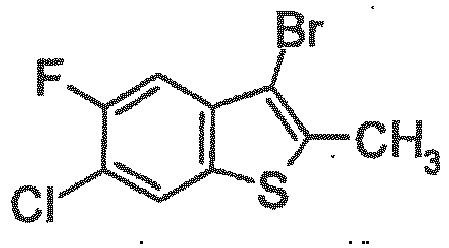
Pr3 
Pr3-1 
Pr3-2 
Pr4 
[Table 8] No. Str Pr5 
Pr6 
Pr7 
Pr7-1 
Pr8 
Pr8-1 
Pr9 
Pr10 
[Table 9] No. Str Pr10-1 
Pr10-2 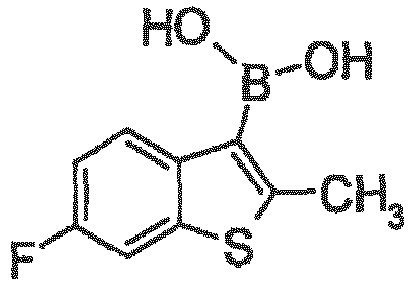
Pr10-3 
Pr10-4 
Pr11 
Pr12 
Pr13 
Pr14 
[Table 10] No. Inf Str Pr15 
Pr16 Chiral 
Pr16-1 Chiral 
Pr16-2 Chiral 
Pr16-3 
Pr17 Chiral 
Pr17-1 Chiral 
[Table 11] No. Inf Str Pr18 
Pr18-1 Chiral 
Pr19 
Pr19-1 Chiral 
Pr20 Chiral 
Pr20-1 Chiral 
[Table 12] No. Inf Str Pr21 Chiral 
Pr21-1 Chiral 
Pr21-2 Chiral 
Pr21-3 Chiral 
Pr21-4 Chiral 
Pr22 Chiral 
[Table 13] No. Inf Str Pr22-1 Chiral 
Pr22-2 Chiral 
Pr22-3 Chiral 
Pr22-4 Chiral 
[Table 14] No. Inf Str Ex1 Chiral 
[Table 15] No. Inf Str Ex2 Chiral 
Ex3 Chiral 
Ex4 Chiral 
Ex5 Chiral 
Ex6 Chiral 
Ex7 Chiral 
[Table 16] No. Inf Str Ex8 
Ex9 Chiral 
Ex10 HCl Chiral 
Ex11 HCl Chiral 
Ex12 HCl Chiral 
Ex13 HCl Chiral 
[Table 17] No. Inf Str Ex14 HCl Chiral 
Ex15 HCl Chiral 
Ex16 HCl Chiral 
Ex17 HCl Chiral 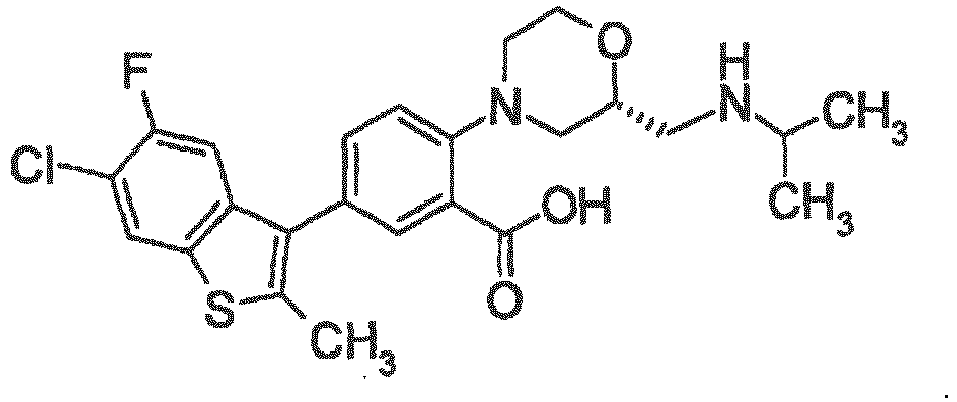
Ex18 HCl Chiral 
Ex19 HCl Chiral 
[Table 18] No. Inf Str Ex20 HCl Chiral 
Ex21 HCl Chiral 
Ex22 HCl Chiral 
Ex23 HCl 
Ex24 HCl Chiral 
Ex25 Chiral 
[Table 19] No. Inf Str Ex26 Chiral 
Ex27 Chiral 
Ex28 Chiral 
Ex29 Chiral 
Ex30 Chiral 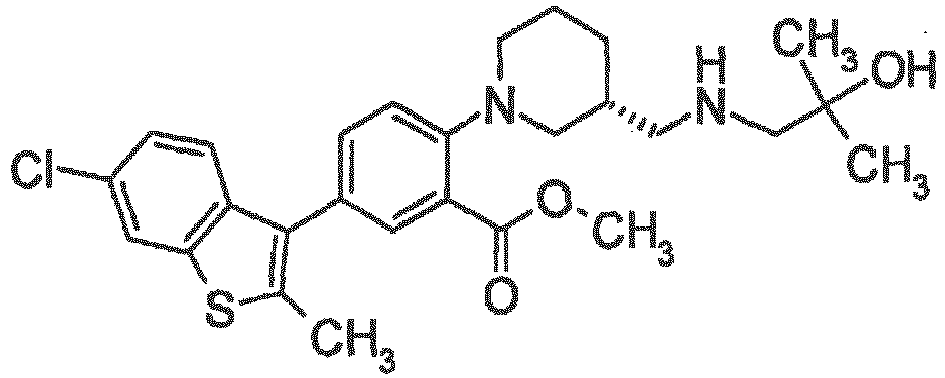
Ex31 HBr Chiral 
[Table 20] No. Ref Dat Pr1 Pr1 NMR(CDCl3):2.57(3H,d,J=1.2Hz),6.91-6.94(1H,m),7.25(1H,dd,J=2.0,8.5Hz),7.54(1H,d,J=8.5Hz),7.71(1 H,d,J=2.0Hz) Pr1-1 Pr1 NMR(CDCl3):2.55(3H,s),6.91(1H,s),7.03(1H,dt,J=2.4,8.8Hz),7.4 1(1H,dd,J=2.2,8.8Hz),7.55(1H,dd,J=5.1,8.7Hz) Pr2 Pr2 NMR(CDCl3):2.53(3H,s),7.32-7.37(1H,m),7.56-7.62(1H,m),7.67-7.71(1H,m) Pr2-1 Pr2 NMR(CDCl3):2.55(3H,s),7.46(1H,d,J=9.3Hz),7.75(1H,d,J=6.4H z) Pr3 Pr3 EI:280,282 Pr3-1 Pr3 NMR(CDCl3):2.53(3H,s),7.15(1H,dt,J=2.4,8.8Hz),7.42(1H,dd,J= 2.4,8.6Hz),7.64(1H,dd,J=5.0,8.8Hz) Pr3-2 Pr3 EI:314,316 Pr4 Pr4 NMR(CDCl3):1.92(1H,t,J=6.1Hz),4.92(2H,dd,J=0.8,6.1Hz),7.13-7.17(1H,m),7.46(1H,d,J=9.4Hz),7.82(1H,d,J=6.6Hz) Pr5 Pr5 NMR(CDCl3):4.82(2H,d,J=0.8Hz),7.22-7.24(1H,m),7.47(1H,d,J=9.3Hz),7.81(1H,d,J=6.6Hz) Pr6 Pr6 NMR(CDCl3):2.57(3H,d,J=1.2Hz),6.90(1H,brs),7.37(1H,d,J=9.6 Hz),7.72(1H,d,J=6.6Hz) Pr7 Pr7 ESI-: 229 Pr7-1 Pr7 APCI/ESI-: 279 Pr8 Pr8 EI:202 Pr8-1 Pr8 EI:236 Pr9 Pr9 NMR(CDCl3):6.67(1H,d,J=2.3Hz),7.31(1H,dd,J=1.9,8.6Hz),7.52 (1H,d,J=8.6Hz),7.61-7.65(1H,m) Pr10 Pr10 NMR(DMSO-d6+D2O):2.66(3H,s),7.34(1H,dd,J=2.0,8.7Hz),7.91-7.97(2H,m) Pr10-1 Pr10 NMR(DMSO-d6+D2O):7.71(1H,d,J=8.5Hz),8.42(1H,s),8.46(1H,s),8.55(1H,d,J =8.5Hz) Pr10-2 Pr10 ESI-: 209 Pr10-3 Pr10 APCI/ESI-: 279 Pr10-4 Pr10 ESI-: 243 [Table 21] No. Ref Dat Pr11 Pr11 NMR(DMSO-d6+D2O):7.37-7.49(1H,m),7.93-8.07(2H,m) Pr12 Pr12 EI:270 Pr13 Pr13 EI:212 Pr14 Pr14 EI:290, 292 Pr15 Pr15 EI:226 Pr16 Pr16 APCI/ESI+: 330,332 Pr16-1 Pr16 ESI+: 399, 401 Pr16-2 Pr16 ESI+:328,330 Pr16-3 Pr16 NMR(CDCl3):1.35-1.50(9H,m),1.84-2.00(2H,m),3.20-3.36(4H,m),3.41-3.63(4H,m),3.88(3H,s),6.89(1H,d,J=8.9Hz),7.36-7.43(1H,m),7.68(1H,d,J=2.6Hz) Pr17 Pr17 APCI/ESI+: 383,385 Pr17-1 Pr17 APCI/ESI+: 371,373 Pr18 Pr18 APCI/ESI+:313,315 Pr18-1 Pr18 NMR(CDCl3):1.72-1.83(1H,m),2.11-2.21(1H,m),2.91(1H,dd,J=5.2,9.9Hz),3.24-3.32(1H,m),3.34-3.43(2H,m),3.60-3.68(1H,m),3.88(3H,s),6.65(1H,d,J=9.0Hz),7.37(1H,dd,J=2.6,9. 0Hz),7.69(1H,d,J=2.6Hz) Pr19 Pr19 APCI/ESI+: 341,343 Pr19-1 Pr19 ESI+: 353, 355 Pr20 Ex25 APCI/ESI+: 383,385 Pr20-1 Ex25 APCI/ESI+: 383, 385 Pr21 Pr21 APCI/ESI+: 450 Pr21-1 Pr21-1 APCI/ESI+: 432 Pr21-2 Pr21 APCI/ESI+: 452 Pr21-3 Pr21 APCI/ESI+: 450 Pr21-4 Pr21 APCI/ESI+: 430 Pr22 Pr22 APCI/ESI+: 528 Pr22-1 Pr22-1 APCI/ESI+: 510 Pr22-2 Pr22 ESI+: 406, 408 Pr22-3 Pr22 APCI/ESI+: 530 Pr22-4 Pr22 APCI/ESI+: 528 [Table 22] No. Ref Dat Ex1 Ex1 APCI+:485 NMR(DMSO-d6):1.50-1.69(4H,m),2.06-2.13(2H,m),2.40-2.48(4H,m),2.55-2.65(2H,m),2.85-2.93(1H,m),3.11-3.18(2H,m),3.25-3.32(1H,m),3.55-3.68(2H,m),3.82(3H,s),3.88-3.93(1H,m),7.23(1H,d,J=8.5Hz),7.36-7.38(2H,m),7.50(1H,dd,J=2.3,8.5Hz),7.59(1H,d,J=2.3Hz),8.10(1H, s) NMR(CDCl3):1.59-1.79(4H,m),2.17-2.30(2H,m),2.46(3H,s),2.60(1H,dd,J=4.0,12.2Hz),2.67-2.81(2H,m),3.00(1H,dt,J=3.1,11.4Hz),3.17-3.32(3H,m),3.80-3.94(5H,m),3.97-4.04(1H,m),7.14(1H,d,J=8.4Hz),7.24(1H,dd,J=1.9,8.6Hz),7.35(1H, d,J=8.6Hz),7.41(1H,dd,J=2.2,8.4Hz),7.73(1H,d,J=2.2Hz),7.75(1H, d,J=1.9Hz) Ex2 Ex1 APCI+:469 NMR(DMSO-d6):1.46-1.68(4H,m),2.04-2.15(2H,m),2.41-2.52(4H,m),2.56-2.66(2H,m),2.86-2.94(1H,m),3.11-3.18(2H,m),3.27-3.33(1H,m),3.56-3.69(2H,m),3.82(3H,s),3.88-3.94(1H,m),7.18-7.24(2H,m),7.38(1H,dd,J=5.2,8.8Hz),7.50(1H,dd,J=2.1,8.4Hz),7.59 (1H,d,J=2.1Hz),7.87(1H,dd,J=2.4,9.2Hz) Ex3 Ex1 APCI/ESI+:539 NMR(CDCl3):1.59-1.79(4H,m),2.16-2.29(2H,m),2.56-2.82(3H,m),3.00(1H,dt,J=3.1,11.3Hz),3.16-3.32(3H,m),3.77-3.95(5H,m),3.96-4.05(1H,m),7.16(1H,d,J=8.4Hz),7.58(1H,dd,J=2.2,8.4Hz),7.60(1H, s),7.90(1H,d,J=2.2Hz),7.93(1H,s),8.24(1H,s) Ex4 Ex1 APCI+:491 Ex5 Ex1 APCI/ESI+: 489 Ex6 Ex1 APCI/ESI+: 455 Ex7 Ex1 APCI/ESI+: 489 NMR(CDCl3):1.57-1.79(4H,m),2.13-2.29(2H,m),2.53-2.80(3H,m),2.99(1H,dt,J=3.1,11.4Hz),3.17-3.31(3H,m),3.79-3.94(5H,m),3.97-4.04(1H,m),7.14(1H,d,J=8.6Hz),7.34(1H,dd,J=2.0,8.6Hz),7.54-7.59(2H,m),7.70(1H,d,J=2.0Hz),7.90(1H,d,J=2.2Hz) Ex8 Ex1 APCI/ESI+: 443 [Table 23] No. Ref Dat Ex9 Ex1 APCI/ESI+: 489 Ex10 Ex10 ESI+:471 NMR(DMSO-d6):1.68-1.88(2H,m),2.11-2.35(4H,m),2.47(3H,s),2.85-3.15(4H,m),3.16-3.33(2H,m),3.64-3.84(2H,m),3.98-4.14(2H,m),7.35-7.43(2H,m),7.55(1H,d,J=8.4Hz),7.65(1H,dd,J=2.2,8.4Hz),7.83(1H, d,J=2.2Hz),8.11-8.16(1H,m),9.10(1H,brs),9.33(1H,brs) Ex11 Ex10 APCI/ESI+: 475 NMR(DMSO-d6):1.68-1.88(2H,m),2.10-2.30(4H,m),2.80-3.14(4H,m),3.17-3.25(1H,m),3.25-3.40(1H,m),3.64-3.81 (2H,m),3.94-4.12(2H,m),7.48-7.55(2H,m),7.63(1H,d,J=8.7Hz),7.77(1H,dd,J=2.1,8.3Hz),7.96(1H, d,J=2.1Hz),8.22(1H,d,J=2.1Hz),9.03(1H,brs),9.20(1H,brs) Ex12 Ex10 APCI/ESI+: 491 NMR(DMSO-d6):1.67-1.88(2H,m),2.07-2.31(4H,m),2.86-3.14(4H,m),3.20(1H,d,J=11.7Hz),3.25-3.32(1H,m),3.64-3.82(2H,m),3.96-4.13(2H,m),7.56(1H,d,J=8.3Hz),7.78(1H,d,J=8.8Hz),7.83-7.89(1H,m),8.00-8.08(2H,m),8.19(1H,s),8.63(1H,s),9.11(1H,brs),9.40(1H,brs) Ex13 Ex10 ESI+: 455 NMR(DMSO-d6):1.69-1,86(2H,m),2.12-2.35(4H,m),2.46(3H,s),2.86-3.14(4H,m),3.17-3.24(1H,m),3.26-3.33(1H,m),3.65-3.80(2H,m),4.01 -4.11(2H,m),7.23(1H,dt,J=2.5,9.0Hz),7.39(1H,dd,J=5.2,8.8Hz),7.56 (1H,d,J=8.4Hz),7.65(1H,dd,J=2.1,8.4Hz),7.83(1H,d,J=2.1Hz),7.89( 1H,dd,J=2.4,9.1Hz),9.20(1H,brs),9.52(1H,brs) Ex14 Ex10 APCI/ESI+: 491 NMR(DMSO-d6):1.21-1.41(10H,m),1.63-1.76(1H,m),1.90-2.03(2H,m),2.11-2.22(1H,m),2.82-2.99(3H,m),3.01-3.10(1H,m),3.13-3.21(1H,m),3.35-3.42(1H,m),7.77-7.84(2H,m),7.95(1H,dd,J=2.2,8.2Hz),8.02(1H,d,J=8.6Hz),8.21(1H, d,J=2.0Hz),8.24(1H,s),8.47(1H,brs),8.58-8.74(2H,m) [Table 24] No. Ref Dat Ex15 Ex10 APCI/ESI+: 525 NMR(DMSO-d6):1.68-1.87(2H,m),2.11-2.30(4H,m),2.84-3.15(4H,m),3.16-3.34(2H,m),3.66-3.83(2H,m),3.97-4.13(2H,m),7.54(1H,d,J=8.5Hz),7.86(1H,dd,J=2.3,8.5Hz),7.99(1H, s),8.02(1H,d,J=2.3Hz),8.28(1H,s),8.80(1H,s),9.07(1H,brs),9.28(1H ,brs) Ex16 Ex10 APCI/ESI+: 473 NMR(DMSO-d6):1.31(9H,s),2.47(3H,s),2.87-3.04(2H,m),3.07-3.37(4H,m),3.72-3.82(1H,m),3.98-4.13(2H,m),7.34-7.42(2H,m),7.54(1H,d,J=8.3Hz),7.65(1H,dd,J=2.2,8.3Hz),7.83(1H, d,J=2.2Hz),8.11-8.14(1H,m),8.54(1H,brs),8.80(1H,brs) Ex17 Ex10 ESI+: 477 Ex18 Ex10 APCI/ESI+: 489 NMR(DMSO-d6):1.68-1.87(2H,m),2.11-2.35(4H,m),2.48(3H,s),2.84-3.15(4H,m),3.16-3.24(1H,m),3.25-3.34(1H,m),3.65-3.81(2H,m),3.99-4.11(2H,m),7.27(1H,d,J=10.2Hz),7.53(1H,d,J=8.3Hz),7.64(1H,dd,J =1.8,8.3Hz),7.81(1H,d,J=1.8Hz),8.30(1H,d,J=6.9Hz),9.14(1H,brs), 9.42(1H,brs) Ex19 Ex10 APCI/ESI+: 491 NMR(DMSO-d6):1.31(9H,s),2.48(3H,s),2.88-3.04(2H,m),3.06-3.27(4H,m),3.71-3.82(1H,m),3.99-4.14(2H,m),7.28(1H,d,J=10.2Hz),7.53(1H,d,J=8.3Hz),7.66(1H,dd,J =2.2,8.3Hz),7.82(1H,d,J=2.2Hz),8.31(1H,d,J=7.0Hz),8.48-8.65(1H,m),8.89-9.03(1H,m) Ex20 Ex10 ESI+: 475 Ex21 Ex10 ESI+: 441 Ex22 Ex10 ESI+: 487 Ex23 Ex10 APCI/ESI+: 429 Ex24 Ex10 APCI/ESI+: 475 [Table 25] No. Ref Dat Ex25 Ex25 APCI/ESI+: 503 NMR(CDCl3):1.61-1.79(4H,m),2.17-2.28(2H,m),2.46(3H,s),2.60(1H,dd,J=4.1,12.2Hz),2.68-2.81(2H,m),3.00(1H,dt,J=3.1,11.5Hz),3.18-3.31(3H,m),3.80-3.93(5H,m),3.97-4.04(1H,m),7.14(1H,d,J=8.4Hz),7.17(1H,d,J=9.9Hz),7.38(1H,dd,J =2.2,8.4Hz),7.71(1H,d,J=2.2Hz),7.77(1H,d,J=6.6Hz) Ex26 Ex25 APCI/ESI+: 505 NMR(CDCl3):1.59-1.81(4H,m),2.17-2.31(2H,m),2.61(1H,dd,J=4.0,12.3Hz),2.68-2.81(2H,m),3.00(1H,dt,J=3.0,11,4Hz),3.17-3.33(3H,m),3.80-3.95(5H.m),3.98-4.04(1H,m),7.15(1H,d,J=8.5Hz),7.55(1H,s),7.59-7.64(2H,m),7.91-8.00(2H,m),8.20(1H,brs) Ex27 Ex25 APCI/ESI+: 505 NMR(CDCl3):0.95-1.20(10H,m),1.68-1.95(4H,m),2.39-2.63(3H,m),2.76-2.87(1H,m),3.30-3.39(1H,m),3.43-3.55(1H,m),3.92(3H,s),7.14(1H,d,J=8.4Hz),7.53(1H,s),7.56(1H,dd, J=2.2,8.4Hz),7.61(1H,d,J=1.4,8.6),7.86(1H,d,J=2.2Hz),7.96(1H,d,J =8.6Hz),8.17-8.20(1H,m) Ex28 Ex25 APCI/ESI+: 487 NMR(CDCl3):1.11(9H,s),2.45(3H,s),2.61(1H,dd,J=4.311,5Hz),2.7 1-2.84(2H,m),3.02(1H,dt,J=3.1,11.5Hz),3.17-3.25(1H,m),3.27-3.35(1H,m),3.78-3.93(5H,m),3.97-4.04(1H,m),7.14(1H,d,J=8.3Hz),7.24(1H,dd,J=1.8,8.6Hz),7.35(1H, d,J=8.6Hz),7.40(1H,dd,J=2.1,8.3Hz),7.71(1H,d,J=2.1Hz),7.75(1H, d,J=1.8Hz) Ex29 Ex25 APCI/ESI+: 505 NMR(CDCl3):1.12(9H,s),2.46(3H,s),2.61(1H,dd,J=4.4,11.5Hz),2.7 2-2.83(2H,m),3.02(1H,dt,J=3.1,11.4Hz),3.17-3.25(1H,m),3.28-3.34(1H,m),3.78-3.94(5H,m),3.97-4.04(1H,m),7.14(1H,d,J=8.4Hz),7.18(1H,d,J=10.0Hz),7.39(1H,dd, J=2.3,8.4Hz),7.69(1H,d,J=2.3Hz),7.77(1H,d,J=6.6Hz) Ex30 Ex30 APCI/ESI+: 501 [Table 26] No. Ref Dat Ex31 Ex31 ESI+: 471 NMR(DMSO-d6):1.72-1.88(2H,m),2.07-2.26(4H,m),2.47(3H,s),2.83-3.16(4H,m),3.18-3.32(2H,m),3.68-3.82(2H,m),3.91-4.01(1H,m),4.04-4.14(1H,m),7.34-7.42(2H,m),7.54(1H,d,J=8.4Hz),7.65(1H,dd,J=2.2,8.4Hz),7.83(1H, d,J=2.0Hz),8.14(1H,dd,J=0.6,1.8Hz),8.72-8.94(2H,m) 2Θ(°)=8.3,16.3,16.9,17.2,24.0 - A compound of the present invention has an IK1 channel activation effect, and can be used as an agent for preventing and/or treating visceral pain, inflammatory pain, osteoarthritis pain, neuropathic pain, or fibromyalgia.
- In addition, according to the findings obtained in the present invention, an IK1 channel activator can also be used as an agent for preventing and/or treating inflammatory pain, osteoarthritis pain, neuropathic pain, or fibromyalgia.
Claims (20)
- A compound of the following formula (I) or a salt thereof.
 X is -O-, -CH2-, -NH-, or -N(lower alkyl)-,n is an integer of 1 to 3,R1 is -H, halogen, or lower alkyl,R2 and R3 are each the same as or different from each other, and are -H, halogen, lower alkyl, or halo-lower alkyl,R4 is -H or -Lk-NH-R0,Lk is lower alkylene or a bond,R0 is lower alkyl, -lower alkylene-OH, or cycloalkyl,provided that in a case where R4 is -H, X is -N(lower alkyl)-, andR5 is -H or lower alkyl.)
 - The compound or a salt thereof according to claim 1, wherein R4 is -Lk-NH-R0.
- The compound or a salt thereof according to claim 2, wherein X is -O- or -CH2-.
- The compound or a salt thereof according to claim 3, wherein n is 2.
- The compound or a salt thereof according to claim 4, wherein Lk is -CH2-.
- The compound or a salt thereof according to claim 5, wherein R5 is -H.
- The compound or a salt thereof according to claim 6, wherein R0 is C4 alkyl, -C4 alkylene-OH, or C3-8 cycloalkyl.
- The compound or a salt thereof according to claim 1, wherein R1 is lower alkyl, R2 is -H, R3 is halogen, R4 is -Lk-NH-R0, Lk is -CH2-, R0 is C3-8 cycloalkyl, R5 is -H, X is -O-, and n is 2.
- The compound or a salt thereof according to claim 1, wherein R1 is lower alkyl, R2 is halogen, R3 is halogen, R4 is -Lk-NH-R0, Lk is -CH2-, R0 is C3-8 cycloalkyl, R5 is -H, X is -O-, and n is 2.
- The compound or a salt thereof according to claim 7, which is selected from the following group consisting of:5-(6-chloro-2-methyl-1-benzothiophen-3-yl)-2-{(2R)-2-[(cyclobutylamino)methyl]morpholin-4-yl}benzoic acid,S-(6-chloro-2-fluoro-1-benzothiophen-3-yl)-2-{(2R)-2-[(cyclobutylamino)methyl]morpholin-4-yl}benzoic acid,2-{(3R)-3-[(tert-butylamino)methyl)piperidin-1-yl}-S-[6-(trifluoromethyl)-1-benzothiophen-3-yl]benzoic acid,5-[5-chloro-6-(trifluoromethyl)-l-benzothiophen-3-yl]-2-{(2R)-2-[(cyclobutylamino)methyl]morpholin-4-yl}benzoic acid, and5-(6-chloro-5-(fluoro-2-methyl-1-benzothiophen-3-yl)-2-{(2R)-2-[(cyclobutylamino)methyl]morpholin-4-yl} benzoic acid.
- The compound or a salt thereof according to claim 10, which is 5-(6-chloro-2-rnethyl-1-benzothiophen-3-yl)-2-{(2R)-2-[(cyclobutylamino)methyl]morpholin-4-yl}benzoic acid or a salt thereof.
- The compound or a salt thereof according to claim 10, which is 5-(6-chloro-5-fluoro-2-methyl-1-benzothiophen-3-yl)-2-{(2R)-2-[(cyclobutylamino)methyl]morpholin-4-yl}benzoic acid or a salt thereof.
- A pharmaceutical composition comprising the compound or a salt thereof according to claim 1 and a pharmaceutically acceptable excipient.
- The pharmaceutical composition according to claim 13, which is an intermediate conductance calcium-activated potassium channel activator.
- The pharmaceutical composition according to claim 13, which is a pharmaceutical composition for preventing or treating a disease selected from the group consisting of visceral pain, inflammatory pain, osteoarthritis pain, neuropathic pain, and fibromyalgia.
- Use of the compound or a salt thereof according to claim 1 for the manufacture of a pharmaceutical composition for preventing or treating a disease selected from the group consisting of visceral pain, inflammatory pain, osteoarthritis pain, neuropathic pain, and fibromyalgia.
- Use of the compound or a salt thereof according to claim 1 for preventing or treating a disease selected from the group consisting of visceral pain, inflammatory pain, osteoarthritis pain, neuropathic pain, and fibromyalgia.
- The compound or a salt thereof according to claim 1 for preventing or treating a disease selected from the group consisting of visceral pain, inflammatory pain, osteoarthritis pain, neuropathic pain, and fibromyalgia.
- A method for preventing or treating a disease selected from the group consisting of visceral pain, inflammatory pain, osteoarthritis pain, neuropathic pain, and fibromyalgia, comprising administering an effective amount of the compound or a salt thereof according to claim 1 to a subject.
- An agent for preventing or treating inflammatory pain, osteoarthritis pain, neuropathic pain, or fibromyalgia, comprising an intermediate conductance calcium-activated potassium channel activator as an active ingredient.
Priority Applications (5)
| Application Number | Priority Date | Filing Date | Title |
|---|---|---|---|
| SI201430718T SI3006443T1 (en) | 2013-06-06 | 2014-06-06 | Benzothiophene compound |
| PL14807340T PL3006443T3 (en) | 2013-06-06 | 2014-06-06 | Benzothiophene compound |
| SM20180306T SMT201800306T1 (en) | 2013-06-06 | 2014-06-06 | Benzothiophene compound |
| HRP20180722TT HRP20180722T1 (en) | 2013-06-06 | 2014-06-06 | BENZOTHOPHENE COMPOUND |
| RS20180626A RS57250B1 (en) | 2013-06-06 | 2014-06-06 | Benzothiophene compound |
Applications Claiming Priority (2)
| Application Number | Priority Date | Filing Date | Title |
|---|---|---|---|
| JP2013119416 | 2013-06-06 | ||
| PCT/JP2014/065141 WO2014196644A1 (en) | 2013-06-06 | 2014-06-06 | Benzothiophene compound |
Publications (3)
| Publication Number | Publication Date |
|---|---|
| EP3006443A1 true EP3006443A1 (en) | 2016-04-13 |
| EP3006443A4 EP3006443A4 (en) | 2016-12-21 |
| EP3006443B1 EP3006443B1 (en) | 2018-04-25 |
Family
ID=52005968
Family Applications (1)
| Application Number | Title | Priority Date | Filing Date |
|---|---|---|---|
| EP14807340.6A Active EP3006443B1 (en) | 2013-06-06 | 2014-06-06 | Benzothiophene compound |
Country Status (32)
| Country | Link |
|---|---|
| US (2) | US8981119B2 (en) |
| EP (1) | EP3006443B1 (en) |
| JP (1) | JP6314978B2 (en) |
| KR (1) | KR102253721B1 (en) |
| CN (1) | CN105263926B (en) |
| AR (1) | AR096544A1 (en) |
| AU (1) | AU2014275768B2 (en) |
| BR (1) | BR112015030533B1 (en) |
| CA (1) | CA2914606C (en) |
| CY (1) | CY1120341T1 (en) |
| DK (1) | DK3006443T3 (en) |
| ES (1) | ES2671818T3 (en) |
| HR (1) | HRP20180722T1 (en) |
| HU (1) | HUE038920T2 (en) |
| IL (1) | IL242800B (en) |
| LT (1) | LT3006443T (en) |
| MX (1) | MX2015016743A (en) |
| MY (1) | MY199155A (en) |
| NO (1) | NO3006443T3 (en) |
| PH (1) | PH12015502637B1 (en) |
| PL (1) | PL3006443T3 (en) |
| PT (1) | PT3006443T (en) |
| RS (1) | RS57250B1 (en) |
| RU (1) | RU2667507C2 (en) |
| SG (1) | SG11201509989VA (en) |
| SI (1) | SI3006443T1 (en) |
| SM (1) | SMT201800306T1 (en) |
| TR (1) | TR201808724T4 (en) |
| TW (1) | TWI624466B (en) |
| UA (1) | UA117484C2 (en) |
| WO (1) | WO2014196644A1 (en) |
| ZA (1) | ZA201508866B (en) |
Families Citing this family (1)
| Publication number | Priority date | Publication date | Assignee | Title |
|---|---|---|---|---|
| MX2022000892A (en) * | 2019-07-23 | 2022-03-11 | Astellas Pharma Global Dev Inc | Methods of treating sleep disorders associated with pain. |
Family Cites Families (9)
| Publication number | Priority date | Publication date | Assignee | Title |
|---|---|---|---|---|
| US5614639A (en) * | 1995-03-31 | 1997-03-25 | Eli Lilly And Company | Process for preparing 2-substituted benzo[b]thiophene compounds and intermediates thereof |
| JP2004532188A (en) * | 2001-02-06 | 2004-10-21 | グラクソ グループ リミテッド | Use of Bicyclic Esters or Amides for the Treatment of Disease Responding to Enhanced Potassium Channel Activity |
| WO2003005025A1 (en) * | 2001-07-03 | 2003-01-16 | Biovitrum Ab | Methods for identifying compounds modulating the activity of ppar-gamma |
| CA2520804A1 (en) * | 2003-04-03 | 2004-10-28 | Merck & Co., Inc. | Biaryl substituted pyrazoles as sodium channel blockers |
| AU2004259703A1 (en) | 2003-07-15 | 2005-02-03 | Smithkline Beecham Corporation | Novel compounds |
| WO2008054435A2 (en) * | 2006-01-09 | 2008-05-08 | The Regents Of The University Of California | Use of sk channel activators to prevent relapse/reinstatement of drugs of abuse |
| WO2009035671A1 (en) | 2007-09-12 | 2009-03-19 | Janssen Pharmaceutica N.V. | Substituted nitrogen-containing heteroaryl derivatives useful as modulators of the histamine h4 receptor |
| CN102272152B (en) * | 2008-11-10 | 2014-05-28 | 贝林格尔.英格海姆国际有限公司 | Compositions and methods for modulating cell-cell fusion via intermediate-conductance calcium-activated potassium channels |
| AR090037A1 (en) | 2011-11-15 | 2014-10-15 | Xention Ltd | DERIVATIVES OF TIENO AND / OR FURO-PYRIMIDINES AND PYRIDINES INHIBITORS OF THE POTASSIUM CHANNELS |
-
2014
- 2014-06-06 SG SG11201509989VA patent/SG11201509989VA/en unknown
- 2014-06-06 TR TR2018/08724T patent/TR201808724T4/en unknown
- 2014-06-06 PT PT148073406T patent/PT3006443T/en unknown
- 2014-06-06 LT LTEP14807340.6T patent/LT3006443T/en unknown
- 2014-06-06 CN CN201480031630.3A patent/CN105263926B/en not_active Expired - Fee Related
- 2014-06-06 TW TW103119735A patent/TWI624466B/en not_active IP Right Cessation
- 2014-06-06 JP JP2015521510A patent/JP6314978B2/en not_active Expired - Fee Related
- 2014-06-06 SM SM20180306T patent/SMT201800306T1/en unknown
- 2014-06-06 HU HUE14807340A patent/HUE038920T2/en unknown
- 2014-06-06 NO NO14807340A patent/NO3006443T3/no unknown
- 2014-06-06 US US14/298,208 patent/US8981119B2/en active Active
- 2014-06-06 DK DK14807340.6T patent/DK3006443T3/en active
- 2014-06-06 KR KR1020157036601A patent/KR102253721B1/en not_active Expired - Fee Related
- 2014-06-06 MX MX2015016743A patent/MX2015016743A/en active IP Right Grant
- 2014-06-06 EP EP14807340.6A patent/EP3006443B1/en active Active
- 2014-06-06 RS RS20180626A patent/RS57250B1/en unknown
- 2014-06-06 AR ARP140102207A patent/AR096544A1/en active IP Right Grant
- 2014-06-06 RU RU2015152150A patent/RU2667507C2/en active
- 2014-06-06 UA UAA201512058A patent/UA117484C2/en unknown
- 2014-06-06 ES ES14807340.6T patent/ES2671818T3/en active Active
- 2014-06-06 CA CA2914606A patent/CA2914606C/en active Active
- 2014-06-06 AU AU2014275768A patent/AU2014275768B2/en not_active Ceased
- 2014-06-06 MY MYPI2015704412A patent/MY199155A/en unknown
- 2014-06-06 BR BR112015030533-4A patent/BR112015030533B1/en not_active IP Right Cessation
- 2014-06-06 SI SI201430718T patent/SI3006443T1/en unknown
- 2014-06-06 WO PCT/JP2014/065141 patent/WO2014196644A1/en not_active Ceased
- 2014-06-06 HR HRP20180722TT patent/HRP20180722T1/en unknown
- 2014-06-06 PL PL14807340T patent/PL3006443T3/en unknown
-
2015
- 2015-01-23 US US14/604,404 patent/US9399038B2/en not_active Expired - Fee Related
- 2015-11-26 PH PH12015502637A patent/PH12015502637B1/en unknown
- 2015-11-26 IL IL242800A patent/IL242800B/en active IP Right Grant
- 2015-12-03 ZA ZA2015/08866A patent/ZA201508866B/en unknown
-
2018
- 2018-06-19 CY CY20181100635T patent/CY1120341T1/en unknown
Also Published As
Similar Documents
| Publication | Publication Date | Title |
|---|---|---|
| EP2716642B1 (en) | Imidazopyridine compound | |
| US8729068B2 (en) | Tetrahydrobenzothiophene compound | |
| AU2008314963A1 (en) | Oxadiazolidinedione compound | |
| EP2611772B1 (en) | 2-(benzyloxy)benzamides as lrrk2 kinase inhibitors | |
| TW200815377A (en) | Oxadiazolidinedione compound | |
| CA2735730A1 (en) | 2,4-diaminopyrimidine compound | |
| EP2096109A1 (en) | Carboxylic acid derivative | |
| WO2000068203A1 (en) | Cyclic compounds and uses thereof | |
| AU2009323259A1 (en) | 2H-chromene compound and derivative thereof | |
| CN104125956A (en) | Cyclic amides as inhibitors of 11-beta-hydroxysteroid dehydrogenase and uses thereof | |
| CA2985348A1 (en) | Ebna1 inhibitors and methods using same | |
| AU2017327304B2 (en) | Use of morphinan derivative for therapeutic treatment of opioid δ receptor agonist-related disease | |
| EP3006443B1 (en) | Benzothiophene compound | |
| WO2023146513A1 (en) | Compounds and methods of use thereof | |
| CA3212918A1 (en) | 8-cyclo-substituted quinazoline derivatives as lpa receptor 2 inhibitors | |
| HK1215570B (en) | Bensothiophene compound | |
| BR112019027678A2 (en) | benzazepine derivatives | |
| HK1129887A (en) | Oxadiazolidinedione compound | |
| HK1143811A (en) | Oxadiazolidinedione compound |
Legal Events
| Date | Code | Title | Description |
|---|---|---|---|
| PUAI | Public reference made under article 153(3) epc to a published international application that has entered the european phase |
Free format text: ORIGINAL CODE: 0009012 |
|
| 17P | Request for examination filed |
Effective date: 20151201 |
|
| AK | Designated contracting states |
Kind code of ref document: A1 Designated state(s): AL AT BE BG CH CY CZ DE DK EE ES FI FR GB GR HR HU IE IS IT LI LT LU LV MC MK MT NL NO PL PT RO RS SE SI SK SM TR |
|
| AX | Request for extension of the european patent |
Extension state: BA ME |
|
| A4 | Supplementary search report drawn up and despatched |
Effective date: 20161123 |
|
| RIC1 | Information provided on ipc code assigned before grant |
Ipc: A61K 31/551 20060101ALI20161117BHEP Ipc: A61K 31/4535 20060101ALI20161117BHEP Ipc: A61K 31/5377 20060101ALI20161117BHEP Ipc: A61P 21/00 20060101ALI20161117BHEP Ipc: A61P 19/02 20060101ALI20161117BHEP Ipc: C07D 409/10 20060101AFI20161117BHEP Ipc: A61P 43/00 20060101ALI20161117BHEP Ipc: A61K 31/4025 20060101ALI20161117BHEP Ipc: C07D 413/10 20060101ALI20161117BHEP Ipc: A61P 25/04 20060101ALI20161117BHEP Ipc: A61P 29/00 20060101ALI20161117BHEP |
|
| GRAP | Despatch of communication of intention to grant a patent |
Free format text: ORIGINAL CODE: EPIDOSNIGR1 |
|
| INTG | Intention to grant announced |
Effective date: 20171116 |
|
| GRAA | (expected) grant |
Free format text: ORIGINAL CODE: 0009210 |
|
| GRAS | Grant fee paid |
Free format text: ORIGINAL CODE: EPIDOSNIGR3 |
|
| AK | Designated contracting states |
Kind code of ref document: B1 Designated state(s): AL AT BE BG CH CY CZ DE DK EE ES FI FR GB GR HR HU IE IS IT LI LT LU LV MC MK MT NL NO PL PT RO RS SE SI SK SM TR |
|
| AX | Request for extension of the european patent |
Extension state: BA ME |
|
| REG | Reference to a national code |
Ref country code: GB Ref legal event code: FG4D |
|
| REG | Reference to a national code |
Ref country code: CH Ref legal event code: EP |
|
| REG | Reference to a national code |
Ref country code: HR Ref legal event code: TUEP Ref document number: P20180722 Country of ref document: HR |
|
| REG | Reference to a national code |
Ref country code: FR Ref legal event code: PLFP Year of fee payment: 5 |
|
| REG | Reference to a national code |
Ref country code: AT Ref legal event code: REF Ref document number: 992744 Country of ref document: AT Kind code of ref document: T Effective date: 20180515 Ref country code: CH Ref legal event code: NV Representative=s name: SERVOPATENT GMBH, CH |
|
| REG | Reference to a national code |
Ref country code: IE Ref legal event code: FG4D |
|
| REG | Reference to a national code |
Ref country code: DE Ref legal event code: R096 Ref document number: 602014024608 Country of ref document: DE |
|
| REG | Reference to a national code |
Ref country code: PT Ref legal event code: SC4A Ref document number: 3006443 Country of ref document: PT Date of ref document: 20180607 Kind code of ref document: T Free format text: AVAILABILITY OF NATIONAL TRANSLATION Effective date: 20180530 |
|
| REG | Reference to a national code |
Ref country code: ES Ref legal event code: FG2A Ref document number: 2671818 Country of ref document: ES Kind code of ref document: T3 Effective date: 20180608 |
|
| REG | Reference to a national code |
Ref country code: HR Ref legal event code: T1PR Ref document number: P20180722 Country of ref document: HR |
|
| REG | Reference to a national code |
Ref country code: RO Ref legal event code: EPE |
|
| REG | Reference to a national code |
Ref country code: DK Ref legal event code: T3 Effective date: 20180618 |
|
| REG | Reference to a national code |
Ref country code: SE Ref legal event code: TRGR |
|
| REG | Reference to a national code |
Ref country code: NL Ref legal event code: FP |
|
| REG | Reference to a national code |
Ref country code: NO Ref legal event code: T2 Effective date: 20180425 |
|
| REG | Reference to a national code |
Ref country code: EE Ref legal event code: FG4A Ref document number: E015655 Country of ref document: EE Effective date: 20180625 |
|
| REG | Reference to a national code |
Ref country code: SK Ref legal event code: T3 Ref document number: E 27659 Country of ref document: SK |
|
| REG | Reference to a national code |
Ref country code: HU Ref legal event code: AG4A Ref document number: E038920 Country of ref document: HU |
|
| REG | Reference to a national code |
Ref country code: GR Ref legal event code: EP Ref document number: 20180401604 Country of ref document: GR Effective date: 20190109 |
|
| REG | Reference to a national code |
Ref country code: DE Ref legal event code: R097 Ref document number: 602014024608 Country of ref document: DE |
|
| PLBE | No opposition filed within time limit |
Free format text: ORIGINAL CODE: 0009261 |
|
| STAA | Information on the status of an ep patent application or granted ep patent |
Free format text: STATUS: NO OPPOSITION FILED WITHIN TIME LIMIT |
|
| 26N | No opposition filed |
Effective date: 20190128 |
|
| REG | Reference to a national code |
Ref country code: HR Ref legal event code: ODRP Ref document number: P20180722 Country of ref document: HR Payment date: 20190514 Year of fee payment: 6 |
|
| REG | Reference to a national code |
Ref country code: CH Ref legal event code: PCAR Free format text: NEW ADDRESS: WANNERSTRASSE 9/1, 8045 ZUERICH (CH) |
|
| REG | Reference to a national code |
Ref country code: HR Ref legal event code: ODRP Ref document number: P20180722 Country of ref document: HR Payment date: 20200603 Year of fee payment: 7 |
|
| REG | Reference to a national code |
Ref country code: AT Ref legal event code: UEP Ref document number: 992744 Country of ref document: AT Kind code of ref document: T Effective date: 20180425 |
|
| REG | Reference to a national code |
Ref country code: HR Ref legal event code: ODRP Ref document number: P20180722 Country of ref document: HR Payment date: 20210602 Year of fee payment: 8 |
|
| REG | Reference to a national code |
Ref country code: HR Ref legal event code: ODRP Ref document number: P20180722 Country of ref document: HR Payment date: 20220603 Year of fee payment: 9 |
|
| REG | Reference to a national code |
Ref country code: HR Ref legal event code: ODRP Ref document number: P20180722 Country of ref document: HR Payment date: 20230519 Year of fee payment: 10 |
|
| P01 | Opt-out of the competence of the unified patent court (upc) registered |
Effective date: 20230512 |
|
| PGFP | Annual fee paid to national office [announced via postgrant information from national office to epo] |
Ref country code: SM Payment date: 20230522 Year of fee payment: 10 Ref country code: RS Payment date: 20230522 Year of fee payment: 10 Ref country code: RO Payment date: 20230525 Year of fee payment: 10 Ref country code: PT Payment date: 20230523 Year of fee payment: 10 Ref country code: NO Payment date: 20230628 Year of fee payment: 10 Ref country code: NL Payment date: 20230626 Year of fee payment: 10 Ref country code: MC Payment date: 20230522 Year of fee payment: 10 Ref country code: LT Payment date: 20230518 Year of fee payment: 10 Ref country code: IE Payment date: 20230627 Year of fee payment: 10 Ref country code: FR Payment date: 20230626 Year of fee payment: 10 Ref country code: EE Payment date: 20230518 Year of fee payment: 10 Ref country code: DK Payment date: 20230628 Year of fee payment: 10 Ref country code: DE Payment date: 20230626 Year of fee payment: 10 Ref country code: CZ Payment date: 20230523 Year of fee payment: 10 Ref country code: BG Payment date: 20230614 Year of fee payment: 10 |
|
| PGFP | Annual fee paid to national office [announced via postgrant information from national office to epo] |
Ref country code: TR Payment date: 20230526 Year of fee payment: 10 Ref country code: SK Payment date: 20230518 Year of fee payment: 10 Ref country code: SI Payment date: 20230519 Year of fee payment: 10 Ref country code: SE Payment date: 20230627 Year of fee payment: 10 Ref country code: PL Payment date: 20230522 Year of fee payment: 10 Ref country code: LV Payment date: 20230518 Year of fee payment: 10 Ref country code: LU Payment date: 20230627 Year of fee payment: 10 Ref country code: IS Payment date: 20230524 Year of fee payment: 10 Ref country code: HU Payment date: 20230525 Year of fee payment: 10 Ref country code: HR Payment date: 20230519 Year of fee payment: 10 Ref country code: GR Payment date: 20230629 Year of fee payment: 10 Ref country code: FI Payment date: 20230626 Year of fee payment: 10 Ref country code: AT Payment date: 20230519 Year of fee payment: 10 |
|
| PGFP | Annual fee paid to national office [announced via postgrant information from national office to epo] |
Ref country code: BE Payment date: 20230627 Year of fee payment: 10 |
|
| PGFP | Annual fee paid to national office [announced via postgrant information from national office to epo] |
Ref country code: MT Payment date: 20230518 Year of fee payment: 10 Ref country code: IT Payment date: 20230620 Year of fee payment: 10 Ref country code: GB Payment date: 20230627 Year of fee payment: 10 Ref country code: ES Payment date: 20230703 Year of fee payment: 10 Ref country code: CY Payment date: 20230522 Year of fee payment: 10 Ref country code: CH Payment date: 20230702 Year of fee payment: 10 |
|
| PGFP | Annual fee paid to national office [announced via postgrant information from national office to epo] |
Ref country code: AL Payment date: 20230603 Year of fee payment: 10 |
|
| PGFP | Annual fee paid to national office [announced via postgrant information from national office to epo] |
Ref country code: MK Payment date: 20230519 Year of fee payment: 10 |
|
| REG | Reference to a national code |
Ref country code: HR Ref legal event code: PBON Ref document number: P20180722 Country of ref document: HR Effective date: 20240606 |
|
| REG | Reference to a national code |
Ref country code: DE Ref legal event code: R119 Ref document number: 602014024608 Country of ref document: DE |
|
| REG | Reference to a national code |
Ref country code: LT Ref legal event code: MM4D Effective date: 20240606 |
|
| REG | Reference to a national code |
Ref country code: SK Ref legal event code: MM4A Ref document number: E 27659 Country of ref document: SK Effective date: 20240606 |
|
| PG25 | Lapsed in a contracting state [announced via postgrant information from national office to epo] |
Ref country code: FI Free format text: LAPSE BECAUSE OF NON-PAYMENT OF DUE FEES Effective date: 20240606 |
|
| PG25 | Lapsed in a contracting state [announced via postgrant information from national office to epo] |
Ref country code: BG Free format text: LAPSE BECAUSE OF NON-PAYMENT OF DUE FEES Effective date: 20240606 |
|
| PG25 | Lapsed in a contracting state [announced via postgrant information from national office to epo] |
Ref country code: LV Free format text: LAPSE BECAUSE OF NON-PAYMENT OF DUE FEES Effective date: 20240606 |
|
| PG25 | Lapsed in a contracting state [announced via postgrant information from national office to epo] |
Ref country code: CZ Free format text: LAPSE BECAUSE OF NON-PAYMENT OF DUE FEES Effective date: 20240606 |
|
| PG25 | Lapsed in a contracting state [announced via postgrant information from national office to epo] |
Ref country code: RO Free format text: LAPSE BECAUSE OF NON-PAYMENT OF DUE FEES Effective date: 20240606 |
|
| REG | Reference to a national code |
Ref country code: DK Ref legal event code: EBP Effective date: 20240630 |
|
| PG25 | Lapsed in a contracting state [announced via postgrant information from national office to epo] |
Ref country code: RS Free format text: LAPSE BECAUSE OF NON-PAYMENT OF DUE FEES Effective date: 20240606 |
|
| REG | Reference to a national code |
Ref country code: SE Ref legal event code: EUG |
|
| PG25 | Lapsed in a contracting state [announced via postgrant information from national office to epo] |
Ref country code: CY Free format text: LAPSE BECAUSE OF NON-PAYMENT OF DUE FEES Effective date: 20240606 |
|
| PG25 | Lapsed in a contracting state [announced via postgrant information from national office to epo] |
Ref country code: RS Free format text: LAPSE BECAUSE OF NON-PAYMENT OF DUE FEES Effective date: 20240606 Ref country code: RO Free format text: LAPSE BECAUSE OF NON-PAYMENT OF DUE FEES Effective date: 20240606 Ref country code: LV Free format text: LAPSE BECAUSE OF NON-PAYMENT OF DUE FEES Effective date: 20240606 Ref country code: FI Free format text: LAPSE BECAUSE OF NON-PAYMENT OF DUE FEES Effective date: 20240606 Ref country code: CZ Free format text: LAPSE BECAUSE OF NON-PAYMENT OF DUE FEES Effective date: 20240606 Ref country code: CY Free format text: LAPSE BECAUSE OF NON-PAYMENT OF DUE FEES Effective date: 20240606 Ref country code: BG Free format text: LAPSE BECAUSE OF NON-PAYMENT OF DUE FEES Effective date: 20240606 Ref country code: MC Free format text: LAPSE BECAUSE OF NON-PAYMENT OF DUE FEES Effective date: 20240701 |
|
| REG | Reference to a national code |
Ref country code: CH Ref legal event code: PL |
|
| REG | Reference to a national code |
Ref country code: NL Ref legal event code: MM Effective date: 20240701 |
|
| REG | Reference to a national code |
Ref country code: AT Ref legal event code: MM01 Ref document number: 992744 Country of ref document: AT Kind code of ref document: T Effective date: 20240606 |
|
| PG25 | Lapsed in a contracting state [announced via postgrant information from national office to epo] |
Ref country code: LU Free format text: LAPSE BECAUSE OF NON-PAYMENT OF DUE FEES Effective date: 20240606 |
|
| REG | Reference to a national code |
Ref country code: EE Ref legal event code: MM4A Ref document number: E015655 Country of ref document: EE Effective date: 20240630 |
|
| GBPC | Gb: european patent ceased through non-payment of renewal fee |
Effective date: 20240606 |
|
| PG25 | Lapsed in a contracting state [announced via postgrant information from national office to epo] |
Ref country code: HU Free format text: LAPSE BECAUSE OF NON-PAYMENT OF DUE FEES Effective date: 20240607 |
|
| PG25 | Lapsed in a contracting state [announced via postgrant information from national office to epo] |
Ref country code: NL Free format text: LAPSE BECAUSE OF NON-PAYMENT OF DUE FEES Effective date: 20240701 |
|
| PG25 | Lapsed in a contracting state [announced via postgrant information from national office to epo] |
Ref country code: NL Free format text: LAPSE BECAUSE OF NON-PAYMENT OF DUE FEES Effective date: 20240701 |
|
| PG25 | Lapsed in a contracting state [announced via postgrant information from national office to epo] |
Ref country code: DE Free format text: LAPSE BECAUSE OF NON-PAYMENT OF DUE FEES Effective date: 20250101 Ref country code: HR Free format text: LAPSE BECAUSE OF NON-PAYMENT OF DUE FEES Effective date: 20240606 |
|
| PG25 | Lapsed in a contracting state [announced via postgrant information from national office to epo] |
Ref country code: LT Free format text: LAPSE BECAUSE OF NON-PAYMENT OF DUE FEES Effective date: 20240606 Ref country code: SM Free format text: LAPSE BECAUSE OF NON-PAYMENT OF DUE FEES Effective date: 20250110 |
|
| PG25 | Lapsed in a contracting state [announced via postgrant information from national office to epo] |
Ref country code: IE Free format text: LAPSE BECAUSE OF NON-PAYMENT OF DUE FEES Effective date: 20240606 |
|
| PG25 | Lapsed in a contracting state [announced via postgrant information from national office to epo] |
Ref country code: NO Free format text: LAPSE BECAUSE OF NON-PAYMENT OF DUE FEES Effective date: 20240630 |
|
| PG25 | Lapsed in a contracting state [announced via postgrant information from national office to epo] |
Ref country code: EE Free format text: LAPSE BECAUSE OF NON-PAYMENT OF DUE FEES Effective date: 20240630 Ref country code: BE Free format text: LAPSE BECAUSE OF NON-PAYMENT OF DUE FEES Effective date: 20240630 Ref country code: AT Free format text: LAPSE BECAUSE OF NON-PAYMENT OF DUE FEES Effective date: 20240606 Ref country code: CH Free format text: LAPSE BECAUSE OF NON-PAYMENT OF DUE FEES Effective date: 20240630 Ref country code: GR Free format text: LAPSE BECAUSE OF NON-PAYMENT OF DUE FEES Effective date: 20250108 |
|
| PG25 | Lapsed in a contracting state [announced via postgrant information from national office to epo] |
Ref country code: FR Free format text: LAPSE BECAUSE OF NON-PAYMENT OF DUE FEES Effective date: 20240630 |
|
| PG25 | Lapsed in a contracting state [announced via postgrant information from national office to epo] |
Ref country code: SK Free format text: LAPSE BECAUSE OF NON-PAYMENT OF DUE FEES Effective date: 20240606 Ref country code: IT Free format text: LAPSE BECAUSE OF NON-PAYMENT OF DUE FEES Effective date: 20240606 Ref country code: GB Free format text: LAPSE BECAUSE OF NON-PAYMENT OF DUE FEES Effective date: 20240606 |
|
| REG | Reference to a national code |
Ref country code: BE Ref legal event code: MM Effective date: 20240630 |
|
| PG25 | Lapsed in a contracting state [announced via postgrant information from national office to epo] |
Ref country code: DK Free format text: LAPSE BECAUSE OF NON-PAYMENT OF DUE FEES Effective date: 20240630 |
|
| REG | Reference to a national code |
Ref country code: ES Ref legal event code: FD2A Effective date: 20250729 |
|
| REG | Reference to a national code |
Ref country code: SI Ref legal event code: KO00 Effective date: 20240607 |
|
| PG25 | Lapsed in a contracting state [announced via postgrant information from national office to epo] |
Ref country code: PT Free format text: LAPSE BECAUSE OF FAILURE TO SUBMIT A TRANSLATION OF THE DESCRIPTION OR TO PAY THE FEE WITHIN THE PRESCRIBED TIME-LIMIT Effective date: 20240606 |
|
| PG25 | Lapsed in a contracting state [announced via postgrant information from national office to epo] |
Ref country code: ES Free format text: LAPSE BECAUSE OF NON-PAYMENT OF DUE FEES Effective date: 20240607 |
|
| PG25 | Lapsed in a contracting state [announced via postgrant information from national office to epo] |
Ref country code: SE Free format text: LAPSE BECAUSE OF NON-PAYMENT OF DUE FEES Effective date: 20240607 |
|
| PG25 | Lapsed in a contracting state [announced via postgrant information from national office to epo] |
Ref country code: PL Free format text: LAPSE BECAUSE OF NON-PAYMENT OF DUE FEES Effective date: 20240606 |
|
| PG25 | Lapsed in a contracting state [announced via postgrant information from national office to epo] |
Ref country code: SI Free format text: LAPSE BECAUSE OF NON-PAYMENT OF DUE FEES Effective date: 20240607 |
|
| PG25 | Lapsed in a contracting state [announced via postgrant information from national office to epo] |
Ref country code: TR Free format text: LAPSE BECAUSE OF NON-PAYMENT OF DUE FEES Effective date: 20240606 |
|
| PG25 | Lapsed in a contracting state [announced via postgrant information from national office to epo] |
Ref country code: IS Free format text: LAPSE BECAUSE OF NON-PAYMENT OF DUE FEES Effective date: 20250103 |