EP3002280A1 - Cyclic triazo and diazo sodium channel blockers - Google Patents
Cyclic triazo and diazo sodium channel blockers Download PDFInfo
- Publication number
- EP3002280A1 EP3002280A1 EP15185526.9A EP15185526A EP3002280A1 EP 3002280 A1 EP3002280 A1 EP 3002280A1 EP 15185526 A EP15185526 A EP 15185526A EP 3002280 A1 EP3002280 A1 EP 3002280A1
- Authority
- EP
- European Patent Office
- Prior art keywords
- cen
- triazine
- diamino
- amino
- imino
- Prior art date
- Legal status (The legal status is an assumption and is not a legal conclusion. Google has not performed a legal analysis and makes no representation as to the accuracy of the status listed.)
- Granted
Links
- 0 CC(*)(C(*)C(C(C(*)NC)C#C)C(C(C1)C1I)C1*I)C1*=C Chemical compound CC(*)(C(*)C(C(C(*)NC)C#C)C(C(C1)C1I)C1*I)C1*=C 0.000 description 3
- VNFDUWLECZHARK-UHFFFAOYSA-N Nc1c(-c2cc(OCc3c(cccc4)c4ccc3)ccc2)nnc(N)n1 Chemical compound Nc1c(-c2cc(OCc3c(cccc4)c4ccc3)ccc2)nnc(N)n1 VNFDUWLECZHARK-UHFFFAOYSA-N 0.000 description 1
- OGOHHINIWVTSIM-UHFFFAOYSA-N Nc1c(-c2nc(Cl)ccc2Cl)nnc(N)n1 Chemical compound Nc1c(-c2nc(Cl)ccc2Cl)nnc(N)n1 OGOHHINIWVTSIM-UHFFFAOYSA-N 0.000 description 1
- RVWKIOUSPDFMSC-UHFFFAOYSA-N Nc1nc(N)nnc1-c(cn1)cc(Cl)c1Cl Chemical compound Nc1nc(N)nnc1-c(cn1)cc(Cl)c1Cl RVWKIOUSPDFMSC-UHFFFAOYSA-N 0.000 description 1
- UNVQNIJCCUHPLJ-UHFFFAOYSA-N Nc1nc(N)nnc1-c1cccc(OCc2cc3ccccc3cc2)c1 Chemical compound Nc1nc(N)nnc1-c1cccc(OCc2cc3ccccc3cc2)c1 UNVQNIJCCUHPLJ-UHFFFAOYSA-N 0.000 description 1
- TWNIUYOJGDDKHI-UHFFFAOYSA-N Nc1nc(N)nnc1-c1nc2ccccc2cc1 Chemical compound Nc1nc(N)nnc1-c1nc2ccccc2cc1 TWNIUYOJGDDKHI-UHFFFAOYSA-N 0.000 description 1
Classifications
-
- C—CHEMISTRY; METALLURGY
- C07—ORGANIC CHEMISTRY
- C07D—HETEROCYCLIC COMPOUNDS
- C07D253/00—Heterocyclic compounds containing six-membered rings having three nitrogen atoms as the only ring hetero atoms, not provided for by group C07D251/00
- C07D253/02—Heterocyclic compounds containing six-membered rings having three nitrogen atoms as the only ring hetero atoms, not provided for by group C07D251/00 not condensed with other rings
- C07D253/06—1,2,4-Triazines
- C07D253/065—1,2,4-Triazines having three double bonds between ring members or between ring members and non-ring members
- C07D253/07—1,2,4-Triazines having three double bonds between ring members or between ring members and non-ring members with hetero atoms, or with carbon atoms having three bonds to hetero atoms with at the most one bond to halogen, e.g. ester or nitrile radicals, directly attached to ring carbon atoms
- C07D253/075—Two hetero atoms, in positions 3 and 5
-
- A—HUMAN NECESSITIES
- A61—MEDICAL OR VETERINARY SCIENCE; HYGIENE
- A61P—SPECIFIC THERAPEUTIC ACTIVITY OF CHEMICAL COMPOUNDS OR MEDICINAL PREPARATIONS
- A61P25/00—Drugs for disorders of the nervous system
-
- A—HUMAN NECESSITIES
- A61—MEDICAL OR VETERINARY SCIENCE; HYGIENE
- A61P—SPECIFIC THERAPEUTIC ACTIVITY OF CHEMICAL COMPOUNDS OR MEDICINAL PREPARATIONS
- A61P25/00—Drugs for disorders of the nervous system
- A61P25/04—Centrally acting analgesics, e.g. opioids
-
- A—HUMAN NECESSITIES
- A61—MEDICAL OR VETERINARY SCIENCE; HYGIENE
- A61P—SPECIFIC THERAPEUTIC ACTIVITY OF CHEMICAL COMPOUNDS OR MEDICINAL PREPARATIONS
- A61P25/00—Drugs for disorders of the nervous system
- A61P25/06—Antimigraine agents
-
- A—HUMAN NECESSITIES
- A61—MEDICAL OR VETERINARY SCIENCE; HYGIENE
- A61P—SPECIFIC THERAPEUTIC ACTIVITY OF CHEMICAL COMPOUNDS OR MEDICINAL PREPARATIONS
- A61P25/00—Drugs for disorders of the nervous system
- A61P25/08—Antiepileptics; Anticonvulsants
-
- A—HUMAN NECESSITIES
- A61—MEDICAL OR VETERINARY SCIENCE; HYGIENE
- A61P—SPECIFIC THERAPEUTIC ACTIVITY OF CHEMICAL COMPOUNDS OR MEDICINAL PREPARATIONS
- A61P25/00—Drugs for disorders of the nervous system
- A61P25/14—Drugs for disorders of the nervous system for treating abnormal movements, e.g. chorea, dyskinesia
-
- A—HUMAN NECESSITIES
- A61—MEDICAL OR VETERINARY SCIENCE; HYGIENE
- A61P—SPECIFIC THERAPEUTIC ACTIVITY OF CHEMICAL COMPOUNDS OR MEDICINAL PREPARATIONS
- A61P25/00—Drugs for disorders of the nervous system
- A61P25/14—Drugs for disorders of the nervous system for treating abnormal movements, e.g. chorea, dyskinesia
- A61P25/16—Anti-Parkinson drugs
-
- A—HUMAN NECESSITIES
- A61—MEDICAL OR VETERINARY SCIENCE; HYGIENE
- A61P—SPECIFIC THERAPEUTIC ACTIVITY OF CHEMICAL COMPOUNDS OR MEDICINAL PREPARATIONS
- A61P25/00—Drugs for disorders of the nervous system
- A61P25/18—Antipsychotics, i.e. neuroleptics; Drugs for mania or schizophrenia
-
- A—HUMAN NECESSITIES
- A61—MEDICAL OR VETERINARY SCIENCE; HYGIENE
- A61P—SPECIFIC THERAPEUTIC ACTIVITY OF CHEMICAL COMPOUNDS OR MEDICINAL PREPARATIONS
- A61P25/00—Drugs for disorders of the nervous system
- A61P25/22—Anxiolytics
-
- A—HUMAN NECESSITIES
- A61—MEDICAL OR VETERINARY SCIENCE; HYGIENE
- A61P—SPECIFIC THERAPEUTIC ACTIVITY OF CHEMICAL COMPOUNDS OR MEDICINAL PREPARATIONS
- A61P25/00—Drugs for disorders of the nervous system
- A61P25/28—Drugs for disorders of the nervous system for treating neurodegenerative disorders of the central nervous system, e.g. nootropic agents, cognition enhancers, drugs for treating Alzheimer's disease or other forms of dementia
-
- A—HUMAN NECESSITIES
- A61—MEDICAL OR VETERINARY SCIENCE; HYGIENE
- A61P—SPECIFIC THERAPEUTIC ACTIVITY OF CHEMICAL COMPOUNDS OR MEDICINAL PREPARATIONS
- A61P27/00—Drugs for disorders of the senses
- A61P27/02—Ophthalmic agents
-
- A—HUMAN NECESSITIES
- A61—MEDICAL OR VETERINARY SCIENCE; HYGIENE
- A61P—SPECIFIC THERAPEUTIC ACTIVITY OF CHEMICAL COMPOUNDS OR MEDICINAL PREPARATIONS
- A61P27/00—Drugs for disorders of the senses
- A61P27/02—Ophthalmic agents
- A61P27/06—Antiglaucoma agents or miotics
-
- A—HUMAN NECESSITIES
- A61—MEDICAL OR VETERINARY SCIENCE; HYGIENE
- A61P—SPECIFIC THERAPEUTIC ACTIVITY OF CHEMICAL COMPOUNDS OR MEDICINAL PREPARATIONS
- A61P29/00—Non-central analgesic, antipyretic or antiinflammatory agents, e.g. antirheumatic agents; Non-steroidal antiinflammatory drugs [NSAID]
-
- A—HUMAN NECESSITIES
- A61—MEDICAL OR VETERINARY SCIENCE; HYGIENE
- A61P—SPECIFIC THERAPEUTIC ACTIVITY OF CHEMICAL COMPOUNDS OR MEDICINAL PREPARATIONS
- A61P7/00—Drugs for disorders of the blood or the extracellular fluid
-
- A—HUMAN NECESSITIES
- A61—MEDICAL OR VETERINARY SCIENCE; HYGIENE
- A61P—SPECIFIC THERAPEUTIC ACTIVITY OF CHEMICAL COMPOUNDS OR MEDICINAL PREPARATIONS
- A61P9/00—Drugs for disorders of the cardiovascular system
- A61P9/10—Drugs for disorders of the cardiovascular system for treating ischaemic or atherosclerotic diseases, e.g. antianginal drugs, coronary vasodilators, drugs for myocardial infarction, retinopathy, cerebrovascula insufficiency, renal arteriosclerosis
-
- C—CHEMISTRY; METALLURGY
- C07—ORGANIC CHEMISTRY
- C07D—HETEROCYCLIC COMPOUNDS
- C07D253/00—Heterocyclic compounds containing six-membered rings having three nitrogen atoms as the only ring hetero atoms, not provided for by group C07D251/00
- C07D253/02—Heterocyclic compounds containing six-membered rings having three nitrogen atoms as the only ring hetero atoms, not provided for by group C07D251/00 not condensed with other rings
- C07D253/06—1,2,4-Triazines
-
- C—CHEMISTRY; METALLURGY
- C07—ORGANIC CHEMISTRY
- C07D—HETEROCYCLIC COMPOUNDS
- C07D253/00—Heterocyclic compounds containing six-membered rings having three nitrogen atoms as the only ring hetero atoms, not provided for by group C07D251/00
- C07D253/02—Heterocyclic compounds containing six-membered rings having three nitrogen atoms as the only ring hetero atoms, not provided for by group C07D251/00 not condensed with other rings
- C07D253/06—1,2,4-Triazines
- C07D253/065—1,2,4-Triazines having three double bonds between ring members or between ring members and non-ring members
- C07D253/07—1,2,4-Triazines having three double bonds between ring members or between ring members and non-ring members with hetero atoms, or with carbon atoms having three bonds to hetero atoms with at the most one bond to halogen, e.g. ester or nitrile radicals, directly attached to ring carbon atoms
-
- C—CHEMISTRY; METALLURGY
- C07—ORGANIC CHEMISTRY
- C07D—HETEROCYCLIC COMPOUNDS
- C07D253/00—Heterocyclic compounds containing six-membered rings having three nitrogen atoms as the only ring hetero atoms, not provided for by group C07D251/00
- C07D253/08—Heterocyclic compounds containing six-membered rings having three nitrogen atoms as the only ring hetero atoms, not provided for by group C07D251/00 condensed with carbocyclic rings or ring systems
- C07D253/10—Condensed 1,2,4-triazines; Hydrogenated condensed 1,2,4-triazines
-
- C—CHEMISTRY; METALLURGY
- C07—ORGANIC CHEMISTRY
- C07D—HETEROCYCLIC COMPOUNDS
- C07D401/00—Heterocyclic compounds containing two or more hetero rings, having nitrogen atoms as the only ring hetero atoms, at least one ring being a six-membered ring with only one nitrogen atom
- C07D401/02—Heterocyclic compounds containing two or more hetero rings, having nitrogen atoms as the only ring hetero atoms, at least one ring being a six-membered ring with only one nitrogen atom containing two hetero rings
- C07D401/04—Heterocyclic compounds containing two or more hetero rings, having nitrogen atoms as the only ring hetero atoms, at least one ring being a six-membered ring with only one nitrogen atom containing two hetero rings directly linked by a ring-member-to-ring-member bond
-
- C—CHEMISTRY; METALLURGY
- C07—ORGANIC CHEMISTRY
- C07D—HETEROCYCLIC COMPOUNDS
- C07D405/00—Heterocyclic compounds containing both one or more hetero rings having oxygen atoms as the only ring hetero atoms, and one or more rings having nitrogen as the only ring hetero atom
- C07D405/02—Heterocyclic compounds containing both one or more hetero rings having oxygen atoms as the only ring hetero atoms, and one or more rings having nitrogen as the only ring hetero atom containing two hetero rings
- C07D405/04—Heterocyclic compounds containing both one or more hetero rings having oxygen atoms as the only ring hetero atoms, and one or more rings having nitrogen as the only ring hetero atom containing two hetero rings directly linked by a ring-member-to-ring-member bond
-
- C—CHEMISTRY; METALLURGY
- C07—ORGANIC CHEMISTRY
- C07D—HETEROCYCLIC COMPOUNDS
- C07D405/00—Heterocyclic compounds containing both one or more hetero rings having oxygen atoms as the only ring hetero atoms, and one or more rings having nitrogen as the only ring hetero atom
- C07D405/02—Heterocyclic compounds containing both one or more hetero rings having oxygen atoms as the only ring hetero atoms, and one or more rings having nitrogen as the only ring hetero atom containing two hetero rings
- C07D405/12—Heterocyclic compounds containing both one or more hetero rings having oxygen atoms as the only ring hetero atoms, and one or more rings having nitrogen as the only ring hetero atom containing two hetero rings linked by a chain containing hetero atoms as chain links
-
- C—CHEMISTRY; METALLURGY
- C07—ORGANIC CHEMISTRY
- C07D—HETEROCYCLIC COMPOUNDS
- C07D405/00—Heterocyclic compounds containing both one or more hetero rings having oxygen atoms as the only ring hetero atoms, and one or more rings having nitrogen as the only ring hetero atom
- C07D405/14—Heterocyclic compounds containing both one or more hetero rings having oxygen atoms as the only ring hetero atoms, and one or more rings having nitrogen as the only ring hetero atom containing three or more hetero rings
-
- C—CHEMISTRY; METALLURGY
- C07—ORGANIC CHEMISTRY
- C07D—HETEROCYCLIC COMPOUNDS
- C07D409/00—Heterocyclic compounds containing two or more hetero rings, at least one ring having sulfur atoms as the only ring hetero atoms
- C07D409/02—Heterocyclic compounds containing two or more hetero rings, at least one ring having sulfur atoms as the only ring hetero atoms containing two hetero rings
- C07D409/04—Heterocyclic compounds containing two or more hetero rings, at least one ring having sulfur atoms as the only ring hetero atoms containing two hetero rings directly linked by a ring-member-to-ring-member bond
-
- C—CHEMISTRY; METALLURGY
- C07—ORGANIC CHEMISTRY
- C07D—HETEROCYCLIC COMPOUNDS
- C07D409/00—Heterocyclic compounds containing two or more hetero rings, at least one ring having sulfur atoms as the only ring hetero atoms
- C07D409/02—Heterocyclic compounds containing two or more hetero rings, at least one ring having sulfur atoms as the only ring hetero atoms containing two hetero rings
- C07D409/12—Heterocyclic compounds containing two or more hetero rings, at least one ring having sulfur atoms as the only ring hetero atoms containing two hetero rings linked by a chain containing hetero atoms as chain links
-
- Y—GENERAL TAGGING OF NEW TECHNOLOGICAL DEVELOPMENTS; GENERAL TAGGING OF CROSS-SECTIONAL TECHNOLOGIES SPANNING OVER SEVERAL SECTIONS OF THE IPC; TECHNICAL SUBJECTS COVERED BY FORMER USPC CROSS-REFERENCE ART COLLECTIONS [XRACs] AND DIGESTS
- Y02—TECHNOLOGIES OR APPLICATIONS FOR MITIGATION OR ADAPTATION AGAINST CLIMATE CHANGE
- Y02A—TECHNOLOGIES FOR ADAPTATION TO CLIMATE CHANGE
- Y02A50/00—TECHNOLOGIES FOR ADAPTATION TO CLIMATE CHANGE in human health protection, e.g. against extreme weather
- Y02A50/30—Against vector-borne diseases, e.g. mosquito-borne, fly-borne, tick-borne or waterborne diseases whose impact is exacerbated by climate change
Definitions
- the present invention relates to triazine compounds and cyclic diazo analogs thereof having sodium channel blocking properties, and to use of the compounds for preparation of medicaments for treatment of associated disorders.
- R 1 is typically benzyl in which the phenyl group is optionally substituted by one or more halogen, haloalkyl or alkoxy groups, for example chloro, fluoro, trifluoromethyl, trifluoromethoxy, methoxy or ethoxy.
- the R 2 to R 6 -substituted phenyl ring suitably contains one, two or three substituents.
- Optional substituents for alkyl groups, heterocyclic or carbocyclic rings include all those disclosed in WO2008-007149 and those mentioned above, and additional groups disclosed below.
- the subject-matter of WO2008-007149 is hereby incorporated herein by reference.
- triazine substituent R1 may be optionally substituted as proposed for monocyclic and bicylic compounds above
- substituents on the A ring include phenyl and phenoxy, benzyl and benzyloxy, which may be optionally substituted on the phenyl ring with for example halogen or alkoxy or other substuents on phenyl rings mentioned above.
- This class is illustrated by the following triazines.
- A is an optionally substituted heterocyclic ring system, for example a monocyclic or bicyclic heterocycle with one or more oxygen or sulphur or nitrogen atoms, especially an aromatic heterocyclic ring system:
- nitrogen containing heterocycles such as pyridyl, indolyl, quinolyl, isoquinolyl, optionally substituted as for previously described mono and bicylic A stuctures, for example by halogen, alkyl or alkoxy, especially by 1, 2 or 3 chlorine or bromine atoms, such as chloropyridyl, anddichloropyridyl.
- the nitrogen containing heterocycles may also optional be N-substutued by alkyl such as methyl, or substutued by phenoxy or phenylthio, with the phenyl optionally substutued by halogen such as chloro.
- substituent R1 may be optionally substituted as proposed for monocyclic and bicylic triazine compounds above.
- the optional substituents for the A ring and XY ring in pyrmidines of formula (I) may include any of those proposed for the triazine compounds previously discussed. Additionally pyrimidines may be alkylated, typically methylated or ethylated, at the X position as illustrated by the compound
- pyrimidine and pyrazine compounds of formula (I) are substituted at R1 and R2, and have various A rings, as disclosed above for triazines of formula (I).
- Certain compounds of formula (I) may also be prepared by methods disclosed in EP 0 021 121 A , the entire disclosure of which is incorporated herein by reference.
- Salts of compounds of formula (I) may be obtained by the presence of a residual acid in the preparative process.
- salts may be prepared by mixing the compound of formula (I) as the free base with a pharmaceutically acceptable acid in a suitable solvent, and removing the solvent to recover the salt, or crystallising the salt from the solvent.
- compositions of the present invention will be present in an effective unit dosage form, that is to say in an amount sufficient to be effective against the disorders in vivo.
- Tablets or other forms of presentation provided in discrete units may conveniently contain an amount of compound of formula I which is effective at such dosage or as a multiple of the same, for instance units containing 5 mg to 500 mg, usually around 10 mg to 250 mg.
- the compounds of formula (I) are normally administered at a dose of from 0.01 mg/kg to 20 mg/kg per day, preferably 0.1 to 5.0 mg/kg per day.
- a well stirred mixture [paddle stirrer] of 3 - methoxy-2-naphthoyl chloride [prepared from 3-methoxy-2-naphthoic acid by standard procedure] (22.08g; 0.10mol), dry toluene (48cm 3 ), dry acetonitrile (12.0cm 3 ), copper I cyanide (12.2; 0.136mol) and Celite (5g) was heated under reflux until no acid chloride remained ( ⁇ 4.0hrs). After ⁇ 5minutes, the reaction mixture darkened and then became bright orange and viscous due to complex formation. Additional acetonitrile (15.0cm 3 ) was added which had the effect of decomposing the orange complex.
- 6-Adamantyl - 3,5-diamino- -1,2,4-triazine (500mg), methyl methanesulfonate (0.50 g, 4.5 mmol) and methanol (10 cm 3 ) were stirred at 40° for 2.5hrs .
- the solution was evaporated to dryness and the solid residue recrystallised from acetone to give the title compound as colourless prisms (435mg), mpt 128-130°.
- lodomethane (8 ml) was added to a stirred suspension of 2,4-diamino-5-(2,3-dichlorophenyl)pyrimidine (0.75 g) in methanol (12 ml). The mixture was stirred at 45 °C for 6h, cooled to room temperature, and diluted with ether (70 ml). A yellow solid deposited and was removed by filtration. This material (0.9 g) was stirred with 0.88 aqueous ammonia (6 ml) and water (10 ml) for 2 h.
- a known pyrimidine commercially available as PYRIMETHAMINE.
- Lithium hydroxide hydrate (0.20 g, 4.8 mmol) was stirred in methanol (20 ml) until dissolution was complete ca. 5 min.
- 2- ⁇ [Cyano-(2,2-difluorobenzodiox-4-yl)methyl]aminolacetamidine hydrobromide (0.40 g, 1.1 mmol) was then added in portions over 5 min and the solution stirred for 3.5h at room temperature.
- R groups can be introduced by analogy with procedures indicated above for correspondingly substituted triazines.
- the screening strategy is designed to select compounds with appropriate sodium channel blocking activity and low side effect liability. To this end all compounds are processed through the primary sodium channel assay (veratrine-evoked uptake of [ 14 C]guanidine into rat forebrain synaptosomes) and IC 50 values computed from generated concentration-effect curves. In order to complement this data IC 50 's for selected compounds to inhibit binding of [ 3 H]BTX-B are also measured.
- Another common side-effect marker is inhibition of h uman E ther-a-go-go R elated G ene potassium (hERG) potassium channel (Inward rectifying, I Kr ) activity which can be fatal due to heart failure brought about by development of long QT syndrome.
- I Kr Inward rectifying, I Kr
- a useful preliminary screen to assess potential to affect this channel is assessed by measurement of inhibition of the binding of [3H]astemizole to cell membranes expressing hERG. Selected compounds are tested for this activity by measurement of inhibition @ 10 ⁇ M. Assuming inhibition values lie between 10% and 90% it is possible to compute an extrapolated IC 50 for each compound.
- Sodium channel blockers such as Sipatrigine, which both reduces the neurological deficit and infarct volume after middle cerebral artery occlusion in rats (Smith et al, 1997) and phenytoin, (which protect retinal ganglion cell death in an experimental model of glaucoma (Hains and Waxman, 2005) show neuroprotective efficacy in a range of models of nerve degeneration.
- These failures (of electrical and ion pump activity) are associated with decreased local concentrations of ATP (Astrup et al 1981).
- ATP et al 1981
- the supernatant fractions were pooled and centrifuged at 40,000 x g (average) at 4° for 15 min and the resulting pellet resuspended in the appropriate assay buffer at a concentration of 20-25 mg wet weight per ml appropriate assay buffer.
- Homogenates were prepared by transferring the known weight of forebrain to a cooled tube containing 9 volumes of ice-cold 50mM pH 7.4 HEPES buffer. The mixture was homogenised @ 4° by 3 x 5 sec bursts of an Ultra-Turrax TM homogeniser set at maximum speed. The resulting homogenate was centrifuged at 40,000 x g (average) at 4° for 15 min and the supernatant discarded.
- Both assays were carried out using 14ml polypropylene test tubes to which a range of concentrations of the compounds under test were added. Test compounds were dissolved in DMSO and added to assays such that maximum concentration of DMSO did not exceed 2% v/v.
- [ 3 H]BTX-B binding was carried out using the method described by Catterall et al (1981), except that both bovine serum albumin and TTX were omitted from the incubation medium.
- Protein concentration was measured using BCA TM protein assay (Pierce) with Bovine Serum albumin as reference standard.
Landscapes
- Chemical & Material Sciences (AREA)
- Organic Chemistry (AREA)
- Health & Medical Sciences (AREA)
- Engineering & Computer Science (AREA)
- Bioinformatics & Cheminformatics (AREA)
- General Health & Medical Sciences (AREA)
- Animal Behavior & Ethology (AREA)
- Veterinary Medicine (AREA)
- Chemical Kinetics & Catalysis (AREA)
- General Chemical & Material Sciences (AREA)
- Medicinal Chemistry (AREA)
- Nuclear Medicine, Radiotherapy & Molecular Imaging (AREA)
- Public Health (AREA)
- Pharmacology & Pharmacy (AREA)
- Life Sciences & Earth Sciences (AREA)
- Neurosurgery (AREA)
- Biomedical Technology (AREA)
- Neurology (AREA)
- Pain & Pain Management (AREA)
- Ophthalmology & Optometry (AREA)
- Psychology (AREA)
- Psychiatry (AREA)
- Heart & Thoracic Surgery (AREA)
- Hematology (AREA)
- Urology & Nephrology (AREA)
- Hospice & Palliative Care (AREA)
- Diabetes (AREA)
- Cardiology (AREA)
- Rheumatology (AREA)
- Vascular Medicine (AREA)
- Pharmaceuticals Containing Other Organic And Inorganic Compounds (AREA)
- Plural Heterocyclic Compounds (AREA)
- Agricultural Chemicals And Associated Chemicals (AREA)
Abstract
X and Y are each N;
A is an optionally substituted phenyl group or an optionally substituted sulphur containing heterocycle;
Z is a single bond or a linking group which is a carbon atom carrying substituents R4 and R5, wherein R4 and R5 are independently selected from hydrogen, optionally substituted C1-6 alkyl and another group A, provided that no more than one of R4 or R5 are hydrogen;
R1 is hydrogen, or a substituent group selected from C1-10 alkyl, C2-10 alkenyl, benzyl, piperidine-methyl, thienyl-methyl, furyl-methyl or C3-10 cycloalkyl, any of which is optionally substituted by hydroxy, halogen, carboxamide, halo C1-4 alkyl, C1-6 alkyl or C1-6 alkoxy; or the Y nitrogen is unsubstituted;
R2 is amino or a substituent group selected from optionally substituted alkyl or phenyl groups; and
N* is =NH when R1 is hydrogen or a substituent group; or
N* is a group NRaRb where Ra and Rb are independently H or an alkyl group; or
N* is an optionally substituted piperazinyl ring.
Description
- The present invention relates to triazine compounds and cyclic diazo analogs thereof having sodium channel blocking properties, and to use of the compounds for preparation of medicaments for treatment of associated disorders.
-
US Patent No. 4,649,139 discloses compounds of the formula (A):
- Our patent application
WO2008-007149 (published after the priority date of this application) discloses use of a compound of formula (B):
- R1 is hydrogen (and =NH is NH2), or carboxamido, C1-10alkyl, C2-10alkenyl, C1-3alkyl-aryl, C1-3 alkyl-heterocyclyl, or C3-10 cycloalkyl, any of which is optionally substituted by hydroxy, halogen, carboxamido, halo C1-6alkyl, C1-6alkyl or C1-6alkoxy;
- R2 to R6 are independently selected from hydrogen, halogen, C1-6 alkyl, alkenyl, alkynyl or alkoxy (all optionally substituted by one or more of halogen, hydroxy and aryl), amino, mono- or di-substituted amino, alkenyloxy, acyl, acyloxy, cyano, nitro, aryl and alkylthio groups;
- (a) as voltage dependent sodium channel blockers for the treatment of disorders in mammals, and particularly epilepsy, multiple sclerosis, glaucoma and uevitis, cerebral traumas and cerebral ischaemias, stroke, head injury, spinal cord injury, surgical trauma, neurodegenerative disorders, motorneurone disease, Alzheimers disease, Parkinsons disease, chronic inflammatory pain, neuropathic pain, migraine, bipolar disorder, mood, anxiety and cognitive disorders, schizophrenia and trigeminal autonomic cephalalgias, especially in humans;
- (b) as antifolates for the treatment of disorders in mammals, and particularly for treatment of mammalian cancers and as antimalarials against plasmodium vivax and plasmodium falciparum malaria, especially in humans.
- As a C1-10alkyl group, R1 is suitably an unsubstituted C1-6 alkyl group, typically methyl, ethyl, i-propyl, n-propyl, i-butyl or n-butyl. Alternatively such a group may be substituted by hydroxy or halogen, such as chloro, bromo or fluoro.
- As a C2-10 alkenyl group, R1 may be an unsubstituted C2-6 alkenyl group, such as allyl.
- As a C3-10 cycloalkyl group, R1 is typically cyclohexyl, optionally substituted by one or more halogen, haloalkyl or alkoxy groups, for example chloro, fluoro, trifluoromethyl, methoxy or ethoxy.
- As a C1-3alkylaryl group, R1 is typically benzyl in which the phenyl group is optionally substituted by one or more halogen, haloalkyl or alkoxy groups, for example chloro, fluoro, trifluoromethyl, trifluoromethoxy, methoxy or ethoxy.
- As a C1-3alkyl-heterocyclyl, R1 is suitably piperidine-methyl, optionally N-substituted, or thienyl-methyl, or furyl-methyl.
- The R2 to R6-substituted phenyl ring suitably contains one, two or three substituents.
- R2 to R6 when other than hydrogen are preferably selected from halogen, halo C1-6alkyl or C1-7 alkoxy groups. Particularly preferred substitutions are 2,3 or 2,4 or 2,5 or or 3,5 or 2,3,5 di- or tri-halo (especially chloro and/or fluoro).
- In one class of compounds, R1 is not hydrogen. In another class of compounds, R2 is not hydrogen. In a further class of compounds, both R1 and R2 are not hydrogen.
- The subject matter of
WO2008-00714 - The compounds of this invention have the general structure

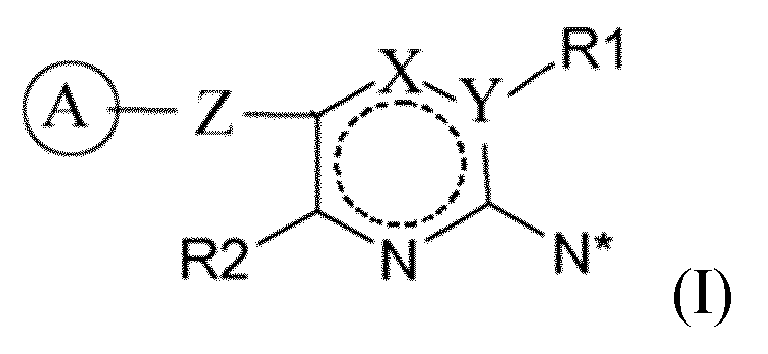
- in which X and Y are each N or C with at least one of X and Y being N;
- Z is a single bond or an optionally substituted linking group
- R1 is hydrogen or a substituent group;
- R2 is amino or a substituent group;
- N* is amino when R1 is hydrogen or =NH when R1 is a substituent group; or
- N* is a group NRaRb where Ra and Rb are independently H or an alkyl group; or
- N* is an optionally substituted piperazinyl ring; and
- A is an optionally substituted heterocyclic or carbocyclic ring system which may be linked to the triazo/diazo ring through R2 to form a fused multicyclic ring.
- As a carbocyclic entity A is typically optionally substituted phenyl or naphthyl or anthracenyl or fluorenyl or adamantyl.
- As a heterocyclic entity A is typically optionally substituted (benzo)thienyl or (benzo)furyl or (benzo)pyran or (iso)indole or (iso)quinoline or pyridine.
- When R1 is a substituent group, suitable groups include all those disclosed in
PCT/GB07/050405 - Alkyl and alkoxy groups mentioned herein typically contain 1-6 or 1-4 carbon atoms, and alkenyl groups 2-4 carbon atoms.
- When R2 is a substituent group other than amino, suitable groups include optionally substituted alkyl or phenyl groups
- When Z is linking group, it may be a carbon atom with one or two optionally substituted alkyl or phenyl groups. The alkyl groups may be linked to form a cycloalkyl group such as cyclopropyl or cyclobutyl. Z may also be an unsaturated linking group eg optionally substituted alkenyl, in which case A-Z- may be styryl.
- When N* is piperazinyl, it is typically N-alkyl piperazinyl. In particular, when X is C, Y is N and R1 is H, N* may be N-methyl piperazinyl.
- Quaternised salts may be formed with N atoms in the triazine/diazine ring.
- Optional substituents for alkyl groups, heterocyclic or carbocyclic rings include all those disclosed in
WO2008-007149 and those mentioned above, and additional groups disclosed below. The subject-matter ofWO2008-007149 is hereby incorporated herein by reference. - In one special class of compounds of general formula (I), X and Y are both N, forming a triazine ring
- Within the general structure of formula (I) there is a group of compounds in which A is a mono, bi or tricyclic carbocyclic ring system, which may be aryl, such as phenyl, naphthyl, anthracenyl or fluorenyl; or non-aryl such as adamantyl, or a mixture of aryl and non-aryl rings. In this group the ring system A is optionally substituted with substituents listed above, or especially with one of more of halogen, such as chloro or bromo, or fluoroalkyl, such as CF3, alkoxy such as OMe or OEt, or aryloxy, such as phenoxy or benzyloxy.
- In this group, typical monocylic substituents A include chlorophenyl, such as dichlorophenyl, and trichlorophenyl, for example 2,3-, 2,6- and 3,5-dichloro, and 2,3,5- trichloro; bromophenyl such as 2-bromo and 3-bromo; trifluoromethyl-phenyl such as di-trifluoromethyl for example 3,5- trifluoromethyl; (m)ethoxy-phenyl such as di(m)ethoxy and tri(m)ethoxy-phenyl for example 4,5 dimethoxy, 3,4,5 trimethoxy; fluoro(m)ethoxy-phenyl such as di(fluoro(m)ethoxy)-phenyl for example 2-fluoro(m)ethoxy, 4-fluoro(m)ethoxy and 2,4-di(fluoro(m)ethoxy).
- When the compound of formula (I) is a triazine, the Y nitrogen may be unsubstituted or carry a substituent R1 which is suitably an alkyl group such as (m)ethyl, a fluoroalkyl group such fluoro(m)ethyl, for example -CH2CHF2, -CH2CF3
- Some typical monocyclic aromatic compounds of formula (I) where A is an optionally substituted phenyl group are:
- 3,5-Diamino-6-(3,4,5 trimethoxyphenyl)-1,2,4-triazine [CEN-095]
- 3,5-Diamino-6-(2-bromophenyl)-1,2,4-triazine [CEN-068]
- 3,5-Diamino-6-(3-bromophenyl)-1,2,4-triazine [CEN-069]
- 3,5-Diamino-6-(3,5-bistrifluoromethylphenyl)-1,2,4-triazine [CEN-092]
- 3,5-Diamino-6-(2,6-dichlorophenyl)-1,2,4-triazine [CEN-104]
- 3,5-Diamino-6-(3,4-dimethoxyphenyl)-1,2,4-triazine [CEN-115]
- 3,5-Diamino-6-(2-bromophenyl)-1,2,4-triazine [CEN-068]
- 3,5-Diamino-6-(3-bromophenyl)-1,2,4-triazine [CEN-069]
- 3,5-Diamino-6-(2-trifluoromethoxyphenyl)-1,2,4-triazine [CEN-056]
- 3,5-Diamino-6-[3-(1,1,2,2-tetrafluoroethoxy)phenyl]-1,2,4-triazine [CEN-108]
- 3,5-Diamino-6-[2-(1,1,2,2-tetrafluoroethoxy)phenyl]-1,2,4-triazine [CEN-137]
- 3,5-Diamino-6-[2,5- bis(2,2,2-trifluoroethoxy)phenyl]-1,2,4-triazine [CEN-140]
- 3,5-Diamino-6-[2-difluoromethoxy)phenyl]-1,2,4-triazine [CEN-142]
- 3,5-Diamino-6-(3-chloro-5-trifluoromethylphenyl)-1,2,4-triazine [CEN-172]
- 3,5-Diamino-6-[3,5 (bis-trifluoromethyl) phenyl]-1,2,4-triazine [CEN-175]
- 3,5-Diamino-6-(2-chloro-3-trifluoromethylphenyl)-1,2,4-triazine [CEN-176]
- 3,5-Diamino-6-[2-chloro-4-(methylsulphonyl) phenyl]-1,2,4-triazine [CEN-179]
- 3,5-Diamino-6-(2,4,6-triisopropylphenyl)-1,2,4-triazine [CEN-180]
- 3,5-Diamino-6-(4-tertbutylphenyl)-1,2,4-triazine [CEN-181]
- 3,5-Diamino-6-(4-n-butylphenyl)-1,2,4-triazine [CEN-183]
- 3,5-Diamino-6-(3,5-di-tert-butylphenyl)-1,2,4-triazine [CEN-187]
- 3,5-Diamino-6-(3,5-dimethoxyphenyl)-1,2,4-triazine [CEN-192]
- 3,5-Diamino-6-[3,5-bis(2,2,2-trifluoroethoxy)phenyl]-1,2,4-triazine [CEN-193]
- 3,5-Diamino-6-(3-chloro-2-fluoro-5-trifluoromethylphenyl)-1,2,4-triazine [CEN-197]
- 3,5-Diamino-6-[2,5-bis(trifluoromethyl)phenyl]-1,2,4-triazine [CEN-198]
- 3,5-Diamino-6-(2-chloro-3-trifluoromethylphenyl)-1,2,4-triazine [CEN-199]
- 3,5-Diamino-6-(5-chloro-2-trifluoromethylphenyl)-1,2,4-triazine [CEN-200]
- 3,5-Diamino-6-(2,3,4-trifluorophenyl)-1,2,4-triazine [CEN-206]
- 3,5-Diamino-6-(2-chloro-4,5-difluorophenyl)-1,2,4-triazine [CEN-207]
- 3,5-Diamino-6-(2,3,4,5-tetrafluorophenyl)-1,2,4-triazine [CEN-208]
- 3,5-Diamino-6-(2,3-dichloro-6-trifluoromethylphenyl)-1,2,4-triazine CEN209
- [3,5-Diamino-6-(2,3,4,5,6-pentafluorophenyl)-1,2,4-triazine [CEN-212]
- 3,5-Diamino-6-(2,3,6-trichlorophenyl)-1,2,4-triazine [CEN-214]
- 5(3)-Amino-6-(2,3,5-trichlorophenyl)-2,3(2,5)-dihydro-3(5)-imino-2-(2,2-difluoroethyl)-1,2,4-triazine [CEN-085]
- 5(3)-Amino-6-(2,3,-dichlorophenyl)-2,3(2,5)-dihydro-3(5)-imino-2-(2,2,2-trifluoroethyl)-1,2,4-triazine [CEN-067]
- 5(3)-Amino-6-(2,3,-dichlorophenyl)-2,3(2,5)-dihydro-3(5)-imino-2-(2-isopropoxy)ethyl-1,2,4-triazine [CEN-091]
- 5(3)-Amino-6-phenyl-2,3(2,5)-dihydro-3(5)-imino-2-methyl-1,2,4-triazine methanesulfonate [CEN-051]
- 5(3)-Amino-6-(2,5-dichlorophenyl)-2,3(2,5)-dihydro-3(5)-imino-2-methyl-1,2,4-triazine [CEN-053]
- 5(3)-Amino-6-(3,5-dichlorophenyl)-2,3(2,5)-dihydro-3(5)-imino-2-methyl-1,2,4-triazine [CEN-059]
- 5(3)-Amino-6-(2-difluoromethoxyphenyl)-2,3(2,5)-dihydro-3(5)-imino-2-methyl-1,2,4-triazine [CEN-146]
- 5(3)-Amino-6-(2-chloro-3-trifluoromethyphenyl)-2,3(2,5)-dihydro-3(5)-imino-2-methyl-1,2,4-triazine [CEN-177]
- 5(3)-Amino-6-(3-chloro-2-fluoro-5-trifluoromethyphenyl)-2,3(2,5)-dihydro-3(5)-imino-2-methyl-1,2,4-triazine [CEN-202]
- 5(3)-Amino-6-(2-chloro-4,5-difluoro-5-phenyl)-2,3(2,5)-dihydro-3(5)-imino-2-methyl-1,2,4-triazine [CEN-204]
- 5(3)-Amino-6-phenyl-2,3(2,5)-dihydro-3(5)-imino-2-ethyl-1,2,4-triazine [CEN-052] 5(3)-Amino-6-(2,5-dichlorophenyl)-2,3(2,5)-dihydro-3(5)-imino-2-ethyl-1,2,4-triazine [CEN-054]
- 5(3)-Amino-6-(2,3,5-trichlorophenyl)-2,3(2,5)-dihydro-3(5)-imino-2-ethyl-1,2,4-triazine [CEN-055]
- 5(3)-Amino-6-(3,5-dichlorophenyl)-2,3(2,5)-dihydro-3(5)-imino-2-ethyl-1,2,4-triazine [CEN-060]
- 5(3)-Amino-6-(2-naphthyl)-2,3(2,5)-dihydro-3(5)-imino-2-ethyl-1,2,4-triazine [CEN-075]
- 5(3)-Amino-6-(3,4,5-trimethoxyphenyl)-2,3(2,5)-dihydro-3(5)-imino-2-ethyl-1,2,4-triazine [CEN-119]
- 5(3)-Amino-6-(2-chloro-3-trifluoromethyphenyl)-2,3(2,5)-dihydro-3(5)-imino-2-ethyl-1,2,4-triazine [CEN-178]
- 5(3)-Amino-6-(3,5-bis-tert-butylphenyl)-2,3(2,5)-dihydro-3(5)-imino-2-ethyl-1,2,4-triazine[CEN-189]
- 5(3)-Amino-6-(3-chloro-2-fluoro-5-trifluoromethyphenyl)-2,3(2,5)-dihydro-3(5)-imino-2-ethyl-1,2,4-triazine [CEN-203]
- 5(3)-Amino-6-(2-chloro-4,5-difluoro-5-phenyl)-2,3(2,5)-dihydro-3(5)-imino-2-ethyl-1,2,4-triazine [CEN-205]
- 5(3)-Amino-6-(3,4,5-trimethoxyphenyl)-2,3(2,5)-dihydro-3(5)-imino-2-methyl-1,2,4-triazine [CEN-101]
- 5(3)-Amino-6-[3,5-(bis-trifluoromethyl)phenyl]-2,3(2,5)-dihydro-3(5)-imino-2-methyl-1,2,4-triazine [CEN-099]
- 5(3)-Amino-6-(3-chloro-2-fluoro-5-trifluoromethyphenyl)-2,3(2,5)-dihydro-3(5)-imino-2-(2,2,3,3-tetrafluoropropyl)-1,2,4-triazine [CEN-210]
- 5(3)-Amino-6-(3-chloro-2-fluoro-5-trifluoromethyphenyl)-2,3(2,5)-dihydro-3(5)-imino-2-(2,2,3,3,3-pentafluoropropyl)-1,2,4-triazine [CEN-211]
- In this group, typical bicyclic substituents A are naphthyl such as 1-naphthyl and 2-naphthyl or tetrahydronaphthyl, or alkylenedioxphenyl such as (m)ethylenedioxyphenyl or benzodioxolo, all of which may be optionally substituted, for example substituted by one or more halogens such as bromo, for example 6-bromonaphthyl, or fluoro, for example 2,2-difluorobenzodioxolo, or by one or more alkoxy groups such as (m)ethoxy for example 2- or 3-(m)ethoxynaphthyl, or 1,4-, 2,5- or 3,7-di(m)ethoxynaphthyl,.
- As before, when the compound of formula (I) with bicyclic substituents A is a triazine, , the Y nitrogen may be unsubstituted or substituent R1 may suitably be an alkyl group such as (m)ethyl, a fluoroalkyl group such fluoro(m)ethyl, for example -CH2CHF2, -CH2CF3
- Some typical compounds of formula (I) where A is a bicyclic substituent are:
- 6-(1-Naphthyl)-1,2,4-triazine-3,5-diamine [CEN-072]
- 3,5-Diamino-6-(2-naphthyl)-1,2,4-triazine [CEN-073]
- 3,5-Diamino-6-[2-(6-bromonaphthyl)-1,2,4-triazine [CEN-096]
- 3,5-Diamino-6-[1-(5,6,7,8-tetrahydronaphthyl)-1,2,4-triazine [CEN-094]
- 3,5-Diamino-6-[2-(3-methoxynaphthyl)-1,2,4-triazine [CEN-139]
- 3,5-Diamino-6-[1-(2-ethoxynaphthyl)-1,2,4-triazine [CEN-110]
- 3,5-Diamino-6-[2-(3-ethoxynaphthyl)-1,2,4-triazine [CEN-141]
- 3,5-Diamino-6-[2-(3,7-dimethoxynaphthyl)-1,2,4-triazine [CEN-143]
- 3,5-Diamino-6-[2-(1,4-dimethoxynaphthyl)-1,2,4-triazine [CEN-151]
- 3,5-Diamino-6-[1-(2,5-dimethoxynaphthyl)-1,2,4-triazine [CEN-156]
- 3,5-Diamino-6-[1-(2,5-dimethoxynaphthyl)-1,2,4-triazine [CEN-157]
- 3,5-Diamino-6-[1-(2,5-dimethoxynaphthyl)-1,2,4-triazine [CEN-158]
- 5(3)-Amino-6-(1-naphthyl)-2,3(2,5)-dihydro-3(5)-imino-2-ethyl-1,2,4-triazine [CEN-077]
- 5(3)-Amino-6-(1-naphthyl)-2,3(2,5)-dihydro-3(5)-imino-2-methyl-1,2,4-triazine [CEN-078]
- 5(3)-Amino-6-(2-naphthyl)-2,3(2,5)-dihydro-3(5)-imino-2-methyl-1,2,4-triazine [CEN-076]
- 5(3)-Amino-6-[1-(5,6,7,8-tetrahydronaphthyl)]-2,3(2,5)-dihydro-3(5)-imino-2-methyl-1,2,4-triazine [CEN-120]
- 5(3)-Amino-6-(2-naphthyl)-2,3(2,5)-dihydro-3(5)-imino-2-ethyl-1,2,4-triazine [CEN-075]
- 3,5-Diamino-6-[5-(2,2-difluorobenzodioxolo)]-1,2,4-triazine [CEN-117]
- 3,5-Diamino-6-[4-(2,2-difluorobenzodioxolo)]-1,2,4-triazine [CEN-070]
- 5(3)-Amino-6-[5-(2,2-difluorobenzodioxolo)]-dihydro-3(5)-imino-2-methyl-1,2,4-triazine [CEN-081]
- 3,5-Diamino-6-(3,4-ethylenedioxyphenyl)-1,2,4-triazine [CEN-109]
- 3,5-Diamino-6-(3,4-methylenedioxyphenyl)-1,2,4-triazine [CEN-103]
- In this group, typical tricyclic substituents A are fused rings containing one or more aromatic rings such as anthracenyl or fluorenyl, or non aromatic such as adamantyl, all of which may be optionally substituted by groups proposed for monocyclic and bicylic compounds above. Again, when the compound of formula (I) with tricyclic substituents A is a triazine, substituent R1 may be optionally substituted as proposed for monocyclic and bicylic compounds above Typical tricyclic compounds of formula (I) are
- 6-(9-Anthracenyl)- 3,5-diamino-1,2,4-triazine [CEN-118]
- 3,5-Diamino-6-[4-(9H-fluorenyl)-1,2,4-triazine [CEN-129]
- 6-Adamantyl-3,5-diamino-1,2,4-triazine [CEN-083]
- 6-Adamantyl-5(3)-amino-2,3(2,5)-dihydro-3(5)-imino-2-methyl-1,2,4-triazine [CEN-100]
- In a class of compounds where R2 in formula (I) is not amino, R2 may suitably be a phenyl or substituted phenyl group, such as alkyl or alkoxyphenyl, or halophenyl; for example as in the illustrative triazine compounds below, which are a special group of compounds in which R2 and A are the same grouping, generating a bis-aryl structure.
- As previously, triazine substituent R1 may be optionally substituted as proposed for monocyclic and bicylic compounds above
- Illustrative bis-phenyl triazine compounds are:
- 3-Amino-5,6-bis(4-methylphenyl) -1,2,4-triazine [CEN-126]
- 3-Amino-5,6-bis(2-chlorophenyl) -1,2,4-triazine [CEN-132]
- 3-Amino-5,6-bis(4-methoxylphenyl) -1,2,4-triazine [CEN-127]
- 3-Amino-2-methyl-5,6-bis(4-methylphenyl)-1,2,4-triazine [CEN-134]
- In another class of compounds of formula (I), the ring system A my be linked with substituent R2 to form a fused ring structure, as in the illustrative triazine compounds below:

- The compounds may be optionally substituted on the fused ring structure and at the R1 position as for the previously described compounds.
- In a special embodiment, two structures of general formula (I) are linked together via their respective A rings. For example when A is optional substituted phenyl or naphthyl the linkage may be via a methylene or ether bridge, as in the compounds below.


- In a variation of this embodiment, a ring A structure is shared between two triazine moieties, as illustrated below.

- The invention includes within its scope compounds of this general bis-format in which the A ring is any other of those described herein, such as bicylic and tricylic structures already described or heterocyclic structures to be described below. Also the triazine rings may be replaced with pyrimidine and pyrazine rings described below.
- In special class of compounds of formula (I), substituents on the A ring include phenyl and phenoxy, benzyl and benzyloxy, which may be optionally substituted on the phenyl ring with for example halogen or alkoxy or other substuents on phenyl rings mentioned above. This class is illustrated by the following triazines.
- 3,5-Diamino-6-(2-biphenyl)-1,2,4-triazine [CEN-074]
- 3,5-Diamino-6-(4-biphenyl)-1,2,4-triazine [CEN-082]
- 3,5-Diamino-6-(3-phenoxphenyl)-1,2,4-triazine [CEN-084]
- 3,5-Diamino-6-(4-phenoxphenyl)-1,2,4-triazine [CEN-093]
- 3,5-Diamino-6-(2-phenoxphenyl)-1,2,4-triazine [CEN-097]
- 5(3)-Amino-6-(4-phenoxyphenyl)-2,3(2,5)-dihydro-3(5)-imino-2-methyl-1,2,4-triazine [CEN-102]
- 5(3)-Amino-6-(2-phenoxyphenyl)-2,3(2,5)-dihydro-3(5)-imino-2-methyl-1,2,4-triazine [CEN-105]
- 5(3)-Amino-6-(3-phenoxyphenyl)-2,3(2,5)-dihydro-3(5)-imino-2-methyl-1,2,4-triazine [CEN-106]
- 3,5-Diamino-6-(3-Benzyloxyphenyl)-1,2,4-triazine [8] [CEN - 123]
- 3,5-Diamino-6-(4-Benzyloxyphenyl)-1,2,4-triazine [CEN - 131]
- 3,5-Diamino-6-[3-(2,4-dichlorobenzyloxyphenyl)]-1,2,4-triazine [CEN - 144]
- 3,5-Diamino-6-(2-Benzyloxyphenyl)-1,2,4-triazine [CEN - 160]
- 3,5-Diamino-6-[3-(2,4-trifluoromethylbenzyloxy)phenyl]-1,2,4-triazine [CEN -171]
- 3,5-Diamino-6-[3-(2,6-dichlorobenzyloxy)phenyl]-1,2,4-triazine [CEN-185]
- 3,5-Diamino-6-(3-phenylphenyl)-1,2,4-triazine [CEN-159]
- In another class of compounds in general structure (I), A is an optionally substituted heterocyclic ring system, for example a monocyclic or bicyclic heterocycle with one or more oxygen or sulphur or nitrogen atoms, especially an aromatic heterocyclic ring system:
- e.g. sulphur containing heterocycles such as thienyl and benzothienyl, optionally substituted as for previously described mono and bicylic A stuctures, for example by halogen, alkyl or alkoxy, especially by 1, 2 or 3 chlorine or bromine atoms.
- Typical compounds of this class are:
- 3,5-Diamino-6-(2-thienyl)-1,2,4-triazine [CEN-057]
- 3,5-Diamino-6-(3-thienyl)-1,2,4-triazine [CEN-064]
- 3,5-Diamino-6-[3-(2,5 dichlorothienyl)]-1,2,4-triazine [CEN-071]
- 3,5-Diamino-6-[2-(3,4,5 trichlorothienyl)]-1,2,4-triazine [CEN-079]
- 5(3)-Amino-6-(2-thienyl)-2,3(2,5)-dihydro-3(5)-imino-2-methyl-1,2,4-triazine [CEN-061]
- 5(3)-Amino-6-(2-thienyl)-2,3(2,5)-dihydro-3(5)-imino-2-ethyl-1,2,4-triazine [CEN-062]
- 5(3)-Amino-6-[3-(2,5-dichlorothienyl)]-2,3(2,5)-dihydro-3(5)-imino-2-methyl-1,2,4-triazine [CEN-080]
- 5(3)-Amino-6-{2-(3,4,5-trichloro)thienyl}-2,3(2,5)-dihydro-3(5)-imino-2-methyl-1,2,4-triazine [CEN-194]
- 5(3)-Amino-6-{2-(3,4,5-trichloro)thienyl}-2,3(2,5)-dihydro-3(5)-imino-2-ethyl-1,2,4-triazine [CEN-195]
- 3,5-Diamino-6-[2-(4,5-dibromothienyl)]-1,2,4-triazine [CEN-122]
- 3,5-Diamino-6-[2-(5-bromothienyl)]-1,2,4-triazine [CEN-124]
- 3,5-Diamino-6-[2-(3-bromothienyl)]-1,2,4-triazine [CEN-125]
- 3,5-Diamino-6-[2-(5-chlorothienyl)]-1,2,4-triazine [CEN-138]
- 3,5-Diamino-6-[2-(benzo[b]thiophenyl)]-1,2,4-triazine [CEN-113]
- 3,5-Diamino-6-[2-(3-chlorobenzo[b]thiophenyl)]-1,2,4-triazine [CEN-114]
- Typical compounds of this class are:
- 3,5-Diamino-6-[2-(5-phenylfuryl)]-1,2,4-triazine [CEN-107]
- 3,5-Diamino-6-[2-(4,5-dibromofuryl)]-1,2,4-triazine [CEN-121]
- 3,5-Diamino-6-[3-(2-oxo-2H-1-benzopyranyl)-1,2,4-triazine [CEN-133]
- 5(3)-Amino-6-[2-(4,5-dibromofuryl)]-2,3(2,5)-dihydro-3(5)-imino-2-methyl-1,2,4-triazine methanesulfonate [CEN-135]
- e.g. nitrogen containing heterocycles, such as pyridyl, indolyl, quinolyl, isoquinolyl, optionally substituted as for previously described mono and bicylic A stuctures, for example by halogen, alkyl or alkoxy, especially by 1, 2 or 3 chlorine or bromine atoms, such as chloropyridyl, anddichloropyridyl. The nitrogen containing heterocycles may also optional be N-substutued by alkyl such as methyl, or substutued by phenoxy or phenylthio, with the phenyl optionally substutued by halogen such as chloro.
- Typical compounds of this class are:
- 3,5-Diamino-6-[3-(2-chloropyridyl)]-1,2,4-triazine [CEN-164]
- 3,5-Diamino-6-[2-(6-chloropyridyl)]-1,2,4-triazine [CEN-166]
- 3,5-Diamino-6-[3-(2-phenoxypyridyl)]-1,2,4-triazine [CEN-167]
- 3,5-Diamino-6-[3-(5,6-dichloropyridyl)]-1,2,4-triazine [CEN-168]
- 3,5-Diamino-6-(2-quinolyl)-1,2,4-triazine [CEN-173]
- 3,5-Diamino-6-[3-(2,6-dichloropyridyl)]-1,2,4-triazine [CEN-174]
- 3,5-Diamino-6-[3-(6-chloro-pyridyl)]-1,2,4-triazine [CEN-191]
- In the heterocyclic systems, optional substituents for the A ring include those disclosed for the carbocyclic A rings. As previously, in triazines, substituent R1 may be optionally substituted as proposed for monocyclic and bicylic compounds above
- In an analogous manner to the previously decribed bis-phenyl triazine compounds, the invention includes bis-heterocycle compounds as illustrated by the compound 3-Amino-5,6-bis(2-furyl)-1,2,4-triazine [CEN-196]
- In another class of compounds within general structure (I), Z is entity other than a single bond. Within this class there is a group of compounds in which Z is an optionally substituted cycloalkyl ring eg a cyclohexyl ring, interposed between the structure A and the XY ring, or in which Z is an alkenyl bridge, optionally substituted by, for example alkyl such as methyl, or by cyano, as in the illustrative compound
- 3,5-Diamino-6-[E-2-(3-phenyl)propenyl]-1,2,4-triazine [CEN-112]
- Also within this class of compounds with a bridge between the A ring and the XY ring, there is group of compounds represented by general formula (V)

- Suitable alkyl groups for R3, R4 or R5 include methyl, ethyl, propyl and butyl. Alkyl groups may be substituted, for example, by halogen or alkoxy groups.
- When one or more of R3, R4 and R5 is a heterocyclic or carbocyclic ring system as proposed for ring A, typical examples are phenyl, naphthyl, xanthyl, as representatives of monocyclic, bicylic and tricylic moieties mentioned previously. Optional substituents as proposed for ring A may be present, such as halogens (chloro, fluoro, bromo) and alkoxy, for example methoxy.
- One or more of the R3, R4 and R5 substituents may be connected to the common carbon atom via an oxygen atom, for example, as an optionally substituted phenoxy group.
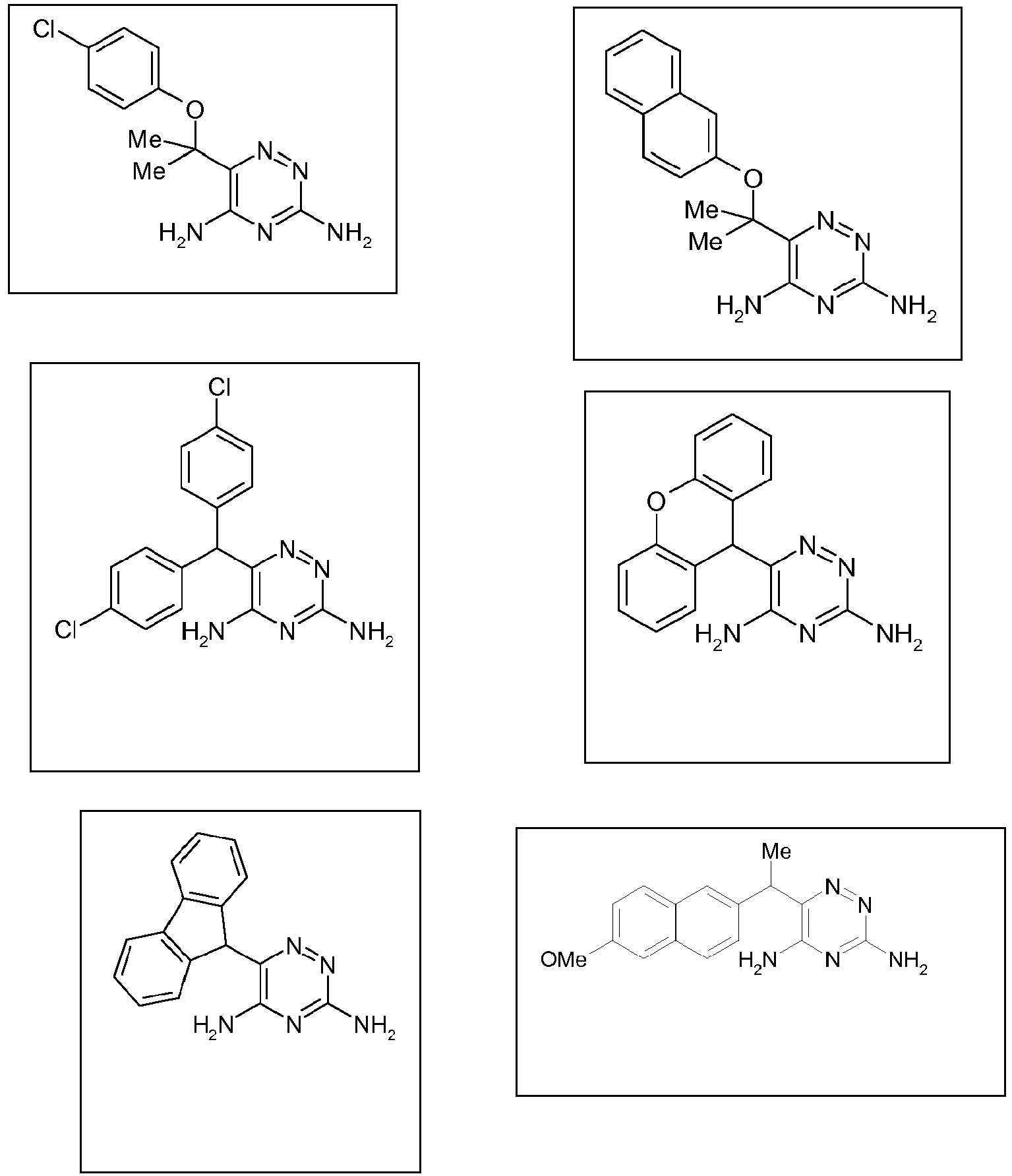
- Typical triazine compounds of formula (V) are shown below for illustration of this group.
- 3,5-Diamino-6-(diphenylmethyl)-1,2,4-triazine [R3=H, R4=R5 = Ph [CEN-130]
- 3,5-Diamino-6-(1,1-diphenylethyl)-1,2,4-triazine [R3=Me, R4=R5 = Ph] [CEN-147]
- 5(3)-Amino-6-(1,1-diphenylethyl)-2,3(2,5)-dihydro-3(5)-imino-2-methyl-1,2,4-triazine [CEN-149]
- 3,5-Diamino-6-(triphenylmethyl)-1,2,4-triazine [R3=R4=R5 = Ph] [CEN - 153]
- 3,5-Diamino-6-(1-cyclopentyl-1-phenyl)-1,2,4-triazine [R3=cyclopentyl, R4=Ph, R5=H] [CEN-163]
- 3,5-Diamino-6-[1-(6-methoxynaphthalene)methyl)-1,2,4-triazine [R3=6-methoxynaphthyl, R4=Me, R5=H] [CEN-165]
- 3,5-Diamino-6-(1-propylbutyl)-1,2,4-triazine [R3=R4=propyl, R5=H] [CEN-170]
- 3,5-Diamino-6-[1-(6-methoxynaphthalene)ethyl)-1,2,4-triazine [R3 + R4=xanthyl, R5=H] [CEN-182]
- 3,5-Diamino-6-(1-isopropyl-1-phenylmethy)-1,2,4-triazine [R3= isopropyl, R4=phenyl, R5=H] [CEN-201]
- 3,5-Diamino-6-[1,1 bis-(4-chlorophenyl)methyl]-1,2,4-triazine [R3= R4= 4-chlorophenyl, R5=H] [CEN-213]
- 3,5-Diamino-6-{1-(4-chlorophenoxy)-1-methyl}ethyl-1,2,4-triazine tosylate [CEN 215]
- In a modification of formula (V), two of R3, R4 and R5, as two alkyl groups are linked together to form a cycloalkyl group, such as cyclopropyl, cyclobutyl, cyclopentyl or cyclohexyl group. Illustrative of this modification are the compounds
- 5(3)-Amino-6-{1-[1-(4-chlorophenyl)]cyclopentyl}-2,3(2,5)-dihydro-3(5)-imino-2-methyl-1,2,4-triazine [CEN-150]
- 3,5-Diamino-6-[1-(4-chlorophenyl)-1-cyclopenty]-1,2,4-triazine [CEN-148]
- 3,5-Diamino-6-[1-(4-chlorophenyl)-1-cyclohexyl]-1,2,4-triazine [CEN-145]
- 3,5-Diamino-6-[1-(4-chlorophenyl)-1-cyclobuty]-1,2,4-triazine [CEN-152]
- 3,5-Diamino-6-[1-(4-chlorophenyl)-1-cyclopropyl]-1,2,4-triazine [CEN-154]
- As previously, in triazines, substituent R1 may be optionally substituted as proposed for monocyclic and bicylic triazine compounds above.
- In one special class of compounds of general structure (I), X is N and Y is H, forming a pyrazine ring.
- Within that class typical compounds are
- 2,6-Diamino-3-(2,3,5-trichlorophenyl)pyrazine [CEN-86]
- 2,6-Diamino-3-(2,3-dichlorophenyl)pyrazine [CEN-87]
- 2,6-Diamino-3-(2-naphthyl)pyrazine [CEN-88]
- 2,6-Diamino-3-(2,2-difluorobenzodioxol-4-yl)pyrazine [CEN-89]
- The optional substituents for the A ring and XY ring in pyrazines of formula (I) may include any of those proposed for the triazine compounds previously discussed. Additionally pyrazines may be N-alkylated, typically N-methylated, at the X position as illustrated by the compound

- In another special class of compounds of general structure (I), X is H and Y is N, forming a pyrimidine ring.
- Within that class typical compounds are
- 2,4-Diamino-5-(2,3-dichlorophenyl)pyrimidine, [CEN-41]
- 4(2)-Amino-5-(2,3-dichlorophenyl)-2,4(2,5)-dihydro-2(4)-imino-1-methyl pyrimidine [CEN-42]
- 4(2)-Amino-5-(2,3-dichlorophenyl)-2,4(2,5)-dihydro-2(4)-imino-1-methylpyrimidine [CEN-43]
- 2,4- Diamino- 5- (2,3,5-trichlorophenyl)pyrimidine [CEN-047]
- The optional substituents for the A ring and XY ring in pyrmidines of formula (I) may include any of those proposed for the triazine compounds previously discussed. Additionally pyrimidines may be alkylated, typically methylated or ethylated, at the X position as illustrated by the compound
- 2,4-Diamino-5-(4-chlorophenyl)-6-ethyl-pyrimidine [CEN-048]
- The invention also includes use of piperazinyl pyrimidines of formaula (I) as illustrated by

EP-A-0372934 . - Further pyrimidine and pyrazine compounds of formula (I) are substituted at R1 and R2, and have various A rings, as disclosed above for triazines of formula (I).
- Further compounds that show variants of the substitution pattern within the scope of formula (I) are illustrated by compounds which may be prepared by procedure (4) below
- Or illustrated by compounds which may be prepared by procedure (3) below


- Or illustrated by compounds which may be prepared by procedure (1) below


- The use of salts of the compounds of formula (I) form an aspect of this invention. Preferred salts are pharmaceutically acceptable acid addition salts. Suitable pharmaceutically acceptable acid addition salts include those formed with both organic and inorganic acids, for example from hydrochloric, sulphuric, citric, tartaric, phosphoric, lactic, pyruvic, acetic, malonic, succinic, oxalic, fumaric, maleic, oxaloacetic, methanesulphonic, p-toluenesulphonic, benzene-sulphonic, glutamic, naphthoic, and isethionic acids. Ethanesulfonate, malate, mandalate, benzoate, and salicylate salts are also suitable.
- In preparation of the compounds of formula (I), the compound or its salt may be obtained as a solvate of the reaction solvent or crystallisation solvent or a component thereof. Use of such solvates forms another aspect of this invention. Suitable pharmaceutically acceptable solvates include hydrates.
- Certain compounds of structure (I) have chiral centres and may occur as racemates, racemic mixtures and as individual enantiomers or diastereomers. All such isomeric forms are included within the present invention. Also included within the scope of the invention are all geometric isomers of the compound of formula (I) whether as individual isomers or mixtures thereof. Thus compounds of structure (I) in the trans and cis configuration form a further aspect of the invention; also all other tautomeric form of structure (I), including mixtures thereof. Furthermore, some of the crystalline forms of the compounds of structure (I) may exist as polymorphs, which are all included in the present invention.
- Certain compounds of formula (I) may be prepared by the procedures disclosed in the above-mentioned
US Patent No. 4,649,139 , the entire disclosure of which is incorporated herein by reference. - Certain compounds of formula (I) may also be prepared by methods disclosed in
EP 0 021 121 A , the entire disclosure of which is incorporated herein by reference. - The preparation of specific compounds mentioned above is illustrated later in this specification. Related compounds within the scope of the invention may be prepared by obvious or routine variations of the disclosed processes, using appropriate starting materials to introduce the desired substituents and moieties of compounds within the scope of formula (I).
- Salts of compounds of formula (I) may be obtained by the presence of a residual acid in the preparative process. Alternatively salts may be prepared by mixing the compound of formula (I) as the free base with a pharmaceutically acceptable acid in a suitable solvent, and removing the solvent to recover the salt, or crystallising the salt from the solvent.
- In a further aspect, the present invention provides pharmaceutical compositions for the treatment of disorders such as epilepsy, multiple sclerosis, glaucoma and uevitis, cerebral traumas and cerebral ischaemias, stroke, head injury, spinal cord injury, surgical trauma, neurodegenerative disorders, motorneurone disease, Alzheimers disease, Parkinsons disease, chronic inflammatory pain, neuropathic pain, migraine, bipolar disorder, mood, anxiety and cognitive disorders, schizophrenia and trigeminal autonomic cephalalgias; for treatment of mammalian cancers; and for treatment of malaria; comprising a compound of formula (I), or a pharmaceutically acceptable salt or solvate thereof, in admixture with a pharmaceutically acceptable carrier.
- The compounds of formula (I) will be present in the compositions of the present invention in an effective unit dosage form, that is to say in an amount sufficient to be effective against the disorders in vivo.
- The pharmaceutically acceptable carriers present in the compositions of the present invention may be materials conventionally used for the purpose of administering the medicament. These may be liquid or solid materials, which are otherwise inert or medically acceptable and are compatible with the active ingredients.
- These pharmaceutical compositions may be given orally or parenterally, for example as a suppository, ointment, cream, powder or trans-dermal patch. However, oral administration and intravenous injection of the compositions are preferred.
- For oral administration, fine powders or granules will contain diluting, dispersing and/or surface active agents, and may be presented in draught, in water or in a syrup, in capsules or sachets in the dry state or in non-aqueous suspension wherein suspending agents may be included, or in a suspension in water or syrup. Where desirable or necessary, flavouring, preserving, suspending, or thickening agents can be included. Dry powders or granules may be compressed to form a tablet or contained in a capsule.
- For injection, the compounds may be presented in sterile aqueous injection solutions which may contain anti-oxidants or buffers.
- The free base or a salt or solvate thereof may also be administered in its pure form unassociated with other additives in which case a capsule or sachet is the preferred carrier.
- Alternatively the active compound may be presented in a pure form as an effective unit dosage, for instance compressed as a tablet or the like.
- Other compounds which may be included are, for example, medically inert ingredients, e.g., solid and liquid diluents such as lactose, starch, or calcium phosphate for tablet or capsules; olive oil or ethyl oleate for soft capsules; and water or vegetable oil for suspensions or emulsions; lubricating agents such as talc or magnesium stearate; gelling agents such as colloidal clays; thickening agents such as gum tragacanth or sodium alginate; and other therapeutically acceptable accessory ingredients such as humectants, preservatives, buffers, and antioxidants which are useful as carriers in such formulations.
- Tablets or other forms of presentation provided in discrete units may conveniently contain an amount of compound of formula I which is effective at such dosage or as a multiple of the same, for instance units containing 5 mg to 500 mg, usually around 10 mg to 250 mg.
- The pharmaceutical compositions of the present invention may be prepared by the admixture of a compound of formula (I) with a pharmaceutically acceptable carrier. Conventional pharmaceutical excipients may be admixed as required. Example of suitable formulations are give in the above-mentioned
US Patent. No. 4,649,139 . - The present invention provides a method of treatment of disorders in mammals that are susceptible to sodium channel blockers and antifolates, and particularly disorders such epilepsy, multiple sclerosis, glaucoma and uevitis, cerebral traumas and cerebral ischaemias, stroke, head injury, spinal cord injury, surgical trauma, neurodegenerative disorders, motorneurone disease, Alzheimers disease, Parkinsons disease, chronic inflammatory pain, neuropathic pain, migraine, bipolar disorder, mood, anxiety and cognitive disorders, schizophrenia and trigeminal autonomic cephalalgias; for treatment of mammalian cancers; and for treatment of malaria; by the administration of a non-toxic effective amount of a compound of formula (I) or a pharmaceutically acceptable salt or solvate thereof, or a composition as hereinbefore defined.
- The present invention also provides of a compound of formula (I) or a pharmaceutically acceptable salt or solvate thereof, or a composition as hereinbefore defined. for, or for the preparation of a medicament for, treatment of disorders in mammals that are susceptible to sodium channel blockers and antifolates, and particularly disorders such epilepsy, multiple sclerosis, glaucoma and uevitis, cerebral traumas and cerebral ischaemias, stroke, head injury, spinal cord injury, surgical trauma, neurodegenerative disorders, motorneurone disease, Alzheimer's disease, Parkinson's disease, chronic inflammatory pain, neuropathic pain, migraine, bipolar disorder, mood, anxiety and cognitive disorders, schizophrenia and trigeminal autonomic cephalalgias; for treatment of mammalian cancers; and for treatment of malaria.
- As indicated above, the compounds of formula (I) are generally useful in treating such disorders by oral administration or intravenous injection.
- The compounds of formula (I) are normally administered at a dose of from 0.01 mg/kg to 20 mg/kg per day, preferably 0.1 to 5.0 mg/kg per day.
- In view of the known use in humans of structurally similar compounds such as lamotrigine, and oher known compounds within the scope of formula (I), no major toxicity problems are anticipated in use of compounds of formula (I). However appropriate testing procedures should be carried out before clinical use.
- The methodology for preparation of illustrative compounds of formula (I) and other compounds used in testing, is reported below. This may be adapted to prepare analogous compounds with additional or alternative substituents or moieties mentioned herein.
- In the procedures below all melting points are in °C.
-

- A well stirred mixture [paddle stirrer] of 3,4 - dimethoxybenzoyl chloride [AcrosOrganics] (14.05g; 0.070mol), dry toluene (32cm3), dry acetonitrile (8.0cm3), copper I cyanide (8.5; 0.095mol) and Celite (5g) was heated under reflux until no acid chloride remained (~1.5hrs). The dark reaction mixture was cooled to ~70° and diluted with toluene (150cm3). After stirring for an additional ~30 minutes, the resulting slurry was filtered through a bed of chromatographic silica gel (~2.5cm) and the pale yellow filtrate evaporated in vacuo to constant weight to give the title compound as a lemon yellow solid.
Yield = 11.41g (85.3%)
Mpt = 143-145°C
The product was used directly in next stage. - To a stirred solution of 99.5% methanesulphonic acid [Aldrich] (422g; 4.40mol) in methanol (720cm3) at 40° was added portionwise over 30 minutes aminoguanidine bicarbonate [Aldrich] (272.0g; 2.00mol). When the addition was complete, the solution was stirred until the temperature had fallen to ~ 40° and then treated slowly with cold ether (500cm3). During the addition, colourless needles started to deposit. The resulting slurry was stood at 0° for 4hrs, filtered and the product washed with cold ether and dried overnight in vacuo at 50°. Yield = 528g (99.25%), mpt = 149 - 150°
(Lit:WO/2004/026845 ; 147.5°) - To a stirred solution of aminoguanidine bismesylate (14.0g; 0.053mol) in 99.5% methanesulphonic acid (22g) at 65 - 70° was added dropwise a warm solution of 3,4 - dimethoxybenzoyl cyanide (5.7g; 0.030mol) in acetonitrile (30cm3) over ~25 minutes. The mixture was then stirred at 68° until a sample gave a clear solution in water (~2.5hrs) and then poured onto crushed ice/water (125g) giving a pale yellow precipitate. The stirred mixture was neutralised (pH 8-9) with 48% sodium hydroxide (19.0cm3) giving a bright yellow precipitate. The product was filtered, washed with cold water and dried in vacuo at 45°.
Yield = 6.21g (83.8%)
Mpt = 98-100°C
TLC [SiO2 plate, 10% methanol in chloroform], Rf = 0.52 - The product was used directly in the next stage.
- A solution of the above cyanohydrazone (6.21g) in propan-1-ol (70cm3) was treated with 20% sodium ethoxide solution in ethanol (1.5cm3) to adjust the pH to 9-10 and the mixture heated under reflux until no starting material remained (1.5hrs). During this time, the starting material went partially into solution and a bright yellow crystalline solid was deposited. After standing at room temperatue, the product was filtered off, washed with cold acetone and dried at 45° in vacuo giving the title compound. (6.06g; 99.3%)
Mpt = 288-290°C
TLC [SiO2 plate, 10% methanol in chloroform], Rf = 0.35 - The following compounds were prepared using the above procedures:
- Obtained from 3,4,5-trimethoxybenzoyl chloride [Fluka] using similar methodology to that employed for example [CEN-115] as pale orange-buff prisms, melting point 309-311°C (decomp.), tlc (20%methanol + chloroform), Rf = 0.57
- Obtained from 2-thienylcarboxylic acid using similar methodology to that employed for example [CEN-115] as dark gold plates, melting point 271-272° C (decompes), tlc (10%methanol + chloroform), Rf= 0.58
- Obtained from 3-thienylcarboxylic acid using similar methodology to that employed for example [CEN-115] as a beige powder, melting point 199-201 (decomp.), tlc (10%methanol + chloroform), Rf = 0.44
- Obtained from 2-bromobenzoic acid using similar methodology to that employed for example [CEN-115] as a pale cream solid, melting point 198-200°C, tlc (20%methanol + chloroform), Rf = 0.65
- Obtained from 3-bromobenzoic acid using similar methodology to that employed for example [CEN-115] as a pale yellow prisms, melting point 221-222°C, tlc (20%methanol + chloroform), Rf = 0.52
- Obtained from 2,5-dichlorothiophene-3-carboxylic acid (Alfaaesar) using similar methodology to that employed for example [CEN-115] as dark gold plates, melting point 190-192°, tlc (20%methanol + chloroform), Rf = 0.68
- Obtained from 3,4,5-trichlorothiophene-2-carboxylic acid [Alfaaesar] using similar methodology to that employed for example [CEN-115] as pale yellow-tan solid, melting point 263-265°, tlc (10%methanol + chloroform), Rf = 0.33
- The toluene sulphonate salt was prepared by standard procedure as small colourless prisms, mpt = 208-210°
- Obtained from 1-naphthoic acid using similar methodology to that employed for example [CEN-115] as pale yellow prisms, melting point 194-196°, tlc (20%methanol + chloroform), Rf = 0.60
- Obtained from 2-naphthoic acid using similar methodology to that employed for example [CEN-115] as pale cream plates, melting point 215-216°, tlc (20%methanol + chloroform), Rf = 0.66
- Obtained from 6-bromo-2-naphthoic acid [Alfaaesar] using similar methodology to that employed for example [CEN-115] as cream plates, melting point 260-262°, tlc (20%methanol + chloroform), Rf = 0.64
- Obtained from 2-biphenyl carboxylic acid [AcrosOrganics] using similar methodology to that employed for example [CEN-115] as a colourless solid, melting point 222-224°, tlc (10%methanol + chloroform), Rf= 0.57
- Obtained from 4-biphenyl carboxylic acid [Alfaaesar] using similar methodology to that employed for example [CEN-115] as pale yellow prisms, melting point 282-284°, tlc (10%methanol + chloroform), Rf= 0.55
- Obtained from 2-phenoxybenzoic acid [Aldrich] using similar methodology to that employed for example [CEN-115] as pale yellow prisms, melting point 200-202°, tlc (10%methanol + chloroform), Rf = 0.32
- Obtained from 3-phenoxybenzoic acid [Aldrich] using similar methodology to that employed for example [CEN-115] as a pale yellow solid, melting point 152-153°, tlc (20%methanol + chloroform), Rf = 0.57
- Obtained from 4-phenoxybenzoic acid [Aldrich] using similar methodology to that employed for example [CEN-115] as pale yellow prisms, melting point 266-267°, tlc (10%methanol + chloroform), Rf = 0.33
- Obtained from 3,5-bistrifluoromethylbenzoic acid [Aldrich] using similar methodology to that employed for example [CEN-115] as off-white prisms, melting point 213-215°, tlc (20%methanol + chloroform), Rf = 0.69
- Obtained from 5,6,7,8-tetrahydronaphthalene-1-carboxylic acid [Shanghai FWD Chemicals Limited, China] using similar methodology to that employed for example [CEN-115] as very pale cream prisms, melting point 202-204°, tlc (10%methanol + chloroform), Rf = 0.50
- Obtained from piperonylic acid [AcrosOrganics] using similar methodology to that employed for example [CEN-115] as pale cream needles, melting point 217-218°, tlc (20%methanol + chloroform), Rf = 0.48
- Obtained from 2,6-dichlorobenzoic acid using similar methodology to that employed for example [CEN-115] as pale beige prisms, melting point 160-162°, tlc (10%methanol + chloroform), Rf = 0.46
- Obtained from 5-phenyl-2-furoic acid [Fluorochem] using similar methodology to that employed for example [CEN-115] as a dull yellow solid, melting point 247-249°, tlc (20%methanol + chloroform), Rf = 0.68
- Obtained from 3,4-(ethylenedioxy)benzoic acid [Apollo Scientific Ltd] using similar methodology to that employed for example [CEN-115] as dark cream prisms, melting point 220-222°, tlc (10%methanol + chloroform), Rf = 0.28
-

- Obtained from 4,4'-oxybis(benzoic acid) [Aldrich] using similar methodology to that employed for example [CEN-115] as a pale cream solid, melting point >360° (darkens at ~300°), tlc (20%methanol + chloroform), Rf = 0.22
-

- Obtained from (E)-alpha-phenylcinnamic acid [AcrosOrganics] using similar methodology to that employed for example [CEN-115] as a pale yellow solid, melting point 212-213°, tlc (10%methanol + chloroform), Rf= 0.55
- Obtained from benzo[b]thiophene-2-carboxylic acid [Acros Organics] using similar methodology to that employed for example [CEN-115] as dark cream prisms, melting point 344-345° (decomp.), tlc (10%methanol + chloroform), Rf = 0.44
- Obtained from 3-chlorobenzo[b]thiophene-2-carboxylic acid [Fluorochem] using similar methodology to that employed for example [CEN-115] as pale cream prisms, melting point 318-320° (decomp.), tlc (10%methanol + chloroform), Rf = 0.30
- Obtained from anthracene-9-carboxylic acid [Alfa Aesar] using similar methodology to that employed for example [CEN-115] as a light grey powder, melting point 350-352° (decomp.), tlc (10%methanol + chloroform), Rf = 0.43
- Obtained from 4,5-dibromo-2-furoic acid [Aldrich] using similar methodology to that employed for example [CEN-115] as a pale cream solid, melting point 272-275° (effervesce.), tlc (10%methanol + chloroform), Rf= 0.13
- Obtained from 4,5-dibromothiophene-2-carboxylic acid [Alfa Aesar] using similar methodology to that employed for example [CEN-115] as a pale cream solid, melting point 318-320° (effervesce.), tlc (10%methanol + chloroform), Rf= 0.22
- Obtained from 5-bromothiophene-2-carboxylic acid [Aldrich] using similar methodology to that employed for example [CEN-115] as a pale cream solid, melting point 265-268° (decomp.), tlc (10%methanol + chloroform), Rf= 0.42
- Obtained from 3-bromothiophene-2-carboxylic acid [Aldrich] using similar methodology to that employed for example [CEN-115] as pale cream plates, melting point 215-217°, tlc (10%methanol + chloroform), Rf = 0.42
- Obtained from 9H-fluorene-4-carboxylic acid [Acros Organics] using similar methodology to that employed for example [CEN-115] as cream prisms plates, melting point 240-242 °, tlc (10%methanol + chloroform), Rf= 0.38
-

- Obtained from coumarin-3-carboxylic acid [Fluka] using similar methodology to that employed for example [CEN-115] as a tan crystalline solid, melting point >350° (decomp.), tlc (25%methanol + chloroform), Rf = 0.27
- Obtained from 5-chlorothiophene-2-carboxylic acid [Acros Organics] using similar methodology to that employed for example [CEN-115] as dull cream plates, melting point 312-314° (decomp.), tlc (20%methanol + chloroform), Rf = 0.57
- Obtained from 2-trifluoromethoxybenzoic acid [Fluorochem] using similar methodology to that employed for example [CEN-115] as a pale cream solid, melting point 148-150°, tlc (10%methanol + chloroform), Rf= 0.58
-

- Obtained from 2,2-Difluorobenzodioxole-4-carboxylic acid [Apollo Scientific Ltd] using similar methodology to that employed for example [CEN-115] as a pale yellow solid, melting point 200-201°, tlc (20%methanol + chloroform), Rf = 0.63
-

- Obtained from 2,2-Difluorobenzodioxole-5-carboxylic acid [Fluorochem] using similar methodology to that employed for example [CEN-115] as a pale yellow solid, melting point 221-222°, tlc (20%methanol + chloroform), Rf = 0.52
- Obtained from 3-(1,1,2,2,-Tetrafluoroethoxy)benzoic acid [Fluorochem] using similar methodology to that employed for example [CEN-115] as pale cream prisms, melting point 199-200°, tlc (20%methanol + chloroform), Rf = 0.56
- Obtained from 2-(1,1,2,2,-Tetrafluoroethoxy)benzoic acid [Fluorochem] using similar methodology to that employed for example [CEN-115] as pale cream needles, melting point 158-160°, tic (20%methanol + chloroform), Rf = 0.57
- Obtained from 2,5-bis(2,2,2-trifluoroethoxy)benzoic acid [Apollo Scientific Ltd] using similar methodology to that employed for example [CEN-115] as pale cream solid, melting point 99-101°, tlc (20%methanol + chloroform), Rf = 0.54
- Obtained from 2-(difluoromethoxy)benzoic acid [Apollo Scientific Ltd] using similar methodology to that employed for example [CEN-115] as pale lilac prisms, melting point 154-155°, tlc (10%methanol + chloroform), Rf= 0.40
- Obtained from 3-biphenylcarboxylic acid [Fluorochem] using similar methodology to that employed for example [CEN-115] as pale cream plates in 75% yield, melting point 215-217° (decomposes), tlc (10%methanol + chloroform), Rf = 0.34
- Obtained from 2-chloro-5-trifluoromethylbenzoic acid [JRD Fluorochemicals Ltd] using similar methodology to that employed for example [CEN-115] as pale buff plates in 70% yield, melting point 238-239°, tlc (10%methanol + chloroform), Rf = 0.37
- Obtained from 3-chloro-5-trifluoromethylbenzoic acid [JRD Fluorochemicals Ltd] using similar methodology to that employed for example [CEN-115] as pale buff prisms in 82% yield, melting point 249-251°, tic (10%methanol + chloroform), Rf = 0.47
- Obtained from 3,5-(bis-trifluoromethyl) benzoic acid [JRD Fluorochemicals Ltd] using similar methodology to that employed for example [CEN-115] as colourless prisms, melting point 350-352° (decompose), tlc (10%methanol + chloroform), Rf = 0.48
- Obtained from 2-chloro-3-trifluoromethylbenzoic acid [JRD Fluorochemicals Ltd] using similar methodology to that employed for example [CEN-115] as very pale cream plates in 59% yield, melting point 255-256°, tic (10%methanol + chloroform), Rf = 0.34
- Obtained from 2-chloro-4-(methylsulphonyl) benzoic acid [Fluorochem] using similar methodology to that employed for example [CEN-115] as pale cream prisms in 85% yield, melting point 286-288° (effervesc.), tlc (10%methanol + chloroform), Rf = 0.32
- Obtained from 2,4,6-triisopropylbenzoic acid [Alfa Aesar] using similar methodology to that employed for example [CEN-115] as pale cream prisms in 12.5% yield, melting point decomposes 275-280°, tlc (10%methanol + chloroform), Rf = 0.48
- Obtained from 4-tertbutyllbenzoic acid [Acros Organics] using similar methodology to that employed for example [CEN-115] as bright pale yellow flat needles in 90.5% yield, melting point 275-276°, tlc (10%methanol + chloroform), Rf = 0.35
- Obtained from 4-n-butylbenzoic acid [Acros Organics] using similar methodology to that employed for example [CEN-115] as very pale cream prisms in 78.5% yield, melting point 184-186°, tlc (10%methanol + chloroform), Rf = 0.39
- Obtained from 4-fluoro-3-phenoxybenzoic acid [Acros Organics] using similar methodology to that employed for example [CEN-115] as pale lemon yellow prisms in 31.5% yield, melting point 226-227°, tlc (10%methanol + chloroform), Rf = 0.37
-

- Obtained from isophthalic acid [Acros Organics] using similar methodology to that employed for example [CEN-115] as a dark cream powder in 92.5% yield, melting point 325-327° (effervesce), tlc (20%methanol + chloroform), Rf= 0.21
- Obtained from 3,5- di-tert-butylbenzoic acid [Advanced Technology & Industrial Co., Hong Kong] using similar methodology to that employed for example [CEN-115] as colourless needles in 80.6% yield, melting point 278-280° , tlc (10%methanol + chloroform), Rf = 0.43
- Obtained from 3,5- dimethoxybenzoic acid [Sigma Aldrich] using similar methodology to that employed for example [CEN-115] as faintly yellow plates in 98.0% yield, melting point 225-228°, tlc (10%methanol + chloroform), Rf = 0.45
- Obtained from 3,5-bis- (2,2,2-trifluoroethoxy) benzoic acid [Advanced Technology & Industrial Co., Hong Kong] using similar methodology to that employed for example [CEN-115] as pale cream prisms in 65.3% yield, melting point 185-187°, tlc (10%methanol + chloroform), Rf = 0.61
- Obtained from 3-chloro-2-fluoro-5-trifluoromethylbenzoic acid [JRD Fluorochemicals Ltd] using similar methodology to that employed for example [CEN-115] as an off-white microcrystalline powder in 17% yield, melting point 218-220°, tlc (10%methanol + chloroform), Rf = 0.35
- Obtained from 3,5-bis-trifluoromethylbenzoic acid [JRD Fluorochemicals Ltd] using similar methodology to that employed for example [CEN-115] as an off-white microcrystalline powder in 16% yield, melting point 218-220°, tlc (10%methanol + chloroform), Rf = 0.37
- Obtained from 2-chloro-3-trifluoromethylbenzoic acid [JRD Fluorochemicals Ltd] using similar methodology to that employed for example [CEN-115] as pale buff needles in 17% yield, melting point 218-220°, tic (10%methanol + chloroform), Rf = 0.39
- Obtained from 5-chloro-2-trifluoromethylbenzoic acid [JRD Fluorochemicals Ltd] using similar methodology to that employed for example [CEN-115] as almost colourless prisms in 65% yield, melting point 242-243°, tlc (10%methanol + chloroform), Rf = 0.41
- Obtained from 2,3,4-trifluorobenzoic acid [Fluorochem] using similar methodology to that employed for example [CEN-115] as cream plates in 75% yield, melting point 242-243°, tlc (10%methanol + chloroform), Rf = 0.33
- Obtained from 2-chloro-4,5-difluorobenzoic acid [JRD Fluorochemicals Ltd] using similar methodology to that employed for example [CEN-115] as pale buff plates in 74% yield, melting point 240-242°, tlc (10%methanol + chloroform), Rf = 0.38
- Obtained from 2,3,4-tetrafluorobenzoic acid [Fluorochem] using similar methodology to that employed for example [CEN-115] as a very pale cream microcrystalline powder in 52.2% yield, melting point 233-235°, tlc (10%methanol + chloroform), Rf = 0.36
- Obtained from 2,3-dichloro-6-trifluoromethylbenzoic acid [JRD Fluorochemicals Ltd] using similar methodology to that employed for example [CEN-115] as very pale greenish yellow prisms in 6.5% yield, melting point: decomposes > 265°, tlc (10%methanol + chloroform), Rf = 0.34
- Obtained from 2,3,4,5,6-pentafluorobenzoic acid [Fluorochem] using similar methodology to that employed for example [CEN-115] as a very pale cream microcrystalline powder in 2.5% yield, melting point 355-358°, tlc (10%methanol + chloroform), Rf = 0.31
- Obtained from 2,3,6-trichlorobenzoic acid [TCI Europe] using similar methodology to that employed for example [CEN-115] as a pale cream powder in 16.5% yield, melting point: decomposes > 265°, tlc (10%methanol + chloroform), Rf = 0.39
- A well stirred mixture [paddle stirrer] of 3 - methoxy-2-naphthoyl chloride [prepared from 3-methoxy-2-naphthoic acid by standard procedure] (22.08g; 0.10mol), dry toluene (48cm3), dry acetonitrile (12.0cm3), copper I cyanide (12.2; 0.136mol) and Celite (5g) was heated under reflux until no acid chloride remained (~4.0hrs). After ~5minutes, the reaction mixture darkened and then became bright orange and viscous due to complex formation. Additional acetonitrile (15.0cm3) was added which had the effect of decomposing the orange complex. The dark reaction mixture was cooled to ~80° and diluted with toluene (200cm3). After stirring for an additional ~30 minutes, the resulting slurry was filtered through a bed of chromatographic silica gel (~2.5cm) and the pale orange filtrate evaporated in vacuo to constant weight to give the title compound as a bright orange solid.
Yield = 19.27g (91.3%)
Mpt = 132-135° - Obtained from the corresponding cyanohydrazone using a similar methodology to that employed for example [CEN-115] as a pale cream solid, melting point 252-254° (decomp.), tlc (15%methanol + chloroform), Rf = 0.66
- Similarly prepared were:
- Obtained from 2-ethoxy-1-naphthoic acid using similar methodology to that employed for examples [CEN-115 + CEN-139] as pale cream prisms, melting point 178-80°, tic (10%methanol + chloroform), Rf = 0.37
- Obtained from 3-ethoxy-2-naphthoic acid using similar methodology to that employed for example [CEN-115 + CEN-139] as cream prisms, melting point 212-214°, tlc (15%methanol + chloroform), Rf = 0.53
- Obtained from 3,7-dimethoxy-2-naphthoic acid using similar methodology to that employed for example [CEN-115 + CEN-139] as dark cream prisms, melting point 274-276° (decomp.), tlc (10%methanol + chloroform), Rf = 0.47
- Obtained from 1,4-dimethoxy-2-naphthoic acid using similar methodology to that employed for example [CEN-115 + CEN-139] as beige prisms, melting point 142-144° (effervesce., resolidifies), 184-186°, tlc (10%methanol + chloroform), Rf = 0.64
- Obtained from 2,5-dimethoxy-1-naphthoic acid using similar methodology to that employed for example [CEN-115 + CEN-139] as pale beige prisms, melting point decomposes >275°, tlc (10%methanol + chloroform), Rf = 0.60
- Obtained from 2-methoxy-1-naphthoic acid using similar methodology to that employed for example [CEN-115 + CEN-139] as pale cream prisms, melting point 255-257° (effervesce.), tlc (10%methanol + chloroform), Rf = 0.56
- Obtained from 4,7-dibromo-3-methoxy-2-naphthoic acid using similar methodology to that employed for example [CEN-115 + CEN-139] as dark cream prisms, melting point 222-224° (decomp.), tlc (10%methanol + chloroform), Rf = 0.48
- Obtained in from 3-biphenyl carboxylic acid [International Laboratory, USA] using similar methodology to that employed for example [CEN-115] as pale golden yellow plates, melting point 215-217°, tlc (10%methanol + chloroform), Rf = 0.34
-

- A mixture of methyl 3-hydroxybenzoate [Aldrich] (15.2g; 0.10mol), benzyl chloride (12.7g; 0.10mol), potassium carbonate (13.8g; 0.10mol), potassium iodide (1.0g) and acetone (150cm3) was stirred at room temperature until no benzyl chloride remained (~24hrs).
- The mixture was then poured slowly into stirred crushed ice/water (200cm3) and the precipitated solid filtered off. The product was washed with cold water until neutral and dried in vacuo at 45° to give the title compound as a colourless powder.
Yield = 23.9g (98.8%)
Mpt = 77 - 78°
Tlc [silica gel plate, chloroform], Rf = 0.72 - The product was used directly in next stage.
- Similarly prepared were:
- Methyl 2 - benzyloxybenzoate; yield = 96.4%, mpt = 46-48°
- Methyl 4 - benzyloxybenzoate; yield = 98.7%, mpt = 96-98°
- Methyl 3 - (2,6 - dichlorobenzyloxy)benzoate; yield = 94.8%, mpt = 87-88°
- Methyl 3 - (3,4 - dichlorobenzyloxy)benzoate; yield = 97.8%, mpt = 115-117°
- Methyl 3 - (3,5 - bistrifluorobenzyloxy)benzoate; yield = 97.9%, mpt = 55-57°
- A mixture of methyl 3 - benzyloxybenzoate (23.9g; 0.099mol), potassium hydroxide (8.42g; 0.15mol) and methanol (100cm3) was stirred at room temperature until a small sample in water gave a clear solution (~18hrs). The solution was then evaporated to dryness and the colourless solid residue dissolved in water (100cm3) and the resulting stirred solution was acidified slowly with 50% sulphuric acid (30cm3). After stirring for ~30minutes, the crystalline precipitate was filtered, washed with water and dried in vacuo at 40° to give the title compound as a colourless powder.
Yield = 22.0g (97.5%)
Mpt = 133 - 135° - The product was used directly in next stage.
- Similarly prepared were:
- 2 - Benzyloxybenzoic acid; yield = 98.4%, mpt = 77-79°
- 4 - Benzyloxybenzoic acid; yield = 97.8%, mpt = 187-189°
- 3 - (2,6 - Dichlorobenzyloxy)benzoic acid; yield = 98.2%, mpt = 173-174°
- 3 - (3,4 - Dichlorobenzyloxy)benzoic acid; yield = 97.5%, mpt = 160-162°
- 3 - (3,5 - Bistrifluorobenzyloxy)benzoic acid; yield = 97.7%, mpt = 183-184°
- A stirred mixture of 3 - benzyloxybenzoic acid (22.0g; 0.096mol) and dry dimethylformamide (2 drops) in dry dichloromethane (100cm3) was treated with oxalyl chloride (19g; 0.15mol) which was added in 4 approximately equal portions over ~30minutes. The mixture was stirred at room temperature until evolution of hydrogen chloride had ceased (~6hrs). The resulting colourless solution was evaporated in vacuo at 40° to constant weight to give a very pale tan oil that solidified rapidly to give the title compound as off-white needles.
Yield = 23.7g (100.0%) - The product was used directly in next stage.
- Similarly prepared were:
- 2 - Benzyloxybenzoyl chloride.
- 4 - Benzyloxybenzoyl chloride
- 3 - (2,6 - Dichlorobenzyloxy)benzoyl chloride
- 3 - (3,4 - Dichlorobenzyloxy)benzoyl chloride
- 3 - (3,5 - Bistrifluorobenzyloxy)benzoyl chloride
- A well stirred mixture [paddle stirrer] of 3 - benzyloxybenzoyl chloride (16.05g; 0.065mol), dry toluene (30cm3), dry acetonitrile (7.5cm3), copper I cyanide (7.7g; 0.086mol) and Celite (4g) was heated under reflux until no acid chloride remained (~3.5hrs). The dark reaction mixture was cooled to ~70° and diluted with toluene (125cm3). After stirring for an additional -30 minutes, the resulting slurry was filtered through a bed of chromatographic silica gel (~2.5cm) and the pale tan filtrate evaporated in vacuo to constant weight to give the title compound as a pale tan oil.
Yield = 14.83g (96.3%) - The product was used directly in next stage.
- Similarly prepared were:
- 2 - Benzyloxybenzoyl cyanide.
- 4 - Benzyloxybenzoyl cyanide.
- 3 - (2,6 - Dichlorobenzyloxy)benzoyl cyanide.
- 3 - (3,4 - Dichlorobenzyloxy)benzoyl cyanide, pale yellow solid (95.5%), mpt = 122-124°
- 3 - (3,5 - Bistrifluorobenzyloxy)benzoyl cyanide.
- To a stirred solution of aminoguanidine bismesylate (15.47g; 0.058mol) in 99.5% methanesulphonic acid (24g) at 58 - 60° was added dropwise a solution of 3 - benzyloxybenzoyl cyanide (7.4g; 0.032mol) in acetonitrile (20cm3) over -25 minutes. The mixture was then stirred at 60° until a sample gave a clear solution in water (~5.5hrs) and then poured onto crushed ice/water (150g). The stirred solution was neutralised (pH 8-9) with 48% sodium hydroxide (20.5cm3) and the precipitated viscous oil extracted into 1:1 butanone + ethyl acetate (3 x 50cm3). The combined extracts were dried over magnesium sulphate, filtered and evaporated in vacuo to constant weight giving the title compound as a pale tan gum.
Yield = 9.1g (97.8%)
TLC [SiO2 plate, 10% methanol in chloroform], Rf = 0.58 - The product was used directly in the next stage.
- A solution of the above cyanohydrazone (9.1g) in propan-1-ol (50cm3) was treated with 20% sodium ethoxide solution in ethanol (1.0cm3) to adjust the pH to 9-10 and the mixture heated under reflux until no starting material remained (2hrs). The hot tan solution was filtered through a pad of Celite to remove some fine insoluble material and the filtrate stood at 10° for several hours when pale beige prisms were deposited. The product was filtered off, washed with acetone-ether (1:1) and dried at 45° in vacuo giving the title compound as a pale beige solid (7.26g; 79.8%)
Mpt = 284-286°
TLC [SiO2 plate, 10% methanol in chloroform], Rf = 0.42 - Prepared using a similar procedure to that described above from 4 - benzyloxybenzoic acid. The title compound was obtained as a pale cream crystalline solid in 46% yield.
Mpt = 205-207°
TLC [SiO2 plate, 10% methanol in chloroform], Rf = 0.44 - Prepared using a similar procedure to that described above from 3 - (3,4-dichlorobenzyloxy)benzoic acid. The title compound was obtained as pale cream prisms in 77.5% yield, mpt = 164-166°, tlc [10% methanol in chloroform], Rf = 0.48
- Prepared using a similar procedure to that described above from 2 - benzyloxybenzoic acid. The title compound was obtained as a pale cream crystalline solid in 65.9% yield.
Mpt = 184-186°
TLC [SiO2 plate, 10% methanol in chloroform], Rf = 0.46 - Prepared using a similar procedure to that described above from 2,4 - bistrifluoromethylbenzyloxybenzoic acid. The title compound was obtained as a fine pale cream needles in 60.3% yield, mpt = 184-186°, tlc (Silica plate, 10% methanol in chloroform), Rf = 0.53
- Prepared using a similar procedure to that described above from 2 - benzyloxybenzoic acid. The title compound was obtained as dark cream prisms in 85.1% yield, mpt = 190-192°, tlc (Silica plate, 10% methanol in chloroform), Rf = 0.62
-

- A stirred mixture of triphenylacetic acid (21.7g; 0.075mol) and dry dimethylformamide (2 drops) in dry dichloromethane (100cm3) was treated with oxalyl chloride (14g; 0.11mol) which was added in 4 approximately equal portions over ~25minutes. The mixture was stirred at 35° until evolution of hydrogen chloride had ceased (~4hrs). The resulting colourless solution was evaporated in vacuo at 40° to constant weight to give the title compound as a colourless crystalline solid.
Yield = 23.24g (100.0%) - The product was used directly in next stage.
- Similarly prepared were:
- A well stirred mixture [paddle stirrer] of triphenylacetyl cyanide (23.24g; 0.075mol), dry toluene (40cm3), dry acetonitrile (10cm3), copper I cyanide (9.20g; 0.103mol), Celite (3.5g) and finely powdered potassium iodide (2g) was heated under reflux until no acid chloride remained (~18hrs). The dark reaction mixture was cooled to ~75° and diluted with toluene (150cm3). After stirring for an additional -30 minutes, the resulting slurry was filtered through a bed of chromatographic silica gel (~2.5cm) and the colourless filtrate evaporated in vacuo to constant weight to give the title compound as a colourless solid.
Yield = 21.97g (98.7%)
Mpt = 67-69° - The product was used directly in next stage.
- To a stirred solution of aminoguanidine bismesylate (15.00g; 0.0564mol) in 99.5% methanesulphonic acid (22.5g) at 65 - 70° was added dropwise a solution of Triphenylacetyl cyanide (8.91g; 0.030mol) in acetonitrile (25cm3) over -25 minutes. The mixture was then stirred at 68° until a sample gave a clear solution in water (~28hrs) and then poured onto crushed ice/water (150g) giving a semi-solid colourless precipitate. The mixture was neutralised (pH 8-9) with 48% sodium hydroxide (17.5cm3) giving the title compound as cream granular solid. The product was filtered off, washed with water and dried in vacuo at 45°.
Yield = 8.47g (80.0%)
Mpt = 112-114°
TLC [SiO2 plate, 10% methanol in chloroform], Rf = 0.68 - The product was used directly in the next stage.
- A solution of the above cyanohydrazone (8.4g) in propan-1-ol (50cm3) was treated with 20% sodium ethoxide solution in ethanol (1.5cm3) to adjust the pH to 9-10 and the mixture heated under reflux until no starting material remained (4.5hrs). The hot tan solution was filtered through a pad of Celite to remove some fine insoluble material and the filtrate evaporated almost to dryness. The resulting very pale tan oil was dissolved in ether (30cm3) and the solution stood at 0° when cream prisms were deposited. The product was filtered off, washed with hexane-ether (1:3) and dried at 45° in vacuo giving the title compound as a pale cream solid (4.42g; 52.6%)
Mpt = 124-126°
TLC [SiO2 plate, 10% methanol in chloroform], Rf = 0.62 - Similarly prepared were:
- Obtained from diphenylacetic acid [Aldrich] using similar methodology to that employed for example [CEN-153] as pale cream prisms, melting point 235-237°, tlc (10%methanol + chloroform), Rf = 0.55
- Obtained from 2,2-diphenylpropionic acid [Aldrich] using similar methodology to that employed for example [CEN-153] as faintly pink prisms, melting point 197-199°, tlc (10%methanol + chloroform), Rf = 0.43
- Obtained from adamantane carboxylic acid [Aldrich] using similar methodology to that employed for example [CEN-153] as colourless prisms, melting point 304-306°, tlc (20%methanol + chloroform), Rf = 0.37
- Obtained from 1-(4-chlorophenyl)-1-cyclohexanecarboxylic acid [Acros Organics] using similar methodology to that employed for example [CEN-153] as large pale beige needles, melting point 205-207°, tlc (10%methanol + chloroform), Rf = 0.54
- Obtained from 1-(4-chlorophenyl)-1-cyclopentanecarboxylic acid [Acros Organics] using similar methodology to that employed for example [CEN-153] as large pale beige needles, melting point 184-186°, tlc (10%methanol + chloroform), Rf = 0.39
- Obtained from 1-(4-chlorophenyl)-1-cyclobutanecarboxylic acid [Acros Organics] using similar methodology to that employed for example [CEN-153] as pale cream prisms, melting point 187-189°, tlc (15%methanol + chloroform), Rf = 0.62
- Obtained from 1-(4-chlorophenyl)-1-cyclopropanecarboxylic acid [Acros Organics] using similar methodology to that employed for example [CEN-153] as pale cream prisms, melting point 157-159°, tlc (15%methanol + chloroform), Rf = 0.55
- Obtained from alpha-phenylcyclopentaneacetic acid [TCI Europe] using similar methodology to that employed for example [CEN-153] in 16.6% yield as pale cream prisms, melting point 268-270°, tlc (10%methanol + chloroform), Rf = 0.23
- Obtained from (+/-)-6-methoxy-alpha-methyl-2-naphthalenecetic acid [TCI Europe] using similar methodology to that employed for example [CEN-153] in 10.6% yield as a pale microcrystalline solid, melting point 210-212°, tlc (10%methanol + chloroform), Rf = 0.32
- Obtained from xanthene-9-carboxylic acid [TCI Europe] using similar methodology to that employed for example [CEN-153] in 36.8% yield as dark cream prisms, melting point 159-161°, tlc (10%methanol + chloroform), Rf = 0.42
- Obtained from alpha-isopropylphenylacetic acid [Alfa Aeser] using similar methodology to that employed for example [CEN-153] in 6.6% yield as a pale microcrystalline solid, melting point > 300°, tlc (10%methanol + chloroform), Rf = 0.32
- Obtained from bis-(4-chlorophenyl)acetic acid [Sigma Aldrich] using similar methodology to that employed for example [CEN-153] as a faintly greenish prisms, melting point > 300°, tlc (20%methanol + chloroform), Rf = 0.65
-

- 3,5-Diamino-6-(2-phenoxyphenyl) -1,2,4-triazine (500mg), methyl methanesulfonate (0.50 g, 4.5 mmol) and methanol (15cm3) were stirred at 40° for 60 min.. The solution was evaporated to dryness and the residue treated with 880 ammonia (2 cm3), After stirring for 20 minutes, the solid was collected by filtration, washed with water and dried. The solid residue was recrystallised from acetone to give the title compound as very pale beige prisms (450mg), mpt 164-166° (effervesce).
- Similarly prepared were:
- The title compound was obtained as very pale yellow prisms (600mg), mpt 160-161° (decomp.), tlc (20% MeOH in CHCl3), Rf = 0.31
- The title compound was obtained as light sensitive cream prisms (420mg), mpt 191-193°, tic (20% MeOH in CHCl3), Rf = 0.34
- The title compound was obtained as a light sensitive off-white powder (470mg), mpt 248-250°, tlc (20% MeOH in CHCl3), Rf = 0.29
- The title compound was obtained as pale yellow prisms (490mg), mpt 286-288°, tlc (10% MeOH in CHCl3), Rf = 0.21
- The title compound was obtained as a pale yellow powder (510mg), mpt 297-298° (decomp.), tlc (10% MeOH in CHCl3), Rf = 0.22
- 3,5-Diamino-6-(2,3,5-trichlorophenyl) -1,2,4-triazine (500mg), 2,2-difluoroethyl methanesulfonate (0.50 g,) and methanol (15 cm3) were stirred at 400 for 100 min. The solution was evaporated to dryness and the solid residue treated with 0.880 ammonia solution (3 cm3). After stirring for 10 minutes, the tan residue was collected by filtration and recrystallised from acetone to give the title compound as pale tan needles (145mg), mpt 168-170 (decomposes).
- A mixture of 3,5-Diamino-6-(2,3,-dichlorophenyl) -1,2,4-triazine (1.28g), 2,2,2-trifluoroethyl triflate (3.00 g,) and dimethylformamide (5 cm3) was stirred at 70° for 1.5 hours. After cooling to room temperature, the solution was treated with 0.880 ammonia solution (3 cm3). After stirring for 24 hours, the tan mixture was treated with water (20 cm3) and the precipitated orange-yellow solid collected by filtration. Recrystallisation from propan-2-ol gave the title compound as a pale yellow solid (470mg), mpt 179-181° (decomposes). Tlc (DCM + MeOH + aqu.NH3; 3.5:0.5:0.25), Rf = 0.32
- A mixture of 3,5-Diamino-6-(2,3,-dichlorophenyl) -1,2,4-triazine (1.00g), 1-bromo-2-chloroethane (3.00 g,) and dimethylformamide (4 cm3) was stirred at 110° for 48 hours. After cooling to room temperature, a pale tan solid crystallised out. This was filtered, washed with ether and dried giving crude 5(3)-amino-6-(2,3,-dichlorophenyl)-2,3(2,5)-dihydro-3(5)-imino-2-(2- chloro)ethyl-1,2,4-triazine hydrobromide (450mg).
- This compound was dissolved in propan-2-ol (10 cm3) and treated with sodium carbonate (1.0g). After refluxing for 3 hrs, the hot mixture was filtered to remove the inorganic solids. On standing, the title compound crystallised out as a yellow solid. This was collected by filtration. Yield = 120mg, mpt. 198-200° (decomposes). Tlc (DCM + MeOH; 4.5:0.5), Rf = 0.21
- 3,5-Diamino-6-(4-phenoxyphenyl) -1,2,4-triazine (500mg), methyl methanesulfonate (0.50 g, 4.5 mmol) and methanol (15 cm3) were stirred at 40° for 80 min. The solution was evaporated to dryness and the solid residue recrystallised from acetone to give the title compound as colourless needles (525mg), mpt 174-176°.
- Similarly prepared were:
- The title compound was obtained as a colourless powder (485mg), mpt 230-232°, tlc (20% MeOH in CHCl3), Rf = 0.32
- The title compound was obtained as a colourless powder (435mg), mpt 297-298°, tlc (20% MeOH in CHCl3), Rf = 0.35
- The title compound was obtained as a colourless powder (295mg), mpt 234-236°, tlc (10% MeOH in CHCl3), Rf = 0.13
- The title compound was obtained as very pale yellow plates (505mg), mpt 201-202°, tlc (10% MeOH in CHCl3), Rf = 0.16
- The title compound was obtained as a pale yellow solid (590mg), mpt 243-244°, tlc (20% MeOH in CHCl3), Rf = 0.32
- The title compound was obtained as pale cream needles (480mg), mpt 236-237°, tlc (10% MeOH in CHCl3), Rf = 0.22
- The title compound was obtained as very pale cream prisms (330mg), mpt 183-185°, tic (10% MeOH in CHCl3), Rf = 0.21
- The title compound was obtained as pale cream prisms (690mg), mpt 213-215°, tlc (10% MeOH in CHCl3), Rf = 0.33
- The title compound was obtained as colourless prisms (505mg), mpt 240-242°, tlc (10% MeOH in CHCl3), Rf = 0.29
- The title compound was obtained as off-white prisms (410mg), mpt 272-273°, tlc (10% MeOH in CHCl3), Rf = 0.28
- The title compound was obtained as very pale cream prisms (76.5% yield), mpt 180-181°, tlc (10% MeOH in CHCl3), Rf = 0.36
- The title compound was obtained as pale yellow solid (81.3% yield), mpt 205-207°, tlc (10% MeOH in CHCl3), Rf = 0.35
- The title compound was obtained as a very pale yellow prisms (85.3%), mpt 192-194° (shrinks at 175-180°), tlc (10% MeOH in CHCl3), Rf = 0.36
- The title compound was obtained as pale yellow solid (83.3% yield), mpt 277-279°, tlc (10% MeOH in CHCl3), Rf = 0.35
- The title compound was obtained as colourless prisms (87.6% yield), mpt 319-321°, tlc (10% MeOH in CHCl3), Rf = 0.37
- 3,5-Diamino-6-phenyl -1,2,4-triazine (500mg), ethyl methanesulfonate (1.0 g,) and ethanol (10cm3) were stirred at 60° for 4 hours. The solution was evaporated to dryness. Recrystallisation from acetone gave the title compound as colourless needles (425mg), mpt 240-241°, tlc (20% MeOH in CHCl3), Rf = = 0.37
- Similarly prepared were:
- The title compound was obtained as a colourless powder (515mg), mpt 264-265° (decomp.), tic (20% MeOH in CHCl3), Rf = 0.39
- The title compound was obtained as a colourless needles (340mg), mpt 269-271° (decomp.), tlc (20% MeOH in CHCl3), Rf = 0.29
- The title compound was obtained as a colourless prisms (415mg), mpt 217-219°, tlc (10% MeOH in CHCl3), Rf = 0.17
- The title compound was obtained as a very pale yellow powder (390mg), mpt 194-196°, tlc (10% MeOH in CHCl3), Rf = 0.19
- The title compound was obtained as pale yellow prisms (500mg), mpt 175-177°, tlc (20% MeOH in CHCl3), Rf = 0.41
- The title compound was obtained as a pale pink solid (515mg), mpt 305-306° (decomp.), tlc (10% MeOH in CHCl3), Rf = 0.23
- The title compound was obtained as very pale cream prisms (67.2% yield), mpt 224-226°, tlc (10% MeOH in CHCl3), Rf = 0.38
- The title compound was obtained as pale yellow solid (76.2% yield), mpt 207-209°, tlc (10% MeOH in CHCl3), Rf = 0.35
- The title compound was obtained as colourless needles (55.6% yield), mpt 258-261°, tlc (10% MeOH in CHCl3), Rf = 0.44
- The title compound was obtained as pale yellow prisms (69.2%), mpt 202-204°, tlc (10% MeOH in CHCl3), Rf = 0.40
- The title compound was obtained as very pale cream prisms (90.7% yield), mpt 277-279°, tlc (10% MeOH in CHCl3), Rf = 0.39
- The title compound was obtained as very pale cream prisms (83.4% yield), decomposes >245°, tlc (10% MeOH in CHCl3), Rf = 0.39
- 3,5-Diamino-6-(3,4,5-trimethoxyphenyl) -1,2,4-triazine (500mg), methyl methanesulfonate (0.50 g, 4.5 mmol) methanol (10 cm3) and dimethylformamide (2cm3) were stirred at 40°for 3hrs . The mixture was evaporated to dryness and the solid residue recrystallised from propan-2-ol to give the title compound as colourless prisms (615mg), mpt 258-259°.
- 6-Adamantyl - 3,5-diamino- -1,2,4-triazine (500mg), methyl methanesulfonate (0.50 g, 4.5 mmol) and methanol (10 cm3) were stirred at 40° for 2.5hrs . The solution was evaporated to dryness and the solid residue recrystallised from acetone to give the title compound as colourless prisms (435mg), mpt 128-130°.
- 3,5-Diamino-6-[3,5-(bis-trifluoromethyl)phenyl)-1,2,4-triazine (500mg), methyl methanesulfonate (0.50 g, 4.5 mmol) and methanol (10 cm3) were stirred at 40° for 1.5hrs . The mixture was evaporated to dryness and the solid residue recrystallised from acetone to give the title compound as colourless needles (615mg), mpt 179-181°.
- 3,5-Diamino-6-(2-phenoxyphenyl) -1,2,4-triazine (500mg), 1-lodo-2,2,2-trifluoroethane [Fluorochem](1.0cm3) and ethanol (10cm3) were stirred at 40° for 124hrs in a sealed tube. The solution was evaporated to dryness and the residue treated with 880 ammonia (2 cm3), After stirring for 20 minutes, the solid was collected by filtration, washed with water and dried. The solid residue was recrystallised from acetone to give the title compound as colourless prisms (400mg), mpt 175-177°, (resolidifies), 254-256 (decomposes).

- The bis-triazine (500mg), methyl methanesulfonate (1.00 g, 9.0 mmol) and dimethylformamide (5 cm3) were stirred at 80° until a clear solution was obtained (2.5hrs). The stirred mixture was cooled to ~45° and flooded with ether (5 cm3) when pale yellow solid was precipitated. The crude product was collected by filtration and recrystallised from propan-2-ol to give the title compound as fine lemon yellow needles (335mg), mpt 214-216°.
- 3,5-Diamino-6-(3-chloro-2-fluoro-5-trifluoromethylyphenyl) -1,2,4-triazine (1.4g), 2,2,3,3-tetrafluoropropyl triflate [Apollo] (1.5g), butan-2-one (10cm3) and dimethlformamide (3 drops) were stirred at 80° for 1.5hrs under nitrogen. The solution was evaporated to dryness and the residue treated with 880 ammonia (2 cm3), After stirring for 20 minutes, the dark cream solid was collected by filtration, washed with water and dried. The crude product was recrystallised from acetone to give the title compound as cream prisms (370mg), mpt 227-228°, tlc (10% methanol-chloroform), Rf = 0.44
- 3,5-Diamino-6-(3-chloro-2-fluoro-5-trifluoromethylyphenyl) -1,2,4-triazine (1.4g), 2,2,3,3,3-pentafluoropropyl triflate [Apollo] (1.5g), butan-2-one (10cm3) and dimethlformamide (3 drops) were stirred at 80° for 2.5hrs under nitrogen. The solution was evaporated to dryness to give a dark cream solid. The crude product was recrystallised from acetone - ether to give the title compound as very pale cream prisms (1.36g), mpt 221-214° (effervesce.), tlc (10% methanol-chloroform), Rf = 0.45
-

- A stirred mixture of 4,4'- dimethylbenzil (2.38g; 0.01 mol), aminoguanidine bismesylate (3.33g; 0.0125mol) and ethanol (10cm3) was heated under reflux until no starting material remained (4hrs) when a cream solid was deposited. The mixture was evaporated to half volume and basified with 880 ammonia + water (1:1; 4cm3). On standing, bight yellow prisms were deposited. The product was filtered off, washed with ethanol + water (1:1) and dried in vacuo at 450.
Yield = 2.65g (96.4%)
Mpt = 134-136° (lit. 132-134°) - Using the alternative literature* synthesis, the identical product was obtained in 92.3% (mpt = 133-135°)
- *(Synthesis and anticonvulsant activity of some potent 5,6-bis aryl 1,2,4-triazines B.P. Mallikarjuna et al.; J Zhejiang Univ Sci B. 2007 July; 8(7): 526-532 [http://www.pubmedcentral.nih.gov/articlerender.fcgi?artid=1906601])
- Prepared by reacting 4,4'-dimethoxybenzil with aminoguanidine bismesylate using the above procedure. The title compound was obtained as pale yellow prisms in 91.8%, mpt = 240-242°
- Prepared by reacting 4,4'-dimethoxybenzil with aminoguanidine bismesylate using the above procedure. The title compound was obtained as pale yellow plates in 92.5%, mpt = 179-181°
-

- Prepared by reacting acenaphthenequinone (3) with aminoguanidine bismesylate for 24hrs using the above procedure except that the basification step with ammonia was omitted. The title compound was obtained as bright yellow prisms in 83.2%, mpt = 264 - 266° (froth)
-

- Prepared by reacting 9,10-phenanthrenequinone (5) with aminoguanidine bismesylate using the above procedure. The title compound was obtained as bright yellow prisms in 99.2%, mpt = 272-274°
-

- A stirred mixture of 1,2-di(2-furyl)-1,2-dione [Acros Organics] (2.85g; 0.015mol), aminoguanidine bismesylate (6.0g; 0.0225mol) and ethanol (20cm3) was heated under reflux until no starting material remained (2hrs). The mixture was filtered through activated carbon, evaporated to half volume and basified with 880 ammonia + water (1:1; 4cm3). On standing, brown needles were deposited. The product was filtered off, washed with ethanol + water (1:1) and dried in vacuo at 45°
Yield = 2.50g (73.1%)
Mpt = 211-212° (effervesce.) -

- A mixture of 3-amino-5,6-bis(4-methylphenyl) -1,2,4-triazine (500mg), methyl methanesulphonate (0.5cm3) and methanol (10cm3) was stirred at 40° for 24hours and then evaporated to dryness. The resulting yellow solid was recrystallised from acetone giving the title compound as pale yellow needles,
Yield = 620mg (89.2%)
Mpt = 205-207° -
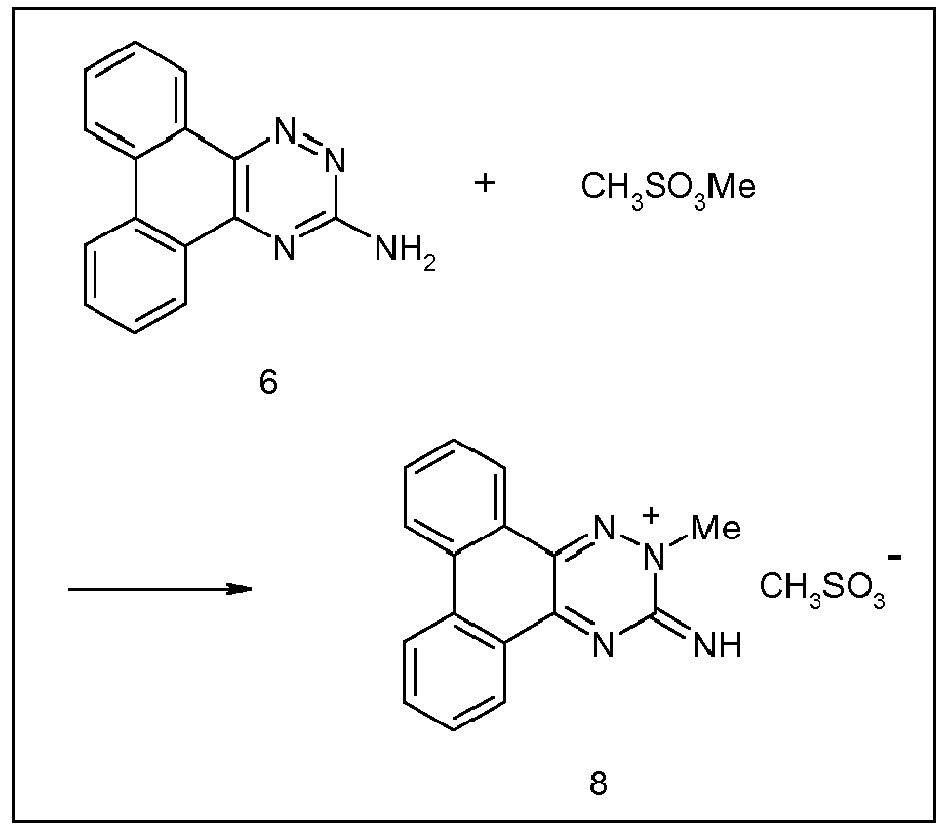
- A mixture of the 3-amino -1,2,4-triazine [6] (500mg), methyl methanesulphonate (0.5cm3), dimethylformamide (0.5cm3) and methanol (10cm3) was stirred at 60° for 30mins. and the resulting deep yellow solution allowed to stand at room temperature for 24hrs. The deep yellow plates that were deposited were filtered off washed with acetone-ether (1:1) and dried.
Yield = 530mg (73.3%)
Mpt = 277-279° - mp 289-291 °C was prepared by the procedure described in
EP- A- 0 372 934 - lodomethane (8 ml) was added to a stirred suspension of 2,4-diamino-5-(2,3-dichlorophenyl)pyrimidine (0.75 g) in methanol (12 ml). The mixture was stirred at 45 °C for 6h, cooled to room temperature, and diluted with ether (70 ml). A yellow solid deposited and was removed by filtration. This material (0.9 g) was stirred with 0.88 aqueous ammonia (6 ml) and water (10 ml) for 2 h. The white solid was removed by filtration, dried in vacuo and recrystallised from methanol to give 0.25 g of 4(2)-Amino-5-(2,3-dichlorophenyl)-2,4(2,5)-dihydro-2(4)-imino-1-methyl-pyrimidine, mp 226-228 °C (decomp.).
- On standing the filtrate deposited 4(2)-Amino-5-(2,3-dichlorophenyl)-2,4(2,5)-dihydro-2(4)-imino-1-methylpyrimidine as pale yellow crystals, which were recrystallised from methanol, mp 289-291 °C. Yield 0.24g. 1 H (500 MHz, dmso-d6) 3.52 (3H, s, NCH3), 7.37 (1 H, dd, J = 7.7, 1.5 Hz, aromatic H), NH), 7.4-7.5 (1 H, brpeak, NH, exchang.), 7.48 (1 H, t, J = 7.7 Hz, aromatic H), 7.76 (1 H, dd, J = 7.7,1.5 Hz, aromatic H), 7.95 (1H, s, pyrimidine H), 7.8-8.2 (1H, vbr peak, NH, exchang.), 8.25 (1H, brpeak, NH, exchang.).
- A known pyrimidine -compound BW 1003C87.
- A known pyrimidine, commercially available as PYRIMETHAMINE.
- mp 168-70 °C, was prepared by the method described in
US patent 6,255,307 - mp 150-153 °C (decomp.), was prepared by the method described in
US patent 6,255,307 - mp 163-165 °C (decomp.), was prepared by the method described in
US patent 6,255,307 - Aminoacetamidine dihydrobromide (1.14 g, 4.9 mmol) was added in portions to a solution of 4-formyl-2,2-difluorobenzodioxole (1.0 g, 5.4 mmol) in methanol (25 ml). Potassium cyanide (0.32 g, 4.9 mmol) was then added in a single portion and the mixture was stirred at room temperature for 4h and then at 50 °C for 24 h. The mixture was cooled and the solvent removed in vacuo. The residue was slurried in ethyl acetate (25 ml) and water (14 ml) and the tan solid removed by filtration and dried. Yield 0.40 g
- Lithium hydroxide hydrate (0.20 g, 4.8 mmol) was stirred in methanol (20 ml) until dissolution was complete ca. 5 min. 2-{[Cyano-(2,2-difluorobenzodiox-4-yl)methyl]aminolacetamidine hydrobromide (0.40 g, 1.1 mmol) was then added in portions over 5 min and the solution stirred for 3.5h at room temperature.
- This solution was concentrated in vacuo to 2 ml. Water (40 ml) was added ,the precipitate removed by filtration and dried. Recrystallisation from toluene -hexane gave the title compound as a light tan solid (0.14 g), mp 135-136 °C
- A mixture of 2,6-Diamino-3-(2,3,5-trichlorophenyl)pyrazine (180mg), methyl methanesulphonate (360mg) and dimethylformamide (2.3cm3) was stirred at 100° for 15minutes. After cooling to room temperature, ether (10 cm3) was added producing a deep red oily precipitate. The ethereal layer was decanted off and the residue crystallised from acetone to give a tan hygroscopic solid (180mg) with an ill-defined melting point.
- These can be prepared by analogy with the other heteroaryl compounds prepared above
-

- Obtained from 2-chloronicotinic acid [Sigma Aldrich] using similar methodology to that employed for 3,5-diamino-6-aryl-1,2,4-triazines described above. The product was obtained as a pale cream microcrystalline solid in 93.3% from the hydrazone, melting point 265-266°(effervesce.), tlc (10%methanol + chloroform), Rf = 0.35
-

- Obtained from 2-chloropicolinic acid [Fluorochem] using similar methodology to that employed for 3,5-diamino-6-aryl-1,2,4-triazines described above. The product was obtained as a fawn prisms in 93.7% from the hydrazone, melting point 300-302°, tlc (10%methanol + chloroform), Rf = 0.67
-

- Obtained from 2-phenoxynicotinic acid [Acros Organics] using similar methodology to that employed for 3,5-diamino-6-aryl-1,2,4-triazines described above. The product was obtained as a colourless crystalline solid in 81.7% from the hydrazone, melting point 223-225°(effervesce.), tlc (10%methanol + chloroform), Rf = 0.28
-

- Obtained from 5,6-dichloronicotinic acid [Sigma Aldrich] using similar methodology to that employed for 3,5-diamino-6-aryl-1,2,4-triazines described above. The product was obtained as a pale mustard prisms in 73.8% from the hydrazone, melting point 258-260°(effervesce.), tlc (10%methanol + chloroform), Rf = 0.28
-

- Obtained from quinaldic acid [AcrosOrganics] using similar methodology to that employed for 3,5-diamino-6-aryl-1,2,4-triazines described above. The product was obtained as a pale mustard microcrystalline solid in 39.0% from the hydrazone, melting point 197-198°(effervesce.), tlc (10%methanol + chloroform), Rf = 0.42
-

- Obtained from 2,6-dichloronicotinic acid [Fluorochem] using similar methodology to that employed for 3,5-diamino-6-aryl-1,2,4-triazines described above. The product was obtained as a pale mustard prisms in 83.4% from the hydrazone, melting point 255-257°(decomposes), tlc (10%methanol + chloroform), Rf = 0.38
-

- Obtained from 3,6-dichloropyridine carboxylic acid [Apollo] using similar methodology to that employed for 3,5-diamino-6-aryl-1,2,4-triazines described above. The product was obtained as a pale mustard prisms in 86.5% from the hydrazone, melting point 264-266°(decomposes), tlc (10%methanol + chloroform), Rf = 0.65
-

- Obtained from 2,6-dichloro-5-fluoropyridine carboxylic acid [AcrosOrganics] using similar methodology to that employed for 3,5-diamino-6-aryl-1,2,4-triazines described above. The product was obtained as a pale mustard prisms in 45.6% from the hydrazone, melting point 255-257°, tlc (10%methanol + chloroform), Rf = 0.65
-

- Obtained from 6-chloro-nicotinic acid [Fluorochem] using similar methodology to that employed for 3,5-diamino-6-aryl-1,2,4-triazines described above. The product was obtained as a pale mustard prisms in 80.2% from the hydrazone, melting point 246-248°, tlc (10%methanol + chloroform), Rf= 0.23
-

- Plus similar targets (2-alkoxy-) and (4-alkoxy-) substitution on the 6-phenyl position

-

- Obtained from 2-propylpentanoic acid [Acros Organics] using similar methodology to that employed for 3,5-diamino-6-aryl-1,2,4-triazines described above. The product was obtained as a pale cream microcrystalline solid, melting point 228-230°, tlc (10%methanol + chloroform), Rf = 0.45
- The following compounds are similarly prepared, making reference to procedure (4) above.


-

- Obtained from 2-(4-chlorophenoxy)-2-methylpropionic acid [Acros Organics] using similar methodology to that employed for 3,5-diamino-6-aryl-1,2,4-triazines described above. The product was obtained as a pale beige microcrystalline solid, melting point 266-268° (decomposes), tlc (10%methanol + chloroform), Rf = 0.45
- The following compounds are similarly prepared, making reference to procedure (4) above.

-

-

-

- R groups can be introduced by analogy with procedures indicated above for correspondingly substituted triazines.
- Compounds of Formula (I) were tested for various activities as follows:
- The screening strategy is designed to select compounds with appropriate sodium channel blocking activity and low side effect liability. To this end all compounds are processed through the primary sodium channel assay (veratrine-evoked uptake of [14C]guanidine into rat forebrain synaptosomes) and IC50 values computed from generated concentration-effect curves. In order to complement this data IC50's for selected compounds to inhibit binding of [3H]BTX-B are also measured.
- Previous studies have shown that substituted triazines are potential inhibitors of DiHydroFolate Reductase (DHFR) activity (McCullough and Bertino 1971, Cashmore et al, 1975, Booth et al, 1987) and Sapse et al, 1994). Inhibitors of DHFR (such as Methotrexate) have been used for the treatment of various cancers (Suster et al, 1978 and Niculescu-Duvaz et al, 1982) as inhibition of this enzyme interferes with cell growth but because of this effect (on cell growth) inhibitors of DHFR may also be teratogenic (Skalko and Gold, 1974, Feldcamp and Carey, 1993 and Buckley et al, 1997). Should compounds be found which are potent inhibitors of DHFR then such compounds may, themselves, have potential as anticancer agents. Several methods are available for measurement of inhibition of DHFR activity and for this study we have examined effects of compounds to inhibit the binding of [3H] methotrexate (Myers et al, 1975 and Rothenberg et al, 1977).
- Another common side-effect marker is inhibition of human Ether-a-go-go Related Gene potassium (hERG) potassium channel (Inward rectifying, IKr) activity which can be fatal due to heart failure brought about by development of long QT syndrome. A useful preliminary screen to assess potential to affect this channel is assessed by measurement of inhibition of the binding of [3H]astemizole to cell membranes expressing hERG. Selected compounds are tested for this activity by measurement of inhibition @ 10 µM. Assuming inhibition values lie between 10% and 90% it is possible to compute an extrapolated IC50 for each compound.
- The above screening cascade identifies compounds with appropriate sodium channel blocking activities that have a low(er) propensity for aforementioned side-effect liabilities. In order to develop these compounds further, some knowledge of their pharmacodynamic properties is required.
- Sodium channel blockers, such as Sipatrigine, which both reduces the neurological deficit and infarct volume after middle cerebral artery occlusion in rats (Smith et al, 1997) and phenytoin, (which protect retinal ganglion cell death in an experimental model of glaucoma (Hains and Waxman, 2005) show neuroprotective efficacy in a range of models of nerve degeneration.. As failure of oxygen supply compromises both glycolysis and oxidative phosphorylation, ischaemic damage ultimately leads to electrical failure (nerve signalling) and pump failure (restoration of cellular membrane potentials). These failures (of electrical and ion pump activity) are associated with decreased local concentrations of ATP (Astrup et al 1981). Thus the effect of compounds to maintain concentrations of ATP in 0.4 mm slices of rat hippocampus following a severe metabolic insult was used.
- Experiments were performed using forebrain (whole brain less cerebellum/medulla) from Male Wistar rats weighing 175-250g. All efforts were made to reduce the number of animals used and all experiments were carried out in accordance with the UK Animals (Scientific Procedures) Act, 1986 and the European Community Council Directive of 24 November 1986 (86/609/EEC). Following killing of animals by stunning and decapitation, the forebrain (whole brain less cerebellum/medulla) was rapidly dissected and transferred to a weighed tube containing ice-cold 0.25M sucrose.
- Synaptosomes (heavy and light mitochondrial fraction containing synaptosomes) were prepared by transferring the forebrain (of known wet weight) to a glass Potter vessel to which 9 volumes ice-cold 0.25M sucrose had been added and homogenising, using a teflon pestle, by 8 'up and down strokes' of a Braun Potter S motor driven homogeniser set to 900rpm. The resulting homogenate was centrifuged at 1036 x g at 4° for 10 min and the supernatant collected. The remaining pellet was resuspended, as above, in fresh ice-cold 0.25M sucrose and the centrifugation step repeated. The supernatant fractions were pooled and centrifuged at 40,000 x g (average) at 4° for 15 min and the resulting pellet resuspended in the appropriate assay buffer at a concentration of 20-25 mg wet weight per ml appropriate assay buffer.
- Homogenates were prepared by transferring the known weight of forebrain to a cooled tube containing 9 volumes of ice-cold 50mM pH 7.4 HEPES buffer. The mixture was homogenised @ 4° by 3 x 5 sec bursts of an Ultra-Turrax™ homogeniser set at maximum speed. The resulting homogenate was centrifuged at 40,000 x g (average) at 4° for 15 min and the supernatant discarded. The resulting pellet was resuspended in 9 volumes of fresh ice-cold pH 7.4 buffer (as above), the centrifugation step was repeated and the resulting pellet resuspended in the [3H]BTX-B binding buffer at a concentration of 20-25 mg wet weight per ml assay buffer.
- Both assays were carried out using 14ml polypropylene test tubes to which a range of concentrations of the compounds under test were added. Test compounds were dissolved in DMSO and added to assays such that maximum concentration of DMSO did not exceed 2% v/v.
- The [14C] guanidinine flux assay was measured using the method of Pauwels PJ et al (1986) but carried out @ 30° for 2½ min.
-
- Pauwels PJ, Leysen JE, Laduron PM. [3H]Batrachotoxinin A 20-alpha-benzoate binding to sodium channels in rat brain: characterization and pharmacological significance. Eur J Pharmacol. 1986 May27;124(3):291-8.
- [3H]BTX-B binding was carried out using the method described by Catterall et al (1981), except that both bovine serum albumin and TTX were omitted from the incubation medium.
-
- Catterall WA, Morrow CS, Daly JW, Brown GB. Binding of batrachotoxinin A 20-alpha-benzoate to a receptor site associated with sodium channels in synaptic nerve ending particles. J Bio. Chem. 1981 Sep. 10; 256(17): 8922-7.
- All steps were carried out at 4° (or on ice). Freshly dissected rat liver was dissected into 0.25M ice-cold Sucrose and subsequently homogenised (U-turrax) in 50 mM pH 6.0 phosphate buffer (10 ml/g tissue) containing 15 mM Dithiothreitol. The resulting homogenate was centrifuged @ 47,500 x g for 20 min and supernatant (filtered through cotton wool to remove fatty lumps) stored @ -80° before use (Rothenberg et al).
- Inhibition of the binding of [3H]methotrexate to rat liver homogenate supernatant fractions were carried out essentially as described by Arons et al, 1975. Results were calculated, either as IC50 values (see below) derived from concentration-effect curves or as percentage inhibition values determined by comparison with control and cold Methotrexate (10 µM final concentration) binding values.
-
- Elliot Arons, Sheldon P. Rothenberg, Maria da Costa, Craig Fischer and M. Perwaiz Iqbal; Cancer Research 35, August 1, 1975, 2033-2038,
- Data are presented as mean ± sem of number of experiments indicated in brackets. IC50 values were obtained from radioligand displacement or guanidine flux inhibition curves by plotting log10 concentration vs bound ligand/guanidine uptake according the equation:-

where - y
- = bound (dpm)
- x
- = log10 compound concentration
- Rmin
- = lower asymptote (i.e. 100% inhibition)
- Rsp
- = upper asymptote - Rmin (i.e. specific binding)
- n
- = slope (loge)
- C
- = IC50 (i.e. concentration required to inhibit 50% of specific binding
- Neuroprotective efficacy was measured in 0.4 mm slices of rat hippocampus using the method described by Fowler and Li (1998)1 except that lodoacetate (400 µM)2 was used as the metabolic insult. Compounds (usually 30 µM) were always directly compared with tetrodotoxin (1 µM)3 for their ability to maintain slice concentrations of ATP following inhibition of glycolysis.
-
- 1. Fowler J C, Li Y. Contributions of Na+ flux and the anoxic depolarization to adenosine 5'-triphosphate levels in hypoxic/hypoglycemic rat hippocampal slices. Neuroscience 1998, 83, 717-722.
- 2. Reiner PB, Laycock AG, Doll CJ. A pharmacological model of ischemia in the hippocampal slice. Neurosci Lett 1990; 119:175-8
- 3. Boening JA, Kass IS, Cottrell JE, Chambers G. The effect of blocking sodium influx on anoxic damage in the rat hippocampal slice. Neuroscience. 1989. vol 33 (2), 263-268.
- Individual slices were disrupted by ultra-sonication and the resulting homogenates centrifuged @ 10000 x g for 5 min @ 4°. The supernatant was decanted into a fresh tube and any remaining supernatant removed by vacuum aspiration. The pellet was resuspended in 0.5 ml 0.1 M KOH by ultra-sonication and the resulting suspensions warmed with gentle agitation @ 37 ° for 30 minutes.
- Concentrations of ATP were measured in 6 µl of supernatant by mixing with Luciferase reagent (ATPLite from Perkin Elmer) and measuring subsequent luminescence in a 96-well plate Counter.
- Protein concentration was measured using BCA™ protein assay (Pierce) with Bovine Serum albumin as reference standard.
- ATP concentrations were expressed as nmoles/ mg protein and neuroprotective indices (% protection) calculated by direct comparison with the effect of 1 µM TTX.
- Compounds were sent to MDS Pharma for measurement of their inhibition @ 10 µM concentration of the binding of [3H]astemizole to HEK-293 cells expressing human recombinant hERG. Making the assumption that binding slopes would be 1.0 IC50 values could be calculated (see above) for compounds exhibiting between 5% and 95% inhibition of binding.
- Compounds were sent to MDS Pharma for measurement of their inhibition @ 10 µM concentration of the binding of [3H]nitrendipine to rat cerebral cortex membranes. Making the assumption that binding slopes would be 1.0 IC50 values could be calculated (see above) for compounds exhibiting between 5% and 95% inhibition of binding.
- Compounds were sent to BioFocus for measurement of their stability @ 1 µM concentration following incubation with rat liver microsomes for 40 minutes @ 37°.
- Data from the various testing procedures is set out in the Table below:
[14C]guanidine flux [3H]mtx binding hERG hERG L-type Ca2+ L-type Ca2+ Microsome stability CEN nr Mean IC50 (µM) % inhibition @ 10 µM IC50 (µM) % inhibition @ 10 µM IC50 (µM) % metabolised IC50 (µM) (% inhibition @ 125 µM) (extrapolated from 10 µM inh'n) (extrapolated from 10 µM inh'n) (40 min incubation 37°) 631 (17 ± 2(4)) 1 (Ltg) 219.2 11** 68*(***) 1 989 17 48.8 0.5 41 60.3 76 -3 >200 - - - 42 616.6 32 - - - - - 43 631.0 20 - - - - - 47 13.2 - 22 35 - - - 48 5.8 - 18 46 -1 >> 190 - 57 >2000 44 - - - - - 61 676.1 87 - - - - - 62 141.3 46 -13 >200 - - - 64 >2000 52 - - - - - 67 4.3 11 15 57 -16 >> 190 0.5 68 794.3 101 - - - - - 69 776.2 66 - - - - - 70 1513.6 66 - - - - - 71 512.9 54 - - - - - 72 131.8 101 - - - - - 73 81.2 5 3 >200 8 114.9 62.5 74 295.1 99 - - - - - 75 49.0 5 78 3 - - - 76 77.6 6 74 4 - - - 77 14.5 -1 36 18 - - - 78 102.3 9 24 32 - - - 79 208.9 -1 3 >200 17 48.8 0.0 80 123.0 -1 14 61 - - - 81 251.1 -2 17 49 - - - 82 >1000 -8 - - - - - 83 40.8 -5 16 52 - - - 84 43.7 -4 9 101 7 132.8 33.0 85 3.6 -5 39 16 -15 >> 190 - 86 14.1 -5 1 >200 9 101.1 - 87 288.4 -5 3 >200 7 132.8 - 88 190.5 82 - - - - - 89 724.4 101 - - - - - 90 97.7 53 - - - - - 91 371.5 94 - - - - - 92 144.5 15 4 >200 3 > 190 0.0 93 63.1 4 35 19 - - - 94 398.1 -2 - - - - - 95 >> 1000 6 - - - - - 96 109.6 105 - - - - - 97 363.1 101 - - - - - 98 8.9 41 18 46 -18 >> 190 6.0 99 134.9 -1 23 34 - - 0.0 100 77.6 10 30 23 - - - 101 >>1000 65 - - - - - 102 58.9 25 - - - - - 103 >>1000 47 - - - - - 104 >>1000 23 - - - - - 105 100.0 86 35 19 - - - 106 26.9 43 - - - - - 107 1174.9 48 - - - - - 108 812.8 81 - - - - - 109 >>1000 80 - - - - - 110 134.9 -23 -12 > 200 - - 61.5 111 912.0 97 - - - - - 112 1000.0 84 - - - - - 113 1995.3 65 - - - - - 114 173.8 46 - - - - - 115 >>1000 61 - - - - - 116 955.0 70 - - - - - 117 >>1000 79 - - - - - 118 1148.2 -7 - - - - - 119 1949.8 52 - - - - - 120 195.0 18 6 157 - - - 121 >>1000 92 - - - - - 122 >>1000 86 - - - - - 123 41.7 86 - - - - - 124 871.0 90 - - - - - 125 7585.8 6 - - - - - 126 58.9 -12 79 3 - - - 127 85.1 -24 2 > 200 - - - 128 251.2 0 16 53 - - - 129 190.5 -3 7 133 - - - 130 20.4 2 -2 > 200 - - - 131 288.4 94 - - - - - 132 69.2 4 - - - - - 133 >> 2000 17 - - - - - 134 4.9 6 - - - - - 135 43.7 89 - - - - - 136 229.1 27 - - - - - 137 >> 2000 23 - - - - - 138 >> 2000 67 - - - - - 139 288.4 46 - - - - - 140 229.1 3 - - - - - 141 288.0 30 - - - - - 142 >> 2000 12 - - - - - 143 >> 2000 27 - - - - - 144 57.5 96 - - - - - 145 9.6 39 - - - - - 146 871.0 3 - - - - - 147 60.3 4 - - - - - 148 20.4 38 - - - - - 149 23.4 4 - - - - - 150 16.2 27 - - - - - 151 67.6 76 - - - - - 152 478.6 1 - - - - - 153 50.1 2 - - - - - 154 162.2 13 - - - - - 155 34 -6 22 35 - - - 156 246 32 - - - - - 157 204 -1 6 157 - - - 158 > 1000 -1 - - - - - 159 44 97 - - - - - 160 295 -11 0 > 200 - - - 161 16 -7 88 1 - - - 162 12 57 - - - - - 163 8 13 11 81 - - - 164 692 0 - - - - - 165 372 -4 23 34 - - - 166 1175 88 - - - - - 167 >>2000 -2 - - - - - 168 1000 95 - - - - - 169 347 95 - - - - - 170 263 29 - - - - - 171 2 91 - - - - - 172 234 100 - - - - - 173 159 34 - - - - - 174 589 4 9 101 - - - 175 >>2000 -4 - - - - - 176 309 55 - - - - - 177 14 16 22 35 - - - 178 28 27 - - - - - 179 >>2000 -1 - - - - - 180 >>2000 -2 - - - - - 181 74 101 - - - - - 182 214 6 10 90 - - - 183 39 106 - - - - - 184 34 104 - - - - - 185 3 90 - - - - - 186 >> 2000 83 - - - - - 187 447 99 - - - - - 188 2570 76 - - - - - 189 468 2 10 90 - - - 190 813 6 - - - - - 191 1950 31 - - - - - 192 >> 2000 91*(***) - - - - - 193 135 99*(***) - - - - - 194 9 -6*(***) - - - - - 195 4 -2*(***) - - - - - 196 912 41*(***) - - - - - 197 91 95*(***) - - - - - * 99µM
** 198µM
*** uses fresh batch of supernatant
Inhibition of binding of [3H]batrachotoxinin binding to rat (wistar) brain
Data are presented as % inhibition @ 10 µM and extrapolated IC50's (which assumes hill slope = 1).
Compounds which give < 5% inhibition are ascribed IC50's of > 200 µM
Compounds which give > 95% inhibition are ascribed IC50's of < 0.5 µMInhibition of binding of [3H]BTX-B Compound % inhibition (@ 10 µM) Extrapolated IC50 (µM) CEN-1 -28 > 200 CEN-198 23 34 CEN-199 29 25 CEN-200 14 61 CEN-201 3 > 200 CEN-202 90 1 CEN-203 102 < 0.5 CEN-204 52 9 CEN-205 79 3 CEN-206 24 32 CEN-207 30 23 CEN-208 31 22 CEN-209 36 18 CEN-210 43 13 CEN-211 106 < 0.5 CEN-212 0 > 200 CEN-213 -2 > 200 CEN-214 10 90 CEN-215 22 35 Summary of [3H]batrachotoxinin binding method -279510 Sodium Channel, Site 2 Source: Wistar Rat brain Ligand: 5 nM [.H] Batrachotoxin Vehicle: 1% DMSO Incubation Time/Temp: 60 minutes @ 37.C Incubation Buffer: 50 mM HEPES, 50 mM Tris-HCl, pH7.4, 130 mM Choline Chloride, 5.4mM KCl, 0.8 mM MgCl., 5.5 mM Glucose, 40 µg/ml LqTx KD: 0.052 µM * Non-Specific Ligand: 100 µM Veratridine Bmax: 0.7 pmole/mg Protein * Specific binding: 77% Quantitation Method: Radioligand Binding Significance Criteria: >/= 50% of max stimulation or Inhibition Hippocampal slice data Standard Conc'n % protection Conc'n % protection Compound (µM) (v 1 µM TTX) Compound (µM) (v 1 µM TTX) (mean ± sem) (mean ± sem) TTX 1 100 CEN-47 30 98 Lamotrigine [CEN-001] 30 41 ± 5 (3) CEN-67 30 3 Sipatrigine 30 58 ± 6 (7) CEN-86 30 98 DPH 30 48 CEN-92 30 32 CEN-98 30 11 (no. of expt's) CEN-130 30 39 CEN-140 30 -11 CEN-152 30 -10 CEN-160 30 0 CEN-163 30 56 - The screening data obtained in respect of representative compounds of the invention points to the suitability of compounds of general formula (I)) for treatment of disorders in mammals that are susceptible to sodium channel blockers and antifolates, and particularly disorders such epilepsy, multiple sclerosis, glaucoma and uevitis, cerebral traumas and cerebral ischaemias, stroke, head injury, spinal cord injury, surgical trauma, neurodegenerative disorders, motorneurone disease, Alzheimer's disease, Parkinson's disease, chronic inflammatory pain, neuropathic pain, migraine, bipolar disorder, mood, anxiety and cognitive disorders, schizophrenia and trigeminal autonomic cephalalgias; for treatment of mammalian cancers; and for treatment of malaria.
- Embodiments of the invention include the following:
- [1]. A compound of general formula (V), or a salt or solvate thereof,

- R3, R4 and R5 are independently hydrogen, or optionally substituted alkyl or alkoxy, or optionally substituted carbocyclic(oxy) or heterocyclic(oxy) ring, with the proviso that only one of R3, R4 and R5 is hydrogen, or
- two of R3, R4 and R5 are linked together to form a cycloalkyl group,
- R1 is hydrogen or carboxamido, C1-10 alkyl, C2-10 alkenyl, C1-3 alkyl-aryl, C1-3 alkyl-heterocyclyl, or C3-10 cycloalkyl, any of which is optionally substituted by hydroxy, halogen, carboxamido, halo C1-6 alkyl, C1-6 alkyl or C1-6 alkoxy;
- R2 is amino;
- N* is amino when R1 is hydrogen or =NH when R1 is a substituent group; or
- N* is a group NRaRb where Ra and Rb are independently H or an alkyl group; or
- N* is an optionally substituted piperazinyl ring.
- [2]. A compound according to [1] above in which at least one of R3, R4 and R5 is an optionally substituted phenyl group.
- [3]. A compound according to [1] or [2] above in which at least one of R3, R4 or R5 is a methyl, ethyl, propyl or butyl group.
- [4]. A compound according to any one of [1] to [3] above in which at least one of R3, R4 or R5 is a phenyl or phenoxy or naphthyl or xanthyl group substituted by one or more halogens or alkoxy groups.
- [5]. A compound according to any one of [1] to [4] above in which two of R3, R4 and R5 are linked together to form a cyclopropyl, cyclobutyl, cyclopentyl or cyclohexyl group.
- [6]. A compound according to [1] above which is
- 3,5-Diamino-6-(diphenylmethyl)-1,2,4-triazine
- 3,5-Diamino-6-(1,1-diphenylethyl)-1,2,4-triazine
- 5(3)-Amino-6-(1,1-diphenylethyl)-2,3(2,5)-dihydro-3(5)-imino-2-methyl-1,2,4-triazine
- 3,5-Diamino-6-(triphenylmethyl)-1,2,4-triazine
- 3,5-Diamino-6-(1-cyclopentyl-1-phenyl)-1,2,4-triazine
- 3,5-Diamino-6-[1-(6-methoxynaphthalene)methyl)-1,2,4-triazine
- 3,5-Diamino-6-(1-propylbutyl)-1,2,4-triazine.
- 3,5-Diamino-6-[1-(6-methoxynaphthalene)ethyl)-1,2,4-triazine
- 3,5-Diamino-6-(1-isopropyl-1-phenylmethy)-1,2,4-triazine
- 3,5-Diamino-6-[1,1-bis-(4-chlorophenyl)methyl]-1,2,4-triazine.
- 3,5-Diamino-6-(9-xanthyl)-1,2,4-triazine; or
- 3,5-Diamino-6-{1-(4-chlorophenoxy)-1-methyl}ethyl-1,2,4-triazine
- [7]. A compound according to [1] above which is
- 5(3)-Amino-6-{1-[1-(4-chlorophenyl)]cyclopentyl}-2,3(2,5)-dihydro-3(5)-imino-2-methyl-1,2,4-triazine
- 3,5-Diamino-6-[1-(4-chlorophenyl)-1-cyclopenty]-1,2,4-triazine
- 3,5-Diamino-6-[1-(4-chlorophenyl)-1-cyclohexyl]-1,2,4-triazine
- 3,5-Diamino-6-[1-(4-chlorophenyl)-1-cyclobuty]-1,2,4-triazine or
- 3,5-Diamino-6-[1-(4-chlorophenyl)-1-cyclopropyl]-1,2,4-triazine.
- [8]. A pharmaceutical composition for the treatment of epilepsy, multiple sclerosis, glaucoma and uveitis, cerebral traumas and cerebral ischaemias, stroke, head injury, spinal cord injury, surgical trauma, neurodegenerative disorders, motor neurone disease, Alzheimer's disease, Parkinson's disease, chronic inflammatory pain, neuropathic pain, migraine, bipolar disorder, mood, anxiety and cognitive disorders, schizophrenia and trigeminal autonomic cephalalgias, the composition comprising a compound of general formula (V) according to any one of [1] to [7] above and a pharmaceutically acceptable carrier.
- [9]. Use of a compound of general formula (V) as claimed in any one of [1] to [7] above for the preparation of a medicament for treatment of epilepsy, multiple sclerosis, glaucoma and uveitis, cerebral traumas and cerebral ischaemias, stroke, head injury, spinal cord injury, surgical trauma, neurodegenerative disorders, motor neurone disease, Alzheimer's disease, Parkinson's disease, chronic inflammatory pain, neuropathic pain, migraine, bipolar disorder, mood, anxiety and cognitive disorders, schizophrenia and trigeminal autonomic cephalalgias.

Claims (10)
- A compound of general formula (I), or a salt or solvate thereof;
 X and Y are each N;A is an optionally substituted phenyl group or an optionally substituted sulphur containing heterocycle;Z is a single bond or a linking group which is a carbon atom carrying substituents R4 and R5, wherein R4 and R5 are independently selected from hydrogen, optionally substituted C1-6 alkyl and another group A, provided that no more than one of R4 or R5 are hydrogen;R1 is hydrogen, or a substituent group selected from C1-10 alkyl, C2-10 alkenyl, benzyl, piperidine-methyl, thienyl-methyl, furyl-methyl or C3-10 cycloalkyl, any of which is optionally substituted by hydroxy, halogen, carboxamide, halo C1-4 alkyl, C1-6 alkyl or C1-6 alkoxy; or the Y nitrogen is unsubstituted;R2 is amino or a substituent group selected from optionally substituted alkyl or phenyl groups; andN* is =NH when R1 is hydrogen or a substituent group; orN* is a group NRaRb where Ra and Rb are independently H or an alkyl group; orN* is an optionally substituted piperazinyl ring.
 - The compound according to claim 1 wherein A is a phenyl group or sulphur containing heterocycle group, substituted with halogen, alkyl or alkoxy.
- The compound according to claim 2 wherein the phenyl group or sulphur containing heterocycle group is substituted with 1, 2, or 3 chlorine or bromine atoms.
- The compound according to any of claims 1 to 3 wherein the compound is selected from:3,5-Diamino-6-(3,4,5 trimethoxyphenyl)-1,2,4-triazine [CEN-095];3,5-Diamino-6-(2-bromophenyl)-1,2,4-triazine [CEN-068];3,5-Diamino-6-(3-bromophenyl)-1,2,4-triazine [CEN-069];3,5-Diamino-6-(3,5-bistrifluoromethylphenyl)-1,2,4-triazine [CEN-092];3,5-Diamino-6-(2,6-dichlorophenyl)-1,2,4-triazine [CEN-104];3,5-Diamino-6-(3,4-dimethoxyphenyl)-1,2,4-triazine [CEN-115];3,5-Diamino-6-(2-bromophenyl)-1,2,4-triazine [CEN-068];3,5-Diamino-6-(3-bromophenyl)-1,2,4-triazine [CEN-069];3,5-Diamino-6-(2-trifluoromethoxyphenyl)-1,2,4-triazine [CEN-056];3,5-Diamino-6-[3-(1,1,2,2-tetrafluoroethoxy)phenyl]-1,2,4-triazine [CEN-108];3,5-Diamino-6-[2-(1,1,2,2-tetrafluoroethoxy)phenyl]-1,2,4-triazine [CEN-137];3,5-Diamino-6-[2,5-bis(2,2,2-trifluoroethoxy)phenyl]-1,2,4-triazine [CEN-140];3,5-Diamino-6-[2-difluoromethoxy)phenyl]-1,2,4-triazine [CEN-142];3,5-Diamino-6-(3-chloro-5-trifluoromethylphenyl)-1,2,4-triazine [CEN-172];3,5-Diamino-6-[3,5 (bis-trifluoromethyl) phenyl]-1,2,4-triazine [CEN-175];3,5-Diamino-6-(2-chloro-3-trifluoromethylphenyl)-1,2,4-triazine [CEN-176];3,5-Diamino-6-(2,4,6-triisopropylphenyl)-1,2,4-triazine [CEN-180];3,5-Diamino-6-(4-tertbutylphenyl)-1,2,4-triazine [CEN-181];3,5-Diamino-6-(4-n-butylphenyl)-1,2,4-triazine [CEN-183];3,5-Diamino-6-(3,5-di-tert-butylphenyl)-1,2,4-triazine [CEN-187];3,5-Diamino-6-(3,5-dimethoxyphenyl)-1,2,4-triazine [CEN-192];3,5-Diamino-6-[3,5-bis(2,2,2-trifluoroethoxy)phenyl]-1,2,4-triazine [CEN-193];3,5-Diamino-6-(3-chloro-2-fluoro-5-trifluoromethylphenyl)-1,2,4-triazine [CEN-197];3,5-Diamino-6-[2,5-bis(trifluoromethyl)phenyl]-1,2,4-triazine [CEN-198];3,5-Diamino-6-(2-chloro-3-trifluoromethylphenyl)-1,2,4-triazine [CEN-199];3,5-Diamino-6-(5-chloro-2-trifluoromethylphenyl)-1,2,4-triazine [CEN-200];3,5-Diamino-6-(2,3,4-trifluorophenyl)-1,2,4-triazine [CEN-206];3,5-Diamino-6-(2-chloro-4,5-difluorophenyl)-1,2,4-triazine [CEN-207];3,5-Diamino-6-(2,3,4,5-tetrafluorophenyl)-1,2,4-triazine [CEN-208];3,5-Diamino-6-(2,3-dichloro-6-trifluoromethylphenyl)-1,2,4-triazine [CEN209;3,5-Diamino-6-(2,3,4,5,6-pentafluorophenyl)-1,2,4-triazine [CEN-212;3,5-Diamino-6-(2,3,6-trichlorophenyl)-1,2,4-triazine [CEN-214];5(3)-Amino-6-(2,3,5-trichlorophenyl)-2,3(2,5)-dihydro-3(5)-imino-2-(2,2-difluoroethyl)-1,2,4-triazine [CEN-085];5(3)-Amino-6-(2,3,-dichlorophenyl)-2,3(2,5)-dihydro-3(5)-imino-2-(2,2,2-trifluoroethyl)-1,2,4-triazine [CEN-067];5(3)-Amino-6-(2,3,-dichlorophenyl)-2,3(2,5)-dihydro-3(5)-imino-2-(2-isopropoxy)ethyl-1,2,4-triazine [CEN-091];5(3)-Amino-6-phenyl-2,3(2,5)-dihydro-3(5)-imino-2-methyl-1,2,4-triazine methanesulfonate [CEN-051];5(3)-Amino-6-(2,5-dichlorophenyl)-2,3(2,5)-dihydro-3(5)-imino-2-methyl-1,2,4-triazine [CEN-053];5(3)-Amino-6-(3,5-dichlorophenyl)-2,3(2,5)-dihydro-3(5)-imino-2-methyl-1,2,4-triazine [CEN-059];5(3)-Amino-6-(2-difluoromethoxyphenyl)-2,3(2,5)-dihydro-3(5)-imino-2-methyl-1,2,4-triazine[CEN-146];5(3)-Amino-6-(2-chloro-3-trifluoromethyphenyl)-2,3(2,5)-dihydro-3(5)-imino-2-methyl-1 ,2,4-triazine [CEN-177];5(3)-Amino-6-(3-chloro-2-fluoro-5-trifluoromethyphenyl)-2,3(2,5)-dihydro-3(5)-imino-2-methyl-1 ,2,4-triazine [CEN-202];5(3)-Amino-6-(2-chloro-4,5-difluoro-5-phenyl)-2,3(2,5)-dihydro-3(5)-imino-2-methyl-1,2,4-triazine [CEN-204];5(3)-Amino-6-phenyl-2,3(2,5)-dihydro-3(5)-imino-2-ethyl-1,2,4-triazine [CEN-052];5(3)-Amino-6-(2,5-dichlorophenyl)-2,3(2,5)-dihydro-3(5)-imino-2-ethyl-1,2,4-triazine [CEN-054];5(3)-Amino-6-(2,3,5-trichlorophenyl)-2,3(2,5)-dihydro-3(5)-imino-2-ethyl-1,2,4-triazine [CEN-055];5(3)-Amino-6-(3,5-dichlorophenyl)-2,3(2,5)-dihydro-3(5)-imino-2-ethyl-1,2,4-triazine [CEN-060];5(3)-Amino-6-(3,4,5-trimethoxyphenyl)-2,3(2,5)-dihydro-3(5)-imino-2-ethyl-1,2,4-triazine [CEN-119];5(3)-Amino-6-(2-chloro-3-trifluoromethyphenyl)-2,3(2,5)-dihydro-3(5)-imino-2-ethyl-1,2,4-triazine [CEN-178];5(3)-Amino-6-(3,5-bis-tert-butylphenyl)-2,3(2,5)-dihydro-3(5)-imino-2-ethyl-1,2,4-triazine[CEN-189];5(3)-Amino-6-(3-chloro-2-fluoro-5-trifluoromethyphenyl)-2,3(2,5)-dihydro-3(5)-imino-2-ethyl-1,2,4-triazine [CEN-203];5(3)-Amino-6-(2-chloro-4,5-difluoro-5-phenyl)-2,3(2,5)-dihydro-3(5)-imino-2-ethyl-1,2,4-triazine [CEN-205];5(3)-Amino-6-(3,4,5-trimethoxyphenyl)-2,3(2,5)-dihydro-3(5)-imino-2-methyl-1,2,4-triazine[CEN-101];5(3)-Amino-6-[3,5-(bis-trifluoromethyl)phenyl]-2,3(2,5)-dihydro-3(5)-imino-2-methyl-1,2,4-triazine [CEN-099];5(3)-Amino-6-(3-chloro-2-fluoro-5-trifluoromethyphenyl)-2,3(2,5)-dihydro-3(5)-imino-2-(2,2,3,3-tetrafluoropropyl)-1,2,4-triazine [CEN-210]; and5(3)-Amino-6-(3-chloro-2-fluoro-5-trifluoromethyphenyl)-2,3(2,5)-dihydro-3(5)-imino-2-(2,2,3,3,3-pentafluoropropyl)-1,2,4-triazine [CEN-211].
- The compound according to any of claims 1 to 3, wherein the compound is selected from:3,5-Diamino-6-(2-thienyl)-1,2,4-triazine [CEN-057];3,5-Diamino-6-(3-thienyl)-1,2,4-triazine [CEN-064];3,5-Diamino-6-[3-(2,5 dichlorothienyl)]-1,2,4-triazine [CEN-071];3,5-Diamino-6-[2-(3,4,5 trichlorothienyl)]-1,2,4-triazine [CEN-079];5(3)-Amino-6-(2-thienyl)-2,3(2,5)-dihydro-3(5)-imino-2-methyl-1,2,4-triazine [CEN-061];5(3)-Amino-6-(2-thienyl)-2,3(2,5)-dihydro-3(5)-imino-2-ethyl-1,2,4-triazine [CEN-062];5(3)-Amino-6-[3-(2,5-dichlorothienyl)]-2,3(2,5)-dihydro-3(5)-imino-2-methyl-1,2,4-triazine [CEN-080];5(3)-Amino-6-{2-(3,4,5-trichloro)thienyl}-2,3(2,5)-dihydro-3(5)-imino-2-methyl-1,2,4-triazine [CEN-194];5(3)-Amino-6-{2-(3,4,5-trichloro)thienyl}-2,3(2,5)-dihydro-3(5)-imino-2-ethyl-1,2,4-triazine [CEN-195];3,5-Diamino-6-[2-(4,5-dibromothienyl)]-1,2,4-triazine [CEN-122];3,5-Diamino-6-[2-(5-bromothienyl)]-1,2,4-triazine [CEN-124];3,5-Diamino-6-[2-(3-bromothienyl)]-1,2,4-triazine [CEN-125];3,5-Diamino-6-[2-(5-chlorothienyl)]-1,2,4-triazine [CEN-138];3,5-Diamino-6-[2-(benzo[b]thienyl)]-1,2,4-triazine [CEN-113]; and3,5-Diamino-6-[2-(3-chlorobenzo[b]thienyl)]-1,2,4-triazine [CEN-114].
- The compound according to claim 4 where the compound is 3,5-Diamino-6-(3,5-bistrifluoromethylphenyl)-1,2,4-triazine [CEN-092].
- The compound according to claim 5 wherein the compound is 3,5-Diamino-6-[2-(3,4,5 trichlorothienyl)]-1,2,4-triazine [CEN-079].
- A pharmaceutical composition for the treatment of epilepsy, multiple sclerosis, glaucoma and uveitis, cerebral traumas and cerebral ischaemias, stroke, head injury, spinal cord injury, surgical trauma, neurodegenerative disorders, motor neurone disease, Alzheimer's disease, Parkinson's disease, chronic inflammatory pain, neuropathic pain, migraine, bipolar disorder, mood, anxiety and cognitive disorders, schizophrenia or trigeminal autonomic cephalalgias, comprising a compound of general formula (I) as claimed in any one of claims 1 to 7 and a pharmaceutically acceptable carrier.
- The compound of general formula (I) as claimed in any one of claims 1 to 7, for use in the treatment of epilepsy, multiple sclerosis, glaucoma and uveitis, cerebral traumas and cerebral ischaemias, stroke, head injury, spinal cord injury, surgical trauma, neurodegenerative disorders, motor neurone disease, Alzheimer's disease, Parkinson's disease, chronic inflammatory pain, neuropathic pain, migraine, bipolar disorder, mood, anxiety and cognitive disorders, schizophrenia or trigeminal autonomic cephalalgias.
- The pharmaceutical composition according to claim 8, or the compound for use according to claim 9, in which the treatment is epilepsy, multiple sclerosis, motor neurone disease, or neuropathic pain.
Applications Claiming Priority (3)
| Application Number | Priority Date | Filing Date | Title |
|---|---|---|---|
| GBGB0800741.1A GB0800741D0 (en) | 2008-01-16 | 2008-01-16 | Cyclic triazo and diazo sodium channel blockers |
| PCT/GB2009/050033 WO2009090431A1 (en) | 2008-01-16 | 2009-01-16 | Cyclic triazo and diazo sodium channel blockers |
| EP09701748.7A EP2229371B1 (en) | 2008-01-16 | 2009-01-16 | Cyclic triazo and diazo sodium channel blockers |
Related Parent Applications (2)
| Application Number | Title | Priority Date | Filing Date |
|---|---|---|---|
| EP09701748.7A Division EP2229371B1 (en) | 2008-01-16 | 2009-01-16 | Cyclic triazo and diazo sodium channel blockers |
| EP09701748.7A Division-Into EP2229371B1 (en) | 2008-01-16 | 2009-01-16 | Cyclic triazo and diazo sodium channel blockers |
Publications (2)
| Publication Number | Publication Date |
|---|---|
| EP3002280A1 true EP3002280A1 (en) | 2016-04-06 |
| EP3002280B1 EP3002280B1 (en) | 2023-05-24 |
Family
ID=39144997
Family Applications (2)
| Application Number | Title | Priority Date | Filing Date |
|---|---|---|---|
| EP15185526.9A Active EP3002280B1 (en) | 2008-01-16 | 2009-01-16 | Cyclic triazo and diazo sodium channel blockers |
| EP09701748.7A Active EP2229371B1 (en) | 2008-01-16 | 2009-01-16 | Cyclic triazo and diazo sodium channel blockers |
Family Applications After (1)
| Application Number | Title | Priority Date | Filing Date |
|---|---|---|---|
| EP09701748.7A Active EP2229371B1 (en) | 2008-01-16 | 2009-01-16 | Cyclic triazo and diazo sodium channel blockers |
Country Status (11)
| Country | Link |
|---|---|
| US (3) | US8691818B2 (en) |
| EP (2) | EP3002280B1 (en) |
| JP (1) | JP5473944B2 (en) |
| KR (1) | KR101600636B1 (en) |
| CN (2) | CN101918378B (en) |
| AU (1) | AU2009205396B2 (en) |
| CA (1) | CA2712070C (en) |
| ES (2) | ES2953286T3 (en) |
| GB (1) | GB0800741D0 (en) |
| IL (1) | IL206815A (en) |
| WO (1) | WO2009090431A1 (en) |
Families Citing this family (17)
| Publication number | Priority date | Publication date | Assignee | Title |
|---|---|---|---|---|
| GB0800741D0 (en) | 2008-01-16 | 2008-02-20 | Univ Greenwich | Cyclic triazo and diazo sodium channel blockers |
| GB2471729A (en) * | 2009-07-08 | 2011-01-12 | Univ Greenwich | 1,2,4-triazine derivatives and their use as sodium channel blockers |
| GB2471713A (en) | 2009-07-08 | 2011-01-12 | Univ Greenwich | 1,2,4-triazine derivatives and their use as sodium channel blockers |
| ES2579949T3 (en) | 2010-02-05 | 2016-08-17 | Heptares Therapeutics Limited | 1,2,4-triazin-4-amine derivatives |
| WO2012019106A2 (en) * | 2010-08-06 | 2012-02-09 | Board Of Regents Of The University Of Nebraska | Positive and negative modulators of nmda receptors |
| CN104341386A (en) * | 2013-07-23 | 2015-02-11 | 中国科学院上海药物研究所 | Aryl heterocycle micromolecule compounds, derivatives thereof, and preparing methods and uses of the compounds and the derivatives |
| ES2858750T3 (en) * | 2015-06-12 | 2021-09-30 | Univ Greenwich | Triazine derivatives as gamma interferon inhibitors |
| JP2020527588A (en) | 2017-07-18 | 2020-09-10 | ニューベイション・バイオ・インコーポレイテッドNuvation Bio Inc. | Heterocyclic compounds as adenosine antagonists |
| CA3070073A1 (en) | 2017-07-18 | 2019-01-24 | Nuvation Bio Inc. | 1,8-naphthyridinone compounds and uses thereof |
| CN107915633A (en) * | 2017-12-06 | 2018-04-17 | 安徽绩溪县徽煌化工有限公司 | The preparation method of one inter-species benzyloxy methyl benzoate |
| PL424999A1 (en) * | 2018-03-22 | 2019-09-23 | Glg Pharma Spółka Akcyjna | Pharmaceutically acceptable 5-(4-chlorophenyl)-6-ethyl-2,4-pyrimidinediamine |
| WO2020150674A1 (en) | 2019-01-18 | 2020-07-23 | Nuvation Bio Inc. | Heterocyclic compounds as adenosine antagonists |
| US11254670B2 (en) | 2019-01-18 | 2022-02-22 | Nuvation Bio Inc. | 1,8-naphthyridinone compounds and uses thereof |
| GB202006076D0 (en) * | 2020-04-24 | 2020-06-10 | Univ Greenwich | Interleukin inhibitors |
| GB202006080D0 (en) * | 2020-04-24 | 2020-06-10 | Univ Greenwich | Cytokine storm syndrome |
| CA3199909A1 (en) * | 2020-11-23 | 2022-05-27 | Steven HOCHWALD | Compounds and methods to target glucose-stimulated phosphohistidine signaling and esophageal cancer growth |
| WO2025046419A1 (en) * | 2023-08-25 | 2025-03-06 | 제일약품주식회사 | Novel compound as nlrp3 inhibitor and pharmaceutical composition comprising same |
Citations (12)
| Publication number | Priority date | Publication date | Assignee | Title |
|---|---|---|---|---|
| GB759014A (en) * | 1952-02-26 | 1956-10-10 | Wellcome Found | Improvements in triazines and their manufacture |
| EP0021120A1 (en) * | 1979-06-01 | 1981-01-07 | The Wellcome Foundation Limited | 3,5-Diamino-1,2,4-triazine derivatives, process for preparing such compounds and pharmaceutical compositions containing them |
| EP0021121A1 (en) | 1979-06-01 | 1981-01-07 | The Wellcome Foundation Limited | 1,2,4-Triazine derivatives, process for preparing such compounds and pharmaceutical compositions containing them |
| EP0086502A2 (en) * | 1979-08-16 | 1983-08-24 | The Wellcome Foundation Limited | Substituted aromatic triazines |
| EP0142306A2 (en) * | 1983-10-27 | 1985-05-22 | The Wellcome Foundation Limited | Triazine compounds having cardiovascular activity |
| EP0372934A2 (en) | 1988-12-07 | 1990-06-13 | The Wellcome Foundation Limited | Pharmacologically active CNS compounds |
| EP0459829A1 (en) * | 1990-06-01 | 1991-12-04 | The Wellcome Foundation Limited | Pharmacologically active CNS compounds |
| US6255307B1 (en) | 1997-03-01 | 2001-07-03 | Glaxo Wellcome, Inc. | Pyrazine compounds |
| WO2003008393A1 (en) * | 2001-07-17 | 2003-01-30 | Helm Ag | Method for producing lamotrigine from alpha-oxo-2,3-dichlorophenyl acetamidino-aminoguanidino hydrazone by ring closure reaction |
| WO2004026845A1 (en) | 2002-09-20 | 2004-04-01 | Richter Gedeon Vegyészeti Gyár Rt. | New process for the synthesis of high purity 3,5-diamino-6-(2, 3-dichlorophenyl)-1,2,4-triazine |
| US20040229873A1 (en) * | 2003-01-14 | 2004-11-18 | Btg International Limited | Treatment of neurodegenerative conditions |
| WO2008007149A2 (en) | 2006-07-13 | 2008-01-17 | University Of Greenwich | New medical use of triazine derivatives |
Family Cites Families (6)
| Publication number | Priority date | Publication date | Assignee | Title |
|---|---|---|---|---|
| US3637688A (en) * | 1970-01-09 | 1972-01-25 | American Home Prod | 6-(fluoro and trifluoromethyl phenyl)-3 5-diamino - 1 2 4 - triazines and substituted - 6 - phenylalkyl-3,5-diamino-1 2 4-triazines |
| CA1133938A (en) * | 1979-06-01 | 1982-10-19 | Martin G. Baxter | Substituted aromatic compounds |
| US5502054A (en) * | 1994-08-11 | 1996-03-26 | Fmc Corporation | 6-substituted-3,5-diamino-1,2,4-triazines as insecticides |
| GB0800741D0 (en) * | 2008-01-16 | 2008-02-20 | Univ Greenwich | Cyclic triazo and diazo sodium channel blockers |
| GB2471729A (en) * | 2009-07-08 | 2011-01-12 | Univ Greenwich | 1,2,4-triazine derivatives and their use as sodium channel blockers |
| GB2471713A (en) * | 2009-07-08 | 2011-01-12 | Univ Greenwich | 1,2,4-triazine derivatives and their use as sodium channel blockers |
-
2008
- 2008-01-16 GB GBGB0800741.1A patent/GB0800741D0/en not_active Ceased
-
2009
- 2009-01-16 AU AU2009205396A patent/AU2009205396B2/en not_active Ceased
- 2009-01-16 CN CN2009801023991A patent/CN101918378B/en active Active
- 2009-01-16 KR KR1020107017361A patent/KR101600636B1/en not_active Expired - Fee Related
- 2009-01-16 ES ES15185526T patent/ES2953286T3/en active Active
- 2009-01-16 EP EP15185526.9A patent/EP3002280B1/en active Active
- 2009-01-16 JP JP2010542694A patent/JP5473944B2/en active Active
- 2009-01-16 CN CN201310579107.1A patent/CN103705519B/en active Active
- 2009-01-16 ES ES09701748.7T patent/ES2565023T3/en active Active
- 2009-01-16 EP EP09701748.7A patent/EP2229371B1/en active Active
- 2009-01-16 US US12/811,884 patent/US8691818B2/en not_active Expired - Fee Related
- 2009-01-16 CA CA2712070A patent/CA2712070C/en active Active
- 2009-01-16 WO PCT/GB2009/050033 patent/WO2009090431A1/en not_active Ceased
-
2010
- 2010-07-05 IL IL206815A patent/IL206815A/en active IP Right Grant
-
2014
- 2014-02-06 US US14/174,492 patent/US9422253B2/en active Active
-
2016
- 2016-07-05 US US15/201,885 patent/US9862691B2/en active Active
Patent Citations (14)
| Publication number | Priority date | Publication date | Assignee | Title |
|---|---|---|---|---|
| GB759014A (en) * | 1952-02-26 | 1956-10-10 | Wellcome Found | Improvements in triazines and their manufacture |
| EP0021120A1 (en) * | 1979-06-01 | 1981-01-07 | The Wellcome Foundation Limited | 3,5-Diamino-1,2,4-triazine derivatives, process for preparing such compounds and pharmaceutical compositions containing them |
| EP0021121A1 (en) | 1979-06-01 | 1981-01-07 | The Wellcome Foundation Limited | 1,2,4-Triazine derivatives, process for preparing such compounds and pharmaceutical compositions containing them |
| EP0059987A1 (en) * | 1979-06-01 | 1982-09-15 | The Wellcome Foundation Limited | Alpha-cyano-alpha-((N-guanidino)-imino) toluenes |
| EP0086502A2 (en) * | 1979-08-16 | 1983-08-24 | The Wellcome Foundation Limited | Substituted aromatic triazines |
| EP0142306A2 (en) * | 1983-10-27 | 1985-05-22 | The Wellcome Foundation Limited | Triazine compounds having cardiovascular activity |
| US4649139A (en) | 1983-10-27 | 1987-03-10 | Burroughs Wellcome Co. | 1,2,4-triazines |
| EP0372934A2 (en) | 1988-12-07 | 1990-06-13 | The Wellcome Foundation Limited | Pharmacologically active CNS compounds |
| EP0459829A1 (en) * | 1990-06-01 | 1991-12-04 | The Wellcome Foundation Limited | Pharmacologically active CNS compounds |
| US6255307B1 (en) | 1997-03-01 | 2001-07-03 | Glaxo Wellcome, Inc. | Pyrazine compounds |
| WO2003008393A1 (en) * | 2001-07-17 | 2003-01-30 | Helm Ag | Method for producing lamotrigine from alpha-oxo-2,3-dichlorophenyl acetamidino-aminoguanidino hydrazone by ring closure reaction |
| WO2004026845A1 (en) | 2002-09-20 | 2004-04-01 | Richter Gedeon Vegyészeti Gyár Rt. | New process for the synthesis of high purity 3,5-diamino-6-(2, 3-dichlorophenyl)-1,2,4-triazine |
| US20040229873A1 (en) * | 2003-01-14 | 2004-11-18 | Btg International Limited | Treatment of neurodegenerative conditions |
| WO2008007149A2 (en) | 2006-07-13 | 2008-01-17 | University Of Greenwich | New medical use of triazine derivatives |
Non-Patent Citations (9)
| Title |
|---|
| B.P. MALLIKARJUNA ET AL., J ZHEJIANG UNIV SCI B., vol. 8, no. 7, July 2007 (2007-07-01), pages 526 - 532, Retrieved from the Internet <URL:http://www.pubmedcentral.nih.gov/articlerender.fcgi?artid=1906601> |
| BOENING JA; KASS IS; COTTRELL JE; CHAMBERS G: "The effect of blocking sodium influx on anoxic damage in the rat hippocampal slice", NEUROSCIENCE, vol. 33, no. 2, 1989, pages 263 - 268, XP024384091, DOI: doi:10.1016/0306-4522(89)90205-4 |
| CATTERALL WA; MORROW CS; DALY JW; BROWN GB: "Binding of batrachotoxinin A 20-alpha-benzoate to a receptor site associated with sodium channels in synaptic nerve ending particles", J BIO. CHEM., vol. 256, no. 17, 10 September 1981 (1981-09-10), pages 8922 - 7 |
| ELLIOT ARONS; SHELDON P; ROTHENBERG; MARIA DA COSTA; CRAIG FISCHER; M. PERWAIZ IQBAL, CANCER RESEARCH, vol. 35, 1 August 1975 (1975-08-01), pages 2033 - 2038 |
| FOWLER J C; LI Y: "Contributions of Na+ flux and the anoxic depolarization to adenosine 5'-triphosphate levels in hypoxic/hypoglycemic rat hippocampal slices", NEUROSCIENCE, vol. 83, 1998, pages 717 - 722 |
| MANNING C O ET AL: "Synthesis of stable isptopically labelled versions of lamotrigine and its methylated metabolite", JOURNAL OF LABELLED COMPOUNDS AND RADIOPHARMACEUTICALS, JOHN WILEY, CHICHESTER, GB, vol. 45, 1 January 2002 (2002-01-01), pages 611 - 618, XP002462532, ISSN: 0362-4803 * |
| PAUWELS PJ; LEYSEN JE; LADURON PM: "3H]Batrachotoxinin A 20-alpha-benzoate binding to sodium channels in rat brain: characterization and pharmacological significance", EUR J PHARMACOL., vol. 124, no. 3, 27 May 1986 (1986-05-27), pages 291 - 8, XP023750373, DOI: doi:10.1016/0014-2999(86)90230-X |
| REINER PB; LAYCOCK AG; DOLL CJ: "A pharmacological model of ischemia in the hippocampal slice", NEUROSCI LETT, vol. 119, 1990, pages 175 - 8, XP024363624, DOI: doi:10.1016/0304-3940(90)90827-V |
| ULOMSKII E N ET AL: "A new approach to the synthesis of lamotrigine and other 3,5-diamino-1,2,4-triazine derivatives", RUSSIAN CHEMICAL BULLETIN, KLUWER ACADEMIC PUBLISHERS-PLENUM PUBLISHERS, NE, vol. 54, no. 3, 1 March 2005 (2005-03-01), pages 726 - 732, XP019224585, ISSN: 1573-9171 * |
Also Published As
| Publication number | Publication date |
|---|---|
| KR101600636B1 (en) | 2016-03-07 |
| US20140155403A1 (en) | 2014-06-05 |
| EP2229371A1 (en) | 2010-09-22 |
| WO2009090431A1 (en) | 2009-07-23 |
| KR20100114512A (en) | 2010-10-25 |
| US20160311784A1 (en) | 2016-10-27 |
| EP3002280B1 (en) | 2023-05-24 |
| ES2953286T3 (en) | 2023-11-10 |
| IL206815A (en) | 2017-01-31 |
| JP2011509992A (en) | 2011-03-31 |
| GB0800741D0 (en) | 2008-02-20 |
| US8691818B2 (en) | 2014-04-08 |
| AU2009205396B2 (en) | 2014-10-02 |
| CN103705519A (en) | 2014-04-09 |
| CN103705519B (en) | 2017-04-19 |
| CA2712070A1 (en) | 2009-07-23 |
| CA2712070C (en) | 2017-09-19 |
| IL206815A0 (en) | 2010-12-30 |
| CN101918378A (en) | 2010-12-15 |
| US9422253B2 (en) | 2016-08-23 |
| US20110009413A1 (en) | 2011-01-13 |
| JP5473944B2 (en) | 2014-04-16 |
| AU2009205396A1 (en) | 2009-07-23 |
| EP2229371B1 (en) | 2015-12-23 |
| CN101918378B (en) | 2013-12-04 |
| US9862691B2 (en) | 2018-01-09 |
| ES2565023T3 (en) | 2016-03-30 |
Similar Documents
| Publication | Publication Date | Title |
|---|---|---|
| EP3002280B1 (en) | Cyclic triazo and diazo sodium channel blockers | |
| AU2010269982B2 (en) | Cyclic triazo sodium channel blockers | |
| EP2043656A2 (en) | New medical use of triazine derivatives | |
| US9000155B2 (en) | Cyclic triazo sodium channel blockers | |
| AU2014280981A1 (en) | Cyclic triazo and diazo channel blockers | |
| HK1129206B (en) | New medical use of triazine derivatives |
Legal Events
| Date | Code | Title | Description |
|---|---|---|---|
| PUAI | Public reference made under article 153(3) epc to a published international application that has entered the european phase |
Free format text: ORIGINAL CODE: 0009012 |
|
| AC | Divisional application: reference to earlier application |
Ref document number: 2229371 Country of ref document: EP Kind code of ref document: P |
|
| AK | Designated contracting states |
Kind code of ref document: A1 Designated state(s): AT BE BG CH CY CZ DE DK EE ES FI FR GB GR HR HU IE IS IT LI LT LU LV MC MK MT NL NO PL PT RO SE SI SK TR |
|
| 17P | Request for examination filed |
Effective date: 20160927 |
|
| RBV | Designated contracting states (corrected) |
Designated state(s): AT BE BG CH CY CZ DE DK EE ES FI FR GB GR HR HU IE IS IT LI LT LU LV MC MK MT NL NO PL PT RO SE SI SK TR |
|
| STAA | Information on the status of an ep patent application or granted ep patent |
Free format text: STATUS: EXAMINATION IS IN PROGRESS |
|
| 17Q | First examination report despatched |
Effective date: 20170207 |
|
| REG | Reference to a national code |
Ref country code: DE Ref legal event code: R079 Ref document number: 602009064846 Country of ref document: DE Free format text: PREVIOUS MAIN CLASS: C07D0253060000 Ipc: C07D0409040000 |
|
| GRAP | Despatch of communication of intention to grant a patent |
Free format text: ORIGINAL CODE: EPIDOSNIGR1 |
|
| STAA | Information on the status of an ep patent application or granted ep patent |
Free format text: STATUS: GRANT OF PATENT IS INTENDED |
|
| RIC1 | Information provided on ipc code assigned before grant |
Ipc: A61P 25/00 20060101ALI20221110BHEP Ipc: A61K 31/53 20060101ALI20221110BHEP Ipc: C07D 253/10 20060101ALI20221110BHEP Ipc: C07D 253/07 20060101ALI20221110BHEP Ipc: C07D 409/12 20060101ALI20221110BHEP Ipc: C07D 405/12 20060101ALI20221110BHEP Ipc: C07D 401/04 20060101ALI20221110BHEP Ipc: C07D 405/14 20060101ALI20221110BHEP Ipc: C07D 253/075 20060101ALI20221110BHEP Ipc: C07D 405/04 20060101ALI20221110BHEP Ipc: C07D 253/06 20060101ALI20221110BHEP Ipc: C07D 409/04 20060101AFI20221110BHEP |
|
| INTG | Intention to grant announced |
Effective date: 20221201 |
|
| GRAS | Grant fee paid |
Free format text: ORIGINAL CODE: EPIDOSNIGR3 |
|
| GRAA | (expected) grant |
Free format text: ORIGINAL CODE: 0009210 |
|
| STAA | Information on the status of an ep patent application or granted ep patent |
Free format text: STATUS: THE PATENT HAS BEEN GRANTED |
|
| AC | Divisional application: reference to earlier application |
Ref document number: 2229371 Country of ref document: EP Kind code of ref document: P |
|
| AK | Designated contracting states |
Kind code of ref document: B1 Designated state(s): AT BE BG CH CY CZ DE DK EE ES FI FR GB GR HR HU IE IS IT LI LT LU LV MC MK MT NL NO PL PT RO SE SI SK TR |
|
| REG | Reference to a national code |
Ref country code: GB Ref legal event code: FG4D |
|
| REG | Reference to a national code |
Ref country code: CH Ref legal event code: EP |
|
| REG | Reference to a national code |
Ref country code: DE Ref legal event code: R096 Ref document number: 602009064846 Country of ref document: DE |
|
| REG | Reference to a national code |
Ref country code: AT Ref legal event code: REF Ref document number: 1569430 Country of ref document: AT Kind code of ref document: T Effective date: 20230615 |
|
| REG | Reference to a national code |
Ref country code: IE Ref legal event code: FG4D |
|
| REG | Reference to a national code |
Ref country code: LT Ref legal event code: MG9D |
|
| REG | Reference to a national code |
Ref country code: NL Ref legal event code: MP Effective date: 20230524 |
|
| REG | Reference to a national code |
Ref country code: AT Ref legal event code: MK05 Ref document number: 1569430 Country of ref document: AT Kind code of ref document: T Effective date: 20230524 |
|
| PG25 | Lapsed in a contracting state [announced via postgrant information from national office to epo] |
Ref country code: SE Free format text: LAPSE BECAUSE OF FAILURE TO SUBMIT A TRANSLATION OF THE DESCRIPTION OR TO PAY THE FEE WITHIN THE PRESCRIBED TIME-LIMIT Effective date: 20230524 Ref country code: PT Free format text: LAPSE BECAUSE OF FAILURE TO SUBMIT A TRANSLATION OF THE DESCRIPTION OR TO PAY THE FEE WITHIN THE PRESCRIBED TIME-LIMIT Effective date: 20230925 Ref country code: NO Free format text: LAPSE BECAUSE OF FAILURE TO SUBMIT A TRANSLATION OF THE DESCRIPTION OR TO PAY THE FEE WITHIN THE PRESCRIBED TIME-LIMIT Effective date: 20230824 Ref country code: NL Free format text: LAPSE BECAUSE OF FAILURE TO SUBMIT A TRANSLATION OF THE DESCRIPTION OR TO PAY THE FEE WITHIN THE PRESCRIBED TIME-LIMIT Effective date: 20230524 Ref country code: AT Free format text: LAPSE BECAUSE OF FAILURE TO SUBMIT A TRANSLATION OF THE DESCRIPTION OR TO PAY THE FEE WITHIN THE PRESCRIBED TIME-LIMIT Effective date: 20230524 |
|
| REG | Reference to a national code |
Ref country code: ES Ref legal event code: FG2A Ref document number: 2953286 Country of ref document: ES Kind code of ref document: T3 Effective date: 20231110 |
|
| PG25 | Lapsed in a contracting state [announced via postgrant information from national office to epo] |
Ref country code: PL Free format text: LAPSE BECAUSE OF FAILURE TO SUBMIT A TRANSLATION OF THE DESCRIPTION OR TO PAY THE FEE WITHIN THE PRESCRIBED TIME-LIMIT Effective date: 20230524 Ref country code: LV Free format text: LAPSE BECAUSE OF FAILURE TO SUBMIT A TRANSLATION OF THE DESCRIPTION OR TO PAY THE FEE WITHIN THE PRESCRIBED TIME-LIMIT Effective date: 20230524 Ref country code: LT Free format text: LAPSE BECAUSE OF FAILURE TO SUBMIT A TRANSLATION OF THE DESCRIPTION OR TO PAY THE FEE WITHIN THE PRESCRIBED TIME-LIMIT Effective date: 20230524 Ref country code: IS Free format text: LAPSE BECAUSE OF FAILURE TO SUBMIT A TRANSLATION OF THE DESCRIPTION OR TO PAY THE FEE WITHIN THE PRESCRIBED TIME-LIMIT Effective date: 20230924 Ref country code: HR Free format text: LAPSE BECAUSE OF FAILURE TO SUBMIT A TRANSLATION OF THE DESCRIPTION OR TO PAY THE FEE WITHIN THE PRESCRIBED TIME-LIMIT Effective date: 20230524 Ref country code: GR Free format text: LAPSE BECAUSE OF FAILURE TO SUBMIT A TRANSLATION OF THE DESCRIPTION OR TO PAY THE FEE WITHIN THE PRESCRIBED TIME-LIMIT Effective date: 20230825 |
|
| PG25 | Lapsed in a contracting state [announced via postgrant information from national office to epo] |
Ref country code: FI Free format text: LAPSE BECAUSE OF FAILURE TO SUBMIT A TRANSLATION OF THE DESCRIPTION OR TO PAY THE FEE WITHIN THE PRESCRIBED TIME-LIMIT Effective date: 20230524 |
|
| PG25 | Lapsed in a contracting state [announced via postgrant information from national office to epo] |
Ref country code: SK Free format text: LAPSE BECAUSE OF FAILURE TO SUBMIT A TRANSLATION OF THE DESCRIPTION OR TO PAY THE FEE WITHIN THE PRESCRIBED TIME-LIMIT Effective date: 20230524 |
|
| PG25 | Lapsed in a contracting state [announced via postgrant information from national office to epo] |
Ref country code: SK Free format text: LAPSE BECAUSE OF FAILURE TO SUBMIT A TRANSLATION OF THE DESCRIPTION OR TO PAY THE FEE WITHIN THE PRESCRIBED TIME-LIMIT Effective date: 20230524 Ref country code: RO Free format text: LAPSE BECAUSE OF FAILURE TO SUBMIT A TRANSLATION OF THE DESCRIPTION OR TO PAY THE FEE WITHIN THE PRESCRIBED TIME-LIMIT Effective date: 20230524 Ref country code: EE Free format text: LAPSE BECAUSE OF FAILURE TO SUBMIT A TRANSLATION OF THE DESCRIPTION OR TO PAY THE FEE WITHIN THE PRESCRIBED TIME-LIMIT Effective date: 20230524 Ref country code: DK Free format text: LAPSE BECAUSE OF FAILURE TO SUBMIT A TRANSLATION OF THE DESCRIPTION OR TO PAY THE FEE WITHIN THE PRESCRIBED TIME-LIMIT Effective date: 20230524 Ref country code: CZ Free format text: LAPSE BECAUSE OF FAILURE TO SUBMIT A TRANSLATION OF THE DESCRIPTION OR TO PAY THE FEE WITHIN THE PRESCRIBED TIME-LIMIT Effective date: 20230524 |
|
| REG | Reference to a national code |
Ref country code: DE Ref legal event code: R097 Ref document number: 602009064846 Country of ref document: DE |
|
| PLBE | No opposition filed within time limit |
Free format text: ORIGINAL CODE: 0009261 |
|
| STAA | Information on the status of an ep patent application or granted ep patent |
Free format text: STATUS: NO OPPOSITION FILED WITHIN TIME LIMIT |
|
| 26N | No opposition filed |
Effective date: 20240227 |
|
| PG25 | Lapsed in a contracting state [announced via postgrant information from national office to epo] |
Ref country code: SI Free format text: LAPSE BECAUSE OF FAILURE TO SUBMIT A TRANSLATION OF THE DESCRIPTION OR TO PAY THE FEE WITHIN THE PRESCRIBED TIME-LIMIT Effective date: 20230524 |
|
| PG25 | Lapsed in a contracting state [announced via postgrant information from national office to epo] |
Ref country code: SI Free format text: LAPSE BECAUSE OF FAILURE TO SUBMIT A TRANSLATION OF THE DESCRIPTION OR TO PAY THE FEE WITHIN THE PRESCRIBED TIME-LIMIT Effective date: 20230524 |
|
| PG25 | Lapsed in a contracting state [announced via postgrant information from national office to epo] |
Ref country code: MC Free format text: LAPSE BECAUSE OF FAILURE TO SUBMIT A TRANSLATION OF THE DESCRIPTION OR TO PAY THE FEE WITHIN THE PRESCRIBED TIME-LIMIT Effective date: 20230524 |
|
| PG25 | Lapsed in a contracting state [announced via postgrant information from national office to epo] |
Ref country code: MC Free format text: LAPSE BECAUSE OF FAILURE TO SUBMIT A TRANSLATION OF THE DESCRIPTION OR TO PAY THE FEE WITHIN THE PRESCRIBED TIME-LIMIT Effective date: 20230524 |
|
| REG | Reference to a national code |
Ref country code: CH Ref legal event code: PL |
|
| PG25 | Lapsed in a contracting state [announced via postgrant information from national office to epo] |
Ref country code: LU Free format text: LAPSE BECAUSE OF NON-PAYMENT OF DUE FEES Effective date: 20240116 |
|
| PG25 | Lapsed in a contracting state [announced via postgrant information from national office to epo] |
Ref country code: LU Free format text: LAPSE BECAUSE OF NON-PAYMENT OF DUE FEES Effective date: 20240116 |
|
| PG25 | Lapsed in a contracting state [announced via postgrant information from national office to epo] |
Ref country code: BE Free format text: LAPSE BECAUSE OF NON-PAYMENT OF DUE FEES Effective date: 20240131 |
|
| PG25 | Lapsed in a contracting state [announced via postgrant information from national office to epo] |
Ref country code: CH Free format text: LAPSE BECAUSE OF NON-PAYMENT OF DUE FEES Effective date: 20240131 |
|
| PG25 | Lapsed in a contracting state [announced via postgrant information from national office to epo] |
Ref country code: CH Free format text: LAPSE BECAUSE OF NON-PAYMENT OF DUE FEES Effective date: 20240131 Ref country code: BE Free format text: LAPSE BECAUSE OF NON-PAYMENT OF DUE FEES Effective date: 20240131 |
|
| REG | Reference to a national code |
Ref country code: BE Ref legal event code: MM Effective date: 20240131 |
|
| PG25 | Lapsed in a contracting state [announced via postgrant information from national office to epo] |
Ref country code: BG Free format text: LAPSE BECAUSE OF FAILURE TO SUBMIT A TRANSLATION OF THE DESCRIPTION OR TO PAY THE FEE WITHIN THE PRESCRIBED TIME-LIMIT Effective date: 20230524 |
|
| PG25 | Lapsed in a contracting state [announced via postgrant information from national office to epo] |
Ref country code: BG Free format text: LAPSE BECAUSE OF FAILURE TO SUBMIT A TRANSLATION OF THE DESCRIPTION OR TO PAY THE FEE WITHIN THE PRESCRIBED TIME-LIMIT Effective date: 20230524 |
|
| PGFP | Annual fee paid to national office [announced via postgrant information from national office to epo] |
Ref country code: DE Payment date: 20250218 Year of fee payment: 17 |
|
| PGFP | Annual fee paid to national office [announced via postgrant information from national office to epo] |
Ref country code: ES Payment date: 20250226 Year of fee payment: 17 |
|
| PGFP | Annual fee paid to national office [announced via postgrant information from national office to epo] |
Ref country code: IE Payment date: 20250131 Year of fee payment: 17 |
|
| PGFP | Annual fee paid to national office [announced via postgrant information from national office to epo] |
Ref country code: FR Payment date: 20250131 Year of fee payment: 17 |
|
| PGFP | Annual fee paid to national office [announced via postgrant information from national office to epo] |
Ref country code: IT Payment date: 20250131 Year of fee payment: 17 Ref country code: GB Payment date: 20250131 Year of fee payment: 17 |
|
| PG25 | Lapsed in a contracting state [announced via postgrant information from national office to epo] |
Ref country code: CY Free format text: LAPSE BECAUSE OF FAILURE TO SUBMIT A TRANSLATION OF THE DESCRIPTION OR TO PAY THE FEE WITHIN THE PRESCRIBED TIME-LIMIT; INVALID AB INITIO Effective date: 20090116 |
|
| PG25 | Lapsed in a contracting state [announced via postgrant information from national office to epo] |
Ref country code: HU Free format text: LAPSE BECAUSE OF FAILURE TO SUBMIT A TRANSLATION OF THE DESCRIPTION OR TO PAY THE FEE WITHIN THE PRESCRIBED TIME-LIMIT; INVALID AB INITIO Effective date: 20090116 |
|
| PG25 | Lapsed in a contracting state [announced via postgrant information from national office to epo] |
Ref country code: TR Free format text: LAPSE BECAUSE OF FAILURE TO SUBMIT A TRANSLATION OF THE DESCRIPTION OR TO PAY THE FEE WITHIN THE PRESCRIBED TIME-LIMIT Effective date: 20230524 |