EP3001312A1 - Method, device and computer program product for detecting data dependencies within a program - Google Patents
Method, device and computer program product for detecting data dependencies within a program Download PDFInfo
- Publication number
- EP3001312A1 EP3001312A1 EP14186595.6A EP14186595A EP3001312A1 EP 3001312 A1 EP3001312 A1 EP 3001312A1 EP 14186595 A EP14186595 A EP 14186595A EP 3001312 A1 EP3001312 A1 EP 3001312A1
- Authority
- EP
- European Patent Office
- Prior art keywords
- write
- signature
- memory
- slot
- read
- Prior art date
- Legal status (The legal status is an assumption and is not a legal conclusion. Google has not performed a legal analysis and makes no representation as to the accuracy of the status listed.)
- Granted
Links
Images




Classifications
-
- G—PHYSICS
- G06—COMPUTING OR CALCULATING; COUNTING
- G06F—ELECTRIC DIGITAL DATA PROCESSING
- G06F8/00—Arrangements for software engineering
- G06F8/40—Transformation of program code
- G06F8/41—Compilation
- G06F8/43—Checking; Contextual analysis
- G06F8/433—Dependency analysis; Data or control flow analysis
-
- G—PHYSICS
- G06—COMPUTING OR CALCULATING; COUNTING
- G06F—ELECTRIC DIGITAL DATA PROCESSING
- G06F11/00—Error detection; Error correction; Monitoring
- G06F11/30—Monitoring
- G06F11/3003—Monitoring arrangements specially adapted to the computing system or computing system component being monitored
-
- G—PHYSICS
- G06—COMPUTING OR CALCULATING; COUNTING
- G06F—ELECTRIC DIGITAL DATA PROCESSING
- G06F11/00—Error detection; Error correction; Monitoring
- G06F11/30—Monitoring
- G06F11/3003—Monitoring arrangements specially adapted to the computing system or computing system component being monitored
- G06F11/302—Monitoring arrangements specially adapted to the computing system or computing system component being monitored where the computing system component is a software system
-
- G—PHYSICS
- G06—COMPUTING OR CALCULATING; COUNTING
- G06F—ELECTRIC DIGITAL DATA PROCESSING
- G06F11/00—Error detection; Error correction; Monitoring
- G06F11/30—Monitoring
- G06F11/3089—Monitoring arrangements determined by the means or processing involved in sensing the monitored data, e.g. interfaces, connectors, sensors, probes, agents
-
- G—PHYSICS
- G06—COMPUTING OR CALCULATING; COUNTING
- G06F—ELECTRIC DIGITAL DATA PROCESSING
- G06F11/00—Error detection; Error correction; Monitoring
- G06F11/30—Monitoring
- G06F11/34—Recording or statistical evaluation of computer activity, e.g. of down time, of input/output operation ; Recording or statistical evaluation of user activity, e.g. usability assessment
- G06F11/3466—Performance evaluation by tracing or monitoring
-
- G—PHYSICS
- G06—COMPUTING OR CALCULATING; COUNTING
- G06F—ELECTRIC DIGITAL DATA PROCESSING
- G06F11/00—Error detection; Error correction; Monitoring
- G06F11/36—Prevention of errors by analysis, debugging or testing of software
-
- G—PHYSICS
- G06—COMPUTING OR CALCULATING; COUNTING
- G06F—ELECTRIC DIGITAL DATA PROCESSING
- G06F11/00—Error detection; Error correction; Monitoring
- G06F11/36—Prevention of errors by analysis, debugging or testing of software
- G06F11/3604—Analysis of software for verifying properties of programs
-
- G—PHYSICS
- G06—COMPUTING OR CALCULATING; COUNTING
- G06F—ELECTRIC DIGITAL DATA PROCESSING
- G06F11/00—Error detection; Error correction; Monitoring
- G06F11/30—Monitoring
- G06F11/34—Recording or statistical evaluation of computer activity, e.g. of down time, of input/output operation ; Recording or statistical evaluation of user activity, e.g. usability assessment
- G06F11/3404—Recording or statistical evaluation of computer activity, e.g. of down time, of input/output operation ; Recording or statistical evaluation of user activity, e.g. usability assessment for parallel or distributed programming
-
- G—PHYSICS
- G06—COMPUTING OR CALCULATING; COUNTING
- G06F—ELECTRIC DIGITAL DATA PROCESSING
- G06F11/00—Error detection; Error correction; Monitoring
- G06F11/30—Monitoring
- G06F11/34—Recording or statistical evaluation of computer activity, e.g. of down time, of input/output operation ; Recording or statistical evaluation of user activity, e.g. usability assessment
- G06F11/3409—Recording or statistical evaluation of computer activity, e.g. of down time, of input/output operation ; Recording or statistical evaluation of user activity, e.g. usability assessment for performance assessment
- G06F11/3428—Benchmarking
-
- G—PHYSICS
- G06—COMPUTING OR CALCULATING; COUNTING
- G06F—ELECTRIC DIGITAL DATA PROCESSING
- G06F2201/00—Indexing scheme relating to error detection, to error correction, and to monitoring
- G06F2201/83—Indexing scheme relating to error detection, to error correction, and to monitoring the solution involving signatures
-
- G—PHYSICS
- G06—COMPUTING OR CALCULATING; COUNTING
- G06F—ELECTRIC DIGITAL DATA PROCESSING
- G06F2201/00—Indexing scheme relating to error detection, to error correction, and to monitoring
- G06F2201/865—Monitoring of software
-
- G—PHYSICS
- G06—COMPUTING OR CALCULATING; COUNTING
- G06F—ELECTRIC DIGITAL DATA PROCESSING
- G06F8/00—Arrangements for software engineering
- G06F8/40—Transformation of program code
- G06F8/41—Compilation
- G06F8/45—Exploiting coarse grain parallelism in compilation, i.e. parallelism between groups of instructions
- G06F8/456—Parallelism detection
Definitions
- the invention relates to a method of determining at least one data dependence within a program, a data-dependence detection device for detecting data dependences in a program and a corresponding computer program product.
- Data-dependence analysis forms the basis of many program analysis tools, such as parallelization assisting tools and data-race detectors.
- data-dependence analysis has been performed statically at compile time.
- a main disadvantage of static data-dependence analysis is that it cannot deal with pointers, dynamically calculated array indices, and dynamic allocation, because the address and even the size of dynamically allocated memory space can only be determined at runtime.
- static data-dependence analysis is generally too conservative due to a lack of runtime information.
- dynamic data-dependence profiling resolves memory addresses and data dependences at runtime.
- the traditional algorithm suffers from significant time and memory overhead.
- the algorithm maintains a separate status (or shadow word) of every memory location that is accessed in the program, which usually costs more memory than the program originally consumes.
- SD 3 The most successful and important approach to lower the memory overhead of dynamic data-dependence profiling is SD 3 .
- SD 3 tries to compress memory accesses by expressing a number of regular memory accesses in a single formula. Although SD 3 has achieved an impressive result on lowering memory overhead, it increases the time overhead significantly (289x slowdown on average, 845x slowdown in the worst case).
- An objective of the present invention is to provide an improved method, data-dependence detection device and computer program product of detecting data dependences.
- the present invention aims to lower the memory overhead of dynamic data-dependence profiling without increasing its time overhead or significantly loosing accuracy or the ability to provide detailed information.
- a method of determining at least one data dependence within a program comprising the steps of:
- Local variables are determined within so called control regions.
- One option to determine control regions may be to determine control dependences.
- a look-ahead technique may be used to determine a re-convergence point when a branch is encountered.
- the re-convergence point is the point where the different branch alternatives of the program end and unconditional execution resumes.
- every possible branch is tried first, and this look-ahead is terminated when a re-convergence point is encountered, which is the first instruction that comes after a control region.
- the re-convergence point is searched for in "look-ahead" mode. This means, while searching, all instrumentation related to memory accesses is disabled and all intermediate values and program states are stored separately on a scratchpad.
- control regions may be used when the source code of a program is available.
- the source code is traversed and all control regions are recorded by determining branches of the program and the corresponding re-convergence points by means of the corresponding program instructions. This is like reading the file and log important things down. The latter can be done on the run, meaning during execution on the program the control regions may thus be identified during execution of the program. Anyhow, control regions may also be determined independently from executing the program as described above.
- Data dependences are preferably recorded by storing the type of data dependence and the line numbers or an equivalent characterization of the memory accesses which are involved in the data dependence.
- a preferred presentation of data dependences may be a triple comprising the ⁇ Dependent-Line, Dependence-Type, Depends-On-Line>.
- Recording data dependences is especially useful and necessary for determining the data structure of a program and options of parallelizing the program.
- true dependences read-after-write or short RAW
- antidependences write-after-read or short WAR
- output dependences write-after-write or short WAW
- input dependences read-after-read or short RAR
- the method may be characterize in that the steps of determining and recording the type of data dependence are performed by a worker thread, and the method comprises the steps of:
- the first, second and third information comprise at least three information items and are called triples.
- the triples comprise the two line numbers of the program code which are involved in the memory access and the type of memory access.
- the approach described above uses the so-called membership check because the members of both the read and the write signature are checked.
- An alternative would be performing membership check and disambiguation whenever a write operation occurs, since read-after-read (RAR) dependences do not prevent parallelization. Since disambiguation usually incurs a bigger overhead than the membership check does, data dependences are preferably built using membership check whenever possible.
- the worker thread may be a device or program code executed on a processor which determines and records the triples as described above.
- Redundant or identical data dependences are merged in order to avoid memory overhead. Such redundancies may be caused by loops and functions that will be executed many times. Checking and discarding may be performed on the run before storing the fourth information in order to reduce the number of data dependences written to the memory device which may be, for example a disk. The alternative approach of comparing the triples in a final step after recording all data dependences may cause too much memory overhead.
- the size of the signatures may be estimated by means of the type of program and the size of the program.
- the chosen size of the signature may in this case be chosen in accordance with reference values which were determined in the past.
- Short signatures may provide less accuracy because there may be variables which cannot be assigned to a slot after all slots have been assigned.
- Experienced based signatures may thus often comprise much more slots than necessary. This may cause unnecessary memory overhead. It may thus be advantageous to count the variables either in a static way or during execution of the program. Executing the program may provide more accurate data with respect to the number of variables and the resulting length of the read signature and the write signature.
- the main memory may be comprised by the memory device or may alternatively be located in a different memory unit. There may be 3, 4, 5 or more sub-memories.
- the sub memories may be chosen independently from whether all local variables of one control region are stored to the same sub-memory. There is no need to determine memory regions assigned to one, two or more control regions in order to determine the data dependences and record for example the triples in the memory device. Furthermore, the location of the memory used for storing a local variable does not interfere with the fact that the variable is a local variable such that the length of the read signature and write signature assigned to the first sub-memory and the length the read signature and write signature assigned to the second sub-memory can be reduced in the same way as in the case of only one main memory.
- the total length of the read signature and write signature assigned to the first sub-memory and the length the read signature and write signature assigned to the second sub-memory are each shorter than a read signature and write signature assigned to the complete main memory because the number of variables and corresponding memory accesses recorded by means of the signatures assigned to a sub-memory can be estimated by the total number of variables divided by the number of sub-memories.
- the worker thread comprises according to another embodiment at least a first sub-worker thread assigned to the first sub-memory for evaluating memory accesses to the first sub-memory; and a second sub-worker thread assigned to the second sub-memory for evaluating memory accesses to the second sub-memory.
- the first sub-worker thread and the second sub-worker thread may analyze the data dependences being related to the respective first and second sub-memory in the same way as described above with respect to the worker thread.
- Two, three, four, five or more sub-worker threads enable to record data dependences of one program in a parallelized approach.
- the parallelized approach may reduce the time needed to record all data dependences.
- the main worker thread may be used to prepare the analysis of data dependences to be performed by the sub-worker threads by sorting memory accesses according to which sub-memory they reference.
- the first chunk and the second chunk are containers with a predefined data capacity.
- the worker thread may comprise at least a first sub-worker thread assigned to the first sub-memory for evaluating memory accesses stored in the first chunk; and a second sub-worker thread assigned to the second sub-memory for evaluating memory accesses stored in the second chunk.
- the chunks are loaded by means of the main thread and assigned to the respective sub-worker thread.
- the respective sub-worker thread fetches and unpacks a corresponding chunk from the queue and subsequently performs the analysis of the data dependences by determining triples as described above.
- the information written to the memory device by means of each sub-worker thread may be controlled on the run in order to determine redundant information which may be caused, for example, by loops as discussed above.
- the information may be merged by discarding the redundant information in order to minimize overhead memory.
- Data dependences recorded by the different sub-worker threads may be compared and merged by discarding the redundant information in order to minimize overhead memory.
- the revised final data dependences are recorded by means of the memory device.
- the worker thread may comprise N ⁇ 2 sub-worker threads.
- the method may comprise in an alternative embodiment the additional step of:
- the approach as already mentioned above may be to divide the length of the signature determined for only one worker thread by the number of sub-worker threads N. It may be necessary to provide an extension to the read signature and write signature assigned to the respective sub-worker thread in order to balance the differences in the program codes accessing the respective sub-memories.
- the sub-memories may be chosen by taking into account the instructions initiating data access. It may in this case be possible to choose sub-memories in a way that the corresponding read signatures and write signatures do have the same length or adapting the size of the signatures to the respective sub-memories.
- a data-dependence detection device for detecting data dependences in a program.
- the data-dependence detection device comprising at least one processing device and at least one memory device, the processing device comprising at least one control-region detection device being adapted to determine at least one control region within the program, the processing device comprising at least one execution device being adapted to execute the program, the processing device comprising a dependence detector, the dependence detector being adapted to detect a first variable within a first control region, the dependence detector being further adapted to assign a first slot of a read signature and a corresponding first slot of a write signature to the first variable, wherein the read signature and the write signature are recorded in the memory device, the dependence detector being further adapted to determine a first line number of a first program line of a first memory access of the program, wherein the first memory access being related to the first variable, the dependence detector being adapted to check whether the first memory access is a read operation or a write operation, the dependence detector being adapted to determine the type of
- the processing device comprises an updater being adapted to update the read signature or the write signature in accordance with the result of the check of the first memory access.
- the processing device comprising an assignment detector being adapted to determine whether the first variable is a first local variable being assigned to the first control region, and the processing device comprising a releasing device being adapted to release the first slot of the read signature and the corresponding first slot of the write signature assigned to the first variable if the first variable is the first local variable if an end of the first control region is passed during execution of the program.
- the data-dependence detection device may comprise a worker thread.
- the worker thread being adapted to perform the functions of the dependence detector and the recorder, the worker thread being adapted to:
- the processing device may be one processor or a combination of two or more processors which are adapted to perform one ore more functions of the control-region detection device, execution device, dependence detector, recorder, assignment detector or releasing device.
- the processing device may alternatively or in addition comprise specialized circuit arrangements in order to perform one or more of the functionalities of the control-region detection device, execution device, dependence detector, recorder, assignment detector or releasing device.
- the memory device may comprise one memory unit or two or more different memory units wherein the memory units may be RAM, disc drives, SSD or memory units realized by any suitable technology.
- the processing device and memory device may be operated by means of a dedicated computer program enabling the described functionalities of the control-region detection device, execution device, dependence detector, recorder, assignment detector or releasing device.
- the processing device may optionally comprise a discarding device for discarding redundant information.
- a computer program product stored on a computer-readable medium or downloaded from a network comprises code means for producing the steps of the method as claimed in any of claims 1 - 10 when run on the accordingly adapted data-dependence detection device of claims 11 or 12.
- the method, the data-dependence detection device and the computer program product presented above may have the advantage to lower the memory overhead of dynamic data-dependence profiling without increasing its time overhead or significantly loosing accuracy or the ability to provide detailed information.
- a signature is a data structure that supports the approximate representation of an unbounded set of elements with a bounded amount of state. It is widely used in transactional memory systems to uncover conflicts.
- a signature usually supports three operations:
- a data dependence can be regarded as a conflict because it exists only when two or more memory operations access the same memory location in some order. Therefore, a signature is also suitable for detecting data-dependences.
- the method adopts the idea of signatures to store memory accesses.
- a fixed-length array is combined with a hash function that maps memory addresses to array indices.
- a source line may be the smallest unit to index data dependences. Anyhow, variable names may be used in order to index dependences in a finer grain. Because of the fixed length of the data structure, memory consumption can be adjusted as needed.
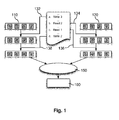
- Fig. 1 shows that two signatures are used to detect data-dependences.
- the access type read or write
- the membership check is run to see whether x exists in the signature of the correspondent type. If x already exists, a data dependence between c and the previous access to x is recorded. Otherwise, x is inserted into the signature.
- a membership check is performed to see whether x exists in the other signature. If yes, data dependence has to be built as well.
- An alternative would be performing membership check and disambiguation whenever a write operation occurs, since read-after-read (RAR) dependences do not prevent parallelization.
- the signature size in Fig. 1 is four.
- Four memory accesses 132, 134, 136, 138 are recorded, including two write and two read accesses.
- the indices always start from 0 at the left of the write signature 110 and the read signature 120, respectively This means that the first address "3" which is accessed is assigned to the fourth (index 3) slot of the write signature 110.
- the second address "2" is assigned to the third (index 2) slot of the read signature 120.
- the third address "1 is assigned to the second (index 1) slot of the read signature 120 etc..
- a disambiguation check is performed after the write access 138 to address "2" in step 150. The disambiguation check of the two signatures indicates a conflict at address 2 of the write signature 110 and the read signature 120.
- a write-after-read (WAR) dependence must be built in step 160.
- the full information about this data dependence comprises the line number "d" of the write access 138, which has to be recorded in the write signature 110, the line number "b" of the read access 134 recorded in the read signature 120 and that the data dependence is a write-after-read (WAR) dependence.
- a function is inserted at the beginning of the target program to initialize the data structures. Every read and write operation of the target program is instrumented. Since disambiguation usually incurs a bigger overhead than the membership check does, data dependences are preferably built using membership check whenever possible. The overhead of disambiguation is higher than of membership check when the size of the signature is big. The latter is explained by means of the following example. It is assumed that there are two signatures containing N elements each. Disambiguation as defined above finds the intersection of the two signatures, which is a set of all the elements that exist in both signatures. This requires a scan of N elements. On the other hand, membership check finds whether an element exist in one signature. The cost equals to the time spent in calculating the position of one element. Since the size of signature is usually tens or even hundreds of thousand slots, it is preferred to use membership check always instead of disambiguation because the cost of scanning N elements is higher than calculating the position of one element if N is a big number.
- Algorithm 1 specifies the membership check stated above.
- Using signatures may cause the problem that two memory accesses may be mapped onto the same slot of the signature. Although false positives are a basic property of signatures and cannot be completely eliminated, an optimization is applied to lower the false-positive rate.
- the main idea is to remove variables from the signature once it is clear that they will never be used again during the remainder of the execution. Thus, a way to monitor the lifetime of a variable is needed.
- the lifetime of a variable is the time between its allocation and de-allocation.
- the lifetime of variables has an impact on the correctness of the data-dependence analysis because signature slots of dead variables might be reused for new variables. If this happens, a false dependence will be built between the last access of the dead variable and the first access of the new variable.
- variable lifetime analysis is dynamically performed.
- a data dependence is expressed as a triple as already indicated above:
- Two data dependences are identical if and only if each element of the triple is identical.
- a data dependence is found, it is checked whether it already exists. If there is no match, a new entry for the dependence is created. Otherwise the new dependence is discarded.
- a parallelism-discovery module reads the dependence file, it still treats these multiple execution instances as one. For example, a loop will always be considered as a whole and its iterations will never be expanded.
- the size of the dependence file for the NAS Parallel Benchmarks ranged from 330 MB to about 37 GB with input class W (6.1 GB on average).
- the file size decreased to between 3 KB and 146 KB (53 KB on average), corresponding to an average reduction by a factor of 120,685x.
- EFPR estimated false-positive rate
- the number of variables in the program is estimated during instrumentation.
- the number is counted based on the intermediate representation (IR) of the program produced by the front-end of LLVM.
- IR intermediate representation
- SSA Static Single Assignment
- the basic idea to parallelize the method described above is using the Single Program Multiple Data Stream (SPMD) model. More specifically, the analysis method is performed in parallel on different sets of memory accesses.
- the producer-consumer pattern is applied as depicted in Fig. 2 .
- a main thread 205 executes the target program 200 and plays the role of the producer, collecting and sorting memory accesses 201, 202, 203 in step 210, whereas 1, 2, 3... sub-worker threads 222 which are comprised by worker thread 220 play the role of consumers, consuming and analyzing memory accesses 201, 202, 2013 and reporting data dependences in step 224.
- a memory address is assigned to exactly one sub-worker thread 222 and this sub-worker 222 thread is responsible for all accesses to that address.
- the total memory which may be called main memory is thus divided or separated in sub-memories.
- Each sub-memory is assigned to a corresponding sub-worker thread 222.
- Fig. 2 shows how the parallelized method and data dependence detection device works.
- the main thread 205 executes the program 200 to be analyzed and collects in step 210 memory accesses 201, 202, 203 in chunks 212 whose size can be changed to provide scalability. And for each sub-worker thread 222, a separate queue to store chunks such as 212 is maintained. A given chunk 212 contains only memory accesses assigned to one sub-worker thread 222. Once a chunk 212 is full, the main thread will push it in step 214 into the queue of the sub-worker thread 222 responsible for the accesses recorded therein.
- the sub-worker threads 222 in turn will consume chunks from their queue, analyze them, store detected data dependences in step 224 in their own local data structure 226 and finally delete those chunks.
- the data from all local data structures is merged in step 230 into a global data structure 240 to remove all duplicated data dependences.
- the column “Original Time (s)” shows the original execution time of the programs from the benchmark suite.
- the column set “Slowdown” lists the slowdown attributable to the instrumentation phase (instrument), to the execution of the instrumented code ("Serial” and “Parallel” w.r.t. the serial and parallel version of our approach), always including the time spent in I/O.
- Total slowdown of a benchmark is the sum of its instrumentation slowdown and execution slowdown.
- the memory consumption is listed in the column set "Memory (MB)”.
- Fig. 3 presents a breakdown of the data-dependence analysis phase. About half (73x) of the time overhead is due to runtime dependence merging. However, it greatly reduces the time needed to write the result to the hard disk. Without dependence merging, it would not be uncommon to spend several hours writing since the dependence-file sizes can easily reach an order of several GB.
- the memory required for the signature varies from 0.01 MB to 248.33 MB, and most of the programs require no more than 45 MB.
- FT requires more than 200 MB due to the large number of variables in the program.
- Table 1 FT consumes 355.13 MB (serial version) in total, which is still adequate for an ordinary computer.
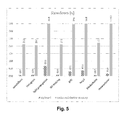
- Fig. 5 and Fig. 6 show the time and memory overhead of the method in comparison to the traditional pair-wise approach, respectively.
- the traditional approach uses a pair-wise algorithm and a multi-layer table to record the status of each memory address.
- Traditional approach (Valgrind-based version) has a huge overhead in both time and memory. Thus it cannot profile NAS benchmarks.
- Test cases used in Fig.5 and Fig.6 are really small programs which can be profiled by the traditional approach. As it is shown in Fig. 6 , the traditional approach has a 521 x slowdown on average in the eight test cases, while our signature approach has an average slowdown of 23x, which is about 22.5x faster.
- Fig. 7 shows a flowchart of the method of determining data dependences within a program.
- the program is started in step 701.
- step 703 it is determined whether there is a next instruction.
- the analysis is terminated in step 705 if there is no further instruction. If there is a next instruction it is determined in step 707 whether the instruction comprises a memory access, meaning a read or write access.
- step 709 it is determined whether a new control region is entered, for example, by detecting a re-convergence point. If a new control region is entered the start of a new control region is recorded in step 713 and local variables which are assigned to the respective new control region are recorded in step 715 and the method proceeds with step 703.
- step 711 If there is no new control region entered in step 709 it is checked in step 711 whether a control region is left. If no control region is left in step 711 the method proceeds with step 703.
- step 717 If a control region is left all slots in the read signature 120 and the write signature 110 which are assigned to local variables of the control region which is left are reset in step 717, recording of data dependences is stopped in step 719 and the method proceeds with step 703.
- step 707 If the instruction determined in step 707 comprises a memory access it is determined in step 721 whether the memory access is a write access.
- step 723 it is checked in step 723 whether the read signature 120 comprises an entry in the slot assigned to the variable accessed by the write access. If there is an entry a write-after-read (WAR) dependence is built and the WAR and the line numbers of the program which are involved in the WAR are recorded in a triple in step 725 as discussed above and the method is continued with step 727.
- WAR write-after-read
- step 723 If in step 723 it is detected there is no entry in the slot of the read signature 120 assigned to the variable accessed by the write access it is continued with step 727.
- step 727 it is checked whether the write signature 110 comprises an entry in the slot assigned to the variable accessed by the write access. If there is an entry a write-after-write (WAW) dependence is built and the WAW and the line numbers of the program which are involved in the WAW are recorded in a triple in step 729 as discussed above and the method proceeds with step 731. In step 731 the line number of the write access is stored in the assigned slot of the write signature 110 and the method is continued with step 703.
- WAW write-after-write
- step 727 If in step 727 it is detected there is no entry in the slot of the write signature 110 assigned to the variable accessed by the write access it is continued with step 703.
- step 735 it is checked whether the write signature 110 comprises an entry in the slot assigned to the variable accessed by the read access. If there is an entry a read-after-write (RAW) dependence is built and the RAW and the line numbers of the program which are involved in the RAW are recorded in a triple in step 737 as discussed above and the method proceeds with step 739. In step 739 the line number of the read access is stored in the assigned slot of the read signature 120 and the method proceeds with step 703.
- RAW read-after-write
- step 735 If it is determined in step 735 that the write signature 110 does not comprise an entry in the slot assigned to the variable accessed by the read access, the method proceeds with step 703.
- Fig. 8 shows a principal sketch of a data-dependence detection device 800 for detecting data dependences in a program.
- the data-dependence detection device comprises a processing device 810 and a memory device 830.
- the processing device 810 comprises a control-region detection device 812 being adapted to determine at least one control region within the program.
- the processing device 810 further comprises at least one execution device 814 being adapted to execute the program.
- the processing device 810 further comprises a dependence detector 816.
- the dependence detector 816 is adapted to detect a first variable within a first control region.
- the dependence detector 816 is further adapted to assign a first slot of a read signature 120 and a corresponding first slot of a write signature 110 to the first variable, wherein the read signature 120 and the write signature 110 are recorded in the memory device 830.
- the dependence detector 816 is further adapted to determine a first line number of a first program line of a first memory access of the program, wherein the first memory access being related to the first variable.
- the dependence detector 816 is further adapted to check whether the first memory access is a read operation or a write operation.
- the dependence detector 816 is further adapted to determine the type of data dependence based on records which are recorded in the first slot of the read signature 120 or the first slot of the write signature 110 and the result of the check of the first memory access.
- the processing device 810 comprises a recorder 818 being adapted to record in the memory device 830 whether the type of data dependence is a read-after-write dependence, write-after-read dependence or write-after-write dependence.
- the processing device further comprises an updater 820 being adapted to update the read signature or the write signature in accordance with the result of the check of the first memory access.
- the updated signatures are stored in the memory device 830.
- the processing device 810 further comprises an assignment detector 822, which is adapted to determine whether the first variable is a first local variable being assigned to the first control region.
- the processing device 810 further comprises a releasing device 824 which is adapted to release the first slot of the read signature and the corresponding first slot of the write signature assigned to the first variable if the first variable is the first local variable if an end of the first control region is passed during execution of the program.
- the parallelism discovery tool "DiscoPoP” was applied to detect parallelizable loops in NAS Parallel Benchmarks (NPB) based on profiled dependences.
- Parallelism discovery requires high-quality data-dependence information to work properly, and already a single false dependence can lead to the opposite result for a code section. Thus, a high precision result of the parallelism discovery tool can prove the high quality of the data dependence.
- Table 1 Detection of parallelizable loops in NAS Parallel Benchmarks.
Landscapes
- Engineering & Computer Science (AREA)
- Theoretical Computer Science (AREA)
- Physics & Mathematics (AREA)
- General Engineering & Computer Science (AREA)
- General Physics & Mathematics (AREA)
- Quality & Reliability (AREA)
- Computer Hardware Design (AREA)
- Computing Systems (AREA)
- Software Systems (AREA)
- Mathematical Physics (AREA)
- Information Retrieval, Db Structures And Fs Structures Therefor (AREA)
Description
- The invention relates to a method of determining at least one data dependence within a program, a data-dependence detection device for detecting data dependences in a program and a corresponding computer program product.
- Data-dependence analysis forms the basis of many program analysis tools, such as parallelization assisting tools and data-race detectors. Traditionally, data-dependence analysis has been performed statically at compile time. A main disadvantage of static data-dependence analysis is that it cannot deal with pointers, dynamically calculated array indices, and dynamic allocation, because the address and even the size of dynamically allocated memory space can only be determined at runtime. Thus, static data-dependence analysis is generally too conservative due to a lack of runtime information.
- In contrast, dynamic data-dependence profiling resolves memory addresses and data dependences at runtime. The traditional algorithm suffers from significant time and memory overhead. The algorithm maintains a separate status (or shadow word) of every memory location that is accessed in the program, which usually costs more memory than the program originally consumes.
- The most successful and important approach to lower the memory overhead of dynamic data-dependence profiling is SD3. SD3 tries to compress memory accesses by expressing a number of regular memory accesses in a single formula. Although SD3 has achieved an impressive result on lowering memory overhead, it increases the time overhead significantly (289x slowdown on average, 845x slowdown in the worst case).
- On the other hand, existing approaches to lower the time overhead of dynamic data-dependence profiling lose either accuracy or detailed information. Instead of recording all the memory accesses, it is, for example, tried to record only some of them, which is called sampling, then infer the data dependences based on partially recorded data and a corresponding mathematical model. Unfortunately, such approaches suffer a significant accuracy drain. Another approach, which has a smaller overhead compared to other tools, records only the critical path instead of detailed pair-wise data dependences. Although it is considered to be fast, it lacks the ability to provide detailed dependence information, which can be useful in assisting parallelization.
- An objective of the present invention is to provide an improved method, data-dependence detection device and computer program product of detecting data dependences. The present invention aims to lower the memory overhead of dynamic data-dependence profiling without increasing its time overhead or significantly loosing accuracy or the ability to provide detailed information.
- This objective is achieved by a method as claimed in
claim 1, by a data-dependence detection device as claimed in claim 11, and by a computer program product as claimed in claim 13. - In a first aspect a method of determining at least one data dependence within a program is presented, the method comprising the steps of:
- determining at least one control region within the program;
- executing the program;
- determining a type of data dependence by means of the steps of
- o detecting a first variable within a first control region;
- o assigning a first slot of a read signature and a corresponding first slot of a write signature to the first variable;
- o determining a first line number of a first program line of a first memory access of the program, wherein the first memory access being related to the first variable;
- o checking whether the first memory access is a read operation or a write operation;
- o determining the type of data dependence based on records being recorded in the first slot of the read signature or the first slot of the write signature and the result of the check of the first memory access;
- recording in a memory device whether the type of data dependence is a read-after-write dependence, write-after-read dependence or write-after-writedependence;
- updating the read signature or the write signature in accordance with the result of the check of the first memory access;
- determining whether the first variable is a first local variable being assigned to the first control region;
- releasing the first slot of the read signature and the corresponding first slot of the write signature assigned to the first variable if the first variable is the first local variable if an end of the first control region is passed during execution of the program.
- The method of data-dependence detection obviously works also without the steps of
- determining at least one control region within the program;
- determining whether the first variable is a first local variable being assigned to the first control region;
- releasing the first slot of the read signature and the corresponding first slot of the write signature assigned to the first variable if the first variable is the first local variable if an end of the first control region is passed during execution of the program
- Local variables are determined within so called control regions. One option to determine control regions may be to determine control dependences. A look-ahead technique may be used to determine a re-convergence point when a branch is encountered. The re-convergence point is the point where the different branch alternatives of the program end and unconditional execution resumes. Before the real branch is executed, every possible branch is tried first, and this look-ahead is terminated when a re-convergence point is encountered, which is the first instruction that comes after a control region. The re-convergence point is searched for in "look-ahead" mode. This means, while searching, all instrumentation related to memory accesses is disabled and all intermediate values and program states are stored separately on a scratchpad. After following all branches up to the re-convergence point, the real branch is executed in normal mode. The look ahead technique is especially suited for the detection of control regions if only binary code is available. Further details about the detection of control regions can be found in the European patent application with the application number
EP 13179316.8 - An alternative and possibly simpler approach to determine the control regions may be used when the source code of a program is available. The source code is traversed and all control regions are recorded by determining branches of the program and the corresponding re-convergence points by means of the corresponding program instructions. This is like reading the file and log important things down. The latter can be done on the run, meaning during execution on the program the control regions may thus be identified during execution of the program. Anyhow, control regions may also be determined independently from executing the program as described above.
- Data dependences are preferably recorded by storing the type of data dependence and the line numbers or an equivalent characterization of the memory accesses which are involved in the data dependence. A preferred presentation of data dependences may be a triple comprising the <Dependent-Line, Dependence-Type, Depends-On-Line>.
- Recording data dependences is especially useful and necessary for determining the data structure of a program and options of parallelizing the program. One can distinguish four types of data dependences: true dependences (read-after-write or short RAW), antidependences (write-after-read or short WAR), output dependences (write-after-write or short WAW) and input dependences (read-after-read or short RAR). Read-after-read dependences are not relevant to or do not influence parallelization. It is therefore not necessary to record RAR dependences. Anyhow, for different purposes it may be useful to record these dependences as well. The method would follow in this case the same way as described above and in the subsequent description.
- According to a preferred embodiment the method may be characterize in that the steps of determining and recording the type of data dependence are performed by a worker thread, and the method comprises the steps of:
- ▪ checking whether the write signature comprises a record of a second line number in the first slot if the first memory access is a read operation;
- ▪ writing a first information or information item to a memory device if the first slot of the write signature comprises the second line number, wherein the first information comprises information regarding the first line number, the second line number and that a read operation has been performed after a write operation;
- ▪ writing the first line number in the first slot of the read signature if the first memory access is a read operation;
- ▪ checking whether the write signature comprises a record of a third line number in the first slot if the first memory access is a write operation;
- ▪ writing a second information to the memory device if the first slot of the write signature comprises the third line number, wherein the second information comprising information regarding the first line number, the third line number and that a write operation has been performed after a write operation;
- ▪ writing the first line number in the first slot of the write signature if the first memory access is a write operation;
- ▪ checking whether the read signature comprises a record of a fourth line number in the first slot if the first memory access is a write operation;
- ▪ writing a third information to the memory device if the first slot of the read signature comprises the fourth line number, wherein the third information comprising information regarding the first line number, the fourth line number and that a write operation has been performed after a read operation;
- ▪ writing the first line number in the first slot of the write signature if the first memory access is a write operation.
- The first, second and third information comprise at least three information items and are called triples. The triples comprise the two line numbers of the program code which are involved in the memory access and the type of memory access. The approach described above uses the so-called membership check because the members of both the read and the write signature are checked. An alternative would be performing membership check and disambiguation whenever a write operation occurs, since read-after-read (RAR) dependences do not prevent parallelization. Since disambiguation usually incurs a bigger overhead than the membership check does, data dependences are preferably built using membership check whenever possible. The worker thread may be a device or program code executed on a processor which determines and records the triples as described above.
- According to another preferred embodiment the method may comprise the further steps of:
- checking if a fourth information is identical with one of the first information, second information or third information;
- discarding the fourth information if the fourth information is identical with one of the first information, second information or third information.
- Redundant or identical data dependences are merged in order to avoid memory overhead. Such redundancies may be caused by loops and functions that will be executed many times. Checking and discarding may be performed on the run before storing the fourth information in order to reduce the number of data dependences written to the memory device which may be, for example a disk. The alternative approach of comparing the triples in a final step after recording all data dependences may cause too much memory overhead.
- The method may comprise according to another preferred embodiment the additional step of:
- determining a size of a read signature and a size of write signature based on a number of variables used within the program prior to the execution of the program.
- The size of the signatures may be estimated by means of the type of program and the size of the program. The chosen size of the signature may in this case be chosen in accordance with reference values which were determined in the past. Short signatures may provide less accuracy because there may be variables which cannot be assigned to a slot after all slots have been assigned. Experienced based signatures may thus often comprise much more slots than necessary. This may cause unnecessary memory overhead. It may thus be advantageous to count the variables either in a static way or during execution of the program. Executing the program may provide more accurate data with respect to the number of variables and the resulting length of the read signature and the write signature.
- The method may comprise according to another preferred embodiment the additional step of:
- separating a main memory available for executing the program into at least a first sub-memory and a second sub-memory prior to the execution of the program.
- The main memory may be comprised by the memory device or may alternatively be located in a different memory unit. There may be 3, 4, 5 or more sub-memories.
- Different variables are usually stored in different sections of a memory. The separation of the main memory which comprises all variables stored for running the program thus enables to perform the analysis of data dependences in parallel in each sub-memory. The steps of
- determining a type of data dependence by means of the steps of
- o detecting a first variable within a first control region;
- o assigning a first slot of a read signature and a corresponding first slot of a write signature to the first variable;
- o determining a first line number of a first program line of a first memory access of the program, wherein the first memory access being related to the first variable;
- o checking whether the first memory access is a read operation or a write operation;
- o determining the type of data dependence based on records being recorded in the first slot of the read signature or the first slot of the write signature and the result of the check of the first memory access;
- recording in a memory device whether the type of data dependence is a read-after-write dependence, write-after-read dependence or write-after-write dependence;
- determining whether the first variable is a first local variable being assigned to the first control region;
- releasing the first slot of the read signature and the corresponding first slot of the write signature assigned to the first variable if the first variable is the first local variable if an end of the first control region is passed during execution of the program,
- Again it is obvious that the steps of
- determining at least one control region within the program;
- determining whether the first variable is a first local variable being assigned to the first control region;
- releasing the first slot of the read signature and the corresponding first slot of the write signature assigned to the first variable if the first variable is the first local variable if an end of the first control region is passed during execution of the program
- The sub memories may be chosen independently from whether all local variables of one control region are stored to the same sub-memory. There is no need to determine memory regions assigned to one, two or more control regions in order to determine the data dependences and record for example the triples in the memory device. Furthermore, the location of the memory used for storing a local variable does not interfere with the fact that the variable is a local variable such that the length of the read signature and write signature assigned to the first sub-memory and the length the read signature and write signature assigned to the second sub-memory can be reduced in the same way as in the case of only one main memory. The total length of the read signature and write signature assigned to the first sub-memory and the length the read signature and write signature assigned to the second sub-memory are each shorter than a read signature and write signature assigned to the complete main memory because the number of variables and corresponding memory accesses recorded by means of the signatures assigned to a sub-memory can be estimated by the total number of variables divided by the number of sub-memories.
- The worker thread comprises according to another embodiment at least a first sub-worker thread assigned to the first sub-memory for evaluating memory accesses to the first sub-memory; and a second sub-worker thread assigned to the second sub-memory for evaluating memory accesses to the second sub-memory.
- The first sub-worker thread and the second sub-worker thread may analyze the data dependences being related to the respective first and second sub-memory in the same way as described above with respect to the worker thread. Two, three, four, five or more sub-worker threads enable to record data dependences of one program in a parallelized approach. The parallelized approach may reduce the time needed to record all data dependences.
- The method may comprise according to another preferred embodiment the additional steps of:
- storing by means of a main thread a memory access to the first sub-memory in a first chunk assigned to the first sub-memory during execution of the program; and
- storing by means of the main thread a memory access to the second sub-memory in a second chunk assigned to the second sub-memory during execution of the program.
- The main worker thread may be used to prepare the analysis of data dependences to be performed by the sub-worker threads by sorting memory accesses according to which sub-memory they reference. The first chunk and the second chunk are containers with a predefined data capacity.
- The worker thread may comprise at least a first sub-worker thread assigned to the first sub-memory for evaluating memory accesses stored in the first chunk; and a second sub-worker thread assigned to the second sub-memory for evaluating memory accesses stored in the second chunk.
- The chunks are loaded by means of the main thread and assigned to the respective sub-worker thread. The respective sub-worker thread fetches and unpacks a corresponding chunk from the queue and subsequently performs the analysis of the data dependences by determining triples as described above. The information written to the memory device by means of each sub-worker thread may be controlled on the run in order to determine redundant information which may be caused, for example, by loops as discussed above. The information may be merged by discarding the redundant information in order to minimize overhead memory.
- The method may comprise according to another preferred embodiment the additional steps of:
- comparing fifth information written by the first sub-worker thread with sixth information written by the second sub-worker thread;
- deleting the sixth information written by the second sub-worker thread if the sixth information written by the second sub-worker thread is identical with the fifth information written by the first sub-worker thread.
- Data dependences recorded by the different sub-worker threads may be compared and merged by discarding the redundant information in order to minimize overhead memory. The revised final data dependences are recorded by means of the memory device.
- The worker thread may comprise N ≥ 2 sub-worker threads. The method may comprise in an alternative embodiment the additional step of:
- determining a size of a read signature and a size of write signature assigned to a sub-worker thread based on a number of variables used within the program and the number N of sub-worker threads prior to the execution of the program.
- The approach as already mentioned above may be to divide the length of the signature determined for only one worker thread by the number of sub-worker threads N. It may be necessary to provide an extension to the read signature and write signature assigned to the respective sub-worker thread in order to balance the differences in the program codes accessing the respective sub-memories. In a more sophisticated approach the sub-memories may be chosen by taking into account the instructions initiating data access. It may in this case be possible to choose sub-memories in a way that the corresponding read signatures and write signatures do have the same length or adapting the size of the signatures to the respective sub-memories.
- According to a further aspect of the present invention a data-dependence detection device for detecting data dependences in a program is presented. The data-dependence detection device comprising at least one processing device and at least one memory device, the processing device comprising at least one control-region detection device being adapted to determine at least one control region within the program, the processing device comprising at least one execution device being adapted to execute the program, the processing device comprising a dependence detector, the dependence detector being adapted to detect a first variable within a first control region, the dependence detector being further adapted to assign a first slot of a read signature and a corresponding first slot of a write signature to the first variable, wherein the read signature and the write signature are recorded in the memory device, the dependence detector being further adapted to determine a first line number of a first program line of a first memory access of the program, wherein the first memory access being related to the first variable, the dependence detector being adapted to check whether the first memory access is a read operation or a write operation, the dependence detector being adapted to determine the type of data dependence based on records being recorded in the first slot of the read signature or the first slot of the write signature and the result of the check of the first memory access, the processing device comprising a recorder being adapted to record in the memory device whether the type of data dependence is a read-after-write dependence, write-after-read dependence or write-after-write dependence. The processing device comprises an updater being adapted to update the read signature or the write signature in accordance with the result of the check of the first memory access. The processing device comprising an assignment detector being adapted to determine whether the first variable is a first local variable being assigned to the first control region, and the processing device comprising a releasing device being adapted to release the first slot of the read signature and the corresponding first slot of the write signature assigned to the first variable if the first variable is the first local variable if an end of the first control region is passed during execution of the program.
- The data-dependence detection device according to another embodiment may comprise a worker thread. The worker thread being adapted to perform the functions of the dependence detector and the recorder, the worker thread being adapted to:
- ▪ check whether the write signature comprises a record of a second line number in the first slot if the first memory access is a read operation;
- ▪ write a first information to the memory device if the first slot of the write signature comprises the second line number, wherein the first information comprising information regarding the first line number, the second line number and that a read operation has been performed after a write operation;
- ▪ write the first line number in the first slot of the read signature if the first memory access is a read operation;
- ▪ check whether the write signature comprises a record of a third line number in the first slot if the first memory access is a write operation;
- ▪ write a second information to the memory device if the first slot of the write signature comprises the third line number, wherein the second information comprising information regarding the first line number, the third line number and that a write operation has been performed after a write operation;
- ▪ write the first line number in the first slot of the write signature if the first memory access is a write operation;
- ▪ check whether the read signature comprises a record of a fourth line number in the first slot if the first memory access is a write operation;
- ▪ write a third information to the memory device if the first slot of the read signature comprises the fourth line number, wherein the third information comprising information regarding the first line number, the fourth line number and that a write operation has been performed after a read operation;
- ▪ write the first line number in the first slot of the write signature if the first memory access is a write operation.
- The processing device may be one processor or a combination of two or more processors which are adapted to perform one ore more functions of the control-region detection device, execution device, dependence detector, recorder, assignment detector or releasing device. The processing device may alternatively or in addition comprise specialized circuit arrangements in order to perform one or more of the functionalities of the control-region detection device, execution device, dependence detector, recorder, assignment detector or releasing device. The memory device may comprise one memory unit or two or more different memory units wherein the memory units may be RAM, disc drives, SSD or memory units realized by any suitable technology. The processing device and memory device may be operated by means of a dedicated computer program enabling the described functionalities of the control-region detection device, execution device, dependence detector, recorder, assignment detector or releasing device.
- The processing device may optionally comprise a discarding device for discarding redundant information.
- In another aspect of the present invention a computer program product stored on a computer-readable medium or downloaded from a network is presented, the computer program product comprises code means for producing the steps of the method as claimed in any of claims 1 - 10 when run on the accordingly adapted data-dependence detection device of claims 11 or 12.
- The method, the data-dependence detection device and the computer program product presented above may have the advantage to lower the memory overhead of dynamic data-dependence profiling without increasing its time overhead or significantly loosing accuracy or the ability to provide detailed information.
- It shall be understood that the method of
claim 1, the data-dependence detection device of claim 11 and the computer program product of claim 13 have similar and/or identical embodiments, in particular, as defined in the dependent claims. - It shall be understood that a preferred embodiment of the invention can also be any combination of the dependent claims with the respective independent claim.
- Further advantageous embodiments are defined below.
- These and other aspects of the invention will be apparent from and elucidated with reference to the embodiments described hereinafter.
- The invention will now be described, by way of example, based on embodiments with reference to the accompanying drawings.
- In the drawings:
-
Fig. 1 shows an example of determining data dependences -
Fig. 2 shows an embodiment of determining data dependences in parallel -
Fig. 3 shows the runtime overhead of determining and merging dependences of the serial profiler -
Fig. 4 shows the memory requirements of the signature-based method on NPB programs when EFPR = 1 % of the serial profiler -
Fig. 5 shows a comparison of slowdown between the signature-based method (sig-based, serial) and the traditional approach (traditional shadow memory) -
Fig. 6 shows a comparison of memory consumption between the signature-based method (sig-based, serial) and the traditional approach (traditional shadow memory) -
Fig. 7 shows a flowchart of the method of determining data dependences within a program -
Fig. 8 shows a principal sketch of a data-dependence detection device - Various embodiments of the invention will now be described.
- A signature is a data structure that supports the approximate representation of an unbounded set of elements with a bounded amount of state. It is widely used in transactional memory systems to uncover conflicts. A signature usually supports three operations:
- Insertion: A new element is inserted into the signature. The state of the signature is changed after the insertion.
- Membership check: Tests whether an element is already a member of the signature. Since a signature is an approximate representation, the membership check returning true does not always mean the element already exists in the signature. It thus may produce false positives. However, the membership check ensures that the return value of an inserted element must be true. Hence, there are no false negatives.
- Disambiguation: Intersection operation between two signatures. If an element was inserted in both of them, the resulting element must be represented in the resulting intersection.
- A data dependence can be regarded as a conflict because it exists only when two or more memory operations access the same memory location in some order. Therefore, a signature is also suitable for detecting data-dependences. The method adopts the idea of signatures to store memory accesses. A fixed-length array is combined with a hash function that maps memory addresses to array indices. In each slot of the array, we save the source line number where the memory access occurs. A source line may be the smallest unit to index data dependences. Anyhow, variable names may be used in order to index dependences in a finer grain. Because of the fixed length of the data structure, memory consumption can be adjusted as needed.
-
Fig. 1 shows that two signatures are used to detect data-dependences. Oneread signature 120 for recording read operations and onewrite signature 110 for write operations. When a memory access c at address x is captured, first the access type (read or write) is obtained. Then, the membership check is run to see whether x exists in the signature of the correspondent type. If x already exists, a data dependence between c and the previous access to x is recorded. Otherwise, x is inserted into the signature. At the same time, a membership check is performed to see whether x exists in the other signature. If yes, data dependence has to be built as well. An alternative would be performing membership check and disambiguation whenever a write operation occurs, since read-after-read (RAR) dependences do not prevent parallelization. The signature size inFig. 1 is four. Four memory accesses 132, 134, 136, 138 are recorded, including two write and two read accesses. The indices always start from 0 at the left of thewrite signature 110 and the readsignature 120, respectively This means that the first address "3" which is accessed is assigned to the fourth (index 3) slot of thewrite signature 110. The second address "2" is assigned to the third (index 2) slot of the readsignature 120. The third address "1 is assigned to the second (index 1) slot of the readsignature 120 etc.. A disambiguation check is performed after thewrite access 138 to address "2" instep 150. The disambiguation check of the two signatures indicates a conflict ataddress 2 of thewrite signature 110 and the readsignature 120. In this case, a write-after-read (WAR) dependence must be built instep 160. The full information about this data dependence comprises the line number "d" of thewrite access 138, which has to be recorded in thewrite signature 110, the line number "b" of the readaccess 134 recorded in the readsignature 120 and that the data dependence is a write-after-read (WAR) dependence. - A function is inserted at the beginning of the target program to initialize the data structures. Every read and write operation of the target program is instrumented. Since disambiguation usually incurs a bigger overhead than the membership check does, data dependences are preferably built using membership check whenever possible. The overhead of disambiguation is higher than of membership check when the size of the signature is big. The latter is explained by means of the following example. It is assumed that there are two signatures containing N elements each. Disambiguation as defined above finds the intersection of the two signatures, which is a set of all the elements that exist in both signatures. This requires a scan of N elements. On the other hand, membership check finds whether an element exist in one signature. The cost equals to the time spent in calculating the position of one element. Since the size of signature is usually tens or even hundreds of thousand slots, it is preferred to use membership check always instead of disambiguation because the cost of scanning N elements is higher than calculating the position of one element if N is a big number.
-
Algorithm 1 specifies the membership check stated above.
- Using signatures may cause the problem that two memory accesses may be mapped onto the same slot of the signature. Although false positives are a basic property of signatures and cannot be completely eliminated, an optimization is applied to lower the false-positive rate.
- The main idea is to remove variables from the signature once it is clear that they will never be used again during the remainder of the execution. Thus, a way to monitor the lifetime of a variable is needed. The lifetime of a variable is the time between its allocation and de-allocation. The lifetime of variables has an impact on the correctness of the data-dependence analysis because signature slots of dead variables might be reused for new variables. If this happens, a false dependence will be built between the last access of the dead variable and the first access of the new variable.
- To resolve this problem, a variable lifetime analysis is dynamically performed.
  int x = 0; // declare x outside while loop, insert x to signature
  while (x < 10) { // entry of while loop, control region starts
     int y = x + 2; // declare y inside while loop, insert y to signature
     x++;
  } // exit of while loop, control region ends
  // x alive, y dead, remove y from signature
This means the allocation and de-allocation of variables is observed. In addition, dynamic control-flow information is exploited, which is helpful to determine the lifetime of local variables allocated inside a control region. Although there is no explicit de-allocation of local variables, they are deallocated once the program leaves the control region where they have been allocated. For this reason, signature slots for local variables can be reused without the danger of building false dependences. Below an example of variable life span is shown and 
- <Dependent-Line, Dependence-Type, Depends-On-Line>.


| Program | Original Time (s) | Slowdown (x) | Memory (MB) | ||||
| Instrument | Serial | Parallel (8T) | Original | Serial | Parallel (8T) | ||
| BT | 8.21 | 2.89 | 245.07 | 99.56 | 12.91 | 2656.59 | 8126.06 |
| SP | 24.79 | 3.00 | 141.36 | 86.59 | 37.46 | 161.06 | 872.84 |
| LU | 23.36 | 4.12 | 165.24 | 74.41 | 25.73 | 105.21 | 231.00 |
| IS | 0.14 | 7.00 | 234.00 | 135.00 | 36.34 | 580.23 | 261.76 |
| EP | 5.96 | 0.02 | 34.89 | 19.42 | 6.94 | 65.58 | 220.26 |
| CG | 0.90 | 0.79 | 290.93 | 142.43 | 33.65 | 106.33 | 656.56 |
| MG | 1.06 | 12.50 | 223.50 | 119.00 | 229.65 | 289.04 | 225.22 |
| FT | 0.87 | 0.43 | 192.30 | 106.60 | 86.14 | 355.13 | 418.85 |
| Average | 8.16 | 3.84 | 190.91 | 97.88 | 58.60 | 539.90 | 1376.57 |
| Program | # Executed Loops | # OMP Annotated | # Identified |
| BT | 184 | 30 | 30 |
| SP | 252 | 34 | 34 |
| LU | 173 | 33 | 33 |
| IS | 25 | 11 | 8 |
| EP | 10 | 1 | 1 |
| CG | 32 | 16 | 9 |
| MG | 74 | 14 | 14 |
| FT | 37 | 8 | 7 |
| Overall | 787 | 147 | 136 |
- 110
- write signature
- 120
- read signature
- 132, 134, 136, 138, 201, 202, 203
- memory access
- 150
- disambiguation check
- 160
- building dependence
- 200
- executing target program
- 205
- main thread
- 210
- collecting memory accesses
- 212
- chunk of memory accesses
- 214
- pushing chunks in queue of corresponding sub-worker thread
- 220
- worker thread
- 222
- sub-worker thread
- 224
- reporting dependences
- 226
- local data structure
- 230
- merging data
- 240
- global data structure
- 701
- starting grogram
- 703
- detecting next instruction
- 705
- terminating analysis
- 707
- comprising instruction memory access
- 709
- detecting new control region
- 711
- detecting whether control region is left
- 713
- recording start of control region
- 715
- recording local variables
- 717
- resetting local variables
- 719
- stopping recording of control region which is left
- 721
- detecting write access
- 723
- checking of read signature
- 725
- recording memory access
- 727
- checking write signature
- 729
- recording memory access
- 731
- writing write signature
- 735
- checking write signature
- 737
- recording memory access
- 739
- writing read signature
- 800
- data-dependence detection device
- 810
- processing device
- 812
- control-region detection device
- 814
- execution device
- 816
- dependence detector
- 818
- recorder
- 820
- updater
- 822
- assignment detector
- 824
- releasing device
- 830
- memory device
Claims (13)
- A method of determining at least one data dependence within a program, the method comprising the steps of:- determining at least one control region within the program;- executing the program;- determining a type of data dependence by means of the steps ofo detecting a first variable within a first control region;o assigning a first slot of a read signature (120) and a corresponding first slot of a write signature (110) to the first variable;o determining a first line number of a first program line of a first memory access (132, 134, 136, 138, 201, 202, 203) of the program, wherein the first memory access (132, 134, 136, 138, 201, 202, 203) being related to the first variable;o checking whether the first memory access (132, 134, 136, 138, 201, 202, 203) is a read operation or a write operation;o determining the type of data dependence based on records being recorded in the first slot of the read signature (120) or the first slot of the write signature (110) and the result of the check of the first memory access (132, 134, 136, 138, 201, 202, 203);- recording in a memory device (830) whether the type of data dependence is a read-after-write dependence, write-after-read dependence or write-after-write dependence;- updating the read signature (120) or the write signature (110) in accordance with the result of the check of the first memory access (132, 134, 136, 138, 201, 202, 203);- determining whether the first variable is a first local variable being assigned to the first control region;- releasing the first slot of the read signature (120) and the corresponding first slot of the write signature (110) assigned to the first variable if the first variable is the first local variable if an end of the first control region is passed during execution of the program.
- The method according to claim 1, wherein the steps of determine and recording the type of data dependence are performed by a worker thread (220), and the method comprises the steps of:▪ checking whether the write signature (110) comprises a record of a second line number in the first slot if the first memory access is a read operation;▪ writing a first information to a memory device if the first slot of the write signature (110) comprises the second line number, wherein the first information comprises information regarding the first line number, the second line number and that a read operation has been performed after a write operation;▪ writing the first line number in the first slot of the read signature (120) if the first memory access is a read operation;▪ checking whether the write signature (110) comprises a record of a third line number in the first slot if the first memory access is a write operation;▪ writing a second information to the memory device if the first slot of the write signature (110) comprises the third line number, wherein the second information comprising information regarding the first line number, the third line number and that a write operation has been performed after a write operation;▪ writing the first line number in the first slot of the write signature (110) if the first memory access is a write operation;▪ checking whether the read signature (120) comprises a record of a fourth line number in the first slot if the first memory access is a write operation;▪ writing a third information to the memory device if the first slot of the read signature (120) comprises the fourth line number, wherein the third information comprising information regarding the first line number, the fourth line number and that a write operation has been performed after a read operation;▪ writing the first line number in the first slot of the write signature (110) if the first memory access is a write operation.
- The method according to any one of the preceding claims, wherein the method comprises the further steps of:- checking if a fourth information is identical with one of the first information, second information or third information;- discarding the fourth information if the fourth information is identical with one of the first information, second information or third information.
- The method according to any one of the preceding claims, wherein the method comprises the additional step of:- determining a size of a read signature (120) and a size of write signature (110) based on a number of variables used within the program prior to the execution of the program.
- The method according to any one of the preceding claims, wherein the method comprises the additional step of:- separating a main memory available for executing the program in at least a first sub-memory and a second sub-memory prior to the execution of the program.
- The method according to claim 5 when depending on claim 2, wherein the worker thread (220) comprises at least a first sub-worker thread (222) assigned to the first sub-memory for evaluating memory accesses to the first sub-memory; and a second sub-worker thread (222) assigned to the second sub-memory for evaluating memory accesses to the second sub-memory.
- The method according to claim 5 when depending on claim 2, wherein the method comprises the additional steps of:- storing by means of a main thread (220) a memory access to the first sub-memory in a first chunk assigned to the first sub-memory during execution of the program; and- storing by means of the main thread (220) a memory access to the second sub-memory in a second chunk assigned to the second sub-memory during execution of the program.
- The method according to claim 7, wherein the worker thread (220) comprises at least a first sub-worker thread (222) assigned to the first sub-memory for evaluating memory accesses stored in the first chunk; and a second sub-worker thread (222) assigned to the second sub-memory for evaluating memory accesses stored in the second chunk.
- The method according to claim 6 or 8, wherein the method comprises the additional steps of:- comparing fifth information written by the first sub-worker thread (222) with sixth information written by the second sub-worker thread (222);- deleting the sixth information written by the second sub-worker thread (222) if the sixth information written by the second sub-worker thread (222) is identical with the fifth information written by the first sub-worker thread (222).
- The method according to any one of claims 6, 8 or 9, wherein the worker thread comprises N ≥ 2 sub-worker threads (222), wherein the method comprises the additional step of:- determining a size of a read signature (120) and a size of write signature (110) assigned to a sub-worker thread (222) based on a number of variables used within the program and the number N of sub-worker threads (222) prior to the execution of the program.
- A data-dependence detection device (800) for detecting data dependences in a program, the data-dependence detection device comprising at least one processing device (810) and at least one memory device (830), the processing device (810) comprising at least one control-region detection device (812) being adapted to determine at least one control region within the program, the processing device (810) comprising at least one execution device (814) being adapted to execute the program, the processing device comprising a dependence detector (816), the dependence detector (816) being adapted to detect a first variable within a first control region, the dependence detector (816) being further adapted to assign a first slot of a read signature (120) and a corresponding first slot of a write signature (110) to the first variable, wherein the read signature (120) and the write signature (110) are recorded in the memory device (830), the dependence detector (816) being further adapted to determine a first line number of a first program line of a first memory access (132, 134, 136, 138, 201, 202, 203) of the program, wherein the first memory access (132, 134, 136, 138, 201, 202, 203) being related to the first variable, the dependence detector (816) being adapted to check whether the first memory access (132, 134, 136, 138, 201, 202, 203) is a read operation or a write operation, the dependence detector (816) being adapted to determine the type of data dependence based on records being recorded in the first slot of the read signature (120) or the first slot of the write signature (110) and the result of the check of the first memory access(132, 134, 136, 138, 201, 202, 203), the processing device (810) comprising a recorder (818) being adapted to record in the memory device whether the type of data dependence is a read-after-write dependence, write-after-read dependence or write-after-write dependence, the processing device (810) comprising an updater (820) being adapted to update the read signature (120) or the write signature (110) in accordance with the result of the check of the first memory access(132, 134, 136, 138, 201, 202, 203), the processing device (810) comprising an assignment detector (822) being adapted to determine whether the first variable is a first local variable being assigned to the first control region, and the processing device (810) comprising a releasing (824) device being adapted to release the first slot of the read signature (120) and the corresponding first slot of the write signature (110) assigned to the first variable if the first variable is the first local variable if an end of the first control region is passed during execution of the program.
- The data-dependence detection device (800) of claim 12 comprising a worker thread (220), the worker thread (220) being adapted to perform the functions of the dependence detector (816) and the recorder (818), the worker thread (220)being adapted to:▪ check whether the write signature (110) comprises a record of a second line number in the first slot if the first memory access (132, 134, 136, 138, 201, 202, 203) is a read operation;▪ write a first information to the memory device (830) if the first slot of the write signature (110) comprises the second line number, wherein the first information comprising information regarding the first line number, the second line number and that a read operation has been performed after a write operation;▪ write the first line number in the first slot of the read signature (120) if the first memory access (132, 134, 136, 138, 201, 202, 203) is a read operation;▪ check whether the write signature (110) comprises a record of a third line number in the first slot if the first memory access is a write operation;▪ write a second information to the memory device (830) if the first slot of the write signature (110) comprises the third line number, wherein the second information comprising information regarding the first line number, the third line number and that a write operation has been performed after a write operation;▪ write the first line number in the first slot of the write signature (110) if the first memory access (132, 134, 136, 138, 201, 202, 203) is a write operation;▪ check whether the read signature (120) comprises a record of a fourth line number in the first slot if the first memory access (132, 134, 136, 138, 201, 202, 203) is a write operation;▪ write a third information to the memory device (830) if the first slot of the read signature (120) comprise the fourth line number, wherein the third information comprising information regarding the first line number, the fourth line number and that a write operation has been performed after a read operation;▪ write the first line number in the first slot of the write signature (110) if the first memory access is a write operation.
- A computer program product comprising code means for producing the steps of the method as claimed in any one of claims 1 to 10 when run on the data-dependence detection device of claim 11.
Priority Applications (1)
| Application Number | Priority Date | Filing Date | Title |
|---|---|---|---|
| EP14186595.6A EP3001312B1 (en) | 2014-09-26 | 2014-09-26 | Method, device and computer program product for detecting data dependencies within a program |
Applications Claiming Priority (1)
| Application Number | Priority Date | Filing Date | Title |
|---|---|---|---|
| EP14186595.6A EP3001312B1 (en) | 2014-09-26 | 2014-09-26 | Method, device and computer program product for detecting data dependencies within a program |
Publications (2)
| Publication Number | Publication Date |
|---|---|
| EP3001312A1 true EP3001312A1 (en) | 2016-03-30 |
| EP3001312B1 EP3001312B1 (en) | 2019-02-27 |
Family
ID=51627204
Family Applications (1)
| Application Number | Title | Priority Date | Filing Date |
|---|---|---|---|
| EP14186595.6A Active EP3001312B1 (en) | 2014-09-26 | 2014-09-26 | Method, device and computer program product for detecting data dependencies within a program |
Country Status (1)
| Country | Link |
|---|---|
| EP (1) | EP3001312B1 (en) |
Cited By (4)
| Publication number | Priority date | Publication date | Assignee | Title |
|---|---|---|---|---|
| WO2018076979A1 (en) * | 2016-10-31 | 2018-05-03 | 华为技术有限公司 | Detection method and apparatus for data dependency between instructions |
| JP2018156568A (en) * | 2017-03-21 | 2018-10-04 | 株式会社東芝 | Compilation device |
| CN109857630A (en) * | 2017-11-30 | 2019-06-07 | 阿里巴巴集团控股有限公司 | Code detection method, system and device |
| US10963373B2 (en) * | 2019-03-25 | 2021-03-30 | Aurora Labs Ltd. | Identifying software dependencies using line-of-code behavior and relation models |
-
2014
- 2014-09-26 EP EP14186595.6A patent/EP3001312B1/en active Active
Non-Patent Citations (7)
| Title |
|---|
| CEZE L ET AL: "Bulk Disambiguation of Speculative Threads in Multiprocessors", COMPUTER ARCHITECTURE, 2006. 33RD INTERNATIONAL SYMPOSIUM ON BOSTON, MA, USA 17-21 JUNE 2006, PISCATAWAY, NJ, US, 17 June 2006 (2006-06-17), pages 227 - 238, XP010925397, ISBN: 978-0-7695-2608-9, DOI: 10.1109/ISCA.2006.13 * |
| HONGTAO YU ET AL: "Multi-slicing: a compiler-supported parallel approach to data dependence profiling", PROCEEDINGS OF THE 2012 INTERNATIONAL SYMPOSIUM ON SOFTWARE TESTING AND ANALYSIS, ISSTA 2012, 15 July 2012 (2012-07-15), New York, New York, USA, pages 23 - 33, XP055180530, ISBN: 978-1-45-031454-1, DOI: 10.1145/2338965.2336756 * |
| HYOYOUNG KIM ET AL: "CUBIT: Compact Bitmap Profling for Dynamic Data Dependence Analysis", PROCEEDINGS OF THE 2013 RESEARCH IN ADAPTIVE AND CONVERGENT SYSTEMS ON, RACS '13, 1 October 2013 (2013-10-01), New York, New York, USA, pages 63 - 68, XP055180609, ISBN: 978-1-45-032348-2, DOI: 10.1145/2513228.2513272 * |
| K-F FAXEN ET AL: "Embla - Data Dependence Profiling for Parallel Programming", COMPLEX, INTELLIGENT AND SOFTWARE INTENSIVE SYSTEMS, 2008. CISIS 2008. INTERNATIONAL CONFERENCE ON, IEEE, PISCATAWAY, NJ, USA, 4 March 2008 (2008-03-04), pages 780 - 785, XP032392639, ISBN: 978-0-7695-3109-0, DOI: 10.1109/CISIS.2008.52 * |
| MINJANG KIM ET AL: "SD3: A Scalable Approach to Dynamic Data-Dependence Profiling", MICROARCHITECTURE (MICRO), 2010 43RD ANNUAL IEEE/ACM INTERNATIONAL SYMPOSIUM ON, IEEE, PISCATAWAY, NJ, USA, 4 December 2010 (2010-12-04), pages 535 - 546, XP031855546, ISBN: 978-1-4244-9071-4 * |
| RAJESHWAR VANKA ET AL: "Efficient and accurate data dependence profiling using software signatures", PROCEEDINGS OF THE TENTH INTERNATIONAL SYMPOSIUM ON CODE GENERATION AND OPTIMIZATION, CHO '12, 31 March 2012 (2012-03-31), New York, New York, USA, pages 186 - 195, XP055179960, ISBN: 978-1-45-031206-6, DOI: 10.1145/2259016.2259041 * |
| ZHEN LI ET AL: "Discovery of Potential Parallelism in Sequential Programs", 2013 42ND INTERNATIONAL CONFERENCE ON PARALLEL PROCESSING, 1 October 2013 (2013-10-01), pages 1 - 10, XP055099187, ISBN: 978-0-76-955117-3, DOI: 10.1109/ICPP.2013.119 * |
Cited By (10)
| Publication number | Priority date | Publication date | Assignee | Title |
|---|---|---|---|---|
| WO2018076979A1 (en) * | 2016-10-31 | 2018-05-03 | 华为技术有限公司 | Detection method and apparatus for data dependency between instructions |
| US10684834B2 (en) | 2016-10-31 | 2020-06-16 | Huawei Technologies Co., Ltd. | Method and apparatus for detecting inter-instruction data dependency |
| JP2018156568A (en) * | 2017-03-21 | 2018-10-04 | 株式会社東芝 | Compilation device |
| CN109857630A (en) * | 2017-11-30 | 2019-06-07 | 阿里巴巴集团控股有限公司 | Code detection method, system and device |
| CN109857630B (en) * | 2017-11-30 | 2022-08-02 | 阿里巴巴集团控股有限公司 | Code detection method, system and equipment |
| US10963373B2 (en) * | 2019-03-25 | 2021-03-30 | Aurora Labs Ltd. | Identifying software dependencies using line-of-code behavior and relation models |
| US11216360B2 (en) | 2019-03-25 | 2022-01-04 | Aurora Labs Ltd. | Identifying software dependencies using controller code models |
| US11442850B2 (en) | 2019-03-25 | 2022-09-13 | Aurora Labs Ltd. | Identifying software dependencies using controller code models |
| US11741280B2 (en) | 2019-03-25 | 2023-08-29 | Aurora Labs Ltd. | Identifying software dependencies using controller code models |
| US12045551B2 (en) | 2019-03-25 | 2024-07-23 | Aurora Labs Ltd. | Identifying software dependencies using controller code models |
Also Published As
| Publication number | Publication date |
|---|---|
| EP3001312B1 (en) | 2019-02-27 |
Similar Documents
| Publication | Publication Date | Title |
|---|---|---|
| EP2972885B1 (en) | Memory object reference count management with improved scalability | |
| US7899997B2 (en) | Systems and methods for implementing key-based transactional memory conflict detection | |
| US8359291B2 (en) | Architecture-aware field affinity estimation | |
| US20100017789A1 (en) | Selectively Obtaining Call Stack Information Based on Criteria | |
| US9612837B2 (en) | Trace method and information processing apparatus | |
| EP3001312B1 (en) | Method, device and computer program product for detecting data dependencies within a program | |
| Li et al. | An efficient data-dependence profiler for sequential and parallel programs | |
| US20080244332A1 (en) | Machine instruction level race condition detection | |
| KR101109210B1 (en) | Method and apparatus for detecting a data access violation | |
| US20140195771A1 (en) | Anticipatorily loading a page of memory | |
| JP5031470B2 (en) | Memory management method, information processing apparatus, and memory management program | |
| Yu et al. | Fast loop-level data dependence profiling | |
| Weng et al. | Effective performance issue diagnosis with value-assisted cost profiling | |
| CN109885489B (en) | Data race detection method and device in driver | |
| US6854110B2 (en) | System and method for obtaining scratch registers in computer executable binaries | |
| US10102099B2 (en) | Performance information generating method, information processing apparatus and computer-readable storage medium storing performance information generation program | |
| US9250939B2 (en) | Information processing device, profile target determining program, and method | |
| US7698690B2 (en) | Identifying code that wastes time performing redundant computation | |
| US8756580B2 (en) | Instance-based field affinity optimization | |
| KR20170131374A (en) | After Disabling Memory Corruption Root Cause Identification Techniques | |
| JP5974856B2 (en) | Sampling program, sampling method and information processing apparatus | |
| US9619361B2 (en) | Performance profiling apparatus and performance profiling method | |
| US9552197B2 (en) | Computer-readable recording medium storing information processing program, information processing apparatus, and information processing method | |
| US7590792B2 (en) | Cache memory analyzing method | |
| US20230333987A1 (en) | Computer-readable recording medium, information processing method, and information processing device |
Legal Events
| Date | Code | Title | Description |
|---|---|---|---|
| PUAI | Public reference made under article 153(3) epc to a published international application that has entered the european phase |
Free format text: ORIGINAL CODE: 0009012 |
|
| AK | Designated contracting states |
Kind code of ref document: A1 Designated state(s): AL AT BE BG CH CY CZ DE DK EE ES FI FR GB GR HR HU IE IS IT LI LT LU LV MC MK MT NL NO PL PT RO RS SE SI SK SM TR |
|
| AX | Request for extension of the european patent |
Extension state: BA ME |
|
| RAP1 | Party data changed (applicant data changed or rights of an application transferred) |
Owner name: TECHNISCHE UNIVERSITAET DARMSTADT |
|
| 17P | Request for examination filed |
Effective date: 20160929 |
|
| RBV | Designated contracting states (corrected) |
Designated state(s): AL AT BE BG CH CY CZ DE DK EE ES FI FR GB GR HR HU IE IS IT LI LT LU LV MC MK MT NL NO PL PT RO RS SE SI SK SM TR |
|
| REG | Reference to a national code |
Ref country code: DE Ref legal event code: R079 Ref document number: 602014041705 Country of ref document: DE Free format text: PREVIOUS MAIN CLASS: G06F0009450000 Ipc: G06F0008410000 |
|
| GRAP | Despatch of communication of intention to grant a patent |
Free format text: ORIGINAL CODE: EPIDOSNIGR1 |
|
| STAA | Information on the status of an ep patent application or granted ep patent |
Free format text: STATUS: GRANT OF PATENT IS INTENDED |
|
| RIC1 | Information provided on ipc code assigned before grant |
Ipc: G06F 11/30 20060101ALI20180430BHEP Ipc: G06F 11/34 20060101ALI20180430BHEP Ipc: G06F 11/36 20060101ALI20180430BHEP Ipc: G06F 8/41 20180101AFI20180430BHEP |
|
| INTG | Intention to grant announced |
Effective date: 20180605 |
|
| GRAS | Grant fee paid |
Free format text: ORIGINAL CODE: EPIDOSNIGR3 |
|
| GRAJ | Information related to disapproval of communication of intention to grant by the applicant or resumption of examination proceedings by the epo deleted |
Free format text: ORIGINAL CODE: EPIDOSDIGR1 |
|
| GRAL | Information related to payment of fee for publishing/printing deleted |
Free format text: ORIGINAL CODE: EPIDOSDIGR3 |
|
| STAA | Information on the status of an ep patent application or granted ep patent |
Free format text: STATUS: REQUEST FOR EXAMINATION WAS MADE |
|
| STAA | Information on the status of an ep patent application or granted ep patent |
Free format text: STATUS: EXAMINATION IS IN PROGRESS |
|
| INTC | Intention to grant announced (deleted) | ||
| 17Q | First examination report despatched |
Effective date: 20181022 |
|
| GRAP | Despatch of communication of intention to grant a patent |
Free format text: ORIGINAL CODE: EPIDOSNIGR1 |
|
| STAA | Information on the status of an ep patent application or granted ep patent |
Free format text: STATUS: GRANT OF PATENT IS INTENDED |
|
| INTG | Intention to grant announced |
Effective date: 20181206 |
|
| GRAA | (expected) grant |
Free format text: ORIGINAL CODE: 0009210 |
|
| STAA | Information on the status of an ep patent application or granted ep patent |
Free format text: STATUS: THE PATENT HAS BEEN GRANTED |
|
| RIC1 | Information provided on ipc code assigned before grant |
Ipc: G06F 11/34 20060101ALI20180430BHEP Ipc: G06F 11/30 20060101ALI20180430BHEP Ipc: G06F 8/41 20180101AFI20180430BHEP Ipc: G06F 11/36 20060101ALI20180430BHEP |
|
| AK | Designated contracting states |
Kind code of ref document: B1 Designated state(s): AL AT BE BG CH CY CZ DE DK EE ES FI FR GB GR HR HU IE IS IT LI LT LU LV MC MK MT NL NO PL PT RO RS SE SI SK SM TR |
|
| REG | Reference to a national code |
Ref country code: GB Ref legal event code: FG4D |
|
| REG | Reference to a national code |
Ref country code: CH Ref legal event code: EP |
|
| REG | Reference to a national code |
Ref country code: AT Ref legal event code: REF Ref document number: 1102360 Country of ref document: AT Kind code of ref document: T Effective date: 20190315 |
|
| REG | Reference to a national code |
Ref country code: IE Ref legal event code: FG4D |
|
| REG | Reference to a national code |
Ref country code: DE Ref legal event code: R096 Ref document number: 602014041705 Country of ref document: DE |
|
| REG | Reference to a national code |
Ref country code: NL Ref legal event code: MP Effective date: 20190227 |
|
| REG | Reference to a national code |
Ref country code: LT Ref legal event code: MG4D |
|
| PG25 | Lapsed in a contracting state [announced via postgrant information from national office to epo] |
Ref country code: NL Free format text: LAPSE BECAUSE OF FAILURE TO SUBMIT A TRANSLATION OF THE DESCRIPTION OR TO PAY THE FEE WITHIN THE PRESCRIBED TIME-LIMIT Effective date: 20190227 Ref country code: LT Free format text: LAPSE BECAUSE OF FAILURE TO SUBMIT A TRANSLATION OF THE DESCRIPTION OR TO PAY THE FEE WITHIN THE PRESCRIBED TIME-LIMIT Effective date: 20190227 Ref country code: FI Free format text: LAPSE BECAUSE OF FAILURE TO SUBMIT A TRANSLATION OF THE DESCRIPTION OR TO PAY THE FEE WITHIN THE PRESCRIBED TIME-LIMIT Effective date: 20190227 Ref country code: PT Free format text: LAPSE BECAUSE OF FAILURE TO SUBMIT A TRANSLATION OF THE DESCRIPTION OR TO PAY THE FEE WITHIN THE PRESCRIBED TIME-LIMIT Effective date: 20190627 Ref country code: NO Free format text: LAPSE BECAUSE OF FAILURE TO SUBMIT A TRANSLATION OF THE DESCRIPTION OR TO PAY THE FEE WITHIN THE PRESCRIBED TIME-LIMIT Effective date: 20190527 Ref country code: SE Free format text: LAPSE BECAUSE OF FAILURE TO SUBMIT A TRANSLATION OF THE DESCRIPTION OR TO PAY THE FEE WITHIN THE PRESCRIBED TIME-LIMIT Effective date: 20190227 |
|
| PG25 | Lapsed in a contracting state [announced via postgrant information from national office to epo] |
Ref country code: BG Free format text: LAPSE BECAUSE OF FAILURE TO SUBMIT A TRANSLATION OF THE DESCRIPTION OR TO PAY THE FEE WITHIN THE PRESCRIBED TIME-LIMIT Effective date: 20190527 Ref country code: HR Free format text: LAPSE BECAUSE OF FAILURE TO SUBMIT A TRANSLATION OF THE DESCRIPTION OR TO PAY THE FEE WITHIN THE PRESCRIBED TIME-LIMIT Effective date: 20190227 Ref country code: RS Free format text: LAPSE BECAUSE OF FAILURE TO SUBMIT A TRANSLATION OF THE DESCRIPTION OR TO PAY THE FEE WITHIN THE PRESCRIBED TIME-LIMIT Effective date: 20190227 Ref country code: GR Free format text: LAPSE BECAUSE OF FAILURE TO SUBMIT A TRANSLATION OF THE DESCRIPTION OR TO PAY THE FEE WITHIN THE PRESCRIBED TIME-LIMIT Effective date: 20190528 Ref country code: IS Free format text: LAPSE BECAUSE OF FAILURE TO SUBMIT A TRANSLATION OF THE DESCRIPTION OR TO PAY THE FEE WITHIN THE PRESCRIBED TIME-LIMIT Effective date: 20190627 Ref country code: LV Free format text: LAPSE BECAUSE OF FAILURE TO SUBMIT A TRANSLATION OF THE DESCRIPTION OR TO PAY THE FEE WITHIN THE PRESCRIBED TIME-LIMIT Effective date: 20190227 |
|
| REG | Reference to a national code |
Ref country code: AT Ref legal event code: MK05 Ref document number: 1102360 Country of ref document: AT Kind code of ref document: T Effective date: 20190227 |
|
| PG25 | Lapsed in a contracting state [announced via postgrant information from national office to epo] |
Ref country code: AL Free format text: LAPSE BECAUSE OF FAILURE TO SUBMIT A TRANSLATION OF THE DESCRIPTION OR TO PAY THE FEE WITHIN THE PRESCRIBED TIME-LIMIT Effective date: 20190227 Ref country code: DK Free format text: LAPSE BECAUSE OF FAILURE TO SUBMIT A TRANSLATION OF THE DESCRIPTION OR TO PAY THE FEE WITHIN THE PRESCRIBED TIME-LIMIT Effective date: 20190227 Ref country code: IT Free format text: LAPSE BECAUSE OF FAILURE TO SUBMIT A TRANSLATION OF THE DESCRIPTION OR TO PAY THE FEE WITHIN THE PRESCRIBED TIME-LIMIT Effective date: 20190227 Ref country code: EE Free format text: LAPSE BECAUSE OF FAILURE TO SUBMIT A TRANSLATION OF THE DESCRIPTION OR TO PAY THE FEE WITHIN THE PRESCRIBED TIME-LIMIT Effective date: 20190227 Ref country code: SK Free format text: LAPSE BECAUSE OF FAILURE TO SUBMIT A TRANSLATION OF THE DESCRIPTION OR TO PAY THE FEE WITHIN THE PRESCRIBED TIME-LIMIT Effective date: 20190227 Ref country code: CZ Free format text: LAPSE BECAUSE OF FAILURE TO SUBMIT A TRANSLATION OF THE DESCRIPTION OR TO PAY THE FEE WITHIN THE PRESCRIBED TIME-LIMIT Effective date: 20190227 Ref country code: RO Free format text: LAPSE BECAUSE OF FAILURE TO SUBMIT A TRANSLATION OF THE DESCRIPTION OR TO PAY THE FEE WITHIN THE PRESCRIBED TIME-LIMIT Effective date: 20190227 Ref country code: ES Free format text: LAPSE BECAUSE OF FAILURE TO SUBMIT A TRANSLATION OF THE DESCRIPTION OR TO PAY THE FEE WITHIN THE PRESCRIBED TIME-LIMIT Effective date: 20190227 |
|
| REG | Reference to a national code |
Ref country code: DE Ref legal event code: R097 Ref document number: 602014041705 Country of ref document: DE |
|
| PG25 | Lapsed in a contracting state [announced via postgrant information from national office to epo] |
Ref country code: PL Free format text: LAPSE BECAUSE OF FAILURE TO SUBMIT A TRANSLATION OF THE DESCRIPTION OR TO PAY THE FEE WITHIN THE PRESCRIBED TIME-LIMIT Effective date: 20190227 Ref country code: SM Free format text: LAPSE BECAUSE OF FAILURE TO SUBMIT A TRANSLATION OF THE DESCRIPTION OR TO PAY THE FEE WITHIN THE PRESCRIBED TIME-LIMIT Effective date: 20190227 |
|
| PG25 | Lapsed in a contracting state [announced via postgrant information from national office to epo] |
Ref country code: AT Free format text: LAPSE BECAUSE OF FAILURE TO SUBMIT A TRANSLATION OF THE DESCRIPTION OR TO PAY THE FEE WITHIN THE PRESCRIBED TIME-LIMIT Effective date: 20190227 |
|
| PLBE | No opposition filed within time limit |
Free format text: ORIGINAL CODE: 0009261 |
|
| STAA | Information on the status of an ep patent application or granted ep patent |
Free format text: STATUS: NO OPPOSITION FILED WITHIN TIME LIMIT |
|
| 26N | No opposition filed |
Effective date: 20191128 |
|
| PG25 | Lapsed in a contracting state [announced via postgrant information from national office to epo] |
Ref country code: SI Free format text: LAPSE BECAUSE OF FAILURE TO SUBMIT A TRANSLATION OF THE DESCRIPTION OR TO PAY THE FEE WITHIN THE PRESCRIBED TIME-LIMIT Effective date: 20190227 |
|
| PG25 | Lapsed in a contracting state [announced via postgrant information from national office to epo] |
Ref country code: TR Free format text: LAPSE BECAUSE OF FAILURE TO SUBMIT A TRANSLATION OF THE DESCRIPTION OR TO PAY THE FEE WITHIN THE PRESCRIBED TIME-LIMIT Effective date: 20190227 |
|
| PG25 | Lapsed in a contracting state [announced via postgrant information from national office to epo] |
Ref country code: MC Free format text: LAPSE BECAUSE OF FAILURE TO SUBMIT A TRANSLATION OF THE DESCRIPTION OR TO PAY THE FEE WITHIN THE PRESCRIBED TIME-LIMIT Effective date: 20190227 |
|
| REG | Reference to a national code |
Ref country code: CH Ref legal event code: PL |
|
| PG25 | Lapsed in a contracting state [announced via postgrant information from national office to epo] |
Ref country code: LU Free format text: LAPSE BECAUSE OF NON-PAYMENT OF DUE FEES Effective date: 20190926 Ref country code: LI Free format text: LAPSE BECAUSE OF NON-PAYMENT OF DUE FEES Effective date: 20190930 Ref country code: IE Free format text: LAPSE BECAUSE OF NON-PAYMENT OF DUE FEES Effective date: 20190926 Ref country code: CH Free format text: LAPSE BECAUSE OF NON-PAYMENT OF DUE FEES Effective date: 20190930 |
|
| REG | Reference to a national code |
Ref country code: BE Ref legal event code: MM Effective date: 20190930 |
|
| PG25 | Lapsed in a contracting state [announced via postgrant information from national office to epo] |
Ref country code: BE Free format text: LAPSE BECAUSE OF NON-PAYMENT OF DUE FEES Effective date: 20190930 |
|
| GBPC | Gb: european patent ceased through non-payment of renewal fee |
Effective date: 20190926 |
|
| PG25 | Lapsed in a contracting state [announced via postgrant information from national office to epo] |
Ref country code: FR Free format text: LAPSE BECAUSE OF NON-PAYMENT OF DUE FEES Effective date: 20190930 Ref country code: GB Free format text: LAPSE BECAUSE OF NON-PAYMENT OF DUE FEES Effective date: 20190926 |
|
| PG25 | Lapsed in a contracting state [announced via postgrant information from national office to epo] |
Ref country code: CY Free format text: LAPSE BECAUSE OF FAILURE TO SUBMIT A TRANSLATION OF THE DESCRIPTION OR TO PAY THE FEE WITHIN THE PRESCRIBED TIME-LIMIT Effective date: 20190227 |
|
| PG25 | Lapsed in a contracting state [announced via postgrant information from national office to epo] |
Ref country code: MT Free format text: LAPSE BECAUSE OF FAILURE TO SUBMIT A TRANSLATION OF THE DESCRIPTION OR TO PAY THE FEE WITHIN THE PRESCRIBED TIME-LIMIT Effective date: 20190227 Ref country code: HU Free format text: LAPSE BECAUSE OF FAILURE TO SUBMIT A TRANSLATION OF THE DESCRIPTION OR TO PAY THE FEE WITHIN THE PRESCRIBED TIME-LIMIT; INVALID AB INITIO Effective date: 20140926 |
|
| PG25 | Lapsed in a contracting state [announced via postgrant information from national office to epo] |
Ref country code: MK Free format text: LAPSE BECAUSE OF FAILURE TO SUBMIT A TRANSLATION OF THE DESCRIPTION OR TO PAY THE FEE WITHIN THE PRESCRIBED TIME-LIMIT Effective date: 20190227 |
|
| PGFP | Annual fee paid to national office [announced via postgrant information from national office to epo] |
Ref country code: DE Payment date: 20250919 Year of fee payment: 12 |