EP3001184B1 - Passive device for the detection and/or determination in situ of amines in gases - Google Patents
Passive device for the detection and/or determination in situ of amines in gases Download PDFInfo
- Publication number
- EP3001184B1 EP3001184B1 EP14795283.2A EP14795283A EP3001184B1 EP 3001184 B1 EP3001184 B1 EP 3001184B1 EP 14795283 A EP14795283 A EP 14795283A EP 3001184 B1 EP3001184 B1 EP 3001184B1
- Authority
- EP
- European Patent Office
- Prior art keywords
- pdms
- amines
- nqs
- sensor according
- sensor
- Prior art date
- Legal status (The legal status is an assumption and is not a legal conclusion. Google has not performed a legal analysis and makes no representation as to the accuracy of the status listed.)
- Active
Links
Images



Classifications
-
- G—PHYSICS
- G01—MEASURING; TESTING
- G01N—INVESTIGATING OR ANALYSING MATERIALS BY DETERMINING THEIR CHEMICAL OR PHYSICAL PROPERTIES
- G01N21/00—Investigating or analysing materials by the use of optical means, i.e. using sub-millimetre waves, infrared, visible or ultraviolet light
- G01N21/75—Systems in which material is subjected to a chemical reaction, the progress or the result of the reaction being investigated
- G01N21/77—Systems in which material is subjected to a chemical reaction, the progress or the result of the reaction being investigated by observing the effect on a chemical indicator
-
- G—PHYSICS
- G01—MEASURING; TESTING
- G01N—INVESTIGATING OR ANALYSING MATERIALS BY DETERMINING THEIR CHEMICAL OR PHYSICAL PROPERTIES
- G01N21/00—Investigating or analysing materials by the use of optical means, i.e. using sub-millimetre waves, infrared, visible or ultraviolet light
- G01N21/75—Systems in which material is subjected to a chemical reaction, the progress or the result of the reaction being investigated
- G01N21/77—Systems in which material is subjected to a chemical reaction, the progress or the result of the reaction being investigated by observing the effect on a chemical indicator
- G01N21/78—Systems in which material is subjected to a chemical reaction, the progress or the result of the reaction being investigated by observing the effect on a chemical indicator producing a change of colour
- G01N21/783—Systems in which material is subjected to a chemical reaction, the progress or the result of the reaction being investigated by observing the effect on a chemical indicator producing a change of colour for analysing gases
-
- G—PHYSICS
- G01—MEASURING; TESTING
- G01N—INVESTIGATING OR ANALYSING MATERIALS BY DETERMINING THEIR CHEMICAL OR PHYSICAL PROPERTIES
- G01N31/00—Investigating or analysing non-biological materials by the use of the chemical methods specified in the subgroup; Apparatus specially adapted for such methods
- G01N31/22—Investigating or analysing non-biological materials by the use of the chemical methods specified in the subgroup; Apparatus specially adapted for such methods using chemical indicators
- G01N31/223—Investigating or analysing non-biological materials by the use of the chemical methods specified in the subgroup; Apparatus specially adapted for such methods using chemical indicators for investigating presence of specific gases or aerosols
- G01N31/224—Investigating or analysing non-biological materials by the use of the chemical methods specified in the subgroup; Apparatus specially adapted for such methods using chemical indicators for investigating presence of specific gases or aerosols for investigating presence of dangerous gases
Definitions
- the invention falls within the field of the detection and/or determination in situ of amines in gases, and relates to a passive, simple and inexpensive device for implementing said estimation.
- the device is capable of acting as a passive colorimetric sensor in the detection of volatile amines, both primary and secondary, and is also capable of discriminating between amines according to the colour obtained.
- Amines in general, are pollutants to be taken into consideration due to the fact that they react very easily in the presence of nitrous acid or other nitrogen compounds producing nitrosamines. Nitrosamines are responsible for causing cancer in a large number of animal species. In the case of humans, current studies show a direct correspondence between nitrosamines and the risk of suffering from cancer. In this way, aliphatic amines are known as potent precursors of carcinogenic substances and the determination and control thereof is crucial.
- Amines have properties such as high volatility and polarity, they are chemically unstable and, in addition, do not have ultraviolet absorbance or fluorescence emission.
- a derivatisation agent In order to provide a solution to the problem of the detection thereof, there are various methods that propose converting the amines into a more stable product, which can be detected, by way of a derivatisation agent.
- the derivatisation allows low quantities of amines to be detected by way of a secondary reaction to form the derivative detectable in mild reaction conditions [1].
- derivatisation agents used for detecting aliphatic amines, such as ortho-phthalaldehyde (OPA), dinitrofluorobenzene (DNFB), ninhydrin, fluorescamine, halogen benzofuran and 1,2 naphthoquinone-4-sulfonate (NQS) [2, 3a-b].
- OPA ortho-phthalaldehyde
- DNFB dinitrofluorobenzene
- ninhydrin fluorescamine
- fluorescamine halogen benzofuran
- NQS 1,2 naphthoquinone-4-sulfonate
- the derivatisation step has been and is widely used as a method for increasing the limit of detection (LOD) in different techniques such as gas chromatography, liquid chromatography and UV-vis spectrometry.
- LOD limit of detection
- these techniques do not generally allow the detection in situ and in real time.
- the active sampling technique which enables the detection to take place in a short time period, although this technique usually depends on an external energy source, which involves the need for specific equipment for the sampling and in some cases, an energy cost to be taken into account.
- the commercial colorimetric tubes [4] have the drawback of low reproducibility and therefore the low accuracy thereof.
- Another example of an active sampler would be the EFS-C18 cartridges derivatised with NQS [5], in which the derivatisation agent is anchored (not embedded) in the solid medium, and therefore they require a costly conditioning, washing and elution process of the cartridge.
- the passive sampling technique although generally requiring greater exposure times, does not require an external energy source, or the execution of specific tasks by the personnel, whereby the energy cost is zero and it improves the simplicity and applicability of the sensor.
- These types of passive sensors are recommended for many specific applications; therefore the availability thereof is of interest.
- a phenoquinone supported by PDMS which acts as a colorimetric and fluorometric photo-induced sensor, is described in [7].
- this sensor requires prior photoinduction by means of UV light to produce the "ana"-quinone derivative, and also only detects very large quantities of amines, to the order of g/ml, therefore it does not have a practical application in real atmospheres.
- a gas dosimeter batch utilising a 1,2-naphthoquinone-4-sulfonic acid (NQSA) derivative (e.g. the sodium salt thereof) as colorimetric reagent for the determination of amines in solution or air is disclosed in [8].
- the reagent is applied dropwise to a carrier medium such as a thin paper-like strip and then allowed to dry, before covering carrier and reagent with a porous membrane layer against the effects of wind, moisture and UV radiation on the reagent.
- said quantification can be carried out by way of direct measurement of the diffuse reflection of the sensors.
- FIGs 5a and 5b Representation of the absorbance at a wavelength of 580 nm ( Figure 5a ) for 6 devices of each synthesis, up to a total of 4 syntheses that were carried out following the same experimental protocol; and photograph showing the 6 devices of one of the syntheses ( Figure 5b ).
- an object of the present invention is to provide a passive colorimetric sensor for the detection in situ of amines in gaseous form, and in particular in air, which does not suffer from the previously stated defects and, in particular, is aimed at providing a colorimetric sensor that has limits of detection lower than the ones known at present for these types of sensors, such that it may be used in the detection of amines in real atmospheres.
- the invention is based on the fact that, in the presence of amines, the NQS sulphate group is eliminated, being bonded to the amine and producing a highly chromogenic product, according to the following reaction:
- the invention is aimed at a passive colorimetric sensor of aliphatic amines with a LOD range suitable for detection and quantification in real atmospheres, according to claim 1.
- the sensor is based on a derivatisation reagent, NQS, embedded in PDMS as absorbent matrix.
- NQS derivatisation reagent
- This device acts as a passive colorimetric sensor in the detection of volatile amines with an LOD of up to 3 mg/m 3 .
- the invention is aimed at a manufacturing process of the sensor according to claim 6, which is based on incorporating the NQS in a solid support of PDMS.
- the manufacturing method comprises the following steps:
- the NQS is supported in the PDMS, unlike other sensors described in the literature, it does not require any kind of pre-treatment or an external source or instrument for the sensor to be able to carry out its function. Furthermore, owing to the properties of the PDMS, the NQS is stabilised, highlighting the harmlessness of the resulting sensor to the environment, the stability thereof over a wide range of temperatures and resistance to reversion, the stability thereof with respect to humidity owing to the low water absorption and the good resistance thereof to solar radiation, thereby preventing the degradation and loss of the function thereof as a derivatisation agent.
- the sensor produced in this way, can be used in the detection and/or quantification of amines in gases, in particular in the air, and more particularly in atmospheric air, in which the detection is carried out in situ and in real time by means of the passive sampling technique.
- the PDMS used is a silicone elastomer based on polydimethylsiloxane such as dimethyl-hydrogenmethyl siloxane marketed under the commercial brand Sylgard 184®, which is one of the most elastic and active polymers and there are multiple applications thereof indicated in the bibliography.
- Sylgard 184® polydimethylsiloxane
- the easy preparation, zero toxicity, the malleability and the thermal and electrical stability thereof are relevant characteristics of this material.
- the chemical properties thereof enable the rapid diffusion of the analytes through the sensor described.
- the design of the sensors is based on the incorporation of NQS in the PDMS gel.
- the synthesis was optimised by varying the solvent for NQS and varying the concentration of NQS. Different thicknesses and shapes were also tested for the device.
- NQS NQS
- responses with greater sensitivity were obtained up to a saturation quantity.
- the most suitable range of NQS concentration values was 0.43 to 0.46 mg NQS/g PDMS.
- the dimensions of the sensor were also optimised, different thicknesses of the sensor being tested and, for this, using different recipients to form the gel.
- the thickness of the sheet formed was the most important parameter. Thicknesses of between 2.5 and 0.8 cm were tested. With thicknesses lower than 1.0 cm, no colour change was observed. The best results obtained in terms of the reproducibility thereof and easy handling of the devices were obtained in a thickness range of 1.0 to 1.5 cm. In terms of the surface area of the sheet, the easiest sensors to handle and in turn sufficiently large to be able to see the colour change with the naked eye were obtained with surface areas between 1.0 and 3.0 cm 2 .
- the elastomer of PDMS (SYLGARD base) (13.6 g) was added to a solution of sodium 1,2 naphthoquinone-4-sulfonate (6.8 mg) in chloroform (0.35 ml) and left under vigorous stirring until a uniform mixture was obtained (30 mins). Then, the polymerisation agent (SYLGARD 184) (1.36 g) was added and sonicated for a few minutes. The resulting gel was deposited on a plate of 8 wells (of the type commonly used for cell cultures) with a 1.5 cm diameter and 1.2 cm depth, where it was left for two days at room temperature in darkness with the aim of obtaining 1,2-naphthoquinone-4-sulfonate embedded in PDMS. Once the gel solidified, forming a film, it was removed from the wells, thereby obtaining each one of the devices ready for the use thereof.
- Example 4 Evaluation of the response of the sensor to amines
- FIG. 1 shows an image of the derivatives formed for each one of the amines. It may be observed with the naked eye that the different amines have different tones; the dimethylamine and the diethylamine have orange tones while the methylamine and ethylamine have brown and grey tones. In this way, the response is selective for each one of the amines in a qualitative manner. Furthermore, the diffuse reflection signal obtained ( Figure 1 ) provides a quantitative measure of the presence of amines in a specific atmosphere.
- amines methylamine, ethylamine, dimethylamine and diethylamine
- the graphs of Figure 2 show the variation of the response of the sensor as a function of the wavelength for different concentrations of methylamine in air.
- the quantification of the amine concentration in a specific atmosphere can be carried out by direct measurement of the sensor exposed to said atmosphere, without the need for any reagent or sample preparation step.
- the increase in sensitivity of this sensor is achieved by increasing the exposure time.
- the increase in sensitivity along with the exposure time is shown for methylamine.
- the results obtained showed that the sensor enables concentrations of amines from 3 mg/m 3 to be detected with an exposure time of 5 hours. Consequently, the sensor can be applied in the detection of amines in environments with a concentration range from 3 mg/m 3 up to levels of ⁇ g/cm 3 , a level at which the sensor is saturated ( Figure 4 ).
- the sensors are shown be to exceptionally stable with time, whereby they can be used long after they have been prepared without the need for any type of treatment.
- the response thereof to the presence of amines is also stable over time.
Landscapes
- Chemical & Material Sciences (AREA)
- Health & Medical Sciences (AREA)
- Physics & Mathematics (AREA)
- Life Sciences & Earth Sciences (AREA)
- Pathology (AREA)
- Immunology (AREA)
- General Physics & Mathematics (AREA)
- Analytical Chemistry (AREA)
- Biochemistry (AREA)
- General Health & Medical Sciences (AREA)
- Chemical Kinetics & Catalysis (AREA)
- Plasma & Fusion (AREA)
- Engineering & Computer Science (AREA)
- Toxicology (AREA)
- Dispersion Chemistry (AREA)
- Biophysics (AREA)
- Molecular Biology (AREA)
- Investigating Or Analysing Materials By The Use Of Chemical Reactions (AREA)
- Investigating Or Analyzing Non-Biological Materials By The Use Of Chemical Means (AREA)
Description
- The invention falls within the field of the detection and/or determination in situ of amines in gases, and relates to a passive, simple and inexpensive device for implementing said estimation. The device is capable of acting as a passive colorimetric sensor in the detection of volatile amines, both primary and secondary, and is also capable of discriminating between amines according to the colour obtained.
- In recent years, nitrogen compounds such as ammonia and aliphatic amines have been become significant pollutants due to the toxic and odorous characteristics thereof. Aliphatic amines found in air in considerable concentrations are the result of the extensive use thereof by the chemical industry, in which said compounds are applied in the manufacture of raw materials or intermediate products for the preparation of fertilisers, pesticides, surfactants, pharmaceuticals, polymers, colourants, etc.
- Amines, in general, are pollutants to be taken into consideration due to the fact that they react very easily in the presence of nitrous acid or other nitrogen compounds producing nitrosamines. Nitrosamines are responsible for causing cancer in a large number of animal species. In the case of humans, current studies show a direct correspondence between nitrosamines and the risk of suffering from cancer. In this way, aliphatic amines are known as potent precursors of carcinogenic substances and the determination and control thereof is crucial. All of this has caused a growing social awareness regarding the dangers to health that the presence of amines in air poses, directing many research studies towards the search for reliable detection methods for the monitoring thereof in the environment, especially in locations prone to having volatile amines in unadvisable quantities, such as purifiers, agrochemical industries and others.
- Amines have properties such as high volatility and polarity, they are chemically unstable and, in addition, do not have ultraviolet absorbance or fluorescence emission. In order to provide a solution to the problem of the detection thereof, there are various methods that propose converting the amines into a more stable product, which can be detected, by way of a derivatisation agent. The derivatisation allows low quantities of amines to be detected by way of a secondary reaction to form the derivative detectable in mild reaction conditions [1]. There are many derivatisation agents used for detecting aliphatic amines, such as ortho-phthalaldehyde (OPA), dinitrofluorobenzene (DNFB), ninhydrin, fluorescamine, halogen benzofuran and 1,2 naphthoquinone-4-sulfonate (NQS) [2, 3a-b].
- The derivatisation step has been and is widely used as a method for increasing the limit of detection (LOD) in different techniques such as gas chromatography, liquid chromatography and UV-vis spectrometry. However, these techniques do not generally allow the detection in situ and in real time.
- In the case of determining amines in situ and in real time, one possibility is to use the active sampling technique, which enables the detection to take place in a short time period, although this technique usually depends on an external energy source, which involves the need for specific equipment for the sampling and in some cases, an energy cost to be taken into account. For example, the commercial colorimetric tubes [4] have the drawback of low reproducibility and therefore the low accuracy thereof. Another example of an active sampler would be the EFS-C18 cartridges derivatised with NQS [5], in which the derivatisation agent is anchored (not embedded) in the solid medium, and therefore they require a costly conditioning, washing and elution process of the cartridge. These systems reach LODs of 3.2 and 1.1 mg/m3, considering 15 and 60 minutes respectively as the sample time at 30 ml/min. Lastly, other active sensors of amines in the air act by doping polymers such as PDMS, PVA or NOA65 with metalloporphyrins and making an active sampling in quantities of 11000 ppmv [6], concentrations significantly above the concentrations in the real atmosphere and the concentrations established by legislation.
- Alternatively, the passive sampling technique, although generally requiring greater exposure times, does not require an external energy source, or the execution of specific tasks by the personnel, whereby the energy cost is zero and it improves the simplicity and applicability of the sensor. These types of passive sensors are recommended for many specific applications; therefore the availability thereof is of interest.
- As an example of a passive sensor, a phenoquinone supported by PDMS, which acts as a colorimetric and fluorometric photo-induced sensor, is described in [7]. However, this sensor requires prior photoinduction by means of UV light to produce the "ana"-quinone derivative, and also only detects very large quantities of amines, to the order of g/ml, therefore it does not have a practical application in real atmospheres. Similarly, a gas dosimeter batch utilising a 1,2-naphthoquinone-4-sulfonic acid (NQSA) derivative (e.g. the sodium salt thereof) as colorimetric reagent for the determination of amines in solution or air is disclosed in [8]. The reagent is applied dropwise to a carrier medium such as a thin paper-like strip and then allowed to dry, before covering carrier and reagent with a porous membrane layer against the effects of wind, moisture and UV radiation on the reagent.
- Hitherto, no passive sensors of amines in air for determination in situ are known that have LODs suitable for determination in real atmospheres, that is to say, with low amine concentrations. Compared to other passive amine sensors previously described, the proposed sensor clearly improves the sensitivity, enabling the detection of amines at very low concentrations. In addition, compared with other devices with colorimetric response, such as for example more common commercial colorimetric tubes (active sensors, with use of manual pumps), the present sensor reaches the same level of concentration with improved accuracy.
- Lastly, in the case of specifying the quantification of amines, said quantification can be carried out by way of direct measurement of the diffuse reflection of the sensors.
-
-
Figures 1a and 1b . Representation of the absorbance values as a function of the wavelength (Figure 1a ) for each amine: a) methylamine, b) dimethylamine, c) ethylamine and d) diethylamine; with an amine concentration of 2.25 µg/cm3 and exposure time of 1 hour; and photograph of the corresponding sensors (Figure 1b ). -
Figures 2a and 2b . Representation of the absorbance values as a function of the wavelength (Figure 2a ) for different concentrations of methylamine (in mg/m3): a): 0, b): 5, c): 10, d): 20, e): 50, for an exposure time of 8 hours; and photograph of the corresponding sensors (Figure 2b ). -
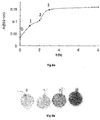
Figures 3a and 3b . Representation of the absorbance values as a function of the exposure time of the sensor (Figure 3a ) for a methylamine concentration of 50 mg/cm3 and a wavelength of 580 nm; and photograph of the corresponding sensors (Figure 3b ). -
Figures 4a and 4b . Representation of the absorbance values as a function of the dimethylamine concentration (Figure 4a ) (mg/m3): a): 0, b): 10, c): 20, d): 50 for a wavelength of 580 nm; and photograph of the corresponding sensors (Figure 4b ). -
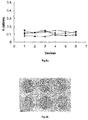
Figures 5a and 5b . Representation of the absorbance at a wavelength of 580 nm (Figure 5a ) for 6 devices of each synthesis, up to a total of 4 syntheses that were carried out following the same experimental protocol; and photograph showing the 6 devices of one of the syntheses (Figure 5b ). - Therefore, an object of the present invention is to provide a passive colorimetric sensor for the detection in situ of amines in gaseous form, and in particular in air, which does not suffer from the previously stated defects and, in particular, is aimed at providing a colorimetric sensor that has limits of detection lower than the ones known at present for these types of sensors, such that it may be used in the detection of amines in real atmospheres.
- This problem has been resolved as the inventors found that, by soaking a derivatisation reagent, 1, 2 naphthoquinone-4-sulfonate (NQS), in an absorbent matrix with a polydimethylsiloxane (PDMS) base, it is possible to obtain a colorimetric-type amine detector, that is to say, an amine sensor that does not consume energy, and also has sufficiently low limits of detection so as to enable the detection thereof and possible quantification in real atmospheres. According to the inventors, the invention is based on the fact that, in the presence of amines, the NQS sulphate group is eliminated, being bonded to the amine and producing a highly chromogenic product, according to the following reaction:

- Thus in a first aspect, the invention is aimed at a passive colorimetric sensor of aliphatic amines with a LOD range suitable for detection and quantification in real atmospheres, according to
claim 1. The sensor is based on a derivatisation reagent, NQS, embedded in PDMS as absorbent matrix. This device acts as a passive colorimetric sensor in the detection of volatile amines with an LOD of up to 3 mg/m3. - In a second aspect, the invention is aimed at a manufacturing process of the sensor according to
claim 6, which is based on incorporating the NQS in a solid support of PDMS. The manufacturing method comprises the following steps: - a) dissolving the NQS in a solvent; in one embodiment the solvent is chloroform or ethanol.
- b) adding the PDMS to the solution from step a), stirring if necessary until a homogenous mixture is obtained;
- c) pouring the solution obtained in step b) into a mould; and
- d) once the solution from step c) has solidified, removing the resulting sheet from the mould, which is the sensor.
- Once the NQS is supported in the PDMS, unlike other sensors described in the literature, it does not require any kind of pre-treatment or an external source or instrument for the sensor to be able to carry out its function. Furthermore, owing to the properties of the PDMS, the NQS is stabilised, highlighting the harmlessness of the resulting sensor to the environment, the stability thereof over a wide range of temperatures and resistance to reversion, the stability thereof with respect to humidity owing to the low water absorption and the good resistance thereof to solar radiation, thereby preventing the degradation and loss of the function thereof as a derivatisation agent.
- The sensor, produced in this way, can be used in the detection and/or quantification of amines in gases, in particular in the air, and more particularly in atmospheric air, in which the detection is carried out in situ and in real time by means of the passive sampling technique.
- In one embodiment, the PDMS used is a silicone elastomer based on polydimethylsiloxane such as dimethyl-hydrogenmethyl siloxane marketed under the commercial brand Sylgard 184®, which is one of the most elastic and active polymers and there are multiple applications thereof indicated in the bibliography. The easy preparation, zero toxicity, the malleability and the thermal and electrical stability thereof are relevant characteristics of this material. The chemical properties thereof enable the rapid diffusion of the analytes through the sensor described.
- As has been mentioned, the design of the sensors is based on the incorporation of NQS in the PDMS gel. The synthesis was optimised by varying the solvent for NQS and varying the concentration of NQS. Different thicknesses and shapes were also tested for the device.
- In the optimisation process, three different solvents were tested: water, ethanol and chloroform. In the case of water, a loss of colour of the NQS was produced and large bubbles were formed, which prevented good homogenisation and the compaction of the gel required for it to solidify. These bubbles did not disappear after 1 hour in a vacuum chamber, or after heating for a period of time. In the case of ethanol and chloroform, the gelification was homogenous and there were no bubbles. In the case of using chloroform, it was necessary to sonicate for 5 minutes; however, the gel was obtained in less time and was more uniform.
- Another variable that was optimised was the quantity of NQS; with a greater quantity, responses with greater sensitivity were obtained up to a saturation quantity. The most suitable range of NQS concentration values was 0.43 to 0.46 mg NQS/g PDMS.
- The dimensions of the sensor were also optimised, different thicknesses of the sensor being tested and, for this, using different recipients to form the gel. The thickness of the sheet formed was the most important parameter. Thicknesses of between 2.5 and 0.8 cm were tested. With thicknesses lower than 1.0 cm, no colour change was observed. The best results obtained in terms of the reproducibility thereof and easy handling of the devices were obtained in a thickness range of 1.0 to 1.5 cm. In terms of the surface area of the sheet, the easiest sensors to handle and in turn sufficiently large to be able to see the colour change with the naked eye were obtained with surface areas between 1.0 and 3.0 cm2.
- The elastomer of PDMS (SYLGARD base) (13.6 g) was added to a solution of
sodium - In order to evaluate the response of the devices to amines it was necessary to determine the conditions for producing the amine atmosphere to be detected by the sensor, that is to say, produce amine patterns in air. For this work, a method previously developed by the inventors was used, where the amine atmosphere is produced by adding a basic solution (NaOH) to the amine solution.
- For this, once the amine solutions of known a concentration were prepared, 5 µl of solution of NaOH 10 M was added in a vial of 20 ml, the sensor to be tested was introduced within said atmosphere, the vial was covered and 5 µl of the amine solution was added using a syringe by way of a septum. Once the corresponding sampling time had lapsed, the sensor was removed and the analyte response of the same was measured by diffuse reflection according to the amine concentration.
- The results obtained using the device obtained by means of the method described in Example 2 show that by using different amines (methylamine, ethylamine, dimethylamine and diethylamine) in concentrations of 2.25 µg/cm3 and exposure time of 1 hour at room temperature, the analytical responses were different for each amine.
Figure 1 shows an image of the derivatives formed for each one of the amines. It may be observed with the naked eye that the different amines have different tones; the dimethylamine and the diethylamine have orange tones while the methylamine and ethylamine have brown and grey tones. In this way, the response is selective for each one of the amines in a qualitative manner. Furthermore, the diffuse reflection signal obtained (Figure 1 ) provides a quantitative measure of the presence of amines in a specific atmosphere. - By way of example, the graphs of
Figure 2 show the variation of the response of the sensor as a function of the wavelength for different concentrations of methylamine in air. As can be observed, the quantification of the amine concentration in a specific atmosphere can be carried out by direct measurement of the sensor exposed to said atmosphere, without the need for any reagent or sample preparation step. - The increase in sensitivity of this sensor is achieved by increasing the exposure time. By way of example, in
Figure 3 the increase in sensitivity along with the exposure time is shown for methylamine. The results obtained showed that the sensor enables concentrations of amines from 3 mg/m3 to be detected with an exposure time of 5 hours. Consequently, the sensor can be applied in the detection of amines in environments with a concentration range from 3 mg/m3 up to levels of µg/cm3, a level at which the sensor is saturated (Figure 4 ). - In order to evaluate the reproducibility of the sensor, four different syntheses were carried out, following, in all of these, the synthesis method described in Example 2. Six devices of each one of the syntheses were taken and the diffuse reflection thereof was measured.
- The analytical signal of each one of the synthesised sensors was measured on both faces of the sensor. The signal from the blank sample was subtracted from each measurement and the two most significant wavelengths were taken as a reference.
Figure 5 shows the analytical responses obtained for six sensors of 4 different syntheses. As can be seen, there was no significant variation in the different synthesised sensors, which means that the reproducibility of the devices is excellent. In fact, it can be seen with the naked eye that all the devices obtained by different syntheses have the same homogenous colour on both faces. - Furthermore, the sensors are shown be to exceptionally stable with time, whereby they can be used long after they have been prepared without the need for any type of treatment. Similarly, as the inventors have proven, the response thereof to the presence of amines is also stable over time.
-
- [1] AnaliX, 2 (1011), Derivatization and separation aliphatic amine.
- [2] A. Fekete, A.K. Malik, A. Kumar, P. Schmitt-Kopplin. Anal Chem. 40 (2010) 102.
- [3] a) A. A. Elbashir, A. A. Ahmed, S. A. A. Ahmed, S. M. A. Ahmed, H. Y. Aboul-Enein 47 (2012) 219. b) P. Campins-Falcó, C. Molina-Legua, A. Sevillano-Cabeza, R. Porras-Serrano, Analyst 122 (1997) 673.
- [4] RAE Systems, Gas Detection Tube Data Sheet. Amines. No 10-132-10 (http://www.raesystems.com/products/colormetric-gas-detection-tubes)
- [5] Y. Moliner-Martinez, P. Campíns-Falcó, R. Herraez-Hernandez. J. Chromatogr. A 1059 (2004) 17-24.
- [6] Sensors and Actuators B 134 (2008) 1000-1004
- [7] Journal of Photochemistry and photobiology A: Chemistry 238 (2012) 1-6.
- [8]
A. J. Attar, US Patent No. 4,840,919 (1989 )
Claims (11)
- A passive colorimetric sensor for the detection and/or determination of aliphatic amines in atmospheric air, which comprises the compound 1,2-naphthoquinone-4-sulfonate (NQS) embedded in a polydimethylsiloxane (PDMS) matrix.
- The sensor according to claim 1, wherein the PDMS is dimethyl-hydrogenmethylsiloxane.
- The sensor according to any one of claims 1 or 2, wherein the NQS is embedded in the PDMS in a concentration of between 0.43 and 0.46 mg NQS/g PDMS.
- The sensor according to any one of the preceding claims, wherein the PDMS matrix is a sheet with a thickness of between 1.0 and 1.5 cm.
- The sensor according to claim 4, wherein the sheet has an area of between 1.0 and 3.0 cm2.
- A manufacturing method of a passive colorimetric sensor for aliphatic amines in atmospheric air, which comprises the steps:a) dissolving the NQS in a solvent;b) adding PDMS to the solution from step a), stirring if necessary until a homogenous mixture is obtained;c) pouring the solution obtained in step b) into a mould; andd) once the solution from step c) has solidified, removing the resulting sheet from the mould, which is the sensor.
- The manufacturing method of a colorimetric sensor according to claim 6, wherein the solvent is chloroform or ethanol.
- The manufacturing method of a colorimetric sensor according to any one of claims 6 or 7, wherein the PDMS is a dimethyl-hydrogenmethyl siloxane.
- The manufacturing method of a colorimetric sensor according to any one of claims 6 to 8, wherein the NQS is added to the PDMS in a concentration of between 0.43 and 0.46 mg NQS/g PDMS.
- The manufacturing method of a colorimetric sensor according to any one of claims 6 to 9, wherein the mould has a diameter of between 1 and 2 cm and a depth of between 1.0 and 1.5 cm.
- The manufacturing method of a colorimetric sensor according to any one of claims 6 to 9, wherein the mould is a well plate and each well has a diameter of between 1 and 2 cm and a depth of between 1.0 and 1.5 cm.
Applications Claiming Priority (2)
| Application Number | Priority Date | Filing Date | Title |
|---|---|---|---|
| ES201300436A ES2519891B2 (en) | 2013-05-07 | 2013-05-07 | Passive device for the detection and / or determination in situ of amines in gases |
| PCT/ES2014/000077 WO2014181012A1 (en) | 2013-05-07 | 2014-05-07 | Passive device for the detection and/or determination in situ of amines in gases |
Publications (3)
| Publication Number | Publication Date |
|---|---|
| EP3001184A1 EP3001184A1 (en) | 2016-03-30 |
| EP3001184A4 EP3001184A4 (en) | 2017-03-22 |
| EP3001184B1 true EP3001184B1 (en) | 2020-03-25 |
Family
ID=51844997
Family Applications (1)
| Application Number | Title | Priority Date | Filing Date |
|---|---|---|---|
| EP14795283.2A Active EP3001184B1 (en) | 2013-05-07 | 2014-05-07 | Passive device for the detection and/or determination in situ of amines in gases |
Country Status (4)
| Country | Link |
|---|---|
| EP (1) | EP3001184B1 (en) |
| ES (1) | ES2519891B2 (en) |
| PT (1) | PT3001184T (en) |
| WO (1) | WO2014181012A1 (en) |
Families Citing this family (2)
| Publication number | Priority date | Publication date | Assignee | Title |
|---|---|---|---|---|
| US10966622B2 (en) | 2016-05-20 | 2021-04-06 | The Board Of Trustees Of Western Michigan University | Printed ECG electrode and method |
| CN107474020B (en) * | 2017-09-19 | 2020-05-15 | 河南工程学院 | Organic small molecule with recognition effect on ethylamine, diethylamine and triethylamine and recognition method thereof |
Family Cites Families (3)
| Publication number | Priority date | Publication date | Assignee | Title |
|---|---|---|---|---|
| US4840919A (en) * | 1987-03-03 | 1989-06-20 | Perfect View, Inc. | Gas dosimeter for colorimetrically indicating the presence of amides |
| FR2876380B1 (en) * | 2004-10-07 | 2006-12-08 | Commissariat Energie Atomique | CHEMICAL SENSORS COMPRISING ANILINE POLYSILOXANES AS SENSITIVE MATERIALS AND THEIR USE FOR THE DETECTION OR DETERMINATION OF NITROUS COMPOUNDS |
| GB0613182D0 (en) * | 2006-07-03 | 2006-08-09 | Isis Innovation | Method of detection |
-
2013
- 2013-05-07 ES ES201300436A patent/ES2519891B2/en active Active
-
2014
- 2014-05-07 EP EP14795283.2A patent/EP3001184B1/en active Active
- 2014-05-07 PT PT147952832T patent/PT3001184T/en unknown
- 2014-05-07 WO PCT/ES2014/000077 patent/WO2014181012A1/en not_active Ceased
Non-Patent Citations (1)
| Title |
|---|
| None * |
Also Published As
| Publication number | Publication date |
|---|---|
| ES2519891B2 (en) | 2015-03-05 |
| ES2519891A1 (en) | 2014-11-07 |
| ES2519891A8 (en) | 2014-11-20 |
| PT3001184T (en) | 2020-06-23 |
| EP3001184A4 (en) | 2017-03-22 |
| WO2014181012A1 (en) | 2014-11-13 |
| EP3001184A1 (en) | 2016-03-30 |
Similar Documents
| Publication | Publication Date | Title |
|---|---|---|
| Duong et al. | A ratiometric fluorescence sensor for the detection of ammonia in water | |
| Abbaspour et al. | Speciation of iron (II), iron (III) and full-range pH monitoring using paptode: A simple colorimetric method as an appropriate alternative for optodes | |
| Genovese et al. | Photoactivated acidochromic elastomeric films for on demand acidic vapor sensing | |
| Arsawiset et al. | Ready-to-use, functionalized paper test strip used with a smartphone for the simultaneous on-site detection of free chlorine, hydrogen sulfide and formaldehyde in wastewater | |
| Pla-Tolós et al. | New optical paper sensor for in situ measurement of hydrogen sulphide in waters and atmospheres | |
| Werner et al. | Ammonia-sensitive polymer matrix employing immobilized indicator ion pairs | |
| Alizadeh et al. | A new triazene-1-oxide derivative, immobilized on the triacetyl cellulose membrane as an optical Ni2+ sensor | |
| Ling et al. | An optical sensor for mercuric ion based on immobilization of Rhodamine B derivative in PVC membrane | |
| Choi et al. | Visualizing indoor ozone exposures via o-dianisidine based colorimetric passive sampler | |
| Jornet-Martínez et al. | Designing solid optical sensors for in situ passive discrimination of volatile amines based on a new one-step hydrophilic PDMS preparation | |
| Tan et al. | A novel optical ammonia sensor based on reflectance measurements for highly polluted and coloured water | |
| Findeisen et al. | Artificial receptor layers for detecting chemical and biological agent mimics | |
| EP3001184A1 (en) | Passive device for the detection and/or determination in situ of amines in gases | |
| Khodadoust et al. | Design of an optically stable pH sensor based on immobilization of Giemsa on triacetylcellulose membrane | |
| Ohira et al. | Flow-based ammonia gas analyzer with an open channel scrubber for indoor environments | |
| Schmitt et al. | Colorimetric sensor for bad odor detection using automated color correction | |
| Gu et al. | Multi-channel surface-enhanced Raman spectroscopy (SERS) platform for pollutant detection in water fabricated on polydimethylsiloxane | |
| Alexy et al. | Disposable optochemical sensor chip for nitrogen dioxide detection based on oxidation of N, N′-diphenyl-1, 4-phenylenediamine | |
| Talio et al. | Determination of cadmium in tobacco by solid surface fluorescence using nylon membranes coated with carbon nanotubes | |
| Hashemi et al. | High sensitive optode for selective determination of Ni2+ based on the covalently immobilized thionine in agarose membrane | |
| US20180080902A1 (en) | Use of piezoelectric transducers modified with metal oxide-based thin films for direct detection of amine derivatives in liquid media | |
| Zeng et al. | A highly efficient and selective rapid detection method applied to the detection of amide herbicides in fish serum | |
| Kiwfo et al. | Smartphone-based color evaluation of passive samplers for gases: a review | |
| Choi et al. | The development of optical chemical sensors for the detection of volatile compounds from spoiled hams | |
| Saleh et al. | Spectrophotometric and spectrofluorimetric determination of pregabalin via condensation reactions in pure form and in capsules. |
Legal Events
| Date | Code | Title | Description |
|---|---|---|---|
| PUAI | Public reference made under article 153(3) epc to a published international application that has entered the european phase |
Free format text: ORIGINAL CODE: 0009012 |
|
| 17P | Request for examination filed |
Effective date: 20151210 |
|
| AK | Designated contracting states |
Kind code of ref document: A1 Designated state(s): AL AT BE BG CH CY CZ DE DK EE ES FI FR GB GR HR HU IE IS IT LI LT LU LV MC MK MT NL NO PL PT RO RS SE SI SK SM TR |
|
| AX | Request for extension of the european patent |
Extension state: BA ME |
|
| RIN1 | Information on inventor provided before grant (corrected) |
Inventor name: JORNET MARTINEZ, NEUS Inventor name: HERRAEZ HERNANDEZ, ROSA Inventor name: CAMPINS FALCO, PILAR Inventor name: VERDU ANDRES, JORGE Inventor name: MOLINER MARTINEZ, YOLANDA Inventor name: MOLINS LEGUA, CARMEN |
|
| DAX | Request for extension of the european patent (deleted) | ||
| A4 | Supplementary search report drawn up and despatched |
Effective date: 20170216 |
|
| RIC1 | Information provided on ipc code assigned before grant |
Ipc: G01N 21/78 20060101ALI20170210BHEP Ipc: G01N 21/77 20060101AFI20170210BHEP Ipc: G01N 31/22 20060101ALI20170210BHEP |
|
| GRAP | Despatch of communication of intention to grant a patent |
Free format text: ORIGINAL CODE: EPIDOSNIGR1 |
|
| STAA | Information on the status of an ep patent application or granted ep patent |
Free format text: STATUS: GRANT OF PATENT IS INTENDED |
|
| INTG | Intention to grant announced |
Effective date: 20191205 |
|
| GRAS | Grant fee paid |
Free format text: ORIGINAL CODE: EPIDOSNIGR3 |
|
| GRAA | (expected) grant |
Free format text: ORIGINAL CODE: 0009210 |
|
| STAA | Information on the status of an ep patent application or granted ep patent |
Free format text: STATUS: THE PATENT HAS BEEN GRANTED |
|
| AK | Designated contracting states |
Kind code of ref document: B1 Designated state(s): AL AT BE BG CH CY CZ DE DK EE ES FI FR GB GR HR HU IE IS IT LI LT LU LV MC MK MT NL NO PL PT RO RS SE SI SK SM TR |
|
| REG | Reference to a national code |
Ref country code: GB Ref legal event code: FG4D |
|
| REG | Reference to a national code |
Ref country code: DE Ref legal event code: R096 Ref document number: 602014062887 Country of ref document: DE |
|
| REG | Reference to a national code |
Ref country code: AT Ref legal event code: REF Ref document number: 1249119 Country of ref document: AT Kind code of ref document: T Effective date: 20200415 Ref country code: IE Ref legal event code: FG4D |
|
| REG | Reference to a national code |
Ref country code: PT Ref legal event code: SC4A Ref document number: 3001184 Country of ref document: PT Date of ref document: 20200623 Kind code of ref document: T Free format text: AVAILABILITY OF NATIONAL TRANSLATION Effective date: 20200617 |
|
| PG25 | Lapsed in a contracting state [announced via postgrant information from national office to epo] |
Ref country code: FI Free format text: LAPSE BECAUSE OF FAILURE TO SUBMIT A TRANSLATION OF THE DESCRIPTION OR TO PAY THE FEE WITHIN THE PRESCRIBED TIME-LIMIT Effective date: 20200325 Ref country code: RS Free format text: LAPSE BECAUSE OF FAILURE TO SUBMIT A TRANSLATION OF THE DESCRIPTION OR TO PAY THE FEE WITHIN THE PRESCRIBED TIME-LIMIT Effective date: 20200325 Ref country code: NO Free format text: LAPSE BECAUSE OF FAILURE TO SUBMIT A TRANSLATION OF THE DESCRIPTION OR TO PAY THE FEE WITHIN THE PRESCRIBED TIME-LIMIT Effective date: 20200625 |
|
| PG25 | Lapsed in a contracting state [announced via postgrant information from national office to epo] |
Ref country code: BG Free format text: LAPSE BECAUSE OF FAILURE TO SUBMIT A TRANSLATION OF THE DESCRIPTION OR TO PAY THE FEE WITHIN THE PRESCRIBED TIME-LIMIT Effective date: 20200625 Ref country code: LV Free format text: LAPSE BECAUSE OF FAILURE TO SUBMIT A TRANSLATION OF THE DESCRIPTION OR TO PAY THE FEE WITHIN THE PRESCRIBED TIME-LIMIT Effective date: 20200325 Ref country code: SE Free format text: LAPSE BECAUSE OF FAILURE TO SUBMIT A TRANSLATION OF THE DESCRIPTION OR TO PAY THE FEE WITHIN THE PRESCRIBED TIME-LIMIT Effective date: 20200325 Ref country code: GR Free format text: LAPSE BECAUSE OF FAILURE TO SUBMIT A TRANSLATION OF THE DESCRIPTION OR TO PAY THE FEE WITHIN THE PRESCRIBED TIME-LIMIT Effective date: 20200626 Ref country code: HR Free format text: LAPSE BECAUSE OF FAILURE TO SUBMIT A TRANSLATION OF THE DESCRIPTION OR TO PAY THE FEE WITHIN THE PRESCRIBED TIME-LIMIT Effective date: 20200325 |
|
| REG | Reference to a national code |
Ref country code: NL Ref legal event code: MP Effective date: 20200325 |
|
| REG | Reference to a national code |
Ref country code: LT Ref legal event code: MG4D |
|
| PG25 | Lapsed in a contracting state [announced via postgrant information from national office to epo] |
Ref country code: NL Free format text: LAPSE BECAUSE OF FAILURE TO SUBMIT A TRANSLATION OF THE DESCRIPTION OR TO PAY THE FEE WITHIN THE PRESCRIBED TIME-LIMIT Effective date: 20200325 |
|
| PG25 | Lapsed in a contracting state [announced via postgrant information from national office to epo] |
Ref country code: SM Free format text: LAPSE BECAUSE OF FAILURE TO SUBMIT A TRANSLATION OF THE DESCRIPTION OR TO PAY THE FEE WITHIN THE PRESCRIBED TIME-LIMIT Effective date: 20200325 Ref country code: EE Free format text: LAPSE BECAUSE OF FAILURE TO SUBMIT A TRANSLATION OF THE DESCRIPTION OR TO PAY THE FEE WITHIN THE PRESCRIBED TIME-LIMIT Effective date: 20200325 Ref country code: IS Free format text: LAPSE BECAUSE OF FAILURE TO SUBMIT A TRANSLATION OF THE DESCRIPTION OR TO PAY THE FEE WITHIN THE PRESCRIBED TIME-LIMIT Effective date: 20200725 Ref country code: RO Free format text: LAPSE BECAUSE OF FAILURE TO SUBMIT A TRANSLATION OF THE DESCRIPTION OR TO PAY THE FEE WITHIN THE PRESCRIBED TIME-LIMIT Effective date: 20200325 Ref country code: SK Free format text: LAPSE BECAUSE OF FAILURE TO SUBMIT A TRANSLATION OF THE DESCRIPTION OR TO PAY THE FEE WITHIN THE PRESCRIBED TIME-LIMIT Effective date: 20200325 Ref country code: LT Free format text: LAPSE BECAUSE OF FAILURE TO SUBMIT A TRANSLATION OF THE DESCRIPTION OR TO PAY THE FEE WITHIN THE PRESCRIBED TIME-LIMIT Effective date: 20200325 Ref country code: CZ Free format text: LAPSE BECAUSE OF FAILURE TO SUBMIT A TRANSLATION OF THE DESCRIPTION OR TO PAY THE FEE WITHIN THE PRESCRIBED TIME-LIMIT Effective date: 20200325 |
|
| REG | Reference to a national code |
Ref country code: AT Ref legal event code: MK05 Ref document number: 1249119 Country of ref document: AT Kind code of ref document: T Effective date: 20200325 |
|
| REG | Reference to a national code |
Ref country code: DE Ref legal event code: R097 Ref document number: 602014062887 Country of ref document: DE |
|
| PG25 | Lapsed in a contracting state [announced via postgrant information from national office to epo] |
Ref country code: CH Free format text: LAPSE BECAUSE OF NON-PAYMENT OF DUE FEES Effective date: 20200531 Ref country code: AT Free format text: LAPSE BECAUSE OF FAILURE TO SUBMIT A TRANSLATION OF THE DESCRIPTION OR TO PAY THE FEE WITHIN THE PRESCRIBED TIME-LIMIT Effective date: 20200325 Ref country code: LI Free format text: LAPSE BECAUSE OF NON-PAYMENT OF DUE FEES Effective date: 20200531 Ref country code: DK Free format text: LAPSE BECAUSE OF FAILURE TO SUBMIT A TRANSLATION OF THE DESCRIPTION OR TO PAY THE FEE WITHIN THE PRESCRIBED TIME-LIMIT Effective date: 20200325 Ref country code: MC Free format text: LAPSE BECAUSE OF FAILURE TO SUBMIT A TRANSLATION OF THE DESCRIPTION OR TO PAY THE FEE WITHIN THE PRESCRIBED TIME-LIMIT Effective date: 20200325 Ref country code: ES Free format text: LAPSE BECAUSE OF FAILURE TO SUBMIT A TRANSLATION OF THE DESCRIPTION OR TO PAY THE FEE WITHIN THE PRESCRIBED TIME-LIMIT Effective date: 20200325 |
|
| PLBE | No opposition filed within time limit |
Free format text: ORIGINAL CODE: 0009261 |
|
| STAA | Information on the status of an ep patent application or granted ep patent |
Free format text: STATUS: NO OPPOSITION FILED WITHIN TIME LIMIT |
|
| PG25 | Lapsed in a contracting state [announced via postgrant information from national office to epo] |
Ref country code: PL Free format text: LAPSE BECAUSE OF FAILURE TO SUBMIT A TRANSLATION OF THE DESCRIPTION OR TO PAY THE FEE WITHIN THE PRESCRIBED TIME-LIMIT Effective date: 20200325 |
|
| 26N | No opposition filed |
Effective date: 20210112 |
|
| REG | Reference to a national code |
Ref country code: BE Ref legal event code: MM Effective date: 20200531 |
|
| PG25 | Lapsed in a contracting state [announced via postgrant information from national office to epo] |
Ref country code: LU Free format text: LAPSE BECAUSE OF NON-PAYMENT OF DUE FEES Effective date: 20200507 |
|
| PG25 | Lapsed in a contracting state [announced via postgrant information from national office to epo] |
Ref country code: BE Free format text: LAPSE BECAUSE OF NON-PAYMENT OF DUE FEES Effective date: 20200531 Ref country code: SI Free format text: LAPSE BECAUSE OF FAILURE TO SUBMIT A TRANSLATION OF THE DESCRIPTION OR TO PAY THE FEE WITHIN THE PRESCRIBED TIME-LIMIT Effective date: 20200325 |
|
| PG25 | Lapsed in a contracting state [announced via postgrant information from national office to epo] |
Ref country code: TR Free format text: LAPSE BECAUSE OF FAILURE TO SUBMIT A TRANSLATION OF THE DESCRIPTION OR TO PAY THE FEE WITHIN THE PRESCRIBED TIME-LIMIT Effective date: 20200325 Ref country code: MT Free format text: LAPSE BECAUSE OF FAILURE TO SUBMIT A TRANSLATION OF THE DESCRIPTION OR TO PAY THE FEE WITHIN THE PRESCRIBED TIME-LIMIT Effective date: 20200325 Ref country code: CY Free format text: LAPSE BECAUSE OF FAILURE TO SUBMIT A TRANSLATION OF THE DESCRIPTION OR TO PAY THE FEE WITHIN THE PRESCRIBED TIME-LIMIT Effective date: 20200325 |
|
| PG25 | Lapsed in a contracting state [announced via postgrant information from national office to epo] |
Ref country code: MK Free format text: LAPSE BECAUSE OF FAILURE TO SUBMIT A TRANSLATION OF THE DESCRIPTION OR TO PAY THE FEE WITHIN THE PRESCRIBED TIME-LIMIT Effective date: 20200325 Ref country code: AL Free format text: LAPSE BECAUSE OF FAILURE TO SUBMIT A TRANSLATION OF THE DESCRIPTION OR TO PAY THE FEE WITHIN THE PRESCRIBED TIME-LIMIT Effective date: 20200325 |
|
| P01 | Opt-out of the competence of the unified patent court (upc) registered |
Effective date: 20230527 |
|
| PGFP | Annual fee paid to national office [announced via postgrant information from national office to epo] |
Ref country code: DE Payment date: 20250529 Year of fee payment: 12 |
|
| PGFP | Annual fee paid to national office [announced via postgrant information from national office to epo] |
Ref country code: GB Payment date: 20250527 Year of fee payment: 12 |
|
| PGFP | Annual fee paid to national office [announced via postgrant information from national office to epo] |
Ref country code: IT Payment date: 20250521 Year of fee payment: 12 |
|
| PGFP | Annual fee paid to national office [announced via postgrant information from national office to epo] |
Ref country code: PT Payment date: 20250421 Year of fee payment: 12 |
|
| PGFP | Annual fee paid to national office [announced via postgrant information from national office to epo] |
Ref country code: FR Payment date: 20250526 Year of fee payment: 12 |
|
| PGFP | Annual fee paid to national office [announced via postgrant information from national office to epo] |
Ref country code: IE Payment date: 20250527 Year of fee payment: 12 |