EP3000857A1 - Antifouling paint composition, antifouling paint film, substrate having an antifouling paint film, and production method for said substrate - Google Patents
Antifouling paint composition, antifouling paint film, substrate having an antifouling paint film, and production method for said substrate Download PDFInfo
- Publication number
- EP3000857A1 EP3000857A1 EP14801563.9A EP14801563A EP3000857A1 EP 3000857 A1 EP3000857 A1 EP 3000857A1 EP 14801563 A EP14801563 A EP 14801563A EP 3000857 A1 EP3000857 A1 EP 3000857A1
- Authority
- EP
- European Patent Office
- Prior art keywords
- antifouling coating
- antifouling
- coating composition
- coating film
- parts
- Prior art date
- Legal status (The legal status is an assumption and is not a legal conclusion. Google has not performed a legal analysis and makes no representation as to the accuracy of the status listed.)
- Granted
Links
Images
Classifications
-
- C—CHEMISTRY; METALLURGY
- C09—DYES; PAINTS; POLISHES; NATURAL RESINS; ADHESIVES; COMPOSITIONS NOT OTHERWISE PROVIDED FOR; APPLICATIONS OF MATERIALS NOT OTHERWISE PROVIDED FOR
- C09D—COATING COMPOSITIONS, e.g. PAINTS, VARNISHES OR LACQUERS; FILLING PASTES; CHEMICAL PAINT OR INK REMOVERS; INKS; CORRECTING FLUIDS; WOODSTAINS; PASTES OR SOLIDS FOR COLOURING OR PRINTING; USE OF MATERIALS THEREFOR
- C09D5/00—Coating compositions, e.g. paints, varnishes or lacquers, characterised by their physical nature or the effects produced; Filling pastes
- C09D5/16—Antifouling paints; Underwater paints
- C09D5/1656—Antifouling paints; Underwater paints characterised by the film-forming substance
- C09D5/1662—Synthetic film-forming substance
- C09D5/1668—Vinyl-type polymers
-
- C—CHEMISTRY; METALLURGY
- C08—ORGANIC MACROMOLECULAR COMPOUNDS; THEIR PREPARATION OR CHEMICAL WORKING-UP; COMPOSITIONS BASED THEREON
- C08F—MACROMOLECULAR COMPOUNDS OBTAINED BY REACTIONS ONLY INVOLVING CARBON-TO-CARBON UNSATURATED BONDS
- C08F220/00—Copolymers of compounds having one or more unsaturated aliphatic radicals, each having only one carbon-to-carbon double bond, and only one being terminated by only one carboxyl radical or a salt, anhydride ester, amide, imide or nitrile thereof
- C08F220/02—Monocarboxylic acids having less than ten carbon atoms; Derivatives thereof
- C08F220/10—Esters
- C08F220/12—Esters of monohydric alcohols or phenols
- C08F220/16—Esters of monohydric alcohols or phenols of phenols or of alcohols containing two or more carbon atoms
- C08F220/18—Esters of monohydric alcohols or phenols of phenols or of alcohols containing two or more carbon atoms with acrylic or methacrylic acids
- C08F220/1802—C2-(meth)acrylate, e.g. ethyl (meth)acrylate
-
- C—CHEMISTRY; METALLURGY
- C08—ORGANIC MACROMOLECULAR COMPOUNDS; THEIR PREPARATION OR CHEMICAL WORKING-UP; COMPOSITIONS BASED THEREON
- C08F—MACROMOLECULAR COMPOUNDS OBTAINED BY REACTIONS ONLY INVOLVING CARBON-TO-CARBON UNSATURATED BONDS
- C08F230/00—Copolymers of compounds having one or more unsaturated aliphatic radicals, each having only one carbon-to-carbon double bond, and containing phosphorus, selenium, tellurium or a metal
-
- C—CHEMISTRY; METALLURGY
- C08—ORGANIC MACROMOLECULAR COMPOUNDS; THEIR PREPARATION OR CHEMICAL WORKING-UP; COMPOSITIONS BASED THEREON
- C08F—MACROMOLECULAR COMPOUNDS OBTAINED BY REACTIONS ONLY INVOLVING CARBON-TO-CARBON UNSATURATED BONDS
- C08F230/00—Copolymers of compounds having one or more unsaturated aliphatic radicals, each having only one carbon-to-carbon double bond, and containing phosphorus, selenium, tellurium or a metal
- C08F230/04—Copolymers of compounds having one or more unsaturated aliphatic radicals, each having only one carbon-to-carbon double bond, and containing phosphorus, selenium, tellurium or a metal containing a metal
-
- C—CHEMISTRY; METALLURGY
- C09—DYES; PAINTS; POLISHES; NATURAL RESINS; ADHESIVES; COMPOSITIONS NOT OTHERWISE PROVIDED FOR; APPLICATIONS OF MATERIALS NOT OTHERWISE PROVIDED FOR
- C09D—COATING COMPOSITIONS, e.g. PAINTS, VARNISHES OR LACQUERS; FILLING PASTES; CHEMICAL PAINT OR INK REMOVERS; INKS; CORRECTING FLUIDS; WOODSTAINS; PASTES OR SOLIDS FOR COLOURING OR PRINTING; USE OF MATERIALS THEREFOR
- C09D133/00—Coating compositions based on homopolymers or copolymers of compounds having one or more unsaturated aliphatic radicals, each having only one carbon-to-carbon double bond, and at least one being terminated by only one carboxyl radical, or of salts, anhydrides, esters, amides, imides, or nitriles thereof; Coating compositions based on derivatives of such polymers
- C09D133/04—Homopolymers or copolymers of esters
- C09D133/06—Homopolymers or copolymers of esters of esters containing only carbon, hydrogen and oxygen, the oxygen atom being present only as part of the carboxyl radical
- C09D133/08—Homopolymers or copolymers of acrylic acid esters
-
- C—CHEMISTRY; METALLURGY
- C09—DYES; PAINTS; POLISHES; NATURAL RESINS; ADHESIVES; COMPOSITIONS NOT OTHERWISE PROVIDED FOR; APPLICATIONS OF MATERIALS NOT OTHERWISE PROVIDED FOR
- C09D—COATING COMPOSITIONS, e.g. PAINTS, VARNISHES OR LACQUERS; FILLING PASTES; CHEMICAL PAINT OR INK REMOVERS; INKS; CORRECTING FLUIDS; WOODSTAINS; PASTES OR SOLIDS FOR COLOURING OR PRINTING; USE OF MATERIALS THEREFOR
- C09D5/00—Coating compositions, e.g. paints, varnishes or lacquers, characterised by their physical nature or the effects produced; Filling pastes
- C09D5/16—Antifouling paints; Underwater paints
- C09D5/1606—Antifouling paints; Underwater paints characterised by the anti-fouling agent
- C09D5/1612—Non-macromolecular compounds
- C09D5/1625—Non-macromolecular compounds organic
-
- C—CHEMISTRY; METALLURGY
- C09—DYES; PAINTS; POLISHES; NATURAL RESINS; ADHESIVES; COMPOSITIONS NOT OTHERWISE PROVIDED FOR; APPLICATIONS OF MATERIALS NOT OTHERWISE PROVIDED FOR
- C09D—COATING COMPOSITIONS, e.g. PAINTS, VARNISHES OR LACQUERS; FILLING PASTES; CHEMICAL PAINT OR INK REMOVERS; INKS; CORRECTING FLUIDS; WOODSTAINS; PASTES OR SOLIDS FOR COLOURING OR PRINTING; USE OF MATERIALS THEREFOR
- C09D5/00—Coating compositions, e.g. paints, varnishes or lacquers, characterised by their physical nature or the effects produced; Filling pastes
- C09D5/16—Antifouling paints; Underwater paints
- C09D5/1606—Antifouling paints; Underwater paints characterised by the anti-fouling agent
- C09D5/1637—Macromolecular compounds
- C09D5/165—Macromolecular compounds containing hydrolysable groups
-
- C—CHEMISTRY; METALLURGY
- C08—ORGANIC MACROMOLECULAR COMPOUNDS; THEIR PREPARATION OR CHEMICAL WORKING-UP; COMPOSITIONS BASED THEREON
- C08K—Use of inorganic or non-macromolecular organic substances as compounding ingredients
- C08K5/00—Use of organic ingredients
- C08K5/16—Nitrogen-containing compounds
- C08K5/34—Heterocyclic compounds having nitrogen in the ring
- C08K5/3412—Heterocyclic compounds having nitrogen in the ring having one nitrogen atom in the ring
- C08K5/3415—Five-membered rings
-
- C—CHEMISTRY; METALLURGY
- C08—ORGANIC MACROMOLECULAR COMPOUNDS; THEIR PREPARATION OR CHEMICAL WORKING-UP; COMPOSITIONS BASED THEREON
- C08K—Use of inorganic or non-macromolecular organic substances as compounding ingredients
- C08K5/00—Use of organic ingredients
- C08K5/16—Nitrogen-containing compounds
- C08K5/34—Heterocyclic compounds having nitrogen in the ring
- C08K5/3412—Heterocyclic compounds having nitrogen in the ring having one nitrogen atom in the ring
- C08K5/3432—Six-membered rings
-
- C—CHEMISTRY; METALLURGY
- C08—ORGANIC MACROMOLECULAR COMPOUNDS; THEIR PREPARATION OR CHEMICAL WORKING-UP; COMPOSITIONS BASED THEREON
- C08K—Use of inorganic or non-macromolecular organic substances as compounding ingredients
- C08K5/00—Use of organic ingredients
- C08K5/16—Nitrogen-containing compounds
- C08K5/34—Heterocyclic compounds having nitrogen in the ring
- C08K5/3467—Heterocyclic compounds having nitrogen in the ring having more than two nitrogen atoms in the ring
- C08K5/3477—Six-membered rings
- C08K5/3492—Triazines
-
- C—CHEMISTRY; METALLURGY
- C08—ORGANIC MACROMOLECULAR COMPOUNDS; THEIR PREPARATION OR CHEMICAL WORKING-UP; COMPOSITIONS BASED THEREON
- C08K—Use of inorganic or non-macromolecular organic substances as compounding ingredients
- C08K5/00—Use of organic ingredients
- C08K5/36—Sulfur-, selenium-, or tellurium-containing compounds
- C08K5/43—Compounds containing sulfur bound to nitrogen
-
- C—CHEMISTRY; METALLURGY
- C08—ORGANIC MACROMOLECULAR COMPOUNDS; THEIR PREPARATION OR CHEMICAL WORKING-UP; COMPOSITIONS BASED THEREON
- C08K—Use of inorganic or non-macromolecular organic substances as compounding ingredients
- C08K5/00—Use of organic ingredients
- C08K5/55—Boron-containing compounds
Definitions
- the present invention relates to an antifouling coating composition, an antifouling coating film, a substrate with an antifouling coating film, and a production process for the substrate. More particularly, the present invention relates to an antifouling coating composition capable of forming coating films which can impart excellent antifouling properties, etc. to substrate surfaces of ships, underwater structures, fishing gears and the like and are excellent in damage resistance, while being decreased in the volatile organic compound (VOC) quantity to reduce a burden on the environment or an effect on a human body, an antifouling coating film formed from the antifouling coating composition, a substrate with an antifouling coating film, and a production process for the substrate.
- VOC volatile organic compound
- Substrates such as ships, underwater structures and fishing nets can be exposed to water for a long period of time, various aquatic creatures, e.g., animals such as oyster, mussel and barnacle, plants, such as laver, and bacteria are liable to adhere to the surfaces of the substrates.
- various aquatic creatures e.g., animals such as oyster, mussel and barnacle, plants, such as laver, and bacteria
- the surface roughness of the ship is increased to may cause lowering of velocity of the ship and deterioration of the fuel cost.
- an anticorrosion coating film formed on a ship surface is damaged to thereby do damages, such as lowering of strength or functions of the ship and marked shortening of a life.
- an antifouling coating film has been provided on a substrate surface in the past for the purpose of preventing adhesion of aquatic creatures.
- the antifouling coating film is required to have properties, such as high antifoulingproperties and stable coating filmconsumption degree, over a long period of time.
- an antifouling coating composition capable of forming such an antifouling coating film a composition containing, as an antifouling agent, 4-bromo-2-(4-chlorophenyl)-5-(trifluoromethyl)-1H-pyrrole-3-carb onitrile is known (patent literatures 1 and 2).
- volatilization quantity of volatile organic compounds also referred to as "VOC” (Volatile Organic Compounds) hereinafter
- VOC Volatile Organic Compounds
- the coating film consumption rate in the initial stage is excessively increased, and thereafter, the coating film consumption rate is decreased, so that a coating film having stable coating film consumption degree and stable antifouling coating properties over a long period of time tends to be unable to be obtained.
- Conventional antifouling coating compositions such as an antifouling coating composition described in the patent literature 2 had poor coating film drying properties, and it was not easy to form antifouling coating films excellent in damage resistance.
- the present invention has been made in the light of the above problems, and it is an object of the present invention to provide an antifouling coating composition having a low VOC content and capable of forming an antifouling coating film which is excellent in damage resistance and has stable coating film consumption degree and high antifouling properties over a long period of time.
- the present inventors have earnestly studied solutions to the above problems. As a result, they have found that the above problems can be solved by an antifouling coating composition containing specific polymer and antifouling agent and having a VOC content of not higher than a specific value, and they have completed the present invention.
- the constitution of the present invention is as follows.
- a high solid hydrolyzable antifouling coating composition which suppresses a burden on the environment and an effect on a human body low, is excellent in coating workability and drying properties though it has a low VOC content, and can form an antifouling coating film that is excellent in stable coating film consumption degree and high antifouling properties and mechanical strength (damage resistance) with a good balance over a long period of time can be provided.
- fouling of substrates such as underwater structures, ships and fishing gears can be prevented over a long period of time.
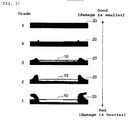
- Fig. 1 is a view showing evaluation criteria in a damage resistance test (block pressure test) in the working examples.
- the antifouling coating composition (also referred to as a "composition” simply hereinafter) of the present invention comprises:
- Such a composition of the present invention becomes a high solid hydrolyzable antifouling coating composition which suppresses a burden on the environment and an effect on a human body low, is excellent in coating workability and drying properties though it has a low VOC content, and can form an antifouling coating film that is excellent in stable coating film consumption degree, high antifouling properties and mechanical strength (damage resistance) with a good balance over a long period of time.
- the coating film consumption rate in the initial stage is excessively increased, and thereafter, the coating film consumption rate is decreased, so that a coating film having stable coating film consumption degree and stable antifouling coating properties over a long period of time tends to be unable to be obtained.
- the composition of the present invention is a composition that has a low viscosity even if the content of VOC is low, and is a composition capable of forming an antifouling coating film having stable coating film consumption degree and high antifouling properties over a long period of time.
- the composition of the present invention has a low viscosity in spite of a low VOC content, as previously described, and therefore, an antifouling coating film can be formed on a substrate by various methods.
- spray coating that is preferably adopted when an antifouling coating film is formed on a substrate such as a ship, an underwater structure and a fishing gear can be easily carried out.
- composition of the present invention is a high solid coating composition, and therefore, coating can be carried out with hardly changing the coating conditions and the coating environment from those for the conventional solvent type coating materials, and even if coating facilities, etc. are not altered, coating becomes possible while taking the environment and the human body into consideration.
- the composition of the present invention has good drying properties.
- the sections of a coated hull are put into a dock for the purpose of new shipbuilding or the like, the sections of the hull are usually supported by blocks, and even in such a case, owing to the good drying properties, an antifouling coating film formed from the composition of the present invention on a ship surface hardly suffers occurrence of depression or protrusion at the portion that is in contact with the block, and is hardly damaged.
- the hydrolyzable polymer (A) has a structural unit (1) and has a weight-average molecular weight (Mw) of 1000 to 5000.
- the polymer (A) exhibits hydrolyzability at least in an alkali atmosphere such as seawater. Since the composition of the present invention contains such a polymer (A) and an antifouling agent (b1), it has a low viscosity while having a low VOC content, is excellent in drying properties and becomes a high solid hydrolyzable antifouling coating composition capable of forming an antifouling coating film that is excellent in stable coating film consumption degree, damage resistance, coating film properties (e.g., crack resistance, adhesion to substrate) and surface smoothness with a good balance over a long period of time.
- an antifouling agent (b1) contains such a polymer (A) and an antifouling agent (b1), it has a low viscosity while having a low VOC content, is excellent in drying properties and becomes a high solid hydrolyzable antifouling coating composition capable of forming an antifouling coating film that is excellent in stable coating film consumption degree, damage resistance, coating film properties (e.g., crack
- the polymer (A) is desirably a polymer containing the structural unit (1) preferably in an amount of 1 to 50% by weight, more preferably 10 to 30% by weight, based on the whole polymer (100% by weight), from the viewpoint that an antifouling coating film that is excellent in stable coating film consumption degree, damage resistance and coating film properties (e.g., crack resistance, adhesion to substrate) with a good balance over a long period of time can be obtained, and other viewpoints.
- the polymer having the structural unit (1) can be obtained by, for example, using the following monomer (a1) as its synthesis raw material.
- the amount of the structural unit (1) in the polymer can be calculated from, for example, the amount of the monomer (a1) used.
- the polymer containing the structural unit (1) in an amount of the above range can be obtained by, for example, properly controlling the amount of the monomer (a1) used.
- the content of zinc and/or copper in the polymer (A) is preferably 0.5 to 25% by weight, more preferably 1 to 20% by weight, of the polymer (A) (i.e., in 100% by weight of the polymer (A)), from the viewpoint that an antifouling coating film that is excellent in stable coating film consumption degree and coating film properties (e.g., crack resistance, adhesion to substrate) with a good balance over a long period of time can be obtained, and other viewpoints.
- the "content of zinc and/or copper” means the total content of zinc and copper when both of zinc and copper are contained.
- the content of zinc and/or copper can be measured by the use of an ICP emission analysis apparatus, and can be controlled by the type and the amount of a metal-containing compound used for the preparation of the polymer (A).
- the monomer (a1) and the unsaturated monomer (a2) may be each used singly or in combination of two or more kinds.
- the monomer (a1) at least one monomer selected from the group consisting of zinc diacrylate, zinc dimethacrylate, copper diacrylate and copper dimethacrylate is preferably contained.
- Such a monomer (a1) can be prepared by a publicly known process such as a process comprising heating and stirring an inorganic metal compound (oxide, hydroxide, chloride or the like of zinc or copper) and (meth) acrylic acid or its ester compound at a temperature of not higher than the decomposition temperature of the monomer (a1) in the presence of an organic solvent such as an ether organic solvent and water.
- a publicly known process such as a process comprising heating and stirring an inorganic metal compound (oxide, hydroxide, chloride or the like of zinc or copper) and (meth) acrylic acid or its ester compound at a temperature of not higher than the decomposition temperature of the monomer (a1) in the presence of an organic solvent such as an ether organic solvent and water.
- the unsaturatedmonomer (a2) at least one unsaturatedmonomer selected from the group consisting of alkyl (meth)acrylate, alkoxyalkyl (meth)acrylate and hydroxyalkyl (meth)acrylate is preferably contained, and of these, particularly preferable is methyl (meth)acrylate, ethyl (meth)acrylate, butyl (meth)acrylate, 2-methoxyethyl (meth)acrylate, 3-methoxybutyl (meth)acrylate, 2-hydroxyethyl (meth)acrylate or the like.
- the copolymer can be produced by a hitherto publicly known process, and as such a process, a process disclosed in JP-A-2000-234072 can be mentioned.
- the copolymer may be a copolymer produced by polymerizing a monomer mixture at a temperature of not lower than 110 °C in a pressurized vessel having been pressurized so that water should not be refluxed.
- a copolymer produced by polymerizing a monomer mixture at a temperature of not lower than 110 °C in a pressurized vessel having been pressurized so that water should not be refluxed.
- the monomer (a1) for use in the synthesis of the copolymer is preferably used in such an amount that the amount of the structural unit (1) and the content of zinc and/or copper in the resulting polymer become in the aforesaid ranges, and specifically, the amount of the monomer (a1) used is preferably 1 to 50% by mol, more preferably 5 to 30% by mol, based on 100% by mol of all of the monomers used for synthesizing the copolymer.
- the amount of the monomer (a2) for use in the synthesis of the copolymer is preferably 50 to 99% by mol, more preferably 70 to 95% by mol, based on 100% by mol of all of the monomers used for synthesizing the copolymer.
- the weight-average molecular weight (Mw, value in terms of polystyrene) of the polymer (A) is preferably 1500 to 5000, more preferably 2000 to 4500, from the viewpoint that a composition that has a lower viscosity while having a low VOC content can be obtained, and other viewpoints.
- the number-average molecular weight (Mn, value in terms of polystyrene) of the polymer (A) can be properly controlled taking viscosity and storage stability of the composition, elution rate of the antifouling coating film, etc. into consideration, but it is preferably 1000 to 3000, more preferably 1000 to 2500.
- the above molecular weights can be measured by gel permeation chromatography (GPC), and specifically, they can be measured by a method described in the working examples mentioned below.
- the Gardner viscosity (25°C) of the polymer (A) is preferably about L to Z, more preferably about O to W, from the viewpoint that a composition that has a low viscosity while having a low VOC content and has excellent coating workability can be obtained, and other viewpoints.
- the composition of the present invention contains the polymer (A) preferably in an amount of 1 to 50 parts by weight, more preferably 3 to 40 parts by weight, still more preferably 5 to 35 parts by weight, in 100 parts by weight of the composition (solids content), from the viewpoint that a composition that is excellent in coating workability and drying properties while having a low VOC content and can form an antifouling coating film that is excellent in stable coating film consumption degree, high antifouling properties and mechanical strength (damage resistance) with a good balance over a long period of time is obtained, and other viewpoints.
- the polymer (A) may be used singly or in combination of two or more kinds.
- composition of the present invention contains an antifouling agent (b1) as the antifouling agent (B).
- composition of the present invention contains such an antifouling agent (b1), an antifouling coating film that is excellent in stable coating film consumption degree, high antifouling properties and mechanical strength (damage resistance) with a good balance over a long period of time can be formed even if a polymer having low Mw is used.
- the present inventors have found that by combining the antifouling agent (b1) with the polymer (A), viscosity of a mixture of them is greatly lowered and it can be suppressed that a hydrolyzable portion of a resin contained in the antifouling coating composition is dissolved first and a portion having no hydrolyzability remains, and therefore, a composition having the above effects has been able to be obtained.
- composition of the present invention contains the antifouling agent (b1), use of copper suboxide that has been heretofore used in a large amount can be completely eliminated, or the amount thereof can be drastically reduced, whereby it becomes possible to make the hydrolysis rate of the antifouling coating film containing the polymer (A) almost constant.
- the content of the antifouling agent (b1) in the composition of the present invention is not specifically restricted as long as it is in a range exerting no evil influence on the properties of the resulting coating film, but from the viewpoint that an antifouling coating film excellent in long-term antifouling properties is obtained, and other viewpoints, the content thereof is preferably 1 to 20 parts by weight, more preferably 1 to 15 parts by weight, still more preferably 2 to 15 parts by weight, based on 100 parts by weight of the composition (solids content) of the present invention.
- composition of the present invention exhibits excellent antifouling properties,etc.because it contains the antifouling agent (b1) as the antifouling agent (B), but in order to further enhance antifouling properties, particularly alga resistance (prevention of adhesion of algae, etc.), another antifouling agent (b2) may be contained, when needed.
- the antifouling agent (b2) is not specifically restricted, but preferred examples thereof include zinc pyrithione, copper pyrithione, 4,5-dichloro-2-n-octyl-4-isothiazolin-3-one,triphenylboron ⁇ amine complex, 2-methylthio-4-tert-butylamino-6-cyclopropyl-s-triazine, N,N-dimethyl-N'-phenyl-N'-(fluorodichloromethylthio)sulfamide and N,N-dimethyl-N'-tolyl-N'-(fluorodichloromethylthio)sulfamide.
- zinc pyrithione and 4,5-dichloro-2-n-octyl-4-isothiazolin-3-one are more preferable from the viewpoint that an antifouling coating film having more excellent antifouling properties is obtained, and other viewpoints, and zinc pyrithione is particularly preferable from the viewpoint that a composition excellent also in coating film drying properties is obtained, and other viewpoints.
- antifouling agents (b2) may be used singly, or may be used in combination of two or more kinds.
- the content of the antifouling agent (b2) in the composition of the present invention is not specifically restricted as long as it is in a range exerting no evil influence on the properties of the resulting coating film, but from the viewpoint that an antifouling coating film excellent in long-termantifoulingproperties is obtained, and other viewpoints, the content thereof is preferably 0.1 to 20 parts by weight, more preferably 0.1 to 15 parts by weight, still more preferably 0.1 to 12 parts by weight, based on 100 parts by weight of the composition (solids content) of the present invention.
- the content of the antifouling agent (b2) is preferably 10 to 1000 parts by weight, more preferably 20 to 500 parts by weight, still more preferably 20 to 400 parts by weight, based on 100 parts by weight of the antifouling agent (b1).
- the content of the antifouling agents (b1) and (b2) in the composition of the present invention is not specifically restricted as long as it is in a range exerting no evil influence on the properties of the resulting coating film, but from the viewpoint that an antifouling coating film excellent in antifouling properties, etc. is obtained, and other viewpoints, the content thereof is preferably 1 to 40 parts by weight, more preferably 1 to 30 parts by weight, still more preferably 1 to 22 parts by weight, based on 100 parts by weight of the composition (solids content) of the present invention.
- composition of the present invention preferably contains zinc oxide from the viewpoint that an antifouling coating film excellent in stable consumption properties, high antifouling properties, damage resistance, etc. is obtained, and other viewpoints.
- the content of zinc oxide is preferably 0.1 to 60 parts by weight, more preferably 1 to 50 parts by weight, still more preferably 3 to 50 parts by weight, based on 100 parts by weight of the composition (solids content) of the present invention.
- composition of the present invention various components used in general coating compositions, such as colorant, extender pigment, dehydrating agent, plasticizer, thixotropic agent, solvent, resin, and organic compound (e.g., organic acid), can be compounded in addition to the aforesaid components. Thesemaybe each used singly, or may be each used in combination of two or more kinds.
- organic compound e.g., organic acid
- colorants examples include color pigments (e.g., inorganic pigments, such as red iron oxide, titanium white (titanium oxide) and yellow iron oxide, organic pigments, such as carbon black, naphthol red and phthalocyanine blue) and dyes.
- color pigments e.g., inorganic pigments, such as red iron oxide, titanium white (titanium oxide) and yellow iron oxide
- organic pigments such as carbon black, naphthol red and phthalocyanine blue
- the amount of the colorant compounded can be properly controlled, it is preferably 0.1 to 20 parts by weight, more preferably 0. 5 to 10 parts by weight, based on 100 parts by weight of the composition (solids content) of the present invention.
- the extender pigment is such a pigment as has a low refractive index and is so transparent that it does not hide the coated surface when it is kneaded with oil or varnish.
- the extender pigments include talc, silica, mica, clay, potash feldspar, calcium carbonate, kaolin, alumina white, white carbon, aluminum hydroxide, magnesium carbonate, barium carbonate,bariumsulfate andzincsulfide. Of these, talc, silica, mica, clay, potash feldspar and barium sulfate are preferable.
- the amount of the extender pigment compounded can be properly controlled, it is preferably 0.1 to 60 parts by weight, more preferably 1 to 50 parts by weight, particularly preferably 5 to 45 parts by weight, based on 100 parts by weight of the composition (solids content) of the present invention.
- Calcium carbonate, kaolin and alumina white can each function also as an anti-settling agent, and white carbon, aluminum hydroxide, magnesium carbonate, barium carbonate, barium sulfate and zinc sulfide can each function also as a flatting agent.
- the amount of the pigments (color pigment + extender pigment) compounded is preferably 1 to 6000 parts by weight, more preferably 5 to 5000 parts by weight, based on 100 parts by weight of the polymer (A) (heating residue), from the viewpoint that an antifouling coating film excellent in antifouling properties, crack resistance, etc. is obtained, and other viewpoints.
- the dehydrating agent is a component that contributes to improvement in storage stability of the composition of the present invention.
- the dehydrating agents include inorganic dehydrating agents, such as anhydrous gypsum, hemihydrate gypsum (calcined gypsum) and synthetic zeolite adsorbent (e.g., "Molecular Sieves" (trade name)), and other dehydrating agents, such as ortho esters (methyl orthoformate, methyl orthoacetate, orthoboric acid ester, etc.), silicates and isocyanates.
- inorganic dehydrating agents such as anhydrous gypsum, hemihydrate gypsum (calcined gypsum) and synthetic zeolite adsorbent (e.g., "Molecular Sieves" (trade name)
- other dehydrating agents such as ortho esters (methyl orthoformate, methyl orthoacetate, orthoboric acid ester, etc.), silicates and isocyanates.
- ortho esters methyl orthoformate, methyl orthoacetate, orthoboric acid ester, etc.
- the amount of the dehydrating agent compounded can be properly controlled, it is preferably 0 to 10 parts by weight, more preferably 0.5 to 5 parts by weight, based on 100 parts by weight of the composition (solids content) of the present invention.
- the plasticizer is a component that contributes to improvement in crack resistance and water resistance of the antifouling coating film and suppression of discoloration thereof.
- plasticizers examples include n-paraffin, chlorinated paraffin, terpene phenol, tricresyl phosphate (TCP) and polyvinyl ethyl ether.
- chlorinated paraffin and terpene phenol are preferable, and chlorinated paraffin is particularly preferable.
- n-paraffin commercial products such as “n-Paraffin” manufactured by Nippon Petrochemicals Co., Ltd. can be mentioned.
- chlorinated paraffin commercial products such as "Toyoparax A-40/A-50/A-70/A-145/A-150" manufactured by Tosoh Corporation can be mentioned.
- the amount of the plasticizer compounded can be properly controlled, but for example, it is 1 to 5% by weight based on the whole solids content in the composition of the present invention.
- thixotropic agents examples include organic clay compounds (e.g., amine salt, stearate salt, lecithin salt or alkyl sulfonate salt of Al, Ca or Zn), organic waxes (polyethylene wax, polyethylene oxide wax, polyamide wax, amide wax, hydrogenated castor oil wax, etc.) and synthetic finely divided silica.
- organic clay compounds e.g., amine salt, stearate salt, lecithin salt or alkyl sulfonate salt of Al, Ca or Zn
- organic waxes polyethylene wax, polyethylene oxide wax, polyamide wax, amide wax, hydrogenated castor oil wax, etc.
- synthetic finely divided silica synthetic finely divided silica.
- organic clay compounds, polyamide wax, polyethylene oxide wax and synthetic finely divided silica are preferable.
- the amount of the thixotropic agent compounded can be properly controlled, but for example, it is 0.1 to 5 parts by weight based on 100 parts by weight of the composition (solids content) of the present invention.
- composition of the present invention may contain organic compounds such as resins and organic acids when needed, in addition to the polymer (A).
- the resins include water-insoluble or slightly water-soluble resins, such as acrylic resin, acrylic silicone resin, polyester resin, unsaturated polyester resin, fluororesin, polybutene resin, silicone rubber, polyurethane resin, epoxy resin, polyamide resin, vinyl resin (vinyl chloride copolymer, ethylene/vinyl acetate copolymer or the like), chlorinated rubber, chlorinated olefin resin, styrene/butadiene copolymer resin, ketone resin, alkyd resin, coumarone resin, terpene phenol resin, petroleum resin, pine tar, and rosin (gum rosin, wood rosin, tall oil rosin).
- acrylic resin acrylic silicone resin
- polyester resin unsaturated polyester resin
- fluororesin polybutene resin
- silicone rubber polyurethane resin
- epoxy resin epoxy resin
- polyamide resin vinyl resin (vinyl chloride copolymer, ethylene/vinyl acetate copolymer or the like), chlor
- organic acids examples include monobasic organic acids, such as naphthenic acid, versatic acid and triphenyl isobutenyl cyclohexene carboxylic acid (e.g., "A-3000” manufactured by Yasuhara Chemical Co., Ltd.).
- solvents generally used as those for antifouling coating materials such as aliphatic solvents, aromatic solvents (xylene, toluene, etc.), ketone solvents (methyl isobutyl ketone, cyclohexanone, etc.), ester solvents, ether solvents (propylene glycol monomethyl ether, propylene glycol monomethyl ether acetate, etc.) and alcohol solvents (isopropyl alcohol, etc.), can be used.
- a solvent may be further added at a coating site according to the workability.
- the composition of the present invention can be prepared by using an apparatus, means, etc. that are the same as those for publicly known general antifouling coating materials.
- the polymer (A) is synthesized in advance, and thereafter, this polymer (reaction solution), an antifouling agent, and if necessary, zinc oxide and other components are added at a time or in order, and then, they are stirred and mixed, whereby the composition can be prepared.
- composition of the present invention can be used in the same embodiments as those of publicly known general antifouling coating materials.
- the composition of the present invention preferably contains VOC so that the composition prepared under such conditions as make the ratio between the polymer (A) and the pigment be in the aforesaid range may become a composition having excellent coating properties (i.e., coating is possible without further addition of a solvent), and the VOC content in the composition of the present invention is more preferably not more than 390 g/L.
- the VOC content in the composition of the present invention By setting the VOC content in the composition of the present invention to not more than 400 g/L, a burden on the environment and an effect on a human body can be reduced.
- the composition having a VOC content in the above range can be obtained by, for example, controlling the solvent quantity capable of being added to the composition of the present invention, and the VOC content can be measured by, for example, a method described in the working examples mentioned below.
- the amounts of the components other than the solvent in the composition of the present invention are determined according to, for example, the intended use, while taking the properties of the resulting antifouling coating film, etc. into consideration, and thereafter, the amount of the solvent is determined so that coating with the resulting composition may become possible without further addition of a solvent.
- a composition containing a minimum necessary quantity of a solvent and having a VOC content in the above range is preferable.
- the viscosity (KU value) of the composition of the present invention is preferably 85 to 100, more preferably 85 to 98, still more preferably 85 to 95.
- a composition having a viscosity in the above range indicates that its viscosity is low, and therefore, the composition of the present invention having such a viscosity has a low viscosity in spite that it has a low VOC content.
- the composition having a viscosity in the above range gives little burden on the environment and little effect on a human body, is excellent in coating workability and drying properties and is easily applicable to spray coating and the like.
- the composition having a viscosity in the above range when applied to a substrate using an applicator or the like, the composition is excellent not only in coating properties but also in retentivity on the substrate, and therefore, it can easily form an antifouling coating film on the substrate by various methods.
- the antifouling coating film of the present invention is formed from the above-mentioned composition of the present invention.
- the antifouling coating film of the present invention can be formed in, for example, the following manner.
- a coating film made from the composition of the present invention is formed on a substrate, particularly on a substrate that always or intermittently comes into contact with seawater, fresh water or the like, such as an underwater structure, a ship or a fishing gear, and the coating film is cured to form an antifouling coating film on the substrate (substrate with an antifouling coating film).
- the process for producing a substrate with an antifouling coating film is not specifically restricted, but there can be mentioned a process comprising the steps of: forming a coating film made from the composition of the present invention on a substrate by a method of coating the substrate with the composition of the present invention through a hitherto publicly known technique, a method of immersing the substrate in the composition of the present invention, or the like; and curing the coating film.
- the coating method is not specifically restricted because the composition of the present invention can be applied onto a substrate by various techniques, but spray coating is preferable.
- the antifouling coating film By coating the surface of the substrate with the antifouling coating film, fouling of the substrate by aquatic creatures and the like can be prevented over a long period of time.
- the (dry) film thickness of the antifouling coating film can be properly controlled taking a consumption rate of the coating film, etc. into consideration, but it is enough just to set the film thickness to, for example, about 40 to 400 ⁇ m, preferably about 40 to 200 ⁇ m.
- the term solids content refers to a heating residue given when a component containing a solvent and the like is dried in a hot air dryer at 105 °C for 3 hours to evaporate the solvent and the like.
- Mw and Mn of a polymer in each hydrolyzable polymer composition obtained in the following production examples were measured by a gel permeation chromatography (GPC) technique using, as a measuring device, "HLC-8120GPC” manufactured by Tosoh Corporation, using two separation columns ( ⁇ -M) of "TSK-gel ⁇ type” manufactured by Tosoh Corporation and using, as an eluent, dimethylformamide (DMF) to which 20 mM of LiBr had been added, and they were determined as values in terms of polystyrene.
- GPC gel permeation chromatography
- Gardner viscosity of a polymer in each hydrolyzable polymer composition obtained in the following production examples was measured at 25°C.
- a transparent mixture composed of 15 parts of methyl methacrylate, 48 parts of ethyl acrylate, 15 parts of n-butyl acrylate, 40 parts of the metal atom-containing polymerizable monomer mixture (a-1), 10 parts of xylene, 1.8 parts of a chain transfer agent (Nofmer MSD manufactured by NOF Corporation), 4 parts of 2,2'-azobisisobutyronitrile (AIBN) and 2 parts of 2,2'-azobis (2-methylbutyronitrile) (AMBN) was dropwise added from the dropping tank at a constant rate over a period of 2.5 hours.
- a chain transfer agent Nofmer MSD manufactured by NOF Corporation
- AIBN 2,2'-azobisisobutyronitrile
- AMBN 2,2'-azobis (2-methylbutyronitrile
- Mw of the polymer contained in the resulting hydrolyzable copolymer composition (A-1) was 3200, and Mn thereof was 1150.
- a transparent mixture composed of 15 parts of methyl methacrylate, 52 parts of ethyl acrylate, 8 parts of n-butyl acrylate, 47 parts of the metal atom-containing polymerizable monomer mixture (a-1), 10 parts of xylene, 2 parts of a chain transfer agent (Nofmer MSD manufactured by NOF Corporation), 3 parts of AIBN and 8 parts of AMBN was dropwise added from the dropping funnel at a constant rate over a period of 2.5 hours. After completion of the dropwise addition, 0.5 part of t-butyl peroctoate and 7 parts of xylene were dropwise added over a period of 30 minutes. After stirring was further carried out for 1 hour and 30 minutes, 3 parts of xylene were added.
- the resulting mixture was filtered through a 300-mesh filter to obtain a light yellow transparent filtrate (hydrolyzable copolymer composition (A-2)) having a heating residue of 54.8% and a Gardner viscosity R and containing no insoluble matter.
- Mw of the polymer contained in the resulting hydrolyzable copolymer composition (A-2) was 3100, and Mn thereof was 1200.
- Mw of the polymer contained in the resulting hydrolyzable copolymer composition (A-3) was 5200, and Mn thereof was 1950.
- Mw of the polymer contained in the resulting hydrolyzable copolymer composition (A-4) was 3600, and Mn thereof was 1350.
- Mw of the polymer contained in the resulting hydrolyzable copolymer composition (A-5) was 55350, and Mn thereof was 9500.
- SEANINE 211N in Tables 1 and 3 is an antifouling agent containing 4,5-dichloro-2-n-octyl-4-isothiazolin-3-one, the antifouling agent being manufactured by Rohm and Haas Japan K.K.
- VOC content g / L specific gravity of composition ⁇ 1000 ⁇ 100 ⁇ heating residue / 100
- a specific gravity cup having a volume of 100 mL was filled with each antifouling coating composition obtained in the examples and the comparative examples, and a mass of the antifouling coating composition was measured. The mass of the antifouling coating composition was divided by the volume of the specific gravity cup to calculate a specific gravity of the composition.
- Heating residue was calculated on the basis of JIS K 5601-1-2. Specifically, 1 g of each antifouling coating composition obtained in the examples and the comparative examples was weighed into a flat bottom dish, then uniformly spread by the use of a wire of a known mass and dried at 125°C for 1 hour. Thereafter, a mass of a residue and a mass of the wire were measured to calculate a heating residue (% by weight).
- Viscosity (KU value) of each antifouling coating composition obtained in the examples and the comparative examples was measured under the following conditions by the use of a Stormer viscometer in accordance with the regulations of JIS K-5600-2-2.
- Stormer viscometer Stormer viscometer manufactured by Coating Tester Industry Co., Ltd.
- Airless spraying workability (atomization properties and coating film appearance)
- each antifouling coating composition obtained in the examples and the comparative examples was allowed to stand for 60 minutes under the temperature conditions of 23°C. Then, a substrate (913mm ⁇ 718mm ⁇ 0.32mm, tinplate) was coated with the composition having been allowed to stand, by the use of an airless spray so that the aimed wet film thickness might become 300 ⁇ m.
- the coating workability (atomization properties, coating film appearance) during this operation was evaluated on the basis of the following evaluation criteria.
- a sandblasted steel plate of 150x70x3.2 mm was coated with an epoxy anticorrosion coating material ("Bannoh 500" manufactured by Chugoku Marine Paints, Ltd.) so that the dry film thickness might become 150 ⁇ m, and the coating material was dried at room temperature (about 20°C) for one day to form a coating film.
- the surface of this coating film was further coated with an epoxy binder coating material ("Bannoh 500N” manufactured by Chugoku Marine Paints, Ltd.) so that the dry film thickness might become 100 ⁇ m, and the coating material was dried at room temperature (about 20°C) for one day to form a coating film.
- each antifouling coating composition obtained in the examples and the comparative examples three of the above test plates were prepared, and they were dried at room temperature (23°C) for 1, 3 or 7 days.
- a wooden chip of 30 ⁇ 30 ⁇ 10 mm was placed, then a pressure of 40 kgf/cm 2 (3. 9 MPa) was applied to the wooden chip in the perpendicular direction (coating film direction) for 20 minutes, and the state of the coating film surface was observed (degree of deformation of the coating film was measured).
- the evaluation criteria are shown in Fig. 1 .
- numeral 10 designates a wooden chip
- numeral 20 designates a coating film.
- the evaluation criterion 5 indicates that the coating film 20 is not deformed and is in a best state.
- the evaluation criterion 4 indicates that deformation of the coating film 20 is slightly observed but the coating film 20 has no mark of the wooden chip 10 and is in a good state.
- the evaluation criteria 3, 2 and 1 indicate that the coating film is deformed and a mark of the wooden chip 10 is observed, and the degrees of damage (deformation) of the evaluation criteria 3, 2 and 1 are in order of 3 ⁇ 2 ⁇ 1.
- Each antifouling coating composition prepared in the examples and the comparative examples was applied to a rigid vinyl chloride plate of 50 ⁇ 50 ⁇ 1.5 mm by the use of an applicator so that the dry film thickness might become 150 ⁇ m, and the composition was dried indoors at room temperature (about 20°C) for 7 days to prepare a test plate.
- This test plate was fixed to the side surface of a rotary drum installed in a constant-temperature bath containing seawater at 25°C, then the rotary drum was rotated at a circumferential velocity of 15 knots, and the consumption degree (decrease in film thickness) of the antifouling coating film was measured every three months.
- a sandblasted steel plate (300 mm (length) ⁇ 100 mm (width) ⁇ 3.2 mm (thickness)) was coated with an epoxy anticorrosion coating material ("Bannoh 500" manufactured by Chugoku Marine Paints, Ltd.) so that the dry film thickness might become 150 ⁇ m, and then the coating material was dried at room temperature for one day to form a coating film.
- the surface of this coating film was further coated with an epoxy binder coating material ("Bannoh 500N” manufactured by Chugoku Marine Paints, Ltd.) so that the dry film thickness might become 100 ⁇ m, and the coating material was dried at room temperature for one day.
- this coating film was coated with each antifouling coating composition obtained in the examples and the comparative examples so that the dry film thickness might become 100 ⁇ m, and the composition was dried at room temperature for 7 days to prepare a test plate with an antifouling coating film.
- test plate prepared as above was immersed in Hiroshima Bay, Hiroshima Prefecture for 12 months. Every three months during this period, the area (%) of the coating film surface to which marine organisms except slime had adhered was measured. Then, static antifouling properties of the antifouling coating film were evaluated in accordance with the following [Evaluation criteria for static antifouling properties on the basis of area of adhesion of marine organism].
Landscapes
- Chemical & Material Sciences (AREA)
- Organic Chemistry (AREA)
- Life Sciences & Earth Sciences (AREA)
- Engineering & Computer Science (AREA)
- Materials Engineering (AREA)
- Wood Science & Technology (AREA)
- Health & Medical Sciences (AREA)
- Chemical Kinetics & Catalysis (AREA)
- Medicinal Chemistry (AREA)
- Polymers & Plastics (AREA)
- Paints Or Removers (AREA)
- Application Of Or Painting With Fluid Materials (AREA)
- Laminated Bodies (AREA)
Abstract
Description
- The present invention relates to an antifouling coating composition, an antifouling coating film, a substrate with an antifouling coating film, and a production process for the substrate. More particularly, the present invention relates to an antifouling coating composition capable of forming coating films which can impart excellent antifouling properties, etc. to substrate surfaces of ships, underwater structures, fishing gears and the like and are excellent in damage resistance, while being decreased in the volatile organic compound (VOC) quantity to reduce a burden on the environment or an effect on a human body, an antifouling coating film formed from the antifouling coating composition, a substrate with an antifouling coating film, and a production process for the substrate.
- Substrates such as ships, underwater structures and fishing nets can be exposed to water for a long period of time, various aquatic creatures, e.g., animals such as oyster, mussel and barnacle, plants, such as laver, and bacteria are liable to adhere to the surfaces of the substrates. For example, if these aquatic creatures adhere to a ship surface and propagate thereon, the surface roughness of the ship is increased to may cause lowering of velocity of the ship and deterioration of the fuel cost. Moreover, there is a fear that an anticorrosion coating film formed on a ship surface is damaged to thereby do damages, such as lowering of strength or functions of the ship and marked shortening of a life. On this account, an antifouling coating film has been provided on a substrate surface in the past for the purpose of preventing adhesion of aquatic creatures.
- The antifouling coating film is required to have properties, such as high antifoulingproperties and stable coating filmconsumption degree, over a long period of time. As an antifouling coating composition capable of forming such an antifouling coating film, a composition containing, as an antifouling agent, 4-bromo-2-(4-chlorophenyl)-5-(trifluoromethyl)-1H-pyrrole-3-carb onitrile is known (
patent literatures 1 and 2). - In addition to the above-mentioned properties, further, it becomes also an important problem of the antifouling coating film that the volatilization quantity of volatile organic compounds (also referred to as "VOC" (Volatile Organic Compounds) hereinafter) is decreased during formation of the coating film, taking into consideration the recent environmental problem and the effect on a human body and the like.
-
- Patent literature 1:
WO 2011/118526 - Patent literature 2:
JP-A-2010-150355 - Conventional antifouling coating compositions have needed to use a large amount of a solvent in order to make the viscosity suitable for coating, and therefore, the quantity of VOC in the compositions has to be increased in order to put them into practical use, so that it cannot be said that these compositions are preferred for the environment, etc. For example, if a molecular weight of a resin that can be contained in an antifouling coating composition is decreased in order to lower the viscosity of the composition, a composition suitable for coating tends to be able to be obtained even if the quantity of the organic solvent is small. In this case, however, the coating film consumption rate in the initial stage is excessively increased, and thereafter, the coating film consumption rate is decreased, so that a coating film having stable coating film consumption degree and stable antifouling coating properties over a long period of time tends to be unable to be obtained.
- Thus, there is a trade-off relationship between lowering of the quantity of VOC in an antifouling coating composition, and long-lasting stable coating film consumption degree and high antifouling properties of an antifouling coating film obtained from the composition. Hence, an antifouling coating composition having these properties that are compatible with each other has been desired.
- Furthermore, in the case of, for example, a ship surface, its surface roughness has been sometimes increased or an anticorrosion coating film formed on the ship surface has been sometimes damaged because of collision with the surface of the sea and suspended matters in the seawater, or a damage due to a block used in shipbuilding, or a damage due to a fender installed on a quay wall. On this account, damage resistance and the like are also required for an antifouling coating film formed on a ship surface.
- Conventional antifouling coating compositions such as an antifouling coating composition described in the
patent literature 2 had poor coating film drying properties, and it was not easy to form antifouling coating films excellent in damage resistance. - The present invention has been made in the light of the above problems, and it is an object of the present invention to provide an antifouling coating composition having a low VOC content and capable of forming an antifouling coating film which is excellent in damage resistance and has stable coating film consumption degree and high antifouling properties over a long period of time.
- The present inventors have earnestly studied solutions to the above problems. As a result, they have found that the above problems can be solved by an antifouling coating composition containing specific polymer and antifouling agent and having a VOC content of not higher than a specific value, and they have completed the present invention. The constitution of the present invention is as follows.
- [1] An antifouling coating composition comprising:
- a hydrolyzable polymer (A) having a structural unit represented by the following formula (1) and having a weight-average molecular weight of 1000 to 5000, and
- an antifouling agent (B) containing (b1) 4-bromo-2-(4-chlorophenyl)-5-(trifluoromethyl)-1H-pyrrole-3-carb onitrile,
- the antifouling coating composition having a volatile organic compound (VOC) content of not more than 400 g/L,

- [2] The antifouling coating composition as stated in [1], which has a viscosity (KU value), as measured by a Stormer viscometer, of 85 to 100.
- [3] The antifouling coating composition as stated in [1] or [2], wherein the content of the antifouling agent (b1) is 1 to 20 parts by weight based on 100 parts by weight (solids content) of the antifouling coating composition.
- [4] The antifouling coating composition as stated in any one of [1] to [3], wherein the antifouling agent (B) further contains at least one antifouling agent (b2) selected from the group consisting of zinc pyrithione, copper pyrithione, 4,5-dichloro-2-n-octyl-4-isothiazolin-3-one, triphenylboron·amine complex, 2-methylthio-4-tert-butylamino-6-cyclopropyl-s-triazine, N,N-dimethyl-N'-phenyl-N'-(fluorodichloromethylthio)sulfamide and N,N-dimethyl-N'-tolyl-N'-(fluorodichloromethylthio)sulfamide.
- [5] The antifouling coating composition as stated in [4], wherein the content of the antifouling agent (b2) is 1 to 20 parts by weight based on 100 parts by weight (solids content) of the antifouling coating composition.
- [6] The antifouling coating composition as stated in any one of
claims 1 to 5, further comprising zinc oxide in an amount of 0.1 to 60 parts by weight based on 100 parts by weight (solids content) of the antifouling coating composition. - [7] The antifouling coating composition as stated in any one of [1] to [6], wherein the polymer (A) has a constituent unit derived from a monomer (a1) represented by the formula (2): CH2=C (R1) -COO-M-O-CO-C (R1)=CH2 [in the formula (2), M represents zinc or copper, and R1 independently represents a hydrogen atom or a methyl group] and a constituent unit derived from another unsaturated monomer (a2) capable of being copolymerized with the monomer (a1).
- [8] The antifouling coating composition as stated in [7], wherein the monomer (a1) contains at least one monomer selected from the group consisting of zinc diacrylate, zinc dimethacrylate, copper diacrylate and copper dimethacrylate.
- [9] The antifouling coating composition as stated in [7] or [8], wherein the unsaturated monomer (a2) contains at least one unsaturated monomer selected from the group consisting of alkyl (meth)acrylate, alkoxyalkyl (meth)acrylate and hydroxyalkyl (meth)acrylate.
- [10] The antifouling coating composition as stated in any one of [1] to [9], wherein the content of zinc and/or copper in the polymer (A) is 0.5 to 25% by weight of the polymer (A).
- [11] An antifouling coating film formed from the antifouling coating composition as stated in any one of [1] to [10].
- [12] A substrate with an antifouling coating film, the substrate having been coated with the antifouling coating film as stated in [11].
- [13] A production process for a substrate with an antifouling coating film, comprising the steps of: forming a coating film made from the antifouling coating composition as stated in any one of [1] to [10]; and curing the coating film.
- According to the present invention, a high solid hydrolyzable antifouling coating composition which suppresses a burden on the environment and an effect on a human body low, is excellent in coating workability and drying properties though it has a low VOC content, and can form an antifouling coating film that is excellent in stable coating film consumption degree and high antifouling properties and mechanical strength (damage resistance) with a good balance over a long period of time can be provided.
- According to the present invention, further, fouling of substrates such as underwater structures, ships and fishing gears can be prevented over a long period of time.
- [
Fig. 1] Fig. 1 is a view showing evaluation criteria in a damage resistance test (block pressure test) in the working examples. - The antifouling coating composition (also referred to as a "composition" simply hereinafter) of the present invention comprises:
- a hydrolyzable polymer (A) having a structural unit represented by the following formula (1) (also referred to as a "structural unit (1)" hereinafter) and having a weight-average molecular weight of 1000 to 5000, and
- an antifouling agent (B) containing (b1) 4-bromo-2-(4-chlorophenyl)-5-(trifluoromethyl)-1H-pyrrole-3-carb onitrile (also referred to as an "antifouling agent (b1)" hereinafter), and
- has a volatile organic compound (VOC) content of not more than 400 g/L.

- Such a composition of the present invention becomes a high solid hydrolyzable antifouling coating composition which suppresses a burden on the environment and an effect on a human body low, is excellent in coating workability and drying properties though it has a low VOC content, and can form an antifouling coating film that is excellent in stable coating film consumption degree, high antifouling properties and mechanical strength (damage resistance) with a good balance over a long period of time.
- As previously described, conventional antifouling coating compositions have needed to use a large amount of a solvent in order tomake the viscosity suitable for coating, and therefore, the quantity of VOC in the compositions has to be increased in order to put them into practical use, so that it cannot be said that these compositions are preferred for the environment, the human body, etc. For example, if a molecular weight of a resin that can be contained in an antifouling coating composition is decreased in order to lower the viscosity of the composition, a composition suitable for coating tends to be able to be obtained even if the quantity of the organic solvent is small. In this case, however, the coating film consumption rate in the initial stage is excessively increased, and thereafter, the coating film consumption rate is decreased, so that a coating film having stable coating film consumption degree and stable antifouling coating properties over a long period of time tends to be unable to be obtained.
- The reason is thought to be that a hydrolyzable portion of a resin contained in the antifouling coating composition is dissolved first, and a portion having no hydrolyzability remains.
- On the other hand, the composition of the present invention is a composition that has a low viscosity even if the content of VOC is low, and is a composition capable of forming an antifouling coating film having stable coating film consumption degree and high antifouling properties over a long period of time. These effects can be attained only when specific polymer (A) and antifouling agent (b1) are contained.
- The composition of the present invention has a low viscosity in spite of a low VOC content, as previously described, and therefore, an antifouling coating film can be formed on a substrate by various methods. Particularly, according to the composition of the present invention, spray coating that is preferably adopted when an antifouling coating film is formed on a substrate such as a ship, an underwater structure and a fishing gear can be easily carried out.
- Further, the composition of the present invention is a high solid coating composition, and therefore, coating can be carried out with hardly changing the coating conditions and the coating environment from those for the conventional solvent type coating materials, and even if coating facilities, etc. are not altered, coating becomes possible while taking the environment and the human body into consideration.
- Furthermore, the composition of the present invention has good drying properties. When sections of a coated hull are put into a dock for the purpose of new shipbuilding or the like, the sections of the hull are usually supported by blocks, and even in such a case, owing to the good drying properties, an antifouling coating film formed from the composition of the present invention on a ship surface hardly suffers occurrence of depression or protrusion at the portion that is in contact with the block, and is hardly damaged. Moreover, after a ship having been docked and subjected to coating is undocked, the ship sometimes comes into contact with a fender or the like installed on the quay wall, and even in such a case, an antifouling coating film formed from the composition of the present invention on a ship surface is hardly damaged by the fender or the like.
- The hydrolyzable polymer (A) has a structural unit (1) and has a weight-average molecular weight (Mw) of 1000 to 5000.
- The polymer (A) exhibits hydrolyzability at least in an alkali atmosphere such as seawater. Since the composition of the present invention contains such a polymer (A) and an antifouling agent (b1), it has a low viscosity while having a low VOC content, is excellent in drying properties and becomes a high solid hydrolyzable antifouling coating composition capable of forming an antifouling coating film that is excellent in stable coating film consumption degree, damage resistance, coating film properties (e.g., crack resistance, adhesion to substrate) and surface smoothness with a good balance over a long period of time.
- The polymer (A) is desirably a polymer containing the structural unit (1) preferably in an amount of 1 to 50% by weight, more preferably 10 to 30% by weight, based on the whole polymer (100% by weight), from the viewpoint that an antifouling coating film that is excellent in stable coating film consumption degree, damage resistance and coating film properties (e.g., crack resistance, adhesion to substrate) with a good balance over a long period of time can be obtained, and other viewpoints.
- The polymer having the structural unit (1) can be obtained by, for example, using the following monomer (a1) as its synthesis raw material. The amount of the structural unit (1) in the polymer can be calculated from, for example, the amount of the monomer (a1) used. The polymer containing the structural unit (1) in an amount of the above range can be obtained by, for example, properly controlling the amount of the monomer (a1) used.
- The content of zinc and/or copper in the polymer (A) is preferably 0.5 to 25% by weight, more preferably 1 to 20% by weight, of the polymer (A) (i.e., in 100% by weight of the polymer (A)), from the viewpoint that an antifouling coating film that is excellent in stable coating film consumption degree and coating film properties (e.g., crack resistance, adhesion to substrate) with a good balance over a long period of time can be obtained, and other viewpoints. Here, the "content of zinc and/or copper" means the total content of zinc and copper when both of zinc and copper are contained.
- The content of zinc and/or copper can be measured by the use of an ICP emission analysis apparatus, and can be controlled by the type and the amount of a metal-containing compound used for the preparation of the polymer (A).
- The polymer (A) is preferably a copolymer having a constituent unit derived from a monomer (a1) represented by the formula (2): CH2=C (R1) -COO-M-O-CO-C (R1) =CH2 [in the formula (2), M represents zinc or copper, and R1 independently represents a hydrogen atom or a methyl group] and a constituent unit derived from another unsaturated monomer (a2) capable of being copolymerized with the monomer (a1).
- The monomer (a1) and the unsaturated monomer (a2) may be each used singly or in combination of two or more kinds.
- As the monomer (a1), at least one monomer selected from the group consisting of zinc diacrylate, zinc dimethacrylate, copper diacrylate and copper dimethacrylate is preferably contained.
- Such a monomer (a1) can be prepared by a publicly known process such as a process comprising heating and stirring an inorganic metal compound (oxide, hydroxide, chloride or the like of zinc or copper) and (meth) acrylic acid or its ester compound at a temperature of not higher than the decomposition temperature of the monomer (a1) in the presence of an organic solvent such as an ether organic solvent and water.
- As the unsaturatedmonomer (a2), at least one unsaturatedmonomer selected from the group consisting of alkyl (meth)acrylate, alkoxyalkyl (meth)acrylate and hydroxyalkyl (meth)acrylate is preferably contained, and of these, particularly preferable is methyl (meth)acrylate, ethyl (meth)acrylate, butyl (meth)acrylate, 2-methoxyethyl (meth)acrylate, 3-methoxybutyl (meth)acrylate, 2-hydroxyethyl (meth)acrylate or the like.
- The copolymer can be produced by a hitherto publicly known process, and as such a process, a process disclosed in
JP-A-2000-234072 - The copolymer may be a copolymer produced by polymerizing a monomer mixture at a temperature of not lower than 110 °C in a pressurized vessel having been pressurized so that water should not be refluxed. In the case where an antifouling coating film formed from a composition containing a copolymer thus produced is formed on a ship, excellent performance of the coating film can be maintained without lowering of self-polishing properties of the coating film even if the ship is run at a low speed.
- The monomer (a1) for use in the synthesis of the copolymer is preferably used in such an amount that the amount of the structural unit (1) and the content of zinc and/or copper in the resulting polymer become in the aforesaid ranges, and specifically, the amount of the monomer (a1) used is preferably 1 to 50% by mol, more preferably 5 to 30% by mol, based on 100% by mol of all of the monomers used for synthesizing the copolymer.
- The amount of the monomer (a2) for use in the synthesis of the copolymer is preferably 50 to 99% by mol, more preferably 70 to 95% by mol, based on 100% by mol of all of the monomers used for synthesizing the copolymer.
- The weight-average molecular weight (Mw, value in terms of polystyrene) of the polymer (A) is preferably 1500 to 5000, more preferably 2000 to 4500, from the viewpoint that a composition that has a lower viscosity while having a low VOC content can be obtained, and other viewpoints.
- The number-average molecular weight (Mn, value in terms of polystyrene) of the polymer (A) can be properly controlled taking viscosity and storage stability of the composition, elution rate of the antifouling coating film, etc. into consideration, but it is preferably 1000 to 3000, more preferably 1000 to 2500.
- The above molecular weights can be measured by gel permeation chromatography (GPC), and specifically, they can be measured by a method described in the working examples mentioned below.
- The Gardner viscosity (25°C) of the polymer (A) is preferably about L to Z, more preferably about O to W, from the viewpoint that a composition that has a low viscosity while having a low VOC content and has excellent coating workability can be obtained, and other viewpoints.
- The composition of the present invention contains the polymer (A) preferably in an amount of 1 to 50 parts by weight, more preferably 3 to 40 parts by weight, still more preferably 5 to 35 parts by weight, in 100 parts by weight of the composition (solids content), from the viewpoint that a composition that is excellent in coating workability and drying properties while having a low VOC content and can form an antifouling coating film that is excellent in stable coating film consumption degree, high antifouling properties and mechanical strength (damage resistance) with a good balance over a long period of time is obtained, and other viewpoints.
- The polymer (A) may be used singly or in combination of two or more kinds.
- The composition of the present invention contains an antifouling agent (b1) as the antifouling agent (B).
- Since the composition of the present invention contains such an antifouling agent (b1), an antifouling coating film that is excellent in stable coating film consumption degree, high antifouling properties and mechanical strength (damage resistance) with a good balance over a long period of time can be formed even if a polymer having low Mw is used.
- The present inventors have found that by combining the antifouling agent (b1) with the polymer (A), viscosity of a mixture of them is greatly lowered and it can be suppressed that a hydrolyzable portion of a resin contained in the antifouling coating composition is dissolved first and a portion having no hydrolyzability remains, and therefore, a composition having the above effects has been able to be obtained.
- Since the composition of the present invention contains the antifouling agent (b1), use of copper suboxide that has been heretofore used in a large amount can be completely eliminated, or the amount thereof can be drastically reduced, whereby it becomes possible to make the hydrolysis rate of the antifouling coating film containing the polymer (A) almost constant.
- Further, by virtue of non-use or reduction of copper suboxide, specific gravity of the antifouling coating composition can be decreased, and corrosion of a substrate caused by copper suboxide can be suppressed. Therefore, irrespective of a material of a substrate, a desired substrate can be selected and used. Moreover, by virtue of non-use or reduction of copper suboxide, color of the resulting antifouling coating film can be controlled.
- The content of the antifouling agent (b1) in the composition of the present invention is not specifically restricted as long as it is in a range exerting no evil influence on the properties of the resulting coating film, but from the viewpoint that an antifouling coating film excellent in long-term antifouling properties is obtained, and other viewpoints, the content thereof is preferably 1 to 20 parts by weight, more preferably 1 to 15 parts by weight, still more preferably 2 to 15 parts by weight, based on 100 parts by weight of the composition (solids content) of the present invention.
- The composition of the present invention exhibits excellent antifouling properties,etc.because it contains the antifouling agent (b1) as the antifouling agent (B), but in order to further enhance antifouling properties, particularly alga resistance (prevention of adhesion of algae, etc.), another antifouling agent (b2) may be contained, when needed.
- The antifouling agent (b2) is not specifically restricted, but preferred examples thereof include zinc pyrithione, copper pyrithione, 4,5-dichloro-2-n-octyl-4-isothiazolin-3-one,triphenylboron·amine complex, 2-methylthio-4-tert-butylamino-6-cyclopropyl-s-triazine, N,N-dimethyl-N'-phenyl-N'-(fluorodichloromethylthio)sulfamide and N,N-dimethyl-N'-tolyl-N'-(fluorodichloromethylthio)sulfamide. Of these, zinc pyrithione and 4,5-dichloro-2-n-octyl-4-isothiazolin-3-one (e.g., SEANINE 211N (manufactured by Rohm and Haas Japan K.K.)) are more preferable from the viewpoint that an antifouling coating film having more excellent antifouling properties is obtained, and other viewpoints, and zinc pyrithione is particularly preferable from the viewpoint that a composition excellent also in coating film drying properties is obtained, and other viewpoints.
- These antifouling agents (b2) may be used singly, or may be used in combination of two or more kinds.
- The content of the antifouling agent (b2) in the composition of the present invention is not specifically restricted as long as it is in a range exerting no evil influence on the properties of the resulting coating film, but from the viewpoint that an antifouling coating film excellent in long-termantifoulingproperties is obtained, and other viewpoints, the content thereof is preferably 0.1 to 20 parts by weight, more preferably 0.1 to 15 parts by weight, still more preferably 0.1 to 12 parts by weight, based on 100 parts by weight of the composition (solids content) of the present invention.
- The content of the antifouling agent (b2) is preferably 10 to 1000 parts by weight, more preferably 20 to 500 parts by weight, still more preferably 20 to 400 parts by weight, based on 100 parts by weight of the antifouling agent (b1).
- The content of the antifouling agents (b1) and (b2) in the composition of the present invention is not specifically restricted as long as it is in a range exerting no evil influence on the properties of the resulting coating film, but from the viewpoint that an antifouling coating film excellent in antifouling properties, etc. is obtained, and other viewpoints, the content thereof is preferably 1 to 40 parts by weight, more preferably 1 to 30 parts by weight, still more preferably 1 to 22 parts by weight, based on 100 parts by weight of the composition (solids content) of the present invention.
- The composition of the present invention preferably contains zinc oxide from the viewpoint that an antifouling coating film excellent in stable consumption properties, high antifouling properties, damage resistance, etc. is obtained, and other viewpoints.
- When the composition of the present invention contains zinc oxide, the content of zinc oxide is preferably 0.1 to 60 parts by weight, more preferably 1 to 50 parts by weight, still more preferably 3 to 50 parts by weight, based on 100 parts by weight of the composition (solids content) of the present invention.
- In the composition of the present invention, various components used in general coating compositions, such as colorant, extender pigment, dehydrating agent, plasticizer, thixotropic agent, solvent, resin, and organic compound (e.g., organic acid), can be compounded in addition to the aforesaid components. Thesemaybe each used singly, or may be each used in combination of two or more kinds.
- Examples of the colorants include color pigments (e.g., inorganic pigments, such as red iron oxide, titanium white (titanium oxide) and yellow iron oxide, organic pigments, such as carbon black, naphthol red and phthalocyanine blue) and dyes.
- Although the amount of the colorant compounded can be properly controlled, it is preferably 0.1 to 20 parts by weight, more preferably 0. 5 to 10 parts by weight, based on 100 parts by weight of the composition (solids content) of the present invention.
- The extender pigment is such a pigment as has a low refractive index and is so transparent that it does not hide the coated surface when it is kneaded with oil or varnish. Examples of the extender pigments include talc, silica, mica, clay, potash feldspar, calcium carbonate, kaolin, alumina white, white carbon, aluminum hydroxide, magnesium carbonate, barium carbonate,bariumsulfate andzincsulfide. Of these, talc, silica, mica, clay, potash feldspar and barium sulfate are preferable. Although the amount of the extender pigment compounded can be properly controlled, it is preferably 0.1 to 60 parts by weight, more preferably 1 to 50 parts by weight, particularly preferably 5 to 45 parts by weight, based on 100 parts by weight of the composition (solids content) of the present invention. Calcium carbonate, kaolin and alumina white can each function also as an anti-settling agent, and white carbon, aluminum hydroxide, magnesium carbonate, barium carbonate, barium sulfate and zinc sulfide can each function also as a flatting agent.
- In the composition of the present invention, the amount of the pigments (color pigment + extender pigment) compounded is preferably 1 to 6000 parts by weight, more preferably 5 to 5000 parts by weight, based on 100 parts by weight of the polymer (A) (heating residue), from the viewpoint that an antifouling coating film excellent in antifouling properties, crack resistance, etc. is obtained, and other viewpoints.
- The dehydrating agent is a component that contributes to improvement in storage stability of the composition of the present invention.
- Examples of the dehydrating agents include inorganic dehydrating agents, such as anhydrous gypsum, hemihydrate gypsum (calcined gypsum) and synthetic zeolite adsorbent (e.g., "Molecular Sieves" (trade name)), and other dehydrating agents, such as ortho esters (methyl orthoformate, methyl orthoacetate, orthoboric acid ester, etc.), silicates and isocyanates. Of these, anhydrous gypsum and hemihydrate gypsum (calcined gypsum) that are inorganic dehydrating agents are preferable.
- Although the amount of the dehydrating agent compounded can be properly controlled, it is preferably 0 to 10 parts by weight, more preferably 0.5 to 5 parts by weight, based on 100 parts by weight of the composition (solids content) of the present invention.
- The plasticizer is a component that contributes to improvement in crack resistance and water resistance of the antifouling coating film and suppression of discoloration thereof.
- Examples of the plasticizers include n-paraffin, chlorinated paraffin, terpene phenol, tricresyl phosphate (TCP) and polyvinyl ethyl ether. Of these, chlorinated paraffin and terpene phenol are preferable, and chlorinated paraffin is particularly preferable.
- As n-paraffin, commercial products such as "n-Paraffin" manufactured by Nippon Petrochemicals Co., Ltd. can be mentioned. As chlorinated paraffin, commercial products such as "Toyoparax A-40/A-50/A-70/A-145/A-150" manufactured by Tosoh Corporation can be mentioned.
- The amount of the plasticizer compounded can be properly controlled, but for example, it is 1 to 5% by weight based on the whole solids content in the composition of the present invention.
- Examples of the thixotropic agents (anti-sagging/anti-settling agents) include organic clay compounds (e.g., amine salt, stearate salt, lecithin salt or alkyl sulfonate salt of Al, Ca or Zn), organic waxes (polyethylene wax, polyethylene oxide wax, polyamide wax, amide wax, hydrogenated castor oil wax, etc.) and synthetic finely divided silica. Of these, organic clay compounds, polyamide wax, polyethylene oxide wax and synthetic finely divided silica are preferable.
- The amount of the thixotropic agent compounded can be properly controlled, but for example, it is 0.1 to 5 parts by weight based on 100 parts by weight of the composition (solids content) of the present invention.
- The composition of the present invention may contain organic compounds such as resins and organic acids when needed, in addition to the polymer (A).
- Examples of the resins include water-insoluble or slightly water-soluble resins, such as acrylic resin, acrylic silicone resin, polyester resin, unsaturated polyester resin, fluororesin, polybutene resin, silicone rubber, polyurethane resin, epoxy resin, polyamide resin, vinyl resin (vinyl chloride copolymer, ethylene/vinyl acetate copolymer or the like), chlorinated rubber, chlorinated olefin resin, styrene/butadiene copolymer resin, ketone resin, alkyd resin, coumarone resin, terpene phenol resin, petroleum resin, pine tar, and rosin (gum rosin, wood rosin, tall oil rosin).
- Examples of the organic acids include monobasic organic acids, such as naphthenic acid, versatic acid and triphenyl isobutenyl cyclohexene carboxylic acid (e.g., "A-3000" manufactured by Yasuhara Chemical Co., Ltd.).
- It is preferable that various components to constitute the composition of the present invention have been dissolved or dispersed in solvents similarly to those of usual antifouling coating compositions. In the present invention, solvents generally used as those for antifouling coating materials, such as aliphatic solvents, aromatic solvents (xylene, toluene, etc.), ketone solvents (methyl isobutyl ketone, cyclohexanone, etc.), ester solvents, ether solvents (propylene glycol monomethyl ether, propylene glycol monomethyl ether acetate, etc.) and alcohol solvents (isopropyl alcohol, etc.), can be used.
- If necessary, a solvent may be further added at a coating site according to the workability.
- The composition of the present invention can be prepared by using an apparatus, means, etc. that are the same as those for publicly known general antifouling coating materials. For example, the polymer (A) is synthesized in advance, and thereafter, this polymer (reaction solution), an antifouling agent, and if necessary, zinc oxide and other components are added at a time or in order, and then, they are stirred and mixed, whereby the composition can be prepared.
- The composition of the present invention can be used in the same embodiments as those of publicly known general antifouling coating materials.
- The composition of the present invention preferably contains VOC so that the composition prepared under such conditions as make the ratio between the polymer (A) and the pigment be in the aforesaid range may become a composition having excellent coating properties (i.e., coating is possible without further addition of a solvent), and the VOC content in the composition of the present invention is more preferably not more than 390 g/L.
- By setting the VOC content in the composition of the present invention to not more than 400 g/L, a burden on the environment and an effect on a human body can be reduced. The composition having a VOC content in the above range can be obtained by, for example, controlling the solvent quantity capable of being added to the composition of the present invention, and the VOC content can be measured by, for example, a method described in the working examples mentioned below.
- The amounts of the components other than the solvent in the composition of the present invention are determined according to, for example, the intended use, while taking the properties of the resulting antifouling coating film, etc. into consideration, and thereafter, the amount of the solvent is determined so that coating with the resulting composition may become possible without further addition of a solvent. Of such compositions, preferable is a composition containing a minimum necessary quantity of a solvent and having a VOC content in the above range.
- The viscosity (KU value) of the composition of the present invention, as measured by a Stormer viscometer, is preferably 85 to 100, more preferably 85 to 98, still more preferably 85 to 95. A composition having a viscosity in the above range indicates that its viscosity is low, and therefore, the composition of the present invention having such a viscosity has a low viscosity in spite that it has a low VOC content. Hence, the composition having a viscosity in the above range gives little burden on the environment and little effect on a human body, is excellent in coating workability and drying properties and is easily applicable to spray coating and the like.
- Further, when the composition having a viscosity in the above range is applied to a substrate using an applicator or the like, the composition is excellent not only in coating properties but also in retentivity on the substrate, and therefore, it can easily form an antifouling coating film on the substrate by various methods.
- The antifouling coating film of the present invention is formed from the above-mentioned composition of the present invention.
- The antifouling coating film of the present invention can be formed in, for example, the following manner. A coating film made from the composition of the present invention is formed on a substrate, particularly on a substrate that always or intermittently comes into contact with seawater, fresh water or the like, such as an underwater structure, a ship or a fishing gear, and the coating film is cured to form an antifouling coating film on the substrate (substrate with an antifouling coating film).
- The process for producing a substrate with an antifouling coating film is not specifically restricted, but there can be mentioned a process comprising the steps of: forming a coating film made from the composition of the present invention on a substrate by a method of coating the substrate with the composition of the present invention through a hitherto publicly known technique, a method of immersing the substrate in the composition of the present invention, or the like; and curing the coating film.
- The coating method is not specifically restricted because the composition of the present invention can be applied onto a substrate by various techniques, but spray coating is preferable.
- By coating the surface of the substrate with the antifouling coating film, fouling of the substrate by aquatic creatures and the like can be prevented over a long period of time. Although the (dry) film thickness of the antifouling coating film can be properly controlled taking a consumption rate of the coating film, etc. into consideration, but it is enough just to set the film thickness to, for example, about 40 to 400 µm, preferably about 40 to 200 µm.
- The present invention will be more concretely described with reference to the following examples, but it should be construed that the present invention is in no way limited to those examples. In the following examples and comparative examples, "part(s)" means part(s) by weight, and "%" indicating a solids content means % by weight, as long as they are not contrary to the spirit of the present invention.
- In the present invention, the term solids content refers to a heating residue given when a component containing a solvent and the like is dried in a hot air dryer at 105 °C for 3 hours to evaporate the solvent and the like.
- Mw and Mn of a polymer in each hydrolyzable polymer composition obtained in the following production examples were measured by a gel permeation chromatography (GPC) technique using, as a measuring device, "HLC-8120GPC" manufactured by Tosoh Corporation, using two separation columns (α-M) of "TSK-gel α type" manufactured by Tosoh Corporation and using, as an eluent, dimethylformamide (DMF) to which 20 mM of LiBr had been added, and they were determined as values in terms of polystyrene.
- Gardner viscosity of a polymer in each hydrolyzable polymer composition obtained in the following production examples was measured at 25°C.
- In a four-neck flask equipped with a condenser, a thermometer, a dropping funnel and a stirrer, 59.9 parts of propylene glycol monomethyl ether (PGM) and 40.7 parts of zinc oxide were placed, and they were heated to 75°C while stirring. Subsequently, a mixture composed of 43 parts of methacrylic acid, 36 parts of acrylic acid and 5 parts of water was dropwise added from the dropping funnel at a constant rate over a period of 3 hours. After completion of the dropwise addition, stirring was further carried out for 2 hours, and thereafter, 29.4 parts of PGM were added to obtain a transparent metal atom-containing polymerizable monomer mixture (a-1). The solids content was 55.1%.
- In a four-neck flask equipped with a condenser, a thermometer, a dropping funnel and a stirrer, 85.4 parts of PGM and 40.7 parts of zinc oxide were placed, and they were heated to 75 °C while stirring. Subsequently, a mixture composed of 43.1 parts of methacrylic acid, 36.1 parts of acrylic acid and 5 parts of water was dropwise added from the dropping funnel at a constant rate over a period of 3 hours. After completion of the dropwise addition, stirring was further carried out for 2 hours, and thereafter, 36 parts of PGM were added to obtain a transparent metal atom-containing polymerizable monomer mixture (a-2). The solids content was 44.8%.
- In an autoclave capable of pressure polymerization and equipped with a condenser, a thermometer, a dropping tank and a stirrer, 10 parts of PGM, 35 parts of xylene and 4 parts of ethyl acrylate were placed, and the autoclave was pressurized to 350 kPa and heated to 135°C while stirring the contents. Subsequently, a transparent mixture composed of 15 parts of methyl methacrylate, 48 parts of ethyl acrylate, 15 parts of n-butyl acrylate, 40 parts of the metal atom-containing polymerizable monomer mixture (a-1), 10 parts of xylene, 1.8 parts of a chain transfer agent (Nofmer MSD manufactured by NOF Corporation), 4 parts of 2,2'-azobisisobutyronitrile (AIBN) and 2 parts of 2,2'-azobis (2-methylbutyronitrile) (AMBN) was dropwise added from the dropping tank at a constant rate over a period of 2.5 hours. After completion of the dropwise addition, the temperature was lowered to 110°C over a period of 30 minutes, and 0.5 part of t-butyl peroctoate and 5 parts of xylene were dropwise added over a period of 30 minutes. After stirring was further carried out for 1 hour and 30 minutes, 3 parts of xylene were added. The resulting mixture was filtered through a 300-mesh filter to obtain a light yellow transparent filtrate (hydrolyzable copolymer composition (A-1)) having a heating residue of 55.3% and a Gardner viscosity R and containing no insoluble matter.
- Mw of the polymer contained in the resulting hydrolyzable copolymer composition (A-1) was 3200, and Mn thereof was 1150.
- In a four-neck flask equipped with a condenser, a thermometer, a dropping funnel and a stirrer, 10 parts of PGM, 37 parts of xylene and 4 parts of ethyl acrylate were placed, and they were heated to 100°C while stirring. Subsequently, a transparent mixture composed of 15 parts of methyl methacrylate, 52 parts of ethyl acrylate, 8 parts of n-butyl acrylate, 47 parts of the metal atom-containing polymerizable monomer mixture (a-1), 10 parts of xylene, 2 parts of a chain transfer agent (Nofmer MSD manufactured by NOF Corporation), 3 parts of AIBN and 8 parts of AMBN was dropwise added from the dropping funnel at a constant rate over a period of 2.5 hours. After completion of the dropwise addition, 0.5 part of t-butyl peroctoate and 7 parts of xylene were dropwise added over a period of 30 minutes. After stirring was further carried out for 1 hour and 30 minutes, 3 parts of xylene were added. The resulting mixture was filtered through a 300-mesh filter to obtain a light yellow transparent filtrate (hydrolyzable copolymer composition (A-2)) having a heating residue of 54.8% and a Gardner viscosity R and containing no insoluble matter.
- Mw of the polymer contained in the resulting hydrolyzable copolymer composition (A-2) was 3100, and Mn thereof was 1200.
- In a four-neck flask equipped with a condenser, a thermometer, a dropping funnel and a stirrer, 15 parts of PGM and 57 parts of xylene were placed, and they were heated to 100°C while stirring. Subsequently, a transparent mixture composed of 1 part of methyl methacrylate, 66.2 parts of ethyl acrylate, 5.4 parts of 2-methoxyethyl acrylate, 52 parts of the metal atom-containing polymerizable monomer mixture (a-2), 10 parts of xylene, 1 part of a chain transfer agent (Nofmer MSD manufactured by NOF Corporation), 2.5 parts of AIBN and 7 parts of AMBN was dropwise added from the dropping funnel at a constant rate over a period of 6 hours. After completion of the dropwise addition, 0.5 part of t-butyl peroctoate and 7 parts of xylene were dropwise added over a period of 30 minutes. After stirring was further carried out for 1 hour and 30 minutes, 4.4 parts of xylene were added. The resulting mixture was filtered through a 300-mesh filter to obtain a light yellow transparent filtrate (hydrolyzable copolymer composition (A-3)) having a heating residue of 45.6% and a Gardner viscosity-Y and containing no insoluble matter.
- Mw of the polymer contained in the resulting hydrolyzable copolymer composition (A-3) was 5200, and Mn thereof was 1950.
- In a four-neck flask equipped with a condenser, a thermometer, a dropping funnel and a stirrer, 30 parts of PGM and 37 parts of xylene were placed, and they were heated to 100°C while stirring. Subsequently, a mixture composed of 35 pars of zinc versatate methacrylate, 10 parts of 2-methoxyethyl acrylate, 30 parts of 3-methoxybutyl acrylate, 25 parts of ethyl acrylate and 10 parts of t-butyl peroxide was dropwise added from the dropping funnel at a constant rate over a period of 2 hours. After completion of the dropwise addition, 1 part of t-butyl peroctoate and 10 parts of xylene were dropwise added over a period of 2 hours. After stirring was further carried out for 2 hours, 10 parts of xylene were added. The resulting mixture was filtered through a 300-mesh filter to obtain a light yellow transparent filtrate (hydrolyzable copolymer composition (A-4) of side-chain end type) having a heating residue of 53.9% and a Gardner viscosity Y and containing no insoluble matter.
- Mw of the polymer contained in the resulting hydrolyzable copolymer composition (A-4) was 3600, and Mn thereof was 1350.
- In a reaction vessel equipped with a stirrer, a condenser, a thermometer, a dropping device, a nitrogen feed pipe and a heating/cooling jacket, 80 parts of xylene were placed, and in a stream of nitrogen, heating and stirring were carried out under the temperature conditions of 85°C. While maintaining the same temperature, a mixture composed of 60 parts of triisopropylsilyl acrylate, 40 parts of methyl methacrylate and 0.3 part of AIBN was dropwise added in the reaction vessel from the dropping device over a period of 2 hours. Thereafter, stirring was carried out at the same temperature for 4 hours, then 0.4 part of AIBM was added, and stirring was further carried out at the same temperature for 3 hours to obtain a colorless transparent hydrolyzable copolymer composition (A-5) having a heating residue of 55.0% and a Gardner viscosity +Z.
- Mw of the polymer contained in the resulting hydrolyzable copolymer composition (A-5) was 55350, and Mn thereof was 9500.
- Components shown in Table 1 and Table 3 were mixed to prepare antifouling coating compositions. The unit of each numerical value in Tables 1 and 3 is part(s) by weight.
- SEANINE 211N in Tables 1 and 3 is an antifouling agent containing 4,5-dichloro-2-n-octyl-4-isothiazolin-3-one, the antifouling agent being manufactured by Rohm and Haas Japan K.K.
- Properties of antifouling coating compositions obtained in Examples 1 to 16 and Comparative Examples 1 to 22 and antifouling coating films formed from those compositions were evaluated as follows. The results obtained are set forth in Table 2 or 4.
- Using values of a specific gravity and a heating residue of each antifouling coating composition obtained in the examples and the comparative examples, a VOC content was calculated from the following formula.

- A specific gravity cup having a volume of 100 mL was filled with each antifouling coating composition obtained in the examples and the comparative examples, and a mass of the antifouling coating composition was measured. The mass of the antifouling coating composition was divided by the volume of the specific gravity cup to calculate a specific gravity of the composition.
- Heating residue was calculated on the basis of JIS K 5601-1-2. Specifically, 1 g of each antifouling coating composition obtained in the examples and the comparative examples was weighed into a flat bottom dish, then uniformly spread by the use of a wire of a known mass and dried at 125°C for 1 hour. Thereafter, a mass of a residue and a mass of the wire were measured to calculate a heating residue (% by weight).
- Viscosity (KU value) of each antifouling coating composition obtained in the examples and the comparative examples was measured under the following conditions by the use of a Stormer viscometer in accordance with the regulations of JIS K-5600-2-2.
- Stormer viscometer: Stormer viscometer manufactured by Coating Tester Industry Co., Ltd.
- Preset temperature: 250±0.5°C
- Amount of sample: 500 mL
- Weight: 75 g to 1000 g
- 5000 g of each antifouling coating composition obtained in the examples and the comparative examples was allowed to stand for 60 minutes under the temperature conditions of 23°C. Then, a substrate (913mm×718mm×0.32mm, tinplate) was coated with the composition having been allowed to stand, by the use of an airless spray so that the aimed wet film thickness might become 300 µm. The coating workability (atomization properties, coating film appearance) during this operation was evaluated on the basis of the following evaluation criteria.
-
- A: When the substrate was coated with the antifouling coating composition by the use of an airless spray, the antifouling coating composition was sprayed as finely divided particles (in the form of fog), and the spray pattern was free from occurrence of streaks and the like and was a uniform pattern (atomization properties were good) .
- B: When the substrate was coated with the antifouling coating composition by the use of an airless spray, the antifouling coating composition was not sprayed as finely divided particles (in the form of fog), and the spray pattern was such a pattern as had streaks drawn (atomization properties were poor).
- C: Coating by an airless spray was extremely difficult.
-
- A: The surface of the coating film formed on the substrate did not have problems such as occurrence of fine particles, lowering of gloss and bad leveling (appearance was good).
- B: The surface of the coating film formed on the substrate had problems such as occurrence of fine particles, lowering of gloss or bad leveling (appearance was poor).
- C: Coating by an airless spray was extremely difficult, and a usual coating film (uniform coating film) was not formed.
- A sandblasted steel plate of 150x70x3.2 mm was coated with an epoxy anticorrosion coating material ("Bannoh 500" manufactured by Chugoku Marine Paints, Ltd.) so that the dry film thickness might become 150 µm, and the coating material was dried at room temperature (about 20°C) for one day to form a coating film. The surface of this coating film was further coated with an epoxy binder coating material ("Bannoh 500N" manufactured by Chugoku Marine Paints, Ltd.) so that the dry film thickness might become 100 µm, and the coating material was dried at room temperature (about 20°C) for one day to form a coating film. Then, a coating film-forming operation consisting of coating the surface of the above coating film with each antifouling coating composition obtained in the examples and the comparative examples by the use of an airless spray so that the dry film thickness might become 160 µm and drying the composition at room temperature (about 20°C) for one day was repeated twice to prepare a test plate with an antifouling coating film having a dry film thickness of 320 µm.
- Using each antifouling coating composition obtained in the examples and the comparative examples, three of the above test plates were prepared, and they were dried at room temperature (23°C) for 1, 3 or 7 days. On the coating film (center portion) of each test plate, a wooden chip of 30×30×10 mm was placed, then a pressure of 40 kgf/cm2 (3. 9 MPa) was applied to the wooden chip in the perpendicular direction (coating film direction) for 20 minutes, and the state of the coating film surface was observed (degree of deformation of the coating film was measured). The evaluation criteria are shown in
Fig. 1 . InFig. 1 , numeral 10 designates a wooden chip, and numeral 20 designates a coating film. Theevaluation criterion 5 indicates that thecoating film 20 is not deformed and is in a best state. Theevaluation criterion 4 indicates that deformation of thecoating film 20 is slightly observed but thecoating film 20 has no mark of thewooden chip 10 and is in a good state. Theevaluation criteria wooden chip 10 is observed, and the degrees of damage (deformation) of theevaluation criteria - Each antifouling coating composition prepared in the examples and the comparative examples was applied to a rigid vinyl chloride plate of 50×50×1.5 mm by the use of an applicator so that the dry film thickness might become 150 µm, and the composition was dried indoors at room temperature (about 20°C) for 7 days to prepare a test plate.
- This test plate was fixed to the side surface of a rotary drum installed in a constant-temperature bath containing seawater at 25°C, then the rotary drum was rotated at a circumferential velocity of 15 knots, and the consumption degree (decrease in film thickness) of the antifouling coating film was measured every three months.
- A sandblasted steel plate (300 mm (length) × 100 mm (width) × 3.2 mm (thickness)) was coated with an epoxy anticorrosion coating material ("Bannoh 500" manufactured by Chugoku Marine Paints, Ltd.) so that the dry film thickness might become 150 µm, and then the coating material was dried at room temperature for one day to form a coating film. The surface of this coating film was further coated with an epoxy binder coating material ("Bannoh 500N" manufactured by Chugoku Marine Paints, Ltd.) so that the dry film thickness might become 100 µm, and the coating material was dried at room temperature for one day. Further, the surface of this coating film was coated with each antifouling coating composition obtained in the examples and the comparative examples so that the dry film thickness might become 100 µm, and the composition was dried at room temperature for 7 days to prepare a test plate with an antifouling coating film.
- The test plate prepared as above was immersed in Hiroshima Bay, Hiroshima Prefecture for 12 months. Every three months during this period, the area (%) of the coating film surface to which marine organisms except slime had adhered was measured. Then, static antifouling properties of the antifouling coating film were evaluated in accordance with the following [Evaluation criteria for static antifouling properties on the basis of area of adhesion of marine organism].
-
- 0: No marine organism adheres.
- 0.5: The area of adhesion of marine organisms is more than 0% but not more than 10%.
- 1: The area of adhesion of marine organisms is more than 10% but not more than 20%.
- 2: The area of adhesion of marine organisms is more than 20% but not more than 30%.
- 3: The area of adhesion of marine organisms is more than 30% but not more than 40%.
- 4: The area of adhesion of marine organisms is more than 40% but not more than 50%.
- 5: The area of adhesion of marine organisms is more than 50%.
-


-


-


-
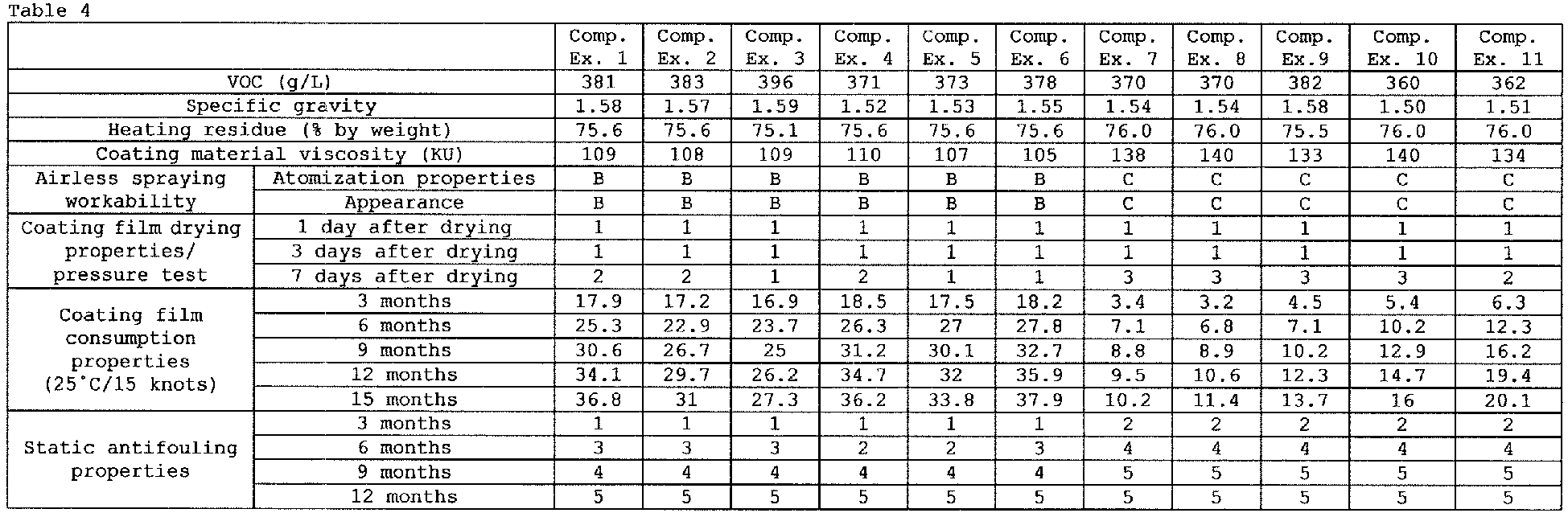

-
- 10:
- wooden chip
- 20:
- antifouling coating film
Claims (13)
- An antifouling coating composition comprising:a hydrolyzable polymer (A) having a structural unit represented by the following formula (1) and having a weight-average molecular weight of 1000 to 5000, andan antifouling agent (B) comprising (b1) 4-bromo-2-(4-chlorophenyl)-5-(trifluoromethyl)-1H-pyrrole-3-carb onitrile,the antifouling coating composition having a volatile organic compound (VOC) content of not more than 400 g/L,

- The antifouling coating composition according to claim 1, which has a viscosity (KU value), as measured by a Stormer viscometer, of 85 to 100.
- The antifouling coating composition according to claim 1 or 2, wherein a content of the antifouling agent (b1) is 1 to 20 parts by weight based on 100 parts by weight (solids content) of the antifouling coating composition.
- The antifouling coating composition according to any one of claims 1 to 3, wherein the antifouling agent (B) further comprises at least one antifouling agent (b2) selected from the group consisting of zinc pyrithione, copper pyrithione, 4,5-dichloro-2-n-octyl-4-isothiazolin-3-one, triphenylboron·amine complex, 2-methylthio-4-tert-butylamino-6-cyclopropyl-s-triazine, N,N-dimethyl-N'-phenyl-N'-(fluorodichloromethylthio)sulfamide and N,N-dimethyl-N'-tolyl-N'-(fluorodichloromethylthio)sulfamide.
- The antifouling coating composition according to claim 4, wherein a content of the antifouling agent (b2) is 1 to 20 parts by weight based on 100 parts by weight (solids content) of the antifouling coating composition.
- The antifouling coating composition according to any one of claims 1 to 5, further comprising zinc oxide in an amount of 0.1 to 60 parts by weight based on 100 parts by weight (solids content) of the antifouling coating composition.
- The antifouling coating composition according to any one of claims 1 to 6, wherein the polymer (A) has a constituent unit derived from a monomer (a1) represented by the formula (2): CH2=C(R1) -COO-M-O-CO-C (R1)=CH2 [in the formula (2), M represents zinc or copper, and R1 independently represents a hydrogen atom or a methyl group] and a constituent unit derived from another unsaturated monomer (a2) capable of being copolymerized with the monomer (a1).
- The antifouling coating composition according to claim 7, wherein the monomer (a1) comprises at least one monomer selected from the group consisting of zinc diacrylate, zinc dimethacrylate, copper diacrylate and copper dimethacrylate.
- The antifouling coating composition according to claim 7 or 8, wherein the unsaturated monomer (a2) comprises at least one unsaturated monomer selected from the group consisting of alkyl (meth)acrylate, alkoxyalkyl (meth)acrylate and hydroxyalkyl (meth)acrylate.
- The antifouling coating composition according to any one of claims 1 to 9, wherein a content of zinc and/or copper in the polymer (A) is 0.5 to 25% by weight of the polymer (A).
- An antifouling coating film formed from the antifouling coating composition according to any one of claims 1 to 10.
- A substrate with an antifouling coating film, the substrate having been coated with the antifouling coating film according to claim 11.
- A production process for a substrate with an antifouling coating film, the process comprising: forming a coating film made from the antifouling coating composition according to any one of claims 1 to 10; and curing the coating film.
Applications Claiming Priority (2)
| Application Number | Priority Date | Filing Date | Title |
|---|---|---|---|
| JP2013107926 | 2013-05-22 | ||
| PCT/JP2014/063434 WO2014189069A1 (en) | 2013-05-22 | 2014-05-21 | Antifouling paint composition, antifouling paint film, substrate having an antifouling paint film, and production method for said substrate |
Publications (3)
| Publication Number | Publication Date |
|---|---|
| EP3000857A1 true EP3000857A1 (en) | 2016-03-30 |
| EP3000857A4 EP3000857A4 (en) | 2016-11-23 |
| EP3000857B1 EP3000857B1 (en) | 2018-09-12 |
Family
ID=51933622
Family Applications (1)
| Application Number | Title | Priority Date | Filing Date |
|---|---|---|---|
| EP14801563.9A Active EP3000857B1 (en) | 2013-05-22 | 2014-05-21 | Antifouling paint composition, antifouling paint film, substrate having an antifouling paint film, and production method for said substrate |
Country Status (9)
| Country | Link |
|---|---|
| US (1) | US9969892B2 (en) |
| EP (1) | EP3000857B1 (en) |
| JP (2) | JP6228600B2 (en) |
| KR (1) | KR101821475B1 (en) |
| CN (1) | CN105392852B (en) |
| ES (1) | ES2690562T3 (en) |
| PT (1) | PT3000857T (en) |
| SG (1) | SG11201509576QA (en) |
| WO (1) | WO2014189069A1 (en) |
Cited By (3)
| Publication number | Priority date | Publication date | Assignee | Title |
|---|---|---|---|---|
| WO2016094663A2 (en) | 2014-12-11 | 2016-06-16 | University Of Houston System | Adsorption of fluorinated anesthetics within the pores of molecular crystals |
| WO2018017557A1 (en) * | 2016-07-19 | 2018-01-25 | Behr Process Corporation | Antimicrobial paint composition and related methods |
| EP3483215A4 (en) * | 2016-07-05 | 2019-06-19 | Mitsubishi Chemical Corporation | POLYMER-CONTAINING COMPOSITION AND ANTITATE COATING COMPOSITION |
Families Citing this family (9)
| Publication number | Priority date | Publication date | Assignee | Title |
|---|---|---|---|---|
| SG11201704006SA (en) * | 2014-11-26 | 2017-06-29 | Chugoku Marine Paints | Antifouling coating composition, antifouling coating film, substrate with an antifouling coating film, antifouling substrate, methods for producing substrate with an antifouling coating film, and method for preventing substrates from fouling |
| WO2018003135A1 (en) * | 2016-07-01 | 2018-01-04 | 中国塗料株式会社 | Antifouling coating material composition, antifouling coating film, substrate provided with antifouling coating film and production method therefor, and antifouling method |
| SG11201911459UA (en) * | 2017-06-01 | 2020-01-30 | Chugoku Marine Paints | Multilayer antifouling coating film, substrate with multilayer antifouling coating film and method for producing same, coating material kit for forming multilayer antifouling coating film, upper-layer antifouling coating composition, and antifouling method |
| CN111669969B (en) * | 2018-02-01 | 2022-02-25 | Agc株式会社 | Base material and copolymer |
| CN108587373A (en) * | 2018-05-25 | 2018-09-28 | 佛山市万善环保科技有限公司 | A kind of aqueous Environment-friendlyanti-corrosive anti-corrosive paint of high rigidity |
| KR102664718B1 (en) * | 2018-07-05 | 2024-05-10 | 한화오션 주식회사 | Anti-fouling paint using temperature responsive capsule |
| JP6799200B1 (en) * | 2019-04-04 | 2020-12-09 | リケンテクノス株式会社 | Antiviral coating film forming paints, coating films, and laminated films |
| JP7351504B2 (en) * | 2019-06-06 | 2023-09-27 | 日東化成株式会社 | Antifouling paint composition |
| KR20230152735A (en) * | 2021-03-02 | 2023-11-03 | 닛토 가세이 가부시끼 가이샤 | Antifouling paint composition |
Family Cites Families (18)
| Publication number | Priority date | Publication date | Assignee | Title |
|---|---|---|---|---|
| JP3945591B2 (en) | 1995-11-15 | 2007-07-18 | 中国塗料株式会社 | Antifouling coating composition, coating film formed from the antifouling coating composition, antifouling method using the antifouling coating composition, and hull or underwater structure coated with the coating |
| JP5031133B2 (en) | 1998-12-17 | 2012-09-19 | 中国塗料株式会社 | Antifouling paint composition, antifouling coating film, ship or underwater structure coated with the antifouling coating film, and antifouling method for ship outer plate or underwater structure |
| EP1496088B1 (en) | 2000-03-28 | 2011-11-02 | Nippon Paint Co., Ltd. | Antifouling coating |
| JP4812947B2 (en) * | 2001-02-21 | 2011-11-09 | 日本ペイント株式会社 | High solid antifouling paint |
| EP1788048B2 (en) * | 2004-08-10 | 2016-01-06 | Chugoku Marine Paints, Ltd. | High-solid anticorrosive coating composition, high-solid rapidly-curable anticorrosive coating composition, method of coating ship or the like, high-solid anticorrosive film and rapidly cured high-solid anticorrosive film obtained, and coated ship and underwater structure coated with these coating films |
| EP1981340B1 (en) * | 2006-02-01 | 2012-07-25 | Janssen Pharmaceutica N.V. | Combinations of 4-bromo-2-(4-chlorophenyl)-5-(trifluoromethyl)-1h-pyrrole-3-carbonitrile and metal compounds |
| US7893047B2 (en) * | 2006-03-03 | 2011-02-22 | Arch Chemicals, Inc. | Biocide composition comprising pyrithione and pyrrole derivatives |
| MY145557A (en) | 2006-04-10 | 2012-02-29 | Janssen Pharmaceutica Nv | Combinations of 4-bromo-2-(4-chlorophenyl)-5-(trifluoromethyl)-1h-pyrrole-3-carbonitrile and bioooooocidal compounds |
| JP2008291141A (en) * | 2007-05-25 | 2008-12-04 | Chugoku Marine Paints Ltd | High solid type antifouling coating composition, coating film comprising the composition, substrate coated with the coating film, and antifouling method |
| JP5373070B2 (en) * | 2008-06-11 | 2013-12-18 | ヨツン エーエス | Binder for antifouling paint composition and antifouling paint composition containing binder |
| JP2010150355A (en) | 2008-12-25 | 2010-07-08 | Nippon Paint Marine Kk | Anti-fouling coating composition, anti-fouling coating film, and method for controlling hydrolysis rate of anti-fouling coating film |
| CN102575126B (en) | 2009-10-13 | 2014-08-20 | 日本油漆船舶涂料公司 | Antifouling coating composition, antifouling film, composite film, and in-water structure |
| DK2551309T3 (en) | 2010-03-23 | 2017-07-10 | Chugoku Marine Paints | ANTI-GRILL COATING COMPOSITION AND APPLICATION THEREOF |
| SG185477A1 (en) | 2010-06-17 | 2013-01-30 | Nippon Paint Marine Coatings Co Ltd | Antifouling paint composition, antifouling coating film, and method for controlling hydrolysis rate of antifouling coating film |
| JP4934851B2 (en) * | 2010-06-23 | 2012-05-23 | 日本ペイントマリン株式会社 | Method for forming antifouling coating film |
| EP2468825A1 (en) | 2010-12-21 | 2012-06-27 | Akzo Nobel Coatings International B.V. | Antifouling coating composition |
| CN103608416B (en) | 2011-06-23 | 2015-12-02 | 中国涂料株式会社 | The manufacture method of binary liquid shape hydrolysis-type antifouling paint compositions, antifouling coat and antifouling base material |
| CN102617795A (en) | 2012-03-31 | 2012-08-01 | 海洋化工研究院 | Aqueous self-polishing antifouling coating substrate resin and antifouling coating prepared from same |
-
2014
- 2014-05-21 SG SG11201509576QA patent/SG11201509576QA/en unknown
- 2014-05-21 KR KR1020157035192A patent/KR101821475B1/en active Active
- 2014-05-21 PT PT14801563T patent/PT3000857T/en unknown
- 2014-05-21 JP JP2015518271A patent/JP6228600B2/en active Active
- 2014-05-21 ES ES14801563.9T patent/ES2690562T3/en active Active
- 2014-05-21 WO PCT/JP2014/063434 patent/WO2014189069A1/en not_active Ceased
- 2014-05-21 US US14/892,835 patent/US9969892B2/en active Active
- 2014-05-21 EP EP14801563.9A patent/EP3000857B1/en active Active
- 2014-05-21 CN CN201480029447.XA patent/CN105392852B/en active Active
-
2017
- 2017-02-08 JP JP2017021126A patent/JP2017122228A/en not_active Withdrawn
Cited By (8)
| Publication number | Priority date | Publication date | Assignee | Title |
|---|---|---|---|---|
| WO2016094663A2 (en) | 2014-12-11 | 2016-06-16 | University Of Houston System | Adsorption of fluorinated anesthetics within the pores of molecular crystals |
| EP3483215A4 (en) * | 2016-07-05 | 2019-06-19 | Mitsubishi Chemical Corporation | POLYMER-CONTAINING COMPOSITION AND ANTITATE COATING COMPOSITION |
| US10954394B2 (en) | 2016-07-05 | 2021-03-23 | Mitsubishi Chemical Corporation | Polymer-containing composition and antifouling coating composition |
| US11732144B2 (en) | 2016-07-05 | 2023-08-22 | Mitsubishi Chemical Corporation | Polymer-containing composition and antifouling coating composition |
| WO2018017557A1 (en) * | 2016-07-19 | 2018-01-25 | Behr Process Corporation | Antimicrobial paint composition and related methods |
| AU2017298280B2 (en) * | 2016-07-19 | 2021-09-02 | Behr Process Corporation | Antimicrobial paint composition and related methods |
| EP3910032A1 (en) * | 2016-07-19 | 2021-11-17 | Behr Process Corporation | Antimicrobial paint composition and related methods |
| US11884841B2 (en) | 2016-07-19 | 2024-01-30 | Behr Process Corporation | Antimicrobial paint composition and related methods |
Also Published As
| Publication number | Publication date |
|---|---|
| JPWO2014189069A1 (en) | 2017-02-23 |
| EP3000857A4 (en) | 2016-11-23 |
| SG11201509576QA (en) | 2015-12-30 |
| CN105392852A (en) | 2016-03-09 |
| US9969892B2 (en) | 2018-05-15 |
| EP3000857B1 (en) | 2018-09-12 |
| CN105392852B (en) | 2018-04-06 |
| US20160168392A1 (en) | 2016-06-16 |
| ES2690562T3 (en) | 2018-11-21 |
| PT3000857T (en) | 2018-11-05 |
| JP6228600B2 (en) | 2017-11-08 |
| WO2014189069A1 (en) | 2014-11-27 |
| JP2017122228A (en) | 2017-07-13 |
| KR20160008592A (en) | 2016-01-22 |
| KR101821475B1 (en) | 2018-01-23 |
Similar Documents
| Publication | Publication Date | Title |
|---|---|---|
| EP3000857B1 (en) | Antifouling paint composition, antifouling paint film, substrate having an antifouling paint film, and production method for said substrate | |
| EP2975095B1 (en) | Antifouling coating composition, antifouling coating film formed using said composition, and coated article having antifouling coating film on surface | |
| EP2551309B1 (en) | Antifouling coating composition and use for same | |
| KR101119537B1 (en) | Anti-stain coating composition containing copper compound and having improved slime resistance and storage stability | |
| KR101817486B1 (en) | Antifouling coating composition, antifouling coating film, non-fouling base, process for producing non-fouling base, and method for storing antifouling coating composition | |
| KR101817487B1 (en) | Antifouling coating material composition, antifouling coating film, antifouling base, method for producing antifouling base, and method for storing antifouling coating material composition | |
| EP2990450A1 (en) | Antifouling paint composition, copolymer for antifouling paint composition and method for manufacturing same, and painted object having on surface antifouling paint film formed using said composition | |
| KR20040071245A (en) | Antifouling paint composition, antifouling paint films, and ships, underwater structures, fishing gear and fishing nets covered with the films | |
| JPWO2018003135A1 (en) | Antifouling paint composition, antifouling coating film, substrate with antifouling coating film and method for producing the same, and antifouling method | |
| KR20130045328A (en) | Antifouling material composition, antifouling film, and method for controlling hydrolysis rate of antifouling film | |
| JPH08269388A (en) | Coating composition | |
| EP3225667B1 (en) | Antifouling coating composition, antifouling coating film, substrate having antifouling coating film, antifouling substrate, method for producing substrate having antifouling coating film, and method for preventing fouling of substrate |
Legal Events
| Date | Code | Title | Description |
|---|---|---|---|
| PUAI | Public reference made under article 153(3) epc to a published international application that has entered the european phase |
Free format text: ORIGINAL CODE: 0009012 |
|
| 17P | Request for examination filed |
Effective date: 20151119 |
|
| AK | Designated contracting states |
Kind code of ref document: A1 Designated state(s): AL AT BE BG CH CY CZ DE DK EE ES FI FR GB GR HR HU IE IS IT LI LT LU LV MC MK MT NL NO PL PT RO RS SE SI SK SM TR |
|
| AX | Request for extension of the european patent |
Extension state: BA ME |
|
| DAX | Request for extension of the european patent (deleted) | ||
| REG | Reference to a national code |
Ref country code: DE Ref legal event code: R079 Ref document number: 602014032340 Country of ref document: DE Free format text: PREVIOUS MAIN CLASS: C09D0133020000 Ipc: C09D0133080000 |
|
| A4 | Supplementary search report drawn up and despatched |
Effective date: 20161026 |
|
| RIC1 | Information provided on ipc code assigned before grant |
Ipc: C09D 5/16 20060101ALI20161020BHEP Ipc: B05D 5/00 20060101ALI20161020BHEP Ipc: C08F 220/18 20060101ALI20161020BHEP Ipc: C09D 133/08 20060101AFI20161020BHEP Ipc: C08F 230/00 20060101ALI20161020BHEP |
|
| GRAP | Despatch of communication of intention to grant a patent |
Free format text: ORIGINAL CODE: EPIDOSNIGR1 |
|
| STAA | Information on the status of an ep patent application or granted ep patent |
Free format text: STATUS: GRANT OF PATENT IS INTENDED |
|
| INTG | Intention to grant announced |
Effective date: 20180515 |
|
| GRAS | Grant fee paid |
Free format text: ORIGINAL CODE: EPIDOSNIGR3 |
|
| GRAA | (expected) grant |
Free format text: ORIGINAL CODE: 0009210 |
|
| STAA | Information on the status of an ep patent application or granted ep patent |
Free format text: STATUS: THE PATENT HAS BEEN GRANTED |
|
| AK | Designated contracting states |
Kind code of ref document: B1 Designated state(s): AL AT BE BG CH CY CZ DE DK EE ES FI FR GB GR HR HU IE IS IT LI LT LU LV MC MK MT NL NO PL PT RO RS SE SI SK SM TR |
|
| RAP1 | Party data changed (applicant data changed or rights of an application transferred) |
Owner name: CHUGOKU MARINE PAINTS, LTD. |
|
| REG | Reference to a national code |
Ref country code: GB Ref legal event code: FG4D |
|
| REG | Reference to a national code |
Ref country code: CH Ref legal event code: EP |
|
| REG | Reference to a national code |
Ref country code: IE Ref legal event code: FG4D |
|
| REG | Reference to a national code |
Ref country code: DE Ref legal event code: R096 Ref document number: 602014032340 Country of ref document: DE |
|
| REG | Reference to a national code |
Ref country code: AT Ref legal event code: REF Ref document number: 1040550 Country of ref document: AT Kind code of ref document: T Effective date: 20181015 |
|
| REG | Reference to a national code |
Ref country code: NL Ref legal event code: FP |
|
| REG | Reference to a national code |
Ref country code: PT Ref legal event code: SC4A Ref document number: 3000857 Country of ref document: PT Date of ref document: 20181105 Kind code of ref document: T Free format text: AVAILABILITY OF NATIONAL TRANSLATION Effective date: 20181008 |
|
| REG | Reference to a national code |
Ref country code: ES Ref legal event code: FG2A Ref document number: 2690562 Country of ref document: ES Kind code of ref document: T3 Effective date: 20181121 |
|
| REG | Reference to a national code |
Ref country code: LT Ref legal event code: MG4D |
|
| PG25 | Lapsed in a contracting state [announced via postgrant information from national office to epo] |
Ref country code: FI Free format text: LAPSE BECAUSE OF FAILURE TO SUBMIT A TRANSLATION OF THE DESCRIPTION OR TO PAY THE FEE WITHIN THE PRESCRIBED TIME-LIMIT Effective date: 20180912 Ref country code: BG Free format text: LAPSE BECAUSE OF FAILURE TO SUBMIT A TRANSLATION OF THE DESCRIPTION OR TO PAY THE FEE WITHIN THE PRESCRIBED TIME-LIMIT Effective date: 20181212 Ref country code: LT Free format text: LAPSE BECAUSE OF FAILURE TO SUBMIT A TRANSLATION OF THE DESCRIPTION OR TO PAY THE FEE WITHIN THE PRESCRIBED TIME-LIMIT Effective date: 20180912 Ref country code: NO Free format text: LAPSE BECAUSE OF FAILURE TO SUBMIT A TRANSLATION OF THE DESCRIPTION OR TO PAY THE FEE WITHIN THE PRESCRIBED TIME-LIMIT Effective date: 20181212 Ref country code: RS Free format text: LAPSE BECAUSE OF FAILURE TO SUBMIT A TRANSLATION OF THE DESCRIPTION OR TO PAY THE FEE WITHIN THE PRESCRIBED TIME-LIMIT Effective date: 20180912 Ref country code: SE Free format text: LAPSE BECAUSE OF FAILURE TO SUBMIT A TRANSLATION OF THE DESCRIPTION OR TO PAY THE FEE WITHIN THE PRESCRIBED TIME-LIMIT Effective date: 20180912 |
|
| PG25 | Lapsed in a contracting state [announced via postgrant information from national office to epo] |
Ref country code: AL Free format text: LAPSE BECAUSE OF FAILURE TO SUBMIT A TRANSLATION OF THE DESCRIPTION OR TO PAY THE FEE WITHIN THE PRESCRIBED TIME-LIMIT Effective date: 20180912 Ref country code: LV Free format text: LAPSE BECAUSE OF FAILURE TO SUBMIT A TRANSLATION OF THE DESCRIPTION OR TO PAY THE FEE WITHIN THE PRESCRIBED TIME-LIMIT Effective date: 20180912 Ref country code: HR Free format text: LAPSE BECAUSE OF FAILURE TO SUBMIT A TRANSLATION OF THE DESCRIPTION OR TO PAY THE FEE WITHIN THE PRESCRIBED TIME-LIMIT Effective date: 20180912 |
|
| REG | Reference to a national code |
Ref country code: GR Ref legal event code: EP Ref document number: 20180402856 Country of ref document: GR Effective date: 20190225 |
|
| REG | Reference to a national code |
Ref country code: AT Ref legal event code: MK05 Ref document number: 1040550 Country of ref document: AT Kind code of ref document: T Effective date: 20180912 |
|
| PG25 | Lapsed in a contracting state [announced via postgrant information from national office to epo] |
Ref country code: EE Free format text: LAPSE BECAUSE OF FAILURE TO SUBMIT A TRANSLATION OF THE DESCRIPTION OR TO PAY THE FEE WITHIN THE PRESCRIBED TIME-LIMIT Effective date: 20180912 Ref country code: PL Free format text: LAPSE BECAUSE OF FAILURE TO SUBMIT A TRANSLATION OF THE DESCRIPTION OR TO PAY THE FEE WITHIN THE PRESCRIBED TIME-LIMIT Effective date: 20180912 Ref country code: AT Free format text: LAPSE BECAUSE OF FAILURE TO SUBMIT A TRANSLATION OF THE DESCRIPTION OR TO PAY THE FEE WITHIN THE PRESCRIBED TIME-LIMIT Effective date: 20180912 Ref country code: IS Free format text: LAPSE BECAUSE OF FAILURE TO SUBMIT A TRANSLATION OF THE DESCRIPTION OR TO PAY THE FEE WITHIN THE PRESCRIBED TIME-LIMIT Effective date: 20190112 Ref country code: RO Free format text: LAPSE BECAUSE OF FAILURE TO SUBMIT A TRANSLATION OF THE DESCRIPTION OR TO PAY THE FEE WITHIN THE PRESCRIBED TIME-LIMIT Effective date: 20180912 Ref country code: CZ Free format text: LAPSE BECAUSE OF FAILURE TO SUBMIT A TRANSLATION OF THE DESCRIPTION OR TO PAY THE FEE WITHIN THE PRESCRIBED TIME-LIMIT Effective date: 20180912 |
|
| PG25 | Lapsed in a contracting state [announced via postgrant information from national office to epo] |
Ref country code: SK Free format text: LAPSE BECAUSE OF FAILURE TO SUBMIT A TRANSLATION OF THE DESCRIPTION OR TO PAY THE FEE WITHIN THE PRESCRIBED TIME-LIMIT Effective date: 20180912 Ref country code: SM Free format text: LAPSE BECAUSE OF FAILURE TO SUBMIT A TRANSLATION OF THE DESCRIPTION OR TO PAY THE FEE WITHIN THE PRESCRIBED TIME-LIMIT Effective date: 20180912 |
|
| REG | Reference to a national code |
Ref country code: DE Ref legal event code: R097 Ref document number: 602014032340 Country of ref document: DE |
|
| PLBE | No opposition filed within time limit |
Free format text: ORIGINAL CODE: 0009261 |
|
| STAA | Information on the status of an ep patent application or granted ep patent |
Free format text: STATUS: NO OPPOSITION FILED WITHIN TIME LIMIT |
|
| PG25 | Lapsed in a contracting state [announced via postgrant information from national office to epo] |
Ref country code: DK Free format text: LAPSE BECAUSE OF FAILURE TO SUBMIT A TRANSLATION OF THE DESCRIPTION OR TO PAY THE FEE WITHIN THE PRESCRIBED TIME-LIMIT Effective date: 20180912 |
|
| 26N | No opposition filed |
Effective date: 20190613 |
|
| PG25 | Lapsed in a contracting state [announced via postgrant information from national office to epo] |
Ref country code: SI Free format text: LAPSE BECAUSE OF FAILURE TO SUBMIT A TRANSLATION OF THE DESCRIPTION OR TO PAY THE FEE WITHIN THE PRESCRIBED TIME-LIMIT Effective date: 20180912 |
|
| REG | Reference to a national code |
Ref country code: CH Ref legal event code: PL |
|
| PG25 | Lapsed in a contracting state [announced via postgrant information from national office to epo] |
Ref country code: CH Free format text: LAPSE BECAUSE OF NON-PAYMENT OF DUE FEES Effective date: 20190531 Ref country code: MC Free format text: LAPSE BECAUSE OF FAILURE TO SUBMIT A TRANSLATION OF THE DESCRIPTION OR TO PAY THE FEE WITHIN THE PRESCRIBED TIME-LIMIT Effective date: 20180912 Ref country code: LI Free format text: LAPSE BECAUSE OF NON-PAYMENT OF DUE FEES Effective date: 20190531 |
|
| REG | Reference to a national code |
Ref country code: BE Ref legal event code: MM Effective date: 20190531 |
|
| PG25 | Lapsed in a contracting state [announced via postgrant information from national office to epo] |
Ref country code: LU Free format text: LAPSE BECAUSE OF NON-PAYMENT OF DUE FEES Effective date: 20190521 |
|
| PG25 | Lapsed in a contracting state [announced via postgrant information from national office to epo] |
Ref country code: TR Free format text: LAPSE BECAUSE OF FAILURE TO SUBMIT A TRANSLATION OF THE DESCRIPTION OR TO PAY THE FEE WITHIN THE PRESCRIBED TIME-LIMIT Effective date: 20180912 |
|
| PG25 | Lapsed in a contracting state [announced via postgrant information from national office to epo] |
Ref country code: IE Free format text: LAPSE BECAUSE OF NON-PAYMENT OF DUE FEES Effective date: 20190521 |
|
| PG25 | Lapsed in a contracting state [announced via postgrant information from national office to epo] |
Ref country code: BE Free format text: LAPSE BECAUSE OF NON-PAYMENT OF DUE FEES Effective date: 20190531 |
|
| PG25 | Lapsed in a contracting state [announced via postgrant information from national office to epo] |
Ref country code: FR Free format text: LAPSE BECAUSE OF NON-PAYMENT OF DUE FEES Effective date: 20190531 |
|
| PG25 | Lapsed in a contracting state [announced via postgrant information from national office to epo] |
Ref country code: CY Free format text: LAPSE BECAUSE OF FAILURE TO SUBMIT A TRANSLATION OF THE DESCRIPTION OR TO PAY THE FEE WITHIN THE PRESCRIBED TIME-LIMIT Effective date: 20180912 |
|
| PG25 | Lapsed in a contracting state [announced via postgrant information from national office to epo] |
Ref country code: HU Free format text: LAPSE BECAUSE OF FAILURE TO SUBMIT A TRANSLATION OF THE DESCRIPTION OR TO PAY THE FEE WITHIN THE PRESCRIBED TIME-LIMIT; INVALID AB INITIO Effective date: 20140521 Ref country code: MT Free format text: LAPSE BECAUSE OF FAILURE TO SUBMIT A TRANSLATION OF THE DESCRIPTION OR TO PAY THE FEE WITHIN THE PRESCRIBED TIME-LIMIT Effective date: 20180912 |
|
| PG25 | Lapsed in a contracting state [announced via postgrant information from national office to epo] |
Ref country code: MK Free format text: LAPSE BECAUSE OF FAILURE TO SUBMIT A TRANSLATION OF THE DESCRIPTION OR TO PAY THE FEE WITHIN THE PRESCRIBED TIME-LIMIT Effective date: 20180912 |
|
| PGFP | Annual fee paid to national office [announced via postgrant information from national office to epo] |
Ref country code: PT Payment date: 20220523 Year of fee payment: 9 Ref country code: GB Payment date: 20220401 Year of fee payment: 9 Ref country code: ES Payment date: 20220602 Year of fee payment: 9 |
|
| PGFP | Annual fee paid to national office [announced via postgrant information from national office to epo] |
Ref country code: GR Payment date: 20220420 Year of fee payment: 9 |
|
| P01 | Opt-out of the competence of the unified patent court (upc) registered |
Effective date: 20230517 |
|
| PG25 | Lapsed in a contracting state [announced via postgrant information from national office to epo] |
Ref country code: GR Free format text: LAPSE BECAUSE OF NON-PAYMENT OF DUE FEES Effective date: 20231208 |
|
| GBPC | Gb: european patent ceased through non-payment of renewal fee |
Effective date: 20230521 |
|
| PG25 | Lapsed in a contracting state [announced via postgrant information from national office to epo] |
Ref country code: PT Free format text: LAPSE BECAUSE OF NON-PAYMENT OF DUE FEES Effective date: 20231121 Ref country code: GR Free format text: LAPSE BECAUSE OF NON-PAYMENT OF DUE FEES Effective date: 20231208 |
|
| PG25 | Lapsed in a contracting state [announced via postgrant information from national office to epo] |
Ref country code: GB Free format text: LAPSE BECAUSE OF NON-PAYMENT OF DUE FEES Effective date: 20230521 |
|
| REG | Reference to a national code |
Ref country code: ES Ref legal event code: FD2A Effective date: 20240703 |
|
| PG25 | Lapsed in a contracting state [announced via postgrant information from national office to epo] |
Ref country code: ES Free format text: LAPSE BECAUSE OF NON-PAYMENT OF DUE FEES Effective date: 20230522 |
|
| PG25 | Lapsed in a contracting state [announced via postgrant information from national office to epo] |
Ref country code: ES Free format text: LAPSE BECAUSE OF NON-PAYMENT OF DUE FEES Effective date: 20230522 |
|
| PGFP | Annual fee paid to national office [announced via postgrant information from national office to epo] |
Ref country code: NL Payment date: 20250409 Year of fee payment: 12 |
|
| PGFP | Annual fee paid to national office [announced via postgrant information from national office to epo] |
Ref country code: DE Payment date: 20250402 Year of fee payment: 12 |
|
| PGFP | Annual fee paid to national office [announced via postgrant information from national office to epo] |
Ref country code: IT Payment date: 20250422 Year of fee payment: 12 |