EP2999763B1 - Seal element - Google Patents
Seal element Download PDFInfo
- Publication number
- EP2999763B1 EP2999763B1 EP14726127.5A EP14726127A EP2999763B1 EP 2999763 B1 EP2999763 B1 EP 2999763B1 EP 14726127 A EP14726127 A EP 14726127A EP 2999763 B1 EP2999763 B1 EP 2999763B1
- Authority
- EP
- European Patent Office
- Prior art keywords
- pcm
- seal element
- element according
- elastomeric
- transition point
- Prior art date
- Legal status (The legal status is an assumption and is not a legal conclusion. Google has not performed a legal analysis and makes no representation as to the accuracy of the status listed.)
- Active
Links
Images

Classifications
-
- C—CHEMISTRY; METALLURGY
- C09—DYES; PAINTS; POLISHES; NATURAL RESINS; ADHESIVES; COMPOSITIONS NOT OTHERWISE PROVIDED FOR; APPLICATIONS OF MATERIALS NOT OTHERWISE PROVIDED FOR
- C09K—MATERIALS FOR MISCELLANEOUS APPLICATIONS, NOT PROVIDED FOR ELSEWHERE
- C09K3/00—Materials not provided for elsewhere
- C09K3/10—Materials in mouldable or extrudable form for sealing or packing joints or covers
- C09K3/1006—Materials in mouldable or extrudable form for sealing or packing joints or covers characterised by the chemical nature of one of its constituents
- C09K3/1009—Fluorinated polymers, e.g. PTFE
-
- C—CHEMISTRY; METALLURGY
- C09—DYES; PAINTS; POLISHES; NATURAL RESINS; ADHESIVES; COMPOSITIONS NOT OTHERWISE PROVIDED FOR; APPLICATIONS OF MATERIALS NOT OTHERWISE PROVIDED FOR
- C09K—MATERIALS FOR MISCELLANEOUS APPLICATIONS, NOT PROVIDED FOR ELSEWHERE
- C09K3/00—Materials not provided for elsewhere
- C09K3/10—Materials in mouldable or extrudable form for sealing or packing joints or covers
- C09K3/1006—Materials in mouldable or extrudable form for sealing or packing joints or covers characterised by the chemical nature of one of its constituents
-
- C—CHEMISTRY; METALLURGY
- C09—DYES; PAINTS; POLISHES; NATURAL RESINS; ADHESIVES; COMPOSITIONS NOT OTHERWISE PROVIDED FOR; APPLICATIONS OF MATERIALS NOT OTHERWISE PROVIDED FOR
- C09K—MATERIALS FOR MISCELLANEOUS APPLICATIONS, NOT PROVIDED FOR ELSEWHERE
- C09K5/00—Heat-transfer, heat-exchange or heat-storage materials, e.g. refrigerants; Materials for the production of heat or cold by chemical reactions other than by combustion
- C09K5/02—Materials undergoing a change of physical state when used
- C09K5/06—Materials undergoing a change of physical state when used the change of state being from liquid to solid or vice versa
- C09K5/063—Materials absorbing or liberating heat during crystallisation; Heat storage materials
-
- E—FIXED CONSTRUCTIONS
- E21—EARTH OR ROCK DRILLING; MINING
- E21B—EARTH OR ROCK DRILLING; OBTAINING OIL, GAS, WATER, SOLUBLE OR MELTABLE MATERIALS OR A SLURRY OF MINERALS FROM WELLS
- E21B33/00—Sealing or packing boreholes or wells
-
- C—CHEMISTRY; METALLURGY
- C09—DYES; PAINTS; POLISHES; NATURAL RESINS; ADHESIVES; COMPOSITIONS NOT OTHERWISE PROVIDED FOR; APPLICATIONS OF MATERIALS NOT OTHERWISE PROVIDED FOR
- C09K—MATERIALS FOR MISCELLANEOUS APPLICATIONS, NOT PROVIDED FOR ELSEWHERE
- C09K3/00—Materials not provided for elsewhere
- C09K3/10—Materials in mouldable or extrudable form for sealing or packing joints or covers
- C09K2003/1034—Materials or components characterised by specific properties
- C09K2003/1053—Elastomeric materials
-
- C—CHEMISTRY; METALLURGY
- C09—DYES; PAINTS; POLISHES; NATURAL RESINS; ADHESIVES; COMPOSITIONS NOT OTHERWISE PROVIDED FOR; APPLICATIONS OF MATERIALS NOT OTHERWISE PROVIDED FOR
- C09K—MATERIALS FOR MISCELLANEOUS APPLICATIONS, NOT PROVIDED FOR ELSEWHERE
- C09K2200/00—Chemical nature of materials in mouldable or extrudable form for sealing or packing joints or covers
- C09K2200/06—Macromolecular organic compounds, e.g. prepolymers
- C09K2200/0607—Rubber or rubber derivatives
-
- C—CHEMISTRY; METALLURGY
- C09—DYES; PAINTS; POLISHES; NATURAL RESINS; ADHESIVES; COMPOSITIONS NOT OTHERWISE PROVIDED FOR; APPLICATIONS OF MATERIALS NOT OTHERWISE PROVIDED FOR
- C09K—MATERIALS FOR MISCELLANEOUS APPLICATIONS, NOT PROVIDED FOR ELSEWHERE
- C09K2200/00—Chemical nature of materials in mouldable or extrudable form for sealing or packing joints or covers
- C09K2200/06—Macromolecular organic compounds, e.g. prepolymers
- C09K2200/0607—Rubber or rubber derivatives
- C09K2200/0612—Butadiene-acrylonitrile rubber
Definitions
- the present invention concerns the field of elastomeric seals, more particularly elastomeric seals suitable for use in applications where the seals are subject to transient conditions of very low temperatures.
- Rapid depressurization may also be encountered in some units, e.g. quick disconnect pressure control packages installed between Christmas Tree (XT) or Wellhead (WH) and riser string, when the emergency shutdown function is activated.
- XT Christmas Tree
- WH Wellhead
- Joule-Thomson effect takes place manifesting itself in a sharp temperature drop.
- the cooling time may be rather short (typically less than an hour) it is very detrimental for elastomeric seals which are vulnerable to large temperature variations. In fact, any shock or undesirable movement could crack or rupture an elastomeric composite when it is cooled down to a brittle state.
- Elastomers with very low glass transition point i.e. elastomers which tolerate low temperatures without becoming brittle, may be utilized in some instances.
- elastomers which tolerate low temperatures without becoming brittle
- they since in general their chemical resistance is inhibited, they are normally not applicable in high temperature wells or those producing extremely aggressive fluids, e.g. containing a significant share of H 2 S in the gas phase.
- WO 94/03743 A1 discloses a seal element comprising a body defining a cavity, wherein the cavity is filled with a material having a lower coefficient of expansion than the body. The filling material ensures that a compressive force between two surfaces sealed by the seal element will not decrease appreciably during low temperatures.
- US 5294133 A discloses an O-ring seal comprising a hollow ring made in an elastomeric material and a central liquid core.
- the liquid core is preferably water or a mixture of water and glycol.
- the O-ring seal provides an improved sealing at low temperatures since the liquid core will expand during low temperature conditions to counteract the contraction of the hollow ring.
- US 2004/208912 A1 discloses a flexible thermal control composite containing an endothermic agent.
- the composite may be used in a gasket.
- the present idea aims to solve or alleviate the material selection challenge for sealing elements with high material glass transition points that might be temporarily subjected to influence of low temperatures.
- the present invention discloses a polymer seal element comprising a phase changing material (PCM) in order to prevent transient overcooling of the seal element caused by blow down (depressurization) or other temporary chilling conditions that may be faced in frozen regions with rapidly alternating weather like Arctic. This is especially important whenever elastomeric seals may reach a temperature corresponding to the glass transition or brittleness point at which they may be easily damaged by any impact load or result in a leak of contained fluid to the environment.
- PCMs represent a group of substances that undergoes a phase transformation at a certain temperature, or over a distinct range of temperatures, accompanied by release of heat.
- the seal element in the present invention may be formed from an elastomeric composite comprising a high temperature and fluid resistant elastomer, which by virtue of the added PCM and the inherently low thermal conductivity of polymers, can withstand a time period of exposure to cold environment while maintaining its sealing capability.
- the present invention provides a seal element comprising an elastomeric composite, said composite comprising an elastomeric polymer blended with a phase change material (PCM), wherein the PCM has a heat of fusion larger than 100 kJ/kg, a phase transition point within the temperature range of 233-288 K and is able to provide heat to the elastomeric polymer upon cooling of the seal element to the phase transition point of the PCM, and wherein at least one surface of the seal element is PCM-free or the PCM only occupies an internal volume of the seal element.
- PCM phase change material
- the amount of PCM is in the range of 1-25 % v/v, based on the total volume of the elastomeric composite, at 20 °C.
- the range may advantageously be in the range of 5-25 % v/v, 1-20 % v/v, 1-15 % v/v or 1-10 % v/v.
- the amount of PCM in the elastomeric composite may be defined as being within the range of 1-40 % w/w, 5-40 % w/w, 1-35 % w/w, 1-30 % w/w or 1-25 % w/w based on the total weight of the elastomeric composite.
- the elastomeric composite constitutes more than 20 % v/v, more than 50 % v/v, more than 90 % v/v, more than 95 % v/v or more than 99 % v/v of said seal element, based on the total volume of the seal element.
- the PCM have a heat of fusion larger than 150 kJ/kg, larger than 200 kJ/kg, larger than 300 kJ/kg, and preferably larger than 350 kJ/kg.
- the phase transition point is within the temperature range of 243-283 K, or 243-272 K.
- the elastomeric polymer in the seal element of the invention is a synthetic rubber.
- the synthetic rubber may be chosen from the group of NBR (nitrile butadienes), HNBR (hydrogenated nitrile butadienes), FKM (fluoroelastomers) or FFKM (perfluoroelastomers), or any combination thereof, and the synthetic rubber is preferably FKM or FFKM.
- the PCM is chosen from the group of paraffins, such as octadecane, fatty acids, fatty esters, alcohols, glycols, salt hydrates, ionic liquids, water, eutectic solutions, eutectic metals, metals with low melting points or any combination thereof.
- paraffins such as octadecane, fatty acids, fatty esters, alcohols, glycols, salt hydrates, ionic liquids, water, eutectic solutions, eutectic metals, metals with low melting points or any combination thereof.
- the PCM has a solid-liquid phase change at the transition point.
- the PCM is linked to, or is an integrated part of, a polymer material.
- the PCM is encapsulated in macro-, micro- or nanosized capsules having a mean diameter size of from 0.1 nm to 5 mm.
- the capsules are preferably made in a polymer material, but may also be made up of other materials suitable for encapsulating PCM.
- the PCM is in the form of granules or particles.
- the PCM is evenly distributed throughout the elastomeric composite.
- the % v/v of PCM may vary in a gradual or stepwise manner through the internal volume of the seal element. It may for instance be advantageous to have the largest w/w % of PCM close to the surface of the seal element.
- the heat provided by the PCM is sufficient to increase the temperature of the elastomeric polymer.
- the temperature increase may be in the range of 5 to 50 K when the seal element is cooled to the phase transition point of the PCM.
- the invention provides a method for manufacturing a seal element according to the invention, comprising the following steps:
- the resulting blend is added to a suitably seal shaped mold prior to the curing/vulcanization step.
- the heat of fusion of the PCM, the temperature ranges of the phase transition point, and the amount of PCM in the elastomeric composite are within the ranges used in the seal element according to the invention.
- Fig. 1 illustrates a schematic workover riser system comprising a seal element according to the invention.
- Fig. 1 illustrates a workover system, and is meant to help understand the advantages that the present invention provides regarding improvement of safety and reliability of the system. Furthermore, any other equipment experiencing transient blow down conditions could benefit from the proposed technology.
- FIG. 1 an offshore oil and gas rig performing a well intervention operation is depicted.
- the rig is positioned over an underwater gas well on top of which permanent seabed equipment is installed, i.e. Wellhead (WH) and Christmas Tree (XT).
- the rig is connected to the XT by means of a completion/workover (CWO) riser, a subsea conduit generally extending from Surface Flow Tree (SFT) on the rig down to a temporary installed workover stack incorporating Emergency Disconnect Package (EDP) and Lower Riser Package (LRP).
- CWO completion/workover
- SFT Surface Flow Tree
- EDP Emergency Disconnect Package
- LRP Lower Riser Package
- the LRP shall essentially contain a production isolation valve (PIV) and, when necessary, it may shut down the flow of hydrocarbons by the PIV or cut any wireline and coiled tubing by virtue of shear rams to prepare for a quick disconnect of the riser.
- PIV production isolation valve
- the EDP shall provide a fast remotely operated disconnect of the riser system and prevent hydrocarbons contained inside the riser from releasing to sea by the retainer valve.
- Joule-Thomson effect could be gas bleed down of a riser through its SFT.
- the upper part of the riser system above the sea level is particularly vulnerable as there is no seawater to keep the riser rather warm.
- the air being cold or warm does not possess sufficient heat transfer capability compared to the water, therefore with the other parameters being equal the effect of Joule-Thomson cooling above sea is stronger than subsea.
- Elastomeric seal elements of different geometry and dimensions can be installed all the way throughout the system from WH to SFT and wetted with produced hydrocarbons. Some of them are primary seals and eventually may be exposed to the transient cooling in gas systems. According to the present invention such seal elements can be made of a hydrocarbon resistant elastomer comprising a PCM material embedded into the main body of the seal forming a composite. Upon cooling, PCM liberates a certain amount of thermal energy or heat, when the temperature of retained medium or ambient air drops to that of the phase transition temperature. Conversely, PCM will absorb heat from the environment when/if the temperature rises.
- the shape of the seal element of the present invention may be designed following commonly used seal practice including, but not limited to, O-rings, S-seals, T-seals, U-seals, V-seals, X-seals, flat seals, lip seals, numerous polymer sealants, back-up rings and gaskets. Also RAM sealing profiles could be made with PCM fillers.
- thermoplastics or other polymer groups might be selected depending on compatibility with flowing media and actual operational conditions of a particular seal member.
- the most favourable material is perfluorinated elastomer (FFKM), though other chemical classes might be beneficial.
- elastomers could be used for composite formulation: nitrile butadiene (NBR), hydrogenated acrylonitrile butadiene (HNBR) or also referred as highly saturated nitrile rubber (HSN), carboxylated acrylonitrile butadiene (XNBR), fluoroelastomer (FKM), fluorosilicone (FMQ), chloroprene (CR), ethylene propylene (EPM), polyurethane (PU), ethylene propylene diene (EPDM), tetrafluoroethylene and polypropylene (FEPM), copolymers thereof and the like.
- NBR nitrile butadiene
- HNBR hydrogenated acrylonitrile butadiene
- HNBR highly saturated nitrile rubber
- XNBR carboxylated acrylonitrile butadiene
- FKM fluoroelastomer
- FMQ fluorosilicone
- CR chloroprene
- EPM ethylene propy
- the composite may also comprise a thermoplastic including, but not limited to, polyether ether ketone (PEEK), polyether ketone (PEK), polyether ketone ketone (PEKK), polytetrafluoroethylene (PTFE), polyoxymethylene (POM).
- Thermosetting polymers such as different epoxies and phenolics may also be selected as a matrix material.
- PCM elements can be either in organic or inorganic form with solid-liquid phase transitions. They could include specifically tailored paraffins, fatty acids, alcohols, glycols, salt hydrates and mixtures thereof, eutectic metals and metals with low melting point, various eutectics and the like.
- PCM's are described in the literature and may, provided they have a suitable phase transition point, be used in the present invention, see for instance E. Oró et al. "Review on phase change materials (PCMs) for cold thermal energy storage applications”; Applied Energy, 2012, Vol. 99, pp. 513-533 .
- a preferred phase transition temperature would commonly be in the range of -30 to +10 °C.
- PCM may be embedded into the body of the seal element by being contained in macro-, micro- or nanocapsules, or as particles or granules with effective capsule/particle size starting from 0.1 nm, as well as specific molecular arrangements linked to polymer chains (for instance, so-called molecular encapsulation).
- the PCM especially PCM having a solid-liquid phase transition, may preferably be contained in capsules made in a polymer material to provide a protective coating and increase adhesion to the main material of the seal member.
- Various types of encapsulation of PCM's are well known to the skilled person.
- the required volume share of a specific PCM depends on its energy storage capacity, physical qualities of polymer matrix and required combination of properties together with expected cold exposure periods and may generally vary over a wide range of 1-25 % v/v, based on the total volume of the elastomeric composite, at 20 °C.
- the amount of PCM in the elastomeric composite may be defined as being within the range of 1-40 % w/w based on the total weight of the elastomeric composite.
- the elastomeric composite may further comprise any necessary components that enhance physical and mechanical properties, impart desired appearance and initiate or accelerate chemical reactions. These components include curing agents, reinforcement fillers, plasticizers, antioxidants, pigments and the like.
- an elastomeric composite comprises a predefined amount of PCM with a volume fraction x and mass m pcm .
- the PCM Upon cooling down to the phase transition point the PCM releases heat corresponding to latent heat of fusion, ⁇ (J/kg).
- el denote elastomer matrix.
- PCM heat release may be further exemplified taking an elastomeric matrix of FFKM rubber compounded with diethylene glycol (the glycol is encapsulated) as a PCM (see E. Oró et al. "Review on phase change materials (PCMs) for cold thermal energy storage applications”; Applied Energy, 2012, Vol. 99, pp. 513-533 ).
- Diethylene glycol has a latent heat of fusion of 247 kJ/kg and density of 1200 kg/m 3 .
Landscapes
- Chemical & Material Sciences (AREA)
- Engineering & Computer Science (AREA)
- Materials Engineering (AREA)
- Organic Chemistry (AREA)
- Physics & Mathematics (AREA)
- Life Sciences & Earth Sciences (AREA)
- Geology (AREA)
- Mining & Mineral Resources (AREA)
- Combustion & Propulsion (AREA)
- Thermal Sciences (AREA)
- Chemical Kinetics & Catalysis (AREA)
- Environmental & Geological Engineering (AREA)
- Fluid Mechanics (AREA)
- General Life Sciences & Earth Sciences (AREA)
- Geochemistry & Mineralogy (AREA)
- Sealing Material Composition (AREA)
- Compositions Of Macromolecular Compounds (AREA)
- Gasket Seals (AREA)
Description
- The present invention concerns the field of elastomeric seals, more particularly elastomeric seals suitable for use in applications where the seals are subject to transient conditions of very low temperatures.
- In high pressure retaining systems, such as subsea production and workover equipment, there may be situations when the system pressure needs to be reduced to a required level, e.g. through choking. Rapid depressurization may also be encountered in some units, e.g. quick disconnect pressure control packages installed between Christmas Tree (XT) or Wellhead (WH) and riser string, when the emergency shutdown function is activated.
- When gas flow is decreased by a choke valve, or it is released through a blow-down valve with a high pressure differential between up- and downstream the plugs, Joule-Thomson effect takes place manifesting itself in a sharp temperature drop. Although the cooling time may be rather short (typically less than an hour) it is very detrimental for elastomeric seals which are vulnerable to large temperature variations. In fact, any shock or undesirable movement could crack or rupture an elastomeric composite when it is cooled down to a brittle state.
- Another point to consider here is regions with harsh weather conditions, in particular those of high alternating diurnal temperatures in mid seasons. In some areas of Arctic the maximum daily temperature difference may reach 30-40 °C. In the glassy or brittle state rubber seals may not necessarily be damaged, but, since the material stiffen too much, the seal may also lack sealability at low temperatures, and, as a consequence, fail to separate contained medium from the outer environment. The consequences of spillage of hydrocarbons or aggressive chemicals may undeniably be harmful either for people or flora and fauna which are much more sensitive in cold areas. Hence, it is of utmost importance to maintain elastomeric seals above the material glass transition temperature.
- Elastomers with very low glass transition point, i.e. elastomers which tolerate low temperatures without becoming brittle, may be utilized in some instances. However, since in general their chemical resistance is inhibited, they are normally not applicable in high temperature wells or those producing extremely aggressive fluids, e.g. containing a significant share of H2S in the gas phase. On the other hand there exist elastomeric composites with excellent high temperature stability exhibiting inertness to most of the production media as well as chemicals utilized in the offshore industry, but their low temperature behavior is quite inferior. Currently a compromise between these properties and failure probability is found.
-
WO 94/03743 A1 -
US 5294133 A discloses an O-ring seal comprising a hollow ring made in an elastomeric material and a central liquid core. The liquid core is preferably water or a mixture of water and glycol. The O-ring seal provides an improved sealing at low temperatures since the liquid core will expand during low temperature conditions to counteract the contraction of the hollow ring. -
US 2004/208912 A1 discloses a flexible thermal control composite containing an endothermic agent. The composite may be used in a gasket. - The present idea aims to solve or alleviate the material selection challenge for sealing elements with high material glass transition points that might be temporarily subjected to influence of low temperatures.
- The present invention discloses a polymer seal element comprising a phase changing material (PCM) in order to prevent transient overcooling of the seal element caused by blow down (depressurization) or other temporary chilling conditions that may be faced in frozen regions with rapidly alternating weather like Arctic. This is especially important whenever elastomeric seals may reach a temperature corresponding to the glass transition or brittleness point at which they may be easily damaged by any impact load or result in a leak of contained fluid to the environment. PCMs represent a group of substances that undergoes a phase transformation at a certain temperature, or over a distinct range of temperatures, accompanied by release of heat. The seal element in the present invention may be formed from an elastomeric composite comprising a high temperature and fluid resistant elastomer, which by virtue of the added PCM and the inherently low thermal conductivity of polymers, can withstand a time period of exposure to cold environment while maintaining its sealing capability. The present invention is defined by the attached claims and in the following:
In one aspect, the present invention provides a seal element comprising an elastomeric composite, said composite comprising an elastomeric polymer blended with a phase change material (PCM), wherein the PCM has a heat of fusion larger than 100 kJ/kg, a phase transition point within the temperature range of 233-288 K and is able to provide heat to the elastomeric polymer upon cooling of the seal element to the phase transition point of the PCM, and wherein at least one surface of the seal element is PCM-free or the PCM only occupies an internal volume of the seal element. - In a further aspect of the invention, the amount of PCM is in the range of 1-25 % v/v, based on the total volume of the elastomeric composite, at 20 °C. The range may advantageously be in the range of 5-25 % v/v, 1-20 % v/v, 1-15 % v/v or 1-10 % v/v. Alternatively, the amount of PCM in the elastomeric composite may be defined as being within the range of 1-40 % w/w, 5-40 % w/w, 1-35 % w/w, 1-30 % w/w or 1-25 % w/w based on the total weight of the elastomeric composite.
- In a further aspect of the seal element according to the invention, the elastomeric composite constitutes more than 20 % v/v, more than 50 % v/v, more than 90 % v/v, more than 95 % v/v or more than 99 % v/v of said seal element, based on the total volume of the seal element.
- In a further aspect of the seal element according to the invention, the PCM have a heat of fusion larger than 150 kJ/kg, larger than 200 kJ/kg, larger than 300 kJ/kg, and preferably larger than 350 kJ/kg.
- In a further aspect of the seal element according to the invention, the phase transition point is within the temperature range of 243-283 K, or 243-272 K.
- In one aspect, the elastomeric polymer in the seal element of the invention is a synthetic rubber. The synthetic rubber may be chosen from the group of NBR (nitrile butadienes), HNBR (hydrogenated nitrile butadienes), FKM (fluoroelastomers) or FFKM (perfluoroelastomers), or any combination thereof, and the synthetic rubber is preferably FKM or FFKM.
- In a further aspect of the seal element according to the invention, the PCM is chosen from the group of paraffins, such as octadecane, fatty acids, fatty esters, alcohols, glycols, salt hydrates, ionic liquids, water, eutectic solutions, eutectic metals, metals with low melting points or any combination thereof.
- In a further aspect of the seal element according to the invention, the PCM has a solid-liquid phase change at the transition point.
- In a further aspect of the seal element according to the invention, the PCM is linked to, or is an integrated part of, a polymer material.
- In a further aspect of the seal element according to the invention, the PCM is encapsulated in macro-, micro- or nanosized capsules having a mean diameter size of from 0.1 nm to 5 mm. The capsules are preferably made in a polymer material, but may also be made up of other materials suitable for encapsulating PCM.
- In a further aspect of the seal element according to the invention, the PCM is in the form of granules or particles.
- In a further aspect of the seal element according to the invention, the PCM is evenly distributed throughout the elastomeric composite.
- In yet a further aspect of the seal element according to the invention, the % v/v of PCM, based on the volume of the elastomeric composite, may vary in a gradual or stepwise manner through the internal volume of the seal element. It may for instance be advantageous to have the largest w/w % of PCM close to the surface of the seal element.
- In yet a further aspect of the seal element according to the invention, the heat provided by the PCM is sufficient to increase the temperature of the elastomeric polymer. The temperature increase may be in the range of 5 to 50 K when the seal element is cooled to the phase transition point of the PCM.
- In yet a further aspect, the invention provides a method for manufacturing a seal element according to the invention, comprising the following steps:
- blending monomers for an elastomeric polymer with PCM; and
- curing or vulcanizing the resulting blend.
- In a further aspect of the method according to the invention, the resulting blend is added to a suitably seal shaped mold prior to the curing/vulcanization step.
- In the method according to the invention, the heat of fusion of the PCM, the temperature ranges of the phase transition point, and the amount of PCM in the elastomeric composite, are within the ranges used in the seal element according to the invention.
-
Fig. 1 illustrates a schematic workover riser system comprising a seal element according to the invention. -
Fig. 1 illustrates a workover system, and is meant to help understand the advantages that the present invention provides regarding improvement of safety and reliability of the system. Furthermore, any other equipment experiencing transient blow down conditions could benefit from the proposed technology. - Referring to
Fig. 1 , an offshore oil and gas rig performing a well intervention operation is depicted. The rig is positioned over an underwater gas well on top of which permanent seabed equipment is installed, i.e. Wellhead (WH) and Christmas Tree (XT). The rig is connected to the XT by means of a completion/workover (CWO) riser, a subsea conduit generally extending from Surface Flow Tree (SFT) on the rig down to a temporary installed workover stack incorporating Emergency Disconnect Package (EDP) and Lower Riser Package (LRP). The latter represents an arrangement of valves that is directly placed on top of the XT with function of a well barrier during the operations. - The LRP shall essentially contain a production isolation valve (PIV) and, when necessary, it may shut down the flow of hydrocarbons by the PIV or cut any wireline and coiled tubing by virtue of shear rams to prepare for a quick disconnect of the riser. The EDP shall provide a fast remotely operated disconnect of the riser system and prevent hydrocarbons contained inside the riser from releasing to sea by the retainer valve.
- During a production test both valves are opened, and a produced gas at a high pressure and the reservoir temperature flows up to the SFT. In the event of closing PIV, when the gas pressure above the valve is drastically reduced if compared to the downstream, Joule-Thomson effect takes place leading to a considerable gas cooling possibly down to subzero temperatures. Hence, the surrounding equipment including elastomeric seals may be subjected to undesirable cooling.
- Another typical case of Joule-Thomson effect could be gas bleed down of a riser through its SFT. The upper part of the riser system above the sea level is particularly vulnerable as there is no seawater to keep the riser rather warm. The air being cold or warm does not possess sufficient heat transfer capability compared to the water, therefore with the other parameters being equal the effect of Joule-Thomson cooling above sea is stronger than subsea.
- Elastomeric seal elements of different geometry and dimensions can be installed all the way throughout the system from WH to SFT and wetted with produced hydrocarbons. Some of them are primary seals and eventually may be exposed to the transient cooling in gas systems. According to the present invention such seal elements can be made of a hydrocarbon resistant elastomer comprising a PCM material embedded into the main body of the seal forming a composite. Upon cooling, PCM liberates a certain amount of thermal energy or heat, when the temperature of retained medium or ambient air drops to that of the phase transition temperature. Conversely, PCM will absorb heat from the environment when/if the temperature rises.
- From experience and simulation models Joule-Thomson effect may cause a temporary chill of some gases down to -70 or -80 Celsius degrees, and, as a consequence, temperature of gas retaining equipment including elastomeric sealing steadily decreases. The temperature reduction rate in a seal core is certainly more delayed than surrounding steel elements due to rubbers low thermal conductivity and thermal inertia effects. Furthermore, PCM can retard the cooling process in elastomers to an even higher extent (temperature stabilization). The latent heat from phase transition will keep the sealing element rather warm and resilient for a sufficient time period and, thus, prevent release of hydrocarbons or other fluids enclosed in the system to the outer environment. The use of PCM would also counteract shock cooling effects by letting the seal loose temperature and resilience more gently; this may be beneficial for the seal as it might get more time to readjust in its seal groove.
- The shape of the seal element of the present invention may be designed following commonly used seal practice including, but not limited to, O-rings, S-seals, T-seals, U-seals, V-seals, X-seals, flat seals, lip seals, numerous polymer sealants, back-up rings and gaskets. Also RAM sealing profiles could be made with PCM fillers.
- As the main component of the elastomeric composite various rubbers, thermoplastics or other polymer groups might be selected depending on compatibility with flowing media and actual operational conditions of a particular seal member. The most favourable material is perfluorinated elastomer (FFKM), though other chemical classes might be beneficial. In particular the following elastomers could be used for composite formulation: nitrile butadiene (NBR), hydrogenated acrylonitrile butadiene (HNBR) or also referred as highly saturated nitrile rubber (HSN), carboxylated acrylonitrile butadiene (XNBR), fluoroelastomer (FKM), fluorosilicone (FMQ), chloroprene (CR), ethylene propylene (EPM), polyurethane (PU), ethylene propylene diene (EPDM), tetrafluoroethylene and polypropylene (FEPM), copolymers thereof and the like. The composite may also comprise a thermoplastic including, but not limited to, polyether ether ketone (PEEK), polyether ketone (PEK), polyether ketone ketone (PEKK), polytetrafluoroethylene (PTFE), polyoxymethylene (POM). Thermosetting polymers such as different epoxies and phenolics may also be selected as a matrix material.
- PCM elements can be either in organic or inorganic form with solid-liquid phase transitions. They could include specifically tailored paraffins, fatty acids, alcohols, glycols, salt hydrates and mixtures thereof, eutectic metals and metals with low melting point, various eutectics and the like. A large number of PCM's are described in the literature and may, provided they have a suitable phase transition point, be used in the present invention, see for instance E. Oró et al. "Review on phase change materials (PCMs) for cold thermal energy storage applications"; Applied Energy, 2012, Vol. 99, pp. 513-533. A preferred phase transition temperature would commonly be in the range of -30 to +10 °C.
- PCM may be embedded into the body of the seal element by being contained in macro-, micro- or nanocapsules, or as particles or granules with effective capsule/particle size starting from 0.1 nm, as well as specific molecular arrangements linked to polymer chains (for instance, so-called molecular encapsulation). The PCM, especially PCM having a solid-liquid phase transition, may preferably be contained in capsules made in a polymer material to provide a protective coating and increase adhesion to the main material of the seal member. Various types of encapsulation of PCM's are well known to the skilled person.
- The required volume share of a specific PCM depends on its energy storage capacity, physical qualities of polymer matrix and required combination of properties together with expected cold exposure periods and may generally vary over a wide range of 1-25 % v/v, based on the total volume of the elastomeric composite, at 20 °C. Alternatively, the amount of PCM in the elastomeric composite may be defined as being within the range of 1-40 % w/w based on the total weight of the elastomeric composite.
- Introduction of PCM into the elastomeric composite should preferably be done prior to curing or vulcanization, though alternative processes, such as spray deposition, may be envisioned. The elastomeric composite may further comprise any necessary components that enhance physical and mechanical properties, impart desired appearance and initiate or accelerate chemical reactions. These components include curing agents, reinforcement fillers, plasticizers, antioxidants, pigments and the like.
- Assume an elastomeric composite comprises a predefined amount of PCM with a volume fraction x and mass mpcm . Upon cooling down to the phase transition point the PCM releases heat corresponding to latent heat of fusion, λ (J/kg). The general equation linking heat added to or removed from a material with temperature change ΔT is:

- Therefore thermal energy transferred from PCM to elastomer matrix lead to a growth of its temperature ΔT which may be calculated as follows:
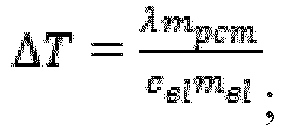

- The effect of PCM heat release may be further exemplified taking an elastomeric matrix of FFKM rubber compounded with diethylene glycol (the glycol is encapsulated) as a PCM (see E. Oró et al. "Review on phase change materials (PCMs) for cold thermal energy storage applications"; Applied Energy, 2012, Vol. 99, pp. 513-533). Diethylene glycol has a latent heat of fusion of 247 kJ/kg and density of 1200 kg/m3. Knowing the typical characteristics of a FFKM elastomer (c = 945 J/kgK and p = 2000 kg/m3) the following magnitudes of temperature stabilization can be predicted:
PCM-content ΔT, K volume fraction, % v/v weight fraction, % w/w 5 3 8 10 6 17 15 9 27
Claims (15)
- A seal element comprising an elastomeric composite, said composite comprising an elastomeric polymer blended with a phase change material (PCM), wherein the PCM have a heat of fusion larger than 100 kJ/kg, a phase transition point within the temperature range of 233-288 K and is able to provide heat to the elastomeric polymer upon cooling of the seal element to the phase transition point of the PCM, and wherein at least one surface of the seal element is PCM-free or the PCM only occupies an internal volume of the seal element.
- A seal element according to claim 1, wherein the PCM is encapsulated in macro-, micro- or nanosized capsules having a mean diameter size of from 0.1 nm to 5 mm.
- A seal element according to claim 1 or 2, wherein the PCM has a solid-liquid phase change at the transition point.
- A seal element according to any of the preceding claims, wherein the amount of PCM is in the range of 1-25 % v/v, based on the total volume of the elastomeric composite, at 20 °C.
- A seal element according to any of the preceding claims, wherein the elastomeric composite constitutes more than 20 % v/v, more than 50 % v/v, more than 90% v/v, more than 95% v/v or more than 99% v/v of said seal element, based on the total volume of the seal element.
- A seal element according to any of the preceding claims, wherein the PCM have a heat of fusion larger than 150 kJ/kg, larger than 200 kJ/kg, larger than 300 kJ/kg, and preferably larger than 350 kJ/kg.
- A seal element according to any of the preceding claims, wherein the phase transition point is within the temperature range of 243-283 K.
- A seal element according to any of the preceding claims, wherein the elastomeric polymer is a synthetic rubber.
- A seal element according to claim 8, wherein the synthetic rubber is chosen from the group of NBR (nitrile butadienes), HNBR (hydrogenated nitrile butadienes), FKM (fluoroelastomers) or FFKM (perfluoroelastomers), or any combination thereof, the synthetic rubber is preferably FKM or FFKM.
- A seal element according to any of the preceding claims, wherein the PCM is chosen from the group of paraffins, such as octadecane, fatty acids, fatty esters, alcohols, glycols, salt hydrates, ionic liquids, water, eutectic solutions, eutectic metals, metals with low melting points, or any combination thereof.
- A seal element according to any of the preceding claims, wherein the PCM is linked to, or is an integrated part of, a polymer material.
- A seal element according to any of the preceding claims, wherein the PCM is in the form of granules or particles.
- A seal element according to any of the preceding claims, wherein the PCM is evenly distributed throughout the elastomeric composite.
- A seal element according to any of the preceding claims, wherein the heat is sufficient to increase the temperature of the elastomeric polymer in the range of 5 to 50 K when the element is cooled to the phase transition point of the PCM.
- A method of manufacturing a seal element according to any of the preceding claims comprising the steps of:- obtaining an elastomeric composite comprising an elastomeric polymer blended with a phase change material (PCM), wherein the PCM have a heat of fusion larger than 100 kJ/kg and a phase transition point within the temperature range of 233-288 K and is able to provide heat to the elastomeric polymer upon cooling to the phase transition point of the PCM; and- molding the elastomeric composite into at least a part of the seal element.
Applications Claiming Priority (2)
| Application Number | Priority Date | Filing Date | Title |
|---|---|---|---|
| NO20130708 | 2013-05-22 | ||
| PCT/EP2014/060289 WO2014187795A1 (en) | 2013-05-22 | 2014-05-20 | Seal element |
Publications (2)
| Publication Number | Publication Date |
|---|---|
| EP2999763A1 EP2999763A1 (en) | 2016-03-30 |
| EP2999763B1 true EP2999763B1 (en) | 2018-10-31 |
Family
ID=50792440
Family Applications (1)
| Application Number | Title | Priority Date | Filing Date |
|---|---|---|---|
| EP14726127.5A Active EP2999763B1 (en) | 2013-05-22 | 2014-05-20 | Seal element |
Country Status (5)
| Country | Link |
|---|---|
| US (1) | US9783716B2 (en) |
| EP (1) | EP2999763B1 (en) |
| BR (1) | BR112015029317B1 (en) |
| CA (1) | CA2911433C (en) |
| WO (1) | WO2014187795A1 (en) |
Families Citing this family (2)
| Publication number | Priority date | Publication date | Assignee | Title |
|---|---|---|---|---|
| GB201414565D0 (en) * | 2014-08-15 | 2014-10-01 | Bisn Oil Tools Ltd | Methods and apparatus for use in oil and gas well completion |
| US20230340854A1 (en) * | 2022-04-20 | 2023-10-26 | Halliburton Energy Services, Inc. | Thermally expanding sealing elements |
Family Cites Families (12)
| Publication number | Priority date | Publication date | Assignee | Title |
|---|---|---|---|---|
| US4504402A (en) * | 1983-06-13 | 1985-03-12 | Pennwalt Corporation | Encapsulated phase change thermal energy _storage materials |
| US4825939A (en) * | 1984-08-31 | 1989-05-02 | The University Of Dayton | Polymeric compositions incorporating polyethylene glycol as a phase change material |
| US5718835A (en) * | 1989-08-04 | 1998-02-17 | Mitsubishi Cable Industries | Heat storage composition |
| US5294133A (en) * | 1991-09-10 | 1994-03-15 | The United States Of America As Represented By The Secretary Of The Army | Fluid-filled O-ring for maintaining a seal under low temperature conditions |
| TW201341B (en) * | 1992-08-07 | 1993-03-01 | Raychem Corp | Low thermal expansion seals |
| US6759476B1 (en) | 1999-07-14 | 2004-07-06 | Claude Q. C. Hayes | Flexible thermal control composite |
| US20030220432A1 (en) * | 2002-04-15 | 2003-11-27 | James Miller | Thermoplastic thermally-conductive interface articles |
| US20050109502A1 (en) | 2003-11-20 | 2005-05-26 | Jeremy Buc Slay | Downhole seal element formed from a nanocomposite material |
| US20050161212A1 (en) | 2004-01-23 | 2005-07-28 | Schlumberger Technology Corporation | System and Method for Utilizing Nano-Scale Filler in Downhole Applications |
| US20090230632A1 (en) * | 2008-03-13 | 2009-09-17 | Vetco Gray Inc. | System, method and apparatus for sealing materials having a low glass transition temperature for high performance sealing applications |
| US8490707B2 (en) | 2011-01-11 | 2013-07-23 | Schlumberger Technology Corporation | Oilfield apparatus and method comprising swellable elastomers |
| CN102721916A (en) * | 2012-06-29 | 2012-10-10 | 福建星网锐捷网络有限公司 | Power supply voltage-regulating testing device |
-
2014
- 2014-05-20 BR BR112015029317-4A patent/BR112015029317B1/en active IP Right Grant
- 2014-05-20 EP EP14726127.5A patent/EP2999763B1/en active Active
- 2014-05-20 US US14/893,046 patent/US9783716B2/en active Active
- 2014-05-20 WO PCT/EP2014/060289 patent/WO2014187795A1/en not_active Ceased
- 2014-05-20 CA CA2911433A patent/CA2911433C/en active Active
Non-Patent Citations (1)
| Title |
|---|
| None * |
Also Published As
| Publication number | Publication date |
|---|---|
| CA2911433C (en) | 2021-03-09 |
| BR112015029317B1 (en) | 2021-11-30 |
| US20160122608A1 (en) | 2016-05-05 |
| BR112015029317A2 (en) | 2017-07-25 |
| EP2999763A1 (en) | 2016-03-30 |
| WO2014187795A1 (en) | 2014-11-27 |
| CA2911433A1 (en) | 2014-11-27 |
| US9783716B2 (en) | 2017-10-10 |
Similar Documents
| Publication | Publication Date | Title |
|---|---|---|
| US20230340854A1 (en) | Thermally expanding sealing elements | |
| RU2740723C1 (en) | Swelling metal for non-elastomeric o-rings, sealing bags and sealing gaskets | |
| EP2600040B1 (en) | Multi-elastomer seal | |
| US4433847A (en) | Conduit sealing system | |
| US10577889B2 (en) | Constructed annular safety valve element package | |
| US4234197A (en) | Conduit sealing system | |
| US4862967A (en) | Method of employing a coated elastomeric packing element | |
| EP1533469B1 (en) | Downhole seal element formed from a nanocomposite material | |
| US20110221137A1 (en) | Sealing method and apparatus | |
| US8607883B2 (en) | Swellable packer having thermal compensation | |
| CN103174409A (en) | Testing device for packing performance of deepwater cementing cement sheath | |
| US9623479B2 (en) | Apparatus including metal foam and methods for using same downhole | |
| EP2992063B1 (en) | Elastomeric seal | |
| AU2012232952A1 (en) | Damage tolerant casing hanger seal | |
| WO2014039604A1 (en) | Functionally gradient elastomer material for downhole sealing element | |
| WO2014133396A1 (en) | Method and structure for protecting a crushable plug in a pipe section for hydrocarbon production, and use thereof | |
| US9783716B2 (en) | Seal element | |
| CN202327345U (en) | Low-friction high-pressure-resistant valve-rod seal ring | |
| CN206754457U (en) | A kind of floating ball valve | |
| US7600649B1 (en) | Methods and devices for preventing extrusion failure of o-ring seal assemblies | |
| CN205504064U (en) | Soft or hard double sealing ball valve | |
| Zhao et al. | Effects of Startup and Shutdown of HPHT Wells on Wellbore Hydraulic Control Line Design | |
| Stevenson | Elastomer Sealing Systems |
Legal Events
| Date | Code | Title | Description |
|---|---|---|---|
| PUAI | Public reference made under article 153(3) epc to a published international application that has entered the european phase |
Free format text: ORIGINAL CODE: 0009012 |
|
| 17P | Request for examination filed |
Effective date: 20151222 |
|
| AK | Designated contracting states |
Kind code of ref document: A1 Designated state(s): AL AT BE BG CH CY CZ DE DK EE ES FI FR GB GR HR HU IE IS IT LI LT LU LV MC MK MT NL NO PL PT RO RS SE SI SK SM TR |
|
| AX | Request for extension of the european patent |
Extension state: BA ME |
|
| DAX | Request for extension of the european patent (deleted) | ||
| STAA | Information on the status of an ep patent application or granted ep patent |
Free format text: STATUS: EXAMINATION IS IN PROGRESS |
|
| 17Q | First examination report despatched |
Effective date: 20161215 |
|
| GRAP | Despatch of communication of intention to grant a patent |
Free format text: ORIGINAL CODE: EPIDOSNIGR1 |
|
| STAA | Information on the status of an ep patent application or granted ep patent |
Free format text: STATUS: GRANT OF PATENT IS INTENDED |
|
| INTG | Intention to grant announced |
Effective date: 20180627 |
|
| GRAS | Grant fee paid |
Free format text: ORIGINAL CODE: EPIDOSNIGR3 |
|
| GRAA | (expected) grant |
Free format text: ORIGINAL CODE: 0009210 |
|
| STAA | Information on the status of an ep patent application or granted ep patent |
Free format text: STATUS: THE PATENT HAS BEEN GRANTED |
|
| AK | Designated contracting states |
Kind code of ref document: B1 Designated state(s): AL AT BE BG CH CY CZ DE DK EE ES FI FR GB GR HR HU IE IS IT LI LT LU LV MC MK MT NL NO PL PT RO RS SE SI SK SM TR |
|
| REG | Reference to a national code |
Ref country code: CH Ref legal event code: EP Ref country code: GB Ref legal event code: FG4D |
|
| REG | Reference to a national code |
Ref country code: AT Ref legal event code: REF Ref document number: 1059344 Country of ref document: AT Kind code of ref document: T Effective date: 20181115 |
|
| REG | Reference to a national code |
Ref country code: DE Ref legal event code: R096 Ref document number: 602014035086 Country of ref document: DE |
|
| REG | Reference to a national code |
Ref country code: IE Ref legal event code: FG4D |
|
| REG | Reference to a national code |
Ref country code: NO Ref legal event code: T2 Effective date: 20181031 |
|
| REG | Reference to a national code |
Ref country code: NL Ref legal event code: MP Effective date: 20181031 |
|
| REG | Reference to a national code |
Ref country code: LT Ref legal event code: MG4D |
|
| REG | Reference to a national code |
Ref country code: AT Ref legal event code: MK05 Ref document number: 1059344 Country of ref document: AT Kind code of ref document: T Effective date: 20181031 |
|
| PG25 | Lapsed in a contracting state [announced via postgrant information from national office to epo] |
Ref country code: ES Free format text: LAPSE BECAUSE OF FAILURE TO SUBMIT A TRANSLATION OF THE DESCRIPTION OR TO PAY THE FEE WITHIN THE PRESCRIBED TIME-LIMIT Effective date: 20181031 Ref country code: HR Free format text: LAPSE BECAUSE OF FAILURE TO SUBMIT A TRANSLATION OF THE DESCRIPTION OR TO PAY THE FEE WITHIN THE PRESCRIBED TIME-LIMIT Effective date: 20181031 Ref country code: AT Free format text: LAPSE BECAUSE OF FAILURE TO SUBMIT A TRANSLATION OF THE DESCRIPTION OR TO PAY THE FEE WITHIN THE PRESCRIBED TIME-LIMIT Effective date: 20181031 Ref country code: LT Free format text: LAPSE BECAUSE OF FAILURE TO SUBMIT A TRANSLATION OF THE DESCRIPTION OR TO PAY THE FEE WITHIN THE PRESCRIBED TIME-LIMIT Effective date: 20181031 Ref country code: PL Free format text: LAPSE BECAUSE OF FAILURE TO SUBMIT A TRANSLATION OF THE DESCRIPTION OR TO PAY THE FEE WITHIN THE PRESCRIBED TIME-LIMIT Effective date: 20181031 Ref country code: IS Free format text: LAPSE BECAUSE OF FAILURE TO SUBMIT A TRANSLATION OF THE DESCRIPTION OR TO PAY THE FEE WITHIN THE PRESCRIBED TIME-LIMIT Effective date: 20190228 Ref country code: BG Free format text: LAPSE BECAUSE OF FAILURE TO SUBMIT A TRANSLATION OF THE DESCRIPTION OR TO PAY THE FEE WITHIN THE PRESCRIBED TIME-LIMIT Effective date: 20190131 Ref country code: FI Free format text: LAPSE BECAUSE OF FAILURE TO SUBMIT A TRANSLATION OF THE DESCRIPTION OR TO PAY THE FEE WITHIN THE PRESCRIBED TIME-LIMIT Effective date: 20181031 Ref country code: LV Free format text: LAPSE BECAUSE OF FAILURE TO SUBMIT A TRANSLATION OF THE DESCRIPTION OR TO PAY THE FEE WITHIN THE PRESCRIBED TIME-LIMIT Effective date: 20181031 |
|
| PG25 | Lapsed in a contracting state [announced via postgrant information from national office to epo] |
Ref country code: GR Free format text: LAPSE BECAUSE OF FAILURE TO SUBMIT A TRANSLATION OF THE DESCRIPTION OR TO PAY THE FEE WITHIN THE PRESCRIBED TIME-LIMIT Effective date: 20190201 Ref country code: RS Free format text: LAPSE BECAUSE OF FAILURE TO SUBMIT A TRANSLATION OF THE DESCRIPTION OR TO PAY THE FEE WITHIN THE PRESCRIBED TIME-LIMIT Effective date: 20181031 Ref country code: AL Free format text: LAPSE BECAUSE OF FAILURE TO SUBMIT A TRANSLATION OF THE DESCRIPTION OR TO PAY THE FEE WITHIN THE PRESCRIBED TIME-LIMIT Effective date: 20181031 Ref country code: SE Free format text: LAPSE BECAUSE OF FAILURE TO SUBMIT A TRANSLATION OF THE DESCRIPTION OR TO PAY THE FEE WITHIN THE PRESCRIBED TIME-LIMIT Effective date: 20181031 Ref country code: PT Free format text: LAPSE BECAUSE OF FAILURE TO SUBMIT A TRANSLATION OF THE DESCRIPTION OR TO PAY THE FEE WITHIN THE PRESCRIBED TIME-LIMIT Effective date: 20190301 Ref country code: NL Free format text: LAPSE BECAUSE OF FAILURE TO SUBMIT A TRANSLATION OF THE DESCRIPTION OR TO PAY THE FEE WITHIN THE PRESCRIBED TIME-LIMIT Effective date: 20181031 |
|
| PG25 | Lapsed in a contracting state [announced via postgrant information from national office to epo] |
Ref country code: IT Free format text: LAPSE BECAUSE OF FAILURE TO SUBMIT A TRANSLATION OF THE DESCRIPTION OR TO PAY THE FEE WITHIN THE PRESCRIBED TIME-LIMIT Effective date: 20181031 Ref country code: DK Free format text: LAPSE BECAUSE OF FAILURE TO SUBMIT A TRANSLATION OF THE DESCRIPTION OR TO PAY THE FEE WITHIN THE PRESCRIBED TIME-LIMIT Effective date: 20181031 Ref country code: CZ Free format text: LAPSE BECAUSE OF FAILURE TO SUBMIT A TRANSLATION OF THE DESCRIPTION OR TO PAY THE FEE WITHIN THE PRESCRIBED TIME-LIMIT Effective date: 20181031 |
|
| REG | Reference to a national code |
Ref country code: DE Ref legal event code: R097 Ref document number: 602014035086 Country of ref document: DE |
|
| PG25 | Lapsed in a contracting state [announced via postgrant information from national office to epo] |
Ref country code: SM Free format text: LAPSE BECAUSE OF FAILURE TO SUBMIT A TRANSLATION OF THE DESCRIPTION OR TO PAY THE FEE WITHIN THE PRESCRIBED TIME-LIMIT Effective date: 20181031 Ref country code: EE Free format text: LAPSE BECAUSE OF FAILURE TO SUBMIT A TRANSLATION OF THE DESCRIPTION OR TO PAY THE FEE WITHIN THE PRESCRIBED TIME-LIMIT Effective date: 20181031 Ref country code: RO Free format text: LAPSE BECAUSE OF FAILURE TO SUBMIT A TRANSLATION OF THE DESCRIPTION OR TO PAY THE FEE WITHIN THE PRESCRIBED TIME-LIMIT Effective date: 20181031 Ref country code: SK Free format text: LAPSE BECAUSE OF FAILURE TO SUBMIT A TRANSLATION OF THE DESCRIPTION OR TO PAY THE FEE WITHIN THE PRESCRIBED TIME-LIMIT Effective date: 20181031 |
|
| PLBE | No opposition filed within time limit |
Free format text: ORIGINAL CODE: 0009261 |
|
| STAA | Information on the status of an ep patent application or granted ep patent |
Free format text: STATUS: NO OPPOSITION FILED WITHIN TIME LIMIT |
|
| 26N | No opposition filed |
Effective date: 20190801 |
|
| PG25 | Lapsed in a contracting state [announced via postgrant information from national office to epo] |
Ref country code: SI Free format text: LAPSE BECAUSE OF FAILURE TO SUBMIT A TRANSLATION OF THE DESCRIPTION OR TO PAY THE FEE WITHIN THE PRESCRIBED TIME-LIMIT Effective date: 20181031 |
|
| REG | Reference to a national code |
Ref country code: DE Ref legal event code: R119 Ref document number: 602014035086 Country of ref document: DE |
|
| REG | Reference to a national code |
Ref country code: CH Ref legal event code: PL |
|
| PG25 | Lapsed in a contracting state [announced via postgrant information from national office to epo] |
Ref country code: CH Free format text: LAPSE BECAUSE OF NON-PAYMENT OF DUE FEES Effective date: 20190531 Ref country code: MC Free format text: LAPSE BECAUSE OF FAILURE TO SUBMIT A TRANSLATION OF THE DESCRIPTION OR TO PAY THE FEE WITHIN THE PRESCRIBED TIME-LIMIT Effective date: 20181031 Ref country code: LI Free format text: LAPSE BECAUSE OF NON-PAYMENT OF DUE FEES Effective date: 20190531 |
|
| REG | Reference to a national code |
Ref country code: BE Ref legal event code: MM Effective date: 20190531 |
|
| PG25 | Lapsed in a contracting state [announced via postgrant information from national office to epo] |
Ref country code: LU Free format text: LAPSE BECAUSE OF NON-PAYMENT OF DUE FEES Effective date: 20190520 |
|
| PG25 | Lapsed in a contracting state [announced via postgrant information from national office to epo] |
Ref country code: TR Free format text: LAPSE BECAUSE OF FAILURE TO SUBMIT A TRANSLATION OF THE DESCRIPTION OR TO PAY THE FEE WITHIN THE PRESCRIBED TIME-LIMIT Effective date: 20181031 |
|
| PG25 | Lapsed in a contracting state [announced via postgrant information from national office to epo] |
Ref country code: IE Free format text: LAPSE BECAUSE OF NON-PAYMENT OF DUE FEES Effective date: 20190520 Ref country code: DE Free format text: LAPSE BECAUSE OF NON-PAYMENT OF DUE FEES Effective date: 20191203 |
|
| PG25 | Lapsed in a contracting state [announced via postgrant information from national office to epo] |
Ref country code: BE Free format text: LAPSE BECAUSE OF NON-PAYMENT OF DUE FEES Effective date: 20190531 |
|
| PG25 | Lapsed in a contracting state [announced via postgrant information from national office to epo] |
Ref country code: CY Free format text: LAPSE BECAUSE OF FAILURE TO SUBMIT A TRANSLATION OF THE DESCRIPTION OR TO PAY THE FEE WITHIN THE PRESCRIBED TIME-LIMIT Effective date: 20181031 |
|
| PG25 | Lapsed in a contracting state [announced via postgrant information from national office to epo] |
Ref country code: HU Free format text: LAPSE BECAUSE OF FAILURE TO SUBMIT A TRANSLATION OF THE DESCRIPTION OR TO PAY THE FEE WITHIN THE PRESCRIBED TIME-LIMIT; INVALID AB INITIO Effective date: 20140520 Ref country code: MT Free format text: LAPSE BECAUSE OF FAILURE TO SUBMIT A TRANSLATION OF THE DESCRIPTION OR TO PAY THE FEE WITHIN THE PRESCRIBED TIME-LIMIT Effective date: 20181031 |
|
| PG25 | Lapsed in a contracting state [announced via postgrant information from national office to epo] |
Ref country code: MK Free format text: LAPSE BECAUSE OF FAILURE TO SUBMIT A TRANSLATION OF THE DESCRIPTION OR TO PAY THE FEE WITHIN THE PRESCRIBED TIME-LIMIT Effective date: 20181031 |
|
| REG | Reference to a national code |
Ref country code: FR Ref legal event code: PLFP Year of fee payment: 10 |
|
| P01 | Opt-out of the competence of the unified patent court (upc) registered |
Effective date: 20230523 |
|
| PGFP | Annual fee paid to national office [announced via postgrant information from national office to epo] |
Ref country code: FR Payment date: 20250310 Year of fee payment: 12 |
|
| PGFP | Annual fee paid to national office [announced via postgrant information from national office to epo] |
Ref country code: GB Payment date: 20250327 Year of fee payment: 12 |
|
| PGFP | Annual fee paid to national office [announced via postgrant information from national office to epo] |
Ref country code: NO Payment date: 20250509 Year of fee payment: 12 |