EP2997745B1 - In-vehicle access of mobile device functions - Google Patents
In-vehicle access of mobile device functions Download PDFInfo
- Publication number
- EP2997745B1 EP2997745B1 EP14714609.6A EP14714609A EP2997745B1 EP 2997745 B1 EP2997745 B1 EP 2997745B1 EP 14714609 A EP14714609 A EP 14714609A EP 2997745 B1 EP2997745 B1 EP 2997745B1
- Authority
- EP
- European Patent Office
- Prior art keywords
- vehicle
- user equipment
- code
- user interface
- app
- Prior art date
- Legal status (The legal status is an assumption and is not a legal conclusion. Google has not performed a legal analysis and makes no representation as to the accuracy of the status listed.)
- Not-in-force
Links
Images



Classifications
-
- G—PHYSICS
- G06—COMPUTING OR CALCULATING; COUNTING
- G06F—ELECTRIC DIGITAL DATA PROCESSING
- G06F7/00—Methods or arrangements for processing data by operating upon the order or content of the data handled
-
- H—ELECTRICITY
- H04—ELECTRIC COMMUNICATION TECHNIQUE
- H04L—TRANSMISSION OF DIGITAL INFORMATION, e.g. TELEGRAPHIC COMMUNICATION
- H04L67/00—Network arrangements or protocols for supporting network services or applications
- H04L67/01—Protocols
- H04L67/02—Protocols based on web technology, e.g. hypertext transfer protocol [HTTP]
- H04L67/025—Protocols based on web technology, e.g. hypertext transfer protocol [HTTP] for remote control or remote monitoring of applications
-
- H—ELECTRICITY
- H04—ELECTRIC COMMUNICATION TECHNIQUE
- H04W—WIRELESS COMMUNICATION NETWORKS
- H04W4/00—Services specially adapted for wireless communication networks; Facilities therefor
- H04W4/30—Services specially adapted for particular environments, situations or purposes
- H04W4/40—Services specially adapted for particular environments, situations or purposes for vehicles, e.g. vehicle-to-pedestrians [V2P]
-
- H—ELECTRICITY
- H04—ELECTRIC COMMUNICATION TECHNIQUE
- H04W—WIRELESS COMMUNICATION NETWORKS
- H04W4/00—Services specially adapted for wireless communication networks; Facilities therefor
- H04W4/50—Service provisioning or reconfiguring
Definitions
- the present disclosure relates to a system, components and methodologies for improved in-vehicle access of mobile device functions.
- the present disclosure is directed to a system, components and methodologies that enable improved in-vehicle access of mobile device functions that include an in-vehicle user control, a display device, and a transceiver to communicate with a mobile communication terminal (UE).
- UE mobile communication terminal
- MICHAEL EICHHORN ET AL "A Flexible In-Vehicle HMI Architecture based on Web Technologies", PROCEEDINGS OF THE 2ND INTERNATIONAL WORKSHOP ON MULTIMODAL INTERFACES FOR AUTOMOTIVE APPLICATIONS (MIAA'10), 7 February 2010 (2010-02-07), pages 9-12, XP055053446, NY, USA DOI: 10.1145/2002368.2002374 ISBN: 978-1-60-558997-8 and BARRIE KIRK: "Connected vehicles: an executive overview of the status and trends", 21 November 2011 (2011-11-21), XP055070786 .
- a vehicle is coupled to the mobile device, and displays a list of apps installed thereon.
- a user manipulates vehicle controls to affect the operation of one of the apps.
- the vehicle modifies its graphical display based on the app.
- a system for in-vehicle access of mobile device functions may include an in-vehicle user control, a display device, and a transceiver to communicate with a mobile communication terminal (UE).
- the vehicle may have a protocol stack (stack) operative to control a function of the UE responsive to a manipulation of the user control, and a browser application that can render user interface code and present a GUI on the vehicle display based on the code.
- the vehicle may request and receive a list of apps installed on the UE and, responsive to a manipulation of the user control, cause a select app to perform an operation.
- a method for in-vehicle accessing of mobile device functions may include coupling a vehicle to a UE via a transceiver; obtaining by the vehicle a list of apps installed on the UE, storing the list in a memory of the vehicle, and presenting the list in a GUI on a display of the vehicle.
- the UE may launch a web server, and the vehicle may launch a browser application. Responsive to a user manipulation of a vehicle control, a select app may perform an operation.
- User interface code may be provided to the browser, which presents a GUI based on the code.
- the vehicle may use a stored Cascading Style Sheet in presenting the GUI, and may execute JavaScript to implement app functionality.
- a mobile communication device may be referred to herein as a “smartphone” or “user equipment” (UE), although the herein disclosed apparatus, systems, and methods may be applied to other mobile communication and/or computing devices as well.
- UE user equipment
- MirrorLink is a device interoperability standard promulgated by the Car Connectivity Consortium (CCC), an organization comprising various automobile and electronic device manufacturers.
- CCC Car Connectivity Consortium
- the CCC establishes standards for certifying apps and devices as safe to use while driving.
- certified compliance with the MirrorLink standard enables a UE and a vehicle's so-called In-Vehicle Infotainment (IVI) system, including a "head unit” (HU), to intercommunicate and cooperate.
- IPI In-Vehicle Infotainment
- MirrorLink turns a smartphone or the like into an application platform that can be used in vehicles, in which apps can be hosted and run on the smartphone while vehicle occupants interact with the apps through controls that are part of the vehicle.
- apps can be hosted and run on the smartphone while vehicle occupants interact with the apps through controls that are part of the vehicle.
- Such controls are commonly located on a steering wheel, dashboard buttons, and/or a touch screen of the vehicle's IVI system, for example, and are already designed to be safe to operate while driving.
- MirrorLink employs a set of well-established, non-proprietary technologies including Internet Protocol (IP), Universal Serial Bus (USB), WiFi wireless local area network (WLAN), Bluetooth, Real-Time Protocol (RTP, for audio) and Universal Plug and Play (UPnP).
- IP Internet Protocol
- USB Universal Serial Bus
- WLAN Wireless Local Area Network
- RTP Real-Time Protocol
- UFP Universal Plug and Play
- VNC Virtual Network Computing
- VNC transmits the operation of vehicle control events from the vehicle to the smartphone, and relays graphical user interface (GUI) updates from the smartphone to the vehicle.
- GUI graphical user interface
- the vehicle and the smartphone communicate over a communication link that may be wired or wireless. Thereby, the user has access to his/her smartphone apps while driving.
- CE consumer electronics
- frameworks e.g., Android, iOS, Windows Mobile, HTML5, cascading style sheets (CSSs), JavaScript (JS), etc.
- an app on a user's smartphone may need access to a vehicle's Controller Area Network (CAN) to obtain vehicle data, such as vehicle speed, fuel consumption, distance travelled, time of vehicle operation, etc.
- vehicle data such as vehicle speed, fuel consumption, distance travelled, time of vehicle operation, etc.
- vehicle display for example in the dashboard, and may also be shared with the smartphone app.
- Another prior art mechanism used to integrate smartphone apps with a car's IVI system involves incorporating a third party application programming interface (API) into the IVI system program code.
- the smartphone app then calls the IVI system API to access IVI resources.
- API application programming interface
- Yet another mechanism used to integrate smartphone functions with an IVI system involves controlling and operating the smartphone using vehicle controls, i.e., remote control of the smartphone and its apps.
- the smartphone itself may simply be mounted in a cradle or the like that makes it conveniently accessible to the user while driving.
- the cradle may, for example, provide a power source to keep the smartphone charged when docked.
- UE user communication terminal
- HU vehicle infotainment system or head unit
- UE can refer to an AppleTM iPhoneTM, a mobile smartphone that uses an AndroidTM or other operating system, or any of various other mobile computing devices that may or may not include mobile telephone functionality.
- Examples can include a personal digital assistant (PDA), a tablet computer, netbook computer, laptop computer, media viewer, or other computing resource containing at least a tangible computing processor and a data storage device such as a static or dynamic memory, magnetic or optical disc drive, or the like.
- PDA personal digital assistant
- FIG. 1A illustrates a prior art arrangement in which a UE 100A and a vehicle infotainment center 110A ("head unit", or HU) cooperate.
- the UE and the HU communicate using a standard called MirrorLink, which uses a graphical user interface (GUI) sharing system called Virtual Network Computing (VNC).
- GUI graphical user interface
- VNC uses the Remote Frame Buffer (RFB) protocol to transmit events which, in this context, pertain to a user manipulation of vehicle controls. The control events are transmitted from the vehicle to the UE.
- GUI graphical user interface
- RFB Remote Frame Buffer
- MirrorLink is also used to transmit screen updates from the UE to the HU for presentation on its display. The screen updates are conveyed to the HU pixel by pixel. This is apparent in the figure, wherein the HU display reproduces the image on the UE display.
- the current MirrorLink standard (Version 1.1) based on VNC has some disadvantages. These include the fact that, because there is a very broad diversity of displays used in UEs, in many cases the resolutions and aspect ratios of the UE display and the HU display do not match. Consequently, very often either portions of the HU display are not covered by the device frame (i.e., when the HU display's horizontal and/or vertical pixel dimension is greater than that of the UE display), or the app appears cropped and pixilated (i.e., when the UE display has a greater pixel dimension than the HU display). In figure 1A , the two displays have the same pixel dimensions, so the UE display just fills the HU display. However, if that were not the case, the HU display may present one of the foregoing artifacts due to the mismatch.
- VNC copies the entire screen pixel by pixel, resulting in an enormous amount of data which must be transferred from the UE to the HU for each screen refresh, and the screen must be refreshed at least several times per second to give a good user experience.
- Tests using a Nokia UE with an 800 x 480 screen resolution coupled to an HU via wired Universal Serial Bus (USB) connection showed a transfer rate of less than 15 frames per second. All other things being equal, the trend of new UE models being introduced with higher and higher density displays will lead inexorably to a less than optimum user experience when screen access is based on VNC, because refreshing a high-density screen at a high frame rate, such as 30 frames per second (fps) for example, may require more communication bandwidth than is available.
- fps frames per second
- the foregoing challenges can result in a poor user experience, and/or in a reduced number of apps that are compatible with Mirrorlink-enabled vehicles.
- Disclosed embodiments provide a solution to the above-described technical problems for providing improved integration between mobile devices, their constituent functionality, and in-vehicle control and infotainment systems.
- Disclosed embodiments offer a solution to this technical problem by sending user interface (Ul) code to the HU to be rendered by a browser running on the HU, wherein the UE and the HU may both use the same interface code and syntax and semantics to render the Ul code for presentation on a display, with the result that they both render the interface in the same way.
- the Ul code that is presented on the UE display may be the same Ul code that is transmitted to the HU for presentation on the HU display; using this framework, app developers need not write any additional code for their apps to display properly on a display of a vehicle HU.
- disclosed embodiments enhance Mirrorlink with a markup language such as HTML5 that can be rendered by a browser application, which changes the situation markedly.
- third-party apps may look better, because the appearance of the apps on the Head Unit (HU) or other vehicle display may be managed by the browser application to present the apps' interface correctly on the HU display regardless of its pixel dimensions, and without regard for any mismatch between the UE display and the HU display.
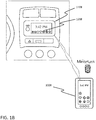
- Figure 1B This is illustrated in Figure 1B , in which the image presented on the display of UE 100B is modified for presentation on the display of HU 110B by adapting the arrangement of the app icons to present properly on the HU display.
- software apps may perform better and be better integrated into the infotainment system. This is because instead of issuing new Ul guidelines, the vehicle manufacturers can simply adapt the browser application to provide an updated look that is characteristic of their brands, and that is controlled by the manufacturers and not by the app developers. Accordingly, the app developers need not update their apps simply to conform to new Ul guidelines. In addition, app developers can enhance their existing in-vehicle apps with additional functionality, and the new functionality will present properly on the HU screen without making any band-specific adjustments. This is not generally possible with MirrorLink using VNC.
- user interface (Ul) code may be sent to the HU to be rendered by a browser running on the HU.
- the UE and the HU may both use the same syntax and semantics to render the Ul code for presentation on a display, with the result that they both render the interface in the same way.
- UI code that is presented on the UE display may be the same UI code that is transmitted to the HU for presentation on the HU display. Using this framework, app developers need not write any additional code for their apps to display properly on a display of a vehicle HU.
- FIG. 2 is a block diagram illustrating components of an exemplary embodiment.
- UE 200A communicates with vehicle components that may be contained in a single enclosure such as HU 200B.
- UE 200A includes a tangible processor 205A, coupled to a storage device such as memory 210A, as well as to a display device 215A, and to a transceiver 220A.
- Transceiver 220A may communicate via an air interface such as a WiFi, Bluetooth, or near field communications (NFC) interface.
- the transceiver may communicate using a wired interface, such as using a USB cable inserted into a port of the UE and a port of the vehicle, or by placing the UE into a docking station or cradle provided in the vehicle for that purpose.
- UE memory 210A comprises operating software, such as an operating system like iOS, Android, Windows, Linux, etc.
- the memory also stores any number of installed apps 225A, including apps that a user may wish to use when driving.
- apps can include, for example, a mapping app that provides directions to a destination, or a social media app like Facebook, or a communications app such as Skype, for example.
- the apps may provide for presentation on the UE display of a graphical user interface (GUI) that is generated using user interface code 230A.
- GUI graphical user interface
- the interface code includes industry standard mechanisms such as hypertext markup language version 5 (HTML5) and cascading style sheets (CSS).
- the app may also incorporate functions written in a scripting language such as JavaScript (JS), or that can be reproduced using JS.
- Memory 210A also includes server software 235A that can send the user interface code to the head unit via UE transceiver 220A.
- Memory 210A further includes instructions 240A for setting up communications with vehicle components, as will be described.
- the UE may include hardware and software (not shown) to support cellular communications, such as conventional cellular telephone calls and cellular data services
- Exemplary vehicle components are also illustrated in Figure 2 .
- the vehicle components may be contained in a single enclosure such as HU 200B, although other arrangements are possible and the components need not all be contained in a single enclosure.
- HU 200B comprises some components similar in general functionality to those described in connection with UE 200A, including processor 205B, memory 210B, display 215B, and transceiver 220B.
- the HU also includes a protocol stack 225B which is used in setting up communications with the UE, in accordance with instructions 240B, as will be described.
- User interface information may be received from the UE via transceiver 220B, to be rendered by browser 235B as a user interface that may be presented on display 215B.
- the received interface code includes industry standard mechanisms such as HTML5.
- the memory can have stored therein at least one CSS previously provided by the vehicle or HU manufacturer, and designed to provide an app appearance that is characteristic of the vehicle brand or the HU brand.
- one or more CSSs can be included in the user interface code received from the UE.
- the interface code received from the UE may also include JS to implement certain app functionality.
- the server in the UE and the browser in the HU communicate using internet protocol (IP).
- IP internet protocol
- the browser running on the HU communicatively connects to the server running on the UE using a socket connection.
- the UE server can then serve the user interface code, including HTML5 code for example, to the HU browser.
- HU stack 225B includes MirrorLink protocols which tell the browser which IP address to use as an entry point. Because MirrorLink is IP-based and the UE and the HU communicate over socket connections, this architecture can be integrated with MirrorLink without altering pre-existing MirrorLink protocols.
- the user interface code received from the UE can be merged with HU-specific CSS and JavaScript files 230B already stored in the HU memory to present on the HU display an "HU-themed" or "vehicle brand-themed” version of the app running on the UE.
- Web apps normally consist of several files that, in their source code, reference each other and/or other resources using relative path names.
- a browser When a browser encounters such a reference, it typically requests the referenced file or other resource using an HTTP GET command, using the relative path name in relation to the host address currently opened.
- the referenced resource may not be available on the HU. Therefore, in at least one embodiment, such resource requests may be redirected to the UE.
- the redirection may be implemented by a browser customized to request the referenced resource from the UE instead of from the HU, which is the current host.
- a delegation server 250B may be provided on the HU that may be used to delegate those requests to the UE.
- use of delegation server 250B does not involve customizing the browser application, and thus does not adversely affect browser interchangeability and maintainability.
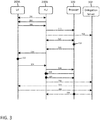
- Figure 3 The operation of an exemplary implementation is illustrated Figure 3 in a sequence chart.
- the chart includes UE 200A and HU 200B, similar to the UE and HU of Figure 2 .
- Figure 3 shows browser application 300 that runs on the HU, and optional delegation server 302 which, if included, also runs on the HU.
- the delegation server and operations involving it are shown using dotted lines to illustrate their optional nature.
- illustrative operations begin with a standard MirrorLink handshake, 304, to establish a communication session between the UE and the HU.
- the HU requests a list of the apps available on the UE that may be accessed by the HU, 306.
- the list of available apps can include, for example, only apps that have been approved for use while driving by the CCC, and/or by a car manufacturer, a regulatory body, or the like.
- An approval mechanism may have resulted in an indicator included with the app, such as a flag or the like in the app code, which identifies the app to the HU as having been approved for use during operation of a vehicle.
- the UE may respond to the request by providing a list of apps, 308.
- the list may be configurable and may include, for example, all apps installed on the UE, or a subset such as all approved apps, or a list of favorite apps, or a list of favorite approved apps, etc.
- the HU also launches its browser application, 310.
- the browser may be based on ChromiumTM, an open source web browser project related to the Google Chrome browser, although other browser applications may be used or developed for this purpose.
- the HU may also launch a delegation server, 312.
- the HU browser obtains the app list provided by the UE and presents the list on the HU display, 314.
- the list of apps may be presented as a plurality of icons on the display, such as icons 120B shown in the display of HU 110B in Figure 1B .
- the user may select one of the displayed apps, 316, for example, by touching an app icon presented on a display touchscreen, or by operating a user control of the vehicle in accordance with the MirrorLink standard to select an app.
- a Launch Application request with the app ID of the selected app may be sent, 318, from the browser via HU transceiver 220B to the UE, 320.
- the UE may start its web server, 322.
- the UE web server may have launched earlier, such as during or after the MirrorLink handshake 304.
- the UE then sends its web server URL to the HU, 324.
- the UE may launch the selected app, update its own display to present the app's user interface, and send to the HU user interface information code (UI code), such as HTML5, CSS, and/or JS code, for example.
- UI code such as HTML5, CSS, and/or JS code
- the HU browser app may obtain the UI code and update the HU display to present a GUI based on the obtained UI code, 326.
- the app running on the UE presents on the UE display a user interface generated using UI code, including for example HTML5, CSS, and/or JS compliant code or the like, and the same UI code may be sent to the HU, which received the UI code and forwards it to the browser.
- the browser then presents the app UI on the HU display based at least in part on the received UI code.
- a separate translator application (not shown) may be provided to generate UI code based on the app user interface data that is used by the UE to present the app interface on its display.
- the translator may run on the UE or on the HU, for example.
- the user interface data or code sent to the HU corresponds to UE display updates as the app executes on the UE.
- the resulting user interface presented on the HU display may correspond to the user interface presented on the UE display as the app runs on the UE and causes changes in the UE display.
- the UE may also send to the HU some or all of the app code for the requested app, as well as the uniform resource identifier (URI) of one or more resources that may be used by the requested app when it runs.
- URI uniform resource identifier
- the UE may send some or all of the app's code to the HU.
- the HU may receive the app code and execute the app on its own processor 205B.
- the app running on the HU may then provide UI code to update its display, or alternatively the app may run in the browser application, 326.
- the HU may optionally also send UI code generated thereon to the UE (not shown). The UE may then update its display based on the UI code received from the HU, thereby synchronizing the UE display with the HU display.
- the HU receives the information sent by the UE, and may respond by accessing resources for its own use in presenting an app user interface on its display in a manner that has a look and feel that is characteristic of the HU brand or of the vehicle brand.
- operations performed at 326 may include, in an illustrative operation, the HU browser loading a pre-defined file that resides in its memory 230B.
- a pre-defined file is the HTML code shown in Figure 4A , which may be used in the case where the UE runs the app and sends to the HU only user interface information or UI code.
- Loading the HTML code of Figure 4A enables the HU browser to request the two files referenced in the code's head-section (i.e., the two lines between the ⁇ head> and ⁇ /head> tags).
- one of the two referenced files may contain one or more CSSs that may provide to the app UI displayed on the HU a look that is characteristic of a particular brand, such as a brand of the HU or of the vehicle.
- the other referenced file, "brand.js” may contain one or more JS scripts that may provide to the app a feel that is characteristic of the brand.
- FIG. 4B Another example of a pre-defined file is the HTML code shown in Figure 4B , which may be used in the case where the UE sends app code the HU, and the app runs on the HU.
- Loading this HTML code enables the HU browser to request two additional files referenced in its head-section, called "css/app.css", and "app.js".
- the former may contain one or more CSSs used by the app to provide its native user interface on the HU.
- the latter may contain JS code included in the app that provides its native functionality. This arrangement facilitates the easy integration of brand-specific CSSs and JS with application-specific CSSs and JS.
- the app may request a resource needed to perform a task, 328 (represented by the 328 large dot).
- the browser may provide the request (represented by the 328 arrow).
- the resource request is resolved by the HU by looking first to its local file system. The address of a resource that is found locally is returned to the app, 330 (dot) or to the browser (arrow). But in the case of a requested resource that is not found locally, the request may optionally be forwarded to the delegation server, 332. The delegation server may then forward the request to the UE, 334, using the server URL.
- the UE may then locate and return the requested resource, or its address, to the delegation server on the HU, 336.
- the delegation server may then forward the resource or its address to the app (338 arrow) or browser (338 dot).
- the UE and HU may cooperate by the HU delegating computing tasks to the UE via the delegation server, and the UE performing the delegated tasks and returning the results to the HU in a distributed computing arrangement (not shown).
- the computing tasks delegated by the HU to the UE may, but need not, pertain to a resource that is not available locally to the HU.
- any appropriate criterion may be used by the HU to delegate tasks to the UE.
- the HU may determine that it may obtain better application performance by delegating to the UE tasks that the UE can perform more quickly than the HU, perhaps because the processor of the UE is more capable and/or less heavily loaded than that of the HU.
- MirrorLink compliant apps always run on the UE, and in order to access vehicle data the app makes calls to a vehicle application programming interface (API).
- API vehicle application programming interface
- the app runs on the UE and sends to the HU only the UI code
- that scheme may still be used.
- the app may not have direct access to the vehicle API because that arrangement is not contemplated or provided for by the prior art MirrorLink standard.
- the app may instead access the vehicle API indirectly via the UE.
- a vehicle API call for vehicle data made by an app running on the HU may be handled similarly to a request for a resource that is not found locally.
- the HU delegation server may translate the API call into a request for the vehicle data.
- the request may then be sent to the UE, which may access the requested vehicle data using the prior art vehicle API and MirrorLink capabilities, and return the vehicle data to the HU.
- indirect access to the vehicle data may be provided to the app on the HU, via the UE.
- the app In order to get an app MirrorLinkTM certified, the app is submitted to a CCC facility for inspection. Optionally, a list of web services the application accesses is submitted along with unobfuscated app code so the reviewers can evaluate the app.
- some developers may be reluctant or unwilling to reveal their intellectual property in this manner.
- for MirrorLink certification requires that an app's communication links to URLs must use Hypertext Transfer Protocol Secure (HTTPS) to secure the connection to prevent so-called man-in-the-middle attacks.
- HTTPS Hypertext Transfer Protocol Secure
- these issues may be addressed and mitigated.
- the HU delegation server can ensure that an app running on the HU accesses URLs using HTTPS, and/or accesses only MirrorLink compatible and/or approved web services.
- the app itself need not provide the HTTPS capability, thereby reducing the burden on the developer to port the app for MirrorLink compliance.
- the app has to be re-reviewed as rigorously as if it were a new application.
- the HTTPS and web services requirements may be enforced by the HU delegation server, the administrative burden of certifying app updates may be correspondingly reduced.
Landscapes
- Engineering & Computer Science (AREA)
- Computer Networks & Wireless Communication (AREA)
- Signal Processing (AREA)
- Theoretical Computer Science (AREA)
- Physics & Mathematics (AREA)
- General Engineering & Computer Science (AREA)
- General Physics & Mathematics (AREA)
- User Interface Of Digital Computer (AREA)
- Human Computer Interaction (AREA)
- Information Transfer Between Computers (AREA)
Description
- The present disclosure relates to a system, components and methodologies for improved in-vehicle access of mobile device functions. In particular, the present disclosure is directed to a system, components and methodologies that enable improved in-vehicle access of mobile device functions that include an in-vehicle user control, a display device, and a transceiver to communicate with a mobile communication terminal (UE).
Similar systems are known fromUS 2012/0324482 A1 ; MICHAEL EICHHORN ET AL: "A Flexible In-Vehicle HMI Architecture based on Web Technologies", PROCEEDINGS OF THE 2ND INTERNATIONAL WORKSHOP ON MULTIMODAL INTERFACES FOR AUTOMOTIVE APPLICATIONS (MIAA'10), 7 February 2010 (2010-02-07), pages 9-12, XP055053446, NY, USA DOI: 10.1145/2002368.2002374 ISBN: 978-1-60-558997-8 and BARRIE KIRK: "Connected vehicles: an executive overview of the status and trends", 21 November 2011 (2011-11-21), XP055070786. - According to the present disclosure, improved in-vehicle access of mobile device functions is provided. A vehicle is coupled to the mobile device, and displays a list of apps installed thereon. A user manipulates vehicle controls to affect the operation of one of the apps. The vehicle modifies its graphical display based on the app.
- In illustrative embodiments, a system for in-vehicle access of mobile device functions may include an in-vehicle user control, a display device, and a transceiver to communicate with a mobile communication terminal (UE). The vehicle may have a protocol stack (stack) operative to control a function of the UE responsive to a manipulation of the user control, and a browser application that can render user interface code and present a GUI on the vehicle display based on the code. The vehicle may request and receive a list of apps installed on the UE and, responsive to a manipulation of the user control, cause a select app to perform an operation.
- In illustrative embodiments, a method for in-vehicle accessing of mobile device functions may include coupling a vehicle to a UE via a transceiver; obtaining by the vehicle a list of apps installed on the UE, storing the list in a memory of the vehicle, and presenting the list in a GUI on a display of the vehicle. The UE may launch a web server, and the vehicle may launch a browser application. Responsive to a user manipulation of a vehicle control, a select app may perform an operation. User interface code may be provided to the browser, which presents a GUI based on the code. The vehicle may use a stored Cascading Style Sheet in presenting the GUI, and may execute JavaScript to implement app functionality.
- Additional features of the present disclosure will become apparent to those skilled in the art upon consideration of illustrative embodiments exemplifying the best mode of carrying out the disclosure as presently perceived.
- The detailed description particularly refers to the accompanying figures in which:
-
FIG. 1A illustrates a prior art arrangement of a vehicle head unit (HU) interacting with a user communication terminal (UE). -
FIG. 1B illustrates an arrangement of a vehicle HU interacting with a UE in accordance with the disclosure. -
Figure 2 is a block diagram of an exemplary embodiment of an HU and a UE in accordance with the disclosure. -
Figure 3 is a flow chart illustrating exemplary operations in accordance with the disclosure. -
Figures 4A and 4B contain exemplary HTML code in accordance with the disclosure. - The figures and descriptions provided herein may have been simplified to illustrate aspects that are relevant for a clear understanding of the herein described devices, systems, and methods, while eliminating, for the purpose of clarity, other aspects that may be found in typical devices, systems, and methods. Those of ordinary skill may recognize that other elements and/or operations may be desirable and/or necessary to implement the devices, systems, and methods described herein. Because such elements and operations are well known in the art, and because they do not facilitate a better understanding of the present disclosure, a discussion of such elements and operations may not be provided herein. However, the present disclosure is deemed to inherently include all such elements, variations, and modifications to the described aspects that would be known to those of ordinary skill in the art.
- Use of mobile communications devices such as smartphones and the like has become very common, and people spend a great deal of time accessing applications ("apps") on their mobile communication devices. A mobile communication device may be referred to herein as a "smartphone" or "user equipment" (UE), although the herein disclosed apparatus, systems, and methods may be applied to other mobile communication and/or computing devices as well.
- However, drivers sometimes become distracted, and reckless as a result of using such mobile devices while driving, for example to get directions, to receive email, to stay connected to a social network, etc. It has been found that such usage while driving can be distracting and therefore is potentially dangerous. Consequently, many states have banned texting while driving, and further state and federal laws and regulations may be implemented in the future to control the use of smartphones and the like while driving.
- One conventional way to make using a UE in a vehicle less distracting is to implement a way to enable the user to interact with the UE by using control means provided in a vehicle. At least one such solution is available in the prior art called MirrorLink™. MirrorLink is a device interoperability standard promulgated by the Car Connectivity Consortium (CCC), an organization comprising various automobile and electronic device manufacturers. The CCC establishes standards for certifying apps and devices as safe to use while driving. In particular, certified compliance with the MirrorLink standard enables a UE and a vehicle's so-called In-Vehicle Infotainment (IVI) system, including a "head unit" (HU), to intercommunicate and cooperate. Thereby, MirrorLink turns a smartphone or the like into an application platform that can be used in vehicles, in which apps can be hosted and run on the smartphone while vehicle occupants interact with the apps through controls that are part of the vehicle. Such controls are commonly located on a steering wheel, dashboard buttons, and/or a touch screen of the vehicle's IVI system, for example, and are already designed to be safe to operate while driving.
- MirrorLink employs a set of well-established, non-proprietary technologies including Internet Protocol (IP), Universal Serial Bus (USB), WiFi wireless local area network (WLAN), Bluetooth, Real-Time Protocol (RTP, for audio) and Universal Plug and Play (UPnP). In addition, MirrorLink uses the Virtual Network Computing (VNC) system as a baseline protocol to display the user interface of smartphone apps on the vehicle's IVI system display, and to communicate user input in the form of manipulation of vehicle controls back to the smartphone. VNC transmits the operation of vehicle control events from the vehicle to the smartphone, and relays graphical user interface (GUI) updates from the smartphone to the vehicle. The vehicle and the smartphone communicate over a communication link that may be wired or wireless. Thereby, the user has access to his/her smartphone apps while driving.
- The consumer electronics (CE) industry uses well-defined mobile app development platforms and frameworks (e.g., Android, iOS, Windows Mobile, HTML5, cascading style sheets (CSSs), JavaScript (JS), etc.) to develop mobile apps as efficiently as is practicable.
- However, development of devices and apps for use in an automotive environment entails additional vehicle-specific requirements. For example, with regard to hardware, one must consider the temperature range of the operating environment, device robustness, etc. And with regard to software apps, in contrast to other computing environments in which full user engagement is often desirable, one must consider mitigating the potential for driver distraction, for example. Consequently, development of apps for in-vehicle environments may incur longer development cycles than application development for other computing environments. Vehicle infotainment platform architectures should therefore be able to satisfy such automotive-specific requirements, and optionally web adaptability and extensibility as well.
- In addition, an app on a user's smartphone may need access to a vehicle's Controller Area Network (CAN) to obtain vehicle data, such as vehicle speed, fuel consumption, distance travelled, time of vehicle operation, etc. Such data may be displayed on a vehicle display, for example in the dashboard, and may also be shared with the smartphone app.
- Various conventional mechanisms are available whereby a smartphone and a vehicle can intercommunicate and cooperate. One mechanism is to present a copy of the smartphone display on an IVI display. The MirrorLink™ specification includes such a mechanism. In particular, the MirrorLink protocol stack uses the Virtual Network Computing (VNC) system to reproduce the contents of a smartphone display on a cooperating vehicle's head unit (HU) display. VNC essentially sends the entire smartphone display contents, pixel by pixel, to the HU display, several times per second. The MirrorLink specifications are available at http://www.mirrorlink.com, and are included herein by reference in their entirety, up to and including the most recent versions available as of the filing date of the present application, and in particular including version 1.1.
- Another prior art mechanism used to integrate smartphone apps with a car's IVI system involves incorporating a third party application programming interface (API) into the IVI system program code. The smartphone app then calls the IVI system API to access IVI resources.
- Yet another mechanism used to integrate smartphone functions with an IVI system involves controlling and operating the smartphone using vehicle controls, i.e., remote control of the smartphone and its apps.
- Finally, the smartphone itself may simply be mounted in a cradle or the like that makes it conveniently accessible to the user while driving. The cradle may, for example, provide a power source to keep the smartphone charged when docked.
- However, each of these conventional mechanisms providing integration between a mobile device and its constituent functionality and a vehicle specific system still suffer from various shortcomings as explained herein. These shortcomings are addressed and resolved by the technical solution of the disclosed embodiments.
- The herein disclosed devices, systems, and methods enable a user communication terminal ("user equipment", or UE), such as a smartphone or the like, to function cooperatively with a vehicle infotainment system or head unit (HU). As used herein, the term UE can refer to an Apple™ iPhone™, a mobile smartphone that uses an Android™ or other operating system, or any of various other mobile computing devices that may or may not include mobile telephone functionality. Examples can include a personal digital assistant (PDA), a tablet computer, netbook computer, laptop computer, media viewer, or other computing resource containing at least a tangible computing processor and a data storage device such as a static or dynamic memory, magnetic or optical disc drive, or the like.
-
Figure 1A illustrates a prior art arrangement in which aUE 100A and avehicle infotainment center 110A ("head unit", or HU) cooperate. As shown, the UE and the HU communicate using a standard called MirrorLink, which uses a graphical user interface (GUI) sharing system called Virtual Network Computing (VNC). VNC uses the Remote Frame Buffer (RFB) protocol to transmit events which, in this context, pertain to a user manipulation of vehicle controls. The control events are transmitted from the vehicle to the UE. MirrorLink is also used to transmit screen updates from the UE to the HU for presentation on its display. The screen updates are conveyed to the HU pixel by pixel. This is apparent in the figure, wherein the HU display reproduces the image on the UE display. - However, the current MirrorLink standard (Version 1.1) based on VNC has some disadvantages. These include the fact that, because there is a very broad diversity of displays used in UEs, in many cases the resolutions and aspect ratios of the UE display and the HU display do not match. Consequently, very often either portions of the HU display are not covered by the device frame (i.e., when the HU display's horizontal and/or vertical pixel dimension is greater than that of the UE display), or the app appears cropped and pixilated (i.e., when the UE display has a greater pixel dimension than the HU display). In
figure 1A , the two displays have the same pixel dimensions, so the UE display just fills the HU display. However, if that were not the case, the HU display may present one of the foregoing artifacts due to the mismatch. - Moreover, VNC copies the entire screen pixel by pixel, resulting in an enormous amount of data which must be transferred from the UE to the HU for each screen refresh, and the screen must be refreshed at least several times per second to give a good user experience. Tests using a Nokia UE with an 800 x 480 screen resolution coupled to an HU via wired Universal Serial Bus (USB) connection showed a transfer rate of less than 15 frames per second. All other things being equal, the trend of new UE models being introduced with higher and higher density displays will lead inexorably to a less than optimum user experience when screen access is based on VNC, because refreshing a high-density screen at a high frame rate, such as 30 frames per second (fps) for example, may require more communication bandwidth than is available.
- Another challenge that exists in the prior art is that different vehicle brands generally have different User Interface (Ul) guidelines for their infotainment systems. An app developer may have to build an entirely new app for every vehicle brand to be supported, resulting in either a large development cost, or a lesser number of vehicle brands than might otherwise be supported. Moreover, the look and feel of third-party apps running on the UE is controlled by the third-party developers, not by the vehicle manufacturers. So every time a new vehicle Ul guideline is released, apps must be updated to match the new UI. Because this update is not controlled by the vehicle manufacturers, updates may not be completed in a timely fashion, or may not be completed at all.
- The foregoing challenges can result in a poor user experience, and/or in a reduced number of apps that are compatible with Mirrorlink-enabled vehicles.
- Disclosed embodiments provide a solution to the above-described technical problems for providing improved integration between mobile devices, their constituent functionality, and in-vehicle control and infotainment systems.
- Disclosed embodiments offer a solution to this technical problem by sending user interface (Ul) code to the HU to be rendered by a browser running on the HU, wherein the UE and the HU may both use the same interface code and syntax and semantics to render the Ul code for presentation on a display, with the result that they both render the interface in the same way. In at least one disclosed embodiment, the Ul code that is presented on the UE display may be the same Ul code that is transmitted to the HU for presentation on the HU display; using this framework, app developers need not write any additional code for their apps to display properly on a display of a vehicle HU.
- Thus, disclosed embodiments enhance Mirrorlink with a markup language such as HTML5 that can be rendered by a browser application, which changes the situation markedly. As a result of this alteration, third-party apps may look better, because the appearance of the apps on the Head Unit (HU) or other vehicle display may be managed by the browser application to present the apps' interface correctly on the HU display regardless of its pixel dimensions, and without regard for any mismatch between the UE display and the HU display. This is illustrated in
Figure 1B , in which the image presented on the display ofUE 100B is modified for presentation on the display ofHU 110B by adapting the arrangement of the app icons to present properly on the HU display. - Further, software apps may perform better and be better integrated into the infotainment system. This is because instead of issuing new Ul guidelines, the vehicle manufacturers can simply adapt the browser application to provide an updated look that is characteristic of their brands, and that is controlled by the manufacturers and not by the app developers. Accordingly, the app developers need not update their apps simply to conform to new Ul guidelines. In addition, app developers can enhance their existing in-vehicle apps with additional functionality, and the new functionality will present properly on the HU screen without making any band-specific adjustments. This is not generally possible with MirrorLink using VNC.
- In particular, user interface (Ul) code may be sent to the HU to be rendered by a browser running on the HU. To support using the same interface code, the UE and the HU may both use the same syntax and semantics to render the Ul code for presentation on a display, with the result that they both render the interface in the same way. In at least one embodiment, UI code that is presented on the UE display may be the same UI code that is transmitted to the HU for presentation on the HU display. Using this framework, app developers need not write any additional code for their apps to display properly on a display of a vehicle HU.
-
Figure 2 is a block diagram illustrating components of an exemplary embodiment. As shown,UE 200A communicates with vehicle components that may be contained in a single enclosure such asHU 200B.UE 200A includes atangible processor 205A, coupled to a storage device such asmemory 210A, as well as to adisplay device 215A, and to atransceiver 220A.Transceiver 220A may communicate via an air interface such as a WiFi, Bluetooth, or near field communications (NFC) interface. Alternatively, the transceiver may communicate using a wired interface, such as using a USB cable inserted into a port of the UE and a port of the vehicle, or by placing the UE into a docking station or cradle provided in the vehicle for that purpose. -
UE memory 210A comprises operating software, such as an operating system like iOS, Android, Windows, Linux, etc. The memory also stores any number of installedapps 225A, including apps that a user may wish to use when driving. Such apps can include, for example, a mapping app that provides directions to a destination, or a social media app like Facebook, or a communications app such as Skype, for example. - Optionally, the apps may provide for presentation on the UE display of a graphical user interface (GUI) that is generated using
user interface code 230A. Although any user interface code may be used that is able to generate a user interface appropriate for the app, in a currently disclosed embodiment the interface code includes industry standard mechanisms such as hypertext markup language version 5 (HTML5) and cascading style sheets (CSS). The app may also incorporate functions written in a scripting language such as JavaScript (JS), or that can be reproduced using JS.Memory 210A also includesserver software 235A that can send the user interface code to the head unit viaUE transceiver 220A.Memory 210A further includesinstructions 240A for setting up communications with vehicle components, as will be described. In addition, the UE may include hardware and software (not shown) to support cellular communications, such as conventional cellular telephone calls and cellular data services - Exemplary vehicle components are also illustrated in
Figure 2 . As shown, the vehicle components may be contained in a single enclosure such asHU 200B, although other arrangements are possible and the components need not all be contained in a single enclosure.HU 200B comprises some components similar in general functionality to those described in connection withUE 200A, includingprocessor 205B,memory 210B,display 215B, andtransceiver 220B. The HU also includes aprotocol stack 225B which is used in setting up communications with the UE, in accordance withinstructions 240B, as will be described. User interface information may be received from the UE viatransceiver 220B, to be rendered bybrowser 235B as a user interface that may be presented ondisplay 215B. As noted in the description above in connection withUE 200A, although any appropriate user interface code may be used, in a currently disclosed embodiment the received interface code includes industry standard mechanisms such as HTML5. In embodiments, the memory can have stored therein at least one CSS previously provided by the vehicle or HU manufacturer, and designed to provide an app appearance that is characteristic of the vehicle brand or the HU brand. Alternatively or in addition, one or more CSSs can be included in the user interface code received from the UE. The interface code received from the UE may also include JS to implement certain app functionality. - The server in the UE and the browser in the HU communicate using internet protocol (IP). The browser running on the HU communicatively connects to the server running on the UE using a socket connection. The UE server can then serve the user interface code, including HTML5 code for example, to the HU browser.
HU stack 225B includes MirrorLink protocols which tell the browser which IP address to use as an entry point. Because MirrorLink is IP-based and the UE and the HU communicate over socket connections, this architecture can be integrated with MirrorLink without altering pre-existing MirrorLink protocols. - To achieve a brand-specific look and feel, the user interface code received from the UE can be merged with HU-specific CSS and JavaScript files 230B already stored in the HU memory to present on the HU display an "HU-themed" or "vehicle brand-themed" version of the app running on the UE.
- Web apps normally consist of several files that, in their source code, reference each other and/or other resources using relative path names. When a browser encounters such a reference, it typically requests the referenced file or other resource using an HTTP GET command, using the relative path name in relation to the host address currently opened. However, because such resources may not be native to the HU and may not have been transferred from the UE to the HU, the referenced resource may not be available on the HU. Therefore, in at least one embodiment, such resource requests may be redirected to the UE. In at least one embodiment, the redirection may be implemented by a browser customized to request the referenced resource from the UE instead of from the HU, which is the current host. In at least another embodiment, a
delegation server 250B may be provided on the HU that may be used to delegate those requests to the UE. Optionally, use ofdelegation server 250B does not involve customizing the browser application, and thus does not adversely affect browser interchangeability and maintainability. - The operation of an exemplary implementation is illustrated
Figure 3 in a sequence chart. The chart includesUE 200A andHU 200B, similar to the UE and HU ofFigure 2 . In addition,Figure 3 showsbrowser application 300 that runs on the HU, andoptional delegation server 302 which, if included, also runs on the HU. The delegation server and operations involving it are shown using dotted lines to illustrate their optional nature. - Referring now to
Figure 3 , illustrative operations begin with a standard MirrorLink handshake, 304, to establish a communication session between the UE and the HU. The HU then requests a list of the apps available on the UE that may be accessed by the HU, 306. In embodiments, the list of available apps can include, for example, only apps that have been approved for use while driving by the CCC, and/or by a car manufacturer, a regulatory body, or the like. An approval mechanism may have resulted in an indicator included with the app, such as a flag or the like in the app code, which identifies the app to the HU as having been approved for use during operation of a vehicle. The UE may respond to the request by providing a list of apps, 308. The list may be configurable and may include, for example, all apps installed on the UE, or a subset such as all approved apps, or a list of favorite apps, or a list of favorite approved apps, etc. - The HU also launches its browser application, 310. In an embodiment, the browser may be based on Chromium™, an open source web browser project related to the Google Chrome browser, although other browser applications may be used or developed for this purpose. Optionally, the HU may also launch a delegation server, 312. The HU browser obtains the app list provided by the UE and presents the list on the HU display, 314. For example, the list of apps may be presented as a plurality of icons on the display, such as
icons 120B shown in the display ofHU 110B inFigure 1B . The user may select one of the displayed apps, 316, for example, by touching an app icon presented on a display touchscreen, or by operating a user control of the vehicle in accordance with the MirrorLink standard to select an app. In response, a Launch Application request with the app ID of the selected app may be sent, 318, from the browser viaHU transceiver 220B to the UE, 320. - In response, the UE may start its web server, 322. Alternatively, the UE web server may have launched earlier, such as during or after the
MirrorLink handshake 304. The UE then sends its web server URL to the HU, 324. In some embodiments, the UE may launch the selected app, update its own display to present the app's user interface, and send to the HU user interface information code (UI code), such as HTML5, CSS, and/or JS code, for example. The HU browser app may obtain the UI code and update the HU display to present a GUI based on the obtained UI code, 326. Optionally, the app running on the UE presents on the UE display a user interface generated using UI code, including for example HTML5, CSS, and/or JS compliant code or the like, and the same UI code may be sent to the HU, which received the UI code and forwards it to the browser. The browser then presents the app UI on the HU display based at least in part on the received UI code. Alternatively, if such code is not used by the UE to present the app interface, then a separate translator application (not shown) may be provided to generate UI code based on the app user interface data that is used by the UE to present the app interface on its display. The translator may run on the UE or on the HU, for example. Optionally, the user interface data or code sent to the HU corresponds to UE display updates as the app executes on the UE. Thereby, the resulting user interface presented on the HU display may correspond to the user interface presented on the UE display as the app runs on the UE and causes changes in the UE display. - In embodiments, at 324 in conjunction with its web server URL, the UE may also send to the HU some or all of the app code for the requested app, as well as the uniform resource identifier (URI) of one or more resources that may be used by the requested app when it runs. For example, if the app is written in an interpreted language such as JavaScript (JS) or the like, the UE may send some or all of the app's code to the HU. In that case, the HU may receive the app code and execute the app on its
own processor 205B. The app running on the HU may then provide UI code to update its display, or alternatively the app may run in the browser application, 326. In an embodiment, the HU may optionally also send UI code generated thereon to the UE (not shown). The UE may then update its display based on the UI code received from the HU, thereby synchronizing the UE display with the HU display. - In either case (i.e., either the UE runs the app and sends UI code or info to the HU, or the UE sends app code to run directly on the HU), the HU receives the information sent by the UE, and may respond by accessing resources for its own use in presenting an app user interface on its display in a manner that has a look and feel that is characteristic of the HU brand or of the vehicle brand.
- For example, operations performed at 326 may include, in an illustrative operation, the HU browser loading a pre-defined file that resides in its
memory 230B. One example of such a file is the HTML code shown inFigure 4A , which may be used in the case where the UE runs the app and sends to the HU only user interface information or UI code. Loading the HTML code ofFigure 4A enables the HU browser to request the two files referenced in the code's head-section (i.e., the two lines between the <head> and </head> tags). In the example shown, one of the two referenced files, called "css/brand.css", may contain one or more CSSs that may provide to the app UI displayed on the HU a look that is characteristic of a particular brand, such as a brand of the HU or of the vehicle. The other referenced file, "brand.js", may contain one or more JS scripts that may provide to the app a feel that is characteristic of the brand. - Another example of a pre-defined file is the HTML code shown in
Figure 4B , which may be used in the case where the UE sends app code the HU, and the app runs on the HU. Loading this HTML code enables the HU browser to request two additional files referenced in its head-section, called "css/app.css", and "app.js". The former may contain one or more CSSs used by the app to provide its native user interface on the HU. The latter may contain JS code included in the app that provides its native functionality. This arrangement facilitates the easy integration of brand-specific CSSs and JS with application-specific CSSs and JS. - Returning to
Figure 3 , in the case where the app runs on the HU, the app may request a resource needed to perform a task, 328 (represented by the 328 large dot). IN the case where the app is running in the browser, then the browser may provide the request (represented by the 328 arrow). Because the paths to resources referenced in app code are relative, the resource request is resolved by the HU by looking first to its local file system. The address of a resource that is found locally is returned to the app, 330 (dot) or to the browser (arrow). But in the case of a requested resource that is not found locally, the request may optionally be forwarded to the delegation server, 332. The delegation server may then forward the request to the UE, 334, using the server URL. The UE may then locate and return the requested resource, or its address, to the delegation server on the HU, 336. The delegation server may then forward the resource or its address to the app (338 arrow) or browser (338 dot). Alternatively, the UE and HU may cooperate by the HU delegating computing tasks to the UE via the delegation server, and the UE performing the delegated tasks and returning the results to the HU in a distributed computing arrangement (not shown). In such an arrangement, the computing tasks delegated by the HU to the UE may, but need not, pertain to a resource that is not available locally to the HU. Instead, any appropriate criterion may be used by the HU to delegate tasks to the UE. For example, the HU may determine that it may obtain better application performance by delegating to the UE tasks that the UE can perform more quickly than the HU, perhaps because the processor of the UE is more capable and/or less heavily loaded than that of the HU. - In the prior art, MirrorLink compliant apps always run on the UE, and in order to access vehicle data the app makes calls to a vehicle application programming interface (API). In embodiments in which the app runs on the UE and sends to the HU only the UI code, that scheme may still be used. However, in embodiments of the present disclosure in which the app runs on the vehicle, such as on the HU processor, the app may not have direct access to the vehicle API because that arrangement is not contemplated or provided for by the prior art MirrorLink standard. In such embodiments, the app may instead access the vehicle API indirectly via the UE. A vehicle API call for vehicle data made by an app running on the HU may be handled similarly to a request for a resource that is not found locally. That is, the HU delegation server may translate the API call into a request for the vehicle data. The request may then be sent to the UE, which may access the requested vehicle data using the prior art vehicle API and MirrorLink capabilities, and return the vehicle data to the HU. Thereby, indirect access to the vehicle data may be provided to the app on the HU, via the UE.
- In order to get an app MirrorLink™ certified, the app is submitted to a CCC facility for inspection. Optionally, a list of web services the application accesses is submitted along with unobfuscated app code so the reviewers can evaluate the app. However, some developers may be reluctant or unwilling to reveal their intellectual property in this manner. Furthermore, for MirrorLink certification requires that an app's communication links to URLs must use Hypertext Transfer Protocol Secure (HTTPS) to secure the connection to prevent so-called man-in-the-middle attacks. In embodiments of the present disclosure, these issues may be addressed and mitigated. For example, at runtime the HU delegation server can ensure that an app running on the HU accesses URLs using HTTPS, and/or accesses only MirrorLink compatible and/or approved web services. Accordingly, the app itself need not provide the HTTPS capability, thereby reducing the burden on the developer to port the app for MirrorLink compliance. Further, when an app update is published, in the prior art the app has to be re-reviewed as rigorously as if it were a new application. However, because the HTTPS and web services requirements may be enforced by the HU delegation server, the administrative burden of certifying app updates may be correspondingly reduced.
- Although certain embodiments have been described and illustrated in exemplary forms with a certain degree of particularity, it is noted that the description and illustrations have been made by way of example only. Numerous changes in the details of construction, combination, and arrangement of parts and operations may be made. Accordingly, such changes are intended to be included within the scope of the disclosure, the protected scope of which is defined by the claims.
Claims (11)
- A system for in-vehicle access of mobile device functions, comprising:an in-vehicle user control operative to control a function of the vehicle;an in-vehicle graphical display device (215B);an in-vehicle transceiver (220B) operative to communicate with a mobile user equipment communication terminal (200A);an in-vehicle processor (205B);an in-vehicle memory (210B) in data communication with the processor (205B), on which is stored computer code which, when executed on the processor (205B), implements:- a protocol stack operative to establish a communication session between the vehicle and the mobile user equipment (200A);- a browser application (235B) operative to receive user interface code and to generate and present on the display a graphical user interface based at least in part on the received code;- a delegation server (250B) on the processor (205B) wherein the delegation server is configured to delegate a request for a resource and/or a task to the mobile user equipment; and- instructions which cause the system to:discover the presence of the mobile user equipment (200A);request and receive a list of apps (225A) installed on the mobile user equipment (200A);provide user interface code of a select app to the browser (235B), generate a graphical user interface based at least in part on the provided user interface code, and present the graphical user interface on the display;responsive to a manipulation of the user control, cause the app to perform an operation;delegate a request for a resource and/or a task to the mobile user equipment (200A) via the delegation server (250B); andobtain access by the system to the requested resource via the mobile user equipment and/or results of a delegated task performed on the mobile user equipment (200A).
- The system of claim 1, further comprising instructions stored in the memory (210B) that cause the vehicle to:
update the graphical user interface presented on the display (215B) responsive to the performed app operation. - The system of claim 1 or 2, further comprising a head unit (200B) that includes the graphical display device (215B), the transceiver (220B) the processor (205B), and the memory (210B).
- The system of any of claims 1 to 3, further comprising at least one cascading style sheet stored in the memory (210B) and operative to cause the browser to present the graphical user interface using predefined graphical user interface elements that provide a characteristic look.
- The system of any of claims 1 to 4, wherein the user interface data includes at least one of HTML5 compliant code and JavaScript code.
- The system of claim 5, wherein the JavaScript code causes the graphical user interface to operate using predefined functionality that provides a characteristic feel.
- The system of any of claims 1 to 6, wherein the vehicle uses Universal Plug and Play in the discovering of the presence of the mobile user equipment (200A).
- A vehicle that accesses functions of a proximate mobile device (200A), comprising:a user control operative to control a function of the vehicle;a graphical display device (215B);a transceiver (220B) operative to communicate with a mobile user equipment (200A) communication terminal;a processor (205B);a memory (210B) in data communication with the processor (205B), on which is stored computer code which, when executed on the processor (205B), implements:- a protocol stack (225B) operative to establish a communication session between the vehicle and the mobile user equipment (200a);- a browser application (235B) operative to receive user interface code and to generate and present on the display (215B) a graphical user interface based at least in part on the received code;- a delegation server (250B) on the processor (205B) of the vehicle, wherein the delegation server is configured to delegate a request for a resource and/or a task to the mobile user equipment; and- instructions which cause the vehicle to:discover the presence of the mobile user equipment (200A);request and receive a list of apps (225A) installed on the mobile user equipment (200A);provide user interface code of a select app to the browser (235B), generate a graphical user interface based at least in part on the provided user interface code, and present the graphical user interface on the display (215B); andresponsive to a manipulation of the user control, cause the app to perform an operation;delegate a request for a resource and/or a task to the mobile user equipment (200A) via the delegation server (250B); andobtain access by the vehicle to the requested resource via the mobile user equipment and/or results of a delegated task performed on the mobile user equipment (200A).
- A method for in-vehicle accessing of mobile device functions, comprising:communicatively coupling a vehicle to a mobile user equipment (200A) via a transceiver (220B) of the vehicle;obtaining by the vehicle a list of apps (225A) installed on the mobile user equipment (200A); storing the list in a memory (210B) of the vehicle;presenting the list in a graphical user interface on a display (215B) of the vehicle;in response to a user selecting an app from the list displayed on the vehicle graphical user interface, launching a browser application (235B) on a processor (205B) of the vehicle and causing a web server on the mobile user equipment (200A) to be launched;receiving app data by the browser application (235B), including hypertext markup language code and scripting language code;accessing at least one cascading style sheet stored in the memory (210B) of the vehicle; presenting on the display (215B) a graphical user interface generated by the browser application (235B) based at least in part on the received hypertext markup language code and the accessed cascading style sheet; andexecuting the received scripting language code to implement at least one function of the select app;further comprising:launching a delegation server (250B) on the processor (205B) of the vehicle, wherein the delegation server is configured to delegate a request for a resource and/or a task to the mobile user equipment;delegating a request for a resource and/or a task to the mobile user equipment (200A) via the delegation server (250B); andobtaining access by the vehicle to the requested resource via the mobile user equipment and/or results of a delegated task performed on the mobile user equipment (200A).
- The method of claim 9, wherein the communicatively coupling step includes establishing a communicative connection between the vehicle and the mobile user equipment (200A) in accordance with the MirrorLink™ standard.
- The method of claim 9 or 10, wherein the app data received by the browser (235B) was previously obtained by the vehicle from the mobile user equipment (200A), and further includes at least one cascading style sheet obtained from the mobile user equipment.
Applications Claiming Priority (2)
| Application Number | Priority Date | Filing Date | Title |
|---|---|---|---|
| US13/834,593 US9348555B2 (en) | 2013-03-15 | 2013-03-15 | In-vehicle access of mobile device functions |
| PCT/EP2014/055094 WO2014140269A1 (en) | 2013-03-15 | 2014-03-14 | In-vehicle access of mobile device functions |
Publications (2)
| Publication Number | Publication Date |
|---|---|
| EP2997745A1 EP2997745A1 (en) | 2016-03-23 |
| EP2997745B1 true EP2997745B1 (en) | 2020-06-17 |
Family
ID=50156751
Family Applications (1)
| Application Number | Title | Priority Date | Filing Date |
|---|---|---|---|
| EP14714609.6A Not-in-force EP2997745B1 (en) | 2013-03-15 | 2014-03-14 | In-vehicle access of mobile device functions |
Country Status (5)
| Country | Link |
|---|---|
| US (1) | US9348555B2 (en) |
| EP (1) | EP2997745B1 (en) |
| KR (1) | KR101687932B1 (en) |
| CN (1) | CN105284136B (en) |
| WO (2) | WO2014139769A1 (en) |
Families Citing this family (74)
| Publication number | Priority date | Publication date | Assignee | Title |
|---|---|---|---|---|
| US9631930B2 (en) | 2013-03-15 | 2017-04-25 | Apple Inc. | Warning for frequently traveled trips based on traffic |
| US9479601B2 (en) * | 2013-03-15 | 2016-10-25 | Ford Global Technologies, Llc | Method and apparatus for seamless application portability over multiple environments |
| US20140365505A1 (en) | 2013-06-08 | 2014-12-11 | Apple Inc. | Harvesting Addresses |
| US9317813B2 (en) | 2013-03-15 | 2016-04-19 | Apple Inc. | Mobile device with predictive routing engine |
| US9200915B2 (en) | 2013-06-08 | 2015-12-01 | Apple Inc. | Mapping application with several user interfaces |
| US9584979B2 (en) * | 2013-06-20 | 2017-02-28 | Blackberry Limited | Server behavior based on paired device identification |
| US20150088411A1 (en) * | 2013-09-26 | 2015-03-26 | Google Inc. | Providing Digital Images to an External Device During Navigation |
| US9109917B2 (en) | 2013-09-26 | 2015-08-18 | Google Inc. | Systems and methods for providing input suggestions via the head unit of a vehicle |
| US10054463B2 (en) * | 2013-09-26 | 2018-08-21 | Google Llc | Systems and methods for providing navigation data to a vehicle |
| US9958289B2 (en) | 2013-09-26 | 2018-05-01 | Google Llc | Controlling navigation software on a portable device from the head unit of a vehicle |
| KR20150074542A (en) * | 2013-12-24 | 2015-07-02 | 현대자동차주식회사 | Method for controlling mirrorlink |
| JP6622705B2 (en) * | 2014-01-06 | 2019-12-18 | ジョンソン コントロールズ テクノロジー カンパニーJohnson Controls Technology Company | Presentation and interaction with audiovisual content in vehicles |
| US20150193093A1 (en) * | 2014-01-06 | 2015-07-09 | Ford Global Technologies, Llc | Method and system for a head unit application host |
| US9430476B2 (en) * | 2014-03-13 | 2016-08-30 | GM Global Technology Operations LLC | Method and apparatus of user recommendation system for in-vehicle apps |
| KR101580852B1 (en) * | 2014-03-18 | 2015-12-30 | 주식회사 오비고 | Method for configuring user interface of car head unit dynamically by using smart terminal, and head unit and computer-readable recording medium using the same |
| US9269328B2 (en) * | 2014-06-24 | 2016-02-23 | Google Inc. | Efficient frame rendering |
| US20160021193A1 (en) * | 2014-07-16 | 2016-01-21 | Myine Electronics, Inc. | Method of automatically closing an application on transport disconnect |
| US20160028870A1 (en) * | 2014-07-23 | 2016-01-28 | Lg Electronics Inc. | Method of sharing information of a mobile terminal for interworking between an in-vehicle infotainment system and the mobile terminal |
| US10089053B2 (en) * | 2014-08-01 | 2018-10-02 | Volkswagen Ag | Mirroring deeplinks |
| US9015295B1 (en) * | 2014-08-18 | 2015-04-21 | Obigo Inc. | Method, terminal and head unit for automatically providing application services |
| US9510384B2 (en) | 2014-09-09 | 2016-11-29 | Qualcomm Incorporated | Pre-association content discovery |
| US10457327B2 (en) * | 2014-09-26 | 2019-10-29 | Nissan North America, Inc. | Method and system of assisting a driver of a vehicle |
| US10180832B2 (en) * | 2014-11-14 | 2019-01-15 | George Stantchev | Application matching method for mobile device and accessory method |
| US9668111B2 (en) * | 2014-12-19 | 2017-05-30 | Infobank Corp. | Terminal for contents sharing, an operating method thereof, and a vehicle information providing terminal |
| KR20160077975A (en) * | 2014-12-24 | 2016-07-04 | 삼성전자주식회사 | Method for sharing data and electronic device thereof |
| EP3043526B1 (en) * | 2015-01-01 | 2018-09-26 | Harman Becker Automotive Systems GmbH | Auxiliary device and method to enhance native in-vehicle systems by adding interfaces and computational power |
| US11374809B2 (en) | 2015-01-01 | 2022-06-28 | Harman Becker Automotive Systems Gmbh | Auxiliary device to enhance native in-vehicle systems by adding interfaces and computational power |
| US10384643B2 (en) * | 2015-01-14 | 2019-08-20 | GM Global Technology Operations LLC | Virtual keyfob for vehicle sharing |
| US9992319B2 (en) * | 2015-02-08 | 2018-06-05 | Lg Electronics Inc. | Method of outputting screens from server and client devices in performing mirrorlink |
| DE102015204336B4 (en) | 2015-03-11 | 2019-01-31 | Volkswagen Aktiengesellschaft | Method and device for integrating vehicle applications |
| JP6369362B2 (en) * | 2015-03-13 | 2018-08-08 | 株式会社オートネットワーク技術研究所 | Vehicle communication system and in-vehicle communication device |
| US9610893B2 (en) * | 2015-03-18 | 2017-04-04 | Car1St Technologies, Llc | Methods and systems for providing alerts to a driver of a vehicle via condition detection and wireless communications |
| US10328855B2 (en) | 2015-03-18 | 2019-06-25 | Uber Technologies, Inc. | Methods and systems for providing alerts to a connected vehicle driver and/or a passenger via condition detection and wireless communications |
| CN114608605A (en) * | 2015-06-23 | 2022-06-10 | 谷歌有限责任公司 | Mobile geographic application in an automotive environment |
| CN105094900A (en) * | 2015-07-13 | 2015-11-25 | 小米科技有限责任公司 | Method and apparatus for downloading control program |
| WO2017032902A1 (en) * | 2015-08-26 | 2017-03-02 | Bloks. Ag | Control device for a vehicle |
| CN105487641B (en) * | 2015-12-25 | 2020-12-18 | 百度在线网络技术(北京)有限公司 | Control method and device of terminal equipment |
| US10123155B2 (en) * | 2016-01-20 | 2018-11-06 | Livio, Inc. | Secondary-connected device companion application control of a primary-connected device |
| KR101964850B1 (en) * | 2016-02-03 | 2019-04-03 | 제이와이커스텀(주) | System and Method for Human Machine Interface Providing Smart Phone and Head Unit Application |
| DE102016002854B4 (en) * | 2016-03-10 | 2023-05-17 | Audi Ag | Method for controlling a display device of a motor vehicle via a mobile terminal |
| US10817238B2 (en) * | 2016-04-13 | 2020-10-27 | Ford Global Technologies, Llc | Systems and methods for determining application availability |
| TW201738691A (en) * | 2016-04-20 | 2017-11-01 | 原相科技股份有限公司 | Interactive system and method for controlling remote multi-points |
| DE102016112833A1 (en) * | 2016-07-13 | 2018-01-18 | Visteon Global Technologies, Inc. | Method for recognizing software applications and user input |
| US10950229B2 (en) * | 2016-08-26 | 2021-03-16 | Harman International Industries, Incorporated | Configurable speech interface for vehicle infotainment systems |
| CN106445275A (en) * | 2016-08-29 | 2017-02-22 | 上海航盛实业有限公司 | Vehicle-mounted information system |
| CZ2016544A3 (en) | 2016-09-06 | 2018-03-14 | Ĺ KODA AUTO a.s. | A procedure for using a mobile terminal device for a remote control function, a control device for a motor vehicle, a mobile end device system and a control device and a storage medium |
| KR102661703B1 (en) | 2016-12-23 | 2024-04-29 | 삼성전자주식회사 | Electronic device and controlling method thereof |
| CN108702366B (en) * | 2016-12-27 | 2021-03-23 | 华为技术有限公司 | Device connection method and terminal |
| US10579122B2 (en) | 2017-03-06 | 2020-03-03 | Samsung Electronics Co., Ltd. | Determining use context for a charging device and displaying a contextually appropriate user interface |
| CN107273280B (en) * | 2017-06-30 | 2021-02-09 | 百度在线网络技术(北京)有限公司 | Log processing method and device, electronic equipment and storage medium |
| US10735449B2 (en) | 2017-07-11 | 2020-08-04 | Viaforensics, Llc | Methods and apparatuses for improved mobile app security testing via bridged native and web user interface interaction |
| GB2565282B (en) * | 2017-08-02 | 2021-12-22 | Vnc Automotive Ltd | Remote control of a computing device |
| CN110741347B (en) * | 2017-10-03 | 2023-08-01 | 谷歌有限责任公司 | Multiple digital assistant coordination in a vehicle environment |
| US10652715B1 (en) * | 2018-02-12 | 2020-05-12 | Trigroup Technologies, Ltd. | Restoring local control of a radio head unit in a motor vehicle when a wireless call is placed on hold |
| US11042340B2 (en) * | 2018-05-06 | 2021-06-22 | Apple Inc. | Generating navigation user interfaces for third-party applications |
| CN110519157B (en) * | 2018-07-25 | 2022-03-04 | 张力 | Instant messaging method and equipment |
| CN108900634A (en) * | 2018-08-02 | 2018-11-27 | 安徽江淮汽车集团股份有限公司 | A kind of remote vehicle control method and system based on V2X |
| US11061668B2 (en) * | 2018-08-21 | 2021-07-13 | Xevo Inc. | System and method for enabling reusable code across applications of different operating systems |
| EP3670235B1 (en) * | 2018-12-19 | 2023-01-25 | Audi Ag | Vehicle comprising a compartment, an operating device and an electronic control unit |
| US11470376B2 (en) * | 2019-01-04 | 2022-10-11 | Voxx International Corporation | Vehicle entertainment system providing remote user control of video content on a monitor display and related methods |
| CA3066419C (en) * | 2019-01-04 | 2022-08-02 | Voxx International Corporation | Vehicle entertainment system providing remote user control of video content on a monitor display and related methods |
| US11400811B2 (en) * | 2019-02-11 | 2022-08-02 | Volvo Car Corporation | Remotely controlling electronic functions of a vehicle without an integrated touchscreen |
| US10761695B1 (en) * | 2019-02-11 | 2020-09-01 | Volvo Car Corporation | Remotely controlling vehicle touchscreen controls |
| CN111832003B (en) * | 2019-04-17 | 2024-09-27 | 阿里巴巴集团控股有限公司 | A method and device for certifying an application program through the Internet of Vehicles Alliance |
| CN111182078A (en) * | 2020-01-03 | 2020-05-19 | 清华大学深圳国际研究生院 | Multi-screen interaction method based on intelligent cabin |
| CN111324378B (en) * | 2020-03-18 | 2023-08-29 | 浩云科技股份有限公司 | Configuration method, device and equipment for video monitoring application software |
| CN111447323B (en) * | 2020-03-20 | 2021-07-09 | 华为技术有限公司 | Application display connection method and device |
| CN113552988A (en) * | 2021-06-24 | 2021-10-26 | 阿波罗智联(北京)科技有限公司 | Interface focus control method and device, electronic equipment and storage medium |
| FR3126586A1 (en) * | 2021-08-24 | 2023-03-03 | Psa Automobiles Sa | Method and device for communication between a vehicle and a mobile communication device |
| DE102021131482A1 (en) | 2021-11-30 | 2023-06-01 | Bayerische Motoren Werke Aktiengesellschaft | Method for controlling an entertainment device in a vehicle, entertainment device for a vehicle, computer program product |
| US12323387B2 (en) * | 2023-05-18 | 2025-06-03 | Conceras, Llc | Method and system for communication via a cellular communication device via a secure user interface |
| DE102023213041A1 (en) | 2023-12-20 | 2025-06-26 | Robert Bosch Gesellschaft mit beschränkter Haftung | Method for configuring an audio device of a public address system, audio device, portable control device, computer program and machine-readable storage medium |
| IL310075A (en) * | 2024-01-10 | 2025-08-01 | Levy Yodan | Connectable mirroring screen and method |
| EP4701161A1 (en) | 2024-08-19 | 2026-02-25 | N-Dream AG | A method of providing internet connectivity for an in-vehicle-infotainment application program |
Family Cites Families (14)
| Publication number | Priority date | Publication date | Assignee | Title |
|---|---|---|---|---|
| WO2000021075A1 (en) * | 1998-10-02 | 2000-04-13 | International Business Machines Corporation | System and method for providing network coordinated conversational services |
| US7398055B2 (en) * | 2003-02-14 | 2008-07-08 | Ntt Docomo, Inc. | Electronic device and program |
| US7646745B2 (en) * | 2006-06-30 | 2010-01-12 | T-Mobile Usa, Inc. | System and method for operating a mobile device, such as providing an out of box connection system for UMA type mobile devices |
| US20090165049A1 (en) * | 2007-12-19 | 2009-06-25 | United Video Properties, Inc. | Methods and devices for presenting and interactive media guidance application |
| EP2437163A1 (en) * | 2010-09-09 | 2012-04-04 | Harman Becker Automotive Systems GmbH | User interface for a vehicle system |
| US9014911B2 (en) * | 2011-11-16 | 2015-04-21 | Flextronics Ap, Llc | Street side sensors |
| US8688320B2 (en) * | 2011-01-11 | 2014-04-01 | Robert Bosch Gmbh | Vehicle information system with customizable user interface |
| DE102011017332A1 (en) | 2011-04-16 | 2012-10-18 | Volkswagen Aktiengesellschaft | Method for data communication in a vehicle and data communication device |
| JPWO2012157014A1 (en) * | 2011-05-13 | 2014-07-31 | 三菱電機株式会社 | Remote operation communication device and navigation device |
| US8621483B2 (en) | 2011-06-20 | 2013-12-31 | Nokia Corporation | Methods, apparatuses and computer program products for provisioning applications to in vehicle infotainment systems with secured access |
| GB2491657B (en) * | 2011-07-15 | 2013-05-15 | Realvnc Ltd | Method and system for remote controlling and viewing mobile phones |
| DE102011120249A1 (en) | 2011-12-05 | 2013-06-06 | Volkswagen Aktiengesellschaft | Method for operating an Internet Protocol-based functional system and associated Internet Protocol-based functional ... |
| US8799360B2 (en) * | 2012-08-31 | 2014-08-05 | Tweedle Group, Inc. | Systems, methods and articles for a server providing communications and services involving automobile head units |
| JP6261264B2 (en) * | 2013-10-01 | 2018-01-17 | クラリオン株式会社 | Information processing linkage system, information processing terminal and program |
-
2013
- 2013-03-15 US US13/834,593 patent/US9348555B2/en active Active
-
2014
- 2014-02-19 WO PCT/EP2014/053218 patent/WO2014139769A1/en not_active Ceased
- 2014-03-14 EP EP14714609.6A patent/EP2997745B1/en not_active Not-in-force
- 2014-03-14 CN CN201480016118.1A patent/CN105284136B/en active Active
- 2014-03-14 WO PCT/EP2014/055094 patent/WO2014140269A1/en not_active Ceased
- 2014-03-14 KR KR1020157028832A patent/KR101687932B1/en active Active
Non-Patent Citations (1)
| Title |
|---|
| None * |
Also Published As
| Publication number | Publication date |
|---|---|
| WO2014140269A1 (en) | 2014-09-18 |
| CN105284136B (en) | 2019-06-04 |
| US9348555B2 (en) | 2016-05-24 |
| EP2997745A1 (en) | 2016-03-23 |
| KR20150137076A (en) | 2015-12-08 |
| US20140277937A1 (en) | 2014-09-18 |
| WO2014139769A1 (en) | 2014-09-18 |
| CN105284136A (en) | 2016-01-27 |
| KR101687932B1 (en) | 2016-12-28 |
Similar Documents
| Publication | Publication Date | Title |
|---|---|---|
| US9348555B2 (en) | In-vehicle access of mobile device functions | |
| US10159098B2 (en) | Efficient headunit communication integration | |
| US8942888B2 (en) | Extensible scheme for operating vehicle head unit as extended interface for mobile device | |
| US9002574B2 (en) | Mobile integration platform (MIP) integrated handset application proxy (HAP) | |
| US9077770B2 (en) | Mobile web app infrastructure | |
| CN104641622B (en) | System for being controlled car-mounted computer by means of mobile phone | |
| EP3132345B1 (en) | Application managing application | |
| JP6289764B2 (en) | Device control method, apparatus, program, and recording medium | |
| US10637804B2 (en) | User terminal apparatus, communication system, and method of controlling user terminal apparatus which support a messenger service with additional functionality | |
| WO2019032044A1 (en) | Method and apparatus for running mobile device software | |
| KR20130130985A (en) | Connecting system and method for user device and external device | |
| WO2018004887A1 (en) | Wireless display implementation of applications | |
| CN114827704A (en) | Vehicle-mounted system interaction method with vehicle, storage medium and mobile terminal | |
| Bose et al. | Morphing smartphones into automotive application platforms | |
| WO2019033724A1 (en) | Browser-based embedded operation method, television, and storage device | |
| CN111885194A (en) | Communication method and device for communication application and electronic equipment | |
| JP7315750B2 (en) | Server system, client device and program | |
| KR101579805B1 (en) | Method and apparatus for sharing presentation | |
| JP2021152936A (en) | Computer system and program | |
| US20140160120A1 (en) | Method providing a display in a motor vehicle and motor vehicle comprising a display unit | |
| CN119902824A (en) | Material preview method, medium and electronic device | |
| JP2017157047A (en) | Server system, client device, and program | |
| EP3251032A1 (en) | Interactive operation method, and transmitter machine, receiver machine and interactive operation system using the same | |
| Shelly | Adopting Strategies to Better Address Automotive Connectivity |
Legal Events
| Date | Code | Title | Description |
|---|---|---|---|
| PUAI | Public reference made under article 153(3) epc to a published international application that has entered the european phase |
Free format text: ORIGINAL CODE: 0009012 |
|
| 17P | Request for examination filed |
Effective date: 20160208 |
|
| AK | Designated contracting states |
Kind code of ref document: A1 Designated state(s): AL AT BE BG CH CY CZ DE DK EE ES FI FR GB GR HR HU IE IS IT LI LT LU LV MC MK MT NL NO PL PT RO RS SE SI SK SM TR |
|
| AX | Request for extension of the european patent |
Extension state: BA ME |
|
| DAX | Request for extension of the european patent (deleted) | ||
| RIN1 | Information on inventor provided before grant (corrected) |
Inventor name: BARTSCH, PATRICK Inventor name: BECKMANN, MARK Inventor name: SCHOLZ, LARS |
|
| STAA | Information on the status of an ep patent application or granted ep patent |
Free format text: STATUS: EXAMINATION IS IN PROGRESS |
|
| 17Q | First examination report despatched |
Effective date: 20190225 |
|
| RIC1 | Information provided on ipc code assigned before grant |
Ipc: H04L 29/08 20060101ALI20191219BHEP Ipc: H04W 4/00 20180101AFI20191219BHEP |
|
| GRAP | Despatch of communication of intention to grant a patent |
Free format text: ORIGINAL CODE: EPIDOSNIGR1 |
|
| STAA | Information on the status of an ep patent application or granted ep patent |
Free format text: STATUS: GRANT OF PATENT IS INTENDED |
|
| INTG | Intention to grant announced |
Effective date: 20200124 |
|
| GRAS | Grant fee paid |
Free format text: ORIGINAL CODE: EPIDOSNIGR3 |
|
| GRAA | (expected) grant |
Free format text: ORIGINAL CODE: 0009210 |
|
| STAA | Information on the status of an ep patent application or granted ep patent |
Free format text: STATUS: THE PATENT HAS BEEN GRANTED |
|
| AK | Designated contracting states |
Kind code of ref document: B1 Designated state(s): AL AT BE BG CH CY CZ DE DK EE ES FI FR GB GR HR HU IE IS IT LI LT LU LV MC MK MT NL NO PL PT RO RS SE SI SK SM TR |
|
| REG | Reference to a national code |
Ref country code: GB Ref legal event code: FG4D |
|
| REG | Reference to a national code |
Ref country code: CH Ref legal event code: EP |
|
| REG | Reference to a national code |
Ref country code: DE Ref legal event code: R096 Ref document number: 602014066660 Country of ref document: DE |
|
| REG | Reference to a national code |
Ref country code: IE Ref legal event code: FG4D |
|
| REG | Reference to a national code |
Ref country code: AT Ref legal event code: REF Ref document number: 1282807 Country of ref document: AT Kind code of ref document: T Effective date: 20200715 |
|
| REG | Reference to a national code |
Ref country code: SE Ref legal event code: TRGR |
|
| PG25 | Lapsed in a contracting state [announced via postgrant information from national office to epo] |
Ref country code: NO Free format text: LAPSE BECAUSE OF FAILURE TO SUBMIT A TRANSLATION OF THE DESCRIPTION OR TO PAY THE FEE WITHIN THE PRESCRIBED TIME-LIMIT Effective date: 20200917 Ref country code: FI Free format text: LAPSE BECAUSE OF FAILURE TO SUBMIT A TRANSLATION OF THE DESCRIPTION OR TO PAY THE FEE WITHIN THE PRESCRIBED TIME-LIMIT Effective date: 20200617 Ref country code: LT Free format text: LAPSE BECAUSE OF FAILURE TO SUBMIT A TRANSLATION OF THE DESCRIPTION OR TO PAY THE FEE WITHIN THE PRESCRIBED TIME-LIMIT Effective date: 20200617 Ref country code: GR Free format text: LAPSE BECAUSE OF FAILURE TO SUBMIT A TRANSLATION OF THE DESCRIPTION OR TO PAY THE FEE WITHIN THE PRESCRIBED TIME-LIMIT Effective date: 20200918 |
|
| REG | Reference to a national code |
Ref country code: LT Ref legal event code: MG4D |
|
| REG | Reference to a national code |
Ref country code: NL Ref legal event code: MP Effective date: 20200617 |
|
| PG25 | Lapsed in a contracting state [announced via postgrant information from national office to epo] |
Ref country code: BG Free format text: LAPSE BECAUSE OF FAILURE TO SUBMIT A TRANSLATION OF THE DESCRIPTION OR TO PAY THE FEE WITHIN THE PRESCRIBED TIME-LIMIT Effective date: 20200917 Ref country code: RS Free format text: LAPSE BECAUSE OF FAILURE TO SUBMIT A TRANSLATION OF THE DESCRIPTION OR TO PAY THE FEE WITHIN THE PRESCRIBED TIME-LIMIT Effective date: 20200617 Ref country code: LV Free format text: LAPSE BECAUSE OF FAILURE TO SUBMIT A TRANSLATION OF THE DESCRIPTION OR TO PAY THE FEE WITHIN THE PRESCRIBED TIME-LIMIT Effective date: 20200617 Ref country code: HR Free format text: LAPSE BECAUSE OF FAILURE TO SUBMIT A TRANSLATION OF THE DESCRIPTION OR TO PAY THE FEE WITHIN THE PRESCRIBED TIME-LIMIT Effective date: 20200617 |
|
| REG | Reference to a national code |
Ref country code: AT Ref legal event code: MK05 Ref document number: 1282807 Country of ref document: AT Kind code of ref document: T Effective date: 20200617 |
|
| PG25 | Lapsed in a contracting state [announced via postgrant information from national office to epo] |
Ref country code: AL Free format text: LAPSE BECAUSE OF FAILURE TO SUBMIT A TRANSLATION OF THE DESCRIPTION OR TO PAY THE FEE WITHIN THE PRESCRIBED TIME-LIMIT Effective date: 20200617 Ref country code: NL Free format text: LAPSE BECAUSE OF FAILURE TO SUBMIT A TRANSLATION OF THE DESCRIPTION OR TO PAY THE FEE WITHIN THE PRESCRIBED TIME-LIMIT Effective date: 20200617 |
|
| PG25 | Lapsed in a contracting state [announced via postgrant information from national office to epo] |
Ref country code: SM Free format text: LAPSE BECAUSE OF FAILURE TO SUBMIT A TRANSLATION OF THE DESCRIPTION OR TO PAY THE FEE WITHIN THE PRESCRIBED TIME-LIMIT Effective date: 20200617 Ref country code: EE Free format text: LAPSE BECAUSE OF FAILURE TO SUBMIT A TRANSLATION OF THE DESCRIPTION OR TO PAY THE FEE WITHIN THE PRESCRIBED TIME-LIMIT Effective date: 20200617 Ref country code: IT Free format text: LAPSE BECAUSE OF FAILURE TO SUBMIT A TRANSLATION OF THE DESCRIPTION OR TO PAY THE FEE WITHIN THE PRESCRIBED TIME-LIMIT Effective date: 20200617 Ref country code: RO Free format text: LAPSE BECAUSE OF FAILURE TO SUBMIT A TRANSLATION OF THE DESCRIPTION OR TO PAY THE FEE WITHIN THE PRESCRIBED TIME-LIMIT Effective date: 20200617 Ref country code: AT Free format text: LAPSE BECAUSE OF FAILURE TO SUBMIT A TRANSLATION OF THE DESCRIPTION OR TO PAY THE FEE WITHIN THE PRESCRIBED TIME-LIMIT Effective date: 20200617 Ref country code: CZ Free format text: LAPSE BECAUSE OF FAILURE TO SUBMIT A TRANSLATION OF THE DESCRIPTION OR TO PAY THE FEE WITHIN THE PRESCRIBED TIME-LIMIT Effective date: 20200617 Ref country code: PT Free format text: LAPSE BECAUSE OF FAILURE TO SUBMIT A TRANSLATION OF THE DESCRIPTION OR TO PAY THE FEE WITHIN THE PRESCRIBED TIME-LIMIT Effective date: 20201019 Ref country code: ES Free format text: LAPSE BECAUSE OF FAILURE TO SUBMIT A TRANSLATION OF THE DESCRIPTION OR TO PAY THE FEE WITHIN THE PRESCRIBED TIME-LIMIT Effective date: 20200617 |
|
| PG25 | Lapsed in a contracting state [announced via postgrant information from national office to epo] |
Ref country code: PL Free format text: LAPSE BECAUSE OF FAILURE TO SUBMIT A TRANSLATION OF THE DESCRIPTION OR TO PAY THE FEE WITHIN THE PRESCRIBED TIME-LIMIT Effective date: 20200617 Ref country code: SK Free format text: LAPSE BECAUSE OF FAILURE TO SUBMIT A TRANSLATION OF THE DESCRIPTION OR TO PAY THE FEE WITHIN THE PRESCRIBED TIME-LIMIT Effective date: 20200617 Ref country code: IS Free format text: LAPSE BECAUSE OF FAILURE TO SUBMIT A TRANSLATION OF THE DESCRIPTION OR TO PAY THE FEE WITHIN THE PRESCRIBED TIME-LIMIT Effective date: 20201017 |
|
| REG | Reference to a national code |
Ref country code: DE Ref legal event code: R097 Ref document number: 602014066660 Country of ref document: DE |
|
| PLBE | No opposition filed within time limit |
Free format text: ORIGINAL CODE: 0009261 |
|
| STAA | Information on the status of an ep patent application or granted ep patent |
Free format text: STATUS: NO OPPOSITION FILED WITHIN TIME LIMIT |
|
| PG25 | Lapsed in a contracting state [announced via postgrant information from national office to epo] |
Ref country code: DK Free format text: LAPSE BECAUSE OF FAILURE TO SUBMIT A TRANSLATION OF THE DESCRIPTION OR TO PAY THE FEE WITHIN THE PRESCRIBED TIME-LIMIT Effective date: 20200617 |
|
| 26N | No opposition filed |
Effective date: 20210318 |
|
| PG25 | Lapsed in a contracting state [announced via postgrant information from national office to epo] |
Ref country code: SI Free format text: LAPSE BECAUSE OF FAILURE TO SUBMIT A TRANSLATION OF THE DESCRIPTION OR TO PAY THE FEE WITHIN THE PRESCRIBED TIME-LIMIT Effective date: 20200617 |
|
| PG25 | Lapsed in a contracting state [announced via postgrant information from national office to epo] |
Ref country code: MC Free format text: LAPSE BECAUSE OF FAILURE TO SUBMIT A TRANSLATION OF THE DESCRIPTION OR TO PAY THE FEE WITHIN THE PRESCRIBED TIME-LIMIT Effective date: 20200617 |
|
| REG | Reference to a national code |
Ref country code: CH Ref legal event code: PL |
|
| REG | Reference to a national code |
Ref country code: BE Ref legal event code: MM Effective date: 20210331 |
|
| PG25 | Lapsed in a contracting state [announced via postgrant information from national office to epo] |
Ref country code: IE Free format text: LAPSE BECAUSE OF NON-PAYMENT OF DUE FEES Effective date: 20210314 Ref country code: FR Free format text: LAPSE BECAUSE OF NON-PAYMENT OF DUE FEES Effective date: 20210331 Ref country code: CH Free format text: LAPSE BECAUSE OF NON-PAYMENT OF DUE FEES Effective date: 20210331 Ref country code: LI Free format text: LAPSE BECAUSE OF NON-PAYMENT OF DUE FEES Effective date: 20210331 Ref country code: LU Free format text: LAPSE BECAUSE OF NON-PAYMENT OF DUE FEES Effective date: 20210314 |
|
| PG25 | Lapsed in a contracting state [announced via postgrant information from national office to epo] |
Ref country code: BE Free format text: LAPSE BECAUSE OF NON-PAYMENT OF DUE FEES Effective date: 20210331 |
|
| PG25 | Lapsed in a contracting state [announced via postgrant information from national office to epo] |
Ref country code: HU Free format text: LAPSE BECAUSE OF FAILURE TO SUBMIT A TRANSLATION OF THE DESCRIPTION OR TO PAY THE FEE WITHIN THE PRESCRIBED TIME-LIMIT; INVALID AB INITIO Effective date: 20140314 |
|
| PG25 | Lapsed in a contracting state [announced via postgrant information from national office to epo] |
Ref country code: CY Free format text: LAPSE BECAUSE OF FAILURE TO SUBMIT A TRANSLATION OF THE DESCRIPTION OR TO PAY THE FEE WITHIN THE PRESCRIBED TIME-LIMIT Effective date: 20200617 |
|
| P01 | Opt-out of the competence of the unified patent court (upc) registered |
Effective date: 20230530 |
|
| PG25 | Lapsed in a contracting state [announced via postgrant information from national office to epo] |
Ref country code: MK Free format text: LAPSE BECAUSE OF FAILURE TO SUBMIT A TRANSLATION OF THE DESCRIPTION OR TO PAY THE FEE WITHIN THE PRESCRIBED TIME-LIMIT Effective date: 20200617 |
|
| PGFP | Annual fee paid to national office [announced via postgrant information from national office to epo] |
Ref country code: DE Payment date: 20240331 Year of fee payment: 11 Ref country code: GB Payment date: 20240308 Year of fee payment: 11 |
|
| PGFP | Annual fee paid to national office [announced via postgrant information from national office to epo] |
Ref country code: SE Payment date: 20240314 Year of fee payment: 11 |
|
| PG25 | Lapsed in a contracting state [announced via postgrant information from national office to epo] |
Ref country code: TR Free format text: LAPSE BECAUSE OF FAILURE TO SUBMIT A TRANSLATION OF THE DESCRIPTION OR TO PAY THE FEE WITHIN THE PRESCRIBED TIME-LIMIT Effective date: 20200617 |
|
| PG25 | Lapsed in a contracting state [announced via postgrant information from national office to epo] |
Ref country code: MT Free format text: LAPSE BECAUSE OF FAILURE TO SUBMIT A TRANSLATION OF THE DESCRIPTION OR TO PAY THE FEE WITHIN THE PRESCRIBED TIME-LIMIT Effective date: 20200617 |
|
| REG | Reference to a national code |
Ref country code: DE Ref legal event code: R119 Ref document number: 602014066660 Country of ref document: DE |
|
| REG | Reference to a national code |
Ref country code: SE Ref legal event code: EUG |
|
| GBPC | Gb: european patent ceased through non-payment of renewal fee |
Effective date: 20250314 |
|
| PG25 | Lapsed in a contracting state [announced via postgrant information from national office to epo] |
Ref country code: DE Free format text: LAPSE BECAUSE OF NON-PAYMENT OF DUE FEES Effective date: 20251001 |
|
| PG25 | Lapsed in a contracting state [announced via postgrant information from national office to epo] |
Ref country code: GB Free format text: LAPSE BECAUSE OF NON-PAYMENT OF DUE FEES Effective date: 20250314 |
|
| PG25 | Lapsed in a contracting state [announced via postgrant information from national office to epo] |
Ref country code: SE Free format text: LAPSE BECAUSE OF NON-PAYMENT OF DUE FEES Effective date: 20250315 |