EP2996421A1 - Method, equipment and computer-readable medium for allocating resources - Google Patents
Method, equipment and computer-readable medium for allocating resources Download PDFInfo
- Publication number
- EP2996421A1 EP2996421A1 EP14306414.5A EP14306414A EP2996421A1 EP 2996421 A1 EP2996421 A1 EP 2996421A1 EP 14306414 A EP14306414 A EP 14306414A EP 2996421 A1 EP2996421 A1 EP 2996421A1
- Authority
- EP
- European Patent Office
- Prior art keywords
- user equipment
- resources
- resource
- resource area
- capacity
- Prior art date
- Legal status (The legal status is an assumption and is not a legal conclusion. Google has not performed a legal analysis and makes no representation as to the accuracy of the status listed.)
- Granted
Links
Images






Classifications
-
- H—ELECTRICITY
- H04—ELECTRIC COMMUNICATION TECHNIQUE
- H04W—WIRELESS COMMUNICATION NETWORKS
- H04W72/00—Local resource management
- H04W72/50—Allocation or scheduling criteria for wireless resources
- H04W72/54—Allocation or scheduling criteria for wireless resources based on quality criteria
- H04W72/542—Allocation or scheduling criteria for wireless resources based on quality criteria using measured or perceived quality
Definitions
- the present subject matter relates to the allocation of resources within a wireless network and more precisely but not exclusively to the allocation of resources to different base stations of a cellular network.
- the present subject matter is drived by to the continuous increase of wireless access demand.
- the issue with the third solution is the cost in terms of front hauling capacity between the different elements of the cellular network. Therefore the second solution is the privileged approach for the "bandwidth restricted" network configurations. Therefore the present subject matter will be focus on the second solution where the coordinator has to relied on Channel State Information (CSI) and other information (such as buffer states, connection priorities, etc%) coming from various nodes in order to allocate the resources optimally.
- CSI Channel State Information
- This summary is provided to introduce concepts related to the allocation of resources to different base stations of a wireless network.
- a method is configured to allocate resources to user equipments connected to a base station of a cellular network, the resources are used to establish connection between the base station and the user equipments, the resources are associated to different resource areas and each resource areas has a predetermined number of resources, the method comprises; a initial step of associated to each user equipment an initial capacity, the method also comprises the following iterative steps; a first step of determining a user equipment with the lowest capacity, and a second step of determining a resource area within which a spectral efficiency of the user equipment is optimal, and a step of allocating a certain number of resources to the user equipment within the resource area, and a step of updating the capacities associated to the different user equipment.
- a equipment or network device is described.
- This equipment is dedicated to allocation of resources to user equipments connected to a base station of a cellular network, the resources are used to establish connection between the base station and the user equipments, the resources are associated to different resource areas and each resource areas has a predetermined number of resources, the equipment comprises; a initial module of associated to each user equipment an initial capacity, a first module of determining a user equipment with the lowest capacity, and a second module of determining a resource area within which a spectral efficiency of the user equipment is optimal, and a module of allocating a certain number of resources to the user equipment within the resource area, and a module of updating the capacities associated to the different user equipment.
- a computer-readable medium having embodied thereon a computer program configured to realize the allocation of resources to user equipments connected to a base station of a cellular network, the resources are used to establish connection between the base station and the user equipments, the resources are associated to different resource areas and each resource areas has a predetermined number of resources, the method comprises; a initial step of associated to each user equipment an initial capacity, the method also comprises the following iterative steps; a first step of determining a user equipment with the lowest capacity, and a second step of determining a resource area within which a spectral efficiency of the user equipment is optimal, and a step of allocating a certain number of resources to the user equipment within the resource area, and a step of updating the capacities associated to the different user equipment.
- the method tends to avoid brute force approaches and favors iterative approaches.
- the method uses an innovative iterative approach based on game theory that enables to scale with the number of nodes linearly while offering sufficient convergence capabilities (local, global).
- the method of this embodiment has been successfully implemented in a distributed context.
- This embodiment is also called the Coordinated Scheduling.
- This approach assumes that all realtime Layer 1 Channel State Information (CSI) and Layer 2 measurements get collected to the central processing unit where an omniscient scheduler will decide the scheduling decisions on behalf of the remote unit that has only to perform the Layer 1 processing.
- CSI Channel State Information
- This approach is very attractive since it can exhibit the best possible performance, better than a fully distributed approach and without the front-hauling cost of a fully centralized approach.
- the method implements the possibility to forecast the scheduling done by each node.
- This embodiment is dedicated to a central option and is able to adapt to multiple ways of considering scheduling especially with the emergence of Coordinated Scheduling/Coordinated Beamforming (CS/CB).
- this embodiment presents an innovative scheduling algorithm - called the "virtual scheduling" since it is not expected to represent the "real" local scheduling but to be a good approximation of it.
- the figure 1 presents an embodiment of the present subject matter.
- This embodiment is a method for allocating resources, associated to at least one base station of a cellular network.
- the resources are used to establish connection between the base stations and several user equipments connected to these base stations.
- the resources are associated to different resource areas. Each resource area has a predetermined number of resources.
- the method comprises an initial step 101 of associated to each user equipment an initial capacity. After that the method also comprises the following iterative steps;
- the iterative steps are realized until the number of allocated resources, associated to each resource area, reachs the predetermined number of resources.
- the method is realized until there is no more resources to allocate.
- the initial step 101 is configured to associate a null capacity to each user equipment.
- the algorithm starts with a pre allocated capacity to some users equipment if some guaranteed capacity are granted (such as VoIP).
- the second determination step 103 is configured to determine a resource area within which a spectral efficiency of the user equipment is optimal and in which there is still resource to allocate. In another words we only consider resource area with available resource to allocate.
- the first determination step 102 is configured to determine a user equipment with the lowest capacity and with a resource area within which the spectral efficiency is optimal that still contains available resources. In another words we only consider user equipment that need resources in a resource area which still contains resources to allocate.
- the useful and interfering signals are derived from the knowledge of the transmitter powers, their average attenuations and the knowledge of their transmission patterns (if they transmit or not in the corresponding resource area).
- the resources areas are for example: a group of time sub frames, or a group of frequency Ressource Blocks, or a group of MIMO transmission patterns or any combination of those elements.
- the best solution is to use a coordinator to control the individual distributed Radio Access Networks (RANs) resources.
- RANs Radio Access Networks
- the resources that fall under the control of the controller will differ as it could be the user attachment (via the Cell Individual Offset or CIO), the time diversity (via Almost Blank Sub frames patterns or ABS patterns), the frequency (ICIC) and even the spatial diversity.
- CIO Cell Individual Offset
- ABS Cell Individual Offset
- COC frequency
- all the processing dedicated to the PHY layer and MAC layer is performed locally, only main parameters are given by the coordinator to each scheduler. This general concept is presented figure 2 .
- the controller is therefore in charge of performing global decisions (thanks to its global knowledge of the network status) but with a lower frequency than the local scheduler. Therefore the local scheduler can react quicker to local changes but within a plurality of resources given by the coordinator. It becomes critical for the coordinator to be able to forecast with good accuracy the performance of the local schedulers in order to be able to allocate resources in a meaningful way.
- the key performance indicators are the capacity expected from the allocation in the next period of allocation. It is expected, due to the real-time reactivity of the local scheduler, that the actual performance will exceed the forecasted performance.
- the table, used to handle the resources allocation is populated by receiving data from the user equipment, then the base stations or eNodeBs then the coordinator as describes within the figure 3 .
- the coordinator can compute the best choice of resource distribution and send the result back to the eNodeBs where the local scheduler will abide by the choice (e.g. restrict the usage of some specific resources in time or subbands).
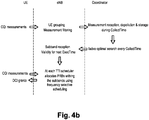
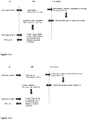
- the figure 4.a and 4.b present respectively the case of time diversity resources and the case of frequency diversity resources.
- the figure 5 is another representation of the method object of the present subject matter.
- the principle is to distribute the resources available in each resources area to user equipments or group of user equipments until those resources are exhausted in all the resources areas.
- the method considers here a "virtual capacity” that is the capacity of a group of user equipments or the capacity of a user equipment if the remaining resources were distributed to this group of user equipments or this user equipment.
- the policy can place the allocation in a state very near the proportional fairness; it is not a proportional fairness per se since the same capacity is seeked and we call it the "absolute fairness" (id est exactly same capacity for all UEgroups) therefore an additional step is required in case proportional fairness is the criteria (we call it the "swapping stage").
- the swapping stage takes relay where the "absolute fairness” ends. The objective of the swapping stage is to increase the proportional fairness by swapping resources between those who have too much and those who do not have enough.
- the figures 6 presents a equipment used to allocate resources within a cellular network.
- This equipment comprises;
- the different modules are realized using one or more processor(s), I/O interface(s), and a memory coupled to the processor(s).
- the processor(s) may be implemented as one or more microprocessors, microcomputers, microcontrollers, digital signal processors, central processing units, state machines, logic circuitries, and/or any devices that manipulate signals based on operational instructions.
- the processor(s) can be a single processing unit or a number of units, all of which could also include multiple computing units.
- the processor(s) are configured to fetch and execute computer-readable instructions stored in the memory.
- processor may be provided through the use of dedicated hardware as well as hardware capable of executing software in association with appropriate software.
- the functions may be provided by a single dedicated processor, by a single shared processor, or by a plurality of individual processors, some of which may be shared.
- explicit use of the term "processor” should not be construed to refer exclusively to hardware capable of executing software, and may implicitly include, without limitation, digital signal processor (DSP) hardware, network processor, application specific integrated circuit (ASIC), field programmable gate array (FPGA), read only memory (ROM) for storing software, random access memory (RAM), and non volatile storage.
- DSP digital signal processor
- ASIC application specific integrated circuit
- FPGA field programmable gate array
- ROM read only memory
- RAM random access memory
- non volatile storage Other hardware, conventional and/or custom, may also be included.
- the memory may include any computer-readable medium known in the art including, for example, volatile memory, such as static random access memory (SRAM) and dynamic random access memory (DRAM), and/or non-volatile memory, such as read only memory (ROM), erasable programmable ROM, flash memories, hard disks, optical disks, and magnetic tapes.
- volatile memory such as static random access memory (SRAM) and dynamic random access memory (DRAM)
- non-volatile memory such as read only memory (ROM), erasable programmable ROM, flash memories, hard disks, optical disks, and magnetic tapes.
- the memory includes modules and data.
- the modules include routines, programs, objects, components, data structures, etc., which perform particular tasks or implement particular abstract data types.
- the data serves as a repository for storing data processed, received, and generated by one or more of the modules.
- program storage devices for example, digital data storage media, which are machine or computer readable and encode machine-executable or computer-executable programs of instructions, where said instructions perform some or all of the steps of the described method.
- the program storage devices may be, for example, digital memories, magnetic storage media, such as a magnetic disks and magnetic tapes, hard drives, or optically readable digital data storage media.
- the method for estimating a communication service described figure 1 can be performed by programmed computers.
- the method comprises a initial step (101) of associated to each user equipment an initial capacity.
- the method also comprises the following iterative steps;
Landscapes
- Engineering & Computer Science (AREA)
- Quality & Reliability (AREA)
- Computer Networks & Wireless Communication (AREA)
- Signal Processing (AREA)
- Mobile Radio Communication Systems (AREA)
Abstract
Description
- The present subject matter relates to the allocation of resources within a wireless network and more precisely but not exclusively to the allocation of resources to different base stations of a cellular network.
- The present subject matter is drived by to the continuous increase of wireless access demand. Within a cellular network this means that there is an increase density of user device in some area more precisely but not exclusively in urban area. There are three solutions suitable for facing this increased demand:
- The first non technical solution is to increase the spectrum dedicated to the network facing scared resource.
- The second solution is a better spectrum reuse via network densification by means of small cells deployment; the issue of densification is the creation of strong interferences that must be controlled via interference mitigation / avoidance (e.g. using Inter-Cell Interference Coordination (ICIC) or enhanced Inter-Cell Interference Coordination (eICIC)).
- The third solution consists in, instead of avoiding the interferences, trying to reuse the interferences to increase signal robustness, therefore enabling the full reuse of the same resource by different terminals. This is the general objective of the Coordinated Multi-point (CoMP) techniques that have been standardized in
3GPP release 11 and following. - The issue with the third solution is the cost in terms of front hauling capacity between the different elements of the cellular network. Therefore the second solution is the privileged approach for the "bandwidth restricted" network configurations. Therefore the present subject matter will be focus on the second solution where the coordinator has to relied on Channel State Information (CSI) and other information (such as buffer states, connection priorities, etc...) coming from various nodes in order to allocate the resources optimally.
- This summary is provided to introduce concepts related to the allocation of resources to different base stations of a wireless network.
- In one implementation, a method is described. A method is configured to allocate resources to user equipments connected to a base station of a cellular network, the resources are used to establish connection between the base station and the user equipments, the resources are associated to different resource areas and each resource areas has a predetermined number of resources, the method comprises; a initial step of associated to each user equipment an initial capacity, the method also comprises the following iterative steps; a first step of determining a user equipment with the lowest capacity, and a second step of determining a resource area within which a spectral efficiency of the user equipment is optimal, and a step of allocating a certain number of resources to the user equipment within the resource area, and a step of updating the capacities associated to the different user equipment.
- In another implementation a equipment or network device is described. This equipment is dedicated to allocation of resources to user equipments connected to a base station of a cellular network, the resources are used to establish connection between the base station and the user equipments, the resources are associated to different resource areas and each resource areas has a predetermined number of resources, the equipment comprises; a initial module of associated to each user equipment an initial capacity, a first module of determining a user equipment with the lowest capacity, and a second module of determining a resource area within which a spectral efficiency of the user equipment is optimal, and a module of allocating a certain number of resources to the user equipment within the resource area, and a module of updating the capacities associated to the different user equipment.
- In another implementation a computer-readable medium is described. The computer-readable medium having embodied thereon a computer program configured to realize the allocation of resources to user equipments connected to a base station of a cellular network, the resources are used to establish connection between the base station and the user equipments, the resources are associated to different resource areas and each resource areas has a predetermined number of resources, the method comprises; a initial step of associated to each user equipment an initial capacity, the method also comprises the following iterative steps; a first step of determining a user equipment with the lowest capacity, and a second step of determining a resource area within which a spectral efficiency of the user equipment is optimal, and a step of allocating a certain number of resources to the user equipment within the resource area, and a step of updating the capacities associated to the different user equipment.
- The detailed description is described with reference to the accompanying figures. In the figures, the left-most digit(s) of a reference number identifies the figure in which the reference number first appears. The same numbers are used throughout the figures to reference like features and components. Some embodiments of system and/or methods in accordance with embodiments of the present subject matter are now described, by way of example only, and with reference to the accompanying figures, in which:
-
Figure 1 illustrates an embodiment of the method object of the present subject matter. -
Figure 2 illustrates the implementation of the method of the present subject matter within a cellular system. -
Figure 3 illustrates an embodiment of the method used to collect the information's needed by the allocation method. -
Figure 4.a and4.b present two embodiments of the method object of the present subject matter. -
Figure 5 presents an embodiment of the method object of the present subject matter. -
Figure 6 presents an embodiment of the equipment object of the present subject matter. - In the present document, the word "exemplary" is used herein to mean "serving as an example, instance, or illustration." Any embodiment or implementation of the present subject matter described herein as "exemplary" is not necessarily to be construed as preferred or advantageous over other embodiments.
- It should be appreciated by those skilled in the art that any block diagrams herein represent conceptual views of illustrative systems embodying the principles of the present subject matter. Similarly, it will be appreciated that any flow charts, flow diagrams, state transition diagrams, pseudo code, and the like represent various processes which may be substantially represented in computer readable medium and so executed by a computer or processor, whether or not such computer or processor is explicitly shown.
- In an embodiment of the present subject matter the method for allocation resources faces number of challenges:
- This method needs to be flexible, to support various Key Performance Indicators (KPI).
- This method needs to be scalable, to support a possibly rather large number of users.
- This method needs to be able to adapt to various parameters and variables (power, frequency, time, spatial diversity...).
- This method needs to converge almost to the global optimum.
- In an embodiment of the present subject matter the method tends to avoid brute force approaches and favors iterative approaches. In this embodiment the method uses an innovative iterative approach based on game theory that enables to scale with the number of nodes linearly while offering sufficient convergence capabilities (local, global...). The method of this embodiment has been successfully implemented in a distributed context.
- This embodiment is also called the Coordinated Scheduling. This approach assumes that all
realtime Layer 1 Channel State Information (CSI) and Layer 2 measurements get collected to the central processing unit where an omniscient scheduler will decide the scheduling decisions on behalf of the remote unit that has only to perform theLayer 1 processing. This approach is very attractive since it can exhibit the best possible performance, better than a fully distributed approach and without the front-hauling cost of a fully centralized approach. - In an embodiment of the present subject matter the method implements the possibility to forecast the scheduling done by each node. This embodiment is dedicated to a central option and is able to adapt to multiple ways of considering scheduling especially with the emergence of Coordinated Scheduling/Coordinated Beamforming (CS/CB). In another word this embodiment presents an innovative scheduling algorithm - called the "virtual scheduling" since it is not expected to represent the "real" local scheduling but to be a good approximation of it.
- The
figure 1 presents an embodiment of the present subject matter. This embodiment is a method for allocating resources, associated to at least one base station of a cellular network. The resources are used to establish connection between the base stations and several user equipments connected to these base stations. The resources are associated to different resource areas. Each resource area has a predetermined number of resources. The method comprises aninitial step 101 of associated to each user equipment an initial capacity. After that the method also comprises the following iterative steps; - a
first step 102 of determining a user equipment with the lowest capacity, and - a
second step 103 of determining a resource area within which a spectral efficiency of the user equipment is optimal, and - a
step 104 of allocating a certain number of resources to the user equipment within the resource area, and - a
step 105 of updating the capacities associated to the different user equipment. - In an embodiment the iterative steps are realized until the number of allocated resources, associated to each resource area, reachs the predetermined number of resources. In another words, the method is realized until there is no more resources to allocate.
- In an embodiment the
initial step 101 is configured to associate a null capacity to each user equipment. In another embodiment, the algorithm starts with a pre allocated capacity to some users equipment if some guaranteed capacity are granted (such as VoIP). - In an embodiment the
second determination step 103 is configured to determine a resource area within which a spectral efficiency of the user equipment is optimal and in which there is still resource to allocate. In another words we only consider resource area with available resource to allocate. - In an embodiment the
first determination step 102 is configured to determine a user equipment with the lowest capacity and with a resource area within which the spectral efficiency is optimal that still contains available resources. In another words we only consider user equipment that need resources in a resource area which still contains resources to allocate. - In an embodiment the
step 104 of updating the capacities associated to the different user equipment is configured to use the following formula:
- In an embodiment the
step 104 of updating the capacities associated to the different user equipment is configured to use the following formula:
- In an embodiment the second step of determining a resource area is configured to used the following formula to determine the spectral efficiency of the user equipment:

- C is the channel capacity in bits per second;
- B is the bandwidth of the channel in hertz
- S is the average received useful signal power over the bandwidth measured in watts;
- N is the average noise or interference power over the bandwidth, measured in watts;
- I is the average received interfering signal power over the bandwidth measured in watts;
- And S/(N+I) is the signal-to-noise+interferer ratio (SINR) expressed as a linear power ratio (not as logarithmic decibels).
- The useful and interfering signals are derived from the knowledge of the transmitter powers, their average attenuations and the knowledge of their transmission patterns (if they transmit or not in the corresponding resource area).
- In an embodiment the resources areas are for example: a group of time sub frames, or a group of frequency Ressource Blocks, or a group of MIMO transmission patterns or any combination of those elements.
- In another words in theses embodiments when the backhauling has limited capacity, the best solution is to use a coordinator to control the individual distributed Radio Access Networks (RANs) resources. Depending on the actual capabilities of the backhauling, the resources that fall under the control of the controller will differ as it could be the user attachment (via the Cell Individual Offset or CIO), the time diversity (via Almost Blank Sub frames patterns or ABS patterns), the frequency (ICIC) and even the spatial diversity. In this scenario, all the processing dedicated to the PHY layer and MAC layer is performed locally, only main parameters are given by the coordinator to each scheduler. This general concept is presented
figure 2 . - The controller is therefore in charge of performing global decisions (thanks to its global knowledge of the network status) but with a lower frequency than the local scheduler. Therefore the local scheduler can react quicker to local changes but within a plurality of resources given by the coordinator. It becomes critical for the coordinator to be able to forecast with good accuracy the performance of the local schedulers in order to be able to allocate resources in a meaningful way. Usually the key performance indicators are the capacity expected from the allocation in the next period of allocation. It is expected, due to the real-time reactivity of the local scheduler, that the actual performance will exceed the forecasted performance.
- In an embodiment the following simplification are used:
- Users equipment are grouped by the access nodes according to some "local criteria" usually referred to as "spectral efficiency proximity"; an example of local criteria is the localization of the users in cell edge or cell center (hence splitting in 2 groups); in cell edge several choices are possible depending on the major interferers (one or more major interferers could exist); in one group the users will have same major interferers combination and therefore similar spectrum efficiency;
- resources are grouped in resource areas to limit the number of cases; resources can be various (time slots, frequency slots, etc...);
- there is a local spectrum efficiency associated to each group of user and resource area; this spectrum efficiency can be considered as static (depending e.g. on the interference patterns) or can be changed dynamically.
- The table, used to handle the resources allocation is populated by receiving data from the user equipment, then the base stations or eNodeBs then the coordinator as describes within the
figure 3 . - Once the table is populated, the coordinator can compute the best choice of resource distribution and send the result back to the eNodeBs where the local scheduler will abide by the choice (e.g. restrict the usage of some specific resources in time or subbands). The
figure 4.a and4.b present respectively the case of time diversity resources and the case of frequency diversity resources. - The
figure 5 is another representation of the method object of the present subject matter. The principle is to distribute the resources available in each resources area to user equipments or group of user equipments until those resources are exhausted in all the resources areas. In order to determine to which user equipment of group of user equipments allocate the resource the method considers here a "virtual capacity" that is the capacity of a group of user equipments or the capacity of a user equipment if the remaining resources were distributed to this group of user equipments or this user equipment. This avoids the main default of the state of the art policies, especially the state of the art policy that selects the currently best group of user equipments or user equipment with the risk of exhausting capacity of group of user equipments or user equipments with low spectrum efficiencies (these group of user equipments or user equipments should be on the contrary more served than the well allocated group of user equipments or user equipments). - In this embodiment the policy can place the allocation in a state very near the proportional fairness; it is not a proportional fairness per se since the same capacity is seeked and we call it the "absolute fairness" (id est exactly same capacity for all UEgroups) therefore an additional step is required in case proportional fairness is the criteria (we call it the "swapping stage"). The swapping stage takes relay where the "absolute fairness" ends. The objective of the swapping stage is to increase the proportional fairness by swapping resources between those who have too much and those who do not have enough. For achieving this, an iterative approach is pursued over all resource areas: for each resource area we select the user having the lowest SE and the one having the greatest and we exchange one unit of resource and check how evolve the logartithm of the capacity; we continue until there is no gain in swapping.
- The
figures 6 presents a equipment used to allocate resources within a cellular network. This equipment comprises; - a
initial module 601 of associated to each user equipment an initial capacity, - a
first module 602 of determining a user equipment with the lowest capacity, and - a
second module 603 of determining a resource area within which a spectral efficiency of the user equipment is optimal, and - a
module 604 of allocating a certain number of resources to the user equipment within the resource area, and - a
module 605 of updating the capacities associated to the different user equipment. - In an embodiment the different modules are realized using one or more processor(s), I/O interface(s), and a memory coupled to the processor(s). The processor(s) may be implemented as one or more microprocessors, microcomputers, microcontrollers, digital signal processors, central processing units, state machines, logic circuitries, and/or any devices that manipulate signals based on operational instructions. The processor(s) can be a single processing unit or a number of units, all of which could also include multiple computing units. Among other capabilities, the processor(s) are configured to fetch and execute computer-readable instructions stored in the memory.
- The functions realized by the processor may be provided through the use of dedicated hardware as well as hardware capable of executing software in association with appropriate software. When provided by a processor, the functions may be provided by a single dedicated processor, by a single shared processor, or by a plurality of individual processors, some of which may be shared. Moreover, explicit use of the term "processor" should not be construed to refer exclusively to hardware capable of executing software, and may implicitly include, without limitation, digital signal processor (DSP) hardware, network processor, application specific integrated circuit (ASIC), field programmable gate array (FPGA), read only memory (ROM) for storing software, random access memory (RAM), and non volatile storage. Other hardware, conventional and/or custom, may also be included.
- The memory may include any computer-readable medium known in the art including, for example, volatile memory, such as static random access memory (SRAM) and dynamic random access memory (DRAM), and/or non-volatile memory, such as read only memory (ROM), erasable programmable ROM, flash memories, hard disks, optical disks, and magnetic tapes. The memory includes modules and data. The modules include routines, programs, objects, components, data structures, etc., which perform particular tasks or implement particular abstract data types. The data, amongst other things, serves as a repository for storing data processed, received, and generated by one or more of the modules.
- A person skilled in the art will readily recognize that steps of the methods, presented above, can be performed by programmed computers. Herein, some embodiments are also intended to cover program storage devices, for example, digital data storage media, which are machine or computer readable and encode machine-executable or computer-executable programs of instructions, where said instructions perform some or all of the steps of the described method. The program storage devices may be, for example, digital memories, magnetic storage media, such as a magnetic disks and magnetic tapes, hard drives, or optically readable digital data storage media.
- In an embodiment of the subject matter, the method for estimating a communication service described
figure 1 can be performed by programmed computers. - The method comprises a initial step (101) of associated to each user equipment an initial capacity.
- The method also comprises the following iterative steps;
- a first step (102) of determining a user equipment with the lowest capacity, and
- a second step (103) of determining a resource area within which a spectral efficiency of the user equipment is optimal, and
- a step (104) of allocating a certain number of resources to the user equipment within the resource area, and
- a step (105) of updating the capacities associated to the different user equipment.
Claims (10)
- A method for allocating resources to user equipments connected to a base station of a cellular network, the resources are used to establish connection between the base station and the user equipments, the resources are associated to different resource areas and each resource areas has a predetermined number of resources,
the method comprises;a initial step (101) of associated to each user equipment an initial capacity,the method also comprises the following iterative steps;a first step (102) of determining a user equipment with the lowest capacity, anda second step (103) of determining a resource area within which a spectral efficiency of the user equipment is optimal, anda step (104) of allocating a certain number of resources to the user equipment within the resource area, anda step (105) of updating the capacities associated to the different user equipment. - The method according to the claim 1 wherein;
the iterative steps are realized until the number of allocated resource associated to each resource area reachs the predetermined number of resources. - The method according to claim 1 and 2 and wherein;
the second determination step (103) is also configured to determine a resource area within which a spectral efficiency of the user equipment is optimal and that still contains available resources. - The method according to any of the previous claims wherein;
the first determination step (102) is also configured to determine a user equipment with the lowest capacity and with a resource area within which the spectral efficiency is optimal that still contains available resources. - The method according to any of the previous claims wherein;the step (105) of updating the capacities associated to the different user equipment is configured to use the following formula:

orthe step (105) of updating the capacities associated to the different user equipment is configured to use the following formula:
- The method according to any of the previous claims wherein;
the initial step (101) of associated to each user equipment an initial capacity, is configured to associated a null capacity to each user equipment. - The method according to any of the previous claims wherein the second step (103) of determining a resource area is configured to used the following formula to determine the spectral efficiency of the user equipment:

where- C is the channel capacity in bits per second;- B is the bandwidth of the channel in hertz- S is the average received useful signal power over the bandwidth measured in watts;- N is the average noise or interference power over the bandwidth, measured in watts;- I is the average received interfering signal power over the bandwidth measured in watts;- And S/(N + I) is the signal-to-noise+interferer ratio expressed as a linear power ratio. - The method according to any of the previous claims wherein the resources areas are a group of time sub frames, and/or a group of frequency Ressource Blocks, and/or a group of MIMO transmission patterns and/or any combination of those elements.
- An equipment for allocating resources to user equipments connected to a base station of a cellular network, the resources are used to establish connection between the base station and the user equipments, the resources are associated to different resource areas and each resource areas has a predetermined number of resources,
the equipment comprises;a initial module (601) of associated to each user equipment an initial capacity,a first module (602) of determining a user equipment with the lowest capacity, anda second module (603) of determining a resource area within which a spectral efficiency of the user equipment is optimal, anda module (604) of allocating a certain number of resources to the user equipment within the resource area, anda module (605) of updating the capacities associated to the different user equipment. - A computer-readable medium having embodied thereon a computer program configured to realize the allocation of resources to user equipments connected to a base station of a cellular network, the resources are used to establish connection between the base station and the user equipments, the resources are associated to different resource areas and each resource areas has a predetermined number of resources,
the method comprises;a initial step (101) of associated to each user equipment an initial capacity,the method also comprises the following iterative steps;a first step (102) of determining a user equipment with the lowest capacity, anda second step (103) of determining a resource area within which a spectral efficiency of the user equipment is optimal, anda step (104) of allocating a certain number of resources to the user equipment within the resource area, anda step (105) of updating the capacities associated to the different user equipment.
Priority Applications (1)
| Application Number | Priority Date | Filing Date | Title |
|---|---|---|---|
| EP14306414.5A EP2996421B1 (en) | 2014-09-15 | 2014-09-15 | Method, equipment and computer-readable medium for allocating resources |
Applications Claiming Priority (1)
| Application Number | Priority Date | Filing Date | Title |
|---|---|---|---|
| EP14306414.5A EP2996421B1 (en) | 2014-09-15 | 2014-09-15 | Method, equipment and computer-readable medium for allocating resources |
Publications (2)
| Publication Number | Publication Date |
|---|---|
| EP2996421A1 true EP2996421A1 (en) | 2016-03-16 |
| EP2996421B1 EP2996421B1 (en) | 2017-06-14 |
Family
ID=51627246
Family Applications (1)
| Application Number | Title | Priority Date | Filing Date |
|---|---|---|---|
| EP14306414.5A Not-in-force EP2996421B1 (en) | 2014-09-15 | 2014-09-15 | Method, equipment and computer-readable medium for allocating resources |
Country Status (1)
| Country | Link |
|---|---|
| EP (1) | EP2996421B1 (en) |
Citations (2)
| Publication number | Priority date | Publication date | Assignee | Title |
|---|---|---|---|---|
| US20110116460A1 (en) * | 2009-11-09 | 2011-05-19 | Movik Networks, Inc. | Burst packet scheduler for improved ran efficiency in umts/hspa networks |
| US20120163208A1 (en) * | 2010-12-28 | 2012-06-28 | Motorola Mobility, Inc. | Subband snr correction in a frequency selective scheduler |
-
2014
- 2014-09-15 EP EP14306414.5A patent/EP2996421B1/en not_active Not-in-force
Patent Citations (2)
| Publication number | Priority date | Publication date | Assignee | Title |
|---|---|---|---|---|
| US20110116460A1 (en) * | 2009-11-09 | 2011-05-19 | Movik Networks, Inc. | Burst packet scheduler for improved ran efficiency in umts/hspa networks |
| US20120163208A1 (en) * | 2010-12-28 | 2012-06-28 | Motorola Mobility, Inc. | Subband snr correction in a frequency selective scheduler |
Non-Patent Citations (1)
| Title |
|---|
| BONALD T: "FLOW-LEVEL PERFORMANCE ANALYSIS OF SOME OPPORTUNISTIC SCHEDULING ALGORITMS", EUROPEAN TRANSACTIONS ON TELECOMMUNICATIONS, WILEY & SONS, CHICHESTER, GB, vol. 16, no. 1, 1 January 2005 (2005-01-01), pages 65 - 75, XP001225777, ISSN: 1124-318X, DOI: 10.1002/ETT.1032 * |
Also Published As
| Publication number | Publication date |
|---|---|
| EP2996421B1 (en) | 2017-06-14 |
Similar Documents
| Publication | Publication Date | Title |
|---|---|---|
| KR101229322B1 (en) | Interference coordination method and access network device | |
| KR101990685B1 (en) | Method and apparatus for power and user distribution to sub-bands in noma systems | |
| Rashid et al. | Opportunistic spectrum scheduling for multiuser cognitive radio: a queueing analysis | |
| JP5424006B2 (en) | System and method for probability-based resource allocation in a wireless communication system | |
| CN114271005B (en) | Controls | |
| JP5925895B2 (en) | Inter-operator spectrum sharing control, inter-operator interference coordination method, and radio resource scheduling in a wireless communication system | |
| US10264592B2 (en) | Method and radio network node for scheduling of wireless devices in a cellular network | |
| JP5322906B2 (en) | Base station apparatus and scheduling method | |
| JP2010226712A (en) | Inter-cell interference prediction for frequency resource allocation | |
| JP7092897B2 (en) | Time-frequency resource allocation method and equipment | |
| Narmanlioglu et al. | Service-aware multi-resource allocation in software-defined next generation cellular networks | |
| CN103229572A (en) | Dynamic multiple input and multiple output cell cluster | |
| CN113573351A (en) | Method and device for determining wireless resource utilization rate, electronic equipment and storage medium | |
| WO2018228699A1 (en) | Control device, network node and methods thereof | |
| EP2254380A1 (en) | A method and apparatus | |
| JP2017515439A (en) | Resource allocation system and method adapted for implementation of inter-device communication in a wireless communication network | |
| CN103313408B (en) | A kind of more sector coordinated scheduling methods and device | |
| CN107396450B (en) | Cross-standard scheduling method and base station | |
| US20170230984A1 (en) | Service-Specific Scheduling in Cellular Networks | |
| KR20120041899A (en) | Apparatus and method for scheduling in wireless communication system | |
| EP2996421B1 (en) | Method, equipment and computer-readable medium for allocating resources | |
| JP2016152622A (en) | Resource scheduling method, device and communication system | |
| JP6163566B2 (en) | Wireless communication method and apparatus | |
| JP6805368B2 (en) | Scheduling equipment and methods and programs | |
| CN113170437B (en) | Method and base station for multi-user multiple input multiple output |
Legal Events
| Date | Code | Title | Description |
|---|---|---|---|
| PUAI | Public reference made under article 153(3) epc to a published international application that has entered the european phase |
Free format text: ORIGINAL CODE: 0009012 |
|
| AK | Designated contracting states |
Kind code of ref document: A1 Designated state(s): AL AT BE BG CH CY CZ DE DK EE ES FI FR GB GR HR HU IE IS IT LI LT LU LV MC MK MT NL NO PL PT RO RS SE SI SK SM TR |
|
| AX | Request for extension of the european patent |
Extension state: BA ME |
|
| 17P | Request for examination filed |
Effective date: 20160916 |
|
| RBV | Designated contracting states (corrected) |
Designated state(s): AL AT BE BG CH CY CZ DE DK EE ES FI FR GB GR HR HU IE IS IT LI LT LU LV MC MK MT NL NO PL PT RO RS SE SI SK SM TR |
|
| GRAP | Despatch of communication of intention to grant a patent |
Free format text: ORIGINAL CODE: EPIDOSNIGR1 |
|
| INTG | Intention to grant announced |
Effective date: 20170224 |
|
| GRAS | Grant fee paid |
Free format text: ORIGINAL CODE: EPIDOSNIGR3 |
|
| GRAA | (expected) grant |
Free format text: ORIGINAL CODE: 0009210 |
|
| AK | Designated contracting states |
Kind code of ref document: B1 Designated state(s): AL AT BE BG CH CY CZ DE DK EE ES FI FR GB GR HR HU IE IS IT LI LT LU LV MC MK MT NL NO PL PT RO RS SE SI SK SM TR |
|
| REG | Reference to a national code |
Ref country code: GB Ref legal event code: FG4D |
|
| REG | Reference to a national code |
Ref country code: CH Ref legal event code: EP Ref country code: AT Ref legal event code: REF Ref document number: 902043 Country of ref document: AT Kind code of ref document: T Effective date: 20170615 |
|
| REG | Reference to a national code |
Ref country code: IE Ref legal event code: FG4D |
|
| REG | Reference to a national code |
Ref country code: DE Ref legal event code: R096 Ref document number: 602014010728 Country of ref document: DE |
|
| REG | Reference to a national code |
Ref country code: FR Ref legal event code: PLFP Year of fee payment: 4 |
|
| REG | Reference to a national code |
Ref country code: NL Ref legal event code: MP Effective date: 20170614 |
|
| REG | Reference to a national code |
Ref country code: LT Ref legal event code: MG4D |
|
| PG25 | Lapsed in a contracting state [announced via postgrant information from national office to epo] |
Ref country code: NO Free format text: LAPSE BECAUSE OF FAILURE TO SUBMIT A TRANSLATION OF THE DESCRIPTION OR TO PAY THE FEE WITHIN THE PRESCRIBED TIME-LIMIT Effective date: 20170914 Ref country code: FI Free format text: LAPSE BECAUSE OF FAILURE TO SUBMIT A TRANSLATION OF THE DESCRIPTION OR TO PAY THE FEE WITHIN THE PRESCRIBED TIME-LIMIT Effective date: 20170614 Ref country code: LT Free format text: LAPSE BECAUSE OF FAILURE TO SUBMIT A TRANSLATION OF THE DESCRIPTION OR TO PAY THE FEE WITHIN THE PRESCRIBED TIME-LIMIT Effective date: 20170614 Ref country code: GR Free format text: LAPSE BECAUSE OF FAILURE TO SUBMIT A TRANSLATION OF THE DESCRIPTION OR TO PAY THE FEE WITHIN THE PRESCRIBED TIME-LIMIT Effective date: 20170915 Ref country code: HR Free format text: LAPSE BECAUSE OF FAILURE TO SUBMIT A TRANSLATION OF THE DESCRIPTION OR TO PAY THE FEE WITHIN THE PRESCRIBED TIME-LIMIT Effective date: 20170614 |
|
| REG | Reference to a national code |
Ref country code: AT Ref legal event code: MK05 Ref document number: 902043 Country of ref document: AT Kind code of ref document: T Effective date: 20170614 |
|
| PG25 | Lapsed in a contracting state [announced via postgrant information from national office to epo] |
Ref country code: RS Free format text: LAPSE BECAUSE OF FAILURE TO SUBMIT A TRANSLATION OF THE DESCRIPTION OR TO PAY THE FEE WITHIN THE PRESCRIBED TIME-LIMIT Effective date: 20170614 Ref country code: BG Free format text: LAPSE BECAUSE OF FAILURE TO SUBMIT A TRANSLATION OF THE DESCRIPTION OR TO PAY THE FEE WITHIN THE PRESCRIBED TIME-LIMIT Effective date: 20170914 Ref country code: SE Free format text: LAPSE BECAUSE OF FAILURE TO SUBMIT A TRANSLATION OF THE DESCRIPTION OR TO PAY THE FEE WITHIN THE PRESCRIBED TIME-LIMIT Effective date: 20170614 Ref country code: LV Free format text: LAPSE BECAUSE OF FAILURE TO SUBMIT A TRANSLATION OF THE DESCRIPTION OR TO PAY THE FEE WITHIN THE PRESCRIBED TIME-LIMIT Effective date: 20170614 Ref country code: NL Free format text: LAPSE BECAUSE OF FAILURE TO SUBMIT A TRANSLATION OF THE DESCRIPTION OR TO PAY THE FEE WITHIN THE PRESCRIBED TIME-LIMIT Effective date: 20170614 |
|
| PG25 | Lapsed in a contracting state [announced via postgrant information from national office to epo] |
Ref country code: SK Free format text: LAPSE BECAUSE OF FAILURE TO SUBMIT A TRANSLATION OF THE DESCRIPTION OR TO PAY THE FEE WITHIN THE PRESCRIBED TIME-LIMIT Effective date: 20170614 Ref country code: CZ Free format text: LAPSE BECAUSE OF FAILURE TO SUBMIT A TRANSLATION OF THE DESCRIPTION OR TO PAY THE FEE WITHIN THE PRESCRIBED TIME-LIMIT Effective date: 20170614 Ref country code: AT Free format text: LAPSE BECAUSE OF FAILURE TO SUBMIT A TRANSLATION OF THE DESCRIPTION OR TO PAY THE FEE WITHIN THE PRESCRIBED TIME-LIMIT Effective date: 20170614 Ref country code: EE Free format text: LAPSE BECAUSE OF FAILURE TO SUBMIT A TRANSLATION OF THE DESCRIPTION OR TO PAY THE FEE WITHIN THE PRESCRIBED TIME-LIMIT Effective date: 20170614 Ref country code: RO Free format text: LAPSE BECAUSE OF FAILURE TO SUBMIT A TRANSLATION OF THE DESCRIPTION OR TO PAY THE FEE WITHIN THE PRESCRIBED TIME-LIMIT Effective date: 20170614 |
|
| PG25 | Lapsed in a contracting state [announced via postgrant information from national office to epo] |
Ref country code: SM Free format text: LAPSE BECAUSE OF FAILURE TO SUBMIT A TRANSLATION OF THE DESCRIPTION OR TO PAY THE FEE WITHIN THE PRESCRIBED TIME-LIMIT Effective date: 20170614 Ref country code: ES Free format text: LAPSE BECAUSE OF FAILURE TO SUBMIT A TRANSLATION OF THE DESCRIPTION OR TO PAY THE FEE WITHIN THE PRESCRIBED TIME-LIMIT Effective date: 20170614 Ref country code: IT Free format text: LAPSE BECAUSE OF FAILURE TO SUBMIT A TRANSLATION OF THE DESCRIPTION OR TO PAY THE FEE WITHIN THE PRESCRIBED TIME-LIMIT Effective date: 20170614 Ref country code: IS Free format text: LAPSE BECAUSE OF FAILURE TO SUBMIT A TRANSLATION OF THE DESCRIPTION OR TO PAY THE FEE WITHIN THE PRESCRIBED TIME-LIMIT Effective date: 20171014 Ref country code: PL Free format text: LAPSE BECAUSE OF FAILURE TO SUBMIT A TRANSLATION OF THE DESCRIPTION OR TO PAY THE FEE WITHIN THE PRESCRIBED TIME-LIMIT Effective date: 20170614 |
|
| REG | Reference to a national code |
Ref country code: DE Ref legal event code: R097 Ref document number: 602014010728 Country of ref document: DE |
|
| REG | Reference to a national code |
Ref country code: CH Ref legal event code: PCOW Free format text: NEW ADDRESS: SITE NOKIA PARIS SACLAY ROUTE DE VILLEJUST, 91620 NOZAY (FR) |
|
| RAP2 | Party data changed (patent owner data changed or rights of a patent transferred) |
Owner name: ALCATEL LUCENT |
|
| PLBE | No opposition filed within time limit |
Free format text: ORIGINAL CODE: 0009261 |
|
| STAA | Information on the status of an ep patent application or granted ep patent |
Free format text: STATUS: NO OPPOSITION FILED WITHIN TIME LIMIT |
|
| PG25 | Lapsed in a contracting state [announced via postgrant information from national office to epo] |
Ref country code: DK Free format text: LAPSE BECAUSE OF FAILURE TO SUBMIT A TRANSLATION OF THE DESCRIPTION OR TO PAY THE FEE WITHIN THE PRESCRIBED TIME-LIMIT Effective date: 20170614 |
|
| REG | Reference to a national code |
Ref country code: CH Ref legal event code: PL |
|
| 26N | No opposition filed |
Effective date: 20180315 |
|
| PG25 | Lapsed in a contracting state [announced via postgrant information from national office to epo] |
Ref country code: MC Free format text: LAPSE BECAUSE OF FAILURE TO SUBMIT A TRANSLATION OF THE DESCRIPTION OR TO PAY THE FEE WITHIN THE PRESCRIBED TIME-LIMIT Effective date: 20170614 |
|
| REG | Reference to a national code |
Ref country code: IE Ref legal event code: MM4A |
|
| REG | Reference to a national code |
Ref country code: BE Ref legal event code: MM Effective date: 20170930 |
|
| PG25 | Lapsed in a contracting state [announced via postgrant information from national office to epo] |
Ref country code: LU Free format text: LAPSE BECAUSE OF NON-PAYMENT OF DUE FEES Effective date: 20170915 |
|
| PG25 | Lapsed in a contracting state [announced via postgrant information from national office to epo] |
Ref country code: CH Free format text: LAPSE BECAUSE OF NON-PAYMENT OF DUE FEES Effective date: 20170930 Ref country code: IE Free format text: LAPSE BECAUSE OF NON-PAYMENT OF DUE FEES Effective date: 20170915 Ref country code: LI Free format text: LAPSE BECAUSE OF NON-PAYMENT OF DUE FEES Effective date: 20170930 |
|
| PG25 | Lapsed in a contracting state [announced via postgrant information from national office to epo] |
Ref country code: SI Free format text: LAPSE BECAUSE OF FAILURE TO SUBMIT A TRANSLATION OF THE DESCRIPTION OR TO PAY THE FEE WITHIN THE PRESCRIBED TIME-LIMIT Effective date: 20170614 Ref country code: BE Free format text: LAPSE BECAUSE OF NON-PAYMENT OF DUE FEES Effective date: 20170930 |
|
| REG | Reference to a national code |
Ref country code: FR Ref legal event code: PLFP Year of fee payment: 5 |
|
| PG25 | Lapsed in a contracting state [announced via postgrant information from national office to epo] |
Ref country code: MT Free format text: LAPSE BECAUSE OF NON-PAYMENT OF DUE FEES Effective date: 20170915 |
|
| PG25 | Lapsed in a contracting state [announced via postgrant information from national office to epo] |
Ref country code: HU Free format text: LAPSE BECAUSE OF FAILURE TO SUBMIT A TRANSLATION OF THE DESCRIPTION OR TO PAY THE FEE WITHIN THE PRESCRIBED TIME-LIMIT; INVALID AB INITIO Effective date: 20140915 |
|
| PG25 | Lapsed in a contracting state [announced via postgrant information from national office to epo] |
Ref country code: CY Free format text: LAPSE BECAUSE OF FAILURE TO SUBMIT A TRANSLATION OF THE DESCRIPTION OR TO PAY THE FEE WITHIN THE PRESCRIBED TIME-LIMIT Effective date: 20170614 |
|
| PG25 | Lapsed in a contracting state [announced via postgrant information from national office to epo] |
Ref country code: MK Free format text: LAPSE BECAUSE OF FAILURE TO SUBMIT A TRANSLATION OF THE DESCRIPTION OR TO PAY THE FEE WITHIN THE PRESCRIBED TIME-LIMIT Effective date: 20170614 |
|
| PG25 | Lapsed in a contracting state [announced via postgrant information from national office to epo] |
Ref country code: TR Free format text: LAPSE BECAUSE OF FAILURE TO SUBMIT A TRANSLATION OF THE DESCRIPTION OR TO PAY THE FEE WITHIN THE PRESCRIBED TIME-LIMIT Effective date: 20170614 |
|
| PG25 | Lapsed in a contracting state [announced via postgrant information from national office to epo] |
Ref country code: PT Free format text: LAPSE BECAUSE OF FAILURE TO SUBMIT A TRANSLATION OF THE DESCRIPTION OR TO PAY THE FEE WITHIN THE PRESCRIBED TIME-LIMIT Effective date: 20170614 |
|
| PG25 | Lapsed in a contracting state [announced via postgrant information from national office to epo] |
Ref country code: AL Free format text: LAPSE BECAUSE OF FAILURE TO SUBMIT A TRANSLATION OF THE DESCRIPTION OR TO PAY THE FEE WITHIN THE PRESCRIBED TIME-LIMIT Effective date: 20170614 |
|
| PGFP | Annual fee paid to national office [announced via postgrant information from national office to epo] |
Ref country code: FR Payment date: 20210812 Year of fee payment: 8 |
|
| PG25 | Lapsed in a contracting state [announced via postgrant information from national office to epo] |
Ref country code: FR Free format text: LAPSE BECAUSE OF NON-PAYMENT OF DUE FEES Effective date: 20220930 |
|
| PGFP | Annual fee paid to national office [announced via postgrant information from national office to epo] |
Ref country code: GB Payment date: 20230803 Year of fee payment: 10 |
|
| PGFP | Annual fee paid to national office [announced via postgrant information from national office to epo] |
Ref country code: DE Payment date: 20230802 Year of fee payment: 10 |
|
| REG | Reference to a national code |
Ref country code: DE Ref legal event code: R119 Ref document number: 602014010728 Country of ref document: DE |
|
| GBPC | Gb: european patent ceased through non-payment of renewal fee |
Effective date: 20240915 |
|
| PG25 | Lapsed in a contracting state [announced via postgrant information from national office to epo] |
Ref country code: DE Free format text: LAPSE BECAUSE OF NON-PAYMENT OF DUE FEES Effective date: 20250401 |
|
| PG25 | Lapsed in a contracting state [announced via postgrant information from national office to epo] |
Ref country code: GB Free format text: LAPSE BECAUSE OF NON-PAYMENT OF DUE FEES Effective date: 20240915 |