EP2996216A1 - Electrical device - Google Patents
Electrical device Download PDFInfo
- Publication number
- EP2996216A1 EP2996216A1 EP15002651.6A EP15002651A EP2996216A1 EP 2996216 A1 EP2996216 A1 EP 2996216A1 EP 15002651 A EP15002651 A EP 15002651A EP 2996216 A1 EP2996216 A1 EP 2996216A1
- Authority
- EP
- European Patent Office
- Prior art keywords
- conducting element
- current
- primary
- parallel circuit
- supply inlet
- Prior art date
- Legal status (The legal status is an assumption and is not a legal conclusion. Google has not performed a legal analysis and makes no representation as to the accuracy of the status listed.)
- Granted
Links
Images


Classifications
-
- H—ELECTRICITY
- H02—GENERATION; CONVERSION OR DISTRIBUTION OF ELECTRIC POWER
- H02J—ELECTRIC POWER NETWORKS; CIRCUIT ARRANGEMENTS OR SYSTEMS FOR SUPPLYING OR DISTRIBUTING ELECTRIC POWER; SYSTEMS FOR STORING ELECTRIC ENERGY
- H02J50/00—Circuit arrangements or systems for wireless supply or distribution of electric power
- H02J50/10—Circuit arrangements or systems for wireless supply or distribution of electric power using inductive coupling
-
- H—ELECTRICITY
- H02—GENERATION; CONVERSION OR DISTRIBUTION OF ELECTRIC POWER
- H02J—ELECTRIC POWER NETWORKS; CIRCUIT ARRANGEMENTS OR SYSTEMS FOR SUPPLYING OR DISTRIBUTING ELECTRIC POWER; SYSTEMS FOR STORING ELECTRIC ENERGY
- H02J3/00—Circuit arrangements for AC mains or AC distribution networks
-
- H—ELECTRICITY
- H02—GENERATION; CONVERSION OR DISTRIBUTION OF ELECTRIC POWER
- H02J—ELECTRIC POWER NETWORKS; CIRCUIT ARRANGEMENTS OR SYSTEMS FOR SUPPLYING OR DISTRIBUTING ELECTRIC POWER; SYSTEMS FOR STORING ELECTRIC ENERGY
- H02J3/00—Circuit arrangements for AC mains or AC distribution networks
- H02J3/007—Arrangements for selectively connecting one or more loads to one or more power sources or power lines
-
- H—ELECTRICITY
- H02—GENERATION; CONVERSION OR DISTRIBUTION OF ELECTRIC POWER
- H02J—ELECTRIC POWER NETWORKS; CIRCUIT ARRANGEMENTS OR SYSTEMS FOR SUPPLYING OR DISTRIBUTING ELECTRIC POWER; SYSTEMS FOR STORING ELECTRIC ENERGY
- H02J50/00—Circuit arrangements or systems for wireless supply or distribution of electric power
- H02J50/10—Circuit arrangements or systems for wireless supply or distribution of electric power using inductive coupling
- H02J50/12—Circuit arrangements or systems for wireless supply or distribution of electric power using inductive coupling of the resonant type
-
- H—ELECTRICITY
- H02—GENERATION; CONVERSION OR DISTRIBUTION OF ELECTRIC POWER
- H02M—APPARATUS FOR CONVERSION BETWEEN AC AND AC, BETWEEN AC AND DC, OR BETWEEN DC AND DC, AND FOR USE WITH MAINS OR SIMILAR POWER SUPPLY SYSTEMS; CONVERSION OF DC OR AC INPUT POWER INTO SURGE OUTPUT POWER; CONTROL OR REGULATION THEREOF
- H02M7/00—Conversion of AC power input into DC power output; Conversion of DC power input into AC power output
- H02M7/42—Conversion of DC power input into AC power output without possibility of reversal
- H02M7/44—Conversion of DC power input into AC power output without possibility of reversal by static converters
-
- Y—GENERAL TAGGING OF NEW TECHNOLOGICAL DEVELOPMENTS; GENERAL TAGGING OF CROSS-SECTIONAL TECHNOLOGIES SPANNING OVER SEVERAL SECTIONS OF THE IPC; TECHNICAL SUBJECTS COVERED BY FORMER USPC CROSS-REFERENCE ART COLLECTIONS [XRACs] AND DIGESTS
- Y02—TECHNOLOGIES OR APPLICATIONS FOR MITIGATION OR ADAPTATION AGAINST CLIMATE CHANGE
- Y02E—REDUCTION OF GREENHOUSE GAS [GHG] EMISSIONS, RELATED TO ENERGY GENERATION, TRANSMISSION OR DISTRIBUTION
- Y02E10/00—Energy generation through renewable energy sources
- Y02E10/50—Photovoltaic [PV] energy
- Y02E10/56—Power conversion systems, e.g. maximum power point trackers
-
- Y—GENERAL TAGGING OF NEW TECHNOLOGICAL DEVELOPMENTS; GENERAL TAGGING OF CROSS-SECTIONAL TECHNOLOGIES SPANNING OVER SEVERAL SECTIONS OF THE IPC; TECHNICAL SUBJECTS COVERED BY FORMER USPC CROSS-REFERENCE ART COLLECTIONS [XRACs] AND DIGESTS
- Y02—TECHNOLOGIES OR APPLICATIONS FOR MITIGATION OR ADAPTATION AGAINST CLIMATE CHANGE
- Y02E—REDUCTION OF GREENHOUSE GAS [GHG] EMISSIONS, RELATED TO ENERGY GENERATION, TRANSMISSION OR DISTRIBUTION
- Y02E10/00—Energy generation through renewable energy sources
- Y02E10/70—Wind energy
- Y02E10/76—Power conversion electric or electronic aspects
Definitions
- the present invention relates to a circuit configuration for an electrical device. More particularly, the present invention relates to a novel and improved configuration for a transformer, a voltage optimisation system or the like.
- Transformers are electrical devices in power networks that transfer electrical energy between circuits through electromagnetic induction.
- a typical transformer comprises at least two windings, a primary winding and a secondary winding, about a core.
- a current from a current supply typically an alternative current from an electrical grid, is supplied into the transformer's primary winding, creates a magnetic flux in the core, and a magnetic field impinges on the secondary winding and induces a voltage therein.
- Voltage optimisation devices are a type of transformer used to optimise the characteristics of the current supplied at the source according to current characteristics required at a load. Voltage optimisation devices accordingly also transform the first current into a second current, which meets the characteristics of the current required at the load.
- the first current is typically an alternating voltage, which may be either lower than the second alternating voltage, in which case the resultant voltage is increased and said to be stepped up, or higher than the second alternating voltage, in which case the resultant voltage is decreased and said to be stepped down. This transformation routinely results in excess transformed voltage.
- the supply current flows into the first winding to the second winding of a voltage optimisation device, wherein the magnetic flux causes the induction of a reverse current, which is a fraction of the supply current.
- This reverse current has a negative charge and flows in the opposite direction to the supply current, wherein it is directed back into the current supply.
- This reverse current is also anti-phase to the supply current, and these characteristics contribute to the efficiency and optimising function of a voltage optimiser.
- This reverse current is a real form of energy, which is distinct from current traditionally referred to as 'apparent' or 'reactive'. This reverse current also constitutes excess transformed current.
- the present invention provides both a novel method of processing power in an electrical device, and a device implementing the method, for harnessing the excess current produced in a transformer, with additional switching means at the primary winding for facilitating the extraction of this excess current towards a secondary load, for instance energy storage means.
- an electrical device comprising a primary conducting element connected with a secondary conducting element in a first parallel circuit; and a current supply inlet and a primary load outlet connected in series with the secondary conducting element, wherein the primary conducting element contains reverse current induced by the secondary conducting element in use.
- the device is characterised in that it further comprises a secondary load outlet connected with the primary conducting element in a second parallel circuit; and a switching means located in the first parallel circuit, having a first position for closing the primary conducting element to direct supply current from the current supply inlet to the secondary load outlet, and a second position opening the primary conducting element to direct reverse current from the primary conducting element to the secondary load outlet.
- the inventive principle disclosed herein thus provides a solution for extracting the reverse current generated in an electrical circuit to a secondary load outlet at which it may be put to further use, non-limitative examples of which include storage for ulterior off-grid powering and/or powering of low-requirement electrical motors and the like, rather than allowing it to wastefully return into the supply.
- the first and second conducting elements are windings about a core member.
- the current from the current supply inlet is a first alternating voltage and the first parallel circuit is adapted to transform the first alternating voltage into a second alternating voltage which is higher or lower than the first alternating voltage.
- the second parallel circuit further comprises a rectifier.
- the secondary load outlet is connected to electrical power storage means.
- embodiments including power storage means allow such storage means to be charged continuously so long as the device is in use and may usefully also allow such storage means to be selectively charged by the supply source directly.
- the electrical power storage means may be coupled with an inverter.
- the device may further comprise data processing means adapted to switch supply to the first parallel circuit between the current supply inlet and the electrical power storage means.
- such embodiments reduce a user's reliance upon a constant supply from an electrical grid, by permitting automatic and/or selective disconnection of the device from the grid and using the current stored in the power storage means, for instance when supply from the grid is interrupted unexpectedly or according to a schedule.
- Further benefits derived from the above include a reduction of the overall supply required by a user through configurations of the device aimed at scheduled off-grid storage-powered operation, resulting in an improved stability of the electrical grid when the demand is reduced at peak times.
- the device may further comprise a secondary current supply inlet connected in series with the secondary conducting element.
- the secondary current supply inlet may be connected to at least one generator driven by wind, solar, heat or hydraulic power.
- such embodiments extend the inventive principle to non-grid supply sources and further reduce a user's reliance upon a constant supply from an electrical grid, particularly when combined with other embodiments including power storage means.
- Any of the above embodiments will preferably take the form of a transformer or a voltage optimiser.
- a method of processing power in an electrical device comprising the steps of connecting a primary conducting element with a secondary conducting element in a first parallel circuit; and connecting a current supply inlet and a primary load outlet in series with the secondary conducting element, wherein the primary conducting element contains reverse current induced by the secondary conducting element in use.
- the method is characterised in that it comprises the further steps of connecting a secondary load outlet with the primary conducting element in a second parallel circuit, locating a switching means in the first parallel circuit, and switching the switching means between a first position for closing the primary conducting element to direct supply current from the current supply inlet to the secondary load outlet, and a second position opening the primary conducting element to direct reverse current from the primary conducting element to the secondary load outlet.
- the first and second conducting elements are windings about a core member.
- the method may comprise the further step of transforming the first alternating voltage into a second alternating voltage which is higher or lower than the first alternating voltage with the first parallel circuit.
- the method may comprise the further step of connecting the secondary load outlet to electrical power storage means.
- the method may comprise the further step of coupling the electrical power storage means with an inverter.
- the method may comprise the further step of switching supply to the first parallel circuit between the current supply inlet and the electrical power storage means with data processing means.
- An embodiment of the method may comprise the further step of connecting a secondary current supply inlet in series with the secondary conducting element.
- the method may comprise the further step of connecting the secondary current supply inlet to at least one generator driven by wind, solar, heat or hydraulic power.
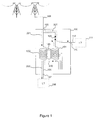
- a first embodiment of an electrical device 100 which has a primary winding 101 connected with a secondary winding 102 and wound about a core 103 in a first parallel circuit 104.
- the device 100 further includes a current supply inlet 105 to which current is delivered by a connection to an electrical grid 106.
- the supplied current is three phase alternating current, by way of non-limitative example representative of common characteristics for alternating current transmission.
- the device 100 further includes a primary load outlet 107 connected in series with the secondary winding 102, for connection to a load 108, for instance electrically-powered office or plant equipment rated for operation at 220V.
- the device 100 further includes a switching means 109 located in the first parallel circuit 104 selectively opening and closing the primary winding 101 to a connection with a secondary load outlet 110 for connection to a secondary load 111 in a second parallel circuit 112.
- the primary winding 101 has real current 200 induced from the secondary winding 102. With reference to Figure 2 , this primary current 200 has opposite flow direction to the supply current 201, and it can be observed from Figure 2 that the primary current 200 is anti-phase to the supply and secondary currents 201, 202.
- the inventive principle resides in diverting current for alternate use, in particular extracting reverse current 200, wherein the extracted current 200 is the negatively charged reverse current from the second winding 102 of the device 100. If the reverse current is to be extracted from the load 108, it is done by the opening of the primary winding 101 in the circuit 104 through opening the switch 109. A parallel connection is then made to the secondary outlet 110 of the primary winding 101 such that the induced reverse current from the device 100 is directed to the secondary outlet 108 for alternate use, such as for a storage system 111 or to supply an alternative load 111. If the current is to be diverted from the supply 105 instead, the primary winding 101 remains closed through closing the switch 109.
- the device 100 is configured with the switch 109 closed, thus wherein the primary winding 101 is closed, whereby the parallel connection to the secondary outlet 110 is not made.
- the reverse current 200 is induced as normal, but, in this configuration, is not the extracted current. Because the primary winding 101 is closed, current from the supply source 107 flows directly to the additional outlet 110 instead.
- Figure 3 shows the device 100 configured with the switch 109 open, thus wherein the primary winding 101 is open, whereby the parallel connection to the secondary outlet 110 is made.
- the reverse current 200 is again induced as normal and, in this configuration, is the current extracted to the secondary outlet 110. Because the primary winding 101 is open, current from the supply source 107 flows to the secondary winding 102 only.
- a second embodiment of an electrical device 100 is shown, as a voltage optimiser 400 also having an open primary winding 101 and a parallel connection.
- the voltage optimiser 400 performs the conventional functions of a voltage optimiser, but the induced reverse current 200 generated as part of such conventional functions is extracted into a power storage system 401 via an inverter 402.
- the voltage optimisation system of Figure 4 is thus again configured to receive a current from an electrical grid 106.
- the current at the supply inlet 105 is stepped down to the requirements of the load 108 and, in the embodiment as shown in Figure 3 , also charges a power storage system 401 as the switching means 109 of Figures 1 and 2 in the first position for closing the primary winding 101 to direct supply current from the current supply inlet 105 to the secondary load outlet 110, as first shown in Figure 1 .
- the voltage optimiser 400 again has a primary winding 101 connected with a secondary winding 102 and wound about a core 103 in a first parallel circuit 104.
- the device 400 again includes a current supply inlet 105 to which current is delivered by a connection to an electrical grid 106.
- the device 400 again includes a primary load outlet 107 connected in series with the secondary winding 102, for connection to one or more primary loads 108 N , for instance electrically-powered office or plant equipment rated for operation at 220V.
- the device 400 again includes a switching means 109 located in the first parallel circuit 104 selectively opening and closing the primary winding 101 to a connection with a secondary load outlet 110 for connection to a power storage system 401 in a second parallel circuit 112.
- the power storage system 401 comprises the AC/DC inverter 402 connected in parallel with a battery 403 in the second parallel circuit 112.
- the voltage optimiser 400 further comprises first and second DC/AC inverters 404, 405, wherein the first inverter 404 is located between the current supply inlet 105 and the battery outlet 406 and the second inverter 405 is located between the primary load outlet 107 and the battery outlet 406.
- the voltage optimiser 400 is shown with the switching means 109 of Figures 1 , 3 and 4 in the second position for opening the primary winding 101 to direct reverse current from the primary load outlet 107 to the power storage system 401, as first shown in Figure 3 .
- the capacity to store from the load 108 applies both when the voltage optimisation device 400 is configured wherein the first alternating voltage supplied at the inlet 105 is higher than the secondary alternating voltage required at the load(s) 108, meaning the voltage is "stepped down", as well as when the first alternating voltage 105 is lower than the secondary alternating voltage, in which case the resultant voltage is thereby increased and said to be "stepped up”.
- connection of the primary winding 101 is again made via the switch 109, the configuration returns to that shown in Figure 4 wherein the induced reverse current 200 is no longer diverted into storage 401.
- the storage device 402 is then again directly charged by the supply source 105.
- the timing for this configuration may advantageously correspond with a period of low power tariff, whereby the storage device 402 can be charged rapidly and cost-effectively.
- the above embodiments may be partially or fully automated with the adjunction of controlling hardware interfacing the various components of the device embodiments 100, 400 with the secondary load 111, 401 and controlling actuation of the switch 109 according to one or both of physical pre-determined parameters, such as supply power levels and/or the presence of reverse current from the load(s) 108, and administrative pre-determined parameters such as scheduled power costs and/or scheduled operation of office or plant equipment 108.
- physical pre-determined parameters such as supply power levels and/or the presence of reverse current from the load(s) 108
- administrative pre-determined parameters such as scheduled power costs and/or scheduled operation of office or plant equipment 108.
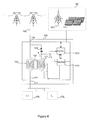
- a further embodiment of a device 600 is shown, based substantially on the power optimisation device 400 of Figures 4 and 5 and wherein like numbers refer to like features, wherein a renewable source of electricity generation 601 such as a solar PV system 601 1 and/or a wind turbine 601 2 is connected to the circuit 104 as an alternate supply source 106 2 .
- a renewable source of electricity generation 601 such as a solar PV system 601 1 and/or a wind turbine 601 2 is connected to the circuit 104 as an alternate supply source 106 2 .
- the device 600 includes a master control unit 602 which is a data processing unit programmed to automatically control actuation of the switch 109, as well as the connection of the alternate supply source 106 2 to the circuit, based on feedback signals which include Low Voltage (LV) side volts, demand and frequency; High Voltage (HV) side volts, demand and frequency; the output of the renewable source of electricity generation 601; the charge level and capacity of the power storage system 401; and control signals related to demand and frequency.
- LV Low Voltage
- HV High Voltage
- alternative power generated by the renewable source 601 can be fed to the storage system 401 by a dual input. Otherwise, the alternative power generated by the renewable source 601 may be fed directly to the main utility of the system, for example a building. This switching of the alternative power generated by the renewable source 601 is controlled by the master control unit 602.
Landscapes
- Engineering & Computer Science (AREA)
- Power Engineering (AREA)
- Computer Networks & Wireless Communication (AREA)
- Supply And Distribution Of Alternating Current (AREA)
- Charge And Discharge Circuits For Batteries Or The Like (AREA)
Abstract
Description
- The present invention relates to a circuit configuration for an electrical device. More particularly, the present invention relates to a novel and improved configuration for a transformer, a voltage optimisation system or the like.
- Transformers are electrical devices in power networks that transfer electrical energy between circuits through electromagnetic induction. A typical transformer comprises at least two windings, a primary winding and a secondary winding, about a core. A current from a current supply, typically an alternative current from an electrical grid, is supplied into the transformer's primary winding, creates a magnetic flux in the core, and a magnetic field impinges on the secondary winding and induces a voltage therein.
- Voltage optimisation devices are a type of transformer used to optimise the characteristics of the current supplied at the source according to current characteristics required at a load. Voltage optimisation devices accordingly also transform the first current into a second current, which meets the characteristics of the current required at the load. The first current is typically an alternating voltage, which may be either lower than the second alternating voltage, in which case the resultant voltage is increased and said to be stepped up, or higher than the second alternating voltage, in which case the resultant voltage is decreased and said to be stepped down. This transformation routinely results in excess transformed voltage.
- In voltage optimisation systems of the prior art, the supply current flows into the first winding to the second winding of a voltage optimisation device, wherein the magnetic flux causes the induction of a reverse current, which is a fraction of the supply current. This reverse current has a negative charge and flows in the opposite direction to the supply current, wherein it is directed back into the current supply. This reverse current is also anti-phase to the supply current, and these characteristics contribute to the efficiency and optimising function of a voltage optimiser. This reverse current is a real form of energy, which is distinct from current traditionally referred to as 'apparent' or 'reactive'. This reverse current also constitutes excess transformed current.
- Having regard to the increasing costs and difficulty of maintaining and improving infrastructures dedicated to the production of electricity and the powering of electrical grids, the widespread adoption of supply sources commonly referred to as renewable energy sources and typically constituted of wind- and solar-powered generators is occurring in parallel with a drive to minimize electrical consumption and maximize the use made of the supplied electricity. In that context, a solution is needed for harnessing the above mentioned excess transformed current for alternative uses.
- The present invention provides both a novel method of processing power in an electrical device, and a device implementing the method, for harnessing the excess current produced in a transformer, with additional switching means at the primary winding for facilitating the extraction of this excess current towards a secondary load, for instance energy storage means.
- According to an aspect of the present invention, there is therefore provided an electrical device, comprising a primary conducting element connected with a secondary conducting element in a first parallel circuit; and a current supply inlet and a primary load outlet connected in series with the secondary conducting element, wherein the primary conducting element contains reverse current induced by the secondary conducting element in use. The device is characterised in that it further comprises a secondary load outlet connected with the primary conducting element in a second parallel circuit; and a switching means located in the first parallel circuit, having a first position for closing the primary conducting element to direct supply current from the current supply inlet to the secondary load outlet, and a second position opening the primary conducting element to direct reverse current from the primary conducting element to the secondary load outlet.
- The inventive principle disclosed herein thus provides a solution for extracting the reverse current generated in an electrical circuit to a secondary load outlet at which it may be put to further use, non-limitative examples of which include storage for ulterior off-grid powering and/or powering of low-requirement electrical motors and the like, rather than allowing it to wastefully return into the supply.
- In an embodiment of the device, the first and second conducting elements are windings about a core member.
- In an embodiment of the device, the current from the current supply inlet is a first alternating voltage and the first parallel circuit is adapted to transform the first alternating voltage into a second alternating voltage which is higher or lower than the first alternating voltage.
- In an embodiment of the device, the second parallel circuit further comprises a rectifier. In a variant of this embodiment, the secondary load outlet is connected to electrical power storage means.
- Advantageously, embodiments including power storage means allow such storage means to be charged continuously so long as the device is in use and may usefully also allow such storage means to be selectively charged by the supply source directly.
- In a further variant, the electrical power storage means may be coupled with an inverter. In a further variant, the device may further comprise data processing means adapted to switch supply to the first parallel circuit between the current supply inlet and the electrical power storage means.
- Advantageously, such embodiments reduce a user's reliance upon a constant supply from an electrical grid, by permitting automatic and/or selective disconnection of the device from the grid and using the current stored in the power storage means, for instance when supply from the grid is interrupted unexpectedly or according to a schedule. Further benefits derived from the above include a reduction of the overall supply required by a user through configurations of the device aimed at scheduled off-grid storage-powered operation, resulting in an improved stability of the electrical grid when the demand is reduced at peak times.
- In an embodiment of the device, the device may further comprise a secondary current supply inlet connected in series with the secondary conducting element. In a variant of this embodiment, the secondary current supply inlet may be connected to at least one generator driven by wind, solar, heat or hydraulic power.
- Advantageously, such embodiments extend the inventive principle to non-grid supply sources and further reduce a user's reliance upon a constant supply from an electrical grid, particularly when combined with other embodiments including power storage means.
- Any of the above embodiments will preferably take the form of a transformer or a voltage optimiser.
- According to another aspect of the present invention, there is also provided a method of processing power in an electrical device, comprising the steps of connecting a primary conducting element with a secondary conducting element in a first parallel circuit; and connecting a current supply inlet and a primary load outlet in series with the secondary conducting element, wherein the primary conducting element contains reverse current induced by the secondary conducting element in use. The method is characterised in that it comprises the further steps of connecting a secondary load outlet with the primary conducting element in a second parallel circuit, locating a switching means in the first parallel circuit, and switching the switching means between a first position for closing the primary conducting element to direct supply current from the current supply inlet to the secondary load outlet, and a second position opening the primary conducting element to direct reverse current from the primary conducting element to the secondary load outlet.
- In an embodiment of the method, the first and second conducting elements are windings about a core member.
- In an embodiment of the method, wherein the current from the current supply inlet may be a first alternating voltage, the method may comprise the further step of transforming the first alternating voltage into a second alternating voltage which is higher or lower than the first alternating voltage with the first parallel circuit.
- In an embodiment of the method, wherein the second parallel circuit further comprises a rectifier, the method may comprise the further step of connecting the secondary load outlet to electrical power storage means. In a variant, the method may comprise the further step of coupling the electrical power storage means with an inverter. In a further variant, the method may comprise the further step of switching supply to the first parallel circuit between the current supply inlet and the electrical power storage means with data processing means.
- An embodiment of the method may comprise the further step of connecting a secondary current supply inlet in series with the secondary conducting element. In a variant, the method may comprise the further step of connecting the secondary current supply inlet to at least one generator driven by wind, solar, heat or hydraulic power.
- Other aspects are as set out in the claims herein.
- For a better understanding of the invention and to show how the same may be carried into effect, there will now be described by way of example only, specific embodiments, methods and processes according to the present invention with reference to the accompanying drawings in which:
-
Figure 1 is a functional diagram of a first embodiment of an electrical device according to the invention, having a primary conducting element connected with a secondary conducting element in a first parallel circuit, a current supply inlet and a primary load outlet connected in series with the secondary conducting element, a secondary load outlet connected with the primary conducting element in a second parallel circuit, and a closed switching means located in the first parallel circuit; -
Figure 2 shows current in the embodiment ofFigure 1 during use; -
Figure 3 shows the embodiment ofFigure 1 with the switching means in the first parallel circuit in the open position; -
Figure 4 is a simplified circuit diagram of a second embodiment of the invention as a voltage optimiser with the switching means ofFigures 1 and2 in the first position for closing the primary conducting element to direct supply current from the current supply inlet to the secondary load outlet; -
Figure 5 is a simplified circuit diagram of the voltage optimiser ofFigure 4 , with the switching means in the second position opening the primary conducting element to direct reverse current from the primary conducting element to the secondary load outlet; and -
Figure 6 is a functional diagram of a third embodiment of an electrical device according to the invention, having a secondary current supply and data processing means. - There will now be described by way of example a specific mode contemplated by the inventors. In the following description numerous specific details are set forth in order to provide a thorough understanding. It will be apparent however, to one skilled in the art, that the present invention may be practiced without limitation to these specific details. In other instances, well known methods and structures have not been described in detail so as not to unnecessarily obscure the description.
- With reference to
Figure 1 , a first embodiment of anelectrical device 100 according to the invention is shown, which has aprimary winding 101 connected with asecondary winding 102 and wound about acore 103 in a firstparallel circuit 104. Thedevice 100 further includes acurrent supply inlet 105 to which current is delivered by a connection to anelectrical grid 106. The supplied current is three phase alternating current, by way of non-limitative example representative of common characteristics for alternating current transmission. Thedevice 100 further includes aprimary load outlet 107 connected in series with thesecondary winding 102, for connection to aload 108, for instance electrically-powered office or plant equipment rated for operation at 220V. Thedevice 100 further includes a switching means 109 located in the firstparallel circuit 104 selectively opening and closing theprimary winding 101 to a connection with asecondary load outlet 110 for connection to asecondary load 111 in a secondparallel circuit 112. - The
primary winding 101 hasreal current 200 induced from thesecondary winding 102. With reference toFigure 2 , this primary current 200 has opposite flow direction to the supply current 201, and it can be observed fromFigure 2 that the primary current 200 is anti-phase to the supply andsecondary currents - The inventive principle resides in diverting current for alternate use, in particular extracting reverse current 200, wherein the extracted current 200 is the negatively charged reverse current from the second winding 102 of the
device 100. If the reverse current is to be extracted from theload 108, it is done by the opening of the primary winding 101 in thecircuit 104 through opening theswitch 109. A parallel connection is then made to thesecondary outlet 110 of the primary winding 101 such that the induced reverse current from thedevice 100 is directed to thesecondary outlet 108 for alternate use, such as for astorage system 111 or to supply analternative load 111. If the current is to be diverted from thesupply 105 instead, the primary winding 101 remains closed through closing theswitch 109. - In the example shown in
Figure 1 , thedevice 100 is configured with theswitch 109 closed, thus wherein the primary winding 101 is closed, whereby the parallel connection to thesecondary outlet 110 is not made. The reverse current 200 is induced as normal, but, in this configuration, is not the extracted current. Because the primary winding 101 is closed, current from thesupply source 107 flows directly to theadditional outlet 110 instead. -
Figure 3 shows thedevice 100 configured with theswitch 109 open, thus wherein the primary winding 101 is open, whereby the parallel connection to thesecondary outlet 110 is made. The reverse current 200 is again induced as normal and, in this configuration, is the current extracted to thesecondary outlet 110. Because the primary winding 101 is open, current from thesupply source 107 flows to the secondary winding 102 only. - With reference to
Figure 4 now, a second embodiment of anelectrical device 100 is shown, as avoltage optimiser 400 also having an open primary winding 101 and a parallel connection. Thevoltage optimiser 400 performs the conventional functions of a voltage optimiser, but the induced reverse current 200 generated as part of such conventional functions is extracted into apower storage system 401 via aninverter 402. - The voltage optimisation system of
Figure 4 is thus again configured to receive a current from anelectrical grid 106. The current at thesupply inlet 105 is stepped down to the requirements of theload 108 and, in the embodiment as shown inFigure 3 , also charges apower storage system 401 as the switching means 109 ofFigures 1 and2 in the first position for closing the primary winding 101 to direct supply current from thecurrent supply inlet 105 to thesecondary load outlet 110, as first shown inFigure 1 . - Accordingly, the
voltage optimiser 400 again has a primary winding 101 connected with a secondary winding 102 and wound about acore 103 in a firstparallel circuit 104. Thedevice 400 again includes acurrent supply inlet 105 to which current is delivered by a connection to anelectrical grid 106. Thedevice 400 again includes aprimary load outlet 107 connected in series with the secondary winding 102, for connection to one or moreprimary loads 108N, for instance electrically-powered office or plant equipment rated for operation at 220V. - The
device 400 again includes a switching means 109 located in the firstparallel circuit 104 selectively opening and closing the primary winding 101 to a connection with asecondary load outlet 110 for connection to apower storage system 401 in a secondparallel circuit 112. - The
power storage system 401 comprises the AC/DC inverter 402 connected in parallel with abattery 403 in the secondparallel circuit 112. Thevoltage optimiser 400 further comprises first and second DC/AC inverters first inverter 404 is located between thecurrent supply inlet 105 and the battery outlet 406 and thesecond inverter 405 is located between theprimary load outlet 107 and the battery outlet 406. - With reference to
Figure 5 , thevoltage optimiser 400 is shown with the switching means 109 ofFigures 1 ,3 and4 in the second position for opening the primary winding 101 to direct reverse current from theprimary load outlet 107 to thepower storage system 401, as first shown inFigure 3 . - It should be noted that the capacity to store from the
load 108 applies both when thevoltage optimisation device 400 is configured wherein the first alternating voltage supplied at theinlet 105 is higher than the secondary alternating voltage required at the load(s) 108, meaning the voltage is "stepped down", as well as when the first alternatingvoltage 105 is lower than the secondary alternating voltage, in which case the resultant voltage is thereby increased and said to be "stepped up". - If the connection of the primary winding 101 is again made via the
switch 109, the configuration returns to that shown inFigure 4 wherein the induced reverse current 200 is no longer diverted intostorage 401. Thestorage device 402 is then again directly charged by thesupply source 105. The timing for this configuration may advantageously correspond with a period of low power tariff, whereby thestorage device 402 can be charged rapidly and cost-effectively. - Accordingly, it will be readily understood by the skilled reader that the above embodiments may be partially or fully automated with the adjunction of controlling hardware interfacing the various components of the
device embodiments secondary load switch 109 according to one or both of physical pre-determined parameters, such as supply power levels and/or the presence of reverse current from the load(s) 108, and administrative pre-determined parameters such as scheduled power costs and/or scheduled operation of office orplant equipment 108. - With reference to
Figure 6 , a further embodiment of adevice 600 is shown, based substantially on thepower optimisation device 400 ofFigures 4 and5 and wherein like numbers refer to like features, wherein a renewable source ofelectricity generation 601 such as asolar PV system 6011 and/or awind turbine 6012 is connected to thecircuit 104 as analternate supply source 1062. - The
device 600 includes amaster control unit 602 which is a data processing unit programmed to automatically control actuation of theswitch 109, as well as the connection of thealternate supply source 1062 to the circuit, based on feedback signals which include Low Voltage (LV) side volts, demand and frequency; High Voltage (HV) side volts, demand and frequency; the output of the renewable source ofelectricity generation 601; the charge level and capacity of thepower storage system 401; and control signals related to demand and frequency. - In this embodiment, when an additional source of electrical charge is needed for the
storage device 402, for example if a greater amount of discharge is required according to a powering schedule, alternative power generated by therenewable source 601 can be fed to thestorage system 401 by a dual input. Otherwise, the alternative power generated by therenewable source 601 may be fed directly to the main utility of the system, for example a building. This switching of the alternative power generated by therenewable source 601 is controlled by themaster control unit 602. - In this specification the terms "comprise, comprises, comprised and comprising" or any variation thereof and the terms include, includes, included and including" or any variation thereof are considered to be totally interchangeable and they should all be afforded the widest possible interpretation and vice versa.
- The invention is not limited to the embodiments hereinbefore described but may be varied in both construction and detail.
Claims (15)
- An electrical device, comprising
a primary conducting element connected with a secondary conducting element in a first parallel circuit;
a current supply inlet and a primary load outlet connected in series with the secondary conducting element, wherein the primary conducting element contains reverse current induced by the secondary conducting element in use;
characterised in that the electrical further comprises
a secondary load outlet connected with the primary conducting element in a second parallel circuit; and
a switching means located in the first parallel circuit, having a first position for closing the primary conducting element to direct supply current from the current supply inlet to the secondary load outlet, and a second position opening the primary conducting element to direct reverse current from the primary conducting element to the secondary load outlet. - An electrical device according to claim 1, wherein the first and second conducting elements are windings about a core member.
- An electrical device according to claim 1 or 2, wherein the current from the current supply inlet is a first alternating voltage and the first parallel circuit is adapted to transform the first alternating voltage into a second alternating voltage which is higher or lower than the first alternating voltage.
- An electrical device according to any of claims 1 to 3, wherein the second parallel circuit further comprises a rectifier.
- An electrical device according to claim 4, wherein the secondary load outlet is connected to electrical power storage means coupled with an inverter.
- An electrical device according to claim 6, further comprising data processing means adapted to switch supply to the first parallel circuit between the current supply inlet and the electrical power storage means.
- An electrical device according to any of claims 1 to 6, further comprising a secondary current supply inlet connected in series with the secondary conducting element.
- An electrical device according to claim 7 wherein the secondary current supply inlet is connected to at least one generator driven by wind, solar, heat or hydraulic power.
- A method of processing power in an electrical device, comprising the steps of:connecting a primary conducting element with a secondary conducting element in a first parallel circuit;connecting a current supply inlet and a primary load outlet in series with the secondary conducting element, wherein the primary conducting element contains reverse current induced by the secondary conducting element in use;characterised in that the method comprises the further steps of:connecting a secondary load outlet with the primary conducting element in a second parallel circuit;locating a switching means in the first parallel circuit; andswitching the switching means between a first position for closing the primary conducting element to direct supply current from the current supply inlet to the secondary load outlet, and a second position opening the primary conducting element to direct reverse current from the primary conducting element to the secondary load outlet.
- A method according to claim 9, wherein the first and second conducting elements are windings about a core member.
- A method according to claim 9 or 10, wherein the current from the current supply inlet is a first alternating voltage and the method comprises the further step of transforming the first alternating voltage into a second alternating voltage which is higher or lower than the first alternating voltage with the first parallel circuit.
- A method according to any of claims 9 to 11, wherein the second parallel circuit further comprises a rectifier and the method comprises the further step of connecting the secondary load outlet to electrical power storage means.
- A method according to claim 12, comprising the further step of coupling the electrical power storage means with an inverter.
- A method according to claim 13, comprising the further step of switching supply to the first parallel circuit between the current supply inlet and the electrical power storage means with data processing means.
- A method according to any of claims 9 to 14, comprising the further step of connecting a secondary current supply inlet in series with the secondary conducting element.
Applications Claiming Priority (1)
| Application Number | Priority Date | Filing Date | Title |
|---|---|---|---|
| GB1416092.3A GB2533900A (en) | 2014-09-11 | 2014-09-11 | Electrical device |
Publications (2)
| Publication Number | Publication Date |
|---|---|
| EP2996216A1 true EP2996216A1 (en) | 2016-03-16 |
| EP2996216B1 EP2996216B1 (en) | 2018-05-23 |
Family
ID=51869468
Family Applications (1)
| Application Number | Title | Priority Date | Filing Date |
|---|---|---|---|
| EP15002651.6A Not-in-force EP2996216B1 (en) | 2014-09-11 | 2015-09-10 | Electrical device |
Country Status (4)
| Country | Link |
|---|---|
| US (1) | US9948107B2 (en) |
| EP (1) | EP2996216B1 (en) |
| AU (1) | AU2015224507A1 (en) |
| GB (1) | GB2533900A (en) |
Families Citing this family (1)
| Publication number | Priority date | Publication date | Assignee | Title |
|---|---|---|---|---|
| US12237682B2 (en) | 2019-10-28 | 2025-02-25 | Breakeats Llc | Efficient hierarchical distributed power storage |
Citations (3)
| Publication number | Priority date | Publication date | Assignee | Title |
|---|---|---|---|---|
| US6498464B1 (en) * | 1998-09-29 | 2002-12-24 | Siemens Aktiengesellschaft | System for supplying power to a load connected to a distribution network |
| WO2011092527A1 (en) * | 2010-01-26 | 2011-08-04 | Gradix Kft | Ac voltage reduction by means of a transformer |
| WO2013079962A2 (en) * | 2011-11-30 | 2013-06-06 | Apex Cables Limited | Apparatus for controlling the voltage in an alternating current electricity supply |
Family Cites Families (2)
| Publication number | Priority date | Publication date | Assignee | Title |
|---|---|---|---|---|
| GB2477327A (en) * | 2010-01-29 | 2011-08-03 | C & C Marshall Ltd | Domestic voltage reduction device |
| GB2504971A (en) * | 2012-08-15 | 2014-02-19 | Univ Warwick | Calculating the reduction in power consumption or energy usage provided by a voltage optimizer |
-
2014
- 2014-09-11 GB GB1416092.3A patent/GB2533900A/en not_active Withdrawn
-
2015
- 2015-09-10 EP EP15002651.6A patent/EP2996216B1/en not_active Not-in-force
- 2015-09-11 US US14/850,996 patent/US9948107B2/en active Active - Reinstated
- 2015-09-11 AU AU2015224507A patent/AU2015224507A1/en not_active Abandoned
Patent Citations (3)
| Publication number | Priority date | Publication date | Assignee | Title |
|---|---|---|---|---|
| US6498464B1 (en) * | 1998-09-29 | 2002-12-24 | Siemens Aktiengesellschaft | System for supplying power to a load connected to a distribution network |
| WO2011092527A1 (en) * | 2010-01-26 | 2011-08-04 | Gradix Kft | Ac voltage reduction by means of a transformer |
| WO2013079962A2 (en) * | 2011-11-30 | 2013-06-06 | Apex Cables Limited | Apparatus for controlling the voltage in an alternating current electricity supply |
Also Published As
| Publication number | Publication date |
|---|---|
| GB201416092D0 (en) | 2014-10-29 |
| US9948107B2 (en) | 2018-04-17 |
| EP2996216B1 (en) | 2018-05-23 |
| US20160079759A1 (en) | 2016-03-17 |
| AU2015224507A1 (en) | 2016-03-31 |
| GB2533900A (en) | 2016-07-13 |
Similar Documents
| Publication | Publication Date | Title |
|---|---|---|
| Sechilariu et al. | Building-integrated microgrid: Advanced local energy management for forthcoming smart power grid communication | |
| Liu et al. | An efficient wind–photovoltaic hybrid generation system using doubly excited permanent-magnet brushless machine | |
| EP3549222B1 (en) | Apparatus for use in a microgrid and methods of operating the same | |
| US10033190B2 (en) | Inverter with at least two DC inputs, photovoltaic system comprising such an inverter and method for controlling an inverter | |
| US20130119769A1 (en) | Energy Systems And Energy Storage System Charging Methods | |
| Manojkumar et al. | Power electronics interface for hybrid renewable energy system—A survey | |
| Ramakrishnan et al. | Review on Backup Storage System in Wind Energy Conversion System | |
| EP2996216B1 (en) | Electrical device | |
| WO2017117840A1 (en) | Multiple energy source interconnected router and control method therefor | |
| Parvathy et al. | A photovoltaic water pumping system with high efficiency and high lifetime | |
| EP3022820B1 (en) | Control arrangement | |
| Padmashini et al. | Energy management for distributed energy storage system | |
| Sulaiman et al. | Multi-Input Transformer Coupled DC-DC Converter For Rural Electrification Using Renewable Energy Sources | |
| Jeong et al. | Test-bed implementation of DC microgrid in islanding mode | |
| Mathew et al. | Integrated single stage standalone solar PV inverter | |
| Elrayyah et al. | Low complexity structure and control for microinverters with reactive power support capability | |
| CN208674946U (en) | A kind of open air mixing accumulating system | |
| Kumar et al. | Investigating critical role of power flow analysis in optimizing four-port converters for electric vehicle charging | |
| Elanchezhian et al. | Design of two-stage soft-switched module Inverter for Photovoltaic applications | |
| Hojabri | Design, Sizing, and Simulation of a DC Microgrid for Real Implementation | |
| Kumar et al. | Seamless control and unified dynamic energy management in a renewable/clean energy integrated self-reliant DC microgrid: integration of renewable sources with high-gain power processing stages | |
| Du | A Four-Port Bidirectional DC-DC Converter for Renewable Energy System and Microgrid | |
| Thin et al. | ENERGY MANAGEMENT OF WIND POWER SUPPLY SYSTEM WITH BATTERY STORAGE | |
| Anipriya et al. | OPTIMIZATION OF PV-WIND-BATTERY BASED MULTI-INPUT TRANSFORMER COUPLED HYBRID CONVERTER FOR HOUSEHOLD APPLICATIONS | |
| Gonzalez Ortega | Dual active bridge DC-DC converter in photovoltaic applications |
Legal Events
| Date | Code | Title | Description |
|---|---|---|---|
| PUAI | Public reference made under article 153(3) epc to a published international application that has entered the european phase |
Free format text: ORIGINAL CODE: 0009012 |
|
| 17P | Request for examination filed |
Effective date: 20150910 |
|
| AK | Designated contracting states |
Kind code of ref document: A1 Designated state(s): AL AT BE BG CH CY CZ DE DK EE ES FI FR GB GR HR HU IE IS IT LI LT LU LV MC MK MT NL NO PL PT RO RS SE SI SK SM TR |
|
| AX | Request for extension of the european patent |
Extension state: BA ME |
|
| GRAP | Despatch of communication of intention to grant a patent |
Free format text: ORIGINAL CODE: EPIDOSNIGR1 |
|
| INTG | Intention to grant announced |
Effective date: 20171218 |
|
| GRAS | Grant fee paid |
Free format text: ORIGINAL CODE: EPIDOSNIGR3 |
|
| GRAA | (expected) grant |
Free format text: ORIGINAL CODE: 0009210 |
|
| AK | Designated contracting states |
Kind code of ref document: B1 Designated state(s): AL AT BE BG CH CY CZ DE DK EE ES FI FR GB GR HR HU IE IS IT LI LT LU LV MC MK MT NL NO PL PT RO RS SE SI SK SM TR |
|
| REG | Reference to a national code |
Ref country code: GB Ref legal event code: FG4D |
|
| REG | Reference to a national code |
Ref country code: CH Ref legal event code: EP |
|
| REG | Reference to a national code |
Ref country code: IE Ref legal event code: FG4D |
|
| REG | Reference to a national code |
Ref country code: AT Ref legal event code: REF Ref document number: 1002287 Country of ref document: AT Kind code of ref document: T Effective date: 20180615 |
|
| REG | Reference to a national code |
Ref country code: DE Ref legal event code: R096 Ref document number: 602015011320 Country of ref document: DE |
|
| REG | Reference to a national code |
Ref country code: NL Ref legal event code: MP Effective date: 20180523 |
|
| REG | Reference to a national code |
Ref country code: LT Ref legal event code: MG4D |
|
| PG25 | Lapsed in a contracting state [announced via postgrant information from national office to epo] |
Ref country code: SE Free format text: LAPSE BECAUSE OF FAILURE TO SUBMIT A TRANSLATION OF THE DESCRIPTION OR TO PAY THE FEE WITHIN THE PRESCRIBED TIME-LIMIT Effective date: 20180523 Ref country code: FI Free format text: LAPSE BECAUSE OF FAILURE TO SUBMIT A TRANSLATION OF THE DESCRIPTION OR TO PAY THE FEE WITHIN THE PRESCRIBED TIME-LIMIT Effective date: 20180523 Ref country code: BG Free format text: LAPSE BECAUSE OF FAILURE TO SUBMIT A TRANSLATION OF THE DESCRIPTION OR TO PAY THE FEE WITHIN THE PRESCRIBED TIME-LIMIT Effective date: 20180823 Ref country code: NO Free format text: LAPSE BECAUSE OF FAILURE TO SUBMIT A TRANSLATION OF THE DESCRIPTION OR TO PAY THE FEE WITHIN THE PRESCRIBED TIME-LIMIT Effective date: 20180823 Ref country code: ES Free format text: LAPSE BECAUSE OF FAILURE TO SUBMIT A TRANSLATION OF THE DESCRIPTION OR TO PAY THE FEE WITHIN THE PRESCRIBED TIME-LIMIT Effective date: 20180523 Ref country code: LT Free format text: LAPSE BECAUSE OF FAILURE TO SUBMIT A TRANSLATION OF THE DESCRIPTION OR TO PAY THE FEE WITHIN THE PRESCRIBED TIME-LIMIT Effective date: 20180523 |
|
| PG25 | Lapsed in a contracting state [announced via postgrant information from national office to epo] |
Ref country code: GR Free format text: LAPSE BECAUSE OF FAILURE TO SUBMIT A TRANSLATION OF THE DESCRIPTION OR TO PAY THE FEE WITHIN THE PRESCRIBED TIME-LIMIT Effective date: 20180824 Ref country code: RS Free format text: LAPSE BECAUSE OF FAILURE TO SUBMIT A TRANSLATION OF THE DESCRIPTION OR TO PAY THE FEE WITHIN THE PRESCRIBED TIME-LIMIT Effective date: 20180523 Ref country code: HR Free format text: LAPSE BECAUSE OF FAILURE TO SUBMIT A TRANSLATION OF THE DESCRIPTION OR TO PAY THE FEE WITHIN THE PRESCRIBED TIME-LIMIT Effective date: 20180523 Ref country code: LV Free format text: LAPSE BECAUSE OF FAILURE TO SUBMIT A TRANSLATION OF THE DESCRIPTION OR TO PAY THE FEE WITHIN THE PRESCRIBED TIME-LIMIT Effective date: 20180523 Ref country code: NL Free format text: LAPSE BECAUSE OF FAILURE TO SUBMIT A TRANSLATION OF THE DESCRIPTION OR TO PAY THE FEE WITHIN THE PRESCRIBED TIME-LIMIT Effective date: 20180523 |
|
| REG | Reference to a national code |
Ref country code: AT Ref legal event code: MK05 Ref document number: 1002287 Country of ref document: AT Kind code of ref document: T Effective date: 20180523 |
|
| PG25 | Lapsed in a contracting state [announced via postgrant information from national office to epo] |
Ref country code: AT Free format text: LAPSE BECAUSE OF FAILURE TO SUBMIT A TRANSLATION OF THE DESCRIPTION OR TO PAY THE FEE WITHIN THE PRESCRIBED TIME-LIMIT Effective date: 20180523 Ref country code: CZ Free format text: LAPSE BECAUSE OF FAILURE TO SUBMIT A TRANSLATION OF THE DESCRIPTION OR TO PAY THE FEE WITHIN THE PRESCRIBED TIME-LIMIT Effective date: 20180523 Ref country code: RO Free format text: LAPSE BECAUSE OF FAILURE TO SUBMIT A TRANSLATION OF THE DESCRIPTION OR TO PAY THE FEE WITHIN THE PRESCRIBED TIME-LIMIT Effective date: 20180523 Ref country code: SK Free format text: LAPSE BECAUSE OF FAILURE TO SUBMIT A TRANSLATION OF THE DESCRIPTION OR TO PAY THE FEE WITHIN THE PRESCRIBED TIME-LIMIT Effective date: 20180523 Ref country code: PL Free format text: LAPSE BECAUSE OF FAILURE TO SUBMIT A TRANSLATION OF THE DESCRIPTION OR TO PAY THE FEE WITHIN THE PRESCRIBED TIME-LIMIT Effective date: 20180523 Ref country code: EE Free format text: LAPSE BECAUSE OF FAILURE TO SUBMIT A TRANSLATION OF THE DESCRIPTION OR TO PAY THE FEE WITHIN THE PRESCRIBED TIME-LIMIT Effective date: 20180523 Ref country code: DK Free format text: LAPSE BECAUSE OF FAILURE TO SUBMIT A TRANSLATION OF THE DESCRIPTION OR TO PAY THE FEE WITHIN THE PRESCRIBED TIME-LIMIT Effective date: 20180523 |
|
| REG | Reference to a national code |
Ref country code: DE Ref legal event code: R097 Ref document number: 602015011320 Country of ref document: DE |
|
| PG25 | Lapsed in a contracting state [announced via postgrant information from national office to epo] |
Ref country code: IT Free format text: LAPSE BECAUSE OF FAILURE TO SUBMIT A TRANSLATION OF THE DESCRIPTION OR TO PAY THE FEE WITHIN THE PRESCRIBED TIME-LIMIT Effective date: 20180523 Ref country code: SM Free format text: LAPSE BECAUSE OF FAILURE TO SUBMIT A TRANSLATION OF THE DESCRIPTION OR TO PAY THE FEE WITHIN THE PRESCRIBED TIME-LIMIT Effective date: 20180523 |
|
| PLBE | No opposition filed within time limit |
Free format text: ORIGINAL CODE: 0009261 |
|
| STAA | Information on the status of an ep patent application or granted ep patent |
Free format text: STATUS: NO OPPOSITION FILED WITHIN TIME LIMIT |
|
| REG | Reference to a national code |
Ref country code: DE Ref legal event code: R119 Ref document number: 602015011320 Country of ref document: DE |
|
| PG25 | Lapsed in a contracting state [announced via postgrant information from national office to epo] |
Ref country code: MC Free format text: LAPSE BECAUSE OF FAILURE TO SUBMIT A TRANSLATION OF THE DESCRIPTION OR TO PAY THE FEE WITHIN THE PRESCRIBED TIME-LIMIT Effective date: 20180523 |
|
| REG | Reference to a national code |
Ref country code: CH Ref legal event code: PL |
|
| 26N | No opposition filed |
Effective date: 20190226 |
|
| PG25 | Lapsed in a contracting state [announced via postgrant information from national office to epo] |
Ref country code: SI Free format text: LAPSE BECAUSE OF FAILURE TO SUBMIT A TRANSLATION OF THE DESCRIPTION OR TO PAY THE FEE WITHIN THE PRESCRIBED TIME-LIMIT Effective date: 20180523 |
|
| REG | Reference to a national code |
Ref country code: BE Ref legal event code: MM Effective date: 20180930 |
|
| REG | Reference to a national code |
Ref country code: IE Ref legal event code: MM4A |
|
| PG25 | Lapsed in a contracting state [announced via postgrant information from national office to epo] |
Ref country code: LU Free format text: LAPSE BECAUSE OF NON-PAYMENT OF DUE FEES Effective date: 20180910 |
|
| PG25 | Lapsed in a contracting state [announced via postgrant information from national office to epo] |
Ref country code: DE Free format text: LAPSE BECAUSE OF NON-PAYMENT OF DUE FEES Effective date: 20190402 Ref country code: IE Free format text: LAPSE BECAUSE OF NON-PAYMENT OF DUE FEES Effective date: 20180910 |
|
| PG25 | Lapsed in a contracting state [announced via postgrant information from national office to epo] |
Ref country code: FR Free format text: LAPSE BECAUSE OF NON-PAYMENT OF DUE FEES Effective date: 20180930 Ref country code: BE Free format text: LAPSE BECAUSE OF NON-PAYMENT OF DUE FEES Effective date: 20180930 Ref country code: LI Free format text: LAPSE BECAUSE OF NON-PAYMENT OF DUE FEES Effective date: 20180930 Ref country code: CH Free format text: LAPSE BECAUSE OF NON-PAYMENT OF DUE FEES Effective date: 20180930 |
|
| PG25 | Lapsed in a contracting state [announced via postgrant information from national office to epo] |
Ref country code: AL Free format text: LAPSE BECAUSE OF FAILURE TO SUBMIT A TRANSLATION OF THE DESCRIPTION OR TO PAY THE FEE WITHIN THE PRESCRIBED TIME-LIMIT Effective date: 20180523 |
|
| PG25 | Lapsed in a contracting state [announced via postgrant information from national office to epo] |
Ref country code: MT Free format text: LAPSE BECAUSE OF NON-PAYMENT OF DUE FEES Effective date: 20180910 |
|
| PG25 | Lapsed in a contracting state [announced via postgrant information from national office to epo] |
Ref country code: TR Free format text: LAPSE BECAUSE OF FAILURE TO SUBMIT A TRANSLATION OF THE DESCRIPTION OR TO PAY THE FEE WITHIN THE PRESCRIBED TIME-LIMIT Effective date: 20180523 |
|
| PG25 | Lapsed in a contracting state [announced via postgrant information from national office to epo] |
Ref country code: PT Free format text: LAPSE BECAUSE OF FAILURE TO SUBMIT A TRANSLATION OF THE DESCRIPTION OR TO PAY THE FEE WITHIN THE PRESCRIBED TIME-LIMIT Effective date: 20180523 |
|
| PG25 | Lapsed in a contracting state [announced via postgrant information from national office to epo] |
Ref country code: CY Free format text: LAPSE BECAUSE OF FAILURE TO SUBMIT A TRANSLATION OF THE DESCRIPTION OR TO PAY THE FEE WITHIN THE PRESCRIBED TIME-LIMIT Effective date: 20180523 Ref country code: MK Free format text: LAPSE BECAUSE OF NON-PAYMENT OF DUE FEES Effective date: 20180523 Ref country code: HU Free format text: LAPSE BECAUSE OF FAILURE TO SUBMIT A TRANSLATION OF THE DESCRIPTION OR TO PAY THE FEE WITHIN THE PRESCRIBED TIME-LIMIT; INVALID AB INITIO Effective date: 20150910 |
|
| PG25 | Lapsed in a contracting state [announced via postgrant information from national office to epo] |
Ref country code: IS Free format text: LAPSE BECAUSE OF FAILURE TO SUBMIT A TRANSLATION OF THE DESCRIPTION OR TO PAY THE FEE WITHIN THE PRESCRIBED TIME-LIMIT Effective date: 20180923 |
|
| PGFP | Annual fee paid to national office [announced via postgrant information from national office to epo] |
Ref country code: GB Payment date: 20230913 Year of fee payment: 9 |
|
| GBPC | Gb: european patent ceased through non-payment of renewal fee |
Effective date: 20240910 |
|
| PG25 | Lapsed in a contracting state [announced via postgrant information from national office to epo] |
Ref country code: GB Free format text: LAPSE BECAUSE OF NON-PAYMENT OF DUE FEES Effective date: 20240910 |