EP2995662B1 - Polishing compositions and methods for polishing cobalt films - Google Patents
Polishing compositions and methods for polishing cobalt films Download PDFInfo
- Publication number
- EP2995662B1 EP2995662B1 EP15175849.7A EP15175849A EP2995662B1 EP 2995662 B1 EP2995662 B1 EP 2995662B1 EP 15175849 A EP15175849 A EP 15175849A EP 2995662 B1 EP2995662 B1 EP 2995662B1
- Authority
- EP
- European Patent Office
- Prior art keywords
- acid
- polishing
- composition
- corrosion
- polishing composition
- Prior art date
- Legal status (The legal status is an assumption and is not a legal conclusion. Google has not performed a legal analysis and makes no representation as to the accuracy of the status listed.)
- Active
Links
Images


Classifications
-
- H—ELECTRICITY
- H10—SEMICONDUCTOR DEVICES; ELECTRIC SOLID-STATE DEVICES NOT OTHERWISE PROVIDED FOR
- H10P—GENERIC PROCESSES OR APPARATUS FOR THE MANUFACTURE OR TREATMENT OF DEVICES COVERED BY CLASS H10
- H10P52/00—Grinding, lapping or polishing of wafers, substrates or parts of devices
- H10P52/40—Chemomechanical polishing [CMP]
- H10P52/403—Chemomechanical polishing [CMP] of conductive or resistive materials
-
- C—CHEMISTRY; METALLURGY
- C09—DYES; PAINTS; POLISHES; NATURAL RESINS; ADHESIVES; COMPOSITIONS NOT OTHERWISE PROVIDED FOR; APPLICATIONS OF MATERIALS NOT OTHERWISE PROVIDED FOR
- C09G—POLISHING COMPOSITIONS; SKI WAXES
- C09G1/00—Polishing compositions
- C09G1/02—Polishing compositions containing abrasives or grinding agents
Definitions
- the present disclosure relates to polishing compositions, and methods for polishing semiconductor substrates using the same. More particularly, this disclosure relates to polishing compositions and methods for polishing cobalt films with various rates and selectivities in semiconductor substrates containing multiple dielectric and metal films.
- CMP Chemical Mechanical Polishing/Planarization
- Co Co
- Co CMP slurries that can polish Co at high MRRs and have a range of selectivities in polishing rates of other metals and metal oxides (Cu, Ti, Ta 2 O 5 , TiO 2 , and RuO 2 ), and dielectric films (SiN, Silicon Oxide, P-Si, and low k dielectrics).
- Cu metals and metal oxides
- TiO 2 , and RuO 2 dielectric films
- SiN Silicon Oxide
- P-Si low k dielectrics
- Co is more chemically reactive than Cu and other noble metals
- Co corrosion prevention is very challenging in advanced nodes' slurry design.
- Current metal polishing slurries are ill-equipped to polish Co films as they suffer from Co corrosion issues in the CMP process. Thus, it is highly desirable to have Co slurries that can remove Co films while not causing Co corrosion.
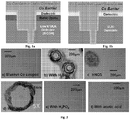
- Figs. 1a and 1b display two Back End stack applications, as examples, in which Co slurries are needed. Each shows both a Co Bulk slurry (Co conductive layer), and a Co Barrier slurry (Co barrier layer).
- the application in Fig. 1a uses an additional metal oxide layer not needed for the application of Fig. 1b .
- the United States Patent number US 8,545,715 B1 discloses a chemical polishing composition and method, wherein the low-k dielectric material removal rate remains stable following polishing of a 110 th polished wafer in a plurality of wafers.
- WO 2009/056491 Aq discloses a CMP slurry composition for planarizing surfaces comprising copper and a diffusion barrier layer comprising an abrasive, an oxidizer, a corrosion inhibitor, an amonomeric polyhydroxy compound, and a base, wherein the slurry composition has a pH between 7 and 13.
- the United States Patent application publication number US 2003/0064671 A1 discloses also a novel CMP slurry composition for polishing metals.
- the disclosed composition comprises an oxidizer and a dispersion solution including an abrasive. By filtering the slurry composition prio to use, a large particle count of less than about 150,000 particles having a size greater than 0.5 ⁇ m in 30 ⁇ l of slurry is achieved.
- the composition may include a chemical activity enhancer like an amine and a corrosion inhibitor.
- the United States Patent application publication number US 2004/0159050 A1 discloses a further slurry composition for polishing metals.
- the composition comprises a dispersion comprising an abrasive. By filtering the slurry composition before use, a large particle count of 25 to 150,000 particles having a particle size greater than 0.5 ⁇ m in 30 ⁇ l of slurry is achieved.
- US 2002/0019128 A1 discloses a further slurry for chemical mechanical polishing of a metal layer. It includes an abrasive, oxidizing agents, a stabilizer comprising an organic acid having a carboxyl group, a corrosion inhibitor, a fluorine compound and deionized water.
- the present disclosure provides CMP polishing compositions for polishing cobalt films. These polishing compositions display high Co Material Removal Rates (MRRs), good MRR selectivities with dielectric and barrier metal films, and superior defectivity and Co surface corrosion protection. With current polishing compositions, cobalt layers exhibit unsatisfactory corrosion.
- MRRs Co Material Removal Rates
- MRR selectivities with dielectric and barrier metal films
- superior defectivity and Co surface corrosion protection With current polishing compositions, cobalt layers exhibit unsatisfactory corrosion.
- the present disclosure relates to a polishing composition in accordance with claim 1, comprising an abrasive, a weak acid acting as a removal rate enhancer (RRE), an azole containing Co corrosion inhibitor (CI), combinations of different azole CIs, and/or a pH adjustor.
- RRE removal rate enhancer
- CI azole containing Co corrosion inhibitor
- the RRE, CI, and the pH adjustor all have a pKa in the 1-18 range (1 ⁇ pKa ⁇ 18), and the polishing composition has a pH in the range of 7-12 (7 ⁇ pH ⁇ 12).
- the overall polishing composition has less than about 100 parts per million (ppm) of sulfate ions and less than about 100 ppm of halide (fluorine, chlorine, bromine or iodine) ions based on total weight of the polishing composition.
- This invention also provides polishing methodsaccording to claims 12 -15, using the aforementioned polishing compositions.
- the present disclosure provides a polishing composition that can polish cobalt with a high selectivity over other dielectric (such as silicon nitride, silicon oxide and polysilicon films), and barrier metal films.
- the present disclosure also provides a polishing composition that can polish cobalt films at very high material removal rates and produce surfaces with very low defectivity post polishing. The post CMP surfaces are also corrosion-free.
- a polishing composition for polishing cobalt containing films in accordance with claim 1.
- the composition comprises an abrasive, a weak acid removal rate enhancer, an azole-containing corrosion inhibitor, and a pH adjuster.
- the removal rate enhancer, the corrosion inhibitor, and the pH adjuster each have a pKa between 1 and 18.
- the pH of the composition is between 7 and 12.
- the overall composition also has less than 100 ppm of sulfates, and less than 100 ppm of halides.
- the present disclosure also provides a method according to claim 12 for polishing a substrate having cobalt on a surface thereof with the composition of claim 1.
- the composition of the present disclosure comprise an abrasive, a weak acid acting as a removal rate enhancer (RRE), at least one azole-containing cobalt (Co) corrosion inhibitor (CI), water, and/or a pH adjustor.
- the RRE, CI, and the pH adjustor each have a pKa in the 1-18 range (1 ⁇ pKa ⁇ 18).
- the polishing composition has a pH in the range of 7-12 (7 ⁇ pH ⁇ 12). Additionally, the composition of the present disclosure has less than 100 parts per million (ppm) of sulfate ions and less than 100 ppm of halide (fluorine, chlorine, bromine or iodine) ions, based on the total weight of the polishing composition.
- ppm parts per million
- halide fluorine, chlorine, bromine or iodine
- the pKa of the RRE, CI, and pH adjustor, along with their associated concentrations, are critical in determining the pH of the slurry and therefore, the final CMP properties (MRRs and corrosion) of the polishing compositions (as discussed in greater detail below).
- the pH of the composition is governed by the pKa of the acidic and corrosion inhibitor components in the slurry such that pH of the slurry (pH slurry ) is related to pKa of the RRE and CI by the following equation: pKa min + 6 ⁇ pH slurry ⁇ pKa max ⁇ 6
- the pKa of each of the RRE, CI, and the pH adjustor is from 1 to 18, or any subranges therebetween.
- the pKa can also be from 2 to 12, or any subranges therebetween, or from 2 to 10, or any subranges therebetween.
- the pH of the composition can be in the range of 7 to 12, or any subranges therebetween, from 7 to 10, or any subranges therebetween, or from 7 to 9, or any subranges therebetween.
- the resulting polishing compositions containing those RREs and CIs have an operating pH in the 7 to 12 pH range.
- the pKa is the logarithmic measure of the acid dissociation constant (Ka) of individual molecules
- the pH of the slurry is the logarithmic measure of the hydrogen ion [H + ] concentration in the slurry/solution.
- the RRE refers to the weak acid molecule that serves to enhance the material removal rates/polish rates of Co, and so is called removal rate enhancer (RRE).
- the corrosion inhibitor refers to the azole containing molecule that serves to prevent corrosion (or inhibit corrosion) on the Co film surface post polishing, and so is called "corrosion inhibitor" (CI).
- compositions having the recited components, in the recited pKa ranges, governed by equation (I), and with the recited sulfate and halide impurity ranges, are found to be particularly well-suited for use in polishing Co.
- Corrosion can be defined as degradation of the properties of a material as a result of chemical reaction with the environment.
- Co films have a different removal and subsequent surface passivation mechanism in different pH ranges, as governed by the Pourbaix Diagram for Cobalt.
- Co metal films have a native Co (II) containing oxide, CoO, on the surface, which is converted to Co(OH) 2 whenever the film comes in contact with any aqueous solution (for e.g., CMP slurry). This Cobalt (II) Hydroxide (Co(OH) 2 ) reacts differently in different pH ranges.
- the predominant passive films formed are Co(II)/Co (III) oxides and hydroxides (Co(OH) 2 , Co 3 O 4 , CoOOH & Co(OH) 3 ).
- Co (II) oxides and Co 2+ ions are the predominant passive films.
- Co (III) passive films are much more passive, i.e., non-reactive, than Co (II) passive films.
- the corrosion and etching rate protection post-polishing of Co (III) passivated films is much better than Co (II) films. This means that the polished Co surface will be more resistant to deleterious effects, such as the corrosion described above.
- the corrosion characteristics of the composition are also much improved by having a weak acid that does not cause any corrosion or does not have any corrosion inducing agent.
- Table 2 lists the strong acids, their pKa, and the corrosion inducing agent contained in them that causes corrosion of Co films. As can be seen from Table 2, all strong acids have some corrosion inducing agent and have pKa ⁇ 0.
- the present disclosure has determined that for Co slurry systems, one should refrain from using strong acids with pKa ⁇ 0, as these cause corrosion on the post-polished surface.
- weak acids are used as RREs and all of these have pKa > 0, as the pKa determines the pH of the slurry and the surface passivation/corrosion characteristics post polishing.
- pKa determines the pH of the slurry and the surface passivation/corrosion characteristics post polishing.
- CMP slurry vendors face is that there are trace metals and impurity ions coming from the raw materials used in making the slurry.
- compositions of the present disclosure have less than 100 parts per million (ppm) of sulfate ions, and less than 100 ppm of halide ions, based on the total weight of the polishing composition. These ranges allow for impurities introduced accidentally, but exclude the deliberate introduction of strong acids with pKa values less than zero. The corrosion caused by sulfate and halide ions at higher levels is discussed below in Example 2, and seen in Figure 3 .
- Co is a first row transition metal like Cu, in the Periodic Table, Co thin films are much more chemically "fragile" than Cu. This is advantageous from a polishing perspective as higher Material Removal Rates (MRRs) can be obtained for Co films.
- MRRs Material Removal Rates
- the big drawback for Co films for not being chemically inert is pitting corrosion post polishing.
- Table 4 a list of azole containing CIs with pKa in the 1-18 range is depicted in Table 4. These CIs prevent Co film surface corrosion post polishing by acting as a strong Co corrosion inhibitor and binding to the Co films, and passivating the films post CMP. The synergistic use of the particular type of RRE and CI combination delivers corrosion free and defect free Co "CMP-ed" films, as is discussed later.
- Table 4 Azole containing Corrosion Inhibitors (pKa > 0; and 1 ⁇ pKa ⁇ 18) that PREVENT Co corrosion in Co slurry systems. These are only some examples of CIs.
- Corrosion Inhibitor Name Formula Conjugate Base pKa Corrosion Inducing Agent Triazole C 2 H 3 N 3 C 2 H 2 N 3 - 2.2 None Aminotriazole C 2 H 4 N 4 C 2 H 3 N 4 - 4.4 None Tetrazole CH 2 N 4 CHN 4 - 4.9 None Benzotriazole C 6 H 5 N 3 C 6 H 4 N 3 - 8.2 None Tolytriazole C 7 H 7 N 3 C 7 H 6 N 3 - 8.8 None Pyrazole C 3 H 4 N 2 C 3 H 3 N 2 - 14 None Imidazole C 3 H 4 N 2 C 3 H 3 N 2 - 14.5 None
- the amount of abrasive in the composition of the present disclosure can be from 0.05 to 15 percent by weight, or any subranges therebetween, or from 0.05 to 10 percent by weight, or any subranges therebetween.
- the amount of RRE can be from 0.1 to 20 percent by weight, or any subranges therebetween, or from 10 to 15 percent by weight, or any subranges therebetween.
- the amount of CI is from 0.05 to 10 percent by weight, or any subranges therebetween, from 0.05 to 6 percent by weight, or any subranges therebetween, or from 1 to 3 percent by weight, or any subranges therebetween.
- the amount of pH adjuster can be up to 2 percent by weight, or any subranges between zero and 2 percent by weight. Unless otherwise indicated in the present specification, all weight amounts are percentage amounts, based on the total weight of the composition.
- the abrasive of the present disclosure can be selected from the group consisting of alumina, silica, titania, ceria, zirconia, co-formed products thereof, coated abrasives, surface modified abrasives, and mixtures thereof.
- RRE which meet the above-described pKa requirements, can be gluconic acid, lactic acid, citric acid, tartaric acid, malic acid, glycolic acid, malonic acid, formic acid, oxalic acid, acetic acid, propionic acid, peracetic acid, succinic acid, lactic acid, potassium acetate, potassium citrate, amino acetic acid, phenoxyacetic acid, bicine, phosphoric acid, diglycolic acid, glyceric acid, tricine, alanine, histidine, valine, phenylalanine, proline, glutamine, aspartic acid, glutamic acid, arginine, lysine, tyrosine, benzoic acid, mixtures thereof, or salts thereof.
- azole-containing CI which meet the above-described pKa requirements, can be of triazole, tetrazole, benzotriazole, tolytriazole, aminotriazole, aminobenzimidazole, pyrazole, imidazole, aminotetrazole, and any mixtures thereof.
- pH adjuster which meet the above-described pKa requirements, can be a weak acid such as citric acid, tartaric acid, malic acid, glycolic acid, malonic acid, oxalic acid, acetic acid, propionic acid, potassium acetate, potassium citrate, or combinations thereof.
- CMP is defined as the concomitant application of chemistry (slurry) and mechanical forces (pressure) causing “Chemical Mechanical” polishing of the wafers containing the metal thin films.
- the chemistry is responsible for the chemical action (etching/corrosion), whereas the mechanical action comes from the abrasive and the tool polishing pressure.
- "Corrosion” in the CMP of metal films denotes a negative connotation, as it is generally referring to an end-result defect, such as pitting, staining, general corrosion and/or surface roughness. However, corrosion is also a necessary part of the metal material removal process in the form of mild etching.
- Corrosion is an oxidation process in which the metal (zero oxidation state) increases its oxidation state to a higher positive number.
- the metal zero oxidation state
- Co films (Co 0 ) once corroded go to Co 2+ and/or Co 3+ .
- This corrosion/oxidation of metal surface causes stress (as per Pilling-Bedworth ratio), and the stress consequently leads to enhanced dissolution rates of the metal films.
- This example demonstrates that the impact of acid additives in a polishing composition on Co corrosion using static etching rate (SER) tests.
- SER static etching rate
- the polishing composition primarily comprises 0.02-3 wt% abrasive, several acids as cobalt RRE, an azole containing corrosion inhibitor or combinations thereof, a weak acid as a pH adjuster and water as a liquid carrier.
- Polishing compositions with different acid additives were tested by 40°C SER to check the corrosion performance. 40°C SER tests were performed on ⁇ 2X2 cm Co coupons immersed in the polishing composition for 5 min. After SER, the Cobalt coupon was rinsed immediately with a lot of DI water and dried with nitrogen gas to clean the surface. The image of post-etched Co coupon surface was taken by Nikon Optical Microscope (made by Nikon Corporation, Japan) for Co corrosion investigation.
- Table 5 lists Co corrosion results for polishing compositions containing 600 ppm of different acid additives.
- a brand new (virgin) blanket Co coupon was used as a control for comparison ( Fig. 2a).
- Figs. 2b - 2f show images of Co coupons etched by polishing compositions (slurries) containing different acid additives as detailed in Table 2. All samples from 5E to 5J showed no Co corrosion, as the pKa of these RREs was in the 1-18 range. However, acids with pKa ⁇ 0 showed massive corrosion in optical images: Figure 2b (Sample 5B: H 2 SO 4 ), Figure 2d (Sample 5C: HCl) and Figure 2c (Sample 5D: HNO 3 ).
- This example demonstrates how Co corrosion is related to sulfate/chloride (or any other halide) anion concentration in the polishing compositions.
- Sulfate/chloride anion concentrations are accurately measured using an ion chromatography (IC), commercially available from Thermo scientific Dionex as IC-5000 model.
- IC ion chromatography
- Other similar IC tools can also be used to quantify sulfate/chloride anion concentration in the polishing compositions.
- IC-5000 model ion chromatography
- sulfate or chloride ions were not intentionally added to the control slurry, the impurity in the raw materials might contribute to ppm levels of sulfate/chloride in the polishing compositions.
- Figs. 3a - 3k As shown in Figs. 3a - 3k , Figs. 4a - 4k , and Table 6, severe Co corrosion occurs when sulfate or chloride concentrations are greater than about 100 ppm individually, based on the total weight of the polishing composition.
- This 100 ppm threshold limit is based on the total weight of the above-described composition.
- the composition of the present disclosure can be diluted at the point of use (POU).
- POU concentration threshold limit should be 10 ppm individually for the sulfate or halide ion.
- sulfate or chloride (a halide) concentrations are less than 100 ppm in the composition of the present disclosure, no Co corrosion was observed under an optical microscope.
- sulfate or halide ions can come from raw materials or certain additives, but the total amount existing in the composition from all sources needs to be no more than about 100 ppm individually of each component, for preventing Co corrosion.
- the composition of the present disclosure can also be referred to as a polishing "concentrate".
- the product is typically sold as a "concentrate”, and customers dilute the supplied concentrate at POU.
- the compositions or concentrates of the present disclosure can be diluted at the (POU) (i.e., before going on the polishing tool) without changing the CMP performance.
- the concentrate polishing composition can be diluted 2X or more at the POU, to form a POU polishing composition.
- the amounts of abrasive, RRE, CI, and pH adjustor will be present in amounts in the POU composition that are proportional to the dilution ratio, but there is no deterioration in performance of the POU composition.
- Water and/or an oxidizer e.g., hydrogen peroxide or ammonium persulfate
- the oxidizer can be added at POU, such that at the POU level, the oxidizer concentration is about 0.0001 wt% to about 5 wt%, based on the total weight of the POU polishing slurry.
- the polishing composition comprised silica particles, RRE and CI with 1 ⁇ pKa ⁇ 18 with a pH in the range of 7-12.
- the sulfate or chloride ions in the polishing composition are less than 100 ppm as confirmed by IC measurements.
- the silica particle can be synthesized using sol-gel method or purchased from commercial particle suppliers such as Evonik Industries of Germany, Nalco Company of USA, or Fuso Chemical Co., Ltd. of Japan.
- An Applied Materials Mirra 200mm CMP polishing tool was used to polish Co films at 1.5 psi using the inventive polishing composition.
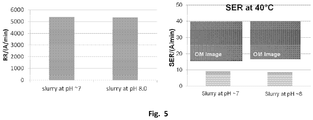
- the polishing composition had very high Co RR of ⁇ 5000 A/min and very low SER of ⁇ 10A/min at 40°C ( Figs. 5a - 5b ).
- the optical images (OM) of Co wafers ( Fig. 5b ) showed that no Co corrosion was occurring post-CMP, using the optimized polishing compositions. This is very important for Co planarization in CMP, where it is often desired to use a Co slurry with a high RR while not having Co corrosion issues.
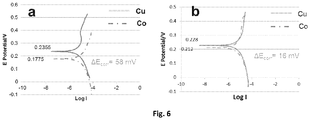
- E corr in a polishing composition can be measured by Tafel plot using electrochemical tool from commercial suppliers such as Princeton Applied Research. As shown by Figs. 6a and 6b , ⁇ E corr between Co and Cu is larger than 30 mV for polishing compositions containing sulfate additives whereas a much lower ⁇ E corr of less than 30 mV is obtained using polishing compositions having sulfate or chloride additive less than 100 ppm and RRE, CI and pH adjuster with pKa in the 1 ⁇ pKa ⁇ 18 range.
- a polishing composition can polish multiple films (metals, dielectrics, etc.) at the same time, and at varying polishing rates.
- the ratio of the polishing rates of different materials polished by the slurry is known as the selectivity of the slurry.
- a Cu slurry may need to polish Cu films at high MRRs and Ta/TaN films at low (and near to zero) MRRs.
- Such a Cu slurry would be called a Cu selective slurry (selective to Cu removal vs. Ta/TaN).
- the polishing composition here contains silica abrasive, RRE, azole based corrosion inhibitor, and acid additives as pH adjuster, with all components having pKa in 1-18 range, and with pH of the slurry in the range of 7-12. Additionally, the slurry has much less than 100 ppm of sulfate and halide ions, as analyzed by IC. The slurry was polished on different blanket films as shown in Table 7 using Applied Materials' Mirra 200mm CMP polishing tool.
- the polishing compositions here had very high selectivity of Co to Ta, TaN, Ti, SiN, TEOS, and poly-Si of greater than 300:1 (table 7), indicating these materials can be used as additional stopping layer or capping materials for Co applications.
- TiN can be used as the additional liner for Co applications (Co: TiN of 9.4), and the inventive polishing compositions can be used in this application to remove both Co and TiN simultaneously, at varying rates. TABLE 7.
- Defectivity is an important parameter during the chip manufacturing process, and it is preferred to have very low defectivity in every step of CMP so as to have high yield of chip dies.
- defectivity can come from corrosion, scratches, polishing byproducts/residues, high Large Particle Counts (LPCs), and particles. It is very difficult to keep the total defectivity counts below 500 since many factors can generate defects. This example demonstrates that the inventive polishing compositions display extremely low total defectivity counts.
- the polishing compositions contains silica abrasive, azole based CI, and RRE/weak acid with pKa in the range of 1-18, and no sulfate or chloride ions added intentionally (4ppm sulfate ion and 1 ppm chloride ions were coming from raw materials as determined by IC).
- the polishing composition was used to polish the Co wafers on Applied Materials Mirra 200mm CMP polishing tool.
- the polished wafers were cleaned with alkaline cleaner and scanned under AIT (KLA-Tencor XUV) tool to generate total defectivity counts and defect maps.
- AIT KLA-Tencor XUV
Landscapes
- Chemical & Material Sciences (AREA)
- Organic Chemistry (AREA)
- Mechanical Treatment Of Semiconductor (AREA)
- Finish Polishing, Edge Sharpening, And Grinding By Specific Grinding Devices (AREA)
- Engineering & Computer Science (AREA)
- Materials Engineering (AREA)
- Chemical Kinetics & Catalysis (AREA)
- General Chemical & Material Sciences (AREA)
Description
- The present disclosure relates to polishing compositions, and methods for polishing semiconductor substrates using the same. More particularly, this disclosure relates to polishing compositions and methods for polishing cobalt films with various rates and selectivities in semiconductor substrates containing multiple dielectric and metal films.
- The semiconductor industry is continually driven to improve chip performance by further miniaturization of devices by process, materials, and integration innovations. Earlier materials innovations included the introduction of copper, replacing aluminum as the conductive material in the interconnect structure, and the use of tantalum (Ta) (adhesion)/tantalum nitride (TaN) (barrier) to separate the Cu conductive material from the non-conductive/insulator dielectric material. Copper (Cu) was chosen as the interconnect material because of its low resistivity and superior resistance against electro-migration. However, as the features of the chip shrink, these multilayer Cu/barrier/dielectric stacks have to be thinner and more conformal to maintain effective interconnect resistivity in Back End of Line (BEOL). However, Cu and the Ta/TaN barrier film scheme present problems with resistivity and flexibility in deposition. With smaller dimensions and advanced manufacturing nodes, resistivity is getting so much exponentially worse that improvements in transistor circuit speed (at Front End of Line (FEOL)) are being cut in half by the delay coming from the conductive Cu/Barrier wiring (BEOL). Cobalt (Co) has emerged as a leading candidate for both the barrier layer as well as the conductive layer. Furthermore, cobalt is also being investigated as a replacement for tungsten (W) metal in multiple applications such as W metal contacts, plugs, vias, and gate materials.
- Chemical Mechanical Polishing/Planarization (CMP) is a semiconductor fabrication process technology that is used to polish and planarize metals and dielectrics in BEOL and FEOL. For instance, for Cu CMP, the conductive Cu layer is polished and planarized until either the barrier layer or the insulator dielectric layer is exposed. The CMP process is performed by using a polishing composition (slurry) on a polishing tool that holds the wafers and presses it against a polishing pad. The concomitant application of chemistry (slurry) and mechanical forces (pressure) causes "Chemical Mechanical" polishing of the wafers. The end goal of the CMP step is to achieve local and global planarity post polishing along with a defect-free and corrosion-free surface. Some key metrics of the CMP slurry/process are Material Removal Rates (MRRs), surface defectivity post-polishing, and metal corrosion/etching prevention post-polishing.
- With the introduction of Cobalt (Co) as a barrier layer, conductive layer, and/or W replacement, there is a market need for Co CMP slurries that can polish Co at high MRRs and have a range of selectivities in polishing rates of other metals and metal oxides (Cu, Ti, Ta2O5, TiO2, and RuO2), and dielectric films (SiN, Silicon Oxide, P-Si, and low k dielectrics). Since Co is more chemically reactive than Cu and other noble metals, Co corrosion prevention is very challenging in advanced nodes' slurry design. Current metal polishing slurries are ill-equipped to polish Co films as they suffer from Co corrosion issues in the CMP process. Thus, it is highly desirable to have Co slurries that can remove Co films while not causing Co corrosion.
-
Figs. 1a and 1b display two Back End stack applications, as examples, in which Co slurries are needed. Each shows both a Co Bulk slurry (Co conductive layer), and a Co Barrier slurry (Co barrier layer). The application inFig. 1a uses an additional metal oxide layer not needed for the application ofFig. 1b . - The United States Patent number
US 8,545,715 B1 discloses a chemical polishing composition and method, wherein the low-k dielectric material removal rate remains stable following polishing of a 110th polished wafer in a plurality of wafers. - Furthermore, the international Patent publication number
WO 2009/056491 Aq discloses a CMP slurry composition for planarizing surfaces comprising copper and a diffusion barrier layer comprising an abrasive, an oxidizer, a corrosion inhibitor, an amonomeric polyhydroxy compound, and a base, wherein the slurry composition has a pH between 7 and 13. - The United States Patent application publication number
US 2003/0064671 A1 discloses also a novel CMP slurry composition for polishing metals. Specifically, the disclosed composition comprises an oxidizer and a dispersion solution including an abrasive. By filtering the slurry composition prio to use, a large particle count of less than about 150,000 particles having a size greater than 0.5µm in 30 µl of slurry is achieved. Additionally, the composition may include a chemical activity enhancer like an amine and a corrosion inhibitor. - The United States Patent application publication number
US 2004/0159050 A1 discloses a further slurry composition for polishing metals. The composition comprises a dispersion comprising an abrasive. By filtering the slurry composition before use, a large particle count of 25 to 150,000 particles having a particle size greater than 0.5µm in 30 µl of slurry is achieved. - The United States Patent application publication number
US 2002/0019128 A1 discloses a further slurry for chemical mechanical polishing of a metal layer. It includes an abrasive, oxidizing agents, a stabilizer comprising an organic acid having a carboxyl group, a corrosion inhibitor, a fluorine compound and deionized water. - The present disclosure provides CMP polishing compositions for polishing cobalt films. These polishing compositions display high Co Material Removal Rates (MRRs), good MRR selectivities with dielectric and barrier metal films, and superior defectivity and Co surface corrosion protection. With current polishing compositions, cobalt layers exhibit unsatisfactory corrosion.
- More particularly, the present disclosure relates to a polishing composition in accordance with claim 1, comprising an abrasive, a weak acid acting as a removal rate enhancer (RRE), an azole containing Co corrosion inhibitor (CI), combinations of different azole CIs, and/or a pH adjustor. The RRE, CI, and the pH adjustor all have a pKa in the 1-18 range (1 < pKa < 18), and the polishing composition has a pH in the range of 7-12 (7 < pH < 12). The overall polishing composition has less than about 100 parts per million (ppm) of sulfate ions and less than about 100 ppm of halide (fluorine, chlorine, bromine or iodine) ions based on total weight of the polishing composition. This invention also provides polishing methodsaccording to claims 12 -15, using the aforementioned polishing compositions.
- The present disclosure provides a polishing composition that can polish cobalt with a high selectivity over other dielectric (such as silicon nitride, silicon oxide and polysilicon films), and barrier metal films. The present disclosure also provides a polishing composition that can polish cobalt films at very high material removal rates and produce surfaces with very low defectivity post polishing. The post CMP surfaces are also corrosion-free.
- Thus, according to the present invention, it is provided a polishing composition for polishing cobalt containing films in accordance with claim 1. The composition comprises an abrasive, a weak acid removal rate enhancer, an azole-containing corrosion inhibitor, and a pH adjuster. The removal rate enhancer, the corrosion inhibitor, and the pH adjuster each have a pKa between 1 and 18. The pH of the composition is between 7 and 12. The overall composition also has less than 100 ppm of sulfates, and less than 100 ppm of halides. The present disclosure also provides a method according to claim 12 for polishing a substrate having cobalt on a surface thereof with the composition of claim 1.
-
-
Figs. 1a and 1b are schematic diagrams of Back End semiconductor stacks depicting the inclusion of Cobalt (Co); both as a conductive layer, and as a barrier layer. -
Figs. 2a-2f display images of Co coupons etched by polishing compositions (slurries) containing different acid additives. -
Figs. 3a - 3k show corrosion images arising from sulfate ions from the raw materials or additives in polishing compositions, at varying concentrations. -
Figs. 4a - 4k show corrosion images arising from chloride ions from the raw materials or additives in polishing compositions, at varying concentrations. -
Figs. 5a and 5b show material removal rates (MRRs) obtained using optimized polishing compositions containing a RRE and CI according to the present disclosure. The inserted images are optical images (OM) of Co wafers after etching with slurries at 40°C for 5 min. -
Figs. 6a and 6b show Tafel plots for Cu and Co in different polishing compositions: a) polishing composition containing 600 ppm Sulfate ions; b) polishing compositions having less than 100 ppm sulfate ions and RREs, CI and pH adjuster according to the present disclosure. -
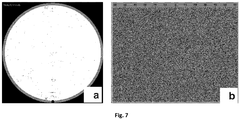
Figs. 7a and 7b show (a) very low defectivity and (b) corrosion-free Co film surfaces post-polishing using the polishing composition of the present disclosure. - The composition of the present disclosure comprise an abrasive, a weak acid acting as a removal rate enhancer (RRE), at least one azole-containing cobalt (Co) corrosion inhibitor (CI), water, and/or a pH adjustor. The RRE, CI, and the pH adjustor each have a pKa in the 1-18 range (1 < pKa < 18). The polishing composition has a pH in the range of 7-12 (7 < pH < 12). Additionally, the composition of the present disclosure has less than 100 parts per million (ppm) of sulfate ions and less than 100 ppm of halide (fluorine, chlorine, bromine or iodine) ions, based on the total weight of the polishing composition.
- The pKa of the RRE, CI, and pH adjustor, along with their associated concentrations, are critical in determining the pH of the slurry and therefore, the final CMP properties (MRRs and corrosion) of the polishing compositions (as discussed in greater detail below). Thus, the pH of the composition is governed by the pKa of the acidic and corrosion inhibitor components in the slurry such that pH of the slurry (pHslurry) is related to pKa of the RRE and CI by the following equation:

- As discussed above, the pKa of each of the RRE, CI, and the pH adjustor is from 1 to 18, or any subranges therebetween. The pKa can also be from 2 to 12, or any subranges therebetween, or from 2 to 10, or any subranges therebetween. The pH of the composition can be in the range of 7 to 12, or any subranges therebetween, from 7 to 10, or any subranges therebetween, or from 7 to 9, or any subranges therebetween.
- As the weak acids and azole containing corrosion inhibitors have pKa in the range of 1 to 18 (in the broadest possible range), the resulting polishing compositions containing those RREs and CIs have an operating pH in the 7 to 12 pH range. The pKa is the logarithmic measure of the acid dissociation constant (Ka) of individual molecules, whereas the pH of the slurry is the logarithmic measure of the hydrogen ion [H+] concentration in the slurry/solution. The RRE refers to the weak acid molecule that serves to enhance the material removal rates/polish rates of Co, and so is called removal rate enhancer (RRE). Furthermore, the corrosion inhibitor refers to the azole containing molecule that serves to prevent corrosion (or inhibit corrosion) on the Co film surface post polishing, and so is called "corrosion inhibitor" (CI).
- For the reasons discussed in greater detail below, compositions having the recited components, in the recited pKa ranges, governed by equation (I), and with the recited sulfate and halide impurity ranges, are found to be particularly well-suited for use in polishing Co.
- Corrosion can be defined as degradation of the properties of a material as a result of chemical reaction with the environment. Co films have a different removal and subsequent surface passivation mechanism in different pH ranges, as governed by the Pourbaix Diagram for Cobalt. Co metal films have a native Co (II) containing oxide, CoO, on the surface, which is converted to Co(OH)2 whenever the film comes in contact with any aqueous solution (for e.g., CMP slurry). This Cobalt (II) Hydroxide (Co(OH)2) reacts differently in different pH ranges. This pH-dependent reaction kinetics and thermodynamics of Co films governs the film dissolution, removal, corrosion, and surface passivation post-polishing mechanisms of CMP polishing compositions, and is summarized in the Table 1 below.
Table 1: Co films dissolution and passivation/corrosion behavior in pH 2 - 12. pH range 2-7 (Acidic) pH = 7 (Neutral) pH range 7-12 (Basic) Co(OH)2 + 2H+ ↔ Co2+ + 2H2O Co(OH)2 ↔ CoO + H2O Co(OH)2 + OH- ↔ CoOOH + H2O + e- 3Co(OH)2 + 2OH- ↔ Co3O4 + 4H2O + 2e- Co(OH)2 + OH- ↔ Co(OH)3 + e- Co films dissolution rate - High Film dissolution - High to Medium Co films dissolution rate - Medium Co Material Removal rates - High Removal rates - High to Medium Co Material Removal rates - Medium Co surface passivation - Low Co surface passivation - Low to Medium Co surface passivation - High - As can be seen from the table above, at a basic pH (pH of 7-12), the predominant passive films formed are Co(II)/Co (III) oxides and hydroxides (Co(OH)2, Co3O4, CoOOH & Co(OH)3). Note that in the acidic and near to neutral pH, Co (II) oxides and Co2+ ions are the predominant passive films. Co (III) passive films are much more passive, i.e., non-reactive, than Co (II) passive films. Thus, the corrosion and etching rate protection post-polishing of Co (III) passivated films is much better than Co (II) films. This means that the polished Co surface will be more resistant to deleterious effects, such as the corrosion described above. Although the surface quality of Co films is the best in basic pH, this comes with the trade-off of lower material removal rates (MRRs) during CMP, as depicted in Table 1. Thus, the present disclosure has determined that using weak acids as RREs, even if the overall MRRs are lower than with stronger acids, provides for better surface protection. In currently available slurries, one would likely not want to use weaker acids due to lower MRRs.
Table 2: Strong Acids (pKa < 0) that cause corrosion in Co slurry systems Acid Name Acid Formula Conjugate Base pKa Corrosion Inducing Agent Chloric acid HClO3 ClO3 - -1 Cl Nitric acid HNO3 NO3 - -1.4 N Sulfuric acid H2SO4 HSO4 - -3 S Hydrochloric acid HCl Cl- -6 Cl Perchloric acid HClO4 ClO4 - -8 Cl Hydrobromic acid HBr Br- -9 Br Hydroiodic acid HI I- -10 I - The corrosion characteristics of the composition are also much improved by having a weak acid that does not cause any corrosion or does not have any corrosion inducing agent. Table 2 lists the strong acids, their pKa, and the corrosion inducing agent contained in them that causes corrosion of Co films. As can be seen from Table 2, all strong acids have some corrosion inducing agent and have pKa < 0.
- The present disclosure has determined that for Co slurry systems, one should refrain from using strong acids with pKa < 0, as these cause corrosion on the post-polished surface. Thus, in the present composition, weak acids are used as RREs and all of these have pKa > 0, as the pKa determines the pH of the slurry and the surface passivation/corrosion characteristics post polishing. However, one major issue that all CMP slurry vendors face is that there are trace metals and impurity ions coming from the raw materials used in making the slurry. As an example, although Hydrochloric acid (HCl with pKa < 0) might not have been intentionally added in the composition, the RRE acid bulk chemical (for example, citric acid with pKa > 0) used in making the slurry might have trace amounts of chloride (Cl) ions as impurity which gets introduced in the slurry once the RRE is used. These trace amounts of corrosion inducing agents introduced in the slurry as an impurity (and not intentionally added) can also cause corrosion on Co films. This intriguing behavior is depicted in Example 1 and
Figure 2 . This is why the compositions of the present disclosure have less than 100 parts per million (ppm) of sulfate ions, and less than 100 ppm of halide ions, based on the total weight of the polishing composition. These ranges allow for impurities introduced accidentally, but exclude the deliberate introduction of strong acids with pKa values less than zero. The corrosion caused by sulfate and halide ions at higher levels is discussed below in Example 2, and seen inFigure 3 . - There are different kinds of corrosion behavior and mechanisms of corrosion for different metal containing films. Within the electronic materials industry, the main forms of corrosion encountered are general corrosion, pitting corrosion, galvanic corrosion, crevice corrosion and inter-granular corrosion. Furthermore, within the CMP industry, the three prevalent forms of corrosion/etching are general, pitting and galvanic corrosion. Thus, most traditional metal polishing slurries (like Cu, and barrier metal) have some form of corrosion inhibitors in them to prevent primarily general corrosion. However, the introduction of "newer" metals such as Co for the conductive and barrier layer introduces new challenges and corrosion problems for the CMP industry. For CMP of Co films, pitting corrosion is the main form of corrosion. Although Co is a first row transition metal like Cu, in the Periodic Table, Co thin films are much more chemically "fragile" than Cu. This is advantageous from a polishing perspective as higher Material Removal Rates (MRRs) can be obtained for Co films. However, the big drawback for Co films for not being chemically inert is pitting corrosion post polishing.
- Not surprisingly, with the integration of Co as a conductive as well as barrier layer for the latest technology node manufacturing, the biggest issue that the CMP community is facing is Co corrosion during or post-CMP. The present disclosure has found that the pKa of the removal rate enhancer (RRE) and the corrosion inhibitor (CI) are critical in determining the operating pH of the slurry and thus the corrosion properties displayed by the slurries. Thus, RREs and CIs are needed which have a pKa in the 1-18 range. Some examples of weak acid RREs with pKa in the 1-18 range are shown in Table 3. These work well for Co slurry systems and do not cause Co film corrosion post polishing.
Table 3: Weak Acids (pKa > 0; and 1 < pKa < 18) that DO NOT cause corrosion in Co slurry systems. These are only some examples of RREs. Acid Name Acid Formula Conjugate Base pKa Corrosion Inducing Agent Oxalic acid H2C2O4 HC2O4 - 1.23 None Phosphoric acid H3PO4 H2PO4 - 2.12 None Citric acid C6H8O7 C6H7O7 - 3.08 None Lactic acid C3H6O3 C3H5O3 - 3.86 None Ascorbic acid C6H8O6 C6H7O6 - 4.10 None Benzoic acid C7H6O2 C7H5O2 - 4.19 None Acetic acid C2H4O2 C2H3O2 - 4.75 None Propionic acid C3H6O2 C3H5O2 - 4.88 None Phenol C6H6O C6H5O- 9.8 None Ethanol C2H6O C2H5O- 16 None - Furthermore, a list of azole containing CIs with pKa in the 1-18 range is depicted in Table 4. These CIs prevent Co film surface corrosion post polishing by acting as a strong Co corrosion inhibitor and binding to the Co films, and passivating the films post CMP. The synergistic use of the particular type of RRE and CI combination delivers corrosion free and defect free Co "CMP-ed" films, as is discussed later.
Table 4: Azole containing Corrosion Inhibitors (pKa > 0; and 1 < pKa < 18) that PREVENT Co corrosion in Co slurry systems. These are only some examples of CIs. Corrosion Inhibitor Name Formula Conjugate Base pKa Corrosion Inducing Agent Triazole C2H3N3 C2H2N3 - 2.2 None Aminotriazole C2H4N4 C2H3N4 - 4.4 None Tetrazole CH2N4 CHN4 - 4.9 None Benzotriazole C6H5N3 C6H4N3 - 8.2 None Tolytriazole C7H7N3 C7H6N3 - 8.8 None Pyrazole C3H4N2 C3H3N2 - 14 None Imidazole C3H4N2 C3H3N2 - 14.5 None - The amount of abrasive in the composition of the present disclosure can be from 0.05 to 15 percent by weight, or any subranges therebetween, or from 0.05 to 10 percent by weight, or any subranges therebetween. The amount of RRE can be from 0.1 to 20 percent by weight, or any subranges therebetween, or from 10 to 15 percent by weight, or any subranges therebetween. The amount of CI is from 0.05 to 10 percent by weight, or any subranges therebetween, from 0.05 to 6 percent by weight, or any subranges therebetween, or from 1 to 3 percent by weight, or any subranges therebetween. When present, the amount of pH adjuster can be up to 2 percent by weight, or any subranges between zero and 2 percent by weight. Unless otherwise indicated in the present specification, all weight amounts are percentage amounts, based on the total weight of the composition.
- The abrasive of the present disclosure can be selected from the group consisting of alumina, silica, titania, ceria, zirconia, co-formed products thereof, coated abrasives, surface modified abrasives, and mixtures thereof. Specific examples of the RRE, which meet the above-described pKa requirements, can be gluconic acid, lactic acid, citric acid, tartaric acid, malic acid, glycolic acid, malonic acid, formic acid, oxalic acid, acetic acid, propionic acid, peracetic acid, succinic acid, lactic acid, potassium acetate, potassium citrate, amino acetic acid, phenoxyacetic acid, bicine, phosphoric acid, diglycolic acid, glyceric acid, tricine, alanine, histidine, valine, phenylalanine, proline, glutamine, aspartic acid, glutamic acid, arginine, lysine, tyrosine, benzoic acid, mixtures thereof, or salts thereof. Specific examples of the azole-containing CI, which meet the above-described pKa requirements, can be of triazole, tetrazole, benzotriazole, tolytriazole, aminotriazole, aminobenzimidazole, pyrazole, imidazole, aminotetrazole, and any mixtures thereof. Specific examples of the pH adjuster, which meet the above-described pKa requirements, can be a weak acid such as citric acid, tartaric acid, malic acid, glycolic acid, malonic acid, oxalic acid, acetic acid, propionic acid, potassium acetate, potassium citrate, or combinations thereof.
- As previously discussed, CMP is defined as the concomitant application of chemistry (slurry) and mechanical forces (pressure) causing "Chemical Mechanical" polishing of the wafers containing the metal thin films. The chemistry is responsible for the chemical action (etching/corrosion), whereas the mechanical action comes from the abrasive and the tool polishing pressure. "Corrosion" in the CMP of metal films denotes a negative connotation, as it is generally referring to an end-result defect, such as pitting, staining, general corrosion and/or surface roughness. However, corrosion is also a necessary part of the metal material removal process in the form of mild etching. Without it, material removal by film dissolution would not occur or would occur in an extremely slow and irrational fashion. Corrosion is an oxidation process in which the metal (zero oxidation state) increases its oxidation state to a higher positive number. For e.g., Co films (Co0) once corroded go to Co2+ and/or Co3+. This corrosion/oxidation of metal surface causes stress (as per Pilling-Bedworth ratio), and the stress consequently leads to enhanced dissolution rates of the metal films. However, if this dynamic corrosion/dissolution of the oxidized metal film is not controlled by the introduction of a corrosion inhibitor (CI) in slurry systems, and the "CMP-ed" surface is not passivated post polishing, the semiconductor device fails post production.
- Thus, the synergistic combination of a limiting number of corrosion inducing agents such as sulfates and halides, along with abrasives, and the right pKa rate enhancers and corrosion inhibitors results in polishing compositions that give high cobalt material removal rates along with a corrosion and defect free surface. This will become evident from the examples and results discussed below.
- Examples are provided to further illustrate the capabilities of the polishing compositions and methods of the present disclosure.
- This example demonstrates that the impact of acid additives in a polishing composition on Co corrosion using static etching rate (SER) tests. This example discloses that in order to prevent Co corrosion, the acid additives in said polishing compositions need to have a pKa within the range of 1< pKa <18. A polishing composition containing strong acid additive (pKa<0) will cause Co corrosion.
- In this example, the polishing composition primarily comprises 0.02-3 wt% abrasive, several acids as cobalt RRE, an azole containing corrosion inhibitor or combinations thereof, a weak acid as a pH adjuster and water as a liquid carrier. Polishing compositions with different acid additives were tested by 40°C SER to check the corrosion performance. 40°C SER tests were performed on ∼ 2X2 cm Co coupons immersed in the polishing composition for 5 min. After SER, the Cobalt coupon was rinsed immediately with a lot of DI water and dried with nitrogen gas to clean the surface. The image of post-etched Co coupon surface was taken by Nikon Optical Microscope (made by Nikon Corporation, Japan) for Co corrosion investigation.
- Table 5 lists Co corrosion results for polishing compositions containing 600 ppm of different acid additives. A brand new (virgin) blanket Co coupon was used as a control for comparison (
Fig. 2a). Figs. 2b - 2f show images of Co coupons etched by polishing compositions (slurries) containing different acid additives as detailed in Table 2. All samples from 5E to 5J showed no Co corrosion, as the pKa of these RREs was in the 1-18 range. However, acids with pKa < 0 showed massive corrosion in optical images:Figure 2b (Sample 5B: H2SO4),Figure 2d (Sample 5C: HCl) andFigure 2c (Sample 5D: HNO3). The corrosion defect pits/holes in Samples 5B, 5C, and 5D (Figs. 2b - 2d ) are as big as 1 micron in diameter. Note that although optical images of only samples 5E (Figure 2e : H3PO4) and 5F (Figure 2f : acetic acid) are shown as representative examples, the Co surface post-polishing for all samples from 5E to 5J showed no Co corrosion, and would have similar optical images.Table 5. Co corrosion Vs. polishing compositions containing different acid additives Sample Acid additive Acid additive pKa Co corrosion 5A, Control (Blanket Co Coupon) None None No 5B H2SO4 <0 Yes 5C HCI <0 Yes 5D HNO3 <0 Yes 5E H3PO4 2.12 NO 5F Acetic acid 4.75 NO 5G Glycolic acid 3.83 NO 5H Malonic acid 2.83 NO 5I Propionic acid 4.88 NO 5J Citric acid 3.08 NO - The results in Table 5 showed that Co corrosion occurred for polishing compositions containing strong acid additive with pKa<0. For polishing compositions containing weak acid (1<pKa<18), the etched Co coupon didn't show Co corrosion. For instance, polishing compositions containing any strong acid such as sulfuric acid, nitric acid or hydrochloric acid will cause severe Co corrosion (
Fig. 2 ). However, polishing compositions containing weak acid additive such as phosphoric acid, acetic acid, glycolic acid, malonic acid, propionic aicd, or citric acid did not have Co corrosion issue (Fig. 2 ). Particularly, the type of Co corrosion here refers to pit corrosion. - This example demonstrates how Co corrosion is related to sulfate/chloride (or any other halide) anion concentration in the polishing compositions.
- Sulfate/chloride anion concentrations are accurately measured using an ion chromatography (IC), commercially available from Thermo scientific Dionex as IC-5000 model. Other similar IC tools can also be used to quantify sulfate/chloride anion concentration in the polishing compositions. Although sulfate or chloride ions were not intentionally added to the control slurry, the impurity in the raw materials might contribute to ppm levels of sulfate/chloride in the polishing compositions. For this example/study, for some compositions, we increased the sulfate or chloride ions in the slurries by intentionally adding sulfuric acid or hydrochloric acid to the control polishing compositions so that there is in-situ generation of sulfate or chloride anions. All the sulfate/chloride concentrations listed in Table 6 were measured by Thermo Dionex IC-5000 IC tool.
Figs. 3a - 3k andFig. 4a - 4k show images of Co coupons after etching by slurries containing different amounts of sulfate or chloride ions, respectively. - As shown in
Figs. 3a - 3k ,Figs. 4a - 4k , and Table 6, severe Co corrosion occurs when sulfate or chloride concentrations are greater than about 100 ppm individually, based on the total weight of the polishing composition. This 100 ppm threshold limit is based on the total weight of the above-described composition. The composition of the present disclosure can be diluted at the point of use (POU). For example, for a composition that is diluted 10X at the POU, the POU concentration threshold limit should be 10 ppm individually for the sulfate or halide ion. When the sulfate or chloride (a halide) concentrations are less than 100 ppm in the composition of the present disclosure, no Co corrosion was observed under an optical microscope. As previously discussed, sulfate or halide ions can come from raw materials or certain additives, but the total amount existing in the composition from all sources needs to be no more than about 100 ppm individually of each component, for preventing Co corrosion. - Since it can be diluted at the point of use (POU), the composition of the present disclosure can also be referred to as a polishing "concentrate". The product is typically sold as a "concentrate", and customers dilute the supplied concentrate at POU. This means that the compositions or concentrates of the present disclosure can be diluted at the (POU) (i.e., before going on the polishing tool) without changing the CMP performance. For example, the concentrate polishing composition can be diluted 2X or more at the POU, to form a POU polishing composition. The amounts of abrasive, RRE, CI, and pH adjustor will be present in amounts in the POU composition that are proportional to the dilution ratio, but there is no deterioration in performance of the POU composition. Water and/or an oxidizer (e.g., hydrogen peroxide or ammonium persulfate) can be added at the POU to achieve the desired dilution ratio. For Co slurries, the oxidizer can be added at POU, such that at the POU level, the oxidizer concentration is about 0.0001 wt% to about 5 wt%, based on the total weight of the POU polishing slurry.
- As seen in Table 6 below, strong acids with negative pKa values will not cause Co corrosion at very low concentrations. However, the amount of the acids that would be present at these very low concentrations would be below the amount needed to effectively remove material from the substrate that is being polished. Thus, these strong acids are not suitable for use in the compositions of the present disclosure, even at very low concentrations that don't cause Co corrosion.
TABLE 6. Co Corrosion vs. sulfate or chloride concentration Acid additive Sample Sulfate (SO4 2-)/ppm Chloride ion (Cl-)/ppm Co Corrosion None Control 4 1 No H2SO4 6A 1000 1 Yes 6B 800 1 Yes 6C 600 1 Yes 6D 500 1 Yes 6E 400 1 Yes 6F 300 1 Yes 6G 200 1 Yes 6H 100 1 Yes 6I 50 1 No 6J 25 1 NO HCl 6K 4 1000 Yes 6L 4 800 Yes 6M 4 600 Yes 6N 4 500 Yes 6O 4 400 Yes 6P 4 300 Yes 6Q 4 200 Yes 6R 4 100 Yes 6S 4 50 No 6T 4 25 NO - This example shows Co removal rate and SER of one optimized polishing composition. The polishing composition comprised silica particles, RRE and CI with 1<pKa<18 with a pH in the range of 7-12. The sulfate or chloride ions in the polishing composition are less than 100 ppm as confirmed by IC measurements. The silica particle can be synthesized using sol-gel method or purchased from commercial particle suppliers such as Evonik Industries of Germany, Nalco Company of USA, or Fuso Chemical Co., Ltd. of Japan. An Applied Materials Mirra 200mm CMP polishing tool was used to polish Co films at 1.5 psi using the inventive polishing composition. The polishing composition had very high Co RR of ∼ 5000 A/min and very low SER of ∼ 10A/min at 40°C (
Figs. 5a - 5b ). The optical images (OM) of Co wafers (Fig. 5b ) showed that no Co corrosion was occurring post-CMP, using the optimized polishing compositions. This is very important for Co planarization in CMP, where it is often desired to use a Co slurry with a high RR while not having Co corrosion issues. - This example shows the impact of acid additives on Corrosion potential difference (ΔEcorr) between Co and Cu. It is well known that galvanic corrosion occurs when two dissimilar metals are in electrical contact in the presence of an electrolyte. The more active metal will be corroded and more noble metal will get protected from Galvanic corrosion. As Co is naturally more chemically reactive that Cu, for integrations involving both Cu and Co metals, the CMP processes for such integrations are challenging due to the galvanic corrosion of Co. To minimize or avoid galvanic corrosion, it is desired to reduce ΔEcorr between Co and Cu to less than 30 mV. This could be achieved by eliminating the strong acid additive (with pKa<1) in the slurry formulations. Ecorr in a polishing composition can be measured by Tafel plot using electrochemical tool from commercial suppliers such as Princeton Applied Research. As shown by
Figs. 6a and 6b , ΔEcorr between Co and Cu is larger than 30 mV for polishing compositions containing sulfate additives whereas a much lower ΔEcorr of less than 30 mV is obtained using polishing compositions having sulfate or chloride additive less than 100 ppm and RRE, CI and pH adjuster with pKa in the 1 < pKa < 18 range. This example demonstrates that galvanic corrosion between Cu and Co can be prevented by using the inventive polishing compositions having sulfate or chloride ions less than 100 ppm and with RRE, CI and pH adjuster with pKa in the 1 - 18 range. - In most CMP processes, it is desirable that a polishing composition (slurry) can polish multiple films (metals, dielectrics, etc.) at the same time, and at varying polishing rates. The ratio of the polishing rates of different materials polished by the slurry is known as the selectivity of the slurry. For example, a Cu slurry may need to polish Cu films at high MRRs and Ta/TaN films at low (and near to zero) MRRs. Such a Cu slurry would be called a Cu selective slurry (selective to Cu removal vs. Ta/TaN). This example shows that the inventive polishing compositions discussed in this disclosure can also be used for polishing other materials such as TiN, Ti, Ta, TaN, SiN, TEOS, polysilicon (poly-Si) with different selectivity to Co films. The polishing composition here contains silica abrasive, RRE, azole based corrosion inhibitor, and acid additives as pH adjuster, with all components having pKa in 1-18 range, and with pH of the slurry in the range of 7-12. Additionally, the slurry has much less than 100 ppm of sulfate and halide ions, as analyzed by IC. The slurry was polished on different blanket films as shown in Table 7 using Applied Materials' Mirra 200mm CMP polishing tool. The polishing compositions here had very high selectivity of Co to Ta, TaN, Ti, SiN, TEOS, and poly-Si of greater than 300:1 (table 7), indicating these materials can be used as additional stopping layer or capping materials for Co applications. As for low/moderate selectivity requirements, TiN can be used as the additional liner for Co applications (Co: TiN of 9.4), and the inventive polishing compositions can be used in this application to remove both Co and TiN simultaneously, at varying rates.
TABLE 7. Co RR Vs. Other metal or dielectric films RR Films Normalized RR RR selectivity (Co: other film) Co 77.09 Ta 0.15 >500 TaN ∼0 >500 Ti 0.07 >500 TiN 8.18 9.4 SiN 0.1 >500 TEOS 0.22 354 Poly-Si 0.14 >500 - Defectivity is an important parameter during the chip manufacturing process, and it is preferred to have very low defectivity in every step of CMP so as to have high yield of chip dies. For metal CMP slurry, defectivity can come from corrosion, scratches, polishing byproducts/residues, high Large Particle Counts (LPCs), and particles. It is very difficult to keep the total defectivity counts below 500 since many factors can generate defects. This example demonstrates that the inventive polishing compositions display extremely low total defectivity counts. The polishing compositions contains silica abrasive, azole based CI, and RRE/weak acid with pKa in the range of 1-18, and no sulfate or chloride ions added intentionally (4ppm sulfate ion and 1 ppm chloride ions were coming from raw materials as determined by IC). The polishing composition was used to polish the Co wafers on Applied Materials Mirra 200mm CMP polishing tool. The polished wafers were cleaned with alkaline cleaner and scanned under AIT (KLA-Tencor XUV) tool to generate total defectivity counts and defect maps. For one inventive polishing composition, the total defectivity counts are only approximately 300. The defect map (
Fig. 7a ), and enlarged "smaller area focused" mode (Fig. 7b ) also showed that no scratches or severe corrosion was present on the polished wafer surface. This low defectivity result of the inventive polishing compositions again demonstrates the benefit of the synergistic effects of eliminating corrosion inducing agents such as sulfate or halides in the polishing composition and using optimized corrosion inhibitor system for Co protection.
Claims (15)
- A polishing composition for polishing cobalt films, comprising:a) an abrasive;b) a weak acid removal rate enhancer;c) an azole-containing corrosion inhibitor; andd) a pH adjuster;wherein said removal rate enhancer, said corrosion inhibitor, and said pH adjuster each have a pKa between 1 and 18, and
wherein the pH of the composition is between 7 and 12, and
wherein the composition has less than 100 parts per million of sulfate ions and less than 100 parts per million of halide ions, each based on the total weight of the composition. - The polishing composition of claim 1, wherein said abrasive is selected from the group consisting of alumina, silica, titania, ceria, zirconia, co-formed products thereof, coated abrasives, surface modified abrasives, and mixtures thereof.
- The polishing composition of claim 1, wherein said removal rate enhancer is selected from the group consisting of gluconic acid, lactic acid, citric acid, tartaric acid, malic acid, glycolic acid, malonic acid, formic acid, oxalic acid, acetic acid, propionic acid, peracetic acid, succinic acid, lactic acid, potassium acetate, potassium citrate, amino acetic acid, phenoxyacetic acid, bicine, phosphoric acid, diglycolic acid, glyceric acid, tricine, alanine, histidine, valine, phenylalanine, proline, glutamine, aspartic acid, glutamic acid, arginine, lysine, tyrosine, benzoic acid, salts thereof, and mixtures thereof.
- The polishing composition of claim 1, wherein the azole-containing corrosion inhibitor is selected from the group consisting of triazole, tetrazole, benzotriazole, tolyltriazole, aminotriazole, aminobenzimidazole, pyrazole, imidazole, aminotetrazole, and mixtures thereof.
- The polishing composition of claim 1, wherein the abrasive is present in an amount of 0.05 to 15 percent by weight, based on the total weight of the composition.
- The polishing composition of claim 1, wherein said removal rate enhancer is present in amount of 0.1 to 20 percent by weight, based on the total weight of the composition.
- The polishing composition of claim 1, wherein said corrosion inhibitor is present in an amount of 0.05 to 10 percent by weight, based on the total weight of the composition.
- The polishing composition of claim 1, wherein said pKa of said removal rate enhancer, said corrosion inhibitor, and said pH adjuster is between 2 and 10.
- The polishing composition of claim 1, wherein the composition has less than 50 parts per million (ppm) of sulfate ions and less than 50 ppm of halide ions.
- The polishing composition of claim 1, wherein the pH adjuster is a weak acid selected from the group consisting of citric acid, tartaric acid, malic acid, glycolic acid, malonic acid, oxalic acid, acetic acid, propionic acid, peracetic acid, succinic acid, lactic acid, potassium acetate, potassium citrate, and combinations thereof.
- A point of use polishing slurry comprising the polishing composition of claim 1, wherein an oxidizer is added to the polishing composition of claim 1 at the point of use,
wherein said oxidizer is hydrogen peroxide, ammonium persulfate, or a combination thereof, or
wherein said oxidizer is present in the point of use polishing slurry in an amount of 0.0001 wt% to 5 wt%, based on the total weight of the polishing slurry. - A polishing method, comprising:applying the polishing composition of claim 1 to a substrate having cobalt on its surface; andremoving at least a portion of the cobalt from the substrate at a first rate, by bringing a pad into contact with the substrate and moving the pad in relation to the substrate.
- The method of claim 12, wherein the substrate further comprises at least one of silicon oxide, silicon nitride, metal oxide, low/ultra-low k dielectric films, and/or polysilicon on the surface, and the method further comprises:
removing said at least one of dielectric and/or metal oxide at a second rate, wherein said first rate is greater than or equal to said second rate. - The method of claim 13, wherein the substrate further comprises at least one other dielectric film selected from the group consisting of silicon oxide, silicon nitride, low/ultra-low k dielectric films, and polysilicon on the surface, and the method further comprises:
removing said at least one of dielectric film at a third rate, wherein said first and second rates are at least 5X greater than the said third rate, and said third rate is less than 100 A/min. - A method for producing a semiconductor device, comprising one of the polishing methods of claims 12, 13, or 14.
Applications Claiming Priority (1)
| Application Number | Priority Date | Filing Date | Title |
|---|---|---|---|
| US14/478,508 US9735030B2 (en) | 2014-09-05 | 2014-09-05 | Polishing compositions and methods for polishing cobalt films |
Publications (2)
| Publication Number | Publication Date |
|---|---|
| EP2995662A1 EP2995662A1 (en) | 2016-03-16 |
| EP2995662B1 true EP2995662B1 (en) | 2018-05-23 |
Family
ID=53785411
Family Applications (1)
| Application Number | Title | Priority Date | Filing Date |
|---|---|---|---|
| EP15175849.7A Active EP2995662B1 (en) | 2014-09-05 | 2015-07-08 | Polishing compositions and methods for polishing cobalt films |
Country Status (7)
| Country | Link |
|---|---|
| US (2) | US9735030B2 (en) |
| EP (1) | EP2995662B1 (en) |
| JP (2) | JP2016058730A (en) |
| KR (1) | KR101787541B1 (en) |
| CN (1) | CN105400434B (en) |
| SG (1) | SG10201505433YA (en) |
| TW (1) | TWI579350B (en) |
Families Citing this family (43)
| Publication number | Priority date | Publication date | Assignee | Title |
|---|---|---|---|---|
| KR102538575B1 (en) * | 2014-10-21 | 2023-06-01 | 씨엠씨 머티리얼즈 엘엘씨 | Cobalt polishing accelerators |
| US9834704B2 (en) * | 2014-10-21 | 2017-12-05 | Cabot Microelectronics Corporation | Cobalt dishing control agents |
| US10619075B2 (en) | 2015-07-13 | 2020-04-14 | Cabot Microelectronics Corporation | Self-stopping polishing composition and method for bulk oxide planarization |
| EP3433327B1 (en) * | 2016-03-22 | 2020-05-20 | Basf Se | Use of a chemical mechanical polishing (cmp) composition for polishing of cobalt and / or cobalt alloy comprising substrates |
| TWI680535B (en) | 2016-06-14 | 2019-12-21 | 美商應用材料股份有限公司 | Oxidative volumetric expansion of metals and metal containing compounds |
| TWI660017B (en) * | 2016-07-14 | 2019-05-21 | Cabot Microelectronics Corporation | Alternative oxidizing agents for cobalt cmp |
| TWI719262B (en) | 2016-11-03 | 2021-02-21 | 美商應用材料股份有限公司 | Deposition and treatment of films for patterning |
| KR20190067939A (en) | 2016-11-08 | 2019-06-17 | 어플라이드 머티어리얼스, 인코포레이티드 | Geometry control of bottom-up fillers for patterning applications |
| TW201839897A (en) | 2017-02-22 | 2018-11-01 | 美商應用材料股份有限公司 | Self-aligned contact patterning critical dimension control |
| US10077382B1 (en) | 2017-03-06 | 2018-09-18 | Rohm And Haas Electronic Materials Cmp Holdings, Inc. | Method for polishing cobalt-containing substrate |
| US10233356B2 (en) | 2017-03-06 | 2019-03-19 | Rohm And Haas Electronic Materials Cmp Holdings, Inc. | Polishing slurry for cobalt-containing substrate |
| WO2018194792A1 (en) * | 2017-04-17 | 2018-10-25 | Cabot Microelectronics Corporation | Self-stopping polishing composition and method for bulk oxide planarization |
| US10636659B2 (en) | 2017-04-25 | 2020-04-28 | Applied Materials, Inc. | Selective deposition for simplified process flow of pillar formation |
| US10676646B2 (en) | 2017-05-25 | 2020-06-09 | Fujifilm Electronic Materials U.S.A., Inc. | Chemical mechanical polishing slurry for cobalt applications |
| US10840186B2 (en) | 2017-06-10 | 2020-11-17 | Applied Materials, Inc. | Methods of forming self-aligned vias and air gaps |
| TW201906035A (en) | 2017-06-24 | 2019-02-01 | 美商微材料有限責任公司 | Method of producing fully self-aligned vias and contacts |
| WO2019046399A1 (en) | 2017-08-31 | 2019-03-07 | Micromaterials Llc | Methods of producing self-aligned vias |
| US10573555B2 (en) | 2017-08-31 | 2020-02-25 | Micromaterials Llc | Methods of producing self-aligned grown via |
| US10600688B2 (en) | 2017-09-06 | 2020-03-24 | Micromaterials Llc | Methods of producing self-aligned vias |
| US10377921B2 (en) | 2017-09-21 | 2019-08-13 | Rohm and Haas Electronics Materials CMP Holdings, Inc. | Chemical mechanical polishing method for cobalt |
| US10170335B1 (en) | 2017-09-21 | 2019-01-01 | Rohm And Haas Electronic Materials Cmp Holdings, Inc. | Chemical mechanical polishing method for cobalt |
| US10428241B2 (en) | 2017-10-05 | 2019-10-01 | Fujifilm Electronic Materials U.S.A., Inc. | Polishing compositions containing charged abrasive |
| US11993729B2 (en) * | 2017-11-22 | 2024-05-28 | Basf Se | Chemical mechanical polishing composition |
| JP2019106538A (en) | 2017-12-07 | 2019-06-27 | マイクロマテリアルズ エルエルシー | Methods for controllable metal and barrier-liner recess |
| EP3499557A1 (en) | 2017-12-15 | 2019-06-19 | Micromaterials LLC | Selectively etched self-aligned via processes |
| KR102533083B1 (en) * | 2017-12-18 | 2023-05-17 | 주식회사 케이씨텍 | Chemical mechanical polishing slurry composition of wafer contaning poly-silicon |
| WO2019124442A1 (en) * | 2017-12-22 | 2019-06-27 | 日産化学株式会社 | Composition for polishing for use in eliminating protrusion in periphery of laser mark |
| CN109971359B (en) * | 2017-12-27 | 2021-12-07 | 安集微电子(上海)有限公司 | Chemical mechanical polishing solution |
| KR20190104902A (en) | 2018-03-02 | 2019-09-11 | 마이크로머티어리얼즈 엘엘씨 | Methods for removing metal oxides |
| TW202002219A (en) | 2018-05-08 | 2020-01-01 | 美商微材料有限責任公司 | Selective removal process to create high aspect ratio fully self-aligned via |
| TW202011547A (en) | 2018-05-16 | 2020-03-16 | 美商微材料有限責任公司 | A method for creating a fully self-aligned via |
| US10699953B2 (en) | 2018-06-08 | 2020-06-30 | Micromaterials Llc | Method for creating a fully self-aligned via |
| US20200102476A1 (en) * | 2018-09-28 | 2020-04-02 | Versum Materials Us, Llc | Barrier Slurry Removal Rate Improvement |
| US11164938B2 (en) | 2019-03-26 | 2021-11-02 | Micromaterials Llc | DRAM capacitor module |
| KR102952447B1 (en) * | 2019-09-24 | 2026-04-13 | 후지필름 일렉트로닉 머티리얼스 유.에스.에이., 아이엔씨. | Abrasive composition and method of using the same |
| KR20220083728A (en) * | 2019-10-15 | 2022-06-20 | 후지필름 일렉트로닉 머티리얼스 유.에스.에이., 아이엔씨. | Abrasive compositions and methods of use thereof |
| KR20220133287A (en) * | 2020-02-13 | 2022-10-04 | 후지필름 일렉트로닉 머티리얼스 유.에스.에이., 아이엔씨. | Abrasive compositions and methods of use thereof |
| CN114945648B (en) * | 2020-02-13 | 2025-06-20 | 富士胶片电子材料美国有限公司 | Polishing composition and method of using the same |
| JP7409899B2 (en) * | 2020-02-18 | 2024-01-09 | 株式会社フジミインコーポレーテッド | Polishing composition, polishing method, and semiconductor substrate manufacturing method |
| JP7864687B2 (en) * | 2020-08-03 | 2026-05-25 | シーエムシー マテリアルズ リミティド ライアビリティ カンパニー | Titanium dioxide-containing ruthenium chemical mechanical polishing slurry |
| CN117120563B (en) * | 2020-12-21 | 2026-03-27 | Cmc材料有限责任公司 | Self-stopping polishing composition and method for high morphology selectivity |
| US12590224B2 (en) | 2020-12-21 | 2026-03-31 | Fujifilm Electronic Materials U.S.A., Inc. | Chemical mechanical polishing compositions and methods of use thereof |
| TW202428806A (en) | 2022-11-29 | 2024-07-16 | 美商富士軟片電子材料美國股份有限公司 | Polishing compositions and methods of use thereof |
Family Cites Families (18)
| Publication number | Priority date | Publication date | Assignee | Title |
|---|---|---|---|---|
| US4615875A (en) * | 1986-02-03 | 1986-10-07 | Allied Corporation | Process for preparing high purity alpha-alumina |
| KR100400030B1 (en) | 2000-06-05 | 2003-09-29 | 삼성전자주식회사 | Slurry for chemical mechanical polishing metal layer, method of preparing the same, and method of metallization for semiconductor device using the same |
| US20030104770A1 (en) | 2001-04-30 | 2003-06-05 | Arch Specialty Chemicals, Inc. | Chemical mechanical polishing slurry composition for polishing conductive and non-conductive layers on semiconductor wafers |
| US20040159050A1 (en) | 2001-04-30 | 2004-08-19 | Arch Specialty Chemicals, Inc. | Chemical mechanical polishing slurry composition for polishing conductive and non-conductive layers on semiconductor wafers |
| CN1842577A (en) * | 2003-06-06 | 2006-10-04 | 应用材料公司 | Polishing compositions and methods for polishing conductive materials |
| US7265055B2 (en) * | 2005-10-26 | 2007-09-04 | Cabot Microelectronics Corporation | CMP of copper/ruthenium substrates |
| JP2007129167A (en) * | 2005-11-07 | 2007-05-24 | Fujifilm Corp | Polishing liquid for metal |
| JP5178121B2 (en) * | 2007-09-28 | 2013-04-10 | 富士フイルム株式会社 | Polishing liquid and polishing method |
| WO2009056491A1 (en) | 2007-10-29 | 2009-05-07 | Basf Se | Cmp slurry composition and process for planarizing copper containing surfaces provided with a diffusion barrier layer |
| JP2011003665A (en) | 2009-06-17 | 2011-01-06 | Jsr Corp | Aqueous dispersant for chemical-mechanical polishing, and chemical-mechanical polishing method using the same |
| CN101928520B (en) | 2009-06-19 | 2014-03-12 | 盟智科技股份有限公司 | Abrasive composition for planarizing metal layers |
| KR101243331B1 (en) * | 2010-12-17 | 2013-03-13 | 솔브레인 주식회사 | Chemical-mechanical polishing slurry composition and method for manufacturing semiconductor device by using the same |
| CN102304327A (en) * | 2011-07-05 | 2012-01-04 | 复旦大学 | Polishing solution based on metal Co for polishing process |
| US20130186850A1 (en) | 2012-01-24 | 2013-07-25 | Applied Materials, Inc. | Slurry for cobalt applications |
| US8545715B1 (en) * | 2012-10-09 | 2013-10-01 | Rohm And Haas Electronic Materials Cmp Holdings, Inc. | Chemical mechanical polishing composition and method |
| DE112013005268T5 (en) * | 2012-11-02 | 2015-09-24 | Fujimi Incorporated | polishing composition |
| CN105144354B (en) * | 2013-02-28 | 2017-12-01 | 福吉米株式会社 | Abrasive composition for cobalt removal |
| JP6379764B2 (en) | 2014-07-10 | 2018-08-29 | 日立化成株式会社 | Polishing liquid and polishing method |
-
2014
- 2014-09-05 US US14/478,508 patent/US9735030B2/en active Active
-
2015
- 2015-07-08 EP EP15175849.7A patent/EP2995662B1/en active Active
- 2015-07-10 SG SG10201505433YA patent/SG10201505433YA/en unknown
- 2015-07-14 TW TW104122736A patent/TWI579350B/en active
- 2015-07-24 KR KR1020150105191A patent/KR101787541B1/en active Active
- 2015-09-01 CN CN201510552487.9A patent/CN105400434B/en active Active
- 2015-09-04 JP JP2015174310A patent/JP2016058730A/en active Pending
- 2015-09-17 US US14/857,325 patent/US9735031B2/en active Active
-
2017
- 2017-12-14 JP JP2017239289A patent/JP6543323B2/en active Active
Non-Patent Citations (1)
| Title |
|---|
| None * |
Also Published As
| Publication number | Publication date |
|---|---|
| EP2995662A1 (en) | 2016-03-16 |
| US20160068710A1 (en) | 2016-03-10 |
| KR101787541B1 (en) | 2017-10-18 |
| US9735030B2 (en) | 2017-08-15 |
| JP2016058730A (en) | 2016-04-21 |
| JP6543323B2 (en) | 2019-07-10 |
| CN105400434B (en) | 2019-03-29 |
| US9735031B2 (en) | 2017-08-15 |
| KR20160029652A (en) | 2016-03-15 |
| TWI579350B (en) | 2017-04-21 |
| US20160189976A1 (en) | 2016-06-30 |
| CN105400434A (en) | 2016-03-16 |
| TW201615777A (en) | 2016-05-01 |
| SG10201505433YA (en) | 2016-04-28 |
| JP2018093204A (en) | 2018-06-14 |
Similar Documents
| Publication | Publication Date | Title |
|---|---|---|
| US9735031B2 (en) | Polishing compositions and methods for polishing cobalt films | |
| CN108929633B (en) | Chemical Mechanical Polishing Slurry for Cobalt Applications | |
| EP4034605B1 (en) | Polishing compositions and methods of use thereof | |
| TWI414573B (en) | CMP composition and method for semiconductor materials | |
| KR101069472B1 (en) | Method for chemical mechanical planarization of chalcogenide materials | |
| JP2002075927A (en) | Composition for polishing and polishing method using it | |
| TWI392727B (en) | Compositions and methods for ruthenium and tantalum barrier cmp | |
| US20070293048A1 (en) | Polishing slurry | |
| JP2002164307A (en) | Polishing composition and polishing method using the same | |
| US20060060568A1 (en) | Slurry compositions, methods of preparing slurry compositions, and methods of polishing an object using slurry compositions | |
| JP7829581B2 (en) | Chemical mechanical polishing composition and method of use thereof | |
| US10364373B2 (en) | Elevated temperature CMP compositions and methods for use thereof | |
| WO2009056491A1 (en) | Cmp slurry composition and process for planarizing copper containing surfaces provided with a diffusion barrier layer | |
| KR102475142B1 (en) | Reduction in large particle counts in polishing slurries | |
| CN110418834B (en) | Composition for cleaning after chemical mechanical polishing | |
| JP7295236B2 (en) | Polishing liquid and chemical mechanical polishing method | |
| KR101526006B1 (en) | Cmp slurry composition for copper and polishing method using the same | |
| JP2005056879A (en) | Polishing liquid for copper metal and polishing method | |
| JP2005056878A (en) | Polishing liquid for barrier metal and polishing method |
Legal Events
| Date | Code | Title | Description |
|---|---|---|---|
| PUAI | Public reference made under article 153(3) epc to a published international application that has entered the european phase |
Free format text: ORIGINAL CODE: 0009012 |
|
| AK | Designated contracting states |
Kind code of ref document: A1 Designated state(s): AL AT BE BG CH CY CZ DE DK EE ES FI FR GB GR HR HU IE IS IT LI LT LU LV MC MK MT NL NO PL PT RO RS SE SI SK SM TR |
|
| AX | Request for extension of the european patent |
Extension state: BA ME |
|
| 17P | Request for examination filed |
Effective date: 20160914 |
|
| RBV | Designated contracting states (corrected) |
Designated state(s): AL AT BE BG CH CY CZ DE DK EE ES FI FR GB GR HR HU IE IS IT LI LT LU LV MC MK MT NL NO PL PT RO RS SE SI SK SM TR |
|
| R17P | Request for examination filed (corrected) |
Effective date: 20160914 |
|
| 17Q | First examination report despatched |
Effective date: 20170126 |
|
| 17Q | First examination report despatched |
Effective date: 20170320 |
|
| RIC1 | Information provided on ipc code assigned before grant |
Ipc: C09G 1/02 20060101AFI20171020BHEP Ipc: H01L 21/02 20060101ALN20171020BHEP |
|
| RIC1 | Information provided on ipc code assigned before grant |
Ipc: C09G 1/02 20060101AFI20171110BHEP Ipc: H01L 21/02 20060101ALN20171110BHEP |
|
| RIC1 | Information provided on ipc code assigned before grant |
Ipc: C09G 1/02 20060101AFI20171121BHEP Ipc: H01L 21/02 20060101ALN20171121BHEP |
|
| GRAP | Despatch of communication of intention to grant a patent |
Free format text: ORIGINAL CODE: EPIDOSNIGR1 |
|
| RIC1 | Information provided on ipc code assigned before grant |
Ipc: C09G 1/02 20060101AFI20171218BHEP Ipc: H01L 21/02 20060101ALN20171218BHEP |
|
| INTG | Intention to grant announced |
Effective date: 20180116 |
|
| RAP1 | Party data changed (applicant data changed or rights of an application transferred) |
Owner name: FUJIFILM PLANAR SOLUTIONS, LLC |
|
| GRAS | Grant fee paid |
Free format text: ORIGINAL CODE: EPIDOSNIGR3 |
|
| GRAA | (expected) grant |
Free format text: ORIGINAL CODE: 0009210 |
|
| AK | Designated contracting states |
Kind code of ref document: B1 Designated state(s): AL AT BE BG CH CY CZ DE DK EE ES FI FR GB GR HR HU IE IS IT LI LT LU LV MC MK MT NL NO PL PT RO RS SE SI SK SM TR |
|
| REG | Reference to a national code |
Ref country code: GB Ref legal event code: FG4D |
|
| REG | Reference to a national code |
Ref country code: CH Ref legal event code: EP |
|
| REG | Reference to a national code |
Ref country code: IE Ref legal event code: FG4D |
|
| REG | Reference to a national code |
Ref country code: AT Ref legal event code: REF Ref document number: 1001496 Country of ref document: AT Kind code of ref document: T Effective date: 20180615 |
|
| REG | Reference to a national code |
Ref country code: DE Ref legal event code: R096 Ref document number: 602015011355 Country of ref document: DE |
|
| REG | Reference to a national code |
Ref country code: FR Ref legal event code: PLFP Year of fee payment: 4 |
|
| REG | Reference to a national code |
Ref country code: NL Ref legal event code: FP |
|
| RAP2 | Party data changed (patent owner data changed or rights of a patent transferred) |
Owner name: FUJIFILM PLANAR SOLUTIONS, LLC |
|
| REG | Reference to a national code |
Ref country code: LT Ref legal event code: MG4D |
|
| PG25 | Lapsed in a contracting state [announced via postgrant information from national office to epo] |
Ref country code: LT Free format text: LAPSE BECAUSE OF FAILURE TO SUBMIT A TRANSLATION OF THE DESCRIPTION OR TO PAY THE FEE WITHIN THE PRESCRIBED TIME-LIMIT Effective date: 20180523 Ref country code: ES Free format text: LAPSE BECAUSE OF FAILURE TO SUBMIT A TRANSLATION OF THE DESCRIPTION OR TO PAY THE FEE WITHIN THE PRESCRIBED TIME-LIMIT Effective date: 20180523 Ref country code: BG Free format text: LAPSE BECAUSE OF FAILURE TO SUBMIT A TRANSLATION OF THE DESCRIPTION OR TO PAY THE FEE WITHIN THE PRESCRIBED TIME-LIMIT Effective date: 20180823 Ref country code: FI Free format text: LAPSE BECAUSE OF FAILURE TO SUBMIT A TRANSLATION OF THE DESCRIPTION OR TO PAY THE FEE WITHIN THE PRESCRIBED TIME-LIMIT Effective date: 20180523 Ref country code: NO Free format text: LAPSE BECAUSE OF FAILURE TO SUBMIT A TRANSLATION OF THE DESCRIPTION OR TO PAY THE FEE WITHIN THE PRESCRIBED TIME-LIMIT Effective date: 20180823 Ref country code: SE Free format text: LAPSE BECAUSE OF FAILURE TO SUBMIT A TRANSLATION OF THE DESCRIPTION OR TO PAY THE FEE WITHIN THE PRESCRIBED TIME-LIMIT Effective date: 20180523 |
|
| PG25 | Lapsed in a contracting state [announced via postgrant information from national office to epo] |
Ref country code: LV Free format text: LAPSE BECAUSE OF FAILURE TO SUBMIT A TRANSLATION OF THE DESCRIPTION OR TO PAY THE FEE WITHIN THE PRESCRIBED TIME-LIMIT Effective date: 20180523 Ref country code: RS Free format text: LAPSE BECAUSE OF FAILURE TO SUBMIT A TRANSLATION OF THE DESCRIPTION OR TO PAY THE FEE WITHIN THE PRESCRIBED TIME-LIMIT Effective date: 20180523 Ref country code: GR Free format text: LAPSE BECAUSE OF FAILURE TO SUBMIT A TRANSLATION OF THE DESCRIPTION OR TO PAY THE FEE WITHIN THE PRESCRIBED TIME-LIMIT Effective date: 20180824 Ref country code: HR Free format text: LAPSE BECAUSE OF FAILURE TO SUBMIT A TRANSLATION OF THE DESCRIPTION OR TO PAY THE FEE WITHIN THE PRESCRIBED TIME-LIMIT Effective date: 20180523 |
|
| PG25 | Lapsed in a contracting state [announced via postgrant information from national office to epo] |
Ref country code: PL Free format text: LAPSE BECAUSE OF FAILURE TO SUBMIT A TRANSLATION OF THE DESCRIPTION OR TO PAY THE FEE WITHIN THE PRESCRIBED TIME-LIMIT Effective date: 20180523 Ref country code: SK Free format text: LAPSE BECAUSE OF FAILURE TO SUBMIT A TRANSLATION OF THE DESCRIPTION OR TO PAY THE FEE WITHIN THE PRESCRIBED TIME-LIMIT Effective date: 20180523 Ref country code: RO Free format text: LAPSE BECAUSE OF FAILURE TO SUBMIT A TRANSLATION OF THE DESCRIPTION OR TO PAY THE FEE WITHIN THE PRESCRIBED TIME-LIMIT Effective date: 20180523 Ref country code: CZ Free format text: LAPSE BECAUSE OF FAILURE TO SUBMIT A TRANSLATION OF THE DESCRIPTION OR TO PAY THE FEE WITHIN THE PRESCRIBED TIME-LIMIT Effective date: 20180523 Ref country code: DK Free format text: LAPSE BECAUSE OF FAILURE TO SUBMIT A TRANSLATION OF THE DESCRIPTION OR TO PAY THE FEE WITHIN THE PRESCRIBED TIME-LIMIT Effective date: 20180523 Ref country code: EE Free format text: LAPSE BECAUSE OF FAILURE TO SUBMIT A TRANSLATION OF THE DESCRIPTION OR TO PAY THE FEE WITHIN THE PRESCRIBED TIME-LIMIT Effective date: 20180523 |
|
| REG | Reference to a national code |
Ref country code: DE Ref legal event code: R097 Ref document number: 602015011355 Country of ref document: DE |
|
| PG25 | Lapsed in a contracting state [announced via postgrant information from national office to epo] |
Ref country code: SM Free format text: LAPSE BECAUSE OF FAILURE TO SUBMIT A TRANSLATION OF THE DESCRIPTION OR TO PAY THE FEE WITHIN THE PRESCRIBED TIME-LIMIT Effective date: 20180523 |
|
| REG | Reference to a national code |
Ref country code: CH Ref legal event code: PL |
|
| REG | Reference to a national code |
Ref country code: DE Ref legal event code: R081 Ref document number: 602015011355 Country of ref document: DE Owner name: FUJIFILM ELECTRONIC MATERIALS, NORTH KINGSTON, US Free format text: FORMER OWNER: FUJIFILM PLANAR SOLUTIONS LLC, ADRIAN, MICH., US Ref country code: DE Ref legal event code: R081 Ref document number: 602015011355 Country of ref document: DE Owner name: FUJIFILM ELECTRONIC MATERIALS USA, INC., NORTH, US Free format text: FORMER OWNER: FUJIFILM PLANAR SOLUTIONS LLC, ADRIAN, MICH., US |
|
| PG25 | Lapsed in a contracting state [announced via postgrant information from national office to epo] |
Ref country code: LU Free format text: LAPSE BECAUSE OF NON-PAYMENT OF DUE FEES Effective date: 20180708 Ref country code: MC Free format text: LAPSE BECAUSE OF FAILURE TO SUBMIT A TRANSLATION OF THE DESCRIPTION OR TO PAY THE FEE WITHIN THE PRESCRIBED TIME-LIMIT Effective date: 20180523 |
|
| PLBE | No opposition filed within time limit |
Free format text: ORIGINAL CODE: 0009261 |
|
| STAA | Information on the status of an ep patent application or granted ep patent |
Free format text: STATUS: NO OPPOSITION FILED WITHIN TIME LIMIT |
|
| REG | Reference to a national code |
Ref country code: DE Ref legal event code: R081 Ref document number: 602015011355 Country of ref document: DE Owner name: FUJIFILM ELECTRONIC MATERIALS, NORTH KINGSTON, US Free format text: FORMER OWNER: FUJIFILM ELECTRONICS MATERIALS U.S.A., INC, NORTH KINGSTON, RI, US Ref country code: DE Ref legal event code: R082 Ref document number: 602015011355 Country of ref document: DE Representative=s name: NOTARBARTOLO & GERVASI GMBH, DE Ref country code: DE Ref legal event code: R081 Ref document number: 602015011355 Country of ref document: DE Owner name: FUJIFILM ELECTRONIC MATERIALS USA, INC., NORTH, US Free format text: FORMER OWNER: FUJIFILM ELECTRONICS MATERIALS U.S.A., INC, NORTH KINGSTON, RI, US |
|
| PG25 | Lapsed in a contracting state [announced via postgrant information from national office to epo] |
Ref country code: CH Free format text: LAPSE BECAUSE OF NON-PAYMENT OF DUE FEES Effective date: 20180731 Ref country code: LI Free format text: LAPSE BECAUSE OF NON-PAYMENT OF DUE FEES Effective date: 20180731 |
|
| 26N | No opposition filed |
Effective date: 20190226 |
|
| PG25 | Lapsed in a contracting state [announced via postgrant information from national office to epo] |
Ref country code: SI Free format text: LAPSE BECAUSE OF FAILURE TO SUBMIT A TRANSLATION OF THE DESCRIPTION OR TO PAY THE FEE WITHIN THE PRESCRIBED TIME-LIMIT Effective date: 20180523 |
|
| REG | Reference to a national code |
Ref country code: BE Ref legal event code: PD Owner name: FUJIFILM ELECTRONIC MATERIALS U.S.A., INC.; US Free format text: DETAILS ASSIGNMENT: CHANGE OF OWNER(S), CESSION; FORMER OWNER NAME: FUJIFILM PLANAR SOLUTIONS, LLC Effective date: 20190326 |
|
| REG | Reference to a national code |
Ref country code: AT Ref legal event code: PC Ref document number: 1001496 Country of ref document: AT Kind code of ref document: T Owner name: FUJIFILM ELECTRONIC MATERIALS U.S.A., INC., US Effective date: 20190506 |
|
| REG | Reference to a national code |
Ref country code: DE Ref legal event code: R082 Ref document number: 602015011355 Country of ref document: DE Representative=s name: NOTARBARTOLO & GERVASI GMBH, DE Ref country code: DE Ref legal event code: R081 Ref document number: 602015011355 Country of ref document: DE Owner name: FUJIFILM ELECTRONIC MATERIALS USA, INC., NORTH, US Free format text: FORMER OWNER: FUJIFILM ELECTRONIC MATERIALS, NORTH KINGSTON, RI, US |
|
| PG25 | Lapsed in a contracting state [announced via postgrant information from national office to epo] |
Ref country code: AL Free format text: LAPSE BECAUSE OF FAILURE TO SUBMIT A TRANSLATION OF THE DESCRIPTION OR TO PAY THE FEE WITHIN THE PRESCRIBED TIME-LIMIT Effective date: 20180523 |
|
| PG25 | Lapsed in a contracting state [announced via postgrant information from national office to epo] |
Ref country code: MT Free format text: LAPSE BECAUSE OF NON-PAYMENT OF DUE FEES Effective date: 20180708 |
|
| GBPC | Gb: european patent ceased through non-payment of renewal fee |
Effective date: 20190708 |
|
| PG25 | Lapsed in a contracting state [announced via postgrant information from national office to epo] |
Ref country code: TR Free format text: LAPSE BECAUSE OF FAILURE TO SUBMIT A TRANSLATION OF THE DESCRIPTION OR TO PAY THE FEE WITHIN THE PRESCRIBED TIME-LIMIT Effective date: 20180523 |
|
| PG25 | Lapsed in a contracting state [announced via postgrant information from national office to epo] |
Ref country code: GB Free format text: LAPSE BECAUSE OF NON-PAYMENT OF DUE FEES Effective date: 20190708 |
|
| PG25 | Lapsed in a contracting state [announced via postgrant information from national office to epo] |
Ref country code: PT Free format text: LAPSE BECAUSE OF FAILURE TO SUBMIT A TRANSLATION OF THE DESCRIPTION OR TO PAY THE FEE WITHIN THE PRESCRIBED TIME-LIMIT Effective date: 20180523 |
|
| PG25 | Lapsed in a contracting state [announced via postgrant information from national office to epo] |
Ref country code: MK Free format text: LAPSE BECAUSE OF NON-PAYMENT OF DUE FEES Effective date: 20180523 Ref country code: HU Free format text: LAPSE BECAUSE OF FAILURE TO SUBMIT A TRANSLATION OF THE DESCRIPTION OR TO PAY THE FEE WITHIN THE PRESCRIBED TIME-LIMIT; INVALID AB INITIO Effective date: 20150708 Ref country code: CY Free format text: LAPSE BECAUSE OF FAILURE TO SUBMIT A TRANSLATION OF THE DESCRIPTION OR TO PAY THE FEE WITHIN THE PRESCRIBED TIME-LIMIT Effective date: 20180523 |
|
| PG25 | Lapsed in a contracting state [announced via postgrant information from national office to epo] |
Ref country code: IS Free format text: LAPSE BECAUSE OF FAILURE TO SUBMIT A TRANSLATION OF THE DESCRIPTION OR TO PAY THE FEE WITHIN THE PRESCRIBED TIME-LIMIT Effective date: 20180923 |
|
| REG | Reference to a national code |
Ref country code: AT Ref legal event code: UEP Ref document number: 1001496 Country of ref document: AT Kind code of ref document: T Effective date: 20180523 |
|
| PGFP | Annual fee paid to national office [announced via postgrant information from national office to epo] |
Ref country code: NL Payment date: 20220726 Year of fee payment: 8 |
|
| PGFP | Annual fee paid to national office [announced via postgrant information from national office to epo] |
Ref country code: AT Payment date: 20220720 Year of fee payment: 8 |
|
| P01 | Opt-out of the competence of the unified patent court (upc) registered |
Effective date: 20230529 |
|
| REG | Reference to a national code |
Ref country code: NL Ref legal event code: MM Effective date: 20230801 |
|
| REG | Reference to a national code |
Ref country code: AT Ref legal event code: MM01 Ref document number: 1001496 Country of ref document: AT Kind code of ref document: T Effective date: 20230708 |
|
| PG25 | Lapsed in a contracting state [announced via postgrant information from national office to epo] |
Ref country code: NL Free format text: LAPSE BECAUSE OF NON-PAYMENT OF DUE FEES Effective date: 20230801 |
|
| PG25 | Lapsed in a contracting state [announced via postgrant information from national office to epo] |
Ref country code: AT Free format text: LAPSE BECAUSE OF NON-PAYMENT OF DUE FEES Effective date: 20230708 |
|
| PG25 | Lapsed in a contracting state [announced via postgrant information from national office to epo] |
Ref country code: NL Free format text: LAPSE BECAUSE OF NON-PAYMENT OF DUE FEES Effective date: 20230801 Ref country code: AT Free format text: LAPSE BECAUSE OF NON-PAYMENT OF DUE FEES Effective date: 20230708 |
|
| PGFP | Annual fee paid to national office [announced via postgrant information from national office to epo] |
Ref country code: DE Payment date: 20250729 Year of fee payment: 11 |
|
| PGFP | Annual fee paid to national office [announced via postgrant information from national office to epo] |
Ref country code: IT Payment date: 20250721 Year of fee payment: 11 |
|
| PGFP | Annual fee paid to national office [announced via postgrant information from national office to epo] |
Ref country code: BE Payment date: 20250728 Year of fee payment: 11 |
|
| PGFP | Annual fee paid to national office [announced via postgrant information from national office to epo] |
Ref country code: FR Payment date: 20250725 Year of fee payment: 11 |
|
| PGFP | Annual fee paid to national office [announced via postgrant information from national office to epo] |
Ref country code: IE Payment date: 20250728 Year of fee payment: 11 |