EP2995618A1 - [1,2,4]triazol [4,3-a]pyridine derivate, preparation method therefor or medical application thereof - Google Patents
[1,2,4]triazol [4,3-a]pyridine derivate, preparation method therefor or medical application thereof Download PDFInfo
- Publication number
- EP2995618A1 EP2995618A1 EP14794045.6A EP14794045A EP2995618A1 EP 2995618 A1 EP2995618 A1 EP 2995618A1 EP 14794045 A EP14794045 A EP 14794045A EP 2995618 A1 EP2995618 A1 EP 2995618A1
- Authority
- EP
- European Patent Office
- Prior art keywords
- mmol
- methyl
- pyrazol
- compound
- formula
- Prior art date
- Legal status (The legal status is an assumption and is not a legal conclusion. Google has not performed a legal analysis and makes no representation as to the accuracy of the status listed.)
- Granted
Links
- 238000002360 preparation method Methods 0.000 title claims abstract description 14
- JUJWROOIHBZHMG-UHFFFAOYSA-N Pyridine Chemical compound C1=CC=NC=C1 JUJWROOIHBZHMG-UHFFFAOYSA-N 0.000 title abstract description 10
- UMJSCPRVCHMLSP-UHFFFAOYSA-N pyridine Natural products COC1=CC=CN=C1 UMJSCPRVCHMLSP-UHFFFAOYSA-N 0.000 title abstract description 5
- NSPMIYGKQJPBQR-UHFFFAOYSA-N 4H-1,2,4-triazole Chemical compound C=1N=CNN=1 NSPMIYGKQJPBQR-UHFFFAOYSA-N 0.000 title abstract 2
- 239000003814 drug Substances 0.000 claims abstract description 25
- 239000008194 pharmaceutical composition Substances 0.000 claims abstract description 21
- 150000001875 compounds Chemical class 0.000 claims description 110
- 125000000623 heterocyclic group Chemical group 0.000 claims description 76
- 125000003545 alkoxy group Chemical group 0.000 claims description 71
- 125000000753 cycloalkyl group Chemical group 0.000 claims description 66
- 229910052736 halogen Inorganic materials 0.000 claims description 57
- 150000002367 halogens Chemical class 0.000 claims description 57
- 150000003839 salts Chemical class 0.000 claims description 57
- 125000003118 aryl group Chemical group 0.000 claims description 53
- 125000001072 heteroaryl group Chemical group 0.000 claims description 53
- 125000000217 alkyl group Chemical group 0.000 claims description 46
- 239000001257 hydrogen Substances 0.000 claims description 37
- 229910052739 hydrogen Inorganic materials 0.000 claims description 37
- 150000002431 hydrogen Chemical class 0.000 claims description 28
- 206010028980 Neoplasm Diseases 0.000 claims description 25
- 125000004169 (C1-C6) alkyl group Chemical group 0.000 claims description 24
- 125000002887 hydroxy group Chemical group [H]O* 0.000 claims description 23
- -1 hydroxy, amino Chemical group 0.000 claims description 22
- 229910052757 nitrogen Inorganic materials 0.000 claims description 19
- 102000001253 Protein Kinase Human genes 0.000 claims description 18
- 108060006633 protein kinase Proteins 0.000 claims description 18
- 201000011510 cancer Diseases 0.000 claims description 15
- 125000004432 carbon atom Chemical group C* 0.000 claims description 15
- 229910052760 oxygen Inorganic materials 0.000 claims description 15
- 208000005718 Stomach Neoplasms Diseases 0.000 claims description 10
- 206010017758 gastric cancer Diseases 0.000 claims description 10
- 125000005842 heteroatom Chemical group 0.000 claims description 10
- 201000011549 stomach cancer Diseases 0.000 claims description 10
- 206010006187 Breast cancer Diseases 0.000 claims description 9
- 208000026310 Breast neoplasm Diseases 0.000 claims description 9
- UFHFLCQGNIYNRP-UHFFFAOYSA-N Hydrogen Chemical compound [H][H] UFHFLCQGNIYNRP-UHFFFAOYSA-N 0.000 claims description 9
- 229910052717 sulfur Inorganic materials 0.000 claims description 9
- 206010058467 Lung neoplasm malignant Diseases 0.000 claims description 8
- 108091008605 VEGF receptors Proteins 0.000 claims description 8
- 201000000488 breast squamous cell carcinoma Diseases 0.000 claims description 8
- 201000005202 lung cancer Diseases 0.000 claims description 8
- 208000020816 lung neoplasm Diseases 0.000 claims description 8
- 238000000034 method Methods 0.000 claims description 8
- 208000013274 squamous cell breast carcinoma Diseases 0.000 claims description 8
- XSQUKJJJFZCRTK-UHFFFAOYSA-N Urea Chemical compound NC(N)=O XSQUKJJJFZCRTK-UHFFFAOYSA-N 0.000 claims description 6
- 125000004183 alkoxy alkyl group Chemical group 0.000 claims description 6
- 208000037265 diseases, disorders, signs and symptoms Diseases 0.000 claims description 6
- 125000000304 alkynyl group Chemical group 0.000 claims description 5
- 201000010099 disease Diseases 0.000 claims description 5
- 125000003226 pyrazolyl group Chemical group 0.000 claims description 5
- 125000000882 C2-C6 alkenyl group Chemical group 0.000 claims description 4
- 125000003601 C2-C6 alkynyl group Chemical group 0.000 claims description 4
- 230000003197 catalytic effect Effects 0.000 claims description 4
- 239000003937 drug carrier Substances 0.000 claims description 4
- 125000002768 hydroxyalkyl group Chemical group 0.000 claims description 4
- 239000000546 pharmaceutical excipient Substances 0.000 claims description 4
- UMGDCJDMYOKAJW-UHFFFAOYSA-N thiourea Chemical compound NC(N)=S UMGDCJDMYOKAJW-UHFFFAOYSA-N 0.000 claims description 4
- 125000001931 aliphatic group Chemical group 0.000 claims description 3
- 150000003951 lactams Chemical class 0.000 claims description 3
- 239000004202 carbamide Substances 0.000 claims description 2
- 125000001188 haloalkyl group Chemical group 0.000 claims description 2
- 150000002596 lactones Chemical class 0.000 claims description 2
- 238000004519 manufacturing process Methods 0.000 claims description 2
- 150000003571 thiolactams Chemical class 0.000 claims description 2
- 229960003444 immunosuppressant agent Drugs 0.000 abstract description 2
- 230000001861 immunosuppressant effect Effects 0.000 abstract description 2
- 239000003018 immunosuppressive agent Substances 0.000 abstract description 2
- 239000003112 inhibitor Substances 0.000 abstract description 2
- 229940124597 therapeutic agent Drugs 0.000 abstract description 2
- YMWUJEATGCHHMB-UHFFFAOYSA-N Dichloromethane Chemical compound ClCCl YMWUJEATGCHHMB-UHFFFAOYSA-N 0.000 description 207
- ZMXDDKWLCZADIW-UHFFFAOYSA-N N,N-Dimethylformamide Chemical compound CN(C)C=O ZMXDDKWLCZADIW-UHFFFAOYSA-N 0.000 description 199
- OKKJLVBELUTLKV-UHFFFAOYSA-N Methanol Chemical compound OC OKKJLVBELUTLKV-UHFFFAOYSA-N 0.000 description 192
- XEKOWRVHYACXOJ-UHFFFAOYSA-N Ethyl acetate Chemical compound CCOC(C)=O XEKOWRVHYACXOJ-UHFFFAOYSA-N 0.000 description 147
- 239000011541 reaction mixture Substances 0.000 description 140
- 239000007787 solid Substances 0.000 description 136
- 238000004949 mass spectrometry Methods 0.000 description 106
- 238000006243 chemical reaction Methods 0.000 description 93
- CXNIUSPIQKWYAI-UHFFFAOYSA-N xantphos Chemical compound C=12OC3=C(P(C=4C=CC=CC=4)C=4C=CC=CC=4)C=CC=C3C(C)(C)C2=CC=CC=1P(C=1C=CC=CC=1)C1=CC=CC=C1 CXNIUSPIQKWYAI-UHFFFAOYSA-N 0.000 description 82
- 238000004440 column chromatography Methods 0.000 description 72
- MFRIHAYPQRLWNB-UHFFFAOYSA-N sodium tert-butoxide Chemical compound [Na+].CC(C)(C)[O-] MFRIHAYPQRLWNB-UHFFFAOYSA-N 0.000 description 62
- 238000005160 1H NMR spectroscopy Methods 0.000 description 59
- HEDRZPFGACZZDS-MICDWDOJSA-N Trichloro(2H)methane Chemical class [2H]C(Cl)(Cl)Cl HEDRZPFGACZZDS-MICDWDOJSA-N 0.000 description 57
- IAZDPXIOMUYVGZ-UHFFFAOYSA-N Dimethylsulphoxide Chemical compound CS(C)=O IAZDPXIOMUYVGZ-UHFFFAOYSA-N 0.000 description 55
- 239000000243 solution Substances 0.000 description 49
- FAPWRFPIFSIZLT-UHFFFAOYSA-M Sodium chloride Chemical class [Na+].[Cl-] FAPWRFPIFSIZLT-UHFFFAOYSA-M 0.000 description 44
- 238000002390 rotary evaporation Methods 0.000 description 43
- CYPYTURSJDMMMP-WVCUSYJESA-N (1e,4e)-1,5-diphenylpenta-1,4-dien-3-one;palladium Chemical compound [Pd].[Pd].C=1C=CC=CC=1\C=C\C(=O)\C=C\C1=CC=CC=C1.C=1C=CC=CC=1\C=C\C(=O)\C=C\C1=CC=CC=C1.C=1C=CC=CC=1\C=C\C(=O)\C=C\C1=CC=CC=C1 CYPYTURSJDMMMP-WVCUSYJESA-N 0.000 description 37
- JGFZNNIVVJXRND-UHFFFAOYSA-N N,N-Diisopropylethylamine (DIPEA) Chemical compound CCN(C(C)C)C(C)C JGFZNNIVVJXRND-UHFFFAOYSA-N 0.000 description 37
- 239000007864 aqueous solution Substances 0.000 description 37
- 238000004895 liquid chromatography mass spectrometry Methods 0.000 description 35
- 239000012043 crude product Substances 0.000 description 34
- XLYOFNOQVPJJNP-UHFFFAOYSA-N water Substances O XLYOFNOQVPJJNP-UHFFFAOYSA-N 0.000 description 34
- RTZKZFJDLAIYFH-UHFFFAOYSA-N Diethyl ether Chemical compound CCOCC RTZKZFJDLAIYFH-UHFFFAOYSA-N 0.000 description 33
- 239000002904 solvent Substances 0.000 description 32
- LFQSCWFLJHTTHZ-UHFFFAOYSA-N Ethanol Chemical compound CCO LFQSCWFLJHTTHZ-UHFFFAOYSA-N 0.000 description 30
- WEVYAHXRMPXWCK-UHFFFAOYSA-N Acetonitrile Chemical compound CC#N WEVYAHXRMPXWCK-UHFFFAOYSA-N 0.000 description 27
- AVASYFXWNRAUPW-UHFFFAOYSA-N 6-(1-methylpyrazol-4-yl)-2h-[1,2,4]triazolo[4,3-a]pyridine-3-thione Chemical compound C1=NN(C)C=C1C1=CN2C(S)=NN=C2C=C1 AVASYFXWNRAUPW-UHFFFAOYSA-N 0.000 description 26
- BWHMMNNQKKPAPP-UHFFFAOYSA-L potassium carbonate Chemical compound [K+].[K+].[O-]C([O-])=O BWHMMNNQKKPAPP-UHFFFAOYSA-L 0.000 description 26
- WQDUMFSSJAZKTM-UHFFFAOYSA-N Sodium methoxide Chemical compound [Na+].[O-]C WQDUMFSSJAZKTM-UHFFFAOYSA-N 0.000 description 22
- 239000012074 organic phase Substances 0.000 description 22
- 239000012071 phase Substances 0.000 description 22
- 230000002441 reversible effect Effects 0.000 description 22
- ZGLQFSYPOYPKCU-UHFFFAOYSA-N 8-fluoro-6-(1-methylpyrazol-4-yl)-2h-[1,2,4]triazolo[4,3-a]pyridine-3-thione Chemical compound C1=NN(C)C=C1C1=CN2C(S)=NN=C2C(F)=C1 ZGLQFSYPOYPKCU-UHFFFAOYSA-N 0.000 description 21
- ZMANZCXQSJIPKH-UHFFFAOYSA-N Triethylamine Chemical compound CCN(CC)CC ZMANZCXQSJIPKH-UHFFFAOYSA-N 0.000 description 18
- 239000011780 sodium chloride Substances 0.000 description 18
- 125000004093 cyano group Chemical group *C#N 0.000 description 17
- 125000000449 nitro group Chemical group [O-][N+](*)=O 0.000 description 16
- RYHBNJHYFVUHQT-UHFFFAOYSA-N 1,4-Dioxane Chemical compound C1COCCO1 RYHBNJHYFVUHQT-UHFFFAOYSA-N 0.000 description 15
- CSCPPACGZOOCGX-UHFFFAOYSA-N Acetone Chemical compound CC(C)=O CSCPPACGZOOCGX-UHFFFAOYSA-N 0.000 description 15
- IJGRMHOSHXDMSA-UHFFFAOYSA-N Atomic nitrogen Chemical compound N#N IJGRMHOSHXDMSA-UHFFFAOYSA-N 0.000 description 15
- 239000003208 petroleum Substances 0.000 description 15
- 125000001424 substituent group Chemical group 0.000 description 15
- WWGORJUJIJKUIH-UHFFFAOYSA-N 6-bromo-4-chloro-3-iodoquinoline Chemical compound C1=C(Br)C=C2C(Cl)=C(I)C=NC2=C1 WWGORJUJIJKUIH-UHFFFAOYSA-N 0.000 description 14
- 125000002915 carbonyl group Chemical group [*:2]C([*:1])=O 0.000 description 14
- XSXHWVKGUXMUQE-UHFFFAOYSA-N osmium dioxide Inorganic materials O=[Os]=O XSXHWVKGUXMUQE-UHFFFAOYSA-N 0.000 description 14
- VYPSYNLAJGMNEJ-UHFFFAOYSA-N Silicium dioxide Chemical compound O=[Si]=O VYPSYNLAJGMNEJ-UHFFFAOYSA-N 0.000 description 13
- 229910000027 potassium carbonate Inorganic materials 0.000 description 13
- 125000006413 ring segment Chemical group 0.000 description 13
- VEXZGXHMUGYJMC-UHFFFAOYSA-N Hydrochloric acid Chemical compound Cl VEXZGXHMUGYJMC-UHFFFAOYSA-N 0.000 description 12
- KWYUFKZDYYNOTN-UHFFFAOYSA-M Potassium hydroxide Chemical compound [OH-].[K+] KWYUFKZDYYNOTN-UHFFFAOYSA-M 0.000 description 12
- HEMHJVSKTPXQMS-UHFFFAOYSA-M Sodium hydroxide Chemical compound [OH-].[Na+] HEMHJVSKTPXQMS-UHFFFAOYSA-M 0.000 description 12
- 229910052799 carbon Inorganic materials 0.000 description 12
- 239000000203 mixture Substances 0.000 description 12
- 238000012360 testing method Methods 0.000 description 12
- LWIHDJKSTIGBAC-UHFFFAOYSA-K tripotassium phosphate Chemical compound [K+].[K+].[K+].[O-]P([O-])([O-])=O LWIHDJKSTIGBAC-UHFFFAOYSA-K 0.000 description 12
- ZBBFRZTWKZGOAK-UHFFFAOYSA-N ClC1=C(C=NC2=CC=C(C=C12)SC1=NN=C2N1C=C(C=C2)C=1C=NN(C=1)C)C=1C=NN(C=1)C Chemical compound ClC1=C(C=NC2=CC=C(C=C12)SC1=NN=C2N1C=C(C=C2)C=1C=NN(C=1)C)C=1C=NN(C=1)C ZBBFRZTWKZGOAK-UHFFFAOYSA-N 0.000 description 11
- WZOQEUJUJMLGMW-UHFFFAOYSA-N FC(OC=1C=2N(C=C(C=1)C=1C=NN(C=1)C)C(=NN=2)SC1=CC=2C3=C(C=NC=2C=C1)N(C(CO3)=O)C)F Chemical compound FC(OC=1C=2N(C=C(C=1)C=1C=NN(C=1)C)C(=NN=2)SC1=CC=2C3=C(C=NC=2C=C1)N(C(CO3)=O)C)F WZOQEUJUJMLGMW-UHFFFAOYSA-N 0.000 description 11
- AWLGLUBASOBKNM-UHFFFAOYSA-N 6-bromo-4-methoxyquinoline Chemical compound C1=C(Br)C=C2C(OC)=CC=NC2=C1 AWLGLUBASOBKNM-UHFFFAOYSA-N 0.000 description 10
- USNPGVAMDHQVDF-UHFFFAOYSA-N 9-[[8-fluoro-6-(1-methylpyrazol-4-yl)-[1,2,4]triazolo[4,3-a]pyridin-3-yl]sulfanyl]-2,3-dihydro-[1,4]dioxino[2,3-c]quinoline Chemical compound C1=NN(C)C=C1C1=CN2C(SC=3C=C4C=5OCCOC=5C=NC4=CC=3)=NN=C2C(F)=C1 USNPGVAMDHQVDF-UHFFFAOYSA-N 0.000 description 10
- YNAVUWVOSKDBBP-UHFFFAOYSA-N Morpholine Chemical compound C1COCCN1 YNAVUWVOSKDBBP-UHFFFAOYSA-N 0.000 description 10
- YNABFSRNRPSJQQ-UHFFFAOYSA-N 1-[6-[[8-fluoro-6-(1-methylpyrazol-4-yl)-[1,2,4]triazolo[4,3-a]pyridin-3-yl]sulfanyl]-4-methoxyquinolin-3-yl]pyrrolidin-2-one Chemical compound C1=C2C(OC)=C(N3C(CCC3)=O)C=NC2=CC=C1SC(N1C=2)=NN=C1C(F)=CC=2C=1C=NN(C)C=1 YNABFSRNRPSJQQ-UHFFFAOYSA-N 0.000 description 9
- RNYWTMIRHGNLTB-UHFFFAOYSA-N 2-[4-[4-methoxy-6-[[6-(1-methylpyrazol-4-yl)-[1,2,4]triazolo[4,3-a]pyridin-3-yl]sulfanyl]quinolin-3-yl]pyrazol-1-yl]ethanol Chemical compound C1=C2C(OC)=C(C3=CN(CCO)N=C3)C=NC2=CC=C1SC(N1C=2)=NN=C1C=CC=2C=1C=NN(C)C=1 RNYWTMIRHGNLTB-UHFFFAOYSA-N 0.000 description 9
- OLXIIYOKEWZCJC-UHFFFAOYSA-N 2-[6-[[6-(1-methylpyrazol-4-yl)-[1,2,4]triazolo[4,3-a]pyridin-3-yl]sulfanyl]quinolin-4-yl]oxyethanol Chemical compound C1=NN(C)C=C1C1=CN2C(SC=3C=C4C(OCCO)=CC=NC4=CC=3)=NN=C2C=C1 OLXIIYOKEWZCJC-UHFFFAOYSA-N 0.000 description 9
- HWYWHOKYOWULME-UHFFFAOYSA-N 2-cyclopropyl-8-[[6-(1-methylpyrazol-4-yl)-[1,2,4]triazolo[4,3-a]pyridin-3-yl]sulfanyl]-[1,3]thiazolo[4,5-c]quinoline Chemical compound C1=NN(C)C=C1C1=CN2C(SC=3C=C4C=5SC(=NC=5C=NC4=CC=3)C3CC3)=NN=C2C=C1 HWYWHOKYOWULME-UHFFFAOYSA-N 0.000 description 9
- XPBFZTGRCIFDIR-UHFFFAOYSA-N 3-(1,3-benzodioxol-5-yl)-4-methoxy-6-[[6-(1-methylpyrazol-4-yl)-[1,2,4]triazolo[4,3-a]pyridin-3-yl]sulfanyl]quinoline Chemical compound C1=C2C(OC)=C(C=3C=C4OCOC4=CC=3)C=NC2=CC=C1SC(N1C=2)=NN=C1C=CC=2C=1C=NN(C)C=1 XPBFZTGRCIFDIR-UHFFFAOYSA-N 0.000 description 9
- UHXOKDGSEBQOOK-UHFFFAOYSA-N 3-[6-[[8-fluoro-6-(1-methylpyrazol-4-yl)-[1,2,4]triazolo[4,3-a]pyridin-3-yl]sulfanyl]-4-methoxyquinolin-3-yl]-1,3-oxazolidin-2-one Chemical compound C1=C2C(OC)=C(N3C(OCC3)=O)C=NC2=CC=C1SC(N1C=2)=NN=C1C(F)=CC=2C=1C=NN(C)C=1 UHXOKDGSEBQOOK-UHFFFAOYSA-N 0.000 description 9
- AMTZWSOKTLFGIU-UHFFFAOYSA-N 4-(2-methoxyethyl)-9-[[6-(1-methylpyrazol-4-yl)-[1,2,4]triazolo[4,3-a]pyridin-3-yl]sulfanyl]-[1,4]oxazino[3,2-c]quinolin-3-one Chemical compound COCCN1C(=O)COC(C2=C3)=C1C=NC2=CC=C3SC(N1C=2)=NN=C1C=CC=2C=1C=NN(C)C=1 AMTZWSOKTLFGIU-UHFFFAOYSA-N 0.000 description 9
- VDWFUMLKWXFILV-UHFFFAOYSA-N 4-(difluoromethoxy)-3-(1-methylpyrazol-4-yl)-6-[[6-(1-methylpyrazol-4-yl)-[1,2,4]triazolo[4,3-a]pyridin-3-yl]sulfanyl]quinoline Chemical compound C1=NN(C)C=C1C1=CN2C(SC=3C=C4C(OC(F)F)=C(C5=CN(C)N=C5)C=NC4=CC=3)=NN=C2C=C1 VDWFUMLKWXFILV-UHFFFAOYSA-N 0.000 description 9
- ZTDAGIXGKPWBTF-UHFFFAOYSA-N 4-[4-(cyclopropylmethoxy)-6-[[6-(1-methylpyrazol-4-yl)-[1,2,4]triazolo[4,3-a]pyridin-3-yl]sulfanyl]quinolin-3-yl]morpholine Chemical compound C1=NN(C)C=C1C1=CN2C(SC=3C=C4C(OCC5CC5)=C(N5CCOCC5)C=NC4=CC=3)=NN=C2C=C1 ZTDAGIXGKPWBTF-UHFFFAOYSA-N 0.000 description 9
- BNNNQQWVQQQCBD-UHFFFAOYSA-N 4-[4-fluoro-6-[[6-(1-methylpyrazol-4-yl)-[1,2,4]triazolo[4,3-a]pyridin-3-yl]sulfanyl]quinolin-3-yl]morpholine Chemical compound C1=NN(C)C=C1C1=CN2C(SC=3C=C4C(F)=C(N5CCOCC5)C=NC4=CC=3)=NN=C2C=C1 BNNNQQWVQQQCBD-UHFFFAOYSA-N 0.000 description 9
- MGJSNNQUWTUZRO-UHFFFAOYSA-N 4-[4-methoxy-6-[[6-(1-methylpyrazol-4-yl)-[1,2,4]triazolo[4,3-a]pyridin-3-yl]sulfanyl]quinolin-3-yl]morpholine Chemical compound C1=C2C(OC)=C(N3CCOCC3)C=NC2=CC=C1SC(N1C=2)=NN=C1C=CC=2C=1C=NN(C)C=1 MGJSNNQUWTUZRO-UHFFFAOYSA-N 0.000 description 9
- HFSZYZXFEQOBLT-UHFFFAOYSA-N 4-methoxy-6-[[6-(1-methylpyrazol-4-yl)-[1,2,4]triazolo[4,3-a]pyridin-3-yl]sulfanyl]quinoline Chemical compound C1=C2C(OC)=CC=NC2=CC=C1SC(N1C=2)=NN=C1C=CC=2C=1C=NN(C)C=1 HFSZYZXFEQOBLT-UHFFFAOYSA-N 0.000 description 9
- ZOPRCPOHVPWLAN-UHFFFAOYSA-N 6-[[8-fluoro-6-(1-methylpyrazol-4-yl)-[1,2,4]triazolo[4,3-a]pyridin-3-yl]sulfanyl]-4-methoxy-3-(1-methylpyrazol-4-yl)quinoline Chemical compound C1=C2C(OC)=C(C3=CN(C)N=C3)C=NC2=CC=C1SC(N1C=2)=NN=C1C(F)=CC=2C=1C=NN(C)C=1 ZOPRCPOHVPWLAN-UHFFFAOYSA-N 0.000 description 9
- DEURWFJTALIILS-UHFFFAOYSA-N BrC=1C=C2C(=C(C=NC2=CC=1)N1CCOCC1)Cl Chemical compound BrC=1C=C2C(=C(C=NC2=CC=1)N1CCOCC1)Cl DEURWFJTALIILS-UHFFFAOYSA-N 0.000 description 9
- MZQIFNMKRKQDTK-UHFFFAOYSA-N C1(CC1)C(=O)N1CCOC2=C1C=NC=1C=CC(=CC2=1)SC1=NN=C2N1C=C(C=C2)C=1C=NN(C=1)C Chemical compound C1(CC1)C(=O)N1CCOC2=C1C=NC=1C=CC(=CC2=1)SC1=NN=C2N1C=C(C=C2)C=1C=NN(C=1)C MZQIFNMKRKQDTK-UHFFFAOYSA-N 0.000 description 9
- YRGMQGVJNCQUMU-UHFFFAOYSA-N CN(C(=O)C1CC1)C1=CN(C2=CC=C(C=C2C1=O)SC1=NN=C2N1C=C(C=C2)C=1C=NN(C=1)C)C Chemical compound CN(C(=O)C1CC1)C1=CN(C2=CC=C(C=C2C1=O)SC1=NN=C2N1C=C(C=C2)C=1C=NN(C=1)C)C YRGMQGVJNCQUMU-UHFFFAOYSA-N 0.000 description 9
- RMFRNTWROCXSFX-UHFFFAOYSA-N COC1=C(C=NC2=CC=C(C=C12)SC1=NN=C2N1C=C(C=C2)C=1C=NN(C=1)C)N1C(COCC1)=O Chemical compound COC1=C(C=NC2=CC=C(C=C12)SC1=NN=C2N1C=C(C=C2)C=1C=NN(C=1)C)N1C(COCC1)=O RMFRNTWROCXSFX-UHFFFAOYSA-N 0.000 description 9
- 241000700159 Rattus Species 0.000 description 9
- PMZURENOXWZQFD-UHFFFAOYSA-L Sodium Sulfate Chemical compound [Na+].[Na+].[O-]S([O-])(=O)=O PMZURENOXWZQFD-UHFFFAOYSA-L 0.000 description 9
- UIIMBOGNXHQVGW-UHFFFAOYSA-M Sodium bicarbonate Chemical compound [Na+].OC([O-])=O UIIMBOGNXHQVGW-UHFFFAOYSA-M 0.000 description 9
- LCATXJCWPJHBEX-UHFFFAOYSA-N [4-chloro-6-[[6-(1-methylpyrazol-4-yl)-[1,2,4]triazolo[4,3-a]pyridin-3-yl]sulfanyl]quinolin-3-yl]-morpholin-4-ylmethanone Chemical compound C1=NN(C)C=C1C1=CN2C(SC=3C=C4C(Cl)=C(C(=O)N5CCOCC5)C=NC4=CC=3)=NN=C2C=C1 LCATXJCWPJHBEX-UHFFFAOYSA-N 0.000 description 9
- 229940079593 drug Drugs 0.000 description 9
- 238000001914 filtration Methods 0.000 description 9
- 238000012746 preparative thin layer chromatography Methods 0.000 description 9
- AVLLGHFOBOLCPF-INIZCTEOSA-N (15S)-4-[[8-fluoro-6-(1-methylpyrazol-4-yl)-[1,2,4]triazolo[4,3-a]pyridin-3-yl]sulfanyl]-17-oxa-8,11-diazatetracyclo[8.7.0.02,7.011,15]heptadeca-1,3,5,7,9-pentaene Chemical compound C1=NN(C)C=C1C1=CN2C(SC=3C=C4C=5OC[C@@H]6CCCN6C=5C=NC4=CC=3)=NN=C2C(F)=C1 AVLLGHFOBOLCPF-INIZCTEOSA-N 0.000 description 8
- WPKVZMBGZQCAFR-UHFFFAOYSA-N 1-[4-[4-methoxy-6-[[6-(1-methylpyrazol-4-yl)-[1,2,4]triazolo[4,3-a]pyridin-3-yl]sulfanyl]quinolin-3-yl]piperazin-1-yl]ethanone Chemical compound C1=C2C(OC)=C(N3CCN(CC3)C(C)=O)C=NC2=CC=C1SC(N1C=2)=NN=C1C=CC=2C=1C=NN(C)C=1 WPKVZMBGZQCAFR-UHFFFAOYSA-N 0.000 description 8
- JZYSUIXYIOVEKE-UHFFFAOYSA-N 4-[4-methoxy-6-[[6-(1-methylpyrazol-4-yl)-[1,2,4]triazolo[4,3-a]pyridin-3-yl]sulfanyl]quinolin-3-yl]-3,5-dimethyl-1,2-oxazole Chemical compound C1=C2C(OC)=C(C3=C(ON=C3C)C)C=NC2=CC=C1SC(N1C=2)=NN=C1C=CC=2C=1C=NN(C)C=1 JZYSUIXYIOVEKE-UHFFFAOYSA-N 0.000 description 8
- BSOCHEDECDANIR-UHFFFAOYSA-N CN1C(OC2=C1C=NC=1C=CC(=CC2=1)SC1=NN=C2N1C=C(C=C2)C=1C=NN(C=1)C)=O Chemical compound CN1C(OC2=C1C=NC=1C=CC(=CC2=1)SC1=NN=C2N1C=C(C=C2)C=1C=NN(C=1)C)=O BSOCHEDECDANIR-UHFFFAOYSA-N 0.000 description 8
- 102000003745 Hepatocyte Growth Factor Human genes 0.000 description 8
- 108090000100 Hepatocyte Growth Factor Proteins 0.000 description 8
- SMWDFEZZVXVKRB-UHFFFAOYSA-N Quinoline Chemical compound N1=CC=CC2=CC=CC=C21 SMWDFEZZVXVKRB-UHFFFAOYSA-N 0.000 description 8
- CDBYLPFSWZWCQE-UHFFFAOYSA-L Sodium Carbonate Chemical compound [Na+].[Na+].[O-]C([O-])=O CDBYLPFSWZWCQE-UHFFFAOYSA-L 0.000 description 8
- 238000010898 silica gel chromatography Methods 0.000 description 8
- MYVSYXBRHZVJPA-UHFFFAOYSA-N 10-[[8-fluoro-6-(1-methylpyrazol-4-yl)-[1,2,4]triazolo[4,3-a]pyridin-3-yl]sulfanyl]-3,4-dihydro-2h-[1,4]dioxepino[2,3-c]quinoline Chemical compound C1=NN(C)C=C1C1=CN2C(SC=3C=C4C=5OCCCOC=5C=NC4=CC=3)=NN=C2C(F)=C1 MYVSYXBRHZVJPA-UHFFFAOYSA-N 0.000 description 7
- JKIKVQOKFDYEON-UHFFFAOYSA-N 2-[methyl-[6-[[6-(1-methylpyrazol-4-yl)-[1,2,4]triazolo[4,3-a]pyridin-3-yl]sulfanyl]quinolin-4-yl]amino]ethanol Chemical compound C1=C2C(N(CCO)C)=CC=NC2=CC=C1SC(N1C=2)=NN=C1C=CC=2C=1C=NN(C)C=1 JKIKVQOKFDYEON-UHFFFAOYSA-N 0.000 description 7
- QZRSPASIAMAJGP-UHFFFAOYSA-N 3-(1-methylpyrazol-4-yl)-6-[[6-(1-methylpyrazol-4-yl)-[1,2,4]triazolo[4,3-a]pyridin-3-yl]sulfanyl]-4-propan-2-yloxyquinoline Chemical compound C1=C2C(OC(C)C)=C(C3=CN(C)N=C3)C=NC2=CC=C1SC(N1C=2)=NN=C1C=CC=2C=1C=NN(C)C=1 QZRSPASIAMAJGP-UHFFFAOYSA-N 0.000 description 7
- QIAPXLRCEKYPBD-UHFFFAOYSA-N 3-amino-6-bromo-1h-quinolin-4-one Chemical compound C1=C(Br)C=C2C(=O)C(N)=CNC2=C1 QIAPXLRCEKYPBD-UHFFFAOYSA-N 0.000 description 7
- YQCHXCLFPHPYEA-UHFFFAOYSA-N 4-[4-chloro-6-[[6-(1-methylpyrazol-4-yl)-[1,2,4]triazolo[4,3-a]pyridin-3-yl]sulfanyl]quinolin-3-yl]morpholine Chemical compound C1=NN(C)C=C1C1=CN2C(SC=3C=C4C(Cl)=C(N5CCOCC5)C=NC4=CC=3)=NN=C2C=C1 YQCHXCLFPHPYEA-UHFFFAOYSA-N 0.000 description 7
- QIEHGHIJOWHWMX-UHFFFAOYSA-N 4-[4-fluoro-6-[[8-fluoro-6-(1-methylpyrazol-4-yl)-[1,2,4]triazolo[4,3-a]pyridin-3-yl]sulfanyl]quinolin-3-yl]morpholine Chemical compound C1=NN(C)C=C1C1=CN2C(SC=3C=C4C(F)=C(N5CCOCC5)C=NC4=CC=3)=NN=C2C(F)=C1 QIEHGHIJOWHWMX-UHFFFAOYSA-N 0.000 description 7
- HZFGNRLTZMCSEL-UHFFFAOYSA-N 4-fluoro-6-[[8-fluoro-6-(1-methylpyrazol-4-yl)-[1,2,4]triazolo[4,3-a]pyridin-3-yl]sulfanyl]-3-(1-methylpyrazol-4-yl)quinoline Chemical compound C1=NN(C)C=C1C1=CN2C(SC=3C=C4C(F)=C(C5=CN(C)N=C5)C=NC4=CC=3)=NN=C2C(F)=C1 HZFGNRLTZMCSEL-UHFFFAOYSA-N 0.000 description 7
- JNZUYVACHGWVSP-UHFFFAOYSA-N 4-methoxy-6-[[8-methoxy-6-(1-methylpyrazol-4-yl)-[1,2,4]triazolo[4,3-a]pyridin-3-yl]sulfanyl]-3-(1-methylpyrazol-4-yl)quinoline Chemical compound N=1N=C2C(OC)=CC(C3=CN(C)N=C3)=CN2C=1SC(C=C1C=2OC)=CC=C1N=CC=2C=1C=NN(C)C=1 JNZUYVACHGWVSP-UHFFFAOYSA-N 0.000 description 7
- CGXIXBIPOPIDFO-UHFFFAOYSA-N 4-methyl-9-[[6-(1-methylpyrazol-4-yl)-[1,2,4]triazolo[4,3-a]pyridin-3-yl]sulfanyl]-[1,4]oxazino[3,2-c]quinolin-3-one Chemical compound CN1C(=O)COC(C2=C3)=C1C=NC2=CC=C3SC(N1C=2)=NN=C1C=CC=2C=1C=NN(C)C=1 CGXIXBIPOPIDFO-UHFFFAOYSA-N 0.000 description 7
- MFEXYTURXUZOID-UHFFFAOYSA-N 9-[[8-fluoro-6-(1-methylpyrazol-4-yl)-[1,2,4]triazolo[4,3-a]pyridin-3-yl]sulfanyl]-4-methyl-[1,4]oxazino[3,2-c]quinolin-3-one Chemical compound CN1C(=O)COC(C2=C3)=C1C=NC2=CC=C3SC(N1C=2)=NN=C1C(F)=CC=2C=1C=NN(C)C=1 MFEXYTURXUZOID-UHFFFAOYSA-N 0.000 description 7
- NCWAMRMXYJFBEQ-UHFFFAOYSA-N BrC=1C=C2C(=C(C=NC2=CC=1)C=1C=NN(C=1)C)Cl Chemical compound BrC=1C=C2C(=C(C=NC2=CC=1)C=1C=NN(C=1)C)Cl NCWAMRMXYJFBEQ-UHFFFAOYSA-N 0.000 description 7
- 108091000080 Phosphotransferase Proteins 0.000 description 7
- 125000002619 bicyclic group Chemical group 0.000 description 7
- 239000000872 buffer Substances 0.000 description 7
- 230000000694 effects Effects 0.000 description 7
- 230000005764 inhibitory process Effects 0.000 description 7
- JZUNTENUDWBETG-UHFFFAOYSA-N n-(2-methoxyethyl)-n-methyl-6-[[6-(1-methylpyrazol-4-yl)-[1,2,4]triazolo[4,3-a]pyridin-3-yl]sulfanyl]quinolin-4-amine Chemical compound C1=C2C(N(C)CCOC)=CC=NC2=CC=C1SC(N1C=2)=NN=C1C=CC=2C=1C=NN(C)C=1 JZUNTENUDWBETG-UHFFFAOYSA-N 0.000 description 7
- XHXFXVLFKHQFAL-UHFFFAOYSA-N phosphoryl trichloride Chemical compound ClP(Cl)(Cl)=O XHXFXVLFKHQFAL-UHFFFAOYSA-N 0.000 description 7
- 102000020233 phosphotransferase Human genes 0.000 description 7
- 210000002381 plasma Anatomy 0.000 description 7
- TYCFAPIAFMTSJY-UHFFFAOYSA-N 4-[6-[[6-(1-methylpyrazol-4-yl)-[1,2,4]triazolo[4,3-a]pyridin-3-yl]sulfanyl]quinolin-4-yl]morpholine Chemical compound C1=NN(C)C=C1C1=CN2C(SC=3C=C4C(N5CCOCC5)=CC=NC4=CC=3)=NN=C2C=C1 TYCFAPIAFMTSJY-UHFFFAOYSA-N 0.000 description 6
- KHYCHAFNYRFYTH-UHFFFAOYSA-N 4-fluoro-3-(1-methylpyrazol-4-yl)-6-[[6-(1-methylpyrazol-4-yl)-[1,2,4]triazolo[4,3-a]pyridin-3-yl]sulfanyl]quinoline Chemical compound C1=NN(C)C=C1C1=CN2C(SC=3C=C4C(F)=C(C5=CN(C)N=C5)C=NC4=CC=3)=NN=C2C=C1 KHYCHAFNYRFYTH-UHFFFAOYSA-N 0.000 description 6
- NXSUMXWTSGJNCH-UHFFFAOYSA-N 9-[[6-(1-methylpyrazol-4-yl)-[1,2,4]triazolo[4,3-a]pyridin-3-yl]sulfanyl]-2,3-dihydro-[1,4]dioxino[2,3-c]quinoline Chemical compound C1=NN(C)C=C1C1=CN2C(SC=3C=C4C=5OCCOC=5C=NC4=CC=3)=NN=C2C=C1 NXSUMXWTSGJNCH-UHFFFAOYSA-N 0.000 description 6
- ZTJLCACQNPNSHN-UHFFFAOYSA-N 9-[[8-fluoro-6-(1-methylpyrazol-4-yl)-[1,2,4]triazolo[4,3-a]pyridin-3-yl]sulfanyl]-4h-[1,4]oxazino[3,2-c]quinolin-3-one Chemical compound C1=NN(C)C=C1C1=CN2C(SC=3C=C4C=5OCC(=O)NC=5C=NC4=CC=3)=NN=C2C(F)=C1 ZTJLCACQNPNSHN-UHFFFAOYSA-N 0.000 description 6
- MMADUFIYUYACBK-UHFFFAOYSA-N 9-bromo-2,3-dihydro-[1,4]dioxino[2,3-c]quinoline Chemical compound O1CCOC2=C1C=NC1=CC=C(Br)C=C12 MMADUFIYUYACBK-UHFFFAOYSA-N 0.000 description 6
- QTBSBXVTEAMEQO-UHFFFAOYSA-N Acetic acid Chemical compound CC(O)=O QTBSBXVTEAMEQO-UHFFFAOYSA-N 0.000 description 6
- OKTJSMMVPCPJKN-UHFFFAOYSA-N Carbon Chemical compound [C] OKTJSMMVPCPJKN-UHFFFAOYSA-N 0.000 description 6
- QGJOPFRUJISHPQ-UHFFFAOYSA-N Carbon disulfide Chemical compound S=C=S QGJOPFRUJISHPQ-UHFFFAOYSA-N 0.000 description 6
- LYCAIKOWRPUZTN-UHFFFAOYSA-N Ethylene glycol Chemical compound OCCO LYCAIKOWRPUZTN-UHFFFAOYSA-N 0.000 description 6
- KFZMGEQAYNKOFK-UHFFFAOYSA-N Isopropanol Chemical compound CC(C)O KFZMGEQAYNKOFK-UHFFFAOYSA-N 0.000 description 6
- WYURNTSHIVDZCO-UHFFFAOYSA-N Tetrahydrofuran Chemical compound C1CCOC1 WYURNTSHIVDZCO-UHFFFAOYSA-N 0.000 description 6
- DTQVDTLACAAQTR-UHFFFAOYSA-N Trifluoroacetic acid Chemical compound OC(=O)C(F)(F)F DTQVDTLACAAQTR-UHFFFAOYSA-N 0.000 description 6
- QVGXLLKOCUKJST-UHFFFAOYSA-N atomic oxygen Chemical compound [O] QVGXLLKOCUKJST-UHFFFAOYSA-N 0.000 description 6
- 125000002618 bicyclic heterocycle group Chemical group 0.000 description 6
- 210000004027 cell Anatomy 0.000 description 6
- 239000001301 oxygen Substances 0.000 description 6
- 125000003367 polycyclic group Chemical group 0.000 description 6
- 229910000160 potassium phosphate Inorganic materials 0.000 description 6
- 235000011009 potassium phosphates Nutrition 0.000 description 6
- 238000004809 thin layer chromatography Methods 0.000 description 6
- VPBBBRFCAKZKLG-UHFFFAOYSA-N 4-chloro-6-[[6-(1-methylpyrazol-4-yl)-[1,2,4]triazolo[4,3-a]pyridin-3-yl]sulfanyl]-1H-quinolin-2-one Chemical compound ClC1=CC(NC2=CC=C(C=C12)SC1=NN=C2N1C=C(C=C2)C=1C=NN(C=1)C)=O VPBBBRFCAKZKLG-UHFFFAOYSA-N 0.000 description 5
- RTVKEUFMIJMMNH-UHFFFAOYSA-N 6-bromo-3-iodo-1h-quinolin-4-one Chemical compound C1=C(Br)C=C2C(O)=C(I)C=NC2=C1 RTVKEUFMIJMMNH-UHFFFAOYSA-N 0.000 description 5
- PLFAGPHPVGUDTI-UHFFFAOYSA-N 9-[[6-(1-methylpyrazol-4-yl)-[1,2,4]triazolo[4,3-a]pyridin-3-yl]sulfanyl]-4h-[1,4]oxazino[3,2-c]quinolin-3-one Chemical compound C1=NN(C)C=C1C1=CN2C(SC=3C=C4C=5OCC(=O)NC=5C=NC4=CC=3)=NN=C2C=C1 PLFAGPHPVGUDTI-UHFFFAOYSA-N 0.000 description 5
- MQPZDWFLEKAFOY-UHFFFAOYSA-N 9-[[8-fluoro-6-(1-methylpyrazol-4-yl)-[1,2,4]triazolo[4,3-a]pyridin-3-yl]sulfanyl]-4-(2-methoxyethyl)-[1,4]oxazino[3,2-c]quinolin-3-one Chemical compound COCCN1C(=O)COC(C2=C3)=C1C=NC2=CC=C3SC(N1C=2)=NN=C1C(F)=CC=2C=1C=NN(C)C=1 MQPZDWFLEKAFOY-UHFFFAOYSA-N 0.000 description 5
- UHNCIGSPUGKPQZ-UHFFFAOYSA-N BrC1=CC=2C3=C(C=NC=2C=C1)N=C(S3)C1CC1 Chemical compound BrC1=CC=2C3=C(C=NC=2C=C1)N=C(S3)C1CC1 UHNCIGSPUGKPQZ-UHFFFAOYSA-N 0.000 description 5
- IFSMZMKALLMRSE-UHFFFAOYSA-N BrC=1C=C2C(=C(C=NC2=CC=1)C=1C=NN(C=1)C)F Chemical compound BrC=1C=C2C(=C(C=NC2=CC=1)C=1C=NN(C=1)C)F IFSMZMKALLMRSE-UHFFFAOYSA-N 0.000 description 5
- BGEPFENYCSKVKJ-UHFFFAOYSA-N BrC=1C=C2C(=C(C=NC2=CC=1)N1CCOCC1)F Chemical compound BrC=1C=C2C(=C(C=NC2=CC=1)N1CCOCC1)F BGEPFENYCSKVKJ-UHFFFAOYSA-N 0.000 description 5
- OUQZHWICKDUYMN-UHFFFAOYSA-N BrC=1C=C2C(=C(C=NC2=CC=1)N1CCOCC1)OC Chemical compound BrC=1C=C2C(=C(C=NC2=CC=1)N1CCOCC1)OC OUQZHWICKDUYMN-UHFFFAOYSA-N 0.000 description 5
- 229910021595 Copper(I) iodide Inorganic materials 0.000 description 5
- KEAYESYHFKHZAL-UHFFFAOYSA-N Sodium Chemical compound [Na] KEAYESYHFKHZAL-UHFFFAOYSA-N 0.000 description 5
- HRJBHHOTXRILFE-UHFFFAOYSA-N [3-fluoro-5-(1-methylpyrazol-4-yl)pyridin-2-yl]hydrazine Chemical compound C1=NN(C)C=C1C1=CN=C(NN)C(F)=C1 HRJBHHOTXRILFE-UHFFFAOYSA-N 0.000 description 5
- LSXDOTMGLUJQCM-UHFFFAOYSA-M copper(i) iodide Chemical compound I[Cu] LSXDOTMGLUJQCM-UHFFFAOYSA-M 0.000 description 5
- NXQGGXCHGDYOHB-UHFFFAOYSA-L cyclopenta-1,4-dien-1-yl(diphenyl)phosphane;dichloropalladium;iron(2+) Chemical compound [Fe+2].Cl[Pd]Cl.[CH-]1C=CC(P(C=2C=CC=CC=2)C=2C=CC=CC=2)=C1.[CH-]1C=CC(P(C=2C=CC=CC=2)C=2C=CC=CC=2)=C1 NXQGGXCHGDYOHB-UHFFFAOYSA-L 0.000 description 5
- 239000000706 filtrate Substances 0.000 description 5
- 206010073071 hepatocellular carcinoma Diseases 0.000 description 5
- LPNYRYFBWFDTMA-UHFFFAOYSA-N potassium tert-butoxide Chemical compound [K+].CC(C)(C)[O-] LPNYRYFBWFDTMA-UHFFFAOYSA-N 0.000 description 5
- 239000012312 sodium hydride Substances 0.000 description 5
- 229910000104 sodium hydride Inorganic materials 0.000 description 5
- 238000006467 substitution reaction Methods 0.000 description 5
- NWZSZGALRFJKBT-KNIFDHDWSA-N (2s)-2,6-diaminohexanoic acid;(2s)-2-hydroxybutanedioic acid Chemical compound OC(=O)[C@@H](O)CC(O)=O.NCCCC[C@H](N)C(O)=O NWZSZGALRFJKBT-KNIFDHDWSA-N 0.000 description 4
- 238000004293 19F NMR spectroscopy Methods 0.000 description 4
- GFHXYORKLHVVET-UHFFFAOYSA-N 2,3-difluoro-5-(1-methylpyrazol-4-yl)pyridine Chemical compound C1=NN(C)C=C1C1=CN=C(F)C(F)=C1 GFHXYORKLHVVET-UHFFFAOYSA-N 0.000 description 4
- RKUOSGCYTQWIKU-UHFFFAOYSA-N 2-(6-bromoquinolin-4-yl)oxyethanol Chemical compound C1=C(Br)C=C2C(OCCO)=CC=NC2=C1 RKUOSGCYTQWIKU-UHFFFAOYSA-N 0.000 description 4
- XUNCFAXYDXSNKG-UHFFFAOYSA-N 2-fluoro-5-(1-methylpyrazol-4-yl)pyridine Chemical compound C1=NN(C)C=C1C1=CC=C(F)N=C1 XUNCFAXYDXSNKG-UHFFFAOYSA-N 0.000 description 4
- CULFVCOLSUEOIF-UHFFFAOYSA-N 3-(1-methylpyrazol-4-yl)-6-[[6-(1-methylpyrazol-4-yl)-[1,2,4]triazolo[4,3-a]pyridin-3-yl]sulfanyl]-4-(2,2,2-trifluoroethoxy)-1H-quinolin-2-one Chemical compound CN1N=CC(=C1)C=1C(NC2=CC=C(C=C2C=1OCC(F)(F)F)SC1=NN=C2N1C=C(C=C2)C=1C=NN(C=1)C)=O CULFVCOLSUEOIF-UHFFFAOYSA-N 0.000 description 4
- MQQGSUDASMOYTK-UHFFFAOYSA-N 4-chloro-6-[[6-(1-methylpyrazol-4-yl)-[1,2,4]triazolo[4,3-a]pyridin-3-yl]sulfanyl]quinoline Chemical compound C1=NN(C)C=C1C1=CN2C(SC=3C=C4C(Cl)=CC=NC4=CC=3)=NN=C2C=C1 MQQGSUDASMOYTK-UHFFFAOYSA-N 0.000 description 4
- KADUEOQWEFDTIS-UHFFFAOYSA-N 6-bromo-3-(2-methylpyrazol-3-yl)-1H-quinolin-4-one Chemical compound BrC=1C=C2C(=C(C=NC2=CC=1)C1=CC=NN1C)O KADUEOQWEFDTIS-UHFFFAOYSA-N 0.000 description 4
- KJILYZMXTLCPDQ-UHFFFAOYSA-N 6-bromo-4-chloroquinoline Chemical compound C1=C(Br)C=C2C(Cl)=CC=NC2=C1 KJILYZMXTLCPDQ-UHFFFAOYSA-N 0.000 description 4
- KLEBEGPZVFDTHX-UHFFFAOYSA-N 8-bromo-3h-[1,3]oxazolo[4,5-c]quinolin-2-one Chemical compound C12=CC(Br)=CC=C2N=CC2=C1OC(=O)N2 KLEBEGPZVFDTHX-UHFFFAOYSA-N 0.000 description 4
- ZOHDGTYYFWUIKR-UHFFFAOYSA-N BrC1=CC=2C3=C(C=NC=2C=C1)N(C(CO3)=O)C Chemical compound BrC1=CC=2C3=C(C=NC=2C=C1)N(C(CO3)=O)C ZOHDGTYYFWUIKR-UHFFFAOYSA-N 0.000 description 4
- IBUNAHVBQBEZJI-UHFFFAOYSA-N BrC1=CC=2C3=C(C=NC=2C=C1)N(C(O3)=O)C Chemical compound BrC1=CC=2C3=C(C=NC=2C=C1)N(C(O3)=O)C IBUNAHVBQBEZJI-UHFFFAOYSA-N 0.000 description 4
- XXUOBAQBJJLVLY-UHFFFAOYSA-N BrC=1C=C2C(=C(C=NC2=CC1)C(=O)Cl)Cl Chemical compound BrC=1C=C2C(=C(C=NC2=CC1)C(=O)Cl)Cl XXUOBAQBJJLVLY-UHFFFAOYSA-N 0.000 description 4
- OJVCJVJACQSYGT-UHFFFAOYSA-N BrC=1C=C2C(=C(C=NC2=CC=1)C(=O)N1CCOCC1)Cl Chemical compound BrC=1C=C2C(=C(C=NC2=CC=1)C(=O)N1CCOCC1)Cl OJVCJVJACQSYGT-UHFFFAOYSA-N 0.000 description 4
- CFGHECVZELRDKI-UHFFFAOYSA-N BrC=1C=C2C(=C(C=NC2=CC=1)C1=CC=NN1C)OC(F)F Chemical compound BrC=1C=C2C(=C(C=NC2=CC=1)C1=CC=NN1C)OC(F)F CFGHECVZELRDKI-UHFFFAOYSA-N 0.000 description 4
- YFZRHLNJZRNGGB-UHFFFAOYSA-N BrC=1C=C2C(=C(C=NC2=CC=1)C=1C(=NOC=1C)C)Cl Chemical compound BrC=1C=C2C(=C(C=NC2=CC=1)C=1C(=NOC=1C)C)Cl YFZRHLNJZRNGGB-UHFFFAOYSA-N 0.000 description 4
- CYLHDDPEOZJRBY-UHFFFAOYSA-N BrC=1C=C2C(=C(C=NC2=CC=1)C=1C=NN(C=1)C)OC Chemical compound BrC=1C=C2C(=C(C=NC2=CC=1)C=1C=NN(C=1)C)OC CYLHDDPEOZJRBY-UHFFFAOYSA-N 0.000 description 4
- GJEBNDPZTJNYPG-UHFFFAOYSA-N BrC=1C=C2C(=C(C=NC2=CC=1)C=1C=NN(C=1)CCO)Cl Chemical compound BrC=1C=C2C(=C(C=NC2=CC=1)C=1C=NN(C=1)CCO)Cl GJEBNDPZTJNYPG-UHFFFAOYSA-N 0.000 description 4
- GTGQEXLFYSTSCG-UHFFFAOYSA-N BrC=1C=C2C(=C(C=NC2=CC=1)C=1C=NN(C=1)CCO)OC Chemical compound BrC=1C=C2C(=C(C=NC2=CC=1)C=1C=NN(C=1)CCO)OC GTGQEXLFYSTSCG-UHFFFAOYSA-N 0.000 description 4
- QMWZZLXSPHMKGL-JTQLQIEISA-N BrC=1C=C2C(=C(C=NC2=CC=1)I)OC[C@H]1NCCC1 Chemical compound BrC=1C=C2C(=C(C=NC2=CC=1)I)OC[C@H]1NCCC1 QMWZZLXSPHMKGL-JTQLQIEISA-N 0.000 description 4
- VDJPERRJQKNAFP-UHFFFAOYSA-N BrC=1C=C2C(=C(C=NC2=CC=1)N1C(CCC1)=O)OC Chemical compound BrC=1C=C2C(=C(C=NC2=CC=1)N1C(CCC1)=O)OC VDJPERRJQKNAFP-UHFFFAOYSA-N 0.000 description 4
- HAILAXJIMSORAD-UHFFFAOYSA-N BrC=1C=C2C(=C(C=NC2=CC=1)N1C(OCC1)=O)OC Chemical compound BrC=1C=C2C(=C(C=NC2=CC=1)N1C(OCC1)=O)OC HAILAXJIMSORAD-UHFFFAOYSA-N 0.000 description 4
- HCDKSRXTWZEBBM-UHFFFAOYSA-N BrC=1C=C2C(=C(C=NC2=CC=1)N1CCN(CC1)C(=O)OC(C)(C)C)Cl Chemical compound BrC=1C=C2C(=C(C=NC2=CC=1)N1CCN(CC1)C(=O)OC(C)(C)C)Cl HCDKSRXTWZEBBM-UHFFFAOYSA-N 0.000 description 4
- POGJZHWRYLQNFY-UHFFFAOYSA-N BrC=1C=C2C(=C(C=NC2=CC=1)N1CCOCC1)OCC1CC1 Chemical compound BrC=1C=C2C(=C(C=NC2=CC=1)N1CCOCC1)OCC1CC1 POGJZHWRYLQNFY-UHFFFAOYSA-N 0.000 description 4
- BVTDDJQYSYRQDR-UHFFFAOYSA-N BrC=1C=C2C(=C(C=NC2=CC=1)NC(=O)C1CC1)O Chemical compound BrC=1C=C2C(=C(C=NC2=CC=1)NC(=O)C1CC1)O BVTDDJQYSYRQDR-UHFFFAOYSA-N 0.000 description 4
- JOTNZMKFKNGMDM-UHFFFAOYSA-N BrC=1C=C2C(C(=CN(C2=CC=1)C)NC(=O)C1CC1)=O Chemical compound BrC=1C=C2C(C(=CN(C2=CC=1)C)NC(=O)C1CC1)=O JOTNZMKFKNGMDM-UHFFFAOYSA-N 0.000 description 4
- AYBDICVIJVKWKT-UHFFFAOYSA-N BrC=1C=C2C(C(=CN(C2=CC=1)C)[N+](=O)[O-])=O Chemical compound BrC=1C=C2C(C(=CN(C2=CC=1)C)[N+](=O)[O-])=O AYBDICVIJVKWKT-UHFFFAOYSA-N 0.000 description 4
- JUGBOORJKBLNTO-UHFFFAOYSA-N C1(CC1)C=1S(C2=C(C=NC=3C=CC(=CC2=3)SC2=NN=C3N2C=C(C=C3F)C=2C=NN(C=2)C)N=1)=O Chemical compound C1(CC1)C=1S(C2=C(C=NC=3C=CC(=CC2=3)SC2=NN=C3N2C=C(C=C3F)C=2C=NN(C=2)C)N=1)=O JUGBOORJKBLNTO-UHFFFAOYSA-N 0.000 description 4
- 0 CCCCN(C1(*)*C2C1)c(c(cc(cc1)SC(C)N(C=C(C=C3*)c4c[n](C)nc4)C3=*)c1nc1)c1N(*C)C2=I Chemical compound CCCCN(C1(*)*C2C1)c(c(cc(cc1)SC(C)N(C=C(C=C3*)c4c[n](C)nc4)C3=*)c1nc1)c1N(*C)C2=I 0.000 description 4
- MJBDXZSRLVUYQC-UHFFFAOYSA-N ClC1=C(C=NC2=CC=C(C=C12)SC1=NN=C2N1C=C(C=C2)C=1C=NN(C=1)C)C=1C(=NOC=1C)C Chemical compound ClC1=C(C=NC2=CC=C(C=C12)SC1=NN=C2N1C=C(C=C2)C=1C=NN(C=1)C)C=1C(=NOC=1C)C MJBDXZSRLVUYQC-UHFFFAOYSA-N 0.000 description 4
- DXOZAYXAGWIGCJ-UHFFFAOYSA-N ClC1=C(C=NC2=CC=C(C=C12)SC1=NN=C2N1C=C(C=C2)C=1C=NN(C=1)C)N1CCN(CC1)C(C)=O Chemical compound ClC1=C(C=NC2=CC=C(C=C12)SC1=NN=C2N1C=C(C=C2)C=1C=NN(C=1)C)N1CCN(CC1)C(C)=O DXOZAYXAGWIGCJ-UHFFFAOYSA-N 0.000 description 4
- 241001465754 Metazoa Species 0.000 description 4
- CDDMZYVQUIFQID-UHFFFAOYSA-N NC1=CN(C2=CC=C(C=C2C1=O)Br)C Chemical compound NC1=CN(C2=CC=C(C=C2C1=O)Br)C CDDMZYVQUIFQID-UHFFFAOYSA-N 0.000 description 4
- 238000005481 NMR spectroscopy Methods 0.000 description 4
- AQQQXLKUAHTFTR-UHFFFAOYSA-N O1COC2=C1C=CC(=C2)C=1C=NC2=CC=C(C=C2C=1Cl)SC1=NN=C2N1C=C(C=C2)C=1C=NN(C=1)C Chemical compound O1COC2=C1C=CC(=C2)C=1C=NC2=CC=C(C=C2C=1Cl)SC1=NN=C2N1C=C(C=C2)C=1C=NN(C=1)C AQQQXLKUAHTFTR-UHFFFAOYSA-N 0.000 description 4
- NQRYJNQNLNOLGT-UHFFFAOYSA-N Piperidine Chemical compound C1CCNCC1 NQRYJNQNLNOLGT-UHFFFAOYSA-N 0.000 description 4
- UEPUCAZCGGVFPL-UHFFFAOYSA-N [5-(1-methylpyrazol-4-yl)pyridin-2-yl]hydrazine Chemical compound C1=NN(C)C=C1C1=CC=C(NN)N=C1 UEPUCAZCGGVFPL-UHFFFAOYSA-N 0.000 description 4
- 230000002159 abnormal effect Effects 0.000 description 4
- 238000010521 absorption reaction Methods 0.000 description 4
- XJHCXCQVJFPJIK-UHFFFAOYSA-M caesium fluoride Chemical compound [F-].[Cs+] XJHCXCQVJFPJIK-UHFFFAOYSA-M 0.000 description 4
- 125000004122 cyclic group Chemical group 0.000 description 4
- CZRWKFPNRGCSND-UHFFFAOYSA-N diethyl 2-[(4-bromoanilino)methylidene]propanedioate Chemical compound CCOC(=O)C(C(=O)OCC)=CNC1=CC=C(Br)C=C1 CZRWKFPNRGCSND-UHFFFAOYSA-N 0.000 description 4
- IVZIOBTVAJBBAS-UHFFFAOYSA-N ethyl 6-bromo-4-oxo-1h-quinoline-3-carboxylate Chemical compound C1=C(Br)C=C2C(=O)C(C(=O)OCC)=CNC2=C1 IVZIOBTVAJBBAS-UHFFFAOYSA-N 0.000 description 4
- 238000002474 experimental method Methods 0.000 description 4
- 231100000844 hepatocellular carcinoma Toxicity 0.000 description 4
- IKDUDTNKRLTJSI-UHFFFAOYSA-N hydrazine monohydrate Substances O.NN IKDUDTNKRLTJSI-UHFFFAOYSA-N 0.000 description 4
- INQOMBQAUSQDDS-UHFFFAOYSA-N iodomethane Chemical compound IC INQOMBQAUSQDDS-UHFFFAOYSA-N 0.000 description 4
- ULWOJODHECIZAU-UHFFFAOYSA-N n,n-diethylpropan-2-amine Chemical compound CCN(CC)C(C)C ULWOJODHECIZAU-UHFFFAOYSA-N 0.000 description 4
- VLKZOEOYAKHREP-UHFFFAOYSA-N n-Hexane Chemical compound CCCCCC VLKZOEOYAKHREP-UHFFFAOYSA-N 0.000 description 4
- 239000000843 powder Substances 0.000 description 4
- 239000000047 product Substances 0.000 description 4
- 238000010992 reflux Methods 0.000 description 4
- 239000000741 silica gel Substances 0.000 description 4
- 229910002027 silica gel Inorganic materials 0.000 description 4
- 229910000029 sodium carbonate Inorganic materials 0.000 description 4
- 239000011550 stock solution Substances 0.000 description 4
- JOXIMZWYDAKGHI-UHFFFAOYSA-N toluene-4-sulfonic acid Chemical compound CC1=CC=C(S(O)(=O)=O)C=C1 JOXIMZWYDAKGHI-UHFFFAOYSA-N 0.000 description 4
- QEHDAUWYRNEWBF-UHFFFAOYSA-N 2-[4-(4,4,5,5-tetramethyl-1,3,2-dioxaborolan-2-yl)pyrazol-1-yl]ethanol Chemical compound O1C(C)(C)C(C)(C)OB1C1=CN(CCO)N=C1 QEHDAUWYRNEWBF-UHFFFAOYSA-N 0.000 description 3
- HNSZCMOGJMXPCT-UHFFFAOYSA-N 4-methoxy-3-(1-methylpyrazol-4-yl)-6-[[6-(1-methylpyrazol-4-yl)-[1,2,4]triazolo[4,3-a]pyridin-3-yl]sulfanyl]quinoline Chemical compound C1=C2C(OC)=C(C3=CN(C)N=C3)C=NC2=CC=C1SC(N1C=2)=NN=C1C=CC=2C=1C=NN(C)C=1 HNSZCMOGJMXPCT-UHFFFAOYSA-N 0.000 description 3
- GRRBXRZINPHFGD-UHFFFAOYSA-N 4h-quinolin-3-one Chemical compound C1=CC=C2N=CC(=O)CC2=C1 GRRBXRZINPHFGD-UHFFFAOYSA-N 0.000 description 3
- VBTPCLFXOGPASV-UHFFFAOYSA-N 6-bromo-3-iodo-4-methoxyquinoline Chemical compound C1=C(Br)C=C2C(OC)=C(I)C=NC2=C1 VBTPCLFXOGPASV-UHFFFAOYSA-N 0.000 description 3
- GIUZUAUCCUFVKW-UHFFFAOYSA-N 6-bromo-4-oxo-1h-quinoline-3-carboxylic acid Chemical compound C1=C(Br)C=C2C(=O)C(C(=O)O)=CNC2=C1 GIUZUAUCCUFVKW-UHFFFAOYSA-N 0.000 description 3
- QGZKDVFQNNGYKY-UHFFFAOYSA-N Ammonia Chemical compound N QGZKDVFQNNGYKY-UHFFFAOYSA-N 0.000 description 3
- XKRFYHLGVUSROY-UHFFFAOYSA-N Argon Chemical compound [Ar] XKRFYHLGVUSROY-UHFFFAOYSA-N 0.000 description 3
- AUYYSMNBKLANBN-UHFFFAOYSA-N BrC1=CC=2C3=C(C=NC=2C=C1)N(C(CO3)=O)CCOC Chemical compound BrC1=CC=2C3=C(C=NC=2C=C1)N(C(CO3)=O)CCOC AUYYSMNBKLANBN-UHFFFAOYSA-N 0.000 description 3
- INYSXLHKBRVRAK-UHFFFAOYSA-N BrC1=CC=2C3=C(C=NC=2C=C1)N(CCO3)C(=O)C1CC1 Chemical compound BrC1=CC=2C3=C(C=NC=2C=C1)N(CCO3)C(=O)C1CC1 INYSXLHKBRVRAK-UHFFFAOYSA-N 0.000 description 3
- SWBUBCUDKVWYAE-JTQLQIEISA-N BrC1=CC=2C3=C(C=NC=2C=C1)N1[C@H](CO3)CCC1 Chemical compound BrC1=CC=2C3=C(C=NC=2C=C1)N1[C@H](CO3)CCC1 SWBUBCUDKVWYAE-JTQLQIEISA-N 0.000 description 3
- SYLXMSUVCGTCRJ-UHFFFAOYSA-N BrC1=CC=2C3=C(C=NC=2C=C1)NC(CO3)=O Chemical compound BrC1=CC=2C3=C(C=NC=2C=C1)NC(CO3)=O SYLXMSUVCGTCRJ-UHFFFAOYSA-N 0.000 description 3
- JTBQWMZFMHMAPZ-UHFFFAOYSA-N BrC1=CC=2C3=C(C=NC=2C=C1)OCCCO3 Chemical compound BrC1=CC=2C3=C(C=NC=2C=C1)OCCCO3 JTBQWMZFMHMAPZ-UHFFFAOYSA-N 0.000 description 3
- VLXGZLRMTKRUMP-UHFFFAOYSA-N BrC=1C=C2C(=C(C=NC2=CC=1)N1C(COCC1)=O)OC Chemical compound BrC=1C=C2C(=C(C=NC2=CC=1)N1C(COCC1)=O)OC VLXGZLRMTKRUMP-UHFFFAOYSA-N 0.000 description 3
- IBYUXZZBWVMLED-UHFFFAOYSA-N BrC=1C=C2C(=C(C=NC2=CC=1)N1CCN(CC1)C(C)=O)Cl Chemical compound BrC=1C=C2C(=C(C=NC2=CC=1)N1CCN(CC1)C(C)=O)Cl IBYUXZZBWVMLED-UHFFFAOYSA-N 0.000 description 3
- ZOJHATGHYDJJFX-UHFFFAOYSA-N BrC=1C=C2C(=C(C=NC2=CC=1)N1CCNCC1)Cl Chemical compound BrC=1C=C2C(=C(C=NC2=CC=1)N1CCNCC1)Cl ZOJHATGHYDJJFX-UHFFFAOYSA-N 0.000 description 3
- WLPRNJFTMKGZIM-UHFFFAOYSA-N O1COC2=C1C=CC(=C2)C=1C=NC2=CC=C(C=C2C=1Cl)Br Chemical compound O1COC2=C1C=CC(=C2)C=1C=NC2=CC=C(C=C2C=1Cl)Br WLPRNJFTMKGZIM-UHFFFAOYSA-N 0.000 description 3
- 102000004022 Protein-Tyrosine Kinases Human genes 0.000 description 3
- 108090000412 Protein-Tyrosine Kinases Proteins 0.000 description 3
- FZWLAAWBMGSTSO-UHFFFAOYSA-N Thiazole Chemical compound C1=CSC=N1 FZWLAAWBMGSTSO-UHFFFAOYSA-N 0.000 description 3
- YXFVVABEGXRONW-UHFFFAOYSA-N Toluene Chemical compound CC1=CC=CC=C1 YXFVVABEGXRONW-UHFFFAOYSA-N 0.000 description 3
- OKJPEAGHQZHRQV-UHFFFAOYSA-N Triiodomethane Natural products IC(I)I OKJPEAGHQZHRQV-UHFFFAOYSA-N 0.000 description 3
- 125000003342 alkenyl group Chemical group 0.000 description 3
- 239000008346 aqueous phase Substances 0.000 description 3
- 238000006254 arylation reaction Methods 0.000 description 3
- FJDQFPXHSGXQBY-UHFFFAOYSA-L caesium carbonate Chemical compound [Cs+].[Cs+].[O-]C([O-])=O FJDQFPXHSGXQBY-UHFFFAOYSA-L 0.000 description 3
- 229910000024 caesium carbonate Inorganic materials 0.000 description 3
- KRKNYBCHXYNGOX-UHFFFAOYSA-N citric acid Chemical compound OC(=O)CC(O)(C(O)=O)CC(O)=O KRKNYBCHXYNGOX-UHFFFAOYSA-N 0.000 description 3
- 238000005859 coupling reaction Methods 0.000 description 3
- ZOOSILUVXHVRJE-UHFFFAOYSA-N cyclopropanecarbonyl chloride Chemical compound ClC(=O)C1CC1 ZOOSILUVXHVRJE-UHFFFAOYSA-N 0.000 description 3
- 230000014509 gene expression Effects 0.000 description 3
- 239000001963 growth medium Substances 0.000 description 3
- 238000004128 high performance liquid chromatography Methods 0.000 description 3
- 239000005457 ice water Substances 0.000 description 3
- 239000010410 layer Substances 0.000 description 3
- KVKFRMCSXWQSNT-UHFFFAOYSA-N n,n'-dimethylethane-1,2-diamine Chemical compound CNCCNC KVKFRMCSXWQSNT-UHFFFAOYSA-N 0.000 description 3
- 208000002154 non-small cell lung carcinoma Diseases 0.000 description 3
- 238000006366 phosphorylation reaction Methods 0.000 description 3
- 239000013641 positive control Substances 0.000 description 3
- 230000008569 process Effects 0.000 description 3
- 108090000765 processed proteins & peptides Proteins 0.000 description 3
- 239000000651 prodrug Substances 0.000 description 3
- 229940002612 prodrug Drugs 0.000 description 3
- 239000002994 raw material Substances 0.000 description 3
- 102000005962 receptors Human genes 0.000 description 3
- 108020003175 receptors Proteins 0.000 description 3
- 229910000030 sodium bicarbonate Inorganic materials 0.000 description 3
- 235000017557 sodium bicarbonate Nutrition 0.000 description 3
- 239000000758 substrate Substances 0.000 description 3
- IBXMKLPFLZYRQZ-UHFFFAOYSA-N 1,5-diphenylpenta-1,4-dien-3-one;palladium Chemical compound [Pd].[Pd].C=1C=CC=CC=1C=CC(=O)C=CC1=CC=CC=C1 IBXMKLPFLZYRQZ-UHFFFAOYSA-N 0.000 description 2
- UCNGGGYMLHAMJG-UHFFFAOYSA-N 1-methyl-4-(4,4,5,5-tetramethyl-1,3,2-dioxaborolan-2-yl)pyrazole Chemical compound C1=NN(C)C=C1B1OC(C)(C)C(C)(C)O1 UCNGGGYMLHAMJG-UHFFFAOYSA-N 0.000 description 2
- DVSUFJNSCYKFHP-UHFFFAOYSA-N 2-cyclopropyl-8-[[8-fluoro-6-(1-methylpyrazol-4-yl)-[1,2,4]triazolo[4,3-a]pyridin-3-yl]sulfanyl]-[1,3]thiazolo[4,5-c]quinoline Chemical compound C1=NN(C)C=C1C1=CN2C(SC=3C=C4C=5SC(=NC=5C=NC4=CC=3)C3CC3)=NN=C2C(F)=C1 DVSUFJNSCYKFHP-UHFFFAOYSA-N 0.000 description 2
- LIOLIMKSCNQPLV-UHFFFAOYSA-N 2-fluoro-n-methyl-4-[7-(quinolin-6-ylmethyl)imidazo[1,2-b][1,2,4]triazin-2-yl]benzamide Chemical compound C1=C(F)C(C(=O)NC)=CC=C1C1=NN2C(CC=3C=C4C=CC=NC4=CC=3)=CN=C2N=C1 LIOLIMKSCNQPLV-UHFFFAOYSA-N 0.000 description 2
- 125000003349 3-pyridyl group Chemical group N1=C([H])C([*])=C([H])C([H])=C1[H] 0.000 description 2
- MUWNWVAEJNEOIB-UHFFFAOYSA-N 4-(cyclopropylmethoxy)-3-(1-methylpyrazol-4-yl)-6-[[6-(1-methylpyrazol-4-yl)-[1,2,4]triazolo[4,3-a]pyridin-3-yl]sulfanyl]quinoline Chemical compound C1=NN(C)C=C1C1=CN2C(SC=3C=C4C(OCC5CC5)=C(C5=CN(C)N=C5)C=NC4=CC=3)=NN=C2C=C1 MUWNWVAEJNEOIB-UHFFFAOYSA-N 0.000 description 2
- XKLBNOHKHRAXKK-UHFFFAOYSA-N 6-bromo-1h-quinolin-4-one Chemical compound N1C=CC(=O)C2=CC(Br)=CC=C21 XKLBNOHKHRAXKK-UHFFFAOYSA-N 0.000 description 2
- AMKJVYOALDEARM-UHFFFAOYSA-N 6-bromo-3-nitro-1h-quinolin-4-one Chemical compound C1=C(Br)C=C2C(=O)C([N+](=O)[O-])=CNC2=C1 AMKJVYOALDEARM-UHFFFAOYSA-N 0.000 description 2
- IKHGUXGNUITLKF-UHFFFAOYSA-N Acetaldehyde Chemical compound CC=O IKHGUXGNUITLKF-UHFFFAOYSA-N 0.000 description 2
- 206010005003 Bladder cancer Diseases 0.000 description 2
- CFSQOVCVHDMLDJ-UHFFFAOYSA-N BrC1=CC=2C3=C(C=NC=2C=C1)NCCO3 Chemical compound BrC1=CC=2C3=C(C=NC=2C=C1)NCCO3 CFSQOVCVHDMLDJ-UHFFFAOYSA-N 0.000 description 2
- LOCSRTWQKCKSAY-UHFFFAOYSA-N BrC=1C=C2C(C(=CN(C2=CC=1)C)N(C(=O)C1CC1)C)=O Chemical compound BrC=1C=C2C(C(=CN(C2=CC=1)C)N(C(=O)C1CC1)C)=O LOCSRTWQKCKSAY-UHFFFAOYSA-N 0.000 description 2
- 206010009944 Colon cancer Diseases 0.000 description 2
- 102000004190 Enzymes Human genes 0.000 description 2
- 108090000790 Enzymes Proteins 0.000 description 2
- 208000008839 Kidney Neoplasms Diseases 0.000 description 2
- 206010027476 Metastases Diseases 0.000 description 2
- AFVFQIVMOAPDHO-UHFFFAOYSA-N Methanesulfonic acid Chemical compound CS(O)(=O)=O AFVFQIVMOAPDHO-UHFFFAOYSA-N 0.000 description 2
- SECXISVLQFMRJM-UHFFFAOYSA-N N-Methylpyrrolidone Chemical compound CN1CCCC1=O SECXISVLQFMRJM-UHFFFAOYSA-N 0.000 description 2
- KDLHZDBZIXYQEI-UHFFFAOYSA-N Palladium Chemical compound [Pd] KDLHZDBZIXYQEI-UHFFFAOYSA-N 0.000 description 2
- NBIIXXVUZAFLBC-UHFFFAOYSA-N Phosphoric acid Chemical compound OP(O)(O)=O NBIIXXVUZAFLBC-UHFFFAOYSA-N 0.000 description 2
- 239000007868 Raney catalyst Substances 0.000 description 2
- NPXOKRUENSOPAO-UHFFFAOYSA-N Raney nickel Chemical compound [Al].[Ni] NPXOKRUENSOPAO-UHFFFAOYSA-N 0.000 description 2
- 229910000564 Raney nickel Inorganic materials 0.000 description 2
- 206010038389 Renal cancer Diseases 0.000 description 2
- 206010039491 Sarcoma Diseases 0.000 description 2
- QAOWNCQODCNURD-UHFFFAOYSA-N Sulfuric acid Chemical compound OS(O)(=O)=O QAOWNCQODCNURD-UHFFFAOYSA-N 0.000 description 2
- FEWJPZIEWOKRBE-UHFFFAOYSA-N Tartaric acid Natural products [H+].[H+].[O-]C(=O)C(O)C(O)C([O-])=O FEWJPZIEWOKRBE-UHFFFAOYSA-N 0.000 description 2
- 208000007097 Urinary Bladder Neoplasms Diseases 0.000 description 2
- AYSYSOQSKKDJJY-UHFFFAOYSA-N [1,2,4]triazolo[4,3-a]pyridine Chemical class C1=CC=CN2C=NN=C21 AYSYSOQSKKDJJY-UHFFFAOYSA-N 0.000 description 2
- 230000005856 abnormality Effects 0.000 description 2
- 230000004913 activation Effects 0.000 description 2
- 239000004480 active ingredient Substances 0.000 description 2
- 229910052786 argon Inorganic materials 0.000 description 2
- 239000012300 argon atmosphere Substances 0.000 description 2
- 230000008901 benefit Effects 0.000 description 2
- 230000004071 biological effect Effects 0.000 description 2
- 230000008512 biological response Effects 0.000 description 2
- 210000004369 blood Anatomy 0.000 description 2
- 239000008280 blood Substances 0.000 description 2
- 150000001721 carbon Chemical group 0.000 description 2
- 239000011203 carbon fibre reinforced carbon Substances 0.000 description 2
- PFKFTWBEEFSNDU-UHFFFAOYSA-N carbonyldiimidazole Chemical compound C1=CN=CN1C(=O)N1C=CN=C1 PFKFTWBEEFSNDU-UHFFFAOYSA-N 0.000 description 2
- 239000003153 chemical reaction reagent Substances 0.000 description 2
- LNAMMBFJMYMQTO-FNEBRGMMSA-N chloroform;(1e,4e)-1,5-diphenylpenta-1,4-dien-3-one;palladium Chemical compound [Pd].[Pd].ClC(Cl)Cl.C=1C=CC=CC=1\C=C\C(=O)\C=C\C1=CC=CC=C1.C=1C=CC=CC=1\C=C\C(=O)\C=C\C1=CC=CC=C1.C=1C=CC=CC=1\C=C\C(=O)\C=C\C1=CC=CC=C1 LNAMMBFJMYMQTO-FNEBRGMMSA-N 0.000 description 2
- 208000029742 colonic neoplasm Diseases 0.000 description 2
- ZYGHJZDHTFUPRJ-UHFFFAOYSA-N coumarin Chemical compound C1=CC=C2OC(=O)C=CC2=C1 ZYGHJZDHTFUPRJ-UHFFFAOYSA-N 0.000 description 2
- GUDMZGLFZNLYEY-UHFFFAOYSA-N cyclopropylmethanol Chemical compound OCC1CC1 GUDMZGLFZNLYEY-UHFFFAOYSA-N 0.000 description 2
- 238000010790 dilution Methods 0.000 description 2
- 239000012895 dilution Substances 0.000 description 2
- USIUVYZYUHIAEV-UHFFFAOYSA-N diphenyl ether Chemical compound C=1C=CC=CC=1OC1=CC=CC=C1 USIUVYZYUHIAEV-UHFFFAOYSA-N 0.000 description 2
- 238000001647 drug administration Methods 0.000 description 2
- 238000010828 elution Methods 0.000 description 2
- 125000001495 ethyl group Chemical group [H]C([H])([H])C([H])([H])* 0.000 description 2
- 230000005284 excitation Effects 0.000 description 2
- 239000012065 filter cake Substances 0.000 description 2
- 201000005787 hematologic cancer Diseases 0.000 description 2
- 208000024200 hematopoietic and lymphoid system neoplasm Diseases 0.000 description 2
- OAKJQQAXSVQMHS-UHFFFAOYSA-N hydrazine group Chemical group NN OAKJQQAXSVQMHS-UHFFFAOYSA-N 0.000 description 2
- 230000002401 inhibitory effect Effects 0.000 description 2
- 150000007529 inorganic bases Chemical class 0.000 description 2
- 125000000959 isobutyl group Chemical group [H]C([H])([H])C([H])(C([H])([H])[H])C([H])([H])* 0.000 description 2
- 125000001449 isopropyl group Chemical group [H]C([H])([H])C([H])(*)C([H])([H])[H] 0.000 description 2
- 201000010982 kidney cancer Diseases 0.000 description 2
- JVTAAEKCZFNVCJ-UHFFFAOYSA-N lactic acid Chemical compound CC(O)C(O)=O JVTAAEKCZFNVCJ-UHFFFAOYSA-N 0.000 description 2
- 238000012417 linear regression Methods 0.000 description 2
- 238000001294 liquid chromatography-tandem mass spectrometry Methods 0.000 description 2
- 238000004020 luminiscence type Methods 0.000 description 2
- 230000009401 metastasis Effects 0.000 description 2
- 125000002496 methyl group Chemical group [H]C([H])([H])* 0.000 description 2
- 239000002480 mineral oil Substances 0.000 description 2
- 235000010446 mineral oil Nutrition 0.000 description 2
- 239000012046 mixed solvent Substances 0.000 description 2
- 125000002950 monocyclic group Chemical group 0.000 description 2
- 125000004108 n-butyl group Chemical group [H]C([H])([H])C([H])([H])C([H])([H])C([H])([H])* 0.000 description 2
- 239000012299 nitrogen atmosphere Substances 0.000 description 2
- 125000004433 nitrogen atom Chemical group N* 0.000 description 2
- 150000007530 organic bases Chemical class 0.000 description 2
- 239000012044 organic layer Substances 0.000 description 2
- YJVFFLUZDVXJQI-UHFFFAOYSA-L palladium(ii) acetate Chemical compound [Pd+2].CC([O-])=O.CC([O-])=O YJVFFLUZDVXJQI-UHFFFAOYSA-L 0.000 description 2
- NFHFRUOZVGFOOS-UHFFFAOYSA-N palladium;triphenylphosphane Chemical compound [Pd].C1=CC=CC=C1P(C=1C=CC=CC=1)C1=CC=CC=C1.C1=CC=CC=C1P(C=1C=CC=CC=1)C1=CC=CC=C1.C1=CC=CC=C1P(C=1C=CC=CC=1)C1=CC=CC=C1.C1=CC=CC=C1P(C=1C=CC=CC=1)C1=CC=CC=C1 NFHFRUOZVGFOOS-UHFFFAOYSA-N 0.000 description 2
- 230000026731 phosphorylation Effects 0.000 description 2
- 125000004194 piperazin-1-yl group Chemical group [H]N1C([H])([H])C([H])([H])N(*)C([H])([H])C1([H])[H] 0.000 description 2
- 125000004193 piperazinyl group Chemical group 0.000 description 2
- 125000003386 piperidinyl group Chemical group 0.000 description 2
- 229920001184 polypeptide Polymers 0.000 description 2
- 238000010837 poor prognosis Methods 0.000 description 2
- 235000011181 potassium carbonates Nutrition 0.000 description 2
- 239000002243 precursor Substances 0.000 description 2
- 102000004196 processed proteins & peptides Human genes 0.000 description 2
- 125000001436 propyl group Chemical group [H]C([*])([H])C([H])([H])C([H])([H])[H] 0.000 description 2
- HNJBEVLQSNELDL-UHFFFAOYSA-N pyrrolidin-2-one Chemical compound O=C1CCCN1 HNJBEVLQSNELDL-UHFFFAOYSA-N 0.000 description 2
- 125000000719 pyrrolidinyl group Chemical group 0.000 description 2
- LISFMEBWQUVKPJ-UHFFFAOYSA-N quinolin-2-ol Chemical compound C1=CC=C2NC(=O)C=CC2=C1 LISFMEBWQUVKPJ-UHFFFAOYSA-N 0.000 description 2
- 230000019491 signal transduction Effects 0.000 description 2
- 239000000377 silicon dioxide Substances 0.000 description 2
- 235000017550 sodium carbonate Nutrition 0.000 description 2
- 238000012453 sprague-dawley rat model Methods 0.000 description 2
- 238000003756 stirring Methods 0.000 description 2
- 239000000126 substance Substances 0.000 description 2
- 239000011975 tartaric acid Substances 0.000 description 2
- 125000000999 tert-butyl group Chemical group [H]C([H])([H])C(*)(C([H])([H])[H])C([H])([H])[H] 0.000 description 2
- YBRBMKDOPFTVDT-UHFFFAOYSA-N tert-butylamine Chemical compound CC(C)(C)N YBRBMKDOPFTVDT-UHFFFAOYSA-N 0.000 description 2
- YLQBMQCUIZJEEH-UHFFFAOYSA-N tetrahydrofuran Natural products C=1C=COC=1 YLQBMQCUIZJEEH-UHFFFAOYSA-N 0.000 description 2
- 201000005112 urinary bladder cancer Diseases 0.000 description 2
- DNIAPMSPPWPWGF-VKHMYHEASA-N (+)-propylene glycol Chemical compound C[C@H](O)CO DNIAPMSPPWPWGF-VKHMYHEASA-N 0.000 description 1
- AVLLGHFOBOLCPF-MRXNPFEDSA-N (15R)-4-[[8-fluoro-6-(1-methylpyrazol-4-yl)-[1,2,4]triazolo[4,3-a]pyridin-3-yl]sulfanyl]-17-oxa-8,11-diazatetracyclo[8.7.0.02,7.011,15]heptadeca-1,3,5,7,9-pentaene Chemical compound C1=NN(C)C=C1C1=CN2C(SC=3C=C4C=5OC[C@H]6CCCN6C=5C=NC4=CC=3)=NN=C2C(F)=C1 AVLLGHFOBOLCPF-MRXNPFEDSA-N 0.000 description 1
- PMVRRQSALOUNSN-UHFFFAOYSA-N (3,5-dimethyl-1,2-thiazol-4-yl)boronic acid Chemical compound CC1=NSC(C)=C1B(O)O PMVRRQSALOUNSN-UHFFFAOYSA-N 0.000 description 1
- 125000004191 (C1-C6) alkoxy group Chemical group 0.000 description 1
- PAAZPARNPHGIKF-UHFFFAOYSA-N 1,2-dibromoethane Chemical compound BrCCBr PAAZPARNPHGIKF-UHFFFAOYSA-N 0.000 description 1
- UIIJONMGHZYPCX-UHFFFAOYSA-N 1,3,2-benzodioxazol-5-ylboronic acid Chemical compound O1NOC2=C1C=CC(=C2)B(O)O UIIJONMGHZYPCX-UHFFFAOYSA-N 0.000 description 1
- YPFDHNVEDLHUCE-UHFFFAOYSA-N 1,3-propanediol Substances OCCCO YPFDHNVEDLHUCE-UHFFFAOYSA-N 0.000 description 1
- YZUPZGFPHUVJKC-UHFFFAOYSA-N 1-bromo-2-methoxyethane Chemical compound COCCBr YZUPZGFPHUVJKC-UHFFFAOYSA-N 0.000 description 1
- 125000004973 1-butenyl group Chemical group C(=CCC)* 0.000 description 1
- 125000004972 1-butynyl group Chemical group [H]C([H])([H])C([H])([H])C#C* 0.000 description 1
- 125000006017 1-propenyl group Chemical group 0.000 description 1
- 125000000530 1-propynyl group Chemical group [H]C([H])([H])C#C* 0.000 description 1
- IZXIZTKNFFYFOF-UHFFFAOYSA-N 2-Oxazolidone Chemical compound O=C1NCCO1 IZXIZTKNFFYFOF-UHFFFAOYSA-N 0.000 description 1
- 125000004974 2-butenyl group Chemical group C(C=CC)* 0.000 description 1
- 125000000069 2-butynyl group Chemical group [H]C([H])([H])C#CC([H])([H])* 0.000 description 1
- KOHBEDRJXKOYHL-UHFFFAOYSA-N 2-methoxy-n-methylethanamine Chemical compound CNCCOC KOHBEDRJXKOYHL-UHFFFAOYSA-N 0.000 description 1
- 125000003903 2-propenyl group Chemical group [H]C([*])([H])C([H])=C([H])[H] 0.000 description 1
- 125000001494 2-propynyl group Chemical group [H]C#CC([H])([H])* 0.000 description 1
- JHUUPUMBZGWODW-UHFFFAOYSA-N 3,6-dihydro-1,2-dioxine Chemical compound C1OOCC=C1 JHUUPUMBZGWODW-UHFFFAOYSA-N 0.000 description 1
- HMQPEBQXONLBNT-UHFFFAOYSA-N 3-(1-methylpyrazol-4-yl)-6-[[6-(1-methylpyrazol-4-yl)-[1,2,4]triazolo[4,3-a]pyridin-3-yl]sulfanyl]-4-(2,2,2-trifluoroethoxy)quinoline Chemical compound C1=NN(C)C=C1C1=CN2C(SC=3C=C4C(OCC(F)(F)F)=C(C5=CN(C)N=C5)C=NC4=CC=3)=NN=C2C=C1 HMQPEBQXONLBNT-UHFFFAOYSA-N 0.000 description 1
- 125000004975 3-butenyl group Chemical group C(CC=C)* 0.000 description 1
- 125000000474 3-butynyl group Chemical group [H]C#CC([H])([H])C([H])([H])* 0.000 description 1
- QMYGFTJCQFEDST-UHFFFAOYSA-N 3-methoxybutyl acetate Chemical group COC(C)CCOC(C)=O QMYGFTJCQFEDST-UHFFFAOYSA-N 0.000 description 1
- BKXAZSJMKVWAKT-UHFFFAOYSA-N 3h-[1,3]oxazolo[4,5-c]quinolin-2-one Chemical compound C1=CC=CC2=C(OC(=O)N3)C3=CN=C21 BKXAZSJMKVWAKT-UHFFFAOYSA-N 0.000 description 1
- TVOJIBGZFYMWDT-UHFFFAOYSA-N 4-(4,4,5,5-tetramethyl-1,3,2-dioxaborolan-2-yl)-1h-pyrazole Chemical compound O1C(C)(C)C(C)(C)OB1C1=CNN=C1 TVOJIBGZFYMWDT-UHFFFAOYSA-N 0.000 description 1
- LBFRLXVNPMYUKI-UHFFFAOYSA-N 4-(6-bromoquinolin-4-yl)morpholine Chemical compound C12=CC(Br)=CC=C2N=CC=C1N1CCOCC1 LBFRLXVNPMYUKI-UHFFFAOYSA-N 0.000 description 1
- WDFQBORIUYODSI-UHFFFAOYSA-N 4-bromoaniline Chemical compound NC1=CC=C(Br)C=C1 WDFQBORIUYODSI-UHFFFAOYSA-N 0.000 description 1
- UZOVYGYOLBIAJR-UHFFFAOYSA-N 4-isocyanato-4'-methyldiphenylmethane Chemical compound C1=CC(C)=CC=C1CC1=CC=C(N=C=O)C=C1 UZOVYGYOLBIAJR-UHFFFAOYSA-N 0.000 description 1
- MYUQKYGWKHTRPG-UHFFFAOYSA-N 5-bromo-2-fluoropyridine Chemical compound FC1=CC=C(Br)C=N1 MYUQKYGWKHTRPG-UHFFFAOYSA-N 0.000 description 1
- PERMDYZFNQIKBL-UHFFFAOYSA-N 5-chloro-2,3-difluoropyridine Chemical compound FC1=CC(Cl)=CN=C1F PERMDYZFNQIKBL-UHFFFAOYSA-N 0.000 description 1
- GIVZTSWWSICEPU-UHFFFAOYSA-N 6-[[8-fluoro-6-(1-methylpyrazol-4-yl)-[1,2,4]triazolo[4,3-a]pyridin-3-yl]sulfanyl]-4-methoxyquinoline Chemical compound C1=C2C(OC)=CC=NC2=CC=C1SC(N1C=2)=NN=C1C(F)=CC=2C=1C=NN(C)C=1 GIVZTSWWSICEPU-UHFFFAOYSA-N 0.000 description 1
- JRWCBEOAFGHNNU-UHFFFAOYSA-N 6-[difluoro-[6-(1-methyl-4-pyrazolyl)-[1,2,4]triazolo[4,3-b]pyridazin-3-yl]methyl]quinoline Chemical compound C1=NN(C)C=C1C1=NN2C(C(F)(F)C=3C=C4C=CC=NC4=CC=3)=NN=C2C=C1 JRWCBEOAFGHNNU-UHFFFAOYSA-N 0.000 description 1
- ZCYVEMRRCGMTRW-UHFFFAOYSA-N 7553-56-2 Chemical compound [I] ZCYVEMRRCGMTRW-UHFFFAOYSA-N 0.000 description 1
- HEAIZQNMNCHNFD-UHFFFAOYSA-N AMG-208 Chemical compound C=1C=NC2=CC(OC)=CC=C2C=1OCC(N1N=2)=NN=C1C=CC=2C1=CC=CC=C1 HEAIZQNMNCHNFD-UHFFFAOYSA-N 0.000 description 1
- 208000024893 Acute lymphoblastic leukemia Diseases 0.000 description 1
- 208000014697 Acute lymphocytic leukaemia Diseases 0.000 description 1
- 208000031261 Acute myeloid leukaemia Diseases 0.000 description 1
- 208000036762 Acute promyelocytic leukaemia Diseases 0.000 description 1
- VHUUQVKOLVNVRT-UHFFFAOYSA-N Ammonium hydroxide Chemical compound [NH4+].[OH-] VHUUQVKOLVNVRT-UHFFFAOYSA-N 0.000 description 1
- 206010003571 Astrocytoma Diseases 0.000 description 1
- 208000032791 BCR-ABL1 positive chronic myelogenous leukemia Diseases 0.000 description 1
- GQYVMHIOWRMANA-UHFFFAOYSA-N BrC=1C=C2C(=C(C(NC2=CC=1)=O)N1CCNCC1)Cl Chemical compound BrC=1C=C2C(=C(C(NC2=CC=1)=O)N1CCNCC1)Cl GQYVMHIOWRMANA-UHFFFAOYSA-N 0.000 description 1
- QOHCAAASFKJJJF-UHFFFAOYSA-N BrC=1C=C2C(=C(C=NC2=CC=1)C1=CC=NN1C)Cl Chemical compound BrC=1C=C2C(=C(C=NC2=CC=1)C1=CC=NN1C)Cl QOHCAAASFKJJJF-UHFFFAOYSA-N 0.000 description 1
- 208000003174 Brain Neoplasms Diseases 0.000 description 1
- WKBOTKDWSSQWDR-UHFFFAOYSA-N Bromine atom Chemical compound [Br] WKBOTKDWSSQWDR-UHFFFAOYSA-N 0.000 description 1
- XUNXRKKZQRIPIB-UHFFFAOYSA-N CN(C)NC(C(F)=C1)N(CSc(cc2)cc3c2ncc(-c2c[n](C)nc2)c3OC)C=C1c1c[n](C)nc1 Chemical compound CN(C)NC(C(F)=C1)N(CSc(cc2)cc3c2ncc(-c2c[n](C)nc2)c3OC)C=C1c1c[n](C)nc1 XUNXRKKZQRIPIB-UHFFFAOYSA-N 0.000 description 1
- QCWPGFUHYQJNKF-UHFFFAOYSA-N CNNC(C=C1)N(CSc(cc2)cc3c2ncc2c3OCCO2)C=C1c1c[n](C)nc1 Chemical compound CNNC(C=C1)N(CSc(cc2)cc3c2ncc2c3OCCO2)C=C1c1c[n](C)nc1 QCWPGFUHYQJNKF-UHFFFAOYSA-N 0.000 description 1
- BMSRSCGIKCOYHA-UHFFFAOYSA-N COc(c(cc(cc1)SC)c1nc1)c1N1CCOCC1 Chemical compound COc(c(cc(cc1)SC)c1nc1)c1N1CCOCC1 BMSRSCGIKCOYHA-UHFFFAOYSA-N 0.000 description 1
- SRNZWANJDOLOBG-UHFFFAOYSA-N C[n]1ncc(C(C=C2)=CN(C)C2NN=C)c1 Chemical compound C[n]1ncc(C(C=C2)=CN(C)C2NN=C)c1 SRNZWANJDOLOBG-UHFFFAOYSA-N 0.000 description 1
- BTWGOLWMZVZGDR-UHFFFAOYSA-N C[n]1ncc(C(C=C2)=CN(CSC(C=CC3N=C4)=CC3C(OC)=C4N(CCOC3)C3=O)C2=N)c1 Chemical compound C[n]1ncc(C(C=C2)=CN(CSC(C=CC3N=C4)=CC3C(OC)=C4N(CCOC3)C3=O)C2=N)c1 BTWGOLWMZVZGDR-UHFFFAOYSA-N 0.000 description 1
- ZBWPNUGIBHHZOD-UHFFFAOYSA-N C[n]1ncc(C(C=C2)=CN(CSc(cc3)cc4c3ncc(-c3c[n](C)nc3)c4Cl)C2NN=C)c1 Chemical compound C[n]1ncc(C(C=C2)=CN(CSc(cc3)cc4c3ncc(-c3c[n](C)nc3)c4Cl)C2NN=C)c1 ZBWPNUGIBHHZOD-UHFFFAOYSA-N 0.000 description 1
- LDIWLWJCGRHXSY-UHFFFAOYSA-N C[n]1ncc(C(C=C2)=CN(CSc(cc3)cc4c3ncc(-c3c[n](CCO)nc3)c4OC)C2NN)c1 Chemical compound C[n]1ncc(C(C=C2)=CN(CSc(cc3)cc4c3ncc(-c3c[n](CCO)nc3)c4OC)C2NN)c1 LDIWLWJCGRHXSY-UHFFFAOYSA-N 0.000 description 1
- BQXCDLOOFMNFSQ-UHFFFAOYSA-N C[n]1ncc(C2=CN3C(Sc(cc4)cc5c4nccc5OC)=NNC3C=C2)c1 Chemical compound C[n]1ncc(C2=CN3C(Sc(cc4)cc5c4nccc5OC)=NNC3C=C2)c1 BQXCDLOOFMNFSQ-UHFFFAOYSA-N 0.000 description 1
- 208000005623 Carcinogenesis Diseases 0.000 description 1
- QKOYLFRFLKGYFW-UHFFFAOYSA-N Cc1cnc(ccc(Br)c2)c2c1Cl Chemical compound Cc1cnc(ccc(Br)c2)c2c1Cl QKOYLFRFLKGYFW-UHFFFAOYSA-N 0.000 description 1
- ZAMOUSCENKQFHK-UHFFFAOYSA-N Chlorine atom Chemical compound [Cl] ZAMOUSCENKQFHK-UHFFFAOYSA-N 0.000 description 1
- VGCXGMAHQTYDJK-UHFFFAOYSA-N Chloroacetyl chloride Chemical compound ClCC(Cl)=O VGCXGMAHQTYDJK-UHFFFAOYSA-N 0.000 description 1
- 208000010833 Chronic myeloid leukaemia Diseases 0.000 description 1
- ZRHRYXYLXOQCGR-UHFFFAOYSA-N ClC1=C(C=NC2=CC=C(C=C12)SC1=NN=C2N1C=C(C=C2F)C=1C=NN(C=1)C)C=1C=NN(C=1)C Chemical compound ClC1=C(C=NC2=CC=C(C=C12)SC1=NN=C2N1C=C(C=C2F)C=1C=NN(C=1)C)C=1C=NN(C=1)C ZRHRYXYLXOQCGR-UHFFFAOYSA-N 0.000 description 1
- HVVNJUAVDAZWCB-RXMQYKEDSA-N D-prolinol Chemical compound OC[C@H]1CCCN1 HVVNJUAVDAZWCB-RXMQYKEDSA-N 0.000 description 1
- 230000004544 DNA amplification Effects 0.000 description 1
- FEWJPZIEWOKRBE-JCYAYHJZSA-N Dextrotartaric acid Chemical compound OC(=O)[C@H](O)[C@@H](O)C(O)=O FEWJPZIEWOKRBE-JCYAYHJZSA-N 0.000 description 1
- IAZDPXIOMUYVGZ-WFGJKAKNSA-N Dimethyl sulfoxide Chemical compound [2H]C([2H])([2H])S(=O)C([2H])([2H])[2H] IAZDPXIOMUYVGZ-WFGJKAKNSA-N 0.000 description 1
- 239000006144 Dulbecco’s modified Eagle's medium Substances 0.000 description 1
- 102000004533 Endonucleases Human genes 0.000 description 1
- 108010042407 Endonucleases Proteins 0.000 description 1
- KMTRUDSVKNLOMY-UHFFFAOYSA-N Ethylene carbonate Chemical compound O=C1OCCO1 KMTRUDSVKNLOMY-UHFFFAOYSA-N 0.000 description 1
- NVNCTCYOMDVYLP-UHFFFAOYSA-N FC1=NC=C(C=C1F)CC=1C=NNC=1 Chemical compound FC1=NC=C(C=C1F)CC=1C=NNC=1 NVNCTCYOMDVYLP-UHFFFAOYSA-N 0.000 description 1
- 201000008808 Fibrosarcoma Diseases 0.000 description 1
- PXGOKWXKJXAPGV-UHFFFAOYSA-N Fluorine Chemical compound FF PXGOKWXKJXAPGV-UHFFFAOYSA-N 0.000 description 1
- 206010064571 Gene mutation Diseases 0.000 description 1
- 208000032612 Glial tumor Diseases 0.000 description 1
- 206010018338 Glioma Diseases 0.000 description 1
- 208000007766 Kaposi sarcoma Diseases 0.000 description 1
- 229940122661 MET tyrosine kinase inhibitor Drugs 0.000 description 1
- 201000003793 Myelodysplastic syndrome Diseases 0.000 description 1
- 208000033761 Myelogenous Chronic BCR-ABL Positive Leukemia Diseases 0.000 description 1
- 208000033776 Myeloid Acute Leukemia Diseases 0.000 description 1
- LQZMLBORDGWNPD-UHFFFAOYSA-N N-iodosuccinimide Chemical compound IN1C(=O)CCC1=O LQZMLBORDGWNPD-UHFFFAOYSA-N 0.000 description 1
- OPKOKAMJFNKNAS-UHFFFAOYSA-N N-methylethanolamine Chemical compound CNCCO OPKOKAMJFNKNAS-UHFFFAOYSA-N 0.000 description 1
- 206010029260 Neuroblastoma Diseases 0.000 description 1
- JCXJVPUVTGWSNB-UHFFFAOYSA-N Nitrogen dioxide Chemical compound O=[N]=O JCXJVPUVTGWSNB-UHFFFAOYSA-N 0.000 description 1
- QVDTXBRFHSKZKX-UHFFFAOYSA-N OC=1C=2N(C=C(C=1)C=1C=NN(C=1)C)C(=NN=2)SC1=CC=2C3=C(C=NC=2C=C1)N(C(CO3)=O)C Chemical compound OC=1C=2N(C=C(C=1)C=1C=NN(C=1)C)C(=NN=2)SC1=CC=2C3=C(C=NC=2C=C1)N(C(CO3)=O)C QVDTXBRFHSKZKX-UHFFFAOYSA-N 0.000 description 1
- 208000006664 Precursor Cell Lymphoblastic Leukemia-Lymphoma Diseases 0.000 description 1
- OFOBLEOULBTSOW-UHFFFAOYSA-N Propanedioic acid Natural products OC(=O)CC(O)=O OFOBLEOULBTSOW-UHFFFAOYSA-N 0.000 description 1
- 239000012980 RPMI-1640 medium Substances 0.000 description 1
- 102000004278 Receptor Protein-Tyrosine Kinases Human genes 0.000 description 1
- 108090000873 Receptor Protein-Tyrosine Kinases Proteins 0.000 description 1
- BCZUAADEACICHN-UHFFFAOYSA-N SGX-523 Chemical compound C1=NN(C)C=C1C1=NN2C(SC=3C=C4C=CC=NC4=CC=3)=NN=C2C=C1 BCZUAADEACICHN-UHFFFAOYSA-N 0.000 description 1
- 201000010208 Seminoma Diseases 0.000 description 1
- 208000000453 Skin Neoplasms Diseases 0.000 description 1
- 208000021712 Soft tissue sarcoma Diseases 0.000 description 1
- NINIDFKCEFEMDL-UHFFFAOYSA-N Sulfur Chemical compound [S] NINIDFKCEFEMDL-UHFFFAOYSA-N 0.000 description 1
- 238000006069 Suzuki reaction reaction Methods 0.000 description 1
- RHQDFWAXVIIEBN-UHFFFAOYSA-N Trifluoroethanol Chemical compound OCC(F)(F)F RHQDFWAXVIIEBN-UHFFFAOYSA-N 0.000 description 1
- HVVNJUAVDAZWCB-YFKPBYRVSA-N [(2s)-pyrrolidin-2-yl]methanol Chemical compound OC[C@@H]1CCCN1 HVVNJUAVDAZWCB-YFKPBYRVSA-N 0.000 description 1
- PYVZXJWQADAHLT-UHFFFAOYSA-N [bromo(difluoro)methyl] diethyl phosphate Chemical compound P(=O)(OC(F)(F)Br)(OCC)OCC PYVZXJWQADAHLT-UHFFFAOYSA-N 0.000 description 1
- WETWJCDKMRHUPV-UHFFFAOYSA-N acetyl chloride Chemical compound CC(Cl)=O WETWJCDKMRHUPV-UHFFFAOYSA-N 0.000 description 1
- 239000012346 acetyl chloride Substances 0.000 description 1
- 239000002253 acid Substances 0.000 description 1
- 230000001154 acute effect Effects 0.000 description 1
- TWKVUTXHANJYGH-UHFFFAOYSA-L allyl palladium chloride Chemical class Cl[Pd]CC=C.Cl[Pd]CC=C TWKVUTXHANJYGH-UHFFFAOYSA-L 0.000 description 1
- HSFWRNGVRCDJHI-UHFFFAOYSA-N alpha-acetylene Natural products C#C HSFWRNGVRCDJHI-UHFFFAOYSA-N 0.000 description 1
- 229910000147 aluminium phosphate Inorganic materials 0.000 description 1
- 150000001412 amines Chemical group 0.000 description 1
- 229910021529 ammonia Inorganic materials 0.000 description 1
- 230000033115 angiogenesis Effects 0.000 description 1
- 125000005428 anthryl group Chemical group [H]C1=C([H])C([H])=C2C([H])=C3C(*)=C([H])C([H])=C([H])C3=C([H])C2=C1[H] 0.000 description 1
- 229940125644 antibody drug Drugs 0.000 description 1
- 230000006907 apoptotic process Effects 0.000 description 1
- 125000004104 aryloxy group Chemical group 0.000 description 1
- 239000012298 atmosphere Substances 0.000 description 1
- WXNOJTUTEXAZLD-UHFFFAOYSA-L benzonitrile;dichloropalladium Chemical compound Cl[Pd]Cl.N#CC1=CC=CC=C1.N#CC1=CC=CC=C1 WXNOJTUTEXAZLD-UHFFFAOYSA-L 0.000 description 1
- 238000012925 biological evaluation Methods 0.000 description 1
- 230000000903 blocking effect Effects 0.000 description 1
- 210000004204 blood vessel Anatomy 0.000 description 1
- GDTBXPJZTBHREO-UHFFFAOYSA-N bromine Substances BrBr GDTBXPJZTBHREO-UHFFFAOYSA-N 0.000 description 1
- 229910052794 bromium Inorganic materials 0.000 description 1
- 230000036952 cancer formation Effects 0.000 description 1
- 231100000504 carcinogenesis Toxicity 0.000 description 1
- 239000003054 catalyst Substances 0.000 description 1
- 230000004709 cell invasion Effects 0.000 description 1
- 230000012292 cell migration Effects 0.000 description 1
- 238000012054 celltiter-glo Methods 0.000 description 1
- 210000003169 central nervous system Anatomy 0.000 description 1
- 239000000460 chlorine Substances 0.000 description 1
- 229910052801 chlorine Inorganic materials 0.000 description 1
- 150000001805 chlorine compounds Chemical group 0.000 description 1
- 239000012230 colorless oil Substances 0.000 description 1
- GBRBMTNGQBKBQE-UHFFFAOYSA-L copper;diiodide Chemical compound I[Cu]I GBRBMTNGQBKBQE-UHFFFAOYSA-L 0.000 description 1
- 229960000956 coumarin Drugs 0.000 description 1
- 235000001671 coumarin Nutrition 0.000 description 1
- 208000035250 cutaneous malignant susceptibility to 1 melanoma Diseases 0.000 description 1
- 125000001995 cyclobutyl group Chemical group [H]C1([H])C([H])([H])C([H])(*)C1([H])[H] 0.000 description 1
- 125000002188 cycloheptatrienyl group Chemical group C1(=CC=CC=CC1)* 0.000 description 1
- 125000000582 cycloheptyl group Chemical group [H]C1([H])C([H])([H])C([H])([H])C([H])([H])C([H])(*)C([H])([H])C1([H])[H] 0.000 description 1
- 125000003678 cyclohexadienyl group Chemical group C1(=CC=CCC1)* 0.000 description 1
- 125000000113 cyclohexyl group Chemical group [H]C1([H])C([H])([H])C([H])([H])C([H])(*)C([H])([H])C1([H])[H] 0.000 description 1
- 125000002433 cyclopentenyl group Chemical group C1(=CCCC1)* 0.000 description 1
- 125000001511 cyclopentyl group Chemical group [H]C1([H])C([H])([H])C([H])([H])C([H])(*)C1([H])[H] 0.000 description 1
- 125000001559 cyclopropyl group Chemical group [H]C1([H])C([H])([H])C1([H])* 0.000 description 1
- 235000005911 diet Nutrition 0.000 description 1
- 230000037213 diet Effects 0.000 description 1
- LTMHNWPUDSTBKD-UHFFFAOYSA-N diethyl 2-(ethoxymethylidene)propanedioate Chemical compound CCOC=C(C(=O)OCC)C(=O)OCC LTMHNWPUDSTBKD-UHFFFAOYSA-N 0.000 description 1
- 208000035475 disorder Diseases 0.000 description 1
- 238000009826 distribution Methods 0.000 description 1
- 239000000890 drug combination Substances 0.000 description 1
- 230000013020 embryo development Effects 0.000 description 1
- 210000002919 epithelial cell Anatomy 0.000 description 1
- GVCAWQUJCHZRCB-UHFFFAOYSA-N ethyl 2-chloro-2,2-difluoroacetate Chemical compound CCOC(=O)C(F)(F)Cl GVCAWQUJCHZRCB-UHFFFAOYSA-N 0.000 description 1
- 125000002534 ethynyl group Chemical group [H]C#C* 0.000 description 1
- 238000011156 evaluation Methods 0.000 description 1
- 230000029142 excretion Effects 0.000 description 1
- 201000008815 extraosseous osteosarcoma Diseases 0.000 description 1
- GNBHRKFJIUUOQI-UHFFFAOYSA-N fluorescein Chemical compound O1C(=O)C2=CC=CC=C2C21C1=CC=C(O)C=C1OC1=CC(O)=CC=C21 GNBHRKFJIUUOQI-UHFFFAOYSA-N 0.000 description 1
- 229910052731 fluorine Inorganic materials 0.000 description 1
- 239000011737 fluorine Substances 0.000 description 1
- 230000003325 follicular Effects 0.000 description 1
- 239000012634 fragment Substances 0.000 description 1
- 125000002541 furyl group Chemical group 0.000 description 1
- 230000009036 growth inhibition Effects 0.000 description 1
- 125000005843 halogen group Chemical group 0.000 description 1
- 230000036541 health Effects 0.000 description 1
- 150000002430 hydrocarbons Chemical group 0.000 description 1
- XMBWDFGMSWQBCA-UHFFFAOYSA-N hydrogen iodide Chemical group I XMBWDFGMSWQBCA-UHFFFAOYSA-N 0.000 description 1
- 125000002883 imidazolyl group Chemical group 0.000 description 1
- 239000011630 iodine Substances 0.000 description 1
- 229910052740 iodine Inorganic materials 0.000 description 1
- 229940043355 kinase inhibitor Drugs 0.000 description 1
- 239000004310 lactic acid Substances 0.000 description 1
- 235000014655 lactic acid Nutrition 0.000 description 1
- 208000032839 leukemia Diseases 0.000 description 1
- 239000003446 ligand Substances 0.000 description 1
- 210000004324 lymphatic system Anatomy 0.000 description 1
- 238000003760 magnetic stirring Methods 0.000 description 1
- VZCYOOQTPOCHFL-UPHRSURJSA-N maleic acid Chemical compound OC(=O)\C=C/C(O)=O VZCYOOQTPOCHFL-UPHRSURJSA-N 0.000 description 1
- 239000011976 maleic acid Substances 0.000 description 1
- 230000036210 malignancy Effects 0.000 description 1
- 201000001441 melanoma Diseases 0.000 description 1
- 108020004084 membrane receptors Proteins 0.000 description 1
- 102000006240 membrane receptors Human genes 0.000 description 1
- 230000002503 metabolic effect Effects 0.000 description 1
- 239000002207 metabolite Substances 0.000 description 1
- 229940098779 methanesulfonic acid Drugs 0.000 description 1
- GRVDJDISBSALJP-UHFFFAOYSA-N methyloxidanyl Chemical group [O]C GRVDJDISBSALJP-UHFFFAOYSA-N 0.000 description 1
- 239000011259 mixed solution Substances 0.000 description 1
- VSEAAEQOQBMPQF-UHFFFAOYSA-N morpholin-3-one Chemical compound O=C1COCCN1 VSEAAEQOQBMPQF-UHFFFAOYSA-N 0.000 description 1
- 125000002757 morpholinyl group Chemical group 0.000 description 1
- 125000001624 naphthyl group Chemical group 0.000 description 1
- 230000009826 neoplastic cell growth Effects 0.000 description 1
- 231100000417 nephrotoxicity Toxicity 0.000 description 1
- 210000001640 nerve ending Anatomy 0.000 description 1
- 235000015097 nutrients Nutrition 0.000 description 1
- 125000002347 octyl group Chemical group [H]C([*])([H])C([H])([H])C([H])([H])C([H])([H])C([H])([H])C([H])([H])C([H])([H])C([H])([H])[H] 0.000 description 1
- 239000003921 oil Substances 0.000 description 1
- 210000000056 organ Anatomy 0.000 description 1
- 239000003960 organic solvent Substances 0.000 description 1
- 230000002018 overexpression Effects 0.000 description 1
- 229910052763 palladium Inorganic materials 0.000 description 1
- PIBWKRNGBLPSSY-UHFFFAOYSA-L palladium(II) chloride Chemical compound Cl[Pd]Cl PIBWKRNGBLPSSY-UHFFFAOYSA-L 0.000 description 1
- 125000001147 pentyl group Chemical group C(CCCC)* 0.000 description 1
- 210000001428 peripheral nervous system Anatomy 0.000 description 1
- 238000002732 pharmacokinetic assay Methods 0.000 description 1
- KHUXNRRPPZOJPT-UHFFFAOYSA-N phenoxy radical Chemical group O=C1C=C[CH]C=C1 KHUXNRRPPZOJPT-UHFFFAOYSA-N 0.000 description 1
- 125000001997 phenyl group Chemical group [H]C1=C([H])C([H])=C(*)C([H])=C1[H] 0.000 description 1
- CYQAYERJWZKYML-UHFFFAOYSA-N phosphorus pentasulfide Chemical compound S1P(S2)(=S)SP3(=S)SP1(=S)SP2(=S)S3 CYQAYERJWZKYML-UHFFFAOYSA-N 0.000 description 1
- 229920000166 polytrimethylene carbonate Polymers 0.000 description 1
- 125000002924 primary amino group Chemical group [H]N([H])* 0.000 description 1
- 230000035755 proliferation Effects 0.000 description 1
- 239000003909 protein kinase inhibitor Substances 0.000 description 1
- 108090000623 proteins and genes Proteins 0.000 description 1
- 102000004169 proteins and genes Human genes 0.000 description 1
- 238000000746 purification Methods 0.000 description 1
- 125000003373 pyrazinyl group Chemical group 0.000 description 1
- 125000004076 pyridyl group Chemical group 0.000 description 1
- 125000000714 pyrimidinyl group Chemical group 0.000 description 1
- 125000000168 pyrrolyl group Chemical group 0.000 description 1
- 108091008598 receptor tyrosine kinases Proteins 0.000 description 1
- 102000027426 receptor tyrosine kinases Human genes 0.000 description 1
- 201000009410 rhabdomyosarcoma Diseases 0.000 description 1
- 238000007363 ring formation reaction Methods 0.000 description 1
- 201000000849 skin cancer Diseases 0.000 description 1
- 150000003384 small molecules Chemical class 0.000 description 1
- 239000012086 standard solution Substances 0.000 description 1
- 239000007858 starting material Substances 0.000 description 1
- 238000003860 storage Methods 0.000 description 1
- 125000000446 sulfanediyl group Chemical group *S* 0.000 description 1
- 239000011593 sulfur Substances 0.000 description 1
- 239000006228 supernatant Substances 0.000 description 1
- 230000004083 survival effect Effects 0.000 description 1
- 239000000725 suspension Substances 0.000 description 1
- 238000001308 synthesis method Methods 0.000 description 1
- 230000002194 synthesizing effect Effects 0.000 description 1
- 235000002906 tartaric acid Nutrition 0.000 description 1
- 208000001608 teratocarcinoma Diseases 0.000 description 1
- CWXPZXBSDSIRCS-UHFFFAOYSA-N tert-butyl piperazine-1-carboxylate Chemical compound CC(C)(C)OC(=O)N1CCNCC1 CWXPZXBSDSIRCS-UHFFFAOYSA-N 0.000 description 1
- CZDYPVPMEAXLPK-UHFFFAOYSA-N tetramethylsilane Chemical compound C[Si](C)(C)C CZDYPVPMEAXLPK-UHFFFAOYSA-N 0.000 description 1
- 125000003831 tetrazolyl group Chemical group 0.000 description 1
- 230000001225 therapeutic effect Effects 0.000 description 1
- 238000002560 therapeutic procedure Methods 0.000 description 1
- 125000001544 thienyl group Chemical group 0.000 description 1
- 125000004568 thiomorpholinyl group Chemical group 0.000 description 1
- 210000001685 thyroid gland Anatomy 0.000 description 1
- 210000001519 tissue Anatomy 0.000 description 1
- VZCYOOQTPOCHFL-UHFFFAOYSA-N trans-butenedioic acid Natural products OC(=O)C=CC(O)=O VZCYOOQTPOCHFL-UHFFFAOYSA-N 0.000 description 1
- 230000005740 tumor formation Effects 0.000 description 1
- 230000004614 tumor growth Effects 0.000 description 1
- 208000029729 tumor suppressor gene on chromosome 11 Diseases 0.000 description 1
- 125000000391 vinyl group Chemical group [H]C([*])=C([H])[H] 0.000 description 1
- 229920002554 vinyl polymer Polymers 0.000 description 1
- 239000003643 water by type Substances 0.000 description 1
- 230000029663 wound healing Effects 0.000 description 1
Classifications
-
- C—CHEMISTRY; METALLURGY
- C07—ORGANIC CHEMISTRY
- C07D—HETEROCYCLIC COMPOUNDS
- C07D471/00—Heterocyclic compounds containing nitrogen atoms as the only ring hetero atoms in the condensed system, at least one ring being a six-membered ring with one nitrogen atom, not provided for by groups C07D451/00 - C07D463/00
- C07D471/02—Heterocyclic compounds containing nitrogen atoms as the only ring hetero atoms in the condensed system, at least one ring being a six-membered ring with one nitrogen atom, not provided for by groups C07D451/00 - C07D463/00 in which the condensed system contains two hetero rings
- C07D471/04—Ortho-condensed systems
-
- A—HUMAN NECESSITIES
- A61—MEDICAL OR VETERINARY SCIENCE; HYGIENE
- A61P—SPECIFIC THERAPEUTIC ACTIVITY OF CHEMICAL COMPOUNDS OR MEDICINAL PREPARATIONS
- A61P29/00—Non-central analgesic, antipyretic or antiinflammatory agents, e.g. antirheumatic agents; Non-steroidal antiinflammatory drugs [NSAID]
-
- A—HUMAN NECESSITIES
- A61—MEDICAL OR VETERINARY SCIENCE; HYGIENE
- A61P—SPECIFIC THERAPEUTIC ACTIVITY OF CHEMICAL COMPOUNDS OR MEDICINAL PREPARATIONS
- A61P35/00—Antineoplastic agents
-
- A—HUMAN NECESSITIES
- A61—MEDICAL OR VETERINARY SCIENCE; HYGIENE
- A61P—SPECIFIC THERAPEUTIC ACTIVITY OF CHEMICAL COMPOUNDS OR MEDICINAL PREPARATIONS
- A61P43/00—Drugs for specific purposes, not provided for in groups A61P1/00-A61P41/00
-
- C—CHEMISTRY; METALLURGY
- C07—ORGANIC CHEMISTRY
- C07D—HETEROCYCLIC COMPOUNDS
- C07D519/00—Heterocyclic compounds containing more than one system of two or more relevant hetero rings condensed among themselves or condensed with a common carbocyclic ring system not provided for in groups C07D453/00 or C07D455/00
Definitions
- the present invention relates to novel [1,2,4]triazolo[4,3-a]pyridine derivatives, a preparation method thereof, a pharmaceutical composition containing the derivatives and their use as a therapeutic agent (especially as a c-Met inhibitor) and in the preparation of immunosuppressant drugs.
- Hepatocyte growth factor (HGF) receptor also known as c-Met, is a tyrosine kinase receptor. It is a mature receptor formed by linking ⁇ and ⁇ subunits which are derived from a single-chain protein precursor by disulfide bonds.
- c-Met is a membrane receptor, which is essential to embryonic development and wound healing.
- Hepatocyte growth factor (HGF) is the only known ligand of c-Met receptor.
- c-Met is usually expressed in epithelial cells, and the expression of HGF is limited to mesenchymal cells. After excitation by HGF, c-Met can induce some biological responses, these biological responses act synergistically, thereby leading to cell survival and proliferation, cell migration and invasion to other tissues, and blocking apoptosis.
- c-Met Abnormal activation of c-Met is related to a poor prognosis of cancer.
- c-Met can lead to tumor growth and formation of new blood vessels (angiogenesis, which can provide nutrients to the tumor) which will help the cancer spread to other organs (metastasis).
- angiogenesis new blood vessels
- c-Met overexpression or disorder WO2007/126799 .
- c-Met abnormality is found in many types of tumors, such as hepatocellular carcinoma HCC, non-small cell lung cancer NSCLC, stomach cancer, and colon cancer, etc.
- c-Met abnormality may manifest as increased expression of c-Met, gene amplification, gene mutation or increased expression of HGF.
- c-Met may be activated in an abnormal state, which contributes to carcinogenesis and poor prognosis. Because of these properties, c-Met is an important target for the treatment of many cancers.
- drugs that target c-Met can be divided into three categories: c-Met specific drugs, multiple target (including c-Met) selective drugs, and antibody drugs.
- Inhibition of c-Met signal pathway is an important therapeutic strategy for cancer. Many small molecule compounds were found to effectively block the HGF/c-Met signal transduction pathway, but so far there is no such a small molecule of c-Met tyrosine kinase inhibitor on the market.
- C-Met specific drugs There is no c-Met specific drug approved by FDA.
- the compounds in clinical trials intended as C-Met specific drugs include SGX-523, JNJ3887705 (Johnson & Johnson), and INCB28060 (Novartis/InCyte). SNG-523 and JNJ3887705 were discontinued in clinical trials due to renal toxicity. AMG-208 and INCB28060 are currently in clinical phase-I trial.
- the present invention provides a compound of formula (I), having the following structure: wherein:
- the compound of formula (I) or pharmaceutically acceptable salt threrof is a compound of formula (II) or pharmaceutically acceptable salt thereof: wherein R 2 , R 3 and R 4 are as defined in formula (I).
- the compound of formula (I) or pharmaceutically acceptable salt threrof is a compound of formula (IIIA) or (IIIB) or pharmaceutically acceptable salt thereof: wherein R 2 and R 3 are as defined in formula (I).
- R 2 is selected from the group of hydrogen, halogen, C 1 -C 6 alkoxyl and haloC 1 -C 6 alkoxyl, preferably hydrogen and halogen.
- R 3 is selected from the group of hydrogen, halogen, C 1 -C 6 alkyl, C 1 -C 6 alkoxyl, haloC 1 -C 6 alkoxyl, -NHR 8 and NR 8 R 9 , preferably halogen and C 1 -C 6 alkoxyl; and R 8 and R 9 are as defined in formula (I).
- the compound of formula (I) or pharmaceutically acceptable salt threrof is a compound of formula (IV) or pharmaceutically acceptable salt thereof:
- R 2 is selected from the group of hydrogen, halogen, C 1 -C 6 alkoxyl and halo C 1 -C 6 alkoxyl, preferably hydrogen and halogen.
- the compound of formula (I) or pharmaceutically acceptable salt threrof is a compound of formula (V) or pharmaceutically acceptable salt thereof:
- a pharmaceutically acceptable salt described in the present invention is formed by a compound of the present invention and an acid selected from the group of:
- the present invention includes the following exemplary compounds, but not limited to: Example No. Structure and Name 2 6-((8-fluoro-6-(1-methyl-1H-pyrazol-4-yl)-[1,2,4]triazolo[4,3-a]pyridin-3-yl )thio)-4-methoxyquinoline 3 9-((8-fluoro-6-(1-methyl-1H-pyrazol-4-yl)-[1,2,4]triazolo[4,3-a]pyridin-3-yl )thio)-2,3-dihydro-[1,4]dioxino[2,3-c]quinoline 4 1-(6-((8-fluoro-6-(1-methyl-1H-pyrazol-4-yl)-[1,2,4]triazolo[4,3-a]pyridin-3 -yl)thio)-4-methoxyquinolin-3-yl)pyrrolidin-2-one 5 4-fluoro-6-((8-fluoro
- the present invention relates to a process for preparing the compound of formula (I) or pharmaceutically acceptable salt thereof, comprising a step of: reacting a compound of formula (IA) with a compound of formula (IB) under an alkaline condition by a S-arylation coupling reaction to give the compound of formula (I); wherein R 1 , R 2 , R 3 and R 4 are as defined in formula (I).
- the solvent used in this reaction is selected from the group of 1,4-dioxane, acetonitrile, N,N-dimethylformamide, dimethyl sulfoxide, and N-methylpyrrolidone, preferably 1,4-dioxane, N,N-dimethylformamide or dimethyl sulfoxide.
- a base which is selected from the group of an inorganic base (such as sodium carbonate, potassium carbonate, sodium hydrogen carbonate, potassium phosphate, sodium tert-butoxide, potassium tert-butoxide) or an organic base (such as triethylamine, pyridine, piperidine, t-butylamine, diethylisopropylamine), preferably sodium tert-butoxide, potassium tert-butoxide or diethylisopropylamine.
- an inorganic base such as sodium carbonate, potassium carbonate, sodium hydrogen carbonate, potassium phosphate, sodium tert-butoxide, potassium tert-butoxide
- organic base such as triethylamine, pyridine, piperidine, t-butylamine, diethylisopropylamine
- One aspect of the invention provides a pharmaceutical composition, comprising a therapeutically effective amount of the compound of formula (I) or pharmaceutically acceptable salt thereof, and a pharmaceutically acceptable carrier or excipient.
- the invention also provides use of the pharmaceutical composition in preparation of a medicament for the treatment of a protein kinase-related disease, wherein protein kinase is selected from c-Met and VEGFR receptor tyrosine kinase.
- the invention also provides use of the pharmaceutical composition in preparation of a medicament for the treatment of cancer, preferably in preparation of a medicament for the treatment of lung cancer, breast cancer, squamous cell carcinoma or stomach cancer.
- Another aspect of the invention provides a method of modulating protein kinase catalytic activity, comprising a step of contacting the protein kinase contact with the compound of formula (I) or pharmaceutically acceptable salt thereof or the pharmaceutical composition comprising the same, wherein the protein kinase is selected from c-Met and VEGFR receptor tyrosine kinase.
- Another aspect of the invention provides use of the compound of formula (I) or pharmaceutically acceptable salt thereof or the pharmaceutical composition comprising the same in preparation of a medicament as a protein kinase inhibitor, wherein the protein kinase is selected from c-Met and VEGFR receptor tyrosine kinase.
- Another aspect of the invention provides use of the compound of formula (I) or pharmaceutically acceptable salt thereof in preparation of a medicament for the treatment of a protein kinase-related disease, wherein the protein kinase is selected from c-Met and VEGFR receptor tyrosine kinase.
- Another aspect of the invention provides the compound of formula (I) or pharmaceutically acceptable salt thereof or the pharmaceutical composition comprising the same, for use as a medicament in the treatment of a protein kinase-related disease, wherein the protein kinase is selected from c-Met and VEGFR receptor tyrosine kinase.
- Another aspect of the invention provides the compound of formula (I) or pharmaceutically acceptable salt thereof or the pharmaceutical composition comprising the same, for use as a medicament in the treatment of cancer, preferably as a medicament in the treatment of lung cancer, breast cancer, squamous cell carcinoma or stomach cancer.
- Another aspect of the invention provides use of the compound of formula (I) or pharmaceutically acceptable salt thereof in preparation of a medicament for the treatment of cancer, preferably for the treatment of lung cancer, breast cancer, squamous cell carcinoma or stomach cancer.
- the compounds of the invention may be used in the treatment of neoplasia, including cancer and metastasis, including but not limited to: cancer, such as bladder cancer, breast cancer, colon cancer, kidney cancer, hepatocellular carcinoma, lung cancer (NSCLC), skin cancer; hematopoietic tumors of lymphatic system (such as leukemia, acute lymphocytic leukemia etc.); hematopoietic tumors of marrow system (such as acute and chronic myelogenous leukemia, myelodysplastic syndrome and promyelocytic leukemia); tumors caused by mesenchyme (such as fibrosarcoma and rhabdomyosarcoma or other sarcomas such as soft tissue sarcoma and osteosarcoma); tumors of central and peripheral nervous system (such as astrocytoma, neuroblastoma, glioma tumor and nerve endings tumor); or other tumors (including malignant melanoma, seminoma,
- the compounds of the present invention are used for the treatment of lung cancer, breast cancer, squamous cell carcinoma or stomach cancer.
- a "pharmaceutical composition” herein means a mixture comprising one or more the compounds described in the present invention or physiologically/pharmaceutically acceptable salts or prodrugs and other chemical components, and optionally comprising other components such as physiologically/pharmaceutically acceptable carriers and excipients.
- the purpose of a pharmaceutical composition is to facilitate administration of a compound to an organism, which will help absorption of the active ingredient, and then to exert biological activity.
- the dosage of a drug depends on a variety of factors, including but not limited to the following factors: the activity of the specific compound, the age of patient, the weight of patient, the general health of patient, the behavior of patient, diet of patient, time of drug administration, route of drug administration, rate of excretion, drug combination etc.
- the best treatment route such as mode of therapy, a daily dose of the compound of formula (I) or the type of pharmaceutically acceptable salt thereof can be verified by the conventional treatment programs.
- Alkyl refers to a saturated aliphatic hydrocarbon group including C 1 -C 20 straight-chain and branched-chain groups.
- an alkyl is an alkyl having 1 to 10 carbon atoms, such as methyl, ethyl, propyl, 2-propyl, n-butyl, isobutyl, tert-butyl or pentyl, etc. More preferably, an alkyl is a lower alkyl having 1 to 4 carbon atoms, such as methyl, ethyl, propyl, 2-propyl, n-butyl, isobutyl or tert-butyl etc. The alkyl may be substituted or unsubstituted.
- the substituent is preferably one or more groups independently selected from the group of alkoxyl, halogen, hydroxy, nitro, cyano, cycloalkyl, heterocyclyl, aryl, heteroaryl, -C(O)OR 9 , -OC(O)R 9 , -O(CH 2 ) m C(O)OR 9 , -OC(O)NR 10 R 11 , carbonyl, -S(O) n R 9 , -OSO 2 R 9 , -SO 2 NR 10 R 11 , -NHC(O)R 9 and -NR 10 R 11 .
- Cycloalkyl refers to 3 to 8 membered all-carbon monocyclic ring group, wherein 3 to 8 membered all-carbon monocyclic ring may comprise one or more double bonds, but the ring has no a completely conjugated ⁇ -electron system.
- Examples of cycloalkyl are cyclopropyl, cyclobutyl, cyclopentyl, cyclopentenyl, cyclohexyl, cyclohexadienyl, cycloheptyl, cycloheptatrienyl, etc.
- the cycloalkyl may be substituted or unsubstituted.
- the substituent is preferably one or more groups independently selected from the group of alkyl, alkoxyl, halogen, hydroxy, nitro, cyano, cycloalkyl, heterocyclyl, aryl, heteroaryl, -C(O)OR 9 , -OC(O)R 9 , -O(CH 2 ) m C(O)OR 9 , -OC(O)NR 10 R 11 , carbonyl, -S(O) n R 9 , -OSO 2 R 9 , -SO 2 NR 10 R 11 , -NHC(O)R 9 and -NR 10 R 11 .
- alkenyl refers to an alkyl group as defined above having at least two carbon atoms and at least one carbon-carbon double bond. Examples of alkenyl are vinyl, 1-propenyl, 2-propenyl, 1-, 2- or 3-butenyl etc. The alkenyl may be substituted or unsubstituted.
- the substituent is preferably one or more groups independently selected from the group of alkyl, alkoxyl, halogen, hydroxy, nitro, cyano, cycloalkyl, heterocyclyl, aryl, heteroaryl, -C(O)OR 9 , -OC(O)R 9 , -O(CH 2 ) m C(O)OR 9 , -OC(O)NR 10 R 11 , carbonyl, -S(O) n R 9 , -OSO 2 R 9 , -SO 2 NR 10 R 11 , -NHC(O)R 9 , and -NR 10 R 11 .
- Alkynyl refers to an alkyl group as defined above having at least two carbon atoms and at least one carbon-carbon triple bond. Examples of alkynyl are ethynyl, 1-propynyl, 2-propynyl, 1-, 2- or 3-butynyl etc. The alkynyl may be substituted or unsubstituted.
- the substituent is preferably one or more groups independently selected from the group of alkyl, alkoxyl, halogen, hydroxy, nitro, cyano, cycloalkyl, heterocyclyl, aryl, heteroaryl, -C(O)OR 9 , -OC(O)R 9 , -O(CH 2 ) m C(O)OR 9 , -OC(O)NR 10 R 11 , carbonyl, -S(O) n R 9 , -OSO 2 R 9 , -SO 2 NR 10 R 11 , -NHC(O)R 9 , and -NR 10 R 11 .
- Heterocyclyl refers to a 3to 8 membered monocyclic ring group, in which one or more ring atoms are heteroatoms selected from the group of nitrogen, oxygen or S(O) n (wherein n is an integer from 0 to 2), and the remaining ring atoms are carbon.
- the ring may also have one or more double bonds, but the ring has no a completely conjugated ⁇ -electron system.
- heterocyclyl are pyrrolidinyl, piperidinyl, piperazinyl, morpholinyl, thiomorpholinyl, homopiperazinyl, etc.
- the heterocyclyl may be substituted or unsubstituted.
- the substituent is preferably one or more groups independently selected from the group of alkyl, alkoxyl, halogen, hydroxy, nitro, cyano, cycloalkyl, heterocyclyl, aryl, heteroaryl, -C(O)OR 9 , -OC(O)R 9 , -O(CH 2 ) m C(O)OR 9 , -OC(O)NR 10 R 11 , carbonyl, -S(O) n R 9 , -OSO 2 R 9 , -SO 2 NR 10 R 11 , -NHC(O)R 9 and -NR 10 R 11 .
- Bicyclic cycloalkyl refers to a 5 to 14 membered all-carbon fused ring group (a "fused" ring system refers to that each ring in the system shares a pair of adjacent carbon atoms with other ring in the system), wherein one or more rings may contain one or more double bonds, but none of the rings has a completely conjugated ⁇ -electron system.
- a bicyclic cycloalkyl is 5/5 or 5/6 membered, and more preferably 5/5 membered.
- the bicyclic cycloalkyl may be substituted or unsubstituted.
- the substituent is preferably one or more groups independently selected from the group of alkyl, alkoxyl, halogen, hydroxy, nitro, cyano, cycloalkyl, heterocyclyl, aryl, heteroaryl, -C(O)OR 9 , -OC(O)R 9 , -O(CH 2 ) m C(O)OR 9 , -OC(O)NR 10 R 11 , carbonyl, -S(O) n R 9 , -OSO 2 R 9 , -SO 2 NR 10 R 11 , -NHC(O)R 9 and -NR 10 R 11 .
- Bicyclic heterocyclyl refers to a 5 to 14 membered fused ring group (a “fused” ring system refers to that each ring in the system shares a pair of adjacent carbon atoms with other ring in the system), wherein one or more ring atoms are heteroatoms selected from the group of nitrogen, oxygen, and S(O) n (where n is an integer from 0 to 2), and the remaining ring atoms are carbon. These rings may contain one or more double bonds, but the ring has no a completely conjugated ⁇ -electron system.
- a bicyclic heterocyclyl is 7 to 10 membered. For example,
- a bicyclic heterocyclyl is 5/5 or 5/6 membered, and more preferably 5/5 membered.
- the bicyclic heterocyclyl may be substituted or unsubstituted.
- the substituent is preferably one or more groups independently selected from the group of alkyl, alkoxyl, halogen, hydroxy, nitro, cyano, cycloalkyl, heterocyclyl, aryl, heteroaryl, -C(O)OR 9 , -OC(O)R 9 , -O(CH 2 ) m C(O)OR 9 , -OC(O)NR 10 R 11 , carbonyl, -S(O) n R 9 , -OSO 2 R 9 , -SO 2 NR 10 R 11 , -NHC(O)R 9 and -NR 10 R 11 .
- Bridged cycloalkyl refers to a 5 to 14 membered all-carbon polycyclic group, wherein every two rings in the system share two disconnected carbon atoms, the rings may contain one or more double bonds, but the ring has no a completely conjugated ⁇ -electron system.
- a bridged cycloalkyl is 7 to 10 membered.
- a bridged cycloalkyl is divided into bicyclic, tricyclic, tetracyclic or polycyclic bridged cycloalkyl, preferably bicyclic, tricyclic or tetracyclic bridged cycloalkyl, and more preferably bicyclic or tricyclic bridged cycloalkyl.
- the bridged cycloalkyl group may be substituted or unsubstituted.
- the substituent is preferably one or more groups independently selected from the group of alkyl, alkoxyl, halogen, hydroxy, nitro, cyano, cycloalkyl, heterocyclyl, aryl, heteroaryl, -C(O)OR 9 , -OC(O)R 9 , -O(CH 2 ) m C(O)OR 9 , -OC(O)NR 10 R 11 , carbonyl, -S(O) n R 9 , -OSO 2 R 9 , -SO 2 NR 10 R 11 , -NHC(O)R 9 , and -NR 10 R 11 .
- “Bridged heterocyclyl” refers to a 5 to 14 membered polycyclic group, wherein every two rings in the system share two disconnected carbon atoms, the rings may contain one or more double bonds, but the ring has no a completely conjugated ⁇ electronic system, wherein one or more ring atoms are heteroatoms selected from the group of nitrogen, oxygen, and S(O) n (where n is an integer from 0 to 2), and the remaining ring atoms are carbon.
- a bridged heterocyclyl is 7 to 10 membered. For example,
- a bridged heterocyclyl is divided into bicyclic, tricyclic, tetracyclic or polycyclic bridged heterocyclyl, preferably bicyclic, tricyclic or tetracyclic bridged heterocyclyl, and more preferably bicyclic or tricyclic bridged heterocyclyl.
- the bridged heterocyclyl may be substituted or unsubstituted.
- the substituent is preferably one or more groups independently selected from the group of alkyl, alkoxyl, halogen, hydroxy, nitro, cyano, cycloalkyl, heterocyclyl, aryl, heteroaryl, -C(O)OR 9 , -OC(O)R 9 , -O(CH 2 ) m C(O)OR 9 , -OC(O)NR 10 R 11 , carbonyl, -S(O) n R 9 , -OSO 2 R 9 , -SO 2 NR 10 R 11 , -NHC(O)R 9 , and -NR 10 R 11 .
- Spiro cycloalkyl refers to a 5 to 14 membered polycyclic group with rings connected through one common carbon atom (called a spiro atom), wherein these rings may contain one or more double bonds, but the ring has no a completely conjugated ⁇ -electron system.
- a spiro cycloalkyl is 7 to 10 membered.
- a spiro cycloalkyl is divided into mono-spiro cycloalkyl, di-spiro cycloalkyl or poly-spiro cycloalkyl, preferably mono-spiro cycloalkyl and di-spiro cycloalkyl, and more preferably 4/4 membered, 4/5 membered, 4/6 membered, 5/5 or 5/6 membered mono-spiro cycloalkyl.
- the spiro cycloalkyl may be substituted or unsubstituted.
- the substituent is preferably one or more groups independently selected from the group of alkyl, alkoxyl, halogen, hydroxy, nitro, cyano, cycloalkyl, heterocyclyl, aryl, heteroaryl, -C(O)OR 9 , -OC(O)R 9 , -O(CH 2 ) m C(O)OR 9 , -OC(O)NR 10 R 11 , carbonyl, -S(O) n R 9 , -OSO 2 R 9 , -SO 2 NR 10 R 11 , -NHC(O)R 9 , and -NR 10 R 11 .
- “Spiro heterocyclyl” refers to a 5 to 14 membered polycyclic hydrocarbon group with rings connected through one common carbon atom (called a spiro atom), wherein one or more ring atoms are heteroatoms selected from the group of nitrogen, oxygen, and S(O) n (where n is an integer from 0 to 2), and the remaining ring atoms are carbon. These rings may contain one or more double bonds, but the ring has no a completely conjugated ⁇ -electron system.
- a spiro heterocyclyl is 7 to 10 membered. For example,
- a spiro heterocyclyl is divided into monospirocheteroyclic, bispiroheterocyclic or polyspiroheterocyclic, preferably momo-spiro heterocyclyl and di-spiro heterocyclyl, and more preferably 4/4 membered, 4/5 membered, 4/6 membered, 5/5 or 5/6 membered mono-spiro heterocyclyl.
- the spiro heterocyclyl may be substituted or unsubstituted.
- the substituent is preferably one or more groups independently selected from the group of alkyl, alkoxyl, halogen, hydroxy, nitro, cyano, cycloalkyl, heterocyclyl, aryl, heteroaryl, -C(O)OR 9 , -OC(O)R 9 , -O(CH 2 ) m C(O)OR 9 , -OC(O)NR 10 R 11 , carbonyl, -S(O) n R 9 , -OSO 2 R 9 , -SO 2 NR 10 R 11 , -NHC(O)R 9 , and -NR 10 R 11 .
- bicyclic cycloalkyl, bicyclic heterocyclyl, mono-spiro cycloalkyl or mono-spiro heterocyclyl refers to that the number of ring atoms in two rings of bicyclic cycloalkyl, bicyclic heterocyclyl, mono-spiro cycloalkyl or mono-spiro heterocyclyl are respectively p and q, p and q are each independently selected from the group of an integer from 3 to 8, and preferably an integer from 4 to 7.
- 3 to 8 membered heterocyclyl refers to a monocyclic or bicyclic non-aromatic cyclic group, wherin the number of ring atoms is 3 to 8 membered, one or more ring atoms are heteroatoms selected from the group of nitrogen, oxygen, and S(O) n (where n is an integer from 0 to 2), the ring may contain 1 to 2 double bonds, and when the ring atom is a nitrogen atom, a bond can be extended from the nitrogen atom.
- it is a 4 to 6 membered heterocyclyl, and more preferably 5 to 6 membered heterocyclyl, such as pyrrolidinyl, piperidinyl or piperazinyl etc.
- the 3 to 8-membered heterocyclyl may be substituted or unsubstituted.
- the substituent is preferably one or more groups independently selected from the group of alkyl, alkoxyl, halogen, hydroxy, nitro, cyano, cycloalkyl, heterocyclyl, aryl, heteroaryl, -C(O)OR 9 , -OC(O)R 9 , -O(CH 2 ) m C(O)OR 9 , -OC(O)NR 10 R 11 , carbonyl, -S(O) n R 9 , -OSO 2 R 9 , -SO 2 NR 10 R 11 , -NHC(O)R 9 , and -NR 10 R 11 .
- Aryl refers to a 6 to 14 membered all-carbon monocyclic ring or polycyclic fused ring (a "fused" ring system means that each ring in the system shares an adjacent pair of carbon atoms with another ring in the system), which has a completely conjugated ⁇ -electron system.
- an aryl is 6-10 membered, such as phenyl, naphthyl and anthryl. The aryl can be substituted or unsubstituted.
- the substituent is preferably one or more groups independently selected from the group of alkyl, alkoxyl, halogen, hydroxy, nitro, cyano, cycloalkyl, heterocyclyl, aryl, heteroaryl, -C(O)OR 9 , -OC(O)R 9 , -O(CH 2 ) m C(O)OR 9 , -OC(O)NR 10 R 11 , carbonyl, -S(O) n R 9 , -OSO 2 R 9 , -SO 2 NR 10 R 11 , -NHC(O)R 9 , and -NR 10 R 11 .
- Heteroaryl refers to a heteroaromatic system comprising 5 to 14 ring atoms and 1 to 4 heteroatoms, wherein the heteroatom is oxygen, sulfur or nitrogen.
- a heteroaryl is 5- or 6-membered, such as furyl, thienyl, pyridyl, pyrrolyl, N-alkylpyrrolyl, pyrimidinyl, pyrazinyl, imidazolyl, tetrazolyl etc.
- the heteroaryl may be substituted or unsubstituted.
- the substituent preferably is one or more groups independently selected from the group of alkyl, alkoxyl, halogen, hydroxy, nitro, cyano, cycloalkyl, heterocyclyl, aryl, heteroaryl, -C(O)OR 9 , -OC(O)R 9 , -O(CH 2 ) m C(O)OR 9 , -OC(O)NR 10 R 11 , carbonyl, -S(O) n R 9 , -OSO 2 R 9 , -SO 2 NR 10 R 11 , -NHC(O)R 9 , and -NR 10 R 11 .
- Aryloxyl refers to -O-aryl and -O-heteroaryl, wherein aryl and heteroaryl are as defined above, such as phenoxyl, pyridinyloxyl, furyloxyl, thienyloxyl, pyrimidinyloxyl, pyrazinyloxyl or derivatives thereof etc.
- Alkoxyl refers to -O-(alkyl) and -O-(unsubstituted cycloalkyl), such as C 1-6 alkoxyl, specifically methoxyl, ethoxyl, propoxyl, butoxyl, cyclopropyloxyl, cyclobutyloxyl, cyclopentyloxyl, cyclohexyloxyl etc.
- the alkoxyl may be substituted or unsubstituted. When substituted, the substituent is preferably one or more groups independently selected from the group of halogen, alkoxyl, hydroxy, amino, cyano, nitro, cycloalkyl or heterocyclyl.
- Hydrophill refers to -OH group.
- Halogen refers to fluorine, chlorine, bromine or iodine.
- Amino refers to -NH 2 .
- Cyano refers to -CN.
- Niro refers to -NO 2 .
- heterocyclyl optionally substituted by alkyl refers to that the alkyl can be, but need not be, present, including the instances of heterocyclyl is substituted or unsubstituted by alkyl.
- a “pharmaceutical composition” herein means a mixture comprising one or more compounds described in the present invention or physiologically/pharmaceutically acceptable salts or prodrugs, and optionally comprising other components such as physiologically/pharmaceutically acceptable carriers and excipients.
- the purpose of a pharmaceutical composition is to facilitate administration of a compound to an organism, which will help absorption of the active ingredient, and then to exert biological activity.
- a process of preparing the compound of formula (I) or pharmaceutically acceptable salt thereof of the present invention comprises a step of: reacting a compound of formula (IA) with a compound of formula (IB) under an alkaline condition by a S-arylation coupling reaction to give the compound of formula (I); wherein R 1 , R 2 , R 3 and R 4 are as defined previously.
- the solvent used in this reaction is selected from the group of 1,4-dioxane, acetonitrile, N,N-dimethylformamide, dimethyl sulfoxide, and N-methylpyrrolidone, preferably 1,4-dioxane, N,N-dimethylformamide, or dimethyl sulfoxide.
- a base which is selected from the group of an inorganic base (such as sodium carbonate, potassium carbonate, sodium hydrogen carbonate, potassium phosphate, sodium tert-butoxide, potassium tert-butoxide) or an organic base (such as triethylamine, pyridine, piperidine, t-butylamine, diethylisopropylamine), preferably sodium tert-butoxide, potassium tert-butoxide or diethylisopropylamine.
- an inorganic base such as sodium carbonate, potassium carbonate, sodium hydrogen carbonate, potassium phosphate, sodium tert-butoxide, potassium tert-butoxide
- organic base such as triethylamine, pyridine, piperidine, t-butylamine, diethylisopropylamine
- the palladium catalyst used in this reaction may comprise allylpalladium chloride dimer, bis(benzonitrile)palladium chloride, palladium acetate, palladium chloride, tetrakis(triphenylphosphine)palladium, tris(dibenzylideneacetone)dipalladium, or tris(dibenzylideneacetone)dipalladium-chloroform adduct; preferably tris(dibenzylideneacetone)dipalladium, or tris(dibenzylideneacetone)dipalladium-chloroform adduct.
- a process of preparing the compound of formula (I) or pharmaceutically acceptable salt thereof of the present invention comprises the steps of: using 1-methyl-4-(4,4,5,5-tetramethyl-1,3,2-dioxaborolan-2-yl)-1H-pyrazole as a raw material of the present synthetic route, via Suzuki reaction, hydrazine substitution, cyclization, to give an intermediate compound (IA); using 6-bromo-4-hydroxy quinoline as a raw material for another fragment, via iodide substitution, chloride substitution, amine substitution, alkoxyl substitution or halogen exchange, to give an intermediate (IB), and then reacting the intermediate compound (IA) with the intermediate compound (IB) by a S-arylation coupling reaction to give the target compound (I).
- NMR nuclear magnetic resonance
- MS mass spectrometry
- MS was determined by a FINNIGAN LCQAd (ESI) mass spectrometer (Manufacturer: Thermo, Model: Finnigan LCQ advantage MAX).
- HPLC High performance liquid chromatography
- the average inhibition rate of kinase and IC 50 values were determined by a NovoStar microplate reader (BMG Co., Germany).
- TLC thin-layer silica gel chromatography
- the known starting materials used in the examples of the present invention examples can be commercially available, or can be synthesized by the methods known in the field.
- Argon or nitrogen atmosphere refers to that a reaction flask is equipped with a about 1L volume argon or nitrogen balloon.
- Hydrogen atmosphere refers to that a reaction flask is equipped with a about 1L hydrogen balloon.
- the solution refers to an aqueous solution.
- reaction temperature was room temperature.
- Room temperature is the optimum reaction temperature, ranged from 20°C to 30°C.
- reaction progress in the examples was monitored by thin layer chromatography (TLC), and the system of developing solvent included: dichloromethane and methanol system, n-hexane and ethyl acetate system, petroleum ether and ethyl acetate system, and acetone.
- TLC thin layer chromatography
- the volume ratio of solvent was adjusted according to the polarity of the compound.
- the elution system for column chromatography included: A: dichloromethane and methanol system, B: n-hexane and ethyl acetate system, C: dichloromethane and ethyl acetate system, D: ethyl acetate and methanol system.
- A dichloromethane and methanol system
- B n-hexane and ethyl acetate system
- C dichloromethane and ethyl acetate system
- D ethyl acetate and methanol system.
- the volume ratio of solvent was adjusted according to the polarity of the compound, and a small amount of ammonia and acetic acid can be added.
- 5-chloro-2,3-difluoro-pyridine (6.16 g, 41.2 mmol), 1-methyl-4-(4,4,5,5-tetramethyl-1,3,2-dioxaborolan-2-yl)-1H-pyrazole (10.26 g, 49.4 mmol), palladium acetate (464 mg, 2.06 mmol), 2-dicyclohexylphosphoro-2,4,6-triisopropylbiphenyl (1.96 g, 4.12 mmol), potassium phosphate (26.24 g, 123.6 mmol), and dioxane/water (80 mL/8 mL) were added.
- the aqueous phase was extracted twice with dichloromethane, and then the aqueous phase was separated and acidified with hydrochloric acid (1 M). A lot of yellow solid was precipitated, the solution was left to stand for 1 hour, then filtered by slow filter paper and washed with water to give the product 8-fluoro-6-(1-methyl-1H-pyrazol-4-yl)-[1,2,4] triazolo[4,3-a]pyridin-3-thiol (1.1 g, yield 68%) as a pale yellow solid.
- Step 2 6-((8-fluoro-6-(1-methyl-1H-pyrazol-4-yl)-[1,2,4]triazolo[4,3-a]pyridin-3-yl)thio)-4-methoxy-2-quinoline (2)
- reaction mixture was purged with N 2 3 times and stirred for 5 minutes at room temperature under N 2 until the solids were dissolved, and then N,N-diisopropylethylamine (162 mg, 1.6 mmol) was added. The reaction mixture was heated to 100 °C overnight.
- 6-bromoquinolin-4-ol 15 g, 66.95 mmol
- 1-iodopyrrolidine-2,5-dione (12.05 g, 53.56 mmol)
- ethyl acetate 400 mL
- the reaction mixture was heated to 60°C for 4.5 hours, and then cooled to room temperature.
- the solid was colleted by filtration, and placed in a 2 liter beaker.
- Sodium carbonate aqueous solution was added to adjust the pH to 7, and then sodium bicarbonate aqueous solution was added to adjust the pH to 8-9.
- the reaction solution was left to stand for 1 hour, and filtered to give an off-white solid.
- Step 4 9-((8-fluoro-6-(1-methyl-1H-pyrazol-4-yl)-[1,2,4]triazolo[4,3-a]pyridin-3-yl)thio)-2,3-dihydro-[1,4]dioxino[2,3-c]quinoline 3
- reaction mixture was purged with N 2 3 times and stirred for 5 minutes at room temperature under N 2 until the solids were dissolved.
- Sodium tert-butoxide (58 mg, 0.608 mmol) was added, stirred at room temperature for 5 minutes, then heated to 100°C overnight.
- 6-bromo-3-iodo-4-methoxyquinoline(0.6 g, 1.65 mmol), cuprous iodide (0.18 g, 0.19 mmol), potassium phosphate (0.7 g, 3.3 mmol), and dimethyl sulfoxide (10 mL) were added.
- the reaction mixture was purged with N 2 three times, then pyrrolidin-2-one (0.18 g, 2.12 mmol) and N,N'-dimethylethanediamine (36 mg, 0.41 mmol) were added under N 2 .
- the reaction mixture was heated to 50°C overnight, and then ethyl acetate (100 mL) was added.
- Step 2 1-(6-((8-fluoro-6-(1-methyl-1H-pyrazol-4-yl)-[1,2,4]triazolo[4,3-a]pyridin-3-yl)thio)-4-methoxyquinolin-3-yl)pyrrolidin-2-one 4
- 1-(6-bromo-4-methoxyquinolin-3-yl)pyrrolidin-2-one 116 mg, 0.47 mmol
- 8-fluoro-6-(1-methyl-1H-pyrazol-4-yl)-[1,2,4]triazolo[4,3-a]pyridin-3-thiol 150 mg, 0.47 mmol
- tris(dibenzylideneacetone)dipalladium 43 mg, 0.047 mmol
- 4,5-bis(diphenylphosphino)-9,9-dimethylxanthene 54 mg, 0.01 mmol
- anhydrous N,N-dimethylformamide 6 mL
- reaction mixture was purged with N 2 , and stirred for 5 minutes at room temperature until the solids were dissolved.
- Sodium tert-butoxide 54 mg, 0.56 mmol was added, stirred at room temperature for 5 minutes, then heated to 100°C overnight. After LC-MS showed the reaction was completed. N,N-dimethylformamide was removed by rotary evaporation, the resulting solid was desolved with dichloromethane, washed twice with water and concentrated.
- 6-bromo-4-chloro-3-iodo-quinoline 1.1 g, 3.0 mmol
- 1-methyl-4-(4,4,5,5-tetrylmethyl-1,3,2-dioxaboronolan-2-yl)-1H-pyrazole 0.75 g, 3.6 mmol
- [1,1'-bis(diphenylphosphino)ferrocene]palladium dichloride 0.22 g , 0.3 mmol
- potassium carbonate 0.83 g, 6.0 mmol
- dioxane/water 50 mL/10 mL
- Step 3 4-fluoro-6-((8-fluoro-6-(1-methyl-1H-pyrazol-4-yl)-[1,2,4]triazolo[4,3-a] pyridin-3-yl)thio)-3-(1-methyl-1H-pyrazol-4-yl)quinoline 5
- reaction mixture was purged with N 2 three times, and stirred for 5 minutes at room temperature until the solids were dissolved.
- Sodium tert-butoxide (41 mg, 0.43 mmol) was added to the reaction mixture, the resulting mixture was stirred at room temperature for 5 minutes, then heated to 100°C for 6 hours.
- LC-MS showed completion of the reaction, N,N-dimethylformamide was removed by rotary evaporation, and the resulting solid was dissolved in dichloromethane, washed twice with water and concentrated.
- 6-bromo-3-iodo-4-methoxyquinoline 0.2 g, 0.55 mmol
- oxazolidin-2-one 0.07 g, 0.83 mmol
- cuprous iodide 0.05 g , 0.28 mmol
- potassium phosphate 0.18 g, 0.83 mmol
- dimethyl sulfoxide 5 mL
- the reaction mixture was purged with N 2 3 times, and then N,N'-dimethylethanediamine (0.05 g, 0.55 mmol) was added, the reaction mixture was heated to 35°C overnight.
- Step 2 3-(6-((8-fluoro-6-(1-methyl-1H-pyrazol-4-yl)-[1,2,4]triazolo[4,3-a]pyridin-3-yl)thio)-4-methoxyquinolin-3-yl)oxazolidin-2-one 6
- Step 3 (S)-9-((8-fluoro-6-(1-methyl-1H-pyrazol-4-yl)-[1,2,4]triazolo[4,3-a] pyridin-3-yl)thio)-2,3,12,12a-tetrahydro-1H-pyrrolo[1',2':4,5][1,4]oxazino[3,2-c]quinoli ne 7
- 6-bromo-3-iodo-4-methoxyquinoline 0.2 g, 0.55 mmol
- morpholin-3-one 0.083 g, 0.83 mmol
- cuprous iodide 0.052 g, 0.28 mmol
- potassium phosphate 0.18 g, 0.83 mmol
- dimethyl sulfoxide 3 mL
- Step 2 4-(4-methoxy-6-((6-(1-methyl-1H-pyrazol-4-yl)-[1,2,4]triazolo[4,3-a] pyridin-3-yl)thio)quinolin-3-yl)morpholin-3-one 11
- 6-(1-methyl-1H-pyrazol-4-yl)-[1,2,4]triazolo[4,3-a]pyridin-3-thiol 127 mg, 0.55 mmol
- 4-(6-bromo-4-methoxyquinolin-3-yl)morpholin-3-one 169 mg, 0.50 mmol
- tris(dibenzylideneacetone)dipalladium 46 mg, 0.05 mmol
- 4,5-bis(diphenylphosphino)-9,9-dimethylxanthene 58 mg, 0.1 mmol
- anhydrous N,N-dimethylformamide 10 mL
- reaction mixture was purged with N 2 and then stirred for 5 minutes at room temperature until the solids were dissolved.
- Sodium tert-butoxide 60 mg, 0.0.63 mmol was added, and the reaction mixture was stirred at room temperature for 5 minutes, then heated to 100°C overnight.
- LC-MS showed completion of the reaction, N,N-dimethylformamide was removed by rotary evaporation. The residue was dissolved in dichloromethane, washed with water twice and concentrated.
- Step 2 10-((8-fluoro-6-(1-methyl-1H-pyrazol-4-yl)-[1,2,4]triazolo[4,3-a]pyridine -3-yl)thio)-3,4-dihydro-2H-[1,4]dioxepino[2,3-c]quinoline 14
- reaction mixture was purged with N 2 and stirred for 5 minutes at room temperature until the solids were dissolved.
- Sodium tert-butoxide 52 mg, 0.54 mmol was added, and the reaction mixture was stirred at room temperature for another 5 minutes, then heated to 100°C overnight.
- LC-MS showed completion of the reaction, N,N-dimethylformamide was removed by rotary evaporation, the resulting residue was dissolved in dichloromethane, washed with water twice and concentrated.
- Step 3 (9-bromo-2,3-dihydro-4H-[1,4]oxazino[3,2-c]quinolin-4-yl)(cyclopropyl) methanone
- Step 4 cyclopropyl(9-((6-(1-methyl-1H-pyrazol-4-yl)-[1,2,4]triazolo[4,3-a] pyridin-3-yl)thio) -2,3-dihydro-4H-[1,4]oxazino[3,2-c]quinolin-4-yl)methanone 15
- 6-(1-methyl-1H-pyrazol-4-yl)-[1,2,4]thiazole[4,3-a]pyridin-3-thiol 28 mg, 0.12 mmol
- (9-bromo-2,3-dihydro-4H-[1,4]oxazino[3,2-c]quinolin-4-yl)(cyclopropyl) methanone 34 mg, 0.10 mmol
- tris(dibenzylideneacetone)dipalladium 6.0 mg, 0.011 mmol
- 4,5-bis(diphenylphosphino)-9,9-dimethylxanthene (12 mg, 0.022 mmol)
- potassium tert-butoxide 23.0 mg, 0.21 mmol
- reaction solution was headed to 100 °C for 36 hours under N 2 .
- Step 3 4-methyl-9-((6-(1-methyl-1H-pyrazol-4-yl)-[1,2,4]triazolo[4,3-a]pyridin-3-yl)thio)-2H-[1,4]oxazino[3,2-c]quinolin-3(4H)-one 16
- 6-(1-methyl-1H-pyrazol-4-yl)-[1,2,4]thiazole[4,3-a]pyridin-3-thiol 44 mg, 0.19 mmol
- 9-bromo-4-methyl-2H-[1,4]oxazino[3,2-c]quinolin-3(4H)-one 46 mg, 0.157 mmol
- tris(dibenzylideneacetone)dipalladium 10 mg, 0.016 mmol
- 4,5-bis(diphenylphosphino)-9,9-dimethylxanthene (20 mg, 0.032 mmol) and anhydrous N,N-dimethyl formamide (10 mL) were added.
- reaction mixture was purged with N 2 and stirred for 5 minutes at room temperature until the solids were dissolved.
- Sodium tert-butoxide (20 mg, 0.188 mmol) was added and stirred at room temperature for another 5 minutes, then heated at 100°C for 24 h. After the reaction was stopped, N,N-dimethylformamide was removed by rotary evaporation.
- 6-bromo-4-chloro-3-iodo-quinoline (5.00 g, 13.57 mmol), morpholine (1.42 g, 16.29 mmol), tris(dibenzylideneacetone)dipalladium (1.24 g, 1.36 mmol) and 4,5-bis(diphenylphosphino)-9,9-dimethylxanthene (1.57 g, 2.71 mmol) were dissolved in DMF (90 mL). The reaction solution was heated to 35°C and stirred for 1 hour under N 2 , then sodium tert-butoxide (1.56 g, 1.629 mmol) was added.
- Step 3 4-(4-(cyclopropylmethoxy)-6-((6-(1-methyl-1H-pyrazol-4-yl)-[1,2,4] triazolo[4,3-a]pyridin-3-yl)thio)quinolin-3-yl)morpholine (17)
- 6-(1-methyl-1H-pyrazol-4-yl)-[1,2,4]triazolo[4,3-a]pyridin-3-thiol 42 mg , 0.182 mmol
- 4-(6-bromo-4-(cyclopropylmethoxy)quinolin-3-yl)morpholine 60 mg, 0.166 mmol
- tris(dibenzylideneacetone)dipalladium 10 mg, 0.017 mmol
- 4,5-bis(diphenylphosphino)-9,9-dimethylxanthene (20 mg, 0.034 mmol) and anhydrous N,N-dimethylformamide (10 mL) were added.
- reaction mixture was purged with N 2 and stirred for 5 minutes at room temperature until the solids were dissolved, then sodium tert-butoxide (24 mg, 0.249 mmol) was added.
- the reaction solution was stirred at room temperature for another 5 minutes, then heated at 100°C for 16 hours. After the reaction was stopped, N,N-dimethylformamide was removed by rotary evaporation.
- 6-(1-methyl-1H-pyrazol-4-yl)-[1,2,4]triazolo[4,3-a]pyridin-3-thiol 51 mg, 0.22 mmol
- 9-bromine-2H-[1,4]oxaazino[3,2-c]quinoline-3(4H)-one 55 mg, 0.2 mmol
- tris(dibenzylideneacetone)dipalladium (12 mg, 0.02 mmol)
- 4,5-bis(diphenylphosphino) -9,9-dimethylxanthene 24 mg, 0.04 mmol
- anhydrous N,N-dimethylformamide 5 mL
- reaction mixture was purged with N 2 and stirred for 5 minutes at room temperature until the solids were dissolved. Then sodium tert-butoxide (39 mg, 0.4 mmol) was added, and the reaction mixture was stirred at room temperature for another 5 minutes and then heated at 100°C for 16 hours. After the reaction was stopped, N,N-dimethylformamide was removed by rotary evaporation.
- 6-(1-methyl-1H-pyrazol-4-yl)-[1,2,4]triazolo [4,3-a]pyridin-3-thiol 118 mg, 0.516 mmol
- 9-bromine-2H-[1,4]oxaazino[3,2-c]quinolone-3(4H)-one 120 mg, 0.430 mmol
- tris(dibenzylideneacetone)dipalladium 25 mg, 0.043 mmol
- 4,5-bis(diphenylphosphino)-9,9-dimethylxanthene 50 mg, 0.086 mmol
- sodium t-butoxide 50 mg, 0.516 mmol
- anhydrous N,N-dimethylformamide 5 mL
- Step 1 9-bromo-4-(2-methoxyethyl)-2H-[1-4]oxazino[3,2-c]quinolin-3(4H)-one
- Step 2 4-(2-methoxyethyl)-9-((6-(1-methyl-1H-pyrazol-4-yl)-[1,2,4]triazolo[4,3-a] pyridin-3-yl)thio)-2H-[1,4]oxazino[3,2-c]quinolin-3(4H)-one 20
- 6-(1-methyl-1H-pyrazol-4-yl)-[1,2,4]triazolo [4,3-a]pyridin-3-thiol 28d 50 mg, 0.216 mmol
- 9-bromo-4-(2-methoxyethyl)-2H-[1,4] oxazino[3,2-c]quinolin-3(4H)-one 56 mg, 0.166 mmol
- 4,5-bis(diphenylphosphino)-9,9-dimethylxanthene 20 mg, 0.034 mmol
- sodium tert-butoxide 25 mg, 0.249 mmol
- anhydrous N,N-dimethylformamide 5mL
- N-(6-bromo-4-hydroxyquinolin-3-yl)cyclopropanecarboxamide (0.15 g, 0.49 mmol)
- phosphorus pentasulfide (0.22 g, 0.98 mmol)
- anhydrous pyridine 5 mL
- the reaction mixture was refluxed for 2 hours.
- the solvent was removed by rotary evaporation.
- the residue was dissolved in ethyl acetate (40 mL), saturated sodium bicarbonate aqueous solution was added to adjust the pH to 9. The layers were separated.
- Step 3 2-cyclopropyl-8-((6-(1-methyl-1H-pyrazol-4-yl)-[1,2,4]triazolo[4,3-a] pyridin-3-yl)thio)thiazolo[4,5-c]quinoline 23
- reaction mixture was purged with N 2 three times, then heated to 100°C overnight. After LC-MS showed completion of the reaction, the reaction mixture was filtered by celite, and washed with ethyl acetate (30 mL). The organic phase was washed with sodium chloride aqueous solution, dried and filtered. The solvent was removed by rotary evaporation, and the crude product was purified by reverse phase column chromatography to give 2-cyclopropyl-8-((6-(1-methyl-1H-pyrazol-4-yl) -[1,2,4]triazolo[4,3-a]pyridin-3-yl)thio)thiazolo[4,5-c]quinoline 23 (15 mg, yield 25%) as a pale yellow solid.
- reaction mixture was purged with N 2 three times and heated to 100°C for 4 hours. After LC-MS showed completion of the reaction, the reaction mixture was filtered by celite, and washed with ethyl acetate (30 mL). The organic layer was washed with sodium chloride aqueous solution, dried and filtered.
- Step 3 3-methyl-8-((6-(1-methyl-1H-pyrazol-4-yl)-[1,2,4]triazolo[4,3-a]pyridin-3-yl)thio)oxazolo[4,5-c]quinolin-2(3H)-one (25)
- 6-(1-methyl-1H-pyrazol-4-yl)-[1,2,4]triazolo[4,3-a] pyridin-3-thiol 0.041 g, 0.18 mmol
- 8-bromo-3-methyloxazolo[4,5-c]quinolin-2(3H)-one 0.05 g, 0.18 mmol
- tris(dibenzylideneacetone)dipalladium 0.016 g, 0.018 mmol
- 4,5-bis(diphenylphosphino)-9,9-dimethylxanthene 0.021 g, 0.036 mmol
- sodium tert-butoxide 0.026 g, 0.27 mmol
- anhydrous N,N-dimethylformamide 3 mL
- reaction mixture was purged with N 2 three times and heated to 100°C for 2 hours. After LC-MS showed completion of the reaction, the reaction solution was filtered by celite, washed with ethyl acetate (30 mL). The organic phase was washed with sodium chloride aqueous solution, dried and filtered.
- 6-bromo-4-chloro-3-(1-methyl-1H-pyrazol-5-yl)quinoline 100 mg, 0.31 mmol
- potassium hydroxide aqueous solution 2M, 2 mL
- dimethyl sulfoxide 8 mL
- the reaction mixture was heated by microwaves to 80°C for 1 hour, then cooled to room temperature.
- the reaction solution was diluted with ethyl acetate, and diluted hydrochloric acid was added to adjust the pH to 6.
- the layers were separated.
- the aqueous phase was extracted with ethyl acetate, the organic phases were combined, dried over anhydrous sodium sulfate, and filtered.
- Step 3 4-(difluoromethoxy)-3-(1-methyl-1H-pyrazol-4-yl)-6-((6-(1-methyl-1H-pyrazol-4-yl)-[1,2,4]triazolo[4,3-a]pyridin-3-yl)thio)quinoline 26
- 6-bromo-4-(difluoromethoxy)-3-(1-methyl -1H-pyrazol-5-yl)quinoline (0.015 g, 0.04 mmol)
- 8-fluoro-6-(1-methyl-1H-pyrazol-4-yl) -[1,2,4]triazolo[4,3-a]pyridin-3-thiol (0.012 g, 0.05 mmol)
- tri(dibenzenylpropanone) dipalladium (0.004 g, 0.004 mmol)
- 4,5-bis(diphenylphosphino)-9,9-dimethylxanthene (0.005 g, 0.008 mmol)
- sodium tert-butoxide (0.005 g, 0.05 mmol) and anhydrous N,N-dimethylformamide (3 mL) were added.
- reaction mixture was purged with N 2 three times and then heated to 85°C for 14 hours. After LC-MS showed completion of the reaction, the reaction mixture was filtered by celite, washed with ethyl acetate (30 mL). The organic phase was washed with sodium chloride aqueous solution, dried and filtered.
- N-(6-bromo-1-methyl-4-oxo-1,4-dihydro quinolin-3-yl)cyclopropanecarboxamide (0.145 g, 0.45 mmol) and anhydrous N,N-dimethylformamide (3 mL) were added.
- the reaction mixture was stirred in an ice bath under N 2 , then sodium hydride (60% in mineral oil, 0.034 g, 0.86 mmol) was added. After the reaction solution was stirred for half an hour, iodomethane (0.122 g, 0.86 mmol) was added. The reaction solution was stirred for 14 hours at room temperature.
- Step 5 N-methyl-N-(1-methyl-6-((6-(1-methyl-1H-pyrazol-4-yl)-[1,2,4]triazolo [4,3-a]pyridin-3-yl)thio)-4-oxo-1,4-dihydroquinolin-3-yl)cyclopropanecarboxamide 27
- N-(6-bromo-1-methyl-4-oxo-1,4-dihydroquinolin -3-yl)-N-methylcyclopropanecarboxamide (0.040 g, 1.19 mmol), 6-(1-methyl-1H-pyrazol-4-yl)-[1,2,4]triazolo[4,3-a]pyridin-3-thiol (0.028 g, 1.19 mmol), tri(dibenzylideneacetone)dipalladium (0.011 g, 0.019 mmol), 4,5-bis(diphenylphosphino)-9,9-dimethylxanthene (0.014 g, 0.038 mmol), sodium t-butoxide (0.015 g, 1.55 mmol) and anhydrous N,N-dimethylformamide (4 mL) were added.
- reaction mixture was purged with N 2 three times and heated to 100°C for 14 hours. After LC-MS showed completion of the reaction, the reaction mixture was filtered by celite, washed with ethyl acetate (30 mL). The organic phase was washed with sodium chloride aqueous solution, dried and filtered.
- 2-hydrazinyl-5-(1-methyl-1H-pyrazol-4-yl)pyridine (9.30 g, 49.15 mmol) was dissolved in ethanol (100 mL), a pre-prepared aqueous solution of potassium hydroxide (3.03 g, 54.16 mmol, 25 mL) was slowly added to the reaction mixture at room temperature, followed by slow addition of carbon disulfide (7.85 g, 103.2 mmol). This yellow solution was heated to 65°C for 48 hours. The reaction solution was concentrated to a small volume, and then dissolved in 50 mL of sodium hydroxide aqueous solution (2 N).
- 6-bromo-4-chloro-3-iodoquinoline (5.00 g, 13.57 mmol), morpholine (1.42 g, 16.29 mmol), tris(dibenzylideneacetone)dipalladium (1.24 g, 1.36 mmol) and 4,5-bis(diphenylphosphino)-9,9-dimethylxanthene (1.57 g, 2.71 mmol) were all dissolved in anhydrous N,N- dimethylformamide (90 mL). The reaction mixture was heated to 35°C and stirred for 1 hour under N 2 , then sodium tert-butoxide (1.56 g, 1.629 mmol) was added. The reaction mixture was kept at this temperature for 16 hours.
- Step 6 4-(4-fluoro-6-((6-(1-methyl-1H-pyrazol-4-yl)-[1,2,4]triazolo[4,3-a]pyridin-3-yl)thio)quinolin-3-yl)morpholine 28
- 6-(1-methyl-1H-pyrazol-4-yl)-[1,2,4]triazolo[4,3-a]pyridin-3-thiol 60 mg, 0.26 mmol
- 4-(6-bromo-4-fluoroquinolin-3-yl)morpholine 80 mg, 0.26 mmol
- tris(dibenzylideneacetone)dipalladium 24 mg, 0.026 mmol
- 4,5-bis(diphenylphosphino) -9,9-dimethylxanthene (30 mg, 0.052 mmol) and N,N- diisopropylethylamine (133 mg, 1.04 mmol) were dissolved in anhydrous N,N-dimethyl formamide (2 mL) under N 2 , the reaction mixture was heated to 100°C and stirred for 48 hours, and then concentrated to dry under reduced pressure.
- Step 2 4-methoxy-6-((6-(1-methyl-1H-pyrazol-4-yl)-[1,2,4]triazolo[4,3-a]pyridin-3-yl)thio)quinoline 29
- 6-(1-methyl-1H-pyrazol-4-yl)-[1,2,4]triazolo[4,3-a]pyridin-3-thiol 100 mg, 0.43 mmol
- 6-bromo-4-methoxyquinoline 103 mg, 0.43 mmol
- tri(dibenzenylpropanone) dipalladium 40 mg, 0.043 mmol
- 4,5-bis(diphenylphosphino)-9,9-dimethylxanthene 50 mg, 0.086 mmol
- N,N-diisopropylethylamine (223 mg, 1.73 mmol) were dissolved in anhydrous N,N- dimethylformamide (2 mL) under N 2 , the reaction mixture was heated to 100 °C for 16 hours and then concentrated to dry under reduced pressure.
- 6-(1-methyl-1H-pyrazol-4-yl)-[1,2,4]triazolo[4,3-a]pyridin-3-thiol 80 mg, 0.35 mmol
- 4-(6-bromoquinolin-4-yl)morpholine 101 mg, 0.35 mmol
- tris(dibenzylideneacetone)dipalladium 32 mg, 0.035 mmol
- 4,5-bis(diphenylphosphino)-9,9- dimethylxanthene 40 mg, 0.069 mmol
- N,N-diisopropylethylamine 179 mg, 1.38 mmol
- 6-(1-methyl-1H-pyrazol-4-yl)-[1,2,4]triazolo[4,3-a]pyridin-3-thiol 80 mg, 0.35 mmol
- 9-bromo-2,3-dihydro-[1,4]dioxino[2,3-c]quinoline 92 mg, 0.35 mmol
- tris(dibenzylideneacetone)dipalladium 32 mg, 0.035 mmol
- 4,5-bis(diphenylphosphino) -9,9-dimethylxanthene 40 mg, 0.069 mmol
- N,N- diisopropylethylamine 179 mg, 1.38 mmol
- 6-(1-methyl-1H-pyrazol-4-yl)-[1,2,4]triazolo[4,3-a]pyridin-3-thiol 200 mg, 0.86 mmol
- 4-chloro-6-bromoquinoline 210 mg, 0.86 mmol
- tri(dibenzenylpropanone) dipalladium 79 mg, 0.086 mmol
- 4,5-bis(diphenylphosphino)-9,9-dimethylxanthene 100 mg, 0.17 mmol
- N,N-diisopropylethylamine 447 mg, 3.46 mmol
- Step 1 2-((6-bromoquinolin-4-yl)oxy)ethan-1-ol 33a
- Step 2 2-((6-((6-(1-methyl-1H-pyrazol-4-yl)-[1,2,4]triazolo[4,3-a]pyridin-3-yl)thio)quinolin -4-yl)oxy)ethan-1-ol 33
- 6-(1-methyl-1H-pyrazol-4-yl)-[1,2,4]triazolo[4,3-a]pyridin-3-thiol 80 mg, 0.35 mmol
- 2-((6-bromoquinolin-4-yl)oxy)ethan-1-ol 93 mg, 0.35 mmol
- tri(dibenzylideneacetone)dipalladium 32 mg, 0.035 mmol
- 4,5-bis(diphenylphosphino)-9,9-dimethylxanthene 40 mg, 0.069 mmol
- N,N-diisopropylethylamine 179 mg, 1.38 mmol
- Step 1 4-chloro-3-(1-methyl-1H-pyrazol-4-yl)-6-((6-(1-methyl-1H-pyrazol-4-yl)-[1,2,4]triazolo[4,3-a]pyridin-3-yl)thio)quinoline (36) 6-(1-methyl-1H-pyrazol-4-yl)-[1,2,4]triazolo[4,3-a]pyridin-3-thiol (72 mg, 0.31 mmol), 6-bromo-4-chloro-3-(1-methyl-1H-pyrazol-4-yl)quinoline (100 mg, 0.31 mmol), tris(dibenzylideneacetone)dipalladium (28 mg, 0.031 mmol), 4,5-bis(diphenylphosphino) -9,9-dimethylxanthene (36 mg, 0.062 mmol) and N,N-diisopropylethylamine (160 mg, 1.25 mmol)
- Step 2 4-(4-methoxy-6-((6-(1-methyl-1H-pyrazol-4-yl)-[1,2,4]triazolo[4,3-a] pyridin-3-yl)thio)quinolin-3-yl)morpholine (39)
- 6-bromo-4-chloro-3-(1-methyl-1H-pyrazol-4-yl)quinoline 50 mg, 0.16 mmol
- sodium methoxide 42 mg, 0.77 mmol
- the reaction mixture was heated to 65°C for 16 hours, cooled, and then concentrated to dry under reduced pressure.
- Step 2 6-((8-fluoro-6-(1-methyl-1H-pyrazol-4-yl)-[1,2,4]triazolo[4,3-a]pyridin-3-yl)thio)-4-methoxy-3-(1-methyl-1H-pyrazol-4-yl)quinoline 40
- 6-(1-methyl-1H-pyrazol-4-yl)-[1,2,4]triazolo[4,3-a]pyridin-3-thiol (76 mg, 0.33 mmol), 6-bromo-4-fluoro-3-(1-methyl-1H-pyrazol-4-yl)quinoline (100 mg, 0.33 mmol), tris(dibenzylideneacetone)dipalladium (30 mg, 0.033 mmol), 4,5-bis(diphenylphosphino)-9,9-dimethylxanthene (38 mg, 0.066 mmol) and N,N-diisopropylethylamine (169 mg, 1.31 mmol) were dissolved in anhydrous N,N-dimethylformamide (2 mL) under N 2 , the reaction mixture was heated to 100°C and stirred for 16 hours, and then concentrated to dry under reduced pressure.
- Step 1 diethyl 2-(((4-bromophenyl)amino)methylene)malonate 43a
- 6-bromo-4-hydroxyquinoline-3-carboxylic acid (1.00 g, 3.730 mmol) was placed in phosphorous oxychloride (20 mL), and the reaction mixture was heated to 100°C for 16 hours. The reaction mixture was distilled under reduced pressure to remove the excess phosphorus oxychloride, the residue was co-boiled with toluene to remove a little remaining phosphorus oxychloride. The crude product 6-bromo-4-chloroquinoline-3-carbonyl chloride was used directly in the next step.
- Step 6 (4-chloro-6-((6-(1-methyl-1H-pyrazol-4-yl)-[1,2,4]triazolo[4,3-a]pyridin-3-yl)thio)quinolin-3-yl)(morpholino)methanone (43)
- 6-(1-methyl-1H-pyrazol-4-yl)-[1,2,4]triazolo[4,3-a]pyridin-3-thiol 330 mg, 1.43mmol
- (6-bromo-4-chloroquinolin-3-yl)(morpholino)methanone 508 mg, 1.43 mmol
- tris(dibenzylideneacetone)dipalladium 131 mg, 0.143 mmol
- 4,5-bis(diphenylphosphino)-9,9-dimethylxanthene 165 mg, 0.29 mmol
- N,N-diisopropylethylamine 737 mg, 5.71 mmol
- 6-(1-methyl-1H-pyrazol-4-yl)-[1,2,4]triazolo[4,3-a]pyridin-3-thiol 100 mg, 0.43 mmol
- 4-(6-bromo-4-chloro-quinolin-3-yl)morpholine 145 mg, 0.43 mmol
- tris(dibenzylideneacetone)dipalladium 40 mg, 0.043 mmol
- 4,5-bis(diphenylphosphino) -9,9-dimethylxanthene 50 mg, 0.086 mmol
- N,N-diisopropylethylamine 223 mg, 1.73 mmol
- Step 1 4-(6-bromo-4-chloroquinolin-3-yl)-3,5-dimethylisoxazole 45a
- 6-bromo-4-chloro-3-iodoquinoline 300 mg, 0.81 mmol
- (3,5-dimethylisothiazol-4-yl)boronic acid (276 mg, 1.95 mmol)
- [1,1'-bis(diphenylphosphino)ferrocene]dichloropalladium 60 mg, 0.081 mmol
- potassium carbonate 338 mg, 2.44 mmol
- Step 2 4-(4-chloro-6-((6-(1-methyl-1H-pyrazol-4-yl)-[1,2,4]triazolo[4,3-a]pyridin-3-yl)thio)quinolin-3-yl)-3,5-dimethylisoxazole 45b
- 6-(1-methyl-1H-pyrazol-4-yl)-[1,2,4]triazolo[4,3-a]pyridin-3-thiol 137 mg, 0.59 mmol
- 4-(6-bromo-4-chloroquinolin-3-yl)-3,5-dimethylisoxazole 200 mg, 0.59 mmol
- tris(dibenzylideneacetone)dipalladium 54 mg, 0.059 mmol
- 4,5-bis(diphenylphosphino)-9,9-dimethylxanthene 69 mg, 0.12 mmol
- N,N-diisopropylethylamine 306 mg, 2.37 mmol) were dissolved in anhydrous1,4-dioxane (5 mL) under N 2 , and the reaction mixture was heated to 75°C and stirred for 16 hours.
- Step 3 4-(4-methoxy-6-((6-(1-methyl-1H-pyrazol-4-yl-[1,2,4]triazolo[4,3-a] pyridin-3-yl)thio)quinolin-3-yl)-3,5-dimethylisoxazole 45
- Step 1 3-(benzo[d][1,3]dioxol-5-yl)-6-bromo-4-chloroquinoline 46a
- 6-bromo-4-chloro-3-iodoquinoline 300 mg, 0.81 mmol
- benzo[d][1,3]dioxazole -5-ylboronic acid 149 mg, 0.90 mmol
- [1,1'-bis(diphenylphosphino)ferrocene] dichloropalladium 60 mg, 0.081 mmol
- potassium carbonate 338 mg, 2.44 mmol
- the reaction solution was heated to 35°C for 16 hours.
- Step 2 3-(benzo[d][1,3]dioxol-5-yl)-4-chloro-6-((6-(1-methyl-1H-pyrazol-4-yl)-[1,2,4]triazolo[4,3-a]pyridin-3-yl)thio)quinoline 46b
- 6-(1-methyl-1H-pyrazol-4-yl)-[1,2,4]triazolo[4,3-a]pyridin-3-thiol 100 mg, 0.43 mmol
- 3-(benzo[d][1,3]dioxazol-5-yl)-6-bromine-4-chloroquinoline 157 mg, 0.43 mmol
- tris(dibenzylideneacetone)dipalladium 40 mg, 0.043 mmol
- 4,5-bis(diphenylphosphino)-9,9-dimethylxanthene 50 mg, 0.086 mmol
- N,N-diisopropylethylamine 223 mg, 1.73 mmol
- Step 3 3-(benzo[d][1,3]dioxol-5-yl)-4-methoxy-6-((6-(1-methyl-1H-pyrazol-4-yl)-[1,2,4]triazolo[4,3-a]pyridin-3-yl)thio)quinoline 46
- Step 1 tert-butyl 4-(6-bromo-4-chloroquinolin-3-yl)piperazine-1-carboxylate 47a
- 6-bromo-4-chloro-3-iodoquinoline (1.00 g, 2.714 mmol), tert-butylpiperazine-1-carboxylate (605mg, 3.26 mmol), tris(dibenzylideneacetone)dipalladium (250 mg, 0.27 mmol) and 4,5-bis(diphenylphosphino)-9,9-dimethylxanthene (315mg, 0.54 mmol) were dissolved in anhydrous N,N-dimethylformamide (50 mL) under N 2 , the reaction mixture was heated to 35°C and stirred for 1 hour, and then sodium tert-butoxide (315 mg, 3.26 mmol) was added.
- 6-bromo-4-chloro-3-(piperazin-1-yl)quinoline 200 mg, 0.6124 mmol
- triethylamine 186 mg, 1.84 mmol
- Acetyl chloride 58 mg, 0.74 mmol was added dropwise at 0°C. After the addition was completed, the reaction mixture was stirred at room temperature for 1 hour.
- Step 4 1-(4-(4-chloro-6-((6-(1-methyl-1H-pyrazol-4-yl)-[1,2,4]triazolo[4,3-a] pyridin-3-yl)thio)quinolin-3-yl)piperazin-1-yl)ethan-1-one 47d
- 6-(1-methyl-1H-pyrazol-4-yl)-[1,2,4]triazolo[4,3-a]pyridin-3-thiol 55 mg, 0.24 mmol
- 1-(4-(6-bromine-4-chloroquinolin-3-yl)piperazin-1-yl)ethanone 88 mg, 0.24 mmol
- tris(dibenzylideneacetone)dipalladium 22 mg, 0.024 mmol
- 4,5-bis(diphenylphosphino)-9,9-dimethylxanthene 28 mg, 0.048 mmol
- N,N-diisopropylethylamine 123 mg, 0.95 mmol
- Step 5 1-(4-methoxy-6-((6-(1-methyl-1H-pyrazol-4-yl)-[1,2,4]triazolo[4,3-a] pyridin-3-yl)thio)quinolin-3-yl)piperazin-1-yl)ethan-1-one 47
- Step 1 2-(4-(4,4,5,5-tetramethyl-1,3,2-dioxaborolan-2-yl)-1H-pyrazol-1-yl)ethan-1-ol 48a
- 6-bromo-4-chloro-3-iodoquinoline 155 mg, 0.42 mmol
- 2-(4-(4,4,5,5-tetramethyl -1,3,2-dioxaborolan-2-yl)-1H-pyrazol-1-yl)ethan-1-ol 220 mg, 0.46 mmol
- [1,1'-bis(diphenylphosphino)ferrocene]dichloropalladium 31 mg, 0.042 mmol
- potassium carbonate 174 mg, 1.26 mmol
- Step 4 2-(4-(4-methoxy-6-((6-(1-methyl-1H-pyrazol-4-yl)-[1,2,4]triazolo[4,3-a] pyridin-3-yl)thio)quinolin-3-yl)-1H-pyrazol-1-yl)ethan-1-ol 48
- 6-(1-methyl-1H-pyrazol-4-yl)-[1,2,4]triazolo[4,3-a]pyridin-3-thiol 35 mg, 0.15 mmol
- 2-(4-(6-bromo-4-methoxyquinolin-3-yl)-1H-pyrazol-1-yl)ethan-1-ol 53 mg, 0.15 mmol
- tris(dibenzylideneacetone)dipalladium 14 mg, 0.015 mmol
- 4,5-bis(diphenylphosphino)-9,9-dimethylxanthene (18 mg, 0.030 mmol) and N,N-diisopropylethylamine (28 mg, 0.61 mmol)
- N,N-diisopropylethylamine 28 mg, 0.61 mmol
- IC 50 values were calculated from the data of the inhibition rates of the compounds on c-MET tyrosine kinase phosphorylation at various concentrations, thereby evaluating the compounds.
- the purpose is to measure the growth inhibition effect of the compound on hepatocellular carcinoma cell lines HCCLM3, MHCC97-H, MHCC97 -L, and stomach cancer cell lines SNU5, MKN-45.
- the positive control and the test compounds were firstly dissolved in 100% dimethyl sulfoxide to prepare a 20 mM stock solution, which was stored at - 20°C in a refrigerator. Before the experiment, the above stock solution was diluted with culture medium containing 0.6% dimethyl sulfoxide to prepare a 20xfold solution for each test concentration.
- Rats were used as test animals.
- a LC/MS/MS method was used to determine drug concentration in plasma at different time points after the rats were administered with the compounds of Examples 3, 22 and 28 intragastrically.
- the pharmacokinetic behavior of the compounds of the present invention was studied and evaluated in rats.
- test compounds A certain amount was weighed. 1.0 mL of dimethyl sulfoxide was added to dissolve the compounds. Normal Saline was added to prepare a 1.0 mg/mL solution. The concentraioin of DMSO was kept at 5%.
- the SD rats were administrated the compounds intragastrically at a dose of 10.0 mg / kg and an administration volume of 10.0 mL/kg.
- Compounds of Example 3, 22 and 28 were administered intragastrically to rats.
- Blood samples (0.1 mL) were taken from the orbital sinus before the administration, at 0.5, 1.0, 2.0, 3.0, 4.0, 6.0, 8.0, 12.0, 24.0, and 36.0 hours after administration.
- the blood sample was placed in a heparinized tube, and then centrifuged for 10 minutes at 4°C, at 10000 rpm to separate blood plasma.
- the plasma samples were stored at -20°C.
- the rats were fed 2 hours after compound administration.
- test compounds in rat plasma after intragastrically administering at different concentrations 50 ⁇ L of rat plasmas taken at various time points after administration were mixed with 50 ⁇ L of internal standard solution and 100 ⁇ L of methanol and mixed for 3 minutes by a vortexer. The mixture was centrifuged for 10 minutes at 13,500 rpm. 10 ⁇ L of the supernatant was taken from the plasma sample and analyzed by LC-MS/MS.
- Pharmacokinetic parameters of the compound of the present invention are as follows: Example No. Pharmacokinetic Assay (5 mg/kg) Plasma Conc. Area Under Curve Half life Mean Residence Time Clearance Apparent Distribution Volume Cmax (ng /mL) AUC (ng/mL*h) tl/2 (h) MRT (h) CL/F (mL/min/k g) Vz/F (mL/kg) 3 5000 ⁇ 957 79255 ⁇ 40707 7.54 ⁇ 4.56 11.6 ⁇ 5.8 1.33 ⁇ 0.76 667 ⁇ 87 22 8628 ⁇ 592 122487 ⁇ 1387 5 5.55 ⁇ 0.78 9.10 ⁇ 0.85 0.686 ⁇ 0.0 71 327 ⁇ 37 28 3603 ⁇ 1817 30853 ⁇ 25464 3.13 ⁇ 0.54 5.17 ⁇ 0.95 4.06 ⁇ 2.4 1130 ⁇ 790 JNJ-38877605 2373 ⁇ 1444 17325 ⁇ 9505 2.97 ⁇ 0.25 4.90 ⁇ 0.62 5.81 ⁇ 2.54 1480 ⁇ 613
- the compounds of the present invention had good pharmacokinetic absorption and significant pharmacokinetic advantages.
Landscapes
- Chemical & Material Sciences (AREA)
- Organic Chemistry (AREA)
- Health & Medical Sciences (AREA)
- Life Sciences & Earth Sciences (AREA)
- Veterinary Medicine (AREA)
- Public Health (AREA)
- General Health & Medical Sciences (AREA)
- Medicinal Chemistry (AREA)
- Animal Behavior & Ethology (AREA)
- Pharmacology & Pharmacy (AREA)
- General Chemical & Material Sciences (AREA)
- Nuclear Medicine, Radiotherapy & Molecular Imaging (AREA)
- Chemical Kinetics & Catalysis (AREA)
- Rheumatology (AREA)
- Pain & Pain Management (AREA)
- Engineering & Computer Science (AREA)
- Bioinformatics & Cheminformatics (AREA)
- Pharmaceuticals Containing Other Organic And Inorganic Compounds (AREA)
- Epidemiology (AREA)
- Nitrogen Condensed Heterocyclic Rings (AREA)
- Nitrogen And Oxygen Or Sulfur-Condensed Heterocyclic Ring Systems (AREA)
Abstract
Description
- The present invention relates to novel [1,2,4]triazolo[4,3-a]pyridine derivatives, a preparation method thereof, a pharmaceutical composition containing the derivatives and their use as a therapeutic agent (especially as a c-Met inhibitor) and in the preparation of immunosuppressant drugs.
- Hepatocyte growth factor (HGF) receptor, also known as c-Met, is a tyrosine kinase receptor. It is a mature receptor formed by linking α and β subunits which are derived from a single-chain protein precursor by disulfide bonds.
- c-Met is a membrane receptor, which is essential to embryonic development and wound healing. Hepatocyte growth factor (HGF) is the only known ligand of c-Met receptor. c-Met is usually expressed in epithelial cells, and the expression of HGF is limited to mesenchymal cells. After excitation by HGF, c-Met can induce some biological responses, these biological responses act synergistically, thereby leading to cell survival and proliferation, cell migration and invasion to other tissues, and blocking apoptosis.
- Abnormal activation of c-Met is related to a poor prognosis of cancer. In the face of abnormal activation, c-Met can lead to tumor growth and formation of new blood vessels (angiogenesis, which can provide nutrients to the tumor) which will help the cancer spread to other organs (metastasis). In many types of human malignancies, such as bladder cancer, hepatocellular carcinoma, kidney cancer, stomach cancer, breast cancer, squamous cell carcinoma, and brain cancer, there exists c-Met overexpression or disorder (
WO2007/126799 ). - c-Met abnormality is found in many types of tumors, such as hepatocellular carcinoma HCC, non-small cell lung cancer NSCLC, stomach cancer, and colon cancer, etc. c-Met abnormality may manifest as increased expression of c-Met, gene amplification, gene mutation or increased expression of HGF. In these abnormal circumstances, c-Met may be activated in an abnormal state, which contributes to carcinogenesis and poor prognosis. Because of these properties, c-Met is an important target for the treatment of many cancers. In the pharmaceutical industry, drugs that target c-Met can be divided into three categories: c-Met specific drugs, multiple target (including c-Met) selective drugs, and antibody drugs.
- Inhibition of c-Met signal pathway is an important therapeutic strategy for cancer. Many small molecule compounds were found to effectively block the HGF/c-Met signal transduction pathway, but so far there is no such a small molecule of c-Met tyrosine kinase inhibitor on the market.
- There is no c-Met specific drug approved by FDA. The compounds in clinical trials intended as C-Met specific drugs include SGX-523, JNJ3887705 (Johnson & Johnson), and INCB28060 (Novartis/InCyte). SNG-523 and JNJ3887705 were discontinued in clinical trials due to renal toxicity. AMG-208 and INCB28060 are currently in clinical phase-I trial.
- It's an aim of the present invention to provide a compound of formula (I) or pharmaceutically acceptable salt thereof, and a metabolite, metabolic precursor or prodrug thereof. The present invention provides a compound of formula (I), having the following structure:

- R1 is selected from the group of pyrazolyl, alkyl, cycloalkyl, haloalkyl, alkoxyl, aryl, heteroaryl and heterocyclyl, optionally substituted by one or more groups selected from the group of halogen, hydroxy, alkyl, alkoxyl, cycloalkyl, heterocyclyl, aryl, heteroaryl, -(CH2)nC(O)OR5, -C(O)NR6R7, -NHC(O)R5, -NR6R7, -NHC(O)NR6R7, -NHC(O)(O)R5 and -NHS(O)mR5; preferably pyrazolyl;
- R2 is selected from the group of hydrogen, halogen, C1-C6 alkoxyl and haloC1-C6 alkoxyl; preferably hydrogen and halogen; and more preferably halogen;
- R3 is selected from the group of halogen, C1-C6 alkyl, C1-C6 alkoxyl, haloC1-C6 alkoxyl, 3 to 8-membered heterocyclyl, -NHR8 and NR8R9, optionally substituted by one or more groups selected from the group of halogen, hydroxy, alkyl, alkoxyl, cycloalkyl, heterocyclyl, aryl, heteroaryl, -(CH2)nC(O)OR5, -C(O)NR6R7, -NHC(O)R5, -NR6R7, -NHC(O)NR6R7, -NHC(O)(O)R5 and -NHS(O)mR5; preferably alkoxyl and halogen; and more preferably halogen;
- R4 is selected from the group of hydrogen, pyrazolyl, C1-C6 alkyl, C3-C10 cycloalkyl, C1-C6 alkoxyl, aryl, heteroaryl, 3 to 8-membered heterocyclyl, -NHR8 and NR8R9, optionally substituted by one or more groups selected from the group of halogen, hydroxy, alkyl, alkoxyl, cycloalkyl, heterocyclyl, aryl, heteroaryl, -(CH2)nC(O)OR5, -C(O)NR6R7, -NHC(O)R5, -NR6R7, -NHC(O)NR6R7, -NHC(O)(O)R5 and -NHS(O)mR5;
- or R3 and R4 are taken together with the attached carbon atoms to form a C5-C10 aliphatic ring, heterocyclyl comprising 1 to 3 heteroatoms selected from the group of O, N and S, lactone, lactam, thiolactam, urea and thiourea, optionally substituted by one or more groups selected from the group of halogen, hydroxy, alkyl, alkoxyl, alkoxylalkyl, cycloalkyl, heterocyclyl, aryl, heteroaryl, -C(O)R5, -C(O)NR6R7, -NHC(O)R5, -NR6R7, -OC(O)NR6R7, -NHC(O)NR6R7, -NHC(O)(O)R5 and -NHS(O)mR5; more preferably, R3 and R4 are taken together with the attached carbon atoms to form a C5-C8 lactam;
- R5 is selected from the group of hydrogen, C1-C6 alkyl, C3-C10 cycloalkyl, 3 to 8-membered heterocyclyl, C2-C6 alkenyl, C2-C6 alkynyl, aryl and heteroaryl, wherein the alkyl, cycloalkyl, heterocyclyl, aryl and heteroaryl are each optionally substituted by one or more groups independently selected from the group of alkyl, halogen, hydroxy, amino, alkoxyl, cycloalkyl, heterocyclyl, aryl, heteroaryl, -(CH2)nC(O)OR8, -C(O)NR9R10, -NHC(O)R8, -NR9R10, -NHC(O)NR9R10, -NHC(O)OR8 and -NHS(O)mR8;
- R6 and R7 are each independently selected from the group of hydrogen, C1-C6 alkyl, C3-C10 cycloalkyl, 3 to 8-membered heterocyclyl, aryl and heteroaryl, wherein the alkyl, cycloalkyl, heterocyclyl, aryl and heteroaryl are each optionally substituted by one or more groups independently selected from the group of alkyl, halogen, hydroxy, amino, alkoxyl, cycloalkyl, heterocyclyl, hydroxyalkyl, alkynyl, aryl, heteroaryl, and -OR8;
- R8 is selected from the group of hydrogen, C1-C6 alkyl, C3-C10 cycloalkyl, C1-C6 alkoxyl, 3 to 8-membered heterocyclyl, hydroxyalkyl, aryl and heteroaryl;
- R9 and R10 are each independently selected from the group of hydrogen, C1-C6 alkyl, C3-C10 cycloalkyl, 3 to 8-membered heterocyclyl, aryl and heteroaryl; and
- m and n are each independently selected from 0, 1 and 2.
- In one preferred embodiment of the present invention, the compound of formula (I) or pharmaceutically acceptable salt threrof is a compound of formula (II) or pharmaceutically acceptable salt thereof:
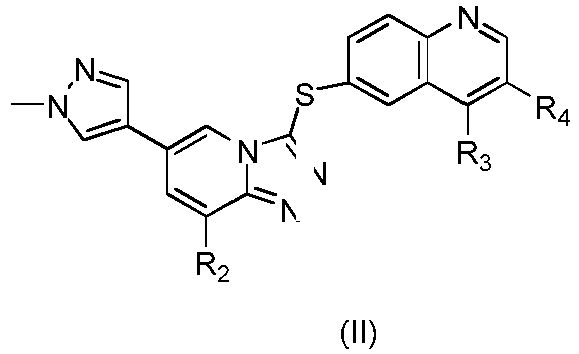
- In another preferred embodiment of the present invention, the compound of formula (I) or pharmaceutically acceptable salt threrof is a compound of formula (IIIA) or (IIIB) or pharmaceutically acceptable salt thereof:

- Preferably, in the compound of formula (IIIA) or (IIIB) or pharmaceutically acceptable salt thereof, R2 is selected from the group of hydrogen, halogen, C1-C6 alkoxyl and haloC1-C6 alkoxyl, preferably hydrogen and halogen.
- Preferably, in the compound of formula (IIIA) or (IIIB) or pharmaceutically acceptable salt thereof, R3 is selected from the group of hydrogen, halogen, C1-C6 alkyl, C1-C6 alkoxyl, haloC1-C6 alkoxyl, -NHR8 and NR8R9, preferably halogen and C1-C6 alkoxyl; and R8 and R9 are as defined in formula (I).
- In another preferred embodiment of the present invention, the compound of formula (I) or pharmaceutically acceptable salt threrof is a compound of formula (IV) or pharmaceutically acceptable salt thereof:
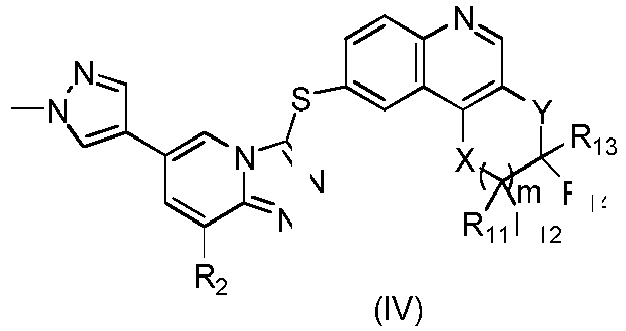
- wherein R2 is as defined in formula (I);
- X=O, N or S, preferably O;
- Y=O, N or S, preferably O;
- m=0, 1 or 2;
- R11, R12, R13 and R14 are each independently selected from the group of hydrogen, C1-C6 alkyl, C3-C10 cycloalkyl, 3 to 8-membered heterocyclyl, C2-C6 alkenyl, C2-C6 alkynyl, aryl and heteroaryl; wherein R11 or R12 and R13 or R14 are taken together with the attached carbon atoms to form a 5 to 10-membered ring or heterocyclyl, or, R11, R12 or R13, R14 are taken together with the attached carbon atoms to form a 5 to 10-membered ring or heterocyclyl; wherein the alkyl, cycloalkyl, heterocyclyl, aryl or heteroaryl are each optionally substituted by one or more groups independently selected from the group of alkyl, halogen, hydroxy, amino, alkoxyl, cycloalkyl, heterocyclyl, aryl, and heteroaryl.
- Preferably, in the compound of formula (IV) or pharmaceutically acceptable salt thereof, R2 is selected from the group of hydrogen, halogen, C1-C6 alkoxyl and halo C1-C6 alkoxyl, preferably hydrogen and halogen.
- In another preferred embodiment of the present invention, the compound of formula (I) or pharmaceutically acceptable salt threrof is a compound of formula (V) or pharmaceutically acceptable salt thereof:

- wherein R2 is as defined in formula (I);
- W is selected from the group of CH2, O, N and S, preferably O and N, and more preferably O;
- R15 and R16 are independently selected from the group of hydrogen, halogen, C1-C6 alkyl and alkoxyl;
- R17 is selected from the group of hydrogen, C1-C6 alkyl, C1-C6 alkoxyl, C1-C6 alkoxylalkyl, C(O)R5, C3-C10 cycloalkyl and 3 to 8-membered heterocyclyl;
- m=0 or 1.
- Preferably, in the compound of formula (V) or pharmaceutically acceptable salt thereof, R2 is selected from the group of hydrogen, halogen, C1-C6 alkoxyl and haloC1-C6 alkoxyl, preferably hydrogen and halogen.
- Preferably, in the compound of formula (V) or pharmaceutically acceptable salt thereof, R17 is selected from the group of hydrogen, C1-C6 alkyl, C1-C6 alkoxyl, C1-C6 alkoxylalkyl, C(O)R5, C3-C10 cycloalkyl and 3 to 8-membered heterocyclyl; preferably C1-C6 alkyl and C3-C10 cycloalkyl.
- A pharmaceutically acceptable salt described in the present invention is formed by a compound of the present invention and an acid selected from the group of:
- hydrochloric acid, p-toluenesulfonic acid, tartaric acid, maleic acid, lactic acid, methanesulfonic acid, sulfuric acid, phosphoric acid, citric acid, acetic acid and trifluoroacetic acid; preferably hydrochloric acid, p-toluenesulfonic, tartaric and trifluoroacetic acid.
- In particular, the present invention includes the following exemplary compounds, but not limited to:
Example No. Structure and Name 2 
6-((8-fluoro-6-(1-methyl-1H-pyrazol-4-yl)-[1,2,4]triazolo[4,3-a]pyridin-3-yl )thio)-4-methoxyquinoline 3 
9-((8-fluoro-6-(1-methyl-1H-pyrazol-4-yl)-[1,2,4]triazolo[4,3-a]pyridin-3-yl )thio)-2,3-dihydro-[1,4]dioxino[2,3-c]quinoline 4 
1-(6-((8-fluoro-6-(1-methyl-1H-pyrazol-4-yl)-[1,2,4]triazolo[4,3-a]pyridin-3 -yl)thio)-4-methoxyquinolin-3-yl)pyrrolidin-2-one 5 
4-fluoro-6-((8-fluoro-6-(1-methyl-1H-pyrazol-4-yl)-[1,2,4]triazolo[4,3-a]pyr idin-3-yl)thio)-3-(1-methyl-1H-pyrazol-4-yl)quinoline 6 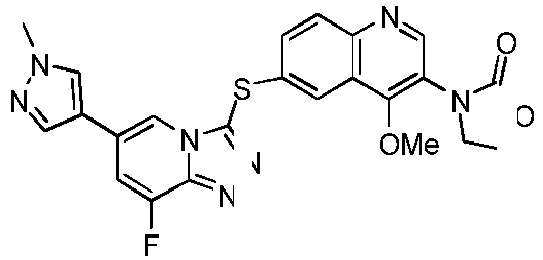
3-(6-((8-fluoro-6-(1-methyl-1H-pyrazol-4-yl)-[1,2,4]triazolo[4,3-a]pyridin-3 -yl)thio)-4-methoxyquinolin-3-yl)oxazolidin-2-one 7 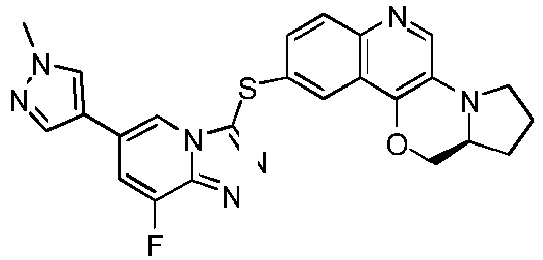
(S)-9-((8-fluoro-6-(1-methyl-1H-pyrazol-4-yl)-[1,2,4]triazolo[4,3-a]pyridin-3-yl)thio)-2,3,12,12a-tetrahydro-1H-pyrrolo[1',2':4,5][1,4]oxazino[3,2-c]qui noline 8 
(R)-9-((8-fluoro-6-(1-methyl-1H-pyrazol-4-yl)-[1,2,4]triazolo[4,3-a]pyridin-3-yl)thio)-2,3,12,12a-tetrahydro-1H-pyrrolo[1',2':4,5][1,4]oxazino[3,2-c]qui noline 9 
3-(1-methyl-1H-pyrazol-4-yl)-6-((6-(1-methyl-1H-pyrazol-4-yl)-[1,2,4]triaz olo[4,3-a]pyridin-3-yl)thio)-4-(2,2,2-trifluoroethoxy)quinoline 10 
4-isopropoxy-3-(1-methyl-1H-pyrazol-4-yl)-6-((6-(1-methyl-1H-pyrazol-4-y l)-[1,2,4]triazolo[4,3-a]pyridin-3-yl)thio)quinoline 11 
4-(4-methoxy-6-((6-(1-methyl-1H-pyrazol-4-yl)-[1,2,4]triazolo[4,3-a]pyridi n-3 -yl)thio)quinolin-3 -yl)morpholin-3 -one 12 
4-(cyclopropylmethoxy)-3-(1-methyl-1H-pyrazol-4-yl)-6-((6-(1-methyl-1H-pyrazol-4-yl)-[1,2,4]triazolo[4,3-a]pyridin-3-yl)thio)quinoline 13 
9-((8-(difluoromethoxy)-6-(1-methyl-1H-pyrazol-4-yl)-[1,2,4]triazolo[4,3-a] pyridin-3-yl)thio)-4-methyl-2H-[1,4]oxazino[3,2-c]quinolin-3(4H)-one 14 
10-((8-fluoro-6-(1-methyl-1H-pyrazol-4-yl)-[1,2,4]triazolo[4,3-a]pyridin-3-y l)thio)-3,4-dihydro-2H-[1,4]dioxepino[2,3-c]quinoline 15 
cyclopropyl(9-((6-(1-methyl-1H-pyrazol-4-yl)-[1,2,4]triazolo[4,3-a]pyridin-3-yl)thio)-2,3-dihydro-4H-[1,4]oxazino[3,2-c]quinolin-4-yl)methanone 16 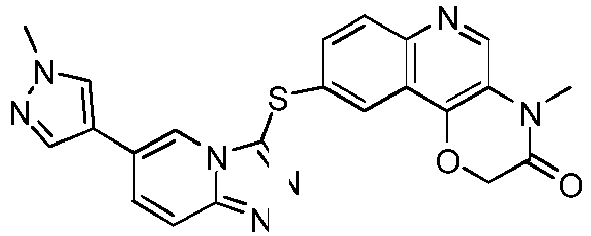
4-methyl-9-((6-(1-methyl-1H-pyrazol-4-yl)-[1,2,4]triazolo[4,3-a]pyridin-3-y l)thio)-2H-[1,4]oxazino[3,2-c]quinolin-3(4H)-one 17 
4-(4-(cyclopropylmethoxy)-6-((6-(1-methyl-1H-pyrazol-4-yl)-[1,2,4]triazolo [4,3-a]pyridin-3-yl)thio)quinolin-3-yl)morpholine 18 
9-((6-(1-methyl-1H-pyrazol-4-yl)-[l,2,4]triazolo[4,3-a]pyridin-3-yl)thio)-2H-[1,4]oxazino[3,2-c]quinolin-3(4H)-one 19 
9-((8-fluoro-6-(1-methyl-1H-pyrazol-4-yl)-[1,2,4]triazolo[4,3-a]pyridin-3-yl )thio)-2H-[1,4]oxazino[3,2-c]quinolin-3(4H)-one 20 
4-(2-methoxyethyl)-9-((6-(1-methyl-1H-pyrazol-4-yl)-[1,2,4]triazolo[4,3-a]p yridin-3-yl)thio)-2H-[1,4]oxazino[3,2-c] quinolin-3(4H)-one 21 
9-((8-fluoro-6-(1-methyl-1H-pyrazol-4-yl)-[1,2,4]triazolo[4,3-a]pyridin-3-yl )thio)-4-(2-methoxyethyl)-2H-[1,4]oxazino[3,2-c]quinolin-3(4H)-one 22 
9-((8-fluoro-6-(1-methyl-1H-pyrazol-4-yl)-[1,2,4]triazolo[4,3-a]pyridin-3-yl )thio)-4-methyl-2H-[1,4]oxazino[3,2-c]quinolin-3(4H)-one 23 
2-cyclopropyl-8-((6-(1-methyl-1H-pyrazol-4-yl)-[1,2,4]triazolo[4,3-a]pyridi n-3-yl)thio)thiazolo[4,5-c]quinoline 24 
2-cyclopropyl-8-((8-fluoro-6-(1-methyl-1H-pyrazol-4-yl)-[1,2,4]triazolo[4,3 -a]pyridin-3-yl)thio)thiazolo[4,5-c]quinoline 25 
3-methyl-8-((6-(1-methyl-1H-pyrazol-4-yl)-[1,2,4]triazolo[4,3-a]pyridin-3-yl)thio)oxazolo[4,5-c]quinolin-2(3H)-one 26 
4-(difluoromethoxy)-3-(1-methyl-1H-pyrazol-4-yl)-6-((6-(1-methyl-1H-pyra zol-4-yl)-[1,2,4]triazolo[4,3-a]pyridin-3-yl)thio)quinoline 27 
N-methyl-N-(1-methyl-6-((6-(1-methyl-1H-pyrazol-4-yl)-[1,2,4]triazolo[4,3 -a]pyridin-3-yl)thio)-4-oxo-1,4-dihydroquinolin-3-yl)cyclopropanecarboxam ide 28 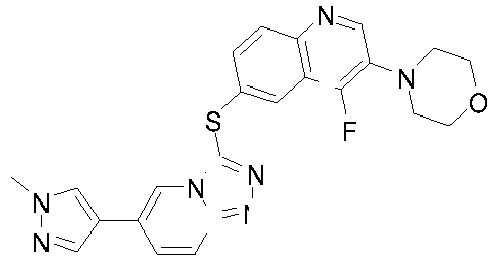
4-(4-fluoro-6-((6-(1-methyl-1H-pyrazol-4-yl)-[1,2,4]triazolo[4,3-a]pyridin-3 -yl)thio)quinolin-3-yl)morpholine 29 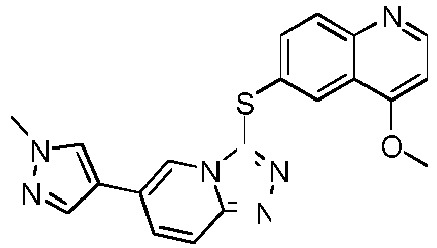
4-methoxy-6-((6-(1-methyl-1H-pyrazol-4-yl)-[1,2,4]triazolo[4,3-a]pyridin-3 -yl)thio)quinoline 30 
4-(6-((6-(1-methyl-1H-pyrazol-4-yl)-[1,2,4]triazolo[4,3-a]pyridin-3-yl)thio) quinolin-4-yl)morpholine 31 
9-((6-(1-methyl-1H-pyrazol-4-yl)-[1,2,4]triazolo[4,3-a]pyridin-3-yl)thio)-2,3 -dihydro-[1,4]dioxino[2,3-c]quinoline 32 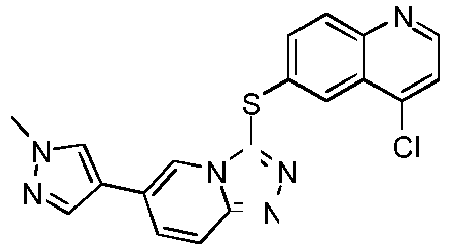
4-chloro-6-((6-(1-methyl-1H-pyrazol-4-yl)-[1,2,4]triazolo[4,3-a]pyridin-3-yl )thio)quinoline 33 
2-((6-((6-(1-methyl-1H-pyrazol-4-yl)-[1,2,4]triazolo[4,3-a]pyridin-3-yl)thio) quinolin-4-yl)oxy)ethan-1-ol 34 
2-(methyl(6-((6-(1-methyl-1H-pyrazol-4-yl)-[1,2,4]triazolo[4,3-a]pyridin-3-yl)thio)quinolin-4-yl)amino)ethan-1-ol 35 
N-(2-methoxyethyl)-N-methyl-6-((6-(1-methyl-1H-pyrazol-4-yl)-[1,2,4]triaz olo[4,3-a]pyridin-3-yl)thio)quinolin-4-amine 36 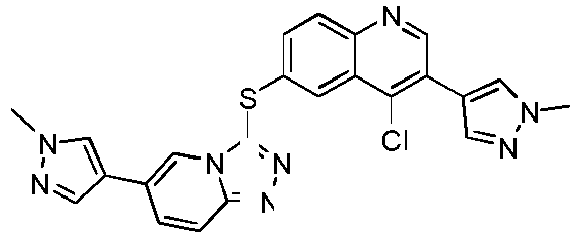
4-chloro-3-(1-methyl-1H-pyrazol-4-yl)-6-((6-(1-methyl-1H-pyrazol-4-yl)-[1, 2,4]triazolo[4,3-a]pyridin-3-yl)thio)quinoline 37 
4-methoxy-3-(1-methyl-1H-pyrazol-4-yl)-6-((6-(1-methyl-1H-pyrazol-4-yl)-[1,2,4]triazolo[4,3-a]pyridin-3-yl)thio)quinoline 38 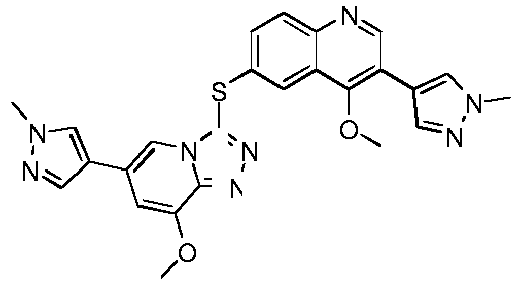
4-methoxy-6-((8-methoxy-6-(1-methyl-1H-pyrazol-4-yl)-[1,2,4]triazolo[4,3-a]pyridin-3-yl)thio)-3-(1-methyl-1H-pyrazol-4-yl)quinoline 39 
4-(4-methoxy-6-((6-(1-methyl-1H-pyrazol-4-yl)-[1,2,4]triazolo[4,3-a]pyridin-3-yl)thio)quinolin-3-yl)morpholine 40 
6-((8-fluoro-6-(1-methyl-1H-pyrazol-4-yl)-[1,2,4]triazolo[4,3-a]pyridin-3-yl )thio)-4-methoxy-3-(1-methyl-1H-pyrazol-4-yl)quinoline 41 
4-fluoro-3-(1-methyl-1H-pyrazol-4-yl)-6-((6-(1-methyl-1H-pyrazol-4-yl)-[1, 2,4]triazolo[4,3-a]pyridin-3-yl)thio)quinoline 42 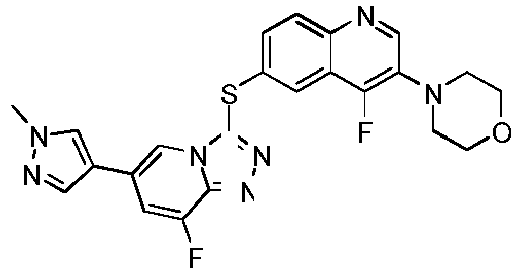
4-(4-fluoro-6-((8-fluoro-6-(1-methyl-1H-pyrazol-4-yl)-[1,2,4]triazolo[4,3-a] pyridin-3-yl)thio)quinolin-3-yl)morpholine 43 
(4-chloro-6-((6-(1-methyl-1H-pyrazol-4-yl)-[1,2,4]triazolo[4,3-a]pyridin-3-y l)thio)quinolin-3-yl)(morpholino)methanone 44 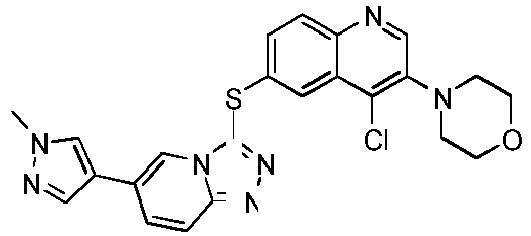
4-(4-chloro-6-((6-(1-methyl-1H-pyrazol-4-yl)-[1,2,4]triazolo[4,3-a]pyridin-3 -yl)thio)quinolin-3-yl)morpholine 45 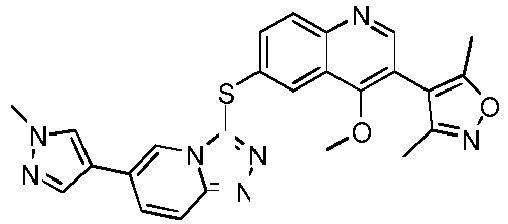
4-(4-methoxy-6-((6-(1-methyl-1H-pyrazol-4-yl)-[1,2,4]triazolo[4,3-a]pyridi n-3-yl)thio)quinolin-3-yl)-3,5-dimethylisoxazole 46 
3-(benzo[d][1,3]dioxol-5-yl)-4-methoxy-6-((6-(1-methyl-1H-pyrazol-4-yl)-[ 1,2,4]triazolo[4,3-a]pyridin-3-yl)thio)quinoline 47 
1-(4-(4-methoxy-6-((6-(1-methyl-1H-pyrazol-4-yl)-[1,2,4]triazolo[4,3-a]pyri din-3-yl)thio)quinolin-3-yl)piperazin-1-yl)ethan-1-one 48 
2-(4-(4-methoxy-6-((6-(1-methyl-1H-pyrazol-4-yl)-[1,2,4]triazolo[4,3-a]pyri din-3-yl)thio)quinolin-3-yl)-1H-pyrazol-1-yl)ethan-1-ol - Further more, the present invention relates to a process for preparing the compound of formula (I) or pharmaceutically acceptable salt thereof, comprising a step of:

- The solvent used in this reaction is selected from the group of 1,4-dioxane, acetonitrile, N,N-dimethylformamide, dimethyl sulfoxide, and N-methylpyrrolidone, preferably 1,4-dioxane, N,N-dimethylformamide or dimethyl sulfoxide.
- The reaction is carried out in the presence of a base, which is selected from the group of an inorganic base (such as sodium carbonate, potassium carbonate, sodium hydrogen carbonate, potassium phosphate, sodium tert-butoxide, potassium tert-butoxide) or an organic base (such as triethylamine, pyridine, piperidine, t-butylamine, diethylisopropylamine), preferably sodium tert-butoxide, potassium tert-butoxide or diethylisopropylamine.
- One aspect of the invention provides a pharmaceutical composition, comprising a therapeutically effective amount of the compound of formula (I) or pharmaceutically acceptable salt thereof, and a pharmaceutically acceptable carrier or excipient. The invention also provides use of the pharmaceutical composition in preparation of a medicament for the treatment of a protein kinase-related disease, wherein protein kinase is selected from c-Met and VEGFR receptor tyrosine kinase. The invention also provides use of the pharmaceutical composition in preparation of a medicament for the treatment of cancer, preferably in preparation of a medicament for the treatment of lung cancer, breast cancer, squamous cell carcinoma or stomach cancer.
- Another aspect of the invention provides a method of modulating protein kinase catalytic activity, comprising a step of contacting the protein kinase contact with the compound of formula (I) or pharmaceutically acceptable salt thereof or the pharmaceutical composition comprising the same, wherein the protein kinase is selected from c-Met and VEGFR receptor tyrosine kinase.
- Another aspect of the invention provides use of the compound of formula (I) or pharmaceutically acceptable salt thereof or the pharmaceutical composition comprising the same in preparation of a medicament as a protein kinase inhibitor, wherein the protein kinase is selected from c-Met and VEGFR receptor tyrosine kinase.
- Another aspect of the invention provides use of the compound of formula (I) or pharmaceutically acceptable salt thereof in preparation of a medicament for the treatment of a protein kinase-related disease, wherein the protein kinase is selected from c-Met and VEGFR receptor tyrosine kinase.
- Another aspect of the invention provides the compound of formula (I) or pharmaceutically acceptable salt thereof or the pharmaceutical composition comprising the same, for use as a medicament in the treatment of a protein kinase-related disease, wherein the protein kinase is selected from c-Met and VEGFR receptor tyrosine kinase.
- Another aspect of the invention provides the compound of formula (I) or pharmaceutically acceptable salt thereof or the pharmaceutical composition comprising the same, for use as a medicament in the treatment of cancer, preferably as a medicament in the treatment of lung cancer, breast cancer, squamous cell carcinoma or stomach cancer.
- Another aspect of the invention provides use of the compound of formula (I) or pharmaceutically acceptable salt thereof in preparation of a medicament for the treatment of cancer, preferably for the treatment of lung cancer, breast cancer, squamous cell carcinoma or stomach cancer.
- The compounds of the invention may be used in the treatment of neoplasia, including cancer and metastasis, including but not limited to: cancer, such as bladder cancer, breast cancer, colon cancer, kidney cancer, hepatocellular carcinoma, lung cancer (NSCLC), skin cancer; hematopoietic tumors of lymphatic system (such as leukemia, acute lymphocytic leukemia etc.); hematopoietic tumors of marrow system (such as acute and chronic myelogenous leukemia, myelodysplastic syndrome and promyelocytic leukemia); tumors caused by mesenchyme (such as fibrosarcoma and rhabdomyosarcoma or other sarcomas such as soft tissue sarcoma and osteosarcoma); tumors of central and peripheral nervous system (such as astrocytoma, neuroblastoma, glioma tumor and nerve endings tumor); or other tumors (including malignant melanoma, seminoma, teratocarcinoma, thyroid follicular cancer and Kaposi's sarcoma etc.).
- Preferably, the compounds of the present invention are used for the treatment of lung cancer, breast cancer, squamous cell carcinoma or stomach cancer.
- A "pharmaceutical composition" herein means a mixture comprising one or more the compounds described in the present invention or physiologically/pharmaceutically acceptable salts or prodrugs and other chemical components, and optionally comprising other components such as physiologically/pharmaceutically acceptable carriers and excipients. The purpose of a pharmaceutical composition is to facilitate administration of a compound to an organism, which will help absorption of the active ingredient, and then to exert biological activity.
- It is known for those skilled in the art that the dosage of a drug depends on a variety of factors, including but not limited to the following factors: the activity of the specific compound, the age of patient, the weight of patient, the general health of patient, the behavior of patient, diet of patient, time of drug administration, route of drug administration, rate of excretion, drug combination etc. In addition, the best treatment route such as mode of therapy, a daily dose of the compound of formula (I) or the type of pharmaceutically acceptable salt thereof can be verified by the conventional treatment programs.
- Unless otherwise stated, the terms used in the specification and claims have the following meanings.
- "Alkyl" refers to a saturated aliphatic hydrocarbon group including C1-C20 straight-chain and branched-chain groups. Preferably, an alkyl is an alkyl having 1 to 10 carbon atoms, such as methyl, ethyl, propyl, 2-propyl, n-butyl, isobutyl, tert-butyl or pentyl, etc. More preferably, an alkyl is a lower alkyl having 1 to 4 carbon atoms, such as methyl, ethyl, propyl, 2-propyl, n-butyl, isobutyl or tert-butyl etc. The alkyl may be substituted or unsubstituted. When substituted, the substituent is preferably one or more groups independently selected from the group of alkoxyl, halogen, hydroxy, nitro, cyano, cycloalkyl, heterocyclyl, aryl, heteroaryl, -C(O)OR9, -OC(O)R9, -O(CH2)mC(O)OR9, -OC(O)NR10R11, carbonyl, -S(O)nR9, -OSO2R9, -SO2NR10R11, -NHC(O)R9 and -NR10R11.
- "Cycloalkyl" refers to 3 to 8 membered all-carbon monocyclic ring group, wherein 3 to 8 membered all-carbon monocyclic ring may comprise one or more double bonds, but the ring has no a completely conjugated π-electron system. Examples of cycloalkyl are cyclopropyl, cyclobutyl, cyclopentyl, cyclopentenyl, cyclohexyl, cyclohexadienyl, cycloheptyl, cycloheptatrienyl, etc. The cycloalkyl may be substituted or unsubstituted. When substituted, the substituent is preferably one or more groups independently selected from the group of alkyl, alkoxyl, halogen, hydroxy, nitro, cyano, cycloalkyl, heterocyclyl, aryl, heteroaryl, -C(O)OR9, -OC(O)R9, -O(CH2)mC(O)OR9, -OC(O)NR10R11, carbonyl, -S(O)nR9, -OSO2R9, -SO2NR10R11, -NHC(O)R9 and -NR10R11.
- "Alkenyl" refers to an alkyl group as defined above having at least two carbon atoms and at least one carbon-carbon double bond. Examples of alkenyl are vinyl, 1-propenyl, 2-propenyl, 1-, 2- or 3-butenyl etc. The alkenyl may be substituted or unsubstituted. When substituted, the substituent is preferably one or more groups independently selected from the group of alkyl, alkoxyl, halogen, hydroxy, nitro, cyano, cycloalkyl, heterocyclyl, aryl, heteroaryl, -C(O)OR9, -OC(O)R9, -O(CH2)mC(O)OR9, -OC(O)NR10R11, carbonyl, -S(O)nR9, -OSO2R9, -SO2NR10R11, -NHC(O)R9, and -NR10R11.
- "Alkynyl" refers to an alkyl group as defined above having at least two carbon atoms and at least one carbon-carbon triple bond. Examples of alkynyl are ethynyl, 1-propynyl, 2-propynyl, 1-, 2- or 3-butynyl etc. The alkynyl may be substituted or unsubstituted. When substituted, the substituent is preferably one or more groups independently selected from the group of alkyl, alkoxyl, halogen, hydroxy, nitro, cyano, cycloalkyl, heterocyclyl, aryl, heteroaryl, -C(O)OR9, -OC(O)R9, -O(CH2)mC(O)OR9, -OC(O)NR10R11, carbonyl, -S(O)nR9, -OSO2R9, -SO2NR10R11, -NHC(O)R9, and -NR10R11.
- "Heterocyclyl" refers to a 3to 8 membered monocyclic ring group, in which one or more ring atoms are heteroatoms selected from the group of nitrogen, oxygen or S(O)n (wherein n is an integer from 0 to 2), and the remaining ring atoms are carbon. The ring may also have one or more double bonds, but the ring has no a completely conjugated π-electron system. Examples of heterocyclyl are pyrrolidinyl, piperidinyl, piperazinyl, morpholinyl, thiomorpholinyl, homopiperazinyl, etc. The heterocyclyl may be substituted or unsubstituted. When substituted, the substituent is preferably one or more groups independently selected from the group of alkyl, alkoxyl, halogen, hydroxy, nitro, cyano, cycloalkyl, heterocyclyl, aryl, heteroaryl, -C(O)OR9, -OC(O)R9, -O(CH2)mC(O)OR9, -OC(O)NR10R11, carbonyl, -S(O)nR9, -OSO2R9, -SO2NR10R11, -NHC(O)R9 and -NR10R11.
- "Bicyclic cycloalkyl" refers to a 5 to 14 membered all-carbon fused ring group (a "fused" ring system refers to that each ring in the system shares a pair of adjacent carbon atoms with other ring in the system), wherein one or more rings may contain one or more double bonds, but none of the rings has a completely conjugated π-electron system. For example,

- Preferably, a bicyclic cycloalkyl is 5/5 or 5/6 membered, and more preferably 5/5 membered. The bicyclic cycloalkyl may be substituted or unsubstituted. When substituted, the substituent is preferably one or more groups independently selected from the group of alkyl, alkoxyl, halogen, hydroxy, nitro, cyano, cycloalkyl, heterocyclyl, aryl, heteroaryl, -C(O)OR9, -OC(O)R9, -O(CH2)mC(O)OR9, -OC(O)NR10R11, carbonyl, -S(O)nR9, -OSO2R9, -SO2NR10R11, -NHC(O)R9 and -NR10R11.
- "Bicyclic heterocyclyl" refers to a 5 to 14 membered fused ring group (a "fused" ring system refers to that each ring in the system shares a pair of adjacent carbon atoms with other ring in the system), wherein one or more ring atoms are heteroatoms selected from the group of nitrogen, oxygen, and S(O)n (where n is an integer from 0 to 2), and the remaining ring atoms are carbon. These rings may contain one or more double bonds, but the ring has no a completely conjugated π-electron system. Preferably, a bicyclic heterocyclyl is 7 to 10 membered. For example,


- Further preferably, a bicyclic heterocyclyl is 5/5 or 5/6 membered, and more preferably 5/5 membered. The bicyclic heterocyclyl may be substituted or unsubstituted. When substituted, the substituent is preferably one or more groups independently selected from the group of alkyl, alkoxyl, halogen, hydroxy, nitro, cyano, cycloalkyl, heterocyclyl, aryl, heteroaryl, -C(O)OR9, -OC(O)R9, -O(CH2)mC(O)OR9, -OC(O)NR10R11, carbonyl, -S(O)nR9, -OSO2R9, -SO2NR10R11, -NHC(O)R9 and -NR10R11.
- "Bridged cycloalkyl" refers to a 5 to 14 membered all-carbon polycyclic group, wherein every two rings in the system share two disconnected carbon atoms, the rings may contain one or more double bonds, but the ring has no a completely conjugated π-electron system. Preferably, a bridged cycloalkyl is 7 to 10 membered. For example,


- According to the number of membered rings, a bridged cycloalkyl is divided into bicyclic, tricyclic, tetracyclic or polycyclic bridged cycloalkyl, preferably bicyclic, tricyclic or tetracyclic bridged cycloalkyl, and more preferably bicyclic or tricyclic bridged cycloalkyl. The bridged cycloalkyl group may be substituted or unsubstituted. When substituted, the substituent is preferably one or more groups independently selected from the group of alkyl, alkoxyl, halogen, hydroxy, nitro, cyano, cycloalkyl, heterocyclyl, aryl, heteroaryl, -C(O)OR9, -OC(O)R9, -O(CH2)mC(O)OR9, -OC(O)NR10R11, carbonyl, -S(O)nR9, -OSO2R9, -SO2NR10R11, -NHC(O)R9, and -NR10R11.
- "Bridged heterocyclyl" refers to a 5 to 14 membered polycyclic group, wherein every two rings in the system share two disconnected carbon atoms, the rings may contain one or more double bonds, but the ring has no a completely conjugated π electronic system, wherein one or more ring atoms are heteroatoms selected from the group of nitrogen, oxygen, and S(O)n (where n is an integer from 0 to 2), and the remaining ring atoms are carbon. Preferably, a bridged heterocyclyl is 7 to 10 membered. For example,

- According to the number of membered rings, a bridged heterocyclyl is divided into bicyclic, tricyclic, tetracyclic or polycyclic bridged heterocyclyl, preferably bicyclic, tricyclic or tetracyclic bridged heterocyclyl, and more preferably bicyclic or tricyclic bridged heterocyclyl. The bridged heterocyclylmay be substituted or unsubstituted. When substituted, the substituent is preferably one or more groups independently selected from the group of alkyl, alkoxyl, halogen, hydroxy, nitro, cyano, cycloalkyl, heterocyclyl, aryl, heteroaryl, -C(O)OR9, -OC(O)R9, -O(CH2)mC(O)OR9, -OC(O)NR10R11, carbonyl, -S(O)nR9, -OSO2R9, -SO2NR10R11, -NHC(O)R9, and -NR10R11.
- "Spiro cycloalkyl" refers to a 5 to 14 membered polycyclic group with rings connected through one common carbon atom (called a spiro atom), wherein these rings may contain one or more double bonds, but the ring has no a completely conjugated π-electron system. Preferably, a spiro cycloalkyl is 7 to 10 membered. For example,

- According to the number of common spiro atoms, a spiro cycloalkyl is divided into mono-spiro cycloalkyl, di-spiro cycloalkyl or poly-spiro cycloalkyl, preferably mono-spiro cycloalkyl and di-spiro cycloalkyl, and more preferably 4/4 membered, 4/5 membered, 4/6 membered, 5/5 or 5/6 membered mono-spiro cycloalkyl. The spiro cycloalkyl may be substituted or unsubstituted. When substituted, the substituent is preferably one or more groups independently selected from the group of alkyl, alkoxyl, halogen, hydroxy, nitro, cyano, cycloalkyl, heterocyclyl, aryl, heteroaryl, -C(O)OR9, -OC(O)R9, -O(CH2)mC(O)OR9, -OC(O)NR10R11, carbonyl, -S(O)nR9, -OSO2R9, -SO2NR10R11, -NHC(O)R9, and -NR10R11.
- "Spiro heterocyclyl" refers to a 5 to 14 membered polycyclic hydrocarbon group with rings connected through one common carbon atom (called a spiro atom), wherein one or more ring atoms are heteroatoms selected from the group of nitrogen, oxygen, and S(O)n (where n is an integer from 0 to 2), and the remaining ring atoms are carbon. These rings may contain one or more double bonds, but the ring has no a completely conjugated π-electron system. Preferably, a spiro heterocyclyl is 7 to 10 membered. For example,

- According to the number of common spiro atoms, a spiro heterocyclyl is divided into monospirocheteroyclic, bispiroheterocyclic or polyspiroheterocyclic, preferably momo-spiro heterocyclyl and di-spiro heterocyclyl, and more preferably 4/4 membered, 4/5 membered, 4/6 membered, 5/5 or 5/6 membered mono-spiro heterocyclyl. The spiro heterocyclyl may be substituted or unsubstituted. When substituted, the substituent is preferably one or more groups independently selected from the group of alkyl, alkoxyl, halogen, hydroxy, nitro, cyano, cycloalkyl, heterocyclyl, aryl, heteroaryl, -C(O)OR9, -OC(O)R9, -O(CH2)mC(O)OR9, -OC(O)NR10R11, carbonyl, -S(O)nR9, -OSO2R9, -SO2NR10R11, -NHC(O)R9, and -NR10R11.
- p/q membered bicyclic cycloalkyl, bicyclic heterocyclyl, mono-spiro cycloalkyl or mono-spiro heterocyclyl refers to that the number of ring atoms in two rings of bicyclic cycloalkyl, bicyclic heterocyclyl, mono-spiro cycloalkyl or mono-spiro heterocyclyl are respectively p and q, p and q are each independently selected from the group of an integer from 3 to 8, and preferably an integer from 4 to 7.
- "3 to 8 membered heterocyclyl" refers to a monocyclic or bicyclic non-aromatic cyclic group, wherin the number of ring atoms is 3 to 8 membered, one or more ring atoms are heteroatoms selected from the group of nitrogen, oxygen, and S(O)n (where n is an integer from 0 to 2), the ring may contain 1 to 2 double bonds, and when the ring atom is a nitrogen atom, a bond can be extended from the nitrogen atom. Preferably, it is a 4 to 6 membered heterocyclyl, and more preferably 5 to 6 membered heterocyclyl, such as pyrrolidinyl, piperidinyl or piperazinyl etc. The 3 to 8-membered heterocyclyl may be substituted or unsubstituted. When substituted, the substituent is preferably one or more groups independently selected from the group of alkyl, alkoxyl, halogen, hydroxy, nitro, cyano, cycloalkyl, heterocyclyl, aryl, heteroaryl, -C(O)OR9, -OC(O)R9, -O(CH2)mC(O)OR9, -OC(O)NR10R11, carbonyl, -S(O)nR9, -OSO2R9, -SO2NR10R11, -NHC(O)R9, and -NR10R11.
- "Aryl" refers to a 6 to 14 membered all-carbon monocyclic ring or polycyclic fused ring (a "fused" ring system means that each ring in the system shares an adjacent pair of carbon atoms with another ring in the system), which has a completely conjugated π-electron system. Preferably, an aryl is 6-10 membered, such as phenyl, naphthyl and anthryl. The aryl can be substituted or unsubstituted. When substituted, the substituent is preferably one or more groups independently selected from the group of alkyl, alkoxyl, halogen, hydroxy, nitro, cyano, cycloalkyl, heterocyclyl, aryl, heteroaryl, -C(O)OR9, -OC(O)R9, -O(CH2)mC(O)OR9, -OC(O)NR10R11, carbonyl, -S(O)nR9, -OSO2R9, -SO2NR10R11, -NHC(O)R9, and -NR10R11.
- "Heteroaryl" refers to a heteroaromatic system comprising 5 to 14 ring atoms and 1 to 4 heteroatoms, wherein the heteroatom is oxygen, sulfur or nitrogen. Preferably, a heteroaryl is 5- or 6-membered, such as furyl, thienyl, pyridyl, pyrrolyl, N-alkylpyrrolyl, pyrimidinyl, pyrazinyl, imidazolyl, tetrazolyl etc. The heteroaryl may be substituted or unsubstituted. When substituted, the substituent preferably is one or more groups independently selected from the group of alkyl, alkoxyl, halogen, hydroxy, nitro, cyano, cycloalkyl, heterocyclyl, aryl, heteroaryl, -C(O)OR9, -OC(O)R9, -O(CH2)mC(O)OR9, -OC(O)NR10R11, carbonyl, -S(O)nR9, -OSO2R9, -SO2NR10R11, -NHC(O)R9, and -NR10R11.
- "Aryloxyl" refers to -O-aryl and -O-heteroaryl, wherein aryl and heteroaryl are as defined above, such as phenoxyl, pyridinyloxyl, furyloxyl, thienyloxyl, pyrimidinyloxyl, pyrazinyloxyl or derivatives thereof etc.
- "Alkoxyl" refers to -O-(alkyl) and -O-(unsubstituted cycloalkyl), such as C1-6 alkoxyl, specifically methoxyl, ethoxyl, propoxyl, butoxyl, cyclopropyloxyl, cyclobutyloxyl, cyclopentyloxyl, cyclohexyloxyl etc. The alkoxyl may be substituted or unsubstituted. When substituted, the substituent is preferably one or more groups independently selected from the group of halogen, alkoxyl, hydroxy, amino, cyano, nitro, cycloalkyl or heterocyclyl.
- "Hydroxyl" refers to -OH group.
- "Halogen" refers to fluorine, chlorine, bromine or iodine.
- "Amino" refers to -NH2.
- "Cyano" refers to -CN.
- "Nitro" refers to -NO2.
- "Bicyclic octyl" refers to

- "Azabicyclo octyl" refers to

- "Optional" or "optionally" refers to that the subsequently described event or circumstance can, but need not, occur, including the instances in which the event or circumstance does or does not occur. For example, "heterocyclyl optionally substituted by alkyl" refers to that the alkyl can be, but need not be, present, including the instances of heterocyclyl is substituted or unsubstituted by alkyl.
- A "pharmaceutical composition" herein means a mixture comprising one or more compounds described in the present invention or physiologically/pharmaceutically acceptable salts or prodrugs, and optionally comprising other components such as physiologically/pharmaceutically acceptable carriers and excipients. The purpose of a pharmaceutical composition is to facilitate administration of a compound to an organism, which will help absorption of the active ingredient, and then to exert biological activity.
- m, n and R9 ∼ R11 are as defined in the compound of formula (I).
- In order to complete the purpose of the present invention, the present invention applies, but not limited to, the following technical solutions:
- A process of preparing the compound of formula (I) or pharmaceutically acceptable salt thereof of the present invention, comprises a step of:

- The solvent used in this reaction is selected from the group of 1,4-dioxane, acetonitrile, N,N-dimethylformamide, dimethyl sulfoxide, and N-methylpyrrolidone, preferably 1,4-dioxane, N,N-dimethylformamide, or dimethyl sulfoxide.
- The reaction is carried out in the presence of a base, which is selected from the group of an inorganic base (such as sodium carbonate, potassium carbonate, sodium hydrogen carbonate, potassium phosphate, sodium tert-butoxide, potassium tert-butoxide) or an organic base (such as triethylamine, pyridine, piperidine, t-butylamine, diethylisopropylamine), preferably sodium tert-butoxide, potassium tert-butoxide or diethylisopropylamine.
- The palladium catalyst used in this reaction may comprise allylpalladium chloride dimer, bis(benzonitrile)palladium chloride, palladium acetate, palladium chloride, tetrakis(triphenylphosphine)palladium, tris(dibenzylideneacetone)dipalladium, or tris(dibenzylideneacetone)dipalladium-chloroform adduct; preferably tris(dibenzylideneacetone)dipalladium, or tris(dibenzylideneacetone)dipalladium-chloroform adduct.
- A process of preparing the compound of formula (I) or pharmaceutically acceptable salt thereof of the present invention, comprises the steps of:


- The following examples are used to further describe the invention, but these examples are not intended to limit the scope of the invention.
- Structures of compounds were identified by nuclear magnetic resonance (NMR) and/or mass spectrometry (MS). NMR chemical shifts (δ) are gave in 10-6 (ppm). NMR was determined by a Bruker AVANCE-400 instrument. The solvents were deuterated dimethyl sulfoxide (DMSO-d6) and deuterated chloroform (CDCl3). The internal standard was tetramethylsilane (TMS).
- MS was determined by a FINNIGAN LCQAd (ESI) mass spectrometer (Manufacturer: Thermo, Model: Finnigan LCQ advantage MAX).
- High performance liquid chromatography (HPLC) was determined by an Agilent 1200DAD high pressure liquid chromatography spectrometer (Sunfire C18 150 × 4.6 mm chromatographic column) and a Waters 2695-2996 high pressure liquid chromatography spectrometer (Gimini C18 150 × 4.6mm chromatographic column).
- The average inhibition rate of kinase and IC50 values were determined by a NovoStar microplate reader (BMG Co., Germany).
- For thin-layer silica gel chromatography (TLC) Yantai Huanghai HSGF254 or Qingdao GF254 silica gel plate was used. The dimension of the plates used in TLC was 0.15 mm to 0.2 mm, and the dimension of the plates used in product purification was 0.4 mm to 0.5 mm.
- Column chromatography generally used Yantai Huanghai 200 to 300 mesh silica gel as a carrier.
- The known starting materials used in the examples of the present invention examples can be commercially available, or can be synthesized by the methods known in the field.
- Unless otherwise stated, all the reactions of the present invention were under continuous magnetic stirring and under dry nitrogen or argon atmosphere.
- Argon or nitrogen atmosphere refers to that a reaction flask is equipped with a about 1L volume argon or nitrogen balloon.
- Hydrogen atmosphere refers to that a reaction flask is equipped with a about 1L hydrogen balloon.
- Unless otherwise stated in the examples, the solution refers to an aqueous solution.
- Unless otherwise stated in the examples, the reaction temperature was room temperature.
- Room temperature is the optimum reaction temperature, ranged from 20°C to 30°C.
- The reaction progress in the examples was monitored by thin layer chromatography (TLC), and the system of developing solvent included: dichloromethane and methanol system, n-hexane and ethyl acetate system, petroleum ether and ethyl acetate system, and acetone. The volume ratio of solvent was adjusted according to the polarity of the compound.
- The elution system for column chromatography included: A: dichloromethane and methanol system, B: n-hexane and ethyl acetate system, C: dichloromethane and ethyl acetate system, D: ethyl acetate and methanol system. The volume ratio of solvent was adjusted according to the polarity of the compound, and a small amount of ammonia and acetic acid can be added.
-

- To a 250 mL one-necked flask, 5-chloro-2,3-difluoro-pyridine (6.16 g, 41.2 mmol), 1-methyl-4-(4,4,5,5-tetramethyl-1,3,2-dioxaborolan-2-yl)-1H-pyrazole (10.26 g, 49.4 mmol), palladium acetate (464 mg, 2.06 mmol), 2-dicyclohexylphosphoro-2,4,6-triisopropylbiphenyl (1.96 g, 4.12 mmol), potassium phosphate (26.24 g, 123.6 mmol), and dioxane/water (80 mL/8 mL) were added. The reaction mixture was purged with N2 three times, and then heated to 100 °C overnight under N2. After LC-MS showed completion of the reaction, silica was added. The solvent was directly removed by rotary evaporation, and the residue was purified by column chromatography using petroleum ether/ethyl acetate (5/1 to 3/1) as elution to give 2,3-difluoro-5-(1-1H-pyrazol-4-yl-methyl)pyridine 1b (6.1 g, yield 76%) as a white solid.
MS m/z (ESI): 196.0
1H NMR (400MHz, CDCl3, ppm) δ 8.32-8.25 (m, 3 H), 8.01 (d, J= 0.4 Hz, 1 H), 3.88 (s, 3 H). - To a 50 mL one-necked flask, 2,3-difluoro-5-(1-methyl-1H-pyrazol-4-yl)pyridine (1.8 g, 9.2 mmol), 85% hydrazine hydrate (1.8 g, 46 mmol) and ethanol (25 mL) were added. The reaction mixture was heated to reflux overnight under N2. Then the reaction mixture was cooled to room temperature, the resulting white solid was filtered and washed with cold ethanol to give 3-fluoro-2-hydrazino-5-(1-methyl-1H-pyrazol-4-yl)pyridine 1c (1.4 g, yield 73%) as a white needle solid.
MS m/z (ESI): 208.0 - To a 50mL one-necked flask, 3-fluoro-2-hydrazino-5-(1-methyl-1H-pyrazol-4-yl) pyridine (1.4 g, 6.7 mmol), carbon disulfide (1.0 g, 13.4 mmol), potassium hydroxide (395 mg, 7.0 mmol) and ethanol/water (20 mL/5 mL) were added. The reaction mixture was heated to reflux for 46 hours under N2. The solvent was removed by rotary evaporation, and the residue was dissolved in sodium hydroxide aqueous solution (1 M, 30 mL), then water was added until the solids had been dissolved. The aqueous phase was extracted twice with dichloromethane, and then the aqueous phase was separated and acidified with hydrochloric acid (1 M). A lot of yellow solid was precipitated, the solution was left to stand for 1 hour, then filtered by slow filter paper and washed with water to give the product 8-fluoro-6-(1-methyl-1H-pyrazol-4-yl)-[1,2,4] triazolo[4,3-a]pyridin-3-thiol (1.1 g, yield 68%) as a pale yellow solid.
MS m/z (ESI): 249.96
1H NMR (400 M, DMSO-d 6, ppm) δ 14.89 (s, 1 H), 8.39 (s, 1 H), 8.23 (s, 1 H), 8.04 (s, 1 H), 7.81 (dd, J = 1.2, 12.4 Hz, 1 H), 3.88 (s, 3 H). -

- To a 10 mL one-necked flask, 6-bromo-4-chloro-quinoline (0.50 g, 2.06 mmol), methanol (5 mL) and sodium methoxide (0.56 g, 10.3 mmol) were added successively, the reaction mixture was heated to 50°C overnight. After TLC showed completion of the reaction, silica was added. The solvent was removed by rotary evaporation, and the residue was purified by silica gel chromatography (petroleum ether/acetone = 10/1) to give 6-bromo-4-methoxy-quinoline 2b (0.25 g, yield 51 %) as a white solid.
MS m/z (ESI): 238.0 - To a 25 mL one-necked flask, 8-fluoro-6-(1-methyl-1H-pyrazol-4-yl)-[1,2,4]triazolo [4,3-a]pyridin-3-thiol (100 mg, 0.4 mmol), 6-bromo-4-methoxy-quinoline (95 mg, 0.4 mmol), tris(dibenzylideneacetone)dipalladium (37 mg, 0.04 mmol), 4,5-bis(diphenylphosphino)-9,9-dimethylxanthene (46 mg, 0.08 mmol) and anhydrous N,N-dimethylformamide (5 mL) were added. The reaction mixture was purged with N2 3 times and stirred for 5 minutes at room temperature under N2 until the solids were dissolved, and then N,N-diisopropylethylamine (162 mg, 1.6 mmol) was added. The reaction mixture was heated to 100 °C overnight. After LC-MS showed completion of the reaction, N,N-dimethylformamide was removed by rotary evaporation, and the residue was purified by column chromatography (dichloromethane/methanol = 20/1) to give 6-((8-fluoro-6-(1-methyl-1H-pyrazol-4-yl)-[1,2,4]triazolo[4,3-a]pyridin-3-yl)thio) -4-methoxy-2-quinoline (2.1 mg) as a white solid.
1H NMR (400 MHz, CDCl3, ppm): δ 8.76 (s, 1 H), 8.26 (s, 1 H), 8.09 (m, 2 H), 7.65 (m, 3 H), 7.19 (dd, J = 10.0 Hz, 0.4 Hz, 1 H), 6.83 (d, J = 5.2 Hz, 1 H), 4.09 (s, 3 H), 3.97 (s, 3 H).
MS m/z (ESI): 407.1. -

- To a 50 mL one-necked flask, 6-bromoquinolin-4-ol (15 g, 66.95 mmol), 1-iodopyrrolidine-2,5-dione (12.05 g, 53.56 mmol) and ethyl acetate (400 mL) were added. The reaction mixture was heated to 60°C for 4.5 hours, and then cooled to room temperature. The solid was colleted by filtration, and placed in a 2 liter beaker. Sodium carbonate aqueous solution was added to adjust the pH to 7, and then sodium bicarbonate aqueous solution was added to adjust the pH to 8-9. The reaction solution was left to stand for 1 hour, and filtered to give an off-white solid. The grey solid was washed with water (it can be washed with cold acetone if a purer product is needed) and dried to give 6-bromo-3-iodoquinolin-4-ol 3b (18 g, yield 77%) as a white solid.
MS m/z (ESI): 349.7 - To a 250 mL sealed tube, 6-bromine-3-iodoquinolin-4-ol (25 g, 71.4 mmol) and phosphorus oxychloride (150 mL) were added. The reaction mixture was heated to 100°C overnight to give a red solution. After LC-MS showed completion of the reaction, the reaction was cooled to room temperature, then the reaction mixture was added to warm water (35°C, 20 mL) slowly under stirring, the temperature of the solution was controlled at 30-45°C by addition of ice and in an ice water bath. When the addition was completed, the mixture was stirred for a further 15 minutes. Then the solid was filtered by a Büchner funnel, and washed with water. The solid was placed in a 2 liter beaker, and sodium carbonate aqueous solution was added to adjust the pH to 8-9. The resulting mixture was stirred for 1 hour, and left to stand for 30 minutes, filtered, washed with water, and dried to give 6-bromo-4-chloro-3-iodoquinoline 3c (22 g, yield 84%) as a pale yellow solid.
MS m/z (ESI): 367.6 - To a 250 mL sealed tube, 6-bromo-3-iodo-quinolin-4-ol (3.7 g, 10.0 mmol), cesium carbonate (9.8 g, 30.12 mmol), cuprous iodide (382 mg, 2.0 mmol), ethylene glycol (100 mL) were added, and then the reaction mixture was heated to 100°C overnight. After LC-MS showed completion of the reaction, the reaction mixture was cooled to room temperature, most of the solvent was removed by vacuum rotary evaporation, and then the mixture was added to water and extracted with ethyl acetate. The organic phases were combined, washed three times with saturated sodium chloride solution, then the organic phase was dried over potassium carbonate and purified by column chromatography (2% methanol in dichloromethane) to give 9-bromo-2,3-dihydro-[1,4] dioxino[2,3-c]quinoline 3d (800 mg, yield 30%) as a white solid.
MS m/z (ESI): 266.0 - To a 25 mL one-necked flask, 8-fluoro-6-(1-methyl-1H-pyrazol-4-yl)-[1,2,4]triazolo[4,3-a]pyridin-3-thiol (132 mg, 0.53 mmol), 9-bromo-2,3-dihydro-[1,4]dioxino[2,3-c] quinoline (128 mg, 0.481 mmol), tris(dibenzylideneacetone)dipalladium (66 mg, 0.072 mmol), 4,5-bis(diphenylphosphino)-9,9-dimethylxanthene (83 mg, 0.144 mmol) and anhydrous N,N-dimethylformamide (8 mL) were added. The reaction mixture was purged with N2 3 times and stirred for 5 minutes at room temperature under N2 until the solids were dissolved. Sodium tert-butoxide (58 mg, 0.608 mmol) was added, stirred at room temperature for 5 minutes, then heated to 100°C overnight. After the reaction was stopped, N,N-dimethylformamide was removed by rotary evaporation, the residue was dissolved in dichloromethane, washed twice with water, then concentrated and purified by reverse phase column chromatography to give 9-((8-fluoro-6-(1-methyl-1H-pyrazol-4-yl)-[1,2,4]triazolo[4,3-a] pyridin-3-yl)thio)-2,3-dihydro-[1,4]dioxino[2,3-c]quinoline 3.
MS m/z (ESI): 321.1
1H NMR (400 MHz, CDCl3, ppm): δ 8.52 (s, 1 H), 8.04 (s, 1 H), 7.99 (s, 1 H), 7.95 (d, J = 8.8 Hz, 1 H), 7.67 (s, 1 H), 7.59 (s, 1H), 7.47 (d, J = 8.4 Hz, 1 H), 7.16 (d, J = 10.4 Hz, 1 H), 4.49 (s, 2 H), 4.39 (s, 2H), 3.95 (s, 3 H). -

- To a 25 mL one-necked flask, 6-bromo-3-iodo-4-methoxyquinoline(0.6 g, 1.65 mmol), cuprous iodide (0.18 g, 0.19 mmol), potassium phosphate (0.7 g, 3.3 mmol), and dimethyl sulfoxide (10 mL) were added. The reaction mixture was purged with N2 three times, then pyrrolidin-2-one (0.18 g, 2.12 mmol) and N,N'-dimethylethanediamine (36 mg, 0.41 mmol) were added under N2. The reaction mixture was heated to 50°C overnight, and then ethyl acetate (100 mL) was added. The resulting solution was washed three times with saturated sodium chloride aqueous solution, the organic phase was dried over anhydrous sodium sulfate, and concentrated. The resulting residue was purified by silica gel column chromatography (eluting solvent: ethyl acetate) to give 1-(6-bromo-4-methoxyquinolin-3-yl)pyrrolidin-2-one (0.3 g, yield 56%) as a yellow solid.
MS m/z (ESI): 321.1 - To a 25 mL one-necked flask, 1-(6-bromo-4-methoxyquinolin-3-yl)pyrrolidin-2-one (116 mg, 0.47 mmol), 8-fluoro-6-(1-methyl-1H-pyrazol-4-yl)-[1,2,4]triazolo[4,3-a]pyridin-3-thiol (150 mg, 0.47 mmol), tris(dibenzylideneacetone)dipalladium (43 mg, 0.047 mmol), 4,5-bis(diphenylphosphino)-9,9-dimethylxanthene (54 mg, 0.01 mmol) and anhydrous N,N-dimethylformamide (6 mL) were added. The reaction mixture was purged with N2, and stirred for 5 minutes at room temperature until the solids were dissolved. Sodium tert-butoxide (54 mg, 0.56 mmol) was added, stirred at room temperature for 5 minutes, then heated to 100°C overnight. After LC-MS showed the reaction was completed. N,N-dimethylformamide was removed by rotary evaporation, the resulting solid was desolved with dichloromethane, washed twice with water and concentrated. The residue was purified by column chromatography (dichloromethane/methanol = 20/1) to give 1-(6-((8-fluoro-6-(1-methyl-1H-pyrazol-4-yl)-[1,2,4]triazolo[4,3-a]pyridin-3-yl)thio)-4-methoxyquinolin-3-yl)pyrrolidin-2-one 4 (10mg) as a white solid.
MS m/z (ESI): 490.2
1H NMR (400 MHz, CDCl3, ppm): δ 8.71 (s, 1 H), 8.12 (s, 1 H), 8.06 (m, 2 H), 7.68 (s, 1 H), 7.60 (m, 1 H), 7.27 (s, 1 H), 7.19 (d, J= 10.4 Hz, 1 H), 4.03 (s, 3 H), 3.95 (s, 3 H), 3.84 (t, J= 6.8 Hz, 2 H), 2.63 (t, J= 8.0 Hz, 2 H), 2.32 (m, 2 H). -

- To a 250 mL one-necked flask, 6-bromo-4-chloro-3-iodo-quinoline (1.1 g, 3.0 mmol), 1-methyl-4-(4,4,5,5-tetrylmethyl-1,3,2-dioxaboronolan-2-yl)-1H-pyrazole (0.75 g, 3.6 mmol), [1,1'-bis(diphenylphosphino)ferrocene]palladium dichloride (0.22 g , 0.3 mmol), potassium carbonate (0.83 g, 6.0 mmol) and dioxane/water (50 mL/10 mL) were added. The reaction mixture was purged with N2 three times, then heated to 35° C overnight. After LC-MS showed completion of the reaction, silica gel was added to the reaction mixture, and the solvent was directly removed by rotary evaporation, and the residue was purified by column chromatography (petroleum ether/ethyl acetate (10:1 to 1:1) ) to give 6-bromo-4-chloro-3-(1-methyl-1H-pyrazol-4-yl)quinoline (0.5 g, yield 52%) as a white solid.
MS m/z (ESI): 322.0 - To a 15 mL sealed tube, 6-bromo-4-chloro-3-(1-methyl-1H-pyrazol-4-yl)quinoline (0.2 g, 0.62 mmol), cesium fluoride (0.59 g, 3.1 mmol) and dry dimethyl sulfoxide (8 mL) were added, then the reaction mixture was heated to 90° C for 3 hours. After LC-MS showed completion of the reaction, the reaction mixture was poured into 50 mL ethyl acetate, washed with saturated sodium chloride three times. The organic phases were combined, dried over anhydrous sodium sulfate and concentrated. The residue was purified by column chromatography (ethyl acetate) to give 6-bromo-4-fluoro-3-(1-methyl-1H-pyrazol-4-yl)quinoline (0.19 g, yield 100%) as a white solid.
MS m/z (ESI): 306.0 - To a 25 mL one-necked flask, 8-fluoro-6-(1-methyl-1H-pyrazol-4-yl)-[1,2,4]triazolo [4,3-a]pyridin-3-thiol (98 mg, 0.39 mmol), 6-bromo-4-fluoro-3-(1-methyl-1H-pyrazol-4-yl)quinoline (120 mg, 0.39 mmol), tris(dibenzylideneacetone)dipalladium (36 mg, 0.039 mmol), 4,5-bis(diphenylphosphino)-9,9-dimethylxanthene (45 mg, 0.078 mmol) and anhydrous N,N-dimethylformamide (5 mL) were added. The reaction mixture was purged with N2 three times, and stirred for 5 minutes at room temperature until the solids were dissolved. Sodium tert-butoxide (41 mg, 0.43 mmol) was added to the reaction mixture, the resulting mixture was stirred at room temperature for 5 minutes, then heated to 100°C for 6 hours. After LC-MS showed completion of the reaction, N,N-dimethylformamide was removed by rotary evaporation, and the resulting solid was dissolved in dichloromethane, washed twice with water and concentrated. The residue was purified by column chromatography (dichloromethane: methanol = 20: 1) to give 4-fluoro-6-((8-fluoro-6-(1-methyl-1H-pyrazol-4-yl)-[1,2,4]triazolo[4,3-a] pyridin-3-yl)thio)-3-(1-methyl-1H-pyrazol-4-yl)quinoline 5 (2.9 mg) as a white solid.
MS m/z (ESI): 475.1
1H NMR (400 MHz, DMSO-d 6, ppm): δ 9.28 (d, J = 10.4 Hz, 1 H), 8.60 (s, 1 H), 8.40 (d, J = 13.6 Hz, 2 H), 8.09 (m, 3 H), 8.01 (d, J = 8.8 Hz, 1 H), 7.87 (d, J = 12.0 Hz, 1 H), 7.59 (dd, J = 8.8, 1.6 Hz, 1 H), 3.94 (s, 3 H), 3.85 (s, 3 H). -

- To a 25 mL one-necked flask, 6-bromo-3-iodo-4-methoxyquinoline (0.2 g, 0.55 mmol), oxazolidin-2-one (0.07 g, 0.83 mmol), cuprous iodide (0.05 g , 0.28 mmol), and potassium phosphate (0.18 g, 0.83 mmol) and dimethyl sulfoxide (5 mL) were added. The reaction mixture was purged with N2 3 times, and then N,N'-dimethylethanediamine (0.05 g, 0.55 mmol) was added, the reaction mixture was heated to 35°C overnight. The reaction solution was diluted with ethyl acetate (50 mL), washed with saturated sodium chloride aqueous solution three times, the organic phase was dried over anhydrous sodium sulfate, and concentrated. The resulting residue was purified by silica gel column chromatography (ethyl acetate) to give 3-(6-bromo-4-methoxyquinolin -3-yl)-oxazolidin-2-one (0.08 g, yield 45%) as a yellow solid.
MS m/z (ESI): 323.0 - To a 25 mL one-necked flask, 8-fluoro-6-(1-methyl-1H-pyrazol-4-yl)-[1,2,4]triazolo[4,3-a] pyridin-3-thiol (137 mg, 0.55 mmol), 3-(6-bromo-4-methoxyquinolin-3-yl)oxazolidin-2-one (160 mg, 0.50 mmol), tris(dibenzylideneacetone)dipalladium (46 mg, 0.05 mmol), 4,5-bis(diphenylphosphino)-9,9-dimethylxanthene (58 mg, 0.1 mmol) and anhydrous N,N-dimethylformamide (5 mL) were added. The reaction mixture was purged with N2 three times and stirred at room temperature until the solids were dissolved. Sodium tert-butoxide (55 mg, 0.58 mmol) was added to the reaction mixture and stirred at room temperature for 5 minutes, then heated to 100°C for 5h. After LC-MS showed completion of the reaction, N,N-dimethylformamide was removed by rotary evaporation, and the resulting solid was dissolved in dichloromethane, washed with water twice and concentrated to give a residue. The residue was purified by reverse phase column chromatography to give (20% acetonitrile in water) 3-(6-((8-fluoro-6-(1-methyl-1H-pyrazol-4-yl)-[1,2,4]triazolo[4,3-a]pyridin-3-yl)thio)-4-methoxyquinolin-3-yl)oxazolidin-2-one 6 (2.6 mg) as a white solid.
MS m/z (ESI): 492.1
1H NMR (400 MHz, DMSO-d 6, ppm): δ 8.84 (s, 1 H), 8.59 (s, 1 H), 8.38 (s, 1 H), 8.16 (s, 1 H), 8.09 (s, 1 H), 7.96 (d, J = 8.8 Hz, 1 H), 7.86 (d, J = 12.0 Hz, 1 H), 7.61 (d, J = 9.2 Hz, 1 H), 4.56 (t, J = 7.8 Hz, 2 H), 4.05 (m, 5 H), 3.86 (s, 3 H). -

- To a 25mL one-necked flask, (S)-pyrrolidine-2-ylmethanol (0.165 g, 1.63 mmol) and anhydrous tetrahydrofuran (5 mL) were added. The reaction mixture was purged with N2 3 times and stirred for 5 minutes at room temperature. Sodium hydride (46 mg, 0.05 mmol) was added and stirred at room temperature for another 15 minutes. A solution of 6-bromo-4-chloro-3-iodoquinoline 3c (0.3 g, 0.81 mmol) in THF (10 mL) was added dropwise. After the addition was completed, the reaction mixture was stirred for 30 minutes at room temperature, then heated to 40°C for 3 hours. After LC-MS showed completion of the reaction, silica gel was added to the reaction mixture, the solvent was removed, and the resulting residue was purified by column chromatography to give (S)-6-bromo-3-iodo-4-(pyrrolidin-2-ylmethoxy)quinoline (0.182g, yield 51%) as a white solid.
MS m/z (ESI): 432.9 - To a 25 mL one-necked flask, (S)-6-bromo-3-iodo-4-(pyrrolidin-2-ylmethoxy)quinoline (0.17 g, 0.39 mmol), cesium carbonate (0.38 g, 1.18 mmol), copper iodide (0.075 mg, 0.39 mmol) and N,N-dimethylformamide (8 mL) were added. The reaction mixture was purged with N2 three times, then heated to 100°C overnight. After LC-MS showed completion of the reaction, the reaction mixture was cooled to room temperature, the solvent was removed by rotary evaporation, the resulting residue was dissolved in dichloromethane, washed with saturated sodium chloride aqueous solution three times. The organic phase was dried over anhydrous sodium sulfate, concentrated and purified by silica gel column chromatography (dichloromethane) to give (S)-9-bromo-2,3,12,12a -tetrahydro-1H-pyrrolo[1',2':4,5][1,4]oxazino[3,2-c]quinoline (0.065 g, yield 54%) as a white solid.
MS m/z (ESI): 305.0 - To a 25 mL one-necked flask, 8-fluoro-6-(1-methyl-1H-pyrazol-4-yl)-[1,2,4] triazolo [4,3-a]pyridin-3-thiol (65 mg, 0.26 mmol), (S)-9-bromo-2,3,12,12a-tetrahydro -1H-pyrrolo[1',2':4,5][1,4]oxazino[3,2-c]quinoline (80 mg, 0.26 mmol), tri(dibenzenylpropanone) dipalladium (24 mg, 0.026 mmol), 4,5-bis(diphenylphosphino)-9,9-dimethylxanthene (30 mg, 0.052 mmol) and anhydrous N,N-dimethylformamide (5 mL) were added. The reaction mixture was purged with N2, stirred for 5 minutes at room temperature until the solids were dissolved. Sodium tert-butoxide (30 mg, 0.31 mmol) was then added and stirred at room temperature for another 5 minutes, and then heated to 100°C for 5 hours. After LC-MS showed completion of the reaction, DMF was removed by rotary evaporation. The resulting residue was dissolved in dichloromethane, washed with water twice and concentrated. The resulting residue was purified by reverse phase column chromatography (40% acetonitrile in water) to give (S)-9-((8-fluoro-6-(1-methyl-1H-pyrazol-4-yl)-[1,2,4]triazolo[4,3-a]pyridin-3-yl)thio)-2 ,3,12,12a-tetrahydro-1H-pyrrolo[1',2':4,5][1,4]oxazino[3,2-c]quinoline 7 (5.1 mg) as a white solid.
MS m/z (ESI): 473.9
1H NMR (400 MHz, CDCl3, ppm): δ 8.41 (s, 1 H), 8.05 (s, 1 H), 8.00 (s, 1 H), 7.90 (d, J = 8.8 Hz, 1 H), 7.67 (s, 1 H), 7.58 (s, 1 H), 7.45 (d, J = 8.8 Hz, 1 H), 7.15 (d, J = 10.8 Hz, 1 H), 4.30 (dd, J = 10.0 Hz, 2.4 Hz, 2 H), 3.95 (m, 4 H), 3.56 (t, J = 8.8 Hz, 1 H), 3.40 (m, 2 H), 2.31 (m, 1 H), 2.02 (m, 1 H), 1.82 (m, 2 H). -

- Compound 8 was synthesized from (R)-pyrrolidin-2-yl methanol by reference to the process of synthesizing compound 7.
1H NMR (400 MHz, CDCl3, ppm): δ 8.34 (s, 1 H), 8.04 (d, J = 1.2 Hz, 1 H), 7.94 (d, J= 2.0 Hz, 1 H), 7.81 (d, J = 8.8 Hz, 1 H), 7.64 (m, 2 H), 7.36 (dd, J = 8.8 Hz, 2.4 Hz, 1 H), 7.12 (dd, J = 9.6 Hz, 0.8 Hz, 1 H), 4.26 (dd, J = 10.0 Hz, 3.2 Hz, 1 H), 3.92-3.86 (m, 4 H), 3.51 (m, 1 H), 3.37 (m, 2 H), 2.26 (m, 1 H), 1.98 (m, 1 H), 1.77 (m, 2 H).
19F NMR (376 MHz, CDCl3, ppm): -126.68 (d, J = 10.9 Hz, 1 F).
MS m/z (ESI): 473.9. -
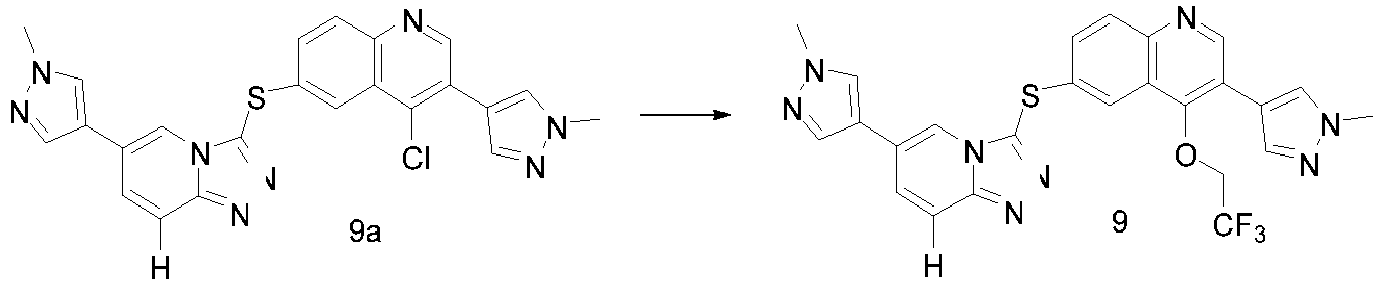
- Under N2, to a 25 mL one-necked flask, trifluoroethanol (4.2 mg, 0.042 mmol), dimethyl sulfoxide (1 mL) and sodium tert-butoxide (5.1 mg, 0.053 mmol) were added, and he reaction mixture was stirred at room temperature for 15 minutes, then 4-chloro-3-(1-methyl-1H-pyrazol-4-yl)-6-((6-(1-methyl-1H-pyrazol-4-yl)-[1,2,4]triazol o[4,3-a]pyridin-3-yl)thio)quinoline (10 mg, 0.021 mmol) was added, the reaction mixture was stirred at room temperature for 1 hours. After LC-MS showed completion of the reaction, the resulting residue was purified by reverse phase column chromatography (40% acetonitrile in water) to give 3-(1-methyl-1H-pyrazol-4-yl)-6-((6-(1-methyl-1H-pyrazol-4-yl)-[1,2,4]triazolo[4,3-a]p yridin-3-yl)thio)-4-(2,2,2-trifluoroethoxy)quinolone 9 (9.6mg, yield 85%) as a white solid.
MS m/z (ESI): 536.9
1H NMR (400 MHz, CDCl3, ppm): δ 8.92 (s, 1 H), 8.20 (s, 1 H), 8.01 (d, J = 8.8 Hz, 1 H), 7.89 (m, 3 H), 7.83 (s, 1 H), 7.68 (s, 1 H), 7.61 (s, 1 H), 7.56 (d, J = 8.8 Hz, 1 H), 7.50 (d, J = 9.6 Hz, 1 H), 4.09 (q, J = 8.1 Hz, 2 H), 4.01 (s, 3 H), 3.93 (s, 3 H).
19F NMR (376 MHz, DMSO-d 6, ppm): -74.10 (t, J = 8.1 Hz, 3 F). -

- Under N2, to a 25 mL one-necked flask, isopropyl alcohol (5.1 mg, 0.053 mmol), dimethyl sulfoxide (1 mL) and sodium tert-butoxide (2.5 mg, 0.042 mmol) were added, and the reaction mixture was stirred at room temperature for 15 minutes, then 4-chloro-3-(1-methyl-1H-pyrazol-4-yl)-6-((6-(1-methyl-1H-pyrazol-4-yl)-[1,2,4]triazol o[4,3-a]pyridin-3-yl)thio)quinoline (10 mg, 0.021 mmol) was added, and the reaction mixture was stirred at room temperature overnight. After LC-MS showed completion of the reaction, the resulting residue was purified by reverse phase column chromatography (40% acetonitrile in water) to give 4-isopropoxy-3-(1-methyl-1H-pyrazol-4-yl)-6-((6-(1-methyl-1H-pyrazol-4-yl)-[1,2,4]tri azolo[4,3-a]pyridin-3-yl)thio)quinoline 10 (2.2 mg, yield 21%) as a white solid.
MS m/z (ESI): 496.9.
1H NMR (400 MHz, CDCl3, ppm): δ 8.88 (s, 1 H), 8.20 (s, 1 H), 8.01 (d, J = 8.8 Hz, 1 H), 7.91 (m, 3 H), 7.81 (s, 1 H), 7.67 (s, 1 H), 7.59 (s, 1 H), 7.54 (dd, J = 8.8 Hz, 2.0 Hz, 1 H), 7.49 (dd, J = 9.6 Hz, 1.6 Hz, 1 H), 4.32 (m, 1 H), 3.99 (s, 3 H), 3.94 (s, 3 H), 1.10 (d, J = 6.0 Hz, 6 H). -

- To a 25 mL one-necked flask, 6-bromo-3-iodo-4-methoxyquinoline (0.2 g, 0.55 mmol), morpholin-3-one (0.083 g, 0.83 mmol), cuprous iodide (0.052 g, 0.28 mmol), potassium phosphate (0.18 g, 0.83 mmol) and dimethyl sulfoxide (3 mL) were added. The reaction mixture was purged with N2 three times, and then N,N'-dimethylethylenediamine (48 mg, 0.55 mmol) was added. The reaction mixture was heated to 50°C overnight. After removing from heat, the reaction mixture was diluted with ethyl acetate (100 mL), washed with saturated sodium chloride aqueous solution three times, the organic phase was dried over anhydrous sodium sulfate and concentrated. The resulting residue was purified by silica gel column chromatography (dichloromethane: methanol = 20:1) to give 4-(6-bromo-4-methoxyquinolin-3-yl)morpholin-3-one (0.17 g, yield 91%) as a yellow solid.
- To a 25 mL one-necked flask, 6-(1-methyl-1H-pyrazol-4-yl)-[1,2,4]triazolo[4,3-a]pyridin-3-thiol (127 mg, 0.55 mmol), 4-(6-bromo-4-methoxyquinolin-3-yl)morpholin-3-one (169 mg, 0.50 mmol), tris(dibenzylideneacetone)dipalladium (46 mg, 0.05 mmol), 4,5-bis(diphenylphosphino)-9,9-dimethylxanthene (58 mg, 0.1 mmol) and anhydrous N,N-dimethylformamide (10 mL) were added. The reaction mixture was purged with N2 and then stirred for 5 minutes at room temperature until the solids were dissolved. Sodium tert-butoxide (60 mg, 0.0.63 mmol) was added, and the reaction mixture was stirred at room temperature for 5 minutes, then heated to 100°C overnight. After LC-MS showed completion of the reaction, N,N-dimethylformamide was removed by rotary evaporation. The residue was dissolved in dichloromethane, washed with water twice and concentrated. The resulting residue was purified by reverse phase column chromatography to obtain 4-(4-methoxy-6-((6-(1-methyl-1H-pyrazol-4-yl)-[1,2,4]triazolo[4,3-a]pyridin-3-yl)thio) quinolin-3-yl)morpholin-3-one 11 (4.6 mg) as a white solid.
MS m/z (ESI): 487.9
1H NMR (400 MHz, CDCl3, ppm): δ 8.54 (s, 1 H), 8.12 (s, 1 H), 8.01 (d, J= 2.0 Hz, 1 H), 7.91 (d, J= 8.8 Hz, 1 H), 7.82 (d, J = 9.6 Hz, 1 H), 7.63 (s, 1 H), 7.54 (s, 1 H), 7.50 (dd, J= 8.8 Hz, 2.0 Hz, 1 H), 7.43 (dd, J = 9.6 Hz, 1.6 Hz, 1 H), 4.34 (s, 2 H), 4.03 (t, J = 5.2 Hz, 2 H), 3.96 (s, 3 H), 3.88 (s, 3 H), 3.68 (t, J = 5.0 Hz, 2 H). -

- Under N2, to a 25 mL one-necked flask, isopropyl alcohol (3.0 mg, 0.042 mmol), dimethyl sulfoxide (1 mL) and sodium tert-butoxide (5.1 mg, 0.053 mmol) were added, the reaction mixture was stirred at room temperature for 15 minutes, then 4-chloro-3-(1-methyl-1H-pyrazol-4-yl)-6-((6-(1-methyl-1H-pyrazol-4-yl)-[1,2,4]triazol o[4,3-a]pyridin-3-yl)thio)quinoine (10 mg, 0.021 mmol) was added, and the reaction solution was stirred at room temperature overnight. After LC-MS showed completion of the reaction, the resulting residue was purified by reverse phase column chromatography (30% acetonitrile in water) to give 4-(cyclopropylmethoxy)-3-(1-methyl-1H-pyrazol-4-yl)-6-((6-(1-methyl-1H-pyrazol-4-y 1)-[1,2,4]triazolo[4,3-a]pyridin-3-yl)thio)quinolone 12 (4.6 mg, yield 43%).
MS m/z (ESI): 508.9.
1H NMR (400 MHz, CDCl3, ppm): δ 8.94 (s, 1 H), 8.20 (s, 1 H), 8.07 (d, J = 8.8 Hz, 1 H), 7.96 - 7.89 (m, 4 H), 7.68 (s, 1 H), 7.61 (s, 1 H), 7.56 (d, J = 8.8 Hz, 1 H), 7.50 (d, J= 9.6 Hz, 1 H), 4.00 (s, 3 H), 3.94 (s, 3 H), 3.67 (d, J= 7.2 Hz, 2 H), 1.07 (m, 1 H), 0.52 (m, 2 H), 0.12 (m, 2 H). -
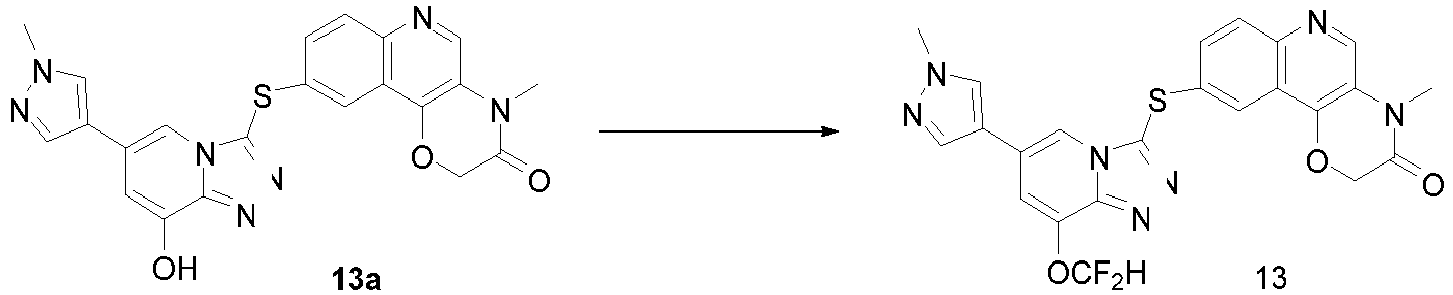
- Under N2, to a 25 mL one-necked flask, 9-((8-hydroxy-6-(1-methyl-1H-pyrazol-4-yl)-[1,2,4]triazolo[4,3-a]pyridin-3-yl)thio)-4-methyl-2H-[1,4]oxaazino[3,2-c]quinoline-3(4H)-one (41 mg, 0.09 mmol), potassium carbonate (25 mg, 0.18 mmol), ethyl chlorodifluoroacetate (16 mg, 0.098 mmol) and anhydrous N,N-dimethylformamide (3 mL) were added. The reaction mixture was stirred for 5 minutes at room temperature, then heated to 70°C overnight. After LC-MS showed completion of the reaction, N,N-dimethylformamide was removed by rotary evaporation, the resulting residue was dissolved in dichloromethane, washed with water twice and concentrated. The resulting residue was purified by column chromatography (dichloromethane: methanol = 20: 1) to give 9-((8-(difluoromethoxy)-6-(1-methyl-1H-pyrazol-4-yl)-[1,2,4]triazolo[4,3-a]pyridin-3-y l)thio)-4-methyl-2H-[1,4]oxazino[3,2-c]quinolin-3(4H)-one 12 (3.5mg) as a white solid.
MS m/z (ESI): 509.8
1H NMR (400 MHz, CDCl3, ppm): δ 8.58 (s, 1 H), 8.02 (s, 1 H), 8.00 (d, J = 2.0 Hz, 1 H), 7.87 (d, J = 8.8 Hz, 1 H), 7.50 (t, J = 73.4 Hz, 1 H), 7.60 (s, 1 H), 7.56 (s, 1 H), 7.44 (dd, J = 8.8 Hz, 2.0 Hz, 1 H), 7.15 (s, 1 H), 4.82 (s, 2 H), 3.88 (s, 3 H), 3.44 (s, 3 H).
19F NMR (376 MHz, CDCl3, ppm): -83.39 (t, J = 73.3 Hz, 2 F). -

- To a 100 mL sealed tube, 6-bromo-4-chloro-3-iodo-quinoline (1.5 g, 4.07 mmol), cesium carbonate (3.98 g, 12.21 mmol), cuprous iodide (388 mg, 2.0 mmol) and 1,3-propanediol (50 mL) were added. The reaction solution was heated to 100°C overnight. After LC-MS showed completion of the reaction, the reaction solution was cooled to room temperature, poured into ice water, and extracted with dichloromethane. The organic phases were combined, washed with saturated sodium chloride aqueous solution three times, and dried over potassium carbonate. The resulting residue was purified by silica gel column chromatography (dichloromethane: methanol = 20:1) to give 10-bromo-3,4-dihydro-2H-[1,4]dioxepino [2,3-c] quinoline (200 mg, yield 18%) as a white solid.
MS m/z (ESI): 279.8 - To a 25 mL one-necked flask, 8-fluoro-6-(1-methyl-1H-pyrazol-4-yl)-[1,2,4]triazolo [4,3-a]pyridin-3-thiol 1 (112 mg, 0.45 mmol) 10-bromo-3,4-dihydro-2H-[1,4]dioxepino [2,3-c]quinoline (100 mg, 0.41 mmol), tris(dibenzylideneacetone)dipalladium (46 mg, 0.05 mmol), 4,5-bis(diphenylphosphino)-9,9-dimethylxanthene (47 mg, 0.08 mmol) and anhydrous N,N-dimethylformamide (5 mL) were added. The reaction mixture was purged with N2 and stirred for 5 minutes at room temperature until the solids were dissolved. Sodium tert-butoxide (52 mg, 0.54 mmol) was added, and the reaction mixture was stirred at room temperature for another 5 minutes, then heated to 100°C overnight. After LC-MS showed completion of the reaction, N,N-dimethylformamide was removed by rotary evaporation, the resulting residue was dissolved in dichloromethane, washed with water twice and concentrated. The resulting residue was purified by column chromatography to obtain 10-((8-fluoro-6-(1-methyl-1H-pyrazol-4-yl)-[1,2,4]triazolo[4,3-a]pyridin-3-yl)thio)-3,4-dihydro-2H-[1,4]dioxepino[2,3-c]quinoline 14 (61 mg, yield 33%) as a white solid.
MS m/z (ESI): 448.9
1H NMR (400 MHz, CDCl3, ppm): δ 8.55 (s, 1 H), 8.15 (s, 1 H), 8.06 (s, 1 H), 7.87 (d, J= 8.8 Hz, 1 H), 7.65 (d, J = 12.0 Hz, 2 H), 7.43 (d, J = 8.8 Hz, 1 H), 7.16 (d, J = 10.4 Hz, 1 H), 4.53 (t, J = 5.4 Hz, 2 H), 4.37 (t, J = 5.8 Hz, 2 H), 3.95 (s, 3 H), 2.35 (m, 2 H).
19F NMR (376 MHz, CDCl3, ppm): -126.73 (d, J= 10.9 Hz, 1 F). -

- To a 100 mL one-necked flask, 6-bromo-3-nitro-quinolin-4-ol (2.5 g, 9.0 mmol) and methanol (10 mL) were added, and hydrazine hydrate (2.7 g, 46.5 mmol) was added in an ice bath. Then a catalytic amount of Raney nickel was added, and the reaction mixture was stirred for 1 hour at room temperature. After TLC showed completion of the reaction, the reaction solution was filtered, and the filter cake was washed with methanol three times. The organic phase was concentrated by rotary evaporation to give 3-amino-6-bromoquinolin-4-ol (2.20 g, yield 95%).
MS m/z (ESI): 238.9 - To a 50 mL one-necked flask, 3-amino-6-bromo-quinolin-4-ol (0.26 g, 1.09 mmol), potassium carbonate (0.90 g, 6.54 mmol), 1,2-dibromoethane (0.62 g, 3.27 mmol) and N,N-dimethylformamide (10 mL) were added. The reaction mixture was heated to 80°C for 4 hours, and then poured into water (200 mL), extracted with ethyl acetate (50 ml, 3 times). The organic phases were combined, dried, and concentrated by rotary evaporation. The resulting residue was purified by silica gel column chromatography (petroleum ether/ethyl acetate = 10: 1 to 4:1, v/v) to give 9-bromo-3,4-dihydro-2H-[1,4]oxazino[3,2-c]quinoline (102 mg, yield 35%) as a pale yellow solid.
MS m/z (ESI): 264.9 - To a 25 mL one-necked flask, 9-bromo-3,4-dihydro-2H-[1,4]oxazino [3,2-c]quinoline (76 mg, 0.29 mmol), ethyldiisopropylamine (0.11 ml, 0.57 mmol) and dichloromethane (10 mL) were added. The reaction mixture was stirred for 5 minutes at room temperature, then cyclopropanecarbonyl chloride (30 µL, 0.32 mmol) was added slowly, and the reaction solution was stirred for 3 hours at room temperature. After the reaction was stopped, the solvent was removed by rotary evaporation. The residue was separated by preparative TLC (petroleum ether: ethyl acetate = 5:1, v/v) to obtain (9-bromo-2,3-dihydro-4H-[1,4]oxazino[3,2-c]quinolin-4-yl)(cyclopropyl)methanone (57 mg, yield 60%) as a white solid.
MS m/z (ESI): 333.0 - 6-(1-methyl-1H-pyrazol-4-yl)-[1,2,4]thiazole[4,3-a]pyridin-3-thiol (28 mg, 0.12 mmol), (9-bromo-2,3-dihydro-4H-[1,4]oxazino[3,2-c]quinolin-4-yl)(cyclopropyl) methanone (34 mg, 0.10 mmol), tris(dibenzylideneacetone)dipalladium (6.0 mg, 0.011 mmol), 4,5-bis(diphenylphosphino)-9,9-dimethylxanthene (12 mg, 0.022 mmol) and potassium tert-butoxide (23.0 mg, 0.21 mmol) were dissolved in anhydrous N,N-dimethylformamide (10 mL). The reaction solution was headed to 100 °C for 36 hours under N2. The solvent was removed by rotary evaporation, and the resulting residue was purified by column chromatography (dichloromethane/methanol = 20: 1, v/v) to give cyclopropyl(9-((6-(1-methyl-1H-pyrazol-4-yl)-[1,2,4]triazolo[4,3-a]pyridin-3-yl)thio)-2, 3-dihydro-4H-[1,4]oxazino[3,2-c]quinolin-4-yl)methanone 15 (6 mg, yield 12%) as a pale yellow solid.
MS m/z (ESI): 484.1
1H NMR (400 MHz, CDCl3) δ 9.02 (s, 1 H), 8.23 (t, J = 1.3 Hz, 1 H), 8.10 (d, J = 2.1 Hz, 1 H), 7.93 (dd, J = 13.6, 9.1 Hz, 2 H), 7.71 (s, 1 H), 7.64 (s, 1 H), 7.53 (ddd, J = 18.4, 9.1, 1.9 Hz, 2 H), 4.57 (t, J = 4.6 Hz, 2 H), 4.13 - 4.04 (m, 2 H), 3.97 (s, 3 H), 0.97 (dq, J = 7.3, 3.9 Hz, 2 H), 0.93-0.82 (m, 3 H). - 4-methyl-9-((6-(1-methyl-1H-pyrazol-4-yl)-[1,2,4]triazolo[4,3-a]pyridin-3-yl)th io)-2H-[1,4]oxazino[3,2-c]quinolin-3(4H)-one (16)

- To a 50 mL one-necked flask, 3-amino-6-bromo-quinolin-4-ol (300 mg, 1.3 mmol), potassium carbonate (520 mg, 3.8 mmol) and anhydrous N,N-dimethylformamide (7 mL) were added. The reaction mixture was stirred at room temperature for 3 minutes, then chloroacetyl chloride (160 mg, 1.3 mmol) was slowly added. The resulted reaction solution was stirred overnight. After LC-MS showed completion of the reaction, the reaction mixture was poured into ice water, stirred for 10 minutes. The resulting solid was filtered by a Büchner funnel and washed with water, then dried to give 9-bromo-2H-[1,4]oxazino[3,2-c]quinolin-3(4H)-one (200mg, yield 57%) as a pale purple solid.
MS m/z (ESI): 278.9 - To a 100 mL sealed tube, 9-bromo-2H-[1,4]oxazino[3,2-c]quinolin-3(4H)-one (1.0 g, 3.6 mmol), sodium tert-butoxide (516 mg, 5.4 mmol) and anhydrous N,N-dimethylformamide (20 mL) were added. The reaction mixture was stirred for 15 minutes at room temperature, and then methyl iodide (560 mg, 3.9 mmol) was added. A lot of solid was precipitated out of the solution. The reaction mixture was left to stand at room temperature overnight. After LC-MS showed completion of the reaction, an appropriate amount of ethyl acetate, acetone, water and ethanol were added to precipitate the desired produt. The resulting solid was filtered to give a pale yellow powder (424 mg), and the filtrate was concentrated and recrystallized to give another yellow powder (268 mg). Totally 692 mg (yield 66%) 9-bromo-4-methyl-2H-[1,4]oxazino[3,2-c]quinolin-3(4H)-one as a yellow powder was obtained.
MS m/z (ESI): 292.9. - To a 25 mL one-necked flask, 6-(1-methyl-1H-pyrazol-4-yl)-[1,2,4]thiazole[4,3-a]pyridin-3-thiol (44 mg, 0.19 mmol), 9-bromo-4-methyl-2H-[1,4]oxazino[3,2-c]quinolin-3(4H)-one (46 mg, 0.157 mmol), tris(dibenzylideneacetone)dipalladium (10 mg, 0.016 mmol), 4,5-bis(diphenylphosphino)-9,9-dimethylxanthene (20 mg, 0.032 mmol) and anhydrous N,N-dimethyl formamide (10 mL) were added. The reaction mixture was purged with N2 and stirred for 5 minutes at room temperature until the solids were dissolved. Sodium tert-butoxide (20 mg, 0.188 mmol) was added and stirred at room temperature for another 5 minutes, then heated at 100°C for 24 h. After the reaction was stopped, N,N-dimethylformamide was removed by rotary evaporation. The residue was purified by column chromatography (dichloromethane/methanol = 25: 1, v/v) to obtain 4-methyl-9-((6-(1-methyl-1H-pyrazol-4-yl)-[1,2,4]triazolo[4,3-a]pyridin-3-yl)thio)-2H-[ 1,4]oxazino[3,2-c]quinolin-3(4H)-one 16 (12 mg, yield 16%) as a pale yellow solid.
MS m/z (ESI): 444.1
1H NMR (400 MHz, CDCl3) δ 8.56 (s, 1 H), 8.16 - 8.12 (m, 1 H), 7.94-7.90 (m, 1 H), 7.87-7.79 (m, 2 H), 7.61 (d, J = 0.8 Hz, 1 H), 7.56 (d, J = 0.9 Hz, 1 H), 7.41 (ddd, J = 9.0, 2.9, 1.9 Hz, 2 H), 7.20 (s, 1 H), 4.80 (s, 2 H), 3.88 (s, 3 H), 3.43 (s, 3 H). -

- 6-bromo-4-chloro-3-iodo-quinoline (5.00 g, 13.57 mmol), morpholine (1.42 g, 16.29 mmol), tris(dibenzylideneacetone)dipalladium (1.24 g, 1.36 mmol) and 4,5-bis(diphenylphosphino)-9,9-dimethylxanthene (1.57 g, 2.71 mmol) were dissolved in DMF (90 mL). The reaction solution was heated to 35°C and stirred for 1 hour under N2, then sodium tert-butoxide (1.56 g, 1.629 mmol) was added. The reaction mixture was stirred for another 16 hours at 35°C, and then the reaction solution was concentrated to dryness under reduced pressure. The resulting residue was dissolved in ethyl acetate, washed with sodium chloride aqueous solution and dried. The solution was filtered and concentrated. The resulting residue was separated by column chromatography (dichloromethane/methanol = 100: 1, v/v) to give a crude produt. The crude product was pulverized and filtered to give 4-(6-bromo-4-chloroquinolin-3-yl)-morpholine (2.5 g, yield 56%) as a white solid.
MS m/z (ESI): 326.9. - To a 25 mL sealed tube, 4-(6-bromo-4-(cyclopropylmethoxy)quinolin-3-yl)-morpholine (100 mg, 0.31 mmol), cyclopropyl methanol (8 mL) and sodium methoxide (81 mg, 1.5 mmol) were added. The reaction solution was heated to 120°C for 12 hours, and then cooled to room temperature. The excess cyclopropyl methanol was distilled off under reduced pressure. The resulting residue was purified by preparative TLC (petroleum ether: ethyl acetate = 5:1) to give 4-(6-bromo-4-(cyclopropylmethoxy)-quinolin-3-yl)-morpholine (65 mg, yield 58%) as a pale yellow solid.
MS m/z (ESI): 363.0. - To a 25 mL one-necked flask, 6-(1-methyl-1H-pyrazol-4-yl)-[1,2,4]triazolo[4,3-a]pyridin-3-thiol (42 mg , 0.182 mmol), 4-(6-bromo-4-(cyclopropylmethoxy)quinolin-3-yl)morpholine (60 mg, 0.166 mmol), tris(dibenzylideneacetone)dipalladium (10 mg, 0.017 mmol), 4,5-bis(diphenylphosphino)-9,9-dimethylxanthene (20 mg, 0.034 mmol) and anhydrous N,N-dimethylformamide (10 mL) were added. The reaction mixture was purged with N2 and stirred for 5 minutes at room temperature until the solids were dissolved, then sodium tert-butoxide (24 mg, 0.249 mmol) was added. The reaction solution was stirred at room temperature for another 5 minutes, then heated at 100°C for 16 hours. After the reaction was stopped, N,N-dimethylformamide was removed by rotary evaporation. The resulting residue was purified by preparative TLC (dichloromethane/methanol = 20:1, v/v) to obtain 4-(4-(cyclopropylmethoxy)-6-((6-(1-methyl-1H-pyrazol-4-yl)-[1,2,4]triazolo[4,3-a]pyridin-3-yl)thio)quinolin-3-yl)morpholine 17 (46 mg, yield 49%) as a pale yellow solid.
MS m/z (ESI): 514.2
1H NMR (400 MHz, CDCl3) δ 8.65 (s, 1 H), 8.20 (s, 1 H), 7.99 (d, J = 11.9 Hz, 2 H), 7.89 (d, J = 9.4 Hz, 1 H), 7.67 (s, 1H), 7.60 (s, 1 H), 7.47 (t, J = 10.7 Hz, 2 H), 4.07 (d, J = 7.3 Hz, 2 H), 3.95 (s, 3 H), 3.91 - 3.84 (m, 4 H), 3.26 - 3.19 (m, 4 H), 1.08 (dd, J= 10.1, 5.5 Hz, 1 H), 0.50 (d, J= 7.4 Hz, 2 H), 0.17 (d, J= 7.0, 6.2 Hz, 2 H). -

MS m/z (ESI): 430.1
1H NMR (400 MHz, DMSO-d 6) δ 11.09 (d, J = 10.6 Hz, 1 H), 8.64 (s, 1 H), 8.46 (s, 1 H), 8.35 (s, 1 H), 8.11 - 7.95 (m, 2 H), 7.97-7.76 (m, 3 H), 7.47 (dd, J = 9.0, 2.1 Hz, 1 H), 4.87 (s, 2 H), 3.86 (s, 3 H). -

- To a 30 mL microwave tube, 6-(1-methyl-1H-pyrazol-4-yl)-[1,2,4]triazolo [4,3-a]pyridin-3-thiol (118 mg, 0.516 mmol), 9-bromine-2H-[1,4]oxaazino[3,2-c]quinolone-3(4H)-one (120 mg, 0.430 mmol), tris(dibenzylideneacetone)dipalladium (25 mg, 0.043 mmol), 4,5-bis(diphenylphosphino)-9,9-dimethylxanthene (50 mg, 0.086 mmol), sodium t-butoxide (50 mg, 0.516 mmol) and anhydrous N,N-dimethylformamide (5 mL) were added. The reaction mixture was purged with N2 and then heated by microwaves to 120 °C for 4 hours. After the reaction was stopped, N,N-dimethylformamide was removed by rotary evaporation. The resulting residue was purified by reverse phase column chromatography to give 9-((8-fluoro-6-(1-methyl-1H-pyrazol-4-yl)-[1,2,4]triazolo[4,3-a]pyridin-3-yl)thio)-2H-[ 1,4]oxazino[3,2-c]quinolin-3(4H)-one 19 (6 mg, yield 3%) as a white solid.
MS m/z (ESI): 448.1.
1H NMR (400 MHz, DMSO-d 6) δ 11.09 (s, 1 H), 8.56 (s, 1 H), 8.47 (s, 1 H), 8.38 (s, 1 H), 8.08 (s, 1 H), 7.92 (d, J = 2.1 Hz, 1 H), 7.86 (dd, J= 10.6, 8.2 Hz, 2 H), 7.49 (dd, J = 9.1, 2.1 Hz, 1 H), 4.89 (s, 2 H), 3.86 (s, 3 H). -

- To a 25 mL one-necked flask, anhydrous N,N-dimethylformamide (5 mL) was added, followed by addition of 9-bromine-2H-[1,4]oxaazino[3,2-c]quinoline-3(4H)-one (100 mg, 0.358 mmol) and sodium t-butoxide (50 mg, 0.534 mmol). The reaction mixture was stirred for 15 minutes at room temperature and then 1-bromo-2-methoxy-ethane (65 mg, 0.465 mmol) was added. The reaction solution was stirred for 4 hours at room temperature, N,N-dimethylformamide was removed under reduced pressure. The resulting solid was separated by preparative TLC (petroleum ether: ethyl acetate = 7: 1) to give 9-bromo-4-(2-methoxyethyl)-2H-[1,4]oxazino[3,2-c]quinolin-3(4H)-one (56 mg, yield 46%).
MS m/z (ESI): 337.0. - To a 30 mL microwave tube, 6-(1-methyl-1H-pyrazol-4-yl)-[1,2,4]triazolo [4,3-a]pyridin-3-thiol 28d (50 mg, 0.216 mmol), 9-bromo-4-(2-methoxyethyl)-2H-[1,4] oxazino[3,2-c]quinolin-3(4H)-one (56 mg, 0.166 mmol), tris(dibenzylideneacetone)dipalladium (10 mg, 0.017 mmol), 4,5-bis(diphenylphosphino)-9,9-dimethylxanthene (20 mg, 0.034 mmol), sodium tert-butoxide (25 mg, 0.249 mmol) and anhydrous N,N-dimethylformamide (5mL) were added successively. The reaction mixture was purged with N2 and heated by microwaves to 120 °C for 2.5 hours. After the reaction was stopped, N,N-dimethylformamide was removed by rotary evaporation. The resulting residue was purified by reverse phase column chromatography to give 4-(2-methoxyethyl)-9-((6-(1-methyl-1H-pyrazol-4-yl)-[1,2,4]triazolo[4,3-a]pyridin-3-yl )thio)-2H-[1,4]oxazino[3,2-c]quinolin-3(4H)-one 20 (20 mg, yield 24%) as a white solid.
MS m/z (ESI): 488.1.
1H NMR (400 MHz, DMSO-d 6) δ 8.90 (s, 1 H), 8.70-8.62 (m, 1 H), 8.35 (s, 1 H), 8.10-7.98 (m, 2 H), 7.95-7.79 (m, 3 H), 7.50 (dd, J = 9.0, 2.1 Hz, 1 H), 4.96 (s, 2 H), 4.25 (t, J = 5.4 Hz, 2 H), 3.86 (s, 3 H), 3.57 (t, J = 5.4 Hz, 2 H), 3.39 (d, J = 11.4 Hz, 1 H), 3.21 (s, 3 H). -

- To a 30 mL microwave tube, 8-fluoro-6-(1-methyl-1H-pyrazol-4-yl)-[1,2,4] triazolo[4,3-a]pyridin-3-thiol (75 mg, 0.299 mmol), 9-bromo-4-(2-methoxyethyl)-2H-[1,4] oxazino[3,2-c]quinolin-3(4H)-one (84 mg, 0.249 mmol), tris(dibenzylideneacetone)dipalladium (15 mg, 0.025 mmol), 4,5-bis(diphenylphosphino)-9,9-dimethylxanthene (30 mg, 0.05 mmol), sodium tert-butoxide (30 mg, 0.299 mmol) and anhydrous N,N-dimethylformamide (5 mL) were added successively. The reaction mixture was purged with N2 and heated by microwaves to 120 °C for 4 hours. After the reaction was stopped, N,N-dimethylformamide was removed by rotary evaporation. The resulting residue was purified by reverse phase column chromatography to give 9-((8-fluoro-6-(1-methyl-1H-pyrazol-4-yl)-[1,2,4]triazolo[4,3-a]pyridin-3-yl)thio)-4-(2-methoxyethyl)-2H-[1,4]oxazino[3,2-c]quinolin-3(4H)-one 21 (20 mg, yield 15%) as a white solid.
MS m/z (ESI): 506.1.
1H NMR (400 MHz, CDCl3) δ 8.91 (s, 1 H), 8.08 - 7.98 (m, 2 H), 7.93 (d, J = 8.9 Hz, 1 H), 7.67 (s, 1 H), 7.61 (s, 1 H), 7.50 (dd, J = 8.9, 2.1 Hz, 1 H), 7.17 (d, J = 10.3 Hz, 1 H), 4.87 (s, 2 H), 4.23 (t, J = 5.2 Hz, 2 H), 3.95 (s, 3 H), 3.70 (t, J = 5.2 Hz, 2 H), 3.33 (s, 3 H). -

- To a 30 mL microwave tube, 8-fluoro-6-(1-methyl-1H-pyrazol-4-yl)-[1,2,4] triazolo[4,3-a]pyridin-3-thiol (93 mg, 0.375 mmol), 9-bromo-4-methyl-2H-[1,4]oxazino[3,2-c]quinolin-3(4H)-one (100 mg, 0.341 mmol), tris(dibenzylideneacetone)dipalladium (20 mg, 0.034 mmol), 4,5-bis(diphenylphosphino)-9,9-dimethylxanthene (40 mg, 0.068 mmol), sodium tert-butoxide (40 mg, 0.409 mmol) and anhydrous N,N-dimethylformamide (5 mL) were added successively. The reaction mixture was purged with N2 and heated by microwaves to 120 °C for 4 hours. After the reaction was stopped, N,N-dimethylformamide was removed by rotary evaporation. The residue was purified by reverse phase column chromatography to give 9-((8-fluoro-6-(1-methyl-1H-pyrazol-4-yl)-[1,2,4]triazolo[4,3-a]pyridin-3-yl)thio)-4-methyl-2H-[1,4]oxazino[3,2-c]quinolin-3(4H)-one 22 (36 mg, yield 23%) as a white solid.
MS m/z (ESI): 462.1.
1H NMR (400 M, DMSO-d 6, ppm) δ 8.82 (s, 1 H), 8.57 (s, 1H), 8.38 (s, 1 H), 8.08 (s, 1 H), 7.97 (s, 1 H), 7.91 (d, J = 9.2 Hz, 1 H), 7.85 (d, J = 12.0 Hz, 1 H), 7.52 (d, J = 9.6 Hz, 1 H), 4.98 (s, 2 H), 3.86 (s, 3 H), 3.43 (s, 3 H). -

- To a 50 mL one-necked flask, 3-amino-6-bromoquinolin-4-ol 15b (200 mg, 0.84 mmol), triethylamine (214 mg, 2.1 mmol) and anhydrous dichloromethane (20 mL) were added. The reaction solution was stirred at -30°C, then cyclopropanecarbonyl chloride (79 mg, 0.75 mmol) was dropwise added. The reaction mixture was stirred at -30°C for 30 minutes, then reacted at room temperature overnight. After LC-MS showed completion of the reaction, the reaction mixture was filtered. The resulting solid was washed with dichloromethane and dried in air to give N-(6-bromo-4-hydroxyquinolin-3-yl)-cyclopropanecarboxamide (100 mg, yield 34%) as a black solid.
MS m/z (ESI): 307, 309.
1H-NMR (DMSO, 400 MHz): δ 12.10 (s, 1 H), 9.57 (s, 1 H), 8.96 (s, 1 H), 8.27 (d, J = 2.0 Hz, 1 H), 7.77 (dd, J = 2.0, 8.8 Hz, 1 H), 7.57 (d, J = 8.8 Hz, 1 H), 2.19-2.26 (m, 1 H), 0.76-0.79 (m, 4 H). - To a 50 mL one-necked flask, N-(6-bromo-4-hydroxyquinolin-3-yl)cyclopropanecarboxamide (0.15 g, 0.49 mmol), phosphorus pentasulfide (0.22 g, 0.98 mmol) and anhydrous pyridine (5 mL) were added. The reaction mixture was refluxed for 2 hours. After LC-MS showed completion of the reaction, the solvent was removed by rotary evaporation. The residue was dissolved in ethyl acetate (40 mL), saturated sodium bicarbonate aqueous solution was added to adjust the pH to 9. The layers were separated. The organic layer was washed successively with saturated sodium bicarbonate aqueous solution and sodium chloride aqueous solution, and then dried, filtered. The solvent was removed by rotary evaporation, and the resulting residue was purified by preparative TLC (petroleum ether: ethyl acetate = 3: 1) to give 8-bromo-2-cyclopropylthiazolo[4,5-c]quinoline (90 mg, yield 60%) as a white solid.
MS m/z (ESI): 305, 307.
1H-NMR (CDCl3, 400MHz): δ 9.23 (s, 1 H), 8.00-8.02 (m, 2 H), 7.70 (dd, J= 2.0, 8.8 Hz, 1 H), 2.47-2.54 (m, 1 H), 1.34-1.36 (m, 4 H). - To a 100 mL three-necked flask, 8-bromo-2-cyclopropylthiazolo[4,5-c]quinoline (0.04 g, 0.13 mmol), 6-(1-methyl-1H-pyrazol-4-yl)-[1,2,4]thiazole[4,3-a]pyridin-3-thiol (0.03 g, 0.13 mmol), tris(dibenzylideneacetone)dipalladium (0.024 g, 0.026 mmol), 4,5-bis(diphenylphosphino)-9,9-dimethylxanthene (0.015 g, 0.026 mmol), sodium tert-butoxide (0.016 g, 0.17 mmol) and anhydrous N,N-dimethylformamide (4 mL) were added. The reaction mixture was purged with N2 three times, then heated to 100°C overnight. After LC-MS showed completion of the reaction, the reaction mixture was filtered by celite, and washed with ethyl acetate (30 mL). The organic phase was washed with sodium chloride aqueous solution, dried and filtered. The solvent was removed by rotary evaporation, and the crude product was purified by reverse phase column chromatography to give 2-cyclopropyl-8-((6-(1-methyl-1H-pyrazol-4-yl) -[1,2,4]triazolo[4,3-a]pyridin-3-yl)thio)thiazolo[4,5-c]quinoline 23 (15 mg, yield 25%) as a pale yellow solid.
MS m/z (ESI): 456;
1H-NMR (CDCl3, 400 MHz): δ 9.31 (s, 1 H), 8.23 (s, 1 H), 8.17 (d, J = 8.8 Hz, 1 H), 7.88-7.91 (m, 2 H), 7.69 (s, 1 H), 7.60 (s, 1 H), 7.56 (dd, J = 1.6, 8.8 Hz, 1 H), 7.49 (dd, J = 1.6, 8.8 Hz, 1 H), 3.94 (s, 3 H), 2.45-2.51 (m, 1 H), 1.31-1.35 (m, 4 H). -
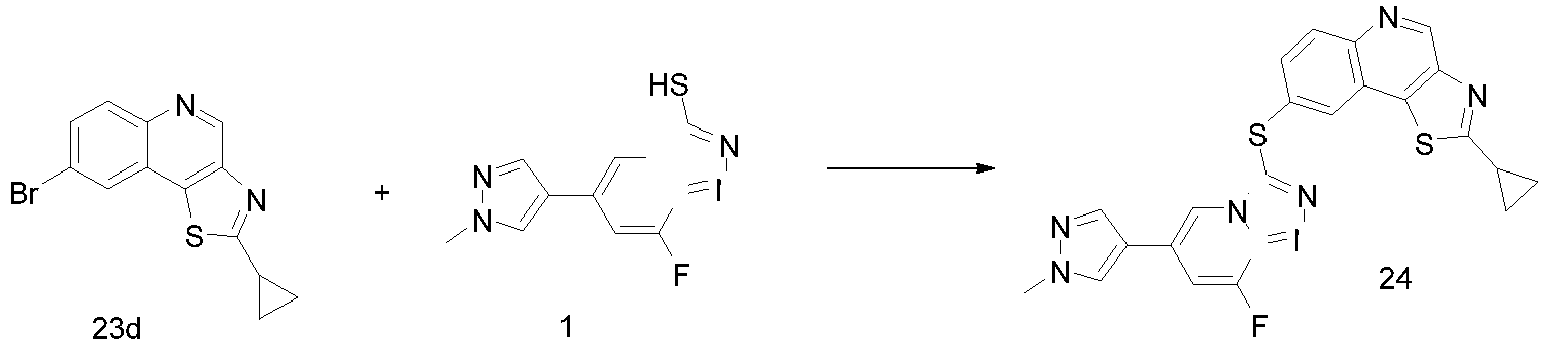
- To a 100 mL three-necked flask, 8-bromo-2-cyclopropylthiazolo[4,5-c]quinoline (0.055 g, 0.18 mmol), 8-fluoro-6-(1-methyl-1H-pyrazol-4-yl)-[1,2,4]triazolo[4,3-a]pyridin-3-thiol (0.05 g, 0.20 mmol), tris(dibenzylideneacetone)dipalladium (0.016 g, 0.018 mmol), 4,5-bis(diphenylphosphino)-9,9-dimethylxanthene (0.021 g, 0.036 mmol), sodium tert-butoxide (0.021 g, 0.22 mmol) and anhydrous N,N-dimethylformamide (5 mL) were added. The reaction mixture was purged with N2 three times and heated to 100°C for 4 hours. After LC-MS showed completion of the reaction, the reaction mixture was filtered by celite, and washed with ethyl acetate (30 mL). The organic layer was washed with sodium chloride aqueous solution, dried and filtered. The solvent was removed by rotary evaporation, and the crude product was purified by reverse phase column chromatography to give 2-cyclopropyl-8-((8-fluoro-6-(1-methyl-1H-pyrazol-4-yl)-[1,2,4]triazolo[4,3-a]pyridin-3-yl)thio)-thiazolo[4,5-c]quinoline (10 mg, yield 12%) as a white solid.
MS m/z (ESI): 474;
1H-NMR (CDCl3, 400MHz): δ 9.32 (s, 1 H), 8.13 (d, J = 8.8 Hz, 1 H), 8.08 (s, 1 H), 7.91 (s, 1 H), 7.67 (s, 1 H), 7.60 (s, 1 H), 7.57 (d, J = 8.8 Hz, 1 H), 7.18 (d, J = 10.4 Hz, 1 H), 3.95 (s, 3 H), 2.46-2.51 (m, 1 H), 1.31-1.35 (m, 4 H). -

- To a 50 mL one-necked flask, 3-amino-6-bromoquinolin-4-ol (0.5 g, 2.09 mmol), N,N'-carbonyldiimidazole (0.51 g, 3.14 mmol) and tetrahydrofuran (20 mL) were added. The reaction mixture was heated to reflux for 4 hours under N2. The solvent was removed by rotary evaporation. The resulting residue was added with ethyl acetate (30 mL), 2M diluted hydrochloric acid (15 mL), and then filtered. The resulting solid was dried in air to give 8-bromooxazolo[4,5-c]quinolin-2(3H)-one (0.4 g, yield 72%) as a pale yellow solid.
MS m/z (ESI): 265, 267. - To a 50 mL three-necked flask, 8-bromooxazolo[4,5-c]quinolin-2(3H)-one (0.10 g, 0.28 mmol) and anhydrous N,N-dimethylformamide (2 mL) were added. The reaction mixture was stirred under N2 in an ice bath, and then sodium hydride (60% in mineral oil, 0.023 g, 0.57 mmol) was added. The reaction solution was stirred for half an hour, then iodomethane (0.081g, 0.57 mmol) was added. The reaction solution was stirred for another 2 hours at room temperature under N2. After LC-MS showed completion of the reaction, ethyl acetate (40 mL) was added, and the reaction mixture was filtered. The filtrate was washed with sodium chloride aqueous solution, and then dried over anhydrous sodium sulfate and filtered. The solvent was removed by rotary evaporation, and the crude product was purified by preparative TLC (petroleum ether/ethyl acetate = 1/1) to give 8-bromo-3-methyloxazolo[4,5-c]quinolin-2(3H)-one (50 mg, yield 48%) as a pale yellow solid.
MS m/z (ESI): 279, 281.
1H-NMR (CDCl3, 400MHz): δ 8.75 (s, 1 H), 8.20 (s, 1 H), 8.00 (d, J = 8.8 Hz, 1 H), 7.74 (d, J = 8.8 Hz, 1 H), 3.61 (s, 1 H). - To a 10 mL three-necked flask, 6-(1-methyl-1H-pyrazol-4-yl)-[1,2,4]triazolo[4,3-a] pyridin-3-thiol (0.041 g, 0.18 mmol), 8-bromo-3-methyloxazolo[4,5-c]quinolin-2(3H)-one (0.05 g, 0.18 mmol), tris(dibenzylideneacetone)dipalladium (0.016 g, 0.018 mmol), 4,5-bis(diphenylphosphino)-9,9-dimethylxanthene (0.021 g, 0.036 mmol), sodium tert-butoxide (0.026 g, 0.27 mmol) and anhydrous N,N-dimethylformamide (3 mL) were added. The reaction mixture was purged with N2 three times and heated to 100°C for 2 hours. After LC-MS showed completion of the reaction, the reaction solution was filtered by celite, washed with ethyl acetate (30 mL). The organic phase was washed with sodium chloride aqueous solution, dried and filtered. The solvent was removed by rotary evaporation, and the crude product was purified by reverse phase column chromatography to give 3-methyl-8-((6-(1-methyl-1H-pyrazol-4-yl)-[1,2,4]triazolo[4,3-a]pyridin-3-yl)thio)oxazolo[4,5-c]quinolin-2(3H)-one 25 (5 mg, yield 7%) as a white solid.
MS m/z (ESI): 430.
1H-NMR (CDCl3, 400MHz): δ 8.69 (s, 1 H), 8.22 (s, 1 H), 8.02 (d, J = 8.8 Hz, 1 H), 7.92 (d, J = 8.8 Hz, 1 H), 7.85 (s, 1 H), 7.69 (s, 1 H), 7.64 (s, 1 H), 7.49-7.53 (m, 2 H), 3.95 (s, 3 H), 3.57 (s, 3 H). -

- To a 30 mL microwave tube, 6-bromo-4-chloro-3-(1-methyl-1H-pyrazol-5-yl)quinoline (100 mg, 0.31 mmol), potassium hydroxide aqueous solution (2M, 2 mL) and dimethyl sulfoxide (8 mL) were added. The reaction mixture was heated by microwaves to 80°C for 1 hour, then cooled to room temperature. After LC-MS showed completion of the reaction, the reaction solution was diluted with ethyl acetate, and diluted hydrochloric acid was added to adjust the pH to 6. The layers were separated. The aqueous phase was extracted with ethyl acetate, the organic phases were combined, dried over anhydrous sodium sulfate, and filtered. The solvent was removed by rotary evaporation, and the crude product was purified by preparative TLC (petroleum ether/ethyl acetate = 1/1) to give 6-bromo-3-(1-methyl-1H-pyrazol-5-yl)quinolin-4-ol (50 mg, yield 53%) as a gray solid.
MS m/z (ESI):304, 306[M+H]+. - To a 10 mL microwave tube, 6-bromo-3-(1-methyl-1H-pyrazol-5-yl)quinolin-4-ol (50 mg, 0.16 mmol), potassium hydroxide aqueous solution (2 M, 1 mL) and acetonitrile (3 mL) were added. The reaction mixture was cooled to -20°C, bromodifluoromethyl diethyl phosphate (92 mg, 0.35 mmol) was added, and the reaction mixture was stirred at room temperature overnight. After LC-MS showed completion of the reaction, the solvent was removed by rotary evaporation, and then extracted with ethyl acetate. The organic phases were combined, dried over anhydrous sodium sulfate, and filtered. The solvent was removed by rotary evaporation, and the crude product was purified by preparative TLC (dichloromethane/methanol = 25/1) to give 6-bromo-4-(difluoromethoxy)-3-(1-methyl-1H-pyrazol-5-yl)quinoline (15 mg, yield 13%) as a white solid.
MS m/z (ESI): 354, 356[M+H]+. - To a 25 mL three-necked flask, 6-bromo-4-(difluoromethoxy)-3-(1-methyl -1H-pyrazol-5-yl)quinoline (0.015 g, 0.04 mmol), 8-fluoro-6-(1-methyl-1H-pyrazol-4-yl) -[1,2,4]triazolo[4,3-a]pyridin-3-thiol (0.012 g, 0.05 mmol), tri(dibenzenylpropanone) dipalladium (0.004 g, 0.004 mmol), 4,5-bis(diphenylphosphino)-9,9-dimethylxanthene (0.005 g, 0.008 mmol), sodium tert-butoxide (0.005 g, 0.05 mmol) and anhydrous N,N-dimethylformamide (3 mL) were added. The reaction mixture was purged with N2 three times and then heated to 85°C for 14 hours. After LC-MS showed completion of the reaction, the reaction mixture was filtered by celite, washed with ethyl acetate (30 mL). The organic phase was washed with sodium chloride aqueous solution, dried and filtered. The solvent was removed by rotary evaporation, and the resulting residue was purified by reverse phase column chromatography to give 4-(difluoromethoxy)-3-(1-methyl-1H-pyrazol-4-yl)-6-((6-(1-methyl-1H-pyrazol-4-yl)-[1,2,4]triazolo[4,3-a]pyridin-3-yl)thio)quinoline 26 (5 mg, yield 24%) as a white solid.
MS m/z (ESI): 505.
1H-NMR (CDCl3, 400 MHz): δ 9.03 (s, 1 H), 8.21 (s, 1 H), 8.03 (m, 2 H), 7.95 (s, 1 H), 7.90 (m, 2 H), 7.68 (s, 1 H), 7.61 (s, 1 H), 7.57 (d, J = 8.8 Hz, 1 H), 7.50 (d, J = 8.8 Hz, 1 H), 6.29 (t, J = 7.4 Hz, 1 H), 4.02 (s, 3 H), 3.94 (s, 3 H). -

- To a 100 mL three-necked flask, 6-bromo-3-nitroquinolin-4-ol (1.0 g, 3.7 mmol), potassium carbonate (1.02 g, 7.4 mmol) and acetonitrile (50 mL) were added. The reaction mixture was stirred at room temperature, then iodomethane (2.64 g, 18.6 mmol) was added. The reaction mixture was stirred at room temperature for 14 hours. After LC-MS showed completion of the reaction, the reaction mixture was washed with sodium chloride aqueous solution, and the organic phase was dried and filtered. The solvent was removed by rotary evaporation to give 6-bromo-1-methyl-3-nitroquinolin-4(1H)-one 27b, (600 mg, yield 55%) as a black solid. The crude product was directly used in the next reaction. Rf=0.55 (dichloromethane/methanol = 20/1).
MS m/z (ESI): 283, 285[M+H]+. - To a 100 mL one-necked flask, 6-bromo-1-methyl-3-nitroquinolin-4(1H)-one (0.6 g, 2.12 mmol), methanol (20 mL) and hydrazine hydrate (0.63 g, 10.6 mmol) were added in an ice bath. A catalytic amount of Raney nickel was added, and the reaction solution was stirred at room temperature for 1 hour. After LC-MS showed completion of the reaction, the reaction mixture was filtered, and the filter cake was washed with methanol three times. The organic phase was dried by rotary evaporation to give 3-amino-6-bromo-1-methylquinolin-4(1H)-one (0.5 g, yield 93%).
MS m/z (ESI): 253, 255. - To a 50 mL one-necked flask, 3-amino-6-bromo-1-methylquinolin-4(1H)-one (230 mg, 0.91 mmol), triethylamine (231 mg, 2.28 mmol) and anhydrous dichloromethane (20 mL) were added. The reaction mixture was stirred in an ice bath, then cyclopropanecarbonyl chloride (105 mg, 1 mmol) was dropwise added to the reaction solution. The reaction mixture was stirred at room temperature overnight. After LC-MS showed completion of the reaction, the solvent was removed by rotary evaporation. The residue was dissolved in ethyl acetate, and washed with saturated sodium bicarbonate solution and sodium chloride aqueous solution. The organic phase was dried and filtered, the solvent was removed by rotary evaporation to give N-(6-bromo-1-methyl -4-oxo-1,4-dihydroquinolin-3-yl)cyclopropanecarboxamide (145 mg, yield 50%) as a yellow solid.
MS m/z (ESI): 321, 323. - To a 50 mL three-necked flask, N-(6-bromo-1-methyl-4-oxo-1,4-dihydro quinolin-3-yl)cyclopropanecarboxamide (0.145 g, 0.45 mmol) and anhydrous N,N-dimethylformamide (3 mL) were added. The reaction mixture was stirred in an ice bath under N2, then sodium hydride (60% in mineral oil, 0.034 g, 0.86 mmol) was added. After the reaction solution was stirred for half an hour, iodomethane (0.122 g, 0.86 mmol) was added. The reaction solution was stirred for 14 hours at room temperature. After LC-MS showed completion of the reaction, the reaction mixture was added with ethyl acetate (40 mL) and washed with sodium chloride aqueous solution. The organic phase was dried over anhydrous sodium sulfate and filtered. The solvent was removed by rotary evaporation, and the resulting residue was purified by preparative TLC (petroleum ether/ethyl acetate = 1/1) to give N-(6-bromo-1-methyl-4-oxo-1,4-dihydroquinolin-3-yl)-N-methylcyclopropanecarboxa mide (70 mg, yield 46%) as a white solid.
MS m/z (ESI): 279, 281. - To a 25 mL three-necked flask, N-(6-bromo-1-methyl-4-oxo-1,4-dihydroquinolin -3-yl)-N-methylcyclopropanecarboxamide (0.040 g, 1.19 mmol), 6-(1-methyl-1H-pyrazol-4-yl)-[1,2,4]triazolo[4,3-a]pyridin-3-thiol (0.028 g, 1.19 mmol), tri(dibenzylideneacetone)dipalladium (0.011 g, 0.019 mmol), 4,5-bis(diphenylphosphino)-9,9-dimethylxanthene (0.014 g, 0.038 mmol), sodium t-butoxide (0.015 g, 1.55 mmol) and anhydrous N,N-dimethylformamide (4 mL) were added. The reaction mixture was purged with N2 three times and heated to 100°C for 14 hours. After LC-MS showed completion of the reaction, the reaction mixture was filtered by celite, washed with ethyl acetate (30 mL). The organic phase was washed with sodium chloride aqueous solution, dried and filtered. The solvent was removed by rotary evaporation, and the residue was purified by reverse phase column chromatography to give N-methyl-N-(1-methyl-6-((6-(1-methyl-1H-pyrazol-4-yl)-[1,2,4]triazolo[4,3-a]pyridin-3 -yl)thio)-4-oxo-1,4-dihydroquinolin-3-yl)cyclopropanecarboxamide 27 (8 mg, yield 15%) as a white solid.
MS m/z (ESI): 486.
1H-NMR (CDCl3, 400M Hz): δ 8.70 (s, 1 H), 8.29 (s, 1 H), 7.87 (d, J = 9.2 Hz, 1 H), 7.71-7.77 (m, 4 H), 7.52 (d, J = 9.2 Hz, 1 H), 7.39 (d, J = 9.2 Hz, 1 H), 3.99 (s, 3 H), 3.83 (s, 3 H), 3.21 (s, 3 H), 1.43 (m, 1 H), 1.08 (m, 1 H), 0.89-0.92 (m, 1 H), 0.58-0.60 (m, 2 H). -
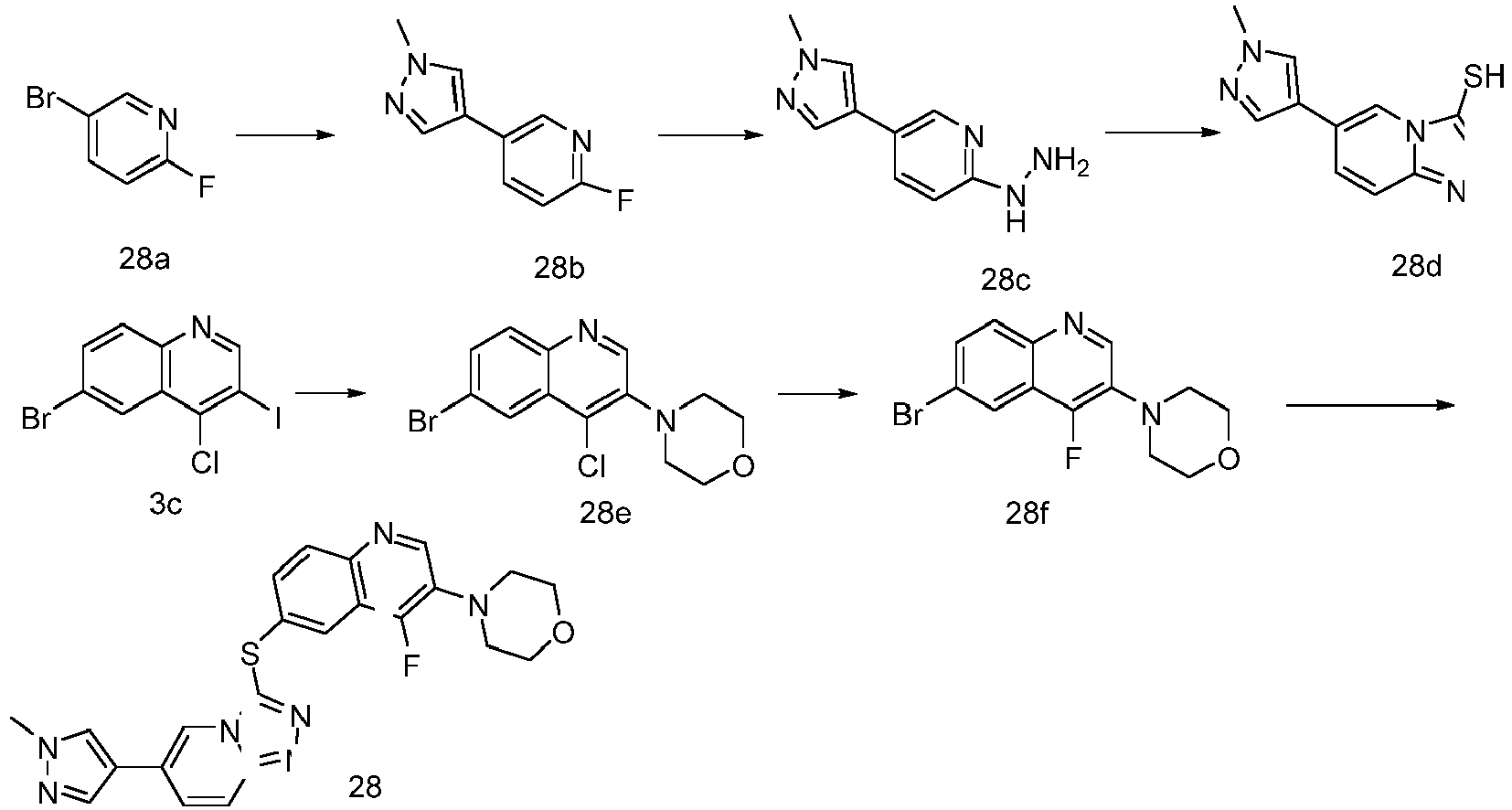
- 5-bromo-2-fluoropyridine (10.0 g, 56.82 mmol), 1-methyl-4-(4,4,5,5-tetrylmethyl-1,3,2-dioxaboronolan-2-yl)-1H-pyrazole (11.8 g, 56.82 mmol), [1,1'-bis(diphenylphosphino)ferrocene]dichloropalladium (4.6 g, 5.68 mmol) and potassium carbonate (23.5 g, 170.5 mmol) were dissolved in a mixed solution of 1,4-dioxane (120 mL) and water (30 mL). The reaction mixture was heated to 75°C for 4 hours and then cooled to room temperature. The reaction solution was concentrated to dry, the residue was added with ethyl acetate, and washed with sodium chloride aqueous solution. The organic phase was dried, filtered, and concentrated to dry, and the resulting residue was purified by column chromatography (petroleum ether/ethyl acetate = 2:1, v/v) to give 2-fluoro-5-(1-methyl-1H-pyrazol-4-yl)pyridine (11.3 g, yield about 100%) as a white solid.
MS m/z (ESI): 178.1
1H NMR (400 MHz, DMSO-d 6, ppm): δ 8.47 (s, 1 H), 8.23 (s, 1 H), 8.15 (td, J = 8.4, 2.4 Hz, 1 H), 7.95 (s, 1 H), 7.19 (dd, J = 8.4, 2.8 Hz, 1 H), 3.87 (s, 3 H). - 2-fluoro-5-(1-methyl-1H-pyrazol-4-yl)pyridine (11.3 g, 56.82 mmol) was added to a 85% aqueous solution of hydrazine hydrate (30 mL). The resulting suspension was heated to 100°C for 3 hours, and then cooled to 10°C.The solid was precipitated and filtered by a Büchner funnel, washed with cold ethanol and dried to give 2-hydrazinyl-5-(1-methyl-1H-pyrazol-4-yl)pyridine (12.5 g, yield about 100%) as a white solid.
MS m/z (ESI): 190.1 - 2-hydrazinyl-5-(1-methyl-1H-pyrazol-4-yl)pyridine (9.30 g, 49.15 mmol) was dissolved in ethanol (100 mL), a pre-prepared aqueous solution of potassium hydroxide (3.03 g, 54.16 mmol, 25 mL) was slowly added to the reaction mixture at room temperature, followed by slow addition of carbon disulfide (7.85 g, 103.2 mmol). This yellow solution was heated to 65°C for 48 hours. The reaction solution was concentrated to a small volume, and then dissolved in 50 mL of sodium hydroxide aqueous solution (2 N). The insoluble solid was removed by filtration, and the filtrate was acidified with a 2 N hydrochloric acid solution to pH = 4. The resulting solid was collected by filtration and dried to give 6-(1-methyl-1H-pyrazol-4-yl)-[1,2,4]triazolo[4,3-a]pyridin-3-thiol (7.5 g, yield 96%) as a yellow powder.
MS m/z (ESI): 232.1
1H NMR (400 MHz, DMSO-d 6, ppm): δ 14.65 (s, 1 H), 8.37 (s, 1 H), 8.35 (s, 1 H), 8.02 (s, 1 H), 7.77 (d, J = 9.6 Hz, 1 H), 7.69 (d, J = 9.6 Hz, 1 H), 3.89 (s, 3 H). - 6-bromo-4-chloro-3-iodoquinoline (5.00 g, 13.57 mmol), morpholine (1.42 g, 16.29 mmol), tris(dibenzylideneacetone)dipalladium (1.24 g, 1.36 mmol) and 4,5-bis(diphenylphosphino)-9,9-dimethylxanthene (1.57 g, 2.71 mmol) were all dissolved in anhydrous N,N- dimethylformamide (90 mL). The reaction mixture was heated to 35°C and stirred for 1 hour under N2, then sodium tert-butoxide (1.56 g, 1.629 mmol) was added. The reaction mixture was kept at this temperature for 16 hours. Then it was concentrated to dry under reduced pressure. Ethyl acetate was added, and the organic phase was washed with sodium chloride aqueous solution, dried, filtered and concentrated. The resulting residue was purified by column chromatography (dichloromethane/methanol = 100:1, v/v), pulverized, and filtered to give 4-(6-bromo-4-chloroquinolin -3-yl)morpholine (2.5 g, yield 56%) as a white solid.
MS m/z (ESI): 329.0 - 4-(6-bromo-4-chloroquinolin-3-yl)morpholine (160 mg, 0.49 mmol) and cesium fluoride (222 mg, 1.47 mmol) were all dissolved in anhydrous dimethyl sulfoxide (10 mL). The reaction mixture was heated to 100°C and stirred for 6 days. When most of the raw materials (~ 90%) were converted to the desired product, the reaction was stopped. The reaction mixture was added with ethyl acetate, washed with sodium chloride aqueous solution and dried. The organic sovent was filtered and concentrated to dry. The crude product was purified by column chromatography (dichloromethane/methanol = 100:1, v/v), pulverized, and filtered to give 4-(6-bromo-4-fluoroquinolin-3-yl)-morpholine (80 mg, yield 53%) as a white solid.
MS m/z (ESI): 311.0
1H NMR (400 MHz, DMSO-d 6, ppm): δ 8.94 (d, J = 10.8 Hz, 1 H), 8.23 (s, 1 H), 7.99 (d, J = 9.2 Hz, 1 H), 7.84 (d, J = 9.2 Hz, 1 H), 3.85 (t, J = 4.8 Hz, 4 H), 3.37 (t, J = 4.8 Hz, 4 H). - 6-(1-methyl-1H-pyrazol-4-yl)-[1,2,4]triazolo[4,3-a]pyridin-3-thiol (60 mg, 0.26 mmol), 4-(6-bromo-4-fluoroquinolin-3-yl)morpholine (80 mg, 0.26 mmol), tris(dibenzylideneacetone)dipalladium (24 mg, 0.026 mmol), 4,5-bis(diphenylphosphino) -9,9-dimethylxanthene (30 mg, 0.052 mmol) and N,N- diisopropylethylamine (133 mg, 1.04 mmol) were dissolved in anhydrous N,N-dimethyl formamide (2 mL) under N2, the reaction mixture was heated to 100°C and stirred for 48 hours, and then concentrated to dry under reduced pressure. The crude product was purified by column chromatography (dichloromethane/methanol/aqueous ammonia = 500:10:1, v/v/v), pulverized, and filtered to give a yellow solid, further recrystallizated to give 4-(4-fluoro-6-((6-(1-methyl-1H-pyrazol-4-yl)-[1,2,4]triazolo[4,3-a]pyridine-3-yl)thio)q uinolin-3-yl)morpholine 28 (12 mg, yield 10%) as a white solid.
MS m/z (ESI): 462.1
1H NMR (400 MHz, DMSO-d 6, ppm): δ 8.79 (d, J= 10.8 Hz, 1 H), 8.64 (s, 1 H), 8.34 (s, 1 H), 8.03 (s, 1 H), 8.01 (d, J = 9.4 Hz, 1 H), 7.92 (d, J = 8.8 Hz, 1 H), 7.82 (d, J = 9.4 Hz, 1 H), 7.80 (d, J = 2.0 Hz, 1 H), 7.42 (dd, J= 8.8, 2.0 Hz, 1 H), 3.85 (s, 3 H), 3.76 (t, J = 4.8 Hz, 4 H), 3.26 (t, J= 4.8 Hz, 4 H). -

- 6-bromo-4-chloroquinoline (1.00 g, 4.124 mmol) and sodium methoxide (1.11 g, 20.62 mmol) were dissolved in methanol (15 mL). The reaction mixture was heated to 108°C in a sealed system for 16 hours, and then concentrated to dry. The residue was dissolved in ethyl acetate, washed with sodium chloride aqueous solution and dried. The organic solvent was filtered and concentrated, the residue was purified by column chromatography (petroleum ether/ethyl acetate = 5:1, v/v) to give 6-bromo-4-methoxyquinoline (872 mg, yield 89%) as a pale yellow solid.
MS m/z (ESI): 238.0 - 6-(1-methyl-1H-pyrazol-4-yl)-[1,2,4]triazolo[4,3-a]pyridin-3-thiol (100 mg, 0.43 mmol), 6-bromo-4-methoxyquinoline (103 mg, 0.43 mmol), tri(dibenzenylpropanone) dipalladium (40 mg, 0.043 mmol), 4,5-bis(diphenylphosphino)-9,9-dimethylxanthene (50 mg, 0.086 mmol) and N,N-diisopropylethylamine (223 mg, 1.73 mmol) were dissolved in anhydrous N,N- dimethylformamide (2 mL) under N2, the reaction mixture was heated to 100 °C for 16 hours and then concentrated to dry under reduced pressure. The residue was purified by column chromatography (dichloromethane/methanol = 20: 1, v/v), pulverized, and filtered to give 4-methoxy-6-((6-(1-methyl-1H-pyrazol-4-yl) -[1,2,4]triazolo[4,3-a]pyridin-3-yl)thio)quinoline 29 (70 mg, yield 42%) as a white solid.
MS m/z (ESI): 389.1
1H NMR (400 MHz, DMSO-d 6, ppm): δ 8.71 (d, J = 5.2 Hz, 1 H), 8.65 (s, 1 H), 8.35 (s, 1 H), 8.06 (d, J = 2.0 Hz, 1 H), 8.03 (s, 1 H), 7.99 (d, J = 9.6 Hz, 1 H), 7.90 (d, J = 8.8 Hz, 1 H), 7.81 (d, J = 9.2 Hz, 1 H), 7.60 (dd, J = 8.8, 2.0 Hz, 1 H), 7.04 (d, J = 5.2 Hz, 1 H), 4.00 (s, 3H), 3.86 (s, 3 H). -

- 6-(1-methyl-1H-pyrazol-4-yl)-[1,2,4]triazolo[4,3-a]pyridin-3-thiol (80 mg, 0.35 mmol), 4-(6-bromoquinolin-4-yl)morpholine (101 mg, 0.35 mmol), tris(dibenzylideneacetone)dipalladium (32 mg, 0.035 mmol), 4,5-bis(diphenylphosphino)-9,9- dimethylxanthene (40 mg, 0.069 mmol) and N,N-diisopropylethylamine (179 mg, 1.38 mmol) were dissolved in anhydrous N,N-dimethylformamide (2 mL) under N2, the reaction mixture was heated to 100 °C for 16 hours and concentrated to dry under reduced pressure. The residue was purified by column chromatography (dichloromethane/methanol = 20:1, v/v), pulverized, and filtered to give 9-(6-((6-(1-methyl-1H-pyrazol-4-yl)-[1,2,4]triazolo[4,3-a]pyridin-3-yl)thio)quinolin-4-y 1)morpholine 30 (71 mg, yield 46%) as a white solid.
MS m/z (ESI): 444.2
1H NMR (400 MHz, DMSO-d 6, ppm): δ 8.64-8.66 (m, 2 H), 8.34 (s, 1 H), 8.08 (d, J = 9.6 Hz, 1 H), 8.02 (s, 1 H), 7.95 (d, J = 9.2 Hz, 1 H), 7.86 (d, J = 9.4 Hz, 1 H), 7.68 (dd, J = 8.8, 2.0 Hz, 1 H), 7.37 (d, J = 2.4 Hz, 1 H), 6.96 (d, J = 4.8 Hz, 1 H), 3.84 (s, 3 H), 3.56 (t, J= 4.0 Hz, 4 H), 2.90 (t, J= 4.4 Hz, 4 H). -

- 6-(1-methyl-1H-pyrazol-4-yl)-[1,2,4]triazolo[4,3-a]pyridin-3-thiol (80 mg, 0.35 mmol), 9-bromo-2,3-dihydro-[1,4]dioxino[2,3-c]quinoline (92 mg, 0.35 mmol), tris(dibenzylideneacetone)dipalladium (32 mg, 0.035 mmol), 4,5-bis(diphenylphosphino) -9,9-dimethylxanthene (40 mg, 0.069 mmol) and N,N- diisopropylethylamine (179 mg, 1.38 mmol) were dissolved in anhydrous N,N-dimethylformamide (2 mL) under N2, the reaction mixture was heated to 100°C for 16 hours and concentrated to dry under reduced pressure. The residue was purified by column chromatography(dichloromethane/methanol = 20: 1, v/v), pulverized, and filtered to give 9-((6-(1-methyl-1H-pyrazol-4-yl)-[1,2,4]triazolo[4,3-a]pyridin-3-yl)thio)-2,3-dihydro-[1 ,4]dioxio[2,3-c]quinoline 31 (12 mg, yield 8%) as a white solid.
MS m/z (ESI): 417.1
1H NMR (400 MHz, DMSO-d 6, ppm): δ 8.64 (s, 1 H), 8.51 (s, 1 H), 8.35 (s, 1 H), 8.04 (s, 1 H), 8.01 (d, J = 9.4 Hz, 1 H), 7.86 (d, J = 8.8 Hz, 1 H), 7.82 (dd, J = 9.2, 1.6 Hz, 1 H), 7.77 (d, J = 2.0 Hz, 1 H), 7.47 (dd, J = 8.8, 2.4 Hz, 1 H), 4.49-4.51 (m, 2 H), 4.37-4.39 (m, 2 H), 3.86 (s, 3 H). -

- 6-(1-methyl-1H-pyrazol-4-yl)-[1,2,4]triazolo[4,3-a]pyridin-3-thiol (200 mg, 0.86 mmol), 4-chloro-6-bromoquinoline (210 mg, 0.86 mmol), tri(dibenzenylpropanone) dipalladium (79 mg, 0.086 mmol), 4,5-bis(diphenylphosphino)-9,9-dimethylxanthene (100 mg, 0.17 mmol) and N,N-diisopropylethylamine (447 mg, 3.46 mmol) were dissolved in anhydrous N,N-dimethylformamide (5 mL) under N2, the reaction mixture was heated to 100°C for 16 hours and concentrated to dry under reduced pressure. The residue was purified by column chromatography (dichloromethane/methanol = 20:1, v/v), pulverized, and filtered to give 4-chloro-6-((6-(1-methyl-1H-pyrazol-4-yl)-[1,2,4] triazolo[4,3-a]pyridin-3-yl)thio)quinoline 32 (135 mg, yield 40%) as a white solid.
MS m/z (ESI): 393.1
1H NMR (400 MHz, DMSO-d 6, ppm): δ 8.81 (d, J = 4.8 Hz, 1 H), 8.69 (s, 1 H), 8.35 (s, 1 H), 8.05 (d, J= 8.8 Hz, 1 H), 8.04 (s, 1 H), 8.03 (d, J= 8.8 Hz, 1 H), 8.02 (d, J= 2.0 Hz, 1 H), 7.85 (d, J= 9.4 Hz, 1 H), 7.78 (d, J= 4.8 Hz, 1 H), 7.63 (d, J= 9.0 Hz, 1 H), 3.85 (s, 3 H). -

- Sodium hydride (60%, 330 mg, 8.25 mmol) was suspended into anhydrous N,N-dimethylformamide (15 mL) under N2, then ethylene glycol (1.28 g, 20.62 mmol) was added dropwise with stirring. The reaction mixture was stirred for 20 minutes and then 6-bromo-4-chloroquinoline (1.00 g, 4.12 mmol) was added. The reaction mixture was heated to 90°C for 16 hours, and cooled, and then concentrated to dry under reduced pressure. The residue was washed with 1N sodium hydroxide aqueous solution and sodium chloride aqueous solution, and then dried, filtered and concentrated. The resulting residue was purified by column chromatography (dichloromethane/methanol = 20: 1, v/v) to give 2-((6-bromoquinolin-4-yl)oxy)ethan-1-ol (230 mg, yield 21%) as a white solid.
MS m/z (ESI): 268.0
1H NMR (400 MHz, DMSO-d 6, ppm): δ 8.75 (d, J = 5.2 Hz, 1 H), 8.44 (s, 1 H), 7.85-7.91 (m, 2 H), 7.07 (d, J= 5.2 Hz, 1 H), 5.16 (t, J= 5.8 Hz, 1 H), 4.26 (t, J= 4.4 Hz, 2 H), 3.85-3.89 (m, 2 H). - 6-(1-methyl-1H-pyrazol-4-yl)-[1,2,4]triazolo[4,3-a]pyridin-3-thiol (80 mg, 0.35 mmol), 2-((6-bromoquinolin-4-yl)oxy)ethan-1-ol (93 mg, 0.35 mmol), tri(dibenzylideneacetone)dipalladium (32 mg, 0.035 mmol), 4,5-bis(diphenylphosphino)-9,9-dimethylxanthene (40 mg, 0.069 mmol) and N,N-diisopropylethylamine (179 mg, 1.38 mmol) were dissolved in anhydrous N,N-dimethylformamide (2 mL) under N2, the reaction mixture was heated to 100 °C and stirred for 16 hours. The mixture was concentrated to dry under reduced pressure, and the residue was purified by column chromatography (dichloromethane/methanol = 20:1, dichloromethane/acetone = 8:1, v/v), pulverized, and filtered to give 2-((6-((6-(1-methyl-1H-pyrazol-4-yl)-[1,2,4]triazolo[4,3-a]pyridine-3-yl)thio)quinolin-4 -yl)oxy)ethan-1-ol 33 (15 mg, yield 10%) as a white solid.
MS m/z (ESI): 419.1.
1H NMR (400 MHz, DMSO-d 6, ppm): δ 8.70 (d, J = 5.2 Hz, 1 H), 8.67 (s, 1 H), 8.39 (s, 1 H), 8.35 (s, 1 H), 8.03 (s, 1 H), 7.98 (d, J = 9.2 Hz, 1 H), 7.87 (d, J= 8.8 Hz, 1 H), 7.81 (d, J = 9.2 Hz, 1 H), 7.49 (d, J = 8.8 Hz, 1 H), 7.05 (d, J = 5.2 Hz, 1 H), 5.13 (t, J = 5.8 Hz, 1 H), 4.25 (t, J = 4.8 Hz, 2 H), 3.87 (s, 3 H), 3.83-3.86 (m, 2 H). -

- 4-chloro-6-((6-(1-methyl-1H-pyrazol-4-yl)-[1,2,4]triazolo[4,3-a]pyridin-3-yl)thio) quinoline (70 mg, 0.18 mmol) and 2-(methylamino)ethanol (3 mL) were placed in a sealed tube, and the reaction mixture was heated to 120°C for 16 hours. The reaction solution was cooled and concentrated to dry under reduced pressure. The crude product was purified by column chromatography (dichloromethane/methanol = 20:1, v/v) to give 2-(methyl(6-((6-(1-methyl-1H-pyrazol-4-yl)-[1,2,4]triazolo[4,3-a]pyridin-3-yl)thio) quinolin-4-yl)amino)ethan-1-ol 34 (45 mg, yield 58%) as a pale yellow solid.
MS m/z (ESI): 432.2
1H NMR (400 MHz, DMSO-d 6, ppm): δ 8.63 (s, 1 H), 8.54 (d, J = 5.2 Hz, 1 H), 8.33 (s, 1 H), 8.18 (s, 1 H), 8.01 (s, 1 H), 7.99 (d, J = 9.6 Hz, 1 H), 7.85 (d, J= 9.2 Hz, 1 H), 7.81 (d, J = 9.6 Hz, 1 H), 7.53 (d, J = 8.8 Hz, 1 H), 6.91 (d, J = 5.2 Hz, 1 H), 4.81 (t, J = 5.2 Hz, 1 H), 3.86 (s, 3 H), 3.56-3.58 (m, 2 H), 3.23 (t, J = 5.6 Hz, 2 H), 2.90 (s, 3 H). -

- 4-chloro-6-((6-(1-methyl-1H-pyrazol-4-yl)-[1,2,4]triazolo[4,3-a]pyridin-3-yl)thio) quinoline (60 mg, 0.153 mmol) and 2-methoxy-N-methyl-ethylamine (2 mL) were placed in a sealed tube, and the reaction mixture was heated to reflux for 16 hours. The reaction solution was cooled and concentrated to dry under reduced pressure. The residue was purified by column chromatography (dichloromethane/methanol = 20:1, v/v) to give N-(2-methoxyethyl) -N-methyl-6-((6-(1-methyl-1H-pyrazol-4-yl)-[1,2,4]triazolo[4,3-a]pyridin-3-yl)thio)qui nolin-4-amine 35 (36 mg, yield 53%) as a pale yellow solid.
MS m/z (ESI): 446.2.
1H NMR (400 MHz, DMSO-d 6, ppm): δ 8.62 (s, 1 H), 8.55 (d, J = 5.6 Hz, 1 H), 8.33 (s, 1H), 8.02 (d, J = 9.4 Hz, 1 H), 8.00 (s, 1 H), 7.95 (s, 1 H), 7.88 (d, J = 8.8 Hz, 1 H), 7.82 (d, J= 9.4 Hz, 1 H), 7.62 (d, J= 8.8 Hz, 1 H), 6.93 (d, J= 5.6 Hz, 1 H), 3.85 (s, 3 H), 3.43 (t, J = 5.2 Hz, 2 H), 3.30-3.33 (m, 2 H), 3.17 (s, 3 H), 2.91 (s, 3 H). -

MS m/z (ESI): 473.1
1H NMR (400 MHz, DMSO-d 6, ppm): δ 9.10 (s, 1 H), 8.69 (s, 1 H), 8.48 (s, 1 H), 8.36 (s, 1 H), 8.13 (s, 1 H), 8.09 (d, J = 2.0 Hz, 1 H), 8.05 (s, 1 H), 8.04 (d, J= 6.4 Hz, 1 H), 8.01 (d, J= 6.4 Hz, 1 H), 7.85 (dd, J= 9.6, 1.6 Hz, 1 H), 7.56 (dd, J= 9.2, 1.6 Hz, 1 H), 3.95 (s, 3 H), 3.85 (s, 3 H). -

- 4-chloro-3-(1-methyl-1H-pyrazol-4-yl)-6-((6-(1-methyl-1H-pyrazol-4-yl)-[1,2,4]tri azolo[4,3-a] pyridin-3-yl)thio)quinoline (65 mg, 0.14 mmol), sodium methoxide (37 mg, 0.69 mmol) and methanol (2 mL) were placed in a seal tube, and the reaction mixture was heated to 112°C for 16 hours. The reaction solution was cooled and concentrated to dry under reduced pressure. The residue was purified by column chromatography (dichloromethane/methanol = 20:1, v/v), and recrystallized to give 4-methoxy-3-(1-methyl-1H-pyrazol-4-yl)-6-((6-(1-methyl-1H-pyrazol-4-yl)-[1,2,4]triaz olo[4,3-a]pyridin-3-yl)thio)quinoline 37 (41 mg, yield 64%) as a white solid.
MS m/z (ESI): 469.2.
1H NMR (400 MHz, DMSO-d 6, ppm): δ 9.16 (s, 1 H), 8.70 (s, 1 H), 8.37 (s, 1 H), 8.35 (s, 1 H), 8.10 (s, 1 H), 8.05 (s, 1 H), 8.03 (d, J= 9.4 Hz, 1 H), 7.96 (d, J= 8.8 Hz, 1 H), 7.93 (d, J = 2.0 Hz, 1 H), 7.84 (d, J = 9.2 Hz, 1 H), 7.52 (dd, J = 8.8, 2.0 Hz, 1 H), 3.93 (s, 3 H), 3.85 (s, 3 H), 3.73 (s, 3 H). -

- 4-chloro-6-((8-fluoro-6-(1-methyl-1H-pyrazol-4-yl)-[1,2,4]triazolo[4,3-a]pyridin-3 -yl)thio)-3-(1-methyl-1H-pyrazol-4-yl)quinoline (65 mg, 0.13 mmol), sodium methoxide (36 mg, 0.66 mmol) and methanol (5 mL) were placed in a sealed tube, and the reaction mixture was heated to 100°C for 16 hours. The mixture was cooled and concentrated to dryness under reduced pressure. The crude product was purified by column chromatography (dichloromethane/methanol = 20:1, v/v), pulverized, and filtered to give 4-methoxy-6-((8-methoxy-6-(1-methyl-1H-pyrazol-4-yl)-[1,2,4]triazolo [4,3-a]pyridin-3-yl)thio)-3-(1-methyl-1H-pyrazol-4-yl)quinoline 38 (30 mg, yield 45%) as a white solid.
MS m/z (ESI): 499.2.
1H NMR (400 MHz, DMSO-d6, ppm): δ 9.16 (s, 1 H), 8.37 (s, 2 H), 8.31 (s, 1 H), 8.10 (s, 1 H), 8.05 (s, 1 H), 7.96 (d, J= 8.8 Hz, 1 H), 7.94 (s, 1 H), 7.49 (d, J = 8.8 Hz, 1 H), 7.15 (s, 1 H), 4.11 (s, 3 H), 3.93 (s, 3 H), 3.85 (s, 3 H), 3.75 (s, 3 H). -

- 4-(6-bromo-4-chloroquinolin-3-yl)morpholine (83 mg, 0.25 mmol) and sodium methoxide (68 mg, 1.27 mmol) were dissolved in methanol (5 mL). The reaction mixture was heated to 65°C for 16 hours, and then cooled to room temperature and concentrated to dry under reduced pressure. The crude product was purified by column chromatography (dichloromethane/methanol = 20:1, v/v) to give 4-(6-bromo-4-methoxy-quinolin-3-yl) morpholine (32 mg, yield 39%) as a white solid.
MS m/z (ESI): 323.0
1H NMR (400 MHz, DMSO-d6, ppm): δ 8.79 (s, 1 H), 8.20 (s, 1 H), 7.88 (d, J = 8.8 Hz, 1 H), 7.72 (d, J= 8.8 Hz, 1 H), 4.04 (s, 3 H), 3.83 (t, J = 4.8 Hz, 4 H), 3.23 (t, J = 4.8 Hz, 4 H). - 6-(1-methyl-1H-pyrazol-4-yl)-[1,2,4]triazolo[4,3-a]pyridin-3-thiol (33 mg, 0.14 mmol), 4-(6-bromo-4-methoxyquinolin-3-yl)morpholine (46 mg, 0.14 mmol), tris(dibenzylideneacetone)dipalladium (13 mg, 0.014 mmol), 4,5-bis(diphenylphosphino) -9,9-dimethylxanthene (16 mg, 0.029 mmol) and N,N-diisopropylethylamine (74 mg, 0.57 mmol) were dissolved in anhydrous N,N- dimethylformamide (2 mL) under N2, the reaction mixture was heated to 110 °C and stirred for 56 hours, and then concentrated to dryness under reduced pressure. The crude product was purified by column chromatography (dichloromethane/methanol = 25:1, v/v), pulverized, and filtered to give 4-(4-methoxy-6-((6-(1-methyl-1H-pyrazol-4-yl)-[1,2,4]triazolo[4,3-a]pyridin-3-yl) thio)quinolin-3-yl)morpholine 39 (12 mg, yield 18%) as a white solid.
MS m/z (ESI): 474.2
1H NMR (400 MHz, CDCl3, ppm): δ 8.61 (s, 1 H), 8.13 (s, 1 H), 8.07 (s, 1 H), 8.01 (s, 1 H), 7.83 (d, J = 9.2 Hz, 1 H), 7.62 (s, 1 H), 7.55 (s, 1 H), 7.41-7.45 (m, 2 H), 4.04 (s, 3 H), 3.88 (s, 3 H), 3.84 (t, J = 4.8 Hz, 4 H), 3.14 (t, J = 4.8 Hz, 4 H). -

- 6-bromo-4-chloro-3-(1-methyl-1H-pyrazol-4-yl)quinoline (50 mg, 0.16 mmol) and sodium methoxide (42 mg, 0.77 mmol) were dissolved in methanol (2 mL). The reaction mixture was heated to 65°C for 16 hours, cooled, and then concentrated to dry under reduced pressure. The crude product was purified by column chromatography (dichloromethane/methanol = 20:1, v/v) to give 6-bromo-4-methoxy-3-(1-methyl-1H-pyrazol-4-yl)quinoline (83 mg, a brown solid), which was used directly in the next step.
MS m/z (ESI): 318.0 - 8-fluoro-6-(1-methyl-1H-pyrazol-4-yl)-[1,2,4]triazolo[4,3-a]pyridin-3-thiol (65 mg , 0.26 mmol), 6-bromo-4-methoxy-3-(1-methyl-1H-pyrazol-4-yl)quinoline (83 mg, 0.26 mmol), tris(dibenzylideneacetone)dipalladium (24 mg, 0.026 mmol), 4,5-bis(diphenylphosphino)-9,9-dimethylxanthene (30 mg, 0.052 mmol) and N,N-diisopropylethylamine (135 mg, 1.04 mmol) were dissolved in anhydrous 1,4-dioxane (2 mL) under N2, the reaction mixture was heated to 85°C for 16 h, and concentrated to dry under reduced pressure. The crude product was purified twice by column chromatography (dichloromethane/methanol = 25: 1, v/v) to give a solid, and then the solid was purified by reverse phase column to give 6-((8-fluoro-6-(1-methyl-1H-pyrazol-4-yl)-[1,2,4]triazolo[4,3-a]pyridine-3-yl)thio)-4-m ethoxy-3-(1-methyl-1H-pyrazol-4-yl)quinoline 40 (3 mg) as a white solid.
MS m/z (ESI): 487.2
1H NMR (400 MHz, DMSO-d 6, ppm): δ 9.23 (s, 1 H), 8.68 (s, 1 H), 8.44 (s, 2 H), 8.16 (s, 1 H), 8.14 (s, 1 H), 8.13 (s, 1 H), 8.01 (d, J = 8.8 Hz, 1 H), 7.92 (d, J = 12 Hz, 1 H), 7.60 (d, J = 8.8 Hz, 1 H), 3.99 (s, 3 H), 3.90 (s, 3 H), 3.84 (s, 3 H). -

- 6-(1-methyl-1H-pyrazol-4-yl)-[1,2,4]triazolo[4,3-a]pyridin-3-thiol (76 mg, 0.33 mmol), 6-bromo-4-fluoro-3-(1-methyl-1H-pyrazol-4-yl)quinoline (100 mg, 0.33 mmol), tris(dibenzylideneacetone)dipalladium (30 mg, 0.033 mmol), 4,5-bis(diphenylphosphino)-9,9-dimethylxanthene (38 mg, 0.066 mmol) and N,N-diisopropylethylamine (169 mg, 1.31 mmol) were dissolved in anhydrous N,N-dimethylformamide (2 mL) under N2, the reaction mixture was heated to 100°C and stirred for 16 hours, and then concentrated to dry under reduced pressure. The crude product was separated by column chromatography (dichloromethane/methanol = 25:1, v/v) to obtain a solid, and then the solid was purified by reverse phase column chromatography to give 4-fluoro-3-(1-methyl-1H-pyrazol-4-yl)-6-((6-(1-methyl-1H-pyrazol-4-yl)-[1,2,4]triazolo[4,3-a]pyridin-3-yl)thio)quinoline 41 (30 mg, yield 20%) as a pale yellow solid.
MS m/z (ESI): 457.1
1H NMR (400 MHz, DMSO-d 6, ppm): δ 9.26 (d, J = 10.0 Hz, 1 H), 8.68 (s, 1 H), 8.41 (s, 1 H), 8.36 (s, 1 H), 8.12 (s, 1 H), 7.99-8.05(m, 3 H), 7.93 (s, 1 H), 7.84 (d, J = 9.6 Hz, 1 H), 7.56 (d, J = 9.0 Hz, 1 H), 3.94 (s, 3 H), 3.85 (s, 3 H). -

MS m/z (ESI): 480.1.
1H NMR (400 MHz, CDCl3, ppm): δ 8.61 (d, J= 10.4 Hz, 1 H), 7.98 (s, 1 H), 7.86 (s, 2 H), 7.60 (s, 1 H), 7.54 (s, 1 H), 7.38 (d, J = 8.8 Hz, 1 H), 7.11 (d, J = 10.4 Hz, 1 H), 3.89 (s, 3 H), 3.83 (t, J = 4.4 Hz, 4 H), 3.23 (t, J = 4.4 Hz, 4 H). -


- 4-bromoaniline (50 g, 290.7 mmol) and diethyl 2-(ethoxymethylene)malonate (63.5 g, 293.7 mmol) were placed in a 500 mL round bottom flask, and the reaction mixture was heated to 90°C for 5 hours. The reaction mixture was added with 200 mL ethanol slowly and cooled to room temperature. The precipitated solid was collected by filtration and washed with cold ethanol, and then dried to give diethyl 2-(((4-bromophenyl)amino)methylene)malonate (85.7 g, yield 86%) as a white solid.
MS m/z (ESI): 342.0 - Diethyl 2-(((4-bromophenyl)amino)methylene)malonate (85.7 g, 250.0 mmol) was added to hot diphenyl ether (130 mL) in batches. After the addition was completed, the reaction mixture was heated to 232°C for 5 hours, and then cooled to 100°C, ethanol (200 mL) was added slowly. The reaction mixture was kept at this temperature and stirred for about 10 minutes, and then cooled to room temperature. The precipitated solid was collected by filtration and washed with diethyl ether, and then dried to give ethyl 6-bromo-4-hydroxy quinoline -3-carboxylate (59.6 g, 80%) as a white solid.
MS m/z (ESI): 296.0
1H NMR (400 MHz, DMSO-d 6, ppm): δ 12.47 (s, 1 H), 8.60 (s, 1 H), 8.23 (s, 1 H), 7.87 (dd, J = 8.8, 2.0 Hz, 1 H), 7.61 (d, J = 8.4 Hz, 1 H), 4.23 (q, 2 H), 1.28 (t, J = 7.2 Hz, 3 H). - Ethyl 6-bromo-4-hydroxyquinoline-3-carboxylate (59.6 g, 201.0 mmol) was dispersed in ethanol (600 mL), and sodium hydroxide aqueous solution (24.1 g, 604.0 mmol, 200 mL) was added. The reaction mixture was heated to 50°C for 5 hours and then cooled to room temperature. The insoluble solid was removed by filtration, the filtrate was neutralized with 3N hydrochloric acid, the precipitated solid was collected by filtration and washed with water, and then dried to give 6-bromo-4-hydroxyquinoline-3-carboxylic acid (52.8 g, yield 98%) as a white solid.
MS m/z (ESI): 368.0 - 6-bromo-4-hydroxyquinoline-3-carboxylic acid (1.00 g, 3.730 mmol) was placed in phosphorous oxychloride (20 mL), and the reaction mixture was heated to 100°C for 16 hours. The reaction mixture was distilled under reduced pressure to remove the excess phosphorus oxychloride, the residue was co-boiled with toluene to remove a little remaining phosphorus oxychloride. The crude product 6-bromo-4-chloroquinoline-3-carbonyl chloride was used directly in the next step.
- Morpholine (488 mg, 5.61 mmol) and triethylamine (1.13 g, 11.21 mmol) were dissolved in dichloromethane (30 mL). 6-bromo-4-chloroquinoline-3-carbonyl chloride (1.14 g, 3.74 mmol) was added in batches at 0°C. After addition was completed, the reaction solution was kept at this temperature for 2 hours. Then the reaction solution was concentrated to a small volume, the precipitated solid was collected by filtration and washed with water, and then dried to give (6-bromo-4-chloro-quinolin-3-yl) (morpholino)methanone (508 mg, yield 38%) as a yellow solid.
MS m/z (ESI): 357.0
1H NMR (400 MHz, DMSO-d 6, ppm): δ 8.91 (s, 1 H), 8.43 (s, 1 H), 8.09 (s, 2 H), 3.69-3.76 (m, 4 H), 3.53-3.57 (m, 2 H), 3.24-3.26 (m, 2 H). - 6-(1-methyl-1H-pyrazol-4-yl)-[1,2,4]triazolo[4,3-a]pyridin-3-thiol (330 mg, 1.43mmol), (6-bromo-4-chloroquinolin-3-yl)(morpholino)methanone (508 mg, 1.43 mmol), tris(dibenzylideneacetone)dipalladium (131 mg, 0.143 mmol), 4,5-bis(diphenylphosphino)-9,9-dimethylxanthene (165 mg, 0.29 mmol) and N,N-diisopropylethylamine (737 mg, 5.71 mmol) were dissolved in anhydrous 1,4-dioxane (5 mL) under N2, the reaction mixture was heated to 85°C and stirred for 16 hours and concentrated to dry under reduced pressure. The resulting residue was purified by column chromatography (dichloromethane/methanol = 25: 1, v/v), and then recrystallized to give (4-chloro-6-((6-(1-methyl-1H-pyrazol-4-yl)-[1,2,4]triazolo[4,3-a] pyridin-3-yl)thio)quinolin-3-yl)(morpholino)methanone 43 (332mg, yield 46%) as a yellow solid.
MS m/z (ESI): 506.1
1H NMR (400 MHz, DMSO-d 6, ppm): δ 8.82 (s, 1 H), 8.69 (s, 1 H), 8.36 (s, 1 H), 8.02-8.09 (m, 4 H), 7.85 (d, J = 9.6 Hz, 1 H), 7.68 (d, J = 8.8 Hz, 1 H), 3.86 (s, 3 H), 3.66-3.73 (m, 4 H), 3.49-3.52 (m, 2 H), 3.19-3.21 (m, 2 H). -

- 6-(1-methyl-1H-pyrazol-4-yl)-[1,2,4]triazolo[4,3-a]pyridin-3-thiol (100 mg, 0.43 mmol), 4-(6-bromo-4-chloro-quinolin-3-yl)morpholine (145 mg, 0.43 mmol), tris(dibenzylideneacetone)dipalladium (40 mg, 0.043 mmol), 4,5-bis(diphenylphosphino) -9,9-dimethylxanthene (50 mg, 0.086 mmol) and N,N-diisopropylethylamine (223 mg, 1.73 mmol) were dissolved in anhydrous N,N-dimethylformamide (5 mL) under N2, the reaction mixture was heated to 90°C and stirred for 16 h, and concentrated to dry under reduced pressure. The resulting residue was purified by column chromatography (dichloromethane/methanol = 25: 1, v/v), and then further purified by reverse phase column chromatography to give 4-(4-chloro-6-((6-(1-methyl-1H-pyrazol-4-yl)-[1,2,4]triazolo[4,3-a]pyridin-3-yl)thio)qui nolin-3-yl)morpholine 44 (20 mg, yield 10%) as a pale yellow solid.
MS m/z (ESI): 477.9.
1H NMR (400 MHz, DMSO-d6, ppm): δ 8.82 (s, 1 H), 8.67 (s, 1 H), 8.36 (s, 1 H), 8.04 (s, 1 H), 8.03 (d, J = 9.6 Hz, 1 H), 7.98 (s, 1 H), 7.97 (d, J = 8.8 Hz, 1 H), 7.84 (d, J = 9.6 Hz, 1 H), 7.46 (d, J = 8.8 Hz, 1 H), 3.85 (s, 3 H), 3.78 (t, J = 4.0 Hz, 4 H), 3.22 (t, J = 4.0 Hz, 4 H). -

- 6-bromo-4-chloro-3-iodoquinoline (300 mg, 0.81 mmol), (3,5-dimethylisothiazol-4-yl)boronic acid (276 mg, 1.95 mmol), [1,1'-bis(diphenylphosphino)ferrocene]dichloropalladium (60 mg, 0.081 mmol) and potassium carbonate (338 mg, 2.44 mmol) were dissolved in a mixed solvent of 1,4-dioxane (5 mL) and water (1 mL), the reaction mixture was heated to 35°C for 16 hours and concentrated to dry under reduced pressure. The resulting residue was dissolved in ethyl acetate, and then washed with sodium chloride aqueous solution, dried, filtered and and concentrated to obtain a crude product, and then the crude product was purified by column chromatography (petroleum ether/ethyl acetate = 3:1, v/v) to give 4-(6-bromo-4-chloroquinolin-3-yl)-3,5-dimethylisoxazole (200 mg, yield 73%) as a colorless oil.
MS m/z (ESI): 339.0 - 6-(1-methyl-1H-pyrazol-4-yl)-[1,2,4]triazolo[4,3-a]pyridin-3-thiol (137 mg, 0.59 mmol), 4-(6-bromo-4-chloroquinolin-3-yl)-3,5-dimethylisoxazole (200 mg, 0.59 mmol), tris(dibenzylideneacetone)dipalladium (54 mg, 0.059 mmol), 4,5-bis(diphenylphosphino)-9,9-dimethylxanthene (69 mg, 0.12 mmol) and N,N-diisopropylethylamine (306 mg, 2.37 mmol) were dissolved in anhydrous1,4-dioxane (5 mL) under N2, and the reaction mixture was heated to 75°C and stirred for 16 hours. The reaction solution was concentrated to dry under reduced pressure, The crude product was purified by column chromatography (dichloromethane/methanol = 25: 1, v/v) to give 4-(4-chloro-6-((6-(1-methyl-1H-pyrazol-4-yl)-[1,2,4]triazolo[4,3-a]pyridin-3-yl) thio)quinolin-3-yl)-3,5-dimethylisoxazole (140mg, yield 48%) as a yellow solid.
MS m/z (ESI): 488.1 - 4-(4-chloro-6-((6-(1-methyl-1H-pyrazol-4-yl)-[1,2,4]triazolo[4,3-a]pyridin-3-yl)thi o)quinolin -3-yl)-3,5-dimethylisoxazole (140 mg, 0.2869 mmol) and sodium methoxide (77 mg, 1.434 mmol) were dissolved in methanol (5 mL). The reaction mixture was heated to 75°C and stirred for 16 hours, and then concentrated to dry under reduced pressure. The residue was dissolved wiht ethyl acetate, and then washed with sodium chloride aqueous solution, dried, filtered and and concentrated to obtain a crude product, and then the crude product was purified by reverse phase column chromatography to give 4-(4-methoxy-6-((6-(1-methyl-1H-pyrazol-4-yl)-[1,2,4]triazolo[4,3-a]pyridin-3-yl) thio)quinolin-3-yl)-3,5-dimethylisoxazole 45 (100 mg, yield 72%) as a white solid.
MS m/z (ESI): 484.0
1H NMR (400 MHz, DMSO-d6, ppm): δ 8.69 (s, 2 H), 8.36 (s, 1 H), 8.10 (s, 1 H), 8.05 (s, 1 H), 8.02 (d, J = 8.8 Hz, 1 H), 8.00 (d, J= 8.8 Hz, 1 H), 7.83 (d, J= 9.6 Hz, 1 H), 7.61 (d, J = 8.8 Hz, 1 H), 3.85 (s, 3 H), 3.59 (s, 3 H), 2.34 (s, 3 H), 2.15 (s, 3 H). -

- 6-bromo-4-chloro-3-iodoquinoline (300 mg, 0.81 mmol), benzo[d][1,3]dioxazole -5-ylboronic acid (149 mg, 0.90 mmol), [1,1'-bis(diphenylphosphino)ferrocene] dichloropalladium (60 mg, 0.081 mmol) and potassium carbonate (338 mg, 2.44 mmol) were dissolved in a mixed solvent of 1,4-dioxane (4 mL) and water (0.5 mL). The reaction solution was heated to 35°C for 16 hours. The precipitated solid was collected by filtration and washed with water, and then dried to give 3-(benzo[d][1,3]dioxol-5-yl)-6-bromo-4-chloroquinoline (272 mg, yield 92%) as a white solid.
MS m/z (ESI): 363.9 - 6-(1-methyl-1H-pyrazol-4-yl)-[1,2,4]triazolo[4,3-a]pyridin-3-thiol (100 mg, 0.43 mmol), 3-(benzo[d][1,3]dioxazol-5-yl)-6-bromine-4-chloroquinoline (157 mg, 0.43 mmol), tris(dibenzylideneacetone)dipalladium (40 mg, 0.043 mmol), 4,5-bis(diphenylphosphino)-9,9-dimethylxanthene (50 mg, 0.086 mmol) and N,N-diisopropylethylamine (223 mg, 1.73 mmol) were dissolved in anhydrous 1,4-dioxane (5 mL) under N2, the reaction mixture was heated to 75°C and stirred for 16 hours, and then concentrated to dry under reduced pressure. The crude product was purified by column chromatography (dichloromethane/methanol = 25:1, v/v) to give 3-(benzo[d][1,3]dioxol-5-yl)-4-chloro-6-((6-(1-methyl-1H-pyrazol-4-yl)-[1,2,4]triazolo[ 4,3-a]pyridin-3-yl)thio)quinoline (173 mg, yield 78%) as a pale yellow solid.
MS m/z (ESI): 513.1 - 3-(benzo[d][1,3]dioxol-5-yl)-4-chloro-6-((6-(1-methyl-1H-pyrazol-4-yl)-[1,2,4]tria zolo[4,3-a]pyridin-3-yl)thio)quinoline (173 mg, 0.34 mmol) and sodium methoxide (91 mg, 1.69 mmol) were dissolved in methanol (5 mL). The reaction mixture was heated to 75 °C for 16 hours, and then concentrated to dry under reduced pressure. The crude product was purified by column chromatography (dichloromethane/methanol = 25: 1, v/v), pulverized, filtered, and dried to give 3-(benzo[d][1,3]dioxol-5-yl)-4-methoxy-6-((6-(1-methyl-1H-pyrazol-4-yl)-[1,2,4]triazo lo[4,3-a] pyridin-3-yl)thio)quinoline 46 (100 mg, yield 58%) as a white solid.
MS m/z (ESI): 508.9.
1H NMR (400 MHz, DMSO-d6, ppm): δ 8.77 (s, 1 H), 8.67 (s, 1 H), 8.35 (s, 1 H), 8.06 (d, J= 2.0 Hz, 1 H), 8.04 (s, 1 H), 8.01 (d, J = 9.2 Hz, 1 H), 7.97 (d, J = 8.8 Hz, 1 H), 7.82 (d, J= 9.2 Hz, 1 H), 7.58 (d, J= 8.8, 2.0 Hz, 1 H), 7.20 (s, 1 H), 7.05-7.11 (m, 2 H), 6.10 (s, 2 H), 3.85 (s, 3 H), 3.56 (s, 3 H). -

- 6-bromo-4-chloro-3-iodoquinoline (1.00 g, 2.714 mmol), tert-butylpiperazine-1-carboxylate (605mg, 3.26 mmol), tris(dibenzylideneacetone)dipalladium (250 mg, 0.27 mmol) and 4,5-bis(diphenylphosphino)-9,9-dimethylxanthene (315mg, 0.54 mmol) were dissolved in anhydrous N,N-dimethylformamide (50 mL) under N2, the reaction mixture was heated to 35°C and stirred for 1 hour, and then sodium tert-butoxide (315 mg, 3.26 mmol) was added. The reaction mixture was kept at this temperature for 16 hours and concentrated to dry under reduced pressure. The crude product was purified by column chromatography (dichloromethane/methanol = 25:1, v/v) to give tert-butyl 4-(6-bromo-4-chloroquinolin-3-yl)piperazine-1-carboxylate (0.98 g, yield 85%) as a brown oil.
- Tert-butyl 4-(6-bromo-4-chloroquinolin-3-yl)piperazine-1-carboxylate (0.98 g, 2.30 mmol) was dissolved in dichloromethane (3 mL) and trifluoroacetic acid (1 mL), and the reaction mixture was stirred at room temperature for 30 minutes. The reaction mixture was concentrated to dry under reduced pressure to give a crude product 6-bromo-4-chloro-3-(piperazin -1-yl)quinolone, which was used directly in the next step.
- 6-bromo-4-chloro-3-(piperazin-1-yl)quinoline (200 mg, 0.6124 mmol) and triethylamine (186 mg, 1.84 mmol) were added to dichloromethane (2 mL). Acetyl chloride (58 mg, 0.74 mmol) was added dropwise at 0°C. After the addition was completed, the reaction mixture was stirred at room temperature for 1 hour. The reaction solution was concentrated to dry under reduced pressure, and the crude product was purified by column chromatography (dichloromethane/methanol = 25:1, v/v) to give 1-(4-(6-bromo-4-chloroquinolin-3-yl) piperazin-1-yl)ethan-1-one (88 mg, yield 39%) as a pale yellow solid.
- 6-(1-methyl-1H-pyrazol-4-yl)-[1,2,4]triazolo[4,3-a]pyridin-3-thiol (55 mg, 0.24 mmol), 1-(4-(6-bromine-4-chloroquinolin-3-yl)piperazin-1-yl)ethanone (88 mg, 0.24 mmol), tris(dibenzylideneacetone)dipalladium (22 mg, 0.024 mmol), 4,5-bis(diphenylphosphino)-9,9-dimethylxanthene (28 mg, 0.048 mmol) and N,N-diisopropylethylamine (123 mg, 0.95 mmol) were dissolved in anhydrous 1,4-dioxane (2 mL) under N2, the reaction mixture was heated to 75°C and stirred for 16 h, and then concentrated to dry under reduced pressure. The crude product was purified by column chromatography (dichloromethane/methanol = 25:1, v/v) to give 1-(4-(4-chloro-6-((6-(1-methyl-1H-pyrazol-4-yl)-[1,2,4]triazolo[4,3-a]pyridin-3-yl)thio) quinolin-3-yl)piperazin-1-yl)ethan-1-one (58 mg, yield 47%) as a pale yellow solid.
MS m/z (ESI): 519.1 - 1-(4-(4-chloro-6-((6-(1-methyl-1H-pyrazol-4-yl)-[1,2,4]triazolo[4,3-a]pyridin-3-yl) thio)quinolin-3-yl)piperazin-1-yl)ethan-1-one (58 mg, 0.11 mmol) and sodium methoxide (30 mg, 0.56 mmol) were dissolved in methanol (2 mL). The reaction mixture was heated to 75°C for 16 hours, and then concentrated to dry under reduced pressure. The crude product was purified by column chromatography (dichloromethane/methanol = 25: 1, v/v), pulverized, filtered, and dried to give 1-(4-(4-methoxy-6-((6-(1-methyl-1H-pyrazol-4-yl)-[1,2,4]triazolo[4,3-a]pyridin-3-yl)thi o) quinolin-3-yl)piperazin-1-yl)ethan-1-one 47 (10 mg, yield 18%) as a pale yellow solid.
MS m/z (ESI): 515.0
1H NMR (400 MHz, DMSO-d6, ppm): δ 8.70 (s, 1 H), 8.64 (s, 1 H), 8.34 (s, 1 H), 8.03 (s, 1 H), 8.01 (d, J = 9.6 Hz, 1 H), 7.92 (d, J= 2.0 Hz, 1 H), 7.87 (d, J = 8.4 Hz, 1 H), 7.82 (d, J = 9.6 Hz, 1 H), 7.40 (dd, J = 8.8 Hz, J = 2.4 Hz, 1 H), 3.94 (s, 3 H), 3.85 (s, 3 H), 3.62-3.64 (m, 4 H), 3.18-3.20 (m, 2 H), 3.12-3.14 (m, 2 H), 2.05 (s, 3 H). -

- 4-(4,4,5,5-tetramethyl-1,3,2-dioxaborolan-2-yl)-1H-pyrazole (1.00 g, 5.15 mmol), ethylene carbonate (500 mg, 5.670mmol) and sodium hydride (206 mg, 5.16 mmol) were dissolved in N,N-dimethylformamide (10 mL). The reaction mixture was heated to 160°C for 2 hours, cooled to room temperature, and then activated carbon was added. The reaction mixture was stirred for another 1 hours and filtered, washed with N,N-dimethylformamide. The filtrate was concentrated to give a crude product 2-(4-(4,4,5,5-tetramethyl-1,3,2-dioxaborolan-2-yl)-1H-pyrazol-1-yl)ethan-1-ol, which was used directly in the next step.
MS m/z (ESI): 239.1 - 6-bromo-4-chloro-3-iodoquinoline (155 mg, 0.42 mmol), 2-(4-(4,4,5,5-tetramethyl -1,3,2-dioxaborolan-2-yl)-1H-pyrazol-1-yl)ethan-1-ol (220 mg, 0.46 mmol), [1,1'-bis(diphenylphosphino)ferrocene]dichloropalladium (31 mg, 0.042 mmol) and potassium carbonate (174 mg, 1.26 mmol) were dissolved in a mixture of 1,4-dioxane (4 mL) and water (1 mL). The reaction mixture was heated to 35°C for 16 hours and then concentrated to dry under reduced pressure. The residue was purified by column chromatography (dichloromethane/methanol = 20:1, v/v) to give 2-(4-(6-bromo-4-chloroquinolin-3-yl)-1H-pyrazol-1-yl)ethan-1-ol (165mg, yield 89%) as an off-white solid.
MS m/z (ESI): 354.0 - 2-(4-(6-bromo-4-chloroquinolin-3-yl)-1H-pyrazol-1-yl)ethan-1-ol (100 mg, 0.2836 mmol) and sodium methoxide (77 mg, 1.418 mmol) were dissolved in methanol (2 mL). The reaction mixture was heated to 65°C for 16 hours and then concentrated to dry under reduced pressure. The crude product was purified by column chromatography (dichloromethane/methanol = 25:1, v/v) to give 2-(4-(6-bromo-4-methoxyquinolin-3-yl)-1H-pyrazol-1-yl)ethan-1-ol (53 mg, yield 54%) as a white solid.
MS m/z (ESI): 348.0 - 6-(1-methyl-1H-pyrazol-4-yl)-[1,2,4]triazolo[4,3-a]pyridin-3-thiol (35 mg, 0.15 mmol), 2-(4-(6-bromo-4-methoxyquinolin-3-yl)-1H-pyrazol-1-yl)ethan-1-ol (53 mg, 0.15 mmol), tris(dibenzylideneacetone)dipalladium (14 mg, 0.015 mmol), 4,5-bis(diphenylphosphino)-9,9-dimethylxanthene (18 mg, 0.030 mmol) and N,N-diisopropylethylamine (28 mg, 0.61 mmol) were dissolved in anhydrous N,N-dimethylformamide (2 mL) under N2, the reaction mixture was heated to 90°C and stirred for 16 hours, and then concentrated to dry under reduced pressure. The crude product was purified by column chromatography (dichloromethane/methanol = 25:1, v/v), and then further purified by reverse phase column chromatography to give 2-(4-(4-methoxy-6-((6-(1-methyl-1H-pyrazol-4-yl)-[1,2,4]triazolo[4,3-a]pyridin-3-yl)thio)quinolin-3-yl)-1 H-pyrazol-1-yl)ethan-1-ol 48 (30 mg, yield 40%) as a white solid.
MS m/z (ESI): 498.9
1H NMR (400 MHz, DMSO-d6, ppm): δ 9.17 (s, 1 H), 8.69 (s, 1 H), 8.37 (s, 1 H), 8.34 (s, 1 H), 8.12 (s, 1 H), 8.03 (s, 1 H), 8.02 (d, J = 9.6 Hz, 1 H), 7.96 (d, J= 8.8 Hz, 1 H), 7.93 (d, J = 2.4 Hz, 1 H), 7.82 (d, J = 9.2 Hz, 1 H), 7.51 (dd, J = 8.8, 2.0 Hz, 1 H), 4.94 (t, J = 5.6 Hz, 1 H), 4.23 (t, J = 5.6 Hz, 2 H), 3.84 (s, 3 H), 3.76-3.80 (m, 2 H), 3.73 (s, 3 H). - The purpose is to study the effect of the compounds on c-MET tyrosine kinase activity at the molecular level. IC50 values were calculated from the data of the inhibition rates of the compounds on c-MET tyrosine kinase phosphorylation at various concentrations, thereby evaluating the compounds.
-
- 1. The positive control and the test compounds were firstly dissolved in 100% dimethyl sulfoxide to prepare a 20 mM stock solution, which was stored at - 20°C in a refrigerator.
- 2. Just before the experiment, the above stock solution was diluted to a final concentration of 4% in dimethyl sulfoxide.
- 3. 5x kinase buffer was diluted with water to 1.33x kinase buffer.
- 4. A mixture of 4 µmol/L polypeptide substrate and 2x kinase was prepared in 1.33x kinase buffer.
- 5. 4 µmol/L phosphorylated peptide substrates were prepared in 1.33x kinase buffer.
- 6. Appropriate concentration of ATP was prepared in 1.33x kinase buffer.
- 7. According to the need of dilution ratio, endonuclease was diluted in display buffer B.
- 8. All of the compounds were diluted within a 96-well plate.
- 9. The mixture of 4 µmol/L polypeptide substrate and 2x kinase, the 4x ATP solution was added to a 96-well plate, the reagents were then transferred to a 384-well plate by a 12 channel pipettor.
- 10. The plate was incubated at room temperature for 1 hour.
- 11. 5 µL display buffer was added, and the plate was incubated at room temperature for another 1 hour.
- 12. Fluorescence was read on a NovoStar microplate reader, with excitation wavelength: 400 nm, and emission wavelength: 445 nm and 520 nm.
- 13. Using GraphPad software, a non-linear regression curve was generated based on the inhibition ratio as a function of the concentarion of the compounds. The IC50 was calculated using a S-shaped dose-effect curve fitting. The inhibition rates of the compounds were calculated according to the following formula.
- 14. Emission light wave ratio = (Coumarin emission wave 445 nm) ÷ (Fluorescein emission wave 520 nm)
- 15. Inhibition percent = 1-phosphorylation (absorption)%/phosphorylation (divergence)%
- The enzyme activity test at molecular level showed that [1,2,4]triazolo[4,3-a]pyridine compounds of the present invention had a good inhibitory effect on c-MET tyrosine kinase at nanomolar concentration levels, and the results are shown in the following table.
- Neru Munshi, Sébastien Jeay, Youzhi Li, et al.Molecular Caner Therapeutics. Mol Cancer Ther 2010;9:1544-1553.
- The purpose is to measure the growth inhibition effect of the compound on hepatocellular carcinoma cell lines HCCLM3, MHCC97-H, MHCC97 -L, and stomach cancer cell lines SNU5, MKN-45.
- The positive control and the test compounds were firstly dissolved in 100% dimethyl sulfoxide to prepare a 20 mM stock solution, which was stored at - 20°C in a refrigerator. Before the experiment, the above stock solution was diluted with culture medium containing 0.6% dimethyl sulfoxide to prepare a 20xfold solution for each test concentration.
-
- (1). To each well of 96-well plate was added 100 µl culture medium containing 2000 cells (HCCLM3/MHCC97-H/MHCC97-L was cultured in DMEM plus 10% FBS; SNU5 was cultured in IMDM plus 10% FBS; and MKN45 was cultured in RPMI1640 plus 10% GFBS). The plate was incubated in a 5% CO2 incubator overnight.
- (2). 20 µl diluted positive control or test compounds were added to each well, with two repeated well for each dilution. To blank well and control well were each added 20 µl culture medium containing 0.6% dimethyl sulfoxide. The final DMSO concentration was kept at 0.1 %.
- (3). After 72 hours, 60 µl CellTiter-Glo Reagent (Promega) was added each well, and mixed for 2 minutes on a shaker.
- (4). The plate was incubated at room temperature for 45 minutes to stabilize the luminescence signal.
- (5). BioTek microplate reader was used to measure the luminescence signal of each well.
- (6). Using GraphPad software, a non-linear regression curve was generated based on the inhibition ratio as a function of the concentarion of the compounds. The IC50 was calculated using a S-shaped dose-effect curve fitting.
- Neru Munshi, Sébastien Jeay, Youzhi Li, et al., ARQ 197, a Novel and Selective Inhibitor of the Human c-Met Receptor Tyrosine Kinase with Antitumor Activity. Mol Cancer Ther 2010;9:1544-1553.
-
Half inhibitory concentration of the compounds of the Examples of the present invention on the receptor tyrosine kinase c-MET Example No. enzyme activity (nM) cell activity (nM) 2 4.9 1.4 3 3.9 4.3 4 11.3 123.8 5 3.1 11.8 6 3.3 598 7 122.7 327.1 8 37 n/a 9 17.8 14.1 10 8.6 1.6 11 308.7 >1000 12 28.3 4.2 13 >1000 >1000 14 12.1 11.7 15 42.5 12.3 16 12 3 17 8.5 15.2 18 9.3 85.8 19 7.9 17.8 20 20.1 19.1 21 11.4 4.5 22 2.9 2 23 13.9 18.9 24 15.3 24.1 25 56.6 428.5 26 5.5 0.9 27 608.2 >1000 28 3.6 2.1 29 7.1 6.2 30 122.3 >10000 31 12.1 12.5 32 10 9.9 33 35.9 188.5 34 439.5 540.4 35 174.8 123.8 36 4.6 0.2 37 2.2 0.2 38 484.8 >1000 39 5 0.4 40 2.5 0.5 41 3.2 2.8 42 10.7 0.7 43 461.7 >1000 44 4.4 0.6 45 210.8 333.2 46 43 9.5 47 5.7 1.8 48 2.4 2.6 - Rats were used as test animals. A LC/MS/MS method was used to determine drug concentration in plasma at different time points after the rats were administered with the compounds of Examples 3, 22 and 28 intragastrically. The pharmacokinetic behavior of the compounds of the present invention was studied and evaluated in rats.
- Eight healthy adult Sprague-Dawley (SD) rats, half male and half female, were divided into 2 groups with 4 rats in each group. The animals were purchased from SINO-BRITISH SIPPR/BK LAB. ANIMAL LTD., CO, Certificate No.: SCXK (Shanghai) 2008-0016.
- A certain amount of test compounds was weighed. 1.0 mL of dimethyl sulfoxide was added to dissolve the compounds. Normal Saline was added to prepare a 1.0 mg/mL solution. The concentraioin of DMSO was kept at 5%.
- After an overnight fast, the SD rats were administrated the compounds intragastrically at a dose of 10.0 mg / kg and an administration volume of 10.0 mL/kg.
- Compounds of Example 3, 22 and 28 were administered intragastrically to rats. Blood samples (0.1 mL) were taken from the orbital sinus before the administration, at 0.5, 1.0, 2.0, 3.0, 4.0, 6.0, 8.0, 12.0, 24.0, and 36.0 hours after administration. The blood sample was placed in a heparinized tube, and then centrifuged for 10 minutes at 4°C, at 10000 rpm to separate blood plasma. The plasma samples were stored at -20°C. The rats were fed 2 hours after compound administration.
- Content determination of the test compounds in rat plasma after intragastrically administering at different concentrations: 50 µL of rat plasmas taken at various time points after administration were mixed with 50 µL of internal standard solution and 100 µL of methanol and mixed for 3 minutes by a vortexer. The mixture was centrifuged for 10 minutes at 13,500 rpm. 10 µL of the supernatant was taken from the plasma sample and analyzed by LC-MS/MS.
- Pharmacokinetic parameters of the compound of the present invention are as follows:
Example No. Pharmacokinetic Assay (5 mg/kg) Plasma Conc. Area Under Curve Half life Mean Residence Time Clearance Apparent Distribution Volume Cmax (ng /mL) AUC (ng/mL*h) tl/2 (h) MRT (h) CL/F (mL/min/k g) Vz/F (mL/kg) 3 5000±957 79255±40707 7.54±4.56 11.6±5.8 1.33±0.76 667±87 22 8628±592 122487±1387 5 5.55±0.78 9.10±0.85 0.686±0.0 71 327±37 28 3603±1817 30853±25464 3.13±0.54 5.17±0.95 4.06±2.4 1130±790 JNJ-38877605 2373±1444 17325±9505 2.97±0.25 4.90±0.62 5.81±2.54 1480±613 - Conclusion: The compounds of the present invention had good pharmacokinetic absorption and significant pharmacokinetic advantages.
Claims (22)
- A compound of formula (I) or pharmaceutically acceptable salt thereof:
 R1 is selected from the group of pyrazolyl, alkyl, cycloalkyl, haloalkyl, alkoxyl, aryl, heteroaryl and heterocyclyl, optionally substituted by one or more groups selected from the group of halogen, hydroxy, alkyl, alkoxyl, cycloalkyl, heterocyclyl, aryl, heteroaryl, -(CH2)nC(O)OR5, -C(O)NR6R7, -NHC(O)R5, -NR6R7, -NHC(O)NR6R7, -NHC(O)(O)R5 and -NHS(O)mR5;R2 is selected from the group of hydrogen, halogen, C1-C6 alkoxyl and haloC1-C6 alkoxyl;R3 is selected from the group of halogen, C1-C6 alkyl, C1-C6 alkoxyl, haloC1-C6 alkoxyl, 3 to 8-membered heterocyclyl, -NHR8 and NR8R9, optionally substituted by one or more groups selected from the group of halogen, hydroxy, alkyl, alkoxyl, cycloalkyl, heterocyclyl, aryl, heteroaryl, -(CH2)nC(O)OR5, -C(O)NR6R7, -NHC(O)R5, -NR6R7, -NHC(O)NR6R7, -NHC(O)(O)R5 and -NHS(O)mR5;R4 is selected from the group of hydrogen, pyrazolyl, C1-C6 alkyl, C3-C10 cycloalkyl, C1-C6 alkoxyl, aryl, heteroaryl, 3 to 8-membered heterocyclyl, -NHR8 and NR8R9, optionally substituted by one or more groups selected from the group of halogen, hydroxy, alkyl, alkoxyl, cycloalkyl, heterocyclyl, aryl, heteroaryl, -(CH2)nC(O)OR5, -C(O)NR6R7, -NHC(O)R5, -NR6R7, -NHC(O)NR6R7, -NHC(O)(O)R5 and -NHS(O)mR5;or R3 and R4 are taken together with the attached carbon atoms to form a C5-C10 aliphatic ring, heterocyclyl comprising 1 to 3 heteroatoms selected from the group of O, N and S, lactone, lactam, thiolactam, urea and thiourea, optionally substituted by one or more groups selected from the group of halogen, hydroxy, alkyl, alkoxyl, alkoxylalkyl, cycloalkyl, heterocyclyl, aryl, heteroaryl, -C(O)R5, -C(O)NR6R7, -NHC(O)R5, -NR6R7, -OC(O)NR6R7, -NHC(O)NR6R7, -NHC(O)(O)R5 and -NHS(O)mR5;R5 is selected from the group of hydrogen, C1-C6 alkyl, C3-C10 cycloalkyl, 3 to 8-membered heterocyclyl, C2-C6 alkenyl, C2-C6 alkynyl, aryl and heteroaryl, wherein the alkyl, cycloalkyl, heterocyclyl, aryl and heteroaryl are each optionally substituted by one or more groups independently selected from the group of alkyl, halogen, hydroxy, amino, alkoxyl, cycloalkyl, heterocyclyl, aryl, heteroaryl, -(CH2)nC(O)OR8, -C(O)NR9R10, -NHC(O)R8, -NR9R10, -NHC(O)NR9R10, -NHC(O)OR8 and -NHS(O)mR8;R6 and R7 are each independently selected from the group of hydrogen, C1-C6 alkyl, C3-C10 cycloalkyl, 3 to 8-membered heterocyclyl, aryl and heteroaryl, wherein the alkyl, cycloalkyl, heterocyclyl, aryl and heteroaryl are each optionally substituted by one or more groups independently selected from the group of alkyl, halogen, hydroxy, amino, alkoxyl, cycloalkyl, heterocyclyl, hydroxyalkyl, alkynyl, aryl, heteroaryl and -OR8;R8 is selected from the group of hydrogen, C1-C6 alkyl, C3-C10 cycloalkyl, C1-C6 alkoxyl, 3 to 8-membered heterocyclyl, hydroxyalkyl, aryl and heteroaryl;R9 and R10 are each independently selected from the group of hydrogen, C1-C6 alkyl, C3-C10 cycloalkyl, 3 to 8-membered heterocyclyl, aryl and heteroaryl; andm and n are each independently selected from 0, 1 and 2.
 - The compound of formula (I) or pharmaceutically acceptable salt threrof according to claim 1, characterized in that it is a compound of formula (II) or pharmaceutically acceptable salt thereof:

- The compound of formula (I) or pharmaceutically acceptable salt threrof according to claim 1 or 2, characterized in that it is a compound of formula (IIIA) or (IIIB) or pharmaceutically acceptable salt thereof:
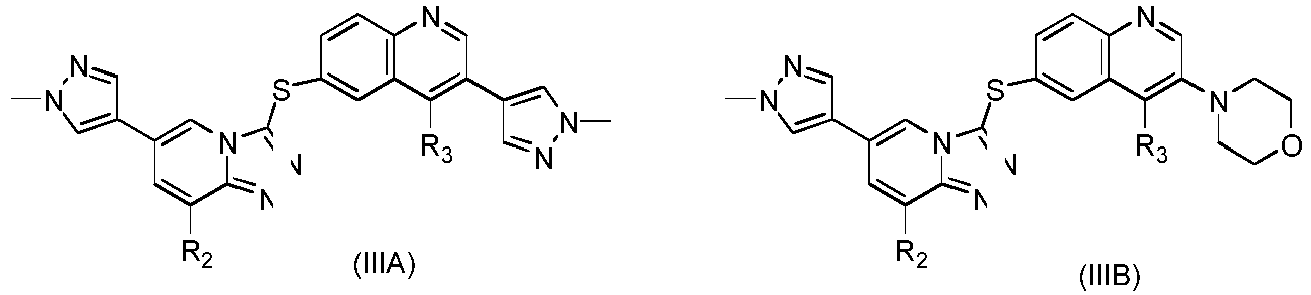
- The compound of formula (I) or pharmaceutically acceptable salt threrof according to claim 1 or 2, characterized in that it is a compound of formula (IIIA) or (IIIB) or pharmaceutically acceptable salt thereof, wherein R2 is selected from the group of hydrogen, halogen, C1-C6 alkoxyl and haloC1-C6 alkoxyl, preferably hydrogen and halogen.
- The compound of formula (I) or pharmaceutically acceptable salt threrof according to claim 1 or 2, characterized in that it is a compound of formula (IIIA) or (IIIB) or pharmaceutically acceptable salt thereof, wherein R3 is selected from the group of hydrogen, halogen, C1-C6 alkyl, C1-C6 alkoxyl, haloC1-C6 alkoxyl, -NHR8 and NR8R9, preferably halogen and C1-C6 alkoxyl; and R8 and R9 are as defined in claim 1.
- The compound of formula (I) or pharmaceutically acceptable salt threrof according to claim 1 or 2, characterized in that it is a compound of formula (IV) or pharmaceutically acceptable salt thereof:
 wherein R2 is as defined in claim 1;X=O, N or S;Y=O, N or S;m=0, 1 or 2;R11, R12, R13 and R14 are each independently selected from the group of hydrogen, C1-C6 alkyl, C3-C10 cycloalkyl, 3 to 8-membered heterocyclyl, C2-C6 alkenyl, C2-C6 alkynyl, aryl and heteroaryl; wherein R11 or R12 and R13 or R14 are taken together with the attached carbon atoms to form a 5 to 10-membered ring or heterocyclyl, or, R11, R12 or R13, R14 are taken together with the attached heteroatoms to form a 5 to 10-membered ring or heterocyclyl; wherein the alkyl, cycloalkyl, heterocyclyl, aryl and heteroaryl are each optionally substituted by one or more groups independently selected from the group of alkyl, halogen, hydroxy, amino, alkoxyl, cycloalkyl, heterocyclyl, aryl and heteroaryl.
 - The compound of formula (I) or pharmaceutically acceptable salt threrof according to claim 1 or 2, characterized in that it is a compound of formula (IV) or pharmaceutically acceptable salt thereof, wherein R2 is selected from the group of hydrogen, halogen, C1-C6 alkoxyl and haloC1-C6 alkoxyl, preferably hydrogen and halogen.
- The compound of formula (I) or pharmaceutically acceptable salt threrof according to claim 1 or 2, characterized in that it is a compound of formula (V) or pharmaceutically acceptable salt thereof:
 R2 is as defined in claim 1;W is selected from the group of CH2, O, N and S;R15 and R16 are each independently selected from the group of hydrogen, halogen, C1-C6 alkyl and alkoxyl;R17 is selected from the group of hydrogen, C1-C6 alkyl, C1-C6 alkoxyl, C1-C6 alkoxylalkyl, C(O)R5, C3-C10 cycloalkyl and 3 to 8-membered heterocyclyl;m=0 or 1.
 - The compound of formula (I) or pharmaceutically acceptable salt threrof according to claim 1 or 2, characterized in that it is a compound of formula (V) or pharmaceutically acceptable salt thereof, wherein R2 is selected from the group of hydrogen, halogen, C1-C6 alkoxyl and haloC1-C6 alkoxyl, preferably hydrogen and halogen.
- The compound of formula (I) or pharmaceutically acceptable salt threrof according to claim 1 or 2, characterized in that it is a compound of formula (V) or pharmaceutically acceptable salt thereof, wherein R17 is selected from the group of hydrogen, C1-C6 alkyl, C1-C6 alkoxyl, C1-C6 alkoxylalkyl, C(O)R5, C3-C10 cycloalkyl and 3 to 8-membered heterocyclyl; preferably C1-C6 alkyl and C3-C10 cycloalkyl.
- The compound of formula (I) or pharmaceutically acceptable salt threrof according to any one of claim 1 to 10, characterized in that the compound is selected from the group of:
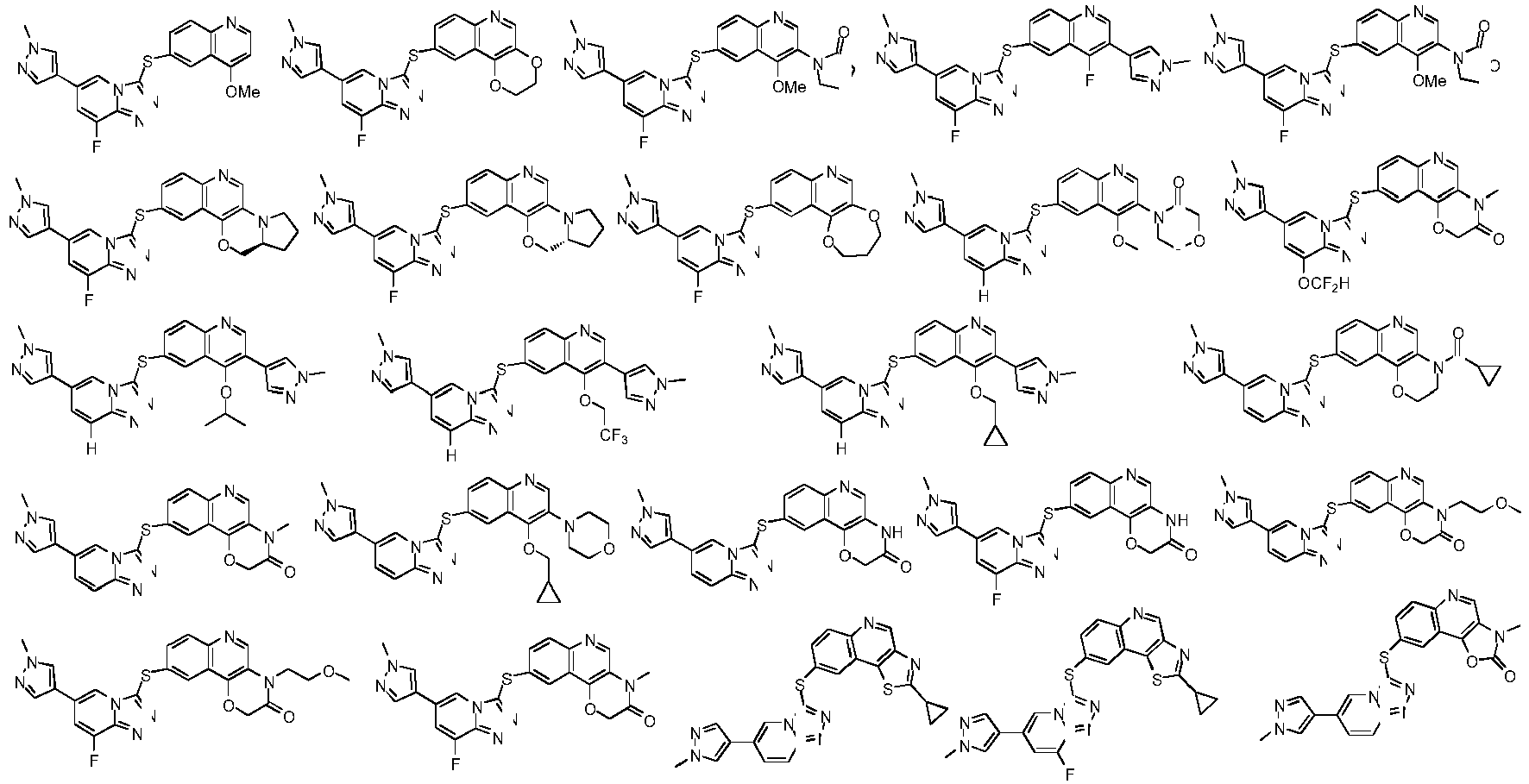

- A process for preparing the compound of formula (I) or pharmaceutically acceptable salt thereof according to claim 1, comprising a step of:
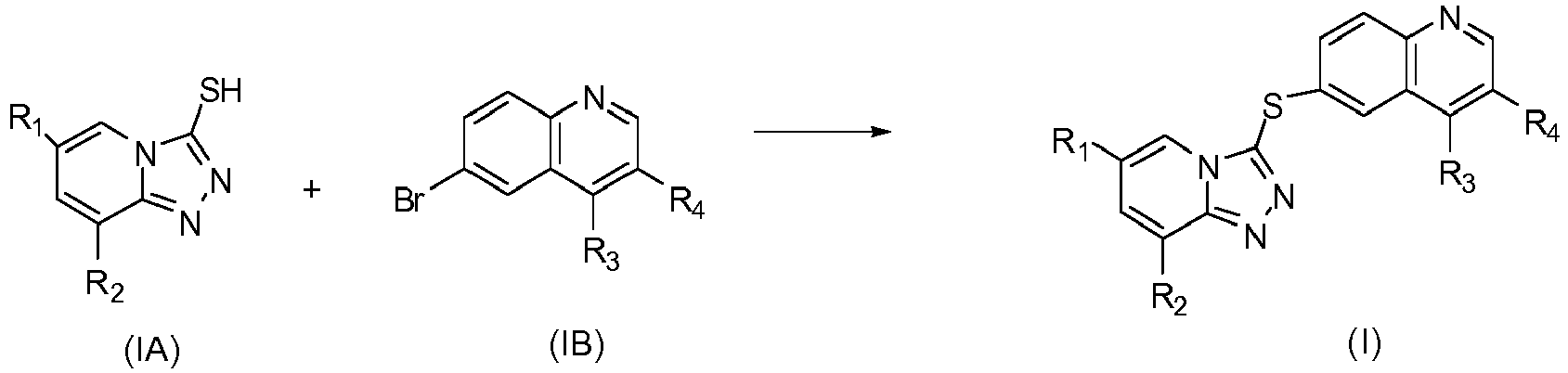 reacting a compound of formula (IA) with a compound of formula (IB) under an alkaline condition to give the compound of formula (I);wherein R1, R2, R3 and R4 are as defined in claim 1.
 - A pharmaceutical composition comprising a therapeutically effective amount of the compound of formula (I) or pharmaceutically acceptable salt thereof according to claim 1, and a pharmaceutically acceptable carrier or excipient.
- A method of modulating protein kinase catalytic activity, comprising a step of contacting the protein kinase with the compound of formula (I) or pharmaceutically acceptable salt thereof according to claim 1 or the pharmaceutical composition according to claim 13, wherein the protein kinase is selected from c-Met and VEGFR receptor tyrosine kinase.
- Use of the compound of formula (I) or pharmaceutically acceptable salt thereof according to claim 1 or the pharmaceutical compositions according to claim 13 in preparation of a medicament for the treatment of a protein kinase-related disease, wherein the protein kinase is selected from c-Met and VEGFR receptor tyrosine kinase.
- The compound of formula (I) or pharmaceutically acceptable salt thereof according to claim 1 or the pharmaceutical compositions according to claim 13, for use as a medicament in the treatment of a protein kinase-related disease, wherein the protein kinase is selected from c-Met and VEGFR receptor tyrosine kinase.
- Use of the compound of formula (I) or pharmaceutically acceptable salt thereof according to claim 1 or the pharmaceutical compositions according to claim 13 in preparation of a medicament for the treatment of cancer.
- Use according to claim 17, wherein the cancer is lung cancer, breast cancer, squamous cell carcinoma or stomach cancer.
- The compound of formula (I) or pharmaceutically acceptable salt thereof according to claim 1, for use as a medicament in the treatment of cancer.
- The compound or pharmaceutically acceptable salt thereof according to claim 19, wherein the cancer is lung cancer, breast cancer, squamous cell carcinoma or stomach cancer.
- The pharmaceutical composition according to claim 13, for use as a medicament in the treatment of cancer.
- The pharmaceutical composition according to claim 21, wherein the cancer is lung cancer, breast cancer, squamous cell carcinoma or stomach cancer.
Applications Claiming Priority (2)
| Application Number | Priority Date | Filing Date | Title |
|---|---|---|---|
| CN201310173581 | 2013-05-10 | ||
| PCT/CN2014/072825 WO2014180182A1 (en) | 2013-05-10 | 2014-03-04 | [1,2,4] triazol [4,3-a] pyridine derivate, preparation method therefor or medical application thereof |
Publications (3)
| Publication Number | Publication Date |
|---|---|
| EP2995618A1 true EP2995618A1 (en) | 2016-03-16 |
| EP2995618A4 EP2995618A4 (en) | 2016-12-28 |
| EP2995618B1 EP2995618B1 (en) | 2019-01-09 |
Family
ID=51866678
Family Applications (1)
| Application Number | Title | Priority Date | Filing Date |
|---|---|---|---|
| EP14794045.6A Not-in-force EP2995618B1 (en) | 2013-05-10 | 2014-03-04 | [1,2,4]triazol [4,3-a]pyridine derivate, preparation method therefor or medical application thereof |
Country Status (10)
| Country | Link |
|---|---|
| US (1) | US9512121B2 (en) |
| EP (1) | EP2995618B1 (en) |
| JP (1) | JP6355719B2 (en) |
| KR (1) | KR102211310B1 (en) |
| CN (1) | CN105143228B (en) |
| AU (1) | AU2014262326B2 (en) |
| BR (1) | BR112015027440B1 (en) |
| CA (1) | CA2910367C (en) |
| TW (1) | TWI628179B (en) |
| WO (1) | WO2014180182A1 (en) |
Families Citing this family (12)
| Publication number | Priority date | Publication date | Assignee | Title |
|---|---|---|---|---|
| JP6537591B2 (en) * | 2014-08-01 | 2019-07-03 | ジエンス ハンセン ファーマセウティカル グループ カンパニー リミテッド | Crystalline free base of c-Met inhibitor or crystalline acid salt thereof, method for producing them and use thereof |
| WO2017049711A1 (en) * | 2015-09-24 | 2017-03-30 | 上海海聚生物科技有限公司 | Quinoline derivative, and pharmaceutical composition, preparation method and use thereof |
| CN106883250B (en) * | 2015-12-15 | 2021-05-18 | 江苏豪森药业集团有限公司 | Preparation method of C-Met tyrosine kinase inhibitor |
| CN106880632A (en) * | 2015-12-16 | 2017-06-23 | 江苏豪森药业集团有限公司 | Pharmaceutical applications of c-Met specific drugs containing quinoline ring and preparation method thereof |
| CN108623619B (en) * | 2017-03-17 | 2021-11-05 | 江苏豪森药业集团有限公司 | Process for preparing C-Met tyrosine kinase inhibitors |
| TWI685341B (en) * | 2017-09-22 | 2020-02-21 | 大陸商江蘇恒瑞醫藥股份有限公司 | Use of combination of apatinib and c-met inhibitor in the preparation of medicament for treating tumor |
| CN109705139A (en) * | 2017-10-26 | 2019-05-03 | 连云港恒运药业有限公司 | The purification process of C-Met inhibitor intermediate |
| WO2020113554A1 (en) * | 2018-12-07 | 2020-06-11 | 东莞市东阳光农药研发有限公司 | Quinoline derivative and preparation method and application thereof |
| EP3942045A1 (en) | 2019-03-21 | 2022-01-26 | Onxeo | A dbait molecule in combination with kinase inhibitor for the treatment of cancer |
| EP4054579A1 (en) | 2019-11-08 | 2022-09-14 | Institut National de la Santé et de la Recherche Médicale (INSERM) | Methods for the treatment of cancers that have acquired resistance to kinase inhibitors |
| WO2021148581A1 (en) | 2020-01-22 | 2021-07-29 | Onxeo | Novel dbait molecule and its use |
| CN120769856A (en) * | 2023-02-27 | 2025-10-10 | 江苏豪森药业集团有限公司 | A triazolocyclic compound mesylate crystal form and its preparation method and application |
Family Cites Families (8)
| Publication number | Priority date | Publication date | Assignee | Title |
|---|---|---|---|---|
| US7632837B2 (en) * | 2005-06-17 | 2009-12-15 | Bristol-Myers Squibb Company | Bicyclic heterocycles as cannabinoid-1 receptor modulators |
| CL2007000851A1 (en) | 2006-03-30 | 2008-03-14 | Novartis Ag | ANTIBODY ANTI RECEIVER OF THE HEPATOCITE GROWTH FACTOR (C-MET); DNA CODING LIGHT AND HEAVY CHAINS OF THE ANTIBODY; PHARMACEUTICAL COMPOSITION AND KIT THAT INCLUDE SUCH ANTIBODY; METHOD FOR TREATMENT RELATED TO C-MET |
| SI2084162T1 (en) | 2006-10-23 | 2012-11-30 | Sgx Pharmaceuticals Inc | Bicyclic triazoles as protein kinase modulators |
| CA2667428A1 (en) * | 2006-10-23 | 2008-05-02 | Sgx Pharmaceuticals, Inc. | Bicyclic triazoles as protein kinase modulators |
| WO2010007316A2 (en) * | 2008-07-18 | 2010-01-21 | Sanofi-Aventis | Novel triazolo(4,3-a)pyridine derivatives, process for the preparation thereof, use thereof as medicaments, pharmaceutical compositions and novel use, in particular as met inhibitors |
| UY32049A (en) * | 2008-08-14 | 2010-03-26 | Takeda Pharmaceutical | CMET INHIBITORS |
| MX2012009378A (en) * | 2010-02-11 | 2012-09-12 | Univ Vanderbilt | Pyrazolopyridine, pyrazolopyrazine, pyrazolopyrimidine, pyrazolothiophene and pyrazolothiazole compounds as mglur4 allosteric potentiators, compounds, and methods of treating neurological dysfunction. |
| UY34329A (en) * | 2011-09-15 | 2013-04-30 | Novartis Ag | TRIAZOLOPIRIDINE COMPOUNDS |
-
2014
- 2014-03-04 CN CN201480015692.5A patent/CN105143228B/en active Active
- 2014-03-04 CA CA2910367A patent/CA2910367C/en active Active
- 2014-03-04 BR BR112015027440-4A patent/BR112015027440B1/en active IP Right Grant
- 2014-03-04 WO PCT/CN2014/072825 patent/WO2014180182A1/en not_active Ceased
- 2014-03-04 JP JP2016512200A patent/JP6355719B2/en active Active
- 2014-03-04 US US14/889,092 patent/US9512121B2/en active Active
- 2014-03-04 KR KR1020157034540A patent/KR102211310B1/en active Active
- 2014-03-04 EP EP14794045.6A patent/EP2995618B1/en not_active Not-in-force
- 2014-03-04 AU AU2014262326A patent/AU2014262326B2/en active Active
- 2014-04-14 TW TW103113515A patent/TWI628179B/en active
Also Published As
| Publication number | Publication date |
|---|---|
| TW201443052A (en) | 2014-11-16 |
| US9512121B2 (en) | 2016-12-06 |
| EP2995618A4 (en) | 2016-12-28 |
| CA2910367C (en) | 2021-07-20 |
| JP2016517893A (en) | 2016-06-20 |
| JP6355719B2 (en) | 2018-07-11 |
| KR20160005354A (en) | 2016-01-14 |
| BR112015027440B1 (en) | 2023-04-11 |
| TWI628179B (en) | 2018-07-01 |
| EP2995618B1 (en) | 2019-01-09 |
| CA2910367A1 (en) | 2014-11-13 |
| AU2014262326A1 (en) | 2015-11-19 |
| CN105143228A (en) | 2015-12-09 |
| KR102211310B1 (en) | 2021-02-03 |
| US20160122339A1 (en) | 2016-05-05 |
| CN105143228B (en) | 2017-07-21 |
| WO2014180182A1 (en) | 2014-11-13 |
| BR112015027440A2 (en) | 2017-08-29 |
| AU2014262326B2 (en) | 2018-03-22 |
Similar Documents
| Publication | Publication Date | Title |
|---|---|---|
| EP2995618B1 (en) | [1,2,4]triazol [4,3-a]pyridine derivate, preparation method therefor or medical application thereof | |
| EP4328225A1 (en) | Heterocyclic derivative inhibitor and preparation method therefor and application thereof | |
| KR102288281B1 (en) | FGFR4 inhibitors, methods for their preparation and pharmaceutical applications | |
| CN102399233B (en) | Dual PI3K and mTOR inhibitor compounds | |
| KR102086871B1 (en) | Anticancer benzopyrazines via the inhibition of fgfr kinases | |
| TW202110843A (en) | Nitrogen-containing heterocyclic derivative regulator, preparation method therefor and application thereof | |
| JP6208223B2 (en) | New compounds | |
| CN114539245A (en) | Pyrimidine-fused ring derivative-containing regulator, and preparation method and application thereof | |
| EP3421038B1 (en) | Naphthyridine compound, pharmaceutical composition and use thereof | |
| CN110914277B (en) | Imidazo [1,2-b ] pyrimido [4,5-d ] pyridazin-5 (6H) -one compounds and application thereof | |
| CN119013279A (en) | Substituted tricyclic compounds as PARP inhibitors and uses thereof | |
| TW202340212A (en) | Therapeutic compounds and methods of use | |
| EP3284746A1 (en) | Preparation and use of kinase inhibitor | |
| CN116670134A (en) | Substituted imidazo[1,5-b]pyridazine compounds as kinase inhibitors and their use | |
| CN110312717B (en) | Substituted fused heteroaromatic tricyclic compounds as kinase inhibitors and their applications | |
| KR20210011988A (en) | Fused cyclic pyrazoloneformamide compound and its preparation method, pharmaceutical composition and use | |
| AU2014284013B2 (en) | Five-membered heterocyclic pyridine compounds and preparation method and use thereof | |
| KR20200110250A (en) | Heteroaryl derivatives, and pharmaceutical composition comprising the same | |
| CN120092008A (en) | Substituted heteroaryl bicyclic compounds as USP1 inhibitors and their applications | |
| US10301325B2 (en) | Quinoline derivative, and pharmaceutical composition, preparation method and use thereof | |
| WO2022236101A1 (en) | Wdr5 inhibitors and modulators | |
| CN104884456A (en) | Pi3k and/or mtor inhibitor | |
| HK40069226A (en) | Pyrimidine-fused ring derivative regulator, a method for preparing the same and use thereof | |
| CN120826404A (en) | Substituted nitrogen-containing tricyclic compounds as PARP inhibitors and their applications | |
| HK1190142B (en) | Pyridonaphthyridine pi3k/mtor dual inhibitors and preparation and use thereof |
Legal Events
| Date | Code | Title | Description |
|---|---|---|---|
| PUAI | Public reference made under article 153(3) epc to a published international application that has entered the european phase |
Free format text: ORIGINAL CODE: 0009012 |
|
| 17P | Request for examination filed |
Effective date: 20151008 |
|
| AK | Designated contracting states |
Kind code of ref document: A1 Designated state(s): AL AT BE BG CH CY CZ DE DK EE ES FI FR GB GR HR HU IE IS IT LI LT LU LV MC MK MT NL NO PL PT RO RS SE SI SK SM TR |
|
| AX | Request for extension of the european patent |
Extension state: BA ME |
|
| DAX | Request for extension of the european patent (deleted) | ||
| REG | Reference to a national code |
Ref country code: DE Ref legal event code: R079 Ref document number: 602014039645 Country of ref document: DE Free format text: PREVIOUS MAIN CLASS: C07D0487040000 Ipc: C07D0519000000 |
|
| A4 | Supplementary search report drawn up and despatched |
Effective date: 20161125 |
|
| RIC1 | Information provided on ipc code assigned before grant |
Ipc: A61K 31/4745 20060101ALI20161121BHEP Ipc: C07D 471/04 20060101ALI20161121BHEP Ipc: A61K 31/503 20060101ALI20161121BHEP Ipc: C07D 519/00 20060101AFI20161121BHEP Ipc: A61P 35/00 20060101ALI20161121BHEP Ipc: A61P 29/00 20060101ALI20161121BHEP |
|
| STAA | Information on the status of an ep patent application or granted ep patent |
Free format text: STATUS: EXAMINATION IS IN PROGRESS |
|
| 17Q | First examination report despatched |
Effective date: 20171219 |
|
| GRAP | Despatch of communication of intention to grant a patent |
Free format text: ORIGINAL CODE: EPIDOSNIGR1 |
|
| STAA | Information on the status of an ep patent application or granted ep patent |
Free format text: STATUS: GRANT OF PATENT IS INTENDED |
|
| INTG | Intention to grant announced |
Effective date: 20180627 |
|
| GRAJ | Information related to disapproval of communication of intention to grant by the applicant or resumption of examination proceedings by the epo deleted |
Free format text: ORIGINAL CODE: EPIDOSDIGR1 |
|
| STAA | Information on the status of an ep patent application or granted ep patent |
Free format text: STATUS: EXAMINATION IS IN PROGRESS |
|
| GRAR | Information related to intention to grant a patent recorded |
Free format text: ORIGINAL CODE: EPIDOSNIGR71 |
|
| GRAS | Grant fee paid |
Free format text: ORIGINAL CODE: EPIDOSNIGR3 |
|
| STAA | Information on the status of an ep patent application or granted ep patent |
Free format text: STATUS: GRANT OF PATENT IS INTENDED |
|
| INTC | Intention to grant announced (deleted) | ||
| GRAA | (expected) grant |
Free format text: ORIGINAL CODE: 0009210 |
|
| STAA | Information on the status of an ep patent application or granted ep patent |
Free format text: STATUS: THE PATENT HAS BEEN GRANTED |
|
| INTG | Intention to grant announced |
Effective date: 20181129 |
|
| RAP1 | Party data changed (applicant data changed or rights of an application transferred) |
Owner name: JIANGSU HANSOH PHARMACEUTICAL GROUP CO., LTD. |
|
| AK | Designated contracting states |
Kind code of ref document: B1 Designated state(s): AL AT BE BG CH CY CZ DE DK EE ES FI FR GB GR HR HU IE IS IT LI LT LU LV MC MK MT NL NO PL PT RO RS SE SI SK SM TR |
|
| REG | Reference to a national code |
Ref country code: GB Ref legal event code: FG4D |
|
| REG | Reference to a national code |
Ref country code: CH Ref legal event code: EP Ref country code: AT Ref legal event code: REF Ref document number: 1087149 Country of ref document: AT Kind code of ref document: T Effective date: 20190115 |
|
| REG | Reference to a national code |
Ref country code: DE Ref legal event code: R096 Ref document number: 602014039645 Country of ref document: DE |
|
| REG | Reference to a national code |
Ref country code: IE Ref legal event code: FG4D |
|
| REG | Reference to a national code |
Ref country code: NL Ref legal event code: MP Effective date: 20190109 |
|
| REG | Reference to a national code |
Ref country code: LT Ref legal event code: MG4D |
|
| PG25 | Lapsed in a contracting state [announced via postgrant information from national office to epo] |
Ref country code: NL Free format text: LAPSE BECAUSE OF FAILURE TO SUBMIT A TRANSLATION OF THE DESCRIPTION OR TO PAY THE FEE WITHIN THE PRESCRIBED TIME-LIMIT Effective date: 20190109 |
|
| REG | Reference to a national code |
Ref country code: AT Ref legal event code: MK05 Ref document number: 1087149 Country of ref document: AT Kind code of ref document: T Effective date: 20190109 |
|
| PG25 | Lapsed in a contracting state [announced via postgrant information from national office to epo] |
Ref country code: ES Free format text: LAPSE BECAUSE OF FAILURE TO SUBMIT A TRANSLATION OF THE DESCRIPTION OR TO PAY THE FEE WITHIN THE PRESCRIBED TIME-LIMIT Effective date: 20190109 Ref country code: PT Free format text: LAPSE BECAUSE OF FAILURE TO SUBMIT A TRANSLATION OF THE DESCRIPTION OR TO PAY THE FEE WITHIN THE PRESCRIBED TIME-LIMIT Effective date: 20190509 Ref country code: SE Free format text: LAPSE BECAUSE OF FAILURE TO SUBMIT A TRANSLATION OF THE DESCRIPTION OR TO PAY THE FEE WITHIN THE PRESCRIBED TIME-LIMIT Effective date: 20190109 Ref country code: FI Free format text: LAPSE BECAUSE OF FAILURE TO SUBMIT A TRANSLATION OF THE DESCRIPTION OR TO PAY THE FEE WITHIN THE PRESCRIBED TIME-LIMIT Effective date: 20190109 Ref country code: NO Free format text: LAPSE BECAUSE OF FAILURE TO SUBMIT A TRANSLATION OF THE DESCRIPTION OR TO PAY THE FEE WITHIN THE PRESCRIBED TIME-LIMIT Effective date: 20190409 Ref country code: PL Free format text: LAPSE BECAUSE OF FAILURE TO SUBMIT A TRANSLATION OF THE DESCRIPTION OR TO PAY THE FEE WITHIN THE PRESCRIBED TIME-LIMIT Effective date: 20190109 Ref country code: LT Free format text: LAPSE BECAUSE OF FAILURE TO SUBMIT A TRANSLATION OF THE DESCRIPTION OR TO PAY THE FEE WITHIN THE PRESCRIBED TIME-LIMIT Effective date: 20190109 |
|
| PG25 | Lapsed in a contracting state [announced via postgrant information from national office to epo] |
Ref country code: BG Free format text: LAPSE BECAUSE OF FAILURE TO SUBMIT A TRANSLATION OF THE DESCRIPTION OR TO PAY THE FEE WITHIN THE PRESCRIBED TIME-LIMIT Effective date: 20190409 Ref country code: HR Free format text: LAPSE BECAUSE OF FAILURE TO SUBMIT A TRANSLATION OF THE DESCRIPTION OR TO PAY THE FEE WITHIN THE PRESCRIBED TIME-LIMIT Effective date: 20190109 Ref country code: LV Free format text: LAPSE BECAUSE OF FAILURE TO SUBMIT A TRANSLATION OF THE DESCRIPTION OR TO PAY THE FEE WITHIN THE PRESCRIBED TIME-LIMIT Effective date: 20190109 Ref country code: GR Free format text: LAPSE BECAUSE OF FAILURE TO SUBMIT A TRANSLATION OF THE DESCRIPTION OR TO PAY THE FEE WITHIN THE PRESCRIBED TIME-LIMIT Effective date: 20190410 Ref country code: RS Free format text: LAPSE BECAUSE OF FAILURE TO SUBMIT A TRANSLATION OF THE DESCRIPTION OR TO PAY THE FEE WITHIN THE PRESCRIBED TIME-LIMIT Effective date: 20190109 Ref country code: IS Free format text: LAPSE BECAUSE OF FAILURE TO SUBMIT A TRANSLATION OF THE DESCRIPTION OR TO PAY THE FEE WITHIN THE PRESCRIBED TIME-LIMIT Effective date: 20190509 |
|
| REG | Reference to a national code |
Ref country code: DE Ref legal event code: R119 Ref document number: 602014039645 Country of ref document: DE |
|
| PG25 | Lapsed in a contracting state [announced via postgrant information from national office to epo] |
Ref country code: RO Free format text: LAPSE BECAUSE OF FAILURE TO SUBMIT A TRANSLATION OF THE DESCRIPTION OR TO PAY THE FEE WITHIN THE PRESCRIBED TIME-LIMIT Effective date: 20190109 Ref country code: IT Free format text: LAPSE BECAUSE OF FAILURE TO SUBMIT A TRANSLATION OF THE DESCRIPTION OR TO PAY THE FEE WITHIN THE PRESCRIBED TIME-LIMIT Effective date: 20190109 Ref country code: SK Free format text: LAPSE BECAUSE OF FAILURE TO SUBMIT A TRANSLATION OF THE DESCRIPTION OR TO PAY THE FEE WITHIN THE PRESCRIBED TIME-LIMIT Effective date: 20190109 Ref country code: CZ Free format text: LAPSE BECAUSE OF FAILURE TO SUBMIT A TRANSLATION OF THE DESCRIPTION OR TO PAY THE FEE WITHIN THE PRESCRIBED TIME-LIMIT Effective date: 20190109 Ref country code: EE Free format text: LAPSE BECAUSE OF FAILURE TO SUBMIT A TRANSLATION OF THE DESCRIPTION OR TO PAY THE FEE WITHIN THE PRESCRIBED TIME-LIMIT Effective date: 20190109 Ref country code: AT Free format text: LAPSE BECAUSE OF FAILURE TO SUBMIT A TRANSLATION OF THE DESCRIPTION OR TO PAY THE FEE WITHIN THE PRESCRIBED TIME-LIMIT Effective date: 20190109 Ref country code: DK Free format text: LAPSE BECAUSE OF FAILURE TO SUBMIT A TRANSLATION OF THE DESCRIPTION OR TO PAY THE FEE WITHIN THE PRESCRIBED TIME-LIMIT Effective date: 20190109 Ref country code: AL Free format text: LAPSE BECAUSE OF FAILURE TO SUBMIT A TRANSLATION OF THE DESCRIPTION OR TO PAY THE FEE WITHIN THE PRESCRIBED TIME-LIMIT Effective date: 20190109 Ref country code: MC Free format text: LAPSE BECAUSE OF FAILURE TO SUBMIT A TRANSLATION OF THE DESCRIPTION OR TO PAY THE FEE WITHIN THE PRESCRIBED TIME-LIMIT Effective date: 20190109 |
|
| REG | Reference to a national code |
Ref country code: CH Ref legal event code: PL |
|
| PLBE | No opposition filed within time limit |
Free format text: ORIGINAL CODE: 0009261 |
|
| STAA | Information on the status of an ep patent application or granted ep patent |
Free format text: STATUS: NO OPPOSITION FILED WITHIN TIME LIMIT |
|
| PG25 | Lapsed in a contracting state [announced via postgrant information from national office to epo] |
Ref country code: SM Free format text: LAPSE BECAUSE OF FAILURE TO SUBMIT A TRANSLATION OF THE DESCRIPTION OR TO PAY THE FEE WITHIN THE PRESCRIBED TIME-LIMIT Effective date: 20190109 Ref country code: LU Free format text: LAPSE BECAUSE OF NON-PAYMENT OF DUE FEES Effective date: 20190304 |
|
| REG | Reference to a national code |
Ref country code: BE Ref legal event code: MM Effective date: 20190331 |
|
| 26N | No opposition filed |
Effective date: 20191010 |
|
| GBPC | Gb: european patent ceased through non-payment of renewal fee |
Effective date: 20190409 |
|
| PG25 | Lapsed in a contracting state [announced via postgrant information from national office to epo] |
Ref country code: CH Free format text: LAPSE BECAUSE OF NON-PAYMENT OF DUE FEES Effective date: 20190331 Ref country code: GB Free format text: LAPSE BECAUSE OF NON-PAYMENT OF DUE FEES Effective date: 20190409 Ref country code: LI Free format text: LAPSE BECAUSE OF NON-PAYMENT OF DUE FEES Effective date: 20190331 Ref country code: DE Free format text: LAPSE BECAUSE OF NON-PAYMENT OF DUE FEES Effective date: 20191001 Ref country code: IE Free format text: LAPSE BECAUSE OF NON-PAYMENT OF DUE FEES Effective date: 20190304 |
|
| PG25 | Lapsed in a contracting state [announced via postgrant information from national office to epo] |
Ref country code: BE Free format text: LAPSE BECAUSE OF NON-PAYMENT OF DUE FEES Effective date: 20190331 Ref country code: SI Free format text: LAPSE BECAUSE OF FAILURE TO SUBMIT A TRANSLATION OF THE DESCRIPTION OR TO PAY THE FEE WITHIN THE PRESCRIBED TIME-LIMIT Effective date: 20190109 Ref country code: FR Free format text: LAPSE BECAUSE OF NON-PAYMENT OF DUE FEES Effective date: 20190309 |
|
| PG25 | Lapsed in a contracting state [announced via postgrant information from national office to epo] |
Ref country code: TR Free format text: LAPSE BECAUSE OF FAILURE TO SUBMIT A TRANSLATION OF THE DESCRIPTION OR TO PAY THE FEE WITHIN THE PRESCRIBED TIME-LIMIT Effective date: 20190109 |
|
| PG25 | Lapsed in a contracting state [announced via postgrant information from national office to epo] |
Ref country code: MT Free format text: LAPSE BECAUSE OF NON-PAYMENT OF DUE FEES Effective date: 20190304 |
|
| PG25 | Lapsed in a contracting state [announced via postgrant information from national office to epo] |
Ref country code: CY Free format text: LAPSE BECAUSE OF FAILURE TO SUBMIT A TRANSLATION OF THE DESCRIPTION OR TO PAY THE FEE WITHIN THE PRESCRIBED TIME-LIMIT Effective date: 20190109 |
|
| PG25 | Lapsed in a contracting state [announced via postgrant information from national office to epo] |
Ref country code: HU Free format text: LAPSE BECAUSE OF FAILURE TO SUBMIT A TRANSLATION OF THE DESCRIPTION OR TO PAY THE FEE WITHIN THE PRESCRIBED TIME-LIMIT; INVALID AB INITIO Effective date: 20140304 |
|
| PG25 | Lapsed in a contracting state [announced via postgrant information from national office to epo] |
Ref country code: MK Free format text: LAPSE BECAUSE OF FAILURE TO SUBMIT A TRANSLATION OF THE DESCRIPTION OR TO PAY THE FEE WITHIN THE PRESCRIBED TIME-LIMIT Effective date: 20190109 |