EP2994473B1 - Process for the preparation of aminoaryl- and aminoheteroaryl boronic acids and esters - Google Patents
Process for the preparation of aminoaryl- and aminoheteroaryl boronic acids and esters Download PDFInfo
- Publication number
- EP2994473B1 EP2994473B1 EP14720164.4A EP14720164A EP2994473B1 EP 2994473 B1 EP2994473 B1 EP 2994473B1 EP 14720164 A EP14720164 A EP 14720164A EP 2994473 B1 EP2994473 B1 EP 2994473B1
- Authority
- EP
- European Patent Office
- Prior art keywords
- formula
- process according
- compound
- bromo
- comprised
- Prior art date
- Legal status (The legal status is an assumption and is not a legal conclusion. Google has not performed a legal analysis and makes no representation as to the accuracy of the status listed.)
- Active
Links
Classifications
-
- C—CHEMISTRY; METALLURGY
- C07—ORGANIC CHEMISTRY
- C07F—ACYCLIC, CARBOCYCLIC OR HETEROCYCLIC COMPOUNDS CONTAINING ELEMENTS OTHER THAN CARBON, HYDROGEN, HALOGEN, OXYGEN, NITROGEN, SULFUR, SELENIUM OR TELLURIUM
- C07F5/00—Compounds containing elements of Groups 3 or 13 of the Periodic Table
- C07F5/02—Boron compounds
- C07F5/025—Boronic and borinic acid compounds
-
- C—CHEMISTRY; METALLURGY
- C07—ORGANIC CHEMISTRY
- C07F—ACYCLIC, CARBOCYCLIC OR HETEROCYCLIC COMPOUNDS CONTAINING ELEMENTS OTHER THAN CARBON, HYDROGEN, HALOGEN, OXYGEN, NITROGEN, SULFUR, SELENIUM OR TELLURIUM
- C07F5/00—Compounds containing elements of Groups 3 or 13 of the Periodic Table
- C07F5/02—Boron compounds
- C07F5/04—Esters of boric acids
Definitions
- the present invention relates to a process for the preparation of aminoaryl- and aminoheteroaryl boronic acids and esters thereof of formula (I) in high yields starting from a dialkyl ketal derivative of formula (V)
- Boronic acid derivatives are widely used in organic synthesis for the formation of carbon-carbon bonds.
- Suzuki coupling an aryl halide and an aryl- or vinyl-borate ester or boronic acid are coupled using Pd(PPh 3 ) 4 ( N. Miyaura, T. Yanagi and A. Suzuki Synth. Commun. 1981, 11, 513 ).
- Aryl triflates are also effective coupling partners ( T. Ohe, N. Miyaura and A. Suzuki J. Org. Chem. 1993, 58, 2201 ).
- Organic aryl, heteroaryl boronic acids and their derivatives can be obtained by different synthetic routes: cross-coupling of bis(pinacolato)diboron (B 2 pin 2 ) with aryl halides and vinyl halides (Miyaura borylation reaction) or by conversion of aryllithium or arylmagnesium compounds with a boronic acid trialkyl ester followed by acid hydrolysis ( T. Leermann, F.R. Leroux, F. Colobert Org. Lett. 2011, 13, 4479-4481 ).
- CN102367260A describes the possibility to use t-butyloxycarbonyl derivatives (t-BOC derivatives) of bromo aminoheteroaryl compounds.
- amino group can also be protected as N,N-dibenzyl derivative, which is a functional group that can be removed by catalytic hydrogenation (see US7196219B2 ) or as N,N-trimethylsilyl derivative, which is unstable to moisture ( Tetrahedron Lett. 2003, 44 (42) , 7719-7722 ).
- DE1002007020401 A1 at page 4 discloses a three-step process to produce aminoaryl/hetaryl-boronic acids from halo-substituted arylamines with intermediate protection of the amino-group as imine.
- WO2010/100127 discloses processes to make amino-substituted arylboronic acids by treating amino-substituted arylbromides with diboronic acid esters under Pd-catalysis.
- di-tert-butylcarbonate the protective reagent described in CN102367260A , is known to be very toxic (fatal if inhaled), flammable and unstable to moisture, which makes it particularly unsuitable for industrial use.
- An object of the present invention is therefore a process for the preparation of aminoaryl- and aminoheteroaryl boronic acids and esters thereof of Formula (I), wherein represents an aryl or heteroaryl group; R 2 is selected from H, Cl, F, C 1 -C 3 alkyl and C 1 -C 3 alkoxy; preferably R 2 is H.
- R is selected from H, C 1 -C 2 alkyl or, taken together with the other R, forms a ring of formula wherein R 7 is H or C 1 -C 3 alkyl
- Said process comprises a condensation reaction between a dialkyl ketal derivative of formula (V) wherein is a C 1 -C 2 alkyl; R 5 and R 6 are aryl; and a bromo aminoaryl or bromo aminoheteroaryl compound of formula (II) wherein and R 2 are as defined above, to afford the corresponding bromo imino derivative of formula (III) wherein R 2 , R 5 and R 6 are as defined above.
- C 1 -C 3 alkyl means linear or branched chain alkyl groups having from 1 to 3 carbon atoms and includes n- and isopropyl, ethyl and methyl.
- C 1 -C 2 alkyl means alkyl groups having from 1 to 2 carbon atoms and includes ethyl and methyl.
- aryl refers to aromatic mono- and polycarbocyclic ring systems, wherein the individual carbocyclic rings in the polyring systems may be fused or attached to each other via a single bond.
- Suitable aryl groups include, but are not limited to, phenyl, naphthyl and biphenyl.
- heteroaryl refers to a 4- to 8- membered monocyclic ring, which consists of carbon atoms and one or more heteroatoms selected from N, O and S.
- Suitable heteroaryl groups include, but are not limited to, pyridine, pyrazine, imidazole, pyrazole, pyran, triazole.
- dialkyl ketal derivative of formula (V) can be obtained according to methods well known in the art, such as for example the method described in Greene T.W. et al. Protecting groups in Organic synthesis, Wiley, Third Editi on.
- a ketone preferably benzophenone in a concentration comprised between 1.5 mol/l and 3.5 mol/l, preferably of about 2.5 mol/l is reacted with a trialkyl orthoformate, preferably trimethyl orthoformate or triethyl orthoformate in a molar ratio comprised between 1.0 and 2.0 with respect to said ketone, preferably in a molar ratio of 1.5 with respect to said ketone, optionally in the presence of an acid catalyst.
- a trialkyl orthoformate preferably trimethyl orthoformate or triethyl orthoformate in a molar ratio comprised between 1.0 and 2.0 with respect to said ketone, preferably in a molar ratio of 1.5 with respect to said ketone, optionally in the presence of an acid catalyst.
- acid catalysts Any acidic compound known to the skilled person can be used as acid catalyst.
- acid catalysts are sulfuric acid, hydrochloric acid, sulfonic acids, such as para toluene sulfonic acid monohydrate, para toluene sulfonic acid ferric salt, or an acidic ion exchange resin such as Serolit Red H + .
- a preferred acid catalyst according to the present invention is para toluene sulfonic acid monohydrate.
- this reaction can be performed in an organic solvent, preferably an alcoholic solvent of formula R 1 -OH or in a mixture of solvents, at a temperature comprised between 40°C and 150°C, preferably at reflux temperature, for a period of time comprised between 1 and 5 h.
- an organic solvent preferably an alcoholic solvent of formula R 1 -OH or in a mixture of solvents
- the mixture of solvents used in the aforementioned reaction is preferably a mixture of an alcoholic solvent, more preferably an alcohol of formula R 1 -OH, wherein R 1 is as defined above, and an organic solvent such as linear, cyclic or branched hydrocarbons, linear or cyclic (poly)ethers or esters, preferably toluene, 1,4-dioxane, diethyleneglycol dimethyl ether or xylenes.
- an organic solvent such as linear, cyclic or branched hydrocarbons, linear or cyclic (poly)ethers or esters, preferably toluene, 1,4-dioxane, diethyleneglycol dimethyl ether or xylenes.
- this protection reaction takes place in a mixture of an alcoholic solvent of formula R 1 -OH and toluene, in a volume ratio comprised between 3 and 2.
- dialkyl ketal derivative of formula (V) of the present invention can be isolated or can be used directly in the next step without any further purification.
- said derivative is not isolated and after removal by distillation of potentially unreacted starting material and said alcoholic solvent, said dialkyl ketal derivative is condensed directly with the bromo aminoaryl or bromo aminoheteroaryl compound of formula (II).
- the molar ratio between said ketone and said bromo aminoaryl or bromo aminoheteroaryl compound of formula (II) is comprised between 0.75 and 2, preferably between 1 and 1.25.
- the condensation reaction is performed in an organic solvent, preferably an aprotic solvent selected from tetrahydrofuran, methyltetrahydrofuran, toluene, 1,4-dioxane, hexane, cyclohexane, heptane and/or mixtures thereof, at a temperature comprised between 70°C and 140°C, preferably at 100-120°C.
- an aprotic solvent selected from tetrahydrofuran, methyltetrahydrofuran, toluene, 1,4-dioxane, hexane, cyclohexane, heptane and/or mixtures thereof.
- said condensation reaction is performed in toluene, still more preferably for a period of time comprised between 6 and 24 h, followed by partial removal through distillation of a volume comprised between 30% and 40% of the total volume of the reaction mixture.
- the residue thus obtained can be isolated by using purification techniques well known to those skilled in the art, such as precipitation, crystallization and the like.
- the imino derivative of formula (III) is isolated by crystallization in an alcoholic solvent or an aliphatic hydrocarbon solvent, more preferably in a C 1 -C 4 alcanol or heptanes, hexane or methylcyclohexane, still more preferably methanol or heptane.
- Another object of the present invention is the use of a dialkyl ketal derivative of formula (V) as intermediate in the process of preparation of aminoaryl- and aminoheteroaryl boronic acids and esters.
- Still another object of the present invention is the process for the preparation of aminoaryl- and aminoheteroaryl boronic acids and esters thereof of Formula (I), further comprising the metalation of the bromo imino derivative of formula (III) and conversion with a compound of formula B(OR') 3 , wherein R' is a C 1 -C 3 alkyl to afford the corresponding boronic acid derivative of formula (IV) wherein R 2 , R 5 and R 6 are as defined above.
- Bromo imino derivatives of formula (III) can be converted into the corresponding aminoaryl and aminoheteroaryl boronic acids and esters thereof using conventional methods reported in literature (see for instance, US2008/2369523 ; US7196219B2 ; Brown H.C., Cole T.E. Organometallics 1983, 2, 1316-1319 ; Seaman W. et al. J.Am.Chem.Soc. 1931, 53, 711-723 ).
- the bromo imino derivative of formula (III) is dissolved in an aprotic organic solvent selected from saturated or unsaturated hydrocarbons, such as hexane, heptane, cyclohexane, toluene, linear or cyclic ethers such as tetrahydrofuran, methyl tetrahydrofuran, 1,4-dioxane, diethyl ether, diisopropyl ether and/or mixtures thereof.
- an aprotic organic solvent selected from saturated or unsaturated hydrocarbons, such as hexane, heptane, cyclohexane, toluene, linear or cyclic ethers such as tetrahydrofuran, methyl tetrahydrofuran, 1,4-dioxane, diethyl ether, diisopropyl ether and/or mixtures thereof.
- a preferred solvent is a linear or cyclic ether, more preferably is tetrahydrofuran or methyl tetrahydrofuran optionally in mixture with a saturated or unsaturated hydrocarbon.
- Suitable conditions for halogen-metal exchange can be obtained using organolithium compounds, preferably alkyl lithium compounds, more preferably n-butyl lithium or n-hexyl lithium at a temperature comprised between -50°C and -100°C.
- Said alkyl lithium compound is preferably used in a concentration comprised between 1.5 mol/l and 3.5 mol/l, preferably in a concentration of about 2.5 mol/l.
- the reaction mixture is left to react at said temperature for a time comprised between 15 minutes and 4 hours, preferably between 30 minutes and 1 hour.
- the temperature is maintained between -50°C and -100°C for a period of time comprised between 0.5 and 1.5 hours, affording the corresponding boronic acid of formula (IV).
- reaction mixture containing compound III can be mixed with a compound of formula B(OR') 3 prior to addition of the lithium reagent.
- the lithium reagent Upon addition of the lithium reagent at -50°C to -100°C the boronic acid of formula IV is generated directly in the reaction mixture.
- said compound of formula (IV) is not isolated and is subsequently subjected to acidic workup, in order to deprotect the imino group and to obtain the corresponding aminoaryl or aminoheteroaryl boronic acid of formula (Ia), in which R 3 and R 4 are both hydrogen, and and R 2 are as defined above.
- said acidic workup takes place at a temperature comprised between -50°C and 30°C, using a mineral acid such as hydrochloric or sulfuric acid.
- the compound (Ia) can be isolated as free base or in a salified form depending on the pH of the reaction mixture, preferably in a salified form, more preferably in form of a hydrogen sulfate or hydrogen chloride salt.
- the boronic acid derivative of formula (Ia) can be converted directly from the reaction mixture into the corresponding ester of formula (I), by esterification with an alcohol of formula R-OH, wherein R is as defined above.
- the boronic ester of formula (I) is prepared by reaction of the boronic acid of formula (Ia), with an alcohol of formula R-OH, preferably pinacol, 1,2-ethanediol, and 1,4-butanediol at a pH comprised between 7.0 and 8.5.
- Said alcohol is preferably used in a molar ratio comprised between 0.8 and 1.5, with respect to the bromo imino derivative of formula (III).
- said boronic acid of formula (Ia) is dissolved in a biphasic aqueous/organic system, in which said organic solvent is selected from toluene, xylenes, C 5 -C 10 linear or branched hydrocarbons, ethers and/or mixtures thereof, preferably is toluene.
- the volume ratio between said aqueous solvent and said organic solvent is preferably comprised between 0.5 and 1.5, more preferably about 1.
- aminoaryl- or aminoheteroaryl boronic acid ester can be isolated by conventional purification techniques, such as precipitation, crystallization and the like, preferably is isolated by crystallization in an apolar solvent.
- Suitable apolar solvents are saturated or unsaturated hydrocarbons, such as hexane, heptane, cyclohexane, toluene, preferably heptane.
- Step 1- Preparation of 3-bromo-N-(diphenylmethylene)-Benzenamine (compound 4) by reaction with benzophenone dimethyl ketal prepared "in situ" from benzophenone and trimethylorthoformate.
- 3-bromo-N-(diphenylmethylene)-Benzenamine (80,0 g; 0,24 Moles) is charged to a cryogenic reactor together with 1.4 eq of triisopropylborate and dissolved in tetrahydrofurane.
- the resulting solution is cooled to-80°C under inert atmosphere and 1.35 eq of n-butyllithium is added as a solution in n-hexane maintaining the internal temperature.
- the reaction mixture is added to a mixture of diluted sulphuric acid (1M) and toluene.
- 3-aminophenylboronic acid (compound 5) can be obtained by precipitation at the temperature of 0-5°C from 0,5M aqueous solutions at pH 7.2 (pH correction with aqueous NaOH 33%). After filtration and drying under vacuum at 40°C for 8 hours 21,7g of compound 5 was obtained(0,16 Moles; 66% molar yield).
- Example B Using the same experimental conditions detailed in Example A (steps 1-3) also the compounds detailed in Examples B-H were prepared. The obtained yields are collected in Table 1. Table 1. % Molar yields of examples A-G Example Step 1 Step 2* Step 3 A 86 66 84 B 82 60 80 C 80 59 78 D 89 65 75 E 75 62 50 F 85 65 73 G 78 62 75 *Note: yields on isolated compound Example B.
Landscapes
- Chemical & Material Sciences (AREA)
- Organic Chemistry (AREA)
- Organic Low-Molecular-Weight Compounds And Preparation Thereof (AREA)
- Low-Molecular Organic Synthesis Reactions Using Catalysts (AREA)
Description
- The present invention relates to a process for the preparation of aminoaryl- and aminoheteroaryl boronic acids and esters thereof of formula (I) in high yields


- Boronic acid derivatives are widely used in organic synthesis for the formation of carbon-carbon bonds. In Suzuki coupling, an aryl halide and an aryl- or vinyl-borate ester or boronic acid are coupled using Pd(PPh3)4 (N. Miyaura, T. Yanagi and A. Suzuki Synth. Commun. 1981, 11, 513). Aryl triflates are also effective coupling partners (T. Ohe, N. Miyaura and A. Suzuki J. Org. Chem. 1993, 58, 2201).
- Boronic acid derivatives have been used during natural product synthesis (P. Rocca et al. Tetrahedron Lett. 1993, 34, 7919), material synthesis (J.P. Sauvage et al. Tetrahedron Lett. 1993, 34, 5125), poly(arylene) polymerization (T.I. Wallow et al. J. Am. Chem. Soc. 1991, 113, 7411) and oligoarene liquid crystals preparation (J.W. Goodby et al. J. Mater. Chem. 1993, 3, 821). One important feature of this kind of chemistry is that boronic acids, in general, are relatively non-toxic and air- and moisture-stable compounds.
- Organic aryl, heteroaryl boronic acids and their derivatives can be obtained by different synthetic routes: cross-coupling of bis(pinacolato)diboron (B2pin2) with aryl halides and vinyl halides (Miyaura borylation reaction) or by conversion of aryllithium or arylmagnesium compounds with a boronic acid trialkyl ester followed by acid hydrolysis (T. Leermann, F.R. Leroux, F. Colobert Org. Lett. 2011, 13, 4479-4481).
- However, the above described synthetic approaches for the preparation of organic aryl and heteroaryl boronic acids present some limitations, mainly linked to the presence of some functional groups that are not compatible with the employed reaction conditions. For example, the presence of an amino group can interfere with the formation of the organometallic compound. Several synthetic strategies were thus applied for the preparation of aminoaryl- and aminoheteroaryl boronic acids and esters using different amino protective groups.
-
US patent application 2008/269523A1 describes the possibility to protect bromo aminoaryl and bromo aminoheteroaryl substrates as imino derivatives with benzophenone. - Alternatively,
CN102367260A describes the possibility to use t-butyloxycarbonyl derivatives (t-BOC derivatives) of bromo aminoheteroaryl compounds. - Moreover, the amino group can also be protected as N,N-dibenzyl derivative, which is a functional group that can be removed by catalytic hydrogenation (see
US7196219B2 ) or as N,N-trimethylsilyl derivative, which is unstable to moisture (Tetrahedron Lett. 2003, 44 (42) , 7719-7722). - Unfortunately, the scale-up of these aforementioned synthetic approaches have some important drawbacks, since upon working on the scale of kilograms, it has never been possible to obtain the described overall yields of
US2008/269523A1 (i.e. 38-66%), but only considerable lower yields (about 2-10%) in very long reaction times (several days) in order to obtain a conversion higher than 90%. - The main problem connected with the lack of reproducibility of what described in
US2008/269523A1 is due to the formation of the imino derivatives; as a matter of fact, the reaction between benzophenone and the aminoaryl or aminoheteroaryl derivative described in Examples 1-10 of the above patent application occurs with very low yields. - Other parameters have been taken into consideration to solve this problem, such as the presence of water, the employed catalyst and the solvent. In particular, the presence of water is known to be critical for the preparation of imino derivatives, since it can influence negatively the equilibrium of the reaction.
- The longer reaction times at larger scale can also explain the lower/varying yields because the application of harsh reaction conditions for long periods of time can clearly results in degradation.
- Although the reason for this unexpected behavior is not completely clear, it was required to improve the method described in
US2008/0269523A1 in order to get to reasonable reaction rate at larger scale (kg or mt) without sacrificing the benefits of the method described. -
DE1002007020401 A1 - In Harry Heaney et al. (Synlett (1988) no. 6, pages 640-642) the general applicability of diarylcarbonyl-dimethyl-ketals to form under mild, catalytic conditions the corresponding diarylmethylen-imino compounds is disclosed.
-
WO2010/100127 discloses processes to make amino-substituted arylboronic acids by treating amino-substituted arylbromides with diboronic acid esters under Pd-catalysis. - Lee Bun Yeoul et al (Journal of the American Chemical Society, ACS publication, US (2005) vol 127, no. 9, pages 3031-3037 discloses a two step process to convert ortho, ortho-dialkyl-p-bromo-anilines with Si(OR)4 and benzophenone to p-diphenylmethyleneimino-benzobromides.
- Lastly, di-tert-butylcarbonate, the protective reagent described in
CN102367260A , is known to be very toxic (fatal if inhaled), flammable and unstable to moisture, which makes it particularly unsuitable for industrial use. - It is therefore desirable to provide an improved process for preparing aminoaryl- and aminoheteroaryl boronic acids in high yields on a large scale, which makes use of non-toxic and easy-to-handle reagents.
- It has now been surprisingly found a new synthetic approach for the preparation of imino derivatives of bromo aminoaryl or bromo aminoheteroaryl compounds, affording the corresponding boronic acids and esters in high yields.
- The process of the present invention is disclosed in the following scheme.

- An object of the present invention is therefore a process for the preparation of aminoaryl- and aminoheteroaryl boronic acids and esters thereof of Formula (I),


R2 is selected from H, Cl, F, C1-C3 alkyl and C1-C3 alkoxy; preferably R2 is H. - R is selected from H, C1-C2 alkyl or, taken together with the other R, forms a ring of formula

- Said process comprises a condensation reaction between a dialkyl ketal derivative of formula (V)

R5 and R6 are aryl;
and a bromo aminoaryl or bromo aminoheteroaryl compound of formula (II)

to afford the corresponding bromo imino derivative of formula (III)

- As used herein, the term "C1-C3 alkyl" means linear or branched chain alkyl groups having from 1 to 3 carbon atoms and includes n- and isopropyl, ethyl and methyl. The term "C1-C2 alkyl" means alkyl groups having from 1 to 2 carbon atoms and includes ethyl and methyl.
- The term "aryl" according to the present invention refers to aromatic mono- and polycarbocyclic ring systems, wherein the individual carbocyclic rings in the polyring systems may be fused or attached to each other via a single bond. Suitable aryl groups include, but are not limited to, phenyl, naphthyl and biphenyl.
- The term "heteroaryl" according to the present invention refers to a 4- to 8- membered monocyclic ring, which consists of carbon atoms and one or more heteroatoms selected from N, O and S. Suitable heteroaryl groups include, but are not limited to, pyridine, pyrazine, imidazole, pyrazole, pyran, triazole.
- The dialkyl ketal derivative of formula (V) can be obtained according to methods well known in the art, such as for example the method described in Greene T.W. et al. Protecting groups in Organic synthesis, Wiley, Third Edition.
- Typically, dialkyl ketal derivatives are obtained by reacting a ketone of formula R5R6C=O with a trialkyl orthoformate of formula HC(OR1)3, optionally in the presence of an acid catalyst, wherein R1, R5 and R6 are as defined above.
- According to an embodiment of the present invention, a ketone, preferably benzophenone in a concentration comprised between 1.5 mol/l and 3.5 mol/l, preferably of about 2.5 mol/l is reacted with a trialkyl orthoformate, preferably trimethyl orthoformate or triethyl orthoformate in a molar ratio comprised between 1.0 and 2.0 with respect to said ketone, preferably in a molar ratio of 1.5 with respect to said ketone, optionally in the presence of an acid catalyst.
- Any acidic compound known to the skilled person can be used as acid catalyst. Examples of acid catalysts are sulfuric acid, hydrochloric acid, sulfonic acids, such as para toluene sulfonic acid monohydrate, para toluene sulfonic acid ferric salt, or an acidic ion exchange resin such as Serolit Red H+.
- A preferred acid catalyst according to the present invention is para toluene sulfonic acid monohydrate.
- According to the process of the present invention, this reaction can be performed in an organic solvent, preferably an alcoholic solvent of formula R1-OH or in a mixture of solvents, at a temperature comprised between 40°C and 150°C, preferably at reflux temperature, for a period of time comprised between 1 and 5 h.
- The mixture of solvents used in the aforementioned reaction is preferably a mixture of an alcoholic solvent, more preferably an alcohol of formula R1-OH, wherein R1 is as defined above, and an organic solvent such as linear, cyclic or branched hydrocarbons, linear or cyclic (poly)ethers or esters, preferably toluene, 1,4-dioxane, diethyleneglycol dimethyl ether or xylenes.
- According to a still more preferred embodiment of the present invention, this protection reaction takes place in a mixture of an alcoholic solvent of formula R1-OH and toluene, in a volume ratio comprised between 3 and 2.
- The dialkyl ketal derivative of formula (V) of the present invention can be isolated or can be used directly in the next step without any further purification. Preferably, said derivative is not isolated and after removal by distillation of potentially unreacted starting material and said alcoholic solvent, said dialkyl ketal derivative is condensed directly with the bromo aminoaryl or bromo aminoheteroaryl compound of formula (II).
- According to the present invention, the molar ratio between said ketone and said bromo aminoaryl or bromo aminoheteroaryl compound of formula (II) is comprised between 0.75 and 2, preferably between 1 and 1.25.
- According to an embodiment of the present invention, the condensation reaction is performed in an organic solvent, preferably an aprotic solvent selected from tetrahydrofuran, methyltetrahydrofuran, toluene, 1,4-dioxane, hexane, cyclohexane, heptane and/or mixtures thereof, at a temperature comprised between 70°C and 140°C, preferably at 100-120°C.
- According to a more preferred embodiment of the present invention, said condensation reaction is performed in toluene, still more preferably for a period of time comprised between 6 and 24 h, followed by partial removal through distillation of a volume comprised between 30% and 40% of the total volume of the reaction mixture.
- The residue thus obtained can be isolated by using purification techniques well known to those skilled in the art, such as precipitation, crystallization and the like. Preferably, the imino derivative of formula (III) is isolated by crystallization in an alcoholic solvent or an aliphatic hydrocarbon solvent, more preferably in a C1-C4 alcanol or heptanes, hexane or methylcyclohexane, still more preferably methanol or heptane.
- These new experimental conditions allow obtaining the imino derivative of formula (III) in high yields, thus making it possible to overcome the problems of scaling up of the process and low rate of conversion previously discussed.
- Another object of the present invention is the use of a dialkyl ketal derivative of formula (V) as intermediate in the process of preparation of aminoaryl- and aminoheteroaryl boronic acids and esters.
- Still another object of the present invention is the process for the preparation of aminoaryl- and aminoheteroaryl boronic acids and esters thereof of Formula (I), further comprising the metalation of the bromo imino derivative of formula (III) and conversion with a compound of formula B(OR')3, wherein R' is a C1-C3 alkyl to afford the corresponding boronic acid derivative of formula (IV)


- Bromo imino derivatives of formula (III) can be converted into the corresponding aminoaryl and aminoheteroaryl boronic acids and esters thereof using conventional methods reported in literature (see for instance,
US2008/2369523 ;US7196219B2 ; Brown H.C., Cole T.E. Organometallics 1983, 2, 1316-1319; Seaman W. et al. J.Am.Chem.Soc. 1931, 53, 711-723). - According to the process of the present invention, the bromo imino derivative of formula (III) is dissolved in an aprotic organic solvent selected from saturated or unsaturated hydrocarbons, such as hexane, heptane, cyclohexane, toluene, linear or cyclic ethers such as tetrahydrofuran, methyl tetrahydrofuran, 1,4-dioxane, diethyl ether, diisopropyl ether and/or mixtures thereof.
- A preferred solvent is a linear or cyclic ether, more preferably is tetrahydrofuran or methyl tetrahydrofuran optionally in mixture with a saturated or unsaturated hydrocarbon.
- Suitable conditions for halogen-metal exchange can be obtained using organolithium compounds, preferably alkyl lithium compounds, more preferably n-butyl lithium or n-hexyl lithium at a temperature comprised between -50°C and -100°C.
- Said alkyl lithium compound is preferably used in a concentration comprised between 1.5 mol/l and 3.5 mol/l, preferably in a concentration of about 2.5 mol/l.
- The reaction mixture is left to react at said temperature for a time comprised between 15 minutes and 4 hours, preferably between 30 minutes and 1 hour.
- When full conversion is reached, a compound of formula B(OR')3 wherein R' is a C1-C6 alkyl, preferably methyl, ethyl or isopropyl, more preferably isopropyl, is added to the reaction mixture in a molar ratio comprised between 1.0 and 1.5, with respect to the bromo imino derivative of formula (III).
- According to a preferred embodiment of the present invention, during said addition, the temperature is maintained between -50°C and -100°C for a period of time comprised between 0.5 and 1.5 hours, affording the corresponding boronic acid of formula (IV).
- In an alternative embodiment the reaction mixture containing compound III can be mixed with a compound of formula B(OR')3 prior to addition of the lithium reagent. Upon addition of the lithium reagent at -50°C to -100°C the boronic acid of formula IV is generated directly in the reaction mixture.
- Preferably, said compound of formula (IV) is not isolated and is subsequently subjected to acidic workup, in order to deprotect the imino group and to obtain the corresponding aminoaryl or aminoheteroaryl boronic acid of formula (Ia), in which R3 and R4 are both hydrogen, and


- According to a preferred embodiment, said acidic workup takes place at a temperature comprised between -50°C and 30°C, using a mineral acid such as hydrochloric or sulfuric acid.
- The compound (Ia) can be isolated as free base or in a salified form depending on the pH of the reaction mixture, preferably in a salified form, more preferably in form of a hydrogen sulfate or hydrogen chloride salt.
- It has to be pointed out that when isolating the compound (Ia) or the corresponding addition salts thereof it has also been possible to recover the starting ketone of formula R5R6C=O, as by-product of the above described reaction, which represents a further advantage of the process of the present invention.
- If desired, the boronic acid derivative of formula (Ia) can be converted directly from the reaction mixture into the corresponding ester of formula (I), by esterification with an alcohol of formula R-OH, wherein R is as defined above.
- Typically, the boronic ester of formula (I) is prepared by reaction of the boronic acid of formula (Ia), with an alcohol of formula R-OH, preferably pinacol, 1,2-ethanediol, and 1,4-butanediol at a pH comprised between 7.0 and 8.5.
- Said alcohol is preferably used in a molar ratio comprised between 0.8 and 1.5, with respect to the bromo imino derivative of formula (III).
- According to a preferred embodiment of the present invention, said boronic acid of formula (Ia) is dissolved in a biphasic aqueous/organic system, in which said organic solvent is selected from toluene, xylenes, C5-C10 linear or branched hydrocarbons, ethers and/or mixtures thereof, preferably is toluene.
- The volume ratio between said aqueous solvent and said organic solvent is preferably comprised between 0.5 and 1.5, more preferably about 1.
- The aminoaryl- or aminoheteroaryl boronic acid ester can be isolated by conventional purification techniques, such as precipitation, crystallization and the like, preferably is isolated by crystallization in an apolar solvent.
- Examples of suitable apolar solvents are saturated or unsaturated hydrocarbons, such as hexane, heptane, cyclohexane, toluene, preferably heptane.
- The following examples are intended to illustrate, but in no way to limit the scope of the invention.
-

- 100 kg of Benzophenone (550 Moles) are converted to the respective dimethyl ketal by treatment with 1.5 mole equivalents of trimethylorthoformate in a refluxing mixture of toluene and methanol (1:3, 5 L/kg benzophenone) under acid catalysis (5 mol% p-toluene sulfonic acid monohydrate). When the reaction is complete, solvents and access reagent are removed by distillation and replaced by toluene. To the resulting mixture, 1 mole equivalent of bromoaniline is added. The mixture is refluxed and partly concentrated until the conversion is complete (12 to 18 hours). Formed solids are removed by filtration and subsequently distillation is continued until the major part of the volatiles is removed. To the resulting concentrated solution/melt an equal amount of methanol is added and product crystallization is initiated by cooling. The resulting suspension is stirred for 30 min at 10 °C and subsequently the formed solid is collected by filtration. The solid is washed with methanol (0.5 L/kg benzophenone) and dried under vacuum to a constant weight at 25 °C. 158 kg of compound 4 are obtained (470 moles; 86% molar yield on benzophenone).
- 3-bromo-N-(diphenylmethylene)-Benzenamine (80,0 g; 0,24 Moles) is charged to a cryogenic reactor together with 1.4 eq of triisopropylborate and dissolved in tetrahydrofurane. The resulting solution is cooled to-80°C under inert atmosphere and 1.35 eq of n-butyllithium is added as a solution in n-hexane maintaining the internal temperature. When full conversion is reached, the reaction mixture is added to a mixture of diluted sulphuric acid (1M) and toluene. The layers are split to obtain an aqueous solution of 3-aminophenylboronic acid hydrogen sulphate salt (Assay yield: 85%) (*point 1). 3-aminophenylboronic acid (compound 5) can be obtained by precipitation at the temperature of 0-5°C from 0,5M aqueous solutions at pH 7.2 (pH correction with aqueous NaOH 33%). After filtration and drying under vacuum at 40°C for 8 hours 21,7g of compound 5 was obtained(0,16 Moles; 66% molar yield).
- IV of Toluene was added to 300 g of 3-aminophenylboronic acid hydrogen sulphate salt solution (obtained at *point 1 of the previous example and containing about 202 mmoles of product) and, under stirring, the pH value of this mixture was corrected to a final pH value of 8,0 with NaOH 33%. 1 eq. Of Pinacol was added and the obtained reaction mixture maintained under stirring at room temperature until the conversion was complete. The organic phase was separated and evaporated under vacuum to residue. 1V of Heptane was added and the obtained slurry maintained under stirring at 20-25°C for 1 hour to afford a precipitate that was recovered by filtration and dried under vacuum (200 mmHg) at 40°C for 8 hours to give 36,5 g of compound 6 (169 mmoles; 84 % yields).
- Using the same experimental conditions detailed in Example A (steps 1-3) also the compounds detailed in Examples B-H were prepared. The obtained yields are collected in Table 1.
Table 1. % Molar yields of examples A-G Example Step 1 Step 2* Step 3 A 86 66 84 B 82 60 80 C 80 59 78 D 89 65 75 E 75 62 50 F 85 65 73 G 78 62 75 *Note: yields on isolated compound Example B. 
-

-

-

-

-

-
Table 2. Chemico-physical properties of compounds 1-6 Compound number Molecular weight/Mass spectrum DSC (peak) or mp NMR/IR 1 Molecular Weight: 336,23 Massa spectra: (m/z) 335, 337. na na 2 Molecular Weight: 136,94 Mass spectra ESI/DPI technique positive ionization (m/z): 138 (100%), 137 (23%), 139 (7%) na na 3 Molecular Weight: 219,09 Mass spectra (m/z): 219, 218. na na 4 Molecular Weight: 336,23 Mass spectra (m/z): 335, 337 70°C 1H-NMR (400 MHz, CDCl3) δ = 6.60 (dq, 1H, 3JHH = 7.8 Hz, 4JHH = 1.7 Hz), 6.91 (t, 1H, 3JHH = 1.7 Hz), 6.97 (t, 1H, 3JHH = 7.8 Hz), 7.04 (dq, 3JHH = 7.8 Hz, 4JHH = 1.7 Hz), 7.09-7.11 (m, 2H), 7.26-7.30 (m, 3H), 7.38-7.41 (m, 2H), 7.45-7.49 (m, 1H), 7.72-7.74 (m, 2H). IR(cm-1): 3466 (w), 3370 (w), 3060 (w), 1656 (m), 1613 (m), 1587 (s), 1561 (s), 1490 (m), 1480 (m), 1465 (s), 1412 (w), 1316 (s), 1294 (s), 1279 (s), 1220 (m), 1143 (m), 1066 (m), 1026 (w), 960 (m), 942 (w), 920 8m), 887 (w), 856 (s), 847 (m), 810 (w), 781 (s), 768 (s), 723 (m), 704 (s), 691 (s), 677 (s), 651 (s), 638 (m), 613 (w) 5 Molecular Weight: 136,94 Mass spectra ESI/DPI technique positive ionization (m/z): 138 (100%), 137 (23%), 139 (7%) 131÷163 °C 1H-NMR (400 MHz, dmso-d6 + D2O); δ = 6.63 (m, 1H), 6.98 (m, 3H), NH2, B(OH)2 not observed due to H-D exchange; IR(cm-1): 3332 (w), 3220 (w), 3033 (w), 1615 (m), 1602 (m), 1580 (s), 1498 (w), 1443 (m), 1390 (s), 1327 (s), 1295 (s), 1243 (s), 1220 (m), 1143 (m), 1066 (m), 1164 (s), 1105 (m), 1069 (m), 1018 (m), 994 (m), 891 (m), 793 (s), 751 (s), 706 (s) 6 Molecular Weight: 219,09 Mass spectra (m/z): 219, 218. 94-96°C 1H-NMR (400 MHz, CDCl3); δ = 1.33 (s, 12H), 3.62 (s, 2H), 6.77-6.80 (m, 1H), 7.13-7.22 (m, 3H). IR(cm-1): 3464 (s), 3374 (s), 3232 (w), 2987 (s), 1627 (s), 1601 (m), 1578 (s), 1493 (w), 1441 (s), 1392 (m), 1357 (s),1320 (s), 1263 (s), 1211 (w), 1220 (m), 1143 (m), 1066 (m), 1169 (m), 1110 (w), 1076 (s), 991 (w), 965 (m), 906 (m), 851 (s), 792 (s), 705 (s) Table 3. Chemico-physical properties of compounds 7-12 7 Molecular Weight: 336,23 Mass spectra ESI/DPI technique, positive ionization (m/z) : 339 (20%) 338 (100%), 337 (21%) 336 (99%), 70,9°C 1H-NMR (500 MHz, CDCl3) δ = 6.70 (d, 1H, 7.7 HZ), 6.85 (dt, 1H, 7.7 Hz), 7.12 (t, 1H, 8.3 Hz), 7.20 (d, 2H, 7.3 Hz), 7.25-7.40 (m, 3H), 7.40-7.50 (m, 3H), 7.50-7.60 (m, 1H), 7.90 (d, 2H, 7.7 Hz), IR(cm-1): 3052 (w), 3025 (w), 1615 (s), 1596 (m), 1576 (s), 1490 (m), 1459 (m), 1447 (m), 1429 (m), 1317 (s), 1293 (s), 1223 (s), 1178 (m), 1145 (m), 1113 (m), 1073 (w), 1044 (m). 1024 (s). 1002 (m). 957 (m). 935 (w), 916 (w), 829 (m), 786 (s), 770 (s), 760 (s), 694 (s), 675 (s), 667 (s) 8 Molecular Weight: 136,94 ESI/DPI technique positive ionization (m/z): 138 (100%), 137 (22%),139 (9%) 102,1°C, 1H-NMR (500 MHz, CDC13); δ = 6.95 (t, 1H, 7.3 Hz), 7.09 (d, 1H, 8.1 Hz), 7.38 (dt, 1H, 7.2 Hz), 7.71 (d, 1H, 7.4 Hz); IR(cm-1): 3487 (m), 3380 (m), 2976 (m), 2936 (w), 1625 (m), 1605 (s), 1567 (m), 1488 (m), 1454 (s), 1387 (m), 1373 (m), 1351 (s), 1310 (s), 1290 (m), 1268 (m), 1245 (s), 1206 (m), 1161 (m), 1135 (s), 1106 (m), 1086 (s), 1055 (m), 1028 (m), 959 (m), 863 (m), 846 (s), 828 (m), 758 (s), 670 (s), 654 (s) 9 Molecular Weight: 219,09 Mass spectra (m/z): 219, 218. na na 10 Molecular Weight: 370,67 Mass spectra ESI/DPI technique positive ionization (m/z): 372,5 (100%), 373,5 (28%), 374,2 (19%) 100°C 1H-NMR (500 MHz, CDCl3) δ = 6.93 (s, 1H), 7.08 (dd, 1H, 8.4 Hz), 7.12 (d, 1H, 8.4 Hz), 7.20 (d, 2H, 6.9 Hz), 7.28-7.42 (m, 3H), 7.50 (t, 2H, 7.8 Hz), 7.57 (t, 1H, 7.2 Hz), 7.86 (d, 2H, 7.9 Hz), IR(cm-1): 3063 (w), 1671 (w), 1623 (s), 1595 (w), 1570 (s), 1550 (w), 1520 (w), 1486 (w), 1459 (w), 1442 (m), 1415 (w), 1372 (w), 1318 (w), 1298 (w), 1279 (w), 1240 (w), 1224 (w), 1180 (w), 1147 (w), 1131 (w), 1073 (s), 1052 (s), 1029 (w), 999 (w), 953 (s), 919 (m), 870 (m), 861 (s), 800 (s), 789 (m), 771 (m), 738 (m), 725 (w), 695 (vs), 675 (s), 652 (s), 615 (w) 11 Molecular Weight: 171,39 Mass spectra ESI/DPI technique positive ionization (m/z): 172 (100%), 174 (2%). na na 12 Molecular Weight: 253,53 Mass spectra ESI/DPI technique positive ionization (m/z): 253 (26%), 254 (100%), 255 (21%), 256 (33%) 68°C 1H-NMR (400 MHz, dmso-d6) δ = 1.23 (s, 12H), 5.29 (s, 2H), 6.78 (dd, 1H, 3JHH = 7.9 Hz, 4JHH = 1.4 Hz), 7.12-7.14 (m, 2H) IR (cm-1): 3442 (), 3350 (m), 2990 (w), 2977 (w), 1627 (w), 1592 (w), 1570 (m), 1492 (w), 1471 (w), 1414 (s), 1391 (m), 1356 (vs), 1323 (m), 1294 (w), 1284 (w), 1273 (w), 1251 (m), 1214 few), 1164 (w), 1142 (s), 1089 (vs), 1033 (w), 1005 (w), 964 (m), 924 (w), 892 (w), 853 (s), 827 (w), 807 (m), 784 (w), 722 (m), 692 (w), 679 (s), 666 (m) Table 4. Chemico-physical properties of compounds 13-17 13 Molecular Weight: 350,25 Mass spectra ESI/DPI technique positive ionization (m/z): 350 (99,7%), 351,3 (24%), 252 (100%), 353 (22%) 156-158°C 1H-NMR (400 MHz, CDC13) δ 2.15 (s, 3H), 6.28 (d, 1H, 3JHH= = 8.3 Hz), 7.00 (dd, 1H, 3JHH = 8.3 Hz, 4JHH = 2.2 Hz), 7.05-7.07 (m, 2H), 7.20-7.21 (m, 1H), 7.23-7.29 (m, 3H), 7.38-7.42 (m, 2H), 7.45-7.49 (m, 1H), 7.75-7.77 (m, 2H); IR (cm-1): 3026 (w), 1692 (w), 1613 (m), 1595 (w), 1570 (m), 1489 (w), 1473 (m), 1444 (w), 1390 (w), 1315 (m), 1304 (w), 1294 (w), 1283 (w), 1269 (w), 1228 (m), 1186 (w), 1149 (w), 1119 (m), 1076 (w), 1029 (w), 1000 (w), 972 (w), 958 (w), 945 (w), 931 (w), 917 (w), 868 (m), 826 (s), 787 (s), 762 (m), 738 (m), 701 (s), 692 (s), 677 (m), 662 (s), 621 (w) 14 Molecular Weight: 150,97 Mass spectra ESI/DPI technique positive ionization (m/z): 151 (100%), 152 (15%). na na 15 Molecular Weight: 233,11 Mass spectra ESI/DPI technique positive ionization (m/z): 233.5 (24%), 234.4 (100%), 235.4 (13%) 96-98°C 1H-NMR (500 MHz, CDCl3) δ = 1.35 (s, 12H), 2.35 (s, 3H), 7.00 (d, 1H, 7.7 Hz), 7.59 (d, 1H, 7.7 Hz), 7.61 (s, 1H); IR (cm-1): 3480 (w), 3456 (w), 3372 (w), 2978 (m), 2927 (w), 1622 (s), 1604 (w), 1571 (m), 1469 (w), 1458 (w), 1408 (m), 1387 (m), 1379 (m), 1350 (s), 1324 (s), 1302 (s), I288 (m), 1267 (s), 1210 (w), 1197 (m), 1134 (s), 1109 (w), 1035 (w), 1003 (m). 986 (m), 962 (s), 906 (m), 912 (m), 851 (s), 824 (s), 738 (m), 686 (m), 667 (s) 16 Molecular Weight: 337,21 Mass spectra ESI/DPI technique positive ionization (m/z): 337.4 (100%), 338.4 (20%), 339.3 (99,5%), 340,3 (20%) 117-120°C 1H-NMR (500 MHz, CDCl3) δ = 6.56 (d, 1H, 8.6 Hz), 7.32-7.42 (m, 4H), 7.42-7.50 (m, 2H), 7.50-7.56 (m, 2H), 7.56-7.70 (m, 2H), 7.85 (d, 1H, 7.5 Hz), 8.40 (d, 1H, 2.0 Hz); IR (cm-1): 3054 (w), 3041 (w), 1629 (s), 1595 (w), 1567 (s), 1546 (m), 1489 (w), 1447 (s), 1397 (w), 1354 (m), 1318 (s), 1291 (s), 1279 (s), 1242 (s), 1221 (m), 1177 (w), 1550 (m), 1124 (s), 1093 (m), 1075 (m), 1027 (w), 1002 (s), 960 (s), 913 (m), 941 (m), 914 (m), 830 (s), 784 (s), 775 (s), 753 (s), 720 (w), 700 (s) ,672 (s) 17 Molecular Weight: 137,93 Mass spectra ESI/DPI technique positive ionization (m/z): 139 (100%), 138 (20%), 140 (5%) na na Table 5. Chemico-physical properties of compounds 18-21 Compound number Molecular weight/Mass spectrum DISC (peak ) or mp NMR 18 Molecular Weight: 220,08 Mass spectra (m/z): 220, 219. na na 19 Molecular Weight: 366,25 Mass spectra ESI/DPI technique positive ionization (m/z): 366.3 (100%), 367.3 (22%), 368.3 (99,9%), 369.3 (21%) 76,1° C 1H-NMR (500 MHz, CDCl3) δ = 3.60 (s, 3H), 6.89 (d, 1H, 1.8 Hz), 6.96 (d, 1H, 7.7 Hz), 7.19 (d, 2H, 7.1 Hz), 7.25-7.35 (m, 3H), 7.35-7.45 (m, 1H), 7.48 (t, 2H, 7.5 Hz), 7.58 (t, 1H, 7.3 Hz), 7.85 (d, 2H, 7.3 Hz); IR (cm-1): 3487 (m), 3381 (m), 2995 (w), 2977(w), 1623 (m), 1606 (s), 1567 (m), 1487 (m), 1455 (s), 1448 (s), 1389 (s), 1352 (s), 1315 (s), 1292 (m), 1244 (s), 1209 (m), 1177 (w), 1260 (w), 1136 (s), 1120 (m), 1107 (m), 1085 (m), 1056 (s), 1028 (m), 1018 (s), 1001 (s), 958 (m), 928 (s), 911 (s), 861 (m), 851 cm), 829 (s), 813 (s), 796 (s), 781 (s), 759 (m), 742 (s), 710 (s), 688 (m), 671 (m), 655 (m). 20 Molecular Weight: 166,97 Mass spectra (m/z): 167, 166, 168. na na 21 Molecular Weight: 249,11 Mass spectra ESI/DPI technique positive ionization (m/z): 249.6 (24%), 250.4 (100%), 251.4 (14.7%) 106,6 1H-NMR (500 MHz, CDCl3) δ = 1.18 (s, 12H), 3.96 (s, 3H), 6.85 (d, 1H, 7.7 Hz), 7.25 (s, 1H), 7.35 (d, 1H, 7.7 Hz); IR (cm-1): 3469 (s), 3366 (s), 3200 (s), 3060 (s), 2999 (s), 2977(s), 2965 (s), 2940 (s), 1618 (m), 1593 (s), 1575 (s), 1525 (s), 1476 (s), 1464 (s), 1449 (s), 1418 (m), 1394 (s), 1376 (m), 1342 (m), 1302 (m),1270 (m), 1219 (m), 1178 (s), 1171 (s), 1140 (m), 1108 (s), 1090 (m), 1063 (s), 1031 (m), 1012 (s), 964 (m), 932 (s), 903 (m), 883 (s), 854 (m), 823 (m), 799 (s), 762 (s), 739 (s), 700 (s), 682 (m), 673(m). - A mixture of 38 Kg (221 moles) of 3-bromo aniline, 40 Kg (221 mole) benzophenone and 2,1 kg (0,05 eq) of p-toluenesulfonic acid monohydrate in 120 kg toluene is refluxed for 150 h under reflux, whereby water is azeotropically removed. Eventually obtained solid substance is filtered, the filtrate is free from toluene by distillation. The residue is brought to crystallisation through slow addition of methanol in the cold. The crystals are sucked, washed with toluene and dried under vacuum. The thus prepared solid is the protected amine benzhydryliden-(3-bromo-phenyl)-amine. Yield: 37,5 kg (113 moles, 51%)
- 472 g (1,4 mole) benzhydryliden-(3-bromo-phenyl)-amine are dissolved in 3,47 kg dry THF and cooled to -78°C. At this temperature 420 g (1,54 moles) of 2.5 M n-butyllithium solution in hexane is slowly added. The mixture is continually stirred for 60 min and then cooled to -85°C. 176 g (1,67 moles) of trimethylborate are slowly added. The mixture is again stirred for 60 min, then left to warm up to -10°C and then poured into a prepared solution of 229 g of 96% sulphuric acid in 3,14 Kg water covered with a layer of 1,18 Kg of toluene. The mixture is stirred for one hour After completion of phase separation the aqueous phase is covered with a layer of 4,72 Kg of fresh toluene and 199,4 g (1,69 moles) pinacol are added. By adding 1,30 Kg of 10% sodium hydroxide solution a pH-value of about 8.5 is set. The mixture is stirred intensely for 12 h, then again phase separation takes place. From the organic phase the bulk of the solvent is removed at 100-150 mbar. The residue is cooled to -5°C. The thereby obtained solid substance is sucked off, washed and dried under vacuum. Thus, colorless crystals of 3-aminophenylboronic acid pinacol ester are obtained. Yield: 210 g (0,95 moles, 69%). Overall yields: 35%.
Claims (30)
- Process for the preparation of aminoaryl or aminoheteroaryl boronic acids and esters thereof of formula (I)


R2 is selected from H, Cl, F, C1-C3 alkyl and C1-C3 alkoxy;
R is selected from H, C1-C2 alkyl or, taken together with the other R, forms a ring of formula
which process comprises a condensation reaction between a dialkyl ketal of derivative of formula (V)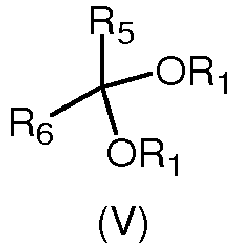
R5 and R6 are aryl;
and a bromo aminoaryl or bromo aminoheteroaryl compound of formula (II)


- Process according to claim 1, characterized in that said aryl group is selected from phenyl, biphenyl or naphtyl, preferably phenyl.
- Process according to any one of claims 1-2, characterized in that said heteroaryl group is selected from pyridinyl or pyrazinyl, preferably pyridinyl
- Process according to any one of claims 1-3, characterized in that R2 is selected from H, Cl, F, C1-C3 alkyl and C1-C3 alkoxy.
- Process according to any one of claims 1-4, characterized in that said dialkyl ketal derivative of formula (V) is obtained by reaction of a ketone of formula R5R6C=O with a trialkyl orthoformate of formula HC(OR1)3, optionally in the presence of an acid catalyst.
- Process according to claim 5, characterized in that said ketone is benzophenone.
- Process according to claim 5, characterized in that said trialkyl orthoformate is trimethyl orthoformate or triethyl orthoformate.
- Process according to claim 5, characterized in that said ketone is used in a concentration comprised between 1.5 mol/l and 3.5 mol/l, preferably of about 2.5 mol/l.
- Process according to claim 5, characterized in that said trialkyl othoformate is used in a molar ratio comprised between 0.5 and 3, with respect to the ketone of formula R5R6C=O, preferably in a molar ratio of about 1.5 with respect to the ketone of formula R5R6C=O.
- Process according to claim 5, characterized in that said acid catalyst is selected from sulfuric acid, hydrochloric acid, sulfonic acids, such as para toluene sulfonic acid monohydrate, para toluene sulfonic acid ferric salt, or an acidic ion exchange resin such as Serolit Red H+, preferably para toluene sulfonic acid monohydrate.
- Process according to claim 5, characterized in that said ketone of formula R5R6C=O is reacted with a trialkyl orthoformate of formula HC(OR1)3 in an alcoholic solvent of formula R1-OH, and optionally in the presence of an additional aprotic organic solvent.
- Process according to claim 11, characterized in that said reaction is performed in a mixture of an alcoholic solvent of formula R1-OH with toluene.
- Process according to any one of claims 11-12, characterized in that the volume ratio between said alcoholic solvent and said toluene is comprised between 3 and 2.
- Process according to claim 11, characterized in that said reaction is performed at a temperature comprised between 40°C and 150°C, preferably at reflux temperature.
- Process according to any one of claims 1-14, characterized in that the molar ratio between said ketone of formula R5R6C=O and said bromo aminoaryl or bromo aminoheteroaryl compound of formula (II) is comprised between 0.75 and 2, preferably between 1 and 1.25.
- Process according to any one of claims 1-15, characterized in that said condensation reaction between a dialkyl ketal of derivative of formula (V) and a bromo aminoaryl or bromo aminoheteroaryl compound of formula (II) takes place in an organic solvent, preferably an aprotic solvent selected from tetrahydrofuran, methyltetrahydrofuran, toluene, 1,4-dioxane, diethyleneglycol dimethyl ether hexane, cyclohexane, heptane and/or mixtures thereof, more preferably in toluene.
- Process according to any one of claims 1-16, characterized in that said condensation reaction is performed at a temperature comprised between 70°C and 140°C, preferably at 100 to 120°C.
- Process according to any one of claims 1-17, further comprising the metalation of the bromo imino derivative of formula (III) and conversion with a compound of formula B(OR')3,
to afford the corresponding boronic acid derivative of formula (IV)

- Process according to claim 18, characterized in that said metalation reaction takes place in the presence of an organolithium compound in an aprotic organic solvent selected from saturated or unsaturated hydrocarbons, such as hexane, heptane, cyclohexane, toluene, linear or cyclic ethers such as tetrahydrofuran, methyl tetrahydrofuran, 1,4-dioxane, diethyl ether, diisopropyl ether, and/or mixtures thereof, preferably in linear or cyclic ethers, more preferably in tetrahydrofuran or in methyl tetrahydrofuran.
- Process according to claim 19, characterized in that said organolithium compound is an alkyl lithium, preferably is n-butyl lithium or n-hexyl lithium.
- Process according to any one of claims 19-20, characterized in that said organolithium compound is used in a concentration comprised between 0.5 mol/l and 2.5 mol/l, preferably in a concentration of about 2.5 mol/l.
- Process according to any one of claims 18-21, characterized in that said compound of formula B(OR')3 is trimethyl-, triethyl- or triisopropyl borate, preferably is triisopropyl borate.
- Process according to any one of claims 18-22, characterized in that said compound of formula B(OR')3 is used in a molar ratio comprised between 1.0 and 1.5, with respect to the bromo imino derivative of formula (III).
- Process according to any one of claims 18-23, characterized in that said compound of formula B(OR')3 is left to react for a period of time comprised between 10 minutes and 3 hours, preferably between 0.5 and 1.5 hours, at a temperature comprised between -50°C and-100°C.
- Process according to any one of claims 18-24, characterized in that said compound of formula (IV) is not isolated and is acidified to afford the aminoaryl or aminoheteroaryl boronic acid of formula (Ia) or a salt thereof


- Process according to any one of claims 18-25, further comprising the esterification of the aminoaryl or aminoheteroaryl boronic acid of formula (Ia) or as an addition salt thereof with an alcohol of formula R-OH, wherein R is as defined above,
to give the boronic ester of formula (I)
- Process according to claim 26, characterized in that said esterification takes place in a biphasic aqueous/organic system.
- Process according to claim 27, characterized in that said organic solvent is selected from toluene, xylenes, C5-C10 linear or branched hydrocarbons, ethers and/or mixtures thereof, preferably is toluene.
- Process according to any one of claims 27-28, characterized in that the volume ratio between said aqueous and said organic solvent is comprised between 0.5 and 1.5, preferably is about 1.
- Use of a dialkyl ketal derivative of formula (V) as intermediate in the process of preparation of aminoaryl- and aminoheteroaryl boronic acids and esters of Formula (I).
Priority Applications (1)
| Application Number | Priority Date | Filing Date | Title |
|---|---|---|---|
| EP14720164.4A EP2994473B1 (en) | 2013-05-06 | 2014-04-30 | Process for the preparation of aminoaryl- and aminoheteroaryl boronic acids and esters |
Applications Claiming Priority (3)
| Application Number | Priority Date | Filing Date | Title |
|---|---|---|---|
| EP20130425068 EP2801577A1 (en) | 2013-05-06 | 2013-05-06 | Process for the preparation of aminoaryl- and aminoheteroaryl boronic acids and esters |
| PCT/EP2014/058873 WO2014180735A1 (en) | 2013-05-06 | 2014-04-30 | Process for the preparation of aminoaryl- and aminoheteroaryl boronic acids and esters |
| EP14720164.4A EP2994473B1 (en) | 2013-05-06 | 2014-04-30 | Process for the preparation of aminoaryl- and aminoheteroaryl boronic acids and esters |
Publications (2)
| Publication Number | Publication Date |
|---|---|
| EP2994473A1 EP2994473A1 (en) | 2016-03-16 |
| EP2994473B1 true EP2994473B1 (en) | 2016-12-21 |
Family
ID=48669834
Family Applications (2)
| Application Number | Title | Priority Date | Filing Date |
|---|---|---|---|
| EP20130425068 Withdrawn EP2801577A1 (en) | 2013-05-06 | 2013-05-06 | Process for the preparation of aminoaryl- and aminoheteroaryl boronic acids and esters |
| EP14720164.4A Active EP2994473B1 (en) | 2013-05-06 | 2014-04-30 | Process for the preparation of aminoaryl- and aminoheteroaryl boronic acids and esters |
Family Applications Before (1)
| Application Number | Title | Priority Date | Filing Date |
|---|---|---|---|
| EP20130425068 Withdrawn EP2801577A1 (en) | 2013-05-06 | 2013-05-06 | Process for the preparation of aminoaryl- and aminoheteroaryl boronic acids and esters |
Country Status (8)
| Country | Link |
|---|---|
| US (2) | US9738663B2 (en) |
| EP (2) | EP2801577A1 (en) |
| JP (1) | JP2016517897A (en) |
| CN (1) | CN105246901B (en) |
| AR (1) | AR096208A1 (en) |
| ES (1) | ES2619711T3 (en) |
| RU (1) | RU2015151217A (en) |
| WO (1) | WO2014180735A1 (en) |
Families Citing this family (2)
| Publication number | Priority date | Publication date | Assignee | Title |
|---|---|---|---|---|
| KR20180012853A (en) | 2015-06-16 | 2018-02-06 | 지앙수 헨그루이 메디슨 컴퍼니 리미티드 | Piperidine derivatives, their preparation methods and their pharmaceutical uses |
| AU2018318854B2 (en) * | 2017-08-14 | 2021-04-08 | Shell Internationale Research Maatschappij B.V. | Boronic hydrate inhibitors |
Family Cites Families (9)
| Publication number | Priority date | Publication date | Assignee | Title |
|---|---|---|---|---|
| DE10322843A1 (en) | 2003-05-19 | 2004-12-16 | Clariant Gmbh | Process for the preparation of aniline boronic acids and their derivatives |
| EP1988095B1 (en) | 2007-04-27 | 2016-01-27 | Euticals GmbH | Method for manufacturing aminoaryl or heteroaryl boronic acid and their derivatives |
| DE102007020401A1 (en) * | 2007-04-27 | 2008-11-06 | Archimica Gmbh | Preparation of aminoaryl or aminoheteroaryl-boronic acid compound involves, formation of protected group by condensation, followed by metalating with boronic compound to form protected boronic acid, then removing protective-group |
| WO2010100127A1 (en) * | 2009-03-04 | 2010-09-10 | Novartis Ag | Disubstituted imidazole derivatives as modulators of raf kinase |
| CN102387260B (en) | 2011-10-20 | 2014-03-12 | 中兴通讯股份有限公司 | Method and system for determining dropped call rate |
| CN102367260A (en) | 2011-12-12 | 2012-03-07 | 南京药石药物研发有限公司 | Synthesis method of 2-aminopyrimidine-5-boric acid |
| CN103524542A (en) | 2012-09-17 | 2014-01-22 | 天津雅特生物科技有限公司 | Preparation method of aminobenzene pinacol ester |
| CN103044471A (en) * | 2012-12-20 | 2013-04-17 | 大连联化化学有限公司 | Method for preparing 4-amino benzene boric acid hydrochloride |
| JP6456925B2 (en) * | 2013-05-06 | 2019-01-23 | エフ・ホフマン−ラ・ロシュ・アクチェンゲゼルシャフト | Process for the preparation of boronic acid intermediates |
-
2013
- 2013-05-06 EP EP20130425068 patent/EP2801577A1/en not_active Withdrawn
-
2014
- 2014-04-30 RU RU2015151217A patent/RU2015151217A/en not_active Application Discontinuation
- 2014-04-30 WO PCT/EP2014/058873 patent/WO2014180735A1/en not_active Ceased
- 2014-04-30 EP EP14720164.4A patent/EP2994473B1/en active Active
- 2014-04-30 CN CN201480025409.7A patent/CN105246901B/en active Active
- 2014-04-30 ES ES14720164.4T patent/ES2619711T3/en active Active
- 2014-04-30 JP JP2016512299A patent/JP2016517897A/en active Pending
- 2014-04-30 US US14/888,844 patent/US9738663B2/en active Active
- 2014-05-07 AR ARP140101850A patent/AR096208A1/en active IP Right Grant
-
2017
- 2017-07-13 US US15/649,190 patent/US10196406B2/en active Active
Non-Patent Citations (1)
| Title |
|---|
| None * |
Also Published As
| Publication number | Publication date |
|---|---|
| US10196406B2 (en) | 2019-02-05 |
| US9738663B2 (en) | 2017-08-22 |
| WO2014180735A1 (en) | 2014-11-13 |
| CN105246901B (en) | 2018-04-10 |
| EP2801577A1 (en) | 2014-11-12 |
| JP2016517897A (en) | 2016-06-20 |
| US20170305937A1 (en) | 2017-10-26 |
| US20160075723A1 (en) | 2016-03-17 |
| AR096208A1 (en) | 2015-12-16 |
| EP2994473A1 (en) | 2016-03-16 |
| ES2619711T3 (en) | 2017-06-26 |
| CN105246901A (en) | 2016-01-13 |
| RU2015151217A (en) | 2017-06-13 |
Similar Documents
| Publication | Publication Date | Title |
|---|---|---|
| Siddiqui | Bis [(L) prolinato-N, O] Zn–water: A green catalytic system for the synthesis of 3, 4-dihydropyrimidin-2 (1H)-ones via the Biginelli reaction | |
| Schnürch et al. | A facile and green synthetic route to boronic acid esters utilizing mechanochemistry | |
| CN102432523B (en) | Method for synthesizing 3-hydroxy-3-arylindole-2-one derivative | |
| US10196406B2 (en) | Process for the preparation of aminoaryl- and aminoheteroaryl boronic acids and esters | |
| CN105646285A (en) | Vilanterol intermediate, preparation method and application thereof | |
| CN107118128B (en) | Preparation method of 3, 4-dihydroxy benzonitrile | |
| US12312373B2 (en) | Cyclopropane skeleton monophosphine ligands, palladium complexes thereof, preparation methods and application | |
| JP6456925B2 (en) | Process for the preparation of boronic acid intermediates | |
| CN103896984B (en) | The synthetic method of 3-methyl isophthalic acid-phenyl-1-phosphorus heterocycle penta-3-alkene-1-oxide compound | |
| US7045640B2 (en) | Method of producing 5-formyl-2-furylboronic acid | |
| JP3949481B2 (en) | Method for producing sulfonic acid amine salt | |
| CN102617371B (en) | Preparation method of 4-phenylamino-3-pentenyl-2-ketone and derivatives thereof | |
| US20120330056A1 (en) | Process for preparing chemical compounds of interest by nucleophilic aromatic substitution of aromatic carboxylic acid derivatives supporting at least one electro-attractive group | |
| CN120484003A (en) | Synthetic method of 4- (2-pyrrolidine-1-ylsulfonyl phenyl) benzaldehyde and intermediate thereof | |
| JP5476549B2 (en) | Process for producing 2,3-dihydro-thieno [3,4-b] furan derivative and novel compound used therefor | |
| CN112979501A (en) | Synthesis method of N-BOC-ethylenediamine | |
| Ma et al. | Samarium (II) iodide promoted reductive coupling of ketones and imines | |
| JPH0522697B2 (en) | ||
| EP0339564A1 (en) | Carbamate derivatives and a process for their production | |
| JPH0452271B2 (en) | ||
| FR2956662A1 (en) | Preparing aromatic carboxylic acid derivatives by aromatic nucleophilic substitution, comprises reacting aromatic carboxylic acid derivatives with metal compound | |
| JP2000355589A (en) | Method for obtaining 3-methylthiophene-2-carbaldehyde | |
| JPS6330294B2 (en) | ||
| JP2012232924A (en) | Novel naphthyl boronic acid compound, and manufacturing method of the same |
Legal Events
| Date | Code | Title | Description |
|---|---|---|---|
| PUAI | Public reference made under article 153(3) epc to a published international application that has entered the european phase |
Free format text: ORIGINAL CODE: 0009012 |
|
| 17P | Request for examination filed |
Effective date: 20151029 |
|
| AK | Designated contracting states |
Kind code of ref document: A1 Designated state(s): AL AT BE BG CH CY CZ DE DK EE ES FI FR GB GR HR HU IE IS IT LI LT LU LV MC MK MT NL NO PL PT RO RS SE SI SK SM TR |
|
| AX | Request for extension of the european patent |
Extension state: BA ME |
|
| DAX | Request for extension of the european patent (deleted) | ||
| GRAP | Despatch of communication of intention to grant a patent |
Free format text: ORIGINAL CODE: EPIDOSNIGR1 |
|
| INTG | Intention to grant announced |
Effective date: 20160922 |
|
| GRAS | Grant fee paid |
Free format text: ORIGINAL CODE: EPIDOSNIGR3 |
|
| GRAA | (expected) grant |
Free format text: ORIGINAL CODE: 0009210 |
|
| AK | Designated contracting states |
Kind code of ref document: B1 Designated state(s): AL AT BE BG CH CY CZ DE DK EE ES FI FR GB GR HR HU IE IS IT LI LT LU LV MC MK MT NL NO PL PT RO RS SE SI SK SM TR |
|
| REG | Reference to a national code |
Ref country code: GB Ref legal event code: FG4D |
|
| REG | Reference to a national code |
Ref country code: CH Ref legal event code: EP |
|
| REG | Reference to a national code |
Ref country code: IE Ref legal event code: FG4D |
|
| REG | Reference to a national code |
Ref country code: AT Ref legal event code: REF Ref document number: 855381 Country of ref document: AT Kind code of ref document: T Effective date: 20170115 |
|
| REG | Reference to a national code |
Ref country code: DE Ref legal event code: R096 Ref document number: 602014005707 Country of ref document: DE |
|
| PG25 | Lapsed in a contracting state [announced via postgrant information from national office to epo] |
Ref country code: LV Free format text: LAPSE BECAUSE OF FAILURE TO SUBMIT A TRANSLATION OF THE DESCRIPTION OR TO PAY THE FEE WITHIN THE PRESCRIBED TIME-LIMIT Effective date: 20161221 |
|
| REG | Reference to a national code |
Ref country code: LT Ref legal event code: MG4D |
|
| REG | Reference to a national code |
Ref country code: NL Ref legal event code: MP Effective date: 20161221 Ref country code: FR Ref legal event code: PLFP Year of fee payment: 4 |
|
| PG25 | Lapsed in a contracting state [announced via postgrant information from national office to epo] |
Ref country code: LT Free format text: LAPSE BECAUSE OF FAILURE TO SUBMIT A TRANSLATION OF THE DESCRIPTION OR TO PAY THE FEE WITHIN THE PRESCRIBED TIME-LIMIT Effective date: 20161221 Ref country code: GR Free format text: LAPSE BECAUSE OF FAILURE TO SUBMIT A TRANSLATION OF THE DESCRIPTION OR TO PAY THE FEE WITHIN THE PRESCRIBED TIME-LIMIT Effective date: 20170322 Ref country code: NO Free format text: LAPSE BECAUSE OF FAILURE TO SUBMIT A TRANSLATION OF THE DESCRIPTION OR TO PAY THE FEE WITHIN THE PRESCRIBED TIME-LIMIT Effective date: 20170321 Ref country code: SE Free format text: LAPSE BECAUSE OF FAILURE TO SUBMIT A TRANSLATION OF THE DESCRIPTION OR TO PAY THE FEE WITHIN THE PRESCRIBED TIME-LIMIT Effective date: 20161221 |
|
| REG | Reference to a national code |
Ref country code: AT Ref legal event code: MK05 Ref document number: 855381 Country of ref document: AT Kind code of ref document: T Effective date: 20161221 |
|
| PG25 | Lapsed in a contracting state [announced via postgrant information from national office to epo] |
Ref country code: FI Free format text: LAPSE BECAUSE OF FAILURE TO SUBMIT A TRANSLATION OF THE DESCRIPTION OR TO PAY THE FEE WITHIN THE PRESCRIBED TIME-LIMIT Effective date: 20161221 Ref country code: HR Free format text: LAPSE BECAUSE OF FAILURE TO SUBMIT A TRANSLATION OF THE DESCRIPTION OR TO PAY THE FEE WITHIN THE PRESCRIBED TIME-LIMIT Effective date: 20161221 Ref country code: RS Free format text: LAPSE BECAUSE OF FAILURE TO SUBMIT A TRANSLATION OF THE DESCRIPTION OR TO PAY THE FEE WITHIN THE PRESCRIBED TIME-LIMIT Effective date: 20161221 |
|
| REG | Reference to a national code |
Ref country code: ES Ref legal event code: FG2A Ref document number: 2619711 Country of ref document: ES Kind code of ref document: T3 Effective date: 20170626 |
|
| PG25 | Lapsed in a contracting state [announced via postgrant information from national office to epo] |
Ref country code: NL Free format text: LAPSE BECAUSE OF FAILURE TO SUBMIT A TRANSLATION OF THE DESCRIPTION OR TO PAY THE FEE WITHIN THE PRESCRIBED TIME-LIMIT Effective date: 20161221 |
|
| PG25 | Lapsed in a contracting state [announced via postgrant information from national office to epo] |
Ref country code: CZ Free format text: LAPSE BECAUSE OF FAILURE TO SUBMIT A TRANSLATION OF THE DESCRIPTION OR TO PAY THE FEE WITHIN THE PRESCRIBED TIME-LIMIT Effective date: 20161221 Ref country code: RO Free format text: LAPSE BECAUSE OF FAILURE TO SUBMIT A TRANSLATION OF THE DESCRIPTION OR TO PAY THE FEE WITHIN THE PRESCRIBED TIME-LIMIT Effective date: 20161221 Ref country code: SK Free format text: LAPSE BECAUSE OF FAILURE TO SUBMIT A TRANSLATION OF THE DESCRIPTION OR TO PAY THE FEE WITHIN THE PRESCRIBED TIME-LIMIT Effective date: 20161221 Ref country code: IS Free format text: LAPSE BECAUSE OF FAILURE TO SUBMIT A TRANSLATION OF THE DESCRIPTION OR TO PAY THE FEE WITHIN THE PRESCRIBED TIME-LIMIT Effective date: 20170421 Ref country code: EE Free format text: LAPSE BECAUSE OF FAILURE TO SUBMIT A TRANSLATION OF THE DESCRIPTION OR TO PAY THE FEE WITHIN THE PRESCRIBED TIME-LIMIT Effective date: 20161221 |
|
| PG25 | Lapsed in a contracting state [announced via postgrant information from national office to epo] |
Ref country code: SM Free format text: LAPSE BECAUSE OF FAILURE TO SUBMIT A TRANSLATION OF THE DESCRIPTION OR TO PAY THE FEE WITHIN THE PRESCRIBED TIME-LIMIT Effective date: 20161221 Ref country code: PL Free format text: LAPSE BECAUSE OF FAILURE TO SUBMIT A TRANSLATION OF THE DESCRIPTION OR TO PAY THE FEE WITHIN THE PRESCRIBED TIME-LIMIT Effective date: 20161221 Ref country code: BE Free format text: LAPSE BECAUSE OF FAILURE TO SUBMIT A TRANSLATION OF THE DESCRIPTION OR TO PAY THE FEE WITHIN THE PRESCRIBED TIME-LIMIT Effective date: 20161221 Ref country code: AT Free format text: LAPSE BECAUSE OF FAILURE TO SUBMIT A TRANSLATION OF THE DESCRIPTION OR TO PAY THE FEE WITHIN THE PRESCRIBED TIME-LIMIT Effective date: 20161221 Ref country code: PT Free format text: LAPSE BECAUSE OF FAILURE TO SUBMIT A TRANSLATION OF THE DESCRIPTION OR TO PAY THE FEE WITHIN THE PRESCRIBED TIME-LIMIT Effective date: 20170421 Ref country code: BG Free format text: LAPSE BECAUSE OF FAILURE TO SUBMIT A TRANSLATION OF THE DESCRIPTION OR TO PAY THE FEE WITHIN THE PRESCRIBED TIME-LIMIT Effective date: 20170321 |
|
| PGFP | Annual fee paid to national office [announced via postgrant information from national office to epo] |
Ref country code: IT Payment date: 20170430 Year of fee payment: 4 |
|
| REG | Reference to a national code |
Ref country code: DE Ref legal event code: R097 Ref document number: 602014005707 Country of ref document: DE |
|
| PLBE | No opposition filed within time limit |
Free format text: ORIGINAL CODE: 0009261 |
|
| STAA | Information on the status of an ep patent application or granted ep patent |
Free format text: STATUS: NO OPPOSITION FILED WITHIN TIME LIMIT |
|
| 26N | No opposition filed |
Effective date: 20170922 |
|
| PG25 | Lapsed in a contracting state [announced via postgrant information from national office to epo] |
Ref country code: DK Free format text: LAPSE BECAUSE OF FAILURE TO SUBMIT A TRANSLATION OF THE DESCRIPTION OR TO PAY THE FEE WITHIN THE PRESCRIBED TIME-LIMIT Effective date: 20161221 |
|
| REG | Reference to a national code |
Ref country code: CH Ref legal event code: PL |
|
| REG | Reference to a national code |
Ref country code: IE Ref legal event code: MM4A |
|
| PG25 | Lapsed in a contracting state [announced via postgrant information from national office to epo] |
Ref country code: MC Free format text: LAPSE BECAUSE OF FAILURE TO SUBMIT A TRANSLATION OF THE DESCRIPTION OR TO PAY THE FEE WITHIN THE PRESCRIBED TIME-LIMIT Effective date: 20161221 |
|
| PG25 | Lapsed in a contracting state [announced via postgrant information from national office to epo] |
Ref country code: LI Free format text: LAPSE BECAUSE OF NON-PAYMENT OF DUE FEES Effective date: 20170430 Ref country code: CH Free format text: LAPSE BECAUSE OF NON-PAYMENT OF DUE FEES Effective date: 20170430 Ref country code: SI Free format text: LAPSE BECAUSE OF FAILURE TO SUBMIT A TRANSLATION OF THE DESCRIPTION OR TO PAY THE FEE WITHIN THE PRESCRIBED TIME-LIMIT Effective date: 20161221 Ref country code: LU Free format text: LAPSE BECAUSE OF NON-PAYMENT OF DUE FEES Effective date: 20170430 |
|
| PG25 | Lapsed in a contracting state [announced via postgrant information from national office to epo] |
Ref country code: IE Free format text: LAPSE BECAUSE OF NON-PAYMENT OF DUE FEES Effective date: 20170430 |
|
| REG | Reference to a national code |
Ref country code: FR Ref legal event code: PLFP Year of fee payment: 5 |
|
| PG25 | Lapsed in a contracting state [announced via postgrant information from national office to epo] |
Ref country code: MT Free format text: LAPSE BECAUSE OF NON-PAYMENT OF DUE FEES Effective date: 20170430 |
|
| PG25 | Lapsed in a contracting state [announced via postgrant information from national office to epo] |
Ref country code: IT Free format text: LAPSE BECAUSE OF NON-PAYMENT OF DUE FEES Effective date: 20180430 |
|
| PG25 | Lapsed in a contracting state [announced via postgrant information from national office to epo] |
Ref country code: HU Free format text: LAPSE BECAUSE OF FAILURE TO SUBMIT A TRANSLATION OF THE DESCRIPTION OR TO PAY THE FEE WITHIN THE PRESCRIBED TIME-LIMIT; INVALID AB INITIO Effective date: 20140430 |
|
| PG25 | Lapsed in a contracting state [announced via postgrant information from national office to epo] |
Ref country code: CY Free format text: LAPSE BECAUSE OF FAILURE TO SUBMIT A TRANSLATION OF THE DESCRIPTION OR TO PAY THE FEE WITHIN THE PRESCRIBED TIME-LIMIT Effective date: 20161221 |
|
| PG25 | Lapsed in a contracting state [announced via postgrant information from national office to epo] |
Ref country code: MK Free format text: LAPSE BECAUSE OF FAILURE TO SUBMIT A TRANSLATION OF THE DESCRIPTION OR TO PAY THE FEE WITHIN THE PRESCRIBED TIME-LIMIT Effective date: 20161221 |
|
| REG | Reference to a national code |
Ref country code: DE Ref legal event code: R082 Ref document number: 602014005707 Country of ref document: DE Representative=s name: STRAUS, ALEXANDER, DIPL.-CHEM.UNIV. DR.PHIL., DE Ref country code: DE Ref legal event code: R082 Ref document number: 602014005707 Country of ref document: DE Representative=s name: 2K PATENT- UND RECHTSANWAELTE PARTNERSCHAFT MB, DE |
|
| PG25 | Lapsed in a contracting state [announced via postgrant information from national office to epo] |
Ref country code: TR Free format text: LAPSE BECAUSE OF FAILURE TO SUBMIT A TRANSLATION OF THE DESCRIPTION OR TO PAY THE FEE WITHIN THE PRESCRIBED TIME-LIMIT Effective date: 20161221 |
|
| PG25 | Lapsed in a contracting state [announced via postgrant information from national office to epo] |
Ref country code: AL Free format text: LAPSE BECAUSE OF FAILURE TO SUBMIT A TRANSLATION OF THE DESCRIPTION OR TO PAY THE FEE WITHIN THE PRESCRIBED TIME-LIMIT Effective date: 20161221 |
|
| REG | Reference to a national code |
Ref country code: DE Ref legal event code: R081 Ref document number: 602014005707 Country of ref document: DE Owner name: CURIA ITALY S.R.L., IT Free format text: FORMER OWNER: EUTICALS S.P.A., MILAN, IT Ref country code: DE Ref legal event code: R082 Ref document number: 602014005707 Country of ref document: DE Representative=s name: 2K PATENT- UND RECHTSANWAELTE PARTNERSCHAFT MB, DE Ref country code: DE Ref legal event code: R081 Ref document number: 602014005707 Country of ref document: DE Owner name: AMRI ITALY S.R.L., IT Free format text: FORMER OWNER: EUTICALS S.P.A., MILAN, IT |
|
| REG | Reference to a national code |
Ref country code: GB Ref legal event code: 732E Free format text: REGISTERED BETWEEN 20210513 AND 20210519 |
|
| REG | Reference to a national code |
Ref country code: DE Ref legal event code: R081 Ref document number: 602014005707 Country of ref document: DE Owner name: CURIA ITALY S.R.L., IT Free format text: FORMER OWNER: AMRI ITALY S.R.L., MILANO, IT |
|
| P01 | Opt-out of the competence of the unified patent court (upc) registered |
Effective date: 20230625 |
|
| REG | Reference to a national code |
Ref country code: DE Ref legal event code: R082 Ref document number: 602014005707 Country of ref document: DE Representative=s name: STRAUS, ALEXANDER, DIPL.-CHEM.UNIV. DR.PHIL., DE |
|
| PGFP | Annual fee paid to national office [announced via postgrant information from national office to epo] |
Ref country code: DE Payment date: 20250428 Year of fee payment: 12 |
|
| PGFP | Annual fee paid to national office [announced via postgrant information from national office to epo] |
Ref country code: GB Payment date: 20250422 Year of fee payment: 12 Ref country code: ES Payment date: 20250513 Year of fee payment: 12 |
|
| PGFP | Annual fee paid to national office [announced via postgrant information from national office to epo] |
Ref country code: FR Payment date: 20250424 Year of fee payment: 12 |