EP2993601A1 - Medical apparatus, medical apparatus control method, and medical apparatus cooperation system - Google Patents
Medical apparatus, medical apparatus control method, and medical apparatus cooperation system Download PDFInfo
- Publication number
- EP2993601A1 EP2993601A1 EP15181018.1A EP15181018A EP2993601A1 EP 2993601 A1 EP2993601 A1 EP 2993601A1 EP 15181018 A EP15181018 A EP 15181018A EP 2993601 A1 EP2993601 A1 EP 2993601A1
- Authority
- EP
- European Patent Office
- Prior art keywords
- connection destination
- cpr assisting
- medical apparatus
- cpr
- assisting device
- Prior art date
- Legal status (The legal status is an assumption and is not a legal conclusion. Google has not performed a legal analysis and makes no representation as to the accuracy of the status listed.)
- Withdrawn
Links
Images



Classifications
-
- H—ELECTRICITY
- H04—ELECTRIC COMMUNICATION TECHNIQUE
- H04W—WIRELESS COMMUNICATION NETWORKS
- H04W76/00—Connection management
- H04W76/20—Manipulation of established connections
- H04W76/25—Maintenance of established connections
-
- G—PHYSICS
- G16—INFORMATION AND COMMUNICATION TECHNOLOGY [ICT] SPECIALLY ADAPTED FOR SPECIFIC APPLICATION FIELDS
- G16H—HEALTHCARE INFORMATICS, i.e. INFORMATION AND COMMUNICATION TECHNOLOGY [ICT] SPECIALLY ADAPTED FOR THE HANDLING OR PROCESSING OF MEDICAL OR HEALTHCARE DATA
- G16H40/00—ICT specially adapted for the management or administration of healthcare resources or facilities; ICT specially adapted for the management or operation of medical equipment or devices
- G16H40/60—ICT specially adapted for the management or administration of healthcare resources or facilities; ICT specially adapted for the management or operation of medical equipment or devices for the operation of medical equipment or devices
- G16H40/63—ICT specially adapted for the management or administration of healthcare resources or facilities; ICT specially adapted for the management or operation of medical equipment or devices for the operation of medical equipment or devices for local operation
-
- A—HUMAN NECESSITIES
- A61—MEDICAL OR VETERINARY SCIENCE; HYGIENE
- A61H—PHYSICAL THERAPY APPARATUS, e.g. DEVICES FOR LOCATING OR STIMULATING REFLEX POINTS IN THE BODY; ARTIFICIAL RESPIRATION; MASSAGE; BATHING DEVICES FOR SPECIAL THERAPEUTIC OR HYGIENIC PURPOSES OR SPECIFIC PARTS OF THE BODY
- A61H31/00—Artificial respiration by a force applied to the chest; Heart stimulation, e.g. heart massage
- A61H31/004—Heart stimulation
-
- H—ELECTRICITY
- H04—ELECTRIC COMMUNICATION TECHNIQUE
- H04W—WIRELESS COMMUNICATION NETWORKS
- H04W4/00—Services specially adapted for wireless communication networks; Facilities therefor
- H04W4/80—Services using short range communication, e.g. near-field communication [NFC], radio-frequency identification [RFID] or low energy communication
Definitions
- the presently disclosed subject matter relates to a medical apparatus, a medical apparatus control method, and a medical apparatus cooperation system.
- CPR Cardio Pulmonary Resuscitation
- a device which is to be placed between the chest of the rescuee and the hands of the rescuer to assist the chest compression hereinafter, such a device is referred to as a CPR assisting device
- a CPR assisting device In a CPR assisting device, it is detected whether an adequate force is applied at proper time intervals to the sternum or not, and, in accordance with the detection result, appropriate notification (such as "Insufficient compression depth” or “Compression timing is too late”) is given to the rescuer.
- Such a CPR assisting device has many occasions to be used concurrently with another medical apparatus such as an AED (Automated External Defibrillator) or a cardioverter defibrillator.
- AED Automated External Defibrillator
- cardioverter defibrillator a cardioverter defibrillator
- JP-T-2013-542814 discloses a technique relating to communication among a plurality of defibrillators
- JP-T-2010-528722 discloses a technique relating to communication between a CPR assisting device and a defibrillator.
- the presently disclosed subject matter may provide a medical apparatus, medical apparatus control method, and medical apparatus cooperation system in which, in the case where medical apparatuses communicate with each other, unintended connection switching can be prevented from occurring.
- the medical apparatus which is communicable with a plurality of CPR assisting devices, the medical apparatus may comprise: a connection destination determining unit which is configured to determine a connection destination CPR assisting device that is a connection destination, from the plurality of CPR assisting devices based on a predetermined rule; and a communicating unit which is configured to communicate only with the connection destination CPR assisting device.
- Fig. 1 is a block diagram showing the configuration of a medical apparatus cooperation system 1 of the embodiment.
- the medical apparatus cooperation system 1 has a defibrillator 10, a CPR assisting device 20, and a CPR assisting device 30.
- the configuration of the medical apparatus cooperation system 1 shown in Fig. 1 is a mere example, and the defibrillator 10 is an example of a medical apparatus, and may be an AED (Automated External Defibrillator) or the like.
- Fig. 1 shows only the two CPR assisting devices (20, 30), the invention is not limited to this, and three or more CPR assisting devices may exist.
- the devices are not designated by reference numerals, and are referred as "CPR assisting devices.”
- the CPR assisting device 20 is a device which is to be placed between the chest (preferably, just above the sternum) of the rescuee and the hands of the rescuer to assist the chest compression.
- the rescuee is a concept containing an injured or sick human (or alternatively referred to as a patient) and also a mannequin and the like.
- the CPR assisting device 20 may be used not only in a situation where the chest compression is actually performed, but also in the training of CPR.
- the CPR assisting device 20 includes a controlling unit 21, an outputting unit 22, a communicating unit 23, and a storing unit 24.
- the CPR assisting device 20 has inside a sensor which is not shown. The sensor detects displacements which are caused when the compression is applied and released, and supplies a signal indicating such a displacement to the controlling unit 21.
- the controlling unit 21 performs various processes for controlling the CPR assisting device 20.
- the controlling unit 21 is realized by a CPU (Central Processing Unit) and various circuits.
- the controlling unit 21 Based on the displacement detected by the above-described sensor, the controlling unit 21 detects the compression depth and rate of the chest compression which is applied to the rescuee. The controlling unit 21 reads out ideal compression depth and rate which are stored in the storing unit 24. The controlling unit 21 compares the read-out compression depth with the depth of the currently performed compression, and determines whether the current compression depth is adequate or not. Similarly, the controlling unit 21 compares the read-out compression rate with the rate of the currently performed compression, and determines whether the current compression rate is adequate or not.
- the controlling unit 21 determines that the compression depth or rate of the currently performed compression is not adequate, the controlling unit 21 causes the outputting unit 22 to perform an output in which the abnormal state is informed to the rescuer (user of the CPR assisting device 20). Moreover, the controlling unit 21 transmits the detected compression depth and rate, and various other statuses and the like related to the chest compression to the defibrillator 10 through the communicating unit 23. Only when the defibrillator 10 determines the CPR assisting device 20 as the connection destination as described later, various information can be transmitted to the defibrillator 10.
- the techniques of the detection and determination of the compression depth and rate of the chest compression which are performed by the controlling unit 22 may be equivalent to those described in WO2012/073900 .
- the outputting unit 22 notifies the user of this situation.
- the outputting unit 22 may be configured by a speaker, a display device disposed on the surface of the case of the CPR assisting device 20, or the like.
- the outputting unit 22 outputs voice guidance instructions of "Press more strongly".
- the outputting unit 22 outputs voice guidance instructions such as "Press more deeply”, “Press more slowly”, or "Press more quickly”.
- the outputting unit 22 may display the status showing the chest compression state on the display device disposed on the surface of the case.
- the communicating unit 23 is a communication interface through which various information such as the compression depth and rate of the currently performed compression is transmitted to the defibrillator 10. Before transmitting and receiving data to and from the defibrillator 10, the communicating unit 23 transmits a connection request to the defibrillator 10. The communicating unit 23 receives various information from the defibrillator 10. The communicating unit 23 is an interface which can perform short-range communication such as Bluetooth (registered trademark). The communicating unit 23 transmits the connection request to the defibrillator 10, and, only when the defibrillator 10 determines the CPR assisting device 20 as the connection destination, is allowed to perform data transmission and reception.
- Bluetooth registered trademark
- the storing unit 24 stores various information (programs which are used by the controlling unit 21, information of the above-described ideal compression depth and rate, and the like).
- the storing unit 24 is realized by a ROM (Read Only Memory), an HDD (Hard Disk Drive), a USB (Universal Serial Bus) memory, or the like.
- the CPR assisting device 30 includes a controlling unit 31, an outputting unit 32, a communicating unit 33, and a storing unit 34.
- the CPR assisting device 30 has a configuration and function which are approximately identical to those of the CPR assisting device 20. Therefore, the controlling unit 31, the outputting unit 32, the communicating unit 33, and the storing unit 34 correspond to the controlling unit 21, the outputting unit 22, the communicating unit 23, and the storing unit 24, respectively.
- the defibrillator 10 includes an inputting unit 11, a storing unit 12, a communicating unit 13, and a controlling unit 14.
- the controlling unit 14 includes a connection destination determining unit 15.
- the defibrillator 10 has defibrillation pads and electrodes which are not shown, and applies an electrical shock to the rescuee through the defibrillation pads and the electrodes.
- the inputting unit 11 receives various inputs for enabling the user to operate the defibrillator 10.
- the inputting unit 11 is configured by buttons, knobs, operable display screen (so-called touch display), and the like which are disposed on the surface of the case.
- the inputting unit 11 receives designation of the charging amount of energy for the defibrillation process which is to be performed on the rescuee.
- the storing unit 12 stores various information used for operating the defibrillator 10.
- the storing unit 12 is realized by a ROM (Read Only Memory), an HDD (Hard Disk Drive), a USB (Universal Serial Bus) memory, or the like.
- the controlling unit 14 performs various processes for controlling the defibrillator 10.
- the controlling unit 14 is realized by a CPU (Central Processing Unit) and various circuits.
- the controlling unit 14 controls charge/discharge of energy for applying an electrical shock to the rescuee, the sound output, etc.
- the connection destination determining unit 15 determines the connection destination CPR assisting device which functions as the connection destination, in accordance with a predetermined rule from a plurality of CPR assisting devices (in the example of Fig. 1 , the CPR assisting devices 20 and 30) with which the connection destination determining unit 15 can communicate (in other words, which transmit a connection request to the defibrillator 10).
- the connection destination CPR assisting device is a single CPR assisting device. That is, the defibrillator 10 preferably communicates only with a single CPR assisting device.
- the connection destination determining unit 15 notifies the communicating unit 13 of identification information (for example, the device address of Bluetooth (registered trademark)) for the determined connection destination CPR assisting device.
- connection destination determining unit 15 may use one of a plurality of rules for determining the connection destination. Therefore, the user of the defibrillator 10 may designate the rule to be used, through the inputting unit 11.
- the communicating unit 13 communicates (performs data transmission and reception) only with the connection destination which is determined by the connection destination determining unit 15.
- the connection destination is the CPR assisting device 20. Therefore, the communicating unit 13 performs data transmission and reception only with respect to the CPR assisting device 20, and does not perform data transmission and reception with respect to the CPR assisting device 30.
- connection destination determining unit 15 determines the connection destination.
- the storing unit 12 stores a connection list in which connectable CPR assisting devices are previously defined.
- the user of the defibrillator 10 sets or changes the connection list through the inputting unit 11.
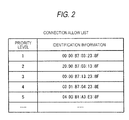
- Fig. 2 is a view showing an example of the connection list.
- connection list CPR assisting devices which are determined to be connectable with the defibrillator 10 are listed.
- the connection list manages CPR assisting devices in accordance with identification information for identifying the devices.
- CPR assisting devices may be managed in accordance with the device address of Bluetooth (registered trademark).
- the connection list may store connectable CPR assisting devices while correlating them with priority levels.
- connection destination determining unit 15 When the connection destination determining unit 15 receives a connection request from a certain CPR assisting device, the unit determines whether the device can be set as a connection destination CPR assisting device or not, depending on whether the identification information of the CPR assisting device is included in the connection list or not. In the case where the connection destination determining unit 15 receives connection requests from a plurality of CPR assisting devices which are included in the connection list, the unit determines the connection destination CPR assisting device based on the priority level. In the example of Fig.
- the identification information is not limited to the device address, but may be of arbitrary format and content.
- connection destination determining unit 15 is configured so as to allow the defibrillator 10 to be connected only to the preset CPR assisting device. Therefore, the defibrillator 10 is in a state where it can communicate only with the expected connection destination. As a result, it is possible to avoid a situation where the defibrillator 10 is connected to an unintended CPR assisting device, and the user is confused.
- connection destination determining unit 15 determines the connection destination based on the priority levels. Therefore, the connection destination determining unit 15 can communicate only with the most appropriate CPR assisting device.
- the connection destination determining unit 15 determines a CPR assisting device which transmits a connection request at the earliest timing after a predetermined timing (for example, the timing when the defibrillator is powered ON), as the connection destination.
- a predetermined timing for example, the timing when the defibrillator is powered ON
- the connection destination determining unit 15 determines the CPR assisting device 20 as the connection destination CPR assisting device.
- the connection request is, for example, a signal related to a search operation in the case where Bluetooth (registered trademark) is used.
- Each CPR assisting device which wishes to communicate with the defibrillator 10 transmits the attribute information of the own device to the defibrillator 10.
- Fig. 3 shows an example of the attribute information which is transmitted by each CPR assisting device.
- the attribute information contains "Medical person?", “Years of medical experience”, “Has taken CPR training course?”, "Number of CPR training courses", and the like. The user of each CPR assisting device previously registers the attribute information.
- the connection destination determining unit 15 evaluates the attribute information transmitted from each CPR assisting device. Based on the plural sets of transmitted attribute information, for example, the connection destination determining unit 15 determines a CPR assisting device corresponding to the user who is a medical person, and who has the longest medical experience, as the connection destination CPR assisting device.
- the connection destination determining unit 15 may evaluate attribute information by using an arbitrary algorithm. For example, the connection destination CPR assisting device may be determined with emphasis on the number of CPR training courses.
- connection destination determining unit 15 evaluates the attribute information transmitted from the CPR assisting devices, and determines the most appropriate connection destination CPR assisting device.
- the connection destination determining unit 15 determines the connection destination CPR assisting device based on information (particularly, information of the rescuer) related to each CPR assisting device, and therefore can communicate with the CPR assisting device which is used by the optimum rescuer.
- connection destination CPR assisting device is determined with reference to the history of CPR assisting devices with which the defibrillator 10 has communicated. An example will be described in detail.
- the storing unit 12 stores the identification information of CPR assisting devices with which the defibrillator 10 has communicated, and the dates and times of communications while correlating them with each other.
- Fig. 4 shows an example of a communication history list stored in the storing unit 12.
- the identification information for identifying a CPR assisting device may be the device address of Bluetooth (registered trademark).
- the connection destination determining unit 15 determines the connection destination CPR assisting device by using the communication history list. For example, the connection destination determining unit 15 may determine, among a plurality of CPR assisting devices which have transmitted a connection request, a CPR assisting device with which the defibrillator 10 has recently communicated, as the connection destination CPR assisting device. Alternatively, the connection destination determining unit 15 may determine, among a plurality of CPR assisting devices which have transmitted a connection request, a CPR assisting device with which the defibrillator 10 has communicated the largest number of times, as the connection destination CPR assisting device.
- connection destination determining unit 15 determines the connection destination CPR assisting device with reference to the communication history list
- the defibrillator 10 can be connected to a CPR assisting device with which the defibrillator 10 has communicated. In a manner similar to that in the previous used state, therefore, the user can cooperatively use the defibrillator 10 and the CPR assisting device.
- connection destination CPR assisting device is determined by using information of the connection destination which is explicitly designated by the user.
- the user of the defibrillator 10 designates a CPR assisting device which is to be communicated with the defibrillator 10, through the inputting unit 11.
- the user of the defibrillator 10 inputs the identification information of the CPR assisting device which is to be communicated with the defibrillator 10.
- the defibrillator 10 may display a list of CPR assisting devices which have transmitted a connection request, on the display device or the like disposed on the surface of the case of the defibrillator 10, and the user may designate one of them.
- the connection destination determining unit 15 determines the CPR assisting device which is designated by the user, as the connection destination CPR assisting device.
- the user can explicitly designate the connection destination CPR assisting device, and therefore the user can perform a rescue procedure on the rescuee by using a pair of the defibrillator 10 and a desired CPR assisting device.
- connection destination determining unit 15 may use another rule as far as a CPR assisting device to function as the connection destination is determined in accordance with the predetermined rule.
- the timing of the process of determining the connection destination CPR assisting device by the connection destination determining unit 15 may be considered as follows. In the case where the connection destination CPR assisting device is once determined, for example, the connection destination determining unit 15 does not change the connection destination CPR assisting device (dose not again perform the determining process) unless a forced reset process is performed (for example, the defibrillator 10 is powered OFF).
- the process of determining the connection destination CPR assisting device is performed only one time after a predetermined time period has elapsed from when the defibrillator 10 began to operate. Therefore, CPR can be performed without changing the communication destination after the connection destination CPR assisting device is once determined.
- the connection destination determining unit 15 may perform the process of determining the connection destination CPR assisting device. Alternatively, the connection destination determining unit 15 may perform the process of determining the connection destination CPR assisting device at regular time intervals. Although there is a possibility that the connection destination is changed during performance of CPR, therefore, it is possible to realize communication with the optimum connection destination. In this case, only when the optimum CPR assisting device newly appears, the connection switching occurs. Therefore, this does not cause unwanted connection switching. In the case where a connection switching occurs, the connection destination determining unit 15 preferably informs the user of the change of the connection destination, through the speaker (not shown) of the defibrillator 10.
- the user may explicitly designate the timing when the connection destination determining unit 15 determines the connection destination CPR assisting device, through the inputting unit 11 of the defibrillator 10.
- the defibrillator 10 (medical apparatus) has the configuration where it communicates only with the connection destination CPR assisting device which is determined in accordance with the predetermined rule. Therefore, the medical apparatus does not communicate with apparatuses or devices other than the connection destination CPR assisting device. Unintended connection switching can be prevented from occurring, and hence the rescuer can perform CPR without being confused.
- the configuration (internal configuration of the defibrillator 10 shown in Fig. 1 ) and algorithm that have been described above may be applied to the reverse case (i.e., the case where the CPR assisting device 20 selects the connection destination from a plurality of defibrillators 10). That is, "configuration which determines an opposing medical apparatus (connection destination opposing medical apparatus) that is to be a connection destination, from a plurality of opposing medical apparatuses based on a predetermined rule (for example, Figs. 2 to 4 above), and which communicates only with the determined connection destination (connection destination opposing medical apparatus)" can be applied to an arbitrary medical apparatus.
- a predetermined rule for example, Figs. 2 to 4 above
Landscapes
- Health & Medical Sciences (AREA)
- Engineering & Computer Science (AREA)
- Biomedical Technology (AREA)
- Signal Processing (AREA)
- Computer Networks & Wireless Communication (AREA)
- Epidemiology (AREA)
- General Health & Medical Sciences (AREA)
- Public Health (AREA)
- Cardiology (AREA)
- Heart & Thoracic Surgery (AREA)
- Medical Informatics (AREA)
- Primary Health Care (AREA)
- General Business, Economics & Management (AREA)
- Business, Economics & Management (AREA)
- Emergency Medicine (AREA)
- Pulmonology (AREA)
- Pain & Pain Management (AREA)
- Physical Education & Sports Medicine (AREA)
- Rehabilitation Therapy (AREA)
- Life Sciences & Earth Sciences (AREA)
- Animal Behavior & Ethology (AREA)
- Veterinary Medicine (AREA)
- Electrotherapy Devices (AREA)
Abstract
Description
- The presently disclosed subject matter relates to a medical apparatus, a medical apparatus control method, and a medical apparatus cooperation system.
- CPR (Cardio Pulmonary Resuscitation) is a technique which is essential in the field of the emergency medical service, and the life and death of the rescuee (patient) depend on the adequateness of the technique. When CPR is to be performed, the rescuer compresses the sternum which is in the upper side of the chest. Since CPR relates to the life and death of the rescuee, a device which is to be placed between the chest of the rescuee and the hands of the rescuer to assist the chest compression (hereinafter, such a device is referred to as a CPR assisting device) has been developed. In a CPR assisting device, it is detected whether an adequate force is applied at proper time intervals to the sternum or not, and, in accordance with the detection result, appropriate notification (such as "Insufficient compression depth" or "Compression timing is too late") is given to the rescuer.
- Such a CPR assisting device has many occasions to be used concurrently with another medical apparatus such as an AED (Automated External Defibrillator) or a cardioverter defibrillator. When a CPR assisting device operates coordinately with a medical apparatus, it is possible to realize an adequate emergency procedure.
- For example,
JP-T-2013-542814 JP-T-2010-528722 - In a medical site or a scene of a medical training, it is supposed that many medical apparatuses are concurrently used. When a large-scale disaster (such as a high-rise building fire) occurs, for example, a case where many CPR assisting devices and AEDs (or cardioverter defibrillators) are simultaneously used may be caused. In a training session on CPR or the like, moreover, many CPR assisting devices and AEDs (or cardioverter defibrillators) are simultaneously used.
- In the case where, in such a situation, medical apparatuses (for example, a CPR assisting device and an AED) communicate with each other, there is a danger that unintended connection switching may occur. Therefore, there is a possibility that the rescuer who uses the medical apparatuses may be confused.
- The presently disclosed subject matter may provide a medical apparatus, medical apparatus control method, and medical apparatus cooperation system in which, in the case where medical apparatuses communicate with each other, unintended connection switching can be prevented from occurring.
- The medical apparatus which is communicable with a plurality of CPR assisting devices, the medical apparatus may comprise: a connection destination determining unit which is configured to determine a connection destination CPR assisting device that is a connection destination, from the plurality of CPR assisting devices based on a predetermined rule; and a communicating unit which is configured to communicate only with the connection destination CPR assisting device.
-
-
Fig. 1 is a block diagram of a medicalapparatus cooperation system 1 ofEmbodiment 1. -
Fig. 2 is a view showing an example of a connection list which is used by a connectiondestination determining unit 15 inEmbodiment 1. -
Fig. 3 is a view showing an example of attribute information which is used by the connectiondestination determining unit 15 inEmbodiment 1. -
Fig. 4 is a view showing an example of a communication history list which is used by the connectiondestination determining unit 15 inEmbodiment 1. - Hereinafter, an embodiment of the presently disclosed subject matter will be described with reference to the drawings.
Fig. 1 is a block diagram showing the configuration of a medicalapparatus cooperation system 1 of the embodiment. The medicalapparatus cooperation system 1 has adefibrillator 10, aCPR assisting device 20, and aCPR assisting device 30. The configuration of the medicalapparatus cooperation system 1 shown inFig. 1 is a mere example, and thedefibrillator 10 is an example of a medical apparatus, and may be an AED (Automated External Defibrillator) or the like. AlthoughFig. 1 shows only the two CPR assisting devices (20, 30), the invention is not limited to this, and three or more CPR assisting devices may exist. In the following description, in the case where theCPR assisting device 20 and theCPR assisting device 30 are not distinct from each other, the devices are not designated by reference numerals, and are referred as "CPR assisting devices." - Firstly, the configuration of the
CPR assisting device 20 will be described. TheCPR assisting device 20 is a device which is to be placed between the chest (preferably, just above the sternum) of the rescuee and the hands of the rescuer to assist the chest compression. The rescuee is a concept containing an injured or sick human (or alternatively referred to as a patient) and also a mannequin and the like. Namely, theCPR assisting device 20 may be used not only in a situation where the chest compression is actually performed, but also in the training of CPR. - The
CPR assisting device 20 includes a controllingunit 21, anoutputting unit 22, a communicatingunit 23, and astoring unit 24. TheCPR assisting device 20 has inside a sensor which is not shown. The sensor detects displacements which are caused when the compression is applied and released, and supplies a signal indicating such a displacement to the controllingunit 21. - The controlling
unit 21 performs various processes for controlling theCPR assisting device 20. The controllingunit 21 is realized by a CPU (Central Processing Unit) and various circuits. - Based on the displacement detected by the above-described sensor, the controlling
unit 21 detects the compression depth and rate of the chest compression which is applied to the rescuee. The controllingunit 21 reads out ideal compression depth and rate which are stored in thestoring unit 24. The controllingunit 21 compares the read-out compression depth with the depth of the currently performed compression, and determines whether the current compression depth is adequate or not. Similarly, the controllingunit 21 compares the read-out compression rate with the rate of the currently performed compression, and determines whether the current compression rate is adequate or not. - If the controlling
unit 21 determines that the compression depth or rate of the currently performed compression is not adequate, the controllingunit 21 causes theoutputting unit 22 to perform an output in which the abnormal state is informed to the rescuer (user of the CPR assisting device 20). Moreover, the controllingunit 21 transmits the detected compression depth and rate, and various other statuses and the like related to the chest compression to thedefibrillator 10 through the communicatingunit 23. Only when thedefibrillator 10 determines theCPR assisting device 20 as the connection destination as described later, various information can be transmitted to thedefibrillator 10. - For example, the techniques of the detection and determination of the compression depth and rate of the chest compression which are performed by the controlling
unit 22 may be equivalent to those described inWO2012/073900 . - If it is determined that the chest compression is not adequately performed, the
outputting unit 22 notifies the user of this situation. For example, theoutputting unit 22 may be configured by a speaker, a display device disposed on the surface of the case of theCPR assisting device 20, or the like. In the case where the compression depth is not sufficient, for example, theoutputting unit 22 outputs voice guidance instructions of "Press more strongly". In accordance with the determination result, similarly, the outputtingunit 22 outputs voice guidance instructions such as "Press more deeply", "Press more slowly", or "Press more quickly". At the same time, theoutputting unit 22 may display the status showing the chest compression state on the display device disposed on the surface of the case. - The communicating
unit 23 is a communication interface through which various information such as the compression depth and rate of the currently performed compression is transmitted to thedefibrillator 10. Before transmitting and receiving data to and from thedefibrillator 10, the communicatingunit 23 transmits a connection request to thedefibrillator 10. The communicatingunit 23 receives various information from thedefibrillator 10. The communicatingunit 23 is an interface which can perform short-range communication such as Bluetooth (registered trademark). The communicatingunit 23 transmits the connection request to thedefibrillator 10, and, only when thedefibrillator 10 determines theCPR assisting device 20 as the connection destination, is allowed to perform data transmission and reception. - The storing
unit 24 stores various information (programs which are used by the controllingunit 21, information of the above-described ideal compression depth and rate, and the like). For example, thestoring unit 24 is realized by a ROM (Read Only Memory), an HDD (Hard Disk Drive), a USB (Universal Serial Bus) memory, or the like. - The
CPR assisting device 30 includes a controllingunit 31, anoutputting unit 32, a communicatingunit 33, and astoring unit 34. TheCPR assisting device 30 has a configuration and function which are approximately identical to those of theCPR assisting device 20. Therefore, the controllingunit 31, theoutputting unit 32, the communicatingunit 33, and thestoring unit 34 correspond to the controllingunit 21, theoutputting unit 22, the communicatingunit 23, and thestoring unit 24, respectively. - Then, the configuration of the
defibrillator 10 will be described. Thedefibrillator 10 includes aninputting unit 11, astoring unit 12, a communicatingunit 13, and a controllingunit 14. The controllingunit 14 includes a connectiondestination determining unit 15. Thedefibrillator 10 has defibrillation pads and electrodes which are not shown, and applies an electrical shock to the rescuee through the defibrillation pads and the electrodes. - The inputting
unit 11 receives various inputs for enabling the user to operate thedefibrillator 10. The inputtingunit 11 is configured by buttons, knobs, operable display screen (so-called touch display), and the like which are disposed on the surface of the case. For example, the inputtingunit 11 receives designation of the charging amount of energy for the defibrillation process which is to be performed on the rescuee. - The storing
unit 12 stores various information used for operating thedefibrillator 10. The storingunit 12 is realized by a ROM (Read Only Memory), an HDD (Hard Disk Drive), a USB (Universal Serial Bus) memory, or the like. - The controlling
unit 14 performs various processes for controlling thedefibrillator 10. The controllingunit 14 is realized by a CPU (Central Processing Unit) and various circuits. The controllingunit 14 controls charge/discharge of energy for applying an electrical shock to the rescuee, the sound output, etc. - The connection
destination determining unit 15 determines the connection destination CPR assisting device which functions as the connection destination, in accordance with a predetermined rule from a plurality of CPR assisting devices (in the example ofFig. 1 , theCPR assisting devices 20 and 30) with which the connectiondestination determining unit 15 can communicate (in other words, which transmit a connection request to the defibrillator 10). Preferably, the connection destination CPR assisting device is a single CPR assisting device. That is, thedefibrillator 10 preferably communicates only with a single CPR assisting device. The process of selecting the connection destination by the connectiondestination determining unit 15 will be described later with reference toFigs. 2 to 4 . The connectiondestination determining unit 15 notifies the communicatingunit 13 of identification information (for example, the device address of Bluetooth (registered trademark)) for the determined connection destination CPR assisting device. - As described later, the connection
destination determining unit 15 may use one of a plurality of rules for determining the connection destination. Therefore, the user of thedefibrillator 10 may designate the rule to be used, through the inputtingunit 11. - The communicating
unit 13 communicates (performs data transmission and reception) only with the connection destination which is determined by the connectiondestination determining unit 15. In the example ofFig. 1 , the connection destination is theCPR assisting device 20. Therefore, the communicatingunit 13 performs data transmission and reception only with respect to theCPR assisting device 20, and does not perform data transmission and reception with respect to theCPR assisting device 30. - Then, methods by which the connection
destination determining unit 15 determines the connection destination will be described. - Hereinafter, a first determination rule will be described. The storing
unit 12 stores a connection list in which connectable CPR assisting devices are previously defined. The user of thedefibrillator 10 sets or changes the connection list through the inputtingunit 11.Fig. 2 is a view showing an example of the connection list. - In the connection list, CPR assisting devices which are determined to be connectable with the
defibrillator 10 are listed. The connection list manages CPR assisting devices in accordance with identification information for identifying the devices. In the connection list, for example, CPR assisting devices may be managed in accordance with the device address of Bluetooth (registered trademark). As shown inFig. 2 , the connection list may store connectable CPR assisting devices while correlating them with priority levels. - When the connection
destination determining unit 15 receives a connection request from a certain CPR assisting device, the unit determines whether the device can be set as a connection destination CPR assisting device or not, depending on whether the identification information of the CPR assisting device is included in the connection list or not. In the case where the connectiondestination determining unit 15 receives connection requests from a plurality of CPR assisting devices which are included in the connection list, the unit determines the connection destination CPR assisting device based on the priority level. In the example ofFig. 2 , it is assumed that the connectiondestination determining unit 15 simultaneously receives connection requests from a CPR assisting device having identification information of "00:D0:B7:03:23:8F" (priority level = 1), and a CPR assisting device having identification information of "C0:D1:B7:04:23:8E" (priority level = 4). The connectiondestination determining unit 15 determines the device of "00:D0:B7:03:23:8F" (priority level = 1) as the connection destination CPR assisting device. The identification information is not limited to the device address, but may be of arbitrary format and content. - As described above, the connection
destination determining unit 15 is configured so as to allow thedefibrillator 10 to be connected only to the preset CPR assisting device. Therefore, thedefibrillator 10 is in a state where it can communicate only with the expected connection destination. As a result, it is possible to avoid a situation where thedefibrillator 10 is connected to an unintended CPR assisting device, and the user is confused. - In the case where a plurality of CPR assisting devices are set as connection candidates, the connection
destination determining unit 15 determines the connection destination based on the priority levels. Therefore, the connectiondestination determining unit 15 can communicate only with the most appropriate CPR assisting device. - Hereinafter, a second determination rule will be described. The connection
destination determining unit 15 determines a CPR assisting device which transmits a connection request at the earliest timing after a predetermined timing (for example, the timing when the defibrillator is powered ON), as the connection destination. In the example ofFig. 1 , it is assumed that theCPR assisting device 20 transmits a connection request in advance of theCPR assisting device 30. Therefore, the connectiondestination determining unit 15 determines theCPR assisting device 20 as the connection destination CPR assisting device. The connection request is, for example, a signal related to a search operation in the case where Bluetooth (registered trademark) is used. - When this rule (a CPR assisting device which transmits a connection request at the earliest timing is set as the connection destination) is used, CPR can be early applied to the rescuee.
- Hereinafter, a third determination rule will be described. In the rule, attributes of a plurality of CPR assisting devices which request the connection are analyzed, and the most appropriate CPR assisting device is determined as the connection destination. An example will be described in detail.
- Each CPR assisting device which wishes to communicate with the
defibrillator 10 transmits the attribute information of the own device to thedefibrillator 10.Fig. 3 shows an example of the attribute information which is transmitted by each CPR assisting device. For example, the attribute information contains "Medical person?", "Years of medical experience", "Has taken CPR training course?", "Number of CPR training courses", and the like. The user of each CPR assisting device previously registers the attribute information. - The connection
destination determining unit 15 evaluates the attribute information transmitted from each CPR assisting device. Based on the plural sets of transmitted attribute information, for example, the connectiondestination determining unit 15 determines a CPR assisting device corresponding to the user who is a medical person, and who has the longest medical experience, as the connection destination CPR assisting device. The connectiondestination determining unit 15 may evaluate attribute information by using an arbitrary algorithm. For example, the connection destination CPR assisting device may be determined with emphasis on the number of CPR training courses. - As described above, the connection
destination determining unit 15 evaluates the attribute information transmitted from the CPR assisting devices, and determines the most appropriate connection destination CPR assisting device. The connectiondestination determining unit 15 determines the connection destination CPR assisting device based on information (particularly, information of the rescuer) related to each CPR assisting device, and therefore can communicate with the CPR assisting device which is used by the optimum rescuer. - Hereinafter, a fourth determination rule will be described. In the rule, the connection destination CPR assisting device is determined with reference to the history of CPR assisting devices with which the
defibrillator 10 has communicated. An example will be described in detail. - The storing
unit 12 stores the identification information of CPR assisting devices with which thedefibrillator 10 has communicated, and the dates and times of communications while correlating them with each other.Fig. 4 shows an example of a communication history list stored in the storingunit 12. For example, the identification information for identifying a CPR assisting device may be the device address of Bluetooth (registered trademark). - The connection
destination determining unit 15 determines the connection destination CPR assisting device by using the communication history list. For example, the connectiondestination determining unit 15 may determine, among a plurality of CPR assisting devices which have transmitted a connection request, a CPR assisting device with which thedefibrillator 10 has recently communicated, as the connection destination CPR assisting device. Alternatively, the connectiondestination determining unit 15 may determine, among a plurality of CPR assisting devices which have transmitted a connection request, a CPR assisting device with which thedefibrillator 10 has communicated the largest number of times, as the connection destination CPR assisting device. - Since the connection
destination determining unit 15 determines the connection destination CPR assisting device with reference to the communication history list, thedefibrillator 10 can be connected to a CPR assisting device with which thedefibrillator 10 has communicated. In a manner similar to that in the previous used state, therefore, the user can cooperatively use thedefibrillator 10 and the CPR assisting device. - Hereinafter, a fifth determination rule will be described. In the rule, the connection destination CPR assisting device is determined by using information of the connection destination which is explicitly designated by the user.
- The user of the
defibrillator 10 designates a CPR assisting device which is to be communicated with thedefibrillator 10, through the inputtingunit 11. For example, the user of thedefibrillator 10 inputs the identification information of the CPR assisting device which is to be communicated with thedefibrillator 10. Alternatively, thedefibrillator 10 may display a list of CPR assisting devices which have transmitted a connection request, on the display device or the like disposed on the surface of the case of thedefibrillator 10, and the user may designate one of them. The connectiondestination determining unit 15 determines the CPR assisting device which is designated by the user, as the connection destination CPR assisting device. - As described above, the user can explicitly designate the connection destination CPR assisting device, and therefore the user can perform a rescue procedure on the rescuee by using a pair of the
defibrillator 10 and a desired CPR assisting device. - Although, in the above, the five rules for determining the connection destination by the connection
destination determining unit 15 have been described, the invention is not limited to the above described determination rules. The connectiondestination determining unit 15 may use another rule as far as a CPR assisting device to function as the connection destination is determined in accordance with the predetermined rule. - The timing of the process of determining the connection destination CPR assisting device by the connection
destination determining unit 15 may be considered as follows. In the case where the connection destination CPR assisting device is once determined, for example, the connectiondestination determining unit 15 does not change the connection destination CPR assisting device (dose not again perform the determining process) unless a forced reset process is performed (for example, thedefibrillator 10 is powered OFF). Here, the process of determining the connection destination CPR assisting device is performed only one time after a predetermined time period has elapsed from when thedefibrillator 10 began to operate. Therefore, CPR can be performed without changing the communication destination after the connection destination CPR assisting device is once determined. - Each time when a new CPR assisting device transmits a connection request, the connection
destination determining unit 15 may perform the process of determining the connection destination CPR assisting device. Alternatively, the connectiondestination determining unit 15 may perform the process of determining the connection destination CPR assisting device at regular time intervals. Although there is a possibility that the connection destination is changed during performance of CPR, therefore, it is possible to realize communication with the optimum connection destination. In this case, only when the optimum CPR assisting device newly appears, the connection switching occurs. Therefore, this does not cause unwanted connection switching. In the case where a connection switching occurs, the connectiondestination determining unit 15 preferably informs the user of the change of the connection destination, through the speaker (not shown) of thedefibrillator 10. - Preferably, the user may explicitly designate the timing when the connection
destination determining unit 15 determines the connection destination CPR assisting device, through the inputtingunit 11 of thedefibrillator 10. - Then, effects of the medical apparatus cooperation system of the embodiment will be described. The defibrillator 10 (medical apparatus) has the configuration where it communicates only with the connection destination CPR assisting device which is determined in accordance with the predetermined rule. Therefore, the medical apparatus does not communicate with apparatuses or devices other than the connection destination CPR assisting device. Unintended connection switching can be prevented from occurring, and hence the rescuer can perform CPR without being confused.
- Although the invention conducted by the inventor has been specifically described based on the embodiment, the invention is not limited to the above-described embodiment, and it is a matter of course that various changes can be made without departing from the spirit of the invention.
- Although, in the above, the operation in which the
defibrillator 10 selects the connection destination from the plurality of CPR assisting devices has been described, the configuration (internal configuration of thedefibrillator 10 shown inFig. 1 ) and algorithm that have been described above may be applied to the reverse case (i.e., the case where theCPR assisting device 20 selects the connection destination from a plurality of defibrillators 10). That is, "configuration which determines an opposing medical apparatus (connection destination opposing medical apparatus) that is to be a connection destination, from a plurality of opposing medical apparatuses based on a predetermined rule (for example,Figs. 2 to 4 above), and which communicates only with the determined connection destination (connection destination opposing medical apparatus)" can be applied to an arbitrary medical apparatus. - According to the presently disclosed subject matter, it is possible to provide a medical apparatus, medical apparatus control method, and medical apparatus cooperation system in which, in the case where medical apparatuses communicate with each other, unintended connection switching can be prevented from occurring.
Claims (12)
- A medical apparatus which is communicable with a plurality of CPR assisting devices, the medical apparatus comprising:a connection destination determining unit which is configured to determine a connection destination CPR assisting device that is a connection destination, from the plurality of CPR assisting devices based on a predetermined rule; anda communicating unit which is configured to communicate only with the connection destination CPR assisting device.
- The medical apparatus according to claim 1, wherein
the connection destination determining unit determines the connection destination CPR assisting device from the plurality of CPR assisting devices based on a connection list which defines a connectable device. - The medical apparatus according to claim 2, wherein
the connection list defines devices and priority levels while correlating the devices with the priority levels. - The medical apparatus according to claim 1, wherein
the connection destination determining unit determines, among the plurality of CPR assisting devices, a CPR assisting device which transmits a connection request at an earliest timing, as the connection destination CPR assisting device. - The medical apparatus according to claim 1, wherein
the connection destination determining unit determines the connection destination CPR assisting device from the plurality of CPR assisting devices based on attribute information which is received from each of the plurality of CPR assisting devices. - The medical apparatus according to claim 1, wherein
the connection destination determining unit determines the connection destination CPR assisting device from the plurality of CPR assisting devices based on a history list storing CPR assisting devices with which the medical apparatus has communicated. - The medical apparatus according to claim 1, further comprising:an inputting unit which is configured to receive an input from a user, whereinthe connection destination determining unit determines the connection destination CPR assisting device from the plurality of CPR assisting devices in accordance with an input from the inputting unit.
- The medical apparatus according to any one of claims 1 to 7, wherein
the connection destination CPR assisting device is a single CPR assisting device. - A method of controlling a medical apparatus which is communicable with a plurality of CPR assisting devices, the method comprising:determining a connection destination CPR assisting device that is a connection destination, from the plurality of CPR assisting devices based on a predetermined rule; andcommunicating only with the connection destination CPR assisting device.
- A medical apparatus cooperation system including a plurality of CPR assisting devices and a medical apparatus which is communicable with the plurality of CPR assisting devices, wherein
each of the plurality of CPR assisting devices transmits a connection request to the medical apparatus, and
the medical apparatus includes:a connection destination determining unit which is configured to determine a connection destination CPR assisting device that is a connection destination, from the plurality of CPR assisting devices based on a predetermined rule; anda communicating unit which is configured to communicate only with the connection destination CPR assisting device. - A CPR assisting device which is configured to transmit a connection request to a medical apparatus that is configured to determine a connection destination from a plurality of devices and that is configured to communicate with the connection destination, and which, only when the CPR assisting device is determined as the communication destination by the medical apparatus, is configured to perform a communication process with the medical apparatus.
- A medical apparatus which is communicable with a plurality of opposing medical apparatuses, the medical apparatus comprising:a connection destination determining unit which is configured to determine a connection destination opposing medical apparatus that is a connection destination, from the plurality of opposing medical apparatuses based on a predetermined rule; anda communicating unit which communicates only with the connection destination opposing medical apparatus.
Applications Claiming Priority (1)
| Application Number | Priority Date | Filing Date | Title |
|---|---|---|---|
| JP2014180023A JP6370175B2 (en) | 2014-09-04 | 2014-09-04 | Medical device, medical device control method, and medical device cooperation system |
Publications (1)
| Publication Number | Publication Date |
|---|---|
| EP2993601A1 true EP2993601A1 (en) | 2016-03-09 |
Family
ID=53835982
Family Applications (1)
| Application Number | Title | Priority Date | Filing Date |
|---|---|---|---|
| EP15181018.1A Withdrawn EP2993601A1 (en) | 2014-09-04 | 2015-08-14 | Medical apparatus, medical apparatus control method, and medical apparatus cooperation system |
Country Status (4)
| Country | Link |
|---|---|
| US (1) | US20160073444A1 (en) |
| EP (1) | EP2993601A1 (en) |
| JP (1) | JP6370175B2 (en) |
| CN (1) | CN105405084A (en) |
Citations (8)
| Publication number | Priority date | Publication date | Assignee | Title |
|---|---|---|---|---|
| US6482154B1 (en) * | 2000-08-02 | 2002-11-19 | Medtronic, Inc | Long range implantable medical device telemetry system with positive patient identification |
| US20050251228A1 (en) * | 2003-06-27 | 2005-11-10 | Hamel Andrew J | System for remotely controlling two or more medical devices |
| US20090080348A1 (en) * | 2007-09-26 | 2009-03-26 | Hamel Andrew J | System for preventing unintended activation of a medical device by a portable remote control console |
| JP2010528722A (en) | 2007-06-01 | 2010-08-26 | カーディアック サイエンス インコーポレイテッド | System, method and apparatus for assisting rescuer to resuscitation |
| US20120003933A1 (en) * | 2010-06-30 | 2012-01-05 | Welch Allyn, Inc. | Medical devices with proximity detection |
| WO2012073900A1 (en) | 2010-11-29 | 2012-06-07 | 株式会社日立製作所 | Compression depth calculation system and compression depth calculation method |
| WO2013103342A1 (en) * | 2012-01-04 | 2013-07-11 | Draeger Medical Systems, Inc. | Patient identification and monitoring system |
| JP2013542814A (en) | 2010-11-12 | 2013-11-28 | フィジオ−コントロール インコーポレイテッド | Method for manually initiating wireless transmission of resuscitation event data to a medical device |
Family Cites Families (4)
| Publication number | Priority date | Publication date | Assignee | Title |
|---|---|---|---|---|
| US9030418B2 (en) * | 2008-06-24 | 2015-05-12 | Lg Electronics Inc. | Mobile terminal capable of sensing proximity touch |
| EP2499628A4 (en) * | 2009-11-13 | 2014-11-05 | Zoll Medical Corp | Cpr competition system |
| JP5135417B2 (en) * | 2010-11-19 | 2013-02-06 | 株式会社東芝 | Wireless communication device |
| TWI521905B (en) * | 2013-02-01 | 2016-02-11 | 寶貝安科技股份有限公司 | Exchange method of pairing information for bluetooth devices and pairing switching method of bluetooth devices applying the same |
-
2014
- 2014-09-04 JP JP2014180023A patent/JP6370175B2/en active Active
-
2015
- 2015-08-14 EP EP15181018.1A patent/EP2993601A1/en not_active Withdrawn
- 2015-08-17 US US14/827,721 patent/US20160073444A1/en not_active Abandoned
- 2015-08-27 CN CN201510535799.9A patent/CN105405084A/en active Pending
Patent Citations (8)
| Publication number | Priority date | Publication date | Assignee | Title |
|---|---|---|---|---|
| US6482154B1 (en) * | 2000-08-02 | 2002-11-19 | Medtronic, Inc | Long range implantable medical device telemetry system with positive patient identification |
| US20050251228A1 (en) * | 2003-06-27 | 2005-11-10 | Hamel Andrew J | System for remotely controlling two or more medical devices |
| JP2010528722A (en) | 2007-06-01 | 2010-08-26 | カーディアック サイエンス インコーポレイテッド | System, method and apparatus for assisting rescuer to resuscitation |
| US20090080348A1 (en) * | 2007-09-26 | 2009-03-26 | Hamel Andrew J | System for preventing unintended activation of a medical device by a portable remote control console |
| US20120003933A1 (en) * | 2010-06-30 | 2012-01-05 | Welch Allyn, Inc. | Medical devices with proximity detection |
| JP2013542814A (en) | 2010-11-12 | 2013-11-28 | フィジオ−コントロール インコーポレイテッド | Method for manually initiating wireless transmission of resuscitation event data to a medical device |
| WO2012073900A1 (en) | 2010-11-29 | 2012-06-07 | 株式会社日立製作所 | Compression depth calculation system and compression depth calculation method |
| WO2013103342A1 (en) * | 2012-01-04 | 2013-07-11 | Draeger Medical Systems, Inc. | Patient identification and monitoring system |
Also Published As
| Publication number | Publication date |
|---|---|
| CN105405084A (en) | 2016-03-16 |
| US20160073444A1 (en) | 2016-03-10 |
| JP6370175B2 (en) | 2018-08-08 |
| JP2016052445A (en) | 2016-04-14 |
Similar Documents
| Publication | Publication Date | Title |
|---|---|---|
| JP7350375B2 (en) | Automated external defibrillator and how to use it | |
| US11877979B2 (en) | Modular components for medical devices | |
| JP2015516280A5 (en) | ||
| US9474446B2 (en) | Transmitting treatment information | |
| US20140335494A1 (en) | Systems and methods for facilitating coaching and/or analysis of pressure-based treatment | |
| JP2020503920A5 (en) | ||
| US20140031883A1 (en) | Automated external defibrillator configuration | |
| JP2007522859A (en) | Method and apparatus for transmitting audible information prompts from an external defibrillator | |
| EP3730043A1 (en) | Transmitting treatment information | |
| EP1157717B1 (en) | System for measuring and analysing Cardio-Pulmonary Resuscitation (CPR) parameters for use with and by an external defibrillator (AED) | |
| CN103458961A (en) | Universal AED training adapter | |
| JP7112830B2 (en) | alarm system | |
| WO2017159635A1 (en) | Detection device and alarm system having the detection device | |
| JP2019534755A5 (en) | ||
| CN101873844A (en) | Systems, methods, and devices for assisting a rescuer in resuscitation | |
| EP1938779A1 (en) | Signal processing device | |
| KR20220039681A (en) | Method and user terminal for supporting CPR(cardiopulmonary resuscitation) performance | |
| JP6342267B2 (en) | Medical device communication system, medical device | |
| JP2008508923A (en) | External defibrillator with multilingual prompt | |
| US20160073444A1 (en) | Medical apparatus, medical apparatus control method, and medical apparatus cooperation system | |
| JP2007505670A (en) | Method and apparatus for printing incident review data from an external defibrillator without the need for a computer | |
| KR101622762B1 (en) | Automated extermal defibrillator system | |
| EP1932502A1 (en) | System for providing feedback on chest compression in CPR | |
| CN114915661A (en) | Method and device for rescuing user | |
| CN205123941U (en) | DR speech control system |
Legal Events
| Date | Code | Title | Description |
|---|---|---|---|
| PUAI | Public reference made under article 153(3) epc to a published international application that has entered the european phase |
Free format text: ORIGINAL CODE: 0009012 |
|
| AK | Designated contracting states |
Kind code of ref document: A1 Designated state(s): AL AT BE BG CH CY CZ DE DK EE ES FI FR GB GR HR HU IE IS IT LI LT LU LV MC MK MT NL NO PL PT RO RS SE SI SK SM TR |
|
| AX | Request for extension of the european patent |
Extension state: BA ME |
|
| 17P | Request for examination filed |
Effective date: 20160908 |
|
| RBV | Designated contracting states (corrected) |
Designated state(s): AL AT BE BG CH CY CZ DE DK EE ES FI FR GB GR HR HU IE IS IT LI LT LU LV MC MK MT NL NO PL PT RO RS SE SI SK SM TR |
|
| STAA | Information on the status of an ep patent application or granted ep patent |
Free format text: STATUS: THE APPLICATION HAS BEEN WITHDRAWN |
|
| 18W | Application withdrawn |
Effective date: 20180924 |