EP2992871A1 - Improved compositions for endodontic procedures - Google Patents
Improved compositions for endodontic procedures Download PDFInfo
- Publication number
- EP2992871A1 EP2992871A1 EP15186933.6A EP15186933A EP2992871A1 EP 2992871 A1 EP2992871 A1 EP 2992871A1 EP 15186933 A EP15186933 A EP 15186933A EP 2992871 A1 EP2992871 A1 EP 2992871A1
- Authority
- EP
- European Patent Office
- Prior art keywords
- group
- multiple groups
- different
- integer
- independently
- Prior art date
- Legal status (The legal status is an assumption and is not a legal conclusion. Google has not performed a legal analysis and makes no representation as to the accuracy of the status listed.)
- Granted
Links
- 0 CN(C*CC*)*=C=** Chemical compound CN(C*CC*)*=C=** 0.000 description 2
Classifications
-
- A—HUMAN NECESSITIES
- A61—MEDICAL OR VETERINARY SCIENCE; HYGIENE
- A61C—DENTISTRY; APPARATUS OR METHODS FOR ORAL OR DENTAL HYGIENE
- A61C5/00—Filling or capping teeth
- A61C5/50—Implements for filling root canals; Methods or instruments for medication of tooth nerve channels
-
- A—HUMAN NECESSITIES
- A61—MEDICAL OR VETERINARY SCIENCE; HYGIENE
- A61K—PREPARATIONS FOR MEDICAL, DENTAL OR TOILETRY PURPOSES
- A61K6/00—Preparations for dentistry
- A61K6/50—Preparations specially adapted for dental root treatment
- A61K6/54—Filling; Sealing
-
- A—HUMAN NECESSITIES
- A61—MEDICAL OR VETERINARY SCIENCE; HYGIENE
- A61K—PREPARATIONS FOR MEDICAL, DENTAL OR TOILETRY PURPOSES
- A61K6/00—Preparations for dentistry
- A61K6/70—Preparations for dentistry comprising inorganic additives
- A61K6/71—Fillers
- A61K6/77—Glass
-
- A—HUMAN NECESSITIES
- A61—MEDICAL OR VETERINARY SCIENCE; HYGIENE
- A61K—PREPARATIONS FOR MEDICAL, DENTAL OR TOILETRY PURPOSES
- A61K6/00—Preparations for dentistry
- A61K6/80—Preparations for artificial teeth, for filling teeth or for capping teeth
- A61K6/884—Preparations for artificial teeth, for filling teeth or for capping teeth comprising natural or synthetic resins
- A61K6/887—Compounds obtained by reactions only involving carbon-to-carbon unsaturated bonds
-
- A—HUMAN NECESSITIES
- A61—MEDICAL OR VETERINARY SCIENCE; HYGIENE
- A61K—PREPARATIONS FOR MEDICAL, DENTAL OR TOILETRY PURPOSES
- A61K6/00—Preparations for dentistry
- A61K6/80—Preparations for artificial teeth, for filling teeth or for capping teeth
- A61K6/884—Preparations for artificial teeth, for filling teeth or for capping teeth comprising natural or synthetic resins
- A61K6/891—Compounds obtained otherwise than by reactions only involving carbon-to-carbon unsaturated bonds
- A61K6/896—Polyorganosilicon compounds
-
- C—CHEMISTRY; METALLURGY
- C07—ORGANIC CHEMISTRY
- C07F—ACYCLIC, CARBOCYCLIC OR HETEROCYCLIC COMPOUNDS CONTAINING ELEMENTS OTHER THAN CARBON, HYDROGEN, HALOGEN, OXYGEN, NITROGEN, SULFUR, SELENIUM OR TELLURIUM
- C07F7/00—Compounds containing elements of Groups 4 or 14 of the Periodic Table
- C07F7/02—Silicon compounds
- C07F7/08—Compounds having one or more C—Si linkages
- C07F7/0834—Compounds having one or more O-Si linkage
- C07F7/0838—Compounds with one or more Si-O-Si sequences
-
- C—CHEMISTRY; METALLURGY
- C08—ORGANIC MACROMOLECULAR COMPOUNDS; THEIR PREPARATION OR CHEMICAL WORKING-UP; COMPOSITIONS BASED THEREON
- C08F—MACROMOLECULAR COMPOUNDS OBTAINED BY REACTIONS ONLY INVOLVING CARBON-TO-CARBON UNSATURATED BONDS
- C08F220/00—Copolymers of compounds having one or more unsaturated aliphatic radicals, each having only one carbon-to-carbon double bond, and only one being terminated by only one carboxyl radical or a salt, anhydride ester, amide, imide or nitrile thereof
- C08F220/02—Monocarboxylic acids having less than ten carbon atoms; Derivatives thereof
- C08F220/10—Esters
- C08F220/26—Esters containing oxygen in addition to the carboxy oxygen
- C08F220/32—Esters containing oxygen in addition to the carboxy oxygen containing epoxy radicals
- C08F220/325—Esters containing oxygen in addition to the carboxy oxygen containing epoxy radicals containing glycidyl radical, e.g. glycidyl (meth)acrylate
-
- C—CHEMISTRY; METALLURGY
- C08—ORGANIC MACROMOLECULAR COMPOUNDS; THEIR PREPARATION OR CHEMICAL WORKING-UP; COMPOSITIONS BASED THEREON
- C08F—MACROMOLECULAR COMPOUNDS OBTAINED BY REACTIONS ONLY INVOLVING CARBON-TO-CARBON UNSATURATED BONDS
- C08F230/00—Copolymers of compounds having one or more unsaturated aliphatic radicals, each having only one carbon-to-carbon double bond, and containing phosphorus, selenium, tellurium or a metal
- C08F230/02—Copolymers of compounds having one or more unsaturated aliphatic radicals, each having only one carbon-to-carbon double bond, and containing phosphorus, selenium, tellurium or a metal containing phosphorus
-
- C—CHEMISTRY; METALLURGY
- C08—ORGANIC MACROMOLECULAR COMPOUNDS; THEIR PREPARATION OR CHEMICAL WORKING-UP; COMPOSITIONS BASED THEREON
- C08F—MACROMOLECULAR COMPOUNDS OBTAINED BY REACTIONS ONLY INVOLVING CARBON-TO-CARBON UNSATURATED BONDS
- C08F230/00—Copolymers of compounds having one or more unsaturated aliphatic radicals, each having only one carbon-to-carbon double bond, and containing phosphorus, selenium, tellurium or a metal
- C08F230/04—Copolymers of compounds having one or more unsaturated aliphatic radicals, each having only one carbon-to-carbon double bond, and containing phosphorus, selenium, tellurium or a metal containing a metal
- C08F230/08—Copolymers of compounds having one or more unsaturated aliphatic radicals, each having only one carbon-to-carbon double bond, and containing phosphorus, selenium, tellurium or a metal containing a metal containing silicon
Definitions
- the present invention is directed to a dental composition, and specifically to an improved composition for endodontic procedures useful for filling root canals.
- Previous root canals procedures included a step of sealing the root canal with a sealant material and then a step of filling the sealed root canal with a filling material.
- Most typical "sealers” are generally hydrocarbon based amine/epoxy systems, which may result in an unstable system when mixed with powder of a filling material such as ground up gutta-percha points.
- Gutta-percha is the most widely used obturation material. However, gutta-percha does not create a seal. It is a second composition referred to as a sealer which creates the seal and then the two materials work together to prevent bacteria from entering the canal system.
- the gutta-percha can be improved by heating it above its melt temperature thus allowing it to flow.
- the melted gutta-percha is compacted with a heated a plugger or a solid carrier.
- the liquid gutta-percha flows into tubules carrying sealer along with it, thus, creating a more complete seal of the root canal system.
- heated gutta-percha has a very high viscosity and tends to be tacky. So, while it flows, it cannot penetrate all tubules or openings, thus the sealer cannot completely seal the entire system.
- the gutta-percha can be improved by heating it above its melt temperature thus allowing it to flow.
- the melted gutta-percha is compacted with a heated a plugger or a solid carrier.
- the liquid gutta-percha flows into tubules carrying sealer along with it, thus, creating a more complete seal of the root canal system.
- heated gutta-percha has a very high viscosity and tends to be tacky. So, while it flows, it cannot penetrate all tubules or openings, thus the sealer cannot completely seal the entire system.
- sealers are typically a reactive composite made up mostly of radiopacifier. If the sealer is to flow to fill the very small gaps to create the seal, the polymer portion of the composite must be a very low viscosity (low molecular weight).
- the present invention attempts to overcome these deficiencies by providing stable improved 2-in-1 sealer composition (e.g., a composite sealant composition) and/or adhesion promoter with optional cross-linked formulations and methods for treating root canals using compositions thereof.
- the present invention provides such improved obturation compositions having these desirable properties as well as other beneficial features and advantages.
- the present invention seeks to improve upon prior obturation systems and particularly the filling a tooth root canal.
- the present invention contemplates an endodontic composite sealant composition for filling and sealing a root canal comprising: cross-linked-polyisoprene microparticles.
- the present invention contemplates an endodontic composite sealant composition for filling and sealing a root canal comprising an adhesion promoter.
- the present invention contemplates a method for sealing a root canal with a composite sealant composition
- a method for sealing a root canal with a composite sealant composition comprising the steps of: providing a mixture including cis-polyisoprene, a cross-linker, an initiator, a filler, zinc oxide and radiopacifier; curing the mixture to form a cured cross-linked cis-polyisoprene material; grinding the cured cross-linked cis-polyisoprene material cryogenically to form microparticles; providing a first component mixture including an epoxy based polymerizable compound and at least one of a radiopacifier, a filler, and the cured cross-linked cis-polyisoprene microparticles; providing a second component mixture including an amine-based polymerizable compound, a curing agent and at least one of a radiopacifier, a filler, and the cured cross-linked cis-polyisoprene micro
- an adhesion promoter comprising the following formula (I): R 1 -R 2 -W-Z-R 3 -R 4 (I) wherein
- any of the aspects of the present invention may be further characterized by one or any combination of the following features: the cross-linked-polyisoprene microparticles are synthesized from cis-polyisoprene; further comprising a polymerizable compound, a curing agent, and a filler; a portion of the polymerizable compound includes a ring-opening functionality, a reactive-cyclic functionality, a free radical functionality, or any combination thereof; the ring-opening functionality is selected from the group consisting of an acid group, an amine group, a thiol group and an alcohol group; the reactive-cyclic functionality is selected from the group consisting of an epoxy group, an anhydride group, an aziridine group and an oxazolone group; the free radical functionality is selected from the group consisting of a double bond and a triple bond; the adhesion promoter includes a dentin binding functionality; the dentin binding functionality includes a negative charge, a positive charge, an ampho
- the composite sealant composition includes a cross-linkable material, though not required.
- the present invention is directed to an improved high strength composite sealant composition and processes of forming the composition.
- the composite sealant composition can be employed to form dental sealants with desirable high strength characteristics.
- This high strength material enables the preparation of root canals and may be useful for improved bonding (higher adhesion) to the tooth dentin and/or root canal points.
- Dental materials containing polymerizable resins and filler particles often are used to prepare the root canals. Such dental materials can be self (chemically)-curable, heat-curable, light-curable, or dual-curable. The dental materials are cured and hardened by different chemical mechanisms to form strong and durable materials for various dental applications.
- the invention solves the problem of the creation of a seal between the sealer and the gutta-percha AND a seal between the sealer and the dentin to prevent leakage of bacteria into the root canal.
- the invention uses rubber formulations cryogenically ground into a powder and mixed as a filler in various two part polymer systems.
- the ground rubber can be blended in either one or both parts of the polymer system.
- One or more types of ground rubber can be used. This will create a fluid(s) with a paste like viscosity.
- the technology to make this work may not be the grinding or the dispersion into the polymer system. It is believed that the formulation of the ground rubber in relation to the polymer system provides the one of the advantages of this invention.
- the invention solves the problem of the creation of a seal between the obturation material and the dentine to prevent leakage of bacteria into the root canal.
- the invention is two ideal molecular additives which have been designed to bond to collagen AND hydroxyapatite.
- Dentin is composed of a collagen (hydrocarbon polymer) matrix holding together crystalline hydroxyapatite (CaP).
- the dentin binding molecules are designed to include three subcomponents in a tri block construction.
- Block A in a first portion, Block A, may be composed of phosphate group
- Block B in a second portion, Block B, may be composed of tris methacrylate
- Block C in a third portion, Block C, may be either a reactive group such as an amino methacrylate or a glycidal methacrylate.
- Block A is designed to bond to the hydroxyapatite.
- Block B is designed to be a compatibilizer.
- Block C is designed to cross link into the network during setting (amino/epoxy reaction).
- the molecular additives are dispersed into two dimethylsiloxanes; an amino functionalized and an epoxy functionalized (see the attached document for more detail).
- the polymerizable material typically includes at least one polymerizable component and optionally without limitation, one or more of at least one filler (e.g., glass particles), an adhesion promoter, an initiator, a catalyst, an accelerator, an inhibitor, surfactant, additive, or combinations thereof or others.
- at least one filler e.g., glass particles
- the composite sealant composition herein may include at least one polymerizable material.
- the composite sealant composition may include a first polymerizable material having at least one of a cyclic compound that is capable of undergoing a ring opening reaction (e.g., a succunic anhydride, a succinimide group, an epoxide, or otherwise) a ring opening nucleophile (e.g., OH, COOH, SH, an amine resin (e.g., NH 2 ), or otherwise), urethane di-(meth)acrylate, multi(meth)acrylate derivatives of isocyanatomethyl cyclohexane, a polymerizable polysiloxane compound (e.g., an epoxy functionalized siloxane, an amino functionalized siloxane, or otherwise), or any combination thereof.
- a ring opening reaction e.g., a succunic anhydride, a succinimide group, an epoxide, or otherwise
- the first polymerizable material may typically be present in an amount of at least about 1%, preferably at least about 5%, and more preferable at least about 10% by wt the composite sealant composition. Furthermore, it is appreciated that the first polymerizable material may typically be present in an amount of less than about 99%, preferably less than about 75% and preferably less than about 50% by wt the overall composite sealant composition. For example, the first polymerizable material may typically be present in an amount ranging from about 1% to about 99%, preferably from about 5% to about 75%, and more preferably from about 10% to about 50% by wt the overall composite sealant composition. In one specific embodiment, the first polymerizable material is the polymerizable polysiloxane compound.
- polymerizable polysiloxane compounds e.g., polydimethylsiloxane copolymers
- examples of polymerizable polysiloxane compounds include, but are not limited to, cyclic compounds that are capable of undergoing a ring opening reaction such as epoxy modified polysiloxane compounds (e.g., difunctional and multifunctional epoxy silicones) and ring opening nucleophiles such as amine modified polysiloxane compounds (e.g., aminoalkyl functional silicones).
- epoxy modified polysiloxane compounds e.g., difunctional and multifunctional epoxy silicones
- ring opening nucleophiles such as amine modified polysiloxane compounds (e.g., aminoalkyl functional silicones).
- One preferred epoxy modified polysiloxane is sold under the Tradename EMS 622 and is commercially available from Gelest, Inc.
- One preferred amine modified polysiloxane is sold under the Tradename AMS 162 and is commercially available from Gel
- the first polymerizable material may include a first component (e.g., a cyclic compound that is capable of undergoing a ring opening reaction) and a second component (e.g., ring opening nucleophile) capable of polymerization.
- the polysiloxane compound may include a first polysiloxane component having an epoxy modified polysiloxane or a second polysiloxane component having an amine modified polysiloxane.
- the epoxy modified polysiloxane may be present in an amount of at least about 1%, preferably at least about 3%, and more preferable at least about 5% by wt the overall composite sealant composition.
- the epoxy modified polysiloxane may be present in an amount of less than about 50%, preferably less than about 40% and preferably less than about 25% by wt the overall composite sealant composition.
- the epoxy modified polysiloxane may be present in an amount ranging from about 1% to about 50%, preferably from about 3% to about 40%, and more preferably from about 5% to about 25% by wt the overall composite sealant composition.
- An example of the first polysiloxane component having the epoxy modified polysiloxane may be present as formula (I). wherein
- the polysiloxane component may include a second polysiloxane component having an amine modified polysiloxane.
- the amine modified polysiloxane may be present in an amount of at least about 1%, preferably at least about 3%, and more preferable at least about 5% by wt the overall composite sealant composition.
- the amine modified polysiloxane may be present in an amount of less than about 50%, preferably less than about 40% and preferably less than about 25% by wt the overall composite sealant composition.
- the amine modified polysiloxane may be present in an amount ranging from about 1% to about 50%, preferably from about 3% to about 40%, and more preferably from about 5% to about 25% by wt the overall composite sealant composition.
- the composite sealant composition herein may include at least one initiating component (e.g., catalyst) to effectuate curing of the material.
- the initiating component may be present in an amount of at least about 0.0005%, preferably at least about 0.005%, and more preferably at least about 0.05% by wt the overall composite sealant composition.
- the overall composite sealant composition may include less than about 3.0%, preferably less than about 1.5%, and more preferably less than about 1% wt of the initiating component.
- the initiating component may be present in a range of about 0.0005% to about 3%, preferably from about 0.005% to about 1.5%, and more preferably from about 0.05% to about 1% wt of the overall composite sealant composition.
- One preferred initiating component includes an alkanol amine.
- suitable alkanol amines include, but are not limited to ethanolamine, 2-amino-1-butanol, 4-amino-1-butanol, 2-aminoethanthiol, 2-amino-1-hexanol, 2-amino-3-methyl-1-butanol, 2-amino-2-methyl-1-propanol, 2-amino-2-methyl-1,3-propanediol, 5-amino-1-pentanol, 2-(methylamino) ethanol, 2-(propylamino)ethanol, tris(hydroxymethyl)aminomethane, 2-amino-1-propanol, 2-amino-1-pentanol, ethanolamine, 2-hydroxyethylhydoradine, 3-amino-1-propanol, DL-2-amino-1-propanol, DL-1-amino-2-propanol, DL-2-a
- Table 1 I.D. 712A11 712B11 712C11 712D11 712 E11 712U11 AMS 162 50.3% 49.5% 49.3% 49.4% 49.0% 85.8% EMS 622 49.7% 49.5% 49.7% 49.5% 50.0% 14.2% 2-amino-3methyl-butanol 0.0% 1.0% 0.0% 0.0% 0.0% 0.0% 0.0% dl-2-amino-1-pentanol 0.0% 0.0% 1.0% 0.0% 0.0% 0.0% 0.0% dl-2-amino-1-hexanol 0.0% 0.0% 0.0% 0.0% 0.0% 0.0% 0.0% 0.0% 0.0% 0.0% 6-amino-1-hexanol 0.0% 0.0% 0.0% 0.0% 0.0% 0.0% 0.0% 0.0% 0.0% 0.0% 0.0% 0.0% 0.0% 0.0% 0.0% Total Mass (g) 10.1 10.1 10.1 10.3 10.0 Time after mixing to full cure (days) 5 3 3 3 5 Not Set, >15
- the composite sealant compositions may include one or more fillers.
- Fillers having Radiopacity useful in accordance with the invention include inorganic fillers such as Ag, TiO 2 , La 2 O 3 , ZrO 2 , BaSO 4 , CaWO 4 , BaWO 4 , Fe 2 O 3 and Bi 2 O 3 , CeO 2 , ZrO 2 , MgO, lanthanide salts, polymer granulates, barium or strontium-containing glass.
- the glass may contain fluoride for fluoride release in vivo.
- the radiopacifier may be present in an amount of at least about 20%, preferably at least about 30%, and more preferable at least about 40% by wt the overall composite sealant composition.
- the radiopacifier may be present in an amount of less than about 80%, preferably less than about 70% and preferably less than about 60% by wt the overall composite sealant composition.
- the radiopacifier may be present in an amount ranging from about 20% to about 80%, preferably from about 30% to about 70%, and more preferably from about 40% to about 60% by wt the overall composite sealant composition.
- fillers that may be employed include, but are not limited to silicas, aluminas, magnesias, titanias, inorganic salts, metallic oxides, (e.g., zinc oxides, calcium hydroxide, or otherwise) and glasses.
- precipitated silica e.g., Hi-Sil 233
- fumed silica e.g., Aerosil 200
- the filler material may be present in an amount of at least about 0.1%, preferably at least about 1%, and more preferably at least about 5% by wt the overall composite sealant composition.
- the filler material may be present in an amount of less than about 25%, preferably less than about 20% and more preferably less than about 15% by wt the overall composite sealant composition.
- the filler material may be present in an amount ranging from about 0.1% to about 25%, preferably from about 1% to about 20%, and more preferably from about 5% to about 15% by wt the overall composite sealant composition.
- the composite sealant composition may further include a cross-linked material (e.g., cross-linked rubber such as polyisoprene or otherwise).
- a cross-linked material may include a cross-linked cis-polyisoprene-based material such as a cis-1,4-polyisoprene-based material.
- the cross-linked material may include the following compositions as described in US Serial No 13/045744, filed March 11, 2011 , which is herein incorporated by reference for all purposes: Table 2 Component Weight % 1-4, Polyisoprene 10 to 40 Curing Agent 0.1 to 30 Curing Co agent 0.01 to 30 Zinc Oxide 0 to 80 Radiopacifier 0 to 40 Reinforcing Fillers 0 to 50 Carbon Nanotubes 0 to 50 Fibers 0 to 50 Colorant 0 to 10 Table 3: Component Weight % Cross-Linkable Material 10 to 40 Rubber 0.5 to 15 Curing Agent 0.1 to 30 Curing Co agent 0.01 to 15 Antimicrobial 0.01 to 50 Radiopacifier 5.0 to 60 Reinforcing Fillers 0.5 to 30 Fibers 0.5 to 30 Colorant 0.01 to 25 Anti Oxidant 0 to 10 Processing Aid 0 to 10
- the cross-linked material may be present in an amount of at least about 3%, preferably at least about 5%, and more preferably at least about 10% by wt the overall composite sealant composition. Furthermore, the cross-linked material may be present in an amount of less than about 50%, preferably less than about 40% and more preferably less than about 30% by wt the overall composite sealant composition. For example, the cross-linked material may be present in an amount ranging from about 3% to about 50%, preferably from about 5% to about 40%, and more preferably from about 10% to about 30% by wt the overall composite sealant composition.
- the cross-linked material may be provided as a powder (e.g., from a grinding or chopping process of the cross-linked material).
- the cross-linked material may include a particle size of at least about 5, preferably at least about 10 and more preferably at least about 25 microns.
- the cross-linked material may include a particle size of less than about 500, preferably less than about 400, and more preferably less than about 300 microns.
- the cross-linked material may include a particle size ranging from about 5 to about 500, preferably from about 10 to about 300, and more preferably from about 25 to about 150 microns (e.g., from about 50 microns to about 100 microns or from about 125 microns to about 200 microns).
- Table 4 one specific example of the two component composite sealant composition containing a cross-linked material: Table 4: Component A Weight % Component B Weight % Reactive-cyclic-based Polymerizable Compound 5.0 to 50 Ring-opening-based Polymerizable Compound 5.0 to 50 Catalyst 0 Catalyst 0.001 to 5.0 Radiopacifier 20 to 80 Radiopacifier 20 to 80 Reinforcing Fillers 0.1 to 25 Reinforcing Fillers 0.1 to 25 Cross-linked Rubber 0.1 to 50 Cross-linked Rubber 0.1 to 50
- the cyclic-based polymerizable compound includes epoxy functionality, while the ring-opening-based polymerizable compound includes amine functionality, though not required.
- the composite sealant composition may further include additives, pharmaceutical active ingredients, dyes or pigments (e.g., iron oxides) waxes, oils (e.g., silicone oil and paraffin oil), surfactants, fatty acids (e.g., stearic acid), anti-oxidants, preservatives (e.g., nanosilver), or mixtures thereof.
- additives e.g., pharmaceutical active ingredients, dyes or pigments (e.g., iron oxides) waxes, oils (e.g., silicone oil and paraffin oil), surfactants, fatty acids (e.g., stearic acid), anti-oxidants, preservatives (e.g., nanosilver), or mixtures thereof.
- the composite sealant composition may further include at least one adhesion promoter.
- the adhesion promoter e.g., second polymerizable material
- the adhesion promoter may be present in addition to the polymerizable compound (e.g., second polymerizable material).
- the adhesion promoter may be the polymerizable compound.
- the adhesion promoter herein makes advantageous employment of a particular molecular structure by which at least a portion of the molecule may include cyclic compounds that are capable of undergoing a ring opening reaction functionality (e.g., epoxy group, a succunic anhydride group, a succinimide group, or otherwise) and/or ring opening nucleophile functionality (e.g., OH, COOH, SH amine group, such as diepoxide or diamine group, or otherwise), which is capable of cross-linking the composite sealant composition.
- a ring opening reaction functionality e.g., epoxy group, a succunic anhydride group, a succinimide group, or otherwise
- ring opening nucleophile functionality e.g., OH, COOH, SH amine group, such as diepoxide or diamine group, or otherwise
- the adhesion promoter molecular structure may include hydrophobic functionality such as a hydrocarbon, a silicone (e.g., it is silanated such as SiO, SiO 2 , SiH 4 , or SiC), or otherwise, which is capable of being a thickener and/or may be provided as a dispersion carrier for the cross-linked material discussed herein.
- the silicone functionality includes a Tris(trimethylsiloxy)silyl group such as [tris(trimethylsilyloxy)silyl]propyl methacrylate).
- the adhesion promoter molecular structure may include a dentin binding functionality, such as an phosphate, sulfate, sulfonate, betaine, carboxylic acids, amino acid, diacids, bisphosphate, or phosphatidylcholine functionality, which is capable of improving the linkage with the tooth dentin such as through the molecular network of the composite sealant composition.
- a dentin binding functionality such as an phosphate, sulfate, sulfonate, betaine, carboxylic acids, amino acid, diacids, bisphosphate, or phosphatidylcholine functionality, which is capable of improving the linkage with the tooth dentin such as through the molecular network of the composite sealant composition.
- the adhesion promoter may be a one component material or a two component material. Examples of the adhesion promoter include but are not limited to: wherein
- the adhesion promoter may be a one component material or a two component material. Examples of the adhesion promoter include but are not limited to: wherein
- each functional portion is present thereby forming a terpolymer adhesion promoter.
- a two component adhesion promoter may include a first component of the formula i) - vii) having a cyclic compound that may undergo ring polymerization such as an epoxide, a succunic anhydride, a succinimide group, or otherwise and a second component of the formula i) - vii) having a ring opening nucleophile such as NH 2 , OH, COOH, SH or otherwise.
- ring polymerization such as NH 2 , OH, COOH, SH or otherwise.
- the adhesion promoter may be synthesized by various processes.
- the ter-polymer adhesion promoter may be formed by RAFT polymerization to form a two component system.
- the first component having a cyclic compound that may undergo ring polymerization
- the first component may be formed by the following RAFT polymerization:
- the second component (having a ring opening nucleophile) may be formed by the following RAFT polymerization:
- the adhesion promoter may be present in an amount of at least about 3%, preferably at least about 5%, and more preferably at least about 10% by wt the overall composite sealant composition. Furthermore, the adhesion promoter may be present in an amount of less than about 50%, preferably less than about 40% and more preferably less than about 30% by wt the overall composite sealant composition. For example, the adhesion promoter may be present in an amount ranging from about 3% to about 50%, preferably from about 5% to about 40%, and more preferably from about 10% to about 30% by wt the overall composite sealant composition.
- Table 4 Component A Weight % Component B Weight % Reactive-Cyclic-based Polymerizable Compound 5.0 to 25 Ring-opening-based Polymerizable Compound 5.0 to 25 Catalyst 0 Catalyst 0.001 to 5.0 Radiopacifier 20 to 80 Radiopacifier 20 to 80 Reinforcing Fillers 0.1 to 25 Reinforcing Fillers 0.1 to 25 Cross-linked Rubber 0.1 to 50 Cross-linked Rubber 0.1 to 50 Reactive-Cyclic-based Adhesion Promoter 5.0 to 25 Ring-opening-based Adhesion Promoter 5.0 to 25 Table 5: Component A Weight % Component B Weight % Reactive-Cyclic-based Polymerizable Compound 5.0 to 50 Ring-opening-based Polymerizable Compound 0 Catalyst 0 Catalyst 0.001 to 5.0 Radiopacifier 20 to 80 Radiopacifier 20 to 80 Reinforcing Fillers 0.1 to 25 Reinforcing Fillers 0.1 to 25 Cross-linked Rubber 0.1 to 50
- the cyclic-based polymerizable compound and the cyclic-based adhesion promoter include epoxy functionality, while the ring opening-based polymerizable compound and the ring opening-based adhesion promoter include amine functionality, though not required.
- the adhesion promoter may in an amount of at least about 1%, preferably at least about 5%, and more preferably at least about 10% by wt the overall composite sealant composition.
- the adhesion promoter may be present in an amount of less than about 90%, preferably less than about 70% and preferably less than about 50% by wt the overall composite sealant composition.
- the adhesion promoter may be present in an amount ranging from about 1% to about 90%, preferably from about 5% to about 70%, and more preferably from about 10% to about 50% by wt the overall composite sealant composition.
- Table 7 Component A Weight % Component B Weight % Reactive-Cyclic-based Adhesion Promoter 5.0 to 50 Ring-opening-based Adhesion Promoter 5.0 to 50 Catalyst 0 Catalyst 0.001 to 5.0 Radiopacifier 20 to 80 Radiopacifier 20 to 80 Reinforcing Fillers 0.1 to 25 Reinforcing Fillers 0.1 to 25 Cross-linked Rubber 0.1 to 50 Cross-linked Rubber 0.1 to 50
- the cyclic-based adhesion promoter includes epoxy functionality, while the ring opening-based adhesion promoter includes amine functionality, though not required.
- the product may comprise of a putty formulation, which includes ground cross-linked material (e.g., ground cross-lined endodontic carriers), silica, polymer, catalyst and bismuth oxide.
- ground cross-linked material e.g., ground cross-lined endodontic carriers
- silica silica
- polymer polymer
- catalyst bismuth oxide
- the formulation mixes into a firm putty which can be delivered with an amalgum delivery device or with pluggers and spreaders. It has the consistency of a putty and can be rolled into any desired shaped prior to placing into the canal.
- a gutta-percha point or a cross-linked endodontic carrier can be inserted into the canal to facilitate a 3-d fill and prevent leakage out the apex.
- the composite sealant composition may comprise of an injectable formulation which includes ground cross-linked material, silica, polymer, catalyst, and bismuth oxide.
- the formulation mixes in a static mixer connected on the end of a dual syringe. The material is directly injected into the canal. Once the canal is filled, a cross-linked endodontic carrier or gutta-percha-point can be inserted into the canal to facilitate a 3-d fill and prevent leakage out the apex.
- sealant material according to the invention can be present as single-component systems or as multi-component systems, preferably as two-component systems, as a function of the polymer system, in each instance.
- the curable polymer systems and their additional components, such as catalysts and/or initiators, are known to a person skilled in the art as such.
- one-component dental sealant materials are used that are cured by means of UV radiation and/or heat.
- photoinitiators are usually contained in them
Landscapes
- Health & Medical Sciences (AREA)
- Chemical & Material Sciences (AREA)
- Oral & Maxillofacial Surgery (AREA)
- Epidemiology (AREA)
- Life Sciences & Earth Sciences (AREA)
- Animal Behavior & Ethology (AREA)
- General Health & Medical Sciences (AREA)
- Public Health (AREA)
- Veterinary Medicine (AREA)
- Organic Chemistry (AREA)
- Chemical Kinetics & Catalysis (AREA)
- Medicinal Chemistry (AREA)
- Polymers & Plastics (AREA)
- Plastic & Reconstructive Surgery (AREA)
- Dentistry (AREA)
- Inorganic Chemistry (AREA)
- Dental Preparations (AREA)
- Compositions Of Macromolecular Compounds (AREA)
- Sealing Material Composition (AREA)
- Polymerisation Methods In General (AREA)
- Other Resins Obtained By Reactions Not Involving Carbon-To-Carbon Unsaturated Bonds (AREA)
- Epoxy Resins (AREA)
- Silicon Polymers (AREA)
- Acyclic And Carbocyclic Compounds In Medicinal Compositions (AREA)
Abstract
(i) cross-linked-polyisoprene microparticles,
(ii) a polymerizable compound,
(iii) a curing agent, and
(iv) a filler,
wherein a portion of the polymerizable compound includes a ring-opening functionality, a reactive-cyclic functionality, a free radical functionality, or any combination thereof.
Description
- This patent application claims the benefit of and priority to
U.S. Provisional Patent Application Ser. No. 61/671,251, filed on July 13, 2012 US Application Ser. No. 13/942,446, filed July 15, 2013 - The present invention is directed to a dental composition, and specifically to an improved composition for endodontic procedures useful for filling root canals.
- Previous root canals procedures included a step of sealing the root canal with a sealant material and then a step of filling the sealed root canal with a filling material. Most typical "sealers" are generally hydrocarbon based amine/epoxy systems, which may result in an unstable system when mixed with powder of a filling material such as ground up gutta-percha points.
- Gutta-percha is the most widely used obturation material. However, gutta-percha does not create a seal. It is a second composition referred to as a sealer which creates the seal and then the two materials work together to prevent bacteria from entering the canal system. The gutta-percha can be improved by heating it above its melt temperature thus allowing it to flow. The melted gutta-percha is compacted with a heated a plugger or a solid carrier. The liquid gutta-percha flows into tubules carrying sealer along with it, thus, creating a more complete seal of the root canal system. However, heated gutta-percha has a very high viscosity and tends to be tacky. So, while it flows, it cannot penetrate all tubules or openings, thus the sealer cannot completely seal the entire system.
- The gutta-percha can be improved by heating it above its melt temperature thus allowing it to flow. The melted gutta-percha is compacted with a heated a plugger or a solid carrier. The liquid gutta-percha flows into tubules carrying sealer along with it, thus, creating a more complete seal of the root canal system. However, heated gutta-percha has a very high viscosity and tends to be tacky. So, while it flows, it cannot penetrate all tubules or openings, thus the sealer cannot completely seal the entire system.
- Since the sealer will be in the canal system in very thin layers it must be very radiopaque to be seen on the x-ray. Therefore, sealers are typically a reactive composite made up mostly of radiopacifier. If the sealer is to flow to fill the very small gaps to create the seal, the polymer portion of the composite must be a very low viscosity (low molecular weight).
- Many sealer formulations have been used over the years, zinc oxide eugenol, epoxy amines and acrylates. All these two part systems are heavily filled liquids which once mixed form a paste and then later set into a solid. Sealers of this type cannot be used without the gutta-percha since they would be nearly impossible to retreat, have no method to compact them into the tubules and are not formulated to be used in thick layers.
- Although these traditional gutta-percha sealer compositions are generally effective in treating root canals, it would be desirable to have a gutta-percha/sealer 2 in 1 composition which could fill the canal system without the need for heat. Ideally, the 2 in 1 composition would have a lower viscosity and be less tacky than melted gutta-percha. This improvement would increase the penetration of the composition into the complex of tubules and tiny openings to more completely seal the entire root canal system. More particularly, the present invention attempts to overcome these deficiencies by providing stable improved 2-in-1 sealer composition (e.g., a composite sealant composition) and/or adhesion promoter with optional cross-linked formulations and methods for treating root canals using compositions thereof. Desirably, the present invention provides such improved obturation compositions having these desirable properties as well as other beneficial features and advantages.
- The present invention seeks to improve upon prior obturation systems and particularly the filling a tooth root canal.
- In one aspect, the present invention contemplates an endodontic composite sealant composition for filling and sealing a root canal comprising: cross-linked-polyisoprene microparticles.
- In another aspect, the present invention contemplates an endodontic composite sealant composition for filling and sealing a root canal comprising an adhesion promoter.
- In another aspect, the present invention contemplates a method for sealing a root canal with a composite sealant composition comprising the steps of: providing a mixture including cis-polyisoprene, a cross-linker, an initiator, a filler, zinc oxide and radiopacifier; curing the mixture to form a cured cross-linked cis-polyisoprene material; grinding the cured cross-linked cis-polyisoprene material cryogenically to form microparticles; providing a first component mixture including an epoxy based polymerizable compound and at least one of a radiopacifier, a filler, and the cured cross-linked cis-polyisoprene microparticles; providing a second component mixture including an amine-based polymerizable compound, a curing agent and at least one of a radiopacifier, a filler, and the cured cross-linked cis-polyisoprene microparticles; and filling the root canal with the first component mixture and the second component mixture to form a cured composite sealant material; wherein the first component mixture, the second component mixture, or both include the cured cross-linked cis-polyisoprene microparticles.
- In another aspect, the present invention contemplates An adhesion promoter comprising the following formula (I): R1-R2-W-Z-R3-R4 (I) wherein
- W is

- Z is

- In yet another aspect, any of the aspects of the present invention may be further characterized by one or any combination of the following features: the cross-linked-polyisoprene microparticles are synthesized from cis-polyisoprene; further comprising a polymerizable compound, a curing agent, and a filler; a portion of the polymerizable compound includes a ring-opening functionality, a reactive-cyclic functionality, a free radical functionality, or any combination thereof; the ring-opening functionality is selected from the group consisting of an acid group, an amine group, a thiol group and an alcohol group; the reactive-cyclic functionality is selected from the group consisting of an epoxy group, an anhydride group, an aziridine group and an oxazolone group; the free radical functionality is selected from the group consisting of a double bond and a triple bond; the adhesion promoter includes a dentin binding functionality; the dentin binding functionality includes a negative charge, a positive charge, an amphoteric charge, or a zwitterionic charge; the negative or positive charge comprises carboxylic acid groups, sulfate groups, amine groups, phosphate groups, quaternary ammonium groups and sulfonate, betaine, phosphatidylcholine groups; the cross-linked polyisoprene microparticles are less than about 200 um; the cross-linked-cis-polyisoprene microparticles range from about 50 to about 180 um; up to about 50% by weight is the cross-linked cis-polyisoprene powder, wherein the composition further comprises: up to about 80 weight % a radiopacifier selected from the group consisting of tungsten, zinc, zinc oxide, tungsten oxide, barium, barium sulfate, bismuth, bismuth oxide, and calcium tungstate; up to about 10% a curing agent, up to about 40% a filler, wherein the filler is a polymer, silica, cross-linked-cis-polyisoprene microparticles or fumed silica, or any combination thereof, and up to about 50% an adhesion promoter; the curing agent includes a catalyst having an amine group; the cross-linked-cis-polyisoprene microparticles comprises fibers, crosslinking agents, initiators, radiopacifiers, cis-polyisoprene, and/or antimicrobial agent; the initiator is selected from the group consisting of a free radical initiator or cationic initiator, and platinum initiator; the adhesion promoter is characterized by the following formula (I): R1-R2-W-Z-R3-R4 (I) wherein
- W is

- Z is

- W is

wherein R1 and R4 are independently NH2, OH, COOH, SH, an epoxide, a succunic anhydride, or a succinimide group; R2 and R3 are independently a C1-10 alkyl group; and R5, R6, R7, R8, R9, R10, R11, and R12 are independently Hydrogen, a C1-10 alkyl group, or a C1-10-R13 group such that R13 is independently a phosphate, a sulfate, a sulfonate, a betaine, a carboxylic acid, an amino acid, a diacids, a bisphosphate, or a phosphatidylcholine group, whereas multiple groups of R7, R8, R9, R10, R11, R12, and R13 may be identical or different; wherein NH2, OH, COOH, or SH is not present when the epoxide, the succunic anhydride, or the succinimide group is present; wherein at least one of R5, R6, R7, R8, R9, R10, R11, and R12 includes the C1-10-R13 group; wherein at least one of R7 and R8 includes the C1-10-R13 group; wherein R5, R6, R11, and R12 are independently a C1-10-alkyl group; wherein: - W is

wherein R1 and R4 are independently Hydrogen, a phosphate, a sulfate, a sulfonate, a betaine, a carboxylic acid, an amino acid, a diacids, a bisphosphate, or a phosphatidylcholine group, provided at least one of R1 and R4 is not Hydrogen; R2 and R3 are independently a C1-10 alkyl group; and R5, R6, R7, R8, R9, R10, R11, and R12 are independently Hydrogen, a C1-10 alkyl group, or a C1-10-R13 group such that R13 is independently NH2, OH, COOH, SH, an epoxide, a succunic anhydride, or a succinimide group, whereas multiple groups of R7, R8, R9, R10, R11, R12, and R13 may be identical or different, provided at least two of R5, R6, R7, R8, R9, R10, R11, and R12 includes the C1-10-R13 group; wherein NH2, OH, COOH, or SH is not present when the epoxide, the succunic anhydride, or the succinimide group is present; wherein at least two of R5, R6, R7, R8, R9, R10, R11, and R12 includes the C1-10-R13 group; wherein x ranges from 1 - 50, y ranges from 25 - 250, and m is 1; wherein the adhesion promoter includes a first component and a second component, a) the first component is characterized by the following formula (IIa): R1-R2-W-Z-R3-R4 (IIa); wherein R1 and R4 are independently NH2, OH, COOH, or SH; R2 and R3 are independently a C1-10 alkyl group; - W is

- Z is

- W is

- Z is

- W is

- Z is

- W is

- Z is

- W is

- Z is

- W is
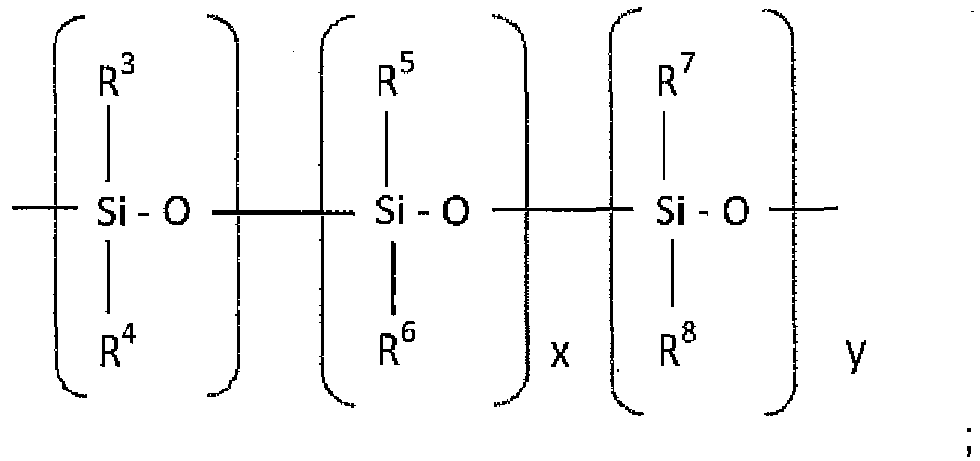
wherein R3, R4, R7, R8, R9, R10, and R11 include the C1-10 alkyl group; x ranges from 1 - 50; y ranges from 25 - 250; and m is 1; wherein the adhesion promoter includes a first component and a second component, a) the first component is characterized by the following formula (IVa): R1-W-Z-R2 (IVa) wherein R1 and R2 are independently a substituted or unsubstituted C1-11 alkyl group; - W is

- Z is

- W is

- Z is

- W is

- W is

- W is

- W is

- W is

- It should be appreciated that the above referenced aspects and examples are nonlimiting as others exist with the present invention, as shown and described herein. For example, any of the above mentioned aspects or features of the invention may be combined to form other unique configurations, as described herein, demonstrated in the drawings, or otherwise.
- Desirably, the composite sealant composition includes a cross-linkable material, though not required.
- In general, the present invention is directed to an improved high strength composite sealant composition and processes of forming the composition. Advantageously, the composite sealant composition can be employed to form dental sealants with desirable high strength characteristics. This high strength material enables the preparation of root canals and may be useful for improved bonding (higher adhesion) to the tooth dentin and/or root canal points. Dental materials containing polymerizable resins and filler particles often are used to prepare the root canals. Such dental materials can be self (chemically)-curable, heat-curable, light-curable, or dual-curable. The dental materials are cured and hardened by different chemical mechanisms to form strong and durable materials for various dental applications.
- In one aspect, the invention solves the problem of the creation of a seal between the sealer and the gutta-percha AND a seal between the sealer and the dentin to prevent leakage of bacteria into the root canal. The invention uses rubber formulations cryogenically ground into a powder and mixed as a filler in various two part polymer systems. The ground rubber can be blended in either one or both parts of the polymer system. One or more types of ground rubber can be used. This will create a fluid(s) with a paste like viscosity.
- The technology to make this work may not be the grinding or the dispersion into the polymer system. It is believed that the formulation of the ground rubber in relation to the polymer system provides the one of the advantages of this invention.
- In another aspect the invention solves the problem of the creation of a seal between the obturation material and the dentine to prevent leakage of bacteria into the root canal. The invention is two ideal molecular additives which have been designed to bond to collagen AND hydroxyapatite.
- Dentin is composed of a collagen (hydrocarbon polymer) matrix holding together crystalline hydroxyapatite (CaP). The dentin binding molecules are designed to include three subcomponents in a tri block construction. For example, in a first portion, Block A, may be composed of phosphate group, in a second portion, Block B, may be composed of tris methacrylate and in a third portion, Block C, may be either a reactive group such as an amino methacrylate or a glycidal methacrylate. Block A is designed to bond to the hydroxyapatite. Block B is designed to be a compatibilizer. Block C is designed to cross link into the network during setting (amino/epoxy reaction). The molecular additives are dispersed into two dimethylsiloxanes; an amino functionalized and an epoxy functionalized (see the attached document for more detail).
- The polymerizable material (e.g., a composite sealant composition) typically includes at least one polymerizable component and optionally without limitation, one or more of at least one filler (e.g., glass particles), an adhesion promoter, an initiator, a catalyst, an accelerator, an inhibitor, surfactant, additive, or combinations thereof or others.
- Turning now in greater detail to the individual components of the overall composition. The composite sealant composition herein may include at least one polymerizable material. Desirably, the composite sealant composition may include a first polymerizable material having at least one of a cyclic compound that is capable of undergoing a ring opening reaction (e.g., a succunic anhydride, a succinimide group, an epoxide, or otherwise) a ring opening nucleophile (e.g., OH, COOH, SH, an amine resin (e.g., NH2), or otherwise), urethane di-(meth)acrylate, multi(meth)acrylate derivatives of isocyanatomethyl cyclohexane, a polymerizable polysiloxane compound (e.g., an epoxy functionalized siloxane, an amino functionalized siloxane, or otherwise), or any combination thereof.
- The first polymerizable material may typically be present in an amount of at least about 1%, preferably at least about 5%, and more preferable at least about 10% by wt the composite sealant composition. Furthermore, it is appreciated that the first polymerizable material may typically be present in an amount of less than about 99%, preferably less than about 75% and preferably less than about 50% by wt the overall composite sealant composition. For example, the first polymerizable material may typically be present in an amount ranging from about 1% to about 99%, preferably from about 5% to about 75%, and more preferably from about 10% to about 50% by wt the overall composite sealant composition. In one specific embodiment, the first polymerizable material is the polymerizable polysiloxane compound.
- Examples of polymerizable polysiloxane compounds (e.g., polydimethylsiloxane copolymers) that may be used in the composition of this invention, include, but are not limited to, cyclic compounds that are capable of undergoing a ring opening reaction such as epoxy modified polysiloxane compounds (e.g., difunctional and multifunctional epoxy silicones) and ring opening nucleophiles such as amine modified polysiloxane compounds (e.g., aminoalkyl functional silicones). One preferred epoxy modified polysiloxane is sold under the Tradename EMS 622 and is commercially available from Gelest, Inc. One preferred amine modified polysiloxane is sold under the Tradename AMS 162 and is commercially available from Gelest, Inc.
- The first polymerizable material may include a first component (e.g., a cyclic compound that is capable of undergoing a ring opening reaction) and a second component (e.g., ring opening nucleophile) capable of polymerization. For example, the polysiloxane compound may include a first polysiloxane component having an epoxy modified polysiloxane or a second polysiloxane component having an amine modified polysiloxane. The epoxy modified polysiloxane may be present in an amount of at least about 1%, preferably at least about 3%, and more preferable at least about 5% by wt the overall composite sealant composition. Furthermore, the epoxy modified polysiloxane may be present in an amount of less than about 50%, preferably less than about 40% and preferably less than about 25% by wt the overall composite sealant composition. For example, the epoxy modified polysiloxane may be present in an amount ranging from about 1% to about 50%, preferably from about 3% to about 40%, and more preferably from about 5% to about 25% by wt the overall composite sealant composition. An example of the first polysiloxane component having the epoxy modified polysiloxane may be present as formula (I).
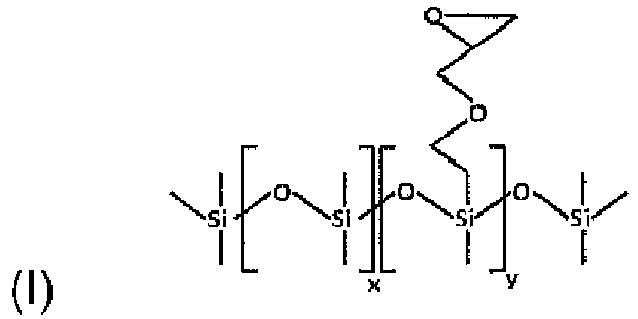
- x is 1 - 1000, and
- y is 1 - 1000.
- Alternatively or in addition to the first polysiloxane component having an epoxy modified polysiloxane, the polysiloxane component may include a second polysiloxane component having an amine modified polysiloxane. The amine modified polysiloxane may be present in an amount of at least about 1%, preferably at least about 3%, and more preferable at least about 5% by wt the overall composite sealant composition. Furthermore, the amine modified polysiloxane may be present in an amount of less than about 50%, preferably less than about 40% and preferably less than about 25% by wt the overall composite sealant composition. For example, the amine modified polysiloxane may be present in an amount ranging from about 1% to about 50%, preferably from about 3% to about 40%, and more preferably from about 5% to about 25% by wt the overall composite sealant composition.
- An example of the second polysiloxane component having the amine modified polysiloxane may be present as formula (II).

- n is 1 - 1000, and
- m is 1 - 1000.
- The composite sealant composition herein may include at least one initiating component (e.g., catalyst) to effectuate curing of the material. The initiating component may be present in an amount of at least about 0.0005%, preferably at least about 0.005%, and more preferably at least about 0.05% by wt the overall composite sealant composition. The overall composite sealant composition may include less than about 3.0%, preferably less than about 1.5%, and more preferably less than about 1% wt of the initiating component. For example, the initiating component may be present in a range of about 0.0005% to about 3%, preferably from about 0.005% to about 1.5%, and more preferably from about 0.05% to about 1% wt of the overall composite sealant composition.
- One preferred initiating component includes an alkanol amine. Examples of suitable alkanol amines include, but are not limited to ethanolamine, 2-amino-1-butanol, 4-amino-1-butanol, 2-aminoethanthiol, 2-amino-1-hexanol, 2-amino-3-methyl-1-butanol, 2-amino-2-methyl-1-propanol, 2-amino-2-methyl-1,3-propanediol, 5-amino-1-pentanol, 2-(methylamino) ethanol, 2-(propylamino)ethanol, tris(hydroxymethyl)aminomethane, 2-amino-1-propanol, 2-amino-1-pentanol, ethanolamine, 2-hydroxyethylhydoradine, 3-amino-1-propanol, DL-2-amino-1-propanol, DL-1-amino-2-propanol, DL-2-amino-1-pentanol, DL-2-Amino-1-hexanol, 6-amino-1-hexanol, 2-(2-aminoethoxy) ethanol, or otherwise and combinations thereof. Other catalysts are appreciated such as salts (e.g., platinum, palladium, or otherwise).
- As shown in Table 1, an example of acceleration effects for curing various composite sealant compositions of the two-component systems with different catalysts:
Table 1 I.D. 712A11 712B11 712C11 712D11 712 E11 712U11 AMS 162 50.3% 49.5% 49.3% 49.4% 49.0% 85.8% EMS 622 49.7% 49.5% 49.7% 49.5% 50.0% 14.2% 2-amino-3methyl-butanol 0.0% 1.0% 0.0% 0.0% 0.0% 0.0% dl-2-amino-1-pentanol 0.0% 0.0% 1.0% 0.0% 0.0% 0.0% dl-2-amino-1-hexanol 0.0% 0.0% 0.0% 1.0% 0.0% 0.0% 6-amino-1-hexanol 0.0% 0.0% 0.0% 0.0% 1.0% 0.0% Total Mass (g) 10.1 10.1 10.1 10.1 10.3 10.0 Time after mixing to full cure (days) 5 3 3 3 5 Not Set, >15 - The composite sealant compositions may include one or more fillers. Fillers having Radiopacity useful in accordance with the invention, without limitation, include inorganic fillers such as Ag, TiO2, La2O3, ZrO2, BaSO4, CaWO4, BaWO4, Fe2O3 and Bi2O3, CeO2, ZrO2, MgO, lanthanide salts, polymer granulates, barium or strontium-containing glass. The glass may contain fluoride for fluoride release in vivo. When included, the radiopacifier may be present in an amount of at least about 20%, preferably at least about 30%, and more preferable at least about 40% by wt the overall composite sealant composition. Furthermore, the radiopacifier may be present in an amount of less than about 80%, preferably less than about 70% and preferably less than about 60% by wt the overall composite sealant composition. For example, the radiopacifier may be present in an amount ranging from about 20% to about 80%, preferably from about 30% to about 70%, and more preferably from about 40% to about 60% by wt the overall composite sealant composition.
- Other fillers that may be employed include, but are not limited to silicas, aluminas, magnesias, titanias, inorganic salts, metallic oxides, (e.g., zinc oxides, calcium hydroxide, or otherwise) and glasses. In one desired embodiment, precipitated silica (e.g., Hi-Sil 233) may be included as a filler. In another desired embodiment, fumed silica (e.g., Aerosil 200) may be included as a filler. The filler material may be present in an amount of at least about 0.1%, preferably at least about 1%, and more preferably at least about 5% by wt the overall composite sealant composition. Furthermore, the filler material may be present in an amount of less than about 25%, preferably less than about 20% and more preferably less than about 15% by wt the overall composite sealant composition. For example, the filler material may be present in an amount ranging from about 0.1% to about 25%, preferably from about 1% to about 20%, and more preferably from about 5% to about 15% by wt the overall composite sealant composition.
- In a preferred embodiment, the composite sealant composition may further include a cross-linked material (e.g., cross-linked rubber such as polyisoprene or otherwise). A desirable example of a cross-linked material may include a cross-linked cis-polyisoprene-based material such as a cis-1,4-polyisoprene-based material. As shown in Tables 2 and 3, the cross-linked material may include the following compositions as described in
US Serial No 13/045744, filed March 11, 2011 Table 2 Component Weight % 1-4, Polyisoprene 10 to 40 Curing Agent 0.1 to 30 Curing Co agent 0.01 to 30 Zinc Oxide 0 to 80 Radiopacifier 0 to 40 Reinforcing Fillers 0 to 50 Carbon Nanotubes 0 to 50 Fibers 0 to 50 Colorant 0 to 10 Table 3: Component Weight % Cross-Linkable Material 10 to 40 Rubber 0.5 to 15 Curing Agent 0.1 to 30 Curing Co agent 0.01 to 15 Antimicrobial 0.01 to 50 Radiopacifier 5.0 to 60 Reinforcing Fillers 0.5 to 30 Fibers 0.5 to 30 Colorant 0.01 to 25 Anti Oxidant 0 to 10 Processing Aid 0 to 10 - The cross-linked material may be present in an amount of at least about 3%, preferably at least about 5%, and more preferably at least about 10% by wt the overall composite sealant composition. Furthermore, the cross-linked material may be present in an amount of less than about 50%, preferably less than about 40% and more preferably less than about 30% by wt the overall composite sealant composition. For example, the cross-linked material may be present in an amount ranging from about 3% to about 50%, preferably from about 5% to about 40%, and more preferably from about 10% to about 30% by wt the overall composite sealant composition.
- Desirably, the cross-linked material may be provided as a powder (e.g., from a grinding or chopping process of the cross-linked material). The cross-linked material may include a particle size of at least about 5, preferably at least about 10 and more preferably at least about 25 microns. Furthermore, the cross-linked material may include a particle size of less than about 500, preferably less than about 400, and more preferably less than about 300 microns. For example, the cross-linked material may include a particle size ranging from about 5 to about 500, preferably from about 10 to about 300, and more preferably from about 25 to about 150 microns (e.g., from about 50 microns to about 100 microns or from about 125 microns to about 200 microns).
- As shown in Table 4, one specific example of the two component composite sealant composition containing a cross-linked material:
Table 4: Component A Weight % Component B Weight % Reactive-cyclic-based Polymerizable Compound 5.0 to 50 Ring-opening-based Polymerizable Compound 5.0 to 50 Catalyst 0 Catalyst 0.001 to 5.0 Radiopacifier 20 to 80 Radiopacifier 20 to 80 Reinforcing Fillers 0.1 to 25 Reinforcing Fillers 0.1 to 25 Cross-linked Rubber 0.1 to 50 Cross-linked Rubber 0.1 to 50 - Desirably, the cyclic-based polymerizable compound includes epoxy functionality, while the ring-opening-based polymerizable compound includes amine functionality, though not required.
- The composite sealant composition may further include additives, pharmaceutical active ingredients, dyes or pigments (e.g., iron oxides) waxes, oils (e.g., silicone oil and paraffin oil), surfactants, fatty acids (e.g., stearic acid), anti-oxidants, preservatives (e.g., nanosilver), or mixtures thereof.
- The composite sealant composition may further include at least one adhesion promoter. In one aspect, the adhesion promoter (e.g., second polymerizable material) may be present in addition to the polymerizable compound (e.g., second polymerizable material). In another aspect the adhesion promoter may be the polymerizable compound.
- Without intending to be bound by theory, it is believed that the adhesion promoter herein makes advantageous employment of a particular molecular structure by which at least a portion of the molecule may include cyclic compounds that are capable of undergoing a ring opening reaction functionality (e.g., epoxy group, a succunic anhydride group, a succinimide group, or otherwise) and/or ring opening nucleophile functionality (e.g., OH, COOH, SH amine group, such as diepoxide or diamine group, or otherwise), which is capable of cross-linking the composite sealant composition. The adhesion promoter molecular structure may include hydrophobic functionality such as a hydrocarbon, a silicone (e.g., it is silanated such as SiO, SiO2, SiH4, or SiC), or otherwise, which is capable of being a thickener and/or may be provided as a dispersion carrier for the cross-linked material discussed herein. In one specific embodiment, the silicone functionality includes a Tris(trimethylsiloxy)silyl group such as [tris(trimethylsilyloxy)silyl]propyl methacrylate). Furthermore, the adhesion promoter molecular structure may include a dentin binding functionality, such as an phosphate, sulfate, sulfonate, betaine, carboxylic acids, amino acid, diacids, bisphosphate, or phosphatidylcholine functionality, which is capable of improving the linkage with the tooth dentin such as through the molecular network of the composite sealant composition.
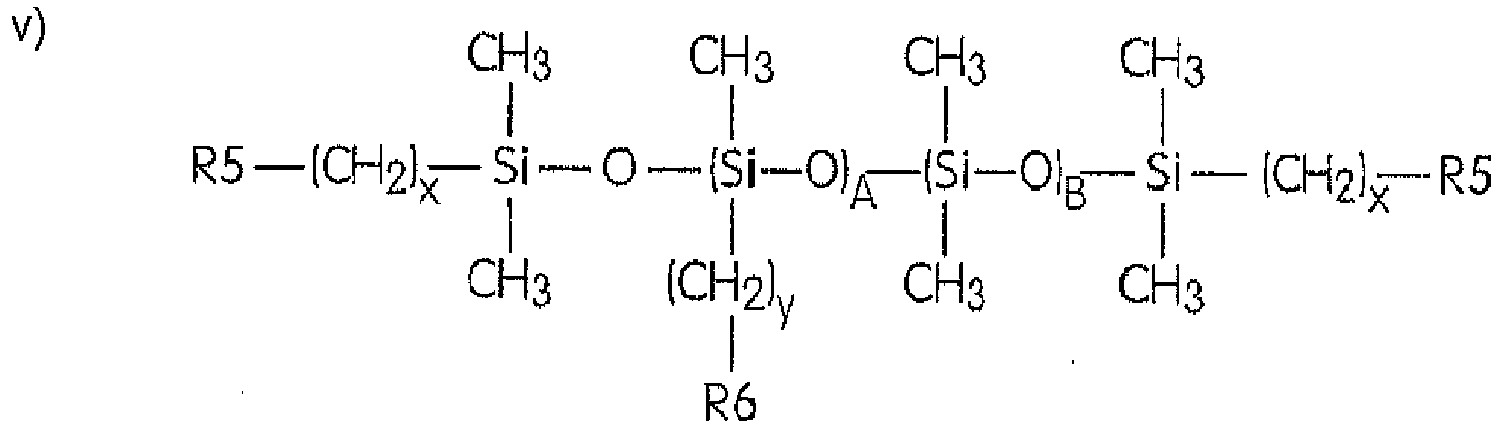
- The adhesion promoter may be a one component material or a two component material. Examples of the adhesion promoter include but are not limited to:

- R1 is independently NH2, OH, COOH, SH, an epoxide, a succunic anhydride, or a succinimide group, whereas R1 may be identical or different, (preferably R1 is a ring opening nucleophile such as NH2, OH, COOH, SH or otherwise);
- x is an integer from 0 to 10 (e.g., 1 to 10), multiple groups of x may be identical or different; and
- y is an integer from 1 to 1000, multiple groups of y may be identical or different.
- R2 is independently NH2, OH, COOH, SH, an epoxide, a succunic anhydride, or a succinimide group, whereas multiple groups of R2 may be identical or different, (preferably R2 is a ring opening nucleophile such as NH2, OH, COOH, SH or otherwise);
- x is an integer from 0 to 10 (e.g., 1 to 10), multiple groups of x may be identical or different;
- y is an integer from 1 to 10, multiple groups of y may be identical or different;
- A is an integer from 1 to 1000 (e.g., 1 to 100, preferably 1 to 10), multiple groups of A may be identical or different; and
- B is an integer from 0 to 1000 (e.g., 1 to 100, preferably 45 to 65), multiple groups of B may be identical or different.
- R3 is independently NH2, OH, COOH, SH, an epoxide, a succunic anhydride, or a succinimide group, whereas R3 may be identical or different, (preferably R3 is a cyclic compound that may undergo ring polymerization such as an epoxide, a succunic anhydride, a succinimide group, or otherwise);
- x is an integer from 0 to 10 (e.g., 1 to 10), multiple groups of x may be identical or different; and
- y is an integer from 1 to 1000, multiple groups of y may be identical or different.
- R4 is independently NH2, OH, COOH, SH, an epoxide, a succunic anhydride, or a succinimide group, whereas multiple groups of R4 may be identical or different, (preferably R4 is a cyclic compound that may undergo ring polymerization such as an epoxide, a succunic anhydride, a succinimide group, or otherwise);
- x is an integer from 0 to 10 (e.g., 1 to 10), multiple groups of x may be identical or different;
- y is an integer from 1 to 10, multiple groups of y may be identical or different;
- A is an integer from 1 to 1000, multiple groups of A may be identical or different; and
- B is an integer from 0 to 1000 (e.g., 1 to 1000), multiple groups of B may be identical or different.
- R5 is independently NH2, OH, COOH, SH, an epoxide, a succunic anhydride, or a succinimide group, whereas multiple groups of R5 may be identical or different;
- R6 is independently a phosphate, a sulfate, a sulfonate, a betaine, a carboxylic acid, an amino acid, a diacids, a bisphosphate, or a phosphatidylcholine group, whereas multiple groups of R6 may be identical or different;
- x is an integer from 0 to 10 (e.g., 1 to 10), multiple groups of x may be identical or different;
- y is an integer from 1 to 10, multiple groups of y may be identical or different;
- A is an integer from 1 to 1000, multiple groups of A may be identical or different; and
- B is an integer from 0 to 1000 (e.g., 1 to 1000), multiple groups of B may be identical or different; and
- wherein R5 and R6 can change positions.
- The adhesion promoter may be a one component material or a two component material. Examples of the adhesion promoter include but are not limited to:

- R9 is independently NH2, OH, COOH, SH, an epoxide, a succunic anhydride, or a succinimide group, whereas multiple groups of R9 may be identical or different;
- R10 is independently a phosphate, a sulfate, a sulfonate, a betaine, a carboxylic acid, an amino acid, a diacids, a bisphosphate, or a phosphatidylcholine group, whereas multiple groups of R10 may be identical or different;
- x is an integer from 0 to 10 (e.g., 1 to 10), multiple groups of x may be identical or different;
- y is an integer from 1 to 10, multiple groups of y may be identical or different;
- z is an integer from 1 to 10, multiple groups of z may be identical or different;
- A is an integer from 1 to 1000, multiple groups of A may be identical or different; and
- B is an integer from 1 to 1000, multiple groups of B may be identical or different; and
- C is an integer from 0 to 1000 (e.g., 1 to 1000), multiple groups of C may be identical or different; and
- wherein R9 and R10 can change positions.
- In a desired embodiment, each functional portion is present thereby forming a terpolymer adhesion promoter.

- R13 is independently a phosphate, a sulfate, a sulfonate, a betaine, a carboxylic acid, an amino acid, a diacids, a bisphosphate, or a phosphatidylcholine group, whereas multiple groups of R13 may be identical or different;
- R14 is independently a hydrophobic group such as a hydrocarbon, a silicone (e.g., it is silanated), or otherwise, (preferably the silicone includes a Tris(trimethylsiloxy)silyl group such as [tris(trimethylsilyloxy)silyl]propyl methacrylate), whereas multiple groups of R14 may be identical or different;
- R15 is independently NH2, OH, COOH, SH, an epoxide, a succunic anhydride, or a succinimide group, whereas multiple groups of R15 may be identical or different;
- n is an integerfrom 1 to 1000, multiple groups of x may be identical or different;
- m is an integer from 0 to 1000 (e.g., 1 to 1000), multiple groups of y may be identical or different;
- p is an integer from 1 to 1000, multiple groups of z may be identical or different; and
- wherein R13, R14, and R15 can change positions.
- It is appreciated that a two component adhesion promoter may include a first component of the formula i) - vii) having a cyclic compound that may undergo ring polymerization such as an epoxide, a succunic anhydride, a succinimide group, or otherwise and a second component of the formula i) - vii) having a ring opening nucleophile such as NH2, OH, COOH, SH or otherwise. When included, polymerization may occur by mixing the first and second components to form the adhesion promoter.
- The adhesion promoter may be synthesized by various processes. Desirably, the ter-polymer adhesion promoter may be formed by RAFT polymerization to form a two component system. For example, the first component (having a cyclic compound that may undergo ring polymerization) may be formed by the following RAFT polymerization:

- The second component (having a ring opening nucleophile) may be formed by the following RAFT polymerization:

- These specific examples i) - vii) of possible adhesion promoters should not be construed as limiting examples.
- In a composite sealant composition that includes at least one polymerizable compound and at least one adhesion promoter (Examples from Tables 4 - 7), the adhesion promoter may be present in an amount of at least about 3%, preferably at least about 5%, and more preferably at least about 10% by wt the overall composite sealant composition. Furthermore, the adhesion promoter may be present in an amount of less than about 50%, preferably less than about 40% and more preferably less than about 30% by wt the overall composite sealant composition. For example, the adhesion promoter may be present in an amount ranging from about 3% to about 50%, preferably from about 5% to about 40%, and more preferably from about 10% to about 30% by wt the overall composite sealant composition.
Table 4: Component A Weight % Component B Weight % Reactive-Cyclic-based Polymerizable Compound 5.0 to 25 Ring-opening-based Polymerizable Compound 5.0 to 25 Catalyst 0 Catalyst 0.001 to 5.0 Radiopacifier 20 to 80 Radiopacifier 20 to 80 Reinforcing Fillers 0.1 to 25 Reinforcing Fillers 0.1 to 25 Cross-linked Rubber 0.1 to 50 Cross-linked Rubber 0.1 to 50 Reactive-Cyclic-based Adhesion Promoter 5.0 to 25 Ring-opening-based Adhesion Promoter 5.0 to 25 Table 5: Component A Weight % Component B Weight % Reactive-Cyclic-based Polymerizable Compound 5.0 to 50 Ring-opening-based Polymerizable Compound 0 Catalyst 0 Catalyst 0.001 to 5.0 Radiopacifier 20 to 80 Radiopacifier 20 to 80 Reinforcing Fillers 0.1 to 25 Reinforcing Fillers 0.1 to 25 Cross-linked Rubber 0.1 to 50 Cross-linked Rubber 0.1 to 50 Reactive-Cyclic-based Adhesion Promoter 0 Ring-opening-based Adhesion Promoter 5.0 to 50 Table 6: Component A Weight % Component B Weight % Reactive-Cyclic-based Polymerizable Compound 0 Ring-opening-based Polymerizable Compound 5.0 to 50 Catalyst 0 Catalyst 0.001 to 5.0 Radiopacifier 20 to 80 Radiopacifier 20 to 80 Reinforcing Fillers 0.1 to 25 Reinforcing Fillers 0.1 to 25 Cross-linked Rubber 0.1 to 50 Cross-linked Rubber 0.1 to 50 Reactive-Cyclic-based Adhesion Promoter 5.0 to 50 Ring-opening-based Adhesion Promoter 0 - Desirably, the cyclic-based polymerizable compound and the cyclic-based adhesion promoter include epoxy functionality, while the ring opening-based polymerizable compound and the ring opening-based adhesion promoter include amine functionality, though not required. It is appreciated that in a composite sealant composition that includes an adhesion promoter as the polymerizable compound (Example of Table 7), the adhesion promoter may in an amount of at least about 1%, preferably at least about 5%, and more preferably at least about 10% by wt the overall composite sealant composition. Furthermore, it is appreciated that the adhesion promoter may be present in an amount of less than about 90%, preferably less than about 70% and preferably less than about 50% by wt the overall composite sealant composition. For example, the adhesion promoter may be present in an amount ranging from about 1% to about 90%, preferably from about 5% to about 70%, and more preferably from about 10% to about 50% by wt the overall composite sealant composition.
Table 7: Component A Weight % Component B Weight % Reactive-Cyclic-based Adhesion Promoter 5.0 to 50 Ring-opening-based Adhesion Promoter 5.0 to 50 Catalyst 0 Catalyst 0.001 to 5.0 Radiopacifier 20 to 80 Radiopacifier 20 to 80 Reinforcing Fillers 0.1 to 25 Reinforcing Fillers 0.1 to 25 Cross-linked Rubber 0.1 to 50 Cross-linked Rubber 0.1 to 50 - Desirably, the cyclic-based adhesion promoter includes epoxy functionality, while the ring opening-based adhesion promoter includes amine functionality, though not required.
- In one specific two-component example, the product may comprise of a putty formulation, which includes ground cross-linked material (e.g., ground cross-lined endodontic carriers), silica, polymer, catalyst and bismuth oxide. The formulation mixes into a firm putty which can be delivered with an amalgum delivery device or with pluggers and spreaders. It has the consistency of a putty and can be rolled into any desired shaped prior to placing into the canal. Once the canal is filled, a gutta-percha point or a cross-linked endodontic carrier can be inserted into the canal to facilitate a 3-d fill and prevent leakage out the apex.
- In another specific example, the composite sealant composition may comprise of an injectable formulation which includes ground cross-linked material, silica, polymer, catalyst, and bismuth oxide. The formulation mixes in a static mixer connected on the end of a dual syringe. The material is directly injected into the canal. Once the canal is filled, a cross-linked endodontic carrier or gutta-percha-point can be inserted into the canal to facilitate a 3-d fill and prevent leakage out the apex.
- It is appreciated that the gutta-percha point/cross-linked carrier choice can left up to the clinician (they are interchangeable).
- It is further appreciated that in the composite sealant composition systems, different types can be used. The sealant material according to the invention can be present as single-component systems or as multi-component systems, preferably as two-component systems, as a function of the polymer system, in each instance. The curable polymer systems and their additional components, such as catalysts and/or initiators, are known to a person skilled in the art as such.
- Preferably, one-component dental sealant materials are used that are cured by means of UV radiation and/or heat. Aside from the curable polymer system as well as the surfactant mixture used according to the invention, photoinitiators are usually contained in them
- It will be further appreciated that functions or structures of a plurality of components or steps may be combined into a single component or step, or the functions or structures of one-step or component may be split among plural steps or components. The present invention contemplates all of these combinations. Unless stated otherwise, dimensions and geometries of the various structures depicted herein are not intended to be restrictive of the invention, and other dimensions or geometries are possible. In addition, while a feature of the present invention may have been described in the context of only one of the illustrated embodiments, such feature may be combined with one or more other features of other embodiments, for any given application. It will also be appreciated from the above that the fabrication of the unique structures herein and the operation thereof also constitute methods in accordance with the present invention. The present invention also encompasses intermediate and end products resulting from the practice of the methods herein. The use of "comprising" or "including" also contemplates embodiments that "consist essentially of" or "consist of" the recited feature.
- The explanations and illustrations presented herein are intended to acquaint others skilled in the art with the invention, its principles, and its practical application. Those skilled in the art may adapt and apply the invention in its numerous forms, as may be best suited to the requirements of a particular use. Accordingly, the specific embodiments of the present invention as set forth are not intended as being exhaustive or limiting of the invention. The scope of the invention should, therefore, be determined not with reference to the above description, but should instead be determined with reference to the appended claims, along with the full scope of equivalents to which such claims are entitled. The disclosures of all articles and references, including patent applications and publications, are incorporated by reference for all purposes.


Claims (16)
wherein the ring-opening functionality is selected from the group consisting of an acid group, an amine group, a thiol group and an alcohol group; or
wherein the reactive-cyclic functionality is selected from the group consisting of an epoxy group, an anhydride group, an aziridine group and an oxazolone group; or wherein the free radical functionality is selected from the group consisting of a double bond and a triple bond; or
wherein the cross-linked polyisoprene microparticles are less than about 200 um; or wherein the cross-linked-cis-polyisoprene microparticles range from about 50 to about 180 µm.
wherein the dentin binding functionality is selected from the group consisting of a phosphate, a sulfate, a sulfonate, a betaine, a carboxylic acid, an amino acid, a diacids, a bisphosphate, and a phosphatidylcholine; or
wherein the composite sealant material has a viscosity over 100,000 cps or putty-like; or
further comprising the step of inserting a gutta-percha point, an obturator, or a cross-linked gutta-percha-point into the root canal; or
wherein the gutta-percha point or carrier is surface modified; or
wherein the surface modification is corona treatment or plasma treatment; or wherein the cross-linked cis-polyisoprene microparticles are not soluble in the composite sealant material.
R1-R2-W-Z-R3-R4 (I)
wherein


wherein R1 and R4 are independently NH2, OH, COOH, SH, an epoxide, a succunic anhydride, or a succinimide group;
R2 and R3 are independently a C1-10 alkyl group; and
R5, R6, R7, R8, R9, R10, R11, and R12 are independently Hydrogen, a C1-10 alkyl group, or a C1-10-R13 group such that R13 is independently a phosphate, a sulfate, a sulfonate, a betaine, a carboxylic acid, an amino acid, a diacids, a bisphosphate, or a phosphatidylcholine group, whereas multiple groups of R7, R8, R9, R10, R11, R12, and R13 may be identical or different; or wherein.

wherein
R1 and R4 are independently Hydrogen, a phosphate, a sulfate, a sulfonate, a betaine, a carboxylic acid, an amino acid, a diacids, a bisphosphate, or a phosphatidylcholine group, provided at least one of R1 and R4 is not Hydrogen;
R2 and R3 are independently a C1-10 alkyl group; and
R5, R6, R7, R8, R9, R10, R11, and R12 are independently Hydrogen, a C1-10 alkyl group, or a C1-10-R13 group such that R13 is independently NH2, OH, COOH, SH, an epoxide, a succunic anhydride, or a succinimide group, whereas multiple groups of R7, R8, R9, R10, R11, R12, and R13 may be identical or different, provided at least two of R5, R6, R7, R8, R9, R10, R11, and R12 includes the C1-10-R13 group.
R1-R2-W-Z-R3-R4 (IIa);
wherein


R13-R14-W-Z-R15-R16 (IIb);
wherein


R1-R2-W-Z-R3-R4 (IIIa);
wherein


R13-R14-W-Z-R15-R16 (IIIb);
wherein


R1-W-Z-R2 (IV)
wherein
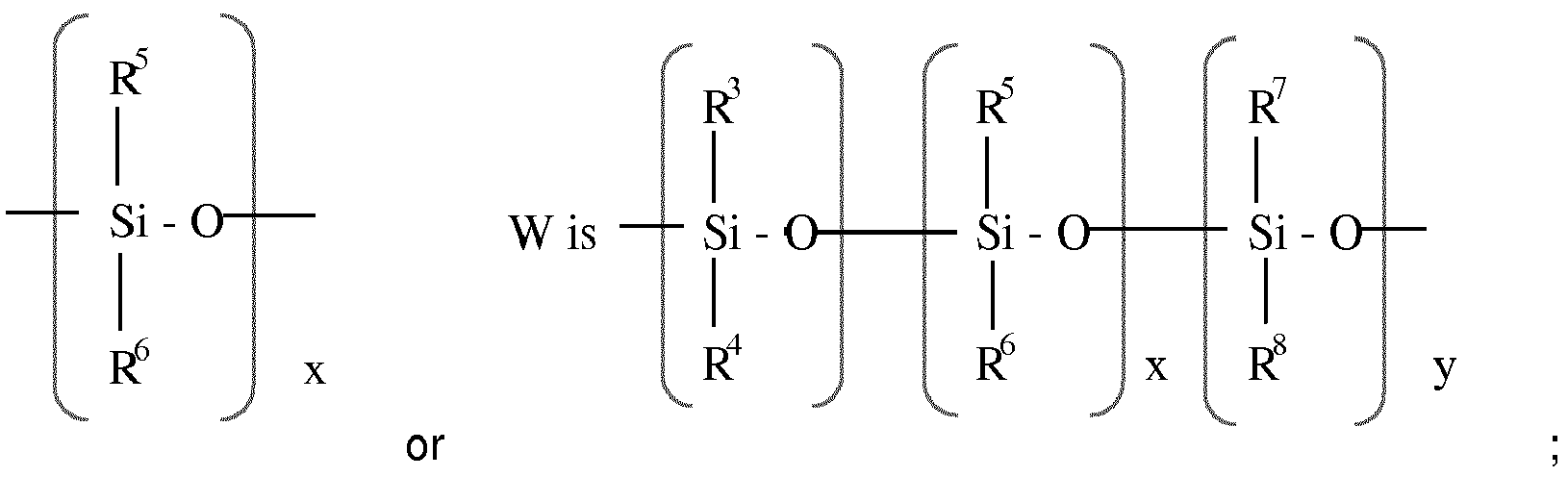

R1-W-Z-R2 (IVa)
wherein


R12-W-Z-R13 (IVb)
wherein


R1-R2-W-R3-R4 (V)
wherein


preferably wherein

x is an integer from 1 to 100, multiple groups of x may be identical or different;
R1-R2-W-R3-R4 (Via);
wherein

R17-R18-W-R19-R20 (VIb);
wherein

Applications Claiming Priority (3)
| Application Number | Priority Date | Filing Date | Title |
|---|---|---|---|
| US201261671251P | 2012-07-13 | 2012-07-13 | |
| EP13742780.3A EP2872105B1 (en) | 2012-07-13 | 2013-07-15 | Improved compositions for endodontic procedures |
| PCT/US2013/050550 WO2014012112A2 (en) | 2012-07-13 | 2013-07-15 | Improved compositions for endodontic procedures |
Related Parent Applications (2)
| Application Number | Title | Priority Date | Filing Date |
|---|---|---|---|
| EP13742780.3A Division EP2872105B1 (en) | 2012-07-13 | 2013-07-15 | Improved compositions for endodontic procedures |
| EP13742780.3A Division-Into EP2872105B1 (en) | 2012-07-13 | 2013-07-15 | Improved compositions for endodontic procedures |
Publications (2)
| Publication Number | Publication Date |
|---|---|
| EP2992871A1 true EP2992871A1 (en) | 2016-03-09 |
| EP2992871B1 EP2992871B1 (en) | 2020-11-18 |
Family
ID=48906492
Family Applications (3)
| Application Number | Title | Priority Date | Filing Date |
|---|---|---|---|
| EP18207044.1A Active EP3482739B1 (en) | 2012-07-13 | 2013-07-15 | Improved compositions for endodontic procedures |
| EP15186933.6A Active EP2992871B1 (en) | 2012-07-13 | 2013-07-15 | Improved compositions for endodontic procedures |
| EP13742780.3A Active EP2872105B1 (en) | 2012-07-13 | 2013-07-15 | Improved compositions for endodontic procedures |
Family Applications Before (1)
| Application Number | Title | Priority Date | Filing Date |
|---|---|---|---|
| EP18207044.1A Active EP3482739B1 (en) | 2012-07-13 | 2013-07-15 | Improved compositions for endodontic procedures |
Family Applications After (1)
| Application Number | Title | Priority Date | Filing Date |
|---|---|---|---|
| EP13742780.3A Active EP2872105B1 (en) | 2012-07-13 | 2013-07-15 | Improved compositions for endodontic procedures |
Country Status (8)
| Country | Link |
|---|---|
| US (2) | US9351909B2 (en) |
| EP (3) | EP3482739B1 (en) |
| JP (2) | JP6189436B2 (en) |
| CN (1) | CN104519855B (en) |
| AU (3) | AU2013289910B2 (en) |
| BR (2) | BR112015000639B1 (en) |
| CA (1) | CA2878858C (en) |
| WO (1) | WO2014012112A2 (en) |
Families Citing this family (4)
| Publication number | Priority date | Publication date | Assignee | Title |
|---|---|---|---|---|
| EP3222245B1 (en) | 2016-03-22 | 2021-09-22 | Dentsply Sirona Inc. | Method and arrangement for cleaning of a canal |
| JP2020522536A (en) * | 2017-06-06 | 2020-07-30 | デンツプライ シロナ インコーポレイテッド | Flowable composition |
| US11638634B2 (en) | 2017-09-25 | 2023-05-02 | Dentsply Sirona Inc. | Method and arrangement for cleaning of a canal |
| BR112020005143B1 (en) | 2017-09-25 | 2022-08-30 | Degudent Gmbh | METHOD AND PROVISION FOR CLEANING A CHANNEL |
Citations (6)
| Publication number | Priority date | Publication date | Assignee | Title |
|---|---|---|---|---|
| US6353041B1 (en) * | 1999-10-22 | 2002-03-05 | Kerr Corporation | Dental compositions |
| US20020051952A1 (en) * | 2000-09-01 | 2002-05-02 | Gc Corporation | Root canal filling material |
| US20020088372A1 (en) * | 2000-11-21 | 2002-07-11 | Gc Corporation | Powder for glass ionomer-based sealer for root canal |
| US20080287566A1 (en) * | 2005-09-28 | 2008-11-20 | Essential Dental Systems, Inc. | Epoxy based oil free root canal sealer |
| US20110070563A1 (en) * | 2008-04-25 | 2011-03-24 | Sun Medical Co., Ltd. | Easily removable dental curable composition |
| US20110230591A1 (en) * | 2010-03-16 | 2011-09-22 | Todd Berger | Compositions for endodontic instruments |
Family Cites Families (29)
| Publication number | Priority date | Publication date | Assignee | Title |
|---|---|---|---|---|
| DE1139940B (en) * | 1959-07-10 | 1962-11-22 | Wacker Chemie Gmbh | Tooth root filler |
| US4380432A (en) * | 1980-09-03 | 1983-04-19 | Scientific Pharmaceuticals | Method for adhering structures to teeth |
| US4449938A (en) * | 1982-02-19 | 1984-05-22 | Lee Pharmaceuticals, Inc. | Endodontic filling and sealing composition |
| US4810768A (en) * | 1984-11-19 | 1989-03-07 | American Telephone And Telegraph Company | Method and formulation for extending shelf life of a silicone resin |
| US4722689A (en) * | 1985-12-20 | 1988-02-02 | Corbett Jack A | Coated temporary dental crowns |
| JP2543721B2 (en) * | 1987-09-25 | 1996-10-16 | 東レ・ダウコーニング・シリコーン株式会社 | Adhesion promoter |
| US4822687A (en) * | 1988-01-22 | 1989-04-18 | Minnesota Mining And Manufacturing Company | Silicone release compositions |
| JPH01294609A (en) * | 1988-02-09 | 1989-11-28 | Toyo Kagaku Kenkyusho:Kk | Dental sealer for root canal filling |
| JPH01275509A (en) * | 1988-04-28 | 1989-11-06 | Nikon Corp | Resin composition for dental use |
| US4894011A (en) * | 1988-11-02 | 1990-01-16 | Johnson William B | Appliance for use in applying filler material to an endodontically prepared root canal |
| US5078988A (en) * | 1988-11-28 | 1992-01-07 | Chesebrough-Pond's Usa Co., Division Of Conopco, Inc. | Dentrifrices including modified aminoalkyl silicones |
| US5154915A (en) * | 1988-11-28 | 1992-10-13 | Chesebrough-Pond's Usa Co., Division Of Conopco, Inc. | Dentifrices containing aminoalkyl silicones and sarcosinate surfactants |
| JPH0689317B2 (en) * | 1989-02-26 | 1994-11-09 | 日本合成化学工業株式会社 | Hot melt adhesive |
| US5084491A (en) * | 1989-03-16 | 1992-01-28 | The Ohio University | Reinforcing glass ionomer dental filling material with stainless steel, or metals thereof |
| US5118297A (en) * | 1991-01-09 | 1992-06-02 | Johnson William B | Obturator body for use in filling an endontically prepared root |
| US5395666A (en) * | 1993-01-08 | 1995-03-07 | Lrc Products Ltd. | Flexible elastomeric article with enhanced lubricity |
| US5700581A (en) * | 1996-06-26 | 1997-12-23 | International Business Machines Corporation | Solvent-free epoxy based adhesives for semiconductor chip attachment and process |
| EP0819749B8 (en) * | 1996-07-18 | 2008-02-13 | Bostik B.V. | Adhesive composition |
| US5833457A (en) * | 1996-11-18 | 1998-11-10 | Dentsply International Inc. | Endodontic obturator |
| US6407148B1 (en) * | 1997-11-13 | 2002-06-18 | 3M Espe Ag | Metal-free dental filling system as a substitute for amalgam |
| DE19934116A1 (en) * | 1999-04-07 | 2000-10-19 | S & C Polymer Silicon & Compos | Copolymers of hydrogen-siloxanes and unsaturated compounds, with silicon-hydrogen groups converted into silanol, used as adhesives for bonding condensation-cured silicone to plastic, e.g. dental impression trays |
| US6387981B1 (en) * | 1999-10-28 | 2002-05-14 | 3M Innovative Properties Company | Radiopaque dental materials with nano-sized particles |
| US6343929B1 (en) * | 2001-01-22 | 2002-02-05 | Ultradent Products, Inc. | Endodontic irrigator tips having fiber covered cannulas and related methods |
| FR2818553B1 (en) * | 2000-12-22 | 2003-02-07 | Rhodia Chimie Sa | DENTAL COMPOSITION BASED ON A CROSSLINKED FUNCTIONALIZED SILICONE AND / OR THERMALLY POLYMERIZABLE |
| DE102004025030A1 (en) * | 2004-05-18 | 2005-12-15 | S&C Polymer Silicon- und Composite-Spezialitäten GmbH | Nano-apatite fillers containing curable restorative materials |
| WO2008023074A1 (en) * | 2006-08-25 | 2008-02-28 | Sachtleben Chemie Gmbh | Barium sulfate-containing composite |
| US8110266B2 (en) * | 2007-02-08 | 2012-02-07 | Allegiance Corporation | Glove coating and manufacturing process |
| EP2163235A1 (en) * | 2008-09-15 | 2010-03-17 | Ivoclar Vivadent AG | Dental materials with high bending module |
| EP2450025B1 (en) * | 2010-11-08 | 2012-11-28 | VOCO GmbH | Polymerisable phosphoric acid derivatives comprising a polyalicyclic structure element |
-
2013
- 2013-07-15 BR BR112015000639-6A patent/BR112015000639B1/en active IP Right Grant
- 2013-07-15 CA CA2878858A patent/CA2878858C/en active Active
- 2013-07-15 US US13/942,446 patent/US9351909B2/en active Active
- 2013-07-15 WO PCT/US2013/050550 patent/WO2014012112A2/en not_active Ceased
- 2013-07-15 EP EP18207044.1A patent/EP3482739B1/en active Active
- 2013-07-15 JP JP2015521886A patent/JP6189436B2/en active Active
- 2013-07-15 AU AU2013289910A patent/AU2013289910B2/en active Active
- 2013-07-15 EP EP15186933.6A patent/EP2992871B1/en active Active
- 2013-07-15 BR BR122019021795A patent/BR122019021795B1/en active IP Right Grant
- 2013-07-15 CN CN201380037282.6A patent/CN104519855B/en active Active
- 2013-07-15 EP EP13742780.3A patent/EP2872105B1/en active Active
-
2016
- 2016-02-02 AU AU2016200650A patent/AU2016200650B2/en active Active
- 2016-04-27 US US15/139,959 patent/US10117809B2/en active Active
-
2017
- 2017-08-01 JP JP2017148767A patent/JP6843016B2/en active Active
- 2017-09-15 AU AU2017228679A patent/AU2017228679B2/en active Active
Patent Citations (6)
| Publication number | Priority date | Publication date | Assignee | Title |
|---|---|---|---|---|
| US6353041B1 (en) * | 1999-10-22 | 2002-03-05 | Kerr Corporation | Dental compositions |
| US20020051952A1 (en) * | 2000-09-01 | 2002-05-02 | Gc Corporation | Root canal filling material |
| US20020088372A1 (en) * | 2000-11-21 | 2002-07-11 | Gc Corporation | Powder for glass ionomer-based sealer for root canal |
| US20080287566A1 (en) * | 2005-09-28 | 2008-11-20 | Essential Dental Systems, Inc. | Epoxy based oil free root canal sealer |
| US20110070563A1 (en) * | 2008-04-25 | 2011-03-24 | Sun Medical Co., Ltd. | Easily removable dental curable composition |
| US20110230591A1 (en) * | 2010-03-16 | 2011-09-22 | Todd Berger | Compositions for endodontic instruments |
Also Published As
| Publication number | Publication date |
|---|---|
| AU2016200650A1 (en) | 2016-02-18 |
| AU2017228679A1 (en) | 2017-10-05 |
| EP2992871B1 (en) | 2020-11-18 |
| EP2872105A2 (en) | 2015-05-20 |
| US20160235632A1 (en) | 2016-08-18 |
| WO2014012112A3 (en) | 2014-05-01 |
| US9351909B2 (en) | 2016-05-31 |
| JP6843016B2 (en) | 2021-03-17 |
| US10117809B2 (en) | 2018-11-06 |
| US20140017636A1 (en) | 2014-01-16 |
| BR112015000639A2 (en) | 2017-06-27 |
| CA2878858A1 (en) | 2014-01-16 |
| CA2878858C (en) | 2022-08-16 |
| EP3482739B1 (en) | 2022-08-24 |
| EP3482739A1 (en) | 2019-05-15 |
| AU2017228679B2 (en) | 2019-01-24 |
| AU2016200650B2 (en) | 2017-06-15 |
| CN104519855B (en) | 2020-08-11 |
| BR112015000639B1 (en) | 2020-03-10 |
| JP6189436B2 (en) | 2017-08-30 |
| AU2013289910B2 (en) | 2016-03-10 |
| BR122019021795B1 (en) | 2020-02-04 |
| WO2014012112A2 (en) | 2014-01-16 |
| AU2013289910A1 (en) | 2015-06-18 |
| CN104519855A (en) | 2015-04-15 |
| EP2872105B1 (en) | 2021-03-31 |
| JP2018021036A (en) | 2018-02-08 |
| JP2015524396A (en) | 2015-08-24 |
Similar Documents
| Publication | Publication Date | Title |
|---|---|---|
| AU2017228679B2 (en) | Improved compositions for endodontic procedures | |
| JP6499262B2 (en) | Improved composition for endodontic appliances | |
| EP1727507B1 (en) | Polymer-bioactive ceramic/cement hybrid composite | |
| JP7724780B2 (en) | Root canal filling composition | |
| JP7732897B2 (en) | Dental composition | |
| EP1928396A2 (en) | Epoxy based oil free root canal sealer |
Legal Events
| Date | Code | Title | Description |
|---|---|---|---|
| PUAI | Public reference made under article 153(3) epc to a published international application that has entered the european phase |
Free format text: ORIGINAL CODE: 0009012 |
|
| AC | Divisional application: reference to earlier application |
Ref document number: 2872105 Country of ref document: EP Kind code of ref document: P |
|
| AK | Designated contracting states |
Kind code of ref document: A1 Designated state(s): AL AT BE BG CH CY CZ DE DK EE ES FI FR GB GR HR HU IE IS IT LI LT LU LV MC MK MT NL NO PL PT RO RS SE SI SK SM TR |
|
| 17P | Request for examination filed |
Effective date: 20160726 |
|
| RBV | Designated contracting states (corrected) |
Designated state(s): AL AT BE BG CH CY CZ DE DK EE ES FI FR GB GR HR HU IE IS IT LI LT LU LV MC MK MT NL NO PL PT RO RS SE SI SK SM TR |
|
| RAP1 | Party data changed (applicant data changed or rights of an application transferred) |
Owner name: DENTSPLY SIRONA INC. |
|
| STAA | Information on the status of an ep patent application or granted ep patent |
Free format text: STATUS: EXAMINATION IS IN PROGRESS |
|
| 17Q | First examination report despatched |
Effective date: 20180704 |
|
| RIN1 | Information on inventor provided before grant (corrected) |
Inventor name: BERGER, TODD Inventor name: BARATZ, ADAM Z. Inventor name: AMMON, DAN Inventor name: WILKINSON, KEVIN |
|
| REG | Reference to a national code |
Ref country code: DE Ref legal event code: R079 Ref document number: 602013074211 Country of ref document: DE Free format text: PREVIOUS MAIN CLASS: A61K0006000000 Ipc: A61C0005500000 |
|
| RIC1 | Information provided on ipc code assigned before grant |
Ipc: A61K 6/00 20200101ALI20200219BHEP Ipc: A61C 5/50 20170101AFI20200219BHEP |
|
| GRAP | Despatch of communication of intention to grant a patent |
Free format text: ORIGINAL CODE: EPIDOSNIGR1 |
|
| STAA | Information on the status of an ep patent application or granted ep patent |
Free format text: STATUS: GRANT OF PATENT IS INTENDED |
|
| INTG | Intention to grant announced |
Effective date: 20200608 |
|
| GRAS | Grant fee paid |
Free format text: ORIGINAL CODE: EPIDOSNIGR3 |
|
| GRAA | (expected) grant |
Free format text: ORIGINAL CODE: 0009210 |
|
| STAA | Information on the status of an ep patent application or granted ep patent |
Free format text: STATUS: THE PATENT HAS BEEN GRANTED |
|
| AC | Divisional application: reference to earlier application |
Ref document number: 2872105 Country of ref document: EP Kind code of ref document: P |
|
| AK | Designated contracting states |
Kind code of ref document: B1 Designated state(s): AL AT BE BG CH CY CZ DE DK EE ES FI FR GB GR HR HU IE IS IT LI LT LU LV MC MK MT NL NO PL PT RO RS SE SI SK SM TR |
|
| REG | Reference to a national code |
Ref country code: GB Ref legal event code: FG4D |
|
| REG | Reference to a national code |
Ref country code: CH Ref legal event code: NV Representative=s name: E. BLUM AND CO. AG PATENT- UND MARKENANWAELTE , CH Ref country code: CH Ref legal event code: EP |
|
| REG | Reference to a national code |
Ref country code: DE Ref legal event code: R096 Ref document number: 602013074211 Country of ref document: DE |
|
| REG | Reference to a national code |
Ref country code: IE Ref legal event code: FG4D |
|
| REG | Reference to a national code |
Ref country code: AT Ref legal event code: REF Ref document number: 1334895 Country of ref document: AT Kind code of ref document: T Effective date: 20201215 |
|
| REG | Reference to a national code |
Ref country code: SE Ref legal event code: TRGR |
|
| REG | Reference to a national code |
Ref country code: AT Ref legal event code: MK05 Ref document number: 1334895 Country of ref document: AT Kind code of ref document: T Effective date: 20201118 |
|
| REG | Reference to a national code |
Ref country code: NL Ref legal event code: MP Effective date: 20201118 |
|
| PG25 | Lapsed in a contracting state [announced via postgrant information from national office to epo] |
Ref country code: GR Free format text: LAPSE BECAUSE OF FAILURE TO SUBMIT A TRANSLATION OF THE DESCRIPTION OR TO PAY THE FEE WITHIN THE PRESCRIBED TIME-LIMIT Effective date: 20210219 Ref country code: PT Free format text: LAPSE BECAUSE OF FAILURE TO SUBMIT A TRANSLATION OF THE DESCRIPTION OR TO PAY THE FEE WITHIN THE PRESCRIBED TIME-LIMIT Effective date: 20210318 Ref country code: NO Free format text: LAPSE BECAUSE OF FAILURE TO SUBMIT A TRANSLATION OF THE DESCRIPTION OR TO PAY THE FEE WITHIN THE PRESCRIBED TIME-LIMIT Effective date: 20210218 Ref country code: RS Free format text: LAPSE BECAUSE OF FAILURE TO SUBMIT A TRANSLATION OF THE DESCRIPTION OR TO PAY THE FEE WITHIN THE PRESCRIBED TIME-LIMIT Effective date: 20201118 Ref country code: FI Free format text: LAPSE BECAUSE OF FAILURE TO SUBMIT A TRANSLATION OF THE DESCRIPTION OR TO PAY THE FEE WITHIN THE PRESCRIBED TIME-LIMIT Effective date: 20201118 |
|
| PG25 | Lapsed in a contracting state [announced via postgrant information from national office to epo] |
Ref country code: LV Free format text: LAPSE BECAUSE OF FAILURE TO SUBMIT A TRANSLATION OF THE DESCRIPTION OR TO PAY THE FEE WITHIN THE PRESCRIBED TIME-LIMIT Effective date: 20201118 Ref country code: IS Free format text: LAPSE BECAUSE OF FAILURE TO SUBMIT A TRANSLATION OF THE DESCRIPTION OR TO PAY THE FEE WITHIN THE PRESCRIBED TIME-LIMIT Effective date: 20210318 Ref country code: PL Free format text: LAPSE BECAUSE OF FAILURE TO SUBMIT A TRANSLATION OF THE DESCRIPTION OR TO PAY THE FEE WITHIN THE PRESCRIBED TIME-LIMIT Effective date: 20201118 Ref country code: BG Free format text: LAPSE BECAUSE OF FAILURE TO SUBMIT A TRANSLATION OF THE DESCRIPTION OR TO PAY THE FEE WITHIN THE PRESCRIBED TIME-LIMIT Effective date: 20210218 Ref country code: AT Free format text: LAPSE BECAUSE OF FAILURE TO SUBMIT A TRANSLATION OF THE DESCRIPTION OR TO PAY THE FEE WITHIN THE PRESCRIBED TIME-LIMIT Effective date: 20201118 |
|
| REG | Reference to a national code |
Ref country code: LT Ref legal event code: MG9D |
|
| PG25 | Lapsed in a contracting state [announced via postgrant information from national office to epo] |
Ref country code: HR Free format text: LAPSE BECAUSE OF FAILURE TO SUBMIT A TRANSLATION OF THE DESCRIPTION OR TO PAY THE FEE WITHIN THE PRESCRIBED TIME-LIMIT Effective date: 20201118 |
|
| PG25 | Lapsed in a contracting state [announced via postgrant information from national office to epo] |
Ref country code: SK Free format text: LAPSE BECAUSE OF FAILURE TO SUBMIT A TRANSLATION OF THE DESCRIPTION OR TO PAY THE FEE WITHIN THE PRESCRIBED TIME-LIMIT Effective date: 20201118 Ref country code: RO Free format text: LAPSE BECAUSE OF FAILURE TO SUBMIT A TRANSLATION OF THE DESCRIPTION OR TO PAY THE FEE WITHIN THE PRESCRIBED TIME-LIMIT Effective date: 20201118 Ref country code: LT Free format text: LAPSE BECAUSE OF FAILURE TO SUBMIT A TRANSLATION OF THE DESCRIPTION OR TO PAY THE FEE WITHIN THE PRESCRIBED TIME-LIMIT Effective date: 20201118 Ref country code: SM Free format text: LAPSE BECAUSE OF FAILURE TO SUBMIT A TRANSLATION OF THE DESCRIPTION OR TO PAY THE FEE WITHIN THE PRESCRIBED TIME-LIMIT Effective date: 20201118 Ref country code: EE Free format text: LAPSE BECAUSE OF FAILURE TO SUBMIT A TRANSLATION OF THE DESCRIPTION OR TO PAY THE FEE WITHIN THE PRESCRIBED TIME-LIMIT Effective date: 20201118 Ref country code: CZ Free format text: LAPSE BECAUSE OF FAILURE TO SUBMIT A TRANSLATION OF THE DESCRIPTION OR TO PAY THE FEE WITHIN THE PRESCRIBED TIME-LIMIT Effective date: 20201118 |
|
| REG | Reference to a national code |
Ref country code: DE Ref legal event code: R097 Ref document number: 602013074211 Country of ref document: DE |
|
| PG25 | Lapsed in a contracting state [announced via postgrant information from national office to epo] |
Ref country code: DK Free format text: LAPSE BECAUSE OF FAILURE TO SUBMIT A TRANSLATION OF THE DESCRIPTION OR TO PAY THE FEE WITHIN THE PRESCRIBED TIME-LIMIT Effective date: 20201118 |
|
| PLBE | No opposition filed within time limit |
Free format text: ORIGINAL CODE: 0009261 |
|
| STAA | Information on the status of an ep patent application or granted ep patent |
Free format text: STATUS: NO OPPOSITION FILED WITHIN TIME LIMIT |
|
| 26N | No opposition filed |
Effective date: 20210819 |
|
| PG25 | Lapsed in a contracting state [announced via postgrant information from national office to epo] |
Ref country code: AL Free format text: LAPSE BECAUSE OF FAILURE TO SUBMIT A TRANSLATION OF THE DESCRIPTION OR TO PAY THE FEE WITHIN THE PRESCRIBED TIME-LIMIT Effective date: 20201118 Ref country code: NL Free format text: LAPSE BECAUSE OF FAILURE TO SUBMIT A TRANSLATION OF THE DESCRIPTION OR TO PAY THE FEE WITHIN THE PRESCRIBED TIME-LIMIT Effective date: 20201118 |
|
| PG25 | Lapsed in a contracting state [announced via postgrant information from national office to epo] |
Ref country code: ES Free format text: LAPSE BECAUSE OF FAILURE TO SUBMIT A TRANSLATION OF THE DESCRIPTION OR TO PAY THE FEE WITHIN THE PRESCRIBED TIME-LIMIT Effective date: 20201118 Ref country code: SI Free format text: LAPSE BECAUSE OF FAILURE TO SUBMIT A TRANSLATION OF THE DESCRIPTION OR TO PAY THE FEE WITHIN THE PRESCRIBED TIME-LIMIT Effective date: 20201118 |
|
| PG25 | Lapsed in a contracting state [announced via postgrant information from national office to epo] |
Ref country code: MC Free format text: LAPSE BECAUSE OF FAILURE TO SUBMIT A TRANSLATION OF THE DESCRIPTION OR TO PAY THE FEE WITHIN THE PRESCRIBED TIME-LIMIT Effective date: 20201118 |
|
| REG | Reference to a national code |
Ref country code: BE Ref legal event code: MM Effective date: 20210731 |
|
| PG25 | Lapsed in a contracting state [announced via postgrant information from national office to epo] |
Ref country code: IS Free format text: LAPSE BECAUSE OF FAILURE TO SUBMIT A TRANSLATION OF THE DESCRIPTION OR TO PAY THE FEE WITHIN THE PRESCRIBED TIME-LIMIT Effective date: 20210318 Ref country code: LU Free format text: LAPSE BECAUSE OF NON-PAYMENT OF DUE FEES Effective date: 20210715 |
|
| PG25 | Lapsed in a contracting state [announced via postgrant information from national office to epo] |
Ref country code: IE Free format text: LAPSE BECAUSE OF NON-PAYMENT OF DUE FEES Effective date: 20210715 Ref country code: BE Free format text: LAPSE BECAUSE OF NON-PAYMENT OF DUE FEES Effective date: 20210731 |
|
| PG25 | Lapsed in a contracting state [announced via postgrant information from national office to epo] |
Ref country code: HU Free format text: LAPSE BECAUSE OF FAILURE TO SUBMIT A TRANSLATION OF THE DESCRIPTION OR TO PAY THE FEE WITHIN THE PRESCRIBED TIME-LIMIT; INVALID AB INITIO Effective date: 20130715 |
|
| PG25 | Lapsed in a contracting state [announced via postgrant information from national office to epo] |
Ref country code: CY Free format text: LAPSE BECAUSE OF FAILURE TO SUBMIT A TRANSLATION OF THE DESCRIPTION OR TO PAY THE FEE WITHIN THE PRESCRIBED TIME-LIMIT Effective date: 20201118 |
|
| PG25 | Lapsed in a contracting state [announced via postgrant information from national office to epo] |
Ref country code: MK Free format text: LAPSE BECAUSE OF FAILURE TO SUBMIT A TRANSLATION OF THE DESCRIPTION OR TO PAY THE FEE WITHIN THE PRESCRIBED TIME-LIMIT Effective date: 20201118 |
|
| PG25 | Lapsed in a contracting state [announced via postgrant information from national office to epo] |
Ref country code: MT Free format text: LAPSE BECAUSE OF FAILURE TO SUBMIT A TRANSLATION OF THE DESCRIPTION OR TO PAY THE FEE WITHIN THE PRESCRIBED TIME-LIMIT Effective date: 20201118 |
|
| P01 | Opt-out of the competence of the unified patent court (upc) registered |
Free format text: CASE NUMBER: UPC_APP_413070/2023 Effective date: 20230509 |
|
| REG | Reference to a national code |
Ref country code: DE Ref legal event code: R082 Ref document number: 602013074211 Country of ref document: DE Ref country code: DE Ref legal event code: R082 Ref document number: 602013074211 Country of ref document: DE Representative=s name: VENNER SHIPLEY GERMANY LLP, DE |
|
| REG | Reference to a national code |
Ref country code: DE Ref legal event code: R082 Ref document number: 602013074211 Country of ref document: DE Representative=s name: VENNER SHIPLEY GERMANY LLP, DE |
|
| PGFP | Annual fee paid to national office [announced via postgrant information from national office to epo] |
Ref country code: GB Payment date: 20250619 Year of fee payment: 13 |
|
| PGFP | Annual fee paid to national office [announced via postgrant information from national office to epo] |
Ref country code: FR Payment date: 20250620 Year of fee payment: 13 |
|
| PGFP | Annual fee paid to national office [announced via postgrant information from national office to epo] |
Ref country code: SE Payment date: 20250619 Year of fee payment: 13 |
|
| PGFP | Annual fee paid to national office [announced via postgrant information from national office to epo] |
Ref country code: DE Payment date: 20250620 Year of fee payment: 13 |
|
| PGFP | Annual fee paid to national office [announced via postgrant information from national office to epo] |
Ref country code: IT Payment date: 20250619 Year of fee payment: 13 |
|
| PGFP | Annual fee paid to national office [announced via postgrant information from national office to epo] |
Ref country code: CH Payment date: 20250801 Year of fee payment: 13 |
|
| PG25 | Lapsed in a contracting state [announced via postgrant information from national office to epo] |
Ref country code: TR Free format text: LAPSE BECAUSE OF FAILURE TO SUBMIT A TRANSLATION OF THE DESCRIPTION OR TO PAY THE FEE WITHIN THE PRESCRIBED TIME-LIMIT Effective date: 20201118 |