EP2991004A2 - Method and apparatus for labeling training samples - Google Patents
Method and apparatus for labeling training samples Download PDFInfo
- Publication number
- EP2991004A2 EP2991004A2 EP14200676.6A EP14200676A EP2991004A2 EP 2991004 A2 EP2991004 A2 EP 2991004A2 EP 14200676 A EP14200676 A EP 14200676A EP 2991004 A2 EP2991004 A2 EP 2991004A2
- Authority
- EP
- European Patent Office
- Prior art keywords
- training samples
- training
- samples
- forecasting result
- probability
- Prior art date
- Legal status (The legal status is an assumption and is not a legal conclusion. Google has not performed a legal analysis and makes no representation as to the accuracy of the status listed.)
- Granted
Links
Images

Classifications
-
- G—PHYSICS
- G06—COMPUTING OR CALCULATING; COUNTING
- G06N—COMPUTING ARRANGEMENTS BASED ON SPECIFIC COMPUTATIONAL MODELS
- G06N20/00—Machine learning
-
- G—PHYSICS
- G06—COMPUTING OR CALCULATING; COUNTING
- G06N—COMPUTING ARRANGEMENTS BASED ON SPECIFIC COMPUTATIONAL MODELS
- G06N7/00—Computing arrangements based on specific mathematical models
- G06N7/01—Probabilistic graphical models, e.g. probabilistic networks
Definitions
- the present invention relates to machine learning technology, and in particular to a method and apparatus for labeling training samples.
- a classification model i.e. a classifier
- machine learning technology which may be generally divided into three phases: sample labeling, feature extraction and model training in a training phase.
- unlabeled training samples i.e. data of unknown types
- labeled training samples i.e. data of known types
- a large number of training samples of the known types may be used to built a classifier.
- the classifier may be applied in many scenarios, for example, since more and more spam pages are generated due to network fraud, which seriously impacts the retrieval efficiency of a search engine and the user experience, counteracting fraud has become one of the most important challenges faced by the search engine, and labeled normal data and fraud data may be used to built a classifier to identify network data.
- labeled normal data and fraud data may be used to built a classifier to identify network data.
- machine learning the greater the number of training samples, the higher the classification accuracy rate of the built classifier, and a large number of known types of training samples need to be acquired.
- a method and apparatus for labeling training samples are provided in a plurality of aspects of the present invention, so as to improve the efficiency and reliability of labeling the training samples.
- a method for labeling training samples comprising:
- selecting, from the M first training samples, N first training samples as second training samples comprises:
- the first training condition comprises:
- selecting, from the N second training samples, P second training samples comprises:
- the second training condition comprises:
- the third training condition comprises:
- the fourth training condition comprises:
- the ratio of Q-P to 2P is a golden ratio.
- the designated type comprises a positive-example type or a counter-example type.
- An apparatus for labeling training samples is provided in another aspect of the present invention, comprising:
- the first training condition comprises:
- the second training condition comprises:
- the third training condition comprises:
- the fourth training condition comprises:
- the ratio of Q-P to 2P is a golden ratio.
- the designated type comprises a positive-example type or a counter-example type.
- Two mutually independent classifiers i.e. a first classifier and a second classifier, are used to perform collaborative forecasting on the M unlabeled first training samples to obtain some of the labeled first training samples, without the need for the participation of operators; the operation is simple and the accuracy is high, thereby improving the efficiency and reliability of labeling the training samples.
- the second classifier and the first classifier are not related and are completely independent of each other, the diversity of the training samples of the first classifier built in a next iteration may be increased. Meanwhile, the classification capability of the first classifier may be further increased, and the accuracy rate of the classification results may be further improved.
- Fig. 1 is a schematic flowchart of a method for labeling training samples provided in an embodiment of the present invention, as shown in Fig. 1 .
- the labeled initial training samples may form a training sample set to build a first classifier.
- the labeled initial training samples are data of some known types. Specifically, some labeled initial training samples contained in the training sample set need to be used in advance to perform training, so as to build an initial classifier, i.e. the first classifier used in 101. Specifically, the requirements for the first classifier built may not need to be particularly stringent, for example, the classification accuracy thereof only needs to be greater than or equal to 60%, and thus, it is easy to realize.
- N being an integer greater than or equal to 1 and less than or equal to M.
- first classifier and second classifier being independent of each other may be understood as meaning that the training processes thereof are different, for example, the training samples used thereby are different, or in another example, the classification algorithms used thereby are different, etc.; therefore, the forecasting results of both, i.e. the first forecasting result and the second forecasting result, are also independent of each other.
- the execution body of 101-106 may be an application located in a local terminal, or may also be a functional unit such as a plug-in or a software development kit (SDK) arranged in the application located in the local terminal, or may also be a classification engine located in a network-side server, which is not particularly limited in this embodiment.
- SDK software development kit
- the application may be a local program (nativeApp) installed in a terminal, or may also be a webpage program (webApp) of a browser in the terminal, which is not limited in this embodiment.
- Two mutually independent classifiers i.e. a first classifier and a second classifier, are used to perform collaborative forecasting on the M unlabeled first training samples to obtain some of the labeled first training samples, without the need for the participation of operators; the operation is simple and the accuracy is high, thereby improving the efficiency and reliability of labeling the training samples.
- the probability that the first training samples indicated by the first forecasting result are of a designated type may be specifically obtained. Then, the N first training samples of which the probability that the first training samples indicated by the first forecasting result are of a designated type satisfies a pre-set first training condition may be selected from the M first training samples as the second training samples.
- the designated type may comprise, but is not limited to, a positive-example type and a counter-example type, which is not particularly limited in this embodiment.
- the first forecasting result is used for indicating that the first training samples are of a positive-example type or a counter-example type.
- the first forecasting result being 0 may be used to indicate that the first training samples are of a positive-example type
- the first forecasting result being 1 may be used to indicate that the first training samples are of a counter-example type.
- the first forecasting result being 1 may be used to indicate that the first training samples are of a positive-example type
- the first forecasting result being 0 may be used to indicate that the first training samples are of a counter-example type.
- the specific form of the first forecasting result is not particularly limited in this embodiment. If the first forecasting result indicates that the first training samples are of a positive-example type, then it indicates that the first training samples are positive-example samples, i.e. positive samples, which may also be called white samples; conversely, if the first forecasting result indicates that the first training samples are of a counter-example type, then it indicates that the first training samples are counter-example samples, i.e. negative samples, which may also be called black samples.
- the first training condition may specifically comprise, but is not limited to, the following: the probability that the first training samples indicated by the first forecasting result are of a designated type is greater than or equal to a first threshold value and is less than or equal to a second threshold value.
- the first threshold value may be specifically set to 0.4
- the second threshold value may be specifically set to 0.6
- the probability that the first training samples indicated by these first forecasting results satisfying the first training condition are of a designated type may be between 0.4 and 0.6
- the first forecasting results of this part of first training samples are fuzzy; therefore, this portion of first training samples are continuously taken as training samples, i.e. the second training samples, and input into other classifiers, i.e. the second classifier independent of the first classifier. Since the second classifier and the first classifier are not related and are completely independent of each other, the diversity of the training samples of the first classifier built in a next iteration may be increased. Meanwhile, the classification capability of the first classifier may be further increased, and the accuracy rate of the classification results may be further improved.
- the probability that the second training samples indicated by the second forecasting result are of a designated type may be specifically obtained. Then, the P second training samples of which the probability that the second training samples indicated by the second forecasting result are of a designated type satisfies a pre-set second training condition may be selected from the N second training samples.
- the second training condition may specifically comprise, but is not limited to, the following: a designated number with the minimum probability that the second training samples indicated by the second forecasting result are of a designated type.
- the probabilities that the second training samples indicated by the second forecasting result are of a designated type may be specifically ranked in an order from the smallest to largest, and the top-ranked P second training samples are selected. Since in some application scenarios such as anti-fraud scenarios, the proportion of the counter-example samples is very low, and selecting, using the second training condition, the P second training samples of which the probability that the second training samples indicated by the second forecasting result is of a positive-example type satisfies a pre-set second training condition, may increase the proportion of the counter-example samples to some extent.
- P first training samples of which the probability that the first training samples indicated by the first forecasting result are of a designated type satisfies a pre-set third training condition may be specifically selected from the other first training samples
- Q-P first training samples of which the probability that the first training samples indicated by the first forecasting result are of a designated type satisfies a pre-set fourth training condition may be selected from the other first training samples.
- the third training condition may specifically comprise, but is not limited to, the following: a designated number with the minimum probability that the first training samples indicated by the first forecasting result are of a designated type.
- the probabilities that the first training samples indicated by the first forecasting result are of a designated type may be specifically ranked in an order from the smallest to largest, and the top-ranked P first training samples are selected.
- the fourth training condition may specifically comprise, but is not limited to, the following: a designated number with the maximum probability that the first training samples indicated by the first forecasting result are of a designated type.
- the probabilities that the first training samples indicated by the first forecasting result are of a designated type may be specifically ranked in an order from the smallest to largest, and the bottom-ranked Q-P first training samples are selected.
- the ratio of Q-P to 2P is a golden ratio, for example, 1.618.
- the ratio of the selected positive-example samples to the counter-example samples may be a golden ratio, the unbalancing of samples in the training sample set may be effectively reduced.
- the generated labeled P second training samples, the generated labeled P first training samples and the generated labeled Q-P first training samples may be added to the training sample set, and the new training sample set is used to re-built a new first classifier.
- the new first classifier built may be used to enter a next iteration, and 101-106 are executed circularly until the first classifier built or the training sample set satisfies a termination condition of the first classifier, for example, the classification accuracy rate is greater than or equal to a pre-set accuracy rate threshold value or the number of first training samples contained in the training sample set is greater than or equal to a pre-set number threshold value, which is not particularly limited in this embodiment.
- two mutually independent classifiers i.e. a first classifier and a second classifier, are used to perform collaborative forecasting on M unlabeled first training samples to obtain some of the labeled first training samples, without the need for the participation of operators; the operation is simple and the accuracy is high, thereby improving the efficiency and reliability of labeling the training samples.
- the second classifier and the first classifier are not related and are completely independent of each other, the diversity of the training samples of the first classifier built in a next iteration may be increased. Meanwhile, the classification capability of the first classifier may be further increased, and the accuracy rate of the classification results may be further improved.
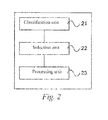
- Fig. 2 is a structural schematic diagram of an apparatus for labeling training samples provided in another embodiment of the present invention, as shown in Fig. 2 .
- the apparatus for labeling the training samples in this embodiment may comprise a classification unit 21, a selection unit 22 and a processing unit 23.
- the classification unit 21 is used for inputting M unlabeled first training samples into a first classifier to obtain a first forecasting result of each first training sample in the M first training samples, M being an integer greater than or equal to 1; the selection unit 22 is used for, according to the first forecasting result of each first training sample, selecting, from the M first training samples, N first training samples as second training samples, N being an integer greater than or equal to 1 and less than or equal to M; the classification unit 21 is also used for inputting the N second training samples into a second classifier to obtain a second forecasting result of each second training sample in the N second training samples, the first classifier and the second classifier being independent of each other; the selection unit 22 is also used for, according to the second forecasting result of each second training sample, selecting, from the N second training samples, P second training samples, P being an integer greater than or equal to 1 and less than or equal to N; the selection unit 22 is also used for, according to first forecasting results of other first training samples in the M first training samples, except the N second training samples
- the classification apparatus may be an application located in a local terminal, or may also be a functional unit such as a plug-in or a software development kit (SDK) arranged in the application located in the local terminal, or may also be a classification engine located in a network-side server, which is not particularly limited in this embodiment.
- SDK software development kit
- the application may be a local program (nativeApp) installed in a terminal, or may also be a webpage program (webApp) of a browser in the terminal, which is not limited in this embodiment.
- the selection unit 22 may be specifically used for obtaining the probability that the first training samples indicated by the first forecasting result are of a designated type; and selecting, from the M first training samples, the N first training samples of which the probability that the first training samples indicated by the first forecasting result are of a designated type satisfies a pre-set first training condition as the second training samples.
- the designated type may comprise, but is not limited to, a positive-example type and a counter-example type, which is not particularly limited in this embodiment. If the first forecasting result indicates that the first training samples are of a counter-example type, then it indicates that the first training samples are positive-example samples, i.e. positive samples, which may also be called white samples; conversely, if the first forecasting result indicates that the first training samples are of a positive-example type, then it indicates that the first training samples are counter-example samples, i.e. negative samples, which may also be called black samples.
- the first training condition may specifically comprise, but is not limited to, the following: the probability that the first training samples indicated by the first forecasting result are of a designated type is greater than or equal to a first threshold value and is less than or equal to a second threshold value.
- the selection unit 22 may be specifically used for obtaining the probability that the second training samples indicated by the second forecasting result are of a designated type; and selecting, from the N second training samples, the P second training samples of which the probability that the second training samples indicated by the second forecasting result are of a designated type satisfies a pre-set second training condition.
- the second training condition may specifically comprise, but is not limited to, the following: a designated number with the minimum probability that the second training samples indicated by the second forecasting result are of a designated type.
- the selection unit 22 may be specifically used for selecting, from the other first training samples, P first training samples of which the probability that the first training samples indicated by the first forecasting result are of a designated type satisfies a pre-set third training condition; and selecting, from the other first training samples, Q-P first training samples of which the probability that the first training samples indicated by the first forecasting result are of a designated type satisfies a pre-set fourth training condition.
- the third training condition may specifically comprise, but is not limited to, the following: a designated number with the minimum probability that the first training samples indicated by the first forecasting result are of a designated type.
- the fourth training condition may specifically comprise, but is not limited to, the following: a designated number with the maximum probability that the first training samples indicated by the first forecasting result are of a designated type.
- the ratio of Q-P to 2P is a golden ratio, for example, 1.618.
- the ratio of the selected positive-example samples to the counter-example samples may be a golden ratio, the unbalancing of samples in the training sample set may be effectively reduced.
- two mutually independent classifiers i.e. a first classifier and a second classifier, are used to perform collaborative forecasting on M unlabeled first training samples to obtain some of the labeled first training samples, without the need for the participation of operators; the operation is simple and the accuracy is high, thereby improving the efficiency and reliability of labeling the training samples.
- the second classifier and the first classifier are not related and are completely independent of each other, the diversity of the training samples of the first classifier built in a next iteration may be increased. Meanwhile, the classification capability of the first classifier may be further increased, and the accuracy rate of the classification results may be further improved.
- the disclosed systems, apparatuses and methods may be implemented in other manners.
- the apparatus embodiments described above are merely illustrative, for example, the division of the units is merely a logical function division, and there may be other division manners during actual implementation, for example, a plurality of units or components may be combined or may be integrated into another system, or some features may be omitted or not carried out.
- the shown or discussed coupling or direct coupling or communication connection may be an indirect coupling or a communication connection via some interfaces, apparatuses, or units, and may be electrical, mechanical, or in other forms.
- the units described as separate components may or may not be physically separate, and components displayed as units may or may not be physical units, that is, they may be located in one position, or may also be distributed on a plurality of network elements. Some or all of the units may be selected according to actual needs to achieve the objectives of the solutions of the present embodiments.
- various functional units in various embodiments of the present invention may be integrated into one processing unit, or each of the units may also exist alone physically, or two or more than two units may be integrated into one unit.
- the above-mentioned integrated unit may be implemented in the form of hardware, and may also be implemented in the form of hardware and software functional units.
- the integrated unit implemented by software functional units may be stored in a computer readable storage medium.
- the above-mentioned software functional units e.g. computer programs
- the foregoing storage medium comprises: various medium that may store program codes, such as a U-disk, a removable hard disk, a read-only memory (ROM), a random access memory (RAM), a magnetic disk, or an optical disk.
Landscapes
- Engineering & Computer Science (AREA)
- Theoretical Computer Science (AREA)
- Software Systems (AREA)
- Physics & Mathematics (AREA)
- General Physics & Mathematics (AREA)
- Data Mining & Analysis (AREA)
- General Engineering & Computer Science (AREA)
- Evolutionary Computation (AREA)
- Artificial Intelligence (AREA)
- Mathematical Physics (AREA)
- Computing Systems (AREA)
- Computer Vision & Pattern Recognition (AREA)
- Medical Informatics (AREA)
- Computational Mathematics (AREA)
- Pure & Applied Mathematics (AREA)
- Mathematical Optimization (AREA)
- Mathematical Analysis (AREA)
- Algebra (AREA)
- Probability & Statistics with Applications (AREA)
- Information Retrieval, Db Structures And Fs Structures Therefor (AREA)
- Other Investigation Or Analysis Of Materials By Electrical Means (AREA)
Abstract
Description
- The present invention relates to machine learning technology, and in particular to a method and apparatus for labeling training samples.
- A classification model, i.e. a classifier, is built using machine learning technology, which may be generally divided into three phases: sample labeling, feature extraction and model training in a training phase. In the prior art, unlabeled training samples, i.e. data of unknown types, need to be manually labeled one by one, so as to obtain labeled training samples, i.e. data of known types, and then a large number of training samples of the known types may be used to built a classifier. The classifier may be applied in many scenarios, for example, since more and more spam pages are generated due to network fraud, which seriously impacts the retrieval efficiency of a search engine and the user experience, counteracting fraud has become one of the most important challenges faced by the search engine, and labeled normal data and fraud data may be used to built a classifier to identify network data. Regarding machine learning, the greater the number of training samples, the higher the classification accuracy rate of the built classifier, and a large number of known types of training samples need to be acquired.
- However, the operation of manually labeling a large number of training samples is complex and prone to error, thereby resulting in the reduction of the efficiency and reliability of labeling the training samples.
- A method and apparatus for labeling training samples are provided in a plurality of aspects of the present invention, so as to improve the efficiency and reliability of labeling the training samples.
- A method for labeling training samples is provided in one aspect of the present invention, comprising:
- inputting M unlabeled first training samples into a first classifier to obtain a first forecasting result of each first training sample in the M first training samples, M being an integer greater than or equal to 1;
- according to the first forecasting result of each first training sample, selecting, from the M first training samples, N first training samples as second training samples, N being an integer greater than or equal to 1 and less than or equal to M;
- inputting the N second training samples into a second classifier to obtain a second forecasting result of each second training sample in the N second training samples, the first classifier and the second classifier being independent of each other;
- according to the second forecasting result of each second training sample, selecting, from the N second training samples, P second training samples, P being an integer greater than or equal to 1 and less than or equal to N;
- according to first forecasting results of other first training samples in the M first training samples, except the N second training samples, and the value of P, selecting, from the other first training samples, Q first training samples, Q being an integer greater than or equal to 1 and less than or equal to M-N; and
- according to second forecasting results of the P second training samples and each of the second training samples therein, generating P labeled second training samples, and according to first forecasting results of the Q first training samples and each of the first training samples therein, generating Q labeled first training samples.
- In the aspect as mentioned above and in any possible implementation, an implementation is further provided, and according to the first forecasting result of each first training sample, selecting, from the M first training samples, N first training samples as second training samples comprises:
- obtaining the probability that the first training samples indicated by the first forecasting result are of a designated type; and
- selecting, from the M first training samples, the N first training samples of which the probability that the first training samples indicated by the first forecasting result are of a designated type satisfies a pre-set first training condition as the second training samples.
- In the aspect as mentioned above and in any possible implementation, an implementation is further provided, and the first training condition comprises:
- the probability that the first training samples indicated by the first forecasting result are of a designated type is greater than or equal to a first threshold value and is less than or equal to a second threshold value.
- In the aspect as mentioned above and in any possible implementation, an implementation is further provided, and according to the second forecasting result of each second training sample, selecting, from the N second training samples, P second training samples comprises:
- obtaining the probability that the second training samples indicated by the second forecasting result are of a designated type; and
- selecting, from the N second training samples, the P second training samples of which the probability that the second training samples indicated by the second forecasting result are of a designated type satisfies a pre-set second training condition.
- In the aspect as mentioned above and in any possible implementation, an implementation is further provided, and the second training condition comprises:
- a designated number with the minimum probability that the second training samples indicated by the second forecasting result are of a designated type.
- In the aspect as mentioned above and in any possible implementation, an implementation is further provided, and according to first forecasting results of other first training samples in the M first training samples, except the N second training samples, and the value of P, selecting, from the other first training samples, Q first training samples comprises:
- selecting, from the other first training samples, P first training samples of which the probability that the first training samples indicated by the first forecasting result are of a designated type satisfies a pre-set third training condition; and
- selecting, from the other first training samples, Q-P first training samples of which the probability that the first training samples indicated by the first forecasting result are of a designated type satisfies a pre-set fourth training condition.
- In the aspect as mentioned above and in any possible implementation, an implementation is further provided, and the third training condition comprises:
- a designated number with the minimum probability that the first training samples indicated by the first forecasting result are of a designated type.
- In the aspect as mentioned above and in any possible implementation, an implementation is further provided, and the fourth training condition comprises:
- a designated number with the maximum probability that the first training samples indicated by the first forecasting result are of a designated type.
- In the aspect as mentioned above and in any possible implementation, an implementation is further provided, and the ratio of Q-P to 2P is a golden ratio.
- In the aspect as mentioned above and in any possible implementation, an implementation is further provided, and the designated type comprises a positive-example type or a counter-example type.
- An apparatus for labeling training samples is provided in another aspect of the present invention, comprising:
- a classification unit for inputting M unlabeled first training samples into a first classifier to obtain a first forecasting result of each first training sample in the M first training samples, M being an integer greater than or equal to 1;
- a selection unit for, according to the first forecasting result of each first training sample, selecting, from the M first training samples, N first training samples as second training samples, N being an integer greater than or equal to 1 and less than or equal to M;
- the classification unit further being for inputting the N second training samples into a second classifier to obtain a second forecasting result of each second training sample in the N second training samples, the first classifier and the second classifier being independent of each other;
- the selection unit further being for, according to the second forecasting result of each second training sample, selecting, from the N second training samples, P second training samples, P being an integer greater than or equal to 1 and less than or equal to N;
- the selection unit further being for, according to first forecasting results of other first training samples in the M first training samples, except the N second training samples, and the value of P, selecting, from the other first training samples, Q first training samples, Q being an integer greater than or equal to 1 and less than or equal to M-N; and
- a processing unit for, according to second forecasting results of the P second training samples and each of the second training samples therein, generating P labeled second training samples, and according to first forecasting results of the Q first training samples and each of the first training samples therein, generating Q labeled first training samples.
- In the aspect as mentioned above and in any possible implementation, an implementation is further provided, and the selection unit is specifically used for:
- obtaining the probability that the first training samples indicated by the first forecasting result are of a designated type; and
- selecting, from the M first training samples, the N first training samples of which the probability that the first training samples indicated by the first forecasting result are of a designated type satisfies a pre-set first training condition as the second training samples.
- In the aspect as mentioned above and in any possible implementation, an implementation is further provided, and the first training condition comprises:
- the probability that the first training samples indicated by the first forecasting result are of a designated type is greater than or equal to a first threshold value and is less than or equal to a second threshold value.
- In the aspect as mentioned above and in any possible implementation, an implementation is further provided, and the selection unit is specifically used for:
- obtaining the probability that the second training samples indicated by the second forecasting result are of a designated type; and
- selecting, from the N second training samples, the P second training samples of which the probability that the second training samples indicated by the second forecasting result are of a designated type satisfies a pre-set second training condition.
- In the aspect as mentioned above and in any possible implementation, an implementation is further provided, and the second training condition comprises:
- a designated number with the minimum probability that the second training samples indicated by the second forecasting result are of a designated type.
- In the aspect as mentioned above and in any possible implementation, an implementation is further provided, and the selection unit is specifically used for:
- selecting, from the other first training samples, P first training samples of which the probability that the first training samples indicated by the first forecasting result are of a designated type satisfies a pre-set third training condition; and
- selecting, from the other first training samples, Q-P first training samples of which the probability that the first training samples indicated by the first forecasting result are of a designated type satisfies a pre-set fourth training condition.
- In the aspect as mentioned above and in any possible implementation, an implementation is further provided, and the third training condition comprises:
- a designated number with the minimum probability that the first training samples indicated by the first forecasting result are of a designated type.
- In the aspect as mentioned above and in any possible implementation, an implementation is further provided, and the fourth training condition comprises:
- a designated number with the maximum probability that the first training samples indicated by the first forecasting result are of a designated type.
- In the aspect as mentioned above and in any possible implementation, an implementation is further provided, and the ratio of Q-P to 2P is a golden ratio.
- In the aspect as mentioned above and in any possible implementation, an implementation is further provided, and the designated type comprises a positive-example type or a counter-example type.
- It may be seen from the above-mentioned technical solutions that in the embodiments of the present invention, by inputting M unlabeled first training samples into a first classifier to obtain a first forecasting result of each first training sample, and then, according to the first forecasting result of each first training sample, selecting, from the M first training samples, N first training samples as second training samples, and inputting the N second training samples into a second classifier which is independent of the first classifier to obtain a second forecasting result of each second training sample, and then, according to the second forecasting result of each second training sample, selecting, from the N second training samples, P second training samples, and according to first forecasting results of other first training samples in the M first training samples, except the N second training samples, and the value of P, selecting, from other first training samples, Q first training samples, so that P labeled second training samples may be generated according to second forecasting results of the P second training samples and each of the second training samples therein, and Q labeled first training samples may be generated according to first forecasting results of the Q first training samples and each of the first training samples therein. Two mutually independent classifiers, i.e. a first classifier and a second classifier, are used to perform collaborative forecasting on the M unlabeled first training samples to obtain some of the labeled first training samples, without the need for the participation of operators; the operation is simple and the accuracy is high, thereby improving the efficiency and reliability of labeling the training samples.
- In addition, by means of the technical solutions provided in the present invention, since the second classifier and the first classifier are not related and are completely independent of each other, the diversity of the training samples of the first classifier built in a next iteration may be increased. Meanwhile, the classification capability of the first classifier may be further increased, and the accuracy rate of the classification results may be further improved.
- In order to illustrate the technical solutions in the embodiments of the present invention more clearly, the accompanying drawings which need to be used in the description of the embodiments or the prior art are briefly introduced below. Obviously, the accompanying drawings in the following description are only some embodiments of the present invention, and those of ordinary skill in the art may further obtain other drawings according to these accompanying drawings without making any inventive effort.
-
Fig. 1 is a schematic flowchart of a method for labeling training samples provided in an embodiment of the present invention; and -
Fig. 2 is a structural schematic diagram of an apparatus for labeling training samples provided in another embodiment of the present invention. - In order to make the objectives, technical solutions and advantages of the embodiments of the present invention more clear, the technical solutions in the embodiments of the present invention will be described clearly and completely below in combination with the accompanying drawings in the embodiments of the present invention. Obviously, the embodiments described are some of the embodiments of the present invention rather than all of the embodiments. All other embodiments obtained by those of ordinary skill in the art and based on the embodiments in the present invention without making any inventive effort are within the scope of protection of the present invention.
- In addition, the term "and/or" herein is merely an association relationship describing associated objects, and indicates that three relationships may exist, for example, A and/or B may indicate: the three cases where A exists alone, A and B exist simultaneously, and B exists alone. In addition, the character "/" herein generally indicates an "or" relationship between associated objects.
-
Fig. 1 is a schematic flowchart of a method for labeling training samples provided in an embodiment of the present invention, as shown inFig. 1 . - 101. inputting M unlabeled first training samples into a first classifier to obtain a first forecasting result of each first training sample in the M first training samples, M being an integer greater than or equal to 1.
- It may be understood that before 101, a few of the labeled initial training samples may form a training sample set to build a first classifier. The labeled initial training samples are data of some known types. Specifically, some labeled initial training samples contained in the training sample set need to be used in advance to perform training, so as to build an initial classifier, i.e. the first classifier used in 101. Specifically, the requirements for the first classifier built may not need to be particularly stringent, for example, the classification accuracy thereof only needs to be greater than or equal to 60%, and thus, it is easy to realize.
- 102. According to the first forecasting result of each first training sample, selecting, from the M first training samples, N first training samples as second training samples, N being an integer greater than or equal to 1 and less than or equal to M.
- 103. Inputting the N second training samples into a second classifier to obtain a second forecasting result of each second training sample in the N second training samples, the first classifier and the second classifier being independent of each other.
- The so-called first classifier and second classifier being independent of each other may be understood as meaning that the training processes thereof are different, for example, the training samples used thereby are different, or in another example, the classification algorithms used thereby are different, etc.; therefore, the forecasting results of both, i.e. the first forecasting result and the second forecasting result, are also independent of each other.
- 104. According to the second forecasting result of each second training sample, selecting, from the N second training samples, P second training samples, P being an integer greater than or equal to 1 and less than or equal to N.
- 105. According to first forecasting results of other first training samples in the M first training samples, except the N second training samples, and the value of P, selecting, from the other first training samples, Q first training samples, Q being an integer greater than or equal to 1 and less than or equal to M-N.
- 106. According to second forecasting results of the P second training samples and each of the second training samples therein, generating P labeled second training samples, and according to first forecasting results of the Q first training samples and each of the first training samples therein, generating Q labeled first training samples.
- It shall be noted that the execution body of 101-106 may be an application located in a local terminal, or may also be a functional unit such as a plug-in or a software development kit (SDK) arranged in the application located in the local terminal, or may also be a classification engine located in a network-side server, which is not particularly limited in this embodiment.
- It may be understood that the application may be a local program (nativeApp) installed in a terminal, or may also be a webpage program (webApp) of a browser in the terminal, which is not limited in this embodiment.
- In this way, by inputting M unlabeled first training samples into a first classifier to obtain a first forecasting result of each first training sample, and then, according to the first forecasting result of each first training sample, selecting, from the M first training samples, N first training samples as second training samples, and inputting the N second training samples into a second classifier which is independent of the first classifier to obtain a second forecasting result of each second training sample, and then, according to the second forecasting result of each second training sample, selecting, from the N second training samples, P second training samples, and according to first forecasting results of other first training samples in the M first training samples, except the N second training samples, and the value of P, selecting, from other first training samples, Q first training samples, so that P labeled second training samples may be generated according to second forecasting results of the P second training samples and each of the second training samples therein, and Q labeled first training samples may be generated according to first forecasting results of the Q first training samples and each of the first training samples therein. Two mutually independent classifiers, i.e. a first classifier and a second classifier, are used to perform collaborative forecasting on the M unlabeled first training samples to obtain some of the labeled first training samples, without the need for the participation of operators; the operation is simple and the accuracy is high, thereby improving the efficiency and reliability of labeling the training samples.
- Optionally, in a possible implementation of this embodiment, in 102, the probability that the first training samples indicated by the first forecasting result are of a designated type may be specifically obtained. Then, the N first training samples of which the probability that the first training samples indicated by the first forecasting result are of a designated type satisfies a pre-set first training condition may be selected from the M first training samples as the second training samples.
- Specifically, the designated type may comprise, but is not limited to, a positive-example type and a counter-example type, which is not particularly limited in this embodiment. The first forecasting result is used for indicating that the first training samples are of a positive-example type or a counter-example type. For example, the first forecasting result being 0 may be used to indicate that the first training samples are of a positive-example type, and the first forecasting result being 1 may be used to indicate that the first training samples are of a counter-example type. Or vice versa, the first forecasting result being 1 may be used to indicate that the first training samples are of a positive-example type, and the first forecasting result being 0 may be used to indicate that the first training samples are of a counter-example type. The specific form of the first forecasting result is not particularly limited in this embodiment. If the first forecasting result indicates that the first training samples are of a positive-example type, then it indicates that the first training samples are positive-example samples, i.e. positive samples, which may also be called white samples; conversely, if the first forecasting result indicates that the first training samples are of a counter-example type, then it indicates that the first training samples are counter-example samples, i.e. negative samples, which may also be called black samples.
- Specifically, the first training condition may specifically comprise, but is not limited to, the following: the probability that the first training samples indicated by the first forecasting result are of a designated type is greater than or equal to a first threshold value and is less than or equal to a second threshold value.
- For example, the first threshold value may be specifically set to 0.4, and the second threshold value may be specifically set to 0.6, then the probability that the first training samples indicated by these first forecasting results satisfying the first training condition are of a designated type may be between 0.4 and 0.6, and regarding the first classifier, the first forecasting results of this part of first training samples are fuzzy; therefore, this portion of first training samples are continuously taken as training samples, i.e. the second training samples, and input into other classifiers, i.e. the second classifier independent of the first classifier. Since the second classifier and the first classifier are not related and are completely independent of each other, the diversity of the training samples of the first classifier built in a next iteration may be increased. Meanwhile, the classification capability of the first classifier may be further increased, and the accuracy rate of the classification results may be further improved.
- Furthermore, in 104, the probability that the second training samples indicated by the second forecasting result are of a designated type may be specifically obtained. Then, the P second training samples of which the probability that the second training samples indicated by the second forecasting result are of a designated type satisfies a pre-set second training condition may be selected from the N second training samples.
- Specifically, the second training condition may specifically comprise, but is not limited to, the following: a designated number with the minimum probability that the second training samples indicated by the second forecasting result are of a designated type.
- For example, the probabilities that the second training samples indicated by the second forecasting result are of a designated type may be specifically ranked in an order from the smallest to largest, and the top-ranked P second training samples are selected. Since in some application scenarios such as anti-fraud scenarios, the proportion of the counter-example samples is very low, and selecting, using the second training condition, the P second training samples of which the probability that the second training samples indicated by the second forecasting result is of a positive-example type satisfies a pre-set second training condition, may increase the proportion of the counter-example samples to some extent.
- Accordingly, in 105, P first training samples of which the probability that the first training samples indicated by the first forecasting result are of a designated type satisfies a pre-set third training condition may be specifically selected from the other first training samples, and Q-P first training samples of which the probability that the first training samples indicated by the first forecasting result are of a designated type satisfies a pre-set fourth training condition may be selected from the other first training samples.
- Specifically, the third training condition may specifically comprise, but is not limited to, the following: a designated number with the minimum probability that the first training samples indicated by the first forecasting result are of a designated type. For example, the probabilities that the first training samples indicated by the first forecasting result are of a designated type may be specifically ranked in an order from the smallest to largest, and the top-ranked P first training samples are selected.
- Specifically, the fourth training condition may specifically comprise, but is not limited to, the following: a designated number with the maximum probability that the first training samples indicated by the first forecasting result are of a designated type. For example, the probabilities that the first training samples indicated by the first forecasting result are of a designated type may be specifically ranked in an order from the smallest to largest, and the bottom-ranked Q-P first training samples are selected.
- Preferably, the ratio of Q-P to 2P is a golden ratio, for example, 1.618. In this way, by limiting the ratio of the selected positive-example samples to the counter-example samples to be a golden ratio, the unbalancing of samples in the training sample set may be effectively reduced.
- By then, the generated labeled P second training samples, the generated labeled P first training samples and the generated labeled Q-P first training samples may be added to the training sample set, and the new training sample set is used to re-built a new first classifier. In this way, the new first classifier built may be used to enter a next iteration, and 101-106 are executed circularly until the first classifier built or the training sample set satisfies a termination condition of the first classifier, for example, the classification accuracy rate is greater than or equal to a pre-set accuracy rate threshold value or the number of first training samples contained in the training sample set is greater than or equal to a pre-set number threshold value, which is not particularly limited in this embodiment.
- In this embodiment, two mutually independent classifiers, i.e. a first classifier and a second classifier, are used to perform collaborative forecasting on M unlabeled first training samples to obtain some of the labeled first training samples, without the need for the participation of operators; the operation is simple and the accuracy is high, thereby improving the efficiency and reliability of labeling the training samples.
- In addition, by means of the technical solutions provided in the present invention, since the second classifier and the first classifier are not related and are completely independent of each other, the diversity of the training samples of the first classifier built in a next iteration may be increased. Meanwhile, the classification capability of the first classifier may be further increased, and the accuracy rate of the classification results may be further improved.
- It shall be noted that, regarding the foregoing method embodiments, and for the sake of a simple description, the methods are described as a series of action combinations, but those of ordinary skill in the art shall know that the present invention is not limited to the action sequence described, because according to the present invention, some steps may be performed in other sequences or may be performed simultaneously. Next, those skilled in the art shall also know that the embodiments described in the description are all preferred embodiments, and the actions and modules involved are not necessarily required in the present invention.
- In the above-mentioned embodiments, the description of each embodiment has its own emphasis, and for a part that is not detailed in a certain embodiment, reference may be made to the relevant description of other embodiments.
-
Fig. 2 is a structural schematic diagram of an apparatus for labeling training samples provided in another embodiment of the present invention, as shown inFig. 2 . The apparatus for labeling the training samples in this embodiment may comprise a classification unit 21, aselection unit 22 and aprocessing unit 23. The classification unit 21 is used for inputting M unlabeled first training samples into a first classifier to obtain a first forecasting result of each first training sample in the M first training samples, M being an integer greater than or equal to 1; the selection unit 22 is used for, according to the first forecasting result of each first training sample, selecting, from the M first training samples, N first training samples as second training samples, N being an integer greater than or equal to 1 and less than or equal to M; the classification unit 21 is also used for inputting the N second training samples into a second classifier to obtain a second forecasting result of each second training sample in the N second training samples, the first classifier and the second classifier being independent of each other; the selection unit 22 is also used for, according to the second forecasting result of each second training sample, selecting, from the N second training samples, P second training samples, P being an integer greater than or equal to 1 and less than or equal to N; the selection unit 22 is also used for, according to first forecasting results of other first training samples in the M first training samples, except the N second training samples, and the value of P, selecting, from the other first training samples, Q first training samples, Q being an integer greater than or equal to 1 and less than or equal to M-N; and the processing unit 23 is used for generating, according to second forecasting results of the P second training samples and each of the second training samples therein, P labeled second training samples, and generating, according to first forecasting results of the Q first training samples and each of the first training samples therein, Q labeled first training samples. - It shall be noted that the classification apparatus provided in this embodiment may be an application located in a local terminal, or may also be a functional unit such as a plug-in or a software development kit (SDK) arranged in the application located in the local terminal, or may also be a classification engine located in a network-side server, which is not particularly limited in this embodiment.
- It may be understood that the application may be a local program (nativeApp) installed in a terminal, or may also be a webpage program (webApp) of a browser in the terminal, which is not limited in this embodiment.
- Optionally, in a possible implementation of this embodiment, the
selection unit 22 may be specifically used for obtaining the probability that the first training samples indicated by the first forecasting result are of a designated type; and selecting, from the M first training samples, the N first training samples of which the probability that the first training samples indicated by the first forecasting result are of a designated type satisfies a pre-set first training condition as the second training samples. - Specifically, the designated type may comprise, but is not limited to, a positive-example type and a counter-example type, which is not particularly limited in this embodiment. If the first forecasting result indicates that the first training samples are of a counter-example type, then it indicates that the first training samples are positive-example samples, i.e. positive samples, which may also be called white samples; conversely, if the first forecasting result indicates that the first training samples are of a positive-example type, then it indicates that the first training samples are counter-example samples, i.e. negative samples, which may also be called black samples.
- Specifically, the first training condition may specifically comprise, but is not limited to, the following: the probability that the first training samples indicated by the first forecasting result are of a designated type is greater than or equal to a first threshold value and is less than or equal to a second threshold value.
- Furthermore, the
selection unit 22 may be specifically used for obtaining the probability that the second training samples indicated by the second forecasting result are of a designated type; and selecting, from the N second training samples, the P second training samples of which the probability that the second training samples indicated by the second forecasting result are of a designated type satisfies a pre-set second training condition. - Specifically, the second training condition may specifically comprise, but is not limited to, the following: a designated number with the minimum probability that the second training samples indicated by the second forecasting result are of a designated type.
- Accordingly, the
selection unit 22 may be specifically used for selecting, from the other first training samples, P first training samples of which the probability that the first training samples indicated by the first forecasting result are of a designated type satisfies a pre-set third training condition; and selecting, from the other first training samples, Q-P first training samples of which the probability that the first training samples indicated by the first forecasting result are of a designated type satisfies a pre-set fourth training condition. - Specifically, the third training condition may specifically comprise, but is not limited to, the following: a designated number with the minimum probability that the first training samples indicated by the first forecasting result are of a designated type.
- Specifically, the fourth training condition may specifically comprise, but is not limited to, the following: a designated number with the maximum probability that the first training samples indicated by the first forecasting result are of a designated type.
- Preferably, the ratio of Q-P to 2P is a golden ratio, for example, 1.618. In this way, by limiting the ratio of the selected positive-example samples to the counter-example samples to be a golden ratio, the unbalancing of samples in the training sample set may be effectively reduced.
- It shall be noted that the method in the embodiment corresponding to
Fig. 1 may be realized by the apparatus for labeling training samples which is provided in this embodiment. Reference may be made to the relevant contents in the embodiment corresponding toFig. 1 for a detailed description, which will not be described here. - In this embodiment, two mutually independent classifiers, i.e. a first classifier and a second classifier, are used to perform collaborative forecasting on M unlabeled first training samples to obtain some of the labeled first training samples, without the need for the participation of operators; the operation is simple and the accuracy is high, thereby improving the efficiency and reliability of labeling the training samples.
- In addition, by means of the technical solutions provided in the present invention, since the second classifier and the first classifier are not related and are completely independent of each other, the diversity of the training samples of the first classifier built in a next iteration may be increased. Meanwhile, the classification capability of the first classifier may be further increased, and the accuracy rate of the classification results may be further improved.
- Those of ordinary skill in the art may clearly understand that, for convenience and brevity of description, the specific operation processes of the above systems, apparatuses, and units may refer to the corresponding processes in the method embodiments, which will not be described here.
- In a few embodiments provided in the present invention, it shall be understood that the disclosed systems, apparatuses and methods may be implemented in other manners. For example, the apparatus embodiments described above are merely illustrative, for example, the division of the units is merely a logical function division, and there may be other division manners during actual implementation, for example, a plurality of units or components may be combined or may be integrated into another system, or some features may be omitted or not carried out. In another point, the shown or discussed coupling or direct coupling or communication connection may be an indirect coupling or a communication connection via some interfaces, apparatuses, or units, and may be electrical, mechanical, or in other forms.
- The units described as separate components may or may not be physically separate, and components displayed as units may or may not be physical units, that is, they may be located in one position, or may also be distributed on a plurality of network elements. Some or all of the units may be selected according to actual needs to achieve the objectives of the solutions of the present embodiments.
- In addition, various functional units in various embodiments of the present invention may be integrated into one processing unit, or each of the units may also exist alone physically, or two or more than two units may be integrated into one unit. The above-mentioned integrated unit may be implemented in the form of hardware, and may also be implemented in the form of hardware and software functional units.
- The integrated unit implemented by software functional units may be stored in a computer readable storage medium. The above-mentioned software functional units (e.g. computer programs) are stored in a storage medium and include several instructions for making a computer device (which may be a personal computer, a server, or a network device and so on) or a processor execute some steps of the method described in the embodiments of the present invention. The foregoing storage medium comprises: various medium that may store program codes, such as a U-disk, a removable hard disk, a read-only memory (ROM), a random access memory (RAM), a magnetic disk, or an optical disk.
- It shall finally be noted that the embodiments above are merely used for illustrating the technical solutions of the present invention rather than limiting same; although the present invention is described in detail with reference to the foregoing embodiments, those of ordinary skill in the art shall understand that they may still make modifications to the technical solutions stated in the foregoing various embodiments or make equivalent replacements to some of the technical features thereof; and these modifications or replacements shall not result in the essence of the corresponding technical solutions departing from the spirit and scope of the technical solutions of various embodiments of the present invention.
- The following numbered paragraphs are also disclosed:
- 1. A method for labeling training samples, characterized in that it comprises:
- inputting M unlabeled first training samples into a first classifier to obtain a first forecasting result of each first training sample in said M first training samples, M being an integer greater than or equal to 1;
- according to said first forecasting result of each first training sample, selecting, from said M first training samples, N first training samples as second training samples, N being an integer greater than or equal to 1 and less than or equal to M;
- inputting said N second training samples into a second classifier to obtain a second forecasting result of each second training sample in said N second training samples, said first classifier and said second classifier being independent of each other;
- according to said second forecasting result of each second training sample, selecting, from said N second training samples, P second training samples, P being an integer greater than or equal to 1 and less than or equal to N;
- according to first forecasting results of other first training samples in said M first training samples, except said N second training samples, and the value of P, selecting, from said other first training samples, Q first training samples, Q being an integer greater than or equal to 1 and less than or equal to M-N; and
- according to second forecasting results of said P second training samples and each of the second training samples therein, generating P labeled second training samples, and according to first forecasting results of said Q first training samples and each of the first training samples therein, generating Q labeled first training samples.
- 2. The method according to
paragraph 1, characterized in that, according to said first forecasting result of each first training sample, selecting, from said M first training samples, N first training samples as second training samples comprises:- obtaining the probability that said first training samples indicated by the first forecasting result are of a designated type; and
- selecting, from said M first training samples, said N first training samples of which the probability that said first training samples indicated by the first forecasting result are of a designated type satisfies a pre-set first training condition as the second training samples.
- 3. The method according to paragraph 2, characterized in that said first training condition comprises:
- the probability that said first training samples indicated by the first forecasting result are of a designated type is greater than or equal to a first threshold value and is less than or equal to a second threshold value.
- 4. The method according to paragraph 2, characterized in that said, according to said second forecasting result of each second training sample, selecting, from said N second training samples, P second training samples comprises:
- obtaining the probability that said second training samples indicated by the second forecasting result are of a designated type; and
- selecting, from said N second training samples, said P second training samples of which the probability that said second training samples indicated by the second forecasting result are of a designated type satisfies a pre-set second training condition.
- 5. The method according to paragraph 4, characterized in that said second training condition comprises:
- a designated number with the minimum probability that said second training samples indicated by the second forecasting result are of a designated type.
- 6. The method according to paragraph 4, characterized in that said, according to first forecasting results of other first training samples in said M first training samples, except said N second training samples, and the value of P, selecting, from said other first training samples, Q first training samples comprises:
- selecting, from said other first training samples, P first training samples of which the probability that said first training samples indicated by the first forecasting result are of a designated type satisfies a pre-set third training condition; and
- selecting, from said other first training samples, Q-P first training samples of which the probability that said first training samples indicated by the first forecasting result are of a designated type satisfies a pre-set fourth training condition.
- 7. The method according to paragraph 6, characterized in that said third training condition comprises:
- a designated number with the minimum probability that said first training samples indicated by the first forecasting result are of a designated type.
- 8. The method according to paragraph 6, characterized in that said fourth training condition comprises:
- a designated number with the maximum probability that said first training samples indicated by the first forecasting result are of a designated type.
- 9. The method according to paragraph 6, characterized in that the ratio of Q-P to 2P is a golden ratio.
- 10. The method according to any one of paragraphs 2 to 9, characterized in that said designated type comprises a positive-example type or a counter-example type.
- 11. An apparatus for labeling training samples, characterized by comprising:
- a classification unit for inputting M unlabeled first training samples into a first classifier to obtain a first forecasting result of each first training sample in said M first training samples, M being an integer greater than or equal to 1;
- a selection unit for, according to said first forecasting result of each first training sample, selecting, from said M first training samples, N first training samples as second training samples, N being an integer greater than or equal to 1 and less than or equal to M;
- said classification unit further being for inputting said N second training samples into a second classifier to obtain a second forecasting result of each second training sample in said N second training samples, said first classifier and said second classifier being independent of each other;
- said selection unit further being for, according to said second forecasting result of each second training sample, selecting, from said N second training samples, P second training samples, P being an integer greater than or equal to 1 and less than or equal to N;
- said selection unit further being for, according to first forecasting results of other first training samples in said M first training samples, except said N second training samples, and the value of P, selecting, from said other first training samples, Q first training samples, Q being an integer greater than or equal to 1 and less than or equal to M-N; and
- a processing unit for generating, according to second forecasting results of said P second training samples and each of these second training samples, P labeled second training samples, and generating, according to first forecasting results of said Q first training samples and each of the first training samples therein, Q labeled first training samples.
- 12. The apparatus according to paragraph 11, characterized in that said selection unit is specifically used for:
- obtaining the probability that said first training samples indicated by the first forecasting result are of a designated type; and
- selecting, from said M first training samples, said N first training samples of which the probability that said first training samples indicated by the first forecasting result are of a designated type satisfies a pre-set first training condition as the second training samples.
- 13. The apparatus according to paragraph 12, characterized in that said first training condition comprises:
- the probability that said first training samples indicated by the first forecasting result are of a designated type is greater than or equal to a first threshold value and is less than or equal to a second threshold value.
- 14. The apparatus according to paragraph 12, characterized in that said selection unit is specifically used for:
- obtaining the probability that said second training samples indicated by the second forecasting result are of a designated type; and
- selecting, from said N second training samples, said P second training samples of which the probability that said second training samples indicated by the second forecasting result are of a designated type satisfies a pre-set second training condition.
- 15. The apparatus according to paragraph 14, characterized in that said second training condition comprises:
- a designated number with the minimum probability that said second training samples indicated by the second forecasting result are of a designated type.
- 16. The apparatus according to paragraph 14, characterized in that said selection unit is specifically used for:
- selecting, from said other first training samples, P first training samples of which the probability that said first training samples indicated by the first forecasting result are of a designated type satisfies a pre-set third training condition; and
- selecting, from said other first training samples, Q-P first training samples of which the probability that said first training samples indicated by the first forecasting result are of a designated type satisfies a pre-set fourth training condition.
- 17. The apparatus according to paragraph 16, characterized in that said third training condition comprises:
- a designated number with the minimum probability that said first training samples indicated by the first forecasting result are of a designated type.
- 18. The apparatus according to paragraph 16, characterized in that said fourth training condition comprises:
- a designated number with the maximum probability that said first training samples indicated by the first forecasting result are of a designated type.
- 19. The apparatus according to paragraph 16, characterized in that the ratio of Q-P to 2P is a golden ratio.
- 20. The apparatus according to any one of paragraphs 12 to 19, characterized in that said designated type comprises a positive-example type or a counter-example type.
- 21. A method for labeling training samples, comprising:
- inputting M unlabeled first training samples into a first classifier to obtain a first forecasting result of each first training sample in the M first training samples, M being an integer greater than or equal to 1;
- selecting N first training samples as second training samples from the M first training samples based upon the first forecasting result of each first training sample, N being an integer greater than or equal to 1 and less than or equal to M;
- inputting the N second training samples into a second classifier to obtain a second forecasting result of each second training sample in the N second training samples, the first classifier and the second classifier being independent of each other;
- selecting P second training samples from the N second training samples based upon the second forecasting result of each second training sample, P being an integer greater than or equal to 1 and less than or equal to N;
- selecting Q first training samples from other first training samples based upon the first forecasting results of other first training samples in the M first training samples apart from the N second training samples and the value of P, Q being an integer greater than or equal to 1 and less than or equal to a difference between M and N; and
- generating P labeled second training samples based upon second forecasting results of the P second training samples and each of the second training samples therein; and
- generating Q labeled first training samples based upon first forecasting results of the Q first training samples and each of the first training samples therein.
- 22. The method of paragraph 21, wherein, said selecting the N first training samples comprises:
- obtaining a first probability that said first training samples indicated by the first forecasting result are of a preselected type; and
- selecting, from the M first training samples, the N first training samples of which the first probability satisfies a pre-set first training condition as the second training samples.
- 23. The method of
paragraph 22, wherein the first training condition comprises a probability that the first training samples indicated by the first forecasting result are of a designated type is greater than or equal to a first threshold value and is less than or equal to a second threshold value. - 24. The method of
paragraph 22, wherein said selecting the P second training samples comprises:- obtaining a second probability that the second training samples indicated by the second forecasting result are of a designated type; and
- selecting, from the N second training samples, the P second training samples of which the second probability satisfies a pre-set second training condition.
- 25. The method of paragraph 24, wherein the second training condition comprises a designated number with a minimum probability that the second training samples indicated by the second forecasting result are of a designated type.
- 26. The method of paragraph 24, wherein said selecting the Q first training samples comprises:
- selecting, from the other first training samples, P first training samples of which a third probability that the first training samples indicated by the first forecasting result are of a designated type satisfies a pre-set third training condition; and
- selecting, from the other first training samples, Q-P first training samples of which the third probability satisfies a pre-set fourth training condition.
- 27. The method of paragraph 26, wherein the third training condition comprises a designated number with a minimum probability that the first training samples indicated by the first forecasting result are of a designated type.
- 28. The method of paragraph 26, wherein the fourth training condition comprises a designated number with the maximum probability that the first training samples indicated by the first forecasting result are of a designated type.
- 29. The method of paragraph 26, wherein a ratio of Q-P to 2P is a golden ratio.
- 30. The method of
paragraph 22, wherein the designated type comprises at least one of a positive-example type and a counter-example type. - 31. An apparatus for labeling training samples, comprising:
- a classification system for inputting M unlabeled first training samples into a first classifier to obtain a first forecasting result of each first training sample in the M first training samples, M being an integer greater than or equal to 1;
- a selection system for, according to the first forecasting result of each first training sample, selecting, from the M first training samples, N first training samples as second training samples, N being an integer greater than or equal to 1 and less than or equal to M;
- said classification system further being for inputting the N second training samples into a second classifier to obtain a second forecasting result of each second training sample in the N second training samples, the first classifier and the second classifier being independent of each other;
- said selection system further being for, according to the second forecasting result of each second training sample, selecting, from said N second training samples, P second training samples, P being an integer greater than or equal to 1 and less than or equal to N;
- said selection system further being for, according to first forecasting results of other first training samples in the M first training samples, apart from the N second training samples, and the value of P, selecting, from the other first training samples, Q first training samples, Q being an integer greater than or equal to 1 and less than or equal to a difference of M-N; and
- a processing system for generating, according to second forecasting results of the P second training samples and each of the second training samples, P labeled second training samples, and generating, according to first forecasting results of the Q first training samples and each of the first training samples therein, Q labeled first training samples.
- 32. The apparatus of paragraph 31, wherein said said selection system is configured for:
- obtaining a first probability that said first training samples indicated by the first forecasting result are of a preselected type; and
- selecting, from the M first training samples, the N first training samples of which the first probability satisfies a pre-set first training condition as the second training samples.
- 33. The apparatus of paragraph 32, wherein the first training condition comprises a probability that the first training samples indicated by the first forecasting result are of a designated type is greater than or equal to a first threshold value and is less than or equal to a second threshold value.
- 34. The apparatus of paragraph 32, wherein said selection system is configured for:
- obtaining a second probability that the second training samples indicated by the second forecasting result are of a designated type; and
- selecting, from the N second training samples, the P second training samples of which the second probability satisfies a pre-set second training condition.
- 35. The apparatus of paragraph 34, wherein the second training condition comprises a designated number with a minimum probability that the second training samples indicated by the second forecasting result are of a designated type.
- 36. The apparatus of paragraph 34, wherein said selection system is configured for:
- selecting, from the other first training samples, P first training samples of which a third probability that the first training samples indicated by the first forecasting result are of a designated type satisfies a pre-set third training condition; and
- selecting, from the other first training samples, Q-P first training samples of which the third probability satisfies a pre-set fourth training condition.
- 37. The apparatus of paragraph 36, wherein the third training condition comprises a designated number with a minimum probability that the first training samples indicated by the first forecasting result are of a designated type.
- 38. The apparatus of paragraph 36, wherein the fourth training condition comprises a designated number with a maximum probability that the first training samples indicated by the first forecasting result are of a designated type.
- 39. The apparatus of paragraph 36, wherein the ratio of Q-P to 2P is a golden ratio.
- 40. The apparatus of paragraph 39, wherein the designated type comprises at least one of a positive-example type and a counter-example type.
Claims (11)
- A method for labeling training samples, comprising:inputting M unlabeled first training samples into a first classifier to obtain a first forecasting result of each first training sample in the M first training samples, M being an integer greater than or equal to 1;selecting N first training samples as second training samples from the M first training samples based upon the first forecasting result of each first training sample, N being an integer greater than or equal to 1 and less than or equal to M;inputting the N second training samples into a second classifier to obtain a second forecasting result of each second training sample in the N second training samples, the first classifier and the second classifier being independent of each other;selecting P second training samples from the N second training samples based upon the second forecasting result of each second training sample, P being an integer greater than or equal to 1 and less than or equal to N;selecting Q first training samples from other first training samples based upon the first forecasting results of other first training samples in the M first training samples apart from the N second training samples and the value of P, Q being an integer greater than or equal to 1 and less than or equal to a difference between M and N; andgenerating P labeled second training samples based upon second forecasting results of the P second training samples and each of the second training samples therein; andgenerating Q labeled first training samples based upon first forecasting results of the Q first training samples and each of the first training samples therein.
- The method of claim 1, wherein, said selecting the N first training samples comprises:obtaining a first probability that said first training samples indicated by the first forecasting result are of a preselected type; andselecting, from the M first training samples, the N first training samples of which the first probability satisfies a pre-set first training condition as the second training samples.
- The method of claim 2, wherein the first training condition comprises a probability that the first training samples indicated by the first forecasting result are of a designated type is greater than or equal to a first threshold value and is less than or equal to a second threshold value.
- The method of claim 2, wherein said selecting the P second training samples comprises:obtaining a second probability that the second training samples indicated by the second forecasting result are of a designated type; andselecting, from the N second training samples, the P second training samples of which the second probability satisfies a pre-set second training condition.
- The method of claim 4, wherein the second training condition comprises a designated number with a minimum probability that the second training samples indicated by the second forecasting result are of a designated type.
- The method of claim 4, wherein said selecting the Q first training samples comprises:selecting, from the other first training samples, P first training samples of which a third probability that the first training samples indicated by the first forecasting result are of a designated type satisfies a pre-set third training condition; andselecting, from the other first training samples, Q-P first training samples of which the third probability satisfies a pre-set fourth training condition.
- The method of claim 6, wherein the third training condition comprises a designated number with a minimum probability that the first training samples indicated by the first forecasting result are of a designated type.
- The method of claim 6, wherein the fourth training condition comprises a designated number with the maximum probability that the first training samples indicated by the first forecasting result are of a designated type.
- The method of claim 6, wherein a ratio of Q-P to 2P is a golden ratio.
- The method of claim 2, wherein the designated type comprises at least one of a positive-example type and a counter-example type.
- An apparatus or computer program for labeling training samples configured to perform the method of any preceding method claim.
Applications Claiming Priority (1)
| Application Number | Priority Date | Filing Date | Title |
|---|---|---|---|
| CN201410433020.8A CN105447031A (en) | 2014-08-28 | 2014-08-28 | Training sample labeling method and device |
Publications (3)
| Publication Number | Publication Date |
|---|---|
| EP2991004A2 true EP2991004A2 (en) | 2016-03-02 |
| EP2991004A3 EP2991004A3 (en) | 2017-01-25 |
| EP2991004B1 EP2991004B1 (en) | 2019-06-12 |
Family
ID=52423543
Family Applications (1)
| Application Number | Title | Priority Date | Filing Date |
|---|---|---|---|
| EP14200676.6A Not-in-force EP2991004B1 (en) | 2014-08-28 | 2014-12-30 | Method and apparatus for labeling training samples |
Country Status (3)
| Country | Link |
|---|---|
| US (2) | US9619758B2 (en) |
| EP (1) | EP2991004B1 (en) |
| CN (1) | CN105447031A (en) |
Families Citing this family (22)
| Publication number | Priority date | Publication date | Assignee | Title |
|---|---|---|---|---|
| JP6151404B1 (en) * | 2016-04-26 | 2017-06-21 | ヤフー株式会社 | Learning device, learning method, and learning program |
| CN106485263B (en) * | 2016-09-14 | 2019-10-11 | 东软集团股份有限公司 | The processing method and processing device of training sample |
| CN107886513A (en) * | 2016-09-29 | 2018-04-06 | 法乐第(北京)网络科技有限公司 | A kind of device for determining training sample |
| CN107886512A (en) * | 2016-09-29 | 2018-04-06 | 法乐第(北京)网络科技有限公司 | A kind of method for determining training sample |
| US10387572B2 (en) * | 2017-09-15 | 2019-08-20 | International Business Machines Corporation | Training data update |
| CN107909088B (en) * | 2017-09-27 | 2022-06-28 | 百度在线网络技术(北京)有限公司 | Method, apparatus, device and computer storage medium for obtaining training samples |
| CN108804413B (en) * | 2018-04-28 | 2022-03-22 | 百度在线网络技术(北京)有限公司 | Text cheating identification method and device |
| CN108920694B (en) * | 2018-07-13 | 2020-08-28 | 鼎富智能科技有限公司 | Short text multi-label classification method and device |
| WO2020062004A1 (en) * | 2018-09-28 | 2020-04-02 | 深圳百诺国际生命科技有限公司 | Neural network and training method therefor |
| US11074456B2 (en) * | 2018-11-14 | 2021-07-27 | Disney Enterprises, Inc. | Guided training for automation of content annotation |
| CN110059828A (en) * | 2019-04-23 | 2019-07-26 | 杭州智趣智能信息技术有限公司 | A kind of training sample mask method, device, equipment and medium |
| CN110334186B (en) * | 2019-07-08 | 2021-09-28 | 北京三快在线科技有限公司 | Data query method and device, computer equipment and computer readable storage medium |
| CN110472056A (en) * | 2019-08-21 | 2019-11-19 | 北京美住美宿科技有限公司 | A kind of comment data classification method and system |
| US10997469B2 (en) * | 2019-09-24 | 2021-05-04 | Motorola Solutions, Inc. | Method and system for facilitating improved training of a supervised machine learning process |
| CN112861898B (en) * | 2019-11-28 | 2022-06-10 | 魔门塔(苏州)科技有限公司 | Training sample acquisition method and device |
| CN111428008B (en) | 2020-06-11 | 2020-09-29 | 北京百度网讯科技有限公司 | Method, apparatus, device and storage medium for training a model |
| CN111985583B (en) * | 2020-09-27 | 2021-04-30 | 上海松鼠课堂人工智能科技有限公司 | Deep learning sample labeling method based on learning data |
| CN113159209B (en) * | 2021-04-29 | 2024-05-24 | 深圳市商汤科技有限公司 | Object detection method, device, equipment and computer readable storage medium |
| CN114462465A (en) * | 2021-09-30 | 2022-05-10 | 马上消费金融股份有限公司 | Training method of classification model, quality inspection prediction method and corresponding device |
| US12525337B2 (en) | 2022-02-09 | 2026-01-13 | Lunit Inc. | Method and apparatus for selecting medical data for annotation |
| CN117037157A (en) * | 2023-08-21 | 2023-11-10 | 知行汽车科技(苏州)股份有限公司 | A method, device, equipment and medium for category labeling of image data |
| CN117194898A (en) * | 2023-09-18 | 2023-12-08 | 上海樵弋机器人科技有限公司 | Detection methods, devices, electronic equipment and storage media for labeled data samples |
Family Cites Families (5)
| Publication number | Priority date | Publication date | Assignee | Title |
|---|---|---|---|---|
| US6937994B1 (en) * | 2000-02-24 | 2005-08-30 | International Business Machines Corporation | System and method for efficiently generating models for targeting products and promotions using classification method by choosing points to be labeled |
| US20040205482A1 (en) * | 2002-01-24 | 2004-10-14 | International Business Machines Corporation | Method and apparatus for active annotation of multimedia content |
| US7844567B2 (en) * | 2007-08-13 | 2010-11-30 | Yahoo! Inc. | System and method for selecting a training sample from a sample test based on data sample proximity |
| US8380647B2 (en) * | 2009-08-14 | 2013-02-19 | Xerox Corporation | Training a classifier by dimension-wise embedding of training data |
| CN103324632B (en) * | 2012-03-22 | 2016-08-03 | 日电(中国)有限公司 | A kind of concept identification method based on Cooperative Study and device |
-
2014
- 2014-08-28 CN CN201410433020.8A patent/CN105447031A/en active Pending
- 2014-12-30 US US14/586,902 patent/US9619758B2/en not_active Expired - Fee Related
- 2014-12-30 EP EP14200676.6A patent/EP2991004B1/en not_active Not-in-force
-
2017
- 2017-02-24 US US15/442,142 patent/US10796244B2/en not_active Expired - Fee Related
Non-Patent Citations (1)
| Title |
|---|
| None |
Also Published As
| Publication number | Publication date |
|---|---|
| EP2991004B1 (en) | 2019-06-12 |
| US9619758B2 (en) | 2017-04-11 |
| US10796244B2 (en) | 2020-10-06 |
| US20160063395A1 (en) | 2016-03-03 |
| EP2991004A3 (en) | 2017-01-25 |
| US20170161645A1 (en) | 2017-06-08 |
| CN105447031A (en) | 2016-03-30 |
Similar Documents
| Publication | Publication Date | Title |
|---|---|---|
| US9619758B2 (en) | Method and apparatus for labeling training samples | |
| US9412077B2 (en) | Method and apparatus for classification | |
| US9189471B2 (en) | Apparatus and method for recognizing emotion based on emotional segments | |
| US20170133008A1 (en) | Method and apparatus for determining a recognition rate | |
| EP3358474B1 (en) | Route search method, device and apparatus, and non-volatile computer storage medium | |
| CN110781960B (en) | Training method, classification method, device and equipment for video classification model | |
| CN113360700B (en) | Image and text retrieval model training and image and text retrieval methods, devices, equipment and media | |
| CN111666965B (en) | Multi-level depth feature and multi-matcher fusion for improved image recognition | |
| CN114549695B (en) | Image generation method, device, electronic equipment and readable storage medium | |
| CN108269122B (en) | Advertisement similarity processing method and device | |
| US20150302598A1 (en) | Line segmentation method | |
| US20240221727A1 (en) | Voice recognition model training method, voice recognition method, electronic device, and storage medium | |
| WO2018075191A1 (en) | Techniques for scheduling language models and character recognition models for handwriting inputs | |
| CN110020430A (en) | A kind of fallacious message recognition methods, device, equipment and storage medium | |
| CN118377719A (en) | Application software fault analysis method, device, equipment, storage medium and product | |
| CN109376362A (en) | A kind of the determination method and relevant device of corrected text | |
| JP6563350B2 (en) | Data classification apparatus, data classification method, and program | |
| US11144712B2 (en) | Dictionary creation apparatus, dictionary creation method, and non-transitory computer-readable storage medium for storing dictionary creation program | |
| CN114691745B (en) | Methods, devices, electronic equipment, and computer storage media for detecting confusing knowledge points | |
| CN119851297A (en) | Training and formula identification method and device for formula identification model | |
| CN103778210A (en) | Method and device for judging specific file type of file to be analyzed | |
| CN112287096A (en) | A method, device and electronic device for generating a document abstract | |
| CN104572820A (en) | Method and device for generating model and method and device for acquiring importance degree | |
| JP5824429B2 (en) | Spam account score calculation apparatus, spam account score calculation method, and program | |
| CN112559474A (en) | Log processing method and device |
Legal Events
| Date | Code | Title | Description |
|---|---|---|---|
| PUAI | Public reference made under article 153(3) epc to a published international application that has entered the european phase |
Free format text: ORIGINAL CODE: 0009012 |
|
| AK | Designated contracting states |
Kind code of ref document: A2 Designated state(s): AL AT BE BG CH CY CZ DE DK EE ES FI FR GB GR HR HU IE IS IT LI LT LU LV MC MK MT NL NO PL PT RO RS SE SI SK SM TR |
|
| AX | Request for extension of the european patent |
Extension state: BA ME |
|
| PUAL | Search report despatched |
Free format text: ORIGINAL CODE: 0009013 |
|
| AK | Designated contracting states |
Kind code of ref document: A3 Designated state(s): AL AT BE BG CH CY CZ DE DK EE ES FI FR GB GR HR HU IE IS IT LI LT LU LV MC MK MT NL NO PL PT RO RS SE SI SK SM TR |
|
| AX | Request for extension of the european patent |
Extension state: BA ME |
|
| RIC1 | Information provided on ipc code assigned before grant |
Ipc: G06N 7/00 20060101ALN20161219BHEP Ipc: G06N 7/06 20060101ALI20161219BHEP Ipc: G06N 99/00 20100101AFI20161219BHEP |
|
| STAA | Information on the status of an ep patent application or granted ep patent |
Free format text: STATUS: REQUEST FOR EXAMINATION WAS MADE |
|
| 17P | Request for examination filed |
Effective date: 20170717 |
|
| RBV | Designated contracting states (corrected) |
Designated state(s): AL AT BE BG CH CY CZ DE DK EE ES FI FR GB GR HR HU IE IS IT LI LT LU LV MC MK MT NL NO PL PT RO RS SE SI SK SM TR |
|
| STAA | Information on the status of an ep patent application or granted ep patent |
Free format text: STATUS: EXAMINATION IS IN PROGRESS |
|
| 17Q | First examination report despatched |
Effective date: 20171115 |
|
| RIC1 | Information provided on ipc code assigned before grant |
Ipc: G06N 99/00 20100101AFI20181207BHEP |
|
| GRAP | Despatch of communication of intention to grant a patent |
Free format text: ORIGINAL CODE: EPIDOSNIGR1 |
|
| STAA | Information on the status of an ep patent application or granted ep patent |
Free format text: STATUS: GRANT OF PATENT IS INTENDED |
|
| INTG | Intention to grant announced |
Effective date: 20190122 |
|
| GRAS | Grant fee paid |
Free format text: ORIGINAL CODE: EPIDOSNIGR3 |
|
| GRAA | (expected) grant |
Free format text: ORIGINAL CODE: 0009210 |
|
| STAA | Information on the status of an ep patent application or granted ep patent |
Free format text: STATUS: THE PATENT HAS BEEN GRANTED |
|
| AK | Designated contracting states |
Kind code of ref document: B1 Designated state(s): AL AT BE BG CH CY CZ DE DK EE ES FI FR GB GR HR HU IE IS IT LI LT LU LV MC MK MT NL NO PL PT RO RS SE SI SK SM TR |
|
| REG | Reference to a national code |
Ref country code: GB Ref legal event code: FG4D |
|
| REG | Reference to a national code |
Ref country code: CH Ref legal event code: EP |
|
| REG | Reference to a national code |
Ref country code: AT Ref legal event code: REF Ref document number: 1143541 Country of ref document: AT Kind code of ref document: T Effective date: 20190615 |
|
| REG | Reference to a national code |
Ref country code: DE Ref legal event code: R096 Ref document number: 602014048122 Country of ref document: DE |
|
| REG | Reference to a national code |
Ref country code: IE Ref legal event code: FG4D |
|
| REG | Reference to a national code |
Ref country code: NL Ref legal event code: MP Effective date: 20190612 |
|
| REG | Reference to a national code |
Ref country code: LT Ref legal event code: MG4D |
|
| PG25 | Lapsed in a contracting state [announced via postgrant information from national office to epo] |
Ref country code: NO Free format text: LAPSE BECAUSE OF FAILURE TO SUBMIT A TRANSLATION OF THE DESCRIPTION OR TO PAY THE FEE WITHIN THE PRESCRIBED TIME-LIMIT Effective date: 20190912 Ref country code: AL Free format text: LAPSE BECAUSE OF FAILURE TO SUBMIT A TRANSLATION OF THE DESCRIPTION OR TO PAY THE FEE WITHIN THE PRESCRIBED TIME-LIMIT Effective date: 20190612 Ref country code: SE Free format text: LAPSE BECAUSE OF FAILURE TO SUBMIT A TRANSLATION OF THE DESCRIPTION OR TO PAY THE FEE WITHIN THE PRESCRIBED TIME-LIMIT Effective date: 20190612 Ref country code: LT Free format text: LAPSE BECAUSE OF FAILURE TO SUBMIT A TRANSLATION OF THE DESCRIPTION OR TO PAY THE FEE WITHIN THE PRESCRIBED TIME-LIMIT Effective date: 20190612 Ref country code: FI Free format text: LAPSE BECAUSE OF FAILURE TO SUBMIT A TRANSLATION OF THE DESCRIPTION OR TO PAY THE FEE WITHIN THE PRESCRIBED TIME-LIMIT Effective date: 20190612 Ref country code: HR Free format text: LAPSE BECAUSE OF FAILURE TO SUBMIT A TRANSLATION OF THE DESCRIPTION OR TO PAY THE FEE WITHIN THE PRESCRIBED TIME-LIMIT Effective date: 20190612 |
|
| PG25 | Lapsed in a contracting state [announced via postgrant information from national office to epo] |
Ref country code: RS Free format text: LAPSE BECAUSE OF FAILURE TO SUBMIT A TRANSLATION OF THE DESCRIPTION OR TO PAY THE FEE WITHIN THE PRESCRIBED TIME-LIMIT Effective date: 20190612 Ref country code: LV Free format text: LAPSE BECAUSE OF FAILURE TO SUBMIT A TRANSLATION OF THE DESCRIPTION OR TO PAY THE FEE WITHIN THE PRESCRIBED TIME-LIMIT Effective date: 20190612 Ref country code: BG Free format text: LAPSE BECAUSE OF FAILURE TO SUBMIT A TRANSLATION OF THE DESCRIPTION OR TO PAY THE FEE WITHIN THE PRESCRIBED TIME-LIMIT Effective date: 20190912 Ref country code: GR Free format text: LAPSE BECAUSE OF FAILURE TO SUBMIT A TRANSLATION OF THE DESCRIPTION OR TO PAY THE FEE WITHIN THE PRESCRIBED TIME-LIMIT Effective date: 20190913 |
|
| REG | Reference to a national code |
Ref country code: AT Ref legal event code: MK05 Ref document number: 1143541 Country of ref document: AT Kind code of ref document: T Effective date: 20190612 |
|
| PG25 | Lapsed in a contracting state [announced via postgrant information from national office to epo] |
Ref country code: PT Free format text: LAPSE BECAUSE OF FAILURE TO SUBMIT A TRANSLATION OF THE DESCRIPTION OR TO PAY THE FEE WITHIN THE PRESCRIBED TIME-LIMIT Effective date: 20191014 Ref country code: AT Free format text: LAPSE BECAUSE OF FAILURE TO SUBMIT A TRANSLATION OF THE DESCRIPTION OR TO PAY THE FEE WITHIN THE PRESCRIBED TIME-LIMIT Effective date: 20190612 Ref country code: EE Free format text: LAPSE BECAUSE OF FAILURE TO SUBMIT A TRANSLATION OF THE DESCRIPTION OR TO PAY THE FEE WITHIN THE PRESCRIBED TIME-LIMIT Effective date: 20190612 Ref country code: SK Free format text: LAPSE BECAUSE OF FAILURE TO SUBMIT A TRANSLATION OF THE DESCRIPTION OR TO PAY THE FEE WITHIN THE PRESCRIBED TIME-LIMIT Effective date: 20190612 Ref country code: CZ Free format text: LAPSE BECAUSE OF FAILURE TO SUBMIT A TRANSLATION OF THE DESCRIPTION OR TO PAY THE FEE WITHIN THE PRESCRIBED TIME-LIMIT Effective date: 20190612 Ref country code: RO Free format text: LAPSE BECAUSE OF FAILURE TO SUBMIT A TRANSLATION OF THE DESCRIPTION OR TO PAY THE FEE WITHIN THE PRESCRIBED TIME-LIMIT Effective date: 20190612 Ref country code: NL Free format text: LAPSE BECAUSE OF FAILURE TO SUBMIT A TRANSLATION OF THE DESCRIPTION OR TO PAY THE FEE WITHIN THE PRESCRIBED TIME-LIMIT Effective date: 20190612 |
|
| PG25 | Lapsed in a contracting state [announced via postgrant information from national office to epo] |
Ref country code: ES Free format text: LAPSE BECAUSE OF FAILURE TO SUBMIT A TRANSLATION OF THE DESCRIPTION OR TO PAY THE FEE WITHIN THE PRESCRIBED TIME-LIMIT Effective date: 20190612 Ref country code: SM Free format text: LAPSE BECAUSE OF FAILURE TO SUBMIT A TRANSLATION OF THE DESCRIPTION OR TO PAY THE FEE WITHIN THE PRESCRIBED TIME-LIMIT Effective date: 20190612 Ref country code: IS Free format text: LAPSE BECAUSE OF FAILURE TO SUBMIT A TRANSLATION OF THE DESCRIPTION OR TO PAY THE FEE WITHIN THE PRESCRIBED TIME-LIMIT Effective date: 20191012 Ref country code: IT Free format text: LAPSE BECAUSE OF FAILURE TO SUBMIT A TRANSLATION OF THE DESCRIPTION OR TO PAY THE FEE WITHIN THE PRESCRIBED TIME-LIMIT Effective date: 20190612 |
|
| REG | Reference to a national code |
Ref country code: DE Ref legal event code: R097 Ref document number: 602014048122 Country of ref document: DE |
|
| PG25 | Lapsed in a contracting state [announced via postgrant information from national office to epo] |
Ref country code: TR Free format text: LAPSE BECAUSE OF FAILURE TO SUBMIT A TRANSLATION OF THE DESCRIPTION OR TO PAY THE FEE WITHIN THE PRESCRIBED TIME-LIMIT Effective date: 20190612 |
|
| PLBE | No opposition filed within time limit |
Free format text: ORIGINAL CODE: 0009261 |
|
| STAA | Information on the status of an ep patent application or granted ep patent |
Free format text: STATUS: NO OPPOSITION FILED WITHIN TIME LIMIT |
|
| PG25 | Lapsed in a contracting state [announced via postgrant information from national office to epo] |
Ref country code: PL Free format text: LAPSE BECAUSE OF FAILURE TO SUBMIT A TRANSLATION OF THE DESCRIPTION OR TO PAY THE FEE WITHIN THE PRESCRIBED TIME-LIMIT Effective date: 20190612 Ref country code: DK Free format text: LAPSE BECAUSE OF FAILURE TO SUBMIT A TRANSLATION OF THE DESCRIPTION OR TO PAY THE FEE WITHIN THE PRESCRIBED TIME-LIMIT Effective date: 20190612 |
|
| 26N | No opposition filed |
Effective date: 20200313 |
|
| PG25 | Lapsed in a contracting state [announced via postgrant information from national office to epo] |
Ref country code: SI Free format text: LAPSE BECAUSE OF FAILURE TO SUBMIT A TRANSLATION OF THE DESCRIPTION OR TO PAY THE FEE WITHIN THE PRESCRIBED TIME-LIMIT Effective date: 20190612 Ref country code: IS Free format text: LAPSE BECAUSE OF FAILURE TO SUBMIT A TRANSLATION OF THE DESCRIPTION OR TO PAY THE FEE WITHIN THE PRESCRIBED TIME-LIMIT Effective date: 20200224 |
|
| PG2D | Information on lapse in contracting state deleted |
Ref country code: IS |
|
| REG | Reference to a national code |
Ref country code: CH Ref legal event code: PL |
|
| REG | Reference to a national code |
Ref country code: BE Ref legal event code: MM Effective date: 20191231 |
|
| PG25 | Lapsed in a contracting state [announced via postgrant information from national office to epo] |
Ref country code: MC Free format text: LAPSE BECAUSE OF FAILURE TO SUBMIT A TRANSLATION OF THE DESCRIPTION OR TO PAY THE FEE WITHIN THE PRESCRIBED TIME-LIMIT Effective date: 20190612 |
|
| PG25 | Lapsed in a contracting state [announced via postgrant information from national office to epo] |
Ref country code: IE Free format text: LAPSE BECAUSE OF NON-PAYMENT OF DUE FEES Effective date: 20191230 Ref country code: LU Free format text: LAPSE BECAUSE OF NON-PAYMENT OF DUE FEES Effective date: 20191230 |
|
| PG25 | Lapsed in a contracting state [announced via postgrant information from national office to epo] |
Ref country code: CH Free format text: LAPSE BECAUSE OF NON-PAYMENT OF DUE FEES Effective date: 20191231 Ref country code: BE Free format text: LAPSE BECAUSE OF NON-PAYMENT OF DUE FEES Effective date: 20191231 Ref country code: LI Free format text: LAPSE BECAUSE OF NON-PAYMENT OF DUE FEES Effective date: 20191231 |
|
| PG25 | Lapsed in a contracting state [announced via postgrant information from national office to epo] |
Ref country code: CY Free format text: LAPSE BECAUSE OF FAILURE TO SUBMIT A TRANSLATION OF THE DESCRIPTION OR TO PAY THE FEE WITHIN THE PRESCRIBED TIME-LIMIT Effective date: 20190612 |
|
| PG25 | Lapsed in a contracting state [announced via postgrant information from national office to epo] |
Ref country code: MT Free format text: LAPSE BECAUSE OF FAILURE TO SUBMIT A TRANSLATION OF THE DESCRIPTION OR TO PAY THE FEE WITHIN THE PRESCRIBED TIME-LIMIT Effective date: 20190612 Ref country code: HU Free format text: LAPSE BECAUSE OF FAILURE TO SUBMIT A TRANSLATION OF THE DESCRIPTION OR TO PAY THE FEE WITHIN THE PRESCRIBED TIME-LIMIT; INVALID AB INITIO Effective date: 20141230 |
|
| PG25 | Lapsed in a contracting state [announced via postgrant information from national office to epo] |
Ref country code: MK Free format text: LAPSE BECAUSE OF FAILURE TO SUBMIT A TRANSLATION OF THE DESCRIPTION OR TO PAY THE FEE WITHIN THE PRESCRIBED TIME-LIMIT Effective date: 20190612 |
|
| P01 | Opt-out of the competence of the unified patent court (upc) registered |
Effective date: 20230526 |
|
| PGFP | Annual fee paid to national office [announced via postgrant information from national office to epo] |
Ref country code: GB Payment date: 20231221 Year of fee payment: 10 |
|
| PGFP | Annual fee paid to national office [announced via postgrant information from national office to epo] |
Ref country code: FR Payment date: 20231220 Year of fee payment: 10 Ref country code: DE Payment date: 20231208 Year of fee payment: 10 |
|
| REG | Reference to a national code |
Ref country code: DE Ref legal event code: R119 Ref document number: 602014048122 Country of ref document: DE |
|
| GBPC | Gb: european patent ceased through non-payment of renewal fee |
Effective date: 20241230 |
|
| PG25 | Lapsed in a contracting state [announced via postgrant information from national office to epo] |
Ref country code: DE Free format text: LAPSE BECAUSE OF NON-PAYMENT OF DUE FEES Effective date: 20250701 |
|
| PG25 | Lapsed in a contracting state [announced via postgrant information from national office to epo] |
Ref country code: GB Free format text: LAPSE BECAUSE OF NON-PAYMENT OF DUE FEES Effective date: 20241230 |
|
| PG25 | Lapsed in a contracting state [announced via postgrant information from national office to epo] |
Ref country code: FR Free format text: LAPSE BECAUSE OF NON-PAYMENT OF DUE FEES Effective date: 20241231 |