EP2990463A1 - A catalyst additive composition for catalytic cracking and a process of preparation thereof - Google Patents
A catalyst additive composition for catalytic cracking and a process of preparation thereof Download PDFInfo
- Publication number
- EP2990463A1 EP2990463A1 EP15181993.5A EP15181993A EP2990463A1 EP 2990463 A1 EP2990463 A1 EP 2990463A1 EP 15181993 A EP15181993 A EP 15181993A EP 2990463 A1 EP2990463 A1 EP 2990463A1
- Authority
- EP
- European Patent Office
- Prior art keywords
- catalyst
- clay
- additive
- catalyst additive
- range
- Prior art date
- Legal status (The legal status is an assumption and is not a legal conclusion. Google has not performed a legal analysis and makes no representation as to the accuracy of the status listed.)
- Granted
Links
Images
Classifications
-
- B—PERFORMING OPERATIONS; TRANSPORTING
- B01—PHYSICAL OR CHEMICAL PROCESSES OR APPARATUS IN GENERAL
- B01J—CHEMICAL OR PHYSICAL PROCESSES, e.g. CATALYSIS OR COLLOID CHEMISTRY; THEIR RELEVANT APPARATUS
- B01J35/00—Catalysts, in general, characterised by their form or physical properties
- B01J35/60—Catalysts, in general, characterised by their form or physical properties characterised by their surface properties or porosity
- B01J35/61—Surface area
- B01J35/615—100-500 m2/g
-
- B—PERFORMING OPERATIONS; TRANSPORTING
- B01—PHYSICAL OR CHEMICAL PROCESSES OR APPARATUS IN GENERAL
- B01J—CHEMICAL OR PHYSICAL PROCESSES, e.g. CATALYSIS OR COLLOID CHEMISTRY; THEIR RELEVANT APPARATUS
- B01J21/00—Catalysts comprising the elements, oxides, or hydroxides of magnesium, boron, aluminium, carbon, silicon, titanium, zirconium, or hafnium
- B01J21/16—Clays or other mineral silicates
-
- B—PERFORMING OPERATIONS; TRANSPORTING
- B01—PHYSICAL OR CHEMICAL PROCESSES OR APPARATUS IN GENERAL
- B01J—CHEMICAL OR PHYSICAL PROCESSES, e.g. CATALYSIS OR COLLOID CHEMISTRY; THEIR RELEVANT APPARATUS
- B01J35/00—Catalysts, in general, characterised by their form or physical properties
- B01J35/30—Catalysts, in general, characterised by their form or physical properties characterised by their physical properties
- B01J35/31—Density
- B01J35/32—Bulk density
-
- B—PERFORMING OPERATIONS; TRANSPORTING
- B01—PHYSICAL OR CHEMICAL PROCESSES OR APPARATUS IN GENERAL
- B01J—CHEMICAL OR PHYSICAL PROCESSES, e.g. CATALYSIS OR COLLOID CHEMISTRY; THEIR RELEVANT APPARATUS
- B01J35/00—Catalysts, in general, characterised by their form or physical properties
- B01J35/60—Catalysts, in general, characterised by their form or physical properties characterised by their surface properties or porosity
- B01J35/63—Pore volume
- B01J35/633—Pore volume less than 0.5 ml/g
-
- B—PERFORMING OPERATIONS; TRANSPORTING
- B01—PHYSICAL OR CHEMICAL PROCESSES OR APPARATUS IN GENERAL
- B01J—CHEMICAL OR PHYSICAL PROCESSES, e.g. CATALYSIS OR COLLOID CHEMISTRY; THEIR RELEVANT APPARATUS
- B01J35/00—Catalysts, in general, characterised by their form or physical properties
- B01J35/60—Catalysts, in general, characterised by their form or physical properties characterised by their surface properties or porosity
- B01J35/64—Pore diameter
- B01J35/643—Pore diameter less than 2 nm
-
- B—PERFORMING OPERATIONS; TRANSPORTING
- B01—PHYSICAL OR CHEMICAL PROCESSES OR APPARATUS IN GENERAL
- B01J—CHEMICAL OR PHYSICAL PROCESSES, e.g. CATALYSIS OR COLLOID CHEMISTRY; THEIR RELEVANT APPARATUS
- B01J35/00—Catalysts, in general, characterised by their form or physical properties
- B01J35/60—Catalysts, in general, characterised by their form or physical properties characterised by their surface properties or porosity
- B01J35/64—Pore diameter
- B01J35/647—2-50 nm
-
- B—PERFORMING OPERATIONS; TRANSPORTING
- B01—PHYSICAL OR CHEMICAL PROCESSES OR APPARATUS IN GENERAL
- B01J—CHEMICAL OR PHYSICAL PROCESSES, e.g. CATALYSIS OR COLLOID CHEMISTRY; THEIR RELEVANT APPARATUS
- B01J35/00—Catalysts, in general, characterised by their form or physical properties
- B01J35/60—Catalysts, in general, characterised by their form or physical properties characterised by their surface properties or porosity
- B01J35/64—Pore diameter
- B01J35/651—50-500 nm
-
- B—PERFORMING OPERATIONS; TRANSPORTING
- B01—PHYSICAL OR CHEMICAL PROCESSES OR APPARATUS IN GENERAL
- B01J—CHEMICAL OR PHYSICAL PROCESSES, e.g. CATALYSIS OR COLLOID CHEMISTRY; THEIR RELEVANT APPARATUS
- B01J35/00—Catalysts, in general, characterised by their form or physical properties
- B01J35/60—Catalysts, in general, characterised by their form or physical properties characterised by their surface properties or porosity
- B01J35/66—Pore distribution
- B01J35/69—Pore distribution bimodal
-
- B—PERFORMING OPERATIONS; TRANSPORTING
- B01—PHYSICAL OR CHEMICAL PROCESSES OR APPARATUS IN GENERAL
- B01J—CHEMICAL OR PHYSICAL PROCESSES, e.g. CATALYSIS OR COLLOID CHEMISTRY; THEIR RELEVANT APPARATUS
- B01J37/00—Processes, in general, for preparing catalysts; Processes, in general, for activation of catalysts
- B01J37/0009—Use of binding agents; Moulding; Pressing; Powdering; Granulating; Addition of materials ameliorating the mechanical properties of the product catalyst
- B01J37/0027—Powdering
- B01J37/0045—Drying a slurry, e.g. spray drying
-
- C—CHEMISTRY; METALLURGY
- C10—PETROLEUM, GAS OR COKE INDUSTRIES; TECHNICAL GASES CONTAINING CARBON MONOXIDE; FUELS; LUBRICANTS; PEAT
- C10G—CRACKING HYDROCARBON OILS; PRODUCTION OF LIQUID HYDROCARBON MIXTURES, e.g. BY DESTRUCTIVE HYDROGENATION, OLIGOMERISATION, POLYMERISATION; RECOVERY OF HYDROCARBON OILS FROM OIL-SHALE, OIL-SAND, OR GASES; REFINING MIXTURES MAINLY CONSISTING OF HYDROCARBONS; REFORMING OF NAPHTHA; MINERAL WAXES
- C10G11/00—Catalytic cracking, in the absence of hydrogen, of hydrocarbon oils
- C10G11/02—Catalytic cracking, in the absence of hydrogen, of hydrocarbon oils characterised by the catalyst used
- C10G11/04—Oxides
-
- C—CHEMISTRY; METALLURGY
- C10—PETROLEUM, GAS OR COKE INDUSTRIES; TECHNICAL GASES CONTAINING CARBON MONOXIDE; FUELS; LUBRICANTS; PEAT
- C10G—CRACKING HYDROCARBON OILS; PRODUCTION OF LIQUID HYDROCARBON MIXTURES, e.g. BY DESTRUCTIVE HYDROGENATION, OLIGOMERISATION, POLYMERISATION; RECOVERY OF HYDROCARBON OILS FROM OIL-SHALE, OIL-SAND, OR GASES; REFINING MIXTURES MAINLY CONSISTING OF HYDROCARBONS; REFORMING OF NAPHTHA; MINERAL WAXES
- C10G11/00—Catalytic cracking, in the absence of hydrogen, of hydrocarbon oils
- C10G11/02—Catalytic cracking, in the absence of hydrogen, of hydrocarbon oils characterised by the catalyst used
- C10G11/04—Oxides
- C10G11/05—Crystalline alumino-silicates, e.g. molecular sieves
-
- C—CHEMISTRY; METALLURGY
- C10—PETROLEUM, GAS OR COKE INDUSTRIES; TECHNICAL GASES CONTAINING CARBON MONOXIDE; FUELS; LUBRICANTS; PEAT
- C10L—FUELS NOT OTHERWISE PROVIDED FOR; NATURAL GAS; SYNTHETIC NATURAL GAS OBTAINED BY PROCESSES NOT COVERED BY SUBCLASSES C10G OR C10K; LIQUIFIED PETROLEUM GAS; USE OF ADDITIVES TO FUELS OR FIRES; FIRE-LIGHTERS
- C10L1/00—Liquid carbonaceous fuels
- C10L1/04—Liquid carbonaceous fuels essentially based on blends of hydrocarbons
- C10L1/06—Liquid carbonaceous fuels essentially based on blends of hydrocarbons for spark ignition
-
- B—PERFORMING OPERATIONS; TRANSPORTING
- B01—PHYSICAL OR CHEMICAL PROCESSES OR APPARATUS IN GENERAL
- B01J—CHEMICAL OR PHYSICAL PROCESSES, e.g. CATALYSIS OR COLLOID CHEMISTRY; THEIR RELEVANT APPARATUS
- B01J2229/00—Aspects of molecular sieve catalysts not covered by B01J29/00
- B01J2229/60—Synthesis on support
- B01J2229/64—Synthesis on support in or on refractory materials
-
- B—PERFORMING OPERATIONS; TRANSPORTING
- B01—PHYSICAL OR CHEMICAL PROCESSES OR APPARATUS IN GENERAL
- B01J—CHEMICAL OR PHYSICAL PROCESSES, e.g. CATALYSIS OR COLLOID CHEMISTRY; THEIR RELEVANT APPARATUS
- B01J38/00—Regeneration or reactivation of catalysts, in general
- B01J38/04—Gas or vapour treating; Treating by using liquids vaporisable upon contacting spent catalyst
- B01J38/12—Treating with free oxygen-containing gas
-
- C—CHEMISTRY; METALLURGY
- C10—PETROLEUM, GAS OR COKE INDUSTRIES; TECHNICAL GASES CONTAINING CARBON MONOXIDE; FUELS; LUBRICANTS; PEAT
- C10G—CRACKING HYDROCARBON OILS; PRODUCTION OF LIQUID HYDROCARBON MIXTURES, e.g. BY DESTRUCTIVE HYDROGENATION, OLIGOMERISATION, POLYMERISATION; RECOVERY OF HYDROCARBON OILS FROM OIL-SHALE, OIL-SAND, OR GASES; REFINING MIXTURES MAINLY CONSISTING OF HYDROCARBONS; REFORMING OF NAPHTHA; MINERAL WAXES
- C10G2300/00—Aspects relating to hydrocarbon processing covered by groups C10G1/00 - C10G99/00
- C10G2300/10—Feedstock materials
- C10G2300/107—Atmospheric residues having a boiling point of at least about 538 °C
-
- C—CHEMISTRY; METALLURGY
- C10—PETROLEUM, GAS OR COKE INDUSTRIES; TECHNICAL GASES CONTAINING CARBON MONOXIDE; FUELS; LUBRICANTS; PEAT
- C10G—CRACKING HYDROCARBON OILS; PRODUCTION OF LIQUID HYDROCARBON MIXTURES, e.g. BY DESTRUCTIVE HYDROGENATION, OLIGOMERISATION, POLYMERISATION; RECOVERY OF HYDROCARBON OILS FROM OIL-SHALE, OIL-SAND, OR GASES; REFINING MIXTURES MAINLY CONSISTING OF HYDROCARBONS; REFORMING OF NAPHTHA; MINERAL WAXES
- C10G2300/00—Aspects relating to hydrocarbon processing covered by groups C10G1/00 - C10G99/00
- C10G2300/10—Feedstock materials
- C10G2300/1077—Vacuum residues
-
- C—CHEMISTRY; METALLURGY
- C10—PETROLEUM, GAS OR COKE INDUSTRIES; TECHNICAL GASES CONTAINING CARBON MONOXIDE; FUELS; LUBRICANTS; PEAT
- C10G—CRACKING HYDROCARBON OILS; PRODUCTION OF LIQUID HYDROCARBON MIXTURES, e.g. BY DESTRUCTIVE HYDROGENATION, OLIGOMERISATION, POLYMERISATION; RECOVERY OF HYDROCARBON OILS FROM OIL-SHALE, OIL-SAND, OR GASES; REFINING MIXTURES MAINLY CONSISTING OF HYDROCARBONS; REFORMING OF NAPHTHA; MINERAL WAXES
- C10G2400/00—Products obtained by processes covered by groups C10G9/00 - C10G69/14
- C10G2400/02—Gasoline
-
- C—CHEMISTRY; METALLURGY
- C10—PETROLEUM, GAS OR COKE INDUSTRIES; TECHNICAL GASES CONTAINING CARBON MONOXIDE; FUELS; LUBRICANTS; PEAT
- C10L—FUELS NOT OTHERWISE PROVIDED FOR; NATURAL GAS; SYNTHETIC NATURAL GAS OBTAINED BY PROCESSES NOT COVERED BY SUBCLASSES C10G OR C10K; LIQUIFIED PETROLEUM GAS; USE OF ADDITIVES TO FUELS OR FIRES; FIRE-LIGHTERS
- C10L2270/00—Specifically adapted fuels
- C10L2270/02—Specifically adapted fuels for internal combustion engines
- C10L2270/023—Specifically adapted fuels for internal combustion engines for gasoline engines
Definitions
- the present invention relates to a catalyst additive composition suitable for fluid cracking, riser cracking and fixed bed cracking with reduction in bottom and coke, wherein the aluminosilicate and silica-alumina is generated in situ from added clay and silica.
- the present invention is also directed towards the preparation of the said catalyst additive composition.
- the invention also discloses a process for cracking of heavy hydrocarbons using the said catalyst additive.
- a cracking catalyst composition for enhancing olefins during cracking of heavier hydrocarbons and gasoline comprising FCC catalyst, in-situ modified clay based additive, optionally ZSM-5 additive.
- the catalyst can be present in the form of microspheres, pellet, tablet, extrudate and ring and suitable for enhancing olefin product yield by cracking heavy feed material derived from atmospheric and vacuum distillation bottoms; FCC bottoms, coker bottoms and hydrocracker bottoms.
- Fluid Catalytic Cracking (FCC) technology developed as early as Second World War is one of the most sophisticated and flexible processes and is most preferred today.
- Catalyst employed in FCC process possess high conversion, selectivity towards gasoline, low coke make, superior thermal and hydrothermal stability due to the usage of faujasite zeolite based derivatives such as NH4Y, HY, USY, REY and REUSY.
- This zeolite on account of its unique pore architecture and cages allow several types of reactions such as cracking, cyclization, alkylation, isomerization among intermediate cracked products as well as with different type of hydrocarbon molecules present in the feed and produces desired useful products as well as adequate amount of coke which is exploited for delivering desired heat for sustaining endothermic cracking reactions.
- the Faujasite zeolite which is the key component of FCC catalyst, is based on collection of sodalite cages connected to each other through their 6-member faces. This arrangement of cages create 12 member pore opening having pore diameter about 13.5 A. Further, the sodalite cages themselves have maximum pore opening of about 6.5 A.
- FCC catalyst can maximize gasoline, diesel and produce little amount of liquefied petroleum gas (LPG) owing to product selectivity.
- LPG liquefied petroleum gas
- This limitation can be overcome to a large extent by employing ZSM-5 zeolite based additive.
- a special type of additives based on large pore matrix and phosphate are used nowadays. It may be noted, in spite of employing combination of FCC catalyst with the additives, FCC process still suffers from few limitations in producing high value propylene, isobutylene beyond certain limit, and suppress low cost coke, dry gas and DCO. Thus there is a need to develop new additive catalyst and use this product with a balanced combination of other additives in main FCC catalyst to maximize high value product such as gasoline, propylene and LPG with reduction of coke.
- silica sol based binder system in the preparation of zeolite promoted catalysts is cited in U.S. Pat. No. 3,867,308 and alum buffered silica-sol is described in U.S. Pat. No. 3,957,689 and these compositions are for maximizing distillates. Binding of low soda Y zeolite with gel alumina and polysilicate has been described in U.S. Pat. Nos. 4,333,857 and 4,326,993 .
- U.S. Pat. No. 4,987,110 refers to the preparation of attrition resistant FCC catalysts using low soda silica sol, REUSY and aluminum chlorohydrol.
- Product selectivity of faujasite zeolite (also referred as Y zeolite) based catalysts is restricted to gasoline range molecules, due to the presence of uniform size large pores in the range 6.5 ⁇ and 13.5 ⁇ .
- ZSM-5 zeolites having pores in the range 5.4 to 5.5 ⁇ were employed along with faujasite zeolites, in a conventional silica-alumina based binder system and process for this is described in U.S. Pat. No. 3,758,403 .
- U.S. Pat. No. 6,258,257 refers to a process for producing polypropylene from C.sub.3 olefins by a two-stage fluid catalytic cracking process having two types of catalysts made from zeolites of large pore and medium pore.
- U.S. Pat. No. 5,286,369 describes a phosphate based binder composition suitable for binding high silica zeolites.
- U.S. Pat. 5,958,818 refers to a Zeolite/clay/phosphate catalyst characterized by their high levels of zeolite stability.
- U.S. Pat. 4,956,075 describes a catalyst composition containing Mn, a large pore crystalline molecular sieve, and optionally rare earths for catalytic cracking. This catalyst claimed to offer high gasoline selectivity with low coke yields.
- U.S. Pat. 4,880,787 refers to a catalyst compositions of superior hydrothermal stability, capable of increasing gasoline plus distillate, improved coke selectivity and reduced C 4 gas yields, are based on framework dealuminated faujasitic zeolite and matrix treated with aluminum and rare earth.
- US Pat application 20010044372 A1 refers to a coke selective catalyst comprising a crystalline molecular sieve material having a metal deficient framework wherein the residual framework aluminium sites constitute less than 20% of the total T-sites.
- U.S. Pat. 4,312,744 refers to a process for low coke make cracking catalyst prepared by mixing a zeolitic crystalline aluminosilicate dispersed in a porous carrier material with a solution of rare earth salt, separating a filter cake from the slurry by a means not involving the washing of the filter cake and calcining the filter cake.
- US 8137534 B2 refers to catalyst systems for use in these processes that decrease yields of undesirable byproducts including dry gas (hydrogen, methane, ethane, and ethylene) and coke.
- Representative catalyst compositions comprise a highly siliceous zeolite such as silicalite.
- WO 2013005225 A1 refers to a process for cracking of higher boiling petroleum feedstock to obtain lower dry gas without affecting the yield of LPG, light olefins and gasoline products; said process comprising, a FCC catalyst component and an additive component, wherein a novel alkaline earth metal varying from 0.01 wt% to 2 wt% has been used along with conventional catalyst components.
- U.S. Pat. 6,114,267 refers to a process for preparation of fluidized catalytic cracking (FCC) catalyst, comprising silicon stabilized large crystallite sized synthetic faujasite zeolite, aluminum depleted and normal kaolin clay, alumina and silica.
- FCC fluidized catalytic cracking
- the cracking catalyst is highly active and selective for bottom up gradation, it produces less coke and higher gasoline and total cycle oil (TCO) and possesses improved metal tolerance.
- This catalyst has limitation in producing LPG, rich in propylene beyond certain limit.
- U.S. Pat 5,846,402 refers to a process for selective catalytic cracking of a petroleum-based feedstock to produce a product having a high yield of liquefied petroleum gas (LPG) and light olefins having 3 to 4 carbons, the process comprises of employing a solid acidic catalyst comprising ultra-stable Y-zeolite, Pentasil zeolite active material, bottom selective matrix and rare earth.
- LPG liquefied petroleum gas
- U.S. Pat. No. 5,389,232 discloses a riser cracking process where 3 wt. % ZSM-5 additive on the catalyst (ZSM-5 is a shape selective high silica zeolite of average 5.4 Angstrom pore opening) was used to increase the yield of C.sub.3 /C.sub.4 olefins by 7 wt. % of feed with minimum loss of gasoline yield up to 5 wt. % of feed from base value.
- the major objective was to improve propylene/iso-butylene selectivity, keeping the gasoline yield at maximum. As a result, the maximum LPG yield in this process is only up to 18 wt. % of feed stock.
- U.S. Pat. No. 4,980,053 describes a deep catalytic cracking (DCC) process at very low weight hourly space velocity (WHSV) of 0.2-20 hr. -1 and relatively higher Catalyst/Oil ratio of 2-12 as compared to conventional FCC conditions of 100-300 hr. -1 WHSV and 4-8 catalyst to oil ratio.
- the LPG yield is reported to be in the range of 30-45 wt. % using paraffinic gas oil as feed stock.
- the major drawback of this process is its relatively very high yield of dry gas (6-12 wt. %) and coke (4-9 wt. %) even with paraffinic gas oil as feed stock.
- the process with a very unstable by-product gasoline cut of sizeable quantity (20-35%) requiring further downstream treatment.
- the present invention discloses a catalyst additive composition suitable for fluid catalytic cracking process in which high value olefins can be significantly enhanced.
- the present invention also discloses a process of preparation of the said catalyst additive and its composition for enhancing the production of LPG, propylene, high value gasoline, and reduction of undesired coke in Fluid Catalytic Cracking Unit (FCCU).
- FCCU Fluid Catalytic Cracking Unit
- the present invention provides a catalyst additive composition
- a catalyst additive composition comprising 10-40 wt% of calcined clay, 10-40 wt% of diluent clay, 10-30 wt% of silica, 1-30 wt% of alumina, less than 0.3 wt% sodium with a surface area of 140 to 165 m 2 /g, average pore diameter of 80 to 86 ⁇ , apparent bulk density (ABD) of 0.7 to 1 g/cc, an attrition index below 10 and has a pore volume in the range of 0.2 to 0.4 cc/gm. and acidity of 0.158 to 0.168 mmol/g.
- the aluminosilicate is generated in situ from alumina and silica.
- 10 to 40% of pore volume of the additive is contributed by pores in the range of 10-100 ⁇ and 10 to 40% of pore volume is contributed by pores in the range of 100 to 2000 ⁇ .
- the source of reacted clay and diluent clay is selected from kaolinite, bentonite, illite, vermiculite, smectite, montmorillonite, sepiolite and hectorite.
- the silica is selected from ammonia or sodium stabilized colloidal silica having less than 0.3 wt% residual soda, sodium silicate and tetraethyl orthosilicate.
- the alumina is selected from alumina trihydrate, bohemite, pseudoboehmite, alumina sol and alumina gel.
- the present invention provides a process for preparing the catalyst additive, said process comprising:
- the concentration of acid used in the formulation is in the range of 5-20 wt%.
- the acid is selected from sulfuric acid, hydrochloric acid, nitric acid, formic acid and acetic acid.
- ratio of the acid and water ranges from 1 to 2.
- the aluminosilicate is generated in situ, employing 10-40 wt% of calcined clay, 10-40 wt% of diluent clay, 10-30 wt% of silica, and 1-30 wt% of alumina.
- the present invention provides a process for catalytic cracking with the catalyst additive, wherein the process is comprising contacting a feed with the catalyst additive under reaction temperature of 510-540°C and feed sourced from atmospheric and vacuum distillation bottoms; FCC bottoms, coker bottoms and hydrocracker bottoms, to obtain LPG up to 27%, gasoline in the range of 35-37 %, reduction in coke in the range of 2-5 wt%, and bottoms below 5 wt%.
- the present invention provides a process for catalytic cracking with the catalyst additive, wherein the process is performed under reaction temperature of 540-580°C and feed sourced from resid, the said catalyst additive produces LPG up to 32%, gasoline in the range of 23-25 % and reduction in coke between 2-5 wt%.
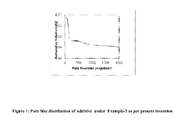
- Fig. 1 Pore Size distribution of Additive under Example-2 as per present invention.
- the present invention discloses a catalyst additive composition suitable for fluid cracking, riser cracking and fixed bed cracking in which high value olefins can be significantly enhanced.
- the present invention also discloses a process of preparation of the said catalyst additive composition and a process employing the said catalyst additive for enhancing the production of LPG, Propylene, gasoline, diesel and reduction of undesired coke and bottom.
- An aspect of the present invention discloses a process for preparing a catalyst additive characterized in that the silica-alumina and aluminosilicate matrix required for cracking of residue and heavy hydrocarbons are generated in-situ rather than adding externally in the process. This process alter the acid sites in the range of 0.158 to 0.168 mmol/g and generates the defects /porosity in the cracking components which in turn enhance yield of desired products such as gasoline, olefin and reduces coke and bottom.
- a catalyst additive composition comprising, 10-40 wt% of reacted clay, 10-40 wt% of diluent clay, 10-30 wt% of silica, 1-30 wt% of alumina, less than 0.3 wt% sodium.
- a catalyst additive composition is disclosed comprising, 10-40 wt% of reacted clay, 10-40 wt% of diluent clay, 10-30 wt% of silica, 1-30 wt% of alumina, less than 0.3 wt% sodium wherein the aluminosilicate is generated in situ from alumina and silica.
- the prepared catalyst additive has surface area of 140 to 165 m 2 /g, average pore diameter of 80 to 86 ⁇ , acidity of 0.158 to 0.168 (mmol/g) apparent bulk density (ABD) of 0.7 to 1 g/cc, an attrition index below 10 and has a pore volume in the range of 0.2 to 0.4 cc/gm.
- a catalyst additive suitable for fluid cracking, riser cracking and fixed bed cracking is disclosed wherein 10 to 40% of pore volume of the catalyst additive is contributed by pores in the range of 10-100 ⁇ and 10 to 40% of pore volume is contributed by pores in the range of 100 to 2000 ⁇ .
- the source of reacted clay and diluent clay is selected from kaolinite, bentonite, illite, vermiculite, smectite, montmorillonite, sepiolite and hectorite.
- the silica is selected from ammonia or sodium stabilized colloidal silica having less than 0.3 wt% residual soda, sodium silicate and tetraethyl orthosilicate.
- the alumina used in accordance with the present invention is selected from alumina trihydrate, bohemite, pseudoboehmite, alumina sol and alumina gel.
- a process for preparing the catalyst additive suitable for fluid cracking, riser cracking and fixed bed cracking comprising calcining clay at 500-1000°C, optionally modifying the reacted clay with acid and adding dilute acid to the reacted clay.
- the reacted clay-acid mixture is cooled, and sodium silicate, diluent clay and optionally alumina are added to the reacted clay acid mixture.
- the mixture is then dried to obtain the catalyst additive.
- process for preparing the catalyst additive suitable for Fluidized Catalytic Cracking process wherein the the aluminosilicate is generated in situ, employing 10-40 wt% of reacted clay, 10-40 wt% of diluent clay, 10-30 wt% of silica, and 1-30 wt% of alumina.
- a process for cracking of heavy hydrocarbons using prepared catalyst additive with steps comprising, contacting a feed with the catalyst additive under reaction temperature of 510-540°C and feed sourced from atmospheric and vacuum distillation bottoms; FCC bottoms, coker bottoms and hydrocracker bottoms, catalyst additive produces LPG up to 27 wt%, gasoline in the range of 35-37 wt%, reduction in coke in the range of 2-5 wt%, and bottoms below 5wt%.
- a process for cracking of heavy hydrocarbons using prepared catalyst additive wherein under reaction temperature of 540-580°C and feed sourced from resid, the said catalyst additive produces LPG up to 32 wt%, gasoline in the range of 23-25 wt% and reduction in coke between 2-5 wt %.
- the feed stocks used in the present invention are the residual fractions having metals (Ni +V) less than 40 ppm.
- Table - 1 gives the properties of feed stock used in this invention.
- Table-1 Properties of Feed Cases-1 & 2 Sr. No. Attributes Unit Feed-1 Feed-2 1 Density @ 15 °C g/cc 0.887 0.928 2 Kinematic Viscosity @ 100°C Cst 7.4 - 3 Distillation, D-1160 4 IBP °C 162 - 5 5% °C 267 - 6 30% °C 370 - 7 50% °C 409 - 8 70% °C 457 - 9 Sulphur wt% 1.72 - 10 Total N 2 ppm 860 - 11 CCR wt% 3.3 3.0 12 V ppm 23 ⁇ 1 13 Ni ppm 9 ⁇ 1 14 Na ppm 1.8 ⁇ 1 15 Fe ppm 2.4 ⁇ 1 16 Paraffin Wt% - 46.8 17 Na
- This example describes the process for the preparation of catalyst additive microspheres.
- 707 gm of neutral grade sodium silicate was dilutes with 707 gm of chilled DM (4 °C).
- 333 gm of sulfuric acid (30 %) was diluted with 333 gm of DM water and maintained at 95 °C and vigorous stirring, while to this, 450 gm of clay prepared as per the procedure mentioned in Example-1 (a).
- Calcined clay-acid mixture was cooled to 18°C, and to this 1380 gm of dilute sodium silicate solution was added at the 50-100 gm/minute through an immersed air atomization spray nozzle under vigorous stirring between 1000-3000 rpm.
- the pore volume 0.32 cc/gm comprising 10 - 40 % volume contributed by pores in the range 10-100 ⁇ and 10 -40 % volume contributed by pores in the range 100-2000 ⁇ .
- Table-2 Properties of Additive in example-2. S.No Additive in example-2 Properties 1 SA (m 2 /g) 165 m 2 /g 2 Average pore dia by BET ( ⁇ ) 86 3 Pore volume (cc/g) 0.32 4 Acidity (mmol/g) 0.168
- This example describes the process for the preparation of catalyst additive microspheres employing sodium stabilized colloidal silica.
- 333 gm of sulfuric acid (30%) was diluted with 333 gm of DM water and maintained at 95 °C and vigorous stirring, while to this, 450 g clay prepared as per the procedure mentioned in Example-1 (a) is said as calcined clay-acid mixture was cooled to 18°C, and to this 833 gm of sodium stabilized colloidal silica was added at the 50-100 gm/minute through a immersed air atomization spray nozzle under vigorous stirring between 1000-3000 rpm. During the process of addition of silicate, 352 gm diluent clay having LOI of 15wt% was also added.
- This example describes the process for the preparation of catalyst additive microspheres employing Ammonium stabilized colloidal silica.
- 333 gm of sulfuric acid (30%) was diluted with 333 gm of DM water and maintained at 95 °C and vigorous stirring, while to this, 450 gm clay prepared as per the procedure mentioned in Example-1 (a) was added and maintained for 3 hours.
- Calcined clay-acid mixture was cooled to 18°C, and to this 833 gm of ammonium stabilized colloidal silica was added at the 50-100 gm/minute through an immersed air atomization spray nozzle under vigorous stirring between 1000-3000 rpm.
- This example describes the process for the preparation of catalyst additive microspheres.
- 707 gm of neutral grade sodium silicate was dilutes with 707 gm of chilled DM (4 °C).
- 333 gm of sulfuric acid (30%) was diluted with 333 gm of DM water and maintained at 95 °C and vigorous stirring, while to this, 450 gm of clay calcined at 950 °C and reacted with an acid was added and maintained for 3 hours.
- Reacted clay-acid mixture was cooled to 18°C, and to this 1380 gm of dilute sodium silicate solution was added at the 50-100 gm/minute through an immersed air atomization spray nozzle under vigorous stirring between 1000-3000 rpm.
- 176 gm diluent clay having LOI of 15 wt% and 180 g bohemite alumina having LOI 17 wt % were also added.
- Final slurry having pH of 3 was spray dried in a counter current spray dryer at inlet temperature of 375 °C and outlet temperature of 12°C.
- Spray dried product was sieved to +20, -120 micron for further processed.
- 500 gm of spray dried product was dispersed in hot DM water, recovered by filtration reslurried twice with hot DM water, filtered and cake was oven dried to obtained as ready to use catalyst additive suitable for enhancing yield of olefins, enhanced gasoline and reduction in bottoms.
- Catalyst additive product has ABD of 0.70 gm/cc, attrition index of 7.
- This example describes the process for the preparation of catalyst additive microspheres.
- 707 gm of neutral grade sodium silicate was dilutes with 707 gm of chilled DM (4 °C).
- 333 gm of sulfuric acid (30%) was diluted with 333 gm of DM water and maintained at 95 °C and vigorous stirring, while to this, 450 gm of clay reacted at 950 °C was added and maintained for 3 hours.
- Reacted clay-acid mixture was cooled to 18°C, and to this 1380 gm of dilute sodium silicate solution was added at the 50-100 gm/minute through an immersed air atomization spray nozzle under vigorous stirring between 1000-3000 rpm.
- 176 gm diluent clay having LOI of 15wt% and 202 gm Aluminum trihydrate alumina having LOI 26 wt % were also added.
- Final slurry having pH of 3 was spray dried in a counter current spray dryer at inlet temperature of 375 °C and outlet temperature of 12 °C.
- Spray dried product was sieved to +20, -120 micron for further processed.
- 500 gm of spray dried product was dispersed in hot DM water, recovered by filtration reslurried twice with hot DM water, filtered and cake was oven dried to obtained as ready to use catalyst additive suitable for enhancing yield of olefins, enhanced gasoline and reduction in bottoms.
- Catalyst additive product has ABD of 0.67 gm/cc, attrition index of 7.
- This example describes the process for the preparation of catalyst additive microspheres with pre-modified clay.
- 707 gm of neutral grade sodium silicate was dilutes with 707 gm of chilled DM (4 °C).
- 333 gm of sulfuric acid (30%) was diluted with 333 gm of DM water and maintained at 95 °C and vigorous stirring, while to this, 450 gm of clay prepared as per the procedure mentioned in Example-1 (b) 1380gm of dilute sodium silicate solution was added at the 50-100 gm/minute through a immersed air atomization spray nozzle under vigorous stirring between 1000-3000 rpm.
- 352 gm diluent clay having LOI of 15 wt% was also added.
- Table-3 indicates that the performance of catalyst composition (Catalyst - G + Additive of Example - 2) prepared as per present invention is better than other catalyst composition w.r.to LPG & Gasoline yields and reduces low value products yields like dry gas and coke.
- Table 3A shows performance of Catalyst-1+ Additive of Example-2 in comparison with Catalyst - I + Commercial additive is shown.
- LPG and Gasoline increase by 1 wt % in case of Catalyst-I+ Additive of Example-2 compared to Catalyst - I + Commercial additive.
- Table - 3A Performance evaluation with Feed Case - 2: Catalyst Catalyst - I + commercial additive ( Additive - H) Catalyst-I + Additive of Example-2 Cat/oil 5.0 Reaction Temperature 545 °C Dry gas 7.0 6.9 LPG 23.89 25 Gasoline 25.11 26.06 Naphtha 7.25 6.85 LCO 15.8 15.47 DCO 9.02 9.12 Coke 12 10.61 216 Conversion 75.38 75.42
- Table-3A indicates that the performance of catalyst composition Catalyst-I+ Additive of Example-2 prepared as per present invention is better than other catalyst composition w.r.to LPG & Gasoline yields and reduces low value coke yield.
- FCCU fluid catalytic cracking process
- the feed being processed in FCCU contains more contaminant metals (Ni & V) & Conradson Carbon Residue (CCR) and it will lead to a significantly higher metal level on the catalyst. i. e. > 3000 ppm (Ni + V) & coke on the catalyst.
- CCR Conradson Carbon Residue
- coke along with metal is deposited on the catalyst which leads to de-activation of the catalyst.
- This catalyst is then activated in the regenerator by burning the coke and leaving the metals on the catalyst. This catalyst is called as the equilibrium catalyst (E-cat).
- lab deactivation procedures need to be designed to simulate these changes that occur commercially.
- An appropriate E-cat sample of the same fresh catalyst should be used to design the lab deactivation conditions, which include duration of steam aging, steam partial pressure, metal (Ni & V) and temperature. Therefore, laboratory deactivation protocols have been mainly developed by taking the properties of E-cat as a reference.
- Table-5 indicates that the performance of catalyst composition (FCC catalyst-B + Additive of example 2) prepared as per present invention is better than the base FCC catalyst w.r.to LPG, Propylene, diesel yields and reduces low value products like coke & dry gas yields.
- This example describes the performance of cracking catalyst composition comprises catalyst A, B, C, D & E.
- the details descriptions of the catalysts/additives are given in table-6.
- performances of the catalyst compositions are given in table-7.
- Table - 6 Detailed description of the catalysts/additives Sr. No. Catalyst Name Details description of catalyst 1 Catalyst A Catalyst prepared in the present invention under Example-2 2 Catalyst C Commercial ZSM-5 additive prepared under US Patent 7656475 3 Catalyst D Commercial FCC catalyst 4 Catalyst E Commercial additive described in Demel Patent WO97/12011
- Table-7 indicates that the performance of catalyst composition [(A) + (C) + (D)] prepared as per present invention is better than the commercial catalyst composition [(E) + (C)+ (D)] w.r.to LPG, Propylene, gasoline yields and reduces low value products like coke & dry gas yields.
Landscapes
- Chemical & Material Sciences (AREA)
- Engineering & Computer Science (AREA)
- Organic Chemistry (AREA)
- Chemical Kinetics & Catalysis (AREA)
- Materials Engineering (AREA)
- Oil, Petroleum & Natural Gas (AREA)
- General Chemical & Material Sciences (AREA)
- Crystallography & Structural Chemistry (AREA)
- Dispersion Chemistry (AREA)
- Production Of Liquid Hydrocarbon Mixture For Refining Petroleum (AREA)
- Catalysts (AREA)
- Nanotechnology (AREA)
Description
- The present invention relates to a catalyst additive composition suitable for fluid cracking, riser cracking and fixed bed cracking with reduction in bottom and coke, wherein the aluminosilicate and silica-alumina is generated in situ from added clay and silica. The present invention is also directed towards the preparation of the said catalyst additive composition. The invention also discloses a process for cracking of heavy hydrocarbons using the said catalyst additive.
- A cracking catalyst composition for enhancing olefins during cracking of heavier hydrocarbons and gasoline, comprising FCC catalyst, in-situ modified clay based additive, optionally ZSM-5 additive. The catalyst can be present in the form of microspheres, pellet, tablet, extrudate and ring and suitable for enhancing olefin product yield by cracking heavy feed material derived from atmospheric and vacuum distillation bottoms; FCC bottoms, coker bottoms and hydrocracker bottoms.
- Fluid Catalytic Cracking (FCC) technology developed as early as Second World War is one of the most sophisticated and flexible processes and is most preferred today. Catalyst employed in FCC process possess high conversion, selectivity towards gasoline, low coke make, superior thermal and hydrothermal stability due to the usage of faujasite zeolite based derivatives such as NH4Y, HY, USY, REY and REUSY. This zeolite, on account of its unique pore architecture and cages allow several types of reactions such as cracking, cyclization, alkylation, isomerization among intermediate cracked products as well as with different type of hydrocarbon molecules present in the feed and produces desired useful products as well as adequate amount of coke which is exploited for delivering desired heat for sustaining endothermic cracking reactions. This coke make and catalyst deactivation is accelerated while processing heavier feeds containing metals such as vanadium, nickel, iron and higher aromaticity. However, for maintaining good trade between endothermic catalytic cracking and exothermic coke burning, there needs to be balanced catalyst composition which can boost the economy of FCC process. Besides maintaining adequate coke, there are other issues in FCC process. The Faujasite zeolite, which is the key component of FCC catalyst, is based on collection of sodalite cages connected to each other through their 6-member faces. This arrangement of cages create 12 member pore opening having pore diameter about 13.5 A. Further, the sodalite cages themselves have maximum pore opening of about 6.5 A. Thus with this type of pore size distribution, and high acidity of main zeolite component, FCC catalyst can maximize gasoline, diesel and produce little amount of liquefied petroleum gas (LPG) owing to product selectivity. This limitation can be overcome to a large extent by employing ZSM-5 zeolite based additive. Similarly, for overcoming limitation in cracking of bulky poly aromatic hydrocarbons, naphthenes and paraffin molecules present in heavy feed, a special type of additives based on large pore matrix and phosphate are used nowadays. It may be noted, in spite of employing combination of FCC catalyst with the additives, FCC process still suffers from few limitations in producing high value propylene, isobutylene beyond certain limit, and suppress low cost coke, dry gas and DCO. Thus there is a need to develop new additive catalyst and use this product with a balanced combination of other additives in main FCC catalyst to maximize high value product such as gasoline, propylene and LPG with reduction of coke.
- Use of silica sol based binder system in the preparation of zeolite promoted catalysts is cited in
U.S. Pat. No. 3,867,308 and alum buffered silica-sol is described inU.S. Pat. No. 3,957,689 and these compositions are for maximizing distillates. Binding of low soda Y zeolite with gel alumina and polysilicate has been described inU.S. Pat. Nos. 4,333,857 and4,326,993 . -
U.S. Pat. No. 4,987,110 refers to the preparation of attrition resistant FCC catalysts using low soda silica sol, REUSY and aluminum chlorohydrol. Product selectivity of faujasite zeolite (also referred as Y zeolite) based catalysts is restricted to gasoline range molecules, due to the presence of uniform size large pores in the range 6.5 Å and 13.5 Å. For enhancing C3 to C4 selectivity, for the first time ZSM-5 zeolites having pores in the range 5.4 to 5.5Å, were employed along with faujasite zeolites, in a conventional silica-alumina based binder system and process for this is described inU.S. Pat. No. 3,758,403 . -
U.S. Pat. No. 6,258,257 refers to a process for producing polypropylene from C.sub.3 olefins by a two-stage fluid catalytic cracking process having two types of catalysts made from zeolites of large pore and medium pore.U.S. Pat. No. 5,286,369 describes a phosphate based binder composition suitable for binding high silica zeolites.U.S. Pat. 5,958,818 , refers to a Zeolite/clay/phosphate catalyst characterized by their high levels of zeolite stability. -
U.S. Pat. 4,956,075 describes a catalyst composition containing Mn, a large pore crystalline molecular sieve, and optionally rare earths for catalytic cracking. This catalyst claimed to offer high gasoline selectivity with low coke yields.U.S. Pat. 4,880,787 refers to a catalyst compositions of superior hydrothermal stability, capable of increasing gasoline plus distillate, improved coke selectivity and reduced C4 gas yields, are based on framework dealuminated faujasitic zeolite and matrix treated with aluminum and rare earth.US Pat application 20010044372 A1 refers to a coke selective catalyst comprising a crystalline molecular sieve material having a metal deficient framework wherein the residual framework aluminium sites constitute less than 20% of the total T-sites. -
U.S. Pat. 4,312,744 refers to a process for low coke make cracking catalyst prepared by mixing a zeolitic crystalline aluminosilicate dispersed in a porous carrier material with a solution of rare earth salt, separating a filter cake from the slurry by a means not involving the washing of the filter cake and calcining the filter cake. -
US 8137534 B2 refers to catalyst systems for use in these processes that decrease yields of undesirable byproducts including dry gas (hydrogen, methane, ethane, and ethylene) and coke. Representative catalyst compositions comprise a highly siliceous zeolite such as silicalite. -
WO 2013005225 A1 , refers to a process for cracking of higher boiling petroleum feedstock to obtain lower dry gas without affecting the yield of LPG, light olefins and gasoline products; said process comprising, a FCC catalyst component and an additive component, wherein a novel alkaline earth metal varying from 0.01 wt% to 2 wt% has been used along with conventional catalyst components. -
U.S. Pat. 6,114,267 refers to a process for preparation of fluidized catalytic cracking (FCC) catalyst, comprising silicon stabilized large crystallite sized synthetic faujasite zeolite, aluminum depleted and normal kaolin clay, alumina and silica. The cracking catalyst is highly active and selective for bottom up gradation, it produces less coke and higher gasoline and total cycle oil (TCO) and possesses improved metal tolerance. This catalyst has limitation in producing LPG, rich in propylene beyond certain limit. -
U.S. Pat 5,846,402 refers to a process for selective catalytic cracking of a petroleum-based feedstock to produce a product having a high yield of liquefied petroleum gas (LPG) and light olefins having 3 to 4 carbons, the process comprises of employing a solid acidic catalyst comprising ultra-stable Y-zeolite, Pentasil zeolite active material, bottom selective matrix and rare earth. -
U.S. Pat. No. 5,389,232 discloses a riser cracking process where 3 wt. % ZSM-5 additive on the catalyst (ZSM-5 is a shape selective high silica zeolite of average 5.4 Angstrom pore opening) was used to increase the yield of C.sub.3 /C.sub.4 olefins by 7 wt. % of feed with minimum loss of gasoline yield up to 5 wt. % of feed from base value. However, in this process the major objective was to improve propylene/iso-butylene selectivity, keeping the gasoline yield at maximum. As a result, the maximum LPG yield in this process is only up to 18 wt. % of feed stock. -
U.S. Pat. No. 4,980,053 describes a deep catalytic cracking (DCC) process at very low weight hourly space velocity (WHSV) of 0.2-20 hr.-1 and relatively higher Catalyst/Oil ratio of 2-12 as compared to conventional FCC conditions of 100-300 hr.-1 WHSV and 4-8 catalyst to oil ratio. The LPG yield is reported to be in the range of 30-45 wt. % using paraffinic gas oil as feed stock. However, the major drawback of this process is its relatively very high yield of dry gas (6-12 wt. %) and coke (4-9 wt. %) even with paraffinic gas oil as feed stock. Moreover, the process with a very unstable by-product gasoline cut of sizeable quantity (20-35%) requiring further downstream treatment. - From various prior art catalyst compositions, it can be inferred that no single catalyst component can give desired performance and only combination of catalysts can deliver. In spite, the combined catalyst too have limitations in delivering desired high value olefinic product and suppressing undesired coke, DCO beyond certain limit.
- The present invention discloses a catalyst additive composition suitable for fluid catalytic cracking process in which high value olefins can be significantly enhanced. The present invention also discloses a process of preparation of the said catalyst additive and its composition for enhancing the production of LPG, propylene, high value gasoline, and reduction of undesired coke in Fluid Catalytic Cracking Unit (FCCU).
- Accordingly, the present invention provides a catalyst additive composition comprising 10-40 wt% of calcined clay, 10-40 wt% of diluent clay, 10-30 wt% of silica, 1-30 wt% of alumina, less than 0.3 wt% sodium with a surface area of 140 to 165 m2/g, average pore diameter of 80 to 86 Å, apparent bulk density (ABD) of 0.7 to 1 g/cc, an attrition index below 10 and has a pore volume in the range of 0.2 to 0.4 cc/gm. and acidity of 0.158 to 0.168 mmol/g.
- In an embodiment of the present invention, the aluminosilicate is generated in situ from alumina and silica.
- In an embodiment of the present invention, 10 to 40% of pore volume of the additive is contributed by pores in the range of 10-100Å and 10 to 40% of pore volume is contributed by pores in the range of 100 to 2000 Å.
- In an embodiment of the present invention, the source of reacted clay and diluent clay is selected from kaolinite, bentonite, illite, vermiculite, smectite, montmorillonite, sepiolite and hectorite.
- In an embodiment of the present invention, the silica is selected from ammonia or sodium stabilized colloidal silica having less than 0.3 wt% residual soda, sodium silicate and tetraethyl orthosilicate.
- In an embodiment of the present invention, the alumina is selected from alumina trihydrate, bohemite, pseudoboehmite, alumina sol and alumina gel.
- In an embodiment of the present invention, the present invention provides a process for preparing the catalyst additive, said process comprising:
- (a) calcining clay at a temperature in the range of 500 °C -1000°C;
- (b) diluting an acid with water and adding the calcined clay of step (a) to obtain a mixture;
- (c) adding diluted sodium silicate solution with the mixture of step (b);
- (d) adding a diluent clay having LOI (Loss On Ignition) in the range of 13 wt% to 16 wt% to obtain a slurry;
- (e) spray drying the slurry of step (d) to obtain the catalyst additive composition.
- In an embodiment of the present invention, the concentration of acid used in the formulation is in the range of 5-20 wt%.
- In an embodiment of the present invention, the acid is selected from sulfuric acid, hydrochloric acid, nitric acid, formic acid and acetic acid.
- In an embodiment of the present invention, ratio of the acid and water ranges from 1 to 2.
- 11. The process as claimed in claim 7, wherein the amount of diluent clay added in the process ranges from 10 to 40 wt %.
- In an embodiment of the present invention, the aluminosilicate is generated in situ, employing 10-40 wt% of calcined clay, 10-40 wt% of diluent clay, 10-30 wt% of silica, and 1-30 wt% of alumina.
- In an embodiment of the present invention, the present invention provides a process for catalytic cracking with the catalyst additive, wherein the process is comprising contacting a feed with the catalyst additive under reaction temperature of 510-540°C and feed sourced from atmospheric and vacuum distillation bottoms; FCC bottoms, coker bottoms and hydrocracker bottoms, to obtain LPG up to 27%, gasoline in the range of 35-37 %, reduction in coke in the range of 2-5 wt%, and bottoms below 5 wt%.
- In an embodiment of the present invention, the present invention provides a process for catalytic cracking with the catalyst additive, wherein the process is performed under reaction temperature of 540-580°C and feed sourced from resid, the said catalyst additive produces LPG up to 32%, gasoline in the range of 23-25 % and reduction in coke between 2-5 wt%.
-
Fig. 1 : Pore Size distribution of Additive under Example-2 as per present invention. - The present invention discloses a catalyst additive composition suitable for fluid cracking, riser cracking and fixed bed cracking in which high value olefins can be significantly enhanced. The present invention also discloses a process of preparation of the said catalyst additive composition and a process employing the said catalyst additive for enhancing the production of LPG, Propylene, gasoline, diesel and reduction of undesired coke and bottom.
- An aspect of the present invention discloses a process for preparing a catalyst additive characterized in that the silica-alumina and aluminosilicate matrix required for cracking of residue and heavy hydrocarbons are generated in-situ rather than adding externally in the process. This process alter the acid sites in the range of 0.158 to 0.168 mmol/g and generates the defects /porosity in the cracking components which in turn enhance yield of desired products such as gasoline, olefin and reduces coke and bottom.
- In an embodiment of the present invention, a catalyst additive composition is disclosed comprising, 10-40 wt% of reacted clay, 10-40 wt% of diluent clay, 10-30 wt% of silica, 1-30 wt% of alumina, less than 0.3 wt% sodium. In another embodiment of the present invention, a catalyst additive composition is disclosed comprising, 10-40 wt% of reacted clay, 10-40 wt% of diluent clay, 10-30 wt% of silica, 1-30 wt% of alumina, less than 0.3 wt% sodium wherein the aluminosilicate is generated in situ from alumina and silica.
- In accordance with the present invention, the prepared catalyst additive has surface area of 140 to 165 m2/g, average pore diameter of 80 to 86 Å, acidity of 0.158 to 0.168 (mmol/g) apparent bulk density (ABD) of 0.7 to 1 g/cc, an attrition index below 10 and has a pore volume in the range of 0.2 to 0.4 cc/gm. Also, in accordance with the present invention, a catalyst additive suitable for fluid cracking, riser cracking and fixed bed cracking is disclosed wherein 10 to 40% of pore volume of the catalyst additive is contributed by pores in the range of 10-100Å and 10 to 40% of pore volume is contributed by pores in the range of 100 to 2000Å.
- In accordance with the present invention, the source of reacted clay and diluent clay is selected from kaolinite, bentonite, illite, vermiculite, smectite, montmorillonite, sepiolite and hectorite. Further in accordance with the present invention, the silica is selected from ammonia or sodium stabilized colloidal silica having less than 0.3 wt% residual soda, sodium silicate and tetraethyl orthosilicate. The alumina used in accordance with the present invention is selected from alumina trihydrate, bohemite, pseudoboehmite, alumina sol and alumina gel.
- A process for preparing the catalyst additive suitable for fluid cracking, riser cracking and fixed bed cracking is disclosed, said process comprising calcining clay at 500-1000°C, optionally modifying the reacted clay with acid and adding dilute acid to the reacted clay. The reacted clay-acid mixture is cooled, and sodium silicate, diluent clay and optionally alumina are added to the reacted clay acid mixture. The mixture is then dried to obtain the catalyst additive.
- In an embodiment of the invention, process for preparing the catalyst additive suitable for Fluidized Catalytic Cracking process is disclosed wherein the the aluminosilicate is generated in situ, employing 10-40 wt% of reacted clay, 10-40 wt% of diluent clay, 10-30 wt% of silica, and 1-30 wt% of alumina.
- In yet another aspect of the present invention, a process for cracking of heavy hydrocarbons using prepared catalyst additive is disclosed with steps comprising, contacting a feed with the catalyst additive under reaction temperature of 510-540°C and feed sourced from atmospheric and vacuum distillation bottoms; FCC bottoms, coker bottoms and hydrocracker bottoms, catalyst additive produces LPG up to 27 wt%, gasoline in the range of 35-37 wt%, reduction in coke in the range of 2-5 wt%, and bottoms below 5wt%.
- In an embodiment of the present invention, a process for cracking of heavy hydrocarbons using prepared catalyst additive is disclosed wherein under reaction temperature of 540-580°C and feed sourced from resid, the said catalyst additive produces LPG up to 32 wt%, gasoline in the range of 23-25 wt% and reduction in coke between 2-5 wt %.
- Having described the basic aspect of the present invention, the following non-limiting examples illustrate specific embodiment thereof.
- The feed stocks used in the present invention are the residual fractions having metals (Ni +V) less than 40 ppm. Table - 1 gives the properties of feed stock used in this invention.
Table-1: Properties of Feed Cases-1 & 2 Sr. No. Attributes Unit Feed-1 Feed-2 1 Density @ 15 °C g/cc 0.887 0.928 2 Kinematic Viscosity @ 100°C Cst 7.4 - 3 Distillation, D-1160 4 IBP °C 162 - 5 5% °C 267 - 6 30% °C 370 - 7 50% °C 409 - 8 70% °C 457 - 9 Sulphur wt% 1.72 - 10 Total N2 ppm 860 - 11 CCR wt% 3.3 3.0 12 V ppm 23 <1 13 Ni ppm 9 <1 14 Na ppm 1.8 <1 15 Fe ppm 2.4 <1 16 Paraffin Wt% - 46.8 17 Naphthene Wt% - 21.6 18 Aromatics Wt% - 31.6 -
- a. This example describes the process for the preparation of ready to react clay. 588 gm kaolin clay with 85% particles size below 3 micron, volatiles in the range of 13-18 wt % was calcined to 500-1000°C for one hour and cooled to room temperature.
- b. Clay prepared as per the procedure mentioned in Example-1 (a) was modified with acid like sulfuric acid, hydrochloric acid, nitric acid, formic acid and acetic acid at 50-100 °C for 3-5 hours.
- This example describes the process for the preparation of catalyst additive microspheres. 707 gm of neutral grade sodium silicate was dilutes with 707 gm of chilled DM (4 °C). 333 gm of sulfuric acid (30 %) was diluted with 333 gm of DM water and maintained at 95 °C and vigorous stirring, while to this, 450 gm of clay prepared as per the procedure mentioned in Example-1 (a). Calcined clay-acid mixture was cooled to 18°C, and to this 1380 gm of dilute sodium silicate solution was added at the 50-100 gm/minute through an immersed air atomization spray nozzle under vigorous stirring between 1000-3000 rpm. During the process of addition of silicate, 352 gm diluent clay having LOI of 15 wt% was also added. Final slurry having pH of 3 was spray dried in a counter current spray dryer at inlet temperature of 375 °C and outlet temperature of 12°C. Spray dried product was sieved to +20, -120 micron for further processed. 500 gm of spray dried product was dispersed in hot DM water, recovered by filtration reslurried twice with hot DM water, filtered and cake was oven dried to obtained as ready to use catalyst additive suitable for enhancing yield of olefins, enhanced gasoline and reduction in bottoms. Catalyst additive product has ABD of 0.78 gm/cc, attrition index of 5. The pore volume 0.32 cc/gm comprising 10 - 40 % volume contributed by pores in the range 10-100 Å and 10 -40 % volume contributed by pores in the range 100-2000Å.
Table-2: Properties of Additive in example-2. S.No Additive in example-2 Properties 1 SA (m2/g) 165 m2/g 2 Average pore dia by BET (Å) 86 3 Pore volume (cc/g) 0.32 4 Acidity (mmol/g) 0.168 - This example describes the process for the preparation of catalyst additive microspheres employing sodium stabilized colloidal silica. 333 gm of sulfuric acid (30%) was diluted with 333 gm of DM water and maintained at 95 °C and vigorous stirring, while to this, 450 g clay prepared as per the procedure mentioned in Example-1 (a) is said as calcined clay-acid mixture was cooled to 18°C, and to this 833 gm of sodium stabilized colloidal silica was added at the 50-100 gm/minute through a immersed air atomization spray nozzle under vigorous stirring between 1000-3000 rpm. During the process of addition of silicate, 352 gm diluent clay having LOI of 15wt% was also added. Final slurry having pH of 3 was spray dried in a counter current spray dryer at inlet temperature of 375 °C and outlet temperature of 12°C. Spray dried product was sieved to +20, -120 micron for further processed. 500 gm of spray dried product was dispersed in hot DM water, recovered by filtration reslurried twice with hot DM water, filtered and cake was oven dried to obtained as ready to use catalyst additive suitable for enhancing yield of olefins, enhanced gasoline and reduction in bottoms. Catalyst additive product has ABD of 0.65 gm/cc, attrition index of 10.
- This example describes the process for the preparation of catalyst additive microspheres employing Ammonium stabilized colloidal silica. 333 gm of sulfuric acid (30%) was diluted with 333 gm of DM water and maintained at 95 °C and vigorous stirring, while to this, 450 gm clay prepared as per the procedure mentioned in Example-1 (a) was added and maintained for 3 hours. Calcined clay-acid mixture was cooled to 18°C, and to this 833 gm of ammonium stabilized colloidal silica was added at the 50-100 gm/minute through an immersed air atomization spray nozzle under vigorous stirring between 1000-3000 rpm. During the process of addition of silicate, 352 gm diluent clay having LOI of 15 wt% was also added. Final slurry having pH of 3 was spray dried in a counter current spray dryer at inlet temperature of 375 °C and outlet temperature of 12°C. Spray dried product was sieved to +20, -120 micron for further processed. 500 gm of spray dried product was calcined at 550 °C to obtained as ready to use catalyst additive suitable for enhancing yield of olefins, enhanced gasoline and reduction in bottoms. Catalyst additive product has ABD of 0.71 gm/cc, attrition index of 10.
- From the Examples 2-4, in-situ modification of clay in presence of silica followed by forming microsphere with diluent clay found to be suitable product with the required Physico-chemical properties and the catalyst additive prepared based on example-2 capable of enhancing propylene rich LPG, gasoline & diesel and to reduce coke and bottom. Therefore procedure described in example-2 employed for preparation of the catalyst additive in following examples.
- This example describes the process for the preparation of catalyst additive microspheres. 707 gm of neutral grade sodium silicate was dilutes with 707 gm of chilled DM (4 °C). 333 gm of sulfuric acid (30%) was diluted with 333 gm of DM water and maintained at 95 °C and vigorous stirring, while to this, 450 gm of clay calcined at 950 °C and reacted with an acid was added and maintained for 3 hours. Reacted clay-acid mixture was cooled to 18°C, and to this 1380 gm of dilute sodium silicate solution was added at the 50-100 gm/minute through an immersed air atomization spray nozzle under vigorous stirring between 1000-3000 rpm. During the process of addition of silicate, 176 gm diluent clay having LOI of 15 wt% and 180 g bohemite alumina having LOI 17 wt % were also added. Final slurry having pH of 3 was spray dried in a counter current spray dryer at inlet temperature of 375 °C and outlet temperature of 12°C. Spray dried product was sieved to +20, -120 micron for further processed. 500 gm of spray dried product was dispersed in hot DM water, recovered by filtration reslurried twice with hot DM water, filtered and cake was oven dried to obtained as ready to use catalyst additive suitable for enhancing yield of olefins, enhanced gasoline and reduction in bottoms. Catalyst additive product has ABD of 0.70 gm/cc, attrition index of 7.
- This example describes the process for the preparation of catalyst additive microspheres. 707 gm of neutral grade sodium silicate was dilutes with 707 gm of chilled DM (4 °C). 333 gm of sulfuric acid (30%) was diluted with 333 gm of DM water and maintained at 95 °C and vigorous stirring, while to this, 450 gm of clay reacted at 950 °C was added and maintained for 3 hours. Reacted clay-acid mixture was cooled to 18°C, and to this 1380 gm of dilute sodium silicate solution was added at the 50-100 gm/minute through an immersed air atomization spray nozzle under vigorous stirring between 1000-3000 rpm. During the process of addition of silicate, 176 gm diluent clay having LOI of 15wt% and 202 gm Aluminum trihydrate alumina having LOI 26 wt % were also added. Final slurry having pH of 3 was spray dried in a counter current spray dryer at inlet temperature of 375 °C and outlet temperature of 12 °C. Spray dried product was sieved to +20, -120 micron for further processed. 500 gm of spray dried product was dispersed in hot DM water, recovered by filtration reslurried twice with hot DM water, filtered and cake was oven dried to obtained as ready to use catalyst additive suitable for enhancing yield of olefins, enhanced gasoline and reduction in bottoms. Catalyst additive product has ABD of 0.67 gm/cc, attrition index of 7.
- This example describes the process for the preparation of catalyst additive microspheres with pre-modified clay. 707 gm of neutral grade sodium silicate was dilutes with 707 gm of chilled DM (4 °C). 333 gm of sulfuric acid (30%) was diluted with 333 gm of DM water and maintained at 95 °C and vigorous stirring, while to this, 450 gm of clay prepared as per the procedure mentioned in Example-1 (b) 1380gm of dilute sodium silicate solution was added at the 50-100 gm/minute through a immersed air atomization spray nozzle under vigorous stirring between 1000-3000 rpm. During the process of addition of silicate, 352 gm diluent clay having LOI of 15 wt% was also added. Final slurry having pH of 3 was spray dried in a counter current spray dryer at inlet temperature of 375 °C and outlet temperature of 12°C. Spray dried product was sieved to +20, -120 micron for further processed. 500 gm of spray dried product was dispersed in hot DM water, recovered by filtration reslurried twice with hot DM water, filtered and cake was oven dried to obtained as ready to use catalyst additive suitable for enhancing yield of olefins, enhanced gasoline and reduction in bottoms. Catalyst additive product has ABD of 0.67 gm/cc, attrition index of 7.
Table-3: Performance evaluation with Feed Case-2 Catalyst Catalyst - G + commercial additive Catalyst - G + Additive of Example - 5 Catalyst - G + Additive of Example - 6 Catalyst - G + Additive of Example - 7 *Catalyst - G + Additive of Example - 2 (Additive prepared as per present invention) Cat/oil 5.0 Reaction Temperature 545 °C Dry gas 6.60 7.11 7.16 7.14 5.8 LPG 25.11 25.22 25.4 25.61 26.14 Gasoline 26.02 23.73 24.65 24.31 27.34 (C5-150C) Naphtha 6.78 6.97 6.61 6.74 6.59 LCO 15.47 15.74 15.33 15.57 16.07 DCO 8.68 9.02 9.01 8.72 8.72 Coke 11.34 12.21 11.84 11.91 9.34 216 Conversion 75.85 75.24 75.66 75.71 75.21 - Table-3 indicates that the performance of catalyst composition (Catalyst - G + Additive of Example - 2) prepared as per present invention is better than other catalyst composition w.r.to LPG & Gasoline yields and reduces low value products yields like dry gas and coke.
- Table 3A shows performance of Catalyst-1+ Additive of Example-2 in comparison with Catalyst - I + Commercial additive is shown. LPG and Gasoline increase by 1 wt % in case of Catalyst-I+ Additive of Example-2 compared to Catalyst - I + Commercial additive.
Table-3A: Performance evaluation with Feed Case-2: Catalyst Catalyst - I + commercial additive (Additive - H) Catalyst-I + Additive of Example-2 Cat/oil 5.0 Reaction Temperature 545 °C Dry gas 7.0 6.9 LPG 23.89 25 Gasoline 25.11 26.06 Naphtha 7.25 6.85 LCO 15.8 15.47 DCO 9.02 9.12 Coke 12 10.61 216 Conversion 75.38 75.42 - Table-3A indicates that the performance of catalyst composition Catalyst-I+ Additive of Example-2 prepared as per present invention is better than other catalyst composition w.r.to LPG & Gasoline yields and reduces low value coke yield.
- This example describe the performance of cracking catalyst additive component whose preparation is described in example 2 at 5 wt % level with FCC catalyst. The prepared catalysts were impregnated with 6852 ppm vanadium employing vanadium naphthanate, 2200 ppm of nickel employing nickel naphthanate by Mitchell method, followed by hydrogen reduction and hydrothermal deactivation at 788 °C for 3 hours. The performance evaluation was carried out with the process parameters of table 4 in ACER+ MAT unit at 510 °C employing feed case - 1. The results are shown in Table.4 along with the commercial cracking Catalyst -B.
Table-4: process parameters for performance evaluation S. No. Parameters Value 1 Cat/oil ratio in example 8 4.5 2 Reaction Temperature in example 8 510 °C 3 Cat/oil ratio in example 9 5.0 4 Reaction Temperature in example 9 545 °C - In the fluid catalytic cracking process (FCC), the catalyst / catalyst along with additive is being continuously undergone reaction and regeneration step. The feed being processed in FCCU contains more contaminant metals (Ni & V) & Conradson Carbon Residue (CCR) and it will lead to a significantly higher metal level on the catalyst. i. e. > 3000 ppm (Ni + V) & coke on the catalyst. During reaction in the reactor, coke along with metal (Ni & V) is deposited on the catalyst which leads to de-activation of the catalyst. This catalyst is then activated in the regenerator by burning the coke and leaving the metals on the catalyst. This catalyst is called as the equilibrium catalyst (E-cat). Therefore, lab deactivation procedures need to be designed to simulate these changes that occur commercially. An appropriate E-cat sample of the same fresh catalyst should be used to design the lab deactivation conditions, which include duration of steam aging, steam partial pressure, metal (Ni & V) and temperature. Therefore, laboratory deactivation protocols have been mainly developed by taking the properties of E-cat as a reference.
- Therefore the conversions of fresh catalysts / catalyst along with additives in to equilibrium catalysts / catalyst along with additives are carried out by metal impregnation followed by hydrothermal deactivation.
Table-5: Performance evaluation with Feed Case-1 Catalyst Base FCC catalyst -B FCC catalyst-B + Additive of example 2 Delta value at conversion at 82.46 wt % Feed Feed Case-1 Feed Case-1 Reaction Temperature °C 510 510 Cat/Oil ratio 4.5 4.5 Dry gas 2.51 2.00 -0.51 LPG 24.29 26.66 2.37 Propylene in LPG 30 32 2.00 Isobutylene 2.30 2.48 0.18 Gasoline 37.59 37.55 -0.04 Naphtha 10.44 10.42 -0.02 LCO 14.14 14.78 0.64 DCO 3.4 2.76 -0.64 Coke 7.63 5.83 -1.80 216 Conversion 82.46 82.46 - Table-5 indicates that the performance of catalyst composition (FCC catalyst-B + Additive of example 2) prepared as per present invention is better than the base FCC catalyst w.r.to LPG, Propylene, diesel yields and reduces low value products like coke & dry gas yields.
- This example describes the performance of cracking catalyst composition comprises catalyst A, B, C, D & E. The details descriptions of the catalysts/additives are given in table-6. However performances of the catalyst compositions are given in table-7.
Table-6: Detailed description of the catalysts/additives Sr. No. Catalyst Name Details description of catalyst 1 Catalyst A Catalyst prepared in the present invention under Example-2 2 Catalyst C Commercial ZSM-5 additive prepared under US Patent 7656475 3 Catalyst D Commercial FCC catalyst 4 Catalyst E Commercial additive described in Demel Patent WO97/12011 - All these catalyst components are de-activated hydro thermally and its activity was evaluated in fixed bed Auto MAT unit under reaction temperature at 545°C after preparing their composite mixture. The performance results of the composite catalyst are given in Table 7.
Table-7: Performance evaluation with Feed Case-2 Catalyst (E) + (C)+ (D) (A) + (C) + (D) (Catalyst composition as per present invention) Delta value Feed Feed-2 Feed-2 Reaction temperature °C Severity, W/F, Min. 1.03 1.02 Dry gas 8.16 7.37 -0.79 LPG 29.77 31.39 +1.62 propylene 9.03 10.41 +1.38 Propylene in LPG 30.33 33.16 Isobutylene 1.56 1.76 Gasoline 23.91 25.23 +1.32 Naphtha 6.1 6.02 LCO 10.93 10.33 DCO 4.08 5.01 Coke 17.05 14.65 -2.40 216 Conversion 84.99 84.66 0.33 - Table-7 indicates that the performance of catalyst composition [(A) + (C) + (D)] prepared as per present invention is better than the commercial catalyst composition [(E) + (C)+ (D)] w.r.to LPG, Propylene, gasoline yields and reduces low value products like coke & dry gas yields.
Claims (14)
- A catalyst additive composition comprising 10-40 wt% of calcined clay, 10-40 wt% of diluent clay, 10-30 wt% of silica, 1-30 wt% of alumina, less than 0.3 wt% sodium with a surface area of 140 to 165 m2/g, average pore diameter of 80 to 86 Å, apparent bulk density (ABD) of 0.7 to 1 g/cc, an attrition index below 10 and has a pore volume in the range of 0.2 to 0.4 cc/gm. and acidity of 0.158 to 0.168 mmol/g.
- The catalyst additive as claimed in claim 1, wherein the aluminosilicate is generated in situ from alumina and silica.
- The catalyst additive as claimed in claim 1, wherein 10 to 40% of volume of the additive is contributed by pores in the range of 10-100Å and 10 to 40% of volume is contributed by pores in the range of 100 to 2000 Å.
- The catalyst additive as claimed in claim 1, wherein the source of reacted clay and diluent clay is selected from kaolinite, bentonite, illite, vermiculite, smectite, montmorillonite, sepiolite and hectorite.
- The catalyst additive as claimed in claim 1, wherein the silica is selected from ammonia or sodium stabilized colloidal silica having less than 0.3 wt% residual soda, sodium silicate and tetraethyl orthosilicate.
- The catalyst additive as claimed in claim 1, wherein the alumina is selected from alumina trihydrate, bohemite, pseudoboehmite, alumina sol and alumina gel.
- A process for preparing the catalyst additive, said process comprising:(a) calcining clay at a temperature in the range of 500-1000°C;(b) diluting an acid with water and adding the calcined clay of step (a) to obtain a mixture;(c) adding diluted sodium silicate solution with the mixture of step (b);(d) adding a diluent clay having LOI (Loss On Ignition) in the range of 13 wt% to 18 wt% to obtain a slurry; and(e) drying the slurry of step (d) to obtain the catalyst additive composition.
- The process as claimed in claim 7, wherein the ratio of sodium silicate and water ranges from 1 to 2.
- The process as claimed in claim 7, wherein the acid is selected from hydrochloric acid, nitric acid, sulfuric acid, formic acid and acetic acid.
- The process as claimed in claim 7, wherein the ratio of the acid and water ranges from 1 to 2.
- The process as claimed in claim 7, wherein the amount of diluent clay added in the process ranges from 10 to 40 wt %.
- The process as claimed in claim 7, wherein the aluminosilicate is generated in situ, employing 10-40 wt% of calcined clay, 10-40 wt% of diluent clay, 10-30 wt% of silica, and 1-30 wt% of alumina.
- A process for catalytic cracking with the catalyst additive of claim 1, wherein the process is comprising contacting a feed with the catalyst as claimed in claim 1 under reaction temperature of 510-540°C and feed sourced from atmospheric and vacuum distillation bottoms; FCC bottoms, coker bottoms and hydrocracker bottoms, to obtain LPG up to 27%, gasoline in the range of 35-37 %, reduction in coke in the range of 2-5 wt%, and bottoms below 5 wt%.
- A process for catalytic cracking with the catalyst additive of claim 1, wherein the process is performed under reaction temperature of 540-580°C and feed sourced from resid, the said catalyst additive produces LPG up to 32%, gasoline in the range of 23-25 % and reduction in coke between 2-5 wt%.
Applications Claiming Priority (1)
| Application Number | Priority Date | Filing Date | Title |
|---|---|---|---|
| IN2748MU2014 | 2014-08-27 |
Publications (2)
| Publication Number | Publication Date |
|---|---|
| EP2990463A1 true EP2990463A1 (en) | 2016-03-02 |
| EP2990463B1 EP2990463B1 (en) | 2018-07-11 |
Family
ID=53938252
Family Applications (1)
| Application Number | Title | Priority Date | Filing Date |
|---|---|---|---|
| EP15181993.5A Active EP2990463B1 (en) | 2014-08-27 | 2015-08-21 | A catalyst additive composition for catalytic cracking, a process of preparation thereof and cracking processes of using thereof |
Country Status (3)
| Country | Link |
|---|---|
| US (1) | US9981246B2 (en) |
| EP (1) | EP2990463B1 (en) |
| SA (1) | SA115360725B1 (en) |
Cited By (1)
| Publication number | Priority date | Publication date | Assignee | Title |
|---|---|---|---|---|
| WO2021161081A1 (en) * | 2020-02-10 | 2021-08-19 | Hindustan Petroleum Corporation Limited | An fcc additive composition for bottoms cracking and a process for preparation thereof |
Families Citing this family (1)
| Publication number | Priority date | Publication date | Assignee | Title |
|---|---|---|---|---|
| EP3800232A3 (en) * | 2019-10-04 | 2021-06-30 | Indian Oil Corporation Limited | Fluid catalytic cracking additive composition for enhancing gasoline octane barrel and a process of preparation thereof |
Citations (22)
| Publication number | Priority date | Publication date | Assignee | Title |
|---|---|---|---|---|
| US3758403A (en) | 1970-10-06 | 1973-09-11 | Mobil Oil | Olites catalytic cracking of hydrocarbons with mixture of zsm-5 and other ze |
| US3867308A (en) | 1973-12-10 | 1975-02-18 | Grace W R & Co | Process for preparing a petroleum cracking catalyst |
| US3957689A (en) | 1974-08-02 | 1976-05-18 | W. R. Grace & Co. | Process for preparing an attrition resistant zeolite hydrocarbon conversion catalyst |
| US4312744A (en) | 1979-08-29 | 1982-01-26 | Uop Inc. | FCC Process using low coke-make FCC catalyst |
| US4326993A (en) | 1979-12-17 | 1982-04-27 | Mobil Oil Corporation | Novel cracking catalysts and catalyst supports |
| US4333857A (en) | 1979-01-15 | 1982-06-08 | Filtrol Corporation | Attrition resistant zeolite containing catalyst |
| US4836913A (en) * | 1983-04-13 | 1989-06-06 | W. R. Grace & Co.-Conn. | Catalytic cracking process exploying a zeolite as catalysts and catalyst supports |
| US4880787A (en) | 1986-08-15 | 1989-11-14 | Mobil Oil Corporation | Cracking catalyst |
| US4956075A (en) | 1988-12-22 | 1990-09-11 | Mobil Oil Corporation | Catalytic cracking |
| US4980053A (en) | 1987-08-08 | 1990-12-25 | Research Institute Of Petroleum Processing, Sinopec | Production of gaseous olefins by catalytic conversion of hydrocarbons |
| US4987110A (en) | 1987-05-07 | 1991-01-22 | Union Oil Company Of California | Attrition resistant cracking catalyst |
| US5286369A (en) | 1991-01-22 | 1994-02-15 | W. R. Grace & Co.-Conn. | Catalytic cracking utilizing a zeolite and aluminum phosphate-containing catalyst |
| US5389232A (en) | 1992-05-04 | 1995-02-14 | Mobil Oil Corporation | Riser cracking for maximum C3 and C4 olefin yields |
| US5846402A (en) | 1997-05-14 | 1998-12-08 | Indian Oil Corporation, Ltd. | Process for catalytic cracking of petroleum based feed stocks |
| US5958818A (en) | 1997-04-14 | 1999-09-28 | Bulldog Technologies U.S.A., Inc. | Alkaline phosphate-activated clay/zeolite catalysts |
| US6114267A (en) | 1998-05-12 | 2000-09-05 | Ghosh; Sobhan | Process for the preparation of fluidized catalytic cracking (FCC) catalyst |
| US6258257B1 (en) | 1998-05-05 | 2001-07-10 | Exxonmobil Research And Engineering Company | Process for producing polypropylene from C3 olefins selectively produced by a two stage fluid catalytic cracking process |
| US20010044372A1 (en) | 1998-10-09 | 2001-11-22 | Vaughan David E.W. | Soft chemistry resynthesis route to faujasitic and related FCC catalyst promoters (LAW529) |
| US20030221991A1 (en) * | 2002-05-31 | 2003-12-04 | Hurley Michael Thomas | Method of enhancing the activity of FCC catalysts |
| US8137534B2 (en) | 2009-04-23 | 2012-03-20 | Uop Llc | Catalyst compositions for improved fluid catalytic cracking (FCC) processes targeting propylene production |
| WO2013005225A1 (en) | 2011-07-06 | 2013-01-10 | Reliance Industries Ltd. | Process and composition of catalyst/ additive for reducing fuel gas yield in fluid catalytic cracking (fcc) process |
| US20130023710A1 (en) * | 2011-07-21 | 2013-01-24 | Reliance Industries Limited | Fcc catalyst additive and a method for its preparation |
-
2015
- 2015-08-21 EP EP15181993.5A patent/EP2990463B1/en active Active
- 2015-08-27 SA SA115360725A patent/SA115360725B1/en unknown
- 2015-08-27 US US14/837,879 patent/US9981246B2/en active Active
Patent Citations (22)
| Publication number | Priority date | Publication date | Assignee | Title |
|---|---|---|---|---|
| US3758403A (en) | 1970-10-06 | 1973-09-11 | Mobil Oil | Olites catalytic cracking of hydrocarbons with mixture of zsm-5 and other ze |
| US3867308A (en) | 1973-12-10 | 1975-02-18 | Grace W R & Co | Process for preparing a petroleum cracking catalyst |
| US3957689A (en) | 1974-08-02 | 1976-05-18 | W. R. Grace & Co. | Process for preparing an attrition resistant zeolite hydrocarbon conversion catalyst |
| US4333857A (en) | 1979-01-15 | 1982-06-08 | Filtrol Corporation | Attrition resistant zeolite containing catalyst |
| US4312744A (en) | 1979-08-29 | 1982-01-26 | Uop Inc. | FCC Process using low coke-make FCC catalyst |
| US4326993A (en) | 1979-12-17 | 1982-04-27 | Mobil Oil Corporation | Novel cracking catalysts and catalyst supports |
| US4836913A (en) * | 1983-04-13 | 1989-06-06 | W. R. Grace & Co.-Conn. | Catalytic cracking process exploying a zeolite as catalysts and catalyst supports |
| US4880787A (en) | 1986-08-15 | 1989-11-14 | Mobil Oil Corporation | Cracking catalyst |
| US4987110A (en) | 1987-05-07 | 1991-01-22 | Union Oil Company Of California | Attrition resistant cracking catalyst |
| US4980053A (en) | 1987-08-08 | 1990-12-25 | Research Institute Of Petroleum Processing, Sinopec | Production of gaseous olefins by catalytic conversion of hydrocarbons |
| US4956075A (en) | 1988-12-22 | 1990-09-11 | Mobil Oil Corporation | Catalytic cracking |
| US5286369A (en) | 1991-01-22 | 1994-02-15 | W. R. Grace & Co.-Conn. | Catalytic cracking utilizing a zeolite and aluminum phosphate-containing catalyst |
| US5389232A (en) | 1992-05-04 | 1995-02-14 | Mobil Oil Corporation | Riser cracking for maximum C3 and C4 olefin yields |
| US5958818A (en) | 1997-04-14 | 1999-09-28 | Bulldog Technologies U.S.A., Inc. | Alkaline phosphate-activated clay/zeolite catalysts |
| US5846402A (en) | 1997-05-14 | 1998-12-08 | Indian Oil Corporation, Ltd. | Process for catalytic cracking of petroleum based feed stocks |
| US6258257B1 (en) | 1998-05-05 | 2001-07-10 | Exxonmobil Research And Engineering Company | Process for producing polypropylene from C3 olefins selectively produced by a two stage fluid catalytic cracking process |
| US6114267A (en) | 1998-05-12 | 2000-09-05 | Ghosh; Sobhan | Process for the preparation of fluidized catalytic cracking (FCC) catalyst |
| US20010044372A1 (en) | 1998-10-09 | 2001-11-22 | Vaughan David E.W. | Soft chemistry resynthesis route to faujasitic and related FCC catalyst promoters (LAW529) |
| US20030221991A1 (en) * | 2002-05-31 | 2003-12-04 | Hurley Michael Thomas | Method of enhancing the activity of FCC catalysts |
| US8137534B2 (en) | 2009-04-23 | 2012-03-20 | Uop Llc | Catalyst compositions for improved fluid catalytic cracking (FCC) processes targeting propylene production |
| WO2013005225A1 (en) | 2011-07-06 | 2013-01-10 | Reliance Industries Ltd. | Process and composition of catalyst/ additive for reducing fuel gas yield in fluid catalytic cracking (fcc) process |
| US20130023710A1 (en) * | 2011-07-21 | 2013-01-24 | Reliance Industries Limited | Fcc catalyst additive and a method for its preparation |
Cited By (2)
| Publication number | Priority date | Publication date | Assignee | Title |
|---|---|---|---|---|
| WO2021161081A1 (en) * | 2020-02-10 | 2021-08-19 | Hindustan Petroleum Corporation Limited | An fcc additive composition for bottoms cracking and a process for preparation thereof |
| US11891577B2 (en) | 2020-02-10 | 2024-02-06 | Hindustan Petroleum Corporation Limited | FCC additive composition for bottoms cracking and a process for preparation thereof |
Also Published As
| Publication number | Publication date |
|---|---|
| US9981246B2 (en) | 2018-05-29 |
| US20160059213A1 (en) | 2016-03-03 |
| EP2990463B1 (en) | 2018-07-11 |
| SA115360725B1 (en) | 2018-07-31 |
Similar Documents
| Publication | Publication Date | Title |
|---|---|---|
| CN103703105B (en) | The technique of catalyst/additive and constituent, for reducing the fuel gas yield in fluid catalystic cracking (FCC) process | |
| US5110776A (en) | Cracking catalysts containing phosphate treated zeolites, and method of preparing the same | |
| CA2691074C (en) | Structurally enhanced cracking catalysts | |
| US6673235B2 (en) | FCC catalysts for feeds containing nickel and vanadium | |
| US20030166453A1 (en) | Stabilized dual zeolite single particle catalyst composition and a process thereof | |
| US9675967B2 (en) | Structurally enhanced cracking catalysts | |
| CA2061950C (en) | Preparation of cracking catalysts, and cracking process using them | |
| US5126298A (en) | Cracking catalysts comprising clays with different particle sizes, and method of preparing and using the same | |
| CN105813740A (en) | Phosphorus-containing fcc catalyst | |
| JP6615097B2 (en) | Boron oxide in FCC method | |
| US12599898B2 (en) | Fluid catalytic cracking catalyst composition for enhanced butylenes yields with metal passivation functionality | |
| EP2998020B1 (en) | Fluid catalytic cracking additive composition and process for preparaing thereof | |
| KR20090087949A (en) | Catalytic Cracking Catalyst Composition With Improved Bottom Conversion | |
| KR102605259B1 (en) | Base material quality improvement and coke fluid catalytic cracking catalyst | |
| US7517827B2 (en) | Process for preparation of liquefied petroleum gas selective cracking catalyst | |
| JP7046763B2 (en) | Fluid cracking catalyst for hydrocarbon oil | |
| EP2990463B1 (en) | A catalyst additive composition for catalytic cracking, a process of preparation thereof and cracking processes of using thereof | |
| US9616408B2 (en) | Adsorbent for removal of con-carbon and contaminant metal present in hydrocarbon feed | |
| JP7178829B2 (en) | Fluid catalytic cracking catalyst for hydrocarbon oil | |
| US10449524B2 (en) | Process and composition for preparation of cracking catalyst suitable for enhancing LPG | |
| US20140235429A1 (en) | Process for enhancing nickel tolerance of heavy hydrocarbon cracking catalysts | |
| JP2020142229A (en) | Fluid cracking catalyst for hydrocarbon oil | |
| JPH0857328A (en) | Catalytic cracking catalyst and method for catalytic cracking of hydrocarbon using the same |
Legal Events
| Date | Code | Title | Description |
|---|---|---|---|
| PUAI | Public reference made under article 153(3) epc to a published international application that has entered the european phase |
Free format text: ORIGINAL CODE: 0009012 |
|
| 17P | Request for examination filed |
Effective date: 20150821 |
|
| AK | Designated contracting states |
Kind code of ref document: A1 Designated state(s): AL AT BE BG CH CY CZ DE DK EE ES FI FR GB GR HR HU IE IS IT LI LT LU LV MC MK MT NL NO PL PT RO RS SE SI SK SM TR |
|
| AX | Request for extension of the european patent |
Extension state: BA ME |
|
| 17Q | First examination report despatched |
Effective date: 20170511 |
|
| GRAP | Despatch of communication of intention to grant a patent |
Free format text: ORIGINAL CODE: EPIDOSNIGR1 |
|
| RIC1 | Information provided on ipc code assigned before grant |
Ipc: B01J 29/03 20060101ALI20180319BHEP Ipc: B01J 21/12 20060101ALI20180319BHEP Ipc: C10G 11/04 20060101ALI20180319BHEP Ipc: B01J 35/00 20060101ALI20180319BHEP Ipc: B01J 38/12 20060101ALI20180319BHEP Ipc: B01J 37/08 20060101ALI20180319BHEP Ipc: C10L 1/06 20060101ALI20180319BHEP Ipc: B01J 21/16 20060101ALI20180319BHEP Ipc: B01J 35/10 20060101ALI20180319BHEP Ipc: C10G 11/05 20060101AFI20180319BHEP Ipc: B01J 37/00 20060101ALI20180319BHEP |
|
| INTG | Intention to grant announced |
Effective date: 20180419 |
|
| GRAA | (expected) grant |
Free format text: ORIGINAL CODE: 0009210 |
|
| AK | Designated contracting states |
Kind code of ref document: B1 Designated state(s): AL AT BE BG CH CY CZ DE DK EE ES FI FR GB GR HR HU IE IS IT LI LT LU LV MC MK MT NL NO PL PT RO RS SE SI SK SM TR |
|
| RAP1 | Party data changed (applicant data changed or rights of an application transferred) |
Owner name: INDIAN OIL CORPORATION LIMITED |
|
| REG | Reference to a national code |
Ref country code: GB Ref legal event code: FG4D |
|
| REG | Reference to a national code |
Ref country code: CH Ref legal event code: EP |
|
| REG | Reference to a national code |
Ref country code: AT Ref legal event code: REF Ref document number: 1016871 Country of ref document: AT Kind code of ref document: T Effective date: 20180715 |
|
| GRAS | Grant fee paid |
Free format text: ORIGINAL CODE: EPIDOSNIGR3 |
|
| REG | Reference to a national code |
Ref country code: IE Ref legal event code: FG4D |
|
| REG | Reference to a national code |
Ref country code: DE Ref legal event code: R096 Ref document number: 602015013287 Country of ref document: DE |
|
| REG | Reference to a national code |
Ref country code: NL Ref legal event code: FP |
|
| REG | Reference to a national code |
Ref country code: LT Ref legal event code: MG4D |
|
| REG | Reference to a national code |
Ref country code: AT Ref legal event code: MK05 Ref document number: 1016871 Country of ref document: AT Kind code of ref document: T Effective date: 20180711 |
|
| PG25 | Lapsed in a contracting state [announced via postgrant information from national office to epo] |
Ref country code: LT Free format text: LAPSE BECAUSE OF FAILURE TO SUBMIT A TRANSLATION OF THE DESCRIPTION OR TO PAY THE FEE WITHIN THE PRESCRIBED TIME-LIMIT Effective date: 20180711 Ref country code: IS Free format text: LAPSE BECAUSE OF FAILURE TO SUBMIT A TRANSLATION OF THE DESCRIPTION OR TO PAY THE FEE WITHIN THE PRESCRIBED TIME-LIMIT Effective date: 20181111 Ref country code: RS Free format text: LAPSE BECAUSE OF FAILURE TO SUBMIT A TRANSLATION OF THE DESCRIPTION OR TO PAY THE FEE WITHIN THE PRESCRIBED TIME-LIMIT Effective date: 20180711 Ref country code: BG Free format text: LAPSE BECAUSE OF FAILURE TO SUBMIT A TRANSLATION OF THE DESCRIPTION OR TO PAY THE FEE WITHIN THE PRESCRIBED TIME-LIMIT Effective date: 20181011 Ref country code: SE Free format text: LAPSE BECAUSE OF FAILURE TO SUBMIT A TRANSLATION OF THE DESCRIPTION OR TO PAY THE FEE WITHIN THE PRESCRIBED TIME-LIMIT Effective date: 20180711 Ref country code: PL Free format text: LAPSE BECAUSE OF FAILURE TO SUBMIT A TRANSLATION OF THE DESCRIPTION OR TO PAY THE FEE WITHIN THE PRESCRIBED TIME-LIMIT Effective date: 20180711 Ref country code: AT Free format text: LAPSE BECAUSE OF FAILURE TO SUBMIT A TRANSLATION OF THE DESCRIPTION OR TO PAY THE FEE WITHIN THE PRESCRIBED TIME-LIMIT Effective date: 20180711 Ref country code: NO Free format text: LAPSE BECAUSE OF FAILURE TO SUBMIT A TRANSLATION OF THE DESCRIPTION OR TO PAY THE FEE WITHIN THE PRESCRIBED TIME-LIMIT Effective date: 20181011 Ref country code: GR Free format text: LAPSE BECAUSE OF FAILURE TO SUBMIT A TRANSLATION OF THE DESCRIPTION OR TO PAY THE FEE WITHIN THE PRESCRIBED TIME-LIMIT Effective date: 20181012 Ref country code: FI Free format text: LAPSE BECAUSE OF FAILURE TO SUBMIT A TRANSLATION OF THE DESCRIPTION OR TO PAY THE FEE WITHIN THE PRESCRIBED TIME-LIMIT Effective date: 20180711 |
|
| PG25 | Lapsed in a contracting state [announced via postgrant information from national office to epo] |
Ref country code: HR Free format text: LAPSE BECAUSE OF FAILURE TO SUBMIT A TRANSLATION OF THE DESCRIPTION OR TO PAY THE FEE WITHIN THE PRESCRIBED TIME-LIMIT Effective date: 20180711 Ref country code: ES Free format text: LAPSE BECAUSE OF FAILURE TO SUBMIT A TRANSLATION OF THE DESCRIPTION OR TO PAY THE FEE WITHIN THE PRESCRIBED TIME-LIMIT Effective date: 20180711 Ref country code: AL Free format text: LAPSE BECAUSE OF FAILURE TO SUBMIT A TRANSLATION OF THE DESCRIPTION OR TO PAY THE FEE WITHIN THE PRESCRIBED TIME-LIMIT Effective date: 20180711 Ref country code: LV Free format text: LAPSE BECAUSE OF FAILURE TO SUBMIT A TRANSLATION OF THE DESCRIPTION OR TO PAY THE FEE WITHIN THE PRESCRIBED TIME-LIMIT Effective date: 20180711 |
|
| REG | Reference to a national code |
Ref country code: DE Ref legal event code: R119 Ref document number: 602015013287 Country of ref document: DE |
|
| REG | Reference to a national code |
Ref country code: CH Ref legal event code: PL |
|
| REG | Reference to a national code |
Ref country code: NL Ref legal event code: MM Effective date: 20180901 |
|
| REG | Reference to a national code |
Ref country code: DE Ref legal event code: R097 Ref document number: 602015013287 Country of ref document: DE |
|
| PG25 | Lapsed in a contracting state [announced via postgrant information from national office to epo] |
Ref country code: MC Free format text: LAPSE BECAUSE OF FAILURE TO SUBMIT A TRANSLATION OF THE DESCRIPTION OR TO PAY THE FEE WITHIN THE PRESCRIBED TIME-LIMIT Effective date: 20180711 Ref country code: EE Free format text: LAPSE BECAUSE OF FAILURE TO SUBMIT A TRANSLATION OF THE DESCRIPTION OR TO PAY THE FEE WITHIN THE PRESCRIBED TIME-LIMIT Effective date: 20180711 Ref country code: RO Free format text: LAPSE BECAUSE OF FAILURE TO SUBMIT A TRANSLATION OF THE DESCRIPTION OR TO PAY THE FEE WITHIN THE PRESCRIBED TIME-LIMIT Effective date: 20180711 Ref country code: LI Free format text: LAPSE BECAUSE OF NON-PAYMENT OF DUE FEES Effective date: 20180831 Ref country code: CH Free format text: LAPSE BECAUSE OF NON-PAYMENT OF DUE FEES Effective date: 20180831 Ref country code: CZ Free format text: LAPSE BECAUSE OF FAILURE TO SUBMIT A TRANSLATION OF THE DESCRIPTION OR TO PAY THE FEE WITHIN THE PRESCRIBED TIME-LIMIT Effective date: 20180711 Ref country code: LU Free format text: LAPSE BECAUSE OF NON-PAYMENT OF DUE FEES Effective date: 20180821 |
|
| REG | Reference to a national code |
Ref country code: BE Ref legal event code: MM Effective date: 20180831 |
|
| REG | Reference to a national code |
Ref country code: DE Ref legal event code: R073 Ref document number: 602015013287 Country of ref document: DE |
|
| REG | Reference to a national code |
Ref country code: NL Ref legal event code: NE Effective date: 20190506 |
|
| PLBE | No opposition filed within time limit |
Free format text: ORIGINAL CODE: 0009261 |
|
| STAA | Information on the status of an ep patent application or granted ep patent |
Free format text: STATUS: NO OPPOSITION FILED WITHIN TIME LIMIT |
|
| PG25 | Lapsed in a contracting state [announced via postgrant information from national office to epo] |
Ref country code: SM Free format text: LAPSE BECAUSE OF FAILURE TO SUBMIT A TRANSLATION OF THE DESCRIPTION OR TO PAY THE FEE WITHIN THE PRESCRIBED TIME-LIMIT Effective date: 20180711 Ref country code: SK Free format text: LAPSE BECAUSE OF FAILURE TO SUBMIT A TRANSLATION OF THE DESCRIPTION OR TO PAY THE FEE WITHIN THE PRESCRIBED TIME-LIMIT Effective date: 20180711 Ref country code: DK Free format text: LAPSE BECAUSE OF FAILURE TO SUBMIT A TRANSLATION OF THE DESCRIPTION OR TO PAY THE FEE WITHIN THE PRESCRIBED TIME-LIMIT Effective date: 20180711 |
|
| 26N | No opposition filed |
Effective date: 20190412 |
|
| PG25 | Lapsed in a contracting state [announced via postgrant information from national office to epo] |
Ref country code: NL Free format text: LAPSE BECAUSE OF NON-PAYMENT OF DUE FEES Effective date: 20180901 |
|
| REG | Reference to a national code |
Ref country code: DE Ref legal event code: R074 Ref document number: 602015013287 Country of ref document: DE |
|
| PG25 | Lapsed in a contracting state [announced via postgrant information from national office to epo] |
Ref country code: SI Free format text: LAPSE BECAUSE OF FAILURE TO SUBMIT A TRANSLATION OF THE DESCRIPTION OR TO PAY THE FEE WITHIN THE PRESCRIBED TIME-LIMIT Effective date: 20180711 Ref country code: BE Free format text: LAPSE BECAUSE OF NON-PAYMENT OF DUE FEES Effective date: 20180831 Ref country code: FR Free format text: LAPSE BECAUSE OF NON-PAYMENT OF DUE FEES Effective date: 20180911 |
|
| PG25 | Lapsed in a contracting state [announced via postgrant information from national office to epo] |
Ref country code: MT Free format text: LAPSE BECAUSE OF NON-PAYMENT OF DUE FEES Effective date: 20180821 |
|
| PG25 | Lapsed in a contracting state [announced via postgrant information from national office to epo] |
Ref country code: TR Free format text: LAPSE BECAUSE OF FAILURE TO SUBMIT A TRANSLATION OF THE DESCRIPTION OR TO PAY THE FEE WITHIN THE PRESCRIBED TIME-LIMIT Effective date: 20180711 |
|
| GBPC | Gb: european patent ceased through non-payment of renewal fee |
Effective date: 20190821 |
|
| PG25 | Lapsed in a contracting state [announced via postgrant information from national office to epo] |
Ref country code: PT Free format text: LAPSE BECAUSE OF FAILURE TO SUBMIT A TRANSLATION OF THE DESCRIPTION OR TO PAY THE FEE WITHIN THE PRESCRIBED TIME-LIMIT Effective date: 20180711 |
|
| PG25 | Lapsed in a contracting state [announced via postgrant information from national office to epo] |
Ref country code: MK Free format text: LAPSE BECAUSE OF NON-PAYMENT OF DUE FEES Effective date: 20180711 Ref country code: IE Free format text: LAPSE BECAUSE OF NON-PAYMENT OF DUE FEES Effective date: 20180821 Ref country code: HU Free format text: LAPSE BECAUSE OF FAILURE TO SUBMIT A TRANSLATION OF THE DESCRIPTION OR TO PAY THE FEE WITHIN THE PRESCRIBED TIME-LIMIT; INVALID AB INITIO Effective date: 20150821 Ref country code: CY Free format text: LAPSE BECAUSE OF FAILURE TO SUBMIT A TRANSLATION OF THE DESCRIPTION OR TO PAY THE FEE WITHIN THE PRESCRIBED TIME-LIMIT Effective date: 20180711 |
|
| PG25 | Lapsed in a contracting state [announced via postgrant information from national office to epo] |
Ref country code: GB Free format text: LAPSE BECAUSE OF NON-PAYMENT OF DUE FEES Effective date: 20190821 |
|
| PGFP | Annual fee paid to national office [announced via postgrant information from national office to epo] |
Ref country code: DE Payment date: 20250828 Year of fee payment: 11 |
|
| PGFP | Annual fee paid to national office [announced via postgrant information from national office to epo] |
Ref country code: IT Payment date: 20250827 Year of fee payment: 11 |