EP2987647A1 - Bifunctionalized polymer - Google Patents
Bifunctionalized polymer Download PDFInfo
- Publication number
- EP2987647A1 EP2987647A1 EP15180008.3A EP15180008A EP2987647A1 EP 2987647 A1 EP2987647 A1 EP 2987647A1 EP 15180008 A EP15180008 A EP 15180008A EP 2987647 A1 EP2987647 A1 EP 2987647A1
- Authority
- EP
- European Patent Office
- Prior art keywords
- formula
- group
- polymerization terminator
- elastomer
- functionalized elastomer
- Prior art date
- Legal status (The legal status is an assumption and is not a legal conclusion. Google has not performed a legal analysis and makes no representation as to the accuracy of the status listed.)
- Granted
Links
- SUSWPFZGLBQMFT-UHFFFAOYSA-N CCO[Si+]1(OC(C)C2)OC(C)CN2CC(C)O1 Chemical compound CCO[Si+]1(OC(C)C2)OC(C)CN2CC(C)O1 SUSWPFZGLBQMFT-UHFFFAOYSA-N 0.000 description 1
- ITODRLMDNMAMCE-UHFFFAOYSA-N CCO[Si]1(OC(C)C2)OC(C)CN2CC(C)O1 Chemical compound CCO[Si]1(OC(C)C2)OC(C)CN2CC(C)O1 ITODRLMDNMAMCE-UHFFFAOYSA-N 0.000 description 1
- CNKGKZBXIBUVHJ-UHFFFAOYSA-N CC[O](C)[Si+]1(OC2)OCC2(C)CO1 Chemical compound CC[O](C)[Si+]1(OC2)OCC2(C)CO1 CNKGKZBXIBUVHJ-UHFFFAOYSA-N 0.000 description 1
- DAWYTGMXMYRFER-UHFFFAOYSA-N CC[O](C)[SiH-]1(OCC2)OCCN2CCO1 Chemical compound CC[O](C)[SiH-]1(OCC2)OCCN2CCO1 DAWYTGMXMYRFER-UHFFFAOYSA-N 0.000 description 1
Classifications
-
- C—CHEMISTRY; METALLURGY
- C08—ORGANIC MACROMOLECULAR COMPOUNDS; THEIR PREPARATION OR CHEMICAL WORKING-UP; COMPOSITIONS BASED THEREON
- C08F—MACROMOLECULAR COMPOUNDS OBTAINED BY REACTIONS ONLY INVOLVING CARBON-TO-CARBON UNSATURATED BONDS
- C08F36/00—Homopolymers and copolymers of compounds having one or more unsaturated aliphatic radicals, at least one having two or more carbon-to-carbon double bonds
- C08F36/02—Homopolymers and copolymers of compounds having one or more unsaturated aliphatic radicals, at least one having two or more carbon-to-carbon double bonds the radical having only two carbon-to-carbon double bonds
- C08F36/04—Homopolymers and copolymers of compounds having one or more unsaturated aliphatic radicals, at least one having two or more carbon-to-carbon double bonds the radical having only two carbon-to-carbon double bonds conjugated
- C08F36/08—Isoprene
-
- B—PERFORMING OPERATIONS; TRANSPORTING
- B60—VEHICLES IN GENERAL
- B60C—VEHICLE TYRES; TYRE INFLATION; TYRE CHANGING; CONNECTING VALVES TO INFLATABLE ELASTIC BODIES IN GENERAL; DEVICES OR ARRANGEMENTS RELATED TO TYRES
- B60C1/00—Tyres characterised by the chemical composition or the physical arrangement or mixture of the composition
- B60C1/0016—Compositions of the tread
-
- C—CHEMISTRY; METALLURGY
- C08—ORGANIC MACROMOLECULAR COMPOUNDS; THEIR PREPARATION OR CHEMICAL WORKING-UP; COMPOSITIONS BASED THEREON
- C08C—TREATMENT OR CHEMICAL MODIFICATION OF RUBBERS
- C08C19/00—Chemical modification of rubber
- C08C19/22—Incorporating nitrogen atoms into the molecule
-
- C—CHEMISTRY; METALLURGY
- C08—ORGANIC MACROMOLECULAR COMPOUNDS; THEIR PREPARATION OR CHEMICAL WORKING-UP; COMPOSITIONS BASED THEREON
- C08C—TREATMENT OR CHEMICAL MODIFICATION OF RUBBERS
- C08C19/00—Chemical modification of rubber
- C08C19/30—Addition of a reagent which reacts with a hetero atom or a group containing hetero atoms of the macromolecule
- C08C19/42—Addition of a reagent which reacts with a hetero atom or a group containing hetero atoms of the macromolecule reacting with metals or metal-containing groups
- C08C19/44—Addition of a reagent which reacts with a hetero atom or a group containing hetero atoms of the macromolecule reacting with metals or metal-containing groups of polymers containing metal atoms exclusively at one or both ends of the skeleton
-
- C—CHEMISTRY; METALLURGY
- C08—ORGANIC MACROMOLECULAR COMPOUNDS; THEIR PREPARATION OR CHEMICAL WORKING-UP; COMPOSITIONS BASED THEREON
- C08F—MACROMOLECULAR COMPOUNDS OBTAINED BY REACTIONS ONLY INVOLVING CARBON-TO-CARBON UNSATURATED BONDS
- C08F2/00—Processes of polymerisation
- C08F2/38—Polymerisation using regulators, e.g. chain terminating agents, e.g. telomerisation
-
- C—CHEMISTRY; METALLURGY
- C08—ORGANIC MACROMOLECULAR COMPOUNDS; THEIR PREPARATION OR CHEMICAL WORKING-UP; COMPOSITIONS BASED THEREON
- C08F—MACROMOLECULAR COMPOUNDS OBTAINED BY REACTIONS ONLY INVOLVING CARBON-TO-CARBON UNSATURATED BONDS
- C08F2/00—Processes of polymerisation
- C08F2/38—Polymerisation using regulators, e.g. chain terminating agents, e.g. telomerisation
- C08F2/42—Polymerisation using regulators, e.g. chain terminating agents, e.g. telomerisation using short-stopping agents
-
- C—CHEMISTRY; METALLURGY
- C08—ORGANIC MACROMOLECULAR COMPOUNDS; THEIR PREPARATION OR CHEMICAL WORKING-UP; COMPOSITIONS BASED THEREON
- C08F—MACROMOLECULAR COMPOUNDS OBTAINED BY REACTIONS ONLY INVOLVING CARBON-TO-CARBON UNSATURATED BONDS
- C08F36/00—Homopolymers and copolymers of compounds having one or more unsaturated aliphatic radicals, at least one having two or more carbon-to-carbon double bonds
- C08F36/02—Homopolymers and copolymers of compounds having one or more unsaturated aliphatic radicals, at least one having two or more carbon-to-carbon double bonds the radical having only two carbon-to-carbon double bonds
- C08F36/04—Homopolymers and copolymers of compounds having one or more unsaturated aliphatic radicals, at least one having two or more carbon-to-carbon double bonds the radical having only two carbon-to-carbon double bonds conjugated
- C08F36/06—Butadiene
-
- C—CHEMISTRY; METALLURGY
- C08—ORGANIC MACROMOLECULAR COMPOUNDS; THEIR PREPARATION OR CHEMICAL WORKING-UP; COMPOSITIONS BASED THEREON
- C08L—COMPOSITIONS OF MACROMOLECULAR COMPOUNDS
- C08L15/00—Compositions of rubber derivatives
-
- C—CHEMISTRY; METALLURGY
- C08—ORGANIC MACROMOLECULAR COMPOUNDS; THEIR PREPARATION OR CHEMICAL WORKING-UP; COMPOSITIONS BASED THEREON
- C08L—COMPOSITIONS OF MACROMOLECULAR COMPOUNDS
- C08L7/00—Compositions of natural rubber
-
- C—CHEMISTRY; METALLURGY
- C08—ORGANIC MACROMOLECULAR COMPOUNDS; THEIR PREPARATION OR CHEMICAL WORKING-UP; COMPOSITIONS BASED THEREON
- C08L—COMPOSITIONS OF MACROMOLECULAR COMPOUNDS
- C08L9/00—Compositions of homopolymers or copolymers of conjugated diene hydrocarbons
-
- C—CHEMISTRY; METALLURGY
- C08—ORGANIC MACROMOLECULAR COMPOUNDS; THEIR PREPARATION OR CHEMICAL WORKING-UP; COMPOSITIONS BASED THEREON
- C08F—MACROMOLECULAR COMPOUNDS OBTAINED BY REACTIONS ONLY INVOLVING CARBON-TO-CARBON UNSATURATED BONDS
- C08F12/00—Homopolymers and copolymers of compounds having one or more unsaturated aliphatic radicals, each having only one carbon-to-carbon double bond, and at least one being terminated by an aromatic carbocyclic ring
- C08F12/02—Monomers containing only one unsaturated aliphatic radical
- C08F12/04—Monomers containing only one unsaturated aliphatic radical containing one ring
- C08F12/06—Hydrocarbons
- C08F12/08—Styrene
-
- C—CHEMISTRY; METALLURGY
- C08—ORGANIC MACROMOLECULAR COMPOUNDS; THEIR PREPARATION OR CHEMICAL WORKING-UP; COMPOSITIONS BASED THEREON
- C08F—MACROMOLECULAR COMPOUNDS OBTAINED BY REACTIONS ONLY INVOLVING CARBON-TO-CARBON UNSATURATED BONDS
- C08F212/00—Copolymers of compounds having one or more unsaturated aliphatic radicals, each having only one carbon-to-carbon double bond, and at least one being terminated by an aromatic carbocyclic ring
- C08F212/02—Monomers containing only one unsaturated aliphatic radical
- C08F212/04—Monomers containing only one unsaturated aliphatic radical containing one ring
- C08F212/06—Hydrocarbons
- C08F212/08—Styrene
-
- Y—GENERAL TAGGING OF NEW TECHNOLOGICAL DEVELOPMENTS; GENERAL TAGGING OF CROSS-SECTIONAL TECHNOLOGIES SPANNING OVER SEVERAL SECTIONS OF THE IPC; TECHNICAL SUBJECTS COVERED BY FORMER USPC CROSS-REFERENCE ART COLLECTIONS [XRACs] AND DIGESTS
- Y02—TECHNOLOGIES OR APPLICATIONS FOR MITIGATION OR ADAPTATION AGAINST CLIMATE CHANGE
- Y02T—CLIMATE CHANGE MITIGATION TECHNOLOGIES RELATED TO TRANSPORTATION
- Y02T10/00—Road transport of goods or passengers
- Y02T10/80—Technologies aiming to reduce greenhouse gasses emissions common to all road transportation technologies
- Y02T10/86—Optimisation of rolling resistance, e.g. weight reduction
Definitions
- Functionalized polymers can be synthesized through various living/controlled polymerization techniques.
- metals from Groups I and II of the periodic table are commonly used to initiate the polymerization of monomers into polymers.
- lithium, barium, magnesium, sodium, and potassium are metals that are frequently utilized in such polymerizations.
- Initiator systems of this type are of commercial importance because they can be used to produce stereo regulated polymers.
- lithium initiators can be utilized to initiate the anionic polymerization of isoprene into synthetic polyisoprene rubber or to initiate the polymerization of 1,3-butadiene into polybutadiene rubber having the desired microstructure.
- the polymers formed in such polymerizations have the metal used to initiate the polymerization at the growing end of their polymer chains and are sometimes referred to as living polymers. They are referred to as living polymers because their polymer chains which contain the terminal metal initiator continue to grow or live until all of the available monomer is exhausted. Polymers that are prepared by utilizing such metal initiators normally have structures which are essentially linear and normally do not contain appreciable amounts of branching.
- This invention details synthesis of functionalized polymers.
- functionalized polymers are highly desirable.
- functionalized elastomers having a high rebound physical property low hysteresis
- rubbery polymers that have a relatively lower rebound physical property higher hysteresis
- blends (mixtures) of various types of synthetic and natural rubber can be utilized in tire treads.
- Functionalized rubbery polymers made by living polymerization techniques are typically compounded with sulfur, accelerators, antidegradants, a filler, such as carbon black, silica or starch, and other desired rubber chemicals and are then subsequently vulcanized or cured into the form of a useful article, such as a tire or a power transmission belt. It has been established that the physical properties of such cured rubbers depend upon the degree to which the filler is homogeneously dispersed throughout the rubber. This is in turn related to the level of affinity that filler has for the particular rubbery polymer. This can be of practical importance in improving the physical characteristics of rubber articles which are made utilizing such rubber compositions.
- the rolling resistance and traction characteristics of tires can be improved by improving the affinity of carbon black and/or silica to the rubbery polymer utilized therein. Therefore, it would be highly desirable to improve the affinity of a given rubbery polymer for fillers, such as carbon black and silica.
- Tin coupling of anionic solution polymers is another commonly used chain end modification method that aids polymer-filler interaction supposedly through increased reaction with the quinone groups on the carbon black surface.
- the effect of this interaction is to reduce the aggregation between carbon black particles which in turn, improves dispersion and ultimately reduces hysteresis.
- Functionalization of a solution polymerized rubber chain end using a functionalized lithium initiator may also be used.
- the invention relates to a bifunctionalized elastomer in accordance with claim 1.
- the subject invention provides for the end-group functionalization of rubbery living polymers to improve their affinity for fillers, such as carbon black and/or silica.
- Such functionalized polymers can be beneficially used in manufacturing tires and other rubber products where improved polymer/filler interaction is desirable. In tire tread compounds this can result in lower polymer hysteresis which in turn can provide a lower level of tire rolling resistance.
- the present invention is directed to a bifunctionalized elastomer comprising the reaction product of 1) a living anionic elastomeric polymer initiated with a functional initiator and 2) a functional polymerization terminator, wherein
- the subject invention provides a means for the end-group bifunctionalization of rubbery living polymers to improve their affinity for fillers, such as carbon black and/or silica, through use of both a functional polymerization initiator and a functional polymerization terminator.
- the process of the present invention can be used to functionalize any living polymer which is terminated with a metal of group I or II of the periodic table. These polymers can be produced utilizing techniques that are well known to persons skilled in the art.
- the metal terminated rubbery polymers that can be functionalized with a terminator of formula I in accordance with this invention can be made utilizing monofunctional initiators having the general structural formula P-M, wherein P represents a polymer chain and wherein M represents a metal of group I or II.
- the initiator used to initiate the polymerization employed in synthesizing the living rubbery polymer that is functionalized in accordance with this invention is typically selected from the group consisting of barium, lithium, magnesium, sodium, and potassium. Lithium and magnesium are the metals that are most commonly utilized in the synthesis of such metal terminated polymers (living polymers). Normally, lithium initiators are more preferred.
- Organolithium compounds are the preferred initiators for utilization in such polymerizations.
- the organolithium compounds which are utilized as initiators are normally organo monolithium compounds.
- the organolithium compounds which are preferred as initiators are monofunctional compounds which can be represented by the formula: R-Li, wherein R represents a hydrocarbyl radical.
- polymerization of a monomer in the presence of the initiator forms a living anionic elastomeric polymer of formula AYLi
- Y is a divalent polymer radical
- Li is a lithium atom bonded to a carbon atom of Y
- A is an amine-containing radical having the formula X wherein R 14 and R 15 independently have from 1 to 20 carbon atoms and each are independently an alkyl group, a cycloalkyl group, an aromatic group, a substituted alkyl group, a substituted cycloalkyl group or a substituted aromatic group, or R 14 and R 15 taken together with the nitrogen to which both R 14 and R 15 are attached comprise a heterocyclic amine group wherein R 14 and R 15 taken together form an alkanediyl group of from 4 to 20 carbon atoms or a substituted alkanediyl group of from 4 to 20 carbon atoms, and R 16 is a covalent bond, an alkanediyl group of from
- the organolithium initiator is an N, N-dialkylamino alkyllithium such as 3-(N, N-dimethylamino)-1-propyllithium, 3-(N, N-dimethylamino)-2-methyl-1-propyllithium, 3-(N, N-dimethylamino)-2,2-dimethyl-1-propyllithium, 4-(N, N-dimethylamino)-1-butyllithium, 5-(N, N-dimethylamino)-1-pentyllithium, 6-(N, N-dimethylamino)-1-hexyllithium, 8-(N, N-dimethylamino)-1-propyllithium, and the like.
- N, N-dialkylamino alkyllithium such as 3-(N, N-dimethylamino)-1-propyllithium, 3-(N, N-dimethylamino)-2-methyl-1-propyllithium, 3-(N
- the group structure is N, N-dialkylamino alkyl such as 3-(N, N-dimethylamino)-1-propyl, 3-(N, N-dimethylamino)-2-methyl-1-propyl, 3-(N, N-dimethylamino)-2,2-dimethyl-1-propyl, 4-(N, N-dimethylamino)-1-butyl, 5-(N, N-dimethylamino)-1-pentyl, 6-(N, N-dimethylamino)-1-hexyl, 8-(N, N-dimethylamino)-1-propyl, and the like.
- N, N-dialkylamino alkyl such as 3-(N, N-dimethylamino)-1-propyl, 3-(N, N-dimethylamino)-2-methyl-1-propyl, 3-(N, N-dimethylamino)-2,2-dimethyl-1-propyl, 4-(N, N
- the organolithium initiator is an azacycloalkyl alkyllithium such as 3-piperidino-1-propyllithium, 3-pyrrolidino-1-propyllithium, and the like.
- the group structure is 3-piperidino-1-propyl, 3-pyrrolidino-1-propyl, and the like.
- the group is 3-pyrrolidino-1-propyl and the initiator is 3-pyrrolidino-1-propyllithium.
- organolithium initiator utilized will vary depending upon the molecular weight which is desired for the rubbery polymer being synthesized as well as the precise polymerization temperature which will be employed. The precise amount of organolithium compound required to produce a polymer of a desired molecular weight can be easily ascertained by persons skilled in the art. However, as a general rule from 0.01 to 1 phm (parts per 100 parts by weight of monomer) of an organolithium initiator will be utilized. In most cases, from 0.01 to 0.1 phm of an organolithium initiator will be utilized with it being preferred to utilize 0.025 to 0.07 phm of the organolithium initiator.
- Elastomeric or rubbery polymers can be synthesized by polymerizing diene monomers utilizing this type of metal initiator system.
- the diene monomers that can be polymerized into synthetic rubbery polymers can be either conjugated or nonconjugated diolefins. Conjugated diolefin monomers containing from 4 to 8 carbon atoms are generally preferred.
- Vinyl-substituted aromatic monomers can also be copolymerized with one or more diene monomers into rubbery polymers, for example styrene-butadiene rubber (SBR).
- SBR styrene-butadiene rubber
- vinyl-substituted aromatic monomers that can be utilized in the synthesis of rubbery polymers include styrene, 1-vinylnapthalene, 3-methylstyrene, 3,5-diethylstyrene, 4-propylstyrene, 2,4,6-trimethylstyrene, 4-dodecylstyrene, 3-methyl-5-normal-hexylstyrene, 4-phenylstyrene, 2-ethyl-4-benzylstyrene, 3,5-diphenylstyrene, 2,3,4,5-tetraethylstyrene, 3-ethyl-1-vinylnapthalene, 6-isopropyl-1-vinylnapthalene, 6-cyclohexyl-1-vinylnapthalene, 7-dodecyl-2-vinylnapthalene, ⁇ -methylstyrene, and the like.
- the metal terminated rubbery polymers that are functionalized with a terminator of formula I in accordance with this invention are generally prepared by solution polymerizations that utilize inert organic solvents, such as saturated aliphatic hydrocarbons, aromatic hydrocarbons, or ethers.
- the solvents used in such solution polymerizations will normally contain from 4 to 10 carbon atoms per molecule and will be liquids under the conditions of the polymerization.
- suitable organic solvents include pentane, isooctane, cyclohexane, normal-hexane, benzene, toluene, xylene, ethylbenzene, tetrahydrofuran, and the like, alone or in admixture.
- the solvent can be a mixture of different hexane isomers.
- Such solution polymerizations result in the formation of a polymer cement (a highly viscous solution of the polymer).
- the metal terminated living rubbery polymers utilized in the practice of this invention can be of virtually any molecular weight.
- the number average molecular weight of the living rubbery polymer will typically be within the range of 50,000 to 500,000. It is more typical for such living rubbery polymers to have number average molecular weights within the range of 100,000 to 250,000.
- the metal terminated living rubbery polymer can be functionalized by simply adding a stoichiometric amount of a terminator of formula I to a solution of the rubbery polymer (a rubber cement of the living polymer). In other words, approximately one mole of the terminator of formula I is added per mole of terminal metal groups in the living rubbery polymer.
- the number of moles of metal end groups in such polymers is assumed to be the number of moles of the metal utilized in the initiator. It is, of course, possible to add greater than a stoichiometric amount of the terminator of formula I. However, the utilization of greater amounts is not beneficial to final polymer properties.
- the terminator of formula I will react with the metal terminated living rubbery polymer over a very wide temperature range.
- the functionalization of such living rubbery polymers will normally be carried out at a temperature within the range of 0°C to 150°C.
- a temperature within the range of 20°C to 100°C with temperatures within the range of 50°C to 80°C being most preferred.
- the capping reaction is very rapid and only very short reaction times within the range of 0.1 to 2 hours are normally required. However, in some cases reaction times of up to about 24 hours may be employed to insure maximum conversions.
- the terminator of formula I has one of the structures shown in Table 1.
- pilot scale polymerization of a non-functionalized elastomer is illustrated.
- Polymerizations were done in a 60-gallon reactor at 65 oC.
- a premix of styrene and butadiene (113.5 kg, 12 wt%) was charged into reactor with hexane followed by addition of modifier (TMEDA, 39-43 ml) and initiator (n-butyllithium, 52-63 ml, 15wt%).
- modifier modifier
- n-butyllithium 52-63 ml, 15wt%
- pilot scale polymerization of an end-functionalized elastomer obtained using a functional initiator is illustrated.
- pilot scale polymerization of an end-functionalized elastomer obtained using a functional terminator is illustrated.
- the functional terminator used in the polymerization was produced as follows. Trisopropanolamine (253.0 g, from Aldrich), tetraethylsilicate (289 g, from Aldrich) and potassium hydroxide (3.7 g, form Aldrich) were mixed in a 1-liter 3-neck round bottle flask equipped with distillation apparatus. The mixture was then heated to 85 oC by heating mantle, and ethanol produced from the reaction was removed under reduced pressure of 200 mmHg. After 2 hour of reaction the pressure was set to 100 mmHg, and the mixture was heated to 120 °C for an additional hour. Total of 230 mL of ethanol was recovered from the distillation.
- This example illustrates pilot scale polymerization of a bifunctionalized elastomer functionalized at both chain ends.
- the bifunctionalized elastomer was obtained using a functional initiator and a functional terminator.
- the polymers of Examples 1 through 4 were characterized using different techniques, for example, size exclusion chromotography (SEC) for determination of molecular weight, dynamic scanning calorimetry (DSC, inflection at 10 °C/min) for determination of Tg, IR for determining cis, trans, styrene and vinyl content, and Mooney viscosity measurements with results given in Tables 2 and 3.
- SEC size exclusion chromotography
- DSC dynamic scanning calorimetry
- IR determining cis, trans, styrene and vinyl content
- Mooney viscosity measurements with results given in Tables 2 and 3.
- Sample 1 the nonfunctional SBR of Example 1
- Sample 2 the monofunctionalized SBR of Example 2 obtained using a functional initiator
- Sample 3 the monofunctionalized SBR of Example 3 obtained using a functional terminator, was labeled as comparative.
- Sample 4 the bifunctionalized SBR of Example 4 obtained using both a functional initiator and a functional terminator, represents the present invention.
- Non-functionalized SBR from Example 1 2 Functionalized SBR initiated with pyrrolidino propyllithium (PPL), from Example 2 3 Functionalized SBR terminated with 1-ethoxy-3,7,10-trimethylsilatrane (ESTI), from Example 3.
- PPL pyrrolidino propyllithium
Landscapes
- Chemical & Material Sciences (AREA)
- Health & Medical Sciences (AREA)
- Chemical Kinetics & Catalysis (AREA)
- Medicinal Chemistry (AREA)
- Polymers & Plastics (AREA)
- Organic Chemistry (AREA)
- General Chemical & Material Sciences (AREA)
- Engineering & Computer Science (AREA)
- Mechanical Engineering (AREA)
- Addition Polymer Or Copolymer, Post-Treatments, Or Chemical Modifications (AREA)
- Polymerisation Methods In General (AREA)
Abstract
Description
- In recent years, there is a growing demand for functionalized polymers. Functionalized polymers can be synthesized through various living/controlled polymerization techniques. In the living polymerization process based on active carbanionic center, metals from Groups I and II of the periodic table are commonly used to initiate the polymerization of monomers into polymers. For example, lithium, barium, magnesium, sodium, and potassium are metals that are frequently utilized in such polymerizations. Initiator systems of this type are of commercial importance because they can be used to produce stereo regulated polymers. For instance, lithium initiators can be utilized to initiate the anionic polymerization of isoprene into synthetic polyisoprene rubber or to initiate the polymerization of 1,3-butadiene into polybutadiene rubber having the desired microstructure.
- The polymers formed in such polymerizations have the metal used to initiate the polymerization at the growing end of their polymer chains and are sometimes referred to as living polymers. They are referred to as living polymers because their polymer chains which contain the terminal metal initiator continue to grow or live until all of the available monomer is exhausted. Polymers that are prepared by utilizing such metal initiators normally have structures which are essentially linear and normally do not contain appreciable amounts of branching.
- This invention details synthesis of functionalized polymers. In general to achieve the best tire performance properties functionalized polymers are highly desirable. In order to reduce the rolling resistance and to improve the tread wear characteristics of tires, functionalized elastomers having a high rebound physical property (low hysteresis) have been used for the tire tread rubber compositions. However, in order to increase the wet skid resistance of a tire tread, rubbery polymers that have a relatively lower rebound physical property (higher hysteresis) which thereby undergo a greater energy loss, have sometimes been used for such tread rubber compositions. To achieve such relatively inconsistent viscoelastic properties for the tire tread rubber compositions, blends (mixtures) of various types of synthetic and natural rubber can be utilized in tire treads.
- Functionalized rubbery polymers made by living polymerization techniques are typically compounded with sulfur, accelerators, antidegradants, a filler, such as carbon black, silica or starch, and other desired rubber chemicals and are then subsequently vulcanized or cured into the form of a useful article, such as a tire or a power transmission belt. It has been established that the physical properties of such cured rubbers depend upon the degree to which the filler is homogeneously dispersed throughout the rubber. This is in turn related to the level of affinity that filler has for the particular rubbery polymer. This can be of practical importance in improving the physical characteristics of rubber articles which are made utilizing such rubber compositions. For example, the rolling resistance and traction characteristics of tires can be improved by improving the affinity of carbon black and/or silica to the rubbery polymer utilized therein. Therefore, it would be highly desirable to improve the affinity of a given rubbery polymer for fillers, such as carbon black and silica.
- In tire tread formulations, better interaction between the filler and the rubbery polymer results in lower hysteresis and consequently tires made with such rubber formulations have lower rolling resistance and in some cases improved tread wear. Low tan delta values at 60°C are indicative of low hysteresis and consequently tires made utilizing such rubber formulations with low tan delta values at 60°C normally exhibit lower rolling resistance. Better interaction between the filler and the rubbery polymer in tire tread formulations also typically results in higher tan delta values at 0°C which is indicative of better traction characteristics.
- The interaction between rubber and carbon black has been attributed to a combination of physical absorption (van der Waals force) and chemisorption between the oxygen containing functional groups on the carbon black surface and the rubber (see D. Rivin, J. Aron, and A. Medalia, Rubber Chem. & Technol. 41, 330 (1968) and A. Gessler, W. Hess, and A Medalia, Plast. Rubber Process, 3, 141 (1968)). Various other chemical modification techniques, especially for styrene-butadiene rubber made by solution polymerization (S-SBR), have also been described for reducing hysteresis loss by improving polymer-filler interactions. In one of these techniques, the solution rubber chain end is modified with aminobenzophenone. This greatly improves the interaction between the polymer and the oxygen-containing groups on the carbon black surface (see N. Nagata, Nippon Gomu Kyokaishi, 62, 630 (1989)). Tin coupling of anionic solution polymers is another commonly used chain end modification method that aids polymer-filler interaction supposedly through increased reaction with the quinone groups on the carbon black surface. The effect of this interaction is to reduce the aggregation between carbon black particles which in turn, improves dispersion and ultimately reduces hysteresis. Functionalization of a solution polymerized rubber chain end using a functionalized lithium initiator may also be used.
- The invention relates to a bifunctionalized elastomer in accordance with claim 1.
- Dependendent claims refer to preferred embodiments of the invention.
- The subject invention provides for the end-group functionalization of rubbery living polymers to improve their affinity for fillers, such as carbon black and/or silica. Such functionalized polymers can be beneficially used in manufacturing tires and other rubber products where improved polymer/filler interaction is desirable. In tire tread compounds this can result in lower polymer hysteresis which in turn can provide a lower level of tire rolling resistance.
- The present invention is directed to a bifunctionalized elastomer comprising the reaction product of 1) a living anionic elastomeric polymer initiated with a functional initiator and 2) a functional polymerization terminator, wherein
- 1) the living anionic elastomeric polymer initiated with a functional initiator is of formula AYLi where Y is a divalent polymer radical, Li is a lithium atom bonded to a carbon atom of Y, and A is an amine-containing radical having the formula X

- 2) the functional polymerization terminator is of formula I


Q is N or a group of structure IX
- The subject invention provides a means for the end-group bifunctionalization of rubbery living polymers to improve their affinity for fillers, such as carbon black and/or silica, through use of both a functional polymerization initiator and a functional polymerization terminator. The process of the present invention can be used to functionalize any living polymer which is terminated with a metal of group I or II of the periodic table. These polymers can be produced utilizing techniques that are well known to persons skilled in the art. The metal terminated rubbery polymers that can be functionalized with a terminator of formula I in accordance with this invention can be made utilizing monofunctional initiators having the general structural formula P-M, wherein P represents a polymer chain and wherein M represents a metal of group I or II.
- The initiator used to initiate the polymerization employed in synthesizing the living rubbery polymer that is functionalized in accordance with this invention is typically selected from the group consisting of barium, lithium, magnesium, sodium, and potassium. Lithium and magnesium are the metals that are most commonly utilized in the synthesis of such metal terminated polymers (living polymers). Normally, lithium initiators are more preferred.
- Organolithium compounds are the preferred initiators for utilization in such polymerizations. The organolithium compounds which are utilized as initiators are normally organo monolithium compounds. The organolithium compounds which are preferred as initiators are monofunctional compounds which can be represented by the formula: R-Li, wherein R represents a hydrocarbyl radical. In the present invention, polymerization of a monomer in the presence of the initiator forms a living anionic elastomeric polymer of formula AYLi where Y is a divalent polymer radical, Li is a lithium atom bonded to a carbon atom of Y, and A is an amine-containing radical having the formula X

- In one embodiment, the organolithium initiator is an N, N-dialkylamino alkyllithium such as 3-(N, N-dimethylamino)-1-propyllithium, 3-(N, N-dimethylamino)-2-methyl-1-propyllithium, 3-(N, N-dimethylamino)-2,2-dimethyl-1-propyllithium, 4-(N, N-dimethylamino)-1-butyllithium, 5-(N, N-dimethylamino)-1-pentyllithium, 6-(N, N-dimethylamino)-1-hexyllithium, 8-(N, N-dimethylamino)-1-propyllithium, and the like. Correspondingly in this embodiment, in formula X the group structure is N, N-dialkylamino alkyl such as 3-(N, N-dimethylamino)-1-propyl, 3-(N, N-dimethylamino)-2-methyl-1-propyl, 3-(N, N-dimethylamino)-2,2-dimethyl-1-propyl, 4-(N, N-dimethylamino)-1-butyl, 5-(N, N-dimethylamino)-1-pentyl, 6-(N, N-dimethylamino)-1-hexyl, 8-(N, N-dimethylamino)-1-propyl, and the like.
- In one embodiment, the organolithium initiator is an azacycloalkyl alkyllithium such as 3-piperidino-1-propyllithium, 3-pyrrolidino-1-propyllithium, and the like. Correspondingly in this embodiment, in formula X the group structure is 3-piperidino-1-propyl, 3-pyrrolidino-1-propyl, and the like. In one embodiment, the group is 3-pyrrolidino-1-propyl and the initiator is 3-pyrrolidino-1-propyllithium.
- The amount of organolithium initiator utilized will vary depending upon the molecular weight which is desired for the rubbery polymer being synthesized as well as the precise polymerization temperature which will be employed. The precise amount of organolithium compound required to produce a polymer of a desired molecular weight can be easily ascertained by persons skilled in the art. However, as a general rule from 0.01 to 1 phm (parts per 100 parts by weight of monomer) of an organolithium initiator will be utilized. In most cases, from 0.01 to 0.1 phm of an organolithium initiator will be utilized with it being preferred to utilize 0.025 to 0.07 phm of the organolithium initiator.
- Many types of unsaturated monomers which contain carbon-carbon double bonds can be polymerized into polymers using such metal catalysts. Elastomeric or rubbery polymers can be synthesized by polymerizing diene monomers utilizing this type of metal initiator system. The diene monomers that can be polymerized into synthetic rubbery polymers can be either conjugated or nonconjugated diolefins. Conjugated diolefin monomers containing from 4 to 8 carbon atoms are generally preferred. Vinyl-substituted aromatic monomers can also be copolymerized with one or more diene monomers into rubbery polymers, for example styrene-butadiene rubber (SBR). Some representative examples of conjugated diene monomers that can be polymerized into rubbery polymers include 1,3-butadiene, isoprene, 1,3-pentadiene, 2,3-dimethyl-1,3-butadiene, 2-methyl1,3-pentadiene, 2,3-dimethyl-1,3-pentadiene, 2-phenyl-1,3-butadiene, and 4,5-diethyl-1,3-octadiene. Some representative examples of vinyl-substituted aromatic monomers that can be utilized in the synthesis of rubbery polymers include styrene, 1-vinylnapthalene, 3-methylstyrene, 3,5-diethylstyrene, 4-propylstyrene, 2,4,6-trimethylstyrene, 4-dodecylstyrene, 3-methyl-5-normal-hexylstyrene, 4-phenylstyrene, 2-ethyl-4-benzylstyrene, 3,5-diphenylstyrene, 2,3,4,5-tetraethylstyrene, 3-ethyl-1-vinylnapthalene, 6-isopropyl-1-vinylnapthalene, 6-cyclohexyl-1-vinylnapthalene, 7-dodecyl-2-vinylnapthalene, α-methylstyrene, and the like.
- The metal terminated rubbery polymers that are functionalized with a terminator of formula I in accordance with this invention are generally prepared by solution polymerizations that utilize inert organic solvents, such as saturated aliphatic hydrocarbons, aromatic hydrocarbons, or ethers. The solvents used in such solution polymerizations will normally contain from 4 to 10 carbon atoms per molecule and will be liquids under the conditions of the polymerization. Some representative examples of suitable organic solvents include pentane, isooctane, cyclohexane, normal-hexane, benzene, toluene, xylene, ethylbenzene, tetrahydrofuran, and the like, alone or in admixture. For instance, the solvent can be a mixture of different hexane isomers. Such solution polymerizations result in the formation of a polymer cement (a highly viscous solution of the polymer).
- The metal terminated living rubbery polymers utilized in the practice of this invention can be of virtually any molecular weight. However, the number average molecular weight of the living rubbery polymer will typically be within the range of 50,000 to 500,000. It is more typical for such living rubbery polymers to have number average molecular weights within the range of 100,000 to 250,000.
- The metal terminated living rubbery polymer can be functionalized by simply adding a stoichiometric amount of a terminator of formula I to a solution of the rubbery polymer (a rubber cement of the living polymer). In other words, approximately one mole of the terminator of formula I is added per mole of terminal metal groups in the living rubbery polymer. The number of moles of metal end groups in such polymers is assumed to be the number of moles of the metal utilized in the initiator. It is, of course, possible to add greater than a stoichiometric amount of the terminator of formula I. However, the utilization of greater amounts is not beneficial to final polymer properties. Nevertheless, in many cases it will be desirable to utilize a slight excess of the terminator of formula I to insure that at least a stoichiometric amount is actually employed or to control the stoichiometry of the functionalization reaction. In most cases from 1.2 to 2 moles of the terminator of formula I will be utilized per mole of metal end groups in the living polymer being treated. In the event that it is not desired to functionalize all of the metal terminated chain ends in a rubbery polymer then, of course, lesser amounts of the terminator of formula I can be utilized.
- The terminator of formula I will react with the metal terminated living rubbery polymer over a very wide temperature range. For practical reasons the functionalization of such living rubbery polymers will normally be carried out at a temperature within the range of 0°C to 150°C. In order to increase reaction rates, in most cases it will be preferred to utilize a temperature within the range of 20°C to 100°C with temperatures within the range of 50°C to 80°C being most preferred. The capping reaction is very rapid and only very short reaction times within the range of 0.1 to 2 hours are normally required. However, in some cases reaction times of up to about 24 hours may be employed to insure maximum conversions.
- In one embodiment, the terminator of formula I has one of the structures shown in Table 1.


- After the functionalization reaction is completed, it will normally be desirable to "kill" any living polydiene chains which remain. This can be accomplished by adding an alcohol, such as methanol or ethanol, to the polymer cement after the functionalization reaction is completed in order to eliminate any living polymer that was not consumed by the reaction with the terminator of formula I. The end-group functionalized polydiene rubber can then be recovered from the solution utilizing standard techniques.
- The invention is illustrated by the following examples that are merely for the purpose of illustration and are not to be regarded as limiting the scope of the invention or the manner in which it can be practiced. Unless specifically indicated otherwise, parts and percentages are given by weight.
- In this example, pilot scale polymerization of a non-functionalized elastomer is illustrated. Polymerizations were done in a 60-gallon reactor at 65 ºC. A premix of styrene and butadiene (113.5 kg, 12 wt%) was charged into reactor with hexane followed by addition of modifier (TMEDA, 39-43 ml) and initiator (n-butyllithium, 52-63 ml, 15wt%). When the conversion was above 98%, the polymerization was terminated with isopropanol. The resulting non-functionalized elastomer was labeled as control Sample 1.
- In this example, pilot scale polymerization of an end-functionalized elastomer obtained using a functional initiator is illustrated.
- Polymerizations were done in a 60-gallon reactor at 65 ºC. Monomer premix of styrene and butadiene (113.5 kg, 12 wt%) was charged into reactor with hexane as solvent followed by addition of modifier (TMEDA, 39-43 mL) and functional initiator (3-pyrrolidino-1-propyl lithium, 200-250 ml, 5.75wt%). When the conversion was above 98%, the polymerization was terminated with isopropanol. The resulting monofunctionalized elastomer was labeled as comparative Sample 2.
- In this example, pilot scale polymerization of an end-functionalized elastomer obtained using a functional terminator is illustrated.
- The functional terminator used in the polymerization was produced as follows. Trisopropanolamine (253.0 g, from Aldrich), tetraethylsilicate (289 g, from Aldrich) and potassium hydroxide (3.7 g, form Aldrich) were mixed in a 1-liter 3-neck round bottle flask equipped with distillation apparatus. The mixture was then heated to 85 ºC by heating mantle, and ethanol produced from the reaction was removed under reduced pressure of 200 mmHg. After 2 hour of reaction the pressure was set to 100 mmHg, and the mixture was heated to 120 °C for an additional hour. Total of 230 mL of ethanol was recovered from the distillation. The oily crude product was then distilled out under the pressure of ~2 mmHg and the temperature of 120 °C. Total of 305 g (88.2% yield) of white crystalline solid, 1-ethoxy-3,7,10-trimethylsilatrane (ESTI), was obtained. 1HNMR and 13CNMR spectroscopy analysis has shown greater than 95% purity of the desired product. m.p. 80-83 °C.
- Polymerizations of solution SBR were done in a 60-gallon reactor at 65 ºC. Monomer premix of styrene and butadiene (113.5 kg, 12 wt%) was charged into reactor with hexane as solvent followed by addition of modifier (TMEDA, 39-43 ml) and initiator (n-butyllithium, 52-63 ml, 15wt%). When the conversion was above 98%, the polymerization was terminated with the functional terminator 1-ethoxy-3,7,10-trimethylsilatrane (ESTI). The resulting monofunctionalized elastomer was labeled as comparative Sample 3.
- This example illustrates pilot scale polymerization of a bifunctionalized elastomer functionalized at both chain ends. The bifunctionalized elastomer was obtained using a functional initiator and a functional terminator.
- Polymerizations were done in a 60-gallon reactor at 65 ºC. Monomer premix of styrene and butadiene (113.5 kg, 12 wt%) was charged into reactor with hexane as solvent followed by addition of modifier (TMEDA, 39-43 mL) and functional initiator (3-pyrrolidino-1-propyl lithium, 200-250 ml, 5.75 wt%.) When the conversion was above 98%, the polymerization was terminated with functional terminator 1-ethoxy-3,7,10-trimethylsilatrane (ESTI). The resulting bifunctionalized elastomer was labeled as inventive Sample 4.
- The polymers of Examples 1 through 4 were characterized using different techniques, for example, size exclusion chromotography (SEC) for determination of molecular weight, dynamic scanning calorimetry (DSC, inflection at 10 °C/min) for determination of Tg, IR for determining cis, trans, styrene and vinyl content, and Mooney viscosity measurements with results given in Tables 2 and 3. Sample 1, the nonfunctional SBR of Example 1, was labeled as control. Sample 2, the monofunctionalized SBR of Example 2 obtained using a functional initiator, was labeled as comparative. Sample 3, the monofunctionalized SBR of Example 3 obtained using a functional terminator, was labeled as comparative. Sample 4, the bifunctionalized SBR of Example 4 obtained using both a functional initiator and a functional terminator, represents the present invention.
Table 2 Polymer Sample Overall Mn (g/mol) PDI 1: SBR1 (Control) 225,000 1.02 2: PPL-SBR2 (Comparative) 354,000 1.46 3: ESTI-SBR3 (Comparative) 212,000 1.04 4: PPL-ESTI-SBR4 (Invention) 294,000 1.28 1 Non-functionalized SBR, from Example 1
2 Functionalized SBR initiated with pyrrolidino propyllithium (PPL), from Example 2
3 Functionalized SBR terminated with 1-ethoxy-3,7,10-trimethylsilatrane (ESTI), from Example 3.
4 Functionalized SBR initiated with PPL and terminated with ESTI, from Example 4.Table 3 Polymer Sample* Mooney Cis % Trans % Styrene % Vinyl %5 Tg °C 1: SBR (Control) 71 16 15 20 49 -23 2: PPL-SBR (Comparative) 58 15 14 21 51 -23 3: ESTI-SBR (Comparative) 71 16 15 21 49 -22 4: PPL-ESTI-SBR (Invention) 64 15 14 20 51 -22 5 Vinyl content expressed as weight percent based on total polymer weight.
*Lower vinyl and lower Tg analog of these polymers were also synthesized, having a styrene content of about 18 percent, vinyl content of about 10 percent, and Tg of about -72 °C.
Claims (15)
- A bifunctionalized elastomer comprising the reaction product of 1) a living anionic elastomeric polymer initiated with a functional initiator and 2) a functional polymerization terminator, wherein
the living anionic elastomeric polymer initiated with a functional initiator is of formula AYLi where Y is a divalent polymer radical, Li is a lithium atom bonded to a carbon atom of Y, and A is an amine-containing radical having the formula X
the functional polymerization terminator is of formula I


- The functionalized elastomer of claim 1, wherein the living anionic elastomer is derived from at least one diene monomer and optionally at least one vinyl aromatic monomer.
- The functionalized elastomer of claim 1, wherein the living anionic elastomer is derived from at least one of isoprene and butadiene, and optionally from styrene.
- The functionalized elastomer of claim 1, 2 or 3, wherein the living anionic elastomer is derived from butadiene and styrene.
- The functionalized elastomer of claim 1, 2 or 3, wherein the polymerization terminator of formula I is ESTI, 1-ethoxy-3,7,10-trimethylsilatrane.
- The functionalized elastomer of claim 1, 2 or 3, wherein the polymerization terminator of formula I is CSTI, 1-(3-chloropropyl)-3,7,10-trimethylsilatrane.
- The functionalized elastomer of claim 1, 2 or 3, wherein the polymerization terminator of formula I is BSTI, 1-isobutyl-3,7,10-trimethylsilatrane.
- The functionalized elastomer of claim 1, 2 or 3, wherein the polymerization terminator of formula I is OSTI, 1-octyl-3,7,10-trimethylsilatrane.
- The functionalized elastomer of claim 1, 2 or 3, wherein the polymerization terminator of formula I is BIPOS, 1,2-bis(3,7,10-trimethylsilatrane)ethane.
- The functionalized elastomer of claim 1, 2 or 3, wherein the polymerization terminator of formula I is selected from the group consisting of the following structures:
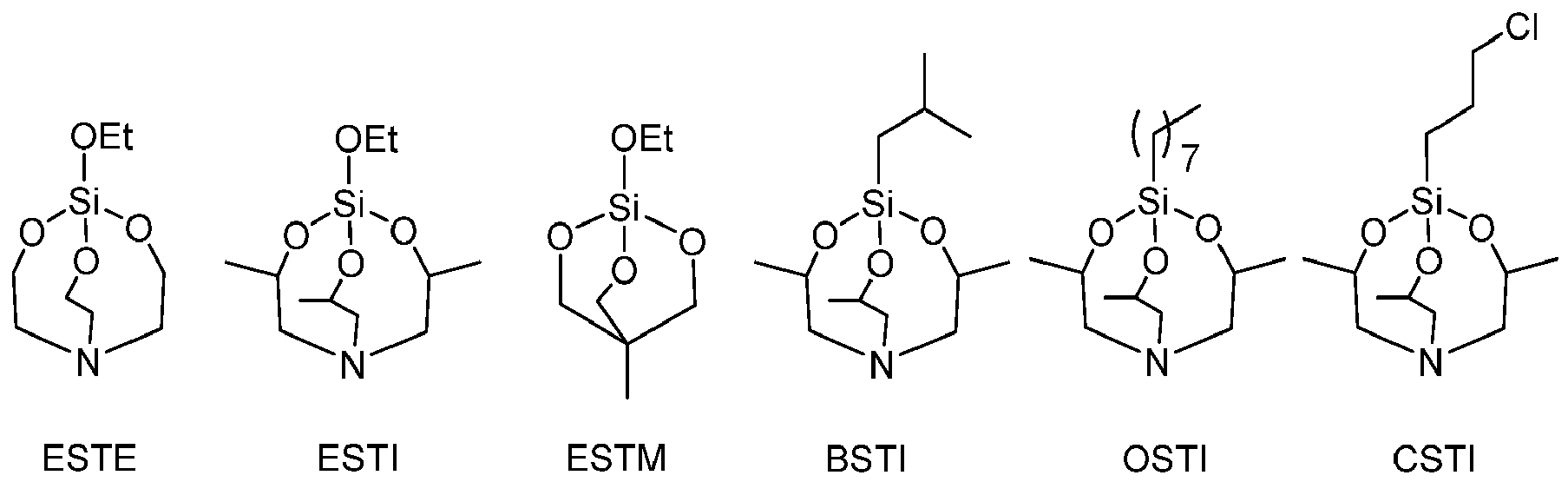


- The functionalized elastomer of claim 1, 2 or 3, wherein the polymerization terminator of formula I has the structure

- The functionalized elastomer of claim 1, 2 or 3, wherein the polymerization terminator of formula I has the structure

- The functionalized elastomer of claim 1, 2 or 3, wherein the polymerization terminator of formula I has the structure

- The functionalized elastomer of claim 1, 2 or 3, wherein the polymerization terminator of formula I has the structure

- The functionalized elastomer of claim 1, 2 or 3, wherein the structure of formula X is selected from the group consisting of 3-(N, N-dimethylamino)-1-propyl, 3-(N, N-dimethylamino)-2-methyl-1-propyl, 3-(N, N-dimethylamino)-2,2-dimethyl-1-propyl, 4-(N, N-dimethylamino)-1-butyl, 5-(N, N-dimethylamino)-1-pentyl, 6-(N, N-dimethylamino)-1-hexyl, and 8-(N, N-dimethylamino)-1-propyl; or wherein the structure of formula X is selected from the group consisting of 3-piperidino-1-propyl and 3-pyrrolidino-1-propyl.
Applications Claiming Priority (1)
| Application Number | Priority Date | Filing Date | Title |
|---|---|---|---|
| US14/462,967 US9109073B1 (en) | 2014-08-19 | 2014-08-19 | Bifunctionalized polymer |
Publications (2)
| Publication Number | Publication Date |
|---|---|
| EP2987647A1 true EP2987647A1 (en) | 2016-02-24 |
| EP2987647B1 EP2987647B1 (en) | 2017-02-22 |
Family
ID=53785909
Family Applications (1)
| Application Number | Title | Priority Date | Filing Date |
|---|---|---|---|
| EP15180008.3A Active EP2987647B1 (en) | 2014-08-19 | 2015-08-06 | Bifunctionalized polymer |
Country Status (4)
| Country | Link |
|---|---|
| US (1) | US9109073B1 (en) |
| EP (1) | EP2987647B1 (en) |
| JP (1) | JP6598574B2 (en) |
| BR (1) | BR102015019332B1 (en) |
Cited By (1)
| Publication number | Priority date | Publication date | Assignee | Title |
|---|---|---|---|---|
| RU2665706C1 (en) * | 2017-06-09 | 2018-09-04 | Публичное акционерное общество "СИБУР Холдинг" | Functionalized initiator of anionic copolymerization and method of its obtaining, copolymers obtained using this initiator and rubber mixtures based on formed copolymers |
Families Citing this family (14)
| Publication number | Priority date | Publication date | Assignee | Title |
|---|---|---|---|---|
| US9428628B2 (en) * | 2014-08-20 | 2016-08-30 | The Goodyear Tire & Rubber Company | Functionalized polymer, rubber composition and pneumatic tire |
| WO2017019878A1 (en) * | 2015-07-29 | 2017-02-02 | Bridgestone Corporation | Processes for preparing functionalized polymers, related functionalizing compound and preparation thereof |
| KR101943408B1 (en) * | 2015-11-02 | 2019-01-30 | 주식회사 엘지화학 | Organic lithium compounds, a method for preparing modified diene polymer using the same and a modified diene polymer |
| DE102015224436A1 (en) * | 2015-12-07 | 2017-06-08 | Evonik Degussa Gmbh | rubber compounds |
| US9790289B1 (en) * | 2016-08-30 | 2017-10-17 | The Goodyear Tire & Rubber Company | Functionalized polymer, rubber composition, and pneumatic tire |
| US10623846B2 (en) * | 2016-12-06 | 2020-04-14 | Bose Corporation | Earpieces employing viscoelastic materials |
| KR102070382B1 (en) * | 2017-01-06 | 2020-01-29 | 주식회사 엘지화학 | Amine compound, Modified conjugated diene polymer comprising functional group derived therefrom and preparation method the modified conjugated diene polymer |
| US11208518B2 (en) | 2018-12-11 | 2021-12-28 | The Goodyear Tire & Rubber Company | Functionalized polymer, rubber composition and pneumatic tire |
| US10947380B2 (en) | 2018-12-20 | 2021-03-16 | The Goodyear Tire & Rubber Company | Functionalized polymer, rubber composition and pneumatic tire |
| KR102576576B1 (en) * | 2018-12-27 | 2023-09-08 | 에스케이이노베이션 주식회사 | Etching composition, method for etching insulating layer of semiconductor devices using the same and method for preparing semiconductor devices |
| KR102803327B1 (en) * | 2019-04-18 | 2025-05-07 | 에스케이이노베이션 주식회사 | Silicon compound |
| US11214667B2 (en) | 2019-07-29 | 2022-01-04 | The Goodyear Tire & Rubber Company | Pneumatic tire |
| US11441021B2 (en) | 2019-07-29 | 2022-09-13 | The Goodyear Tire & Rubber Company | Pneumatic tire |
| US12692329B2 (en) * | 2022-03-31 | 2026-07-28 | G-3 Chickadee Purchaser, Llc | Functionalized hydrogenated polymers |
Citations (4)
| Publication number | Priority date | Publication date | Assignee | Title |
|---|---|---|---|---|
| US7339005B2 (en) * | 2003-01-31 | 2008-03-04 | Sumitomo Chemical Company, Limited | Process for producing modified diene polymer rubber |
| EP2206742A1 (en) * | 2008-12-19 | 2010-07-14 | Evonik Degussa GmbH | Particle containing silatrane |
| US20140213693A1 (en) * | 2011-11-24 | 2014-07-31 | Sumitomo Rubber Industries, Ltd. | Rubber composition and studless tire |
| EP2875967A2 (en) * | 2013-11-25 | 2015-05-27 | The Goodyear Tire & Rubber Company | Functionalized elastomer and rubber composition with such an elastomer |
Family Cites Families (35)
| Publication number | Priority date | Publication date | Assignee | Title |
|---|---|---|---|---|
| US4935471A (en) | 1987-10-15 | 1990-06-19 | The Goodyear Tire & Rubber Company | Capped polydienes |
| CA1338805C (en) * | 1988-05-02 | 1996-12-17 | Akio Imai | Modified diene polymer rubbers |
| US6025450A (en) | 1992-10-02 | 2000-02-15 | Bridgestone Corporation | Amine containing polymers and products therefrom |
| US5552473A (en) | 1992-10-02 | 1996-09-03 | Bridgestone Corporation | Functionalized polymer and rubber compositions produced from solubilized anionic polymerization initiators |
| US5332810A (en) | 1992-10-02 | 1994-07-26 | Bridgestone Corporation | Solubilized anionic polymerization initiator and preparation thereof |
| US5625017A (en) * | 1992-10-19 | 1997-04-29 | Bridgestone Corporation | Process for preparing a polymer using lithium initiator prepared by in situ preparation |
| DE69417195T2 (en) | 1993-12-29 | 1999-07-29 | Bridgestone Corp., Tokio/Tokyo | Diene polymers and diene copolymers with an alkoxysilane group |
| US5527753A (en) | 1994-12-13 | 1996-06-18 | Fmc Corporation | Functionalized amine initiators for anionic polymerization |
| US5785778A (en) | 1995-02-01 | 1998-07-28 | Bridgestone Corporation | Aminoalkyllithium compounds containing cyclic amines and polymers therefrom |
| US5574109A (en) | 1995-02-01 | 1996-11-12 | Bridgestone Corporation | Aminoalkyllithium compounds containing cyclic amines and polymers therefrom |
| US6080835A (en) | 1995-02-01 | 2000-06-27 | Bridgestone Corporation | Aminoalkyllithium compounds containing cyclic amines and polymers therefrom |
| US5798418A (en) | 1995-07-31 | 1998-08-25 | Fmc Corporation | Star polymers from mixed initiators |
| US5919870A (en) | 1995-07-31 | 1999-07-06 | Fmc Corporation | Functional telechelic star polymers |
| US5912313A (en) * | 1995-11-22 | 1999-06-15 | The B. F. Goodrich Company | Addition polymers of polycycloolefins containing silyl functional groups |
| US5786441A (en) | 1996-12-31 | 1998-07-28 | Bridgestone Corporation | Polymers, elastomeric compounds and products thereof, derived from novel amine compounds containing side-chain organolithium moieties |
| US5866650A (en) | 1997-07-11 | 1999-02-02 | Bridgestone Corporation | Composition of cyclic amine-initiated elastomers and amorphous silica and process for the production thereof |
| JP2000302977A (en) * | 1999-04-16 | 2000-10-31 | Dow Corning Toray Silicone Co Ltd | Silicone rubber composition |
| KR100416409B1 (en) * | 2001-01-22 | 2004-01-31 | 금호석유화학 주식회사 | Synthesis method of siloxane-functionalized high 1,4-cis polybutadiene |
| EP1479698B1 (en) * | 2003-05-22 | 2008-05-14 | JSR Corporation | Method for producing modified conjugated diene polymer and rubber composition |
| US7625981B2 (en) * | 2004-06-04 | 2009-12-01 | Sumitomo Chemical Company, Limited | Process for producing modified polymer rubber |
| JP4901101B2 (en) * | 2004-12-28 | 2012-03-21 | 株式会社ブリヂストン | Modified polymer, rubber composition and tire |
| DE102005038794A1 (en) * | 2005-08-17 | 2007-02-22 | Degussa Ag | rubber compounds |
| DE102006004062A1 (en) | 2006-01-28 | 2007-08-09 | Degussa Gmbh | rubber compounds |
| US20080103261A1 (en) * | 2006-10-25 | 2008-05-01 | Bridgestone Corporation | Process for producing modified conjugated diene based polymer, modified conjugated diene based polymer produced by the process, rubber composition, and tire |
| JP5503298B2 (en) * | 2008-02-22 | 2014-05-28 | 株式会社ブリヂストン | Organosilicon compound, and rubber composition, tire, primer composition, coating composition and adhesive using the same |
| TWI395785B (en) * | 2008-04-30 | 2013-05-11 | 旭化成電子材料股份有限公司 | A resin composition and a sheet using the same |
| JP5628498B2 (en) * | 2009-08-26 | 2014-11-19 | 株式会社ブリヂストン | Organosilicon compound, organosilicon compound composition containing the same, rubber composition, primer composition, coating composition, adhesive, and tire |
| RU2531824C2 (en) * | 2009-10-21 | 2014-10-27 | ДжейЭсАр КОРПОРЕЙШН | Method of producing modified conjugated diene rubber, modified conjugated diene rubber and rubber composition |
| CN102781973B (en) | 2009-12-10 | 2016-10-19 | 戴纳索尔埃拉斯托默罗斯有限公司 | Comprise functionalization multiarm polymers and their application of the functionalized polymeric synthesized by anionic polymerisation |
| KR101702697B1 (en) * | 2010-02-26 | 2017-02-06 | 제온 코포레이션 | Conjugated diene rubber, rubber composition, crosslinked rubber, tire, and process for production of conjugated diene rubber |
| DE102011109827A1 (en) * | 2010-08-11 | 2012-02-16 | Sumitomo Chemical Company, Ltd. | Conjugated diene-based polymer, conjugated diene-based polymer composition, and process for producing conjugated diene-based polymer |
| DE102011109823B4 (en) * | 2010-08-11 | 2023-10-12 | Sumitomo Chemical Company, Limited | Conjugated diene-based polymer, conjugated diene-based polymer composition and process for producing conjugated diene-based polymer |
| JP6004677B2 (en) * | 2011-03-31 | 2016-10-12 | 住友化学株式会社 | Method for producing modified conjugated diene polymer, modified conjugated diene polymer, and polymer composition |
| JP5902447B2 (en) * | 2011-11-24 | 2016-04-13 | 住友ゴム工業株式会社 | Rubber composition and pneumatic tire |
| JP2013216612A (en) * | 2012-04-09 | 2013-10-24 | Daiso Co Ltd | Sulfur-containing organosilicon compound having new structure, and method for producing the same |
-
2014
- 2014-08-19 US US14/462,967 patent/US9109073B1/en active Active
-
2015
- 2015-08-06 EP EP15180008.3A patent/EP2987647B1/en active Active
- 2015-08-12 BR BR102015019332-7A patent/BR102015019332B1/en not_active IP Right Cessation
- 2015-08-14 JP JP2015160096A patent/JP6598574B2/en active Active
Patent Citations (4)
| Publication number | Priority date | Publication date | Assignee | Title |
|---|---|---|---|---|
| US7339005B2 (en) * | 2003-01-31 | 2008-03-04 | Sumitomo Chemical Company, Limited | Process for producing modified diene polymer rubber |
| EP2206742A1 (en) * | 2008-12-19 | 2010-07-14 | Evonik Degussa GmbH | Particle containing silatrane |
| US20140213693A1 (en) * | 2011-11-24 | 2014-07-31 | Sumitomo Rubber Industries, Ltd. | Rubber composition and studless tire |
| EP2875967A2 (en) * | 2013-11-25 | 2015-05-27 | The Goodyear Tire & Rubber Company | Functionalized elastomer and rubber composition with such an elastomer |
Non-Patent Citations (3)
| Title |
|---|
| A. GESSLER; W. HESS; A MEDALIA, PLAST. RUBBER PROCESS, vol. 3, 1968, pages 141 |
| D. RIVIN; J. ARON; A. MEDALIA, RUBBER CHEM. & TECHNOL., vol. 41, 1968, pages 330 |
| N. NAGATA, NIPPON GOMU KYOKAISHI, vol. 62, 1989, pages 630 |
Cited By (1)
| Publication number | Priority date | Publication date | Assignee | Title |
|---|---|---|---|---|
| RU2665706C1 (en) * | 2017-06-09 | 2018-09-04 | Публичное акционерное общество "СИБУР Холдинг" | Functionalized initiator of anionic copolymerization and method of its obtaining, copolymers obtained using this initiator and rubber mixtures based on formed copolymers |
Also Published As
| Publication number | Publication date |
|---|---|
| JP6598574B2 (en) | 2019-10-30 |
| BR102015019332B1 (en) | 2021-07-13 |
| EP2987647B1 (en) | 2017-02-22 |
| US9109073B1 (en) | 2015-08-18 |
| JP2016044305A (en) | 2016-04-04 |
| BR102015019332A2 (en) | 2016-04-12 |
Similar Documents
| Publication | Publication Date | Title |
|---|---|---|
| EP2987647B1 (en) | Bifunctionalized polymer | |
| EP2516478B1 (en) | Modified polymer compositions | |
| CA3035654C (en) | Rubber compositions | |
| EP3059257A1 (en) | Modified conjugated diene-based polymer, preparation method therefor, and rubber composition comprising same | |
| JPWO2018043699A1 (en) | Rubber composition | |
| EP2516474A1 (en) | Modified polymer compositions | |
| EP2640753A1 (en) | Methanol-terminated polymers containing silane | |
| EP2847264A1 (en) | Carbinol-terminated polymers containing amine | |
| WO2013167410A1 (en) | Carbinol-terminated polymers containing allylamine | |
| US20190375912A1 (en) | Modified Polymerization Initiator and Modified Conjugated Diene-Based Polymer Including Functional Group Derived Therefrom | |
| EP2640754B1 (en) | Methanol-terminated polymers containing ether | |
| JP2019500475A (en) | Modified conjugated diene polymer and process for producing the same | |
| TWI896036B (en) | Covalent diene polymer and covalent diene polymer composition | |
| EP3347381B1 (en) | Methods for preparation of functionalized polymers | |
| JP6608068B2 (en) | Modified monomer, modified conjugated diene polymer containing the same, and method for producing the same | |
| KR20250143946A (en) | Modified conjugated diene-based polymer, preparing method thereof and rubber composition comprising the same | |
| US20220162426A1 (en) | Copolymer, Copolymer Composition, and Rubber Composition | |
| KR102724304B1 (en) | Modified conjugated diene polymer, preparing method thereof and rubber composition comprising the same | |
| JP2020515675A (en) | Modifier, method for producing the same, and modified conjugated diene polymer containing the same | |
| KR102308724B1 (en) | Modified conjugated diene polymer and method for preparing the same | |
| JP2025179570A (en) | Rubber composition for crawlers | |
| KR102065652B1 (en) | Modifying agent, preparation method of modified conjugated diene polymer using the modifying agent and modified conjugated diene polymer | |
| WO2025150432A1 (en) | Modified conjugated diene polymer and method for producing modified conjugated diene polymer | |
| JP2025151725A (en) | Hydrogenated conjugated diene polymer | |
| KR20220068750A (en) | Copolymer, method of producing the same and rubber composition comprising the same |
Legal Events
| Date | Code | Title | Description |
|---|---|---|---|
| PUAI | Public reference made under article 153(3) epc to a published international application that has entered the european phase |
Free format text: ORIGINAL CODE: 0009012 |
|
| AK | Designated contracting states |
Kind code of ref document: A1 Designated state(s): AL AT BE BG CH CY CZ DE DK EE ES FI FR GB GR HR HU IE IS IT LI LT LU LV MC MK MT NL NO PL PT RO RS SE SI SK SM TR |
|
| AX | Request for extension of the european patent |
Extension state: BA ME |
|
| GRAP | Despatch of communication of intention to grant a patent |
Free format text: ORIGINAL CODE: EPIDOSNIGR1 |
|
| 17P | Request for examination filed |
Effective date: 20160824 |
|
| RBV | Designated contracting states (corrected) |
Designated state(s): AL AT BE BG CH CY CZ DE DK EE ES FI FR GB GR HR HU IE IS IT LI LT LU LV MC MK MT NL NO PL PT RO RS SE SI SK SM TR |
|
| RIC1 | Information provided on ipc code assigned before grant |
Ipc: C08F 36/06 20060101ALI20160913BHEP Ipc: C08C 19/44 20060101ALI20160913BHEP Ipc: C08L 9/00 20060101ALI20160913BHEP Ipc: C08F 2/42 20060101ALI20160913BHEP Ipc: C08C 19/22 20060101ALI20160913BHEP Ipc: C08F 36/08 20060101ALI20160913BHEP Ipc: C08F 4/48 20060101ALI20160913BHEP Ipc: C08L 7/00 20060101ALI20160913BHEP Ipc: B60C 1/00 20060101AFI20160913BHEP Ipc: C08F 212/08 20060101ALI20160913BHEP Ipc: C08F 2/38 20060101ALI20160913BHEP |
|
| INTG | Intention to grant announced |
Effective date: 20160928 |
|
| GRAS | Grant fee paid |
Free format text: ORIGINAL CODE: EPIDOSNIGR3 |
|
| GRAA | (expected) grant |
Free format text: ORIGINAL CODE: 0009210 |
|
| AK | Designated contracting states |
Kind code of ref document: B1 Designated state(s): AL AT BE BG CH CY CZ DE DK EE ES FI FR GB GR HR HU IE IS IT LI LT LU LV MC MK MT NL NO PL PT RO RS SE SI SK SM TR |
|
| REG | Reference to a national code |
Ref country code: GB Ref legal event code: FG4D |
|
| REG | Reference to a national code |
Ref country code: CH Ref legal event code: EP |
|
| REG | Reference to a national code |
Ref country code: AT Ref legal event code: REF Ref document number: 868968 Country of ref document: AT Kind code of ref document: T Effective date: 20170315 |
|
| REG | Reference to a national code |
Ref country code: IE Ref legal event code: FG4D |
|
| REG | Reference to a national code |
Ref country code: DE Ref legal event code: R096 Ref document number: 602015001558 Country of ref document: DE |
|
| REG | Reference to a national code |
Ref country code: LT Ref legal event code: MG4D |
|
| REG | Reference to a national code |
Ref country code: NL Ref legal event code: MP Effective date: 20170222 |
|
| REG | Reference to a national code |
Ref country code: AT Ref legal event code: MK05 Ref document number: 868968 Country of ref document: AT Kind code of ref document: T Effective date: 20170222 |
|
| REG | Reference to a national code |
Ref country code: FR Ref legal event code: PLFP Year of fee payment: 3 |
|
| PG25 | Lapsed in a contracting state [announced via postgrant information from national office to epo] |
Ref country code: GR Free format text: LAPSE BECAUSE OF FAILURE TO SUBMIT A TRANSLATION OF THE DESCRIPTION OR TO PAY THE FEE WITHIN THE PRESCRIBED TIME-LIMIT Effective date: 20170523 Ref country code: LT Free format text: LAPSE BECAUSE OF FAILURE TO SUBMIT A TRANSLATION OF THE DESCRIPTION OR TO PAY THE FEE WITHIN THE PRESCRIBED TIME-LIMIT Effective date: 20170222 Ref country code: HR Free format text: LAPSE BECAUSE OF FAILURE TO SUBMIT A TRANSLATION OF THE DESCRIPTION OR TO PAY THE FEE WITHIN THE PRESCRIBED TIME-LIMIT Effective date: 20170222 Ref country code: NO Free format text: LAPSE BECAUSE OF FAILURE TO SUBMIT A TRANSLATION OF THE DESCRIPTION OR TO PAY THE FEE WITHIN THE PRESCRIBED TIME-LIMIT Effective date: 20170522 Ref country code: FI Free format text: LAPSE BECAUSE OF FAILURE TO SUBMIT A TRANSLATION OF THE DESCRIPTION OR TO PAY THE FEE WITHIN THE PRESCRIBED TIME-LIMIT Effective date: 20170222 |
|
| PG25 | Lapsed in a contracting state [announced via postgrant information from national office to epo] |
Ref country code: NL Free format text: LAPSE BECAUSE OF NON-PAYMENT OF DUE FEES Effective date: 20170222 Ref country code: AT Free format text: LAPSE BECAUSE OF FAILURE TO SUBMIT A TRANSLATION OF THE DESCRIPTION OR TO PAY THE FEE WITHIN THE PRESCRIBED TIME-LIMIT Effective date: 20170222 Ref country code: LV Free format text: LAPSE BECAUSE OF FAILURE TO SUBMIT A TRANSLATION OF THE DESCRIPTION OR TO PAY THE FEE WITHIN THE PRESCRIBED TIME-LIMIT Effective date: 20170222 Ref country code: SE Free format text: LAPSE BECAUSE OF FAILURE TO SUBMIT A TRANSLATION OF THE DESCRIPTION OR TO PAY THE FEE WITHIN THE PRESCRIBED TIME-LIMIT Effective date: 20170222 Ref country code: ES Free format text: LAPSE BECAUSE OF FAILURE TO SUBMIT A TRANSLATION OF THE DESCRIPTION OR TO PAY THE FEE WITHIN THE PRESCRIBED TIME-LIMIT Effective date: 20170222 Ref country code: RS Free format text: LAPSE BECAUSE OF FAILURE TO SUBMIT A TRANSLATION OF THE DESCRIPTION OR TO PAY THE FEE WITHIN THE PRESCRIBED TIME-LIMIT Effective date: 20170222 Ref country code: BG Free format text: LAPSE BECAUSE OF FAILURE TO SUBMIT A TRANSLATION OF THE DESCRIPTION OR TO PAY THE FEE WITHIN THE PRESCRIBED TIME-LIMIT Effective date: 20170522 Ref country code: PT Free format text: LAPSE BECAUSE OF FAILURE TO SUBMIT A TRANSLATION OF THE DESCRIPTION OR TO PAY THE FEE WITHIN THE PRESCRIBED TIME-LIMIT Effective date: 20170622 |
|
| PG25 | Lapsed in a contracting state [announced via postgrant information from national office to epo] |
Ref country code: CZ Free format text: LAPSE BECAUSE OF FAILURE TO SUBMIT A TRANSLATION OF THE DESCRIPTION OR TO PAY THE FEE WITHIN THE PRESCRIBED TIME-LIMIT Effective date: 20170222 Ref country code: EE Free format text: LAPSE BECAUSE OF FAILURE TO SUBMIT A TRANSLATION OF THE DESCRIPTION OR TO PAY THE FEE WITHIN THE PRESCRIBED TIME-LIMIT Effective date: 20170222 Ref country code: SK Free format text: LAPSE BECAUSE OF FAILURE TO SUBMIT A TRANSLATION OF THE DESCRIPTION OR TO PAY THE FEE WITHIN THE PRESCRIBED TIME-LIMIT Effective date: 20170222 Ref country code: RO Free format text: LAPSE BECAUSE OF FAILURE TO SUBMIT A TRANSLATION OF THE DESCRIPTION OR TO PAY THE FEE WITHIN THE PRESCRIBED TIME-LIMIT Effective date: 20170222 |
|
| REG | Reference to a national code |
Ref country code: DE Ref legal event code: R097 Ref document number: 602015001558 Country of ref document: DE |
|
| PG25 | Lapsed in a contracting state [announced via postgrant information from national office to epo] |
Ref country code: SM Free format text: LAPSE BECAUSE OF FAILURE TO SUBMIT A TRANSLATION OF THE DESCRIPTION OR TO PAY THE FEE WITHIN THE PRESCRIBED TIME-LIMIT Effective date: 20170222 Ref country code: PL Free format text: LAPSE BECAUSE OF FAILURE TO SUBMIT A TRANSLATION OF THE DESCRIPTION OR TO PAY THE FEE WITHIN THE PRESCRIBED TIME-LIMIT Effective date: 20170222 Ref country code: DK Free format text: LAPSE BECAUSE OF FAILURE TO SUBMIT A TRANSLATION OF THE DESCRIPTION OR TO PAY THE FEE WITHIN THE PRESCRIBED TIME-LIMIT Effective date: 20170222 |
|
| PLBE | No opposition filed within time limit |
Free format text: ORIGINAL CODE: 0009261 |
|
| STAA | Information on the status of an ep patent application or granted ep patent |
Free format text: STATUS: NO OPPOSITION FILED WITHIN TIME LIMIT |
|
| 26N | No opposition filed |
Effective date: 20171123 |
|
| PG25 | Lapsed in a contracting state [announced via postgrant information from national office to epo] |
Ref country code: SI Free format text: LAPSE BECAUSE OF FAILURE TO SUBMIT A TRANSLATION OF THE DESCRIPTION OR TO PAY THE FEE WITHIN THE PRESCRIBED TIME-LIMIT Effective date: 20170222 |
|
| PG25 | Lapsed in a contracting state [announced via postgrant information from national office to epo] |
Ref country code: MC Free format text: LAPSE BECAUSE OF FAILURE TO SUBMIT A TRANSLATION OF THE DESCRIPTION OR TO PAY THE FEE WITHIN THE PRESCRIBED TIME-LIMIT Effective date: 20170222 |
|
| REG | Reference to a national code |
Ref country code: BE Ref legal event code: MM Effective date: 20170831 |
|
| REG | Reference to a national code |
Ref country code: IE Ref legal event code: MM4A |
|
| PG25 | Lapsed in a contracting state [announced via postgrant information from national office to epo] |
Ref country code: LU Free format text: LAPSE BECAUSE OF NON-PAYMENT OF DUE FEES Effective date: 20170806 |
|
| REG | Reference to a national code |
Ref country code: FR Ref legal event code: PLFP Year of fee payment: 4 |
|
| PG25 | Lapsed in a contracting state [announced via postgrant information from national office to epo] |
Ref country code: IE Free format text: LAPSE BECAUSE OF NON-PAYMENT OF DUE FEES Effective date: 20170806 |
|
| PG25 | Lapsed in a contracting state [announced via postgrant information from national office to epo] |
Ref country code: BE Free format text: LAPSE BECAUSE OF NON-PAYMENT OF DUE FEES Effective date: 20170831 |
|
| PG25 | Lapsed in a contracting state [announced via postgrant information from national office to epo] |
Ref country code: MT Free format text: LAPSE BECAUSE OF NON-PAYMENT OF DUE FEES Effective date: 20170806 |
|
| REG | Reference to a national code |
Ref country code: CH Ref legal event code: PL |
|
| PG25 | Lapsed in a contracting state [announced via postgrant information from national office to epo] |
Ref country code: LI Free format text: LAPSE BECAUSE OF NON-PAYMENT OF DUE FEES Effective date: 20180831 Ref country code: CH Free format text: LAPSE BECAUSE OF NON-PAYMENT OF DUE FEES Effective date: 20180831 |
|
| PG25 | Lapsed in a contracting state [announced via postgrant information from national office to epo] |
Ref country code: HU Free format text: LAPSE BECAUSE OF FAILURE TO SUBMIT A TRANSLATION OF THE DESCRIPTION OR TO PAY THE FEE WITHIN THE PRESCRIBED TIME-LIMIT; INVALID AB INITIO Effective date: 20150806 |
|
| PG25 | Lapsed in a contracting state [announced via postgrant information from national office to epo] |
Ref country code: CY Free format text: LAPSE BECAUSE OF FAILURE TO SUBMIT A TRANSLATION OF THE DESCRIPTION OR TO PAY THE FEE WITHIN THE PRESCRIBED TIME-LIMIT Effective date: 20170222 |
|
| PG25 | Lapsed in a contracting state [announced via postgrant information from national office to epo] |
Ref country code: MK Free format text: LAPSE BECAUSE OF FAILURE TO SUBMIT A TRANSLATION OF THE DESCRIPTION OR TO PAY THE FEE WITHIN THE PRESCRIBED TIME-LIMIT Effective date: 20170222 |
|
| PG25 | Lapsed in a contracting state [announced via postgrant information from national office to epo] |
Ref country code: TR Free format text: LAPSE BECAUSE OF FAILURE TO SUBMIT A TRANSLATION OF THE DESCRIPTION OR TO PAY THE FEE WITHIN THE PRESCRIBED TIME-LIMIT Effective date: 20170222 |
|
| GBPC | Gb: european patent ceased through non-payment of renewal fee |
Effective date: 20190806 |
|
| PG25 | Lapsed in a contracting state [announced via postgrant information from national office to epo] |
Ref country code: AL Free format text: LAPSE BECAUSE OF FAILURE TO SUBMIT A TRANSLATION OF THE DESCRIPTION OR TO PAY THE FEE WITHIN THE PRESCRIBED TIME-LIMIT Effective date: 20170222 Ref country code: IS Free format text: LAPSE BECAUSE OF FAILURE TO SUBMIT A TRANSLATION OF THE DESCRIPTION OR TO PAY THE FEE WITHIN THE PRESCRIBED TIME-LIMIT Effective date: 20170622 |
|
| PG25 | Lapsed in a contracting state [announced via postgrant information from national office to epo] |
Ref country code: GB Free format text: LAPSE BECAUSE OF NON-PAYMENT OF DUE FEES Effective date: 20190806 |
|
| PGFP | Annual fee paid to national office [announced via postgrant information from national office to epo] |
Ref country code: DE Payment date: 20250724 Year of fee payment: 11 |
|
| PGFP | Annual fee paid to national office [announced via postgrant information from national office to epo] |
Ref country code: IT Payment date: 20250723 Year of fee payment: 11 |
|
| PGFP | Annual fee paid to national office [announced via postgrant information from national office to epo] |
Ref country code: FR Payment date: 20250723 Year of fee payment: 11 |
|
| REG | Reference to a national code |
Ref country code: DE Ref legal event code: R081 Ref document number: 602015001558 Country of ref document: DE Owner name: G-3 CHICKADEE PURCHASER, LLC, AKRON, US Free format text: FORMER OWNER: THE GOODYEAR TIRE & RUBBER COMPANY, AKRON, OHIO, US |