EP2986605B1 - Rohitukine analogs as cyclin-dependent kinase inhibitors and a process for the preparation thereof - Google Patents
Rohitukine analogs as cyclin-dependent kinase inhibitors and a process for the preparation thereof Download PDFInfo
- Publication number
- EP2986605B1 EP2986605B1 EP14734915.3A EP14734915A EP2986605B1 EP 2986605 B1 EP2986605 B1 EP 2986605B1 EP 14734915 A EP14734915 A EP 14734915A EP 2986605 B1 EP2986605 B1 EP 2986605B1
- Authority
- EP
- European Patent Office
- Prior art keywords
- hydroxy
- methyl
- compound
- chromen
- methylpiperidin
- Prior art date
- Legal status (The legal status is an assumption and is not a legal conclusion. Google has not performed a legal analysis and makes no representation as to the accuracy of the status listed.)
- Active
Links
- 0 CC(C)[C@](C*)C(C)(C)C(Oc1c2c(O)c(*)c(*)c1C(CCN(C)C1)C1O)=C(*)C2=O Chemical compound CC(C)[C@](C*)C(C)(C)C(Oc1c2c(O)c(*)c(*)c1C(CCN(C)C1)C1O)=C(*)C2=O 0.000 description 1
- JYWYBFQSFMWIOI-UHFFFAOYSA-N CC(Oc1c2c(O)cc(O)c1C(CCN(C)C1)C1O)=C(C(c(cc1)ccc1F)O)C2=O Chemical compound CC(Oc1c2c(O)cc(O)c1C(CCN(C)C1)C1O)=C(C(c(cc1)ccc1F)O)C2=O JYWYBFQSFMWIOI-UHFFFAOYSA-N 0.000 description 1
- PZXBPUJVINVNLU-AATRIKPKSA-N CN(CCC1c(c(O)cc(O)c23)c2OC(/C=C/c2cc(F)ccc2)=CC3=O)CC1O Chemical compound CN(CCC1c(c(O)cc(O)c23)c2OC(/C=C/c2cc(F)ccc2)=CC3=O)CC1O PZXBPUJVINVNLU-AATRIKPKSA-N 0.000 description 1
- FLRKPLFPBHNFLM-AATRIKPKSA-N CN(CCC1c(c(O)cc(O)c23)c2OC(/C=C/c2cccc(Cl)c2)=CC3=O)CC1O Chemical compound CN(CCC1c(c(O)cc(O)c23)c2OC(/C=C/c2cccc(Cl)c2)=CC3=O)CC1O FLRKPLFPBHNFLM-AATRIKPKSA-N 0.000 description 1
- WPVJHWMAIWTPQH-VOTSOKGWSA-N CN(CCC1c(c(O)cc(O)c23)c2OC(/C=C/c2ccccc2F)=CC3=O)CC1O Chemical compound CN(CCC1c(c(O)cc(O)c23)c2OC(/C=C/c2ccccc2F)=CC3=O)CC1O WPVJHWMAIWTPQH-VOTSOKGWSA-N 0.000 description 1
- TYEGPOQQLDRKLM-ZHACJKMWSA-N CN(CCC1c(c(OC(/C=C/c2c(cccc3)c3cc3c2cccc3)=C2)c(c(O)c3)C2=O)c3O)CC1O Chemical compound CN(CCC1c(c(OC(/C=C/c2c(cccc3)c3cc3c2cccc3)=C2)c(c(O)c3)C2=O)c3O)CC1O TYEGPOQQLDRKLM-ZHACJKMWSA-N 0.000 description 1
- BIIVYFLTOXDAOV-UHFFFAOYSA-N CN(CCC1c(c(OC(c(cccc2)c2Cl)=C2)c(c(O)c3)C2=O)c3O)CC1O Chemical compound CN(CCC1c(c(OC(c(cccc2)c2Cl)=C2)c(c(O)c3)C2=O)c3O)CC1O BIIVYFLTOXDAOV-UHFFFAOYSA-N 0.000 description 1
Images


Classifications
-
- C—CHEMISTRY; METALLURGY
- C07—ORGANIC CHEMISTRY
- C07D—HETEROCYCLIC COMPOUNDS
- C07D405/00—Heterocyclic compounds containing both one or more hetero rings having oxygen atoms as the only ring hetero atoms, and one or more rings having nitrogen as the only ring hetero atom
- C07D405/02—Heterocyclic compounds containing both one or more hetero rings having oxygen atoms as the only ring hetero atoms, and one or more rings having nitrogen as the only ring hetero atom containing two hetero rings
- C07D405/04—Heterocyclic compounds containing both one or more hetero rings having oxygen atoms as the only ring hetero atoms, and one or more rings having nitrogen as the only ring hetero atom containing two hetero rings directly linked by a ring-member-to-ring-member bond
-
- A—HUMAN NECESSITIES
- A61—MEDICAL OR VETERINARY SCIENCE; HYGIENE
- A61P—SPECIFIC THERAPEUTIC ACTIVITY OF CHEMICAL COMPOUNDS OR MEDICINAL PREPARATIONS
- A61P35/00—Antineoplastic agents
-
- C—CHEMISTRY; METALLURGY
- C07—ORGANIC CHEMISTRY
- C07D—HETEROCYCLIC COMPOUNDS
- C07D405/00—Heterocyclic compounds containing both one or more hetero rings having oxygen atoms as the only ring hetero atoms, and one or more rings having nitrogen as the only ring hetero atom
- C07D405/14—Heterocyclic compounds containing both one or more hetero rings having oxygen atoms as the only ring hetero atoms, and one or more rings having nitrogen as the only ring hetero atom containing three or more hetero rings
Definitions
- the present invention relates to the 5,7-dihydroxy-8-(3-hydroxy-1-methylpiperidin-4-yl)-2-methyl-4H-chromen-4-one (Rohitukine) analogs that showed potent inhibition of cyclin-dependent kinase-2/cyclin A (CDK-2/cyclin A) and cyclin-dependent kinase-9/cyclin T1 (CDK-9/cyclin T1).
- CDK-2/cyclin A cyclin-dependent kinase-9/cyclin T1
- CDK-9/cyclin T1 cyclin-dependent kinase-9/cyclin T1
- the present invention particularly relates to the preparation of semi-synthetic analogs of rohitukine (5,7-dihydroxy-8-(3-hydroxy-1-methylpiperidin-4-yl)-2-methyl-4H-chromen-4-one) and their CDK-2/A and CDK-9/T1 inhibitory effects.
- CDKs Cyclin-dependent kinases
- Alteration and deregulation of CDK activity have pathogenic link to the cancer.
- Number of cancers are associated with hyper-activation of CDKs as a result of mutation of the CDK genes or CDK inhibitor genes. Therefore, CDK inhibitors or modulators are of great interest to explore as novel therapeutic agents against cancer ( Senderowicz, A.M. Leukemia 2001, 15, 1 ).
- Several classes of chemical inhibitors of CDK activity have been described ( Zhang, J. et.al. Nat Rev Cancer. 2009, 9, 28 ) and some of them have reached to clinical pipeline for cancer.
- CDK inhibitors are ATP competitive ligands; hence earlier they were typically described as purine class of compounds for example dimethylaminopurine, a first substance to be known as a CDK inhibitor ( Neant, I. et al. Exp. Cell Res. 1988, 176, 68 ), olomoucine ( Vesely, J. et al. Eur. J. Biochem. 1994, 224, 771 ) and roscovitine ( Meijer, L. et al. Eur. J. Biochem. 1997, 243, 527 ).
- the IC 50 values of these purine class of compounds for CDK1/cyclin B are 120, 7 and 0.2-0.8 ⁇ M respectively ( Gray, N. et al. Curr.
- CDK complexes with their respective type cyclin partners such as, complex of CDK2 and cyclin A is responsible for the cell's progression from G1 phase to S phase ( Sherr, C.J. Science 1996, 274, 1672 ).
- DNA synthesis begins with the CDK mediated phosphorylation of Rb (retinoblastoma) protein. Phosphorylated Rb is released from its complex with E2F. The released E2F then promotes the transcription of numerous genes required for the cell to progress through S phase, including thymidylate synthase and dihydrofolate reductase which are required for cell progression ( Hatakeyama, M. et. al, Cell Cycle Res.
- Majority of human cancers have abnormalities in some component of the Rb pathway because of hyper-activation of CDKs resulting from the over-expression of positive cofactors (cyclins/CDKs) or a decrease in negative factors (endogenous CDK inhibitors) or Rb gene mutations ( Sausville, E.A. et. al, Pharmacol. Ther. 1999, 82, 285 ).
- the CDK-9 is a member of the Cdc2-like family of kinases. Its cyclin partners are members of the family of cyclin T (T1, T2a and T2b) and cyclin K.
- the CDK-9/cyclin T complexes appear to be involved in regulating several physiological processes.
- CDK9/cyclin T1 belongs to the P-TEFb complex, and is responsible for the phosphorylation of carboxyl terminal domain of the RNA Polymerase II, thus promoting general elongation.
- CDK-9 has also been described as the kinase of the TAK complex, which is homologous to the P-TEFb complex and is involved in HIV replication.
- CDK9 also appears to be involved in the differentiation program of several cell types, such as muscle cells, monocytes and neurons, suggesting that it may have a function in controlling specific differentiative pathways.
- CDK-9 seems to have an anti-apoptotic function in monocytes, that may be related to its control over differentiation of monocytes. This suggests the involvement of CDK-9 in several physiological processes in the cell, the deregulation of which may be related to the genesis of transforming events that may in turn lead to the onset of cancer.
- the complex CDK-9/cyclin T1 is able to bind to the HIV-1 product Tat, the study of the functions of CDK-9/cyclin T may be of interest in understanding the basal mechanisms that regulate HIV replication ( Falco, G. D. and Giordano A. Cancer Biol. Therapy 2002, 1, 337 ).
- Rohitukine belongs to a class of chromone alkaloids and it was isolated by chemists at Hoechst India Ltd. in the early 1990's from Dysoxylum binectariferum Hook. which is phylogenetically related to the Ayurvedic plant, D. malabaricum Bedd., used for rheumatoid arthritis. Rohitukine was isolated as the constituent responsible for antiinflammatory and immunomodulatory activity ( Naik, R.G. et. al. Tetrahedron 1988, 44, 2081 ; US Patent US4900727, 1990 ). Medicinal chemistry efforts around this nature-derived flavone alkaloid led to discovery of two promising clinical candidates for treatment of cancer viz .
- rohitukine analogs suitable for controlling tumors The molecular formula of rohitukine is C 16 H 19 NO 5 and the structure has a molecular weight of 305.32 g/mol.
- the chemical structure of rohitukine (1) is shown below.
- the present invention reports new semi-synthetic analogs of rohitukine as promising inhibitors of cyclin-dependent kinases such as CDK-2 and CDK-9.
- the main objective of the present invention is to provide novel analogue of 5,7-dihydroxy-8-(3-hydroxy-1-methylpiperidin-4-yl)-2-methyl-4H-chromen-4-one.
- Yet another object of the present invention is to provide inhibitors of cyclin-dependent kinases, which are implicated in the pathogenesis of cancer and HIV infection.
- Still another object of the present invention is to provide a process for the preparation of analogs of rohitukine.
- Yet another objective of the present invention is to discover novel anticancer agents, exhibiting promising in vitro and in vivo tumor growth inhibition.
- the salts of compounds of formula A are selected from the group consisting of hydrochloride, hydrobromide, and methane sulfonate.
- the compounds exhibit inhibition of cyclin-dependent kinase-2/cyclin A (CDK-2/A) and cyclin-dependent kinase-9/cyclin T1 (CDK-9/T1).
- the compounds for use in treating or preventing the development of a proliferative disorder selected from the group consisting of breast cancer and leukemia are provided.
- the compounds showed IC 50 values for CDK-2/A inhibition from 16 nM to 608 nM
- the compounds showed IC 50 values for CDK-9-T1 inhibition from 2 nM to 30 nM.
- Disclosed herein is a process for the preparation of compounds of formula A comprising the step of reacting Rohitukine with compound selected from the group consisting of substituted benzyl, substituted benzyl halide, substituted aromatic aldehyde, and substituted aliphatic aldehyde in the presence of base selected from the group consisting of potassium carbonate, 1,4-diazabicyclo[2.2.2]octane (DABCO) and KOH to obtain compound of formula A.
- base selected from the group consisting of potassium carbonate, 1,4-diazabicyclo[2.2.2]octane (DABCO) and KOH
- the process for the preparation of compound of formula A selected from the group consisting of compound 8-30 and 32-35 comprising the step of reacting Rohitukine with a compound selected from the group consisting of substituted aromatic aldehyde in the presence of KOH for a period from 10 to 20 hrs to obtain compound of formula A selected from the group consisting of compound 28-30 and 32-35.
- the present invention provides the Rohitukine analogs of formula A as defined in the claims. Also disclosed herein are the 5,7-dihydroxy-8-(3-hydroxy-1-methylpiperidin-4-yl)-4H-chromen-4-ones (Rohitukine) analogs of formulae I and II and salts thereof, as potent anticancer agents and as inhibitors of cyclin-dependent kinases and the process for the preparation thereof.
- Rohitukine 5,7-dihydroxy-8-(3-hydroxy-1-methylpiperidin-4-yl)-4H-chromen-4-ones
- the patient is human.
- the proliferative disease is cancer.
- acyl refers to a carbonyl attached to an alkenyl, alkyl, aryl, cycloalkyl, heteroaryl, heterocyclyl, or any other moiety where the atom attached to the carbonyl is carbon.
- An “acetyl” group refers to a - C(O)CH 3 group.
- alkylcarbonyl or “alkanoyl” group refers to an alkyl group attached to the parent molecular moiety through a carbonyl group. Examples of such groups include methylcarbonyl and ethylcarbonyl. Examples of acyl groups include formyl, alkanoyl and aroyl.
- alkenyl refers to a straight-chain or branched-chain hydrocarbon radical having one or more double bonds optionally substituted and containing from 2 to 20, preferably 2 to 6, carbon atoms.
- alkenyl radicals include ethenyl, propenyl, 2-methylpropenyl, 1,4-butadienyl and the like.
- alkoxy refers to an alkyl ether radical, optionally substituted wherein the term alkyl is as defined below.
- alkyl ether radicals include methoxy, ethoxy, n-propoxy, isopropoxy, n-butoxy, iso-butoxy, sec-butoxy, tert-butoxy, and the like.
- alkyl refers to a straight-chain or branched-chain alkyl radical optionally substituted containing from 1 to 20 and including 20, preferably 1 to 10, and more preferably 1 to 6, carbon atoms. Alkyl groups may be optionally substituted as defined herein. Examples of alkyl radicals include methyl, ethyl, n-propyl, isopropyl, n-butyl, isobutyl, sec-butyl, tert-butyl, pentyl, iso-amyl, hexyl, octyl, nonyl and the like.
- alkylamino refers to an alkyl group optionally substituted attached to the parent molecular moiety through an amino group.
- Alkylamino groups may be mono- or dialkylated, forming groups such as, for example, N-methylamino, N-ethylamino, N,N-dimethylamino, N,N-ethylmethylamino and the like.
- alkynyl refers to a straight-chain or branched chain hydrocarbon radical having one or more triple bonds and containing from 2 to 20, preferably from 2 to 6, more preferably from 2 to 4, carbon atoms.
- Alkynyl refers to a carbon-carbon triple bond attached at two positions such as ethynylene (-C:::C-, -C ⁇ C-).
- alkynyl radicals include ethynyl, propynyl, hydroxypropynyl, butyn-1-yl, butyn-2-yl, pentyn-1-yl, 3-methylbutyn-1-yl, hexyn-2-yl, and the like.
- amino refers to -NRR', wherein R and R' are independently selected from the group consisting of hydrogen, alkyl, acyl, heteroalkyl, aryl, cycloalkyl, heteroaryl, and heterocycloalkyl, any of which may themselves be optionally substituted.
- aryl as used herein, alone or in combination, means a carbocyclic aromatic system containing one, two or three rings wherein such rings may be attached together in a pendent manner or may be fused optionally substituted with at least one halogen, an alkyl containing from 1 to 3 carbon atoms, an alkoxyl, an aryl radical, a nitro function, a polyether radical, a heteroaryl radical, a benzoyl radical, an alkyl ester group, a carboxylic acid, a hydroxyl optionally protected with an acetyl or benzoyl group, or an amino function optionally protected with an acetyl or benzoyl group or optionally substituted with at least one alkyl containing from 1 to 12 carbon atoms.
- arylalkyl or “aralkyl,” as used herein, alone or in combination, refers to an aryl group attached to the parent molecular moiety through an alkyl group.
- carbamate and “carbamoyl” as used herein, alone or in combination, refers to an ester of carbamic acid (-NHCOO-) which may be attached to the parent molecular moiety from either the nitrogen or acid end, and which may be optionally substituted as defined herein.
- carbonyl when alone includes formyl [-C(O)H] and in combination is a -C(O)- group.
- Carboxy refers to -C(O)OH or the corresponding “carboxylate” anion, such as is in a carboxylic acid salt.
- An "O-carboxy” group refers to a RC(O)O- group, where R is as defined herein.
- a “C-carboxy” group refers to a - C(O)OR groups where R is as defined herein.
- cycloalkyl or, alternatively, “carbocycle” as used herein, alone or in combination, refers to a saturated or partially saturated monocyclic, bicyclic or tricyclic alkyl radical wherein each cyclic moiety contains from 3 to 12, preferably five to seven, carbon atom ring members and which may optionally be a benzo-fused ring system which is optionally substituted as defined herein.
- cycloalkyl radicals examples include cyclopropyl, cyclobutyl, cyclopentyl, cyclohexyl, cycloheptyl, octahydronaphthyl, 2,3-dihydro-1H-indenyl, adamantyl and the like.
- "Bicyclic” and “tricyclic” as used herein are intended to include both fused ring systems, such as decahydronapthalene, octahydronapthalene as well as the multicyclic (multicentered) saturated or partially unsaturated type.
- the latter type of isomer is exemplified in general by, bicyclo[1,1,1]pentane, camphor, adamantane, and bicyclo[3,2,1]octane.
- esters refers to a carboxy group bridging two moieties linked at carbon atoms.
- ether refers to an oxygen atom bridging two moieties linked at carbon atoms.
- halo or halogen, as used herein, alone or in combination, refers to fluorine, chlorine, bromine, or iodine.
- haloalkyl refers to an alkyl radical having the meaning as defined above wherein one or more hydrogens are replaced with a halogen. Specifically embraced are monohaloalkyl, dihaloalkyl and polyhaloalkyl radicals.
- a monohaloalkyl radical for one example, may have an iodo, bromo, chloro or fluoro atom within the radical.
- Dihalo and polyhaloalkyl radicals may have two or more of the same halo atoms or a combination of different halo radicals.
- haloalkyl radicals include fluoromethyl, difluoromethyl, trifluoromethyl, chloromethyl, dichloromethyl, trichloromethyl, pentafluoroethyl, heptafluoropropyl, difluorochloromethyl, dichlorofluoromethyl, difluoroethyl, difluoropropyl, dichloroethyl and dichloropropyl.
- Haloalkylene refers to a haloalkyl group attached at two or more positions. Examples include fluoromethylene (-CHF-), difluoromethylene (-CF 2 -), chloromethylene (-CHCl-) and the like.
- heteroaryl refers to 3 to 7 membered, preferably 5 to 7-membered, unsaturated heteromonocyclic rings, or fused polycyclic rings in which at least one of the fused rings is unsaturated, wherein at least one atom is selected from the group consisting of O, S, and N.
- the term also embraces fused polycyclic groups wherein heterocyclic radicals are fused with aryl radicals, wherein heteroaryl radicals are fused with other heteroaryl radicals, or wherein heteroaryl radicals are fused with cycloalkyl radicals.
- heteroaryl groups include pyrrolyl, pyrrolinyl, imidazolyl, pyrazolyl, pyridyl, pyrimidinyl, pyrazinyl, pyridazinyl, triazolyl, pyranyl, furyl, thienyl, oxazolyl, isoxazolyl, oxadiazolyl, thiazolyl, thiadiazolyl, isothiazolyl, indolyl, isoindolyl, indolizinyl, benzimidazolyl, quinolyl, isoquinolyl, quinoxalinyl, quinazolinyl, indazolyl, benzotriazolyl, benzodioxolyl, benzopyranyl, benzoxazolyl, benzoxadiazolyl, benzothiazolyl, benzothiadiazolyl, benzofuryl, benzothienyl, chromonyl,
- Exemplary tricyclic heterocyclic groups includecarbazolyl, benzidolyl, phenanthrolinyl, dibenzofuranyl, acridinyl, phenanthridinyl, xanthenyl and the like.
- heterocycloalkyl and, interchangeably, “heterocyclyl” as used herein, alone or in combination, each refer to a saturated, partially unsaturated, or fully unsaturated monocyclic, bicyclic, or tricyclic heterocyclic radical containing at least one, preferably 1 to 4, and more preferably 1 to 2 heteroatoms as ring members, wherein each said heteroatom may be independently selected from the group consisting of nitrogen, oxygen, and sulfur, and wherein there are preferably 3 to 8 ring members in each ring, more preferably 3 to 7 ring members in each ring, and most preferably 5 to 6 ring members in each ring.
- Heterocycloalkyl and “heterocyclyl” are intended to include sulfones, sulfoxides, N-oxides of tertiary nitrogen ring members, and carbocyclic fused and benzo fused ring systems; additionally, both terms also include systems where a heterocycle ring is fused to an aryl group, as defined herein, or an additional heterocycle group.
- Heterocyclyl groups of the invention are exemplified by aziridinyl, azetidinyl, 1,3-benzodioxolyl, dihydroisoindolyl, dihydroisoquinolinyl, dihydrocinnolinyl, dihydrobenzodioxinyl, dihydro[1,3]oxazolo[4,5-b]pyridinyl, benzothiazolyl, dihydroindolyl, dihy-dropyridinyl, 1,3-dioxanyl, 1,4-dioxanyl, 1,3-dioxolanyl, isoindolinyl, morpholinyl, piperazinyl, pyrrolidinyl, tetrahydropyridinyl, piperidinyl, thiomorpholinyl, and the like.
- the heterocyclyl groups may be optionally substituted unless specifically prohibited.
- hydroxy as used herein, alone or in combination, refers to -OH.
- any definition herein may be used in combination with any other definition to describe a composite structural group.
- the trailing element of any such definition is that which attaches to the parent moiety.
- the composite group alkylamido would represent an alkyl group attached to the parent molecule through an amido group
- the term alkoxyalkyl would represent an alkoxy group attached to the parent molecule through an alkyl group.
- Individual stereoisomers of compounds can be prepared synthetically from commercially available starting materials which contain chiral centers or by preparation of mixtures of enantiomeric products followed by separation such as conversion to a mixture of diastereomers followed by separation or recrystallization, chromatographic techniques, direct separation of enantiomers on chiral chromatographic columns, or any other appropriate method known in the art.
- Starting compounds of particular stereochemistry are either commercially available or can be made and resolved by techniques known in the art.
- the compounds of the present invention may exist as geometric isomers.
- the present invention includes all cis, trans, syn, anti,
- compounds may exist as tautomers; all tautomeric isomers are provided by this invention.
- the compounds of the present invention can exist in unsolvated as well as solvated forms with pharmaceutically acceptable solvents such as water, ethanol, and the like. In general, the solvated forms are considered equivalent to the unsolvated forms for the purposes of the present invention.
- Optical isomers are compounds with the same molecular formula but differ in the way they rotate plane polarized light.
- the first type of optical isomers are compounds that are mirror images of one another but cannot be superimposed on each other. These isomers are called “enantiomers.”
- the second type of optical isomers are molecules that are not mirror images but each molecule rotates plane polarized light and are considered optically-active. Such molecules are called “diastereoisomers.”
- Diasteroisomers differ not only in the way they rotate plane polarized light, but also their physical properties.
- the term "optical isomer” comprises more particularly the enantiomers and the diastereoisomers, in pure form or in the form of a mixture.
- bonds refers to a covalent linkage between two atoms, or two moieties when the atoms joined by the bond are considered to be part of larger substructure.
- a bond may be single, double, or triple unless otherwise specified.
- a dashed line between two atoms in a drawing of a molecule indicates that an additional bond may be present or absent at that position.
- Disclosed herein is a method for treating or preventing cancer diseases such as leukemia, breast cancer etc. by identifying a patient suffering from or at a risk of developing a proliferative disease and administering to the patient a therapeutically-effective amount of a compound represented by the formulae I and II,
- One or more compounds of the invention can be used to treat a patient (e.g. a human) at a risk of developing or already suffering from a proliferative disease, such as breast cancer, leukemia etc.
- a patient e.g. a human
- a proliferative disease such as breast cancer, leukemia etc.
- the compounds of the invention can be used to treat a patient (e.g. a human) that suffers from or is at a risk of suffering from a disease, disorder, condition, or symptom described herein.
- a patient e.g. a human
- the compounds of the invention can be used alone or in combination with other agents and compounds in methods of treating or preventing proliferative disease such as cancer.
- Each such treatment described above includes the step of administering to a patient in need thereof a therapeutically effective amount of the compound of the invention described herein to delay, reduce or prevent such a disease, disorder, condition, or symptom.
- the compounds of the present invention are also useful for the treatment of animals, e.g., the veterinary treatment of domesticated animal, companion animals (e.g., dogs and cats), exotic animals, farm animals (e.g., ungulates, including horses, cows, sheep, goats, and pigs), and animals used in scientific research (e.g., rodents).
- animals e.g., the veterinary treatment of domesticated animal, companion animals (e.g., dogs and cats), exotic animals, farm animals (e.g., ungulates, including horses, cows, sheep, goats, and pigs), and animals used in scientific research (e.g., rodents).
- Rohitukine (1) Light yellow crystalline powder; melting point 229-232°C; 1 H-NMR (CD 3 OD, 500 MHz): ⁇ 6.26 (s, 1H, H-6), 6.10 (s, 1H, H-3), 4.22 (brs, 1H, H-3'), 3.82-3.21 (m, 6H of piperidine ring), 2.90 (s, 3H), 2.41 (s, 3H), 1.84 (m, 1H, H-5'a); 13 C NMR (CD 3 OD + Pyridin-d 5 , 100 MHz): ⁇ 182.90, 178.24, 166.77, 161.44, 156.96, 108.53, 108.03, 102.73, 69.30, 62.20, 56.60, 44.81, 37.35, 24.03, 23.62, 19.97; ESI-MS: m / z 306.0957 [M+H] + ; IR (KBr): v max 3399, 2924, 23
- FIG. 2 A general synthetic strategy for Baylis-Hilman analogs 13-27 proposed in present invention is depicted in Figure 2 . Conditions used in the synthesis are mild and yields are excellent.
- the method of synthesis for compounds of the invention is as follows: To the solution of rohitukine (1 , 61 mg, 2 mmol) in methanol (5 mL) was added substituted aromatic and aliphatic aldehydes (2 mmol) and DABCO (1 mmol), and the reaction mixture was continuously stirred for 10-15 days, however in none of the reaction starting material completely consumed, thus desired products were separated using preparative TLC.
- FIG. 3 A general synthetic strategy for styryl analogs 28-35 is depicted in Figure 3 .
- the method of synthesis for compounds of the invention is as follows: To the solution of rohitukine (1, 61 mg, 2 mmol) in methanol (5 mL) was added substituted aromatic or aliphatic aldehyde (2 mmol) in presence of 15 % aqueous KOH (few drop) as catalyst, and the reaction mixture was continuously stirred for 10-20 h. The styryl products were observed as side products and their yields also varied depending on different aldehydes. An intense yellow colored band was separated using preparative TLC to get desired product.
- a general synthetic strategy for Mannich adducts 36-42 is depicted in Figure 4 .
- the method of synthesis for compounds of the invention is as follows: To the solution of rohitukine ( 1, 61 mg, 2 mmol) in methanol-water (10 ml, ratio 7:3) was slowly added to a solution of formaldehyde (1 ml solution) and secondary amine (2 mmol) and reaction mixture was stirred at room temp for 5-10 h. Mannich adducts were purified using sephadex gel chromatography using methanol as a eluent.
- the present invention is related to novel compounds that show promising anticancer and CDK inhibitory activities.
- Both series of compounds displayed cytotoxicity against a panel of cell lines including HL-60 (leukemia), PC-3 (prostate), A-375 (Melanoma), MIAPaCa-2 (pancreatic), MCF-7 (breast) and Caco-2 (colon) as shown in Table 3 and 4.
- the styryl analogs 31 and 33 displayed promising cytotoxicity in HL-60 cells with IC 50 value of 1.0 and 0.9 ⁇ M, respectively.
- Another styryl analog 28 displayed potent cytotoxicity in MCF-7 cells with IC 50 value of 2 ⁇ M. Table 3.
- IC 50 ( ⁇ M) values of selected compounds of invention on selected cell lines a Compound code HL-60 Leukemia PC-3 Prostate A-375 Melanoma MCF-7 Breast Caco-2 Colon 1 6 ND ND ND 6 ND ND 8 ND ND 9 ND ND 12 ND ND 10 8 ND ND ND ND 14 11 ND ND ND ND 20 ND 5 ND ND ND 28 ND 10 4 2 ND 29 ND 12 ND ND ND 30 8 7 7 3 8 31 1 58 4.4 31 3.7 32 8 31 30 49 5.6 33 0.9 41 8 4 7 34 3 30 8 4 7 ND, not determined; a Since none of the compound showed >50% growth inhibition in MIAPaCa-2 cell line in preliminary screening at 10 ⁇ M, no IC 50 was determined in this cell line.
- CDK-2/cyclin A (5-20 mU diluted in 50 mM Hepes pH 7.5, 1 mM DTT, 0.02% Brij35, 100 mM NaCl) was assayed against Histone H1 in a final volume of 25.5 ⁇ l containing 50 mM Hepes pH7.5, 1 mM DTT, 0.02% Brij35, 100 mM NaCl, Histone H1 (1 mg/ml), 10 mM magnesium acetate and 0.02 mM [33P-g-ATP](500-1000 cpm/pmole) and incubated for 30 min at room temperature.
- CDK-9/Cyclin T1 (5-20 mU diluted in 50 mM Tris pH 7.5, 0.1 mM EGTA, 1 mg/ml BSA, 0.1 % mercaptoethanol) was assayed against a substrate peptide (YSPTSPSYSPTSPSYSPTSPKKK) in a final volume of 25.5 ⁇ l containing 50 mM Tris pH 7.5, 0.1 mM EDTA, 10 mM DTT, 1 mg/ml BSA, 0.3 mM YSPTSPSYSPTSPSYSPTSPKKK, 10 mM magnesium acetate and 0.05 mM [33P- ⁇ -ATP] (50-1000 cpm/pmole) and incubated for 30 min at room temperature.
- YSPTSPSYSPTSPSYSPTSPKKK substrate peptide
- CDK inhibition profile of compounds of the formulae I and II is shown in Figure 5 and 6 .
- styryl series of compounds 28-35 showed promising activity against CDK-2 and CDK-9 showing IC 50 values in low nanomolar range.
- Analogs 33, 34 and 35 are potent inhibitors of both enzymes CDK-2 and CDK-9 displaying IC 50 values in the range of 16-608 nM for CDK-2 and 2-30 nM for CDK-9, respectively.
- the comparative CDK-2 and CDK-9 inhibitory activity of rohitukine ( 1 ), flavopiridol and new most potent analogs 33-35 of the present invention is shown in Table 5.
- Results presented in table 3 indicate that synthesized NCEs have better CDK inhibitory activity compared with parent natural product rohitukine ( 1 ).
- Table 5 Comparative CDK-2 and CDK-9 inhibitory activity of rohitukine (1), flavopiridol and new most potent analogs 33-35 of the present invention Compound Structure IC 50 (nM) CDK-2/A CDK-9/T1 Rohitukine (1) >10,000 550 Flavopiridol 170 ( Kim K.S. et al., J. Med. Chem. 2000, 43, 4126 ) 20 ( Montagnoli A. et al., Nat. Chem. Biol. 2008, 4, 357 ) 33 16 2 34 608 12 35 466 30
- both compounds showed binding to the ATP binding site of CDK-9/Cyclin T complex by dense network of H-bonding and Vander waal interactions.
- the carbonyl oxygen and C-5 hydroxyl oxygen of compound 33 interacts with the -SH and NH group of Cys106 residue of hinge region with plethora of H-bonding.
- Protonated piperidinyl NH + and piperidinyl 3'-hydroxyl group interacts with the Ala153 and C7 hydroxyl group with backbone and side chain Asp167 of DFG signature motif
- compound 33 bears trans-2,6-dichloro-styryl ring, which interacts with the closed G loop residues including Gly26, Ile 25 and Val 33 by Vander waal interactions. All the interactions with the compound 33 are shown in Figure 7 .
- Compound 34 binds to same ATP binding site but slightly deeper into the hinge region pocket.
- compound 34 the hydrogen atom of C-5 hydroxyl group interacts with the Asp104 back bone and carbonyl oxygen with Cys106 by H-bonding.
- compound 34 instead of C-7 hydroxyl group interactions to Asp167, compound 34 interacts with the Asn154 residue and protonated piperidinyl NH + interacts with the Asp167 residue of DFG signature motif.
- the 2,3,4,5,6-pentafluoro styryl moiety at C-2 carbon displayed similar vander waal interactions with CDK-9/cyclinT complex as that of flavopiridol and compound 33 ( Figure 7 ).
- the potent CDK inhibitory properties of the compounds of the invention can therefore be used to treat or prevent diseases, disorders, conditions, or symptoms in a patient (e.g. human) that involve, directly, or indirectly abnormal cellular proliferation.
- EAC Ehrlich ascites carcinoma
- the third treatment group was treated with 5-fluorouracil (22 mg/kg, i.p) from day 1-9 and it served as positive control.
- the control group was similarly administered normal saline (0.2 ml, i.p.) from day 1-9.
- tumor bearing thigh of each animal was shaved and longest and shortest diameters of the tumor were measured with the help of vernier caliper.
- the percent tumor growth inhibition was calculated on day 13 by comparing the average values of treated groups with that of control group. Tumor growth in saline treated control animals was taken to be 100%.
- Compound 33 was screened for in vivo anticancer activity in Ehrlich solid tumor mice model. Results are shown in Table 6. Compound 33 at 70 mg/kg administered intra-peritonially showed 37.65% tumor growth inhibition without any mortality. Table 6. In-vivo anticancer activity of compound 33 in Ehrlich solid tumor mice model Treatment Groups Av. Body weights (g) of animals on days Day 13 %Tumor Growth Inhibition Mortality 1 5 9 Av. Body weights (g) Av.
- Tumor weights (mg) Compound 33 (50 mg/kg i/p) 21.21 21.92 22.30 22.46 989.12 ⁇ 115.22 33.11 0/7 Compound 33 (70 mg/kg i/p) 20.57 21.4 22.0 21.85 922.0 ⁇ 88.18 37.65 0/7 Positive control 5-FU (22 mg /Kg i/p) 20.54 21.28 20.0 19.85 613.71 ⁇ 61.72 58.50 0/7 Normal Control NS ( 0.2 ml i/p) 21.8 23.1 23.1 23.4 1478.9 ⁇ 125.99 -- 0/10
- the compounds were first dissolved in methanol to prepare stock solutions (100 and 1000 ⁇ g/mL). Different concentrations of stock solutions were pipetted into the 96-well plates and the solvent was evaporated to ensure that solid drug was present in the beginning of the experiment. Thereafter, 200 ⁇ l of the dissolution medium (water) was added to the wells and 96-well plate was shaken horizontally at 300 rpm (Eppendorf Thermoblock Adapter, North America) for 4 h at room temperature (25 ⁇ 1 °C). The plates were kept overnight for equilibration of drug in medium. Later, the plates were centrifuged at 3000 rpm for 15 min (Jouan centrifuge BR4i).
- CDK-9/ cylin T/ flavopiridol complex was retrieved from the protein data bank (PDB ID: 3BLR), prepared by protein preparation wizard in maestro ( Polier G. et al. Cell Death Dis. 2011, 2, 1-10 ).
- the site of molecular docking was defined by constructing the grid considering flavopiridol as centroid of grid box. All docking calculations were done using GLIDE XP docking, and ⁇ G of inhibitors binding to CDK-9/cyclin T complex was carried out by Prime using end point MMGB/SA method.
Landscapes
- Chemical & Material Sciences (AREA)
- Organic Chemistry (AREA)
- Health & Medical Sciences (AREA)
- General Chemical & Material Sciences (AREA)
- Medicinal Chemistry (AREA)
- Nuclear Medicine, Radiotherapy & Molecular Imaging (AREA)
- Chemical Kinetics & Catalysis (AREA)
- Pharmacology & Pharmacy (AREA)
- Life Sciences & Earth Sciences (AREA)
- Animal Behavior & Ethology (AREA)
- General Health & Medical Sciences (AREA)
- Public Health (AREA)
- Veterinary Medicine (AREA)
- Pharmaceuticals Containing Other Organic And Inorganic Compounds (AREA)
Description
- The present invention relates to the 5,7-dihydroxy-8-(3-hydroxy-1-methylpiperidin-4-yl)-2-methyl-4H-chromen-4-one (Rohitukine) analogs that showed potent inhibition of cyclin-dependent kinase-2/cyclin A (CDK-2/cyclin A) and cyclin-dependent kinase-9/cyclin T1 (CDK-9/cyclin T1). These compounds are potent inhibitors of cell growth and proliferation, both in vitro as well as in vivo, and thus can be used to treat proliferative diseases such as cancer and other diseases involving abnormal cellular proliferation. As compounds of the present invention showed potent CDK-9 inhibition, these can be used for the treatment of HIV, rheumatoid arthritis, gout, type I diabetes, multiple sclerosis and cardiac hypertrophy. The present invention particularly relates to the preparation of semi-synthetic analogs of rohitukine (5,7-dihydroxy-8-(3-hydroxy-1-methylpiperidin-4-yl)-2-methyl-4H-chromen-4-one) and their CDK-2/A and CDK-9/T1 inhibitory effects.
- The disruption of any internal and external regulation of cellular growth leads to tumorogenesis by uncontrolled proliferation. This loss of control occurs at multiple levels in most of the cancer cases. Cyclin-dependent kinases (CDKs) have been recognized as key regulators of cell cycle progression. Alteration and deregulation of CDK activity have pathogenic link to the cancer. Number of cancers are associated with hyper-activation of CDKs as a result of mutation of the CDK genes or CDK inhibitor genes. Therefore, CDK inhibitors or modulators are of great interest to explore as novel therapeutic agents against cancer (Senderowicz, A.M. ). Several classes of chemical inhibitors of CDK activity have been described (Zhang, J. et.al. Nat Rev Cancer. 2009, 9, 28) and some of them have reached to clinical pipeline for cancer.
- Because CDK inhibitors are ATP competitive ligands; hence earlier they were typically described as purine class of compounds for example dimethylaminopurine, a first substance to be known as a CDK inhibitor (Neant, I. et al. Exp. Cell Res. 1988, 176, 68), olomoucine (Vesely, J. et al. Eur. J. Biochem. 1994, 224, 771) and roscovitine (Meijer, L. et al. Eur. J. Biochem. 1997, 243, 527). The IC50 values of these purine class of compounds for CDK1/cyclin B are 120, 7 and 0.2-0.8 µM respectively (Gray, N. et al. Curr. Med. Chem. 1999, 6, 859). Some of the more potent members of this series have been prepared by the Schultz group using combinatorial approaches (Gray, N.S. et al. Science 1998, 281, 533). Number of synthetic flavoalkaloids having potent CDK inhibitory activity has been reviewed recently (Jain, S. K. et al. Mini-Rev. Med. Chem. 2012, 12, 632).
- Specific CDKs operate in distinct phases of the cell cycle. CDK complexes with their respective type cyclin partners such as, complex of CDK2 and cyclin A is responsible for the cell's progression from G1 phase to S phase (Sherr, C.J. Science 1996, 274, 1672). DNA synthesis (S phase) begins with the CDK mediated phosphorylation of Rb (retinoblastoma) protein. Phosphorylated Rb is released from its complex with E2F. The released E2F then promotes the transcription of numerous genes required for the cell to progress through S phase, including thymidylate synthase and dihydrofolate reductase which are required for cell progression (Hatakeyama, M. et. al, Cell Cycle Res. 1995, 1, 9; Zhang, H.S. et. al. Cell 1999, 97, 53). Majority of human cancers have abnormalities in some component of the Rb pathway because of hyper-activation of CDKs resulting from the over-expression of positive cofactors (cyclins/CDKs) or a decrease in negative factors (endogenous CDK inhibitors) or Rb gene mutations (Sausville, E.A. et. al, Pharmacol. Ther. 1999, 82, 285).
- The CDK-9 is a member of the Cdc2-like family of kinases. Its cyclin partners are members of the family of cyclin T (T1, T2a and T2b) and cyclin K. The CDK-9/cyclin T complexes appear to be involved in regulating several physiological processes. CDK9/cyclin T1 belongs to the P-TEFb complex, and is responsible for the phosphorylation of carboxyl terminal domain of the RNA Polymerase II, thus promoting general elongation. CDK-9 has also been described as the kinase of the TAK complex, which is homologous to the P-TEFb complex and is involved in HIV replication. CDK9 also appears to be involved in the differentiation program of several cell types, such as muscle cells, monocytes and neurons, suggesting that it may have a function in controlling specific differentiative pathways. In addition, CDK-9 seems to have an anti-apoptotic function in monocytes, that may be related to its control over differentiation of monocytes. This suggests the involvement of CDK-9 in several physiological processes in the cell, the deregulation of which may be related to the genesis of transforming events that may in turn lead to the onset of cancer. In addition, since the complex CDK-9/cyclin T1 is able to bind to the HIV-1 product Tat, the study of the functions of CDK-9/cyclin T may be of interest in understanding the basal mechanisms that regulate HIV replication (Falco, G. D. and Giordano A. Cancer Biol. Therapy 2002, 1, 337).
- Rohitukine belongs to a class of chromone alkaloids and it was isolated by chemists at Hoechst India Ltd. in the early 1990's from Dysoxylum binectariferum Hook. which is phylogenetically related to the Ayurvedic plant, D. malabaricum Bedd., used for rheumatoid arthritis. Rohitukine was isolated as the constituent responsible for antiinflammatory and immunomodulatory activity (Naik, R.G. et. al. Tetrahedron 1988, 44, 2081; US Patent
US4900727, 1990 ). Medicinal chemistry efforts around this nature-derived flavone alkaloid led to discovery of two promising clinical candidates for treatment of cancer viz . flavopiridol of Sanofi-Aventis and P-276-00 of Piramal life sciences. Recently FDA has granted the orphan drug status to flavopiridol for treatment of chronic lymphocytic leukemia (CLL). Further,US5284856 discloses rohitukine analogs suitable for controlling tumors. The molecular formula of rohitukine is C16H19NO5 and the structure has a molecular weight of 305.32 g/mol. The chemical structure of rohitukine (1) is shown below. The present invention reports new semi-synthetic analogs of rohitukine as promising inhibitors of cyclin-dependent kinases such as CDK-2 and CDK-9.
- The main objective of the present invention is to provide novel analogue of 5,7-dihydroxy-8-(3-hydroxy-1-methylpiperidin-4-yl)-2-methyl-4H-chromen-4-one.
- Yet another object of the present invention is to provide inhibitors of cyclin-dependent kinases, which are implicated in the pathogenesis of cancer and HIV infection.
- Still another object of the present invention is to provide a process for the preparation of analogs of rohitukine.
- Yet another objective of the present invention is to discover novel anticancer agents, exhibiting promising in vitro and in vivo tumor growth inhibition.
- Accordingly, the present invention provides a compound of formula A and a pharmaceutically acceptable salt thereof,

- n= 1, the dotted line indicates the double bond,
- R1 is selected from the group consisting of 3-chlorophenyl, anthracen-9-yl, 2-fluorophenyl, 4-chlorophenyl, 2,6-dichlorophenyl, 2,3,4,5,6-pentafluorophenyl, and 3-fluorophenyl.
- R2, R3 and R4 is hydrogen.
- In still another embodiment of the present invention, the structural formula of the representative compounds are having the following formulae:


- In yet another embodiment of the present invention, the salts of compounds of formula A, are selected from the group consisting of hydrochloride, hydrobromide, and methane sulfonate.
- In still another embodiment of the present invention, the compounds exhibit inhibition of cyclin-dependent kinase-2/cyclin A (CDK-2/A) and cyclin-dependent kinase-9/cyclin T1 (CDK-9/T1).
- In yet another embodiment of the present invention, the compounds for use in treating or preventing the development of a proliferative disorder selected from the group consisting of breast cancer and leukemia.
- In still another embodiment of the present invention, the compounds showed IC50 values for CDK-2/A inhibition from 16 nM to 608 nM
- In yet another embodiment of the present invention, the compounds showed IC50 values for CDK-9-T1 inhibition from 2 nM to 30 nM.
- Disclosed herein is a process for the preparation of compounds of formula A comprising the step of reacting Rohitukine

- In still another embodiment of the present invention there is provided process for the preparation of compounds of formula A, wherein said process comprises the step of reacting Rohitukine

- In still another embodiment of the present invention the process for the preparation of compound of formula A selected from the group consisting of compound 8-30 and 32-35, comprising the step of reacting Rohitukine with a compound selected from the group consisting of substituted aromatic aldehyde in the presence of KOH for a period from 10 to 20 hrs to obtain compound of formula A selected from the group consisting of compound 28-30 and 32-35.
-
-
Figure 1 is a diagram illustrating the chemical synthesis of 5,7-dihydroxy-8-(3-hydroxy-1-methylpiperidin-4-yl)-2-methyl-4H-chromen-4-one compounds 2-12 -
Figure 2 is a diagram illustrating chemical synthesis of 5,7-dihydroxy-8-(3-hydroxy-1-methylpiperidin-4-yl)-2-methyl-4H-chromen-4-one compounds 13-27 -
Figure 3 is a diagram illustrating chemical synthesis of 5,7-dihydroxy-8-(3-hydroxy-1-methylpiperidin-4-yl)-2-methyl-4H-chromen-4-one compounds 28-35 -
Figure 4 is a diagram illustrating chemical synthesis of 5,7-d'ihydroxy-8-(3-hydroxy-1-methylpiperidin-4-yl)-2-methyl-4H-chromen-4-one compounds 36-42 -
Figure 5 is a diagram illustrating cyclin-dependent kinase (CDK) inhibition by 5,7-dihydroxy-8-(3-hydroxy-1-methylpiperidin-4-yl)-2-methyl-4H-chromen-4-one compounds 1, 10-12, 15, 19, 38 and 42 -
Figure 6 is a diagram illustrating cyclin-dependent kinase (CDK) inhibition by 5,7-dihydroxy-8-(3-hydroxy-1-methylpiperidin-4-yl)-2-methyl-4H-chromen-4-one compounds 28-35 -
Figure 7 is a diagram showing interactions ofcompounds - The present invention provides the Rohitukine analogs of formula A as defined in the claims. Also disclosed herein are the 5,7-dihydroxy-8-(3-hydroxy-1-methylpiperidin-4-yl)-4H-chromen-4-ones (Rohitukine) analogs of formulae I and II and salts thereof, as potent anticancer agents and as inhibitors of cyclin-dependent kinases and the process for the preparation thereof.

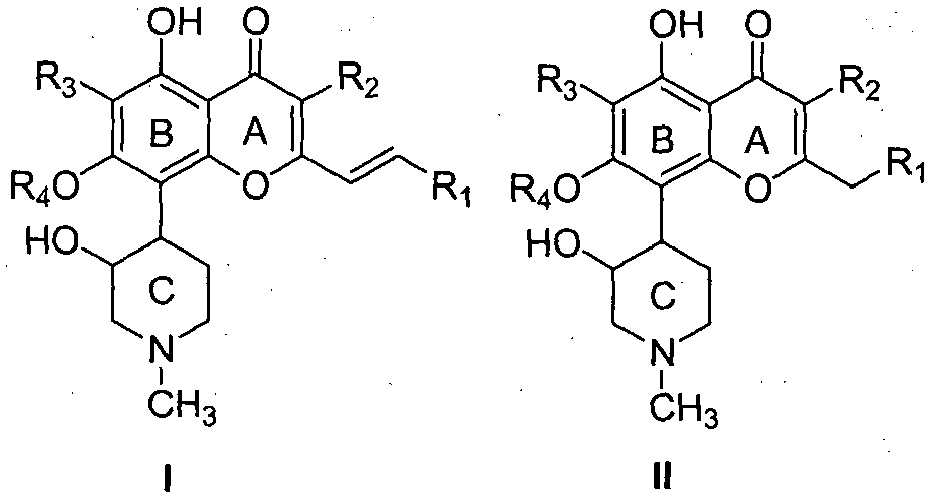
- n=0 or 1, when n=1 dotted line indicates the double bond.
- R1 is selected from the group consisting of alkyl, substituted alkyl, alkyl having 1 to 6 carbon atoms, aryl, substituted aryl, fused aryl (for example naphthalene and anthracene) heteroaryl, substituted heteroaryl, substitution on alkyl, aryl and heteroaryl with C1-C4-alkyl, halogen, nitro, amino, alkyl substituted amino, hydroxyl, alkoxy, carboxyl, COO-alkyl C1-C4 wherein alkyl is long chain or branched.
- R2 is hydrogen or

- R3 is selected from the group consisting of hydrogen, halogen, aryl, substituted aryl, heteroaryl, substituted heteroaryl, alkylamino, substitution on alkyl, aryl and heteroaryl with C1-C4-alkyl; halogen, nitro, amino, alkylamino (alkylamino may be - NH-alkyl, N-dialkyl, NH-cycloalkyl, N-cycloalkyl, or, any alkyl substituted amino derived group derived from either amino acid or heterocycles like piperidine or morpholine) hydroxyl, alkoxy, carboxyl, ester groups.
- R4 is selected from the group consisting of hydrogen, alkyl, substituted alkyl, cycloalkyl, acyl, alkanoyl, alkenyl, benzyl, heteroaryl, -CO-CH2-heteroaryl, -CO-Ph, - CO-substituted aryl, -CO-heteroaryl, or any carbon atom which may be optionally substituted; wherein, alkyl group may be selected from C1-C10 carbon chain or branched radical having up to 6 and preferably up to 5 carbon atoms, for example methyl, ethyl, propyl, isopropyl, t-butyl, pentyl, or isopentyl groups, substituted alkyl group may be selected from C1-C10, containing one or more radical selected from the group consisting of halogen, nitro, amino, hydroxyl, cyano, phenyl, substituted phenyl, carboxyl and an aldehyde
- wherein substituted phenyl group may be selected from the phenyls possessing substitutions at 2-5 positions with groups consisting of halogen, hydroxy, (C1-C4)-alkoxy, amino, nitro, cyano, carboxy and the like.
- In one embodiment, the patient is human. In another embodiment, the proliferative disease is cancer.
- As used herein, the terms below have the meanings indicated.
- The term "acyl," as used herein, alone or in combination, refers to a carbonyl attached to an alkenyl, alkyl, aryl, cycloalkyl, heteroaryl, heterocyclyl, or any other moiety where the atom attached to the carbonyl is carbon. An "acetyl" group refers to a - C(O)CH3 group.
- An "alkylcarbonyl" or "alkanoyl" group refers to an alkyl group attached to the parent molecular moiety through a carbonyl group. Examples of such groups include methylcarbonyl and ethylcarbonyl. Examples of acyl groups include formyl, alkanoyl and aroyl.
- The term "alkenyl," as used herein, alone or in combination, refers to a straight-chain or branched-chain hydrocarbon radical having one or more double bonds optionally substituted and containing from 2 to 20, preferably 2 to 6, carbon atoms. Alkenyl refers to a carbon-carbon double bond system attached at two or more positions such as ethenylene [(-CH=CH-),(-C::C-)]. Examples of alkenyl radicals include ethenyl, propenyl, 2-methylpropenyl, 1,4-butadienyl and the like.
- The term "alkoxy," as used herein, alone or in combination, refers to an alkyl ether radical, optionally substituted wherein the term alkyl is as defined below. Examples of alkyl ether radicals include methoxy, ethoxy, n-propoxy, isopropoxy, n-butoxy, iso-butoxy, sec-butoxy, tert-butoxy, and the like.
- The term "alkyl," as used herein, alone or in combination, refers to a straight-chain or branched-chain alkyl radical optionally substituted containing from 1 to 20 and including 20, preferably 1 to 10, and more preferably 1 to 6, carbon atoms. Alkyl groups may be optionally substituted as defined herein. Examples of alkyl radicals include methyl, ethyl, n-propyl, isopropyl, n-butyl, isobutyl, sec-butyl, tert-butyl, pentyl, iso-amyl, hexyl, octyl, nonyl and the like.
- The term "alkylamino" as used herein, alone or in combination, refers to an alkyl group optionally substituted attached to the parent molecular moiety through an amino group. Alkylamino groups may be mono- or dialkylated, forming groups such as, for example, N-methylamino, N-ethylamino, N,N-dimethylamino, N,N-ethylmethylamino and the like.
- The term "alkynyl," as used herein, alone or in combination, refers to a straight-chain or branched chain hydrocarbon radical having one or more triple bonds and containing from 2 to 20, preferably from 2 to 6, more preferably from 2 to 4, carbon atoms. "Alkynyl" refers to a carbon-carbon triple bond attached at two positions such as ethynylene (-C:::C-, -C≡C-). Examples of alkynyl radicals include ethynyl, propynyl, hydroxypropynyl, butyn-1-yl, butyn-2-yl, pentyn-1-yl, 3-methylbutyn-1-yl, hexyn-2-yl, and the like.
- The term "amino," as used herein, alone or in combination, refers to -NRR', wherein R and R' are independently selected from the group consisting of hydrogen, alkyl, acyl, heteroalkyl, aryl, cycloalkyl, heteroaryl, and heterocycloalkyl, any of which may themselves be optionally substituted.
- The term "aryl" as used herein, alone or in combination, means a carbocyclic aromatic system containing one, two or three rings wherein such rings may be attached together in a pendent manner or may be fused optionally substituted with at least one halogen, an alkyl containing from 1 to 3 carbon atoms, an alkoxyl, an aryl radical, a nitro function, a polyether radical, a heteroaryl radical, a benzoyl radical, an alkyl ester group, a carboxylic acid, a hydroxyl optionally protected with an acetyl or benzoyl group, or an amino function optionally protected with an acetyl or benzoyl group or optionally substituted with at least one alkyl containing from 1 to 12 carbon atoms.
- The term "arylalkyl" or "aralkyl," as used herein, alone or in combination, refers to an aryl group attached to the parent molecular moiety through an alkyl group.
- The terms "benzo" and "benz," as used herein, alone or in combination, refer to the divalent radical C6H4= derived from benzene. Examples include benzothiophene and benzimidazole.
- The terms "carbamate" and "carbamoyl" as used herein, alone or in combination, refers to an ester of carbamic acid (-NHCOO-) which may be attached to the parent molecular moiety from either the nitrogen or acid end, and which may be optionally substituted as defined herein.
- The term "carbonyl," as used herein, when alone includes formyl [-C(O)H] and in combination is a -C(O)- group.
- The term "carboxy," as used herein, refers to -C(O)OH or the corresponding "carboxylate" anion, such as is in a carboxylic acid salt. An "O-carboxy" group refers to a RC(O)O- group, where R is as defined herein. A "C-carboxy" group refers to a - C(O)OR groups where R is as defined herein.
- The term "cycloalkyl," or, alternatively, "carbocycle" as used herein, alone or in combination, refers to a saturated or partially saturated monocyclic, bicyclic or tricyclic alkyl radical wherein each cyclic moiety contains from 3 to 12, preferably five to seven, carbon atom ring members and which may optionally be a benzo-fused ring system which is optionally substituted as defined herein. Examples of such cycloalkyl radicals include cyclopropyl, cyclobutyl, cyclopentyl, cyclohexyl, cycloheptyl, octahydronaphthyl, 2,3-dihydro-1H-indenyl, adamantyl and the like. "Bicyclic" and "tricyclic" as used herein are intended to include both fused ring systems, such as decahydronapthalene, octahydronapthalene as well as the multicyclic (multicentered) saturated or partially unsaturated type. The latter type of isomer is exemplified in general by, bicyclo[1,1,1]pentane, camphor, adamantane, and bicyclo[3,2,1]octane.
- The term "ester," as used herein, alone or in combination, refers to a carboxy group bridging two moieties linked at carbon atoms.
- The term "ether," as used herein, alone or in combination, refers to an oxygen atom bridging two moieties linked at carbon atoms.
- The term "halo," or "halogen," as used herein, alone or in combination, refers to fluorine, chlorine, bromine, or iodine.
- The term "haloalkyl" as used herein, alone or in combination, refers to an alkyl radical having the meaning as defined above wherein one or more hydrogens are replaced with a halogen. Specifically embraced are monohaloalkyl, dihaloalkyl and polyhaloalkyl radicals. A monohaloalkyl radical, for one example, may have an iodo, bromo, chloro or fluoro atom within the radical. Dihalo and polyhaloalkyl radicals may have two or more of the same halo atoms or a combination of different halo radicals. Examples of haloalkyl radicals include fluoromethyl, difluoromethyl, trifluoromethyl, chloromethyl, dichloromethyl, trichloromethyl, pentafluoroethyl, heptafluoropropyl, difluorochloromethyl, dichlorofluoromethyl, difluoroethyl, difluoropropyl, dichloroethyl and dichloropropyl. "Haloalkylene" refers to a haloalkyl group attached at two or more positions. Examples include fluoromethylene (-CHF-), difluoromethylene (-CF2-), chloromethylene (-CHCl-) and the like.
- The term "heteroaryl" as used herein, alone or in combination, refers to 3 to 7 membered, preferably 5 to 7-membered, unsaturated heteromonocyclic rings, or fused polycyclic rings in which at least one of the fused rings is unsaturated, wherein at least one atom is selected from the group consisting of O, S, and N. The term also embraces fused polycyclic groups wherein heterocyclic radicals are fused with aryl radicals, wherein heteroaryl radicals are fused with other heteroaryl radicals, or wherein heteroaryl radicals are fused with cycloalkyl radicals. Examples of heteroaryl groups include pyrrolyl, pyrrolinyl, imidazolyl, pyrazolyl, pyridyl, pyrimidinyl, pyrazinyl, pyridazinyl, triazolyl, pyranyl, furyl, thienyl, oxazolyl, isoxazolyl, oxadiazolyl, thiazolyl, thiadiazolyl, isothiazolyl, indolyl, isoindolyl, indolizinyl, benzimidazolyl, quinolyl, isoquinolyl, quinoxalinyl, quinazolinyl, indazolyl, benzotriazolyl, benzodioxolyl, benzopyranyl, benzoxazolyl, benzoxadiazolyl, benzothiazolyl, benzothiadiazolyl, benzofuryl, benzothienyl, chromonyl, coumarinyl, benzopyranyl, tetrahydroquinolinyl, tetrazolopyridazinyl, tetrahydroisoquinolinyl, thienopyridinyl, furopyridinyl, pyrrolopyridinyl and the like. Exemplary tricyclic heterocyclic groupsincludecarbazolyl, benzidolyl, phenanthrolinyl, dibenzofuranyl, acridinyl, phenanthridinyl, xanthenyl and the like.
- The terms "heterocycloalkyl" and, interchangeably, "heterocyclyl" as used herein, alone or in combination, each refer to a saturated, partially unsaturated, or fully unsaturated monocyclic, bicyclic, or tricyclic heterocyclic radical containing at least one, preferably 1 to 4, and more preferably 1 to 2 heteroatoms as ring members, wherein each said heteroatom may be independently selected from the group consisting of nitrogen, oxygen, and sulfur, and wherein there are preferably 3 to 8 ring members in each ring, more preferably 3 to 7 ring members in each ring, and most preferably 5 to 6 ring members in each ring. "Heterocycloalkyl" and "heterocyclyl" are intended to include sulfones, sulfoxides, N-oxides of tertiary nitrogen ring members, and carbocyclic fused and benzo fused ring systems; additionally, both terms also include systems where a heterocycle ring is fused to an aryl group, as defined herein, or an additional heterocycle group. Heterocyclyl groups of the invention are exemplified by aziridinyl, azetidinyl, 1,3-benzodioxolyl, dihydroisoindolyl, dihydroisoquinolinyl, dihydrocinnolinyl, dihydrobenzodioxinyl, dihydro[1,3]oxazolo[4,5-b]pyridinyl, benzothiazolyl, dihydroindolyl, dihy-dropyridinyl, 1,3-dioxanyl, 1,4-dioxanyl, 1,3-dioxolanyl, isoindolinyl, morpholinyl, piperazinyl, pyrrolidinyl, tetrahydropyridinyl, piperidinyl, thiomorpholinyl, and the like. The heterocyclyl groups may be optionally substituted unless specifically prohibited.
- The term "hydroxy" as used herein, alone or in combination, refers to -OH.
- Any definition herein may be used in combination with any other definition to describe a composite structural group. By convention, the trailing element of any such definition is that which attaches to the parent moiety. For example, the composite group alkylamido would represent an alkyl group attached to the parent molecule through an amido group, and the term alkoxyalkyl would represent an alkoxy group attached to the parent molecule through an alkyl group.
- Asymmetric centers exist in the compounds of the present invention. These centers are designated by the symbols "R" or "S," depending on the configuration of substituents around the chiral carbon atom. It should be understood that the invention encompasses all stereochemical isomeric forms, including diastereomeric, enantiomeric, and epimeric forms, as well as d-isomers and 1-isomers, and mixtures thereof. Individual stereoisomers of compounds can be prepared synthetically from commercially available starting materials which contain chiral centers or by preparation of mixtures of enantiomeric products followed by separation such as conversion to a mixture of diastereomers followed by separation or recrystallization, chromatographic techniques, direct separation of enantiomers on chiral chromatographic columns, or any other appropriate method known in the art. Starting compounds of particular stereochemistry are either commercially available or can be made and resolved by techniques known in the art. Additionally, the compounds of the present invention may exist as geometric isomers. The present invention includes all cis, trans, syn, anti, entgegen (E), and zusammen (Z) isomers as well as the appropriate mixtures thereof. Additionally, compounds may exist as tautomers; all tautomeric isomers are provided by this invention. Additionally, the compounds of the present invention can exist in unsolvated as well as solvated forms with pharmaceutically acceptable solvents such as water, ethanol, and the like. In general, the solvated forms are considered equivalent to the unsolvated forms for the purposes of the present invention.
- Optical isomers are compounds with the same molecular formula but differ in the way they rotate plane polarized light. There are two types of optical isomers. The first type of optical isomers are compounds that are mirror images of one another but cannot be superimposed on each other. These isomers are called "enantiomers." The second type of optical isomers are molecules that are not mirror images but each molecule rotates plane polarized light and are considered optically-active. Such molecules are called "diastereoisomers." Diasteroisomers differ not only in the way they rotate plane polarized light, but also their physical properties. The term "optical isomer" comprises more particularly the enantiomers and the diastereoisomers, in pure form or in the form of a mixture.
- The term "bond" refers to a covalent linkage between two atoms, or two moieties when the atoms joined by the bond are considered to be part of larger substructure. A bond may be single, double, or triple unless otherwise specified. A dashed line between two atoms in a drawing of a molecule indicates that an additional bond may be present or absent at that position. Disclosed herein is a method for treating or preventing cancer diseases such as leukemia, breast cancer etc. by identifying a patient suffering from or at a risk of developing a proliferative disease and administering to the patient a therapeutically-effective amount of a compound represented by the formulae I and II,
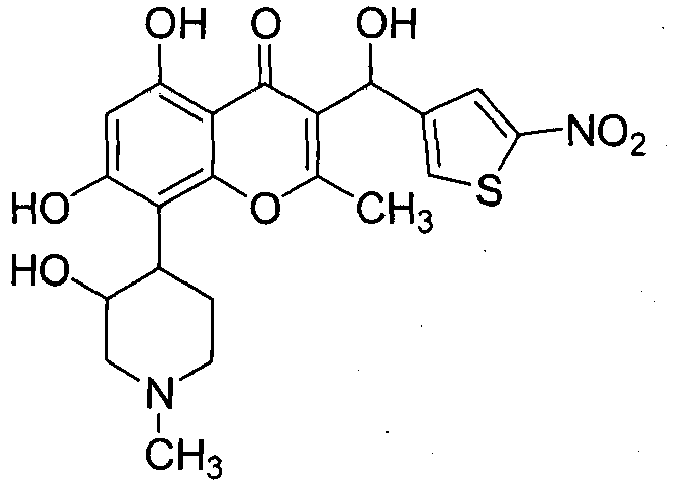
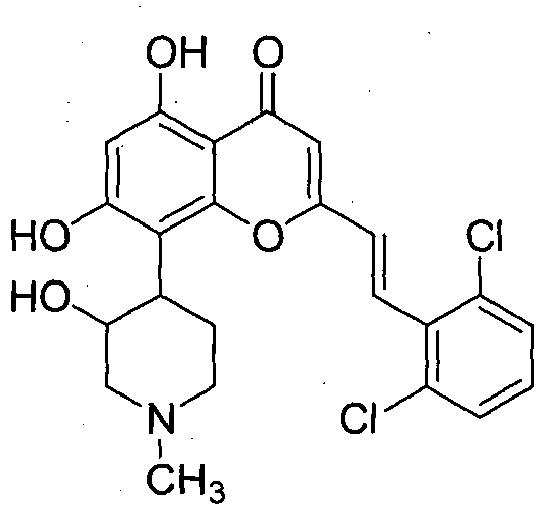
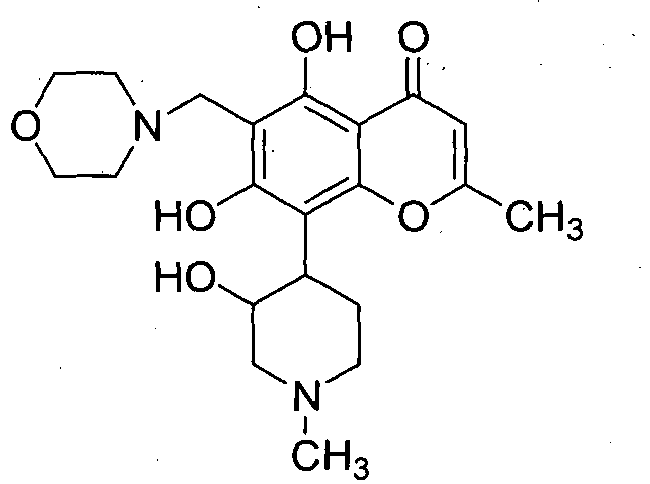
- Compounds derived from Formulae I and II include, but are not limited to, the following chemical structures:

-

-

-

-

-

-

-

-

-

-

-

-

-

-

-

-

-

-

-

-

-

-

-

-

-
-

-

-

-

-

-
-

-

-

-

-
-

-

-

-

-

-

- One or more compounds of the invention can be used to treat a patient (e.g. a human) at a risk of developing or already suffering from a proliferative disease, such as breast cancer, leukemia etc.
- The compounds of the invention can be used to treat a patient (e.g. a human) that suffers from or is at a risk of suffering from a disease, disorder, condition, or symptom described herein. The compounds of the invention can be used alone or in combination with other agents and compounds in methods of treating or preventing proliferative disease such as cancer. Each such treatment described above includes the step of administering to a patient in need thereof a therapeutically effective amount of the compound of the invention described herein to delay, reduce or prevent such a disease, disorder, condition, or symptom.
- Besides being useful for human treatment, the compounds of the present invention are also useful for the treatment of animals, e.g., the veterinary treatment of domesticated animal, companion animals (e.g., dogs and cats), exotic animals, farm animals (e.g., ungulates, including horses, cows, sheep, goats, and pigs), and animals used in scientific research (e.g., rodents).
- It is understood that the foregoing examples are merely illustrative of the present invention. Certain modifications of the articles and/or methods employed may be made and still achieve the objectives of the invention. Such modifications are contemplated as within the scope of the claimed invention.
- To isolate rohitukine, the stem bark of Dysoxylum binectariferum (Roxb.) Hook was collected from Western Ghats India. Bark of Dysoxylum binectariferum (1.5 kg) was extracted by ethanol (3 L in each cycle) three times and concentrated over rotary evaporator to get crude (110 g, extractive value 7.3%) material. Half of the crude extract (55 g) was again suspended in water (150 ml) and pH was adjusted to 5 by HCl and placed over night (exact period) at room temperature (exact temperature). Then, it was filtered with celite and a clear solution was neutralized with liquid ammonia to get
pH 11. The solution was adjusted to 2 L with water and passed through HP20 resin (100 ml,bed size 10% of final volume). Adsorbed material was eluted with increasing proportion of methanol in water, wherein the rohitukine (1) was isolated at 40% methanol in water. Purification was done by crystallization with water - acetone mixture (40:60). Finally 17 g of rohitukine (2.26 %) was isolated with > 98.5% purity. The compound was characterized by comparison of spectral data with literature values (Naik, R.G. et. al. Tetrahedron 1988, 44, 2081). Rohitukine (1): Light yellow crystalline powder; melting point 229-232°C; 1H-NMR (CD3OD, 500 MHz): δ 6.26 (s, 1H, H-6), 6.10 (s, 1H, H-3), 4.22 (brs, 1H, H-3'), 3.82-3.21 (m, 6H of piperidine ring), 2.90 (s, 3H), 2.41 (s, 3H), 1.84 (m, 1H, H-5'a); 13C NMR (CD3OD + Pyridin-d5, 100 MHz): δ 182.90, 178.24, 166.77, 161.44, 156.96, 108.53, 108.03, 102.73, 69.30, 62.20, 56.60, 44.81, 37.35, 24.03, 23.62, 19.97; ESI-MS: m/z 306.0957 [M+H]+; IR (KBr): v max 3399, 2924, 2350, 1659, 1556, 1417, 1271, 1186, 841, 757, 554 cm-1. - Synthesis of ether analog 7-(benzyloxy)-5-hydroxy-8-(3-hydroxy-1-methylpiperidin-4-yl)-2-methyl-4H-chromen-4-one (2): A general synthetic strategy for compounds 2-12 proposed in present invention is depicted in
Figure 1 , Rohitukine (1, 30 mg, 1 mmol) was mixed with equivalent amount of potassium carbonate in a pestle and substituted benzyl or benzyl halide (1.5 equiv) was added to the pestle and triturated intermittently for 5-15 min until reaction gets completed. Reaction mixture was suspended in water and extracted with ethyl acetate. Organic layer was concentrated and purified by preparative TLC in chloroform-methanol (85:15). Light yellow powder; 1H NMR (CD3OD, 400 MHz): δ 7.156 (m, 5H, ArH), 6.64 (s, 1H, H-6), 6.126 (s, 1H, H-3), 5.22 (brs, 2H), 4.294 (brs, 1H, H-3'), 3.797-3.453 (m, 6H of piperidine), 2.99 (s, 3H), 2.47 (s, 3H) 1.96 (m, 1H); ESI-MS: m/z 396.2103 [M+H]+; IR (KBr) v max 3325, 2923, 1658, 1588, 1420, 1270, 1120, 1028, 749 cm-1. - Synthesis of ether analog 7-(4-methoxybenzyloxy)-5-hydroxy-8-(3-hydroxy-1-methylpiperidin-4-yl)-2-methyl-4H-chromen-4-one (3): This compound was synthesized using the similar procedure as described in example 2. White powder; m.p. 208-210 °C; 1H NMR (400 MHz, D2O, ppm): δ 12.39 (s, 1H, H-bonded), 7.71 (d, J = 8.2 Hz, 2H), 7.09 (d, J = 8.2 Hz, 2H), 5.82 (s, 1H), 5.57 (s, 1H), 5.29 (d, J = 12.7 Hz, 1H), 4.71 (d, J = 12.7 Hz, 1H), 4.15 (brs, 1H), 3.80 (s, 3H), 3.57-3.35 (m, 6H of piperidine), 2.83 (s, 3H), 2.27 (s, 3H), 1.54 (m, 1H); 13C NMR (100 MHz, CD3OD, ppm): δ 179.62, 176.46, 163.71, 159.99, 159.69, 155.30, 134.37, 120.21, 113.72, 106.80, 106.12, 102.14, 98.04, 68.37, 62.58, 62.27, 61.80, 54.84, 51.53, 35.55, 19.85, 19.38; IR (KBr): v max 3415, 2854, 1617, 1352, 1258, 1180 cm-1; ESI-MS: m/z 448.20 [M+Na]+.
- Synthesis of ether analog 7-(4-Bromobenzyloxy)-5-hydroxy-8-(3-hydroxy-1-methylpiperidin-4-yl)-2-methyl-4H-chromen-4-one (4): This compound was synthesized using the similar procedure as described in example 2. Off-white powder; m.p. 248-250 °C; 1H NMR (400 MHz, CD3OD, ppm): δ 7.68 (m, 4H), 5.97 (s, 1H), 5.37 (s, 1H), 5.33 (d, J = 12 Hz, 1H), 4.84 (d, J = 12 Hz, 1H), 4.33 (brs, 1H), 3.73-3.30 (m, 6H of piperidine), 2.89 (s, 3H), 2.43 (s, 3H), 1.71 (m, 1H); ESI-MS: m/z 476.08 [M+H]+.
- Synthesis of ether analog 7-((furan-2-yl)methoxy)-5-hydroxy-8-(3-hydroxy-1-methylpiperidin-4-yl)-2-methyl-4H-chromen-4-one (5): This compound was synthesized using the similar procedure as described in example 2. White crystalline powder; 1H NMR (400 MHz, CD3O): δ 7.72 (d, J= 1.2 Hz, 1H), 6.92 (d, J = 3.2 Hz, 1H), 6.58 (dd, J = 3.2, 1.6 Hz, 1H), 6.07 (s, 1H), 5.94 (s, 1H), 5.26 (d, J = 14.4 Hz, 1H), 4.10 (d, J= 14.4 Hz, 1H), 4.29 (brs, 1H), 3.71-3.50 (m, 6H of piperidin), 3.10 (s, 3H), 2.36 (s, 3H), 1.84 (m, 1H); 13C NMR (100 MHz, CD3O): δ 183.63, 172.27, 167.88, 162.01, 158.01, 157.96, 147.31, 144.93, 118.22, 112.58, 111.95, 108.22, 107.70, 103.10, 66.99, 65.17, 62.78, 58.35, 54.28, 37.44, 23.72, 21.55; ESI-MS: m/z 386.16 [M+H]+.
- Synthesis of ether analog 7-((thiophen-2-yl)methoxy)-5-hydroxy-8-(3-hydroxy-1-methylpiperidin-4-yl)-2-methyl-4H-chromen-4-one (6): This compound was synthesized using the similar procedure as described in example 2. White powder; 1H NMR (400 MHz, CD3O): δ 7.69 (d, J = 5.2 Hz, 1H), 7.54 (d, J = 3.2 Hz, 1H), 7.19 (m, J = 5.1, 3.1 Hz, 1H), 6.02 (s, 1H), 5.94 (s, 1H), 5.52 (d, J = 13.6 Hz, 1H), 4.84 (brs, 1H), 3.81-3.31 (m, 6H of piperidine), 3.05 (s, 3H), 2.36 (s, 3H) 1.72 (m, 1H); ESI-MS m/z 403.17 [M+H]+.
- Synthesis of ether analog 7-(Cinnamyloxy)-5-hydroxy-8-(3-hydroxy-1-methylpiperidin-4-yl)-2-methyl-4H-chromen-4-one (7): This compound was synthesized using the similar procedure as described in example 2. Yellow powder; m.p. 242-246 °C; 1H NMR (400 MHz, CD3OD, ppm): δ 7.57 (m, 2H), 7.37 (m, 3H), 7.08 (d, J = 15.6 Hz, 1H), 6.51 (m, J = 15.6 Hz, 1H), 6.07 (s, 1H) 5.97 (s, 1H), 4.85 (m, 1H), 4.51 (m, 1H), 4.28 (brs, 1H), 3.78-3.33 (m, 6H of piperidine ring), 3.10 (s, 3H), 2.36 (s, 3H), 1.74 (m, 1H); 13C NMR (100 MHz, CD3OD, ppm): δ 180.75, 165.22, 164.62, 159.96, 155.80, 140.84, 135.21, 128.6 (2C), 127.03 (2C), 117.2, 106.71, 106.60, 101.68, 101.22, 68.25, 64.8, 63.7, 62.4, 52.2, 36.1, 19.95, 19.76; ESI-MS: m/z 423.08 [M+H]+.
- Synthesis of ether analog 7-(4-Nitrobenzyloxy)-5-hydroxy-8-(3-hydroxy-1-methylpiperidin-4-yl)-2-methyl-4H-chromen-4-one (8): This compound was synthesized using the similar procedure as described in example 2. White powder; m.p. 234-236 °C; 1H NMR (400 MHz, CD3OD, ppm): δ 8.33 (d, J= 8.4 Hz, 2H), 8.08 (d, J= 8.4 Hz, 2H), 6.17 (m, 2H), 5.97 (d, J = 12.8 Hz, 1H), 4.80 (d, J = 12.8 Hz, 1H), 4.13 (brs, 1H), 3.77-3.35 (m, 6H of piperidine), 2.95 (s, 3H), 2.35 (s, 3H), 1.74 (m, 1H); 13C NMR (100 MHz, CD3OD, ppm): δ 183.46, 176.22, 167.33, 162.22, 157.66, 149.16, 136.55 (2C), 124.89 (2C), 107.94, 107.88, 104.36, 104.03, 101.85, 70.89, 65.17, 64.55, 62.78, 57.29, 37.71, 21.73, 20.28; ESI-MS: m/z 441.1692 [M+H]+.
- Synthesis of ether analog 7-(2-Bromobenzyloxy)-5-hydroxy-8-(3-hydroxy-1-methylpiperidin-4-yl)-2-methyl-4H-chromen -one (9): This compound was synthesized using the similar procedure as described in example 2. White powder; m.p. 238-241 °C; 1H NMR (400 MHz, CD3OD, ppm): δ 8.10 (d, J = 8.0 Hz, 1H), 7.83 (m, 1H), 7.48 (m, 2H), 5.98 (brs, 2H), 5.48 (d, J = 13.2 Hz, 1H), 5.17 (d, J = 13.3 Hz, 1H), 4.37 (brs, 1H), 3.95-3.59 (m, 6H of piperidine), 2.41 (s, 3H), 2.01 (s, 3H), 1.84 (m, 1H); 13C NMR (100 MHz, CD3OD, ppm): δ 184.43, 169.35, 164.14, 161.97, 158.39, 137.24, 136.47, 135.66, 133.73, 129.69, 128.96, 108.81, 106.27, 105.51, 100.37, 72.14, 68.83, 66.74, 64.61, 53.39, 38.00, 21.31, 20.76; ESI-MS: m/z 474 [M+1]+.
- Synthesis of ether analog 7-((1H-Benzo[d]imidazol-2-yl)methoxy)-5-hydroxy-8-(3-hydroxy-1-methylpiperidin-4-yl)-2-methyl-4H-chromen-4-one (10): This compound was synthesized using the similar procedure as described in example 2. White powder; m.p. 217-220 °C; 1H NMR (400 MHz, CD3OD, ppm): δ 7.61 (dd, J = 3.2, 6 Hz, 2H), 7.52 (dd, J = 2.8, 6 Hz, 2H), 5.90 (s, 1H), 5.82 (s, 1H), 5.50 (d, J = 13.6 Hz, 1H), 4.99 (d, J= 13.6 Hz, 1H), 4.27 (brs, 1H), 3.91-3.26 (m, 6H of piperidin), 2.58 (s, 3H), 2.23 (s, 3H), 1.54 (m, 1H); ESI-MS: m/z 436.18 [M+H]+.
- Synthesis of ester analog 5-hydroxy-8-(3-hydroxy-1-methylpiperidin-4-yl)-2-methyl-4-oxo-4H-chromen-7-yl-furan-2-carboxylate (11): This compound was synthesized using the similar procedure as described in example 2. White powder; m.p. 184-186 °C; 1H NMR (400 MHz, CD3OD, ppm): δ 7.73 (dd, J = 0.4, 1.6 Hz, 1H), 7.49 (dd, J = 0.8, 3.6 Hz, 1H), 6.60 (dd, J = 1.6, 3.6 Hz, 1H), 6.22 (s, 1H), 5.96 (s, 1H), 5.58 (brs, 1H), 3.89-3.33 (m, 6H of piperidine), 2.97 (s, 3H), 2.14 (s, 3H), 2.10 (m, 1H); 13C NMR (100 MHz, CD3OD, ppm): δ 184.16, 169.03, 164.07, 162.34, 158.66, 158.21, 148.77, 145.03, 120.90, 113.27, 108.67, 105.18, 104.62, 99.79, 70.35, 58.27, 56.92, 44.67, 36.52, 24.37, 20.47; IR (KBr): v max 3416, 2924, 1617, 1560, 1424, 1290, 1177, 1113 cm-1; ESI-MS: m/z 400.16 [M+H]+.
- Synthesis of ester analog 5-hydroxy-8-(3-hydroxy-1-methylpiperidin-4-yl)-2-methyl-4-oxo-4H-chromen-7-yl-2-methylbenzoate (12): This compound was synthesized using the similar procedure as described in example 2. White powder; m.p. 244-246 °C; 1H-NMR (400 MHz, CD3OD, ppm): δ 8.03 (d, J = 7.2 Hz, 1H), 7.36 (dd, J = 7.2, 7.6 Hz, 1H), 7.23-7.13 (m, 2H), 6.187 (s, 1H), 5.83 (s, 1H), 5.61 (brs, 1H), 3.84-3.40 (m, 6H of piperidin), 2.94 (s, 3H), 2.17 (s, 3H), 2.08 (s, 3H), 2.03 (m, 1H); ESI-MS: m/z 424.46 [M+H]+.
- A general synthetic strategy for Baylis-Hilman analogs 13-27 proposed in present invention is depicted in
Figure 2 . Conditions used in the synthesis are mild and yields are excellent. The method of synthesis for compounds of the invention is as follows: To the solution of rohitukine (1, 61 mg, 2 mmol) in methanol (5 mL) was added substituted aromatic and aliphatic aldehydes (2 mmol) and DABCO (1 mmol), and the reaction mixture was continuously stirred for 10-15 days, however in none of the reaction starting material completely consumed, thus desired products were separated using preparative TLC. - Synthesis of Baylis-
Hillman analog 5,7-dihydroxy-3-(hydroxy(4-nitrophenyl)methyl)-8-(3-hydroxy-1-methylpiperidin-4-yl)-2-methyl-4H-chromen-4-one (13): This compound was synthesized using the procedure as described in example 3. Isolated as a racemic mixture; cream colored solid, 1H-NMR (400 MHz, DMSO-d6): δ 13.57 (s, 1H), 8.13 (dd, J = 4.8, 10 Hz, 2H), 7.71 (dd, J = 4.4, 10.1 Hz, 2H), 5.91 (m, 2H), 3.94 (brs, 1H), 3.25 - 3.05 (m, 6H of piperidine), 2.60 (s, 3H), 1.88 (s, 3H), 1.27 (m, 1H); ESI-MS: m/z 457.16 [M+H]+; IR (CHCl3) v max: 3400, 2923, 1658, 1556,1468,1389,1273,1150, 1025 (cm-1). - This compound was synthesized using the procedure as described in example 3. Isolated as a racemic mixture; white solid; 1H-NMR (400 MHz, CD3OD): δ 7.34 (m, 2H), 7.12 (m, 2H), 5.92 (s, 1H), 5.84 (s, 1H), 4.07 (brs, 1H), 3.49 (d, J= 12 Hz, 1H), 3.21 (d, J = 12 Hz, 1H), 3.17-3.00 (m, 4H), 2.72 (s, 3H), 2.24 (s, 3H), 1.47 (d, J = 12 Hz, 1H); ESI-MS: m/z 446.01 [M+H]+; IR (CHCl3) v max: 3400, 2926, 1659, 1556, 1468, 1361, 1127, 1014 cm-1.
- This compound was synthesized using the procedure as described in example 3. Isolated as a racemic mixture; off white solid; 1H NMR (400 MHz, CD3OD): δ 7.51 - 7.06 (m, 4H), 6.37 (m, 1H), 5.88 (m, 1H), 4.17 (brs, 1H), 3.09 - 3.08 (m, 6H of piperidine), 2.96 (s, 3H), 2.32 (s, 3H), 1.60 (m, 1H); ESI-MS: m/z 491.8 [M+H]+; IR (CHCl3): v max 3391, 2923, 1658, 1558, 1465, 1387, 1273, 1149, 1026 cm-1.
- This compound was synthesized using the procedure as described in example3. Isolated as a racemic mixture; white solid; 1H NMR (CD3OD, 400 MHz): δ 6.94 (M, 2H), 6.58 (m, 1H), 5.91 (s, 1H), 5.83 (s, 1H), 4.71 (brs, 1H), 4.03 (m, 1H), 3.48- 2.91 (m, 5H), 2.74 (s, 3H), 2.23 (s, 3H), 1.48 (m, 1H); ESI-MS: m/z 448.2 [M+H]+; IR (CHCl3) v max: 3391, 2924, 1659, 1557, 1463, 1388, 1272, 1113 cm-1.
- This compound was synthesized using the procedure as described in example 3. Isolated as a racemic mixture; white powder; 1H NMR (400 MHz, DMSO-d6): δ 13.46 (s, 1H), 7.47-7.17 (m, 4H), 5.91 (s, 1H), 5.97 (m, 1H) 3.88 (brs, 1H), 3.30-2.78 (m, 6H of piperidin), 2.51 (s, 3H), 2.24 (s, 3H), 1.13 (m, 1H).; ESI-MS: m/z 446.14 [M+H]+; IR (CHCl3): v max 3400, 2925,1659, 1470, 1388, 1273, 1150, 1027 cm-1.
- Synthesis of Baylis-Hillman analog 3-((3-bromo-4-methoxyphenyl)(hydroxy)methyl)-5,7-dihydroxy-8-(3-hydroxy-1-methyl-piperidin -4-yl)-2-methyl-4H-chromen-4-one (18): This compound was synthesized using the procedure as described in example 3. Isolated as a racemic mixture; off white solid; 1H NMR (500 MHz, CD3O): δ 7.75 (m, 1H), 7.37 (m, 1H), 6.89 (m, 1H), 5.97 (m, 1H), 5.88 (m, 1H), 4.08. (brs, 1H), 5.48 (d, J = 13.2 1H), 5.17 (d, J = 13.3, 1H), 4.37 (brs, 1H), 3.73 (s, 3H) 3.35-2.80 (m, 6H of piperidin), 2.71 (s, 3H), 2.30 (s, 3H), 1.49 (m, 1H). ESI-MS: m/z 521.1 [M+H]+; IR (CHCl3) v max: 3400, 2928, 1659, 1552, 1494, 1394, 1272, 1149, 1080cm-1.
- Synthesis of Baylis-Hillman analog 3-((3-Bromo-4-fluorophenyl)(hydroxy)methyl)-5,7-dihydroxy-8-(3-hydroxy-1-methylpiperidin-4-yl)-2-methyl-4H-chromen-4-one (19): This compound was synthesized using the procedure as described in example 3. Isolated as a racemic mixture; white solid; 1H NMR (400 MHz, DMSO-d6): δ 7.70 (m, 1H), 7.42 (m, 1H), 7.23 (m, 1H), 5.92 (s, 1H), 5.75 (m, 1H), 4.00. (m, 1H), 3.34-2.51 (m, 6H of piperidin), 2.51 (s, 3H), 2.24 (s, 3H), 1.32 (m, 1H); ESI-MS: m/z 508.1 [M+H]+; IR (CHCl3) v max: 3400, 2926, 1658,1455,1389, 1243, 1145, 1083, 1023 cm-1.
- This compound was synthesized using the procedure as described in example 3. Isolated as a racemic mixture; white solid; 1H NMR (500 MHz, CD3O): δ 7.89 (s, 1H), 7.30 (m, 1H), 7.17 (m, 1H), 6.91 (m, 1H), 5.93 (s, 1H), 4.20 (brs, 2H); 4.00- 3.21 (m, 6H of piperidin), 3.18 (s, 3H), 2.35 (s, 3H), 1.82 (m,1H). ESI-MS: m/z 478.1 [M+H]+; IR (CHCl3) v max: 3400, 2922, 1651, 1561, 1464, 1386, 1260, 1032 cm-1.
- Synthesis of Baylis-Hillman analog 3-((2-chloro-6-fluorophenyl)(hydroxy)methyl)-5,7-dihydroxy-8-(3-hydroxy-1-methylpiperidin-4-yl)-2-metlayl-4H-chromen-4-one (21): This compound was synthesized using the procedure as described in example 3. Isolated as a racemic mixture; white solid; 1H NMR (500 MHz, DMSO-d6): δ 13.15 (s, 1H), 7.28 (m, 2H), 7.61 (m, 1H), 6.32 (m, 1H), 5.87 (s,1H), 4.04 (brs, 1H), 3.33 - 3.10 (m, 6H of piperidin), 2.75 (s, 3H), 2.27 (s, 3H), 1.44 (m, 1H); ESI-MS: m/z 464.1 [M+H]+.
- This compound was synthesized using the procedure as described in example 3. Isolated as a racemic mixture; brown solid powder; 1H NMR (400 MHz, CD3OD): δ 7.21 (m, 1H), 6.30 (m, 1H), 6.26 (m, 2H), 4.68 (brs, 1H), 4.06 - 2.98 (m, 6H of piperidin), 2.73 (s, 3H), 2.22 (s, 3H), 1.50 (m, 1H). ESI-MS: m/z 447.2 [M+H]+; IR (CHCl3): v max 3400, 2923, 1658, 1465, 1386, 1241, 1149, 1081, 1020 cm-1.
- This compound was synthesized using the similar procedure as described in example 3. Isolated as a racemic mixture; solid powder; 1H NMR (400 MHz, CD3OD): δ 7.45 (m, 2H),7.15 (m, 1H), 6.50 (m, 1H), 5.95 (brs 1H), 4.25 (brs, 1H), 3.68-3.32 (m, 6H of piperidin), 2.88 (s, 3H), 2.39 (s, 3H), 1.78 (m, 1H); ESI-MS: m/z 478.1 [M+H]+; IR (CHCl3): v max 3400, 2923, 1658, 1556, 1466, 1387, 1242, 1101 cm-1.
- Synthesis of Baylis-
Hillman analog 5,7-dihydroxy-8-(3-hydroxy-1-methylpiperidin-4-yl)-3-(1-hydroxydodecyl)-2-methyl-4H-chromen-4-one (24): This compound was synthesized using the procedure as described in example 3. Isolated as a racemic mixture; white needles; 1H NMR (400 MHz, CD3O): δ 6.56 (m, 1H), 5.83 (s, 1H), 4.75 (s, 1H), 4.05 (brs 1H), 3.49-2.80 (6H of piperidin), 2.63 (s, 3H), 2.24 (s, 3H), 2.14 (m, 2H), 1.39 (m, 1H), 1.20 (brs, 16H), 0.81 (m, 3H); ESI-MS: m/z 472.3 [M-OH]+; IR (CHCl3) v max: 2921, 1657, 1576, 1425, 1272, 1040 cm-1. - This compound was synthesized using the procedure as described in example 3. Isolated as a racemic mixture; white powder; 1H NMR (500 MHz, CD3OD): δ 7.40 (m, 2H), 6.97 (m, 2H), 5.89 (s, 1H), 5.69 (s, 1H), 3.93 (m, 1H), 3.23-2.57 (m, 6H of piperidin), 2.49 (s, 3H), 2.28 (s, 3H), 1.31 (m, 1H); ESI-MS: m/z 412.1 [M+H]+; IR (CHCl3): v max 3400, 2927, 1658, 1602, 1549, 1425, 1342, 1040 cm-1.
- This compound was synthesized using the procedure as described in example 3. Isolated as a racemic mixture; brown solid; 1H NMR (CD3OD, 400 MHz): δ 7.72 (d, J= 2 Hz, 1H), 6.82 (d, J= 2.1 Hz, 1H), 6.44 (s, 1H), 6.06 (s, 1H), 4.74 (brs, 1H), 4.19 (m, 1H), 3.66-3.20 (m, 5H), 2.82 (s, 3H), 2.34 (s, 3H), 1.71 (d, J = 12 Hz, 1H); ESI-MS: m/z 463.13 [M+H]+; IR (CHCl3) v max: 3435, 2919, 2850, 1653, 1465, 1332, 1019 cm-1.
- This compound was synthesized using the procedure as described in example 3. Isolated as a racemic mixture; brown colored solid; 1H NMR (400 MHz, CD3OD): δ 7.88 (m, 1H), 7.49 (m, 1H), 5.92 (m, 1H), 5.82 (m, 1H), 4.07 (brs, 1H), 3.49-2.98 (m, 6H of piperidin), 2.71 (s, 3H), 2.23 (s, 3H), 1.46 (m, 1H); ESI-MS: m/z 463.13 [M+H]+; IR (CHCl3): v max 3400, 2922, 1657, 1555, 1332, 1273, 1099, 1022 cm-1.
- A general synthetic strategy for styryl analogs 28-35 is depicted in
Figure 3 . The method of synthesis for compounds of the invention is as follows: To the solution of rohitukine (1, 61 mg, 2 mmol) in methanol (5 mL) was added substituted aromatic or aliphatic aldehyde (2 mmol) in presence of 15 % aqueous KOH (few drop) as catalyst, and the reaction mixture was continuously stirred for 10-20 h. The styryl products were observed as side products and their yields also varied depending on different aldehydes. An intense yellow colored band was separated using preparative TLC to get desired product. - Synthesis of styryl analog 2-(3-chlorostyryl)-5,7-dihydroxy-8-(3-hydroxy-1-methylpiperidin-4-yl)-4H-chromen-4-one (28): This compound was synthesized using the procedure as described in example 4. Yellow solid; 1H NMR (500 MHz, DMSO-d6): δ 12.84 (s, 1H), 7.75 (s, 1H), 7.56-7.56 (m, 3H), 7.29 (d, J = 16, 1H), 7.22 (d, J =16, 1H), 6.06 (s, 1H), 5.52 (s, 1H), 3.84 (brs, 1H); 3.19 (m, 1H), 2.97 (m, 1H), 2.89 (m, 1H), 2.77 (m, 1H), 2.26 (s, 3H), 2.20 (m, 2H), 1.19 (m, 1H); ESI-MS: m/z 428.1 [M+H]+; IR (CHCl3): v max 3391, 2923, 2357, 1733, 1699, 1652, 1575, 1386, 1046 cm-1.
- Synthesis of styryl analog 2-((E)-2-(anthracen-10-yl)vinyl)-5,7-dihydroxy-8-(3-hydroxy-1-methylpiperidin-4-yl)-4H-chromen-4-one (29): This compound was synthesized using the procedure as described in example 4. Red solid; 1H NMR (DMSO-d6, 500 MHz): δ 8.68 (s, 1H), 8.34 (m, 3H), 8.16 (m, 2H), 7.61 (m, 4H), 7.00 (d, J = 16 Hz, 1H), 6.21 (s, 1H), 5.56 (s, 1H), 3.9 (brs, 1H), 2.94- 2.50 (m, 6H of piperidin), 2.05 (s, 3H), 1.28 (m, 1H); ESI-MS: m/z 494.19 [M+H]+; IR (CHCl3): v max 3391, 2922, 2851,2357, 1732,1651,1557, 1456, 1385, 1273, 1020 cm-1.
- Synthesis of styryl analog 2-(2-fluorostyryl)-5,7-dihydroxy-8-(3-hydroxy-1-methylpiperidin-4-yl)-4H-chromen-4-one (30): This compound was synthesized using the procedure as described in example 4. Yellow solid; 1H NMR (DMSO-d6, 500 MHz): δ 7.86 (m, 1H), 7.52 (d, J = 16 Hz, 1H), 7.05-7.54 (m, 3H), 7.17 (d, J = 16 Hz, 1H), 6.05 (s, 1H), 5.32 (s, 1H), 4.53 (brs, 1H), 3.10-2.50 (m, 6H of piperidine), 2.05 (s, 3H), 1.14 (m, 1H); ESI-MS: m/z 412.1 [M+H]+; IR (CHCl3): v max 3391, 2921, 2353, 1732, 1651, 1557, 1540, 1455, 1385, 1093 cm-1.
- Synthesis of refernce example 2-styryl-5,7-dihydroxy-8-(3-hydroxy-1-methylpiperidin-4-yl)-4H-chromen-4-one (31): This compound was synthesized using the procedure as described in example 4. Yellow solid; 1H NMR (DMSO-d6, 500 MHz): δ 7.61 (m, 2H), 7.44 (d, J = 16 Hz, 1H), 7.30 (m, 3H), 6.92 (d, J = 16 Hz, 1H), 6.09 (s, 1H), 5.91 (s, 1H), 4.17 (brs, 1H), 3.61 (m, 1H), 3.41 (m, 1H), 3.29 (m, 1H), 3.26 (m, 1H), 3.03 (m, 2H) 2.75 (s, 3H), 1.58 (m, 1H); 13C NMR (Pyridine-d5, 125 MHz): δ 184.82, 169.46, 164.07, 163.34, 157.69, 138.96, 132.70, 131.42, 130.32, 122.96, 110.63, 110.61, 106.64, 103.87, 100.69, 71.29, 64.71, 59.08, 47.79, 40.79, 40.43, 27.10; ESI-MS: m/z 394.2 [M+H]+; IR (CHCl3): v max 3400, 2921, 1652, 1584, 1381, 1187, 1085 cm-1.
- Synthesis of styryl analog 2-(4-chlorostyryl)-5,7-dihydroxy-8-(3-hydroxy-1-methylpiperidin-4-yl)-4H-chromen-4-one (32): This compound was synthesized using the procedure as described in example4. Yellow solid; 1H NMR (DMSO-d6, 400 MHz): δ 7.24 (dd, J = 4.0, 8.0 Hz, 2H), 7.22 (dd, J = 4.0, 8.0 Hz, 2H), 7.16 (d, J = 16 Hz, 1H), 6.31 (d, J = 16 Hz, 1H), 6.12 (s, 1H), 5.91 (s, 1H), 4.02 (m, 1H), 4.13-3.12 (m, 6H of pieridine), 2.51 (s, 3H), 1.55 (m, 1H); ESI-MS: m/z 428.2 [M+H]+; IR (CHCl3): v max 3400, 2922, 2353, 1654, 1581, 1385, 1149, 1090 cm-1.
- Synthesis of styryl analog 2-(2,6-dichlorostyryl)-5,7-dihydroxy-8-(3-hydroxy-1-methylpiperidin-4-yl)-4H-chromen-4-one (33): This compound was synthesized using the procedure as described in example4. Yellow solid; 1H NMR (DMSO-d6, 400 MHz): δ 7.68 (m, 2H), 7.61 (d, J = 16 Hz, 1H), 7.49 (t, J = 8 Hz, 1H), 7.14 (d, J= 16 Hz, 1H), 6.41 (s, 1H), 5.85 (s, 1H), 4.53 (brs, 1H), 3.10-2.50 (m, 6H of piperidine), 2.65 (s, 3H), 1.62 (m, 1H); 13C NMR (DMSO-d6, 125 MHz): δ 179.68. 171.27, 159.20, 158.02, 154.03, 133.12, 131.49, 129.75, 128.35 (2C), 128.20, 127.90, 108.81, 106.79, 100.88, 100.52, 66.35, 59.82, 54.45, 43.15, 35.79, 22.01, 20.33, ESI-MS: m/z 462.01 [M+H]+; IR (CHCl3): v max 3400, 2921, 1652, 1577, 1550, 1417, 1380, 1191, 1085 cm-1. Synthesis of styryl analog 2-(2,3,4,5,6-pentafluorostyryl)-5,7-dihydroxy-8-(3-hydroxy-1-methylpiperidin-4-yl)-4H-chromen-4-one (34): This compound was synthesized using the procedure as described in example 4 . Yellow solid; 1H NMR (DMSO-d6, 400 MHz): δ 7.56 (d, J = 16 Hz, 1H), 7.31 (d, J = 16 Hz, 1H), 6.41 (s, 1H), 5.91 (s, 1H), 4.05 (m, 1H), 4.03-3.17 (m, 6H of pieridine), 2.51 (s, 3H), 1.55 (m, 1H); ESI-MS: m/z 484.2 [M+H]+; IR (CHCl3): v max 3400, 2922, 2356, 1652, 1475, 1366, 1279, 1116, 1035 cm-1.
- Synthesis of styryl analog 2-(3-fluorostyryl)-5,7-dihydroxy-8-(3-hydroxy-1-methylpiperidin-4-yl)-4H-chromen-4-one (35): This compound was synthesized using the procedure as described in example4. Yellow solid; 1H NMR (DMSO-d6, 400 MHz): δ 7-68-7.54 (m, 3H), 7.48 (d, J = 16 Hz, 1H), 7.32 (m, 1H), 7.27 (d, J = 16 Hz, 1H), 6.25 (s, 1H), 5.78 (s, 1H), 4.19 (s, 1H), 3.33 (m, 3H), 3.01-2.8 (m, 3H), 2.73 (s, 3H), 1.48 (m, 1H); ESI-MS: m/z 412.2 [M+1]+; IR (CHCl3) Vmax: 3390, 2920, 2858, 2356, 1733, 1652, 1554, 1453, 1387, 1272, 1021 cm-1.
- A general synthetic strategy for Mannich adducts 36-42 is depicted in
Figure 4 . The method of synthesis for compounds of the invention is as follows: To the solution of rohitukine (1, 61 mg, 2 mmol) in methanol-water (10 ml, ratio 7:3) was slowly added to a solution of formaldehyde (1 ml solution) and secondary amine (2 mmol) and reaction mixture was stirred at room temp for 5-10 h. Mannich adducts were purified using sephadex gel chromatography using methanol as a eluent. - Synthesis of
Mannich adduct 5,7-dihydroxy-8-(3-hydroxy-1-methylpiperidin-4-yl)-2-methyl-6-(morpholinomethyl)-4H-chromen-4-one (36): This compound was synthesized using the procedure as described in example 5 White solid; 1H NMR (400 MHz, CD3O): δ 5.90 (S, 1H), 4.1 (m, 3H), 3.77 (brs, 4H), 3.42 (d, J = 12.1 Hz, 1H), 3.28 (d, J = 12 Hz, 1H), 3.25 (d, J = 12 Hz, 1H), 3.20-3.11 (m, 3H), 3.10 (brs, 4H), 2.56 (s, 3H), 2.25 (s, 3H), 1.55 (d, J = 12 Hz, 1H); ESI-MS: m/z 403.20 [M-H]+; IR (CHCl3): v max 3435, 2921, 2851, 1740, 1631, 1606, 1381, 1019 cm-1. - Synthesis of
Mannich adduct 5,7-dihydroxy-8-(3-hydroxy-1-methylpiperidin-4-yl)-2-methyl-6-((4-methylpiperazin-1-yl) methyl)-4H-chromen-4-one (37): This compound was synthesized using the procedure as described in example 5. White solid; 1H-NMR (400 MHz, CD3OD): δ 5.88 (s, 1H), 4.04 (m, 3H), 3.51 (d, J = 12 Hz, 1H), 3.32 (d, J = 12.1 Hz, 1H), 3.28 (d, J= 12 Hz, 1H), 3.24 - 3.20 (m, 2H), 3.08 (brs, 4H), 2.81 (s, 3H), 2.56 (s, 6H), 2.25 (brs, 4H), 1.54 (d, J= 12 Hz, 1H); ESI-MS: m/z 418.3 [M+H]+; IR (CHCl3) v max: 3400, 2923, 2852, 1738, 1659, 1606, 1391, 1362, 1319, 1149, 1042 cm-1. - Synthesis of
Mannich adduct 5,7-dihydroxy-8-(3-hydroxy-1-methylpiperidin-4-yl)-2-methyl-6-((piperidin-1-yl)methyl)-4H-chromen-4-one (38): This compound was synthesized using the procedure as described in example 5. White solid; 1H-NMR (400 MHz, CD3OD): δ 5.98 (s, 1H), 4.00 (m, 3H), 3.40 - 2.40 (m, 2H), 2.98 (m, 4H), 2.87 (m, 1H), 2.61-2.51 (m, 4H), 2.50 (s, 3H), 2.31 (s, 3H), 1.65 (m, 4H), 1.25 (brs, 1H), 0.85 (m, 2H); ESI-MS: m/z 403.3 [M+H]+; IR (CHCl3) v max: 3400, 2957, 2828, 2858, 1738, 1659, 1609, 1359, 1372, 1150 cm-1. - Synthesis of
Mannich adduct 5,7-dihydroxy-8-(3-hydroxy-1-methylpiperidin-4-yl)-2-methyl-6-((pyrrolidin-1-yl)methyl)-4H-chromen-4-one (39): This compound was synthesized using the procedure as described in example 5. White solid; 1H NMR (400 MHz, CD3O): δ 5.86 (s, 1H), 4.72 (brs, 3H), 4.16 (d, J = 8 Hz, 1H), 3.51-3.05 (m, 7H), 2.76 (s, 3H), 2.26 (s, 3H), 1.99-1.85 (m, 6H), 151 (d, J= 12 Hz, 1H); ESI-MS: m/z 389.2 [M+H]+; IR (CHCl3): v max 3400, 2924, 2824, 1738, 1658, 1610.2, 1394, 1151, 1021 cm-1. - Synthesis of Mannich adduct 6-((diethylamino)methyl)-5,7-dihydroxy-8-(3-hydroxy-1-methylpiperidin-4-yl)-2-methyl-4H-chromen-4-one (40): This compound was synthesized using the procedure as described in example 5. White solid; 1H NMR (400 MHZ, CD3O): δ 5.88 (s, 1H), 4.15 (m, 3H), 3.32-3.05 (m, 10H), 2.79 (s, 3H), 2.29 (s, 3H), 1.51 (m, 1H), 1.26 (m, 6H); ESI-MS: m/z 391.10 [M+H]+; IR (CHCl3) v max: 3400, 2958, 29.27.5, 2958.16, 1738, 1660, 1610, 1274, 1153, 1019 cm-1.
- Synthesis of Mannich adduct 2-(N-((5,7-dihydroxy-8-(3-hydroxy-1-methylpiperidin-4-yl)-2-methyl-4-oxo-4H-chromen-6-yl)methyl)-N methylamino)acetic acid (41): This compound was synthesized using the procedure as described in example 5. White needles; 1H NMR (400 MHz, CD3O): δ 6.01 (s, 1H), 4.28 (m, 2H), 3.68 (d, J = 12.2 Hz, 1H), 3.57 (brs, 1H), 3.48 (d, J = 12.3 Hz, 1H), 3.38 (m, 2H), 3.25-3.20 (m, 4H), 2.83 (s, 3H), 2.80 (s, 3H), 2.32 (s, 3H), 1.61 (d, J = 13.3 Hz, 1H); ESI-MS: m/z 407.0 [M+H]+; IR (CHCl3) v max: 3400, 2922, 2852, 1741, 1618, 1609, 1384, 1021 cm-1.
- Synthesis of Mannich adduct 4-hydroxy-1-((5,7-dihydroxy-8-(3-hydroxy-1-methylpiperidin-4-yl)-2-methyl-4-oxo-4H-chromen-6-yl)methyl)pyrrolidine-2-carboxylic acid (42): This compound was synthesized using the procedure as described in example 5. White crystalline solid; 1H NMR (400 MHz, CD3OD): δ 6.01 (s, 1H), 4.31 (brs, 2H), 4.26 (s, 1H), 3.95 (d, J = 8 Hz, 1H), 3.67 (d, J = 12 Hz, 1H), 3.50-3.25 (m, 6H), 2.81 (s, 3H), 2.80 (m, 1H), 2.52 (m, 1H), 2.27 (s, 3H), 2.13 (d, J= 12 Hz, 1H), 1.60 (d, J = 12 Hz, 1H), 1,25 (m, 1H); ESI-MS: m/z 449.19 [M+H]+; IR (CHCl3): v max 3435, 2922, 2852, 1739, 1589, 1418, 1219, 1019 cm-1.
-
Compound 33 was dissolved in dry methanol and it was bubbled with HCl gas for 1 h. Hydrochloride salt of the compound was precipitated as yellow brown solid. 1H NMR (DMSO-d6, 400 MHz): δ 7.63 (d, J = 16 Hz, 1H), 7.54 (m, 2H), 7.38 (m, 1H), 7.00 (d, J = 16 Hz, 1H), 6.51 (s, 1H), 6.30 (s, 1H), 4.09 (brs, 1H), 3.7-2.8 (m, 6H of piperidine), 2.69 (s, 3H), 1.11 (m, 1H). -
Compound 34 was dissolved in dry methanol and it was bubbled with HCl gas for 1 h. The hydrochloride salt of compound was precipitated as yellow brown solid. 1H NMR (DMSO-d6, 400 MHz): δ 7.6 (d, J = 16 Hz, 1H), 7.21 (d, J = 16 Hz, 1H), 6.37 (s, 1H), 5.94 (s, 1H), 4.05 (m, 1H), 4.03-3.17 (m, 6H of pieridine), 2.31 (s, 3H), 1.21 (m, 1H).Table 1. The summary of starting materials and reaction conditions used for preparation of compounds claimed in formula I (Scheme shown in Figure 3). For preparation of compounds 28-35, general protocol is shown in example 4. Compound Starting materials Solvent Reagents Temperature 28 Rohitukine, 3-chlorobenzaldehyde methanol or ethanol 15% aq. KOH 90° C 29 Rohitukine, antracene benzaldehyde methanol or ethanol 15% aq. KOH 80° C 30 Rohitukine, 2-fluorobenzaldehyde methanol or ethanol 15% aq. KOH 110° C 31 Rohitukine, benzaldehyde methanol or ethanol 15% aq. KOH 95° C 32 Rohitukine, 4-chlorobenzaldehyde methanol or ethanol 15% aq. KOH 120° C 33 Rohitukine, 2,6 dichlorobenzaldehyde methanol or ethanol 15% aq. KOH 100° C 34 Rohitukine, 2,3,4,5,6 pentafluorobenzaldehyde methanol or ethanol 15% aq. KOH 85° C 35 Rohitukine, 3-fluorobenzaldehyde methanol or ethanol 15% aq. KOH 105°C 33. HCl Compound 33 Dry methanol HCl gas 25 °C 34. HCl Compound 34 Dry methanol HCl gas 30°C - All examples disclosed in formula II, are prepared by employing the similar method containing different R1, R2, R3 and R4 groups. For preparation of compounds 2-12, general protocol is shown in example 2. For preparation of compounds 13-27, general protocol is shown in example 3. For preparation of compounds 36-42, general protocol is shown in example 5. The details of reaction conditions are depicted in the Table 2 given below.
Table 2. The summary of starting materials and reaction conditions used for preparation of compounds claimed in formula II (Scheme shown in Figure 1, 2, 4) Compound Starting materials Solvent Reagents Temperature/ time 2 Rohitukine, Benzyl chloride Without solvent Potassium carbonate 20°C, 10 min 3 Rohitukine, 4-methoxy benzyl bromide Without solvent Potassium carbonate 25°C, 15 min 4 Rohitukine, 4-bromo benzyl bromide Without solvent Potassium carbonate 27°C, 8 min 5 Rohitukine, 2-(bromo methyl)furan Without solvent Potassium carbonate 20°C, 5 min 6 Rohitukine, 2-(bromo methyl)thiophene Without solvent Potassium carbonate 30°C, 15 min 7 Rohitukine, cinnamyl bromide Without solvent Potassium carbonate 25°C, 15 min 8 Rohitukine, 4-nitro benzyl bromide Without solvent Potassium carbonate 25°C, 15 min 9 Rohitukine, 2-bromo benzyl bromide Without solvent Potassium carbonate 30°C, 15 min 10 Rohitukine, 2-(bromo methyl)-1H-benzo[d]imidazole Without solvent Potassium carbonate 25°C, 15 min 11 Rohitukine, furan-2-carbonyl chloride Without solvent Potassium carbonate 25°C, 12 min 12 Rohitukine, 2-methyl benzoate Without solvent Potassium carbonate 30°C, 15 min 13 Rohitukine, 4-nitro benzaldehyde Methanol or ethanol DABCO 22°C, 15 days 14 Rohitukine, 4-chloro benzaldehyde Methanol or ethanol DABCO 27°C, 10 days 15 Rohitukine, 2-bromo Methanol or ethanol DABCO 30°C, 12 days benzaldehyde 16 Rohitukine, 3,5-difluorobenzaldehy de Methanol or ethanol DABCO 30°C, 15 days 17 Rohitukine, 3-chloro benzaldehyde Methanol or ethanol DABCO 25°C, 11 days 18 Rohitukine, 3-bromo 4-methoxy benzaldehyde Methanol or ethanol DABCO 25°C, 15 days 19 Rohitukine, 3-bromo 4-fluoro benzaldehyde Methanol or ethanol DABCO 25°C, 10 days 20 Rohitukine, 2,6-dichloro benzaldehyde Methanol or ethanol DABCO 25°C, 14 days 21 Rohitukine, 2-fluoro-6-chlorobenzaldehyde Methanol or ethanol DABCO 27°C, 15 days 22 Rohitukine, 5-nitro furan-2-carbaldehyde Methanol or ethanol DABCO 20°C, 15 days 23 Rohitukine, 2,3-dichloro benzaldehyde Methanol or ethanol DABCO 25°C, 15 days 24 Rohitukine, decanal Methanol or ethanol DABCO 30°C, 14 days 25 Rohitukine, 4-fluorobenzaldehyde Methanol or ethanol DABCO 30°C, 14 days 26 Rohitukine, 5-nitrothiophene-2-carbaldehyde Methanol or ethanol DABCO 25°C, 15 days 27 Rohitukine, 4-nitrothiophene-2-carbaldehyde Methanol or ethanol DABCO 25°C, 15 days 36 Rohitukine, morpholine Methanol-water (ratio 7:3) or DMSO Formaldehyde 27°C, 10 h 37 Rohitukine, N-methylpiperazine Methanol-water (ratio 7:3) or DMSO Formaldehyde 30°C, 5 h 38 Rohitukine, piperidine Methanol-water (ratio 7:3) or DMSO Formaldehyde 30°C, 10 h 39 Rohitukine, pyrrolidine Methanol-water (ratio 7:3) or DMSO Formaldehyde 25°C, 8 h 40 Rohitukine, diethylamine Methanol-water (ratio 7:3) or DMSO Formaldehyde 25°C, 8 h 41 Rohitukine, sarcosin Methanol-water (ratio 7:3) or Formaldehyde 27°C, 10 h DMSO 42 Rohitukine, 4-hydroxyproline Methanol-water (ratio 7:3) or DMSO Formaldehyde 20°C, 10 h - Compounds proposed in the present invention were evaluated for their cytotoxic effect against panel of six cancer cell line viz. HL-60 (Leukemia), PC-3 (Prostate), A-375 (Melanoma), MIAPaCa-2 (pancreatic), MCF-7 (Breast) and Caco-2 (Colon) using MTT assay. In each well of a 96-well plate, 3×10³ cells were grown in 100 µL of medium. After 24 h, each test molecules were added to achieve a final concentration of 10 to 0.01 µmol/L, respectively. After 48 h of treatment, 20 µL of 2.5 mg/mL MTT (Organics Research, Inc.) solution in phosphate buffer saline was added to each well. After 48 h, supernatant was removed and formazan crystals were dissolved in 200 µL of DMSO. Absorbance was then measured at 570 nm using an absorbance plate reader (Bio-Rad Microplate Reader). Data are expressed as the percentage of viable cells in treated relative to non-treated conditions. Each experiment was repeated thrice and data was expressed as mean ± SD of three independent experiments (Mol. Cancer Ther. 2010, 9, 358-368). Rohitukine (1) along with several analogs showed promising cytotoxicity in panel of cell lines. Cytotoxicity results are shown in Table 3 and 4.
- The present invention is related to novel compounds that show promising anticancer and CDK inhibitory activities. Both series of compounds displayed cytotoxicity against a panel of cell lines including HL-60 (leukemia), PC-3 (prostate), A-375 (Melanoma), MIAPaCa-2 (pancreatic), MCF-7 (breast) and Caco-2 (colon) as shown in Table 3 and 4. The
styryl analogs styryl analog 28 displayed potent cytotoxicity in MCF-7 cells with IC50 value of 2 µM.Table 3. Cytotoxicity of selected compounds of invention against panel of cancer cell lines: Sample code Conc (µm) Cell Growth Inhibition (%) HL-60 Leukemia PC-3 Prostate A-375 Melanoma MIAPaCa-2 Pancreatic MCF-7 Breast Caco-2 Colon 1 10 83.32 32.87 41.24 1.46 15.36 11.86 2 10 24.30 41.00 27.79 13.80 1.44 17.65 3 10 22.79 35.23 34.16 15.71 15.61 8.43 4 10 26.95 17.08 45.49 13.15 14.03 13.03 5 10 31.88 14.06 36.82 6.61 5.73 16.86 6 10 22.24 22.76 53.80 13.25 19.82 33.29 7 10 20.98 18.26 21.78 11.19 7.02 9.49 8 10 14.40 22.98 37.52 12.36 39.30 13.59 9 10 3.05 31.74 58.62 29.69 45.38 35.10 11 10 80.21 15.08 11.21 16.05 2.86 1.96 12 10 12.83 18.58 42.03 7.19 13.44 6.53 13 10 0 23.84 35.85 2.48 4.03 5.08 14 10 1.93 41.02 34.19 14.81 5.91 2.83 15 10 52.02 44.52 22.44 10.10 20.58 6.62 17 10 22.24 30.98 34.91 1.52 5.01 4.42 21 10 25.37 72.48 20.80 8.58 13.61 5.94 28 10 24.31 53.66 65.87 40.32 80.39 27.52 29 10 12.05 50.54 4.963 16.98 12.69 0.00 30 10 80.45 72.16 54.10 21.26 81.13 51.00 Table 4. IC50 (µM) values of selected compounds of invention on selected cell linesa Compound code HL-60 Leukemia PC-3 Prostate A-375 Melanoma MCF-7 Breast Caco-2 Colon 1 6 ND ND ND ND 6 ND ND 8 ND ND 9 ND ND 12 ND ND 10 8 ND ND ND ND 14 11 ND ND ND ND 20 ND 5 ND ND ND 28 ND 10 4 2 ND 29 ND 12 ND ND ND 30 8 7 7 3 8 31 1 58 4.4 31 3.7 32 8 31 30 49 5.6 33 0.9 41 8 4 7 34 3 30 8 4 7 - CDK-2/cyclin A (5-20 mU diluted in 50 mM Hepes pH 7.5, 1 mM DTT, 0.02% Brij35, 100 mM NaCl) was assayed against Histone H1 in a final volume of 25.5 µl containing 50 mM Hepes pH7.5, 1 mM DTT, 0.02% Brij35, 100 mM NaCl, Histone H1 (1 mg/ml), 10 mM magnesium acetate and 0.02 mM [33P-g-ATP](500-1000 cpm/pmole) and incubated for 30 min at room temperature. Assays were stopped by addition of 5 µl of 0.5 M (3%) orthophosphoric acid and then harvested onto P81 Unifilter plates with a wash buffer of 50 mM orthophosphoric acid. CDK-2/A inhibitory activity of rohitukine and its analogs is shown in
Figure 5 and6 . - CDK-9/Cyclin T1 (5-20 mU diluted in 50 mM Tris pH 7.5, 0.1 mM EGTA, 1 mg/ml BSA, 0.1 % mercaptoethanol) was assayed against a substrate peptide (YSPTSPSYSPTSPSYSPTSPKKK) in a final volume of 25.5 µl containing 50 mM Tris pH 7.5, 0.1 mM EDTA, 10 mM DTT, 1 mg/ml BSA, 0.3 mM YSPTSPSYSPTSPSYSPTSPKKK, 10 mM magnesium acetate and 0.05 mM [33P-γ-ATP] (50-1000 cpm/pmole) and incubated for 30 min at room temperature. Assays were stopped by addition of 5 µl of 0.5 M (3%) orthophosphoric acid and then harvested onto P81 Unifilter plates with a wash buffer of 50 mM orthophosphoric acid. CDK-9/T1 inhibitory activity of rohitukine and its analogs is shown in
Figure 5 and6 . - The CDK inhibition profile of compounds of the formulae I and II is shown in
Figure 5 and6 . Amongst various analogs presented in this invention, styryl series of compounds 28-35 showed promising activity against CDK-2 and CDK-9 showing IC50 values in low nanomolar range.Analogs Table 5. Comparative CDK-2 and CDK-9 inhibitory activity of rohitukine (1), flavopiridol and new most potent analogs 33-35 of the present invention Compound Structure IC50 (nM) CDK-2/A CDK-9/T1 Rohitukine (1) 
>10,000 550 Flavopiridol 
170 (Kim K.S. et al., J. Med. Chem. 2000, 43, 4126) 20 (Montagnoli A. et al., Nat. Chem. Biol. 2008, 4, 357) 33 
16 2 34 
608 12 35 
466 30 - The interactions and binding pattern of
compounds Figure 7 ). It is well known that, binding of the CDK-9 inhibitor flavopiridol to CDK-9 induces conformational changes in the CDK-9/cyclin T complex, which bury flavopiridol deeply in the ATP binding site (Baumli S. et al. EMBO J. 2008, 23, 1907-1918) and prevent subsequent phosphorylation by blocking the entry of ATP in competitive manner. The flavopiridol-CDK-9 crystal structure (PDB ID: 3BLR) was used to study interactions ofcompounds compound 33 interacts with the -SH and NH group of Cys106 residue of hinge region with plethora of H-bonding. Protonated piperidinyl NH+ and piperidinyl 3'-hydroxyl group interacts with the Ala153 and C7 hydroxyl group with backbone and side chain Asp167 of DFG signature motif Instead of chloro-phenyl ring of flavopiridol,compound 33 bears trans-2,6-dichloro-styryl ring, which interacts with the closed G loop residues including Gly26, Ile 25 andVal 33 by Vander waal interactions. All the interactions with thecompound 33 are shown inFigure 7 .Compound 34 binds to same ATP binding site but slightly deeper into the hinge region pocket. Incompound 34, the hydrogen atom of C-5 hydroxyl group interacts with the Asp104 back bone and carbonyl oxygen with Cys106 by H-bonding. However, instead of C-7 hydroxyl group interactions to Asp167,compound 34 interacts with the Asn154 residue and protonated piperidinyl NH+ interacts with the Asp167 residue of DFG signature motif. The 2,3,4,5,6-pentafluoro styryl moiety at C-2 carbon displayed similar vander waal interactions with CDK-9/cyclinT complex as that of flavopiridol and compound 33 (Figure 7 ). - The potent CDK inhibitory properties of the compounds of the invention can therefore be used to treat or prevent diseases, disorders, conditions, or symptoms in a patient (e.g. human) that involve, directly, or indirectly abnormal cellular proliferation.
- Ehrlich ascites carcinoma (EAC) cells were collected from the peritoneal cavity of the swiss mice harbouring 8-10 days old ascitic tumor. 1x10⁷ EAC cells were injected intramuscularly in right thigh of 31 Swiss male mice selected for the experiment on day 0. The next day, animals were randomized and divided into four groups. Three treatment groups contained 7 animals each and one control group contained 10 animals. Treatment was given as follows:
- Group I: Compound 33 (50 mg/kg i/p) from day 1-9.
- Group II: Compound 33 (70 mg/kg i/p) from day 1-9.
- The third treatment group was treated with 5-fluorouracil (22 mg/kg, i.p) from day 1-9 and it served as positive control. The control group was similarly administered normal saline (0.2 ml, i.p.) from day 1-9. On
day 9 & 13, tumor bearing thigh of each animal was shaved and longest and shortest diameters of the tumor were measured with the help of vernier caliper. Tumor weight of each animal was calculated using the following formula.
- The percent tumor growth inhibition was calculated on day 13 by comparing the average values of treated groups with that of control group. Tumor growth in saline treated control animals was taken to be 100%.
-
Compound 33 was screened for in vivo anticancer activity in Ehrlich solid tumor mice model. Results are shown in Table 6.Compound 33 at 70 mg/kg administered intra-peritonially showed 37.65% tumor growth inhibition without any mortality.Table 6. In-vivo anticancer activity of compound 33 in Ehrlich solid tumor mice modelTreatment Groups Av. Body weights (g) of animals on days Day 13 %Tumor Growth Inhibition Mortality 1 5 9 Av. Body weights (g) Av. Tumor weights (mg) Compound 33 (50 mg/kg i/p) 21.21 21.92 22.30 22.46 989.12 ± 115.22 33.11 0/7 Compound 33 (70 mg/kg i/p) 20.57 21.4 22.0 21.85 922.0 ± 88.18 37.65 0/7 Positive control 5-FU (22 mg /Kg i/p) 20.54 21.28 20.0 19.85 613.71 ± 61.72 58.50 0/7 Normal Control NS ( 0.2 ml i/p) 21.8 23.1 23.1 23.4 1478.9 ± 125.99 -- 0/10 - The compounds were first dissolved in methanol to prepare stock solutions (100 and 1000 µg/mL). Different concentrations of stock solutions were pipetted into the 96-well plates and the solvent was evaporated to ensure that solid drug was present in the beginning of the experiment. Thereafter, 200 µl of the dissolution medium (water) was added to the wells and 96-well plate was shaken horizontally at 300 rpm (Eppendorf Thermoblock Adapter, North America) for 4 h at room temperature (25 ± 1 °C). The plates were kept overnight for equilibration of drug in medium. Later, the plates were centrifuged at 3000 rpm for 15 min (Jouan centrifuge BR4i). Supernatant (50 µl) was pipetted into UV 96-well plates (Corning® 96 Well Clear Flat Bottom UV-Transparent Microplate) for analyses with plate reader (SpectraMax Plus384) at λmax of 350 nm. The analyses were performed in triplicate for each compound. The solubility curve of concentration (µg/mL) vs absorbance was plotted to find out saturation point and the corresponding concentration was noted (Heikkilä, T. et al. Int. J. Pharm. 2011, 405, 132).
- The aqueous solubility of
best compounds Table 7. Solubility of compounds 33-34 and their hydrochloride salts in water, phosphate buffer saline (PBS), simulated gastric fluid (SGF), and simulated intestinal fluid (SIF). Compound Solubility in µg/mL Water PBS SGF SIF 33 5 5 40 20 34 5 10 80 20 Hydrochloride salt of 33 >1500 40 40 10 Hydrochloride salt of 34 >1500 40 80 40 - CDK-9/ cylin T/ flavopiridol complex was retrieved from the protein data bank (PDB ID: 3BLR), prepared by protein preparation wizard in maestro (Polier G. et al. Cell Death Dis. 2011, 2, 1-10). The site of molecular docking was defined by constructing the grid considering flavopiridol as centroid of grid box. All docking calculations were done using GLIDE XP docking, and ΔG of inhibitors binding to CDK-9/cyclin T complex was carried out by Prime using end point MMGB/SA method.
- The main advantages of the present invention are:
- The method for synthesis of compounds of the invention uses very mild conditions and produce higher yields.
- Compounds of the invention are very potent inhibitors of cyclin-dependent kinases, which are implicated in the pathogenesis of cancer and HIV infection.
- Compounds of the invention show promising in-vitro antiproliferative activity at micromolar to nanomolar concentrations.
- Compounds of the invention show promising in-vivo anticancer activity in Ehrlich solid tumor mice model.
- Compounds of the invention have good water solubility and are stable.
Claims (7)
- A compound of formula A and a pharmaceutically acceptable salt thereof,
 n=1, the dotted line indicates a double bond,R1 is selected from the group consisting of 3-chlorophenyl, anthracen-9-yl, 2-fluorophenyl, 4-chlorophenyl, 2,6-dichlorophenyl, 2,3,4,5,6-pentafluorophenyl, and 3-fluorophenyl.R2, R3 and R4 is hydrogen.
 - The compound of formula A and a pharmaceutically acceptable salt thereof as claimed in claim 1, wherein structural formula of the representative compounds are having the following formulae:


- The compound of formula A and a pharmaceutically acceptable salt thereof as claimed in claim 1, wherein salts of said compounds are selected from the group consisting of hydrochloride, hydrobromide, and methane sulfonate.
- The compound of formula A and a pharmaceutically acceptable salt thereof as claimed in claim 1, wherein said compounds exhibit inhibition of cyclin-dependent kinase-2/cyclin A (CDK-2/A) and cyclin-dependent kinase-9/cyclin T1 (CDK-9/T1).
- The compound of formula A and a pharmaceutically acceptable salt thereof as claimed in claim 1 for use in treating or preventing the development of a proliferative disorder selected from the group consisting of breast cancer and leukemia.
- A process for the preparation of compounds of formula A as claimed in claim 1, wherein said process comprises the step of reacting Rohitukine

- The process as claimed in claim 6, wherein said process comprises the step of reacting Rohitukine with substituted aromatic aldehyde in the presence of KOH for a period from 10 to 20 hrs to obtain compound of formula A selected from the group consisting of compound 28-30 and 32-35 as claimed in claim 2.
Applications Claiming Priority (2)
| Application Number | Priority Date | Filing Date | Title |
|---|---|---|---|
| IN1142DE2013 | 2013-04-17 | ||
| PCT/IN2014/000239 WO2014170914A1 (en) | 2013-04-17 | 2014-04-16 | Rohitukine analogs as cyclin-dependent kinase inhibitors and a process for the preparation thereof |
Publications (2)
| Publication Number | Publication Date |
|---|---|
| EP2986605A1 EP2986605A1 (en) | 2016-02-24 |
| EP2986605B1 true EP2986605B1 (en) | 2017-11-15 |
Family
ID=51062856
Family Applications (1)
| Application Number | Title | Priority Date | Filing Date |
|---|---|---|---|
| EP14734915.3A Active EP2986605B1 (en) | 2013-04-17 | 2014-04-16 | Rohitukine analogs as cyclin-dependent kinase inhibitors and a process for the preparation thereof |
Country Status (4)
| Country | Link |
|---|---|
| US (1) | US9932327B2 (en) |
| EP (1) | EP2986605B1 (en) |
| CA (1) | CA2908084C (en) |
| WO (1) | WO2014170914A1 (en) |
Families Citing this family (3)
| Publication number | Priority date | Publication date | Assignee | Title |
|---|---|---|---|---|
| CA3099901C (en) | 2018-07-13 | 2024-03-19 | Council Of Scientific & Industrial Research | Solid dispersion comprising an anticancer compound for improved solubility and efficacy |
| CN111533721B (en) * | 2020-05-15 | 2022-04-26 | 浙江大学 | Benzopyrone or quinolinone compounds and application thereof |
| JP7832659B2 (en) * | 2021-03-17 | 2026-03-18 | 株式会社ユニバーサルコーポレーション | Anticancer agents, pharmaceutical compositions, and food and beverage compositions |
Family Cites Families (4)
| Publication number | Priority date | Publication date | Assignee | Title |
|---|---|---|---|---|
| IN164232B (en) | 1986-04-11 | 1989-02-04 | Hoechst India | |
| US5284856A (en) * | 1988-10-28 | 1994-02-08 | Hoechst Aktiengesellschaft | Oncogene-encoded kinases inhibition using 4-H-1-benzopyran-4-one derivatives |
| US5733920A (en) * | 1995-10-31 | 1998-03-31 | Mitotix, Inc. | Inhibitors of cyclin dependent kinases |
| US5849733A (en) * | 1996-05-10 | 1998-12-15 | Bristol-Myers Squibb Co. | 2-thio or 2-oxo flavopiridol analogs |
-
2014
- 2014-04-16 EP EP14734915.3A patent/EP2986605B1/en active Active
- 2014-04-16 WO PCT/IN2014/000239 patent/WO2014170914A1/en not_active Ceased
- 2014-04-16 US US14/784,489 patent/US9932327B2/en active Active
- 2014-04-16 CA CA2908084A patent/CA2908084C/en active Active
Non-Patent Citations (1)
| Title |
|---|
| None * |
Also Published As
| Publication number | Publication date |
|---|---|
| CA2908084A1 (en) | 2014-10-23 |
| WO2014170914A4 (en) | 2015-01-15 |
| WO2014170914A1 (en) | 2014-10-23 |
| US20160052915A1 (en) | 2016-02-25 |
| CA2908084C (en) | 2022-05-03 |
| EP2986605A1 (en) | 2016-02-24 |
| US9932327B2 (en) | 2018-04-03 |
Similar Documents
| Publication | Publication Date | Title |
|---|---|---|
| RU2719428C2 (en) | Indazole compounds as fgfr kinase inhibitors, preparation and use thereof | |
| EP3160956B1 (en) | Inhibitors of lysine specific demethylase-1 | |
| AU2014351413B2 (en) | Pyrrolopyrrolone derivatives and their use as BET inhibitors | |
| JP2020196726A (en) | Substituted heterocyclyl derivatives as cdk inhibitors | |
| KR101828187B1 (en) | Novel fused pyrimidine compound or salt thereof | |
| ES2247398T3 (en) | DERIVATIVES OF 2-PIRIDINI9L-6,7,8,9-TETRAHYDROPIRIMIDO (1,2-A) PIRIMIDIN-4-ONA AND 7-PIRIDINIL-2,3-DIHYDROIMIDAZO (1,2-A) PIRIMIDIN-5 (1H) ONA SUBSTITUTED. | |
| CN116157400B (en) | Heterocyclic derivative and preparation method and application thereof | |
| BRPI0712816B1 (en) | pyrrolpyrimidine compounds and their use | |
| EP1590352A1 (en) | 4-AMINOTHIENO [2,3-d] PYRIMIDINE-6-CARBONITRILE DERIVATIVES AS PDE7 INHIBITORS | |
| WO2015077193A1 (en) | Inhibitors of lysine methyl transferase | |
| KR100800250B1 (en) | 2-pyridinyl-6,7,8,9-tetrahydropyrimido [1,2-α] pyrimidin-4-one and 7-pyridinyl-2,3-dihydroimidazo [1,2-α ] Pyrimidine-5 (1H) warm derivative | |
| TW201040191A (en) | Heterocyclic compounds and their use as glycogen synthase kinase-3 inhibitors | |
| JP6283688B2 (en) | Novel pyrazole-substituted imidazopyrazine as casein kinase 1D / E inhibitor | |
| TW200900395A (en) | Heteroarylamide pyrimidone compounds | |
| EP3166945B1 (en) | Novel triazolopyrimidinone or triazolopyridinone derivatives, and use thereof | |
| TW200936140A (en) | Substituted arylamide oxazepinopyrimidone derivatives | |
| TW200524599A (en) | Substituted tricyclic heterocycles and their uses | |
| EP2617723A2 (en) | Novel compound acting as a cannabinoid receptor-1 inhibitor | |
| CA2747359A1 (en) | Derivatives of 6-cycloamino-2-thienyl-3-(pyridin-4-yl)imidazo[1,2-b]-pyridazine and 6-cycloamino-2-furanyl-3-(pyridin-4-yl)imidazo[1,2-b]-pyridazine, preparation and therapeutic application thereof | |
| KR100775192B1 (en) | 1- [alkyl], 1-[(heteroaryl) alkyl] and 1-[(aryl) alkyl] -7-pyridinyl-imidazo [1,2-α] pyrimidin-5 (1H) -one derivatives | |
| US9932327B2 (en) | Rohitukine analogs as cyclin-dependent kinase inhibitors and a process for the preparation thereof | |
| CN119894886A (en) | Piperidine pyrimidine derivative, preparation method thereof and application thereof in medicine | |
| CN119264065A (en) | A class of cell programmed necrosis inhibitors and preparation method and use thereof | |
| EP3380476B1 (en) | Fused pyrimidines as isoform selective phosphoinositide-3-kinase-alpha inhibitors and process for preparation thereof | |
| CN113166148B (en) | Heterocyclic compounds as CDK-HDAC dual pathway inhibitors |
Legal Events
| Date | Code | Title | Description |
|---|---|---|---|
| PUAI | Public reference made under article 153(3) epc to a published international application that has entered the european phase |
Free format text: ORIGINAL CODE: 0009012 |
|
| 17P | Request for examination filed |
Effective date: 20151014 |
|
| AK | Designated contracting states |
Kind code of ref document: A1 Designated state(s): AL AT BE BG CH CY CZ DE DK EE ES FI FR GB GR HR HU IE IS IT LI LT LU LV MC MK MT NL NO PL PT RO RS SE SI SK SM TR |
|
| AX | Request for extension of the european patent |
Extension state: BA ME |
|
| DAX | Request for extension of the european patent (deleted) | ||
| STAA | Information on the status of an ep patent application or granted ep patent |
Free format text: STATUS: EXAMINATION IS IN PROGRESS |
|
| 17Q | First examination report despatched |
Effective date: 20161123 |
|
| GRAP | Despatch of communication of intention to grant a patent |
Free format text: ORIGINAL CODE: EPIDOSNIGR1 |
|
| STAA | Information on the status of an ep patent application or granted ep patent |
Free format text: STATUS: GRANT OF PATENT IS INTENDED |
|
| RAP1 | Party data changed (applicant data changed or rights of an application transferred) |
Owner name: COUNCIL OF SCIENTIFIC AND INDUSTRIAL RESEARCH |
|
| INTG | Intention to grant announced |
Effective date: 20170721 |
|
| GRAS | Grant fee paid |
Free format text: ORIGINAL CODE: EPIDOSNIGR3 |
|
| GRAA | (expected) grant |
Free format text: ORIGINAL CODE: 0009210 |
|
| STAA | Information on the status of an ep patent application or granted ep patent |
Free format text: STATUS: THE PATENT HAS BEEN GRANTED |
|
| AK | Designated contracting states |
Kind code of ref document: B1 Designated state(s): AL AT BE BG CH CY CZ DE DK EE ES FI FR GB GR HR HU IE IS IT LI LT LU LV MC MK MT NL NO PL PT RO RS SE SI SK SM TR |
|
| REG | Reference to a national code |
Ref country code: CH Ref legal event code: EP Ref country code: GB Ref legal event code: FG4D Ref country code: AT Ref legal event code: REF Ref document number: 946145 Country of ref document: AT Kind code of ref document: T Effective date: 20171115 |
|
| REG | Reference to a national code |
Ref country code: IE Ref legal event code: FG4D |
|
| REG | Reference to a national code |
Ref country code: DE Ref legal event code: R096 Ref document number: 602014017242 Country of ref document: DE |
|
| REG | Reference to a national code |
Ref country code: NL Ref legal event code: MP Effective date: 20171115 |
|
| REG | Reference to a national code |
Ref country code: LT Ref legal event code: MG4D |
|
| REG | Reference to a national code |
Ref country code: AT Ref legal event code: MK05 Ref document number: 946145 Country of ref document: AT Kind code of ref document: T Effective date: 20171115 |
|
| PG25 | Lapsed in a contracting state [announced via postgrant information from national office to epo] |
Ref country code: SE Free format text: LAPSE BECAUSE OF FAILURE TO SUBMIT A TRANSLATION OF THE DESCRIPTION OR TO PAY THE FEE WITHIN THE PRESCRIBED TIME-LIMIT Effective date: 20171115 Ref country code: NO Free format text: LAPSE BECAUSE OF FAILURE TO SUBMIT A TRANSLATION OF THE DESCRIPTION OR TO PAY THE FEE WITHIN THE PRESCRIBED TIME-LIMIT Effective date: 20180215 Ref country code: NL Free format text: LAPSE BECAUSE OF FAILURE TO SUBMIT A TRANSLATION OF THE DESCRIPTION OR TO PAY THE FEE WITHIN THE PRESCRIBED TIME-LIMIT Effective date: 20171115 Ref country code: LT Free format text: LAPSE BECAUSE OF FAILURE TO SUBMIT A TRANSLATION OF THE DESCRIPTION OR TO PAY THE FEE WITHIN THE PRESCRIBED TIME-LIMIT Effective date: 20171115 Ref country code: FI Free format text: LAPSE BECAUSE OF FAILURE TO SUBMIT A TRANSLATION OF THE DESCRIPTION OR TO PAY THE FEE WITHIN THE PRESCRIBED TIME-LIMIT Effective date: 20171115 Ref country code: ES Free format text: LAPSE BECAUSE OF FAILURE TO SUBMIT A TRANSLATION OF THE DESCRIPTION OR TO PAY THE FEE WITHIN THE PRESCRIBED TIME-LIMIT Effective date: 20171115 |
|
| PG25 | Lapsed in a contracting state [announced via postgrant information from national office to epo] |
Ref country code: RS Free format text: LAPSE BECAUSE OF FAILURE TO SUBMIT A TRANSLATION OF THE DESCRIPTION OR TO PAY THE FEE WITHIN THE PRESCRIBED TIME-LIMIT Effective date: 20171115 Ref country code: HR Free format text: LAPSE BECAUSE OF FAILURE TO SUBMIT A TRANSLATION OF THE DESCRIPTION OR TO PAY THE FEE WITHIN THE PRESCRIBED TIME-LIMIT Effective date: 20171115 Ref country code: LV Free format text: LAPSE BECAUSE OF FAILURE TO SUBMIT A TRANSLATION OF THE DESCRIPTION OR TO PAY THE FEE WITHIN THE PRESCRIBED TIME-LIMIT Effective date: 20171115 Ref country code: AT Free format text: LAPSE BECAUSE OF FAILURE TO SUBMIT A TRANSLATION OF THE DESCRIPTION OR TO PAY THE FEE WITHIN THE PRESCRIBED TIME-LIMIT Effective date: 20171115 Ref country code: GR Free format text: LAPSE BECAUSE OF FAILURE TO SUBMIT A TRANSLATION OF THE DESCRIPTION OR TO PAY THE FEE WITHIN THE PRESCRIBED TIME-LIMIT Effective date: 20180216 Ref country code: BG Free format text: LAPSE BECAUSE OF FAILURE TO SUBMIT A TRANSLATION OF THE DESCRIPTION OR TO PAY THE FEE WITHIN THE PRESCRIBED TIME-LIMIT Effective date: 20180215 |
|
| PG25 | Lapsed in a contracting state [announced via postgrant information from national office to epo] |
Ref country code: CZ Free format text: LAPSE BECAUSE OF FAILURE TO SUBMIT A TRANSLATION OF THE DESCRIPTION OR TO PAY THE FEE WITHIN THE PRESCRIBED TIME-LIMIT Effective date: 20171115 Ref country code: EE Free format text: LAPSE BECAUSE OF FAILURE TO SUBMIT A TRANSLATION OF THE DESCRIPTION OR TO PAY THE FEE WITHIN THE PRESCRIBED TIME-LIMIT Effective date: 20171115 Ref country code: CY Free format text: LAPSE BECAUSE OF FAILURE TO SUBMIT A TRANSLATION OF THE DESCRIPTION OR TO PAY THE FEE WITHIN THE PRESCRIBED TIME-LIMIT Effective date: 20171115 Ref country code: DK Free format text: LAPSE BECAUSE OF FAILURE TO SUBMIT A TRANSLATION OF THE DESCRIPTION OR TO PAY THE FEE WITHIN THE PRESCRIBED TIME-LIMIT Effective date: 20171115 Ref country code: SK Free format text: LAPSE BECAUSE OF FAILURE TO SUBMIT A TRANSLATION OF THE DESCRIPTION OR TO PAY THE FEE WITHIN THE PRESCRIBED TIME-LIMIT Effective date: 20171115 |
|
| REG | Reference to a national code |
Ref country code: DE Ref legal event code: R097 Ref document number: 602014017242 Country of ref document: DE |
|
| PG25 | Lapsed in a contracting state [announced via postgrant information from national office to epo] |
Ref country code: RO Free format text: LAPSE BECAUSE OF FAILURE TO SUBMIT A TRANSLATION OF THE DESCRIPTION OR TO PAY THE FEE WITHIN THE PRESCRIBED TIME-LIMIT Effective date: 20171115 Ref country code: IT Free format text: LAPSE BECAUSE OF FAILURE TO SUBMIT A TRANSLATION OF THE DESCRIPTION OR TO PAY THE FEE WITHIN THE PRESCRIBED TIME-LIMIT Effective date: 20171115 Ref country code: SM Free format text: LAPSE BECAUSE OF FAILURE TO SUBMIT A TRANSLATION OF THE DESCRIPTION OR TO PAY THE FEE WITHIN THE PRESCRIBED TIME-LIMIT Effective date: 20171115 Ref country code: PL Free format text: LAPSE BECAUSE OF FAILURE TO SUBMIT A TRANSLATION OF THE DESCRIPTION OR TO PAY THE FEE WITHIN THE PRESCRIBED TIME-LIMIT Effective date: 20171115 |
|
| PLBE | No opposition filed within time limit |
Free format text: ORIGINAL CODE: 0009261 |
|
| STAA | Information on the status of an ep patent application or granted ep patent |
Free format text: STATUS: NO OPPOSITION FILED WITHIN TIME LIMIT |
|
| 26N | No opposition filed |
Effective date: 20180817 |
|
| REG | Reference to a national code |
Ref country code: DE Ref legal event code: R119 Ref document number: 602014017242 Country of ref document: DE |
|
| PG25 | Lapsed in a contracting state [announced via postgrant information from national office to epo] |
Ref country code: MC Free format text: LAPSE BECAUSE OF FAILURE TO SUBMIT A TRANSLATION OF THE DESCRIPTION OR TO PAY THE FEE WITHIN THE PRESCRIBED TIME-LIMIT Effective date: 20171115 Ref country code: SI Free format text: LAPSE BECAUSE OF FAILURE TO SUBMIT A TRANSLATION OF THE DESCRIPTION OR TO PAY THE FEE WITHIN THE PRESCRIBED TIME-LIMIT Effective date: 20171115 |
|
| REG | Reference to a national code |
Ref country code: CH Ref legal event code: PL |
|
| REG | Reference to a national code |
Ref country code: BE Ref legal event code: MM Effective date: 20180430 |
|
| REG | Reference to a national code |
Ref country code: IE Ref legal event code: MM4A |
|
| PG25 | Lapsed in a contracting state [announced via postgrant information from national office to epo] |
Ref country code: LU Free format text: LAPSE BECAUSE OF NON-PAYMENT OF DUE FEES Effective date: 20180416 Ref country code: DE Free format text: LAPSE BECAUSE OF NON-PAYMENT OF DUE FEES Effective date: 20181101 |
|
| PG25 | Lapsed in a contracting state [announced via postgrant information from national office to epo] |
Ref country code: BE Free format text: LAPSE BECAUSE OF NON-PAYMENT OF DUE FEES Effective date: 20180430 Ref country code: CH Free format text: LAPSE BECAUSE OF NON-PAYMENT OF DUE FEES Effective date: 20180430 Ref country code: LI Free format text: LAPSE BECAUSE OF NON-PAYMENT OF DUE FEES Effective date: 20180430 |
|
| PG25 | Lapsed in a contracting state [announced via postgrant information from national office to epo] |
Ref country code: FR Free format text: LAPSE BECAUSE OF NON-PAYMENT OF DUE FEES Effective date: 20180430 Ref country code: IE Free format text: LAPSE BECAUSE OF NON-PAYMENT OF DUE FEES Effective date: 20180416 |
|
| PG25 | Lapsed in a contracting state [announced via postgrant information from national office to epo] |
Ref country code: MT Free format text: LAPSE BECAUSE OF NON-PAYMENT OF DUE FEES Effective date: 20180416 |
|
| PG25 | Lapsed in a contracting state [announced via postgrant information from national office to epo] |
Ref country code: TR Free format text: LAPSE BECAUSE OF FAILURE TO SUBMIT A TRANSLATION OF THE DESCRIPTION OR TO PAY THE FEE WITHIN THE PRESCRIBED TIME-LIMIT Effective date: 20171115 |
|
| PG25 | Lapsed in a contracting state [announced via postgrant information from national office to epo] |
Ref country code: PT Free format text: LAPSE BECAUSE OF FAILURE TO SUBMIT A TRANSLATION OF THE DESCRIPTION OR TO PAY THE FEE WITHIN THE PRESCRIBED TIME-LIMIT Effective date: 20171115 |
|
| PG25 | Lapsed in a contracting state [announced via postgrant information from national office to epo] |
Ref country code: HU Free format text: LAPSE BECAUSE OF FAILURE TO SUBMIT A TRANSLATION OF THE DESCRIPTION OR TO PAY THE FEE WITHIN THE PRESCRIBED TIME-LIMIT; INVALID AB INITIO Effective date: 20140416 Ref country code: MK Free format text: LAPSE BECAUSE OF NON-PAYMENT OF DUE FEES Effective date: 20171115 |
|
| PG25 | Lapsed in a contracting state [announced via postgrant information from national office to epo] |
Ref country code: AL Free format text: LAPSE BECAUSE OF FAILURE TO SUBMIT A TRANSLATION OF THE DESCRIPTION OR TO PAY THE FEE WITHIN THE PRESCRIBED TIME-LIMIT Effective date: 20171115 Ref country code: IS Free format text: LAPSE BECAUSE OF FAILURE TO SUBMIT A TRANSLATION OF THE DESCRIPTION OR TO PAY THE FEE WITHIN THE PRESCRIBED TIME-LIMIT Effective date: 20180315 |
|
| PGFP | Annual fee paid to national office [announced via postgrant information from national office to epo] |
Ref country code: GB Payment date: 20250428 Year of fee payment: 12 |