EP2985806A1 - Ultrasonic welding device, manufacturing method of rechargeable battery using the same, and rechargeable battery - Google Patents
Ultrasonic welding device, manufacturing method of rechargeable battery using the same, and rechargeable battery Download PDFInfo
- Publication number
- EP2985806A1 EP2985806A1 EP15180236.0A EP15180236A EP2985806A1 EP 2985806 A1 EP2985806 A1 EP 2985806A1 EP 15180236 A EP15180236 A EP 15180236A EP 2985806 A1 EP2985806 A1 EP 2985806A1
- Authority
- EP
- European Patent Office
- Prior art keywords
- negative
- positive electrode
- horn
- electrode
- pressing
- Prior art date
- Legal status (The legal status is an assumption and is not a legal conclusion. Google has not performed a legal analysis and makes no representation as to the accuracy of the status listed.)
- Granted
Links
Images





Classifications
-
- B—PERFORMING OPERATIONS; TRANSPORTING
- B23—MACHINE TOOLS; METAL-WORKING NOT OTHERWISE PROVIDED FOR
- B23K—SOLDERING OR UNSOLDERING; WELDING; CLADDING OR PLATING BY SOLDERING OR WELDING; CUTTING BY APPLYING HEAT LOCALLY, e.g. FLAME CUTTING; WORKING BY LASER BEAM
- B23K20/00—Non-electric welding by applying impact or other pressure, with or without the application of heat, e.g. cladding or plating
- B23K20/10—Non-electric welding by applying impact or other pressure, with or without the application of heat, e.g. cladding or plating making use of vibrations, e.g. ultrasonic welding
-
- B—PERFORMING OPERATIONS; TRANSPORTING
- B29—WORKING OF PLASTICS; WORKING OF SUBSTANCES IN A PLASTIC STATE IN GENERAL
- B29C—SHAPING OR JOINING OF PLASTICS; SHAPING OF MATERIAL IN A PLASTIC STATE, NOT OTHERWISE PROVIDED FOR; AFTER-TREATMENT OF THE SHAPED PRODUCTS, e.g. REPAIRING
- B29C65/00—Joining or sealing of preformed parts, e.g. welding of plastics materials; Apparatus therefor
- B29C65/02—Joining or sealing of preformed parts, e.g. welding of plastics materials; Apparatus therefor by heating, with or without pressure
- B29C65/08—Joining or sealing of preformed parts, e.g. welding of plastics materials; Apparatus therefor by heating, with or without pressure using ultrasonic vibrations
-
- B—PERFORMING OPERATIONS; TRANSPORTING
- B23—MACHINE TOOLS; METAL-WORKING NOT OTHERWISE PROVIDED FOR
- B23K—SOLDERING OR UNSOLDERING; WELDING; CLADDING OR PLATING BY SOLDERING OR WELDING; CUTTING BY APPLYING HEAT LOCALLY, e.g. FLAME CUTTING; WORKING BY LASER BEAM
- B23K20/00—Non-electric welding by applying impact or other pressure, with or without the application of heat, e.g. cladding or plating
- B23K20/002—Non-electric welding by applying impact or other pressure, with or without the application of heat, e.g. cladding or plating specially adapted for particular articles or work
-
- B—PERFORMING OPERATIONS; TRANSPORTING
- B23—MACHINE TOOLS; METAL-WORKING NOT OTHERWISE PROVIDED FOR
- B23K—SOLDERING OR UNSOLDERING; WELDING; CLADDING OR PLATING BY SOLDERING OR WELDING; CUTTING BY APPLYING HEAT LOCALLY, e.g. FLAME CUTTING; WORKING BY LASER BEAM
- B23K20/00—Non-electric welding by applying impact or other pressure, with or without the application of heat, e.g. cladding or plating
- B23K20/10—Non-electric welding by applying impact or other pressure, with or without the application of heat, e.g. cladding or plating making use of vibrations, e.g. ultrasonic welding
- B23K20/106—Features related to sonotrodes
-
- B—PERFORMING OPERATIONS; TRANSPORTING
- B23—MACHINE TOOLS; METAL-WORKING NOT OTHERWISE PROVIDED FOR
- B23K—SOLDERING OR UNSOLDERING; WELDING; CLADDING OR PLATING BY SOLDERING OR WELDING; CUTTING BY APPLYING HEAT LOCALLY, e.g. FLAME CUTTING; WORKING BY LASER BEAM
- B23K20/00—Non-electric welding by applying impact or other pressure, with or without the application of heat, e.g. cladding or plating
- B23K20/26—Auxiliary equipment
-
- H—ELECTRICITY
- H01—ELECTRIC ELEMENTS
- H01M—PROCESSES OR MEANS, e.g. BATTERIES, FOR THE DIRECT CONVERSION OF CHEMICAL ENERGY INTO ELECTRICAL ENERGY
- H01M10/00—Secondary cells; Manufacture thereof
- H01M10/04—Construction or manufacture in general
- H01M10/0431—Cells with wound or folded electrodes
-
- H—ELECTRICITY
- H01—ELECTRIC ELEMENTS
- H01M—PROCESSES OR MEANS, e.g. BATTERIES, FOR THE DIRECT CONVERSION OF CHEMICAL ENERGY INTO ELECTRICAL ENERGY
- H01M10/00—Secondary cells; Manufacture thereof
- H01M10/04—Construction or manufacture in general
- H01M10/045—Cells or batteries with folded plate-like electrodes
-
- H—ELECTRICITY
- H01—ELECTRIC ELEMENTS
- H01M—PROCESSES OR MEANS, e.g. BATTERIES, FOR THE DIRECT CONVERSION OF CHEMICAL ENERGY INTO ELECTRICAL ENERGY
- H01M10/00—Secondary cells; Manufacture thereof
- H01M10/05—Accumulators with non-aqueous electrolyte
- H01M10/052—Li-accumulators
-
- H—ELECTRICITY
- H01—ELECTRIC ELEMENTS
- H01M—PROCESSES OR MEANS, e.g. BATTERIES, FOR THE DIRECT CONVERSION OF CHEMICAL ENERGY INTO ELECTRICAL ENERGY
- H01M10/00—Secondary cells; Manufacture thereof
- H01M10/05—Accumulators with non-aqueous electrolyte
- H01M10/058—Construction or manufacture
- H01M10/0587—Construction or manufacture of accumulators having only wound construction elements, i.e. wound positive electrodes, wound negative electrodes and wound separators
-
- H—ELECTRICITY
- H01—ELECTRIC ELEMENTS
- H01M—PROCESSES OR MEANS, e.g. BATTERIES, FOR THE DIRECT CONVERSION OF CHEMICAL ENERGY INTO ELECTRICAL ENERGY
- H01M50/00—Constructional details or processes of manufacture of the non-active parts of electrochemical cells other than fuel cells, e.g. hybrid cells
- H01M50/10—Primary casings; Jackets or wrappings
- H01M50/116—Primary casings; Jackets or wrappings characterised by the material
- H01M50/117—Inorganic material
- H01M50/119—Metals
-
- H—ELECTRICITY
- H01—ELECTRIC ELEMENTS
- H01M—PROCESSES OR MEANS, e.g. BATTERIES, FOR THE DIRECT CONVERSION OF CHEMICAL ENERGY INTO ELECTRICAL ENERGY
- H01M50/00—Constructional details or processes of manufacture of the non-active parts of electrochemical cells other than fuel cells, e.g. hybrid cells
- H01M50/10—Primary casings; Jackets or wrappings
- H01M50/116—Primary casings; Jackets or wrappings characterised by the material
- H01M50/121—Organic material
-
- H—ELECTRICITY
- H01—ELECTRIC ELEMENTS
- H01M—PROCESSES OR MEANS, e.g. BATTERIES, FOR THE DIRECT CONVERSION OF CHEMICAL ENERGY INTO ELECTRICAL ENERGY
- H01M50/00—Constructional details or processes of manufacture of the non-active parts of electrochemical cells other than fuel cells, e.g. hybrid cells
- H01M50/10—Primary casings; Jackets or wrappings
- H01M50/116—Primary casings; Jackets or wrappings characterised by the material
- H01M50/124—Primary casings; Jackets or wrappings characterised by the material having a layered structure
- H01M50/126—Primary casings; Jackets or wrappings characterised by the material having a layered structure comprising three or more layers
-
- H—ELECTRICITY
- H01—ELECTRIC ELEMENTS
- H01M—PROCESSES OR MEANS, e.g. BATTERIES, FOR THE DIRECT CONVERSION OF CHEMICAL ENERGY INTO ELECTRICAL ENERGY
- H01M50/00—Constructional details or processes of manufacture of the non-active parts of electrochemical cells other than fuel cells, e.g. hybrid cells
- H01M50/50—Current conducting connections for cells or batteries
- H01M50/531—Electrode connections inside a battery casing
- H01M50/534—Electrode connections inside a battery casing characterised by the material of the leads or tabs
-
- H—ELECTRICITY
- H01—ELECTRIC ELEMENTS
- H01M—PROCESSES OR MEANS, e.g. BATTERIES, FOR THE DIRECT CONVERSION OF CHEMICAL ENERGY INTO ELECTRICAL ENERGY
- H01M50/00—Constructional details or processes of manufacture of the non-active parts of electrochemical cells other than fuel cells, e.g. hybrid cells
- H01M50/50—Current conducting connections for cells or batteries
- H01M50/531—Electrode connections inside a battery casing
- H01M50/538—Connection of several leads or tabs of wound or folded electrode stacks
-
- H—ELECTRICITY
- H01—ELECTRIC ELEMENTS
- H01M—PROCESSES OR MEANS, e.g. BATTERIES, FOR THE DIRECT CONVERSION OF CHEMICAL ENERGY INTO ELECTRICAL ENERGY
- H01M50/00—Constructional details or processes of manufacture of the non-active parts of electrochemical cells other than fuel cells, e.g. hybrid cells
- H01M50/50—Current conducting connections for cells or batteries
- H01M50/543—Terminals
- H01M50/547—Terminals characterised by the disposition of the terminals on the cells
- H01M50/55—Terminals characterised by the disposition of the terminals on the cells on the same side of the cell
-
- H—ELECTRICITY
- H01—ELECTRIC ELEMENTS
- H01M—PROCESSES OR MEANS, e.g. BATTERIES, FOR THE DIRECT CONVERSION OF CHEMICAL ENERGY INTO ELECTRICAL ENERGY
- H01M50/00—Constructional details or processes of manufacture of the non-active parts of electrochemical cells other than fuel cells, e.g. hybrid cells
- H01M50/50—Current conducting connections for cells or batteries
- H01M50/543—Terminals
- H01M50/552—Terminals characterised by their shape
- H01M50/553—Terminals adapted for prismatic, pouch or rectangular cells
- H01M50/557—Plate-shaped terminals
-
- H—ELECTRICITY
- H01—ELECTRIC ELEMENTS
- H01M—PROCESSES OR MEANS, e.g. BATTERIES, FOR THE DIRECT CONVERSION OF CHEMICAL ENERGY INTO ELECTRICAL ENERGY
- H01M50/00—Constructional details or processes of manufacture of the non-active parts of electrochemical cells other than fuel cells, e.g. hybrid cells
- H01M50/50—Current conducting connections for cells or batteries
- H01M50/543—Terminals
- H01M50/564—Terminals characterised by their manufacturing process
- H01M50/566—Terminals characterised by their manufacturing process by welding, soldering or brazing
-
- B—PERFORMING OPERATIONS; TRANSPORTING
- B23—MACHINE TOOLS; METAL-WORKING NOT OTHERWISE PROVIDED FOR
- B23K—SOLDERING OR UNSOLDERING; WELDING; CLADDING OR PLATING BY SOLDERING OR WELDING; CUTTING BY APPLYING HEAT LOCALLY, e.g. FLAME CUTTING; WORKING BY LASER BEAM
- B23K2101/00—Articles made by soldering, welding or cutting
- B23K2101/36—Electric or electronic devices
-
- Y—GENERAL TAGGING OF NEW TECHNOLOGICAL DEVELOPMENTS; GENERAL TAGGING OF CROSS-SECTIONAL TECHNOLOGIES SPANNING OVER SEVERAL SECTIONS OF THE IPC; TECHNICAL SUBJECTS COVERED BY FORMER USPC CROSS-REFERENCE ART COLLECTIONS [XRACs] AND DIGESTS
- Y02—TECHNOLOGIES OR APPLICATIONS FOR MITIGATION OR ADAPTATION AGAINST CLIMATE CHANGE
- Y02E—REDUCTION OF GREENHOUSE GAS [GHG] EMISSIONS, RELATED TO ENERGY GENERATION, TRANSMISSION OR DISTRIBUTION
- Y02E60/00—Enabling technologies; Technologies with a potential or indirect contribution to GHG emissions mitigation
- Y02E60/10—Energy storage using batteries
-
- Y—GENERAL TAGGING OF NEW TECHNOLOGICAL DEVELOPMENTS; GENERAL TAGGING OF CROSS-SECTIONAL TECHNOLOGIES SPANNING OVER SEVERAL SECTIONS OF THE IPC; TECHNICAL SUBJECTS COVERED BY FORMER USPC CROSS-REFERENCE ART COLLECTIONS [XRACs] AND DIGESTS
- Y02—TECHNOLOGIES OR APPLICATIONS FOR MITIGATION OR ADAPTATION AGAINST CLIMATE CHANGE
- Y02P—CLIMATE CHANGE MITIGATION TECHNOLOGIES IN THE PRODUCTION OR PROCESSING OF GOODS
- Y02P70/00—Climate change mitigation technologies in the production process for final industrial or consumer products
- Y02P70/50—Manufacturing or production processes characterised by the final manufactured product
Definitions
- the present invention relates to an ultrasonic welding device, a method for manufacturing a rechargeable battery using an ultrasonic welding device, and a rechargeable battery.
- a pouch type of rechargeable battery includes an electrode assembly in a pouch.
- An electrode lead coupled to an uncoated region of the electrodes may extend from the pouch, and electrode tabs may be welded to electrode leads.
- the electrode leads and electrode tabs may be interconnected by ultrasonic welding.
- the positive electrode lead may be formed of aluminum and may serve as a positive electrode current collector.
- the negative electrode lead may be formed of copper, and may serve as a negative electrode current collector.
- a condition for welding the positive electrode tab to the positive electrode lead is different from a condition for welding the negative electrode tab to the negative electrode lead.
- an ultrasonic welding device uses horns having the same structure. As a result, even when welding conditions are different, a process for welding the positive electrode tab to the positive electrode lead and a process for welding the negative electrode tab to the negative electrode lead are separately performed.
- an ultrasonic welding device includes an ultrasonic wave oscillator to generate ultrasonic waves; and a horn structure coupled to the ultrasonic wave oscillator, the horn to perform ultrasonic welding by respectively disposing a negative electrode tab and a positive electrode tab on a negative electrode lead and a positive electrode lead of a rechargeable battery while pressure is applied, wherein the horn structure includes a negative electrode horn and a positive electrode horn that respectively press the negative electrode tab and the positive electrode tab, and the negative and positive electrode horns are integrally provided in a body and have pressing patterns of different shapes.
- the pressing pattern of the negative electrode horn may be less densely formed than the pressing pattern of the positive electrode horn.
- a pitch of the pressing pattern in the negative electrode horn may be between about 0.4 mm and about 0.8 mm, and a pitch of the pressing pattern in the positive electrode horn may be between about 0.1 mm to about 0.3 mm.
- Edge lines of the pressing pattern may be substantially parallel and perpendicular to a vibration direction in the negative and positive electrode horns.
- Ends of the pressing pattern of the negative electrode horn may be more bluntly formed than ends of the pressing pattern of the positive electrode horn.
- Edge lines of the pressing patterns of the negative and positive electrode horns may be in different directions.
- Edge lines of the pressing pattern in the negative horn may be parallel and perpendicular to a vibration direction, and edge lines of the pressing pattern in the positive horn may be inclined at a predetermined angle with respect to the vibration direction.
- the pyramids forming the patterns are oriented in the same direction in both the negative and positive electrode horns or are oriented in different directions in the negative and positive electrode horns.
- the body may have a substantially square pillar shape, and the horn may be on four sides of the body.
- a method for manufacturing a rechargeable battery includes cutting a continuously provided intermediate material into a negative electrode tab and a positive electrode tab; respectively disposing the negative and positive electrode tabs to overlap a negative electrode lead and a positive electrode lead of the rechargeable battery; and ultrasonically welding the overlapped negative and positive electrode tabs while pressing the overlapped negative and positive electrode tabs with a negative electrode horn and a positive electrode horn integrally formed in the ultrasonic welding device.
- the cutting operation may include cutting the negative and positive electrode tabs with an ultrasonic welding device, while the negative and positive electrode tabs are connected by lamination tape.
- the disposing operation may include disposing the lamination tape to overlap the negative and positive electrode tabs using the ultrasonic welding device.
- the ultrasonic welding device may be used to ultrasonically weld the negative and positive electrode horns, and the negative and positive electrode horns may have pressing patterns of different densities.
- the ultrasonic welding device may be used to ultrasonically weld the negative and positive electrode horns, and the negative and positive horns may include corner lines of pressing patterns in different directions.
- a rechargeable battery includes an electrode assembly to be charged and discharged; a pouch including the electrode assembly; negative and positive electrode leads in the pouch and respectively coupled to negative and positive regions of the electrode assembly, the negative and positive electrode leads protruding outside the pouch; and negative and positive electrode tabs overlapping respective ones of the negative and positive electrode leads, the negative and positive electrode tabs coupled to respective ones of the negative and positive leads by an ultrasonic weld, wherein negative electrode connecting patterns to connect the negative electrode lead with the negative electrode tab and positive electrode connecting patterns to couple the positive electrode lead with the positive electrode tab have different shapes.
- the negative electrode connecting patterns may be less dense than the positive electrode connecting patterns.
- Pattern lines may be at least one of parallel or perpendicular to a vibration direction in the negative and positive electrode connecting patterns.
- the pattern lines may be in different directions in the negative and positive electrode connecting patterns.
- the pattern lines may be substantially parallel and perpendicular to the vibration direction in the negative electrode connecting pattern, and the pattern lines may be inclined at an angle with respect to the vibration direction in the positive electrode connecting pattern.
- the negative and positive electrode leads may be interconnected by lamination tape.
- a horn structure for an ultrasonic welding device comprising a negative electrode horn to press a negative electrode tab and a positive electrode horn to press a positive electrode tab, wherein the negative and positive electrode horns have different pressing patterns.
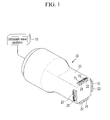
- FIG. 1 illustrates an embodiment of an ultrasonic welding device which includes an ultrasonic wave oscillator 10 for generating ultrasonic waves, and a horn 20 coupled to the ultrasonic wave oscillator 10 to perform ultrasonic welding.
- the ultrasonic wave oscillator 10 converts a 60 Hz AC current into a 20 kHz or above high-frequency current, converts electrical energy to ultrasonic waves that are mechanical energy, and amplifies the ultrasonic waves for transmission to the horn 20.
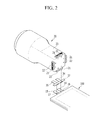
- FIG. 2 illustrates an example of a state immediately before electrode tabs are welded by the ultrasonic welding device in FIG. 1 .
- the horn 20 while being coupled to the ultrasonic wave oscillator 10, the horn 20 performs ultrasonic welding by disposing electrode tabs (e.g., negative electrode tab 34 and positive electrode tab 35) on electrode leads (e.g., negative electrode lead 14 and positive electrode lead 15) of the rechargeable battery 100 and pressing them.
- electrode tabs e.g., negative electrode tab 34 and positive electrode tab 35
- electrode leads e.g., negative electrode lead 14 and positive electrode lead 15
- the horn 20 has a negative electrode horn 21 and a positive electrode horn 22 that respectively press the negative electrode tab 34 and positive electrode tab 35.
- the negative and positive electrode horns 21 and 22 may be integrally formed with, or otherwise coupled to, a body 23, and may respectively have pressing patterns P1 and P2 of different shapes.
- the body 23 has a predetermined (e.g., square pillar) shape, and the negative and positive electrode horns 21 and 22 are formed on four sides of the body 23.
- the body 23 may have a different shape.
- the negative and positive electrode horns 21 and 22 at one side are abraded, the negative and positive electrode horns 21 and 22 at the other sides may be instantly used, because four pairs of the negative and positive electrode horns 21 and 22 are provided in the body 23. Accordingly, a time for replacement of the negative and positive electrode horns 21 and 22 may be reduced.
- FIG. 3 illustrates an embodiment of a horn structure, which, for example, may correspond to the horn 20 in the ultrasonic welding device of FIG. 1 .
- the pressing patterns P 1 of the negative electrode horn 21 are less densely formed than the pressing patterns P 2 of the positive electrode horns 22.
- a pitch P11 of the pressing pattern P1 in the negative electrode horn 21 may be formed between 0.4 mm and 0.8 mm
- a pitch P21 of the pressing pattern P2 in the positive electrode horn 22 may be formed between 0.1 mm and 0.3 mm.
- the negative electrode lead 14 may include copper (Cu) and the positive electrode lead 15 may include aluminum (Al). In other embodiments, different metals may be used. Because the electrode leads 14 and 15 include different metals, the positive electrode lead 15 may have lower strength and, thus, may be more easily damaged than the negative electrode lead 14.
- the positive electrode lead 15 may be less vulnerable to rupturing, and may be adhered to a horn anvil when ultrasonically welded, compared with the negative electrode lead 14.
- the negative and positive electrode horns 21 and 22 are formed in a quadrangular pyramidal shape, for example square or rectangular pyramids.
- the pyramids in the negative and positive electrode horns are oriented in the same direction.
- the pyramids can be said to be oriented at a first angle ⁇ 1 in pattern P2 and a second angle ⁇ 2 in pattern P1.
- ⁇ 1 and ⁇ 2 are the same. In other embodiments, they may be different so that the pyramids are oriented at different angles to one another.
- the horns 21 and 22 may have different shapes, or one of the horns may have a shape different from the other horn.
- pattern P2 is shown to be denser than pattern P1
- the pattern P1 may be denser than pattern P2 in another embodiment, where the positive and negative electrode leads are switched around.
- ends of the pressing patterns P2 of the positive electrode horn 22 may be more bluntly formed than those of the pressing patterns P1 of the negative electrode horn 21.
- the ends of the pressing pattern P1 of the negative electrode horn 21 may be more sharply formed than those of the pressing patterns P2 of the positive electrode horn 22.
- the positive electrode lead 15 that includes aluminum (Al), and thus has weaker strength has a lesser possibility of being torn than the negative electrode lead 14 formed of copper (Cu) when ultrasonically welded.
- FIGS. 4 and 5 illustrate an embodiment of a rechargeable battery 100 which includes a pouch 120 for accommodating an electrode assembly 110.
- the electrode assembly 110 may have a thin jelly-roll form which includes a first e lectrode 11 (e.g., a negative electrode) and a second electrode 12 (e.g., a positive electrode) with an interposing separator 113.
- the first and second electrodes 11 and 12 and the separator may be would a predetermined number of times.
- the separator 13 may be or include, for example, a polymer film through which lithium ions pass.
- the electrode assembly 110 includes a first electrode lead 14 (e.g., a negative electrode lead) and a second electrode lead 15 (e.g., a positive electrode lead) that are respectively coupled to the negative and positive electrodes 11 and 12.
- a first electrode lead 14 e.g., a negative electrode lead
- a second electrode lead 15 e.g., a positive electrode lead
- the negative electrode 11 includes a coated region and an uncoated region.
- the coated region includes an active material which is coated on current collectors made of a thin metal plate.
- the uncoated region includes an active material which is not coated.
- the current collector of the negative electrode 11 and the negative electrode lead 34 may include, for example, copper (Cu).
- the positive electrode 12 includes a coated region and an uncoated region.
- the coated region includes an active material different from the active material of the negative electrode 11 coated on current collectors and may be made of a thin metal plate.
- the uncoated region includes an active material is not coated.
- the current collector of the positive electrode 12 and the positive electrode lead 35 may include, for example, aluminum (Al).
- the negative electrode lead 14 is coupled to the uncoated region of the negative electrode 11.
- the positive electrode lead 15 is spaced apart from the negative electrode lead 14 and is coupled to the uncoated region of the positive electrode 12.
- the negative and positive electrode leads 14 and 15 may be drawn out of the same lateral side of the electrode assembly 10 (e.g., to the left of FIGS. 1 and 2 ) and may be separately disposed at this location.
- the negative and positive electrode leads may be respectively disposed at opposite lateral sides of the electrode assembly (e.g., to the left and right of FIGS. 1 and 2 )
- the rechargeable battery 100 is formed by placing the electrode assembly 110 into the pouch 120 and then bonding (e.g., thermo-bonding) an outer portion of the electrode assembly 110.
- bonding e.g., thermo-bonding
- the negative and positive electrode leads 14 and 15 are enclosed by insulating members 16 and 17 and are drawn out of the pouch 120 through the thermo-bonded portion.
- the insulating members 16 and 17 electrically insulate the negative electrode lead 14 from the positive electrode lead 15 and the negative and positive electrode leads 14 and 15 from the pouch 120.
- the pouch 120 may have a multi-layered sheet structure for enclosing an exterior of the electrode assembly 110.
- the pouch 120 may include a polymer sheet 121 that forms an inner side and performs insulating and thermo-bonding functions, a PET (polyethylene terephthalate) sheet that forms an outer side and performs a protecting function, a nylon sheet or a PET-nylon composite sheet 122 (for convenience, a "nylon sheet” will be exemplarily described), and a metal sheet 123 provided for mechanical strength.
- the metal sheet 123 is between the polymer sheet 121 and the nylon sheet 122, and may include, for example, aluminum.
- the pouch 120 includes a first exterior member 201 that accommodates the electrode assembly 110, and a second exterior member 202 that covers the electrode assembly 110 and is thermo-bonded to the first exterior member 201 outside of the electrode assembly 110.
- the first and second exterior members 201 and 202 may be formed of the polymer sheet 121, the nylon sheet 122, and the metal sheet 123, which have the same layered structure.
- the first exterior member 201 may be concavely formed to accommodate the electrode assembly 110
- the second exterior member 202 may be flatly formed to cover the electrode assembly 110 that is accommodated in the first exterior member 201.
- the second exterior member may be coupled to the first exterior member.
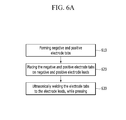
- FIG. 6A illustrates operations included in one embodiment of a method for manufacturing a rechargeable battery using an ultrasonic welding device, which, for example, may be the ultrasonic welding device according to any of the aforementioned embodiments.
- the method includes cutting intermediate materials 341 and 351 into negative and positive electrode tabs 34 and 35 (operation 610), as illustrated in FIG. 6B .
- a second operation includes disposing the negative and positive electrode tabs 34 and 35 in an overlapping relationship on the negative and positive electrode leads 14 and 15 (operation 620), as illustrated in FIG. 7 .
- a third operation includes ultrasonically welding the negative and positive electrode tabs 34 and 35 to the negative and positive electrode leads 14 and 15, while pressing the negative and positive electrode tabs 34 and 35 on the negative and positive electrode horns 21 and 22 (operation 630).
- FIG. 6B illustrates the electrode tabs 34 and 35 and lamination tape 37 to be welded to the electrode leads of the rechargeable battery of FIG. 5 using the ultrasonic welding device of FIG. 1 .
- the intermediate materials 341 and 351 of the negative and positive electrode tabs 34 and 35, which are to be welded to the negative and positive electrode leads 14 and 15, are illustrated along with the lamination tape 37.
- the intermediate materials 341 and 351 of the negative and positive electrode tabs 34 and 35 are continuously supplied, while being coupled to each other through the lamination tape 37. During this process, an interval G is maintained between the intermediate materials 341 and 342 of the negative and positive electrode tabs 34 and 35, which correspond to the negative and positive electrode leads 14 and 15.
- the intermediate materials 341 and 351 are cut to have predetermined lengths that correspond to the negative and positive electrode tabs 34 and 35, as explained with reference to operation 610 in FIG. 6A .
- the negative and positive electrode tabs 34 and 35 are cut while the negative and positive electrode tabs 34 and 35 are connected through the lamination tape 37.
- the lamination tape 37 makes handling of the negative and positive electrode tabs 34 and 35 easier, by preventing the negative and positive electrode tabs 34 and 35, which are cut from the intermediate materials 341 and 351, from separating from each other.
- the interval G of the negative and positive electrode leads 14 and 15 is very small, e.g., less than 1 cm. This may allow the negative and positive electrode tabs 34 and 35 to be welded to the negative and positive electrode leads 14 and 15 through a single process.
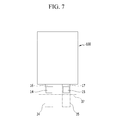
- FIG. 7 illustrates an example of a state in which the electrode tabs 34 and 35 are disposed at the electrode leads 14 and 15 after the state in FIG. 2 .
- the negative and positive electrode tabs 34 and 35 are respectively disposed to overlap the negative and positive electrode leads 14 and 15 of the rechargeable battery 100, as explained with reference to operation 620 in FIG. 6A .
- the lamination tape 37 is disposed to overlap the negative and positive electrode tabs 34 and 35, which respectively overlap the negative and positive electrode leads 14 and 15.
- the negative and positive electrode tabs 34 and 35 that overlap the negative and positive electrode leads 14 and 15 are ultrasonically welded, while being pressed by the negative and positive electrode horns 21 and 22 integrally formed in the ultrasonic welding device, as explained with reference to operation 630 in FIG. 6A .
- ultrasonic welding is performed using the negative and positive electrode horns 21 and 22 that are integrally provided in the body 23, which has the pressing patterns P1 and P2 of different shapes.
- pressure delivered to the negative and positive electrode leads 14 and 15 by the negative and positive electrode horns 21 and 22 is 0.05 MPa to 0.15 MPa
- an amplitude is 40 % to 70 % of the maximum amplitude
- a welding time is 0.04 s to 0.1 s
- a pitch P11 of the pressing pattern P1 corresponding to the negative electrode tab 34 is 0.4 mm to 0.8 mm
- a pitch P21 of the pressing pattern P2 corresponding to the positive electrode tab 35 is 0.1 mm to 0.3 mm.
- the pressure may be 0.1 MPa
- the amplitude may be 55 % of the maximum amplitude
- the welding time may be 0.07 s
- the pitch P11 of the pressing pattern P1 corresponding to the negative electrode tab 34 may be 0.6 mm
- the pitch P21 of the pressing pattern P2 corresponding to the positive electrode tab 35 may be 0.2mm.
- FIG. 8 illustrates an example of a state in which welding is performed by the ultrasonic welding device after the state in FIG. 7 .
- the negative electrode lead 14 and the negative electrode tab 34 have negative electrode connecting patterns P12 for interconnecting one another
- the positive electrode lead 15 and the positive electrode tab 35 have a positive electrode connecting patterns P22 for interconnecting one another.
- the negative electrode connecting patterns P12 are less densely formed than the positive electrode connecting patterns P22.
- pattern lines PL1 and PL2 are parallel and perpendicular to a vibration direction.
- the negative and positive electrode leads 14 and 15 are interconnected by the lamination tape 37, and the negative and positive electrode connecting patterns P12 and P22 are coated with the lamination tape 37.
- the manufacturing method of the rechargeable battery does not require an additional process of attaching the lamination tape 37 to the negative and positive electrode leads 14 and 15.
- FIG. 9 illustrates another embodiment of a horn for an ultrasonic welding device according.
- a negative electrode horn 51 and a positive electrode horn 52 have pyramids which are differently oriented.
- edge lines L5 and L6 ie. ridges rising from the base to the apex
- the edge lines L5 of the pyramids of a pressing pattern P5 are parallel and perpendicular to the vibration direction A in the negative electrode horn 51, but the edge lines L6 of the pyramids of a pressing pattern P6 are inclined or oriented at a third angle ⁇ 3 in the positive electrode horn 52, as shown in Fig. 9 .
- Another embodiment of a manufacturing method of a rechargeable battery is similar to the previous method embodiment, except that ultrasonic welding is performed in the third operation using the negative and positive electrode horns 51 and 52 integrally provided in the body 23 and formed with the pyramids of the pressing patterns P5 and P6 in different directions.
- FIG. 10 illustrates an embodiment of electrode tabs welded to respective electrode leads by the ultrasonic welding device in FIG. 9 .
- a negative electrode connecting pattern P52 and a positive electrode connecting pattern P62 have pattern lines PL5 and PL6 in different directions.
- the pattern lines PL5 are parallel and perpendicular to the vibration direction A.
- the pattern lines PL6 are inclined at the third angle ⁇ 3.
- the positive electrode lead 15 having a lower strength may be more easily damaged than the negative electrode lead 14.
- the positive electrode lead 15 may be more easily prevented from being torn when ultrasonically welded, compared with the negative electrode lead 14.
Landscapes
- Chemical & Material Sciences (AREA)
- Chemical Kinetics & Catalysis (AREA)
- Electrochemistry (AREA)
- General Chemical & Material Sciences (AREA)
- Engineering & Computer Science (AREA)
- Manufacturing & Machinery (AREA)
- Mechanical Engineering (AREA)
- Inorganic Chemistry (AREA)
- Connection Of Batteries Or Terminals (AREA)
Abstract
Description
- The present invention relates to an ultrasonic welding device, a method for manufacturing a rechargeable battery using an ultrasonic welding device, and a rechargeable battery.
- The popularity and use of mobile devices has increased the demand for rechargeable batteries of all types, including but not limited to cylindrical, prismatic, and pouch types of batteries.
- A pouch type of rechargeable battery includes an electrode assembly in a pouch. An electrode lead coupled to an uncoated region of the electrodes may extend from the pouch, and electrode tabs may be welded to electrode leads. The electrode leads and electrode tabs may be interconnected by ultrasonic welding. The positive electrode lead may be formed of aluminum and may serve as a positive electrode current collector. The negative electrode lead may be formed of copper, and may serve as a negative electrode current collector.
- Because the positive and negative leads are formed of different materials, a condition for welding the positive electrode tab to the positive electrode lead is different from a condition for welding the negative electrode tab to the negative electrode lead. However, an ultrasonic welding device uses horns having the same structure. As a result, even when welding conditions are different, a process for welding the positive electrode tab to the positive electrode lead and a process for welding the negative electrode tab to the negative electrode lead are separately performed.
- In addition, in a pouch-type of rechargeable battery, even if the positive and negative electrode leads are spaced from one another and protrude in parallel, separate processes are required to respectively weld the positive and negative electrode tabs to the positive and negative electrode leads while the horn is being moved. This increases welding time.
- In addition, different conditions are configured in the ultrasonic welding device to weld the positive and negative electrode tabs to the positive and negative electrode leads. This complicates the welding process, and thus the overall manufacturing method of the rechargeable battery.
- In accordance with one embodiment, an ultrasonic welding device includes an ultrasonic wave oscillator to generate ultrasonic waves; and a horn structure coupled to the ultrasonic wave oscillator, the horn to perform ultrasonic welding by respectively disposing a negative electrode tab and a positive electrode tab on a negative electrode lead and a positive electrode lead of a rechargeable battery while pressure is applied, wherein the horn structure includes a negative electrode horn and a positive electrode horn that respectively press the negative electrode tab and the positive electrode tab, and the negative and positive electrode horns are integrally provided in a body and have pressing patterns of different shapes.
- The pressing pattern of the negative electrode horn may be less densely formed than the pressing pattern of the positive electrode horn. A pitch of the pressing pattern in the negative electrode horn may be between about 0.4 mm and about 0.8 mm, and a pitch of the pressing pattern in the positive electrode horn may be between about 0.1 mm to about 0.3 mm. Edge lines of the pressing pattern may be substantially parallel and perpendicular to a vibration direction in the negative and positive electrode horns.
- Ends of the pressing pattern of the negative electrode horn may be more bluntly formed than ends of the pressing pattern of the positive electrode horn. Edge lines of the pressing patterns of the negative and positive electrode horns may be in different directions. Edge lines of the pressing pattern in the negative horn may be parallel and perpendicular to a vibration direction, and edge lines of the pressing pattern in the positive horn may be inclined at a predetermined angle with respect to the vibration direction.
- In other words, the pyramids forming the patterns are oriented in the same direction in both the negative and positive electrode horns or are oriented in different directions in the negative and positive electrode horns.
- The body may have a substantially square pillar shape, and the horn may be on four sides of the body.
- In accordance with another embodiment, a method for manufacturing a rechargeable battery includes cutting a continuously provided intermediate material into a negative electrode tab and a positive electrode tab; respectively disposing the negative and positive electrode tabs to overlap a negative electrode lead and a positive electrode lead of the rechargeable battery; and ultrasonically welding the overlapped negative and positive electrode tabs while pressing the overlapped negative and positive electrode tabs with a negative electrode horn and a positive electrode horn integrally formed in the ultrasonic welding device.
- The cutting operation may include cutting the negative and positive electrode tabs with an ultrasonic welding device, while the negative and positive electrode tabs are connected by lamination tape. The disposing operation may include disposing the lamination tape to overlap the negative and positive electrode tabs using the ultrasonic welding device. The ultrasonic welding device may be used to ultrasonically weld the negative and positive electrode horns, and the negative and positive electrode horns may have pressing patterns of different densities. The ultrasonic welding device may be used to ultrasonically weld the negative and positive electrode horns, and the negative and positive horns may include corner lines of pressing patterns in different directions.
- In accordance with another embodiment, a rechargeable battery includes an electrode assembly to be charged and discharged; a pouch including the electrode assembly; negative and positive electrode leads in the pouch and respectively coupled to negative and positive regions of the electrode assembly, the negative and positive electrode leads protruding outside the pouch; and negative and positive electrode tabs overlapping respective ones of the negative and positive electrode leads, the negative and positive electrode tabs coupled to respective ones of the negative and positive leads by an ultrasonic weld, wherein negative electrode connecting patterns to connect the negative electrode lead with the negative electrode tab and positive electrode connecting patterns to couple the positive electrode lead with the positive electrode tab have different shapes.
- The negative electrode connecting patterns may be less dense than the positive electrode connecting patterns. Pattern lines may be at least one of parallel or perpendicular to a vibration direction in the negative and positive electrode connecting patterns. The pattern lines may be in different directions in the negative and positive electrode connecting patterns.
- The pattern lines may be substantially parallel and perpendicular to the vibration direction in the negative electrode connecting pattern, and the pattern lines may be inclined at an angle with respect to the vibration direction in the positive electrode connecting pattern. The negative and positive electrode leads may be interconnected by lamination tape.
- In accordance with another embodiment, a horn structure for an ultrasonic welding device, the horn comprising a negative electrode horn to press a negative electrode tab and a positive electrode horn to press a positive electrode tab, wherein the negative and positive electrode horns have different pressing patterns.
- Features will become apparent to those of skill in the art by describing in detail exemplary embodiments with reference to the attached drawings in which:
-
FIG. 1 illustrates an embodiment of an ultrasonic welding device; -
FIG. 2 illustrates an example of a state immediately before electrode tabs are welded by the ultrasonic welding device; -
FIG. 3 illustrates an embodiment of a horn of the ultrasonic welding device; -
FIG. 4 illustrates an embodiment of a rechargeable battery; -
FIG. 5 illustrates another view of the rechargeable battery; -
FIG. 6A illustrates operations included in one embodiment of a method for manufacturing a rechargeable battery, andFIG. 6B illustrates an embodiment of electrode tabs and lamination tape; -
FIG. 7 illustrates an example of a state in which the electrode tabs are disposed at the electrode leads after the state inFIG. 2 ; -
FIG. 8 illustrates an example of a state in which welding is performed by the ultrasonic welding device after the state inFIG. 7 ; -
FIG. 9 illustrates another embodiment of a horn of an ultrasonic welding device; and -
FIG. 10 illustrates an example of a state in which electrode tabs are welded to electrode leads by the ultrasonic welding device inFIG. 9 . - Example embodiments are described more fully hereinafter with reference to the accompanying drawings; however, they may be embodied in different forms and should not be construed as limited to the embodiments set forth herein. Rather, these embodiments are provided so that this disclosure will be thorough and complete, and will fully convey exemplary implementations to those skilled in the art. In the drawings, the dimensions of layers and regions may be exaggerated for clarity of illustration. Like reference numerals refer to like elements throughout.
-
FIG. 1 illustrates an embodiment of an ultrasonic welding device which includes anultrasonic wave oscillator 10 for generating ultrasonic waves, and ahorn 20 coupled to theultrasonic wave oscillator 10 to perform ultrasonic welding. As an example, theultrasonic wave oscillator 10 converts a 60 Hz AC current into a 20 kHz or above high-frequency current, converts electrical energy to ultrasonic waves that are mechanical energy, and amplifies the ultrasonic waves for transmission to thehorn 20. -
FIG. 2 illustrates an example of a state immediately before electrode tabs are welded by the ultrasonic welding device inFIG. 1 . Referring toFIGS. 1 and2 , while being coupled to theultrasonic wave oscillator 10, thehorn 20 performs ultrasonic welding by disposing electrode tabs (e.g.,negative electrode tab 34 and positive electrode tab 35) on electrode leads (e.g.,negative electrode lead 14 and positive electrode lead 15) of therechargeable battery 100 and pressing them. - The
horn 20 has anegative electrode horn 21 and apositive electrode horn 22 that respectively press thenegative electrode tab 34 andpositive electrode tab 35. The negative andpositive electrode horns body 23, and may respectively have pressing patterns P1 and P2 of different shapes. - The
body 23 has a predetermined (e.g., square pillar) shape, and the negative andpositive electrode horns body 23. In other embodiments, thebody 23 may have a different shape. For example, when the negative andpositive electrode horns positive electrode horns positive electrode horns body 23. Accordingly, a time for replacement of the negative andpositive electrode horns -
FIG. 3 illustrates an embodiment of a horn structure, which, for example, may correspond to thehorn 20 in the ultrasonic welding device ofFIG. 1 . Referring toFIG. 3 , in this embodiment, the pressing patterns P1 of thenegative electrode horn 21 are less densely formed than the pressing patterns P2 of thepositive electrode horns 22. For example, a pitch P11 of the pressing pattern P1 in thenegative electrode horn 21 may be formed between 0.4 mm and 0.8 mm, and a pitch P21 of the pressing pattern P2 in thepositive electrode horn 22 may be formed between 0.1 mm and 0.3 mm. - The
negative electrode lead 14 may include copper (Cu) and thepositive electrode lead 15 may include aluminum (Al). In other embodiments, different metals may be used. Because the electrode leads 14 and 15 include different metals, thepositive electrode lead 15 may have lower strength and, thus, may be more easily damaged than thenegative electrode lead 14. - Because the pressing patterns P2 of the
positive electrode horn 22 are more densely formed than the pressing patterns P1 of thenegative electrode horn 21, thepositive electrode lead 15 may be less vulnerable to rupturing, and may be adhered to a horn anvil when ultrasonically welded, compared with thenegative electrode lead 14. - In this embodiment, the negative and
positive electrode horns - Also, in other embodiments, the
horns - Also, in one embodiment, ends of the pressing patterns P2 of the
positive electrode horn 22 may be more bluntly formed than those of the pressing patterns P1 of thenegative electrode horn 21. For example, the ends of the pressing pattern P1 of thenegative electrode horn 21 may be more sharply formed than those of the pressing patterns P2 of thepositive electrode horn 22. Thus, thepositive electrode lead 15 that includes aluminum (Al), and thus has weaker strength, has a lesser possibility of being torn than thenegative electrode lead 14 formed of copper (Cu) when ultrasonically welded. -
FIGS. 4 and5 illustrate an embodiment of arechargeable battery 100 which includes apouch 120 for accommodating anelectrode assembly 110. Theelectrode assembly 110 may have a thin jelly-roll form which includes a first electrode 11 (e.g., a negative electrode) and a second electrode 12 (e.g., a positive electrode) with an interposing separator 113. The first andsecond electrodes separator 13 may be or include, for example, a polymer film through which lithium ions pass. - The
electrode assembly 110 includes a first electrode lead 14 (e.g., a negative electrode lead) and a second electrode lead 15 (e.g., a positive electrode lead) that are respectively coupled to the negative andpositive electrodes - The
negative electrode 11 includes a coated region and an uncoated region. The coated region includes an active material which is coated on current collectors made of a thin metal plate. The uncoated region includes an active material which is not coated. The current collector of thenegative electrode 11 and thenegative electrode lead 34 may include, for example, copper (Cu). - The
positive electrode 12 includes a coated region and an uncoated region. The coated region includes an active material different from the active material of thenegative electrode 11 coated on current collectors and may be made of a thin metal plate. The uncoated region includes an active material is not coated. The current collector of thepositive electrode 12 and thepositive electrode lead 35 may include, for example, aluminum (Al). - The
negative electrode lead 14 is coupled to the uncoated region of thenegative electrode 11. Thepositive electrode lead 15 is spaced apart from thenegative electrode lead 14 and is coupled to the uncoated region of thepositive electrode 12. The negative and positive electrode leads 14 and 15 may be drawn out of the same lateral side of the electrode assembly 10 (e.g., to the left ofFIGS. 1 and2 ) and may be separately disposed at this location. The negative and positive electrode leads may be respectively disposed at opposite lateral sides of the electrode assembly (e.g., to the left and right ofFIGS. 1 and2 ) - The
rechargeable battery 100 is formed by placing theelectrode assembly 110 into thepouch 120 and then bonding (e.g., thermo-bonding) an outer portion of theelectrode assembly 110. In this case, the negative and positive electrode leads 14 and 15 are enclosed by insulatingmembers pouch 120 through the thermo-bonded portion. For example, the insulatingmembers negative electrode lead 14 from thepositive electrode lead 15 and the negative and positive electrode leads 14 and 15 from thepouch 120. - The
pouch 120 may have a multi-layered sheet structure for enclosing an exterior of theelectrode assembly 110. For example, thepouch 120 may include apolymer sheet 121 that forms an inner side and performs insulating and thermo-bonding functions, a PET (polyethylene terephthalate) sheet that forms an outer side and performs a protecting function, a nylon sheet or a PET-nylon composite sheet 122 (for convenience, a "nylon sheet" will be exemplarily described), and ametal sheet 123 provided for mechanical strength. Themetal sheet 123 is between thepolymer sheet 121 and thenylon sheet 122, and may include, for example, aluminum. - The
pouch 120 includes afirst exterior member 201 that accommodates theelectrode assembly 110, and asecond exterior member 202 that covers theelectrode assembly 110 and is thermo-bonded to thefirst exterior member 201 outside of theelectrode assembly 110. The first and secondexterior members polymer sheet 121, thenylon sheet 122, and themetal sheet 123, which have the same layered structure. For example, thefirst exterior member 201 may be concavely formed to accommodate theelectrode assembly 110, and thesecond exterior member 202 may be flatly formed to cover theelectrode assembly 110 that is accommodated in thefirst exterior member 201. The second exterior member may be coupled to the first exterior member. -
FIG. 6A illustrates operations included in one embodiment of a method for manufacturing a rechargeable battery using an ultrasonic welding device, which, for example, may be the ultrasonic welding device according to any of the aforementioned embodiments. - The method includes cutting
intermediate materials positive electrode tabs 34 and 35 (operation 610), as illustrated inFIG. 6B . A second operation includes disposing the negative andpositive electrode tabs FIG. 7 . - A third operation includes ultrasonically welding the negative and
positive electrode tabs positive electrode tabs positive electrode horns 21 and 22 (operation 630). -
FIG. 6B illustrates theelectrode tabs lamination tape 37 to be welded to the electrode leads of the rechargeable battery ofFIG. 5 using the ultrasonic welding device ofFIG. 1 . Referring toFIG. 6B , theintermediate materials positive electrode tabs lamination tape 37. - The
intermediate materials positive electrode tabs lamination tape 37. During this process, an interval G is maintained between theintermediate materials 341 and 342 of the negative andpositive electrode tabs intermediate materials positive electrode tabs operation 610 inFIG. 6A . - In
operation 610, the negative andpositive electrode tabs positive electrode tabs lamination tape 37. Thelamination tape 37 makes handling of the negative andpositive electrode tabs positive electrode tabs intermediate materials - In addition, when the
rechargeable battery 100 has a predetermined size (e.g., 1 x 1 cm), the interval G of the negative and positive electrode leads 14 and 15 is very small, e.g., less than 1 cm. This may allow the negative andpositive electrode tabs -
FIG. 7 illustrates an example of a state in which theelectrode tabs FIG. 2 . Referring toFIG. 7 , the negative andpositive electrode tabs rechargeable battery 100, as explained with reference tooperation 620 inFIG. 6A . In this operation, thelamination tape 37 is disposed to overlap the negative andpositive electrode tabs - Referring to
FIGS. 2 to 7 , the negative andpositive electrode tabs positive electrode horns operation 630 inFIG. 6A . - In this operation, ultrasonic welding is performed using the negative and
positive electrode horns body 23, which has the pressing patterns P1 and P2 of different shapes. As an example, pressure delivered to the negative and positive electrode leads 14 and 15 by the negative andpositive electrode horns negative electrode tab 34 is 0.4 mm to 0.8 mm, and a pitch P21 of the pressing pattern P2 corresponding to thepositive electrode tab 35 is 0.1 mm to 0.3 mm. - In one embodiment, the pressure may be 0.1 MPa, the amplitude may be 55 % of the maximum amplitude, the welding time may be 0.07 s, the pitch P11 of the pressing pattern P1 corresponding to the
negative electrode tab 34 may be 0.6 mm, and the pitch P21 of the pressing pattern P2 corresponding to thepositive electrode tab 35 may be 0.2mm. -
FIG. 8 illustrates an example of a state in which welding is performed by the ultrasonic welding device after the state inFIG. 7 . Referring toFIGS. 3 and8 , thenegative electrode lead 14 and thenegative electrode tab 34 have negative electrode connecting patterns P12 for interconnecting one another, and thepositive electrode lead 15 and thepositive electrode tab 35 have a positive electrode connecting patterns P22 for interconnecting one another. - In the
rechargeable battery 100, the negative electrode connecting patterns P12 are less densely formed than the positive electrode connecting patterns P22. In the negative and positive electrode connecting patterns P12 and P22, pattern lines PL1 and PL2 are parallel and perpendicular to a vibration direction. In addition, the negative and positive electrode leads 14 and 15 are interconnected by thelamination tape 37, and the negative and positive electrode connecting patterns P12 and P22 are coated with thelamination tape 37. - Thus, the manufacturing method of the rechargeable battery does not require an additional process of attaching the
lamination tape 37 to the negative and positive electrode leads 14 and 15. -
FIG. 9 illustrates another embodiment of a horn for an ultrasonic welding device according. Referring toFIG. 9 , anegative electrode horn 51 and apositive electrode horn 52 have pyramids which are differently oriented. Thus, edge lines L5 and L6 (ie. ridges rising from the base to the apex) of the pyramids in thenegative electrode horn 51 and in thepositive electrode horn 52 are differently oriented. For example, the edge lines L5 of the pyramids of a pressing pattern P5 are parallel and perpendicular to the vibration direction A in thenegative electrode horn 51, but the edge lines L6 of the pyramids of a pressing pattern P6 are inclined or oriented at a third angle θ3 in thepositive electrode horn 52, as shown inFig. 9 . - Another embodiment of a manufacturing method of a rechargeable battery is similar to the previous method embodiment, except that ultrasonic welding is performed in the third operation using the negative and
positive electrode horns body 23 and formed with the pyramids of the pressing patterns P5 and P6 in different directions. -
FIG. 10 illustrates an embodiment of electrode tabs welded to respective electrode leads by the ultrasonic welding device inFIG. 9 . Referring toFIG. 10 , in arechargeable battery 500, a negative electrode connecting pattern P52 and a positive electrode connecting pattern P62 have pattern lines PL5 and PL6 in different directions. For example, in the negative electrode connecting pattern P52, the pattern lines PL5 are parallel and perpendicular to the vibration direction A. In the positive electrode connecting pattern P62, the pattern lines PL6 are inclined at the third angle θ3. - Because the
negative electrode lead 14 includes copper (Cu) and thepositive electrode lead 15 includes aluminum (Al), thepositive electrode lead 15 having a lower strength may be more easily damaged than thenegative electrode lead 14. In the positive electrode connecting pattern P62, because the pyramids are inclined at the third angle θ3, thepositive electrode lead 15 may be more easily prevented from being torn when ultrasonically welded, compared with thenegative electrode lead 14. - Example embodiments have been disclosed herein, and although specific terms are employed, they are used and are to be interpreted in a generic and descriptive sense only and not for purpose of limitation. In some instances, as would be apparent to one of skill in the art as of the filing of the present application, features, characteristics, and/or elements described in connection with a particular embodiment may be used singly or in combination with features, characteristics, and/or elements described in connection with other embodiments unless otherwise indicated. Accordingly, it will be understood by those of skill in the art that various changes in form and details may be made without departing from the scope of the present invention as set forth in the following claims.
Claims (15)
- An ultrasonic welding device, comprising:an ultrasonic wave oscillator to generate ultrasonic waves; anda horn structure coupled to the ultrasonic wave oscillator and configured to perform ultrasonic welding by respectively disposing a negative electrode tab and a positive electrode tab on a negative electrode lead and a positive electrode lead of a rechargeable battery while pressure is applied, wherein:the horn structure includes a negative electrode horn and a positive electrode horn that respectively press the negative electrode tab and the positive electrode tab, andthe negative and positive electrode horns are integrally provided in a body and have pressing patterns of different shapes.
- The device as claimed in claim 1, wherein the pressing pattern of the negative electrode horn is less densely formed than the pressing pattern of the positive electrode horn.
- The device as claimed in claim 2, wherein:the pitch of the pressing pattern in the negative electrode horn is between 0.4 mm and about 0.8 mm, andthe pitch of the pressing pattern in the positive electrode horn is between 0.1 mm to about 0.3 mm.
- The device as claimed in claim 2 or 3, wherein the pressing patterns comprise pyramids.
- The device as claimed in claim 4, wherein the pyramids are oriented in the same direction in both the negative and positive electrode horns.
- The device as claimed in claim 4, wherein the pyramids are oriented in different directions in the negative and positive electrode horns.
- The device as claimed in any one of the preceding claims, wherein ends of the pressing pattern of the positive electrode horn are more bluntly formed than ends of the pressing pattern of the negative electrode horn.
- The device as claimed in any one of the preceding claims, wherein:the body has a substantially square pillar shape, andone pair of positive and negative electrode horns is disposed on each of the four sides of the body.
- A method of manufacturing a rechargeable battery, comprising:cutting a continuously provided intermediate material into a negative electrode tab and a positive electrode tab;respectively disposing the negative and positive electrode tabs to overlap a negative electrode lead and a positive electrode lead of the rechargeable battery; andultrasonically welding the overlapped negative and positive electrode tabs while pressing the overlapped negative and positive electrode tabs with a negative electrode horn and a positive electrode horn integrally formed.
- The method as claimed in claim 9, wherein the cutting includes:cutting the negative and positive electrode tabs with an ultrasonic welding device, while the negative and positive electrode tabs are connected by lamination tape, wherein the disposing may include:disposing the lamination tape to overlap the negative and positive electrode tabs using the ultrasonic welding device.
- The method as claimed in claim 10, wherein the ultrasonic welding device is used to ultrasonically weld the negative and positive electrode horns, the negative and positive electrode horns having pressing patterns of different densitiesand/or wherein the pressing patterns are oriented in different directions.
- A rechargeable battery, comprising:an electrode assembly;a pouch including the electrode assembly;negative and positive electrode leads in the pouch and respectively electrically coupled to negative and positive regions of the electrode assembly, the negative and positive electrode leads protruding outside the pouch; andnegative and positive electrode tabs overlapping respective ones of the negative and positive electrode leads, the negative and positive electrode tabs coupled to respective ones of the negative and positive leads by an ultrasonic weld, wherein negative electrode connecting patterns to connect the negative electrode lead with the negative electrode tab and positive electrode connecting patterns to couple the positive electrode lead with the positive electrode tab have different shapes.
- The battery as claimed in claim 12, wherein the negative electrode connecting patterns are less dense than the positive electrode connecting patterns.
- The battery as claimed in claim 12, wherein pattern lines are parallel or perpendicular to a vibration direction in the negative and positive electrode connecting patterns, and/or wherein pattern lines are in different directions in the negative and positive electrode connecting patterns, and/or wherein:the pattern lines may be substantially parallel, and perpendicular to the vibration direction in the negative electrode connecting pattern, andthe pattern lines may be inclined at an angle with respect to the vibration direction in the positive electrode connecting pattern.
- The battery as claimed in any one of claims 12 to 14, wherein the negative and positive electrode leads are interconnected by lamination tape.
Applications Claiming Priority (1)
| Application Number | Priority Date | Filing Date | Title |
|---|---|---|---|
| KR1020140103872A KR102211524B1 (en) | 2014-08-11 | 2014-08-11 | Ultrasonic welding device, rechargeable battery manufacturing method using the same, and rechargeable battery thereof |
Publications (2)
| Publication Number | Publication Date |
|---|---|
| EP2985806A1 true EP2985806A1 (en) | 2016-02-17 |
| EP2985806B1 EP2985806B1 (en) | 2019-11-20 |
Family
ID=53783642
Family Applications (1)
| Application Number | Title | Priority Date | Filing Date |
|---|---|---|---|
| EP15180236.0A Active EP2985806B1 (en) | 2014-08-11 | 2015-08-07 | Ultrasonic welding device, manufacturing method of rechargeable battery using the same, and rechargeable battery |
Country Status (4)
| Country | Link |
|---|---|
| US (1) | US20160043360A1 (en) |
| EP (1) | EP2985806B1 (en) |
| KR (1) | KR102211524B1 (en) |
| CN (2) | CN110293308B (en) |
Cited By (3)
| Publication number | Priority date | Publication date | Assignee | Title |
|---|---|---|---|---|
| TWI628023B (en) * | 2016-08-04 | 2018-07-01 | 日商東芝三菱電機產業系統股份有限公司 | Ultrasonic bonding tool and ultrasonic bonding apparatus |
| JP2020116641A (en) * | 2016-08-10 | 2020-08-06 | 株式会社エンビジョンAescジャパン | Ultrasonic bonding equipment |
| EP3895837A4 (en) * | 2019-01-21 | 2022-02-16 | Lg Energy Solution, Ltd. | CORNET AND WELDING DEVICE |
Families Citing this family (11)
| Publication number | Priority date | Publication date | Assignee | Title |
|---|---|---|---|---|
| KR102510882B1 (en) * | 2015-07-16 | 2023-03-16 | 삼성에스디아이 주식회사 | Manufacturing method for secondary battery |
| KR102288097B1 (en) * | 2016-11-07 | 2021-08-10 | 주식회사 엘지에너지솔루션 | Pouch-typed Battery Cell Comprising Electrode Tab and Lead Having Current Breaking Function |
| KR102309416B1 (en) | 2017-03-03 | 2021-10-07 | 주식회사 엘지에너지솔루션 | Pouch Type Secondary Battery for Preventing Disconnection Between Foil and Lead by sheet and Method thereof |
| CN109560318B (en) * | 2018-12-29 | 2024-01-26 | 桂林市啄木鸟医疗器械有限公司 | Rechargeable battery and hot-melt gutta-percha pen |
| CN111757634B (en) * | 2019-03-29 | 2023-11-14 | 台达电子工业股份有限公司 | heat transfer device |
| CN110336065B (en) * | 2019-05-15 | 2021-05-18 | 广东微电新能源有限公司 | Button-type battery and method for manufacturing the same |
| CN110253132B (en) * | 2019-07-05 | 2021-03-26 | 惠州市杰优实业有限公司 | Power battery tab welding device and method |
| US11801574B2 (en) * | 2020-03-06 | 2023-10-31 | GM Global Technology Operations LLC | Welding systems and methods with knurled weld interfaces for metallic workpieces |
| JP7397831B2 (en) * | 2021-08-06 | 2023-12-13 | プライムプラネットエナジー&ソリューションズ株式会社 | Horn for ultrasonic bonding |
| CN115837510B (en) * | 2021-11-09 | 2024-01-16 | 宁德时代新能源科技股份有限公司 | Lug welding method, welding tool, battery cell, battery and electricity utilization device |
| CN115922048A (en) * | 2022-11-04 | 2023-04-07 | 浙江南都电源动力股份有限公司 | An ultrasonic welding structure |
Citations (4)
| Publication number | Priority date | Publication date | Assignee | Title |
|---|---|---|---|---|
| EP2266744A1 (en) * | 2009-06-22 | 2010-12-29 | Ultex Corporation | Resonator for joining metal members together utilizing ultrasonic vibration and a joining tool having distal end projecting laterally |
| US20120196173A1 (en) * | 2011-01-28 | 2012-08-02 | Samsung Sdi Co., Ltd. | Secondary battery |
| WO2013105361A1 (en) * | 2012-01-12 | 2013-07-18 | 日立マクセル株式会社 | Ultrasonic welding tip, ultrasonic welding machine, and method for producing battery |
| US20140087245A1 (en) * | 2011-05-30 | 2014-03-27 | Lg Chem, Ltd. | Ultrasonic welding apparatus and secondary battery with enhanced electrode structure |
Family Cites Families (26)
| Publication number | Priority date | Publication date | Assignee | Title |
|---|---|---|---|---|
| US3426951A (en) * | 1961-11-06 | 1969-02-11 | Lehfeldt & Co Gmbh Dr | Ultrasonic welding apparatus |
| US3780926A (en) * | 1972-06-02 | 1973-12-25 | Dukane Corp | Ultrasonic rigid horn assembly |
| US3813006A (en) * | 1973-02-02 | 1974-05-28 | Branson Instr | Replaceable welding tip for vibratory welding apparatus |
| FR2618356B1 (en) * | 1987-07-24 | 1993-05-07 | Cadiou James | COMPOSITE ULTRASONIC SONOTRODE PARTICULARLY SUITABLE FOR WELDING BETWEEN SEMI-RIGID POLYSTYRENE AND MOLDED CELLULOSE |
| US4852788A (en) * | 1988-06-16 | 1989-08-01 | American Technology, Inc. | Method and apparatus of ultrasonic gang welding |
| DE69018220T2 (en) * | 1989-12-20 | 1995-07-27 | Sumitomo Electric Industries | Connecting tool. |
| JP3455344B2 (en) * | 1995-10-20 | 2003-10-14 | 株式会社オートネットワーク技術研究所 | Ultrasonic welding equipment |
| JP3099942B2 (en) * | 1996-08-08 | 2000-10-16 | 株式会社アルテクス | Ultrasonic vibration bonding resonator |
| JP2002368036A (en) * | 2001-06-11 | 2002-12-20 | Nec Kyushu Ltd | Wire bonding equipment |
| JP4013691B2 (en) * | 2002-07-31 | 2007-11-28 | 住友電装株式会社 | Flexible flat cable connection method and ultrasonic welding machine |
| JP3753426B2 (en) * | 2003-01-15 | 2006-03-08 | 株式会社東芝 | Ultrasonic bonding tool and method for manufacturing semiconductor device using ultrasonic bonding tool |
| DE10323783A1 (en) * | 2003-05-23 | 2004-12-09 | Maschinenfabrik Gerd Mosca Ag | Ultrasonic welding device |
| US7344620B2 (en) * | 2004-05-10 | 2008-03-18 | Bandelin Electronic Gmbh & Co. Kg | Ultrasonic sonotrode |
| KR200364044Y1 (en) * | 2004-07-21 | 2004-10-08 | 주식회사 이스퀘어텍 | Lithium Ion Battery of High Rate and High Capacity |
| JP2006088147A (en) * | 2004-08-24 | 2006-04-06 | Fuji Photo Film Co Ltd | Ultrasonic joining horn and ultrasonic welding method |
| JP2006093636A (en) * | 2004-08-27 | 2006-04-06 | Fujitsu Ltd | Semiconductor chip bonding method and bonding apparatus |
| JP4047349B2 (en) * | 2004-11-09 | 2008-02-13 | 株式会社東芝 | Ultrasonic bonding apparatus for manufacturing semiconductor device, semiconductor device, and manufacturing method |
| JP4792945B2 (en) * | 2005-01-28 | 2011-10-12 | 日産自動車株式会社 | Ultrasonic bonding apparatus and bonded structure |
| JP2009194153A (en) * | 2008-02-14 | 2009-08-27 | Toshiba Corp | Semiconductor device manufacturing method and ultrasonic bonding apparatus |
| US9352868B2 (en) * | 2010-10-26 | 2016-05-31 | Rinco Ultrasonics USA, Inc. | Stepped sonotrode and anvil energy director grids for narrow/complex ultrasonic welds of improved durability |
| KR101278507B1 (en) * | 2011-05-24 | 2013-07-02 | 주식회사 엘지화학 | Secondary battery with enhanced electrode structure strength |
| CN202240147U (en) * | 2011-09-23 | 2012-05-30 | 维动新能源股份有限公司 | Welding rod of ultrasonic welding machine |
| US20130213552A1 (en) * | 2012-02-20 | 2013-08-22 | Branson Ultrasonics Corporation | Vibratory welder having low thermal conductivity tool |
| US8651163B1 (en) * | 2012-12-04 | 2014-02-18 | Ford Global Technologies, Llc | Geometric design for ultrasonic welding tools |
| US8925612B2 (en) * | 2013-02-25 | 2015-01-06 | Branson Ultrasonics Corporation | Ultrasonic collet horn for ultrasonic welder |
| KR101354142B1 (en) * | 2013-10-02 | 2014-01-24 | 주식회사 엘지화학 | Ultrasonic waves welding apparatus |
-
2014
- 2014-08-11 KR KR1020140103872A patent/KR102211524B1/en active Active
-
2015
- 2015-06-05 US US14/731,782 patent/US20160043360A1/en not_active Abandoned
- 2015-07-30 CN CN201910636963.3A patent/CN110293308B/en active Active
- 2015-07-30 CN CN201510460022.0A patent/CN105364295B/en active Active
- 2015-08-07 EP EP15180236.0A patent/EP2985806B1/en active Active
Patent Citations (4)
| Publication number | Priority date | Publication date | Assignee | Title |
|---|---|---|---|---|
| EP2266744A1 (en) * | 2009-06-22 | 2010-12-29 | Ultex Corporation | Resonator for joining metal members together utilizing ultrasonic vibration and a joining tool having distal end projecting laterally |
| US20120196173A1 (en) * | 2011-01-28 | 2012-08-02 | Samsung Sdi Co., Ltd. | Secondary battery |
| US20140087245A1 (en) * | 2011-05-30 | 2014-03-27 | Lg Chem, Ltd. | Ultrasonic welding apparatus and secondary battery with enhanced electrode structure |
| WO2013105361A1 (en) * | 2012-01-12 | 2013-07-18 | 日立マクセル株式会社 | Ultrasonic welding tip, ultrasonic welding machine, and method for producing battery |
Cited By (5)
| Publication number | Priority date | Publication date | Assignee | Title |
|---|---|---|---|---|
| TWI628023B (en) * | 2016-08-04 | 2018-07-01 | 日商東芝三菱電機產業系統股份有限公司 | Ultrasonic bonding tool and ultrasonic bonding apparatus |
| US10946475B2 (en) | 2016-08-04 | 2021-03-16 | Toshiba Mitsubishi-Electric Industrial Systems Corporation | Tool for ultrasonic bonding and apparatus for ultrasonic bonding |
| JP2020116641A (en) * | 2016-08-10 | 2020-08-06 | 株式会社エンビジョンAescジャパン | Ultrasonic bonding equipment |
| EP3895837A4 (en) * | 2019-01-21 | 2022-02-16 | Lg Energy Solution, Ltd. | CORNET AND WELDING DEVICE |
| US12257646B2 (en) | 2019-01-21 | 2025-03-25 | Lg Energy Solution, Ltd. | Horn and welding device |
Also Published As
| Publication number | Publication date |
|---|---|
| CN110293308B (en) | 2021-11-09 |
| CN105364295B (en) | 2020-05-29 |
| CN105364295A (en) | 2016-03-02 |
| US20160043360A1 (en) | 2016-02-11 |
| CN110293308A (en) | 2019-10-01 |
| KR20160019287A (en) | 2016-02-19 |
| KR102211524B1 (en) | 2021-02-02 |
| EP2985806B1 (en) | 2019-11-20 |
Similar Documents
| Publication | Publication Date | Title |
|---|---|---|
| EP2985806B1 (en) | Ultrasonic welding device, manufacturing method of rechargeable battery using the same, and rechargeable battery | |
| US11075374B2 (en) | Method for producing electrode assembly and method for producing nonaqueous electrolyte secondary battery | |
| US12051827B2 (en) | Electrode assembly configured such that pressure welding portions of electrode tab welding portions have different sizes and ultrasonic welding apparatus configured to manufacture the same | |
| JP5054419B2 (en) | Sheet-like secondary battery | |
| EP2006935B1 (en) | Electric device with outer film cover | |
| CN110326130B (en) | Electrode with improved electrode tab welding characteristics and secondary battery including the same | |
| KR102221806B1 (en) | Curved secondary battery and manufacturing method thereof | |
| US9847514B2 (en) | Battery and method for manufacturing same | |
| WO2021020032A1 (en) | Ultrasonic horn, secondary battery, and method for manufacturing secondary battery | |
| JP6095120B2 (en) | Lithium ion secondary battery | |
| JP6873798B2 (en) | Manufacturing method of film exterior battery and film exterior battery | |
| CN111554960B (en) | Method for manufacturing power storage element, bonding method, and bonded body | |
| JP2012209269A (en) | Method for manufacturing sheet-like secondary battery | |
| JP7336287B2 (en) | Nonaqueous electrolyte secondary battery and manufacturing method thereof | |
| JP2009187674A (en) | Method of welding sheet-like electrode and tab in laminated state by ultrasonic wave | |
| JP2019091563A (en) | Power storage element | |
| JP7205723B2 (en) | Ultrasonic bonding method | |
| KR101367752B1 (en) | Ultrasonic waves welding apparatus | |
| KR101354142B1 (en) | Ultrasonic waves welding apparatus | |
| KR20190061573A (en) | Welding method of electrode tap and lead | |
| KR101277731B1 (en) | Secondary battery with enhanced electrode structure strength | |
| JP3775396B2 (en) | Flat cell battery pack | |
| US20120171568A1 (en) | Prismatic battery cell welding | |
| KR20250155896A (en) | Battery, device comprising the same and battery manufacturing method | |
| KR20250064386A (en) | Electrode plate for secondary battery, battery cell including the same, and method of manufacturing electrode plate for secondary battery |
Legal Events
| Date | Code | Title | Description |
|---|---|---|---|
| PUAI | Public reference made under article 153(3) epc to a published international application that has entered the european phase |
Free format text: ORIGINAL CODE: 0009012 |
|
| AK | Designated contracting states |
Kind code of ref document: A1 Designated state(s): AL AT BE BG CH CY CZ DE DK EE ES FI FR GB GR HR HU IE IS IT LI LT LU LV MC MK MT NL NO PL PT RO RS SE SI SK SM TR |
|
| AX | Request for extension of the european patent |
Extension state: BA ME |
|
| 17P | Request for examination filed |
Effective date: 20160817 |
|
| RBV | Designated contracting states (corrected) |
Designated state(s): AL AT BE BG CH CY CZ DE DK EE ES FI FR GB GR HR HU IE IS IT LI LT LU LV MC MK MT NL NO PL PT RO RS SE SI SK SM TR |
|
| STAA | Information on the status of an ep patent application or granted ep patent |
Free format text: STATUS: EXAMINATION IS IN PROGRESS |
|
| 17Q | First examination report despatched |
Effective date: 20170913 |
|
| GRAP | Despatch of communication of intention to grant a patent |
Free format text: ORIGINAL CODE: EPIDOSNIGR1 |
|
| STAA | Information on the status of an ep patent application or granted ep patent |
Free format text: STATUS: GRANT OF PATENT IS INTENDED |
|
| RIC1 | Information provided on ipc code assigned before grant |
Ipc: B23K 101/36 20060101ALI20190429BHEP Ipc: H01M 10/04 20060101ALI20190429BHEP Ipc: B23K 20/10 20060101ALI20190429BHEP Ipc: H01M 2/02 20060101AFI20190429BHEP Ipc: H01M 2/26 20060101ALI20190429BHEP Ipc: B29C 65/08 20060101ALI20190429BHEP Ipc: H01M 10/0587 20100101ALI20190429BHEP |
|
| INTG | Intention to grant announced |
Effective date: 20190531 |
|
| GRAS | Grant fee paid |
Free format text: ORIGINAL CODE: EPIDOSNIGR3 |
|
| GRAA | (expected) grant |
Free format text: ORIGINAL CODE: 0009210 |
|
| STAA | Information on the status of an ep patent application or granted ep patent |
Free format text: STATUS: THE PATENT HAS BEEN GRANTED |
|
| AK | Designated contracting states |
Kind code of ref document: B1 Designated state(s): AL AT BE BG CH CY CZ DE DK EE ES FI FR GB GR HR HU IE IS IT LI LT LU LV MC MK MT NL NO PL PT RO RS SE SI SK SM TR |
|
| REG | Reference to a national code |
Ref country code: GB Ref legal event code: FG4D |
|
| REG | Reference to a national code |
Ref country code: CH Ref legal event code: EP |
|
| REG | Reference to a national code |
Ref country code: IE Ref legal event code: FG4D |
|
| REG | Reference to a national code |
Ref country code: DE Ref legal event code: R096 Ref document number: 602015041938 Country of ref document: DE |
|
| REG | Reference to a national code |
Ref country code: AT Ref legal event code: REF Ref document number: 1205192 Country of ref document: AT Kind code of ref document: T Effective date: 20191215 |
|
| REG | Reference to a national code |
Ref country code: NL Ref legal event code: MP Effective date: 20191120 |
|
| REG | Reference to a national code |
Ref country code: LT Ref legal event code: MG4D |
|
| PG25 | Lapsed in a contracting state [announced via postgrant information from national office to epo] |
Ref country code: NO Free format text: LAPSE BECAUSE OF FAILURE TO SUBMIT A TRANSLATION OF THE DESCRIPTION OR TO PAY THE FEE WITHIN THE PRESCRIBED TIME-LIMIT Effective date: 20200220 Ref country code: BG Free format text: LAPSE BECAUSE OF FAILURE TO SUBMIT A TRANSLATION OF THE DESCRIPTION OR TO PAY THE FEE WITHIN THE PRESCRIBED TIME-LIMIT Effective date: 20200220 Ref country code: LT Free format text: LAPSE BECAUSE OF FAILURE TO SUBMIT A TRANSLATION OF THE DESCRIPTION OR TO PAY THE FEE WITHIN THE PRESCRIBED TIME-LIMIT Effective date: 20191120 Ref country code: GR Free format text: LAPSE BECAUSE OF FAILURE TO SUBMIT A TRANSLATION OF THE DESCRIPTION OR TO PAY THE FEE WITHIN THE PRESCRIBED TIME-LIMIT Effective date: 20200221 Ref country code: NL Free format text: LAPSE BECAUSE OF FAILURE TO SUBMIT A TRANSLATION OF THE DESCRIPTION OR TO PAY THE FEE WITHIN THE PRESCRIBED TIME-LIMIT Effective date: 20191120 Ref country code: LV Free format text: LAPSE BECAUSE OF FAILURE TO SUBMIT A TRANSLATION OF THE DESCRIPTION OR TO PAY THE FEE WITHIN THE PRESCRIBED TIME-LIMIT Effective date: 20191120 Ref country code: SE Free format text: LAPSE BECAUSE OF FAILURE TO SUBMIT A TRANSLATION OF THE DESCRIPTION OR TO PAY THE FEE WITHIN THE PRESCRIBED TIME-LIMIT Effective date: 20191120 Ref country code: FI Free format text: LAPSE BECAUSE OF FAILURE TO SUBMIT A TRANSLATION OF THE DESCRIPTION OR TO PAY THE FEE WITHIN THE PRESCRIBED TIME-LIMIT Effective date: 20191120 |
|
| PG25 | Lapsed in a contracting state [announced via postgrant information from national office to epo] |
Ref country code: IS Free format text: LAPSE BECAUSE OF FAILURE TO SUBMIT A TRANSLATION OF THE DESCRIPTION OR TO PAY THE FEE WITHIN THE PRESCRIBED TIME-LIMIT Effective date: 20200320 Ref country code: RS Free format text: LAPSE BECAUSE OF FAILURE TO SUBMIT A TRANSLATION OF THE DESCRIPTION OR TO PAY THE FEE WITHIN THE PRESCRIBED TIME-LIMIT Effective date: 20191120 Ref country code: HR Free format text: LAPSE BECAUSE OF FAILURE TO SUBMIT A TRANSLATION OF THE DESCRIPTION OR TO PAY THE FEE WITHIN THE PRESCRIBED TIME-LIMIT Effective date: 20191120 |
|
| PG25 | Lapsed in a contracting state [announced via postgrant information from national office to epo] |
Ref country code: AL Free format text: LAPSE BECAUSE OF FAILURE TO SUBMIT A TRANSLATION OF THE DESCRIPTION OR TO PAY THE FEE WITHIN THE PRESCRIBED TIME-LIMIT Effective date: 20191120 |
|
| PG25 | Lapsed in a contracting state [announced via postgrant information from national office to epo] |
Ref country code: ES Free format text: LAPSE BECAUSE OF FAILURE TO SUBMIT A TRANSLATION OF THE DESCRIPTION OR TO PAY THE FEE WITHIN THE PRESCRIBED TIME-LIMIT Effective date: 20191120 Ref country code: CZ Free format text: LAPSE BECAUSE OF FAILURE TO SUBMIT A TRANSLATION OF THE DESCRIPTION OR TO PAY THE FEE WITHIN THE PRESCRIBED TIME-LIMIT Effective date: 20191120 Ref country code: DK Free format text: LAPSE BECAUSE OF FAILURE TO SUBMIT A TRANSLATION OF THE DESCRIPTION OR TO PAY THE FEE WITHIN THE PRESCRIBED TIME-LIMIT Effective date: 20191120 Ref country code: RO Free format text: LAPSE BECAUSE OF FAILURE TO SUBMIT A TRANSLATION OF THE DESCRIPTION OR TO PAY THE FEE WITHIN THE PRESCRIBED TIME-LIMIT Effective date: 20191120 Ref country code: PT Free format text: LAPSE BECAUSE OF FAILURE TO SUBMIT A TRANSLATION OF THE DESCRIPTION OR TO PAY THE FEE WITHIN THE PRESCRIBED TIME-LIMIT Effective date: 20200412 Ref country code: EE Free format text: LAPSE BECAUSE OF FAILURE TO SUBMIT A TRANSLATION OF THE DESCRIPTION OR TO PAY THE FEE WITHIN THE PRESCRIBED TIME-LIMIT Effective date: 20191120 |
|
| REG | Reference to a national code |
Ref country code: AT Ref legal event code: MK05 Ref document number: 1205192 Country of ref document: AT Kind code of ref document: T Effective date: 20191120 |
|
| REG | Reference to a national code |
Ref country code: DE Ref legal event code: R097 Ref document number: 602015041938 Country of ref document: DE |
|
| PG25 | Lapsed in a contracting state [announced via postgrant information from national office to epo] |
Ref country code: SK Free format text: LAPSE BECAUSE OF FAILURE TO SUBMIT A TRANSLATION OF THE DESCRIPTION OR TO PAY THE FEE WITHIN THE PRESCRIBED TIME-LIMIT Effective date: 20191120 Ref country code: SM Free format text: LAPSE BECAUSE OF FAILURE TO SUBMIT A TRANSLATION OF THE DESCRIPTION OR TO PAY THE FEE WITHIN THE PRESCRIBED TIME-LIMIT Effective date: 20191120 |
|
| PLBE | No opposition filed within time limit |
Free format text: ORIGINAL CODE: 0009261 |
|
| STAA | Information on the status of an ep patent application or granted ep patent |
Free format text: STATUS: NO OPPOSITION FILED WITHIN TIME LIMIT |
|
| 26N | No opposition filed |
Effective date: 20200821 |
|
| REG | Reference to a national code |
Ref country code: DE Ref legal event code: R079 Ref document number: 602015041938 Country of ref document: DE Free format text: PREVIOUS MAIN CLASS: H01M0002020000 Ipc: H01M0050100000 |
|
| PG25 | Lapsed in a contracting state [announced via postgrant information from national office to epo] |
Ref country code: AT Free format text: LAPSE BECAUSE OF FAILURE TO SUBMIT A TRANSLATION OF THE DESCRIPTION OR TO PAY THE FEE WITHIN THE PRESCRIBED TIME-LIMIT Effective date: 20191120 Ref country code: PL Free format text: LAPSE BECAUSE OF FAILURE TO SUBMIT A TRANSLATION OF THE DESCRIPTION OR TO PAY THE FEE WITHIN THE PRESCRIBED TIME-LIMIT Effective date: 20191120 Ref country code: SI Free format text: LAPSE BECAUSE OF FAILURE TO SUBMIT A TRANSLATION OF THE DESCRIPTION OR TO PAY THE FEE WITHIN THE PRESCRIBED TIME-LIMIT Effective date: 20191120 |
|
| PG25 | Lapsed in a contracting state [announced via postgrant information from national office to epo] |
Ref country code: IT Free format text: LAPSE BECAUSE OF FAILURE TO SUBMIT A TRANSLATION OF THE DESCRIPTION OR TO PAY THE FEE WITHIN THE PRESCRIBED TIME-LIMIT Effective date: 20191120 |
|
| PG25 | Lapsed in a contracting state [announced via postgrant information from national office to epo] |
Ref country code: MC Free format text: LAPSE BECAUSE OF FAILURE TO SUBMIT A TRANSLATION OF THE DESCRIPTION OR TO PAY THE FEE WITHIN THE PRESCRIBED TIME-LIMIT Effective date: 20191120 |
|
| REG | Reference to a national code |
Ref country code: CH Ref legal event code: PL |
|
| PG25 | Lapsed in a contracting state [announced via postgrant information from national office to epo] |
Ref country code: LU Free format text: LAPSE BECAUSE OF NON-PAYMENT OF DUE FEES Effective date: 20200807 Ref country code: LI Free format text: LAPSE BECAUSE OF NON-PAYMENT OF DUE FEES Effective date: 20200831 Ref country code: CH Free format text: LAPSE BECAUSE OF NON-PAYMENT OF DUE FEES Effective date: 20200831 |
|
| REG | Reference to a national code |
Ref country code: BE Ref legal event code: MM Effective date: 20200831 |
|
| PG25 | Lapsed in a contracting state [announced via postgrant information from national office to epo] |
Ref country code: IE Free format text: LAPSE BECAUSE OF NON-PAYMENT OF DUE FEES Effective date: 20200807 Ref country code: BE Free format text: LAPSE BECAUSE OF NON-PAYMENT OF DUE FEES Effective date: 20200831 |
|
| PG25 | Lapsed in a contracting state [announced via postgrant information from national office to epo] |
Ref country code: TR Free format text: LAPSE BECAUSE OF FAILURE TO SUBMIT A TRANSLATION OF THE DESCRIPTION OR TO PAY THE FEE WITHIN THE PRESCRIBED TIME-LIMIT Effective date: 20191120 Ref country code: MT Free format text: LAPSE BECAUSE OF FAILURE TO SUBMIT A TRANSLATION OF THE DESCRIPTION OR TO PAY THE FEE WITHIN THE PRESCRIBED TIME-LIMIT Effective date: 20191120 Ref country code: CY Free format text: LAPSE BECAUSE OF FAILURE TO SUBMIT A TRANSLATION OF THE DESCRIPTION OR TO PAY THE FEE WITHIN THE PRESCRIBED TIME-LIMIT Effective date: 20191120 |
|
| PG25 | Lapsed in a contracting state [announced via postgrant information from national office to epo] |
Ref country code: MK Free format text: LAPSE BECAUSE OF FAILURE TO SUBMIT A TRANSLATION OF THE DESCRIPTION OR TO PAY THE FEE WITHIN THE PRESCRIBED TIME-LIMIT Effective date: 20191120 |
|
| P01 | Opt-out of the competence of the unified patent court (upc) registered |
Effective date: 20230528 |
|
| PGFP | Annual fee paid to national office [announced via postgrant information from national office to epo] |
Ref country code: DE Payment date: 20250805 Year of fee payment: 11 |
|
| PGFP | Annual fee paid to national office [announced via postgrant information from national office to epo] |
Ref country code: GB Payment date: 20250731 Year of fee payment: 11 |
|
| PGFP | Annual fee paid to national office [announced via postgrant information from national office to epo] |
Ref country code: FR Payment date: 20250808 Year of fee payment: 11 |