EP2985307A1 - Method for producing crosslinked fluoroelastomer - Google Patents
Method for producing crosslinked fluoroelastomer Download PDFInfo
- Publication number
- EP2985307A1 EP2985307A1 EP14782620.0A EP14782620A EP2985307A1 EP 2985307 A1 EP2985307 A1 EP 2985307A1 EP 14782620 A EP14782620 A EP 14782620A EP 2985307 A1 EP2985307 A1 EP 2985307A1
- Authority
- EP
- European Patent Office
- Prior art keywords
- cross
- fluoroelastomer
- linked
- linked fluoroelastomer
- producing
- Prior art date
- Legal status (The legal status is an assumption and is not a legal conclusion. Google has not performed a legal analysis and makes no representation as to the accuracy of the status listed.)
- Granted
Links
Classifications
-
- C—CHEMISTRY; METALLURGY
- C08—ORGANIC MACROMOLECULAR COMPOUNDS; THEIR PREPARATION OR CHEMICAL WORKING-UP; COMPOSITIONS BASED THEREON
- C08J—WORKING-UP; GENERAL PROCESSES OF COMPOUNDING; AFTER-TREATMENT NOT COVERED BY SUBCLASSES C08B, C08C, C08F, C08G or C08H
- C08J3/00—Processes of treating or compounding macromolecular substances
- C08J3/24—Crosslinking, e.g. vulcanising, of macromolecules
-
- C—CHEMISTRY; METALLURGY
- C08—ORGANIC MACROMOLECULAR COMPOUNDS; THEIR PREPARATION OR CHEMICAL WORKING-UP; COMPOSITIONS BASED THEREON
- C08F—MACROMOLECULAR COMPOUNDS OBTAINED BY REACTIONS ONLY INVOLVING CARBON-TO-CARBON UNSATURATED BONDS
- C08F259/00—Macromolecular compounds obtained by polymerising monomers on to polymers of halogen containing monomers as defined in group C08F14/00
- C08F259/08—Macromolecular compounds obtained by polymerising monomers on to polymers of halogen containing monomers as defined in group C08F14/00 on to polymers containing fluorine
-
- C—CHEMISTRY; METALLURGY
- C08—ORGANIC MACROMOLECULAR COMPOUNDS; THEIR PREPARATION OR CHEMICAL WORKING-UP; COMPOSITIONS BASED THEREON
- C08K—Use of inorganic or non-macromolecular organic substances as compounding ingredients
- C08K5/00—Use of organic ingredients
- C08K5/16—Nitrogen-containing compounds
- C08K5/34—Heterocyclic compounds having nitrogen in the ring
- C08K5/3467—Heterocyclic compounds having nitrogen in the ring having more than two nitrogen atoms in the ring
- C08K5/3477—Six-membered rings
- C08K5/3492—Triazines
- C08K5/34924—Triazines containing cyanurate groups; Tautomers thereof
-
- C—CHEMISTRY; METALLURGY
- C08—ORGANIC MACROMOLECULAR COMPOUNDS; THEIR PREPARATION OR CHEMICAL WORKING-UP; COMPOSITIONS BASED THEREON
- C08J—WORKING-UP; GENERAL PROCESSES OF COMPOUNDING; AFTER-TREATMENT NOT COVERED BY SUBCLASSES C08B, C08C, C08F, C08G or C08H
- C08J2327/00—Characterised by the use of homopolymers or copolymers of compounds having one or more unsaturated aliphatic radicals, each having only one carbon-to-carbon double bond, and at least one being terminated by a halogen; Derivatives of such polymers
- C08J2327/02—Characterised by the use of homopolymers or copolymers of compounds having one or more unsaturated aliphatic radicals, each having only one carbon-to-carbon double bond, and at least one being terminated by a halogen; Derivatives of such polymers not modified by chemical after-treatment
- C08J2327/12—Characterised by the use of homopolymers or copolymers of compounds having one or more unsaturated aliphatic radicals, each having only one carbon-to-carbon double bond, and at least one being terminated by a halogen; Derivatives of such polymers not modified by chemical after-treatment containing fluorine atoms
Definitions
- the invention relates to a method for producing a cross-linked fluoroelastomer and a cross-linked fluoroelastomer obtained by this method.
- Water vapor is used in various applications such as bacteria removal, washing or the like in addition to power generation in various industries including plants, machinery, foodstuff and health care.
- a sealing material such as a rubber O-ring is used in a pipe or an apparatus through which the water vapor flows, and serves to prevent leakage of water vapor to the outside.
- Patent Document 1 JP-A-2006-9010
- the invention has been made in view of the above-mentioned problems, and one object thereof is to provide a cross-linked fluoroelastomer having improved vapor resistance and a production method thereof.
- one object of the invention is to provide a novel cross-linking agent.
- a method for producing a cross-linked fluoroelastomer comprising cross-linking a fluoroelastomer with a cross-linking agent in an inert atmosphere in the presence of an initiator is provided.
- a cross-linked fluoroelastomer obtained by the above-mentioned production method and a formed product are provided.
- a cross-linked fluoroelastomer and a formed product exhibiting a small percentage change in swelling ratios are provided.
- the method for producing a fluoroelastomer according to one embodiment of the invention comprises cross-linking a fluoroelastomer with a cross-linking agent in an inert gas atmosphere in the presence of an initiator.
- cross-linking in an inert gas atmosphere By cross-linking in an inert gas atmosphere, vapor resistance is significantly improved.
- the inert gas nitrogen, helium, argon or the like can be used. Among them, nitrogen is preferable.
- the oxygen concentration is preferably 10 ppm or less, more preferably 5 ppm or less.
- the fluoroelastomer may be a perfluoroelastomer, or may be a partially-fluorinated elastomer.
- the fluoroelastomer may contain one or two or more monomer-derived repeating units.
- CF 2 CH 2 (vinylidene fluoride)
- CF 2 CF 2 (tetrafluoroethylene)
- CF 2 CFCF 3 (hexafluoropropylene)
- CH 2 CH 2
- CH 2 CHCH 3
- the fluoroelastomer used in the invention preferably comprises, as a part to be attacked by radicals at the time of cross-linking (curing), iodine and/or bromine, more preferably iodine.
- curing cross-linking
- iodine and/or bromine more preferably iodine.
- a perfluoroelastomer that can be cured by a peroxidizing method is described in Patent Document 1, or the like, for example.
- a perfluoroelastomer comprises iodine in an amount of 0.001 wt% to 5 wt%, preferably 0.01 to 2.5 wt%, relative to the total weight of the polymer.
- Iodine atoms can be present along the chain and/or at the terminal.
- a perfluoroelastomer be produced from a copolymer such as perfluorinated olefin having an ethylenic unsaturated bond, preferably at its terminal.
- CF 2 CFOR 2f (per)fluoroalkylvinylether (PAVE)
- R 2f is a (per)fluoroalkyl having 1 to 6 carbon atoms, e.g. trifluoromethyl or pentafluoropropyl
- CF 2 CFOX o (per)fluorooxyalkylvinylether
- X 0 is a (per)fluorooxyalkyl having 1 to 12 carbon atoms and comprising one or more ether groups, e.g.
- CFX 2 CX 2 OCF 2 OR" f (I-B) (in the formula, R" f is a linear or branched (per)fluoroalkyl having 2 to 6 carbon atoms, a cyclic (per)fluoroalkyl having 5 or 6 carbon atoms or a linear or branched (per)fluorooxyalkyl having 2 to 6 carbon atoms that include 1 to 3 oxygen atoms, and X 2 is F or H)
- CF 2 CFOCF 2 OCF 2 CF 3 (MOVE1)
- CF 2 CFOCF 2 OCF 2 CF 2 OCF 3 (MOVE2)
- the preferable monomer composition the following can be exemplified.
- the perfluoroelastomer may contain a vinylidene fluoride-derived unit, a fluoroolefin having 3 to 8 carbon atoms and may contain chlorine and/or bromine, or a non-fluorinated olefin having 3 to 8 carbon atoms.
- cross-linking agent a cross-linking agent represented by the following formula can be used.
- Z-((O) n -(CH 2 ) m -C(R 30 ) CR 20 R 10 ) t
- R 10 , R 20 and R 30 may be the same or different and are hydrogen, an alkyl group having 1 to 6 carbon atoms or fluorine; Z is a divalent or trivalent linking group; m is independently 0 or 1; n is independently 0 or 1; and t is 2 or 3.
- the plural R 10 s may be the same as or different from each other, the plural R 20 s may be the same as or different from each other and the plural R 30 s may be the same as or different from each other.
- R 1 , R 2 , R 3 , R 4 , R 5 and R 6 may be the same or different and are hydrogen, an alkyl group having 1 to 6 carbon atoms or fluorine; Z is a divalent linkage group; m is independently 0 or 1; and n is independently 0 or 1.
- R 6 in the formula, R 1 , R 2 , R 3 , R 4 , R 5 and R 6 , Z, m and n are as defined above)
- R 1 , R 2 , R 3 , R 4 , R 5 and R 6 are preferably hydrogen or fluorine.
- Z is preferably a linear or branched alkylene having 1 to 18 carbon atoms or cycloalkylene and may optionally contain an oxygen atom. A part or all of them may be fluorinated.
- Z is a (per)fluoropolyoxyalkylene group.
- Z is more preferably a perfluoroalkylene group having 4 to 12 carbon atoms, with 4 to 8 carbon atoms being further preferable.
- Z is preferably a group represented by the following formula: -(Q) p -CF 2 O-(CF 2 CF 2 O) m (CF 2 O) n -CF 2 -(Q) p - (II) (in the formula, Q is alkylene or oxyalkylene group having 1 to 10 carbon atoms, p is 0 or 1, and m and n is independently a number that allows a m/n ratio to be 0.2 to 5)
- Z is preferably a trivalent residue corresponding to triazine-2,4,6-(1H, 3H, 5H)-trion.
- the cross-linking agent is added in an amount of preferably 0.5 to 15 mmol, more preferably 1 to 8 mmol, and further preferably 1.5 to 5 mmol relative to 100g of the fluoroelastomer. A larger amount added tends to lead to more improved vapor resistance and heat resistance. However, if the amount of the cross-linking agent is too large, the cross-linked fluoroelastomer may tend to be hard.
- the initiator one that is normally used can be used.
- a peroxide, an azo compound or the like can be exemplified.
- the initiator is added in an amount of preferably 0.3 to 15 mmol, more preferably 1 to 10 mmol, and further preferably 1.5 to 8 mmol relative to 100g of the fluoroelastomer. If a large amount of the initiator is added, vapor resistance and heat resistance may likely improve. However, if the amount is too large, scorching or bubbling may occur.
- a filler may be added to the above-mentioned fluoroelastomer compositionin order to improve the mechanical strength.
- a filler that is commonly known as a filler for the elastomer can be used.
- carbon black, silica, barium sulfide, titanium dioxide, semi-crystalline fluoropolymer and perfluoropolymer can be given.
- a thickening agent, a pigment, a coupling agent, an anti-oxidant, a stabilizer or the like can be incorporated in an appropriate amount.
- the cross-linking conditions it is preferable to heat at 100 to 250°C for 10 minutes to 5 hours.
- the primary cross-linking raw materials are put in a mold and the raw materials are then subjected to cross-linking while being subjected to press forming.
- the primary cross-linking is conducted by heating at 150 to 200°C for 5 to 60 minutes.
- the secondary cross-linking is conducted by heating at 150 to 300°C for 1 to 100 hours, for example.
- the cross-linking can be conducted by using an electric furnace or the like. By applying thermal history through the secondary cross-linking, deformation or the like during use can be prevented.
- a formed product of the cross-linked fluoroelastomer of the invention can be produced by the following method, for example.
- the resulting kneaded product is put in a mold. After subjecting the kneaded product to a heat treatment in the air, the resultant product is subjected to primary cross-linking while being subjected to press forming. Then, the resulting formed product is removed from the mold, and is then subjected to a heat treatment in a nitrogen atmosphere or in the air.
- the amount of the initiator is preferably 0.1 to 4.0 phr and the amount of carbon black (filler) is preferably 0.1 to 50 phr relative to 100 parts by mass of the fluoroelastomer (when two or more carbon blacks are used, the amounts of these two or more carbon blacks may be almost equal).
- the cross-linked fluoroelastomer that is obtained by the production method of the invention can be used as a sealing material, and can be used in the form of a formed product such as a gasket and a seal ring.
- a formed product having a percentage change in swelling ratios of 100% or less before and after exposure to saturated vapor of 300°C for 70 hours can be obtained.
- the swelling ratios are measured by the method described in the Examples.
- the percentage change in swelling ratios is preferably 90% or less, more preferably 80% or less.
- a formed product having a percentage change in swelling ratios of 45% or less before and after exposure to saturated vapor of 250°C for 70 hours can be obtained.
- the swelling ratios are measured by the method described in the Examples.
- the change in swelling ratios is preferably 40% or less, more preferably 38% or less.
- a formed product having a compression permanent strain measured by the method described in the Examples of 50% or less can be obtained.
- the compression permanent strain is preferably 40% or less, more preferably 38% or less.
- Perfluorosebacic acid HOOC(CF 2 ) 8 COOH (10 mmol) and sodium hydroxide NaOH (20 mmol) were reacted in water, whereby a sodium salt of perfluorosebacic acid NaOOC(CF 2 ) 8 COONa was obtained.
- NaOOC(CF 2 ) 8 COONa was re-crystallized from methanol, and the resulting crystals were dried under reduced pressure at 100°C for 12 hours. Then, an appropriate amount of benzene was added. By means of a Dean-stark apparatus, the resultant was stirred at 100°C for 24 hours. Then, benzene was removed under reduced pressure, and vacuum-dried at room temperature for 24 hours.
- the formed product was removed from the mold, and then subjected to a heat treatment (rising temperature for 8 hours) at 290°C for 16 hours in a nitrogen atmosphere (oxygen concentration: 5 ppm) or in the air, whereby a formed product of a cross-linked fluoroelastomer was obtained.
- the formed product was in the form of an O-ring (AS568-214; inner diameter 24.99 mm, thickness 3.53 mm).
- the results are shown in Table 1.
- the upper value indicates the value of the cross-linked fluoroelastomer after the secondary cross-linking in the air and the lower value indicates the value of the secondary cross-linked fluoroelastomer after the secondary cross-linking in a nitrogen atmosphere.
- the swelling ratio is an index for the cross-linking density. Since the value after the secondary cross-linking in a nitrogen atmosphere is smaller than the value after the secondary cross-linking in the air, it can be understood that a higher cross-linking density can be obtained when secondary cross-linking is conducted in a nitrogen atmosphere.
- the O-ring was compressed by 25%, and treated at 250°C for 70 hours. Then, the O-ring was released and left stand at room temperature for 30 minutes.
- the amount of the initiator and the amount of the cross-linking agent, each relative to 100g of the fluoroelastomer, were 4.8 mmol (1.4 phr) and 4.2 mmol (1.5 phr), respectively.
- PFR94 manufactured by Solvey Japan, Ltd.
- fluoroelastomer perhexa 25B (manufactured by NOF Corporation) (initiator)
- TAIC manufactured by Nippon Kasei Chemical Co., Ltd.
- cross-linking agent cross-linking agent
- the formed product was removed from the mold, and then subjected to a heat treatment at 230°C for 8 hours in a nitrogen atmosphere (oxygen concentration: 5 ppm) or in the air, whereby a formed product of a cross-linked fluoroelastomer was obtained.
- the formed product was in the form of an O-ring (AS568-214).
- the amount of the initiator and the amount of the cross-linking agent, each relative to 100g of the fluoroelastomer, were 3.4 mmol (1 phr) and 8.0 mmol (2 phr), respectively.
- Table 4 Secondary cross linking atmosphere Air N2 Air N2 Composition PFR94 G912 +25B 3.4 mmol (1 phr) +25B 3.4 mmol (1 phr) +TAlC 8.0 mmol (2 phr) +TAlC 8.0 mmol (2 phr) Swelling ratio [%] before vapor test 100 96 276 265 CS[%] 250°C x 70 h 16 14 51 42 Swelling ratio [%] after vapor test 250°C x 70 h 154 129 - 308 Percentage change [%] in swelling ratio 54 34 - 16
- the fluoroelastomer of the invention can be widely used as a sealing material for which vapor resistance is required.
Landscapes
- Chemical & Material Sciences (AREA)
- Health & Medical Sciences (AREA)
- Chemical Kinetics & Catalysis (AREA)
- Medicinal Chemistry (AREA)
- Polymers & Plastics (AREA)
- Organic Chemistry (AREA)
- Compositions Of Macromolecular Compounds (AREA)
- Addition Polymer Or Copolymer, Post-Treatments, Or Chemical Modifications (AREA)
- Processes Of Treating Macromolecular Substances (AREA)
Abstract
Description
- The invention relates to a method for producing a cross-linked fluoroelastomer and a cross-linked fluoroelastomer obtained by this method.
- Water vapor is used in various applications such as bacteria removal, washing or the like in addition to power generation in various industries including plants, machinery, foodstuff and health care. A sealing material such as a rubber O-ring is used in a pipe or an apparatus through which the water vapor flows, and serves to prevent leakage of water vapor to the outside.
- In recent years, in power generation plants, in order to improve power generation efficiency, there has been a tendency of increasing the temperature of water vapor than before. With this tendency, a sealing material is required to have resistance to high-temperature water vapor. In such cases, a sealing material made of cross-linked fluoroelastomer such as fluororubber and perfluororubber that has excellent heat resistance is often used. However, while a sealing material made of the cross-linked fluoroelastomer has excellent heat resistance, it may have poor resistance to vapor, and hence, improvement is required in this respect (see Patent Document 1, for example).
- Patent Document 1:
JP-A-2006-9010 - The invention has been made in view of the above-mentioned problems, and one object thereof is to provide a cross-linked fluoroelastomer having improved vapor resistance and a production method thereof.
- Further, one object of the invention is to provide a novel cross-linking agent. [0006]
- According to one aspect of the invention, a method for producing a cross-linked fluoroelastomer comprising cross-linking a fluoroelastomer with a cross-linking agent in an inert atmosphere in the presence of an initiator is provided.
- According to another aspect of the invention, a cross-linked fluoroelastomer obtained by the above-mentioned production method and a formed product are provided.
- According to another aspect of the invention, a cross-linked fluoroelastomer and a formed product exhibiting a small percentage change in swelling ratios are provided.
- According to another aspect of the invention, the following cross-linking agents are provided.
CF2=CF-(CF2)X-CF=CF2
CF2=CH-(CF2)X-CH=CF2
(in the formulas, x is 2 to 24)
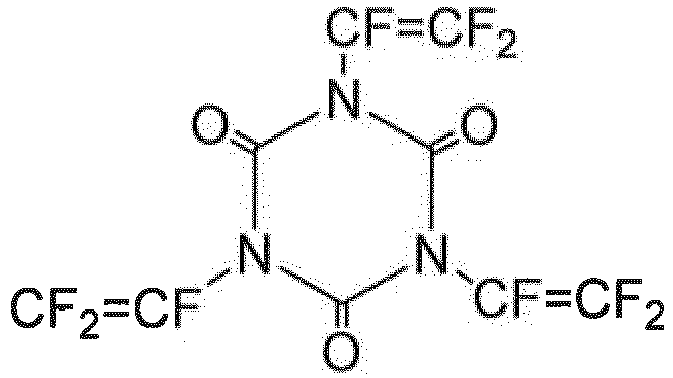
- According to the invention, it is possible to provide a cross-linked fluoroelastomer having improved vapor resistance and a production method thereof.
- According to the invention, it is possible to provide a novel cross-linking agent.
- One embodiment of the invention will be explained below. The invention is not restricted to this embodiment.
- The method for producing a fluoroelastomer according to one embodiment of the invention comprises cross-linking a fluoroelastomer with a cross-linking agent in an inert gas atmosphere in the presence of an initiator. By cross-linking in an inert gas atmosphere, vapor resistance is significantly improved.
- As the inert gas, nitrogen, helium, argon or the like can be used. Among them, nitrogen is preferable. In the inert gas atmosphere, the oxygen concentration is preferably 10 ppm or less, more preferably 5 ppm or less.
- The fluoroelastomer may be a perfluoroelastomer, or may be a partially-fluorinated elastomer.
- For example, the following monomer-derived repeating units can be exemplified. The fluoroelastomer may contain one or two or more monomer-derived repeating units.
CF2=CH2 (vinylidene fluoride),
CF2=CF2 (tetrafluoroethylene),
CF2=CFCF3 (hexafluoropropylene),
CH2=CH2,
CH2=CHCH3
- The fluoroelastomer used in the invention preferably comprises, as a part to be attacked by radicals at the time of cross-linking (curing), iodine and/or bromine, more preferably iodine. A perfluoroelastomer that can be cured by a peroxidizing method is described in Patent Document 1, or the like, for example.
- In general, a perfluoroelastomer comprises iodine in an amount of 0.001 wt% to 5 wt%, preferably 0.01 to 2.5 wt%, relative to the total weight of the polymer. Iodine atoms can be present along the chain and/or at the terminal.
- It is preferred that a perfluoroelastomer be produced from a copolymer such as perfluorinated olefin having an ethylenic unsaturated bond, preferably at its terminal.
- As a comonomer, the following can be exemplified.
CF2=CFOR2f (per)fluoroalkylvinylether (PAVE)
(In the formula, R2f is a (per)fluoroalkyl having 1 to 6 carbon atoms, e.g. trifluoromethyl or pentafluoropropyl)
CF2=CFOXo (per)fluorooxyalkylvinylether
(in the formula, X0 is a (per)fluorooxyalkyl having 1 to 12 carbon atoms and comprising one or more ether groups, e.g. perfluoro-2-propoxypropyl)
CFX2=CX2OCF2OR"f (I-B)
(in the formula, R"f is a linear or branched (per)fluoroalkyl having 2 to 6 carbon atoms, a cyclic (per)fluoroalkyl having 5 or 6 carbon atoms or a linear or branched (per)fluorooxyalkyl having 2 to 6 carbon atoms that include 1 to 3 oxygen atoms, and X2 is F or H) - The (per)fluorovinylether represented by the formula (I-B) is preferably represented by the following formula:
CFX2=CX2OCF2OCF2CF2Y (II-B)
(in the formula, Y=F or OCF3; and X2 is as defined above) - The perfluorovinylether represented by the following formula is more preferable.
CF2=CFOCF2OCF2CF3 (MOVE1)
CF2=CFOCF2OCF2CF2OCF3 (MOVE2)
- As the preferable monomer composition, the following can be exemplified.
- Tetrafluoroethylene (TFE): 50 to 85 mol%, PAVE: 15 to 50 mol%,
- TFE: 50 to 85 mol%, MOVE: 15 to 50 mol%
- The perfluoroelastomer may contain a vinylidene fluoride-derived unit, a fluoroolefin having 3 to 8 carbon atoms and may contain chlorine and/or bromine, or a non-fluorinated olefin having 3 to 8 carbon atoms.
- As the cross-linking agent, a cross-linking agent represented by the following formula can be used.
Z-((O)n-(CH2)m-C(R30)=CR20R10)t
- In the formula, R10, R20 and R30 may be the same or different and are hydrogen, an alkyl group having 1 to 6 carbon atoms or fluorine; Z is a divalent or trivalent linking group; m is independently 0 or 1; n is independently 0 or 1; and t is 2 or 3. The plural R10s may be the same as or different from each other, the plural R20s may be the same as or different from each other and the plural R30s may be the same as or different from each other.
- When Z is a divalent linking group (that is, t is 2), the cross-linking agent may preferably be a cross-linking agent represented by the following structural formula:
R1R2C=C(R3)-(CH2)m(O)n-Z-(O)n-(CH2)m-C(R4)=CR5R6
- In the formula, R1, R2, R3, R4, R5 and R6 may be the same or different and are hydrogen, an alkyl group having 1 to 6 carbon atoms or fluorine; Z is a divalent linkage group; m is independently 0 or 1; and n is independently 0 or 1.
- The following cross-linking agents can be exemplified.
R1R2C=C(R3)-(O)n-Z-(O)n-C(R4)=CR5R6
R1R2C=C(R3)-(CH2)m-Z-(CH2)m-C(R4)=CR5R6
R1 R2C=C(R3)-Z-C(R4)=CR5R6
(in the formula, R1, R2, R3, R4, R5 and R6, Z, m and n are as defined above) - R1, R2, R3, R4, R5 and R6 are preferably hydrogen or fluorine.
- Z is preferably a linear or branched alkylene having 1 to 18 carbon atoms or cycloalkylene and may optionally contain an oxygen atom. A part or all of them may be fluorinated. For example, Z is a (per)fluoropolyoxyalkylene group.
- Z is more preferably a perfluoroalkylene group having 4 to 12 carbon atoms, with 4 to 8 carbon atoms being further preferable.
- When Z is a (per)fluoropolyoxyalkylene group, it may contain one or more groups selected from the following:
-CF2CF2O-, -CF2CF(CF3)O-, -CFX1O- (in the formula, X1=F or CF3),
-CF2CF2CF2O-, -CF2-CH2CH2O-, -C3F6O-
- Z is preferably a group represented by the following formula:
-(Q)p-CF2O-(CF2CF2O)m(CF2O)n-CF2-(Q)p- (II)
(in the formula, Q is alkylene or oxyalkylene group having 1 to 10 carbon atoms, p is 0 or 1, and m and n is independently a number that allows a m/n ratio to be 0.2 to 5) - Preferably, Q is selected from the following.
-CH2OCH2-, -CH2O(CH2CH2O)sCH2- (in the formula, s=1 to 3)
- When t is 3, Z is preferably a trivalent residue corresponding to triazine-2,4,6-(1H, 3H, 5H)-trion.
- As specific cross-linking agents, the following can be exemplified.
CH2=CH-(CF2)X-CH=CH2
CH2=CH-CH2-(CF2)X-CH2-CH=CH2
CF2=CH-(CF2)X-CH=CF2
CF2=CH-CH2-(CF2)X-CH2-CH=CF2
CF2=CH-O-(CF2)X-O-CH=CF2
CF2=CF-O-(CF2)X-O-CF=CF2
CF2=CF-(CF2)X-CF=CF2
(in the formulas, x is 2 to 24)


- The cross-linking agent is added in an amount of preferably 0.5 to 15 mmol, more preferably 1 to 8 mmol, and further preferably 1.5 to 5 mmol relative to 100g of the fluoroelastomer. A larger amount added tends to lead to more improved vapor resistance and heat resistance. However, if the amount of the cross-linking agent is too large, the cross-linked fluoroelastomer may tend to be hard.
- As the initiator, one that is normally used can be used. For example, a peroxide, an azo compound or the like can be exemplified.
- The initiator is added in an amount of preferably 0.3 to 15 mmol, more preferably 1 to 10 mmol, and further preferably 1.5 to 8 mmol relative to 100g of the fluoroelastomer. If a large amount of the initiator is added, vapor resistance and heat resistance may likely improve. However, if the amount is too large, scorching or bubbling may occur.
- A filler may be added to the above-mentioned fluoroelastomer compositionin order to improve the mechanical strength. As long as the advantageous effects of the invention are not impaired, a filler that is commonly known as a filler for the elastomer can be used. For example, carbon black, silica, barium sulfide, titanium dioxide, semi-crystalline fluoropolymer and perfluoropolymer can be given.
- According to need, a thickening agent, a pigment, a coupling agent, an anti-oxidant, a stabilizer or the like can be incorporated in an appropriate amount.
- As for the cross-linking conditions, it is preferable to heat at 100 to 250°C for 10 minutes to 5 hours. Normally, as the primary cross-linking, raw materials are put in a mold and the raw materials are then subjected to cross-linking while being subjected to press forming. The primary cross-linking is conducted by heating at 150 to 200°C for 5 to 60 minutes. Thereafter, the raw materials are removed from the mold, and subjected to secondary cross-linking in an inert gas atmosphere. The secondary cross-linking is conducted by heating at 150 to 300°C for 1 to 100 hours, for example. The cross-linking can be conducted by using an electric furnace or the like. By applying thermal history through the secondary cross-linking, deformation or the like during use can be prevented.
- A formed product of the cross-linked fluoroelastomer of the invention can be produced by the following method, for example.
- After kneading a fluoroelastomer in which a cross-linking agent has been internally filled, an initiator and one or two or more types of carbon black (filler)) in an open roll, the resulting kneaded product is put in a mold. After subjecting the kneaded product to a heat treatment in the air, the resultant product is subjected to primary cross-linking while being subjected to press forming. Then, the resulting formed product is removed from the mold, and is then subjected to a heat treatment in a nitrogen atmosphere or in the air.
- In this case, the amount of the initiator is preferably 0.1 to 4.0 phr and the amount of carbon black (filler) is preferably 0.1 to 50 phr relative to 100 parts by mass of the fluoroelastomer (when two or more carbon blacks are used, the amounts of these two or more carbon blacks may be almost equal).
- The cross-linked fluoroelastomer that is obtained by the production method of the invention can be used as a sealing material, and can be used in the form of a formed product such as a gasket and a seal ring.
- According to the production method of the invention, a formed product having a percentage change in swelling ratios of 100% or less before and after exposure to saturated vapor of 300°C for 70 hours can be obtained. The swelling ratios are measured by the method described in the Examples. The percentage change in swelling ratios is preferably 90% or less, more preferably 80% or less. Further, according to the production method of the invention, a formed product having a percentage change in swelling ratios of 45% or less before and after exposure to saturated vapor of 250°C for 70 hours can be obtained. The swelling ratios are measured by the method described in the Examples. The change in swelling ratios is preferably 40% or less, more preferably 38% or less.
- Further, a formed product having a compression permanent strain measured by the method described in the Examples of 50% or less can be obtained. The compression permanent strain is preferably 40% or less, more preferably 38% or less.
- Perfluorosebacic acid HOOC(CF2)8COOH (10 mmol) and sodium hydroxide NaOH (20 mmol) were reacted in water, whereby a sodium salt of perfluorosebacic acid NaOOC(CF2)8COONa was obtained. NaOOC(CF2)8COONa was re-crystallized from methanol, and the resulting crystals were dried under reduced pressure at 100°C for 12 hours. Then, an appropriate amount of benzene was added. By means of a Dean-stark apparatus, the resultant was stirred at 100°C for 24 hours. Then, benzene was removed under reduced pressure, and vacuum-dried at room temperature for 24 hours. Thereafter, NaOOC(CF2)8COONa was decarboxylated by heating to 350°C under reduced pressure. By using a dry ice strap, an intended CF2=CF-(CF2)4-CF=CF2 was obtained. The resultant was analyzed by 19F-NMR, and 19F-NMR(δppm):-88.2(2F), -105.6(2F), -119.5(4F), -125.2(4F) and -189.8(2F) were observed. It was confirmed to be CF2=CF-(CF2)4-CF=CF2.
- PFR94 (manufactured by Solvey Japan, Ltd.) (fluoroelastomer), perhexa 25B (manufactured by NOF Corporation) (initiator), fluorinated diene (1,6-divinylperfluorohexane) (CH2=CH-(CF2)6-CH=CH2) (cross-linking agent) were kneaded in an open roll. The kneaded product was put in a mold, and subjected to a heat treatment in the air at 170°C for 15 minutes, whereby primary cross-linking was conducted while performing press forming. Subsequently, the formed product was removed from the mold, and then subjected to a heat treatment (rising temperature for 8 hours) at 290°C for 16 hours in a nitrogen atmosphere (oxygen concentration: 5 ppm) or in the air, whereby a formed product of a cross-linked fluoroelastomer was obtained. The formed product was in the form of an O-ring (AS568-214; inner diameter 24.99 mm, thickness 3.53 mm).
- The amounts of the initiator and the cross-linking agent relative to the fluoroelastomer ("mmol" relative to 100g of the fluoroelastomer and "part by mass" (phr) relative to 100 parts by mass of the fluoroelastomer were both indicated) were changed as shown in Tables 1 and 2.
- For the resulting secondary cross-linked fluoroelastomer, the following evaluation was conducted.
- The O-ring was cut in a length of about 10 mm, and the resultant was immersed in a perfluorocarbon solution (Fluorinate FC-3283, manufactured by 3M Japan) at room temperature (21 to 25°C, preferably 23°C) for one week. Change in volume before and after the test was obtained by calculation.

- The results are shown in Table 1. In the table, the upper value indicates the value of the cross-linked fluoroelastomer after the secondary cross-linking in the air and the lower value indicates the value of the secondary cross-linked fluoroelastomer after the secondary cross-linking in a nitrogen atmosphere. The swelling ratio is an index for the cross-linking density. Since the value after the secondary cross-linking in a nitrogen atmosphere is smaller than the value after the secondary cross-linking in the air, it can be understood that a higher cross-linking density can be obtained when secondary cross-linking is conducted in a nitrogen atmosphere.
- The O-ring was compressed by 25%, and treated at 250°C for 70 hours. Then, the O-ring was released and left stand at room temperature for 30 minutes. In accordance with the JIS standard (JIS K6262), the thickness before and after the test was measured, and the compression permanent strain was calculated according to the following formula.

- The results are shown in Table 2. A smaller value indicates an excellent heat resistance. In the table, the upper value indicates the value of the cross-linked fluoroelastomer after the secondary cross-linking in the air and the lower value indicates the value of the cross-linked fluoroelastomer after the secondary cross-linking in a nitrogen atmosphere.


- From Table 2, it can be understood that a cross-linked fluoroelastomer having excellent heat resistance can be obtained when cross-linking is conducted in a nitrogen atmosphere.
- In the same manner as in Experimental Example 1, PFR94, Perhexa 25B and fluorinated diene were subjected to a heat-treatment at 170°C for 15 minutes in the air. Subsequently, the resultant was subjected to a heat treatment at 290°C for 16 hours (secondary cross-linking) in a nitrogen atmosphere (oxygen concentration: 5 ppm) or in the air.
- The amount of the initiator and the amount of the cross-linking agent, each relative to 100g of the fluoroelastomer, were 4.8 mmol (1.4 phr) and 4.2 mmol (1.5 phr), respectively.
- In the same manner as in Experimental Example 1, for the resulting cross-linked fluoroelastomer after the secondary cross-linking, the swelling ratio and the compression permanent strain (CS) were evaluated.
- Further, for the cross-linked fluoroelastomer after the secondary cross-linking, a vapor test was conducted. From the ratio in percentage change in swelling ratio (swelling ratio percentage change) before and after exposure for 70 hours to saturated water vapor of 300°C, vapor resistance was evaluated. The results are shown in Table 3.

Table 3 Secondary cross-linking atmosphere Air N2 Swelling ratio [%] before vapor test 174 146 CS [%] 250°C x 70 h 30 28 Swelling ratio [%] after vapor test 300°C x 70 h 541 256 Percentage change in swelling ratio 210 76 - From Table 3, it can be understood that, by cross-linking in a nitrogen atmosphere, a cross-linked fluoroelastomer that has not only excellent heat resistance but also excellent vapor resistance can be obtained.
- PFR94 (manufactured by Solvey Japan, Ltd.) (fluoroelastomer), perhexa 25B (manufactured by NOF Corporation) (initiator) and TAIC (manufactured by Nippon Kasei Chemical Co., Ltd.) (cross-linking agent) were kneaded in an open roll. The kneaded product was put in a mold, and subjected to a heat treatment in the air at 160°C for 15 minutes, whereby primary cross-linking was conducted while performing press forming. Subsequently, the formed product was removed from the mold, and then subjected to a heat treatment at 230°C for 8 hours in a nitrogen atmosphere (oxygen concentration: 5 ppm) or in the air, whereby a formed product of a cross-linked fluoroelastomer was obtained. The formed product was in the form of an O-ring (AS568-214).
- The amount of the initiator and the amount of the cross-linking agent, each relative to 100g of the fluoroelastomer, were 3.4 mmol (1 phr) and 8.0 mmol (2 phr), respectively.
- For the cross-linked fluoroelastomer after the secondary cross-linking, the swelling ratio and the compression permanent strain (CS) were evaluated in the same manner as in Experimental Example 1.
- Further, for the cross-linked fluoroelastomer after the secondary cross-linking, a vapor test was conducted. From the percentage change in swelling ratios (swelling percentage ratio) before exposure to saturated water vapor of 250°C for 70 hours and after exposure to saturated water vapor of 250°C for 70 hours, vapor resistance was evaluated.
- The results are shown in Table 4.
- An O-ring was prepared and evaluated in the same manner as in Experimental Example 3, except that G912 (manufactured by Daikin Industries, Inc.) (fluoroelastomer) was used instead of PFR94.
- The results are shown in Table 4. The "-" (hyphen) in Table 4 means that measurement could not be conducted since the sample was broken after the vapor test.
Table 4 Secondary cross linking atmosphere Air N2 Air N2 Composition PFR94 G912 +25B 3.4 mmol (1 phr) +25B 3.4 mmol (1 phr) +TAlC 8.0 mmol (2 phr) +TAlC 8.0 mmol (2 phr) Swelling ratio [%] before vapor test 100 96 276 265 CS[%] 250°C x 70 h 16 14 51 42 Swelling ratio [%] after vapor test 250°C x 70 h 154 129 - 308 Percentage change [%] in swelling ratio 54 34 - 16 - From Table 4, it can be understood that, by cross-linking in a nitrogen atmosphere, a cross-linked fluoroelastomer that has not only excellent heat resistance but also excellent vapor resistance can be obtained.
- 100 parts by mass of PFR95HT (manufactured by Solvey Japan, Ltd.) in which a cross-linking agent was filled, 0.75 phr of Perhexa 25B (manufactured by NOF Corporation) (initiator), 7 phr of MT Carbon N 990 (manufactured by Cancarb Ltd.) (carbon black (filler)) and 8 phr of Austin Black (manufactured by Coal Fillers, Inc.) (carbon black) were kneaded in an open roll. The kneaded product was put in a mold, and subjected to a heat treatment in the air, whereby primary cross-linking was conducted while performing press molding. Subsequently, the formed product was removed from the mold, and then subjected to a heat treatment in a nitrogen atmosphere or in the air, whereby a cross-linked fluoroelastomer was obtained.
- The fluoroelastomer of the invention can be widely used as a sealing material for which vapor resistance is required.
- Although only some exemplary embodiments and/or examples of this invention have been described in detail above, those skilled in the art will readily appreciate that many modifications are possible in the exemplary embodiments and/or examples without materially departing from the novel teachings and advantages of this invention. Accordingly, all such modifications are intended to be included within the scope of this invention.
- The Japanese application specification claiming priority under the Paris Convention are incorporated herein by reference in its entirety.
Claims (18)
- A method for producing a cross-linked fluoroelastomer, which comprises cross- linking a fluoroelastomer with a cross-linking agent in an inert gas atmosphere in the presence of an initiator.
- The method for producing a cross-linked fluoroelastomer according to claim 1, wherein the inert gas atmosphere is a nitrogen atmosphere.
- The method for producing a cross-linked fluoroelastomer according to claim 1 or 2, wherein the fluoroelastomer is a perfluoroelastomer or a partially-fluorinated elastomer.
- The method for producing a cross-linked fluoroelastomer according to any one of claims 1 to 3, wherein the cross-linking agent is represented by the following structural formula:
Z-((O)n-(CH2)m-C(R30)=CR20R10),
wherein in the forrnula, R10, R20 and R30 may be the same or different and are hydrogen, an alkyl group having 1 to 6 carbon atoms or fluorine; Z is a divalent or trivalent linking group; m is independently 0 or 1; n is independently 0 or 1, and t is 2 or 3; plural R10s may be the same or different; plural R20s may be the same or different; and plural R30s may be the same or different. - The method for producing a cross-linked fluoroelastomer according to claim 4, wherein t is 2 and Z is a divalent linking group.
- The method for producing a cross-linked fluoroelastomer according to claim 5, wherein Z is an alkylene group having 1 to 18 carbon atoms in which a part or all thereof is fluorinated.
- The method for producing a cross-linked fluoroelastomer according to claim 4, wherein t is 3 and Z is a trivalent residue corresponding to triazine-2,4,6-(1H,3H,5H)-trion.
- The method for producing a cross-linked fluoroelastomer according to any one of claims 1 to 7, wherein the cross-linking agent is added in an amount of 0.5 to 15 mmol relative to 100g of the fluoroelastomer.
- The method for producing a cross-linked fluoroelastomer according to any one of claims 1 to 8, wherein the initiator is added in an amount of 0.3 to 15 mmol relative to 100g of the fluoroelastomer.
- A cross-linked fluoroelastomer that is obtained by the production method according to any one of claims 1 to 9.
- A cross-linked fluoroelastomer wherein when first and second formings of the cross-linked fluoroelastomer are prepared; the second forming is exposed to saturated water vapor of 300°C for 70 hours; the first forming without the exposure is immersed in a perfluorocarbon solution at 21 to 25°C for one week and taken out to obtain a first swelling ratio; and the second forming after the exposure is immersed in a perfluorocarbon solution at 21 to 25°C for one week and taken out to obtain a second swelling ratio:the cross-linked fluoroelastomer comprises a percentage change from the first swelling ratio to the second swelling ratio of 100% or less.
- The cross-linked fluoroelastomer according to claim 11, wherein the percentage change in swelling ratios is 80% or less.
- A cross-linked fluoroelastomer wherein when first and second formings of the cross-linked fuoroelastomer are prepared; the second forming is exposed to saturated water vapor of 250°C for 70 hours; the first forming without the exposure is immersed in a perfluorocarbon solution at 21 to 25°C for one week and taken out to obtain a first swelling ratio; and the second forming after the exposure is immersed in a perfluorocarbon solution at 21 to 25°C for one week and taken out to obtain a second swelling ratio:the cross-linked fluoroelastomer comprises a percentage change from the first swelling ratio to the second swelling ratio of 45% or less.
- The cross-linked fluoroelastomer according to claim 13, wherein the percentage change in swelling ratios is 38% or less.
- The cross-linked fluoroelastomer according to any one of claims 11 to 14, wherein the cross-linked fluoroelastomer is cross-linked with a cross-linking agent represented by the following structural formula:
Z-((O)n-(CH2)m-C(R30)=CR20R10)t
wherein in the formula, R10, R20 and R30 may be the same or different and are hydrogen, an alkyl group having 1 to 6 carbon atoms or fluorine; Z is a divalent or trivalent linking group; m is independently 0 or 1; n is independently 0 or 1; and t is 2 or 3; plural R10s may be the same or different; plural R20s may be the same or different; and plural R30s may be the same or different. - The cross-linked fluoroelastomer according to claim 15, wherein t is 2 and Z is a divalent linking group.
- A formed product obtained from the cross-linked fluoroelastomer according to any one of claims 10 to 16.
- A formed product according to claim 17 that is a sealing material.
Applications Claiming Priority (2)
| Application Number | Priority Date | Filing Date | Title |
|---|---|---|---|
| JP2013081478 | 2013-04-09 | ||
| PCT/JP2014/001786 WO2014167797A1 (en) | 2013-04-09 | 2014-03-27 | Method for producing crosslinked fluoroelastomer |
Publications (3)
| Publication Number | Publication Date |
|---|---|
| EP2985307A1 true EP2985307A1 (en) | 2016-02-17 |
| EP2985307A4 EP2985307A4 (en) | 2016-12-07 |
| EP2985307B1 EP2985307B1 (en) | 2019-10-02 |
Family
ID=51689219
Family Applications (1)
| Application Number | Title | Priority Date | Filing Date |
|---|---|---|---|
| EP14782620.0A Active EP2985307B1 (en) | 2013-04-09 | 2014-03-27 | Method for producing crosslinked fluoroelastomer |
Country Status (6)
| Country | Link |
|---|---|
| US (1) | US20160032039A1 (en) |
| EP (1) | EP2985307B1 (en) |
| JP (1) | JP6611606B2 (en) |
| KR (1) | KR20150140636A (en) |
| CN (1) | CN105121518A (en) |
| WO (1) | WO2014167797A1 (en) |
Families Citing this family (9)
| Publication number | Priority date | Publication date | Assignee | Title |
|---|---|---|---|---|
| GB2543228B (en) | 2014-08-01 | 2021-07-21 | Nichias Corp | Crosslinking agent and fluorine-containing aromatic compound |
| JP2017165841A (en) * | 2016-03-15 | 2017-09-21 | オリンパス株式会社 | Member for medical instrument and method for producing member for medical instrument |
| JP6618507B2 (en) * | 2016-05-30 | 2019-12-11 | 株式会社バルカー | Perfluoroelastomer composition and sealing material |
| US11084910B2 (en) * | 2017-06-06 | 2021-08-10 | Zeon Corporation | Cross-linked rubber and production method therefor |
| CN108841017B (en) * | 2018-05-21 | 2021-09-14 | 山西福诺欧新材料科技股份有限公司 | Heat treatment method for improving cross-linking activity of tetrafluoroethylene-propylene rubber |
| JP7600996B2 (en) * | 2019-10-23 | 2024-12-17 | Agc株式会社 | FLUOROCOPOLYMER COMPOSITION AND CROSSLINKED RUBBER ARTICLE |
| WO2021166664A1 (en) * | 2020-02-21 | 2021-08-26 | Agc株式会社 | Fluorine-containing copolymer composition and cross-linked product thereof, and compound |
| WO2021230231A1 (en) | 2020-05-14 | 2021-11-18 | ニチアス株式会社 | Rubber composition, fluoroelastomer, and sealing material |
| JP7623604B2 (en) * | 2020-11-25 | 2025-01-29 | ダイキン工業株式会社 | Fluoropolymers, aqueous dispersions, compositions and crosslinked products |
Family Cites Families (19)
| Publication number | Priority date | Publication date | Assignee | Title |
|---|---|---|---|---|
| DE2165239A1 (en) * | 1970-12-30 | 1972-07-27 | Daikin Ind Ltd | Process for making fluoroelastomer terpolymers |
| US4303761A (en) * | 1979-05-29 | 1981-12-01 | E. I. Du Pont De Nemours And Company | Fluoroelastomer gelling agents and products made therefrom |
| JPS5696189A (en) * | 1979-12-28 | 1981-08-04 | Ebara Corp | Pump equipment |
| JP2705105B2 (en) * | 1988-05-21 | 1998-01-26 | ダイキン工業株式会社 | New polymers and their manufacturing methods and applications |
| JPH0693210A (en) * | 1992-04-30 | 1994-04-05 | Minnesota Mining & Mfg Co <3M> | Stain-resistant protective coating composition |
| US5696189A (en) * | 1995-12-01 | 1997-12-09 | E. I. Du Pont De Nemours And Company | Perfluoroelastomer compositions |
| KR20000022144A (en) * | 1996-07-01 | 2000-04-25 | 이노우에 노리유끼 | Fluorinated triallyl isocyanurates, vulcanizable elastomer compositions containing the same, and method for vulcanization |
| JPH10101740A (en) * | 1996-10-01 | 1998-04-21 | Nippon Mektron Ltd | Fluoroelastomer and crosslinkable composition thereof |
| JP4550954B2 (en) * | 1998-05-29 | 2010-09-22 | デュポン パフォーマンス エラストマーズ エルエルシー | White elastomer sealing material and method for producing the same |
| EP1160275A4 (en) * | 1998-07-17 | 2002-03-20 | Daikin Ind Ltd | CROSSLINKABLE ELASTOMERIC COMPOSITION, SEALING MATERIAL PRODUCED FROM THIS COMPOSITION, AND ASSOCIATED FILLER FOR USE THEREOF |
| EP1160285B1 (en) * | 1998-07-17 | 2005-06-29 | Daikin Industries, Ltd. | Fluororubber composition |
| JP4240716B2 (en) * | 1999-02-01 | 2009-03-18 | ユニマテック株式会社 | Fluorine-containing elastomer composition |
| JP5070805B2 (en) * | 2000-05-09 | 2012-11-14 | ダイキン工業株式会社 | Crosslinkable fluoroelastomer composition containing clean filler |
| JP2003002992A (en) * | 2001-06-25 | 2003-01-08 | Daikin Ind Ltd | Method for producing fluorinated molded article of peroxide crosslinked perfluoroelastomer |
| WO2005049746A1 (en) * | 2003-11-21 | 2005-06-02 | Daikin Industries, Ltd. | Fluorine-containing elastomer coating composition |
| ITMI20041252A1 (en) * | 2004-06-22 | 2004-09-22 | Solvay Solexis Spa | PERFLUOROELASTOMERIC COMPOSITIONS |
| JP4628814B2 (en) * | 2005-02-15 | 2011-02-09 | 日本バルカー工業株式会社 | Sealant for semiconductor manufacturing equipment |
| WO2008038682A1 (en) * | 2006-09-28 | 2008-04-03 | Asahi Glass Company, Limited | Novel fluorine-containing polymer |
| JP5735308B2 (en) * | 2011-03-04 | 2015-06-17 | ユーサンガスケット株式会社 | Manufacturing method of gasket material |
-
2014
- 2014-03-27 EP EP14782620.0A patent/EP2985307B1/en active Active
- 2014-03-27 CN CN201480020501.4A patent/CN105121518A/en active Pending
- 2014-03-27 WO PCT/JP2014/001786 patent/WO2014167797A1/en not_active Ceased
- 2014-03-27 KR KR1020157023152A patent/KR20150140636A/en not_active Ceased
- 2014-03-27 US US14/783,297 patent/US20160032039A1/en not_active Abandoned
- 2014-03-27 JP JP2015511088A patent/JP6611606B2/en active Active
Also Published As
| Publication number | Publication date |
|---|---|
| US20160032039A1 (en) | 2016-02-04 |
| CN105121518A (en) | 2015-12-02 |
| JP6611606B2 (en) | 2019-11-27 |
| KR20150140636A (en) | 2015-12-16 |
| EP2985307A4 (en) | 2016-12-07 |
| WO2014167797A1 (en) | 2014-10-16 |
| JPWO2014167797A1 (en) | 2017-02-16 |
| EP2985307B1 (en) | 2019-10-02 |
Similar Documents
| Publication | Publication Date | Title |
|---|---|---|
| EP2985307B1 (en) | Method for producing crosslinked fluoroelastomer | |
| KR101729353B1 (en) | Crosslinkable fluororubber composition and crosslinked rubber article | |
| JPWO2015080002A1 (en) | Perfluoroelastomer, perfluoroelastomer composition, crosslinked rubber article, and method for producing perfluoroelastomer | |
| EP3031851B1 (en) | Crosslinking agent and fluorine-containing aromatic compound | |
| EP3243811A1 (en) | Crosslinking agent and fluorine-containing aromatic compound | |
| WO2021210503A1 (en) | Fluorocopolymer composition and crosslinked rubber article | |
| EP3936534B1 (en) | Fluorinated copolymer composition, crosslinked rubber and method for its production | |
| JP2016145167A (en) | Crosslinking agent and fluorine-containing aromatic compound | |
| JP2016145277A (en) | Crosslinking agent | |
| EP3901206B1 (en) | Perfluoroelastomer composition, crosslinked perfluoroelastomer and molded article | |
| WO2004033580A1 (en) | Sealing material for semiconductor device and method for production thereof | |
| US8354472B2 (en) | Fluoroelastomer composition | |
| JP2005220161A (en) | Perfluoroelastomer composition for vulcanization and method for producing perfluoroelastomer molded product | |
| JP7121325B1 (en) | Sealing material and battery | |
| CN116209845B (en) | Sealing material and method for producing sealing material | |
| WO2019009250A1 (en) | Fluorine-containing elastic copolymer composition and crosslinked rubber article | |
| JP7155286B2 (en) | Elastomer composition and sealing material | |
| JP6408927B2 (en) | Fluorine-containing aromatic compound | |
| WO2021079849A1 (en) | Fluorine-containing copolymer composition and crosslinked rubber article | |
| JP2025036050A (en) | Method for decomposing fluorine-containing polymers | |
| WO2025047315A1 (en) | Method for decomposing fluorine-containing polymers | |
| CN121195026A (en) | Elastomer compositions, methods for manufacturing elastomer compositions, sealing materials, and methods for manufacturing sealing materials. | |
| JP2025152618A (en) | Method for producing recycled perfluoro(co)polymer and method for producing recycled material |
Legal Events
| Date | Code | Title | Description |
|---|---|---|---|
| PUAI | Public reference made under article 153(3) epc to a published international application that has entered the european phase |
Free format text: ORIGINAL CODE: 0009012 |
|
| 17P | Request for examination filed |
Effective date: 20151007 |
|
| AK | Designated contracting states |
Kind code of ref document: A1 Designated state(s): AL AT BE BG CH CY CZ DE DK EE ES FI FR GB GR HR HU IE IS IT LI LT LU LV MC MK MT NL NO PL PT RO RS SE SI SK SM TR |
|
| AX | Request for extension of the european patent |
Extension state: BA ME |
|
| DAX | Request for extension of the european patent (deleted) | ||
| A4 | Supplementary search report drawn up and despatched |
Effective date: 20161107 |
|
| RIC1 | Information provided on ipc code assigned before grant |
Ipc: C08L 27/12 20060101ALI20161031BHEP Ipc: C08F 259/08 20060101ALI20161031BHEP Ipc: C08J 3/24 20060101AFI20161031BHEP Ipc: C08K 5/3492 20060101ALI20161031BHEP Ipc: C08K 5/14 20060101ALI20161031BHEP |
|
| STAA | Information on the status of an ep patent application or granted ep patent |
Free format text: STATUS: EXAMINATION IS IN PROGRESS |
|
| 17Q | First examination report despatched |
Effective date: 20180131 |
|
| GRAP | Despatch of communication of intention to grant a patent |
Free format text: ORIGINAL CODE: EPIDOSNIGR1 |
|
| STAA | Information on the status of an ep patent application or granted ep patent |
Free format text: STATUS: GRANT OF PATENT IS INTENDED |
|
| INTG | Intention to grant announced |
Effective date: 20190426 |
|
| GRAS | Grant fee paid |
Free format text: ORIGINAL CODE: EPIDOSNIGR3 |
|
| GRAA | (expected) grant |
Free format text: ORIGINAL CODE: 0009210 |
|
| STAA | Information on the status of an ep patent application or granted ep patent |
Free format text: STATUS: THE PATENT HAS BEEN GRANTED |
|
| AK | Designated contracting states |
Kind code of ref document: B1 Designated state(s): AL AT BE BG CH CY CZ DE DK EE ES FI FR GB GR HR HU IE IS IT LI LT LU LV MC MK MT NL NO PL PT RO RS SE SI SK SM TR |
|
| REG | Reference to a national code |
Ref country code: GB Ref legal event code: FG4D |
|
| REG | Reference to a national code |
Ref country code: CH Ref legal event code: EP Ref country code: AT Ref legal event code: REF Ref document number: 1186108 Country of ref document: AT Kind code of ref document: T Effective date: 20191015 |
|
| REG | Reference to a national code |
Ref country code: DE Ref legal event code: R096 Ref document number: 602014054614 Country of ref document: DE |
|
| REG | Reference to a national code |
Ref country code: IE Ref legal event code: FG4D |
|
| REG | Reference to a national code |
Ref country code: NL Ref legal event code: MP Effective date: 20191002 |
|
| REG | Reference to a national code |
Ref country code: LT Ref legal event code: MG4D |
|
| REG | Reference to a national code |
Ref country code: AT Ref legal event code: MK05 Ref document number: 1186108 Country of ref document: AT Kind code of ref document: T Effective date: 20191002 |
|
| PG25 | Lapsed in a contracting state [announced via postgrant information from national office to epo] |
Ref country code: GR Free format text: LAPSE BECAUSE OF FAILURE TO SUBMIT A TRANSLATION OF THE DESCRIPTION OR TO PAY THE FEE WITHIN THE PRESCRIBED TIME-LIMIT Effective date: 20200103 Ref country code: PL Free format text: LAPSE BECAUSE OF FAILURE TO SUBMIT A TRANSLATION OF THE DESCRIPTION OR TO PAY THE FEE WITHIN THE PRESCRIBED TIME-LIMIT Effective date: 20191002 Ref country code: BG Free format text: LAPSE BECAUSE OF FAILURE TO SUBMIT A TRANSLATION OF THE DESCRIPTION OR TO PAY THE FEE WITHIN THE PRESCRIBED TIME-LIMIT Effective date: 20200102 Ref country code: NL Free format text: LAPSE BECAUSE OF FAILURE TO SUBMIT A TRANSLATION OF THE DESCRIPTION OR TO PAY THE FEE WITHIN THE PRESCRIBED TIME-LIMIT Effective date: 20191002 Ref country code: FI Free format text: LAPSE BECAUSE OF FAILURE TO SUBMIT A TRANSLATION OF THE DESCRIPTION OR TO PAY THE FEE WITHIN THE PRESCRIBED TIME-LIMIT Effective date: 20191002 Ref country code: LT Free format text: LAPSE BECAUSE OF FAILURE TO SUBMIT A TRANSLATION OF THE DESCRIPTION OR TO PAY THE FEE WITHIN THE PRESCRIBED TIME-LIMIT Effective date: 20191002 Ref country code: AT Free format text: LAPSE BECAUSE OF FAILURE TO SUBMIT A TRANSLATION OF THE DESCRIPTION OR TO PAY THE FEE WITHIN THE PRESCRIBED TIME-LIMIT Effective date: 20191002 Ref country code: ES Free format text: LAPSE BECAUSE OF FAILURE TO SUBMIT A TRANSLATION OF THE DESCRIPTION OR TO PAY THE FEE WITHIN THE PRESCRIBED TIME-LIMIT Effective date: 20191002 Ref country code: PT Free format text: LAPSE BECAUSE OF FAILURE TO SUBMIT A TRANSLATION OF THE DESCRIPTION OR TO PAY THE FEE WITHIN THE PRESCRIBED TIME-LIMIT Effective date: 20200203 Ref country code: LV Free format text: LAPSE BECAUSE OF FAILURE TO SUBMIT A TRANSLATION OF THE DESCRIPTION OR TO PAY THE FEE WITHIN THE PRESCRIBED TIME-LIMIT Effective date: 20191002 Ref country code: SE Free format text: LAPSE BECAUSE OF FAILURE TO SUBMIT A TRANSLATION OF THE DESCRIPTION OR TO PAY THE FEE WITHIN THE PRESCRIBED TIME-LIMIT Effective date: 20191002 Ref country code: NO Free format text: LAPSE BECAUSE OF FAILURE TO SUBMIT A TRANSLATION OF THE DESCRIPTION OR TO PAY THE FEE WITHIN THE PRESCRIBED TIME-LIMIT Effective date: 20200102 |
|
| PG25 | Lapsed in a contracting state [announced via postgrant information from national office to epo] |
Ref country code: IS Free format text: LAPSE BECAUSE OF FAILURE TO SUBMIT A TRANSLATION OF THE DESCRIPTION OR TO PAY THE FEE WITHIN THE PRESCRIBED TIME-LIMIT Effective date: 20200224 Ref country code: RS Free format text: LAPSE BECAUSE OF FAILURE TO SUBMIT A TRANSLATION OF THE DESCRIPTION OR TO PAY THE FEE WITHIN THE PRESCRIBED TIME-LIMIT Effective date: 20191002 Ref country code: HR Free format text: LAPSE BECAUSE OF FAILURE TO SUBMIT A TRANSLATION OF THE DESCRIPTION OR TO PAY THE FEE WITHIN THE PRESCRIBED TIME-LIMIT Effective date: 20191002 Ref country code: CZ Free format text: LAPSE BECAUSE OF FAILURE TO SUBMIT A TRANSLATION OF THE DESCRIPTION OR TO PAY THE FEE WITHIN THE PRESCRIBED TIME-LIMIT Effective date: 20191002 |
|
| PG25 | Lapsed in a contracting state [announced via postgrant information from national office to epo] |
Ref country code: AL Free format text: LAPSE BECAUSE OF FAILURE TO SUBMIT A TRANSLATION OF THE DESCRIPTION OR TO PAY THE FEE WITHIN THE PRESCRIBED TIME-LIMIT Effective date: 20191002 |
|
| REG | Reference to a national code |
Ref country code: DE Ref legal event code: R097 Ref document number: 602014054614 Country of ref document: DE |
|
| PG2D | Information on lapse in contracting state deleted |
Ref country code: IS |
|
| PG25 | Lapsed in a contracting state [announced via postgrant information from national office to epo] |
Ref country code: RO Free format text: LAPSE BECAUSE OF FAILURE TO SUBMIT A TRANSLATION OF THE DESCRIPTION OR TO PAY THE FEE WITHIN THE PRESCRIBED TIME-LIMIT Effective date: 20191002 Ref country code: DK Free format text: LAPSE BECAUSE OF FAILURE TO SUBMIT A TRANSLATION OF THE DESCRIPTION OR TO PAY THE FEE WITHIN THE PRESCRIBED TIME-LIMIT Effective date: 20191002 Ref country code: EE Free format text: LAPSE BECAUSE OF FAILURE TO SUBMIT A TRANSLATION OF THE DESCRIPTION OR TO PAY THE FEE WITHIN THE PRESCRIBED TIME-LIMIT Effective date: 20191002 Ref country code: IS Free format text: LAPSE BECAUSE OF FAILURE TO SUBMIT A TRANSLATION OF THE DESCRIPTION OR TO PAY THE FEE WITHIN THE PRESCRIBED TIME-LIMIT Effective date: 20200202 |
|
| PLBE | No opposition filed within time limit |
Free format text: ORIGINAL CODE: 0009261 |
|
| STAA | Information on the status of an ep patent application or granted ep patent |
Free format text: STATUS: NO OPPOSITION FILED WITHIN TIME LIMIT |
|
| PG25 | Lapsed in a contracting state [announced via postgrant information from national office to epo] |
Ref country code: SK Free format text: LAPSE BECAUSE OF FAILURE TO SUBMIT A TRANSLATION OF THE DESCRIPTION OR TO PAY THE FEE WITHIN THE PRESCRIBED TIME-LIMIT Effective date: 20191002 Ref country code: SM Free format text: LAPSE BECAUSE OF FAILURE TO SUBMIT A TRANSLATION OF THE DESCRIPTION OR TO PAY THE FEE WITHIN THE PRESCRIBED TIME-LIMIT Effective date: 20191002 |
|
| 26N | No opposition filed |
Effective date: 20200703 |
|
| PG25 | Lapsed in a contracting state [announced via postgrant information from national office to epo] |
Ref country code: MC Free format text: LAPSE BECAUSE OF FAILURE TO SUBMIT A TRANSLATION OF THE DESCRIPTION OR TO PAY THE FEE WITHIN THE PRESCRIBED TIME-LIMIT Effective date: 20191002 |
|
| REG | Reference to a national code |
Ref country code: CH Ref legal event code: PL |
|
| PG25 | Lapsed in a contracting state [announced via postgrant information from national office to epo] |
Ref country code: SI Free format text: LAPSE BECAUSE OF FAILURE TO SUBMIT A TRANSLATION OF THE DESCRIPTION OR TO PAY THE FEE WITHIN THE PRESCRIBED TIME-LIMIT Effective date: 20191002 |
|
| REG | Reference to a national code |
Ref country code: BE Ref legal event code: MM Effective date: 20200331 |
|
| PG25 | Lapsed in a contracting state [announced via postgrant information from national office to epo] |
Ref country code: LU Free format text: LAPSE BECAUSE OF NON-PAYMENT OF DUE FEES Effective date: 20200327 |
|
| PG25 | Lapsed in a contracting state [announced via postgrant information from national office to epo] |
Ref country code: IE Free format text: LAPSE BECAUSE OF NON-PAYMENT OF DUE FEES Effective date: 20200327 Ref country code: CH Free format text: LAPSE BECAUSE OF NON-PAYMENT OF DUE FEES Effective date: 20200331 Ref country code: FR Free format text: LAPSE BECAUSE OF NON-PAYMENT OF DUE FEES Effective date: 20200331 Ref country code: LI Free format text: LAPSE BECAUSE OF NON-PAYMENT OF DUE FEES Effective date: 20200331 |
|
| PG25 | Lapsed in a contracting state [announced via postgrant information from national office to epo] |
Ref country code: BE Free format text: LAPSE BECAUSE OF NON-PAYMENT OF DUE FEES Effective date: 20200331 |
|
| PG25 | Lapsed in a contracting state [announced via postgrant information from national office to epo] |
Ref country code: TR Free format text: LAPSE BECAUSE OF FAILURE TO SUBMIT A TRANSLATION OF THE DESCRIPTION OR TO PAY THE FEE WITHIN THE PRESCRIBED TIME-LIMIT Effective date: 20191002 Ref country code: MT Free format text: LAPSE BECAUSE OF FAILURE TO SUBMIT A TRANSLATION OF THE DESCRIPTION OR TO PAY THE FEE WITHIN THE PRESCRIBED TIME-LIMIT Effective date: 20191002 Ref country code: CY Free format text: LAPSE BECAUSE OF FAILURE TO SUBMIT A TRANSLATION OF THE DESCRIPTION OR TO PAY THE FEE WITHIN THE PRESCRIBED TIME-LIMIT Effective date: 20191002 |
|
| PG25 | Lapsed in a contracting state [announced via postgrant information from national office to epo] |
Ref country code: MK Free format text: LAPSE BECAUSE OF FAILURE TO SUBMIT A TRANSLATION OF THE DESCRIPTION OR TO PAY THE FEE WITHIN THE PRESCRIBED TIME-LIMIT Effective date: 20191002 |
|
| P01 | Opt-out of the competence of the unified patent court (upc) registered |
Effective date: 20230512 |
|
| REG | Reference to a national code |
Ref country code: DE Ref legal event code: R082 Ref document number: 602014054614 Country of ref document: DE Representative=s name: TERGAU & WALKENHORST INTELLECTUAL PROPERTY GMB, DE |
|
| PGFP | Annual fee paid to national office [announced via postgrant information from national office to epo] |
Ref country code: GB Payment date: 20260209 Year of fee payment: 13 |
|
| PGFP | Annual fee paid to national office [announced via postgrant information from national office to epo] |
Ref country code: DE Payment date: 20260128 Year of fee payment: 13 |
|
| PGFP | Annual fee paid to national office [announced via postgrant information from national office to epo] |
Ref country code: IT Payment date: 20260220 Year of fee payment: 13 |