EP2984953B1 - Bra incorporating shape memory polymers and method of manufacture thereof - Google Patents
Bra incorporating shape memory polymers and method of manufacture thereof Download PDFInfo
- Publication number
- EP2984953B1 EP2984953B1 EP15180804.5A EP15180804A EP2984953B1 EP 2984953 B1 EP2984953 B1 EP 2984953B1 EP 15180804 A EP15180804 A EP 15180804A EP 2984953 B1 EP2984953 B1 EP 2984953B1
- Authority
- EP
- European Patent Office
- Prior art keywords
- layer
- wearer
- film layer
- breasts
- breast
- Prior art date
- Legal status (The legal status is an assumption and is not a legal conclusion. Google has not performed a legal analysis and makes no representation as to the accuracy of the status listed.)
- Active
Links
Images





Classifications
-
- A—HUMAN NECESSITIES
- A41—WEARING APPAREL
- A41C—CORSETS; BRASSIERES
- A41C3/00—Brassieres
- A41C3/005—Brassieres specially adapted for specific purposes
- A41C3/0057—Brassieres specially adapted for specific purposes for sport activities
-
- A—HUMAN NECESSITIES
- A41—WEARING APPAREL
- A41C—CORSETS; BRASSIERES
- A41C3/00—Brassieres
- A41C3/12—Component parts
- A41C3/14—Stiffening or bust-forming inserts
- A41C3/142—Stiffening inserts
Definitions
- the present application relates to bras that are to be worn while engaged in athletic activities.
- Many sports bras are designed to limit or prevent movement of a wearer's breasts while she is engaged in athletic activity.
- a woman's breasts do not move up and down together, but rather separately, in what can be called a "butterfly" motion.
- This movement of the breasts is very painful and possibly damaging to the supportive breast tissue.
- the common ways of supporting the breasts during athletic activity and controlling this butterfly motion are by high compression fabric, components, and construction; rigid fabric and components; and/or encapsulation of the breasts via separate breast cups, usually requiring a molded pad with or without an underwire, and usually requiring two individual cups that surround each breast, keeping them separate.
- US6198204B1 discloses a sports bra comprising a piezoelectric transducer. As the breast moves, the piezoelectric transducer deforms and induces a voltage that is passed to an electrical component. The transducer stiffens in response to the electrical component and reduces the movement of the breast by placing an external force on the breast.
- a front panel for a sports bra includes an interior liner layer having a back face contacting a wearer's skin, and having a size and shape configured to substantially cover a wearer's breasts.
- An exterior shell layer having a back face facing a front face of the interior liner layer, and also having a size and shape configured to substantially cover the wearer's breasts, is coupled to the interior liner layer.
- a film layer is located between the front face of the interior liner layer and the back face of the exterior shell layer. When the front panel is worn as part of the sports bra, the film layer is configured to stiffen as a frequency of movement of the wearer's breasts increases, thereby absorbing forces caused by the movement of the wearer's breasts.
- a method for constructing a front panel for a sports bra that stiffens upon movement of a wearer's breasts includes providing an exterior shell layer having a size and shape configured to substantially cover the wearer's breasts, and providing an interior liner layer having a back face for contacting a wearer's skin and also having a size and shape configured to substantially cover the wearer's breasts.
- a film layer is provided and placed between a back face of the exterior shell layer and a front face of the interior liner layer. The film layer, the exterior shell layer, and the interior liner layer are then coupled together.
- the film layer comprises a thermally-induced shape memory polymer that exhibits viscoelastic properties when at body temperature and stiffens to absorb between about 0.015 N and about 0.03 N of force at frequencies of breast movement of between about 6 Hz and about 15 Hz.
- FIG. 1 shows several separated layers of a sports bra according to the present disclosure. These layers include an exterior shell layer 12 having a front face 13a and a back face 13b. After the bra is assembled, the front face 13a will be visible while the bra is being worn, while the back face 13b will be hidden by additional layers about to be described.
- Adjacent the exterior shell layer 12 is an internal fabric layer 32, having a front face 15a and a back face 15b. When the bra is assembled, the front face 15a of the internal fabric layer 32 faces the back face 13b of the exterior shell layer 12.
- Adjacent the internal fabric layer is a film layer 36 having a front face 17a and a back face 17b. The front face 17a of the film layer 36 faces the back face 15b of the internal fabric layer 32.
- an interior liner layer 44 having a front face 19a and a back face 19b.
- the front face 19a of the interior liner layer 44 faces the back face 17b of the film layer 36.
- the back face 19b of the interior liner layer 44 touches the wearer's skin, and is therefore the innermost part of the bra.
- the exterior shell layer 12, the internal fabric layer 32, the film layer 36, and the interior liner layer 44 make up a front panel 10 for the bra.
- a rear portion 11 of the bra is shown in FIG. 1 as well.
- the rear portion 11 may have some or all of the same layers 12, 32, 36, 44 of material as the front panel 10, but its layers will not be described in detail herein. Rather, focus will be on describing the front panel 10 and its superior bounce-absorbing capabilities.
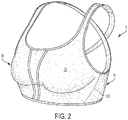
- FIG. 2 shows a sports bra 9 according to the present disclosure, with all of the layers 12, 32, 36, 44 of the front panel 10 and the rear portion 11 assembled together.
- FIG. 2 shows how the rear portion 11 and the front panel 10 can be sewn or otherwise coupled to one another along a seam 23, it being understood that a similar seam may exist on the opposite side of the bra 9. Further details of the connection of the front panel 10 to the rear portion 11 of the bra 9 will be described herein below. It should be understood that the rear portion 11 and the front panel 10 are connected such that the wearer's body is situated between the rear portion 11 and the interior liner layer 44 of the front panel 10 when the bra 9 is being worn.
- FIG. 3 illustrates the exterior shell layer 12 for the front panel 10 for the sports bra 9.
- the front (exterior) face 13a of the exterior shell layer 12 is shown.
- the exterior shell layer 12 is the layer one would normally see facing outwardly from a wearer's body while the bra 9 is being worn.
- the back face 13b (opposite side) of the exterior shell layer 12 is closer to the wearer's body than the front face 13a.
- the exterior shell layer 12 may comprise a piece of fabric having a size and shape configured to substantially cover a wearer's breasts, and may have two straps 14a, 14b extending therefrom.
- the exterior shell layer 12 can be a fabric made of nylon, spandex, polyester, polypropylene, or any combination of these with one another or with cotton.
- the exterior shell layer 12 is a 320 gram fabric with a tight knit that provides compression to the wearer's breasts.
- the exterior shell layer 12 has a neckline 16, a rib cage band 18, a left side 20, and a right side 22.
- the straps 14a, 14b extend from an upper edge of the exterior shell layer 12 near the neckline 16.
- the straps 14a, 14b can be integral with the exterior shell layer 12, or can be separately sewn or otherwise coupled to the exterior shell layer 12.
- the straps 14a, 14b are padded.
- the exterior shell layer 12 may be sewn or otherwise coupled along seams 23 to other layers of the front panel 10, as well as to the rear portion 11, as will be described further herein below.
- FIG. 4 shows a rear portion 11 of the sports bra 9, which was not fully shown in FIG. 3 for the sake of clarity. More specifically, FIG. 4 shows an exterior of the rear portion 11 of the bra 9, which would be seen during normal wear of the bra. The interior of the rear portion 11 (i.e., the part that contacts the wearer) is on the side opposite that shown in FIG. 4 .
- the rear portion 11 is not shown connected to the front panel 10. However, if should be understood that the rear portion 11 could be integral with, sewn, or otherwise coupled to the front panel 10 when the bra 9 is fully assembled, as will be described further below.
- FIG. 4 shows an exterior of the rear portion 11 of the bra 9, which would be seen during normal wear of the bra.
- the interior of the rear portion 11 i.e., the part that contacts the wearer
- the rear portion 11 is not shown connected to the front panel 10. However, if should be understood that the rear portion 11 could be integral with, sewn, or otherwise coupled to the front panel 10 when the bra 9 is fully assembled, as
- the straps 14a, 14b (which can be integral with, sewn, or otherwise coupled to the straps 14a, 14b shown in FIG. 3 ) can be crossed over one another in order to create an X-shaped back.
- the straps can form a U-shape, a V-shape, or a T-shape (racer back) and need not cross over one another.
- the orientation and/or shape of the straps is therefore not limiting on the scope of the present disclosure.
- the straps 14a, 14b may be provided with sliders 24a, 24b that allow the length of the straps 14a, 14b to be adjusted.
- Straps 14a, 14b are attached to an upper portion of the back of the bra 9 via rings 26a, 26b, which also allow for adjustment of the lengths of the straps. Straps 14a, 14b are connected by rings 26a, 26b respectively to wings 28, 30. Wings 28, 30 may be connected to one another at location 31 by a hook and eye closure, or by any other closure known to those having ordinary skill in the art, such as by snaps, Velcro, magnetic closures, etc. When the bra 9 is fully assembled, wing 28 extends from left side 20 of the exterior shell layer 12 and wing 30 extends from right side 22 of the exterior shell layer 12 (see FIG. 3 , where wings 28, 30 are shown wrapping around the lateral sides of the bra and connected to the front panel 10 at seams 23).
- the wings 28, 30 may be integral with or sewn to the left and right sides 20, 22 of the exterior shell layer 12, such as for example along seams 23.
- Bemis tape, ultrasonic seams, and/or glue could be used instead of sewing at seams 23.
- the exterior fabric of the wings 28, 30 may be the same fabric as that of the exterior shell layer 12.
- the next layer of the front panel 10 of the bra 9 is an internal fabric layer 32.
- a front face 15a of the internal fabric layer 32 is shown in FIG. 5 , and when assembled, faces the back face 13b of the exterior shell layer 12. The opposite, back face 15b is thus closer to the wearer's skin.
- the internal fabric layer 32 may end at an upper edge 33 approximately where the straps 14a, 14b of the exterior shell layer 12 would start, or may continue along the straps 14a, 14b.
- the internal fabric layer 32 may be sewn (or otherwise connected) to the exterior shell layer 12 along seams 23.
- the internal fabric layer 32 may comprise a knitted spacer fabric that provides breathability, comfort, and modesty to the wearer.
- the internal fabric layer 32 may comprise two different types of fabric: a first fabric 35a below dashed line 35 comprising a knitted spacer fabric, and a second fabric 35b above dashed line 35 comprising a mesh fabric.
- the mesh fabric 35b acts as a stabilizer and reduces the thickness of the front panel 10 in the areas where it is used, as it is much thinner than the knitted spacer fabric.
- an underwire 34 may be coupled to the internal fabric layer 32.
- the underwire 34 may be a plastic underwire that is surrounded by an underwire tunnel casing.
- the underwire tunnel casing may be sewn along its edges to the internal fabric layer 32.
- the tunnel casing may additionally or alternatively be glued, bonded, or taped to the internal fabric layer 32, or the underwire 34 itself maybe glued or taped to the internal fabric layer 32.
- the underwire 34 may comprise a continuous, undulating W shape, or may comprise two separate U-shaped underwires, although these are not shown herein.
- Each of the weight, thickness, and shape of the underwire 34 may be customized by cup size to provide the required support level.
- the underwire 34 may be sewn to the front face 15a of the internal fabric layer 32 such that the springiness of the spacer fabric between the underwire 34 and the wearer's skin protects the wearer from the relative rigidity of the underwire 34.
- the front panel 10 further comprises a film layer 36, shown in hatching.
- the front face 17a of the film layer 36 faces the back face 15b of the internal fabric layer 32 shown in FIG. 5 .
- the back face 17b is on the opposite side from that shown and is closer to the wearer's body.
- the film layer 36 may continue up into the straps 14a, 14b as shown herein, or may end at the lines 38a, 38b shown in FIG. 6 . In the either case, the film layer 36 may be sewn to the internal fabric layer 32 and/or to the exterior shell layer 12.
- the film layer 36 comprises a first breast cup 40a and a second breast cup 40b.
- the film layer 36 has a first aperture 42a at an apex of the first breast cup 40a and a second aperture 42b at an apex of the second breast cup 40b.
- the first and second apertures 42a, 42b allow a wearer's breast tissue to project there through, thereby providing spaces for the breast tissue to fill.
- the film layer 36 is not very stretchy and might not expand to provide enough room for the breast tissue, but the internal fabric layer 32 and even the compression fabric of the exterior shell layer 12 beyond the apertures 42a, 42b provide enough stretch to accommodate the wearer's breast tissue.
- the apertures 42a, 42b allow the volume of the user's breasts to fit within the front panel 10 despite the non-stretchy film layer 36.
- the apertures 42a, 42b may be sized to allow a substantial portion of the wearer's breast tissue to project there through, and in one example about 50% of a wearer's breast tissue projects through the apertures 42a, 42b. If these apertures 42a, 42b were not provided, some sort of puckering, folding, or gathering of the material of the film layer 36 could instead be provided in order to fit the volume of the wearer's breasts within the first and second breast cups 40a, 40b.
- the film layer 36 comprises a single sheet having two apertures 42a, 42b; however, the film layer 36 could comprise multiple sheets sewn or otherwise connected together.
- film layer 36 is sewn or otherwise connected along seams 23 to exterior shell layer 12, which are the same seams along which internal fabric layer 32 is sewn to exterior shell layer 12. Note that where these seams 23 are provided is also roughly where the film layer's lateral edges are located.
- the film layer 36 may be molded such that the first and second breast cups 40a, 40b have a concave shape that approximates a shape of the wearer's breasts and that is predetermined based on breast size.
- the convex exterior of the bra shown in FIG. 2 reflects the opposite side of the concave shape of the breast cups 40a, 40b.
- the concavity of the breast cups 40a, 40b allows the material of the film layer 36 to fit closely along the shape of the wearer's breasts and ensures that some of the volume of the wearer's breasts may project through the apertures 42a, 42b.
- the apertures may also be sized specifically based on the bra's cup size, such that larger apertures 42a, 42b are provided for larger cup sizes, and vice versa.
- the circumference of each aperture 42a, 42b may be heat-treated in order to provide strength to this area and hold the shape of the aperture.
- the material of which the film layer 36 is made will be more fully described herein below.
- FIG. 7 an interior liner layer 44 of the front panel 10 will be described.
- the front face 19a of the interior liner layer 44 faces the back face 17b of the film layer 36 shown in FIG. 6 .
- the back face 19b i.e., the face that actually touches the wearer's skin is on the opposite side from that shown in FIG. 7 .
- the interior liner layer 44 may be a sheet of fabric that has straps (in one example, co-extensive with straps 14a, 14b of exterior shell layer 12) extending integrally therefrom, a sheet of material that does not include straps, or a sheet of material that includes straps that are sewn to its upper edges.
- the interior liner layer 44 may comprise fabric made of spandex, nylon, polyester, or any blend of one of those materials with one another and/or with cotton.
- the interior liner layer 44 may alternatively comprise a polypropylene-spandex blend. When the bra 9 is worn, the back face 19b of the interior liner layer 44 sits against the wearer's skin. In one example, the interior liner layer 44 ends at the lateral edges 47 shown in FIG.
- the interior liner layer 44 extends continuously from the front panel portion shown in FIG. 7 out to form the interior faces of the wings 28, 30 on the rear portion 11 of the bra 9, as partially shown in dashed lines (see also FIG. 4 ).
- the interior liner layer 44 may comprise one seamless sheet of material that extends across the back face of the entire front panel 10 and along the inside surfaces of the wings 28, 30 (i.e., the surfaces that touches the wearer's body) to the location 31 where the wings 28, 30 are intended to meet. In both cases, the interior liner layer 44 has a size and shape configured to substantially cover a wearer's breasts.
- the interior liner layer 44 may also be molded such that it has first and second breast cups 45a, 45b that have a concave shape and that fit the size of a wearer's breasts. These cups 45a, 45b, when a wearer's breasts are not in them, appear as somewhat wrinkled or looser areas in the fabric of the interior liner layer 44, which then stretch to encapsulate the wearer's breasts when the bra 9 is worn.
- the wearer's breasts are described as at least partially extending through the apertures 42a, 42b in the film layer 36, the wearer's breasts are in fact resting in the breast cups 45a, 45b of the interior liner layer 44, and both the wearer's breasts and the fabric of the breast cups 45a, 45b project through the apertures 42a, 42b, respectively.
- the interior liner layer 44 thus provides a smooth surface for contacting the wearer's skin, as well as a barrier between the wearer's breasts and the film layer 36, such that the wearer does not notice that her breasts are projecting through the apertures 42a, 42b.
- the film layer 36 may comprise two separate sheets 36a, 36b that are sewn to the back face 15b of the internal fabric layer 32.
- these sheets 36a, 36b may be sewn directly to the back face 13b of the exterior shell layer 12 or to the front face 19a of the interior liner layer 44, if no internal fabric layer 32 is provided.
- the sheets 36a, 36b are provided near laterally exterior sides of the wearer's breasts, but do not extend much above, below, or between the wearer's breasts.
- a third sheet 36c is provided along with the sheets 36a, 36b.
- This sheet 36c is generally T-shaped and when the bra is worn does extend between the wearer's breasts.
- the film material does not extend much beneath the wearer's breasts.
- the film layer 36 shown in FIG. 6 extends completely around the wearer's breasts and has apertures 42a, 42b that allow a portion of the wearer's breasts to extend there through.
- the film layer 36 may be included in several different ways.
- the film layer 36 may be a separate layer of material that is formed as a mesh (i.e., a layer of fabric with holes in it).
- the film layer 36 may be a resin layer printed on or otherwise molded or adhered to another layer of fabric made of natural, synthetic, or a blend of natural and synthetic fibers (i.e., the film layer 36 may be a resin layer covering part of the surface of at least one side of the other fabric).
- the film layer 36 may be a resin layer printed onto the back face 13b of the exterior shell layer 12, the back face 15b of the internal fabric layer 32, or the front face 19a of the interior liner layer 44.
- the material of which the film layer 36 is made becomes stiffer as a frequency of movement of a wearer's breasts increases, and thereby absorbs forces caused by the movement of the wearer's breasts. This is important because, as the frequency of a wearer's breasts increases (from moderate to strenuous exercise) the force caused by acceleration of the breasts also increases. This increasing force can be absorbed by the film layer 36 of the present disclosure, which is made of a shape-memory polymer (SMP).
- the film layer 36 may comprise a thermally-induced SMP that exhibits viscoelastic properties when at or near the temperature of the human body. In other words, the SMP's glass transition temperature is at or near body temperature.
- the SMP stiffens to absorb energy at frequencies of breast movement between about 1 Hz and about 100 Hz and is capable of effectively absorbing forces up to and above 0.03 N, as will be described further herein below.
- the SMPs described herein are able to provide damping to the movement of the wearer's breasts, as they also exhibit a high energy dissipation factor (tan ⁇ ) at higher frequencies, yet maintain a good skin feel at lower frequencies, where the tan ⁇ is also lower. Additionally, given a constant frequency, tan ⁇ is at a maximum in the range of the temperature of the human body, and thus the SMPs described herein are particularly suited for applications in clothing.
- the polymer from which the SMP fabric is constructed may include polyurethane elastomer resin and polystyrene elastomer resin blended, for example, in a ratio of 9:1.
- the polymer is a blend of thermoplastic polyurethane and thermoplastic polyurethane-silicone elastomer (made by a dynamic vulcanization process), combined, for example, at a mass ratio of 90:10 to 60:40.
- parts or all of the film layer 36 are made of 100% silicone, or 100% thermoplastic polyurethane (TPU), such as DESMOPAN® Developmental Product DP 2795A-SMP provided by Bayer Material Science of Pittsburgh, PN.
- the SMP film layer 36 may comprise a polyurethane elastomer produced by the polymerization of a bifunctional diisocyanate, bifunctional polyol and bifunctional chain extender using the pre-polymer method or bulk method at a molar ratio of 2.00-1.10 : 1.00 : 1.00-0.10, and may have multiple apertures at an aperture ratio ranging from 10-90% (inclusive).
- the molecular weight of the bifunctional diisocyanate can range from 174 to 303, the molecular weight of the bifunctional polyol can range from 300 to 2,500, and the bifunctional chain extender can be a diol or diamine with a molecular weight ranging from 60 to 360.
- the number of apertures in the film per unit area can range from 30/cm 2 to 150/cm 2 (inclusive).
- Specific examples of the bifunctional diisocyanate include 2,4-toluene diisocyanate, 4,4'-diphenyl methane diisocyanate, carbodiimide-modified 4,4'-diphenylmethane diisocyanate and hexamethylene diisocyanate.
- bifunctional polyol examples include polypropylene glycol, 1,4-butane glycol adipate, polytetramethylene glycol, polyethylene glycol, and propylene oxide adducts of bisphenol-A.
- the bifunctional polyol can also be further modified by reacting it with a bifunctional carboxyllic acid or cyclic ether.
- the diols which can be used include ethylene glycol, 1,4-butane glycol, bis (2-hydroxyethyl) hydroquinone, ethylene oxide adducts of bisphenol-A and propylene oxide adducts of bisphenol-A.
- diamines which can be used include ethylene diamine.
- the glass-transition temperature of the film should fall within a range of 0 to 40°C, with a range of 25 to 35°C preferable.
- the film layer 36 is a composite fabric including a fabric produced from natural fiber, synthetic fiber or a mixed fiber containing both natural fiber and synthetic fiber, as well as a synthetic resin layer which covers part of the surface of at least one side of the fabric.
- the synthetic resin layer is composed primarily of the above-mentioned polyurethane elastomer, and the coverage ratio of the synthetic resin layer relative to the surface of the fabric ranges from 10 to 90% (inclusive). For example, see FIG. 10 , which shows film layer 100 having a fabric layer 101 coated with a resin layer 102 having apertures 103 extending there through.
- apertures 103 are shown as being cylindrical, but they could take any shape, such as but not limited to hexagons, ellipses, polygons, or rounded polygons.
- the fabric layer 101 is coated on both sides with the resin layer 102.
- the resin layer 102 is a continuous sheet having apertures 103.
- the resin layer 102 is split into two or more sheets with gaps left there between.
- the film layer 400 comprises a fabric layer 401 with the resin layer 402 applied in discontinuous or discrete dots (or other shapes).
- the aperture ratio of the synthetic resin layer ranges from 10 to 90% (inclusive), or more specifically from 20 to 50% (inclusive).
- the number of apertures per unit area ranges from 30/cm 2 to 150/cm 2 (inclusive).
- the thickness of the synthetic resin layer ranges from 20 to 1,000 ⁇ m (inclusive).
- Example 1 For Example 1, a film was formed over a release sheet using gravure printing and the release sheet was applied to a fabric to prepare the composite fabric detailed below.
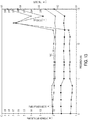
- FIGS. 12-15 In order to demonstrate the superiority of the shape memory polymers described herein and of fabric/SMP composites over materials generally used to construct front panels of sports bras, FIGS. 12-15 will now be discussed.
- FIGS. 12-15 show the graphical results of dynamic mechanical analysis (DMA) of several test materials.
- DMA measures the mechanical properties of tested materials as a function of time, temperature, and frequency.
- the type of DMA performed on the materials shown in FIGS. 12-15 is known as a frequency sweep, in which a sample material is held at a fixed temperature and tested at a variety of frequencies.
- the DMA graphs show a storage modulus, loss modulus, force, and tan ⁇ of each of the tested materials.
- the storage modulus E' is measured on the left hand side of the left axis
- the loss modulus E" is measured on the right hand side of the left axis
- the force is measured on the left hand side of the right axis
- the mechanical dynamic loss tangent (tan ⁇ ) is measured on the right hand side of the right axis.
- the storage modulus measures the ability of the material to store energy (i.e., the elastic portion) and the loss modulus measures the ability of the material to dissipate energy as heat (i.e., the viscous portion).
- the x-axis shows the frequency of the material being tested in Hz.
- the DMA machine used for these tests was the Q800 Version 20.6 Build 24, provided by TA Instruments.
- FIG. 12 shows a graph from a DMA of fabric layered with a prior art mesh material.
- the force that the layered material is able to absorb does not vary with the frequency at which the material is tested (i.e., the force plot 1200 remains relatively flat).
- the material is unable to stiffen to absorb increasing force of the wearer's breasts caused by increasing frequency of movement during physical activity, which generally can range from 0.1 Hz to 15 Hz.
- FIG. 13 a DMA of 100% spandex fabric is shown. As shown by the plot 1300, the force that the material is capable of absorbing remains relatively the same across all frequencies (especially in the 0.1 Hz to 15 Hz frequency range produced while exercising), again showing that the material is incapable of stiffening to absorb an increasing force of a wearer's breasts.
- FIG. 14 which shows DMA of an SMP film according to the present disclosure (see Example 1), it can be seen that the amount of force that the film is capable of absorbing increases gradually as the frequency at which the material is tested increases.
- the force that the material is able to absorb ranges from less than 0.01 N at 0.1 Hz (see point 1402) to greater than 0.8 N at 100 Hz (see point 1404). This shows that as frequency of the wearer's body increases (i.e., as the intensity of a workout increases), the SMP fabric of the current disclosure is able to absorb an increasing amount of force (i.e., bounce of the breasts).
- FIG. 15 shows a graph from DMA of fabric layered with 100% SMP film according to Example 1.
- the test of FIG. 15 most closely corresponds to the front panel 10 of the bra 9 according to the present disclosure, as it tests fabric (e.g., exterior shell layer 12, internal fabric layer 32, interior liner layer 44), layered with 100% SMP film (e.g., film layer 36).
- fabric e.g., exterior shell layer 12, internal fabric layer 32, interior liner layer 44
- 100% SMP film e.g., film layer 36
- the force that the layered construction is able to absorb increases gradually beginning at a frequency of 1 Hz (about 0.023 N at point 1502) to frequencies up to 100 Hz (about 0.041 N at point 1504).
- the force that the fabric layered with 100% SMP film is able to absorb includes forces of 0.03 N and higher.
- the frequency of her breast movement may be about 6 Hz.
- the frequency of her breast movement may be about 15 Hz.
- the layered fabric/SMP construction of the present disclosure stiffens to absorb between about 0.015 and about 0.03 N of force. More specifically, in this frequency range of 6 Hz to 15 Hz, the layered fabric/SMP construction stiffens to absorb between about 0.024 N (point 1506) and about 0.026 N (point 1508).
- the efficacy of the SMP film in counteracting movement of a wearer's breasts can also be studied by measuring the storage elastic modulus and loss modulus of the SMP film.
- the synthetic resin constituting the synthetic resin layer described in Example 1 above shows a higher storage elastic modulus E' as well as a higher loss modulus E" at frequencies which correspond to exercise versus frequencies which correspond to a rest state.
- the synthetic resin layer also shows a high mechanical dynamic loss tangent (tan ⁇ ) within the frequency range of the surface of the human body (0.1 to 100 Hz).
- FIG. 16 is a graph showing dynamic viscoelasticity temperature dependence (0 to 50°C) for a film made according to Example 1.
- the horizontal axis represents temperature
- the first vertical axis represents the storage elastic modulus E' and the loss modulus E"
- the second vertical axis represents tan ⁇ .
- tan ⁇ is the tangent of the ratio of the loss modulus E" to the storage elastic modulus E' (E"/E') at a frequency of 1.0 Hz.
- the measurements shown in FIG. 16 were made using a viscoelasticity measuring apparatus (TA Instruments Inc., RSA-G2).
- Measurement conditions were as follows: measurement frequency: 1.0 Hz; temperature range: -50 to 80°C; rate of temperature increase: 5°C/min; measurement distortion: automatically variable from 1%; initial tension: 30g (constant).
- the composite fabric produced in Example 1 showed a tan ⁇ maximum near 34°C. (Note that tan ⁇ is generally at a maximum at/near the glass transition, where the storage modulus decreases dramatically and the loss modulus reaches a maximum.) Because the composite fabric produced in Example 1 has a glass-transition temperature within range of the surface temperature of the human body, it is particularly comfortable when worn on the human body. Note that when only the synthetic resin layer film was measured, a dynamic viscoelasticity temperature dependence similar to that shown in FIG. 16 was observed.
- FIG. 17 is a graph showing the dynamic viscoelasticity frequency dependence observed for a film made according to Example 1.
- the horizontal axis represents frequency
- the first vertical axis represents the storage elastic modulus E' and the loss modulus E"
- the second vertical axis represents tan ⁇ .
- tan ⁇ is the tangent of the ratio of the loss modulus E" to the storage elastic modulus E' (E"/E') at a temperature of 25°C.
- the measurements shown in FIG. 17 were made using a viscoelasticity measuring apparatus (TA Instruments Inc., RSA-G2). Measurement conditions were as follows: measurement temperature: 25°C; measurement mode: tensile; displacement amplitude: set to 12.5 ⁇ m.
- tan ⁇ was 0.25 or greater within a range of 0.1 to 100 Hz.
- E' and E" increased monotonically as frequency increased. That is, E' and E" were higher during frequencies associated with exercise (10 to 100 Hz) than frequencies associated with rest (0.1 to 1 Hz), and tan ⁇ increased with increasing frequency. In particular, tan ⁇ increased dramatically from 10 to 100 Hz. Based on these results, it is clear that the composite fabric produced in Example 1 reinforces the motion of human muscles during exercise without burdening the muscles during rest. Furthermore, the composite fabric produced in Example 1 is comfortable when worn on the human body, both when the body is at rest as well during exercise. Note that when only the synthetic resin layer film was measured, a dynamic viscoelasticity frequency dependence similar to that shown above was observed.
- a method for constructing a front panel 10 for a sports bra 9 that stiffens upon movement of a wearer's breasts includes providing an exterior shell layer 12, as shown at 1801.
- the method also includes providing an interior liner layer 44 for contacting a wearer's skin, as shown at 1803.
- a film layer 36 is also provided and placed between the exterior shell layer 12 and the interior liner layer 44.
- the method next includes coupling the film layer 36, the exterior shell layer 12, and the interior liner layer 44 together, as shown at 1807.
- the coupling is performed by sewing.
- the coupling could also be done by Bemis tape, ultrasonic bonding, or gluing.
- the film layer 36 comprises a thermally-induced shape memory polymer that exhibits viscoelastic properties when at body temperature and stiffens to absorb between about 0.015 N and about 0.03 N of force at frequencies of breast movement of about 6 Hz to about 15 Hz.
- the film layer 36 is formed as a mesh.
- the mesh may be formed by placing a melted composition of SMP in a mold sized and shaped to produce a mesh having a thickness between about 0.15 mm and about 0.30 mm, and cooling the melted composition in the mold.
- the formed mesh may have a hole density of 480 holes/in 2 .
- the hole to SMP ratio of the mesh may be 1:4.
- the mesh may have a weight of about 136.8 g/m 2 and a thickness of 0.22 mm, where both figures may vary by +/- 10%.
- Such a mesh may have the following properties: Length Width Tensile Force (N/in 2 ) 20% 13.2 9.2 40% 20.0 14.6 60% 24.6 18.2 80% 28.6 21.3 Breaking Force (N/in 2 ) 84.5 51.0 Tensile Strength (MPa) 20% 1.2 0.8 40% 1.8 1.3 60% 2.2 1.7 80% 2.6 1.9 Breaking Strength (MPa) 7.6 4.6
- the film layer 36 can be formed via intaglio printing techniques, including gravure printing.
- a suitable catalyst can be added and melted into the bifunctional diisocyanate, bifunctional polyol and bifunctional chain extender mixture prepared at the above mentioned ratio range of 2.00-1.10 : 1.00 : 1.00-0.10 as needed to prepare a molten synthetic resin material.
- the molten synthetic resin material should show a viscosity ranging from 500 to 5,000 Pa•s at the relevant molding temperature (190 to 230°C) with a range of 1,000 to 2,000 Pa•s preferable.
- a plate corresponding to the shape of the synthetic resin layer is set within a printing apparatus.
- Prepared molten synthetic resin material is fed onto the printing apparatus plate and printed onto a release sheet.
- a film is prepared on the release sheet.
- the film may be peeled off and used alone, or the release sheet may be bonded to a natural, synthetic, or natural/synthetic blend fabric.
- the release sheet is peeled off, the film is transferred onto the fabric to form a synthetic resin layer thereon.
- a synthetic resin film constituting a single continuous film can be formed on the fabric, after which part of the film is removed, in order to form a synthetic resin layer on the fabric.
- the above mentioned bifunctional diisocyanate, bifunctional polyol and bifunctional chain extender mixture starting material can be cross-linked, after which it is mixed with a suitable solvent to prepare a synthetic resin solution.
- the synthetic resin solution is then applied to the surface of the fabric using known methods (e.g., screen printing). Subsequently, part of the synthetic resin film is removed via mechanical puncturing or laser treatment.
- the mesh film or mesh film/fabric composite may be formed into a first breast cup 40a and a second breast cup 40b within a second mold. Care should be taken not to heat the mold to temperatures that will damage the properties of the film.
- the first and second breast cups can be formed while the mesh is first being cooled from its molten state in the mold or on the plate that was used to create the mesh in the first place.
- the method may further include cutting or stamping a first aperture 42a at an apex of the first breast cup 40a and a second aperture 42b at an apex of the second breast cup 40b, the first and second apertures 42a, 42b configured to allow a wearer's breast tissue to project there through when the bra is being worn. If the mesh film is created using a printing technique, the apertures 42a, 42b may be formed by leaving unprinted areas.
- the method may further comprise molding the first and second breast cups 40a, 40b to a concave shape that approximates a shape of the wearer's breasts that is predetermined based on breast size, i.e., the graduation of the mold is changed based on the breast size for which the breast cup is molded.
- the interior liner layer 44 can also be molded to create breast cups 45a, 45b, which can then be aligned with the breast cups 40a, 40b and apertures 42a, 42b of the film layer 36 as the two layers are combined to form the front panel 10 of the bra 9.
Landscapes
- Engineering & Computer Science (AREA)
- Textile Engineering (AREA)
- Corsets Or Brassieres (AREA)
- Laminated Bodies (AREA)
Description
- The present application relates to bras that are to be worn while engaged in athletic activities.
- Many sports bras are designed to limit or prevent movement of a wearer's breasts while she is engaged in athletic activity. During high impact activities, a woman's breasts do not move up and down together, but rather separately, in what can be called a "butterfly" motion. This movement of the breasts is very painful and possibly damaging to the supportive breast tissue. Currently, the common ways of supporting the breasts during athletic activity and controlling this butterfly motion are by high compression fabric, components, and construction; rigid fabric and components; and/or encapsulation of the breasts via separate breast cups, usually requiring a molded pad with or without an underwire, and usually requiring two individual cups that surround each breast, keeping them separate.
- Constructing a garment using the above-mentioned material and methods results in a tight and uncomfortable fit for the wearer; however, women who require a supportive garment to reduce breast movement during high impact exercise have no choice but to wear a similarly-constructed garment or multiple support garments to meet their breast support needs. For more information regarding breast discomfort during physical activity, and the detrimental effects thereof, please see An Abstract of the Thesis "Breast Support for the Active Woman: Relationship to 3D Kinematics of Running," by Ann L. C. Boschma, submitted to Oregon State University on September 23, 1994. Boschma summarizes her study of running kinematics with the following observation: while exercising, women of all breast sizes experience increases in breast discomfort as breast support decreases. This indicates that full support bras are more comfortable for a wearer engaged in vigorous athletic activities, no matter what her breast size.
-
US6198204B1 discloses a sports bra comprising a piezoelectric transducer. As the breast moves, the piezoelectric transducer deforms and induces a voltage that is passed to an electrical component. The transducer stiffens in response to the electrical component and reduces the movement of the breast by placing an external force on the breast. - This Summary is provided to introduce a selection of concepts that are further described below in the Detailed Description. This Summary is not intended to identify key or essential features of the claimed subject matter, nor is it intended to be used as an aid in limiting the scope of the claimed subject matter.
- In one example of the present disclosure, a front panel for a sports bra according to
claim 1 includes an interior liner layer having a back face contacting a wearer's skin, and having a size and shape configured to substantially cover a wearer's breasts. An exterior shell layer having a back face facing a front face of the interior liner layer, and also having a size and shape configured to substantially cover the wearer's breasts, is coupled to the interior liner layer. A film layer is located between the front face of the interior liner layer and the back face of the exterior shell layer. When the front panel is worn as part of the sports bra, the film layer is configured to stiffen as a frequency of movement of the wearer's breasts increases, thereby absorbing forces caused by the movement of the wearer's breasts. - In another example, a method for constructing a front panel for a sports bra that stiffens upon movement of a wearer's breasts according to
claim 9 is disclosed. The method includes providing an exterior shell layer having a size and shape configured to substantially cover the wearer's breasts, and providing an interior liner layer having a back face for contacting a wearer's skin and also having a size and shape configured to substantially cover the wearer's breasts. A film layer is provided and placed between a back face of the exterior shell layer and a front face of the interior liner layer. The film layer, the exterior shell layer, and the interior liner layer are then coupled together. The film layer comprises a thermally-induced shape memory polymer that exhibits viscoelastic properties when at body temperature and stiffens to absorb between about 0.015 N and about 0.03 N of force at frequencies of breast movement of between about 6 Hz and about 15 Hz. - Examples of articles of manufacture and methods for manufacturing bras and materials that can be used to construct bras are described with reference to the following figures. These same numbers are used throughout the figures to reference like features and like components.
-
FIG. 1 shows several separated layers of a sports bra according to the present disclosure. -
FIG. 2 shows the several layers combined into a sports bra according to the present disclosure. -
FIG. 3 shows an exterior shell layer of a front panel for the sports bra. -
FIG. 4 shows a rear portion of the sports bra. -
FIG. 5 shows an internal fabric layer of the front panel. -
FIG. 6 shows a film layer to be located between an interior liner layer and the exterior shell layer. -
FIG. 7 shows the interior liner layer for contacting a wearer's skin. -
FIGS. 8 and 9 show alternative examples of the film layer. -
FIG. 10 shows one example of a construction of the film layer. -
FIG. 11 shows another example of a construction of the film layer. -
FIG. 12 is a graph showing a dynamic mechanical analysis (DMA) of a piece of fabric layered with a prior art mesh. -
FIG. 13 is a graph showing a DMA of a 100% spandex fabric. -
FIG. 14 is a graph showing a DMA of a film made of 100% shape memory polymer. -
FIG. 15 is a graph showing a DMA of fabric layered with 100% shape memory polymer film. -
FIG. 16 is a graph showing dynamic viscoelasticity temperature dependence observed for one example of a film used in the film layer. -
FIG. 17 is a graph showing dynamic viscoelasticity frequency dependence observed for one example of a film used in the film layer. -
FIG. 18 illustrates a method for constructing a front panel for a sports bra. -
FIG. 1 shows several separated layers of a sports bra according to the present disclosure. These layers include anexterior shell layer 12 having afront face 13a and aback face 13b. After the bra is assembled, thefront face 13a will be visible while the bra is being worn, while theback face 13b will be hidden by additional layers about to be described. Adjacent theexterior shell layer 12 is aninternal fabric layer 32, having afront face 15a and aback face 15b. When the bra is assembled, thefront face 15a of theinternal fabric layer 32 faces theback face 13b of theexterior shell layer 12. Adjacent the internal fabric layer is afilm layer 36 having afront face 17a and aback face 17b. Thefront face 17a of thefilm layer 36 faces theback face 15b of theinternal fabric layer 32. Next, adjacent to thefilm layer 36, is aninterior liner layer 44 having afront face 19a and aback face 19b. Thefront face 19a of theinterior liner layer 44 faces theback face 17b of thefilm layer 36. Theback face 19b of theinterior liner layer 44 touches the wearer's skin, and is therefore the innermost part of the bra. Together, theexterior shell layer 12, theinternal fabric layer 32, thefilm layer 36, and theinterior liner layer 44 make up afront panel 10 for the bra. Arear portion 11 of the bra is shown inFIG. 1 as well. Therear portion 11 may have some or all of thesame layers front panel 10, but its layers will not be described in detail herein. Rather, focus will be on describing thefront panel 10 and its superior bounce-absorbing capabilities. -
FIG. 2 shows asports bra 9 according to the present disclosure, with all of thelayers front panel 10 and therear portion 11 assembled together.FIG. 2 shows how therear portion 11 and thefront panel 10 can be sewn or otherwise coupled to one another along aseam 23, it being understood that a similar seam may exist on the opposite side of thebra 9. Further details of the connection of thefront panel 10 to therear portion 11 of thebra 9 will be described herein below. It should be understood that therear portion 11 and thefront panel 10 are connected such that the wearer's body is situated between therear portion 11 and theinterior liner layer 44 of thefront panel 10 when thebra 9 is being worn. -
FIG. 3 illustrates theexterior shell layer 12 for thefront panel 10 for thesports bra 9. The front (exterior) face 13a of theexterior shell layer 12 is shown. Theexterior shell layer 12 is the layer one would normally see facing outwardly from a wearer's body while thebra 9 is being worn. Theback face 13b (opposite side) of theexterior shell layer 12 is closer to the wearer's body than thefront face 13a. Theexterior shell layer 12 may comprise a piece of fabric having a size and shape configured to substantially cover a wearer's breasts, and may have twostraps exterior shell layer 12 can be a fabric made of nylon, spandex, polyester, polypropylene, or any combination of these with one another or with cotton. In one example, theexterior shell layer 12 is a 320 gram fabric with a tight knit that provides compression to the wearer's breasts. Theexterior shell layer 12 has aneckline 16, arib cage band 18, aleft side 20, and aright side 22. Thestraps exterior shell layer 12 near theneckline 16. Thestraps exterior shell layer 12, or can be separately sewn or otherwise coupled to theexterior shell layer 12. In one example, thestraps exterior shell layer 12 may be sewn or otherwise coupled alongseams 23 to other layers of thefront panel 10, as well as to therear portion 11, as will be described further herein below. -
FIG. 4 shows arear portion 11 of thesports bra 9, which was not fully shown inFIG. 3 for the sake of clarity. More specifically,FIG. 4 shows an exterior of therear portion 11 of thebra 9, which would be seen during normal wear of the bra. The interior of the rear portion 11 (i.e., the part that contacts the wearer) is on the side opposite that shown inFIG. 4 . For the sake of clearly illustrating therear portion 11 of the bra, therear portion 11 is not shown connected to thefront panel 10. However, if should be understood that therear portion 11 could be integral with, sewn, or otherwise coupled to thefront panel 10 when thebra 9 is fully assembled, as will be described further below.FIG. 4 shows how thestraps straps FIG. 3 ) can be crossed over one another in order to create an X-shaped back. In other embodiments, the straps can form a U-shape, a V-shape, or a T-shape (racer back) and need not cross over one another. The orientation and/or shape of the straps is therefore not limiting on the scope of the present disclosure. Thestraps sliders straps -
Straps bra 9 viarings Straps rings wings Wings location 31 by a hook and eye closure, or by any other closure known to those having ordinary skill in the art, such as by snaps, Velcro, magnetic closures, etc. When thebra 9 is fully assembled,wing 28 extends fromleft side 20 of theexterior shell layer 12 andwing 30 extends fromright side 22 of the exterior shell layer 12 (seeFIG. 3 , wherewings front panel 10 at seams 23). Thewings right sides exterior shell layer 12, such as for example along seams 23. In alternative embodiments, Bemis tape, ultrasonic seams, and/or glue could be used instead of sewing at seams 23. The exterior fabric of thewings exterior shell layer 12. - Turning to
FIG. 5 , and proceeding inwardly from theexterior shell layer 12 toward the wearer's breasts, the next layer of thefront panel 10 of thebra 9 is aninternal fabric layer 32. Afront face 15a of theinternal fabric layer 32 is shown inFIG. 5 , and when assembled, faces theback face 13b of theexterior shell layer 12. The opposite,back face 15b is thus closer to the wearer's skin. Theinternal fabric layer 32 may end at anupper edge 33 approximately where thestraps exterior shell layer 12 would start, or may continue along thestraps internal fabric layer 32 may be sewn (or otherwise connected) to theexterior shell layer 12 along seams 23. Note that where theseseams 23 are shown is also approximately where the lateral edges of theinternal fabric layer 32 are located. In one example, theinternal fabric layer 32 may comprise a knitted spacer fabric that provides breathability, comfort, and modesty to the wearer. In another example, theinternal fabric layer 32 may comprise two different types of fabric: afirst fabric 35a below dashedline 35 comprising a knitted spacer fabric, and asecond fabric 35b above dashedline 35 comprising a mesh fabric. Themesh fabric 35b acts as a stabilizer and reduces the thickness of thefront panel 10 in the areas where it is used, as it is much thinner than the knitted spacer fabric. - In one example, an
underwire 34 may be coupled to theinternal fabric layer 32. For example, theunderwire 34 may be a plastic underwire that is surrounded by an underwire tunnel casing. The underwire tunnel casing may be sewn along its edges to theinternal fabric layer 32. The tunnel casing may additionally or alternatively be glued, bonded, or taped to theinternal fabric layer 32, or theunderwire 34 itself maybe glued or taped to theinternal fabric layer 32. Theunderwire 34 may comprise a continuous, undulating W shape, or may comprise two separate U-shaped underwires, although these are not shown herein. Each of the weight, thickness, and shape of theunderwire 34 may be customized by cup size to provide the required support level. Theunderwire 34 may be sewn to thefront face 15a of theinternal fabric layer 32 such that the springiness of the spacer fabric between theunderwire 34 and the wearer's skin protects the wearer from the relative rigidity of theunderwire 34. - Again, continuing inwardly from the
internal fabric layer 32 towards the wearer's breasts, as shown inFIG. 6 , thefront panel 10 further comprises afilm layer 36, shown in hatching. Thefront face 17a of thefilm layer 36 faces theback face 15b of theinternal fabric layer 32 shown inFIG. 5 . Theback face 17b is on the opposite side from that shown and is closer to the wearer's body. Thefilm layer 36 may continue up into thestraps lines FIG. 6 . In the either case, thefilm layer 36 may be sewn to theinternal fabric layer 32 and/or to theexterior shell layer 12. Thefilm layer 36 comprises afirst breast cup 40a and asecond breast cup 40b. Thefilm layer 36 has afirst aperture 42a at an apex of thefirst breast cup 40a and asecond aperture 42b at an apex of thesecond breast cup 40b. The first andsecond apertures film layer 36 is not very stretchy and might not expand to provide enough room for the breast tissue, but theinternal fabric layer 32 and even the compression fabric of theexterior shell layer 12 beyond theapertures - Thus, the
apertures front panel 10 despite thenon-stretchy film layer 36. Generally, theapertures apertures apertures film layer 36 could instead be provided in order to fit the volume of the wearer's breasts within the first andsecond breast cups film layer 36 comprises a single sheet having twoapertures film layer 36 could comprise multiple sheets sewn or otherwise connected together. As shown herein,film layer 36 is sewn or otherwise connected alongseams 23 toexterior shell layer 12, which are the same seams along whichinternal fabric layer 32 is sewn toexterior shell layer 12. Note that where theseseams 23 are provided is also roughly where the film layer's lateral edges are located. - The
film layer 36 may be molded such that the first andsecond breast cups FIG. 2 reflects the opposite side of the concave shape of thebreast cups breast cups film layer 36 to fit closely along the shape of the wearer's breasts and ensures that some of the volume of the wearer's breasts may project through theapertures larger apertures aperture film layer 36 is made will be more fully described herein below. - Now turning to
FIG. 7 , and again continuing through the layers of thefront panel 10 as they move closer towards the wearer's breasts, aninterior liner layer 44 of thefront panel 10 will be described. Thefront face 19a of theinterior liner layer 44 faces theback face 17b of thefilm layer 36 shown inFIG. 6 . Theback face 19b (i.e., the face that actually touches the wearer's skin) is on the opposite side from that shown inFIG. 7 . Theinterior liner layer 44 may be a sheet of fabric that has straps (in one example, co-extensive withstraps interior liner layer 44 may comprise fabric made of spandex, nylon, polyester, or any blend of one of those materials with one another and/or with cotton. Theinterior liner layer 44 may alternatively comprise a polypropylene-spandex blend. When thebra 9 is worn, theback face 19b of theinterior liner layer 44 sits against the wearer's skin. In one example, theinterior liner layer 44 ends at the lateral edges 47 shown inFIG. 7 . Preferably, however, theinterior liner layer 44 extends continuously from the front panel portion shown inFIG. 7 out to form the interior faces of thewings rear portion 11 of thebra 9, as partially shown in dashed lines (see alsoFIG. 4 ). For example, theinterior liner layer 44 may comprise one seamless sheet of material that extends across the back face of the entirefront panel 10 and along the inside surfaces of thewings 28, 30 (i.e., the surfaces that touches the wearer's body) to thelocation 31 where thewings interior liner layer 44 has a size and shape configured to substantially cover a wearer's breasts. - The
interior liner layer 44 may also be molded such that it has first andsecond breast cups cups interior liner layer 44, which then stretch to encapsulate the wearer's breasts when thebra 9 is worn. It should be understood that when the wearer's breasts are described as at least partially extending through theapertures film layer 36, the wearer's breasts are in fact resting in thebreast cups interior liner layer 44, and both the wearer's breasts and the fabric of thebreast cups apertures interior liner layer 44 thus provides a smooth surface for contacting the wearer's skin, as well as a barrier between the wearer's breasts and thefilm layer 36, such that the wearer does not notice that her breasts are projecting through theapertures - Now turning to
FIGS. 8 and 9 , alternative configurations for thefilm layer 36 are shown. Here, thefilm layer 36 andinternal fabric layer 32 are shown from their back faces 15b, 17b, respectively, so as to show how the pattern and coverage of thefilm layer 36 compare to that of theinternal fabric layer 32. As shown inFIG. 8 , thefilm layer 36 may comprise twoseparate sheets back face 15b of theinternal fabric layer 32. Alternatively, thesesheets back face 13b of theexterior shell layer 12 or to thefront face 19a of theinterior liner layer 44, if nointernal fabric layer 32 is provided. When thebra 9 is worn, thesheets FIG. 9 , athird sheet 36c is provided along with thesheets sheet 36c is generally T-shaped and when the bra is worn does extend between the wearer's breasts. However, the film material does not extend much beneath the wearer's breasts. In contrast to the examples ofFIGS. 8 and 9 , thefilm layer 36 shown inFIG. 6 extends completely around the wearer's breasts and hasapertures film layer 36, in order to reap the below-described force-absorbing benefits thereof. This also ensures that both upward and downward forces from bouncing breasts are absorbed, as well as side-to-side bounce, all experienced during the above-mentioned butterfly motion of breasts while a woman is exercising. - In any of the examples of
FIGS. 6 ,8, and 9 , thefilm layer 36 may be included in several different ways. Thefilm layer 36 may be a separate layer of material that is formed as a mesh (i.e., a layer of fabric with holes in it). Alternatively, thefilm layer 36 may be a resin layer printed on or otherwise molded or adhered to another layer of fabric made of natural, synthetic, or a blend of natural and synthetic fibers (i.e., thefilm layer 36 may be a resin layer covering part of the surface of at least one side of the other fabric). In yet another example, thefilm layer 36 may be a resin layer printed onto theback face 13b of theexterior shell layer 12, theback face 15b of theinternal fabric layer 32, or thefront face 19a of theinterior liner layer 44. - According to the present disclosure, the material of which the
film layer 36 is made becomes stiffer as a frequency of movement of a wearer's breasts increases, and thereby absorbs forces caused by the movement of the wearer's breasts. This is important because, as the frequency of a wearer's breasts increases (from moderate to strenuous exercise) the force caused by acceleration of the breasts also increases. This increasing force can be absorbed by thefilm layer 36 of the present disclosure, which is made of a shape-memory polymer (SMP). According to the present disclosure, thefilm layer 36 may comprise a thermally-induced SMP that exhibits viscoelastic properties when at or near the temperature of the human body. In other words, the SMP's glass transition temperature is at or near body temperature. The SMP stiffens to absorb energy at frequencies of breast movement between about 1 Hz and about 100 Hz and is capable of effectively absorbing forces up to and above 0.03 N, as will be described further herein below. At or near body temperature, the SMPs described herein are able to provide damping to the movement of the wearer's breasts, as they also exhibit a high energy dissipation factor (tanδ) at higher frequencies, yet maintain a good skin feel at lower frequencies, where the tanδ is also lower. Additionally, given a constant frequency, tanδ is at a maximum in the range of the temperature of the human body, and thus the SMPs described herein are particularly suited for applications in clothing. - In one example, the polymer from which the SMP fabric is constructed may include polyurethane elastomer resin and polystyrene elastomer resin blended, for example, in a ratio of 9:1. In another example, the polymer is a blend of thermoplastic polyurethane and thermoplastic polyurethane-silicone elastomer (made by a dynamic vulcanization process), combined, for example, at a mass ratio of 90:10 to 60:40. In still other examples, parts or all of the
film layer 36 are made of 100% silicone, or 100% thermoplastic polyurethane (TPU), such as DESMOPAN® Developmental Product DP 2795A-SMP provided by Bayer Material Science of Pittsburgh, PN. - In another example, described in as-yet unpublished Japanese Patent Application No.
2015-17206, filed on January 30, 2015 SMP film layer 36 may comprise a polyurethane elastomer produced by the polymerization of a bifunctional diisocyanate, bifunctional polyol and bifunctional chain extender using the pre-polymer method or bulk method at a molar ratio of 2.00-1.10 : 1.00 : 1.00-0.10, and may have multiple apertures at an aperture ratio ranging from 10-90% (inclusive). The molecular weight of the bifunctional diisocyanate can range from 174 to 303, the molecular weight of the bifunctional polyol can range from 300 to 2,500, and the bifunctional chain extender can be a diol or diamine with a molecular weight ranging from 60 to 360. The number of apertures in the film per unit area can range from 30/cm2 to 150/cm2 (inclusive). Specific examples of the bifunctional diisocyanate include 2,4-toluene diisocyanate, 4,4'-diphenyl methane diisocyanate, carbodiimide-modified 4,4'-diphenylmethane diisocyanate and hexamethylene diisocyanate. Specific examples of the bifunctional polyol include polypropylene glycol, 1,4-butane glycol adipate, polytetramethylene glycol, polyethylene glycol, and propylene oxide adducts of bisphenol-A. The bifunctional polyol can also be further modified by reacting it with a bifunctional carboxyllic acid or cyclic ether. Examples of the diols which can be used include ethylene glycol, 1,4-butane glycol, bis (2-hydroxyethyl) hydroquinone, ethylene oxide adducts of bisphenol-A and propylene oxide adducts of bisphenol-A. Examples of the diamines which can be used include ethylene diamine. The glass-transition temperature of the film should fall within a range of 0 to 40°C, with a range of 25 to 35°C preferable. - In another example, the
film layer 36 is a composite fabric including a fabric produced from natural fiber, synthetic fiber or a mixed fiber containing both natural fiber and synthetic fiber, as well as a synthetic resin layer which covers part of the surface of at least one side of the fabric. The synthetic resin layer is composed primarily of the above-mentioned polyurethane elastomer, and the coverage ratio of the synthetic resin layer relative to the surface of the fabric ranges from 10 to 90% (inclusive). For example, seeFIG. 10 , which showsfilm layer 100 having afabric layer 101 coated with aresin layer 102 havingapertures 103 extending there through. Theseapertures 103 are shown as being cylindrical, but they could take any shape, such as but not limited to hexagons, ellipses, polygons, or rounded polygons. In other examples, thefabric layer 101 is coated on both sides with theresin layer 102. InFIG. 10 , theresin layer 102 is a continuoussheet having apertures 103. In other examples, theresin layer 102 is split into two or more sheets with gaps left there between. In still other examples, referring toFIG. 11 , thefilm layer 400 comprises afabric layer 401 with theresin layer 402 applied in discontinuous or discrete dots (or other shapes). - If the synthetic resin layer is a continuous film containing apertures, the aperture ratio of the synthetic resin layer ranges from 10 to 90% (inclusive), or more specifically from 20 to 50% (inclusive). The number of apertures per unit area ranges from 30/cm2 to 150/cm2 (inclusive). The thickness of the synthetic resin layer ranges from 20 to 1,000 µm (inclusive).
- For Example 1, a film was formed over a release sheet using gravure printing and the release sheet was applied to a fabric to prepare the composite fabric detailed below.
- Fabric: PET fabric, 75D X 100D (denier) (84T X 100T (decitex))
- Fabric Size: 1530 mm by 1000 mm
- Synthetic Resin Layer Composition: SMPMM-2520 manufactured by SMP Technologies Co., Ltd.
- Synthetic Resin Layer Size: Continuous film 150 mm by 1,000 mm in size
- Synthetic Resin Layer Thickness: 200 µm
- Aperture Ratio: 25%
- Number of Apertures per Unit Area: 74.4/cm2 (480/inch2)
- In order to demonstrate the superiority of the shape memory polymers described herein and of fabric/SMP composites over materials generally used to construct front panels of sports bras,
FIGS. 12-15 will now be discussed. -
FIGS. 12-15 show the graphical results of dynamic mechanical analysis (DMA) of several test materials. DMA measures the mechanical properties of tested materials as a function of time, temperature, and frequency. The type of DMA performed on the materials shown inFIGS. 12-15 is known as a frequency sweep, in which a sample material is held at a fixed temperature and tested at a variety of frequencies. The DMA graphs show a storage modulus, loss modulus, force, and tanδ of each of the tested materials. The storage modulus E' is measured on the left hand side of the left axis, the loss modulus E" is measured on the right hand side of the left axis, the force is measured on the left hand side of the right axis, and the mechanical dynamic loss tangent (tanδ) is measured on the right hand side of the right axis. The storage modulus measures the ability of the material to store energy (i.e., the elastic portion) and the loss modulus measures the ability of the material to dissipate energy as heat (i.e., the viscous portion). The x-axis shows the frequency of the material being tested in Hz. The DMA machine used for these tests was the Q800 Version 20.6 Build 24, provided by TA Instruments. -
FIG. 12 shows a graph from a DMA of fabric layered with a prior art mesh material. As shown, the force that the layered material is able to absorb does not vary with the frequency at which the material is tested (i.e., theforce plot 1200 remains relatively flat). In other words, the material is unable to stiffen to absorb increasing force of the wearer's breasts caused by increasing frequency of movement during physical activity, which generally can range from 0.1 Hz to 15 Hz. - Turning to
FIG. 13 , a DMA of 100% spandex fabric is shown. As shown by theplot 1300, the force that the material is capable of absorbing remains relatively the same across all frequencies (especially in the 0.1 Hz to 15 Hz frequency range produced while exercising), again showing that the material is incapable of stiffening to absorb an increasing force of a wearer's breasts. - Turning to
FIG. 14 , which shows DMA of an SMP film according to the present disclosure (see Example 1), it can be seen that the amount of force that the film is capable of absorbing increases gradually as the frequency at which the material is tested increases. For example, referring toline 1400, the force that the material is able to absorb ranges from less than 0.01 N at 0.1 Hz (see point 1402) to greater than 0.8 N at 100 Hz (see point 1404). This shows that as frequency of the wearer's body increases (i.e., as the intensity of a workout increases), the SMP fabric of the current disclosure is able to absorb an increasing amount of force (i.e., bounce of the breasts). -
FIG. 15 shows a graph from DMA of fabric layered with 100% SMP film according to Example 1. The test ofFIG. 15 most closely corresponds to thefront panel 10 of thebra 9 according to the present disclosure, as it tests fabric (e.g.,exterior shell layer 12,internal fabric layer 32, interior liner layer 44), layered with 100% SMP film (e.g., film layer 36). Looking atline 1500 on the chart, it can be seen that the force that the layered construction is able to absorb increases gradually beginning at a frequency of 1 Hz (about 0.023 N at point 1502) to frequencies up to 100 Hz (about 0.041 N at point 1504). As shown in the graph, the force that the fabric layered with 100% SMP film is able to absorb includes forces of 0.03 N and higher. For a wearer who is walking, the frequency of her breast movement may be about 6 Hz. For a wearer who is vigorously exercising, the frequency of her breast movement may be about 15 Hz. At such frequencies, the layered fabric/SMP construction of the present disclosure stiffens to absorb between about 0.015 and about 0.03 N of force. More specifically, in this frequency range of 6 Hz to 15 Hz, the layered fabric/SMP construction stiffens to absorb between about 0.024 N (point 1506) and about 0.026 N (point 1508). - The efficacy of the SMP film in counteracting movement of a wearer's breasts can also be studied by measuring the storage elastic modulus and loss modulus of the SMP film. The synthetic resin constituting the synthetic resin layer described in Example 1 above shows a higher storage elastic modulus E' as well as a higher loss modulus E" at frequencies which correspond to exercise versus frequencies which correspond to a rest state. The synthetic resin layer also shows a high mechanical dynamic loss tangent (tanδ) within the frequency range of the surface of the human body (0.1 to 100 Hz).
-
FIG. 16 is a graph showing dynamic viscoelasticity temperature dependence (0 to 50°C) for a film made according to Example 1. InFIG. 16 the horizontal axis represents temperature, while the first vertical axis represents the storage elastic modulus E' and the loss modulus E" and the second vertical axis represents tanδ. Here tanδ is the tangent of the ratio of the loss modulus E" to the storage elastic modulus E' (E"/E') at a frequency of 1.0 Hz. The measurements shown inFIG. 16 were made using a viscoelasticity measuring apparatus (TA Instruments Inc., RSA-G2). Measurement conditions were as follows: measurement frequency: 1.0 Hz; temperature range: -50 to 80°C; rate of temperature increase: 5°C/min; measurement distortion: automatically variable from 1%; initial tension: 30g (constant). The composite fabric produced in Example 1 showed a tanδ maximum near 34°C. (Note that tanδ is generally at a maximum at/near the glass transition, where the storage modulus decreases dramatically and the loss modulus reaches a maximum.) Because the composite fabric produced in Example 1 has a glass-transition temperature within range of the surface temperature of the human body, it is particularly comfortable when worn on the human body. Note that when only the synthetic resin layer film was measured, a dynamic viscoelasticity temperature dependence similar to that shown inFIG. 16 was observed. -
FIG. 17 is a graph showing the dynamic viscoelasticity frequency dependence observed for a film made according to Example 1. InFIG. 17 the horizontal axis represents frequency, while the first vertical axis represents the storage elastic modulus E' and the loss modulus E" and the second vertical axis represents tanδ. Here, tanδ is the tangent of the ratio of the loss modulus E" to the storage elastic modulus E' (E"/E') at a temperature of 25°C. The measurements shown inFIG. 17 were made using a viscoelasticity measuring apparatus (TA Instruments Inc., RSA-G2). Measurement conditions were as follows: measurement temperature: 25°C; measurement mode: tensile; displacement amplitude: set to 12.5 µm. For the composite fabric produced in Example 1, tanδ was 0.25 or greater within a range of 0.1 to 100 Hz. For the composite fabric produced in Example 1, E' and E" increased monotonically as frequency increased. That is, E' and E" were higher during frequencies associated with exercise (10 to 100 Hz) than frequencies associated with rest (0.1 to 1 Hz), and tanδ increased with increasing frequency. In particular, tanδ increased dramatically from 10 to 100 Hz. Based on these results, it is clear that the composite fabric produced in Example 1 reinforces the motion of human muscles during exercise without burdening the muscles during rest. Furthermore, the composite fabric produced in Example 1 is comfortable when worn on the human body, both when the body is at rest as well during exercise. Note that when only the synthetic resin layer film was measured, a dynamic viscoelasticity frequency dependence similar to that shown above was observed. - With reference to
FIG. 18 , a method for constructing afront panel 10 for asports bra 9 that stiffens upon movement of a wearer's breasts is disclosed. The method includes providing anexterior shell layer 12, as shown at 1801. The method also includes providing aninterior liner layer 44 for contacting a wearer's skin, as shown at 1803. As shown at 1805, afilm layer 36 is also provided and placed between theexterior shell layer 12 and theinterior liner layer 44. The method next includes coupling thefilm layer 36, theexterior shell layer 12, and theinterior liner layer 44 together, as shown at 1807. In one example, the coupling is performed by sewing. The coupling could also be done by Bemis tape, ultrasonic bonding, or gluing. According to one example of the present disclosure, thefilm layer 36 comprises a thermally-induced shape memory polymer that exhibits viscoelastic properties when at body temperature and stiffens to absorb between about 0.015 N and about 0.03 N of force at frequencies of breast movement of about 6 Hz to about 15 Hz. - In one example of the method, the
film layer 36 is formed as a mesh. The mesh may be formed by placing a melted composition of SMP in a mold sized and shaped to produce a mesh having a thickness between about 0.15 mm and about 0.30 mm, and cooling the melted composition in the mold. The formed mesh may have a hole density of 480 holes/in2. The hole to SMP ratio of the mesh may be 1:4. In one example, the mesh may have a weight of about 136.8 g/m2 and a thickness of 0.22 mm, where both figures may vary by +/- 10%. Such a mesh may have the following properties:Length Width Tensile Force (N/in2) 20% 13.2 9.2 40% 20.0 14.6 60% 24.6 18.2 80% 28.6 21.3 Breaking Force (N/in2) 84.5 51.0 Tensile Strength (MPa) 20% 1.2 0.8 40% 1.8 1.3 60% 2.2 1.7 80% 2.6 1.9 Breaking Strength (MPa) 7.6 4.6 - Alternatively, the
film layer 36 can be formed via intaglio printing techniques, including gravure printing. A suitable catalyst can be added and melted into the bifunctional diisocyanate, bifunctional polyol and bifunctional chain extender mixture prepared at the above mentioned ratio range of 2.00-1.10 : 1.00 : 1.00-0.10 as needed to prepare a molten synthetic resin material. Given formability considerations, the molten synthetic resin material should show a viscosity ranging from 500 to 5,000 Pa•s at the relevant molding temperature (190 to 230°C) with a range of 1,000 to 2,000 Pa•s preferable. The type (molecular weight) and relative proportions of the bifunctional diisocyanate, bifunctional polyol and bifunctional chain extender are selected in order to satisfy the above viscosity constraints. A plate corresponding to the shape of the synthetic resin layer is set within a printing apparatus. Prepared molten synthetic resin material is fed onto the printing apparatus plate and printed onto a release sheet. In this way a film is prepared on the release sheet. The film may be peeled off and used alone, or the release sheet may be bonded to a natural, synthetic, or natural/synthetic blend fabric. When the release sheet is peeled off, the film is transferred onto the fabric to form a synthetic resin layer thereon. - Alternatively, a synthetic resin film constituting a single continuous film can be formed on the fabric, after which part of the film is removed, in order to form a synthetic resin layer on the fabric. For example, the above mentioned bifunctional diisocyanate, bifunctional polyol and bifunctional chain extender mixture starting material can be cross-linked, after which it is mixed with a suitable solvent to prepare a synthetic resin solution. The synthetic resin solution is then applied to the surface of the fabric using known methods (e.g., screen printing). Subsequently, part of the synthetic resin film is removed via mechanical puncturing or laser treatment.
- After it is formed, the mesh film or mesh film/fabric composite may be formed into a
first breast cup 40a and asecond breast cup 40b within a second mold. Care should be taken not to heat the mold to temperatures that will damage the properties of the film. Alternatively, the first and second breast cups can be formed while the mesh is first being cooled from its molten state in the mold or on the plate that was used to create the mesh in the first place. After the mesh film or mesh film/fabric composite has been removed from the mold, the method may further include cutting or stamping afirst aperture 42a at an apex of thefirst breast cup 40a and asecond aperture 42b at an apex of thesecond breast cup 40b, the first andsecond apertures apertures second breast cups - The
interior liner layer 44 can also be molded to createbreast cups breast cups apertures film layer 36 as the two layers are combined to form thefront panel 10 of thebra 9. - In the above description certain terms have been used for brevity, clarity, and understanding. No unnecessary limitations are to be inferred therefrom beyond the requirement of the prior art because such terms are used for descriptive purposes and are intended to be broadly construed. The different articles of manufacture and methods described herein above may be used in alone or in combination with other articles of manufacture and methods.
Claims (15)
- A front panel (10) for a sports bra (9) comprising:an interior liner layer (44) having a back face (19b) contacting a wearer's skin, and having a size and shape configured to substantially cover a wearer's breasts;an exterior shell layer (12) having a back face (13b) facing a front face (19a) of the interior liner layer (44), having a size and shape configured to substantially cover the wearer's breasts, and coupled to the interior liner layer; anda film layer (36) located between the front face (19a) of the interior liner layer (44) and the back face (13b) of the exterior shell layer (12), wherein the film layer comprises a thermally-induced shape memory polymer that exhibits viscoelastic properties when at body temperature;wherein, when the front panel (10) is worn as part of the sports bra (9), the film layer (36) is configured to stiffen as a frequency of movement of the wearer's breasts increases, thereby absorbing forces caused by the movement of the wearer's breasts, and wherein the shape memory polymer is configured to stiffen to absorb energy at frequencies of breast movement of between about 1 Hz and about 100 Hz and is capable of absorbing a force of up to about 0.03 N.
- The front panel (10) of claim 1, wherein the shape memory polymer is configured to stiffen to absorb between about 0.015 N and about 0.03 N of force at frequencies of breast movement of between about 6 Hz and about 15 Hz.
- The front panel (10) of any of the preceding claims, wherein the film layer (36) comprises a first breast cup (40a) and a second breast cup (40b).
- The front panel (10) of claim 3, wherein the first and second breast cups (40a, 40b) are molded to a concave shape that approximates a shape of the wearer's breasts and that is predetermined based on breast size.
- The front panel (10) of any of the preceding claims, wherein the film layer (36) has a first aperture (42a) at an apex of the first breast cup (40a) and a second aperture (42b) at an apex of the second breast cup (40b), the first and second apertures allowing a wearer's breast tissue to project there through.
- The front panel (10) of any of the preceding claims, further comprising an internal fabric layer (32) coupled between the back face (13b) of the exterior shell layer (12) and a front face (17a) of the film layer (36).
- The front panel (10) of any of the preceding claims, wherein the film layer (36) comprises a polyurethane elastomer produced by the polymerization of a bifunctional diisocyanate, a bifunctional polyol and a bifunctional chain extender using one of a pre-polymer method and a bulk method at a molar ratio of 2.00-1.10 : 1.00 : 1.00-0.10, and wherein the film layer has multiple apertures at an aperture ratio of ranging from 10 to 90%, optionally wherein a molecular weight of the bifunctional diisocyanate ranges from 174 to 303, a molecular weight of the bifunctional polyol ranges from 300 to 2,500, and the bifunctional chain extender is a diol or diamine with a molecular weight ranging from 60 to 360.
- The front panel (10) of claim 7, wherein the film layer (36) comprises a layer of fabric and a layer of the polyurethane elastomer coating at least one side of the layer of fabric.
- A method for constructing a front panel for a sports bra that stiffens upon movement of a wearer's breasts, the method comprising:providing (1801) an exterior shell layer (12) having a size and shape configured to substantially cover the wearer's breasts;providing (1803) an interior liner layer (44) having a back face (19b) for contacting a wearer's skin and having a size and shape configured to substantially cover the wearer's breasts;providing (1805) a film layer (36) and placing the film layer between a back face (13b) of the exterior shell layer (12) and a front face (19a) of the interior liner layer (44); andcoupling (1807) the film layer (36), the exterior shell layer (12), and the interior liner layer (44) together;wherein the film layer (36) comprises a thermally-induced shape memory polymer that exhibits viscoelastic properties when at body temperature and stiffens to absorb between about 0.015 N and about 0.03 N of force at frequencies of breast movement of between about 6 Hz and about 15 Hz.
- The method of claim 9, further comprising forming the film layer (36) as a mesh, optionally forming the mesh by placing a melted composition of shape-memory polymer in a mold sized and shaped to produce a mesh having a thickness between about 0.15 mm and about 0.30 mm, and cooling the melted composition in the mold.
- The method of claim 10, further comprising forming the mesh into a first breast cup (40a) and a second breast cup (40b) within the mold, and after removing the mesh from the mold, further comprising cutting a first aperture (42a) at an apex of the first breast cup and a second aperture (42b) at an apex of the second breast cup, the first and second apertures configured to allow a wearer's breast tissue to project there through.
- The method of any of claims 9 to 11, wherein the coupling (1807) is performed by sewing.
- The method of any of claims 9 to 12, further comprising forming the film layer (36) by adding a catalyst to a bifunctional diisocyanate, bifunctional polyol and bifunctional chain extender mixture prepared using one of a pre-polymer method and a bulk method at a molar ratio of 2.00-1.10 : 1.00 : 1.00-0.10 to prepare a molten synthetic resin material.
- The method of claim 13, further comprising feeding the molten synthetic resin material onto a printing apparatus plate, printing the molten synthetic resin material onto a release sheet, and bonding the release sheet to a layer of fabric.
- The method of claim 13 or claim 14, wherein a molecular weight of the bifunctional diisocyanate ranges from 174 to 303, a molecular weight of the bifunctional polyol ranges from 300 to 2,500, and the bifunctional chain extender is a diol or diamine with a molecular weight ranging from 60 to 360.
Applications Claiming Priority (3)
| Application Number | Priority Date | Filing Date | Title |
|---|---|---|---|
| US201462036723P | 2014-08-13 | 2014-08-13 | |
| US201562116081P | 2015-02-13 | 2015-02-13 | |
| US14/809,835 US10448678B2 (en) | 2014-08-13 | 2015-07-27 | Bra incorporating shape memory polymers and method of manufacture thereof |
Publications (2)
| Publication Number | Publication Date |
|---|---|
| EP2984953A1 EP2984953A1 (en) | 2016-02-17 |
| EP2984953B1 true EP2984953B1 (en) | 2017-05-31 |
Family
ID=54292564
Family Applications (1)
| Application Number | Title | Priority Date | Filing Date |
|---|---|---|---|
| EP15180804.5A Active EP2984953B1 (en) | 2014-08-13 | 2015-08-12 | Bra incorporating shape memory polymers and method of manufacture thereof |
Country Status (4)
| Country | Link |
|---|---|
| US (1) | US10448678B2 (en) |
| EP (1) | EP2984953B1 (en) |
| CA (1) | CA2899757C (en) |
| ES (1) | ES2634791T3 (en) |
Families Citing this family (33)
| Publication number | Priority date | Publication date | Assignee | Title |
|---|---|---|---|---|
| DE102015217841A1 (en) * | 2015-09-17 | 2017-03-23 | Adidas Ag | Sportswear with support elements |
| US10588359B2 (en) * | 2015-11-05 | 2020-03-17 | Veil Intimates Llc | Formed brassiere and associated method of manufacture |
| USD809245S1 (en) | 2015-11-27 | 2018-02-06 | Adidas Ag | Garment |
| US10660377B2 (en) * | 2016-05-16 | 2020-05-26 | Mast Industries (Far East) Limited | Brassiere and front panel for brassiere |
| US11317658B2 (en) * | 2017-02-24 | 2022-05-03 | Nike, Inc. | Support garment |
| US10244801B2 (en) * | 2017-04-04 | 2019-04-02 | Reebok International Limited | Movement-reactive athletic apparel and methods of making the same |
| US10532267B2 (en) | 2017-05-05 | 2020-01-14 | Easton Diamond Sports, Llc | Harness with single-pull adjustment for sports chest protector |
| WO2018203915A1 (en) | 2017-05-05 | 2018-11-08 | Veil Intimates Llc | Formed brassiere and associated method of manufacture |
| TWI646982B (en) | 2017-06-23 | 2019-01-11 | 國立臺北科技大學 | Shape memory three-dimensional fabric composite |
| USD821701S1 (en) * | 2017-08-02 | 2018-07-03 | Nike, Inc. | Garment |
| US11612193B2 (en) | 2017-08-30 | 2023-03-28 | Kelynnsher Llc | Garments, for example brassieres, employing elastomers, for example silicone, and methods of manufacturing same |
| USD842583S1 (en) * | 2017-09-18 | 2019-03-12 | Under Armour, Inc. | Brassiere |
| US10779582B2 (en) | 2017-09-19 | 2020-09-22 | Lululemon Athletica Canada Inc. | Pressure-distributing undergarment with fastening system |
| BE1025841B1 (en) * | 2017-12-27 | 2019-07-30 | Van De Velde Nv | Bra for use during sports activity |
| USD862033S1 (en) | 2018-02-06 | 2019-10-08 | Victoria's Secret Stores Brand Management, Inc. | Brassiere |
| US20190297959A1 (en) * | 2018-03-28 | 2019-10-03 | Ifgcure Holdings, Llc | Posture, performance, recovery (ppr) bra |
| US10721975B2 (en) * | 2018-03-28 | 2020-07-28 | Ifgcure Holding, Llc | Posture recovery therapeutic bra |
| US12048338B2 (en) | 2018-03-28 | 2024-07-30 | Ifgcure Holdings, Llc | Wearable orthopedic device for lower body posture correction and improved ergonomics |
| US11284648B2 (en) * | 2018-06-21 | 2022-03-29 | Nike, Inc. | Young adult modesty support garment |
| US11957185B2 (en) * | 2018-10-16 | 2024-04-16 | Global Trademarks, Inc. | Bra assembly to provide proper fit for multiple sized wearers |
| CN109793289B (en) * | 2019-01-04 | 2023-09-26 | 广东新怡内衣科技有限公司 | Mould cup with good supporting effect |
| US10993482B2 (en) * | 2019-07-18 | 2021-05-04 | Ruby Ribbon, Inc. | Active-wear bra and method |
| GB2599090B (en) * | 2020-09-18 | 2026-02-25 | Rheon Labs Ltd | Wearable items |
| CN215224837U (en) * | 2021-05-17 | 2021-12-21 | 彼悦(北京)科技有限公司 | Composite soft support non-size bra |
| US12133563B2 (en) * | 2021-05-17 | 2024-11-05 | Spanx, Llc | Upper body garment |
| EP4340664B1 (en) * | 2021-05-20 | 2025-10-01 | Puma Se | Athletic bra |
| CN113841944A (en) * | 2021-09-10 | 2021-12-28 | 荣利服饰有限公司 | Preparation method of shaping clothes with shape memory patches |
| US20250040626A1 (en) * | 2022-02-09 | 2025-02-06 | Super Rich Moulders Limited | Sportswear and body-protecting gears incorporating shear-thickening or non-newtonian foams |
| GB2616882B (en) * | 2022-03-23 | 2026-02-18 | Rheon Labs Ltd | Energy control systems |
| EP4622495A1 (en) * | 2022-11-22 | 2025-10-01 | Lululemon Athletica Canada Inc. | Fabric articles with engineered support structure |
| US11771144B1 (en) | 2023-01-17 | 2023-10-03 | Mast Industries (Far East) Limited | Bra, bra cup, and method of manufacturing same |
| US12302955B1 (en) | 2024-04-12 | 2025-05-20 | Mast Industries (Far East) Limited | Collection of bras |
| CN223929541U (en) * | 2025-03-14 | 2026-02-24 | 广州润微科技有限责任公司 | A type of underwear |
Family Cites Families (22)
| Publication number | Priority date | Publication date | Assignee | Title |
|---|---|---|---|---|
| US6478656B1 (en) * | 1998-12-01 | 2002-11-12 | Brava, Llc | Method and apparatus for expanding soft tissue with shape memory alloys |
| US6198204B1 (en) | 2000-01-27 | 2001-03-06 | Michael D. Pottenger | Piezoelectrically controlled active wear |
| AU2001282942A1 (en) * | 2000-07-20 | 2002-02-05 | Vanity Fair, Inc. | Wireless support for brassiere |
| JP3684504B2 (en) | 2001-10-26 | 2005-08-17 | 明和グラビア株式会社 | Method for manufacturing a three-dimensional decorative body |
| US6966815B2 (en) * | 2002-06-14 | 2005-11-22 | Invists North America S.R.R.L. | Shaped anti-roll supports and garments incorporating such supports |
| US7524914B2 (en) | 2002-10-11 | 2009-04-28 | The University Of Connecticut | Shape memory polymers based on semicrystalline thermoplastic polyurethanes bearing nanostructured hard segments |
| US7309104B2 (en) | 2004-03-12 | 2007-12-18 | Gm Global Technology Operations, Inc. | Shape memory polymer seat assemblies |
| US7300331B2 (en) * | 2005-10-11 | 2007-11-27 | Invista North America S.Ar.L. | Brassiere construction using multiple layers of fabric |
| JP2007159603A (en) | 2005-12-09 | 2007-06-28 | Meiwa Gravure Co Ltd | Laminated sheet |
| JP5437569B2 (en) * | 2007-08-03 | 2014-03-12 | 株式会社イノアックコーポレーション | Shape followable resin foam and method of using the same |
| JP2009072986A (en) | 2007-09-19 | 2009-04-09 | Idemitsu Technofine Co Ltd | Laminate |
| US9332789B2 (en) * | 2009-06-10 | 2016-05-10 | Sheila K. Campbell | Adjustable breast support garment |
| US9222203B2 (en) | 2010-06-30 | 2015-12-29 | The Hong Kong Polytechnic University | Items of clothing having shape memory |
| WO2013056344A1 (en) * | 2011-10-17 | 2013-04-25 | Lululemon Athletica Canada Inc. | Multi-layer brassiere with molded breast cups |
| JP5777216B2 (en) | 2012-01-17 | 2015-09-09 | 株式会社Smpテクノロジーズ | Polyurethane foam |
| EP2811054B1 (en) * | 2012-01-31 | 2022-06-29 | Kuraray Co., Ltd. | Composite fiber, method for producing polyurethane elastomer fabric, and polyurethane elastomer fabric |
| FR2987976B1 (en) * | 2012-03-15 | 2014-12-26 | Dbapparel Operations | SUPPORT, WITHOUT BACK AND POSSIBLY WITHOUT STRAPS, WITH REINFORCING PLATE |
| WO2014049390A1 (en) | 2012-09-25 | 2014-04-03 | Mas Research And Innovation (Private) Limited | A textile assembly with air and water vapor permeable elastomeric coating |
| JP6171646B2 (en) | 2013-07-12 | 2017-08-02 | 株式会社リコー | Ink jet recording ink, ink jet recording method, and ink jet recording apparatus |
| US9480287B2 (en) | 2013-08-21 | 2016-11-01 | Hbi Branded Apparel Enterprises, Llc | Athletic bra |
| US20150087204A1 (en) * | 2013-09-24 | 2015-03-26 | Frances Conde | Shape Support System for Garments |
| JP6501107B2 (en) | 2015-01-30 | 2019-04-17 | 株式会社Smpテクノロジーズ | Film and composite cloth |
-
2015
- 2015-07-27 US US14/809,835 patent/US10448678B2/en active Active
- 2015-08-06 CA CA2899757A patent/CA2899757C/en active Active
- 2015-08-12 ES ES15180804.5T patent/ES2634791T3/en active Active
- 2015-08-12 EP EP15180804.5A patent/EP2984953B1/en active Active
Non-Patent Citations (1)
| Title |
|---|
| None * |
Also Published As
| Publication number | Publication date |
|---|---|
| US10448678B2 (en) | 2019-10-22 |
| ES2634791T3 (en) | 2017-09-29 |
| US20160044971A1 (en) | 2016-02-18 |
| EP2984953A1 (en) | 2016-02-17 |
| CA2899757C (en) | 2018-05-01 |
| CA2899757A1 (en) | 2016-02-13 |
Similar Documents
| Publication | Publication Date | Title |
|---|---|---|
| CA2899757C (en) | Bra incorporating shape memory polymers and method of manufacture thereof | |
| JP6862565B2 (en) | Support garment | |
| JP5517008B2 (en) | Clothing with cup | |
| EP2334206B1 (en) | Athletic bra | |
| EP3035814B1 (en) | Athletic bra | |
| WO2008016689A2 (en) | Garments having auxetic foam layers | |
| US20090007315A1 (en) | Shoulder support for brassiere | |
| US20160221317A1 (en) | Film and composite fabric | |
| US20220361592A1 (en) | Sports bra with impact padding | |
| CN119279288A (en) | Cotton cup and clothing | |
| CN224234777U (en) | Injection integrated seamless knitted knee pad | |
| JP2015150323A (en) | Support pad for mounting, clothing provided with the same, and three-dimensional solid network structure | |
| US20250386881A1 (en) | Front panel for a brassiere | |
| CN121970939A (en) | A bra cup, bra, garment, and bra cup manufacturing method with elastic support | |
| HK40054581A (en) | Support garment |
Legal Events
| Date | Code | Title | Description |
|---|---|---|---|
| PUAI | Public reference made under article 153(3) epc to a published international application that has entered the european phase |
Free format text: ORIGINAL CODE: 0009012 |
|
| AK | Designated contracting states |
Kind code of ref document: A1 Designated state(s): AL AT BE BG CH CY CZ DE DK EE ES FI FR GB GR HR HU IE IS IT LI LT LU LV MC MK MT NL NO PL PT RO RS SE SI SK SM TR |
|
| AX | Request for extension of the european patent |
Extension state: BA ME |
|
| 17P | Request for examination filed |
Effective date: 20160621 |
|
| RBV | Designated contracting states (corrected) |
Designated state(s): AL AT BE BG CH CY CZ DE DK EE ES FI FR GB GR HR HU IE IS IT LI LT LU LV MC MK MT NL NO PL PT RO RS SE SI SK SM TR |
|
| GRAP | Despatch of communication of intention to grant a patent |
Free format text: ORIGINAL CODE: EPIDOSNIGR1 |
|
| INTG | Intention to grant announced |
Effective date: 20170109 |
|
| GRAS | Grant fee paid |
Free format text: ORIGINAL CODE: EPIDOSNIGR3 |
|
| GRAJ | Information related to disapproval of communication of intention to grant by the applicant or resumption of examination proceedings by the epo deleted |
Free format text: ORIGINAL CODE: EPIDOSDIGR1 |
|
| GRAL | Information related to payment of fee for publishing/printing deleted |
Free format text: ORIGINAL CODE: EPIDOSDIGR3 |
|
| GRAR | Information related to intention to grant a patent recorded |
Free format text: ORIGINAL CODE: EPIDOSNIGR71 |
|
| GRAA | (expected) grant |
Free format text: ORIGINAL CODE: 0009210 |
|
| INTC | Intention to grant announced (deleted) | ||
| AK | Designated contracting states |
Kind code of ref document: B1 Designated state(s): AL AT BE BG CH CY CZ DE DK EE ES FI FR GB GR HR HU IE IS IT LI LT LU LV MC MK MT NL NO PL PT RO RS SE SI SK SM TR |
|
| INTG | Intention to grant announced |
Effective date: 20170424 |
|
| REG | Reference to a national code |
Ref country code: GB Ref legal event code: FG4D Ref country code: CH Ref legal event code: EP |
|
| REG | Reference to a national code |
Ref country code: AT Ref legal event code: REF Ref document number: 896647 Country of ref document: AT Kind code of ref document: T Effective date: 20170615 |
|
| REG | Reference to a national code |
Ref country code: IE Ref legal event code: FG4D |
|
| REG | Reference to a national code |
Ref country code: DE Ref legal event code: R096 Ref document number: 602015002907 Country of ref document: DE |
|
| REG | Reference to a national code |
Ref country code: FR Ref legal event code: PLFP Year of fee payment: 3 |
|
| REG | Reference to a national code |
Ref country code: NL Ref legal event code: FP |
|
| REG | Reference to a national code |
Ref country code: ES Ref legal event code: FG2A Ref document number: 2634791 Country of ref document: ES Kind code of ref document: T3 Effective date: 20170929 |
|
| REG | Reference to a national code |
Ref country code: LT Ref legal event code: MG4D |
|
| REG | Reference to a national code |
Ref country code: AT Ref legal event code: MK05 Ref document number: 896647 Country of ref document: AT Kind code of ref document: T Effective date: 20170531 |
|
| PG25 | Lapsed in a contracting state [announced via postgrant information from national office to epo] |
Ref country code: HR Free format text: LAPSE BECAUSE OF FAILURE TO SUBMIT A TRANSLATION OF THE DESCRIPTION OR TO PAY THE FEE WITHIN THE PRESCRIBED TIME-LIMIT Effective date: 20170531 Ref country code: FI Free format text: LAPSE BECAUSE OF FAILURE TO SUBMIT A TRANSLATION OF THE DESCRIPTION OR TO PAY THE FEE WITHIN THE PRESCRIBED TIME-LIMIT Effective date: 20170531 Ref country code: AT Free format text: LAPSE BECAUSE OF FAILURE TO SUBMIT A TRANSLATION OF THE DESCRIPTION OR TO PAY THE FEE WITHIN THE PRESCRIBED TIME-LIMIT Effective date: 20170531 Ref country code: GR Free format text: LAPSE BECAUSE OF FAILURE TO SUBMIT A TRANSLATION OF THE DESCRIPTION OR TO PAY THE FEE WITHIN THE PRESCRIBED TIME-LIMIT Effective date: 20170901 Ref country code: NO Free format text: LAPSE BECAUSE OF FAILURE TO SUBMIT A TRANSLATION OF THE DESCRIPTION OR TO PAY THE FEE WITHIN THE PRESCRIBED TIME-LIMIT Effective date: 20170831 Ref country code: LT Free format text: LAPSE BECAUSE OF FAILURE TO SUBMIT A TRANSLATION OF THE DESCRIPTION OR TO PAY THE FEE WITHIN THE PRESCRIBED TIME-LIMIT Effective date: 20170531 |
|
| PG25 | Lapsed in a contracting state [announced via postgrant information from national office to epo] |
Ref country code: RS Free format text: LAPSE BECAUSE OF FAILURE TO SUBMIT A TRANSLATION OF THE DESCRIPTION OR TO PAY THE FEE WITHIN THE PRESCRIBED TIME-LIMIT Effective date: 20170531 Ref country code: LV Free format text: LAPSE BECAUSE OF FAILURE TO SUBMIT A TRANSLATION OF THE DESCRIPTION OR TO PAY THE FEE WITHIN THE PRESCRIBED TIME-LIMIT Effective date: 20170531 Ref country code: IS Free format text: LAPSE BECAUSE OF FAILURE TO SUBMIT A TRANSLATION OF THE DESCRIPTION OR TO PAY THE FEE WITHIN THE PRESCRIBED TIME-LIMIT Effective date: 20170930 Ref country code: SE Free format text: LAPSE BECAUSE OF FAILURE TO SUBMIT A TRANSLATION OF THE DESCRIPTION OR TO PAY THE FEE WITHIN THE PRESCRIBED TIME-LIMIT Effective date: 20170531 Ref country code: BG Free format text: LAPSE BECAUSE OF FAILURE TO SUBMIT A TRANSLATION OF THE DESCRIPTION OR TO PAY THE FEE WITHIN THE PRESCRIBED TIME-LIMIT Effective date: 20170831 |
|
| PG25 | Lapsed in a contracting state [announced via postgrant information from national office to epo] |
Ref country code: CZ Free format text: LAPSE BECAUSE OF FAILURE TO SUBMIT A TRANSLATION OF THE DESCRIPTION OR TO PAY THE FEE WITHIN THE PRESCRIBED TIME-LIMIT Effective date: 20170531 Ref country code: RO Free format text: LAPSE BECAUSE OF FAILURE TO SUBMIT A TRANSLATION OF THE DESCRIPTION OR TO PAY THE FEE WITHIN THE PRESCRIBED TIME-LIMIT Effective date: 20170531 Ref country code: SK Free format text: LAPSE BECAUSE OF FAILURE TO SUBMIT A TRANSLATION OF THE DESCRIPTION OR TO PAY THE FEE WITHIN THE PRESCRIBED TIME-LIMIT Effective date: 20170531 Ref country code: DK Free format text: LAPSE BECAUSE OF FAILURE TO SUBMIT A TRANSLATION OF THE DESCRIPTION OR TO PAY THE FEE WITHIN THE PRESCRIBED TIME-LIMIT Effective date: 20170531 Ref country code: EE Free format text: LAPSE BECAUSE OF FAILURE TO SUBMIT A TRANSLATION OF THE DESCRIPTION OR TO PAY THE FEE WITHIN THE PRESCRIBED TIME-LIMIT Effective date: 20170531 |
|
| PG25 | Lapsed in a contracting state [announced via postgrant information from national office to epo] |
Ref country code: PL Free format text: LAPSE BECAUSE OF FAILURE TO SUBMIT A TRANSLATION OF THE DESCRIPTION OR TO PAY THE FEE WITHIN THE PRESCRIBED TIME-LIMIT Effective date: 20170531 Ref country code: SM Free format text: LAPSE BECAUSE OF FAILURE TO SUBMIT A TRANSLATION OF THE DESCRIPTION OR TO PAY THE FEE WITHIN THE PRESCRIBED TIME-LIMIT Effective date: 20170531 |
|
| REG | Reference to a national code |
Ref country code: DE Ref legal event code: R097 Ref document number: 602015002907 Country of ref document: DE |
|
| PG25 | Lapsed in a contracting state [announced via postgrant information from national office to epo] |
Ref country code: MC Free format text: LAPSE BECAUSE OF FAILURE TO SUBMIT A TRANSLATION OF THE DESCRIPTION OR TO PAY THE FEE WITHIN THE PRESCRIBED TIME-LIMIT Effective date: 20170531 |
|
| PLBE | No opposition filed within time limit |
Free format text: ORIGINAL CODE: 0009261 |
|
| STAA | Information on the status of an ep patent application or granted ep patent |
Free format text: STATUS: NO OPPOSITION FILED WITHIN TIME LIMIT |
|
| 26N | No opposition filed |
Effective date: 20180301 |
|
| REG | Reference to a national code |
Ref country code: IE Ref legal event code: MM4A |
|
| PG25 | Lapsed in a contracting state [announced via postgrant information from national office to epo] |
Ref country code: SI Free format text: LAPSE BECAUSE OF FAILURE TO SUBMIT A TRANSLATION OF THE DESCRIPTION OR TO PAY THE FEE WITHIN THE PRESCRIBED TIME-LIMIT Effective date: 20170531 |
|
| PG25 | Lapsed in a contracting state [announced via postgrant information from national office to epo] |
Ref country code: LU Free format text: LAPSE BECAUSE OF NON-PAYMENT OF DUE FEES Effective date: 20170812 |
|
| REG | Reference to a national code |
Ref country code: FR Ref legal event code: PLFP Year of fee payment: 4 |
|
| PG25 | Lapsed in a contracting state [announced via postgrant information from national office to epo] |
Ref country code: IE Free format text: LAPSE BECAUSE OF NON-PAYMENT OF DUE FEES Effective date: 20170812 |
|
| PG25 | Lapsed in a contracting state [announced via postgrant information from national office to epo] |
Ref country code: MT Free format text: LAPSE BECAUSE OF NON-PAYMENT OF DUE FEES Effective date: 20170812 |
|
| REG | Reference to a national code |
Ref country code: CH Ref legal event code: PL |
|
| PG25 | Lapsed in a contracting state [announced via postgrant information from national office to epo] |
Ref country code: LI Free format text: LAPSE BECAUSE OF NON-PAYMENT OF DUE FEES Effective date: 20180831 Ref country code: CH Free format text: LAPSE BECAUSE OF NON-PAYMENT OF DUE FEES Effective date: 20180831 |
|
| PG25 | Lapsed in a contracting state [announced via postgrant information from national office to epo] |
Ref country code: HU Free format text: LAPSE BECAUSE OF FAILURE TO SUBMIT A TRANSLATION OF THE DESCRIPTION OR TO PAY THE FEE WITHIN THE PRESCRIBED TIME-LIMIT; INVALID AB INITIO Effective date: 20150812 |
|
| PG25 | Lapsed in a contracting state [announced via postgrant information from national office to epo] |
Ref country code: CY Free format text: LAPSE BECAUSE OF FAILURE TO SUBMIT A TRANSLATION OF THE DESCRIPTION OR TO PAY THE FEE WITHIN THE PRESCRIBED TIME-LIMIT Effective date: 20170531 |
|
| PG25 | Lapsed in a contracting state [announced via postgrant information from national office to epo] |
Ref country code: MK Free format text: LAPSE BECAUSE OF FAILURE TO SUBMIT A TRANSLATION OF THE DESCRIPTION OR TO PAY THE FEE WITHIN THE PRESCRIBED TIME-LIMIT Effective date: 20170531 |
|
| PG25 | Lapsed in a contracting state [announced via postgrant information from national office to epo] |
Ref country code: TR Free format text: LAPSE BECAUSE OF FAILURE TO SUBMIT A TRANSLATION OF THE DESCRIPTION OR TO PAY THE FEE WITHIN THE PRESCRIBED TIME-LIMIT Effective date: 20170531 |
|
| PG25 | Lapsed in a contracting state [announced via postgrant information from national office to epo] |
Ref country code: PT Free format text: LAPSE BECAUSE OF FAILURE TO SUBMIT A TRANSLATION OF THE DESCRIPTION OR TO PAY THE FEE WITHIN THE PRESCRIBED TIME-LIMIT Effective date: 20170531 |
|
| REG | Reference to a national code |
Ref country code: GB Ref legal event code: 732E Free format text: REGISTERED BETWEEN 20200625 AND 20200701 |
|
| REG | Reference to a national code |
Ref country code: DE Ref legal event code: R081 Ref document number: 602015002907 Country of ref document: DE Owner name: MAST INDUSTRIES (FAR EAST) LIMITED, HK Free format text: FORMER OWNER: MAST INDUSTRIES (FAR EAST) LTD., KOWLOON, HONGKONG, HK |
|
| REG | Reference to a national code |
Ref country code: DE Ref legal event code: R082 Ref document number: 602015002907 Country of ref document: DE Representative=s name: VON ROHR PATENTANWAELTE PARTNERSCHAFT MBB, DE Ref country code: DE Ref legal event code: R081 Ref document number: 602015002907 Country of ref document: DE Owner name: MAST INDUSTRIES (FAR EAST) LIMITED, HK Free format text: FORMER OWNER: LB INTERNATIONAL HK LTD., KOWLOON, HK |
|
| PG25 | Lapsed in a contracting state [announced via postgrant information from national office to epo] |
Ref country code: AL Free format text: LAPSE BECAUSE OF FAILURE TO SUBMIT A TRANSLATION OF THE DESCRIPTION OR TO PAY THE FEE WITHIN THE PRESCRIBED TIME-LIMIT Effective date: 20170531 |
|
| REG | Reference to a national code |
Ref country code: ES Ref legal event code: PC2A Owner name: MAST INDUSTRIES (FAR EAST) LIMITED Effective date: 20200803 |
|
| REG | Reference to a national code |
Ref country code: NL Ref legal event code: PD Owner name: LB INTERNATIONAL HK LIMITED; HK Free format text: DETAILS ASSIGNMENT: CHANGE OF OWNER(S), ASSIGNMENT; FORMER OWNER NAME: MAST INDUSTRIES (FAR EAST) LIMITED Effective date: 20200720 Ref country code: NL Ref legal event code: HC Owner name: MAST INDUSTRIES (FAR EAST) LIMITED; HK Free format text: DETAILS ASSIGNMENT: CHANGE OF OWNER(S), CHANGE OF OWNER(S) NAME; FORMER OWNER NAME: LB INTERNATIONAL HK LIMITED Effective date: 20200720 |
|
| REG | Reference to a national code |
Ref country code: BE Ref legal event code: PD Owner name: LB INTERNATIONAL HK LIMITED; HK Free format text: DETAILS ASSIGNMENT: CHANGE OF OWNER(S), CESSION; FORMER OWNER NAME: MAST INDUSTRIES (FAR EAST) LIMITED Effective date: 20200716 Ref country code: BE Ref legal event code: HC Owner name: MAST INDUSTRIES (FAR EAST) LIMITED; HK Free format text: DETAILS ASSIGNMENT: CHANGE OF OWNER(S), CHANGEMENT DE NOM DU PROPRIETAIRE; FORMER OWNER NAME: LB INTERNATIONAL HK LIMITED Effective date: 20200716 |
|
| P01 | Opt-out of the competence of the unified patent court (upc) registered |
Effective date: 20230516 |
|
| PGFP | Annual fee paid to national office [announced via postgrant information from national office to epo] |
Ref country code: NL Payment date: 20250704 Year of fee payment: 11 |
|
| PGFP | Annual fee paid to national office [announced via postgrant information from national office to epo] |
Ref country code: ES Payment date: 20250902 Year of fee payment: 11 |
|
| PGFP | Annual fee paid to national office [announced via postgrant information from national office to epo] |
Ref country code: DE Payment date: 20250702 Year of fee payment: 11 |
|
| PGFP | Annual fee paid to national office [announced via postgrant information from national office to epo] |
Ref country code: IT Payment date: 20250722 Year of fee payment: 11 |
|
| PGFP | Annual fee paid to national office [announced via postgrant information from national office to epo] |
Ref country code: GB Payment date: 20250703 Year of fee payment: 11 Ref country code: BE Payment date: 20250703 Year of fee payment: 11 |
|
| PGFP | Annual fee paid to national office [announced via postgrant information from national office to epo] |
Ref country code: FR Payment date: 20250703 Year of fee payment: 11 |