EP2984481B1 - Composition for the detection of alcohol vapors in an air sample - Google Patents
Composition for the detection of alcohol vapors in an air sample Download PDFInfo
- Publication number
- EP2984481B1 EP2984481B1 EP13730944.9A EP13730944A EP2984481B1 EP 2984481 B1 EP2984481 B1 EP 2984481B1 EP 13730944 A EP13730944 A EP 13730944A EP 2984481 B1 EP2984481 B1 EP 2984481B1
- Authority
- EP
- European Patent Office
- Prior art keywords
- composition
- nitrate
- container
- alcohol vapors
- salt
- Prior art date
- Legal status (The legal status is an assumption and is not a legal conclusion. Google has not performed a legal analysis and makes no representation as to the accuracy of the status listed.)
- Active
Links
Images

Classifications
-
- G—PHYSICS
- G01—MEASURING; TESTING
- G01N—INVESTIGATING OR ANALYSING MATERIALS BY DETERMINING THEIR CHEMICAL OR PHYSICAL PROPERTIES
- G01N33/00—Investigating or analysing materials by specific methods not covered by groups G01N1/00 - G01N31/00
- G01N33/48—Biological material, e.g. blood, urine; Haemocytometers
- G01N33/483—Physical analysis of biological material
- G01N33/497—Physical analysis of biological material of gaseous biological material, e.g. breath
- G01N33/4972—Determining alcohol content
-
- G—PHYSICS
- G01—MEASURING; TESTING
- G01N—INVESTIGATING OR ANALYSING MATERIALS BY DETERMINING THEIR CHEMICAL OR PHYSICAL PROPERTIES
- G01N21/00—Investigating or analysing materials by the use of optical means, i.e. using sub-millimetre waves, infrared, visible or ultraviolet light
- G01N21/75—Systems in which material is subjected to a chemical reaction, the progress or the result of the reaction being investigated
- G01N21/77—Systems in which material is subjected to a chemical reaction, the progress or the result of the reaction being investigated by observing the effect on a chemical indicator
- G01N21/78—Systems in which material is subjected to a chemical reaction, the progress or the result of the reaction being investigated by observing the effect on a chemical indicator producing a change of colour
- G01N21/783—Systems in which material is subjected to a chemical reaction, the progress or the result of the reaction being investigated by observing the effect on a chemical indicator producing a change of colour for analysing gases
-
- G—PHYSICS
- G01—MEASURING; TESTING
- G01N—INVESTIGATING OR ANALYSING MATERIALS BY DETERMINING THEIR CHEMICAL OR PHYSICAL PROPERTIES
- G01N31/00—Investigating or analysing non-biological materials by the use of the chemical methods specified in the subgroup; Apparatus specially adapted for such methods
- G01N31/22—Investigating or analysing non-biological materials by the use of the chemical methods specified in the subgroup; Apparatus specially adapted for such methods using chemical indicators
- G01N31/223—Investigating or analysing non-biological materials by the use of the chemical methods specified in the subgroup; Apparatus specially adapted for such methods using chemical indicators for investigating presence of specific gases or aerosols
-
- G—PHYSICS
- G01—MEASURING; TESTING
- G01N—INVESTIGATING OR ANALYSING MATERIALS BY DETERMINING THEIR CHEMICAL OR PHYSICAL PROPERTIES
- G01N33/00—Investigating or analysing materials by specific methods not covered by groups G01N1/00 - G01N31/00
- G01N33/0004—Gaseous mixtures, e.g. polluted air
- G01N33/0009—General constructional details of gas analysers, e.g. portable test equipment
- G01N33/0027—General constructional details of gas analysers, e.g. portable test equipment concerning the detector
- G01N33/0036—General constructional details of gas analysers, e.g. portable test equipment concerning the detector specially adapted to detect a particular component
- G01N33/0047—Organic compounds
-
- G—PHYSICS
- G01—MEASURING; TESTING
- G01N—INVESTIGATING OR ANALYSING MATERIALS BY DETERMINING THEIR CHEMICAL OR PHYSICAL PROPERTIES
- G01N33/00—Investigating or analysing materials by specific methods not covered by groups G01N1/00 - G01N31/00
- G01N33/48—Biological material, e.g. blood, urine; Haemocytometers
- G01N33/50—Chemical analysis of biological material, e.g. blood, urine; Testing involving biospecific ligand binding methods; Immunological testing
- G01N33/52—Use of compounds or compositions for colorimetric, spectrophotometric or fluorometric investigation, e.g. use of reagent paper and including single- and multilayer analytical elements
-
- G—PHYSICS
- G01—MEASURING; TESTING
- G01N—INVESTIGATING OR ANALYSING MATERIALS BY DETERMINING THEIR CHEMICAL OR PHYSICAL PROPERTIES
- G01N33/00—Investigating or analysing materials by specific methods not covered by groups G01N1/00 - G01N31/00
- G01N33/48—Biological material, e.g. blood, urine; Haemocytometers
- G01N33/50—Chemical analysis of biological material, e.g. blood, urine; Testing involving biospecific ligand binding methods; Immunological testing
- G01N33/98—Chemical analysis of biological material, e.g. blood, urine; Testing involving biospecific ligand binding methods; Immunological testing involving alcohol, e.g. ethanol in breath
-
- A—HUMAN NECESSITIES
- A61—MEDICAL OR VETERINARY SCIENCE; HYGIENE
- A61B—DIAGNOSIS; SURGERY; IDENTIFICATION
- A61B5/00—Measuring for diagnostic purposes; Identification of persons
- A61B5/08—Measuring devices for evaluating the respiratory organs
- A61B5/082—Evaluation by breath analysis, e.g. determination of the chemical composition of exhaled breath
-
- A—HUMAN NECESSITIES
- A61—MEDICAL OR VETERINARY SCIENCE; HYGIENE
- A61B—DIAGNOSIS; SURGERY; IDENTIFICATION
- A61B5/00—Measuring for diagnostic purposes; Identification of persons
- A61B5/08—Measuring devices for evaluating the respiratory organs
- A61B5/097—Devices for facilitating collection of breath or for directing breath into or through measuring devices
-
- A—HUMAN NECESSITIES
- A61—MEDICAL OR VETERINARY SCIENCE; HYGIENE
- A61B—DIAGNOSIS; SURGERY; IDENTIFICATION
- A61B5/00—Measuring for diagnostic purposes; Identification of persons
- A61B5/48—Other medical applications
- A61B5/4845—Toxicology, e.g. by detection of alcohol, drug or toxic products
-
- A—HUMAN NECESSITIES
- A61—MEDICAL OR VETERINARY SCIENCE; HYGIENE
- A61K—PREPARATIONS FOR MEDICAL, DENTAL OR TOILETRY PURPOSES
- A61K31/00—Medicinal preparations containing organic active ingredients
- A61K31/185—Acids; Anhydrides, halides or salts thereof, e.g. sulfur acids, imidic, hydrazonic or hydroximic acids
- A61K31/205—Amine addition salts of organic acids; Inner quaternary ammonium salts, e.g. betaine, carnitine
-
- G—PHYSICS
- G01—MEASURING; TESTING
- G01N—INVESTIGATING OR ANALYSING MATERIALS BY DETERMINING THEIR CHEMICAL OR PHYSICAL PROPERTIES
- G01N21/00—Investigating or analysing materials by the use of optical means, i.e. using sub-millimetre waves, infrared, visible or ultraviolet light
- G01N21/75—Systems in which material is subjected to a chemical reaction, the progress or the result of the reaction being investigated
- G01N21/77—Systems in which material is subjected to a chemical reaction, the progress or the result of the reaction being investigated by observing the effect on a chemical indicator
-
- G—PHYSICS
- G01—MEASURING; TESTING
- G01N—INVESTIGATING OR ANALYSING MATERIALS BY DETERMINING THEIR CHEMICAL OR PHYSICAL PROPERTIES
- G01N27/00—Investigating or analysing materials by the use of electric, electrochemical, or magnetic means
- G01N27/26—Investigating or analysing materials by the use of electric, electrochemical, or magnetic means by investigating electrochemical variables; by using electrolysis or electrophoresis
- G01N27/403—Cells and electrode assemblies
- G01N27/404—Cells with anode, cathode and cell electrolyte on the same side of a permeable membrane which separates them from the sample fluid, e.g. Clark-type oxygen sensors
- G01N27/4045—Cells with anode, cathode and cell electrolyte on the same side of a permeable membrane which separates them from the sample fluid, e.g. Clark-type oxygen sensors for gases other than oxygen
-
- G—PHYSICS
- G01—MEASURING; TESTING
- G01N—INVESTIGATING OR ANALYSING MATERIALS BY DETERMINING THEIR CHEMICAL OR PHYSICAL PROPERTIES
- G01N2800/00—Detection or diagnosis of diseases
- G01N2800/30—Psychoses; Psychiatry
- G01N2800/307—Drug dependency, e.g. alcoholism
-
- G—PHYSICS
- G01—MEASURING; TESTING
- G01N—INVESTIGATING OR ANALYSING MATERIALS BY DETERMINING THEIR CHEMICAL OR PHYSICAL PROPERTIES
- G01N31/00—Investigating or analysing non-biological materials by the use of the chemical methods specified in the subgroup; Apparatus specially adapted for such methods
- G01N31/22—Investigating or analysing non-biological materials by the use of the chemical methods specified in the subgroup; Apparatus specially adapted for such methods using chemical indicators
Definitions
- the present invention relates to a silica gel-based composition capable of changing color when placed in contact with alcohol vapors, usable, for example, for the detection of ethyl alcohol vapors in a sample of air exhaled by a human being.
- An ethylometer is a device for measuring the ethyl alcohol content in the blood, broadly used by law enforcement agencies, above all to check motorists suspected to be in a state of inebriation.
- This device can comprise a chemical composition capable of changing color in the presence of alcohol vapors.
- the operating principle of an ethylometer is based on the fact that, after being ingested, alcohol is rapidly absorbed by the stomach and intestine and is mostly metabolized in the body. A small part, however, is eliminated through urine, sweat and breath.
- compositions contained in the ethylometer comprising compositions based on chromium salts, typically dichromate, and/or iodine salts capable of changing color if placed in contact with alcohol vapors.
- Patent ITPG20040047 describes in general terms an alcohol testing device which exploits the chromatic properties of a composition comprising an iodine salt, a catalyst in the form of nitrate ions and phosphoric acid- and sulphuric acid-impregnated silica. This mixture, however, requires a laborious and costly process of preparation, which also includes a step of boiling the silica in sulphuric acid.
- a related alcohol vapor test device is known from GB1516295 A .
- compositions generally used in ethylometers are not capable of a long maintaining of the color appearing after the test was performed, and which is indicative of the positive test result.
- testing rate and the sensitivity to alcohol vapors are often low, so that they are not recommended for a practical and reproducible use.
- the present invention relates, in a first aspect, to a composition for the detection of alcohol vapors in an air sample, said composition comprising:
- composition of the present invention is defined in claim 1.
- the invention relates to a process for preparing the composition, said process comprising the dry mixing of the silica with a penta- or hepta-valent iodine salt, followed by the contact with a solution of the nitrate salt in sulphuric acid.
- An additional aspect is the use of the present composition for detecting the presence of alcohol vapors, preferably ethyl alcohol vapors (CH 3 CH 2 -OH), in air samples, for example samples of air exhaled by human beings or air samples drawn from closed environments.
- alcohol vapors preferably ethyl alcohol vapors (CH 3 CH 2 -OH)
- air samples for example samples of air exhaled by human beings or air samples drawn from closed environments.
- Alcohol vapors can be detected for an alcohol content expressed by ethanol which ranges from 0.01, or even less, to about 2 g/L.
- the invention in another aspect, relates to a method for the detection of alcohol vapors in the air which comprises placing the present composition in contact with an air sample, and observing the color change, if any.
- a container comprising the present composition, preferably in the form of a vial; and a device for carrying out the above-described method, preferably in the form of an ethylometer.
- alkali or "alkaline earth” metal means a metal of the first or second group of the periodic table, e.g. potassium, sodium, magnesium, calcium and the like.
- the composition of the invention is capable of changing color if placed in contact with an air sample containing alcohol vapors, turning from an initially whitish color into a pink-violet color.
- a normal condition i.e. in the absence of alcohol vapors
- the composition has a whitish color, due to the presence of silica gel as the main component.
- the composition takes on a pink-violet color, caused by an oxidation-reduction process between the iodine and ethyl alcohol.
- the iodine having an oxidation number of +5 or +7 is reduced to elementary iodine I 2 (i.e. with an oxidation number equal to 0), imparting a characteristic violet-pink color to the composition.
- the iodine is not reduced and the composition maintains its whitish color. The intensity of the color is directly proportional to the amount of alcohol vapors actually present in the analyzed air.
- the composition can be conveniently used, for example, to carry out so-called "alcohol tests", generally used by the police and law enforcement agents to determine the percentages of ethyl alcohol present in the blood of a driver.
- alcohol tests generally used by the police and law enforcement agents to determine the percentages of ethyl alcohol present in the blood of a driver.
- the composition contains silica, sulphuric acid and penta- or hepta-valent iodine salts and it is characterized in that it contains a specific amount of nitrate ions, intended as NO 3 - ions, typically present as nitrate salts.
- the present composition for the detection of alcohol vapors in the air is further characterized in that it does not contain phosphoric acid or chromium salts, unlike similar compositions used in the art for this purpose.
- the invention relates to a composition, understood as being free of phosphoric acid and/or chromium salts, which consists in:
- the composition preferably comprises hepta- or penta-valent iodine salts of the iodate (IO 3 - ) or periodate (IO 4 - ) type of alkali or alkaline earth metals, preferably selected from: potassium, sodium and cesium.
- the composition comprises iodate salts of alkali or alkaline earth metals, even more preferably selected from among: potassium iodate (KIO 3 ), sodium iodate (NaIO 3 ) and cesium iodate (CsIO 3 ), KIO 3 being particularly preferred.
- KIO 3 potassium iodate
- NaIO 3 sodium iodate
- CsIO 3 cesium iodate
- the hepta- or penta-valent iodine salts can be used in amounts by weight comprised between 1 and 10%, preferably comprised between 1.5 and 7%.
- the silica (or silica gel) is the one commonly used in chemistry, having the general formula SiO 2 and readily available in the market at a low cost.
- the silica used as a substrate material is non-impregnated silica, unlike the silica used in the prior art, which is usually pre-treated with an acid boiling treatment. In other words, the silica of the present composition does not undergo any pre-treatment with acidic or alkaline substances.
- composition of the present invention is in fact endowed with a high sensitivity, being capable of detecting percentages of alcohol vapors that are even lower than 0.5 g/l, indeed even lower than 0.2 g/l, for example 0.1 g/l.
- Different particle sizes of silica can be used, for example comprised between 0.4 and 2, generally in amounts by weight comprised between 75 and 91% depending, for example, on the type of device intended to be developed to carry out the alcohol test.
- the sulphuric acid (H 2 SO 4 ) present in the composition of the invention is generally concentrated sulphuric acid, i.e. having a concentration comprised between 95 and 98%, or even oleum, i.e. the so-called "fuming" sulphuric acid, obtainable, for example, by mixing sulphur trioxide and sulphuric acid. Preferably, 98% concentrated sulphuric acid is used.
- the present composition does not contain any additional acids, such as, for example, phosphoric acid, as occurs in the prior art.
- the nitrate ions can be present both as salts with an alkali or alkaline earth metal, or also as an ammonium salt.
- the composition comprises: ammonium nitrate (NH 4 NO 3 ), or potassium, sodium or cerium nitrate, potassium or cerium nitrate being particularly preferred.
- the selected salt is used in an amount preferably comprised between 4% and 10%, even more preferably comprised between 5% and 7%. Larger percentages would lead to a saturation of the solution with nitrate ions, which would inhibit the reaction, since they would re-crystallize, going to form crystals on the surface of the silica gel grains and thereby creating a barrier to the alcohol vapors, which would not be detected.
- the present composition makes it possible not only to obtain excellent results in terms of sensitivity to alcohol vapors, but also to maintain the color after contact with said vapors, even for a long time.
- the present composition is in fact capable of maintaining the color taken on at the end of the test even for 2 or 3 days. This is particularly advantageous above all when the composition is used in a device to measure the concentration of ethyl alcohol in a breath sample, and hence in the blood of a vehicle driver. As a result, the test can be used as evidence in any situations in which a decision must be made a posteriori.
- the present composition is capable of showing the pink-violet color in a very short time, even instantly upon contact with the air to be analyzed.
- This latter property is likewise attributable to the fact that the silica used is silica that is not treated, but rather dry functionalized. Thanks to this, in fact, the oxidation-reduction reaction between iodine and ethyl alcohol occurs on the surface of the grains and not inside the pores in case created by an acid pre-treatment, unlike in prior art devices, which can require times of response sometimes even longer than one minute.
- an additional aspect of the invention is the use of the present composition for detecting the presence of alcohol vapors, preferably ethanol or ethyl alcohol (CH 3 CH 2 -OH) vapors, in air samples.
- alcohol vapors preferably ethanol or ethyl alcohol (CH 3 CH 2 -OH) vapors
- the latter can be samples of air exhaled by human beings or drawn from closed environments, such as laboratories or rooms, as well as reactors, silos and the like.
- the present invention also relates to a process for preparing the above-described composition, said process comprising the steps of:
- the mixing step a) can take place with the use of known machinery or devices for dry mixing two solid components, such as, for example, mills, mixers, homogenizers, blade stirrers and the like.
- the iodine salts are periodate or, preferably, alkali or alkaline earth metal iodate salts as defined above in detail, sodium and potassium salts being particularly preferred.
- step a) The mixing of the two components takes place in a short time, i.e. comprised between a few minutes and about an hour, typically depending on the amount of material to be mixed and the type of machinery used. In general, however, it does not take longer than 1.5-2 hours to carry out step a) .
- the latter is placed in contact, according to step b), with a solution of concentrated sulphuric acid or sulphuric acid in the form of oleum in which nitrate salt has been dissolved, in accordance with the preceding embodiments.
- the acidic solution that is obtained has a nitrate ion concentration preferably comprised between 4 and 10 % relative to the weight of the silica.
- the contact between the solid mixture and the acidic solution preferably occurs by diffusion at ambient temperature (i.e. comprised between around 5 and 40° C) or also at higher temperatures, i.e. up to around 70° C, for a time which can range from a few minutes to a few hours, for example between 5 and 60 minutes.
- the composition is completely dried, generally using methods known to the person skilled in the art, and can be conveniently stocked and/or stored, preferably in moisture-tight containers.
- the composition can also be advantageously packed directly in ready-to-use containers, for example in the form of vials or the like.
- the preparation of the mixture takes place in an extremely simple and highly reproducible manner, without envisaging any step of impregnation of the silica, or any acid pre-contact. This makes it possible on the one hand to increase the safety of the entire process, and on the other hand to considerably optimize the times of preparing the final product.
- a further aspect of the invention is a method for the detection of alcohol vapors in the air which comprises placing the present composition in contact with an air sample and observing whether there is any color change.
- the present method can be conveniently used to analyze samples of air exhaled by a human being or air samples drawn from closed environments or rooms in which one wishes to detect, for example for safety reasons, the presence of alcohol vapors.
- the composition is used as the main component of devices such as ethylometers or the like, whereas in the latter case, the composition of the invention can be included in special containers of various sizes, and with characteristics depending, for example, on the type of room or the amount of composition one wishes to use. Examples of such closed environments or rooms are laboratories in general, or also reactors or industrial silos, whereby it is often necessary to check the formation of toxic or potentially dangerous gases.
- An additional aspect of the invention is a device for carrying out an alcohol test 1, comprising a container 3 containing the present composition, connected to a mouthpiece 2 and a bag 4.
- the container 3 is preferably in the form of a cylindrical vial and is made with a transparent polymeric material such as polycarbonate, unexpanded polystyrene, polystyrene or glass.
- the container is rendered antibacterial, or even biodegradable, using specific masterbatches known in the art for such purposes.
- the container 3 is configured in such a way as to be able to be connected by means of a first end 3a and a second end 3b respectively to a mouthpiece 2 and to a bag 4, thereby forming the device for measuring alcohol content (ethylometer), as illustrated, for example, in figure 1b .
- the mouthpiece 2 is in fluid communication with the inside of the container, and the container 3 is in turn in communication with the bag 4.
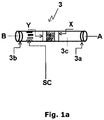
- Figure 1a shows a schematic representation of the container 3, in cylindrical form, on the surface of which there is indicated a color scale SC, useful for determining the value of the alcohol present in the air sample and corresponding to the color taken on by the composition of the invention.
- the container comprises the composition of the invention inserted inside two filters x and y.
- Said container 3 generally comprises connection means disposed at the two end sides to make said connection.
- said means are snap-fit or screw-type means.
- the container 3 contains the composition of the invention in an inert gas atmosphere.
- the container is filled with the composition, and then an inert gas, preferably nitrogen or argon, is blown in.
- an inert gas preferably nitrogen or argon
- the cartridge can be stored in a closed form, i.e. by closing off its ends, for example, with plastic caps A and B.
- the invention relates to a device capable of detecting the presence of ethyl alcohol vapors in an air sample (ethylometer) which comprises the above-described container 3, to whose first end 3a and second end 3b the mouthpiece 2 and the bag 4 are respectively connected, as illustrated, for example, in figure 1b .
- the mouthpiece 2 generally cylindrical in shape, is preferably made of an antibacterial polymeric material. It is configured in such a way as to be able to be connected to the container 3 directly or also by means of interposed fluid connection means. During use, the mouthpiece conveys the air exhaled by the individual into the vial, so that the air is in contact with the composition of the invention, which will change color according to the percentage of any alcohol vapors present in the exhaled air.
- the second end 3b of the vial is connected to a bag 4, typically based on a plastic material commonly used, for example, in the realm of healthcare.
- a bag typically based on a plastic material commonly used, for example, in the realm of healthcare.
- said bag has a volume of about 1-1.2 liters, even more preferably about 1 liter.
- the present device when the exhaled air is placed in contact with the present composition inside the vial (by means of the mouthpiece) and subsequently collected (in the bag) after passing through the composition itself, if ethanol vapors are present a change in the color of the composition will be observed, depending on the amount of ethanol present in the air.
- the color scale in fact shows a series of intermediate colors that go gradually from white (i.e. absence of ethanol) to dark violet (i.e. presence of a percentage of alcohol of about 2%), which are associated with the corresponding alcohol concentrations detected by the composition.
- said color scale SC is positioned on the outer surface of the container 3c, for example as an adhesive label, or also printed directly onto the outer surface of the container itself.
- said scale can also be pre-printed on another support (for example cardboard or plastic), and used after the individual has blown into the mouthpiece in order to identify the percentage of alcohol associated with the color taken on by the composition inside the transparent vial.
- the ethylometer 1 of the invention can be conveniently assembled in a 5 -part kit which comprises: the container 3, preferably in the form of a vial, as described above in detail, a mouthpiece 2 and a bag 4, and optionally a support made, for example, of cardboard or plastic, on which the color shades from white to dark violet, associated with corresponding values of alcohol content, are printed.
- Said kit 5 can contain the three components 2,3,4 in three separate compartments, in partial combination with each other (for example container and mouthpiece or container and bag) or also, preferably, in a single one.
- Example 1 use of the composition in the detection of ethyl alcohol vapors
- Air samples comprising respectively an amount of alcohol vapors equal to: 0.1, 0.5, 0.8, 1.0, 1.2 and 1.5 g/l are placed in contact with a composition of the invention comprising:
- composition initially white, takes on a pink-violet color, indicative of the presence of alcohol vapors.
- This color is also checked at intervals of approximately 30 minutes following the color change and significant persistence of color may be noted throughout the next 3 hours.
- a silica/KIO 4 mixture is prepared by weighing 100 g of sieved silica gel with a suitable particle size and adding 5g of KIO 4 , followed by stirring.
- a mixture with 20g of H 2 SO 4 and 7 g of KNO 3 is prepared separately.
Landscapes
- Health & Medical Sciences (AREA)
- Life Sciences & Earth Sciences (AREA)
- Chemical & Material Sciences (AREA)
- Engineering & Computer Science (AREA)
- Immunology (AREA)
- Physics & Mathematics (AREA)
- Molecular Biology (AREA)
- Biomedical Technology (AREA)
- Hematology (AREA)
- Analytical Chemistry (AREA)
- General Health & Medical Sciences (AREA)
- Pathology (AREA)
- Biochemistry (AREA)
- General Physics & Mathematics (AREA)
- Urology & Nephrology (AREA)
- Medicinal Chemistry (AREA)
- Food Science & Technology (AREA)
- Biophysics (AREA)
- Biotechnology (AREA)
- Microbiology (AREA)
- Cell Biology (AREA)
- Combustion & Propulsion (AREA)
- Dispersion Chemistry (AREA)
- Chemical Kinetics & Catalysis (AREA)
- Plasma & Fusion (AREA)
- Investigating Or Analyzing Non-Biological Materials By The Use Of Chemical Means (AREA)
- Investigating Or Analysing Biological Materials (AREA)
- Investigating Or Analyzing Materials By The Use Of Fluid Adsorption Or Reactions (AREA)
- Investigating Or Analyzing Materials By The Use Of Electric Means (AREA)
- Sampling And Sample Adjustment (AREA)
- Investigating Or Analysing Materials By The Use Of Chemical Reactions (AREA)
Description
- The present invention relates to a silica gel-based composition capable of changing color when placed in contact with alcohol vapors, usable, for example, for the detection of ethyl alcohol vapors in a sample of air exhaled by a human being.
- An ethylometer is a device for measuring the ethyl alcohol content in the blood, broadly used by law enforcement agencies, above all to check motorists suspected to be in a state of inebriation. This device can comprise a chemical composition capable of changing color in the presence of alcohol vapors. By checking the exhaled breath, in fact, it is possible to understand if an individual has ingested beverages containing ethanol, and whether the intake is higher or lower than the safety values established by the highway code. The operating principle of an ethylometer is based on the fact that, after being ingested, alcohol is rapidly absorbed by the stomach and intestine and is mostly metabolized in the body. A small part, however, is eliminated through urine, sweat and breath. The latter part is what is in practice detected during an alcohol test by means of the composition contained in the ethylometer. Among the common commercially available ethylometers, there exist some of them comprising compositions based on chromium salts, typically dichromate, and/or iodine salts capable of changing color if placed in contact with alcohol vapors.
- Patent ITPG20040047, for example, describes in general terms an alcohol testing device which exploits the chromatic properties of a composition comprising an iodine salt, a catalyst in the form of nitrate ions and phosphoric acid- and sulphuric acid-impregnated silica. This mixture, however, requires a laborious and costly process of preparation, which also includes a step of boiling the silica in sulphuric acid. A related alcohol vapor test device is known from
GB1516295 A - Moreover, the biggest problem of the compositions generally used in ethylometers is the fact that they are not capable of a long maintaining of the color appearing after the test was performed, and which is indicative of the positive test result. Moreover, the testing rate and the sensitivity to alcohol vapors are often low, so that they are not recommended for a practical and reproducible use.
- There thus remains a need to find a composition that is useful for the detection of alcohol vapors in air samples, and which enables the color to be maintained substantially unchanged also for a long time, at the same time ensuring high sensitivity, and rapid response rate.
- The present invention relates, in a first aspect, to a composition for the detection of alcohol vapors in an air sample, said composition comprising:
- at least one hepta- or pentavalent iodine salt,
- sulphuric acid,
- 2.5-10% by weight of nitrate ions,
- and 75-91% by weight of silica gel.
- The composition of the present invention is defined in
claim 1. - In a further aspect, the invention relates to a process for preparing the composition, said process comprising the dry mixing of the silica with a penta- or hepta-valent iodine salt, followed by the contact with a solution of the nitrate salt in sulphuric acid.
- An additional aspect is the use of the present composition for detecting the presence of alcohol vapors, preferably ethyl alcohol vapors (CH3CH2-OH), in air samples, for example samples of air exhaled by human beings or air samples drawn from closed environments.
- Alcohol vapors can be detected for an alcohol content expressed by ethanol which ranges from 0.01, or even less, to about 2 g/L.
- In another aspect, the invention relates to a method for the detection of alcohol vapors in the air which comprises placing the present composition in contact with an air sample, and observing the color change, if any.
- Finally, additional aspects of the invention are: a container comprising the present composition, preferably in the form of a vial; and
a device for carrying out the above-described method, preferably in the form of an ethylometer. -
-
Figure 1a schematically represents acontainer 3 in the form of a cylindrical vial, upon whose outer surface there is a color scale for measuring the corresponding alcohol content. -
Figure 1b schematically represents adevice 1 for the detection of ethyl alcohol vapors (ethylometer) according to the present invention. - Unless otherwise specified, the percentages by weight of the components are understood as amounts of the component considered, relative to the total weight of the mixture. The term "alkali" or "alkaline earth" metal means a metal of the first or second group of the periodic table, e.g. potassium, sodium, magnesium, calcium and the like.
- The term "penta-" or "hepta-" valent iodine is intended to indicate, respectively, iodine having an atomic number of 5+ or 7+. Therefore, the compounds comprising said ions, according to the present invention, are understood as salts of the iodate (IO3 -) and periodate (IO4 -) ions, as described below in detail.
- The composition of the invention is capable of changing color if placed in contact with an air sample containing alcohol vapors, turning from an initially whitish color into a pink-violet color. Practically speaking, in a normal condition (i.e. in the absence of alcohol vapors) the composition has a whitish color, due to the presence of silica gel as the main component. In the presence of alcohol vapors, on the other hand, the composition takes on a pink-violet color, caused by an oxidation-reduction process between the iodine and ethyl alcohol. When the composition is in contact with alcohol vapors, for example present in a sample of air exhaled by a person, or an air sample from an industrial environment, the iodine having an oxidation number of +5 or +7, is reduced to elementary iodine I2 (i.e. with an oxidation number equal to 0), imparting a characteristic violet-pink color to the composition. In the absence of such alcohol vapors, the iodine is not reduced and the composition maintains its whitish color. The intensity of the color is directly proportional to the amount of alcohol vapors actually present in the analyzed air.
- Thanks to its chromatic properties, the composition can be conveniently used, for example, to carry out so-called "alcohol tests", generally used by the police and law enforcement agents to determine the percentages of ethyl alcohol present in the blood of a driver. By the contact with a sample of air exhaled by a driver in a state of inebriation, the pink-violet color taken on by the present composition can be indicative of the presence of a certain quantity of alcohol in the individual's breath and hence blood.
- As mentioned above, the composition contains silica, sulphuric acid and penta- or hepta-valent iodine salts and it is characterized in that it contains a specific amount of nitrate ions, intended as NO3 - ions, typically present as nitrate salts.
- In addition to the amount of nitrate ions, the present composition for the detection of alcohol vapors in the air is further characterized in that it does not contain phosphoric acid or chromium salts, unlike similar compositions used in the art for this purpose.
- Therefore, in one embodiment, the invention relates to a composition, understood as being free of phosphoric acid and/or chromium salts, which consists in:
- at least one salt comprising hepta- or penta-valent iodine,
- silica gel,
- sulphuric acid, and
- nitrate ions in a concentration comprised between 2.5 and 10% by weight.
- The composition preferably comprises hepta- or penta-valent iodine salts of the iodate (IO3 -) or periodate (IO4 -) type of alkali or alkaline earth metals, preferably selected from: potassium, sodium and cesium.
- In a preferred embodiment, the composition comprises iodate salts of alkali or alkaline earth metals, even more preferably selected from among: potassium iodate (KIO3), sodium iodate (NaIO3) and cesium iodate (CsIO3), KIO3 being particularly preferred.
- The hepta- or penta-valent iodine salts can be used in amounts by weight comprised between 1 and 10%, preferably comprised between 1.5 and 7%.
- The silica (or silica gel) is the one commonly used in chemistry, having the general formula SiO2 and readily available in the market at a low cost. As may be inferred from the present description, in the composition of the invention the silica used as a substrate material is non-impregnated silica, unlike the silica used in the prior art, which is usually pre-treated with an acid boiling treatment. In other words, the silica of the present composition does not undergo any pre-treatment with acidic or alkaline substances. This has numerous implications and practical advantages, including that of avoiding costly and potentially dangerous steps of impregnation with acids, and above all that of being able to use an not-impregnated substrate (silica) which is thus capable of absorbing and rendering visible even small percentages of red iodide vapors, eventually appearing upon contact with alcohol vapors.
- The composition of the present invention is in fact endowed with a high sensitivity, being capable of detecting percentages of alcohol vapors that are even lower than 0.5 g/l, indeed even lower than 0.2 g/l, for example 0.1 g/l. Different particle sizes of silica can be used, for example comprised between 0.4 and 2, generally in amounts by weight comprised between 75 and 91% depending, for example, on the type of device intended to be developed to carry out the alcohol test.
- The sulphuric acid (H2SO4) present in the composition of the invention is generally concentrated sulphuric acid, i.e. having a concentration comprised between 95 and 98%, or even oleum, i.e. the so-called "fuming" sulphuric acid, obtainable, for example, by mixing sulphur trioxide and sulphuric acid. Preferably, 98% concentrated sulphuric acid is used. Besides sulphuric acid, the present composition does not contain any additional acids, such as, for example, phosphoric acid, as occurs in the prior art.
- As regards the nitrate ions, these can be present both as salts with an alkali or alkaline earth metal, or also as an ammonium salt. Preferably, the composition comprises: ammonium nitrate (NH4NO3), or potassium, sodium or cerium nitrate, potassium or cerium nitrate being particularly preferred.
- The selected salt is used in an amount preferably comprised between 4% and 10%, even more preferably comprised between 5% and 7%. Larger percentages would lead to a saturation of the solution with nitrate ions, which would inhibit the reaction, since they would re-crystallize, going to form crystals on the surface of the silica gel grains and thereby creating a barrier to the alcohol vapors, which would not be detected.
- Surprisingly, the present composition makes it possible not only to obtain excellent results in terms of sensitivity to alcohol vapors, but also to maintain the color after contact with said vapors, even for a long time. In this regard it should be noted that the present composition is in fact capable of maintaining the color taken on at the end of the test even for 2 or 3 days. This is particularly advantageous above all when the composition is used in a device to measure the concentration of ethyl alcohol in a breath sample, and hence in the blood of a vehicle driver. As a result, the test can be used as evidence in any situations in which a decision must be made a posteriori. This property of long duration of the color is probably due to the fact that since the silica is used in a not impregnated form, it is capable of trapping and holding the iodide ions that are formed by the reduction of the penta- or heptavalent iodine ions upon contact with the alcohol vapors.
- Furthermore, the present composition is capable of showing the pink-violet color in a very short time, even instantly upon contact with the air to be analyzed. This latter property is likewise attributable to the fact that the silica used is silica that is not treated, but rather dry functionalized. Thanks to this, in fact, the oxidation-reduction reaction between iodine and ethyl alcohol occurs on the surface of the grains and not inside the pores in case created by an acid pre-treatment, unlike in prior art devices, which can require times of response sometimes even longer than one minute.
- Therefore, an additional aspect of the invention is the use of the present composition for detecting the presence of alcohol vapors, preferably ethanol or ethyl alcohol (CH3CH2-OH) vapors, in air samples. The latter can be samples of air exhaled by human beings or drawn from closed environments, such as laboratories or rooms, as well as reactors, silos and the like.
- The present invention also relates to a process for preparing the above-described composition, said process comprising the steps of:
- a) dry mixing the non-impregnated silica with a penta- or hepta-valent iodine salt, and
- b) placing the mixture thus obtained in contact with a solution of a nitrate salt in concentrated sulphuric acid.
- The mixing step a) can take place with the use of known machinery or devices for dry mixing two solid components, such as, for example, mills, mixers, homogenizers, blade stirrers and the like.
- The iodine salts are periodate or, preferably, alkali or alkaline earth metal iodate salts as defined above in detail, sodium and potassium salts being particularly preferred.
- The mixing of the two components takes place in a short time, i.e. comprised between a few minutes and about an hour, typically depending on the amount of material to be mixed and the type of machinery used. In general, however, it does not take longer than 1.5-2 hours to carry out step a) .
- After the preparation of the silica-iodine salt mixture, the latter is placed in contact, according to step b), with a solution of concentrated sulphuric acid or sulphuric acid in the form of oleum in which nitrate salt has been dissolved, in accordance with the preceding embodiments. In this regard, the acidic solution that is obtained has a nitrate ion concentration preferably comprised between 4 and 10 % relative to the weight of the silica. The contact between the solid mixture and the acidic solution preferably occurs by diffusion at ambient temperature (i.e. comprised between around 5 and 40° C) or also at higher temperatures, i.e. up to around 70° C, for a time which can range from a few minutes to a few hours, for example between 5 and 60 minutes.
- At the end of step b) the composition is completely dried, generally using methods known to the person skilled in the art, and can be conveniently stocked and/or stored, preferably in moisture-tight containers. The composition can also be advantageously packed directly in ready-to-use containers, for example in the form of vials or the like. As may also be inferred from the experimental part herein included, the preparation of the mixture takes place in an extremely simple and highly reproducible manner, without envisaging any step of impregnation of the silica, or any acid pre-contact. This makes it possible on the one hand to increase the safety of the entire process, and on the other hand to considerably optimize the times of preparing the final product.
- A further aspect of the invention is a method for the detection of alcohol vapors in the air which comprises placing the present composition in contact with an air sample and observing whether there is any color change. The present method can be conveniently used to analyze samples of air exhaled by a human being or air samples drawn from closed environments or rooms in which one wishes to detect, for example for safety reasons, the presence of alcohol vapors. When the present method is used to carry out an alcohol test on a human being, the composition is used as the main component of devices such as ethylometers or the like, whereas in the latter case, the composition of the invention can be included in special containers of various sizes, and with characteristics depending, for example, on the type of room or the amount of composition one wishes to use. Examples of such closed environments or rooms are laboratories in general, or also reactors or industrial silos, whereby it is often necessary to check the formation of toxic or potentially dangerous gases.
- An additional aspect of the invention is a device for carrying out an
alcohol test 1, comprising acontainer 3 containing the present composition, connected to amouthpiece 2 and abag 4. - The
container 3, is preferably in the form of a cylindrical vial and is made with a transparent polymeric material such as polycarbonate, unexpanded polystyrene, polystyrene or glass. In one embodiment, the container is rendered antibacterial, or even biodegradable, using specific masterbatches known in the art for such purposes. - The
container 3 is configured in such a way as to be able to be connected by means of afirst end 3a and asecond end 3b respectively to amouthpiece 2 and to abag 4, thereby forming the device for measuring alcohol content (ethylometer), as illustrated, for example, infigure 1b . In this manner themouthpiece 2 is in fluid communication with the inside of the container, and thecontainer 3 is in turn in communication with thebag 4. -
Figure 1a shows a schematic representation of thecontainer 3, in cylindrical form, on the surface of which there is indicated a color scale SC, useful for determining the value of the alcohol present in the air sample and corresponding to the color taken on by the composition of the invention. Typically, the container comprises the composition of the invention inserted inside two filters x and y. - Said
container 3 generally comprises connection means disposed at the two end sides to make said connection. In a preferred embodiment, said means are snap-fit or screw-type means. - In a preferred embodiment, the
container 3 contains the composition of the invention in an inert gas atmosphere. Practically speaking, the container is filled with the composition, and then an inert gas, preferably nitrogen or argon, is blown in. In this manner, the composition will show improved stability over time, thus assuring a longer storage life. As indicated infigure 1a , typically in order to better preserve the inert environment, the cartridge can be stored in a closed form, i.e. by closing off its ends, for example, with plastic caps A and B. - In this regard, therefore, the invention relates to a device capable of detecting the presence of ethyl alcohol vapors in an air sample (ethylometer) which comprises the above-described
container 3, to whosefirst end 3a andsecond end 3b themouthpiece 2 and thebag 4 are respectively connected, as illustrated, for example, infigure 1b . - The
mouthpiece 2, generally cylindrical in shape, is preferably made of an antibacterial polymeric material. It is configured in such a way as to be able to be connected to thecontainer 3 directly or also by means of interposed fluid connection means. During use, the mouthpiece conveys the air exhaled by the individual into the vial, so that the air is in contact with the composition of the invention, which will change color according to the percentage of any alcohol vapors present in the exhaled air. - As mentioned above, the
second end 3b of the vial is connected to abag 4, typically based on a plastic material commonly used, for example, in the realm of healthcare. Preferably, said bag has a volume of about 1-1.2 liters, even more preferably about 1 liter. - Using the
present device 1, when the exhaled air is placed in contact with the present composition inside the vial (by means of the mouthpiece) and subsequently collected (in the bag) after passing through the composition itself, if ethanol vapors are present a change in the color of the composition will be observed, depending on the amount of ethanol present in the air. - In this regard, by comparing it with a color scale SC, which goes from white to dark violet, it will be possible to determine the percentage of alcohol content detected. The color scale in fact shows a series of intermediate colors that go gradually from white (i.e. absence of ethanol) to dark violet (i.e. presence of a percentage of alcohol of about 2%), which are associated with the corresponding alcohol concentrations detected by the composition.
- In a preferred embodiment, and as indicated, for example, in
figure 1a , said color scale SC is positioned on the outer surface of thecontainer 3c, for example as an adhesive label, or also printed directly onto the outer surface of the container itself. Alternatively, or in addition, said scale can also be pre-printed on another support (for example cardboard or plastic), and used after the individual has blown into the mouthpiece in order to identify the percentage of alcohol associated with the color taken on by the composition inside the transparent vial. - Furthermore, the
ethylometer 1 of the invention can be conveniently assembled in a 5-part kit which comprises: thecontainer 3, preferably in the form of a vial, as described above in detail, amouthpiece 2 and abag 4, and optionally a support made, for example, of cardboard or plastic, on which the color shades from white to dark violet, associated with corresponding values of alcohol content, are printed. - Said kit 5 can contain the three
components - The present invention will now be described with examples that are not intended in any way to limit the scope hereof.
- Air samples comprising respectively an amount of alcohol vapors equal to: 0.1, 0.5, 0.8, 1.0, 1.2 and 1.5 g/l are placed in contact with a composition of the invention comprising:
- 5% potassium iodate,
- 4% potassium nitrate
- 91% silica gel, with a particle size of 0.4-0.7,
- In the space of a few seconds the composition, initially white, takes on a pink-violet color, indicative of the presence of alcohol vapors.
- This color is also checked at intervals of approximately 30 minutes following the color change and significant persistence of color may be noted throughout the next 3 hours.
- A silica/KIO4 mixture is prepared by weighing 100 g of sieved silica gel with a suitable particle size and adding 5g of KIO4, followed by stirring.
- A mixture with 20g of H2SO4 and 7 g of KNO3 is prepared separately.
- The latter mixture is added to the above-described silica/KIO4 mixture, and then follows another 10 minutes of stirring.
Claims (15)
- A composition for the detection of alcohol vapors in an air sample, said composition comprising:at least one hepta- or penta-valent iodine salt,sulphuric acid,2.5-10% by weight of nitrate ions,and 75-91% by weight of silica gel.
- The composition according to claim 1, wherein said hepta- or penta-valent iodine salt is an iodate or periodate salt of an alkali or alkaline earth metal.
- The composition according to claim 2, wherein said metal is selected from among: potassium, sodium and cesium.
- The composition according to any one of the preceding claims, wherein the nitrate ions are present in an amount comprised between 5% and 10%, preferably comprised between 5% and 7%.
- The composition according to any one of the preceding claims, wherein the nitrate ions are present as a nitrate salt of an alkali or alkaline earth metal or of ammonium.
- The composition according to claim 5, wherein said nitrate salt is selected from among: potassium nitrate, ammonium nitrate and cerium nitrate, potassium nitrate being preferred.
- A process for the preparation of the composition according to the preceding claims, which comprises dry mixing the silica with a penta- or hepta-valent iodine salt, followed by contact of the mixture obtained with a solution of a nitrate salt in sulphuric acid.
- A use of the composition as defined in any one of claims 1-6, for detecting the presence of alcohol vapors in an air sample.
- The use according to claim 8, for the detection of ethyl alcohol vapors in a sample of air exhaled by a human being.
- A method for the detection of alcohol vapors, preferably ethanolic, in air, which comprises placing the composition as defined in claims 1-6 in contact with an air sample and observing the color change, if any, of the composition.
- A container (3) comprising the composition according to claims 1-6, preferably in the form of a vial.
- The container according to claim 11, made with a biodegradable and/or antibacterial material.
- The container (3) according to claims 11-12, wherein said composition is present in an atmosphere of inert gas, preferably nitrogen or argon.
- A device (1) for the detection of ethyl alcohol vapors in an air sample, comprising the container (3) according to claims 11-13, connected by means of a first end (3a) and a second end (3b) respectively to a mouthpiece (2) and to a bag (4).
- A kit of parts for preparing the device (1) according to claim 14, comprising the container (3) according to claims 11-13, the mouthpiece (2) and the bag (4).
Priority Applications (1)
| Application Number | Priority Date | Filing Date | Title |
|---|---|---|---|
| PL13730944T PL2984481T3 (en) | 2013-04-08 | 2013-04-08 | COMPOSITION FOR DETECTING ALCOHOL VAPORS IN AN AIR SAMPLE |
Applications Claiming Priority (1)
| Application Number | Priority Date | Filing Date | Title |
|---|---|---|---|
| PCT/IT2013/000100 WO2014167586A1 (en) | 2013-04-08 | 2013-04-08 | Composition for the detection of alcohol vapors in an air sample |
Publications (2)
| Publication Number | Publication Date |
|---|---|
| EP2984481A1 EP2984481A1 (en) | 2016-02-17 |
| EP2984481B1 true EP2984481B1 (en) | 2021-11-03 |
Family
ID=48672770
Family Applications (1)
| Application Number | Title | Priority Date | Filing Date |
|---|---|---|---|
| EP13730944.9A Active EP2984481B1 (en) | 2013-04-08 | 2013-04-08 | Composition for the detection of alcohol vapors in an air sample |
Country Status (6)
| Country | Link |
|---|---|
| US (1) | US9410941B2 (en) |
| EP (1) | EP2984481B1 (en) |
| BR (1) | BR112015025555B1 (en) |
| ES (1) | ES2900756T3 (en) |
| PL (1) | PL2984481T3 (en) |
| WO (1) | WO2014167586A1 (en) |
Families Citing this family (1)
| Publication number | Priority date | Publication date | Assignee | Title |
|---|---|---|---|---|
| JP7453171B2 (en) * | 2021-03-09 | 2024-03-19 | 日本電子株式会社 | Solid phase mixtures, packings and columns |
Family Cites Families (8)
| Publication number | Priority date | Publication date | Assignee | Title |
|---|---|---|---|---|
| GB1168529A (en) | 1967-11-07 | 1969-10-29 | Luckey Lab Inc | Improvements in and relating to Breath Alcohol Determination |
| CH613777A5 (en) * | 1976-05-06 | 1979-10-15 | Etzlinger Lucien | |
| US4492673A (en) * | 1983-09-02 | 1985-01-08 | Sobryco, Inc. | Disposable sobriety tester |
| US4789638A (en) * | 1987-05-06 | 1988-12-06 | Kramer David N | Process and apparatus for the detection of hydrazine and hydrazine derivatives |
| US6479019B1 (en) * | 1999-04-15 | 2002-11-12 | Quantum Group, Inc. | Sensor and sensor assembly for detecting a target gas in a breath sample |
| US20070258894A1 (en) * | 2000-11-08 | 2007-11-08 | Melker Richard J | System and Method for Real-Time Diagnosis, Treatment, and Therapeutic Drug Monitoring |
| ITPG20040047A1 (en) | 2004-10-27 | 2005-01-27 | Pietro Caimmi | ALCOHOL TEST DISPOSABLE |
| US20110098590A1 (en) * | 2009-10-26 | 2011-04-28 | Pulse Health Llc | Methods and apparatuses for detecting analytes |
-
2013
- 2013-04-08 WO PCT/IT2013/000100 patent/WO2014167586A1/en not_active Ceased
- 2013-04-08 US US14/782,680 patent/US9410941B2/en active Active
- 2013-04-08 PL PL13730944T patent/PL2984481T3/en unknown
- 2013-04-08 BR BR112015025555-8A patent/BR112015025555B1/en active IP Right Grant
- 2013-04-08 EP EP13730944.9A patent/EP2984481B1/en active Active
- 2013-04-08 ES ES13730944T patent/ES2900756T3/en active Active
Non-Patent Citations (1)
| Title |
|---|
| None * |
Also Published As
| Publication number | Publication date |
|---|---|
| BR112015025555B1 (en) | 2020-11-17 |
| EP2984481A1 (en) | 2016-02-17 |
| BR112015025555A2 (en) | 2017-07-18 |
| ES2900756T3 (en) | 2022-03-18 |
| US9410941B2 (en) | 2016-08-09 |
| US20160041147A1 (en) | 2016-02-11 |
| WO2014167586A1 (en) | 2014-10-16 |
| PL2984481T3 (en) | 2022-03-14 |
Similar Documents
| Publication | Publication Date | Title |
|---|---|---|
| CN107037044A (en) | Chemical sensing hydrogel for biogenic amine detection | |
| CN106290181A (en) | A kind of iodine in serum quantitative determination reagent kit | |
| CN102621137B (en) | Detection reagent for fast detecting cyanide in water and preparation method of detection reagent | |
| US3223488A (en) | Device for alcohol determination | |
| US9410941B2 (en) | Composition for the detection of alcohol vapors in an air sample | |
| KR20160062504A (en) | Method of making hydrogel bead for detecting of HF and the kit comprising the same | |
| CN110672536A (en) | Detection reagent and detection method for nitrate in sewage | |
| EP3368894B1 (en) | Storage stable standards for aqueous chlorine analysis | |
| US2963351A (en) | Determination of nitrogen dioxide | |
| Amin | Solid-phase spectrophotometric determination of trace amounts of vanadium using 2, 3-dichloro-6 (3-carboxy-2-hydroxynaphthylazo) quinoxaline | |
| US4105409A (en) | Method and reagent for determining the ethyl alcohol content of a gas | |
| JP4223981B2 (en) | Formaldehyde detection material and manufacturing method thereof | |
| US2942952A (en) | Determination of gaseous chlorine and bromine | |
| US2736638A (en) | Detection of sulfur dioxide | |
| JP2004522950A (en) | Desiccant for indicator of silica substrate | |
| Haslam et al. | The detection of “additional elements” in plastic materials by the oxygen flask combustion method | |
| US4466942A (en) | Gaseous contaminant dosimeter | |
| KR820000162B1 (en) | Method and reagent for determining the ethly alcohol content of a gas | |
| US3455655A (en) | Detection of missile fuels in gas atmosphere | |
| CN109632677B (en) | Absorbent for spectrophotometry determination and preparation method thereof | |
| WO2004081561A1 (en) | Method for detection mustard | |
| Christova-Bagdassarian et al. | Spectrophotometric determination of sodium azide in workplace air | |
| Pitschmann et al. | Detector tube with picric acid used to detect irritating CN and CS agents in the air | |
| WO2016025714A1 (en) | Chloropicrin sensor | |
| SU1673959A1 (en) | Indicator compound for determining hydrogen chloride and chlorine in air |
Legal Events
| Date | Code | Title | Description |
|---|---|---|---|
| PUAI | Public reference made under article 153(3) epc to a published international application that has entered the european phase |
Free format text: ORIGINAL CODE: 0009012 |
|
| 17P | Request for examination filed |
Effective date: 20150626 |
|
| AK | Designated contracting states |
Kind code of ref document: A1 Designated state(s): AL AT BE BG CH CY CZ DE DK EE ES FI FR GB GR HR HU IE IS IT LI LT LU LV MC MK MT NL NO PL PT RO RS SE SI SK SM TR |
|
| AX | Request for extension of the european patent |
Extension state: BA ME |
|
| DAX | Request for extension of the european patent (deleted) | ||
| STAA | Information on the status of an ep patent application or granted ep patent |
Free format text: STATUS: EXAMINATION IS IN PROGRESS |
|
| 17Q | First examination report despatched |
Effective date: 20171129 |
|
| REG | Reference to a national code |
Ref country code: DE Ref legal event code: R079 Ref document number: 602013079885 Country of ref document: DE Free format text: PREVIOUS MAIN CLASS: G01N0031220000 Ipc: A61B0005000000 |
|
| RIC1 | Information provided on ipc code assigned before grant |
Ipc: A61B 5/097 20060101ALI20210128BHEP Ipc: G01N 33/497 20060101ALI20210128BHEP Ipc: G01N 31/22 20060101ALI20210128BHEP Ipc: A61B 5/00 20060101AFI20210128BHEP Ipc: G01N 33/98 20060101ALI20210128BHEP Ipc: A61B 5/08 20060101ALI20210128BHEP Ipc: A61K 31/205 20060101ALI20210128BHEP Ipc: G01N 33/52 20060101ALI20210128BHEP Ipc: G01N 33/00 20060101ALI20210128BHEP |
|
| GRAP | Despatch of communication of intention to grant a patent |
Free format text: ORIGINAL CODE: EPIDOSNIGR1 |
|
| STAA | Information on the status of an ep patent application or granted ep patent |
Free format text: STATUS: GRANT OF PATENT IS INTENDED |
|
| INTG | Intention to grant announced |
Effective date: 20210310 |
|
| GRAJ | Information related to disapproval of communication of intention to grant by the applicant or resumption of examination proceedings by the epo deleted |
Free format text: ORIGINAL CODE: EPIDOSDIGR1 |
|
| STAA | Information on the status of an ep patent application or granted ep patent |
Free format text: STATUS: EXAMINATION IS IN PROGRESS |
|
| INTC | Intention to grant announced (deleted) | ||
| GRAP | Despatch of communication of intention to grant a patent |
Free format text: ORIGINAL CODE: EPIDOSNIGR1 |
|
| STAA | Information on the status of an ep patent application or granted ep patent |
Free format text: STATUS: GRANT OF PATENT IS INTENDED |
|
| INTG | Intention to grant announced |
Effective date: 20210617 |
|
| GRAS | Grant fee paid |
Free format text: ORIGINAL CODE: EPIDOSNIGR3 |
|
| GRAA | (expected) grant |
Free format text: ORIGINAL CODE: 0009210 |
|
| STAA | Information on the status of an ep patent application or granted ep patent |
Free format text: STATUS: THE PATENT HAS BEEN GRANTED |
|
| AK | Designated contracting states |
Kind code of ref document: B1 Designated state(s): AL AT BE BG CH CY CZ DE DK EE ES FI FR GB GR HR HU IE IS IT LI LT LU LV MC MK MT NL NO PL PT RO RS SE SI SK SM TR |
|
| REG | Reference to a national code |
Ref country code: GB Ref legal event code: FG4D |
|
| REG | Reference to a national code |
Ref country code: AT Ref legal event code: REF Ref document number: 1443243 Country of ref document: AT Kind code of ref document: T Effective date: 20211115 Ref country code: CH Ref legal event code: EP |
|
| REG | Reference to a national code |
Ref country code: IE Ref legal event code: FG4D |
|
| REG | Reference to a national code |
Ref country code: DE Ref legal event code: R096 Ref document number: 602013079885 Country of ref document: DE |
|
| REG | Reference to a national code |
Ref country code: LT Ref legal event code: MG9D |
|
| REG | Reference to a national code |
Ref country code: NL Ref legal event code: MP Effective date: 20211103 |
|
| REG | Reference to a national code |
Ref country code: AT Ref legal event code: MK05 Ref document number: 1443243 Country of ref document: AT Kind code of ref document: T Effective date: 20211103 |
|
| REG | Reference to a national code |
Ref country code: ES Ref legal event code: FG2A Ref document number: 2900756 Country of ref document: ES Kind code of ref document: T3 Effective date: 20220318 |
|
| PG25 | Lapsed in a contracting state [announced via postgrant information from national office to epo] |
Ref country code: RS Free format text: LAPSE BECAUSE OF FAILURE TO SUBMIT A TRANSLATION OF THE DESCRIPTION OR TO PAY THE FEE WITHIN THE PRESCRIBED TIME-LIMIT Effective date: 20211103 Ref country code: LT Free format text: LAPSE BECAUSE OF FAILURE TO SUBMIT A TRANSLATION OF THE DESCRIPTION OR TO PAY THE FEE WITHIN THE PRESCRIBED TIME-LIMIT Effective date: 20211103 Ref country code: FI Free format text: LAPSE BECAUSE OF FAILURE TO SUBMIT A TRANSLATION OF THE DESCRIPTION OR TO PAY THE FEE WITHIN THE PRESCRIBED TIME-LIMIT Effective date: 20211103 Ref country code: BG Free format text: LAPSE BECAUSE OF FAILURE TO SUBMIT A TRANSLATION OF THE DESCRIPTION OR TO PAY THE FEE WITHIN THE PRESCRIBED TIME-LIMIT Effective date: 20220203 Ref country code: AT Free format text: LAPSE BECAUSE OF FAILURE TO SUBMIT A TRANSLATION OF THE DESCRIPTION OR TO PAY THE FEE WITHIN THE PRESCRIBED TIME-LIMIT Effective date: 20211103 |
|
| PG25 | Lapsed in a contracting state [announced via postgrant information from national office to epo] |
Ref country code: IS Free format text: LAPSE BECAUSE OF FAILURE TO SUBMIT A TRANSLATION OF THE DESCRIPTION OR TO PAY THE FEE WITHIN THE PRESCRIBED TIME-LIMIT Effective date: 20220303 Ref country code: SE Free format text: LAPSE BECAUSE OF FAILURE TO SUBMIT A TRANSLATION OF THE DESCRIPTION OR TO PAY THE FEE WITHIN THE PRESCRIBED TIME-LIMIT Effective date: 20211103 Ref country code: PT Free format text: LAPSE BECAUSE OF FAILURE TO SUBMIT A TRANSLATION OF THE DESCRIPTION OR TO PAY THE FEE WITHIN THE PRESCRIBED TIME-LIMIT Effective date: 20220303 Ref country code: NO Free format text: LAPSE BECAUSE OF FAILURE TO SUBMIT A TRANSLATION OF THE DESCRIPTION OR TO PAY THE FEE WITHIN THE PRESCRIBED TIME-LIMIT Effective date: 20220203 Ref country code: NL Free format text: LAPSE BECAUSE OF FAILURE TO SUBMIT A TRANSLATION OF THE DESCRIPTION OR TO PAY THE FEE WITHIN THE PRESCRIBED TIME-LIMIT Effective date: 20211103 Ref country code: LV Free format text: LAPSE BECAUSE OF FAILURE TO SUBMIT A TRANSLATION OF THE DESCRIPTION OR TO PAY THE FEE WITHIN THE PRESCRIBED TIME-LIMIT Effective date: 20211103 Ref country code: HR Free format text: LAPSE BECAUSE OF FAILURE TO SUBMIT A TRANSLATION OF THE DESCRIPTION OR TO PAY THE FEE WITHIN THE PRESCRIBED TIME-LIMIT Effective date: 20211103 Ref country code: GR Free format text: LAPSE BECAUSE OF FAILURE TO SUBMIT A TRANSLATION OF THE DESCRIPTION OR TO PAY THE FEE WITHIN THE PRESCRIBED TIME-LIMIT Effective date: 20220204 |
|
| PG25 | Lapsed in a contracting state [announced via postgrant information from national office to epo] |
Ref country code: SM Free format text: LAPSE BECAUSE OF FAILURE TO SUBMIT A TRANSLATION OF THE DESCRIPTION OR TO PAY THE FEE WITHIN THE PRESCRIBED TIME-LIMIT Effective date: 20211103 Ref country code: SK Free format text: LAPSE BECAUSE OF FAILURE TO SUBMIT A TRANSLATION OF THE DESCRIPTION OR TO PAY THE FEE WITHIN THE PRESCRIBED TIME-LIMIT Effective date: 20211103 Ref country code: RO Free format text: LAPSE BECAUSE OF FAILURE TO SUBMIT A TRANSLATION OF THE DESCRIPTION OR TO PAY THE FEE WITHIN THE PRESCRIBED TIME-LIMIT Effective date: 20211103 Ref country code: EE Free format text: LAPSE BECAUSE OF FAILURE TO SUBMIT A TRANSLATION OF THE DESCRIPTION OR TO PAY THE FEE WITHIN THE PRESCRIBED TIME-LIMIT Effective date: 20211103 Ref country code: DK Free format text: LAPSE BECAUSE OF FAILURE TO SUBMIT A TRANSLATION OF THE DESCRIPTION OR TO PAY THE FEE WITHIN THE PRESCRIBED TIME-LIMIT Effective date: 20211103 |
|
| REG | Reference to a national code |
Ref country code: DE Ref legal event code: R097 Ref document number: 602013079885 Country of ref document: DE |
|
| PLBE | No opposition filed within time limit |
Free format text: ORIGINAL CODE: 0009261 |
|
| STAA | Information on the status of an ep patent application or granted ep patent |
Free format text: STATUS: NO OPPOSITION FILED WITHIN TIME LIMIT |
|
| 26N | No opposition filed |
Effective date: 20220804 |
|
| PG25 | Lapsed in a contracting state [announced via postgrant information from national office to epo] |
Ref country code: AL Free format text: LAPSE BECAUSE OF FAILURE TO SUBMIT A TRANSLATION OF THE DESCRIPTION OR TO PAY THE FEE WITHIN THE PRESCRIBED TIME-LIMIT Effective date: 20211103 |
|
| PG25 | Lapsed in a contracting state [announced via postgrant information from national office to epo] |
Ref country code: SI Free format text: LAPSE BECAUSE OF FAILURE TO SUBMIT A TRANSLATION OF THE DESCRIPTION OR TO PAY THE FEE WITHIN THE PRESCRIBED TIME-LIMIT Effective date: 20211103 |
|
| REG | Reference to a national code |
Ref country code: CH Ref legal event code: PL |
|
| REG | Reference to a national code |
Ref country code: BE Ref legal event code: MM Effective date: 20220430 |
|
| PG25 | Lapsed in a contracting state [announced via postgrant information from national office to epo] |
Ref country code: MC Free format text: LAPSE BECAUSE OF FAILURE TO SUBMIT A TRANSLATION OF THE DESCRIPTION OR TO PAY THE FEE WITHIN THE PRESCRIBED TIME-LIMIT Effective date: 20211103 Ref country code: LU Free format text: LAPSE BECAUSE OF NON-PAYMENT OF DUE FEES Effective date: 20220408 Ref country code: LI Free format text: LAPSE BECAUSE OF NON-PAYMENT OF DUE FEES Effective date: 20220430 Ref country code: CH Free format text: LAPSE BECAUSE OF NON-PAYMENT OF DUE FEES Effective date: 20220430 |
|
| PG25 | Lapsed in a contracting state [announced via postgrant information from national office to epo] |
Ref country code: BE Free format text: LAPSE BECAUSE OF NON-PAYMENT OF DUE FEES Effective date: 20220430 |
|
| PG25 | Lapsed in a contracting state [announced via postgrant information from national office to epo] |
Ref country code: IE Free format text: LAPSE BECAUSE OF NON-PAYMENT OF DUE FEES Effective date: 20220408 |
|
| PG25 | Lapsed in a contracting state [announced via postgrant information from national office to epo] |
Ref country code: HU Free format text: LAPSE BECAUSE OF FAILURE TO SUBMIT A TRANSLATION OF THE DESCRIPTION OR TO PAY THE FEE WITHIN THE PRESCRIBED TIME-LIMIT; INVALID AB INITIO Effective date: 20130408 |
|
| PG25 | Lapsed in a contracting state [announced via postgrant information from national office to epo] |
Ref country code: MK Free format text: LAPSE BECAUSE OF FAILURE TO SUBMIT A TRANSLATION OF THE DESCRIPTION OR TO PAY THE FEE WITHIN THE PRESCRIBED TIME-LIMIT Effective date: 20211103 Ref country code: CY Free format text: LAPSE BECAUSE OF FAILURE TO SUBMIT A TRANSLATION OF THE DESCRIPTION OR TO PAY THE FEE WITHIN THE PRESCRIBED TIME-LIMIT Effective date: 20211103 |
|
| PG25 | Lapsed in a contracting state [announced via postgrant information from national office to epo] |
Ref country code: MT Free format text: LAPSE BECAUSE OF FAILURE TO SUBMIT A TRANSLATION OF THE DESCRIPTION OR TO PAY THE FEE WITHIN THE PRESCRIBED TIME-LIMIT Effective date: 20211103 |
|
| PGFP | Annual fee paid to national office [announced via postgrant information from national office to epo] |
Ref country code: PL Payment date: 20250404 Year of fee payment: 13 Ref country code: DE Payment date: 20250428 Year of fee payment: 13 |
|
| PGFP | Annual fee paid to national office [announced via postgrant information from national office to epo] |
Ref country code: ES Payment date: 20250513 Year of fee payment: 13 |
|
| PGFP | Annual fee paid to national office [announced via postgrant information from national office to epo] |
Ref country code: IT Payment date: 20250408 Year of fee payment: 13 |
|
| PGFP | Annual fee paid to national office [announced via postgrant information from national office to epo] |
Ref country code: FR Payment date: 20250424 Year of fee payment: 13 |
|
| PGFP | Annual fee paid to national office [announced via postgrant information from national office to epo] |
Ref country code: CZ Payment date: 20250402 Year of fee payment: 13 |
|
| PG25 | Lapsed in a contracting state [announced via postgrant information from national office to epo] |
Ref country code: TR Free format text: LAPSE BECAUSE OF FAILURE TO SUBMIT A TRANSLATION OF THE DESCRIPTION OR TO PAY THE FEE WITHIN THE PRESCRIBED TIME-LIMIT Effective date: 20211103 |
|
| PGFP | Annual fee paid to national office [announced via postgrant information from national office to epo] |
Ref country code: GB Payment date: 20260331 Year of fee payment: 14 |