EP2984084B1 - Highly efficient polarizing agents for dynamic nuclear polarization - Google Patents
Highly efficient polarizing agents for dynamic nuclear polarization Download PDFInfo
- Publication number
- EP2984084B1 EP2984084B1 EP14716608.6A EP14716608A EP2984084B1 EP 2984084 B1 EP2984084 B1 EP 2984084B1 EP 14716608 A EP14716608 A EP 14716608A EP 2984084 B1 EP2984084 B1 EP 2984084B1
- Authority
- EP
- European Patent Office
- Prior art keywords
- azadispiro
- hexadec
- oxyl
- oxidanyl
- tetramethylpiperidin
- Prior art date
- Legal status (The legal status is an assumption and is not a legal conclusion. Google has not performed a legal analysis and makes no representation as to the accuracy of the status listed.)
- Active
Links
Images
Classifications
-
- C—CHEMISTRY; METALLURGY
- C07—ORGANIC CHEMISTRY
- C07D—HETEROCYCLIC COMPOUNDS
- C07D491/00—Heterocyclic compounds containing in the condensed ring system both one or more rings having oxygen atoms as the only ring hetero atoms and one or more rings having nitrogen atoms as the only ring hetero atoms, not provided for by groups C07D451/00 - C07D459/00, C07D463/00, C07D477/00 or C07D489/00
- C07D491/12—Heterocyclic compounds containing in the condensed ring system both one or more rings having oxygen atoms as the only ring hetero atoms and one or more rings having nitrogen atoms as the only ring hetero atoms, not provided for by groups C07D451/00 - C07D459/00, C07D463/00, C07D477/00 or C07D489/00 in which the condensed system contains three hetero rings
- C07D491/20—Spiro-condensed systems
-
- C—CHEMISTRY; METALLURGY
- C07—ORGANIC CHEMISTRY
- C07D—HETEROCYCLIC COMPOUNDS
- C07D211/00—Heterocyclic compounds containing hydrogenated pyridine rings, not condensed with other rings
- C07D211/92—Heterocyclic compounds containing hydrogenated pyridine rings, not condensed with other rings with a hetero atom directly attached to the ring nitrogen atom
- C07D211/94—Oxygen atom, e.g. piperidine N-oxide
-
- C—CHEMISTRY; METALLURGY
- C07—ORGANIC CHEMISTRY
- C07D—HETEROCYCLIC COMPOUNDS
- C07D221/00—Heterocyclic compounds containing six-membered rings having one nitrogen atom as the only ring hetero atom, not provided for by groups C07D211/00 - C07D219/00
- C07D221/02—Heterocyclic compounds containing six-membered rings having one nitrogen atom as the only ring hetero atom, not provided for by groups C07D211/00 - C07D219/00 condensed with carbocyclic rings or ring systems
- C07D221/20—Spiro-condensed ring systems
-
- C—CHEMISTRY; METALLURGY
- C07—ORGANIC CHEMISTRY
- C07D—HETEROCYCLIC COMPOUNDS
- C07D401/00—Heterocyclic compounds containing two or more hetero rings, having nitrogen atoms as the only ring hetero atoms, at least one ring being a six-membered ring with only one nitrogen atom
- C07D401/02—Heterocyclic compounds containing two or more hetero rings, having nitrogen atoms as the only ring hetero atoms, at least one ring being a six-membered ring with only one nitrogen atom containing two hetero rings
- C07D401/12—Heterocyclic compounds containing two or more hetero rings, having nitrogen atoms as the only ring hetero atoms, at least one ring being a six-membered ring with only one nitrogen atom containing two hetero rings linked by a chain containing hetero atoms as chain links
-
- C—CHEMISTRY; METALLURGY
- C07—ORGANIC CHEMISTRY
- C07D—HETEROCYCLIC COMPOUNDS
- C07D401/00—Heterocyclic compounds containing two or more hetero rings, having nitrogen atoms as the only ring hetero atoms, at least one ring being a six-membered ring with only one nitrogen atom
- C07D401/14—Heterocyclic compounds containing two or more hetero rings, having nitrogen atoms as the only ring hetero atoms, at least one ring being a six-membered ring with only one nitrogen atom containing three or more hetero rings
-
- C—CHEMISTRY; METALLURGY
- C07—ORGANIC CHEMISTRY
- C07D—HETEROCYCLIC COMPOUNDS
- C07D403/00—Heterocyclic compounds containing two or more hetero rings, having nitrogen atoms as the only ring hetero atoms, not provided for by group C07D401/00
- C07D403/02—Heterocyclic compounds containing two or more hetero rings, having nitrogen atoms as the only ring hetero atoms, not provided for by group C07D401/00 containing two hetero rings
- C07D403/12—Heterocyclic compounds containing two or more hetero rings, having nitrogen atoms as the only ring hetero atoms, not provided for by group C07D401/00 containing two hetero rings linked by a chain containing hetero atoms as chain links
-
- G—PHYSICS
- G01—MEASURING; TESTING
- G01N—INVESTIGATING OR ANALYSING MATERIALS BY DETERMINING THEIR CHEMICAL OR PHYSICAL PROPERTIES
- G01N24/00—Investigating or analyzing materials by the use of nuclear magnetic resonance, electron paramagnetic resonance or other spin effects
- G01N24/08—Investigating or analyzing materials by the use of nuclear magnetic resonance, electron paramagnetic resonance or other spin effects by using nuclear magnetic resonance
- G01N24/088—Assessment or manipulation of a chemical or biochemical reaction, e.g. verification whether a chemical reaction occurred or whether a ligand binds to a receptor in drug screening or assessing reaction kinetics
Definitions
- the present invention relates to novel bis-nitroxide compounds. These may be applied as Dynamic Nuclear Polarization (DNP) agents in Nuclear Magnetic Resonance (NMR) spectroscopy.
- DNP Dynamic Nuclear Polarization
- NMR Nuclear Magnetic Resonance
- DNP Dynamic Nuclear Polarization
- EPR electron paramagnetic resonance
- the electron spin system in DNP may be provided by an endogenous or exogenous paramagnetic polarizing agent. Most often in this technique a paramagnetic agent is added to the sample of interest.
- Dulog, L. et al., ADVANCED MATERIALS, Vol. 4, No. 5, 1992, pp. 349-351 disclose a dinitroxylamide radical containing two unpaired electrons, which exhibits ferromagnetic coupling.
- the present invention seeks to provide further dinitroxide compounds with improved DNP efficiency and/or solubility properties since the efficiency of polarizing agents for specific applications depend on a number of factors including the polarizing agent, analyte, solvent, and experimental conditions.
- the present invention relates to a compound of general formula (I) wherein:
- the compound according to the invention may be used as a Dynamic Nuclear Polarization (DNP) agent for polarizing NMR-active nuclear spins of an analyte in Nuclear Magnetic Resonance (NMR) spectroscopy.
- DNP Dynamic Nuclear Polarization
- NMR Nuclear Magnetic Resonance
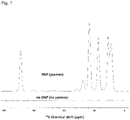
- Figure 1 shows an DNP experiment with Compound 58 ("AMUPol") as a polarizing agent at 14.1 T, 600 MHz 1 H frequency, 395 GHz microwave frequency.
- AMUPol Compound 58
- the chemical elements are identified in accordance with the Periodic Table of the Elements, CAS version, Handbook of Chemistry and Physics, 75th Ed ., inside cover, and specific functional groups are generally defined as described therein. Additionally, general principles of organic chemistry, as well as specific functional moieties and reactivity, are described in Organic Chemistry, Thomas Sorrell, University Science Books, Sausalito, 1999 ; Smith and March March 's Advanced Organic Chemistry, 5th Edition, John Wiley & Sons, Inc., New York, 2001 ; Larock, Comprehensive Organic Transformations, VCH Publishers, Inc., New York, 1989 ; Carruthers, Some Modern Methods of Organic Synthesis, 4th Edition, Cambridge University Press, Cambridge, 2004 .
- nitroxide refers to a stable nitroxide group which may be cyclic or acyclic.
- a stable nitroxide refers to a chemically stable nitroxide which may be obtained in pure form, stored, and handled in the laboratory.
- a stable nitroxide refers to a cyclic or acyclic nitroxide which contains two groups which do not contain alpha hydrogens. Exemplary cyclic or acyclic nitroxides are provided in Keana, Chemical Reviews (1978) 78:37-64 .
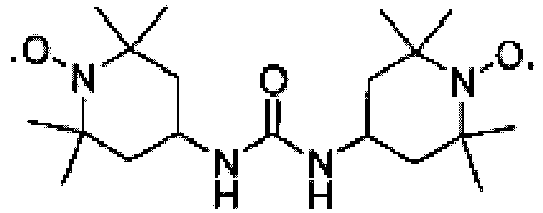
- the compound ,4-ureylene-di-(2,2,6,6-tetramethyl-)piperidinyloxyl (also designated as "bTUrea”) is, of course, always excluded.
- Q 1 and Q 2 are identical. Most preferably, they are both
- m in (CH 2 -CH 2 -O) m -CH 3 or (CH 2 -CH 2 -O) m -H is preferably an integer of from 1 to 200. more preferred 1-100, and even more preferred 1-20 or 1-15.
- Presently preferred compounds of claim 1 are:
- the compounds of the invention generally are very stable and have a good to very good water solubility.
- the biradical compounds of the invention can be used as a Dynamic Nuclear Polarization (DNP) agents for polarizing an NMR-active spin of a nucleus of an analyte in Nuclear Magnetic Resonance (NMR) spectroscopy.
- An NMR-active spin is spin half or uneven multiples thereof.
- NMR spectroscopy encompasses Solid State NMR (SS-NMR) spectroscopy, liquid state NMR spectroscopy and Magnetic Resonance Imaging (MRI), in all of which the biradical compounds of the invention may be used as DNP agents.
- analyte denotes a chemical or biological entity, such as a solid inorganic, organic or metallo-organic material having an crystal lattice or an amorphous solid structure, e.g. zeolithes, nanoparticles, mesoporous and porous materials, glasses, Metal Organic Frameworks (MOF's), a molecular chemical or biochemical compound including polymeric compounds and macromolecular compounds, e.g., proteins, enzymes, DNA/RNA, and a biological entity, e.g. a whole cell, a leaf, a virus particle, tissue or bone components or a whole body, having one or more NMR-active spins to be investigated by NMR spectroscopy.
- a chemical or biological entity such as a solid inorganic, organic or metallo-organic material having an crystal lattice or an amorphous solid structure, e.g. zeolithes, nanoparticles, mesoporous and porous materials, glasses, Metal Organic Framework
- the molecular chemical or biochemical compound may be an isolated inorganic, organic, metallo-organic or biochemical compound or an inorganic, organic or biochemical compound in its natural biological environment.
- the analyte may be dissolved in an aqueous medium, an organic solvent or solvent mixture or an aqueous/organic solvent mixture, or it may be present without a solvent.
- the investigation by NMR spectroscopy could e.g. be structure determination, monitoring of reaction kinetics, or flow imaging.
- the nucleus having an NMR-active spin may be any known such nucleus, e.g. 1 H, 2 H, 6 Li, 7 Li, 10 B, 11 B, 13 C, 14 N, 15 N, 17 O, 19 F, 23 Na, 25 Mg, 27 Al, 29 Si, 31 P, 33 S, 35 Cl, 37 Cl, 39 K, 41 K, 43 Ca, 47 Ti, 49 Ti, 50 V, 51 V, 53 Cr, 77 Se, 89 Y, 117 Sn, 119 Sn, and 199 Hg.
- the DNP agent may be dissolved in the solvent of the analyte or can be introduced without a solvent chemically bound to the analyte, such as in doped polymers, materials functionalized with polarizing agents, or paramagnetic spin labels on biological samples.
- the polarizing agent could also be dispersed in the analyte, for example by initially introducing the polarizing agent with a solvent and evaporating the solvent in a following step leaving the polarizing agent and analyte, or be introduced by wet impregnation.
- the polarizing agent could also be added during a synthetic preparation step.
- the polarizing agent may be present in a solid state during the polarization time, such as in a frozen solution comprising a frozen solvent or solvent mixture containing the analyte or in a solid state without solvent.
- the DNP agent may be present in a liquid state or in a liquid solution during the polarization time.
- Use concentration of the DNP agent concentration may be in the range of from about 1 to about 200 mM.
- the temperature of a sample containing the analyte and the DNP agent is usually in the range of from about 1 to about 200 K.
- the polarization time during which microwave irradiation is applied to the electron spins and the nuclear spins are polarized via transfer of the polarization can be continuous (microwaves are on all the time) and simultaneous with the NMR spectroscopic measurement time.
- the microwave irradiation can be pulsed, or a combination of short and long pulses.
- Microwave irradiation can also occur as a step before the NMR spectroscopy, for example in dissolution DNP or temperature jump DNP, where a solid DNP sample is polarized in the solid state and then melted for solution state applications.
- Tpol exponential time constant
- the frequency range of the microwave irradiation by which the polarization is transferred to an NMR-active nucleus is usually from about 5 to about 800 GHz.
- the experimental setup may be either static or spinning samples.
- the compounds of the invention show high DNP efficiencies.
- Table 1 shows the 1H DNP signal enhancement and polarization build-up time at two DNP frequencies of selected compounds of the invention.
- Table 1 Biradical Compound No. Solubility in Glycerol/H 2 O (60/40) 263 GHz T pol 263 GHz DNP ⁇ 395 GHz T pol 395 GHz DNP ⁇ 58 ⁇ 25 mM 3.4 s 235 4.9 s 128 57 ⁇ 25 mM 4.9 s 217 6.4 s 123 56 ⁇ 25 mM 5.7 s 207 8.7 s 128 61 ⁇ 20 mM 3.0 s 116 3.7 s 61 51 ⁇ 10 mM 5.6 s 120 7.7 s 81 52 ⁇ 10 mM 120 69 > 10 mM 290 160 70 > 10 mM 278 138 71 > 20 mM 303 72 > 20 mM 257 bTUrea (4,4-ureylene-di-(2,2,6,6-tetra
- the 1H DNP signal enhancement was measured at 9.4 T 263 GHz and 14.1 T 395 GHz at 97 K sample temperature and 8 kHz magic angle spinning (MAS) frequency for Compounds 58, 57, 56, 61 and 51 according to the invention compared to TOTAPOL. All samples were prepared with 10 mM biradical polarizing agent, 0.25 M 13C-15N Proline, in glycerol-d8/D2O/H2O (60/30/10 % volume ratio). The 1H DNP signal enhancement was measured via 1H-13C cross polarization experiment with and without microwave irradiation. Polarization build-up time, Tpol, was measured with saturation recovery experiment with microwave irradiation on continuously.
- Tpol Polarization build-up time
- Figure 1 shows a DNP experiment with Compound 58 ((15- ⁇ [(7-oxyl-3,11-dioxa-7-azadispiro[5.1.5.3]hexadec-15-yl)carbamoyl][2-(2,5,8,11-tetraoxatridecan-13-ylamino) ⁇ -[3,11-dioxa-7-azadispiro[5.1.5.3]hexadec-7-yl])oxidanyl,designated as "bPyTureaPEG4" or "AMUPOL”) as a polarizing agent at 14.1 T, 600 MHz 1H frequency, 395 GHz microwave frequency.
- Compound 58 ((15- ⁇ [(7-oxyl-3,11-dioxa-7-azadispiro[5.1.5.3]hexadec-15-yl)carbamoyl][2-(2,5,8,11-tetraoxatridecan-13-ylamino) ⁇ -[3,11-
- a fused core C18 column (Phenomenex, Kinetex C18, 100 mm x 4.6 mm, 2.6 ⁇ m) was used. Typically, a gradient elution using aqueous mobile phase with increasing fraction of acetonitrile (from 10% to 40% over 5 min and from 40 to 100% over 5 min) in the presence of 0.1% TFA was used. The compounds were eluted using a flow rate of 1.5 ml/min.
- the aqueous layer was adjusted to pH 11 by adding 50 mL of 10% K 2 CO 3 aqueous solution and then extracted with chloroform (2 x 100 mL).
- the organic phase was concentrated under reduced pressure, diluted in ethylacetate (100 mL), washed with brine (100 mL), dried over Na 2 SO 4 , and the solvent was distilled under reduced pressure.
- the crude product was purified by SiO 2 column chromatography with AcOEt/pentane (1/1) and recrystallized to afford 7-aza-3,11-dioxadispiro[5.1.5.3]hexadecane-15-one 3 (2.00 g, 23%) as a white solid.
- Example 12 Synthesis of (4- ⁇ 3-[1-(PEG)-1 H -1,2,3-Triazol-4-yl]propyl ⁇ [(1-oxyl-2,2,6,6-tetramethylpiperidin-4-yl)carbamoyl]amino ⁇ -2,2,6,6-tetramethylpiperidin-1-yl)oxidanyl (Compound 61)
- Example 19 (for illustration only): Synthesis of (4- ⁇ [(1-Oxyl-2,2,6,6-tetramethylpiperidin-4-yl)sulfamoyl]amino ⁇ -2,2,6,6-tetramethylpiperidin-1-yl)oxidanyl (Compound 68)
- Example 20 Synthesis of 5-Hydroxy-1,3-bis(7-oxyl-3,11-dioxa-7-azadispiro[5.1.5.3]-hexadec-15-yl)tetrahydropyrimidin-2(1 H )-one (Compound 69) and 1,3-Bis(7-oxyl-3,11-dioxa-7-azadispiro[5.1.5.3]hexadec-15-yl)-5-(2,5,8,11-tetraoxatridecan-13-yloxy)tetrahydropyrimidin-2(1 H )-one (Compound 70)
- Example 21 Synthesis of ⁇ - ⁇ (7-Oxyl-3,11-dioxa-7-azadispiro[5.1.5.3]hexadec-15-yl)[(7-oxyl-3,11-dioxa-7-azadispiro[5.1.5.3]hexadec-15-yl)carbamoyl]amino ⁇ ⁇ - methylpoly(ethane-1,2-diyloxy) (Compound 72)
Landscapes
- Chemical & Material Sciences (AREA)
- Organic Chemistry (AREA)
- Physics & Mathematics (AREA)
- Health & Medical Sciences (AREA)
- High Energy & Nuclear Physics (AREA)
- Analytical Chemistry (AREA)
- General Health & Medical Sciences (AREA)
- Chemical Kinetics & Catalysis (AREA)
- Bioinformatics & Cheminformatics (AREA)
- Life Sciences & Earth Sciences (AREA)
- Engineering & Computer Science (AREA)
- Biochemistry (AREA)
- Medicinal Chemistry (AREA)
- General Physics & Mathematics (AREA)
- Immunology (AREA)
- Pathology (AREA)
- Plural Heterocyclic Compounds (AREA)
- Hydrogenated Pyridines (AREA)
- Nitrogen And Oxygen Or Sulfur-Condensed Heterocyclic Ring Systems (AREA)
- Pharmaceuticals Containing Other Organic And Inorganic Compounds (AREA)
Description
- The present invention relates to novel bis-nitroxide compounds. These may be applied as Dynamic Nuclear Polarization (DNP) agents in Nuclear Magnetic Resonance (NMR) spectroscopy.
- In the method of Dynamic Nuclear Polarization (DNP) the polarization of unpaired electron spins which in thermal equilibrium is much larger than that of nuclei having spin half or uneven multiples thereof is transferred by high frequency microwave irradiation to nuclear spins so as to enhance their NMR sensitivity. Only electron paramagnetic resonance (EPR)-active spins (unpaired electrons, also referred to as paramagnetic centers or radicals) are eligible for this polarization process. The electron spin system in DNP may be provided by an endogenous or exogenous paramagnetic polarizing agent. Most often in this technique a paramagnetic agent is added to the sample of interest.
- Dulog, L. et al., ADVANCED MATERIALS, Vol. 4, No. 5, 1992, pp. 349-351, disclose a dinitroxylamide radical containing two unpaired electrons, which exhibits ferromagnetic coupling.
- Initially, compounds comprising one nitroxide radical or other g ≈ 2 paramagnetic center were utilized as DNP agents for NMR applications. To improve DNP efficiency, the research groups of Robert Griffin and Timothy Swager from MIT introduced biradical polarizing agents consisting of two paramagnetic centers tethered together. For the last 7 years, the TOTAPOL biradical (
US 7,351,402 B2 ,WO 2008/048714 , C. Song et al., J. Am. Chem. Soc., 2006, 128(35), 11385) has been the most widely used polarizing agent for biological applications due to its high solubility in aqueous solutions, high stability, and good DNP efficiency. - In 2008, the group of Robert Griffin and Timothy Swager disclosed 4,4-ureylene-di-(2,2,6,6-tetramethylpiperidinyloxyl) ("bis-TEMPO-urea" or "bTurea") for use as a DNP agent (K.-N. Hu, C. Song, H. Yu, T. Swager, and R. Griffin J. Chem. Phys. 128, 052302 (2008)). In Matsuki, Y. et al, ANGEWANDTE CHEMIE INTERNATIONAL EDITION, Vol. 48, No. 27, 2009, pp. 4996-5000, a rigid dinitroxyl radical is described to be a highly useful DNP agent. In Ysacco, C. et al., PHYSICAL CHEMISTRY CHEMICAL PHYSICS, Vol. 12, No 22, 2010, pp. 5841-5845, 4,4-ureylene-di-(2,2,6,6-tetramethyl-)piperidinyloxyl is disclosed among other dinitroxyl compounds.
- The present invention seeks to provide further dinitroxide compounds with improved DNP efficiency and/or solubility properties since the efficiency of polarizing agents for specific applications depend on a number of factors including the polarizing agent, analyte, solvent, and experimental conditions.
- The present invention relates to a compound of general formula (I)

- M
- is NR2;
- X
- is CO or SO2;
- a
- is 1 or 0;
- R1
- is H; (CH2)o-E, wherein o is an integer of from 1 to 10 and E is COOH, or (CH2-CH2-O)m-CH3 or (CH2-CH2-O)m-H, wherein m is an integer of from 1 to 500; or

- R2
- is H;
- a is 1 and M is NR2, R1 and R2 form together a bridging -CH2CH(G)CH2- group with G = (CH2)o-E, wherein o is an integer of from 0 to 10 and E is: COOH, OH or NH2; or (CH2-CH2-O)m-CH3, wherein m is an integer of from 0 to 500; or a bridging -CH2CH2-, -CH2CH2CH2- or -CH2-CHOH-CH2- group; and
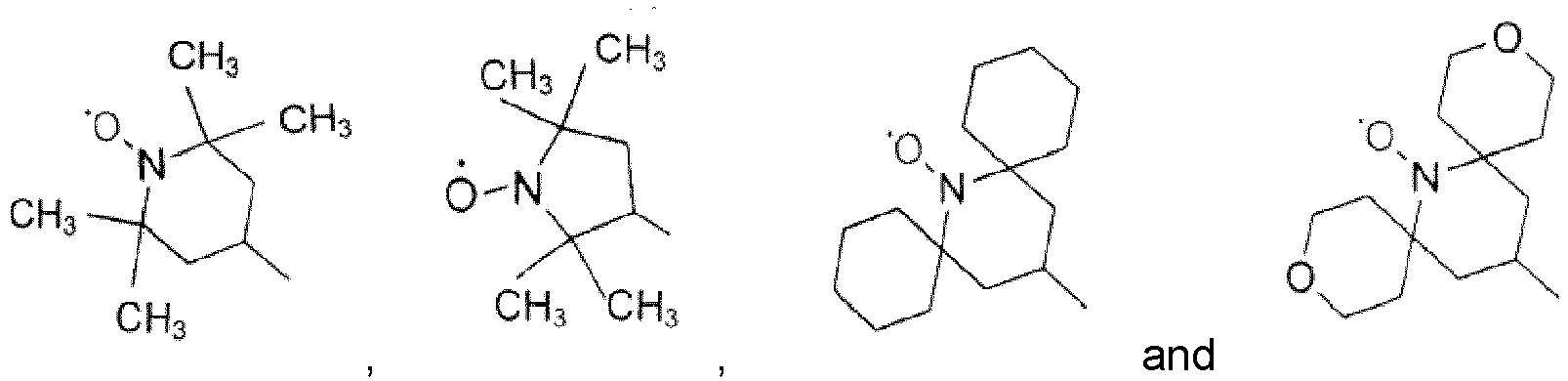
- Q1 and Q2 are independently selected from
- selected from
- except the compound 4,4-ureylene-di-(2,2,6,6-tetramethyl-)piperidinyloxyl
- The compound according to the invention may be used as a Dynamic Nuclear Polarization (DNP) agent for polarizing NMR-active nuclear spins of an analyte in Nuclear Magnetic Resonance (NMR) spectroscopy.
-
Figure 1 shows an DNP experiment with Compound 58 ("AMUPol") as a polarizing agent at 14.1 T, 600 MHz 1H frequency, 395 GHz microwave frequency. - At first definitions of specific functional groups, substituents and chemical terms relevant in the context of the present invention are described in more detail below.
- For purposes of this invention, the chemical elements are identified in accordance with the Periodic Table of the Elements, CAS version, Handbook of Chemistry and Physics, 75th Ed., inside cover, and specific functional groups are generally defined as described therein. Additionally, general principles of organic chemistry, as well as specific functional moieties and reactivity, are described in Organic Chemistry, Thomas Sorrell, University Science Books, Sausalito, 1999; Smith and March March 's Advanced Organic Chemistry, 5th Edition, John Wiley & Sons, Inc., New York, 2001; Larock, Comprehensive Organic Transformations, VCH Publishers, Inc., New York, 1989; Carruthers, Some Modern Methods of Organic Synthesis, 4th Edition, Cambridge University Press, Cambridge, 2004.
- The term "nitroxide" or "nitroxyl", as used herein, refers to a stable nitroxide group which may be cyclic or acyclic. In certain embodiments, a stable nitroxide refers to a chemically stable nitroxide which may be obtained in pure form, stored, and handled in the laboratory. In certain embodiments, a stable nitroxide refers to a cyclic or acyclic nitroxide which contains two groups which do not contain alpha hydrogens. Exemplary cyclic or acyclic nitroxides are provided in Keana, Chemical Reviews (1978) 78:37-64.
- The nitroxide-containing groups Q1 and Q2 are attached to NR1, X (= C=O) and M (=NR2) via one of their C atoms. Exemplary synthetic procedures for this are shown in the Examples.
- In the following embodiments of the invention, the compound ,4-ureylene-di-(2,2,6,6-tetramethyl-)piperidinyloxyl (also designated as "bTUrea")

- In the compound of formula (I)
- M
- is NR2;
- X
- is CO or SO2;
- a
- is 1 or 0;
- R1
- is H; (CH2)o-E, wherein o is an integer of from 1 to 10 and E is COOH, or (CH2-CH2-O)m-CH3 or (CH2-CH2-O)m-H, wherein m is an integer of from 1 to 500; or

- R2
- is H;
- a is 1 and M is NR2, R1 and R2 form together a bridging -CH2CH(G)CH2- group with G = (CH2)o-E, wherein o is an integer of from 0 to 10 and E is: COOH, OH or NH2; or (CH2-CH2-O)m-CH3, wherein m is an integer of from 0 to 500; or a bridging -CH2CH2-, -CH2CH2CH2- or -CH2-CHOH-CH2- group; and
- Q1 and Q2 are independently selected from

- Preferably, in the above embodiment,
- X is CO;
- a = 1;
- R1 is H; or (CH2-CH2-O)m-CH3 or (CH2-CH2-O)m-H, m is an integer of from 1 to 500, preferably 1 to 15; or

or - R1 and R2 together form a bridging group CH2CH(G)CH2- wherein G is (CH2-CH2-O)m-CH3 with m being an integer of from 1 to 500, preferably 1 to 15, or bridging -CH2CH2-, -CH2CH2CH2- or -CH2-CHOH-CH2- group
and - Q1 and Q2 are selected from

- In embodiments of the invention, Q1 and Q2 are identical. Most preferably, they are both

- In all of the above embodiments, m in (CH2-CH2-O)m-CH3 or (CH2-CH2-O)m-H is preferably an integer of from 1 to 200. more preferred 1-100, and even more preferred 1-20 or 1-15.
- Presently preferred compounds of claim 1 are:

- (15-{[(7oxyl-3,11-dioxa-7-azadispiro[5.1.5.3]hexadec-15-yl)carbamoyl]amino}-[3,11-dioxa-7-azadispiro[5.1.5.3]hexadec-7-yl])oxidanyl),
- designated as "bPyTurea" or "PyPol";

- 57: (15-{[(7-oxyl-3,11-dioxa-7-azadispiro[5.1.5.3]hexadec-15-yl)carbamoyl][2-(2-methoxyethoxy)ethyl]amino}-[3,11-dioxa-7-azadispiro[5.1.5.3]hexadec-7-yl])oxidanyl, designated as "bPyTureaPEG2";
- 58: (15-{[(7-oxyl-3,11-dioxa-7-azadispiro[5.1.5.3]hexadec-15-yl)carbamoyl][2-(2,5,8,11-tetraoxatridecan-13-ylamino)}-[3,11-dioxa-7-azadispiro[5.1.5.3]hexadec-7-yl])oxidanyl, designated as "bPyTureaPEG4" or "AMUPol";

- (15-{[(7oxyl-7-azadispiro[5.1.5.3]hexadec-15-yl)carbamoyl]amino}-7-azadispiro[5.1.5.3]hexadec-7-yl)oxidanyl, designated as "bCTurea";

- 54: (15-{[(7-hydroxy-7-azadispiro[5.1.5.3]hexadec-15-yl)carbamoyl][2-(2-methoxyethoxy) ethyl]amino}-7-azadispiro[5.1.5.3]hexadec-7-yl)oxidanyl, designated as "bCTureaPEG2";
- 55. (15-{[(7-oxyl-7-azadispiro[5.1.5.3]hexadec-15-yl)carbamoyl][2-(2-methoxyethoxy) ethyl]amino}-7-azadispiro[5.1.5.3]hexadec-7-yl)oxidanyl,
- designated as "bCTureaPEG4";

- 51: (4-{[2-(2-methoxyethoxy)ethyl][(1-oxyl-2,2,6,6-tetramethylpiperidin-4-yl)carbamoyl]amino}-2,2,6,6-tetramethylpiperidin-1-yl)oxidanyl, designated as "bTureaPEG2";
- 52: (4-{(2,5,8,11-tetraoxatridecan-13-yl)[(1-oxyl-2,2,6,6-tetramethylpiperidin-4-yl)carbamoyl] amino}-2,2,6,6-tetramethylpiperidin-1-yl)oxidanyl, designated as "bTureaPEG4";

- (4-{(5-carboxypentyl)[(1-oxyl-2,2,6,6-tetramethylpiperidin-4-yl)carbamoyl]amino}-2,2,6,6-tetramethylpiperidin-1-yl)oxidanyl;

- (4-{(pent-4-yn-1-yl)[(1-oxyl-2,2,6,6-tetramethylpiperidin-4-yl)carbamoyl]amino}-2,2,6,6-tetramethylpiperidin-1-yl)oxidanyl;

- (4-{3-[1-(PEG)-1H-1,2,3-triazol-4-yl]propyl}[(1-oxyl-2,2,6,6-tetramethylpiperidin-4-yl)carbamoyl]amino}-2,2,6,6-tetramethylpiperidin-1-yl)oxidanyl, designated as "bTureaPEG500" , when n=500;

- 62: 1,3-bis(1-oxyl-2,2,6,6-tetramethylpiperidin-4-yl)imidazolidin-2-one, designated as "bTureaC5";
- 63: 1,3-bis(1-oxyl-2,2,6,6-tetramethylpiperidin-4-yl)tetrahydropyrimidin-2(1H)-one, designated as "bTureaC6";

- (3-{[(1-oxyl-2,2,5,5-tetramethylpyrrolidin-3-yl) carbamoyl]amino}-[2,2,5,5-tetramethylpyrrolidin-3-yl])oxidanyl,
- designated as "bProxurea";

- (4-{[(1-oxyl-2,2,6,6-tetramethylpiperidin-4-yl)carbonyl]amino}-2,2,6,6-tetramethylpiperidin-1-yl)oxidanyl,
- designated as "bTamide";

- {3-[(1-oxyl-2,2,6,6-tetramethylpiperidin-4-yl)carbamoyl]-2,2,5,5-tetramethylpyrrolidin-1-yl}oxidanyl,
- designated as "ProxTamide";

- (3-{[(1-oxyl-2,2,6,6-tetramethylpiperidin-4-yl)carbonyl]amino}-2,2,5,5-tetramethylpyrrolidin-1-yl)oxidanyl.
- designated as "TProxamide";

- 5-hydroxy-1,3-bis(7-oxyl-3,11-dioxa-7-azadispiro[5.1.5.3]hexadec-15-yl)tetrahydropyrimidin-2(1H)-one;
- designated as "PyPOLC6OH";


- 1,3-bis(7-oxyl-3,11-dioxa-7-azadispiro[5.1.5.3]hexadec-15-yl)-5-(2,5,8,11-tetraoxatridecan-13-yloxy)tetrahydropyrimidin-2(1H)-one;

- (15-{[(7-oxyl-3,11-dioxa-7-azadispiro[5.1.5.3]hexadec-15-yl)carbamoyl][2-(2-hydroxyethoxy)ethyl]amino}-[3,11-dioxa-7-azadispiro[5.1.5.3]hexadec-7-yl])oxidanyl, designated as "PyPOLPEG2OH";
and
- α-{(7-oxyl-3,11-dioxa-7-azadispiro[5.1.5.3]hexadec-15-yl)[(7-oxyl-3,11-dioxa-7-azadispiro[5.1.5.3]hexadec-15-yl)carbamoyl]amino}ω-methylpoly(ethane-1,2-diyloxy), designated as "PyPOLPEG10".
- The syntheses of these compounds are described in the Examples.
- The compounds of the invention generally are very stable and have a good to very good water solubility.
- The biradical compounds of the invention can be used as a Dynamic Nuclear Polarization (DNP) agents for polarizing an NMR-active spin of a nucleus of an analyte in Nuclear Magnetic Resonance (NMR) spectroscopy. An NMR-active spin is spin half or uneven multiples thereof. The term NMR spectroscopy, as used herein, encompasses Solid State NMR (SS-NMR) spectroscopy, liquid state NMR spectroscopy and Magnetic Resonance Imaging (MRI), in all of which the biradical compounds of the invention may be used as DNP agents.
- The term analyte, as used herein, denotes a chemical or biological entity, such as a solid inorganic, organic or metallo-organic material having an crystal lattice or an amorphous solid structure, e.g. zeolithes, nanoparticles, mesoporous and porous materials, glasses, Metal Organic Frameworks (MOF's), a molecular chemical or biochemical compound including polymeric compounds and macromolecular compounds, e.g., proteins, enzymes, DNA/RNA, and a biological entity, e.g. a whole cell, a leaf, a virus particle, tissue or bone components or a whole body, having one or more NMR-active spins to be investigated by NMR spectroscopy. The molecular chemical or biochemical compound may be an isolated inorganic, organic, metallo-organic or biochemical compound or an inorganic, organic or biochemical compound in its natural biological environment. The analyte may be dissolved in an aqueous medium, an organic solvent or solvent mixture or an aqueous/organic solvent mixture, or it may be present without a solvent.
- The investigation by NMR spectroscopy could e.g. be structure determination, monitoring of reaction kinetics, or flow imaging.
- The nucleus having an NMR-active spin may be any known such nucleus, e.g. 1H, 2H, 6Li, 7Li, 10B, 11B, 13C, 14N, 15N, 17O, 19F, 23Na, 25Mg, 27Al, 29Si, 31P, 33S, 35Cl, 37Cl, 39K, 41K, 43Ca, 47Ti, 49Ti, 50V, 51V, 53Cr, 77Se, 89Y, 117Sn, 119Sn, and 199Hg.
- The DNP agent may be dissolved in the solvent of the analyte or can be introduced without a solvent chemically bound to the analyte, such as in doped polymers, materials functionalized with polarizing agents, or paramagnetic spin labels on biological samples. The polarizing agent could also be dispersed in the analyte, for example by initially introducing the polarizing agent with a solvent and evaporating the solvent in a following step leaving the polarizing agent and analyte, or be introduced by wet impregnation. The polarizing agent could also be added during a synthetic preparation step.
- The polarizing agent may be present in a solid state during the polarization time, such as in a frozen solution comprising a frozen solvent or solvent mixture containing the analyte or in a solid state without solvent.
- In other embodiments, the DNP agent may be present in a liquid state or in a liquid solution during the polarization time.
- Use concentration of the DNP agent concentration may be in the range of from about 1 to about 200 mM.
- In solid state NMR experiments, the temperature of a sample containing the analyte and the DNP agent is usually in the range of from about 1 to about 200 K.
- The polarization time during which microwave irradiation is applied to the electron spins and the nuclear spins are polarized via transfer of the polarization can be continuous (microwaves are on all the time) and simultaneous with the NMR spectroscopic measurement time. Alternatively, the microwave irradiation can be pulsed, or a combination of short and long pulses. Microwave irradiation can also occur as a step before the NMR spectroscopy, for example in dissolution DNP or temperature jump DNP, where a solid DNP sample is polarized in the solid state and then melted for solution state applications. In the case of continuous microwave irradiation the polarization builds up with an exponential time constant (Tpol) which can be measured similarly to T1 measurements in NMR experiments.
- The frequency range of the microwave irradiation by which the polarization is transferred to an NMR-active nucleus is usually from about 5 to about 800 GHz.
- The experimental setup may be either static or spinning samples.
- The compounds of the invention show high DNP efficiencies.
- Table 1 shows the 1H DNP signal enhancement and polarization build-up time at two DNP frequencies of selected compounds of the invention.
Table 1 Biradical Compound No. Solubility in Glycerol/H2O (60/40) 263 GHz Tpol 263 GHz DNP ε 395 GHz Tpol 395 GHz DNP ε 58 ~ 25 mM 3.4 s 235 4.9 s 128 57 ~ 25 mM 4.9 s 217 6.4 s 123 56 ~ 25 mM 5.7 s 207 8.7 s 128 61 ~ 20 mM 3.0 s 116 3.7 s 61 51 ~ 10 mM 5.6 s 120 7.7 s 81 52 ~ 10 mM 120 69 > 10 mM 290 160 70 > 10 mM 278 138 71 > 20 mM 303 72 > 20 mM 257 bTUrea (4,4-ureylene-di-(2,2,6,6-tetramethyl-piperidinyloxyl) ~ 3 mM 16.5 62 TOTAPOL 5.6 s 75 7.7 s 30 - The 1H DNP signal enhancement (DNP ε) was measured at 9.4 T 263 GHz and 14.1 T 395 GHz at 97 K sample temperature and 8 kHz magic angle spinning (MAS) frequency for Compounds 58, 57, 56, 61 and 51 according to the invention compared to TOTAPOL. All samples were prepared with 10 mM biradical polarizing agent, 0.25
M 13C-15N Proline, in glycerol-d8/D2O/H2O (60/30/10 % volume ratio). The 1H DNP signal enhancement was measured via 1H-13C cross polarization experiment with and without microwave irradiation. Polarization build-up time, Tpol, was measured with saturation recovery experiment with microwave irradiation on continuously. -
Figure 1 shows a DNP experiment with Compound 58 ((15-{[(7-oxyl-3,11-dioxa-7-azadispiro[5.1.5.3]hexadec-15-yl)carbamoyl][2-(2,5,8,11-tetraoxatridecan-13-ylamino)}-[3,11-dioxa-7-azadispiro[5.1.5.3]hexadec-7-yl])oxidanyl,designated as "bPyTureaPEG4" or "AMUPOL") as a polarizing agent at 14.1 T, 600 MHz 1H frequency, 395 GHz microwave frequency. 1H-13C CPMAS experiment at 14 kHz MAS, 100 K sample temperature, 8 scans signal averaging, 1 dummy scan, 6.4 s recycle delay. Top trace (DNP) with microwave irradiation and bottom trace (no DNP) without microwave. Concentration: 10 mM of Compound 58, 0.25M 13C-15N Proline in glycerol-d8/D2O/H2O (60/30/10 % volume ratio). - All chemicals used in synthesis were purchased from Aldrich Chemical Co. Commercially available starting materials were used without further purification. Purification of products was accomplished by flash column chromatography on silica gel (Merck silica gel 60, 230-400 mesh) and neutral alumina (Merck Aluminium oxide 90 active neutral, 70-230 mesh). NMR measurements were recorded on a Bruker AVL 300 spectrometer (1H-NMR 300.1 MHz and 13C-NMR 75.5 MHz) using CDCl3 as the solvent (internal reference). Splitting patterns are indicated as follows: br, broad; s, singlet; d, doublet; t, triplet; q, quartet; m, multiplet; dd, doublet of doublets; dt, doublet of triplets. Mass spectral analyses were carried out using a Q-STAR Elite at the Aix Marseille Université Mass Spectrum Facility, Spectropole Saint Jérôme Marseille. Melting points were determined using a Büchi B-540 apparatus and were uncorrected. The final products were purified to ≥ 95% and were confirmed by HPLC and/or elemental analysis. HPLC experiments were performed using Agilent 1200 system equipped with UV-Vis absorption and fluorescence detectors. A fused core C18 column (Phenomenex, Kinetex C18, 100 mm x 4.6 mm, 2.6 µm) was used. Typically, a gradient elution using aqueous mobile phase with increasing fraction of acetonitrile (from 10% to 40% over 5 min and from 40 to 100% over 5 min) in the presence of 0.1% TFA was used. The compounds were eluted using a flow rate of 1.5 ml/min.
-

- To a stirred mixture of 1,2,2,6,6-pentamethypiperidin-4-one 1 (6.08 g, 0.036 mol) and tetrahydro-4H-pyran-4-one (10.8 g, 0.108 mol) in dimethylsulfoxide (70 mL), NH4Cl (11.55 g, 0.216 mol) was added at room temperature. The mixture was heated at 80°C during 24 h, then it was diluted with water (200 mL), acidified with 1N HCI aqueous solution (40 mL) and the mixture was extracted with diethylether (3 x 100 mL). The aqueous layer was adjusted to pH 11 by adding 50 mL of 10% K2CO3 aqueous solution and then extracted with chloroform (2 x 100 mL). The organic phase was concentrated under reduced pressure, diluted in ethylacetate (100 mL), washed with brine (100 mL), dried over Na2SO4, and the solvent was distilled under reduced pressure. The crude product was purified by SiO2 column chromatography with AcOEt/pentane (1/1) and recrystallized to afford 7-aza-3,11-dioxadispiro[5.1.5.3]hexadecane-15-one 3 (2.00 g, 23%) as a white solid. mp: 170°C (lit. mp: 167°C). 1H NMR (CDCl3) δ 1.64 (t, 8H, J= 5.6 Hz), 2.41 (s, 4H), 3.54-3.60 (m, 4H), 3.82-3.88 (m, 4H). 13C NMR (CDCl3) δ 40.24, 51.86, 54.59, 63.46, 208.95. HRMS-ESI: calcd for C13H21NO3 [M+H]+ 240.1594, found 240.1594.
-

- Compound 3 (2.9 g, 12.1 mmol) and Na2WO4.2H2O (400 mg, 1.21 mmol) were stirred in ethanol (100 mL). H2O2 (35%, 48.4 mmol, 5 mL) was added and the mixture was stirred for 24 h at room temperature. At the end of reaction, K2CO3 was added and the solution was extracted twice with chloroform (100 mL). The organic layer was dried over Na2SO4 and distilled under reduced pressure. The crude product was purified by column chromatography (SiO2, DCM:EtOH) to provide (15-oxo-3,11-dioxa-7-azadispiro[5.1.5.3]hexadec-7-yl)oxidanyl 5 as a yellow solid (2.5 g, 81%). mp: 148.5 °C (lit. mp : 149.5 °C) ESI-MS m/z = 255 [M+H]+; 277 [M+Na]+.
-

- Under Argon atmosphere, a solution of ammonium acetate (2.55 g, 33 mmol) in MeOH (25 ml) was stirred for 5 min at rt. K2CO3 was added to adjust the pH at 8. Then a solution of 5 (840 mg, 3.3 mmol) in MeOH was added and the reaction mixture was stirred at rt. NaBH(CN)3 (540 mg, 8.6 mmol) was added in one portion. The reaction was stirred 16h at rt and 5 ml of sat. NaHCO3 were added. MeOH was removed under reduced pressure and the remaining aqueous phase was extracted twice with chloroform. The organic layer was dried on Na2SO4, solvent removed under vacuum and the residue was column chromatographied to give (15-amino-3,11-dioxa-7-azadispiro[5.1.5.3]hexadec-7-yl)oxidanyl 7 (700 mg, 2.743 mmol, 83 %) as a red solid. mp: 140.5 °C HRMS-ESI: m/z calcd for C13H23N2O3 · [M+H]+ 256.1781, found 256.1781
-

- To a solution of 7 (200 mg, 0.78 mmol) and NEt3 (220 µl, 1.56 mmol) in DCM (5 ml) was added a solution of triphosgene (38 mg, 0.13 mmol) in DCM and the solution was stirred at rt for 6h. A solution of sat. NaHCO3 is added and the mixture is extracted with DCM twice. The organic phase was dried on Na2SO4, solvent removed under vacuum and the residue was column chromatographied to afford (15-{[(7oxyl-3,11-dioxa-7-azadispiro[5.1.5.3]hexadec-15-yl)carbamoyl]amino}-[3,11-dioxa-7-azadispiro[5.1.5.3]-hexadec-7-yl])oxidanyl 56 as a red solid (100 mg, 0.18 mmol, 52 %. HRMS-ESI: m/z calcd for C27H44N4O7 •• [M+H]+ 537.3283, found 537.3283. Elemental analysis: found C, 53.82; H, 7.63; N, 8.89 calcd for C27H44N4O7 + 1.05 CH2Cl2: C, 53.81; H, 7.42; N, 8.95.
-

- A solution of 5 (500 mg, 1.97 mmol), tetra(ethylene glycol) methyl ether amine (370 mg, 1.79 mmol) and AcOH (0.6 ml) in THF (30 ml) was stirred at rt for 2h. Na(OAc)3BH (1.40 g, 5.4 mmol) was added and the reaction was stirred at rt for 12h. THF was removed under reduced pressure and the residue was solubilized in DCM. The organic phase was washed with a saturated solution of NaHCO3. The aqueous phase is saturated with NaCl and extracted with chloroform twice. The organic phases are dried (Na2SO4) and solvents are removed under reduced pressure. The residue is purified by column chromatography to give [15-{(2,5,8,11-tetraoxatridecan-13-yl)amino}-3,11-dioxa-7-azadispiro[5.1.5.3]-hexadec-7-yl]oxidanyl 11 (540 mg, 1.22 mmol, 68 %) as a red oil. HRMS-ESI: m/z calcd C22H41N2O7 • [M+H]+ 446.2987, found 446.2986
- The same procedure was used to synthesize (15-{[2-(2-methoxyethoxy)ethyl]amino}-3,11-dioxa-7-azadispiro[5.1.5.3]hexadec-7-yl)oxidanyl 10, starting from di(ethylene glycol) methyl ether amine. ESI-HRMS: m/z calcd C18H33N2O5 • [M+H]+ 358.2462, found 358.2462
-

- A solution of 11 (600 mg, 0.88 mmol), 7 (130 mg, 0.51 mmol) and NEt3 (125 µl, 0.83 mmol) was stirred at rt in DCM (5 ml) for 6 h. The solution was washed with brine, dried over Na2SO4 and the solvent was removed under vacuum. The residue was purified using flash chromatography to give (15-{[(7-oxyl-3,11-dioxa-7-azadispiro[5.1.5.3]hexadec-15-yl)carbamoyl][2-(2,5,8,11-tetraoxatridecan-13-ylamino)}-[3,11-dioxa-7-azadispiro-[5.1.5.3]hexadec-7-yl])oxidanyl 58 as a red oil (120 mg, 0.16 mmol, 33 %). ESI-HRMS: m/z calcd C36H62N4O11 •• [M+H]+ 727.4488, found 727.4487. Elemental analysis: found C, 58.70; H, 8.70; N, 8.75 calcd for C36H62N4O11, 0.4 H2O, 0.7 CH3CN: C, 58.75; H, 8.58; N, 8.61.
- The same procedure was used to synthesize (15-{[(7-oxyl-3,11-dioxa-7-azadispiro[5.1.5.3]hexadec-15-yl)carbamoyl][2-(2-methoxyethoxy)ethyl]amino}-[3,11-dioxa-7-azadispiro[5.1.5.3]hexadec-7-yl])oxidanyl 57. ESI-HRMS: m/z calcd C32H54N4O9 •• [M+H]+ 639.3964, found 639.3963
-

- Starting from cyclohexanone and compound 1, General Procedure A of Example 1A was followed to obtain 7-azadispiro[5.1.5.3]hexadecan-15-one 2, mp: 102°C (lit. 103°C). 1H NMR (300 MHz, CDCl3): 1.35-1.44 (m, 8H), 1.47-1.53 (m, 8H), 1.58-1.68 (m, 4H), 2.29 (s, 4H). 13C NMR (75 MHz, CDCl3): 22.34, 25.68, 40.78, 52.29, 56.80, 211.47. ESI-MS m/z = 236 [M+H] +, 242 [M+Li]+.
-

- Starting from Compound 2, General procedure B of Example 1.B was followed to obtain (15-oxo-7-azadispiro[5.1.5.3]hexadec-7-yl)oxidanyl 4. ESI-MS m/z = 255 [M+H]+, 277 [M+Na]+.
-

- Starting from Compound 4, General procedure C of Example 1.C was followed to obtain (15-amino-7-azadispiro[5.1.5.3]hexadec-7-yl)oxidanyl 6. ESI-MS m/z = 252 [M+H]+.
-

- Starting from Compound 6, General Procedure D of Example 1.D was followed to obtain (15-{[(7-oxyl-7-azadispiro[5.1.5.3]hexadec-15-yl)carbamoyl]amino}-7-azadispiro[5.1.5.3]hexadec-7-yl)oxidanyl 53. HRMS-ESI: m/z calcd for C31H52N4O3[M+H]+ 529.4112, found 529.4112.
-

- Compound 8 (15-{[2-(2-methoxyethoxy)ethyl]amino}-7-azadispiro[5.1.5.3]hexadec-7-yl)oxidanyl was synthesized following General Procedure E of Example 2.A/3.A starting from di(ethylene glycol) methyl ether amine. ESI-MS m/z = 354 [M+H]+; 376 [M+Na]+; 392 [M+K]+.
- Compound 9 [15-{(2,5,8,11-tetraoxatridecan-13-yl)amino}-7-azadispiro[5.1,5.3]hexadec-7-yl]oxidanyl was synthesized following General Procedure E of Examples 2.A/3.A starting from tetra(ethylene glycol) methyl ether amine. HRMS-ESI: m/z calcd for C24H45N2O5 [M+H]+ 442.3401, found 442.3394.
-

- Starting from Compounds 8 and 6, General Procedure F of Examples 2.B/3.B. was followed to obtain (15-{[(7-hydroxy-7-azadispiro[5.1.5.3]hexadec-15-yl)carbamoyl][2-(2-methoxyethoxy) ethyl]amino}-7-azadispiro[5.1.5.3]hexadec-7-yl)oxidanyl 54 .HRMS-ESI: m/z calcd for C36H62N4O5[M+H]+ 631.4793, found 631.4794. Elemental analysis: found C, 68.19; H, 10.11; N, 8.67calcd C36H62N4O: C, 68.53; H, 9.91; N, 8.88.
- Starting from Compounds 9 and 6, General Procedure F of Examples 2.B/3.B. was followed to obtain (15-{[(7-oxyl-7-azadispiro[5.1.5.3]hexadec-15-yl)carbamoyl][2-(2-methoxyethoxy) ethyl]amino}-7-azadispiro[5.1.5.3]hexadec-7-yl)oxidanyl 55 . HRMS-ESI: m/z calcd for C40H70N4O7 [M+H]+ 719.5317, found 719.5316. Anal. Calcd for C40H70N4O7: C, 66.82; H, 9.81; N, 7.79 found C, 67.01; H, 10.07; N, 8.04.
-

- 14 (4-{[2-(2-methoxyethoxy)ethyl]amino}-2,2,6,6-tetramethylpiperidin-1-yl)oxidanyl was synthesized following General Procedure E of Examples 2.A/3.A starting from di(ethylene glycol) methyl ether amine. ESI-MS m/z = 274 [M+H]+; 296 [M+Na]+.
- 15 (4-{(2,5,8,11-tetraoxatridecan-13-yl)amino}-2,2,6,6-tetramethylpiperidin-1-yl)oxidanyl was synthesized following General Procedure E of Examples 2.A/3.A starting from tetra(ethylene glycol) methyl ether amine. HRMS-ESI: m/z calcd for C18H37N2O5 [M+H]+ 362.2775, found 362.2778
-

- (4-{[2-(2-Methoxyethoxy)ethyl][(1-oxyl-2,2,6,6-tetramethylpiperidin-4-yl)carbamoyl]amino}-2,2,6,6-tetramethylpiperidin-1-yl)oxidanyl 51 was synthesized following General Procedure F of Examples 2.B/3.B starting from Compounds 14 and 12. HRMS-ESI: m/z calcd for C24H46N4O5 [M+H]+ 471.3540, found 471.3538. Anal. Calcd for C24H46N4O5: C, 61.25; H, 9.85; N, 11.90. Found C, 61.17; H, 10.06; N, 11.65.
- (4-{(2,5,8,11-Tetraoxatridecan-13-yl)[(1-oxyl-2,2,6,6-tetramethylpiperidin-4-yl)carbamoyl] amino}-2,2,6,6-tetramethylpiperidin-1-yl)oxidanyl 52 was synthesized following General Procedure F of Examples 2.B/3.B starting from Compounds 15 and 12.. HRMS-ESI: m/z calcd for C28H54N4O7 [M+H]+ 559.4065, found 559.4063.
-

- (4-{(6-Ethoxy-6-oxohexyl)amino}-2,2,6,6-tetramethylpiperidin-1-yl)oxidanyl 17 was synthesized following General Procedure E of Examples 2.A/3.A starting from ethyl 6-aminohexanoate hydrochloride and Compound 13. ESI-MS m/z = 314 [M+H]+, 320 [M+Li]+.
-

- (4-{(6-Ethoxy-6-oxohexyl)[(1-oxyl-2,2,6,6-tetramethylpiperidin-4-yl)carbamoyl]amino}-2,2,6,6-tetramethylpiperidin-1-yl)oxidanyl 18 was synthesized following General Procedure F of Examples 2.B/3.B starting from Compounds 17 and 12. ESI-MS m/z = 511 [M+H]+, 517 [M+Li]+
-
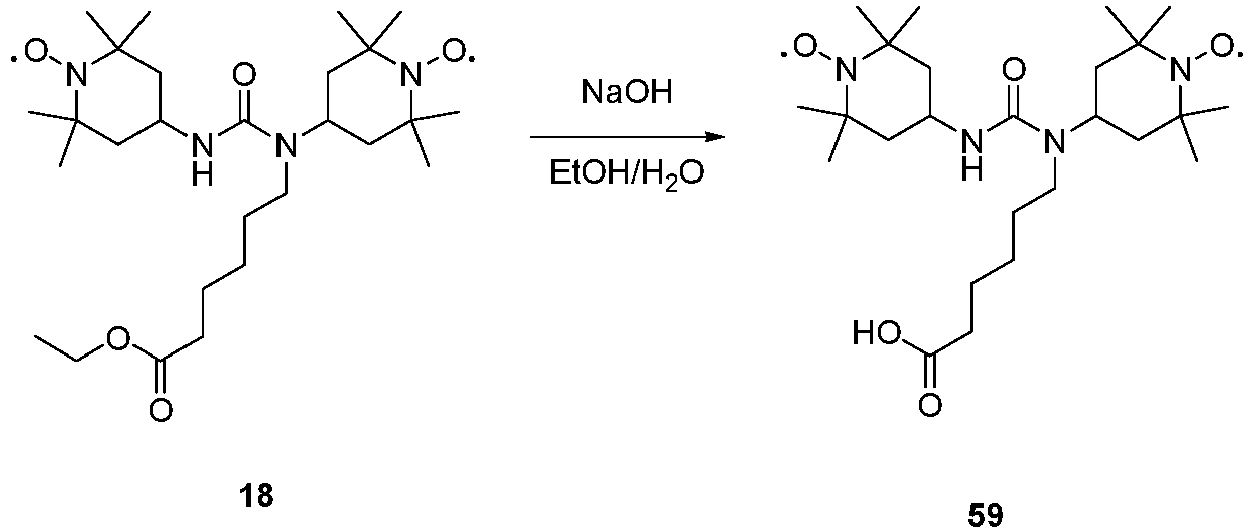
- A solution of 18 (820 mg, 1.6 mmol) and NaOH (320 mg, 8.0 mmol) in a 8:2 mixture EtOH:H2O (10 ml) was stirred at 70 °C for 12 h. EtOH was removed under vacuum. Using 1M HCI aqueous solution, pH of the remaining water phase was adjusted at 3. The aqueous phase was then extracted with DCM. The residue was purified using flash chromatography to give (4-{(5-carboxypentyl)[(1-oxyl-2,2,6,6-tetramethylpiperidin-4-yl)carbamoyl]amino}-2,2,6,6-tetramethylpiperidin-1-yl)oxidanyl 59 as a red solid (505 mg, 1.05 mmol, 65 %). HRMS-ESI: m/z calcd for C25H46N4O5 • [M+H]+ 483.3541, found 483.3541. Elemental analysis: found C, 61.24; H, 9.70; N, 11.31 calcd for C25H46N4O5, 0.4 H2O: C, 61.30; H, 9.63; N, 11.44.
-

- [2,2,6,6-Tetramethyl-4-(pent-4-yn-1-ylamino)piperidin-1-yl]oxidanyl 19 was synthesized following General Procedure E of Examples 2.A/3.A starting from pent-4-yn-1-amine and Compound 13. HRMS-ESI: m/z calcd for C14H25N2O• [M+H]+ 238.2039, found 238.2041
-
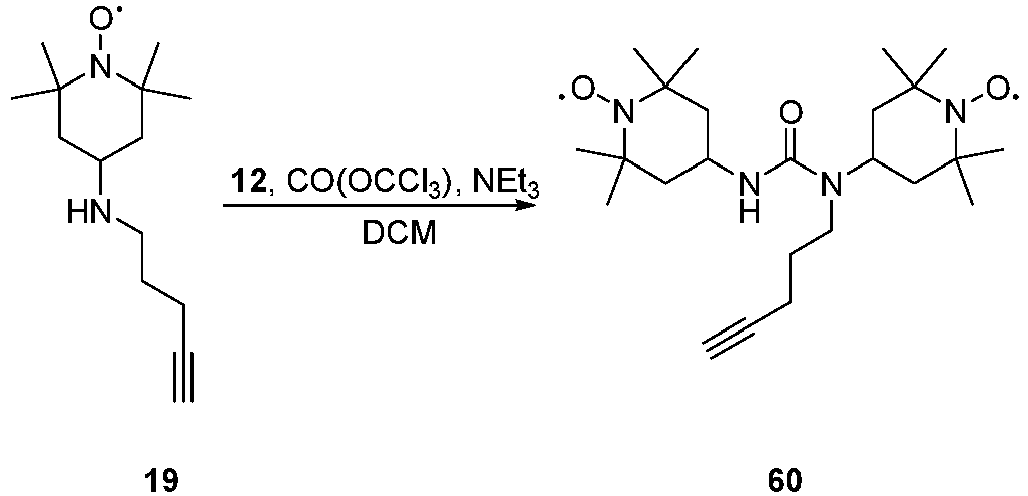
- (4-{(Pent-4-yn-1-yl)[(1-oxyl-2,2,6,6-tetramethylpiperidin-4-yl)carbamoyl]amino}-2,2,6,6-tetramethylpiperidin-1-yl)oxidanyl 60 was synthesized following General procedure F of Example 2.B/3.B starting form Compound 19. HRMS-ESI: m/z calcd for C24H42N4O3 •• [M+H]+ 435.3330, found 435.3333
-

- A solution of 60 (50 mg, 0.12 mmol) and PEG-N3 Mn=500 (62 mg, 0.12 mmol) in EtOH (3 mL) was diluted with water (2 mL). Sodium ascorbate (1M solution in water, 24 µL, 0.024 mmol, 20 mol %) and copper(II) sulfate pentahydrate (1 M solution in water, 12 µL, 0.012 mmol, 10 mol %) were added. After being stirred at room temperature for 6 h, the solution was concentrated in vacuo. The resulting residue was purified by column chromatography to afford crude compound 61 as a red oil (15 mg) which was further purified on prep-HPLC to afford 11 mg of pure (4-{3-[1-(PEG)-1H-1,2,3-triazol-4-yl]propyl}[(1-oxyl-2,2,6,6-tetramethylpiperidin-4-yl)carbamoyl]amino}-2,2,6,6-tetramethylpiperidin-1-yl)oxidanyl 61 as an oil (0.01 mmol, 10 %). HRMS-ESI: m/z calcd for C25H45N4O3 ••C2H4O)7[M+H]+ 800.5492, found 800.5495; m/z calcd for C25H45N4O3 ••(C2H4O)8[M+H]+ 844.5754, found 544.5758; m/z calcd for C25H45N4O3 ••(C2H4O)9[M+H]+ 888.6016, found 888.6024; m/z calcd for C25H45N4O3 ••(C2H4O)10[M+H]+ 932.6278, found 932.6280
-

- Following General Procedure E of Examples 2.A/3.A starting from Compound 20, 4,4'-(ethane-1,2-diyldiimino)bis(2,2,6,6-tetramethylpiperidin-1-oxidanyl) 22 was obtained. HRMS-ESI: m/z calcd for C20H40N4O2 ••[M+H]+ 369.3224, found 369.3223
- Following General Procedure E of Examples 2.A/3.A starting from Compound 21, 4,4'-(propane-1,3-diyldiimino)bis(2,2,6,6-tetramethylpiperidin-1-oxidanyl) 23 was obtained. HRMS-ESI: m/z calcd for C21H42N4O2 •• [M+H]+ 383.3381, found 383.3386
-

- To a 0.01 M solution of 22 (100 mg, 0.27 mmol) in DCM was added a solution of triphosgene (28 mg, 0.09 mmol) in DCM (1 ml) and the solution was stirred at rt overnight. The reaction mixture was washed with sat. aq. NaHCO3, dried over Na2SO4 and the solvent removed under reduce pressure. The residue was purified by column chromatography (SiO2, DCM:MeOH, 97:3) to give 1,3-bis(1-oxyl-2,2,6,6-tetramethylpiperidin-4-yl)imidazolidin-2-one 62 as a red solid (50 mg, 0.13 mmol, 47 %). HRMS-ESI: m/z calcd for C21H38N4O3 ••[M+H]+ 395.3017, found 395.3013.
- 1,3-Bis(1-oxyl-2,2,6,6-tetramethylpiperidin-4-yl)tetrahydropyrimidin-2(1H)-one 63 was synthesized in an analogous manner starting from Compound 23. HRMS-ESI: m/z calcd for C22H40N4O3 ••[M+H]+409.3173, found 409.3178
-

- (3-{[(1-Oxyl-2,2,5,5-tetramethylpyrrolidin-3-yl) carbamoyl]amino}-[2,2,5,5-tetramethylpyrrolidin-3-yl])oxidanyl 64 was synthesized following General Procedure D of Example 1.D. starting from Compound 24.. HRMS-ESI: m/z calcd for C17H32N4O3 ••[M+H]+ 341.2547, found 341.2547
-

- To a stirred solution of (2,2,6,6-tetramethyl-4-oxopiperidin-1-yl)oxidanyl (1.00 g, 5.88 mmol) and tosylmethyl isocyanide (1.30 g, 6.66 mmol) in dimethoxyethane (20 mL) was added slowly a solution of potassium tert-butoxide (1.30 g, 11.60 mmol) dissolved in a mixture of dimethoxyethane (10 mL) and tert-butyl alcohol (10 mL). The mixture was stirred for 3 h at room temperature. At the end of reaction, 100 ml of water was added and the mixture was extracted with diethylether (80 ml), dried over Na2SO4 and concentrated under reduced pressure to give (4-cyano-2,2,6,6-tetramethylpiperidin-1-yl)oxidanyl 25 (0.95 g, 89 %) as a red powder. ESI-MS: [M+H]+= 182; [M+Na]+= 204.
-

- To a solution of 25 (0.90 g, 4.97 mmol) in methanol (20 mL) was added a solution of Ba(OH)2.8H2O (3.00 g, 9.52 mmol) in 100 mL of water. The mixture was refluxed during 6 h. At the end of time, the mixture was cooled, and extracted with chloroform (2 x 200 mL). Then, the aqueous solution was acidified with 5% hydrochloric acid, and extracted with chloroform (3 x 200 mL). The chloroform extracts were recombined, dried over Na2SO4 and concentrated under reduced pressure to give (4-carboxy-2,2,6,6-tetramethylpiperidin-1-yl)oxidanyl 26 (0.82g, 82%) as a red powder. mp: 171°C; HRMS-ESI: calcd for C10H18NO3·([M+H]+) 201.1359, found 201.1359.
-

- To a solution of 26 (50 mg, 0.25 mmol) under Argon atmosphere in DCM was added oxalyl chloride (26 µl, 0.3 mmol). The solution was stirred at rt for 3h. Then the excess of oxalyl chloride and DCM were removed in vacuo. To a solution of 12 (43 mg, 0.25 mmol) in DCM was added the solution of the acid chloride in DCM dropwise and the resulting solution was stirred at rt for 2h. It was then washed with sat. aq. NaHCO3 and the solvent was removed under reduced pressure. The residue was purified using flash chromatography to give 40 mg of red solid (4-{[(1-oxyl-2,2,6,6-tetramethylpiperidin-4-yl)carbonyl]amino}-2,2,6,6-tetramethylpiperidin-1-yl)oxidanyl 65 (0.11 mmol, 45 %). HRMS-ESI: calcd for C19H35N3O3 [M+H]+ 354.2754, found 354.2748.
-

- A solution of 12 (50 mg, 0.29 mmol), 27 (55 mg, 0.29 mmol), DCC (66 mg, 0.32 mmol), HOBt (78 mg, 0.58 mmol) and NEt3 in DCM (5 ml) was stirred under Argon atmosphere for 6h. It was then washed with sat. aq. NaHCO3, brine and the solvent was removed under reduced pressure. The residue was purified using flash chromatography to give 35 mg of red solid {3-[(1-oxyl-2,2,6,6-tetramethylpiperidin-4-yl)carbamoyl]-2,2,5,5-tetramethylpyrrolidin-1-yl}oxidanyl 66 (0.10 mmol, 36 %). HRMS-ESI: calcd for C18H33N3O3[M+H]+ 340.2595, found 340.2596.
-

- (3-{[(1-Oxyl-2,2,6,6-tetramethylpiperidin-4-yl)carbonyl]amino}-2,2,5,5-tetramethylpyrrolidin-1-yl)oxidanyl 67 was synthesized following General Procedure G. of Example 17 starting from Compounds 28 and 26. HRMS-ESI: calcd for C18H33N3O3 [M +H]+ 340.2595, found 340.2594.
-

- Under an argon atmosphere, to a solution of 29 (312 mg, 2 mmol) in DCM was added a solution of sulfuryl chloride (81 µl, 1 mmol) in DCM (1 ml) and the solution was stirred for 2h. The precipitate of 30 was filtrated and used without further purification.
-

- Following General procedure B of Example 1.B starting from Compound 30, (4-{[(1-oxyl-2,2,6,6-tetramethylpiperidin-4-yl)sulfamoyl]amino}-2,2,6,6-tetramethylpiperidin-1-yl)oxidanyl 68 was synthesized.HRMS-ESI: calcd for C18H36N4O4S [M +H]+ 405.2530, found 405.2530.
-

- Over a solution of 31 (0.25 g, 2.77 mmol) in CH2Cl2 (20 mL) at 0 °C was added imidazole (566 mg, 8.33 mmol), DMAP (67 mg, 0.27 mmol) and tert-butyldimethylsilyl chloride (666 mg, 5.55 mmol). The solution was stirred for 5 h at room temperature, after this time the solvent was removed by distillation at reduced pressure obtaining a crude that was purified by flash chromatography (10-30% EtOH/ CH2Cl2) affording 32 as an oil (0.5 g, 85%). 1H NMR (400 MHz, CHLOROFORM-d) δ ppm 0.10 (s, 6 H); 0.87 - 0.95 (m, 9 H); 2.76 (dd, J=5.14, 3.89 Hz, 3 H); 3.61 (quin, J=5.21 Hz, 1 H); 13C NMR (75 MHz, CHLOROFORM-d) δ ppm: -4.49; 18.09: 25.84; 45.67; 75.10.
-

- To a solution of ketone 5 (750 mg, 2.95mmol), diamine 32 (251 mg, 1.23 mmol) in dry THF (10 ml) was added AcOH to adjust the pH at 6-7 and the solution was stirred at rt for 2h. Then, Na(OAc)3BH (630 mg, 3.69 mmol) was added portionwise and the reaction was stirred at rt for 16h. After this time, the mixture was concentrated under reduced pressure. The residue was solubilized in CH2Cl2, washed with a saturated aqueous solution of NaHCO3, dried on Na2SO4, concentrated under reduced pressure and the crude product was purified by SiO2 column chromatography with CH2Cl2/MeOH (9/1) to give the desired compound 33 (425 mg, 0.62 mmol, 51 %). HRMS-ESI: m/z calcd for C35H65N4O7Si [M+H]+ 681.4617, found 681.4614.
-

- To a 0.01 M solution of 33 (425 mg, 0.62 mmol) and NEt3 (0.2 ml, 1.36 mmol) in DCM was added under Ar at 0°C a solution of triphosgene (61 mg, 0.20 mmol) in DCM (1 ml) and the solution was stirred at rt overnight. The reaction mixture was washed with sat. aq. NaHCO3, dried over Na2SO4 and the solvent removed under reduced pressure. The residue was purified by column chromatography (SiO2, DCM:MeOH, 97:3) to give 34 as a red solid (310 mg, 0.44 mmol, 71 %). HRMS-ESI: m/z calcd for C36H63N4O8Si [M+H]+ 707.4410, found 707.4410.
-

- A 1 M solution of TBAF (0.47 ml, 0.47 mmol) was added to a stirred solution of 34 (310 mg, 0.44 mmol) in THF (5 ml). The solution was stirred at rt for 2h (until completion, followed by TLC), brine was added and it was extracted with AcOEt. The organic phase was dried over Na2SO4 and the solvent removed under reduced pressure. The residue was purified by column chromatography (SiO2, DCM:MeOH, 95:5) to give 5-hydroxy-1,3-bis(7-oxyl-3,11-dioxa-7-azadispiro[5.1.5.3]hexadec-15-yl)tetrahydropyrimidin-2(1H)-one 69 as a red solid (250 mg, 0.42 mmol, 95 %). HRMS-ESI: m/z calcd for C30H49N4O8 [M+H]+ 593.3545, found 593.3550.
-

- NaH (60 %, 30 mg, 0.18 mmol) was added to a solution of 69 (75 mg, 0.12 mmol) in DMF and stirred at rt for 3h. Then a solution of tosylated PEG (66 mg, 0.18 mmol) was added and the reaction mixture was stirred at rt for 5h. Brine was added and the mixture was extracted with DCM, dried over Na2SO4 and the solvent removed under reduced pressure. The residue was purified by column chromatography (SiO2, DCM:EtOH, 95:5) to give 1,3-bis(7-oxyl-3,11-dioxa-7-azadispiro[5.1,5.3]hexadec-15-yl)-5-(2,5,8,11-tetraoxatridecan-13-yloxy)tetrahydropyrimidin-2(1H)-one 70 as a red solid (25 mg, 0.03 mmol, 27 %). HRMS-ESI: m/z calcd for C39H70N5O12 [M+NH4] + 800.5016, found 800.5015.
-

- Over a solution of 2-(2-aminoethoxy)ethanol (35) (5.0 ml, 50.3 mmol) in CH2Cl2 (30 ml) at 0 °C was added imidazole (10.3 g, 151 mmol), DMAP (0.6 g, 5 mmol) and tert-butyldimethylsilyl chloride (8.3 g, 55 mmol). The solution was stirred for 5 h at room temperature, then washed with brine and the solvent was removed under reduced pressure to obtain 36 as an oil (7.5 g, 68%). 1H NMR (300 MHz, CHLOROFORM-d) δ ppm: -0.03 (s, 6 H); 0.80 (s, 9 H); 2.87 (t, J=5.18 Hz, 2 H); 3.44 (m, J=5.23 Hz, 2 H); 3.52 (t, J=5.18 Hz, 2 H); 3.66 (t, J=4.86 Hz, 2 H). 13C NMR (75 MHz, CHLOROFORM-d) δ ppm -5.49 (s, 2 CH3); 18.12 (s, C); 25.69 (s, 3 CH3); 40.53 (s, CH2); 62.46 (s, CH2); 70.45 (s, CH2); 72.22 (s, CH2).
-

- Compound 37 was synthesized following General Procedure E of Example 2.A/3.A starting from Compounds 5 and 35. HRMS-ESI: m/z calcd C23H46N2O5 Si•+ [M+H]+ 458.3171, found 458.3166.
-

- Compound 38 was synthesized following General procedure F of Example 2.B/3.B starting form Compound 37. HRMS-ESI: m/z calcd C37H67N4O9 Si••+ [M+H]+ 739.4672, found 739.4669.
-

- A 1 M solution of tetrabutyl ammonium chloride (TBAF) (1.8 ml, 1.8 mmol) was added to a stirred solution of 38 (1.33 g, 1.8 mmol) in THF (30 ml). The solution was stirred at rt for 2h (until completion, followed by TLC), brine was added and it was extracted with AcOEt. The organic phase was dried over Na2SO4 and the solvent removed under reduced pressure. The residue was purified by column chromatography (SiO2, DCM:MeOH, 96:4) to give (15-{[(7-oxyl-3,11-dioxa-7-azadispiro[5.1.5.3]hexadec-15-y!)carbamoyl][2-(2-hydroxyethoxy)ethyl]amino}-[3,11-dioxa-7-azadispiro[5.1.5.3]hexadec-7-yl])oxidanyl 71 as a red solid (1.07 g, 1.71 mmol, 95 %). HRMS-ESI: m/z calcd for C31H53N4O9 [M+H]+ 625.3807, found 625.3799.
-

- Compound 39 was synthesized following General procedure E of Example 2.A/3.A starting from poly((ethylene glycol) methyl ether (Mn=500 g.mol-1).
-
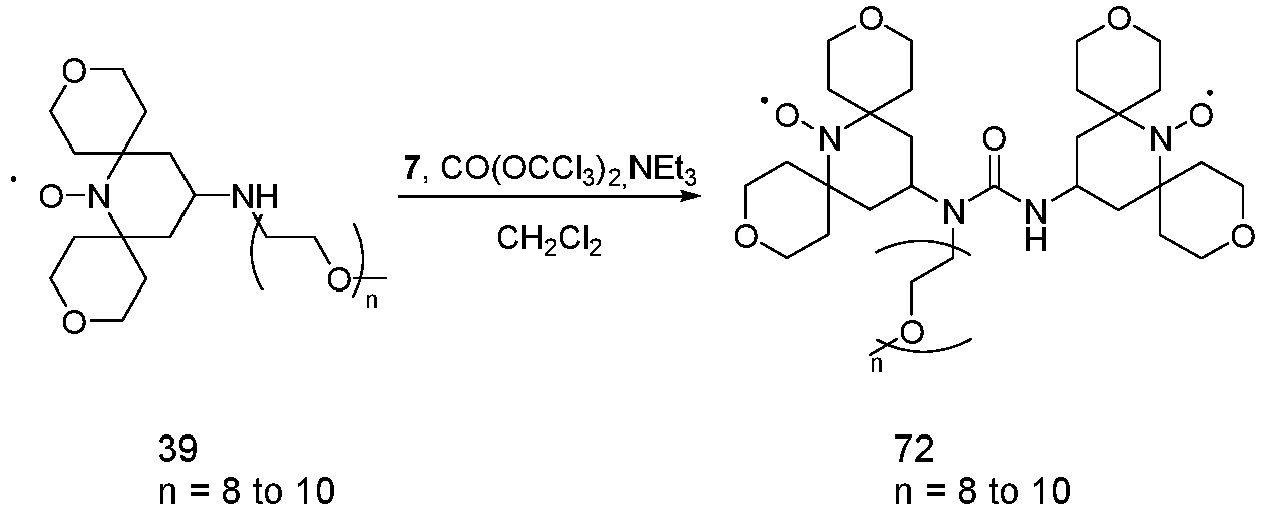
- α-{(7-Oxyl-3,11-dioxa-7-azadispiro[5.1,5.3]hexadec-15-yl)[(7-oxyl-3,11-dioxa-7-azadispiro[5.1.5.3]hexadec-15-yl)carbamoyl]amino}ω-methylpoly(ethane-1,2-diyloxy) 72 was synthesized following General Procedure F of Example 2.B/3.B starting from Compound 39.
- HRMS-ESI: m/z calcd for
- C30H58N2O11 [M8+H]+ 622.4035, found 622.4036;
- C32H62N2O12 [M9+H]+ 666.4297, found 666.4296;
- C34H66N2O13 [M10+H]+ 710.4559, found 710.4559;
- C36H70N2O14 [M10+H]+ 754.4822, found 754.4815.
Claims (5)
- A compound of general formula (I)
 M is NR2;X is CO;a is 1 or 0;R1 is H; (CH2)o-E, wherein o is an integer of from 1 to 10 and E is COOH; or (CH2-CH2-O)m-CH3 or (CH2-CH2-O)m-H, wherein m is an integer of from 1 to 500; or
 R2 is H;ora is 1 and M is NR2, R1 and R2 form togethera bridging -CH2CH(G)CH2- group, with G = (CH2)o-E, wherein o is an integer of from 0 to 10 and E is: COOH, OH or NH2; or (CH2-CH2-O)m-CH3, wherein m is an integer of from 1 to 500; or a bridging -CH2CH2-, -CH2CH2CH2- or -CH2-CHOH-CH2- group;
andQ1 and Q2 are independently selected from

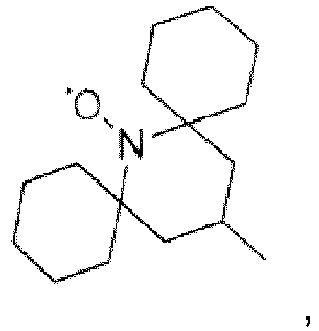
 except the compound 4,4-ureylene-di-(2,2,6,6-tetramethylpiperidinyloxyl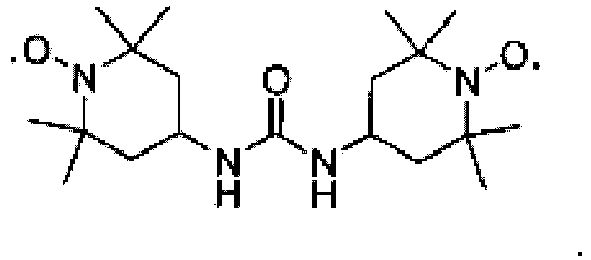
- The compound of claim 1, whereina is 1,R1 is H; or (CH2-CH2-O)m-CH3 or (CH2-CH2-O)m-H, wherein m is an integer of from 1 to 500, preferably 1 to 15; or

orR1 and R2 together form a bridging group -CH2CH(G)CH2- wherein G is (CH2-CH2-O)m-CH3 with m being an integer of from 1 to 500, or a bridging -CH2CH2-, -CH2-CHOH-CH2- or -CH2CH2CH2- group;andQ1 and Q2 are selected from
- The compound of claim 1 or 2, wherein Q1 and Q2 are identical.
- The compound of claim 3, wherein Q1 and Q2 are

- The compound of any of claims 1 to 4, which is selected from
 (15-{[(7oxyl-3,11-dioxa-7-azadispiro[5.1.5.3]hexadec-15-yl)carbamoyl]amino}-[3,11-dioxa-7-azadispiro[5.1.5.3]hexadec-7-yl])oxidanyl),designated as "bPyTurea" or "PyPOL";
 57: (15-{[(7-oxyl-3,11-dioxa-7-azadispiro[5.1.5.3]hexadec-15-yl)carbamoyl][2-(2-methoxyethoxy)ethyl]amino}-[3,11-dioxa-7-azadispiro[5.1.5.3]hexadec-7-yl])oxidanyl, designated as "bPyTureaPEG2";58: (15-{[(7-oxyl-3,11-dioxa-7-azadispiro[5.1.5.3]hexadec-15-yl)carbamoyl][2-(2,5,8,11-tetraoxatridecan-13-ylamino)}-[3,11-dioxa-7-azadispiro[5.1.5.3]hexadec-7-yl])oxidanyl, designated as "bPyTureaPEG4" or "AMUPOL";
 (15-{[(7oxyl-7-azadispiro[5.1.5.3]hexadec-15-yl)carbamoyl]amino}-7-azadispiro[5.1.5.3]hexadec-7-yl)oxidanyl,designated as "bCTurea";
 54: (15-{[(7-hydroxy-7-azadispiro[5.1.5.3]hexadec-15-yl)carbamoyl][2-(2-methoxyethoxy) ethyl]amino}-7-azadispiro[5.1.5.3]hexadec-7-yl)oxidanyl,designated as "bCTureaPEG2";55. (15-{[(7-oxyl-7-azadispiro[5.1.5.3]hexadec-15-yl)carbamoyl][2-(2-methoxyethoxy) ethyl]amino}-7-azadispiro[5.1.5.3]hexadec-7-yl)oxidanyl,designated as "bCTureaPEG4";
 51: (4-{[2-(2-methoxyethoxy)ethyl][(1-oxyl-2,2,6,6-tetramethylpiperidin-4-yl)carbamoyl]amino}-2,2,6,6-tetramethylpiperidin-1-yl)oxidanyl,designated as "bTureaPEG2";52: (4-{(2,5,8,11-tetraoxatridecan-13-yl)[(1-oxyl-2,2,6,6-tetramethylpiperidin-4-yl)carbamoyl] amino}-2,2,6,6-tetramethylpiperidin-1-yl)oxidanyl,designated as "bTureaPEG4";
 (4-{(5-carboxypentyl)[(1-oxyl-2,2,6,6-tetramethylpiperidin-4-yl)carbamoyl]amino}-2,2,6,6-tetramethylpiperidin-1-yl)oxidanyl;
 (4-{(pent-4-yn-1-yl)[(1-oxyl-2,2,6,6-tetramethylpiperidin-4-yl)carbamoyl]amino}-2,2,6,6-tetramethylpiperidin-1-yl)oxidanyl;
 (4-{3-[1-(PEG)-1H-1,2,3-triazol-4-yl]propyl}[(1-oxyl-2,2,6,6-tetramethylpiperidin-4-yl)carbamoyl]amino}-2,2,6,6-tetramethylpiperidin-1-yl)oxidanyl,designated as "bTureaPEG500", when n=500;
 62: 1,3-bis(1-oxyl-2,2,6,6-tetramethylpiperidin-4-yl)imidazolidin-2-one, designated as "bTureaC5";63: 1,3-bis(1-oxyl-2,2,6,6-tetramethylpiperidin-4-yl)tetrahydropyrimidin-2(1H)-one, designated as "bTureaC6";
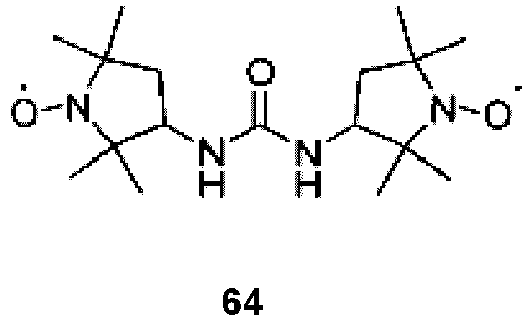 (3-{[(1-oxyl-2,2,5,5-tetramethylpyrrolidin-3-yl) carbamoyl]amino}-[2,2,5,5-tetramethylpyrrolidin-3-yl])oxidanyl,designated as "bProxurea";
 (4-{[(1-oxyl-2,2,6,6-tetramethylpiperidin-4-yl)carbonyl]amino}-2,2,6,6-tetramethylpiperidin-1-yl)oxidanyl,designated as "bTamide";
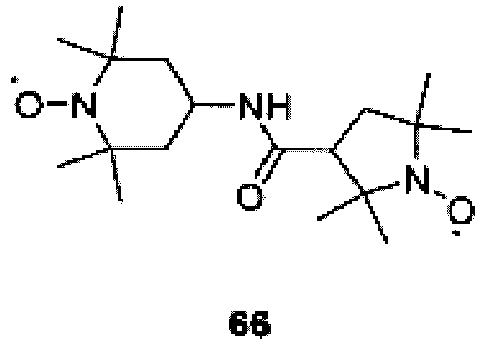 {3-[(1-oxyl-2,2,6,6-tetramethylpiperidin-4-yl)carbamoyl]-2,2,5,5-tetramethylpyrrolidin-1-yl}oxidanyl,designated as "ProxTamide";
 (3-{[(1-oxyl-2,2,6,6-tetramethylpiperidin-4-yl)carbonyl]amino}-2,2,5,5-tetramethylpyrrolidin-1-yl)oxidanyl.designated as "TProxamide";
 5-hydroxy-1,3-bis(7-oxyl-3,11-dioxa-7-azadispiro[5.1,5.3]hexadec-15-yl)tetrahydropyrimidin-2(1H)-one;designated as "PyPOLC6OH";
 1,3-bis(7-oxyl-3,11-dioxa-7-azadispiro[5.1.5.3]hexadec-15-yl)-5-(2,5,8,11-tetraoxatridecan-13-yloxy)tetrahydropyrimidin-2(1H)-one;
 (15-{[(7-oxyl-3,11-dioxa-7-azadispiro[5.1.5.3]hexadec-15-yl)carbamoyl][2-(2-hydroxyethoxy)ethyl]amino}-[3,11-dioxa-7-azadispiro[5.1.5.3]hexadec-7-yl])oxidanyl, designated as "PyPOLPEG2OH";
and α-{(7-0xyl-3,11-dioxa-7-azadispiro[5.1.5.3]hexadec-15-yl)[(7-oxyl-3,11-dioxa-7-azadispiro[5.1.5.3]hexadec-15-yl)carbamoyl]amino}ω-methylpoly(ethane-1,2-diyloxy), designated as "PyPOLPEG10".
Applications Claiming Priority (2)
| Application Number | Priority Date | Filing Date | Title |
|---|---|---|---|
| EP13290082.0A EP2789609A1 (en) | 2013-04-11 | 2013-04-11 | Highly efficient polarizing agents for dynamic nuclear polarization |
| PCT/EP2014/057439 WO2014167121A1 (en) | 2013-04-11 | 2014-04-11 | Highly efficient polarizing agents for dynamic nuclear polarization |
Publications (2)
| Publication Number | Publication Date |
|---|---|
| EP2984084A1 EP2984084A1 (en) | 2016-02-17 |
| EP2984084B1 true EP2984084B1 (en) | 2022-05-04 |
Family
ID=48366293
Family Applications (2)
| Application Number | Title | Priority Date | Filing Date |
|---|---|---|---|
| EP13290082.0A Withdrawn EP2789609A1 (en) | 2013-04-11 | 2013-04-11 | Highly efficient polarizing agents for dynamic nuclear polarization |
| EP14716608.6A Active EP2984084B1 (en) | 2013-04-11 | 2014-04-11 | Highly efficient polarizing agents for dynamic nuclear polarization |
Family Applications Before (1)
| Application Number | Title | Priority Date | Filing Date |
|---|---|---|---|
| EP13290082.0A Withdrawn EP2789609A1 (en) | 2013-04-11 | 2013-04-11 | Highly efficient polarizing agents for dynamic nuclear polarization |
Country Status (4)
| Country | Link |
|---|---|
| US (1) | US9738657B2 (en) |
| EP (2) | EP2789609A1 (en) |
| JP (1) | JP6490052B2 (en) |
| WO (1) | WO2014167121A1 (en) |
Families Citing this family (4)
| Publication number | Priority date | Publication date | Assignee | Title |
|---|---|---|---|---|
| JP6757946B2 (en) * | 2016-12-12 | 2020-09-23 | 国立研究開発法人理化学研究所 | NMR measurement method and equipment |
| EP3424921A1 (en) | 2017-07-05 | 2019-01-09 | Commissariat à l'Energie Atomique et aux Energies Alternatives | Dinitroxide biradical compounds as polarizing agents |
| WO2019028473A1 (en) * | 2017-08-04 | 2019-02-07 | Ohio State Innovation Foundation | Radical compounds and methods of using thereof |
| WO2019082951A1 (en) * | 2017-10-26 | 2019-05-02 | 国立大学法人九州大学 | Composition, composition for dynamic nuclear polarization, high polarization method, highly polarized substance, and nmr measuring method |
Family Cites Families (14)
| Publication number | Priority date | Publication date | Assignee | Title |
|---|---|---|---|---|
| JPS52100543A (en) * | 1976-02-18 | 1977-08-23 | Adeka Argus Chem Co Ltd | Stabilized synthetic resin compositions |
| US4123273A (en) * | 1977-07-11 | 1978-10-31 | Eastman Kodak Company | Stable free radical nitroxyl bleaching agents for photographic processes |
| DE2830032A1 (en) * | 1977-07-11 | 1979-02-01 | Eastman Kodak Co | USE OF NITROXYL RADICALS AS PHOTOGRAPHIC BLEACHING AGENTS |
| IT1277329B1 (en) | 1995-03-01 | 1997-11-10 | Ciba Geigy Spa | PROCEDURE FOR THE METHYLATION OF 2,2,6,6-TETRAMETHYL-4-PIPERIDONE (TRIACETONAMINE) |
| DE69727550T2 (en) * | 1996-10-25 | 2004-12-23 | The Yokohama Rubber Co., Ltd. | RUBBER COMPOSITION |
| DE19648811A1 (en) * | 1996-11-27 | 1998-05-28 | Basf Ag | Process for the polymerization of vinyl monomers |
| DE69710163T2 (en) * | 1996-12-02 | 2002-10-02 | Ondeo Nalco Energy Services, L.P. | Inhibition of the polymerization of vinyl aromatic monomers |
| US7351402B2 (en) | 2003-08-21 | 2008-04-01 | Massachusetts Institute Of Technology | Polarizing agents for dynamic nuclear polarization |
| JP4101242B2 (en) * | 2004-04-01 | 2008-06-18 | 横浜ゴム株式会社 | Polymer modification method |
| US7985594B2 (en) * | 2006-05-12 | 2011-07-26 | Massachusetts Institute Of Technology | Biradical polarizing agents for dynamic nuclear polarization |
| DE602007011607D1 (en) * | 2006-07-05 | 2011-02-10 | Basf Se | METHOD FOR THE PRODUCTION OF STERRICALLY PREVENTED NITROXYL ETHER |
| WO2009054455A1 (en) * | 2007-10-26 | 2009-04-30 | Kyusyu University | Hyperbranched polymer having nitroxyl group |
| FR2943676B1 (en) * | 2009-03-26 | 2017-03-24 | Univ De Provence | OPTIMIZED DINTIROXIDE BIRDICAL COMPOUNDS FOR NUCLEAR DYNAMIC POLARIZATION (PDN) |
| FR3004450B1 (en) * | 2013-04-15 | 2015-12-18 | Univ Aix Marseille | RIGID DINITROXIDE-LIKE BIRDICAL COMPOUNDS AS PERFECTED POLARIZATION AGENTS FOR NUCLEAR DYNAMIC POLARIZATION (PDN) TECHNIQUES |
-
2013
- 2013-04-11 EP EP13290082.0A patent/EP2789609A1/en not_active Withdrawn
-
2014
- 2014-04-11 US US14/783,134 patent/US9738657B2/en active Active
- 2014-04-11 JP JP2016506998A patent/JP6490052B2/en active Active
- 2014-04-11 WO PCT/EP2014/057439 patent/WO2014167121A1/en not_active Ceased
- 2014-04-11 EP EP14716608.6A patent/EP2984084B1/en active Active
Also Published As
| Publication number | Publication date |
|---|---|
| EP2789609A1 (en) | 2014-10-15 |
| JP6490052B2 (en) | 2019-03-27 |
| JP2016516094A (en) | 2016-06-02 |
| US20160046643A1 (en) | 2016-02-18 |
| EP2984084A1 (en) | 2016-02-17 |
| US9738657B2 (en) | 2017-08-22 |
| WO2014167121A1 (en) | 2014-10-16 |
Similar Documents
| Publication | Publication Date | Title |
|---|---|---|
| AU2020266956B2 (en) | Crystal form of Wee1 inhibitor compound and use thereof | |
| Kirilyuk et al. | Synthesis of the tetraethyl substituted pH-sensitive nitroxides of imidazole series with enhanced stability towards reduction | |
| EP2809666B1 (en) | Diarylamine-based fluorogenic probes for detection of peroxynitrite | |
| Xu et al. | Design, synthesis and anticancer activity evaluation of novel C14 heterocycle substituted epi-triptolide | |
| US9738657B2 (en) | Highly efficient polarizing agents for dynamic nuclear polarization | |
| CN111393401A (en) | Fluorescent probe molecule for detecting diaphorase based on rhodamine derivatives, preparation method and application | |
| CN103045230A (en) | A kind of PET type Fe3+ fluorescent probe and its preparation method and application | |
| Rajca et al. | 1, 3-Alternate calix [4] arene nitronyl nitroxide tetraradical and diradical: synthesis, X-ray crystallography, paramagnetic NMR spectroscopy, EPR spectroscopy, and magnetic studies | |
| US20230040736A1 (en) | Dinitroxide biradical compounds as polarizing agents | |
| EP4509506A1 (en) | Oxadiazole compound, pharmaceutical composition comprising same, and use thereof | |
| Bade et al. | A novel series of 1, 4-Dihydropyridine (DHP) derivatives bearing thiazolidin-4-one: From synthesis to structure | |
| Ferreira et al. | Gd (DO3A-N-α-aminopropionate): a versatile and easily available synthon with optimized water exchange for the synthesis of high relaxivity, targeted MRI contrast agents | |
| EP2128135A1 (en) | Method for synthesis of nitroxyl radical | |
| CN106929004B (en) | A signal-enhanced near-infrared fluorescent probe and its preparation method and application | |
| EP2957559A1 (en) | Iminosydnone derivatives for conjugation and release of compounds of interest | |
| KR20180001646A (en) | compound for detecting β-galactosidase using rearrangement of amin-thiol and Method for manufacturing thereof | |
| Yuan et al. | Synthesis, Structure Analysis, and Antitumor Activity of (R)‐2, 4‐Dioxo‐5‐fluoro‐1‐[1‐(methoxycarbonyl) Ethylaminocarbonylmethyl]‐1, 2, 3, 4‐tetrahydropyrimidine | |
| CN112500353B (en) | Levosimendan prodrug compound, preparation method and application thereof | |
| Habata et al. | Synthesis of diazahexathia-24-crown-8 derivatives and structures of Ag+ complexes | |
| EP2986613B1 (en) | Rigid dinitroxide biradical compounds used as improved polarising agents for dynamic nuclear polarisation techniques | |
| BR112020006051A2 (en) | crystalline forms of lenalidomide | |
| Marie-Aimée et al. | Unveiling the Synthesis, Spectral Characterizations, and Electrochemical Potential of Novel (E)-Furan-2-yl Acrylohydrazides: An Exploration in Molecular Design | |
| Penayori Marie-Aimée et al. | Unveiling the Synthesis, Spectral Characterizations, and Electrochemical Potential of Novel (E)-Furan-2-yl Acrylohydrazides: An Exploration in Molecular Design | |
| CA3007797C (en) | Water-soluble triazapyridinophane-based complexing agents and corresponding fluorescent lanthanide complexes | |
| Guo et al. | Synthesis and binding properties of a new fluorescent molecular sensor based on a triazole nucleoside |
Legal Events
| Date | Code | Title | Description |
|---|---|---|---|
| PUAI | Public reference made under article 153(3) epc to a published international application that has entered the european phase |
Free format text: ORIGINAL CODE: 0009012 |
|
| 17P | Request for examination filed |
Effective date: 20151111 |
|
| AK | Designated contracting states |
Kind code of ref document: A1 Designated state(s): AL AT BE BG CH CY CZ DE DK EE ES FI FR GB GR HR HU IE IS IT LI LT LU LV MC MK MT NL NO PL PT RO RS SE SI SK SM TR |
|
| AX | Request for extension of the european patent |
Extension state: BA ME |
|
| RIN1 | Information on inventor provided before grant (corrected) |
Inventor name: SAUVEE, CLAIRE Inventor name: TORDO, PAUL Inventor name: AUSSENAC, FABIEN Inventor name: ROSAY, MELANIE Inventor name: OUARI, OLIVIER Inventor name: CASANO, GILLES |
|
| DAX | Request for extension of the european patent (deleted) | ||
| STAA | Information on the status of an ep patent application or granted ep patent |
Free format text: STATUS: EXAMINATION IS IN PROGRESS |
|
| 17Q | First examination report despatched |
Effective date: 20170710 |
|
| GRAP | Despatch of communication of intention to grant a patent |
Free format text: ORIGINAL CODE: EPIDOSNIGR1 |
|
| STAA | Information on the status of an ep patent application or granted ep patent |
Free format text: STATUS: GRANT OF PATENT IS INTENDED |
|
| INTG | Intention to grant announced |
Effective date: 20211105 |
|
| RIN1 | Information on inventor provided before grant (corrected) |
Inventor name: ROSAY, MELANIE Inventor name: AUSSENAC, FABIEN Inventor name: TORDO, PAUL Inventor name: OUARI, OLIVIER Inventor name: CASANO, GILLES Inventor name: SAUVEE, CLAIRE |
|
| RAP3 | Party data changed (applicant data changed or rights of an application transferred) |
Owner name: BRUKER FRANCE S.A.S. |
|
| GRAS | Grant fee paid |
Free format text: ORIGINAL CODE: EPIDOSNIGR3 |
|
| GRAA | (expected) grant |
Free format text: ORIGINAL CODE: 0009210 |
|
| STAA | Information on the status of an ep patent application or granted ep patent |
Free format text: STATUS: THE PATENT HAS BEEN GRANTED |
|
| AK | Designated contracting states |
Kind code of ref document: B1 Designated state(s): AL AT BE BG CH CY CZ DE DK EE ES FI FR GB GR HR HU IE IS IT LI LT LU LV MC MK MT NL NO PL PT RO RS SE SI SK SM TR |
|
| REG | Reference to a national code |
Ref country code: GB Ref legal event code: FG4D |
|
| REG | Reference to a national code |
Ref country code: CH Ref legal event code: EP |
|
| REG | Reference to a national code |
Ref country code: AT Ref legal event code: REF Ref document number: 1488948 Country of ref document: AT Kind code of ref document: T Effective date: 20220515 |
|
| REG | Reference to a national code |
Ref country code: DE Ref legal event code: R096 Ref document number: 602014083531 Country of ref document: DE |
|
| REG | Reference to a national code |
Ref country code: IE Ref legal event code: FG4D |
|
| REG | Reference to a national code |
Ref country code: LT Ref legal event code: MG9D |
|
| REG | Reference to a national code |
Ref country code: NL Ref legal event code: MP Effective date: 20220504 |
|
| REG | Reference to a national code |
Ref country code: AT Ref legal event code: MK05 Ref document number: 1488948 Country of ref document: AT Kind code of ref document: T Effective date: 20220504 |
|
| PG25 | Lapsed in a contracting state [announced via postgrant information from national office to epo] |
Ref country code: SE Free format text: LAPSE BECAUSE OF FAILURE TO SUBMIT A TRANSLATION OF THE DESCRIPTION OR TO PAY THE FEE WITHIN THE PRESCRIBED TIME-LIMIT Effective date: 20220504 Ref country code: PT Free format text: LAPSE BECAUSE OF FAILURE TO SUBMIT A TRANSLATION OF THE DESCRIPTION OR TO PAY THE FEE WITHIN THE PRESCRIBED TIME-LIMIT Effective date: 20220905 Ref country code: NO Free format text: LAPSE BECAUSE OF FAILURE TO SUBMIT A TRANSLATION OF THE DESCRIPTION OR TO PAY THE FEE WITHIN THE PRESCRIBED TIME-LIMIT Effective date: 20220804 Ref country code: NL Free format text: LAPSE BECAUSE OF FAILURE TO SUBMIT A TRANSLATION OF THE DESCRIPTION OR TO PAY THE FEE WITHIN THE PRESCRIBED TIME-LIMIT Effective date: 20220504 Ref country code: LT Free format text: LAPSE BECAUSE OF FAILURE TO SUBMIT A TRANSLATION OF THE DESCRIPTION OR TO PAY THE FEE WITHIN THE PRESCRIBED TIME-LIMIT Effective date: 20220504 Ref country code: HR Free format text: LAPSE BECAUSE OF FAILURE TO SUBMIT A TRANSLATION OF THE DESCRIPTION OR TO PAY THE FEE WITHIN THE PRESCRIBED TIME-LIMIT Effective date: 20220504 Ref country code: GR Free format text: LAPSE BECAUSE OF FAILURE TO SUBMIT A TRANSLATION OF THE DESCRIPTION OR TO PAY THE FEE WITHIN THE PRESCRIBED TIME-LIMIT Effective date: 20220805 Ref country code: FI Free format text: LAPSE BECAUSE OF FAILURE TO SUBMIT A TRANSLATION OF THE DESCRIPTION OR TO PAY THE FEE WITHIN THE PRESCRIBED TIME-LIMIT Effective date: 20220504 Ref country code: ES Free format text: LAPSE BECAUSE OF FAILURE TO SUBMIT A TRANSLATION OF THE DESCRIPTION OR TO PAY THE FEE WITHIN THE PRESCRIBED TIME-LIMIT Effective date: 20220504 Ref country code: BG Free format text: LAPSE BECAUSE OF FAILURE TO SUBMIT A TRANSLATION OF THE DESCRIPTION OR TO PAY THE FEE WITHIN THE PRESCRIBED TIME-LIMIT Effective date: 20220804 Ref country code: AT Free format text: LAPSE BECAUSE OF FAILURE TO SUBMIT A TRANSLATION OF THE DESCRIPTION OR TO PAY THE FEE WITHIN THE PRESCRIBED TIME-LIMIT Effective date: 20220504 |
|
| PG25 | Lapsed in a contracting state [announced via postgrant information from national office to epo] |
Ref country code: RS Free format text: LAPSE BECAUSE OF FAILURE TO SUBMIT A TRANSLATION OF THE DESCRIPTION OR TO PAY THE FEE WITHIN THE PRESCRIBED TIME-LIMIT Effective date: 20220504 Ref country code: PL Free format text: LAPSE BECAUSE OF FAILURE TO SUBMIT A TRANSLATION OF THE DESCRIPTION OR TO PAY THE FEE WITHIN THE PRESCRIBED TIME-LIMIT Effective date: 20220504 Ref country code: LV Free format text: LAPSE BECAUSE OF FAILURE TO SUBMIT A TRANSLATION OF THE DESCRIPTION OR TO PAY THE FEE WITHIN THE PRESCRIBED TIME-LIMIT Effective date: 20220504 Ref country code: IS Free format text: LAPSE BECAUSE OF FAILURE TO SUBMIT A TRANSLATION OF THE DESCRIPTION OR TO PAY THE FEE WITHIN THE PRESCRIBED TIME-LIMIT Effective date: 20220904 |
|
| PG25 | Lapsed in a contracting state [announced via postgrant information from national office to epo] |
Ref country code: SM Free format text: LAPSE BECAUSE OF FAILURE TO SUBMIT A TRANSLATION OF THE DESCRIPTION OR TO PAY THE FEE WITHIN THE PRESCRIBED TIME-LIMIT Effective date: 20220504 Ref country code: SK Free format text: LAPSE BECAUSE OF FAILURE TO SUBMIT A TRANSLATION OF THE DESCRIPTION OR TO PAY THE FEE WITHIN THE PRESCRIBED TIME-LIMIT Effective date: 20220504 Ref country code: RO Free format text: LAPSE BECAUSE OF FAILURE TO SUBMIT A TRANSLATION OF THE DESCRIPTION OR TO PAY THE FEE WITHIN THE PRESCRIBED TIME-LIMIT Effective date: 20220504 Ref country code: EE Free format text: LAPSE BECAUSE OF FAILURE TO SUBMIT A TRANSLATION OF THE DESCRIPTION OR TO PAY THE FEE WITHIN THE PRESCRIBED TIME-LIMIT Effective date: 20220504 Ref country code: DK Free format text: LAPSE BECAUSE OF FAILURE TO SUBMIT A TRANSLATION OF THE DESCRIPTION OR TO PAY THE FEE WITHIN THE PRESCRIBED TIME-LIMIT Effective date: 20220504 Ref country code: CZ Free format text: LAPSE BECAUSE OF FAILURE TO SUBMIT A TRANSLATION OF THE DESCRIPTION OR TO PAY THE FEE WITHIN THE PRESCRIBED TIME-LIMIT Effective date: 20220504 |
|
| REG | Reference to a national code |
Ref country code: DE Ref legal event code: R097 Ref document number: 602014083531 Country of ref document: DE |
|
| PLBE | No opposition filed within time limit |
Free format text: ORIGINAL CODE: 0009261 |
|
| STAA | Information on the status of an ep patent application or granted ep patent |
Free format text: STATUS: NO OPPOSITION FILED WITHIN TIME LIMIT |
|
| PG25 | Lapsed in a contracting state [announced via postgrant information from national office to epo] |
Ref country code: AL Free format text: LAPSE BECAUSE OF FAILURE TO SUBMIT A TRANSLATION OF THE DESCRIPTION OR TO PAY THE FEE WITHIN THE PRESCRIBED TIME-LIMIT Effective date: 20220504 |
|
| 26N | No opposition filed |
Effective date: 20230207 |
|
| PG25 | Lapsed in a contracting state [announced via postgrant information from national office to epo] |
Ref country code: SI Free format text: LAPSE BECAUSE OF FAILURE TO SUBMIT A TRANSLATION OF THE DESCRIPTION OR TO PAY THE FEE WITHIN THE PRESCRIBED TIME-LIMIT Effective date: 20220504 |
|
| REG | Reference to a national code |
Ref country code: CH Ref legal event code: PL |
|
| PG25 | Lapsed in a contracting state [announced via postgrant information from national office to epo] |
Ref country code: LU Free format text: LAPSE BECAUSE OF NON-PAYMENT OF DUE FEES Effective date: 20230411 |
|
| REG | Reference to a national code |
Ref country code: BE Ref legal event code: MM Effective date: 20230430 |
|
| PG25 | Lapsed in a contracting state [announced via postgrant information from national office to epo] |
Ref country code: MC Free format text: LAPSE BECAUSE OF FAILURE TO SUBMIT A TRANSLATION OF THE DESCRIPTION OR TO PAY THE FEE WITHIN THE PRESCRIBED TIME-LIMIT Effective date: 20220504 |
|
| PG25 | Lapsed in a contracting state [announced via postgrant information from national office to epo] |
Ref country code: MC Free format text: LAPSE BECAUSE OF FAILURE TO SUBMIT A TRANSLATION OF THE DESCRIPTION OR TO PAY THE FEE WITHIN THE PRESCRIBED TIME-LIMIT Effective date: 20220504 Ref country code: LI Free format text: LAPSE BECAUSE OF NON-PAYMENT OF DUE FEES Effective date: 20230430 Ref country code: IT Free format text: LAPSE BECAUSE OF FAILURE TO SUBMIT A TRANSLATION OF THE DESCRIPTION OR TO PAY THE FEE WITHIN THE PRESCRIBED TIME-LIMIT Effective date: 20220504 Ref country code: CH Free format text: LAPSE BECAUSE OF NON-PAYMENT OF DUE FEES Effective date: 20230430 |
|
| REG | Reference to a national code |
Ref country code: IE Ref legal event code: MM4A |
|
| PG25 | Lapsed in a contracting state [announced via postgrant information from national office to epo] |
Ref country code: BE Free format text: LAPSE BECAUSE OF NON-PAYMENT OF DUE FEES Effective date: 20230430 |
|
| PG25 | Lapsed in a contracting state [announced via postgrant information from national office to epo] |
Ref country code: IE Free format text: LAPSE BECAUSE OF NON-PAYMENT OF DUE FEES Effective date: 20230411 |
|
| PG25 | Lapsed in a contracting state [announced via postgrant information from national office to epo] |
Ref country code: IE Free format text: LAPSE BECAUSE OF NON-PAYMENT OF DUE FEES Effective date: 20230411 |
|
| PG25 | Lapsed in a contracting state [announced via postgrant information from national office to epo] |
Ref country code: BG Free format text: LAPSE BECAUSE OF FAILURE TO SUBMIT A TRANSLATION OF THE DESCRIPTION OR TO PAY THE FEE WITHIN THE PRESCRIBED TIME-LIMIT Effective date: 20220504 |
|
| PG25 | Lapsed in a contracting state [announced via postgrant information from national office to epo] |
Ref country code: BG Free format text: LAPSE BECAUSE OF FAILURE TO SUBMIT A TRANSLATION OF THE DESCRIPTION OR TO PAY THE FEE WITHIN THE PRESCRIBED TIME-LIMIT Effective date: 20220504 |
|
| P01 | Opt-out of the competence of the unified patent court (upc) registered |
Free format text: CASE NUMBER: APP_102/2025 Effective date: 20250102 |
|
| PGFP | Annual fee paid to national office [announced via postgrant information from national office to epo] |
Ref country code: DE Payment date: 20250417 Year of fee payment: 12 |
|
| PGFP | Annual fee paid to national office [announced via postgrant information from national office to epo] |
Ref country code: FR Payment date: 20250422 Year of fee payment: 12 |
|
| PG25 | Lapsed in a contracting state [announced via postgrant information from national office to epo] |
Ref country code: CY Free format text: LAPSE BECAUSE OF FAILURE TO SUBMIT A TRANSLATION OF THE DESCRIPTION OR TO PAY THE FEE WITHIN THE PRESCRIBED TIME-LIMIT; INVALID AB INITIO Effective date: 20140411 |
|
| PG25 | Lapsed in a contracting state [announced via postgrant information from national office to epo] |
Ref country code: HU Free format text: LAPSE BECAUSE OF FAILURE TO SUBMIT A TRANSLATION OF THE DESCRIPTION OR TO PAY THE FEE WITHIN THE PRESCRIBED TIME-LIMIT; INVALID AB INITIO Effective date: 20140411 |
|
| PG25 | Lapsed in a contracting state [announced via postgrant information from national office to epo] |
Ref country code: TR Free format text: LAPSE BECAUSE OF FAILURE TO SUBMIT A TRANSLATION OF THE DESCRIPTION OR TO PAY THE FEE WITHIN THE PRESCRIBED TIME-LIMIT Effective date: 20220504 |
|
| PGFP | Annual fee paid to national office [announced via postgrant information from national office to epo] |
Ref country code: GB Payment date: 20260324 Year of fee payment: 13 |