EP2983890B1 - A method for laser welding of plastic materials - Google Patents
A method for laser welding of plastic materials Download PDFInfo
- Publication number
- EP2983890B1 EP2983890B1 EP14718905.4A EP14718905A EP2983890B1 EP 2983890 B1 EP2983890 B1 EP 2983890B1 EP 14718905 A EP14718905 A EP 14718905A EP 2983890 B1 EP2983890 B1 EP 2983890B1
- Authority
- EP
- European Patent Office
- Prior art keywords
- laser
- plastic material
- plastic
- dye
- compound
- Prior art date
- Legal status (The legal status is an assumption and is not a legal conclusion. Google has not performed a legal analysis and makes no representation as to the accuracy of the status listed.)
- Active
Links
- 239000000463 material Substances 0.000 title claims description 41
- 238000000034 method Methods 0.000 title claims description 22
- 238000004023 plastic welding Methods 0.000 title claims description 14
- 229920003023 plastic Polymers 0.000 claims description 99
- 239000004033 plastic Substances 0.000 claims description 91
- 150000001875 compounds Chemical class 0.000 claims description 25
- RBSLJAJQOVYTRQ-UHFFFAOYSA-N croconic acid Chemical class OC1=C(O)C(=O)C(=O)C1=O RBSLJAJQOVYTRQ-UHFFFAOYSA-N 0.000 claims description 18
- 238000002844 melting Methods 0.000 claims description 12
- 230000008018 melting Effects 0.000 claims description 12
- 238000002835 absorbance Methods 0.000 claims description 8
- 125000000217 alkyl group Chemical group 0.000 claims description 6
- 125000000524 functional group Chemical group 0.000 claims description 6
- 125000004432 carbon atom Chemical group C* 0.000 claims description 5
- 238000001228 spectrum Methods 0.000 claims description 5
- 230000003213 activating effect Effects 0.000 claims description 2
- 238000002329 infrared spectrum Methods 0.000 claims description 2
- 230000000007 visual effect Effects 0.000 claims description 2
- 239000000975 dye Substances 0.000 description 61
- 238000003466 welding Methods 0.000 description 34
- 239000006096 absorbing agent Substances 0.000 description 23
- 238000010521 absorption reaction Methods 0.000 description 18
- 229920000642 polymer Polymers 0.000 description 16
- 239000000654 additive Substances 0.000 description 12
- -1 transition metal salt Chemical class 0.000 description 12
- 239000000203 mixture Substances 0.000 description 11
- 230000008569 process Effects 0.000 description 10
- IAZDPXIOMUYVGZ-UHFFFAOYSA-N Dimethylsulphoxide Chemical compound CS(C)=O IAZDPXIOMUYVGZ-UHFFFAOYSA-N 0.000 description 9
- YXFVVABEGXRONW-UHFFFAOYSA-N Toluene Chemical compound CC1=CC=CC=C1 YXFVVABEGXRONW-UHFFFAOYSA-N 0.000 description 9
- 229910052757 nitrogen Inorganic materials 0.000 description 9
- LRHPLDYGYMQRHN-UHFFFAOYSA-N N-Butanol Chemical compound CCCCO LRHPLDYGYMQRHN-UHFFFAOYSA-N 0.000 description 8
- 239000001045 blue dye Substances 0.000 description 8
- 239000002904 solvent Substances 0.000 description 8
- 239000004698 Polyethylene Substances 0.000 description 7
- 230000005855 radiation Effects 0.000 description 7
- 229910052721 tungsten Inorganic materials 0.000 description 7
- UHOVQNZJYSORNB-UHFFFAOYSA-N Benzene Chemical compound C1=CC=CC=C1 UHOVQNZJYSORNB-UHFFFAOYSA-N 0.000 description 6
- XEKOWRVHYACXOJ-UHFFFAOYSA-N Ethyl acetate Chemical compound CCOC(C)=O XEKOWRVHYACXOJ-UHFFFAOYSA-N 0.000 description 6
- IMNFDUFMRHMDMM-UHFFFAOYSA-N N-Heptane Chemical compound CCCCCCC IMNFDUFMRHMDMM-UHFFFAOYSA-N 0.000 description 6
- WYURNTSHIVDZCO-UHFFFAOYSA-N Tetrahydrofuran Chemical compound C1CCOC1 WYURNTSHIVDZCO-UHFFFAOYSA-N 0.000 description 6
- 239000010410 layer Substances 0.000 description 6
- 229920002521 macromolecule Polymers 0.000 description 6
- 239000001044 red dye Substances 0.000 description 6
- WFKWXMTUELFFGS-UHFFFAOYSA-N tungsten Chemical compound [W] WFKWXMTUELFFGS-UHFFFAOYSA-N 0.000 description 6
- 239000010937 tungsten Substances 0.000 description 6
- YMWUJEATGCHHMB-UHFFFAOYSA-N Dichloromethane Chemical compound ClCCl YMWUJEATGCHHMB-UHFFFAOYSA-N 0.000 description 5
- GWEVSGVZZGPLCZ-UHFFFAOYSA-N Titan oxide Chemical compound O=[Ti]=O GWEVSGVZZGPLCZ-UHFFFAOYSA-N 0.000 description 5
- 238000004519 manufacturing process Methods 0.000 description 5
- 239000007787 solid Substances 0.000 description 5
- 239000004743 Polypropylene Substances 0.000 description 4
- 125000003118 aryl group Chemical group 0.000 description 4
- 238000000354 decomposition reaction Methods 0.000 description 4
- 229920001707 polybutylene terephthalate Polymers 0.000 description 4
- 229920000573 polyethylene Polymers 0.000 description 4
- 239000000047 product Substances 0.000 description 4
- 239000000126 substance Substances 0.000 description 4
- 238000005160 1H NMR spectroscopy Methods 0.000 description 3
- WEVYAHXRMPXWCK-UHFFFAOYSA-N Acetonitrile Chemical compound CC#N WEVYAHXRMPXWCK-UHFFFAOYSA-N 0.000 description 3
- IJGRMHOSHXDMSA-UHFFFAOYSA-N Atomic nitrogen Chemical compound N#N IJGRMHOSHXDMSA-UHFFFAOYSA-N 0.000 description 3
- 229910000906 Bronze Inorganic materials 0.000 description 3
- 239000002253 acid Substances 0.000 description 3
- 239000000980 acid dye Substances 0.000 description 3
- 150000001412 amines Chemical class 0.000 description 3
- QVGXLLKOCUKJST-UHFFFAOYSA-N atomic oxygen Chemical compound [O] QVGXLLKOCUKJST-UHFFFAOYSA-N 0.000 description 3
- 230000015572 biosynthetic process Effects 0.000 description 3
- 239000010974 bronze Substances 0.000 description 3
- 238000000576 coating method Methods 0.000 description 3
- 229920001577 copolymer Polymers 0.000 description 3
- KUNSUQLRTQLHQQ-UHFFFAOYSA-N copper tin Chemical compound [Cu].[Sn] KUNSUQLRTQLHQQ-UHFFFAOYSA-N 0.000 description 3
- 238000009792 diffusion process Methods 0.000 description 3
- 230000000694 effects Effects 0.000 description 3
- 239000000155 melt Substances 0.000 description 3
- VLKZOEOYAKHREP-UHFFFAOYSA-N n-Hexane Chemical compound CCCCCC VLKZOEOYAKHREP-UHFFFAOYSA-N 0.000 description 3
- 230000003287 optical effect Effects 0.000 description 3
- 229910052760 oxygen Inorganic materials 0.000 description 3
- 239000001301 oxygen Substances 0.000 description 3
- 239000002245 particle Substances 0.000 description 3
- 239000004417 polycarbonate Substances 0.000 description 3
- 239000011541 reaction mixture Substances 0.000 description 3
- 238000010992 reflux Methods 0.000 description 3
- 238000007711 solidification Methods 0.000 description 3
- 239000000243 solution Substances 0.000 description 3
- 125000001424 substituent group Chemical group 0.000 description 3
- 231100000419 toxicity Toxicity 0.000 description 3
- 230000001988 toxicity Effects 0.000 description 3
- 230000026683 transduction Effects 0.000 description 3
- 238000010361 transduction Methods 0.000 description 3
- 238000012546 transfer Methods 0.000 description 3
- 238000001644 13C nuclear magnetic resonance spectroscopy Methods 0.000 description 2
- 0 C*c1c(C(C(C(*)C2(C)C3(C)C2c(ccc(N*)c2)c2O)O)C3O)ccc(N(*)*)c1 Chemical compound C*c1c(C(C(C(*)C2(C)C3(C)C2c(ccc(N*)c2)c2O)O)C3O)ccc(N(*)*)c1 0.000 description 2
- 101150041968 CDC13 gene Proteins 0.000 description 2
- HEDRZPFGACZZDS-UHFFFAOYSA-N Chloroform Chemical compound ClC(Cl)Cl HEDRZPFGACZZDS-UHFFFAOYSA-N 0.000 description 2
- LFQSCWFLJHTTHZ-UHFFFAOYSA-N Ethanol Chemical compound CCO LFQSCWFLJHTTHZ-UHFFFAOYSA-N 0.000 description 2
- KFZMGEQAYNKOFK-UHFFFAOYSA-N Isopropanol Chemical compound CC(C)O KFZMGEQAYNKOFK-UHFFFAOYSA-N 0.000 description 2
- ATHHXGZTWNVVOU-UHFFFAOYSA-N N-methylformamide Chemical compound CNC=O ATHHXGZTWNVVOU-UHFFFAOYSA-N 0.000 description 2
- 229920000299 Nylon 12 Polymers 0.000 description 2
- 229920002292 Nylon 6 Polymers 0.000 description 2
- 229930040373 Paraformaldehyde Natural products 0.000 description 2
- 239000004695 Polyether sulfone Substances 0.000 description 2
- 239000004793 Polystyrene Substances 0.000 description 2
- CDBYLPFSWZWCQE-UHFFFAOYSA-L Sodium Carbonate Chemical compound [Na+].[Na+].[O-]C([O-])=O CDBYLPFSWZWCQE-UHFFFAOYSA-L 0.000 description 2
- HEDRZPFGACZZDS-MICDWDOJSA-N Trichloro(2H)methane Chemical compound [2H]C(Cl)(Cl)Cl HEDRZPFGACZZDS-MICDWDOJSA-N 0.000 description 2
- 239000011358 absorbing material Substances 0.000 description 2
- 238000000862 absorption spectrum Methods 0.000 description 2
- 229920002877 acrylic styrene acrylonitrile Polymers 0.000 description 2
- 230000005540 biological transmission Effects 0.000 description 2
- 239000006229 carbon black Substances 0.000 description 2
- 125000002915 carbonyl group Chemical group [*:2]C([*:1])=O 0.000 description 2
- 238000006243 chemical reaction Methods 0.000 description 2
- 239000003086 colorant Substances 0.000 description 2
- 230000001419 dependent effect Effects 0.000 description 2
- 238000009826 distribution Methods 0.000 description 2
- 239000003480 eluent Substances 0.000 description 2
- 229940093499 ethyl acetate Drugs 0.000 description 2
- 235000019439 ethyl acetate Nutrition 0.000 description 2
- 239000004744 fabric Substances 0.000 description 2
- 229920001903 high density polyethylene Polymers 0.000 description 2
- 238000004896 high resolution mass spectrometry Methods 0.000 description 2
- 239000004700 high-density polyethylene Substances 0.000 description 2
- 229940063583 high-density polyethylene Drugs 0.000 description 2
- 238000005304 joining Methods 0.000 description 2
- 229920001684 low density polyethylene Polymers 0.000 description 2
- 239000004702 low-density polyethylene Substances 0.000 description 2
- 229940099514 low-density polyethylene Drugs 0.000 description 2
- 238000010309 melting process Methods 0.000 description 2
- QGLKJKCYBOYXKC-UHFFFAOYSA-N nonaoxidotritungsten Chemical compound O=[W]1(=O)O[W](=O)(=O)O[W](=O)(=O)O1 QGLKJKCYBOYXKC-UHFFFAOYSA-N 0.000 description 2
- 125000002080 perylenyl group Chemical class C1(=CC=C2C=CC=C3C4=CC=CC5=CC=CC(C1=C23)=C45)* 0.000 description 2
- 229920001643 poly(ether ketone) Polymers 0.000 description 2
- 229920003229 poly(methyl methacrylate) Polymers 0.000 description 2
- 229920002285 poly(styrene-co-acrylonitrile) Polymers 0.000 description 2
- 229920002492 poly(sulfone) Polymers 0.000 description 2
- 229920000515 polycarbonate Polymers 0.000 description 2
- 229920006393 polyether sulfone Polymers 0.000 description 2
- 239000005020 polyethylene terephthalate Substances 0.000 description 2
- 229920000139 polyethylene terephthalate Polymers 0.000 description 2
- 229920006324 polyoxymethylene Polymers 0.000 description 2
- 229920000069 polyphenylene sulfide Polymers 0.000 description 2
- 229920001155 polypropylene Polymers 0.000 description 2
- 239000004800 polyvinyl chloride Substances 0.000 description 2
- 229920000915 polyvinyl chloride Polymers 0.000 description 2
- 150000003839 salts Chemical class 0.000 description 2
- 238000012360 testing method Methods 0.000 description 2
- 239000004408 titanium dioxide Substances 0.000 description 2
- PBYZMCDFOULPGH-UHFFFAOYSA-N tungstate Chemical compound [O-][W]([O-])(=O)=O PBYZMCDFOULPGH-UHFFFAOYSA-N 0.000 description 2
- 229910001930 tungsten oxide Inorganic materials 0.000 description 2
- ZNOKGRXACCSDPY-UHFFFAOYSA-N tungsten trioxide Chemical compound O=[W](=O)=O ZNOKGRXACCSDPY-UHFFFAOYSA-N 0.000 description 2
- XLYOFNOQVPJJNP-UHFFFAOYSA-N water Substances O XLYOFNOQVPJJNP-UHFFFAOYSA-N 0.000 description 2
- 125000003837 (C1-C20) alkyl group Chemical group 0.000 description 1
- SKIDNYUZJPMKFC-UHFFFAOYSA-N 1-iododecane Chemical compound CCCCCCCCCCI SKIDNYUZJPMKFC-UHFFFAOYSA-N 0.000 description 1
- RGUKSQMBTKNZKL-UHFFFAOYSA-N 3-(didecylamino)phenol Chemical compound C(CCCCCCCCC)N(CCCCCCCCCC)C=1C=C(C=CC=1)O RGUKSQMBTKNZKL-UHFFFAOYSA-N 0.000 description 1
- WAVOOWVINKGEHS-UHFFFAOYSA-N 3-(diethylamino)phenol Chemical compound CCN(CC)C1=CC=CC(O)=C1 WAVOOWVINKGEHS-UHFFFAOYSA-N 0.000 description 1
- CWLKGDAVCFYWJK-UHFFFAOYSA-N 3-aminophenol Chemical compound NC1=CC=CC(O)=C1 CWLKGDAVCFYWJK-UHFFFAOYSA-N 0.000 description 1
- 229940018563 3-aminophenol Drugs 0.000 description 1
- XDTMQSROBMDMFD-UHFFFAOYSA-N Cyclohexane Chemical compound C1CCCCC1 XDTMQSROBMDMFD-UHFFFAOYSA-N 0.000 description 1
- 229910003202 NH4 Inorganic materials 0.000 description 1
- 239000007832 Na2SO4 Substances 0.000 description 1
- 229920007019 PC/ABS Polymers 0.000 description 1
- ISWSIDIOOBJBQZ-UHFFFAOYSA-N Phenol Chemical compound OC1=CC=CC=C1 ISWSIDIOOBJBQZ-UHFFFAOYSA-N 0.000 description 1
- PMZURENOXWZQFD-UHFFFAOYSA-L Sodium Sulfate Chemical compound [Na+].[Na+].[O-]S([O-])(=O)=O PMZURENOXWZQFD-UHFFFAOYSA-L 0.000 description 1
- TVZITOFTNSFCKS-UHFFFAOYSA-N [W].[Cs].[K] Chemical compound [W].[Cs].[K] TVZITOFTNSFCKS-UHFFFAOYSA-N 0.000 description 1
- 150000007513 acids Chemical class 0.000 description 1
- 239000004676 acrylonitrile butadiene styrene Substances 0.000 description 1
- 229920000122 acrylonitrile butadiene styrene Polymers 0.000 description 1
- XECAHXYUAAWDEL-UHFFFAOYSA-N acrylonitrile butadiene styrene Chemical compound C=CC=C.C=CC#N.C=CC1=CC=CC=C1 XECAHXYUAAWDEL-UHFFFAOYSA-N 0.000 description 1
- 230000004913 activation Effects 0.000 description 1
- 230000000996 additive effect Effects 0.000 description 1
- 150000001298 alcohols Chemical class 0.000 description 1
- 229910052782 aluminium Inorganic materials 0.000 description 1
- 229920001871 amorphous plastic Polymers 0.000 description 1
- 238000004458 analytical method Methods 0.000 description 1
- 229910052788 barium Inorganic materials 0.000 description 1
- 239000011230 binding agent Substances 0.000 description 1
- 239000007844 bleaching agent Substances 0.000 description 1
- 229910052793 cadmium Inorganic materials 0.000 description 1
- 229910052792 caesium Inorganic materials 0.000 description 1
- 229910052791 calcium Inorganic materials 0.000 description 1
- 239000007795 chemical reaction product Substances 0.000 description 1
- 239000011248 coating agent Substances 0.000 description 1
- 239000008199 coating composition Substances 0.000 description 1
- 239000011247 coating layer Substances 0.000 description 1
- 230000001427 coherent effect Effects 0.000 description 1
- 238000004440 column chromatography Methods 0.000 description 1
- 238000013329 compounding Methods 0.000 description 1
- 229910052802 copper Inorganic materials 0.000 description 1
- 239000012043 crude product Substances 0.000 description 1
- 229910001873 dinitrogen Inorganic materials 0.000 description 1
- 238000001035 drying Methods 0.000 description 1
- 238000000605 extraction Methods 0.000 description 1
- 239000000835 fiber Substances 0.000 description 1
- 238000003818 flash chromatography Methods 0.000 description 1
- 229910052733 gallium Inorganic materials 0.000 description 1
- 239000011521 glass Substances 0.000 description 1
- 229910052737 gold Inorganic materials 0.000 description 1
- 238000010438 heat treatment Methods 0.000 description 1
- 125000001072 heteroaryl group Chemical group 0.000 description 1
- 229910052739 hydrogen Inorganic materials 0.000 description 1
- 229910052738 indium Inorganic materials 0.000 description 1
- 230000003993 interaction Effects 0.000 description 1
- 229910052742 iron Inorganic materials 0.000 description 1
- 239000007788 liquid Substances 0.000 description 1
- 238000004895 liquid chromatography mass spectrometry Methods 0.000 description 1
- 229910052744 lithium Inorganic materials 0.000 description 1
- 238000001840 matrix-assisted laser desorption--ionisation time-of-flight mass spectrometry Methods 0.000 description 1
- QSHDDOUJBYECFT-UHFFFAOYSA-N mercury Chemical compound [Hg] QSHDDOUJBYECFT-UHFFFAOYSA-N 0.000 description 1
- 229910052753 mercury Inorganic materials 0.000 description 1
- 150000002736 metal compounds Chemical class 0.000 description 1
- 125000002496 methyl group Chemical group [H]C([H])([H])* 0.000 description 1
- 229920012128 methyl methacrylate acrylonitrile butadiene styrene Polymers 0.000 description 1
- 238000012986 modification Methods 0.000 description 1
- 230000004048 modification Effects 0.000 description 1
- 229910052750 molybdenum Inorganic materials 0.000 description 1
- 229910052758 niobium Inorganic materials 0.000 description 1
- 125000004433 nitrogen atom Chemical group N* 0.000 description 1
- 229920006113 non-polar polymer Polymers 0.000 description 1
- 239000012454 non-polar solvent Substances 0.000 description 1
- 239000012038 nucleophile Substances 0.000 description 1
- 230000000269 nucleophilic effect Effects 0.000 description 1
- 239000012074 organic phase Substances 0.000 description 1
- 230000010355 oscillation Effects 0.000 description 1
- 229910052763 palladium Inorganic materials 0.000 description 1
- 230000037361 pathway Effects 0.000 description 1
- 239000008188 pellet Substances 0.000 description 1
- CSHWQDPOILHKBI-UHFFFAOYSA-N peryrene Natural products C1=CC(C2=CC=CC=3C2=C2C=CC=3)=C3C2=CC=CC3=C1 CSHWQDPOILHKBI-UHFFFAOYSA-N 0.000 description 1
- 239000012071 phase Substances 0.000 description 1
- 239000000049 pigment Substances 0.000 description 1
- 229910052697 platinum Inorganic materials 0.000 description 1
- 239000002861 polymer material Substances 0.000 description 1
- 239000004926 polymethyl methacrylate Substances 0.000 description 1
- 229920002223 polystyrene Polymers 0.000 description 1
- 229910052700 potassium Inorganic materials 0.000 description 1
- 239000002243 precursor Substances 0.000 description 1
- 238000002360 preparation method Methods 0.000 description 1
- 238000012545 processing Methods 0.000 description 1
- 229910052701 rubidium Inorganic materials 0.000 description 1
- 238000007789 sealing Methods 0.000 description 1
- 229910052709 silver Inorganic materials 0.000 description 1
- 229910052708 sodium Inorganic materials 0.000 description 1
- 229910000029 sodium carbonate Inorganic materials 0.000 description 1
- 229910052938 sodium sulfate Inorganic materials 0.000 description 1
- 239000006104 solid solution Substances 0.000 description 1
- 238000003756 stirring Methods 0.000 description 1
- 229910052712 strontium Inorganic materials 0.000 description 1
- 239000000758 substrate Substances 0.000 description 1
- YLQBMQCUIZJEEH-UHFFFAOYSA-N tetrahydrofuran Natural products C=1C=COC=1 YLQBMQCUIZJEEH-UHFFFAOYSA-N 0.000 description 1
- 229910052716 thallium Inorganic materials 0.000 description 1
- 229910052718 tin Inorganic materials 0.000 description 1
- 231100000331 toxic Toxicity 0.000 description 1
- 230000002588 toxic effect Effects 0.000 description 1
- 229910052723 transition metal Inorganic materials 0.000 description 1
- 238000002834 transmittance Methods 0.000 description 1
- 150000003657 tungsten Chemical class 0.000 description 1
- 238000005493 welding type Methods 0.000 description 1
- 229910052724 xenon Inorganic materials 0.000 description 1
- FHNFHKCVQCLJFQ-UHFFFAOYSA-N xenon atom Chemical compound [Xe] FHNFHKCVQCLJFQ-UHFFFAOYSA-N 0.000 description 1
- 239000008096 xylene Substances 0.000 description 1
- 150000003738 xylenes Chemical class 0.000 description 1
- 229910052725 zinc Inorganic materials 0.000 description 1
Images

Classifications
-
- B—PERFORMING OPERATIONS; TRANSPORTING
- B29—WORKING OF PLASTICS; WORKING OF SUBSTANCES IN A PLASTIC STATE IN GENERAL
- B29C—SHAPING OR JOINING OF PLASTICS; SHAPING OF MATERIAL IN A PLASTIC STATE, NOT OTHERWISE PROVIDED FOR; AFTER-TREATMENT OF THE SHAPED PRODUCTS, e.g. REPAIRING
- B29C65/00—Joining or sealing of preformed parts, e.g. welding of plastics materials; Apparatus therefor
- B29C65/02—Joining or sealing of preformed parts, e.g. welding of plastics materials; Apparatus therefor by heating, with or without pressure
- B29C65/14—Joining or sealing of preformed parts, e.g. welding of plastics materials; Apparatus therefor by heating, with or without pressure using wave energy, i.e. electromagnetic radiation, or particle radiation
- B29C65/1477—Joining or sealing of preformed parts, e.g. welding of plastics materials; Apparatus therefor by heating, with or without pressure using wave energy, i.e. electromagnetic radiation, or particle radiation making use of an absorber or impact modifier
-
- B—PERFORMING OPERATIONS; TRANSPORTING
- B29—WORKING OF PLASTICS; WORKING OF SUBSTANCES IN A PLASTIC STATE IN GENERAL
- B29C—SHAPING OR JOINING OF PLASTICS; SHAPING OF MATERIAL IN A PLASTIC STATE, NOT OTHERWISE PROVIDED FOR; AFTER-TREATMENT OF THE SHAPED PRODUCTS, e.g. REPAIRING
- B29C65/00—Joining or sealing of preformed parts, e.g. welding of plastics materials; Apparatus therefor
- B29C65/02—Joining or sealing of preformed parts, e.g. welding of plastics materials; Apparatus therefor by heating, with or without pressure
- B29C65/14—Joining or sealing of preformed parts, e.g. welding of plastics materials; Apparatus therefor by heating, with or without pressure using wave energy, i.e. electromagnetic radiation, or particle radiation
- B29C65/16—Laser beams
- B29C65/1603—Laser beams characterised by the type of electromagnetic radiation
- B29C65/1612—Infrared [IR] radiation, e.g. by infrared lasers
- B29C65/1616—Near infrared radiation [NIR], e.g. by YAG lasers
-
- B—PERFORMING OPERATIONS; TRANSPORTING
- B29—WORKING OF PLASTICS; WORKING OF SUBSTANCES IN A PLASTIC STATE IN GENERAL
- B29C—SHAPING OR JOINING OF PLASTICS; SHAPING OF MATERIAL IN A PLASTIC STATE, NOT OTHERWISE PROVIDED FOR; AFTER-TREATMENT OF THE SHAPED PRODUCTS, e.g. REPAIRING
- B29C65/00—Joining or sealing of preformed parts, e.g. welding of plastics materials; Apparatus therefor
- B29C65/02—Joining or sealing of preformed parts, e.g. welding of plastics materials; Apparatus therefor by heating, with or without pressure
- B29C65/14—Joining or sealing of preformed parts, e.g. welding of plastics materials; Apparatus therefor by heating, with or without pressure using wave energy, i.e. electromagnetic radiation, or particle radiation
- B29C65/16—Laser beams
- B29C65/1629—Laser beams characterised by the way of heating the interface
- B29C65/1635—Laser beams characterised by the way of heating the interface at least passing through one of the parts to be joined, i.e. laser transmission welding
-
- B—PERFORMING OPERATIONS; TRANSPORTING
- B29—WORKING OF PLASTICS; WORKING OF SUBSTANCES IN A PLASTIC STATE IN GENERAL
- B29C—SHAPING OR JOINING OF PLASTICS; SHAPING OF MATERIAL IN A PLASTIC STATE, NOT OTHERWISE PROVIDED FOR; AFTER-TREATMENT OF THE SHAPED PRODUCTS, e.g. REPAIRING
- B29C65/00—Joining or sealing of preformed parts, e.g. welding of plastics materials; Apparatus therefor
- B29C65/02—Joining or sealing of preformed parts, e.g. welding of plastics materials; Apparatus therefor by heating, with or without pressure
- B29C65/14—Joining or sealing of preformed parts, e.g. welding of plastics materials; Apparatus therefor by heating, with or without pressure using wave energy, i.e. electromagnetic radiation, or particle radiation
- B29C65/16—Laser beams
- B29C65/1629—Laser beams characterised by the way of heating the interface
- B29C65/1654—Laser beams characterised by the way of heating the interface scanning at least one of the parts to be joined
- B29C65/1658—Laser beams characterised by the way of heating the interface scanning at least one of the parts to be joined scanning once, e.g. contour laser welding
-
- B—PERFORMING OPERATIONS; TRANSPORTING
- B29—WORKING OF PLASTICS; WORKING OF SUBSTANCES IN A PLASTIC STATE IN GENERAL
- B29C—SHAPING OR JOINING OF PLASTICS; SHAPING OF MATERIAL IN A PLASTIC STATE, NOT OTHERWISE PROVIDED FOR; AFTER-TREATMENT OF THE SHAPED PRODUCTS, e.g. REPAIRING
- B29C65/00—Joining or sealing of preformed parts, e.g. welding of plastics materials; Apparatus therefor
- B29C65/02—Joining or sealing of preformed parts, e.g. welding of plastics materials; Apparatus therefor by heating, with or without pressure
- B29C65/14—Joining or sealing of preformed parts, e.g. welding of plastics materials; Apparatus therefor by heating, with or without pressure using wave energy, i.e. electromagnetic radiation, or particle radiation
- B29C65/16—Laser beams
- B29C65/1677—Laser beams making use of an absorber or impact modifier
-
- B—PERFORMING OPERATIONS; TRANSPORTING
- B29—WORKING OF PLASTICS; WORKING OF SUBSTANCES IN A PLASTIC STATE IN GENERAL
- B29C—SHAPING OR JOINING OF PLASTICS; SHAPING OF MATERIAL IN A PLASTIC STATE, NOT OTHERWISE PROVIDED FOR; AFTER-TREATMENT OF THE SHAPED PRODUCTS, e.g. REPAIRING
- B29C66/00—General aspects of processes or apparatus for joining preformed parts
- B29C66/70—General aspects of processes or apparatus for joining preformed parts characterised by the composition, physical properties or the structure of the material of the parts to be joined; Joining with non-plastics material
- B29C66/71—General aspects of processes or apparatus for joining preformed parts characterised by the composition, physical properties or the structure of the material of the parts to be joined; Joining with non-plastics material characterised by the composition of the plastics material of the parts to be joined
- B29C66/712—General aspects of processes or apparatus for joining preformed parts characterised by the composition, physical properties or the structure of the material of the parts to be joined; Joining with non-plastics material characterised by the composition of the plastics material of the parts to be joined the composition of one of the parts to be joined being different from the composition of the other part
-
- B—PERFORMING OPERATIONS; TRANSPORTING
- B29—WORKING OF PLASTICS; WORKING OF SUBSTANCES IN A PLASTIC STATE IN GENERAL
- B29C—SHAPING OR JOINING OF PLASTICS; SHAPING OF MATERIAL IN A PLASTIC STATE, NOT OTHERWISE PROVIDED FOR; AFTER-TREATMENT OF THE SHAPED PRODUCTS, e.g. REPAIRING
- B29C66/00—General aspects of processes or apparatus for joining preformed parts
- B29C66/70—General aspects of processes or apparatus for joining preformed parts characterised by the composition, physical properties or the structure of the material of the parts to be joined; Joining with non-plastics material
- B29C66/73—General aspects of processes or apparatus for joining preformed parts characterised by the composition, physical properties or the structure of the material of the parts to be joined; Joining with non-plastics material characterised by the intensive physical properties of the material of the parts to be joined, by the optical properties of the material of the parts to be joined, by the extensive physical properties of the parts to be joined, by the state of the material of the parts to be joined or by the material of the parts to be joined being a thermoplastic or a thermoset
- B29C66/739—General aspects of processes or apparatus for joining preformed parts characterised by the composition, physical properties or the structure of the material of the parts to be joined; Joining with non-plastics material characterised by the intensive physical properties of the material of the parts to be joined, by the optical properties of the material of the parts to be joined, by the extensive physical properties of the parts to be joined, by the state of the material of the parts to be joined or by the material of the parts to be joined being a thermoplastic or a thermoset characterised by the material of the parts to be joined being a thermoplastic or a thermoset
- B29C66/7392—General aspects of processes or apparatus for joining preformed parts characterised by the composition, physical properties or the structure of the material of the parts to be joined; Joining with non-plastics material characterised by the intensive physical properties of the material of the parts to be joined, by the optical properties of the material of the parts to be joined, by the extensive physical properties of the parts to be joined, by the state of the material of the parts to be joined or by the material of the parts to be joined being a thermoplastic or a thermoset characterised by the material of the parts to be joined being a thermoplastic or a thermoset characterised by the material of at least one of the parts being a thermoplastic
-
- C—CHEMISTRY; METALLURGY
- C08—ORGANIC MACROMOLECULAR COMPOUNDS; THEIR PREPARATION OR CHEMICAL WORKING-UP; COMPOSITIONS BASED THEREON
- C08K—Use of inorganic or non-macromolecular organic substances as compounding ingredients
- C08K5/00—Use of organic ingredients
- C08K5/0008—Organic ingredients according to more than one of the "one dot" groups of C08K5/01 - C08K5/59
- C08K5/0041—Optical brightening agents, organic pigments
-
- C—CHEMISTRY; METALLURGY
- C08—ORGANIC MACROMOLECULAR COMPOUNDS; THEIR PREPARATION OR CHEMICAL WORKING-UP; COMPOSITIONS BASED THEREON
- C08L—COMPOSITIONS OF MACROMOLECULAR COMPOUNDS
- C08L67/00—Compositions of polyesters obtained by reactions forming a carboxylic ester link in the main chain; Compositions of derivatives of such polymers
- C08L67/02—Polyesters derived from dicarboxylic acids and dihydroxy compounds
-
- C—CHEMISTRY; METALLURGY
- C09—DYES; PAINTS; POLISHES; NATURAL RESINS; ADHESIVES; COMPOSITIONS NOT OTHERWISE PROVIDED FOR; APPLICATIONS OF MATERIALS NOT OTHERWISE PROVIDED FOR
- C09B—ORGANIC DYES OR CLOSELY-RELATED COMPOUNDS FOR PRODUCING DYES, e.g. PIGMENTS; MORDANTS; LAKES
- C09B23/00—Methine or polymethine dyes, e.g. cyanine dyes
- C09B23/0066—Methine or polymethine dyes, e.g. cyanine dyes the polymethine chain being part of a carbocyclic ring,(e.g. benzene, naphtalene, cyclohexene, cyclobutenene-quadratic acid)
-
- C—CHEMISTRY; METALLURGY
- C09—DYES; PAINTS; POLISHES; NATURAL RESINS; ADHESIVES; COMPOSITIONS NOT OTHERWISE PROVIDED FOR; APPLICATIONS OF MATERIALS NOT OTHERWISE PROVIDED FOR
- C09B—ORGANIC DYES OR CLOSELY-RELATED COMPOUNDS FOR PRODUCING DYES, e.g. PIGMENTS; MORDANTS; LAKES
- C09B57/00—Other synthetic dyes of known constitution
-
- B—PERFORMING OPERATIONS; TRANSPORTING
- B29—WORKING OF PLASTICS; WORKING OF SUBSTANCES IN A PLASTIC STATE IN GENERAL
- B29C—SHAPING OR JOINING OF PLASTICS; SHAPING OF MATERIAL IN A PLASTIC STATE, NOT OTHERWISE PROVIDED FOR; AFTER-TREATMENT OF THE SHAPED PRODUCTS, e.g. REPAIRING
- B29C66/00—General aspects of processes or apparatus for joining preformed parts
- B29C66/01—General aspects dealing with the joint area or with the area to be joined
- B29C66/05—Particular design of joint configurations
- B29C66/10—Particular design of joint configurations particular design of the joint cross-sections
- B29C66/11—Joint cross-sections comprising a single joint-segment, i.e. one of the parts to be joined comprising a single joint-segment in the joint cross-section
- B29C66/114—Single butt joints
- B29C66/1142—Single butt to butt joints
-
- B—PERFORMING OPERATIONS; TRANSPORTING
- B29—WORKING OF PLASTICS; WORKING OF SUBSTANCES IN A PLASTIC STATE IN GENERAL
- B29C—SHAPING OR JOINING OF PLASTICS; SHAPING OF MATERIAL IN A PLASTIC STATE, NOT OTHERWISE PROVIDED FOR; AFTER-TREATMENT OF THE SHAPED PRODUCTS, e.g. REPAIRING
- B29C66/00—General aspects of processes or apparatus for joining preformed parts
- B29C66/40—General aspects of joining substantially flat articles, e.g. plates, sheets or web-like materials; Making flat seams in tubular or hollow articles; Joining single elements to substantially flat surfaces
- B29C66/41—Joining substantially flat articles ; Making flat seams in tubular or hollow articles
- B29C66/43—Joining a relatively small portion of the surface of said articles
-
- B—PERFORMING OPERATIONS; TRANSPORTING
- B29—WORKING OF PLASTICS; WORKING OF SUBSTANCES IN A PLASTIC STATE IN GENERAL
- B29C—SHAPING OR JOINING OF PLASTICS; SHAPING OF MATERIAL IN A PLASTIC STATE, NOT OTHERWISE PROVIDED FOR; AFTER-TREATMENT OF THE SHAPED PRODUCTS, e.g. REPAIRING
- B29C66/00—General aspects of processes or apparatus for joining preformed parts
- B29C66/70—General aspects of processes or apparatus for joining preformed parts characterised by the composition, physical properties or the structure of the material of the parts to be joined; Joining with non-plastics material
- B29C66/71—General aspects of processes or apparatus for joining preformed parts characterised by the composition, physical properties or the structure of the material of the parts to be joined; Joining with non-plastics material characterised by the composition of the plastics material of the parts to be joined
-
- B—PERFORMING OPERATIONS; TRANSPORTING
- B29—WORKING OF PLASTICS; WORKING OF SUBSTANCES IN A PLASTIC STATE IN GENERAL
- B29C—SHAPING OR JOINING OF PLASTICS; SHAPING OF MATERIAL IN A PLASTIC STATE, NOT OTHERWISE PROVIDED FOR; AFTER-TREATMENT OF THE SHAPED PRODUCTS, e.g. REPAIRING
- B29C66/00—General aspects of processes or apparatus for joining preformed parts
- B29C66/70—General aspects of processes or apparatus for joining preformed parts characterised by the composition, physical properties or the structure of the material of the parts to be joined; Joining with non-plastics material
- B29C66/73—General aspects of processes or apparatus for joining preformed parts characterised by the composition, physical properties or the structure of the material of the parts to be joined; Joining with non-plastics material characterised by the intensive physical properties of the material of the parts to be joined, by the optical properties of the material of the parts to be joined, by the extensive physical properties of the parts to be joined, by the state of the material of the parts to be joined or by the material of the parts to be joined being a thermoplastic or a thermoset
- B29C66/731—General aspects of processes or apparatus for joining preformed parts characterised by the composition, physical properties or the structure of the material of the parts to be joined; Joining with non-plastics material characterised by the intensive physical properties of the material of the parts to be joined, by the optical properties of the material of the parts to be joined, by the extensive physical properties of the parts to be joined, by the state of the material of the parts to be joined or by the material of the parts to be joined being a thermoplastic or a thermoset characterised by the intensive physical properties of the material of the parts to be joined
- B29C66/7311—Thermal properties
- B29C66/73115—Melting point
- B29C66/73116—Melting point of different melting point, i.e. the melting point of one of the parts to be joined being different from the melting point of the other part
-
- B—PERFORMING OPERATIONS; TRANSPORTING
- B29—WORKING OF PLASTICS; WORKING OF SUBSTANCES IN A PLASTIC STATE IN GENERAL
- B29C—SHAPING OR JOINING OF PLASTICS; SHAPING OF MATERIAL IN A PLASTIC STATE, NOT OTHERWISE PROVIDED FOR; AFTER-TREATMENT OF THE SHAPED PRODUCTS, e.g. REPAIRING
- B29C66/00—General aspects of processes or apparatus for joining preformed parts
- B29C66/70—General aspects of processes or apparatus for joining preformed parts characterised by the composition, physical properties or the structure of the material of the parts to be joined; Joining with non-plastics material
- B29C66/73—General aspects of processes or apparatus for joining preformed parts characterised by the composition, physical properties or the structure of the material of the parts to be joined; Joining with non-plastics material characterised by the intensive physical properties of the material of the parts to be joined, by the optical properties of the material of the parts to be joined, by the extensive physical properties of the parts to be joined, by the state of the material of the parts to be joined or by the material of the parts to be joined being a thermoplastic or a thermoset
- B29C66/739—General aspects of processes or apparatus for joining preformed parts characterised by the composition, physical properties or the structure of the material of the parts to be joined; Joining with non-plastics material characterised by the intensive physical properties of the material of the parts to be joined, by the optical properties of the material of the parts to be joined, by the extensive physical properties of the parts to be joined, by the state of the material of the parts to be joined or by the material of the parts to be joined being a thermoplastic or a thermoset characterised by the material of the parts to be joined being a thermoplastic or a thermoset
- B29C66/7392—General aspects of processes or apparatus for joining preformed parts characterised by the composition, physical properties or the structure of the material of the parts to be joined; Joining with non-plastics material characterised by the intensive physical properties of the material of the parts to be joined, by the optical properties of the material of the parts to be joined, by the extensive physical properties of the parts to be joined, by the state of the material of the parts to be joined or by the material of the parts to be joined being a thermoplastic or a thermoset characterised by the material of the parts to be joined being a thermoplastic or a thermoset characterised by the material of at least one of the parts being a thermoplastic
- B29C66/73921—General aspects of processes or apparatus for joining preformed parts characterised by the composition, physical properties or the structure of the material of the parts to be joined; Joining with non-plastics material characterised by the intensive physical properties of the material of the parts to be joined, by the optical properties of the material of the parts to be joined, by the extensive physical properties of the parts to be joined, by the state of the material of the parts to be joined or by the material of the parts to be joined being a thermoplastic or a thermoset characterised by the material of the parts to be joined being a thermoplastic or a thermoset characterised by the material of at least one of the parts being a thermoplastic characterised by the materials of both parts being thermoplastics
-
- B—PERFORMING OPERATIONS; TRANSPORTING
- B29—WORKING OF PLASTICS; WORKING OF SUBSTANCES IN A PLASTIC STATE IN GENERAL
- B29K—INDEXING SCHEME ASSOCIATED WITH SUBCLASSES B29B, B29C OR B29D, RELATING TO MOULDING MATERIALS OR TO MATERIALS FOR MOULDS, REINFORCEMENTS, FILLERS OR PREFORMED PARTS, e.g. INSERTS
- B29K2023/00—Use of polyalkenes or derivatives thereof as moulding material
- B29K2023/04—Polymers of ethylene
-
- B—PERFORMING OPERATIONS; TRANSPORTING
- B29—WORKING OF PLASTICS; WORKING OF SUBSTANCES IN A PLASTIC STATE IN GENERAL
- B29K—INDEXING SCHEME ASSOCIATED WITH SUBCLASSES B29B, B29C OR B29D, RELATING TO MOULDING MATERIALS OR TO MATERIALS FOR MOULDS, REINFORCEMENTS, FILLERS OR PREFORMED PARTS, e.g. INSERTS
- B29K2995/00—Properties of moulding materials, reinforcements, fillers, preformed parts or moulds
- B29K2995/0018—Properties of moulding materials, reinforcements, fillers, preformed parts or moulds having particular optical properties, e.g. fluorescent or phosphorescent
Definitions
- the present invention relates to a method for laser welding of plastics and the use of croconic acid derivatives as a near-infra red absorbing compound in laser welding of plastic materials.
- NIR near-infrared
- NIR pigments such as Carbon black
- various metallated phthalocyanines and more recently differently substituted perylenes have been used.
- These classes of compounds are well-studied, chemically inert, heat resistant, and often relatively cheap to produce.
- They suffer from the disadvantage, that they are colored in the visible region, thus making them less ideal for the use in laser welding of colorless plastics.
- An issue with most of these dyes is their chemical stability; the stability leaves the plastic colored after the welding has been performed.
- compositions comprising titanium dioxide in the anatase form and a polymeric binder.
- the composition may also comprise tungsten suboxide, tungsten bronze, or mixtures of tungsten trioxide, tungsten bronze and metallic tungsten.
- the composition is used for forming a laser-sensitive coating layer on a substrate.
- WO2009/059900 relates to the use of tungsten oxide or of tungstate to increase the heat-input amount of near infrared radiation in laser welding of plastics.
- Tungsten oxide to be using in the invention has the formula W03-x wherein W is tungsten, O is oxygen, and x is 0.1-1 and/or the use of tungstate of the formula MxWyOz wherein M is one or more element selected from NH4, H, Li, Na, K, Rb, Cs, Ca, Ba, Sr, Fe, Sn, Mo, Nb, Ta, Ni, Pd, Pt, Cu, Ag, Au, Zn, Cd, Al, Ga, In, Tl, W is tungsten, O is oxygen, 0.001 ⁇ x/y ⁇ 1, and 2.0 ⁇ z/y ⁇ 3.0, to increase the heat-input amount of near infrared radiation in the process of NIR curing of coatings and NIR drying of coatings.
- WO 2010/046285 also relates to welding of plastic using a tungsten derivative.
- WO 2011/005631 relates to potassium cesium tungsten bronze solid solution particles, which are indicated to be NIR absorbers. The particles may be included in plastics.
- WO 2009/010405 also discloses a laser-sensitive system.
- the laser-sensitive system is selected from the group consisting of a salt of an acid and an amine or mixtures of salts of acids and amines, titanium dioxide, an oxygen containing transition metal salt, a compound containing a free carbonyl group and a nucleophile or a compound containing a free carbonyl group, which compound is substituted with one or more nucleophilic groups, a compound having functional groups and a metal compound or an acid, and a color former and a color developer or a latent color developer which generates a color developer upon activation, preferably a color former and a latent color developer.
- WO 2007/114829 discloses a coating composition comprising a mark formation layer, which contains an electron donor dye precursor micro-encapsulated within a polymer of a specific Tg range, and an electron acceptor compound which can react with the electron donor dye to turn it into a dye.
- WO2005/053935 discloses a method for the manufacture of a container for liquids.
- the container comprises a plurality of plastic components.
- the method comprises forming a series of welded joints between adjacent components.
- the formation of the welded joints is effected by arranging at least two plastic components in the required relative alignment adjacent each other, exposing the joint region to incident radiation having a wavelength outside the visible range so as to cause melting of the surface of one or both components at the joint region and allowing the melted material to cool, thereby welding the components together.
- a radiation absorbing material having an absorption band matched to the wavelength of the incident radiation, so as to absorb the incident radiation and generate heat for the melting process, is provided at the joint region in one of the components or between the components.
- WO 93/01941 discloses a donor element for a laser-induced thermal transfer process.
- the donor element comprises a support bearing thereon a colorant layer comprising a colorant and an infrared absorbing material, which may be a croconium compound.
- WO1993/01941 does not use the croconium compound in a laser welding process.
- Hilton et al. (Laser Welding of Fabrics Using Infrared Absorbing Dyes, Proceedings from Joining of Advanced and Specialty Materials, 9-11 October 2000, 136-140 ) describes laser welding of polymer fabrics, and croconium dyes are mentioned as relevant. However, the croconium dyes in laser welding are unspecified.
- WO 00/20157 provides a further example of transmission laser welding and suggests using unspecified croconium dyes for the laser welding.
- Dyes that are used as laser absorber dyes should fulfill certain requirements.
- the dye must have a strong absorption at the wavelength of the used laser, it should be sufficiently heat resistant to resist the treatment during compounding and neither the dye nor the decomposition products should be toxic if used together with foodstuff etc.
- the present invention provides laser absorbing dyes, which in addition to the above requirements, also are almost colorless in the visible area.
- a colorless laser absorbing dye may provide for almost invisible sealing of transparent plastic elements to each other.
- the laser absorbing dyes for plastic laser welding is colorless in the visible region and absorbs intensely in the NIR region, where the laser of choice emits.
- the present invention provides in a preferred embodiment that the NIR absorption of the dye is transmitted to the surroundings in the form of heat, thus causing the welding to occur.
- the NIR absorber of the present invention for laser welding of plastic does not, or only to a limited extent, releases its energy via other pathways than heat, such as fluorescence.
- the present invention relates to a method for laser welding of plastics, comprising the steps of
- aromatic substituent is dependent of the wavelength for which the croconaine dye is optimized.
- asymmetric dyes can be synthesized, which is dyes where the fictionalization of the two aryl groups are different.
- the aryl groups can be functionalized to impart specific properties, such as compatibility with a specific polymer towards the dye. This can be done through the use of specific groups where the functional groups R 1 , R 2 , R 3 and R 4 are identical alkyl having 4 to 20 carbon atoms.
- the energy After absorption of the laser light by the first plastic material the energy is converted into heat and the heat is subsequently dispersed into the second plastic material. The energy is absorbed either as surface or volume absorption and melts the plastic. The heat of the first plastic material is transferred to the second plastic material by heat transduction.
- the first and the second plastic material may be of the same type and grade or a different type and grade dependent on desired end-product.
- the first and the second plastic material at a certain temperature have overlapping melting intervals.
- Plastics contain a polymer and also several different additives that influence mechanical and aesthetic properties.
- the melting intervals of a plastic material may be changed by adjusting the type and amount of additives.
- the efficiency of transduction of heat to the laser transparent plastic depends on a sufficient contact in the interface, because heat is best conducted where there is contact. Therefore, the present invention may be favorably be practiced by providing external mechanical pressure in step c. If the contact is poor it is necessary to heat the laser absorbing plastic to a higher temperature to obtain a weld, increasing the risk of decomposition.
- the invention relates to the use of croconic acid derivatives of the general formula as a near-infra red absorbing compound in laser welding of plastic materials, where the functional groups R1, R2, R3 and R4 represent identical alkyls having 4 to 20 carbon atoms.
- the croconic acid derivatives are used as near-infra red absorbing compounds, where the compound or compounds are admixed with the plastic materials.
- the near-infra red absorbing compound is dispersed in a plastic material imbued with a dye having its major absorbance in the visible part of the spectrum, thus imparting laser-weldability on said plastic material, without significantly changing its visual appearance.
- Croconaine dyes have a strong and sharp absorption in the near-infrared (NIR) region. Compared to other dyes with a sharp absorption in NIR we have found that they can be synthesized in few steps. Furthermore, the crocanaine dyes are easy to adapt to the specific plastic material used because changing the substituents on the amine nitrogen can easily modify the solubility. While the selection of aromatic or hetero-aromatic group can tune the overall absorption profile of the dye, the choice of substituent can provided physical chemical properties needed for efficient use in laser welding applications.
- Laser welding of plastic is typically achieved by incorporating a near-infrared absorber into one of the two pieces of plastic one wish to weld together.
- the two pieces of plastic are placed on top of each other and laser irradiation using a laser with a wavelength that corresponds to the absorption of the NIR absorber is performed.
- Laser welding provides a convenient way to make very narrow welding zones as compared to other types of welding procedures.
- the croconic acid derivative is preferably present admixed with the plastic material.
- One strategy to achieve high solubility of organic absorbers in very non-polar solvents, and also to very non-polar polymers such as polyethylene and polypropylene, is to append long alkyl chains to the absorber.
- suitable plastic materials for the present invention includes ABS (acrylonitrile-butadiene-styrene-copolymer), ASA (acrylonitrile-styrene-acrylate-copolymer), MABS (methyl methacrylate-acrylonitrile-butadiene-styrene-copolymer), PA-6 (polyamide-6), PA-6.6 (polyamide-6.6), PA-12 (polyamide-12), PBT (polybutylene terephthalate), PBT/ASA (polybutylene terephthalate/ acrylonitrile-styrene-acrylate-blends), PC (polycarbonate), PC/ABS (polycarbonate/ acrylonitrile-butadiene-styrene-blends), LDPE (low density-polyethylene), HDPE (high density-polyethylene), PEEK (poly ether ketone), P
- Plastics can be welded if they are miscible and have overlapping melting intervals.
- Plastics contain a polymer and also several different additives that influence mechanical and aesthetic properties. The additives also influence other characteristics of the plastic, such as the transmittance.
- additives When preparing plastics different additives are added to the polymer to obtain the desired characteristics of the plastic. An even distribution of the different additives is advantageous to obtain the required properties. This is particularly important for additives in low concentrations, like laser absorbers.
- the additives are typically mixed with the polymer in an extruder; the polymer is melted and is mixed with the additives.
- the melted polymer with admixed additive may be used directly in the formation of the first plastic material used in the present invention or plastic is divided into small pellets ready for further processing.
- TTLW through- transmission laser welding
- Butt-Joint welding Another method is Butt-Joint welding.
- the basic principle in TTLW is to use laser light to join a laser transparent and a laser absorbing plastic.
- the laser light is transmitted through the laser-transparent plastic to the laser-absorbing plastic.
- the absorbing plastic converts the laser energy into heat and the polymers melt.
- heat conduction and the transparent plastic melts In the contact surface between the absorbing and transparent plastic heat is transferred to the transparent plastic by heat conduction and the transparent plastic melts. If the absorber is deposited on the surface, by surface coating the energy will be transferred to both plastics.
- Butt-Joint welding the principle is joining of parallel surfaces of two components.
- the laser light interacts with the surface of the two plastics parallel to the contact interface.
- the energy is absorbed into the surface, if the entire laser light is absorbed close to the surface.
- the laser light is absorbed by volume absorption, if the light transmits further into the plastic.
- Absorption of laser light and generation of heat can be divided into two different interaction processes, direct absorption and indirect absorption.
- direct absorption the macromolecules of the plastic materials absorbs the energy from the laser light, resulting in oscillations in the macromolecules.
- Direct absorption can be obtained with laser light with wavelengths above 1200 nm, corresponding to frequencies below 8300 cm -1 .
- Plastics are rather transparent to laser light between 800 and 1200 nm.
- laser absorber converts the energy from the laser light into heat that is transferred into the polymer.
- the contact interface of both plastics exceeds the melting temperature.
- the plastics changes from a solid into the molten state, in which the mobility of the polymers are increased. With increasing temperature the specific volume of the plastic is increased. It will generate an increased internal pressure between both molten interfaces. By applying external mechanical pressure to fix the plastics, macromolecules at each interface will penetrate into the other and will form the weld joint after re-solidification.
- the first effect is inter-diffusion process according to which segments of the macromolecular chain below the melting temperature can move caused by Brown's micro mobility, but the mobility is restricted in a "cage" consisting of the other macromolecules.
- segments of the macromolecular chain can leave the "cage” induced by Brown's micro mobility.
- macromolecular chain segments can step out of the surface of the layer and diffuse into the second layer. The extent of diffusion is a function of temperature.
- the melting process is accompanied by an increase in volume, and with applied external pressure the molten areas will begin to squeeze into the free spaces between both layers.
- Macromolecules with parallel orientation to the interface surface will be stretched in the molten state along the squeeze flow direction, parallel to the interface.
- the stretched macromolecules are subjected to relaxation process and they try to return to their original structure.
- Semicrystalline plastics can, beside the two already mentioned effects for amorphous plastics, generate mixed crystalline phases in the re-solidification process.
- TTLW is the most common applied process for industrial application of laser welding of plastics.
- the process is basically used in three different modifications as contour welding, quasi-simultaneous welding and simultaneous welding.
- Contour welding is characterized with a single laser beam is moved along the joint path on the plastic.
- the line energy, E S quantifies the energy applied to the plastic in the laser welding process.
- the laser power and welding speed can be changed, if the line energy is identical, will the weld have similar quality.
- the laser absorber is suitably in the polymer with the highest melting temperature if two different types of plastic are welded because the highest temperature is obtained in the plastic with the laser absorber.
- the laser transparent plastic is heated by transduction of heat from the laser absorbing plastic.
- the materials properties which have influence on the compatibility, include:
- the table below prepared R. Klein, Laser Welding of Plastics, Wiley-VCH, 2012 , illustrates compatibilities between plastic materials.
- the table illustrates tested combinations of plastics and their weldability, in which the dark grey marks the strong welds, the pale grey marks combinations, which are weldable but not strong welding, whereas the blank marks incompatible combinations under the test conditions used. It should be kept in mind however, that the solubility of the various polymer materials may be changed by addition of additives. Therefore, a blank combination should not necessarily be understood as indicating that adherance is imporsible in general.
- a good weld is often characterized when breakage occurs in the plastic before the weld is broken in a pull-test. Strong welds are as a general seen between plastics with similar characteristics.
- Laser absorbers are added in low concentrations, typically 1% for inorganic absorbers and 0.01% for organic absorbers.
- Inorganic additives like carbon black are dispersed in the plastic and typical have particle sizes between 0.5 and 1 ⁇ m.
- Organic dyes like azo or perylene dyes are dissolved, with a typical size between 0.01 and 0.1 ⁇ m. Both inorganic and organic dyes can absorb the laser radiation and transfer the laser energy into process-heat. Because organic dyes may be more homogeneously distributed and the direct contact to the macromolecular chains is better, the heat transfer is more effective compared to inorganic dyes. This is also the reason for the smaller amount organic dye necessary.
- Dyes must have some special characteristics for being suitable as laser absorber. Croconaine dyes have several of these characteristics. They have their absorption maxima at about 800 nm or higher suitable for the relative inexpensive 808 nm diode lasers. The croconain dyes may also be fine-tuned so that other lasers at even longer wavelength may be used.
- the molar absorbance coefficient is in the order 10E5 M -1 ⁇ cm -1 , a high molar absorbance coefficient is important to keep the concentration in the polymer low.
- the solubility can easily by modified by changing the substituents on the nitrogen atoms of the anilins, in order to optimize the solubility in different polymers, like PE and PP.
- croconaine dyes have little absorption in the visible area and can be used in plastic transparent in the NIR region of the spectrum. For colorless polymers, only imbued with croconaine dye, one can bleach the plastic after welding. Exposure to light from e.g. a xenon or mercury arc lamp leads to colorless decomposition products of the croconaine dye.
- Croconaine dyes can be synthesized in few steps with reasonably good yields. This is important for a commercial perspective to produce the laser absorbers at low costs. Toxicity is another important criterion for some applications, as diffusion in the plastic will bring the croconaine dye in contact with the consumer, goods, or foodstuff. There are no reports with analysis of the toxicity of neither croconaine dyes nor its decomposition products. Compared to other NIR absorbers that contain large aromatic systems, the expected risk of toxicity is low.
- Croconaine dyes of the invention can, as a non-limiting example, be synthesized by the reaction illustrated below, where it should be noted, that there is some leeway in the selection of solvents. Accordingly, other alcohols than 1-butanol can be used, and co-solvents other than toluene, such as benzene, cyclohexane or xylenes can be utilized, depending on the ability to form azeotropes with water and the reaction temperature selected. R: C1-20 alkyl.
- Step 1 Production of 3-(N,N'-didecanylamino)phenol
- Step 2 Production of 2,5-bis[4-(N,N'-didecylamino)-2-hydroxyphenyl]-croconaine dye.
- 3-(N,N'-didecanylanmino)phenol Into a 250 ml round-bottomed flask equipped with a Dean-Stark condenser, magnetic stirrer, and nitrogen gas inlet, 3-(N,N'-didecanylanmino)phenol (2.725 g, 7.0 mmol) was added to a mixture of 1-butanol (30 ml) and toluene (70 ml). The solution was stirred until the 3-(N,N'- didecanylanmino)-phenol was completely dissolved. Croconic acid (497.5 mg, 3.5 mmol) was added to the solution. The reaction mixture was heated to reflux for 5 hours. The reaction mixture was rapidly cooled with ice, and the solvents where evaporated in vacou, to give a brown- black solid.
- Example 3 Welding of polyethylene compounded with 2,5-bis[4-(N,N'-didecylamino)-2-hydroxyphenyl]-croconaine dye with a 808 nm diode laser.
- the PE compounded with croconaine dye has successfully been welded with PE.
- the plastic was welded with a 300 W, 808 nm Laserline diode laser.
- the plastics were held together with pressure from a glass plate.
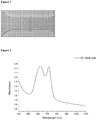
- a strong welding was obtained with 100 W and a welding speed of 100 mm/s.
- the weld formed is shown in figure 1 .
- Example 4 Variation in the spectroscopic properties in dependence on solvent.
- Table 2 shows the spectroscopic properties of 2,5-bis[4-(N,N'-didecylamino)-2-hydroxyphenyl]-croconaine dye in a selection of solvent.
- E T 30 (kcal/mol) Absorbance maxima (nm) Molar absorbance coefficient (M -1 ⁇ cm -1 ) N- methylformamide 54.1 836 36300 Ethanol 51.9 825 190000 Acetonitrile 45.6 824 168500 Dichloromethane 40.7 832 221200 Chloroform 39.1 833 232600 Tetrahydrofuran 37.4 826 230000 Benzene 34.3 830 253200 Hexane 31.0 809 229800
- the laser used was a Coherent FAB-800 fiber coupled laser run at 15 W optical power, as determined by a Thorlabs laser power meter.
- the plastic pieces to be welded were held in place using a mechanical fixture, and the fixture and the plastic parts were placed on a programmable linear table, with the speed selectable up to 50mm per second. Welds obtained showed good adhesion and strength.
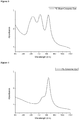
- FIG. 2-6 Shown in figures 2-6 is the absorbance spectra of polyethylene imbued with respectively the Blue dye, Red dye, Croconic dye, Blue dye plus Croconic dye and lastly Red dye plus Croconic dye.
- the spectra were determined with a Perkin-Elmer Lambda 40 spectrometer, scanning from 1100nm to 400nm.
- the Blue dye nor the Red dye in themselves have appreciable absorbance at 808 nm, while the Croconic dye as well as the combinations of Croconic dye and the Blue dye or Red Dye absorbs significantly at 808 nm.
- FIG. 2-6 Shown in figures 2-6 is the absorbance spectra of polyethylene imbued with respectively the Blue dye, Red dye, Croconic dye, Blue dye plus Croconic dye and lastly Red dye plus Croconic dye.
- the spectra were determined with a Perkin-Elmer Lambda 40 spectrometer, scanning from 1100nm to 400nm.
- the Blue dye nor the Red dye in themselves have appreciable absorbance at 808 nm, while the Croconic dye as well as the combinations of Croconic dye and the Blue dye or Red Dye absorbs significantly at 808 nm.
Landscapes
- Physics & Mathematics (AREA)
- Health & Medical Sciences (AREA)
- Optics & Photonics (AREA)
- Toxicology (AREA)
- Mechanical Engineering (AREA)
- Engineering & Computer Science (AREA)
- Electromagnetism (AREA)
- Chemical & Material Sciences (AREA)
- Organic Chemistry (AREA)
- Chemical Kinetics & Catalysis (AREA)
- Medicinal Chemistry (AREA)
- Polymers & Plastics (AREA)
- Lining Or Joining Of Plastics Or The Like (AREA)
Description
- The present invention relates to a method for laser welding of plastics and the use of croconic acid derivatives as a near-infra red absorbing compound in laser welding of plastic materials.
- Laser welding of plastic is an important emerging industrial process that utilizes near-infrared (NIR) lasers to weld pieces of plastic together.
- For use in industrial laser welding processes NIR pigments such as Carbon black, various metallated phthalocyanines and more recently differently substituted perylenes have been used. These classes of compounds are well-studied, chemically inert, heat resistant, and often relatively cheap to produce. However, they suffer from the disadvantage, that they are colored in the visible region, thus making them less ideal for the use in laser welding of colorless plastics. An issue with most of these dyes is their chemical stability; the stability leaves the plastic colored after the welding has been performed.
- Specific examples of prior art publications include
WO 2009/024497 disclosing a composition comprising titanium dioxide in the anatase form and a polymeric binder. The composition may also comprise tungsten suboxide, tungsten bronze, or mixtures of tungsten trioxide, tungsten bronze and metallic tungsten. The composition is used for forming a laser-sensitive coating layer on a substrate. -
WO2009/059900 relates to the use of tungsten oxide or of tungstate to increase the heat-input amount of near infrared radiation in laser welding of plastics. Tungsten oxide to be using in the invention has the formula W03-x wherein W is tungsten, O is oxygen, and x is 0.1-1 and/or the use of tungstate of the formula MxWyOz wherein M is one or more element selected from NH4, H, Li, Na, K, Rb, Cs, Ca, Ba, Sr, Fe, Sn, Mo, Nb, Ta, Ni, Pd, Pt, Cu, Ag, Au, Zn, Cd, Al, Ga, In, Tl, W is tungsten, O is oxygen, 0.001 <x/y<1, and 2.0<z/y<3.0, to increase the heat-input amount of near infrared radiation in the process of NIR curing of coatings and NIR drying of coatings. -
WO 2010/046285 also relates to welding of plastic using a tungsten derivative.WO 2011/005631 relates to potassium cesium tungsten bronze solid solution particles, which are indicated to be NIR absorbers. The particles may be included in plastics. -
WO 2009/010405 also discloses a laser-sensitive system. Preferably, the laser-sensitive system is selected from the group consisting of a salt of an acid and an amine or mixtures of salts of acids and amines, titanium dioxide, an oxygen containing transition metal salt, a compound containing a free carbonyl group and a nucleophile or a compound containing a free carbonyl group, which compound is substituted with one or more nucleophilic groups, a compound having functional groups and a metal compound or an acid, and a color former and a color developer or a latent color developer which generates a color developer upon activation, preferably a color former and a latent color developer. -
WO 2007/114829 discloses a coating composition comprising a mark formation layer, which contains an electron donor dye precursor micro-encapsulated within a polymer of a specific Tg range, and an electron acceptor compound which can react with the electron donor dye to turn it into a dye. -
WO2005/053935 discloses a method for the manufacture of a container for liquids. The container comprises a plurality of plastic components. The method comprises forming a series of welded joints between adjacent components. The formation of the welded joints is effected by arranging at least two plastic components in the required relative alignment adjacent each other, exposing the joint region to incident radiation having a wavelength outside the visible range so as to cause melting of the surface of one or both components at the joint region and allowing the melted material to cool, thereby welding the components together. A radiation absorbing material having an absorption band matched to the wavelength of the incident radiation, so as to absorb the incident radiation and generate heat for the melting process, is provided at the joint region in one of the components or between the components. -
WO 93/01941 WO1993/01941 - Hilton et al. (Laser Welding of Fabrics Using Infrared Absorbing Dyes, Proceedings from Joining of Advanced and Specialty Materials, 9-11 October 2000, 136-140) describes laser welding of polymer fabrics, and croconium dyes are mentioned as relevant. However, the croconium dyes in laser welding are unspecified.
-
WO 00/20157 - Dyes that are used as laser absorber dyes should fulfill certain requirements. The dye must have a strong absorption at the wavelength of the used laser, it should be sufficiently heat resistant to resist the treatment during compounding and neither the dye nor the decomposition products should be toxic if used together with foodstuff etc.
- The present invention provides laser absorbing dyes, which in addition to the above requirements, also are almost colorless in the visible area. A colorless laser absorbing dye may provide for almost invisible sealing of transparent plastic elements to each other. In a preferred embodiment the laser absorbing dyes for plastic laser welding is colorless in the visible region and absorbs intensely in the NIR region, where the laser of choice emits. Furthermore, the present invention provides in a preferred embodiment that the NIR absorption of the dye is transmitted to the surroundings in the form of heat, thus causing the welding to occur. The NIR absorber of the present invention for laser welding of plastic does not, or only to a limited extent, releases its energy via other pathways than heat, such as fluorescence.
- The present invention relates to a method for laser welding of plastics, comprising the steps of
- a) providing a first plastic material to be welded comprising a compound capable of absorbing near-infrared light,
- b) positioning a second plastic material in intimate contact with the first plastic material, and
- c) activating a laser source emitting a wave length in the near-infrared spectrum to obtain attachments of the first and the second plastic material,
- In the present invention with claims, the terms "derivative of croconic acid", "croconic acid derivative ", "croconaine dye", "absorber", "NIR absorber", or "dye" are used interchangeably to denote a compound of the above general fomula.
- The specific choice of aromatic substituent is dependent of the wavelength for which the croconaine dye is optimized. For fine-tuning of the optical absorptive properties or the physical chemical properties even asymmetric dyes can be synthesized, which is dyes where the fictionalization of the two aryl groups are different.
- It will be appreciated, that the aryl groups can be functionalized to impart specific properties, such as compatibility with a specific polymer towards the dye. This can be done through the use of specific groups where the functional groups R1, R2, R3 and R4 are identical alkyl having 4 to 20 carbon atoms.
- After absorption of the laser light by the first plastic material the energy is converted into heat and the heat is subsequently dispersed into the second plastic material. The energy is absorbed either as surface or volume absorption and melts the plastic. The heat of the first plastic material is transferred to the second plastic material by heat transduction.
- In accordance with the present invention, the first and the second plastic material may be of the same type and grade or a different type and grade dependent on desired end-product. In an embodiment of the present invention the first and the second plastic material at a certain temperature have overlapping melting intervals. Several factors influence how weldable two plastics are, one factor being the type of plastics. Generally, two plastics can be welded if they have overlapping melting intervals and are miscible.
- Plastics contain a polymer and also several different additives that influence mechanical and aesthetic properties. The melting intervals of a plastic material may be changed by adjusting the type and amount of additives.
- The efficiency of transduction of heat to the laser transparent plastic depends on a sufficient contact in the interface, because heat is best conducted where there is contact. Therefore, the present invention may be favorably be practiced by providing external mechanical pressure in step c. If the contact is poor it is necessary to heat the laser absorbing plastic to a higher temperature to obtain a weld, increasing the risk of decomposition.
- In another aspect, the invention relates to the use of croconic acid derivatives of the general formula

- Suitably, the croconic acid derivatives are used as near-infra red absorbing compounds, where the compound or compounds are admixed with the plastic materials.
- In a certain aspect of the invention the near-infra red absorbing compound is dispersed in a plastic material imbued with a dye having its major absorbance in the visible part of the spectrum, thus imparting laser-weldability on said plastic material, without significantly changing its visual appearance.
- Croconaine dyes have a strong and sharp absorption in the near-infrared (NIR) region. Compared to other dyes with a sharp absorption in NIR we have found that they can be synthesized in few steps. Furthermore, the crocanaine dyes are easy to adapt to the specific plastic material used because changing the substituents on the amine nitrogen can easily modify the solubility. While the selection of aromatic or hetero-aromatic group can tune the overall absorption profile of the dye, the choice of substituent can provided physical chemical properties needed for efficient use in laser welding applications.
- Laser welding of plastic is typically achieved by incorporating a near-infrared absorber into one of the two pieces of plastic one wish to weld together. The two pieces of plastic are placed on top of each other and laser irradiation using a laser with a wavelength that corresponds to the absorption of the NIR absorber is performed. Laser welding provides a convenient way to make very narrow welding zones as compared to other types of welding procedures.
- According to the present invention the croconic acid derivative is preferably present admixed with the plastic material. In certain applications it may however, be advantageously to have the croconic acid derivative deposited on the surface between the parts to be joined by laser welding. It is desirable to have the NIR absorber evenly distributed in the plastic to ensure a smooth welding zone. The even distribution may be achieved by preparing NIR absorbers that are soluble in the type of plastic one wish to weld. One strategy to achieve high solubility of organic absorbers in very non-polar solvents, and also to very non-polar polymers such as polyethylene and polypropylene, is to append long alkyl chains to the absorber.
- Several factors influence how weldable two plastics are, one factor is the type of plastics. Examples of suitable plastic materials for the present invention includes ABS (acrylonitrile-butadiene-styrene-copolymer), ASA (acrylonitrile-styrene-acrylate-copolymer), MABS (methyl methacrylate-acrylonitrile-butadiene-styrene-copolymer), PA-6 (polyamide-6), PA-6.6 (polyamide-6.6), PA-12 (polyamide-12), PBT (polybutylene terephthalate), PBT/ASA (polybutylene terephthalate/ acrylonitrile-styrene-acrylate-blends), PC (polycarbonate), PC/ABS (polycarbonate/ acrylonitrile-butadiene-styrene-blends), LDPE (low density-polyethylene), HDPE (high density-polyethylene), PEEK (poly ether ketone), PES (polyethersulfone), PET (polyethylene terephthalate), PMMA (poly(methyl methacrylate)), POM (polyoxy methylene), PP (polypropylene), PPS (poly(p-phenylene sulfide), PS (polystyrene), PSU (polysulfone), PVC (polyvinylchloride), SAN (styrene-acrylonitrile-copolymer).
- Generally, two plastics can be welded if they are miscible and have overlapping melting intervals. Plastics contain a polymer and also several different additives that influence mechanical and aesthetic properties. The additives also influence other characteristics of the plastic, such as the transmittance.
- When preparing plastics different additives are added to the polymer to obtain the desired characteristics of the plastic. An even distribution of the different additives is advantageous to obtain the required properties. This is particularly important for additives in low concentrations, like laser absorbers. The additives are typically mixed with the polymer in an extruder; the polymer is melted and is mixed with the additives. The melted polymer with admixed additive may be used directly in the formation of the first plastic material used in the present invention or plastic is divided into small pellets ready for further processing.
- Different laser welding techniques can be used for welding. The most common is through- transmission laser welding (TTLW) another method is Butt-Joint welding. The basic principle in TTLW is to use laser light to join a laser transparent and a laser absorbing plastic. The laser light is transmitted through the laser-transparent plastic to the laser-absorbing plastic. The absorbing plastic converts the laser energy into heat and the polymers melt. In the contact surface between the absorbing and transparent plastic heat is transferred to the transparent plastic by heat conduction and the transparent plastic melts. If the absorber is deposited on the surface, by surface coating the energy will be transferred to both plastics.
- In Butt-Joint welding the principle is joining of parallel surfaces of two components. The laser light interacts with the surface of the two plastics parallel to the contact interface. Depending on the choice of laser and the optical properties of the material the energy is absorbed into the surface, if the entire laser light is absorbed close to the surface. Alternatively the laser light is absorbed by volume absorption, if the light transmits further into the plastic.
- Absorption of laser light and generation of heat can be divided into two different interaction processes, direct absorption and indirect absorption. In direct absorption the macromolecules of the plastic materials absorbs the energy from the laser light, resulting in oscillations in the macromolecules. Direct absorption can be obtained with laser light with wavelengths above 1200 nm, corresponding to frequencies below 8300 cm-1. Plastics are rather transparent to laser light between 800 and 1200 nm. With addition of laser absorbers to the plastic indirect absorption is obtained. The laser absorber converts the energy from the laser light into heat that is transferred into the polymer.
- By heating with laser light in the absorbing plastic and heat flow into the transparent plastic, the contact interface of both plastics exceeds the melting temperature. The plastics changes from a solid into the molten state, in which the mobility of the polymers are increased. With increasing temperature the specific volume of the plastic is increased. It will generate an increased internal pressure between both molten interfaces. By applying external mechanical pressure to fix the plastics, macromolecules at each interface will penetrate into the other and will form the weld joint after re-solidification.
- Different effects appear to contribute to the generation of the weld. The first effect is inter-diffusion process according to which segments of the macromolecular chain below the melting temperature can move caused by Brown's micro mobility, but the mobility is restricted in a "cage" consisting of the other macromolecules. By exceeding the melting temperature segments of the macromolecular chain can leave the "cage" induced by Brown's micro mobility. At the interface between two molten layers macromolecular chain segments can step out of the surface of the layer and diffuse into the second layer. The extent of diffusion is a function of temperature.
- The melting process is accompanied by an increase in volume, and with applied external pressure the molten areas will begin to squeeze into the free spaces between both layers. Macromolecules with parallel orientation to the interface surface will be stretched in the molten state along the squeeze flow direction, parallel to the interface. In the beginning of the re-solidification, the stretched macromolecules are subjected to relaxation process and they try to return to their original structure. Semicrystalline plastics can, beside the two already mentioned effects for amorphous plastics, generate mixed crystalline phases in the re-solidification process.
- TTLW is the most common applied process for industrial application of laser welding of plastics. The process is basically used in three different modifications as contour welding, quasi-simultaneous welding and simultaneous welding. Contour welding is characterized with a single laser beam is moved along the joint path on the plastic. The line energy, ES , quantifies the energy applied to the plastic in the laser welding process. The laser power and welding speed can be changed, if the line energy is identical, will the weld have similar quality.
- The laser absorber is suitably in the polymer with the highest melting temperature if two different types of plastic are welded because the highest temperature is obtained in the plastic with the laser absorber. The laser transparent plastic is heated by transduction of heat from the laser absorbing plastic.
- When welding two plastic materials they have to be compatible with each other. The materials properties, which have influence on the compatibility, include:
- Chemical structure - polymeric molecules have to be miscible between each other.
- Thermal properties - the melt temperature ranges should overlap, heat expansion coefficients should be of the same order.
- Surface energetic properties - the polar surface energy should be of the same order.
- Rheological properties - the melt-flow index should be of the same order.
- If the plastic materials used in the first and the second plastic material are different from each other the compatibility needs to be examined. The table below, prepared R. Klein, Laser Welding of Plastics, Wiley-VCH, 2012, illustrates compatibilities between plastic materials. The table illustrates tested combinations of plastics and their weldability, in which the dark grey marks the strong welds, the pale grey marks combinations, which are weldable but not strong welding, whereas the blank marks incompatible combinations under the test conditions used. It should be kept in mind however, that the solubility of the various polymer materials may be changed by addition of additives. Therefore, a blank combination should not necessarily be understood as indicating that adherance is imporsible in general.


- A good weld is often characterized when breakage occurs in the plastic before the weld is broken in a pull-test. Strong welds are as a general seen between plastics with similar characteristics.
- Laser absorbers are added in low concentrations, typically 1% for inorganic absorbers and 0.01% for organic absorbers. Inorganic additives like carbon black are dispersed in the plastic and typical have particle sizes between 0.5 and 1 µm. Organic dyes, like azo or perylene dyes are dissolved, with a typical size between 0.01 and 0.1 µm. Both inorganic and organic dyes can absorb the laser radiation and transfer the laser energy into process-heat. Because organic dyes may be more homogeneously distributed and the direct contact to the macromolecular chains is better, the heat transfer is more effective compared to inorganic dyes. This is also the reason for the smaller amount organic dye necessary.
- Dyes must have some special characteristics for being suitable as laser absorber. Croconaine dyes have several of these characteristics. They have their absorption maxima at about 800 nm or higher suitable for the relative inexpensive 808 nm diode lasers. The croconain dyes may also be fine-tuned so that other lasers at even longer wavelength may be used. The molar absorbance coefficient is in the order 10E5 M-1·cm-1, a high molar absorbance coefficient is important to keep the concentration in the polymer low. The solubility can easily by modified by changing the substituents on the nitrogen atoms of the anilins, in order to optimize the solubility in different polymers, like PE and PP. Several croconaine dyes have little absorption in the visible area and can be used in plastic transparent in the NIR region of the spectrum. For colorless polymers, only imbued with croconaine dye, one can bleach the plastic after welding. Exposure to light from e.g. a xenon or mercury arc lamp leads to colorless decomposition products of the croconaine dye.
- Croconaine dyes can be synthesized in few steps with reasonably good yields. This is important for a commercial perspective to produce the laser absorbers at low costs. Toxicity is another important criterion for some applications, as diffusion in the plastic will bring the croconaine dye in contact with the consumer, goods, or foodstuff. There are no reports with analysis of the toxicity of neither croconaine dyes nor its decomposition products. Compared to other NIR absorbers that contain large aromatic systems, the expected risk of toxicity is low.
- While the chemical compounds of the present invention have been described in a single resonance form, it will be understood by the person skilled in the art that croconic acid derivaties may be present in various resonance forms. In
scheme 1 below is illustrated the resonance forms for a specific example.
- Croconaine dyes of the invention can, as a non-limiting example, be synthesized by the reaction illustrated below, where it should be noted, that there is some leeway in the selection of solvents. Accordingly, other alcohols than 1-butanol can be used, and co-solvents other than toluene, such as benzene, cyclohexane or xylenes can be utilized, depending on the ability to form azeotropes with water and the reaction temperature selected.

- 3-Aminophenol (5.00 g, 45.8 mmol) and Na2CO3 (6.75 g, 64.85 mmol) were added to isopropanol (40 ml) in a round bottomed flask while stirring. The mixture was stirred for 30 minutes, and iododecane (24.55 g, 91.6 mmol) was added drop wise to the solution over a period of 30 minutes. The reaction mixture was heated to reflux overnight. The mixture was cooled to room temperature, and water (30 ml) was added, followed by extraction with CH2Cl2 (3 · 75 ml). The organic phases were collected, dried with Na2SO4, and the solvent evaporated in vacou. The product was isolated by dry vacuum column chromatography with heptane:ethylacetate.
Yield: 12.6 g (32.3 mmol) 71% as a purple oil
1H NMR (500 MHz, DMSO) δ 8.86 (s, 1H), 6.86 (t, J = 8.1 Hz, 1H), 6.05-5.94 (m, 2H), 5.75 (s, 1H), 3.14 (t, J = 7.5 Hz, 4H), 1.47 (s, 4H), 1.24 (m), 28H), 0.85 (t, J = 6.9 Hz, 6H).
13C NMR (126 MHz, DMSO) δ 158.2, 149.1, 129.4, 102.8, 102.5, 98.6, 50.3, 31.3, 29.1, 29.0, 28.9, 28.7, 26.9, 26.5, 22.1, 13.8. - Into a 250 ml round-bottomed flask equipped with a Dean-Stark condenser, magnetic stirrer, and nitrogen gas inlet, 3-(N,N'-didecanylanmino)phenol (2.725 g, 7.0 mmol) was added to a mixture of 1-butanol (30 ml) and toluene (70 ml). The solution was stirred until the 3-(N,N'- didecanylanmino)-phenol was completely dissolved. Croconic acid (497.5 mg, 3.5 mmol) was added to the solution. The reaction mixture was heated to reflux for 5 hours. The reaction mixture was rapidly cooled with ice, and the solvents where evaporated in vacou, to give a brown- black solid. The crude product was purified by consecutive columns by flash chromatography with ethylacetate:heptane (1:5) followed THF:Heptane (1:4) as eluents.
Yield: 0.84 g (0.95 mmol) 27% as a purple/black solid.
1H NMR (500 MHz, CDC13) δ 14.08 (s, 2H), 8.97 (s, 2H), 6.38 (d, J = 9.9 Hz, 2H), 6.05 (s, 2H), 3.36 (d, J = 7.8 Hz, 8H), 1.60 (d, J = 14.2 Hz, 8H), 1.24 (broad signal, 56H), 0.82 (t, J = 6.4 Hz, 12H).
MS (MALDI-TOF) m/z = 886.021 [M] (calculated for C57H92N2O5: m/z = 884.70).
HR MS m/z = 885.7062 [M+H]+ (calculated for C57H93N2O5 + m/z = 885.7079). - 3-(Diethylamino)phenol (1.19 g, 7.2 mmol) and croconic acid (0.49 g, 3.5 mmol) were suspended in butanol (25 ml) and toluene (25 ml) and heated to reflux for 10 minutes. The solvent was removed in vacou. The crude mixture was purified on a flash column using THF as eluent. The solvent was evaporated in vacou. Isolated as a brown solid.
1H NMR (500 MHz, CDC13+DMSO) δ 9.96 (d, 2H), 6.53 (dd, 2H), 6.10 (d, 2H), 3.55 (q, J = 7.2 Hz, 8H), 1.25 (t, J = 11.6, 7.4 Hz, 12H).
13C NMR was not obtained due to poor solubility. MS (LC-MS) m/z = 437.2 [M] (calculated for C25H29N2O5: m/z = 437.2) HR MS m/z = 437.2071 [M+H]+ (calculated for C25H29N2O5: m/z = 437.2071). - The PE compounded with croconaine dye has successfully been welded with PE. The plastic was welded with a 300 W, 808 nm Laserline diode laser. The plastics were held together with pressure from a glass plate. A strong welding was obtained with 100 W and a welding speed of 100 mm/s. The weld formed is shown in
figure 1 . -
Table 2. shows the spectroscopic properties of 2,5-bis[4-(N,N'-didecylamino)-2-hydroxyphenyl]-croconaine dye in a selection of solvent. ET30 (kcal/mol) Absorbance maxima (nm) Molar absorbance coefficient (M-1 · cm-1) N-methylformamide 54.1 836 36300 Ethanol 51.9 825 190000 Acetonitrile 45.6 824 168500 Dichloromethane 40.7 832 221200 Chloroform 39.1 833 232600 Tetrahydrofuran 37.4 826 230000 Benzene 34.3 830 253200 Hexane 31.0 809 229800 - Welds of plastic samples imbued with croconic acid dye, as well as samples imbued with the combination of a commercially available plastic dye in combination with croconic acid dye was laser-welded using a solid state laser emitting at 808 nm. The croconic acid dye used was 2,5-bis[4-(N,N.-didecylamino)-2-hydroxyphenyl]-croconaine dye.
- The laser used was a Coherent FAB-800 fiber coupled laser run at 15 W optical power, as determined by a Thorlabs laser power meter. The plastic pieces to be welded were held in place using a mechanical fixture, and the fixture and the plastic parts were placed on a programmable linear table, with the speed selectable up to 50mm per second. Welds obtained showed good adhesion and strength.
- Shown in
figures 2-6 is the absorbance spectra of polyethylene imbued with respectively the Blue dye, Red dye, Croconic dye, Blue dye plus Croconic dye and lastly Red dye plus Croconic dye. The spectra were determined with a Perkin-Elmer Lambda 40 spectrometer, scanning from 1100nm to 400nm. As can be seen from the figures neither the Blue dye nor the Red dye in themselves have appreciable absorbance at 808 nm, while the Croconic dye as well as the combinations of Croconic dye and the Blue dye or Red Dye absorbs significantly at 808 nm. - parts were placed on a programmable linear table, with the speed selectable up to 50mm per second. Welds obtained showed good adhesion and strength.
- Shown in
figures 2-6 is the absorbance spectra of polyethylene imbued with respectively the Blue dye, Red dye, Croconic dye, Blue dye plus Croconic dye and lastly Red dye plus Croconic dye. The spectra were determined with a Perkin-Elmer Lambda 40 spectrometer, scanning from 1100nm to 400nm. As can be seen from the figures neither the Blue dye nor the Red dye in themselves have appreciable absorbance at 808 nm, while the Croconic dye as well as the combinations of Croconic dye and the Blue dye or Red Dye absorbs significantly at 808 nm.

Claims (7)
- A method for laser welding of plastics, comprising the steps ofa) providing a first plastic material to be welded comprising a compound capable of absorbing near-infrared light,b) positioning a second plastic material in intimate contact with the first plastic material, andc) activating a laser source emitting a wave length in the near-infrared spectrum to obtain attachments of the first and the second plastic material,characterised in that the compound is a derivative of croconic acid having the general

- The method according to claim 1, wherein the first and the second plastic material at a certain temperature have overlapping melting intervals.
- The method according to claim 2, wherein the first plastic material has a melting temperature above the melting temperature of the second plastic material.
- The method according to any of the claims 1 to 3, wherein external mechanical pressure is provided in step c.
- The use of croconic acid derivatives of the general formula

- The use of croconic acid derivatives according to claim 5 as near-infra red absorbing compounds, where the compound or compounds are admixed with the plastic materials.
- The use of the of croconic acid derivatives according to claims 5 or 6, where the near-infra red absorbing compound is dispersed in a plastic material imbued with a dye having its major absorbance in the visible part of the spectrum, thus imparting laser-weldability on said plastic material, without significantly changing its visual appearance.
Applications Claiming Priority (3)
| Application Number | Priority Date | Filing Date | Title |
|---|---|---|---|
| DKPA201300217 | 2013-04-11 | ||
| DKPA201300216 | 2013-04-11 | ||
| PCT/DK2014/050096 WO2014166506A1 (en) | 2013-04-11 | 2014-04-11 | A method for laser welding of plastic materials |
Publications (2)
| Publication Number | Publication Date |
|---|---|
| EP2983890A1 EP2983890A1 (en) | 2016-02-17 |
| EP2983890B1 true EP2983890B1 (en) | 2019-09-25 |
Family
ID=50543411
Family Applications (1)
| Application Number | Title | Priority Date | Filing Date |
|---|---|---|---|
| EP14718905.4A Active EP2983890B1 (en) | 2013-04-11 | 2014-04-11 | A method for laser welding of plastic materials |
Country Status (3)
| Country | Link |
|---|---|
| US (1) | US10343339B2 (en) |
| EP (1) | EP2983890B1 (en) |
| WO (1) | WO2014166506A1 (en) |
Families Citing this family (8)
| Publication number | Priority date | Publication date | Assignee | Title |
|---|---|---|---|---|
| CN103640212B (en) * | 2013-12-21 | 2016-05-11 | 厦门建霖工业有限公司 | Cross water assembly laser welding process |
| JP2016198218A (en) * | 2015-04-08 | 2016-12-01 | 出光ユニテック株式会社 | Zipper tape, bag body with zipper tape, and method for manufacturing bag body with zipper tape |
| KR102449936B1 (en) * | 2015-04-08 | 2022-09-30 | 이데미쓰 유니테크 가부시키가이샤 | A method for manufacturing a zipper tape, a bag body having a zipper tape, and a bag body having a zipper tape, a method for joining an elongated member capable of bonding the elongated member satisfactorily, an apparatus therefor, and an apparatus for bonding a zipper tape |
| US10889064B1 (en) | 2017-04-26 | 2021-01-12 | Mercury Plastics Llc | Process for laser welding of crosslinked polyethylene |
| WO2019154974A1 (en) | 2018-02-09 | 2019-08-15 | Københavns Universitet | Thermally stable nir dyes for laser welding of plastic materials |
| US11014293B2 (en) * | 2018-03-08 | 2021-05-25 | Ricoh Co., Ltd. | Additive manufacturing using photothermal dyes for high efficiency sintering |
| JP7167350B2 (en) * | 2019-08-13 | 2022-11-08 | 富士フイルム株式会社 | COMPOSITION, MEMBRANE, OPTICAL FILTER AND MANUFACTURING METHOD THEREOF, SOLID-STATE IMAGE SENSOR, INFRARED SENSOR, CAMERA MODULE, AND COMPOUND |
| EP4271593A4 (en) * | 2020-12-29 | 2025-03-05 | Perceptive Solutions Inc. | SEAT BELT WITH A WOVEN PATTERN MADE OF IR-ABSORBING MATERIAL |
Citations (1)
| Publication number | Priority date | Publication date | Assignee | Title |
|---|---|---|---|---|
| WO2000020157A1 (en) * | 1998-10-01 | 2000-04-13 | The Welding Institute | Welding method |
Family Cites Families (10)
| Publication number | Priority date | Publication date | Assignee | Title |
|---|---|---|---|---|
| WO1993001941A1 (en) * | 1991-07-17 | 1993-02-04 | E.I. Du Pont De Nemours And Company | Dye diffusion transfer imaging with infrared laser diodes and croconium dyes |
| GB0327773D0 (en) * | 2003-11-29 | 2003-12-31 | Barkston Plastics Engineering | Welding of plastics materials |
| WO2005080066A1 (en) | 2004-02-18 | 2005-09-01 | Invista Technologies S.A.R.L. | Fabric seam formation by radiation welding process |
| US7820936B2 (en) * | 2004-07-02 | 2010-10-26 | Boston Scientific Scimed, Inc. | Method and apparatus for controlling and adjusting the intensity profile of a laser beam employed in a laser welder for welding polymeric and metallic components |
| US20070098900A1 (en) | 2004-11-05 | 2007-05-03 | Fuji Hunt Photographic Chemicals, Inc. | Media providing non-contacting formation of high contrast marks and method of using same, composition for forming a laser-markable coating, a laser-markable material and process of forming a marking |
| WO2009010405A1 (en) | 2007-07-18 | 2009-01-22 | Basf Se | Laser-sensitive coating formulation |
| US9045619B2 (en) | 2007-08-22 | 2015-06-02 | Datalase Ltd. | Laser-sensitive coating composition |
| CN102965049A (en) | 2007-11-05 | 2013-03-13 | 巴斯夫欧洲公司 | Tungsten oxides used to increase the heat-input amount of near infrared radiation |
| US8853314B2 (en) | 2008-10-23 | 2014-10-07 | Datalase Ltd. | Heat absorbing additives |
| CN102471090B (en) | 2009-07-07 | 2015-11-25 | 巴斯夫欧洲公司 | Potassium cesium tungsten bronze particles |
-
2014
- 2014-04-11 US US14/784,024 patent/US10343339B2/en not_active Expired - Fee Related
- 2014-04-11 WO PCT/DK2014/050096 patent/WO2014166506A1/en not_active Ceased
- 2014-04-11 EP EP14718905.4A patent/EP2983890B1/en active Active
Patent Citations (1)
| Publication number | Priority date | Publication date | Assignee | Title |
|---|---|---|---|---|
| WO2000020157A1 (en) * | 1998-10-01 | 2000-04-13 | The Welding Institute | Welding method |
Non-Patent Citations (1)
| Title |
|---|
| HILTON P A ET AL: "LASER WELDING OF FABRICS USING INFRARED ABSORBING DYES", PROCEEDINGS FROM MATERIALS SOLUTIONS CONFERENCE ON JOINING OFADVANCED AND SPECIALTY MATERIALS, XX, XX, October 2000 (2000-10-01), pages 136 - 141, XP002989231 * |
Also Published As
| Publication number | Publication date |
|---|---|
| EP2983890A1 (en) | 2016-02-17 |
| WO2014166506A1 (en) | 2014-10-16 |
| US20160059475A1 (en) | 2016-03-03 |
| US10343339B2 (en) | 2019-07-09 |
Similar Documents
| Publication | Publication Date | Title |
|---|---|---|
| US10343339B2 (en) | Laser welding plastic | |
| EP2283021B1 (en) | Switchable special effect substances | |
| DE60304397T2 (en) | Phthalocyanine compound, near infrared absorbing dyes and heat ray shielding | |
| Patil et al. | ESIPT-inspired benzothiazole fluorescein: Photophysics of microenvironment pH and viscosity | |
| EP0155780A2 (en) | Infra-red absorber | |
| JP7674756B2 (en) | New polycyclic compounds | |
| EP2102307B1 (en) | Photostabilized time temperature indicator | |
| JP2022008162A (en) | Resin composition and molded product | |
| JP4648637B2 (en) | Phthalocyanine compound having carboxyl group and / or sulfonic acid group and method for producing the same | |
| KR100858863B1 (en) | Quinophthalone compounds, mixed colorants, laser light transmitting colored resin compositions, and laser welded articles | |
| EP3470472A1 (en) | New methine dyes | |
| JP2011094127A (en) | Heat-absorbing material | |
| WO2019154974A1 (en) | Thermally stable nir dyes for laser welding of plastic materials | |
| EP1488418A1 (en) | Squarylium dyes as a light-absorbing compound in the information layer of optical data carriers | |
| JP2009024161A (en) | Cyanine compound | |
| CN102911168B (en) | Method for modifying spirooxazine compound into oxazole compound | |
| Jędrzejewska et al. | One-and two-photon-induced isomerization of styryl compounds possessing A-π-A′ structure | |
| Matsui et al. | Survey, fluorescence spectra, and solubility of liquid cyanine dyes | |
| EP2297108B1 (en) | Quinoid rylene dicarboximides as ir absorbers | |
| EP1954764B1 (en) | Benzopyran colorants, method of manufacture, and method of use | |
| Corns | Novel near-infrared absorbing dyes | |
| US20080009573A1 (en) | Labeled tackifiers | |
| Vedernikov et al. | New cation-‘capped’complex of the Z-isomer of a crown-containing styryl dye bearing a long N-ammonioalkyl substituent | |
| DE102016213372A1 (en) | NIR absorber Additives for the laser beam welding of plastics | |
| WO2024110327A2 (en) | Thermostable methine dyes |
Legal Events
| Date | Code | Title | Description |
|---|---|---|---|
| PUAI | Public reference made under article 153(3) epc to a published international application that has entered the european phase |
Free format text: ORIGINAL CODE: 0009012 |
|
| 17P | Request for examination filed |
Effective date: 20151103 |
|
| AK | Designated contracting states |
Kind code of ref document: A1 Designated state(s): AL AT BE BG CH CY CZ DE DK EE ES FI FR GB GR HR HU IE IS IT LI LT LU LV MC MK MT NL NO PL PT RO RS SE SI SK SM TR |
|
| AX | Request for extension of the european patent |
Extension state: BA ME |
|
| DAX | Request for extension of the european patent (deleted) | ||
| STAA | Information on the status of an ep patent application or granted ep patent |
Free format text: STATUS: EXAMINATION IS IN PROGRESS |
|
| 17Q | First examination report despatched |
Effective date: 20161122 |
|
| GRAP | Despatch of communication of intention to grant a patent |
Free format text: ORIGINAL CODE: EPIDOSNIGR1 |
|
| STAA | Information on the status of an ep patent application or granted ep patent |
Free format text: STATUS: GRANT OF PATENT IS INTENDED |
|
| RIC1 | Information provided on ipc code assigned before grant |
Ipc: B29C 65/14 20060101ALI20190304BHEP Ipc: B29C 65/00 20060101AFI20190304BHEP Ipc: C09B 57/00 20060101ALI20190304BHEP Ipc: B29C 65/16 20060101ALI20190304BHEP Ipc: C08K 5/00 20060101ALI20190304BHEP Ipc: C09B 23/01 20060101ALI20190304BHEP |
|
| INTG | Intention to grant announced |
Effective date: 20190401 |
|
| GRAS | Grant fee paid |
Free format text: ORIGINAL CODE: EPIDOSNIGR3 |
|
| GRAA | (expected) grant |
Free format text: ORIGINAL CODE: 0009210 |
|
| STAA | Information on the status of an ep patent application or granted ep patent |
Free format text: STATUS: THE PATENT HAS BEEN GRANTED |
|
| AK | Designated contracting states |
Kind code of ref document: B1 Designated state(s): AL AT BE BG CH CY CZ DE DK EE ES FI FR GB GR HR HU IE IS IT LI LT LU LV MC MK MT NL NO PL PT RO RS SE SI SK SM TR |
|
| REG | Reference to a national code |
Ref country code: GB Ref legal event code: FG4D |
|
| REG | Reference to a national code |
Ref country code: CH Ref legal event code: EP |
|
| REG | Reference to a national code |
Ref country code: AT Ref legal event code: REF Ref document number: 1183402 Country of ref document: AT Kind code of ref document: T Effective date: 20191015 |
|
| REG | Reference to a national code |
Ref country code: IE Ref legal event code: FG4D |
|
| REG | Reference to a national code |
Ref country code: DE Ref legal event code: R096 Ref document number: 602014054197 Country of ref document: DE |
|
| REG | Reference to a national code |
Ref country code: NL Ref legal event code: MP Effective date: 20190925 |
|
| PG25 | Lapsed in a contracting state [announced via postgrant information from national office to epo] |
Ref country code: LT Free format text: LAPSE BECAUSE OF FAILURE TO SUBMIT A TRANSLATION OF THE DESCRIPTION OR TO PAY THE FEE WITHIN THE PRESCRIBED TIME-LIMIT Effective date: 20190925 Ref country code: HR Free format text: LAPSE BECAUSE OF FAILURE TO SUBMIT A TRANSLATION OF THE DESCRIPTION OR TO PAY THE FEE WITHIN THE PRESCRIBED TIME-LIMIT Effective date: 20190925 Ref country code: NO Free format text: LAPSE BECAUSE OF FAILURE TO SUBMIT A TRANSLATION OF THE DESCRIPTION OR TO PAY THE FEE WITHIN THE PRESCRIBED TIME-LIMIT Effective date: 20191225 Ref country code: SE Free format text: LAPSE BECAUSE OF FAILURE TO SUBMIT A TRANSLATION OF THE DESCRIPTION OR TO PAY THE FEE WITHIN THE PRESCRIBED TIME-LIMIT Effective date: 20190925 Ref country code: FI Free format text: LAPSE BECAUSE OF FAILURE TO SUBMIT A TRANSLATION OF THE DESCRIPTION OR TO PAY THE FEE WITHIN THE PRESCRIBED TIME-LIMIT Effective date: 20190925 Ref country code: BG Free format text: LAPSE BECAUSE OF FAILURE TO SUBMIT A TRANSLATION OF THE DESCRIPTION OR TO PAY THE FEE WITHIN THE PRESCRIBED TIME-LIMIT Effective date: 20191225 |
|
| REG | Reference to a national code |
Ref country code: LT Ref legal event code: MG4D |
|
| PG25 | Lapsed in a contracting state [announced via postgrant information from national office to epo] |
Ref country code: RS Free format text: LAPSE BECAUSE OF FAILURE TO SUBMIT A TRANSLATION OF THE DESCRIPTION OR TO PAY THE FEE WITHIN THE PRESCRIBED TIME-LIMIT Effective date: 20190925 Ref country code: GR Free format text: LAPSE BECAUSE OF FAILURE TO SUBMIT A TRANSLATION OF THE DESCRIPTION OR TO PAY THE FEE WITHIN THE PRESCRIBED TIME-LIMIT Effective date: 20191226 Ref country code: LV Free format text: LAPSE BECAUSE OF FAILURE TO SUBMIT A TRANSLATION OF THE DESCRIPTION OR TO PAY THE FEE WITHIN THE PRESCRIBED TIME-LIMIT Effective date: 20190925 |
|
| REG | Reference to a national code |
Ref country code: AT Ref legal event code: MK05 Ref document number: 1183402 Country of ref document: AT Kind code of ref document: T Effective date: 20190925 |
|
| PG25 | Lapsed in a contracting state [announced via postgrant information from national office to epo] |
Ref country code: AT Free format text: LAPSE BECAUSE OF FAILURE TO SUBMIT A TRANSLATION OF THE DESCRIPTION OR TO PAY THE FEE WITHIN THE PRESCRIBED TIME-LIMIT Effective date: 20190925 Ref country code: NL Free format text: LAPSE BECAUSE OF FAILURE TO SUBMIT A TRANSLATION OF THE DESCRIPTION OR TO PAY THE FEE WITHIN THE PRESCRIBED TIME-LIMIT Effective date: 20190925 Ref country code: AL Free format text: LAPSE BECAUSE OF FAILURE TO SUBMIT A TRANSLATION OF THE DESCRIPTION OR TO PAY THE FEE WITHIN THE PRESCRIBED TIME-LIMIT Effective date: 20190925 Ref country code: PT Free format text: LAPSE BECAUSE OF FAILURE TO SUBMIT A TRANSLATION OF THE DESCRIPTION OR TO PAY THE FEE WITHIN THE PRESCRIBED TIME-LIMIT Effective date: 20200127 Ref country code: ES Free format text: LAPSE BECAUSE OF FAILURE TO SUBMIT A TRANSLATION OF THE DESCRIPTION OR TO PAY THE FEE WITHIN THE PRESCRIBED TIME-LIMIT Effective date: 20190925 Ref country code: PL Free format text: LAPSE BECAUSE OF FAILURE TO SUBMIT A TRANSLATION OF THE DESCRIPTION OR TO PAY THE FEE WITHIN THE PRESCRIBED TIME-LIMIT Effective date: 20190925 Ref country code: IT Free format text: LAPSE BECAUSE OF FAILURE TO SUBMIT A TRANSLATION OF THE DESCRIPTION OR TO PAY THE FEE WITHIN THE PRESCRIBED TIME-LIMIT Effective date: 20190925 Ref country code: RO Free format text: LAPSE BECAUSE OF FAILURE TO SUBMIT A TRANSLATION OF THE DESCRIPTION OR TO PAY THE FEE WITHIN THE PRESCRIBED TIME-LIMIT Effective date: 20190925 Ref country code: EE Free format text: LAPSE BECAUSE OF FAILURE TO SUBMIT A TRANSLATION OF THE DESCRIPTION OR TO PAY THE FEE WITHIN THE PRESCRIBED TIME-LIMIT Effective date: 20190925 |
|
| PG25 | Lapsed in a contracting state [announced via postgrant information from national office to epo] |
Ref country code: SM Free format text: LAPSE BECAUSE OF FAILURE TO SUBMIT A TRANSLATION OF THE DESCRIPTION OR TO PAY THE FEE WITHIN THE PRESCRIBED TIME-LIMIT Effective date: 20190925 Ref country code: CZ Free format text: LAPSE BECAUSE OF FAILURE TO SUBMIT A TRANSLATION OF THE DESCRIPTION OR TO PAY THE FEE WITHIN THE PRESCRIBED TIME-LIMIT Effective date: 20190925 Ref country code: SK Free format text: LAPSE BECAUSE OF FAILURE TO SUBMIT A TRANSLATION OF THE DESCRIPTION OR TO PAY THE FEE WITHIN THE PRESCRIBED TIME-LIMIT Effective date: 20190925 Ref country code: IS Free format text: LAPSE BECAUSE OF FAILURE TO SUBMIT A TRANSLATION OF THE DESCRIPTION OR TO PAY THE FEE WITHIN THE PRESCRIBED TIME-LIMIT Effective date: 20200224 |
|
| REG | Reference to a national code |
Ref country code: DE Ref legal event code: R097 Ref document number: 602014054197 Country of ref document: DE |
|
| PG2D | Information on lapse in contracting state deleted |
Ref country code: IS |
|
| PG25 | Lapsed in a contracting state [announced via postgrant information from national office to epo] |
Ref country code: DK Free format text: LAPSE BECAUSE OF FAILURE TO SUBMIT A TRANSLATION OF THE DESCRIPTION OR TO PAY THE FEE WITHIN THE PRESCRIBED TIME-LIMIT Effective date: 20190925 Ref country code: IS Free format text: LAPSE BECAUSE OF FAILURE TO SUBMIT A TRANSLATION OF THE DESCRIPTION OR TO PAY THE FEE WITHIN THE PRESCRIBED TIME-LIMIT Effective date: 20200126 |
|
| PGFP | Annual fee paid to national office [announced via postgrant information from national office to epo] |
Ref country code: DE Payment date: 20200319 Year of fee payment: 7 Ref country code: FR Payment date: 20200415 Year of fee payment: 7 |
|
| PLBE | No opposition filed within time limit |
Free format text: ORIGINAL CODE: 0009261 |
|
| STAA | Information on the status of an ep patent application or granted ep patent |
Free format text: STATUS: NO OPPOSITION FILED WITHIN TIME LIMIT |
|
| PGFP | Annual fee paid to national office [announced via postgrant information from national office to epo] |
Ref country code: GB Payment date: 20200416 Year of fee payment: 7 |
|
| 26N | No opposition filed |
Effective date: 20200626 |
|
| PG25 | Lapsed in a contracting state [announced via postgrant information from national office to epo] |
Ref country code: MC Free format text: LAPSE BECAUSE OF FAILURE TO SUBMIT A TRANSLATION OF THE DESCRIPTION OR TO PAY THE FEE WITHIN THE PRESCRIBED TIME-LIMIT Effective date: 20190925 Ref country code: SI Free format text: LAPSE BECAUSE OF FAILURE TO SUBMIT A TRANSLATION OF THE DESCRIPTION OR TO PAY THE FEE WITHIN THE PRESCRIBED TIME-LIMIT Effective date: 20190925 |
|
| REG | Reference to a national code |
Ref country code: CH Ref legal event code: PL |
|
| PG25 | Lapsed in a contracting state [announced via postgrant information from national office to epo] |
Ref country code: CH Free format text: LAPSE BECAUSE OF NON-PAYMENT OF DUE FEES Effective date: 20200430 Ref country code: LU Free format text: LAPSE BECAUSE OF NON-PAYMENT OF DUE FEES Effective date: 20200411 Ref country code: LI Free format text: LAPSE BECAUSE OF NON-PAYMENT OF DUE FEES Effective date: 20200430 |
|
| REG | Reference to a national code |
Ref country code: BE Ref legal event code: MM Effective date: 20200430 |
|
| PG25 | Lapsed in a contracting state [announced via postgrant information from national office to epo] |
Ref country code: BE Free format text: LAPSE BECAUSE OF NON-PAYMENT OF DUE FEES Effective date: 20200430 |
|
| PG25 | Lapsed in a contracting state [announced via postgrant information from national office to epo] |
Ref country code: IE Free format text: LAPSE BECAUSE OF NON-PAYMENT OF DUE FEES Effective date: 20200411 |
|
| REG | Reference to a national code |
Ref country code: DE Ref legal event code: R119 Ref document number: 602014054197 Country of ref document: DE |
|
| GBPC | Gb: european patent ceased through non-payment of renewal fee |
Effective date: 20210411 |
|
| PG25 | Lapsed in a contracting state [announced via postgrant information from national office to epo] |
Ref country code: FR Free format text: LAPSE BECAUSE OF NON-PAYMENT OF DUE FEES Effective date: 20210430 Ref country code: GB Free format text: LAPSE BECAUSE OF NON-PAYMENT OF DUE FEES Effective date: 20210411 Ref country code: DE Free format text: LAPSE BECAUSE OF NON-PAYMENT OF DUE FEES Effective date: 20211103 |
|
| PG25 | Lapsed in a contracting state [announced via postgrant information from national office to epo] |
Ref country code: TR Free format text: LAPSE BECAUSE OF FAILURE TO SUBMIT A TRANSLATION OF THE DESCRIPTION OR TO PAY THE FEE WITHIN THE PRESCRIBED TIME-LIMIT Effective date: 20190925 Ref country code: MT Free format text: LAPSE BECAUSE OF FAILURE TO SUBMIT A TRANSLATION OF THE DESCRIPTION OR TO PAY THE FEE WITHIN THE PRESCRIBED TIME-LIMIT Effective date: 20190925 Ref country code: CY Free format text: LAPSE BECAUSE OF FAILURE TO SUBMIT A TRANSLATION OF THE DESCRIPTION OR TO PAY THE FEE WITHIN THE PRESCRIBED TIME-LIMIT Effective date: 20190925 |
|
| PG25 | Lapsed in a contracting state [announced via postgrant information from national office to epo] |
Ref country code: MK Free format text: LAPSE BECAUSE OF FAILURE TO SUBMIT A TRANSLATION OF THE DESCRIPTION OR TO PAY THE FEE WITHIN THE PRESCRIBED TIME-LIMIT Effective date: 20190925 |