EP2982672A1 - Hypervalent iodine CF2CF2X reagents and their use - Google Patents
Hypervalent iodine CF2CF2X reagents and their use Download PDFInfo
- Publication number
- EP2982672A1 EP2982672A1 EP14180136.5A EP14180136A EP2982672A1 EP 2982672 A1 EP2982672 A1 EP 2982672A1 EP 14180136 A EP14180136 A EP 14180136A EP 2982672 A1 EP2982672 A1 EP 2982672A1
- Authority
- EP
- European Patent Office
- Prior art keywords
- alkyl
- formula
- sime
- substituted
- unsubstituted
- Prior art date
- Legal status (The legal status is an assumption and is not a legal conclusion. Google has not performed a legal analysis and makes no representation as to the accuracy of the status listed.)
- Withdrawn
Links
- 229910052740 iodine Inorganic materials 0.000 title claims abstract description 15
- 239000011630 iodine Substances 0.000 title claims abstract description 13
- ZCYVEMRRCGMTRW-UHFFFAOYSA-N 7553-56-2 Chemical compound [I] ZCYVEMRRCGMTRW-UHFFFAOYSA-N 0.000 title claims abstract description 10
- 239000003153 chemical reaction reagent Substances 0.000 title claims description 60
- 150000001875 compounds Chemical class 0.000 claims abstract description 45
- 239000012038 nucleophile Substances 0.000 claims abstract description 19
- 238000000034 method Methods 0.000 claims abstract description 16
- XUJNEKJLAYXESH-UHFFFAOYSA-N cysteine Natural products SCC(N)C(O)=O XUJNEKJLAYXESH-UHFFFAOYSA-N 0.000 claims abstract description 5
- 238000004519 manufacturing process Methods 0.000 claims abstract description 4
- 108090000765 processed proteins & peptides Proteins 0.000 claims abstract description 4
- WEVYAHXRMPXWCK-UHFFFAOYSA-N Acetonitrile Chemical compound CC#N WEVYAHXRMPXWCK-UHFFFAOYSA-N 0.000 claims description 33
- RAXXELZNTBOGNW-UHFFFAOYSA-N imidazole Natural products C1=CNC=N1 RAXXELZNTBOGNW-UHFFFAOYSA-N 0.000 claims description 31
- 239000002253 acid Substances 0.000 claims description 27
- 238000006243 chemical reaction Methods 0.000 claims description 27
- LFQSCWFLJHTTHZ-UHFFFAOYSA-N Ethanol Chemical compound CCO LFQSCWFLJHTTHZ-UHFFFAOYSA-N 0.000 claims description 21
- -1 tetraalkylammonium fluorides Chemical class 0.000 claims description 18
- 238000006891 umpolung reaction Methods 0.000 claims description 18
- 239000012190 activator Substances 0.000 claims description 13
- RMVRSNDYEFQCLF-UHFFFAOYSA-N thiophenol Chemical group SC1=CC=CC=C1 RMVRSNDYEFQCLF-UHFFFAOYSA-N 0.000 claims description 12
- KRHYYFGTRYWZRS-UHFFFAOYSA-M Fluoride anion Chemical compound [F-] KRHYYFGTRYWZRS-UHFFFAOYSA-M 0.000 claims description 11
- NUVBSKCKDOMJSU-UHFFFAOYSA-N ethylparaben Chemical class CCOC(=O)C1=CC=C(O)C=C1 NUVBSKCKDOMJSU-UHFFFAOYSA-N 0.000 claims description 10
- NWVVVBRKAWDGAB-UHFFFAOYSA-N p-methoxyphenol Chemical class COC1=CC=C(O)C=C1 NWVVVBRKAWDGAB-UHFFFAOYSA-N 0.000 claims description 10
- 239000002904 solvent Substances 0.000 claims description 10
- 239000000758 substrate Substances 0.000 claims description 9
- 229910052736 halogen Inorganic materials 0.000 claims description 8
- 150000002367 halogens Chemical class 0.000 claims description 8
- GZFGOTFRPZRKDS-UHFFFAOYSA-N 4-bromophenol Chemical class OC1=CC=C(Br)C=C1 GZFGOTFRPZRKDS-UHFFFAOYSA-N 0.000 claims description 6
- 235000010228 ethyl p-hydroxybenzoate Nutrition 0.000 claims description 6
- WHMDPDGBKYUEMW-UHFFFAOYSA-N pyridine-2-thiol Chemical class SC1=CC=CC=N1 WHMDPDGBKYUEMW-UHFFFAOYSA-N 0.000 claims description 6
- 125000001424 substituent group Chemical group 0.000 claims description 6
- DZLFLBLQUQXARW-UHFFFAOYSA-N tetrabutylammonium Chemical compound CCCC[N+](CCCC)(CCCC)CCCC DZLFLBLQUQXARW-UHFFFAOYSA-N 0.000 claims description 6
- YXIWHUQXZSMYRE-UHFFFAOYSA-N 1,3-benzothiazole-2-thiol Chemical class C1=CC=C2SC(S)=NC2=C1 YXIWHUQXZSMYRE-UHFFFAOYSA-N 0.000 claims description 5
- QZRGKCOWNLSUDK-UHFFFAOYSA-N Iodochlorine Chemical compound ICl QZRGKCOWNLSUDK-UHFFFAOYSA-N 0.000 claims description 5
- 125000001931 aliphatic group Chemical group 0.000 claims description 5
- 229910000104 sodium hydride Inorganic materials 0.000 claims description 5
- HYZJCKYKOHLVJF-UHFFFAOYSA-N 1H-benzimidazole Chemical group C1=CC=C2NC=NC2=C1 HYZJCKYKOHLVJF-UHFFFAOYSA-N 0.000 claims description 4
- YCKRFDGAMUMZLT-UHFFFAOYSA-N Fluorine atom Chemical compound [F] YCKRFDGAMUMZLT-UHFFFAOYSA-N 0.000 claims description 4
- WTKZEGDFNFYCGP-UHFFFAOYSA-N Pyrazole Chemical group C=1C=NNC=1 WTKZEGDFNFYCGP-UHFFFAOYSA-N 0.000 claims description 4
- 125000003342 alkenyl group Chemical group 0.000 claims description 4
- 125000000217 alkyl group Chemical group 0.000 claims description 4
- XJHCXCQVJFPJIK-UHFFFAOYSA-M caesium fluoride Chemical compound [F-].[Cs+] XJHCXCQVJFPJIK-UHFFFAOYSA-M 0.000 claims description 4
- 239000003795 chemical substances by application Substances 0.000 claims description 4
- 235000018417 cysteine Nutrition 0.000 claims description 4
- 125000000151 cysteine group Chemical group N[C@@H](CS)C(=O)* 0.000 claims description 4
- LXCYSACZTOKNNS-UHFFFAOYSA-N diethoxy(oxo)phosphanium Chemical class CCO[P+](=O)OCC LXCYSACZTOKNNS-UHFFFAOYSA-N 0.000 claims description 4
- 229910052731 fluorine Inorganic materials 0.000 claims description 4
- 239000011737 fluorine Substances 0.000 claims description 4
- NNFCIKHAZHQZJG-UHFFFAOYSA-N potassium cyanide Chemical class [K+].N#[C-] NNFCIKHAZHQZJG-UHFFFAOYSA-N 0.000 claims description 4
- BFKJFAAPBSQJPD-UHFFFAOYSA-N tetrafluoroethene Chemical group FC(F)=C(F)F BFKJFAAPBSQJPD-UHFFFAOYSA-N 0.000 claims description 4
- 239000003849 aromatic solvent Substances 0.000 claims description 3
- 125000003118 aryl group Chemical group 0.000 claims description 3
- 150000002460 imidazoles Chemical class 0.000 claims description 3
- 239000011777 magnesium Substances 0.000 claims description 3
- 150000003217 pyrazoles Chemical class 0.000 claims description 3
- 230000009467 reduction Effects 0.000 claims description 3
- 150000003860 tertiary carboxamides Chemical class 0.000 claims description 3
- 238000006227 trimethylsilylation reaction Methods 0.000 claims description 3
- FYYHWMGAXLPEAU-UHFFFAOYSA-N Magnesium Chemical compound [Mg] FYYHWMGAXLPEAU-UHFFFAOYSA-N 0.000 claims description 2
- KEAYESYHFKHZAL-UHFFFAOYSA-N Sodium Chemical compound [Na] KEAYESYHFKHZAL-UHFFFAOYSA-N 0.000 claims description 2
- HCHKCACWOHOZIP-UHFFFAOYSA-N Zinc Chemical compound [Zn] HCHKCACWOHOZIP-UHFFFAOYSA-N 0.000 claims description 2
- 230000002378 acidificating effect Effects 0.000 claims description 2
- 229910052783 alkali metal Inorganic materials 0.000 claims description 2
- 229910001515 alkali metal fluoride Inorganic materials 0.000 claims description 2
- 150000001340 alkali metals Chemical class 0.000 claims description 2
- 125000006193 alkinyl group Chemical group 0.000 claims description 2
- 125000003545 alkoxy group Chemical group 0.000 claims description 2
- 125000005599 alkyl carboxylate group Chemical group 0.000 claims description 2
- XAGFODPZIPBFFR-UHFFFAOYSA-N aluminium Chemical compound [Al] XAGFODPZIPBFFR-UHFFFAOYSA-N 0.000 claims description 2
- 239000002585 base Substances 0.000 claims description 2
- 150000001556 benzimidazoles Chemical class 0.000 claims description 2
- 239000003054 catalyst Substances 0.000 claims description 2
- 239000002738 chelating agent Substances 0.000 claims description 2
- 150000003983 crown ethers Chemical class 0.000 claims description 2
- 125000000524 functional group Chemical group 0.000 claims description 2
- 150000004795 grignard reagents Chemical class 0.000 claims description 2
- DBTNVRCCIDISMV-UHFFFAOYSA-L lithium;magnesium;propane;dichloride Chemical compound [Li+].[Mg+2].[Cl-].[Cl-].C[CH-]C DBTNVRCCIDISMV-UHFFFAOYSA-L 0.000 claims description 2
- 229910052749 magnesium Inorganic materials 0.000 claims description 2
- 125000005010 perfluoroalkyl group Chemical group 0.000 claims description 2
- 150000002989 phenols Chemical class 0.000 claims description 2
- 235000018102 proteins Nutrition 0.000 claims description 2
- 102000004169 proteins and genes Human genes 0.000 claims description 2
- 108090000623 proteins and genes Proteins 0.000 claims description 2
- 239000012312 sodium hydride Substances 0.000 claims description 2
- 125000006850 spacer group Chemical group 0.000 claims description 2
- 125000005497 tetraalkylphosphonium group Chemical group 0.000 claims description 2
- DPKBAXPHAYBPRL-UHFFFAOYSA-M tetrabutylazanium;iodide Chemical compound [I-].CCCC[N+](CCCC)(CCCC)CCCC DPKBAXPHAYBPRL-UHFFFAOYSA-M 0.000 claims description 2
- 229910052725 zinc Inorganic materials 0.000 claims description 2
- 239000011701 zinc Substances 0.000 claims description 2
- IJOOHPMOJXWVHK-UHFFFAOYSA-N chlorotrimethylsilane Chemical compound C[Si](C)(C)Cl IJOOHPMOJXWVHK-UHFFFAOYSA-N 0.000 claims 4
- 150000004673 fluoride salts Chemical class 0.000 claims 1
- 150000004678 hydrides Chemical class 0.000 claims 1
- 125000002883 imidazolyl group Chemical group 0.000 claims 1
- 230000015572 biosynthetic process Effects 0.000 description 28
- 238000003786 synthesis reaction Methods 0.000 description 25
- SOPWNVVASNITBW-UHFFFAOYSA-N trimethyl-(1,1,2,2-tetrafluoro-2-phenylsulfanylethyl)silane Chemical compound C[Si](C)(C)C(F)(F)C(F)(F)SC1=CC=CC=C1 SOPWNVVASNITBW-UHFFFAOYSA-N 0.000 description 14
- 238000005481 NMR spectroscopy Methods 0.000 description 12
- HEDRZPFGACZZDS-MICDWDOJSA-N Trichloro(2H)methane Chemical compound [2H]C(Cl)(Cl)Cl HEDRZPFGACZZDS-MICDWDOJSA-N 0.000 description 10
- YMWUJEATGCHHMB-UHFFFAOYSA-N Dichloromethane Chemical compound ClCCl YMWUJEATGCHHMB-UHFFFAOYSA-N 0.000 description 9
- 238000007792 addition Methods 0.000 description 7
- 125000001495 ethyl group Chemical group [H]C([H])([H])C([H])([H])* 0.000 description 7
- 150000003573 thiols Chemical class 0.000 description 7
- YBJHBAHKTGYVGT-ZKWXMUAHSA-N (+)-Biotin Chemical compound N1C(=O)N[C@@H]2[C@H](CCCCC(=O)O)SC[C@@H]21 YBJHBAHKTGYVGT-ZKWXMUAHSA-N 0.000 description 6
- BLRPTPMANUNPDV-UHFFFAOYSA-N Silane Chemical compound [SiH4] BLRPTPMANUNPDV-UHFFFAOYSA-N 0.000 description 6
- 238000000354 decomposition reaction Methods 0.000 description 6
- KVBKAPANDHPRDG-UHFFFAOYSA-N dibromotetrafluoroethane Chemical compound FC(F)(Br)C(F)(F)Br KVBKAPANDHPRDG-UHFFFAOYSA-N 0.000 description 6
- 229910000077 silane Inorganic materials 0.000 description 6
- RWSXRVCMGQZWBV-WDSKDSINSA-N glutathione Chemical compound OC(=O)[C@@H](N)CCC(=O)N[C@@H](CS)C(=O)NCC(O)=O RWSXRVCMGQZWBV-WDSKDSINSA-N 0.000 description 5
- 238000011065 in-situ storage Methods 0.000 description 5
- GXELTROTKVKZBQ-UHFFFAOYSA-N n,n-dibenzylhydroxylamine Chemical compound C=1C=CC=CC=1CN(O)CC1=CC=CC=C1 GXELTROTKVKZBQ-UHFFFAOYSA-N 0.000 description 5
- 230000000269 nucleophilic effect Effects 0.000 description 5
- 150000004756 silanes Chemical class 0.000 description 5
- 238000004293 19F NMR spectroscopy Methods 0.000 description 4
- VZXOZSQDJJNBRC-UHFFFAOYSA-N 4-chlorobenzenethiol Chemical compound SC1=CC=C(Cl)C=C1 VZXOZSQDJJNBRC-UHFFFAOYSA-N 0.000 description 4
- 238000004458 analytical method Methods 0.000 description 4
- 125000001246 bromo group Chemical group Br* 0.000 description 4
- 238000006555 catalytic reaction Methods 0.000 description 4
- GPAYUJZHTULNBE-UHFFFAOYSA-N diphenylphosphine Chemical compound C=1C=CC=CC=1PC1=CC=CC=C1 GPAYUJZHTULNBE-UHFFFAOYSA-N 0.000 description 4
- 125000005647 linker group Chemical group 0.000 description 4
- 125000003170 phenylsulfonyl group Chemical group C1(=CC=CC=C1)S(=O)(=O)* 0.000 description 4
- 150000003003 phosphines Chemical class 0.000 description 4
- 238000002360 preparation method Methods 0.000 description 4
- 230000008569 process Effects 0.000 description 4
- 239000011541 reaction mixture Substances 0.000 description 4
- 230000009257 reactivity Effects 0.000 description 4
- 0 C*Cc(cc12)ccc1I(C(F)(F)F)OC2=O Chemical compound C*Cc(cc12)ccc1I(C(F)(F)F)OC2=O 0.000 description 3
- RTZKZFJDLAIYFH-UHFFFAOYSA-N Diethyl ether Chemical compound CCOCC RTZKZFJDLAIYFH-UHFFFAOYSA-N 0.000 description 3
- XUJNEKJLAYXESH-REOHCLBHSA-N L-Cysteine Chemical compound SC[C@H](N)C(O)=O XUJNEKJLAYXESH-REOHCLBHSA-N 0.000 description 3
- 239000012445 acidic reagent Substances 0.000 description 3
- 150000007513 acids Chemical class 0.000 description 3
- 229960002685 biotin Drugs 0.000 description 3
- 235000020958 biotin Nutrition 0.000 description 3
- 239000011616 biotin Substances 0.000 description 3
- 125000004122 cyclic group Chemical group 0.000 description 3
- 229940079593 drug Drugs 0.000 description 3
- 239000003814 drug Substances 0.000 description 3
- 238000002474 experimental method Methods 0.000 description 3
- 238000003818 flash chromatography Methods 0.000 description 3
- 229910000043 hydrogen iodide Inorganic materials 0.000 description 3
- ZPDQJYIMWOBNDH-UHFFFAOYSA-N iodo acetate Chemical compound CC(=O)OI ZPDQJYIMWOBNDH-UHFFFAOYSA-N 0.000 description 3
- 239000003446 ligand Substances 0.000 description 3
- 230000007246 mechanism Effects 0.000 description 3
- 230000002829 reductive effect Effects 0.000 description 3
- IZXIZTKNFFYFOF-UHFFFAOYSA-N 2-Oxazolidone Chemical compound O=C1NCCO1 IZXIZTKNFFYFOF-UHFFFAOYSA-N 0.000 description 2
- IJGRMHOSHXDMSA-UHFFFAOYSA-N Atomic nitrogen Chemical compound N#N IJGRMHOSHXDMSA-UHFFFAOYSA-N 0.000 description 2
- 101710092857 Integrator complex subunit 1 Proteins 0.000 description 2
- 102100024061 Integrator complex subunit 1 Human genes 0.000 description 2
- 150000001298 alcohols Chemical class 0.000 description 2
- 150000001336 alkenes Chemical class 0.000 description 2
- 150000004703 alkoxides Chemical class 0.000 description 2
- 238000013459 approach Methods 0.000 description 2
- 230000003197 catalytic effect Effects 0.000 description 2
- 230000008859 change Effects 0.000 description 2
- 239000003638 chemical reducing agent Substances 0.000 description 2
- 238000006114 decarboxylation reaction Methods 0.000 description 2
- 238000013461 design Methods 0.000 description 2
- 238000001514 detection method Methods 0.000 description 2
- 230000007717 exclusion Effects 0.000 description 2
- 150000002222 fluorine compounds Chemical class 0.000 description 2
- 238000000806 fluorine-19 nuclear magnetic resonance spectrum Methods 0.000 description 2
- 229960003180 glutathione Drugs 0.000 description 2
- 125000000623 heterocyclic group Chemical group 0.000 description 2
- 150000002443 hydroxylamines Chemical class 0.000 description 2
- 238000002955 isolation Methods 0.000 description 2
- 239000000463 material Substances 0.000 description 2
- 230000004048 modification Effects 0.000 description 2
- 238000012986 modification Methods 0.000 description 2
- COCAUCFPFHUGAA-MGNBDDOMSA-N n-[3-[(1s,7s)-5-amino-4-thia-6-azabicyclo[5.1.0]oct-5-en-7-yl]-4-fluorophenyl]-5-chloropyridine-2-carboxamide Chemical compound C=1C=C(F)C([C@@]23N=C(SCC[C@@H]2C3)N)=CC=1NC(=O)C1=CC=C(Cl)C=N1 COCAUCFPFHUGAA-MGNBDDOMSA-N 0.000 description 2
- QJGQUHMNIGDVPM-UHFFFAOYSA-N nitrogen group Chemical group [N] QJGQUHMNIGDVPM-UHFFFAOYSA-N 0.000 description 2
- 238000005457 optimization Methods 0.000 description 2
- BBEAQIROQSPTKN-UHFFFAOYSA-N pyrene Chemical compound C1=CC=C2C=CC3=CC=CC4=CC=C1C2=C43 BBEAQIROQSPTKN-UHFFFAOYSA-N 0.000 description 2
- 238000011160 research Methods 0.000 description 2
- 238000006884 silylation reaction Methods 0.000 description 2
- ZFRKQXVRDFCRJG-UHFFFAOYSA-N skatole Chemical compound C1=CC=C2C(C)=CNC2=C1 ZFRKQXVRDFCRJG-UHFFFAOYSA-N 0.000 description 2
- 239000007787 solid Substances 0.000 description 2
- 238000003860 storage Methods 0.000 description 2
- 229960004556 tenofovir Drugs 0.000 description 2
- VCMJCVGFSROFHV-WZGZYPNHSA-N tenofovir disoproxil fumarate Chemical compound OC(=O)\C=C\C(O)=O.N1=CN=C2N(C[C@@H](C)OCP(=O)(OCOC(=O)OC(C)C)OCOC(=O)OC(C)C)C=NC2=C1N VCMJCVGFSROFHV-WZGZYPNHSA-N 0.000 description 2
- 238000012360 testing method Methods 0.000 description 2
- 238000006692 trifluoromethylation reaction Methods 0.000 description 2
- PQDJYEQOELDLCP-UHFFFAOYSA-N trimethylsilane Chemical class C[SiH](C)C PQDJYEQOELDLCP-UHFFFAOYSA-N 0.000 description 2
- 238000010792 warming Methods 0.000 description 2
- GETTZEONDQJALK-UHFFFAOYSA-N (trifluoromethyl)benzene Chemical compound FC(F)(F)C1=CC=CC=C1 GETTZEONDQJALK-UHFFFAOYSA-N 0.000 description 1
- JLGADZLAECENGR-UHFFFAOYSA-N 1,1-dibromo-1,2,2,2-tetrafluoroethane Chemical compound FC(F)(F)C(F)(Br)Br JLGADZLAECENGR-UHFFFAOYSA-N 0.000 description 1
- XSZMFYQLHGJKKD-UHFFFAOYSA-N 1-chloro-1$l^{3},2-benziodoxol-3-one Chemical compound C1=CC=C2I(Cl)OC(=O)C2=C1 XSZMFYQLHGJKKD-UHFFFAOYSA-N 0.000 description 1
- GYUIBRZEAWWIHU-UHFFFAOYSA-N 2-trimethylsilylethenone Chemical compound C[Si](C)(C)C=C=O GYUIBRZEAWWIHU-UHFFFAOYSA-N 0.000 description 1
- QTBSBXVTEAMEQO-UHFFFAOYSA-M Acetate Chemical compound CC([O-])=O QTBSBXVTEAMEQO-UHFFFAOYSA-M 0.000 description 1
- NIXOWILDQLNWCW-UHFFFAOYSA-M Acrylate Chemical compound [O-]C(=O)C=C NIXOWILDQLNWCW-UHFFFAOYSA-M 0.000 description 1
- CPELXLSAUQHCOX-UHFFFAOYSA-M Bromide Chemical compound [Br-] CPELXLSAUQHCOX-UHFFFAOYSA-M 0.000 description 1
- VPKWZQMNAGDCER-UHFFFAOYSA-N C1(=CC=CC=C1)S(=O)(=O)C[Si](C)(C)C(F)F Chemical compound C1(=CC=CC=C1)S(=O)(=O)C[Si](C)(C)C(F)F VPKWZQMNAGDCER-UHFFFAOYSA-N 0.000 description 1
- UBRGFPVYZSCHKB-UHFFFAOYSA-N CC(C)(C)C(C(C(F)(F)Sc1ccccc1)(F)F)C(N(C(CO1)c2ccccc2)C1=O)=O Chemical compound CC(C)(C)C(C(C(F)(F)Sc1ccccc1)(F)F)C(N(C(CO1)c2ccccc2)C1=O)=O UBRGFPVYZSCHKB-UHFFFAOYSA-N 0.000 description 1
- WJVJASSLZDDMCV-UHFFFAOYSA-N CC(C)(C)CC(N(C1(CC1)CO1)C1=O)=O Chemical compound CC(C)(C)CC(N(C1(CC1)CO1)C1=O)=O WJVJASSLZDDMCV-UHFFFAOYSA-N 0.000 description 1
- ARUYKOVMCBIBIB-UHFFFAOYSA-N CC(C)C1NC2C1C2 Chemical compound CC(C)C1NC2C1C2 ARUYKOVMCBIBIB-UHFFFAOYSA-N 0.000 description 1
- HSFMERMKLOIYPW-UHFFFAOYSA-N CC1(C)OC(C(F)(F)F)c2c1cccc2 Chemical compound CC1(C)OC(C(F)(F)F)c2c1cccc2 HSFMERMKLOIYPW-UHFFFAOYSA-N 0.000 description 1
- YBKCOFSJGXNOKP-UHFFFAOYSA-N COC(C(Cc1ccccc11)C1=O)=O Chemical compound COC(C(Cc1ccccc11)C1=O)=O YBKCOFSJGXNOKP-UHFFFAOYSA-N 0.000 description 1
- 238000007445 Chromatographic isolation Methods 0.000 description 1
- RGJOEKWQDUBAIZ-IBOSZNHHSA-N CoASH Chemical compound O[C@@H]1[C@H](OP(O)(O)=O)[C@@H](COP(O)(=O)OP(O)(=O)OCC(C)(C)[C@@H](O)C(=O)NCCC(=O)NCCS)O[C@H]1N1C2=NC=NC(N)=C2N=C1 RGJOEKWQDUBAIZ-IBOSZNHHSA-N 0.000 description 1
- 238000010485 C−C bond formation reaction Methods 0.000 description 1
- 229940126656 GS-4224 Drugs 0.000 description 1
- 108010024636 Glutathione Proteins 0.000 description 1
- 208000031886 HIV Infections Diseases 0.000 description 1
- 241000713772 Human immunodeficiency virus 1 Species 0.000 description 1
- 108050002021 Integrator complex subunit 2 Proteins 0.000 description 1
- 102100033265 Integrator complex subunit 2 Human genes 0.000 description 1
- 102100033263 Integrator complex subunit 3 Human genes 0.000 description 1
- 101710092886 Integrator complex subunit 3 Proteins 0.000 description 1
- 238000000023 Kugelrohr distillation Methods 0.000 description 1
- FFFHZYDWPBMWHY-VKHMYHEASA-N L-homocysteine Chemical compound OC(=O)[C@@H](N)CCS FFFHZYDWPBMWHY-VKHMYHEASA-N 0.000 description 1
- CBENFWSGALASAD-UHFFFAOYSA-N Ozone Chemical compound [O-][O+]=O CBENFWSGALASAD-UHFFFAOYSA-N 0.000 description 1
- 102100038280 Prostaglandin G/H synthase 2 Human genes 0.000 description 1
- 108050003267 Prostaglandin G/H synthase 2 Proteins 0.000 description 1
- 108010090804 Streptavidin Proteins 0.000 description 1
- ACDMHVQYOFHZJF-UHFFFAOYSA-N [Na]C1=NC=CN1 Chemical compound [Na]C1=NC=CN1 ACDMHVQYOFHZJF-UHFFFAOYSA-N 0.000 description 1
- 230000003213 activating effect Effects 0.000 description 1
- 125000000746 allylic group Chemical group 0.000 description 1
- 230000000798 anti-retroviral effect Effects 0.000 description 1
- 238000003556 assay Methods 0.000 description 1
- 150000003851 azoles Chemical class 0.000 description 1
- 150000003935 benzaldehydes Chemical class 0.000 description 1
- 125000004057 biotinyl group Chemical group [H]N1C(=O)N([H])[C@]2([H])[C@@]([H])(SC([H])([H])[C@]12[H])C([H])([H])C([H])([H])C([H])([H])C([H])([H])C(*)=O 0.000 description 1
- 239000005388 borosilicate glass Substances 0.000 description 1
- 229910052799 carbon Chemical group 0.000 description 1
- CREMABGTGYGIQB-UHFFFAOYSA-N carbon carbon Chemical compound C.C CREMABGTGYGIQB-UHFFFAOYSA-N 0.000 description 1
- 239000011203 carbon fibre reinforced carbon Substances 0.000 description 1
- 238000010743 carbon-heteroatom bond forming reactions Methods 0.000 description 1
- 150000001735 carboxylic acids Chemical class 0.000 description 1
- 239000000969 carrier Substances 0.000 description 1
- 210000004027 cell Anatomy 0.000 description 1
- 210000000170 cell membrane Anatomy 0.000 description 1
- RGJOEKWQDUBAIZ-UHFFFAOYSA-N coenzime A Natural products OC1C(OP(O)(O)=O)C(COP(O)(=O)OP(O)(=O)OCC(C)(C)C(O)C(=O)NCCC(=O)NCCS)OC1N1C2=NC=NC(N)=C2N=C1 RGJOEKWQDUBAIZ-UHFFFAOYSA-N 0.000 description 1
- 239000005516 coenzyme A Substances 0.000 description 1
- 229940093530 coenzyme a Drugs 0.000 description 1
- 150000004699 copper complex Chemical class 0.000 description 1
- 238000005859 coupling reaction Methods 0.000 description 1
- 230000001419 dependent effect Effects 0.000 description 1
- KDTSHFARGAKYJN-UHFFFAOYSA-N dephosphocoenzyme A Natural products OC1C(O)C(COP(O)(=O)OP(O)(=O)OCC(C)(C)C(O)C(=O)NCCC(=O)NCCS)OC1N1C2=NC=NC(N)=C2N=C1 KDTSHFARGAKYJN-UHFFFAOYSA-N 0.000 description 1
- 230000000779 depleting effect Effects 0.000 description 1
- 125000002534 ethynyl group Chemical group [H]C#C* 0.000 description 1
- GVEPBJHOBDJJJI-UHFFFAOYSA-N fluoranthrene Natural products C1=CC(C2=CC=CC=C22)=C3C2=CC=CC3=C1 GVEPBJHOBDJJJI-UHFFFAOYSA-N 0.000 description 1
- 125000003709 fluoroalkyl group Chemical group 0.000 description 1
- 239000000446 fuel Substances 0.000 description 1
- 238000007306 functionalization reaction Methods 0.000 description 1
- 208000002672 hepatitis B Diseases 0.000 description 1
- 238000004128 high performance liquid chromatography Methods 0.000 description 1
- 229910052739 hydrogen Inorganic materials 0.000 description 1
- JBFYUZGYRGXSFL-UHFFFAOYSA-N imidazolide Chemical compound C1=C[N-]C=N1 JBFYUZGYRGXSFL-UHFFFAOYSA-N 0.000 description 1
- 230000006872 improvement Effects 0.000 description 1
- 238000010952 in-situ formation Methods 0.000 description 1
- 230000000977 initiatory effect Effects 0.000 description 1
- XMBWDFGMSWQBCA-YPZZEJLDSA-N iodane Chemical class [125IH] XMBWDFGMSWQBCA-YPZZEJLDSA-N 0.000 description 1
- 150000002596 lactones Chemical class 0.000 description 1
- 239000007788 liquid Substances 0.000 description 1
- 239000004973 liquid crystal related substance Substances 0.000 description 1
- 239000008204 material by function Substances 0.000 description 1
- 230000001404 mediated effect Effects 0.000 description 1
- 125000000325 methylidene group Chemical group [H]C([H])=* 0.000 description 1
- 238000002156 mixing Methods 0.000 description 1
- 239000000203 mixture Substances 0.000 description 1
- 230000007935 neutral effect Effects 0.000 description 1
- 239000002547 new drug Substances 0.000 description 1
- 229910052757 nitrogen Inorganic materials 0.000 description 1
- 238000010534 nucleophilic substitution reaction Methods 0.000 description 1
- 239000007800 oxidant agent Substances 0.000 description 1
- 230000001590 oxidative effect Effects 0.000 description 1
- 125000005004 perfluoroethyl group Chemical group FC(F)(F)C(F)(F)* 0.000 description 1
- 239000003444 phase transfer catalyst Substances 0.000 description 1
- 125000001997 phenyl group Chemical group [H]C1=C([H])C([H])=C(*)C([H])=C1[H] 0.000 description 1
- 210000002381 plasma Anatomy 0.000 description 1
- 239000002243 precursor Substances 0.000 description 1
- 102000004196 processed proteins & peptides Human genes 0.000 description 1
- 238000010379 pull-down assay Methods 0.000 description 1
- 150000003254 radicals Chemical class 0.000 description 1
- 230000035484 reaction time Effects 0.000 description 1
- 239000003419 rna directed dna polymerase inhibitor Substances 0.000 description 1
- 229940074386 skatole Drugs 0.000 description 1
- 239000007921 spray Substances 0.000 description 1
- 238000013112 stability test Methods 0.000 description 1
- 239000007858 starting material Substances 0.000 description 1
- 239000000126 substance Substances 0.000 description 1
- 238000006467 substitution reaction Methods 0.000 description 1
- 150000003460 sulfonic acids Chemical class 0.000 description 1
- 229910052717 sulfur Inorganic materials 0.000 description 1
- 239000011593 sulfur Substances 0.000 description 1
- 239000000725 suspension Substances 0.000 description 1
- 229940042055 systemic antimycotics triazole derivative Drugs 0.000 description 1
- MWKJTNBSKNUMFN-UHFFFAOYSA-N trifluoromethyltrimethylsilane Chemical compound C[Si](C)(C)C(F)(F)F MWKJTNBSKNUMFN-UHFFFAOYSA-N 0.000 description 1
- 239000013598 vector Substances 0.000 description 1
- 238000010626 work up procedure Methods 0.000 description 1
- 150000007934 α,β-unsaturated carboxylic acids Chemical class 0.000 description 1
Images

Classifications
-
- C—CHEMISTRY; METALLURGY
- C07—ORGANIC CHEMISTRY
- C07F—ACYCLIC, CARBOCYCLIC OR HETEROCYCLIC COMPOUNDS CONTAINING ELEMENTS OTHER THAN CARBON, HYDROGEN, HALOGEN, OXYGEN, NITROGEN, SULFUR, SELENIUM OR TELLURIUM
- C07F9/00—Compounds containing elements of Groups 5 or 15 of the Periodic Table
- C07F9/02—Phosphorus compounds
- C07F9/547—Heterocyclic compounds, e.g. containing phosphorus as a ring hetero atom
- C07F9/6561—Heterocyclic compounds, e.g. containing phosphorus as a ring hetero atom containing systems of two or more relevant hetero rings condensed among themselves or condensed with a common carbocyclic ring or ring system, with or without other non-condensed hetero rings
- C07F9/65616—Heterocyclic compounds, e.g. containing phosphorus as a ring hetero atom containing systems of two or more relevant hetero rings condensed among themselves or condensed with a common carbocyclic ring or ring system, with or without other non-condensed hetero rings containing the ring system having three or more than three double bonds between ring members or between ring members and non-ring members, e.g. purine or analogs
-
- C—CHEMISTRY; METALLURGY
- C07—ORGANIC CHEMISTRY
- C07D—HETEROCYCLIC COMPOUNDS
- C07D347/00—Heterocyclic compounds containing rings having halogen atoms as ring hetero atoms
-
- C—CHEMISTRY; METALLURGY
- C07—ORGANIC CHEMISTRY
- C07D—HETEROCYCLIC COMPOUNDS
- C07D421/00—Heterocyclic compounds containing two or more hetero rings, at least one ring having selenium, tellurium, or halogen atoms as ring hetero atoms
- C07D421/02—Heterocyclic compounds containing two or more hetero rings, at least one ring having selenium, tellurium, or halogen atoms as ring hetero atoms containing two hetero rings
- C07D421/06—Heterocyclic compounds containing two or more hetero rings, at least one ring having selenium, tellurium, or halogen atoms as ring hetero atoms containing two hetero rings linked by a carbon chain containing only aliphatic carbon atoms
Definitions
- the present invention concerns the field of fluoroalkylation by hypervalent iodine and coupling reactions using such hypervalent iodine.
- Togni reagents (herein referred to as acid CF 3 reagent and alcohol CF 3 reagent) turned out to be extremely versatile donors of the formally electrophilic CF 3 -synthon.
- acid CF 3 reagent and alcohol CF 3 reagent The hypervalent cyclic CF 3 -iodine reagents [1] known as Togni reagents (herein referred to as acid CF 3 reagent and alcohol CF 3 reagent) turned out to be extremely versatile donors of the formally electrophilic CF 3 -synthon.
- the success story of the Togni reagents also inspired other research groups to develop other fluoroalkylated analogues of them and explore their potential in electrophilic fluoroalkylation.
- the stable alcohol PhSO 2 CF 2 -reagent could be employed in electrophilic (phenylsulfonyl)difluoromethylation of a variety of thiol substrates in up to 87% yield.
- the fluoroalkylation reagent of the present invention is a hypervalent iodine of formula (I) and/or formula (II) wherein R is a nucleophile other than fluorine or perfluoroalkyl.
- X may be any group
- iodanes or more specific X-iodane acid and X-iodane alcohol are also termed iodanes or more specific X-iodane acid and X-iodane alcohol.
- preferred nucleophiles are selected from the group consisting of unsubstituted or substituted imidazoles, unsubstituted or substituted pyrazoles, unsubstituted or substituted benzimidazoles, unsubstituted or substituted thiophenols, unsubstituted or substituted phenols, like 4-methoxyphenols, ethyl-4-hydroxybenzoates, 4-bromophenols, unsubstituted or substituted pyridinethiols, unsubstituted or substituted 2-mercaptobenzothiazoles, potassium cyanide and diethylphosphite, more preferred imidazole, pyrazole, benzimidazole, thiophenol, 4-methoxyphenol, ethyl-4-hydroxybenzoate, 4-bromophenols, pyridine-2-thiol, 2-mercaptobenzothiazoles, potassium cyanide and diethyl
- Suitable substituents can independently from each other be small groups like halogens, linear or branched, unsubstituted or halogen substituted C1 to C4 alkyl or C1 to C4 alkenyl or C1 to C4 alkinyl or C1 to C4 alkoxy or C1 to C4 alkyl carboxylate groups.
- a substituent can also be a linker or spacer coupled to a desired group such as a functional group, said linker preferably being an optionally halogen substituted aliphatic group.
- a preferred synthesis involves an intermediate compound of type R-CF 2 -CF 2 -SiPh x (C 1 -C 3 -alkyl) 3-x wherein Ph is phenyl and x is 0 to 3, preferred R-CF 2 -CF 2 -SiMe 3 .
- This intermediate can be produced via different routes.
- One of these routes uses 1,2,-dibromo-1,1,2,2-tetrafluoroethane (also termed Halon 2402) that can be readily prepared but that for its ozone depleting potential is not easily commercially available in high amounts.
- R-CF 2 -CF 2 -Br is formed, possibly via a mechanism as follows:
- R-CF 2 -CF 2 -Br is reacted to R-CF 2 -CF 2 -SiPh x (C 1 -C 3 -alkyl) 3-x using Hal-SiPh x (C 1 -C 3 -alkyl) 3-x as reagent wherein the halogen (Hal) suitably is Cl.
- a nucleophile R-H is reacted with tetrafluoroethylene (CF 2 -CF 2 ) in the presence of a catalyst, e.g. NaH/n-Bu4NI, to yield X-CF 2 -CF 2 -H that - in a second step - is reacted to X-CF 2 -CF 2 -SiPh x (C 1 -C 3 -alkyl) 3-x using Hal-SiPh x (C 1 -C 3 -alkyl) 3-x as reagent in the presence of a base.
- a catalyst e.g. NaH/n-Bu4NI
- X-CF 2 -CF 2 -SiPh x (C 1 -C 3 -alkyl) 3-x or its use in the preparation of hypervalent iodine-fluoroalkyl reagents and in the preparation of fluoroalkyl and fluoroalkylene compounds is also an object of the present invention.
- R-CF 2 -CF 2 -SiPh x (C 1 -C 3 -alkyl) 3-x is reacted with an "iodane”alcohol or acid such as "fluoroiodane” alcohol In-situ generated “fluoroiodane” acid to yield
- the compounds of formula (I) usually distinguish from the reagents of formula (II) in that those of formula (I) have better solubility and higher basicity while those of formula (II) are the better oxidants.
- R Since R must be a nucleophile, it may be necessary to provide a desired group with a nucleophilic substituent such as -SH or -OH, possibly via a linker in order to retain the original features of the desired group.
- R in compounds of formula (I) or formula (II) is "desired group - linker - nucleophilic substituent".
- desired groups can e.g. be fluorescent groups or biotin.
- Some examples of compounds of formula (I) and/or formula (II) are azole-tetrafluoroethyl-based reagents, phenoxytetrafluoroethyl and thiophenoxytetrafluoroethyl-substituted reagents. These represent the families that can be most easily tuned and functionalized. Halogen or heteoatom substitution on the aromatic nuclei of fluoroalkylated moieties can provide additional vectors for further functionalization in carbon-carbon and carbon-heteroatom bond-forming reactions.
- One preferred group to be reacted with the compounds of formula (I) or formula (II) are cysteins in any biological environment.
- Such stable adduct can be used for the determination of reduced glutathione (GSH).
- GSH reduced glutathione
- R comprises a biotinyl group
- biotin moiety into cysteine comprising peptides and in cysteine rich domains allows use of Pull-Down Assays due to the high affinity of biotin to streptavidin.
- Suitable reducing or metallating agents/methods are e.g. metallic magnesium, metallic aluminum, metallic zinc, tris-dialkylaminophosphines, tetrakis-dialkylaminoethylenes, i -propylmagnesium chloride-lithium chloride complex, Grignard reagents, alkyl, alkenyl and aryl lithiums, and cathodic electroreduction.
- activators that can be used are generally ate complexes of fluoride anion and an inorganic or organic Lewis acidic organic acceptor, sources of naked anhydrous fluoride anion, such as tetraalkylammonium fluorides, tetraalkylphosphonium or tetraarylphosphonium fluorides, cesium fluoride, combination of alkali metal fluorides and alkali metal chelators such as crown ethers or related structures.
- Solvents other than acetonitrile are THF, higher nitrile analogues of acetonitrile, halogenated aliphatic and aromatic solvents, tertiary carboxamides.
- the Umpolung of the alcohol compound of formula (I) can be performed at temperatures up to 25°C. In general, however, it is performed at temperatures of at most 0°C. Often improved purity is obtained at temperatures significantly below 0°C such as below -10°C or even below -20°C such as -35°C. Due to its lower reactivity, the Umpolung of the acid compound usually is performed at higher temperature, usually at temperatures from about 0°C up to ambient temperature (rt), usually 20°C to 25°C.
- trime-thylsilanes are used as Ph x (C 1 -C 3 -alkyl) 3-x silanes.
- Trimethylsilanes are preferred silanes because they are comparably cheap and readily available.
- PhSCF 2 CF 2 SiMe 3 was added within 10 minutes e the yields not in parenthesis are NMR yields measured with internal standard PhCF 3 , those in parenthesis are isolated yields.
- TBAT tetrabutylammonium triphenyldifluorosilicate
- the poorly stable fluoroiodane acid was chosen.
- the fluoroiodane acid in pure form an only be obtained in solution, preferably as a solution in MeCN.
- Treatment of 2 equivalents of 1-chloro-benziodoxol-3-one (chloroiodane acid) with 10 equivalents of spray-dried KF in MeCN at 75 °C provided a suspension of KCl, KF and dissolved fluoroiodane acid.
- the solution of fluoroiodane acid was carefully canula-filtered under Ar from one into another Schlenk flash and treated with 10 mol% TBAT and 1 equivalent of PhSCF 2 CF 2 SiMe 3 at 5 °C. Formation of PHS-II in 59% NMR yield together with 28% protodesilylation product of PhSCF 2 CF 2 SiMe 3 was observed.
- Nitrogen-based heterocyclic functionalities are of high importance in medicinal chemistry and agro-chemistry. Therefore compounds of formula (I) and formula (II) with R comprising nitrogen-containing heterocyclic groups are of high interest in these fields.
- Im-I and Im-II were used as representatives of this class.
- bromotetrafluoroethylation of imidazole formally represents a nucleophilic substitution, it actually comprises a combination of several elementary steps.
- the generally accepted mechanism is depicted in the Scheme below.
- the overall process is initiated by bromophilic attack of the nucleophile on BrCF 2 CF 2 Br, providing the brominated nucleophile and the highly unstable bromotetrafluoroethyl anion Int1 which quickly loses bromide anion to give the interermediate tetrafluoroethylene (Int2).
- Tetrafluoroethylene then behaves as the actual acceptor of the nucleophile, forming fluoroalkylated carbanion Int3.
- This carbanion is then finally brominated by a further bromophilic attack of BrCF 2 CF 2 Br, initiating a new reaction cycle with the release of new Int1.
- Reagent PhS-I is assumed to be in dynamic equilibrium between its cyclic and open iodonium-alkoxide form. It can be also conceived that the open iodonium-alkoxide form can coordinate the alkoxide moiety of a second molecule of PhS-I.
- a solvent with poor donor ability represented by CDCl 3
- the rate and extent of such dynamic processes is expected to be significant enough to lead to signal broadening.
- the more broadened 19 F NMR resonance is assumed to correspond to the -CF 2 -moiety directly attached to the hypervalent iodine center where the changes of electronic properties are most pronounced during these chemical exchange processes.
- a further test reaction was fluoroalkylation of diphenylphosphine.
- Fluoroiodane alcohols and fluoroiodane acids are the best Umpolung partners for fluoroalkylated silanes.
- a reagent comprising a fluorescent moiety attached through a linker to the CF 2 CF 2 -moiety will serve as a double tag, suitable for both fluorimetric assay and NMR spectrometric detection.
- hypervalent fluoroalkyl-iodine reagents of formula (I) or formula (II) can function as highly thiol-selective carriers of a variety of moieties attached to the hypervalent iodine center.
- the compounds of formula (I) and formula(II) have broad application in discovery of new drugs, modification of existing lead structures and in the design of new functional materials (liquid crystals, fuel cell membranes, donor-acceptor molecular wires for solar electrochemical cells).
- fluoroalkylation of existing drugs can improve some of their properties, for instance acidobasic behaviour or bioavailability.
- Tenofovir may be mentioned.
- Tenofovir marketed by the company Gilead Sciences, is an antiretroviral drug (reverse transcriptase inhibitor) effective against HIV1 and hepatitis B infections.
Landscapes
- Chemical & Material Sciences (AREA)
- Organic Chemistry (AREA)
- Health & Medical Sciences (AREA)
- Life Sciences & Earth Sciences (AREA)
- Biochemistry (AREA)
- General Health & Medical Sciences (AREA)
- Molecular Biology (AREA)
- Organic Low-Molecular-Weight Compounds And Preparation Thereof (AREA)
Abstract
A hypervalent iodine of formula (I) or formula (II)
wherein R is a nucleophile and a method for their production is described. Such compounds can be used for fluoroethylation of compounds carrying a reactive group. A preferred compound carrying a reactive group is cystein in any environment such as peptide targets.
Description
- The present invention concerns the field of fluoroalkylation by hypervalent iodine and coupling reactions using such hypervalent iodine.
- The hypervalent cyclic CF3-iodine reagents[1]

- In 2008, Hu et al. reported a synthesis of a related (phenylsulfonyl)difluoromethyl hypervalent iodine reagent, utilizing the Umpolung concept known from the Togni reagents. The (phenylsulfonyl)difluoromethyl trimethylsilane, which has shown competence in several examples of nucleophilic difluorosulfonylation and indirect difluoromethylation, [2] was subjected to Umpolung with acetoxy-iodane to give (phenylsulfonyl)difluoromethyl hypervalent iodine reagent in good yield. [3]
- In their original report, the stable alcohol PhSO2CF2-reagent could be employed in electrophilic (phenylsulfonyl)difluoromethylation of a variety of thiol substrates in up to 87% yield.
- In 2012, Hu et al. demonstrated that the (phenylsulfonyl)difluoromethylation hypervalent iodine reagent can be used for electrophilic (phenylsulfonyl)difluoromethylation of α,β-unsaturated carboxylic acids in the presence of catalytic amounts of an in-situ formed copper complex. Under the applied reaction conditions, acrylate substrates underwent decarboxylation followed by phenylsulfonyldifluoromethylation. [4]
- In a publication that followed very soon, the same research group could show that β,γ-unsaturated carboxylic acids undergo decarboxylation/phenysulfonyldifluoromethylation to give allylic phenylsulfonyldifluoromethylated products in good yields. The resulting products could be further transformed into useful difluoromethylated and difluoromethylenated products.[5]
- Apart from the (phenylsulfonyl)difluoromethylation hypervalent iodine reagent, perfluoroethyl analogue of acid CF3 reagent was synthetized by Studer et al. who showcased that the resulting reagent can be used similarly as acid CF3 reagent in tandem radical fluoroalkylation/aminoxylation.[6]
- While the (phenylsulfonyl)difluoromethyl substituted reagent has been shown suitable for producing some trifluoromethylated and difluoromethylenated olefins, there is still a need for further fluoroalkylated products.
- Hence, it is a general object of the invention to provide a reagent that is suitable for fluoroalkylating a broad variety of compounds and having broad applicability.
- Now, in order to implement these and still further objects of the invention, which will become more readily apparent as the description proceeds, the fluoroalkylation reagent of the present invention is a hypervalent iodine of formula (I) and/or formula (II)

- Compounds of formula (I) or formula (II) with a specific R will later on be termed (specific R)-I or (specific R)-II, i.e. for e.g. R = PhS the compounds will be termed PhS-I and PhS-II.
- Compounds with the basic structure

- In the compounds of formula (I) or formula (II) preferred nucleophiles are selected from the group consisting of unsubstituted or substituted imidazoles, unsubstituted or substituted pyrazoles, unsubstituted or substituted benzimidazoles, unsubstituted or substituted thiophenols, unsubstituted or substituted phenols, like 4-methoxyphenols, ethyl-4-hydroxybenzoates, 4-bromophenols, unsubstituted or substituted pyridinethiols, unsubstituted or substituted 2-mercaptobenzothiazoles, potassium cyanide and diethylphosphite, more preferred imidazole, pyrazole, benzimidazole, thiophenol, 4-methoxyphenol, ethyl-4-hydroxybenzoate, 4-bromophenols, pyridine-2-thiol, 2-mercaptobenzothiazoles, potassium cyanide and diethylphosphite, even more preferred imidazole, pyrazole, benzimidazole, thiophenol, 4-methoxyphenol, ethyl-4-hydroxybenzoate, 4-bromophenols and pyridine-2-thiol.
- Suitable substituents can independently from each other be small groups like halogens, linear or branched, unsubstituted or halogen substituted C1 to C4 alkyl or C1 to C4 alkenyl or C1 to C4 alkinyl or C1 to C4 alkoxy or C1 to C4 alkyl carboxylate groups. In specific cases a substituent can also be a linker or spacer coupled to a desired group such as a functional group, said linker preferably being an optionally halogen substituted aliphatic group.
- In general the R listed above will be unsubstituted (i.e. the - R will not be further substituted than explicitly indicated above).
- A preferred synthesis involves an intermediate compound of type R-CF2-CF2-SiPhx(C1-C3-alkyl)3-x wherein Ph is phenyl and x is 0 to 3, preferred R-CF2-CF2-SiMe3. This intermediate can be produced via different routes. One of these routes uses 1,2,-dibromo-1,1,2,2-tetrafluoroethane (also termed Halon 2402) that can be readily prepared but that for its ozone depleting potential is not easily commercially available in high amounts.
- Starting from R-H and Br-CF2-CF2-Br, in a first step R-CF2-CF2-Br is formed, possibly via a mechanism as follows:

- In a second step, R-CF2-CF2-Br is reacted to R-CF2-CF2-SiPhx(C1-C3-alkyl)3-x using Hal-SiPhx(C1-C3-alkyl)3-x as reagent wherein the halogen (Hal) suitably is Cl.
- In an alternative method avoiding Br-CF2-CF2-Br a nucleophile R-H is reacted with tetrafluoroethylene (CF2-CF2) in the presence of a catalyst, e.g. NaH/n-Bu4NI, to yield X-CF2-CF2-H that - in a second step - is reacted to X-CF2-CF2-SiPhx(C1-C3-alkyl)3-x using Hal-SiPhx(C1-C3-alkyl)3-x as reagent in the presence of a base.
- X-CF2-CF2-SiPhx(C1-C3-alkyl)3-x or its use in the preparation of hypervalent iodine-fluoroalkyl reagents and in the preparation of fluoroalkyl and fluoroalkylene compounds is also an object of the present invention.
- In a final step, R-CF2-CF2-SiPhx(C1-C3-alkyl)3-x is reacted with an "iodane"alcohol or acid such as


to yield
- For the same or similar R groups, the compounds of formula (I) usually distinguish from the reagents of formula (II) in that those of formula (I) have better solubility and higher basicity while those of formula (II) are the better oxidants.
- Since R must be a nucleophile, it may be necessary to provide a desired group with a nucleophilic substituent such as -SH or -OH, possibly via a linker in order to retain the original features of the desired group. In this case R in compounds of formula (I) or formula (II) is "desired group - linker - nucleophilic substituent". In e.g. biological applications such desired groups can e.g. be fluorescent groups or biotin.
- Some examples of compounds of formula (I) and/or formula (II) are azole-tetrafluoroethyl-based reagents, phenoxytetrafluoroethyl and thiophenoxytetrafluoroethyl-substituted reagents. These represent the families that can be most easily tuned and functionalized. Halogen or heteoatom substitution on the aromatic nuclei of fluoroalkylated moieties can provide additional vectors for further functionalization in carbon-carbon and carbon-heteroatom bond-forming reactions.
- Some of such compounds are illustrated below:

- Compounds of formula (I) and/or formula (II) can be used for producing a broad variety of R-CF2-CF2-substituted compounds like compounds of all classes that have already been trifluoromethylated, e.g. by reacting compounds of formula (I) and/or compounds of formula (II) with reactive groups such as reactive groups of the following types:
- sulfur centered nucleophiles, like -SH,
- carbon-centered nucleophiles, like silyl enolethers, silyl ketene imines and active methylene compounds, such as 1,3-dicarbonyl compounds,
- oxygen-centered nucleophiles, like -OH, hydroxylamines such as N-monosubstituted or preferably N,N-disubstituted hydroxylamines and sulfonic acids,
- nitrogen-centered nucleophiles, like cyclic aromatic heterocycles with at least 2 nitrogens, such as imidazoles, pyrazoles and triazole derivatives,
- phosphorous centered nucleophiles, like primary phosphines and secondary phosphines.
- One preferred group to be reacted with the compounds of formula (I) or formula (II) are cysteins in any biological environment.
- For example a cysteine group can be labelled with a fluorescent group in a very selective and close to quantitative manner according to the reaction scheme

- Such stable adduct can be used for the determination of reduced glutathione (GSH). In combination with HPLC fluorimetry GSH can be determined in blood plasma. The method allows the detection of free cysteine, homocystein, coenzyme A etc. in one single analysis.
- In another application R comprises a biotinyl group
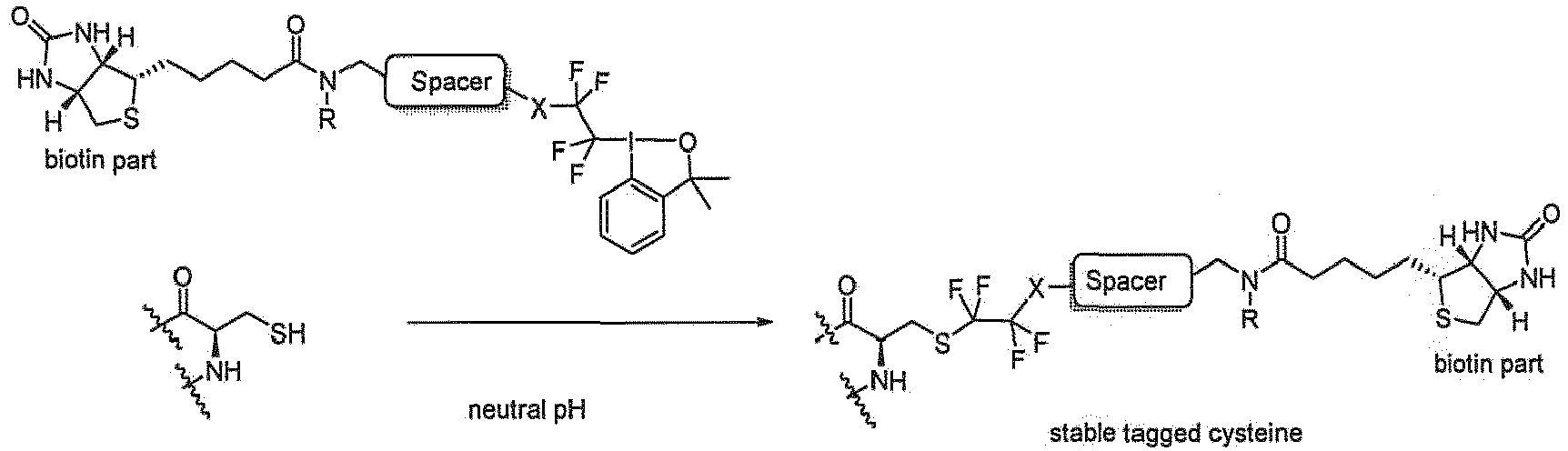
- The introduction of the biotin moiety into cysteine comprising peptides and in cysteine rich domains allows use of Pull-Down Assays due to the high affinity of biotin to streptavidin.
- This description makes reference to the annexed drawings wherein:
-
Fig. 1 shows so far isolated compounds of formula (I) and formula (II). The numbers written under the reagents denote the isolated yields of successive steps in their syntheses (1. synthesis of XCF2CF2Br, 2. conversion of XCF2CF2Br to XCF2CF2TMS and 3. the final "Umpolung" step leading to the hypervalent iodine-CF2CF2X reagent. - One method for producing compounds of formula (I) and compounds of formula (II) is via the following synthetic approach (below R = Nu):
- 1. Bromotetrafluoroethylation

- 2. Reduction / Trimethylsilylation

- 3. Umpolung
- a) alcohol reagent:

- b) acid reagent:

- a) alcohol reagent:
- 1. Bromotetrafluoroethylation

- 2. Reduction / Trimethylsilylation

- 3. Umpolung
- a) alcohol reagent:

- b) acid reagent:

- a) alcohol reagent:
- Suitable reducing or metallating agents/methods are e.g. metallic magnesium, metallic aluminum, metallic zinc, tris-dialkylaminophosphines, tetrakis-dialkylaminoethylenes, i-propylmagnesium chloride-lithium chloride complex, Grignard reagents, alkyl, alkenyl and aryl lithiums, and cathodic electroreduction.
- Other activators that can be used are generally ate complexes of fluoride anion and an inorganic or organic Lewis acidic organic acceptor, sources of naked anhydrous fluoride anion, such as tetraalkylammonium fluorides, tetraalkylphosphonium or tetraarylphosphonium fluorides, cesium fluoride, combination of alkali metal fluorides and alkali metal chelators such as crown ethers or related structures.
- Solvents other than acetonitrile are THF, higher nitrile analogues of acetonitrile, halogenated aliphatic and aromatic solvents, tertiary carboxamides.
- The Umpolung of the alcohol compound of formula (I) can be performed at temperatures up to 25°C. In general, however, it is performed at temperatures of at most 0°C. Often improved purity is obtained at temperatures significantly below 0°C such as below -10°C or even below -20°C such as -35°C. Due to its lower reactivity, the Umpolung of the acid compound usually is performed at higher temperature, usually at temperatures from about 0°C up to ambient temperature (rt), usually 20°C to 25°C.
- In the following experimental part trime-thylsilanes are used as Phx(C1-C3-alkyl)3-x silanes. Trimethylsilanes are preferred silanes because they are comparably cheap and readily available.
- Using PhSCF2CF2SiMe3, an optimum protocol for smooth and high yielding Umpolung reaction was elaborated. The comparison of the result of Umpolung of Ruppert-Prakash reagent with chloroiodane acid and fluoroiodane alcohol indicated that chloroiodane acid is not sufficiently reactive and that even in situ formation of fluoroiodane acid as mere intermediate results in poorer yields than starting from isolated fluoroiodane alcohol. The best result was obtained with the combined use of excess fluoroiodane alcohol and a well soluble fluoride source (e.g. tetrabutylammonium triphenyldifluorosilicate (TBAT) (see Table 1) as activator.
Table 1: Results of the Umpolung of PhSCF2CF2SiMe3 with fluoroiodane alcohol entry activator equiv. of PhSCF2C F2SiMe3 equiv. fluoroiodane alcohol solvent t [°C] reaction time yielde scale 1 excess of spray dried KF 1.2 1 eq. = 0.25M MeCN 0°C to 25°C 6h 22% (18%) 100 mg 2a 10 mol% TBAT 1 2 eq.= 0.25M THF -10°C to 25°C 3h (40%) 100 mg 3b 10 mol% TBAT 1 2 eq. = 0.33M THF 0°C 26% 100 mg 3c 1 mol% TBAT 1 2 eq. = 0.4M MeCN -20°C to 0°C 2 h 69%(6 8%) 100 mg 4d 1 mol% TBAT 1 2 eq. = 0.4M MeCN -35°C to 0°C 1 h 93%(85%) 1 g a PhSCF2CF2SiMe3 was added in three portions during 1 h.
b PhSCF2CF2SiMe3 was added with syringe pump within 8 h.
c PhSCF2CF2SiMe3 was added at once at -20 °C.
d PhSCF2CF2SiMe3 was added within 10 minutes
e the yields not in parenthesis are NMR yields measured
with internal standard PhCF3, those in parenthesis are isolated yields.
TBAT = tetrabutylammonium triphenyldifluorosilicate - The worst result was obtained with KF. The Umpolung was slow and incomplete (entry 1). Switching to the use of isolated fluoroiodane alcohol in THF in combination with 10 mol% TBAT improved the yield to 40% (entry 2). During the conditions of entry 2, an instanteous color change to orange was observed after the addition of the first portion of PhSCF2CF2SiMe3 to the mixture of fluoroiodane alcohol and TBAT. This rapid color change might possibly be interpreted as an accompanying decomposition of PhSCF2CF2SiMe3 in the presence of highly reactive fluoride activator. Therefore, in a next approach the reaction temperature was lowered to -20 °C and less activator was used (entry 3). This appeared to be a fruitful intervention leading to 69% NMR yield of PHS-I. Pleasingly, performing the reaction on a 1 g scale, lowering the reaction temperature to -35 °C and adding PhSCF2CF2SiMe3 within 10 minutes gave 93% NMR yield of PhS-I. A quick TLC analysis of the reaction mixture revealed that the reaction was essentially complete in 5 minutes after the silane PhSCF2CF2SiMe3 had been added.
- These observations support the following hypothesis that, however, shall not be construed as limiting the invention in any way:
- (i) highly soluble fluoride source is the best activator
- (ii) fluoroiodane alcohol is the best acceptor of the fluoroalkylated carbanion
- (iii) catalysis is mediated only by the fast dissolving fluoride such as TBAT throughout the whole catalytic Umpolung process ("pure fluoride catalysis") (This is astonishing since in a number of fluoridecatalyzed nucleophilic fluoroalkylations, for example additions of fluoroalkylated silanes to benzaldehydes, the catalytically relevant activator responsible for major part of the conversion is the intermediate alkoxide and not the fluoride.)
- (iv) instability of activated fluoroalkylated silanes can be minimized by using excess of the acceptor fluoroiodane alcohol.
- Having optimized the synthesis of PhS-I, also the synthesis of the related "acid" reagent PhS-II was further investigated.
- First the potential of acetoxyiodane acid as the precursor for synthesis of PhS-II was explored. However, the acetate of the acetoxyiodane acid proved to have insufficient activating power.
- Thus, the poorly stable fluoroiodane acid was chosen. The fluoroiodane acid in pure form an only be obtained in solution, preferably as a solution in MeCN. Treatment of 2 equivalents of 1-chloro-benziodoxol-3-one (chloroiodane acid) with 10 equivalents of spray-dried KF in MeCN at 75 °C provided a suspension of KCl, KF and dissolved fluoroiodane acid. The solution of fluoroiodane acid was carefully canula-filtered under Ar from one into another Schlenk flash and treated with 10 mol% TBAT and 1 equivalent of PhSCF2CF2SiMe3 at 5 °C. Formation of PHS-II in 59% NMR yield together with 28% protodesilylation product of PhSCF2CF2SiMe3 was observed.
- In the next experiment, 3 equivalents of in-situ formed fluoroiodane acid together with 1 mol% TBAT was used. First the Umpolung of PhSCF2CF2SiMe3 was performed at 0 °C, but even after 1 h, only low conversion of the silane PhSCF2CF2SiMe3 was detected. After warming up to 20°C to 25°C, much faster progress of the reaction was observed; within 3 h, the starting material could no longer be detected on TLC anymore. 19F NMR examination of the crude reaction mixture revealed formation of PhS-II in 60% NMR yield together with 17% PhSCF2CF2H. PhS-II could be then isolated by flash chromatography in 60% yield, with chromatographic behaviour similar to the related acid CF3 reagent.

- The reaction of PhSO2CF2CF2TMS with 2 equivalents of fluoroiodane alcohol in the presence of 1 mol% TBAT at -35 °C in MeCN gave 48% NMR yield of PhSO2-I. Pure PhSO2-I could be obtained in 32% isolated yield.

- When PhSO2CF2CF2SiMe3 was subjected to 3 equivalents of in-situ formed fluoroiodane acid in the presence of 1 mol% TBAT, formation of the desired reagent PhSO2-II could be detected only in 8% NMR yield after 3 h at ambient temperature (20°C to 25°C). The lower nucleo-philicity of the silane in combination with lower purity of PhSO2CF2CF2SiMe3 used is assumed to the reason of failure. The silane used in these experiments, namely, was contaminated with 15% protodesilylated material.

- Nitrogen-based heterocyclic functionalities are of high importance in medicinal chemistry and agro-chemistry. Therefore compounds of formula (I) and formula (II) with R comprising nitrogen-containing heterocyclic groups are of high interest in these fields.
- Im-I and Im-II were used as representatives of this class.
- The synthesis of the desired reagents required access to the corresponding 1-[(1,1,2,2-Tetrafluoro-2-trimethylsilyl)ethyl]-1H-imidazole. Following the synthesis reported by Petko et al.[7], imidazole was deprotonated with 1.05 equivalents of sodium hydride in DMF and treated with 2 equivalents BrCF2CF2Br (see also [8]) in the presence of 2 mol% TBAT to give 1-[(1,1,2,2-Tetrafluoro-2-bromol]-1H-imidazole in 42% yield (Lit. 68% yield). In a second experiment, in order to need less dibromotetrafluoroethane, its excess was reduced to 1.5 equivalents and simultaneously the reactivity of the imidazolide anion was increased by increasing the amount of phase transfer catalyst (activator) to 7 mol%. Combination of these two adjustments provided 1-[(1,1,2,2-Tetrafluoro-2-bromol]-1H-imidazole in 68% yield which represents a certain improvement in comparison to the synthesis reported in the literature.

- Although the bromotetrafluoroethylation of imidazole formally represents a nucleophilic substitution, it actually comprises a combination of several elementary steps. The generally accepted mechanism is depicted in the Scheme below. The overall process is initiated by bromophilic attack of the nucleophile on BrCF2CF2Br, providing the brominated nucleophile and the highly unstable bromotetrafluoroethyl anion Int1 which quickly loses bromide anion to give the interermediate tetrafluoroethylene (Int2). Tetrafluoroethylene then behaves as the actual acceptor of the nucleophile, forming fluoroalkylated carbanion Int3. This carbanion is then finally brominated by a further bromophilic attack of BrCF2CF2Br, initiating a new reaction cycle with the release of new Int1.


- The next step in the synthesis of 1-[(1,1,2,2-Tetrafluoro-2-trimethylsilyl)ethyl]-1H-imidazole was a debrominative reductive silylation under Barbier conditions. 1-[(1,1,2,2-Tetrafluoro-2-bromol]-1H-imidazole was treated with 1.5 equivalents Mg grit and 4 equivalents of TMSC1 in THF to provide the corresponding 1-[(1,1,2,2-Tetrafluoro-2-trimethylsilyl)ethyl]-1H-imidazole in 71% yield after Kugelrohr distillation. During the aqueous workup of the silane, care had to be taken to work under neutral conditions and in the cold, otherwise extensive protodesilylation of 1-[(1,1,2,2-Tetrafluoro-2-trimethylsilyl)ethyl]-1H-imidazole was observed.

- 1 equivalent of 1-[(1,1,2,2-Tetrafluoro-2-trimethylsilyl)ethyl]-1H-imidazole was treated with 2 equivalents of fluoroiodane alcohol in the presence of 1 mol% TBAT in acetonitrile at a temperature of -35°C to 0°C for 1 hour providing Im-I in 77-80% isolated yield. Similarly as in the case of synthesis of PHS-I, the Umpolung of 1-[(1,1,2,2-Tetrafluoro-2-trimethylsilyl)ethyl]-1H-imidazole with fluoroiodane alcohol was essentially finished within 10 minutes after addition of silane was complete (as evidenced by TLC analysis). Reagent Im-I was obtained as a viscous yellowish liquid that soon crystallized at ambient temperature (20°C to 25°C).

- The synthesis of the related "acid-type" reagent Im-II was conducted along the lines of the previously optimized protocol. Reaction of 1 equivalent of 1-[(1,1,2,2-Tetrafluoro-2-trimethylsilyl)ethyl]-1H-imidazole with 3 equivalents of an in-situ formed fluoroiodane acid in the presence of 1 mol% TBAT gave Im-II in 66% NMR yield. The compound could be isolated by flash chromatography in 66% isolated yield.

- According to the methods described above so far the compounds of formula (I) and formula (II) shown in
Figure 1 have been prepared in the indicated isolated yields. - In detail: The numbers written under the reagents denote the isolated yields of successive steps in their syntheses (1. synthesis of XCF2CF2Br, 2. conversion of XCF2CF2Br to XCF2CF2TMS and 3. the final "Umpolung" step leading to the hypervalent iodine-CF2CF2X reagent.
- When measuring the 19F NMR spectra of PhS-I in CDCl3 on the one hand and in acetonitrile on the other hand an interesting phenomenon was observed. The crude reaction mixture showed in MeCN a well resolved pair of triplets at -83.1 ppm and -92.4 ppm. However, the isolated PhS-I re-dissolved in CDCl3, gave one triplet at -82.2 ppm and a broad resonance at -89.9 ppm instead.
- The same compound in d3-MeCN at ambient temperature (20°C to 25°C), gave again a clearly developed pair of triplets at -83.1 ppm and -92.4 ppm.
- A similar solvent-dependent behaviour, only less pronounced, was observed for other reagents as well.
- A not limiting interpretation of this behaviour might be as follows:
- Reagent PhS-I is assumed to be in dynamic equilibrium between its cyclic and open iodonium-alkoxide form. It can be also conceived that the open iodonium-alkoxide form can coordinate the alkoxide moiety of a second molecule of PhS-I. [9] In a solvent with poor donor ability (represented by CDCl3), the rate and extent of such dynamic processes is expected to be significant enough to lead to signal broadening. The more broadened 19F NMR resonance is assumed to correspond to the -CF2-moiety directly attached to the hypervalent iodine center where the changes of electronic properties are most pronounced during these chemical exchange processes. Addition of solvent with good donor properties (represented by MeCN) is equivalent to addition of large excess of a ligand that effectively freezes the ligand exchange equilibria, whereby only the MeCN complex of PhS-I is observed (see below). A similar behaviour was observed for arylsulfur trifluorides where exchange of axial and equatorial fluorides was "frozen" by addition of diethyl ether, although the original nature of signal broadening is not exactly the same. [10]

- Again this interpretation shall by no means be construed as limiting the scope of the present invention.
- Only preliminary stability tests of reagents PHS-I, PhS-II, PhSO2-I, Im-I and Im-II in the solid state and in solution in deuterated solvents (CDCl3 and d3-MeCN) were performed.
- All reagents could be handled for a few hours at room temperature without any decomposition. The well crystallizing reagent Im-II was stored at 25°C for 5 days without decomposition.
- However, as a solution in both CDCl3 and d3-MeCN, significant decomposition (more than 50%) was detected after 24 h at room temperature, in standard borosilicate glass NMR tubes under air without exclusion of light. In the case of reagent PHS-I, severe stability problems were experienced. Partial decomposition could already be detected within 1 hour when using d3-MeCN that was not dry.
- During storage of reagents PHS-I, PhS-II, PhSO2-I, Im-I and Im-II for 4 months at -20 °C no decomposition was observed. It is therefore recommended to store the reagents in tightly sealed containers with exclusion of moisture at -20 °C.
- Based on the literature precedence of successful mild trifluoromethylation of thiols with alcohol CF3 reagent, [11] the reactivity of Im-I towards 4-chlorothiophenol was investigated. Upon addition of a solution of 1 equivalent of 4-chlorothiophenol to 1 equivalent of Im-I in DCM (dichloromethane) at -78 °C, the reaction mixture instaneously turned yellowish-green. In the trifluoromethylation reaction of thiols, this greenish coloration was assumed to be caused by intermediary formation of charge trasfer complex between the reagent and the thiol substrate. This could also be the case with Im-I. Within a minute, the yellowish-green solution turned colorless and a crystalline white solid formed. After warming up to ambient temperature (20°C to 25°C), an almost colorless solution was obtained. 19F NMR analysis with internal standard revealed clean formation of the corresponding fluoroalkylated product in 93% yield (see Scheme below). Subsequent chromatographic isolation provided 1-[(1,1,2,2-Tetrafluoro-2-(4-chlorophenyl)]-1H-imidazole in 90% isolated yield as white needles.

- Another test reaction was the fluoroalkylation of N,N-disubstituted hydroxylamines.
- Treatment of 1 equivalent of N,N-dibenzylhydroxylamine with 1 equivalent of PhS-I in DCM at ambient temperature (20°C to 25°C) gave after overnight reaction 70% NMR yield of the corresponding fluoroalkylated hydroxylamine. Isolation by flash chromatography yielded O-fluoroalkylated N,N-dibenzylhydroxylamine in 63% yield.

- A further test reaction was fluoroalkylation of diphenylphosphine. Upon mixing 1 equivalent of diphenylphosphine with 1 equivalent of Im-I fast conversion to the corresponding fluoroalkylated diphenylphosphine was observed by 19F NMR. The NMR yield was 62%. Isolation has to be performed under non-oxidizing conditions.

- Reactions with further substrates have also already been examined. A list with reaction conditions is given in the following Table 2. The reagents are designated as in
Figure 1 :Table 2: Substrate (type) Reagent Reaction Bn2-hydroxylamine (O) A4 
N-Boc-cysteine ester (S) A1 
4-Cl-thiophenol (S) A2 
Diphenylphosphine (P) A2 
Skatole (C) A2 
β-Keto ester (C) A4 
β-Keto ester (C) B4 
Oxazolidinone 1 (C) B4 
Oxazolidinone 2 (C) B4 
2-Mercaptobenzothia- zol (S) A 
- Fluoroiodane alcohols and fluoroiodane acids are the best Umpolung partners for fluoroalkylated silanes.
- Pure fluoride catalysis with 1 mol% TBAT is able to mediate the very rapid Umpolung of nucleophilic fluoroalkylsilanes within minutes at -35 °C.
- Use of excess fluoroiodane alcohols and fluoroiodane acids helps to improve the yields of the desired hypervalent fluoroalkyl-iodine reagents (compounds of formula (I) and formula (II).
- In the so far performed reactions "alcohol-type" reagents PhS-I and Im-I showed very promising potential, as thiols, N,N-disubstituted hydroxylamines, secondary phosphines and carbon centered nucleophiles proved to be receptive substrates in electrophilic fluoroalkylation. Further reactions wherein the compounds of the present invention are of interest are for example the diastereoselective fluoroalkylation of chiral Evans-type acyl oxazolidin-2-ones, fluoroalkylation of trimethylsilyl ketene acetals derived from lactones, enantioselective Cu-catalyzed fluoroalkylation of cyclic β-keto esters, fluoroalkylation of terminal acetylenes, alkenes and aryl- and alkenylboronic acids. Fluoroalkylation of heteroatom-centered nucleophiles like azoles and secondary phosphines is assumed to provide highly interesting ligand scaffolds applicable in homogeneous metal-catalyzed tranformations.
- The expectional reactivity towards thiol substrates can be employed in selective tagging of cysteine residues in the context of highly complex peptide targets. For example, a reagent comprising a fluorescent moiety attached through a linker to the CF2CF2-moiety will serve as a double tag, suitable for both fluorimetric assay and NMR spectrometric detection. [12]

- Seen from a more general perspective, hypervalent fluoroalkyl-iodine reagents of formula (I) or formula (II) can function as highly thiol-selective carriers of a variety of moieties attached to the hypervalent iodine center.
- From the life- and material science perspective, thanks to their excellent tunability, the compounds of formula (I) and formula(II) have broad application in discovery of new drugs, modification of existing lead structures and in the design of new functional materials (liquid crystals, fuel cell membranes, donor-acceptor molecular wires for solar electrochemical cells). For example, fluoroalkylation of existing drugs can improve some of their properties, for instance acidobasic behaviour or bioavailability. As an example of a modification with a compound of formula (I) or formula (II) Tenofovir may be mentioned. Tenofovir, marketed by the company Gilead Sciences, is an antiretroviral drug (reverse transcriptase inhibitor) effective against HIV1 and hepatitis B infections.

- While there are shown and described presently preferred embodiments of the invention, it is to be distinctly understood that the invention is not limited thereto but may be otherwise variously embodied and practiced within the scope of the following claims.
-
- [1]
- a) P. Eisenberger, S. Gischig, A. Togni, Chem. Eur. J. 2006, 12, 2579-2586;
- b) P. Eisenberger, ETH Zurich, Diss. No. 17371 (Zurich), 2007.
- [2]
- a) J. Liu, C. Ni, F. Wang, J. Hu, Tetrahedron Lett. 2008, 49, 1605-1608;
- b) C. Ni, J. Hu, Tetrahedron Lett. 2005, 46, 8273-8277.
- [3] W. Zhang, J. Zhu, J. Hu, Tetrahedron Lett. 2008, 49, 5006-5008.
- [4] Z. He, T. Luo, M. Hu, Y. Cao, J. Hu, Angew. Chem. Int. Ed. 2012, 51, 3944-3947.
- [5] Z. He, M. Hu, T. Luo, L. Li, J. Hu, Angew. Chem. Int. Ed. 2012, 51, 11545-11547.
- [6] Y. Li, A. Studer, Angew. Chem. Int. Ed. 2012, 51, 8221-8224.
- [7] K. I. Petko, T. M. Sokolenko, A. V. Bezdudny, L. M. Yagupolskii, J. Fluorine Chem. 2005, 126, 1342-1346.
- [8] W. Dmowski, J. Fluorine Chem. 2012, 142, 6-13.
- [9] V. Zhdankin, in Hypervalent Iodine Chemistry: Preparation, Structure and Synthetic Applications of Polyvalent Iodine Compounds, John Wiley and Sons, 2013, pp. 21-143.
- [10] T. Umemoto, R. P. Singh, Y. Xu, N. Saito, J. Am. Chem. Soc. 2010, 132, 18199-18205.
- [11] I. Kieltsch, P. Eisenberger, A. Togni, Angew. Chem. Int. Ed. 2007, 46, 754-757.
- [12]
- a) Y. Kim, S. O. Ho, N. R. Gassman, Y. Korlann, E. V. Landorf, F. R. Collart, S. Weiss, Bioconjugate Chem. 2008, 19, 786-791;
- b) M. C. Puljung, W. N. Zagotta, in Current Protocols in Protein Science, John Wiley & Sons, Inc., 2001.

Claims (15)
- A hypervalent iodine of formula (I) or formula (II)

- The compound of claim 1, wherein R is selected from the group consisting of unsubstituted or substituted imidazoles, unsubstituted or substituted pyrazoles, unsubstituted or substituted benzimidazoles, unsubstituted or substituted thiophenols, unsubstituted or substituted phenols, like 4-methoxyphenols, ethyl-4-hydroxybenzoates, 4-bromophenols, unsubstituted or substituted pyridine-thiols, unsubstituted or substituted 2-mercaptobenzothiazoles, potassium cyanide and diethylphosphite.
- The compound of claim 1 or 2, wherein, R is selected from the group consisting of imidazole, pyrazole, benzimidazole, thiophenol, 4-methoxyphenol, ethyl-4-hydroxybenzoate, 4-bromophenols, pyridine-2-thiol, 2-mercaptobenzothiazoles, potassium cyanide and diethylphosphite, more preferred imidazole, pyrazole, benzimidazole, thiophenol, 4-methoxyphenol, ethyl-4-hydroxybenzoate, 4-bromophenols and pyridine-2-thiol.
- The compound of claim 2 or 3, wherein R is substituted with a substituent independently from each other selected from the group consisting of halogens, linear or branched, unsubstituted or halogen substituted C1 to C4 alkyl or C1 to C4 alkenyl or C1 to C4 alkinyl or C1 to C4 alkoxy or C1 to C4 alkyl carboxylate groups, or the substituent may be a linker or spacer coupled to a desired group such as a functional group, said linker preferably being an optionally halogen substituted aliphatic group.
- The compound of claim 2 or 3, wherein R is unsubstituted.
- A method for the production of a compound of formula (I) or formula (II) of one of claims 1 to 5 comprising an Umpolung wherein(a) fluoroiodane alcohol is reacted with R-CF2-CF2-SiPhx(C1-C3-alkyl)3-x, preferably R-CF2-CF2-SiMe3 in the presence of at least one fluorine source as activator to give a compound of formula (I), or wherein(b) chloroiodane acid or fluoroiodane acid is reacted with R-CF2-CF2-SiPhx(C1-C3-alkyl)3-x, preferably R-CF2-CF2-SiMe3, in the presence of at least one fluorine source as activator to give a compound of formula (II),wherein the activator preferably is selected from ate complexes of fluoride anion and an inorganic or organic Lewis acidic organic acceptor like tetrabutylammonium triphenyldifluorosilicate (TBAT), sources of naked anhydrous fluoride anion, such as tetraalkylammonium fluorides, tetraalkylphosphonium or tetraarylphosphonium fluorides, cesium fluoride, combination of alkali metal fluorides and alkali metal chelators such as crown ethers or related structures, more preferred tetrabutylammonium triphenyldifluorosilicate (TBAT).
- The method of claim 6 wherein(a) is performed with 2 eq. fluoroiodane alcohol per equivalent R-CF2-CF2-SiPhx(C1-C3-alkyl)3-x, preferably R-CF2-CF2-SiMe3, 1 to 5 mole % of one or more activators, preferably tetrabutylammonium triphenyldifluorosilicate (TBAT) in a solvent, preferably acetonitrile, THF, higher nitrile analogues of acetonitrile, halogenated aliphatic and aromatic solvents, tertiary carboxamides, more preferred acetonitrile, at a temperature below 0°C, preferably below -10°C, more preferred below -20°C, most preferred at about -35°C,
or wherein(b) is performed with 3 eq. chloroiodane alcohol per equivalent R-CF2-CF2-SiPhx(C1-C3-alkyl)3-x, preferably R-CF2-CF2-SiMe3, one or more activators, preferably KF and about 2 mole % tetrabutylammonium triphenyldifluorosilicate (TBAT), in a solvent, preferably acetonitrile, THF, higher nitrile analogues of acetonitrile, halogenated aliphatic and aromatic solvents, tertiary carboxamides, more preferred acetonitrile, at a temperature between about 0°C and 25°. - The method of claim 6 or 7, wherein R-CF2-CF2-SiPhx(C1-C3-alkyl)3-x, preferably R-CF2-CF2-SiMe3, is produced by a combined reduction and phenylalkylsilylation reaction, preferably trimethylsilylation reaction, of R-CF2-CF2-Br in the presence a reducing or metallating agent, preferably metallic magnesium, metallic aluminum, metallic zinc, tris-dialkylaminophosphines, tetrakis-dialkylaminoethylenes,i-propylmagnesium chloride-lithium chloride complex, Grignard reagents, alkyl, alkenyl and aryl lithiums or applying cathodic electroreduction, and chlorophenylalkylsilane, preferably chlorotrimethylsilane (TMSCl).
- The method of claim 8, wherein R-CF2-CF2-Br is produced by bromotetrafluoroethylation.
- The method of claim 9, wherein the bromotetrafluoroethylation is performed by first reacting R-H with a hydride to form R- and then reacting R- with Br-CF2-CF2-Br to form R-CF2-CF2-Br.
- The method of claim 10, wherein the bromotetrafluoroethylation is performed by first reacting R-H (or Nu-H) with about 1.5 eq. of sodiumhydride in a solvent, preferably DMF, preferably at about 0°C, to form R- and then reacting R- with about 1.25 eq. Br-CF2-CF2-Br to form R-CF2-CF2-Br.
- The method of claim 6 or 7, wherein R-CF2-CF2-SiPhx(C1-C3-alkyl)3-x, preferably R-CF2-CF2-SiMe3 is produced by reacting R-H with tetrafluoroethylene (CF2=CF2) in the presence of a catalyst, e.g. NaH/n-Bu4NI, to yield R-CF2-CF2-H that - in a second step - is reacted to R-CF2-CF2-SiPhx(C1-C3-alkyl)3-x or R-CF2-CF2-SiMe3, respectively, using Hal-SiPhx(C1-C3-alkyl)3-x or Hal-SiMe3, preferably ClSiPhx(C1-C3-alkyl)3-x or ClSiMe3, as reagent in the presence of a base.
- Use of a compound of formula SiPhx(C1-C3-alkyl)3-x, in particular R-CF2-CF2-SiMe3, wherein R is a nucleophile as defined in any of claims 1 to 5 in the production of compounds of one of claims 1 to 5.
- Use of a compound of one of claims 1 to 5 for producing fluoroethylated substrates.
- The use of claim 14, wherein the substrate is cysteine or a cysteine comprising peptide or, protein.
Priority Applications (6)
| Application Number | Priority Date | Filing Date | Title |
|---|---|---|---|
| EP14180136.5A EP2982672A1 (en) | 2014-08-07 | 2014-08-07 | Hypervalent iodine CF2CF2X reagents and their use |
| DE202015009538.0U DE202015009538U1 (en) | 2014-08-07 | 2015-08-03 | Hypervalent Iodine CF2CF2X Reagents and Their Use |
| US15/501,872 US10040812B2 (en) | 2014-08-07 | 2015-08-03 | Hypervalent iodine CF2CF2X reagents and their use |
| PCT/CH2015/000113 WO2016019475A1 (en) | 2014-08-07 | 2015-08-03 | Hypervalent iodine cf2cf2x reagents and their use |
| EP15750621.3A EP3180324B1 (en) | 2014-08-07 | 2015-08-03 | Hypervalent iodine cf2cf2x reagents and their use |
| US16/055,629 US10669250B2 (en) | 2014-08-07 | 2018-08-06 | Hypervalent iodine CF2CF2X reagents and their use |
Applications Claiming Priority (1)
| Application Number | Priority Date | Filing Date | Title |
|---|---|---|---|
| EP14180136.5A EP2982672A1 (en) | 2014-08-07 | 2014-08-07 | Hypervalent iodine CF2CF2X reagents and their use |
Publications (1)
| Publication Number | Publication Date |
|---|---|
| EP2982672A1 true EP2982672A1 (en) | 2016-02-10 |
Family
ID=51302902
Family Applications (2)
| Application Number | Title | Priority Date | Filing Date |
|---|---|---|---|
| EP14180136.5A Withdrawn EP2982672A1 (en) | 2014-08-07 | 2014-08-07 | Hypervalent iodine CF2CF2X reagents and their use |
| EP15750621.3A Active EP3180324B1 (en) | 2014-08-07 | 2015-08-03 | Hypervalent iodine cf2cf2x reagents and their use |
Family Applications After (1)
| Application Number | Title | Priority Date | Filing Date |
|---|---|---|---|
| EP15750621.3A Active EP3180324B1 (en) | 2014-08-07 | 2015-08-03 | Hypervalent iodine cf2cf2x reagents and their use |
Country Status (4)
| Country | Link |
|---|---|
| US (1) | US10040812B2 (en) |
| EP (2) | EP2982672A1 (en) |
| DE (1) | DE202015009538U1 (en) |
| WO (1) | WO2016019475A1 (en) |
Cited By (1)
| Publication number | Priority date | Publication date | Assignee | Title |
|---|---|---|---|---|
| CN111718323A (en) * | 2020-07-10 | 2020-09-29 | 南宁师范大学 | Hypervalent iodine thiocyanate reagent and preparation method and application thereof |
Families Citing this family (6)
| Publication number | Priority date | Publication date | Assignee | Title |
|---|---|---|---|---|
| EP3736269A1 (en) | 2019-05-06 | 2020-11-11 | CF Plus Chemicals s.r.o. | A method for functionalization of an aromatic amino acid or a nucleobase |
| WO2020246612A1 (en) * | 2019-06-07 | 2020-12-10 | ダイキン工業株式会社 | Fluorinated compound |
| KR102848811B1 (en) | 2019-12-17 | 2025-08-22 | 삼성전자주식회사 | Resist composition and Method of manufacturing semiconductor device using the same |
| CN111303115A (en) * | 2020-03-04 | 2020-06-19 | 南开大学 | Organic trivalent iodine monofluorine transfer reagent compound and its synthesis method |
| CN111517954A (en) * | 2020-06-08 | 2020-08-11 | 浙江师范大学 | (Z) -5-fluoro-2-difluoromethylene olefin derivative and preparation method thereof |
| CN115928114B (en) * | 2022-12-29 | 2023-06-27 | 淮北师范大学 | Synthetic method of aromatic hydrocarbon pyrazole compound |
-
2014
- 2014-08-07 EP EP14180136.5A patent/EP2982672A1/en not_active Withdrawn
-
2015
- 2015-08-03 WO PCT/CH2015/000113 patent/WO2016019475A1/en not_active Ceased
- 2015-08-03 DE DE202015009538.0U patent/DE202015009538U1/en not_active Expired - Lifetime
- 2015-08-03 EP EP15750621.3A patent/EP3180324B1/en active Active
- 2015-08-03 US US15/501,872 patent/US10040812B2/en active Active
Non-Patent Citations (19)
| Title |
|---|
| C. NI; J. HU, TETRAHEDRON LETT., vol. 46, 2005, pages 8273 - 8277 |
| C. PULJUNG; W. N. ZAGOTTA: "Current Protocols in Protein Science", 2001, JOHN WILEY & SONS, INC. |
| CARBONI A. ET AL: "Photoredox-induced three-component oxy-, amino-, and carbotrifluoromethylation of enecarbamates", ORGANIC LETTERS, vol. 16, no. 4, 12 February 2014 (2014-02-12), pages 1240 - 1243, XP002731188 * |
| I. KIELTSCH; P. EISENBERGER; A. TOGNI, ANGEW. CHEM. INT. ED., vol. 46, 2007, pages 754 - 757 |
| J. LIU; C. NI; F. WANG; J. HU, TETRAHEDRON LETT., vol. 49, 2008, pages 1605 - 1608 |
| K. I. PETKO; T. M. SOKOLENKO; A. . BEZDUDNY; M. YAGUPOLSKII, J. FLUORINE CHEM., vol. 126, 2005, pages 1342 - 1346 |
| LI Y. ET AL: "Transition-metal-free trifluoromethylaminoxylation of alkenes", ANGEWANDTE CHEMIE INTERNATIONAL EDITION, vol. 51, no. 33, 13 August 2012 (2012-08-13), pages 8221 - 8224, XP002731187 * |
| MIZUTA S. ET AL: "Trifluoromethylation of allylsilanes under photoredox catalysis", ORGANIC LETTERS, vol. 15, no. 6, 6 March 2013 (2013-03-06), pages 1250 - 1253, XP002731185 * |
| P. EISENBERGER, ETH ZURICH, DISS. NO. 173 1 (ZURICH, 2007 |
| P. EISENBERGER; S. GISCHIG; A. TOGNI, CHEM. UR. J., vol. 12, 2006, pages 2579 - 2586 |
| T. UMEMOTO; R. P. SINGH; Y. XU; N. SAITO, J. AM. CHEM. SOC., vol. 132, 2010, pages 8199 - 18205 |
| V. ZHDANKIN: "Hypervalent Iodine Chemistry: Preparation, Structure and Synthetic Applications of Polyvalent Iodine Compounds", 2013, JOHN WILEY AND SONS, pages: 21 - 143 |
| W. DMOWSKI, J. FLUORINE CHEM., vol. 142, 2012, pages 6 - 13 |
| W. ZHANG; J. ZHU; J. HU, TETRAHEDRON LETT., vol. 49, 2008, pages 5006 - 5008 |
| Y. KIM; O. O; N. R. GASSMAN; Y. KORLANN; E. . LANDORF; F. R. COLLART; S. WEISS, BIOCONJUGATE CHEM., vol. 19, 2008, pages 786 - 791 |
| Y. LI; A. STUDER, ANGEW. CHEM. NT. ED., vol. 51, 2012, pages 8221 - 8224 |
| Z. HE; M. HU; T. LUO; L. LI; J. HU, ANGEW. CHEM. INT. ED., vol. 51, 2012, pages 11545 - 11547 |
| Z. HE; T. LUO; M. HU; Y. CAO; J. HU, ANGEW. CHEM. NT. ., vol. 51, 2012, pages 3944 - 3947 |
| ZHANG B. ET AL: "6-Trifluoromethyl-phenanthridines through radical trifluoromethylation of isonitriles", ANGEWANDTE CHEMIE INTERNATIONAL EDITION, vol. 52, no. 41, 4 October 2013 (2013-10-04), pages 10792 - 10795, XP002731186 * |
Cited By (2)
| Publication number | Priority date | Publication date | Assignee | Title |
|---|---|---|---|---|
| CN111718323A (en) * | 2020-07-10 | 2020-09-29 | 南宁师范大学 | Hypervalent iodine thiocyanate reagent and preparation method and application thereof |
| CN111718323B (en) * | 2020-07-10 | 2021-06-11 | 南宁师范大学 | High-valence iodothiocyanide reagent and preparation method and application thereof |
Also Published As
| Publication number | Publication date |
|---|---|
| WO2016019475A1 (en) | 2016-02-11 |
| US10040812B2 (en) | 2018-08-07 |
| DE202015009538U1 (en) | 2018-06-12 |
| US20170233420A1 (en) | 2017-08-17 |
| EP3180324B1 (en) | 2020-11-25 |
| EP3180324A1 (en) | 2017-06-21 |
Similar Documents
| Publication | Publication Date | Title |
|---|---|---|
| EP3180324B1 (en) | Hypervalent iodine cf2cf2x reagents and their use | |
| Ni et al. | Recent advances in the synthetic application of difluorocarbene | |
| Milcent et al. | The main and recent syntheses of the N-CF3 motif | |
| Kim et al. | A general and direct synthesis of imidazolium ionic liquids using orthoesters | |
| KR102500024B1 (en) | Aromatic fluorination method | |
| Loska et al. | New synthesis of 2‐heteroarylperfluoropropionic acids derivatives by reaction of azine N‐oxides with hexafluoropropene | |
| Bolek et al. | Ring opening reactions of cyclic sulfamidates. Synthesis of β-fluoroaryl alanines and derivatives of 4, 4-difluoroglutamic acid | |
| Siah et al. | Dual-gold (I)-generated trifluoromethylation of terminal alkynes with Togni’s reagent | |
| EP3677576A1 (en) | Fluorine-containing compounds for use as nucleophilic reagents for transferring functional groups onto high value organic compounds | |
| BR112017007509B1 (en) | process for the preparation of 1- (3,5-dichloro-4-fluorophenyl) -2,2,2-trifluoro-ethanone | |
| US10087126B2 (en) | Process for the preparation of halo-substituted benzenes | |
| JP4227742B2 (en) | Highly branched perfluoroolefins, extremely stable perfluoroalkyl radicals and methods for their production | |
| US10669250B2 (en) | Hypervalent iodine CF2CF2X reagents and their use | |
| WO2012075316A2 (en) | Cyclopropyl mida boronate | |
| Kitamura | Azidoimidazolinium Salts: Safe and Efficient Diazo‐transfer Reagents and Unique Azido‐donors | |
| WO2018186331A1 (en) | Modification method and analysis method for mixture containing trifluorosulfanyl aromatic compound | |
| CN105061290B (en) | A kind of synthetic method of indole ketone compound | |
| Milcent et al. | Construction of N‐CF2H, N‐CF3, and N‐CH2CF3 Motifs | |
| LV15139B (en) | Sulfone synthesis from potassium allyltrifluoroborates | |
| CN106866488A (en) | A kind of synthetic method of the assimilation compound of 3,3 difluoro, 4 pyrrolin 2 | |
| JP2507922B2 (en) | Novel fluorine-containing oligomer and method for producing the same | |
| Hall | Electrophilic Fluorination of Organometallic Fragments | |
| JP2008174552A (en) | Method for producing 4-perfluoroisopropylanilines | |
| Shibayama et al. | Reaction of β-trifluoromethyl vinamidinium salt with carbon nucleophiles | |
| US20260042715A1 (en) | Fluorination process |
Legal Events
| Date | Code | Title | Description |
|---|---|---|---|
| PUAI | Public reference made under article 153(3) epc to a published international application that has entered the european phase |
Free format text: ORIGINAL CODE: 0009012 |
|
| AK | Designated contracting states |
Kind code of ref document: A1 Designated state(s): AL AT BE BG CH CY CZ DE DK EE ES FI FR GB GR HR HU IE IS IT LI LT LU LV MC MK MT NL NO PL PT RO RS SE SI SK SM TR |
|
| AX | Request for extension of the european patent |
Extension state: BA ME |
|
| STAA | Information on the status of an ep patent application or granted ep patent |
Free format text: STATUS: THE APPLICATION IS DEEMED TO BE WITHDRAWN |
|
| 18D | Application deemed to be withdrawn |
Effective date: 20160811 |