EP2981260B1 - Novel analogues of epicatechin and related polyphenols - Google Patents
Novel analogues of epicatechin and related polyphenols Download PDFInfo
- Publication number
- EP2981260B1 EP2981260B1 EP14778691.7A EP14778691A EP2981260B1 EP 2981260 B1 EP2981260 B1 EP 2981260B1 EP 14778691 A EP14778691 A EP 14778691A EP 2981260 B1 EP2981260 B1 EP 2981260B1
- Authority
- EP
- European Patent Office
- Prior art keywords
- cis
- chroman
- diol
- compound
- hydroxyphenyl
- Prior art date
- Legal status (The legal status is an assumption and is not a legal conclusion. Google has not performed a legal analysis and makes no representation as to the accuracy of the status listed.)
- Active
Links
- 0 *COC(Oc1cc(C([C@@](C2)O)Oc3c2c(O)cc(O)c3)ccc1O)=O Chemical compound *COC(Oc1cc(C([C@@](C2)O)Oc3c2c(O)cc(O)c3)ccc1O)=O 0.000 description 12
- SZTXQJKBJAEYES-SCBLGKRXSA-N O[C@H](C1)C(c2cc(OCc3ccccc3)ccc2)Oc2c1ccc(OCc1ccccc1)c2 Chemical compound O[C@H](C1)C(c2cc(OCc3ccccc3)ccc2)Oc2c1ccc(OCc1ccccc1)c2 SZTXQJKBJAEYES-SCBLGKRXSA-N 0.000 description 2
- FSQRVBREHITJKB-BVPFNMGQSA-N C(c1ccccc1)N[C@@H](C1)[C@@H](c(cc2OCc3ccccc3)ccc2OCc2ccccc2)Oc2c1c(OCc1ccccc1)cc(OCc1ccccc1)c2 Chemical compound C(c1ccccc1)N[C@@H](C1)[C@@H](c(cc2OCc3ccccc3)ccc2OCc2ccccc2)Oc2c1c(OCc1ccccc1)cc(OCc1ccccc1)c2 FSQRVBREHITJKB-BVPFNMGQSA-N 0.000 description 1
- FSQRVBREHITJKB-BDBAGMBPSA-N C(c1ccccc1)N[C@H](C1)[C@@H](c(cc2OCc3ccccc3)ccc2OCc2ccccc2)Oc2c1c(OCc1ccccc1)cc(OCc1ccccc1)c2 Chemical compound C(c1ccccc1)N[C@H](C1)[C@@H](c(cc2OCc3ccccc3)ccc2OCc2ccccc2)Oc2c1c(OCc1ccccc1)cc(OCc1ccccc1)c2 FSQRVBREHITJKB-BDBAGMBPSA-N 0.000 description 1
- XJYHLHKBRDYBBO-ZENAZSQFSA-N CC(C)(C)OC(O[C@@H]1C(c(cc2O)ccc2O)Oc2cc(O)cc(O)c2C1)=O Chemical compound CC(C)(C)OC(O[C@@H]1C(c(cc2O)ccc2O)Oc2cc(O)cc(O)c2C1)=O XJYHLHKBRDYBBO-ZENAZSQFSA-N 0.000 description 1
- KVTWQLUZUNZDKY-PPUHSXQSSA-N CC(C)COC(Oc1cc(OC([C@@H](C2)O)c(cc3O)ccc3O)c2c(OC(OCC(C)C)=O)c1)=O Chemical compound CC(C)COC(Oc1cc(OC([C@@H](C2)O)c(cc3O)ccc3O)c2c(OC(OCC(C)C)=O)c1)=O KVTWQLUZUNZDKY-PPUHSXQSSA-N 0.000 description 1
- RKJWEIABVMDMGY-QZTJIDSGSA-N CC(C)NC(O[C@H](C1)[C@@H](c(cc2O)ccc2O)Oc2c1c(O)cc(O)c2)=O Chemical compound CC(C)NC(O[C@H](C1)[C@@H](c(cc2O)ccc2O)Oc2c1c(O)cc(O)c2)=O RKJWEIABVMDMGY-QZTJIDSGSA-N 0.000 description 1
- NZYIWENTBFEVGM-AWSIMMLFSA-N CC(C)NC(O[C@H](C1)[C@@H](c(cc2OCc3ccccc3)ccc2OCc2ccccc2)Oc2c1c(OCc1ccccc1)cc(OCc1ccccc1)c2)=O Chemical compound CC(C)NC(O[C@H](C1)[C@@H](c(cc2OCc3ccccc3)ccc2OCc2ccccc2)Oc2c1c(OCc1ccccc1)cc(OCc1ccccc1)c2)=O NZYIWENTBFEVGM-AWSIMMLFSA-N 0.000 description 1
- XLEYFDVVXLMULC-UHFFFAOYSA-N CC(c(c(O)cc(O)c1)c1O)=O Chemical compound CC(c(c(O)cc(O)c1)c1O)=O XLEYFDVVXLMULC-UHFFFAOYSA-N 0.000 description 1
- HEHTYXOPJQUNOF-UHFFFAOYSA-N CC(c(c(OCc1ccccc1)cc(OCc1ccccc1)c1)c1O)=O Chemical compound CC(c(c(OCc1ccccc1)cc(OCc1ccccc1)c1)c1O)=O HEHTYXOPJQUNOF-UHFFFAOYSA-N 0.000 description 1
- LPPQKEUJKIFEDO-OFOPBUFHSA-N CC1(C[C@H]([C@@H](c(cc2OCc3ccccc3)ccc2OCc2ccccc2)O2)O)C2=CC(OCc2ccccc2)=CC1OCc1ccccc1 Chemical compound CC1(C[C@H]([C@@H](c(cc2OCc3ccccc3)ccc2OCc2ccccc2)O2)O)C2=CC(OCc2ccccc2)=CC1OCc1ccccc1 LPPQKEUJKIFEDO-OFOPBUFHSA-N 0.000 description 1
- ADIQLOIVRJGJNA-XGDNGBMYSA-N CCCO[C@H](C1)C(c2cccc(OCc3ccccc3)c2)Oc2c1ccc(OCc1ccccc1)c2 Chemical compound CCCO[C@H](C1)C(c2cccc(OCc3ccccc3)c2)Oc2c1ccc(OCc1ccccc1)c2 ADIQLOIVRJGJNA-XGDNGBMYSA-N 0.000 description 1
- OBFJTTVHQGGRFF-ATKRNPRHSA-N CO[C@H](C1O)C(Cc(cc2OC)ccc2OC)(O)Oc2c1c(OC)cc([O](C)=C)c2 Chemical compound CO[C@H](C1O)C(Cc(cc2OC)ccc2OC)(O)Oc2c1c(OC)cc([O](C)=C)c2 OBFJTTVHQGGRFF-ATKRNPRHSA-N 0.000 description 1
- KBNQMTSOLKALHK-VZUYHUTRSA-N O=C(C1)[C@@H](c(cc2)cc(OCc3ccccc3)c2OCc2ccccc2)Oc2c1c(OCc1ccccc1)cc(OCc1ccccc1)c2 Chemical compound O=C(C1)[C@@H](c(cc2)cc(OCc3ccccc3)c2OCc2ccccc2)Oc2c1c(OCc1ccccc1)cc(OCc1ccccc1)c2 KBNQMTSOLKALHK-VZUYHUTRSA-N 0.000 description 1
- VUXKHJBKYJULNP-PSXMRANNSA-N O=C(C1)[C@@H](c(cc2F)ccc2OCc2ccccc2)Oc2c1c(OCc1ccccc1)cc(OCc1ccccc1)c2 Chemical compound O=C(C1)[C@@H](c(cc2F)ccc2OCc2ccccc2)Oc2c1c(OCc1ccccc1)cc(OCc1ccccc1)c2 VUXKHJBKYJULNP-PSXMRANNSA-N 0.000 description 1
- DBDLQHVVCMGFCX-UHFFFAOYSA-N O=C1C(OCc2ccccc2)=C(c(cc2)ccc2OCc2ccccc2)Oc2c1c(OCc1ccccc1)ccc2 Chemical compound O=C1C(OCc2ccccc2)=C(c(cc2)ccc2OCc2ccccc2)Oc2c1c(OCc1ccccc1)ccc2 DBDLQHVVCMGFCX-UHFFFAOYSA-N 0.000 description 1
- SCVOIWNRAAQHJC-UHFFFAOYSA-N OC1=C(c(cc2)ccc2OCc2ccccc2)Oc(cccc2OCc3ccccc3)c2C1=O Chemical compound OC1=C(c(cc2)ccc2OCc2ccccc2)Oc(cccc2OCc3ccccc3)c2C1=O SCVOIWNRAAQHJC-UHFFFAOYSA-N 0.000 description 1
- PFTAWBLQPZVEMU-DZGCQCFKSA-N O[C@@H](C1)[C@@H](c(cc2O)ccc2O)Oc2c1c(O)cc(O)c2 Chemical compound O[C@@H](C1)[C@@H](c(cc2O)ccc2O)Oc2c1c(O)cc(O)c2 PFTAWBLQPZVEMU-DZGCQCFKSA-N 0.000 description 1
- NRJRMFXLQSNZGY-PWPASLGISA-N O[C@@H](C1)[C@@H](c(cc2OCc3ccccc3)ccc2OCc2ccccc2)Oc2c1c(OCc1ccccc1)cc(OCc1ccccc1)c2 Chemical compound O[C@@H](C1)[C@@H](c(cc2OCc3ccccc3)ccc2OCc2ccccc2)Oc2c1c(OCc1ccccc1)cc(OCc1ccccc1)c2 NRJRMFXLQSNZGY-PWPASLGISA-N 0.000 description 1
- PFTAWBLQPZVEMU-UKRRQHHQSA-N O[C@H](C1)[C@@H](c(cc2O)ccc2O)Oc2c1c(O)cc(O)c2 Chemical compound O[C@H](C1)[C@@H](c(cc2O)ccc2O)Oc2c1c(O)cc(O)c2 PFTAWBLQPZVEMU-UKRRQHHQSA-N 0.000 description 1
- NRJRMFXLQSNZGY-BVXKYASOSA-N O[C@H](C1)[C@@H](c(cc2OCc3ccccc3)ccc2OCc2ccccc2)Oc2c1c(OCc1ccccc1)cc(OCc1ccccc1)c2 Chemical compound O[C@H](C1)[C@@H](c(cc2OCc3ccccc3)ccc2OCc2ccccc2)Oc2c1c(OCc1ccccc1)cc(OCc1ccccc1)c2 NRJRMFXLQSNZGY-BVXKYASOSA-N 0.000 description 1
- XJYVZWDTNOWOAK-IAQYHMDHSA-N O[C@H](C1)[C@@H](c(ccc(O)c2O)c2F)Oc2c1c(O)cc(O)c2 Chemical compound O[C@H](C1)[C@@H](c(ccc(O)c2O)c2F)Oc2c1c(O)cc(O)c2 XJYVZWDTNOWOAK-IAQYHMDHSA-N 0.000 description 1
- COLXKBHQDOIITL-AFYYWNPRSA-N O[C@H]1C(c2cccc(O)c2)Oc2cc(O)ccc2C1 Chemical compound O[C@H]1C(c2cccc(O)c2)Oc2cc(O)ccc2C1 COLXKBHQDOIITL-AFYYWNPRSA-N 0.000 description 1
- VXTVDYFYRUDQGA-UKRRQHHQSA-N O[C@H]1[C@@H](c(cc2O)ccc2O)Oc2ccccc2C1 Chemical compound O[C@H]1[C@@H](c(cc2O)ccc2O)Oc2ccccc2C1 VXTVDYFYRUDQGA-UKRRQHHQSA-N 0.000 description 1
Classifications
-
- C—CHEMISTRY; METALLURGY
- C07—ORGANIC CHEMISTRY
- C07D—HETEROCYCLIC COMPOUNDS
- C07D311/00—Heterocyclic compounds containing six-membered rings having one oxygen atom as the only hetero atom, condensed with other rings
- C07D311/02—Heterocyclic compounds containing six-membered rings having one oxygen atom as the only hetero atom, condensed with other rings ortho- or peri-condensed with carbocyclic rings or ring systems
- C07D311/04—Benzo[b]pyrans, not hydrogenated in the carbocyclic ring
- C07D311/58—Benzo[b]pyrans, not hydrogenated in the carbocyclic ring other than with oxygen or sulphur atoms in position 2 or 4
- C07D311/60—Benzo[b]pyrans, not hydrogenated in the carbocyclic ring other than with oxygen or sulphur atoms in position 2 or 4 with aryl radicals attached in position 2
- C07D311/62—Benzo[b]pyrans, not hydrogenated in the carbocyclic ring other than with oxygen or sulphur atoms in position 2 or 4 with aryl radicals attached in position 2 with oxygen atoms directly attached in position 3, e.g. anthocyanidins
-
- A—HUMAN NECESSITIES
- A23—FOODS OR FOODSTUFFS; TREATMENT THEREOF, NOT COVERED BY OTHER CLASSES
- A23L—FOODS, FOODSTUFFS OR NON-ALCOHOLIC BEVERAGES, NOT OTHERWISE PROVIDED FOR; PREPARATION OR TREATMENT THEREOF
- A23L33/00—Modifying nutritive qualities of foods; Dietetic products; Preparation or treatment thereof
- A23L33/10—Modifying nutritive qualities of foods; Dietetic products; Preparation or treatment thereof using additives
-
- A—HUMAN NECESSITIES
- A61—MEDICAL OR VETERINARY SCIENCE; HYGIENE
- A61P—SPECIFIC THERAPEUTIC ACTIVITY OF CHEMICAL COMPOUNDS OR MEDICINAL PREPARATIONS
- A61P21/00—Drugs for disorders of the muscular or neuromuscular system
-
- A—HUMAN NECESSITIES
- A61—MEDICAL OR VETERINARY SCIENCE; HYGIENE
- A61P—SPECIFIC THERAPEUTIC ACTIVITY OF CHEMICAL COMPOUNDS OR MEDICINAL PREPARATIONS
- A61P43/00—Drugs for specific purposes, not provided for in groups A61P1/00-A61P41/00
-
- A—HUMAN NECESSITIES
- A61—MEDICAL OR VETERINARY SCIENCE; HYGIENE
- A61P—SPECIFIC THERAPEUTIC ACTIVITY OF CHEMICAL COMPOUNDS OR MEDICINAL PREPARATIONS
- A61P9/00—Drugs for disorders of the cardiovascular system
-
- C—CHEMISTRY; METALLURGY
- C07—ORGANIC CHEMISTRY
- C07C—ACYCLIC OR CARBOCYCLIC COMPOUNDS
- C07C45/00—Preparation of compounds having >C = O groups bound only to carbon or hydrogen atoms; Preparation of chelates of such compounds
- C07C45/61—Preparation of compounds having >C = O groups bound only to carbon or hydrogen atoms; Preparation of chelates of such compounds by reactions not involving the formation of >C = O groups
- C07C45/67—Preparation of compounds having >C = O groups bound only to carbon or hydrogen atoms; Preparation of chelates of such compounds by reactions not involving the formation of >C = O groups by isomerisation; by change of size of the carbon skeleton
- C07C45/68—Preparation of compounds having >C = O groups bound only to carbon or hydrogen atoms; Preparation of chelates of such compounds by reactions not involving the formation of >C = O groups by isomerisation; by change of size of the carbon skeleton by increase in the number of carbon atoms
- C07C45/70—Preparation of compounds having >C = O groups bound only to carbon or hydrogen atoms; Preparation of chelates of such compounds by reactions not involving the formation of >C = O groups by isomerisation; by change of size of the carbon skeleton by increase in the number of carbon atoms by reaction with functional groups containing oxygen only in singly bound form
- C07C45/71—Preparation of compounds having >C = O groups bound only to carbon or hydrogen atoms; Preparation of chelates of such compounds by reactions not involving the formation of >C = O groups by isomerisation; by change of size of the carbon skeleton by increase in the number of carbon atoms by reaction with functional groups containing oxygen only in singly bound form being hydroxy groups
-
- C—CHEMISTRY; METALLURGY
- C07—ORGANIC CHEMISTRY
- C07C—ACYCLIC OR CARBOCYCLIC COMPOUNDS
- C07C45/00—Preparation of compounds having >C = O groups bound only to carbon or hydrogen atoms; Preparation of chelates of such compounds
- C07C45/61—Preparation of compounds having >C = O groups bound only to carbon or hydrogen atoms; Preparation of chelates of such compounds by reactions not involving the formation of >C = O groups
- C07C45/67—Preparation of compounds having >C = O groups bound only to carbon or hydrogen atoms; Preparation of chelates of such compounds by reactions not involving the formation of >C = O groups by isomerisation; by change of size of the carbon skeleton
- C07C45/68—Preparation of compounds having >C = O groups bound only to carbon or hydrogen atoms; Preparation of chelates of such compounds by reactions not involving the formation of >C = O groups by isomerisation; by change of size of the carbon skeleton by increase in the number of carbon atoms
- C07C45/72—Preparation of compounds having >C = O groups bound only to carbon or hydrogen atoms; Preparation of chelates of such compounds by reactions not involving the formation of >C = O groups by isomerisation; by change of size of the carbon skeleton by increase in the number of carbon atoms by reaction of compounds containing >C = O groups with the same or other compounds containing >C = O groups
-
- C—CHEMISTRY; METALLURGY
- C07—ORGANIC CHEMISTRY
- C07D—HETEROCYCLIC COMPOUNDS
- C07D311/00—Heterocyclic compounds containing six-membered rings having one oxygen atom as the only hetero atom, condensed with other rings
- C07D311/02—Heterocyclic compounds containing six-membered rings having one oxygen atom as the only hetero atom, condensed with other rings ortho- or peri-condensed with carbocyclic rings or ring systems
- C07D311/04—Benzo[b]pyrans, not hydrogenated in the carbocyclic ring
- C07D311/42—Benzo[b]pyrans, not hydrogenated in the carbocyclic ring with oxygen or sulfur atoms in positions 2 and 4
- C07D311/44—Benzo[b]pyrans, not hydrogenated in the carbocyclic ring with oxygen or sulfur atoms in positions 2 and 4 with one hydrogen atom in position 3
- C07D311/54—Benzo[b]pyrans, not hydrogenated in the carbocyclic ring with oxygen or sulfur atoms in positions 2 and 4 with one hydrogen atom in position 3 substituted in the carbocyclic ring
-
- C—CHEMISTRY; METALLURGY
- C07—ORGANIC CHEMISTRY
- C07D—HETEROCYCLIC COMPOUNDS
- C07D311/00—Heterocyclic compounds containing six-membered rings having one oxygen atom as the only hetero atom, condensed with other rings
- C07D311/02—Heterocyclic compounds containing six-membered rings having one oxygen atom as the only hetero atom, condensed with other rings ortho- or peri-condensed with carbocyclic rings or ring systems
- C07D311/04—Benzo[b]pyrans, not hydrogenated in the carbocyclic ring
- C07D311/58—Benzo[b]pyrans, not hydrogenated in the carbocyclic ring other than with oxygen or sulphur atoms in position 2 or 4
- C07D311/60—Benzo[b]pyrans, not hydrogenated in the carbocyclic ring other than with oxygen or sulphur atoms in position 2 or 4 with aryl radicals attached in position 2
-
- C—CHEMISTRY; METALLURGY
- C07—ORGANIC CHEMISTRY
- C07D—HETEROCYCLIC COMPOUNDS
- C07D405/00—Heterocyclic compounds containing both one or more hetero rings having oxygen atoms as the only ring hetero atoms, and one or more rings having nitrogen as the only ring hetero atom
- C07D405/02—Heterocyclic compounds containing both one or more hetero rings having oxygen atoms as the only ring hetero atoms, and one or more rings having nitrogen as the only ring hetero atom containing two hetero rings
- C07D405/12—Heterocyclic compounds containing both one or more hetero rings having oxygen atoms as the only ring hetero atoms, and one or more rings having nitrogen as the only ring hetero atom containing two hetero rings linked by a chain containing hetero atoms as chain links
Definitions
- the present invention provides novel analogues of epicatechin and related polyphenols, their variously functionalized derivatives, process for preparation of the same, composition comprising these compounds and their method of use.
- Polyphenolic natural products are of current interest because of their various biological activities, their occurrence in foodstuffs, and hence their relevance for human health. Polyphenolic natural products have two or more hydroxyl groups on their aromatic rings.
- Representative examples include: (-)-epiafzelechin, (+)-catechin, (-)-epicatechin, (-)-gallocatechin, (-)-epigallocatechin, their respective 3-gallate esters, as well as two 3-(30-methyl)-gallate esters, herein referred to collectively as "catechins".
- (+)-Catechin, (-)-catechins, (+)-epicatechin and (-)-epicatechin are flavon-3-ols.
- flavonols are present in the human diet in chocolate, fruits, vegetables and wine and have found use in the treatment of acute coronary syndromes, including but not limited to myocardial infarction and angina; acute ischemic events in other organs and tissues, renal injury, renal ischemia and diseases of the aorta and its branches; injuries arising from medical interventions, including but not limited to coronary artery bypass grafting (CABG) procedures and aneurysm repair; cancer; and metabolic diseases, diabetes mellitus and other such disorders.
- acute coronary syndromes including but not limited to myocardial infarction and angina
- acute ischemic events in other organs and tissues renal injury, renal ischemia and diseases of the aorta and its branches
- injuries arising from medical interventions including but not limited to coronary artery bypass grafting (CABG) procedures and aneurysm repair
- cancer and metabolic diseases, diabetes mellitus and other such disorders.
- One of the means to achieve such an effect is to have new analogues of epicatechin.
- the analogues of polyphenols may be used, to reduce or eliminate metabolites, increase the half-life of the parent drug, decrease the number of doses needed to achieve a desired effect, and/or create a more effective and/or a safer drug.
- WO2013/022846 discloses epicatechin derivatives for treatment of conditions related to mitochondrial function.
- WO2013/020979 discloses catechin and epicatechin conjugates, processes for their preparation, and food products comprising them.
- US2010/048920 discloses the preparation of (+)-catechin, (-)-epicatechin, (-)-catechin, and (+)-epicatechin and their 5,7,3',4'-tetra-O-benzyl analogues.
- WO2012/101652 discloses synthetic processes for preparing racemic and/or optically pure epicatechin, epigallocatechin and related polyphenols.
- An object of the invention is to provide novel analogues of polyphenols and a process of preparation thereof.
- R 11 and R 12 are independently hydrogen, OH, halo, C 1-6 alkyl, aryl, alkaryl , arylalkyl, substituted alkyl, which may be straight, branched chain or cyclic, C 1-6 alkoxy which may be straight, branched chain or cyclic, COOR 13 , CH 2 COOR 13 , C(R 13 ) 2 OCOR 13 , C(R 13 ) 2 OCOOR 13 , C(R 13 ) 2 OCON(R 13 ) 2 , C(R 13 ) 2 N(R 13 )COOR 13 or haloalkyl, aryl, substituted aryl, or R 11 and R 12 taken together with the atoms to which they may attach to form a 5- to 7-member ring optionally incorporating one or two ring heteroatoms chosen from N, O, or S, which is optionally substituted with further substituents or A and R 6 may form an oxime; R 13 is independently hydrogen, lower straight or branched al
- the analogues of polyphenols of Formula I may also be represented by compounds of Formula II; wherein
- the compounds of the present invention are selected from the group consisting of:
- Table 1 Illustrative Compounds SPR No Structure Chemical name Molecular Formula Mol. Weight 1001 (R,E)-2-(3,4-dihydroxyphenyl)-5,7-dihydroxychroman- 3 -one oxime C 15 H 13 NO 6 303.07 1002 Cis ( ⁇ ) 3-hydroxychroman-2-yl)benzene-1,2-diol C 15 H 14 O 4 258.09 1003 Cis ( ⁇ ) 2-(3,4-dihydroxyphenyl)chroma n-3,7-diol C 15 H 14 O 5 274.08 1004 Cis ( ⁇ ) 2-(4-hydroxyphenyl)chroman-3,7-diol C 15 H 14 O 4 258.09 1005 Cis ( ⁇ ) 2-(3-hydroxyphenyl)chroman-3,5-diol C 15 H 14 O 4 258.27 1006 Cis ( ⁇ ) 2-(4-hydroxyphenyl)chroman-3
- Scheme 1 comprises the following steps:
- Any flavan-3-ol ( 12 ) such as catechin with or without a suitable protecting group such as benzyl on phenolic OH can be converted to compound [13] in presence of suitable oxidizing agents such as Dess-Martin periodinane in presence of suitable solvents such as THF or DCM.
- suitable oxidizing agents such as Dess-Martin periodinane
- suitable solvents such as THF or DCM.
- Compound [13] may be further functionalized to compound 14 with or without diastereoselectivity, exploiting different transformations of ketone group known in literature such as but not limited to cyanohydrins, oximes synthesis or halogenations or when treated with different Grignard reagents to obtain tertiary alcohols.
- Any flavan-3-ol ( 15 ) such as epicatechin with or without a suitable protecting groups such as benzyl on phenolic OH can be functionalized into compound of general formula [16] in presence of suitable nucleophiles such as alkylating agents like alkyl iodide or bromide or acylating agents such as acetyl chloride or alkyl chloroformate reagents in presence of suitable base such as NaH, pyridine in presence of suitable solvents such as THF, DCM.
- suitable nucleophiles such as alkylating agents like alkyl iodide or bromide or acylating agents such as acetyl chloride or alkyl chloroformate reagents
- suitable base such as NaH, pyridine
- suitable solvents such as THF, DCM
- Any flavan-3-ol intermediate such as cyanidin [17] with or without a suitable protecting group such as benzyl on phenolic OH can be converted to compound [18A] and [18B] in presence of suitable reducing agents such as NaCNBD 4 in presence of suitable solvents such as THF or DCM.
- suitable reducing agents such as NaCNBD 4
- suitable solvents such as THF or DCM.
- Compounds [18A] and [18B] may be further reduced as well as deprotected in a single step when treated with Pd(OH) 2 in hydrogen atmosphere to obtain the final products with or without diastereoselectivity.
- Examples include the salts and isomers of the compounds.
- Compounds may in some cases form salts. All stereoisomers of the present compounds, such as those which may exist due to asymmetric carbons on the R substituents of the compound, including enantiomeric and diastereomeric forms, are disclosed.
- the present invention also contemplates a composition or formulation comprising the compounds of the present invention.
- the composition or formulation may be used for cosmetic or nutraceutical or pharmaceutial purposes. Further the compounds of the present invention can be used in combination with other pharmaceutical or nutraceutical agents.
- the compounds are used for indications wherein epicatechin and other polyphenols are found to be useful.
- the compounds may be used for inducing mitochondrial biogenesis.
- the compounds of the present invention may be useful as supplements/medication in meeting the muscle requirement by sports men/exercised muscles to meet the increasing energy demand.
- the compounds may be used for treating the diseases associated with mitochondria dysfunction.
- novel analogues exhibit substantially different pharmacokinetic, pharmacodynamic, and acute and long-term toxicity profiles in comparison to the other polyphenols. Further, they exhibit rapid oxidations and generally produce a detectable kinetic isotope effect that affects the pharmacokinetic, pharmacological, and/or toxicological profiles of a compound.
- reaction mass was filtered over celite and excess of solvent was removed under vacuum to afford light brown sticky material, which was further purified using silica gel column and 6% methanol in dichloromethane as eluent to afford [1001] as off white sticky material (0.02 g, 25%); ESIMS: 304[M + +1] .
- Step 1 Synthesis of [1010] from catechin [19]
- Step 1 Synthesis of 1-(4-benzyloxy)-2-hydroxyphenyl)ethanone from 1-(2,4-dihydroxyphenyl)ethanone.
- Step 2 Synthesis of [27] from 1-(4-benzyloxy)-2-hydroxyphenyl) ethanone and [26].
- Step 5 Synthesis of [30] and [31] from [29].
- Step 6 Synthesis of [1004] from [30] and [31].
- Step 1 Synthesis of (E)-3-(3,4-bis-(benzyloxy)phenyl)-1-(2-hydroxyphenyl)prop-2-en-1- one [35]:
- Step 2 Synthesis of 2-(3,4-bis(benzyloxy)phenyl)-3-hydroxy-4H-chromen-4-one (36):
- Step 3 Synthesis of 3-(benzyloxy)-2-(3,4-bis(benzyloxy)phenyl)-4H-chromen-4-one [37]:
- EXAMPLE 8 Synthesis of Cis ( ⁇ ) 2-(3-hydroxyphenyl)chroman-3-ol [1011] was carried out by procedure as described for 1002 with [33] and 3-(benzyloxy)benzaldehyde as starting material.
- Step 2 Synthesis of (E)-1-(2-(benzyloxy)-6-hydroxyphenyl)-3-(4-(benzyloxy)-phenyl)-prop-2-en-1-one (43):
- Step 4 Synthesis of 3,5-bis-(benzyloxy)-2-(4-(benzyloxy)-phenyl)-4H-chromen-4-one (46):
- Step 5 Synthesis of compound 62 (A) + 62 (B) from [61]
- EXAMPLE 11 Synthesis of Cis ( ⁇ ) 2-(3-hydroxyphenyl)chroman-3,5-diol [1005] was carried out by procedure as described for 1006 with [41] and 3-(benzyloxy)benzaldehyde as starting material.
- EXAMPLE 12 Synthesis of Cis ( ⁇ ) 2-(3,4-dihydroxyphenyl)chroman-3,5-diol [1013] was carried out by procedure as described for 1006 with [41] and 3,4-bis(benzyloxy)benzaldehyde as starting material.
- EXAMPLE 13 Synthesis of 2-(3-methoxy-4-methylphenyl)chromane-3,7-diol [1026] and 2-(3-hydroxy-4-methylphenyl)chromane-3,7-diol [1027] was carried out by procedure as described for 1004 with [25] and 3-methoxy-4-methylbenzaldehyde as starting material. [1026] ESIMS: 287[M + +1] [1027] ESIMS: 272[M + +1]
- EXAMPLE 14 Synthesis of 2-(4-fluoro-3-methoxyphenyl)chromane-3,7-diol [1028] and 2-(4-fluoro-3-hydroxyphenyl)chromane-3,7-diol [1029] was carried out by procedure as described for 1004 with [25] and 4-fluoro-3-methoxybenzaldehyde as starting material. [1028] ESIMS: 290[M + +1] [1029] ESIMS: 276[M + +1]
- EXAMPLE 15 Synthesis of Cis ( ⁇ ) 2-(3-methoxyphenyl)chroman-3,7-diol, Cis ( ⁇ ) 2-(3-hydroxyphenyl)-7-methoxychroman-3-ol, Cis( ⁇ )7-methoxy-2-(3-methoxyphenyl) chroman-3-ol [1017, 1018 and 1019]
- Step 1 Synthesis of [1017], [1018] and [1019] from [1007]
- EXAMPLE 16 Synthesis of Cis ( ⁇ )3-(3,7-dihydroxychroman-2-yl)phenyl acetate [1022], Cis ( ⁇ ) 3-hydroxy-2-(4-hydroxyphenyl)chroman-7-yl acetate [1023] and Cis ( ⁇ )3-(7-acetoxy-3-hydroxychroman-2-yl)phenyl acetate [1024]
- Step 1 Synthesis of [1022], [1023] and [1024] from [1007]
- Step 1 Synthesis of 1-(2,4-bis(benzyloxy)-6-hydroxyphenyl)-ethanone:
- Step2 Synthesis of (E)-3-(4-(benzyloxy)phenyl)-1-(2,4-bis(benzyloxy)-6-hydroxyphenyl)-prop-2-en-1-one:
- Step 4 Synthesis of 3,5,7-tris(benzyloxy)-2-(4-(benzyloxy)phenyl)-4H-chromen-4-one:
- Step 6 Synthesis of 1011 from 55(A) and 55(B)
- Cis ( ⁇ ) 2-phenylchroman-3,5,7-triol [1015] was carried out by procedure as described for 1008 with [51] and benzaldehyde as starting material.
- Step 2 Synthesis of [53] from [51] and [56].
- Step 5 Synthesis of [60] and [61] from [59].
- Step 6 Synthesis of 1031 from [60] and [61].
- Step 1 Synthesis of [63] from [51] and [62].
- Step 1 Synthesis of tetrabenzylated racemic epicatechin [76] form racemic epicatechin [75]
- AMPK activation potential of the compounds was evaluated using cell based ELISA.
- Hepatoma Hep G2
- liver cells were maintained in a T 75 culture flask-containing 25 mM DMEM+10% fetal calf serum.
- the cells were maintained in a T 75 culture flask-containing medium (DMEM+10% fetal calf serum).
- DMEM+10% fetal calf serum On reaching a confluence of 70 to 80%, the cells were seeded in a 96 well plate at a density of 40,000 cells per well in 25mM DMEM+10% FCS medium. The plates were then incubated at 37°C with 5% CO 2 for 24 hours.
- Various concentrations of drugs were prepared in DMSO and diluted to required concentration with the medium and incubated at 37° C.
- the cells were incubated with 1:1000 dilution primary antibody (Phospho-AMPK ⁇ (Thrl72) Rabbit mAb, Cell Signaling in PBS-T containing 5% BSA at 4° C overnight. The cells were then washed three times with PBS-T for 5 minutes and incubated with 1:1000 dilution secondary antibody (Anti-rabbit IgG, HRP-linked Antibody, Cell Signaling) in PBS-T with 1% BSA for 1 hour at RT. Cells were washed three times with PBS-T for 5 minutes The cells were incubated with 100 ⁇ l TMB substrate solution for 30minutes and the reaction was stopped with 100 ⁇ l of 2N H 2 SO 4 .
- 1:1000 dilution primary antibody Phospho-AMPK ⁇ (Thrl72) Rabbit mAb, Cell Signaling in PBS-T containing 5% BSA at 4° C overnight.
- the cells were then washed three times with PBS-T for 5 minutes and incubated with 1:1000 dilution secondary
- the plate was read at 450 nM using ELISA plate reader and absorbance recorded. % activity was calculated using DMSO control as 100%. All compounds, as exemplified and encompassed are found to be active.
- the activation potential of the compounds at 10nm concentration is provided in Table 2, whereby only compounds 1002-1007, 1011-1013, 1016-1030 and 1067-1070 are compounds of the invention.
- Table 2 Activiation potential of the compounds.
Landscapes
- Chemical & Material Sciences (AREA)
- Organic Chemistry (AREA)
- Health & Medical Sciences (AREA)
- Chemical Kinetics & Catalysis (AREA)
- Life Sciences & Earth Sciences (AREA)
- Engineering & Computer Science (AREA)
- General Health & Medical Sciences (AREA)
- General Chemical & Material Sciences (AREA)
- Medicinal Chemistry (AREA)
- Nuclear Medicine, Radiotherapy & Molecular Imaging (AREA)
- Pharmacology & Pharmacy (AREA)
- Animal Behavior & Ethology (AREA)
- Bioinformatics & Cheminformatics (AREA)
- Public Health (AREA)
- Veterinary Medicine (AREA)
- Polymers & Plastics (AREA)
- Food Science & Technology (AREA)
- Nutrition Science (AREA)
- Mycology (AREA)
- Physical Education & Sports Medicine (AREA)
- Orthopedic Medicine & Surgery (AREA)
- Neurology (AREA)
- Cardiology (AREA)
- Heart & Thoracic Surgery (AREA)
- Pharmaceuticals Containing Other Organic And Inorganic Compounds (AREA)
- Pyrane Compounds (AREA)
- Plural Heterocyclic Compounds (AREA)
- Low-Molecular Organic Synthesis Reactions Using Catalysts (AREA)
- Coloring Foods And Improving Nutritive Qualities (AREA)
- Cosmetics (AREA)
- Organic Low-Molecular-Weight Compounds And Preparation Thereof (AREA)
Description
- The present invention provides novel analogues of epicatechin and related polyphenols, their variously functionalized derivatives, process for preparation of the same, composition comprising these compounds and their method of use.
- Polyphenolic natural products are of current interest because of their various biological activities, their occurrence in foodstuffs, and hence their relevance for human health. Polyphenolic natural products have two or more hydroxyl groups on their aromatic rings.
- Representative examples include: (-)-epiafzelechin, (+)-catechin, (-)-epicatechin, (-)-gallocatechin, (-)-epigallocatechin, their respective 3-gallate esters, as well as two 3-(30-methyl)-gallate esters, herein referred to collectively as "catechins". (+)-Catechin, (-)-catechins, (+)-epicatechin and (-)-epicatechin are flavon-3-ols.
- These flavonols are present in the human diet in chocolate, fruits, vegetables and wine and have found use in the treatment of acute coronary syndromes, including but not limited to myocardial infarction and angina; acute ischemic events in other organs and tissues, renal injury, renal ischemia and diseases of the aorta and its branches; injuries arising from medical interventions, including but not limited to coronary artery bypass grafting (CABG) procedures and aneurysm repair; cancer; and metabolic diseases, diabetes mellitus and other such disorders.
- Though such polyphenols including catechins and epicatechin are used widely, they have certain drawbacks such as low potency, undesirable pharmacodymanics and pharmacokinetic profile. Hence there is a need to improve the potency, pharmacodynamics and pharmacokinetic profiles of the polyphenols.
- One of the means to achieve such an effect is to have new analogues of epicatechin. The analogues of polyphenols may be used, to reduce or eliminate metabolites, increase the half-life of the parent drug, decrease the number of doses needed to achieve a desired effect, and/or create a more effective and/or a safer drug.
-
WO2013/022846 discloses epicatechin derivatives for treatment of conditions related to mitochondrial function. -
WO2013/020979 discloses catechin and epicatechin conjugates, processes for their preparation, and food products comprising them. -
US2010/048920 discloses the preparation of (+)-catechin, (-)-epicatechin, (-)-catechin, and (+)-epicatechin and their 5,7,3',4'-tetra-O-benzyl analogues. -
WO2012/101652 discloses synthetic processes for preparing racemic and/or optically pure epicatechin, epigallocatechin and related polyphenols. - An object of the invention is to provide novel analogues of polyphenols and a process of preparation thereof.
- According to a first aspect of the present invention, there is provided a process for the preparation of a compound of formula (I):

- 1002 Cis (±) 3-hydroxychroman-2-yl)benzene-1,2-diol;
- 1003 Cis (±) 2-(3,4-dihydroxyphenyl)chroman-3,7-diol;
- 1004 Cis (±) 2-(4-hydroxyphenyl)chroman-3,7-diol;
- 1005 Cis (±) 2-(3-hydroxyphenyl)chroman-3,5-diol;
- 1006 Cis (±) 2-(4-hydroxyphenyl)chroman-3,5-diol;
- 1007 Cis (±) 2-(3-hydroxyphenyl)chroman-3,7-diol;
- 1011 Cis (±) 2-(3-hydroxyphenyl)chroman-3-ol;
- 1012 Cis (±) 2-(4-hydroxyphenyl)chroman-3-ol;
- 1013 Cis (±) 2-(3,4-dihydroxyphenyl)chroman-3,5-diol;
- 1016 Cis (±) 2-(4-hydroxyphenyl)-3-methoxychroman-7-ol;
- 1017 Cis (±) 2-(4-methoxyphenyl)chroman-3,7-diol;
- 1018 Cis (±) 2-(4-hydroxyphenyl)-7-methoxychroman-3-ol;
- 1019 Cis (±) 7-methoxy-2-(4-methoxyphenyl)chroman-3-ol;
- 1020 Cis (±) 3,7-dimethoxy-2-(4-methoxyphenyl)chromane;
- 1021 Cis (±) 7-hydroxy-2-(4-hydroxyphenyl)chroman-3-yl acetate;
- 1022 Cis (±) 3-(3,7-dihydroxychroman-2-yl)phenyl acetate;
- 1023 Cis (±) 3-hydroxy-2-(3-hydroxyphenyl)chroman-7-yl acetate;
- 1024 Cis (±) 3-(7-acetoxy-3-hydroxychroman-2-yl)phenyl acetate;
- 1025 Cis (±) 2-(4-acetoxyphenyl)chroman-3,7-diyl diacetate;
- 1026 2-(3-methoxy-4-methylphenyl)chromane-3,7-diol;
- 1027 2-(3-hydroxy-4-methylphenyl)chromane-3,7-diol;
- 1028 2-(4-fluoro-3-methoxyphenyl)chromane-3,7-diol;
- 1029 2-(4-fluoro-3-hydroxyphenyl)chromane-3,7-diol;
- 1030 2-(3-hydroxyphenyl)-3-propoxychroman-7-ol;
- 1067 (2R,3R)-7-methoxy-2-(3-methoxyphenyl)-3-propoxychromane;
- 1068 (2R,3R)-2-(3-methoxyphenyl)-3-propoxychroman-7-ol;
- 1069 (2R,3R)-2-(3-hydroxy-4-methylphenyl)chromane-3,7-diol; and
- 1070 (2R,3R)-7-methoxy-2-(4-methoxyphenyl)chroman-3-ol;
comprising the steps of:- I. protecting the hydroxyl groups of an acetophenone of Formula 1, wherein X is methyl, with a protecting agent in the presence of a base and a solvent;

- II. reacting compound of Formula 1 obtained from step (i) with a compound of formula 2 in the presence of a base and a solvent to obtain a chalcone of formula 3;

- III. converting the chalcone of formula 3 to a compound 4 in the presence of an epoxidizing agent or a base;

- IV. optionally protecting hydroxyl group(s) of the compound obtained in step (iii);
- V. reducing the compounds of step (iii) or step (iv) in the presence of a chiral/achiral reducing agent to obtain a mixture of 4H-chromene and 2H-chromene compounds of formula 6 and 7; and

- I. protecting the hydroxyl groups of an acetophenone of Formula 1, wherein X is methyl, with a protecting agent in the presence of a base and a solvent;
- According to a second aspect of the invention, there is provided a compound selected from the group consisting of:
- 1002 Cis (±) 3-hydroxychroman-2-yl)benzene-1,2-diol;
- 1003 Cis (±) 2-(3,4-dihydroxyphenyl)chroman-3,7-diol;
- 1004 Cis (±) 2-(4-hydroxyphenyl)chroman-3,7-diol;
- 1005 Cis (±) 2-(3-hydroxyphenyl)chroman-3,5-diol;
- 1006 Cis (±) 2-(4-hydroxyphenyl)chroman-3,5-diol;
- 1007 Cis (±) 2-(3-hydroxyphenyl)chroman-3,7-diol;
- 1011 Cis (±) 2-(3-hydroxyphenyl)chroman-3-ol;
- 1012 Cis (±) 2-(4-hydroxyphenyl)chroman-3-ol;
- 1013 Cis (±) 2-(3,4-dihydroxyphenyl)chroman-3,5-diol;
- 1016 Cis (±) 2-(4-hydroxyphenyl)-3-methoxychroman-7-ol;
- 1017 Cis (±) 2-(4-methoxyphenyl)chroman-3,7-diol;
- 1018 Cis (±) 2-(4-hydroxyphenyl)-7-methoxychroman-3-ol;
- 1019 Cis (±) 7-methoxy-2-(4-methoxyphenyl)chroman-3-ol;
- 1020 Cis (±) 3,7-dimethoxy-2-(4-methoxyphenyl)chromane;
- 1021 Cis (±) 7-hydroxy-2-(4-hydroxyphenyl)chroman-3-yl acetate;
- 1022 Cis (±) 3-(3,7-dihydroxychroman-2-yl)phenyl acetate;
- 1023 Cis (±) 3-hydroxy-2-(3-hydroxyphenyl)chroman-7-yl acetate;
- 1024 Cis (±) 3-(7-acetoxy-3-hydroxychroman-2-yl)phenyl acetate;
- 1025 Cis (±) 2-(4-acetoxyphenyl)chroman-3,7-diyl diacetate;
- 1026 2-(3-methoxy-4-methylphenyl)chromane-3,7-diol;
- 1027 2-(3-hydroxy-4-methylphenyl)chromane-3,7-diol;
- 1028 2-(4-fluoro-3-methoxyphenyl)chromane-3,7-diol;
- 1029 2-(4-fluoro-3-hydroxyphenyl)chromane-3,7-diol;
- 1030 2-(3-hydroxyphenyl)-3-propoxychroman-7-ol;
- 1067 (2R,3R)-7-methoxy-2-(3-methoxyphenyl)-3-propoxychromane;
- 1068 (2R,3R)-2-(3-methoxyphenyl)-3-propoxychroman-7-ol;
- 1069 (2R,3R)-2-(3-hydroxy-4-methylphenyl)chromane-3,7-diol; and
- 1070 (2R,3R)-7-methoxy-2-(4-methoxyphenyl)chroman-3-ol.
- One example relates to analogues of polyphenols of the formula (I). Only the compounds of formula (I) as claimed are part of the invention. Further disclosure is for reference only.

- A is independently deuterium, hydrogen, alkyl, F, Cl
- B is independently A or hydroxyl; OR11, NR11R12
- R1 to R10 are independently hydrogen; deuterium, NH2, F, Cl, hydroxyl, alkoxy, lower acyclic or cyclic alkyl, lower acyclic or cyclic acyl, -CO-OR11, -OCO-OR11, -CO-NR11R12, -COR11,-CR11R12, -O-CO-R11, -CR11R12, -O-CO-NR11R12, OCONHCHR11R12, -OCR11R12, -O-CO-R11R12, -CO-aminoacid; or -CO-hydroxyacid; which may be optionally substituted with lower alkyl, acyl, alkoxy, OR11, NR11R12, COOR11, CONR11R12, OCOR11R12, OCONR11R12, OSO3R11, OSO2NR11R12, NR11SO2NR12, NR11SO3R12;
- When any two adjacent R1 to R6 are either OH or NHR11, these may be additionally be joined together by a CR11R12, -(C=O)n, -CO(CH2)n-,-C=S, C=NR12 or -OSO3-; wherein n=1 to 2.
- R11 and R12 are independently hydrogen, OH, halo, C1-6 alkyl, aryl, alkaryl , arylalkyl, substituted alkyl, which may be straight, branched chain or cyclic, C1-6 alkoxy which may be straight, branched chain or cyclic, COOR13, CH2COOR13, C(R13)2OCOR13, C(R13)2OCOOR13, C(R13)2OCON(R13)2, C(R13)2N(R13)COOR13 or haloalkyl, aryl, substituted aryl, or R11 and R12 taken together with the atoms to which they may attach to form a 5- to 7-member ring optionally incorporating one or two ring heteroatoms chosen from N, O, or S, which is optionally substituted with further substituents
or A and R6 may form an oxime;
R13 is independently hydrogen, lower straight or branched alkyl, substituted or unsubstituted aryl or benzyl, when two R13 groups are present on the same atom, they can be joined to form a 3 to 6 membered ring;
Where substitution at C2 and C3 of pyran ring is always cis (+) or cis (-) or mixture of two. In other words, absolute configuration at C2 and C3 of pyran ring may either have RR or SS stereochemistry or a racemic mixture of RR and SS.. - The analogues of polyphenols of Formula I may also be represented by compounds of Formula II;

- A is independently deuterium, hydrogen, alkyl, F, Cl;
- B is independently A or hydroxyl; OR11, NR11R12;
- R1 to R7 and R9 are independently; H, D, NH2, F, Cl, hydroxyl, -CO-OR11, -CO-NR11R12, OCONHCHR11R12, -COR11, -CR11R12, -O-CO-R11, -CR11R12, -O-CO-NR11-R12, -OCR11R12,-O-CO-R11R12;
- R11 and R12 are independently hydrogen, OH, halo, C1-6 alkyl, aryl, alkaryl , arylalkyl, substituted alkyl, which may be straight, branched chain or cyclic, C1-6 alkoxy which may be straight, branched chain or cyclic, COOR13, CH2COOR13, C(R13)2OCOR13, C(R13)2OCOOR13, C(R13)2OCON(R13)2, C(R13)2N(R13)COOR13 or haloalkyl, aryl, substituted aryl, or R11 and R12 taken together with the atoms to which they may attach to form a 5- to 7-member ring optionally incorporating one or two ring heteroatoms chosen from N, O, or S, which is optionally substituted with further substituents
or A and R6 may form an oxime; - R13 is independently hydrogen, lower straight or branched alkyl, substituted or unsubstituted aryl or benzyl, when two R13 groups are present on the same atom, they can be joined to form a 3 to 6 membered ring;
- Where substitution at C2 and C3 of pyran ring is always cis (+) or cis (-) or mixture of two. In other words, absolute configuration at C2 and C3 of pyran ring may either have RR or SS stereochemistry or a racemic mixture of RR and SS.
- The compounds of the present invention are selected from the group consisting of:
- 1002 Cis (±) 3-hydroxychroman-2-yl)benzene-1,2-diol;
- 1003 Cis (±) 2-(3,4-dihydroxyphenyl)chroman-3,7-diol;
- 1004 Cis (±) 2-(4-hydroxyphenyl)chroman-3,7-diol;
- 1005 Cis (±) 2-(3-hydroxyphenyl)chroman-3,5-diol;
- 1006 Cis (±) 2-(4-hydroxyphenyl)chroman-3,5-diol;
- 1007 Cis (±) 2-(3-hydroxyphenyl)chroman-3,7-diol;
- 1011 Cis (±) 2-(3-hydroxyphenyl)chroman-3-ol;
- 1012 Cis (±) 2-(4-hydroxyphenyl)chroman-3-ol;
- 1013 Cis (±) 2-(3,4-dihydroxyphenyl)chroman-3,5-diol;
- 1016 Cis (±) 2-(4-hydroxyphenyl)-3-methoxychroman-7-ol;
- 1017 Cis (±) 2-(4-methoxyphenyl)chroman-3,7-diol;
- 1018 Cis (±) 2-(4-hydroxyphenyl)-7-methoxychroman-3-ol;
- 1019 Cis (±) 7-methoxy-2-(4-methoxyphenyl)chroman-3-ol;
- 1020 Cis (±) 3,7-dimethoxy-2-(4-methoxyphenyl)chromane;
- 1021 Cis (±) 7-hydroxy-2-(4-hydroxyphenyl)chroman-3-yl acetate;
- 1022 Cis (±) 3-(3,7-dihydroxychroman-2-yl)phenyl acetate;
- 1023 Cis (±) 3-hydroxy-2-(3-hydroxyphenyl)chroman-7-yl acetate;
- 1024 Cis (±) 3-(7-acetoxy-3-hydroxychroman-2-yl)phenyl acetate;
- 1025 Cis (±) 2-(4-acetoxyphenyl)chroman-3,7-diyl diacetate;
- 1026 2-(3-methoxy-4-methylphenyl)chromane-3,7-diol;
- 1027 2-(3-hydroxy-4-methylphenyl)chromane-3,7-diol;
- 1028 2-(4-fluoro-3-methoxyphenyl)chromane-3,7-diol;
- 1029 2-(4-fluoro-3-hydroxyphenyl)chromane-3,7-diol;
- 1030 2-(3-hydroxyphenyl)-3-propoxychroman-7-ol;
- 1067 (2R,3R)-7-methoxy-2-(3-methoxyphenyl)-3-propoxychromane;
- 1068 (2R,3R)-2-(3-methoxyphenyl)-3-propoxychroman-7-ol;
- 1069 (2R,3R)-2-(3-hydroxy-4-methylphenyl)chromane-3,7-diol; and
- 1070 (2R,3R)-7-methoxy-2-(4-methoxyphenyl)chroman-3-ol.
- These compounds are illustrated in Table 1. The remaining compounds illustrated in Table 1 are provided as reference examples.
Table 1: Illustrative Compounds SPR No Structure Chemical name Molecular Formula Mol. Weight 1001 
(R,E)-2-(3,4-dihydroxyphenyl)-5,7-dihydroxychroman- 3 -one oxime C15H13NO6 303.07 1002 
Cis (±) 3-hydroxychroman-2-yl)benzene-1,2-diol C15H14O4 258.09 1003 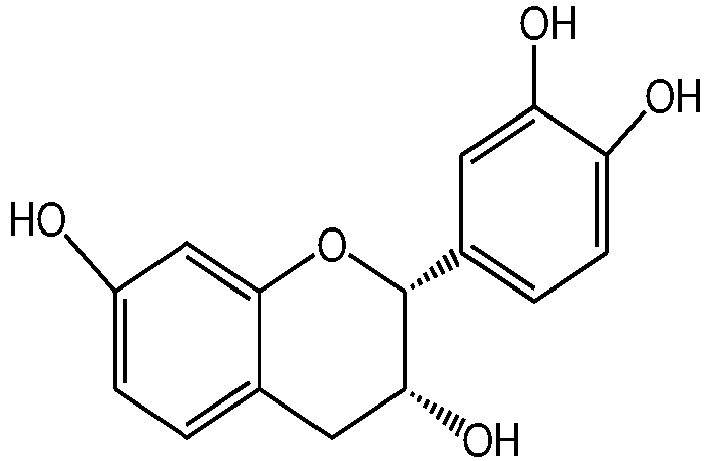
Cis (±) 2-(3,4-dihydroxyphenyl)chroma n-3,7-diol C15H14O5 274.08 1004 
Cis (±) 2-(4-hydroxyphenyl)chroman-3,7-diol C15H14O4 258.09 1005 
Cis (±) 2-(3-hydroxyphenyl)chroman-3,5-diol C15H14O4 258.27 1006 
Cis (±) 2-(4-hydroxyphenyl)chroman-3,5-diol C15H14O4 258.27 1007 
Cis (±) 2-(3-hydroxyphenyl)chroman-3,7-diol C15H14O4 258.27 1008 
Cis (±) 2-(4-hydroxyphenyl)chroman-3,5,7-triol C15H14O5 274.27 1009 
(2R,3S)-2-(3,4-dihydroxyphenyl)-3-methylchroman-3,5,7-triol C17H18NO7 348.11 1010 
(2R,3R)-2-(2,3-dihydroxyphenyl)-3-fluorochroman-5,7-diol C15H13FO5 292.07 1011 
Cis (±) 2-(3-hydroxyphenyl)chroman-3-ol C15H14O3 242.09 1012 
Cis (±) 2-(4-hydroxyphenyl)chroman-3-ol C15H14O3 242.09 1013 
Cis (±) 2-(3,4-dihydroxyphenyl)chroma n-3,5-diol C15H14O5 274.08 1014 
Cis (±) 2-(3-hydroxyphenyl)chroman-3,5,7-triol C15H14O5 274.08 1015 
Cis (±) 2-phenylchroman-3,5,7-triol C15H14O4 258.1 1016 
Cis (±) 2-(4-hydroxyphenyl)-3-methoxychroman-7-ol C16H16O4 272.1 1017 
Cis (±) 2-(4-methoxyphenyl)chroman -3,7-diol C16H16O4 272.1 1018 
Cis (±) 2-(4-hydroxyphenyl)-7-methoxychroman-3-ol C16H16O4 272.1 1019 
Cis (±) 7-methoxy-2-(4-methoxyphenyl)chroman -3-ol C17H18O4 286.12 1020 
Cis (±) 3,7-dimethoxy-2-(4-methoxyphenyl) chromane C18H20O4 300.14 1021 
Cis (±) 7-hydroxy-2-(4-hydroxyphenyl)chroman-3-yl acetate C17H16O5 300.1 1022 
Cis (±)3-(3,7-dihydroxychroman-2-yl)phenyl acetate C17H16O5 300.1 1023 
Cis (±) 3-hydroxy-2-(4-hydroxyphenyl)chroman-7-yl acetate C17H16O5 300.1 1024 
Cis (±)3-(7-acetoxy-3-hydroxychroman-2-yl)phenyl acetate C19H18O6 342.11 1025 
Cis (±) 2-(4-acetoxyphenyl)chroman-3,7-diyl diacetate C21H20O7 384.12 1026 
2-(3-methoxy-4-methylphenyl)chromane-3,7-diol C17H18O4 286.12 1027 
2-(3-hydroxy-4-methylphenyl)chromane-3,7-diol C16H16O4 272.10 1028 
2-(4-fluoro-3-methoxyphenyl)chroman e-3,7-diol C16H15FO4 290.10 1029 
2-(4-fluoro-3-hydroxyphenyl)chromane -3,7-diol C15H13FO4 276.08 1030 
2-(3-hydroxyphenyl)-3-propoxychroman-7-ol C18H20O4 300.14 1031 
Cis (±) 2-(3,4-dihydroxy-2-methylphenyl)chroman-3,5,7-triol C16H16O6 304.29 1032 
Cis (±) 2-(2-fluoro-3,4-dihydroxyphenyl)chroma n-3,5,7-triol C15H13FO6 308.07 1033 
Cis (±) 2-(2-fluoro-4,5-dihydroxyphenyl)chroma ne-3,5,7-triol C15H13FO6 308.07 1034 
Cis (±) 2-(3-fluoro-4-hydroxyphenyl)chromane -3,5,7-triol C15H13FO5 292.07 1035 
Cis(±) (2-(3,4-dihydroxy-5-methylphenyl)chromane-3,5,7-triol C16H16O6 304.09 1036 
(2R,3R)-2-(3,4-dihydroxyphenyl)chroma ne-4,4-d2-3,5,7-triol C15H12D2O6 292.09 1037 
(2R,3R)-2-(3,4-dihydroxyphenyl)chroma ne-2-d-3,5,7-triol C15H13DO6 291.09 1038 
(2R,3R)-2-(3,4-dihydroxyphenyl)chroma ne-2,4-d2-3,5,7-triol C15H12D2O6 292.09 1039 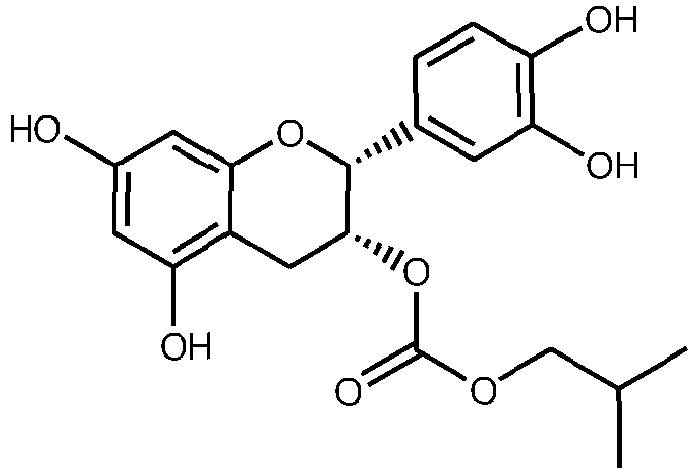
(2R,3R)-2-(3,4-dihydroxyphenyl)-5,7-dihydroxychroman-3-yl isobutyl carbonate C20H22O8 390.13 1040 
tert-butyl (2-hydroxy-5-(2R,3R)-3,5,7-trihydroxychroman-2yl)phenyl)carbonate 1041 
3-((((2R,3R)-2-(3,4-dihydroxyphenyl)-5,7-dihydroxychroman-3-yl)oxy)carbonyl)-1-methylpyridin-1-ium C22H20INO7 + 537.03 1042 
2-hydroxy-5-((2R,3R)-3,5,7-trihydroxychroman-2-yl)phenyl neopentyl carbonate C21H24O8 404.15 1043 
2-hydroxy-4-((2R,3R)-3,5,7-trihydroxychroman-2-yl)phenyl octanoate C23H28O7 416.18 1044 
4-((2R,3R)-3,5,7-trihydroxychroman-2-yl)-1,2-phenylene bis(isopropylcarbamate) C23H28N2O8 460.18 1045 
(2R,3R)-2-(3,4-dihydroxyphenyl)-5,7-dihydroxychroman-3-yl neopentyl carbonate C21H24O8 404.15 1046 
(2R,3R)-2-(3,4-dihydroxyphenyl)-5,7-dihydroxychroman-3-yl isopropylcarbamate C19H21NO7 375.13 1047 
(2R,3R)-2-(3,4-dihydroxyphenyl)-5,7-dihydroxychroman-3-yl dimethylcarbamate C18H19NO7 361.12 1048 
dibenzyl (4-((2R,3R)-3,5,7-trihydroxychroman-2-yl)-1,2-phenylene) bis(carbonate) C31H26O10 558.15 1049 
dimethyl (4-((2R,3R)-3,5,7-trihydroxychroman-2-yl)-1,2-phenylene) bis(carbonate) C19H18O10 406.09 1050 
(2R,3R)-2-(3,4-dihydroxyphenyl)-3-hydroxychromane-5,7-diyl diisobutyl bis(carbonate) C25H30O10 490.18 1051 
4-((2R,3R)-5,7-bis((benzylcarbamoyl)ox y)-3-hydroxychroman-2-yl)-1,2-phenylene bis(benzylcarbamate) C47H42N4O10 822.29 1052 
dibenzyl (4-((2R,3R)-5,7-bis(((benzyloxy)carbonyl )oxy)-3-hydroxychroman-2-yl)-1,2-phenylene) bis(carbonate) C47H38O14 826.23 1053 
(2R,3R)-2-(3,4-dihydroxyphenyl)-5,7-dihydroxychroman-3-yl ethyl carbonate C18H18O8 362.10 1054 
(2R,3R)-2-(3,4-dihydroxyphenyl)-3-hydroxychromane-5,7-diyl diisobutyl bis(carbonate) C25H30O10 490.18 1055 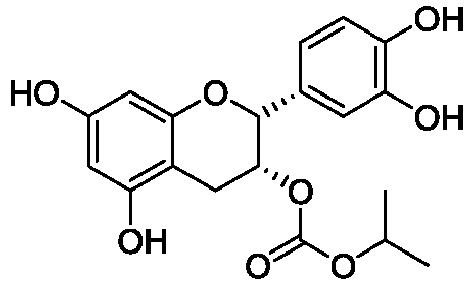
(2R,3R)-2-(3,4-dihydroxyphenyl)-5,7-dihydroxychroman-3-yl isopropyl carbonate C19H20O8 376.12 1056 
methyl ((((2R,3R)-2-(3,4-dihydroxyphenyl)-5,7-dihydroxychroman-3-yl)oxy)carbonyl)glycinat e C19H19NO9 405.11 1057 
(2R,3R)-2-(3,4-dihydroxyphenyl)-3-hydroxychromane-5,7-diyl diethyl bis(carbonate) C21H22O10 434.12 1058 
(2R,3R)-2-(3,4-dihydroxyphenyl)-3-hydroxychromane-5,7-diyl dimethyl bis(carbonate) C19H18O10 406.09 1059 
4-((2R,3R)-3,5,7-trihydroxychroman-2-yl)-1,2-phenylene bis(benzylcarbamate) C31H28N2O 8 556.18 1060 
dibenzyl (4-((2R,3R)-3-hydroxy-5,7-bis((isobutoxycarbonyl)o xy)chroman-2-yl)-1,2-phenylene) bis(carbonate) C41H42O14 758.26 1061 
(2R,3R)-2-(3,4-dihydroxyphenyl)-3,7-dihydroxychroman-5-yl heptanoate C22H26O7 402.17 1062 
(2R,3R)-2-(3,4-dihydroxyphenyl) -3,5-dihydroxychroman-7-yl heptanoate C22H26O7 402.17 1063 
(2R,3R)-2-(3,4-dihydroxyphenyl)-3-hydroxychromane-5,7-diyl diheptanoate C29H38O8 514.26 1064 
(2R,3R)-2-(3,4-dihydroxyphenyl)-3,7-dihydroxychroman-5-yl octanoate C23H28O7 416.18 1065 
(2R,3R)-2-(3,4-dihydroxyphenyl)-3,5-dihydroxychroman-7-yl octanoate C23H28O7 416.18 1066 
dibenzyl (4-((2R,3R)-3-hydroxy-5,7-bis((methoxycarbonyl)ox y)chroman-2-yl)-1,2-phenylene) bis(carbonate) C35H30O14 674.16 1067 
(2R,3R)-7-methoxy-2-(3-methoxyphenyl)-3-propoxychromane C20H24O4 328.17 1068 
(2R,3R)-2-(3-methoxyphenyl)-3-propoxychroman-7-ol C19H22O4 314.15 1069 
(2R,3R)-2-(3-hydroxy-4-methylphenyl)chromane-3,7-diol C16H16O4 272.10 1070 
(2R,3R)-7-methoxy-2-(4-methoxyphenyl)chroman -3-ol C17H18O4 286.12 1071 
(2R,3R)-2-(3,4-dihydroxyphenyl)-5,7-dihydroxychroman-3-yl nicotinate C21H17NO7 395.10 1072 
dineopentyl (4-((2R,3R)-3,5,7-trihydroxychroman-2-yl)-1,2-phenylene) bis(carbonate) C27H34O10 518.22 1073 
tert-butyl ((2R,3R)-2-(3,4-dihydroxyphenyl)-5,7-dihydroxychroman-3-yl) carbonate C20H22O8 390.13 1074 
(2R,3R)-2-(3,4-dihydroxyphenyl)-5,7-dihydroxychroman-3-yl (R)-3-hydroxybutanoate C19H20O8 376.12 1075 
diisopropyl (4-((2R,3R)-3,5,7-trihydroxychroman-2-yl)-1,2-phenylene) bis(carbonate) C23H26O10 462.15 1076 
dineopentyl (4-((2R,3R)-3,5,7-trihydroxychroman-2-yl)-1,2-phenylene) bis(carbonate) C27H34O10 518.22 - In one example, there is disclosed a process of preparing the compounds of formula (I) and formula (II) as below,

- Scheme 1 comprises the following steps:
- Step 1: Hydroxyl groups of an acetophenone of Formula 1 is optionally protected with a protecting agent in presence of a base and a solvent;

- Step 2: Chalcone of formula [3] may be converted into compound [4] in presence of suitable base such as NaOH, in presence of suitable epoxidizing agent such as hydrogen peroxide and in presence of suitable solvent such as MEOH or EtOH.
- Step 3: Compound of formula [4] may be treated with a protecting agent to protect the hydroxyl group(s) if any, preferably with a benzylating agent such as benzyl bromide in presence of suitable base such as potassium carbonate in presence of suitable solvent such as dimethylformamide or acetone at ambient temperature may be converted to a compound [5] having protected hydroxyl group;
- Step 4: Compound [5] may be converted to mixture of compound [6] and [7] in presence of chiral/achiral reducing agents such as lithium aluminum hydride/deutride in solvents such as THF or ether at a temperature ranging from ambient to reflux.
- Step 5: Compounds [6] and [7] may be converted to compound [8] and [9] on deprotection. 4H-chromene and 2H-chromene compounds obtained in step 4 when subjected to hydrogenation in presence of palladium on carbon in presence of hydrogen atmosphere or palladium hydroxide at a temperature ranging from ambient to 60°C is converted to polyphenol analogues.
- Step 1: Chalcone 3 which may be synthesized as described in synthetic scheme 1, on treatment with a reducing reagent such as NaBH4 may be converted to 10 in presence of a suitable solvent such as EtOH or MeOH at temperature ranging from ambient to reflux.
- Step 2: Compound 10 may be converted to compound of general formula 11 in presence of suitable reagents such as OsO4, with or without chiral co-catalysts such as AD-mix-α or AD-mix-β in presence of suitable solvent such as THF at a temperature ranging from ambient to reflux.
- Step 3: Compound 11 may be converted to 12 when treated with suitable reducing agents such as NaCNBH3 in presence of suitable solvents as AcOH or THF at ambient temperature.
- Step 4: Compound 12 may be converted to compound 13 in presence of suitable oxidizing agents such as dess-martin periodinane in presence of suitable solvents such as THF or DCM.
- Step 5: Compound [13] may be converted to compound 8 in presence of suitable reducing agents such as 1-selectride at a temperature ranging from -78°C to room temperature in presence of suitable solvents such as THF.
- Any flavan-3-ol (12) such as catechin with or without a suitable protecting group such as benzyl on phenolic OH can be converted to compound [13] in presence of suitable oxidizing agents such as Dess-Martin periodinane in presence of suitable solvents such as THF or DCM. Compound [13] may be further functionalized to compound 14 with or without diastereoselectivity, exploiting different transformations of ketone group known in literature such as but not limited to cyanohydrins, oximes synthesis or halogenations or when treated with different Grignard reagents to obtain tertiary alcohols.

- Any flavan-3-ol (15) such as epicatechin with or without a suitable protecting groups such as benzyl on phenolic OH can be functionalized into compound of general formula [16] in presence of suitable nucleophiles such as alkylating agents like alkyl iodide or bromide or acylating agents such as acetyl chloride or alkyl chloroformate reagents in presence of suitable base such as NaH, pyridine in presence of suitable solvents such as THF, DCM. The protecting groups if present can then be removed or retained to provide the final compounds


- Any flavan-3-ol intermediate such as cyanidin [17] with or without a suitable protecting group such as benzyl on phenolic OH can be converted to compound [18A] and [18B] in presence of suitable reducing agents such as NaCNBD4 in presence of suitable solvents such as THF or DCM. Compounds [18A] and [18B] may be further reduced as well as deprotected in a single step when treated with Pd(OH)2 in hydrogen atmosphere to obtain the final products with or without diastereoselectivity.
- It is submitted that the synthetic schemes as disclosed herein are not meant to limit the scope of the invention, but are meant as general synthetic schemes representative for synthesizing all described analogues.
- Examples include the salts and isomers of the compounds. Compounds may in some cases form salts. All stereoisomers of the present compounds, such as those which may exist due to asymmetric carbons on the R substituents of the compound, including enantiomeric and diastereomeric forms, are disclosed.
- The present invention also contemplates a composition or formulation comprising the compounds of the present invention. The composition or formulation may be used for cosmetic or nutraceutical or pharmaceutial purposes. Further the compounds of the present invention can be used in combination with other pharmaceutical or nutraceutical agents.
- In another example, the compounds are used for indications wherein epicatechin and other polyphenols are found to be useful.
- In another example, the compounds may be used for inducing mitochondrial biogenesis. The compounds of the present invention may be useful as supplements/medication in meeting the muscle requirement by sports men/exercised muscles to meet the increasing energy demand. In another example, the compounds may be used for treating the diseases associated with mitochondria dysfunction.
- Without being limited by theory, it is submitted that the novel analogues exhibit substantially different pharmacokinetic, pharmacodynamic, and acute and long-term toxicity profiles in comparison to the other polyphenols. Further, they exhibit rapid oxidations and generally produce a detectable kinetic isotope effect that affects the pharmacokinetic, pharmacological, and/or toxicological profiles of a compound.
- The following examples are representative of the disclosure, and provide detailed methods for preparing the compounds of the disclosure, including the preparation of the intermediate compounds. The preparation of particular compounds of the examples is described in detail in the following examples, but the artisan will recognize that the chemical reactions described may be readily adapted to prepare a number of other agents of the various examples. For example, the synthesis of non-exemplified compounds may be successfully performed by modifications apparent to those skilled in the art, e.g. by appropriately protecting interfering groups, by changing to other suitable reagents known in the art, or by making routine modifications of reaction conditions.
- For all of the following examples, standard work-up and purification methods known to those skilled in the art may be utilized. Unless otherwise indicated, all temperatures are expressed in °C (degrees Centigrade). All reactions conducted at room temperature unless otherwise noted. Synthetic methodologies illustrated herein are intended to exemplify the applicable chemistry through the use of specific examples and are not indicative of the scope of the disclosure.
-

- To a stirred solution of [19] (1.0 g, 3.4 mmol) in DMF, anhydrous K2CO3 (2.3 g, 17.0 mmol) was added at 0 °C under nitrogen atmosphere. After an additional stirring at this for 15 minutes at same temperature, benzyl bromide (2.0 ml, 17.0 mmol) was added drop-wise. The reaction temperature was allowed to increase up to 25 °C and stirring was continued for overnight. Consumption of [19] was monitored by TLC. After complete consumption of [19], water (50 ml) was added and organic layer was extracted with ethyl acetate (3 x 100 ml). The combined organic layers were washed with water, brine and dried over sodium sulphate. The organic layer was concentrated to afford light brown sticky material which was further purified using silica gel column chromatography using 8% ethyl acetate in hexane as eluent to afford [20] as white powder (1.5 g, 68%); ESIMS: 651[M++1]
-

- To a stirred solution of [20] (1.0 g, 1.53 mmol) in Dry DCM, Dess-Martin Periodinane (0.98 g, 2.3 mmol) was added in one portion at room temperature. After an additional stirring for 6 - 7 h, saturated NaH2CO3 (20 ml) was added and was extracted with DCM (3 x 100 ml). The combined organic layers were washed with water and dried over sodium sulphate. The organic layer was concentrated to afford light pink sticky material which was further purified using silica gel flash column chromatography using DCM as eluent to afford off [21] as a white-pinkish solid powder (0.65 g, 71%); ESIMS: 649[M++1]
-

- To a stirred solution of [21] (0.20 g, 0.30 mmol) in a mixture of acetonitrile (2ml) and methanol (5 ml), ammonium acetate (0.03 g, 0.36 mmol) was added in one portion at room temperature. After additional stirring at this temperature for 10 min hydroxylamine hydrochloride (0.02 g, 0.36 mmol) was added. Consumption of [21] was monitored by TLC. After complete consumption of [21], the reaction mixture was concentrated and water (50 ml) was added. The organic layer was then extracted with ethyl acetate (2 x 100 ml). The combined organic layers were washed with water, brine and dried over sodium sulphate. The organic layer was concentrated to afford [22] as off white sticky solid which was used as such for further steps (0.12 g, 68 %); ESIMS: 664[M++1]
-

- To a stirred solution of [22] (0.15 g, 0.22 mmol) in a mixture of ethyl acetate and methanol (1;1, 5 ml), was added a slurry of 10% Pd/C (0.02 g) at room temperature. Hydrogen balloon pressure was applied and the reaction mixture was stirred for 1hr at RT, followed by additional stirring of overnight at 50°C-55°C. Reaction was monitored using TLC. The reaction mass was filtered over celite and excess of solvent was removed under vacuum to afford light brown sticky material, which was further purified using silica gel column and 6% methanol in dichloromethane as eluent to afford [1001] as off white sticky material (0.02 g, 25%); ESIMS: 304[M++1] .
-

- To a stirred solution of [19] (0.10 g, 0.34 mmol) in Dry DCM at -10 °C was added DAST (0.20 ml, 1.0 mmol) dissolved in DCM to form a solution. The stirring was continued for 2 h before addition of saturated NaHCO3 followed by extraction with DCM (2 x 50 ml). The combined organic layer was washed with brine and dried over sodium sulphate and concentrated to afford light brown sticky material. The crude reaction mixture was purified using Flash silica gel column and 1% MeOH in DCM as eluent to afford 1014 (0.01 g, 10 %) as a light yellowish sticky material; ESIMS: 293[M++1].
-

- To a stirred solution of [21] (0.50 g, 0.77 mmol) in dry THF, benzylamine (0.18 ml, 1.5 mmol) was added at room temperature under nitrogen atmosphere. After an additional stirring at this for 15 minutes at same temperature, acetic acid (3 - 4drops) was added drop-wise. Further stirring at this temperature for 1h, NaCNBH3 (0.09 g, 1.5 mmol) was added. Consumption of [21] was monitored by TLC. After complete consumption of the starting material, water (50ml) was added and organic layer was extracted with ethyl acetate (3 x 100 ml). The combined organic layers were washed with water, brine and dried over sodium sulphate. The organic layer was concentrated to afford light brown sticky material which was further purified using silica gel column chromatography using 5% ethyl acetate in hexane as eluent to afford [23] (0.21 g, 36 %) and 15 (0.07 g, 13 %) as a light yellow sticky material. ESIMS: 740[M++1]
-

- To a stirred solution of [23A] (0.10 g, 0.13 mmol) in a mixture of ethyl acetate and methanol (1;1, 5 ml), was added a slurry of 10% Pd/C (0.02 g) at room temperature. Hydrogen balloon pressure was applied and the reaction mixture was stirred for overnight at RT. Reaction was monitored using TLC. The reaction mass was filtered over celite and excess of solvent was removed under vacuum at low temperature to afford light brown sticky material, which was further purified using Prep HPLC to afford [1009] as light brown sticky material (0.01 g, 27%). ESIMS: 290 [M++1]
-

- To a stirred solution of [24] (10.0 g, 65.78 mmol) in DMF (60 ml) was added K2CO3 (27.2 g, 197 mmol) at 0°C under nitrogen atmosphere. After stirring at this temperature for 15min, was added Benzyl bromide drop-wise (7.2 ml, 65.7 mmol). The temperature of reaction mixture was allowed to raise to room temperature and stirred it for overnight. TLC showed complete consumption of [24]. Reaction mixture was quenched with water (500 ml) and extracted with ethyl acetate (2 x 500 ml). The combined organic layer was washed with water, brine and dried over sodium sulphate. The organic layer was rotary evaporated to afford light brown sticky material. This crude product was loaded on to silica gel column and eluted with 8 % ethyl acetate/hexane to afford brown powder [25] (12 g,75 %); ESIMS: 242[M++1].
-

- To a stirred solution of [25] (3.0 g, 12.3 mmol) in EtOH (30 ml) was added [26] (3.1 g, 14.8 mmol) and reaction mixture was heated to 50°C, then 50% aq.NaOH solution (9.0ml) was added dropwise with constant stirring to reaction mixture at 50 °C and allowed to stir at rt for overnight. Completion of reaction was monitored by checking TLC. TLC showed complete consumption of [25]. Reaction mixture was poured into crushed ice and neutralized with 5% HCl solution, crude product was obtained as yellow precipitate which was filtered through buchener funnel and crude product was recrystallised with aq.EtOH to obtained pure product [27] as a yellow powder. This pure product [27] (3.5 g, 64 %) was used for further step. ESIMS: 436[M++1]
-

- To a stirred solution of [27] (3.0 g, 6.88 mmol) in methanol (40 ml), was added 20% aq. NaOH(7.0 ml) . The reaction mixture was kept in an ice bath at 0°C and 30% H2O2 (3.2ml) was added dropwise with constant stirring then reaction temperature was raised to RT and stirred at this temperature for overnight. Completion of reaction was monitored by c TLC. TLC showed complete consumption of [27]. Reaction mixture was acidified with cold 5%HCl solution. The yellow precipitate formed was filtered off through Buchner funnel and crude product was recrystallized with aq. EtOH to obtained pure product [28] as a yellow powder. This pure product [28] (1.7 g, 56%) was used for the next step; ESIMS: 450[M++1]
-

- To a stirred solution of [28] (1.6 g, 3.55 mmol) in DMF was added K2CO3 (0.588 g, 4.26 mmol) at 0°C under nitrogen atmosphere. After stirring at this temperature for 15min, was added Benzyl bromide drop-wise (0.42 ml, 3.55 mmol). The temperature of reaction mixture was allowed to rise to room temperature and stirred it for overnight. TLC showed complete consumption of [28]. Reaction mixture was quenched with water (500 ml) and extracted with ethyl acetate (2x200ml). The combined organic layer was washed with water, brine and dried over sodium sulphate. The organic layer was rotary evaporated to afford yellow solid. This crude product was washed with diethyl ether to afford light yellow powder [29] (1.5 g, 78 %). ESIMS: 540[M++1]
-

- To a stirred solution of [29] (1.5g, 2.77 mmol) in MTBE (20 ml) was added LAH (0.422 g, 11.1 mmol) at 40 °C under nitrogen atmosphere. After stirring at this temperature for 5min, The temperature of reaction mixture was allowed to raise to 80 °C for 2 h. Completion of reaction as monitored by TLC showed complete consumption of [29]. Reaction mixture was quenched with water (50 ml) and extracted with ethyl acetate (2 x 100 ml). The combined organic layer was washed with water, brine and dried over sodium sulphate. The organic layer was rotary evaporated to afford dark brown sticky material. This crude product was loaded on to silica gel column and eluted with 100% DCM to afford light brown sticky material as a mixture of [30] and [31] (0.90 g, 61 %). The mixture of [30] and [31] was used in the next step; ESIMS: 526[M++1].
-

- To a stirred solution of [30] and [31] (0.750 g, 1.42 mmol) in 1:1 mixture ethyl acetate and methanol (10 ml), was added a slurry of 10% Pd/C (0.075 g) at room temperature. Hydrogen balloon pressure was applied and the reaction mixture was stirred at this temperature for 1 h and then reaction temperature was raised to 50 °C - 55 °C and stirred at this temperature for overnight. The reaction mass was filtered over celite and the solvent was removed under rotary evaporator to afford light brown sticky material. This crude product was purified by prep HPLC to afford cis racemic [1004] as an off white powder (0.035 g, 10%) and its trans isomer [32] as an off white powder (0.013 g, 4 %); ESIMS: 258[M++1].
-

-

- To a stirred solution of compound [33] (2.0 g, 14.68 mmol) and compound [34] (1.75 g, 8.28 mmol) in EtOH (20 ml), were added aq. NaOH solution (2 g dissolve in 10 ml water). Reaction mixture was stirred at 50°C for 30 min and then stirred at RT for overnight. Consumption of [33] and [34] were monitored by TLC. Reaction mixture was acidified with 2N HCl to pH 4, water (50 ml) was added and organic layer was extracted with ethyl acetate (2 x 100 ml). The combined organic layers were washed with water, brine and dried over sodium sulphate. The organic layer was concentrated to afford light yellow sticky material which was further purified using recrysallisation by using EtOH to afford [35] as light yellow solid (3.04 g, 55 %).ESIMS: 437[M++1]
-

- Compound [35] (2.5 g, 5.77 mmol) was stirred at 0 °C for 10 minute in EtOH (20 ml). Then solution of 20% NaOH (8 ml) was added in reaction mixture followed by 30% H2O2 (10 ml) was added and stirred at 0°C for 4-5 hrs. Then reaction mixture was kept in freeze for overnight at 4°C. Consumption of [35] was monitored by TLC. Reaction mixture was acidified with 2N HCl to pH 3, and organic layer was extracted with ethyl acetate (2x100 ml). The combined organic layers were washed with water, brine and dried over sodium sulphate. The organic layer was concentrated to afford light yellow sticky material which was further purified using recrysallisation by using EtOH to afford [36] as light yellow solid (1.56 g, 62%).ESIMS: 451[M++1]
-

- To a stirred solution of [36] (1.40 g, 3.11 mmol) in DMF, anhydrous K2CO3 (0.865 g, 6.22 mmol) was added at RT under nitrogen atmosphere. After an additional stirring at this for 15 minutes at same temperature, benzyl bromide (0.57 ml, 4.66 mmol) was added drop-wise in reaction mixture. The reaction mixture was stirred continued for 2-3 h at RT. Consumption of [36] was monitored by TLC. After complete consumption of [36], water (20 ml) was added and organic layer was extracted with ethyl acetate (2 x 50 ml). The combined organic layers were washed with water, brine and dried over sodium sulphate. The organic layer was concentrated to afford light brown sticky material which was further purified by crystallization using EtOH to afford [37] as light yellow solid (1.70 g, 90 %). ESIMS: 541[M++1]
-

- To a stirred solution of [37] (1.30 g, 2.41mmol) in MTBE (30 ml), LAH (0.366 g, 9.647mmol) was added at RT under nitrogen atmosphere. Reaction mixture temperature was increased to 70°C and stirred at this temperature for 1 hrs. Consumption of [37] was monitored by TLC. After complete consumption of [37], reaction mixture was cooled to 0°C and then quenched by NH4Cl (25 ml). Water (20 ml) was added and organic layer was extracted with ethyl acetate (2 x 50 ml). The combined organic layers were washed with water, brine and dried over sodium sulphate. The organic layer was concentrated to afford off-white sticky material of compound [38] and compound [39] (1.20 g, 80%), which was directly used for next step. ESIMS: 527[M++1]
-

- To a stirred solution of [38] and [39] (0.500 g, 9.53 mmol) in a mixture of ethyl acetate and methanol (1:1, 20 ml), was added a slurry of 10% Pd/C (0.05 g) at room temperature under nitrogen atmosphere. Hydrogen balloon pressure was applied and the reaction mixture was stirred for 1 h at RT, followed by additional stirring of overnight at 50°C - 55°C. Reaction was monitored by using TLC. The reaction mass was filtered over celite bed and excess of solvent was removed under vacuum to afford light brown sticky material, which was further purified using silica gel column and 2% methanol in dichloromethane as eluent to afford cis racemic 1002 (0.090 g, 40%) as an off-white solid and 1002A (0.010g, 10%) .ESIMS: 259[M++1]
-

- To a stirred solution of [40] (2.0 g, 1.34mmol) in DMF, anhydrous K2CO3 (2.17 g, 15.77mmol) was added at RT under nitrogen atmosphere. After an additional stirring at this for 15 minutes at same temperature, benzyl bromide (1.92 ml, 15.77mmol) was added drop-wise. The reaction mixture was stirred continuously for overnight at RT. Consumption of [40] was monitored by TLC. After complete consumption of [40], water (50ml) was added and organic layer was extracted with ethyl acetate (2x100ml). The combined organic layers were washed with water, brine and dried over sodium sulphate. The organic layer was concentrated to afford light brown sticky material which was further purified using silica gel column chromatography using 5% ethyl acetate in hexane as eluent to afford [41] as white powder (2.1 g, 80%).ESIMS: 243[M++1]
-

- To a stirred solution of compound [41] (2.0 g, 8.28mmol) and compound [42] (1.75 g, 8.28 mmol) in EtOH (20 ml), were added aq. NaOH solution (1g dissolve in 6 ml water). Reaction mixture was stirred at 50°C for 30 min and then stirred at RT for overnight. Consumption of [41] and [42] were monitored by TLC. Reaction mixture was acidified with 2N HCl to pH 4, water (50ml) was added and organic layer was extracted with ethyl acetate (2x100ml). The combined organic layers were washed with water, brine and dried over sodium sulphate. The organic layer was concentrated to afford light yellow sticky material which was further purified using recrysallisation by using EtOH to afford [43] as light yellow solid (2.0 g, 50%).ESIMS: 437[M++1]
-

- Compound [43] (1.5 g, 3.44mmol) was stirred at 0°C for 10 minute in EtOH (20 ml). Then solution of 20% NaOH (10 ml) was added in reaction mixture followed by 30% H2O2 (10 ml) was added and stirred at 0 °C for 4-5 h. Then reaction mixture was kept in freeze for overnight at 4 °C. Consumption of [43] was monitored by TLC. Reaction mixture was acidified with 2N HCl to pH 3, and organic layer was extracted with ethyl acetate (2 x 100 ml). The combined organic layers were washed with water, brine and dried over sodium sulphate. The organic layer was concentrated to afford light yellow sticky material which was further purified using recrysallisation by using EtOH to afforded [44] and [45] as a light yellow solid (890 mg, 50 %).ESIMS: 451[M++1]
-

- To a stirred solution of [44] (0.6 g, 1.33 mmol) in DMF, anhydrous K2CO3 (0.36 g, 2.66mmol) was added at RT under nitrogen atmosphere. After an additional stirring at this for 15 minutes at same temperature, benzyl bromide (0.325 ml, 2.66 mmol) was added drop-wise in reaction mixture. The reaction mixture was stirred continued for 2-3 hrs at RT. Consumption of [44] was monitored by TLC. After complete consumption of [44], water (20ml) was added and organic layer was extracted with ethyl acetate (2 x 50 ml). The combined organic layers were washed with water, brine and dried over sodium sulphate. The organic layer was concentrated to afford light brown sticky material which was further purified by crystallization using EtOH to afford [46] as light yellow solid (0.3 g, 52%).ESIMS: 541[M++1]
-

- To a stirred solution of [46] (0.5 g, 9.25 mmol) in MTBE (20 ml), LAH (0.140 g, 37.03 mmol) was added at RT under nitrogen atmosphere. Reaction mixture temperature was increased to 70°C and stirred at this temperature for 1 hrs. Consumption of [46] was monitored by TLC. After complete consumption of [46], reaction mixture was cooled to 0°C and then quenched by NH4Cl (25 ml). Water (20 ml) was added and organic layer was extracted with ethyl acetate (2 x 50 ml). The combined organic layers were washed with water, brine and dried over sodium sulphate. The organic layer was concentrated to afford off-white sticky material of compound 47 (A + B) (0.4 g, 80 %), which was directly used for next step. ESIMS: 527[M++1]
-

- To a stirred solution of 47 (A+B) (0.400 g, 0.76 mmol) in a mixture of ethyl acetate and methanol (1:1, 20 ml), was added a slurry of 10 % Pd/C (0.04 g) at room temperature under nitrogen atmosphere. Hydrogen balloon pressure was applied and the reaction mixture was stirred for 1hr at RT, followed by additional stirring of overnight at 50°C - 55°C. Reaction was monitored by using TLC. The reaction mass was filtered over celite bed and excess of solvent was removed under vacuum to afford light brown sticky material, which was further purified using silica gel column and 2% methanol in dichloromethane as eluent to afforded cis racemic 1006 (0.028 g, 30 %) as an off-white solids.ESIMS: 259[M++1]
- EXAMPLE 13: Synthesis of 2-(3-methoxy-4-methylphenyl)chromane-3,7-diol [1026] and 2-(3-hydroxy-4-methylphenyl)chromane-3,7-diol [1027] was carried out by procedure as described for 1004 with [25] and 3-methoxy-4-methylbenzaldehyde as starting material. [1026] ESIMS: 287[M++1][1027] ESIMS: 272[M++1]
-

- To a stirred solution of [1007] (0.12g, 0.46 mmol) in DMF, anhydrous K2CO3 (0.12g, 0.93 mmol) was added at 0°C under nitrogen atmosphere. After an additional stirring for 15 minutes at same temperature, Methyl iodide (0.05 ml, 0.93 mmol) was added drop-wise. The reaction temperature was allowed to increase up to 25°C and stirring was continued for 4 h. Consumption of [1007] was monitored by TLC. After complete consumption of [1007], water (50 ml) was added and organic layer was extracted with ethyl acetate (2 x 50 ml). The combined organic layers were washed with water, brine and dried over sodium sulphate. The organic layer was concentrated to afford light brown sticky material which was further purified using silica gel column chromatography using 5 % ethyl acetate/hexane as eluent to afford [1017] as light green sticky material (0.05g, 37%,), [1018] and [1019] as light yellow sticky material (0.02g, 16 %). [1019] ESIMS: 287[M++1] [1017] and [1018] ESIMS: 272[M++1]
-

- To a stirred solution of [1007] (0.2g, 0.77 mmol) in DMF, pyridine (0.12ml, 1.5 mmol) was added at 0°C under nitrogen atmosphere. After an additional stirring for 5 minutes at same temperature, Acetic anhydride (0.15 ml, 1.5 mmol) was added drop-wise. The reaction temperature was allowed to increase up to 25°C and stirring was continued for 1h. Consumption of [1007] was monitored by TLC. After complete consumption of [1007], water (50 ml) was added and organic layer was extracted with ethyl acetate (2 x 50 ml). The combined organic layers were washed with water, brine and dried over sodium sulphate. The organic layer was concentrated to afford light brown sticky material which was further purified using silica gel column chromatography using 5 % ethyl acetate/hexane as eluent to afford [1024] as light yellow sticky material (0.08g, 30%), [1022] and [1023] as yellow sticky material (0.04g, 17 %). [1024] ESIMS: 343[M++1] [1022] and [1023] ESIMS: 301[M++1]
-

- To a stirred solution of [1007] (0.15 g, 0.58 mmol) in DMF, anhydrous K2CO3 (0.24g, 1.14 mmol) was added at RT under nitrogen atmosphere. After an additional stirring for 15 minutes at same temperature, benzyl bromide (0.13ml, 1.16 mmol) was added drop-wise in reaction mixture. The reaction mixture was stirred continued for overnight at RT. Consumption of [1007] was monitored by TLC. After complete consumption of [1007], water (20ml) was added and organic layer was extracted with ethyl acetate (2 x 50 ml). The combined organic layers were washed with water, brine and dried over sodium sulphate. The organic layer was concentrated to afford light brown sticky material which was further purified using silica gel column chromatography using 5 % ethyl acetate/hexane as eluent to afford [48] as off-white sticky material (0.17g, 67%). [81] ESIMS: 439[M++1]
-

- To a stirred solution of [48] (0.25 g, 0.57 mmol) in DMF, Sodium hydride (0.45g, 1.1 mmol) was added at RT under nitrogen atmosphere. After an additional stirring for 15 minutes at same temperature, propyl bromide (0.13ml, 1.1 mmol) was added drop-wise in reaction mixture. The reaction mixture was stirred continued for overnight at RT. Consumption of [48] was monitored by TLC. After complete consumption of [48], water (20ml) was added and organic layer was extracted with ethyl acetate (2 x 50 ml). The combined organic layers were washed with water, brine and dried over sodium sulphate. The organic layer was concentrated to afford light brown sticky material which was further purified using silica gel column chromatography using 7 % ethyl acetate/hexane as eluent to afford [49] as off-white sticky material (0.20g, 73%). [49] ESIMS: 481[M++1]
-

- To a stirred solution of [49] (0.20 g, 0.4 mmol) in a mixture of ethyl acetate and methanol (1:1, 20 ml), was added a slurry of 10% Pd/C (0.02 g) at room temperature under nitrogen atmosphere. Hydrogen balloon pressure was applied and the reaction mixture was stirred for 1hr at RT, followed by additional stirring of overnight at 50 °C - 55 °C. Reaction was monitored by using TLC. The reaction mass was filtered over celite bed and excess of solvent was removed under vacuum to afford light brown sticky material, which was further purified using silica gel column and 2 % methanol in dichloromethane as eluent to afforded [1030] (0.90g, 72%) as an off-white solid. ESIMS: 301 [M++1]
-

- To a stirred solution of [50] (3.0 g, 16.19 mmol) in DMF, anhydrous K2CO3 (5.56 g, 40.32 mmol) was added at 0°C under nitrogen atmosphere. After an additional stirring at this for 15 minutes at same temperature, benzyl bromide (4.92 ml, 40.32 mmol) was added drop-wise. The reaction temperature was allowed to increase up to 25°C and stirring was continued for overnight. Consumption of [50] was monitored by TLC. After complete consumption of [50], water (50 ml) was added and organic layer was extracted with ethyl acetate (2 x 100 ml). The combined organic layers were washed with water, brine and dried over sodium sulphate. The organic layer was concentrated to afford light brown sticky material which was further purified using silica gel column chromatography using 5 % ethyl acetate/hexane as eluent to afford [51] as white powder (3.2 g, 70 %). ESIMS: 349[M++1]
-

- To a stirred solution of compound [51] (2.0 g, 5.74 mmol) and compound [26] (1.21 g, 5.74 mmol) in EtOH (20 ml), were added aq. NaOH solution (2 g dissolve in 10 ml water). Reaction mixture was stirred at 50 °C for 30 min and then stirred at RT for overnight. Consumption of [51] and [26] were monitored by TLC. Reaction mixture was acidified with 2N HCl to pH 4, water (50 ml) was added and organic layer was extracted with ethyl acetate (2 x 100 ml). The combined organic layers were washed with water, brine and dried over sodium sulphate. The organic layer was concentrated to afford light yellow sticky material which was further purified using recrysallisation by using EtOH to afford [52] as light yellow solid (2.0 g, 65 %).ESIMS: 543[M++1]
-

- Compound [52] (1.8 g, 3.32 mmol) was stirred at 0°C for 10 minute in EtOH (20 ml). Then solution of 20 % NaOH (8 ml) was added in reaction mixture followed by 30% H2O2 (20 ml) was added and stirred at 0°C for 4-5 hrs. Then reaction mixture was kept in freeze for overnight at 4°C. Consumption of [52] was monitored by TLC. Reaction mixture was acidified with 2N HCl to pH 3, and organic layer was extracted with ethyl acetate (2 x 100 ml). The combined organic layers were washed with water, brine and dried over sodium sulphate. The organic layer was concentrated to afford light yellow sticky material which was further purified using recrysallisation by using EtOH to afford [53] as light yellow solid (1.3 g, 60 %).ESIMS: 557[M++1]
-

- To a stirred solution of [53] (1.25 g, 2.24 mmol) in DMF, anhydrous K2CO3 (0.370 g, 2.69 mmol) was added at RT under nitrogen atmosphere. After an additional stirring at this for 15 minutes at same temperature, benzyl bromide (0.330 ml, 2.69 mmol) was added drop-wise in reaction mixture. The reaction mixture was stirred continuously for 2-3 hrs at RT. Consumption of [53] was monitored by TLC. After complete consumption of [53], water (20 ml) was added and organic layer was extracted with ethyl acetate (2 x 50 ml). The combined organic layers were washed with water, brine and dried over sodium sulphate. The organic layer was concentrated to afford light brown sticky material which was further purified by crystallization using EtOH to afford [54] as light yellow solid (0.900 g, 60 %).ESIMS: 646[M++1]
-

- To a stirred solution of [54] (0.950 g, 1.47 mmol) in MTBE (20 ml), LAH (0.223 g, 5.82 mmol) was added at RT under nitrogen atmosphere. Reaction mixture temperature was increased to 70 °C and stirred at this temperature for 1 hrs. Consumption of [54] was monitored by TLC. After complete consumption of [54], reaction mixture was cooled to 0°C and then quenched by NH4Cl (25 ml). Water (20 ml) was added and organic layer was extracted with ethyl acetate (2 x 50 ml). The combined organic layers were washed with water, brine and dried over sodium sulphate. The organic layer was concentrated to afford off-white sticky material of compound [55 (A + B)] (0.590 g, 70 %), which was directly used for next step. ESIMS: 633[M++1]
-

- To a stirred solution of 55 (A+B) (0.300 g, 4.7 mmol) in a mixture of ethyl acetate and methanol (1:1, 20 ml), was added a slurry of 10% Pd/C (0.05 g) at room temperature under nitrogen atmosphere. Hydrogen balloon pressure was applied and the reaction mixture was stirred for 1hr at RT, followed by additional stirring of overnight at 50 °C - 55 °C. Reaction was monitored by using TLC. The reaction mass was filtered over celite bed and excess of solvent was removed under vacuum to afford light brown sticky material, which was further purified using silica gel column and 2 % methanol in dichloromethane as eluent to afforded cis racemic 1008 (0.040 g, 35 %) as an off-white solid.ESIMS: 275[M++1]
-

- To a stirred solution of [50] (5.0 g, 26.8 mmol) in DMF(50 ml) was added K2CO3 (11.1 g, 80.6mmol) at 0°C under nitrogen atmosphere. After stirring at this temperature for 15min, was added Benzyl bromide drop-wise (6.42 ml, 53.7 mmol). The temperature of reaction mixture was allowed to rise to room temperature and stirred it for overnight. TLC showed complete consumption of [50]. Reaction mixture was quenched with water (500 ml) and extracted with ethyl acetate (2x400ml). The combined organic layer was washed with water, brine and dried over sodium sulphate. The organic layer was rotary evaporated to afford light brown solid. This crude product was loaded on to silica gel column and eluted with 10% ethyl acetate/hexane to off-white powder [51] (3.3 g, 35 %). This pure product [51] was used for further step.ESIMS: 348[M++1]
-

- To a stirred solution of [51] (3.3. g, 9.48 mmol) in EtOH (35.0 ml) was added [56] (3.6 g, 11.3 mmol) and reaction mixture was heated to 50 °C, then 50 % aq.NaOH solution (10.0 ml) was added dropwise with constant stirring to reaction mixture at 50 °C and allowed to stir at room temperature for overnight. Completion of reaction was monitored TLC. TLC showed complete consumption of [56]. Reaction mixture was poured into crushed ice and neutralized with 5% HCl solution, crude product was obtained as yellow precipitate which was filtered through Buchner funnel and crude product was recrystallised with aq.EtOH to obtained pure product [57] as a yellow powder. This pure product [57] (4.2 g, 68 %) was used for further step. ESIMS: 663[M++1]
-
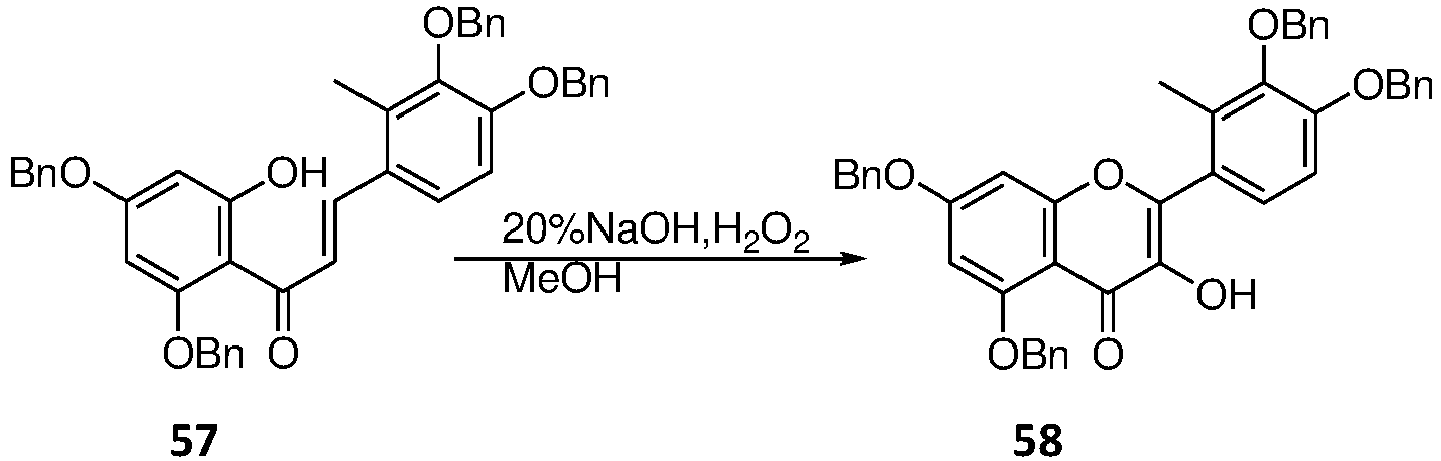
- To a stirred solution of [57] (3.0 g, 5.53 mmol) in methanol (35 ml), was added 20% aq. NaOH(5.0 ml) . The reaction mixture was kept in an ice bath at 0°C and 30% H2O2 (2.5 ml) was added dropwise with constant stirring then reaction temperature was raised to rt and stirred at this temperature for overnight. Completion of reaction was monitored by checking TLC. Reaction mixture was acidified with cold 5%HCl solution. The yellow precipitate formed was filtered off through Buchner funnel and crude product was re-crystallised with aq.EtOH to obtained pure product [58] as a yellow powder. This pure product [58] (0.4 g, 10%) was used for further step. ESIMS: 677[M++1]
-

- To a stirred solution of [58] (0.4 g, 0.59 mmol) in DMF was added K2CO3 (0.12 g, 0.86 mmol) at 0 °C under nitrogen atmosphere. After stirring at this temperature for 15min, was added Benzyl bromide drop-wise (0.10 ml, 0.88 mmol). The temperature of reaction mixture was allowed to raise to room temperature and stirred it for overnight. TLC showed complete consumption of [58]. Reaction mixture was quenched with water (500 ml) and extracted with ethyl acetate (2 x 200 ml). The combined organic layer was washed with water, brine and dried over sodium sulphate. The organic layer was rotary evaporated to afford a yellow solid. This crude product was washed with diethyl ether to afford light yellow powder [59] (0.4 g, 88 %). ESIMS: 767[M++1]
-

- To a stirred solution of [59] (0.4 g, 0.52 mmol) in MTBE (10 ml) was added LAH (0.05 g, 1.56 mmol) at 40 °C under nitrogen atmosphere. After stirring at this temperature for 5min, the temperature of reaction mixture was allowed to raise to 80 °C for 2 h. Completion of reaction was monitored by checking TLC TLC showed complete consumption of [59]. Reaction mixture was quenched with water (50 ml) and extracted with ethyl acetate (2 x 100 ml). The combined organic layer was washed with water, brine and dried over sodium sulphate. The organic layer was rotary evaporated to afford dark brown sticky material. This crude product was loaded on to silica gel column and eluted with 100 % DCM to afford light brown sticky material as a mixture of [60] and [61] (0.25 g, 67 %). The mixture of [60] and [61] was used for further step.ESIMS: 727[M++1]
-

- To a stirred solution of [60] and [61] (0.25 g, 0.34 mmol) in 1:1 mixture ethyl acetate and methanol (10 ml), was added a slurry of 10% Pd/C (0.03 g) at room temperature under nitrogen atmosphere. Hydrogen balloon pressure was applied and the reaction mixture was stirred at this temperature for 1hr and then reaction temperature was raised to 50 °C - 55 °C and stirred at this temperature for overnight. The reaction mass was filtered over celite and the solvent was removed under rotary evaporator to afford light brown sticky material. This crude product was purified by prep HPLC to afford cis racemic [1031A] as a off-white powder (0.02 g, 20 %) and trans racemic [1031B] as a off white powder (0.01 g, 9 %).
- [1034]

- To a stirred solution of [51] (2.2g, 6.32mmol) in EtOH (35.0ml) was added [62] (1.7g, 7.58mmol) and reaction mixture was heated to 50°C, then 50% aq.NaOH solution (10.0ml) was added dropwise with constant stirring to reaction mixture at 50°C and allowed to stir at room temperature for overnight. Completion of reaction was monitored TLC. TLC showed complete consumption of [62]. Reaction mixture was poured into crushed ice and neutralized with 5% HCl solution, crude product was obtained as yellow precipitate which was filtered through Buchner funnel and crude product was recrystallised with aq.EtOH to obtained pure product [63] as a yellow powder. This pure product [63] (2.0g, 55%) was used for further step.ESIMS: 560[M++1]
-

- To a stirred solution of [63] (2.0g, 3.57mmol) in mixture of EtOH (20.0ml) and THF(10ml) was added NaBH4 (0.3g, 7.14mmol) and reaction mixture was heated to 80°C for 2hr, then the reaction mixture was rotary-evaporated to dryness and was added 1:2 mixture of AcOH and water(20ml) at 0°C. The reaction mixture was allowed to stir at room temperature for overnight. Reaction mixture was again rotary evaporated to dryness and saturated solution of Na2CO3 was poured and was extracted with DCM (200ml). The combined organic layer was washed with water, brine and dried over sodium sulphate. The organic layer was rotary evaporated to afford light brown sticky material. This crude product was loaded on to silica gel flash column and eluted with 100% DCM to afford light yellow sticky material [64] (1.0g, 51%). ESIMS: 545[M++1]
-

- To a stirred solution of [64] (1.0g, 1.8mmol) in dry THF was added N-methyl morpholine oxide (0.2g, 2.29mmol), OsO4 in t-BuOH (3%, 2ml) and water(3ml) at room temperature and the resulting solution was stirred at this temperature for 6 h. Reaction was monitored by TLC. After complete consumption of [64], saturated solution of sodium thiosulfate was added and extracted with DCM. The combined organic layer was washed with brine and dried over sodium sulphate and evaporated to afford the desired material [65] (0.9g, 86%) which was used as such for further reaction. ESIMS: 579[M++1]
-

- To a stirred solution of [65] (0.9g, 1.55mmol) in AcOH at 0°C was added NaCNBH3(1.4g 23.3mmol) portion-wise under constant stirring. The resulting solution was stirred at 0°C for 1h and then the temperature of reaction mixture was allowed to come to room temperature. Reaction was monitored by TLC. After complete consumption of [65], saturated NaHCO3 was added and extracted with DCM. The combined organic layer was washed with brine and dried over sodium sulphate and evaporated to afford the desired material trans [66] (0.60g, 68%) which was used as such for further reaction. ESIMS: 563[M++1]
-

- To a stirred solution of [66] (0.6g, 1.0mmol) in Dry DCM, Dess-Martin Periodinane (1.2g, 3.0mmol) was added in one portion at room temperature. After an additional stirring for 6-7h, saturated NaHCO3 (20ml) was added and was extracted with DCM (3x100ml). The combined organic layers were washed with water and dried over sodium sulphate. The organic layer was concentrated to afford light pink sticky material which was further purified using silica gel flash column chromatography using DCM as eluent to afford off [67] as a white-pinkish solid powder (0.40g, 71%) ESIMS: 561[M++1]
-

- To a stirred solution of [67] (0.2g, 0.35mmol) in dry THF at -78 °C was added L-selectride (1.78ml) drop wise under nitrogen atmosphere. The resulting solution was stirred at -78 °C for 5 h and then the temperature of reaction mixture was allowed to come to room temperature. Reaction was monitored by TLC. After complete consumption of [67], saturated NaHCO3 was added and extracted with ethyl acetate. The combined organic layer was washed with brine and dried over sodium sulphate and evaporated to afford the desired material cis [68] (0.10g, 51%). ESIMS: 563[M++1]
-

- To a stirred solution of [68] (0.10g, 0.17 mmol) in 1:1 mixture ethyl acetate and methanol (10 ml), was added a slurry of 10% Pd/C (0.010 g) at room temperature. Hydrogen balloon pressure was applied and the reaction mixture was stirred at this temperature for 1hr and then reaction temperature was raised to 50 °C - 55 °C and stirred at this temperature for overnight. The reaction mass was filtered over celite and the solvent was removed under rotary evaporator to afford light brown sticky material. This crude product was loaded on to silica gel column and eluted with 4% methanol/ Dichloromethane to afford off white powder
(0.028, 57%). ESIMS: 293[M++1] -

- To a stirred suspension of [69] (2.5g) in methyl tertiary butyl ether (75.0ml,30vol) was added lithium aluminium deuteride (0.251 mg, 3.6 eq) in small portions at room temperature under a nitrogen atmosphere. After stirring for 10 min at this temperature, the temperature of the reaction was raised from 65°C to 70°C. After stirring at the same temperature for 1 hour, reaction mass was quenched with a 1 N HCl (10 ml) solution at 0 to -5°C, then the temperature of the reaction was raised to room temperature. Ethyl acetate (10 ml) was added to the reaction and stirred for 30 min. The organic layer was decanted and removed. Ethyl acetate was added to the aqueous layer. The mixture was filtered through a celite bed, and the aqueous and organic layer was separated. The organic layers were combined and concentrated under reduced pressure to afford an off-white solid (2.5 g). The crude compound was triturated with ethyl acetate (10 ml) at room temperature for 4 h, then filtered, washed with ethyl acetate, and dried under vacuum to afford an off-white solid (1.0 g, 40% yield) [70].
- After isolation of [70], the mother liquor was concentrated under reduced pressure to afford a pale yellow residue. The semi solid obtained was triturated with 50% ethyl acetate: hexane (250 ml) for 30 min at room temperature, thus solid was obtained. The solid was filtered and washed with 50% ethyl acetate: hexane (200ml). The solid obtained was dried under vacuum to obtain off white solid (0.250 g, 10% yield) [71]. ESIMS: 741 [M++ 1]
-

- To a stirred solution of [71] (0.3g, 0.404 mmol) in 1:1 mixture ethyl acetate and methanol (10ml), was added a slurry of Pd(OH)2 (0.030 g) at room temperature. The reaction mixture was stirred at room temperature for 1 h then the reaction temperature was raised to 50 to 55 °C and stirred at this temperature for overnight. The reaction was filtered through celite. The collected solvent was removed with a rotary evaporator to afford a light brown sticky material. This crude product was loaded on to silica gel column and eluted with a 4% methanol/ dichloromethane to afford a light pink powder (0.055 g, 46% yield) [1036]. ESIMS: 293 [M++ 1]
-

- To a stirred solution of [70] (0.18 g, 0.24 mmol) in a 1:1 mixture of ethyl acetate and methanol (8 ml), was added a slurry of Pd(OH)2 (0.020 g) at room temperature. The reaction mixture was stirred at this temperature for 1 h and then the reaction temperature was raised to 50 - 55 °C and stirred at this temperature for overnight. The reaction was filtered through celite. The collected solvent was removed with a rotary evaporator to afford a light brown sticky material. This crude product was loaded on to silica gel column and eluted with 4% methanol/ dichloromethane to afford an off white powder, which was then separated on prep-HPLC to afford [1038] (0.045 g, 64% yield). ESIMS: 293 [M++ 1]
-

- To a stirred solution of [72] (0.2g, 0.25 mmol) in dry dichloromethane under nitrogen atmosphere was added NaCNBD3 (0.02g, 0.25 mmol) in one portion at room temperature. Reaction mixture was allowed to stir at this temperature for 15min. After completion of reaction, the reaction mixture was quenched with water under cooling. Reaction mixture was further diluted with dichloromethane, organic layer was separated, dried over sodium sulfate and evaporated under reduced pressure to give [73] and [74] as light pink sticky material (0.16g, 85%). ESIMS: 740[M++1]
-


- To a stirred solution of [73] (0.150 g, 0.20 mmol) in a 1:1 mixture of ethyl acetate and methanol (8 ml), was added a slurry of Pd(OH)2 (0.020 g) at room temperature. Hydrogen balloon pressure was applied and the reaction mixture was stirred at this temperature for 1 h and then the reaction temperature was raised to 50 - 55 °C and stirred at this temperature for overnight. The reaction was filtered through celite. The collected solvent was removed with a rotary evaporator to afford a light brown sticky material. This crude product was loaded on to silica gel column and eluted with 4% methanol/ dichloromethane to afford an off white powder, which was then separated on prep-HPLC to afford cis racemic [1037]along with minor trans isomer.. ESIMS: 292 [M++ 1]
-

- To a suspension of [75] (1.0eq, 0.15gm, 0.5mmol) in 10 ml acetonitrile at 0°C was added dropwise triethyl amine (2.0eq,0.14ml,1.0mol) and stirred for 10 minutes. To this suspension benzyl chloroformate (2.0eq, 0.16ml, 1.0 mol) was added dropwise over a period of 5 minutes. The resulting solution was stirred at 0°C for another 10 minutes. The progress of the reaction was monitored by TLC. The reaction mixture was diluted with ethyl acetate and washed with water. Ethyl acetate layer was separated and dried over Na2SO4, filtered and evaporated to yield colorless gel which was subjected to column chromatography on silica gel and eluted with 2% MeOH /Dichloromethane to afforded [1048] as a colorless solid [0.135gm,46%].ESIMS: 740[M++1]
In a similar manner the compounds [1043], [1044] and [1049] were synthesized. -

- To a suspension of [75] (1.0eq, 0.2gm, 0.68mmol) in 10 ml acetonitrile at 0°C was added dropwise triethyl amine (2.0eq, 0.14ml, 1.4mol) and stirred for 10 minutes. To this suspension benzyl isocyanate [2.0eq, 0.17ml, 1.4mol] was added dropwise over a period of 5 minutes. The resulting solution was stirred at 0°C for 10 minutes. The progress of the reaction was monitored by TLC. The reaction mixture was diluted with ethyl acetate and washed with water. Ethyl acetate layer was separated and dried over Na2SO4, filtered and evaporated to yield colorless gel which was subjected to column chromatography on silica gel [100-200 mesh size] and eluted the compound by 2% MeOH/Dichloromethane to afforded [1059] as a colorless solid [0.08gm,20%]. ESIMS: 556 [M++1]
-

- To a stirred of [75] (1.0gm, 3.4mmol) in DMF was added K2CO3 (2.3gm, 17.0mmol) at 0°C under nitrogen atmosphere. After stirring at this temperature for 15min, was added Benzyl bromide drop-wise. The temperature of reaction mixture was allowed to raise to room temperature and stirred it for overnight. TLC showed complete consumption of [75]. Reaction mixture was quenched with water (50ml) and extracted with ethyl acetate (2x100ml). The combined organic layer was washed with water, brine and dried over sodium sulphate. The organic layer was rotary evaporated to afford to afford light brown sticky material. This crude product was loaded on to silica gel column and eluted with 8% ethyl acetate/hexane to afford white powder [76] (1.5gm, 68%). ESIMS: 651[M++1]
-

- To a stirred of [76] (0.20gm, 0.30mmol) in DMF was added NaH portionwise (0.017gm, 0.46mmol) at 0°C under nitrogen atmosphere. After stirring at this temperature for 1h, was added 4-nitrophenyl isopropylcarbamate (0.10gm,0.46mmol) portion-wise. The temperature of reaction mixture was allowed to raise to room temperature and stirred it for 2h. TLC showed complete consumption of [76] Reaction mixture was quenched with water (50ml) and extracted with ethyl acetate (2x100ml). The combined organic layer was washed with water, brine and dried over sodium sulphate. The organic layer was rotary evaporated to afford to afford light brown sticky material which was purified on silica gel column with 8% EtoAc/hexane as eluent to afford [77](0.07gm, 35%) as light yellow powder. ESIMS: 736[M++1]
-

- To a stirred solution of [77] (0.070 g, 0.09 mmol) in 1:1 mixture ethyl acetate and methanol (10 ml), was added a slurry of 10% Pd/C (0.070 g) at room temperature. Hydrogen balloon pressure was applied and the reaction mixture was stirred at this temperature for 4hr. The reaction mass was filtered over celite and the solvent was removed under rotary evaporator to afford light brown sticky material. This crude product was purified on silica gel column with 4%MeOH/ Dichloromethane as eluent to afford [1046] (0.02g, 10%) as a off white powder (0.005g, 74%). ESIMS: 376 [M++1]
- In a similar manner the compounds [1045], [1047], [1053], [1055] and [1056] were synthesized.
-

- To a suspension of [75] (1.0eq, 1.0gm, 3.5mmol) in 10 ml acetonitrile at 0°C was added dropwise triethyl amine (2.9ml, 21.0mol) and stirred for 10 minutes. To this suspension benzyl chloroformate (3.61ml, 21.0mmol) was added dropwise over a period of 5 minutes. The resulting solution was stirred at 0°C for another 10 minutes. The progress of the reaction was monitored by TLC. The reaction mixture was diluted with ethyl acetate and washed with water. Ethyl acetate layer was separated and dried over Na2SO4, filtered and evaporated to afford [1052] transparent sticky material (2.70g, 94%]. ESIMS: 827[M++1]
In a similar manner [1051] was synthesized. -

- To a suspension of [1048] (0.1gm, 0.17mmol) in 10 ml acetonitrile at 0°C was added dropwise to triethyl amine (0.02ml, 0.17mmol) and stirred for 10 minutes. To this suspension methyl chloroformate (0.01ml, 0.17mmol) was added dropwise over a period of 5 minutes. The resulting solution was stirred at 0°C for another 30 minutes. The progress of the reaction was monitored by TLC. The reaction mixture was diluted with ethyl acetate and washed with water. Ethyl acetate layer was separated and dried over Na2SO4, filtered and evaporated to yield colorless gel which was subjected to column chromatography on silica gel and eluted with 20% Ethylacetate/Hexane to afforded [1066] as a off white solid [0.04gm,35%]. ESIMS: 675[M++1]
In a similar manner [1060] was synthesized -

- To a stirred solution of [1066] (0.10 g, 0.14 mmol) in 1:1 mixture ethyl acetate and methanol (10 ml), was added a slurry of 10% Pd/C (0.01 g) at room temperature. Hydrogen balloon pressure was applied and the reaction mixture was stirred at this temperature for 1hr. The reaction mass was filtered over celite and the solvent was removed under rotary evaporator to afford light brown sticky material. This crude product was purified on silica gel column with 4% MeOH/ Dichloromethane as eluent to afford [1058] (0.05g, 83%) as a light brown powder (0.05g, 74%). ESIMS: 407 [M++1]
In a similar manner [1050], [1054] and [1057] were synthesized. -

- To a suspension of [1048] (0.5gm, 0.89mmol) in 20 ml acetonitrile at 0°C was added dropwise triethyl amine (0.12ml, 0.89mmol) and stirred for 10 minutes. To this suspension hepatnoic chloride (0.13g, 0.89mmol) was added dropwise over a period of 5 minutes. The resulting solution was stirred at 0°C for another 30 minutes. The progress of the reaction was monitored by TLC. The reaction mixture was diluted with ethyl acetate and washed with water. Ethyl acetate layer was separated and dried over Na2SO4, filtered and evaporated to yield colorless gel which was subjected to column chromatography on silica gel and eluted with 2% MeOH/ Dichloromethane to afforded [78] (0.07g, 11%) as off white solid, [79] (0.05, 9%) and [80] (0.18g, 25%) as a light green sticky material. [78] and [79]: ESIMS: 671[M++1]
: ESIMS: 783 [M++1] - In a similar manner [1064] and [1065] were synthesized.
- AMPK activation potential of the compounds was evaluated using cell based ELISA.Hepatoma (Hep G2) liver cells were maintained in a T 75 culture flask-containing 25 mM DMEM+10% fetal calf serum. The cells were maintained in a T 75 culture flask-containing medium (DMEM+10% fetal calf serum). On reaching a confluence of 70 to 80%, the cells were seeded in a 96 well plate at a density of 40,000 cells per well in 25mM DMEM+10% FCS medium. The plates were then incubated at 37°C with 5% CO2 for 24 hours. Various concentrations of drugs were prepared in DMSO and diluted to required concentration with the medium and incubated at 37° C. with 5% CO2 for 30 min and 1h for Epicatechin analogs and 11-BHP analogs respectively. Metformin was used as positive control .Cells were fixed with 4% formaldehyde for 30 minutes at room temperature and washed three times with PBS containing 0.1% Triton X-100. Endogenous peroxidase was quenched with 1 % H2O2 in PBS-T (0.1% Tween 20) for 30 minutes and washed three times in PBS-T. Cells were blocked with 1% BSA in PBS-T for 1 hour. The cells were incubated with 1:1000 dilution primary antibody (Phospho-AMPKα (Thrl72) Rabbit mAb, Cell Signaling in PBS-T containing 5% BSA at 4° C overnight. The cells were then washed three times with PBS-T for 5 minutes and incubated with 1:1000 dilution secondary antibody (Anti-rabbit IgG, HRP-linked Antibody, Cell Signaling) in PBS-T with 1% BSA for 1 hour at RT. Cells were washed three times with PBS-T for 5 minutes The cells were incubated with 100 µl TMB substrate solution for 30minutes and the reaction was stopped with 100 µl of 2N H2SO4. Then the plate was read at 450 nM using ELISA plate reader and absorbance recorded. % activity was calculated using DMSO control as 100%. All compounds, as exemplified and encompassed are found to be active. For illustrative purpose, the activation potential of the compounds at 10nm concentration is provided in Table 2, whereby only compounds 1002-1007, 1011-1013, 1016-1030 and 1067-1070 are compounds of the invention.
Table 2: Activiation potential of the compounds. Compound %pAMPK(at 10nm) 1002 108 1004 114 1005 102 1006 103 1007 113 1008 103 1009 101 1015 119 1017 110 1018 100 1019 101 1026 101 1027 94 1028 101 1029 93 1030 94 1032 104 1031 101 1033 107 1034 107 1035 102 1036 105 1037 110 1041 88 1042 95 1043 98 1044 96 1045 105 1046 101 1047 100 1048 103 1049 105 1050 91 1051 85 1052 103 1053 94 1054 91 1055 105 1056 112 1058 117 1059 144 1060 110 1064 110 1066 139 1068 90 1069 110 1070 126 1071 102 1072 99 1073 109


Claims (9)
- A process for the preparation of a compound of Formula (I):
 1002 Cis (±) 3-hydroxychroman-2-yl)benzene-1,2-diol;1003 Cis (±) 2-(3,4-dihydroxyphenyl)chroman-3,7-diol;1004 Cis (±) 2-(4-hydroxyphenyl)chroman-3,7-diol;1005 Cis (±) 2-(3-hydroxyphenyl)chroman-3,5-diol;1006 Cis (±) 2-(4-hydroxyphenyl)chroman-3,5-diol;1007 Cis (±) 2-(3-hydroxyphenyl)chroman-3,7-diol;1011 Cis (±) 2-(3-hydroxyphenyl)chroman-3-ol;1012 Cis (±) 2-(4-hydroxyphenyl)chroman-3-ol;1013 Cis (±) 2-(3,4-dihydroxyphenyl)chroman-3,5-diol;1016 Cis (±) 2-(4-hydroxyphenyl)-3-methoxychroman-7-ol;1017 Cis (±) 2-(4-methoxyphenyl)chroman-3,7-diol;1018 Cis (±) 2-(4-hydroxyphenyl)-7-methoxychroman-3-ol;1019 Cis (±) 7-methoxy-2-(4-methoxyphenyl)chroman-3-ol;1020 Cis (±) 3,7-dimethoxy-2-(4-methoxyphenyl)chromane;1021 Cis (±) 7-hydroxy-2-(4-hydroxyphenyl)chroman-3-yl acetate;1022 Cis (±) 3-(3,7-dihydroxychroman-2-yl)phenyl acetate;1023 Cis (±) 3-hydroxy-2-(3-hydroxyphenyl)chroman-7-yl acetate;1024 Cis (±) 3-(7-acetoxy-3-hydroxychroman-2-yl)phenyl acetate;1025 Cis (±) 2-(4-acetoxyphenyl)chroman-3,7-diyl diacetate;1026 2-(3-methoxy-4-methylphenyl)chromane-3,7-diol;1027 2-(3-hydroxy-4-methylphenyl)chromane-3,7-diol;1028 2-(4-fluoro-3-methoxyphenyl)chromane-3,7-diol;1029 2-(4-fluoro-3-hydroxyphenyl)chromane-3,7-diol;1030 2-(3-hydroxyphenyl)-3-propoxychroman-7-ol;1067 (2R,3R)-7-methoxy-2-(3-methoxyphenyl)-3-propoxychromane;1068 (2R,3R)-2-(3-methoxyphenyl)-3-propoxychroman-7-ol;1069 (2R,3R)-2-(3-hydroxy-4-methylphenyl)chromane-3,7-diol; and1070 (2R,3R)-7-methoxy-2-(4-methoxyphenyl)chroman-3-ol; comprising the steps of:i. protecting the hydroxyl groups of an acetophenone of Formula 1, wherein X is methyl, with a protecting agent in the presence of a base and a solvent;
 ii. reacting compound of Formula 1 obtained from step (i) with a compound of formula 2 in the presence of a base and a solvent to obtain a chalcone of formula 3;
 iii. converting the chalcone of formula 3 to a compound 4 in the presence of an epoxidizing agent or a base;
 iv. optionally protecting hydroxyl group(s) of the compound obtained in step (iii);v. reducing the compounds of step (iii) or step (iv) in the presence of a chiral/achiral reducing agent to obtain a mixture of 4H-chromene and 2H-chromene compounds of formula 6 and 7; and
- The process of claim 1, comprising the steps of:i. protecting hydroxyl groups of a flavan-3-ol of formula 12 with a protecting agent;ii. treating the protected flavan-3-ol of step (i) with an oxidizing agent to obtain a compound of formula 13;
 iii. functionalising the oxo group of compound 13 to obtain a compound of formula 14; and
 iv. deprotecting the compound obtained in step (iii) to obtain the compound of Formula (I).
 - The process of claim 1, comprising the steps of:i. optionally protecting hydroxyl groups of a flavan-3-ol of formula 15 with a protecting agent;ii. functionalising the protected/unprotected hydroxyl group of the compound of formula 15 to obtain compound of formula 16; and
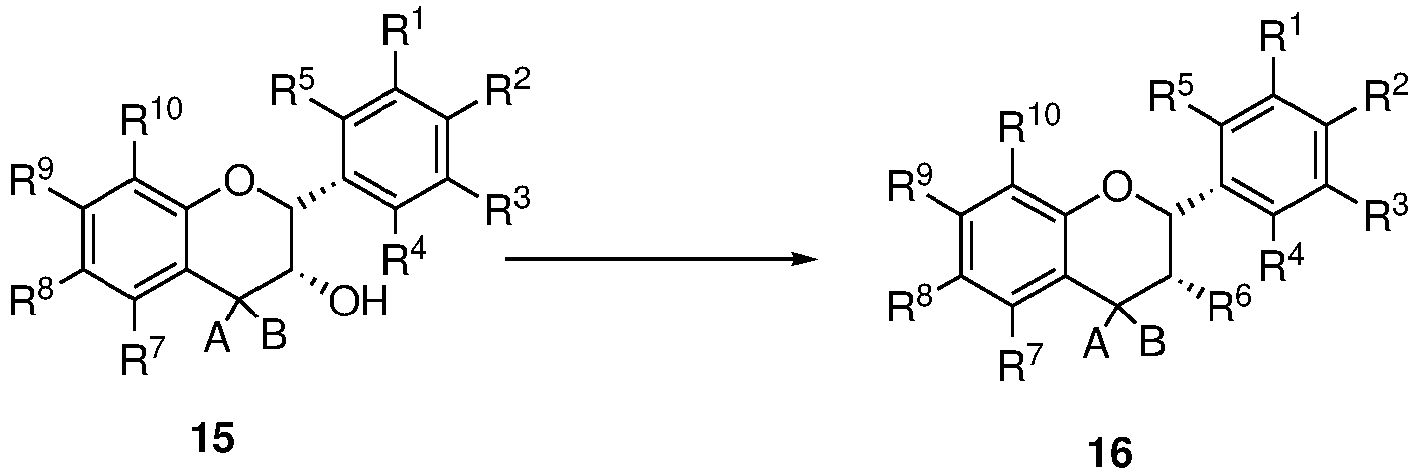
- The process of claim 1, wherein the compound of Formula (II) is of formula 8, comprising the steps of:
 i. treating a chalcone of formula 3 with a reducing agent in presence of a solvent at a temperature ranging from ambient to reflux to obtain a compound of formula 10;
 ii. converting the compound of formula 10 to compound of formula 11 in the presence of a hydroxylating agent with or without chiral co-catalysts and a suitable solvent at a temperature ranging from ambient to reflux;
 iii. functionalizing the hydroxyl group of compound of formula 11 with a suitable reagent in the presence of a suitable solvent to obtain a compound of formula 12;
 iv. treating the compound of formula 12 with an oxidizing agent to obtain a compound of formula 13; and
 iii. reducing the compound of formula 13 from step iv in the presence of a chiral reducing agent at a temperature ranging from -78°C to room temperature in presence of suitable solvents to obtain the compound of Formula (I).
 - A compound selected from the group consisting of:1002 Cis (±) 3-hydroxychroman-2-yl)benzene-1,2-diol;1003 Cis (±) 2-(3,4-dihydroxyphenyl)chroman-3,7-diol;1004 Cis (±) 2-(4-hydroxyphenyl)chroman-3,7-diol;1005 Cis (±) 2-(3-hydroxyphenyl)chroman-3,5-diol;1006 Cis (±) 2-(4-hydroxyphenyl)chroman-3,5-diol;1007 Cis (±) 2-(3-hydroxyphenyl)chroman-3,7-diol;1011 Cis (±) 2-(3-hydroxyphenyl)chroman-3-ol;1012 Cis (±) 2-(4-hydroxyphenyl)chroman-3-ol;1013 Cis (±) 2-(3,4-dihydroxyphenyl)chroman-3,5-diol;1016 Cis (±) 2-(4-hydroxyphenyl)-3-methoxychroman-7-ol;1017 Cis (±) 2-(4-methoxyphenyl)chroman-3,7-diol;1018 Cis (±) 2-(4-hydroxyphenyl)-7-methoxychroman-3-ol;1019 Cis (±) 7-methoxy-2-(4-methoxyphenyl)chroman-3-ol;1020 Cis (±) 3,7-dimethoxy-2-(4-methoxyphenyl)chromane;1021 Cis (±) 7-hydroxy-2-(4-hydroxyphcnyl)chroman-3-yl acctatc;1022 Cis (±) 3-(3,7-dihydroxychroman-2-yl)phenyl acetate;1023 Cis (±) 3-hydroxy-2-(3-hydroxyphenyl)chroman-7-yl acetate;1024 Cis (±) 3-(7-acetoxy-3-hydroxychroman-2-yl)phenyl acetate;1025 Cis (±) 2-(4-acetoxyphenyl)chroman-3,7-diyl diacetate;1026 2-(3-methoxy-4-methylphenyl)chromane-3,7-diol;1027 2-(3-hydroxy-4-methylphenyl)chromane-3,7-diol;1028 2-(4-fluoro-3-methoxyphenyl)chromane-3,7-diol;1029 2-(4-fluoro-3-hydroxyphenyl)chromane-3,7-diol;1030 2-(3-hydroxyphenyl)-3-propoxychroman-7-ol;1067 (2R,3R)-7-methoxy-2-(3-methoxyphenyl)-3-propoxychromane;1068 (2R,3R)-2-(3-methoxyphenyl)-3-propoxychroman-7-ol;1069 (2R,3R)-2-(3-hydroxy-4-methylphenyl)chromane-3,7-diol; and1070 (2R,3R)-7-methoxy-2-(4-methoxyphenyl)chroman-3-ol.
- A pharmaceutical composition comprising a compound of claim 5 along with a pharmaceutically or nutraceutically acceptable excipient.
- The compound as claimed in claim 5, for use in treating acute coronary syndromes, selected from the group comprising myocardial infarction and angina; acute ischemic events in other organs and tissues, renal injury, renal ischemia and diseases of the aorta and its branches; injuries arising from medical interventions selected from the group comprising coronary artery bypass grafting (CABG) procedures and aneurysm repair; cancer; metabolic diseases, and diabetes mellitus.
- Non-therapeutic use of the compound of claim 5, as supplement in meeting the muscle requirement by sports men/exercised muscles to meet the increasing energy demand.
- The compound of claim 5, when present as its stereoisomer, enantiomer, or pharmaceutically acceptable salt thereof.
Priority Applications (1)
| Application Number | Priority Date | Filing Date | Title |
|---|---|---|---|
| EP21151222.3A EP3872071A1 (en) | 2013-04-04 | 2014-04-04 | Novel analogues of epicatechin and related polyphenols |
Applications Claiming Priority (2)
| Application Number | Priority Date | Filing Date | Title |
|---|---|---|---|
| IN3104DE2012 | 2013-04-04 | ||
| PCT/IN2014/000213 WO2014162320A2 (en) | 2013-04-04 | 2014-04-04 | Novel analogues of epicatechin and related polyphenols |
Related Child Applications (1)
| Application Number | Title | Priority Date | Filing Date |
|---|---|---|---|
| EP21151222.3A Division EP3872071A1 (en) | 2013-04-04 | 2014-04-04 | Novel analogues of epicatechin and related polyphenols |
Publications (3)
| Publication Number | Publication Date |
|---|---|
| EP2981260A2 EP2981260A2 (en) | 2016-02-10 |
| EP2981260A4 EP2981260A4 (en) | 2016-07-27 |
| EP2981260B1 true EP2981260B1 (en) | 2021-01-13 |
Family
ID=51659276
Family Applications (2)
| Application Number | Title | Priority Date | Filing Date |
|---|---|---|---|
| EP21151222.3A Withdrawn EP3872071A1 (en) | 2013-04-04 | 2014-04-04 | Novel analogues of epicatechin and related polyphenols |
| EP14778691.7A Active EP2981260B1 (en) | 2013-04-04 | 2014-04-04 | Novel analogues of epicatechin and related polyphenols |
Family Applications Before (1)
| Application Number | Title | Priority Date | Filing Date |
|---|---|---|---|
| EP21151222.3A Withdrawn EP3872071A1 (en) | 2013-04-04 | 2014-04-04 | Novel analogues of epicatechin and related polyphenols |
Country Status (6)
| Country | Link |
|---|---|
| US (1) | US9975869B2 (en) |
| EP (2) | EP3872071A1 (en) |
| JP (4) | JP6621400B2 (en) |
| CN (2) | CN105283179A (en) |
| ES (1) | ES2861931T3 (en) |
| WO (1) | WO2014162320A2 (en) |
Families Citing this family (14)
| Publication number | Priority date | Publication date | Assignee | Title |
|---|---|---|---|---|
| KR102637487B1 (en) * | 2014-10-31 | 2024-02-19 | 상하이 인스티튜트 오브 마테리아 메디카 차이니즈 아카데미 오브 싸이언시즈 | Six-membered ring benzo deribatibes as dpp-4 inhibitor and use thereof |
| CN105481814B (en) * | 2015-11-09 | 2018-08-31 | 陕西嘉禾生物科技股份有限公司 | A kind of synthetic method of Isorhamnetin |
| JP7509340B2 (en) * | 2016-03-14 | 2024-07-02 | ピボット ホールディングス エルエルシー | Trigonelline-Based Compounds |
| US10898465B2 (en) | 2016-06-21 | 2021-01-26 | Epirium Bio Inc. | Utility of (+) epicatechin and their analogs |
| CN108129438A (en) * | 2017-12-25 | 2018-06-08 | 中国海洋大学 | A kind of compound of the chroman of benzene containing 2- parent nucleus and preparation method thereof |
| CN110372663A (en) * | 2018-04-13 | 2019-10-25 | 山东百极地长制药有限公司 | Sulfur heterocyclic compound and its application as DPP4 inhibitor derivates |
| CN108623550B (en) * | 2018-05-29 | 2021-08-24 | 沈阳药科大学 | Flavan-3-ol derivatives and their uses |
| CN112367987A (en) | 2018-06-05 | 2021-02-12 | 旗舰创业创新五公司 | Active agents and methods for their use in treating metabolic disorders and non-alcoholic fatty liver disease |
| CA3117466A1 (en) | 2018-10-24 | 2020-04-30 | Epirium Bio Inc. | Co-crystals comprising epicatechin and a carboxy-n-heterocyclic co-crystal former |
| CN112047916A (en) * | 2020-09-21 | 2020-12-08 | 苏州昊帆生物股份有限公司 | Method for synthesizing isolicoflavonol |
| CN112625048A (en) * | 2020-12-16 | 2021-04-09 | 顺德职业技术学院 | Novel flavane compound of dianella root and preparation method thereof |
| CN114853603B (en) * | 2022-03-17 | 2024-09-06 | 湖南大学 | Research on construction of iodo-alkyl ester compound by copper-catalyzed cyclic ether and carboxylic acid |
| WO2024036223A1 (en) | 2022-08-10 | 2024-02-15 | Epirium Bio Inc. | Epicatechin inhibiting atp hydrolysis |
| WO2024036225A1 (en) | 2022-08-10 | 2024-02-15 | Epirium Bio Inc. | Epicatechin for inhibiting glutamate toxicity |
Family Cites Families (22)
| Publication number | Priority date | Publication date | Assignee | Title |
|---|---|---|---|---|
| US3689663A (en) * | 1963-08-28 | 1972-09-05 | Merck Ag E | Lowering cholesterol blood levels with flavanoids |
| GR67250B (en) * | 1978-03-15 | 1981-06-25 | Wellcome Found | |
| GB2064514B (en) * | 1979-10-29 | 1984-01-18 | Maruko Pharmaceutical Co | Flavan compounds and acid addition salts thereof and pharmaceutical compositions thereof |
| JPS6023115B2 (en) * | 1979-10-29 | 1985-06-05 | マルコ製薬株式会社 | Flavan derivatives and their acid addition salts |
| JP3165279B2 (en) * | 1993-03-29 | 2001-05-14 | 三井農林株式会社 | Oil-soluble antioxidant containing 3-acylated catechin |
| US5935752A (en) * | 1996-11-22 | 1999-08-10 | Minolta Co., Ltd. | Toner for developing electrostatic latent images |
| JP3571975B2 (en) * | 1999-11-02 | 2004-09-29 | 三井農林株式会社 | Method for producing flavan-3-ols labeled with deuterium or tritium at position 4 |
| WO2003101927A1 (en) * | 2002-05-31 | 2003-12-11 | Proteotech, Inc. | Compounds, compositions and methods for the treatment of amyloid diseases and synucleinopathies such as alzheimer's disease, type 2 diabetes, and parkinson's disease |
| JP2008505657A (en) * | 2004-07-10 | 2008-02-28 | ザ リサーチ ファウンデイション オブ ステイト ユニバーシティー オブ ニューヨーク | Production of flavonoids by recombinant microorganisms |
| EP1896443A1 (en) * | 2005-06-29 | 2008-03-12 | Mars, Incorporated | Preparation of (+)-catechin, (-)-epicatechin, (-)-catechin, (+)-epicatechin, and their 5,7,3',4'-tetra-o-benzyl analogues |
| JP5126942B2 (en) * | 2006-12-26 | 2013-01-23 | 静岡県公立大学法人 | 5,7-dideoxyepigallocatechin gallate, process for producing the same, and anti-influenza virus agent |
| FR2923718B1 (en) * | 2007-11-15 | 2009-12-18 | Caudalie | COMPOSITIONS OF FLAVONOIDIC POLYPHENOLIC DERIVATIVES AND THEIR APPLICATIONS TO COMBAT PATHOLOGIES AND AGING LIVING ORGANISMS |
| MX339476B (en) * | 2008-04-18 | 2016-05-27 | Reata Pharmaceuticals Inc | Compounds including an anti-inflammatory pharmacore and methods of use. |
| TWI370736B (en) * | 2008-12-31 | 2012-08-21 | Ind Tech Res Inst | Pharmaceutical composition for treating hepatitis b and heath food for inhibiting hepatitis b virus |
| EA201190219A1 (en) * | 2009-04-17 | 2013-01-30 | Кардеро Терапьютикс, Инк. | METHODS AND COMPOSITIONS FOR THE TREATMENT OF ISCHEMIC STATES AND CONDITIONS ASSOCIATED WITH MITICHONDRIA FUNCTION |
| CN101857584B (en) * | 2010-04-22 | 2011-11-09 | 广东德鑫制药有限公司 | Hydroxyl flavanoid compound and application thereof |
| US8623897B2 (en) * | 2010-09-20 | 2014-01-07 | Kareus Therapeutics, Sa | Methods and compositions for treatment of diabetes and dyslipidemia |
| CN102578094B (en) * | 2011-01-13 | 2013-06-12 | 中国中化股份有限公司 | Use of (+)- epiafzelechin as pesticide |
| JP5890846B2 (en) * | 2011-01-27 | 2016-03-22 | スファエラ ファーマ ピーティーイー リミテッド | New synthesis method of polyphenol |
| WO2013022846A2 (en) * | 2011-08-05 | 2013-02-14 | Cardero Therapeutics, Inc. | Flavonoid compounds |
| EP2557079A1 (en) * | 2011-08-09 | 2013-02-13 | Nestec S.A. | Synthesis of catechin and epicatechin conjugates |
| CN102503924B (en) * | 2011-11-07 | 2014-04-02 | 吉首大学 | Flavane (isoflavane) urease inhibitor and synthesis and use thereof |
-
2014
- 2014-04-04 CN CN201480025255.1A patent/CN105283179A/en active Pending
- 2014-04-04 EP EP21151222.3A patent/EP3872071A1/en not_active Withdrawn
- 2014-04-04 JP JP2016505931A patent/JP6621400B2/en active Active
- 2014-04-04 WO PCT/IN2014/000213 patent/WO2014162320A2/en not_active Ceased
- 2014-04-04 CN CN202011307611.2A patent/CN112724114A/en active Pending
- 2014-04-04 ES ES14778691T patent/ES2861931T3/en active Active
- 2014-04-04 EP EP14778691.7A patent/EP2981260B1/en active Active
- 2014-04-04 US US14/780,214 patent/US9975869B2/en active Active
-
2018
- 2018-09-26 JP JP2018180509A patent/JP6794413B2/en active Active
-
2020
- 2020-11-11 JP JP2020187811A patent/JP2021042218A/en active Pending
-
2023
- 2023-01-16 JP JP2023004376A patent/JP2023052411A/en active Pending
Non-Patent Citations (1)
| Title |
|---|
| YUH-MEEI LIN ET AL: "Chalcones and flavonoids as anti-Tuberculosis agents", BIOORGANIC & MEDICINAL CHEMISTRY, vol. 10, no. 8, 1 August 2002 (2002-08-01), GB, pages 2795 - 2802, XP055464742, ISSN: 0968-0896, DOI: 10.1016/S0968-0896(02)00094-9 * |
Also Published As
| Publication number | Publication date |
|---|---|
| JP2023052411A (en) | 2023-04-11 |
| JP6794413B2 (en) | 2020-12-02 |
| JP6621400B2 (en) | 2019-12-18 |
| EP2981260A4 (en) | 2016-07-27 |
| WO2014162320A2 (en) | 2014-10-09 |
| ES2861931T3 (en) | 2021-10-06 |
| CN112724114A (en) | 2021-04-30 |
| JP2019034944A (en) | 2019-03-07 |
| WO2014162320A3 (en) | 2014-12-24 |
| US20160039781A1 (en) | 2016-02-11 |
| CN105283179A (en) | 2016-01-27 |
| JP2021042218A (en) | 2021-03-18 |
| EP3872071A1 (en) | 2021-09-01 |
| US9975869B2 (en) | 2018-05-22 |
| EP2981260A2 (en) | 2016-02-10 |
| JP2016515610A (en) | 2016-05-30 |
Similar Documents
| Publication | Publication Date | Title |
|---|---|---|
| EP3872071A1 (en) | Novel analogues of epicatechin and related polyphenols | |
| US5068364A (en) | Chalcone derivatives and process for producing the same | |
| US8263790B2 (en) | Method for enantioselective hydrogenation of chromenes | |
| EP1534698B1 (en) | Flavonoid compounds as therapeutic antioxidants | |
| CA3019890A1 (en) | Bioenzymatic synthesis of tetrahydrocannabivarin (thc-v), cannabinol (cbn), and cannabivarin (cbv) and their use as therapeutic agents | |
| EP2817299B1 (en) | Substituted chroman compounds as calcium sensing receptor modulators | |
| EP2668176B1 (en) | A novel process for synthesis of polyphenols | |
| WO1997043259A1 (en) | Arylalkylpiperazine compounds as antioxidants | |
| US5420132A (en) | Substituted benzodioxins | |
| EP2922834B1 (en) | 1-(dimethylamino)ethyl-substituted 6h-benzo[c]chromen-6-ones against senile dementia | |
| CN110240582B (en) | Flavone derivative with tumor cell inhibiting function and preparation method and application thereof | |
| JP2011526297A (en) | Schweinfurchin analog | |
| EP0685473B1 (en) | Benzoheterocyclic compounds, as antioxidants | |
| EP3733656B1 (en) | Method for synthesis of lobaric acid and analog thereof | |
| US11591305B2 (en) | Method for producing fisetin or fisetin derivatives | |
| KR100783626B1 (en) | Method for synthesizing NDA and its derivatives having antioxidant activity | |
| JP2018070509A (en) | Novel tocopheryl derivative of ascorbic acid and method for producing same | |
| US8507549B2 (en) | Methods for synthesizing glycinols, glyceollins I and II and isoflavenes and chromanes using a Wittig reaction, and compositions made therewith | |
| KR840001077B1 (en) | Process for n4-carbamoylpiperazino propanal derivatives | |
| KR19990069211A (en) | Novel polyhydroxy-diphenylalkane derivatives having tyrosinase inhibitory activity and preparation method thereof | |
| CN101225031A (en) | Disubstituted phenylpropene derivatives, preparation method and use thereof |
Legal Events
| Date | Code | Title | Description |
|---|---|---|---|
| PUAI | Public reference made under article 153(3) epc to a published international application that has entered the european phase |
Free format text: ORIGINAL CODE: 0009012 |
|
| 17P | Request for examination filed |
Effective date: 20151104 |
|
| AK | Designated contracting states |
Kind code of ref document: A2 Designated state(s): AL AT BE BG CH CY CZ DE DK EE ES FI FR GB GR HR HU IE IS IT LI LT LU LV MC MK MT NL NO PL PT RO RS SE SI SK SM TR |
|
| AX | Request for extension of the european patent |
Extension state: BA ME |
|
| REG | Reference to a national code |
Ref country code: DE Ref legal event code: R079 Ref document number: 602014074235 Country of ref document: DE Free format text: PREVIOUS MAIN CLASS: A61K0031353000 Ipc: C07D0311540000 |
|
| DAX | Request for extension of the european patent (deleted) | ||
| A4 | Supplementary search report drawn up and despatched |
Effective date: 20160627 |
|
| RIC1 | Information provided on ipc code assigned before grant |
Ipc: C07D 311/62 20060101ALI20160621BHEP Ipc: A61P 21/00 20060101ALI20160621BHEP Ipc: C07D 405/12 20060101ALI20160621BHEP Ipc: A61K 31/353 20060101ALI20160621BHEP Ipc: C07D 311/54 20060101AFI20160621BHEP Ipc: A61K 31/4433 20060101ALI20160621BHEP Ipc: A61P 9/00 20060101ALI20160621BHEP Ipc: C07D 311/60 20060101ALI20160621BHEP |
|
| STAA | Information on the status of an ep patent application or granted ep patent |
Free format text: STATUS: EXAMINATION IS IN PROGRESS |
|
| 17Q | First examination report despatched |
Effective date: 20170607 |
|
| GRAP | Despatch of communication of intention to grant a patent |
Free format text: ORIGINAL CODE: EPIDOSNIGR1 |
|
| STAA | Information on the status of an ep patent application or granted ep patent |
Free format text: STATUS: GRANT OF PATENT IS INTENDED |
|
| INTG | Intention to grant announced |
Effective date: 20200724 |
|
| GRAS | Grant fee paid |
Free format text: ORIGINAL CODE: EPIDOSNIGR3 |
|
| GRAA | (expected) grant |
Free format text: ORIGINAL CODE: 0009210 |
|
| STAA | Information on the status of an ep patent application or granted ep patent |
Free format text: STATUS: THE PATENT HAS BEEN GRANTED |
|
| AK | Designated contracting states |
Kind code of ref document: B1 Designated state(s): AL AT BE BG CH CY CZ DE DK EE ES FI FR GB GR HR HU IE IS IT LI LT LU LV MC MK MT NL NO PL PT RO RS SE SI SK SM TR |
|
| REG | Reference to a national code |
Ref country code: GB Ref legal event code: FG4D |
|
| REG | Reference to a national code |
Ref country code: CH Ref legal event code: EP |
|
| REG | Reference to a national code |
Ref country code: DE Ref legal event code: R096 Ref document number: 602014074235 Country of ref document: DE |
|
| REG | Reference to a national code |
Ref country code: IE Ref legal event code: FG4D |
|
| REG | Reference to a national code |
Ref country code: AT Ref legal event code: REF Ref document number: 1354465 Country of ref document: AT Kind code of ref document: T Effective date: 20210215 |
|
| REG | Reference to a national code |
Ref country code: CH Ref legal event code: NV Representative=s name: E. BLUM AND CO. AG PATENT- UND MARKENANWAELTE V, CH |
|
| REG | Reference to a national code |
Ref country code: SE Ref legal event code: TRGR |
|
| REG | Reference to a national code |
Ref country code: NL Ref legal event code: FP |
|
| REG | Reference to a national code |
Ref country code: AT Ref legal event code: MK05 Ref document number: 1354465 Country of ref document: AT Kind code of ref document: T Effective date: 20210113 |
|
| REG | Reference to a national code |
Ref country code: LT Ref legal event code: MG9D |
|
| PG25 | Lapsed in a contracting state [announced via postgrant information from national office to epo] |
Ref country code: GR Free format text: LAPSE BECAUSE OF FAILURE TO SUBMIT A TRANSLATION OF THE DESCRIPTION OR TO PAY THE FEE WITHIN THE PRESCRIBED TIME-LIMIT Effective date: 20210414 Ref country code: HR Free format text: LAPSE BECAUSE OF FAILURE TO SUBMIT A TRANSLATION OF THE DESCRIPTION OR TO PAY THE FEE WITHIN THE PRESCRIBED TIME-LIMIT Effective date: 20210113 Ref country code: FI Free format text: LAPSE BECAUSE OF FAILURE TO SUBMIT A TRANSLATION OF THE DESCRIPTION OR TO PAY THE FEE WITHIN THE PRESCRIBED TIME-LIMIT Effective date: 20210113 Ref country code: PT Free format text: LAPSE BECAUSE OF FAILURE TO SUBMIT A TRANSLATION OF THE DESCRIPTION OR TO PAY THE FEE WITHIN THE PRESCRIBED TIME-LIMIT Effective date: 20210513 Ref country code: LT Free format text: LAPSE BECAUSE OF FAILURE TO SUBMIT A TRANSLATION OF THE DESCRIPTION OR TO PAY THE FEE WITHIN THE PRESCRIBED TIME-LIMIT Effective date: 20210113 Ref country code: BG Free format text: LAPSE BECAUSE OF FAILURE TO SUBMIT A TRANSLATION OF THE DESCRIPTION OR TO PAY THE FEE WITHIN THE PRESCRIBED TIME-LIMIT Effective date: 20210413 Ref country code: NO Free format text: LAPSE BECAUSE OF FAILURE TO SUBMIT A TRANSLATION OF THE DESCRIPTION OR TO PAY THE FEE WITHIN THE PRESCRIBED TIME-LIMIT Effective date: 20210413 |
|
| PG25 | Lapsed in a contracting state [announced via postgrant information from national office to epo] |
Ref country code: RS Free format text: LAPSE BECAUSE OF FAILURE TO SUBMIT A TRANSLATION OF THE DESCRIPTION OR TO PAY THE FEE WITHIN THE PRESCRIBED TIME-LIMIT Effective date: 20210113 Ref country code: PL Free format text: LAPSE BECAUSE OF FAILURE TO SUBMIT A TRANSLATION OF THE DESCRIPTION OR TO PAY THE FEE WITHIN THE PRESCRIBED TIME-LIMIT Effective date: 20210113 Ref country code: LV Free format text: LAPSE BECAUSE OF FAILURE TO SUBMIT A TRANSLATION OF THE DESCRIPTION OR TO PAY THE FEE WITHIN THE PRESCRIBED TIME-LIMIT Effective date: 20210113 Ref country code: AT Free format text: LAPSE BECAUSE OF FAILURE TO SUBMIT A TRANSLATION OF THE DESCRIPTION OR TO PAY THE FEE WITHIN THE PRESCRIBED TIME-LIMIT Effective date: 20210113 |
|
| PG25 | Lapsed in a contracting state [announced via postgrant information from national office to epo] |
Ref country code: IS Free format text: LAPSE BECAUSE OF FAILURE TO SUBMIT A TRANSLATION OF THE DESCRIPTION OR TO PAY THE FEE WITHIN THE PRESCRIBED TIME-LIMIT Effective date: 20210513 |
|
| REG | Reference to a national code |
Ref country code: ES Ref legal event code: FG2A Ref document number: 2861931 Country of ref document: ES Kind code of ref document: T3 Effective date: 20211006 |
|
| REG | Reference to a national code |
Ref country code: DE Ref legal event code: R097 Ref document number: 602014074235 Country of ref document: DE |
|
| PG25 | Lapsed in a contracting state [announced via postgrant information from national office to epo] |
Ref country code: SM Free format text: LAPSE BECAUSE OF FAILURE TO SUBMIT A TRANSLATION OF THE DESCRIPTION OR TO PAY THE FEE WITHIN THE PRESCRIBED TIME-LIMIT Effective date: 20210113 Ref country code: EE Free format text: LAPSE BECAUSE OF FAILURE TO SUBMIT A TRANSLATION OF THE DESCRIPTION OR TO PAY THE FEE WITHIN THE PRESCRIBED TIME-LIMIT Effective date: 20210113 Ref country code: CZ Free format text: LAPSE BECAUSE OF FAILURE TO SUBMIT A TRANSLATION OF THE DESCRIPTION OR TO PAY THE FEE WITHIN THE PRESCRIBED TIME-LIMIT Effective date: 20210113 |
|
| PLBE | No opposition filed within time limit |
Free format text: ORIGINAL CODE: 0009261 |
|
| STAA | Information on the status of an ep patent application or granted ep patent |
Free format text: STATUS: NO OPPOSITION FILED WITHIN TIME LIMIT |
|
| PG25 | Lapsed in a contracting state [announced via postgrant information from national office to epo] |
Ref country code: DK Free format text: LAPSE BECAUSE OF FAILURE TO SUBMIT A TRANSLATION OF THE DESCRIPTION OR TO PAY THE FEE WITHIN THE PRESCRIBED TIME-LIMIT Effective date: 20210113 Ref country code: MC Free format text: LAPSE BECAUSE OF FAILURE TO SUBMIT A TRANSLATION OF THE DESCRIPTION OR TO PAY THE FEE WITHIN THE PRESCRIBED TIME-LIMIT Effective date: 20210113 Ref country code: SK Free format text: LAPSE BECAUSE OF FAILURE TO SUBMIT A TRANSLATION OF THE DESCRIPTION OR TO PAY THE FEE WITHIN THE PRESCRIBED TIME-LIMIT Effective date: 20210113 Ref country code: RO Free format text: LAPSE BECAUSE OF FAILURE TO SUBMIT A TRANSLATION OF THE DESCRIPTION OR TO PAY THE FEE WITHIN THE PRESCRIBED TIME-LIMIT Effective date: 20210113 |
|
| 26N | No opposition filed |
Effective date: 20211014 |
|
| PG25 | Lapsed in a contracting state [announced via postgrant information from national office to epo] |
Ref country code: LU Free format text: LAPSE BECAUSE OF NON-PAYMENT OF DUE FEES Effective date: 20210404 |
|
| REG | Reference to a national code |
Ref country code: BE Ref legal event code: MM Effective date: 20210430 |
|
| PG25 | Lapsed in a contracting state [announced via postgrant information from national office to epo] |
Ref country code: AL Free format text: LAPSE BECAUSE OF FAILURE TO SUBMIT A TRANSLATION OF THE DESCRIPTION OR TO PAY THE FEE WITHIN THE PRESCRIBED TIME-LIMIT Effective date: 20210113 |
|
| PG25 | Lapsed in a contracting state [announced via postgrant information from national office to epo] |
Ref country code: SI Free format text: LAPSE BECAUSE OF FAILURE TO SUBMIT A TRANSLATION OF THE DESCRIPTION OR TO PAY THE FEE WITHIN THE PRESCRIBED TIME-LIMIT Effective date: 20210113 |
|
| PG25 | Lapsed in a contracting state [announced via postgrant information from national office to epo] |
Ref country code: IS Free format text: LAPSE BECAUSE OF FAILURE TO SUBMIT A TRANSLATION OF THE DESCRIPTION OR TO PAY THE FEE WITHIN THE PRESCRIBED TIME-LIMIT Effective date: 20210513 |
|
| PG25 | Lapsed in a contracting state [announced via postgrant information from national office to epo] |
Ref country code: BE Free format text: LAPSE BECAUSE OF NON-PAYMENT OF DUE FEES Effective date: 20210430 |
|
| PG25 | Lapsed in a contracting state [announced via postgrant information from national office to epo] |
Ref country code: HU Free format text: LAPSE BECAUSE OF FAILURE TO SUBMIT A TRANSLATION OF THE DESCRIPTION OR TO PAY THE FEE WITHIN THE PRESCRIBED TIME-LIMIT; INVALID AB INITIO Effective date: 20140404 |
|
| PG25 | Lapsed in a contracting state [announced via postgrant information from national office to epo] |
Ref country code: CY Free format text: LAPSE BECAUSE OF FAILURE TO SUBMIT A TRANSLATION OF THE DESCRIPTION OR TO PAY THE FEE WITHIN THE PRESCRIBED TIME-LIMIT Effective date: 20210113 |
|
| PGFP | Annual fee paid to national office [announced via postgrant information from national office to epo] |
Ref country code: NL Payment date: 20240226 Year of fee payment: 11 Ref country code: IE Payment date: 20240223 Year of fee payment: 11 |
|
| PG25 | Lapsed in a contracting state [announced via postgrant information from national office to epo] |
Ref country code: MK Free format text: LAPSE BECAUSE OF FAILURE TO SUBMIT A TRANSLATION OF THE DESCRIPTION OR TO PAY THE FEE WITHIN THE PRESCRIBED TIME-LIMIT Effective date: 20210113 |
|
| PGFP | Annual fee paid to national office [announced via postgrant information from national office to epo] |
Ref country code: GB Payment date: 20240222 Year of fee payment: 11 |
|
| PGFP | Annual fee paid to national office [announced via postgrant information from national office to epo] |
Ref country code: SE Payment date: 20240226 Year of fee payment: 11 Ref country code: IT Payment date: 20240313 Year of fee payment: 11 Ref country code: FR Payment date: 20240223 Year of fee payment: 11 |
|
| PGFP | Annual fee paid to national office [announced via postgrant information from national office to epo] |
Ref country code: DE Payment date: 20240220 Year of fee payment: 11 |
|
| PGFP | Annual fee paid to national office [announced via postgrant information from national office to epo] |
Ref country code: CH Payment date: 20240501 Year of fee payment: 11 |
|
| PGFP | Annual fee paid to national office [announced via postgrant information from national office to epo] |
Ref country code: ES Payment date: 20240509 Year of fee payment: 11 |
|
| PG25 | Lapsed in a contracting state [announced via postgrant information from national office to epo] |
Ref country code: MT Free format text: LAPSE BECAUSE OF FAILURE TO SUBMIT A TRANSLATION OF THE DESCRIPTION OR TO PAY THE FEE WITHIN THE PRESCRIBED TIME-LIMIT Effective date: 20210113 |
|
| REG | Reference to a national code |
Ref country code: DE Ref legal event code: R119 Ref document number: 602014074235 Country of ref document: DE |
|
| REG | Reference to a national code |
Ref country code: CH Ref legal event code: H13 Free format text: ST27 STATUS EVENT CODE: U-0-0-H10-H13 (AS PROVIDED BY THE NATIONAL OFFICE) Effective date: 20251125 |
|
| REG | Reference to a national code |
Ref country code: SE Ref legal event code: EUG |
|
| REG | Reference to a national code |
Ref country code: NL Ref legal event code: MM Effective date: 20250501 |
|
| PG25 | Lapsed in a contracting state [announced via postgrant information from national office to epo] |
Ref country code: TR Free format text: LAPSE BECAUSE OF FAILURE TO SUBMIT A TRANSLATION OF THE DESCRIPTION OR TO PAY THE FEE WITHIN THE PRESCRIBED TIME-LIMIT Effective date: 20210113 |
|
| GBPC | Gb: european patent ceased through non-payment of renewal fee |
Effective date: 20250404 |
|
| PG25 | Lapsed in a contracting state [announced via postgrant information from national office to epo] |
Ref country code: DE Free format text: LAPSE BECAUSE OF NON-PAYMENT OF DUE FEES Effective date: 20251104 |
|
| PG25 | Lapsed in a contracting state [announced via postgrant information from national office to epo] |
Ref country code: GB Free format text: LAPSE BECAUSE OF NON-PAYMENT OF DUE FEES Effective date: 20250404 |
|
| PG25 | Lapsed in a contracting state [announced via postgrant information from national office to epo] |
Ref country code: NL Free format text: LAPSE BECAUSE OF NON-PAYMENT OF DUE FEES Effective date: 20250501 Ref country code: FR Free format text: LAPSE BECAUSE OF NON-PAYMENT OF DUE FEES Effective date: 20250430 |
|
| PG25 | Lapsed in a contracting state [announced via postgrant information from national office to epo] |
Ref country code: CH Free format text: LAPSE BECAUSE OF NON-PAYMENT OF DUE FEES Effective date: 20250430 |
|
| PG25 | Lapsed in a contracting state [announced via postgrant information from national office to epo] |
Ref country code: SE Free format text: LAPSE BECAUSE OF NON-PAYMENT OF DUE FEES Effective date: 20250405 |
|
| PG25 | Lapsed in a contracting state [announced via postgrant information from national office to epo] |
Ref country code: IE Free format text: LAPSE BECAUSE OF NON-PAYMENT OF DUE FEES Effective date: 20250404 |
|
| PG25 | Lapsed in a contracting state [announced via postgrant information from national office to epo] |
Ref country code: IT Free format text: LAPSE BECAUSE OF NON-PAYMENT OF DUE FEES Effective date: 20250404 |