EP2981119A1 - System and method for a media access control scheduler for a long term evolution unlicensed network environment - Google Patents
System and method for a media access control scheduler for a long term evolution unlicensed network environment Download PDFInfo
- Publication number
- EP2981119A1 EP2981119A1 EP15178914.6A EP15178914A EP2981119A1 EP 2981119 A1 EP2981119 A1 EP 2981119A1 EP 15178914 A EP15178914 A EP 15178914A EP 2981119 A1 EP2981119 A1 EP 2981119A1
- Authority
- EP
- European Patent Office
- Prior art keywords
- lte
- frames
- wireless
- communication devices
- sub
- Prior art date
- Legal status (The legal status is an assumption and is not a legal conclusion. Google has not performed a legal analysis and makes no representation as to the accuracy of the status listed.)
- Granted
Links
Images



Classifications
-
- H—ELECTRICITY
- H04—ELECTRIC COMMUNICATION TECHNIQUE
- H04W—WIRELESS COMMUNICATION NETWORKS
- H04W16/00—Network planning, e.g. coverage or traffic planning tools; Network deployment, e.g. resource partitioning or cells structures
- H04W16/14—Spectrum sharing arrangements between different networks
-
- H—ELECTRICITY
- H04—ELECTRIC COMMUNICATION TECHNIQUE
- H04W—WIRELESS COMMUNICATION NETWORKS
- H04W72/00—Local resource management
- H04W72/50—Allocation or scheduling criteria for wireless resources
- H04W72/54—Allocation or scheduling criteria for wireless resources based on quality criteria
- H04W72/542—Allocation or scheduling criteria for wireless resources based on quality criteria using measured or perceived quality
-
- H—ELECTRICITY
- H04—ELECTRIC COMMUNICATION TECHNIQUE
- H04W—WIRELESS COMMUNICATION NETWORKS
- H04W72/00—Local resource management
- H04W72/20—Control channels or signalling for resource management
- H04W72/23—Control channels or signalling for resource management in the downlink direction of a wireless link, i.e. towards a terminal
-
- H—ELECTRICITY
- H04—ELECTRIC COMMUNICATION TECHNIQUE
- H04W—WIRELESS COMMUNICATION NETWORKS
- H04W72/00—Local resource management
- H04W72/04—Wireless resource allocation
- H04W72/044—Wireless resource allocation based on the type of the allocated resource
- H04W72/0446—Resources in time domain, e.g. slots or frames
-
- H—ELECTRICITY
- H04—ELECTRIC COMMUNICATION TECHNIQUE
- H04W—WIRELESS COMMUNICATION NETWORKS
- H04W72/00—Local resource management
- H04W72/04—Wireless resource allocation
- H04W72/044—Wireless resource allocation based on the type of the allocated resource
- H04W72/0453—Resources in frequency domain, e.g. a carrier in FDMA
-
- H—ELECTRICITY
- H04—ELECTRIC COMMUNICATION TECHNIQUE
- H04W—WIRELESS COMMUNICATION NETWORKS
- H04W72/00—Local resource management
- H04W72/12—Wireless traffic scheduling
- H04W72/1215—Wireless traffic scheduling for collaboration of different radio technologies
-
- H—ELECTRICITY
- H04—ELECTRIC COMMUNICATION TECHNIQUE
- H04W—WIRELESS COMMUNICATION NETWORKS
- H04W74/00—Wireless channel access
- H04W74/08—Non-scheduled access, e.g. ALOHA
- H04W74/0808—Non-scheduled access, e.g. ALOHA using carrier sensing, e.g. carrier sense multiple access [CSMA]
- H04W74/0816—Non-scheduled access, e.g. ALOHA using carrier sensing, e.g. carrier sense multiple access [CSMA] with collision avoidance
Definitions
- This disclosure relates in general to the field of communications and, more particularly, to a system and method for a Media Access Control (MAC) Scheduler for a Long Term Evolution Unlicensed (LTE-U) network environment.
- MAC Media Access Control
- LTE-U Long Term Evolution Unlicensed
- Networking architectures have grown increasingly complex in communication environments.
- Mobile communication networks have grown substantially in subscriber base as end users become increasingly connected to mobile wireless environments.
- efficient management of communication resources becomes more critical.
- network service providers desire to offload certain mobile communications to unlicensed frequency bands, such as LTE-U, in order to reduce congestion in a network or in some cases to provide differentiated services to subscribers.
- LTE-U unlicensed frequency bands
- FIGURE 1A is a simplified block diagram illustrating a communication system to facilitate MAC frame scheduling in an LTE-U network environment according to one embodiment of the present disclosure
- a method for a communication network may include determining, by a first communication device, whether one or more other communication devices are communicating wireless signals in a particular channel of an unlicensed band of the communication network; scheduling one or more Long Term Evolution Unlicensed (LTE-U) sub-frames within a frame schedule for a user equipment (UE) based, at least in part, on determining that one or more communication devices are communicating wireless signals in the particular channel; and communicating the one or more LTE-U sub-frames to the UE according to the frame schedule.
- the frame schedule can further include one or more zero-power sub-frames.
- the one or more LTE-U sub-frames can be LTE-U downlink frames for the UE.
- the determining can include at least one of: implementing physical carrier sense by the first communication device to detect wireless signals being transmitted by one or more other communication devices; decoding, by the first communication device, Request to Send (RTS) and Clear to Send (CTS) frames being transmitted by one or more other communication devices; and implementing virtual carrier sense by the first communication device to detect wireless signals being communicated by one or more other communication devices.
- RTS Request to Send
- CTS Clear to Send
- the determining can be performed using a wireless receiver for a LTE-U Media Access Control (MAC) scheduler for the first communication device.
- the physical carrier sense can include a Clear Channel Assessment (CCA) at one or more signal strength thresholds.
- the virtual carrier sense can include decoding a Duration Field and a Network Allocation Vector being transmitted by the one or more other communication devices.
- the method can include transmitting, by the first communication device, Clear to Send-to-self (CTS-to-self) frames including a Duration Field and Network Allocation Vector (NAV) based on transmit opportunity (TXOP) prior to communicating the one or more LTE-U sub-frames to the UE.
- CTS-to-self Clear to Send-to-self frames including a Duration Field and Network Allocation Vector (NAV) based on transmit opportunity (TXOP) prior to communicating the one or more LTE-U sub-frames to the UE.
- the method can include implementing, by the first communication device, one or more random back-off mechanisms to prohibit communicating the LTE-U sub-frames to the UE including at least one of: a distributed coordination function (DCF) back-off mechanism; and an enhanced distributed channel access (EDCA) back-off mechanism.
- DCF distributed coordination function
- EDCA enhanced distributed channel access
- the first communication device can be at least one of: an LTE-U evolved Node B (eNodeB) including an LTE-U Media Access Control (MAC) scheduler, wherein the LTE-U eNodeB includes a wireless receiver and a wireless transmitter for the LTE-U MAC scheduler and includes an LTE MAC scheduler; and an LTE-U Access Point (AP) including an LTE-U MAC scheduler, wherein the LTE-U AP includes a wireless receiver and a wireless transmitter for the LTE-U MAC scheduler.
- eNodeB evolved Node B
- MAC Media Access Control
- AP LTE-U Access Point
- FIGURE 1A is a simplified block diagram illustrating a communication system 10 to facilitate LTE-U MAC frame scheduling in an LTE-U network environment in a network environment according to one embodiment of the present disclosure.
- This particular configuration may be tied to the 3rd Generation Partnership Project (3GPP) Evolved Packet System (EPS) architecture, also sometimes referred to as the Long Term Evolution (LTE) EPS architecture.
- 3GPP 3rd Generation Partnership Project
- EPS Evolved Packet System
- LTE Long Term Evolution
- the depicted architecture may be applicable to other environments equally.
- the example architecture of FIGURE 1A may include user equipment (UE) 12a-12d, a 3GPP access network 30 including LTE Unlicensed (LTE-U) evolved Node B (eNodeBs) 14, 16, a trusted non-3GPP Internet protocol (IP) access network 32 and an untrusted non-3GPP IP access network 34, each respectively including a wireless radio access point 42, 44 and a 3GPP core network 40.
- LTE-U LTE Unlicensed
- eNodeBs evolved Node B
- IP Internet protocol
- untrusted non-3GPP IP access network 34 each respectively including a wireless radio access point 42, 44 and a 3GPP core network 40.
- the term 'unlicensed' is used to refer to unlicensed communication frequency bands or spectrums that can be used for communication technologies such as WiFi, BluetoothTM, WiMAX, etc.
- LTE-U eNodeBs 14, 16 may each include a respective LTE Media Access Control (MAC) Scheduler 20a-20b, an LTE-U MAC scheduler 22a-22b, a processor 46a-46b and a memory element 48a-48b.
- LTE-U MAC scheduler 22a within LTE-U eNodeB 14 may additionally be configured to interface with a wireless transmitter 24a and a wireless receiver 26a.
- LTE-U MAC scheduler 22b may be configured to interface with a wireless transmitter 24b and a wireless receiver 26b.
- communication system 10 may include a configuration capable of transmission control protocol/Internet protocol (TCP/IP) communications for the transmission or reception of packets in a network.
- TCP/IP transmission control protocol/Internet protocol
- Communication system 10 may also operate in conjunction with a user datagram protocol/IP (UDP/IP) or any other suitable protocol where appropriate and based on particular needs.
- UDP/IP user datagram protocol/IP
- 3GPP access network 30 may include access networks such as a GSM EDGE radio access network (GERAN), a UMTS terrestrial radio access network (UTRAN), generally referred to as 3G, and/or a LTE access network such as evolved UTRAN (E-UTRAN), generally referred to as 4G or LTE/LTE-Advanced (LTE-A).
- the GERAN and UTRAN may interface with 3GPP core network 40 via one of more network elements such as, for example, one or more Node Bs (NodeBs), one or more Radio Network Controllers (RNCs), one or more Serving General Packet Radio Service (GPRS) Support Nodes (SGSNs) and one or more Gateway GPRS support nodes (GGSNs).
- NodeBs Node Bs
- RNCs Radio Network Controllers
- GPRS General Packet Radio Service
- SGSNs Serving General Packet Radio Service
- GGSNs Gateway GPRS support nodes
- LTE-U eNodeBs 14, 16 may be used to provide E-UTRAN coverage for 3GPP access network 30 and may interface with 3GPP core network 40 using, for example, one or more Mobility Management Entities (MMEs), one or more serving gateways (SGWs), one or more Packet Data Network (PDN) gateways (PGWs), etc.
- MMEs Mobility Management Entities
- SGWs serving gateways
- PGWs Packet Data Network gateways
- PGWs Packet Data Network gateways
- 3GPP core network 40 may include other elements such as one or more Policy and Charging Rules Functions (PCRFs), one or more Authentication, Authorization and Accounting (AAA) elements, a Home Subscriber Server/Home Location Register (HSS/HLR), etc. to provide connectivity for UE 12a-12d to external PDNs, such as the Internet, to implement QoS on packet flows, to provide enhanced services to UE 12a-12d, stateful firewalls, Traffic Performance Optimization, etc.
- PCRFs Policy and Charging Rules Functions
- AAA Authentication, Authorization and Accounting
- HSS/HLR Home Subscriber Server/Home Location Register
- These elements are also not shown in order to illustrate other features of communication system 10.
- LTE-U eNodeBs 14, 16 can offer suitable connectivity to one or more UE (e.g., UE 12a-12b) using any appropriate protocol or technique.
- LTE-U eNodeB 14 may also allow UEs (e.g., UE 12a) to connect to a wired network using wireless transmitter 24a and wireless receiver 26a configured for LTE-U MAC scheduler 22a.
- LTE-U eNodeB 16 may also allow UEs (e.g., UE 12b to connect to a wired network using wireless transmitter 24b and wireless receiver 26b configured for LTE-U MAC scheduler 22b.
- LTE-U eNodeBs 14, 16 may offer wireless connectivity to one or more UEs using one or more wireless technologies such as WiFi, BluetoothTM, WiMAX, etc. and may offer cellular connectivity to one or more UEs using 4G/LTE/LTE-A, or any other appropriate standard.
- wireless transmitter 24a and wireless receiver 26a may be configured as included within LTE-U MAC scheduler 22a for LTE-U eNodeB 14 (as shown in FIGURE 1A ) or may be configured within LTE-U eNodeB 14 external to LTE-U MAC scheduler 22a and may interface with LTE-U MAC scheduler 22b.
- wireless transmitter 24b and wireless receiver 26b may be configured as included within LTE-U MAC scheduler 22b for LTE-U eNodeB 16 (as shown in FIGURE 1A ) or may be configured within LTE-U eNodeB 14 external to LTE-U MAC scheduler 22a and may interface with LTE-U MAC scheduler 22b.
- Non-3GPP IP access networks can be included in communication system 10 and can divided into trusted and untrusted segments such as trusted non-3GPP IP access network 32 and untrusted non-3GPP IP access network 34, respectively.
- trusted non-3GPP IP access network 32 may be interchangeably referred to herein in this Specification as a 'trusted IP access network'
- untrusted non-3GPP IP access network 34 may be interchangeably referred to herein in this Specification as an 'untrusted IP access network'.
- trusted IP access network 32 and untrusted IP access network 34 may each respectively include a wireless radio access point 42, 44.
- Wireless radio access point 42 may be in communication with UE 12c, to provide PDN connectivity for UE 12c to a PDN, such as the Internet.
- Wireless radio access point 44 may be in communication with UE 12d, to provide PDN connectivity for UE 12d to a PDN such as the Internet.
- WAPs 'wireless access points'
- trusted IP access networks support mobility, policy and AAA interfaces to the EPC, whereas untrusted IP access networks do not.
- ePDG evolved packet data gateway
- trusted IP access network 32 including WAP 42 and untrusted IP access network 34 first including WAP 44 are provided in FIGURE 1A for illustrative purposes only in order to illustrate certain features related to MAC frame scheduling as provided by various embodiments of communication system 10. It should be understood that any combination of non-3GPP trusted and/or untrusted IP access networks, WAPS, etc. as well as 3GPP access networks can be configured in communication system 10 and are clearly within the scope of the present disclosure. Additionally, it should be understood that 3GPP access networks and trusted/untrusted IP access networks can be partially or fully overlapping access networks (e.g., 3GPP access network 30, trusted non-3GPP IP access network 32 and/or untrusted non-3GPP IP access network 34 can have full or partial overlapping coverage areas).
- LTE-U Before detailing some of the operational aspects of FIGURE 1A , it is important to understand common characteristics of LTE-U as generally operated in commercial architectures. The following foundation is offered earnestly for teaching purposes only and, therefore should not be construed in any way to limit the broad teachings of the present disclosure.
- the LTE-vendor community has proposed extending LTE into unlicensed spectrums with the technology referred to as LTE- U.
- the proponents of the technology have suggested using an LTE MAC scheduler 'as-is' and applying it to unlicensed spectrum operations in countries where regulations would allow such behavior (such as the United States).
- LTE-U may include a modified MAC, which can account for co-existence and fair usage with other unlicensed technology communication devices such as WiFi, BluetoothTM, WiMAX, etc.
- LBT Listen-Before-Talk
- radar detection in certain frequency bands as well as ensuring fair usage of an unlicensed spectrum with other LTE-U users as well as other unlicensed technology users such as WiFi, BluetoothTM, WiMAX, etc.
- communication system 10 can overcome the aforementioned shortcomings (and others) by providing an LTE-U MAC scheduler for LTE-U supplemental downlink (SDL) frames.
- a given LTE-U MAC scheduler may rely on having a wireless receiver/transmitter (e.g., LTE-U eNodeB 14 including LTE-U MAC scheduler 22a having wireless transmitter 24a and wireless receiver 26a) to perform physical carrier sensing, virtual carrier sensing and/or hidden node detection in order to avoid collisions with other wireless communication devices (e.g., LTE-U eNodeB 16, WAPs 42, 44, etc.) operating in the unlicensed spectrum of communication system 10.
- a wireless receiver/transmitter e.g., LTE-U eNodeB 14 including LTE-U MAC scheduler 22a having wireless transmitter 24a and wireless receiver 26a
- a given wireless receiver e.g., wireless receiver 26a
- This can enable an LTE-U communication device to prevent collisions with distant wireless transmitters, which may be sensed at signal levels below -62 dBm but above the wireless receiver sensitivity.
- the wireless receiver for an LTE-U communication device e.g., LTE-U eNodeB 14
- LTE-U eNodeB 14 may be used to implement a form of multi-technology hidden node detection.
- the LTE-U MAC scheduler may also implement random back-off mechanisms such as distributed coordination function (DCF) back-off mechanisms and/or enhanced distributed channel access (EDCA) back-off mechanisms in order to share a given wireless channel fairly.
- DCF distributed coordination function
- EDCA enhanced distributed channel access
- the LTE-U MAC scheduler can also implement wireless (e.g., WiFi) Clear to Send (CTS) or CTS-to-self frames prior to any LTE-U transmission to reduce chances of collision with other wireless communication devices operating in the unlicensed spectrum of communication system 10.
- wireless e.g., WiFi
- CTS Clear to Send
- CTS-to-self frames prior to any LTE-U transmission to reduce chances of collision with other wireless communication devices operating in the unlicensed spectrum of communication system 10.
- solutions provided by communication system 10 can ensure that LTE-U MAC scheduling can be implemented fairly and can co-exist with other unlicensed technologies such as WiFi, which uses similar CTS or CTS-to-self frames. Similar approaches can be used by potentially adopting similar frames in BluetoothTM, WiMAX, etc.
- Having a wireless receiver in an LTE-U communication device can also enable detecting wireless access points and their corresponding bandwidths (e.g., 20/40/80/160 MHz) and may allow the LTE-U communication device to detect primary and secondary channels of 802.11ac APs. This, in turn, can help the LTE-U communication device to transmit in secondary channels over primary channels, which can improve the coexistence of 802.11ac APs and LTE-U communication devices if they share only secondary channels for communications with UEs rather than sharing a primary channel.
- the frame schedule for downlink (DL) frames for UE 12a may be sent over LTE in a control channel using LTE MAC scheduler 20a.
- LTE-U with supplemental downlink (SDL)
- all uplink frames may also sent over LTE in the control channel using LTE MAC scheduler 20a.
- LTE-U downlink sub-frames may be sent over LTE-U using LTE-U MAC scheduler 22a via wireless transmitter 24a.
- the LTE-U frame and sub-frame structure may include Zero-Power sub-frames (ZPSF) and that the primary synchronization signal (PSS) and secondary synchronization signal (SSS) can be less frequent than in LTE.
- ZPSF Zero-Power sub-frames
- PSS primary synchronization signal
- SSS secondary synchronization signal
- PSS and SSS are expected twice every frame.
- this may include sending synchronization signals (e.g., PSS and SSS) sent every 100 msec (e.g., the typical frequency of WiFi beacons).
- PSS and SSS synchronization signals
- This may allow LTE-U eNodeB 14 to be completely silent (e.g., zero power) for relatively long periods of time.
- LTE defines almost blank sub-frames (ABSF), which are not zero power as they contain cell-specific reference signals (CRS).
- CRS cell-specific reference signals
- FIGURE 1B is a simplified schematic diagram 100 illustrating example cross-layer frame scheduling, which can be provided by LTE-U MAC scheduler 22a for times 'To' thru 'T 10 ' in accordance with one potential embodiment of the present disclosure, for a particular communication channel that may be used for communicating frames from LTE-U eNodeB 14 to UE 12a.
- the communication channel may be shared by LTE-U eNodeB 14 and one or more other communication devices (e.g., WAPs 42, 44 and/or neighboring LTE-U eNodeB 16) in communication system 10.
- FIGURE 1B Times T 0 -T 10 are shown in FIGURE 1B for illustrative purposes only and are not meant to limit the scope of the present disclosure.
- Note references may be made to LTE-U MAC scheduler 22a alone (as shown in FIGURE 1A ) for illustrating certain solutions provided by communication system 10, however, it should be understood that solutions and/or features described with regard to LTE-U MAC scheduler 22a can apply equally to any LTE-U MAC scheduler as described herein in this Specification such as LTE-U MAC scheduler 22b shown in FIGURE 1A and/or LTE-U MAC scheduler 22c shown in FIGURE 2 , discussed in further detail below.
- the frame schedule for LTE-U eNodeB 14 may include ZPSFs and LTE-U sub-frames for downlink frames for UE 12a. Also shown in FIGURE 1B are wireless frames for other wireless communication devices, such as wireless radio access points 42, 44, and/or neighboring LTE-U communication devices such as LTE-U eNodeB 16.
- LTE-U MAC scheduler 22a using wireless receiver 26a, can implement physical carrier sense for one or more other wireless communication devices/nodes in the system.
- Implementing physical carrier sense can include implementing Clear Channel Assessment (CCA) for one or more signal thresholds (e.g., to detect wireless preambles) and withholding LTE-U transmissions to UE 12a for signal strengths greater than a corresponding threshold.
- the thresholds can include -62 dBm for detecting non WiFi signals down to -82 dBm for 20MHz bandwidth WiFi.
- Equivalent thresholds can be set for alternative bandwidths as determined by a service provider or system operator.
- LTE-U MAC scheduler 22a can withhold transmissions of LTE-U sub-frames between times T 1 -T 2 and/or between times T 7 -T 8 using physical carrier sense implemented via wireless receiver 26a, which may detect wireless frames from other wireless communication devices.
- LTE-U MAC scheduler 22a may transmit downlink frames (e.g., LTE-U sub-frames) to UE 12a, for example, at times T 3 , T 5 and T 9 .
- downlink frames e.g., LTE-U sub-frames
- LTE-U MAC scheduler 22a using wireless receiver 26a, can also implement mechanisms to detect hidden nodes, which may help ensure that LTE-U eNodeB 14 can prevent wireless collisions in cases where a transmitter or receiver of another wireless communication device can be detected but not both.
- mechanisms to detect hidden nodes can include decoding WiFi Request to Send (RTS) and CTS frames transmitted by other wireless communication devices in communication system 10.
- RTS WiFi Request to Send
- LTE-U MAC scheduler 22a may detect WiFi RTS and/or CTS frames between times T 0 -T 1 and/or between times T 6 -T 7 in order to withhold transmitting LTE-U sub-frames to UE 12a, which may prevent collisions between hidden wireless nodes in the system (e.g., other LTE-U wireless communication devices and/or wireless APs, which may be present in the system).
- hidden wireless nodes in the system e.g., other LTE-U wireless communication devices and/or wireless APs, which may be present in the system.
- LTE-U MAC scheduler 22a using wireless receiver 26a, can also implement virtual carrier sense, which can be used to decode a Duration Field and network allocation vector (NAV) transmitted by one or more other wireless communication devices in communication system 10.
- Duration Field and NAV is typically used by wireless stations to reserve the medium (e.g., channel) for mandatory frames, which must follow a current frame.
- using virtual carrier sense prior to transmission may provide another mechanism for LTE-U MAC scheduler 22a to prevent collisions with other wireless communication devices in communication system 10.
- All WiFi frames can have Duration and NAV fields in the header of frames, and upon detection of any WiFi frame such as RTS, CTS, CTS-to-self or data frame, these fields can be retrieved from the MAC header.
- LTE-U MAC scheduler 22a can also enable other wireless receivers in communication system 10 to sense LTE transmissions (e.g., at lower sensitivity levels) by transmitting WiFi CTS-to-self frames with appropriate duration and NAV fields, based on transmit opportunity (TXOP), to help reduce channel collisions between LTE-U eNodeB 14 and other WiFi devices.
- LTE transmissions e.g., at lower sensitivity levels
- WiFi CTS-to-self frames e.g., at lower sensitivity levels
- NAV fields based on transmit opportunity (TXOP)
- LTE-U MAC scheduler 22a can also implement a random back-off mechanism, such as Distributed Coordination Function (DCF) and/or Enhanced Distributed Channel Access (EDCA), to ensure that it is sharing the medium (e.g., channel) fairly with other wireless users and other LTE-U eNodeBs. It is noteworthy that the issue of fairness is important even when there are only LTE-U eNodeBs sharing an unlicensed band. A back-off mechanism can ensure that several unlicensed users can share the channel fairly.
- DCF Distributed Coordination Function
- EDCA Enhanced Distributed Channel Access
- the back-off mechanism may not address access category priority but instead may addresses channel access fairness between LTE-U eNodeBs and/or between LTE-U eNodeBs and other wireless (e.g., WiFi, BluetoothTM, WiMAX, etc.) devices.
- wireless e.g., WiFi, BluetoothTM, WiMAX, etc.
- LTE-U MAC scheduler 22a can perform physical carrier sensing, virtual carrier sensing and/or hidden node detection prior to transmission. Assuming that a medium is available (and, in certain embodiments, depending on a DCF and/or EDCA schedule), LTE-U MAC scheduler 22a using wireless transmitter 24a can notify other wireless receivers of an upcoming transmission and duration of the upcoming transmission.
- the solution provided by communication system 10 may provide several advantages over using an unmodified LTE MAC scheduler for LTE-U transmissions. For example, implementing carrier sense and/or hidden node detection can reduce possible collisions between LTE-U transmissions and other wireless communication devices. Sending Quiet Frame information such as Duration Field and NAV (e.g., based on TXOP) can also be used to reduce channel collisions. Further, TXOP can also provide for implementing LTE Time Division Duplexing (LTE-TDD) by reserving sub-frames for uplink transmissions. Additionally, implementing back-off mechanisms based on communication environment feedback may be used to ensure multiple eNodeBs can co-exist under heavy loads since traditional Inter-cell Interference Coordination (ICIC) methods are unlikely to work in a multi-service provider environment.
- ICIC Inter-cell Interference Coordination
- UE 12a-12d can be associated with users, employees, clients, customers, etc. wishing to initiate a flow in communication system 10 via some network.
- the terms 'user equipment', 'mobile node', 'end user', 'user', and 'subscriber' are inclusive of devices used to initiate a communication, such as a computer, a personal digital assistant (PDA), a laptop or electronic notebook, a cellular telephone, an i-PhoneTM, i-PadTM, a Google DroidTM phone, an IP phone, or any other device, component, element, or object capable of initiating voice, audio, video, media, or data exchanges within communication system 10.
- PDA personal digital assistant
- UE 12a-12d may also be inclusive of a suitable interface to a human user such as a microphone, a display, a keyboard, or other terminal equipment.
- UE 12a-12d may also be any device that seeks to initiate a communication on behalf of another entity or element such as a program, a database, or any other component, device, element, or object capable of initiating an exchange within communication system 10.
- Data refers to any type of numeric, voice, video, media, or script data, or any type of source or object code, or any other suitable information in any appropriate format that may be communicated from one point to another.
- UE 12a-12d may have a bundled subscription for network access and application services (e.g., voice), etc. Once the access session is established, the user can register for application services as well, without additional authentication requirements.
- IP addresses can be assigned using dynamic host configuration protocol (DHCP), Stateless Address Auto-configuration, default bearer activation, etc., or any suitable variation thereof.
- DHCP dynamic host configuration protocol
- Stateless Address Auto-configuration default bearer activation, etc., or any suitable variation thereof.
- Wireless radio access points 42, 44 can offer suitable connectivity to UE using any appropriate protocol or technique.
- wireless radio access points 42, 44 represent radio access point devices that can allow UE to connect to a wired network using WiFi, BluetoothTM, WiMAX, or any other appropriate standard.
- the broad term 'radio access point' can be inclusive of a hotspot, a WiFi array, a wireless bridge (e.g., between networks sharing same Service Set Identifier (SSID) and radio channel) or any other suitable access device, which may be capable of providing suitable connectivity to UE.
- the access point can connect to a router (via a wired network), which can relay data between the UE and other UE of the network.
- LTE-U eNodeBs 14, 16 can each include a respective processor 46a-46b and a respective memory element 48a-4ab. Additionally, LTE-U eNodeB 14 can further include LTE MAC scheduler 20a and LTE-U MAC scheduler 22a, which can be configured with wireless transmitter 24a and wireless receiver 26a. LTE-U eNodeB 16 can further include LTE-U MAC scheduler 20b and LTE-U MAC scheduler 22b, which can be configured with wireless transmitter 24b and wireless receiver 26b. Hence, appropriate software and/or hardware is being provisioned in LTE-U eNodeBs 14, 16 in order to facilitate LTE-U MAC frame scheduling in the network environment. Note that in certain examples, certain databases can be consolidated with memory elements (or vice versa), or the storage can overlap/exist in any other suitable manner.
- LTE-U eNodeBs 14, 16 are network elements, which are meant to encompass network appliances, servers, routers, switches, gateways, bridges, loadbalancers, firewalls, processors, modules, or any other suitable device, component, element, or object operable to exchange information that facilitates or otherwise helps coordinate LTE-U MAC frame scheduling activities (e.g., for networks such as those illustrated in FIGURE 1A and in FIGURE 2 , described in further detail below).
- these operations and/or features may be provided external to these elements, or included in some other network device to achieve this intended functionality.
- one or more of these elements can include software (or reciprocating software) that can coordinate in order to achieve the operations and/or features, as outlined herein.
- one or more of these devices may include any suitable algorithms, hardware, software, components, modules, interfaces, or objects that facilitate the operations thereof. This may be inclusive of appropriate algorithms and communication protocols that allow for the effective exchange of data or information.
- each of LTE-U eNodeB 14, 16 can include memory elements for storing information to be used in achieving the LTE-U MAC frame scheduling operations, as outlined herein. Additionally, each of these devices may include a processor that can execute software or an algorithm to perform LTE-U MAC frame scheduling activities as discussed in this Specification. These devices may further keep information in any suitable memory element [e.g., random access memory (RAM), read only memory (ROM), an erasable programmable read only memory (EPROM), application specific integrated circuit (ASIC), etc.], software, hardware, or in any other suitable component, device, element, or object where appropriate and based on particular needs.
- RAM random access memory
- ROM read only memory
- EPROM erasable programmable read only memory
- ASIC application specific integrated circuit
- any of the memory items discussed herein should be construed as being encompassed within the broad term 'memory element'.
- the information being tracked or sent to LTE-U eNodeBs 14, 16 could be provided in any database, register, control list, cache, or storage structure: all of which can be referenced at any suitable timeframe. Any such storage options may be included within the broad term 'memory element' as used herein.
- any of the potential processing elements, modules, and machines described herein should be construed as being encompassed within the broad term 'processor'.
- Each of the network elements and user equipment e.g., mobile nodes
- the LTE-U MAC frame scheduling functions as outlined herein may be implemented by logic encoded in one or more tangible media, which may be inclusive of non-transitory media (e.g., embedded logic provided in an ASIC, in DSP instructions, software [potentially inclusive of object code and source code] to be executed by a processor, or other similar machine, etc.).
- memory elements e.g., embedded logic provided in an ASIC, in DSP instructions, software [potentially inclusive of object code and source code] to be executed by a processor, or other similar machine, etc.
- memory elements [as shown in FIGURE 1A and in FIGURE 2 , described in further detail below] can store data used for the operations described herein. This includes the memory elements being able to store software, logic, code, or processor instructions that are executed to carry out the activities described herein.
- a processor can execute any type of instructions associated with the data to achieve the operations detailed herein.
- the processors [as shown in FIGURE 1A and in FIGURE 2 , described in further detail below] could transform an element or an article (e.g., data) from one state or thing to another state or thing.
- the activities outlined herein may be implemented with fixed logic or programmable logic (e.g., software/computer instructions executed by a processor) and the elements identified herein could be some type of a programmable processor, programmable digital logic (e.g., a field programmable gate array (FPGA), a digital signal processor (DSP), an EPROM, EEPROM) or an ASIC that includes digital logic, software, code, electronic instructions, or any suitable combination thereof.
- FPGA field programmable gate array
- DSP digital signal processor
- EPROM erasable read-only memory
- EEPROM electrically erasable programmable read-only memory
- ASIC ASIC that includes digital logic, software, code, electronic instructions, or any suitable combination thereof.
- FIGURE 2 is a simplified block diagram is a simplified block diagram illustrating an LTE-U access point use case 200 in accordance with one potential embodiment of communication system 10.
- FIGURE 2 includes 3GPP access network 30, which may include an LTE eNodeB 80 and an LTE-U access point (AP) 82.
- LTE eNodeB 80 may include an LTE MAC scheduler 20c, a processor 46c and a memory element 48c.
- LTE-U AP 82 may include LTE-U MAC scheduler 22c, which may be configured with a wireless transmitter 24c and a wireless receiver 26c.
- LTE-U AP 82 may also include a processor 46d and a memory element 48d.
- trusted non-3GPP IP access network 32 including wireless radio access point 42 in communication with UE 12c and untrusted non-3GPP IP access network 34 including wireless radio access point 44 in communication with UE 12d.
- 3GPP core network 40 which may interface with LTE eNodeB 80, LTE-U access point 82, the UTRAN, GERAN and trusted/untrusted IP access networks 32, 34.
- FIGURE 2 The network elements shown in FIGURE 2 may be largely similar to those shown in FIGURE 1A , except that FIGURE 2 illustrates that an LTE-U AP including an LTE-U MAC scheduler may be provided external to an LTE eNodeB.
- LTE-U sub-frames for UE 12a may be communicated from LTE-U AP 82 using LTE-U MAC scheduler 22c via wireless transmitter 24c. Scheduling the sub-frames may be performed using one or more mechanisms, as discussed above, such as physical carrier sense, virtual carrier sense and/or hidden node detection using wireless receiver 26c to reduce possible collisions prior to transmissions from LTE-U AP 82 via wireless transmitter 24c to UE 12a.
- scheduling the sub-frames can be performed according to one or more random back-off mechanisms to reduce collisions and, using wireless transmitter 24c, LTE-U MAC scheduler 22c can notify one or more other wireless receivers of an upcoming transmission and duration of the upcoming transmission.
- LTE-U AP 82 can perform similar functions as combined LTE-U eNodeB 14 for scheduling the transmission of LTE-U sub-frames, but as a stand-alone AP.
- Uplink frames for UE 12a may still be communicated to UE 12a using LTE MAC scheduler 20c.
- Further appropriate software and/or hardware can be provisioned in LTE-U AP 80 in order to facilitate LTE-U MAC frame scheduling in the network environment.
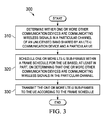
- FIGURE 3 is a simplified flow diagram 300 illustrating example operations associated with LTE-U MAC frame scheduling in a network environment according to an embodiment.
- these operations may be carried out by LTE-U eNodeB 14 via LTE-U MAC scheduler 22a configured with wireless transmitter 24a and wireless receiver 26a and/or LTE-U eNodeB 16 via LTE-U MAC scheduler 20b configured with wireless transmitter 24b and wireless receiver 26b.
- a given LTE-U MAC scheduler e.g., LTE-U MAC scheduler 22a
- processing may start at 310 where LTE-U eNodeB 14 using LTE-U MAC scheduler 22a in conjunction with wireless receiver 26a may determine whether one or more other communication devices are communicating wireless signals in a particular channel of an unlicensed band shared by an LTE-U communication device (e.g., LTE-U eNodeB 14) and UE 12a.
- the determining can include implementing, using wireless receiver 26a for LTE-U MAC scheduler 22a, physical carrier sense, virtual carrier sense and/or hidden node detection (e.g., decoding WiFi RTS and/or CTS frames communicated by one or more other communication devices).
- the physical carrier sense can include a CCA at one or more signal strength thresholds for wireless signals (e.g., frames) communicated from the one or more other communication devices.
- the virtual carrier sense can include decoding a Duration Field and NAV being transmitted by the one or more other communication devices.
- LTE-U MAC scheduler 22a can schedule one or more LTE-U sub-frames within a frame schedule for UE 12a based, at least in part, on determining that one or more other communication devices are communicating wireless signals in the particular channel.
- the LTE-U sub-frames may be downlink sub-frames for UE 12a.
- LTE-U MAC scheduler 22a can schedule the one or more LTE-U sub-frames based additionally on one or more random back-off mechanisms such as DCF and/or EDCA, which may be implemented in LTE-U eNodeB 14.
- LTE-U MAC scheduler 22a using wireless transmitter 24a, can transmit the one or more scheduled LTE-U sub-frames to UE 12a according to the frame schedule.
- FIGURE 4 is a simplified flow diagram 400 illustrating other example operations associated with LTE-U MAC frame scheduling in a network environment according to an embodiment.
- these operations may be carried out by LTE-U eNodeB 14 via LTE-U MAC scheduler 22a configured with wireless transmitter 24a and wireless receiver 26a and/or LTE-U eNodeB 16 via LTE-U MAC scheduler 20b configured with wireless transmitter 24b and wireless receiver 26b.
- a given LTE-U MAC scheduler e.g., LTE-U MAC scheduler 22a
- processing may start at 410 where LTE-U eNodeB 14 using LTE-U MAC scheduler 22a in conjunction with wireless receiver 26a may implement physical carrier sensing, virtual carrier sensing and/or hidden node detection for a particular unlicensed wireless medium (e.g., a particular wireless channel) shared by LTE-U MAC scheduler 22a and UE 12a.
- LTE-U MAC scheduler 22a may determine based, at least in part, on the carrier sensing and/or hidden node detection whether one or more other communication devices are communicating in the unlicensed wireless medium. If so, at 422 LTE-U MAC scheduler may withhold transmitting LTE-U sub-frame(s) to UE 12a and may continue to implement the carrier sensing and/or hidden node detection to determine when the wireless medium may become available.
- LTE-U MAC scheduler 22a may determine if any random back-off mechanisms are implemented, such as, for example EDCA and/or DCF. If no back-off mechanism is implemented, the LTE-U MAC scheduler may schedule one or more LTE-U sub-frames within a frame schedule for the UE based on the wireless medium availability at 440. At 450, LTE-U MAC scheduler 22a, using wireless transmitter 24a, may transmit CTS-to-self (e.g., WiFi CTS-to-self) frames with appropriate duration and NAV information for an upcoming transmission. At 460, LTE-U MAC scheduler 22a may transmit the one or more LTE-U sub-frames to the UE according to the frame schedule.
- CTS-to-self e.g., WiFi CTS-to-self
- LTE-U MAC scheduler 22a may perform a given random-back-off mechanism to withhold transmitting frames according to the back-off mechanism.
- LTE-U MAC scheduler 22a may schedule one or more LTE-U sub-frames within a frame schedule for the UE according to wireless medium availability and the one or more implemented random back-off mechanisms.
- LTE-U MAC scheduler 22a using wireless transmitter 24a, may transmit CTS-to-self (e.g., WiFi CTS-to-self) frames with appropriate duration and NAV information for an upcoming transmission, and at 460, LTE-U MAC scheduler 22a may transmit the one or more LTE-U sub-frames to the UE according to the frame schedule.
- CTS-to-self e.g., WiFi CTS-to-self
- NAV information for an upcoming transmission
- LTE-U MAC scheduler 22a may transmit the one or more LTE-U sub-frames to the UE according to the frame schedule.
- communication system 10 (and its teachings) are readily scalable and can accommodate a large number of components, as well as more complicated/sophisticated arrangements and configurations. Accordingly, the examples provided should not limit the scope or inhibit the broad teachings of communication system 10 as potentially applied to a myriad of other architectures.
Landscapes
- Engineering & Computer Science (AREA)
- Computer Networks & Wireless Communication (AREA)
- Signal Processing (AREA)
- Quality & Reliability (AREA)
- Mobile Radio Communication Systems (AREA)
Abstract
Description
- This disclosure relates in general to the field of communications and, more particularly, to a system and method for a Media Access Control (MAC) Scheduler for a Long Term Evolution Unlicensed (LTE-U) network environment.
- Networking architectures have grown increasingly complex in communication environments. Mobile communication networks have grown substantially in subscriber base as end users become increasingly connected to mobile wireless environments. As the number of mobile subscribers increases, efficient management of communication resources becomes more critical. In some instances, network service providers desire to offload certain mobile communications to unlicensed frequency bands, such as LTE-U, in order to reduce congestion in a network or in some cases to provide differentiated services to subscribers. However, there are significant challenges in managing access to LTE-U, particularly in the context of sharing the LTE-U frequency band with other wireless devices and wireless access points operating in the network.
- To provide a more complete understanding of the present disclosure and features and advantages thereof, reference is made to the following description, taken in conjunction with the accompanying figures, wherein like reference numerals represent like parts, in which:
-
FIGURE 1A is a simplified block diagram illustrating a communication system to facilitate MAC frame scheduling in an LTE-U network environment according to one embodiment of the present disclosure; -
FIGURE 1B is a simplified schematic diagram illustrating an example cross-layer frame scheduling flow in accordance with one potential embodiment of the present disclosure; -
FIGURE 2 is a simplified block diagram illustrating an LTE-U access point use case in accordance with one potential embodiment of the present disclosure; -
FIGURE 3 is simplified flow diagram illustrating example operations associated with one embodiment of the present disclosure; and -
FIGURE 4 is simplified flow diagram illustrating other example operations associated with one embodiment of the present disclosure. - Aspects of the invention are set out in the independent claims and preferred features are set out in the dependent claims. Preferred features of one aspect may be applied to other aspects and preferred features may be applied alone or in combination.. In particular, preferred features of the method may be applied to the apparatus or computer program, computer program product or computer readable tangible media aspects.
- A method for a communication network is provided in one example embodiment and may include determining, by a first communication device, whether one or more other communication devices are communicating wireless signals in a particular channel of an unlicensed band of the communication network; scheduling one or more Long Term Evolution Unlicensed (LTE-U) sub-frames within a frame schedule for a user equipment (UE) based, at least in part, on determining that one or more communication devices are communicating wireless signals in the particular channel; and communicating the one or more LTE-U sub-frames to the UE according to the frame schedule. In some cases, the frame schedule can further include one or more zero-power sub-frames. In some cases, the one or more LTE-U sub-frames can be LTE-U downlink frames for the UE.
- In some instances, the determining can include at least one of: implementing physical carrier sense by the first communication device to detect wireless signals being transmitted by one or more other communication devices; decoding, by the first communication device, Request to Send (RTS) and Clear to Send (CTS) frames being transmitted by one or more other communication devices; and implementing virtual carrier sense by the first communication device to detect wireless signals being communicated by one or more other communication devices.
- In some cases, the determining can be performed using a wireless receiver for a LTE-U Media Access Control (MAC) scheduler for the first communication device. In yet other cases, the physical carrier sense can include a Clear Channel Assessment (CCA) at one or more signal strength thresholds. In still other cases, the virtual carrier sense can include decoding a Duration Field and a Network Allocation Vector being transmitted by the one or more other communication devices.
- In still other cases, the method can include transmitting, by the first communication device, Clear to Send-to-self (CTS-to-self) frames including a Duration Field and Network Allocation Vector (NAV) based on transmit opportunity (TXOP) prior to communicating the one or more LTE-U sub-frames to the UE. In yet other cases, the method can include implementing, by the first communication device, one or more random back-off mechanisms to prohibit communicating the LTE-U sub-frames to the UE including at least one of: a distributed coordination function (DCF) back-off mechanism; and an enhanced distributed channel access (EDCA) back-off mechanism.
- In some instances, the first communication device can be at least one of: an LTE-U evolved Node B (eNodeB) including an LTE-U Media Access Control (MAC) scheduler, wherein the LTE-U eNodeB includes a wireless receiver and a wireless transmitter for the LTE-U MAC scheduler and includes an LTE MAC scheduler; and an LTE-U Access Point (AP) including an LTE-U MAC scheduler, wherein the LTE-U AP includes a wireless receiver and a wireless transmitter for the LTE-U MAC scheduler.
- Turning to
FIGURE 1A, FIGURE 1A is a simplified block diagram illustrating acommunication system 10 to facilitate LTE-U MAC frame scheduling in an LTE-U network environment in a network environment according to one embodiment of the present disclosure. This particular configuration may be tied to the 3rd Generation Partnership Project (3GPP) Evolved Packet System (EPS) architecture, also sometimes referred to as the Long Term Evolution (LTE) EPS architecture. Alternatively, the depicted architecture may be applicable to other environments equally. - The example architecture of
FIGURE 1A may include user equipment (UE) 12a-12d, a3GPP access network 30 including LTE Unlicensed (LTE-U) evolved Node B (eNodeBs) 14, 16, a trusted non-3GPP Internet protocol (IP)access network 32 and an untrusted non-3GPPIP access network 34, each respectively including a wirelessradio access point 3GPP core network 40. Note as referred to herein in this Specification, the term 'unlicensed' is used to refer to unlicensed communication frequency bands or spectrums that can be used for communication technologies such as WiFi, Bluetooth™, WiMAX, etc. LTE-U eNodeBs 14, 16 may each include a respective LTE Media Access Control (MAC)Scheduler 20a-20b, an LTE-U MAC scheduler 22a-22b, aprocessor 46a-46b and amemory element 48a-48b. LTE-U MAC scheduler 22a within LTE-U eNodeB 14 may additionally be configured to interface with awireless transmitter 24a and awireless receiver 26a. LTE-U MAC scheduler 22b may be configured to interface with awireless transmitter 24b and awireless receiver 26b. - Each of the elements of
FIGURE 1A may couple to one another through simple interfaces (as illustrated) or through any other suitable connection (wired or wireless), which provides a viable pathway for network communications. Additionally, any one or more of these elements may be combined or removed from the architecture based on particular configuration needs. For example,communication system 10 may include a configuration capable of transmission control protocol/Internet protocol (TCP/IP) communications for the transmission or reception of packets in a network.Communication system 10 may also operate in conjunction with a user datagram protocol/IP (UDP/IP) or any other suitable protocol where appropriate and based on particular needs. - In various embodiments,
3GPP access network 30 may include access networks such as a GSM EDGE radio access network (GERAN), a UMTS terrestrial radio access network (UTRAN), generally referred to as 3G, and/or a LTE access network such as evolved UTRAN (E-UTRAN), generally referred to as 4G or LTE/LTE-Advanced (LTE-A). The GERAN and UTRAN may interface with3GPP core network 40 via one of more network elements such as, for example, one or more Node Bs (NodeBs), one or more Radio Network Controllers (RNCs), one or more Serving General Packet Radio Service (GPRS) Support Nodes (SGSNs) and one or more Gateway GPRS support nodes (GGSNs). These network elements are not shown in order to illustrate other features ofcommunication system 10. LTE-U eNodeBs 14, 16 may be used to provide E-UTRAN coverage for3GPP access network 30 and may interface with3GPP core network 40 using, for example, one or more Mobility Management Entities (MMEs), one or more serving gateways (SGWs), one or more Packet Data Network (PDN) gateways (PGWs), etc. These network elements are also not shown in order to illustrate other features ofcommunication system 10. - 3GPP
core network 40 may include other elements such as one or more Policy and Charging Rules Functions (PCRFs), one or more Authentication, Authorization and Accounting (AAA) elements, a Home Subscriber Server/Home Location Register (HSS/HLR), etc. to provide connectivity for UE 12a-12d to external PDNs, such as the Internet, to implement QoS on packet flows, to provide enhanced services to UE 12a-12d, stateful firewalls, Traffic Performance Optimization, etc. These elements are also not shown in order to illustrate other features ofcommunication system 10. - LTE-U eNodeBs 14, 16 can offer suitable connectivity to one or more UE (e.g., UE 12a-12b) using any appropriate protocol or technique. For example, in addition to providing E-UTRAN coverage, LTE-U eNodeB 14 may also allow UEs (e.g., UE 12a) to connect to a wired network using
wireless transmitter 24a andwireless receiver 26a configured for LTE-U MAC scheduler 22a. Similarly, LTE-U eNodeB 16 may also allow UEs (e.g., UE 12b to connect to a wired network usingwireless transmitter 24b andwireless receiver 26b configured for LTE-U MAC scheduler 22b. Thus, LTE-U eNodeBs 14, 16 may offer wireless connectivity to one or more UEs using one or more wireless technologies such as WiFi, Bluetooth™, WiMAX, etc. and may offer cellular connectivity to one or more UEs using 4G/LTE/LTE-A, or any other appropriate standard. Notewireless transmitter 24a andwireless receiver 26a may be configured as included within LTE-U MAC scheduler 22a for LTE-U eNodeB 14 (as shown inFIGURE 1A ) or may be configured within LTE-U eNodeB 14 external to LTE-U MAC scheduler 22a and may interface with LTE-U MAC scheduler 22b. Similarly,wireless transmitter 24b andwireless receiver 26b may be configured as included within LTE-U MAC scheduler 22b for LTE-U eNodeB 16 (as shown inFIGURE 1A ) or may be configured within LTE-U eNodeB 14 external to LTE-U MAC scheduler 22a and may interface with LTE-U MAC scheduler 22b. - Non-3GPP IP access networks can be included in
communication system 10 and can divided into trusted and untrusted segments such as trusted non-3GPPIP access network 32 and untrusted non-3GPPIP access network 34, respectively. Note trusted non-3GPPIP access network 32 may be interchangeably referred to herein in this Specification as a 'trusted IP access network' and untrusted non-3GPPIP access network 34 may be interchangeably referred to herein in this Specification as an 'untrusted IP access network'. - As shown in
FIGURE 1A , trustedIP access network 32 and untrustedIP access network 34 may each respectively include a wirelessradio access point radio access point 42 may be in communication with UE 12c, to provide PDN connectivity for UE 12c to a PDN, such as the Internet. Wirelessradio access point 44 may be in communication with UE 12d, to provide PDN connectivity for UE 12d to a PDN such as the Internet. Note the term 'wireless radio access point' may be referred to interchangeably in this Specification as 'wireless access points' (WAPs). In general, trusted IP access networks support mobility, policy and AAA interfaces to the EPC, whereas untrusted IP access networks do not. For trustedIP access network 32, a viable relationship can exist between a service provider and elements of the 3GPP core network. In contrast, access from untrusted access network 62 is managed via an evolved packet data gateway (ePDG) (not shown) to interface with the 3GPP core network. - Note trusted
IP access network 32 includingWAP 42 and untrustedIP access network 34 first including WAP 44 are provided inFIGURE 1A for illustrative purposes only in order to illustrate certain features related to MAC frame scheduling as provided by various embodiments ofcommunication system 10. It should be understood that any combination of non-3GPP trusted and/or untrusted IP access networks, WAPS, etc. as well as 3GPP access networks can be configured incommunication system 10 and are clearly within the scope of the present disclosure. Additionally, it should be understood that 3GPP access networks and trusted/untrusted IP access networks can be partially or fully overlapping access networks (e.g.,3GPP access network 30, trusted non-3GPPIP access network 32 and/or untrusted non-3GPPIP access network 34 can have full or partial overlapping coverage areas). - Before detailing some of the operational aspects of
FIGURE 1A , it is important to understand common characteristics of LTE-U as generally operated in commercial architectures. The following foundation is offered earnestly for teaching purposes only and, therefore should not be construed in any way to limit the broad teachings of the present disclosure. The LTE-vendor community has proposed extending LTE into unlicensed spectrums with the technology referred to as LTE- U. In its first discussion, the proponents of the technology have suggested using an LTE MAC scheduler 'as-is' and applying it to unlicensed spectrum operations in countries where regulations would allow such behavior (such as the United States). However, there is a concern that using an existing LTE MAC scheduler within an LTE-U communication device (e.g., an LTE-U eNodeB or LTE-U AP) cannot be used for unlicensed communications 'as-is' because such a MAC may simply 'swamp-out' or overrun other wireless (e.g., WiFi) communication devices such as wireless access points or other neighboring LTE-U communication devices operating within a coverage area of a particular LTE-U communication device. Thus, there is consensus that LTE-U may include a modified MAC, which can account for co-existence and fair usage with other unlicensed technology communication devices such as WiFi, Bluetooth™, WiMAX, etc. - Key requirements for such a modified MAC for LTE-U can include the ability to meet regulatory requirements such as Listen-Before-Talk (LBT) and/or radar detection in certain frequency bands as well as ensuring fair usage of an unlicensed spectrum with other LTE-U users as well as other unlicensed technology users such as WiFi, Bluetooth™, WiMAX, etc.
- In accordance with one embodiment,
communication system 10 can overcome the aforementioned shortcomings (and others) by providing an LTE-U MAC scheduler for LTE-U supplemental downlink (SDL) frames. A given LTE-U MAC scheduler may rely on having a wireless receiver/transmitter (e.g., LTE-U eNodeB 14 including LTE-U MAC scheduler 22a havingwireless transmitter 24a andwireless receiver 26a) to perform physical carrier sensing, virtual carrier sensing and/or hidden node detection in order to avoid collisions with other wireless communication devices (e.g., LTE-U eNodeB 16,WAPs communication system 10. For example, a given wireless receiver (e.g.,wireless receiver 26a) can decode wireless (e.g., WiFi) headers, which can enable the receiver to go beyond carrier sensing at -62 dBm and may allow for decoding packets at -82 dBm at least, and likely up to -88 dBm. This, in turn, can enable an LTE-U communication device to prevent collisions with distant wireless transmitters, which may be sensed at signal levels below -62 dBm but above the wireless receiver sensitivity. Thus, the wireless receiver for an LTE-U communication device (e.g., LTE-U eNodeB 14) may be used to implement a form of multi-technology hidden node detection. - In various embodiments, the LTE-U MAC scheduler may also implement random back-off mechanisms such as distributed coordination function (DCF) back-off mechanisms and/or enhanced distributed channel access (EDCA) back-off mechanisms in order to share a given wireless channel fairly. In various embodiments, the LTE-U MAC scheduler can also implement wireless (e.g., WiFi) Clear to Send (CTS) or CTS-to-self frames prior to any LTE-U transmission to reduce chances of collision with other wireless communication devices operating in the unlicensed spectrum of
communication system 10. By incorporating key aspects of wireless scheduling into the LTE-MAC scheduler, solutions provided bycommunication system 10 can ensure that LTE-U MAC scheduling can be implemented fairly and can co-exist with other unlicensed technologies such as WiFi, which uses similar CTS or CTS-to-self frames. Similar approaches can be used by potentially adopting similar frames in Bluetooth™, WiMAX, etc. - Having a wireless receiver in an LTE-U communication device can also enable detecting wireless access points and their corresponding bandwidths (e.g., 20/40/80/160 MHz) and may allow the LTE-U communication device to detect primary and secondary channels of 802.11ac APs. This, in turn, can help the LTE-U communication device to transmit in secondary channels over primary channels, which can improve the coexistence of 802.11ac APs and LTE-U communication devices if they share only secondary channels for communications with UEs rather than sharing a primary channel.
- As shown in
FIGURE 1A , the frame schedule for downlink (DL) frames forUE 12a may be sent over LTE in a control channel usingLTE MAC scheduler 20a. In LTE-U (with supplemental downlink (SDL)), all uplink frames may also sent over LTE in the control channel usingLTE MAC scheduler 20a. LTE-U downlink sub-frames may be sent over LTE-U using LTE-U MAC scheduler 22a viawireless transmitter 24a. For theUE 12a frame schedule, it is assumed that the LTE-U frame and sub-frame structure may include Zero-Power sub-frames (ZPSF) and that the primary synchronization signal (PSS) and secondary synchronization signal (SSS) can be less frequent than in LTE. For example, with LTE, PSS and SSS are expected twice every frame. However, for LTE-U, it is assumed that synchronization can be sent less frequently. In various embodiments, this may include sending synchronization signals (e.g., PSS and SSS) sent every 100 msec (e.g., the typical frequency of WiFi beacons). This may allow LTE-U eNodeB 14 to be completely silent (e.g., zero power) for relatively long periods of time. Note that LTE defines almost blank sub-frames (ABSF), which are not zero power as they contain cell-specific reference signals (CRS). Thus, it is further assumed that CRS may not be sent for LTE-U. - To illustrate features of
communication system 10, considerFIGURE 1B , which is a simplified schematic diagram 100 illustrating example cross-layer frame scheduling, which can be provided by LTE-U MAC scheduler 22a for times 'To' thru 'T10' in accordance with one potential embodiment of the present disclosure, for a particular communication channel that may be used for communicating frames from LTE-U eNodeB 14 toUE 12a. As shown inFIGURE 1B , the communication channel may be shared by LTE-U eNodeB 14 and one or more other communication devices (e.g.,WAPs communication system 10. Times T0-T10 are shown inFIGURE 1B for illustrative purposes only and are not meant to limit the scope of the present disclosure. Note references may be made to LTE-U MAC scheduler 22a alone (as shown inFIGURE 1A ) for illustrating certain solutions provided bycommunication system 10, however, it should be understood that solutions and/or features described with regard to LTE-U MAC scheduler 22a can apply equally to any LTE-U MAC scheduler as described herein in this Specification such as LTE-U MAC scheduler 22b shown inFIGURE 1A and/or LTE-U MAC scheduler 22c shown inFIGURE 2 , discussed in further detail below. - As illustrated in
FIGURE 1B , the frame schedule for LTE-U eNodeB 14 may include ZPSFs and LTE-U sub-frames for downlink frames forUE 12a. Also shown inFIGURE 1B are wireless frames for other wireless communication devices, such as wirelessradio access points U eNodeB 16. - During operation, for example, LTE-
U MAC scheduler 22a, usingwireless receiver 26a, can implement physical carrier sense for one or more other wireless communication devices/nodes in the system. Implementing physical carrier sense can include implementing Clear Channel Assessment (CCA) for one or more signal thresholds (e.g., to detect wireless preambles) and withholding LTE-U transmissions toUE 12a for signal strengths greater than a corresponding threshold. In various embodiments, the thresholds can include -62 dBm for detecting non WiFi signals down to -82 dBm for 20MHz bandwidth WiFi. Equivalent thresholds can be set for alternative bandwidths as determined by a service provider or system operator. For example, as shown inFIGURE 1B , LTE-U MAC scheduler 22a can withhold transmissions of LTE-U sub-frames between times T1-T2 and/or between times T7-T8 using physical carrier sense implemented viawireless receiver 26a, which may detect wireless frames from other wireless communication devices. - Upon determining that the channel is unoccupied, LTE-
U MAC scheduler 22a, usingwireless transmitter 24a, may transmit downlink frames (e.g., LTE-U sub-frames) toUE 12a, for example, at times T3, T5 and T9. - As noted, LTE-
U MAC scheduler 22a, usingwireless receiver 26a, can also implement mechanisms to detect hidden nodes, which may help ensure that LTE-U eNodeB 14 can prevent wireless collisions in cases where a transmitter or receiver of another wireless communication device can be detected but not both. In various embodiments, mechanisms to detect hidden nodes can include decoding WiFi Request to Send (RTS) and CTS frames transmitted by other wireless communication devices incommunication system 10. For example, LTE-U MAC scheduler 22a may detect WiFi RTS and/or CTS frames between times T0-T1 and/or between times T6-T7 in order to withhold transmitting LTE-U sub-frames toUE 12a, which may prevent collisions between hidden wireless nodes in the system (e.g., other LTE-U wireless communication devices and/or wireless APs, which may be present in the system). - LTE-
U MAC scheduler 22a, usingwireless receiver 26a, can also implement virtual carrier sense, which can be used to decode a Duration Field and network allocation vector (NAV) transmitted by one or more other wireless communication devices incommunication system 10. Duration Field and NAV is typically used by wireless stations to reserve the medium (e.g., channel) for mandatory frames, which must follow a current frame. Thus, using virtual carrier sense prior to transmission may provide another mechanism for LTE-U MAC scheduler 22a to prevent collisions with other wireless communication devices incommunication system 10. All WiFi frames can have Duration and NAV fields in the header of frames, and upon detection of any WiFi frame such as RTS, CTS, CTS-to-self or data frame, these fields can be retrieved from the MAC header. - In various embodiments, LTE-
U MAC scheduler 22a can also enable other wireless receivers incommunication system 10 to sense LTE transmissions (e.g., at lower sensitivity levels) by transmitting WiFi CTS-to-self frames with appropriate duration and NAV fields, based on transmit opportunity (TXOP), to help reduce channel collisions between LTE-U eNodeB 14 and other WiFi devices. - In various embodiments, LTE-
U MAC scheduler 22a can also implement a random back-off mechanism, such as Distributed Coordination Function (DCF) and/or Enhanced Distributed Channel Access (EDCA), to ensure that it is sharing the medium (e.g., channel) fairly with other wireless users and other LTE-U eNodeBs. It is noteworthy that the issue of fairness is important even when there are only LTE-U eNodeBs sharing an unlicensed band. A back-off mechanism can ensure that several unlicensed users can share the channel fairly. Since LTE-U downlink frames typically carry several traffic streams to several LTE-U clients, the back-off mechanism may not address access category priority but instead may addresses channel access fairness between LTE-U eNodeBs and/or between LTE-U eNodeBs and other wireless (e.g., WiFi, Bluetooth™, WiMAX, etc.) devices. - Accordingly, LTE-
U MAC scheduler 22a can perform physical carrier sensing, virtual carrier sensing and/or hidden node detection prior to transmission. Assuming that a medium is available (and, in certain embodiments, depending on a DCF and/or EDCA schedule), LTE-U MAC scheduler 22a usingwireless transmitter 24a can notify other wireless receivers of an upcoming transmission and duration of the upcoming transmission. - The solution provided by
communication system 10 may provide several advantages over using an unmodified LTE MAC scheduler for LTE-U transmissions. For example, implementing carrier sense and/or hidden node detection can reduce possible collisions between LTE-U transmissions and other wireless communication devices. Sending Quiet Frame information such as Duration Field and NAV (e.g., based on TXOP) can also be used to reduce channel collisions. Further, TXOP can also provide for implementing LTE Time Division Duplexing (LTE-TDD) by reserving sub-frames for uplink transmissions. Additionally, implementing back-off mechanisms based on communication environment feedback may be used to ensure multiple eNodeBs can co-exist under heavy loads since traditional Inter-cell Interference Coordination (ICIC) methods are unlikely to work in a multi-service provider environment. - Returning to
FIGURE 1A , in various embodiments,UE 12a-12d can be associated with users, employees, clients, customers, etc. wishing to initiate a flow incommunication system 10 via some network. The terms 'user equipment', 'mobile node', 'end user', 'user', and 'subscriber' are inclusive of devices used to initiate a communication, such as a computer, a personal digital assistant (PDA), a laptop or electronic notebook, a cellular telephone, an i-Phone™, i-Pad™, a Google Droid™ phone, an IP phone, or any other device, component, element, or object capable of initiating voice, audio, video, media, or data exchanges withincommunication system 10.UE 12a-12d may also be inclusive of a suitable interface to a human user such as a microphone, a display, a keyboard, or other terminal equipment. -
UE 12a-12d may also be any device that seeks to initiate a communication on behalf of another entity or element such as a program, a database, or any other component, device, element, or object capable of initiating an exchange withincommunication system 10. Data, as used herein in this document, refers to any type of numeric, voice, video, media, or script data, or any type of source or object code, or any other suitable information in any appropriate format that may be communicated from one point to another. In certain embodiments,UE 12a-12d may have a bundled subscription for network access and application services (e.g., voice), etc. Once the access session is established, the user can register for application services as well, without additional authentication requirements. There can be two different user data repositories (e.g., AAA databases, whitelist databases, etc.): one for the access user profile and one for the application user profile. IP addresses can be assigned using dynamic host configuration protocol (DHCP), Stateless Address Auto-configuration, default bearer activation, etc., or any suitable variation thereof. - Wireless
radio access points radio access points - As shown in
FIGURE 1A , LTE-U eNodeBs respective processor 46a-46b and arespective memory element 48a-4ab. Additionally, LTE-U eNodeB 14 can further includeLTE MAC scheduler 20a and LTE-U MAC scheduler 22a, which can be configured withwireless transmitter 24a andwireless receiver 26a. LTE-U eNodeB 16 can further include LTE-U MAC scheduler 20b and LTE-U MAC scheduler 22b, which can be configured withwireless transmitter 24b andwireless receiver 26b. Hence, appropriate software and/or hardware is being provisioned in LTE-U eNodeBs - In one example implementation, LTE-
U eNodeBs FIGURE 1A and inFIGURE 2 , described in further detail below). In other embodiments, these operations and/or features may be provided external to these elements, or included in some other network device to achieve this intended functionality. Alternatively, one or more of these elements can include software (or reciprocating software) that can coordinate in order to achieve the operations and/or features, as outlined herein. In still other embodiments, one or more of these devices may include any suitable algorithms, hardware, software, components, modules, interfaces, or objects that facilitate the operations thereof. This may be inclusive of appropriate algorithms and communication protocols that allow for the effective exchange of data or information. - In regards to the internal structure associated with
communication system 10, each of LTE-U eNodeB U eNodeBs - Note that in certain example implementations, the LTE-U MAC frame scheduling functions as outlined herein may be implemented by logic encoded in one or more tangible media, which may be inclusive of non-transitory media (e.g., embedded logic provided in an ASIC, in DSP instructions, software [potentially inclusive of object code and source code] to be executed by a processor, or other similar machine, etc.). In some of these instances, memory elements [as shown in
FIGURE 1A and inFIGURE 2 , described in further detail below] can store data used for the operations described herein. This includes the memory elements being able to store software, logic, code, or processor instructions that are executed to carry out the activities described herein. A processor can execute any type of instructions associated with the data to achieve the operations detailed herein. In one example, the processors [as shown inFIGURE 1A and inFIGURE 2 , described in further detail below] could transform an element or an article (e.g., data) from one state or thing to another state or thing. In another example, the activities outlined herein may be implemented with fixed logic or programmable logic (e.g., software/computer instructions executed by a processor) and the elements identified herein could be some type of a programmable processor, programmable digital logic (e.g., a field programmable gate array (FPGA), a digital signal processor (DSP), an EPROM, EEPROM) or an ASIC that includes digital logic, software, code, electronic instructions, or any suitable combination thereof. - Referring to
FIGURE 2, FIGURE 2 is a simplified block diagram is a simplified block diagram illustrating an LTE-U access point use case 200 in accordance with one potential embodiment ofcommunication system 10.FIGURE 2 includes3GPP access network 30, which may include anLTE eNodeB 80 and an LTE-U access point (AP) 82.LTE eNodeB 80 may include anLTE MAC scheduler 20c, aprocessor 46c and amemory element 48c. LTE-U AP 82 may include LTE-U MAC scheduler 22c, which may be configured with awireless transmitter 24c and awireless receiver 26c. LTE-U AP 82 may also include aprocessor 46d and amemory element 48d. Also shown inFIGURE 2 are trusted non-3GPPIP access network 32 including wirelessradio access point 42 in communication withUE 12c and untrusted non-3GPPIP access network 34 including wirelessradio access point 44 in communication withUE 12d. Additionally shown inFIGURE 2 is3GPP core network 40, which may interface withLTE eNodeB 80, LTE-U access point 82, the UTRAN, GERAN and trusted/untrustedIP access networks - The network elements shown in
FIGURE 2 may be largely similar to those shown inFIGURE 1A , except thatFIGURE 2 illustrates that an LTE-U AP including an LTE-U MAC scheduler may be provided external to an LTE eNodeB. Thus, LTE-U sub-frames forUE 12a may be communicated from LTE-U AP 82 using LTE-U MAC scheduler 22c viawireless transmitter 24c. Scheduling the sub-frames may be performed using one or more mechanisms, as discussed above, such as physical carrier sense, virtual carrier sense and/or hidden node detection usingwireless receiver 26c to reduce possible collisions prior to transmissions from LTE-U AP 82 viawireless transmitter 24c toUE 12a. Additionally, scheduling the sub-frames can be performed according to one or more random back-off mechanisms to reduce collisions and, usingwireless transmitter 24c, LTE-U MAC scheduler 22c can notify one or more other wireless receivers of an upcoming transmission and duration of the upcoming transmission. - Thus, LTE-
U AP 82 can perform similar functions as combined LTE-U eNodeB 14 for scheduling the transmission of LTE-U sub-frames, but as a stand-alone AP. Uplink frames forUE 12a may still be communicated toUE 12a usingLTE MAC scheduler 20c. Further appropriate software and/or hardware can be provisioned in LTE-U AP 80 in order to facilitate LTE-U MAC frame scheduling in the network environment. - Referring to
FIGURE 3, FIGURE 3 is a simplified flow diagram 300 illustrating example operations associated with LTE-U MAC frame scheduling in a network environment according to an embodiment. In one particular embodiment, these operations may be carried out by LTE-U eNodeB 14 via LTE-U MAC scheduler 22a configured withwireless transmitter 24a andwireless receiver 26a and/or LTE-U eNodeB 16 via LTE-U MAC scheduler 20b configured withwireless transmitter 24b andwireless receiver 26b. At any time, a given LTE-U MAC scheduler (e.g., LTE-U MAC scheduler 22a) may be used to communicate one or more LTE-U sub-frames to a given UE (e.g.,UE 12a). - Thus, processing may start at 310 where LTE-
U eNodeB 14 using LTE-U MAC scheduler 22a in conjunction withwireless receiver 26a may determine whether one or more other communication devices are communicating wireless signals in a particular channel of an unlicensed band shared by an LTE-U communication device (e.g., LTE-U eNodeB 14) andUE 12a. In various embodiments, the determining can include implementing, usingwireless receiver 26a for LTE-U MAC scheduler 22a, physical carrier sense, virtual carrier sense and/or hidden node detection (e.g., decoding WiFi RTS and/or CTS frames communicated by one or more other communication devices). In various embodiments, the physical carrier sense can include a CCA at one or more signal strength thresholds for wireless signals (e.g., frames) communicated from the one or more other communication devices. In various embodiments, the virtual carrier sense can include decoding a Duration Field and NAV being transmitted by the one or more other communication devices. - At 320, LTE-
U MAC scheduler 22a can schedule one or more LTE-U sub-frames within a frame schedule forUE 12a based, at least in part, on determining that one or more other communication devices are communicating wireless signals in the particular channel. In various embodiments, the LTE-U sub-frames may be downlink sub-frames forUE 12a. In various embodiments, LTE-U MAC scheduler 22a can schedule the one or more LTE-U sub-frames based additionally on one or more random back-off mechanisms such as DCF and/or EDCA, which may be implemented in LTE-U eNodeB 14. At 330, LTE-U MAC scheduler 22a, usingwireless transmitter 24a, can transmit the one or more scheduled LTE-U sub-frames toUE 12a according to the frame schedule. - Referring to
FIGURE 4, FIGURE 4 is a simplified flow diagram 400 illustrating other example operations associated with LTE-U MAC frame scheduling in a network environment according to an embodiment. In one particular embodiment, these operations may be carried out by LTE-U eNodeB 14 via LTE-U MAC scheduler 22a configured withwireless transmitter 24a andwireless receiver 26a and/or LTE-U eNodeB 16 via LTE-U MAC scheduler 20b configured withwireless transmitter 24b andwireless receiver 26b. At any time, a given LTE-U MAC scheduler (e.g., LTE-U MAC scheduler 22a) may be used to communicate one or more LTE-U sub-frames to a given UE (e.g.,UE 12a). - Thus, processing may start at 410 where LTE-
U eNodeB 14 using LTE-U MAC scheduler 22a in conjunction withwireless receiver 26a may implement physical carrier sensing, virtual carrier sensing and/or hidden node detection for a particular unlicensed wireless medium (e.g., a particular wireless channel) shared by LTE-U MAC scheduler 22a andUE 12a. At 420, LTE-U MAC scheduler 22a may determine based, at least in part, on the carrier sensing and/or hidden node detection whether one or more other communication devices are communicating in the unlicensed wireless medium. If so, at 422 LTE-U MAC scheduler may withhold transmitting LTE-U sub-frame(s) toUE 12a and may continue to implement the carrier sensing and/or hidden node detection to determine when the wireless medium may become available. - If no other communication devices are determined to be communicating in the wireless medium (e.g., the medium is available for communications), then at 430 LTE-
U MAC scheduler 22a may determine if any random back-off mechanisms are implemented, such as, for example EDCA and/or DCF. If no back-off mechanism is implemented, the LTE-U MAC scheduler may schedule one or more LTE-U sub-frames within a frame schedule for the UE based on the wireless medium availability at 440. At 450, LTE-U MAC scheduler 22a, usingwireless transmitter 24a, may transmit CTS-to-self (e.g., WiFi CTS-to-self) frames with appropriate duration and NAV information for an upcoming transmission. At 460, LTE-U MAC scheduler 22a may transmit the one or more LTE-U sub-frames to the UE according to the frame schedule. - Returning to 430, if one or more random back-off mechanisms are implemented, at 432, LTE-
U MAC scheduler 22a may perform a given random-back-off mechanism to withhold transmitting frames according to the back-off mechanism. At 434, LTE-U MAC scheduler 22a may schedule one or more LTE-U sub-frames within a frame schedule for the UE according to wireless medium availability and the one or more implemented random back-off mechanisms. At 450, LTE-U MAC scheduler 22a, usingwireless transmitter 24a, may transmit CTS-to-self (e.g., WiFi CTS-to-self) frames with appropriate duration and NAV information for an upcoming transmission, and at 460, LTE-U MAC scheduler 22a may transmit the one or more LTE-U sub-frames to the UE according to the frame schedule. - Note that with the examples provided above, as well as numerous other examples provided herein, interaction may be described in terms of one, two, three, or four network elements. However, this has been done for purposes of clarity and example only. In certain cases, it may be easier to describe one or more of the functionalities of a given set of flows by only referencing a limited number of network elements. It should be appreciated that communication system 10 (and its teachings) are readily scalable and can accommodate a large number of components, as well as more complicated/sophisticated arrangements and configurations. Accordingly, the examples provided should not limit the scope or inhibit the broad teachings of
communication system 10 as potentially applied to a myriad of other architectures. - It is also important to note that the steps in the appended diagrams illustrate only some of the possible signaling scenarios and patterns that may be executed by, or within,
communication system 10. Some of these steps may be deleted or removed where appropriate, or these steps may be modified or changed considerably without departing from the scope of teachings provided herein. In addition, a number of these operations have been described as being executed concurrently with, or in parallel to, one or more additional operations. However, the timing of these operations may be altered considerably. The preceding flows and activities have been offered for purposes of example and discussion. Substantial flexibility is provided bycommunication system 10 in that any suitable arrangements, chronologies, configurations, and timing mechanisms may be provided without departing from the teachings provided herein. - Numerous other changes, substitutions, variations, alterations, and modifications may be ascertained to one skilled in the art and it is intended that the present disclosure encompass all such changes, substitutions, variations, alterations, and modifications as falling within the scope of the appended claims. The Applicant: does not intend, by any statement in the specification, to limit this disclosure in any way that is not otherwise reflected in the appended claims.
Claims (15)
- A method for a communication network comprising:determining, by a first communication device, whether one or more other communication devices are communicating wireless signals in a particular channel of an unlicensed band of the communication network;scheduling one or more Long Term Evolution Unlicensed (LTE-U) sub-frames within a frame schedule for a user equipment (UE) based, at least in part, on determining that one or more communication devices are communicating wireless signals in the particular channel; andcommunicating the one or more LTE-U sub-frames to the UE according to the frame schedule.
- The method of Claim 1, wherein the frame schedule further includes one or more zero-power sub-frames.
- The method of Claim 1 or 2, wherein the one or more LTE-U sub-frames are LTE-U downlink frames for the UE.
- The method of any preceding claim, wherein the determining includes at least one of:implementing physical carrier sense by the first communication device to detect wireless signals being transmitted by one or more other communication devices;decoding, by the first communication device, Request to Send (RTS) and Clear to Send (CTS) frames being transmitted by one or more other communication devices; andimplementing virtual carrier sense by the first communication device to detect wireless signals being communicated by one or more other communication devices.
- The method of Claim 4, wherein the determining is performed using a wireless receiver for a LTE-U Media Access Control (MAC) scheduler for the first communication device.
- The method of Claim 4 or Claim 5, wherein the physical carrier sense includes a Clear Channel Assessment (CCA) at one or more signal strength thresholds.
- The method of any of Claims 4 to 6, wherein the virtual carrier sense includes decoding a Duration Field and a Network Allocation Vector being transmitted by the one or more other communication devices.
- The method of any preceding claim, wherein the first communication device is at least one of:an LTE-U evolved Node B (eNodeB) including an LTE-U Media Access Control (MAC) scheduler, wherein the LTE-U eNodeB includes a wireless receiver and a wireless transmitter for the LTE-U MAC scheduler and includes an LTE MAC scheduler; andan LTE-U Access Point (AP) including an LTE-U MAC scheduler, wherein the LTE-U AP includes a wireless receiver and a wireless transmitter for the LTE-U MAC scheduler.
- The method of any preceding claim, further comprising:transmitting, by the first communication device, Clear to Send-to-self (CTS-to-self) frames including a Duration Field and Network Allocation Vector (NAV) based on transmit opportunity (TXOP) prior to communicating the one or more LTE-U sub-frames to the UE.
- The method of any preceding claim, further comprising:implementing, by the first communication device, one or more random back-off mechanisms to prohibit communicating the one or more LTE-U sub-frames to the UE including at least one of:a distributed coordination function (DCF) back-off mechanism; andan enhanced distributed channel access (EDCA) back-off mechanism.
- One or more non-transitory tangible media, a computer program or a computer program product encoding logic that includes instructions for execution that, when executed by a processor, is operable to perform operations comprising:determining, by a first communication device, whether one or more other communication devices are communicating wireless signals in a particular channel of an unlicensed band of a communication network;scheduling one or more Long Term Evolution Unlicensed (LTE-U) sub-frames within a frame schedule for a user equipment (UE) based, at least in part, on determining that one or more communication devices are communicating wireless signals in the particular channel; andcommunicating the one or more LTE-U sub-frames to the UE according to the frame schedule.
- The media, computer program or computer program product of Claim 11, further encoding logic that includes instructions for execution that when implemented by a processor, are operable to implement any of Claims 2 to 10.
- An apparatus, comprising:a Long Term Evolution Unlicensed (LTE-U) Media Access Control (MAC) scheduler;a memory element for storing data; anda processor that executes instructions associated with the data, wherein the processor and memory element cooperate such that the apparatus is configured for:determining, by a first communication device, whether one or more other communication devices are communicating wireless signals in a particular channel of an unlicensed band of a communication network;scheduling one or more LTE-U sub-frames within a frame schedule for a user equipment (UE) based, at least in part, on determining that one or more communication devices are communicating wireless signals in the particular channel; andcommunicating the one or more LTE-U sub-frames to the UE according to the frame schedule.
- The apparatus of Claim 13, wherein the determining includes at least one of:implementing physical carrier sense by the first communication device to detect wireless signals being transmitted by one or more other communication devices;decoding, by the first communication device, Request to Send (RTS) and Clear to Send (CTS) frames being transmitted by one or more other communication devices; andimplementing virtual carrier sense by the first communication device to detect wireless signals being communicated by one or more other communication devices.
- The apparatus of Claim 13 or 14, wherein the first communication devices is at least one of:an LTE-U evolved Node B (eNodeB) including the LTE-U MAC scheduler, wherein the LTE-U eNodeB includes a wireless receiver and a wireless transmitter for the LTE-U MAC scheduler and includes an LTE MAC scheduler; andan LTE-U Access Point (AP) including the LTE-U MAC scheduler, wherein the LTE-U AP includes a wireless receiver and a wireless transmitter for the LTE-U MAC scheduler.
Applications Claiming Priority (1)
| Application Number | Priority Date | Filing Date | Title |
|---|---|---|---|
| US14/450,040 US9516640B2 (en) | 2014-08-01 | 2014-08-01 | System and method for a media access control scheduler for a long term evolution unlicensed network environment |
Publications (2)
| Publication Number | Publication Date |
|---|---|
| EP2981119A1 true EP2981119A1 (en) | 2016-02-03 |
| EP2981119B1 EP2981119B1 (en) | 2021-02-17 |
Family
ID=53785487
Family Applications (1)
| Application Number | Title | Priority Date | Filing Date |
|---|---|---|---|
| EP15178914.6A Active EP2981119B1 (en) | 2014-08-01 | 2015-07-29 | System and method for a media access control scheduler for a long term evolution unlicensed network environment |
Country Status (3)
| Country | Link |
|---|---|
| US (1) | US9516640B2 (en) |
| EP (1) | EP2981119B1 (en) |
| CN (1) | CN105307279B (en) |
Cited By (13)
| Publication number | Priority date | Publication date | Assignee | Title |
|---|---|---|---|---|
| US9414310B2 (en) | 2013-11-27 | 2016-08-09 | Cisco Technology, Inc. | System and method for small cell power control in an enterprise network environment |
| US9621362B2 (en) | 2015-02-03 | 2017-04-11 | Cisco Technology, Inc. | System and method for providing policy charging and rules function discovery in a network environment |
| US9629042B2 (en) | 2014-12-05 | 2017-04-18 | Cisco Technology, Inc. | System and method for providing collaborative neighbor management in a network environment |
| US9686798B1 (en) | 2015-01-14 | 2017-06-20 | Cisco Technology, Inc. | System and method for providing collision-avoided physical downlink control channel resource allocation in a network environment |
| US9693205B2 (en) | 2014-07-03 | 2017-06-27 | Cisco Technology, Inc. | System and method for providing message delivery and paging to a group of users in a network environment |
| US9699601B2 (en) | 2015-04-06 | 2017-07-04 | Cisco Technology, Inc. | System and method for managing interference in a network environment based on user presence |
| US9717068B2 (en) | 2014-09-09 | 2017-07-25 | Cisco Technology, Inc. | System and method for supporting cell updates within a small cell cluster for idle mobility in cell paging channel mode |
| CN107094046A (en) * | 2017-05-24 | 2017-08-25 | 熊猫电子集团有限公司 | A kind of satellite communication method of the suppression network of slave station triggering |
| US9801127B2 (en) | 2016-02-23 | 2017-10-24 | Cisco Technology, Inc. | System and method to provide power management for a multimode access point in a network environment |
| US9843687B2 (en) | 2014-11-09 | 2017-12-12 | Cisco Technology, Inc. | System and method for radio aware traffic management based wireless authorization |
| CN109479212A (en) * | 2016-07-15 | 2019-03-15 | 阿尔卡特朗讯 | Manage media access for access points and associated devices in a wireless network |
| US10462699B2 (en) | 2014-09-08 | 2019-10-29 | Cisco Technology, Inc. | System and method for internet protocol version-based multiple access point name support in a network environment |
| CN112260987A (en) * | 2020-09-10 | 2021-01-22 | 西安电子科技大学 | Bidirectional security authentication method and system in digital content protection system |
Families Citing this family (22)
| Publication number | Priority date | Publication date | Assignee | Title |
|---|---|---|---|---|
| US9143995B2 (en) | 2013-02-22 | 2015-09-22 | Cisco Technology, Inc. | System and method for hand-in disambiguation using user equipment WiFi location in a network environment |
| WO2016009278A2 (en) | 2014-06-27 | 2016-01-21 | Techflux, Ltd. | Method and device for transmitting data |
| US9516640B2 (en) | 2014-08-01 | 2016-12-06 | Cisco Technology, Inc. | System and method for a media access control scheduler for a long term evolution unlicensed network environment |
| WO2016032304A1 (en) * | 2014-08-29 | 2016-03-03 | Samsung Electronics Co., Ltd. | Method and apparatus for communicating using unlicensed bands in mobile communication system |
| US10560891B2 (en) * | 2014-09-09 | 2020-02-11 | Blackberry Limited | Medium Access Control in LTE-U |
| US9326157B1 (en) * | 2014-11-06 | 2016-04-26 | Intel IP Corporation | Subframe aligned listen-before-talk for cellular in unlicensed band |
| US10129857B2 (en) * | 2014-11-06 | 2018-11-13 | Qualcomm Incorporated | Band occupancy techniques for transmissions in unlicensed spectrum |
| US9699725B1 (en) | 2014-11-07 | 2017-07-04 | Cisco Technology, Inc. | System and method for providing power saving mode enhancements in a network environment |
| US9730156B1 (en) | 2014-11-07 | 2017-08-08 | Cisco Technology, Inc. | System and method for providing power saving mode enhancements in a network environment |
| US10129870B2 (en) * | 2015-09-01 | 2018-11-13 | Qualcomm Incorporated | Separation of control and data subbands in unlicensed spectrum |
| JP6239672B2 (en) * | 2016-03-31 | 2017-11-29 | 株式会社Nttドコモ | User terminal, radio base station, and radio communication method |
| CN105898873B (en) * | 2016-03-31 | 2019-06-07 | 北京邮电大学 | The distribution method and device and data transmission method and device of data frame |
| CN107295696B (en) * | 2016-04-01 | 2023-05-30 | 中兴通讯股份有限公司 | Channel access method, device, UE and base station |
| CN106059978B (en) * | 2016-05-23 | 2019-05-07 | 浙江大学 | Cellular mobile communication system and communication method in unlicensed frequency band |
| US10517021B2 (en) | 2016-06-30 | 2019-12-24 | Evolve Cellular Inc. | Long term evolution-primary WiFi (LTE-PW) |
| GB2552189B (en) | 2016-07-13 | 2020-08-05 | Canon Kk | Restored fairness in an 802.11 network implementing resource units |
| US10136331B2 (en) * | 2016-08-12 | 2018-11-20 | Alcatel Lucent | Enhancing coexistence on unlicensed frequency bands using adaptive clear-to-send-to-self messages |
| US10356626B2 (en) * | 2016-12-06 | 2019-07-16 | Qualcomm Incorporated | Opportunistic reclaiming of resources in new radio-spectrum sharing (NR-SS) |
| CN109479290B (en) * | 2017-01-11 | 2023-06-30 | 联发科技股份有限公司 | Efficient wide bandwidth operation and efficient UE-specific RF bandwidth adaptation |
| CN109587714B (en) * | 2018-12-11 | 2022-09-09 | 恒玄科技(上海)股份有限公司 | Method, device, storage medium and Bluetooth headset for sending audio data |
| US11109408B2 (en) | 2019-08-16 | 2021-08-31 | Techflux, Inc. | Method and device for uplink transmission |
| CN114765871A (en) * | 2021-01-15 | 2022-07-19 | 大唐移动通信设备有限公司 | Resource processing method and device and readable storage medium |
Citations (5)
| Publication number | Priority date | Publication date | Assignee | Title |
|---|---|---|---|---|
| US20120327850A1 (en) * | 2011-03-30 | 2012-12-27 | Qualcomm Incorporated | Multi-radio coexistence |
| US20130294356A1 (en) * | 2010-09-23 | 2013-11-07 | Interdigital Patent Holdings, Inc. | Channel access systems and methods for cognitive relaying for cellular systems |
| US20130343288A1 (en) * | 2012-06-21 | 2013-12-26 | Nokia Corporation | Power Control For LTE Deployment In Unlicensed Band |
| WO2014051606A1 (en) * | 2012-09-28 | 2014-04-03 | Nokia Corporation | Null subframe indication for coexistence between different network types |
| EP2757850A1 (en) * | 2013-01-16 | 2014-07-23 | Telefonaktiebolaget L M Ericsson (Publ) | Radio communication in unlicensed band |
Family Cites Families (119)
| Publication number | Priority date | Publication date | Assignee | Title |
|---|---|---|---|---|
| US4826287A (en) | 1987-01-20 | 1989-05-02 | Hughes Aircraft Company | Display system having coma-control plate in relay lens |
| US6483820B1 (en) | 1999-03-22 | 2002-11-19 | Ericsson Inc. | System and method for dynamic radio resource allocation for non-transparent high-speed circuit-switched data services |
| EP1472897A1 (en) | 2002-02-08 | 2004-11-03 | Nokia Corporation | Method and system for performing relocation or anchoring in a wireless telecommunication network |
| US7379739B2 (en) | 2002-11-14 | 2008-05-27 | Samsung Electronics Co., Ltd. | Apparatus and method for selecting a handoff base station in a wireless network |
| US20060229087A1 (en) | 2005-04-12 | 2006-10-12 | Cingular Wireless, Llc | Location-based cell determination for mobile communication networks |
| US7864673B2 (en) | 2005-05-24 | 2011-01-04 | At&T Mobility Ii Llc | Dynamic dual-mode service access control, location-based billing, and E911 mechanisms |
| US7983667B2 (en) | 2006-10-05 | 2011-07-19 | Cisco Technology, Inc. | Radio frequency coverage map generation in wireless networks |
| US9344259B2 (en) | 2007-06-20 | 2016-05-17 | Google Technology Holdings LLC | Control channel provisioning and signaling |
| US8917658B2 (en) | 2007-07-13 | 2014-12-23 | Telefonaktiebolaget L M Ericsson (Publ) | Matching used and allowed radio access technology types |
| US9584622B2 (en) | 2007-08-23 | 2017-02-28 | Telefonaktiebolaget Lm Ericsson (Publ) | Method for network controlled access selection |
| US8144662B2 (en) | 2007-09-17 | 2012-03-27 | Qualcomm Incorporated | Method and apparatus for neighbor list updates |
| WO2009058108A1 (en) | 2007-10-29 | 2009-05-07 | Nokia Siemens Networks Oy | A method for neighbor set selection for handover in a home access environment |
| AU2008320506B2 (en) | 2007-10-29 | 2013-05-02 | Telefonaktiebolaget L M Ericsson (Publ) | Control channel data allocation method in OFDM systems |
| US8326263B2 (en) | 2007-12-27 | 2012-12-04 | Zte Corporation | Method for selecting policy and charging rules function |
| US8107950B2 (en) | 2008-01-25 | 2012-01-31 | Telefonaktiebolaget Lm Ericsson (Publ) | Inter-RAT/ frequency automatic neighbor relation list management |
| US8320965B2 (en) | 2008-05-19 | 2012-11-27 | Samsung Electronics Co., Ltd. | Apparatus and method for saving power of femto base station in wireless communication system |
| US20100056184A1 (en) | 2008-08-26 | 2010-03-04 | Motorola, Inc. | Presence-aware cellular communication system and method |
| US20100112982A1 (en) | 2008-11-03 | 2010-05-06 | Qualcomm Incorporated | System and method to perform access control and paging using femto cells |
| EP2184939B1 (en) | 2008-11-07 | 2019-05-15 | Nokia Solutions and Networks Oy | Reducing interference and energy consumption for femto base stations |
| KR20100056034A (en) | 2008-11-19 | 2010-05-27 | 삼성전자주식회사 | Method for the neighbor cell monitoring in a dual standby mobile terminal |
| KR101104965B1 (en) | 2008-12-19 | 2012-01-12 | 한국전자통신연구원 | Scheduling Method and Device in Base Station Considering Downlink Control Channel Resource |
| US8165577B2 (en) | 2009-03-19 | 2012-04-24 | Kyocera Corporation | Pilot signal transmission management |
| US8774852B2 (en) | 2009-04-23 | 2014-07-08 | Qualcomm Incorporated | Femto node power adjustment in wireless communications systems |
| US8989208B2 (en) | 2009-04-30 | 2015-03-24 | Qualcomm Incorporated | PDCCH search space design for LTE-A multi-carrier operation |
| US9094074B2 (en) | 2009-07-02 | 2015-07-28 | Qualcomm Incorporated | Method and apparatus for communicating antenna port assignments |
| US8639243B2 (en) | 2009-08-21 | 2014-01-28 | Qualcomm Incorporated | Systems, methods and apparatus configured to manage neighbor cell lists |
| KR20110049622A (en) | 2009-11-04 | 2011-05-12 | 삼성전자주식회사 | Method and apparatus for data transmission in wireless communication network system |
| US8644193B2 (en) | 2009-12-01 | 2014-02-04 | Spidercloud Wireless, Inc. | Method, system and device for configuring topology or a wireless network |
| MY156150A (en) | 2009-12-22 | 2016-01-15 | Interdigital Patent Holdings | Group-based machine to machine communication |
| WO2011082895A1 (en) | 2010-01-05 | 2011-07-14 | Telefonaktiebolaget Lm Ericsson (Publ) | Method and apparatus for gateway session establishment |
| KR101550959B1 (en) | 2010-01-08 | 2015-09-07 | 인터디지탈 패튼 홀딩스, 인크 | Managing power consumption in base stations and remote access points |
| IN2012DN04906A (en) | 2010-01-08 | 2015-09-25 | Interdigital Patent Holdings | |
| US8374610B2 (en) | 2010-01-20 | 2013-02-12 | Research In Motion Limited | Systems and methods for independent setting of cell change network control mode and notification of cell change mode for uncontrolled cells |
| EP2369890A1 (en) | 2010-03-26 | 2011-09-28 | Panasonic Corporation | Connection peak avoidance for machine-type-communication (MTC) devices |
| WO2011134529A1 (en) | 2010-04-30 | 2011-11-03 | Nokia Siemens Networks Oy | Method of assigning a unique identifier to a mobile station in a communications network |
| KR101615985B1 (en) | 2010-05-24 | 2016-05-12 | 엘지전자 주식회사 | Method and apparatus for allocation of discontinuous uplink resource |
| US9426685B2 (en) | 2010-07-16 | 2016-08-23 | Broadcom Corporation | Method and system for mitigation of unlisted cell impacts in idle mode of cellular systems |
| US9225619B2 (en) | 2010-07-26 | 2015-12-29 | Telefonaktiebolaget L M Ericsson (Publ) | Method and apparatuses for policy decisions on usage monitoring |
| CN102378288B (en) | 2010-08-13 | 2016-08-03 | 中兴通讯股份有限公司 | The method and system of cell update, base station from home |
| US8588698B2 (en) | 2010-08-26 | 2013-11-19 | At&T Mobility Ii Llc | Bluetooth-enabled femto pilot gating |
| US8712459B2 (en) | 2010-09-13 | 2014-04-29 | Electronics And Telecommunications Research Institute | Group control method for machine type communication and mobile communication system using the method |
| US8886198B2 (en) | 2010-09-28 | 2014-11-11 | Qualcomm Incorporated | Active hang-in for multi-FEMTO deployments |
| US8626156B2 (en) | 2010-10-20 | 2014-01-07 | Tekelec, Inc. | Methods, systems, and computer readable media for selective policy enhancement (PE) for high-usage roamers |
| WO2012055984A2 (en) | 2010-10-28 | 2012-05-03 | Nec Europe Ltd. | A method for switching a base station from an inactive operational mode to a more active operational mode in a hierarchically structured mobile communication network and a corresponding system |
| EP2453700B1 (en) | 2010-11-10 | 2014-05-21 | Alcatel Lucent | Identifying neighbouring base stations |
| CN102480755A (en) | 2010-11-24 | 2012-05-30 | 北京三星通信技术研究有限公司 | Method for carrying out activation switching on Femtocell and positional information server applied to method |
| US8943221B2 (en) | 2010-12-16 | 2015-01-27 | Openet Telecom Ltd. | Methods, systems and devices for pipeline processing |
| EP2664101B1 (en) | 2011-01-10 | 2015-04-22 | Telefonaktiebolaget L M Ericsson (publ) | Recovery of a system for policy control and charging, said system having a redundancy of policy and charging rules function |
| US8966057B2 (en) | 2011-01-21 | 2015-02-24 | At&T Intellectual Property I, L.P. | Scalable policy deployment architecture in a communication network |
| US20130079007A1 (en) | 2011-03-25 | 2013-03-28 | Qualcomm Incorporated | Neighbor cell list based on handover message |
| CN103718639A (en) | 2011-04-01 | 2014-04-09 | 英特尔公司 | Opportunistic carrier aggregation using short range extension carriers |
| WO2012135680A1 (en) | 2011-04-01 | 2012-10-04 | Interdigital Patent Holdings, Inc. | System and method for sharing a common pdp context |
| US8973068B2 (en) | 2011-04-08 | 2015-03-03 | Verizon Patent And Licensing Inc. | Video on demand delivery optimization over combined satellite and wireless broadband networks |
| EP2523389A3 (en) | 2011-05-09 | 2014-07-30 | Telefonaktiebolaget LM Ericsson (publ) | Method and apparatus for authorizing a transactional service by a Policy and Charging Control architecture |
| EP2727401A1 (en) | 2011-07-01 | 2014-05-07 | InterDigital Patent Holdings, Inc. | Method and apparatus for supporting local ip access -lipa- mobility |
| US9392636B2 (en) | 2011-09-19 | 2016-07-12 | Telefonaktiebolaget Lm Ericsson (Publ) | Methods and apparatuses for setting up a packet data network (PDN) connection |
| US9510256B2 (en) | 2011-09-20 | 2016-11-29 | Wildfire.Exchange, Inc. | Seamless handoff, offload, and load balancing in integrated Wi-Fi/small cell systems |
| TW201703490A (en) | 2011-11-29 | 2017-01-16 | 內數位專利控股公司 | Methods, apparatus and systems IP mobility management |
| WO2013086659A1 (en) | 2011-12-15 | 2013-06-20 | Renesas Mobile Corporation | Centralized control sharing of spectrum for coexistence of wireless communication systems in unlicensed bands |
| JP5961282B2 (en) | 2011-12-22 | 2016-08-02 | インターデイジタル パテント ホールディングス インコーポレイテッド | Control signaling in LTE carrier aggregation |
| WO2013097193A1 (en) | 2011-12-30 | 2013-07-04 | 华为技术有限公司 | Method, device and system for determining policy and charging enforcement function |
| CN103209401B (en) | 2012-01-12 | 2018-07-24 | 中兴通讯股份有限公司 | Policy control method and system in a kind of converged network |
| US20130182680A1 (en) | 2012-01-18 | 2013-07-18 | Electronics And Telecommunications Research Institute | Method for machine type communication user equipment to connect to evolved node-b and apparatus employing the same |
| US9350737B2 (en) | 2012-01-19 | 2016-05-24 | Telefonaktiebolaget Lm Ericsson (Publ) | Handling of authorization requests for a packet-based service in a mobile network |
| US9094437B2 (en) | 2012-01-25 | 2015-07-28 | Telefonaktiebolaget Lm Ericsson (Publ) | System, policy nodes, and methods to perform policy provisioning of traffic offloaded at a fixed broadband network |
| US8830936B2 (en) | 2012-02-07 | 2014-09-09 | Telefonaktiebolaget L M Ericsson (Publ) | Allocating control channel elements to downlink control channels |
| WO2013123467A1 (en) | 2012-02-17 | 2013-08-22 | Vid Scale, Inc. | Hierarchical traffic differentiation to handle congestion and/or manage user quality of experience |
| US10003652B2 (en) | 2012-03-05 | 2018-06-19 | Omnitracs, Llc | Managing selective access of a user equipment to internet-based services based on transport type |
| US9497639B2 (en) | 2012-03-06 | 2016-11-15 | Qualcomm Incorporated | Methods and apparatus for adapting femtocell properties based on changes detected in network topology |
| CN104205726B (en) | 2012-03-21 | 2018-02-13 | 交互数字专利控股公司 | A mobile base session sponsored by another mobile base station in a wireless network |
| US8953482B2 (en) | 2012-05-11 | 2015-02-10 | Intel Corporation | Methods and apparatuses to improve on-time throughput for integrated multi-rat heterogeneous networks |
| US20130308531A1 (en) | 2012-05-21 | 2013-11-21 | Zte (Usa) Inc. | Co-existence support for 3gpp device and fixed device bearer transport over fixed broadband access network |
| US9432864B2 (en) | 2012-05-29 | 2016-08-30 | Alcatel Lucent | Generic persistence in a diameter routing agent |
| US8874124B2 (en) | 2012-06-14 | 2014-10-28 | Netgear, Inc. | Dual band LTE small cell |
| US8831562B2 (en) | 2012-06-14 | 2014-09-09 | United States Cellular Corporation | System and method for using network identification information to manage mobile wireless user service policies |
| US9578548B2 (en) | 2012-06-22 | 2017-02-21 | Futurewei Technologies, Inc. | System and method for configuring multiple IP connections |
| US9602382B2 (en) | 2012-06-28 | 2017-03-21 | Alcatel Lucent | Dynamic reaction to diameter routing failures |
| US9439073B2 (en) | 2012-07-02 | 2016-09-06 | Panasonic Intellectual Property Corporation Of America | Server and communication terminal |
| EP2683202A3 (en) | 2012-07-03 | 2014-03-12 | HTC Corporation | A method of group based mtc messaging through cell broadcast and apparatuses using the same |
| US9451643B2 (en) | 2012-09-14 | 2016-09-20 | Futurewei Technologies, Inc. | System and method for a multiple IP interface control protocol |
| WO2014040284A1 (en) | 2012-09-17 | 2014-03-20 | 华为终端有限公司 | Method and device for processing session of machine-type communication |
| US10638526B2 (en) | 2012-09-24 | 2020-04-28 | Qualcomm Incorporated | Transport of control protocol for trusted WLAN (TWAN) offload |
| CN103891337B (en) * | 2012-09-29 | 2018-05-29 | 华为技术有限公司 | Interference detecting method, base station and user equipment |
| US9191806B2 (en) | 2012-10-23 | 2015-11-17 | Lg Electronics Inc. | Method and apparatus for retransmitting MTC group message in wireless communication system |
| US9853756B2 (en) | 2012-11-07 | 2017-12-26 | Qualcomm Incorporated | Multicast over wireless network with the assistance of power-efficient peer group discovery |
| WO2014075287A1 (en) * | 2012-11-16 | 2014-05-22 | Broadcom Corporation | Low-power almost blank subframe (abs) in heterogeneous networks |
| US9985771B2 (en) | 2012-11-27 | 2018-05-29 | Qualcomm Incorporated | Methods and apparatus for cooperating between wireless wide area network radios and wireless local area network radios |
| US9060347B2 (en) | 2012-11-30 | 2015-06-16 | Cisco Technology, Inc. | Subscriber-aware paging |
| US9143995B2 (en) | 2013-02-22 | 2015-09-22 | Cisco Technology, Inc. | System and method for hand-in disambiguation using user equipment WiFi location in a network environment |
| KR102099650B1 (en) | 2013-03-11 | 2020-05-15 | 삼성전자 주식회사 | Method and apparatus for controlling congestion status in mobile communication network |
| KR102057949B1 (en) * | 2013-03-19 | 2020-02-07 | 삼성전자주식회사 | Method and apparatus for performing data communicationin wireless communication system |
| US9642106B2 (en) | 2013-03-21 | 2017-05-02 | Spidercloud Wireless, Inc. | Dynamic primary scrambling code disambiguation |
| CN105144665B (en) | 2013-03-28 | 2020-02-11 | 甲骨文国际公司 | Methods, systems, and computer readable media for performing stateful DIAMETER routing with DIAMETER routing agents that implement stateful routing using different mechanisms |
| US9775099B2 (en) | 2013-05-02 | 2017-09-26 | Nokia Solutions And Networks Oy | Methods and apparatus for access network selection |
| US10314077B2 (en) * | 2013-05-20 | 2019-06-04 | Qualcomm Incorporated | Gating scheme for wireless communication over unlicensed spectrum |
| US9935778B2 (en) | 2013-07-03 | 2018-04-03 | Telefonaktiebolaget Lm Ericsson (Publ) | Selection of a policy and charging control unit by a diameter routing unit |
| US10034283B2 (en) * | 2013-08-23 | 2018-07-24 | Qualcomm Incorporated | CSI and ACK reporting enhancements in LTE/LTE-A with unlicensed spectrum |
| US9219816B2 (en) | 2013-10-18 | 2015-12-22 | Cisco Technology, Inc. | System and method for automated whitelist management in an enterprise small cell network environment |
| US9226255B2 (en) | 2013-11-25 | 2015-12-29 | Cisco Technology, Inc. | Systems, methods and media for small cell idle mode mobility |
| US9414310B2 (en) | 2013-11-27 | 2016-08-09 | Cisco Technology, Inc. | System and method for small cell power control in an enterprise network environment |
| KR102087665B1 (en) * | 2014-04-10 | 2020-03-11 | 삼성전자주식회사 | Method and apparatus for using a channel of unlicenced band in a celluler wireless communication system |
| EP3657882B1 (en) * | 2014-06-09 | 2023-04-26 | Commscope Technologies LLC | Radio access networks using plural remote units |
| US9917676B2 (en) * | 2014-06-11 | 2018-03-13 | Samsung Electronics Co., Ltd. | Harq procedure and frame structure for LTE cells on unlicensed spectrum |
| US10225698B2 (en) | 2014-07-03 | 2019-03-05 | Cisco Technology, Inc. | System and method for providing message delivery and paging to a group of users in a network environment |
| EP2963989A1 (en) * | 2014-07-04 | 2016-01-06 | Sequans Communications S.A. | LTE transmission in unlicensed bands |
| US9516640B2 (en) | 2014-08-01 | 2016-12-06 | Cisco Technology, Inc. | System and method for a media access control scheduler for a long term evolution unlicensed network environment |
| US9560549B2 (en) | 2014-09-05 | 2017-01-31 | Cisco Technology, Inc. | Reporting of aggregated RAN congestion information |
| US10462699B2 (en) | 2014-09-08 | 2019-10-29 | Cisco Technology, Inc. | System and method for internet protocol version-based multiple access point name support in a network environment |
| US9717068B2 (en) | 2014-09-09 | 2017-07-25 | Cisco Technology, Inc. | System and method for supporting cell updates within a small cell cluster for idle mobility in cell paging channel mode |
| US10003986B2 (en) * | 2014-09-26 | 2018-06-19 | Futurewei Technologies, Inc. | Device, network, and method for communications with variable-duration reference signals |
| US10425187B2 (en) * | 2014-10-03 | 2019-09-24 | Qualcomm Incorporated | UE assisted interference learning |
| US10694496B2 (en) * | 2014-11-07 | 2020-06-23 | Samsung Electronics Co., Ltd. | Method and apparatus for transmitting group message to user equipment (UE) |
| US9843687B2 (en) | 2014-11-09 | 2017-12-12 | Cisco Technology, Inc. | System and method for radio aware traffic management based wireless authorization |
| US9629042B2 (en) | 2014-12-05 | 2017-04-18 | Cisco Technology, Inc. | System and method for providing collaborative neighbor management in a network environment |
| US9686798B1 (en) | 2015-01-14 | 2017-06-20 | Cisco Technology, Inc. | System and method for providing collision-avoided physical downlink control channel resource allocation in a network environment |
| US10129782B2 (en) * | 2015-01-30 | 2018-11-13 | Samsung Electronics Co., Ltd. | Methods and apparatus for CSI measurement configuration and reporting on unlicensed spectrum |
| US9621362B2 (en) | 2015-02-03 | 2017-04-11 | Cisco Technology, Inc. | System and method for providing policy charging and rules function discovery in a network environment |
| US20160234763A1 (en) * | 2015-02-09 | 2016-08-11 | Electronics And Telecommunications Research Institute | Base station, signal transmitting method of the same, communication system comprising thereof |
| CN105050072A (en) | 2015-08-21 | 2015-11-11 | 中国联合网络通信集团有限公司 | Session binding method and network system |
-
2014
- 2014-08-01 US US14/450,040 patent/US9516640B2/en active Active
-
2015
- 2015-07-29 EP EP15178914.6A patent/EP2981119B1/en active Active
- 2015-07-30 CN CN201510460262.0A patent/CN105307279B/en not_active Expired - Fee Related
Patent Citations (5)
| Publication number | Priority date | Publication date | Assignee | Title |
|---|---|---|---|---|
| US20130294356A1 (en) * | 2010-09-23 | 2013-11-07 | Interdigital Patent Holdings, Inc. | Channel access systems and methods for cognitive relaying for cellular systems |
| US20120327850A1 (en) * | 2011-03-30 | 2012-12-27 | Qualcomm Incorporated | Multi-radio coexistence |
| US20130343288A1 (en) * | 2012-06-21 | 2013-12-26 | Nokia Corporation | Power Control For LTE Deployment In Unlicensed Band |
| WO2014051606A1 (en) * | 2012-09-28 | 2014-04-03 | Nokia Corporation | Null subframe indication for coexistence between different network types |
| EP2757850A1 (en) * | 2013-01-16 | 2014-07-23 | Telefonaktiebolaget L M Ericsson (Publ) | Radio communication in unlicensed band |
Non-Patent Citations (2)
| Title |
|---|
| ALMEIDA ERIKA ET AL: "Enabling LTE/WiFi coexistence by LTE blank subframe allocation", 2013 IEEE INTERNATIONAL CONFERENCE ON COMMUNICATIONS (ICC), IEEE, 9 June 2013 (2013-06-09), pages 5083 - 5088, XP032522656, ISSN: 1550-3607, [retrieved on 20131104], DOI: 10.1109/ICC.2013.6655388 * |
| RAPEEPAT RATASUK ET AL: "License-exempt LTE deployment in heterogeneous network", WIRELESS COMMUNICATION SYSTEMS (ISWCS), 2012 INTERNATIONAL SYMPOSIUM ON, IEEE, 28 August 2012 (2012-08-28), pages 246 - 250, XP032263759, ISBN: 978-1-4673-0761-1, DOI: 10.1109/ISWCS.2012.6328367 * |
Cited By (17)
| Publication number | Priority date | Publication date | Assignee | Title |
|---|---|---|---|---|
| US9414310B2 (en) | 2013-11-27 | 2016-08-09 | Cisco Technology, Inc. | System and method for small cell power control in an enterprise network environment |
| US10225698B2 (en) | 2014-07-03 | 2019-03-05 | Cisco Technology, Inc. | System and method for providing message delivery and paging to a group of users in a network environment |
| US9693205B2 (en) | 2014-07-03 | 2017-06-27 | Cisco Technology, Inc. | System and method for providing message delivery and paging to a group of users in a network environment |
| US10462699B2 (en) | 2014-09-08 | 2019-10-29 | Cisco Technology, Inc. | System and method for internet protocol version-based multiple access point name support in a network environment |
| US9717068B2 (en) | 2014-09-09 | 2017-07-25 | Cisco Technology, Inc. | System and method for supporting cell updates within a small cell cluster for idle mobility in cell paging channel mode |
| US9843687B2 (en) | 2014-11-09 | 2017-12-12 | Cisco Technology, Inc. | System and method for radio aware traffic management based wireless authorization |
| US9629042B2 (en) | 2014-12-05 | 2017-04-18 | Cisco Technology, Inc. | System and method for providing collaborative neighbor management in a network environment |
| US9686798B1 (en) | 2015-01-14 | 2017-06-20 | Cisco Technology, Inc. | System and method for providing collision-avoided physical downlink control channel resource allocation in a network environment |
| US9755843B2 (en) | 2015-02-03 | 2017-09-05 | Cisco Technology, Inc. | System and method for providing policy charging and rules function discovery in a network environment |
| US9621362B2 (en) | 2015-02-03 | 2017-04-11 | Cisco Technology, Inc. | System and method for providing policy charging and rules function discovery in a network environment |
| US9699601B2 (en) | 2015-04-06 | 2017-07-04 | Cisco Technology, Inc. | System and method for managing interference in a network environment based on user presence |
| US10080097B2 (en) | 2015-04-06 | 2018-09-18 | Cisco Technology, Inc. | System and method for managing interference in a network environment based on user presence |
| US9801127B2 (en) | 2016-02-23 | 2017-10-24 | Cisco Technology, Inc. | System and method to provide power management for a multimode access point in a network environment |
| CN109479212A (en) * | 2016-07-15 | 2019-03-15 | 阿尔卡特朗讯 | Manage media access for access points and associated devices in a wireless network |
| CN107094046A (en) * | 2017-05-24 | 2017-08-25 | 熊猫电子集团有限公司 | A kind of satellite communication method of the suppression network of slave station triggering |
| CN107094046B (en) * | 2017-05-24 | 2020-07-07 | 熊猫电子集团有限公司 | Satellite communication method for network suppression triggered by slave station |
| CN112260987A (en) * | 2020-09-10 | 2021-01-22 | 西安电子科技大学 | Bidirectional security authentication method and system in digital content protection system |
Also Published As
| Publication number | Publication date |
|---|---|
| EP2981119B1 (en) | 2021-02-17 |
| US9516640B2 (en) | 2016-12-06 |
| CN105307279A (en) | 2016-02-03 |
| CN105307279B (en) | 2019-05-10 |
| US20160037490A1 (en) | 2016-02-04 |
Similar Documents
| Publication | Publication Date | Title |
|---|---|---|
| EP2981119B1 (en) | System and method for a media access control scheduler for a long term evolution unlicensed network environment | |
| US11758619B2 (en) | Methods and devices for managing access to shared channels | |
| US12095553B2 (en) | Sensing reference signal adjustments for user equipment participation | |
| US20240365322A1 (en) | Enhanced multiplexing of uplink control information with different physical layer priorities | |
| EP3791667A1 (en) | Channelization and bwp | |
| US10602368B2 (en) | Method and device for controlling access to a limited access spectrum | |
| CN111096031B (en) | Method and apparatus for resource slot configuration and assigning user equipment to resource slots to control channel access from user equipment | |
| WO2015076925A1 (en) | Techniques for provisioning configuration information based on cell characteristics | |
| EP2910054A1 (en) | Prioritization of users for switching between co-existence wireless systems | |
| KR20220010060A (en) | Detection of bursty wifi interference in lte/lte-a communications in an unlicensed spectrum | |
| US20240214888A1 (en) | Radio resource management requirements for inter cell beam measurement | |
| US20240155536A1 (en) | Ue uplink timing for non-terrestrial networks | |
| US20240292378A1 (en) | Reference configuration determination for inter-ue coordination feedback for nr v2x sidelink communication with collision avoidance | |
| JP2025510519A (en) | Downlink (DL) or uplink (UL) transmission in duplex operation | |
| KR20240029736A (en) | Enhanced physical uplink shared channel repetition for half-duplex frequency division duplex radio operation | |
| US20250227737A1 (en) | Physical sidelink feedback channel (psfch) and synchronization channels for a sidelink system operating in an unlicensed band | |
| US20260006537A1 (en) | Enhanced unknown secondary cell activation for wireless communications | |
| KR20260018180A (en) | Information determination method, terminal apparatus, and network apparatus | |
| US20250374092A1 (en) | Enhanced gap management for packet data convergence protocol and radio link control count for wireless communications | |
| EP4492850A1 (en) | Service processing method, apparatus, communication device and readable storage medium | |
| EP3169096B1 (en) | Communication unit employed as a remote router and method for enforcement | |
| CN117957891A (en) | Procedure for sidelink resource pool resource usage with reduced sensing | |
| US20260095358A1 (en) | Enhanced configuration of channel sounding signal for bandwidth stitching for wireless device positioning | |
| CN117529963A (en) | Reference configuration determination for inter-UE coordinated feedback for NR V2X side-link communication with collision avoidance | |
| JP6737526B2 (en) | Subframe scheduling method and base station |
Legal Events
| Date | Code | Title | Description |
|---|---|---|---|
| PUAI | Public reference made under article 153(3) epc to a published international application that has entered the european phase |
Free format text: ORIGINAL CODE: 0009012 |
|
| AK | Designated contracting states |
Kind code of ref document: A1 Designated state(s): AL AT BE BG CH CY CZ DE DK EE ES FI FR GB GR HR HU IE IS IT LI LT LU LV MC MK MT NL NO PL PT RO RS SE SI SK SM TR |
|
| AX | Request for extension of the european patent |
Extension state: BA ME |
|
| 17P | Request for examination filed |
Effective date: 20160801 |
|
| RBV | Designated contracting states (corrected) |
Designated state(s): AL AT BE BG CH CY CZ DE DK EE ES FI FR GB GR HR HU IE IS IT LI LT LU LV MC MK MT NL NO PL PT RO RS SE SI SK SM TR |
|
| STAA | Information on the status of an ep patent application or granted ep patent |
Free format text: STATUS: EXAMINATION IS IN PROGRESS |
|
| 17Q | First examination report despatched |
Effective date: 20170421 |
|
| REG | Reference to a national code |
Ref country code: DE Ref legal event code: R079 Ref document number: 602015065503 Country of ref document: DE Free format text: PREVIOUS MAIN CLASS: H04W0016140000 Ipc: H04W0072120000 |
|
| GRAP | Despatch of communication of intention to grant a patent |
Free format text: ORIGINAL CODE: EPIDOSNIGR1 |
|
| STAA | Information on the status of an ep patent application or granted ep patent |
Free format text: STATUS: GRANT OF PATENT IS INTENDED |
|
| RIC1 | Information provided on ipc code assigned before grant |
Ipc: H04W 16/14 20090101ALI20200831BHEP Ipc: H04W 74/08 20090101ALN20200831BHEP Ipc: H04W 72/12 20090101AFI20200831BHEP |
|
| INTG | Intention to grant announced |
Effective date: 20200917 |
|
| RIN1 | Information on inventor provided before grant (corrected) |
Inventor name: PAZHYANNUR, RAJESH S. Inventor name: HEDAYAT, AHMADREZA Inventor name: CHANDRASEKHAR, VIKRAM |
|
| GRAS | Grant fee paid |
Free format text: ORIGINAL CODE: EPIDOSNIGR3 |
|
| GRAA | (expected) grant |
Free format text: ORIGINAL CODE: 0009210 |
|
| STAA | Information on the status of an ep patent application or granted ep patent |
Free format text: STATUS: THE PATENT HAS BEEN GRANTED |
|
| AK | Designated contracting states |
Kind code of ref document: B1 Designated state(s): AL AT BE BG CH CY CZ DE DK EE ES FI FR GB GR HR HU IE IS IT LI LT LU LV MC MK MT NL NO PL PT RO RS SE SI SK SM TR |
|
| REG | Reference to a national code |
Ref country code: GB Ref legal event code: FG4D |
|
| REG | Reference to a national code |
Ref country code: CH Ref legal event code: EP |
|
| REG | Reference to a national code |
Ref country code: DE Ref legal event code: R096 Ref document number: 602015065503 Country of ref document: DE |
|
| REG | Reference to a national code |
Ref country code: AT Ref legal event code: REF Ref document number: 1363225 Country of ref document: AT Kind code of ref document: T Effective date: 20210315 |
|
| REG | Reference to a national code |
Ref country code: IE Ref legal event code: FG4D |
|
| REG | Reference to a national code |
Ref country code: LT Ref legal event code: MG9D |
|
| REG | Reference to a national code |
Ref country code: NL Ref legal event code: MP Effective date: 20210217 |
|
| PG25 | Lapsed in a contracting state [announced via postgrant information from national office to epo] |
Ref country code: HR Free format text: LAPSE BECAUSE OF FAILURE TO SUBMIT A TRANSLATION OF THE DESCRIPTION OR TO PAY THE FEE WITHIN THE PRESCRIBED TIME-LIMIT Effective date: 20210217 Ref country code: FI Free format text: LAPSE BECAUSE OF FAILURE TO SUBMIT A TRANSLATION OF THE DESCRIPTION OR TO PAY THE FEE WITHIN THE PRESCRIBED TIME-LIMIT Effective date: 20210217 Ref country code: GR Free format text: LAPSE BECAUSE OF FAILURE TO SUBMIT A TRANSLATION OF THE DESCRIPTION OR TO PAY THE FEE WITHIN THE PRESCRIBED TIME-LIMIT Effective date: 20210518 Ref country code: PT Free format text: LAPSE BECAUSE OF FAILURE TO SUBMIT A TRANSLATION OF THE DESCRIPTION OR TO PAY THE FEE WITHIN THE PRESCRIBED TIME-LIMIT Effective date: 20210617 Ref country code: LT Free format text: LAPSE BECAUSE OF FAILURE TO SUBMIT A TRANSLATION OF THE DESCRIPTION OR TO PAY THE FEE WITHIN THE PRESCRIBED TIME-LIMIT Effective date: 20210217 Ref country code: BG Free format text: LAPSE BECAUSE OF FAILURE TO SUBMIT A TRANSLATION OF THE DESCRIPTION OR TO PAY THE FEE WITHIN THE PRESCRIBED TIME-LIMIT Effective date: 20210517 Ref country code: NO Free format text: LAPSE BECAUSE OF FAILURE TO SUBMIT A TRANSLATION OF THE DESCRIPTION OR TO PAY THE FEE WITHIN THE PRESCRIBED TIME-LIMIT Effective date: 20210517 |
|
| REG | Reference to a national code |
Ref country code: AT Ref legal event code: MK05 Ref document number: 1363225 Country of ref document: AT Kind code of ref document: T Effective date: 20210217 |
|
| PG25 | Lapsed in a contracting state [announced via postgrant information from national office to epo] |
Ref country code: RS Free format text: LAPSE BECAUSE OF FAILURE TO SUBMIT A TRANSLATION OF THE DESCRIPTION OR TO PAY THE FEE WITHIN THE PRESCRIBED TIME-LIMIT Effective date: 20210217 Ref country code: LV Free format text: LAPSE BECAUSE OF FAILURE TO SUBMIT A TRANSLATION OF THE DESCRIPTION OR TO PAY THE FEE WITHIN THE PRESCRIBED TIME-LIMIT Effective date: 20210217 Ref country code: PL Free format text: LAPSE BECAUSE OF FAILURE TO SUBMIT A TRANSLATION OF THE DESCRIPTION OR TO PAY THE FEE WITHIN THE PRESCRIBED TIME-LIMIT Effective date: 20210217 Ref country code: NL Free format text: LAPSE BECAUSE OF FAILURE TO SUBMIT A TRANSLATION OF THE DESCRIPTION OR TO PAY THE FEE WITHIN THE PRESCRIBED TIME-LIMIT Effective date: 20210217 Ref country code: SE Free format text: LAPSE BECAUSE OF FAILURE TO SUBMIT A TRANSLATION OF THE DESCRIPTION OR TO PAY THE FEE WITHIN THE PRESCRIBED TIME-LIMIT Effective date: 20210217 |
|
| PG25 | Lapsed in a contracting state [announced via postgrant information from national office to epo] |
Ref country code: IS Free format text: LAPSE BECAUSE OF FAILURE TO SUBMIT A TRANSLATION OF THE DESCRIPTION OR TO PAY THE FEE WITHIN THE PRESCRIBED TIME-LIMIT Effective date: 20210617 |
|
| PG25 | Lapsed in a contracting state [announced via postgrant information from national office to epo] |
Ref country code: SM Free format text: LAPSE BECAUSE OF FAILURE TO SUBMIT A TRANSLATION OF THE DESCRIPTION OR TO PAY THE FEE WITHIN THE PRESCRIBED TIME-LIMIT Effective date: 20210217 Ref country code: EE Free format text: LAPSE BECAUSE OF FAILURE TO SUBMIT A TRANSLATION OF THE DESCRIPTION OR TO PAY THE FEE WITHIN THE PRESCRIBED TIME-LIMIT Effective date: 20210217 Ref country code: CZ Free format text: LAPSE BECAUSE OF FAILURE TO SUBMIT A TRANSLATION OF THE DESCRIPTION OR TO PAY THE FEE WITHIN THE PRESCRIBED TIME-LIMIT Effective date: 20210217 Ref country code: AT Free format text: LAPSE BECAUSE OF FAILURE TO SUBMIT A TRANSLATION OF THE DESCRIPTION OR TO PAY THE FEE WITHIN THE PRESCRIBED TIME-LIMIT Effective date: 20210217 |
|
| REG | Reference to a national code |
Ref country code: DE Ref legal event code: R097 Ref document number: 602015065503 Country of ref document: DE |
|
| PG25 | Lapsed in a contracting state [announced via postgrant information from national office to epo] |
Ref country code: DK Free format text: LAPSE BECAUSE OF FAILURE TO SUBMIT A TRANSLATION OF THE DESCRIPTION OR TO PAY THE FEE WITHIN THE PRESCRIBED TIME-LIMIT Effective date: 20210217 Ref country code: ES Free format text: LAPSE BECAUSE OF FAILURE TO SUBMIT A TRANSLATION OF THE DESCRIPTION OR TO PAY THE FEE WITHIN THE PRESCRIBED TIME-LIMIT Effective date: 20210217 Ref country code: RO Free format text: LAPSE BECAUSE OF FAILURE TO SUBMIT A TRANSLATION OF THE DESCRIPTION OR TO PAY THE FEE WITHIN THE PRESCRIBED TIME-LIMIT Effective date: 20210217 Ref country code: SK Free format text: LAPSE BECAUSE OF FAILURE TO SUBMIT A TRANSLATION OF THE DESCRIPTION OR TO PAY THE FEE WITHIN THE PRESCRIBED TIME-LIMIT Effective date: 20210217 |
|
| PLBE | No opposition filed within time limit |
Free format text: ORIGINAL CODE: 0009261 |
|
| STAA | Information on the status of an ep patent application or granted ep patent |
Free format text: STATUS: NO OPPOSITION FILED WITHIN TIME LIMIT |
|
| 26N | No opposition filed |
Effective date: 20211118 |
|
| PG25 | Lapsed in a contracting state [announced via postgrant information from national office to epo] |
Ref country code: AL Free format text: LAPSE BECAUSE OF FAILURE TO SUBMIT A TRANSLATION OF THE DESCRIPTION OR TO PAY THE FEE WITHIN THE PRESCRIBED TIME-LIMIT Effective date: 20210217 |
|
| PG25 | Lapsed in a contracting state [announced via postgrant information from national office to epo] |
Ref country code: SI Free format text: LAPSE BECAUSE OF FAILURE TO SUBMIT A TRANSLATION OF THE DESCRIPTION OR TO PAY THE FEE WITHIN THE PRESCRIBED TIME-LIMIT Effective date: 20210217 |
|
| REG | Reference to a national code |
Ref country code: CH Ref legal event code: PL |
|
| PG25 | Lapsed in a contracting state [announced via postgrant information from national office to epo] |
Ref country code: MC Free format text: LAPSE BECAUSE OF FAILURE TO SUBMIT A TRANSLATION OF THE DESCRIPTION OR TO PAY THE FEE WITHIN THE PRESCRIBED TIME-LIMIT Effective date: 20210217 |
|
| REG | Reference to a national code |
Ref country code: BE Ref legal event code: MM Effective date: 20210731 |
|
| PG25 | Lapsed in a contracting state [announced via postgrant information from national office to epo] |
Ref country code: LI Free format text: LAPSE BECAUSE OF NON-PAYMENT OF DUE FEES Effective date: 20210731 Ref country code: IT Free format text: LAPSE BECAUSE OF FAILURE TO SUBMIT A TRANSLATION OF THE DESCRIPTION OR TO PAY THE FEE WITHIN THE PRESCRIBED TIME-LIMIT Effective date: 20210217 Ref country code: CH Free format text: LAPSE BECAUSE OF NON-PAYMENT OF DUE FEES Effective date: 20210731 |
|
| PG25 | Lapsed in a contracting state [announced via postgrant information from national office to epo] |
Ref country code: IS Free format text: LAPSE BECAUSE OF FAILURE TO SUBMIT A TRANSLATION OF THE DESCRIPTION OR TO PAY THE FEE WITHIN THE PRESCRIBED TIME-LIMIT Effective date: 20210617 Ref country code: LU Free format text: LAPSE BECAUSE OF NON-PAYMENT OF DUE FEES Effective date: 20210729 |
|
| PG25 | Lapsed in a contracting state [announced via postgrant information from national office to epo] |
Ref country code: IE Free format text: LAPSE BECAUSE OF NON-PAYMENT OF DUE FEES Effective date: 20210729 Ref country code: BE Free format text: LAPSE BECAUSE OF NON-PAYMENT OF DUE FEES Effective date: 20210731 |
|
| PG25 | Lapsed in a contracting state [announced via postgrant information from national office to epo] |
Ref country code: HU Free format text: LAPSE BECAUSE OF FAILURE TO SUBMIT A TRANSLATION OF THE DESCRIPTION OR TO PAY THE FEE WITHIN THE PRESCRIBED TIME-LIMIT; INVALID AB INITIO Effective date: 20150729 |
|
| PG25 | Lapsed in a contracting state [announced via postgrant information from national office to epo] |
Ref country code: CY Free format text: LAPSE BECAUSE OF FAILURE TO SUBMIT A TRANSLATION OF THE DESCRIPTION OR TO PAY THE FEE WITHIN THE PRESCRIBED TIME-LIMIT Effective date: 20210217 |
|
| P01 | Opt-out of the competence of the unified patent court (upc) registered |
Effective date: 20230525 |
|
| PG25 | Lapsed in a contracting state [announced via postgrant information from national office to epo] |
Ref country code: MK Free format text: LAPSE BECAUSE OF FAILURE TO SUBMIT A TRANSLATION OF THE DESCRIPTION OR TO PAY THE FEE WITHIN THE PRESCRIBED TIME-LIMIT Effective date: 20210217 |
|
| PG25 | Lapsed in a contracting state [announced via postgrant information from national office to epo] |
Ref country code: MT Free format text: LAPSE BECAUSE OF FAILURE TO SUBMIT A TRANSLATION OF THE DESCRIPTION OR TO PAY THE FEE WITHIN THE PRESCRIBED TIME-LIMIT Effective date: 20210217 |
|
| PGFP | Annual fee paid to national office [announced via postgrant information from national office to epo] |
Ref country code: DE Payment date: 20250618 Year of fee payment: 11 |
|
| PGFP | Annual fee paid to national office [announced via postgrant information from national office to epo] |
Ref country code: GB Payment date: 20250711 Year of fee payment: 11 |
|
| PGFP | Annual fee paid to national office [announced via postgrant information from national office to epo] |
Ref country code: FR Payment date: 20250716 Year of fee payment: 11 |
|
| PG25 | Lapsed in a contracting state [announced via postgrant information from national office to epo] |
Ref country code: TR Free format text: LAPSE BECAUSE OF FAILURE TO SUBMIT A TRANSLATION OF THE DESCRIPTION OR TO PAY THE FEE WITHIN THE PRESCRIBED TIME-LIMIT Effective date: 20210217 |