EP2980016A1 - Process for the preparation of microcrystalline lifepo4, which is specifically suitable as cathode material in lithium batteries - Google Patents
Process for the preparation of microcrystalline lifepo4, which is specifically suitable as cathode material in lithium batteries Download PDFInfo
- Publication number
- EP2980016A1 EP2980016A1 EP15425045.0A EP15425045A EP2980016A1 EP 2980016 A1 EP2980016 A1 EP 2980016A1 EP 15425045 A EP15425045 A EP 15425045A EP 2980016 A1 EP2980016 A1 EP 2980016A1
- Authority
- EP
- European Patent Office
- Prior art keywords
- phosphate
- iron
- lithium
- fepo
- lifepo
- Prior art date
- Legal status (The legal status is an assumption and is not a legal conclusion. Google has not performed a legal analysis and makes no representation as to the accuracy of the status listed.)
- Granted
Links
- 238000000034 method Methods 0.000 title claims abstract description 19
- WHXSMMKQMYFTQS-UHFFFAOYSA-N Lithium Chemical compound [Li] WHXSMMKQMYFTQS-UHFFFAOYSA-N 0.000 title claims abstract description 9
- 229910052744 lithium Inorganic materials 0.000 title claims abstract description 9
- 238000002360 preparation method Methods 0.000 title claims description 6
- 239000010406 cathode material Substances 0.000 title abstract description 5
- WBJZTOZJJYAKHQ-UHFFFAOYSA-K iron(3+) phosphate Chemical compound [Fe+3].[O-]P([O-])([O-])=O WBJZTOZJJYAKHQ-UHFFFAOYSA-K 0.000 claims abstract description 35
- 229910000399 iron(III) phosphate Inorganic materials 0.000 claims abstract description 34
- 229910052493 LiFePO4 Inorganic materials 0.000 claims abstract description 27
- 239000000463 material Substances 0.000 claims abstract description 20
- 238000010438 heat treatment Methods 0.000 claims abstract description 16
- XIXADJRWDQXREU-UHFFFAOYSA-M lithium acetate Chemical compound [Li+].CC([O-])=O XIXADJRWDQXREU-UHFFFAOYSA-M 0.000 claims abstract description 11
- GELKBWJHTRAYNV-UHFFFAOYSA-K lithium iron phosphate Chemical compound [Li+].[Fe+2].[O-]P([O-])([O-])=O GELKBWJHTRAYNV-UHFFFAOYSA-K 0.000 claims abstract description 11
- 238000006243 chemical reaction Methods 0.000 claims abstract description 9
- 239000003638 chemical reducing agent Substances 0.000 claims abstract description 8
- 238000002425 crystallisation Methods 0.000 claims abstract description 6
- 230000008025 crystallization Effects 0.000 claims abstract description 6
- 239000002105 nanoparticle Substances 0.000 claims abstract 2
- 230000003647 oxidation Effects 0.000 claims abstract 2
- 238000007254 oxidation reaction Methods 0.000 claims abstract 2
- 239000003795 chemical substances by application Substances 0.000 claims description 4
- 238000004519 manufacturing process Methods 0.000 claims description 4
- 238000003746 solid phase reaction Methods 0.000 claims description 4
- 238000010671 solid-state reaction Methods 0.000 claims description 4
- 230000015572 biosynthetic process Effects 0.000 claims description 3
- 229910009112 xH2O Inorganic materials 0.000 claims description 3
- VTLYFUHAOXGGBS-UHFFFAOYSA-N Fe3+ Chemical compound [Fe+3] VTLYFUHAOXGGBS-UHFFFAOYSA-N 0.000 claims description 2
- RQKNQWUJROKKEQ-UHFFFAOYSA-K iron(3+);phosphate;hydrate Chemical compound [OH-].[Fe+3].OP([O-])([O-])=O RQKNQWUJROKKEQ-UHFFFAOYSA-K 0.000 claims description 2
- 150000003013 phosphoric acid derivatives Chemical class 0.000 claims 2
- BDAGIHXWWSANSR-UHFFFAOYSA-M Formate Chemical compound [O-]C=O BDAGIHXWWSANSR-UHFFFAOYSA-M 0.000 claims 1
- 150000004678 hydrides Chemical class 0.000 claims 1
- XMBWDFGMSWQBCA-UHFFFAOYSA-N hydrogen iodide Chemical compound I XMBWDFGMSWQBCA-UHFFFAOYSA-N 0.000 claims 1
- 229910000398 iron phosphate Inorganic materials 0.000 claims 1
- 150000002642 lithium compounds Chemical class 0.000 claims 1
- 238000006138 lithiation reaction Methods 0.000 abstract description 9
- 238000006722 reduction reaction Methods 0.000 abstract description 8
- MHAJPDPJQMAIIY-UHFFFAOYSA-N Hydrogen peroxide Chemical compound OO MHAJPDPJQMAIIY-UHFFFAOYSA-N 0.000 abstract description 5
- BAUYGSIQEAFULO-UHFFFAOYSA-L iron(2+) sulfate (anhydrous) Chemical compound [Fe+2].[O-]S([O-])(=O)=O BAUYGSIQEAFULO-UHFFFAOYSA-L 0.000 abstract description 4
- 229910000359 iron(II) sulfate Inorganic materials 0.000 abstract description 4
- 239000000203 mixture Substances 0.000 abstract description 4
- NBIIXXVUZAFLBC-UHFFFAOYSA-K phosphate Chemical compound [O-]P([O-])([O-])=O NBIIXXVUZAFLBC-UHFFFAOYSA-K 0.000 abstract description 3
- 238000001556 precipitation Methods 0.000 abstract description 3
- XLYOFNOQVPJJNP-UHFFFAOYSA-N water Substances O XLYOFNOQVPJJNP-UHFFFAOYSA-N 0.000 abstract description 3
- RUTXIHLAWFEWGM-UHFFFAOYSA-H iron(3+) sulfate Chemical compound [Fe+3].[Fe+3].[O-]S([O-])(=O)=O.[O-]S([O-])(=O)=O.[O-]S([O-])(=O)=O RUTXIHLAWFEWGM-UHFFFAOYSA-H 0.000 abstract description 2
- 239000007864 aqueous solution Substances 0.000 abstract 1
- 230000008030 elimination Effects 0.000 abstract 1
- 238000003379 elimination reaction Methods 0.000 abstract 1
- 235000003891 ferrous sulphate Nutrition 0.000 abstract 1
- 239000011790 ferrous sulphate Substances 0.000 abstract 1
- 238000002156 mixing Methods 0.000 abstract 1
- 230000009466 transformation Effects 0.000 abstract 1
- HSZCZNFXUDYRKD-UHFFFAOYSA-M lithium iodide Chemical compound [Li+].[I-] HSZCZNFXUDYRKD-UHFFFAOYSA-M 0.000 description 7
- 239000002243 precursor Substances 0.000 description 6
- XGZVUEUWXADBQD-UHFFFAOYSA-L lithium carbonate Chemical compound [Li+].[Li+].[O-]C([O-])=O XGZVUEUWXADBQD-UHFFFAOYSA-L 0.000 description 4
- 229910052808 lithium carbonate Inorganic materials 0.000 description 4
- WEVYAHXRMPXWCK-UHFFFAOYSA-N Acetonitrile Chemical compound CC#N WEVYAHXRMPXWCK-UHFFFAOYSA-N 0.000 description 3
- XEEYBQQBJWHFJM-UHFFFAOYSA-N Iron Chemical compound [Fe] XEEYBQQBJWHFJM-UHFFFAOYSA-N 0.000 description 3
- MUBZPKHOEPUJKR-UHFFFAOYSA-N Oxalic acid Chemical compound OC(=O)C(O)=O MUBZPKHOEPUJKR-UHFFFAOYSA-N 0.000 description 3
- PMZURENOXWZQFD-UHFFFAOYSA-L Sodium Sulfate Chemical compound [Na+].[Na+].[O-]S([O-])(=O)=O PMZURENOXWZQFD-UHFFFAOYSA-L 0.000 description 3
- KRKNYBCHXYNGOX-UHFFFAOYSA-N citric acid Chemical compound OC(=O)CC(O)(C(O)=O)CC(O)=O KRKNYBCHXYNGOX-UHFFFAOYSA-N 0.000 description 3
- 239000002131 composite material Substances 0.000 description 3
- BMTOKWDUYJKSCN-UHFFFAOYSA-K iron(3+);phosphate;dihydrate Chemical compound O.O.[Fe+3].[O-]P([O-])([O-])=O BMTOKWDUYJKSCN-UHFFFAOYSA-K 0.000 description 3
- 230000004580 weight loss Effects 0.000 description 3
- CIWBSHSKHKDKBQ-JLAZNSOCSA-N Ascorbic acid Chemical compound OC[C@H](O)[C@H]1OC(=O)C(O)=C1O CIWBSHSKHKDKBQ-JLAZNSOCSA-N 0.000 description 2
- OKTJSMMVPCPJKN-UHFFFAOYSA-N Carbon Chemical compound [C] OKTJSMMVPCPJKN-UHFFFAOYSA-N 0.000 description 2
- 229910000901 LiFePO4/C Inorganic materials 0.000 description 2
- HBBGRARXTFLTSG-UHFFFAOYSA-N Lithium ion Chemical compound [Li+] HBBGRARXTFLTSG-UHFFFAOYSA-N 0.000 description 2
- 239000007832 Na2SO4 Substances 0.000 description 2
- 229910019142 PO4 Inorganic materials 0.000 description 2
- 229910052799 carbon Inorganic materials 0.000 description 2
- 238000007599 discharging Methods 0.000 description 2
- BNIILDVGGAEEIG-UHFFFAOYSA-L disodium hydrogen phosphate Chemical compound [Na+].[Na+].OP([O-])([O-])=O BNIILDVGGAEEIG-UHFFFAOYSA-L 0.000 description 2
- 229910000397 disodium phosphate Inorganic materials 0.000 description 2
- 230000000694 effects Effects 0.000 description 2
- 229910000360 iron(III) sulfate Inorganic materials 0.000 description 2
- 229910001416 lithium ion Inorganic materials 0.000 description 2
- IIPYXGDZVMZOAP-UHFFFAOYSA-N lithium nitrate Chemical compound [Li+].[O-][N+]([O-])=O IIPYXGDZVMZOAP-UHFFFAOYSA-N 0.000 description 2
- 239000001488 sodium phosphate Substances 0.000 description 2
- 229910000162 sodium phosphate Inorganic materials 0.000 description 2
- 229910052938 sodium sulfate Inorganic materials 0.000 description 2
- 238000003786 synthesis reaction Methods 0.000 description 2
- RYFMWSXOAZQYPI-UHFFFAOYSA-K trisodium phosphate Chemical compound [Na+].[Na+].[Na+].[O-]P([O-])([O-])=O RYFMWSXOAZQYPI-UHFFFAOYSA-K 0.000 description 2
- DGXAGETVRDOQFP-UHFFFAOYSA-N 2,6-dihydroxybenzaldehyde Chemical compound OC1=CC=CC(O)=C1C=O DGXAGETVRDOQFP-UHFFFAOYSA-N 0.000 description 1
- 239000004254 Ammonium phosphate Substances 0.000 description 1
- RYGMFSIKBFXOCR-UHFFFAOYSA-N Copper Chemical compound [Cu] RYGMFSIKBFXOCR-UHFFFAOYSA-N 0.000 description 1
- WQZGKKKJIJFFOK-GASJEMHNSA-N Glucose Natural products OC[C@H]1OC(O)[C@H](O)[C@@H](O)[C@@H]1O WQZGKKKJIJFFOK-GASJEMHNSA-N 0.000 description 1
- 229920002538 Polyethylene Glycol 20000 Polymers 0.000 description 1
- 239000004743 Polypropylene Substances 0.000 description 1
- CZMRCDWAGMRECN-UGDNZRGBSA-N Sucrose Chemical compound O[C@H]1[C@H](O)[C@@H](CO)O[C@@]1(CO)O[C@@H]1[C@H](O)[C@@H](O)[C@H](O)[C@@H](CO)O1 CZMRCDWAGMRECN-UGDNZRGBSA-N 0.000 description 1
- 229930006000 Sucrose Natural products 0.000 description 1
- 238000002441 X-ray diffraction Methods 0.000 description 1
- 238000009825 accumulation Methods 0.000 description 1
- 229910045601 alloy Inorganic materials 0.000 description 1
- 239000000956 alloy Substances 0.000 description 1
- 229910000148 ammonium phosphate Inorganic materials 0.000 description 1
- 235000019289 ammonium phosphates Nutrition 0.000 description 1
- 239000007900 aqueous suspension Substances 0.000 description 1
- 229960005070 ascorbic acid Drugs 0.000 description 1
- 235000010323 ascorbic acid Nutrition 0.000 description 1
- 239000011668 ascorbic acid Substances 0.000 description 1
- 239000012298 atmosphere Substances 0.000 description 1
- WQZGKKKJIJFFOK-VFUOTHLCSA-N beta-D-glucose Chemical compound OC[C@H]1O[C@@H](O)[C@H](O)[C@@H](O)[C@@H]1O WQZGKKKJIJFFOK-VFUOTHLCSA-N 0.000 description 1
- 239000000919 ceramic Substances 0.000 description 1
- 239000003153 chemical reaction reagent Substances 0.000 description 1
- 238000000975 co-precipitation Methods 0.000 description 1
- 150000001875 compounds Chemical class 0.000 description 1
- 229910052802 copper Inorganic materials 0.000 description 1
- 239000010949 copper Substances 0.000 description 1
- 230000007423 decrease Effects 0.000 description 1
- 230000018044 dehydration Effects 0.000 description 1
- 238000006297 dehydration reaction Methods 0.000 description 1
- MNNHAPBLZZVQHP-UHFFFAOYSA-N diammonium hydrogen phosphate Chemical compound [NH4+].[NH4+].OP([O-])([O-])=O MNNHAPBLZZVQHP-UHFFFAOYSA-N 0.000 description 1
- 230000005611 electricity Effects 0.000 description 1
- 230000008020 evaporation Effects 0.000 description 1
- 238000001704 evaporation Methods 0.000 description 1
- 239000008103 glucose Substances 0.000 description 1
- 230000036571 hydration Effects 0.000 description 1
- 238000006703 hydration reaction Methods 0.000 description 1
- 238000001027 hydrothermal synthesis Methods 0.000 description 1
- 238000011065 in-situ storage Methods 0.000 description 1
- 229910052742 iron Inorganic materials 0.000 description 1
- OWZIYWAUNZMLRT-UHFFFAOYSA-L iron(2+);oxalate Chemical compound [Fe+2].[O-]C(=O)C([O-])=O OWZIYWAUNZMLRT-UHFFFAOYSA-L 0.000 description 1
- WHXSMMKQMYFTQS-NJFSPNSNSA-N lithium-9 Chemical compound [9Li] WHXSMMKQMYFTQS-NJFSPNSNSA-N 0.000 description 1
- IAQLJCYTGRMXMA-UHFFFAOYSA-M lithium;acetate;dihydrate Chemical compound [Li+].O.O.CC([O-])=O IAQLJCYTGRMXMA-UHFFFAOYSA-M 0.000 description 1
- 238000001000 micrograph Methods 0.000 description 1
- 239000012299 nitrogen atmosphere Substances 0.000 description 1
- 235000006408 oxalic acid Nutrition 0.000 description 1
- 239000007800 oxidant agent Substances 0.000 description 1
- 239000002245 particle Substances 0.000 description 1
- 239000010452 phosphate Substances 0.000 description 1
- 238000006116 polymerization reaction Methods 0.000 description 1
- -1 polypropylene Polymers 0.000 description 1
- 229920001155 polypropylene Polymers 0.000 description 1
- 230000005855 radiation Effects 0.000 description 1
- WBHQBSYUUJJSRZ-UHFFFAOYSA-M sodium bisulfate Chemical compound [Na+].OS([O-])(=O)=O WBHQBSYUUJJSRZ-UHFFFAOYSA-M 0.000 description 1
- 229910000342 sodium bisulfate Inorganic materials 0.000 description 1
- 230000002269 spontaneous effect Effects 0.000 description 1
- 239000005720 sucrose Substances 0.000 description 1
- 238000001308 synthesis method Methods 0.000 description 1
- 238000002411 thermogravimetry Methods 0.000 description 1
Images





Classifications
-
- C—CHEMISTRY; METALLURGY
- C01—INORGANIC CHEMISTRY
- C01B—NON-METALLIC ELEMENTS; COMPOUNDS THEREOF; METALLOIDS OR COMPOUNDS THEREOF NOT COVERED BY SUBCLASS C01C
- C01B25/00—Phosphorus; Compounds thereof
- C01B25/16—Oxyacids of phosphorus; Salts thereof
- C01B25/26—Phosphates
- C01B25/45—Phosphates containing plural metal, or metal and ammonium
-
- H—ELECTRICITY
- H01—ELECTRIC ELEMENTS
- H01M—PROCESSES OR MEANS, e.g. BATTERIES, FOR THE DIRECT CONVERSION OF CHEMICAL ENERGY INTO ELECTRICAL ENERGY
- H01M4/00—Electrodes
- H01M4/02—Electrodes composed of, or comprising, active material
- H01M4/36—Selection of substances as active materials, active masses, active liquids
- H01M4/58—Selection of substances as active materials, active masses, active liquids of inorganic compounds other than oxides or hydroxides, e.g. sulfides, selenides, tellurides, halogenides or LiCoFy; of polyanionic structures, e.g. phosphates, silicates or borates
- H01M4/5825—Oxygenated metallic salts or polyanionic structures, e.g. borates, phosphates, silicates, olivines
-
- H—ELECTRICITY
- H01—ELECTRIC ELEMENTS
- H01M—PROCESSES OR MEANS, e.g. BATTERIES, FOR THE DIRECT CONVERSION OF CHEMICAL ENERGY INTO ELECTRICAL ENERGY
- H01M10/00—Secondary cells; Manufacture thereof
- H01M10/05—Accumulators with non-aqueous electrolyte
- H01M10/052—Li-accumulators
- H01M10/0525—Rocking-chair batteries, i.e. batteries with lithium insertion or intercalation in both electrodes; Lithium-ion batteries
-
- C—CHEMISTRY; METALLURGY
- C01—INORGANIC CHEMISTRY
- C01P—INDEXING SCHEME RELATING TO STRUCTURAL AND PHYSICAL ASPECTS OF SOLID INORGANIC COMPOUNDS
- C01P2002/00—Crystal-structural characteristics
- C01P2002/60—Compounds characterised by their crystallite size
-
- C—CHEMISTRY; METALLURGY
- C01—INORGANIC CHEMISTRY
- C01P—INDEXING SCHEME RELATING TO STRUCTURAL AND PHYSICAL ASPECTS OF SOLID INORGANIC COMPOUNDS
- C01P2004/00—Particle morphology
- C01P2004/60—Particles characterised by their size
- C01P2004/62—Submicrometer sized, i.e. from 0.1-1 micrometer
-
- H—ELECTRICITY
- H01—ELECTRIC ELEMENTS
- H01M—PROCESSES OR MEANS, e.g. BATTERIES, FOR THE DIRECT CONVERSION OF CHEMICAL ENERGY INTO ELECTRICAL ENERGY
- H01M10/00—Secondary cells; Manufacture thereof
- H01M10/05—Accumulators with non-aqueous electrolyte
- H01M10/052—Li-accumulators
-
- Y—GENERAL TAGGING OF NEW TECHNOLOGICAL DEVELOPMENTS; GENERAL TAGGING OF CROSS-SECTIONAL TECHNOLOGIES SPANNING OVER SEVERAL SECTIONS OF THE IPC; TECHNICAL SUBJECTS COVERED BY FORMER USPC CROSS-REFERENCE ART COLLECTIONS [XRACs] AND DIGESTS
- Y02—TECHNOLOGIES OR APPLICATIONS FOR MITIGATION OR ADAPTATION AGAINST CLIMATE CHANGE
- Y02E—REDUCTION OF GREENHOUSE GAS [GHG] EMISSIONS, RELATED TO ENERGY GENERATION, TRANSMISSION OR DISTRIBUTION
- Y02E60/00—Enabling technologies; Technologies with a potential or indirect contribution to GHG emissions mitigation
- Y02E60/10—Energy storage using batteries
Definitions
- Lithium iron phosphate (LiFePO 4 ) is emerging as one of the most interesting cathode materials for the production of lithium-ion batteries, that are used not only in connection with consumer electronics products, but also in connection with other areas in which lithium batteries have not yet reached their full commercial potential, such as, for example, in the automotive field or in the field of steady electricity accumulation.
- LiFePO 4 may be synthesized with various methods and, consequently, various synthetic procedures may be found in literature, which include: 1) A solid state reaction 1 ; 2) Sol-gel 2 ; 3) Hydrothermal synthesis 3 ; 4) Co-precipitation 4 , 5) Heating with a microwave oven 5 and various other methods, which also include many syntheses of LiFePO 4 that initially use FePO 4 as a precursor.
- the use of FePO 4 in order to obtain LiFePO 4 gives rise to two possible synthetic routes: the first consists in the reduction and simultaneous lithiation of FePO 4 .
- the second consists in a two-step process, in which the first step is the reduction of FePO 4 and the second is the lithiation thereof.
- LiI lithium iodide
- Prosini et al. 6 first prepared LiFePO 4 by using LiI.
- the effect of LiI being used for improving the electrochemical performance of LiFePO 4 has been recently studied by Kuo et al. 7 .
- Shiratsuchi et al. 8 have also carried out the reduction and simultaneous lithiation of FePO 4 with LiI in acetonitrile.
- the initial material was, in turn, synthesized by starting from an equimolar aqueous suspension of iron powder and P 2 O 5 . 1 P. P.Prosini, D.
- Pasquali A New Synthetic Route for Preparing LiFeP04 with Enhanced Electrochemical Performance, J. Electrochem. Soc. 149 (2002) A886 . 7 H.T. Kuo, T.S. Chan, N.C. Bagkar, R.S. Liu, C.H. Shen, D.S. Shy, X. K. Xing, and J.-F. Lee, Effect of LiI Amount to Enhance the Electrochemical Performance of Carbon-Coated LiFeP04, Electrochem. Solid-State Lett. 12 (2009) A111 . 8 T.Shiratsuchi, S. Okada, J. Yamaki, S. Yamashita, T. Nishida, Cathode performance of olivine-type LiFeP04 synthesized by chemical lithiation, Journal of Power Sources, 173, (2007)979 .
- LiFePO 4 by commencing from FePO 4 consists in the use of two different agents, one of which is a reducing agent and the other a lithiating agent. Studies to this effect may be found in literature, which have been conducted by using different reducing and lithiating agents. For example, amorphous LiFePO 4 has been obtained by the chemical reduction and subsequent lithiation of FePO 4 by means of the use of ascorbic acid as a reducing agent and lithium acetate as a source of Lithium 9 . Chen et al.
- LiFePO 4 /C composite by heating a mixture of resorcinol-formaldehyde as a reducing agent and lithium acetate dihydrate as a lithiating agent in nitrogen atmosphere.
- Zheng et al. 11 prepared amorphous LiFePO 4 via the lithiation of FePO 4 •xH 2 O by using oxalic acid as a reducing agent and lithium carbonate as a lithiating agent.
- Mi et al. 12 used polypropylene as the reducing agent (and carbon source) in a solid state reaction for the carbo-thermal production of LiFePO 4 , with lithium carbonate as the lithiating agent.
- Li Superior electrode performance of LiFeP04/C composite prepared by an in situ polymerization restriction method, Journal of Alloys and Compounds 563(2013)264-268 . 11 J.-C. Zheng, X.-H. Li, Z.-X. Wang, H.-J. Guo, S.-Y. Zhou, LiFeP04 with enhanced performance synthesized by a novel synthetic route, Journal of Power Sources 184 (2008) 574 . 12 C.H. Mi, G.S. Cao, X.B. Zhao, Low-cost, one-step process for synthesis of carbon-coated LiFeP04 cathode, Mater. Lett. 59 (2005) 127 . 13 M.J. Li, L.Q. Sun, K.
- This invention will describe the solid state synthesis of LiFePO 4 , commencing from FePO 4 , as well as the simultaneous use of lithium acetate both as a reducing agent and a lithiating agent.
- the main purpose of this invention is to produce the material by starting from inexpensive precursors and using a method which is easy to implement and which, above all, does not involve the need to operate in a controlled environment, since such material may be synthesized directly in air.
- the so obtained cathode material has a nanometric grain-size.
- anhydrous iron (III) phosphate - which is used as a precursor - is prepared by dehydrating iron phosphate hydrate, which is in turn preferably prepared by means of the spontaneous precipitation thereof from a solution of iron (II) sulfate and sodium phosphate, using hydrogen peroxide as the oxidizing agent (reaction 1).
- iron (III) phosphate hydrate can be prepared by reacting iron (III) sulfate with sodium phosphate (reaction 2).
- Anhydrous FePO 4 is obtained through the dehydration of iron (III) phosphate hydrate by heating it in air at temperatures between 300 and 400°C (reaction 3): FePO 4 *x H 2 O ⁇ FePO 4 + x H 2 O ⁇ (3)
- microcrystalline LiFePO 4 is obtained through the reaction of anhydrous FePO 4 with lithium acetate by heating it in air at temperatures between 550 and 600°C (reaction 4): FePO 4 + CH 3 COOLi + 1.75 O 2 ⁇ LiFePO 4 + 2 CO 2 ⁇ + 1.5 H 2 O ⁇ (4)
- thermo-gravimetric analysis conducted on FePO 4 hydrate demonstrates that the material, upon being heated up to 450°C, has a weight loss of roughly 27%. This weight loss is due to the loss of the water of hydration (x in Eq. 3). This weight loss corresponds exactly to the evaporation of 3 moles of water per mole of iron (III) phosphate.
- the X-ray analysis of the product obtained after heat treatment confirms that anhydrous FePO 4 has an amorphous structure.
- Figure 1 shows the diffractogram of the material obtained by heating anhydrous FePO 4 with lithium acetate at a temperature of 550°C for 30 minutes.
- the material shows the characteristic diffraction peaks of crystalline LiFePO 4 having olivine-type structures (JCPDS No. 40-1499), the peaks are small in intensity and broadly spread, thus indicating that the crystalline structure has very short coherence time intervals (i.e. the crystallites are small in size).
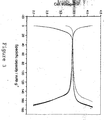
- Figure 2 shows an enlargement of the previous diffractogram depicting the peak belonging to the 131 plane of LiFePO 4 .
- the numbers shown therein indicate the values of the angles corresponding to the maximum and the width, calculated at half height, of the peak.
- ⁇ d k ⁇ / Bcos ⁇ >>, whereby d is the size of the crystallites, k is a constant that depends on the shape of the crystallites (and which, in the case at hand, has been assumed to be equal to 0.89), ⁇ is the wavelength of the radiation used (amounting to 1.54 ⁇ as a result of having used a copper lamp), B is the peak's width at half height and ⁇ is the diffraction angle of the peak. Using this formula, the crystallites' size was found to be about 28 nm.
- the voltage profiles for a cell as described above containing the material which is the subject-matter of the invention are shown in figure 3 . They confirm the fact that the material is capable of discharging about 170 mAh g -1 (roughly corresponding to the theoretical capacity) when cycled at a C/10 rate, with an average voltage of 3.40 V, corresponding to an energy density of 578 Wh kg -1 .
- FIG. 4-6 The performance of the material - depending on the number of cycles and the discharge rate - is illustrated in Figures 4-6 .
- the material was cycled at rates of C/10, C/2, C, 3C and 5C and the dependence of the voltage profiles on the specific capacity are shown in Figure 4 .
- the capacity of the material decreases, as does the cell voltage.
- the maximum discharge rate (5C) the material is capable of discharging a little less than half the capacity discharged at C/10, at an average voltage discharge rate of 2.83 V.
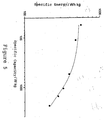
- Figure 5 shows the energy delivered on the basis of the specific power used (Ragone plot).
- the material may be discharged at over 2400 W kg -1 by providing a specific energy capacity of 213 Wh kg -1 .
- Figure 6 shows the specific capacity trend based on the number of cycles.
- the cell was discharged at C rate.
- a reduced discharge rate cycle (C/10 rate) was conducted every 10 cycles in order to assess the ability to discharge the cell in less severe conditions.
- C/10 rate reduced discharge rate cycle
Landscapes
- Chemical & Material Sciences (AREA)
- Inorganic Chemistry (AREA)
- Chemical Kinetics & Catalysis (AREA)
- Electrochemistry (AREA)
- General Chemical & Material Sciences (AREA)
- Crystallography & Structural Chemistry (AREA)
- Organic Chemistry (AREA)
- Engineering & Computer Science (AREA)
- Materials Engineering (AREA)
- Manufacturing & Machinery (AREA)
- Battery Electrode And Active Subsutance (AREA)
Abstract
Description
- Lithium iron phosphate (LiFePO4) is emerging as one of the most interesting cathode materials for the production of lithium-ion batteries, that are used not only in connection with consumer electronics products, but also in connection with other areas in which lithium batteries have not yet reached their full commercial potential, such as, for example, in the automotive field or in the field of steady electricity accumulation. LiFePO4 may be synthesized with various methods and, consequently, various synthetic procedures may be found in literature, which include: 1) A solid state reaction 1 ; 2) Sol-gel 2 ; 3) Hydrothermal synthesis 3 ; 4) Co-precipitation 4 , 5) Heating with a microwave oven 5 and various other methods, which also include many syntheses of LiFePO4 that initially use FePO4 as a precursor. The use of FePO4 in order to obtain LiFePO4 gives rise to two possible synthetic routes: the first consists in the reduction and simultaneous lithiation of FePO4. The second consists in a two-step process, in which the first step is the reduction of FePO4 and the second is the lithiation thereof. A typical reagent used for the reduction and simultaneous lithiation of FePO4 is lithium iodide (LiI). Prosini et al. 6 first prepared LiFePO4 by using LiI. The effect of LiI being used for improving the electrochemical performance of LiFePO4 has been recently studied by Kuo et al. 7. Shiratsuchi et al. 8 have also carried out the reduction and simultaneous lithiation of FePO4 with LiI in acetonitrile. The initial material was, in turn, synthesized by starting from an equimolar aqueous suspension of iron powder and P2O5.
1 P. P.Prosini, D. Zane, Mauro Pasquali, Improved electrochemical performance of a LiFeP04-based composite cathode, Electrochimica Acta 46 (2001) 3517.
2 Y.Q. Hu, M.M. Doeff, R. Kostecki, R. Finones, Electrochemical Performance of Sol-Gel Synthesized LiFeP04 in Lithium Batteries, J. Electrochem. Soc. 151 (2004) 1279.
3 G. Meligrana, C. Gerbaldi, A. Tuel, S. Bodoardo, N. Penazzi,Hydrothermal synthesis of high surface LiFeP04 powders as cathode for Li-ion cells, J. Power Sources 160 (2006) 516.
4 K.S. Park, J.T. Son, H.T. Chung, S.J. Kim, C.H. Lee, H.G. Kim, Synthesis of LiFeP04 by co-precipitation and microwave heating, Electrochem. Commun. 5 (2003) 839.
5 M. Higuchi, K. Katayama, Y. Azuma,Synthesis of LiFeP04 cathode material by microwave processing, J. Power Sources, 119 (2003) 258.
6 P. P. Prosini, M. Carewska, S. Scaccia, P. Wisniewski,S. Passerini, and M. Pasquali, A New Synthetic Route for Preparing LiFeP04 with Enhanced Electrochemical Performance, J. Electrochem. Soc. 149 (2002) A886.
7 H.T. Kuo, T.S. Chan, N.C. Bagkar, R.S. Liu, C.H. Shen, D.S. Shy, X. K. Xing, and J.-F. Lee, Effect of LiI Amount to Enhance the Electrochemical Performance of Carbon-Coated LiFeP04, Electrochem. Solid-State Lett. 12 (2009) A111.
8 T.Shiratsuchi, S. Okada, J. Yamaki, S. Yamashita, T. Nishida, Cathode performance of olivine-type LiFeP04 synthesized by chemical lithiation, Journal of Power Sources, 173, (2007)979. - A second possibility for obtaining LiFePO4 by commencing from FePO4 consists in the use of two different agents, one of which is a reducing agent and the other a lithiating agent. Studies to this effect may be found in literature, which have been conducted by using different reducing and lithiating agents. For example, amorphous LiFePO4 has been obtained by the chemical reduction and subsequent lithiation of FePO4 by means of the use of ascorbic acid as a reducing agent and lithium acetate as a source of Lithium9. Chen et al. 10 prepared a LiFePO4/C composite by heating a mixture of resorcinol-formaldehyde as a reducing agent and lithium acetate dihydrate as a lithiating agent in nitrogen atmosphere. Zheng et al. 11 prepared amorphous LiFePO4 via the lithiation of FePO4•xH2O by using oxalic acid as a reducing agent and lithium
carbonate as a lithiating agent. Mi et al. 12 used polypropylene as the reducing agent (and carbon source) in a solid state reaction for the carbo-thermal production of LiFePO4, with lithium carbonate as the lithiating agent. Li et al. 13 used, instead, citric acid and lithium carbonate. Zhao et al. 14 used glucose and lithium acetate, while Wang et al. 15 used sucrose and lithium nitrate. Finally, it should be noted that all these synthesis methods have been carried out under inert or reducing atmosphere. Only Zhang et al.16 prepared LiFePO4 in air by starting from a mixture containing PEG 20000 as the carbon source, lithium carbonate as the lithium source, ammonium phosphate as the phosphate source and iron (II) oxalate as the iron source.
9 B. Wang, Y. Qiu, S. Ni, Ultrafine LiFeP04 cathode materials synthesized by chemical reduction and lithiation method in alcohol solution, Solid State Ionics, 178 (2007) 843; as well as K. Galoustov, M. Anthonisen, D.H. Ryan, D.D. MacNeil, Characterization of two lithiation reactions starting with an amorphous FeP04 precursor, Journal of Power Sources, 196 (2011) 6893.
10 J.Chen, Y.-C. Zou, F. Zhang, Y.-C. Zhang, F.-F. Guo, G.-D. Li, Superior electrode performance of LiFeP04/C composite prepared by an in situ polymerization restriction method, Journal of Alloys and Compounds 563(2013)264-268.
11 J.-C. Zheng, X.-H. Li, Z.-X. Wang, H.-J. Guo, S.-Y. Zhou, LiFeP04 with enhanced performance synthesized by a novel synthetic route, Journal of Power Sources 184 (2008) 574.
12 C.H. Mi, G.S. Cao, X.B. Zhao, Low-cost, one-step process for synthesis of carbon-coated LiFeP04 cathode, Mater. Lett. 59 (2005) 127.
13 M.J. Li, L.Q. Sun, K. Sun, R.S. Wang, H.M. Xie, An optimum route to prepare FePO4•2H2O and its use as an iron source to synthesize LiFeP04, SCIENCE CHINA-CHEMISTRY, 56 (2013) 576-582.
14 R.R Zhao, L. C. Zhu, Z.Z. Huang, J.Z. Liang, H.Y. Chen, An investigation on the performance of LiFeP04/C derived from various FeP04, Ionics, 19 (2013) 581-588.
15 F. Wang, J. Chen, M. Wu, B. Yi, Propylene oxide-assisted fast sol-gel synthesis of mesoporous and nano-structured LiFeP04/C cathode materials, Ionics 19 (2013) 451-460.
16 Q. Zhang, S. Wang, Z. Zhou, G. Ma, W. Jiang, X. Guo, S. Zhao, Structural and electrochemical properties of Nd-doped LiFeP04/C prepared without using inert gas, SOLID STATE IONICS, 191 (2011) 40-44. - This invention will describe the solid state synthesis of LiFePO4, commencing from FePO4, as well as the simultaneous use of lithium acetate both as a reducing agent and a lithiating agent. The main purpose of this invention is to produce the material by starting from inexpensive precursors and using a method which is easy to implement and which, above all, does not involve the need to operate in a controlled environment, since such material may be synthesized directly in air.
- This result has been achieved, according to this invention, by perfecting a process for the preparation of microcrystalline LiFePO4 that is based on FePO4 and lithium acetate, consisting in a single heating process that is conducted in air. Such material has been found to be particularly suitable for use as a cathode in lithium or lithium ion batteries. The inventive concept on which this process is based consists in the preparation of a mixture of anhydrous FePO4 with lithium acetate, as well as in the subsequent heat treatment thereof, for the purpose of obtaining - in the subsequent reduction, lithiation and crystallization step - extremely small LiFePO4 particles.
- The importance - in the light of the low speeds at which lithium spreads in lithium-iron-phosphate - of the material having nanometric grain-sizes is - with a view to obtaining high-level electrochemical performances with remarkable discharge speeds - demonstrated herein.
- According to a specific feature of the invention, the so obtained cathode material has a nanometric grain-size.
- A better understanding of the invention will be had after having read the detailed description and the accompanying drawings that are set out below, which provide, by way of mere example and without any pretense of completeness, examples of how this invention may be applied.
- In particular:
-
Figure 1 shows, in the presence of lithium acetate, a diffractogram of the material prepared for the heat treatment in the air of anhydrous FeP04 heated at 550°C for 20 minutes; -
Figure 2 shows an enlargement of the diffractogram illustrated inFigure 1 , within a 35.0-36.4° range of diffraction; -
Figure 3 shows the voltage profiles for the first 10 charge and discharge cycles as a function of the specific capacity of the microcrystalline lithium-iron-phosphate prepared according to this invention and discharged at C/10 discharge rate (17 mA g-1); -
Figure 4 shows the discharge voltage profiles as a function of the specific capacity of the micro-crystalline lithium-iron-phosphate prepared according to this invention and discharged at C/10, C/2, C, 2C, 3C and 5C rate(17, 85, 170, 340, 510 and 850 mA g-1); -
Figure 5 shows in a double logarithmic graph the specific energy variation that occurs, upon the specific power output being increased, in relation to the micro-crystalline lithium-iron-phosphate that has been prepared according to this invention; -
Figure 6 shows the variation in the specific capacity that occurs, upon the number of cycles being increased, as regards the micro-crystalline lithium-iron-phosphate that has been prepared according to this invention; -
Figures 7 and8 are respectively microphotographs of Fe(III)PO4 used as a precursor for the synthesis of LiFePO4 and micro-crystalline LiFePO4, which has been obtained as a result of heating the precursor in air with lithium acetate for 20' at 550°C. - According to this invention, anhydrous iron (III) phosphate - which is used as a precursor - is prepared by dehydrating iron phosphate hydrate, which is in turn preferably prepared by means of the spontaneous precipitation thereof from a solution of iron (II) sulfate and sodium phosphate, using hydrogen peroxide as the oxidizing agent (reaction 1). Alternatively, iron (III) phosphate hydrate can be prepared by reacting iron (III) sulfate with sodium phosphate (reaction 2). The two reactions in the preparation of iron (III) phosphate hydrate can be described as follows:
FeSO4*7H2O+ Na2HPO4+ ½ H2O2 → FePO4*xH2O ↓ + Na2SO4 + (8-x)H2O (1)
Fe2(SO4)3 + 2 Na2HPO4 + 2x H2O → 2 FePO4*x H2O ↓ + 2 NaHSO4+ Na2SO4 (2)
- Anhydrous FePO4 is obtained through the dehydration of iron (III) phosphate hydrate by heating it in air at temperatures between 300 and 400°C (reaction 3):
FePO4 *x H2O → FePO4 + x H2O↑ (3)
- Finally, microcrystalline LiFePO4 is obtained through the reaction of anhydrous FePO4 with lithium acetate by heating it in air at temperatures between 550 and 600°C (reaction 4):
FePO4 + CH3COOLi + 1.75 O2 → LiFePO4 + 2 CO2 ↑ + 1.5 H2O↑ (4)
- The thermo-gravimetric analysis conducted on FePO4 hydrate demonstrates that the material, upon being heated up to 450°C, has a weight loss of roughly 27%. This weight loss is due to the loss of the water of hydration (x in Eq. 3). This weight loss corresponds exactly to the evaporation of 3 moles of water per mole of iron (III) phosphate. The X-ray analysis of the product obtained after heat treatment confirms that anhydrous FePO4 has an amorphous structure.
-
Figure 1 shows the diffractogram of the material obtained by heating anhydrous FePO4 with lithium acetate at a temperature of 550°C for 30 minutes. Although the material shows the characteristic diffraction peaks of crystalline LiFePO4 having olivine-type structures (JCPDS No. 40-1499), the peaks are small in intensity and broadly spread, thus indicating that the crystalline structure has very short coherence time intervals (i.e. the crystallites are small in size).Figure 2 shows an enlargement of the previous diffractogram depicting the peak belonging to the 131 plane of LiFePO4. The numbers shown therein indicate the values of the angles corresponding to the maximum and the width, calculated at half height, of the peak. These values have been used to assess the size of the crystallites, for which the Sherrer formula has been used in order to calculate them: << d = k λ / Bcos θ>>, whereby d is the size of the crystallites, k is a constant that depends on the shape of the crystallites (and which, in the case at hand, has been assumed to be equal to 0.89), λ is the wavelength of the radiation used (amounting to 1.54 Å as a result of having used a copper lamp), B is the peak's width at half height and θ is the diffraction angle of the peak. Using this formula, the crystallites' size was found to be about 28 nm. - The voltage profiles for a cell as described above containing the material which is the subject-matter of the invention are shown in
figure 3 . They confirm the fact that the material is capable of discharging about 170 mAh g-1 (roughly corresponding to the theoretical capacity) when cycled at a C/10 rate, with an average voltage of 3.40 V, corresponding to an energy density of 578 Wh kg-1. - The performance of the material - depending on the number of cycles and the discharge rate - is illustrated in
Figures 4-6 . The material was cycled at rates of C/10, C/2, C, 3C and 5C and the dependence of the voltage profiles on the specific capacity are shown inFigure 4 . By increasing the electrical discharge rate, the capacity of the material decreases, as does the cell voltage. At the maximum discharge rate (5C), the material is capable of discharging a little less than half the capacity discharged at C/10, at an average voltage discharge rate of 2.83 V. The result of the test is summarized inFigure 5 , which shows the energy delivered on the basis of the specific power used (Ragone plot). The material may be discharged at over 2400 W kg-1 by providing a specific energy capacity of 213 Wh kg-1.Figure 6 shows the specific capacity trend based on the number of cycles. The cell was discharged at C rate. A reduced discharge rate cycle (C/10 rate) was conducted every 10 cycles in order to assess the ability to discharge the cell in less severe conditions. One can see from the graph that the cyclability of the material prepared in accordance with the process described herein is very good. As regards deep discharge cycles, the loss of capacity during the first 60 cycles was estimated at around 0,1% per cycle, while it was negligible during reduced current cycles. - Scanning electron microscope photographs of the precursor as well as of the LiFePO4 (cfr.
Figs. 7-8 ) depict a globular structure, the grains having an average size of about 120 to 150 nanometers. The material's electrochemical properties are closely related to its nanometric structure, since lithium spreads extremely slowly through LiFePO4. To this effect, it is useful to observe that the materials obtained with traditional ceramic methods (solid state reaction of the precursors) leads to the formation of crystalline LiFePO4 with micrometric - as opposed to nanometric - grain sizes
Claims (7)
- Process for the production of nano-sized microcrystalline LiFePO4, which is particularly suitable for the production of high energy density electrodes and/or batteries, characterized by the fact that it provides for the solid state reaction of anhydrous iron (III) phosphate (FePO4), through the reducing and lithiating agent lithium acetate and through the heat treatment in air - which is carried out while maintaining the material at a temperature between 550°C and 600°C for a period of not less than 15 minutes - and the simultaneous crystallization of LiFePO4.
- Process according to one of the previous claims, characterized by the fact that the said heat treatment for the formation and crystallization of LiFePO4 by reaction is conducted in air.
- Process according to the previous claims, characterized by the fact that anhydrous iron phosphate (FePO4) is obtained through the heat treatment of iron phosphate hydrate(FePO4*xH2O) at a temperature ranging from 300°C to 400°C for a period of not less than 15 minutes.
- Process according to the previous claims, characterized by the fact that iron phosphate hydrate (FePO4) is obtained from the shift reaction of Fe3+ on a soluble phosphate salt or by the oxidation of a Fe2+ salt and the simultaneous shifting thereof on a soluble phosphate salt.
- Process according to the previous claims, characterized by the fact that the microcrystalline lithium-iron-phosphate has a globular type structure, the average size of the grains being of about 120 ÷ 150 nm.
- Process according to the previous claims, characterized by the fact that the said heat treatment for the preparation of lithium-iron- phosphate is carried out through other reducing agents containing lithium, such as hydride, iodide, formate or other organic lithium compounds.
- Process according to one of the previous claims, characterized by the fact that the said heat treatment for the preparation of lithium-iron-phosphate is carried out while maintaining the material in air, in the presence of the lithiating and reducing agents at a temperature of 550°C for 30 minutes.
Applications Claiming Priority (1)
| Application Number | Priority Date | Filing Date | Title |
|---|---|---|---|
| ITRM20140434 | 2014-07-31 |
Publications (3)
| Publication Number | Publication Date |
|---|---|
| EP2980016A1 true EP2980016A1 (en) | 2016-02-03 |
| EP2980016B1 EP2980016B1 (en) | 2018-06-06 |
| EP2980016B8 EP2980016B8 (en) | 2018-12-26 |
Family
ID=51541199
Family Applications (1)
| Application Number | Title | Priority Date | Filing Date |
|---|---|---|---|
| EP15425045.0A Not-in-force EP2980016B8 (en) | 2014-07-31 | 2015-06-17 | Process for the preparation of microcrystalline lifepo4, which is specifically suitable as cathode material in lithium batteries |
Country Status (2)
| Country | Link |
|---|---|
| EP (1) | EP2980016B8 (en) |
| CN (1) | CN105322164A (en) |
Cited By (4)
| Publication number | Priority date | Publication date | Assignee | Title |
|---|---|---|---|---|
| CN110467169A (en) * | 2019-07-25 | 2019-11-19 | 青海圣诺光电科技有限公司 | A kind of preparation method of basic lithium iron phosphate composite material |
| CN111186827A (en) * | 2020-01-16 | 2020-05-22 | 昆明理工大学 | Preparation method of high-rate lithium iron phosphate microspheres |
| CN116730317A (en) * | 2023-07-20 | 2023-09-12 | 广州融捷能源科技有限公司 | Preparation method of lithium iron phosphate |
| WO2024159919A1 (en) * | 2023-01-31 | 2024-08-08 | 湖北亿纬动力有限公司 | Composite lithium iron phosphate positive electrode material, preparation method therefor and use thereof |
Families Citing this family (1)
| Publication number | Priority date | Publication date | Assignee | Title |
|---|---|---|---|---|
| FR3160517A1 (en) * | 2024-03-22 | 2025-09-26 | Centre National De La Recherche Scientifique | Process of chemically inserting cations of an alkali metal into a solid compound |
Family Cites Families (3)
| Publication number | Priority date | Publication date | Assignee | Title |
|---|---|---|---|---|
| CN100420074C (en) * | 2006-11-23 | 2008-09-17 | 武汉大学 | A method to manufacture anode material of LiFePO4/C for lithium ion cell |
| CN101229917A (en) * | 2007-11-16 | 2008-07-30 | 中南民族大学 | Method for synthesizing lithium ion-cell anode material LiFePO4 |
| CN102020259A (en) * | 2009-09-11 | 2011-04-20 | 上海林立电池技术有限公司 | Method for preparing lithium iron phosphate by using iron phosphate |
-
2015
- 2015-06-17 EP EP15425045.0A patent/EP2980016B8/en not_active Not-in-force
- 2015-07-01 CN CN201510379834.2A patent/CN105322164A/en active Pending
Non-Patent Citations (21)
| Title |
|---|
| ANG; J. CHEN; M. WU; B. YI: "Propylene oxide-assisted fast sol-gel synthesis of mesoporous and nano-structured LiFeP04/C cathode materials", IONICS, vol. 19, 2013, pages 451 - 460 |
| B. WANG; Y. QIU; S. NI: "Ultrafine LiFeP04 cathode materials synthesized by chemical reduction and lithiation method in alcohol solution", SOLID STATE IONICS, vol. 178, 2007, pages 843, XP022066334, DOI: doi:10.1016/j.ssi.2007.03.004 |
| G. MELIGRANA; C. GERBALDI; A. TUEL; S. BODOARDO; N. . PENAZZI: "Hydrothermal synthesis of high surface LiFeP04 powders as cathode for Li-ion cells", J. POWER SOURCES, vol. 160, 2006, pages 516 |
| GUO X F ET AL: "Rapid synthesis of LiFePO4/C composite by microwave method", SOLID STATE IONICS, NORTH HOLLAND PUB. COMPANY. AMSTERDAM; NL, NL, vol. 180, no. 4-5, 27 April 2009 (2009-04-27), pages 386 - 391, XP026064595, ISSN: 0167-2738, [retrieved on 20090316], DOI: 10.1016/J.SSI.2008.11.021 * |
| H.T. KUO; T.S. CHAN; N.C. BAGKAR; R.S. LIU; C.H. SHEN; D.S. SHY; X. K. XING; J.-F. LEE: "Effect of LiI Amount to Enhance the Electrochemical Performance of Carbon-Coated LiFeP04, Electrochem", SOLID-STATE LETT., vol. 12, 2009, pages A111 |
| J.-C. ZHENG; X.-H. LI; Z.-X. WANG; H.-J. GUO; S.-Y. ZHOU: "LiFeP04 with enhanced performance synthesized by a novel synthetic route", JOURNAL OF POWER SOURCES, vol. 184, 2008, pages 574, XP024525263, DOI: doi:10.1016/j.jpowsour.2008.01.016 |
| J.CHEN; Y.-C. ZOU; F. ZHANG; Y.-C. ZHANG; F.-F. GUO; G.-D. LI: "Superior electrode performance of LiFeP04/C composite prepared by an in situ polymerization restriction method", JOURNAL OF ALLOYS AND COMPOUNDS, vol. 563, 2013, pages 264 - 268 |
| K. GALOUSTOV; M. ANTHONISEN; D.H. RYAN; D.D. MACNEIL: "Characterization of two lithiation reactions starting with an amorphous FeP04 precursor", JOURNAL OF POWER SOURCES, vol. 196, 2011, pages 6893 |
| K.S. PARK; J.T. SON; H.T. CHUNG; S.J. KIM; C.H. LEE; H.G. KIM: "Synthesis of LiFeP04 by co-precipitation and microwave heating", ELECTROCHEM. COMMUN., vol. 5, 2003, pages 839, XP002409827, DOI: doi:10.1016/j.elecom.2003.08.005 |
| M. HIGUCHI; K. KATAYAMA; Y. AZUMA: "Synthesis of LiFeP04 cathode material by microwave processing", J. POWER SOURCES, vol. 119, 2003, pages 258 |
| M.J. LI; L.Q. SUN; K. SUN; R.S. WANG; H.M. XIE: "An optimum route to prepare FeP04-2H20 and its use as an iron source to synthesize LiFeP04", SCIENCE CHINA-CHEMISTRY, vol. 56, 2013, pages 576 - 582 |
| MI; G.S. CAO; X.B. ZHAO: "Low-cost, one-step process for synthesis of carbon-coated LiFeP04 cathode", MATER. LETT., vol. 59, 2005, XP025257068, DOI: doi:10.1016/j.matlet.2004.07.051 |
| P. P. PROSINI; M. CAREWSKA; S. SCACCIA; P. WISNIEWSKI; S. PASSERINI; M. PASQUALI: "A New Synthetic Route for Preparing LiFeP04 with Enhanced Electrochemical Performance", J. ELECTROCHEM. SOC., vol. 149, 2002, pages A886, XP002693368, DOI: doi:10.1149/1.1481716 |
| P. P.PROSINI; D. ZANE; MAURO PASQUALI: "Improved electrochemical performance of a LiFeP04-based composite cathode", ELECTROCHIMICA ACTA, vol. 46, 2001, pages 3517, XP004299609, DOI: doi:10.1016/S0013-4686(01)00631-4 |
| P. SUBRAMANYA HERLE ET AL: "Nano-network electronic conduction in iron and nickel olivine phosphates", NATURE MATERIALS, vol. 3, no. 3, 22 February 2004 (2004-02-22), pages 147 - 152, XP055172734, ISSN: 1476-1122, DOI: 10.1038/nmat1063 * |
| PIER PAOLO PROSINI ET AL: "A synthesis of LiFePO4 starting from FePO4 under reducing atmosphere", AIP CONFERENCE PROCEEDINGS, 19 June 2014 (2014-06-19), pages 109 - 118, XP055185022, ISSN: 0094-243X, DOI: 10.1063/1.4883049 * |
| PROSINI P P ET AL: "A new synthetic route for preparing LiFePO[4] with enhanced electrochemical performance", JOURNAL OF THE ELECTROCHEMICAL SOCIETY, ELECTROCHEMICAL SOCIETY, vol. 149, no. 7, 20 May 2002 (2002-05-20), pages A886 - A890, XP008128733, ISSN: 0013-4651, DOI: 10.1149/1.1481716 * |
| Q. ZHANG; S. WANG; Z. ZHOU; G. MA; W. JIANG; X. GUO; S. ZHAO: "Structural and electrochemical properties of Nd-doped LiFeP04/C prepared without using inert gas", SOLID STATE IONICS, vol. 191, 2011, pages 40 - 44, XP028210412, DOI: doi:10.1016/j.ssi.2011.03.025 |
| R.R ZHAO; L. C. ZHU; Z.Z. HUANG; J.Z. LIANG; H.Y. CHEN: "An investigation on the performance of LiFeP04/C derived from various FeP04", IONICS, vol. 19, 2013, pages 581 - 588 |
| T.SHIRATSUCHI; S. OKADA; J. YAMAKI; S. YAMASHITA; T. NISHIDA: "Cathode performance of olivine-type LiFeP04 synthesized by chemical lithiation", JOURNAL OF POWER SOURCES, vol. 173, 2007, pages 979, XP022299771, DOI: doi:10.1016/j.jpowsour.2007.08.038 |
| Y.Q. HU; M.M. DOEFF; R. KOSTECKI; R. FINONES: "Electrochemical Performance of Sol-Gel Synthesized LiFeP04 in Lithium Batteries", J. ELECTROCHEM. SOC., vol. 151, 2004, pages 1279 |
Cited By (4)
| Publication number | Priority date | Publication date | Assignee | Title |
|---|---|---|---|---|
| CN110467169A (en) * | 2019-07-25 | 2019-11-19 | 青海圣诺光电科技有限公司 | A kind of preparation method of basic lithium iron phosphate composite material |
| CN111186827A (en) * | 2020-01-16 | 2020-05-22 | 昆明理工大学 | Preparation method of high-rate lithium iron phosphate microspheres |
| WO2024159919A1 (en) * | 2023-01-31 | 2024-08-08 | 湖北亿纬动力有限公司 | Composite lithium iron phosphate positive electrode material, preparation method therefor and use thereof |
| CN116730317A (en) * | 2023-07-20 | 2023-09-12 | 广州融捷能源科技有限公司 | Preparation method of lithium iron phosphate |
Also Published As
| Publication number | Publication date |
|---|---|
| EP2980016B8 (en) | 2018-12-26 |
| CN105322164A (en) | 2016-02-10 |
| EP2980016B1 (en) | 2018-06-06 |
Similar Documents
| Publication | Publication Date | Title |
|---|---|---|
| Aravindan et al. | LiMnPO 4–A next generation cathode material for lithium-ion batteries | |
| KR102497808B1 (en) | Microwave assisted sol-gel method for preparing in situ carbon coated electrode materials and its products | |
| Yang et al. | Preparation of LiFePO4 powders by co-precipitation | |
| JP5113081B2 (en) | Lithium manganese phosphate cathode material for lithium secondary battery | |
| Muraliganth et al. | Understanding the shifts in the redox potentials of olivine LiM1− y M y PO4 (M= Fe, Mn, Co, and Mg) solid solution cathodes | |
| JP5473894B2 (en) | Room temperature single phase Li insertion / extraction material for use in Li-based batteries | |
| EP2938571B1 (en) | Process for preparing metal-containing compounds | |
| JP5298286B2 (en) | Method for producing lithium silicate compound | |
| Ni et al. | Lithium iron orthosilicate cathode: progress and perspectives | |
| Beninati et al. | MW-assisted synthesis of LiFePO4 for high power applications | |
| US20110315919A1 (en) | Production process for lithium-borate-system compound | |
| CN101675001B (en) | Synthesis of LiMPO4 compounds and their use as electrode materials in lithium batteries | |
| EP2980016B1 (en) | Process for the preparation of microcrystalline lifepo4, which is specifically suitable as cathode material in lithium batteries | |
| Zou et al. | LiMPO4 and derived NaMPO4 (M= Mn, Fe, Mg) with excellent electrochemical properties for lithium/sodium ion batteries | |
| KR101352793B1 (en) | Cathode Material for Secondary Battery and Manufacturing Method of the Same | |
| Herrera et al. | LiMnPO4: review on synthesis and electrochemical properties | |
| JP6099038B2 (en) | Method for producing electrode material | |
| Zhai et al. | Synthesis and structural stability of Li2. 1Mn0. 9 [PO4] 0.1 [SiO4] 0.9/C mixed polyanion cathode material for Li-ion battery | |
| TW201803803A (en) | Method for manufacturing vanadium lithium phosphate | |
| Zhang et al. | Novel synthesis of LiMnPO4· Li3V2 (PO4) 3/C composite cathode material | |
| Mohan et al. | Urea and sucrose assisted combustion synthesis of LiFePO4/C nano-powder for lithium-ion battery cathode application | |
| Jo et al. | One-pot pyro-synthesis of a high energy density LiFePO4-Li3V2 (PO4) 3 nanocomposite cathode for lithium-ion battery applications | |
| Lan et al. | Preparation and characterization of carbon-coated LiFePO4 cathode materials for lithium-ion batteries with resorcinol–formaldehyde polymer as carbon precursor | |
| Prosini et al. | Synthesis of microcrystalline LiFePO4 in air | |
| Wang et al. | Improving electrochemical performance of LiMnPO4 by Zn doping using a facile solid state method |
Legal Events
| Date | Code | Title | Description |
|---|---|---|---|
| PUAI | Public reference made under article 153(3) epc to a published international application that has entered the european phase |
Free format text: ORIGINAL CODE: 0009012 |
|
| AK | Designated contracting states |
Kind code of ref document: A1 Designated state(s): AL AT BE BG CH CY CZ DE DK EE ES FI FR GB GR HR HU IE IS IT LI LT LU LV MC MK MT NL NO PL PT RO RS SE SI SK SM TR |
|
| AX | Request for extension of the european patent |
Extension state: BA ME |
|
| 17P | Request for examination filed |
Effective date: 20160330 |
|
| RBV | Designated contracting states (corrected) |
Designated state(s): AL AT BE BG CH CY CZ DE DK EE ES FI FR GB GR HR HU IE IS IT LI LT LU LV MC MK MT NL NO PL PT RO RS SE SI SK SM TR |
|
| 17Q | First examination report despatched |
Effective date: 20160912 |
|
| GRAP | Despatch of communication of intention to grant a patent |
Free format text: ORIGINAL CODE: EPIDOSNIGR1 |
|
| RIC1 | Information provided on ipc code assigned before grant |
Ipc: C01B 25/45 20060101AFI20180111BHEP Ipc: H01M 10/052 20100101ALI20180111BHEP Ipc: H01M 4/58 20100101ALI20180111BHEP |
|
| INTG | Intention to grant announced |
Effective date: 20180208 |
|
| GRAS | Grant fee paid |
Free format text: ORIGINAL CODE: EPIDOSNIGR3 |
|
| GRAA | (expected) grant |
Free format text: ORIGINAL CODE: 0009210 |
|
| AK | Designated contracting states |
Kind code of ref document: B1 Designated state(s): AL AT BE BG CH CY CZ DE DK EE ES FI FR GB GR HR HU IE IS IT LI LT LU LV MC MK MT NL NO PL PT RO RS SE SI SK SM TR |
|
| REG | Reference to a national code |
Ref country code: GB Ref legal event code: FG4D |
|
| REG | Reference to a national code |
Ref country code: CH Ref legal event code: EP Ref country code: AT Ref legal event code: REF Ref document number: 1005884 Country of ref document: AT Kind code of ref document: T Effective date: 20180615 |
|
| REG | Reference to a national code |
Ref country code: IE Ref legal event code: FG4D |
|
| REG | Reference to a national code |
Ref country code: DE Ref legal event code: R096 Ref document number: 602015011785 Country of ref document: DE |
|
| REG | Reference to a national code |
Ref country code: FR Ref legal event code: PLFP Year of fee payment: 4 |
|
| REG | Reference to a national code |
Ref country code: NL Ref legal event code: MP Effective date: 20180606 |
|
| REG | Reference to a national code |
Ref country code: LT Ref legal event code: MG4D |
|
| PG25 | Lapsed in a contracting state [announced via postgrant information from national office to epo] |
Ref country code: CY Free format text: LAPSE BECAUSE OF FAILURE TO SUBMIT A TRANSLATION OF THE DESCRIPTION OR TO PAY THE FEE WITHIN THE PRESCRIBED TIME-LIMIT Effective date: 20180606 Ref country code: SE Free format text: LAPSE BECAUSE OF FAILURE TO SUBMIT A TRANSLATION OF THE DESCRIPTION OR TO PAY THE FEE WITHIN THE PRESCRIBED TIME-LIMIT Effective date: 20180606 Ref country code: FI Free format text: LAPSE BECAUSE OF FAILURE TO SUBMIT A TRANSLATION OF THE DESCRIPTION OR TO PAY THE FEE WITHIN THE PRESCRIBED TIME-LIMIT Effective date: 20180606 Ref country code: BG Free format text: LAPSE BECAUSE OF FAILURE TO SUBMIT A TRANSLATION OF THE DESCRIPTION OR TO PAY THE FEE WITHIN THE PRESCRIBED TIME-LIMIT Effective date: 20180906 Ref country code: NO Free format text: LAPSE BECAUSE OF FAILURE TO SUBMIT A TRANSLATION OF THE DESCRIPTION OR TO PAY THE FEE WITHIN THE PRESCRIBED TIME-LIMIT Effective date: 20180906 Ref country code: LT Free format text: LAPSE BECAUSE OF FAILURE TO SUBMIT A TRANSLATION OF THE DESCRIPTION OR TO PAY THE FEE WITHIN THE PRESCRIBED TIME-LIMIT Effective date: 20180606 Ref country code: ES Free format text: LAPSE BECAUSE OF FAILURE TO SUBMIT A TRANSLATION OF THE DESCRIPTION OR TO PAY THE FEE WITHIN THE PRESCRIBED TIME-LIMIT Effective date: 20180606 |
|
| PGFP | Annual fee paid to national office [announced via postgrant information from national office to epo] |
Ref country code: FR Payment date: 20180801 Year of fee payment: 4 |
|
| PG25 | Lapsed in a contracting state [announced via postgrant information from national office to epo] |
Ref country code: GR Free format text: LAPSE BECAUSE OF FAILURE TO SUBMIT A TRANSLATION OF THE DESCRIPTION OR TO PAY THE FEE WITHIN THE PRESCRIBED TIME-LIMIT Effective date: 20180907 Ref country code: RS Free format text: LAPSE BECAUSE OF FAILURE TO SUBMIT A TRANSLATION OF THE DESCRIPTION OR TO PAY THE FEE WITHIN THE PRESCRIBED TIME-LIMIT Effective date: 20180606 Ref country code: HR Free format text: LAPSE BECAUSE OF FAILURE TO SUBMIT A TRANSLATION OF THE DESCRIPTION OR TO PAY THE FEE WITHIN THE PRESCRIBED TIME-LIMIT Effective date: 20180606 Ref country code: LV Free format text: LAPSE BECAUSE OF FAILURE TO SUBMIT A TRANSLATION OF THE DESCRIPTION OR TO PAY THE FEE WITHIN THE PRESCRIBED TIME-LIMIT Effective date: 20180606 |
|
| REG | Reference to a national code |
Ref country code: CH Ref legal event code: PK Free format text: RETTIFICA B8 |
|
| REG | Reference to a national code |
Ref country code: AT Ref legal event code: MK05 Ref document number: 1005884 Country of ref document: AT Kind code of ref document: T Effective date: 20180606 |
|
| PG25 | Lapsed in a contracting state [announced via postgrant information from national office to epo] |
Ref country code: NL Free format text: LAPSE BECAUSE OF FAILURE TO SUBMIT A TRANSLATION OF THE DESCRIPTION OR TO PAY THE FEE WITHIN THE PRESCRIBED TIME-LIMIT Effective date: 20180606 |
|
| REG | Reference to a national code |
Ref country code: DE Ref legal event code: R119 Ref document number: 602015011785 Country of ref document: DE Ref country code: DE Ref legal event code: R409 Ref document number: 602015011785 Country of ref document: DE |
|
| PG25 | Lapsed in a contracting state [announced via postgrant information from national office to epo] |
Ref country code: AT Free format text: LAPSE BECAUSE OF FAILURE TO SUBMIT A TRANSLATION OF THE DESCRIPTION OR TO PAY THE FEE WITHIN THE PRESCRIBED TIME-LIMIT Effective date: 20180606 Ref country code: RO Free format text: LAPSE BECAUSE OF FAILURE TO SUBMIT A TRANSLATION OF THE DESCRIPTION OR TO PAY THE FEE WITHIN THE PRESCRIBED TIME-LIMIT Effective date: 20180606 Ref country code: CZ Free format text: LAPSE BECAUSE OF FAILURE TO SUBMIT A TRANSLATION OF THE DESCRIPTION OR TO PAY THE FEE WITHIN THE PRESCRIBED TIME-LIMIT Effective date: 20180606 Ref country code: PL Free format text: LAPSE BECAUSE OF FAILURE TO SUBMIT A TRANSLATION OF THE DESCRIPTION OR TO PAY THE FEE WITHIN THE PRESCRIBED TIME-LIMIT Effective date: 20180606 Ref country code: EE Free format text: LAPSE BECAUSE OF FAILURE TO SUBMIT A TRANSLATION OF THE DESCRIPTION OR TO PAY THE FEE WITHIN THE PRESCRIBED TIME-LIMIT Effective date: 20180606 Ref country code: IS Free format text: LAPSE BECAUSE OF FAILURE TO SUBMIT A TRANSLATION OF THE DESCRIPTION OR TO PAY THE FEE WITHIN THE PRESCRIBED TIME-LIMIT Effective date: 20181006 Ref country code: SK Free format text: LAPSE BECAUSE OF FAILURE TO SUBMIT A TRANSLATION OF THE DESCRIPTION OR TO PAY THE FEE WITHIN THE PRESCRIBED TIME-LIMIT Effective date: 20180606 |
|
| REG | Reference to a national code |
Ref country code: CH Ref legal event code: PL |
|
| PG25 | Lapsed in a contracting state [announced via postgrant information from national office to epo] |
Ref country code: IT Free format text: LAPSE BECAUSE OF FAILURE TO SUBMIT A TRANSLATION OF THE DESCRIPTION OR TO PAY THE FEE WITHIN THE PRESCRIBED TIME-LIMIT Effective date: 20180606 Ref country code: SM Free format text: LAPSE BECAUSE OF FAILURE TO SUBMIT A TRANSLATION OF THE DESCRIPTION OR TO PAY THE FEE WITHIN THE PRESCRIBED TIME-LIMIT Effective date: 20180606 |
|
| REG | Reference to a national code |
Ref country code: BE Ref legal event code: MM Effective date: 20180630 |
|
| REG | Reference to a national code |
Ref country code: DE Ref legal event code: R097 Ref document number: 602015011785 Country of ref document: DE |
|
| REG | Reference to a national code |
Ref country code: IE Ref legal event code: MM4A |
|
| PG25 | Lapsed in a contracting state [announced via postgrant information from national office to epo] |
Ref country code: MC Free format text: LAPSE BECAUSE OF FAILURE TO SUBMIT A TRANSLATION OF THE DESCRIPTION OR TO PAY THE FEE WITHIN THE PRESCRIBED TIME-LIMIT Effective date: 20180606 Ref country code: LU Free format text: LAPSE BECAUSE OF NON-PAYMENT OF DUE FEES Effective date: 20180617 |
|
| PLBE | No opposition filed within time limit |
Free format text: ORIGINAL CODE: 0009261 |
|
| STAA | Information on the status of an ep patent application or granted ep patent |
Free format text: STATUS: NO OPPOSITION FILED WITHIN TIME LIMIT |
|
| PG25 | Lapsed in a contracting state [announced via postgrant information from national office to epo] |
Ref country code: IE Free format text: LAPSE BECAUSE OF NON-PAYMENT OF DUE FEES Effective date: 20180617 Ref country code: LI Free format text: LAPSE BECAUSE OF NON-PAYMENT OF DUE FEES Effective date: 20180630 Ref country code: CH Free format text: LAPSE BECAUSE OF NON-PAYMENT OF DUE FEES Effective date: 20180630 |
|
| PGFP | Annual fee paid to national office [announced via postgrant information from national office to epo] |
Ref country code: DE Payment date: 20180830 Year of fee payment: 4 |
|
| 26N | No opposition filed |
Effective date: 20190307 |
|
| PG25 | Lapsed in a contracting state [announced via postgrant information from national office to epo] |
Ref country code: SI Free format text: LAPSE BECAUSE OF FAILURE TO SUBMIT A TRANSLATION OF THE DESCRIPTION OR TO PAY THE FEE WITHIN THE PRESCRIBED TIME-LIMIT Effective date: 20180606 Ref country code: BE Free format text: LAPSE BECAUSE OF NON-PAYMENT OF DUE FEES Effective date: 20180630 Ref country code: DK Free format text: LAPSE BECAUSE OF FAILURE TO SUBMIT A TRANSLATION OF THE DESCRIPTION OR TO PAY THE FEE WITHIN THE PRESCRIBED TIME-LIMIT Effective date: 20180606 |
|
| PG25 | Lapsed in a contracting state [announced via postgrant information from national office to epo] |
Ref country code: AL Free format text: LAPSE BECAUSE OF FAILURE TO SUBMIT A TRANSLATION OF THE DESCRIPTION OR TO PAY THE FEE WITHIN THE PRESCRIBED TIME-LIMIT Effective date: 20180606 |
|
| REG | Reference to a national code |
Ref country code: DE Ref legal event code: R119 Ref document number: 602015011785 Country of ref document: DE |
|
| PG25 | Lapsed in a contracting state [announced via postgrant information from national office to epo] |
Ref country code: MT Free format text: LAPSE BECAUSE OF NON-PAYMENT OF DUE FEES Effective date: 20180617 |
|
| GBPC | Gb: european patent ceased through non-payment of renewal fee |
Effective date: 20190617 |
|
| PG25 | Lapsed in a contracting state [announced via postgrant information from national office to epo] |
Ref country code: TR Free format text: LAPSE BECAUSE OF FAILURE TO SUBMIT A TRANSLATION OF THE DESCRIPTION OR TO PAY THE FEE WITHIN THE PRESCRIBED TIME-LIMIT Effective date: 20180606 |
|
| PG25 | Lapsed in a contracting state [announced via postgrant information from national office to epo] |
Ref country code: GB Free format text: LAPSE BECAUSE OF NON-PAYMENT OF DUE FEES Effective date: 20190617 Ref country code: DE Free format text: LAPSE BECAUSE OF NON-PAYMENT OF DUE FEES Effective date: 20200101 |
|
| PG25 | Lapsed in a contracting state [announced via postgrant information from national office to epo] |
Ref country code: PT Free format text: LAPSE BECAUSE OF FAILURE TO SUBMIT A TRANSLATION OF THE DESCRIPTION OR TO PAY THE FEE WITHIN THE PRESCRIBED TIME-LIMIT Effective date: 20180606 |
|
| PG25 | Lapsed in a contracting state [announced via postgrant information from national office to epo] |
Ref country code: HU Free format text: LAPSE BECAUSE OF FAILURE TO SUBMIT A TRANSLATION OF THE DESCRIPTION OR TO PAY THE FEE WITHIN THE PRESCRIBED TIME-LIMIT; INVALID AB INITIO Effective date: 20150617 Ref country code: FR Free format text: LAPSE BECAUSE OF NON-PAYMENT OF DUE FEES Effective date: 20190630 Ref country code: MK Free format text: LAPSE BECAUSE OF NON-PAYMENT OF DUE FEES Effective date: 20180606 |