EP2980015A1 - High-calorie gas manufacturing process - Google Patents
High-calorie gas manufacturing process Download PDFInfo
- Publication number
- EP2980015A1 EP2980015A1 EP14772585.7A EP14772585A EP2980015A1 EP 2980015 A1 EP2980015 A1 EP 2980015A1 EP 14772585 A EP14772585 A EP 14772585A EP 2980015 A1 EP2980015 A1 EP 2980015A1
- Authority
- EP
- European Patent Office
- Prior art keywords
- glycerin
- gas
- decomposition
- high calorific
- producing method
- Prior art date
- Legal status (The legal status is an assumption and is not a legal conclusion. Google has not performed a legal analysis and makes no representation as to the accuracy of the status listed.)
- Granted
Links
Images
Classifications
-
- C—CHEMISTRY; METALLURGY
- C01—INORGANIC CHEMISTRY
- C01B—NON-METALLIC ELEMENTS; COMPOUNDS THEREOF; METALLOIDS OR COMPOUNDS THEREOF NOT COVERED BY SUBCLASS C01C
- C01B3/00—Hydrogen; Gaseous mixtures containing hydrogen; Separation of hydrogen from mixtures containing it; Purification of hydrogen; Reversible storage of hydrogen
- C01B3/02—Production of hydrogen; Production of gaseous mixtures containing hydrogen
- C01B3/22—Production of hydrogen; Production of gaseous mixtures containing hydrogen by decomposition of gaseous or liquid organic compounds
-
- C—CHEMISTRY; METALLURGY
- C01—INORGANIC CHEMISTRY
- C01B—NON-METALLIC ELEMENTS; COMPOUNDS THEREOF; METALLOIDS OR COMPOUNDS THEREOF NOT COVERED BY SUBCLASS C01C
- C01B2203/00—Integrated processes for the production of hydrogen or synthesis gas
- C01B2203/02—Processes for making hydrogen or synthesis gas
- C01B2203/0266—Processes for making hydrogen or synthesis gas containing a decomposition step
- C01B2203/0277—Processes for making hydrogen or synthesis gas containing a decomposition step containing a catalytic decomposition step
-
- C—CHEMISTRY; METALLURGY
- C01—INORGANIC CHEMISTRY
- C01B—NON-METALLIC ELEMENTS; COMPOUNDS THEREOF; METALLOIDS OR COMPOUNDS THEREOF NOT COVERED BY SUBCLASS C01C
- C01B2203/00—Integrated processes for the production of hydrogen or synthesis gas
- C01B2203/10—Catalysts for performing the hydrogen forming reactions
- C01B2203/1041—Composition of the catalyst
- C01B2203/1047—Group VIII metal catalysts
-
- C—CHEMISTRY; METALLURGY
- C01—INORGANIC CHEMISTRY
- C01B—NON-METALLIC ELEMENTS; COMPOUNDS THEREOF; METALLOIDS OR COMPOUNDS THEREOF NOT COVERED BY SUBCLASS C01C
- C01B2203/00—Integrated processes for the production of hydrogen or synthesis gas
- C01B2203/12—Feeding the process for making hydrogen or synthesis gas
- C01B2203/1205—Composition of the feed
- C01B2203/1211—Organic compounds or organic mixtures used in the process for making hydrogen or synthesis gas
Definitions
- the present invention relates to a high calorific gas producing method. More specifically, the present invention relates to a high calorific gas producing method using decomposition of glycerin.
- Non-Patent Literatures 1 to 4 report decomposition reactions of glycerin over various group VIII metal catalysts.
- Non-Patent Literatures 1 to 4 The present inventors have studied the catalysts described in Non-Patent Literatures 1 to 4 above and revealed that in each case, the yield of hydrogen produced by steam reforming of glycerin is approximately 20 to 70% and that the selectivities of carbon monoxide, methane and carbon dioxide are 20 to 30%, 5 to 10% and 60 to 75%, respectively, and thus the proportion of carbon dioxide is the highest.
- the yield of hydrogen was calculated with the yield of hydrogen at the time the reaction expressed by the following formula (1) had been completely progressed being defined as 100%.
- the lower calorific values of hydrogen, carbon monoxide and methane are 2580 kcal/m 3 , 3020 kcal/m 3 and 8560 kcal/m 3 , respectively.
- the lower calorific value with the above gas composition having a low methane content and a high carbon dioxide content should be small and can be estimated to be about 1800 kcal/m 3 .
- An object of the present invention is therefore to provide a high calorific gas producing method for obtaining high calorific gas by decomposing glycerin.
- the present inventors have made intensive studies to achieve the above object and as a result found that high calorific gas can be obtained by decomposing glycerin over iron ore, and the invention has been thus completed. Specifically, the present invention provides the following (1) to (5).
- a high calorific gas producing method for obtaining high calorific gas by decomposing glycerin as described below.
- the high calorific gas producing method of the invention can be utilized for decomposing glycerin that is a by-product of production of biodiesel fuel (BDF) recently receiving attention.
- BDF biodiesel fuel
- the material from which glycerin is derived is not particularly limited, if use is made of glycerin that is a by-product of the BDF produced in large amounts, high calorific gas can be produced without increasing carbon dioxide emissions and thus, this method is very effective.
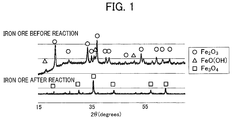
- FIG. 1 is a graph showing X-ray diffractograms of iron ore used in decomposition of glycerin (steam reforming reaction) before and after the reaction.
- the high calorific gas producing method of the invention is a high calorific gas producing method for obtaining high calorific gas with a lower calorific value of 3,000 kcal/m 3 or more by decomposing glycerin over iron ore.
- Glycerin has a reactivity of 100% in the decomposition reaction at 800°C and according to a chemical equilibrium calculation, the composition of produced gas (dry gas basis) includes 62.6% hydrogen, 24.6% carbon monoxide, 12.8% carbon dioxide and 0.05% methane.
- the lower calorific value with this composition is about 2,360 kcal/m 3 .
- the iron ore used in the high calorific gas producing method of the invention is not particularly limited.
- the iron ore may be solely used, or a mixture of the iron ore with a sintered ore which is obtained by mixing an iron ore with coal or lime, followed by baking, may be used.
- the iron ore examples include a Robe River ore (pisolite ore), a Yandicoogina ore and a Carajas ore, which may be used alone or in combination of two or more.
- an iron ore in which several types of iron ores are mixed, such as a Pilbara blend ore, may be used.
- the iron ore has a specific surface area measured by a BET method (hereinafter referred to as "BET specific surface area”) of preferably at least 10 m 2 /g and more preferably at least 15 m 2 /g but preferably up to 200 m 2 /g.
- BET specific surface area measured by a BET method
- the iron ore has an iron content (iron concentration) of preferably at least 50% and more preferably at least 60%.
- the yield of gas tends to be high and therefore this is preferred.
- FIG. 1 shows X-ray diffractograms of the iron ore used in decomposition of glycerin (steam reforming reaction) before and after the reaction.
- the iron ore before decomposition of glycerin is primarily composed of hematite (Fe 2 O 3 ), whereas the iron ore after decomposition of glycerin has been reduced to magnetite (Fe 3 O 4 ).
- the iron ore used in the high calorific gas producing method of the invention is, after use, usable as an iron-making material and owing to this, the amount of a reductant such as coke for use in reducing iron ore to metallic iron can be decreased.
- the temperature in decomposition of glycerin is not particularly limited and is preferably 600 to 900°C and more preferably 650 to 800°C because the selectivity of carbon dioxide can be suppressed and gas having a further increased calorific value can be produced.
- the reaction through which the gas having the foregoing composition is produced upon decomposition of glycerin is an endothermic reaction requiring a slight amount of energy of 60 kcal/mol and therefore, a heat source is needed for promoting the reaction.
- the heat source is not particularly limited.
- exhaust heat of a steel mill specifically sensible heat of red-hot coke or slag, is advantageously used.
- the pressure in decomposition of glycerin is not particularly limited and preferably ranges from atmospheric pressure to 0.5 MPa in terms of cost, decomposition time and the like.
- the high calorific gas producing method of the invention can also be utilized for decomposing glycerin that is a by-product of production of a biodiesel fuel (BDF) recently receiving attention (hereinafter called "by-product glycerin” in the following).
- BDF biodiesel fuel
- the by-product glycerin is produced as a by-product in the form of an aqueous solution (aqueous glycerin solution) or a mixture with methanol.
- the high calorific gas producing method of the invention can be advantageously utilized for decomposing the by-product glycerin.
- the molar ratio between water and glycerin (water/glycerin) in the aqueous glycerin solution is preferably about 2 to about 10 and more preferably 3 to 5 in terms of cost and handleability.
- the BDF is sometimes produced without water and in such cases, the by-product glycerin is to be a mixture of glycerin and methanol. Methanol is decomposed as shown in the following formula (3) more easily than glycerin. CH 3 OH ⁇ CO + 2H 2 (3)
- the lower calorific value of gas produced by formula (3) is 2,730 kcal/m 3 and therefore, a large amount of methanol tends to result in decrease of the calorific value of produced gas.
- the by-product glycerin has a glycerin content of 30% or more
- the lower calorific value of high calorific gas produced is not less than 3,000 kcal/m 3 . Since the actual by-product glycerin has a glycerin content of 70% or more, the presence of methanol causes substantially no problem and even if water is not added in producing the BDF, the object of the invention can be attained.
- the residence time (W/F) expressed with the weight (W) of the iron ore relative to the gas flow rate (F) is preferably 2 to 20 g ⁇ hr/mol and more preferably 5 to 10 g ⁇ hr/mol.
- the high calorific gas producing method of the invention is described below in detail by way of examples. However, the present invention is not limited thereto.
- the decomposition conditions were set in which the molar ratio between water and glycerin (water/glycerin ratio) in the aqueous glycerin solution was 3.4, the residence time (W/F) was 18 g ⁇ hr/mol, the decomposition temperature was 800°C and the decomposition pressure was atmospheric pressure.
- Example 1 was repeated except that the residence time (W/F) was changed to 6.0 g ⁇ hr/mol, thereby decomposing glycerin.
- Example 1 was repeated except that the residence time (W/F) was changed to 3.0 g ⁇ hr/mol, thereby decomposing glycerin.
- Example 1 was repeated except that Yandicoogina ore (iron content: 58%, BET specific surface area: 20 m 2 /g) was used in place of the Robe River ore and the residence time (W/F) was changed to 12.0 g ⁇ hr/mol, thereby decomposing glycerin.
- Yandicoogina ore iron content: 58%, BET specific surface area: 20 m 2 /g
- W/F residence time
- Example 1 was repeated except that the decomposition temperature was changed to 900°C and the residence time (W/F) was changed to 12.0 g ⁇ hr/mol, thereby decomposing glycerin.
- Example 1 was repeated except that Pilbara blend ore (iron content: 62%, BET specific surface area: 6 m 2 /g) was used in place of the Robe River ore and the residence time (W/F) was changed to 12.0 g ⁇ hr/mol, thereby decomposing glycerin.
- Pilbara blend ore iron content: 62%, BET specific surface area: 6 m 2 /g
- W/F residence time
- Example 1 was repeated except that Carajas ore (iron content: 67%, BET specific surface area: 2 m 2 /g) was used in place of the Robe River ore and the residence time (W/F) was changed to 12.0 g ⁇ hr/mol, thereby decomposing glycerin.
- Carajas ore iron content: 67%, BET specific surface area: 2 m 2 /g
- W/F residence time
- Example 1 was repeated except that a precipitated iron catalyst (iron content: 70%, BET specific surface area: 4.1 m 2 /g) was used in place of the Robe River ore and the decomposition conditions were set as described below, thereby decomposing glycerin.
- a precipitated iron catalyst iron content: 70%, BET specific surface area: 4.1 m 2 /g
- the decomposition conditions were set in which the residence time (W/F) expressed with the weight (W) of the iron catalyst relative to the gas flow rate (F) was 18 g ⁇ hr/mol, the decomposition temperature was 800°C and the decomposition pressure was atmospheric pressure.
- Example 1 was repeated except that a silica-supported iron catalyst (iron content: 10%, BET specific surface area: 254 m 2 /g) was used in place of the Robe River ore and the decomposition conditions were set as described below, thereby decomposing glycerin.
- a silica-supported iron catalyst iron content: 10%, BET specific surface area: 254 m 2 /g
- the decomposition conditions were set in which the residence time (W/F) expressed with the weight (W) of the iron catalyst relative to the gas flow rate (F) was 18 g ⁇ hr/mol, the decomposition temperature was 800°C and the decomposition pressure was atmospheric pressure.
- Example 4 Furthermore, it was revealed from the comparison between Example 4 and Examples 6 and 7 that while the lower calorific value of generated gas in Examples 6 and 7 is lower than that in Example 4, owing to the iron content of not less than 60%, the yield of gas in Examples 6 and 7 is higher.
- the high calorific gas producing method of the invention can attain 1.8 times the reaction rate and the increased yield of methane, thereby obtaining gas having a further increased calorific value.
Landscapes
- Chemical & Material Sciences (AREA)
- Organic Chemistry (AREA)
- Health & Medical Sciences (AREA)
- General Health & Medical Sciences (AREA)
- Engineering & Computer Science (AREA)
- Combustion & Propulsion (AREA)
- Inorganic Chemistry (AREA)
- Organic Low-Molecular-Weight Compounds And Preparation Thereof (AREA)
- Catalysts (AREA)
- Chemical Kinetics & Catalysis (AREA)
- Hydrogen, Water And Hydrids (AREA)
- Manufacture Of Metal Powder And Suspensions Thereof (AREA)
Abstract
Description
- The present invention relates to a high calorific gas producing method. More specifically, the present invention relates to a high calorific gas producing method using decomposition of glycerin.
- It is known that glycerin is decomposed into carbon monoxide and hydrogen over a group VIII metal catalyst.
- For example, Non-Patent Literatures 1 to 4 report decomposition reactions of glycerin over various group VIII metal catalysts.
- In addition, these Non-Patent Literatures report Ru = Rh > Ni > Ir > Co > Pt > Pd > Fe as the order of activity of group VIII metal catalysts and further report that Ru is most active and among group VIII metals which are less expensive, Ni has higher activity.
-
- Non-Patent Literature 1: Toshihide Hirai and other three, "Development of Catalyst for Glycerin Steam Reforming Reaction," Proceedings of Petroleum-Petrochemical Symposium, vol. 34, p. 248 (2004)
- Non-Patent Literature 2: Toshihide Hirai and other four, "Production of Hydrogen by Steam Reforming of Glycerin over Ruthenium Catalyst," Proceedings of Conference of the Japan Institute of Energy, vol. 14, p. 264 to 265 (2005)
- Non-Patent Literature 3: Takuya Suenaga and other four, "Production of Hydrogen by Steam Reforming of Glycerin over Nickel Catalyst," Proceedings of Annual Conference of the Japan Petroleum Institute, vol. 49, p. 93 (2006)
- Non-Patent Literature 4: Susumu Kitamura and other five, "Production of Hydrogen by Steam Reforming of Glycerin over Ni/CaO-ZrO2 Catalyst," Proceedings of Petroleum-Petrochemical Symposium, vol. 38, p. 229 (2008)
- The present inventors have studied the catalysts described in Non-Patent Literatures 1 to 4 above and revealed that in each case, the yield of hydrogen produced by steam reforming of glycerin is approximately 20 to 70% and that the selectivities of carbon monoxide, methane and carbon dioxide are 20 to 30%, 5 to 10% and 60 to 75%, respectively, and thus the proportion of carbon dioxide is the highest. As described in Non-Patent Literature 1, the yield of hydrogen was calculated with the yield of hydrogen at the time the reaction expressed by the following formula (1) had been completely progressed being defined as 100%.
C3H8O3 + H2O (steam) → 3CO + 4H2 (1)
- The lower calorific values of hydrogen, carbon monoxide and methane are 2580 kcal/m3, 3020 kcal/m3 and 8560 kcal/m3, respectively.
- Accordingly, the lower calorific value with the above gas composition having a low methane content and a high carbon dioxide content should be small and can be estimated to be about 1800 kcal/m3.
- An object of the present invention is therefore to provide a high calorific gas producing method for obtaining high calorific gas by decomposing glycerin.
- The present inventors have made intensive studies to achieve the above object and as a result found that high calorific gas can be obtained by decomposing glycerin over iron ore, and the invention has been thus completed. Specifically, the present invention provides the following (1) to (5).
-
- (1) A high calorific gas producing method, comprising the step of:
- decomposing glycerin over iron ore to thereby obtain high calorific gas with a lower calorific value of 3,000 kcal/m3 or more.
- (2) The high calorific gas producing method according to (1), wherein the glycerin is decomposed at a temperature of 600 to 900°C.
- (3) The high calorific gas producing method according to (1) or (2), wherein the glycerin is a by-product of production of biodiesel fuel.
- (4) The high calorific gas producing method according to any one of (1) to (3), wherein the iron ore has a specific surface area measured by a BET method of at least 10 m2/g.
- (5) The high calorific gas producing method according to any one of (1) to (4), wherein the iron ore has an iron content of at least 50%.
- According to the present invention, there can be provided a high calorific gas producing method for obtaining high calorific gas by decomposing glycerin, as described below.
- In addition, the high calorific gas producing method of the invention can be utilized for decomposing glycerin that is a by-product of production of biodiesel fuel (BDF) recently receiving attention.
- While in the invention, the material from which glycerin is derived is not particularly limited, if use is made of glycerin that is a by-product of the BDF produced in large amounts, high calorific gas can be produced without increasing carbon dioxide emissions and thus, this method is very effective.
- [
FIG. 1] FIG. 1 is a graph showing X-ray diffractograms of iron ore used in decomposition of glycerin (steam reforming reaction) before and after the reaction. - The high calorific gas producing method of the invention is a high calorific gas producing method for obtaining high calorific gas with a lower calorific value of 3,000 kcal/m3 or more by decomposing glycerin over iron ore.
- The reason why high calorific gas can be obtained by decomposing glycerin over such iron ore is not apparent for details but can be assumed as described below.
- Glycerin has a reactivity of 100% in the decomposition reaction at 800°C and according to a chemical equilibrium calculation, the composition of produced gas (dry gas basis) includes 62.6% hydrogen, 24.6% carbon monoxide, 12.8% carbon dioxide and 0.05% methane. The lower calorific value with this composition is about 2,360 kcal/m3.
- It is revealed that when glycerin is decomposed over iron ore at 800°C, compared to the above composition calculated through the chemical equilibrium calculation, the selectivity of methane is much higher and the selectivity of carbon dioxide is much lower as shown in Examples to be described later. It is revealed that as a result, the lower calorific value of generated gas exceeds 3,000 kcal/m3 and increases to about 3,900 kcal/m3.
- The above facts lead to the assumption that methane is directly generated in decomposition of glycerin over an iron ore.
- The iron ore, conditions of glycerin decomposition and the like applied in the high calorific gas producing method of the invention will be described in detail below.
- The iron ore used in the high calorific gas producing method of the invention is not particularly limited.
- In the present invention, the iron ore may be solely used, or a mixture of the iron ore with a sintered ore which is obtained by mixing an iron ore with coal or lime, followed by baking, may be used.
- Specific examples of the iron ore include a Robe River ore (pisolite ore), a Yandicoogina ore and a Carajas ore, which may be used alone or in combination of two or more. Alternatively, an iron ore in which several types of iron ores are mixed, such as a Pilbara blend ore, may be used.
- In the high calorific gas producing method of the invention, the iron ore has a specific surface area measured by a BET method (hereinafter referred to as "BET specific surface area") of preferably at least 10 m2/g and more preferably at least 15 m2/g but preferably up to 200 m2/g.
- With the BET specific surface area of the iron ore within the foregoing range, the selectivity of methane is increased and the iron ore itself has excellent mechanical strength, whereby gas having a further increased calorific value can be stably produced.
- In the high calorific gas producing method of the invention, the iron ore has an iron content (iron concentration) of preferably at least 50% and more preferably at least 60%.
- At the iron content of the iron ore within the foregoing range, the yield of gas tends to be high and therefore this is preferred.
-
FIG. 1 shows X-ray diffractograms of the iron ore used in decomposition of glycerin (steam reforming reaction) before and after the reaction. - As can be seen from
FIG. 1 , the iron ore before decomposition of glycerin is primarily composed of hematite (Fe2O3), whereas the iron ore after decomposition of glycerin has been reduced to magnetite (Fe3O4). - Therefore, the iron ore used in the high calorific gas producing method of the invention is, after use, usable as an iron-making material and owing to this, the amount of a reductant such as coke for use in reducing iron ore to metallic iron can be decreased.
- In the high calorific gas producing method of the invention, the temperature in decomposition of glycerin (decomposition temperature) is not particularly limited and is preferably 600 to 900°C and more preferably 650 to 800°C because the selectivity of carbon dioxide can be suppressed and gas having a further increased calorific value can be produced.
- The reaction through which the gas having the foregoing composition is produced upon decomposition of glycerin is an endothermic reaction requiring a slight amount of energy of 60 kcal/mol and therefore, a heat source is needed for promoting the reaction.
- In the present invention, the heat source is not particularly limited. For instance, exhaust heat of a steel mill, specifically sensible heat of red-hot coke or slag, is advantageously used.
- The pressure in decomposition of glycerin (decomposition pressure) is not particularly limited and preferably ranges from atmospheric pressure to 0.5 MPa in terms of cost, decomposition time and the like.
- As described above, the high calorific gas producing method of the invention can also be utilized for decomposing glycerin that is a by-product of production of a biodiesel fuel (BDF) recently receiving attention (hereinafter called "by-product glycerin" in the following).
- The by-product glycerin is produced as a by-product in the form of an aqueous solution (aqueous glycerin solution) or a mixture with methanol.
- In decomposition of glycerin over iron ore, the selectivity of carbon dioxide is low as described above and therefore, even when an aqueous solution is used, the production of carbon dioxide upon the reaction (shift reaction) expressed by the following formula (2), which is progressed with coexistent water, is hardly progressed.
- Accordingly, the high calorific gas producing method of the invention can be advantageously utilized for decomposing the by-product glycerin.
CO + H2O → CO2 + H2 (2)
- In the high calorific gas producing method of the invention, the molar ratio between water and glycerin (water/glycerin) in the aqueous glycerin solution is preferably about 2 to about 10 and more preferably 3 to 5 in terms of cost and handleability.
- The BDF is sometimes produced without water and in such cases, the by-product glycerin is to be a mixture of glycerin and methanol. Methanol is decomposed as shown in the following formula (3) more easily than glycerin.
CH3OH → CO + 2H2 (3)
- The lower calorific value of gas produced by formula (3) is 2,730 kcal/m3 and therefore, a large amount of methanol tends to result in decrease of the calorific value of produced gas. However, when the by-product glycerin has a glycerin content of 30% or more, the lower calorific value of high calorific gas produced is not less than 3,000 kcal/m3. Since the actual by-product glycerin has a glycerin content of 70% or more, the presence of methanol causes substantially no problem and even if water is not added in producing the BDF, the object of the invention can be attained.
- In addition, in the high calorific gas producing method of the invention, the residence time (W/F) expressed with the weight (W) of the iron ore relative to the gas flow rate (F) is preferably 2 to 20 g·hr/mol and more preferably 5 to 10 g·hr/mol.
- The high calorific gas producing method of the invention is described below in detail by way of examples. However, the present invention is not limited thereto.
- Robe River ore (iron content: 57%, BET specific surface area: 16 m2/g) was used as the iron ore to decompose glycerin.
- The decomposition conditions were set in which the molar ratio between water and glycerin (water/glycerin ratio) in the aqueous glycerin solution was 3.4, the residence time (W/F) was 18 g·hr/mol, the decomposition temperature was 800°C and the decomposition pressure was atmospheric pressure.
- Gas produced upon the decomposition was analyzed and it was found that the yield of gas was 96.3%, the selectivities of hydrogen, carbon monoxide, carbon dioxide and methane were 31.4%, 48.8%, 0.7% and 19.0%, respectively, and the lower calorific value of the produced gas was 3,910 kcal/m3.
- Example 1 was repeated except that the residence time (W/F) was changed to 6.0 g·hr/mol, thereby decomposing glycerin.
- Gas produced upon the decomposition was analyzed and it was found that the yield of gas was 69.6%, the selectivities of hydrogen, carbon monoxide, carbon dioxide and methane were 31.4%, 50.2%, 0.6% and 17.9%, respectively, and the lower calorific value of the produced gas was 3,860 kcal/m3.
- Example 1 was repeated except that the residence time (W/F) was changed to 3.0 g·hr/mol, thereby decomposing glycerin.
- Gas produced upon the decomposition was analyzed and it was found that the yield of gas was 39.9%, the selectivities of hydrogen, carbon monoxide, carbon dioxide and methane were 31.3%, 51.3%, 0.5% and 16.9%, respectively, and the lower calorific value of the produced gas was 3,800 kcal/m3.
- Example 1 was repeated except that Yandicoogina ore (iron content: 58%, BET specific surface area: 20 m2/g) was used in place of the Robe River ore and the residence time (W/F) was changed to 12.0 g·hr/mol, thereby decomposing glycerin.
- Gas produced upon the decomposition was analyzed and it was found that the yield of gas was 70%, the selectivities of hydrogen, carbon monoxide, carbon dioxide and methane were 31.5%, 50.0%, 0.5% and 18.0%, respectively, and the lower calorific value of the produced gas was 3,860 kcal/m3.
- Example 1 was repeated except that the decomposition temperature was changed to 900°C and the residence time (W/F) was changed to 12.0 g·hr/mol, thereby decomposing glycerin.
- Gas produced upon the decomposition was analyzed and it was found that the yield of gas was 80%, the selectivities of hydrogen, carbon monoxide, carbon dioxide and methane were 39%, 23%, 21% and 17%, respectively, and the lower calorific value of the produced gas was 3,160 kcal/m3.
- Example 1 was repeated except that Pilbara blend ore (iron content: 62%, BET specific surface area: 6 m2/g) was used in place of the Robe River ore and the residence time (W/F) was changed to 12.0 g·hr/mol, thereby decomposing glycerin.
- Gas produced upon the decomposition was analyzed and it was found that the yield of gas was 76%, and the selectivities of hydrogen, carbon monoxide and methane were 49.7%, 35.0% and 15.3%, respectively, with no carbon dioxide detected. The lower calorific value of the produced gas was 3,650 kcal/m3.
- Example 1 was repeated except that Carajas ore (iron content: 67%, BET specific surface area: 2 m2/g) was used in place of the Robe River ore and the residence time (W/F) was changed to 12.0 g·hr/mol, thereby decomposing glycerin.
- Gas produced upon the decomposition was analyzed and it was found that the yield of gas was 81%, the selectivities of hydrogen, carbon monoxide, carbon dioxide and methane were 46.2%, 34.3%, 3.5% and 16.0%, respectively, and the lower calorific value of the produced gas was 3,600 kcal/m3.
- Example 1 was repeated except that a precipitated iron catalyst (iron content: 70%, BET specific surface area: 4.1 m2/g) was used in place of the Robe River ore and the decomposition conditions were set as described below, thereby decomposing glycerin.
- The decomposition conditions were set in which the residence time (W/F) expressed with the weight (W) of the iron catalyst relative to the gas flow rate (F) was 18 g·hr/mol, the decomposition temperature was 800°C and the decomposition pressure was atmospheric pressure.
- Gas produced upon the decomposition was analyzed and it was found that the yield of gas was 51.3%, the selectivities of hydrogen, carbon monoxide and methane were 67.5%, 23.7% and 8.8%, respectively, and the lower calorific value of the produced gas was 3,210 kcal/m3. No carbon dioxide was detected from the produced gas.
- Example 1 was repeated except that a silica-supported iron catalyst (iron content: 10%, BET specific surface area: 254 m2/g) was used in place of the Robe River ore and the decomposition conditions were set as described below, thereby decomposing glycerin.
- The decomposition conditions were set in which the residence time (W/F) expressed with the weight (W) of the iron catalyst relative to the gas flow rate (F) was 18 g·hr/mol, the decomposition temperature was 800°C and the decomposition pressure was atmospheric pressure.
- Gas produced upon the decomposition was analyzed and it was found that the yield of gas was 50%, the selectivities of hydrogen, carbon monoxide and methane were 29.4%, 52.5% and 18.1%, respectively, and the lower calorific value of the produced gas was 3,890 kcal/m3. No carbon dioxide was detected from the produced gas.
- It was revealed from the results of Comparative Example 1 that when glycerin is decomposed over the precipitated iron catalyst, the selectivity of methane is low and the decomposability of glycerin (yield of gas) is also low, and thus the high calorific gas cannot be produced efficiently.
- It was revealed from the results of Comparative Example 2 that when glycerin is decomposed over the supported iron catalyst, the decomposition rate of glycerin (yield of gas) is low, and thus the high calorific gas cannot be produced efficiently.
- In contrast, it was revealed from the results of Examples 1 to 7 that when glycerin is decomposed over the iron ore, the selectivity of methane is 10% or more and the decomposition rate of glycerin (yield of gas) is also high, and thus the high calorific gas with a lower calorific value of not less than 3,000 kcal/m3 can be produced efficiently.
- In particular, it was revealed from the comparison between Examples 1 to 5 and Examples 6 and 7 that when the iron ore to be used has a BET specific surface area of not less than 10 m2/g, there is the tendency in which the selectivity of methane is increased and gas having a further increased calorific value can be efficiently produced.
- Furthermore, it was revealed from the comparison between Example 4 and Examples 6 and 7 that while the lower calorific value of generated gas in Examples 6 and 7 is lower than that in Example 4, owing to the iron content of not less than 60%, the yield of gas in Examples 6 and 7 is higher.
- From the foregoing results, it is revealed that compared to conventional methods in which glycerin is decomposed over an iron catalyst, the high calorific gas producing method of the invention can attain 1.8 times the reaction rate and the increased yield of methane, thereby obtaining gas having a further increased calorific value.
Claims (5)
- A high calorific gas producing method, comprising the step of:decomposing glycerin over iron ore to thereby obtain high calorific gas with a lower calorific value of 3,000 kcal/m3 or more.
- The high calorific gas producing method according to claim 1, wherein the glycerin is decomposed at a temperature of 600 to 900°C.
- The high calorific gas producing method according to claim 1 or 2, wherein the glycerin is a by-product of production of biodiesel fuel.
- The high calorific gas producing method according to any one of claims 1 to 3, wherein the iron ore has a specific surface area measured by a BET method of at least 10 m2/g.
- The high calorific gas producing method according to any one of claims 1 to 4, wherein the iron ore has an iron content of at least 50%.
Applications Claiming Priority (2)
| Application Number | Priority Date | Filing Date | Title |
|---|---|---|---|
| JP2013071883 | 2013-03-29 | ||
| PCT/JP2014/058963 WO2014157553A1 (en) | 2013-03-29 | 2014-03-27 | High-calorie gas manufacturing process |
Publications (3)
| Publication Number | Publication Date |
|---|---|
| EP2980015A1 true EP2980015A1 (en) | 2016-02-03 |
| EP2980015A4 EP2980015A4 (en) | 2016-05-11 |
| EP2980015B1 EP2980015B1 (en) | 2018-07-04 |
Family
ID=51624511
Family Applications (1)
| Application Number | Title | Priority Date | Filing Date |
|---|---|---|---|
| EP14772585.7A Active EP2980015B1 (en) | 2013-03-29 | 2014-03-27 | High-calorie gas manufacturing process |
Country Status (6)
| Country | Link |
|---|---|
| EP (1) | EP2980015B1 (en) |
| JP (1) | JP5754563B2 (en) |
| KR (1) | KR101634513B1 (en) |
| CN (1) | CN105073632B (en) |
| BR (1) | BR112015024606B1 (en) |
| WO (1) | WO2014157553A1 (en) |
Family Cites Families (9)
| Publication number | Priority date | Publication date | Assignee | Title |
|---|---|---|---|---|
| US2429980A (en) | 1942-11-27 | 1947-11-04 | Lion Oil Co | Process of conducting chemical reactions |
| JPH07122067B2 (en) * | 1987-02-18 | 1995-12-25 | 三井造船株式会社 | Coal hydrogenation carbonization method |
| US5529599A (en) * | 1995-01-20 | 1996-06-25 | Calderon; Albert | Method for co-producing fuel and iron |
| US8114174B2 (en) * | 2006-04-05 | 2012-02-14 | Kao Corporation | Reaction device |
| BRPI0903986B1 (en) * | 2009-04-20 | 2019-09-17 | Vale S/A | PROCEDURE FOR INHIBITING PARTICULATE DUTIES DURING THE TERMINATION OF IRON ORE PELLETS THREADED |
| JP2011105523A (en) * | 2009-11-12 | 2011-06-02 | Kao Corp | Method for producing water gas |
| WO2011127869A1 (en) * | 2010-04-15 | 2011-10-20 | G.F. Agro A.S. | Method for processing of a mixture of waste substances containing glycerol as a prevailing component |
| EP2563880A2 (en) * | 2010-04-27 | 2013-03-06 | Phillips 66 Company | Carbohydrates upgrading and hydrotreating to hydrocarbons |
| DE102011014824A1 (en) * | 2011-03-23 | 2012-09-27 | Fraunhofer-Gesellschaft zur Förderung der angewandten Forschung e.V. | Multi-fuel pyrolysis system for generating electrical power for e.g. mobile device, has pyrolysis reactor which pyrolyzes liquid, gaseous hydrocarbon mixtures or gas mixtures, and diesel fuel by anaerobic catalytic reaction |
-
2014
- 2014-03-27 EP EP14772585.7A patent/EP2980015B1/en active Active
- 2014-03-27 BR BR112015024606-0A patent/BR112015024606B1/en active IP Right Grant
- 2014-03-27 KR KR1020157025918A patent/KR101634513B1/en active Active
- 2014-03-27 JP JP2015508714A patent/JP5754563B2/en active Active
- 2014-03-27 WO PCT/JP2014/058963 patent/WO2014157553A1/en not_active Ceased
- 2014-03-27 CN CN201480018882.2A patent/CN105073632B/en active Active
Also Published As
| Publication number | Publication date |
|---|---|
| JPWO2014157553A1 (en) | 2017-02-16 |
| EP2980015B1 (en) | 2018-07-04 |
| EP2980015A4 (en) | 2016-05-11 |
| KR101634513B1 (en) | 2016-06-28 |
| BR112015024606A2 (en) | 2017-07-18 |
| JP5754563B2 (en) | 2015-07-29 |
| KR20150119429A (en) | 2015-10-23 |
| CN105073632A (en) | 2015-11-18 |
| BR112015024606B1 (en) | 2022-02-08 |
| CN105073632B (en) | 2017-03-15 |
| WO2014157553A1 (en) | 2014-10-02 |
Similar Documents
| Publication | Publication Date | Title |
|---|---|---|
| Koike et al. | Catalytic performance of manganese-promoted nickel catalysts for the steam reforming of tar from biomass pyrolysis to synthesis gas | |
| Ang et al. | High-temperature water–gas shift reaction over Ni/xK/CeO2 catalysts: Suppression of methanation via formation of bridging carbonyls | |
| Stonor et al. | Biomass conversion to H 2 with substantially suppressed CO 2 formation in the presence of Group I & Group II hydroxides and a Ni/ZrO 2 catalyst | |
| Chen et al. | An experimental study on carbon monoxide conversion and hydrogen generation from water gas shift reaction | |
| Lu et al. | Hydrogen production by supercritical water gasification of glucose with Ni/CeO2/Al2O3: Effect of Ce loading | |
| CN111268644B (en) | System and method for producing hydrogen using byproduct gas | |
| Xu et al. | Dry and steam reforming of biomass pyrolysis gas for rich hydrogen gas | |
| Cha et al. | Reaction characteristics of two-step methane reforming over a Cu-ferrite/Ce–ZrO2 medium | |
| Wang et al. | Effect of Ca promoter on the structure, performance, and carbon deposition of Ni-Al2O3 catalyst for CO2-CH4 reforming | |
| Virginie et al. | Comparative study of H2 production by ethanol steam reforming on Ce2Zr1. 5Co0. 5O8− δ and Ce2Zr1. 5Co0. 47Rh0. 07O8− δ: evidence of the Rh role on the deactivation process | |
| Mebrahtu et al. | Enhanced catalytic activity of iron‐promoted nickel on γ‐Al2O3 nanosheets for carbon dioxide methanation | |
| Watanabe et al. | Role of alkali metal in a highly active Pd/alkali/Fe2O3 catalyst for water gas shift reaction | |
| Lee et al. | Syngas and hydrogen production via stepwise methane reforming over Cu‐ferrite/YSZ | |
| MX2024012419A (en) | Noble metal catalysts and processes for reforming of methane and other hydrocarbons | |
| De Llobet et al. | CH4 and CO2 partial pressures influence and deactivation study on the Catalytic Decomposition of Biogas over a Ni catalyst | |
| Gan et al. | Y2Ti2O7 pyrochlore supported nickel-based catalysts for hydrogen production by auto-thermal reforming of acetic acid | |
| JP2011213545A (en) | Method for producing synthesis gas and method for producing reduced iron | |
| Wang et al. | A novel method for producing hydrogen from water with Fe enhanced by HS− under mild hydrothermal conditions | |
| Cha et al. | A study on improving reactivity of Cu‐ferrite/ZrO2 medium for syngas and hydrogen production from two‐step thermochemical methane reforming | |
| KR102072506B1 (en) | The catalyst for direct synthesis of hydrocarbon and alcohol from syngas, the method of the same and the direct synthesis method of hydrocarbon and alcohol from syngas by using the same | |
| EP2980015B1 (en) | High-calorie gas manufacturing process | |
| Moniri et al. | Syngas production by combined carbon dioxide reforming and partial oxidation of methane over Ni/α-Al2O3 catalysts | |
| Li et al. | Double perovskite of Ca3WO6 supported Ni-based catalysts for hydrogen production via auto-thermal reforming of acetic acid | |
| US20190077658A1 (en) | Process for the production of hydrogen-enriched synthesis gas | |
| KR101724287B1 (en) | Ni-based Reforming Catalysts to Produce the Reduction Gas for Iron Ore |
Legal Events
| Date | Code | Title | Description |
|---|---|---|---|
| PUAI | Public reference made under article 153(3) epc to a published international application that has entered the european phase |
Free format text: ORIGINAL CODE: 0009012 |
|
| 17P | Request for examination filed |
Effective date: 20150925 |
|
| AK | Designated contracting states |
Kind code of ref document: A1 Designated state(s): AL AT BE BG CH CY CZ DE DK EE ES FI FR GB GR HR HU IE IS IT LI LT LU LV MC MK MT NL NO PL PT RO RS SE SI SK SM TR |
|
| AX | Request for extension of the european patent |
Extension state: BA ME |
|
| REG | Reference to a national code |
Ref country code: DE Ref legal event code: R079 Ref document number: 602014027923 Country of ref document: DE Free format text: PREVIOUS MAIN CLASS: C01B0003380000 Ipc: C01B0003220000 |
|
| A4 | Supplementary search report drawn up and despatched |
Effective date: 20160413 |
|
| RIC1 | Information provided on ipc code assigned before grant |
Ipc: C01B 3/22 20060101AFI20160407BHEP |
|
| DAX | Request for extension of the european patent (deleted) | ||
| STAA | Information on the status of an ep patent application or granted ep patent |
Free format text: STATUS: EXAMINATION IS IN PROGRESS |
|
| 17Q | First examination report despatched |
Effective date: 20170117 |
|
| GRAP | Despatch of communication of intention to grant a patent |
Free format text: ORIGINAL CODE: EPIDOSNIGR1 |
|
| STAA | Information on the status of an ep patent application or granted ep patent |
Free format text: STATUS: GRANT OF PATENT IS INTENDED |
|
| INTG | Intention to grant announced |
Effective date: 20180312 |
|
| GRAJ | Information related to disapproval of communication of intention to grant by the applicant or resumption of examination proceedings by the epo deleted |
Free format text: ORIGINAL CODE: EPIDOSDIGR1 |
|
| STAA | Information on the status of an ep patent application or granted ep patent |
Free format text: STATUS: EXAMINATION IS IN PROGRESS |
|
| GRAR | Information related to intention to grant a patent recorded |
Free format text: ORIGINAL CODE: EPIDOSNIGR71 |
|
| GRAS | Grant fee paid |
Free format text: ORIGINAL CODE: EPIDOSNIGR3 |
|
| STAA | Information on the status of an ep patent application or granted ep patent |
Free format text: STATUS: GRANT OF PATENT IS INTENDED |
|
| GRAA | (expected) grant |
Free format text: ORIGINAL CODE: 0009210 |
|
| STAA | Information on the status of an ep patent application or granted ep patent |
Free format text: STATUS: THE PATENT HAS BEEN GRANTED |
|
| INTC | Intention to grant announced (deleted) | ||
| INTG | Intention to grant announced |
Effective date: 20180523 |
|
| AK | Designated contracting states |
Kind code of ref document: B1 Designated state(s): AL AT BE BG CH CY CZ DE DK EE ES FI FR GB GR HR HU IE IS IT LI LT LU LV MC MK MT NL NO PL PT RO RS SE SI SK SM TR |
|
| REG | Reference to a national code |
Ref country code: GB Ref legal event code: FG4D |
|
| REG | Reference to a national code |
Ref country code: CH Ref legal event code: EP |
|
| REG | Reference to a national code |
Ref country code: AT Ref legal event code: REF Ref document number: 1014291 Country of ref document: AT Kind code of ref document: T Effective date: 20180715 |
|
| REG | Reference to a national code |
Ref country code: IE Ref legal event code: FG4D |
|
| REG | Reference to a national code |
Ref country code: DE Ref legal event code: R096 Ref document number: 602014027923 Country of ref document: DE |
|
| REG | Reference to a national code |
Ref country code: NL Ref legal event code: MP Effective date: 20180704 |
|
| REG | Reference to a national code |
Ref country code: LT Ref legal event code: MG4D |
|
| REG | Reference to a national code |
Ref country code: AT Ref legal event code: MK05 Ref document number: 1014291 Country of ref document: AT Kind code of ref document: T Effective date: 20180704 |
|
| PG25 | Lapsed in a contracting state [announced via postgrant information from national office to epo] |
Ref country code: NL Free format text: LAPSE BECAUSE OF FAILURE TO SUBMIT A TRANSLATION OF THE DESCRIPTION OR TO PAY THE FEE WITHIN THE PRESCRIBED TIME-LIMIT Effective date: 20180704 |
|
| PG25 | Lapsed in a contracting state [announced via postgrant information from national office to epo] |
Ref country code: CZ Free format text: LAPSE BECAUSE OF FAILURE TO SUBMIT A TRANSLATION OF THE DESCRIPTION OR TO PAY THE FEE WITHIN THE PRESCRIBED TIME-LIMIT Effective date: 20180704 Ref country code: NO Free format text: LAPSE BECAUSE OF FAILURE TO SUBMIT A TRANSLATION OF THE DESCRIPTION OR TO PAY THE FEE WITHIN THE PRESCRIBED TIME-LIMIT Effective date: 20181004 Ref country code: BG Free format text: LAPSE BECAUSE OF FAILURE TO SUBMIT A TRANSLATION OF THE DESCRIPTION OR TO PAY THE FEE WITHIN THE PRESCRIBED TIME-LIMIT Effective date: 20181004 Ref country code: RS Free format text: LAPSE BECAUSE OF FAILURE TO SUBMIT A TRANSLATION OF THE DESCRIPTION OR TO PAY THE FEE WITHIN THE PRESCRIBED TIME-LIMIT Effective date: 20180704 Ref country code: IS Free format text: LAPSE BECAUSE OF FAILURE TO SUBMIT A TRANSLATION OF THE DESCRIPTION OR TO PAY THE FEE WITHIN THE PRESCRIBED TIME-LIMIT Effective date: 20181104 Ref country code: LT Free format text: LAPSE BECAUSE OF FAILURE TO SUBMIT A TRANSLATION OF THE DESCRIPTION OR TO PAY THE FEE WITHIN THE PRESCRIBED TIME-LIMIT Effective date: 20180704 Ref country code: PL Free format text: LAPSE BECAUSE OF FAILURE TO SUBMIT A TRANSLATION OF THE DESCRIPTION OR TO PAY THE FEE WITHIN THE PRESCRIBED TIME-LIMIT Effective date: 20180704 Ref country code: AT Free format text: LAPSE BECAUSE OF FAILURE TO SUBMIT A TRANSLATION OF THE DESCRIPTION OR TO PAY THE FEE WITHIN THE PRESCRIBED TIME-LIMIT Effective date: 20180704 Ref country code: GR Free format text: LAPSE BECAUSE OF FAILURE TO SUBMIT A TRANSLATION OF THE DESCRIPTION OR TO PAY THE FEE WITHIN THE PRESCRIBED TIME-LIMIT Effective date: 20181005 Ref country code: FI Free format text: LAPSE BECAUSE OF FAILURE TO SUBMIT A TRANSLATION OF THE DESCRIPTION OR TO PAY THE FEE WITHIN THE PRESCRIBED TIME-LIMIT Effective date: 20180704 Ref country code: SE Free format text: LAPSE BECAUSE OF FAILURE TO SUBMIT A TRANSLATION OF THE DESCRIPTION OR TO PAY THE FEE WITHIN THE PRESCRIBED TIME-LIMIT Effective date: 20180704 |
|
| PG25 | Lapsed in a contracting state [announced via postgrant information from national office to epo] |
Ref country code: AL Free format text: LAPSE BECAUSE OF FAILURE TO SUBMIT A TRANSLATION OF THE DESCRIPTION OR TO PAY THE FEE WITHIN THE PRESCRIBED TIME-LIMIT Effective date: 20180704 Ref country code: HR Free format text: LAPSE BECAUSE OF FAILURE TO SUBMIT A TRANSLATION OF THE DESCRIPTION OR TO PAY THE FEE WITHIN THE PRESCRIBED TIME-LIMIT Effective date: 20180704 Ref country code: LV Free format text: LAPSE BECAUSE OF FAILURE TO SUBMIT A TRANSLATION OF THE DESCRIPTION OR TO PAY THE FEE WITHIN THE PRESCRIBED TIME-LIMIT Effective date: 20180704 Ref country code: ES Free format text: LAPSE BECAUSE OF FAILURE TO SUBMIT A TRANSLATION OF THE DESCRIPTION OR TO PAY THE FEE WITHIN THE PRESCRIBED TIME-LIMIT Effective date: 20180704 |
|
| REG | Reference to a national code |
Ref country code: DE Ref legal event code: R097 Ref document number: 602014027923 Country of ref document: DE |
|
| PG25 | Lapsed in a contracting state [announced via postgrant information from national office to epo] |
Ref country code: EE Free format text: LAPSE BECAUSE OF FAILURE TO SUBMIT A TRANSLATION OF THE DESCRIPTION OR TO PAY THE FEE WITHIN THE PRESCRIBED TIME-LIMIT Effective date: 20180704 Ref country code: IT Free format text: LAPSE BECAUSE OF FAILURE TO SUBMIT A TRANSLATION OF THE DESCRIPTION OR TO PAY THE FEE WITHIN THE PRESCRIBED TIME-LIMIT Effective date: 20180704 Ref country code: RO Free format text: LAPSE BECAUSE OF FAILURE TO SUBMIT A TRANSLATION OF THE DESCRIPTION OR TO PAY THE FEE WITHIN THE PRESCRIBED TIME-LIMIT Effective date: 20180704 |
|
| PLBE | No opposition filed within time limit |
Free format text: ORIGINAL CODE: 0009261 |
|
| STAA | Information on the status of an ep patent application or granted ep patent |
Free format text: STATUS: NO OPPOSITION FILED WITHIN TIME LIMIT |
|
| PG25 | Lapsed in a contracting state [announced via postgrant information from national office to epo] |
Ref country code: SM Free format text: LAPSE BECAUSE OF FAILURE TO SUBMIT A TRANSLATION OF THE DESCRIPTION OR TO PAY THE FEE WITHIN THE PRESCRIBED TIME-LIMIT Effective date: 20180704 Ref country code: DK Free format text: LAPSE BECAUSE OF FAILURE TO SUBMIT A TRANSLATION OF THE DESCRIPTION OR TO PAY THE FEE WITHIN THE PRESCRIBED TIME-LIMIT Effective date: 20180704 Ref country code: SK Free format text: LAPSE BECAUSE OF FAILURE TO SUBMIT A TRANSLATION OF THE DESCRIPTION OR TO PAY THE FEE WITHIN THE PRESCRIBED TIME-LIMIT Effective date: 20180704 |
|
| 26N | No opposition filed |
Effective date: 20190405 |
|
| PG25 | Lapsed in a contracting state [announced via postgrant information from national office to epo] |
Ref country code: SI Free format text: LAPSE BECAUSE OF FAILURE TO SUBMIT A TRANSLATION OF THE DESCRIPTION OR TO PAY THE FEE WITHIN THE PRESCRIBED TIME-LIMIT Effective date: 20180704 |
|
| PG25 | Lapsed in a contracting state [announced via postgrant information from national office to epo] |
Ref country code: MC Free format text: LAPSE BECAUSE OF FAILURE TO SUBMIT A TRANSLATION OF THE DESCRIPTION OR TO PAY THE FEE WITHIN THE PRESCRIBED TIME-LIMIT Effective date: 20180704 |
|
| REG | Reference to a national code |
Ref country code: CH Ref legal event code: PL |
|
| GBPC | Gb: european patent ceased through non-payment of renewal fee |
Effective date: 20190327 |
|
| PG25 | Lapsed in a contracting state [announced via postgrant information from national office to epo] |
Ref country code: LU Free format text: LAPSE BECAUSE OF NON-PAYMENT OF DUE FEES Effective date: 20190327 |
|
| REG | Reference to a national code |
Ref country code: BE Ref legal event code: MM Effective date: 20190331 |
|
| PG25 | Lapsed in a contracting state [announced via postgrant information from national office to epo] |
Ref country code: IE Free format text: LAPSE BECAUSE OF NON-PAYMENT OF DUE FEES Effective date: 20190327 Ref country code: CH Free format text: LAPSE BECAUSE OF NON-PAYMENT OF DUE FEES Effective date: 20190331 Ref country code: GB Free format text: LAPSE BECAUSE OF NON-PAYMENT OF DUE FEES Effective date: 20190327 Ref country code: LI Free format text: LAPSE BECAUSE OF NON-PAYMENT OF DUE FEES Effective date: 20190331 |
|
| PG25 | Lapsed in a contracting state [announced via postgrant information from national office to epo] |
Ref country code: FR Free format text: LAPSE BECAUSE OF NON-PAYMENT OF DUE FEES Effective date: 20190331 Ref country code: BE Free format text: LAPSE BECAUSE OF NON-PAYMENT OF DUE FEES Effective date: 20190331 |
|
| PG25 | Lapsed in a contracting state [announced via postgrant information from national office to epo] |
Ref country code: TR Free format text: LAPSE BECAUSE OF FAILURE TO SUBMIT A TRANSLATION OF THE DESCRIPTION OR TO PAY THE FEE WITHIN THE PRESCRIBED TIME-LIMIT Effective date: 20180704 |
|
| PG25 | Lapsed in a contracting state [announced via postgrant information from national office to epo] |
Ref country code: PT Free format text: LAPSE BECAUSE OF FAILURE TO SUBMIT A TRANSLATION OF THE DESCRIPTION OR TO PAY THE FEE WITHIN THE PRESCRIBED TIME-LIMIT Effective date: 20181104 Ref country code: MT Free format text: LAPSE BECAUSE OF NON-PAYMENT OF DUE FEES Effective date: 20190327 |
|
| PG25 | Lapsed in a contracting state [announced via postgrant information from national office to epo] |
Ref country code: CY Free format text: LAPSE BECAUSE OF FAILURE TO SUBMIT A TRANSLATION OF THE DESCRIPTION OR TO PAY THE FEE WITHIN THE PRESCRIBED TIME-LIMIT Effective date: 20180704 |
|
| PG25 | Lapsed in a contracting state [announced via postgrant information from national office to epo] |
Ref country code: HU Free format text: LAPSE BECAUSE OF FAILURE TO SUBMIT A TRANSLATION OF THE DESCRIPTION OR TO PAY THE FEE WITHIN THE PRESCRIBED TIME-LIMIT; INVALID AB INITIO Effective date: 20140327 |
|
| PG25 | Lapsed in a contracting state [announced via postgrant information from national office to epo] |
Ref country code: MK Free format text: LAPSE BECAUSE OF FAILURE TO SUBMIT A TRANSLATION OF THE DESCRIPTION OR TO PAY THE FEE WITHIN THE PRESCRIBED TIME-LIMIT Effective date: 20180704 |
|
| PGFP | Annual fee paid to national office [announced via postgrant information from national office to epo] |
Ref country code: DE Payment date: 20260128 Year of fee payment: 13 |