EP2977957A1 - Method and system for segmenting motion in moving picture using randomized voting - Google Patents
Method and system for segmenting motion in moving picture using randomized voting Download PDFInfo
- Publication number
- EP2977957A1 EP2977957A1 EP15750911.8A EP15750911A EP2977957A1 EP 2977957 A1 EP2977957 A1 EP 2977957A1 EP 15750911 A EP15750911 A EP 15750911A EP 2977957 A1 EP2977957 A1 EP 2977957A1
- Authority
- EP
- European Patent Office
- Prior art keywords
- feature points
- video
- groups
- motion segmentation
- score
- Prior art date
- Legal status (The legal status is an assumption and is not a legal conclusion. Google has not performed a legal analysis and makes no representation as to the accuracy of the status listed.)
- Withdrawn
Links
Images





Classifications
-
- G—PHYSICS
- G06—COMPUTING OR CALCULATING; COUNTING
- G06T—IMAGE DATA PROCESSING OR GENERATION, IN GENERAL
- G06T7/00—Image analysis
- G06T7/20—Analysis of motion
- G06T7/215—Motion-based segmentation
-
- G—PHYSICS
- G06—COMPUTING OR CALCULATING; COUNTING
- G06F—ELECTRIC DIGITAL DATA PROCESSING
- G06F18/00—Pattern recognition
- G06F18/20—Analysing
- G06F18/21—Design or setup of recognition systems or techniques; Extraction of features in feature space; Blind source separation
- G06F18/211—Selection of the most significant subset of features
- G06F18/2115—Selection of the most significant subset of features by evaluating different subsets according to an optimisation criterion, e.g. class separability, forward selection or backward elimination
-
- G—PHYSICS
- G06—COMPUTING OR CALCULATING; COUNTING
- G06F—ELECTRIC DIGITAL DATA PROCESSING
- G06F18/00—Pattern recognition
- G06F18/20—Analysing
- G06F18/22—Matching criteria, e.g. proximity measures
-
- G—PHYSICS
- G06—COMPUTING OR CALCULATING; COUNTING
- G06T—IMAGE DATA PROCESSING OR GENERATION, IN GENERAL
- G06T7/00—Image analysis
- G06T7/10—Segmentation; Edge detection
- G06T7/11—Region-based segmentation
-
- G—PHYSICS
- G06—COMPUTING OR CALCULATING; COUNTING
- G06T—IMAGE DATA PROCESSING OR GENERATION, IN GENERAL
- G06T7/00—Image analysis
- G06T7/10—Segmentation; Edge detection
- G06T7/143—Segmentation; Edge detection involving probabilistic approaches, e.g. Markov random field [MRF] modelling
-
- G—PHYSICS
- G06—COMPUTING OR CALCULATING; COUNTING
- G06T—IMAGE DATA PROCESSING OR GENERATION, IN GENERAL
- G06T7/00—Image analysis
- G06T7/10—Segmentation; Edge detection
- G06T7/162—Segmentation; Edge detection involving graph-based methods
-
- G—PHYSICS
- G06—COMPUTING OR CALCULATING; COUNTING
- G06T—IMAGE DATA PROCESSING OR GENERATION, IN GENERAL
- G06T7/00—Image analysis
- G06T7/20—Analysis of motion
-
- G—PHYSICS
- G06—COMPUTING OR CALCULATING; COUNTING
- G06T—IMAGE DATA PROCESSING OR GENERATION, IN GENERAL
- G06T7/00—Image analysis
- G06T7/20—Analysis of motion
- G06T7/246—Analysis of motion using feature-based methods, e.g. the tracking of corners or segments
-
- G—PHYSICS
- G06—COMPUTING OR CALCULATING; COUNTING
- G06V—IMAGE OR VIDEO RECOGNITION OR UNDERSTANDING
- G06V10/00—Arrangements for image or video recognition or understanding
- G06V10/40—Extraction of image or video features
- G06V10/50—Extraction of image or video features by performing operations within image blocks; by using histograms, e.g. histogram of oriented gradients [HoG]; by summing image-intensity values; Projection analysis
-
- G—PHYSICS
- G06—COMPUTING OR CALCULATING; COUNTING
- G06V—IMAGE OR VIDEO RECOGNITION OR UNDERSTANDING
- G06V10/00—Arrangements for image or video recognition or understanding
- G06V10/70—Arrangements for image or video recognition or understanding using pattern recognition or machine learning
- G06V10/74—Image or video pattern matching; Proximity measures in feature spaces
- G06V10/761—Proximity, similarity or dissimilarity measures
-
- G—PHYSICS
- G06—COMPUTING OR CALCULATING; COUNTING
- G06V—IMAGE OR VIDEO RECOGNITION OR UNDERSTANDING
- G06V10/00—Arrangements for image or video recognition or understanding
- G06V10/70—Arrangements for image or video recognition or understanding using pattern recognition or machine learning
- G06V10/77—Processing image or video features in feature spaces; using data integration or data reduction, e.g. principal component analysis [PCA] or independent component analysis [ICA] or self-organising maps [SOM]; Blind source separation
- G06V10/771—Feature selection, e.g. selecting representative features from a multi-dimensional feature space
-
- G—PHYSICS
- G06—COMPUTING OR CALCULATING; COUNTING
- G06V—IMAGE OR VIDEO RECOGNITION OR UNDERSTANDING
- G06V20/00—Scenes; Scene-specific elements
- G06V20/40—Scenes; Scene-specific elements in video content
- G06V20/46—Extracting features or characteristics from the video content, e.g. video fingerprints, representative shots or key frames
-
- H—ELECTRICITY
- H04—ELECTRIC COMMUNICATION TECHNIQUE
- H04N—PICTORIAL COMMUNICATION, e.g. TELEVISION
- H04N19/00—Methods or arrangements for coding, decoding, compressing or decompressing digital video signals
- H04N19/50—Methods or arrangements for coding, decoding, compressing or decompressing digital video signals using predictive coding
- H04N19/503—Methods or arrangements for coding, decoding, compressing or decompressing digital video signals using predictive coding involving temporal prediction
- H04N19/51—Motion estimation or motion compensation
-
- H—ELECTRICITY
- H04—ELECTRIC COMMUNICATION TECHNIQUE
- H04N—PICTORIAL COMMUNICATION, e.g. TELEVISION
- H04N19/00—Methods or arrangements for coding, decoding, compressing or decompressing digital video signals
- H04N19/50—Methods or arrangements for coding, decoding, compressing or decompressing digital video signals using predictive coding
- H04N19/503—Methods or arrangements for coding, decoding, compressing or decompressing digital video signals using predictive coding involving temporal prediction
- H04N19/51—Motion estimation or motion compensation
- H04N19/513—Processing of motion vectors
- H04N19/521—Processing of motion vectors for estimating the reliability of the determined motion vectors or motion vector field, e.g. for smoothing the motion vector field or for correcting motion vectors
-
- H—ELECTRICITY
- H04—ELECTRIC COMMUNICATION TECHNIQUE
- H04N—PICTORIAL COMMUNICATION, e.g. TELEVISION
- H04N19/00—Methods or arrangements for coding, decoding, compressing or decompressing digital video signals
- H04N19/50—Methods or arrangements for coding, decoding, compressing or decompressing digital video signals using predictive coding
- H04N19/503—Methods or arrangements for coding, decoding, compressing or decompressing digital video signals using predictive coding involving temporal prediction
- H04N19/51—Motion estimation or motion compensation
- H04N19/537—Motion estimation other than block-based
- H04N19/54—Motion estimation other than block-based using feature points or meshes
-
- H—ELECTRICITY
- H04—ELECTRIC COMMUNICATION TECHNIQUE
- H04N—PICTORIAL COMMUNICATION, e.g. TELEVISION
- H04N19/00—Methods or arrangements for coding, decoding, compressing or decompressing digital video signals
- H04N19/50—Methods or arrangements for coding, decoding, compressing or decompressing digital video signals using predictive coding
- H04N19/503—Methods or arrangements for coding, decoding, compressing or decompressing digital video signals using predictive coding involving temporal prediction
- H04N19/51—Motion estimation or motion compensation
- H04N19/537—Motion estimation other than block-based
- H04N19/543—Motion estimation other than block-based using regions
-
- G—PHYSICS
- G06—COMPUTING OR CALCULATING; COUNTING
- G06F—ELECTRIC DIGITAL DATA PROCESSING
- G06F18/00—Pattern recognition
- G06F18/20—Analysing
- G06F18/25—Fusion techniques
- G06F18/259—Fusion by voting
-
- G—PHYSICS
- G06—COMPUTING OR CALCULATING; COUNTING
- G06T—IMAGE DATA PROCESSING OR GENERATION, IN GENERAL
- G06T2207/00—Indexing scheme for image analysis or image enhancement
- G06T2207/10—Image acquisition modality
- G06T2207/10016—Video; Image sequence
-
- G—PHYSICS
- G06—COMPUTING OR CALCULATING; COUNTING
- G06T—IMAGE DATA PROCESSING OR GENERATION, IN GENERAL
- G06T7/00—Image analysis
- G06T7/30—Determination of transform parameters for the alignment of images, i.e. image registration
- G06T7/33—Determination of transform parameters for the alignment of images, i.e. image registration using feature-based methods
-
- G—PHYSICS
- G06—COMPUTING OR CALCULATING; COUNTING
- G06T—IMAGE DATA PROCESSING OR GENERATION, IN GENERAL
- G06T7/00—Image analysis
- G06T7/70—Determining position or orientation of objects or cameras
- G06T7/73—Determining position or orientation of objects or cameras using feature-based methods
-
- H—ELECTRICITY
- H04—ELECTRIC COMMUNICATION TECHNIQUE
- H04N—PICTORIAL COMMUNICATION, e.g. TELEVISION
- H04N19/00—Methods or arrangements for coding, decoding, compressing or decompressing digital video signals
- H04N19/10—Methods or arrangements for coding, decoding, compressing or decompressing digital video signals using adaptive coding
- H04N19/102—Methods or arrangements for coding, decoding, compressing or decompressing digital video signals using adaptive coding characterised by the element, parameter or selection affected or controlled by the adaptive coding
- H04N19/103—Selection of coding mode or of prediction mode
- H04N19/105—Selection of the reference unit for prediction within a chosen coding or prediction mode, e.g. adaptive choice of position and number of pixels used for prediction
-
- H—ELECTRICITY
- H04—ELECTRIC COMMUNICATION TECHNIQUE
- H04N—PICTORIAL COMMUNICATION, e.g. TELEVISION
- H04N19/00—Methods or arrangements for coding, decoding, compressing or decompressing digital video signals
- H04N19/10—Methods or arrangements for coding, decoding, compressing or decompressing digital video signals using adaptive coding
- H04N19/134—Methods or arrangements for coding, decoding, compressing or decompressing digital video signals using adaptive coding characterised by the element, parameter or criterion affecting or controlling the adaptive coding
- H04N19/136—Incoming video signal characteristics or properties
- H04N19/137—Motion inside a coding unit, e.g. average field, frame or block difference
-
- H—ELECTRICITY
- H04—ELECTRIC COMMUNICATION TECHNIQUE
- H04N—PICTORIAL COMMUNICATION, e.g. TELEVISION
- H04N19/00—Methods or arrangements for coding, decoding, compressing or decompressing digital video signals
- H04N19/10—Methods or arrangements for coding, decoding, compressing or decompressing digital video signals using adaptive coding
- H04N19/134—Methods or arrangements for coding, decoding, compressing or decompressing digital video signals using adaptive coding characterised by the element, parameter or criterion affecting or controlling the adaptive coding
- H04N19/136—Incoming video signal characteristics or properties
- H04N19/137—Motion inside a coding unit, e.g. average field, frame or block difference
- H04N19/139—Analysis of motion vectors, e.g. their magnitude, direction, variance or reliability
-
- H—ELECTRICITY
- H04—ELECTRIC COMMUNICATION TECHNIQUE
- H04N—PICTORIAL COMMUNICATION, e.g. TELEVISION
- H04N19/00—Methods or arrangements for coding, decoding, compressing or decompressing digital video signals
- H04N19/10—Methods or arrangements for coding, decoding, compressing or decompressing digital video signals using adaptive coding
- H04N19/134—Methods or arrangements for coding, decoding, compressing or decompressing digital video signals using adaptive coding characterised by the element, parameter or criterion affecting or controlling the adaptive coding
- H04N19/154—Measured or subjectively estimated visual quality after decoding, e.g. measurement of distortion
-
- H—ELECTRICITY
- H04—ELECTRIC COMMUNICATION TECHNIQUE
- H04N—PICTORIAL COMMUNICATION, e.g. TELEVISION
- H04N19/00—Methods or arrangements for coding, decoding, compressing or decompressing digital video signals
- H04N19/85—Methods or arrangements for coding, decoding, compressing or decompressing digital video signals using pre-processing or post-processing specially adapted for video compression
- H04N19/89—Methods or arrangements for coding, decoding, compressing or decompressing digital video signals using pre-processing or post-processing specially adapted for video compression involving methods or arrangements for detection of transmission errors at the decoder
- H04N19/895—Methods or arrangements for coding, decoding, compressing or decompressing digital video signals using pre-processing or post-processing specially adapted for video compression involving methods or arrangements for detection of transmission errors at the decoder in combination with error concealment
Definitions
- the present disclosure relates to a method and a system for segmenting video-motion, and more particularly, to a technique for dividing feature points having different motions or grouping feature points having the same motion.
- Video-motion segmentation may be performed to compress a video, detect a moving object, and analyze a motion as a process for perceiving different motions of an object in the video.
- motion segmentation in an existing video may not be robust to noise and may be slow in processing speed. Further, the motion segmentation in an existing video may have a problem in that accuracy for segmenting motions gets worse.
- the present disclosure is directed to provide motion segmentation method and system that are robust to noise and improve a processing speed and accuracy for motion segmentation.
- the present disclosure is directed to provide video motion segmentation method and system that provide a technique for applying a randomized voting method using a score histogram on each of at least a portion of a plurality of feature points in a motion segmentation process.
- the present disclosure is directed to provide video motion segmentation method and system that provide a technique for using a minimum of video frames in segmenting a motion by applying a randomized voting method to at least two or more video frames.
- a video-motion segmentation method using a randomized voting includes receiving a video; extracting a plurality of feature points from the video, and grouping the plurality of feature points by applying a randomized voting method using a score histogram on each of the at least some feature points of the plurality of feature points.
- the grouping of the plurality of feature points includes randomly grouping the plurality of feature points based on the predetermined number of groups, selecting the at least some feature points from a plurality of groups, which are obtained by randomly grouping the at least some feature points, based on the predetermined number of feature points selected by the group, obtaining a fundamental matrix on each of the plurality of groups from the at least some feature points, using a sampson distance method to calculate a distance between each of the at least some feature points and a fundamental matrix on each of the plurality of groups, updating the score histogram on each of the at least some feature points based on an objective function defined as the distance, and regrouping the at least some feature points based on the updated score histogram.
- the updating of the score histogram includes accumulating a score of any group corresponding to a fundamental matrix which minimizes the objective function on the score histogram having an interval corresponding to each of the plurality of groups with respect to the at least some feature points.
- the regrouping of the at least some feature points includes regrouping each of the at least some feature points into a group corresponding to the highest score on the updated score histogram.
- the using of the sampson distance method includes accumulating the distance with respect to at least two or more video frames, and the updating of the score histogram comprises updating the score histogram on each of the at least some feature points based on the objective function.
- the regrouping of the at least some feature points includes using a plurality of groups, which are obtained by regrouping the at least some feature points, in a next process to be repeated, when the randomized voting method is repeated.
- the regrouping of the at least some feature points includes stopping regrouping the at least some feature points by comparing the number of randomized voting methods performed with a predetermined repetition count or comparing the objective function on at least some feature points selected from the plurality of groups, which are obtained by regrouping the at least some feature points, with a predetermined value.
- the regrouping of the at least some feature points includes selectively performing a spectral clustering on the at least some feature points.
- the extracting of the plurality of feature points includes extracting the plurality of feature points through at least two or more video frames.
- the extracting of the plurality of feature points includes applying a kanade-lukas-tomasi (hereafter referred as to "KLT") method to extract the plurality of feature points from the video.
- KLT kanade-lukas-tomasi
- a video-motion segmentation system using a randomized voting includes a video input unit configured to receive a video; a feature point extracting unit configured to extract a plurality of feature points from the video, and a randomized voting method applying unit configured to group the plurality of feature points by applying a randomized voting method using a score histogram on each of the at least some feature points of the plurality of feature points.
- the randomized voting method applying unit includes a grouping unit configured to group the plurality of feature points based on the predetermined number of groups; a feature point selecting unit configured to select the at least some feature points from a plurality of groups, which are obtained by randomly grouping the plurality of feature points, based on the predetermined number of feature points selected by the group; a fundamental matrix obtaining unit configured to obtain a fundamental matrix on each of a plurality of groups from the at least some feature points, a distance calculating unit configured to use a sampson distance method to calculate a distance between each of the at least some feature points and a fundamental matrix on each of the plurality of groups; a score histogram updating unit configured to update a score histogram on each of the at least some feature points based on an objective function defined as a distance between each of the at least some feature points and the fundamental matrix on each of the plurality of groups, and a regrouping unit configured to regroup the at least some feature points based on the updated score histogram.
- the score histogram updating unit accumulates a score of any group corresponding to a fundamental matrix which minimizes the objective function on a score histogram having an interval corresponding to each of the plurality of groups with respect to each of the at least some feature points.
- the regrouping unit regroups each of the at least some feature points into a group corresponding to the highest score on the updated score histogram.
- Motion segmentation method and system are robust to noise and improve a processing speed and accuracy for motion segmentation.
- Video motion segmentation method and system provide a technique for applying a randomized voting method using a score histogram on each of at least a portion of a plurality of feature points in a motion segmentation process.
- Video motion segmentation method and system provide a technique for using a minimum of video frames in segmenting a motion by applying a randomized voting method to at least two or more video frames.
- FIG. 1 is a diagram for describing a randomized voting method applied in a video motion segmentation method.
- a motion segmentation system may apply a randomized voting method using a score histogram 130 on each of at least a portion 120 of a plurality of feature points 110 in a motion segmentation process which divides feature points having different motions or groups feature points having the same motion in a video.
- the motion segmentation system may regroup at least a portion 120 of the feature points 110 into a first group 140 or a second group 150 by selecting the at least a portion 120 from a plurality of groups 140 and 150 and utilizing the score histogram 130 on each of the selected feature points 120.
- the motion segmentation system may obtain a fundamental matrix on each of the plurality of groups 140 and 150 and update the score histogram 130 on each of the selected the feature points 120 based on an objective function defined as a distance between each of the selected feature points 120 and a fundamental matrix on each of the plurality of groups 140 and 150, thereby making it possible to regroup the selected feature points 120 using the updated score histogram 130.
- the selected feature points 120 of the plurality of feature points 110 may be continuously regrouped based on an objective function. Accordingly, feature points having different motions of the plurality of feature points 110 may be divided into different groups, and feature points having the same motion of the plurality of feature points 110 may be classified into the same group.
- the detailed description on the randomized voting method may be described as follows.
- the motion segmentation system may perform a motion segmentation method which is robust to noise and improves a processing speed and accuracy by applying the randomized voting method.
- FIGS. 2A to 2D are diagrams for describing a video-motion segmentation method according to an embodiment of the inventive concept.
- a motion segmentation system may randomly group a plurality of feature points 210 extracted from a video based on the predetermined number of groups and select at least a portion 240 (illustrated by cross-marks having a circular or rectangular boundary) from a plurality of groups 220 and 230, in which the plurality of feature points 210 are randomly grouped, based on the predetermined number of feature points selected by the group.
- the motion segmentation system may randomly group the plurality of feature points 210 into a first group 220 and a second group 230, select seven first feature points 241 (illustrated by cross-marks having a circular boundary) from the first group 220, and select seven second feature points 242 (illustrated by cross-marks having a rectangular boundary) from the second group 230.
- the motion segmentation system may obtain a fundamental matrix on each of the plurality of groups 220 and 230 from at least some feature points 240.
- a process for obtaining a fundamental matrix may use existing calculating methods. The detailed description on the method may be omitted, because it gets out from the spirit and scope of the inventive concept.
- the motion segmentation system may obtain a fundamental matrix to correspond to each of the plurality groups 220 and 230. Accordingly, the number of fundamental matrices to be obtained may be the same as the predetermined number of groups.
- the motion segmentation system may obtain a first fundamental matrix on the first group 220 from first feature points 241 as illustrated in FIG. 2B(a) and obtain a second fundamental matrix on the second group 230 from second feature points 242 as illustrated in FIG. 2B(b) .
- the motion segmentation system may use a sampson distance method to calculate a distance between each of at least some feature points 240 and a fundamental matrix on each of the groups 220 and 230.
- the motion segmentation system may calculate a distance between each of the at least some feature points 240 and the first fundamental matrix and a distance between each of the at least some feature points 240 and the second fundamental matrix, respectively.
- the motion segmentation system may calculate a distance between each of the at least some feature points 240 and a fundamental matrix on each of the groups 220 and 230, using the sampson distance method expressed by the following equation 1.
- SD x y F y T ⁇ F x F x 1 2 + F x 2 2 + F y 1 2 + F y 2 2
- SD(x, y, F) may denote a distance between a specific feature point having coordinates (x, y) in a video and a fundamental matrix F.
- (F x ) j 2 may denote a j-th item of the fundamental matrix F x .
- the motion segmentation system may accumulate a distance, which is calculated using the Sampson distance method, between each of the at least some feature points 240 and a fundamental matrix on each of the plurality of groups 220 and 230 with respect to at least two or more video frames.
- E(X k , Fg) may denote a value in which a distance between a k-th specific feature point X k of the at least some feature points 240 and a fundamental matrix Fg is accumulated with respect to at least two or more video frames.
- Fg denotes a fundamental matrix corresponding to a group g.
- X k (i) may denote a coordinate of a specific feature point X k in a i-th video frame.
- X k (j) may denote a coordinate of a specific feature point X k in a j-th video frame.
- F g (i,j) may denote a fundamental matrix which is obtained from a i-th frame and a j-th frame.
- f may denote the total number of video frames.
- the motion segmentation system may set an objective function, as expressed by Equation 2, using the described characteristic.
- the objective function may be defined as a distance between each of at least some feature points 240, accumulated with respect to at least two or more video frames, and a fundamental matrix on each of the plurality of groups 220 and 230
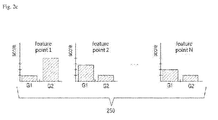
- the motion segmentation system may update a score histogram 250 on each of at least some feature points 240 based on an objective function defined as a distance between each of the at least some feature points 240 and a fundamental matrix on each of the groups 220 and 230.
- the score histogram 250 on each of the at least some feature points 240 may have an interval corresponding to each of the groups 220 and 230.
- the motion segmentation system may select any group, corresponding to a fundamental matrix which minimizes the objective function, expressed by Equation 2, on the score histogram 250 with respect to each of the at least some feature points 240, according to Equation 3 and accumulate a score of the selected group according to Equation 4, thereby making it possible to update the score histogram 250 on each of the at least some feature points 240.
- ⁇ may denote any group corresponding to a fundamental matrix which minimizes the objective function.
- d i may be SD(x i (k) , x i (1) , F g (k,l) ) and denote a distance between a i-th specific feature point, having a coordinate x i (k) in a k-th frame and a coordinate x i (1) in a 1-th video frame, and a fundamental matrix F g (k,l) obtained from the k-th frame and the 1-th frame in the video.
- ⁇ may denote a parameter for adjusting an accumulation intensity.
- h i [g] may denote an interval g of the score histogram 250 on the i-th specific feature point.
- the interval g may correspond to any group corresponding to a fundamental matrix which minimizes an objective function.
- the motion segmentation system may accumulate a score on remaining groups on the score histogram 250 on each of the at least some feature points 240 according to Equation 5 as well as accumulate a score of any group corresponding to a fundamental matrix which minimizes an objective function on the score histogram 250 on each of the at least some feature points 240.
- h i [g ⁇ ] may denote an interval g ⁇ of the score histogram 250 on the i-th specific feature point.
- the interval g ⁇ may correspond to the remaining groups except for any group corresponding to a fundamental matrix which minimizes an objective function.
- the motion segmentation system may relatively more accumulate a score of any group corresponding to a fundamental matrix which minimizes an objective function the score histogram 250 on each of at least some feature points 240 and relatively less accumulate a score on the remaining groups, instead of accumulating only a score of any group corresponding to a fundamental matrix which minimizes an objective function on the score histogram 250 on each of at least some feature points 240.
- the motion segmentation system may regroup each of at least some feature points 240 into a group corresponding to the highest score on the updated score histogram 250 on each of the at least some feature points 240 according to Equation 6.
- Equation ⁇ may denote a group, corresponding to the highest score, from among a plurality of groups 220 and 230.
- a first feature point 260 may be included in the first group 220 in a first random grouping process. However, when a group corresponding to the highest score on a score histogram on the first feature point 260 is the second group 230, the first feature point 260 may be regrouped into the second group 230.
- a second feature point 270 may be included in the second group 230 in a first randomly grouped process. However, when a group corresponding to the highest score on a score histogram on the second feature point 270 is the first group 220, the second feature point 270 may be regrouped into the first group 220.
- the randomized voting method may be repeated.
- a plurality of groups which are obtained by regrouping at least some feature points 240, may be used in a next process of the randomized voting method.
- the motion segmentation system may use the plurality of groups 220 and 230 obtained through regrouping of at least some feature points 240 in selecting the at least some feature points 240 from the plurality of groups 220 and 230 in which the plurality of feature points 210 are randomly grouped.
- the motion segmentation system may select at least a portion from a plurality of groups, in which at least some feature points 240 are regrouped, instead of selecting the at least some feature points 240 from the plurality of groups 220 and 230, in which the plurality of feature points 210 are randomly grouped.
- the randomized voting method which is repeated may terminate by comparing the number of randomized voting methods performed with a predetermined repetition count or comparing an objective function on each of at least some feature points selected from the plurality of groups, in which the at least some feature points 240 are regrouped, with a predetermined value. Furthermore, the randomized voting method may terminate by stopping regrouping at least some feature points 240.
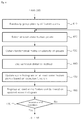
- FIG. 3 is a flow chart illustrating a motion segmentation method in a video according to an embodiment of the inventive concept.
- a motion segmentation system may receive a video(310).
- the motion segmentation system may extract a plurality of feature points from the video (320).
- the motion segmentation system may extract a plurality of feature points from at least two or more video frames.
- the motion segmentation system may apply a kanade-lukas-tomasi (hereafter referred as to "KLT") method to extract a plurality of feature points from the video.
- KLT kanade-lukas-tomasi
- the motion segmentation system may group a plurality of feature points by applying a randomized voting method using a score histogram on each of at least some feature points of the plurality of feature points (330). This will be more fully described with reference to FIG. 4 .
- FIG. 4 is a flow chart schematically illustrating grouping of a plurality of feature points using a randomized voting method shown in FIG. 3 .
- the motion segmentation system may randomly group a plurality of feature points based on the predetermined number of groups (410).
- the motion segmentation system may select at least some feature points from a plurality of groups, which are obtained by randomly grouping the plurality of feature points, based on the predetermined number of feature points selected by the group (420).
- the motion segmentation system may obtain a fundamental matrix on each of a plurality of groups from at least some feature points (430).
- the motion segmentation system may use a sampson distance method to calculate a distance between each of at least some feature points and a fundamental matrix on each of a plurality of groups (440).
- the motion segmentation system may accumulate a distance between each of the at least some feature points and a fundamental matrix on each of a plurality of groups with respect to at least two or more video frames in a process for applying the sampson distance method. Accordingly, when updating a score histogram on each of the at least some feature points (450), the motion segmentation system may update a score histogram on each of the at least some feature points based on an objective function defined as the distance between each of the at least some feature points, which are accumulated with respect to at least two or more video frames, and a fundamental matrix on each of a plurality of groups.
- the motion segmentation system may update a score histogram on each of the at least some feature points based on an objective function defined as a distance between each of the at least some feature points and a fundamental matrix on each of a plurality of groups (450).
- the motion segmentation system may accumulate a score of any group corresponding to a fundamental matrix which minimizes an objective function on a score histogram having an interval corresponding to each of a plurality of groups, thereby making it possible to update a score histogram on each of the at least some feature points.
- the motion segmentation system may regroup the at least some feature points based on the updated score histogram (460).
- the motion segmentation system may regroup each of the at least some feature points into a group corresponding to the highest score on the updated score histogram.
- the motion segmentation system may determine an end condition to repeat or cease the aforementioned randomized voting method (470).
- the motion segmentation system may stop regrouping the at least some feature points, by comparing the number of randomized voting methods performed with a predetermined repetition count or comparing an objective function on at least some feature points selected from the plurality of groups, which are obtained by regrouping the at least some feature points, with a predetermined value.
- the motion segmentation system may use a plurality of groups, which are obtained by regrouping the at least some feature points, in the next process to be repeated.
- the motion segmentation system may selectively perform spectral clustering on the at least some feature points.
- FIG. 5 is a block diagram illustrating a video motion segmentation system according to an embodiment of the inventive concept.
- a motion segmentation system may include a video input unit 510, a feature point extracting unit 520, and a randomized voting method applying unit 530.
- the video input unit 510 may receive a video.
- the feature point extracting unit 520 may extract a plurality of feature points from the video.
- the feature point extracting unit 520 may extract a plurality of feature points through at least two or more video frames.
- the feature point extracting unit 520 may use a KLT method to extract a plurality of feature points from the video.
- the randomized voting method applying unit 530 may apply a randomized voting method using a score histogram on each of the at least some feature points of the plurality of feature points, to group the plurality of feature points.
- the randomized voting method applying unit 530 may include a grouping unit, a feature point selecting unit, a fundamental matrix obtaining unit, a distance calculating unit, a score histogram updating unit, and a regrouping unit.
- the grouping unit may randomly group a plurality of feature points based on the predetermined number of groups.
- the feature point selecting unit may select the at least some feature points from a plurality of groups, in which a plurality of feature points are randomly grouped, based on the number of feature points selected by the group.
- the fundamental matrix obtaining unit may obtain a fundamental matrix on each of a plurality of groups from at least some feature points.
- the distance calculating unit may use a sampson distance method to calculate a distance between each of at least some feature points and a fundamental matrix on each of a plurality of groups.
- the distance calculating unit may accumulate a distance between each of at least some feature points and a fundamental matrix on each of a plurality of groups with respect to at least two or more video frames, thereby making it possible for the score histogram updating unit to update a score histogram on each of at least some feature points based on an objective function.
- the objective function may be defined as a distance, which is accumulated with respect to at least two or more video frames, between each of at least some feature points and a fundamental matrix on each of a plurality of groups.
- the score histogram updating unit may update a score histogram on each of at least some feature points based on the objective function.
- the score histogram updating unit may update a score histogram on each of at least some feature points by accumulating a score of any group corresponding to a fundamental matrix, which minimizes an objective function on a score histogram having an interval corresponding to each of a plurality of groups, with respect to each of at least some feature points.
- the regrouping unit may regroup at least some feature points based on the updated score histogram.
- the regrouping unit may regroup each of at least some feature points into a group corresponding to the highest score on the updated score histogram.
- the regrouping unit may determine an end condition to repeat or cease a randomized voting method.
- the regrouping unit may cease regrouping the at least some feature points by comparing the number of randomized voting methods performed with a predetermined repetition count or comparing an objective function on each of at least some feature points selected from the plurality of groups, which are obtained by regrouping at least some feature points, with a predetermined value.
- the regrouping unit may use a plurality of groups, which are obtained by regrouping at least some feature points, in the next process to be repeated.
- the regrouping unit may selectively perform a spectral clustering on the at least some feature points.
- the aforementioned device may be implemented with a hardware component, a software component, and/or a combination of a hardware component and a software component.
- a method according to an embodiment of the inventive concept may be implemented with a program command shape which can be performed through various computer means and be recorded to a computer-readable medium.
Landscapes
- Engineering & Computer Science (AREA)
- Theoretical Computer Science (AREA)
- Multimedia (AREA)
- Physics & Mathematics (AREA)
- Computer Vision & Pattern Recognition (AREA)
- General Physics & Mathematics (AREA)
- Signal Processing (AREA)
- Artificial Intelligence (AREA)
- Data Mining & Analysis (AREA)
- Evolutionary Computation (AREA)
- Software Systems (AREA)
- Databases & Information Systems (AREA)
- Medical Informatics (AREA)
- General Health & Medical Sciences (AREA)
- Computing Systems (AREA)
- Life Sciences & Earth Sciences (AREA)
- Bioinformatics & Cheminformatics (AREA)
- Bioinformatics & Computational Biology (AREA)
- Evolutionary Biology (AREA)
- General Engineering & Computer Science (AREA)
- Health & Medical Sciences (AREA)
- Probability & Statistics with Applications (AREA)
- Image Analysis (AREA)
Abstract
Description
- The present disclosure relates to a method and a system for segmenting video-motion, and more particularly, to a technique for dividing feature points having different motions or grouping feature points having the same motion.
- Video-motion segmentation may be performed to compress a video, detect a moving object, and analyze a motion as a process for perceiving different motions of an object in the video.
- However, motion segmentation in an existing video may not be robust to noise and may be slow in processing speed. Further, the motion segmentation in an existing video may have a problem in that accuracy for segmenting motions gets worse.
- In this specification, there may be disclosed a motion segmentation technique using randomized voting, thereby making it possible to be robust to noise and improving a processing speed and accuracy for motion segmentation.
- The present disclosure is directed to provide motion segmentation method and system that are robust to noise and improve a processing speed and accuracy for motion segmentation.
- Additionally, the present disclosure is directed to provide video motion segmentation method and system that provide a technique for applying a randomized voting method using a score histogram on each of at least a portion of a plurality of feature points in a motion segmentation process.
- Additionally, the present disclosure is directed to provide video motion segmentation method and system that provide a technique for using a minimum of video frames in segmenting a motion by applying a randomized voting method to at least two or more video frames.
- In accordance with an aspect of the present disclosure, a video-motion segmentation method using a randomized voting includes receiving a video; extracting a plurality of feature points from the video, and grouping the plurality of feature points by applying a randomized voting method using a score histogram on each of the at least some feature points of the plurality of feature points.
- Additionally, the grouping of the plurality of feature points includes randomly grouping the plurality of feature points based on the predetermined number of groups, selecting the at least some feature points from a plurality of groups, which are obtained by randomly grouping the at least some feature points, based on the predetermined number of feature points selected by the group, obtaining a fundamental matrix on each of the plurality of groups from the at least some feature points, using a sampson distance method to calculate a distance between each of the at least some feature points and a fundamental matrix on each of the plurality of groups, updating the score histogram on each of the at least some feature points based on an objective function defined as the distance, and regrouping the at least some feature points based on the updated score histogram.
- Additionally, the updating of the score histogram includes accumulating a score of any group corresponding to a fundamental matrix which minimizes the objective function on the score histogram having an interval corresponding to each of the plurality of groups with respect to the at least some feature points.
- Additionally, the regrouping of the at least some feature points includes regrouping each of the at least some feature points into a group corresponding to the highest score on the updated score histogram.
- Additionally, the using of the sampson distance method includes accumulating the distance with respect to at least two or more video frames, and the updating of the score histogram comprises updating the score histogram on each of the at least some feature points based on the objective function.
- Additionally, the regrouping of the at least some feature points includes using a plurality of groups, which are obtained by regrouping the at least some feature points, in a next process to be repeated, when the randomized voting method is repeated.
- Additionally, the regrouping of the at least some feature points includes stopping regrouping the at least some feature points by comparing the number of randomized voting methods performed with a predetermined repetition count or comparing the objective function on at least some feature points selected from the plurality of groups, which are obtained by regrouping the at least some feature points, with a predetermined value.
- Additionally, the regrouping of the at least some feature points includes selectively performing a spectral clustering on the at least some feature points.
- Additionally, the extracting of the plurality of feature points includes extracting the plurality of feature points through at least two or more video frames.
- Additionally, the extracting of the plurality of feature points includes applying a kanade-lukas-tomasi (hereafter referred as to "KLT") method to extract the plurality of feature points from the video.
- In accordance with another aspect of the present disclosure, a video-motion segmentation system using a randomized voting includes a video input unit configured to receive a video; a feature point extracting unit configured to extract a plurality of feature points from the video, and a randomized voting method applying unit configured to group the plurality of feature points by applying a randomized voting method using a score histogram on each of the at least some feature points of the plurality of feature points.
- Additionally, the randomized voting method applying unit includes a grouping unit configured to group the plurality of feature points based on the predetermined number of groups; a feature point selecting unit configured to select the at least some feature points from a plurality of groups, which are obtained by randomly grouping the plurality of feature points, based on the predetermined number of feature points selected by the group; a fundamental matrix obtaining unit configured to obtain a fundamental matrix on each of a plurality of groups from the at least some feature points, a distance calculating unit configured to use a sampson distance method to calculate a distance between each of the at least some feature points and a fundamental matrix on each of the plurality of groups; a score histogram updating unit configured to update a score histogram on each of the at least some feature points based on an objective function defined as a distance between each of the at least some feature points and the fundamental matrix on each of the plurality of groups, and a regrouping unit configured to regroup the at least some feature points based on the updated score histogram.
- Additionally, the score histogram updating unit accumulates a score of any group corresponding to a fundamental matrix which minimizes the objective function on a score histogram having an interval corresponding to each of the plurality of groups with respect to each of the at least some feature points.
- Additionally, the regrouping unit regroups each of the at least some feature points into a group corresponding to the highest score on the updated score histogram.
- Motion segmentation method and system are robust to noise and improve a processing speed and accuracy for motion segmentation.
- Video motion segmentation method and system provide a technique for applying a randomized voting method using a score histogram on each of at least a portion of a plurality of feature points in a motion segmentation process.
- Video motion segmentation method and system provide a technique for using a minimum of video frames in segmenting a motion by applying a randomized voting method to at least two or more video frames.
-
-
FIG. 1 is a diagram for describing a randomized voting method applied in a video motion segmentation method. -
FIGS. 2A to 2D are diagrams for describing a video-motion segmentation method according to an embodiment of the inventive concept. -
FIG. 3 is a flow chart illustrating a motion segmentation method in a video according to an embodiment of the inventive concept. -
FIG. 4 is a flow chart schematically illustrating grouping of a plurality of feature points using a randomized voting method shown inFIG. 3 . -
FIG. 5 is a block diagram illustrating a video motion segmentation system according to an embodiment of the inventive concept. - Hereinafter, the attached drawings will be referred to describe an optical logic circuit operating with light reflection control, and a computation device using the optical logic circuit in accordance with embodiments of the present disclosure.
- Various embodiments of the present disclosure as described hereinafter are provided to detail features of the present disclosure, not to restrict or concretely define the scope of inventive concept thereof. Rather, it will be properly construed that all of modifications, alterations, or variations derivable by those skilled in the art may be included in the scope of the present disclosure.
-
FIG. 1 is a diagram for describing a randomized voting method applied in a video motion segmentation method. - Referring to
FIG. 1 , a motion segmentation system according to an embodiment of the inventive concept may apply a randomized voting method using ascore histogram 130 on each of at least aportion 120 of a plurality offeature points 110 in a motion segmentation process which divides feature points having different motions or groups feature points having the same motion in a video. - Specifically, after randomly grouping the plurality of
feature points 110 into afirst group 140 and asecond group 150, the motion segmentation system may regroup at least aportion 120 of thefeature points 110 into afirst group 140 or asecond group 150 by selecting the at least aportion 120 from a plurality ofgroups score histogram 130 on each of theselected feature points 120. - Here, the motion segmentation system may obtain a fundamental matrix on each of the plurality of
groups score histogram 130 on each of the selected thefeature points 120 based on an objective function defined as a distance between each of theselected feature points 120 and a fundamental matrix on each of the plurality ofgroups selected feature points 120 using theupdated score histogram 130. - As the randomized voting method is repeated, the
selected feature points 120 of the plurality offeature points 110 may be continuously regrouped based on an objective function. Accordingly, feature points having different motions of the plurality offeature points 110 may be divided into different groups, and feature points having the same motion of the plurality offeature points 110 may be classified into the same group. The detailed description on the randomized voting method may be described as follows. - Therefore, the motion segmentation system may perform a motion segmentation method which is robust to noise and improves a processing speed and accuracy by applying the randomized voting method.
-
FIGS. 2A to 2D are diagrams for describing a video-motion segmentation method according to an embodiment of the inventive concept. - Referring to
FIG. 2A , a motion segmentation system may randomly group a plurality offeature points 210 extracted from a video based on the predetermined number of groups and select at least a portion 240 (illustrated by cross-marks having a circular or rectangular boundary) from a plurality ofgroups feature points 210 are randomly grouped, based on the predetermined number of feature points selected by the group. - For example, when the predetermined number of groups is two and the predetermined number of feature points selected by the group is seven, the motion segmentation system may randomly group the plurality of
feature points 210 into afirst group 220 and asecond group 230, select seven first feature points 241 (illustrated by cross-marks having a circular boundary) from thefirst group 220, and select seven second feature points 242 (illustrated by cross-marks having a rectangular boundary) from thesecond group 230. - Referring to
FIG. 2B , the motion segmentation system may obtain a fundamental matrix on each of the plurality ofgroups feature points 240. Here, a process for obtaining a fundamental matrix may use existing calculating methods. The detailed description on the method may be omitted, because it gets out from the spirit and scope of the inventive concept. Here, the motion segmentation system may obtain a fundamental matrix to correspond to each of theplurality groups - For example, the motion segmentation system may obtain a first fundamental matrix on the
first group 220 fromfirst feature points 241 as illustrated inFIG. 2B(a) and obtain a second fundamental matrix on thesecond group 230 fromsecond feature points 242 as illustrated inFIG. 2B(b) . - Next, the motion segmentation system may use a sampson distance method to calculate a distance between each of at least some
feature points 240 and a fundamental matrix on each of thegroups feature points 240 and the first fundamental matrix and a distance between each of the at least somefeature points 240 and the second fundamental matrix, respectively. - For example, the motion segmentation system may calculate a distance between each of the at least some feature points 240 and a fundamental matrix on each of the
groups following equation 1.
- In
Equation 1, SD(x, y, F) may denote a distance between a specific feature point having coordinates (x, y) in a video and a fundamental matrix F. (Fx)j 2 may denote a j-th item of the fundamental matrix Fx. - The motion segmentation system may accumulate a distance, which is calculated using the Sampson distance method, between each of the at least some feature points 240 and a fundamental matrix on each of the plurality of
groups 
- In
Equation 2, E(Xk, Fg) may denote a value in which a distance between a k-th specific feature point Xk of the at least some feature points 240 and a fundamental matrix Fg is accumulated with respect to at least two or more video frames. Here, because g denotes a group in which the plurality of feature points 210 are grouped, Fg denotes a fundamental matrix corresponding to a group g. Xk (i) may denote a coordinate of a specific feature point Xk in a i-th video frame. Xk (j) may denote a coordinate of a specific feature point Xk in a j-th video frame. Fg (i,j) may denote a fundamental matrix which is obtained from a i-th frame and a j-th frame. f may denote the total number of video frames. - When a specific feature point is grouped into a proper group, a distance between a specific feature point, accumulated with respect to at least two or more video frames, and a fundamental matrix, corresponding to the proper group, may approximate to 0. Therefore, the motion segmentation system may set an objective function, as expressed by
Equation 2, using the described characteristic. Here, the objective function may be defined as a distance between each of at least some feature points 240, accumulated with respect to at least two or more video frames, and a fundamental matrix on each of the plurality ofgroups - Referring to
FIG. 2C , the motion segmentation system may update ascore histogram 250 on each of at least somefeature points 240 based on an objective function defined as a distance between each of the at least some feature points 240 and a fundamental matrix on each of thegroups score histogram 250 on each of the at least some feature points 240 may have an interval corresponding to each of thegroups - Specifically, the motion segmentation system may select any group, corresponding to a fundamental matrix which minimizes the objective function, expressed by
Equation 2, on thescore histogram 250 with respect to each of the at least some feature points 240, according to Equation 3 and accumulate a score of the selected group according to Equation 4, thereby making it possible to update thescore histogram 250 on each of the at least some feature points 240.
- In Equation 3, ĝ may denote any group corresponding to a fundamental matrix which minimizes the objective function.

- In Equation 4, di may be SD(xi (k), xi (1), Fg (k,l)) and denote a distance between a i-th specific feature point, having a coordinate xi (k) in a k-th frame and a coordinate xi (1) in a 1-th video frame, and a fundamental matrix Fg (k,l) obtained from the k-th frame and the 1-th frame in the video. λ may denote a parameter for adjusting an accumulation intensity. hi[g] may denote an interval g of the
score histogram 250 on the i-th specific feature point. Here, the interval g may correspond to any group corresponding to a fundamental matrix which minimizes an objective function. - Here, the motion segmentation system may accumulate a score on remaining groups on the
score histogram 250 on each of the at least somefeature points 240 according to Equation 5 as well as accumulate a score of any group corresponding to a fundamental matrix which minimizes an objective function on thescore histogram 250 on each of the at least some feature points 240.
- In Equation 5, hi[g̃] may denote an interval g̃ of the
score histogram 250 on the i-th specific feature point. Here, the interval g̃ may correspond to the remaining groups except for any group corresponding to a fundamental matrix which minimizes an objective function. - That is, the motion segmentation system may relatively more accumulate a score of any group corresponding to a fundamental matrix which minimizes an objective function the
score histogram 250 on each of at least some feature points 240 and relatively less accumulate a score on the remaining groups, instead of accumulating only a score of any group corresponding to a fundamental matrix which minimizes an objective function on thescore histogram 250 on each of at least some feature points 240. - Accordingly, referring to
FIG. 2D , the motion segmentation system may regroup each of at least some feature points 240 into a group corresponding to the highest score on the updatedscore histogram 250 on each of the at least somefeature points 240 according to Equation 6.
- In Equation ĝ may denote a group, corresponding to the highest score, from among a plurality of
groups - For example, a
first feature point 260 may be included in thefirst group 220 in a first random grouping process. However, when a group corresponding to the highest score on a score histogram on thefirst feature point 260 is thesecond group 230, thefirst feature point 260 may be regrouped into thesecond group 230. Asecond feature point 270 may be included in thesecond group 230 in a first randomly grouped process. However, when a group corresponding to the highest score on a score histogram on thesecond feature point 270 is thefirst group 220, thesecond feature point 270 may be regrouped into thefirst group 220. - The randomized voting method may be repeated. When the randomized voting method is repeated, a plurality of groups, which are obtained by regrouping at least some feature points 240, may be used in a next process of the randomized voting method. For example, the motion segmentation system may use the plurality of
groups feature points 240 in selecting the at least somefeature points 240 from the plurality ofgroups feature points 240 from the plurality ofgroups - Here, the randomized voting method which is repeated may terminate by comparing the number of randomized voting methods performed with a predetermined repetition count or comparing an objective function on each of at least some feature points selected from the plurality of groups, in which the at least some feature points 240 are regrouped, with a predetermined value. Furthermore, the randomized voting method may terminate by stopping regrouping at least some feature points 240.
-
FIG. 3 is a flow chart illustrating a motion segmentation method in a video according to an embodiment of the inventive concept. - Referring to
FIG. 3 , a motion segmentation system according to an embodiment of the inventive concept may receive a video(310). - Next, the motion segmentation system may extract a plurality of feature points from the video (320). Here, the motion segmentation system may extract a plurality of feature points from at least two or more video frames. Moreover, the motion segmentation system may apply a kanade-lukas-tomasi (hereafter referred as to "KLT") method to extract a plurality of feature points from the video.
- After that, the motion segmentation system may group a plurality of feature points by applying a randomized voting method using a score histogram on each of at least some feature points of the plurality of feature points (330). This will be more fully described with reference to
FIG. 4 . -
FIG. 4 is a flow chart schematically illustrating grouping of a plurality of feature points using a randomized voting method shown inFIG. 3 . - Referring to
FIG. 4 , the motion segmentation system according to an embodiment of the inventive concept may randomly group a plurality of feature points based on the predetermined number of groups (410). - The motion segmentation system may select at least some feature points from a plurality of groups, which are obtained by randomly grouping the plurality of feature points, based on the predetermined number of feature points selected by the group (420).
- Next, the motion segmentation system may obtain a fundamental matrix on each of a plurality of groups from at least some feature points (430).
- After that, the motion segmentation system may use a sampson distance method to calculate a distance between each of at least some feature points and a fundamental matrix on each of a plurality of groups (440).
- Here, the motion segmentation system may accumulate a distance between each of the at least some feature points and a fundamental matrix on each of a plurality of groups with respect to at least two or more video frames in a process for applying the sampson distance method. Accordingly, when updating a score histogram on each of the at least some feature points (450), the motion segmentation system may update a score histogram on each of the at least some feature points based on an objective function defined as the distance between each of the at least some feature points, which are accumulated with respect to at least two or more video frames, and a fundamental matrix on each of a plurality of groups.
- Next, the motion segmentation system may update a score histogram on each of the at least some feature points based on an objective function defined as a distance between each of the at least some feature points and a fundamental matrix on each of a plurality of groups (450).
- Here, the motion segmentation system may accumulate a score of any group corresponding to a fundamental matrix which minimizes an objective function on a score histogram having an interval corresponding to each of a plurality of groups, thereby making it possible to update a score histogram on each of the at least some feature points.
- After that, the motion segmentation system may regroup the at least some feature points based on the updated score histogram (460). In detail, the motion segmentation system may regroup each of the at least some feature points into a group corresponding to the highest score on the updated score histogram.
- Moreover, the motion segmentation system may determine an end condition to repeat or cease the aforementioned randomized voting method (470).
- For example, the motion segmentation system may stop regrouping the at least some feature points, by comparing the number of randomized voting methods performed with a predetermined repetition count or comparing an objective function on at least some feature points selected from the plurality of groups, which are obtained by regrouping the at least some feature points, with a predetermined value.
- When the randomized voting method is repeated, the motion segmentation system may use a plurality of groups, which are obtained by regrouping the at least some feature points, in the next process to be repeated.
- Further, although not shown in figures, when the randomized voting method is ceased, the motion segmentation system may selectively perform spectral clustering on the at least some feature points.
-
FIG. 5 is a block diagram illustrating a video motion segmentation system according to an embodiment of the inventive concept. - Referring to
FIG. 5 , a motion segmentation system according to an embodiment of the inventive concept may include avideo input unit 510, a featurepoint extracting unit 520, and a randomized votingmethod applying unit 530. - The
video input unit 510 may receive a video. - The feature
point extracting unit 520 may extract a plurality of feature points from the video. Here, the featurepoint extracting unit 520 may extract a plurality of feature points through at least two or more video frames. Moreover, the featurepoint extracting unit 520 may use a KLT method to extract a plurality of feature points from the video. - The randomized voting
method applying unit 530 may apply a randomized voting method using a score histogram on each of the at least some feature points of the plurality of feature points, to group the plurality of feature points. - Here, although not illustrated in figures, the randomized voting
method applying unit 530 may include a grouping unit, a feature point selecting unit, a fundamental matrix obtaining unit, a distance calculating unit, a score histogram updating unit, and a regrouping unit. - The grouping unit may randomly group a plurality of feature points based on the predetermined number of groups.
- The feature point selecting unit may select the at least some feature points from a plurality of groups, in which a plurality of feature points are randomly grouped, based on the number of feature points selected by the group.
- The fundamental matrix obtaining unit may obtain a fundamental matrix on each of a plurality of groups from at least some feature points.
- The distance calculating unit may use a sampson distance method to calculate a distance between each of at least some feature points and a fundamental matrix on each of a plurality of groups.
- Here, when applying the sampson distance method, the distance calculating unit may accumulate a distance between each of at least some feature points and a fundamental matrix on each of a plurality of groups with respect to at least two or more video frames, thereby making it possible for the score histogram updating unit to update a score histogram on each of at least some feature points based on an objective function. Here, the objective function may be defined as a distance, which is accumulated with respect to at least two or more video frames, between each of at least some feature points and a fundamental matrix on each of a plurality of groups.
- The score histogram updating unit may update a score histogram on each of at least some feature points based on the objective function.
- Here, the score histogram updating unit may update a score histogram on each of at least some feature points by accumulating a score of any group corresponding to a fundamental matrix, which minimizes an objective function on a score histogram having an interval corresponding to each of a plurality of groups, with respect to each of at least some feature points.
- The regrouping unit may regroup at least some feature points based on the updated score histogram. In detail, the regrouping unit may regroup each of at least some feature points into a group corresponding to the highest score on the updated score histogram.
- Moreover, the regrouping unit may determine an end condition to repeat or cease a randomized voting method.
- For example, the regrouping unit may cease regrouping the at least some feature points by comparing the number of randomized voting methods performed with a predetermined repetition count or comparing an objective function on each of at least some feature points selected from the plurality of groups, which are obtained by regrouping at least some feature points, with a predetermined value.
- When the randomized voting method is repeated, the regrouping unit may use a plurality of groups, which are obtained by regrouping at least some feature points, in the next process to be repeated.
- Furthermore, when the randomized voting method is ceased, the regrouping unit may selectively perform a spectral clustering on the at least some feature points.
- The aforementioned device may be implemented with a hardware component, a software component, and/or a combination of a hardware component and a software component.
- A method according to an embodiment of the inventive concept may be implemented with a program command shape which can be performed through various computer means and be recorded to a computer-readable medium.
Claims (15)
- A video-motion segmentation method using a randomized voting, comprising:receiving a video;extracting a plurality of feature points from the video; andgrouping the plurality of feature points by applying a randomized voting method using a score histogram on each of at least some feature points of the plurality of feature points.
- The video-motion segmentation method of claim 1, wherein the grouping of the plurality of feature points comprises:randomly grouping the plurality of feature points based on the predetermined number of groups;selecting the at least some feature points from a plurality of groups, which are obtained by grouping the at least some feature points, based on the predetermined number of feature points selected by the group;obtaining a fundamental matrix on each of the plurality of groups from the at least some feature points;using a sampson distance method to calculate a distance between each of the at least some feature points and a fundamental matrix on each of the plurality of groups;updating the score histogram on each of the at least some feature points based on an objective function defined as the distance; andregrouping the at least some feature points based on the updated score histogram.
- The video-motion segmentation method of claim 2, wherein the updating of the score histogram comprises:accumulating a score of a group corresponding to a fundamental matrix, which minimizes the objective function on the score histogram having an interval corresponding to each of the plurality of groups, with respect to the at least some feature points.
- The video-motion segmentation method of claim 2, wherein the regrouping of the at least some feature points comprises:regrouping each of the at least some feature points into a group corresponding to the highest score on the updated score histogram.
- The video-motion segmentation method of claim 2, wherein the using of the sampson distance method comprises:accumulating the distance with respect to at least two or more video frames, and wherein the updating of the score histogram comprises:updating the score histogram on each of the at least some feature points based on the objective function.
- The video-motion segmentation method of claim 2, wherein the regrouping of the at least some feature points comprises:using a plurality of groups, which are obtained by regrouping the at least some feature points, in a next process to be repeated, when the randomized voting method is repeated.
- The video-motion segmentation method of claim 2, wherein the regrouping of the at least some feature points comprises:stopping regrouping the at least some feature points by comparing the number of randomized voting methods performed with a predetermined repetition count or comparing the objective function on each of at least some feature points selected from the plurality of groups, which are obtained by regrouping at least some feature points, with a predetermined value.
- The video-motion segmentation method of claim 7, wherein the regrouping of the at least some feature points comprises:selectively performing a spectral clustering on the at least some feature points.
- The video-motion segmentation method of claim 1, wherein the extracting of the plurality of feature points comprises:extracting the plurality of feature points through at least two or more video frames.
- The video-motion segmentation method of claim 1, wherein the extracting of the plurality of feature points comprises:applying a kanade-lukas-tomasi (hereafter referred as to "KLT") method to extract the plurality of feature points from the video.
- A computer-readable recording medium storing a program for executing a method set forth in claim 1.
- A video-motion segmentation system using a randomized voting, comprising:a video input unit configured to receive a video;a feature point extracting unit configured to extract a plurality of feature points from the video; anda randomized voting method applying unit configured to group the plurality of feature points by applying a randomized voting method using a score histogram on each of at least some feature points of the plurality of feature points.
- The video-motion segmentation system of claim 12, wherein the randomized voting method applying unit comprises:a grouping unit configured to group the plurality of feature points based on the predetermined number of groups;a feature point selecting unit configured to select the at least some feature points from a plurality of groups, which are obtained by randomly grouping the plurality of feature points, based on the predetermined number of feature points selected by the group;a fundamental matrix obtaining unit configured to obtain a fundamental matrix on each of a plurality of groups from the at least some feature points;a distance calculating unit configured to use a sampson distance method to calculate a distance between each of the at least some feature points and a fundamental matrix on each of the plurality of groups;a score histogram updating unit configured to update a score histogram on each of the at least some feature points based on an objective function defined as a distance between each of the at least some feature points and the fundamental matrix on each of the plurality of groups; anda regrouping unit configured to regroup the at least some feature points based on the updated score histogram.
- The video-motion segmentation system of claim 13, wherein the score histogram updating unit accumulates a score of a group corresponding to a fundamental matrix, which minimizes the objective function on a score histogram having an interval corresponding to each of the plurality of groups, with respect to each of the at least some feature points.
- The video-motion segmentation system of claim 13, wherein the regrouping unit regroups each of the at least some feature points into a group corresponding to the highest score on the updated score histogram.
Applications Claiming Priority (3)
| Application Number | Priority Date | Filing Date | Title |
|---|---|---|---|
| KR20140052413 | 2014-04-30 | ||
| KR1020150054605A KR101693106B1 (en) | 2014-04-30 | 2015-04-17 | Motion segmentation method and system in video using randomized voting |
| PCT/KR2015/004421 WO2015167292A1 (en) | 2014-04-30 | 2015-04-30 | Method and system for segmenting motion in moving picture using randomized voting |
Publications (2)
| Publication Number | Publication Date |
|---|---|
| EP2977957A1 true EP2977957A1 (en) | 2016-01-27 |
| EP2977957A4 EP2977957A4 (en) | 2016-07-27 |
Family
ID=54605324
Family Applications (1)
| Application Number | Title | Priority Date | Filing Date |
|---|---|---|---|
| EP15750911.8A Withdrawn EP2977957A4 (en) | 2014-04-30 | 2015-04-30 | METHOD AND SYSTEM FOR MOTION SEGMENTATION IN RANDOM-DISTRIBUTED MOTION MOVING IMAGE |
Country Status (4)
| Country | Link |
|---|---|
| US (1) | US10140716B2 (en) |
| EP (1) | EP2977957A4 (en) |
| KR (1) | KR101693106B1 (en) |
| WO (1) | WO2015167292A1 (en) |
Families Citing this family (1)
| Publication number | Priority date | Publication date | Assignee | Title |
|---|---|---|---|---|
| TWI744000B (en) * | 2020-09-21 | 2021-10-21 | 財團法人資訊工業策進會 | Image labeling apparatus, method, and computer program product thereof |
Family Cites Families (5)
| Publication number | Priority date | Publication date | Assignee | Title |
|---|---|---|---|---|
| US8175412B2 (en) * | 2004-02-17 | 2012-05-08 | Yeda Research & Development Co. Ltd. | Method and apparatus for matching portions of input images |
| KR20060065417A (en) | 2004-12-09 | 2006-06-14 | 한국전자통신연구원 | Marker-free motion capture device with tracking error correction and method |
| US8249299B1 (en) * | 2009-08-17 | 2012-08-21 | Adobe Systems Incorporated | Systems and methods of tracking objects in video |
| KR101665386B1 (en) | 2010-11-15 | 2016-10-12 | 한화테크윈 주식회사 | Method and apparatus for estimating position in a mobile robot |
| US8447116B2 (en) * | 2011-07-22 | 2013-05-21 | Honeywell International Inc. | Identifying true feature matches for vision based navigation |
-
2015
- 2015-04-17 KR KR1020150054605A patent/KR101693106B1/en active Active
- 2015-04-30 EP EP15750911.8A patent/EP2977957A4/en not_active Withdrawn
- 2015-04-30 WO PCT/KR2015/004421 patent/WO2015167292A1/en not_active Ceased
- 2015-04-30 US US14/768,836 patent/US10140716B2/en active Active
Also Published As
| Publication number | Publication date |
|---|---|
| US20160277732A1 (en) | 2016-09-22 |
| KR20150125898A (en) | 2015-11-10 |
| KR101693106B1 (en) | 2017-01-05 |
| EP2977957A4 (en) | 2016-07-27 |
| WO2015167292A1 (en) | 2015-11-05 |
| US10140716B2 (en) | 2018-11-27 |
Similar Documents
| Publication | Publication Date | Title |
|---|---|---|
| CN103093181B (en) | A kind of method and apparatus of license plate image location | |
| Von Gioi et al. | LSD: A fast line segment detector with a false detection control | |
| US9792507B2 (en) | Method and system for ground truth determination in lane departure warning | |
| US11334814B2 (en) | Method and apparatus for training a learning machine | |
| EP3822830B1 (en) | Feature processing method and device for motion trajectory, and computer storage medium | |
| CN104867130B (en) | A kind of self-adapting division method based on crack image sub-district gray average | |
| US10445868B2 (en) | Method for detecting a defect on a surface of a tire | |
| US10579883B2 (en) | Method and apparatus for detecting a vehicle in a driving assisting system | |
| US10945888B2 (en) | Intelligent blind guide method and apparatus | |
| EP3226176A1 (en) | Method for learning rejector by forming classification tree in use of training images and detecting object in test images, and rejector using the same | |
| CN104217192A (en) | Hand positioning method and equipment based on range image | |
| CN104021552A (en) | Multi-objective particle swarm parameter optimization method based on graph segmentation process | |
| CN112381034A (en) | Lane line detection method, device, equipment and storage medium | |
| CN108234821A (en) | Detect the methods, devices and systems of the action in video | |
| KR101937436B1 (en) | Apparatus and method for separating background and foreground in 3d video | |
| CN103116890A (en) | Video image based intelligent searching and matching method | |
| CN105354549B (en) | Based on the rapid pedestrian detection method estimated like physical property | |
| EP2887261A2 (en) | Information processing device, information processing method, and program | |
| CN113837171B (en) | Candidate region extraction method, candidate region extraction system, candidate region extraction device, medium and target detection method | |
| US10140716B2 (en) | Method of motion segmentation in video using randomized voting and system having the same | |
| CN118628984B (en) | Vision-assisted method and system for counting number of milk sheep | |
| CN103714552B (en) | Motion shadow removing method and device and intelligent video analysis system | |
| CN104754248A (en) | Method and device for acquiring target snapshot | |
| EP3076370B1 (en) | Method and system for selecting optimum values for parameter set for disparity calculation | |
| KR102846723B1 (en) | Real-time objection detection network system |
Legal Events
| Date | Code | Title | Description |
|---|---|---|---|
| PUAI | Public reference made under article 153(3) epc to a published international application that has entered the european phase |
Free format text: ORIGINAL CODE: 0009012 |
|
| 17P | Request for examination filed |
Effective date: 20150827 |
|
| AK | Designated contracting states |
Kind code of ref document: A1 Designated state(s): AL AT BE BG CH CY CZ DE DK EE ES FI FR GB GR HR HU IE IS IT LI LT LU LV MC MK MT NL NO PL PT RO RS SE SI SK SM TR |
|
| AX | Request for extension of the european patent |
Extension state: BA ME |
|
| RAP1 | Party data changed (applicant data changed or rights of an application transferred) |
Owner name: KOREA ADVANCED INSTITUTE OF SCIENCE AND TECHNOLOGY |
|
| RIN1 | Information on inventor provided before grant (corrected) |
Inventor name: KIM, JUN MO Inventor name: JUNG, HEE CHUL Inventor name: JU, JEONG WOO |
|
| A4 | Supplementary search report drawn up and despatched |
Effective date: 20160629 |
|
| RIC1 | Information provided on ipc code assigned before grant |
Ipc: H04N 19/51 20140101ALI20160623BHEP Ipc: G06T 7/20 20060101AFI20160623BHEP |
|
| STAA | Information on the status of an ep patent application or granted ep patent |
Free format text: STATUS: THE APPLICATION IS DEEMED TO BE WITHDRAWN |
|
| 18D | Application deemed to be withdrawn |
Effective date: 20170126 |
|
| DAV | Request for validation of the european patent (deleted) | ||
| DAX | Request for extension of the european patent (deleted) |