EP2977879A1 - Mobile terminal-based method and system for unlocking screen, and storage medium - Google Patents
Mobile terminal-based method and system for unlocking screen, and storage medium Download PDFInfo
- Publication number
- EP2977879A1 EP2977879A1 EP13878716.3A EP13878716A EP2977879A1 EP 2977879 A1 EP2977879 A1 EP 2977879A1 EP 13878716 A EP13878716 A EP 13878716A EP 2977879 A1 EP2977879 A1 EP 2977879A1
- Authority
- EP
- European Patent Office
- Prior art keywords
- regions
- unlocking
- screen
- user
- combination
- Prior art date
- Legal status (The legal status is an assumption and is not a legal conclusion. Google has not performed a legal analysis and makes no representation as to the accuracy of the status listed.)
- Withdrawn
Links
Images



Classifications
-
- G—PHYSICS
- G06—COMPUTING OR CALCULATING; COUNTING
- G06F—ELECTRIC DIGITAL DATA PROCESSING
- G06F21/00—Security arrangements for protecting computers, components thereof, programs or data against unauthorised activity
- G06F21/30—Authentication, i.e. establishing the identity or authorisation of security principals
- G06F21/31—User authentication
- G06F21/36—User authentication by graphic or iconic representation
-
- G—PHYSICS
- G06—COMPUTING OR CALCULATING; COUNTING
- G06F—ELECTRIC DIGITAL DATA PROCESSING
- G06F3/00—Input arrangements for transferring data to be processed into a form capable of being handled by the computer; Output arrangements for transferring data from processing unit to output unit, e.g. interface arrangements
- G06F3/01—Input arrangements or combined input and output arrangements for interaction between user and computer
- G06F3/048—Interaction techniques based on graphical user interfaces [GUI]
- G06F3/0487—Interaction techniques based on graphical user interfaces [GUI] using specific features provided by the input device, e.g. functions controlled by the rotation of a mouse with dual sensing arrangements, or of the nature of the input device, e.g. tap gestures based on pressure sensed by a digitiser
- G06F3/0488—Interaction techniques based on graphical user interfaces [GUI] using specific features provided by the input device, e.g. functions controlled by the rotation of a mouse with dual sensing arrangements, or of the nature of the input device, e.g. tap gestures based on pressure sensed by a digitiser using a touch-screen or digitiser, e.g. input of commands through traced gestures
-
- G—PHYSICS
- G06—COMPUTING OR CALCULATING; COUNTING
- G06F—ELECTRIC DIGITAL DATA PROCESSING
- G06F3/00—Input arrangements for transferring data to be processed into a form capable of being handled by the computer; Output arrangements for transferring data from processing unit to output unit, e.g. interface arrangements
- G06F3/01—Input arrangements or combined input and output arrangements for interaction between user and computer
- G06F3/048—Interaction techniques based on graphical user interfaces [GUI]
- G06F3/0487—Interaction techniques based on graphical user interfaces [GUI] using specific features provided by the input device, e.g. functions controlled by the rotation of a mouse with dual sensing arrangements, or of the nature of the input device, e.g. tap gestures based on pressure sensed by a digitiser
- G06F3/0488—Interaction techniques based on graphical user interfaces [GUI] using specific features provided by the input device, e.g. functions controlled by the rotation of a mouse with dual sensing arrangements, or of the nature of the input device, e.g. tap gestures based on pressure sensed by a digitiser using a touch-screen or digitiser, e.g. input of commands through traced gestures
- G06F3/04886—Interaction techniques based on graphical user interfaces [GUI] using specific features provided by the input device, e.g. functions controlled by the rotation of a mouse with dual sensing arrangements, or of the nature of the input device, e.g. tap gestures based on pressure sensed by a digitiser using a touch-screen or digitiser, e.g. input of commands through traced gestures by partitioning the display area of the touch-screen or the surface of the digitising tablet into independently controllable areas, e.g. virtual keyboards or menus
-
- H—ELECTRICITY
- H04—ELECTRIC COMMUNICATION TECHNIQUE
- H04L—TRANSMISSION OF DIGITAL INFORMATION, e.g. TELEGRAPHIC COMMUNICATION
- H04L63/00—Network architectures or network communication protocols for network security
- H04L63/16—Implementing security features at a particular protocol layer
- H04L63/168—Implementing security features at a particular protocol layer above the transport layer
-
- H—ELECTRICITY
- H04—ELECTRIC COMMUNICATION TECHNIQUE
- H04W—WIRELESS COMMUNICATION NETWORKS
- H04W12/00—Security arrangements; Authentication; Protecting privacy or anonymity
- H04W12/06—Authentication
Definitions
- the present invention relates to a mobile terminal with a large screen, and more particularly to a unlocking a screen method and system based on the mobile terminal, as well as a storage medium for the same.
- the mobile phone is an extremely popular communication device. Over the years, the smart phone has gradually become the mainstream among mobile phones. Every manufacturer considers the issue of unlocking manners of a smart phone with a large screen. Nevertheless, an easy unlocking manner is more convenient for the user.
- the prior art for the unlocking method is generally a slide to unlock or keying a password to unlock. These methods are unable to meet the personalized requirements of the user. The, unlocking passwords are easily cracked, and therefore are disadvantageous for protecting the user's personal information.
- the present invention aims to solve the aforementioned technical problems arising from the foregoing deficiencies in the prior art by providing a screen unlocking method and system based on mobile terminal, and storage medium for the same for easily and quacking unlocking a large screen of the mobile terminal, and therefore is convenient for the user to use.
- the present invention provide a technical solution for solving the above technical problems by providing a screen unlocking method based on a mobile terminal, the method comprises steps of:
- N is an integer greater than 0 and less than M;
- a screen unlocking system based on a mobile terminal comprises:
- a screen unlocking storage medium based on a mobile terminal having stored thereon instructions being executed by a processor, the processor executing said instructions provides a method for unlocking a screen configured to a mobile terminal, comprising:
- the present invention relates to a screen unlocking method and system based on mobile terminal, and storage medium for the same.
- a screen of a mobile terminal is divided into M regions in advance; a combination of N regions is set in the divided regions as a screen unlocking combination regions.
- the divided M regions and the screen unlocking combination regions are self-defined parameters. Therefore, a user may set multiple unlocking combinations, so as to meet the personalized requirements of a user for unlocking a screen, avoid an incorrect touch screen unlocking operation, and prevent unauthorized users from easily unlocking the screen, thereby preserving the user's personal interests, improving the screen unlocking security, and providing convenience for the user.
- the mobile terminal includes, but is not limited to, hand held or laptop devices, mobile devices (such as mobile phones, personal digital assistants (PDA), media players, and the like), multi-processor systems, consumer electronic devices comprising the distributed computing environment for any of the above systems or devices, etc.
- mobile devices such as mobile phones, personal digital assistants (PDA), media players, and the like
- multi-processor systems consumer electronic devices comprising the distributed computing environment for any of the above systems or devices, etc.
- the screen unlocking system 10 comprises a region dividing module (11), an unlocking setting module (12), a receiving module (13), a comparison module (14), an unlocking control module (15), and an unlocking error prompting module 16.
- the region dividing module (11) is used for receiving an region dividing instruction, and dividing instruction a screen is divided to M regions according to the region dividing instruction, wherein M is an integer greater than 1.
- the unlocking setting module (12) is used for receiving an region setting instruction, and setting N regions among the M regions of the screen as screen unlocking combination regions according to the region setting instruction.
- the screen unlocking combination regions are stored.
- the number N is an integer greater than 0 and less than M.
- the receiving module (13) is used for receiving a user operation instruction, and selecting N regions of the screen as user unlocking regions according to the user operation instruction.
- the comparison module (14) is used for comparing the user unlocking regions with the screen unlocking combination regions to obtain a comparison result.
- the unlocking control module (15) is used for executing the screen unlocking operation if the comparison result is that the user unlocking regions and the screen unlocking combination regions are consistent.
- the unlocking error prompt module (16) is used providng a prompt stating that unlocking is failed if the comparison result is that the user unlocking regions and the screen unlocking combination regions are not consistent.
- the unlocking setting module (12) stores a region setting sequence of the screen unlocking combination regions; and the comparison module (14) is used to compare the user unlocking regions with the screen unlocking combination regions, and to compare the selected sequence of the user unlocking regions with the region setting sequence of the screen unlocking combination regions to obtain the comparison result. If the comparison result is that the user unlocking regions and the screen unlocking combination regions are consistent, and the selected sequence and the region setting sequence are consistent, then the unlocking control module (15) unlocks the screen. If either the comparison result is that the user unlocking region and the screen unlocking combination regions are inconsistent, or the selected sequence and the region setting sequence are inconsistent, then the unlocking error prompt module (16) prompts that unlocking is failed.
- the receiving module (13) selects the latest selected N regions of the screen as the user unlocking regions.
- M 25
- the region dividing module (11) divides the screen into 25 regions, and the 25 regions are configured into 5 rows from left to right, and into 5 columns from top to bottom.
- FIG. 2 is a flow chart of the referred embodiment of the screen unlocking method based on the mobile terminal of the present invention.
- the screen unlocking method of the preferred embodiment comprises:
- a user lights the mobile phone screen and then the user performs the operation of the mobile terminal (i.e., the user issues the region dividing instruction), inputs the setting of a screen unlocking manner, that is, the screen of the mobile terminal is divided into M regions by the region dividing module (11), wherein M is an integer and greater than 0; and the method enters Step S202.
- the screen unlocking manner is set to receive an region setting instruction by touching the region of the screen. Therefore, after a screen is divided into M regions, an unlocking setting module (12) then arbitrarily selects N regions from the M regions as the screen unlocking combination regions according to the region setting instruction and stores the selected N regions combination, and the method enters step S203.
- step S203 when the screen is in a screen locking state, after the mobile terminal receives an operation instruction from a user to illuminate the screen.
- the receiving module (13) receives a user operation instruction and selects N regions of the screen of the mobile terminal accordingly.
- the selected N regions are combined as the user unlocking regions, wherein N is an integer greater than 0 and less than M; and the method enters the next step S204.
- a comparison module (14) compares the user unlocking regions selected by the user with the screen unlocking combination regions in the system to obtain the comparison result; and the method enters step S205.
- an unlocking control module (15) performs the operation of unlocking the screen; if the comparison result is that the user unlocking regions and the screen unlocking combination regions are not consistent, then the unlocking error prompt module (16) prompts that unlocking is failed, then the user operation instruction can be re-inputted.
- the screen unlocking method for the mobile terminal ends at step 205
- a receiving module (13) selects the latest selected N regions of the screen as the user unlocking regions.
- the predetermined period can be 1 second, 2 seconds, etc. Specifically, the system sets that a time interval for two regions that are touched successively should be within 1 second If the period from the previous selectively touched region to the next one region to be touched exceeds 1 second, then the user fails to select the complete combination of the preset N regions, so as to lead to the failure of the unlocking operation, and therefore the screen cannot be unlocked. If the user does not completely touch the stored combination of preset N regions, the screen cannot be unlocked. If no region of the screen is touched after the screen is illuminated, or if the user touches other regions which are not in the combination of the preset N regions, the screen is also unable to be unlocked.
- step S202 if the unlocking setting module (12) stores the preset combination of N regions, which are not selected in order (i.e. the unlocking setting module (12) does not store the region set sequence of the screen unlocking combination regions), in the system, then in step 204, when the comparison module (14) compares the selected combination of the N regions in the system, it is only necessary to decide whether the selected N regions are completely the same as the stored preset combination of the N regions or not. If the unlocking setting module (12) stores the preset combination of N regions in the system, which are selected in order (i.e.
- the unlocking setting module (12) stores the region set sequence of the screen unlocking combination regions), then in the step 204, when the comparison module (14) compares the selected combination of the N regions in the system, it is necessary to determine whether the selected combination of the N regions are touched in order according to the preset sequence so as to be completely the same as the stored preset combination of N regions and the selected sequence (i.e. the comparison module (14) also performs comparison of the selected sequence of the user unlocking regions with the preset sequence.). If the comparison result is that the user unlocking regions and the screen unlocking combination regions are consistent, and the selected sequence of the user unlocking regions and the region setting sequence of the screen unlocking combination regions are also consistent, then the unlocking control module (15) unlocks the screen.
- the unlocking error prompt module (16) prompts that unlocking is failed.
- the positions which a finger touches sensed by a touch screen are compared with the preset combination of the N regions so as to unlock the screen.
- selection is only performed in the divided regions of the screen, thus it is not necessary to input a password by an input method for unlocking. Therefore, the screen unlocking security is improved. Furthermore, it provides convenience for the user that the screen is not easily inadvertently unlocked when touched by other objects.
- the step S202 further comprises:
- the user selects the most convenient and effective combination of N regions as the screen unlocking combination regions.
- the user may select the combination of N regions according to a certain sequence of the selection, and also may randomly select any combination of N regions, and then the method enters step S2022.
- Step S2022 storing the combination of N regions, which have been already preset for unlocking, in the system of the mobile terminal.
- step S2021 After presetting the combination of N regions according to the certain sequence or randomly in step S2021, it is correspondingly selected to store the same according to the certain sequence or in the same random manner in the system.
- step S201 specifically comprises:
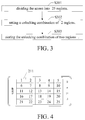
- FIG. 4 is a schematic diagram of the divided regions before setting an unlocking manner for the screen by the screen unlocking method based on the mobile terminal of the present invention.
- the user divides the screen of the mobile terminal into 25 regions in advance, then controlls to arrange the 25 regions in order from left to right and from up to bottom according to the placing directions shown in FIG. 4 .
- step S201 comprises:
- FIG. 3 is a flow chart of a preferred embodiment of setting a screen unlocking manner by the screen unlocking method based on the mobile terminal of the present invention.
- the method of the present embodiment comprises the following steps:
- the user may select to set the screen to has the default 25 regions divided by the system, as shown in the upper left corner of FIG. 4 .
- the first region 211 divided is one of the default 25 regions of the screen set by the system.
- the regions are divided into X regions in the horizontal direction (row direction), and are divided into Y regions in the vertical direction (column direction).
- the range of the value X is 2 ⁇ X ⁇ 5
- the range of the value Y is 2 ⁇ Y ⁇ 5
- the values X and Y are any set of integers selected from the respective ranges above. Then the method enters the step S302.
- N regions are set as the screen unlocking combination regions in the M regions of the screen, wherein N is an integers in a range of 2 ⁇ N ⁇ M.
- N is an integers in a range of 2 ⁇ N ⁇ M.
- FIG. 5 which is a schematic diagram of the combination of any two regions in the screen unlocking method based on the mobile terminal of the present invention. Parameters relating to a particular coordinate of the selected region with respect to an origin of coordinate and the setting sequence of selection are shown above the selected region 221 on the left side of FIG. 5 .
- parameters relating to a particular coordinate of the selected region with respect to an origin of coordinate and the setting sequence of selection are also shown above the selected region 222 on the right side of FIG. 5 .
- the three concentric circles shown in the diagram indicates an effective range of a selected region for determining whether the unlocking combination of N regions are touched during the user's unlocking process, then the method enters step S303.
- the preset unlocking combination of N regions are stored into the system of the mobile terminal. According to the above description of S302, in present embodiment, the selected preset unlocking combination of two regions are stored into the system. (as show in FIG. 5 ), so as to achieve the setting process for unlocking the screen.
- the user before using the method of unlocking screen, the user performs presetting various schemes for unlocking the screen according to personal preferences or the user's habit.
- the screen is divided into M touch regions, and a combination of N valid regions with or without a sequence are set, and stored in the system. Since such unlocking setting solutions enable the user own the diversified selections, in actual operation process, more close to demand of the user's operation.
- the mobile terminal screen is a coupling capacitive touch screen,.
- the coupling capacitance is reduced, and the system can determine the location of the finger touch by detecting the amount of change in coupling capacitance. Therefore, in material selection for a larger smart phone screen, a touch screen made by the coupling capacitive material is used in the unlocking method of the present invention, so that the screen can be conveniently divided into a plurality of regions and different contact points are set, thereby enabling the system to more sensitively sense the operation condition of each region contact point.
- FIG. 6 is a flow chart of one embodiment of the screen unlocking method based on the mobile terminal of the present invention. The specific flow is:
- a user's mobile phone should be in the screen locking state. At this moment, the user first lights the screen, then the method enters step S602.
- a user's mobile phone When a user's mobile phone is illuminated and is still in a screen locking state, it begins to enter an unlocking screen operation interface. If the user selects any two regions of the screen to touch successively and respectively, then the method enters a determining process in S306. If the user touches a non-set region, or no region is touched after a certain time, then the method enters step S605.
- step S602 If any two regions, which are just the two preset regions, on the screen are selected by the user, then the method directly enters step S604.
- step S603 if the determination result conforms to the preset combination of regions, then the screen is unlocked.
- step S602 if the user touches a region other than the preset unlocking regions or if no region is touched after a certain time, then the method enters step S606.
- step S605 if the determination result does not conform to the preset combination of regions, then the screen is not unlocked.
- the present invention is both convenient and practical. Since such an unlocking method provides user great selectivity in the operation process, therefore it is suitable for the demands of the users themselves, and it provides more convenience in the user's operation.
- the instructions are stored in computer-readable storage medium.
- the instructions comprise the process of the method of embodiments described above.
- the storage medium comprises: magnetic discs, optical discs, read-only storage memory (ROM), or random access memory (RAM), etc.
- the present invention relates to a screen unlocking method and system based on mobile terminal, and storage medium for the same.
- the screen of a mobile terminal is divided into M regions in advance; a combination of N regions are set in the divided regions as a screen unlocking combination regions.
- the divided M regions and the screen unlocking combination regions are self-defined parameters. Therefore, a user may set multiple unlocking combinations, so as to meet the personalized requirements of a user for unlocking a screen, avoiding incorrect touch screen unlocking operations, and preventing non-users from easily unlocking the screen, thereby preserving the user's personal interests, improving the screen unlocking security, and providing convenience for the user.
Landscapes
- Engineering & Computer Science (AREA)
- Computer Security & Cryptography (AREA)
- Theoretical Computer Science (AREA)
- General Engineering & Computer Science (AREA)
- Physics & Mathematics (AREA)
- General Physics & Mathematics (AREA)
- Computer Networks & Wireless Communication (AREA)
- Signal Processing (AREA)
- Computer Hardware Design (AREA)
- Human Computer Interaction (AREA)
- Software Systems (AREA)
- Computing Systems (AREA)
- Telephone Function (AREA)
- User Interface Of Digital Computer (AREA)
Abstract
Description
- The present invention relates to a mobile terminal with a large screen, and more particularly to a unlocking a screen method and system based on the mobile terminal, as well as a storage medium for the same.
- The mobile phone is an extremely popular communication device. Over the years, the smart phone has gradually become the mainstream among mobile phones. Every manufacturer considers the issue of unlocking manners of a smart phone with a large screen. Nevertheless, an easy unlocking manner is more convenient for the user.
- The prior art for the unlocking method is generally a slide to unlock or keying a password to unlock. These methods are unable to meet the personalized requirements of the user. The, unlocking passwords are easily cracked, and therefore are disadvantageous for protecting the user's personal information.
- The present invention aims to solve the aforementioned technical problems arising from the foregoing deficiencies in the prior art by providing a screen unlocking method and system based on mobile terminal, and storage medium for the same for easily and quacking unlocking a large screen of the mobile terminal, and therefore is convenient for the user to use.
- The present invention provide a technical solution for solving the above technical problems by providing a screen unlocking method based on a mobile terminal, the method comprises steps of:
- receiving a region dividing instruction, and dividing a screen of a mobile terminal into M regions according to the region dividing instruction, wherein M is an integer greater than 1;
- receiving a region setting instruction, and setting N regions among the M regions of the screen as screen unlocking combination regions according to the region setting instruction , and storing the screen unlocking combination regions, wherein N is an integer greater than 0 and less than M;
- receiving a user operation instruction, and selecting N regions of the screen as user unlocking regions according to the user operation instruction;
- comparing the user unlocking regions with the screen unlocking combination regions to obtain a comparison result; and
- executing an unlocking operation to the screen if the comparison result is that the user unlocking regions and the screen unlocking combination regions are consistent.
- In addition, a screen unlocking system based on a mobile terminal is provided, the system comprises:
- a region dividing module for receiving a region dividing instruction and dividing a screen into M regions according to the region dividing instruction, wherein M is an integer greater than 1;
- an unlocking setting module for receiving a region setting instruction, setting N regions among the M regions of the screen as screen unlocking combination regions according to the region setting instruction, and storing the screen unlocking combination regions, wherein N is an integer greater than 0 and less than M;
- a receiving module for receiving a user operation instruction, and selecting N regions of the screen as user unlocking regions according to the user operation instruction;
- a comparison module for comparing the user unlocking regions with the screen unlocking combination regions to obtain a comparison result; and
- an unlocking control module for executing an unlocking operation to the screen if the comparison result is that the user unlocking regions and the screen unlocking combination regions are consistent.
- Furthermore, a screen unlocking storage medium based on a mobile terminal is provided, having stored thereon instructions being executed by a processor, the processor executing said instructions provides a method for unlocking a screen configured to a mobile terminal, comprising:
- receiving an region dividing instruction, and dividing a screen into M regions according to the region dividing instruction, wherein M is an integer and greater than 1;
- receiving an region setting instruction, and setting N regions among the M regions of the screen as the screen unlocking combination regions according to the region, and storing the screen unlocking combination regions, wherein N is an integer greater than 0 and less than M;
- receiving a user operation instruction, and selecting N regions of the screen as a user unlocking regions according to the user operation instruction;
- comparing the user unlocking region with the screen unlocking combination regions to obtain the comparison result; and
- executing an unlocking operation to the screen if the comparison result is that the user unlocking regions and the screen unlocking combination regions are consistent.
- The present invention relates to a screen unlocking method and system based on mobile terminal, and storage medium for the same. According to a finger touch position which is sensed by screen, a screen of a mobile terminal is divided into M regions in advance; a combination of N regions is set in the divided regions as a screen unlocking combination regions. The divided M regions and the screen unlocking combination regions are self-defined parameters. Therefore, a user may set multiple unlocking combinations, so as to meet the personalized requirements of a user for unlocking a screen, avoid an incorrect touch screen unlocking operation, and prevent unauthorized users from easily unlocking the screen, thereby preserving the user's personal interests, improving the screen unlocking security, and providing convenience for the user.
-
-
FIG. 1 is a structural schematic diagram of a preferred embodiment of the present invention. -
FIG. 2 is a flow chart of a preferred embodiment of the present invention. -
FIG. 3 is a flow chart of setting an unlocking screen in a preferred embodiment of the present invention. -
FIG. 4 is a schematic diagram of the dividing regions before setting an unlocking screen of the present invention. -
FIG. 5 is a schematic diagram for a combination of any two regions of the present invention. -
FIG. 6 is a flow chart of one embodiment of the present invention. - In order to further clarify the purposes, technical solutions, and advantages of the present invention, the present invention will be described in further detail by referring to the appending drawings and embodiments. It should be appreciated that the specific embodiments described herein are only to illustrate the present invention, but are not intended to limit the scope of the present invention.
- Please refer to
FIG. 1 , which is a structural schematic diagram of the preferred embodiment of the present invention. The mobile terminal includes, but is not limited to, hand held or laptop devices, mobile devices (such as mobile phones, personal digital assistants (PDA), media players, and the like), multi-processor systems, consumer electronic devices comprising the distributed computing environment for any of the above systems or devices, etc. - In the present preferred embodiment, the
screen unlocking system 10 comprises a region dividing module (11), an unlocking setting module (12), a receiving module (13), a comparison module (14), an unlocking control module (15), and an unlockingerror prompting module 16. The region dividing module (11) is used for receiving an region dividing instruction, and dividing instruction a screen is divided to M regions according to the region dividing instruction, wherein M is an integer greater than 1. The unlocking setting module (12) is used for receiving an region setting instruction, and setting N regions among the M regions of the screen as screen unlocking combination regions according to the region setting instruction. The screen unlocking combination regions are stored. The number N is an integer greater than 0 and less than M. The receiving module (13) is used for receiving a user operation instruction, and selecting N regions of the screen as user unlocking regions according to the user operation instruction. The comparison module (14) is used for comparing the user unlocking regions with the screen unlocking combination regions to obtain a comparison result. The unlocking control module (15) is used for executing the screen unlocking operation if the comparison result is that the user unlocking regions and the screen unlocking combination regions are consistent. The unlocking error prompt module (16) is used providng a prompt stating that unlocking is failed if the comparison result is that the user unlocking regions and the screen unlocking combination regions are not consistent. - Preferably, the unlocking setting module (12) stores a region setting sequence of the screen unlocking combination regions; and the comparison module (14) is used to compare the user unlocking regions with the screen unlocking combination regions, and to compare the selected sequence of the user unlocking regions with the region setting sequence of the screen unlocking combination regions to obtain the comparison result. If the comparison result is that the user unlocking regions and the screen unlocking combination regions are consistent, and the selected sequence and the region setting sequence are consistent, then the unlocking control module (15) unlocks the screen. If either the comparison result is that the user unlocking region and the screen unlocking combination regions are inconsistent, or the selected sequence and the region setting sequence are inconsistent, then the unlocking error prompt module (16) prompts that unlocking is failed.
- If the user's operation instruction is not received within a predetermined period, then the receiving module (13) selects the latest selected N regions of the screen as the user unlocking regions.
- Preferably, the region dividing module (11) divides the screen into M regions, and the M regions are configured into X rows from left to right, and into Y columns from top to bottom; M = X * Y, X and Y respectively being integers greater than 1. When M is 25, the region dividing module (11) divides the screen into 25 regions, and the 25 regions are configured into 5 rows from left to right, and into 5 columns from top to bottom.
- The operation principles of the preferred embodiment of the screen unlocking system based on the mobile terminal are described with reference to the preferred embodiment of the screen unlocking method based on the mobile terminal as below.
- Please refer to
FIG. 1 andFIG. 2. FIG. 2 is a flow chart of the referred embodiment of the screen unlocking method based on the mobile terminal of the present invention. The screen unlocking method of the preferred embodiment comprises: - Step S201, receiving an region dividing instruction, and dividing a screen into M regions according to the region dividing instruction, wherein M is an integer greater than 1.
- Taking a smart phone with a large screen as an example, when the present invention is implemented, first, a user lights the mobile phone screen and then the user performs the operation of the mobile terminal (i.e., the user issues the region dividing instruction), inputs the setting of a screen unlocking manner, that is, the screen of the mobile terminal is divided into M regions by the region dividing module (11), wherein M is an integer and greater than 0; and the method enters Step S202.
- Step S202, receiving an region setting instruction, and setting N regions among the M regions of the screen as screen unlocking combination regions according to the region setting instruction,, and storing the screen unlocking combination regions, wherein N is an integer greater than 0 and less than M.
- In the step S201 above, the screen unlocking manner is set to receive an region setting instruction by touching the region of the screen. Therefore, after a screen is divided into M regions, an unlocking setting module (12) then arbitrarily selects N regions from the M regions as the screen unlocking combination regions according to the region setting instruction and stores the selected N regions combination, and the method enters step S203.
- Step S203, receiving a user operation instruction, and selecting N regions of the screen as a user unlocking regions according to the user operation instruction selecting N regions of the screen as a user unlocking region.
- According to the operation of the foregoing step S203, when the screen is in a screen locking state, after the mobile terminal receives an operation instruction from a user to illuminate the screen. the receiving module (13) receives a user operation instruction and selects N regions of the screen of the mobile terminal accordingly. The selected N regions are combined as the user unlocking regions, wherein N is an integer greater than 0 and less than M; and the method enters the next step S204.
- Step S204, comparing the user unlocking regions with the screen unlocking combination regions to obtain the comparison result.
- According to the operation of the foregoing step S203, in the present step, a comparison module (14) compares the user unlocking regions selected by the user with the screen unlocking combination regions in the system to obtain the comparison result; and the method enters step S205.
- Step S205, executing an unlocking operation to the screen if the comparison result is that the user unlocking regions and the screen unlocking combination regions are consistent; or prompting that unlocking is failed if the comparison result is that the user unlocking regions and the screen unlocking combination regions are inconsistent.
- In the present step, if the comparison result is that the user unlocking regions and the screen unlocking combination regions are consistent, then an unlocking control module (15) performs the operation of unlocking the screen; if the comparison result is that the user unlocking regions and the screen unlocking combination regions are not consistent, then the unlocking error prompt module (16) prompts that unlocking is failed, then the user operation instruction can be re-inputted.
- In the present preferred embodiments, the screen unlocking method for the mobile terminal ends at step 205
- Preferably, in step S203, if the user operation instruction has not been received within a predetermined period, then a receiving module (13) selects the latest selected N regions of the screen as the user unlocking regions. The predetermined period can be 1 second, 2 seconds, etc. Specifically, the system sets that a time interval for two regions that are touched successively should be within 1 second If the period from the previous selectively touched region to the next one region to be touched exceeds 1 second, then the user fails to select the complete combination of the preset N regions, so as to lead to the failure of the unlocking operation, and therefore the screen cannot be unlocked. If the user does not completely touch the stored combination of preset N regions, the screen cannot be unlocked. If no region of the screen is touched after the screen is illuminated, or if the user touches other regions which are not in the combination of the preset N regions, the screen is also unable to be unlocked.
- Preferably, in step S202, if the unlocking setting module (12) stores the preset combination of N regions, which are not selected in order (i.e. the unlocking setting module (12) does not store the region set sequence of the screen unlocking combination regions), in the system, then in step 204, when the comparison module (14) compares the selected combination of the N regions in the system, it is only necessary to decide whether the selected N regions are completely the same as the stored preset combination of the N regions or not. If the unlocking setting module (12) stores the preset combination of N regions in the system, which are selected in order (i.e. the unlocking setting module (12) stores the region set sequence of the screen unlocking combination regions), then in the step 204, when the comparison module (14) compares the selected combination of the N regions in the system, it is necessary to determine whether the selected combination of the N regions are touched in order according to the preset sequence so as to be completely the same as the stored preset combination of N regions and the selected sequence (i.e. the comparison module (14) also performs comparison of the selected sequence of the user unlocking regions with the preset sequence.). If the comparison result is that the user unlocking regions and the screen unlocking combination regions are consistent, and the selected sequence of the user unlocking regions and the region setting sequence of the screen unlocking combination regions are also consistent, then the unlocking control module (15) unlocks the screen. If the comparison result is that the user unlocking regions and the screen unlocking combination regions are not consistent, or the selected sequence of the user unlocking regions and the region setting sequence of the screen unlocking combination regions are not consistent, then the unlocking error prompt module (16) prompts that unlocking is failed.
- In the present embodiment, the positions which a finger touches sensed by a touch screen are compared with the preset combination of the N regions so as to unlock the screen. During the entire unlocking process, selection is only performed in the divided regions of the screen, thus it is not necessary to input a password by an input method for unlocking. Therefore, the screen unlocking security is improved. Furthermore, it provides convenience for the user that the screen is not easily inadvertently unlocked when touched by other objects.
- In the screen unlocking method based on the mobile terminal, the step S202 further comprises:
- Step S2021, setting N regions among M regions of the screen as the screen unlocking combination regions.
- In the M regions of the screen, in accordance with finger touch positions sensed by the touch screen, the user selects the most convenient and effective combination of N regions as the screen unlocking combination regions. The user may select the combination of N regions according to a certain sequence of the selection, and also may randomly select any combination of N regions, and then the method enters step S2022.
- Step S2022, storing the combination of N regions, which have been already preset for unlocking, in the system of the mobile terminal.
- After presetting the combination of N regions according to the certain sequence or randomly in step S2021, it is correspondingly selected to store the same according to the certain sequence or in the same random manner in the system.
- In the screen unlocking method based on the mobile terminal, when M is 25, step S201 specifically comprises:
- pre-dividing the screen into 25 regions, and the 25 regions are configured into 5 rows from left to right, and 5 columns from top to bottom.
-
FIG. 4 is a schematic diagram of the divided regions before setting an unlocking manner for the screen by the screen unlocking method based on the mobile terminal of the present invention. The user divides the screen of the mobile terminal into 25 regions in advance, then controlls to arrange the 25 regions in order from left to right and from up to bottom according to the placing directions shown inFIG. 4 . - In the screen unlocking method based on the mobile terminal, step S201 comprises:
- dividing the mobile terminal screen into M regions. The M regions are controlled to be arranged consecutively from left to right into X rows, and from top to bottom into Y columns , wherein M = X * Y. The range of the value X is 2 ≦ X ≦ 5, the range of the value Y is 2 ≦ Y ≦ 5, and the values X and Y are respectively any set of integers selected within the ranges above. As shown in
FIG. 4 , in the X row and Y column directions, different values are selected from the given ranges, and therefore the manner that the screen is divided into M regions is not unique, which enable a user to have more options of setting a screen unlocking manner. -
FIG. 3 is a flow chart of a preferred embodiment of setting a screen unlocking manner by the screen unlocking method based on the mobile terminal of the present invention. The method of the present embodiment comprises the following steps: - Step S301, dividing the screen into 25 regions.
- The user may select to set the screen to has the
default 25 regions divided by the system, as shown in the upper left corner ofFIG. 4 . Thefirst region 211 divided is one of thedefault 25 regions of the screen set by the system. Similarly, in the process of screen setting of the system, the user may also divide the screen into M regions in a self-defined manner, M = X * Y. The regions are divided into X regions in the horizontal direction (row direction), and are divided into Y regions in the vertical direction (column direction). The range of the value X is 2 ≦ X ≦ 5, the range of the value Y is 2 ≦ Y ≦ 5, and the values X and Y are any set of integers selected from the respective ranges above. Then the method enters the step S302. - Step S302, setting an unlocking combination of two regions.
- N regions are set as the screen unlocking combination regions in the M regions of the screen, wherein N is an integers in a range of 2 ≦ N < M. According to the above step S301 , in the present embodiment, we set a combination of two regions of 25 regions of the screen as the screen unlocking combination regions. As shown in
FIG. 5 , which is a schematic diagram of the combination of any two regions in the screen unlocking method based on the mobile terminal of the present invention. Parameters relating to a particular coordinate of the selected region with respect to an origin of coordinate and the setting sequence of selection are shown above the selectedregion 221 on the left side ofFIG. 5 . Likewise, parameters relating to a particular coordinate of the selected region with respect to an origin of coordinate and the setting sequence of selection are also shown above the selected region 222 on the right side ofFIG. 5 . The three concentric circles shown in the diagram indicates an effective range of a selected region for determining whether the unlocking combination of N regions are touched during the user's unlocking process, then the method enters step S303. - Step S303, storing the unlocking combination of two regions.
- The preset unlocking combination of N regions are stored into the system of the mobile terminal. According to the above description of S302, in present embodiment, the selected preset unlocking combination of two regions are stored into the system. (as show in
FIG. 5 ), so as to achieve the setting process for unlocking the screen. - In this embodiment, before using the method of unlocking screen, the user performs presetting various schemes for unlocking the screen according to personal preferences or the user's habit. The screen is divided into M touch regions, and a combination of N valid regions with or without a sequence are set, and stored in the system. Since such unlocking setting solutions enable the user own the diversified selections, in actual operation process, more close to demand of the user's operation.
- In the above described embodiment, in the screen unlocking method based on the mobile terminal, the mobile terminal screen is a coupling capacitive touch screen,.When a finger touches the screen, the coupling capacitance is reduced, and the system can determine the location of the finger touch by detecting the amount of change in coupling capacitance. Therefore, in material selection for a larger smart phone screen, a touch screen made by the coupling capacitive material is used in the unlocking method of the present invention, so that the screen can be conveniently divided into a plurality of regions and different contact points are set, thereby enabling the system to more sensitively sense the operation condition of each region contact point.
-
FIG. 6 is a flow chart of one embodiment of the screen unlocking method based on the mobile terminal of the present invention.
The specific flow is: - Step S601, illuminating a screen when a mobile phone is in a screen locking state.
- First, a user's mobile phone should be in the screen locking state. At this moment, the user first lights the screen, then the method enters step S602.
-
Step 602, entering a process for unlocking the screen. - When a user's mobile phone is illuminated and is still in a screen locking state, it begins to enter an unlocking screen operation interface. If the user selects any two regions of the screen to touch successively and respectively, then the method enters a determining process in S306. If the user touches a non-set region, or no region is touched after a certain time, then the method enters step S605.
- In Step S603, the two preset region are touched.
- In accordance with step S602, If any two regions, which are just the two preset regions, on the screen are selected by the user, then the method directly enters step S604.
- Step S604, unlocking.
- According to the above step S603, if the determination result conforms to the preset combination of regions, then the screen is unlocked.
- Step S605, other regions are touched or no region is touched.
- In accordance with the above step S602, if the user touches a region other than the preset unlocking regions or if no region is touched after a certain time, then the method enters step S606.
- Step S606, unlocking is failed.
- In accordance with the above step S605, if the determination result does not conform to the preset combination of regions, then the screen is not unlocked.
- In this embodiment, by way of utilizing the screen unlocking method in practice, the present invention is both convenient and practical. Since such an unlocking method provides user great selectivity in the operation process, therefore it is suitable for the demands of the users themselves, and it provides more convenience in the user's operation.
- For people of ordinary skilled in the art, it should be appreciated that for all or part of the process of the methods of the embodiments described above, which can be performed by way of computer instructions executed by related hardware, the instructions are stored in computer-readable storage medium. When the instructions are executed, the instructions comprise the process of the method of embodiments described above. Wherein, the storage medium comprises: magnetic discs, optical discs, read-only storage memory (ROM), or random access memory (RAM), etc.
- In summary, the present invention relates to a screen unlocking method and system based on mobile terminal, and storage medium for the same. According to touch positions of a finger sensed by a touch screen, the screen of a mobile terminal is divided into M regions in advance; a combination of N regions are set in the divided regions as a screen unlocking combination regions. The divided M regions and the screen unlocking combination regions are self-defined parameters. Therefore, a user may set multiple unlocking combinations, so as to meet the personalized requirements of a user for unlocking a screen, avoiding incorrect touch screen unlocking operations, and preventing non-users from easily unlocking the screen, thereby preserving the user's personal interests, improving the screen unlocking security, and providing convenience for the user.
- It should be appreciated that applications of the present invention are not limited to the above described examples. Modifications and transformations will occur to a person of ordinary skill in the art based on the above description; all such improvements and modifications are intended to be part of protection scope of the present invention, which is only limited by the claims appended hereto.
Claims (17)
- A screen unlocking method based on a mobile terminal, characterized in that comprising steps of:receiving a region dividing instruction, and dividing a screen into M regions according to the region dividing instruction, wherein M is an integer greater than 1;receiving a region setting instruction, setting N regions among the M regions of the screen as-screen unlocking combination regions according to the region setting instruction, and storing the screen unlocking combination regions, wherein N is an integer greater than 0 and less than M;receiving a user operation instruction, and selecting N regions of the screen as user unlocking regions according to the user operation instruction;comparing the user unlocking regions with the screen unlocking combination regions to obtain a comparison result; andexecuting an unlocking operation to the screen if the comparison result is that the user unlocking regions and the screen unlocking combination regions are consistent.
- The screen unlocking method based on the mobile terminal according to Claim 1, characterized in that the method further comprises a step of:prompting that unlocking is failed if the comparison result is that the user unlocking regions and the screen unlocking combination regions are inconsistent.
- The screen unlocking method based on the mobile terminal according to Claim 2, characterized in that a region setting sequence for the screen unlocking combination regions is stored in the step of setting the N regions as the screen unlocking combination regions;
the user unlocking regions are compared with the screen unlocking combination regions and a region selecting sequence of the user unlocking regions is compared with the region setting sequence to obtain the comparison result. - The screen unlocking method based on the mobile terminal according to Claim 3, characterized in that the unlocking operation is executed if the comparison result is that the user unlocking regions and the screen unlocking combination regions are consistent, and the selecting sequence and the region setting sequence are also consistent.
- The screen unlocking method based on the mobile terminal according to Claim 3, characterized in that it is prompted that unlocking is failed if either the comparison result is that the user unlocking regions and the screen unlocking combination regions are inconsistent, or the selecting sequence and the region setting sequence are inconsistent.
- The screen unlocking method based on the mobile terminal according to Claim 1, characterized in that the step of receiving the region dividing instruction and the dividing the screen into the M regions according to the regions dividing instruction comprises:dividing the screen into the M regions, and the M regions being arranged into X rows and Y columns from left to right and from top to bottom; wherein M = X * Y, X and Y are integers greater than 1, respectively.
- The screen unlocking method based on the mobile terminal according to Claim 6, characterized in that the screen is divided into 25 regions when M is 25, and the 25 regions are arranged into 5 rows and 5 columns from left to right and from top to bottom.
- The screen unlocking method based on the mobile terminal according to Claim 1, characterized in that the step of receiving the user operation instruction and selecting the N regions of the screen as the user unlocking regions according to the user operation instruction comprise:selecting the latest selected N regions of the screen as the user unlocking regions if the user operation instruction is not received within a predetermined period.
- A screen unlocking system based on a mobile terminal, characterized in that comprising:a region dividing module (11) for receiving an region dividing instruction and dividing a screen into M regions according to the region dividing instruction, wherein M is an integer and greater than 1;an unlocking setting module (12) for receiving an region setting instruction, setting N regions in the M regions of the screen as the screen unlocking combination regions according to the region setting instruction , and storing the screen unlocking combination regions, wherein N is an integer greater than 0 and less than M;a receiving module (13) for receiving a user operation instruction, and selecting N regions of the screen as a user unlocking regions according to the user operation instruction ;a comparison module (14) for comparing the user unlocking regions with the screen unlocking combination regions to obtain a comparison result; andan unlocking control module (15) for executing an unlocking operation to the screen if the comparison result is that the user unlocking regions and the screen unlocking combination regions are consistent.
- The screen unlocking system based on a mobile terminal according to Claim 9, characterized in that the system further comprises:an unlocking error prompt module (16) for prompting that unlocking is failed if the comparison result is that the user unlocking region and the screen unlocking combination regions are inconsistent.
- The screen unlocking system based on a mobile terminal according to Claim 10, characterized in that the unlocking setting module (12) for storing a region setting sequence of the screen unlocking combination regions; and the comparison module (14) for comparing the user unlocking region with the screen unlocking combination regions, and comparing the selected sequence of the user unlocking regions with the region setting sequence to obtain the comparison result.
- The screen unlocking system based on a mobile terminal according to Claim 11, characterized in that the unlocking operation is executed if the comparison result is that the user unlocking regions and the screen unlocking combination regions are consistent, and the selecting sequence and the region setting sequence are consistent.
- The screen unlocking system based on a mobile terminal according to Claim 11, characterized in that the unlocking error prompt module (16) is prompted that unlocking is failed if either the comparison result is that the user unlocking regions and the screen unlocking combination regions are inconsistent, or the selecting sequence and the region setting sequence are inconsistent.
- The screen unlocking system based on a mobile terminal according to Claim 9, characterized in that the region dividing module (11) for dividing the screen into the M regions, and the M regions are arranged into X rows and Y columns from left to right and from top to bottom; wherein M = X * Y, X and Y are integer greaters than 1 respectively.
- The screen unlocking system based on a mobile terminal according to Claim 14, characterized in that the region dividing module (11) is divided the screen into 25 regions when M is 25, , and the 25 regions are arranged into 5 rows and 5 columns from left to right and from top to bottom.
- The screen unlocking system based on a mobile terminal according to Claim 9, characterized in that the receiving module (13) selects the latest selected N screen regions of the screen as the user unlocking regions according to the user operation instruction if the user operation instrution is not received within a predetermined period.
- A screen unlocking storage medium based on a mobile terminal, having stored thereon instructions being executed by a processor, the processor executing said instructions provides a method for unlocking a screen configured to a mobile terminal, characterized in that comprising :receiving an region dividing instruction, and dividing a screen into M regions according to the region dividing instruction, wherein M is an integer greater than 1;receiving an region setting instruction, and setting N regions among the M regions of the screen as the screen unlocking combination regions according to the region setting instruction, , and storing the screen unlocking combination regions, wherein N is an integer greater than 0 and less than M;receiving a user operation instruction, and selecting N regions of the screen as a user unlocking regions according to the user operation instruction;comparing the user unlocking regions with the screen unlocking combination regions to obtain a comparison result; andexecuting an unlocking operation to the screen if the comparison result is that the user unlocking regions and the screen unlocking combination regions are consistent.
Applications Claiming Priority (2)
| Application Number | Priority Date | Filing Date | Title |
|---|---|---|---|
| CN201310091905XA CN103164161A (en) | 2013-03-21 | 2013-03-21 | Screen unlocking method and system based on mobile terminal |
| PCT/CN2013/081315 WO2014146391A1 (en) | 2013-03-21 | 2013-08-12 | Mobile terminal-based method and system for unlocking screen, and storage medium |
Publications (2)
| Publication Number | Publication Date |
|---|---|
| EP2977879A1 true EP2977879A1 (en) | 2016-01-27 |
| EP2977879A4 EP2977879A4 (en) | 2016-09-14 |
Family
ID=48587290
Family Applications (1)
| Application Number | Title | Priority Date | Filing Date |
|---|---|---|---|
| EP13878716.3A Withdrawn EP2977879A4 (en) | 2013-03-21 | 2013-08-12 | MOBILEM DEVICE BASED METHOD AND SYSTEM FOR UNLOCKING A SCREEN AND STORAGE MEDIUM |
Country Status (4)
| Country | Link |
|---|---|
| US (1) | US9471766B2 (en) |
| EP (1) | EP2977879A4 (en) |
| CN (1) | CN103164161A (en) |
| WO (1) | WO2014146391A1 (en) |
Families Citing this family (15)
| Publication number | Priority date | Publication date | Assignee | Title |
|---|---|---|---|---|
| CN103164161A (en) * | 2013-03-21 | 2013-06-19 | 惠州Tcl移动通信有限公司 | Screen unlocking method and system based on mobile terminal |
| CN103543939B (en) * | 2013-07-08 | 2017-06-06 | Tcl集团股份有限公司 | A kind of electronic equipment unlocking method, system and electronic equipment |
| CN104424406B (en) * | 2013-08-22 | 2019-01-04 | 深圳富泰宏精密工业有限公司 | Linear incision unlocking method and system |
| CN105302450A (en) * | 2014-07-21 | 2016-02-03 | 中兴通讯股份有限公司 | Terminal and terminal unlocking method |
| CN104484119B (en) * | 2014-11-28 | 2018-05-18 | 苏州佳世达电通有限公司 | Electronic device and its awakening method |
| CN104639694A (en) * | 2015-03-13 | 2015-05-20 | 陈蔼珊 | Stretchable intelligent mobile terminal screen |
| TWI557592B (en) * | 2015-06-24 | 2016-11-11 | A method of adding / unlocking an electronic device | |
| CN105160277A (en) * | 2015-09-27 | 2015-12-16 | 陆俊 | Mobile terminal encrypting and decrypting method and mobile terminal |
| CN105205387B (en) * | 2015-09-29 | 2017-11-14 | 广东欧珀移动通信有限公司 | mobile terminal unlocking password setting method and device, and unlocking method and device |
| CN106961512A (en) * | 2016-01-08 | 2017-07-18 | 中兴通讯股份有限公司 | Mobile terminal and its unlocking screen method |
| CN107657178A (en) * | 2016-07-25 | 2018-02-02 | 中兴通讯股份有限公司 | The report method and device of response contents, terminal |
| CN106101447A (en) * | 2016-08-08 | 2016-11-09 | 惠州Tcl移动通信有限公司 | A kind of mobile terminal unlocking method and system |
| CN107329678A (en) * | 2017-06-22 | 2017-11-07 | 深圳传音通讯有限公司 | Unlocking method, device and the electric terminal of electric terminal |
| CN108985043A (en) * | 2018-07-18 | 2018-12-11 | 林祖毅 | A kind of unlocking screen method and storage medium based on time dimension |
| CN109857304A (en) * | 2018-10-23 | 2019-06-07 | 惠州Tcl移动通信有限公司 | A kind of screen locking method and mobile terminal |
Family Cites Families (18)
| Publication number | Priority date | Publication date | Assignee | Title |
|---|---|---|---|---|
| US20120005483A1 (en) * | 2009-04-09 | 2012-01-05 | Hydrabyte, Inc. | Method for Image-Based Authentication |
| US8458485B2 (en) * | 2009-06-17 | 2013-06-04 | Microsoft Corporation | Image-based unlock functionality on a computing device |
| US8456429B2 (en) | 2009-07-30 | 2013-06-04 | Ncr Corporation | Encrypting touch-sensitive display |
| KR101608673B1 (en) * | 2009-10-30 | 2016-04-05 | 삼성전자주식회사 | Operation Method for Portable Device including a touch lock state And Apparatus using the same |
| CN101853130A (en) | 2010-05-17 | 2010-10-06 | 中兴通讯股份有限公司 | Unlocking method, device and terminal equipment of touch screen |
| CN102455839A (en) * | 2010-10-18 | 2012-05-16 | 中标软件有限公司 | Unlocking method and system of touch screen device and mobile terminal |
| CN101986251B (en) * | 2010-10-28 | 2016-01-06 | 华为终端有限公司 | Touch pattern locking/unlocking method and device |
| CN102566861A (en) * | 2010-12-17 | 2012-07-11 | 安徽康佳同创电器有限公司 | Electronic terminal, and touch unlocking method and touch unlocking setting method for electronic terminal |
| CN102799336A (en) * | 2011-05-24 | 2012-11-28 | 汉王科技股份有限公司 | Method, device and mobile terminal for unlocking touch screens |
| CN102236527B (en) * | 2011-07-15 | 2014-06-25 | Tcl集团股份有限公司 | Method and device for unlocking touch screen and touch screen terminal |
| CN102609204A (en) * | 2012-02-06 | 2012-07-25 | 深圳市同洲电子股份有限公司 | Unlocking method, unlocking system, unlocking password setting method and unlocking password setting system |
| CN102799363B (en) * | 2012-06-21 | 2016-01-06 | 小米科技有限责任公司 | A kind of method and mobile terminal realizing picture screen locking |
| CN102799387A (en) * | 2012-08-07 | 2012-11-28 | 上海斐讯数据通信技术有限公司 | Mobile terminal with touch unlocking function and method for touch unlocking of mobile terminal |
| CN102880398B (en) * | 2012-09-24 | 2016-05-11 | 惠州Tcl移动通信有限公司 | A kind of mobile phone unlock method and mobile phone based on random digit array |
| CN102984349B (en) * | 2012-10-31 | 2015-05-27 | 小米科技有限责任公司 | Method and device for screen locking code generating and screen unlocking method and screen unlocking device and mobile terminal |
| CN103092519B (en) * | 2013-01-24 | 2016-03-30 | 北京航空航天大学 | A kind of touch-screen mobile phone unlock method and device |
| CN103164161A (en) * | 2013-03-21 | 2013-06-19 | 惠州Tcl移动通信有限公司 | Screen unlocking method and system based on mobile terminal |
| KR20150017150A (en) * | 2013-08-06 | 2015-02-16 | 삼성전자주식회사 | An electronic deive with touch screen and operating method thereof |
-
2013
- 2013-03-21 CN CN201310091905XA patent/CN103164161A/en active Pending
- 2013-08-12 WO PCT/CN2013/081315 patent/WO2014146391A1/en not_active Ceased
- 2013-08-12 EP EP13878716.3A patent/EP2977879A4/en not_active Withdrawn
- 2013-08-12 US US14/417,061 patent/US9471766B2/en active Active
Also Published As
| Publication number | Publication date |
|---|---|
| EP2977879A4 (en) | 2016-09-14 |
| US9471766B2 (en) | 2016-10-18 |
| WO2014146391A1 (en) | 2014-09-25 |
| US20150213249A1 (en) | 2015-07-30 |
| CN103164161A (en) | 2013-06-19 |
Similar Documents
| Publication | Publication Date | Title |
|---|---|---|
| US9471766B2 (en) | Screen unlocking method and system based on mobile terminal, and storage medium for the same | |
| US20150123925A1 (en) | Method, apparatus, and device for touch screen verification | |
| US20140344923A1 (en) | Unlocking method and device, password setting method and device | |
| KR101933250B1 (en) | Screen unlocking method, apparatus, and device | |
| US10331872B2 (en) | Electronic device and password entering method | |
| US20170140137A1 (en) | Multi-System Entering Method, Apparatus and Terminal | |
| US20140354556A1 (en) | Adapative sensing component resolution based on touch location authentication | |
| US20140189604A1 (en) | Method and system for unlocking a touchscreen of an electronic device | |
| EP2763070B1 (en) | Graphical user interface (GUI) that receives directional input to change face for receiving passcode | |
| US20130159927A1 (en) | Electronic device with touch screen and screen unlocking method thereof | |
| US20180203568A1 (en) | Method for Enabling Function Module of Terminal, and Terminal Device | |
| US9245101B2 (en) | Electronic device and unlocking method thereof | |
| CN104657655B (en) | The unlocking method and mobile terminal of mobile terminal | |
| WO2011143470A1 (en) | Automatic derivation of analogous touch gestures from a user-defined gesture | |
| US20140013419A1 (en) | Electronic device for multiple users and login method thereof | |
| US20160191697A1 (en) | Mobile terminal and method for switching unlocking modes | |
| US20170316197A1 (en) | User interface control method and electronic device | |
| US20180300466A1 (en) | Method and appapratus for controlling electronic device, and electrode device | |
| US20180107332A1 (en) | Electronic device and touch control method thereof | |
| US20170364670A1 (en) | Electronic device and working mode selecting method thereof | |
| US9397992B1 (en) | Authentication using color-shape pairings | |
| CN106096385A (en) | A kind of unlocking processing method based on mobile terminal and system | |
| CN107066870A (en) | A kind of gesture password unlocking method of intelligent touch-screen equipment | |
| CN103777747A (en) | Mobile terminal and mobile terminal screen locking and unlocking method | |
| US9489509B2 (en) | Electronic device and method for unlocking objects of electronic device |
Legal Events
| Date | Code | Title | Description |
|---|---|---|---|
| PUAI | Public reference made under article 153(3) epc to a published international application that has entered the european phase |
Free format text: ORIGINAL CODE: 0009012 |
|
| 17P | Request for examination filed |
Effective date: 20150924 |
|
| AK | Designated contracting states |
Kind code of ref document: A1 Designated state(s): AL AT BE BG CH CY CZ DE DK EE ES FI FR GB GR HR HU IE IS IT LI LT LU LV MC MK MT NL NO PL PT RO RS SE SI SK SM TR |
|
| AX | Request for extension of the european patent |
Extension state: BA ME |
|
| DAX | Request for extension of the european patent (deleted) | ||
| A4 | Supplementary search report drawn up and despatched |
Effective date: 20160816 |
|
| RIC1 | Information provided on ipc code assigned before grant |
Ipc: H04L 29/06 20060101ALI20160809BHEP Ipc: G06F 21/36 20130101ALI20160809BHEP Ipc: G06F 3/0488 20130101AFI20160809BHEP Ipc: H04W 12/06 20090101ALI20160809BHEP |
|
| 17Q | First examination report despatched |
Effective date: 20170804 |
|
| STAA | Information on the status of an ep patent application or granted ep patent |
Free format text: STATUS: THE APPLICATION IS DEEMED TO BE WITHDRAWN |
|
| 18D | Application deemed to be withdrawn |
Effective date: 20201107 |