EP2977854B1 - Method, apparatus, and user terminal for removing malicious power consuming application - Google Patents
Method, apparatus, and user terminal for removing malicious power consuming application Download PDFInfo
- Publication number
- EP2977854B1 EP2977854B1 EP14814534.5A EP14814534A EP2977854B1 EP 2977854 B1 EP2977854 B1 EP 2977854B1 EP 14814534 A EP14814534 A EP 14814534A EP 2977854 B1 EP2977854 B1 EP 2977854B1
- Authority
- EP
- European Patent Office
- Prior art keywords
- application
- power consumption
- power
- malicious
- consuming
- Prior art date
- Legal status (The legal status is an assumption and is not a legal conclusion. Google has not performed a legal analysis and makes no representation as to the accuracy of the status listed.)
- Active
Links
Images

Classifications
-
- G—PHYSICS
- G06—COMPUTING OR CALCULATING; COUNTING
- G06F—ELECTRIC DIGITAL DATA PROCESSING
- G06F21/00—Security arrangements for protecting computers, components thereof, programs or data against unauthorised activity
- G06F21/50—Monitoring users, programs or devices to maintain the integrity of platforms, e.g. of processors, firmware or operating systems
- G06F21/55—Detecting local intrusion or implementing counter-measures
- G06F21/56—Computer malware detection or handling, e.g. anti-virus arrangements
-
- G—PHYSICS
- G06—COMPUTING OR CALCULATING; COUNTING
- G06F—ELECTRIC DIGITAL DATA PROCESSING
- G06F1/00—Details not covered by groups G06F3/00 - G06F13/00 and G06F21/00
- G06F1/26—Power supply means, e.g. regulation thereof
- G06F1/32—Means for saving power
- G06F1/3203—Power management, i.e. event-based initiation of a power-saving mode
- G06F1/3206—Monitoring of events, devices or parameters that trigger a change in power modality
-
- G—PHYSICS
- G06—COMPUTING OR CALCULATING; COUNTING
- G06F—ELECTRIC DIGITAL DATA PROCESSING
- G06F1/00—Details not covered by groups G06F3/00 - G06F13/00 and G06F21/00
- G06F1/26—Power supply means, e.g. regulation thereof
- G06F1/32—Means for saving power
- G06F1/3203—Power management, i.e. event-based initiation of a power-saving mode
- G06F1/3234—Power saving characterised by the action undertaken
-
- G—PHYSICS
- G06—COMPUTING OR CALCULATING; COUNTING
- G06F—ELECTRIC DIGITAL DATA PROCESSING
- G06F1/00—Details not covered by groups G06F3/00 - G06F13/00 and G06F21/00
- G06F1/26—Power supply means, e.g. regulation thereof
- G06F1/32—Means for saving power
- G06F1/3203—Power management, i.e. event-based initiation of a power-saving mode
- G06F1/3234—Power saving characterised by the action undertaken
- G06F1/329—Power saving characterised by the action undertaken by task scheduling
-
- G—PHYSICS
- G06—COMPUTING OR CALCULATING; COUNTING
- G06F—ELECTRIC DIGITAL DATA PROCESSING
- G06F21/00—Security arrangements for protecting computers, components thereof, programs or data against unauthorised activity
- G06F21/50—Monitoring users, programs or devices to maintain the integrity of platforms, e.g. of processors, firmware or operating systems
- G06F21/52—Monitoring users, programs or devices to maintain the integrity of platforms, e.g. of processors, firmware or operating systems during program execution, e.g. stack integrity ; Preventing unwanted data erasure; Buffer overflow
-
- H—ELECTRICITY
- H04—ELECTRIC COMMUNICATION TECHNIQUE
- H04W—WIRELESS COMMUNICATION NETWORKS
- H04W4/00—Services specially adapted for wireless communication networks; Facilities therefor
-
- G—PHYSICS
- G06—COMPUTING OR CALCULATING; COUNTING
- G06F—ELECTRIC DIGITAL DATA PROCESSING
- G06F2221/00—Indexing scheme relating to security arrangements for protecting computers, components thereof, programs or data against unauthorised activity
- G06F2221/03—Indexing scheme relating to G06F21/50, monitoring users, programs or devices to maintain the integrity of platforms
- G06F2221/033—Test or assess software
-
- G—PHYSICS
- G06—COMPUTING OR CALCULATING; COUNTING
- G06F—ELECTRIC DIGITAL DATA PROCESSING
- G06F2221/00—Indexing scheme relating to security arrangements for protecting computers, components thereof, programs or data against unauthorised activity
- G06F2221/21—Indexing scheme relating to G06F21/00 and subgroups addressing additional information or applications relating to security arrangements for protecting computers, components thereof, programs or data against unauthorised activity
- G06F2221/2143—Clearing memory, e.g. to prevent the data from being stolen
-
- Y—GENERAL TAGGING OF NEW TECHNOLOGICAL DEVELOPMENTS; GENERAL TAGGING OF CROSS-SECTIONAL TECHNOLOGIES SPANNING OVER SEVERAL SECTIONS OF THE IPC; TECHNICAL SUBJECTS COVERED BY FORMER USPC CROSS-REFERENCE ART COLLECTIONS [XRACs] AND DIGESTS
- Y02—TECHNOLOGIES OR APPLICATIONS FOR MITIGATION OR ADAPTATION AGAINST CLIMATE CHANGE
- Y02D—CLIMATE CHANGE MITIGATION TECHNOLOGIES IN INFORMATION AND COMMUNICATION TECHNOLOGIES [ICT], I.E. INFORMATION AND COMMUNICATION TECHNOLOGIES AIMING AT THE REDUCTION OF THEIR OWN ENERGY USE
- Y02D10/00—Energy efficient computing, e.g. low power processors, power management or thermal management
-
- Y—GENERAL TAGGING OF NEW TECHNOLOGICAL DEVELOPMENTS; GENERAL TAGGING OF CROSS-SECTIONAL TECHNOLOGIES SPANNING OVER SEVERAL SECTIONS OF THE IPC; TECHNICAL SUBJECTS COVERED BY FORMER USPC CROSS-REFERENCE ART COLLECTIONS [XRACs] AND DIGESTS
- Y02—TECHNOLOGIES OR APPLICATIONS FOR MITIGATION OR ADAPTATION AGAINST CLIMATE CHANGE
- Y02D—CLIMATE CHANGE MITIGATION TECHNOLOGIES IN INFORMATION AND COMMUNICATION TECHNOLOGIES [ICT], I.E. INFORMATION AND COMMUNICATION TECHNOLOGIES AIMING AT THE REDUCTION OF THEIR OWN ENERGY USE
- Y02D30/00—Reducing energy consumption in communication networks
- Y02D30/70—Reducing energy consumption in communication networks in wireless communication networks
Definitions
- the present invention relates to the field of user terminal devices, and in particular, to a method and an apparatus for clearing a malicious power-consuming application, and a user terminal.
- an intelligent terminal can support multiple applications, while some open application markets are full of undesirable applications. After a user downloads and installs these applications, these applications improperly occupy system resources of the intelligent terminal, including occupying the CPU for a long time, maintaining the system in an active state for a long time, consuming traffic secretly in the background, using various sensors secretly, and the like. Therefore, after the user installs these applications, power consumption rises due to malicious power consumption of these applications, thereby further reducing a battery endurance capability, and reducing user experience.
- An existing intelligent terminal generally guides the user to stop or uninstall applications with relatively high power consumption in a manner of collecting statistics on power consumption of all applications on the intelligent terminal to rank applications with high power consumption.
- an application covered in the ranking may be one that is desired and frequently used by the user, for example, an online video application frequently used by the user.
- This application frequently uses the CPU due to video decoding, online video watching requires Internet connection and consumes many network resources, and usually screen brightness is relatively high when the user watches a video.
- Such an application naturally has high power consumption; according to the manner of the prior art, this application is often ranked high among power-consuming applications. From another point of view, this ranking manner in the prior art cannot accurately identify undesirable applications that consume power maliciously, and therefore cannot effectively avoid impact of these undesirable applications on the battery endurance capability of the intelligent terminal.
- EP 2 390 758 A1 relates to management of applications executed in a portable terminal for preventing battery power consumption and degradation of system performance due to the system resources being utilized by applications being executed, while providing multi-tasking functions through a plurality of applications.
- Embodiments of the present invention provide a method and an apparatus for clearing a malicious power-consuming application, and a user terminal, which are used to accurately identify and clear a malicious power-consuming application, to improve a battery endurance capability of an intelligent terminal.
- an embodiment of the present invention provides a method for clearing a malicious power-consuming application, as defined in claim 1.
- the calculating background working power consumption of each application that is running in a user terminal specifically includes:
- the calculating power consumption during occupation of a CPU of the user terminal when the running application works in the background specifically includes:
- the wakelock occupying time of each application in the user terminal in the case in which the screen is turned off is detected by using a system framework layer.
- the first period and the second period are timed according to a working period excluding a sleep period of the CPU.
- an embodiment of the present invention provides an apparatus for clearing a malicious power-consuming application, as defined in claim 6.
- the calculating module is specifically configured to: starting from a moment when a last time of charging the user terminal ends, for each running application, periodically calculate, according to the first period, power consumption during occupation of a CPU of the user terminal, power consumption during holding of a wakelock, and power consumption during occurrence of data traffic when the running application works in the background; and calculate a sum of the power consumption during the occupation of the CPU of the user terminal, the power consumption during the holding of the wakelock, and the power consumption during the occurrence of the data traffic, as the background working power consumption of each running application.
- the calculating module is specifically configured to: for each application, calculate a product of an accumulated working duration for which the application works in the background and occupies the CPU and unit-time power consumption of a corresponding frequency, to obtain the power consumption during the occupation of the CPU of the user terminal when the application works in the background; for each application, calculate a product of an accumulated duration for which the CPU of the user terminal is IDLE when the application works in the background and unit-time power consumption when the CPU of the user terminal is IDLE, to obtain the power consumption during the holding of the wakelock when the application works in the background; and for each application, calculate a product of a quantity of bytes of accumulated data traffic generated when the application works in the background and power consumption of a single byte, to obtain the power consumption during the occurrence of the data traffic when the application works in the background.
- the calculating module is specifically configured to detect, by using a system framework layer, the wakelock occupying time of each application in the user terminal in the case in which the screen is turned off.
- an embodiment of the present invention provides a user terminal, where the user terminal includes the foregoing apparatus for clearing a malicious power-consuming application.
- Beneficial effects of the embodiments of the present invention include: According to the method and the apparatus for clearing a malicious power-consuming application, and the user terminal provided by the embodiments of the present invention, background working power consumption of each application that is running in a user terminal is periodically calculated; an application whose background working power consumption is not less than a power consumption threshold is determined as a malicious power-consuming application; and wakelock (wakelock) occupying time of each application in the user terminal in a case in which a screen is turned off is periodically calculated, and if an application whose wakelock occupying time is not less than a time threshold is a background working application, the application is determined as a malicious power-consuming application.
- These applications are applications that improperly occupy resources in the background, but are not applications that consume much power but are normally used by a user, so that the malicious power-consuming applications are accurately identified and detected, and unnecessary power consumption of the user terminal is avoided while user experience is ensured, thereby saving electric energy, and improving a battery endurance capability of the user terminal to some extent.
- a malicious power-consuming application generally may consume power of a user terminal in the following two manners:
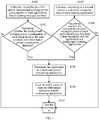
- a method for clearing a malicious power-consuming application is disclosed. As shown in FIG. 1 , the method specifically includes the following steps:
- S101 to S102, and S103 to S104 are two independent manners for detecting a malicious power-consuming application, and one of the two manners may be selected and implemented, or both of the two manners may be implemented. During specific implementation, if both of the two manners are implemented, the two manners may be implemented simultaneously or sequentially.
- the first period and the second period are not timed according to physical time, but preferably are timed according to a working period excluding a sleep period of a CPU of the user terminal.
- a malicious power consumption manner includes but is not limited to that: an application frequently applies for an RTC to wake up the CPU, and data traffic occurs after the CPU is woken up; an application holds a wakelock for a long time in a case in which a screen is turned off, and the like. Therefore, accumulated power consumption during occupation of the CPU of the user terminal when an application works in the background may be calculated based on the several manners in which an application consumes power maliciously in the background.
- the calculating background working power consumption of each application that is running in a user terminal may specifically be implemented in the following manner:
- the PC may charge the user terminal through, for example, the USB interface.
- the user may not need to charge the user terminal, and the user terminal is slightly charged.
- the end of charging is not determined as a real "end of charging” if a USB charge level at this time is less than a set threshold or a charging time is less than a set duration, and an operation of periodically calculating, according to the first period, power consumption during occupation of the CPU of the user terminal, power consumption during holding of a wakelock, and power consumption during occurrence of data traffic when the application that is running in the user terminal works in the background is not triggered.
- the calculating power consumption during occurrence of data traffic when each application works in the background is specifically implemented by using the following step: for each application, calculating a product of a quantity of bytes of accumulated data traffic generated when the application works in the background and power consumption of a single byte, to obtain the power consumption during the occurrence of the data traffic when the application works in the background.
- a source of accumulated data traffic generated when the application works in the background is mainly a sum of traffic generated by the user terminal by using a wireless local area network such as a wireless fidelity (Wireless Fidelity, WIFI) network and data traffic generated by the user terminal by using an operator network such as a 2G or 3G network.
- a wireless local area network such as a wireless fidelity (Wireless Fidelity, WIFI) network
- WIFI Wireless Fidelity
- the wakelock occupying time of each application may be detected by using a system framework (Framework) layer. Once it is found that the wakelock occupying time is not less than a time threshold (for example, 15 minutes), the application is determined as a malicious power-consuming application.
- a time threshold for example, 15 minutes
- the determined malicious power-consuming application may be directly cleared in the following case: it is found that the determined malicious power-consuming application is in a saved blacklist of malicious power-consuming applications, and was marked as being manually cleared.
- a clearing process includes an operation of closing the malicious power-consuming application and/or uninstalling the malicious power-consuming application.
- step S106 the process of instructing the user to clear the application includes:
- a notification sending frequency may be properly reduced on the following conditions:
- the frequency of sending the notification message of the malicious power-consuming applications can be properly reduced, to avoid interference to the process in which the user normally uses the user terminal.
- detecting and finding malicious power-consuming applications of a user terminal in time is quite necessary for prolonging normal service time of the user terminal, for example, when a battery level of the user terminal is less than a relatively small battery level threshold (for example, 20%), or when the user actively sends an instruction for viewing a background application list, the operation of calculating background working power consumption of each application that is running in the current user terminal and/or a wakelock occupying time of each application that is running in the current user terminal in a case in which the screen is turned off is triggered.
- a battery level of the user terminal is less than a relatively small battery level threshold (for example, 20%)
- a relatively small battery level threshold for example, 20%
- An application whose power consumption is not less than the first power consumption threshold and/or a background application whose wakelock occupying time in the user terminal in the case in which the screen is turned off is not less than the time threshold is determined as a malicious power-consuming application.
- Determined malicious power-consuming applications are ranked according to the power consumption or the wakelock occupying time, to generate a list of the malicious power-consuming applications, and a notification message carrying the list of the malicious power-consuming applications is sent to the user.
- a background working power consumption detection engine in the user terminal for detecting a malicious power-consuming application calculates, starting from a moment when a last time of charging the user terminal ends (for example, a charging power supply of the user terminal is unplugged), accumulated power consumption during background working of each application in the user terminal every hour; when a battery level of the user terminal is less than 20%, calculates background working power consumption of each application that is running in the user terminal; and determines malicious power-consuming applications (if an extraordinarily malicious power-consuming application is found, immediately sends a notification message to the user).
- a condition of sending a notification message is met (for example, compared with a last time, the malicious power-consuming applications in a list of malicious power-consuming applications change, and more than 4 hours has passed since a last time a notification message is sent), a corresponding notification bar message is sent to the user, where the notification bar message notifies the user that several malicious power-consuming applications are detected and brief information such as icons of the malicious power-consuming applications are enumerated.
- UI User Interface
- the interface displays a list of malicious power-consuming applications that are ranked according to power consumption in descending order (the applications in the list are applications whose background working power consumption is not less than a set power consumption threshold by default), provides power consumption information related to each malicious power-consuming application, and selects several high power consumption applications by default.
- the interface also provides a corresponding check box for each application in the list, so that the user may deselect an application in the list as required, and select "One click end" to clear the power-consuming applications.
- the apparatus includes:
- the calculating module 401 is specifically configured to: starting from a moment when a last time of charging the user terminal ends, for each running application, periodically calculate, according to the first period, power consumption during occupation of a CPU of the user terminal, power consumption during holding of a wakelock, and power consumption during occurrence of data traffic when the running application works in the background; and calculate a sum of the power consumption during the occupation of the CPU of the user terminal, the power consumption during the holding of the wakelock, and the power consumption during the occurrence of the data traffic, as the background working power consumption of each application that is running in the user terminal.
- the calculating module 401 is specifically configured to: for each application, calculate a product of an accumulated working duration for which the application works in the background and occupies the CPU and unit-time power consumption of a corresponding frequency, to obtain the power consumption during the occupation of the CPU of the user terminal when the application works in the background; for each application, calculate a product of an accumulated duration for which the CPU of the user terminal is IDLE when the application works in the background and unit-time power consumption when the CPU of the user terminal is IDLE, to obtain the power consumption during the holding of the wakelock when the application works in the background; and for each application, calculate a product of a quantity of bytes of accumulated data traffic generated when the application works in the background and power consumption of a single byte, to obtain the power consumption during the occurrence of the data traffic when the application works in the background.
- the calculating module 401 is specifically configured to detect, by using a system framework layer, the wakelock occupying time of each application in the user terminal in the case in which the screen is turned off.
- the calculating module 401 is specifically configured to time the first period and the second period according to a working period excluding a sleep period of the CPU.
- the clearing module 403 is further configured to: before clearing or instructing the user to clear the determined malicious power-consuming application, determine, according to a locally saved list of applications selected by the user to be ignord in processing, whether the malicious power-consuming application was selected by the user to be ignord in processing; and if not determine that the subsequent step of clearing or instructing the user to clear the determined malicious power-consuming application is to be performed.
- the clearing module 403 is further configured to: when calculated background working power consumption of an application is greater than the first power consumption threshold, before determining whether the malicious power-consuming application was selected by the user to be ignored in processing, determine whether the calculated background working power consumption is not less than a set power consumption threshold (which is referred to as a second power consumption threshold below for ease of description), where the second power consumption threshold is greater than the first power consumption threshold; if yes, instruct the user to clear the application; and if not, perform the step of determining whether the malicious power-consuming application was ignored in processing by the user.
- a set power consumption threshold which is referred to as a second power consumption threshold below for ease of description
- the apparatus for clearing a malicious power-consuming application further includes: a storage module 404, configured to store a list of malicious power-consuming applications that are selected by the user to be ignored in processing.
- the clearing module 403 is specifically configured to rank determined malicious power-consuming applications according to the power consumption or the wakelock occupying time, to generate a list of the malicious power-consuming applications, and send, to the user, a notification message carrying the list of the malicious power-consuming applications; when receiving an instruction for ignoring the malicious power-consuming applications that is returned by the user, use the malicious power-consuming applications that are selected by the user to be ignored in processing to update the list of the applications selected by the user to be ignored in processing that is saved by the storage module 404; and when receiving an instruction for clearing the malicious power-consuming applications that is returned by the user, stop running or uninstall the malicious power-consuming applications that are selected by the user, and mark the malicious power-consuming applications as having been manually cleared.
- the storage module 404 is further configured to save, for a set time, each list of malicious power-consuming applications that is generated according to the first period.
- the clearing module 403 is further configured to: before the step of sending, to the user, a notification message carrying the list of the malicious power-consuming applications, compare a list of malicious power-consuming applications that is generated in this period and saved by the storage module 404 with a list of malicious power-consuming applications that is generated in a last period and saved by the storage module 404, and if the two lists include same malicious power-consuming applications, suspend sending the notification message; if the two lists include different malicious power-consuming applications, go to the step of sending, to the user, a notification message carrying the list of the malicious power-consuming applications that is generated in this period.
- the calculating module 401 is further configured to: when a battery level of the user terminal is less than a battery level threshold, or when the user sends an instruction for viewing a list of background power-consuming applications, trigger an operation of calculating background working power consumption of each application that is running in the current user terminal and/or a wakelock occupying time of each application in the current user terminal in the case in which the screen is turned off.
- the determining module 402 is further configured to: when a battery level of the user terminal is less than a battery level threshold, or when the user sends an instruction for viewing a list of background power-consuming applications, determine an application whose current background working power consumption is not less than the first power consumption threshold and/or a background application whose wakelock occupying time in the user terminal in the case in which the screen is turned off is not less than the time threshold as a malicious power-consuming application.
- the clearing module 403 is further configured to: when a battery level of the user terminal is less than a battery level threshold, or when the user sends an instruction for viewing a list of background power-consuming applications, rank determined malicious power-consuming applications according to the power consumption or the wakelock occupying time, to generate a list of the malicious power-consuming applications, and send, to the user, a notification message carrying the list of the malicious power-consuming applications.
- the apparatus includes:
- background working power consumption of each application in a user terminal is periodically calculated, an application whose background working power consumption is not less than a power consumption threshold is determined as a malicious power-consuming application; and a wakelock occupying time of each application in the user terminal in a case in which a screen is turned off is periodically calculated, and if an application whose wakelock occupying time is not less than a time threshold is a background working application, the application is determined as a malicious power-consuming application.
- These applications are applications that improperly occupy resources in the background, but are not applications that consume much power but are normally used by a user, so that the malicious power-consuming applications are accurately identified and detected, and unnecessary power consumption of the user terminal is avoided while user experience is ensured, thereby saving electric energy, and improving a battery endurance capability of the user terminal to some extent.
- the embodiments of the present invention may be implemented by using hardware, or may be implemented in a manner of software plus a necessary general hardware platform. Based on such an understanding, the technical solutions of the present invention may be implemented in a form of a software product.
- the software product may be stored in a non-volatile storage medium (which may be a CD-ROM, a USB flash drive, a removable hard disk, or the like) and includes several instructions for instructing a computer device (which may be a personal computer, a server, a network device, or the like) to execute the methods described in the embodiments of the present invention.
- modules in the apparatuses provided in the embodiments may be arranged in the apparatuses in a distributed manner according to the description of the embodiments, or may be arranged in one or more apparatuses which are different from those described in the embodiments.
- the modules in the foregoing embodiments may be combined into one module, or split into a plurality of submodules.
Landscapes
- Engineering & Computer Science (AREA)
- Theoretical Computer Science (AREA)
- Computer Security & Cryptography (AREA)
- General Engineering & Computer Science (AREA)
- Physics & Mathematics (AREA)
- General Physics & Mathematics (AREA)
- Software Systems (AREA)
- Computer Hardware Design (AREA)
- Health & Medical Sciences (AREA)
- General Health & Medical Sciences (AREA)
- Virology (AREA)
- Computer Networks & Wireless Communication (AREA)
- Signal Processing (AREA)
- Telephone Function (AREA)
- Power Sources (AREA)
Description
- The present invention relates to the field of user terminal devices, and in particular, to a method and an apparatus for clearing a malicious power-consuming application, and a user terminal.
- At present, for many user terminals, especially intelligent terminals, due to improved processing capabilities, increasingly big screens, and increasingly high resolution, as well as high-speed wireless networks such as WIFI, 3G, and LTE networks that are supported, a problem of severe power consumption generally exits. For example, longest standby time of many smart phones or tablet computers is generally shorter than one day, and users need to frequently charge them to ensure normal use, which results in great inconvenience.
- In addition, at present, an intelligent terminal can support multiple applications, while some open application markets are full of undesirable applications. After a user downloads and installs these applications, these applications improperly occupy system resources of the intelligent terminal, including occupying the CPU for a long time, maintaining the system in an active state for a long time, consuming traffic secretly in the background, using various sensors secretly, and the like. Therefore, after the user installs these applications, power consumption rises due to malicious power consumption of these applications, thereby further reducing a battery endurance capability, and reducing user experience.
- An existing intelligent terminal generally guides the user to stop or uninstall applications with relatively high power consumption in a manner of collecting statistics on power consumption of all applications on the intelligent terminal to rank applications with high power consumption.
- For such a manner, an application covered in the ranking may be one that is desired and frequently used by the user, for example, an online video application frequently used by the user. This application frequently uses the CPU due to video decoding, online video watching requires Internet connection and consumes many network resources, and usually screen brightness is relatively high when the user watches a video. Such an application naturally has high power consumption; according to the manner of the prior art, this application is often ranked high among power-consuming applications. From another point of view, this ranking manner in the prior art cannot accurately identify undesirable applications that consume power maliciously, and therefore cannot effectively avoid impact of these undesirable applications on the battery endurance capability of the intelligent terminal.
-
EP 2 390 758 A1 relates to management of applications executed in a portable terminal for preventing battery power consumption and degradation of system performance due to the system resources being utilized by applications being executed, while providing multi-tasking functions through a plurality of applications. - ABHINAV PATHAK ET AL, "Where is the energy spent inside my app?", PROCEEDINGS OF THE 7TH ACM EUROPEAN CONFERENCE ON COMPUTER SYSTEMS, EUROSYS '12, New York, New York, USA, 13.03.2012, doi:10.1145/2168836.2168841, ISBN 978-1-4503-1223-3, PAGE 29 - 42, 1-13 p. 31 discloses accounting energy consumption due to wakelocks to track down wakelock bugs.
- Embodiments of the present invention provide a method and an apparatus for clearing a malicious power-consuming application, and a user terminal, which are used to accurately identify and clear a malicious power-consuming application, to improve a battery endurance capability of an intelligent terminal.
- According to a first aspect, an embodiment of the present invention provides a method for clearing a malicious power-consuming application, as defined in
claim 1. - With reference to the first aspect, in a first possible implementation manner, the calculating background working power consumption of each application that is running in a user terminal specifically includes:
- starting from a moment when a last time of charging the user terminal ends, for each running application, periodically calculating, according to the first period, power consumption during occupation of a CPU of the user terminal, power consumption during holding of a wakelock, and power consumption during occurrence of data traffic when the running application works in the background; and
- calculating a sum of the power consumption during the occupation of the CPU of the user terminal, the power consumption during the holding of the wakelock, and the power consumption during the occurrence of the data traffic, as the background working power consumption of each running application
- wherein instructing the user to clear the application includes:
- ranking determined malicious power-consuming applications according to the power consumption or the wakelock occupying time, to generate a list of the malicious power-consuming applications, and sending, to the user, a notification message carrying the list of the malicious power-consuming applications;
- when receiving an instruction for ignoring the malicious power-consuming applications that is returned by the user, using malicious power-consuming applications that are selected by the user to be ignored in processing to update a locally saved list of applications selected by the user to be ignored in processing; or
- when receiving an instruction for clearing the malicious power-consuming applications that is returned by the user, stopping running or uninstalling malicious power-consuming applications that are selected by the user, and marking the malicious power-consuming applications as having been manually cleared, and
- wherein each list of malicious power-consuming applications detected and generated according to a period is saved for a set time, and is deleted after the set time elapses;
- before the notification message carrying the list of the malicious power-consuming applications is sent, a saved list of malicious power-consuming applications generated in this period is compared with a list of malicious power-consuming applications generated in a previous period, and if the two lists include same malicious power-consuming applications, sending of the notification message is suspended; and
- With reference to the first possible implementation manner of the first aspect, in a second possible implementation manner, the calculating power consumption during occupation of a CPU of the user terminal when the running application works in the background specifically includes:
- for each application, calculating a product of an accumulated working duration for which the application works in the background and occupies the CPU and unit-time power consumption of a corresponding frequency, to obtain the power consumption during the occupation of the CPU of the user terminal when the application works in the background;
- the calculating power consumption during holding of a wakelock when the application works in the background specifically includes:
- for each application, calculating a product of an accumulated duration for which the CPU of the user terminal is IDLE when the application works in the background and unit-time power consumption when the CPU of the user terminal is IDLE, to obtain the power consumption during the holding of the wakelock when the application works in the background; and
- the calculating power consumption during occurrence of data traffic when the application works in the background specifically includes:
for each application, calculating a product of a quantity of bytes of accumulated data traffic generated when the application works in the background and power consumption of a single byte, to obtain the power consumption during the occurrence of the data traffic when the application works in the background.
- With reference to the first aspect, in a third possible implementation manner, the wakelock occupying time of each application in the user terminal in the case in which the screen is turned off is detected by using a system framework layer.
- With reference to the first to third possible implementation manners of the first aspect, in a fourth possible implementation manner, the first period and the second period are timed according to a working period excluding a sleep period of the CPU.
- According to a second aspect, an embodiment of the present invention provides an apparatus for clearing a malicious power-consuming application, as defined in claim 6.
- With reference to the second aspect, in a first possible implementation manner, the calculating module is specifically configured to: starting from a moment when a last time of charging the user terminal ends, for each running application, periodically calculate, according to the first period, power consumption during occupation of a CPU of the user terminal, power consumption during holding of a wakelock, and power consumption during occurrence of data traffic when the running application works in the background; and calculate a sum of the power consumption during the occupation of the CPU of the user terminal, the power consumption during the holding of the wakelock, and the power consumption during the occurrence of the data traffic, as the background working power consumption of each running application.
- With reference to the first possible implementation manner of the second aspect, in a second possible implementation manner, the calculating module is specifically configured to: for each application, calculate a product of an accumulated working duration for which the application works in the background and occupies the CPU and unit-time power consumption of a corresponding frequency, to obtain the power consumption during the occupation of the CPU of the user terminal when the application works in the background; for each application, calculate a product of an accumulated duration for which the CPU of the user terminal is IDLE when the application works in the background and unit-time power consumption when the CPU of the user terminal is IDLE, to obtain the power consumption during the holding of the wakelock when the application works in the background; and for each application, calculate a product of a quantity of bytes of accumulated data traffic generated when the application works in the background and power consumption of a single byte, to obtain the power consumption during the occurrence of the data traffic when the application works in the background.
- With reference to the second aspect, in a third possible implementation manner, the calculating module is specifically configured to detect, by using a system framework layer, the wakelock occupying time of each application in the user terminal in the case in which the screen is turned off.
- According to a fourth aspect, an embodiment of the present invention provides a user terminal, where the user terminal includes the foregoing apparatus for clearing a malicious power-consuming application.
- Beneficial effects of the embodiments of the present invention include:
According to the method and the apparatus for clearing a malicious power-consuming application, and the user terminal provided by the embodiments of the present invention, background working power consumption of each application that is running in a user terminal is periodically calculated; an application whose background working power consumption is not less than a power consumption threshold is determined as a malicious power-consuming application; and wakelock (wakelock) occupying time of each application in the user terminal in a case in which
a screen is turned off is periodically calculated, and if an application whose wakelock occupying time is not less than a time threshold is a background working application, the application is determined as a malicious power-consuming application. These applications are applications that improperly occupy resources in the background, but are not applications that consume much power but are normally used by a user, so that the malicious power-consuming applications are accurately identified and detected, and unnecessary power consumption of the user terminal is avoided while user experience is ensured, thereby saving electric energy, and improving a battery endurance capability of the user terminal to some extent. - To describe the technical solutions in the embodiments of the present invention more clearly, the following briefly introduces the accompanying drawings required for describing the embodiments. Apparently, the accompanying drawings in the following description show merely some embodiments of the present invention, and a person of ordinary skill in the art may still derive other drawings from these accompanying drawings without creative efforts.
-
FIG. 1 is a flowchart of a method for clearing a malicious power-consuming application; -
FIG. 2 is a flow block diagram of an instance; -
FIG. 3 is a schematic diagram of a UI interface of a high power consumption application; -
FIG. 4 is a first schematic structural diagram of an apparatus for clearing a malicious power-consuming application; and -
FIG. 5 is a second schematic structural diagram of an apparatus for clearing a malicious power-consuming application. - Specific implementation manners of the method and the apparatus for clearing a malicious power-consuming application, and a user terminal provided by the embodiments of the present invention are described below with reference to the accompanying drawings of this specification.
- First, the method for clearing a malicious power-consuming application provided by an embodiment of the present invention is described in detail.
- Based on the manner in which an application consumes power maliciously in an existing user terminal, it is found that a malicious power-consuming application generally may consume power of a user terminal in the following two manners:
- One manner is that in a case in which the user terminal is normally used, an application improperly uses resources in the background, which causes high power consumption; and
- the other manner is that in a situation that a screen is turned off (that is, a situation that a user does not need to use a mobile phone, which is also referred to as a situation of a black screen), a background application continuously holds a wakelock (wakelock, where a Wakelock is a lock mechanism, and as long as an application program holds a Wakelock, the system cannot enter a sleep state), so that the system cannot sleep, which causes malicious power consumption.
- Therefore, for the foregoing two manners, to accurately detect a malicious power-consuming application (which is not a normal application required by the user), a method for clearing a malicious power-consuming application is disclosed. As shown in
FIG. 1 , the method specifically includes the following steps: - S101: Calculate, according to a first period, background working power consumption of each application that is running in a user terminal.
- S102: Determine whether the background working power consumption of each application that is running in the user terminal is not less than a power consumption threshold (which is referred to as a first power consumption threshold below for ease of description), and if yes, perform the following step S105; and if not, go to the following step S107.
- S103: Calculate, according to a second period, a wakelock occupying time of each running application.
- S104: Determine whether the calculated wakelock occupying time of each application is not less than a time threshold, and the application is a background working application; and if yes, go to step S105; and if not, go to the following step S107.
- S105: Determine the application as a malicious power-consuming application, and then perform the following step S106.
- S106: Clear or instruct a user to clear the determined malicious power-consuming application.
- S107: End the procedure.
- In the foregoing procedure, S101 to S102, and S103 to S104 are two independent manners for detecting a malicious power-consuming application, and one of the two manners may be selected and implemented, or both of the two manners may be implemented. During specific implementation, if both of the two manners are implemented, the two manners may be implemented simultaneously or sequentially.
- In the foregoing procedure, the first period and the second period are not timed according to physical time, but preferably are timed according to a working period excluding a sleep period of a CPU of the user terminal.
- Because malicious power consumption of an application in a user terminal is different from power consumption during normal use of a user, a malicious power consumption manner includes but is not limited to that: an application frequently applies for an RTC to wake up the CPU, and data traffic occurs after the CPU is woken up; an application holds a wakelock for a long time in a case in which a screen is turned off, and the like. Therefore, accumulated power consumption during occupation of the CPU of the user terminal when an application works in the background may be calculated based on the several manners in which an application consumes power maliciously in the background.
- Further, in the foregoing step S101, the calculating background working power consumption of each application that is running in a user terminal may specifically be implemented in the following manner:
- starting from a moment when a last time of charging the user terminal ends, for each running application, periodically calculating, according to the first period, power consumption during occupation of the CPU of the user terminal, power consumption during holding of a wakelock, and power consumption during occurrence of data traffic when the running application works in the background; and
- calculating a sum of the power consumption during the occupation of the CPU of the user terminal, the power consumption during the holding of the wakelock, and the power consumption during the occurrence of the data traffic, as the background working power consumption of each application that is running in the user terminal.
- In a special case, because many existing user terminals can be charged through a USB interface when being connected to a PC, when a user connects the user terminal to the PC to perform a short time operation (such as downloading and/or uploading a multimedia file, or updating an application program) on the user terminal, the PC may charge the user terminal through, for example, the USB interface. However, in this case, the user may not need to charge the user terminal, and the user terminal is slightly charged. To avoid impact on performance of the user terminal caused by frequently calculating the power consumption accumulated when each application works in the background, even if the user ends the operation on the user terminal and USB charging is ended accordingly, the end of charging is not determined as a real "end of charging" if a USB charge level at this time is less than a set threshold or a charging time is less than a set duration, and an operation of periodically calculating, according to the first period, power consumption during occupation of the CPU of the user terminal, power consumption during holding of a wakelock, and power consumption during occurrence of data traffic when the application that is running in the user terminal works in the background is not triggered.
- Further, the foregoing step of calculating power consumption during occupation of the CPU of the user terminal when each application works in the background is specifically implemented by using the following step:
for each application, calculating a product of an accumulated working duration for which the application works in the background and occupies the CPU and unit-time power consumption of a corresponding frequency (that is, CPU power consumption = CPU background working time x Unit-time power consumption of a corresponding frequency), to obtain the power consumption during the occupation of the CPU of the user terminal when the application works in the background. - Further, the calculating power consumption during the holding of a wakelock when each application works in the background is specifically implemented by using the following step:
for each application, calculating a product of a duration for which the CPU of the user terminal is IDLE when the application works in the background and unit-time power consumption when the CPU of the user terminal is IDLE (Power consumption during holding of a wakelock = Accumulated duration for which the CPU is IDLE x Unit-time power consumption when the CPU is IDLE), to obtain the power consumption during the holding of the wakelock when the application works in the background. - Further, the calculating power consumption during occurrence of data traffic when each application works in the background is specifically implemented by using the following step:
for each application, calculating a product of a quantity of bytes of accumulated data traffic generated when the application works in the background and power consumption of a single byte, to obtain the power consumption during the occurrence of the data traffic when the application works in the background. - For a common user terminal, such as a mobile phone, or a tablet computer that can be connected to a wireless network, a source of accumulated data traffic generated when the application works in the background is mainly a sum of traffic generated by the user terminal by using a wireless local area network such as a wireless fidelity (Wireless Fidelity, WIFI) network and data traffic generated by the user terminal by using an operator network such as a 2G or 3G network.
- Further, in the foregoing step S103, the wakelock occupying time of each application may be detected by using a system framework (Framework) layer. Once it is found that the wakelock occupying time is not less than a time threshold (for example, 15 minutes), the application is determined as a malicious power-consuming application. The specific detection manner belongs to the prior art, and is not described herein again.
- Further, in a possible implementation manner, before performing the foregoing step S106, the following steps may also be performed:
- determining, according to a locally saved list of applications selected by the user to be ignored in processing, whether the malicious power-consuming application that is determined in steps S101 to S102 and steps S103 to S104 was selected by the user to be ignored in processing; and
- if yes, neither clearing the application nor sending a notification about the malicious power-consuming application; and if not, performing the subsequent step of clearing or instructing the user to clear the determined malicious power-consuming application.
- In still another situation, if calculated background working power consumption of an application is extremely large, that is, if the application is an extraordinarily malicious power-consuming application, it is not required to determine a condition such as whether the malicious power-consuming application is ignored, and a notification of the malicious power-consuming application is directly sent to the user. Specifically, after it is determined, by means of calculation, that the background working power consumption of the application is greater than a first power consumption threshold, before the determining whether the malicious power-consuming application is selected by the user to be ignored in processing, the following step may also be performed:
- determining whether the background working power consumption of the application is not less than a greater power consumption threshold (which is referred to as a second power consumption threshold below for ease of description), where the second power consumption threshold is greater than the first power consumption threshold, for example, the first power consumption threshold is 10 maH, and the second power consumption threshold is 50 maH; and
- if yes, immediately instructing the user to clear the application; and
- if not, performing the foregoing step of determining whether the malicious power-consuming application was ignored in processing by the user.
- Further, in the foregoing step S106, the determined malicious power-consuming application may be directly cleared in the following case:
it is found that the determined malicious power-consuming application is in a saved blacklist of malicious power-consuming applications, and was marked as being manually cleared. - A clearing process includes an operation of closing the malicious power-consuming application and/or uninstalling the malicious power-consuming application.
- In the foregoing step S106, the process of instructing the user to clear the application includes:
- ranking determined malicious power-consuming applications according to the power consumption or the wakelock occupying time, to generate a list of the malicious power-consuming applications, and sending, to the user, a notification message carrying the list of the malicious power-consuming applications;
- when receiving an instruction for ignoring the malicious power-consuming applications that is returned by the user, using malicious power-consuming applications that are selected by the user to be ignored in processing to update the locally saved list of applications selected by the user to be ignored in processing; or
- when receiving an instruction for clearing the malicious power-consuming applications that is returned by the user, stopping running or uninstalling malicious power-consuming applications that are selected by the user, and marking the malicious power-consuming applications as having been manually cleared.
- Preferably, to avoid frequently instructing the user of the list of the malicious power-consuming applications in a short period of time, and avoid affecting user experience of a normal application in the user terminal, in this embodiment, a notification sending frequency may be properly reduced on the following conditions:
- each list of malicious power-consuming applications detected and generated according to the first period is saved for a set time, and is deleted after the set time elapses;
- in addition, before the notification message carrying the list of the malicious power-consuming applications is sent, a saved list of malicious power-consuming applications generated in this period is compared with a list of malicious power-consuming applications generated in a last period, and if the two lists include same malicious power-consuming applications (ranking may be different), sending of the notification message is suspended; and
- if an interval between a moment when the notification message carrying the list of the malicious power-consuming applications is sent this time and a moment when the notification message carrying the list of the malicious power-consuming applications is sent last time is less than a time interval (for example, 4 hours), sending of the notification message is suspended.
- In this way, under the premise of ensuring that the malicious power-consuming applications are effectively detected, the frequency of sending the notification message of the malicious power-consuming applications can be properly reduced, to avoid interference to the process in which the user normally uses the user terminal.
- Preferably, in some cases, detecting and finding malicious power-consuming applications of a user terminal in time is quite necessary for prolonging normal service time of the user terminal, for example, when a battery level of the user terminal is less than a relatively small battery level threshold (for example, 20%), or when the user actively sends an instruction for viewing a background application list, the operation of calculating background working power consumption of each application that is running in the current user terminal and/or a wakelock occupying time of each application that is running in the current user terminal in a case in which the screen is turned off is triggered.
- An application whose power consumption is not less than the first power consumption threshold and/or a background application whose wakelock occupying time in the user terminal in the case in which the screen is turned off is not less than the time threshold is determined as a malicious power-consuming application.
- Determined malicious power-consuming applications are ranked according to the power consumption or the wakelock occupying time, to generate a list of the malicious power-consuming applications, and a notification message carrying the list of the malicious power-consuming applications is sent to the user.
- To better describe the foregoing method for clearing a malicious power-consuming application provided by this embodiment, description is provided below by using a flow block diagram of an instance shown in
FIG. 2 . - A background working power consumption detection engine in the user terminal for detecting a malicious power-consuming application calculates, starting from a moment when a last time of charging the user terminal ends (for example, a charging power supply of the user terminal is unplugged), accumulated power consumption during background working of each application in the user terminal every hour; when a battery level of the user terminal is less than 20%, calculates background working power consumption of each application that is running in the user terminal; and determines malicious power-consuming applications (if an extraordinarily malicious power-consuming application is found, immediately sends a notification message to the user).
- When a condition of sending a notification message is met (for example, compared with a last time, the malicious power-consuming applications in a list of malicious power-consuming applications change, and more than 4 hours has passed since a last time a notification message is sent), a corresponding notification bar message is sent to the user, where the notification bar message notifies the user that several malicious power-consuming applications are detected and brief information such as icons of the malicious power-consuming applications are enumerated. If the user clicks the message, switch to a user interface (User Interface, UI) of a high power consumption application; if the user directly clicks "Ignore the message" in the notification bar message, a frequency of sending a notification bar message subsequently is further reduced, so that frequent prompting is avoided; if the user clicks "Clear", running of the determined malicious power-consuming applications is directly stopped.
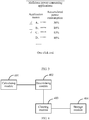
- After the UI interface of the high power consumption application is entered, as shown in
FIG. 3 , the interface displays a list of malicious power-consuming applications that are ranked according to power consumption in descending order (the applications in the list are applications whose background working power consumption is not less than a set power consumption threshold by default), provides power consumption information related to each malicious power-consuming application, and selects several high power consumption applications by default. Certainly, the interface also provides a corresponding check box for each application in the list, so that the user may deselect an application in the list as required, and select "One click end" to clear the power-consuming applications. - Because principles of the apparatus and the user terminal for resolving problems are similar to those of the foregoing method for clearing a malicious power-consuming application, for implementation of the apparatus and the user terminal, refer to implementation of the foregoing method for clearing a malicious power-consuming application, and repeated parts are not described again.
- In a first possible implementation manner of the apparatus for clearing a malicious power-consuming application as shown in
FIG. 4 , the apparatus includes: - a calculating
module 401, configured to calculate, according to a first period, background working power consumption of each application that is running in a user terminal; and calculate, according to a second period, a wakelock occupying time of each application that is running in the user terminal in a case in which a screen is turned off; - a determining
module 402, configured to determine whether the background working power consumption of each application calculated by the calculatingmodule 401 is not less than a power consumption threshold (which is referred to as a first power consumption threshold below for ease of description), and if yes, determine the application as a malicious power-consuming application; and determine whether the accumulated wakelock occupying time of each application calculated by the calculatingmodule 401 is not less than a time threshold, and if yes, and the application is a background working application, determine the application as a malicious power-consuming application; and - a
clearing module 403, configured to clear or instruct a user to clear the determined malicious power-consuming application. - Further, the calculating
module 401 is specifically configured to: starting from a moment when a last time of charging the user terminal ends, for each running application, periodically calculate, according to the first period, power consumption during occupation of a CPU of the user terminal, power consumption during holding of a wakelock, and power consumption during occurrence of data traffic when the running application works in the background; and calculate a sum of the power consumption during the occupation of the CPU of the user terminal, the power consumption during the holding of the wakelock, and the power consumption during the occurrence of the data traffic, as the background working power consumption of each application that is running in the user terminal. - Further, the calculating
module 401 is specifically configured to: for each application, calculate a product of an accumulated working duration for which the application works in the background and occupies the CPU and unit-time power consumption of a corresponding frequency, to obtain the power consumption during the occupation of the CPU of the user terminal when the application works in the background; for each application, calculate a product of an accumulated duration for which the CPU of the user terminal is IDLE when the application works in the background and unit-time power consumption when the CPU of the user terminal is IDLE, to obtain the power consumption during the holding of the wakelock when the application works in the background; and for each application, calculate a product of a quantity of bytes of accumulated data traffic generated when the application works in the background and power consumption of a single byte, to obtain the power consumption during the occurrence of the data traffic when the application works in the background. - Further, the calculating
module 401 is specifically configured to detect, by using a system framework layer, the wakelock occupying time of each application in the user terminal in the case in which the screen is turned off. - Further, the calculating
module 401 is specifically configured to time the first period and the second period according to a working period excluding a sleep period of the CPU. - Further, the
clearing module 403 is further configured to: before clearing or instructing the user to clear the determined malicious power-consuming application, determine, according to a locally saved list of applications selected by the user to be ignord in processing, whether the malicious power-consuming application was selected by the user to be ignord in processing; and if not determine that the subsequent step of clearing or instructing the user to clear the determined malicious power-consuming application is to be performed. - Further, the
clearing module 403 is further configured to: when calculated background working power consumption of an application is greater than the first power consumption threshold, before determining whether the malicious power-consuming application was selected by the user to be ignored in processing, determine whether the calculated background working power consumption is not less than a set power consumption threshold (which is referred to as a second power consumption threshold below for ease of description), where the second power consumption threshold is greater than the first power consumption threshold; if yes, instruct the user to clear the application; and if not, perform the step of determining whether the malicious power-consuming application was ignored in processing by the user. - Further, as shown in
FIG. 4 , the apparatus for clearing a malicious power-consuming application further includes: astorage module 404, configured to store a list of malicious power-consuming applications that are selected by the user to be ignored in processing. - Correspondingly, the
clearing module 403 is specifically configured to rank determined malicious power-consuming applications according to the power consumption or the wakelock occupying time, to generate a list of the malicious power-consuming applications, and send, to the user, a notification message carrying the list of the malicious power-consuming applications; when receiving an instruction for ignoring the malicious power-consuming applications that is returned by the user, use the malicious power-consuming applications that are selected by the user to be ignored in processing to update the list of the applications selected by the user to be ignored in processing that is saved by thestorage module 404; and when receiving an instruction for clearing the malicious power-consuming applications that is returned by the user, stop running or uninstall the malicious power-consuming applications that are selected by the user, and mark the malicious power-consuming applications as having been manually cleared. - Further, the
storage module 404 is further configured to save, for a set time, each list of malicious power-consuming applications that is generated according to the first period. - Correspondingly, the
clearing module 403 is further configured to: before the step of sending, to the user, a notification message carrying the list of the malicious power-consuming applications, compare a list of malicious power-consuming applications that is generated in this period and saved by thestorage module 404 with a list of malicious power-consuming applications that is generated in a last period and saved by thestorage module 404, and if the two lists include same malicious power-consuming applications, suspend sending the notification message; if the two lists include different malicious power-consuming applications, go to the step of sending, to the user, a notification message carrying the list of the malicious power-consuming applications that is generated in this period. - Further, the calculating
module 401 is further configured to: when a battery level of the user terminal is less than a battery level threshold, or when the user sends an instruction for viewing a list of background power-consuming applications, trigger an operation of calculating background working power consumption of each application that is running in the current user terminal and/or a wakelock occupying time of each application in the current user terminal in the case in which the screen is turned off. - Correspondingly, the determining
module 402 is further configured to: when a battery level of the user terminal is less than a battery level threshold, or when the user sends an instruction for viewing a list of background power-consuming applications, determine an application whose current background working power consumption is not less than the first power consumption threshold and/or a background application whose wakelock occupying time in the user terminal in the case in which the screen is turned off is not less than the time threshold as a malicious power-consuming application. - Correspondingly, the
clearing module 403 is further configured to: when a battery level of the user terminal is less than a battery level threshold, or when the user sends an instruction for viewing a list of background power-consuming applications, rank determined malicious power-consuming applications according to the power consumption or the wakelock occupying time, to generate a list of the malicious power-consuming applications, and send, to the user, a notification message carrying the list of the malicious power-consuming applications. - In a second possible implementation manner of the apparatus for clearing a malicious power-consuming application as shown in
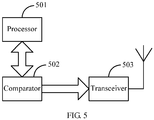
FIG. 5 , the apparatus includes: - a
processor 501, configured to calculate, according to a first period, background working power consumption of each application that is running in a user terminal; calculate, according to a second period, a wakelock occupying time of each application that is running in the user terminal in a case in which a screen is turned off; when acomparator 502 determines that background working power consumption of an application is not less than a first power consumption threshold, determine the application as a malicious power-consuming application, and when thecomparator 502 determines that wakelock occupying time of an application is not less than a time threshold, determine the application as a malicious power-consuming application; and clear the determined power-consuming application, or send, by using a transceiver, a notification to a user to clear the determined power-consuming application; and - the
comparator 502, configured to determine whether the background working power consumption of each application calculated by theprocessor 501 is not less than the first power consumption threshold, and determine whether the wakelock occupying time of each application calculated by theprocessor 501 is not less than the time threshold; and - the
transceiver 503, configured to send a notification to the user to clear the determined malicious power-consuming application. - According to the method and the apparatus for clearing a malicious power-consuming application, and the user terminal, background working power consumption of each application in a user terminal is periodically calculated, an application whose background working power consumption is not less than a power consumption threshold is determined as a malicious power-consuming application; and a wakelock occupying time of each application in the user terminal in a case in which a screen is turned off is periodically calculated, and if an application whose wakelock occupying time is not less than a time threshold is a background working application, the application is determined as a malicious power-consuming application. These applications are applications that improperly occupy resources in the background, but are not applications that consume much power but are normally used by a user, so that the malicious power-consuming applications are accurately identified and detected, and unnecessary power consumption of the user terminal is avoided while user experience is ensured, thereby saving electric energy, and improving a battery endurance capability of the user terminal to some extent.
- According to the descriptions of the foregoing implementation manners, a person skilled in the art may clearly understand that the embodiments of the present invention may be implemented by using hardware, or may be implemented in a manner of software plus a necessary general hardware platform. Based on such an understanding, the technical solutions of the present invention may be implemented in a form of a software product. The software product may be stored in a non-volatile storage medium (which may be a CD-ROM, a USB flash drive, a removable hard disk, or the like) and includes several instructions for instructing a computer device (which may be a personal computer, a server, a network device, or the like) to execute the methods described in the embodiments of the present invention.
- A person skilled in the art may understand that the accompanying drawings are merely schematic diagrams of exemplary embodiments, and modules or processes in the accompanying drawings are not necessarily required for implementing the present invention.
- A person skilled in the art may understand that the modules in the apparatuses provided in the embodiments may be arranged in the apparatuses in a distributed manner according to the description of the embodiments, or may be arranged in one or more apparatuses which are different from those described in the embodiments. The modules in the foregoing embodiments may be combined into one module, or split into a plurality of submodules.
- The sequence numbers of the foregoing embodiments of the present invention are merely for illustrative purposes, and are not intended to indicate priorities of the embodiments.
- Obviously, a person skilled in the art can make various modifications and variations to the present invention without departing from the scope of the present invention. The present invention is intended to cover these modifications and variations provided that they fall within the scope of protection defined by the following claims.
Claims (11)
- A method for clearing a malicious power-consuming application, comprising:calculating (S101), according to a first period, background working power consumption of each application that is running in a user terminal, and when the background working power consumption of an application is not less than a power consumption threshold, determining (S105) the corresponding application as a malicious power-consuming application; and/orcalculating (S103), according to a second period, a wakelock occupying time of each application that is running in the user terminal in a case in which a screen is turned off, and when the wakelock occupying time of an application is not less than a time threshold, and the corresponding application is a background working application, determining (S105) the application as a malicious power-consuming application; andinstructing (S106) a user to clear the determined malicious power-consuming application,wherein instructing (S106) the user to clear the application includes:ranking determined malicious power-consuming applications according to the power consumption or the wakelock occupying time, to generate a list of the malicious power-consuming applications, and sending, to the user, a notification message carrying the list of the malicious power-consuming applications;when receiving an instruction for ignoring the malicious power-consuming applications that is returned by the user, using malicious power-consuming applications that are selected by the user to be ignored in processing to update a locally saved list of applications selected by the user to be ignored in processing; orwhen receiving an instruction for clearing the malicious power-consuming applications that is returned by the user, stopping running or uninstalling malicious power-consuming applications that are selected by the user, and marking the malicious power-consuming applications as having been manually cleared, andwherein each list of malicious power-consuming applications detected and generated according to a period is saved for a set time, and is deleted after the set time elapses;before the notification message carrying the list of the malicious power-consuming applications is sent, a saved list of malicious power-consuming applications generated in this period is compared with a list of malicious power-consuming applications generated in a previous period, and if the two lists include same malicious power-consuming applications, sending of the notification message is suspended; andif an interval between a moment when the notification message carrying the list of the malicious power-consuming applications is sent this time and a moment when the notification message carrying the list of the malicious power-consuming applications is sent a previous time is less than a time interval, sending of the notification message is suspended.
- The method according to claim 1, wherein the calculating (S101) background working power consumption of each application that is running in a user terminal specifically comprises:starting from a moment when a last time of charging the user terminal ends, for each running application, periodically calculating, according to the first period, power consumption during occupation of a CPU of the user terminal, power consumption during holding of a wakelock, and power consumption during occurrence of data traffic when the running application works in the background; andcalculating a sum of the power consumption during the occupation of the CPU of the user terminal, the power consumption during the holding of the wakelock, and the power consumption during the occurrence of the data traffic, as the background working power consumption of each running application.
- The method according to claim 2, wherein the calculating (S101) power consumption during occupation of a CPU of the user terminal when the running application works in the background specifically comprises:for each application, calculating a product of an accumulated working duration for which the application works in the background and occupies the CPU and unit-time power consumption of a corresponding frequency, to obtain the power consumption during the occupation of the CPU of the user terminal when the application works in the background;the calculating (S103) power consumption during holding of a wakelock when the running application works in the background specifically comprises:for each application, calculating a product of an accumulated duration for which the CPU of the user terminal is IDLE when the application works in the background and unit-time power consumption when the CPU of the user terminal is IDLE, to obtain the power consumption during the holding of the wakelock when the application works in the background; andthe calculating power consumption during occurrence of data traffic when the running application works in the background specifically comprises:
for each application, calculating a product of a quantity of bytes of accumulated data traffic generated when the application works in the background and power consumption of a single byte, to obtain the power consumption during the occurrence of the data traffic when the application works in the background. - The method according to claim 1, wherein the wakelock occupying time of each application in the user terminal in the case in which the screen is turned off is detected by using a system framework layer.
- The method according to any one of claims 1 to 4, wherein the first period and the second period are timed according to a working period excluding a sleep period of the CPU.
- An apparatus for clearing a malicious power-consuming application, comprising:a calculating module (401), configured to calculate, according to a first period, background working power consumption of each application that is running in a user terminal; and calculate, according to a second period, a wakelock occupying time of each application that is running in the user terminal in a case in which a screen is turned off;a determining module (402), configured to determine whether the background working power consumption of each application calculated by the calculating module (401) is not less than a power consumption threshold, and if the background working power consumption of an application is not less than a power consumption threshold , determine the corresponding application as a malicious power-consuming application; and determine whether the wakelock occupying time of each application calculated by the calculating module (401) is not less than a time threshold, and if the wakelock occupying time of an application is not less than a time threshold , and the application is a background working application, determine the corresponding application as a malicious power-consuming application; anda clearing module (403), configured to clear or instruct a user to clear the determined malicious power-consuming application,wherein the clearing module (403) is further adapted to:rank determined malicious power-consuming applications according to the power consumption or the wakelock occupying time, to generate a list of the malicious power-consuming applications, and send, to the user, a notification message carrying the list of the malicious power-consuming applications;when receiving an instruction for ignoring the malicious power-consuming applications that is returned by the user, use malicious power-consuming applications that are selected by the user to be ignored in processing to update a locally saved list of applications selected by the user to be ignored in processing; orwhen receiving an instruction for clearing the malicious power-consuming applications that is returned by the user, stop running or uninstalling malicious power-consuming applications that are selected by the user, and mark a malicious power-consuming applications as having been manually cleared, andwherein each list of malicious power-consuming applications detected and generated according to a period is saved for a set time, and is deleted after the set time elapses;before the notification message carrying the list of the malicious power-consuming applications is sent, a saved list of malicious power-consuming applications generated in this period is compared with a list of malicious power-consuming applications generated in a previous period, and if the two lists include same malicious power-consuming applications, sending of the notification message is suspended; andif an interval between a moment when the notification message carrying the list of the malicious power-consuming applications is sent this time and a moment when the notification message carrying the list of the malicious power-consuming applications is sent a previous time is less than a time interval, sending of the notification message is suspended.
- The apparatus according to claim 6, wherein the calculating module (401) is specifically configured to: starting from a moment when a last time of charging the user terminal ends, for each running application, periodically calculate, according to the first period, power consumption during occupation of a CPU of the user terminal, power consumption during holding of a wakelock, and power consumption during occurrence of data traffic when the running application works in the background; and calculate a sum of the power consumption during the occupation of the CPU of the user terminal, the power consumption during the holding of the wakelock, and the power consumption during the occurrence of the data traffic, as the background working power consumption of each running application.
- The apparatus according to claim 7, wherein the calculating module (401) is specifically configured to: for each application, calculate a product of an accumulated working duration for which the application works in the background and occupies the CPU and unit-time power consumption of a corresponding frequency, to obtain the power consumption during the occupation of the CPU of the user terminal when the application works in the background; for each application, calculate a product of an accumulated duration for which the CPU of the user terminal is IDLE when the application works in the background and unit-time power consumption when the CPU of the user terminal is IDLE, to obtain the power consumption during the holding of the wakelock when the application works in the background; and for each application, calculate a product of a quantity of bytes of accumulated data traffic generated when the application works in the background and power consumption of a single byte, to obtain the power consumption during the occurrence of the data traffic when the application works in the background.
- The apparatus according to claim 6, wherein the calculating module (401) is specifically configured to detect, by using a system framework layer, the wakelock occupying time of each application in the user terminal in the case in which the screen is turned off.
- The apparatus according to any one of claims 6 to 9, wherein the calculating module (401) is specifically configured to time the first period and the second period according to a working period excluding a sleep period of the CPU.
- A user terminal, wherein the user terminal comprises the apparatus for clearing a malicious power-consuming application according to any one of claims 6 to 10.
Applications Claiming Priority (2)
| Application Number | Priority Date | Filing Date | Title |
|---|---|---|---|
| CN2013102398517A CN103324519A (en) | 2013-06-17 | 2013-06-17 | Method and device for clearing malicious power consumption applications, and user terminal |
| PCT/CN2014/078623 WO2014201945A1 (en) | 2013-06-17 | 2014-05-28 | Method, apparatus, and user terminal for removing malicious power consuming application |
Publications (3)
| Publication Number | Publication Date |
|---|---|
| EP2977854A1 EP2977854A1 (en) | 2016-01-27 |
| EP2977854A4 EP2977854A4 (en) | 2016-06-08 |
| EP2977854B1 true EP2977854B1 (en) | 2019-07-31 |
Family
ID=49193283
Family Applications (1)
| Application Number | Title | Priority Date | Filing Date |
|---|---|---|---|
| EP14814534.5A Active EP2977854B1 (en) | 2013-06-17 | 2014-05-28 | Method, apparatus, and user terminal for removing malicious power consuming application |
Country Status (4)
| Country | Link |
|---|---|
| US (1) | US20160048682A1 (en) |
| EP (1) | EP2977854B1 (en) |
| CN (1) | CN103324519A (en) |
| WO (1) | WO2014201945A1 (en) |
Families Citing this family (95)
| Publication number | Priority date | Publication date | Assignee | Title |
|---|---|---|---|---|
| GB2495058B (en) * | 2010-07-26 | 2014-03-05 | Seven Networks Inc | Context aware traffic management for resource conservation in a wireless network |
| WO2013090212A1 (en) | 2011-12-14 | 2013-06-20 | Seven Networks, Inc. | Mobile network reporting and usage analytics system and method using aggregation of data in a distributed traffic optimization system |
| CN103324519A (en) * | 2013-06-17 | 2013-09-25 | 华为技术有限公司 | Method and device for clearing malicious power consumption applications, and user terminal |
| CN104298584A (en) * | 2013-07-19 | 2015-01-21 | 贝壳网际(北京)安全技术有限公司 | Method and device for acquiring application program with abnormal power consumption and mobile terminal |
| CN103544435A (en) * | 2013-10-18 | 2014-01-29 | 广东欧珀移动通信有限公司 | Method and device for preventing secret photography |
| CN104679637B (en) * | 2013-12-02 | 2018-05-15 | 北京猎豹移动科技有限公司 | The method and system of power consumption are applied under a kind of definite mobile terminal in standby state |
| CN103729052A (en) * | 2013-12-31 | 2014-04-16 | 贝壳网际(北京)安全技术有限公司 | Processing method and system for power consumption of application program and mobile terminal |
| US9351254B2 (en) | 2014-01-22 | 2016-05-24 | Seven Networks, Llc | Method for power saving in mobile devices by optimizing wakelocks |
| US9841802B2 (en) * | 2014-02-20 | 2017-12-12 | Qualcomm Incorporated | Wake lock management through application monitoring |
| CN103885871A (en) * | 2014-03-10 | 2014-06-25 | 可牛网络技术(北京)有限公司 | Power consumption display method and device, and mobile terminal |
| CN104008036A (en) * | 2014-03-31 | 2014-08-27 | 可牛网络技术(北京)有限公司 | Message view setting method and device |
| CN104023149A (en) * | 2014-06-19 | 2014-09-03 | 深圳市中兴移动通信有限公司 | Mobile terminal and sharing power source resource state abnormity prompting method thereof |
| CN104020837B (en) * | 2014-06-19 | 2017-02-01 | 珠海全志科技股份有限公司 | audio playing power management method and power management device |
| CN104038635A (en) * | 2014-06-25 | 2014-09-10 | 深圳市中兴移动通信有限公司 | Mobile terminal and prompting method of abnormal standby thereof |
| CN104023147B (en) * | 2014-06-27 | 2016-05-11 | 广东欧珀移动通信有限公司 | A kind of method and system that make mobile terminal stablize dormancy |
| CN104156053B (en) * | 2014-07-29 | 2015-12-30 | 努比亚技术有限公司 | A kind of control method of abnormal power consumption, device and mobile terminal |
| CN104219746B (en) * | 2014-09-03 | 2020-06-09 | 南京白下高新技术产业园区投资发展有限责任公司 | Method, device and terminal for autonomously adjusting wake-up time |
| CN104219747B (en) * | 2014-09-03 | 2020-05-29 | 湖北职升科技文化有限公司 | Method, device and terminal for adjusting wake-up time according to electric quantity information |
| CN104239195B (en) * | 2014-09-17 | 2017-07-28 | 可牛网络技术(北京)有限公司 | A kind of method and electronic equipment for handling electronic equipment power consumption |
| JP2017534958A (en) | 2014-09-18 | 2017-11-24 | ブーズ−アレン アンド ハミルトン | System and method for location-based security |
| KR102294180B1 (en) * | 2014-10-31 | 2021-08-27 | 삼성전자주식회사 | Electronic device and method for controlling power in electronic device |
| CN105676987A (en) * | 2014-11-19 | 2016-06-15 | 中兴通讯股份有限公司 | Method for shutting down background application of mobile terminal, device and mobile terminal |
| JP6487044B2 (en) | 2014-11-25 | 2019-03-20 | ホアウェイ・テクノロジーズ・カンパニー・リミテッド | Power management method and power management apparatus for user equipment |
| CN104461734A (en) * | 2014-11-26 | 2015-03-25 | 北京奇虎科技有限公司 | Processing method and system for terminal applications |
| CN104468558B (en) * | 2014-11-28 | 2018-01-09 | 东莞宇龙通信科技有限公司 | Data security management method and device and terminal |
| CN104375624B (en) * | 2014-12-11 | 2017-04-26 | 深圳市奇虎智能科技有限公司 | Mobile terminal and power saving suggestion method thereof |
| KR102311817B1 (en) * | 2015-02-26 | 2021-10-13 | 삼성전자주식회사 | Electronic device and method for managung power in electronic device |
| WO2016165078A1 (en) * | 2015-04-14 | 2016-10-20 | 华为技术有限公司 | Method and terminal for controlling application |
| CN104915111B (en) * | 2015-05-28 | 2018-08-14 | 努比亚技术有限公司 | terminal operation control method and device |
| CN104899153A (en) * | 2015-06-04 | 2015-09-09 | 上海卓易科技股份有限公司 | Background application cleaning method and system |
| CN104967741B (en) * | 2015-06-17 | 2020-12-29 | 努比亚技术有限公司 | Method and device for cleaning terminal service |
| CN106411828B (en) * | 2015-08-03 | 2019-06-28 | 阿里巴巴集团控股有限公司 | Methods, devices, and systems for quantifying defense outcomes |
| CN105204908B (en) * | 2015-09-30 | 2019-06-14 | 北京金山安全软件有限公司 | Application program package stopping method and device and electronic equipment |
| CN105607920B (en) * | 2015-09-30 | 2019-09-17 | 北京金山安全软件有限公司 | Application program package stopping method and device and electronic equipment |
| WO2017070894A1 (en) | 2015-10-29 | 2017-05-04 | 华为技术有限公司 | Terminal-based wakelock control method and apparatus, and terminal |
| CN105446776A (en) * | 2015-11-20 | 2016-03-30 | 北京金山安全软件有限公司 | Application program closing method and device and electronic equipment |
| CN105892613A (en) * | 2015-12-04 | 2016-08-24 | 乐视移动智能信息技术(北京)有限公司 | Method and apparatus for clearing background applications |
| CN106855826B (en) * | 2015-12-08 | 2021-02-23 | 斑马智行网络(香港)有限公司 | Background application program control method and device |
| CN105373482A (en) * | 2015-12-23 | 2016-03-02 | 北京金山安全软件有限公司 | Method and device for detecting abnormal power consumption of application program and electronic equipment |
| CN106897051B (en) * | 2015-12-24 | 2022-01-25 | 北京奇虎科技有限公司 | Process cleaning method and device |
| CN105677386A (en) * | 2015-12-29 | 2016-06-15 | 北京金山安全软件有限公司 | Application program management method and device and electronic equipment |
| KR102465543B1 (en) * | 2016-02-19 | 2022-11-10 | 삼성전자 주식회사 | Method and electronic device controlling applications and components |
| CN105808235A (en) * | 2016-02-24 | 2016-07-27 | 北京奇虎科技有限公司 | Management method and device for notification bar messages of mobile terminal, and mobile terminal |
| CN105792335B (en) * | 2016-02-26 | 2018-12-18 | 深圳天珑无线科技有限公司 | A kind of method and terminal device improving cruise duration |
| CN107239131B (en) * | 2016-03-28 | 2020-05-08 | 杭州海康威视数字技术股份有限公司 | A power consumption adjustment method and a video analysis system based on battery life |
| CN105702232B (en) * | 2016-04-26 | 2018-05-04 | 广东欧珀移动通信有限公司 | Brightness processing method and system |
| CN106055077A (en) * | 2016-05-31 | 2016-10-26 | 广东欧珀移动通信有限公司 | A processing method and device based on wake lock |
| CN106095414A (en) * | 2016-06-01 | 2016-11-09 | 北京金山安全软件有限公司 | Method and device for managing application program and electronic equipment |
| CN106095645A (en) * | 2016-06-21 | 2016-11-09 | 广东欧珀移动通信有限公司 | A method and device for searching an application program |
| CN106200880A (en) * | 2016-07-27 | 2016-12-07 | 宇龙计算机通信科技(深圳)有限公司 | Terminal control method, terminal control mechanism and terminal |
| CN106292997A (en) * | 2016-07-28 | 2017-01-04 | 宇龙计算机通信科技(深圳)有限公司 | A kind of application program freezing method and device |
| KR102691293B1 (en) | 2016-07-29 | 2024-08-05 | 삼성전자 주식회사 | Method and apparatus for reducing power consumption of electronic device |
| CN106445582A (en) * | 2016-08-30 | 2017-02-22 | 宇龙计算机通信科技(深圳)有限公司 | Application copy deletion method and terminal |
| CN106484071A (en) * | 2016-09-12 | 2017-03-08 | 惠州Tcl移动通信有限公司 | A kind of electricity saving method of intelligent terminal and system |
| CN107894902B (en) * | 2016-09-30 | 2021-01-01 | 北京小米移动软件有限公司 | Equipment control method and device |
| CN106569579A (en) * | 2016-10-21 | 2017-04-19 | 宇龙计算机通信科技(深圳)有限公司 | Power-saving control method and device of terminal |
| US10169576B2 (en) * | 2016-11-15 | 2019-01-01 | International Business Machines Corporation | Malware collusion detection |
| US10298605B2 (en) * | 2016-11-16 | 2019-05-21 | Red Hat, Inc. | Multi-tenant cloud security threat detection |
| CN106792161B (en) * | 2016-12-30 | 2020-02-11 | 上海敬邦机电设备有限公司 | Mobile terminal and data transmission method |
| CN108271237A (en) * | 2017-01-03 | 2018-07-10 | 中兴通讯股份有限公司 | The method and apparatus that business is performed for control terminal |
| CN106686633A (en) * | 2017-02-20 | 2017-05-17 | 苏州蜗牛数字科技股份有限公司 | Method for preventing WIFI malicious frequent awakening |
| CN107145425B (en) * | 2017-05-08 | 2019-02-05 | Oppo广东移动通信有限公司 | Information processing method and device and mobile terminal |
| US10685118B2 (en) | 2017-05-15 | 2020-06-16 | Ut-Battelle, Llc | System and method for monitoring power consumption to detect malware |
| CN107291212A (en) * | 2017-06-16 | 2017-10-24 | 深圳天珑无线科技有限公司 | Power lock processing method and processing device |
| CN107506019A (en) * | 2017-08-07 | 2017-12-22 | 北京小米移动软件有限公司 | Management method and device, terminal, the storage medium of application program |
| CN107563196A (en) * | 2017-08-16 | 2018-01-09 | 深圳天珑无线科技有限公司 | Filter method, equipment and the readable storage medium storing program for executing of malicious application |
| CN107729236A (en) * | 2017-09-30 | 2018-02-23 | 努比亚技术有限公司 | Management method, device, mobile terminal and the storage medium of application program |
| CN111052040A (en) | 2017-10-13 | 2020-04-21 | 华为技术有限公司 | Method and terminal for reducing power consumption of terminal |
| CN107908271A (en) * | 2017-10-19 | 2018-04-13 | 上海闻泰信息技术有限公司 | Prophylactic applications influence the method, apparatus and intelligent terminal of intelligent terminal power consumption |
| CN107861855A (en) * | 2017-10-30 | 2018-03-30 | 深圳市金立通信设备有限公司 | A kind of method, terminal, system and computer-readable recording medium for reducing abnormal power consumption |
| CN110018885B (en) * | 2017-12-29 | 2021-06-01 | Oppo广东移动通信有限公司 | Application freezing method, device, storage medium and terminal |
| US10061933B1 (en) * | 2018-01-09 | 2018-08-28 | Booz Allen Hamilton Inc. | System and method for controlling the power states of a mobile computing device |
| CN108536546A (en) * | 2018-03-29 | 2018-09-14 | 广东欧珀移动通信有限公司 | Information processing method, device, mobile terminal and computer readable storage medium |
| CN108616653B (en) * | 2018-03-30 | 2020-01-17 | Oppo广东移动通信有限公司 | Information processing method, device, mobile terminal, and computer-readable storage medium |
| CN108650384B (en) * | 2018-05-15 | 2020-07-07 | Oppo(重庆)智能科技有限公司 | Information processing method, device, mobile terminal, and computer-readable storage medium |
| WO2019218299A1 (en) * | 2018-05-17 | 2019-11-21 | 华为技术有限公司 | Power consumption anomaly prompting method, server, and terminal |
| US11662796B2 (en) * | 2018-06-01 | 2023-05-30 | Apple Inc. | User interfaces for indicating battery information on an electronic device |
| GB201812240D0 (en) | 2018-07-27 | 2018-09-12 | Ibm | Device, system and method for detection of compromise through automated power analysis |
| CN109271292A (en) * | 2018-09-06 | 2019-01-25 | 北京小米移动软件有限公司 | Power consumption information acquisition method and device |
| CN110908727A (en) * | 2018-09-14 | 2020-03-24 | 中兴通讯股份有限公司 | Application freezing method and device, storage medium and electronic device |
| CN110908851A (en) * | 2018-09-14 | 2020-03-24 | 中兴通讯股份有限公司 | Abnormal application detection and control method, device, terminal and storage medium |
| CN109413726B (en) * | 2018-12-24 | 2021-05-07 | 维沃移动通信有限公司 | Power consumption control method and mobile terminal |
| CN109901692A (en) * | 2019-03-04 | 2019-06-18 | 上海卓易科技股份有限公司 | Execution method, device, terminal and storage medium of target application |
| US11277120B2 (en) | 2019-03-12 | 2022-03-15 | International Business Machines Corporation | Dynamic signal processing |
| CN110134219B (en) * | 2019-05-13 | 2024-03-19 | 深圳传音通讯有限公司 | Application program background power consumption processing method and device |
| US20200372077A1 (en) * | 2019-05-20 | 2020-11-26 | Microsoft Technology Licensing, Llc | Interactive chart recommender |
| US11074345B2 (en) | 2019-05-30 | 2021-07-27 | Ut-Battelle, Llc | Rootkit detection system |
| CN111385859A (en) * | 2020-02-28 | 2020-07-07 | 北京九州云动科技有限公司 | Terminal power consumption detection optimization method and device |
| CN112860326A (en) * | 2021-02-01 | 2021-05-28 | 读书郎教育科技有限公司 | Power-saving processing method for screen-off standby of android device |
| CN112882762A (en) * | 2021-03-25 | 2021-06-01 | 广州文石信息科技有限公司 | Power consumption optimization method, device, equipment and storage medium for ink screen equipment |
| CN113778214B (en) * | 2021-09-15 | 2024-07-05 | 广州点金石信息技术有限公司 | Power saving optimization method and device, mobile terminal and storage medium |
| CN114115509B (en) * | 2022-01-25 | 2022-07-26 | 荣耀终端有限公司 | Application management method and terminal |
| CN114428546B (en) * | 2022-01-25 | 2024-04-09 | 惠州Tcl移动通信有限公司 | Background application cleaning method and device, storage medium and terminal equipment |
| TWI806664B (en) * | 2022-06-16 | 2023-06-21 | 華碩電腦股份有限公司 | Method and system for detecting application program version with abnormal power consumption |
| CN118259738A (en) * | 2022-12-28 | 2024-06-28 | 蔚来移动科技有限公司 | Method, system and apparatus for controlling Job execution |
Family Cites Families (11)
| Publication number | Priority date | Publication date | Assignee | Title |
|---|---|---|---|---|
| US8538484B2 (en) * | 2009-08-14 | 2013-09-17 | Google Inc. | Providing a user with feedback regarding power consumption in battery-operated electronic devices |
| EP2390757A1 (en) * | 2010-05-25 | 2011-11-30 | Samsung Electronics Co., Ltd. | Method and apparatus for managing an application being executed in a portable terminal |
| US20120210150A1 (en) * | 2011-02-10 | 2012-08-16 | Alcatel-Lucent Usa Inc. | Method And Apparatus Of Smart Power Management For Mobile Communication Terminals |
| CN102495761A (en) * | 2011-11-11 | 2012-06-13 | 中兴通讯股份有限公司 | Method and device for closing applications |
| CN102841672B (en) * | 2012-07-10 | 2016-03-16 | 上海果壳电子有限公司 | A kind of dormancy hold-up interception method and system |
| US8655307B1 (en) * | 2012-10-26 | 2014-02-18 | Lookout, Inc. | System and method for developing, updating, and using user device behavioral context models to modify user, device, and application state, settings and behavior for enhanced user security |
| CN103037108A (en) * | 2012-12-10 | 2013-04-10 | 乐蛙科技(上海)有限公司 | Power saving method for smart mobile terminal |
| CN103049319A (en) * | 2012-12-18 | 2013-04-17 | 广东欧珀移动通信有限公司 | Method and terminal for managing background application program by time period |
| CN103092685A (en) * | 2012-12-21 | 2013-05-08 | 广东欧珀移动通信有限公司 | Method and device for closing application program |
| CN104166542B (en) * | 2013-05-17 | 2018-01-05 | 腾讯科技(深圳)有限公司 | The method and apparatus that power consumption is applied in detection |
| CN103324519A (en) * | 2013-06-17 | 2013-09-25 | 华为技术有限公司 | Method and device for clearing malicious power consumption applications, and user terminal |
-
2013
- 2013-06-17 CN CN2013102398517A patent/CN103324519A/en active Pending
-
2014
- 2014-05-28 WO PCT/CN2014/078623 patent/WO2014201945A1/en not_active Ceased
- 2014-05-28 EP EP14814534.5A patent/EP2977854B1/en active Active
-
2015
- 2015-10-30 US US14/927,545 patent/US20160048682A1/en not_active Abandoned
Non-Patent Citations (1)
| Title |
|---|
| None * |
Also Published As
| Publication number | Publication date |
|---|---|
| CN103324519A (en) | 2013-09-25 |
| EP2977854A4 (en) | 2016-06-08 |
| WO2014201945A1 (en) | 2014-12-24 |
| US20160048682A1 (en) | 2016-02-18 |
| EP2977854A1 (en) | 2016-01-27 |
Similar Documents
| Publication | Publication Date | Title |
|---|---|---|
| EP2977854A1 (en) | Method, apparatus, and user terminal for removing malicious power consuming application | |
| CN106557407B (en) | Method and device for monitoring equipment load | |
| RU2686673C1 (en) | Device and method of terminal control and terminal | |
| CN109213539B (en) | Memory recovery method and device | |
| CN103823543B (en) | Portable electronic device and method of operating therein | |
| CN104932657B (en) | Power saving mode optimization and optimization configuration information generation method and device for mobile terminal | |
| CN102200942B (en) | Based on application behavior monitoring method and the cloud server of cloud computing | |
| US20120117576A1 (en) | Method and apparatus for obtaining feedback from a device | |
| CA2838397C (en) | Mobile device operations with battery optimization | |
| CN107577508B (en) | Application processing method, device, readable storage medium and mobile terminal | |
| CN106921506B (en) | Method and system for data collection and reporting of mobile devices | |
| WO2015176448A1 (en) | Method and apparatus for intelligent screen splitting of terminal | |
| CN107544842A (en) | Application program processing method and device, computer equipment, storage medium | |
| US11096177B2 (en) | Operation mode switching method and user equipment | |
| CN106844026B (en) | Method and system for cleaning terminal equipment process | |
| CN107526637B (en) | Application processing method and device, mobile terminal and storage medium | |
| CN107526638B (en) | Application processing method, device, mobile terminal and storage medium | |
| US20130055271A1 (en) | Apparatus and method for controlling polling | |
| CN105468441A (en) | Processing method and apparatus for task process | |
| KR20160145116A (en) | Battery efficient synchronization of communications using a token bucket | |
| CN106569917A (en) | Data backup method and mobile terminal | |
| KR20130024801A (en) | Terminal and method for managing application thereof | |
| CN107450952B (en) | Application control method and device, storage medium and electronic equipment | |
| CN105893134A (en) | Information processing method and electronic equipment | |
| CN107436674A (en) | terminal control method, device and non-transitory computer-readable medium |
Legal Events
| Date | Code | Title | Description |
|---|---|---|---|
| PUAI | Public reference made under article 153(3) epc to a published international application that has entered the european phase |
Free format text: ORIGINAL CODE: 0009012 |
|
| 17P | Request for examination filed |
Effective date: 20151023 |
|
| AK | Designated contracting states |
Kind code of ref document: A1 Designated state(s): AL AT BE BG CH CY CZ DE DK EE ES FI FR GB GR HR HU IE IS IT LI LT LU LV MC MK MT NL NO PL PT RO RS SE SI SK SM TR |
|
| AX | Request for extension of the european patent |
Extension state: BA ME |
|
| A4 | Supplementary search report drawn up and despatched |
Effective date: 20160511 |
|
| RIC1 | Information provided on ipc code assigned before grant |
Ipc: G06F 1/32 20060101AFI20160504BHEP |
|
| DAX | Request for extension of the european patent (deleted) | ||
| STAA | Information on the status of an ep patent application or granted ep patent |
Free format text: STATUS: EXAMINATION IS IN PROGRESS |
|
| 17Q | First examination report despatched |
Effective date: 20171102 |
|
| GRAP | Despatch of communication of intention to grant a patent |
Free format text: ORIGINAL CODE: EPIDOSNIGR1 |
|
| STAA | Information on the status of an ep patent application or granted ep patent |
Free format text: STATUS: GRANT OF PATENT IS INTENDED |
|
| INTG | Intention to grant announced |
Effective date: 20190214 |
|
| GRAS | Grant fee paid |
Free format text: ORIGINAL CODE: EPIDOSNIGR3 |
|
| GRAA | (expected) grant |
Free format text: ORIGINAL CODE: 0009210 |
|
| STAA | Information on the status of an ep patent application or granted ep patent |
Free format text: STATUS: THE PATENT HAS BEEN GRANTED |
|
| AK | Designated contracting states |
Kind code of ref document: B1 Designated state(s): AL AT BE BG CH CY CZ DE DK EE ES FI FR GB GR HR HU IE IS IT LI LT LU LV MC MK MT NL NO PL PT RO RS SE SI SK SM TR |
|
| REG | Reference to a national code |
Ref country code: CH Ref legal event code: EP Ref country code: GB Ref legal event code: FG4D |
|
| REG | Reference to a national code |
Ref country code: AT Ref legal event code: REF Ref document number: 1161597 Country of ref document: AT Kind code of ref document: T Effective date: 20190815 |
|
| REG | Reference to a national code |
Ref country code: IE Ref legal event code: FG4D |
|
| REG | Reference to a national code |
Ref country code: DE Ref legal event code: R096 Ref document number: 602014050973 Country of ref document: DE |
|
| REG | Reference to a national code |
Ref country code: NL Ref legal event code: MP Effective date: 20190731 |
|
| REG | Reference to a national code |
Ref country code: LT Ref legal event code: MG4D |
|
| REG | Reference to a national code |
Ref country code: AT Ref legal event code: MK05 Ref document number: 1161597 Country of ref document: AT Kind code of ref document: T Effective date: 20190731 |
|
| PG25 | Lapsed in a contracting state [announced via postgrant information from national office to epo] |
Ref country code: AT Free format text: LAPSE BECAUSE OF FAILURE TO SUBMIT A TRANSLATION OF THE DESCRIPTION OR TO PAY THE FEE WITHIN THE PRESCRIBED TIME-LIMIT Effective date: 20190731 Ref country code: NL Free format text: LAPSE BECAUSE OF FAILURE TO SUBMIT A TRANSLATION OF THE DESCRIPTION OR TO PAY THE FEE WITHIN THE PRESCRIBED TIME-LIMIT Effective date: 20190731 Ref country code: BG Free format text: LAPSE BECAUSE OF FAILURE TO SUBMIT A TRANSLATION OF THE DESCRIPTION OR TO PAY THE FEE WITHIN THE PRESCRIBED TIME-LIMIT Effective date: 20191031 Ref country code: SE Free format text: LAPSE BECAUSE OF FAILURE TO SUBMIT A TRANSLATION OF THE DESCRIPTION OR TO PAY THE FEE WITHIN THE PRESCRIBED TIME-LIMIT Effective date: 20190731 Ref country code: HR Free format text: LAPSE BECAUSE OF FAILURE TO SUBMIT A TRANSLATION OF THE DESCRIPTION OR TO PAY THE FEE WITHIN THE PRESCRIBED TIME-LIMIT Effective date: 20190731 Ref country code: LT Free format text: LAPSE BECAUSE OF FAILURE TO SUBMIT A TRANSLATION OF THE DESCRIPTION OR TO PAY THE FEE WITHIN THE PRESCRIBED TIME-LIMIT Effective date: 20190731 Ref country code: PT Free format text: LAPSE BECAUSE OF FAILURE TO SUBMIT A TRANSLATION OF THE DESCRIPTION OR TO PAY THE FEE WITHIN THE PRESCRIBED TIME-LIMIT Effective date: 20191202 Ref country code: FI Free format text: LAPSE BECAUSE OF FAILURE TO SUBMIT A TRANSLATION OF THE DESCRIPTION OR TO PAY THE FEE WITHIN THE PRESCRIBED TIME-LIMIT Effective date: 20190731 Ref country code: NO Free format text: LAPSE BECAUSE OF FAILURE TO SUBMIT A TRANSLATION OF THE DESCRIPTION OR TO PAY THE FEE WITHIN THE PRESCRIBED TIME-LIMIT Effective date: 20191031 |
|
| PG25 | Lapsed in a contracting state [announced via postgrant information from national office to epo] |
Ref country code: LV Free format text: LAPSE BECAUSE OF FAILURE TO SUBMIT A TRANSLATION OF THE DESCRIPTION OR TO PAY THE FEE WITHIN THE PRESCRIBED TIME-LIMIT Effective date: 20190731 Ref country code: GR Free format text: LAPSE BECAUSE OF FAILURE TO SUBMIT A TRANSLATION OF THE DESCRIPTION OR TO PAY THE FEE WITHIN THE PRESCRIBED TIME-LIMIT Effective date: 20191101 Ref country code: ES Free format text: LAPSE BECAUSE OF FAILURE TO SUBMIT A TRANSLATION OF THE DESCRIPTION OR TO PAY THE FEE WITHIN THE PRESCRIBED TIME-LIMIT Effective date: 20190731 Ref country code: RS Free format text: LAPSE BECAUSE OF FAILURE TO SUBMIT A TRANSLATION OF THE DESCRIPTION OR TO PAY THE FEE WITHIN THE PRESCRIBED TIME-LIMIT Effective date: 20190731 Ref country code: IS Free format text: LAPSE BECAUSE OF FAILURE TO SUBMIT A TRANSLATION OF THE DESCRIPTION OR TO PAY THE FEE WITHIN THE PRESCRIBED TIME-LIMIT Effective date: 20191130 Ref country code: AL Free format text: LAPSE BECAUSE OF FAILURE TO SUBMIT A TRANSLATION OF THE DESCRIPTION OR TO PAY THE FEE WITHIN THE PRESCRIBED TIME-LIMIT Effective date: 20190731 |
|
| PG25 | Lapsed in a contracting state [announced via postgrant information from national office to epo] |
Ref country code: TR Free format text: LAPSE BECAUSE OF FAILURE TO SUBMIT A TRANSLATION OF THE DESCRIPTION OR TO PAY THE FEE WITHIN THE PRESCRIBED TIME-LIMIT Effective date: 20190731 |
|
| PG25 | Lapsed in a contracting state [announced via postgrant information from national office to epo] |
Ref country code: DK Free format text: LAPSE BECAUSE OF FAILURE TO SUBMIT A TRANSLATION OF THE DESCRIPTION OR TO PAY THE FEE WITHIN THE PRESCRIBED TIME-LIMIT Effective date: 20190731 Ref country code: EE Free format text: LAPSE BECAUSE OF FAILURE TO SUBMIT A TRANSLATION OF THE DESCRIPTION OR TO PAY THE FEE WITHIN THE PRESCRIBED TIME-LIMIT Effective date: 20190731 Ref country code: RO Free format text: LAPSE BECAUSE OF FAILURE TO SUBMIT A TRANSLATION OF THE DESCRIPTION OR TO PAY THE FEE WITHIN THE PRESCRIBED TIME-LIMIT Effective date: 20190731 Ref country code: IT Free format text: LAPSE BECAUSE OF FAILURE TO SUBMIT A TRANSLATION OF THE DESCRIPTION OR TO PAY THE FEE WITHIN THE PRESCRIBED TIME-LIMIT Effective date: 20190731 Ref country code: PL Free format text: LAPSE BECAUSE OF FAILURE TO SUBMIT A TRANSLATION OF THE DESCRIPTION OR TO PAY THE FEE WITHIN THE PRESCRIBED TIME-LIMIT Effective date: 20190731 |
|
| PG25 | Lapsed in a contracting state [announced via postgrant information from national office to epo] |
Ref country code: IS Free format text: LAPSE BECAUSE OF FAILURE TO SUBMIT A TRANSLATION OF THE DESCRIPTION OR TO PAY THE FEE WITHIN THE PRESCRIBED TIME-LIMIT Effective date: 20200224 Ref country code: SM Free format text: LAPSE BECAUSE OF FAILURE TO SUBMIT A TRANSLATION OF THE DESCRIPTION OR TO PAY THE FEE WITHIN THE PRESCRIBED TIME-LIMIT Effective date: 20190731 Ref country code: SK Free format text: LAPSE BECAUSE OF FAILURE TO SUBMIT A TRANSLATION OF THE DESCRIPTION OR TO PAY THE FEE WITHIN THE PRESCRIBED TIME-LIMIT Effective date: 20190731 Ref country code: CZ Free format text: LAPSE BECAUSE OF FAILURE TO SUBMIT A TRANSLATION OF THE DESCRIPTION OR TO PAY THE FEE WITHIN THE PRESCRIBED TIME-LIMIT Effective date: 20190731 |
|
| REG | Reference to a national code |
Ref country code: DE Ref legal event code: R097 Ref document number: 602014050973 Country of ref document: DE |
|
| PLBE | No opposition filed within time limit |
Free format text: ORIGINAL CODE: 0009261 |
|
| STAA | Information on the status of an ep patent application or granted ep patent |
Free format text: STATUS: NO OPPOSITION FILED WITHIN TIME LIMIT |
|
| PG2D | Information on lapse in contracting state deleted |
Ref country code: IS |
|
| PG25 | Lapsed in a contracting state [announced via postgrant information from national office to epo] |
Ref country code: IS Free format text: LAPSE BECAUSE OF FAILURE TO SUBMIT A TRANSLATION OF THE DESCRIPTION OR TO PAY THE FEE WITHIN THE PRESCRIBED TIME-LIMIT Effective date: 20191030 |
|
| 26N | No opposition filed |
Effective date: 20200603 |
|
| PG25 | Lapsed in a contracting state [announced via postgrant information from national office to epo] |
Ref country code: SI Free format text: LAPSE BECAUSE OF FAILURE TO SUBMIT A TRANSLATION OF THE DESCRIPTION OR TO PAY THE FEE WITHIN THE PRESCRIBED TIME-LIMIT Effective date: 20190731 |
|
| PG25 | Lapsed in a contracting state [announced via postgrant information from national office to epo] |
Ref country code: LI Free format text: LAPSE BECAUSE OF NON-PAYMENT OF DUE FEES Effective date: 20200531 Ref country code: MC Free format text: LAPSE BECAUSE OF FAILURE TO SUBMIT A TRANSLATION OF THE DESCRIPTION OR TO PAY THE FEE WITHIN THE PRESCRIBED TIME-LIMIT Effective date: 20190731 Ref country code: CH Free format text: LAPSE BECAUSE OF NON-PAYMENT OF DUE FEES Effective date: 20200531 |
|
| REG | Reference to a national code |
Ref country code: BE Ref legal event code: MM Effective date: 20200531 |
|
| PG25 | Lapsed in a contracting state [announced via postgrant information from national office to epo] |
Ref country code: LU Free format text: LAPSE BECAUSE OF NON-PAYMENT OF DUE FEES Effective date: 20200528 |
|
| PG25 | Lapsed in a contracting state [announced via postgrant information from national office to epo] |
Ref country code: IE Free format text: LAPSE BECAUSE OF NON-PAYMENT OF DUE FEES Effective date: 20200528 |
|
| PG25 | Lapsed in a contracting state [announced via postgrant information from national office to epo] |
Ref country code: BE Free format text: LAPSE BECAUSE OF NON-PAYMENT OF DUE FEES Effective date: 20200531 |
|
| PG25 | Lapsed in a contracting state [announced via postgrant information from national office to epo] |
Ref country code: MT Free format text: LAPSE BECAUSE OF FAILURE TO SUBMIT A TRANSLATION OF THE DESCRIPTION OR TO PAY THE FEE WITHIN THE PRESCRIBED TIME-LIMIT Effective date: 20190731 Ref country code: CY Free format text: LAPSE BECAUSE OF FAILURE TO SUBMIT A TRANSLATION OF THE DESCRIPTION OR TO PAY THE FEE WITHIN THE PRESCRIBED TIME-LIMIT Effective date: 20190731 |
|
| PG25 | Lapsed in a contracting state [announced via postgrant information from national office to epo] |
Ref country code: MK Free format text: LAPSE BECAUSE OF FAILURE TO SUBMIT A TRANSLATION OF THE DESCRIPTION OR TO PAY THE FEE WITHIN THE PRESCRIBED TIME-LIMIT Effective date: 20190731 |
|
| REG | Reference to a national code |
Ref country code: FR Ref legal event code: PLFP Year of fee payment: 10 |
|
| PGFP | Annual fee paid to national office [announced via postgrant information from national office to epo] |
Ref country code: DE Payment date: 20250402 Year of fee payment: 12 |
|
| PGFP | Annual fee paid to national office [announced via postgrant information from national office to epo] |
Ref country code: GB Payment date: 20250401 Year of fee payment: 12 |
|
| PGFP | Annual fee paid to national office [announced via postgrant information from national office to epo] |
Ref country code: FR Payment date: 20250401 Year of fee payment: 12 |