EP2977367A1 - Production method for (meth) acrylate aryl ester - Google Patents
Production method for (meth) acrylate aryl ester Download PDFInfo
- Publication number
- EP2977367A1 EP2977367A1 EP14768024.3A EP14768024A EP2977367A1 EP 2977367 A1 EP2977367 A1 EP 2977367A1 EP 14768024 A EP14768024 A EP 14768024A EP 2977367 A1 EP2977367 A1 EP 2977367A1
- Authority
- EP
- European Patent Office
- Prior art keywords
- group
- aryl
- meth
- acrylate
- formula
- Prior art date
- Legal status (The legal status is an assumption and is not a legal conclusion. Google has not performed a legal analysis and makes no representation as to the accuracy of the status listed.)
- Withdrawn
Links
- -1 acrylate aryl ester Chemical class 0.000 title claims abstract description 41
- 238000004519 manufacturing process Methods 0.000 title claims abstract description 16
- 125000002887 hydroxy group Chemical group [H]O* 0.000 claims abstract description 47
- 150000001491 aromatic compounds Chemical class 0.000 claims abstract description 45
- ISWSIDIOOBJBQZ-UHFFFAOYSA-N Phenol Chemical compound OC1=CC=CC=C1 ISWSIDIOOBJBQZ-UHFFFAOYSA-N 0.000 claims abstract description 36
- OJMIONKXNSYLSR-UHFFFAOYSA-N phosphorous acid Chemical compound OP(O)O OJMIONKXNSYLSR-UHFFFAOYSA-N 0.000 claims abstract 5
- 125000003118 aryl group Chemical group 0.000 claims description 136
- NIXOWILDQLNWCW-UHFFFAOYSA-M Acrylate Chemical compound [O-]C(=O)C=C NIXOWILDQLNWCW-UHFFFAOYSA-M 0.000 claims description 115
- 125000000217 alkyl group Chemical group 0.000 claims description 57
- 238000006243 chemical reaction Methods 0.000 claims description 49
- 239000000203 mixture Substances 0.000 claims description 40
- YXFVVABEGXRONW-UHFFFAOYSA-N Toluene Chemical compound CC1=CC=CC=C1 YXFVVABEGXRONW-UHFFFAOYSA-N 0.000 claims description 39
- 238000004817 gas chromatography Methods 0.000 claims description 38
- 239000003054 catalyst Substances 0.000 claims description 33
- 238000002835 absorbance Methods 0.000 claims description 32
- 125000005090 alkenylcarbonyl group Chemical group 0.000 claims description 28
- 125000004453 alkoxycarbonyl group Chemical group 0.000 claims description 28
- 125000004448 alkyl carbonyl group Chemical group 0.000 claims description 28
- 125000003710 aryl alkyl group Chemical group 0.000 claims description 28
- 125000005129 aryl carbonyl group Chemical group 0.000 claims description 28
- 125000003178 carboxy group Chemical group [H]OC(*)=O 0.000 claims description 28
- 125000000753 cycloalkyl group Chemical group 0.000 claims description 28
- 125000005647 linker group Chemical group 0.000 claims description 26
- 125000002496 methyl group Chemical group [H]C([H])([H])* 0.000 claims description 24
- 150000004945 aromatic hydrocarbons Chemical class 0.000 claims description 22
- 125000003545 alkoxy group Chemical group 0.000 claims description 20
- 125000004104 aryloxy group Chemical group 0.000 claims description 20
- 125000004093 cyano group Chemical group *C#N 0.000 claims description 19
- 125000004663 dialkyl amino group Chemical group 0.000 claims description 19
- 125000005843 halogen group Chemical group 0.000 claims description 19
- 229910044991 metal oxide Inorganic materials 0.000 claims description 19
- 150000004706 metal oxides Chemical class 0.000 claims description 19
- 238000000034 method Methods 0.000 claims description 19
- 125000000449 nitro group Chemical group [O-][N+](*)=O 0.000 claims description 19
- 125000000542 sulfonic acid group Chemical group 0.000 claims description 19
- 125000004665 trialkylsilyl group Chemical group 0.000 claims description 19
- CERQOIWHTDAKMF-UHFFFAOYSA-N Methacrylic acid Chemical compound CC(=C)C(O)=O CERQOIWHTDAKMF-UHFFFAOYSA-N 0.000 claims description 18
- 125000001424 substituent group Chemical group 0.000 claims description 16
- 125000004435 hydrogen atom Chemical group [H]* 0.000 claims description 15
- 229910052801 chlorine Inorganic materials 0.000 claims description 14
- ZAMOUSCENKQFHK-UHFFFAOYSA-N Chlorine atom Chemical compound [Cl] ZAMOUSCENKQFHK-UHFFFAOYSA-N 0.000 claims description 13
- 239000000460 chlorine Substances 0.000 claims description 13
- 150000005323 carbonate salts Chemical class 0.000 claims description 8
- ABLZXFCXXLZCGV-UHFFFAOYSA-N Phosphorous acid Chemical compound OP(O)=O ABLZXFCXXLZCGV-UHFFFAOYSA-N 0.000 description 28
- JWAZRIHNYRIHIV-UHFFFAOYSA-N 2-naphthol Chemical compound C1=CC=CC2=CC(O)=CC=C21 JWAZRIHNYRIHIV-UHFFFAOYSA-N 0.000 description 26
- UFWIBTONFRDIAS-UHFFFAOYSA-N Naphthalene Chemical compound C1=CC=CC2=CC=CC=C21 UFWIBTONFRDIAS-UHFFFAOYSA-N 0.000 description 24
- CXOYJPWMGYDJNW-UHFFFAOYSA-N naphthalen-2-yl 2-methylprop-2-enoate Chemical compound C1=CC=CC2=CC(OC(=O)C(=C)C)=CC=C21 CXOYJPWMGYDJNW-UHFFFAOYSA-N 0.000 description 24
- 230000000052 comparative effect Effects 0.000 description 18
- 239000000243 solution Substances 0.000 description 18
- 150000001875 compounds Chemical class 0.000 description 17
- HVLLSGMXQDNUAL-UHFFFAOYSA-N triphenyl phosphite Chemical compound C=1C=CC=CC=1OP(OC=1C=CC=CC=1)OC1=CC=CC=C1 HVLLSGMXQDNUAL-UHFFFAOYSA-N 0.000 description 14
- 229950011260 betanaphthol Drugs 0.000 description 13
- 238000006116 polymerization reaction Methods 0.000 description 11
- 239000000395 magnesium oxide Substances 0.000 description 10
- CPLXHLVBOLITMK-UHFFFAOYSA-N magnesium oxide Inorganic materials [Mg]=O CPLXHLVBOLITMK-UHFFFAOYSA-N 0.000 description 10
- AXZKOIWUVFPNLO-UHFFFAOYSA-N magnesium;oxygen(2-) Chemical compound [O-2].[Mg+2] AXZKOIWUVFPNLO-UHFFFAOYSA-N 0.000 description 10
- 239000002904 solvent Substances 0.000 description 10
- 238000003860 storage Methods 0.000 description 10
- UHOVQNZJYSORNB-UHFFFAOYSA-N Benzene Chemical compound C1=CC=CC=C1 UHOVQNZJYSORNB-UHFFFAOYSA-N 0.000 description 9
- 229910052751 metal Inorganic materials 0.000 description 9
- 239000002184 metal Substances 0.000 description 9
- RTZKZFJDLAIYFH-UHFFFAOYSA-N Diethyl ether Chemical compound CCOCC RTZKZFJDLAIYFH-UHFFFAOYSA-N 0.000 description 8
- VYPSYNLAJGMNEJ-UHFFFAOYSA-N Silicium dioxide Chemical compound O=[Si]=O VYPSYNLAJGMNEJ-UHFFFAOYSA-N 0.000 description 8
- RJNPPEUAJCEUPV-UHFFFAOYSA-N naphthalen-2-yl acetate Chemical compound C1=CC=CC2=CC(OC(=O)C)=CC=C21 RJNPPEUAJCEUPV-UHFFFAOYSA-N 0.000 description 8
- NLZUEZXRPGMBCV-UHFFFAOYSA-N Butylhydroxytoluene Chemical compound CC1=CC(C(C)(C)C)=C(O)C(C(C)(C)C)=C1 NLZUEZXRPGMBCV-UHFFFAOYSA-N 0.000 description 7
- 235000010354 butylated hydroxytoluene Nutrition 0.000 description 7
- 230000000694 effects Effects 0.000 description 7
- 229920000642 polymer Polymers 0.000 description 7
- WEVYAHXRMPXWCK-UHFFFAOYSA-N Acetonitrile Chemical compound CC#N WEVYAHXRMPXWCK-UHFFFAOYSA-N 0.000 description 6
- 230000000704 physical effect Effects 0.000 description 6
- 239000010453 quartz Substances 0.000 description 6
- 230000032050 esterification Effects 0.000 description 5
- 238000005886 esterification reaction Methods 0.000 description 5
- 238000002474 experimental method Methods 0.000 description 5
- 239000011521 glass Substances 0.000 description 5
- 239000003112 inhibitor Substances 0.000 description 5
- XGZVUEUWXADBQD-UHFFFAOYSA-L lithium carbonate Chemical compound [Li+].[Li+].[O-]C([O-])=O XGZVUEUWXADBQD-UHFFFAOYSA-L 0.000 description 5
- 229910052808 lithium carbonate Inorganic materials 0.000 description 5
- 125000001997 phenyl group Chemical group [H]C1=C([H])C([H])=C(*)C([H])=C1[H] 0.000 description 5
- CDBYLPFSWZWCQE-UHFFFAOYSA-L Sodium Carbonate Chemical compound [Na+].[Na+].[O-]C([O-])=O CDBYLPFSWZWCQE-UHFFFAOYSA-L 0.000 description 4
- XSQUKJJJFZCRTK-UHFFFAOYSA-N Urea Natural products NC(N)=O XSQUKJJJFZCRTK-UHFFFAOYSA-N 0.000 description 4
- 239000003795 chemical substances by application Substances 0.000 description 4
- 238000004255 ion exchange chromatography Methods 0.000 description 4
- DCUFMVPCXCSVNP-UHFFFAOYSA-N methacrylic anhydride Chemical compound CC(=C)C(=O)OC(=O)C(C)=C DCUFMVPCXCSVNP-UHFFFAOYSA-N 0.000 description 4
- 238000007086 side reaction Methods 0.000 description 4
- 238000003756 stirring Methods 0.000 description 4
- 239000000126 substance Substances 0.000 description 4
- NWUYHJFMYQTDRP-UHFFFAOYSA-N 1,2-bis(ethenyl)benzene;1-ethenyl-2-ethylbenzene;styrene Chemical compound C=CC1=CC=CC=C1.CCC1=CC=CC=C1C=C.C=CC1=CC=CC=C1C=C NWUYHJFMYQTDRP-UHFFFAOYSA-N 0.000 description 3
- QTBSBXVTEAMEQO-UHFFFAOYSA-N Acetic acid Chemical compound CC(O)=O QTBSBXVTEAMEQO-UHFFFAOYSA-N 0.000 description 3
- WFDIJRYMOXRFFG-UHFFFAOYSA-N Acetic anhydride Chemical compound CC(=O)OC(C)=O WFDIJRYMOXRFFG-UHFFFAOYSA-N 0.000 description 3
- YMWUJEATGCHHMB-UHFFFAOYSA-N Dichloromethane Chemical compound ClCCl YMWUJEATGCHHMB-UHFFFAOYSA-N 0.000 description 3
- ZMXDDKWLCZADIW-UHFFFAOYSA-N N,N-Dimethylformamide Chemical compound CN(C)C=O ZMXDDKWLCZADIW-UHFFFAOYSA-N 0.000 description 3
- ZMANZCXQSJIPKH-UHFFFAOYSA-N Triethylamine Chemical compound CCN(CC)CC ZMANZCXQSJIPKH-UHFFFAOYSA-N 0.000 description 3
- 229910052783 alkali metal Inorganic materials 0.000 description 3
- 150000001340 alkali metals Chemical class 0.000 description 3
- 229910052784 alkaline earth metal Inorganic materials 0.000 description 3
- 239000003963 antioxidant agent Substances 0.000 description 3
- 230000003078 antioxidant effect Effects 0.000 description 3
- 235000006708 antioxidants Nutrition 0.000 description 3
- 239000012298 atmosphere Substances 0.000 description 3
- 239000007810 chemical reaction solvent Substances 0.000 description 3
- 238000002485 combustion reaction Methods 0.000 description 3
- 238000002425 crystallisation Methods 0.000 description 3
- 230000008025 crystallization Effects 0.000 description 3
- 238000004821 distillation Methods 0.000 description 3
- 238000001914 filtration Methods 0.000 description 3
- 238000002290 gas chromatography-mass spectrometry Methods 0.000 description 3
- 239000003456 ion exchange resin Substances 0.000 description 3
- 229920003303 ion-exchange polymer Polymers 0.000 description 3
- VLKZOEOYAKHREP-UHFFFAOYSA-N n-Hexane Chemical compound CCCCCC VLKZOEOYAKHREP-UHFFFAOYSA-N 0.000 description 3
- 125000001624 naphthyl group Chemical group 0.000 description 3
- NWVVVBRKAWDGAB-UHFFFAOYSA-N p-methoxyphenol Chemical compound COC1=CC=C(O)C=C1 NWVVVBRKAWDGAB-UHFFFAOYSA-N 0.000 description 3
- MFGWMAAZYZSWMY-UHFFFAOYSA-N (2-naphthyl)methanol Chemical compound C1=CC=CC2=CC(CO)=CC=C21 MFGWMAAZYZSWMY-UHFFFAOYSA-N 0.000 description 2
- KJCVRFUGPWSIIH-UHFFFAOYSA-N 1-naphthol Chemical compound C1=CC=C2C(O)=CC=CC2=C1 KJCVRFUGPWSIIH-UHFFFAOYSA-N 0.000 description 2
- 125000000094 2-phenylethyl group Chemical group [H]C1=C([H])C([H])=C(C([H])=C1[H])C([H])([H])C([H])([H])* 0.000 description 2
- SSADPHQCUURWSW-UHFFFAOYSA-N 3,9-bis(2,6-ditert-butyl-4-methylphenoxy)-2,4,8,10-tetraoxa-3,9-diphosphaspiro[5.5]undecane Chemical compound CC(C)(C)C1=CC(C)=CC(C(C)(C)C)=C1OP1OCC2(COP(OC=3C(=CC(C)=CC=3C(C)(C)C)C(C)(C)C)OC2)CO1 SSADPHQCUURWSW-UHFFFAOYSA-N 0.000 description 2
- 125000000590 4-methylphenyl group Chemical group [H]C1=C([H])C(=C([H])C([H])=C1*)C([H])([H])[H] 0.000 description 2
- ZSBDGXGICLIJGD-UHFFFAOYSA-N 4-phenoxyphenol Chemical compound C1=CC(O)=CC=C1OC1=CC=CC=C1 ZSBDGXGICLIJGD-UHFFFAOYSA-N 0.000 description 2
- VTYYLEPIZMXCLO-UHFFFAOYSA-L Calcium carbonate Chemical compound [Ca+2].[O-]C([O-])=O VTYYLEPIZMXCLO-UHFFFAOYSA-L 0.000 description 2
- HEDRZPFGACZZDS-UHFFFAOYSA-N Chloroform Chemical compound ClC(Cl)Cl HEDRZPFGACZZDS-UHFFFAOYSA-N 0.000 description 2
- IAZDPXIOMUYVGZ-UHFFFAOYSA-N Dimethylsulphoxide Chemical compound CS(C)=O IAZDPXIOMUYVGZ-UHFFFAOYSA-N 0.000 description 2
- VEXZGXHMUGYJMC-UHFFFAOYSA-N Hydrochloric acid Chemical compound Cl VEXZGXHMUGYJMC-UHFFFAOYSA-N 0.000 description 2
- QIGBRXMKCJKVMJ-UHFFFAOYSA-N Hydroquinone Chemical compound OC1=CC=C(O)C=C1 QIGBRXMKCJKVMJ-UHFFFAOYSA-N 0.000 description 2
- AFVFQIVMOAPDHO-UHFFFAOYSA-N Methanesulfonic acid Chemical compound CS(O)(=O)=O AFVFQIVMOAPDHO-UHFFFAOYSA-N 0.000 description 2
- VVQNEPGJFQJSBK-UHFFFAOYSA-N Methyl methacrylate Chemical compound COC(=O)C(C)=C VVQNEPGJFQJSBK-UHFFFAOYSA-N 0.000 description 2
- IMNFDUFMRHMDMM-UHFFFAOYSA-N N-Heptane Chemical compound CCCCCCC IMNFDUFMRHMDMM-UHFFFAOYSA-N 0.000 description 2
- JKIJEFPNVSHHEI-UHFFFAOYSA-N Phenol, 2,4-bis(1,1-dimethylethyl)-, phosphite (3:1) Chemical compound CC(C)(C)C1=CC(C(C)(C)C)=CC=C1OP(OC=1C(=CC(=CC=1)C(C)(C)C)C(C)(C)C)OC1=CC=C(C(C)(C)C)C=C1C(C)(C)C JKIJEFPNVSHHEI-UHFFFAOYSA-N 0.000 description 2
- NBIIXXVUZAFLBC-UHFFFAOYSA-N Phosphoric acid Chemical compound OP(O)(O)=O NBIIXXVUZAFLBC-UHFFFAOYSA-N 0.000 description 2
- JUJWROOIHBZHMG-UHFFFAOYSA-N Pyridine Chemical compound C1=CC=NC=C1 JUJWROOIHBZHMG-UHFFFAOYSA-N 0.000 description 2
- QAOWNCQODCNURD-UHFFFAOYSA-N Sulfuric acid Chemical compound OS(O)(=O)=O QAOWNCQODCNURD-UHFFFAOYSA-N 0.000 description 2
- WYURNTSHIVDZCO-UHFFFAOYSA-N Tetrahydrofuran Chemical compound C1CCOC1 WYURNTSHIVDZCO-UHFFFAOYSA-N 0.000 description 2
- GWEVSGVZZGPLCZ-UHFFFAOYSA-N Titan oxide Chemical compound O=[Ti]=O GWEVSGVZZGPLCZ-UHFFFAOYSA-N 0.000 description 2
- 238000000862 absorption spectrum Methods 0.000 description 2
- 125000002777 acetyl group Chemical group [H]C([H])([H])C(*)=O 0.000 description 2
- 239000003377 acid catalyst Substances 0.000 description 2
- 239000000654 additive Substances 0.000 description 2
- 239000000853 adhesive Substances 0.000 description 2
- 230000001070 adhesive effect Effects 0.000 description 2
- 125000005037 alkyl phenyl group Chemical group 0.000 description 2
- 125000002947 alkylene group Chemical group 0.000 description 2
- UMGDCJDMYOKAJW-UHFFFAOYSA-N aminothiocarboxamide Natural products NC(N)=S UMGDCJDMYOKAJW-UHFFFAOYSA-N 0.000 description 2
- 238000004458 analytical method Methods 0.000 description 2
- MWPLVEDNUUSJAV-UHFFFAOYSA-N anthracene Chemical compound C1=CC=CC2=CC3=CC=CC=C3C=C21 MWPLVEDNUUSJAV-UHFFFAOYSA-N 0.000 description 2
- CUFNKYGDVFVPHO-UHFFFAOYSA-N azulene Chemical compound C1=CC=CC2=CC=CC2=C1 CUFNKYGDVFVPHO-UHFFFAOYSA-N 0.000 description 2
- AYJRCSIUFZENHW-UHFFFAOYSA-L barium carbonate Chemical compound [Ba+2].[O-]C([O-])=O AYJRCSIUFZENHW-UHFFFAOYSA-L 0.000 description 2
- QVQLCTNNEUAWMS-UHFFFAOYSA-N barium oxide Chemical compound [Ba]=O QVQLCTNNEUAWMS-UHFFFAOYSA-N 0.000 description 2
- 239000002585 base Substances 0.000 description 2
- 125000003236 benzoyl group Chemical group [H]C1=C([H])C([H])=C(C([H])=C1[H])C(*)=O 0.000 description 2
- 125000001797 benzyl group Chemical group [H]C1=C([H])C([H])=C(C([H])=C1[H])C([H])([H])* 0.000 description 2
- YXVFYQXJAXKLAK-UHFFFAOYSA-N biphenyl-4-ol Chemical compound C1=CC(O)=CC=C1C1=CC=CC=C1 YXVFYQXJAXKLAK-UHFFFAOYSA-N 0.000 description 2
- 125000000484 butyl group Chemical group [H]C([*])([H])C([H])([H])C([H])([H])C([H])([H])[H] 0.000 description 2
- BRPQOXSCLDDYGP-UHFFFAOYSA-N calcium oxide Chemical compound [O-2].[Ca+2] BRPQOXSCLDDYGP-UHFFFAOYSA-N 0.000 description 2
- 239000000292 calcium oxide Substances 0.000 description 2
- ODINCKMPIJJUCX-UHFFFAOYSA-N calcium oxide Inorganic materials [Ca]=O ODINCKMPIJJUCX-UHFFFAOYSA-N 0.000 description 2
- 239000004202 carbamide Substances 0.000 description 2
- WDECIBYCCFPHNR-UHFFFAOYSA-N chrysene Chemical compound C1=CC=CC2=CC=C3C4=CC=CC=C4C=CC3=C21 WDECIBYCCFPHNR-UHFFFAOYSA-N 0.000 description 2
- 238000010276 construction Methods 0.000 description 2
- 125000000113 cyclohexyl group Chemical group [H]C1([H])C([H])([H])C([H])([H])C([H])(*)C([H])([H])C1([H])[H] 0.000 description 2
- 125000001511 cyclopentyl group Chemical group [H]C1([H])C([H])([H])C([H])([H])C([H])(*)C1([H])[H] 0.000 description 2
- 239000003480 eluent Substances 0.000 description 2
- 125000001495 ethyl group Chemical group [H]C([H])([H])C([H])([H])* 0.000 description 2
- 230000001747 exhibiting effect Effects 0.000 description 2
- 239000000835 fiber Substances 0.000 description 2
- 239000007789 gas Substances 0.000 description 2
- 238000010438 heat treatment Methods 0.000 description 2
- 239000002638 heterogeneous catalyst Substances 0.000 description 2
- 125000005027 hydroxyaryl group Chemical group 0.000 description 2
- 125000001449 isopropyl group Chemical group [H]C([H])([H])C([H])(*)C([H])([H])[H] 0.000 description 2
- 239000000314 lubricant Substances 0.000 description 2
- 150000002736 metal compounds Chemical class 0.000 description 2
- 125000001160 methoxycarbonyl group Chemical group [H]C([H])([H])OC(*)=O 0.000 description 2
- 239000000178 monomer Substances 0.000 description 2
- QWVGKYWNOKOFNN-UHFFFAOYSA-N o-cresol Chemical compound CC1=CC=CC=C1O QWVGKYWNOKOFNN-UHFFFAOYSA-N 0.000 description 2
- SSDSCDGVMJFTEQ-UHFFFAOYSA-N octadecyl 3-(3,5-ditert-butyl-4-hydroxyphenyl)propanoate Chemical compound CCCCCCCCCCCCCCCCCCOC(=O)CCC1=CC(C(C)(C)C)=C(O)C(C(C)(C)C)=C1 SSDSCDGVMJFTEQ-UHFFFAOYSA-N 0.000 description 2
- 230000003647 oxidation Effects 0.000 description 2
- 238000007254 oxidation reaction Methods 0.000 description 2
- 239000003973 paint Substances 0.000 description 2
- YNPNZTXNASCQKK-UHFFFAOYSA-N phenanthrene Chemical compound C1=CC=C2C3=CC=CC=C3C=CC2=C1 YNPNZTXNASCQKK-UHFFFAOYSA-N 0.000 description 2
- 239000004033 plastic Substances 0.000 description 2
- 229920003023 plastic Polymers 0.000 description 2
- BWHMMNNQKKPAPP-UHFFFAOYSA-L potassium carbonate Chemical compound [K+].[K+].[O-]C([O-])=O BWHMMNNQKKPAPP-UHFFFAOYSA-L 0.000 description 2
- 238000012545 processing Methods 0.000 description 2
- 125000001436 propyl group Chemical group [H]C([*])([H])C([H])([H])C([H])([H])[H] 0.000 description 2
- 125000004805 propylene group Chemical group [H]C([H])([H])C([H])([*:1])C([H])([H])[*:2] 0.000 description 2
- 238000000746 purification Methods 0.000 description 2
- BBEAQIROQSPTKN-UHFFFAOYSA-N pyrene Chemical compound C1=CC=C2C=CC3=CC=CC4=CC=C1C2=C43 BBEAQIROQSPTKN-UHFFFAOYSA-N 0.000 description 2
- 239000002994 raw material Substances 0.000 description 2
- 230000035484 reaction time Effects 0.000 description 2
- 239000000565 sealant Substances 0.000 description 2
- 125000002914 sec-butyl group Chemical group [H]C([H])([H])C([H])([H])C([H])(*)C([H])([H])[H] 0.000 description 2
- 229910000029 sodium carbonate Inorganic materials 0.000 description 2
- 229940124530 sulfonamide Drugs 0.000 description 2
- 125000000999 tert-butyl group Chemical group [H]C([H])([H])C(*)(C([H])([H])[H])C([H])([H])[H] 0.000 description 2
- JOXIMZWYDAKGHI-UHFFFAOYSA-N toluene-4-sulfonic acid Chemical compound CC1=CC=C(S(O)(=O)=O)C=C1 JOXIMZWYDAKGHI-UHFFFAOYSA-N 0.000 description 2
- 125000002023 trifluoromethyl group Chemical group FC(F)(F)* 0.000 description 2
- QQBLOZGVRHAYGT-UHFFFAOYSA-N tris-decyl phosphite Chemical compound CCCCCCCCCCOP(OCCCCCCCCCC)OCCCCCCCCCC QQBLOZGVRHAYGT-UHFFFAOYSA-N 0.000 description 2
- 238000005406 washing Methods 0.000 description 2
- MIOPJNTWMNEORI-GMSGAONNSA-N (S)-camphorsulfonic acid Chemical compound C1C[C@@]2(CS(O)(=O)=O)C(=O)C[C@@H]1C2(C)C MIOPJNTWMNEORI-GMSGAONNSA-N 0.000 description 1
- RPKMZUSHIMNFGW-UHFFFAOYSA-N 1,3-bis(4-hydroxynaphthalen-1-yl)propan-2-one Chemical compound OC1=CC=C(C2=CC=CC=C12)CC(=O)CC1=CC=C(C2=CC=CC=C12)O RPKMZUSHIMNFGW-UHFFFAOYSA-N 0.000 description 1
- PLRXBMPPQBKJQV-UHFFFAOYSA-N 1,3-bis(4-hydroxyphenyl)propan-2-one Chemical compound C1=CC(O)=CC=C1CC(=O)CC1=CC=C(O)C=C1 PLRXBMPPQBKJQV-UHFFFAOYSA-N 0.000 description 1
- RYHBNJHYFVUHQT-UHFFFAOYSA-N 1,4-Dioxane Chemical compound C1COCCO1 RYHBNJHYFVUHQT-UHFFFAOYSA-N 0.000 description 1
- XZZWOTQMUOIIFX-UHFFFAOYSA-N 1-(2-diphenoxyphosphanyloxypropoxy)propan-2-yl diphenyl phosphite Chemical compound C=1C=CC=CC=1OP(OC=1C=CC=CC=1)OC(C)COCC(C)OP(OC=1C=CC=CC=1)OC1=CC=CC=C1 XZZWOTQMUOIIFX-UHFFFAOYSA-N 0.000 description 1
- SSHIVHKMGVBXTJ-UHFFFAOYSA-N 1-nitronaphthalen-2-ol Chemical compound C1=CC=CC2=C([N+]([O-])=O)C(O)=CC=C21 SSHIVHKMGVBXTJ-UHFFFAOYSA-N 0.000 description 1
- WJFKNYWRSNBZNX-UHFFFAOYSA-N 10H-phenothiazine Chemical compound C1=CC=C2NC3=CC=CC=C3SC2=C1 WJFKNYWRSNBZNX-UHFFFAOYSA-N 0.000 description 1
- PFEFOYRSMXVNEL-UHFFFAOYSA-N 2,4,6-tritert-butylphenol Chemical compound CC(C)(C)C1=CC(C(C)(C)C)=C(O)C(C(C)(C)C)=C1 PFEFOYRSMXVNEL-UHFFFAOYSA-N 0.000 description 1
- OPLCSTZDXXUYDU-UHFFFAOYSA-N 2,4-dimethyl-6-tert-butylphenol Chemical compound CC1=CC(C)=C(O)C(C(C)(C)C)=C1 OPLCSTZDXXUYDU-UHFFFAOYSA-N 0.000 description 1
- KUFFULVDNCHOFZ-UHFFFAOYSA-N 2,4-xylenol Chemical compound CC1=CC=C(O)C(C)=C1 KUFFULVDNCHOFZ-UHFFFAOYSA-N 0.000 description 1
- DKCPKDPYUFEZCP-UHFFFAOYSA-N 2,6-di-tert-butylphenol Chemical compound CC(C)(C)C1=CC=CC(C(C)(C)C)=C1O DKCPKDPYUFEZCP-UHFFFAOYSA-N 0.000 description 1
- HFHFGHLXUCOHLN-UHFFFAOYSA-N 2-fluorophenol Chemical compound OC1=CC=CC=C1F HFHFGHLXUCOHLN-UHFFFAOYSA-N 0.000 description 1
- SRJCJJKWVSSELL-UHFFFAOYSA-N 2-methylnaphthalen-1-ol Chemical compound C1=CC=CC2=C(O)C(C)=CC=C21 SRJCJJKWVSSELL-UHFFFAOYSA-N 0.000 description 1
- 125000001622 2-naphthyl group Chemical group [H]C1=C([H])C([H])=C2C([H])=C(*)C([H])=C([H])C2=C1[H] 0.000 description 1
- PZRWFKGUFWPFID-UHFFFAOYSA-N 3,9-dioctadecoxy-2,4,8,10-tetraoxa-3,9-diphosphaspiro[5.5]undecane Chemical compound C1OP(OCCCCCCCCCCCCCCCCCC)OCC21COP(OCCCCCCCCCCCCCCCCCC)OC2 PZRWFKGUFWPFID-UHFFFAOYSA-N 0.000 description 1
- BBEUKPFAAKFUIG-UHFFFAOYSA-N 3-fluoronaphthalen-2-ol Chemical compound C1=CC=C2C=C(F)C(O)=CC2=C1 BBEUKPFAAKFUIG-UHFFFAOYSA-N 0.000 description 1
- MDWVSAYEQPLWMX-UHFFFAOYSA-N 4,4'-Methylenebis(2,6-di-tert-butylphenol) Chemical compound CC(C)(C)C1=C(O)C(C(C)(C)C)=CC(CC=2C=C(C(O)=C(C=2)C(C)(C)C)C(C)(C)C)=C1 MDWVSAYEQPLWMX-UHFFFAOYSA-N 0.000 description 1
- QTXDOZVNRMLLPN-UHFFFAOYSA-N 4-(dimethylamino)naphthalen-1-ol Chemical compound C1=CC=C2C(N(C)C)=CC=C(O)C2=C1 QTXDOZVNRMLLPN-UHFFFAOYSA-N 0.000 description 1
- VHYFNPMBLIVWCW-UHFFFAOYSA-N 4-Dimethylaminopyridine Chemical compound CN(C)C1=CC=NC=C1 VHYFNPMBLIVWCW-UHFFFAOYSA-N 0.000 description 1
- BOTGCZBEERTTDQ-UHFFFAOYSA-N 4-Methoxy-1-naphthol Chemical compound C1=CC=C2C(OC)=CC=C(O)C2=C1 BOTGCZBEERTTDQ-UHFFFAOYSA-N 0.000 description 1
- CVNOWLNNPYYEOH-UHFFFAOYSA-N 4-cyanophenol Chemical compound OC1=CC=C(C#N)C=C1 CVNOWLNNPYYEOH-UHFFFAOYSA-N 0.000 description 1
- UZFMOKQJFYMBGY-UHFFFAOYSA-N 4-hydroxy-TEMPO Chemical group CC1(C)CC(O)CC(C)(C)N1[O] UZFMOKQJFYMBGY-UHFFFAOYSA-N 0.000 description 1
- MNVMYTVDDOXZLS-UHFFFAOYSA-N 4-methoxyguaiacol Natural products COC1=CC=C(O)C(OC)=C1 MNVMYTVDDOXZLS-UHFFFAOYSA-N 0.000 description 1
- VCTMBSPXQPELSA-UHFFFAOYSA-N 4-phenoxynaphthalen-1-ol Chemical compound C12=CC=CC=C2C(O)=CC=C1OC1=CC=CC=C1 VCTMBSPXQPELSA-UHFFFAOYSA-N 0.000 description 1
- VQWRORYSXGKWSM-UHFFFAOYSA-N 4-phenylnaphthalen-1-ol Chemical compound C12=CC=CC=C2C(O)=CC=C1C1=CC=CC=C1 VQWRORYSXGKWSM-UHFFFAOYSA-N 0.000 description 1
- WKBOTKDWSSQWDR-UHFFFAOYSA-N Bromine atom Chemical group [Br] WKBOTKDWSSQWDR-UHFFFAOYSA-N 0.000 description 1
- 239000004215 Carbon black (E152) Substances 0.000 description 1
- XDTMQSROBMDMFD-UHFFFAOYSA-N Cyclohexane Chemical compound C1CCCCC1 XDTMQSROBMDMFD-UHFFFAOYSA-N 0.000 description 1
- ZAFNJMIOTHYJRJ-UHFFFAOYSA-N Diisopropyl ether Chemical compound CC(C)OC(C)C ZAFNJMIOTHYJRJ-UHFFFAOYSA-N 0.000 description 1
- UFHFLCQGNIYNRP-UHFFFAOYSA-N Hydrogen Chemical compound [H][H] UFHFLCQGNIYNRP-UHFFFAOYSA-N 0.000 description 1
- MHAJPDPJQMAIIY-UHFFFAOYSA-N Hydrogen peroxide Chemical compound OO MHAJPDPJQMAIIY-UHFFFAOYSA-N 0.000 description 1
- CERQOIWHTDAKMF-UHFFFAOYSA-M Methacrylate Chemical compound CC(=C)C([O-])=O CERQOIWHTDAKMF-UHFFFAOYSA-M 0.000 description 1
- BZLVMXJERCGZMT-UHFFFAOYSA-N Methyl tert-butyl ether Chemical compound COC(C)(C)C BZLVMXJERCGZMT-UHFFFAOYSA-N 0.000 description 1
- GRYLNZFGIOXLOG-UHFFFAOYSA-N Nitric acid Chemical compound O[N+]([O-])=O GRYLNZFGIOXLOG-UHFFFAOYSA-N 0.000 description 1
- CTQNGGLPUBDAKN-UHFFFAOYSA-N O-Xylene Chemical compound CC1=CC=CC=C1C CTQNGGLPUBDAKN-UHFFFAOYSA-N 0.000 description 1
- BENNPBRBSFRLGP-UHFFFAOYSA-N OP(O)OP(O)O.C(CCCCCCCCC)C(O)(C(CO)(CO)CO)CCCCCCCCCC Chemical compound OP(O)OP(O)O.C(CCCCCCCCC)C(O)(C(CO)(CO)CO)CCCCCCCCCC BENNPBRBSFRLGP-UHFFFAOYSA-N 0.000 description 1
- 229910019142 PO4 Inorganic materials 0.000 description 1
- 239000007983 Tris buffer Substances 0.000 description 1
- 230000002378 acidificating effect Effects 0.000 description 1
- 230000009471 action Effects 0.000 description 1
- 239000003513 alkali Substances 0.000 description 1
- 125000003342 alkenyl group Chemical group 0.000 description 1
- 125000004450 alkenylene group Chemical group 0.000 description 1
- 125000000304 alkynyl group Chemical group 0.000 description 1
- 125000004419 alkynylene group Chemical group 0.000 description 1
- PNEYBMLMFCGWSK-UHFFFAOYSA-N aluminium oxide Inorganic materials [O-2].[O-2].[O-2].[Al+3].[Al+3] PNEYBMLMFCGWSK-UHFFFAOYSA-N 0.000 description 1
- 229910000147 aluminium phosphate Inorganic materials 0.000 description 1
- 150000001412 amines Chemical class 0.000 description 1
- 125000003277 amino group Chemical group 0.000 description 1
- JCJNNHDZTLRSGN-UHFFFAOYSA-N anthracen-9-ylmethanol Chemical compound C1=CC=C2C(CO)=C(C=CC=C3)C3=CC2=C1 JCJNNHDZTLRSGN-UHFFFAOYSA-N 0.000 description 1
- 239000003849 aromatic solvent Substances 0.000 description 1
- 230000008901 benefit Effects 0.000 description 1
- 210000000988 bone and bone Anatomy 0.000 description 1
- KGBXLFKZBHKPEV-UHFFFAOYSA-N boric acid Chemical compound OB(O)O KGBXLFKZBHKPEV-UHFFFAOYSA-N 0.000 description 1
- 239000004327 boric acid Substances 0.000 description 1
- 150000001642 boronic acid derivatives Chemical class 0.000 description 1
- 229910000019 calcium carbonate Inorganic materials 0.000 description 1
- 125000001309 chloro group Chemical group Cl* 0.000 description 1
- 238000001816 cooling Methods 0.000 description 1
- 150000001879 copper Chemical class 0.000 description 1
- 125000004122 cyclic group Chemical group 0.000 description 1
- 125000004956 cyclohexylene group Chemical group 0.000 description 1
- 125000000058 cyclopentadienyl group Chemical group C1(=CC=CC1)* 0.000 description 1
- GLOQRSIADGSLRX-UHFFFAOYSA-N decyl diphenyl phosphite Chemical compound C=1C=CC=CC=1OP(OCCCCCCCCCC)OC1=CC=CC=C1 GLOQRSIADGSLRX-UHFFFAOYSA-N 0.000 description 1
- 125000002704 decyl group Chemical group [H]C([H])([H])C([H])([H])C([H])([H])C([H])([H])C([H])([H])C([H])([H])C([H])([H])C([H])([H])C([H])([H])C([H])([H])* 0.000 description 1
- 230000006735 deficit Effects 0.000 description 1
- 238000001514 detection method Methods 0.000 description 1
- 125000001664 diethylamino group Chemical group [H]C([H])([H])C([H])([H])N(*)C([H])([H])C([H])([H])[H] 0.000 description 1
- ZJIPHXXDPROMEF-UHFFFAOYSA-N dihydroxyphosphanyl dihydrogen phosphite Chemical compound OP(O)OP(O)O ZJIPHXXDPROMEF-UHFFFAOYSA-N 0.000 description 1
- 125000003438 dodecyl group Chemical group [H]C([H])([H])C([H])([H])C([H])([H])C([H])([H])C([H])([H])C([H])([H])C([H])([H])C([H])([H])C([H])([H])C([H])([H])C([H])([H])C([H])([H])* 0.000 description 1
- 239000012776 electronic material Substances 0.000 description 1
- ZSWFCLXCOIISFI-UHFFFAOYSA-N endo-cyclopentadiene Natural products C1C=CC=C1 ZSWFCLXCOIISFI-UHFFFAOYSA-N 0.000 description 1
- 238000005516 engineering process Methods 0.000 description 1
- 125000001301 ethoxy group Chemical group [H]C([H])([H])C([H])([H])O* 0.000 description 1
- 125000000816 ethylene group Chemical group [H]C([H])([*:1])C([H])([H])[*:2] 0.000 description 1
- GVEPBJHOBDJJJI-UHFFFAOYSA-N fluoranthrene Natural products C1=CC(C2=CC=CC=C22)=C3C2=CC=CC3=C1 GVEPBJHOBDJJJI-UHFFFAOYSA-N 0.000 description 1
- 229910052731 fluorine Inorganic materials 0.000 description 1
- 125000001153 fluoro group Chemical group F* 0.000 description 1
- 229910052736 halogen Inorganic materials 0.000 description 1
- 150000002367 halogens Chemical class 0.000 description 1
- 125000000623 heterocyclic group Chemical group 0.000 description 1
- 239000011964 heteropoly acid Substances 0.000 description 1
- 229930195733 hydrocarbon Natural products 0.000 description 1
- 150000002430 hydrocarbons Chemical class 0.000 description 1
- 239000001257 hydrogen Substances 0.000 description 1
- 229910052739 hydrogen Inorganic materials 0.000 description 1
- 150000003949 imides Chemical class 0.000 description 1
- 230000006872 improvement Effects 0.000 description 1
- 230000005764 inhibitory process Effects 0.000 description 1
- 238000002347 injection Methods 0.000 description 1
- 239000007924 injection Substances 0.000 description 1
- 125000002510 isobutoxy group Chemical group [H]C([H])([H])C([H])(C([H])([H])[H])C([H])([H])O* 0.000 description 1
- FUJCRWPEOMXPAD-UHFFFAOYSA-N lithium oxide Chemical compound [Li+].[Li+].[O-2] FUJCRWPEOMXPAD-UHFFFAOYSA-N 0.000 description 1
- 229910001947 lithium oxide Inorganic materials 0.000 description 1
- ZLNQQNXFFQJAID-UHFFFAOYSA-L magnesium carbonate Chemical compound [Mg+2].[O-]C([O-])=O ZLNQQNXFFQJAID-UHFFFAOYSA-L 0.000 description 1
- 239000001095 magnesium carbonate Substances 0.000 description 1
- 229910000021 magnesium carbonate Inorganic materials 0.000 description 1
- 235000012054 meals Nutrition 0.000 description 1
- 238000005259 measurement Methods 0.000 description 1
- 229910001510 metal chloride Inorganic materials 0.000 description 1
- 229910000000 metal hydroxide Inorganic materials 0.000 description 1
- 150000004692 metal hydroxides Chemical class 0.000 description 1
- 229910001960 metal nitrate Inorganic materials 0.000 description 1
- 229910001463 metal phosphate Inorganic materials 0.000 description 1
- 229940098779 methanesulfonic acid Drugs 0.000 description 1
- 125000000956 methoxy group Chemical group [H]C([H])([H])O* 0.000 description 1
- IVAXJJJTBDVHEA-UHFFFAOYSA-N methyl 4-hydroxynaphthalene-1-carboxylate Chemical compound C1=CC=C2C(C(=O)OC)=CC=C(O)C2=C1 IVAXJJJTBDVHEA-UHFFFAOYSA-N 0.000 description 1
- 125000001570 methylene group Chemical group [H]C([H])([*:1])[*:2] 0.000 description 1
- 150000007522 mineralic acids Chemical class 0.000 description 1
- 230000004048 modification Effects 0.000 description 1
- 238000012986 modification Methods 0.000 description 1
- 125000006606 n-butoxy group Chemical group 0.000 description 1
- 150000002823 nitrates Chemical class 0.000 description 1
- 229910017604 nitric acid Inorganic materials 0.000 description 1
- TVMXDCGIABBOFY-UHFFFAOYSA-N octane Chemical compound CCCCCCCC TVMXDCGIABBOFY-UHFFFAOYSA-N 0.000 description 1
- 125000001117 oleyl group Chemical group [H]C([*])([H])C([H])([H])C([H])([H])C([H])([H])C([H])([H])C([H])([H])C([H])([H])C([H])([H])/C([H])=C([H])\C([H])([H])C([H])([H])C([H])([H])C([H])([H])C([H])([H])C([H])([H])C([H])([H])C([H])([H])[H] 0.000 description 1
- 230000003287 optical effect Effects 0.000 description 1
- 150000007524 organic acids Chemical class 0.000 description 1
- 150000002989 phenols Chemical class 0.000 description 1
- 229950000688 phenothiazine Drugs 0.000 description 1
- VCAFTIGPOYBOIC-UHFFFAOYSA-N phenyl dihydrogen phosphite Chemical compound OP(O)OC1=CC=CC=C1 VCAFTIGPOYBOIC-UHFFFAOYSA-N 0.000 description 1
- 239000010452 phosphate Substances 0.000 description 1
- AQSJGOWTSHOLKH-UHFFFAOYSA-N phosphite(3-) Chemical class [O-]P([O-])[O-] AQSJGOWTSHOLKH-UHFFFAOYSA-N 0.000 description 1
- 150000003013 phosphoric acid derivatives Chemical class 0.000 description 1
- 239000002798 polar solvent Substances 0.000 description 1
- 229910000027 potassium carbonate Inorganic materials 0.000 description 1
- CHWRSCGUEQEHOH-UHFFFAOYSA-N potassium oxide Chemical compound [O-2].[K+].[K+] CHWRSCGUEQEHOH-UHFFFAOYSA-N 0.000 description 1
- 229910001950 potassium oxide Inorganic materials 0.000 description 1
- 238000001556 precipitation Methods 0.000 description 1
- 238000002360 preparation method Methods 0.000 description 1
- ARJOQCYCJMAIFR-UHFFFAOYSA-N prop-2-enoyl prop-2-enoate Chemical compound C=CC(=O)OC(=O)C=C ARJOQCYCJMAIFR-UHFFFAOYSA-N 0.000 description 1
- 125000002572 propoxy group Chemical group [*]OC([H])([H])C(C([H])([H])[H])([H])[H] 0.000 description 1
- NGDMLQSGYUCLDC-UHFFFAOYSA-N pyren-1-ylmethanol Chemical compound C1=C2C(CO)=CC=C(C=C3)C2=C2C3=CC=CC2=C1 NGDMLQSGYUCLDC-UHFFFAOYSA-N 0.000 description 1
- UMJSCPRVCHMLSP-UHFFFAOYSA-N pyridine Natural products COC1=CC=CN=C1 UMJSCPRVCHMLSP-UHFFFAOYSA-N 0.000 description 1
- 125000004151 quinonyl group Chemical group 0.000 description 1
- 238000001953 recrystallisation Methods 0.000 description 1
- 239000011347 resin Substances 0.000 description 1
- 229920005989 resin Polymers 0.000 description 1
- 238000004904 shortening Methods 0.000 description 1
- 239000000377 silicon dioxide Substances 0.000 description 1
- KKCBUQHMOMHUOY-UHFFFAOYSA-N sodium oxide Chemical compound [O-2].[Na+].[Na+] KKCBUQHMOMHUOY-UHFFFAOYSA-N 0.000 description 1
- 229910001948 sodium oxide Inorganic materials 0.000 description 1
- 238000007711 solidification Methods 0.000 description 1
- 230000008023 solidification Effects 0.000 description 1
- 238000006467 substitution reaction Methods 0.000 description 1
- 150000003460 sulfonic acids Chemical class 0.000 description 1
- 150000003467 sulfuric acid derivatives Chemical class 0.000 description 1
- 230000001502 supplementing effect Effects 0.000 description 1
- YLQBMQCUIZJEEH-UHFFFAOYSA-N tetrahydrofuran Natural products C=1C=COC=1 YLQBMQCUIZJEEH-UHFFFAOYSA-N 0.000 description 1
- 125000000383 tetramethylene group Chemical group [H]C([H])([*:1])C([H])([H])C([H])([H])C([H])([H])[*:2] 0.000 description 1
- 125000001544 thienyl group Chemical group 0.000 description 1
- 125000004001 thioalkyl group Chemical group 0.000 description 1
- BDZBKCUKTQZUTL-UHFFFAOYSA-N triethyl phosphite Chemical compound CCOP(OCC)OCC BDZBKCUKTQZUTL-UHFFFAOYSA-N 0.000 description 1
- 125000000026 trimethylsilyl group Chemical group [H]C([H])([H])[Si]([*])(C([H])([H])[H])C([H])([H])[H] 0.000 description 1
- 238000009834 vaporization Methods 0.000 description 1
- 230000008016 vaporization Effects 0.000 description 1
- 239000008096 xylene Substances 0.000 description 1
Images
Classifications
-
- C—CHEMISTRY; METALLURGY
- C07—ORGANIC CHEMISTRY
- C07C—ACYCLIC OR CARBOCYCLIC COMPOUNDS
- C07C67/00—Preparation of carboxylic acid esters
- C07C67/08—Preparation of carboxylic acid esters by reacting carboxylic acids or symmetrical anhydrides with the hydroxy or O-metal group of organic compounds
-
- C—CHEMISTRY; METALLURGY
- C07—ORGANIC CHEMISTRY
- C07C—ACYCLIC OR CARBOCYCLIC COMPOUNDS
- C07C67/00—Preparation of carboxylic acid esters
- C07C67/48—Separation; Purification; Stabilisation; Use of additives
- C07C67/62—Use of additives, e.g. for stabilisation
Definitions
- the present invention relates to a production method for a low-tint aryl (meth)acrylate.
- aryl (meth)acrylate is generally useful for an application in various fields including plastics, a paint, adhesives, a treatment agent for paper processing, an oil agent for fibers, additives for a lubricant, a construction sealant, an ink, and the like.
- a method for obtaining an aryl (meth)acrylate at high yield a method of reacting (meth)acrylic acid anhydride with an aromatic compound containing a hydroxy group is known (Patent Documents 1 and 2).
- An object of the present invention is to provide a low-tint aryl (meth)acrylate.
- the present invention relates to the following (1) to (15).
- a low-tint aryl (meth)acrylate can be provided by the present invention.
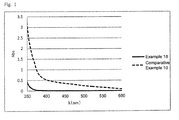
- Fig. 1 is a graph showing the absorbance of a toluene solution of aryl (meth)acrylate of Example 18 and Comparative Example 10.
- a low-tint aryl (meth)acrylate can be produced by reacting an aromatic compound containing a hydroxy group that is represented by the formula [1] with (meth)acrylic acid anhydride in the presence of a specific anti-oxidant and/or a catalyst. It was also found that an aryl (meth)acrylate composition containing a specific anti-oxidant or aryl acetate has excellent storage stability and low tint.
- acrylate and methacrylate are collectively described as (meth)acrylate.
- Acrylic acid anhydride and methacrylic acid anhydride are collectively described as (meth)acrylic acid anhydride.
- (meth)acrylic acid anhydride is also described as anhydrous (meth)acrylic acid.
- an aromatic compound containing a hydroxy group represented by the above formula [1] and (meth)acrylic acid anhydride are reacted with each other.
- ring Z represents an aromatic hydrocarbon.
- the aromatic hydrocarbon include benzene, naphthalene, azulene, anthracene, phenanthrene, pyrene, and chrysene. Among them, from the viewpoint of easy industrial availability due to low price, benzene and naphthalene are preferred as an aromatic hydrocarbon. Further, from the viewpoint of having high refractive index, low hygroscopicity, and excellent heat resistance or the like, naphthalene is preferred more as an aromatic hydrocarbon.
- Examples of the divalent linking group represented by L include a divalent linking group which may have a substituent group or a hetero bond.
- Examples of the divalent linking group include a linear, branched, or cyclic alkylene group, an alkenylene group, and an alkynylene group. Specific examples thereof include a methylene group, an ethylene group, a propylene group, a butylene group, an isopropylene group, a cyclohexylene group, and a combination thereof.
- divalent linking group which has a hetero bond examples include an ether, an ester bond, a thio ether bond, a thio ester bond, a sulfonyl bond, an amide bond, an imide bond, a sulfonamide bond, a urethane bond, a urea bond, a thiourea bond, and a divalent alkylene group having those bonds.
- the hetero bond may be present either inside or at the end of a divalent linking group. Further, only one or plural hetero bonds may be present in a divalent linking group. Further, the divalent linking group may consist of a hetero bond.
- n is an integer of 0 or 1.
- L may contain a structure in which a common divalent linking group is repeated.
- number of the repetition is preferably 2 to 20, more preferably 2 to 10, and even more preferably 2 to 5.
- substituent group R 1 examples include a linear or branched alkyl group such as a methyl group, an ethyl group, a propyl group, an isopropyl group, a butyl group, a s-butyl group, or a t-butyl group; a cycloalkyl group such as a cyclopentyl group or a cyclohexyl group; a phenyl group, an alkylphenyl group such as a 4-methylphenyl group, dimethylphenyl group, and an aryl group such as a naphthyl group; an aralkyl group such as a benzyl group or a phenethyl group; a carboxy group; an alkoxycarbonyl group such as a methoxycarbonyl group; an alkylcarbonyl group such as an acetyl group; an alkenylcarbonyl group; an arylcarbonyl group such as a
- R 1 when m is 2 or higher, R 1 may be the same or different from each other.
- the substitution position of R 1 in the ring Z is not particularly limited.
- m is an integer of 0 or higher, it may be appropriately selected depending on the ring number of the ring Z, and it is not particularly limited.
- m is preferably 0 to 4, more preferably 0 to 2, and even more preferably 0 or 1.
- Examples of the aromatic compound containing a hydroxy group represented by the above formula [1] include 2-naphthol, 1-naphthol, 2-methyl-1-naphthol, 3-fluoro-2-naphthol, 4-phenyl-1-naphthol, methyl 4-hydroxynaphthalene-1-carboxylate, 4-hydroxy-1-naphthylmethyl ketone, 4-methoxy-1-naphthol, 4-phenoxy-1-naphthol, 1-nitro-2-naphthol, 4-dimethylamino-1-naphthol, 2-naphthalene methanol, phenol, o-cresol, 2,4-dimethylphenol, 2-fluorophenol, 4-phenylphenol, 4-hydroxyphenyl methyl ketone, 4-methoxyphenol, 4-phenoxyphenol, 4-cyanophenol, 9-hydroxymethylanthracene, and 1-pyrene methanol. It may be used either singly or in combination of
- the use amount of the (meth)acrylic acid anhydride which is used in the present invention is not particularly limited. However, from the viewpoint of obtaining an aryl (meth)acrylate at good yield, the use amount of the (meth)acrylic acid anhydride is preferably 0.5 mol or more per 1 mol of the hydroxy group of an aromatic compound containing a hydroxy group. More preferably, it is 0.7 mol or more. Even more preferably, it is 0.9 mol or more.
- the use amount of the (meth)acrylic acid anhydride is preferably 2 mol or less per 1 mol of the hydroxy group of an aromatic compound containing a hydroxy group. More preferably, it is 1.8 mol or less. Even more preferably, it is 1.5 mol or less.
- a low-tint aryl (meth)acrylate can be produced by performing the reaction in the presence of hindered phenol and phosphite represented by the formula [2].
- the hindered phenol has an effect of supplementing peroxy radicals that are produced by oxidation of an aromatic compound containing a hydroxy group.
- the phosphite represented by the formula [2] has an effect of decomposing hydroperoxide that is produced by an action of hindered phenol.
- a low-tint aryl (meth)acrylate can be obtained.
- the hindered phenol has a bulky substituent group at two ortho positions of a phenolic hydroxy group in addition to a hydrogen atom and a methyl group.
- the bulky substituent group include an alkyl group other than a methyl group, an alkenyl group, an alkynyl group, an aryl group, a heterocyclic group, an alkoxy group, an aryloxy group, a substituted amino group, a thioalkyl group, and a thiophenyl group.
- hindered phenol examples include 2,6-di-tert-butylphenol, 2,6-di-tert-butyl-4-methylphenol, 2,4,6-tri-tert-butylphenol, 4,4'-methylenebis(2,6-di-t-butylphenol), 2,6-di-tert-butyl-4-(octadecaneoxycarbonylethyl)phenol, and 1,3,5-dimethyl-2,4,6-tris(3,5-tert-butyl-4-hydroxybenzyl)benzene. It may be used either singly or in combination of two or more types.
- Examples of the substituent group R 2 of phosphite represented by the above formula [2] include a linear or branched alkyl group such as a methyl group, an ethyl group, a propyl group, an isopropyl group, a butyl group, a s-butyl group, a t-butyl group, a 2-ethylhexyl group, a decyl group, a lauryl group, or an oleyl group; a cycloalkyl group such as a cyclopentyl group or a cyclohexyl group; a phenyl group, an alkylphenyl group such as a 4-methylphenyl group, and an aryl group such as a dimethylphenyl group and a naphthyl group; an aralkyl group such as a benzyl group and a phenethyl group; a carboxy group; an alkoxycarbonyl
- R 2 may be the same or different from each other. Further, R 2 may have a substituent group or a hetero bond.
- the hetero bond include an ether bond, an ester bond, a phosphate ester bond, a phosphite ester bond, a phosphonate ester bond, a thio ether bond, a thio ester bond, a sulfonyl bond, an amide bond, an imide bone, a sulfonamide bond, a urethane bond, a urea bond, and a thiourea bond.
- the hetero bond may be present either inside or at the end of the substituent group R 2 .
- Examples of the phosphite represented by the above formula [2] include triethyl phosphite, tridecyl phosphite, trioleyl phosphite, triphenyl phosphite, tricresyl phosphite, tris(2,4-di-tert-butylphenyl)phosphite, diphenyl monodecyl phosphite, tetraphenyl dipropylene glycol diphosphite, bis(decyl)pentaerythritol diphosphite, distearyl pentaerythritol diphosphite, and bis(2,6-di-tert-butyl-4-methylphenyl)pentaerythritol diphosphite. It may be used either singly or in combination of two or more types.
- the use amount of the hindered phenol is preferably 0.005 part by mass or more per 100 parts by mass of the aromatic compound containing a hydroxy group from the viewpoint of exhibiting a sufficient effect. It is more preferably 0.01 part by mass or more. Further, from the viewpoint of not having any influence on the physical properties of a polymer, the use amount of the hindered phenol is preferably 0.5 part by mass or less per 100 parts by mass of the aromatic compound containing a hydroxy group. More preferably, it is 0.3 part by mass or less.
- the use amount of the phosphite that is represented by the above formula [2] is preferably 0.005 part by mass or more per 100 parts by mass of the aromatic compound containing a hydroxy group from the viewpoint of exhibiting a sufficient effect. It is more preferably 0.01 part by mass or more. Further, from the viewpoint of not having any influence on the physical properties of a polymer, the use amount of the phosphite that is represented by the above formula [2] is preferably 0.5 part by mass or less per 100 parts by mass of the aromatic compound containing a hydroxy group. More preferably, it is 0.3 part by mass or less.
- the mass ratio between the hindered phenol and the phosphite represented by the formula [2] is, from the viewpoint of obtaining a high effect of suppressing coloration, preferably 10 : 90 to 90 : 10 in terms of hindered phenol: phosphite represented by the formula [2]. It is more preferably 25 : 75 to 75 : 25, and even more preferably 40 : 60 to 60 : 40.
- a low-tint aryl (meth)acrylate can be produced as an esterification is performed in the presence of a catalyst and the ratio (%) of gas chromatography (GC) area value of the aromatic compound containing a hydroxy group to that of the aryl (meth)acrylate (aromatic compound containing a hydroxy group/ aryl (meth)acrylate x 100) is adjusted to 13% or less after the reaction for 1 hour for suppressing oxidation of the aromatic compound containing a hydroxy group.
- a catalyst allowing the aforementioned ratio of 13 % or less for the reaction.
- the ratio is more preferably 10% or less. Even more preferably, it is 8% or less.
- reaction start time the time point at which the internal temperature of a reaction vessel reaches the predetermined reaction temperature is employed as start time.
- Examples of the catalyst capable of satisfying the above ratio range include a metal compound, an acid catalyst, a base catalyst, and a heterogeneous catalyst.
- the metal compound include metal oxide, metal hydroxide, metal chloride, metal inorganic acid salt such as metal carbonate salt, metal sulfate salt, metal nitrate salt, metal phosphate salt, or metal borate salt, metal organic acid salt such as metal carboxylate salt or metal sulfonic acid salt, metal acetylaceontate, and metal complex salt such as a metal cyclopentadienyl complex.
- Examples of the acid catalyst include inorganic acid such as sulfuric acid, nitric acid, phosphoric acid, boric acid, hydrochloric acid, and heteropoly acid; and organic acid such as methane sulfonic acid, p-toluenesulfonic acid, or camphor sulfonic acid.
- Examples of the base catalyst include an organic amine such as pyridine, 4-(dimethylamino)pyridine, or triethylamine.
- Examples of the heterogeneous catalyst include an ion exchange resin such as basic ion exchange resin or an acidic ion exchange resin and a catalyst having an active component supported on a carrier such as silica, alumina, or titania.
- the catalyst may be used either singly or in combination of two or more types. From the viewpoint of easily satisfying the aforementioned ratio range and having high operability, at least one of metal oxide and carbonate salt is preferred as a catalyst. Among them, from the viewpoint of easy obtainability, metal oxide or carbonate salt containing an alkali metal or an alkali earth metal is preferred as a catalyst.
- the meal oxide containing an alkali metal or an alkali earth metal include lithium oxide, sodium oxide, potassium oxide, magnesium oxide, calcium oxide, and barium oxide.
- the carbonate salt containing an alkali metal or an alkali earth metal include lithium carbonate, sodium carbonate, potassium carbonate, magnesium carbonate, calcium carbonate, and barium carbonate.
- magnesium oxide is preferred as a catalyst.
- the metal oxide When metal oxide is used as a catalyst and the reaction temperature is 80°C, the metal oxide is preferably allowed to be present at 0.006 equivalent or more relative to the aromatic compound containing a hydroxy group so that the aforementioned ratio is 13% or less. More preferably, it is allowed to be present at 0.0065 equivalent or more. Meanwhile, from the viewpoint suppressing a side reaction or a load during a treatment step after the reaction, metal oxide is allowed to be present at 1 equivalent or less relative to the aromatic compound containing a hydroxy group. More preferably, it is allowed to be present at 0.5 equivalent or less.
- the hindered phenol allowed to be present in the system also functions as a polymerization inhibitor.
- a polymerization inhibitor other than the hindered phenol may be additionally present.
- the polymerization inhibitor include, although not particularly limited, hydroquinone monomethyl ether, hydroquinone, 4-hydroxy-2,2,6,6-tetramethylpiperidine-N-oxyl, phenothiazine, and copper salt. It may be used either singly or in combination of two or more types.
- the use amount of the polymerization inhibitor is preferably 0.005 part by mass or more per 100 parts by mass of the aromatic compound containing a hydroxy group.
- the use amount of the polymerization inhibitor is preferably 0.5 part by mass or less per 100 parts by mass of the aromatic compound containing a hydroxy group. More preferably, it is 0.3 part by mass or less.
- the reaction temperature for the esterification is preferably 25°C or higher from the viewpoint of shortening the reaction time. More preferably, it is 40°C or higher. Even more preferably, it is 60°C or higher. Particularly preferably, it is 70°C or higher. Further, from the viewpoint of suppressing a side reaction like a polymerization reaction, the reaction temperature is preferably 150°C or lower. More preferably, it is 110°C or lower. Even more preferably, it is 100°C or lower. Particularly preferably, it is 90°C or lower.
- the reaction pressure at the time of performing the esterification is not particularly limited. It can be performed under any pressure including reduced pressure, normal pressure, and increased pressure.
- the reaction time for the esterification can be suitably selected depending on reaction conditions or the like. It may be 0.5 to 20 hours, for example.
- reaction solvent for a case in which the solubility of the aromatic compound containing a hydroxy group is low in the (meth)acrylic acid anhydride or (meth)acrylic acid that is produced over time, the viscosity of the reaction system is high, or it is desired to prevent the polymerization reaction, a reaction solvent can be suitably used.
- a reaction solvent a solvent not containing active hydrogen can be used.
- solvent examples include an aromatic solvent such as toluene or xylene; a hydrocarbon solvent such as hexane, heptane, octane, or cyclohexane; a polar solvent such as dimethyl formamide, dimethyl sulfoxide or acetonitrile, an ether solvent such as diethyl ether, diisopropyl ether, t-butyl methyl ether, tetrahydrofuran, or dioxane; and a halogen solvent such as chloroform or dichloromethane.
- aromatic solvent such as toluene or xylene
- hydrocarbon solvent such as hexane, heptane, octane, or cyclohexane
- a polar solvent such as dimethyl formamide, dimethyl sulfoxide or acetonitrile
- an ether solvent such as diethyl ether, diisopropyl ether, t-
- the reaction is preferably performed in an air atmosphere.
- metal oxide is used as a catalyst, a low-tint aryl (meth)acrylate can be sufficiently obtained even when the reaction is performed in an air atmosphere.
- washing like alkali washing and a purification method such as distillation, crystallization, or precipitation can be suitably combined in consideration of the physical properties of a product, type and amount of the raw materials and catalyst, presence or absence of a solvent, or the like.
- the aryl (meth)acrylate composition according to the present invention contains hindered phenol and the phosphite represented by the formula [2], each at 0.0002 parts by mass or more and 10 parts by mass or less relative to 100 parts by mass of aryl (meth)acrylate represented by the formula [3]. It is preferable that the aryl (meth)acrylate composition contain hindered phenol and the phosphite represented by the formula [2], each at 0.0005 parts by mass or more and 5 parts by mass or less. More preferably, it contains each at 0.001 part by mass or more and 2 parts by mass or less. Even more preferably, it contains each at 0.005 part by mass or more and 0.5 part by mass or less.
- the aryl (meth)acrylate composition contains hindered phenol and the phosphite represented by the formula [2], each at 0.0002 parts by mass or more, coloration does not increase during storage, and thus good storage stability is obtained. Further, as the aryl (meth)acrylate composition contains hindered phenol and the phosphite represented by the formula [2], each at 10 parts by mass or less, an influence on physical properties of a polymer can be suppressed.
- the composition can be produced by controlling the amount of the hindered phenol and the phosphite represented by the formula [2] in the production method for an aryl (meth)acrylate.
- the composition may be produced by adding the hindered phenol and the phosphite represented by the formula [2] in an amount within the aforementioned range relative to the aryl (meth)acrylate represented by the formula [3]. Further, the composition may also contain other components including a solvent and a monomer like methyl methacrylate (MMA). However, the amount of the aryl (meth)acrylate represented by the formula [3] contained in the composition is preferably 5% by mass or more. It is more preferably 10% by mass or more. It is even more preferably 15% by mass or more.
- the aryl (meth)acrylate composition according to the present invention contains aryl acetate represented by the formula [4] and (meth)acrylate ester represented by the formula [3] and the ratio (%) of gas chromatography (GC) area value of the aryl acetate to that of the aryl (meth)acrylate (aryl acetate/ aryl (meth)acrylate x 100) is 0.01 to 10%.
- the ratio is more preferably 0.05 to 8%. Even more preferably, it is 0.1 to 5%.
- the ratio is 0.01% or higher, the composition can have low tint. Further, as the ratio is 10% or less, an influence on physical properties of a polymer can be suppressed.
- the composition can be produced by adding aryl acetate represented by the formula [4] in an amount within the aforementioned range to (meth)acrylate represented by the formula [3]. Further, the composition can be also produced by performing the aforementioned production method for an aryl (meth)acrylate in the presence of an acetic acid component like acetic anhydride.
- the aryl (meth)acrylate composition according to the present invention contains aryl (meth)acrylate represented by the formula [3], and the toluene solution of the composition has absorbance of 0.4 or less at wavelength of 417 nm.
- the absorbance is preferably 0.3 or less. More preferably, it is 0.2 or less. Even more preferably, it is 0.1 or less. Particularly preferably, it is 0.08 or less. Meanwhile, the lower absorbance is preferred more and it can be 0.
- the composition can be preferably produced by the aforementioned production method for aryl (meth)acrylate.
- the absorbance indicates a value which is obtained by dissolving 1.00 g of the aryl (meth)acrylate composition in toluene to give 10 mL solution and absorbance at wavelength of 417 nm is determined by using a quartz cell (1 cm width and height) and a UV visible spectrophotometer (trade name: UV-1700, manufactured by Shimadzu Corporation).
- the aryl (meth)acrylate according to the present invention contains (meth)acrylate represented by the formula [3] and it has total chlorine content of 13000 ppm or less.
- the total chlorine content is preferably 10000 ppm or less. It is more preferably 7000 ppm or less. Meanwhile, the less total chlorine content is preferred more and it can be 0 ppm.
- the chlorine content contained in the polymer is reduced so that release of a chlorine component by a combustion treatment or the like is suppressed. As a result, a load on environment can be reduced.
- the composition can be preferably produced by the aforementioned production method for an aryl (meth)acrylate.
- the total chlorine content is a value that is measured as follows; a distillation eluent is combusted by heating it to 100 to 900°C using a sample combustion device QF-02 (trade name, manufactured by Mitsubishi Chemical Corporation), and after allowing the gas to get absorbed in an absorbing pipe, analysis is performed by IC (ion chromatography).
- the aryl (meth)acrylate composition according to the present invention can be used for various uses in many fields including plastics, a paint, adhesives, a treatment agent for paper processing, an oil agent for fibers, additives for a lubricant, a construction sealant, and an ink.
- plastics plastics
- adhesives adhesives
- a treatment agent for paper processing an oil agent for fibers
- additives for a lubricant a construction sealant
- an ink an ink.
- it can be preferably used for optical use or use for electronic materials requiring colorless transparency or less load on environment.
- hindered phenol and the phosphite represented by the formula [2] are contained each at 0.0002 parts by mass or more and 10 parts by mass or less relative to 100 parts by mass of aryl (meth)acrylate represented by the formula [3]. It is more preferable that hindered phenol and the phosphite represented by the formula [2] be contained each at 0.0005 parts by mass or more and 5 parts by mass or less. It is more preferable that hindered phenol and the phosphite represented by the formula [2] be contained each at 0.001 part by mass or more and 2 parts by mass or less.
- the aryl (meth)acrylate may also contain other components including a solvent and a monomer like methyl methacrylate (MMA).
- the content of the aryl (meth)acrylate represented by the formula [3] is preferably 5% by mass or more. It is more preferably 10% by mass or more. It is even more preferably 15% by mass or more.
- the container for storage can be any form including a glass container, a resin container, a metallic storage tank, a drum can, and a lorry.
- Adjustment of the amount of hindered phenol and phosphite for satisfying the aforementioned mass ratio can be performed by adding a deficit amount, or by controlling reaction conditions or the like to have desired composition during the preparation of the aryl (meth)acrylate represented by the formula [3].
- the temperature for storage can be suitably determined depending on a solidification point.
- the temperature for storage is preferably -40°C or higher. It is more preferably -20°C or higher. It is even more preferably -10°C or higher. It is particularly preferably 0°C or higher.
- the temperature for storage is preferably 120°C or lower. It is more preferably 110°C or lower. It is even more preferably 100°C or lower.
- GC-2014 (trade name) manufactured by Shimadzu Corporation with conditions as follows; column: DB-1 (trade name, 30 m x 0.53 mm x 5 ⁇ m) manufactured by Agilent Technologies, Inc., temperature of vaporization chamber: 250°C, temperature of detection part: 270°C, temperature program: 50°C (maintained for 5 minutes) ⁇ increasing the temperature 10°C/min ⁇ 250°C (maintained for 10 minutes), detector: FID, linear speed: 40 cm/s, split ratio: 30, and injection amount: 1 ⁇ L.
- reaction solution was measured by using a UV visible spectrophotometer UV-1700 (trade name) manufactured by Shimadzu Corporation.
- the obtained reaction solution was filtered and the entire reaction solution after the filtration was dissolved in toluene to have 50 mL solution. Then, absorbance was measured by using a quartz cell (1 cm width and height) and a UV visible spectrophotometer. As the absorption spectrum having the maximum value at 540 nm was obtained when high coloration is observed with a naked eye, the comparison was made with the absorbance at 540 nm. The results are shown in Table 1.
- Example 1 A1 1000 ppm - - B1 1000 ppm 0.015
- Example 2 A1 1000 ppm - - B2 1000 ppm 0.035
- Example 3 A1 1000 ppm - - B3 1000 ppm 0.029
- Example 4 A1 1000 ppm - - B4 1000 ppm 0.030
- Example 5 A2 1000 ppm - - B1 1000 ppm 0.025
- Example 6 A1 500 ppm - - B1 500 ppm 0.029 Comparative Example 1 - - -
- the obtained reaction solution was filtered and the entire reaction solution after the filtration was dissolved in toluene to have 50 mL solution. Then, absorbance was measured by using a quartz cell (1 cm width and height) and a UV visible spectrophotometer. Comparison was made with the absorbance at 417 nm and 540 nm. The results are shown in Table 2.
- Example 7 The experiments were performed in the same manner as Example 7 except that the type and amount of the catalyst used in Example 7 were modified to the type and amount of the catalyst shown in Table 2. The results are shown in Table 2.
- Examples 7 to 9 have low absorbance both at 417 nm and 540 nm.
- the absorbance at 540 nm was higher in Examples 10 to 13 compared to Examples 7 to 9.
- the absorbance at 417 nm was lower.
- Comparative Example 5 has high absorbance both at 417 nm and 540 nm.
- Comparative Examples 6 and 7 have low absorbance at 540 nm, the absorbance at 417 nm was very high, and as a result, the purification load became very high.
- the obtained reaction solution was filtered and the entire reaction solution after the filtration was dissolved in toluene to have 50 mL solution. Then, absorbance was measured by using a quartz cell (1 cm width and height) and a UV visible spectrophotometer. As the absorption spectrum having the maximum value at 540 nm was obtained when high coloration is observed with a naked eye, the comparison was made with the absorbance at 540 nm. The results are shown in Table 3.
- 2-naphthyl methacrylate a compound of the formula [3] in which ring Z is naphthalene, n is 0, m is 0, and R 3 is a methyl group
- 2-naphthyl methacrylate a compound of the formula [3] in which ring Z is naphthalene, n is 0, m is 0, and R 3 is a methyl group
- 2,6-di-tert-butyl-4-methylphenol 0.0024 parts by mass relative to 100 parts by mass of 2-naphthyl methacrylate
- triphenyl phosphite a compound of the formula [2] in which R 2 is a phenyl group
- Example 15 The experiments were performed in the same manner as Example 15 except that the type and amount of the anti-oxidant (2,6-di-tert-butyl-4-methylphenol and triphenyl phosphite in Example 15) were modified to the type and amount shown in Table 4. The results are shown in Table 4.
- 2-naphthyl methacrylate obtained from Example 14 2-naphthyl acetate is contained at GC area value ratio of 1.2% (2-naphthyl acetate/2-naphthyl methacrylate x 100).
- Example 19 Obtained from Example 14 17 Comparative Example 11 Manufactured by Aldrich Company 14000
- the present invention relates to a low-tint aryl (meth)acrylate, a production method for the same, and a low-tint aryl (meth)acrylate composition, and an aryl (meth)acrylate with high quality can be produced.
Landscapes
- Chemical & Material Sciences (AREA)
- Organic Chemistry (AREA)
- Organic Low-Molecular-Weight Compounds And Preparation Thereof (AREA)
- Low-Molecular Organic Synthesis Reactions Using Catalysts (AREA)
- Engineering & Computer Science (AREA)
- Materials Engineering (AREA)
- Chemical Kinetics & Catalysis (AREA)
Abstract
Description
- The present invention relates to a production method for a low-tint aryl (meth)acrylate.
- Using the high refractive index, low hygroscopicity, heat resistance, or the like of aryl group, aryl (meth)acrylate is generally useful for an application in various fields including plastics, a paint, adhesives, a treatment agent for paper processing, an oil agent for fibers, additives for a lubricant, a construction sealant, an ink, and the like. As a method for obtaining an aryl (meth)acrylate at high yield, a method of reacting (meth)acrylic acid anhydride with an aromatic compound containing a hydroxy group is known (
Patent Documents 1 and 2). -
- Patent Document 1:
JP 2010-126502 A - Patent Document 2:
JP 5-140035 A - However, for producing an aryl (meth)acrylate, there is a problem that coloration remains even in a product since the coloration by a reaction solution is high. According to the methods described in
Patent Documents - An object of the present invention is to provide a low-tint aryl (meth)acrylate.
- The present invention relates to the following (1) to (15).
- (1) A production method for an aryl (meth)acrylate represented by the following formula [3]
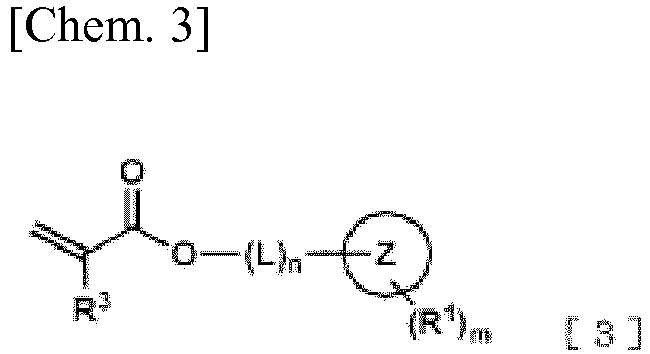
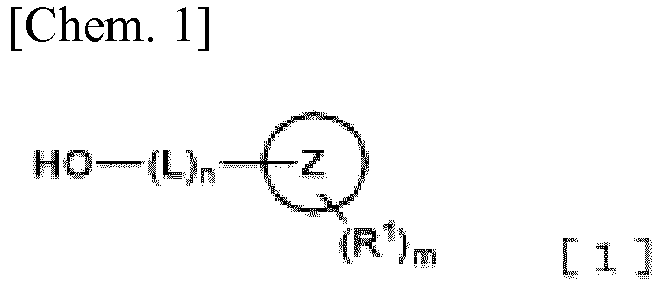

- (2) The method described in (1), in which the reaction is performed in the presence of a catalyst and the ratio (%) of gas chromatography (GC) area value of the aromatic compound containing a hydroxy group to that of the aryl (meth)acrylate (aromatic compound containing a hydroxy group/ aryl (meth)acrylate x 100) is 13% or less after the reaction for 1 hour.
- (3) The method described in (2), in which the catalyst is at least one of metal oxide and carbonate salt.
- (4) The method described in (2), in which the catalyst is metal oxide, the reaction temperature is 80°C, and the metal oxide is allowed to be present at 0.006 equivalent or more relative to the aromatic compound containing a hydroxy group such that the ratio (%) of gas chromatography (GC) area value of the aromatic compound containing a hydroxy group to that of the aryl (meth)acrylate (aromatic compound containing a hydroxy group/-aryl (meth)acrylate x 100) is 13% or less after the reaction for 1 hour.
- (5) A production method for an aryl (meth)acrylate represented by the following formula [3]

by reacting an aromatic compound containing a hydroxy group represented by the following formula [1] with (meth)acrylic acid anhydride in the presence of a catalyst,
in which the ratio (%) of gas chromatography (GC) area value of the aromatic compound containing a hydroxy group to that of the aryl (meth)acrylate (aromatic compound containing a hydroxy group/ aryl (meth)acrylate x 100) is 13% or less after the reaction for 1 hour. - (6) The method described in (5), in which the catalyst is at least one of metal oxide and carbonate salt.
- (7) The method described in (5), in which the catalyst is metal oxide, the reaction temperature is 80°C, and the metal oxide is allowed to be present at 0.006 equivalent or more relative to the aromatic compound containing a hydroxy group such that the ratio (%) of gas chromatography (GC) area value of the aromatic compound containing a hydroxy group to that of the aryl (meth)acrylate (aromatic compound containing a hydroxy group/-aryl (meth)acrylate x 100) is 13% or less after the reaction for 1 hour.
- (8) An aryl (meth)acrylate composition containing hindered phenol and phosphite represented by the following formula [2]


- (9) An aryl (meth)acrylate composition containing aryl acetate represented by the following formula [4],


in which the ratio (%) of gas chromatography (GC) area value of the aryl acetate to that of the aryl (meth)acrylate (aryl acetate/ aryl (meth)acrylate x 100) is 0.01 to 10%. - (10) A method for preserving aryl (meth)acrylate by containing, relative to 100 parts by mass of aryl (meth)acrylate represented by the following formula [3],
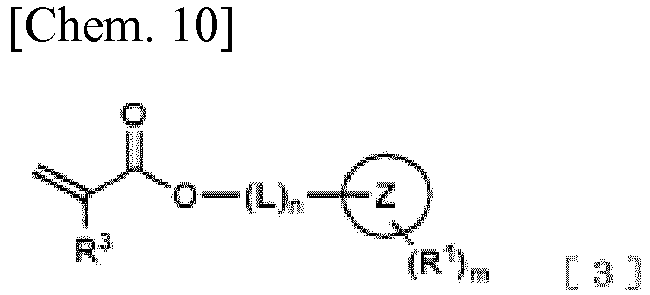
hindered phenol and phosphite represented by the following formula [2]
[Chem. 11] P-(OR2)3 [2]
(in the formula, R2 represents a linear or branched alkyl group, a cycloalkyl group, an aryl group, an aralkyl group, a carboxyl group, an alkoxycarbonyl group, an alkylcarbonyl group, an alkenylcarbonyl group, an arylcarbonyl group, or a halogenated alkyl group, which may have a substituent group or a hetero bond. R2 may be the same or different from each other),
each at 0.0002 parts by mass or more and 10 parts by mass or less. - (11) An aryl (meth)acrylate composition containing an aryl (meth)acrylate represented by the following formula [3], in which a toluene solution of the composition has absorbance of 0.4 or less at a wavelength of 417 nm

- (12) The aryl (meth)acrylate composition described in (11), further containing an aryl acetate represented by the following formula [4],
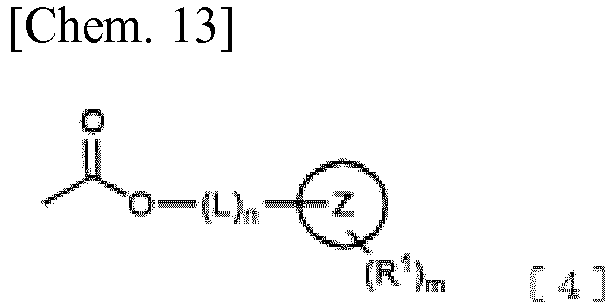
- (13) The aryl (meth)acrylate composition described in (12), which further contains hindered phenol and phosphite represented by the following formula [2]
[Chem. 14] P-(OR2)3 [2]
(in the formula, R2 represents a linear or branched alkyl group, a cycloalkyl group, an aryl group, an aralkyl group, a carboxyl group, an alkoxycarbonyl group, an alkylcarbonyl group, an alkenylcarbonyl group, an arylcarbonyl group, or a halogenated alkyl group, which may have a substituent group or a hetero bond. R2 may be the same or different from each other),
each at 0.0002 parts by mass or more and 10 parts by mass or less relative to 100 parts by mass of aryl (meth)acrylate, - (14) An aryl (meth)acrylate composition containing an aryl (meth)acrylate represented by the following formula [3] and having the total chlorine content of 13000 ppm or less

- (15) The aryl (meth)acrylate composition described in (14), further containing an aryl acetate represented by the following formula [4],

- A low-tint aryl (meth)acrylate can be provided by the present invention.
-
Fig. 1 is a graph showing the absorbance of a toluene solution of aryl (meth)acrylate of Example 18 and Comparative Example 10. - As a result of intensive studies, the inventors of the present invention found that a low-tint aryl (meth)acrylate can be produced by reacting an aromatic compound containing a hydroxy group that is represented by the formula [1] with (meth)acrylic acid anhydride in the presence of a specific anti-oxidant and/or a catalyst. It was also found that an aryl (meth)acrylate composition containing a specific anti-oxidant or aryl acetate has excellent storage stability and low tint.
- In the present specification, acrylate and methacrylate are collectively described as (meth)acrylate. Acrylic acid anhydride and methacrylic acid anhydride are collectively described as (meth)acrylic acid anhydride. Further, (meth)acrylic acid anhydride is also described as anhydrous (meth)acrylic acid.
- According to the production method for an aryl (meth)acrylate of the present invention, an aromatic compound containing a hydroxy group represented by the above formula [1] and (meth)acrylic acid anhydride are reacted with each other.
- The aromatic compound containing a hydroxy group which is used in the present invention is represented by the above formula [1]. As described herein, ring Z represents an aromatic hydrocarbon. Examples of the aromatic hydrocarbon include benzene, naphthalene, azulene, anthracene, phenanthrene, pyrene, and chrysene. Among them, from the viewpoint of easy industrial availability due to low price, benzene and naphthalene are preferred as an aromatic hydrocarbon. Further, from the viewpoint of having high refractive index, low hygroscopicity, and excellent heat resistance or the like, naphthalene is preferred more as an aromatic hydrocarbon.
- Examples of the divalent linking group represented by L include a divalent linking group which may have a substituent group or a hetero bond. Examples of the divalent linking group include a linear, branched, or cyclic alkylene group, an alkenylene group, and an alkynylene group. Specific examples thereof include a methylene group, an ethylene group, a propylene group, a butylene group, an isopropylene group, a cyclohexylene group, and a combination thereof.
- Examples of the divalent linking group which has a hetero bond include an ether, an ester bond, a thio ether bond, a thio ester bond, a sulfonyl bond, an amide bond, an imide bond, a sulfonamide bond, a urethane bond, a urea bond, a thiourea bond, and a divalent alkylene group having those bonds. Meanwhile, the hetero bond may be present either inside or at the end of a divalent linking group. Further, only one or plural hetero bonds may be present in a divalent linking group. Further, the divalent linking group may consist of a hetero bond. n is an integer of 0 or 1. Meanwhile, L may contain a structure in which a common divalent linking group is repeated. In such case, from the viewpoint of maintaining properties of an aryl (meth)acrylate like high refractive index, low hygroscopicity, and heat resistance, number of the repetition is preferably 2 to 20, more preferably 2 to 10, and even more preferably 2 to 5.
- Examples of the substituent group R1 include a linear or branched alkyl group such as a methyl group, an ethyl group, a propyl group, an isopropyl group, a butyl group, a s-butyl group, or a t-butyl group; a cycloalkyl group such as a cyclopentyl group or a cyclohexyl group; a phenyl group, an alkylphenyl group such as a 4-methylphenyl group, dimethylphenyl group, and an aryl group such as a naphthyl group; an aralkyl group such as a benzyl group or a phenethyl group; a carboxy group; an alkoxycarbonyl group such as a methoxycarbonyl group; an alkylcarbonyl group such as an acetyl group; an alkenylcarbonyl group; an arylcarbonyl group such as a phenylcarbonyl group; a halogenated alkyl group such as a trifluoromethyl group; an alkoxy group such as a methoxy group, an ethoxy group, a propoxy group, a n-butoxy group, an isobutoxy group, or a t-butoxy group; an aryloxy group such as a phenyloxy group or a 2-methylphenyloxy group; a trialkylsilyl group such as a trimethylsilyl group; a cyano group; a nitro group; a dialkylamino group such as a diethylamino group; a sulfonic acid group; and a halogen atom such as a fluorine atom, a chlorine atom, or a bromine atom. In the formula [1], when m is 2 or higher, R1 may be the same or different from each other. The substitution position of R1 in the ring Z is not particularly limited. When m is an integer of 0 or higher, it may be appropriately selected depending on the ring number of the ring Z, and it is not particularly limited. For example, when the ring Z is a naphthalene ring, from the viewpoint of easy obtainability of a raw material, m is preferably 0 to 4, more preferably 0 to 2, and even more preferably 0 or 1.
- Examples of the aromatic compound containing a hydroxy group represented by the above formula [1] include 2-naphthol, 1-naphthol, 2-methyl-1-naphthol, 3-fluoro-2-naphthol, 4-phenyl-1-naphthol, methyl 4-hydroxynaphthalene-1-carboxylate, 4-hydroxy-1-naphthylmethyl ketone, 4-methoxy-1-naphthol, 4-phenoxy-1-naphthol, 1-nitro-2-naphthol, 4-dimethylamino-1-naphthol, 2-naphthalene methanol, phenol, o-cresol, 2,4-dimethylphenol, 2-fluorophenol, 4-phenylphenol, 4-hydroxyphenyl methyl ketone, 4-methoxyphenol, 4-phenoxyphenol, 4-cyanophenol, 9-hydroxymethylanthracene, and 1-pyrene methanol. It may be used either singly or in combination of two or more types.
- As for the (meth)acrylic acid anhydride, a commercially available product or a separately synthesized product can be used. The use amount of the (meth)acrylic acid anhydride which is used in the present invention is not particularly limited. However, from the viewpoint of obtaining an aryl (meth)acrylate at good yield, the use amount of the (meth)acrylic acid anhydride is preferably 0.5 mol or more per 1 mol of the hydroxy group of an aromatic compound containing a hydroxy group. More preferably, it is 0.7 mol or more. Even more preferably, it is 0.9 mol or more. Further, from the viewpoint of preventing polymerization originating from (meth)acrylic acid anhydride, the use amount of the (meth)acrylic acid anhydride is preferably 2 mol or less per 1 mol of the hydroxy group of an aromatic compound containing a hydroxy group. More preferably, it is 1.8 mol or less. Even more preferably, it is 1.5 mol or less.
- According to the present invention, a low-tint aryl (meth)acrylate can be produced by performing the reaction in the presence of hindered phenol and phosphite represented by the formula [2]. The hindered phenol has an effect of supplementing peroxy radicals that are produced by oxidation of an aromatic compound containing a hydroxy group. Further, the phosphite represented by the formula [2] has an effect of decomposing hydroperoxide that is produced by an action of hindered phenol. In particular, since an effect of suppressing generation of a quinone structure substance, which is a tint-causing substance, is obtained by using them in combination in the present invention, a low-tint aryl (meth)acrylate can be obtained.
- As described herein, the hindered phenol has a bulky substituent group at two ortho positions of a phenolic hydroxy group in addition to a hydrogen atom and a methyl group. Example of the bulky substituent group include an alkyl group other than a methyl group, an alkenyl group, an alkynyl group, an aryl group, a heterocyclic group, an alkoxy group, an aryloxy group, a substituted amino group, a thioalkyl group, and a thiophenyl group. Examples of the hindered phenol include 2,6-di-tert-butylphenol, 2,6-di-tert-butyl-4-methylphenol, 2,4,6-tri-tert-butylphenol, 4,4'-methylenebis(2,6-di-t-butylphenol), 2,6-di-tert-butyl-4-(octadecaneoxycarbonylethyl)phenol, and 1,3,5-dimethyl-2,4,6-tris(3,5-tert-butyl-4-hydroxybenzyl)benzene. It may be used either singly or in combination of two or more types.
- Examples of the substituent group R2 of phosphite represented by the above formula [2] include a linear or branched alkyl group such as a methyl group, an ethyl group, a propyl group, an isopropyl group, a butyl group, a s-butyl group, a t-butyl group, a 2-ethylhexyl group, a decyl group, a lauryl group, or an oleyl group; a cycloalkyl group such as a cyclopentyl group or a cyclohexyl group; a phenyl group, an alkylphenyl group such as a 4-methylphenyl group, and an aryl group such as a dimethylphenyl group and a naphthyl group; an aralkyl group such as a benzyl group and a phenethyl group; a carboxy group; an alkoxycarbonyl group such as a methoxycarbonyl group; an alkylcarbonyl group such as an acetyl group; an alkenylcarbonyl group; an arylcarbonyl group such as a phenylcarbonyl group; and a halogenated alkyl group such as a trifluoromethyl group. R2 may be the same or different from each other. Further, R2 may have a substituent group or a hetero bond. Examples of the hetero bond include an ether bond, an ester bond, a phosphate ester bond, a phosphite ester bond, a phosphonate ester bond, a thio ether bond, a thio ester bond, a sulfonyl bond, an amide bond, an imide bone, a sulfonamide bond, a urethane bond, a urea bond, and a thiourea bond. Meanwhile, the hetero bond may be present either inside or at the end of the substituent group R2. Further, only one or plural hetero bonds may be present in the substituent group R2. Further, diphosphite in which two phosphites that are represented by the formula [2] are bonded to each other via R2 is also included in the phosphite that is represented by the formula [2] of the present invention. Examples of the phosphite represented by the above formula [2] include triethyl phosphite, tridecyl phosphite, trioleyl phosphite, triphenyl phosphite, tricresyl phosphite, tris(2,4-di-tert-butylphenyl)phosphite, diphenyl monodecyl phosphite, tetraphenyl dipropylene glycol diphosphite, bis(decyl)pentaerythritol diphosphite, distearyl pentaerythritol diphosphite, and bis(2,6-di-tert-butyl-4-methylphenyl)pentaerythritol diphosphite. It may be used either singly or in combination of two or more types.
- In the present invention, the use amount of the hindered phenol is preferably 0.005 part by mass or more per 100 parts by mass of the aromatic compound containing a hydroxy group from the viewpoint of exhibiting a sufficient effect. It is more preferably 0.01 part by mass or more. Further, from the viewpoint of not having any influence on the physical properties of a polymer, the use amount of the hindered phenol is preferably 0.5 part by mass or less per 100 parts by mass of the aromatic compound containing a hydroxy group. More preferably, it is 0.3 part by mass or less.
- The use amount of the phosphite that is represented by the above formula [2] is preferably 0.005 part by mass or more per 100 parts by mass of the aromatic compound containing a hydroxy group from the viewpoint of exhibiting a sufficient effect. It is more preferably 0.01 part by mass or more. Further, from the viewpoint of not having any influence on the physical properties of a polymer, the use amount of the phosphite that is represented by the above formula [2] is preferably 0.5 part by mass or less per 100 parts by mass of the aromatic compound containing a hydroxy group. More preferably, it is 0.3 part by mass or less.
- The mass ratio between the hindered phenol and the phosphite represented by the formula [2] is, from the viewpoint of obtaining a high effect of suppressing coloration, preferably 10 : 90 to 90 : 10 in terms of hindered phenol: phosphite represented by the formula [2]. It is more preferably 25 : 75 to 75 : 25, and even more preferably 40 : 60 to 60 : 40.
- According to the present invention, a low-tint aryl (meth)acrylate can be produced as an esterification is performed in the presence of a catalyst and the ratio (%) of gas chromatography (GC) area value of the aromatic compound containing a hydroxy group to that of the aryl (meth)acrylate (aromatic compound containing a hydroxy group/ aryl (meth)acrylate x 100) is adjusted to 13% or less after the reaction for 1 hour for suppressing oxidation of the aromatic compound containing a hydroxy group. Thus, it is preferable to use a catalyst allowing the aforementioned ratio of 13 % or less for the reaction. The ratio is more preferably 10% or less. Even more preferably, it is 8% or less. Particularly preferably, it is 5% or less. Meanwhile, the lower ratio is preferred more, and it can be 0%. Further, with regard to the reaction start time, the time point at which the internal temperature of a reaction vessel reaches the predetermined reaction temperature is employed as start time.
- Examples of the catalyst capable of satisfying the above ratio range include a metal compound, an acid catalyst, a base catalyst, and a heterogeneous catalyst. Examples of the metal compound include metal oxide, metal hydroxide, metal chloride, metal inorganic acid salt such as metal carbonate salt, metal sulfate salt, metal nitrate salt, metal phosphate salt, or metal borate salt, metal organic acid salt such as metal carboxylate salt or metal sulfonic acid salt, metal acetylaceontate, and metal complex salt such as a metal cyclopentadienyl complex. Examples of the acid catalyst include inorganic acid such as sulfuric acid, nitric acid, phosphoric acid, boric acid, hydrochloric acid, and heteropoly acid; and organic acid such as methane sulfonic acid, p-toluenesulfonic acid, or camphor sulfonic acid. Examples of the base catalyst include an organic amine such as pyridine, 4-(dimethylamino)pyridine, or triethylamine. Examples of the heterogeneous catalyst include an ion exchange resin such as basic ion exchange resin or an acidic ion exchange resin and a catalyst having an active component supported on a carrier such as silica, alumina, or titania. The catalyst may be used either singly or in combination of two or more types. From the viewpoint of easily satisfying the aforementioned ratio range and having high operability, at least one of metal oxide and carbonate salt is preferred as a catalyst. Among them, from the viewpoint of easy obtainability, metal oxide or carbonate salt containing an alkali metal or an alkali earth metal is preferred as a catalyst. Examples of the meal oxide containing an alkali metal or an alkali earth metal include lithium oxide, sodium oxide, potassium oxide, magnesium oxide, calcium oxide, and barium oxide. Examples of the carbonate salt containing an alkali metal or an alkali earth metal include lithium carbonate, sodium carbonate, potassium carbonate, magnesium carbonate, calcium carbonate, and barium carbonate. Further, from the viewpoint of producing a low-tint aryl (meth)acrylate in a smaller amount and suppressing cost increase, load increase during a treatment step after the reaction, progress of a side reaction, or the like, magnesium oxide is preferred as a catalyst.
- When metal oxide is used as a catalyst and the reaction temperature is 80°C, the metal oxide is preferably allowed to be present at 0.006 equivalent or more relative to the aromatic compound containing a hydroxy group so that the aforementioned ratio is 13% or less. More preferably, it is allowed to be present at 0.0065 equivalent or more. Meanwhile, from the viewpoint suppressing a side reaction or a load during a treatment step after the reaction, metal oxide is allowed to be present at 1 equivalent or less relative to the aromatic compound containing a hydroxy group. More preferably, it is allowed to be present at 0.5 equivalent or less.
- With regard to the production method for an aryl (meth)acrylate of the present invention, the hindered phenol allowed to be present in the system also functions as a polymerization inhibitor. For further inhibition of a polymerization reaction, a polymerization inhibitor other than the hindered phenol may be additionally present. Examples of the polymerization inhibitor include, although not particularly limited, hydroquinone monomethyl ether, hydroquinone, 4-hydroxy-2,2,6,6-tetramethylpiperidine-N-oxyl, phenothiazine, and copper salt. It may be used either singly or in combination of two or more types. The use amount of the polymerization inhibitor is preferably 0.005 part by mass or more per 100 parts by mass of the aromatic compound containing a hydroxy group. More preferably, it is 0.01 part by mass or more. Further, the use amount of the polymerization inhibitor is preferably 0.5 part by mass or less per 100 parts by mass of the aromatic compound containing a hydroxy group. More preferably, it is 0.3 part by mass or less.
- The reaction temperature for the esterification is preferably 25°C or higher from the viewpoint of shortening the reaction time. More preferably, it is 40°C or higher. Even more preferably, it is 60°C or higher. Particularly preferably, it is 70°C or higher. Further, from the viewpoint of suppressing a side reaction like a polymerization reaction, the reaction temperature is preferably 150°C or lower. More preferably, it is 110°C or lower. Even more preferably, it is 100°C or lower. Particularly preferably, it is 90°C or lower. The reaction pressure at the time of performing the esterification is not particularly limited. It can be performed under any pressure including reduced pressure, normal pressure, and increased pressure.
- The reaction time for the esterification can be suitably selected depending on reaction conditions or the like. It may be 0.5 to 20 hours, for example.
- For the production method of the present invention, it is not particularly necessary to use a reaction solvent. However, for a case in which the solubility of the aromatic compound containing a hydroxy group is low in the (meth)acrylic acid anhydride or (meth)acrylic acid that is produced over time, the viscosity of the reaction system is high, or it is desired to prevent the polymerization reaction, a reaction solvent can be suitably used. As for the reaction solvent, a solvent not containing active hydrogen can be used. Examples of such solvent include an aromatic solvent such as toluene or xylene; a hydrocarbon solvent such as hexane, heptane, octane, or cyclohexane; a polar solvent such as dimethyl formamide, dimethyl sulfoxide or acetonitrile, an ether solvent such as diethyl ether, diisopropyl ether, t-butyl methyl ether, tetrahydrofuran, or dioxane; and a halogen solvent such as chloroform or dichloromethane. The solvent may be used either singly or as a mixture. Further, the use amount can be suitably determined.
- From the viewpoint of preventing polymerization between aryl (meth)acrylate and (meth)acrylic acid anhydride, the reaction is preferably performed in an air atmosphere. In particular, when metal oxide is used as a catalyst, a low-tint aryl (meth)acrylate can be sufficiently obtained even when the reaction is performed in an air atmosphere.
- With regard to a method for purifying a reaction solution after completion of the esterification according to the present invention, washing like alkali washing and a purification method such as distillation, crystallization, or precipitation can be suitably combined in consideration of the physical properties of a product, type and amount of the raw materials and catalyst, presence or absence of a solvent, or the like.
- The aryl (meth)acrylate composition according to the present invention contains hindered phenol and the phosphite represented by the formula [2], each at 0.0002 parts by mass or more and 10 parts by mass or less relative to 100 parts by mass of aryl (meth)acrylate represented by the formula [3]. It is preferable that the aryl (meth)acrylate composition contain hindered phenol and the phosphite represented by the formula [2], each at 0.0005 parts by mass or more and 5 parts by mass or less. More preferably, it contains each at 0.001 part by mass or more and 2 parts by mass or less. Even more preferably, it contains each at 0.005 part by mass or more and 0.5 part by mass or less. Particularly preferably, it contains each at 0.01 part by mass or more and 0.1 part by mass or less. As the aryl (meth)acrylate composition contains hindered phenol and the phosphite represented by the formula [2], each at 0.0002 parts by mass or more, coloration does not increase during storage, and thus good storage stability is obtained. Further, as the aryl (meth)acrylate composition contains hindered phenol and the phosphite represented by the formula [2], each at 10 parts by mass or less, an influence on physical properties of a polymer can be suppressed. The composition can be produced by controlling the amount of the hindered phenol and the phosphite represented by the formula [2] in the production method for an aryl (meth)acrylate. Further, the composition may be produced by adding the hindered phenol and the phosphite represented by the formula [2] in an amount within the aforementioned range relative to the aryl (meth)acrylate represented by the formula [3]. Further, the composition may also contain other components including a solvent and a monomer like methyl methacrylate (MMA). However, the amount of the aryl (meth)acrylate represented by the formula [3] contained in the composition is preferably 5% by mass or more. It is more preferably 10% by mass or more. It is even more preferably 15% by mass or more.
- The aryl (meth)acrylate composition according to the present invention contains aryl acetate represented by the formula [4] and (meth)acrylate ester represented by the formula [3] and the ratio (%) of gas chromatography (GC) area value of the aryl acetate to that of the aryl (meth)acrylate (aryl acetate/ aryl (meth)acrylate x 100) is 0.01 to 10%. The ratio is more preferably 0.05 to 8%. Even more preferably, it is 0.1 to 5%. As the ratio is 0.01% or higher, the composition can have low tint. Further, as the ratio is 10% or less, an influence on physical properties of a polymer can be suppressed. The composition can be produced by adding aryl acetate represented by the formula [4] in an amount within the aforementioned range to (meth)acrylate represented by the formula [3]. Further, the composition can be also produced by performing the aforementioned production method for an aryl (meth)acrylate in the presence of an acetic acid component like acetic anhydride.
- The aryl (meth)acrylate composition according to the present invention contains aryl (meth)acrylate represented by the formula [3], and the toluene solution of the composition has absorbance of 0.4 or less at wavelength of 417 nm. The absorbance is preferably 0.3 or less. More preferably, it is 0.2 or less. Even more preferably, it is 0.1 or less. Particularly preferably, it is 0.08 or less. Meanwhile, the lower absorbance is preferred more and it can be 0. As the absorbance is 0.4 or less, polymer coloration can be suppressed and the composition can be applied for use in which colorless transparency is required. The composition can be preferably produced by the aforementioned production method for aryl (meth)acrylate. Further, the absorbance indicates a value which is obtained by dissolving 1.00 g of the aryl (meth)acrylate composition in toluene to give 10 mL solution and absorbance at wavelength of 417 nm is determined by using a quartz cell (1 cm width and height) and a UV visible spectrophotometer (trade name: UV-1700, manufactured by Shimadzu Corporation).
- The aryl (meth)acrylate according to the present invention contains (meth)acrylate represented by the formula [3] and it has total chlorine content of 13000 ppm or less. The total chlorine content is preferably 10000 ppm or less. It is more preferably 7000 ppm or less. Meanwhile, the less total chlorine content is preferred more and it can be 0 ppm. As the total chlorine content is 13000 ppm or less, the chlorine content contained in the polymer is reduced so that release of a chlorine component by a combustion treatment or the like is suppressed. As a result, a load on environment can be reduced. The composition can be preferably produced by the aforementioned production method for an aryl (meth)acrylate. Further, the total chlorine content is a value that is measured as follows; a distillation eluent is combusted by heating it to 100 to 900°C using a sample combustion device QF-02 (trade name, manufactured by Mitsubishi Chemical Corporation), and after allowing the gas to get absorbed in an absorbing pipe, analysis is performed by IC (ion chromatography).
- By taking advantage of the high refractive index, low hygroscopicity, heat resistance, or the like that are possessed by an aryl group, the aryl (meth)acrylate composition according to the present invention can be used for various uses in many fields including plastics, a paint, adhesives, a treatment agent for paper processing, an oil agent for fibers, additives for a lubricant, a construction sealant, and an ink. Among them, by having low tint and low chlorine content, it can be preferably used for optical use or use for electronic materials requiring colorless transparency or less load on environment.
- According to the method for preserving an aryl (meth)acrylate of the present invention, hindered phenol and the phosphite represented by the formula [2] are contained each at 0.0002 parts by mass or more and 10 parts by mass or less relative to 100 parts by mass of aryl (meth)acrylate represented by the formula [3]. It is more preferable that hindered phenol and the phosphite represented by the formula [2] be contained each at 0.0005 parts by mass or more and 5 parts by mass or less. It is more preferable that hindered phenol and the phosphite represented by the formula [2] be contained each at 0.001 part by mass or more and 2 parts by mass or less. It is even more preferable that they be contained each at 0.005 part by mass or more and 0.5 part by mass or less. It is particularly preferable that they be contained each at 0.01 part by mass or more and 0.1 part by mass or less. As the hindered phenol and the phosphite represented by the formula [2] are contained each at 0.0002 parts by mass or more, coloration does not increase during storage, and thus good storage stability is obtained. Further, as the hindered phenol and the phosphite represented by the formula [2] are contained each at 10 parts by mass or less, an influence on physical properties of a polymer can be suppressed. The aryl (meth)acrylate may also contain other components including a solvent and a monomer like methyl methacrylate (MMA). However, the content of the aryl (meth)acrylate represented by the formula [3] is preferably 5% by mass or more. It is more preferably 10% by mass or more. It is even more preferably 15% by mass or more.
- The container for storage can be any form including a glass container, a resin container, a metallic storage tank, a drum can, and a lorry.
- Adjustment of the amount of hindered phenol and phosphite for satisfying the aforementioned mass ratio can be performed by adding a deficit amount, or by controlling reaction conditions or the like to have desired composition during the preparation of the aryl (meth)acrylate represented by the formula [3].
- When a solvent or the like is present, the temperature for storage can be suitably determined depending on a solidification point. However, from the viewpoint of suppressing an energy load on cooling facilities, the temperature for storage is preferably -40°C or higher. It is more preferably -20°C or higher. It is even more preferably -10°C or higher. It is particularly preferably 0°C or higher. Further, from the viewpoint of suppressing a side reaction like a polymerization reaction, the temperature for storage is preferably 120°C or lower. It is more preferably 110°C or lower. It is even more preferably 100°C or lower.
- Hereinbelow, the present invention is described in detail in view of the examples. However, the present invention is not limited to those examples.
- The reaction was followed by gas chromatography (GC). Measurement was performed by using GC-2014 (trade name) manufactured by Shimadzu Corporation with conditions as follows; column: DB-1 (trade name, 30 m x 0.53 mm x 5 µm) manufactured by Agilent Technologies, Inc., temperature of vaporization chamber: 250°C, temperature of detection part: 270°C, temperature program: 50°C (maintained for 5 minutes) → increasing the
temperature 10°C/min → 250°C (maintained for 10 minutes), detector: FID, linear speed: 40 cm/s, split ratio: 30, and injection amount: 1 µL. - Further, coloration of the reaction solution was measured by using a UV visible spectrophotometer UV-1700 (trade name) manufactured by Shimadzu Corporation.
- To a glass flask equipped with a stirrer, a thermometer, and a Dimroth condenser, 2.00 g (13.9 mmol) of 2-naphthol (a compound of the formula [1] in which ring Z is naphthalene, n is 0, and m is 0) which has been purified by crystallization, 2.57g (16.6 mmol) methacrylic anhydride, 5.00 g of toluene, 2.0 mg of 2,6-di-tert-butyl-4-methylphenol (0.10 part by mass relative to 100 parts by mass of 2-naphthol), 2.0 mg of triphenyl phosphite (a compound of the formula [2] in which R2 is a phenyl group) (0.10 part by mass relative to 100 parts by mass of 2-naphthol), and 103 mg (1.39 mmol) of lithium carbonate were added followed by reaction under stirring for 3 hours at 80°C. When the reaction is completed, it was confirmed by GC-MS and NMR that 2-naphthyl methacrylate (a compound of the formula [3] in which ring Z is naphthalene, n is 0, m is 0, and R3 is a methyl group) is produced. Yield of 2-naphthyl methacrylate was 98%.
- The obtained reaction solution was filtered and the entire reaction solution after the filtration was dissolved in toluene to have 50 mL solution. Then, absorbance was measured by using a quartz cell (1 cm width and height) and a UV visible spectrophotometer. As the absorption spectrum having the maximum value at 540 nm was obtained when high coloration is observed with a naked eye, the comparison was made with the absorbance at 540 nm. The results are shown in Table 1.
- By using the hindered phenol and phosphite that are described in Table 1, the experiments were performed in the same manner as Example 1. The results are shown in Table 1.
[Table 1] Hindered phenols Other phenols Phosphites Absorbance (λ = 540 nm) Compound Use amount (relative to 2-naphthol) Compound Use amount (relative to 2-naphthol) Compound Use amount (relative to 2-naphthol) Example 1 A1 1000 ppm - - B1 1000 ppm 0.015 Example 2 A1 1000 ppm - - B2 1000 ppm 0.035 Example 3 A1 1000 ppm - - B3 1000 ppm 0.029 Example 4 A1 1000 ppm - - B4 1000 ppm 0.030 Example 5 A2 1000 ppm - - B1 1000 ppm 0.025 Example 6 A1 500 ppm - - B1 500 ppm 0.029 Comparative Example 1 - - - - - - 0.073 Comparative Example 2 A1 1000 ppm - - - - 0.072 Comparative Example 3 - - - - B1 1000 ppm 0.076 Comparative Example 4 - - X3 1000 ppm B1 1000 ppm 0.083 Note) A1: 2,6-di-tert-butyl-4-methylphenol
A2: 2,6-di-tert-butyl-4-(octadecaneoxycarbonylethyl)phenol 1
X3: 2-tert-butyl-4,6-dimethylphenol
B1: triphenyl phosphite
B2: tris(2,4-di-tert-butylphenyl)phosphite
B3: tridecyl phosphite
B4: bis(2,6-di-tert-butyl-4-methylphenyl)pentaerythritol diphosphite - [Example 7]
- To a glass flask equipped with a stirrer, a thermometer, and a Dimroth condenser, 2.00 g (13.9 mmol) of 2-naphthol (a compound of the formula [1] in which ring Z is naphthalene, n is 0, and m is 0) which has been purified by recrystallization, 2.57g (16.6 mmol) methacrylic anhydride, 5.00 g of toluene, and 55.9 mg (1.39 mmol) of magnesium oxide as a catalyst were added followed by reaction under stirring for 3 hours at 80°C in an air atmosphere. When the reaction is completed, it was confirmed by GC-MS and NMR that 2-naphthyl methacrylate (a compound of the formula [3] in which ring Z is naphthalene, n is 0, m is 0, and R3 is a methyl group) is produced. Yield of 2-naphthyl methacrylate was 100%.
- The obtained reaction solution was filtered and the entire reaction solution after the filtration was dissolved in toluene to have 50 mL solution. Then, absorbance was measured by using a quartz cell (1 cm width and height) and a UV visible spectrophotometer. Comparison was made with the absorbance at 417 nm and 540 nm. The results are shown in Table 2.
- The experiments were performed in the same manner as Example 7 except that the type and amount of the catalyst used in Example 7 were modified to the type and amount of the catalyst shown in Table 2. The results are shown in Table 2.
- Examples 7 to 9 have low absorbance both at 417 nm and 540 nm. The absorbance at 540 nm was higher in Examples 10 to 13 compared to Examples 7 to 9. However, the absorbance at 417 nm was lower. Meanwhile, Comparative Example 5 has high absorbance both at 417 nm and 540 nm. Although Comparative Examples 6 and 7 have low absorbance at 540 nm, the absorbance at 417 nm was very high, and as a result, the purification load became very high.
[Table 2] Catalyst Catalyst amount (equivalents) Absorbance (λ = 417 nm) Absorbance (λ = 540 nm) Ratio (%) of GC area value after reaction for 1 hour 2-Naphthol/2-naphthyl methacrylate Example 7 Magnesium oxide 0.1 0.058 0.005 0.41 Example 8 Magnesium oxide 0.05 0.118 0.008 1.03 Example 9 Magnesium oxide 0.008 0.592 0.035 4.91 Example 10 Calcium oxide 0.1 0.428 0.048 2.04 Example 11 Lithium carbonate 1.0 0.327 0.047 6.09 Example 12 Lithium carbonate 0.5 0.478 0.086 7.85 Example 13 Sodium carbonate 0.05 0.232 0.061 3.67 Comparative Example 5 Lithium carbonate 0.1 1.116 0.073 15.95 Comparative Example 6 Magnesium oxide 0.005 1.144 0.033 30.18 Comparative Example 7 Magnesium oxide 0.001 1.325 0.036 62.85 - To a glass flask equipped with a stirrer, a thermometer, and a Dimroth condenser, 2.00 g (13.9 mmol) of 2-naphthol (a compound of the formula [1] in which ring Z is naphthalene, n is 0, and m is 0) which has been purified by crystallization, 2.57g (16.6 mmol) methacrylic anhydride, 5.00 g of toluene, 2.0 mg of 2,6-di-tert-butyl-4-methylphenol (0.10 part by mass relative to 100 parts by mass of 2-naphthol), 2.0 mg of triphenyl phosphite (a compound of the formula [2] in which R2 is a phenyl group) (0.10 part by mass relative to 100 parts by mass of 2-naphthol), and 55.9 mg (1.39 mmol) of magnesium oxide were added followed by reaction under stirring for 3 hours at 80°C. When the reaction is completed, it was confirmed by GC-MS and NMR that 2-naphthyl methacrylate (a compound of the formula [3] in which ring Z is naphthalene, n is 0, m is 0, and R3 is a methyl group) is produced. Yield of 2-naphthyl methacrylate was 99%.
- The obtained reaction solution was filtered and the entire reaction solution after the filtration was dissolved in toluene to have 50 mL solution. Then, absorbance was measured by using a quartz cell (1 cm width and height) and a UV visible spectrophotometer. As the absorption spectrum having the maximum value at 540 nm was obtained when high coloration is observed with a naked eye, the comparison was made with the absorbance at 540 nm. The results are shown in Table 3.
[Table 3] Catalyst Catalyst amount (equivalents) Hindered phenol Phosphite Absorbance (λ =417nm) Absorbance (λ = 540 nm) Ratio (%) of GC area value after reaction for 1 hour 2-Naphthol/2-naphthyl methacrylate Compound Use amount (relative to 100 parts by mass of 2-naphthyl methacrylate) Compound Use amount (relative to 100 parts by mass of 2-naphthyl methaclylate) Example 14 Magnesium oxide 0.1 A1 0.10 part by mass B1 0.10 part by mass 0.016 0.002 0.57 Note) A1: 2,6-di-tert-butyl-4-methylphenol
B1: triphenyl phosphite - To a glass flask equipped with a stirrer, and a Dimroth condenser, 1.4 g of 2-naphthyl methacrylate (a compound of the formula [3] in which ring Z is naphthalene, n is 0, m is 0, and R3 is a methyl group) containing 2,6-di-tert-butyl-4-methylphenol (0.0024 parts by mass relative to 100 parts by mass of 2-naphthyl methacrylate), triphenyl phosphite (a compound of the formula [2] in which R2 is a phenyl group) (0.0024 parts by mass relative to 100 parts by mass of 2-naphthyl methacrylate) was added followed by stirring for 3 hours at 100°C.
- After that, the entire amount of 2-naphthyl methacrylate was dissolved in acetonitrile to have a solution of 10 mL and the absorbance was measured by using a quartz cell (1 cm width and height) and a UV visible spectrophotometer. Comparison was made with the absorbance at 417 nm. The results are shown in Table 4.
- The experiments were performed in the same manner as Example 15 except that the type and amount of the anti-oxidant (2,6-di-tert-butyl-4-methylphenol and triphenyl phosphite in Example 15) were modified to the type and amount shown in Table 4. The results are shown in Table 4.
[Table 4] 2,6-Di-tert-butyl-4-methylphenol 4-Methoxyphenol Triphenyl phosphite Absorbance (λ = 417 nm) Use amount (relative to 100 parts by mass of 2-naphthyl methacrylate) Use amount (relative to 100 parts by mass of 2-naphthyl methacrylate) Use amount (relative to 100 parts by mass of 2-naphthyl methacrylate) Example 15 0.0024 part by mass - 0.0024 part by mass 0.075 Example 16 0.0056 part by mass - 0.0056 part by mass 0.063 Example 17 0.020 part by mass - 0.020 part by mass 0.046 Comparative Example 8 - - - 0.099 Comparative Example 9 - 0.0052 part by mass 0.0051 part by mass 0.088 - 1.00 g of 2-naphthyl methacrylate obtained from Example 14 (a compound of the formula [3] in which ring Z is naphthalene, n is 0, m is 0, and R3 is a methyl group) was dissolved in toluene to have a solution of 10 mL and the absorbance was measured by using a quartz cell (1 cm width and height) and a UV visible spectrophotometer. The results are shown in
Fig. 1 . Meanwhile, the absorbance at 417 nm was 0.0118. Further, it was found that, in 2-naphthyl methacrylate obtained from Example 14, 2-naphthyl acetate is contained at GC area value ratio of 1.2% (2-naphthyl acetate/2-naphthyl methacrylate x 100). - The experiments were performed in the same manner as Example 18 except that 2-naphthyl methacrylate manufactured by Aldrich Company was used. The results are shown in
Fig. 1 . Meanwhile, the absorbance at 417 nm was 0.4556. Further, 2-naphthyl acetate was not detected by GC from 2-naphthyl methacrylate manufactured by Aldrich Company, and thus it was found that 2-naphthyl acetate was not contained. - By using 2-naphthyl methacrylate obtained from Example 14 (a compound of the formula [3] in which ring Z is naphthalene, n is 0, m is 0, and R3 is a methyl group), the total chlorine content was measured. The total chlorine content was measured as follows; a distillation eluent is combusted by heating it to 100 to 900°C using a sample combustion device QF-02 (trade name, manufactured by Mitsubishi Chemical Corporation), and after allowing the gas to be absorbed in an absorbing pipe, analysis is performed by IC (ion chromatography). The results are shown in Table 5.
- The experiments were performed in the same manner as Example 19 except that 2-naphthyl methacrylate manufactured by Aldrich Company is used. The results are shown in Table 5.
[Table 5] 2-Naphthyl methacrylate Total chlorine amount (ppm) Example 19 Obtained from Example 14 17 Comparative Example 11 Manufactured by Aldrich Company 14000 - This application claims priority to
Japanese Patent Application No. 2013-60459 which has been filed on March 22, 2013 Japanese Patent Application No. 2013-79070 which has been filed on April 5, 2013 - Hereinabove, the present invention is described in view of the embodiments and examples. However, it is evident that the present invention is not limited to those embodiments and examples, and various modifications that can be understood by a person skilled in the art can be made within the constitution or specifically, within the scope of the present invention.
- The present invention relates to a low-tint aryl (meth)acrylate, a production method for the same, and a low-tint aryl (meth)acrylate composition, and an aryl (meth)acrylate with high quality can be produced.
Claims (15)
- A production method for an aryl (meth)acrylate represented by the following formula [3]

by reacting an aromatic compound containing a hydroxy group represented by the following formula [1] with (meth)acrylic acid anhydride
in the presence of hindered phenol and phosphite represented by the following formula [2]
[Chem. 2] p-(OR2)3 [2]
(in the formula, R2 represents a linear or branched alkyl group, a cycloalkyl group, an aryl group, an aralkyl group, a carboxyl group, an alkoxycarbonyl group, an alkylcarbonyl group, an alkenylcarbonyl group, an arylcarbonyl group, or a halogenated alkyl group, which may have a substituent group or a hetero bond. R2 may be the same or different from each other). - The method according to claim 1, wherein the reaction is performed in the presence of a catalyst and the ratio (%) of gas chromatography (GC) area value of the aromatic compound containing a hydroxy group to that of the aryl (meth)acrylate (aromatic compound containing a hydroxy group/aryl (meth)acrylate x 100) is 13% or less after the reaction for 1 hour.
- The method according to claim 2, wherein the catalyst is at least one of metal oxide and carbonate salt.
- The method according to claim 2, wherein the catalyst is metal oxide, the reaction temperature is 80°C, and the metal oxide is allowed to be present at 0.006 equivalent or more relative to the aromatic compound containing a hydroxy group such that the ratio (%) of gas chromatography (GC) area value of the aromatic compound containing a hydroxy group to that of the aryl (meth)acrylate (aromatic compound containing a hydroxy group/aryl (meth)acrylate x 100) is 13% or less after the reaction for 1 hour.
- A production method for an aryl (meth)acrylate represented by the following formula [3]


wherein the ratio (%) of gas chromatography (GC) area value of the aromatic compound containing a hydroxy group to that of the aryl (meth)acrylate (aromatic compound containing a hydroxy group/aryl (meth)acrylate x 100) is 13% or less after the reaction for 1 hour. - The method according to claim 5, wherein the catalyst is at least one of metal oxide and carbonate salt.
- The method according to claim 5, wherein the catalyst is metal oxide, the reaction temperature is 80°C, and the metal oxide is allowed to be present at 0.006 equivalent or more relative to the aromatic compound containing a hydroxy group such that the ratio (%) of gas chromatography (GC) area value of the aromatic compound containing a hydroxy group to that of the aryl (meth)acrylate (aromatic compound containing a hydroxy group/aryl (meth)acrylate x 100) is 13% or less after the reaction for 1 hour.
- An aryl (meth)acrylate composition containing hindered phenol and phosphite represented by the following formula [2]
[Chem. 6] P-(OR2)3 [2]
(in the formula, R2 represents a linear or branched alkyl group, a cycloalkyl group, an aryl group, an aralkyl group, a carboxyl group, an alkoxycarbonyl group, an alkylcarbonyl group, an alkenylcarbonyl group, an arylcarbonyl group, or a halogenated alkyl group, which may have a substituent group or a hetero bond. R2 may be the same or different from each other),
each at 0.0002 parts by mass or more and 10 parts by mass or less relative to 100 parts by mass of aryl (meth)acrylate represented by the following formula [3]
- An aryl (meth)acrylate composition containing aryl acetate represented by the following formula [4],

and aryl (meth)acrylate represented by the following formula [3]

wherein the ratio (%) of gas chromatography (GC) area value of the aryl acetate to that of the aryl (meth)acrylate (aryl acetate /aryl (meth)acrylate x 100) is 0.01 to 10%. - A method for preserving aryl (meth)acrylate by containing, relative to 100 parts by mass of aryl (meth)acrylate represented by the following formula [3],

hindered phenol and phosphite represented by the following formula [2]
[Chem. 11] P-(OR2)3 [2]
(in the formula, R2 represents a linear or branched alkyl group, a cycloalkyl group, an aryl group, an aralkyl group, a carboxyl group, an alkoxycarbonyl group, an alkylcarbonyl group, an alkenylcarbonyl group, an arylcarbonyl group, or a halogenated alkyl group, which may have a substituent group or a hetero bond. R2 may be the same or different from each other),
each at 0.0002 parts by mass or more and 10 parts by mass or less. - An aryl (meth)acrylate composition containing an aryl (meth)acrylate represented by the following formula [3], wherein a toluene solution of the composition has absorbance of 0.4 or less at a wavelength of 417 nm

- The aryl (meth)acrylate composition according to claim 11, further containing an aryl acetate represented by the following formula [4],

the ratio (%) of gas chromatography (GC) area value of the aryl acetate to that of the a ryl (meth)acrylate (aryl acetate/aryl (meth)acrylate x 100) is 0.01 to 10%. - The aryl (meth)acrylate composition according to claim 12, further containing hindered phenol and phosphite represented by the following formula [2]
[Chem. 14] P-(OR2)3 [2]
(in the formula, R2 represents a linear or branched alkyl group, a cycloalkyl group, an aryl group, an aralkyl group, a carboxyl group, an alkoxycarbonyl group, an alkylcarbonyl group, an alkenylcarbonyl group, an arylcarbonyl group, or a halogenated alkyl group, which may have a substituent group or a hetero bond. R2 may be the same or different from each other),
each at 0.0002 parts by mass or more and 10 parts by mass or less relative to 100 parts by mass of aryl (meth)acrylate. - A n aryl (meth)acrylate composition containing a n aryl (meth)acrylate represented by the following formula [3] and having the total chlorine content of 13000 ppm or less

- The aryl (meth)acrylate composition according to claim 14, further containing an aryl acetate represented by the following formula [4],
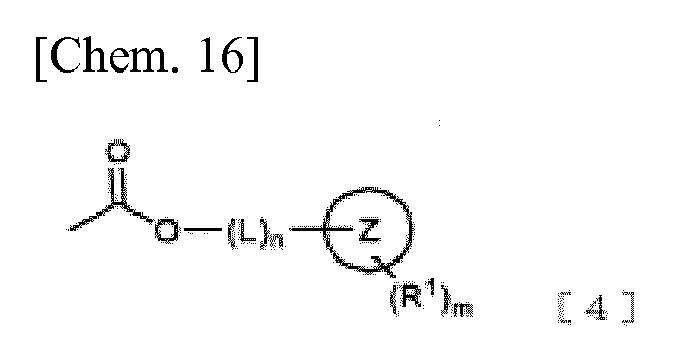
the ratio (%) of gas chromatography (GC) area value of the aryl acetate to that of the a ryl (meth)acrylate (aryl acetate/aryl (meth)acrylate x 100) is 0.01 to 10%.
Applications Claiming Priority (3)
| Application Number | Priority Date | Filing Date | Title |
|---|---|---|---|
| JP2013060459 | 2013-03-22 | ||
| JP2013079070 | 2013-04-05 | ||
| PCT/JP2014/056893 WO2014148386A1 (en) | 2013-03-22 | 2014-03-14 | Production method for (meth) acrylate aryl ester |
Publications (2)
| Publication Number | Publication Date |
|---|---|
| EP2977367A1 true EP2977367A1 (en) | 2016-01-27 |
| EP2977367A4 EP2977367A4 (en) | 2016-07-27 |
Family
ID=51580072
Family Applications (1)
| Application Number | Title | Priority Date | Filing Date |
|---|---|---|---|
| EP14768024.3A Withdrawn EP2977367A4 (en) | 2013-03-22 | 2014-03-14 | PROCESS FOR PRODUCING ARYL ESTER OF (METH) ACRYLATE |
Country Status (7)
| Country | Link |
|---|---|
| US (1) | US20160289160A1 (en) |
| EP (1) | EP2977367A4 (en) |
| JP (1) | JPWO2014148386A1 (en) |
| KR (1) | KR20150132090A (en) |
| CN (1) | CN105051000A (en) |
| TW (1) | TWI523839B (en) |
| WO (1) | WO2014148386A1 (en) |
Families Citing this family (7)
| Publication number | Priority date | Publication date | Assignee | Title |
|---|---|---|---|---|
| EP3544949A1 (en) * | 2016-11-23 | 2019-10-02 | Rohm and Haas Company | Preparation of phenolic (meth)acrylates |
| JP7160817B2 (en) | 2017-01-20 | 2022-10-25 | エボニック オペレーションズ ゲーエムベーハー | Shelf-stable glycerol (meth)acrylate carboxylic acid ester |
| JP7098973B2 (en) * | 2017-03-16 | 2022-07-12 | 三菱ケミカル株式会社 | Method for manufacturing (meth) acrylic acid ester |
| EP3611155A1 (en) | 2018-08-16 | 2020-02-19 | Evonik Operations GmbH | Preparation of (meth)acrylic acid esters |
| JP2021134152A (en) * | 2020-02-25 | 2021-09-13 | 三菱ケミカル株式会社 | (Meta) acrylic acid ester composition |
| JP7655031B2 (en) * | 2021-03-23 | 2025-04-02 | 三菱ケミカル株式会社 | Method for producing (meth)acrylic acid ester |
| JP7655030B2 (en) | 2021-03-23 | 2025-04-02 | 三菱ケミカル株式会社 | Method for producing (meth)acrylic acid ester |
Family Cites Families (6)
| Publication number | Priority date | Publication date | Assignee | Title |
|---|---|---|---|---|
| JP3111557B2 (en) | 1991-11-22 | 2000-11-27 | 住友化学工業株式会社 | Process for producing high-purity carboxylic acid phenyl esters |
| JP2000191590A (en) * | 1998-12-24 | 2000-07-11 | Nof Corp | Method for producing phenyl (meth) acrylate |
| KR20070067645A (en) * | 2003-08-22 | 2007-06-28 | 사토머 테크놀로지 컴퍼니, 인코포레이티드 | High temperature stabilization |
| JP5702048B2 (en) * | 2008-11-28 | 2015-04-15 | 三菱レイヨン株式会社 | Method for producing (meth) acrylic acid naphthyl ester |
| US8796492B2 (en) * | 2009-03-31 | 2014-08-05 | Nippon Shokubai Co., Ltd. | α-(unsaturated alkoxyalkyl) acrylate composition and process for production thereof |
| JP5643163B2 (en) * | 2011-07-22 | 2014-12-17 | 株式会社日本触媒 | Active energy ray-curable composition and cured product thereof |
-
2014
- 2014-03-14 JP JP2014513818A patent/JPWO2014148386A1/en active Pending
- 2014-03-14 KR KR1020157019467A patent/KR20150132090A/en not_active Withdrawn
- 2014-03-14 US US14/442,177 patent/US20160289160A1/en not_active Abandoned
- 2014-03-14 EP EP14768024.3A patent/EP2977367A4/en not_active Withdrawn
- 2014-03-14 WO PCT/JP2014/056893 patent/WO2014148386A1/en not_active Ceased
- 2014-03-14 CN CN201480017407.3A patent/CN105051000A/en active Pending
- 2014-03-20 TW TW103110405A patent/TWI523839B/en active
Also Published As
| Publication number | Publication date |
|---|---|
| KR20150132090A (en) | 2015-11-25 |
| US20160289160A1 (en) | 2016-10-06 |
| TW201443014A (en) | 2014-11-16 |
| CN105051000A (en) | 2015-11-11 |
| EP2977367A4 (en) | 2016-07-27 |
| TWI523839B (en) | 2016-03-01 |
| WO2014148386A1 (en) | 2014-09-25 |
| JPWO2014148386A1 (en) | 2017-02-16 |
Similar Documents
| Publication | Publication Date | Title |
|---|---|---|
| US20160289160A1 (en) | Production method for aryl (meth) acrylate | |
| CN115819842B (en) | Hindered phenol-containing color-resistant antioxidant composition for polymer | |
| JP6240187B2 (en) | Tritylated alkyl aryl ether | |
| KR101173215B1 (en) | Novel thio compounds and Preparing method of the same | |
| EP2953918B1 (en) | Alkyl trityl phenyl ethers | |
| JP6674535B2 (en) | Composition | |
| WO2022213904A1 (en) | Intramolecular complex hindered phenol compound, preparation method therefor and use thereof | |
| WO2009069657A1 (en) | Chemical polymerization catalyst for dental use and curable dental compositions containing the catalyst | |
| EP3153495A1 (en) | Method for producing carboxylic acid anhydride, and method for producing carboxylic acid ester | |
| TWI518061B (en) | Tritylated ethers | |
| EP3320055B1 (en) | Substituted benzotriazole phenolate salts and antioxidant compositions formed therefrom | |
| CN110183364A (en) | A kind of thioether class bis-phenol acrylate multiple-effect antioxidant and preparation method thereof | |
| CN106536683B (en) | Tetraaryl methane ethers as fuel and oil markers | |
| KR101538566B1 (en) | Stabilized isocyanate group-containing ethylene-based unsaturated compound | |
| KR101821905B1 (en) | Phenyl(meta)acrylate production method and phenyl(meta)acrylate composition | |
| Chukicheva et al. | Antioxidant properties of terpene-substituted phenols | |
| JP5176401B2 (en) | Method for producing (meth) acrylic acid ester | |
| KR101395814B1 (en) | Fluoroalkoxy triazine derivatives as reactive ultraviolet light stabilizers and synthesis thereof | |
| US9040736B2 (en) | Stabilized isocyanate group-containing ethylenically unsaturated compound | |
| CN101437786B (en) | Method for producing (meth)acrylate and (meth)acrylate composition | |
| KR20170033765A (en) | Method of preparing for selective di-styrenated phenol using titanium dioxide solid acid catalyst | |
| EP4053099B1 (en) | Acrylic acid derivative-containing composition, and method for stabilizing acrylic acid derivative | |
| EP4613784A1 (en) | Ester compound-containing composition, method for producing same, polymerizable composition, (meth)acrylic polymer, and method for producing same | |
| CN121949244A (en) | Gallic acid antioxidant and preparation method and application thereof | |
| Wasilewski | SYNTHESIS AND STYRENE COPOLYMERIZATION OF OCTYL 2-CYANO-3-(R-PHENYL)-2-PROPENOATES |
Legal Events
| Date | Code | Title | Description |
|---|---|---|---|
| PUAI | Public reference made under article 153(3) epc to a published international application that has entered the european phase |
Free format text: ORIGINAL CODE: 0009012 |
|
| 17P | Request for examination filed |
Effective date: 20150424 |
|
| AK | Designated contracting states |
Kind code of ref document: A1 Designated state(s): AL AT BE BG CH CY CZ DE DK EE ES FI FR GB GR HR HU IE IS IT LI LT LU LV MC MK MT NL NO PL PT RO RS SE SI SK SM TR |
|
| AX | Request for extension of the european patent |
Extension state: BA ME |
|
| RIC1 | Information provided on ipc code assigned before grant |
Ipc: C07C 69/54 20060101ALI20160223BHEP Ipc: C07C 67/08 20060101AFI20160223BHEP |
|
| DAX | Request for extension of the european patent (deleted) | ||
| A4 | Supplementary search report drawn up and despatched |
Effective date: 20160623 |
|
| RIC1 | Information provided on ipc code assigned before grant |
Ipc: C07C 69/54 20060101ALI20160617BHEP Ipc: C07C 67/08 20060101AFI20160617BHEP |
|
| STAA | Information on the status of an ep patent application or granted ep patent |
Free format text: STATUS: THE APPLICATION HAS BEEN WITHDRAWN |
|
| 18W | Application withdrawn |
Effective date: 20170306 |