EP2975865A1 - Method and server for performing capability discovery - Google Patents
Method and server for performing capability discovery Download PDFInfo
- Publication number
- EP2975865A1 EP2975865A1 EP14177676.5A EP14177676A EP2975865A1 EP 2975865 A1 EP2975865 A1 EP 2975865A1 EP 14177676 A EP14177676 A EP 14177676A EP 2975865 A1 EP2975865 A1 EP 2975865A1
- Authority
- EP
- European Patent Office
- Prior art keywords
- contacts
- server
- contact list
- list
- home
- Prior art date
- Legal status (The legal status is an assumption and is not a legal conclusion. Google has not performed a legal analysis and makes no representation as to the accuracy of the status listed.)
- Withdrawn
Links
Images

Classifications
-
- H—ELECTRICITY
- H04—ELECTRIC COMMUNICATION TECHNIQUE
- H04W—WIRELESS COMMUNICATION NETWORKS
- H04W4/00—Services specially adapted for wireless communication networks; Facilities therefor
- H04W4/50—Service provisioning or reconfiguring
-
- H—ELECTRICITY
- H04—ELECTRIC COMMUNICATION TECHNIQUE
- H04L—TRANSMISSION OF DIGITAL INFORMATION, e.g. TELEGRAPHIC COMMUNICATION
- H04L61/00—Network arrangements, protocols or services for addressing or naming
- H04L61/45—Network directories; Name-to-address mapping
- H04L61/4594—Address books, i.e. directories containing contact information about correspondents
-
- H—ELECTRICITY
- H04—ELECTRIC COMMUNICATION TECHNIQUE
- H04L—TRANSMISSION OF DIGITAL INFORMATION, e.g. TELEGRAPHIC COMMUNICATION
- H04L65/00—Network arrangements, protocols or services for supporting real-time applications in data packet communication
- H04L65/10—Architectures or entities
- H04L65/1016—IP multimedia subsystem [IMS]
-
- H—ELECTRICITY
- H04—ELECTRIC COMMUNICATION TECHNIQUE
- H04L—TRANSMISSION OF DIGITAL INFORMATION, e.g. TELEGRAPHIC COMMUNICATION
- H04L65/00—Network arrangements, protocols or services for supporting real-time applications in data packet communication
- H04L65/1066—Session management
- H04L65/1101—Session protocols
- H04L65/1104—Session initiation protocol [SIP]
-
- H—ELECTRICITY
- H04—ELECTRIC COMMUNICATION TECHNIQUE
- H04L—TRANSMISSION OF DIGITAL INFORMATION, e.g. TELEGRAPHIC COMMUNICATION
- H04L67/00—Network arrangements or protocols for supporting network services or applications
- H04L67/50—Network services
- H04L67/54—Presence management, e.g. monitoring or registration for receipt of user log-on information, or the connection status of the users
-
- H—ELECTRICITY
- H04—ELECTRIC COMMUNICATION TECHNIQUE
- H04W—WIRELESS COMMUNICATION NETWORKS
- H04W8/00—Network data management
- H04W8/22—Processing or transfer of terminal data, e.g. status or physical capabilities
-
- H—ELECTRICITY
- H04—ELECTRIC COMMUNICATION TECHNIQUE
- H04L—TRANSMISSION OF DIGITAL INFORMATION, e.g. TELEGRAPHIC COMMUNICATION
- H04L69/00—Network arrangements, protocols or services independent of the application payload and not provided for in the other groups of this subclass
- H04L69/24—Negotiation of communication capabilities
Definitions
- the present invention relates to a method for performing a capability discovery. More particularly, the present invention relates to a method for performing a capability discovery associated with the use of Rich Communication Suite (RCS) services with respect to contact information stored in a user equipment.
- RCS Rich Communication Suite
- Rich Communication Suite services provide various communication functions to a user of a user equipment, for instance a mobile phone, through a communication network, based on the standard specifications set by the Global System for Mobile Communication Association (GSMA).
- GSMA Global System for Mobile Communication Association
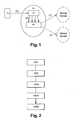
- a user equipment 1 sends a subscription 2 to its home Resource List Server (RLS) server 3 in its home domain 4.
- RLS Resource List Server
- the subscriptions comprise a contact list containing hundreds of contact information.
- the home server 3 analyzes the contacts contained in the contact list and, for each contact locally unknown, the home server 3 sends a corresponding Back-End (BE) subscription 4 to a home IP Multimedia (IMS) core 5.
- the home IMS core 5 sends subscriptions 6 to a plurality of remote domain (also named partner domain).
- An aspect of the invention is therefore to overcome the drawback aforementioned. Accordingly, embodiments of the invention are directed to a method and an apparatus for performing a capability discovery that has a minimal impact on the IMS network capacity and behavior.
- an aspect of the present invention is a method for performing a capability discovery, said method being implemented by a home server and comprising the steps of:
- the invention and more particularly the fact that the home server sends a plurality of secondary requests to a plurality of remote servers in order to obtain information before sending back-end subscription to the home IMS core, allows obtaining an efficient capability discovery mechanism that has a minimal impact on the IMS network capacity and behavior.
- the method for performing a capability discovery according to the invention may also have one or more of the additional features below, taken individually or in any technically feasible combination.
- the principal discovery request is a Resource List Server subscription with a Request-Contained list using the Session Initiation Protocol RFC 5367.
- each secondary discovery request is a Resource List Server subscription with a Request-Contained list using the Session Initiation Protocol (SIP) RFC 5367.
- SIP Session Initiation Protocol
- each secondary discovery request is performed by the home server using a Public Service Identity identification identical to the Public Service Identity identification supported by each remote server.
- the limited contact list contains all contacts of the complete contact list unknown by the home server.
- the notification containing information about contacts contained in the limited contact list indicates the contacts that are RCS enabled.
- the notification containing information about contacts contained in the limited contact list indicates the contacts that are IMS enabled.
- the notification containing information about contacts contained in the limited contact list indicates the contacts that are not IMS enabled.
- the notification indicates for said contact a state of terminated and a reason of no resource.
- the notification indicates for said contact a state of terminated and a reason of rejected.
- the invention relates also to a home server for performing a capability discovery comprising:
- the home server is a Resource List Server.
- a method 100 for performing a capability discovery is represented. Further, the figure 2 illustrates a home server 10 for performing a capability discovery. More particularly, the home server 10 is adapted and constructed to implement the steps of the method 100 for performing a capability discovery. In a not limited embodiment, the home server 10 is a Resource List Server/Presence Server (RLS/PS).
- RLS/PS Resource List Server/Presence Server
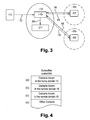
- the method 100 for performing a capability discovery comprises a step of receiving 101 a principal discovery request 12 comprising a complete contact list.
- the principal discovery request 12 is sent by a user terminal 11.
- the principal discovery request 12 is a Resource List Server (RLS) subscription with a Request-Contained list using the Session Initiation Protocol (SIP) RFC 5367.
- RLS Resource List Server
- SIP Session Initiation Protocol
- the figure 3 describes, in a not limited embodiment, the content of the complete contact list embedded in the principal discovery request 12 and received by the home server 10 of an home domain 13.
- the complete contact list contains contacts a that are known in the home domain 13 (i.e. by the home server 10), contacts b that are known in a peering domain 14 (i.e. by a remote server 17 of the domain 14), c peering domain 15 (i.e. by a remote server 18 of the domain 15), and so on.
- the complete contact list contains contacts d that are unknown in any peering domains 14, 15.
- the home domain 13 and each remote domain 14, 15 are identified by domain names like example.com, example.net or wireless.provider.com.
- a contact of the complete contact list is represented as a Tel-Uri (RFC 3966) such as tel:+1-201-555-0123.
- the method 100 for performing a capability discovery comprises a step of determining 102, from the complete contact list, which contacts are locally known.
- the home server 10 determines which contacts are local to the home domain 13, using any available means. For example, the home server 10 determines which contacts are local to the home domain 13 by querying a local or a global database or possibly performing some ENUM queries.
- the method 100 for performing a capability discovery comprises, for all contacts that are locally unknown, a step of sending 103, from the home server 10, a plurality of secondary discovery requests 19 comprising a limited contact list to a plurality of remote servers 17 and 18.
- the plurality of secondary discovery requests 19 are routed to the plurality of remote servers 17, 18 by the home IMS core 21. More particularly, the home IMS core 21 routes the plurality of secondary discovery requests 19 to the remote IMS cores (not illustrated) of the remote domains 14, 15, which remote IMS cores route the plurality of secondary discovery requests 19 to their remote server 17, 18. For reasons of clarity, this routing is not illustrated.
- each remote server 17, 18 is a Resource List Server/Presence Server (RLS/PS). It could be noted that the limited contact list contains only the contacts of the complete contact list unknown by the home server 10. In other terms, the local contacts of the complete contact list have been removed.
- each secondary discovery request 19 sent is a RLS subscription with a Request-Contained list using the Session Initiation Protocol (SIP) RFC 5367.
- SIP Session Initiation Protocol
- all secondary discovery requests 19 are performed by the home server 10 using a Public Service Identity (PSI) as defined in [TS 23.168] and [TS 24.169].
- PSI Public Service Identity
- all interconnected domains i.e. home domain 13, and remote domains 14, 15 support the same PSI identification, typically based on a common sub-domain identification.
- the method 100 for performing a capability discovery comprises further a step of receiving 104 a notification 16 containing information about contacts contained in the limited contact list.
- a notification 16 is sent by each remote server 17, 18 to the home server 10.
- each notification 16 received by the home server 10 contains a Resource-List Meta Information (RLMI) document.
- This RLMI document includes, for instance, three types of information, as described in the figure 4 :
- the different types of contacts are mapped onto different instance state in the RLMI documents to allow the home server 10 to take the right decision as to the remaining subscriptions to be performed and to report correct information to the user equipment 11. For instance, when a remote server 17 or 18 has no information about a contact, then the notification received by the home server 10 indicates for said contact a state of terminated and a reason of "noresource". Further, when a remote server 17 or 18 has a contact not RCS enabled, then the notification 16 received by the home server 10 indicates for said contact a state of terminated and a reason of rejected. Remaining contacts may have an instance state according to usual practices.
- the method 100 for performing a capability discovery comprises a step of sending 105 from the home server 10, for each unknown contact by the home server 10 and the plurality of remote servers 17, 18, a back-end subscription 20 to a home IMS core 21. For that step 105, when the home server 10 receives answers from all domain partner 14, 15, the home server 10 aggregates the information to determine the contacts that are still unknown.
- the home server 10 can applies the following rule: any state/reason takes precedence over a state/reason of "terminated/noresource". Given that policy, the home server performs BE subscriptions for the resources whose state is still unknwon, i.e. the following ones:
- each remote server 17, 18 always provide the first type of information b1 (i.e. the list of contacts that are RCS enabled). When possible, each remote server 17, 18 also provide the other types of information b2 (The list of contacts that are IMS enabled) and b3 (The list of contacts that are not IMS enabled), to narrow even more the number of remaining Back-End subscriptions to be performed by the home server 10.
- b1 i.e. the list of contacts that are RCS enabled
- each remote server 17, 18 also provide the other types of information b2 (The list of contacts that are IMS enabled) and b3 (The list of contacts that are not IMS enabled), to narrow even more the number of remaining Back-End subscriptions to be performed by the home server 10.
- the invention relates also to a home server 10 for performing a capability discovery.
- a home server 10 for performing a capability discovery.
- An example of a home server 10 according to the invention is illustrated in figure 6 .
- the home server 10 comprises:
- each means 30, 31, 32, 33, 34 of the home server 10 may each include one or more processors executing one or more sequences of one or more instructions contained in a memory to perform their intended functions (carry out comparison, collect information, send information,).
- processors executing one or more sequences of one or more instructions contained in a memory to perform their intended functions (carry out comparison, collect information, send information,).
- hard-wired circuitry may be used in place of or in combination with software instructions to implement the invention.
- embodiments of the invention are not limited to any specific combination of hardware circuitry and software.
Landscapes
- Engineering & Computer Science (AREA)
- Computer Networks & Wireless Communication (AREA)
- Signal Processing (AREA)
- Multimedia (AREA)
- Databases & Information Systems (AREA)
- Business, Economics & Management (AREA)
- General Business, Economics & Management (AREA)
- Telephonic Communication Services (AREA)
Abstract
The invention relates to a method (100) for performing a capability discovery. The method (100) is implemented by a home server (10) and comprising the steps of:
- Receiving (101), from a user terminal (11), a principal discovery request (12) comprising a complete contact list,
- from the complete contact list, determining (102) which contacts are locally known,
- For all contacts that are locally unknown, sending (103) a plurality of secondary discovery requests (19) comprising a limited contact list to a plurality of remote servers (17, 18),
- receiving (104), from each remote server (17, 18), a notification (16) containing information about contacts contained in the limited contact list,
- Sending (105), for each unknown contact by the home server (10) and the plurality of remote servers (17, 18), a back-end subscription to a home IMS core (21).
- Receiving (101), from a user terminal (11), a principal discovery request (12) comprising a complete contact list,
- from the complete contact list, determining (102) which contacts are locally known,
- For all contacts that are locally unknown, sending (103) a plurality of secondary discovery requests (19) comprising a limited contact list to a plurality of remote servers (17, 18),
- receiving (104), from each remote server (17, 18), a notification (16) containing information about contacts contained in the limited contact list,
- Sending (105), for each unknown contact by the home server (10) and the plurality of remote servers (17, 18), a back-end subscription to a home IMS core (21).
Description
- The present invention relates to a method for performing a capability discovery. More particularly, the present invention relates to a method for performing a capability discovery associated with the use of Rich Communication Suite (RCS) services with respect to contact information stored in a user equipment.
- Rich Communication Suite services provide various communication functions to a user of a user equipment, for instance a mobile phone, through a communication network, based on the standard specifications set by the Global System for Mobile Communication Association (GSMA).
- As depicted in
figure 1 , in a current presence based solution, to achieve the capability discovery as required by the RCS standardization, auser equipment 1 sends asubscription 2 to its home Resource List Server (RLS)server 3 in itshome domain 4. Usually, the subscriptions comprise a contact list containing hundreds of contact information.Then, thehome server 3 analyzes the contacts contained in the contact list and, for each contact locally unknown, thehome server 3 sends a corresponding Back-End (BE)subscription 4 to a home IP Multimedia (IMS)core 5. Finally, the home IMScore 5 sendssubscriptions 6 to a plurality of remote domain (also named partner domain). Given that a typical size of a contact list is several hundred entries, and that initially, only a few percent of them will be locally know by thehome server 3, this approach is generating a lot of Back-End subscriptions 6 on thehome IMS core 6. This causes a problem in that the amounts of Back-End subscriptions 6 periodically flood thehome IMS core 5 and the IMS core of the remote domains. - The above information is presented as background information only to assist with an understanding of the present disclosure. No determination has been made, and no assertion is made, as to whether any of the above might be applicable as prior art with regard to the present invention.
- An aspect of the invention is therefore to overcome the drawback aforementioned. Accordingly, embodiments of the invention are directed to a method and an apparatus for performing a capability discovery that has a minimal impact on the IMS network capacity and behavior.
- To achieve these advantages and in accordance with the purpose of the embodiments of the invention, an aspect of the present invention is a method for performing a capability discovery, said method being implemented by a home server and comprising the steps of:
- Receiving, from a user terminal, a principal discovery request comprising a complete contact list,
- from the complete contact list, determining which contacts are locally known,
- For all contacts that are locally unknown, sending a plurality of secondary discovery requests comprising a limited contact list to a plurality of remote servers,
- Receiving, from each remote server, a notification containing information about contacts contained in the limited contact list,
- Sending, for each unknown contact by the home server and the plurality of remote servers, a back-end subscription to a home IMS core.
- The invention, and more particularly the fact that the home server sends a plurality of secondary requests to a plurality of remote servers in order to obtain information before sending back-end subscription to the home IMS core, allows obtaining an efficient capability discovery mechanism that has a minimal impact on the IMS network capacity and behavior.
- In addition to the main features aforementioned in the previous paragraph, the method for performing a capability discovery according to the invention may also have one or more of the additional features below, taken individually or in any technically feasible combination.
- In a not limited embodiment, the principal discovery request is a Resource List Server subscription with a Request-Contained list using the Session Initiation Protocol RFC 5367.
- In a not limited embodiment, each secondary discovery request is a Resource List Server subscription with a Request-Contained list using the Session Initiation Protocol (SIP) RFC 5367.
- In a not limited embodiment, each secondary discovery request is performed by the home server using a Public Service Identity identification identical to the Public Service Identity identification supported by each remote server.
- In a not limited embodiment, the limited contact list contains all contacts of the complete contact list unknown by the home server.
- In a not limited embodiment, the notification containing information about contacts contained in the limited contact list indicates the contacts that are RCS enabled.
- In a not limited embodiment, the notification containing information about contacts contained in the limited contact list indicates the contacts that are IMS enabled.
- In a not limited embodiment, the notification containing information about contacts contained in the limited contact list indicates the contacts that are not IMS enabled.
- In a not limited embodiment, when a remote server has no information about a contact, then the notification indicates for said contact a state of terminated and a reason of no resource.
- In a not limited embodiment, when a remote server has a contact not RCS enabled, then the notification indicates for said contact a state of terminated and a reason of rejected.
- The invention relates also to a home server for performing a capability discovery comprising:
- Means of reception constructed and arranged to receive from a user terminal a principal discovery request comprising a complete contact list,
- Means of determining constructed and arranged to, from the complete contact list, determining which contacts are locally known,
- Means of sending constructed and arranged to send to a plurality of remote servers, for all contacts that are locally unknown, a plurality of secondary discovery requests comprising a limited contact list,
- Means of reception constructed and arranged to receive from each remote server a notification about contacts contained in the limited contact list,
- Means of sending constructed and arranged to send to, for each unknown contact by the home server and the plurality of remote servers, a back-end subscription to a home IMS core.
- In a not limited embodiment, the home server is a Resource List Server.
- The accompanying drawings are included to provide a further understanding of the invention and are incorporated in and constitute a part of this specification, to illustrate embodiments of the invention and, together with the description, to explain the principles of the invention:
-
Figure 1 illustrates a method for performing a capability discovery according to the background art, -
Figure 2 illustrates, in a not limited embodiment, the steps of a method for performing a capability discovery according to the invention, -
Figure 3 depicts, in a not limited embodiment, a home server adapted to implement the method for performing a capability discovery according to the invention, -
Figure 4 depicts, in a not limited embodiment, the content of a complete contact list embedded in a principal discovery request, -
Figure 5 depicts, in a not limited embodiment, a notification that each remote server provides about its known contacts, -
Figure 6 illustrates, in a not limited embodiment, a home server for performing a capability discovery. - For reasons of clarity, only those elements beneficial for comprehension of the invention have been shown, more specifically schematically and with no regard for scale. Furthermore, like elements illustrated in different figures are denoted by like reference numerals.
- In reference to
figure 2 , a method 100 for performing a capability discovery is represented. Further, thefigure 2 illustrates ahome server 10 for performing a capability discovery. More particularly, thehome server 10 is adapted and constructed to implement the steps of the method 100 for performing a capability discovery. In a not limited embodiment, thehome server 10 is a Resource List Server/Presence Server (RLS/PS). - The method 100 for performing a capability discovery comprises a step of receiving 101 a
principal discovery request 12 comprising a complete contact list. Theprincipal discovery request 12 is sent by auser terminal 11. In a not limited embodiment, theprincipal discovery request 12 is a Resource List Server (RLS) subscription with a Request-Contained list using the Session Initiation Protocol (SIP) RFC 5367. - The
figure 3 describes, in a not limited embodiment, the content of the complete contact list embedded in theprincipal discovery request 12 and received by thehome server 10 of anhome domain 13. The complete contact list contains contacts a that are known in the home domain 13 (i.e. by the home server 10), contacts b that are known in a peering domain 14 (i.e. by aremote server 17 of the domain 14), c peering domain 15 (i.e. by aremote server 18 of the domain 15), and so on. Finally, the complete contact list contains contacts d that are unknown in anypeering domains home domain 13 and eachremote domain - The method 100 for performing a capability discovery comprises a step of determining 102, from the complete contact list, which contacts are locally known. In other terms, when receiving the
principal discovery request 12 from theuser equipment 11, thehome server 10 determines which contacts are local to thehome domain 13, using any available means. For example, thehome server 10 determines which contacts are local to thehome domain 13 by querying a local or a global database or possibly performing some ENUM queries. - The method 100 for performing a capability discovery comprises, for all contacts that are locally unknown, a step of sending 103, from the
home server 10, a plurality ofsecondary discovery requests 19 comprising a limited contact list to a plurality ofremote servers secondary discovery requests 19 are routed to the plurality ofremote servers home IMS core 21. More particularly, thehome IMS core 21 routes the plurality ofsecondary discovery requests 19 to the remote IMS cores (not illustrated) of theremote domains secondary discovery requests 19 to theirremote server - In a not limited embodiment, each
remote server home server 10. In other terms, the local contacts of the complete contact list have been removed. In a not limited embodiment, eachsecondary discovery request 19 sent is a RLS subscription with a Request-Contained list using the Session Initiation Protocol (SIP) RFC 5367. - In a not limited embodiment, all
secondary discovery requests 19 are performed by thehome server 10 using a Public Service Identity (PSI) as defined in [TS 23.168] and [TS 24.169]. For making the peering as simple as possible and limit configuration impacts, all interconnected domains (i.e.home domain 13, andremote domains - The method 100 for performing a capability discovery comprises further a step of receiving 104 a
notification 16 containing information about contacts contained in the limited contact list. Anotification 16 is sent by eachremote server home server 10. In a not limited embodiment, eachnotification 16 received by thehome server 10 contains a Resource-List Meta Information (RLMI) document. This RLMI document includes, for instance, three types of information, as described in thefigure 4 : - (b1) The list of contacts that are RCS enabled, so presence enabled,
- (b2) The list of contacts that are IMS enabled (so presumably in the ENUM base), but not RCS or presence enabled,
- (b3) The list of contacts that are not IMS enabled (and so an ENUM resolution would certainly fail).
- In a not limited embodiment, the different types of contacts are mapped onto different instance state in the RLMI documents to allow the
home server 10 to take the right decision as to the remaining subscriptions to be performed and to report correct information to theuser equipment 11. For instance, when aremote server home server 10 indicates for said contact a state of terminated and a reason of "noresource". Further, when aremote server notification 16 received by thehome server 10 indicates for said contact a state of terminated and a reason of rejected. Remaining contacts may have an instance state according to usual practices. - The method 100 for performing a capability discovery comprises a step of sending 105 from the
home server 10, for each unknown contact by thehome server 10 and the plurality ofremote servers end subscription 20 to ahome IMS core 21. For thatstep 105, when thehome server 10 receives answers from alldomain partner home server 10 aggregates the information to determine the contacts that are still unknown. - When performing the aggregation, the
home server 10 can applies the following rule: any state/reason takes precedence over a state/reason of "terminated/noresource". Given that policy, the home server performs BE subscriptions for the resources whose state is still unknwon, i.e. the following ones: - No state information has ever been reported by any remote RLS servers for that resource.
- After the aggregation operation, the state/reason of the resource is still "terminated/noresource".
- In a not limited embodiment, each
remote server remote server home server 10. - The invention relates also to a
home server 10 for performing a capability discovery. An example of ahome server 10 according to the invention is illustrated infigure 6 . - The
home server 10 comprises: - Means for
reception 30 constructed and arranged to receive from a user terminal 11 aprincipal discovery request 12 comprising a complete contact list, - Means for determining 31 constructed and arranged to, from the complete contact list, determining which contacts are locally known,
- Means for sending 32 constructed and arranged to send to a plurality of
remote servers secondary discovery requests 19 comprising a limited contact list, - Means for
reception 33 constructed and arranged to receive from eachremote server notification 16 containing information about contacts contained in the limited contact list, - Means for sending 34 constructed and arranged to send to, for each unknown contact by the
home server 10 and the plurality ofremote servers end subscription 20 to ahome IMS core 21. - According to an embodiment of the invention, each means 30, 31, 32, 33, 34 of the
home server 10 may each include one or more processors executing one or more sequences of one or more instructions contained in a memory to perform their intended functions (carry out comparison, collect information, send information,...). In alternative embodiments, hard-wired circuitry may be used in place of or in combination with software instructions to implement the invention. Thus, embodiments of the invention are not limited to any specific combination of hardware circuitry and software. - It is to be understood that the present invention contemplates that, to the extent possible, one or more features of any embodiment can be combined with one or more features of any other embodiment.
- The descriptions above are intended to be illustrative, not limiting. Thus, it will be apparent to one skilled in the art that modifications may be made to the invention as described without departing from the scope of the claims set out below.
Claims (11)
- Method (100) for performing a capability discovery, said method (100) being implemented by a home server (10) and comprising the steps of:- Receiving (101), from a user terminal (11), a principal discovery request (12) comprising a complete contact list,- from the complete contact list, determining (102) which contacts are locally known,- For all contacts that are locally unknown, sending (103) a plurality of secondary discovery requests (19) comprising a limited contact list to a plurality of remote servers (17, 18),- receiving (104), from each remote server (17, 18), a notification (16) containing information about contacts contained in the limited contact list,- Sending (105), for each unknown contact by the home server (10) and the plurality of remote servers (17, 18), a back-end subscription to a home IMS core (21).
- Method (100) according to claim 1, wherein the principal discovery request (12) is a Resource List Server subscription with a Request-Contained list using the Session Initiation Protocol RFC 5367.
- Method (100) according to claim 1 or 2, wherein each secondary discovery request (19) is a Resource List Server subscription with a Request-Contained list using the Session Initiation Protocol RFC 5367.
- Method (100) according to any of the preceding claims, wherein each secondary discovery request (19) is performed by the home server (10) using a Public Service Identity identification identical to the Public Service Identity identification supported by each remote server (14, 15).
- Method (100) according to any of the preceding claims, wherein the notification (16) containing information about contacts contained in the limited contact list indicates the contacts that are RCS enabled.
- Method (100) according to any of the preceding claims, wherein the notification (16) containing information about contacts contained in the limited contact list indicates the contacts that are IMS enabled.
- Method (100) according to any of the preceding claims, wherein the notification (16) containing information about contacts contained in the limited contact list indicates the contacts that are not IMS enabled.
- Method (100) according to any of the preceding claims, wherein when a remote server (17, 18) has no information about a contact, then the notification (16) indicates for said contact a state of terminated and a reason of no resource.
- Method (100) according to claims 5, wherein when a remote server (17, 18) has a contact not RCS enabled, then the notification (16) indicates for said contact a state of terminated and a reason of rejected.
- Home server (10) for performing a capability discovery comprising:- Means for reception (30) constructed and arranged to receive from a user terminal (11) a principal discovery request (12) comprising a complete contact list,- Means for determining (31) constructed and arranged to, from the complete contact list, determining which contacts are locally known,- Means for sending (32) constructed and arranged to send to a plurality of remote servers (17, 18), for all contacts that are locally unknown, a plurality of secondary discovery requests (19) comprising a limited contact list,- Means for reception (33) constructed and arranged to receive from each remote server (17, 18) a notification (16) about contacts contained in the limited contact list,- Means for sending (34) constructed and arranged to send to, for each unknown contact by the home server (10) and the plurality of remote servers (17, 18), a back-end subscription (20) to a home IMS core (21).
- Home server (10) according to claim 11, wherein the home server (10) is a Resource List Server.
Priority Applications (4)
| Application Number | Priority Date | Filing Date | Title |
|---|---|---|---|
| EP14177676.5A EP2975865A1 (en) | 2014-07-18 | 2014-07-18 | Method and server for performing capability discovery |
| PCT/EP2015/066284 WO2016008983A1 (en) | 2014-07-18 | 2015-07-16 | Method and server for performing capability discovery |
| US15/326,253 US10708735B2 (en) | 2014-07-18 | 2015-07-16 | Method and server for performing capability discovery |
| EP15736302.9A EP3170321A1 (en) | 2014-07-18 | 2015-07-16 | Method and server for performing capability discovery |
Applications Claiming Priority (1)
| Application Number | Priority Date | Filing Date | Title |
|---|---|---|---|
| EP14177676.5A EP2975865A1 (en) | 2014-07-18 | 2014-07-18 | Method and server for performing capability discovery |
Publications (1)
| Publication Number | Publication Date |
|---|---|
| EP2975865A1 true EP2975865A1 (en) | 2016-01-20 |
Family
ID=51211632
Family Applications (2)
| Application Number | Title | Priority Date | Filing Date |
|---|---|---|---|
| EP14177676.5A Withdrawn EP2975865A1 (en) | 2014-07-18 | 2014-07-18 | Method and server for performing capability discovery |
| EP15736302.9A Withdrawn EP3170321A1 (en) | 2014-07-18 | 2015-07-16 | Method and server for performing capability discovery |
Family Applications After (1)
| Application Number | Title | Priority Date | Filing Date |
|---|---|---|---|
| EP15736302.9A Withdrawn EP3170321A1 (en) | 2014-07-18 | 2015-07-16 | Method and server for performing capability discovery |
Country Status (3)
| Country | Link |
|---|---|
| US (1) | US10708735B2 (en) |
| EP (2) | EP2975865A1 (en) |
| WO (1) | WO2016008983A1 (en) |
Family Cites Families (6)
| Publication number | Priority date | Publication date | Assignee | Title |
|---|---|---|---|---|
| US8332516B2 (en) * | 2009-12-08 | 2012-12-11 | International Business Machines Corporation | Optimized cooperation between resource list servers and presence servers |
| US20120011244A1 (en) * | 2010-07-09 | 2012-01-12 | Telefonaktiebolaget L M Ericsson (Publ) | Method for redistributing license tokens for a service across a cloud computing environment |
| FR2991530A1 (en) * | 2012-05-29 | 2013-12-06 | France Telecom | METHOD AND ENTITY FOR PROCESSING A MESSAGE |
| US9032027B2 (en) * | 2013-08-27 | 2015-05-12 | Sybase, Inc. | Enhanced consumer engagement using advanced communication exchange services |
| WO2015069154A1 (en) * | 2013-11-06 | 2015-05-14 | Telefonaktiebolaget L M Ericsson (Publ) | Methods and user equipments for exchanging service capabilities |
| US20160295390A1 (en) * | 2013-11-22 | 2016-10-06 | Telefonaktiebolaget L M Ericsson (Publ) | Centralised capabiity discovery |
-
2014
- 2014-07-18 EP EP14177676.5A patent/EP2975865A1/en not_active Withdrawn
-
2015
- 2015-07-16 WO PCT/EP2015/066284 patent/WO2016008983A1/en not_active Ceased
- 2015-07-16 US US15/326,253 patent/US10708735B2/en not_active Expired - Fee Related
- 2015-07-16 EP EP15736302.9A patent/EP3170321A1/en not_active Withdrawn
Non-Patent Citations (3)
| Title |
|---|
| "Resource List Server (RLS) Specification ; OMA-TS-Presence_SIMPLE_RLS-V1_0-20120710-A", no. 1.0, 10 July 2012 (2012-07-10), pages 1 - 17, XP064159143, Retrieved from the Internet <URL:ftp/Public_documents/COM/COM-XDM/Permanent_documents/> [retrieved on 20120820] * |
| GSM ASSOCIATION: "Rich Communication Suite 5.1 Advanced Communications Services and Client Specification - Version 4.0", 28 November 2013 (2013-11-28), pages 1 - 498, XP055164102, Retrieved from the Internet <URL:http://www.gsma.com/network2020/rcs/specs-and-product-docs/> [retrieved on 20150122] * |
| ROACH B CAMPBELL ESTACADO SYSTEMS J ROSENBERG CISCO SYSTEMS A B: "A Session Initiation Protocol (SIP) Event Notification Extension for Resource Lists; rfc4662.txt", 20060801, 1 August 2006 (2006-08-01), XP015047413, ISSN: 0000-0003 * |
Also Published As
| Publication number | Publication date |
|---|---|
| US20170208453A1 (en) | 2017-07-20 |
| US10708735B2 (en) | 2020-07-07 |
| EP3170321A1 (en) | 2017-05-24 |
| WO2016008983A1 (en) | 2016-01-21 |
Similar Documents
| Publication | Publication Date | Title |
|---|---|---|
| CN107006042B (en) | Configuration techniques for emergency sessions | |
| CN111919474B (en) | Network fragmentation in IMS | |
| US9294618B2 (en) | Call-back to a UE that has made an emergency call via a visited IMS network | |
| US8693464B2 (en) | Method and apparatus for processing calls | |
| US8335485B2 (en) | Call routing | |
| EP2898647B1 (en) | Methods and apparatus for processing an ims session | |
| EP2456156A1 (en) | Attachment method and system with identifier and location splitting in next generation network | |
| JP2016213604A (en) | Communication apparatus and management method | |
| US9560583B2 (en) | Gateway selection based on geographical location | |
| US20190141094A1 (en) | Multi-subscription in internet protocol multimedia subsystems | |
| US10231109B2 (en) | Handling of emergency calls in a roaming scenario | |
| US10708735B2 (en) | Method and server for performing capability discovery | |
| CN104301450A (en) | Addressing method and device | |
| US12010154B2 (en) | Support for IMS virtual clients in multi-operator environment | |
| CN107302485B (en) | Method, equipment and device for interconnecting equipment in different networks | |
| US9203920B2 (en) | Method and node for automatically exchanging network service provider information | |
| CN102547971B (en) | Method and device for registering user terminal in IMS (IP multimedia subsystem) network | |
| CN119316397A (en) | A message processing method and device, electronic device and storage medium | |
| KR20110040151A (en) | How to register PCSC in IMS network and system using same | |
| KR20120002245A (en) | How to provide oIP service |
Legal Events
| Date | Code | Title | Description |
|---|---|---|---|
| PUAI | Public reference made under article 153(3) epc to a published international application that has entered the european phase |
Free format text: ORIGINAL CODE: 0009012 |
|
| AK | Designated contracting states |
Kind code of ref document: A1 Designated state(s): AL AT BE BG CH CY CZ DE DK EE ES FI FR GB GR HR HU IE IS IT LI LT LU LV MC MK MT NL NO PL PT RO RS SE SI SK SM TR |
|
| AX | Request for extension of the european patent |
Extension state: BA ME |
|
| STAA | Information on the status of an ep patent application or granted ep patent |
Free format text: STATUS: THE APPLICATION IS DEEMED TO BE WITHDRAWN |
|
| 18D | Application deemed to be withdrawn |
Effective date: 20160721 |