EP2975849A1 - Method for decoding a color mapping table and corresponding device - Google Patents
Method for decoding a color mapping table and corresponding device Download PDFInfo
- Publication number
- EP2975849A1 EP2975849A1 EP14306167.9A EP14306167A EP2975849A1 EP 2975849 A1 EP2975849 A1 EP 2975849A1 EP 14306167 A EP14306167 A EP 14306167A EP 2975849 A1 EP2975849 A1 EP 2975849A1
- Authority
- EP
- European Patent Office
- Prior art keywords
- decoding
- color
- mapping table
- hierarchical tree
- data item
- Prior art date
- Legal status (The legal status is an assumption and is not a legal conclusion. Google has not performed a legal analysis and makes no representation as to the accuracy of the status listed.)
- Withdrawn
Links
- 238000013507 mapping Methods 0.000 title claims abstract description 52
- 238000000034 method Methods 0.000 title claims abstract description 43
- 238000004590 computer program Methods 0.000 claims description 6
- 238000004891 communication Methods 0.000 description 7
- 238000009795 derivation Methods 0.000 description 5
- 238000005070 sampling Methods 0.000 description 4
- 230000003287 optical effect Effects 0.000 description 3
- 238000003491 array Methods 0.000 description 2
- 229920001690 polydopamine Polymers 0.000 description 2
- 238000012545 processing Methods 0.000 description 2
- 230000000295 complement effect Effects 0.000 description 1
- 230000006870 function Effects 0.000 description 1
- 239000011159 matrix material Substances 0.000 description 1
- 238000012986 modification Methods 0.000 description 1
- 230000004048 modification Effects 0.000 description 1
- 239000004065 semiconductor Substances 0.000 description 1
- 238000001228 spectrum Methods 0.000 description 1
- 238000009827 uniform distribution Methods 0.000 description 1
Images


Classifications
-
- H—ELECTRICITY
- H04—ELECTRIC COMMUNICATION TECHNIQUE
- H04N—PICTORIAL COMMUNICATION, e.g. TELEVISION
- H04N19/00—Methods or arrangements for coding, decoding, compressing or decompressing digital video signals
- H04N19/10—Methods or arrangements for coding, decoding, compressing or decompressing digital video signals using adaptive coding
- H04N19/169—Methods or arrangements for coding, decoding, compressing or decompressing digital video signals using adaptive coding characterised by the coding unit, i.e. the structural portion or semantic portion of the video signal being the object or the subject of the adaptive coding
- H04N19/186—Methods or arrangements for coding, decoding, compressing or decompressing digital video signals using adaptive coding characterised by the coding unit, i.e. the structural portion or semantic portion of the video signal being the object or the subject of the adaptive coding the unit being a colour or a chrominance component
-
- H—ELECTRICITY
- H04—ELECTRIC COMMUNICATION TECHNIQUE
- H04N—PICTORIAL COMMUNICATION, e.g. TELEVISION
- H04N19/00—Methods or arrangements for coding, decoding, compressing or decompressing digital video signals
- H04N19/30—Methods or arrangements for coding, decoding, compressing or decompressing digital video signals using hierarchical techniques, e.g. scalability
-
- H—ELECTRICITY
- H04—ELECTRIC COMMUNICATION TECHNIQUE
- H04N—PICTORIAL COMMUNICATION, e.g. TELEVISION
- H04N19/00—Methods or arrangements for coding, decoding, compressing or decompressing digital video signals
- H04N19/46—Embedding additional information in the video signal during the compression process
- H04N19/463—Embedding additional information in the video signal during the compression process by compressing encoding parameters before transmission
-
- H—ELECTRICITY
- H04—ELECTRIC COMMUNICATION TECHNIQUE
- H04N—PICTORIAL COMMUNICATION, e.g. TELEVISION
- H04N19/00—Methods or arrangements for coding, decoding, compressing or decompressing digital video signals
- H04N19/70—Methods or arrangements for coding, decoding, compressing or decompressing digital video signals characterised by syntax aspects related to video coding, e.g. related to compression standards
-
- H—ELECTRICITY
- H04—ELECTRIC COMMUNICATION TECHNIQUE
- H04N—PICTORIAL COMMUNICATION, e.g. TELEVISION
- H04N19/00—Methods or arrangements for coding, decoding, compressing or decompressing digital video signals
- H04N19/90—Methods or arrangements for coding, decoding, compressing or decompressing digital video signals using coding techniques not provided for in groups H04N19/10-H04N19/85, e.g. fractals
- H04N19/96—Tree coding, e.g. quad-tree coding
Definitions
- This invention is in the field of Color Gamut Scalability (CGS) coding/decoding. Specifically, a method of decoding a color mapping table coded as a hierarchical tree of octants/nodes arranged in levels is disclosed. A corresponding decoding device is disclosed.
- CGS Color Gamut Scalability
- In Scalable Video Coding (e.g. SHVC as defined in the document entitled Preliminary version of High efficiency video coding (HEVC) scalable extension Draft 6, JCTVC_01008_v3 published on June 7, 2014 ), in the case where the color spaces and/or the color gamuts of the Base Layer (BL) and of the Enhancement Layer (EL) are different, one can use a Color Mapping process to transform the color samples of the BL when performing the prediction of the EL samples from BL samples as depicted in Figure 1 .
- This tool is called Color Gamut Scalability (CGS) in SHVC.
- CGS Color Gamut Scalability
- the up-scaling is optional and is only applied in the case where BL pictures and EL pictures have different spatial resolutions.
- the Color Mapping is performed using a 3D LUT containing color parameters.
- the 3D LUT is composed of a lattice of nodes/octants, each node/octant being associated with color parameters (e.g. 4 or 8 color vertices or 9 matrix coefficients with 3 additional offsets).
- Each node represents an octant, i.e. a portion of a 3D color space, e.g. YUV or RGB color space.
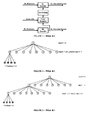
- the 3D LUT is described using a hierarchical tree of octants of maximal depth cm_octant_depth, where the final nodes/octants are further split into YPartNum leaves as depicted in Figures 2 and 3 .
- the splitting is done in one dimension only, namely the Y dimension (in the YUV color space).
- the color parameters are encoded.
- the encoding of one color parameter comprises coding of residual values, e.g. res_y, res_u, res_v as defined in JCTVC_Q1008_v3.
- the residual values and the reconstructed color parameters may be stored in 3D arrays (e.g.
- split_octant_flag The splitting is signaled by the syntax element "split_octant_flag".
- split_octant_flag the value of split_octant_flag is indicated inside the tree leaves.
- the corresponding coding syntax is depicted in the following table 1 extracted from sections F.7.3.5.1 and F.7.3.5.2 of the document entitled Preliminary version of High efficiency video coding (HEVC) scalable extension Draft 6, JCTVC-Q1008-V3.
- HEVC High efficiency video coding
- the solution as currently disclosed in JCTVC_Q1008_v3 has several drawbacks.
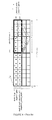
- some of the residuals representative of color parameters may be "not explicitly encoded" (such values are identified by a question mark in Figure 4 ). In this case, JCTVC_Q1008_v3 teaches to derive these "non-explicitly-encoded" color parameters by inferring they have zero residuals.
- the distance between a non-explicitly-encoded color parameter and the corresponding explicitly-encoded color parameter is up to R/2 (as depicted in the second row of the Figure 4 ).
- a method for decoding a color mapping table coded as a hierarchical tree of octants arranged in levels comprises for at least one current octant of said hierarchical tree:
- associating said decoded at least one data item with an index of the color mapping table determined at least based on a maximal split depth of the color mapping table and based on a level position of said at least one current octant in the hierarchical tree comprises storing said at least one data item in an array at a location determined by said index.
- the at least one data item is a residual of a color parameter.
- the decoding method further comprises adding a prediction to said decoded at least one data item in order to obtain a decoded color parameter, wherein the prediction is obtained from at least one previously decoded color parameter.
- the method for coding further comprises reconstructing a non-explicitly encoded color parameter at least from said decoded color parameter.
- a decoding device for decoding a color mapping table coded as a hierarchical tree of octants arranged in levels comprises a processor configured to:
- a decoding device for decoding a color mapping table coded as a hierarchical tree of octants arranged in levels comprises:
- the device is configured to execute the steps of the method for decoding according to any of the embodiments and variants disclosed.
- a computer program product comprising program code instructions to execute the steps of the decoding method according to any of the embodiments and variants disclosed when this program is executed on a computer.
- a processor readable medium having stored therein instructions for causing a processor to perform at least the steps of the decoding method according to any of the embodiments and variants disclosed.
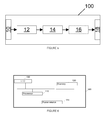
- Figure 5 depicts a device 100 for decoding a color mapping table coded as a hierarchical tree of nodes arranged in levels according to a specific and non-limitative embodiment of the invention.
- Each node represents an octant, i.e. a portion of a 3D color space, e.g. YUV or RGB color space.
- the decoding device 100 comprises an input 10 configured to receive a bitstream.
- the input 10 is linked to a decoding module 12 configured to decode at least one data item representative of at least one color parameter associated with at least one current node/octant of the hierarchical tree.
- the decoding module 12 is linked to a module 14 configured to associate the data item with an index of the color mapping table, wherein the index is determined at least based on a maximal split depth of the color mapping table and based on a level position of the current node/octant in the hierarchical tree.
- the module 14 comprises a memory in which the data item is stored at a location determined by the index.
- the decoding device further comprises a module 16 configured to add a prediction data to the data item.
- the module 14 or the module 16 when present is linked to an output 18.
- the color mapping table may be stored in a memory internal to the decoding device 100 or external to it. In a variant, the color mapping table is sent to a destination.
- FIG. 6 represents an exemplary architecture of the decoding device 100 configured to decode a color mapping table from a bitstream according to an exemplary embodiment of the invention.
- the decoding device 100 comprises one or more processor(s) 110 , which is(are), for example, a CPU, a GPU and/or a DSP (English acronym of Digital Signal Processor), along with internal memory 120 (e.g. RAM, ROM, EPROM).
- the decoding device 100 comprises one or several Input/Output interface(s) 130 adapted to display output information and/or allow a user to enter commands and/or data (e.g. a keyboard, a mouse, a touchpad, a webcam); and a power source 140 which may be external to the decoding device 100.
- the device 100 may also comprise network interface(s) (not shown).
- the bitstream may be obtained from a source. According to different embodiments of the invention, the source belongs to a set comprising:
- Figure 7 represents a flowchart of a method for decoding a color mapping table coded as a hierarchical tree of nodes/octants arranged in levels from a bitstream F according to a specific and non-limitative embodiment of the invention.
- the LUT is described using a hierarchical tree of maximal depth cm_octant_depth, where the final nodes/octants are further split into YPartNum leaves. In this latter case the splitting is done in one dimension only, namely the Y dimension. It will be appreciated, however, that the invention is not restricted to the splitting of the final nodes/octants in the Y dimension. For each of these YPartNum leaves, color parameters are encoded.
- the encoding of one color parameter may comprise coding of residual values, e.g. res_y, res_u, res_v as defined in JCTVC_Q1008_v3.
- the residual values and the decoded color parameters may be stored in 3D arrays (e.g.
- a step S10 at least one data item representative of at least one color parameter associated with at least one node/octant of the hierarchical tree is decoded.
- the data item can be the color parameter itself or can be a residual representative of the color parameter.
- the decoded at least one data item is associated with an index of the color mapping table, wherein the index is determined at least based on a maximal split depth of the color mapping table and further based on the level position of the current node/octant in the hierarchical tree.
- the syntax defined in the document JCTVC-Q1008-V3 is amended as indicated in Table 2 (modified elements are shown in italics and bold). According to this table, the color mapping table is clearly encoded as a hierarchical tree of octants.
- a prediction is added to the decoded at least one data item representative of the color parameter in order to decode a color parameter.
- the prediction data is obtained from one or several previously decoded color parameter(s). The method is advantageously iterated on all the nodes/octants to decode the whole color mapping table.
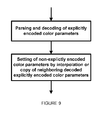
- the decoding/reconstruction of the color parameters is done in two steps as depicted in Figure 9 .
- a first step all explicitly encoded color parameters are decoded.
- the non-explicitly encoded color parameters are reconstructed from neighboring decoded explicitly encoded color parameters.
- the reconstruction process of these color parameters i.e. non-explicitly encoded, can be done from any reconstructed explicitly-encoded color parameters, whatever its position in the LUT and independently to the parsing/decoding order of the explicitly-encoded color parameters.
- the explicitly encoded color parameters are decoded, stored and marked (as explicitly encoded).
- This information can be used at the non-explicitly-encoded color parameters reconstruction stage.
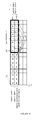
- non-explicitly-encoded color parameters (identified by "?" in the figure 10 ) are reconstructed (by copy or by interpolation) from neighboring decoded explicitly-encoded color parameters (circles) but not in decoding order (multi-pass process).
- the distance derivation of non-explicitly-encoded color parameters to the corresponding explicitly-encoded color parameters is inferior or equal to R/4, that is less than with previous existing solution ( Figure 4 ) thanks to a better sampling.
- the non-explicitly encoded color parameters are derived from explicitly encoded color parameters (identified with circles).
- the derivation process is illustrated by the blue arrows.
- a lower distance derivation between explicitly-encoded color parameters and non-explicitly-encoded color parameters is used.
- the non-explicitly-encoded color parameters are better predicted.
- a better color space sampling of the 3D LUT is obtained.
- the non-explicitly encoded color parameters are better predicted.
- the implementations described herein may be implemented in, for example, a method or a process, an apparatus, a software program, a data stream, or a signal. Even if only discussed in the context of a single form of implementation (for example, discussed only as a method or a device), the implementation of features discussed may also be implemented in other forms (for example a program).
- An apparatus may be implemented in, for example, appropriate hardware, software, and firmware.
- the methods may be implemented in, for example, an apparatus such as, for example, a processor, which refers to processing devices in general, including, for example, a computer, a microprocessor, an integrated circuit, or a programmable logic device. Processors also include communication devices, such as, for example, computers, cell phones, portable/personal digital assistants ("PDAs”), and other devices that facilitate communication of information between end-users.
- PDAs portable/personal digital assistants
- Implementations of the various processes and features described herein may be embodied in a variety of different equipment or applications, particularly, for example, equipment or applications.
- equipment examples include an encoder, a decoder, a post-processor processing output from a decoder, a pre-processor providing input to an encoder, a video coder, a video decoder, a video codec, a web server, a set-top box, a laptop, a personal computer, a cell phone, a PDA, and other communication devices.
- the equipment may be mobile and even installed in a mobile vehicle.
- the methods may be implemented by instructions being performed by a processor, and such instructions (and/or data values produced by an implementation) may be stored on a processor-readable medium such as, for example, an integrated circuit, a software carrier or other storage device such as, for example, a hard disk, a compact diskette (“CD"), an optical disc (such as, for example, a DVD, often referred to as a digital versatile disc or a digital video disc), a random access memory (“RAM”), or a read-only memory (“ROM”).
- the instructions may form an application program tangibly embodied on a processor-readable medium. Instructions may be, for example, in hardware, firmware, software, or a combination.
- a processor may be characterized, therefore, as, for example, both a device configured to carry out a process and a device that includes a processor-readable medium (such as a storage device) having instructions for carrying out a process. Further, a processor-readable medium may store, in addition to or in lieu of instructions, data values produced by an implementation.
- implementations may produce a variety of signals formatted to carry information that may be, for example, stored or transmitted.
- the information may include, for example, instructions for performing a method, or data produced by one of the described implementations.
- a signal may be formatted to carry as data the rules for writing or reading the syntax of a described embodiment, or to carry as data the actual syntax-values written by a described embodiment.
- Such a signal may be formatted, for example, as an electromagnetic wave (for example, using a radio frequency portion of spectrum) or as a baseband signal.
- the formatting may include, for example, encoding a data stream and modulating a carrier with the encoded data stream.
- the information that the signal carries may be, for example, analog or digital information.
- the signal may be transmitted over a variety of different wired or wireless links, as is known.
- the signal may be stored on a processor-readable medium.
Landscapes
- Engineering & Computer Science (AREA)
- Multimedia (AREA)
- Signal Processing (AREA)
- Compression Or Coding Systems Of Tv Signals (AREA)
Abstract
A method for decoding a color mapping table coded as a hierarchical tree of octants arranged in levels is disclosed. The method comprises for at least one current octant of said hierarchical tree:
a) decoding (S10) at least one data item representative of a color parameter associated with said at least one current octant;
b) associating (S12) said decoded at least one data item with an index in the color mapping table, wherein the index is determined at least based on a maximal split depth of the color mapping table and based on a level position of said at least one current octant in the hierarchical tree.
a) decoding (S10) at least one data item representative of a color parameter associated with said at least one current octant;
b) associating (S12) said decoded at least one data item with an index in the color mapping table, wherein the index is determined at least based on a maximal split depth of the color mapping table and based on a level position of said at least one current octant in the hierarchical tree.
Description
- This invention is in the field of Color Gamut Scalability (CGS) coding/decoding. Specifically, a method of decoding a color mapping table coded as a hierarchical tree of octants/nodes arranged in levels is disclosed. A corresponding decoding device is disclosed.
- EP application
PCT/EP14/055333 - In Scalable Video Coding (e.g. SHVC as defined in the document entitled Preliminary version of High efficiency video coding (HEVC) scalable extension Draft 6, JCTVC_01008_v3 published on June 7, 2014), in the case where the color spaces and/or the color gamuts of the Base Layer (BL) and of the Enhancement Layer (EL) are different, one can use a Color Mapping process to transform the color samples of the BL when performing the prediction of the EL samples from BL samples as depicted in
Figure 1 . This tool is called Color Gamut Scalability (CGS) in SHVC. InFigure 1 , the up-scaling is optional and is only applied in the case where BL pictures and EL pictures have different spatial resolutions.
In the current SHVC specification (JCTVC_Q1008_v3), the Color Mapping is performed using a 3D LUT containing color parameters. The 3D LUT is composed of a lattice of nodes/octants, each node/octant being associated with color parameters (e.g. 4 or 8 color vertices or 9 matrix coefficients with 3 additional offsets). Each node represents an octant, i.e. a portion of a 3D color space, e.g. YUV or RGB color space.
Exemplarily, the 3D LUT is described using a hierarchical tree of octants of maximal depth cm_octant_depth, where the final nodes/octants are further split into YPartNum leaves as depicted inFigures 2 and 3 . In this case the splitting is done in one dimension only, namely the Y dimension (in the YUV color space). For each of these YPartNum leaves, the color parameters are encoded. The encoding of one color parameter comprises coding of residual values, e.g. res_y, res_u, res_v as defined in JCTVC_Q1008_v3. The residual values and the reconstructed color parameters may be stored in 3D arrays (e.g. res_y[yldx][uldx][vldx], res_u[yldx][uldx][vldx], res_v[yldx][uldx][vldx] and LutY[yldx][uldx][vldx], LutU [yldx][uldx][vldx], LutV [[yldx][uldx][vldx] respectively).
The current coding syntax (as defined in JCTVC_Q1008_v3) thus makes it possible to recursively split the tree nodes into 8 octants as depicted inFigures 2 and 3 . The splitting is signaled by the syntax element "split_octant_flag". Infigures 2 and 3 , the value of split_octant_flag is indicated inside the tree leaves.
The corresponding coding syntax is depicted in the following table 1 extracted from sections F.7.3.5.1 and F.7.3.5.2 of the document entitled Preliminary version of High efficiency video coding (HEVC) scalable extension Draft 6, JCTVC-Q1008-V3.

Figure 4 represents an example of a 3D LUT (Y and U dimensions are represented while the V dimension is not) obtained with cm_octant_depth=2, YPartNum=4, where the octant(y=0,u=0,v=0, depth=0) is split into 8 octants, in which first octant octant(y=0,u=0,v=0, depth=1) is split again into 8 octants but the second octant octant(y=1,u=0,v=0, depth=1) (depicted with a bold line) is not split.
The solution as currently disclosed in JCTVC_Q1008_v3 has several drawbacks.
First, the reconstructed explicitly coded color parameters in JCTVC_Q1008_v3 are consecutively stored in the LUT (circle inside the octant delimited with the bold line). Therefore, the color space sampling of this octant is not optimal because not uniformly distributed inside the octant in the case where its depth is strictly inferior to cm_octant_depth and split_octant_flag=0. Second, in JCTVC_Q1008_v3, some of the residuals representative of color parameters may be "not explicitly encoded" (such values are identified by a question mark inFigure 4 ). In this case, JCTVC_Q1008_v3 teaches to derive these "non-explicitly-encoded" color parameters by inferring they have zero residuals. Then they are (recursively) derived from the last reconstructed neighboring (in the color table) color parameters in decoding order (i.e. previously decoded color parameters), as specified by the prediction process of the color parameters LUT values described in JCTVC_Q1008_v3 and as depicted by the arrows in the example ofFigure 4 . In this example, the relative distance of color parameters derivation is up to R/2 (with R = range of the component, typically 256 for a 8-bit full range signal) as depicted inFigure 4 . Specifically, the distance between a non-explicitly-encoded color parameter and the corresponding explicitly-encoded color parameter is up to R/2 (as depicted in the second row of theFigure 4 ). - A method for decoding a color mapping table coded as a hierarchical tree of octants arranged in levels is disclosed. The method comprises for at least one current octant of said hierarchical tree:
- a) decoding at least one data item representative of a color parameter associated with said at least one current octant; and
- b) associating said decoded at least one data item with an index in the color mapping table, wherein the index is determined at least based on a maximal split depth of the color mapping table and based on a level position of said at least one current octant in the hierarchical tree.
- In a specific embodiment, associating said decoded at least one data item with an index of the color mapping table determined at least based on a maximal split depth of the color mapping table and based on a level position of said at least one current octant in the hierarchical tree comprises storing said at least one data item in an array at a location determined by said index.
- According to a specific characteristic, the at least one data item is a residual of a color parameter.
- Advantageously, the decoding method further comprises adding a prediction to said decoded at least one data item in order to obtain a decoded color parameter, wherein the prediction is obtained from at least one previously decoded color parameter.
- Advantageously, the method for coding further comprises reconstructing a non-explicitly encoded color parameter at least from said decoded color parameter.
- A decoding device for decoding a color mapping table coded as a hierarchical tree of octants arranged in levels is also disclosed that comprises a processor configured to:
- a) decoding at least one data item representative of a color parameter associated with at least one current octant of said hierarchical tree;
- b) associating said decoded at least one data item with an index in the color mapping table, wherein the index is determined at least based on a maximal split depth of the color mapping table and based on a level position of said at least one current octant in the hierarchical tree.
- A decoding device for decoding a color mapping table coded as a hierarchical tree of octants arranged in levels is disclosed that said decoding device comprises:
- means for decoding at least one data item representative of a color parameter associated with at least one current octant of said hierarchical tree;
- means for associating said decoded at least one data item with an index in the color mapping table, wherein the index is determined at least based on a maximal split depth of the color mapping table and based on a level position of said at least one current octant in the hierarchical tree.
- The device is configured to execute the steps of the method for decoding according to any of the embodiments and variants disclosed.
- A computer program product comprising program code instructions to execute the steps of the decoding method according to any of the embodiments and variants disclosed when this program is executed on a computer.
- A processor readable medium having stored therein instructions for causing a processor to perform at least the steps of the decoding method according to any of the embodiments and variants disclosed.
- In the drawings, an embodiment of the present invention is illustrated. The following description is made in connection with the drawings in which:
-
Figure 1 shows a Scalable Video Decoder using Color Gamut Scalability according to the prior art; -
Figure 2 depicts a hierarchical tree describing a LUT with cm_octant_depth=1 and YPartNum=4 according to the prior art; -
Figure 3 depicts a hierarchical tree describing a LUT with cm_octant_depth=2 and YPartNum=4 according to the prior art; -
Figure 4 represents an example of a 3D LUT (Y and U dimensions are represented while the V dimension is not) obtained with cm_octant_depth=2, YPartNum=4 according to the prior art; -
Figure 5 depicts a device for decoding color mapping table coded as a hierarchical tree of nodes arranged in levels according to a specific and non-limitative embodiment of the invention; -
Figure 6 represents an exemplary architecture of the decoding device configured to decode a color mapping table from a bitstream according to an exemplary embodiment of the invention; -
Figure 7 represents a flowchart of a method for decoding a color mapping table coded as a hierarchical tree of nodes arranged in levels from a bitstream F according to a specific and non-limitative embodiment of the invention; -
Figure 8 represents an example of a 3D LUT (Y and U dimensions are represented while the V dimension is not) obtained with cm_octant_depth=2, YPartNum=4 according to a specific and non-limitative embodiment of the invention; -
Figure 9 depicts a flowchart of a method for decoding a color mapping table in two steps according to a specific and non-limitative embodiment of the invention; and -
Figure 10 represents an example of a 3D LUT (Y and U dimensions are represented while the V dimension is not) obtained with cm_octant_depth=2, YPartNum=4 according to a specific and non-limitative embodiment of the invention. -
Figure 5 depicts adevice 100 for decoding a color mapping table coded as a hierarchical tree of nodes arranged in levels according to a specific and non-limitative embodiment of the invention. Each node represents an octant, i.e. a portion of a 3D color space, e.g. YUV or RGB color space. Thedecoding device 100 comprises aninput 10 configured to receive a bitstream. Theinput 10 is linked to adecoding module 12 configured to decode at least one data item representative of at least one color parameter associated with at least one current node/octant of the hierarchical tree. Thedecoding module 12 is linked to amodule 14 configured to associate the data item with an index of the color mapping table, wherein the index is determined at least based on a maximal split depth of the color mapping table and based on a level position of the current node/octant in the hierarchical tree. Exemplarily, themodule 14 comprises a memory in which the data item is stored at a location determined by the index.
Optionally, the decoding device further comprises amodule 16 configured to add a prediction data to the data item. Themodule 14 or themodule 16 when present is linked to anoutput 18.
The color mapping table may be stored in a memory internal to thedecoding device 100 or external to it. In a variant, the color mapping table is sent to a destination. -
Figure 6 represents an exemplary architecture of thedecoding device 100 configured to decode a color mapping table from a bitstream according to an exemplary embodiment of the invention. Thedecoding device 100 comprises one or more processor(s) 110 , which is(are), for example, a CPU, a GPU and/or a DSP (English acronym of Digital Signal Processor), along with internal memory 120 (e.g. RAM, ROM, EPROM). Thedecoding device 100 comprises one or several Input/Output interface(s) 130 adapted to display output information and/or allow a user to enter commands and/or data (e.g. a keyboard, a mouse, a touchpad, a webcam); and apower source 140 which may be external to thedecoding device 100. Thedevice 100 may also comprise network interface(s) (not shown). The bitstream may be obtained from a source. According to different embodiments of the invention, the source belongs to a set comprising: - a local memory, e.g. a video memory, a RAM, a flash memory, a hard disk ;
- a storage interface, e.g. an interface with a mass storage, a ROM, an optical disc or a magnetic support;
- a communication interface, e.g. a wireline interface (for example a bus interface, a wide area network interface, a local area network interface) or a wireless interface (such as a IEEE 802.11 interface or a Bluetooth interface); and
- an image capturing circuit (e.g. a sensor such as, for example, a CCD (or Charge-Coupled Device) or CMOS (or Complementary Metal-Oxide-Semiconductor)).
- a mobile device ;
- a communication device ;
- a game device ;
- a set top box;
- a TV set;
- a tablet (or tablet computer) ;
- a laptop ;
- a display and
- a decoding chip.
-
Figure 7 represents a flowchart of a method for decoding a color mapping table coded as a hierarchical tree of nodes/octants arranged in levels from a bitstream F according to a specific and non-limitative embodiment of the invention.
Exemplarily, the LUT is described using a hierarchical tree of maximal depth cm_octant_depth, where the final nodes/octants are further split into YPartNum leaves. In this latter case the splitting is done in one dimension only, namely the Y dimension. It will be appreciated, however, that the invention is not restricted to the splitting of the final nodes/octants in the Y dimension. For each of these YPartNum leaves, color parameters are encoded. The encoding of one color parameter may comprise coding of residual values, e.g. res_y, res_u, res_v as defined in JCTVC_Q1008_v3. The residual values and the decoded color parameters may be stored in 3D arrays (e.g. res_y[yldx][uldx][vldx], res_u[yldx][uldx][vldx], res_v[yldx][uldx][vldx] and LutY [[yldx][uldx][vldx], LutU [[yldx][uldx][vldx], LutV [[yldx][uldx][vldx] respectively). - In a step S10, at least one data item representative of at least one color parameter associated with at least one node/octant of the hierarchical tree is decoded. The data item can be the color parameter itself or can be a residual representative of the color parameter.
- In a step S12, the decoded at least one data item is associated with an index of the color mapping table, wherein the index is determined at least based on a maximal split depth of the color mapping table and further based on the level position of the current node/octant in the hierarchical tree. To this aim, the syntax defined in the document JCTVC-Q1008-V3 is amended as indicated in Table 2 (modified elements are shown in italics and bold). According to this table, the color mapping table is clearly encoded as a hierarchical tree of octants.

figures 2 and 3 .Figure 8 represents the same configuration as depicted inFigure 4 but obtained with the method disclosed with respect tofigure 7 . Introducing the shift by i<<sh in table 2 makes it possible to obtain a nigh-uniform distribution of the color parameters in the LUT in case of non-explicitly-encoded color parameters (i.e. in the case where the current depth is strictly inferior to cm_octant_depth). - In an optional step S14, a prediction is added to the decoded at least one data item representative of the color parameter in order to decode a color parameter. Exemplarily, the prediction data is obtained from one or several previously decoded color parameter(s).
The method is advantageously iterated on all the nodes/octants to decode the whole color mapping table. - In a specific and non-limiting embodiment of the invention, the decoding/reconstruction of the color parameters is done in two steps as depicted in
Figure 9 . In a first step, all explicitly encoded color parameters are decoded. In a second step, the non-explicitly encoded color parameters are reconstructed from neighboring decoded explicitly encoded color parameters.
In that way, the reconstruction process of these color parameters, i.e. non-explicitly encoded, can be done from any reconstructed explicitly-encoded color parameters, whatever its position in the LUT and independently to the parsing/decoding order of the explicitly-encoded color parameters.
In the first step, the explicitly encoded color parameters are decoded, stored and marked (as explicitly encoded). This information (marking) can be used at the non-explicitly-encoded color parameters reconstruction stage.
In the second step, non-explicitly-encoded color parameters (identified by "?" in thefigure 10 ) are reconstructed (by copy or by interpolation) from neighboring decoded explicitly-encoded color parameters (circles) but not in decoding order (multi-pass process). In this example, the distance derivation of non-explicitly-encoded color parameters to the corresponding explicitly-encoded color parameters is inferior or equal to R/4, that is less than with previous existing solution (Figure 4 ) thanks to a better sampling. Infigure 10 , the non-explicitly encoded color parameters (identified with a question mark in thefigure 7 ) are derived from explicitly encoded color parameters (identified with circles). The derivation process is illustrated by the blue arrows. Advantageously, a lower distance derivation between explicitly-encoded color parameters and non-explicitly-encoded color parameters is used. Thus the non-explicitly-encoded color parameters are better predicted.
In the case where there exist non-explicitly-encoded color parameters (use of split_octant_flag), a better color space sampling of the 3D LUT is obtained. In addition, the non-explicitly encoded color parameters are better predicted. - The implementations described herein may be implemented in, for example, a method or a process, an apparatus, a software program, a data stream, or a signal. Even if only discussed in the context of a single form of implementation (for example, discussed only as a method or a device), the implementation of features discussed may also be implemented in other forms (for example a program). An apparatus may be implemented in, for example, appropriate hardware, software, and firmware. The methods may be implemented in, for example, an apparatus such as, for example, a processor, which refers to processing devices in general, including, for example, a computer, a microprocessor, an integrated circuit, or a programmable logic device. Processors also include communication devices, such as, for example, computers, cell phones, portable/personal digital assistants ("PDAs"), and other devices that facilitate communication of information between end-users.
- Implementations of the various processes and features described herein may be embodied in a variety of different equipment or applications, particularly, for example, equipment or applications. Examples of such equipment include an encoder, a decoder, a post-processor processing output from a decoder, a pre-processor providing input to an encoder, a video coder, a video decoder, a video codec, a web server, a set-top box, a laptop, a personal computer, a cell phone, a PDA, and other communication devices. As should be clear, the equipment may be mobile and even installed in a mobile vehicle.
- Additionally, the methods may be implemented by instructions being performed by a processor, and such instructions (and/or data values produced by an implementation) may be stored on a processor-readable medium such as, for example, an integrated circuit, a software carrier or other storage device such as, for example, a hard disk, a compact diskette ("CD"), an optical disc (such as, for example, a DVD, often referred to as a digital versatile disc or a digital video disc), a random access memory ("RAM"), or a read-only memory ("ROM"). The instructions may form an application program tangibly embodied on a processor-readable medium. Instructions may be, for example, in hardware, firmware, software, or a combination. Instructions may be found in, for example, an operating system, a separate application, or a combination of the two. A processor may be characterized, therefore, as, for example, both a device configured to carry out a process and a device that includes a processor-readable medium (such as a storage device) having instructions for carrying out a process. Further, a processor-readable medium may store, in addition to or in lieu of instructions, data values produced by an implementation.
- As will be evident to one of skill in the art, implementations may produce a variety of signals formatted to carry information that may be, for example, stored or transmitted. The information may include, for example, instructions for performing a method, or data produced by one of the described implementations. For example, a signal may be formatted to carry as data the rules for writing or reading the syntax of a described embodiment, or to carry as data the actual syntax-values written by a described embodiment. Such a signal may be formatted, for example, as an electromagnetic wave (for example, using a radio frequency portion of spectrum) or as a baseband signal. The formatting may include, for example, encoding a data stream and modulating a carrier with the encoded data stream. The information that the signal carries may be, for example, analog or digital information. The signal may be transmitted over a variety of different wired or wireless links, as is known. The signal may be stored on a processor-readable medium.
- A number of implementations have been described. Nevertheless, it will be understood that various modifications may be made. For example, elements of different implementations may be combined, supplemented, modified, or removed to produce other implementations. Additionally, one of ordinary skill will understand that other structures and processes may be substituted for those disclosed and the resulting implementations will perform at least substantially the same function(s), in at least substantially the same way(s), to achieve at least substantially the same result(s) as the implementations disclosed. Accordingly, these and other implementations are contemplated by this application.
In addition, a lower distance derivation between explicitly-encoded color parameters and non-explicitly-encoded color parameters is used.
According to an exemplary and non-limitative embodiment of the invention, the
According to exemplary and non-limitative embodiments, the
Claims (10)
- A method for decoding a color mapping table coded as a hierarchical tree of octants arranged in levels, comprising for at least one current octant of said hierarchical tree:a) decoding (S10) at least one data item representative of a color parameter associated with said at least one current octant;b) associating (S12) said decoded at least one data item with an index in the color mapping table, wherein the index is determined at least based on a maximal split depth of the color mapping table and based on a level position of said at least one current octant in the hierarchical tree.
- The method for decoding according to claim 1, wherein associating said decoded at least one data item with an index of the color mapping table determined at least based on a maximal split depth of the color mapping table and based on a level position of said at least one current octant in the hierarchical tree comprises storing said at least one data item in an array at a location determined by said index.
- The method for decoding according to claim 1 or 2, wherein said at least one data item is a residual of a color parameter.
- The method for decoding according to any of claims 1 to 3, further comprising adding a prediction to said decoded at least one data item in order to obtain a decoded color parameter, wherein said prediction is obtained from at least one previously decoded color parameter.
- The method for decoding according to claim 4, further comprising reconstructing a non-explicitly encoded color parameter at least from said decoded color parameter.
- A decoding device for decoding a color mapping table coded as a hierarchical tree of octants arranged in said decoding device comprising a processor configured to:a) decoding at least one data item representative of a color parameter associated with at least one current octant of said hierarchical tree;b) associating said decoded at least one data item with an index in the color mapping table, wherein the index is determined at least based on a maximal split depth of the color mapping table and based on a level position of said at least one current octant in the hierarchical tree.
- A decoding device for decoding a color mapping table coded as a hierarchical tree of octants arranged in levels, said decoding device comprising:- means for decoding at least one data item representative of a color parameter associated with at least one current octant of said hierarchical tree;- means for associating said decoded at least one data item with an index in the color mapping table, wherein the index is determined at least based on a maximal split depth of the color mapping table and based on a level position of said at least one current octant in the hierarchical tree.
- Decoding device according to claim 6, wherein said device is configured to execute the steps of the method for decoding according to any of claims 1 to 5.
- A computer program product comprising program code instructions to execute the steps of the decoding method according to any of claims 1 to 5 when this program is executed on a computer.
- A processor readable medium having stored therein instructions for causing a processor to perform at least the steps of the decoding method according to any of claims 1 to 5.
Priority Applications (3)
| Application Number | Priority Date | Filing Date | Title |
|---|---|---|---|
| EP14306167.9A EP2975849A1 (en) | 2014-07-18 | 2014-07-18 | Method for decoding a color mapping table and corresponding device |
| PCT/EP2015/062909 WO2015193147A1 (en) | 2014-06-19 | 2015-06-10 | Method for decoding a color mapping table and corresponding device |
| TW104119667A TW201601515A (en) | 2014-06-19 | 2015-06-18 | Method for decoding a color mapping table and corresponding device |
Applications Claiming Priority (1)
| Application Number | Priority Date | Filing Date | Title |
|---|---|---|---|
| EP14306167.9A EP2975849A1 (en) | 2014-07-18 | 2014-07-18 | Method for decoding a color mapping table and corresponding device |
Publications (1)
| Publication Number | Publication Date |
|---|---|
| EP2975849A1 true EP2975849A1 (en) | 2016-01-20 |
Family
ID=51228399
Family Applications (1)
| Application Number | Title | Priority Date | Filing Date |
|---|---|---|---|
| EP14306167.9A Withdrawn EP2975849A1 (en) | 2014-06-19 | 2014-07-18 | Method for decoding a color mapping table and corresponding device |
Country Status (1)
| Country | Link |
|---|---|
| EP (1) | EP2975849A1 (en) |
-
2014
- 2014-07-18 EP EP14306167.9A patent/EP2975849A1/en not_active Withdrawn
Non-Patent Citations (3)
| Title |
|---|
| "Preliminary version of High efficiency video coding (HEVC) scalable extension Draft 6", JCTVC Q1008 V3, 7 June 2014 (2014-06-07) |
| "Preliminary version of High efficiency video coding (HEVC) scalable extension Draft 6", JCTVC-Q 1008-V3 |
| BORDES P ET AL: "Bug fix in SHVC draft specification", 18. JCT-VC MEETING; 30-6-2014 - 9-7-2014; SAPPORO; (JOINT COLLABORATIVE TEAM ON VIDEO CODING OF ISO/IEC JTC1/SC29/WG11 AND ITU-T SG.16 ); URL: HTTP://WFTP3.ITU.INT/AV-ARCH/JCTVC-SITE/, no. JCTVC-R0164, 21 June 2014 (2014-06-21), XP030116447 * |
Similar Documents
| Publication | Publication Date | Title |
|---|---|---|
| JP2022137130A (en) | Method and apparatus for encoding/decoding image units containing image data represented by a luminance channel and at least one chrominance channel | |
| US11122101B2 (en) | Method and apparatus to encode and decode two-dimension point clouds | |
| TWI670971B (en) | Escape sample coding in palette-based video coding | |
| CN106559669B (en) | Method and device for predictive image encoding and decoding | |
| KR102473657B1 (en) | Method for encoding and method for decoding a colour transform and corresponding devices | |
| TW201722164A (en) | Restriction of the value of the escaped pixel signal in the palette mode video writing code | |
| TW201639364A (en) | Restriction on palette block size in video coding | |
| TW202046721A (en) | Gradient-based prediction refinement for video coding | |
| KR20200081386A (en) | Method and device for generating a second image from a first image | |
| US10771802B2 (en) | Method for color mapping a video signal based on color mapping data and method of encoding a video signal and color mapping data and corresponding devices | |
| EP3151559A1 (en) | Method for coding and decoding a plurality of picture blocks and corresponding devices | |
| EP2887672A1 (en) | Method for coding a sequence of pictures and method for decoding a bitstream and corresponding devices | |
| KR20180010195A (en) | Method for color mapping a video signal and corresponding device | |
| JP2015211466A (en) | Methods for encoding and decoding picture and corresponding devices | |
| TW202141977A (en) | Coefficient coding of transform skip blocks in video coding | |
| WO2015193147A1 (en) | Method for decoding a color mapping table and corresponding device | |
| EP3026913A1 (en) | Scalable encoding and decoding methods and corresponding devices with combined intraprediction and interlayer prediction | |
| EP2887667A1 (en) | Coding of high dynamic range images | |
| EP2887673A1 (en) | Method for coding a sequence of pictures and method for decoding a bitstream and corresponding devices | |
| KR20260065821A (en) | Warping layer format for implicit neural representation | |
| US10757427B2 (en) | Method and device for obtaining color difference components for color picture data | |
| KR20260022327A (en) | A method for decoding image information, a method for encoding image information, and a method for transmitting data regarding image information. | |
| WO2026002547A1 (en) | Ordering the coefficients of a local attribute transform for point cloud compression | |
| WO2015193116A1 (en) | Method and device for decoding a hdr picture from a bitstream representing a ldr picture and an illumination picture | |
| US20170118482A1 (en) | Method and device for decoding a hdr picture from a bitstream representing a ldr picture and an illumination picture |
Legal Events
| Date | Code | Title | Description |
|---|---|---|---|
| PUAI | Public reference made under article 153(3) epc to a published international application that has entered the european phase |
Free format text: ORIGINAL CODE: 0009012 |
|
| AK | Designated contracting states |
Kind code of ref document: A1 Designated state(s): AL AT BE BG CH CY CZ DE DK EE ES FI FR GB GR HR HU IE IS IT LI LT LU LV MC MK MT NL NO PL PT RO RS SE SI SK SM TR |
|
| AX | Request for extension of the european patent |
Extension state: BA ME |
|
| STAA | Information on the status of an ep patent application or granted ep patent |
Free format text: STATUS: THE APPLICATION IS DEEMED TO BE WITHDRAWN |
|
| 18D | Application deemed to be withdrawn |
Effective date: 20160721 |