EP2974713A1 - Ceramide-like function imparting agent - Google Patents
Ceramide-like function imparting agent Download PDFInfo
- Publication number
- EP2974713A1 EP2974713A1 EP14764366.2A EP14764366A EP2974713A1 EP 2974713 A1 EP2974713 A1 EP 2974713A1 EP 14764366 A EP14764366 A EP 14764366A EP 2974713 A1 EP2974713 A1 EP 2974713A1
- Authority
- EP
- European Patent Office
- Prior art keywords
- group
- carbon atoms
- derivative
- succinic acid
- acid diamide
- Prior art date
- Legal status (The legal status is an assumption and is not a legal conclusion. Google has not performed a legal analysis and makes no representation as to the accuracy of the status listed.)
- Granted
Links
- SNCZNSNPXMPCGN-UHFFFAOYSA-N butanediamide Chemical class NC(=O)CCC(N)=O SNCZNSNPXMPCGN-UHFFFAOYSA-N 0.000 claims abstract description 87
- 125000004432 carbon atom Chemical group C* 0.000 claims abstract description 51
- 239000003795 chemical substances by application Substances 0.000 claims abstract description 46
- 239000003814 drug Substances 0.000 claims abstract description 37
- 229940079593 drug Drugs 0.000 claims abstract description 30
- 125000000217 alkyl group Chemical group 0.000 claims abstract description 28
- 125000002768 hydroxyalkyl group Chemical group 0.000 claims abstract description 24
- 230000003020 moisturizing effect Effects 0.000 claims abstract description 20
- 230000003014 reinforcing effect Effects 0.000 claims abstract description 20
- 230000008591 skin barrier function Effects 0.000 claims abstract description 19
- 239000004615 ingredient Substances 0.000 claims abstract description 11
- 238000000034 method Methods 0.000 claims description 35
- 125000000954 2-hydroxyethyl group Chemical group [H]C([*])([H])C([H])([H])O[H] 0.000 claims description 11
- 238000004519 manufacturing process Methods 0.000 claims description 10
- 125000004429 atom Chemical group 0.000 claims 1
- 210000003491 skin Anatomy 0.000 description 64
- 238000002360 preparation method Methods 0.000 description 46
- 150000001875 compounds Chemical class 0.000 description 45
- -1 alkyl succinic acid diamide Chemical compound 0.000 description 27
- XLYOFNOQVPJJNP-UHFFFAOYSA-N water Substances O XLYOFNOQVPJJNP-UHFFFAOYSA-N 0.000 description 26
- OKKJLVBELUTLKV-UHFFFAOYSA-N Methanol Chemical compound OC OKKJLVBELUTLKV-UHFFFAOYSA-N 0.000 description 24
- 230000036572 transepidermal water loss Effects 0.000 description 24
- 230000004888 barrier function Effects 0.000 description 18
- 150000001783 ceramides Chemical class 0.000 description 18
- 230000000052 comparative effect Effects 0.000 description 17
- 238000005259 measurement Methods 0.000 description 17
- 229940106189 ceramide Drugs 0.000 description 15
- HVYWMOMLDIMFJA-DPAQBDIFSA-N cholesterol Chemical compound C1C=C2C[C@@H](O)CC[C@]2(C)[C@@H]2[C@@H]1[C@@H]1CC[C@H]([C@H](C)CCCC(C)C)[C@@]1(C)CC2 HVYWMOMLDIMFJA-DPAQBDIFSA-N 0.000 description 15
- 230000000694 effects Effects 0.000 description 15
- HZAXFHJVJLSVMW-UHFFFAOYSA-N 2-Aminoethan-1-ol Chemical compound NCCO HZAXFHJVJLSVMW-UHFFFAOYSA-N 0.000 description 14
- 150000002632 lipids Chemical class 0.000 description 14
- 239000000203 mixture Substances 0.000 description 14
- 230000015572 biosynthetic process Effects 0.000 description 13
- LFQSCWFLJHTTHZ-UHFFFAOYSA-N Ethanol Chemical compound CCO LFQSCWFLJHTTHZ-UHFFFAOYSA-N 0.000 description 12
- 210000004027 cell Anatomy 0.000 description 12
- 238000003786 synthesis reaction Methods 0.000 description 12
- 238000005160 1H NMR spectroscopy Methods 0.000 description 11
- 238000011156 evaluation Methods 0.000 description 11
- 230000001939 inductive effect Effects 0.000 description 11
- 238000002844 melting Methods 0.000 description 11
- 230000008018 melting Effects 0.000 description 11
- 239000007787 solid Substances 0.000 description 11
- HEDRZPFGACZZDS-UHFFFAOYSA-N Chloroform Chemical compound ClC(Cl)Cl HEDRZPFGACZZDS-UHFFFAOYSA-N 0.000 description 10
- 229940125904 compound 1 Drugs 0.000 description 9
- 229940125782 compound 2 Drugs 0.000 description 9
- 239000002537 cosmetic Substances 0.000 description 9
- 229910052757 nitrogen Inorganic materials 0.000 description 9
- 239000002904 solvent Substances 0.000 description 9
- 238000003756 stirring Methods 0.000 description 9
- 239000002250 absorbent Substances 0.000 description 8
- 230000002745 absorbent Effects 0.000 description 8
- 235000012000 cholesterol Nutrition 0.000 description 8
- 230000007246 mechanism Effects 0.000 description 8
- 235000021355 Stearic acid Nutrition 0.000 description 7
- 230000008859 change Effects 0.000 description 7
- 238000006243 chemical reaction Methods 0.000 description 7
- 229940126214 compound 3 Drugs 0.000 description 7
- QIQXTHQIDYTFRH-UHFFFAOYSA-N octadecanoic acid Chemical compound CCCCCCCCCCCCCCCCCC(O)=O QIQXTHQIDYTFRH-UHFFFAOYSA-N 0.000 description 7
- OQCDKBAXFALNLD-UHFFFAOYSA-N octadecanoic acid Natural products CCCCCCCC(C)CCCCCCCCC(O)=O OQCDKBAXFALNLD-UHFFFAOYSA-N 0.000 description 7
- 239000008117 stearic acid Substances 0.000 description 7
- 210000000434 stratum corneum Anatomy 0.000 description 7
- KDLHZDBZIXYQEI-UHFFFAOYSA-N Palladium Chemical compound [Pd] KDLHZDBZIXYQEI-UHFFFAOYSA-N 0.000 description 6
- WQDUMFSSJAZKTM-UHFFFAOYSA-N Sodium methoxide Chemical compound [Na+].[O-]C WQDUMFSSJAZKTM-UHFFFAOYSA-N 0.000 description 6
- 229940099417 ceramide 2 Drugs 0.000 description 6
- PUGFCQQOYJMKOO-UHFFFAOYSA-N n-(3-hexadecoxy-2-hydroxypropyl)-n-(2-hydroxyethyl)hexadecanamide Chemical compound CCCCCCCCCCCCCCCCOCC(O)CN(CCO)C(=O)CCCCCCCCCCCCCCC PUGFCQQOYJMKOO-UHFFFAOYSA-N 0.000 description 6
- 238000002441 X-ray diffraction Methods 0.000 description 5
- 150000008064 anhydrides Chemical class 0.000 description 5
- FFBHFFJDDLITSX-UHFFFAOYSA-N benzyl N-[2-hydroxy-4-(3-oxomorpholin-4-yl)phenyl]carbamate Chemical compound OC1=C(NC(=O)OCC2=CC=CC=C2)C=CC(=C1)N1CCOCC1=O FFBHFFJDDLITSX-UHFFFAOYSA-N 0.000 description 5
- 229940125898 compound 5 Drugs 0.000 description 5
- 230000006872 improvement Effects 0.000 description 5
- 239000007788 liquid Substances 0.000 description 5
- 102220038387 rs587780404 Human genes 0.000 description 5
- 239000000243 solution Substances 0.000 description 5
- 230000001225 therapeutic effect Effects 0.000 description 5
- 238000005406 washing Methods 0.000 description 5
- 206010016807 Fluid retention Diseases 0.000 description 4
- WYURNTSHIVDZCO-UHFFFAOYSA-N Tetrahydrofuran Chemical compound C1CCOC1 WYURNTSHIVDZCO-UHFFFAOYSA-N 0.000 description 4
- 239000013078 crystal Substances 0.000 description 4
- 230000003247 decreasing effect Effects 0.000 description 4
- 230000002401 inhibitory effect Effects 0.000 description 4
- 239000006210 lotion Substances 0.000 description 4
- 230000014759 maintenance of location Effects 0.000 description 4
- 239000012299 nitrogen atmosphere Substances 0.000 description 4
- 239000011541 reaction mixture Substances 0.000 description 4
- 125000004079 stearyl group Chemical group [H]C([*])([H])C([H])([H])C([H])([H])C([H])([H])C([H])([H])C([H])([H])C([H])([H])C([H])([H])C([H])([H])C([H])([H])C([H])([H])C([H])([H])C([H])([H])C([H])([H])C([H])([H])C([H])([H])C([H])([H])C([H])([H])[H] 0.000 description 4
- 238000004736 wide-angle X-ray diffraction Methods 0.000 description 4
- 0 *CC=CC[C@](CC(O1)=*)*1=O Chemical compound *CC=CC[C@](CC(O1)=*)*1=O 0.000 description 3
- YMWUJEATGCHHMB-UHFFFAOYSA-N Dichloromethane Chemical compound ClCCl YMWUJEATGCHHMB-UHFFFAOYSA-N 0.000 description 3
- XEKOWRVHYACXOJ-UHFFFAOYSA-N Ethyl acetate Chemical compound CCOC(C)=O XEKOWRVHYACXOJ-UHFFFAOYSA-N 0.000 description 3
- VYPSYNLAJGMNEJ-UHFFFAOYSA-N Silicium dioxide Chemical compound O=[Si]=O VYPSYNLAJGMNEJ-UHFFFAOYSA-N 0.000 description 3
- YXFVVABEGXRONW-UHFFFAOYSA-N Toluene Chemical compound CC1=CC=CC=C1 YXFVVABEGXRONW-UHFFFAOYSA-N 0.000 description 3
- 239000004480 active ingredient Substances 0.000 description 3
- 125000001204 arachidyl group Chemical group [H]C([*])([H])C([H])([H])C([H])([H])C([H])([H])C([H])([H])C([H])([H])C([H])([H])C([H])([H])C([H])([H])C([H])([H])C([H])([H])C([H])([H])C([H])([H])C([H])([H])C([H])([H])C([H])([H])C([H])([H])C([H])([H])C([H])([H])C([H])([H])[H] 0.000 description 3
- 239000007795 chemical reaction product Substances 0.000 description 3
- 239000012043 crude product Substances 0.000 description 3
- 235000014113 dietary fatty acids Nutrition 0.000 description 3
- 229930195729 fatty acid Natural products 0.000 description 3
- 239000000194 fatty acid Substances 0.000 description 3
- 150000004665 fatty acids Chemical class 0.000 description 3
- 239000003205 fragrance Substances 0.000 description 3
- 238000005342 ion exchange Methods 0.000 description 3
- FPYJFEHAWHCUMM-UHFFFAOYSA-N maleic anhydride Chemical compound O=C1OC(=O)C=C1 FPYJFEHAWHCUMM-UHFFFAOYSA-N 0.000 description 3
- 125000000913 palmityl group Chemical group [H]C([*])([H])C([H])([H])C([H])([H])C([H])([H])C([H])([H])C([H])([H])C([H])([H])C([H])([H])C([H])([H])C([H])([H])C([H])([H])C([H])([H])C([H])([H])C([H])([H])C([H])([H])C([H])([H])[H] 0.000 description 3
- 239000000843 powder Substances 0.000 description 3
- 238000000746 purification Methods 0.000 description 3
- 238000006722 reduction reaction Methods 0.000 description 3
- 238000000235 small-angle X-ray scattering Methods 0.000 description 3
- QDRKDTQENPPHOJ-UHFFFAOYSA-N sodium ethoxide Chemical compound [Na+].CC[O-] QDRKDTQENPPHOJ-UHFFFAOYSA-N 0.000 description 3
- 229910001220 stainless steel Inorganic materials 0.000 description 3
- 239000010935 stainless steel Substances 0.000 description 3
- RYHBNJHYFVUHQT-UHFFFAOYSA-N 1,4-Dioxane Chemical compound C1COCCO1 RYHBNJHYFVUHQT-UHFFFAOYSA-N 0.000 description 2
- UXFQFBNBSPQBJW-UHFFFAOYSA-N 2-amino-2-methylpropane-1,3-diol Chemical compound OCC(N)(C)CO UXFQFBNBSPQBJW-UHFFFAOYSA-N 0.000 description 2
- OKTJSMMVPCPJKN-UHFFFAOYSA-N Carbon Chemical compound [C] OKTJSMMVPCPJKN-UHFFFAOYSA-N 0.000 description 2
- IAZDPXIOMUYVGZ-UHFFFAOYSA-N Dimethylsulphoxide Chemical compound CS(C)=O IAZDPXIOMUYVGZ-UHFFFAOYSA-N 0.000 description 2
- 206010013786 Dry skin Diseases 0.000 description 2
- PEDCQBHIVMGVHV-UHFFFAOYSA-N Glycerine Chemical compound OCC(O)CO PEDCQBHIVMGVHV-UHFFFAOYSA-N 0.000 description 2
- 241001465754 Metazoa Species 0.000 description 2
- 238000004458 analytical method Methods 0.000 description 2
- 230000000844 anti-bacterial effect Effects 0.000 description 2
- 239000002260 anti-inflammatory agent Substances 0.000 description 2
- 239000002775 capsule Substances 0.000 description 2
- WORJEOGGNQDSOE-UHFFFAOYSA-N chloroform;methanol Chemical compound OC.ClC(Cl)Cl WORJEOGGNQDSOE-UHFFFAOYSA-N 0.000 description 2
- 239000006071 cream Substances 0.000 description 2
- 210000004207 dermis Anatomy 0.000 description 2
- 238000004821 distillation Methods 0.000 description 2
- UKMSUNONTOPOIO-UHFFFAOYSA-N docosanoic acid Chemical compound CCCCCCCCCCCCCCCCCCCCCC(O)=O UKMSUNONTOPOIO-UHFFFAOYSA-N 0.000 description 2
- 125000003438 dodecyl group Chemical group [H]C([H])([H])C([H])([H])C([H])([H])C([H])([H])C([H])([H])C([H])([H])C([H])([H])C([H])([H])C([H])([H])C([H])([H])C([H])([H])C([H])([H])* 0.000 description 2
- 230000037336 dry skin Effects 0.000 description 2
- 239000000839 emulsion Substances 0.000 description 2
- 210000002615 epidermis Anatomy 0.000 description 2
- 238000001914 filtration Methods 0.000 description 2
- 239000000796 flavoring agent Substances 0.000 description 2
- 239000000499 gel Substances 0.000 description 2
- 239000011521 glass Substances 0.000 description 2
- 239000008187 granular material Substances 0.000 description 2
- 230000036541 health Effects 0.000 description 2
- 239000003906 humectant Substances 0.000 description 2
- 230000005764 inhibitory process Effects 0.000 description 2
- 244000005700 microbiome Species 0.000 description 2
- 125000001421 myristyl group Chemical group [H]C([*])([H])C([H])([H])C([H])([H])C([H])([H])C([H])([H])C([H])([H])C([H])([H])C([H])([H])C([H])([H])C([H])([H])C([H])([H])C([H])([H])C([H])([H])C([H])([H])[H] 0.000 description 2
- 239000002674 ointment Substances 0.000 description 2
- 238000007911 parenteral administration Methods 0.000 description 2
- 239000000419 plant extract Substances 0.000 description 2
- LPNYRYFBWFDTMA-UHFFFAOYSA-N potassium tert-butoxide Chemical compound [K+].CC(C)(C)[O-] LPNYRYFBWFDTMA-UHFFFAOYSA-N 0.000 description 2
- 239000002994 raw material Substances 0.000 description 2
- 239000000741 silica gel Substances 0.000 description 2
- 229910002027 silica gel Inorganic materials 0.000 description 2
- 208000017520 skin disease Diseases 0.000 description 2
- 229940014800 succinic anhydride Drugs 0.000 description 2
- 239000004094 surface-active agent Substances 0.000 description 2
- 239000003826 tablet Substances 0.000 description 2
- YLQBMQCUIZJEEH-UHFFFAOYSA-N tetrahydrofuran Natural products C=1C=COC=1 YLQBMQCUIZJEEH-UHFFFAOYSA-N 0.000 description 2
- FJLUATLTXUNBOT-UHFFFAOYSA-N 1-Hexadecylamine Chemical compound CCCCCCCCCCCCCCCCN FJLUATLTXUNBOT-UHFFFAOYSA-N 0.000 description 1
- GIAFURWZWWWBQT-UHFFFAOYSA-N 2-(2-aminoethoxy)ethanol Chemical compound NCCOCCO GIAFURWZWWWBQT-UHFFFAOYSA-N 0.000 description 1
- BKMMTJMQCTUHRP-UHFFFAOYSA-N 2-aminopropan-1-ol Chemical compound CC(N)CO BKMMTJMQCTUHRP-UHFFFAOYSA-N 0.000 description 1
- YAXXOCZAXKLLCV-UHFFFAOYSA-N 3-dodecyloxolane-2,5-dione Chemical class CCCCCCCCCCCCC1CC(=O)OC1=O YAXXOCZAXKLLCV-UHFFFAOYSA-N 0.000 description 1
- 239000004475 Arginine Substances 0.000 description 1
- 235000021357 Behenic acid Nutrition 0.000 description 1
- YDNKGFDKKRUKPY-JHOUSYSJSA-N C16 ceramide Natural products CCCCCCCCCCCCCCCC(=O)N[C@@H](CO)[C@H](O)C=CCCCCCCCCCCCCC YDNKGFDKKRUKPY-JHOUSYSJSA-N 0.000 description 1
- 206010012438 Dermatitis atopic Diseases 0.000 description 1
- OKKJLVBELUTLKV-MZCSYVLQSA-N Deuterated methanol Chemical compound [2H]OC([2H])([2H])[2H] OKKJLVBELUTLKV-MZCSYVLQSA-N 0.000 description 1
- 241000196324 Embryophyta Species 0.000 description 1
- UFHFLCQGNIYNRP-UHFFFAOYSA-N Hydrogen Chemical compound [H][H] UFHFLCQGNIYNRP-UHFFFAOYSA-N 0.000 description 1
- 206010021639 Incontinence Diseases 0.000 description 1
- CRJGESKKUOMBCT-VQTJNVASSA-N N-acetylsphinganine Chemical compound CCCCCCCCCCCCCCC[C@@H](O)[C@H](CO)NC(C)=O CRJGESKKUOMBCT-VQTJNVASSA-N 0.000 description 1
- CTQNGGLPUBDAKN-UHFFFAOYSA-N O-Xylene Chemical compound CC1=CC=CC=C1C CTQNGGLPUBDAKN-UHFFFAOYSA-N 0.000 description 1
- OFOBLEOULBTSOW-UHFFFAOYSA-N Propanedioic acid Natural products OC(=O)CC(O)=O OFOBLEOULBTSOW-UHFFFAOYSA-N 0.000 description 1
- WUGQZFFCHPXWKQ-UHFFFAOYSA-N Propanolamine Chemical compound NCCCO WUGQZFFCHPXWKQ-UHFFFAOYSA-N 0.000 description 1
- 201000004681 Psoriasis Diseases 0.000 description 1
- 229920002385 Sodium hyaluronate Polymers 0.000 description 1
- 239000004902 Softening Agent Substances 0.000 description 1
- KDYFGRWQOYBRFD-UHFFFAOYSA-N Succinic acid Natural products OC(=O)CCC(O)=O KDYFGRWQOYBRFD-UHFFFAOYSA-N 0.000 description 1
- 206010048222 Xerosis Diseases 0.000 description 1
- 239000006096 absorbing agent Substances 0.000 description 1
- 239000002253 acid Substances 0.000 description 1
- 239000000654 additive Substances 0.000 description 1
- 150000001298 alcohols Chemical class 0.000 description 1
- 238000007112 amidation reaction Methods 0.000 description 1
- 230000000202 analgesic effect Effects 0.000 description 1
- 239000000730 antalgic agent Substances 0.000 description 1
- 229940121363 anti-inflammatory agent Drugs 0.000 description 1
- 239000003963 antioxidant agent Substances 0.000 description 1
- 230000003078 antioxidant effect Effects 0.000 description 1
- ODKSFYDXXFIFQN-UHFFFAOYSA-N arginine Natural products OC(=O)C(N)CCCNC(N)=N ODKSFYDXXFIFQN-UHFFFAOYSA-N 0.000 description 1
- 239000003212 astringent agent Substances 0.000 description 1
- 239000012298 atmosphere Substances 0.000 description 1
- 201000008937 atopic dermatitis Diseases 0.000 description 1
- 239000003899 bactericide agent Substances 0.000 description 1
- 230000003796 beauty Effects 0.000 description 1
- 229940116226 behenic acid Drugs 0.000 description 1
- 125000002511 behenyl group Chemical group [H]C([*])([H])C([H])([H])C([H])([H])C([H])([H])C([H])([H])C([H])([H])C([H])([H])C([H])([H])C([H])([H])C([H])([H])C([H])([H])C([H])([H])C([H])([H])C([H])([H])C([H])([H])C([H])([H])C([H])([H])C([H])([H])C([H])([H])C([H])([H])C([H])([H])C([H])([H])[H] 0.000 description 1
- 239000011230 binding agent Substances 0.000 description 1
- 239000006172 buffering agent Substances 0.000 description 1
- 239000004067 bulking agent Substances 0.000 description 1
- 239000003054 catalyst Substances 0.000 description 1
- 238000010531 catalytic reduction reaction Methods 0.000 description 1
- ZVEQCJWYRWKARO-UHFFFAOYSA-N ceramide Natural products CCCCCCCCCCCCCCC(O)C(=O)NC(CO)C(O)C=CCCC=C(C)CCCCCCCCC ZVEQCJWYRWKARO-UHFFFAOYSA-N 0.000 description 1
- 125000001549 ceramide group Chemical group 0.000 description 1
- 125000003901 ceryl group Chemical group [H]C([*])([H])C([H])([H])C([H])([H])C([H])([H])C([H])([H])C([H])([H])C([H])([H])C([H])([H])C([H])([H])C([H])([H])C([H])([H])C([H])([H])C([H])([H])C([H])([H])C([H])([H])C([H])([H])C([H])([H])C([H])([H])C([H])([H])C([H])([H])C([H])([H])C([H])([H])C([H])([H])C([H])([H])C([H])([H])C([H])([H])[H] 0.000 description 1
- 239000007806 chemical reaction intermediate Substances 0.000 description 1
- 238000004587 chromatography analysis Methods 0.000 description 1
- 239000011248 coating agent Substances 0.000 description 1
- 238000000576 coating method Methods 0.000 description 1
- 238000002425 crystallisation Methods 0.000 description 1
- 230000008025 crystallization Effects 0.000 description 1
- 125000002704 decyl group Chemical group [H]C([H])([H])C([H])([H])C([H])([H])C([H])([H])C([H])([H])C([H])([H])C([H])([H])C([H])([H])C([H])([H])C([H])([H])* 0.000 description 1
- 238000003745 diagnosis Methods 0.000 description 1
- 150000005690 diesters Chemical class 0.000 description 1
- 239000003085 diluting agent Substances 0.000 description 1
- 230000008034 disappearance Effects 0.000 description 1
- 239000002270 dispersing agent Substances 0.000 description 1
- 239000002552 dosage form Substances 0.000 description 1
- 238000001035 drying Methods 0.000 description 1
- 239000000975 dye Substances 0.000 description 1
- 239000003995 emulsifying agent Substances 0.000 description 1
- 210000001339 epidermal cell Anatomy 0.000 description 1
- 150000002148 esters Chemical class 0.000 description 1
- HWJHWSBFPPPIPD-UHFFFAOYSA-N ethoxyethane;propan-2-one Chemical compound CC(C)=O.CCOCC HWJHWSBFPPPIPD-UHFFFAOYSA-N 0.000 description 1
- 125000001495 ethyl group Chemical group [H]C([H])([H])C([H])([H])* 0.000 description 1
- 235000019634 flavors Nutrition 0.000 description 1
- 235000013355 food flavoring agent Nutrition 0.000 description 1
- 239000000417 fungicide Substances 0.000 description 1
- 235000011187 glycerol Nutrition 0.000 description 1
- 238000000227 grinding Methods 0.000 description 1
- 239000005556 hormone Substances 0.000 description 1
- 229940088597 hormone Drugs 0.000 description 1
- 229910052739 hydrogen Inorganic materials 0.000 description 1
- 239000001257 hydrogen Substances 0.000 description 1
- 125000002887 hydroxy group Chemical group [H]O* 0.000 description 1
- 238000003384 imaging method Methods 0.000 description 1
- 239000003112 inhibitor Substances 0.000 description 1
- 239000007924 injection Substances 0.000 description 1
- 238000002347 injection Methods 0.000 description 1
- 230000007794 irritation Effects 0.000 description 1
- 238000002955 isolation Methods 0.000 description 1
- XUGNVMKQXJXZCD-UHFFFAOYSA-N isopropyl palmitate Chemical compound CCCCCCCCCCCCCCCC(=O)OC(C)C XUGNVMKQXJXZCD-UHFFFAOYSA-N 0.000 description 1
- 125000002463 lignoceryl group Chemical group [H]C([*])([H])C([H])([H])C([H])([H])C([H])([H])C([H])([H])C([H])([H])C([H])([H])C([H])([H])C([H])([H])C([H])([H])C([H])([H])C([H])([H])C([H])([H])C([H])([H])C([H])([H])C([H])([H])C([H])([H])C([H])([H])C([H])([H])C([H])([H])C([H])([H])C([H])([H])C([H])([H])C([H])([H])[H] 0.000 description 1
- 239000000314 lubricant Substances 0.000 description 1
- VZCYOOQTPOCHFL-UPHRSURJSA-N maleic acid Chemical compound OC(=O)\C=C/C(O)=O VZCYOOQTPOCHFL-UPHRSURJSA-N 0.000 description 1
- 239000011976 maleic acid Substances 0.000 description 1
- 125000002960 margaryl group Chemical group [H]C([*])([H])C([H])([H])C([H])([H])C([H])([H])C([H])([H])C([H])([H])C([H])([H])C([H])([H])C([H])([H])C([H])([H])C([H])([H])C([H])([H])C([H])([H])C([H])([H])C([H])([H])C([H])([H])C([H])([H])[H] 0.000 description 1
- 239000000463 material Substances 0.000 description 1
- 230000004060 metabolic process Effects 0.000 description 1
- OJURWUUOVGOHJZ-UHFFFAOYSA-N methyl 2-[(2-acetyloxyphenyl)methyl-[2-[(2-acetyloxyphenyl)methyl-(2-methoxy-2-oxoethyl)amino]ethyl]amino]acetate Chemical compound C=1C=CC=C(OC(C)=O)C=1CN(CC(=O)OC)CCN(CC(=O)OC)CC1=CC=CC=C1OC(C)=O OJURWUUOVGOHJZ-UHFFFAOYSA-N 0.000 description 1
- 125000002496 methyl group Chemical group [H]C([H])([H])* 0.000 description 1
- 239000004570 mortar (masonry) Substances 0.000 description 1
- VVGIYYKRAMHVLU-UHFFFAOYSA-N newbouldiamide Natural products CCCCCCCCCCCCCCCCCCCC(O)C(O)C(O)C(CO)NC(=O)CCCCCCCCCCCCCCCCC VVGIYYKRAMHVLU-UHFFFAOYSA-N 0.000 description 1
- 125000001196 nonadecyl group Chemical group [H]C([*])([H])C([H])([H])C([H])([H])C([H])([H])C([H])([H])C([H])([H])C([H])([H])C([H])([H])C([H])([H])C([H])([H])C([H])([H])C([H])([H])C([H])([H])C([H])([H])C([H])([H])C([H])([H])C([H])([H])C([H])([H])C([H])([H])[H] 0.000 description 1
- 125000001400 nonyl group Chemical group [H]C([*])([H])C([H])([H])C([H])([H])C([H])([H])C([H])([H])C([H])([H])C([H])([H])C([H])([H])C([H])([H])[H] 0.000 description 1
- 125000002347 octyl group Chemical group [H]C([*])([H])C([H])([H])C([H])([H])C([H])([H])C([H])([H])C([H])([H])C([H])([H])C([H])([H])[H] 0.000 description 1
- 230000003287 optical effect Effects 0.000 description 1
- MUMZUERVLWJKNR-UHFFFAOYSA-N oxoplatinum Chemical compound [Pt]=O MUMZUERVLWJKNR-UHFFFAOYSA-N 0.000 description 1
- 238000012856 packing Methods 0.000 description 1
- 229910052763 palladium Inorganic materials 0.000 description 1
- HXYVTAGFYLMHSO-UHFFFAOYSA-N palmitoyl ethanolamide Chemical compound CCCCCCCCCCCCCCCC(=O)NCCO HXYVTAGFYLMHSO-UHFFFAOYSA-N 0.000 description 1
- 125000002460 pentacosyl group Chemical group [H]C([*])([H])C([H])([H])C([H])([H])C([H])([H])C([H])([H])C([H])([H])C([H])([H])C([H])([H])C([H])([H])C([H])([H])C([H])([H])C([H])([H])C([H])([H])C([H])([H])C([H])([H])C([H])([H])C([H])([H])C([H])([H])C([H])([H])C([H])([H])C([H])([H])C([H])([H])C([H])([H])C([H])([H])C([H])([H])[H] 0.000 description 1
- 125000002958 pentadecyl group Chemical group [H]C([*])([H])C([H])([H])C([H])([H])C([H])([H])C([H])([H])C([H])([H])C([H])([H])C([H])([H])C([H])([H])C([H])([H])C([H])([H])C([H])([H])C([H])([H])C([H])([H])C([H])([H])[H] 0.000 description 1
- 230000000737 periodic effect Effects 0.000 description 1
- 239000000546 pharmaceutical excipient Substances 0.000 description 1
- 229910003446 platinum oxide Inorganic materials 0.000 description 1
- 238000006116 polymerization reaction Methods 0.000 description 1
- 239000003755 preservative agent Substances 0.000 description 1
- 239000000047 product Substances 0.000 description 1
- 239000008213 purified water Substances 0.000 description 1
- JUJWROOIHBZHMG-RALIUCGRSA-N pyridine-d5 Chemical compound [2H]C1=NC([2H])=C([2H])C([2H])=C1[2H] JUJWROOIHBZHMG-RALIUCGRSA-N 0.000 description 1
- 238000001953 recrystallisation Methods 0.000 description 1
- 238000011946 reduction process Methods 0.000 description 1
- 230000002787 reinforcement Effects 0.000 description 1
- 239000012744 reinforcing agent Substances 0.000 description 1
- 239000011347 resin Substances 0.000 description 1
- 229920005989 resin Polymers 0.000 description 1
- 102220181094 rs373609902 Human genes 0.000 description 1
- 238000005070 sampling Methods 0.000 description 1
- 239000002453 shampoo Substances 0.000 description 1
- 229940010747 sodium hyaluronate Drugs 0.000 description 1
- YWIVKILSMZOHHF-QJZPQSOGSA-N sodium;(2s,3s,4s,5r,6r)-6-[(2s,3r,4r,5s,6r)-3-acetamido-2-[(2s,3s,4r,5r,6r)-6-[(2r,3r,4r,5s,6r)-3-acetamido-2,5-dihydroxy-6-(hydroxymethyl)oxan-4-yl]oxy-2-carboxy-4,5-dihydroxyoxan-3-yl]oxy-5-hydroxy-6-(hydroxymethyl)oxan-4-yl]oxy-3,4,5-trihydroxyoxane-2- Chemical compound [Na+].CC(=O)N[C@H]1[C@H](O)O[C@H](CO)[C@@H](O)[C@@H]1O[C@H]1[C@H](O)[C@@H](O)[C@H](O[C@H]2[C@@H]([C@@H](O[C@H]3[C@@H]([C@@H](O)[C@H](O)[C@H](O3)C(O)=O)O)[C@H](O)[C@@H](CO)O2)NC(C)=O)[C@@H](C(O)=O)O1 YWIVKILSMZOHHF-QJZPQSOGSA-N 0.000 description 1
- 150000003408 sphingolipids Chemical class 0.000 description 1
- 238000005507 spraying Methods 0.000 description 1
- 239000000126 substance Substances 0.000 description 1
- 125000001424 substituent group Chemical group 0.000 description 1
- 239000001384 succinic acid Substances 0.000 description 1
- KZNICNPSHKQLFF-UHFFFAOYSA-N succinimide Chemical compound O=C1CCC(=O)N1 KZNICNPSHKQLFF-UHFFFAOYSA-N 0.000 description 1
- 230000001502 supplementing effect Effects 0.000 description 1
- 239000000829 suppository Substances 0.000 description 1
- 239000006188 syrup Substances 0.000 description 1
- 235000020357 syrup Nutrition 0.000 description 1
- 238000012360 testing method Methods 0.000 description 1
- 239000002562 thickening agent Substances 0.000 description 1
- 235000015961 tonic Nutrition 0.000 description 1
- 230000001256 tonic effect Effects 0.000 description 1
- 229960000716 tonics Drugs 0.000 description 1
- VZCYOOQTPOCHFL-UHFFFAOYSA-N trans-butenedioic acid Natural products OC(=O)C=CC(O)=O VZCYOOQTPOCHFL-UHFFFAOYSA-N 0.000 description 1
- 125000002469 tricosyl group Chemical group [H]C([*])([H])C([H])([H])C([H])([H])C([H])([H])C([H])([H])C([H])([H])C([H])([H])C([H])([H])C([H])([H])C([H])([H])C([H])([H])C([H])([H])C([H])([H])C([H])([H])C([H])([H])C([H])([H])C([H])([H])C([H])([H])C([H])([H])C([H])([H])C([H])([H])C([H])([H])C([H])([H])[H] 0.000 description 1
- 125000002889 tridecyl group Chemical group [H]C([*])([H])C([H])([H])C([H])([H])C([H])([H])C([H])([H])C([H])([H])C([H])([H])C([H])([H])C([H])([H])C([H])([H])C([H])([H])C([H])([H])C([H])([H])[H] 0.000 description 1
- LENZDBCJOHFCAS-UHFFFAOYSA-N tris Chemical compound OCC(N)(CO)CO LENZDBCJOHFCAS-UHFFFAOYSA-N 0.000 description 1
- 125000002948 undecyl group Chemical group [H]C([*])([H])C([H])([H])C([H])([H])C([H])([H])C([H])([H])C([H])([H])C([H])([H])C([H])([H])C([H])([H])C([H])([H])C([H])([H])[H] 0.000 description 1
- 239000011782 vitamin Substances 0.000 description 1
- 229940088594 vitamin Drugs 0.000 description 1
- 229930003231 vitamin Natural products 0.000 description 1
- 235000013343 vitamin Nutrition 0.000 description 1
- 239000008096 xylene Substances 0.000 description 1
- 239000004711 α-olefin Substances 0.000 description 1
Classifications
-
- A—HUMAN NECESSITIES
- A61—MEDICAL OR VETERINARY SCIENCE; HYGIENE
- A61K—PREPARATIONS FOR MEDICAL, DENTAL OR TOILETRY PURPOSES
- A61K31/00—Medicinal preparations containing organic active ingredients
- A61K31/16—Amides, e.g. hydroxamic acids
- A61K31/164—Amides, e.g. hydroxamic acids of a carboxylic acid with an aminoalcohol, e.g. ceramides
-
- A—HUMAN NECESSITIES
- A61—MEDICAL OR VETERINARY SCIENCE; HYGIENE
- A61K—PREPARATIONS FOR MEDICAL, DENTAL OR TOILETRY PURPOSES
- A61K8/00—Cosmetics or similar toiletry preparations
- A61K8/18—Cosmetics or similar toiletry preparations characterised by the composition
- A61K8/30—Cosmetics or similar toiletry preparations characterised by the composition containing organic compounds
- A61K8/40—Cosmetics or similar toiletry preparations characterised by the composition containing organic compounds containing nitrogen
- A61K8/42—Amides
-
- A—HUMAN NECESSITIES
- A61—MEDICAL OR VETERINARY SCIENCE; HYGIENE
- A61K—PREPARATIONS FOR MEDICAL, DENTAL OR TOILETRY PURPOSES
- A61K9/00—Medicinal preparations characterised by special physical form
- A61K9/0012—Galenical forms characterised by the site of application
- A61K9/0014—Skin, i.e. galenical aspects of topical compositions
-
- A—HUMAN NECESSITIES
- A61—MEDICAL OR VETERINARY SCIENCE; HYGIENE
- A61P—SPECIFIC THERAPEUTIC ACTIVITY OF CHEMICAL COMPOUNDS OR MEDICINAL PREPARATIONS
- A61P17/00—Drugs for dermatological disorders
-
- A—HUMAN NECESSITIES
- A61—MEDICAL OR VETERINARY SCIENCE; HYGIENE
- A61P—SPECIFIC THERAPEUTIC ACTIVITY OF CHEMICAL COMPOUNDS OR MEDICINAL PREPARATIONS
- A61P17/00—Drugs for dermatological disorders
- A61P17/16—Emollients or protectives, e.g. against radiation
-
- A—HUMAN NECESSITIES
- A61—MEDICAL OR VETERINARY SCIENCE; HYGIENE
- A61P—SPECIFIC THERAPEUTIC ACTIVITY OF CHEMICAL COMPOUNDS OR MEDICINAL PREPARATIONS
- A61P43/00—Drugs for specific purposes, not provided for in groups A61P1/00-A61P41/00
-
- A—HUMAN NECESSITIES
- A61—MEDICAL OR VETERINARY SCIENCE; HYGIENE
- A61Q—SPECIFIC USE OF COSMETICS OR SIMILAR TOILETRY PREPARATIONS
- A61Q17/00—Barrier preparations; Preparations brought into direct contact with the skin for affording protection against external influences, e.g. sunlight, X-rays or other harmful rays, corrosive materials, bacteria or insect stings
-
- A—HUMAN NECESSITIES
- A61—MEDICAL OR VETERINARY SCIENCE; HYGIENE
- A61Q—SPECIFIC USE OF COSMETICS OR SIMILAR TOILETRY PREPARATIONS
- A61Q19/00—Preparations for care of the skin
-
- C—CHEMISTRY; METALLURGY
- C07—ORGANIC CHEMISTRY
- C07C—ACYCLIC OR CARBOCYCLIC COMPOUNDS
- C07C233/00—Carboxylic acid amides
- C07C233/01—Carboxylic acid amides having carbon atoms of carboxamide groups bound to hydrogen atoms or to acyclic carbon atoms
- C07C233/16—Carboxylic acid amides having carbon atoms of carboxamide groups bound to hydrogen atoms or to acyclic carbon atoms having the nitrogen atom of at least one of the carboxamide groups bound to a carbon atom of a hydrocarbon radical substituted by singly-bound oxygen atoms
- C07C233/17—Carboxylic acid amides having carbon atoms of carboxamide groups bound to hydrogen atoms or to acyclic carbon atoms having the nitrogen atom of at least one of the carboxamide groups bound to a carbon atom of a hydrocarbon radical substituted by singly-bound oxygen atoms with the substituted hydrocarbon radical bound to the nitrogen atom of the carboxamide group by an acyclic carbon atom
- C07C233/20—Carboxylic acid amides having carbon atoms of carboxamide groups bound to hydrogen atoms or to acyclic carbon atoms having the nitrogen atom of at least one of the carboxamide groups bound to a carbon atom of a hydrocarbon radical substituted by singly-bound oxygen atoms with the substituted hydrocarbon radical bound to the nitrogen atom of the carboxamide group by an acyclic carbon atom having the carbon atom of the carboxamide group bound to a carbon atom of an acyclic unsaturated carbon skeleton
Definitions
- the present invention relates to an agent for imparting ceramide-like function, an agent for reinforcing skin barrier function, a moisturizing agent and a skin drug for external use, all using a compound having ceramide-like functions.
- Ceramides one of sphingolipids, are lipids contained in very small amount in the whole body of living organism, but they account for at least half of the intercellular lipids in the horny cell layer that is the outermost layer of skin layers, and they play an important role in the skin's barrier mechanism.
- the ceramides function after they were produced and secreted in epidermal cells to constitute an intercellular lamellar structure in a horny cell layer.
- ceramide analogues For treating such skin diseases, a method of supplementing externally natural ceramides of animal or plant origin and of microorganism origin, chemically synthesized ceramides and/or ceramide analogues has been investigated.
- ceramides due to small amount of ceramides contained in each individual of animals, plants and microorganisms, ceramides are difficult to isolate and expensive.
- Certain types of ceramides having a specified structure are industrially produced through chemical synthesis. However, the production involves problems with respect to the function of the ceramide produced and expensive production cost.
- ceramide analogues having functions similar to those of ceramides have been studied and reported (e.g., Patent Document 1, etc.), but their effects were not necessarily satisfactory.
- Patent Document 2 Japanese Patent Document 2
- the present invention is directed to the following 1) to 16).
- R 1 and R 2 each independently represents a hydroxyalkyl group of from 1 to 6 carbon atoms
- R 1a and R 2a represent a 2-hydroxyethyl group
- the present invention relates to providing an agent for imparting ceramide-like function which provides a function similar to that of ceramides, an agent for reinforcing skin barrier function, a moisturizing agent and a skin drug for external use.
- the present inventors conducted extensive studies on chemically synthesized ceramide-like compounds, and as a result, found that a derivative of succinic acid diamide represented by the following formula (1) has a stable lamellar-forming ability similar to natural ceramides, an excellent transepidermal water loss (TEWL)-inhibiting effect and a water retaining effect, and thus is useful as a compound which may provide ceramide-like functions.
- TEWL transepidermal water loss
- the derivatives of succinic acid diamide according to the invention have functions similar to those of natural ceramides, they can be used as an agent for imparting ceramide-like functions, an agent for reinforcing skin barrier function, a moisturizing agent, or a skin drug for external use.
- TEWL is inhibited to retain water, whereby enabling improvement of dry skin, etc. to maintain the skin in a healthy condition.
- the alkyl group in the hydroxyalkyl group of from 1 to 6 carbon atoms represented by R 1 and R 2 may be either a linear or branched chain, and preferably contains 2 or more to 4 or less carbon atoms.
- the number of the hydroxyl group contained therein is 1 or more to 5 or less, preferably 4 or less, more preferably 2 or less.
- examples of the hydroxyalkyl group include, for example, 2-hydroxyethyl group, 3-hydroxypropyl group, 1-hydroxypropan-2-yl group, 4-hydroxybutyl group, 1,3-dihydroxy-2-methylpropan-2-yl group, 1,3-dihydroxy-2-(hydroxymethyl)propan-2-yl group, 1,2-dihydroxypropan-3-yl group, 1-hydroxy-2-(hydroxymethyl)propan-3-yl group, 1,3-dihydroxy-2-ethylpropan-2-yl group, 1,2,3,4,5-pentahydroxyhexan-6-yl group, etc.
- 2-hydroxyethyl group preferred are 2-hydroxyethyl group, 3-hydroxypropyl group, 1-hydroxypropan-2-yl group, 1,3-dihydroxy-2-methylpropan-2-yl group and 1,3-dihydroxy-2-(hydroxymethyl)propan-2-yl group, and more preferred is 2-hydroxyethyl group.
- R 1 and R 2 may be identical or different, but are preferably the same hydroxyalkyl group of from 1 to 6 carbon atoms, for example, both of them are a 2-hydroxyethyl group.
- the alkyl group of from 8 to 26 carbon atoms represented by R 4 may have either a linear chain or a branched chain, but preferably is a linear alkyl group, and the nubmer of the carbon atoms thereof is preferably 8 or more, more preferably 12 or more, and is preferably 22 or less, more preferably 20 or less.
- An example of the nubmer of the carbon atoms is from 8 to 22 or from 12 to 20.
- alkyl group R 4 examples include octyl group, nonyl group, decyl group, undecyl group, dodecyl group, tridecyl group, tetradecyl group, pentadecyl group, hexadecyl group, heptadecyl group, octadecyl group, nonadecyl group, icosyl group, docosyl group, tricosyl group, tetracosyl group, pentacosyl group, hexacosyl group, 2-ethylhexyl group, 2-hexyldecyl group, 2-octylundecyl group, 2-decyltetradecyl group and the like.
- dodecyl group preferred are dodecyl group, tetradecyl group, hexadecyl group, octadecyl group and icosyl group, and more preferred are hexadecyl group, octadecyl group and icosyl group.
- succinic acid diamide represented by formula (1) according to the invention
- they may exist as an isomer such as an optical isomer, e.g., a d-form isomer or an l-form isomer, or a rotational isomer, depending on the kind of substituent and a combination thereof. Both of mixtures of these isomers and isolated isomers are included in the present invention.
- the derivative of succinic acid diamide represented by formula (1) can be a single compound or a mixture of two or more compounds.
- the derivatives of succinic acid diamide represented by formula (1) according to the invention can be prepared by using an amidation reaction and a reduction reaction both of which are known.
- R 1 and R 2 represent the same group
- ⁇ Reaction scheme 1> by condensing an alkenyl succinic anhydride (A) or a diester of alkenyl succinic acid (B) with an amine compound (C) (Process-1 or Process-1'), and the compound wherein R 3 represents an alkyl group (group: -CH 2 CH 2 CH 2 CH 2 -R 4 ) can be prepared by subjecting the resultant compound to a reduction reaction (Process-2).
- the reaction in the Process-1 can be conducted by stirring in the presence or absence of a solvent at a temperature in the range of, for example, from 0 to 180°C, for 10 minutes to 24 hours.
- a solvent for example, dimethylsulfoxide, xylene, toluene, dioxane, etc.
- the reaction in the Process-1' can be conducted by stirring in the presence of a base such as sodium methoxide, sodium ethoxide or tert-butoxypotassium in a suitable solvent (such as dichloromethane, chloroform, tetrahydrofuran, dioxane, ethanol or methanol) at a temperature in the range of, for example, from 0 to 150°C, for 10 minutes to 24 hours.
- a base such as sodium methoxide, sodium ethoxide or tert-butoxypotassium
- a suitable solvent such as dichloromethane, chloroform, tetrahydrofuran, dioxane, ethanol or methanol
- the reduction reaction in the Process-2 is preferably a catalytic reduction.
- preferred catalyst include a palladium-activated carbon, a platinum oxide, etc.
- preferred solvent include ethanol, methanol, tetrahydrofuran, ethyl acetate, etc.
- R 1 and R 2 represent different groups
- ⁇ Reaction scheme 2> by reacting an alkenyl succinic anhydride (A) with an amine compound (D) to give a pyrrolidinedione compound (E)(Process-3), and condensing the resultant compound with an amine compound (F) (Process-4).
- R 3 represents an alkyl group
- Process-5 by reacting an alkenyl succinic anhydride (A) with an amine compound (D) to give a pyrrolidinedione compound (E)(Process-3), and condensing the resultant compound with an amine compound (F) (Process-4).
- R 3 represents an alkyl group
- the reaction in the Process-3 can be conducted by stirring in the presence or absence of a base such as sodium methoxide, sodium ethoxide or tert-butoxypotassium at a temperature in the range of, for example, from 0 to 180°C, for 10 minutes to 24 hours.
- a base such as sodium methoxide, sodium ethoxide or tert-butoxypotassium
- Process-4 and Process-5 can be conducted in a manner similar to Process-1 and Process-2, respectively.
- Y represents a lower alkyl group (ethyl group, methyl group, etc.)
- R 4 represents the same group as defined above
- each of X 1 , X 2 and X 3 represents the group as defined above for R 1 or R 2 ].
- any of the alkenyl succinic anhydrides (A) used as a raw material is a known compound and can be prepared according to a known method ( JP 60-78975 A A ). For example, it can be prepared by stirring a mixture of an anhydrous maleic acid and a corresponding ⁇ -olefin in the presence of a polymerization inhibitor and an antioxidant at a temperature between 150°C and 260°C for 10 minutes to 24 hours.
- isolation of the compound in each of the reactions may be conducted, if necessary, by a purification method conventionally used in synthetic organic chemistry, such as filtration, washing, drying, recrystallization, various chromatographies, distillation or the like.
- the derivatives of succinic acid diamide represented by formula (1) of the invention need not necessarily be pure and may be crude products when used for various applications.
- examples of the crude product include those having a purity of 80% by mass or more, 90% by mass or more, 95% by mass or more, even 98% by mass or more, or even more 99% by mass or more.
- a reaction intermediate i.e., a pyrrodinedione compound (E)
- it can develop functions as far as it has the above-mentioned purity.
- the derivative of succinic acid diamide represented by formula (1) of the invention exhibits functions similar to or superior to those of ceramides (ceramide-like functions) as shown by the examples described below. Specifically, the derivative forms a lamellar structure together with intercellular lipids in a horny cell layer, and exhibits a TEWL-suppressing effect and a water-retaining effect.
- Ceramides form a lamellar structure together with intercellular lipids (stearic acid, cholesterol, etc.) in a horny layer (lamellar forming ability) and have an important role in a skin moisture-retaining mechanism and a barrier mechanism (i.e., a TEWL-inhibiting mechanism)( G. Imokawa, et al., J. Invest. Dermatol., 87, 758-761 (1986 )).
- a barrier mechanism i.e., a TEWL-inhibiting mechanism
- the moisture-retaining mechanism is meant an effect to provide skin with flexibility by including an appropriate amount of water, thereby giving a smooth and beautiful skin.
- the barrier mechanism is meant effects to prevent water from getting out of the body and keep the body not dried up, as well as to prevent external foreign matters from entering into the body.
- ceramide-like functions is meant to retain a lamellar-forming ability, a moisture-retaining mechanism and a barrier mechanism similar to or superior to those of natural ceramides.
- the derivative of succinic acid diamide represented by formula (1) of the invention can be an agent for imparting ceramide-like functions, a moisturizing agent and an agent for reinforcing a barrier function (abbreviated as "ceramide-like function-imparting agent and the like"), and, when applied to a human body, it can impart ceramide-like functions and reinforce a moisturizing effect and a barrier function.
- ceramide-like function-imparting agent and the like an agent for imparting ceramide-like functions, a moisturizing agent and an agent for reinforcing a barrier function
- non-therapeutic means a concept that excludes medical practice, namely a concept that excludes operation, treatment or diagnosis of the human body, and specifically a concept that excludes a method for operating, treating or diagnosing the human body conducted by a physician or a person instructed by a physician.
- the derivative of succinic acid diamide represented by formula (1) of the invention can be used for producing a ceramide-like function-imparting agent and the like.
- the ceramide-like function-imparting agent and the like may themselves be a cosmetic, a medicine or a quasi-drug for imparting and providing ceramide-like functions, improving a water-retaining ability of skin (moisture retention) and reinforcing a barrier function of skin, or, alternatively, may be a material or a preparation to be incorporated into the cosmetic, medicine, quasi-drug or the like as a skin drug for external use.
- the medicine or quasi-drug may be administered in an optional dosage form.
- administration is meant applying the derivative of succinic acid diamide represented by formula (1) to a subject via an administration route which can develop in the subject intended functions of imparting and providing ceramide-like functions, improving the water-retaining ability of skin (moisture retention) and reinforcing the barrier function of skin in an effective dose and for an effective period of time.
- the administration route includes a parenteral administration administered in any of the forms of, for example, injections, suppositories, inhalation drugs, transdermal drugs or external drugs, as well as an oral administration administered in any of the forms of tablets, capsule, granules, powders, syrups or the like.
- a parenteral administration and more preferred is an external administration administered in the form of an external drug.
- the external administration herein is preferably conducted via a measure wherein a skin drug for external use (for example, in the form of ointment, emulsified cosmetic, cream, emulsion, lotion or gel), i.e., a preparation comprising the derivative of succinic acid diamide represented by formula (1), is caused to contact directly or indirectly with the whole of or a part of the skin surfaces of the human body (including skin surfaces after dehairing and also after removing horny cell layer) in an effective amount for an effective period of time (for example, from 0 to 24 hours, preferably from 3 to 24 hours) to deliver the derivative of succinic acid diamide to the epidermis and/or dermis or to a specified layer the skin.
- a skin drug for external use for example, in the form of ointment, emulsified cosmetic, cream, emulsion, lotion or gel
- a preparation comprising the derivative
- the indirect contact includes a measure wherein the skin drug for external use is applied to a predetermined surface of an absorbent article such as diaper, sanitary napkin, panty liner or incontinence pad, i.e. a surface which contacts the skin of a wearer during wearing, whereby transferring the derivative of succinic acid diamide of formula (1) to the skin of the wearer.
- an absorbent article such as diaper, sanitary napkin, panty liner or incontinence pad, i.e. a surface which contacts the skin of a wearer during wearing, whereby transferring the derivative of succinic acid diamide of formula (1) to the skin of the wearer.
- the absorbent article herein usually consists of a plural number of sheets (liquid-permeable sheets, liquid impermeable sheets) and an absorbent body, and no particular limitation is imposed on the structure thereof.
- the skin drug for external use (the derivative of succinic acid diamide of formula (1)) is applied to the absorbent article over the whole or a part of the surfaces where the skin of the wearer of the absorbent article comes into contact, as it is or after optionally adjusting the viscosity of the drug, by way of a coating method such as a dice coater method or a slot spraying method.
- the derivative of succinic acid diamide of formula (1) can be used solely or optionally in combination with a pharmaceutically acceptable excipient, binder, bulking agent, disintegrating agent, surfactant, lubricant, dispersant, buffering agent, preserving agent, flavoring agent, fragrance, coating agent, carrier, diluting agent or the like.
- medicines or quasi-drugs may be incorporated with, besides the derivative of succinic acid diamide of formula (1), plant extracts, analgesic antiphlogistic agents, analgesic agents, bactericides, astringents, skin softening agents, hormones, vitamins, humectants, anti-inflammatory agents, algefacients, antiseborrheic agents or the like as long as they do not hinder the effects of the present invention.
- the content of the derivative of succinic acid diamide of formula (1) of the invention in the medicine or quasi-drug is preferably 0.001% by mass or more, more preferably 0.01% by mass or more, and preferably 10% by mass or less, more preferably 5% by mass or less, further more preferably 3% by mass or less.
- the content is preferably in the range of from 0.001 to 10% by mass, more preferably from 0.01 to 5% by mass, further more preferably from 0.01 to 3% by mass.
- a dose per day of the medicine or quasi-drug for an adult is, for example, preferably 0.001 mg or more, more preferably 0.01 mg or more, and preferably 1000 mg or less, more preferably 500 mg or less, reduced to the amount of the derivative of succinic acid diamide of formula (1) of the invention.
- the dose is preferably in the range of from 0.001 to 1000 mg, more preferably from 0.01 to 500 mg.
- the cosmetics may be any of skin drugs for external use, washing agents and make-up cosmetics.
- the cosmetics are supplied in various forms such as beauty lotions, face lotions, massaging agents, lotions, emulsions, gels, creams, ointments, powders, packs, granules, foundations, lip sticks, bath additives, shampoos, hair conditioners, hair tonics, tablets, capsules, absorbent articles and sheet-like products.
- Such cosmetics can be prepared by using the derivative of succinic acid diamide of formula (1) of the invention solely or optionally in combination with oily ingredientss, humectants, powders, dyes, emulsifying agents, solubilizers, washing agents, ultraviolet absorbing agents, thickeners, medicinal ingredients, flavors, resins, bactericidal fungicidal agents, plant extracts, alcohols or the like.
- oily ingredientss humectants
- powders dyes
- emulsifying agents solubilizers
- washing agents ultraviolet absorbing agents
- thickeners e.g., bactericidal fungicidal agents, plant extracts, alcohols or the like.
- medicinal ingredients include, for example, sodium hyaluronate.
- the content of the derivative of succinic acid diamide of formula (1) of the invention in the cosmetics is preferably 0.001% by mass or more, more preferably 0.01% by mass or more, and preferably 10% by mass or less, more preferably 5% by mass or less, further more preferably 3% by mass or less.
- the content is preferably in the range of from 0.001 to 10% by mass, more preferably from 0.01 to 5% by mass, further more preferably from 0.01 to 3% by mass.
- the subject to be applied with the medicine, quasi-drug or cosmetic is not particularly limited as long as application thereof is required, but is preferably a human body which requires impartment of ceramide functions, reinforcement and soundness (returning to health) of skin barrier functions, and improvement (moisture retention) in water-retention ability (moisture retention) of skin.
- R 1 and R 2 each independently represents a hydroxyalkyl group of from 1 to 6 carbon atoms
- R 1a and R 2a represent a 2-hydroxyethyl group
- a silica gel column eluting solvent: a chloroform-methanol mixed liquid
- Each of stearic acid and cholesterol, used as representatives of fatty acids that are horny layer intercellular lipids, as well as a sample to be evaluated was weighed to give an equimolar mixture, and an ion-exchange water was added thereto in an amount of 30 wt% of the weight of the lipids. The mixture was heat-melted and then cooled to give an evaluation sample.
- Small-angle X-ray scattering apparatus (NANO Viewer manufactured by RIGAKU Corportion), Small-angle X-ray scattering)
- sampling for measurement was conducted by finely grinding a sample in an agate mortar and packing the sample in a measurement cell to give a flat surface.
- the sample was packed in a cell made of stainless steel having grid openings of approximately 4 mm in width and 2 mm in depth.
- measurement cell a cell for exclusive use made of stainless steel, applied voltage: 45 kV, applied current: 40 mA.
- measurement cell a sample that was packed in a stainless steel holder having grid openings was measured.
- applied voltage 40 mV
- applied current 30 mA
- X-ray irradiation period 30 minutes, measured at a camera length of from 450 to 650 mm using a detector with an imaging plate.
- a symbol B was assigned to a sample wherein diffraction peaks originating from crystals of stearic acid and cholesterol remained but peaks originating approximately from a lamellar structure were observed
- a symbol C was assigned to a sample wherein peaks originating from a lamellar structure were observed only partly
- a symbol D was assigned to a sample wherein no peaks originating from a lamellar structure were observed.
- a symbol E was assigned to a sample wherein diffraction peaks originating from a periodic structure of lamellar structure were observed, and a symbol F was assigned to a sample wherein no diffraction peaks were observed.
- Compounds 1-7 could form a lamellar structure together with stearic acid and cholesterol that are horny layer intercellular lipids, similar to Sphingolipid E and Ceramide 2 could.
- stearic acid and cholesterol used as representatives of fatty acids that are horny layer intercellular lipids, and a sample to be evaluated was weighed into a screw tube, and a mixed liquid of chloroform and methanol (9:1 by volume) was used to give a 10% solution of the lipid mixture (w/v).
- the filter thus prepared was set in a vial charged with ion-exchange water (20 ml), and the weight of the filter was measured over time to calculate an amount of TEWL.
- As a control was measured an amount of TEWL of a filter which had been immersed only in a mixed liquid of chloroform and methanol (9:1 by volume).
- a inhibition rate of TEWL of each evaluated sample (%, an average of the results of three time measurements) is shown in Table 2.
- Compounds 1-7 exhibited a TEWL inhibiting effect comparable to that of sphingolipid E and Ceramide 2 which were reported to have a TEWL inhibiting effect.
- [Table 2] Evaluated sample TEWL inhibition rate (%) Compound 1 29.8 Compound 2 34.0 Compound 3 39.3 Compound 4 33.2 Compound 5 43.2 Compound 6 40.1 Compound 7 37.0 Comparative compound 2 24.2 Comparative compound 4 27.4 Sphingolipid E (manufactured by Kao Corporation) 32.8 Ceramide 2 (manufactured by SEDERMA) 35.7
- Example 3 Measurement on bonded water content (differential scan calorimetric analysis)
- the temperature of the sample was raised from-40°C at a rate of 1°C/minute to obtain an enthalpy change accompanied by the temperature raise.
- a bonded water content was determined from the relation between a water content of a lipid mixture (an amount of moisture absorbed) and a change of peak of enthalpy (melting heat), and an enthalpy change was obtained from the point 0.
- Example 4 Test of application to irritated skin model
- the irritated skin models were prepared by mounting a glass cup to each of the two sites of the inner side of front arm, placing 10 ml of an acetone-ether mixture (1:1, v/v) in each of the glass cups, shaking the mixture for 30 minutes, placing 10 ml of distillation water in the cup immediately after discarding the solvent, followed by shaking for 10 minutes.
- a capacitance restoration rate (%) was calculated as a rate of capacitance change ⁇ (B-C) caused by application of a tested preparation to irritated skin model, relative to a rate of capacitance change ⁇ (B-A) caused by the irritated skin-inducing treatment, whereby evaluating for each tested preparation improvement in water content of stratum corneum of irritated skin which had been decreased in water content of stratum corneum, and restoration effect.
- the results are shown in Table 5.
- Capacitance restoration rate % 100 ⁇ ⁇ ⁇ B - C / ⁇ ⁇ B - A .
- a barrier function-restoration rate (%) was calculated as a rate of TEWL change ⁇ (B-C) caused by application of a tested preparation to irritated skin model, relative to a rate of TEWL change ⁇ (B-A) caused by irritated skin-inducing treatment, whereby evaluating for each tested preparation improvement in barrier function of irritated skin and restoration effect.
- the results are shown in Table 6.
- Barrier function - restoration rate % 100 ⁇ ⁇ ⁇ B - C / ⁇ ⁇ B - A .
Landscapes
- Health & Medical Sciences (AREA)
- Life Sciences & Earth Sciences (AREA)
- Chemical & Material Sciences (AREA)
- Veterinary Medicine (AREA)
- Public Health (AREA)
- General Health & Medical Sciences (AREA)
- Animal Behavior & Ethology (AREA)
- Organic Chemistry (AREA)
- Dermatology (AREA)
- Pharmacology & Pharmacy (AREA)
- Medicinal Chemistry (AREA)
- Epidemiology (AREA)
- Engineering & Computer Science (AREA)
- Chemical Kinetics & Catalysis (AREA)
- Bioinformatics & Cheminformatics (AREA)
- General Chemical & Material Sciences (AREA)
- Nuclear Medicine, Radiotherapy & Molecular Imaging (AREA)
- Birds (AREA)
- Toxicology (AREA)
- Organic Low-Molecular-Weight Compounds And Preparation Thereof (AREA)
- Acyclic And Carbocyclic Compounds In Medicinal Compositions (AREA)
- Cosmetics (AREA)
Abstract
an agent for reinforcing skin barrier function, a moisturizing agent and a skin drug for external use.

Description
- The present invention relates to an agent for imparting ceramide-like function, an agent for reinforcing skin barrier function, a moisturizing agent and a skin drug for external use, all using a compound having ceramide-like functions.
- Ceramides, one of sphingolipids, are lipids contained in very small amount in the whole body of living organism, but they account for at least half of the intercellular lipids in the horny cell layer that is the outermost layer of skin layers, and they play an important role in the skin's barrier mechanism. The ceramides function after they were produced and secreted in epidermal cells to constitute an intercellular lamellar structure in a horny cell layer.
- However, as to skin diseases such as dry skin, irritated skin, atopic dermatitis, senile xerosis and psoriasis, there have been many reports that healthy metabolism of ceramides is disturbed and ceramides content in horny cell layer is decreased, thereby causing the decrease in the skin's moisturizing function and barrier function.
- For treating such skin diseases, a method of supplementing externally natural ceramides of animal or plant origin and of microorganism origin, chemically synthesized ceramides and/or ceramide analogues has been investigated. However, due to small amount of ceramides contained in each individual of animals, plants and microorganisms, ceramides are difficult to isolate and expensive. Certain types of ceramides having a specified structure are industrially produced through chemical synthesis. However, the production involves problems with respect to the function of the ceramide produced and expensive production cost. On the other hand, ceramide analogues having functions similar to those of ceramides have been studied and reported (e.g., Patent Document 1, etc.), but their effects were not necessarily satisfactory.
- Meanwhile, it has been known that certain compounds of alkyl succinic acid diamide exhibit a surfactant effect and the like (Patent Document 2).
- It has not been known, however, that a specific derivative of succinic acid diamide shows a ceramide-like effect.
-
- Patent Document 1:
JP 62-228048 A - Patent Document 2:
US5541341 A - The present invention is directed to the following 1) to 16).
- 1) An agent for imparting ceramide-like functions, comprising as an active ingredient a derivative of succinic acid diamide represented by the following formula (1).
- 2) An agent for reinforcing skin barrier function, comprising as an active ingredient a derivative of succinic acid diamide represented by the following formula (1).
- 3) A moisturizing agent comprising as an active ingredient a derivative of succinic acid diamide represented by the following formula (1).
- 4) A skin drug for external use comprising a derivative of succinic acid diamide represented by the following formula (1).
- 5) Use of a derivative of succinic acid diamide represented by the following formula (1) for production of an agent for imparting ceramide-like functions.
- 6) Use of a derivative of succinic acid diamide represented by the following formula (1) for production of an agent for reinforcing skin barrier function.
- 7) Use of a derivative of succinic acid diamide represented by the following formula (1) for production of a moisturizing agent.
- 8) Use of a derivative of succinic acid diamide represented by the following formula (1) for production of a skin drug for external use.
- 9) A derivative of succinic acid diamide represented by the following formula (1) for use of imparting ceramide-like functions.
- 10) A derivative of succinic acid diamide represented by the following formula (1) for use of reinforcing skin barrier function.
- 11) A derivative of succinic acid diamide represented by the following formula (1) for use of skin moisturizing.
- 12) A derivative of succinic acid diamide represented by the following formula (1) for external use on the skin.
- 13) A method for imparting ceramide-like function, comprising administering a derivative of succinic acid diamide represented by the following formula (1).
- 14) A method for reinforcing skin barrier function, comprising administering a derivative of succinic acid diamide represented by the following formula (1).
- 15) A method for moisturizing skin, comprising administering a derivative of succinic acid diamide represented by the following formula (1).
- 16) A derivative of succinic acid diamide represented by the following formula (2):
- [wherein, R1 and R2 each independently represents a hydroxyalkyl group of from 1 to 6 carbon atoms, R3 represents a group:-CH2CH2CH2CH2-R4 or a group: -CH2CH=CHCH2-R4 (wherein R4 represents an alkyl group of from 8 to 26 carbon atoms)].

- [wherein R1a and R2a represent a 2-hydroxyethyl group, R3a represents a group: -CH2CH2CH2CH2-R4a or a group: -CH2CH=CHCH2-R4a (wherein R4a represents an alkyl group of from 12 to 26 carbon atoms].
- The present invention relates to providing an agent for imparting ceramide-like function which provides a function similar to that of ceramides, an agent for reinforcing skin barrier function, a moisturizing agent and a skin drug for external use.
- The present inventors conducted extensive studies on chemically synthesized ceramide-like compounds, and as a result, found that a derivative of succinic acid diamide represented by the following formula (1) has a stable lamellar-forming ability similar to natural ceramides, an excellent transepidermal water loss (TEWL)-inhibiting effect and a water retaining effect, and thus is useful as a compound which may provide ceramide-like functions.
- Since the derivatives of succinic acid diamide according to the invention have functions similar to those of natural ceramides, they can be used as an agent for imparting ceramide-like functions, an agent for reinforcing skin barrier function, a moisturizing agent, or a skin drug for external use. By applying these agents to the human body, TEWL is inhibited to retain water, whereby enabling improvement of dry skin, etc. to maintain the skin in a healthy condition.
- In formula (1), the alkyl group in the hydroxyalkyl group of from 1 to 6 carbon atoms represented by R1 and R2 may be either a linear or branched chain, and preferably contains 2 or more to 4 or less carbon atoms. The number of the hydroxyl group contained therein is 1 or more to 5 or less, preferably 4 or less, more preferably 2 or less.
- Specifically, examples of the hydroxyalkyl group include, for example, 2-hydroxyethyl group, 3-hydroxypropyl group, 1-hydroxypropan-2-yl group, 4-hydroxybutyl group, 1,3-dihydroxy-2-methylpropan-2-yl group, 1,3-dihydroxy-2-(hydroxymethyl)propan-2-yl group, 1,2-dihydroxypropan-3-yl group, 1-hydroxy-2-(hydroxymethyl)propan-3-yl group, 1,3-dihydroxy-2-ethylpropan-2-yl group, 1,2,3,4,5-pentahydroxyhexan-6-yl group, etc.
- Among them, preferred are 2-hydroxyethyl group, 3-hydroxypropyl group, 1-hydroxypropan-2-yl group, 1,3-dihydroxy-2-methylpropan-2-yl group and 1,3-dihydroxy-2-(hydroxymethyl)propan-2-yl group, and more preferred is 2-hydroxyethyl group.
- Such R1 and R2 may be identical or different, but are preferably the same hydroxyalkyl group of from 1 to 6 carbon atoms, for example, both of them are a 2-hydroxyethyl group.
- In the group: -CH2CH2CH2CH2-R4 or the group: -CH2CH=CHCH2-R4 represented by R3, the alkyl group of from 8 to 26 carbon atoms represented by R4 may have either a linear chain or a branched chain, but preferably is a linear alkyl group, and the nubmer of the carbon atoms thereof is preferably 8 or more, more preferably 12 or more, and is preferably 22 or less, more preferably 20 or less. An example of the nubmer of the carbon atoms is from 8 to 22 or from 12 to 20.
- Specific examples of the alkyl group R4 include octyl group, nonyl group, decyl group, undecyl group, dodecyl group, tridecyl group, tetradecyl group, pentadecyl group, hexadecyl group, heptadecyl group, octadecyl group, nonadecyl group, icosyl group, docosyl group, tricosyl group, tetracosyl group, pentacosyl group, hexacosyl group, 2-ethylhexyl group, 2-hexyldecyl group, 2-octylundecyl group, 2-decyltetradecyl group and the like. Among them, preferred are dodecyl group, tetradecyl group, hexadecyl group, octadecyl group and icosyl group, and more preferred are hexadecyl group, octadecyl group and icosyl group.
- Further, in the derivative of succinic acid diamide represented by formula (1) according to the invention, they may exist as an isomer such as an optical isomer, e.g., a d-form isomer or an l-form isomer, or a rotational isomer, depending on the kind of substituent and a combination thereof. Both of mixtures of these isomers and isolated isomers are included in the present invention.
- In the ceramide-like function-imparting agent, barrier function-reinforcing agent and moisturizing agent according to the invention, the derivative of succinic acid diamide represented by formula (1) can be a single compound or a mixture of two or more compounds. Examples of such mixtures include a mixture of plural compounds in which R4 in the group -CH2CH2CH2CH2-R4 or -CH2CH=CHCH2-R4 represented by R3 has carbon atoms in the range of from 12 to 20 or from 16 to 20.
- Among the derivatives of succinic acid diamide represented by formula (1) according to the invention, preferred in view of ceramide-like functions are a compound in which both of R1 and R2 are a hydroxyalkyl group of from 1 to 6 carbon atoms; a compound in which both of R1 and R2 are a 2-hydroxyethyl group; a compound in which both of R1 and R2 are a hydroxyalkyl group of from 1 to 6 carbon atoms and R3 is a group -CH2CH=CHCH2-R4; a compound in which both of R1 and R2 are a 2-hydroxyethyl group and R3 is a group - CH2CH=CHCH2-R4; a mixture of plural compounds in which R4 in the group -CH2CH=CHCH2-R4represented by R3 has carbon atoms in the range of from 12 to 20; and a mixture of plural compounds in which R4 in the group -CH2CH=CHCH2-R4 represented by R3 has carbon atoms in the range of from 16 to 20.
- Among the derivatives of succinic acid diamide represented by formula (1) according to the invention, novel compounds not described in literature are such compounds (of formula (2)) in which both of R1 and R2 are a 2-hydroxyethyl group, R3 is a group - CH2CH=CHCH2-R4 and R4 has carbon atoms in the range of from 12 to 26.
- The derivatives of succinic acid diamide represented by formula (1) according to the invention can be prepared by using an amidation reaction and a reduction reaction both of which are known.
- The compound wherein R1 and R2 represent the same group can be prepared, as shown, for example, by the following <Reaction scheme 1>, by condensing an alkenyl succinic anhydride (A) or a diester of alkenyl succinic acid (B) with an amine compound (C) (Process-1 or Process-1'), and the compound wherein R3 represents an alkyl group (group: -CH2CH2CH2CH2-R4) can be prepared by subjecting the resultant compound to a reduction reaction (Process-2).
- In the above, the reaction in the Process-1 can be conducted by stirring in the presence or absence of a solvent at a temperature in the range of, for example, from 0 to 180°C, for 10 minutes to 24 hours. Incidentally, when a solvent is used, as the solvent can be used, for example, dimethylsulfoxide, xylene, toluene, dioxane, etc.
- The reaction in the Process-1' can be conducted by stirring in the presence of a base such as sodium methoxide, sodium ethoxide or tert-butoxypotassium in a suitable solvent (such as dichloromethane, chloroform, tetrahydrofuran, dioxane, ethanol or methanol) at a temperature in the range of, for example, from 0 to 150°C, for 10 minutes to 24 hours.
- The reduction reaction in the Process-2 is preferably a catalytic reduction. In this case, examples of preferred catalyst include a palladium-activated carbon, a platinum oxide, etc. Examples of preferred solvent include ethanol, methanol, tetrahydrofuran, ethyl acetate, etc.
- The compound wherein R1 and R2 represent different groups can be prepared, as shown, for example, by the following <Reaction scheme 2>, by reacting an alkenyl succinic anhydride (A) with an amine compound (D) to give a pyrrolidinedione compound (E)(Process-3), and condensing the resultant compound with an amine compound (F) (Process-4). The compound wherein R3 represents an alkyl group can be prepared by further subjecting the resultant compound to a reduction process (Process-5).
- The reaction in the Process-3 can be conducted by stirring in the presence or absence of a base such as sodium methoxide, sodium ethoxide or tert-butoxypotassium at a temperature in the range of, for example, from 0 to 180°C, for 10 minutes to 24 hours.
- Process-4 and Process-5 can be conducted in a manner similar to Process-1 and Process-2, respectively.

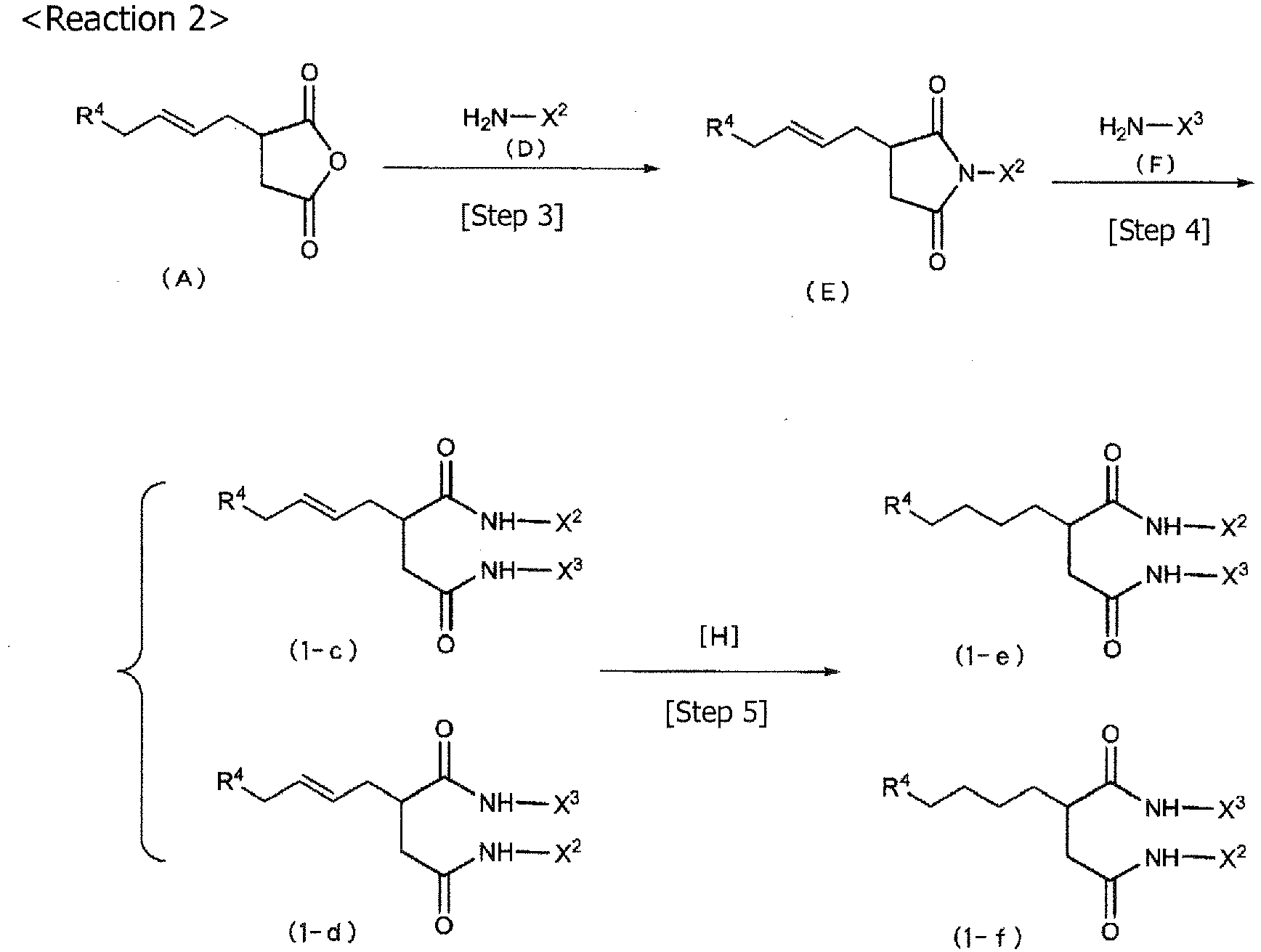
- [wherein Y represents a lower alkyl group (ethyl group, methyl group, etc.), R4 represents the same group as defined above, and each of X1, X2 and X3 represents the group as defined above for R1 or R2].
- Any of the alkenyl succinic anhydrides (A) used as a raw material is a known compound and can be prepared according to a known method (
JP 60-78975 A A - Incidentally, isolation of the compound in each of the reactions may be conducted, if necessary, by a purification method conventionally used in synthetic organic chemistry, such as filtration, washing, drying, recrystallization, various chromatographies, distillation or the like.
- The derivatives of succinic acid diamide represented by formula (1) of the invention need not necessarily be pure and may be crude products when used for various applications. For example, examples of the crude product include those having a purity of 80% by mass or more, 90% by mass or more, 95% by mass or more, even 98% by mass or more, or even more 99% by mass or more. For example, even if the crude product includes a reaction intermediate, i.e., a pyrrodinedione compound (E), it can develop functions as far as it has the above-mentioned purity.
- The derivative of succinic acid diamide represented by formula (1) of the invention exhibits functions similar to or superior to those of ceramides (ceramide-like functions) as shown by the examples described below. Specifically, the derivative forms a lamellar structure together with intercellular lipids in a horny cell layer, and exhibits a TEWL-suppressing effect and a water-retaining effect.
- Ceramides form a lamellar structure together with intercellular lipids (stearic acid, cholesterol, etc.) in a horny layer (lamellar forming ability) and have an important role in a skin moisture-retaining mechanism and a barrier mechanism (i.e., a TEWL-inhibiting mechanism)(G. Imokawa, et al., J. Invest. Dermatol., 87, 758-761 (1986)). By the lamellar forming ability herein is meant formation of a multi-lamellar structure consisting of a lipid bimembrane and a water layer like a horny layer of intercellular lipids. By the moisture-retaining mechanism is meant an effect to provide skin with flexibility by including an appropriate amount of water, thereby giving a smooth and beautiful skin. By the barrier mechanism is meant effects to prevent water from getting out of the body and keep the body not dried up, as well as to prevent external foreign matters from entering into the body.
- In the present invention, by the "ceramide-like functions" is meant to retain a lamellar-forming ability, a moisture-retaining mechanism and a barrier mechanism similar to or superior to those of natural ceramides.
- Accordingly, the derivative of succinic acid diamide represented by formula (1) of the invention can be an agent for imparting ceramide-like functions, a moisturizing agent and an agent for reinforcing a barrier function (abbreviated as "ceramide-like function-imparting agent and the like"), and, when applied to a human body, it can impart ceramide-like functions and reinforce a moisturizing effect and a barrier function.
- In the application to the human body as described above, the application may be a therapeutic use or non-therapeutic use. The term "non-therapeutic" means a concept that excludes medical practice, namely a concept that excludes operation, treatment or diagnosis of the human body, and specifically a concept that excludes a method for operating, treating or diagnosing the human body conducted by a physician or a person instructed by a physician.
- In addition, the derivative of succinic acid diamide represented by formula (1) of the invention can be used for producing a ceramide-like function-imparting agent and the like.
- The ceramide-like function-imparting agent and the like may themselves be a cosmetic, a medicine or a quasi-drug for imparting and providing ceramide-like functions, improving a water-retaining ability of skin (moisture retention) and reinforcing a barrier function of skin, or, alternatively, may be a material or a preparation to be incorporated into the cosmetic, medicine, quasi-drug or the like as a skin drug for external use.
- The medicine or quasi-drug may be administered in an optional dosage form. In the present invention, by the term "administration" is meant applying the derivative of succinic acid diamide represented by formula (1) to a subject via an administration route which can develop in the subject intended functions of imparting and providing ceramide-like functions, improving the water-retaining ability of skin (moisture retention) and reinforcing the barrier function of skin in an effective dose and for an effective period of time. The administration route includes a parenteral administration administered in any of the forms of, for example, injections, suppositories, inhalation drugs, transdermal drugs or external drugs, as well as an oral administration administered in any of the forms of tablets, capsule, granules, powders, syrups or the like. Among them, preferred is a parenteral administration, and more preferred is an external administration administered in the form of an external drug. The external administration herein is preferably conducted via a measure wherein a skin drug for external use (for example, in the form of ointment, emulsified cosmetic, cream, emulsion, lotion or gel), i.e., a preparation comprising the derivative of succinic acid diamide represented by formula (1), is caused to contact directly or indirectly with the whole of or a part of the skin surfaces of the human body (including skin surfaces after dehairing and also after removing horny cell layer) in an effective amount for an effective period of time (for example, from 0 to 24 hours, preferably from 3 to 24 hours) to deliver the derivative of succinic acid diamide to the epidermis and/or dermis or to a specified layer the skin. In this connection, the indirect contact includes a measure wherein the skin drug for external use is applied to a predetermined surface of an absorbent article such as diaper, sanitary napkin, panty liner or incontinence pad, i.e. a surface which contacts the skin of a wearer during wearing, whereby transferring the derivative of succinic acid diamide of formula (1) to the skin of the wearer. By this measure, the ceramide-like functions are imparted to the skin that contacts the surface applied with the drug, and irritation and redness of the skin can be inhibited. The absorbent article herein usually consists of a plural number of sheets (liquid-permeable sheets, liquid impermeable sheets) and an absorbent body, and no particular limitation is imposed on the structure thereof. The skin drug for external use (the derivative of succinic acid diamide of formula (1)) is applied to the absorbent article over the whole or a part of the surfaces where the skin of the wearer of the absorbent article comes into contact, as it is or after optionally adjusting the viscosity of the drug, by way of a coating method such as a dice coater method or a slot spraying method.
- For preparing the medicine or quasi-drug, the derivative of succinic acid diamide of formula (1) can be used solely or optionally in combination with a pharmaceutically acceptable excipient, binder, bulking agent, disintegrating agent, surfactant, lubricant, dispersant, buffering agent, preserving agent, flavoring agent, fragrance, coating agent, carrier, diluting agent or the like. These medicines or quasi-drugs may be incorporated with, besides the derivative of succinic acid diamide of formula (1), plant extracts, analgesic antiphlogistic agents, analgesic agents, bactericides, astringents, skin softening agents, hormones, vitamins, humectants, anti-inflammatory agents, algefacients, antiseborrheic agents or the like as long as they do not hinder the effects of the present invention.
- The content of the derivative of succinic acid diamide of formula (1) of the invention in the medicine or quasi-drug is preferably 0.001% by mass or more, more preferably 0.01% by mass or more, and preferably 10% by mass or less, more preferably 5% by mass or less, further more preferably 3% by mass or less. The content is preferably in the range of from 0.001 to 10% by mass, more preferably from 0.01 to 5% by mass, further more preferably from 0.01 to 3% by mass.
- In addition, a dose per day of the medicine or quasi-drug for an adult is, for example, preferably 0.001 mg or more, more preferably 0.01 mg or more, and preferably 1000 mg or less, more preferably 500 mg or less, reduced to the amount of the derivative of succinic acid diamide of formula (1) of the invention. In addition, the dose is preferably in the range of from 0.001 to 1000 mg, more preferably from 0.01 to 500 mg.
- The cosmetics may be any of skin drugs for external use, washing agents and make-up cosmetics. Depending on the method of use, the cosmetics are supplied in various forms such as beauty lotions, face lotions, massaging agents, lotions, emulsions, gels, creams, ointments, powders, packs, granules, foundations, lip sticks, bath additives, shampoos, hair conditioners, hair tonics, tablets, capsules, absorbent articles and sheet-like products.
- Such cosmetics can be prepared by using the derivative of succinic acid diamide of formula (1) of the invention solely or optionally in combination with oily ingredientss, humectants, powders, dyes, emulsifying agents, solubilizers, washing agents, ultraviolet absorbing agents, thickeners, medicinal ingredients, flavors, resins, bactericidal fungicidal agents, plant extracts, alcohols or the like. Incidentally, examples of the medicinal ingredients include, for example, sodium hyaluronate.
- The content of the derivative of succinic acid diamide of formula (1) of the invention in the cosmetics is preferably 0.001% by mass or more, more preferably 0.01% by mass or more, and preferably 10% by mass or less, more preferably 5% by mass or less, further more preferably 3% by mass or less. The content is preferably in the range of from 0.001 to 10% by mass, more preferably from 0.01 to 5% by mass, further more preferably from 0.01 to 3% by mass.
- The subject to be applied with the medicine, quasi-drug or cosmetic is not particularly limited as long as application thereof is required, but is preferably a human body which requires impartment of ceramide functions, reinforcement and soundness (returning to health) of skin barrier functions, and improvement (moisture retention) in water-retention ability (moisture retention) of skin.
- In regard to the above-mentioned modes, the following embodiments are disclosed by the present invention:
- <1> An agent for imparting ceramide-like function comprising as an effective ingredient a derivative of succinic acid diamide of the following formula (1).
- <2> An agent for reinforcing skin barrier function comprising as an effective ingredient a derivative of succinic acid diamide of the following formula (1).
- <3> A moisturizing agent comprising a derivative of succinic acid diamide of the following formula (1) as an effective ingredient.
- <4> A skin drug for external use comprising a derivative of succinic acid diamide of the following formula (1) as an effective ingredient.
- <5> Use of a derivative of succinic acid diamide of the following formula (1) for preparing an agent for imparting ceramide-like function.
- <6> Use of a derivative of succinic acid diamide of the following formula (1) for preparing an agent for reinforcing skin barrier function.
- <7> Use of a derivative of succinic acid diamide of the following formula (1) for preparing a moisturizing agent.
- <8> Use of a derivative of succinic acid diamide of the following formula (1) for preparing a skin drug for external use.
- <9> A derivative of succinic acid diamide of the following formula (1) for use in imparting ceramide-like function.
- <10> A derivative of succinic acid diamide of the following formula (1) for use in reinforcing skin barrier function.
- <11> A derivative of succinic acid diamide of the following formula (1) for use in moisturizing.
- <12> A derivative of succinic acid diamide of the following formula (1) for use in external use for skin.
- <13> A method for imparting ceramide-like function which comprises administering a derivative of succinic acid diamide of the following formula (1).
- <14> The method for imparting ceramide-like function according to <13>, comprising administering an effective amount of the derivative of succinic acid diamide of the following formula (1) to the human body for the purpose of reinforcing and returning to health of skin barrier functions or improvement in water-retention ability of skin.
- <15> The method for imparting ceramide-like function according to <14>, which comprising making the derivative of succinic acid diamide of the following formula (1) contact directly or indirectly with a skin surface of the human body to deliver an effective amount of the derivative of succinic acid diamide to the epidermis and/or dermis of the skin.
- <16> The method for imparting ceramide-like function according to <14> or <15>, comprising administering from 0.001 mg to 1000 mg per day of the derivative of succinic acid diamide of the following formula (1).
- <17> A method for reinforcing skin barrier function which comprises administering a derivative of succinic acid diamide of the following formula (1).
- <18> A method of moisturizing, comprising administering a derivative of succinic acid diamide of the following formula (1).
- <19> The derivative of succinic acid diamide according to <9> to <12>, which is for non-therapeutic use.
- <20> The method according to <13> to <18>, which is non-therapeutic.
- <21> In the foregoing <1> to <20>, the derivative of succinic acid diamide of formula (1) is preferably the one wherein both of R1 and R2 are a hydroxyalkyl group of from 1 to 6 carbon atoms.
- <22> In the foregoing <1> to <20>, the derivative of succinic acid diamide of formula (1) is preferably the one wherein both of R1 and R2 are a 2-hydroxyethyl group.
- <23> In the foregoing <1> to <22>, the content of the derivative of succinic acid diamide of formula (1) is preferably 0.001% by mass or more, more preferably 0.01% by mass or more, and preferably 10% by mass or less, more preferably 5% by mass or less, further more preferably 3% by mass or less. The content is preferably in the range of from 0.001 to 10% by mass, more preferably from 0.01 to 5% by mass, further more preferably from 0.01 to 3% by mass.
- <24> A derivative of succinic acid diamide represented by the following formula (2).
- <25> An absorbent article, wherein a derivative of succinic acid diamide of the following formula (1) is applied to the surface of the article which the skin of a wearer touches during use.
- <26> An absorbent article, wherein a ceramide-like function-imparting agent comprising as an effective ingredient a derivative of succinic acid diamide of the following formula (1) is applied to the surface of the article which the skin of a wearer touches during use.
- [wherein R1 and R2 each independently represents a hydroxyalkyl group of from 1 to 6 carbon atoms, R3 represents a group:-CH2CH2CH2CH2-R4 or a group: -CH2CH=CHCH2-R4 (wherein R4 represents an alkyl group of from 8 to 26 carbon atoms)].

- [wherein R1a and R2a represent a 2-hydroxyethyl group, R3a represents a group: -CH2CH2CH2CH2-R4a or a group: -CH2CH=CHCH2-R4a (wherein R4a represents an alkyl group of from 12 to 26 carbon atoms].
-


- Ethanolamine (50.4 g, 0.825 mol) was heated at 150°C with stirring under a nitrogen atmosphere, and thereto was added over one hour a molten alkenylsuccinic anhydride (mole ratio: C16/C18=6/4, synthesized from linealene 168 (IDEMITSU Kosan Co., Ltd.) and maleic anhydride) (54.5 g, 0.163 mol). After 9 hours, stirring was stopped and the reaction mixture was cooled to room temperature and solidified. Reaction products were dissolved in chloroform and subjected to purification by using a silica gel column (eluting solvent: a chloroform-methanol mixed liquid) to give 47.5 g of the aimed compound 1 (yield: 67%).
- white solid, melting point: 105°C;
IR (cm-1, ATR method) : 3293, 2917, 2849, 1637, 1551, 1026;
1H-NMR (CDCL3, ppm) : 0.85(t, J=7Hz, 3H), 1.10-1.38 (m, 24H), 1.90-2.01(m, 2H), 2.07-2.26(m, 1H), 2.26-2.40(m, 2H), 2.40-2.58(m, 1H), 2.64-2.77(m, 1H), 3.05-3.20(m, 2H), 3.44-3.66(m, 4H), 3.66-3.75(m, 2H), 5.23-5.35(m, 1H), 5.40-5.53(m, 1H), 6.74-6.90(m, 2H). -

- After Pd/C (0.3 g, 10%, Wako Pure Chemical Industries, Ltd.) was added to a solution of compound 1 (3.25 g, 7.42 mmol) in ethanol (150 ml) at room temperature under a nitrogen atmosphere, the atmosphere of the reaction system was changed to hydrogen. After one hour, crystals precipitated, and thus the reaction mixture was heated to 50°C, reacted for further 3 hours and then cooled to room temperature. After filtering to remove the Pd/C, the resultant reaction product was concentrated under reduced pressure to give 3.21 g of the aimed compound 2 (yield: 99%).
- white solid, melting point: 122°C;
IR (cm-1, ATR method): 3285, 29182, 2849, 1647, 1552, 1063;
1H-NMR(Pyridine-d5, ppm): 0.84(t, J=7Hz, 3H), 1.05-1.35(m, 28H), 1.38-1.48(m, 1H), 1.48-1.58(m, 1H), 1.58-1.68(m, 1H), 1.90-2.00(m, 1H), 2.64-2.75(m, 1H), 3.00-3.11(m, 1H), 3.25-3.35(m, 1H), 3.64-3.88(m, 4H), 3.94-4.12(m, 4H), 8.90-9.01(m, 1H), 9.01-9.10(m, 1H). -

- Similar to preparation example 1 except that propanolamine was used in place of ethanolamine, 44.1 g of the aimed compound 3 was synthesized (yield: 71%).
- white solid, melting point: 97°C;
IR (cm-1, ATR method): 3298, 2919, 2851, 1645, 1546, 1049;
1H-NMR(CDCL3, ppm): 0.85(t, J=7Hz, 3H), 1.11-1.38(m, 24H), 1.56-1.74(m, 4H), 1.90-2.01(m, 2H), 2.06-2.27(m, 1H), 2.27-2.40(m, 2H), 2.40-2.56(m, 1H), 2.65-2.78(m, 1H), 3.20-3.35(m, 2H), 3.35-3.50(m, 2H), 3.50-3.65(m, 4H), 5.22-5.35(m, 1H), 5.40-5.53(m, 1H), 6.5(bs, 2H) . -

- Similar to preparation example 1 except that DL-2-amino-1-propanol was used in place of ethanolamine, 35.8 g of the aimed compound 4 was synthesized (yield: 58%).
- white solid, melting point: 105°C;
IR (cm-1, ATR method): 3286, 2918, 2850, 1644, 1544, 1042;
1H-NMR(CDCL3, ppm): 0.85(t, J=7Hz, 3H), 1.03-1.18(m, 6H), 1.18-1.40(m, 24H), 1.88-2.03(m, 2H), 2.03-2.25(m, 1H), 2.25-2.88 (m, 4H), 3.28-3.72(m, 4H), 3.85-4.10(m, 2H), 5.22-5.38(m, 1H), 5.40-5.53(m, 1H), 6.30-6.50(m, 4H). -


- Similar to preparation example 1 except that an alkenylsuccinic anhydride (mole ratio: C20/C22/C24=5/4/1, synthesized from maleic anhydride and linealene 2024 (IDEMITSU Kosan Co., Ltd.)) was used in place of the alkenylsuccinic anhydride (mole ratio: C16/C18=6/4), 42 g of the aimed compound 5 was synthesized (yield: 66%).
- white solid, melting point: 130°C;
IR (cm-1, ATR method): 3283, 2917, 2849, 1636, 1552, 1052;
1H-NMR(CDCL3, ppm): 0.85(t, J=7Hz, 3H), 1.07-1.40(m, 34H), 1.84-2.01(m, 2H), 2.07-2.26(m, 1H), 2.26-2.42(m, 2H), 2.42-2.58(m, 1H), 2.70-2.78(m, 1H), 3.07-3.21(m, 2H), 3.47-3.64(m, 4H), 3.64-3.79(m, 2H), 5.22-5.36(m, 1H), 5.430-5.53(m, 1H), 6.70-6.95(m, 2H). -

- An alkenylsuccinic acid dimethyl ester (mole ratio: C16/C18=6/4, 15.0 g, 0.0392 mol), 2-amino-2-methyl-1,3-propanediol (8.25 g, 0.0785 mol) and 28% methanol solution of sodium methoxide (16.7 g, 0.0863 mol) were heated at 60°C with stirring under a nitrogen atmosphere. After 10 hours, stirring was stopped and the reaction mixture was cooled to room temperature and solidified. Reaction products were dissolved in chloroform and subjected to purification using a silica gel column (eluting solvent: a chloroform-methanol mixed liquid) to give 8.46 g of the aimed compound 6 (yield: 51%).
- pale yellow solid.
IR (cm-1, ATR method): 3280, 2922, 2852, 1638, 1558, 1049;
1H-NMR (CDCL3, ppm): 0.85(t, J=7Hz, 3H), 1.15(d, J=4Hz, 6H), 1.20-1.40(m, 24H), 1.91-2.02 (m, 2H), 2.10-2.27(m, 1H), 2.27-2.56(m, 3H), 2.60-2.72(m, 1H), 3.50-3.66(m, 4H), 3.66-3.79(m, 2H), 3.79-3.97(m, 2H), 5.23-5.35(m, 1H), 5.43-5.57(m, 1H), 6.32-6.50(m, 2H). -

- Similar to preparation example 6 except that tris(hydroxymethyl)aminomethane was used in place of 2-amino-2-methyl-1,3-propanediol, 5.73 g of the aimed compound 7 was synthesized (yield: 26%).
- white solid, melting point: 62°C;
IR (cm-1, ATR method): 3313, 2919, 2851, 1647, 1548, 1045;
1H-NMR(MeOH-d4, ppm): 0.91 (t, J=7Hz, 3H), 1.21-1.44(m, 24H), 1.95-2.10(m, 2H), 2.10-2.20(m, 1H), 2.20-2.45(m, 2H), 2.45-2.60(m, 1H), 2.67-2.80(m, 1H), 3.60-3.70(m, 12H), 3.66-3.79(m, 2H), 5.30-5.45(m, 1H), 5.45-5.58(m, 1H). -

- Isopropyl palmitate (300 g, 1.00 mol) and ethanolamine (82.0 g, 1.34 mol) were heated at 60°C with stirring under a nitrogen atmosphere, and thereto were added 17.1 g of a sodium ethoxide/ethanol solution (20 wt%, 50.3 mmol) and methanol (100 ml). Four hours later, disappearance of the raw material ester was confirmed by TLC analysis, and then methanol (500 ml) was added thereto and the reaction mixture was cooled to room temperature to allow crystallization. The resultant crystals were filtered off and washed with methanol to give 268 g of the aimed comparative compound 1 (yield: 89%).
- white solid, melting point: 100°C;
IR (cm-1, ATR method): 3293, 2917, 2849, 1638, 1552, 1056;
1H-NMR(CDCL3, ppm): 0.85(t, J=7Hz, 3H), 1.16-1.37(m, 24H), 1.57-1.66(m, 2H), 2.19(t, J=8Hz, 2H), 3.41 (q, J=5Hz, 2H), 3.71(t, J=5Hz, 2H), 6.05(bs, 1H). -

- Similar to preparation example 1 except that diglycolamine was used in place of ethanolamine, 35.8 g of the aimed comparative compound 2 was synthesized (yield: 58%).
- white solid, melting point: 57°C;
IR (cm-1, ATR method): 3284, 2919, 2851, 1651, 1552, 1068;
1H-NMR(CDCL3, ppm): 0.85(t, J=7Hz, 3H), 1.10-1.39(m, 24H), 1.90-2.01(m, 2H), 2.05-2.27(m, 1H), 2.27-2.39(m, 2H), 2.39-2.52(m, 1H), 2.60-2.70(m, 1H), 3.14-3.40(m, 2H), 3.40-3.64(m, 12H), 3.64-3.84(m, 2H), 5.20-5.35(m, 1H), 5.40-5.50(m, 1H), 6.77(bs, 1H), 6.87(bs, 1H). -

- Similar to preparation example 1 except that hexadecylamine was used in place of ethanolamine, 35.8 g of the aimed comparative compound 3 was synthesized (yield: 58%).
- white solid, melting point: 100°C;
IR (cm-1, ATR method): 3291, 2916, 2849, 1633, 1551;
1H-NMR(CDCL3, ppm): 0.85(t, J=7Hz, 9H), 1.08-1.39(m, 80H), 1.90-2.01(m, 2H), 2.05-2.23(m, 1H), 2.23-2.37(m, 2H), 2.37-2.48(m, 1H), 2.54-2.65(m, 1H), 3.07-3.26(m, 4H), 5.23-5.35(m, 1H), 5.40-5.50(m, 1H), 5.79(bs, 1H), 5.88(bs, 1H). -


- Similar to preparation example 1 except that (E)-3-(hexadeca/octadeca)-2-en-1-yl)-1-(2-hydroxyethyl)pyrroldine-2,5-dione (synthesized from an alkenylsuccinic anhydride (mole ratio: C16/C18=6/4) and ethanolamine) was used in place of the alkenylsuccinic anhydride (mole ratio: C16/C18=6/4), 5.94 g of the aimed comparative compound 4 was synthesized (yield: 35%).
- white solid, melting point: 130°C;
IR (cm-1, ATR method): 3288, 2917, 2850, 1634, 1548, 1055;
1H-NMR(CDCL3, ppm): 0.86(t, J=7Hz, 6H), 1.10-1.39(m, 52H), 1.39-1.50(m, 28H), 1.89-2.02(m, 2H), 2.08-2.23(m, 2H), 2.23-2.38(m, 2H),2.38-2.55(m, 1H), 2.59-2.68(m, 1H), 3.07-3.19(m, 1H), 3.19-3.32(m, 2H),3.37-3.47(m, 1H), 3.57-3.72(m, 2H), 5.23-5.36(m, 1H), 5.40-5.53(m, 1H), 5.82(bs, 1H), 6.37(bs, 1H) . - Evaluation of lamellar-formation ability was conducted according to the method by Mizushima et al. (Lipids, 30(4), 327-332 (1995)).
- Each of stearic acid and cholesterol, used as representatives of fatty acids that are horny layer intercellular lipids, as well as a sample to be evaluated was weighed to give an equimolar mixture, and an ion-exchange water was added thereto in an amount of 30 wt% of the weight of the lipids. The mixture was heat-melted and then cooled to give an evaluation sample.
- Wide-angle X-ray diffraction apparatus ((PANalytical) X' Pert MRD High Resolution X-ray Diffractometer)
- Small-angle X-ray scattering apparatus ((NANO Viewer manufactured by RIGAKU Corportion), Small-angle X-ray scattering)
- In the case where the wide-angle X-ray diffraction apparatus was used, sampling for measurement was conducted by finely grinding a sample in an agate mortar and packing the sample in a measurement cell to give a flat surface. In the case of small-angle X-ray scattering apparatus, the sample was packed in a cell made of stainless steel having grid openings of approximately 4 mm in width and 2 mm in depth.
- Conditions for wide-angle X-ray diffraction measurement: measurement cell: a cell for exclusive use made of stainless steel, applied voltage: 45 kV, applied current: 40 mA.
- measured range: 2 θ = 3° to 45° , measurement speed: 2θ= 1°/min.
- Conditions for small-angle X-ray measurement: measurement cell: a sample that was packed in a stainless steel holder having grid openings was measured.
- applied voltage: 40 mV, applied current: 30 mA, X-ray irradiation period: 30 minutes, measured at a camera length of from 450 to 650 mm using a detector with an imaging plate.
- In a wide-angle X-ray diffraction measurement, a symbol A was assigned to a sample wherein diffraction peaks originating from crystals of stearic acid and cholesterol disappeared and only the peaks originating from a lamellar structure were observed near 2 θ = 22°, a symbol B was assigned to a sample wherein diffraction peaks originating from crystals of stearic acid and cholesterol remained but peaks originating approximately from a lamellar structure were observed, a symbol C was assigned to a sample wherein peaks originating from a lamellar structure were observed only partly, and a symbol D was assigned to a sample wherein no peaks originating from a lamellar structure were observed. In addition, in a small-angle X-ray measurement, a symbol E was assigned to a sample wherein diffraction peaks originating from a periodic structure of lamellar structure were observed, and a symbol F was assigned to a sample wherein no diffraction peaks were observed.
- The results of the X-ray diffraction measurement of the evaluated samples are shown in Table 1.
-
[Table 1] Evaluated sample Evaluation of X-ray diffraction measurement wide-angle X-ray measurement small-angle X-ray measurement Compound 1 B E Compound 2 B E Compound 3 C E Compound 4 C E Compound 5 A E Compound 6 B E Compound 7 A E Comparative compound 1 D F Comparative compound 2 D F Comparative compound 3 D F Sphingolipid E (manufactured by Kao Corporation) A E Ceramide 2 (manufactured by SEDERMA) A E - Compounds 1-7 could form a lamellar structure together with stearic acid and cholesterol that are horny layer intercellular lipids, similar to Sphingolipid E and Ceramide 2 could.
- Evaluation as to occlusion was conducted according to the method by Akasaki et al. (Fragrance Journal, extra edition, No. 13, p. 65, 1994).
- Each of stearic acid and cholesterol, used as representatives of fatty acids that are horny layer intercellular lipids, and a sample to be evaluated was weighed into a screw tube, and a mixed liquid of chloroform and methanol (9:1 by volume) was used to give a 10% solution of the lipid mixture (w/v). A filter paper (ADVANTEC Co. Ltd., No. 5C, φ=21 mm) was immersed in the 10% solution, and then taken out, dried at room temperature, heated at 90°C for one hour, hydrated by a water sprayer, heat-treated at 60°C for 12 hours, and then cooled. The filter thus prepared was set in a vial charged with ion-exchange water (20 ml), and the weight of the filter was measured over time to calculate an amount of TEWL. As a control, was measured an amount of TEWL of a filter which had been immersed only in a mixed liquid of chloroform and methanol (9:1 by volume). A control rate of TEWL (%) was calculated according to the following equation:

- A inhibition rate of TEWL of each evaluated sample (%, an average of the results of three time measurements) is shown in Table 2. Compounds 1-7 exhibited a TEWL inhibiting effect comparable to that of sphingolipid E and Ceramide 2 which were reported to have a TEWL inhibiting effect.
[Table 2] Evaluated sample TEWL inhibition rate (%) Compound 1 29.8 Compound 2 34.0 Compound 3 39.3 Compound 4 33.2 Compound 5 43.2 Compound 6 40.1 Compound 7 37.0 Comparative compound 2 24.2 Comparative compound 4 27.4 Sphingolipid E (manufactured by Kao Corporation) 32.8 Ceramide 2 (manufactured by SEDERMA) 35.7 - Measurement on bonded water content was conducted according to the method by Akasaki et al. (Fragrance Journal, extra edition, No. 13, pp. 66-67, 1994).
- 1) Differential scan calorimetric analyzer: (DSC6100 (SII Seiko Instruments Inc.)).
- 2) Evaluation method
- A sample prepared by adding ion-exchange water to an equimolar mixture of stearic acid and cholesterol, both used as representatives of fatty acids that are a horny layer intercellular lipid, and a sample to be evaluated, was encapsulated in a cell, and the water content thereof was measured. The temperature of the sample was raised from-40°C at a rate of 1°C/minute to obtain an enthalpy change accompanied by the temperature raise. A bonded water content was determined from the relation between a water content of a lipid mixture (an amount of moisture absorbed) and a change of peak of enthalpy (melting heat), and an enthalpy change was obtained from the point 0.
- A bonded water content (% by weight) of each of the evaluated sample is shown in Table 3. Compounds 1-2 exhibited a water retention effect comparable to that of sphingolipid E and Ceramide 2 which were reported to have a high water retention effect.
[Table 3] Evaluated sample Bonded water content (% by mass) Compound 1 10.6 Compound 2 12.4 Sphingolipid E (manufactured by Kao Corporation) 7.1 Ceramide 2 (manufactured by SEDERMA) 6.0 - Two sites of irritated skin models in the inner side of front arm of each of ten healthy males and females aged from 20 to 50 were deemed as subject sites, and to one of the two sites was applied once a preparation of the present invention shown in Table 4 and to the other sites was applied once a comparative preparation. After 3 hours, these sites were washed and compared with each other as to the state of bare skin.
- The irritated skin models were prepared by mounting a glass cup to each of the two sites of the inner side of front arm, placing 10 ml of an acetone-ether mixture (1:1, v/v) in each of the glass cups, shaking the mixture for 30 minutes, placing 10 ml of distillation water in the cup immediately after discarding the solvent, followed by shaking for 10 minutes.
- An amount of TEWL and a water content of stratum corneum of the subject sites each before the irritated skin-inducing treatment (A), immediately after the treatment (B) and 3 hours after application of tested preparation (C) were measured according to the following method, and a degree of restoration of irritated skin was evaluated.
[Table 4] Wt % Preparation of the invention Comparative preparation Compound 5 2.02 - Cholesterol 1.58 1.58 Behenic acid 1.40 1.40 AMiSOFT HA-P 0.32 0.32 Arginine 0.18 0.18 86% Glycerine 9.30 9.30 Purified water 85.20 87.22 Total 100.00 100.00 - After washing a site to be measured, the site was habituated for 20 minutes in an environment in which the temperature was set to 20°C and the humidity was set to 40%. Using Corneometer CM825MP (Trade name, manufactured by Courage+Khazaka electronic GmbH), an average of 5 measured values per one site was deemed as a capacitance value of each subject site, and an average capacitance value of 10 panelists was calculated to evaluate a water content of stratum corneum. In addition, a capacitance restoration rate (%) was calculated as a rate of capacitance change Δ(B-C) caused by application of a tested preparation to irritated skin model, relative to a rate of capacitance change Δ(B-A) caused by the irritated skin-inducing treatment, whereby evaluating for each tested preparation improvement in water content of stratum corneum of irritated skin which had been decreased in water content of stratum corneum, and restoration effect. The results are shown in Table 5.

- After washing a site to be measured, the site was habituated under a condition set at 20°C and a humidity of 40% for 20 minutes. Using Tewameter TM300MP (Trade name, manufactured by Courage+Khazaka electronic GmbH), a value measured once per one site was deemed as a TEWL value of each subject site, and an average TEWL value of 10 panelists was calculated to evaluate a barrier function. In addition, a barrier function-restoration rate (%) was calculated as a rate of TEWL change Δ(B-C) caused by application of a tested preparation to irritated skin model, relative to a rate of TEWL change Δ(B-A) caused by irritated skin-inducing treatment, whereby evaluating for each tested preparation improvement in barrier function of irritated skin and restoration effect. The results are shown in Table 6.

-
[Table 5] Evaluation result of water content of stratum corneum average value±SD (n=10) Capacitance value A B C Capacitance restoration rate (%) Before irritated skin-inducing treatment Immediately after irritated skin-inducing treatment 3 hours after application Present preparation 36.1 ± 2.4 17.3 ± 2.0 25.3 ± 7.3 43.9 ± 38.8 Comparative preparation 36.2 ± 4.6 17.2 ± 3.9 21.6 ± 3.7 25.1 ± 15.2 [Table 6] Evaluation result of barrier function average value ±SD (n=10) TEWL value A B C Before irritated skin-inducing treatment Immediately after irritated skin-inducing treatment 3 hours after application barrier function-restoration rate (%) Present preparation 8.67 ± 2.25 12.03 ± 2.61 10.10 ± 2.21 65.5 ± 52.0 Comparative Preparation 8.66 ± 1.17 12.26 ± 2.17 11.08 ± 2.13 39.0 ± 42.8 - As apparent from Table 5, comparing each of the capacitance values, no difference is recognized between the present preparation and the control preparation, both before the irritated skin-inducing treatment and immediately after the irritated skin-inducing treatment. However, the present preparation exhibited a higher value than that of the control preparation three hours after the application. With regard to capacitance restoration rate, the present preparation exhibited a higher rate than that of the control preparation. Namely, the results shown in Table 5 indicate that the compound of the present invention has the effects of improving the water content of horn cell layer and restoring the content thereof for irritated skin in which the water content of stratum corneum has decreased.
- As apparent from Table 6, comparing each of the TEWL values, no difference is recognized between the present preparation and the control preparation both before the irritated skin-inducing treatment and immediately after the irritated skin-inducing treatment. However, after elapse of 3 hours after the application, the present preparation exhibited a significantly lower TEWL value than that of the control preparation (p<0.05). With regard to barrier function restoration rate, the present preparation exhibited a higher rate than that of the control preparation. Namely, the results shown in Table 6 indicate that the compound of the present invention has the effects of improving and restoring barrier function for irritated skin in which the barrier function thereof has decreased.
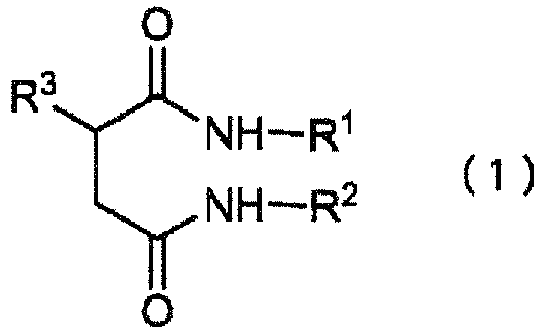

Claims (16)
- An agent for imparting ceramide-like functions, comprising as an effective ingredient a derivative of succinic acid diamide represented by the following formula (1) :

- An agent for reinforcing skin barrier function, comprising as an effective ingredient a derivative of succinic acid diamide represented by the following formula (1) :
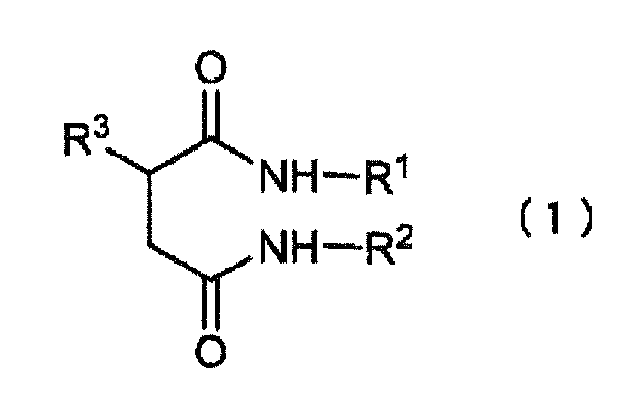
- A moisturizing agent comprising as an effective ingredient a derivative of succinic acid diamide represented by the following formula (1):

- A skin drug for external use, comprising a derivative of succinic acid diamide represented by the following formula (1):

- Use of a derivative of succinic acid diamide represented by the following formula (1):

- Use of a derivative of succinic acid diamide represented by the following formula (1) :

- Use of a derivative of succinic acid diamide represented by the following formula (1):

- Use of a derivative of succinic acid diamide represented by the following formula (1):

- A derivative of succinic acid diamide represented by the following formula (1):

- A derivative of succinic acid diamide represented by the following formula (1):

- A derivative of succinic acid diamide represented by the following formula (1) :

- A derivative of succinic acid diamide represented by the following formula (1):

- A method for imparting ceramide-like function, comprising administering a derivative of succinic acid diamide represented by the following formula (1) :

- A method for reinforcing skin barrier function, comprising administering a derivative of succinic acid diamide represented by the following formula (1):

- A method for moisturizing skin, comprising administering a derivative of succinic acid diamide represented by the following formula (1) :

- A derivative of succinic acid diamide represented by the following formula (2):

Applications Claiming Priority (2)
| Application Number | Priority Date | Filing Date | Title |
|---|---|---|---|
| JP2013049331 | 2013-03-12 | ||
| PCT/JP2014/056320 WO2014142116A1 (en) | 2013-03-12 | 2014-03-11 | Ceramide-like function imparting agent |
Publications (3)
| Publication Number | Publication Date |
|---|---|
| EP2974713A1 true EP2974713A1 (en) | 2016-01-20 |
| EP2974713A4 EP2974713A4 (en) | 2016-09-21 |
| EP2974713B1 EP2974713B1 (en) | 2019-05-01 |
Family
ID=51536770
Family Applications (1)
| Application Number | Title | Priority Date | Filing Date |
|---|---|---|---|
| EP14764366.2A Active EP2974713B1 (en) | 2013-03-12 | 2014-03-11 | Ceramide-like function imparting agent |
Country Status (6)
| Country | Link |
|---|---|
| US (1) | US10143667B2 (en) |
| EP (1) | EP2974713B1 (en) |
| JP (1) | JP6341699B2 (en) |
| CN (1) | CN105188655B (en) |
| TW (1) | TW201505660A (en) |
| WO (1) | WO2014142116A1 (en) |
Cited By (1)
| Publication number | Priority date | Publication date | Assignee | Title |
|---|---|---|---|---|
| US11976471B2 (en) | 2010-05-10 | 2024-05-07 | Unilin Bv | Floor panel |
Families Citing this family (4)
| Publication number | Priority date | Publication date | Assignee | Title |
|---|---|---|---|---|
| CN106256821B (en) * | 2015-06-19 | 2018-12-18 | 上海东升新材料有限公司 | A kind of alkenyl succinic anhydride and its preparation method and application |
| CN106316997B (en) * | 2015-06-19 | 2018-12-18 | 上海东升新材料有限公司 | A kind of alkenyl succinic anhydride and its preparation method and application |
| WO2019066644A1 (en) | 2017-09-28 | 2019-04-04 | Innexus Nutraceuticals B.V. | Methods for providing highly pure palmitoylethanolamide (pea), pure pea preparations, and uses thereof |
| WO2019070981A1 (en) * | 2017-10-05 | 2019-04-11 | Novomer, Inc. | Isocyanates, derivatives, and processes for producing the same |
Family Cites Families (11)
| Publication number | Priority date | Publication date | Assignee | Title |
|---|---|---|---|---|
| BE716351A (en) * | 1967-06-13 | 1968-12-10 | ||
| US4505832A (en) * | 1983-09-06 | 1985-03-19 | Texaco Inc. | Anti-fretting additive for grease comprising the reaction product of an alkenyl succinic anhydride and an alkanolamine |
| JPS6078975A (en) | 1983-10-05 | 1985-05-04 | Kao Corp | Production of alkenylsuccinic anhydride |
| MY100343A (en) | 1985-12-20 | 1990-08-28 | Kao Corp | Amide derivative and external medicament comprising same |
| JPS62228048A (en) | 1985-12-20 | 1987-10-06 | Kao Corp | Amide derivative and dermatic external drug containing same |
| DE4407016C1 (en) | 1994-03-03 | 1995-04-06 | Henkel Kgaa | Pseudoceramides |
| GB9424353D0 (en) | 1994-12-02 | 1995-01-18 | Ici Plc | Surfactants |
| US5541341A (en) * | 1995-03-24 | 1996-07-30 | Lever Brothers Company, Division Of Conopco, Inc. | Nonionic glycasuccinimide surfactants and a process for their manufacture |
| DE60043187D1 (en) | 1999-04-08 | 2009-12-03 | Kao Corp | COMPOSITIONS FOR EXTERNAL USAGE |
| CZ289465B6 (en) | 1999-10-29 | 2002-01-16 | Centropen A. S. | Washable ink easily removable from skin |
| JP2002047261A (en) | 2000-08-04 | 2002-02-12 | Kao Corp | External preparation composition |
-
2014
- 2014-03-11 CN CN201480014000.5A patent/CN105188655B/en not_active Expired - Fee Related
- 2014-03-11 TW TW103108484A patent/TW201505660A/en unknown
- 2014-03-11 EP EP14764366.2A patent/EP2974713B1/en active Active
- 2014-03-11 US US14/775,043 patent/US10143667B2/en active Active
- 2014-03-11 JP JP2014047799A patent/JP6341699B2/en active Active
- 2014-03-11 WO PCT/JP2014/056320 patent/WO2014142116A1/en not_active Ceased
Cited By (5)
| Publication number | Priority date | Publication date | Assignee | Title |
|---|---|---|---|---|
| US11976471B2 (en) | 2010-05-10 | 2024-05-07 | Unilin Bv | Floor panel |
| US12012764B2 (en) | 2010-05-10 | 2024-06-18 | Unilin Bv | Floor panel |
| US12031337B2 (en) | 2010-05-10 | 2024-07-09 | Unilin, Bv | Floor panel |
| US12123201B2 (en) | 2010-05-10 | 2024-10-22 | Unilin, Bv | Floor panel |
| US12612789B2 (en) | 2010-05-10 | 2026-04-28 | Unilin, Bv | Floor panel |
Also Published As
| Publication number | Publication date |
|---|---|
| JP6341699B2 (en) | 2018-06-13 |
| EP2974713A4 (en) | 2016-09-21 |
| EP2974713B1 (en) | 2019-05-01 |
| CN105188655B (en) | 2018-05-08 |
| CN105188655A (en) | 2015-12-23 |
| US10143667B2 (en) | 2018-12-04 |
| WO2014142116A1 (en) | 2014-09-18 |
| US20160038443A1 (en) | 2016-02-11 |
| JP2014198708A (en) | 2014-10-23 |
| TW201505660A (en) | 2015-02-16 |
Similar Documents
| Publication | Publication Date | Title |
|---|---|---|
| KR100987234B1 (en) | External preparation composition | |
| EP1166766B1 (en) | External preparation compositions | |
| EP2974713B1 (en) | Ceramide-like function imparting agent | |
| ITMI991884A1 (en) | COMPOSITIONS FOR SKIN CARE AND THEIR USE IN CARE FOR DAMAGED SKIN | |
| JP2001509138A (en) | Pseudoceramide-related compound and external preparation for skin containing the same | |
| EP1120407A1 (en) | Cysteine derivatives | |
| EP1408045B1 (en) | Novel galactosylceramide analogs and beta-glucocerebrosidase activators,external skin preparations and method of activating beta-glucocerebrosidase using the analogs | |
| EP1660437B1 (en) | Hydroxamic acid derivatives and the method for preparing thereof | |
| KR20040021724A (en) | Cosmetic Composition Comprising Novel Pseudo Ceramide for Preventing and Alleviating Atopic Dermatitis | |
| US8722729B2 (en) | Unsaturated fatty acid monoesters and diesters on ascorbic acid and cosmetic uses thereof | |
| EP3621950B1 (en) | Trpv1 modulator compounds | |
| JP2000327551A (en) | Moisturizer | |
| JP5328254B2 (en) | Ceramide production promoter | |
| JP3712676B2 (en) | External preparation composition | |
| AU2006217529C1 (en) | Crystalline ACAT inhibitor | |
| JP2002047261A (en) | External preparation composition | |
| JPH06321873A (en) | External agent for skin | |
| JP4150738B2 (en) | External preparation composition | |
| KR100899335B1 (en) | Adamantane Derivative Compounds Showing Elastase Inhibitory Effect and a Method for Preparing the Same | |
| JP3833945B2 (en) | Keratinization improver | |
| JPH06321766A (en) | External skin preparation | |
| KR20060005892A (en) | Hydroxamic Acid Derivatives and Methods for Preparing the Same | |
| JP2006008584A (en) | Topical skin preparation | |
| JPH06271449A (en) | Wrinkle improver and keratinization improver | |
| KR20170020112A (en) | Composition for enhancing skin elasticity comprising retinoids derivative as active ingredient |
Legal Events
| Date | Code | Title | Description |
|---|---|---|---|
| PUAI | Public reference made under article 153(3) epc to a published international application that has entered the european phase |
Free format text: ORIGINAL CODE: 0009012 |
|
| 17P | Request for examination filed |
Effective date: 20151008 |
|
| AK | Designated contracting states |
Kind code of ref document: A1 Designated state(s): AL AT BE BG CH CY CZ DE DK EE ES FI FR GB GR HR HU IE IS IT LI LT LU LV MC MK MT NL NO PL PT RO RS SE SI SK SM TR |
|
| AX | Request for extension of the european patent |
Extension state: BA ME |
|
| DAX | Request for extension of the european patent (deleted) | ||
| RIC1 | Information provided on ipc code assigned before grant |
Ipc: A61K 8/42 20060101AFI20160811BHEP Ipc: A61Q 19/00 20060101ALI20160811BHEP Ipc: A61P 17/16 20060101ALI20160811BHEP Ipc: A61K 31/164 20060101ALI20160811BHEP Ipc: C07C 233/20 20060101ALI20160811BHEP Ipc: A61K 9/00 20060101ALI20160811BHEP Ipc: A61Q 17/00 20060101ALI20160811BHEP |
|
| A4 | Supplementary search report drawn up and despatched |
Effective date: 20160822 |
|
| STAA | Information on the status of an ep patent application or granted ep patent |
Free format text: STATUS: EXAMINATION IS IN PROGRESS |
|
| 17Q | First examination report despatched |
Effective date: 20180102 |
|
| GRAP | Despatch of communication of intention to grant a patent |
Free format text: ORIGINAL CODE: EPIDOSNIGR1 |
|
| STAA | Information on the status of an ep patent application or granted ep patent |
Free format text: STATUS: GRANT OF PATENT IS INTENDED |
|
| INTG | Intention to grant announced |
Effective date: 20180822 |
|
| GRAS | Grant fee paid |
Free format text: ORIGINAL CODE: EPIDOSNIGR3 |
|
| GRAA | (expected) grant |
Free format text: ORIGINAL CODE: 0009210 |
|
| STAA | Information on the status of an ep patent application or granted ep patent |
Free format text: STATUS: THE PATENT HAS BEEN GRANTED |
|
| AK | Designated contracting states |
Kind code of ref document: B1 Designated state(s): AL AT BE BG CH CY CZ DE DK EE ES FI FR GB GR HR HU IE IS IT LI LT LU LV MC MK MT NL NO PL PT RO RS SE SI SK SM TR |
|
| REG | Reference to a national code |
Ref country code: GB Ref legal event code: FG4D |
|
| REG | Reference to a national code |
Ref country code: CH Ref legal event code: EP Ref country code: AT Ref legal event code: REF Ref document number: 1125963 Country of ref document: AT Kind code of ref document: T Effective date: 20190515 |
|
| REG | Reference to a national code |
Ref country code: DE Ref legal event code: R096 Ref document number: 602014045803 Country of ref document: DE |
|
| REG | Reference to a national code |
Ref country code: IE Ref legal event code: FG4D |
|
| REG | Reference to a national code |
Ref country code: NL Ref legal event code: MP Effective date: 20190501 |
|
| REG | Reference to a national code |
Ref country code: LT Ref legal event code: MG4D |
|
| PG25 | Lapsed in a contracting state [announced via postgrant information from national office to epo] |
Ref country code: NO Free format text: LAPSE BECAUSE OF FAILURE TO SUBMIT A TRANSLATION OF THE DESCRIPTION OR TO PAY THE FEE WITHIN THE PRESCRIBED TIME-LIMIT Effective date: 20190801 Ref country code: FI Free format text: LAPSE BECAUSE OF FAILURE TO SUBMIT A TRANSLATION OF THE DESCRIPTION OR TO PAY THE FEE WITHIN THE PRESCRIBED TIME-LIMIT Effective date: 20190501 Ref country code: HR Free format text: LAPSE BECAUSE OF FAILURE TO SUBMIT A TRANSLATION OF THE DESCRIPTION OR TO PAY THE FEE WITHIN THE PRESCRIBED TIME-LIMIT Effective date: 20190501 Ref country code: SE Free format text: LAPSE BECAUSE OF FAILURE TO SUBMIT A TRANSLATION OF THE DESCRIPTION OR TO PAY THE FEE WITHIN THE PRESCRIBED TIME-LIMIT Effective date: 20190501 Ref country code: AL Free format text: LAPSE BECAUSE OF FAILURE TO SUBMIT A TRANSLATION OF THE DESCRIPTION OR TO PAY THE FEE WITHIN THE PRESCRIBED TIME-LIMIT Effective date: 20190501 Ref country code: PT Free format text: LAPSE BECAUSE OF FAILURE TO SUBMIT A TRANSLATION OF THE DESCRIPTION OR TO PAY THE FEE WITHIN THE PRESCRIBED TIME-LIMIT Effective date: 20190901 Ref country code: ES Free format text: LAPSE BECAUSE OF FAILURE TO SUBMIT A TRANSLATION OF THE DESCRIPTION OR TO PAY THE FEE WITHIN THE PRESCRIBED TIME-LIMIT Effective date: 20190501 Ref country code: LT Free format text: LAPSE BECAUSE OF FAILURE TO SUBMIT A TRANSLATION OF THE DESCRIPTION OR TO PAY THE FEE WITHIN THE PRESCRIBED TIME-LIMIT Effective date: 20190501 Ref country code: NL Free format text: LAPSE BECAUSE OF FAILURE TO SUBMIT A TRANSLATION OF THE DESCRIPTION OR TO PAY THE FEE WITHIN THE PRESCRIBED TIME-LIMIT Effective date: 20190501 |
|
| PG25 | Lapsed in a contracting state [announced via postgrant information from national office to epo] |
Ref country code: BG Free format text: LAPSE BECAUSE OF FAILURE TO SUBMIT A TRANSLATION OF THE DESCRIPTION OR TO PAY THE FEE WITHIN THE PRESCRIBED TIME-LIMIT Effective date: 20190801 Ref country code: RS Free format text: LAPSE BECAUSE OF FAILURE TO SUBMIT A TRANSLATION OF THE DESCRIPTION OR TO PAY THE FEE WITHIN THE PRESCRIBED TIME-LIMIT Effective date: 20190501 Ref country code: LV Free format text: LAPSE BECAUSE OF FAILURE TO SUBMIT A TRANSLATION OF THE DESCRIPTION OR TO PAY THE FEE WITHIN THE PRESCRIBED TIME-LIMIT Effective date: 20190501 Ref country code: GR Free format text: LAPSE BECAUSE OF FAILURE TO SUBMIT A TRANSLATION OF THE DESCRIPTION OR TO PAY THE FEE WITHIN THE PRESCRIBED TIME-LIMIT Effective date: 20190802 |
|
| REG | Reference to a national code |
Ref country code: AT Ref legal event code: MK05 Ref document number: 1125963 Country of ref document: AT Kind code of ref document: T Effective date: 20190501 |
|
| PG25 | Lapsed in a contracting state [announced via postgrant information from national office to epo] |
Ref country code: IS Free format text: LAPSE BECAUSE OF FAILURE TO SUBMIT A TRANSLATION OF THE DESCRIPTION OR TO PAY THE FEE WITHIN THE PRESCRIBED TIME-LIMIT Effective date: 20190901 |
|
| PG25 | Lapsed in a contracting state [announced via postgrant information from national office to epo] |
Ref country code: RO Free format text: LAPSE BECAUSE OF FAILURE TO SUBMIT A TRANSLATION OF THE DESCRIPTION OR TO PAY THE FEE WITHIN THE PRESCRIBED TIME-LIMIT Effective date: 20190501 Ref country code: SK Free format text: LAPSE BECAUSE OF FAILURE TO SUBMIT A TRANSLATION OF THE DESCRIPTION OR TO PAY THE FEE WITHIN THE PRESCRIBED TIME-LIMIT Effective date: 20190501 Ref country code: EE Free format text: LAPSE BECAUSE OF FAILURE TO SUBMIT A TRANSLATION OF THE DESCRIPTION OR TO PAY THE FEE WITHIN THE PRESCRIBED TIME-LIMIT Effective date: 20190501 Ref country code: AT Free format text: LAPSE BECAUSE OF FAILURE TO SUBMIT A TRANSLATION OF THE DESCRIPTION OR TO PAY THE FEE WITHIN THE PRESCRIBED TIME-LIMIT Effective date: 20190501 Ref country code: DK Free format text: LAPSE BECAUSE OF FAILURE TO SUBMIT A TRANSLATION OF THE DESCRIPTION OR TO PAY THE FEE WITHIN THE PRESCRIBED TIME-LIMIT Effective date: 20190501 Ref country code: CZ Free format text: LAPSE BECAUSE OF FAILURE TO SUBMIT A TRANSLATION OF THE DESCRIPTION OR TO PAY THE FEE WITHIN THE PRESCRIBED TIME-LIMIT Effective date: 20190501 |
|
| REG | Reference to a national code |
Ref country code: DE Ref legal event code: R097 Ref document number: 602014045803 Country of ref document: DE |
|
| PG25 | Lapsed in a contracting state [announced via postgrant information from national office to epo] |
Ref country code: IT Free format text: LAPSE BECAUSE OF FAILURE TO SUBMIT A TRANSLATION OF THE DESCRIPTION OR TO PAY THE FEE WITHIN THE PRESCRIBED TIME-LIMIT Effective date: 20190501 Ref country code: SM Free format text: LAPSE BECAUSE OF FAILURE TO SUBMIT A TRANSLATION OF THE DESCRIPTION OR TO PAY THE FEE WITHIN THE PRESCRIBED TIME-LIMIT Effective date: 20190501 |
|
| PLBE | No opposition filed within time limit |
Free format text: ORIGINAL CODE: 0009261 |
|
| STAA | Information on the status of an ep patent application or granted ep patent |
Free format text: STATUS: NO OPPOSITION FILED WITHIN TIME LIMIT |
|
| PG25 | Lapsed in a contracting state [announced via postgrant information from national office to epo] |
Ref country code: TR Free format text: LAPSE BECAUSE OF FAILURE TO SUBMIT A TRANSLATION OF THE DESCRIPTION OR TO PAY THE FEE WITHIN THE PRESCRIBED TIME-LIMIT Effective date: 20190501 |
|
| 26N | No opposition filed |
Effective date: 20200204 |
|
| PG25 | Lapsed in a contracting state [announced via postgrant information from national office to epo] |
Ref country code: PL Free format text: LAPSE BECAUSE OF FAILURE TO SUBMIT A TRANSLATION OF THE DESCRIPTION OR TO PAY THE FEE WITHIN THE PRESCRIBED TIME-LIMIT Effective date: 20190501 |
|
| PG25 | Lapsed in a contracting state [announced via postgrant information from national office to epo] |
Ref country code: SI Free format text: LAPSE BECAUSE OF FAILURE TO SUBMIT A TRANSLATION OF THE DESCRIPTION OR TO PAY THE FEE WITHIN THE PRESCRIBED TIME-LIMIT Effective date: 20190501 |
|
| PG25 | Lapsed in a contracting state [announced via postgrant information from national office to epo] |
Ref country code: MC Free format text: LAPSE BECAUSE OF FAILURE TO SUBMIT A TRANSLATION OF THE DESCRIPTION OR TO PAY THE FEE WITHIN THE PRESCRIBED TIME-LIMIT Effective date: 20190501 |
|
| REG | Reference to a national code |
Ref country code: CH Ref legal event code: PL |
|
| REG | Reference to a national code |
Ref country code: BE Ref legal event code: MM Effective date: 20200331 |
|
| PG25 | Lapsed in a contracting state [announced via postgrant information from national office to epo] |
Ref country code: LU Free format text: LAPSE BECAUSE OF NON-PAYMENT OF DUE FEES Effective date: 20200311 |
|
| PG25 | Lapsed in a contracting state [announced via postgrant information from national office to epo] |
Ref country code: CH Free format text: LAPSE BECAUSE OF NON-PAYMENT OF DUE FEES Effective date: 20200331 Ref country code: IE Free format text: LAPSE BECAUSE OF NON-PAYMENT OF DUE FEES Effective date: 20200311 Ref country code: LI Free format text: LAPSE BECAUSE OF NON-PAYMENT OF DUE FEES Effective date: 20200331 |
|
| PG25 | Lapsed in a contracting state [announced via postgrant information from national office to epo] |
Ref country code: BE Free format text: LAPSE BECAUSE OF NON-PAYMENT OF DUE FEES Effective date: 20200331 |
|
| PGFP | Annual fee paid to national office [announced via postgrant information from national office to epo] |
Ref country code: GB Payment date: 20220127 Year of fee payment: 9 Ref country code: DE Payment date: 20220203 Year of fee payment: 9 |
|
| PG25 | Lapsed in a contracting state [announced via postgrant information from national office to epo] |
Ref country code: MT Free format text: LAPSE BECAUSE OF FAILURE TO SUBMIT A TRANSLATION OF THE DESCRIPTION OR TO PAY THE FEE WITHIN THE PRESCRIBED TIME-LIMIT Effective date: 20190501 Ref country code: CY Free format text: LAPSE BECAUSE OF FAILURE TO SUBMIT A TRANSLATION OF THE DESCRIPTION OR TO PAY THE FEE WITHIN THE PRESCRIBED TIME-LIMIT Effective date: 20190501 |
|
| PGFP | Annual fee paid to national office [announced via postgrant information from national office to epo] |
Ref country code: FR Payment date: 20220209 Year of fee payment: 9 |
|
| PG25 | Lapsed in a contracting state [announced via postgrant information from national office to epo] |
Ref country code: MK Free format text: LAPSE BECAUSE OF FAILURE TO SUBMIT A TRANSLATION OF THE DESCRIPTION OR TO PAY THE FEE WITHIN THE PRESCRIBED TIME-LIMIT Effective date: 20190501 |
|
| REG | Reference to a national code |
Ref country code: DE Ref legal event code: R119 Ref document number: 602014045803 Country of ref document: DE |
|
| GBPC | Gb: european patent ceased through non-payment of renewal fee |
Effective date: 20230311 |
|
| PG25 | Lapsed in a contracting state [announced via postgrant information from national office to epo] |
Ref country code: GB Free format text: LAPSE BECAUSE OF NON-PAYMENT OF DUE FEES Effective date: 20230311 |
|
| PG25 | Lapsed in a contracting state [announced via postgrant information from national office to epo] |
Ref country code: GB Free format text: LAPSE BECAUSE OF NON-PAYMENT OF DUE FEES Effective date: 20230311 Ref country code: FR Free format text: LAPSE BECAUSE OF NON-PAYMENT OF DUE FEES Effective date: 20230331 Ref country code: DE Free format text: LAPSE BECAUSE OF NON-PAYMENT OF DUE FEES Effective date: 20231003 |