EP2970534B1 - Process for the preparation of propylene terpolymers - Google Patents
Process for the preparation of propylene terpolymers Download PDFInfo
- Publication number
- EP2970534B1 EP2970534B1 EP14707993.3A EP14707993A EP2970534B1 EP 2970534 B1 EP2970534 B1 EP 2970534B1 EP 14707993 A EP14707993 A EP 14707993A EP 2970534 B1 EP2970534 B1 EP 2970534B1
- Authority
- EP
- European Patent Office
- Prior art keywords
- butene
- bis
- ethylene
- weight
- dimethoxypropane
- Prior art date
- Legal status (The legal status is an assumption and is not a legal conclusion. Google has not performed a legal analysis and makes no representation as to the accuracy of the status listed.)
- Active
Links
Classifications
-
- C—CHEMISTRY; METALLURGY
- C08—ORGANIC MACROMOLECULAR COMPOUNDS; THEIR PREPARATION OR CHEMICAL WORKING-UP; COMPOSITIONS BASED THEREON
- C08F—MACROMOLECULAR COMPOUNDS OBTAINED BY REACTIONS ONLY INVOLVING CARBON-TO-CARBON UNSATURATED BONDS
- C08F210/00—Copolymers of unsaturated aliphatic hydrocarbons having only one carbon-to-carbon double bond
- C08F210/04—Monomers containing three or four carbon atoms
- C08F210/06—Propene
-
- C—CHEMISTRY; METALLURGY
- C08—ORGANIC MACROMOLECULAR COMPOUNDS; THEIR PREPARATION OR CHEMICAL WORKING-UP; COMPOSITIONS BASED THEREON
- C08F—MACROMOLECULAR COMPOUNDS OBTAINED BY REACTIONS ONLY INVOLVING CARBON-TO-CARBON UNSATURATED BONDS
- C08F4/00—Polymerisation catalysts
- C08F4/42—Metals; Metal hydrides; Metallo-organic compounds; Use thereof as catalyst precursors
- C08F4/44—Metals; Metal hydrides; Metallo-organic compounds; Use thereof as catalyst precursors selected from light metals, zinc, cadmium, mercury, copper, silver, gold, boron, gallium, indium, thallium, rare earths or actinides
- C08F4/60—Metals; Metal hydrides; Metallo-organic compounds; Use thereof as catalyst precursors selected from light metals, zinc, cadmium, mercury, copper, silver, gold, boron, gallium, indium, thallium, rare earths or actinides together with refractory metals, iron group metals, platinum group metals, manganese, rhenium technetium or compounds thereof
- C08F4/62—Refractory metals or compounds thereof
- C08F4/64—Titanium, zirconium, hafnium or compounds thereof
- C08F4/65—Pretreating the metal or compound covered by group C08F4/64 before the final contacting with the metal or compound covered by group C08F4/44
- C08F4/652—Pretreating with metals or metal-containing compounds
- C08F4/654—Pretreating with metals or metal-containing compounds with magnesium or compounds thereof
- C08F4/6543—Pretreating with metals or metal-containing compounds with magnesium or compounds thereof halides of magnesium
Definitions
- the present invention relates to a process for the preparation of propylene terpolymers and to propylene terpolymers obtained thereby.
- the propylene terpolymers obtained by the process of the present invention are suitable to be used in film applications, particularly for mono- and bi-oriented films and for heat-sealable films.
- Propylene copolymers and terpolymers have been used in film applications because, with respect to propylene homopolymers, are characterized by a better impact, lower rigidity and better transparency. It is however difficult to find an acceptable balance between those properties that are often contrasting. For example, when a certain softness is desired, that is commonly obtained in the presence of high amount of xylene-soluble fractions that make them unsuitable for food contact applications. Moreover, for heat-seal applications it is important to have a sufficiently wide processability window, i.e. the range of temperatures comprised between the melting point and the seal initiation temperature.
- the present invention provides a process as described in claim 1
- the succinate is preferably selected from succinates of formula (I):
- R3 and/or R4 radicals are secondary alkyls like isopropyl, sec-butyl, 2-pentyl, 3-pentyl or cycloalkyls like cyclohexyl, cyclopentyl, cyclohexylmethyl.
- Examples of the above-mentioned compounds are the (S,R) (S,R) forms pure or in mixture, optionally in racemic form, of diethyl 2,3-bis(trimethylsilyl)succinate, diethyl 2,3-bis(2-ethylbutyl)succinate, diethyl 2,3-dibenzylsuccinate, diethyl 2,3-diisopropylsuccinate, diisobutyl 2,3-diisopropylsuccinate, diethyl 2,3-bis(cyclohexylmethyl)succinate, diethyl 2,3-diisobutylsuccinate, diethyl 2,3-dineopentylsuccinate, diethyl 2,3-dicyclopentylsuccinate, diethyl 2,3-dicyclohexylsuccinate.
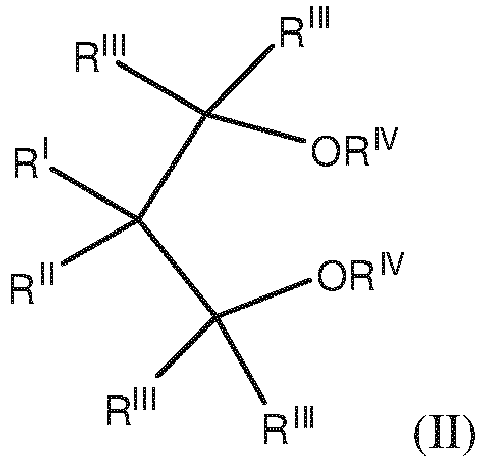
- RI and RII are the same or different and are hydrogen or linear or branched C1-C18 hydrocarbon groups which can also form one or more cyclic structures;
- each of RI to RIV groups can contain heteroatoms selected from halogens, N, O, S and Si.
- RIV is a 1-6 carbon atom alkyl radical and more particularly a methyl while the RIII radicals are preferably hydrogen.
- RII can be ethyl, propyl, isopropyl, butyl, isobutyl, tert-butyl, isopentyl, 2-ethylhexyl, cyclopentyl, cyclohexyl, methylcyclohexyl, phenyl or benzyl;
- RII when RI is hydrogen, RII can be ethyl, butyl, sec-butyl, tert-butyl, 2-ethylhexyl, cyclohexylethyl, diphenylmethyl, p-chlorophenyl, 1-naphthyl, 1-decahydronaphthyl; RI and RII can also be the
- ethers that can be advantageously used include: 2-(2-ethylhexyl)1,3-dimethoxypropane, 2-isopropyl-1,3-dimethoxypropane, 2-butyl-1,3-dimethoxypropane, 2-sec-butyl-1,3 -dimethoxypropane, 2-cyclohexy1-1,3 -dimethoxypropane, 2-phenyl-1,3-dimethoxypropane, 2-tert-butyl-1,3-dimethoxypropane, 2-cumyl-1,3-dimethoxypropane, 2-(2-phenylethyl)-1,3-dimethoxypropane, 2-(2-cyclohexylethyl)-1,3-dimethoxypropane, 2-(p-chlorophenyl)-1,3-dimethoxypropane, 2-(diphenylmethyl)-1,3-dimethoxypropane, 2(1-e,
- radicals RIV have the same meaning explained above and the radicals RIII and RV radicals, equal or different to each other, are selected from the group consisting of hydrogen; halogens, preferably Cl and F; C1-C20 alkyl radicals, linear or branched; C3-C20 cycloalkyl, C6-C20 aryl, C7-C20 alkaryl and C7-C20 aralkyl radicals and two or more of the RV radicals can be bonded to each other to form condensed cyclic structures, saturated or unsaturated, optionally substituted with RVI radicals selected from the group consisting of halogens, preferably Cl and F; C1-C20 alkyl radicals, linear or branched; C3-C20 cycloalkyl, C6-C20 aryl, C7-C20 alkaryl and C7-C20 aralkyl radicals; said radicals RV and RVI optional
- all the R III radicals are hydrogen, and all the R IV radicals are methyl.
- RVI radicals equal or different are hydrogen; halogens, preferably Cl and F; C1-C20 alkyl radicals, linear or branched; C3-C20 cycloalkyl, C6-C20 aryl, C7-C20 alkylaryl and C7-C20 aralkyl radicals, optionally containing one or more heteroatoms selected from the group consisting of N, 0, S, P, Si and halogens, in particular Cl and F, as substitutes for carbon or hydrogen atoms, or both; the radicals RIII and RIV are as defined above for formula (II).
- the catalyst component (a) comprises, in addition to the above electron donors, a titanium compound having at least a Ti-halogen bond and a Mg halide.
- the magnesium halide is preferably MgCl2 in active form which is widely known from the patent literature as a support for Ziegler-Natta catalysts.
- Patents USP 4,298,718 and USP 4,495,338 were the first to describe the use of these compounds in Ziegler-Natta catalysis.
- magnesium dihalides in active form used as support or co-support in components of catalysts for the polymerization of olefins are characterized by X-ray spectra in which the most intense diffraction line that appears in the spectrum of the non-active halide is diminished in intensity and is replaced by a halo whose maximum intensity is displaced towards lower angles relative to that of the more intense line.
- the preferred titanium compounds used in the catalyst component of the present invention are TiCl4 and TiCl3; furthermore, also Ti-haloalcoholates of formula Ti(OR)n-yXy can be used, where n is the valence of titanium, y is a number between 1 and n-1 X is halogen and R is a hydrocarbon radical having from 1 to 10 carbon atoms.
- the catalyst component (a) has an average particle size ranging from 15 to 80 ⁇ m, more preferably from 20 to 70 ⁇ m and even more preferably from 25 to 65 ⁇ m.
- the succinate is present in an amount ranging from 40 to 90% by weight with respect to the total amount of donors. Preferably it ranges from 50 to 85% by weight and more preferably from 65 to 80% by weight.
- the 1,3-diether preferably constitutes the remaining amount.
- the alkyl-Al compound (b) is preferably chosen among the trialkyl aluminum compounds such as for example triethylaluminum, tri-n-hexylaluminum, tri-n-octylaluminum. It is also possible to use mixtures of trialkylaluminum's with alkylaluminum halides, alkylaluminum hydrides or alkylaluminum sesquichlorides such as AlEt2Cl and Al2Ft3Cl3.
- Preferred external electron-donor compounds include silicon compounds, ethers, esters such as ethyl 4-ethoxybenzoate, amines, heterocyclic compounds and particularly 2,2,6,6-tetramethyl piperidine, ketones and the 1,3-diethers.
- Another class of preferred external donor compounds is that of silicon compounds of formula Ra5Rb6Si(OR7)c, where a and b are integer from 0 to 2, c is an integer from 1 to 3 and the sum (a+b+c) is 4; R5, R6, and R7, are alkyl, cycloalkyl or aryl radicals with 1-18 carbon atoms optionally containing heteroatoms.
- diisopropyldimethoxysilane dicyclopentyldimethoxysilane, methylcyclohexyldimethoxysilane, diphenyldimethoxysilane, methyl-t-butyldimethoxysilane, 2-ethylpiperidinyl-2-t-butyldimethoxysilane, 1,1,1,trifluoropropyl-2-ethylpiperidinyl-dimethoxysilane and 1,1,1,trifluoropropyl-metil-dimethoxysilane.
- the external electron donor compound is used in such an amount to give a molar ratio between the organo-aluminum compound and said electron donor compound of from 5 to 500, preferably from 5 to 400 and more preferably from 10 to 200.
- the catalyst forming components can be contacted with a liquid inert hydrocarbon solvent such as, e.g., propane, n-hexane or n-heptane, at a temperature below about 60°C and preferably from about 0 to 30°C for a time period of from about 6 seconds to 60 minutes.
- a liquid inert hydrocarbon solvent such as, e.g., propane, n-hexane or n-heptane
- the above catalyst components (a), (b) and optionally (c) can be fed to a pre-contacting vessel, in amounts such that the weight ratio (b)/(a) is in the range of 0.1-10 and if the compound (c) is present, the weight ratio (b)/(c) is weight ratio corresponding to the molar ratio as defined above.
- the said components are pre-contacted at a temperature of from 10 to 20°C for 1-30 minutes.
- the precontact vessel is generally a stirred tank reactor.
- the precontacted catalyst is then fed to a prepolymerization reactor where a prepolymerization step takes place.
- the prepolymerization step can be carried out in a first reactor selected from a loop reactor or a continuously stirred tank reactor, and is generally carried out in liquid-phase.
- the liquid medium comprises liquid alpha-olefin monomer(s), optionally with the addition of an inert hydrocarbon solvent.
- Said hydrocarbon solvent can be either aromatic, such as toluene, or aliphatic, such as propane, hexane, heptane, isobutane, cyclohexane and 2,2,4-trimethylpentane.
- step (i)a is carried out in the absence of inert hydrocarbon solvents.
- the average residence time in the pre-polymerization reactor generally ranges from 2 to 40 minutes, preferably from 5 to 25 minutes.
- the temperature ranges between 10°C and 50°C, preferably between 15°C and 35°C. Adopting these conditions allows to obtain a pre-polymerization degree in the preferred range from 60 to 800g per gram of solid catalyst component, preferably from 150 to 500 g per gram of solid catalyst component.
- Step (i)a is further characterized by a low concentration of solid in the slurry, typically in the range from 50 g to 300 g of solid per liter of slurry.
- the slurry containing the catalyst preferably in pre-polymerized form, is discharged from the pre-polymerization reactor and fed to a gas-phase or liquid-phase polymerization reactor.
- a gas-phase reactor it generally consists of a fluidized or stirred, fixed bed reactor or a reactor comprising two interconnected polymerization zones one of which, working under fast fluidization conditions and the other in which the polymer flows under the action of gravity.
- the liquid phase process can be either in slurry, solution or bulk (liquid monomer). This latter technology can be carried out in various types of reactors such as continuous stirred tank reactors, loop reactors or plug-flow ones.
- the polymerization is run in sequential steps whereby the product exiting the first polymerization reactor is sent to a second polymerization reactor and then possibly to further reactor(s).
- the polymerization is generally carried out at temperature of from 20 to 120°C, preferably of from 40 to 85°C.
- the operating pressure is generally between 0.5 and 10 MPa, preferably between 1 and 5 MPa.
- the operating pressure is generally between 1 and 6 MPa preferably between 1.5 and 4 MPa.
- Hydrogen can be used as a molecular weight regulator.
- the propylene terpolymers obtained with the process of the present invention contain preferably from 0.5 to 6 % by weight, more preferably from 0.6 to 4 % by weight, even more preferably from 0.7 to 3.5 % by weight of ethylene units, and preferably from 2.5 to 15 % by weight, more preferably from 3.5 to 13 % by weight, even more preferably from 5 to 11 % by weight of 1-butene.
- the terpolymers have the following preferred features:
- the terpolymers of the present invention have the additional advantage that the films produced therefrom do not contain phthalate residues.
- the terpolymers of the present invention can also contain additives commonly employed in the art, such as antioxidants, light stabilizers, heat stabilizers, nucleating agents, colorants and fillers. Particularly, they can comprise an inorganic filler agent in an amount ranging from 0.5 to 60 parts by weight with respect to 100 parts by weight of the said heterophasic polyolefin composition. Typical examples of such filler agents are calcium carbonate, barium sulphate, titanium bioxide and talc. Talc and calcium carbonate are preferred. A number of filler agents can also have a nucleating effect, such as talc that is also a nucleating agent. The amount of a nucleating agent is typically from 0.5 to 5 wt% with respect to the polymer amount.
- the molecular weight of the terpolymers can be modified by visbreaking according to well-known techniques.
- the terpolymer of propylene, ethylene and 1-butene comprising from 0.5 to 6 % by weight of ethylene units and from 2.5 to 15 % by weight of 1-butene units, obtained with the process of the present invention, have:
- Selected terpolymers according to the invention satisfy the relation: 7 C2 + 3.2 C4 + SIT ⁇ 145 and even 7 C2 + 3.2 C4 + SIT ⁇ 144
- the melting point (Tm) of the terpolymers of propylene, ethylene and 1-butene according to the present invention is preferably higher than 132°C, more preferably higher than 133°C.
- the terpolymers of propylene comprising comonomer units derived from ethylene and from 1-butene have preferably the intrinsic viscosity of the xylene-soluble fraction (XSIV) higher than 0.7 dL/g, preferably higher than 0.8 dL/g.
- the present invention provides a terpolymer of propylene comprising comonomer units derived from ethylene and from 1-butene, wherein the % of 1-butene units in the xylene-soluble fraction (C4XS) and the % of ethylene units in the terpolymer (C4TOT), both determined via 13C-NMR analysis, satisfy the following relation: C4XS/C4TOT > 1.8 preferably C 4 XS / C 4 TOT > 2.0
- the terpolymers obtained with the process of claim 1 have the % of ethylene units in the xylene-soluble fraction (C2XS) and the % of ethylene units in the terpolymer (C2TOT), both determined via 13C-NMR analysis, satisfy the following relation: C 2 XS / C 2 TOT ⁇ 3.5 preferably: C 2 XS / C 2 TOT ⁇ 3.0
- the terpolymers of propylene, ethylene and 1-butene comprising from 0.5 to 6 % by weight of ethylene units and from 2.5 to 15 % by weight of 1-butene units, have the intrinsic viscosity of the xylene-insoluble fraction (XIIV) and intrinsic viscosity of the xylene-soluble fraction (XSIV) satisfying the following relation: XIIV / XSIV ⁇ 3.0 preferably: XIIV / XSIV ⁇ 2.8 more preferably: XIIV / XSIV ⁇ 2.5
- the terpolymer of propylene, ethylene and 1-butene comprising from 0.5 to 6 % by weight of ethylene units and from 2.5 to 15 % by weight of 1-butene units, have the intrinsic viscosity of the xylene-soluble fraction (XSIV) and intrinsic viscosity of the final terpolymer (IV) satisfying the following relation: XSIV / IV > 0.35 preferably: XSIV / IV > 0.40
- the terpolymer of propylene, ethylene and 1-butene comprising from 0.5 to 6 % by weight of ethylene units and from 2.5 to 15 % by weight of 1-butene units, have the intrinsic viscosity of the xylene-soluble fraction (XSIV) and intrinsic viscosity of the final terpolymer (IV) satisfying the following relation: XSIV ⁇ XS / IV > 3.0 preferably: XSIV ⁇ XS / IV > 3.5
- the propylene terpolymers produced according to claim 1 contain preferably from 0.5 to 6 % by weight, more preferably from 0.6 to 4 % by weight, even more preferably from 0.7 to 3.5 % by weight of ethylene units. They contain preferably from 2.5 to 15 % by weight, more preferably from 3.5 to 13 % by weight, even more preferably from 5 to 11 % by weight of 1-butene units.
- the terpolymers of propylene, ethylene and 1-butene contain from 1.7 to 3.5 % by weight, preferably from 1.5 to 3.2 % by weight of ethylene units, and from 4.5 to 10.0 % by weight, preferably from 5.0 to 9.0 % by weight of 1-butene units.
- the terpolymers of propylene, ethylene and 1-butene contain from 0.6 to 1.4 % by weight, preferably from 0.8 to 1.2 % by weight of ethylene units, and from 8.0 to 12.0% by weight, preferably from 9.0 to 11.0 % by weight of 1-butene units.
- the terpolymers can be used to prepare films endowed with excellent sealing behavior.
- the films obtained from a terpolymer of propylene, ethylene and 1-butene comprising from 0.5 to 6 % by weight of ethylene units and from 2.5 to 15 % by weight of 1-butene units, wherein
- the content of comonomers was determined by infrared spectroscopy by collecting the IR spectrum of the sample vs. an air background with a Fourier Transform Infrared spectrometer (FTIR).
- FTIR Fourier Transform Infrared spectrometer
- the spectra of the unknown samples are recorded and then (At), (AC2) and (DC4) of the unknown sample are calculated.
- the ethylene content (% molar fraction C2m) of the sample was calculated as follows:
- the 1-butene content (% molar fraction C4m) of the sample was calculated as follows:
- Molar content was transformed in weight content using monomers molecular weight.
- the melting point or melting temperature was determined by differential scanning calorimetry (DSC) according to the ASTM D 3417 method, which is equivalent to the ISO 11357/1 and 3 method.
- a 50 ⁇ m cast film was prepared from the obtained propylene terpolymers by extrusion by means of a single screw Collin extruder (30mm D, 25 L/D) at a film drawing speed of 7 m/min and a melt temperature of 210-250 °C.
- the resulting film was overlapped to a 1000 ⁇ m thick sheet of polypropylene homopolymer having an isotacticity index of 97 % and a MFR L of 2 g/10 min.
- the overlapped films were then bonded each other by means of a compression molding Collin press at 200 °C under a 35 Kg/cm 2 pressure maintained for 5 minutes.
- the resulting plaques were stretched longitudinally and transversally, i.e.
- the sealed samples were left to cool, cut 2 cm width and then their unsealed ends were attached to an Instron machine where they were tested at a traction speed of 50 mm/min.
- the S.I.T. is defined as the temperature at which five of six specimens tested have a force ⁇ 2N.
- the sample is dissolved by tetrahydronaphtalene at 135°C and then it is poured into the capillary viscometer.
- the viscometer tube Ubbelohde type
- the viscometer tube is surrounded by a cylindrical glass jacket; this setup allows temperature control with a circulating thermostated liquid.
- the downward passage of the meniscus is timed by a photoelectric device.
- the passage of meniscus in front of the upper lamp starts the counter which has a quartz crystal oscillator.
- the meniscus stops the counter as it passes the lower lamp and the efflux time is registered: this is converted into a value of intrinsic viscosity through Huggin's equation, provided that the flow time of the pure solvent is known at the same experimental conditions (same viscometer and same temperature).
- One single polymer solution is used to determine [ ⁇ ].
- the solid catalyst component described above is contacted with aluminum-triethyl (TEAL) and with di-iso-propyl-di-metoxy-silane (DIPMS) under the conditions reported in Table 1.
- TEAL aluminum-triethyl
- DIPMS di-iso-propyl-di-metoxy-silane
- the catalyst system is then subject to prepolymerization treatment at 20°C by maintaining it in suspension in liquid propylene for a residence time of 9 minutes before introducing it into the polymerization reactor.
- the polymerization was carried out in gas-phase polymerization reactor comprising two interconnected polymerization zones, a riser and a downcomer, as described in European Patent EP782587 . Hydrogen was used as molecular weight regulator.
- the polymer particles exiting from the polymerization step were subjected to a steam treatment to remove the unreacted monomers and dried under a nitrogen flow.
- Example 3 of WO 2009/019169 Table 1 - Polymerization conditions
- Example 1 2 3 Precontact Temperature (°C) 15 15 15 15 Residence time (min) 14 14 12 Catalyst (g/h) 2.3 3.3 9.3 Teal (g/h) 17 20 80 Teal/donor ratio (g/g) 3.5 3.2 4.0 Prepolymerization Temperature (°C) 30 30 30 Residence time (min) 8.5 6.3 9.0 Prepolymerization degree (g pol./g cat.) 300 300 300 Polymerization Temperature (°C) 72 71 71 Pressure (barg) 24 21 21 Residence time (min) 80 80 119 C 2 - /C2- + C3- (mol/mol) 0.017 0.007 0.01 C 4 - /C4- + C3- (mol/mol) 0.075 0.15 0.18 H 2 /C 3 - (mol/mol) 0.01 0.044 0.035
- Table 1 - Polymer and film characterization Example 1 2 3 4C Ethy
- the solid catalyst component described above is contacted with aluminum-triethyl (TEAL) and with di-iso-propyl-di-metoxy-silane (DIPMS) under the conditions reported in Table 3.
- TEAL aluminum-triethyl
- DIPMS di-iso-propyl-di-metoxy-silane
- the catalyst system is then subject to prepolymerization treatment at 15°C by maintaining it in suspension in liquid propylene for a residence time of 32 ⁇ 36 minutes before introducing it into the polymerization reactor.
- a propylene polymer is produced by feeding in a continuous and constant flow the prepolymerized catalyst system, hydrogen (used as molecular weight regulator), propylene and ethylene in the gas state.
- the polymer produced in the first reactor is discharged in a continuous flow and, after purging of unreacted monomers, introduced in a continuous flow into a second gas phase polymerization reactor, together with quantitatively constant flows of hydrogen, ethylene, propylene and 1-butene in the gas state.
- the polymer particles exiting from the polymerization step were subjected to a steam treatment to remove the unreacted monomers and dried under a nitrogen flow.
- the solid catalyst component was prepared as follows. Into a 500 mL four-necked round flask, purged with nitrogen, 250 mL of TiCl4 were introduced at 0°C. While stirring, 20.0 g of microspheroidal MgCl 2 ⁇ 1.8C 2 H 5 OH having average particle size of 63 ⁇ m (prepared in accordance with the method described in example 1 of EP728769 ), an amount of diisobutylphthalate such as to have a Mg/phthalate molar ratio of 6 was added. The temperature was raised to 100°C and kept at this value for 60 min.
Landscapes
- Chemical & Material Sciences (AREA)
- Health & Medical Sciences (AREA)
- Chemical Kinetics & Catalysis (AREA)
- Medicinal Chemistry (AREA)
- Polymers & Plastics (AREA)
- Organic Chemistry (AREA)
- Engineering & Computer Science (AREA)
- Materials Engineering (AREA)
- Transition And Organic Metals Composition Catalysts For Addition Polymerization (AREA)
- Addition Polymer Or Copolymer, Post-Treatments, Or Chemical Modifications (AREA)
Description
- The present invention relates to a process for the preparation of propylene terpolymers and to propylene terpolymers obtained thereby. The propylene terpolymers obtained by the process of the present invention are suitable to be used in film applications, particularly for mono- and bi-oriented films and for heat-sealable films.
- Propylene copolymers and terpolymers have been used in film applications because, with respect to propylene homopolymers, are characterized by a better impact, lower rigidity and better transparency. It is however difficult to find an acceptable balance between those properties that are often contrasting. For example, when a certain softness is desired, that is commonly obtained in the presence of high amount of xylene-soluble fractions that make them unsuitable for food contact applications. Moreover, for heat-seal applications it is important to have a sufficiently wide processability window, i.e. the range of temperatures comprised between the melting point and the seal initiation temperature.
- International application
WO 2009/019169 describes a process for producing terpolymers of propylene, ethylene and other alpha-olefins in a gas-phase reactor comprising two interconnected polymerization zones. The process is carried out in the presence of conventional Ziegler-Natta catalysts comprising a phthalate-based electron donor. The obtained terpolymers show a quite good combination of properties. There still exists the need to obtain propylene terpolymers endowed with further improved properties, particularly with respect to their low seal initiation temperature with as little as possible comonomer amount coupled with a sufficiently wide processability window. It has been found that those and other results can be achieved by using a specific class of Ziegler-Natta catalysts in the preparation of propylene terpolymers.WO2012/139897 andWO 2011/061134 describes a catalyst system similar to that one used in the present disclosure but to obtain different copolymers. - Thus, according to a first object, the present invention provides a process as described in claim 1
- In the solid catalyst component (a) the succinate is preferably selected from succinates of formula (I):
- in which the radicals R1 and R2, equal to, or different from, each other are a C1-C20 linear or

- R1 and R2 are preferably C1-C8 alkyl, cycloalkyl, aryl, arylalkyl and alkylaryl groups. Particularly preferred are the compounds in which R1 and R2 are selected from primary alkyls and in particular branched primary alkyls. Examples of suitable R1 and R2 groups are methyl, ethyl, n-propyl, n-butyl, isobutyl, neopentyl, 2-ethylhexyl. Particularly preferred are ethyl, isobutyl, and neopentyl.
- Particularly preferred are the compounds in which the R3 and/or R4 radicals are secondary alkyls like isopropyl, sec-butyl, 2-pentyl, 3-pentyl or cycloalkyls like cyclohexyl, cyclopentyl, cyclohexylmethyl.
- Examples of the above-mentioned compounds are the (S,R) (S,R) forms pure or in mixture, optionally in racemic form, of diethyl 2,3-bis(trimethylsilyl)succinate, diethyl 2,3-bis(2-ethylbutyl)succinate, diethyl 2,3-dibenzylsuccinate, diethyl 2,3-diisopropylsuccinate, diisobutyl 2,3-diisopropylsuccinate, diethyl 2,3-bis(cyclohexylmethyl)succinate, diethyl 2,3-diisobutylsuccinate, diethyl 2,3-dineopentylsuccinate, diethyl 2,3-dicyclopentylsuccinate, diethyl 2,3-dicyclohexylsuccinate.
- Among the 1,3-diethers mentioned above, particularly preferred are the compounds of formula (II):

- Preferably, RIV is a 1-6 carbon atom alkyl radical and more particularly a methyl while the RIII radicals are preferably hydrogen. Moreover, when RI is methyl, ethyl, propyl, or isopropyl, RII can be ethyl, propyl, isopropyl, butyl, isobutyl, tert-butyl, isopentyl, 2-ethylhexyl, cyclopentyl, cyclohexyl, methylcyclohexyl, phenyl or benzyl; when RI is hydrogen, RII can be ethyl, butyl, sec-butyl, tert-butyl, 2-ethylhexyl, cyclohexylethyl, diphenylmethyl, p-chlorophenyl, 1-naphthyl, 1-decahydronaphthyl; RI and RII can also be the same and can be ethyl, propyl, isopropyl, butyl, isobutyl, tert-butyl, neopentyl, phenyl, benzyl, cyclohexyl, cyclopentyl.
- Specific examples of ethers that can be advantageously used include: 2-(2-ethylhexyl)1,3-dimethoxypropane, 2-isopropyl-1,3-dimethoxypropane, 2-butyl-1,3-dimethoxypropane, 2-sec-butyl-1,3 -dimethoxypropane, 2-cyclohexy1-1,3 -dimethoxypropane, 2-phenyl-1,3-dimethoxypropane, 2-tert-butyl-1,3-dimethoxypropane, 2-cumyl-1,3-dimethoxypropane, 2-(2-phenylethyl)-1,3-dimethoxypropane, 2-(2-cyclohexylethyl)-1,3-dimethoxypropane, 2-(p-chlorophenyl)-1,3-dimethoxypropane, 2-(diphenylmethyl)-1,3-dimethoxypropane, 2(1-naphthyl)-1,3-dimethoxypropane, 2(p-fluorophenyl)-1,3-dimethoxypropane, 2(1-decahydronaphthyl)-1,3-dimethoxypropane, 2(p-tert-butylphenyl)-1,3-dimethoxypropane, 2,2-dicyclohexyl-1,3-dimethoxypropane, 2,2-diethyl-1,3-dimethoxypropane, 2,2-dipropyl-1,3-dimethoxypropane, 2,2-dibutyl-1,3-dimethoxypropane, 2,2-diethyl-1,3-diethoxypropane, 2,2-dicyclopentyl-1,3-dimethoxypropane, 2,2-dipropyl-1,3-diethoxypropane, 2,2-dibutyl-1,3-diethoxypropane, 2-methyl-2-ethyl-1,3-dimethoxypropane, 2-methyl-2-propyl-1,3-dimethoxypropane, 2-methyl-2-benzyl-1,3-dimethoxypropane, 2-methyl-2-phenyl-1,3-dimethoxypropane, 2-methyl-2-cyclohexyl-1,3-dimethoxypropane, 2-methyl-2-methylcyclohexyl-1,3-dimethoxypropane, 2,2-bis(p-chlorophenyl)-1,3-dimethoxypropane, 2,2-bis(2-phenylethyl)-1,3-dimethoxypropane, 2,2-bis(2-cyclohexylethyl)-1,3-dimethoxypropane, 2-methyl-2-isobutyl-1,3-dimethoxypropane, 2-methyl-2-(2-ethylhexyl)-1,3-dimethoxypropane, 2,2-bis(2-ethylhexyl)-1,3-dimethoxypropane,2,2-bis(p-methylphenyl)-1,3-dimethoxypropane, 2-methyl-2-isopropyl-1,3-dimethoxypropane, 2,2-dilsobutyl-1,3-dimethoxypropane, 2,2-diphenyl-1,3-dimethoxypropane, 2,2-dibenzyl-1,3-dimethoxypropane, 2-isopropyl-2-cyclopentyl-1,3-dimethoxypropane, 2,2-bis(cyclohexylmethyl)-1,3-dimethoxypropane, 2,2-diisobutyl-1,3-diethoxypropane, 2,2-diisobutyl-1,3-dibutoxypropane, 2-isobutyl-2-isopropyl-1,3-dimetoxypropane, 2,2-di-sec-butyl-1,3-dimetoxypropane, 2,2-di-tert-butyl-1,3-dimethoxypropane, 2,2-dineopentyl-1,3-dimethoxypropane, 2-iso-propyl-2-isopentyl-1,3-dimethoxypropane, 2-phenyl-2-benzyl-1,3-dimetoxypropane, 2-cyclohexyl-2-cyclohexylmethyl-1,3-dimethoxypropane.
- Furthermore, particularly preferred are the 1,3-diethers of formula (III):

- Preferably, in the 1,3-diethers of formulae (I) and (II) all the RIII radicals are hydrogen, and all the RIV radicals are methyl. Moreover, are particularly preferred the 1,3-diethers of formula (II) in which two or more of the RV radicals are bonded to each other to form one or more condensed cyclic structures, preferably benzenic, optionally substituted by RVI radicals. Specially preferred are the compounds of formula (IV):

- Specific examples of compounds comprised in formulae (II) and (III) are:
- 1,1-bis(methoxymethyl)-cyclopentadiene;
- 1,1-bis(methoxymethyl)-2,3,4,5-tetramethylcyclopentadiene;
- 1,1-bis(methoxymethyl)-2,3,4,5-tetraphenylcyclopentadiene;
- 1,1 -bis(methoxymethyl)-2,3,4,5-tetrafluorocyclopentadiene;
- 1,1-bis(methoxymethyl)-3,4-dicyclopentylcyclopentadiene;
- 1,1--bis(methoxymethyl)indene; 1,1-bis(methoxymethyl)-2,3-dimethylindene;
- 1,1-bis(methoxymethyl)-4,5,6,7-tetrahydroindene;
- 1,1 -bis(methoxymethyl)-2,3,6,7-tetrafluoroindene;
- 1,1 -bis(methoxymethyl)-4,7-dimethylindene;
- 1,1 -bis(methoxymethyl)-3,6-dimethylindene;
- 1, 1 -bis(methoxymethyl)-4-phenylindene;
- 1,1-bis(methoxymethyl)-4-phenyl-2-methylindene;
- 1,1-bis(methoxymethyl)-4-cyclohexylindene;
- 1,1 -bis(methoxymethyl)-7-(3,3,3-trifluoropropyl)indene;
- 1,1-bis(methoxymethyl)-7-trimethyisilylindene;
- 1,1 -bis(methoxymethyl)-7-trifluoromethylindene;
- 1,1-bis(methoxymethyl)-4,7-dimethyl-4,5,6,7-tetrahydroindene;
- 1,1-bis(methoxymethyl)-7-methylindene;
- 1,1-bis(methoxymethyl)-7-cyclopenthylindene;
- 1,1-bis(methoxymethyl)-7-isopropylindene;
- 1,1-bis(methoxymethyl)-7-cyclohexylindene;
- 1,1-bis(methoxymethyl)-7-tert-butylindene;
- 1,1-bis(methoxymethyl)-7-tert-butyl-2-methylindene;
- 1,1-bis(methoxymethyl)-7-phenylindene;
- 1,1-bis(methoxymethyl)-2-phenylindene;
- 1,1-bis(methoxymethyl)-1H-benz[e]indene;
- 1,1-bis(methoxymethyl)-1H-2-methylbenz[e]indene;
- 9,9-bis(methoxymethyl)fluorene;
- 9,9-bis(methoxymethyl)-2,3,6,7-tetramethylfluorene;
- 9,9-bis(methoxymethyl)-2,3,4,5,6,7-hexafluorofluorene;
- 9,9-bis(methoxymethyl)-2,3-benzofluorene;
- 9,9-bis(methoxymethyl)-2,3,6,7-dibenzofluorene;
- 9,9-bis(methoxymethyl)-2,7-diisopropylfluorene;
- 9,9-bis(methoxymethyl)-1,8-dichlorofluorene;
- 9,9-bis(methoxymethyl)-2,7-dicyclopentylfluorene;
- 9,9-bis(methoxymethyl)-1,8-difluorofluorene;
- 9,9-bis(methoxymethyl)-1,2,3,4-tetrahydrofluorene;
- 9,9-bis(methoxymethyl)-1,2,3,4,5,6,7,8-octahydrofluorene;
- 9,9-bis(methoxymethyl)-4-tert-butylfluorene.
- As explained above, the catalyst component (a) comprises, in addition to the above electron donors, a titanium compound having at least a Ti-halogen bond and a Mg halide. The magnesium halide is preferably MgCl2 in active form which is widely known from the patent literature as a support for Ziegler-Natta catalysts. Patents
USP 4,298,718 andUSP 4,495,338 were the first to describe the use of these compounds in Ziegler-Natta catalysis. It is known from these patents that the magnesium dihalides in active form used as support or co-support in components of catalysts for the polymerization of olefins are characterized by X-ray spectra in which the most intense diffraction line that appears in the spectrum of the non-active halide is diminished in intensity and is replaced by a halo whose maximum intensity is displaced towards lower angles relative to that of the more intense line. - The preferred titanium compounds used in the catalyst component of the present invention are TiCl4 and TiCl3; furthermore, also Ti-haloalcoholates of formula Ti(OR)n-yXy can be used, where n is the valence of titanium, y is a number between 1 and n-1 X is halogen and R is a hydrocarbon radical having from 1 to 10 carbon atoms.
- Preferably, the catalyst component (a) has an average particle size ranging from 15 to 80 µm, more preferably from 20 to 70 µm and even more preferably from 25 to 65 µm. As explained the succinate is present in an amount ranging from 40 to 90% by weight with respect to the total amount of donors. Preferably it ranges from 50 to 85% by weight and more preferably from 65 to 80% by weight. The 1,3-diether preferably constitutes the remaining amount.
- The alkyl-Al compound (b) is preferably chosen among the trialkyl aluminum compounds such as for example triethylaluminum, tri-n-hexylaluminum, tri-n-octylaluminum. It is also possible to use mixtures of trialkylaluminum's with alkylaluminum halides, alkylaluminum hydrides or alkylaluminum sesquichlorides such as AlEt2Cl and Al2Ft3Cl3.
- Preferred external electron-donor compounds include silicon compounds, ethers, esters such as ethyl 4-ethoxybenzoate, amines, heterocyclic compounds and particularly 2,2,6,6-tetramethyl piperidine, ketones and the 1,3-diethers. Another class of preferred external donor compounds is that of silicon compounds of formula Ra5Rb6Si(OR7)c, where a and b are integer from 0 to 2, c is an integer from 1 to 3 and the sum (a+b+c) is 4; R5, R6, and R7, are alkyl, cycloalkyl or aryl radicals with 1-18 carbon atoms optionally containing heteroatoms. Particularly preferred are diisopropyldimethoxysilane, dicyclopentyldimethoxysilane, methylcyclohexyldimethoxysilane, diphenyldimethoxysilane, methyl-t-butyldimethoxysilane, 2-ethylpiperidinyl-2-t-butyldimethoxysilane, 1,1,1,trifluoropropyl-2-ethylpiperidinyl-dimethoxysilane and 1,1,1,trifluoropropyl-metil-dimethoxysilane. The external electron donor compound is used in such an amount to give a molar ratio between the organo-aluminum compound and said electron donor compound of from 5 to 500, preferably from 5 to 400 and more preferably from 10 to 200. The catalyst forming components can be contacted with a liquid inert hydrocarbon solvent such as, e.g., propane, n-hexane or n-heptane, at a temperature below about 60°C and preferably from about 0 to 30°C for a time period of from about 6 seconds to 60 minutes.
- The above catalyst components (a), (b) and optionally (c) can be fed to a pre-contacting vessel, in amounts such that the weight ratio (b)/(a) is in the range of 0.1-10 and if the compound (c) is present, the weight ratio (b)/(c) is weight ratio corresponding to the molar ratio as defined above. Preferably, the said components are pre-contacted at a temperature of from 10 to 20°C for 1-30 minutes. The precontact vessel is generally a stirred tank reactor.
- Preferably, the precontacted catalyst is then fed to a prepolymerization reactor where a prepolymerization step takes place. The prepolymerization step can be carried out in a first reactor selected from a loop reactor or a continuously stirred tank reactor, and is generally carried out in liquid-phase. The liquid medium comprises liquid alpha-olefin monomer(s), optionally with the addition of an inert hydrocarbon solvent. Said hydrocarbon solvent can be either aromatic, such as toluene, or aliphatic, such as propane, hexane, heptane, isobutane, cyclohexane and 2,2,4-trimethylpentane. The amount of hydrocarbon solvent, if any, is lower than 40% by weight with respect to the total amount of alpha-olefins, preferably lower than 20% by weight. Preferably, step (i)a is carried out in the absence of inert hydrocarbon solvents. The average residence time in the pre-polymerization reactor generally ranges from 2 to 40 minutes, preferably from 5 to 25 minutes. The temperature ranges between 10°C and 50°C, preferably between 15°C and 35°C. Adopting these conditions allows to obtain a pre-polymerization degree in the preferred range from 60 to 800g per gram of solid catalyst component, preferably from 150 to 500 g per gram of solid catalyst component. Step (i)a is further characterized by a low concentration of solid in the slurry, typically in the range from 50 g to 300 g of solid per liter of slurry.
- The slurry containing the catalyst, preferably in pre-polymerized form, is discharged from the pre-polymerization reactor and fed to a gas-phase or liquid-phase polymerization reactor. In case of a gas-phase reactor, it generally consists of a fluidized or stirred, fixed bed reactor or a reactor comprising two interconnected polymerization zones one of which, working under fast fluidization conditions and the other in which the polymer flows under the action of gravity. The liquid phase process can be either in slurry, solution or bulk (liquid monomer). This latter technology can be carried out in various types of reactors such as continuous stirred tank reactors, loop reactors or plug-flow ones. According to a particular embodiment, the polymerization is run in sequential steps whereby the product exiting the first polymerization reactor is sent to a second polymerization reactor and then possibly to further reactor(s). The polymerization is generally carried out at temperature of from 20 to 120°C, preferably of from 40 to 85°C. When the polymerization is carried out in gas-phase the operating pressure is generally between 0.5 and 10 MPa, preferably between 1 and 5 MPa. In the bulk polymerization the operating pressure is generally between 1 and 6 MPa preferably between 1.5 and 4 MPa. Hydrogen can be used as a molecular weight regulator.
- The propylene terpolymers obtained with the process of the present invention contain preferably from 0.5 to 6 % by weight, more preferably from 0.6 to 4 % by weight, even more preferably from 0.7 to 3.5 % by weight of ethylene units, and preferably from 2.5 to 15 % by weight, more preferably from 3.5 to 13 % by weight, even more preferably from 5 to 11 % by weight of 1-butene.
- The terpolymers have the following preferred features:
- melting point (Tm) higher than 120°C, preferably ranging from 130 to 140 °C;
- seal initiation temperature (SIT) ranging from 90 to 120 °C;
- Tm and SIT satisfying the following relation (1):


- melt flow rate (MFR) values according to ISO 1133 (230°C, 2.16 Kg) generally ranging from 0.1 to 100 g/10min, preferably from 0.2 to 50 g/10min;
- an amount of fraction soluble in xylene generally lower than 18%, preferably lower than 16 %, more preferably lower than 14 %;
- an amount of fraction soluble in hexane generally lower than 4.5 %, preferably lower than 4.0 %, more preferably lower than 3.8 %.
- The terpolymers of the present invention have the additional advantage that the films produced therefrom do not contain phthalate residues.
- The terpolymers of the present invention can also contain additives commonly employed in the art, such as antioxidants, light stabilizers, heat stabilizers, nucleating agents, colorants and fillers. Particularly, they can comprise an inorganic filler agent in an amount ranging from 0.5 to 60 parts by weight with respect to 100 parts by weight of the said heterophasic polyolefin composition. Typical examples of such filler agents are calcium carbonate, barium sulphate, titanium bioxide and talc. Talc and calcium carbonate are preferred. A number of filler agents can also have a nucleating effect, such as talc that is also a nucleating agent. The amount of a nucleating agent is typically from 0.5 to 5 wt% with respect to the polymer amount.
- If necessary, the molecular weight of the terpolymers can be modified by visbreaking according to well-known techniques.
- The terpolymer of propylene, ethylene and 1-butene comprising from 0.5 to 6 % by weight of ethylene units and from 2.5 to 15 % by weight of 1-butene units, obtained with the process of the present invention, have:
- a. the melting point (Tm) is higher than 131°C, and
- b. the % by weight of ethylene units (C2), the % by weight of 1-butene units (C4), and the sealing initiation temperature (SIT) satisfy the following relation (2):


- Selected terpolymers according to the invention satisfy the relation:


- The sign "≤" stands for "less than or equal to".
- The melting point (Tm) of the terpolymers of propylene, ethylene and 1-butene according to the present invention is preferably higher than 132°C, more preferably higher than 133°C.
- The terpolymers of propylene comprising comonomer units derived from ethylene and from 1-butene have preferably the intrinsic viscosity of the xylene-soluble fraction (XSIV) higher than 0.7 dL/g, preferably higher than 0.8 dL/g.
- It has been found that in the terpolymers in which the alpha-olefin is 1-butene, the amount of 1-butene units in the xylene-soluble fraction (C4XS) is higher with respect to conventional terpolymers having the same comonomers amounts.
- Therefore, according to still another aspect, the present invention provides a terpolymer of propylene comprising comonomer units derived from ethylene and from 1-butene, wherein the % of 1-butene units in the xylene-soluble fraction (C4XS) and the % of ethylene units in the terpolymer (C4TOT), both determined via 13C-NMR analysis, satisfy the following relation:


- It has also been found that in the terpolymers the amount of ethylene units in the xylene-soluble fraction (C2XS) is lower with respect to conventional terpolymers having the same comonomers amounts.
- The terpolymers obtained with the process of claim 1 have the % of ethylene units in the xylene-soluble fraction (C2XS) and the % of ethylene units in the terpolymer (C2TOT), both determined via 13C-NMR analysis, satisfy the following relation:


- The terpolymers of propylene, ethylene and 1-butene comprising from 0.5 to 6 % by weight of ethylene units and from 2.5 to 15 % by weight of 1-butene units, have the intrinsic viscosity of the xylene-insoluble fraction (XIIV) and intrinsic viscosity of the xylene-soluble fraction (XSIV) satisfying the following relation:



- The terpolymer of propylene, ethylene and 1-butene comprising from 0.5 to 6 % by weight of ethylene units and from 2.5 to 15 % by weight of 1-butene units, have the intrinsic viscosity of the xylene-soluble fraction (XSIV) and intrinsic viscosity of the final terpolymer (IV) satisfying the following relation:


- The terpolymer of propylene, ethylene and 1-butene comprising from 0.5 to 6 % by weight of ethylene units and from 2.5 to 15 % by weight of 1-butene units, have the intrinsic viscosity of the xylene-soluble fraction (XSIV) and intrinsic viscosity of the final terpolymer (IV) satisfying the following relation:


- The propylene terpolymers produced according to claim 1 contain preferably from 0.5 to 6 % by weight, more preferably from 0.6 to 4 % by weight, even more preferably from 0.7 to 3.5 % by weight of ethylene units. They contain preferably from 2.5 to 15 % by weight, more preferably from 3.5 to 13 % by weight, even more preferably from 5 to 11 % by weight of 1-butene units.
- According to an embodiment, the terpolymers of propylene, ethylene and 1-butene contain from 1.7 to 3.5 % by weight, preferably from 1.5 to 3.2 % by weight of ethylene units, and from 4.5 to 10.0 % by weight, preferably from 5.0 to 9.0 % by weight of 1-butene units.
- The terpolymers of propylene, ethylene and 1-butene contain from 0.6 to 1.4 % by weight, preferably from 0.8 to 1.2 % by weight of ethylene units, and from 8.0 to 12.0% by weight, preferably from 9.0 to 11.0 % by weight of 1-butene units.
- The terpolymers can be used to prepare films endowed with excellent sealing behavior.
- The films obtained from a terpolymer of propylene, ethylene and 1-butene comprising from 0.5 to 6 % by weight of ethylene units and from 2.5 to 15 % by weight of 1-butene units, wherein
- c. the melting point (Tm) is higher than 131°C, and
- d. the % by weight of ethylene units (C2), the % by weight of 1-butene units (C4), and the sealing initiation temperature (SIT) satisfy the following relation:

- The following examples are given to illustrate the present invention without any limiting purpose.
- Determined by gas-chromatography.
- Determined by a method based on the principle of the optical diffraction of monochromatic laser light with the "Malvern Instr. 2600" apparatus. The average size is given as P50.
- The content of comonomers was determined by infrared spectroscopy by collecting the IR spectrum of the sample vs. an air background with a Fourier Transform Infrared spectrometer (FTIR). The instrument data acquisition parameters were:
- purge time: 30 seconds minimum
- collect time: 3 minutes minimum
- apodization: Happ-Genzel
- resolution: 2 cm-1.
- Sample Preparation - Using a hydraulic press, a thick sheet was obtained by pressing about 1 gram of sample between two aluminum foils. A small portion was cut from this sheet to mold a film of thickness ranging between 0.02 and 0.05 cm (8 - 20 mils). Pressing conditions were 180±10°C (356°F) and about 10 kg/cm2 (142.2 PSI) pressure for about one minute. The pressure was then released, the sample removed from the press and cooled to room temperature. The spectrum of pressed film sample was recorded in absorbance vs. wavenumbers (cm-1). The following measurements were used to calculate ethylene and 1-butene content:
- Area (At) of the combination absorption bands between 4482 and 3950 cm-1 used for spectrometric normalization of film thickness;
- Area (AC2) of the absorption band between 750-700 cm-1 after two proper consecutive spectroscopic subtractions of an isotactic non-additivated polypropylene spectrum and then of a reference spectrum of an 1-butene-propylene random copolymer in the range 800-690 cm-1;
- Height (DC4) of the absorption band at 769 cm-1 (maximum value), after two proper consecutive spectroscopic subtractions of an isotactic non-additivated polypropylene spectrum and then of a reference spectrum of an ethylene-propylene random copolymer in the range 800-690 cm-1.
- In order to calculate the ethylene and 1-butene content, calibration straights lines for ethylene and 1-butene obtained by using samples of known amount of ethylene and 1-butene are needed: Calibration for ethylene - A calibration straight line is obtained by plotting AC2/At versus ethylene molar percent (%C2m). The slope GC2 is calculated from a linear regression. Calibration for 1-butene - A calibration straight line is obtained by plotting DC4/At versus butene molar percent (%C4m). The slope GC4 is calculated from a linear regression.
- The spectra of the unknown samples are recorded and then (At), (AC2) and (DC4) of the unknown sample are calculated. The ethylene content (% molar fraction C2m) of the sample was calculated as follows:

- The 1-butene content (% molar fraction C4m) of the sample was calculated as follows:

- The propylene content (molar fraction C3m) was calculated as follows:

- The ethylene, 1-butene contents by weight were calculated as follows:


- For determining the content of comonomers via 13C-NMR analysis, it was worked according to the following procedure. 13C NMR spectra were acquired on a Bruker AV600 spectrometer equipped with cryo probe, operating 150.91 MHz in the Fourier transform mode at 120 °C. The peak of the Sδδ carbon (nomenclature according C.J. Carman, R.A. Harrington and C.E. Wilkes, Macromolecules, 10, 3, 536 (1977)) was used as internal reference at 29.9 ppm. About 30 mg of sample were dissolved in 0.5 ml of 1,1,2,2 tetrachloro ethane d2 at 120 °C w. Each spectrum was acquired with a 90 ° pulse, 15 seconds of delay between pulses and CPD to remove 1H-13C coupling. 512 transients were stored in 65 K data points using a spectral window of 9000 Hz. Triad distribution was obtained using the following relations:





-

- I are the areas of the corresponding carbon as reported in the table "Assignments of the 13C NMR spectrum of Ethylene/Propylene/1-Butene terpolymers";
- and X can be propylene or 1-butene.
- The molar content of ethylene (E), propylene (P) and 1-butene (B) is obtained from triads using the following relations:


- Molar content was transformed in weight content using monomers molecular weight.
-
Number Chemical Shift (ppm) Carbon Sequence 1 37.64 - 37.35 Sαδ PEE 2 37.35 - 37.15 Tβδ XBE 3 35.27 - 34.92 Tββ XBX 4 33.29 - 33.15 Tδδ EPE 5 30.93 - 30.77 Tβδ XPE 6 30.35 - 30.26 Sγδ PEEE 7 29.97 - 29.85 Sδδ EEE 8 29.14 - 28.31 Tββ XPX 9 24.88 - 24.14 Sββ XEX - The melting point or melting temperature was determined by differential scanning calorimetry (DSC) according to the ASTM D 3417 method, which is equivalent to the ISO 11357/1 and 3 method.
- A 50 µm cast film was prepared from the obtained propylene terpolymers by extrusion by means of a single screw Collin extruder (30mm D, 25 L/D) at a film drawing speed of 7 m/min and a melt temperature of 210-250 °C. The resulting film was overlapped to a 1000 µm thick sheet of polypropylene homopolymer having an isotacticity index of 97 % and a MFR L of 2 g/10 min. The overlapped films were then bonded each other by means of a compression molding Collin press at 200 °C under a 35 Kg/cm2 pressure maintained for 5 minutes. The resulting plaques were stretched longitudinally and transversally, i.e. biaxially, by a factor 7 with a Brueckner film stretcher at 160 °C, thus obtaining a 20 µm thick film (18 µm homopolymer + 2 µm testing material). 2 × 5 cm specimens were then cut from the obtained stretched film. For each test, two cast film specimens were overlapped and then sealed along one of the 5 cm sides with a Brugger Feinmechanik Sealer, model HSG-ETK 745. Sealing time was 5 seconds at a pressure of 20psi. The sealing temperature was increased for each seal, starting from about 10 °C less than the melting temperature of the test composition. The sealed samples were left to cool, cut 2 cm width and then their unsealed ends were attached to an Instron machine where they were tested at a traction speed of 50 mm/min. The S.I.T. is defined as the temperature at which five of six specimens tested have a force ≥ 2N.
- Determined as follows: 2.5 g of polymer and 250 ml of xylene are introduced in a glass flask equipped with a refrigerator and a magnetical stirrer. The temperature is raised in 30 minutes up to the boiling point of the solvent. The so obtained clear solution is then kept under reflux and stirring for further 30 minutes. The closed flask is then kept in thermostatic water bath at 25° C for 30 minutes. The so formed solid is filtered on quick filtering paper. 100 ml of the filtered liquid is poured in a previously weighed aluminium container, which is heated on a heating plate under nitrogen flow, to remove the solvent by evaporation. The container is then kept on an oven at 80° C under vacuum until constant weight is obtained. The weight percentage of polymer soluble in xylene at room temperature is then calculated.
- Determined according to FDA 177.1520, by suspending in an excess of hexane a 100 µm thick film specimen of the composition being analyzed, in an autoclave at 50 °C for 2 hours. The hexane is then removed by evaporation and the dried residue is weighed.
- The sample is dissolved by tetrahydronaphtalene at 135°C and then it is poured into the capillary viscometer. The viscometer tube (Ubbelohde type) is surrounded by a cylindrical glass jacket; this setup allows temperature control with a circulating thermostated liquid. The downward passage of the meniscus is timed by a photoelectric device. The passage of meniscus in front of the upper lamp starts the counter which has a quartz crystal oscillator. The meniscus stops the counter as it passes the lower lamp and the efflux time is registered: this is converted into a value of intrinsic viscosity through Huggin's equation, provided that the flow time of the pure solvent is known at the same experimental conditions (same viscometer and same temperature). One single polymer solution is used to determine [η].
- Into a 500 mL four-necked round flask, purged with nitrogen, 250 mL of TiCl4 were introduced at 0 °C. While stirring, 10.0 g of microspheroidal MgCl2·2.1 C2H5OH having average particle size of 47 µm (prepared in accordance with the method described in example 1 of
EP728769 - Before introducing it into the polymerization reactors, the solid catalyst component described above is contacted with aluminum-triethyl (TEAL) and with di-iso-propyl-di-metoxy-silane (DIPMS) under the conditions reported in Table 1.
- The catalyst system is then subject to prepolymerization treatment at 20°C by maintaining it in suspension in liquid propylene for a residence time of 9 minutes before introducing it into the polymerization reactor.
- The polymerization was carried out in gas-phase polymerization reactor comprising two interconnected polymerization zones, a riser and a downcomer, as described in European Patent
EP782587 - The main precontact, prepolymerization and polymerization conditions and the molar ratios of monomers and hydrogen fed to the polymerization reactor are reported in Table 1. Polymer and film characterization data are reported in Table 2.
- It was worked according to the procedure described for examples 1-2, except that di-cyclopentyl-di-metoxy-silane was used in place of di-iso-propyl-di-metoxy-silane. Process conditions are reported in Table 1 and polymer/film characterization data are reported in Table 2.
- Example 3 of
WO 2009/019169 .Table 1 - Polymerization conditions Example 1 2 3 Precontact Temperature (°C) 15 15 15 Residence time (min) 14 14 12 Catalyst (g/h) 2.3 3.3 9.3 Teal (g/h) 17 20 80 Teal/donor ratio (g/g) 3.5 3.2 4.0 Prepolymerization Temperature (°C) 30 30 30 Residence time (min) 8.5 6.3 9.0 Prepolymerization degree (g pol./g cat.) 300 300 300 Polymerization Temperature (°C) 72 71 71 Pressure (barg) 24 21 21 Residence time (min) 80 80 119 C2 - /C2- + C3- (mol/mol) 0.017 0.007 0.01 C4 - /C4- + C3- (mol/mol) 0.075 0.15 0.18 H2/C3 - (mol/mol) 0.01 0.044 0.035 Table 2 - Polymer and film characterization Example 1 2 3 4C Ethylene content (IR) % 2.1 0.9 0.8 1.2 1-Butene content (IR) % 4.8 9.7 10.8 11.3 MFR "L" g/10' 5.2 4.0 7 5.1 Melting point (Tm) °C 135.3 134.6 133.3 130.4 S.I.T. °C 113 108 105 107.4 7(C2) + 3.2(C4) + SIT 143.06 145.34 146.16 151.96 Xylene solubles wt% 6.9 9.2 12.2 19.6 Hexane solubles wt% 1.7 2.8 3.2 2.8 - It was worked according to the procedure described for examples 1-2, except that the average particle size of microspheroidal support was 61 µm and that the molar ratio between Mg and the total amount of internal donors (ID) was Mg/ID=7, the relative molar ratio between succinate and diether being the same as in examples 1-2.
- Before introducing it into the polymerization reactors, the solid catalyst component described above is contacted with aluminum-triethyl (TEAL) and with di-iso-propyl-di-metoxy-silane (DIPMS) under the conditions reported in Table 3.
- The catalyst system is then subject to prepolymerization treatment at 15°C by maintaining it in suspension in liquid propylene for a residence time of 32÷ 36 minutes before introducing it into the polymerization reactor.
- Into a first gas phase polymerization reactor a propylene polymer is produced by feeding in a continuous and constant flow the prepolymerized catalyst system, hydrogen (used as molecular weight regulator), propylene and ethylene in the gas state. The polymer produced in the first reactor is discharged in a continuous flow and, after purging of unreacted monomers, introduced in a continuous flow into a second gas phase polymerization reactor, together with quantitatively constant flows of hydrogen, ethylene, propylene and 1-butene in the gas state. The polymer particles exiting from the polymerization step were subjected to a steam treatment to remove the unreacted monomers and dried under a nitrogen flow.
- The main precontact, prepolymerization and polymerization conditions and the molar ratios of monomers and hydrogen fed to the polymerization reactors are reported in Table 3. Polymer and film characterization data are reported in Table 4.
- It was worked according to the procedure of examples 5-10, except that the solid catalyst component was prepared as follows. Into a 500 mL four-necked round flask, purged with nitrogen, 250 mL of TiCl4 were introduced at 0°C. While stirring, 20.0 g of microspheroidal MgCl2·1.8C2H5OH having average particle size of 63 µm (prepared in accordance with the method described in example 1 of
EP728769 - The main precontact, prepolymerization and polymerization conditions and the molar ratios of monomers and hydrogen fed to the polymerization reactors are reported in Table 3. Polymer and film characterization data are reported in Table 4.
Table 3 - Polymerization conditions Example 5 6 7 8 9 10 11C Precontact Temperature (°C) 15 15 15 15 15 15 15 Residence time (min) 9 9 9 9 9 9 9 Catalyst (g/h) 9.9 10 10.1 10.1 6.4 10.5 9.7 Teal (g/h) 40.2 39.8 40 39.9 28.3 39.9 40 Teal/donor ratio (g/g) 3 3.1 3 3 10.1 3 3.9 Prepolymerization Temperature (°C) 15 15 15 15 15 15 15 Residence time (min) 32 32 36 32 32 36 32 Prepolymerization degree (g pol./g cat.) 230 191 266 210 232 --- 123 Polymerization 1st reactor Temperature (°C) 70 70 70 70 70 70 70 Pressure (barg) 16 18 16 16 18 16 16 Residence time (min) 48 55 50 44 54 58 46 C2 - /C2- + C3- (mol/mol) 0.026 0.025 0.028 0.027 0.025 0.029 0.029 H2/C3 - (mol/mol) 0.012 0.0098 0.007 0.013 0.0088 0.007 0.018 Polymerization 2nd reactor Temperature (°C) 70 70 70 70 70 70 70 Pressure (barg) 16 16 16 16 16 16 16 Residence time (min) 61 57 46 53 50 44 51 C2 - /C2- + C3- (mol/mol) 0.026 0.024 0.022 0.018 0.017 0.017 0.034 C4 - /C4- + C3- (mol/mol) 0.18 0.172 0.202 0.192 0.184 0.24 0.16 Table 4 - Polymer and film characterization Example 5 6 7 8 9 10 11C Ethylene content (IR) % 3.4 3.1 2.6 2.2 2.1 2.0 3.2 1-Butene content (IR) % 5.8 5.5 7.2 7.5 7.1 8.7 6.1 MFR "L" g/10' 5 5 6 5 5 6 5.5 Melting point (Tm) °C 136 133 136 135 138 136 133 S.I.T. °C 102 103 99 102 100 93 101 7(C2) + 3.2(C4) + SIT 144.36 142.3 140.24 141.4 137.42 134.84 142.9 Xylene Solubles (XS) wt% 10.8 8.7 10.8 8.2 8.9 8.0 11.5 6.8 C2TOT (NMR) % 3 3 2.5 2 2 2 3.1 C4TOT (NMR) % 7.2 6.6 8.8 8.9 8.1 8.6 6.6 C2XS (NMR) % 9.2 8.2 6.7 6.1 7.4 5 11.8 C4XS (NMR) % 14 13.5 19.2 19.6 16.1 32.2 10.2 C2XI (NMR) % 2.5 2.6 2 2 1.9 1.8 2.7 C4XI (NMR) % 6.7 6 7.2 7.8 7.4 8.1 6.4 C2XS/C2TOT 3.1 2.7 2.7 3.0 3.7 2.5 3.8 C4XS/C4TOT 1.9 2.0 2.2 2.2 2.0 3.7 1,5 XIIV dL/g 1.96 1.93 1.89 1.90 1.94 1.90 1.84 XSIV dL/g 0.93 0.91 0.81 0.83 0.72 0.89 0.61 XIIV/XSIV 2.1 2.1 2.3 2.3 2.7 2.1 3.0 XSIV / IV 0.51 0.50 0.48 0.43 0.39 0.50 0.34 XSIV × XS / IV 6.1 4.9 5.6 4.1 3.5 5.8 2.7
Claims (3)
- A process for the preparation of a propylene terpolymer comprising comonomer units derived from ethylene and from 1-butene, the process comprising the step of copolymerizing propylene, ethylene and 1-butene in the presence of a catalyst system comprising the product obtained by contacting the following components:(a) a solid catalyst component comprising a magnesium halide, a titanium compound having at least a Ti-halogen bond and at least two electron donor compounds one of which being present in an amount from 40 to 90% by mol with respect to the total amount of donors and selected from succinates and the other being selected from 1,3 diethers,(b) an aluminum hydrocarbyl compound, and(c) optionally an external electron donor compound.
- The process according to claim 1, wherein the succinate is of formula (I):

- The process according to any of claims 1 or 2, wherein the 1,3-diether is of formula (II):
Priority Applications (1)
| Application Number | Priority Date | Filing Date | Title |
|---|---|---|---|
| EP14707993.3A EP2970534B1 (en) | 2013-03-15 | 2014-03-03 | Process for the preparation of propylene terpolymers |
Applications Claiming Priority (4)
| Application Number | Priority Date | Filing Date | Title |
|---|---|---|---|
| EP13159360.0A EP2778182A1 (en) | 2013-03-15 | 2013-03-15 | Process for the preparation of propylene terpolymers and terpolymers obtained thereby |
| EP14157186 | 2014-02-28 | ||
| EP14707993.3A EP2970534B1 (en) | 2013-03-15 | 2014-03-03 | Process for the preparation of propylene terpolymers |
| PCT/EP2014/054029 WO2014139811A2 (en) | 2013-03-15 | 2014-03-03 | Process for the preparation of propylene terpolymers and terpolymers obtained thereby |
Publications (2)
| Publication Number | Publication Date |
|---|---|
| EP2970534A2 EP2970534A2 (en) | 2016-01-20 |
| EP2970534B1 true EP2970534B1 (en) | 2023-08-23 |
Family
ID=50231146
Family Applications (1)
| Application Number | Title | Priority Date | Filing Date |
|---|---|---|---|
| EP14707993.3A Active EP2970534B1 (en) | 2013-03-15 | 2014-03-03 | Process for the preparation of propylene terpolymers |
Country Status (7)
| Country | Link |
|---|---|
| US (1) | US9650458B2 (en) |
| EP (1) | EP2970534B1 (en) |
| JP (1) | JP6177938B2 (en) |
| KR (1) | KR101768846B1 (en) |
| CN (1) | CN105899554B (en) |
| BR (1) | BR112015020491B1 (en) |
| WO (1) | WO2014139811A2 (en) |
Families Citing this family (17)
| Publication number | Priority date | Publication date | Assignee | Title |
|---|---|---|---|---|
| PL3071608T3 (en) * | 2013-11-21 | 2025-09-01 | W.R. Grace & Co. - Conn. | Producing high comonomer content propylene-based polymers |
| BR112017013863B1 (en) * | 2014-12-29 | 2021-12-14 | Dow Global Technologies Llc | PROCESS FOR FORMING A FIRST COMPOSITION COMPRISING A FIRST ETHYLENE/AL-OLEFIN INTERPOLYMER AND A SECOND ETHYLENE/AL-OLEFIN INTERPOLYMER, COMPOSITION AND ARTICLE |
| KR101867254B1 (en) * | 2015-06-12 | 2018-06-12 | 보레알리스 아게 | Process for producing propylene polymer compositions |
| ES2961331T3 (en) | 2015-07-16 | 2024-03-11 | Borealis Ag | Catalytic component |
| CN107873036B (en) * | 2015-08-04 | 2021-03-30 | 巴塞尔聚烯烃意大利有限公司 | Prepolymerized catalyst component for polymerizing olefins |
| US11292858B2 (en) | 2016-12-29 | 2022-04-05 | Borealis Ag | Polypropylene composition combining low sealing initiation temperature and high melting temperature |
| US11414500B2 (en) | 2016-12-29 | 2022-08-16 | Borealis Ag | Process for preparing polypropylene composition |
| JP2018188636A (en) | 2017-05-10 | 2018-11-29 | 日本ポリプロ株式会社 | Propylene / ethylene / 1-butene terpolymer and process for producing the same |
| EP3453727A1 (en) * | 2017-09-08 | 2019-03-13 | Borealis AG | Process for preparing polypropylene composition |
| CN109721856A (en) * | 2017-10-27 | 2019-05-07 | 中国石油化工股份有限公司 | Ternary polymerized polypropylene of aluminizing casting films resin combination |
| CN109721808A (en) * | 2017-10-27 | 2019-05-07 | 中国石油化工股份有限公司 | The preparation method of ternary polymerized polypropylene of aluminizing casting films resin combination |
| EP3826933B1 (en) | 2018-07-24 | 2023-04-05 | Braskem S.A. | Terpolymers for caps and closures |
| CN113366038B (en) * | 2019-02-01 | 2024-01-12 | 博里利斯股份公司 | bimodal terpolymer |
| CN114585654B (en) * | 2019-10-04 | 2023-11-07 | 北欧化工公司 | Ziegler-Natta catalyst for olefin polymerization |
| CN112824433B (en) * | 2019-11-20 | 2022-09-06 | 中国石油化工股份有限公司 | Propylene and 1-butene random copolymer, polypropylene composition and respective preparation methods |
| EP4405403B8 (en) * | 2021-09-23 | 2025-08-06 | Borealis GmbH | Monophasic bimodal propylene/ethylene/1-butene random terpolymer compositions with improved optical and sealing properties |
| JP2025020611A (en) * | 2023-07-31 | 2025-02-13 | 東邦チタニウム株式会社 | Solid catalyst component for olefin polymerization, method for producing solid catalyst component for olefin polymerization, catalyst for olefin polymerization, and method for producing olefin polymer |
Citations (1)
| Publication number | Priority date | Publication date | Assignee | Title |
|---|---|---|---|---|
| EP2743073A1 (en) * | 2012-12-12 | 2014-06-18 | Basell Poliolefine Italia S.r.l. | Propylene-based terpolymers |
Family Cites Families (18)
| Publication number | Priority date | Publication date | Assignee | Title |
|---|---|---|---|---|
| DK133012C (en) | 1968-11-21 | 1976-08-09 | Montedison Spa | CATALYST FOR POLYMERIZATION OF ALKENES |
| YU35844B (en) | 1968-11-25 | 1981-08-31 | Montedison Spa | Process for obtaining catalysts for the polymerization of olefines |
| JPH0730218B2 (en) | 1986-10-09 | 1995-04-05 | 三井石油化学工業株式会社 | Low crystalline propylene random copolymer composition |
| JP2685262B2 (en) | 1988-12-26 | 1997-12-03 | 三井石油化学工業株式会社 | Heat sealant |
| IT1254468B (en) | 1992-02-18 | 1995-09-25 | Himont Inc | THERMAL SEALABLE POLYOLEFIN COMPOSITIONS |
| IL117114A (en) | 1995-02-21 | 2000-02-17 | Montell North America Inc | Components and catalysts for the polymerization ofolefins |
| IT1275573B (en) | 1995-07-20 | 1997-08-07 | Spherilene Spa | PROCESS AND EQUIPMENT FOR GAS PHASE POMIMERIZATION OF ALPHA-OLEFINS |
| DE19722569A1 (en) | 1997-05-28 | 1998-12-03 | Basf Ag | Statistical propylene copolymers |
| JPH11279345A (en) | 1998-03-30 | 1999-10-12 | Montell Jpo Kk | Matte, crystalline propylene copolymer composition heat-sealable at low temperature |
| CA2334743C (en) | 1999-04-15 | 2010-01-12 | Basell Technology Company B.V. | Components and catalysts for the polymerization of olefins |
| RU2005128272A (en) | 2003-02-24 | 2006-08-10 | Чайна Петролеум Энд Кемикал Корпорейшн (Cn) | COMPLETE CARRIER OF PROPYLENE POLYMERIZATION CATALYSTS, CATALYTIC COMPONENT AND CATALYST INCLUDING THE INDICATED COMPONENT |
| JP2007517122A (en) | 2003-12-24 | 2007-06-28 | ペトロキミカ クーヨ エスエイアイシー | Sealing layer resin composition |
| EP1849807A1 (en) | 2006-04-24 | 2007-10-31 | Total Petrochemicals Research Feluy | Catalyst composition for the copolymerization of propylene |
| US10150828B2 (en) | 2007-08-03 | 2018-12-11 | Basell Poliolefine Italia S.R.L. | Process for producing propylene terpolymers |
| US9068028B2 (en) * | 2009-06-19 | 2015-06-30 | Basell Poliolefine Italia S.R.L. | Process for the preparation of impact resistant propylene polymer compositions |
| US9068029B2 (en) | 2009-11-19 | 2015-06-30 | Basell Poliolefine Italia S.R.L. | Process for the preparation of impact resistant propylene polymer compositions |
| BR112013025658B1 (en) | 2011-04-12 | 2020-04-07 | Basell Poliolefine Italia Srl | components of solid catalyst, catalyst for the polymerization of olefins and process for the (co) polymerization of olefins |
| EP2666793A1 (en) | 2012-05-21 | 2013-11-27 | Basell Poliolefine Italia S.r.l. | Propylene based terpolymer |
-
2014
- 2014-03-03 EP EP14707993.3A patent/EP2970534B1/en active Active
- 2014-03-03 US US14/774,591 patent/US9650458B2/en active Active
- 2014-03-03 BR BR112015020491-0A patent/BR112015020491B1/en active IP Right Grant
- 2014-03-03 KR KR1020157027165A patent/KR101768846B1/en active Active
- 2014-03-03 CN CN201480011868.XA patent/CN105899554B/en active Active
- 2014-03-03 JP JP2015559517A patent/JP6177938B2/en active Active
- 2014-03-03 WO PCT/EP2014/054029 patent/WO2014139811A2/en not_active Ceased
Patent Citations (1)
| Publication number | Priority date | Publication date | Assignee | Title |
|---|---|---|---|---|
| EP2743073A1 (en) * | 2012-12-12 | 2014-06-18 | Basell Poliolefine Italia S.r.l. | Propylene-based terpolymers |
Also Published As
| Publication number | Publication date |
|---|---|
| WO2014139811A2 (en) | 2014-09-18 |
| KR101768846B1 (en) | 2017-08-17 |
| JP2016513167A (en) | 2016-05-12 |
| US20160032032A1 (en) | 2016-02-04 |
| WO2014139811A3 (en) | 2014-11-06 |
| US9650458B2 (en) | 2017-05-16 |
| CN105899554A (en) | 2016-08-24 |
| BR112015020491A2 (en) | 2017-07-18 |
| KR20150135331A (en) | 2015-12-02 |
| EP2970534A2 (en) | 2016-01-20 |
| BR112015020491B1 (en) | 2020-10-13 |
| CN105899554B (en) | 2018-07-27 |
| JP6177938B2 (en) | 2017-08-09 |
Similar Documents
| Publication | Publication Date | Title |
|---|---|---|
| US9650458B2 (en) | Process for the preparation of propylene terpolymers and terpolymers obtained thereby | |
| EP2443159B1 (en) | Process for the preparation of impact resistant propylene polymer compositions | |
| EP2726516B1 (en) | Polypropylene films and sheets | |
| EP2501727B1 (en) | Process for the preparation of impact resistant propylene polymer compositions | |
| EP2627703B1 (en) | Automotive interior element | |
| EP2780380B1 (en) | Process for the preparation of heterophasic propylene polymer compositions | |
| EP3060588B1 (en) | Process for the preparation of porous propylene polymers | |
| US10155829B2 (en) | Sterilizable article made of propylene copolymer | |
| EP3167002B1 (en) | Polyolefin composition | |
| EP2778182A1 (en) | Process for the preparation of propylene terpolymers and terpolymers obtained thereby | |
| EP3149083B1 (en) | Propylene-based polymer composition | |
| EP2931513B1 (en) | Propylene-based terpolymers | |
| EP2758440B1 (en) | Process for the preparation of high purity propylene polymers | |
| EP2829397A1 (en) | Heat sealable polyolefin films and sheets | |
| EP2986652B2 (en) | Nucleated propylene-based polyolefin compositions | |
| EP2909244B1 (en) | Process for the preparation of propylene random copolymers | |
| EP4408898B1 (en) | Propylene polymer composition | |
| EP4031588B1 (en) | Catalyst components for the polymerization of olefins |
Legal Events
| Date | Code | Title | Description |
|---|---|---|---|
| PUAI | Public reference made under article 153(3) epc to a published international application that has entered the european phase |
Free format text: ORIGINAL CODE: 0009012 |
|
| 17P | Request for examination filed |
Effective date: 20150825 |
|
| AK | Designated contracting states |
Kind code of ref document: A2 Designated state(s): AL AT BE BG CH CY CZ DE DK EE ES FI FR GB GR HR HU IE IS IT LI LT LU LV MC MK MT NL NO PL PT RO RS SE SI SK SM TR |
|
| AX | Request for extension of the european patent |
Extension state: BA ME |
|
| DAX | Request for extension of the european patent (deleted) | ||
| RAP1 | Party data changed (applicant data changed or rights of an application transferred) |
Owner name: BASELL POLIOLEFINE ITALIA S.R.L. |
|
| RAP1 | Party data changed (applicant data changed or rights of an application transferred) |
Owner name: BASELL POLIOLEFINE ITALIA S.R.L. |
|
| STAA | Information on the status of an ep patent application or granted ep patent |
Free format text: STATUS: EXAMINATION IS IN PROGRESS |
|
| 17Q | First examination report despatched |
Effective date: 20200916 |
|
| GRAP | Despatch of communication of intention to grant a patent |
Free format text: ORIGINAL CODE: EPIDOSNIGR1 |
|
| STAA | Information on the status of an ep patent application or granted ep patent |
Free format text: STATUS: GRANT OF PATENT IS INTENDED |
|
| INTG | Intention to grant announced |
Effective date: 20230510 |
|
| P01 | Opt-out of the competence of the unified patent court (upc) registered |
Effective date: 20230414 |
|
| GRAS | Grant fee paid |
Free format text: ORIGINAL CODE: EPIDOSNIGR3 |
|
| GRAA | (expected) grant |
Free format text: ORIGINAL CODE: 0009210 |
|
| STAA | Information on the status of an ep patent application or granted ep patent |
Free format text: STATUS: THE PATENT HAS BEEN GRANTED |
|
| AK | Designated contracting states |
Kind code of ref document: B1 Designated state(s): AL AT BE BG CH CY CZ DE DK EE ES FI FR GB GR HR HU IE IS IT LI LT LU LV MC MK MT NL NO PL PT RO RS SE SI SK SM TR |
|
| REG | Reference to a national code |
Ref country code: GB Ref legal event code: FG4D |
|
| REG | Reference to a national code |
Ref country code: CH Ref legal event code: EP |
|
| REG | Reference to a national code |
Ref country code: IE Ref legal event code: FG4D |
|
| REG | Reference to a national code |
Ref country code: DE Ref legal event code: R096 Ref document number: 602014088028 Country of ref document: DE |
|
| REG | Reference to a national code |
Ref country code: LT Ref legal event code: MG9D |
|
| REG | Reference to a national code |
Ref country code: NL Ref legal event code: MP Effective date: 20230823 |
|
| REG | Reference to a national code |
Ref country code: AT Ref legal event code: MK05 Ref document number: 1602522 Country of ref document: AT Kind code of ref document: T Effective date: 20230823 |
|
| PG25 | Lapsed in a contracting state [announced via postgrant information from national office to epo] |
Ref country code: GR Free format text: LAPSE BECAUSE OF FAILURE TO SUBMIT A TRANSLATION OF THE DESCRIPTION OR TO PAY THE FEE WITHIN THE PRESCRIBED TIME-LIMIT Effective date: 20231124 |
|
| PG25 | Lapsed in a contracting state [announced via postgrant information from national office to epo] |
Ref country code: IS Free format text: LAPSE BECAUSE OF FAILURE TO SUBMIT A TRANSLATION OF THE DESCRIPTION OR TO PAY THE FEE WITHIN THE PRESCRIBED TIME-LIMIT Effective date: 20231223 |
|
| PG25 | Lapsed in a contracting state [announced via postgrant information from national office to epo] |
Ref country code: SE Free format text: LAPSE BECAUSE OF FAILURE TO SUBMIT A TRANSLATION OF THE DESCRIPTION OR TO PAY THE FEE WITHIN THE PRESCRIBED TIME-LIMIT Effective date: 20230823 Ref country code: RS Free format text: LAPSE BECAUSE OF FAILURE TO SUBMIT A TRANSLATION OF THE DESCRIPTION OR TO PAY THE FEE WITHIN THE PRESCRIBED TIME-LIMIT Effective date: 20230823 Ref country code: PT Free format text: LAPSE BECAUSE OF FAILURE TO SUBMIT A TRANSLATION OF THE DESCRIPTION OR TO PAY THE FEE WITHIN THE PRESCRIBED TIME-LIMIT Effective date: 20231226 Ref country code: NO Free format text: LAPSE BECAUSE OF FAILURE TO SUBMIT A TRANSLATION OF THE DESCRIPTION OR TO PAY THE FEE WITHIN THE PRESCRIBED TIME-LIMIT Effective date: 20231123 Ref country code: NL Free format text: LAPSE BECAUSE OF FAILURE TO SUBMIT A TRANSLATION OF THE DESCRIPTION OR TO PAY THE FEE WITHIN THE PRESCRIBED TIME-LIMIT Effective date: 20230823 Ref country code: LV Free format text: LAPSE BECAUSE OF FAILURE TO SUBMIT A TRANSLATION OF THE DESCRIPTION OR TO PAY THE FEE WITHIN THE PRESCRIBED TIME-LIMIT Effective date: 20230823 Ref country code: LT Free format text: LAPSE BECAUSE OF FAILURE TO SUBMIT A TRANSLATION OF THE DESCRIPTION OR TO PAY THE FEE WITHIN THE PRESCRIBED TIME-LIMIT Effective date: 20230823 Ref country code: IS Free format text: LAPSE BECAUSE OF FAILURE TO SUBMIT A TRANSLATION OF THE DESCRIPTION OR TO PAY THE FEE WITHIN THE PRESCRIBED TIME-LIMIT Effective date: 20231223 Ref country code: HR Free format text: LAPSE BECAUSE OF FAILURE TO SUBMIT A TRANSLATION OF THE DESCRIPTION OR TO PAY THE FEE WITHIN THE PRESCRIBED TIME-LIMIT Effective date: 20230823 Ref country code: GR Free format text: LAPSE BECAUSE OF FAILURE TO SUBMIT A TRANSLATION OF THE DESCRIPTION OR TO PAY THE FEE WITHIN THE PRESCRIBED TIME-LIMIT Effective date: 20231124 Ref country code: FI Free format text: LAPSE BECAUSE OF FAILURE TO SUBMIT A TRANSLATION OF THE DESCRIPTION OR TO PAY THE FEE WITHIN THE PRESCRIBED TIME-LIMIT Effective date: 20230823 Ref country code: AT Free format text: LAPSE BECAUSE OF FAILURE TO SUBMIT A TRANSLATION OF THE DESCRIPTION OR TO PAY THE FEE WITHIN THE PRESCRIBED TIME-LIMIT Effective date: 20230823 |
|
| PG25 | Lapsed in a contracting state [announced via postgrant information from national office to epo] |
Ref country code: PL Free format text: LAPSE BECAUSE OF FAILURE TO SUBMIT A TRANSLATION OF THE DESCRIPTION OR TO PAY THE FEE WITHIN THE PRESCRIBED TIME-LIMIT Effective date: 20230823 |
|
| PG25 | Lapsed in a contracting state [announced via postgrant information from national office to epo] |
Ref country code: ES Free format text: LAPSE BECAUSE OF FAILURE TO SUBMIT A TRANSLATION OF THE DESCRIPTION OR TO PAY THE FEE WITHIN THE PRESCRIBED TIME-LIMIT Effective date: 20230823 |
|
| PG25 | Lapsed in a contracting state [announced via postgrant information from national office to epo] |
Ref country code: SM Free format text: LAPSE BECAUSE OF FAILURE TO SUBMIT A TRANSLATION OF THE DESCRIPTION OR TO PAY THE FEE WITHIN THE PRESCRIBED TIME-LIMIT Effective date: 20230823 Ref country code: RO Free format text: LAPSE BECAUSE OF FAILURE TO SUBMIT A TRANSLATION OF THE DESCRIPTION OR TO PAY THE FEE WITHIN THE PRESCRIBED TIME-LIMIT Effective date: 20230823 Ref country code: ES Free format text: LAPSE BECAUSE OF FAILURE TO SUBMIT A TRANSLATION OF THE DESCRIPTION OR TO PAY THE FEE WITHIN THE PRESCRIBED TIME-LIMIT Effective date: 20230823 Ref country code: EE Free format text: LAPSE BECAUSE OF FAILURE TO SUBMIT A TRANSLATION OF THE DESCRIPTION OR TO PAY THE FEE WITHIN THE PRESCRIBED TIME-LIMIT Effective date: 20230823 Ref country code: DK Free format text: LAPSE BECAUSE OF FAILURE TO SUBMIT A TRANSLATION OF THE DESCRIPTION OR TO PAY THE FEE WITHIN THE PRESCRIBED TIME-LIMIT Effective date: 20230823 Ref country code: CZ Free format text: LAPSE BECAUSE OF FAILURE TO SUBMIT A TRANSLATION OF THE DESCRIPTION OR TO PAY THE FEE WITHIN THE PRESCRIBED TIME-LIMIT Effective date: 20230823 Ref country code: SK Free format text: LAPSE BECAUSE OF FAILURE TO SUBMIT A TRANSLATION OF THE DESCRIPTION OR TO PAY THE FEE WITHIN THE PRESCRIBED TIME-LIMIT Effective date: 20230823 |
|
| REG | Reference to a national code |
Ref country code: DE Ref legal event code: R097 Ref document number: 602014088028 Country of ref document: DE |
|
| PG25 | Lapsed in a contracting state [announced via postgrant information from national office to epo] |
Ref country code: IT Free format text: LAPSE BECAUSE OF FAILURE TO SUBMIT A TRANSLATION OF THE DESCRIPTION OR TO PAY THE FEE WITHIN THE PRESCRIBED TIME-LIMIT Effective date: 20230823 |
|
| PLBE | No opposition filed within time limit |
Free format text: ORIGINAL CODE: 0009261 |
|
| STAA | Information on the status of an ep patent application or granted ep patent |
Free format text: STATUS: NO OPPOSITION FILED WITHIN TIME LIMIT |
|
| 26N | No opposition filed |
Effective date: 20240524 |
|
| PG25 | Lapsed in a contracting state [announced via postgrant information from national office to epo] |
Ref country code: SI Free format text: LAPSE BECAUSE OF FAILURE TO SUBMIT A TRANSLATION OF THE DESCRIPTION OR TO PAY THE FEE WITHIN THE PRESCRIBED TIME-LIMIT Effective date: 20230823 |
|
| REG | Reference to a national code |
Ref country code: CH Ref legal event code: PL |
|
| PG25 | Lapsed in a contracting state [announced via postgrant information from national office to epo] |
Ref country code: BG Free format text: LAPSE BECAUSE OF FAILURE TO SUBMIT A TRANSLATION OF THE DESCRIPTION OR TO PAY THE FEE WITHIN THE PRESCRIBED TIME-LIMIT Effective date: 20230823 |
|
| PG25 | Lapsed in a contracting state [announced via postgrant information from national office to epo] |
Ref country code: LU Free format text: LAPSE BECAUSE OF NON-PAYMENT OF DUE FEES Effective date: 20240303 |
|
| PG25 | Lapsed in a contracting state [announced via postgrant information from national office to epo] |
Ref country code: MC Free format text: LAPSE BECAUSE OF FAILURE TO SUBMIT A TRANSLATION OF THE DESCRIPTION OR TO PAY THE FEE WITHIN THE PRESCRIBED TIME-LIMIT Effective date: 20230823 |
|
| GBPC | Gb: european patent ceased through non-payment of renewal fee |
Effective date: 20240303 |
|
| PG25 | Lapsed in a contracting state [announced via postgrant information from national office to epo] |
Ref country code: MC Free format text: LAPSE BECAUSE OF FAILURE TO SUBMIT A TRANSLATION OF THE DESCRIPTION OR TO PAY THE FEE WITHIN THE PRESCRIBED TIME-LIMIT Effective date: 20230823 Ref country code: LU Free format text: LAPSE BECAUSE OF NON-PAYMENT OF DUE FEES Effective date: 20240303 Ref country code: BG Free format text: LAPSE BECAUSE OF FAILURE TO SUBMIT A TRANSLATION OF THE DESCRIPTION OR TO PAY THE FEE WITHIN THE PRESCRIBED TIME-LIMIT Effective date: 20230823 |
|
| REG | Reference to a national code |
Ref country code: BE Ref legal event code: MM Effective date: 20240331 |
|
| PG25 | Lapsed in a contracting state [announced via postgrant information from national office to epo] |
Ref country code: BE Free format text: LAPSE BECAUSE OF NON-PAYMENT OF DUE FEES Effective date: 20240331 |
|
| PG25 | Lapsed in a contracting state [announced via postgrant information from national office to epo] |
Ref country code: GB Free format text: LAPSE BECAUSE OF NON-PAYMENT OF DUE FEES Effective date: 20240303 |
|
| PG25 | Lapsed in a contracting state [announced via postgrant information from national office to epo] |
Ref country code: IE Free format text: LAPSE BECAUSE OF NON-PAYMENT OF DUE FEES Effective date: 20240303 |
|
| PG25 | Lapsed in a contracting state [announced via postgrant information from national office to epo] |
Ref country code: IE Free format text: LAPSE BECAUSE OF NON-PAYMENT OF DUE FEES Effective date: 20240303 Ref country code: GB Free format text: LAPSE BECAUSE OF NON-PAYMENT OF DUE FEES Effective date: 20240303 Ref country code: BE Free format text: LAPSE BECAUSE OF NON-PAYMENT OF DUE FEES Effective date: 20240331 Ref country code: CH Free format text: LAPSE BECAUSE OF NON-PAYMENT OF DUE FEES Effective date: 20240331 |
|
| PG25 | Lapsed in a contracting state [announced via postgrant information from national office to epo] |
Ref country code: CY Free format text: LAPSE BECAUSE OF FAILURE TO SUBMIT A TRANSLATION OF THE DESCRIPTION OR TO PAY THE FEE WITHIN THE PRESCRIBED TIME-LIMIT; INVALID AB INITIO Effective date: 20140303 |
|
| PG25 | Lapsed in a contracting state [announced via postgrant information from national office to epo] |
Ref country code: HU Free format text: LAPSE BECAUSE OF FAILURE TO SUBMIT A TRANSLATION OF THE DESCRIPTION OR TO PAY THE FEE WITHIN THE PRESCRIBED TIME-LIMIT; INVALID AB INITIO Effective date: 20140303 |
|
| PG25 | Lapsed in a contracting state [announced via postgrant information from national office to epo] |
Ref country code: TR Free format text: LAPSE BECAUSE OF FAILURE TO SUBMIT A TRANSLATION OF THE DESCRIPTION OR TO PAY THE FEE WITHIN THE PRESCRIBED TIME-LIMIT Effective date: 20230823 |
|
| PGFP | Annual fee paid to national office [announced via postgrant information from national office to epo] |
Ref country code: DE Payment date: 20260213 Year of fee payment: 13 |
|
| PGFP | Annual fee paid to national office [announced via postgrant information from national office to epo] |
Ref country code: FR Payment date: 20260209 Year of fee payment: 13 |