EP2970229B1 - Oxindole derivatives carrying an oxetane substituent and use thereof for treating vasopressine-related diseases - Google Patents
Oxindole derivatives carrying an oxetane substituent and use thereof for treating vasopressine-related diseases Download PDFInfo
- Publication number
- EP2970229B1 EP2970229B1 EP14709694.5A EP14709694A EP2970229B1 EP 2970229 B1 EP2970229 B1 EP 2970229B1 EP 14709694 A EP14709694 A EP 14709694A EP 2970229 B1 EP2970229 B1 EP 2970229B1
- Authority
- EP
- European Patent Office
- Prior art keywords
- cyano
- carboxamide
- oxetan
- sulfonyl
- compound
- Prior art date
- Legal status (The legal status is an assumption and is not a legal conclusion. Google has not performed a legal analysis and makes no representation as to the accuracy of the status listed.)
- Not-in-force
Links
- 208000037265 diseases, disorders, signs and symptoms Diseases 0.000 title claims description 86
- 201000010099 disease Diseases 0.000 title claims description 30
- JLTCWSBVQSZVLT-CDIPANDDSA-N (2s)-n-[(2s)-6-amino-1-[(2-amino-2-oxoethyl)amino]-1-oxohexan-2-yl]-1-[(4r,7s,10s,13s,16s,19r)-19-amino-7-(2-amino-2-oxoethyl)-10-(3-amino-3-oxopropyl)-13-benzyl-16-[(4-hydroxyphenyl)methyl]-6,9,12,15,18-pentaoxo-1,2-dithia-5,8,11,14,17-pentazacycloicosan Chemical compound NCCCC[C@@H](C(=O)NCC(N)=O)NC(=O)[C@@H]1CCCN1C(=O)[C@H]1NC(=O)[C@H](CC(N)=O)NC(=O)[C@H](CCC(N)=O)NC(=O)[C@H](CC=2C=CC=CC=2)NC(=O)[C@H](CC=2C=CC(O)=CC=2)NC(=O)[C@@H](N)CSSC1.C([C@H]1C(=O)N[C@@H](CCC(N)=O)C(=O)N[C@@H](CC(N)=O)C(=O)N[C@@H](CSSC[C@@H](C(N[C@@H](CC=2C=CC(O)=CC=2)C(=O)N1)=O)N)C(=O)N1[C@@H](CCC1)C(=O)N[C@@H](CCCN=C(N)N)C(=O)NCC(N)=O)C1=CC=CC=C1 JLTCWSBVQSZVLT-CDIPANDDSA-N 0.000 title 1
- 125000003566 oxetanyl group Chemical group 0.000 title 1
- 125000004095 oxindolyl group Chemical class N1(C(CC2=CC=CC=C12)=O)* 0.000 title 1
- 150000001875 compounds Chemical class 0.000 claims description 646
- 125000002496 methyl group Chemical group [H]C([H])([H])* 0.000 claims description 361
- 125000000956 methoxy group Chemical group [H]C([H])([H])O* 0.000 claims description 299
- 239000000460 chlorine Chemical group 0.000 claims description 263
- 229910052739 hydrogen Inorganic materials 0.000 claims description 174
- 239000001257 hydrogen Substances 0.000 claims description 174
- -1 cyano, methyl Chemical group 0.000 claims description 76
- 229910052731 fluorine Inorganic materials 0.000 claims description 76
- 150000003839 salts Chemical class 0.000 claims description 67
- 238000011282 treatment Methods 0.000 claims description 64
- 239000011737 fluorine Substances 0.000 claims description 61
- PXGOKWXKJXAPGV-UHFFFAOYSA-N Fluorine Chemical compound FF PXGOKWXKJXAPGV-UHFFFAOYSA-N 0.000 claims description 56
- 239000003814 drug Substances 0.000 claims description 53
- 125000004435 hydrogen atom Chemical class [H]* 0.000 claims description 50
- 150000001204 N-oxides Chemical class 0.000 claims description 45
- 229910052801 chlorine Chemical group 0.000 claims description 45
- 238000011321 prophylaxis Methods 0.000 claims description 37
- 229910052736 halogen Inorganic materials 0.000 claims description 36
- 150000002367 halogens Chemical class 0.000 claims description 36
- KBZOIRJILGZLEJ-LGYYRGKSSA-N argipressin Chemical compound C([C@H]1C(=O)N[C@@H](CCC(N)=O)C(=O)N[C@@H](CC(N)=O)C(=O)N[C@@H](CSSC[C@@H](C(N[C@@H](CC=2C=CC(O)=CC=2)C(=O)N1)=O)N)C(=O)N1[C@@H](CCC1)C(=O)N[C@@H](CCCN=C(N)N)C(=O)NCC(N)=O)C1=CC=CC=C1 KBZOIRJILGZLEJ-LGYYRGKSSA-N 0.000 claims description 34
- 229940079593 drug Drugs 0.000 claims description 30
- GXBMIBRIOWHPDT-UHFFFAOYSA-N Vasopressin Natural products N1C(=O)C(CC=2C=C(O)C=CC=2)NC(=O)C(N)CSSCC(C(=O)N2C(CCC2)C(=O)NC(CCCN=C(N)N)C(=O)NCC(N)=O)NC(=O)C(CC(N)=O)NC(=O)C(CCC(N)=O)NC(=O)C1CC1=CC=CC=C1 GXBMIBRIOWHPDT-UHFFFAOYSA-N 0.000 claims description 27
- 108010004977 Vasopressins Proteins 0.000 claims description 27
- 102000002852 Vasopressins Human genes 0.000 claims description 27
- 229960003726 vasopressin Drugs 0.000 claims description 27
- ZAMOUSCENKQFHK-UHFFFAOYSA-N Chlorine atom Chemical group [Cl] ZAMOUSCENKQFHK-UHFFFAOYSA-N 0.000 claims description 25
- 208000019901 Anxiety disease Diseases 0.000 claims description 24
- 230000035882 stress Effects 0.000 claims description 22
- 125000006274 (C1-C3)alkoxy group Chemical group 0.000 claims description 20
- 125000004178 (C1-C4) alkyl group Chemical group 0.000 claims description 19
- 208000020401 Depressive disease Diseases 0.000 claims description 19
- 125000004093 cyano group Chemical group *C#N 0.000 claims description 17
- 125000004432 carbon atom Chemical group C* 0.000 claims description 16
- 125000006273 (C1-C3) alkyl group Chemical group 0.000 claims description 14
- 239000008194 pharmaceutical composition Substances 0.000 claims description 14
- 208000019022 Mood disease Diseases 0.000 claims description 13
- 230000001419 dependent effect Effects 0.000 claims description 13
- 208000024827 Alzheimer disease Diseases 0.000 claims description 12
- UFHFLCQGNIYNRP-UHFFFAOYSA-N Hydrogen Chemical compound [H][H] UFHFLCQGNIYNRP-UHFFFAOYSA-N 0.000 claims description 11
- 208000028017 Psychotic disease Diseases 0.000 claims description 11
- 125000004429 atom Chemical group 0.000 claims description 11
- CPPKAGUPTKIMNP-UHFFFAOYSA-N cyanogen fluoride Chemical group FC#N CPPKAGUPTKIMNP-UHFFFAOYSA-N 0.000 claims description 11
- 230000006735 deficit Effects 0.000 claims description 11
- 206010012601 diabetes mellitus Diseases 0.000 claims description 11
- 125000001301 ethoxy group Chemical group [H]C([H])([H])C([H])([H])O* 0.000 claims description 10
- 208000011117 substance-related disease Diseases 0.000 claims description 10
- 125000000229 (C1-C4)alkoxy group Chemical group 0.000 claims description 9
- 208000010877 cognitive disease Diseases 0.000 claims description 9
- 239000003937 drug carrier Substances 0.000 claims description 9
- 201000000980 schizophrenia Diseases 0.000 claims description 9
- 125000004767 (C1-C4) haloalkoxy group Chemical group 0.000 claims description 8
- 125000004765 (C1-C4) haloalkyl group Chemical group 0.000 claims description 8
- 229910052799 carbon Inorganic materials 0.000 claims description 8
- 208000024714 major depressive disease Diseases 0.000 claims description 8
- 230000001404 mediated effect Effects 0.000 claims description 7
- QJGQUHMNIGDVPM-UHFFFAOYSA-N nitrogen group Chemical group [N] QJGQUHMNIGDVPM-UHFFFAOYSA-N 0.000 claims description 7
- 125000006699 (C1-C3) hydroxyalkyl group Chemical group 0.000 claims description 6
- 206010047163 Vasospasm Diseases 0.000 claims description 6
- 206010047700 Vomiting Diseases 0.000 claims description 6
- 125000003253 isopropoxy group Chemical group [H]C([H])([H])C([H])(O*)C([H])([H])[H] 0.000 claims description 6
- 230000002285 radioactive effect Effects 0.000 claims description 6
- 208000012672 seasonal affective disease Diseases 0.000 claims description 6
- 208000024891 symptom Diseases 0.000 claims description 5
- 208000020925 Bipolar disease Diseases 0.000 claims description 4
- 208000028698 Cognitive impairment Diseases 0.000 claims description 4
- 208000014311 Cushing syndrome Diseases 0.000 claims description 4
- 206010019280 Heart failures Diseases 0.000 claims description 4
- 206010020772 Hypertension Diseases 0.000 claims description 4
- 206010022489 Insulin Resistance Diseases 0.000 claims description 4
- 208000028552 Treatment-Resistant Depressive disease Diseases 0.000 claims description 4
- 208000024732 dysthymic disease Diseases 0.000 claims description 4
- 125000002887 hydroxy group Chemical group [H]O* 0.000 claims description 4
- 206010027175 memory impairment Diseases 0.000 claims description 4
- 201000009395 primary hyperaldosteronism Diseases 0.000 claims description 4
- 208000019116 sleep disease Diseases 0.000 claims description 4
- 208000001072 type 2 diabetes mellitus Diseases 0.000 claims description 4
- 206010001605 Alcohol poisoning Diseases 0.000 claims description 3
- 208000007848 Alcoholism Diseases 0.000 claims description 3
- 206010002388 Angina unstable Diseases 0.000 claims description 3
- 206010003225 Arteriospasm coronary Diseases 0.000 claims description 3
- 208000008967 Enuresis Diseases 0.000 claims description 3
- 208000019025 Hypokalemia Diseases 0.000 claims description 3
- 206010021036 Hyponatraemia Diseases 0.000 claims description 3
- 206010053198 Inappropriate antidiuretic hormone secretion Diseases 0.000 claims description 3
- 206010021639 Incontinence Diseases 0.000 claims description 3
- 206010022714 Intestinal ulcer Diseases 0.000 claims description 3
- 206010028851 Necrosis Diseases 0.000 claims description 3
- 206010030113 Oedema Diseases 0.000 claims description 3
- 208000007107 Stomach Ulcer Diseases 0.000 claims description 3
- 208000037175 Travel-Related Illness Diseases 0.000 claims description 3
- 208000007814 Unstable Angina Diseases 0.000 claims description 3
- 208000025746 alcohol use disease Diseases 0.000 claims description 3
- 208000029650 alcohol withdrawal Diseases 0.000 claims description 3
- 208000028505 alcohol-related disease Diseases 0.000 claims description 3
- 230000023555 blood coagulation Effects 0.000 claims description 3
- 238000002512 chemotherapy Methods 0.000 claims description 3
- 238000007887 coronary angioplasty Methods 0.000 claims description 3
- 230000004064 dysfunction Effects 0.000 claims description 3
- 230000002496 gastric effect Effects 0.000 claims description 3
- 210000001035 gastrointestinal tract Anatomy 0.000 claims description 3
- 201000008284 inappropriate ADH syndrome Diseases 0.000 claims description 3
- 201000004332 intermediate coronary syndrome Diseases 0.000 claims description 3
- 208000028867 ischemia Diseases 0.000 claims description 3
- 230000027939 micturition Effects 0.000 claims description 3
- 208000027061 mild cognitive impairment Diseases 0.000 claims description 3
- 201000003152 motion sickness Diseases 0.000 claims description 3
- 208000010125 myocardial infarction Diseases 0.000 claims description 3
- 230000017074 necrotic cell death Effects 0.000 claims description 3
- 208000005346 nocturnal enuresis Diseases 0.000 claims description 3
- 208000024896 potassium deficiency disease Diseases 0.000 claims description 3
- 208000002815 pulmonary hypertension Diseases 0.000 claims description 3
- 210000005227 renal system Anatomy 0.000 claims description 3
- 230000001331 thermoregulatory effect Effects 0.000 claims description 3
- 230000001457 vasomotor Effects 0.000 claims description 3
- GIZRFNDITLNKIF-PSXMRANNSA-N n-[(3s)-1-(2,4-dimethoxyphenyl)sulfonyl-3-(2-ethoxypyridin-3-yl)-5,6-difluoro-2-oxoindol-3-yl]-4-[4-(oxetan-3-yl)piperazin-1-yl]piperidine-1-carboxamide Chemical compound CCOC1=NC=CC=C1[C@@]1(NC(=O)N2CCC(CC2)N2CCN(CC2)C2COC2)C2=CC(F)=C(F)C=C2N(S(=O)(=O)C=2C(=CC(OC)=CC=2)OC)C1=O GIZRFNDITLNKIF-PSXMRANNSA-N 0.000 claims description 2
- BOBUOLBEVMFPQJ-KXQOOQHDSA-N n-[(3s)-5-cyano-1-(2,4-dimethoxyphenyl)sulfonyl-2-oxo-3-(2-propan-2-yloxypyridin-3-yl)indol-3-yl]-4-[1-(oxetan-3-yl)piperidin-4-yl]piperazine-1-carboxamide Chemical compound COC1=CC(OC)=CC=C1S(=O)(=O)N1C2=CC=C(C#N)C=C2[C@](NC(=O)N2CCN(CC2)C2CCN(CC2)C2COC2)(C=2C(=NC=CC=2)OC(C)C)C1=O BOBUOLBEVMFPQJ-KXQOOQHDSA-N 0.000 claims description 2
- 150000002431 hydrogen Chemical class 0.000 description 133
- IAZDPXIOMUYVGZ-WFGJKAKNSA-N Dimethyl sulfoxide Chemical compound [2H]C([2H])([2H])S(=O)C([2H])([2H])[2H] IAZDPXIOMUYVGZ-WFGJKAKNSA-N 0.000 description 82
- 125000002023 trifluoromethyl group Chemical group FC(F)(F)* 0.000 description 68
- 125000000876 trifluoromethoxy group Chemical group FC(F)(F)O* 0.000 description 65
- 125000004785 fluoromethoxy group Chemical group [H]C([H])(F)O* 0.000 description 61
- JNCMHMUGTWEVOZ-UHFFFAOYSA-N F[CH]F Chemical compound F[CH]F JNCMHMUGTWEVOZ-UHFFFAOYSA-N 0.000 description 60
- 125000004786 difluoromethoxy group Chemical group [H]C(F)(F)O* 0.000 description 60
- VUWZPRWSIVNGKG-UHFFFAOYSA-N fluoromethane Chemical compound F[CH2] VUWZPRWSIVNGKG-UHFFFAOYSA-N 0.000 description 60
- 208000035475 disorder Diseases 0.000 description 56
- 238000002330 electrospray ionisation mass spectrometry Methods 0.000 description 55
- 238000000034 method Methods 0.000 description 50
- 238000005160 1H NMR spectroscopy Methods 0.000 description 48
- 239000000126 substance Substances 0.000 description 48
- YMWUJEATGCHHMB-UHFFFAOYSA-N Dichloromethane Chemical compound ClCCl YMWUJEATGCHHMB-UHFFFAOYSA-N 0.000 description 34
- 238000012360 testing method Methods 0.000 description 34
- IAZDPXIOMUYVGZ-UHFFFAOYSA-N Dimethylsulphoxide Chemical compound CS(C)=O IAZDPXIOMUYVGZ-UHFFFAOYSA-N 0.000 description 32
- 150000003254 radicals Chemical group 0.000 description 31
- 238000006243 chemical reaction Methods 0.000 description 28
- 102000005962 receptors Human genes 0.000 description 25
- 108020003175 receptors Proteins 0.000 description 25
- 229910052805 deuterium Inorganic materials 0.000 description 23
- 239000000203 mixture Substances 0.000 description 22
- OKKJLVBELUTLKV-UHFFFAOYSA-N Methanol Chemical compound OC OKKJLVBELUTLKV-UHFFFAOYSA-N 0.000 description 21
- 241001465754 Metazoa Species 0.000 description 20
- YZCKVEUIGOORGS-OUBTZVSYSA-N Deuterium Chemical compound [2H] YZCKVEUIGOORGS-OUBTZVSYSA-N 0.000 description 19
- DTQVDTLACAAQTR-UHFFFAOYSA-N Trifluoroacetic acid Chemical compound OC(=O)C(F)(F)F DTQVDTLACAAQTR-UHFFFAOYSA-N 0.000 description 19
- 102000004136 Vasopressin Receptors Human genes 0.000 description 19
- 108090000643 Vasopressin Receptors Proteins 0.000 description 19
- 230000000694 effects Effects 0.000 description 18
- 238000004519 manufacturing process Methods 0.000 description 18
- 238000003786 synthesis reaction Methods 0.000 description 17
- XLYOFNOQVPJJNP-UHFFFAOYSA-N water Substances O XLYOFNOQVPJJNP-UHFFFAOYSA-N 0.000 description 17
- 208000030336 Bipolar and Related disease Diseases 0.000 description 16
- 230000027455 binding Effects 0.000 description 16
- 241000282414 Homo sapiens Species 0.000 description 15
- 230000015572 biosynthetic process Effects 0.000 description 15
- 230000002503 metabolic effect Effects 0.000 description 15
- 239000000243 solution Substances 0.000 description 15
- 208000002193 Pain Diseases 0.000 description 14
- 210000004027 cell Anatomy 0.000 description 14
- 238000011534 incubation Methods 0.000 description 14
- 108010015742 Cytochrome P-450 Enzyme System Proteins 0.000 description 13
- 102000002004 Cytochrome P-450 Enzyme System Human genes 0.000 description 13
- TWRXJAOTZQYOKJ-UHFFFAOYSA-L Magnesium chloride Chemical compound [Mg+2].[Cl-].[Cl-] TWRXJAOTZQYOKJ-UHFFFAOYSA-L 0.000 description 12
- RYYVLZVUVIJVGH-UHFFFAOYSA-N caffeine Chemical compound CN1C(=O)N(C)C(=O)C2=C1N=CN2C RYYVLZVUVIJVGH-UHFFFAOYSA-N 0.000 description 12
- 101800000414 Corticotropin Proteins 0.000 description 11
- IDLFZVILOHSSID-OVLDLUHVSA-N corticotropin Chemical compound C([C@@H](C(=O)N[C@@H](CO)C(=O)N[C@@H](CCSC)C(=O)N[C@@H](CCC(O)=O)C(=O)N[C@@H](CC=1NC=NC=1)C(=O)N[C@@H](CC=1C=CC=CC=1)C(=O)N[C@@H](CCCNC(N)=N)C(=O)N[C@@H](CC=1C2=CC=CC=C2NC=1)C(=O)NCC(=O)N[C@@H](CCCCN)C(=O)N1[C@@H](CCC1)C(=O)N[C@@H](C(C)C)C(=O)NCC(=O)N[C@@H](CCCCN)C(=O)N[C@@H](CCCCN)C(=O)N[C@@H](CCCNC(N)=N)C(=O)N[C@@H](CCCNC(N)=N)C(=O)N1[C@@H](CCC1)C(=O)N[C@@H](C(C)C)C(=O)N[C@@H](CCCCN)C(=O)N[C@@H](C(C)C)C(=O)N[C@@H](CC=1C=CC(O)=CC=1)C(=O)N1[C@@H](CCC1)C(=O)N[C@@H](CC(N)=O)C(=O)NCC(=O)N[C@@H](C)C(=O)N[C@@H](CCC(O)=O)C(=O)N[C@@H](CC(O)=O)C(=O)N[C@@H](CCC(O)=O)C(=O)N[C@@H](CO)C(=O)N[C@@H](C)C(=O)N[C@@H](CCC(O)=O)C(=O)N[C@@H](C)C(=O)N[C@@H](CC=1C=CC=CC=1)C(=O)N1[C@@H](CCC1)C(=O)N[C@@H](CC(C)C)C(=O)N[C@@H](CCC(O)=O)C(=O)N[C@@H](CC=1C=CC=CC=1)C(O)=O)NC(=O)[C@@H](N)CO)C1=CC=C(O)C=C1 IDLFZVILOHSSID-OVLDLUHVSA-N 0.000 description 11
- 229960000258 corticotropin Drugs 0.000 description 11
- 239000002904 solvent Substances 0.000 description 11
- 239000000275 Adrenocorticotropic Hormone Substances 0.000 description 10
- 102400000739 Corticotropin Human genes 0.000 description 10
- XEKOWRVHYACXOJ-UHFFFAOYSA-N Ethyl acetate Chemical compound CCOC(C)=O XEKOWRVHYACXOJ-UHFFFAOYSA-N 0.000 description 10
- BZLVMXJERCGZMT-UHFFFAOYSA-N Methyl tert-butyl ether Chemical compound COC(C)(C)C BZLVMXJERCGZMT-UHFFFAOYSA-N 0.000 description 10
- 241000700159 Rattus Species 0.000 description 10
- HEDRZPFGACZZDS-MICDWDOJSA-N Trichloro(2H)methane Chemical compound [2H]C(Cl)(Cl)Cl HEDRZPFGACZZDS-MICDWDOJSA-N 0.000 description 10
- 239000004480 active ingredient Substances 0.000 description 10
- 238000003556 assay Methods 0.000 description 10
- 238000002474 experimental method Methods 0.000 description 10
- JYGXADMDTFJGBT-VWUMJDOOSA-N hydrocortisone Chemical compound O=C1CC[C@]2(C)[C@H]3[C@@H](O)C[C@](C)([C@@](CC4)(O)C(=O)CO)[C@@H]4[C@@H]3CCC2=C1 JYGXADMDTFJGBT-VWUMJDOOSA-N 0.000 description 10
- QTBSBXVTEAMEQO-UHFFFAOYSA-N Acetic acid Chemical compound CC(O)=O QTBSBXVTEAMEQO-UHFFFAOYSA-N 0.000 description 9
- WEVYAHXRMPXWCK-UHFFFAOYSA-N Acetonitrile Chemical compound CC#N WEVYAHXRMPXWCK-UHFFFAOYSA-N 0.000 description 9
- ZMANZCXQSJIPKH-UHFFFAOYSA-N Triethylamine Chemical compound CCN(CC)CC ZMANZCXQSJIPKH-UHFFFAOYSA-N 0.000 description 9
- 239000000872 buffer Substances 0.000 description 9
- 238000012048 forced swim test Methods 0.000 description 9
- 210000001853 liver microsome Anatomy 0.000 description 9
- 238000002360 preparation method Methods 0.000 description 9
- HBAQYPYDRFILMT-UHFFFAOYSA-N 8-[3-(1-cyclopropylpyrazol-4-yl)-1H-pyrazolo[4,3-d]pyrimidin-5-yl]-3-methyl-3,8-diazabicyclo[3.2.1]octan-2-one Chemical class C1(CC1)N1N=CC(=C1)C1=NNC2=C1N=C(N=C2)N1C2C(N(CC1CC2)C)=O HBAQYPYDRFILMT-UHFFFAOYSA-N 0.000 description 8
- CSNNHWWHGAXBCP-UHFFFAOYSA-L Magnesium sulfate Chemical compound [Mg+2].[O-][S+2]([O-])([O-])[O-] CSNNHWWHGAXBCP-UHFFFAOYSA-L 0.000 description 8
- 102100026383 Vasopressin-neurophysin 2-copeptin Human genes 0.000 description 8
- 239000005557 antagonist Substances 0.000 description 8
- 239000000543 intermediate Substances 0.000 description 8
- 230000035987 intoxication Effects 0.000 description 8
- 231100000566 intoxication Toxicity 0.000 description 8
- 230000003228 microsomal effect Effects 0.000 description 8
- 102000004169 proteins and genes Human genes 0.000 description 8
- 108090000623 proteins and genes Proteins 0.000 description 8
- 239000007787 solid Substances 0.000 description 8
- 125000001424 substituent group Chemical group 0.000 description 8
- ROADCYAOHVSOLQ-UHFFFAOYSA-N 3-oxetanone Chemical compound O=C1COC1 ROADCYAOHVSOLQ-UHFFFAOYSA-N 0.000 description 7
- VYPSYNLAJGMNEJ-UHFFFAOYSA-N Silicium dioxide Chemical compound O=[Si]=O VYPSYNLAJGMNEJ-UHFFFAOYSA-N 0.000 description 7
- 230000000949 anxiolytic effect Effects 0.000 description 7
- 125000001153 fluoro group Chemical group F* 0.000 description 7
- 230000036407 pain Effects 0.000 description 7
- 101800001144 Arg-vasopressin Proteins 0.000 description 6
- LPHGQDQBBGAPDZ-UHFFFAOYSA-N Isocaffeine Natural products CN1C(=O)N(C)C(=O)C2=C1N(C)C=N2 LPHGQDQBBGAPDZ-UHFFFAOYSA-N 0.000 description 6
- WYURNTSHIVDZCO-UHFFFAOYSA-N Tetrahydrofuran Chemical compound C1CCOC1 WYURNTSHIVDZCO-UHFFFAOYSA-N 0.000 description 6
- 208000027568 Trauma and Stressor Related disease Diseases 0.000 description 6
- 239000007983 Tris buffer Substances 0.000 description 6
- 239000002253 acid Substances 0.000 description 6
- 230000016571 aggressive behavior Effects 0.000 description 6
- 229960001948 caffeine Drugs 0.000 description 6
- VJEONQKOZGKCAK-UHFFFAOYSA-N caffeine Natural products CN1C(=O)N(C)C(=O)C2=C1C=CN2C VJEONQKOZGKCAK-UHFFFAOYSA-N 0.000 description 6
- 230000000875 corresponding effect Effects 0.000 description 6
- 125000001028 difluoromethyl group Chemical group [H]C(F)(F)* 0.000 description 6
- 125000004216 fluoromethyl group Chemical group [H]C([H])(F)* 0.000 description 6
- 230000004179 hypothalamic–pituitary–adrenal axis Effects 0.000 description 6
- 229910001629 magnesium chloride Inorganic materials 0.000 description 6
- 239000012528 membrane Substances 0.000 description 6
- JTJMJGYZQZDUJJ-UHFFFAOYSA-N phencyclidine Chemical compound C1CCCCN1C1(C=2C=CC=CC=2)CCCCC1 JTJMJGYZQZDUJJ-UHFFFAOYSA-N 0.000 description 6
- 229950010883 phencyclidine Drugs 0.000 description 6
- 239000007858 starting material Substances 0.000 description 6
- LENZDBCJOHFCAS-UHFFFAOYSA-N tris Chemical compound OCC(N)(CO)CO LENZDBCJOHFCAS-UHFFFAOYSA-N 0.000 description 6
- QKNYBSVHEMOAJP-UHFFFAOYSA-N 2-amino-2-(hydroxymethyl)propane-1,3-diol;hydron;chloride Chemical compound Cl.OCC(N)(CO)CO QKNYBSVHEMOAJP-UHFFFAOYSA-N 0.000 description 5
- 208000000094 Chronic Pain Diseases 0.000 description 5
- LFQSCWFLJHTTHZ-UHFFFAOYSA-N Ethanol Chemical compound CCO LFQSCWFLJHTTHZ-UHFFFAOYSA-N 0.000 description 5
- 208000007271 Substance Withdrawal Syndrome Diseases 0.000 description 5
- XJLXINKUBYWONI-DQQFMEOOSA-N [[(2r,3r,4r,5r)-5-(6-aminopurin-9-yl)-3-hydroxy-4-phosphonooxyoxolan-2-yl]methoxy-hydroxyphosphoryl] [(2s,3r,4s,5s)-5-(3-carbamoylpyridin-1-ium-1-yl)-3,4-dihydroxyoxolan-2-yl]methyl phosphate Chemical compound NC(=O)C1=CC=C[N+]([C@@H]2[C@H]([C@@H](O)[C@H](COP([O-])(=O)OP(O)(=O)OC[C@@H]3[C@H]([C@@H](OP(O)(O)=O)[C@@H](O3)N3C4=NC=NC(N)=C4N=C3)O)O2)O)=C1 XJLXINKUBYWONI-DQQFMEOOSA-N 0.000 description 5
- 150000001412 amines Chemical class 0.000 description 5
- 238000004458 analytical method Methods 0.000 description 5
- 239000002249 anxiolytic agent Substances 0.000 description 5
- 239000002585 base Substances 0.000 description 5
- 230000015556 catabolic process Effects 0.000 description 5
- 125000001309 chloro group Chemical group Cl* 0.000 description 5
- 238000006731 degradation reaction Methods 0.000 description 5
- 125000004431 deuterium atom Chemical group 0.000 description 5
- 239000012458 free base Substances 0.000 description 5
- 229960000890 hydrocortisone Drugs 0.000 description 5
- 238000001990 intravenous administration Methods 0.000 description 5
- 230000004060 metabolic process Effects 0.000 description 5
- 230000036651 mood Effects 0.000 description 5
- 229930027945 nicotinamide-adenine dinucleotide Natural products 0.000 description 5
- 230000008569 process Effects 0.000 description 5
- 238000000159 protein binding assay Methods 0.000 description 5
- 239000000758 substrate Substances 0.000 description 5
- IJGRMHOSHXDMSA-UHFFFAOYSA-N Atomic nitrogen Chemical compound N#N IJGRMHOSHXDMSA-UHFFFAOYSA-N 0.000 description 4
- 241000218236 Cannabis Species 0.000 description 4
- 241000282412 Homo Species 0.000 description 4
- JGFZNNIVVJXRND-UHFFFAOYSA-N N,N-Diisopropylethylamine (DIPEA) Chemical compound CCN(C(C)C)C(C)C JGFZNNIVVJXRND-UHFFFAOYSA-N 0.000 description 4
- 241000208125 Nicotiana Species 0.000 description 4
- 235000002637 Nicotiana tabacum Nutrition 0.000 description 4
- JUJWROOIHBZHMG-UHFFFAOYSA-N Pyridine Chemical compound C1=CC=NC=C1 JUJWROOIHBZHMG-UHFFFAOYSA-N 0.000 description 4
- 230000001154 acute effect Effects 0.000 description 4
- 238000010171 animal model Methods 0.000 description 4
- 239000003795 chemical substances by application Substances 0.000 description 4
- 230000003001 depressive effect Effects 0.000 description 4
- 150000001975 deuterium Chemical group 0.000 description 4
- 238000006073 displacement reaction Methods 0.000 description 4
- 230000008482 dysregulation Effects 0.000 description 4
- 235000019439 ethyl acetate Nutrition 0.000 description 4
- 238000003818 flash chromatography Methods 0.000 description 4
- 239000000380 hallucinogen Substances 0.000 description 4
- 230000000147 hypnotic effect Effects 0.000 description 4
- 238000001727 in vivo Methods 0.000 description 4
- 238000007918 intramuscular administration Methods 0.000 description 4
- 230000005445 isotope effect Effects 0.000 description 4
- 239000003446 ligand Substances 0.000 description 4
- 210000004185 liver Anatomy 0.000 description 4
- 229910052943 magnesium sulfate Inorganic materials 0.000 description 4
- 239000012074 organic phase Substances 0.000 description 4
- 229960001723 oxytocin Drugs 0.000 description 4
- 239000012071 phase Substances 0.000 description 4
- 239000008057 potassium phosphate buffer Substances 0.000 description 4
- 125000006239 protecting group Chemical group 0.000 description 4
- 230000009467 reduction Effects 0.000 description 4
- 230000004044 response Effects 0.000 description 4
- 239000000932 sedative agent Substances 0.000 description 4
- 230000001624 sedative effect Effects 0.000 description 4
- 230000035939 shock Effects 0.000 description 4
- 239000012321 sodium triacetoxyborohydride Substances 0.000 description 4
- 241000894007 species Species 0.000 description 4
- YYRZJEVHUQIJEJ-UHFFFAOYSA-N 1-[1-(oxetan-3-yl)piperidin-4-yl]piperazine Chemical compound C1OCC1N1CCC(N2CCNCC2)CC1 YYRZJEVHUQIJEJ-UHFFFAOYSA-N 0.000 description 3
- ZWEHNKRNPOVVGH-UHFFFAOYSA-N 2-Butanone Chemical compound CCC(C)=O ZWEHNKRNPOVVGH-UHFFFAOYSA-N 0.000 description 3
- CSCPPACGZOOCGX-UHFFFAOYSA-N Acetone Chemical compound CC(C)=O CSCPPACGZOOCGX-UHFFFAOYSA-N 0.000 description 3
- 206010001488 Aggression Diseases 0.000 description 3
- OMFXVFTZEKFJBZ-UHFFFAOYSA-N Corticosterone Natural products O=C1CCC2(C)C3C(O)CC(C)(C(CC4)C(=O)CO)C4C3CCC2=C1 OMFXVFTZEKFJBZ-UHFFFAOYSA-N 0.000 description 3
- IGXWBGJHJZYPQS-SSDOTTSWSA-N D-Luciferin Chemical compound OC(=O)[C@H]1CSC(C=2SC3=CC=C(O)C=C3N=2)=N1 IGXWBGJHJZYPQS-SSDOTTSWSA-N 0.000 description 3
- CYCGRDQQIOGCKX-UHFFFAOYSA-N Dehydro-luciferin Natural products OC(=O)C1=CSC(C=2SC3=CC(O)=CC=C3N=2)=N1 CYCGRDQQIOGCKX-UHFFFAOYSA-N 0.000 description 3
- 238000002965 ELISA Methods 0.000 description 3
- 102000004190 Enzymes Human genes 0.000 description 3
- 108090000790 Enzymes Proteins 0.000 description 3
- BJGNCJDXODQBOB-UHFFFAOYSA-N Fivefly Luciferin Natural products OC(=O)C1CSC(C=2SC3=CC(O)=CC=C3N=2)=N1 BJGNCJDXODQBOB-UHFFFAOYSA-N 0.000 description 3
- PEDCQBHIVMGVHV-UHFFFAOYSA-N Glycerine Chemical compound OCC(O)CO PEDCQBHIVMGVHV-UHFFFAOYSA-N 0.000 description 3
- GVGLGOZIDCSQPN-PVHGPHFFSA-N Heroin Chemical compound O([C@H]1[C@H](C=C[C@H]23)OC(C)=O)C4=C5[C@@]12CCN(C)[C@@H]3CC5=CC=C4OC(C)=O GVGLGOZIDCSQPN-PVHGPHFFSA-N 0.000 description 3
- 101000954141 Homo sapiens Vasopressin V1b receptor Proteins 0.000 description 3
- DDWFXDSYGUXRAY-UHFFFAOYSA-N Luciferin Natural products CCc1c(C)c(CC2NC(=O)C(=C2C=C)C)[nH]c1Cc3[nH]c4C(=C5/NC(CC(=O)O)C(C)C5CC(=O)O)CC(=O)c4c3C DDWFXDSYGUXRAY-UHFFFAOYSA-N 0.000 description 3
- 208000027030 Premenstrual dysphoric disease Diseases 0.000 description 3
- DNIAPMSPPWPWGF-UHFFFAOYSA-N Propylene glycol Chemical compound CC(O)CO DNIAPMSPPWPWGF-UHFFFAOYSA-N 0.000 description 3
- 206010041250 Social phobia Diseases 0.000 description 3
- HEMHJVSKTPXQMS-UHFFFAOYSA-M Sodium hydroxide Chemical compound [OH-].[Na+] HEMHJVSKTPXQMS-UHFFFAOYSA-M 0.000 description 3
- 238000010521 absorption reaction Methods 0.000 description 3
- 208000012761 aggressive behavior Diseases 0.000 description 3
- 230000004075 alteration Effects 0.000 description 3
- 239000000935 antidepressant agent Substances 0.000 description 3
- 208000028683 bipolar I disease Diseases 0.000 description 3
- 208000022257 bipolar II disease Diseases 0.000 description 3
- 239000008280 blood Substances 0.000 description 3
- 210000004369 blood Anatomy 0.000 description 3
- 230000037396 body weight Effects 0.000 description 3
- 239000000969 carrier Substances 0.000 description 3
- 239000003153 chemical reaction reagent Substances 0.000 description 3
- HEDRZPFGACZZDS-UHFFFAOYSA-N chloroform Substances ClC(Cl)Cl HEDRZPFGACZZDS-UHFFFAOYSA-N 0.000 description 3
- KRKNYBCHXYNGOX-UHFFFAOYSA-N citric acid Chemical compound OC(=O)CC(O)(C(O)=O)CC(O)=O KRKNYBCHXYNGOX-UHFFFAOYSA-N 0.000 description 3
- OMFXVFTZEKFJBZ-HJTSIMOOSA-N corticosterone Chemical compound O=C1CC[C@]2(C)[C@H]3[C@@H](O)C[C@](C)([C@H](CC4)C(=O)CO)[C@@H]4[C@@H]3CCC2=C1 OMFXVFTZEKFJBZ-HJTSIMOOSA-N 0.000 description 3
- 208000026725 cyclothymic disease Diseases 0.000 description 3
- 229960002069 diamorphine Drugs 0.000 description 3
- 238000009826 distribution Methods 0.000 description 3
- 239000007903 gelatin capsule Substances 0.000 description 3
- 125000005843 halogen group Chemical group 0.000 description 3
- 125000000623 heterocyclic group Chemical group 0.000 description 3
- 230000005764 inhibitory process Effects 0.000 description 3
- 230000000155 isotopic effect Effects 0.000 description 3
- 239000007788 liquid Substances 0.000 description 3
- 239000002207 metabolite Substances 0.000 description 3
- DDLIGBOFAVUZHB-UHFFFAOYSA-N midazolam Chemical compound C12=CC(Cl)=CC=C2N2C(C)=NC=C2CN=C1C1=CC=CC=C1F DDLIGBOFAVUZHB-UHFFFAOYSA-N 0.000 description 3
- 229960003793 midazolam Drugs 0.000 description 3
- 230000009871 nonspecific binding Effects 0.000 description 3
- FYCBRGMZDWYEHI-UHFFFAOYSA-N oxetane-3-carbaldehyde Chemical group O=CC1COC1 FYCBRGMZDWYEHI-UHFFFAOYSA-N 0.000 description 3
- 239000000137 peptide hydrolase inhibitor Substances 0.000 description 3
- 238000009790 rate-determining step (RDS) Methods 0.000 description 3
- 238000001525 receptor binding assay Methods 0.000 description 3
- 239000000741 silica gel Substances 0.000 description 3
- 229910002027 silica gel Inorganic materials 0.000 description 3
- 239000012453 solvate Substances 0.000 description 3
- 238000007920 subcutaneous administration Methods 0.000 description 3
- 238000006467 substitution reaction Methods 0.000 description 3
- 239000003826 tablet Substances 0.000 description 3
- 230000001225 therapeutic effect Effects 0.000 description 3
- 238000002560 therapeutic procedure Methods 0.000 description 3
- UPMCDLDCQKJMFS-UHFFFAOYSA-N 1-(oxetan-3-yl)-4-piperidin-4-ylpiperidine Chemical compound C1OCC1N1CCC(C2CCNCC2)CC1 UPMCDLDCQKJMFS-UHFFFAOYSA-N 0.000 description 2
- SGZFJWQQBHYNNF-UHFFFAOYSA-N 3-hydroxyindolin-2-one Chemical class C1=CC=C2C(O)C(=O)NC2=C1 SGZFJWQQBHYNNF-UHFFFAOYSA-N 0.000 description 2
- 208000008811 Agoraphobia Diseases 0.000 description 2
- QGZKDVFQNNGYKY-UHFFFAOYSA-N Ammonia Chemical compound N QGZKDVFQNNGYKY-UHFFFAOYSA-N 0.000 description 2
- 108010017443 B 43 Proteins 0.000 description 2
- WKBOTKDWSSQWDR-UHFFFAOYSA-N Bromine atom Chemical compound [Br] WKBOTKDWSSQWDR-UHFFFAOYSA-N 0.000 description 2
- 0 C*(C*(*CCN(CC(C)(C)C*)*C1*(*)COC1)CC1)CN1C(N[C@](C(C(*)=*)=CC(*)=C*)(c1cc(*)c(*)cc1N1S(C2=CC(C)(*)C=C(*)C=*2)(=O)=O)C1=O)=O Chemical compound C*(C*(*CCN(CC(C)(C)C*)*C1*(*)COC1)CC1)CN1C(N[C@](C(C(*)=*)=CC(*)=C*)(c1cc(*)c(*)cc1N1S(C2=CC(C)(*)C=C(*)C=*2)(=O)=O)C1=O)=O 0.000 description 2
- 241000282472 Canis lupus familiaris Species 0.000 description 2
- RTZKZFJDLAIYFH-UHFFFAOYSA-N Diethyl ether Chemical compound CCOCC RTZKZFJDLAIYFH-UHFFFAOYSA-N 0.000 description 2
- ULGZDMOVFRHVEP-RWJQBGPGSA-N Erythromycin Chemical compound O([C@@H]1[C@@H](C)C(=O)O[C@@H]([C@@]([C@H](O)[C@@H](C)C(=O)[C@H](C)C[C@@](C)(O)[C@H](O[C@H]2[C@@H]([C@H](C[C@@H](C)O2)N(C)C)O)[C@H]1C)(C)O)CC)[C@H]1C[C@@](C)(OC)[C@@H](O)[C@H](C)O1 ULGZDMOVFRHVEP-RWJQBGPGSA-N 0.000 description 2
- 208000035874 Excoriation Diseases 0.000 description 2
- VZCYOOQTPOCHFL-OWOJBTEDSA-N Fumaric acid Chemical compound OC(=O)\C=C\C(O)=O VZCYOOQTPOCHFL-OWOJBTEDSA-N 0.000 description 2
- 208000001613 Gambling Diseases 0.000 description 2
- XLYOFNOQVPJJNP-ZSJDYOACSA-N Heavy water Chemical compound [2H]O[2H] XLYOFNOQVPJJNP-ZSJDYOACSA-N 0.000 description 2
- 208000014513 Hoarding disease Diseases 0.000 description 2
- 206010060800 Hot flush Diseases 0.000 description 2
- VEXZGXHMUGYJMC-UHFFFAOYSA-N Hydrochloric acid Chemical compound Cl VEXZGXHMUGYJMC-UHFFFAOYSA-N 0.000 description 2
- 241000124008 Mammalia Species 0.000 description 2
- 208000003863 Marijuana Abuse Diseases 0.000 description 2
- AFVFQIVMOAPDHO-UHFFFAOYSA-N Methanesulfonic acid Chemical compound CS(O)(=O)=O AFVFQIVMOAPDHO-UHFFFAOYSA-N 0.000 description 2
- 241000699670 Mus sp. Species 0.000 description 2
- 206010028403 Mutism Diseases 0.000 description 2
- 238000005481 NMR spectroscopy Methods 0.000 description 2
- 206010057852 Nicotine dependence Diseases 0.000 description 2
- 208000021384 Obsessive-Compulsive disease Diseases 0.000 description 2
- 208000026251 Opioid-Related disease Diseases 0.000 description 2
- 102400000050 Oxytocin Human genes 0.000 description 2
- 101800000989 Oxytocin Proteins 0.000 description 2
- XNOPRXBHLZRZKH-UHFFFAOYSA-N Oxytocin Natural products N1C(=O)C(N)CSSCC(C(=O)N2C(CCC2)C(=O)NC(CC(C)C)C(=O)NCC(N)=O)NC(=O)C(CC(N)=O)NC(=O)C(CCC(N)=O)NC(=O)C(C(C)CC)NC(=O)C1CC1=CC=C(O)C=C1 XNOPRXBHLZRZKH-UHFFFAOYSA-N 0.000 description 2
- 206010034912 Phobia Diseases 0.000 description 2
- NBIIXXVUZAFLBC-UHFFFAOYSA-N Phosphoric acid Chemical compound OP(O)(O)=O NBIIXXVUZAFLBC-UHFFFAOYSA-N 0.000 description 2
- GLUUGHFHXGJENI-UHFFFAOYSA-N Piperazine Chemical compound C1CNCCN1 GLUUGHFHXGJENI-UHFFFAOYSA-N 0.000 description 2
- 208000028665 Reactive Attachment disease Diseases 0.000 description 2
- 241000283984 Rodentia Species 0.000 description 2
- 206010039917 Selective mutism Diseases 0.000 description 2
- 208000000810 Separation Anxiety Diseases 0.000 description 2
- CDBYLPFSWZWCQE-UHFFFAOYSA-L Sodium Carbonate Chemical compound [Na+].[Na+].[O-]C([O-])=O CDBYLPFSWZWCQE-UHFFFAOYSA-L 0.000 description 2
- PMZURENOXWZQFD-UHFFFAOYSA-L Sodium Sulfate Chemical compound [Na+].[Na+].[O-]S([O-])(=O)=O PMZURENOXWZQFD-UHFFFAOYSA-L 0.000 description 2
- UIIMBOGNXHQVGW-UHFFFAOYSA-M Sodium bicarbonate Chemical compound [Na+].OC([O-])=O UIIMBOGNXHQVGW-UHFFFAOYSA-M 0.000 description 2
- FAPWRFPIFSIZLT-UHFFFAOYSA-M Sodium chloride Chemical compound [Na+].[Cl-] FAPWRFPIFSIZLT-UHFFFAOYSA-M 0.000 description 2
- 231100000643 Substance intoxication Toxicity 0.000 description 2
- 208000025569 Tobacco Use disease Diseases 0.000 description 2
- 206010043903 Tobacco abuse Diseases 0.000 description 2
- 208000031674 Traumatic Acute Stress disease Diseases 0.000 description 2
- 102100037188 Vasopressin V1b receptor Human genes 0.000 description 2
- 229940116211 Vasopressin antagonist Drugs 0.000 description 2
- 150000007513 acids Chemical class 0.000 description 2
- 208000005298 acute pain Diseases 0.000 description 2
- 208000026345 acute stress disease Diseases 0.000 description 2
- 208000012826 adjustment disease Diseases 0.000 description 2
- 239000000556 agonist Substances 0.000 description 2
- 230000001430 anti-depressive effect Effects 0.000 description 2
- 229940005513 antidepressants Drugs 0.000 description 2
- 230000008901 benefit Effects 0.000 description 2
- KUDMXJWQEHIBPM-UHFFFAOYSA-N benzyl 4-[1-(oxetan-3-yl)piperidin-4-yl]piperidine-1-carboxylate Chemical compound O=C(OCc1ccccc1)N1CCC(CC1)C1CCN(CC1)C1COC1 KUDMXJWQEHIBPM-UHFFFAOYSA-N 0.000 description 2
- VEZXCJBBBCKRPI-UHFFFAOYSA-N beta-propiolactone Chemical compound O=C1CCO1 VEZXCJBBBCKRPI-UHFFFAOYSA-N 0.000 description 2
- 230000004071 biological effect Effects 0.000 description 2
- 238000010241 blood sampling Methods 0.000 description 2
- 208000022266 body dysmorphic disease Diseases 0.000 description 2
- SRSPILBBEHNEHD-UHFFFAOYSA-N boranylformonitrile Chemical compound BC#N SRSPILBBEHNEHD-UHFFFAOYSA-N 0.000 description 2
- GDTBXPJZTBHREO-UHFFFAOYSA-N bromine Substances BrBr GDTBXPJZTBHREO-UHFFFAOYSA-N 0.000 description 2
- 229910052794 bromium Inorganic materials 0.000 description 2
- 238000013375 chromatographic separation Methods 0.000 description 2
- 230000003931 cognitive performance Effects 0.000 description 2
- 239000012043 crude product Substances 0.000 description 2
- 238000010511 deprotection reaction Methods 0.000 description 2
- 201000010064 diabetes insipidus Diseases 0.000 description 2
- BABWHSBPEIVBBZ-UHFFFAOYSA-N diazete Chemical compound C1=CN=N1 BABWHSBPEIVBBZ-UHFFFAOYSA-N 0.000 description 2
- 238000010790 dilution Methods 0.000 description 2
- 239000012895 dilution Substances 0.000 description 2
- 229940042399 direct acting antivirals protease inhibitors Drugs 0.000 description 2
- 239000002270 dispersing agent Substances 0.000 description 2
- IXTMWRCNAAVVAI-UHFFFAOYSA-N dofetilide Chemical compound C=1C=C(NS(C)(=O)=O)C=CC=1CCN(C)CCOC1=CC=C(NS(C)(=O)=O)C=C1 IXTMWRCNAAVVAI-UHFFFAOYSA-N 0.000 description 2
- 229960002994 dofetilide Drugs 0.000 description 2
- 230000035622 drinking Effects 0.000 description 2
- 230000036267 drug metabolism Effects 0.000 description 2
- 230000002255 enzymatic effect Effects 0.000 description 2
- 150000002148 esters Chemical class 0.000 description 2
- 229940093499 ethyl acetate Drugs 0.000 description 2
- 125000001495 ethyl group Chemical group [H]C([H])([H])C([H])([H])* 0.000 description 2
- 125000000816 ethylene group Chemical group [H]C([H])([*:1])C([H])([H])[*:2] 0.000 description 2
- 235000003599 food sweetener Nutrition 0.000 description 2
- 230000006870 function Effects 0.000 description 2
- 239000003862 glucocorticoid Substances 0.000 description 2
- 239000008187 granular material Substances 0.000 description 2
- 208000011331 hallucinogen-persisting perception disease Diseases 0.000 description 2
- 230000036541 health Effects 0.000 description 2
- 238000004128 high performance liquid chromatography Methods 0.000 description 2
- 150000004677 hydrates Chemical class 0.000 description 2
- 238000000338 in vitro Methods 0.000 description 2
- 238000010348 incorporation Methods 0.000 description 2
- 238000002347 injection Methods 0.000 description 2
- 239000007924 injection Substances 0.000 description 2
- 230000003993 interaction Effects 0.000 description 2
- 238000011835 investigation Methods 0.000 description 2
- 125000001449 isopropyl group Chemical group [H]C([H])([H])C([H])(*)C([H])([H])[H] 0.000 description 2
- JVTAAEKCZFNVCJ-UHFFFAOYSA-N lactic acid Chemical compound CC(O)C(O)=O JVTAAEKCZFNVCJ-UHFFFAOYSA-N 0.000 description 2
- 239000011777 magnesium Substances 0.000 description 2
- HQKMJHAJHXVSDF-UHFFFAOYSA-L magnesium stearate Chemical compound [Mg+2].CCCCCCCCCCCCCCCCCC([O-])=O.CCCCCCCCCCCCCCCCCC([O-])=O HQKMJHAJHXVSDF-UHFFFAOYSA-L 0.000 description 2
- 238000005259 measurement Methods 0.000 description 2
- BDAGIHXWWSANSR-UHFFFAOYSA-N methanoic acid Natural products OC=O BDAGIHXWWSANSR-UHFFFAOYSA-N 0.000 description 2
- LXCFILQKKLGQFO-UHFFFAOYSA-N methylparaben Chemical compound COC(=O)C1=CC=C(O)C=C1 LXCFILQKKLGQFO-UHFFFAOYSA-N 0.000 description 2
- 238000002156 mixing Methods 0.000 description 2
- RJFCTBUFICBEFE-DIPNUNPCSA-N n-[(3s)-5-cyano-1-(2,4-dimethoxyphenyl)sulfonyl-3-(2-ethoxypyridin-3-yl)-2-oxoindol-3-yl]-4-[1-(oxetan-3-yl)piperidin-4-yl]piperazine-1-carboxamide Chemical compound CCOC1=NC=CC=C1[C@@]1(NC(=O)N2CCN(CC2)C2CCN(CC2)C2COC2)C2=CC(C#N)=CC=C2N(S(=O)(=O)C=2C(=CC(OC)=CC=2)OC)C1=O RJFCTBUFICBEFE-DIPNUNPCSA-N 0.000 description 2
- YBLDTHVASKPFDK-UUWRZZSWSA-N n-[(3s)-5-cyano-1-(2,4-dimethoxyphenyl)sulfonyl-3-(2-ethoxypyridin-3-yl)-2-oxoindol-3-yl]-4-piperidin-4-ylpiperazine-1-carboxamide Chemical compound CCOC1=NC=CC=C1[C@@]1(NC(=O)N2CCN(CC2)C2CCNCC2)C2=CC(C#N)=CC=C2N(S(=O)(=O)C=2C(=CC(OC)=CC=2)OC)C1=O YBLDTHVASKPFDK-UUWRZZSWSA-N 0.000 description 2
- 125000004123 n-propyl group Chemical group [H]C([H])([H])C([H])([H])C([H])([H])* 0.000 description 2
- 208000004296 neuralgia Diseases 0.000 description 2
- 208000021722 neuropathic pain Diseases 0.000 description 2
- 229910052757 nitrogen Inorganic materials 0.000 description 2
- SJROKWJOHHGXEO-UHFFFAOYSA-N oxetane-3-carbonyl chloride Chemical compound ClC(=O)C1COC1 SJROKWJOHHGXEO-UHFFFAOYSA-N 0.000 description 2
- 150000005623 oxindoles Chemical class 0.000 description 2
- 125000004430 oxygen atom Chemical group O* 0.000 description 2
- XNOPRXBHLZRZKH-DSZYJQQASA-N oxytocin Chemical compound C([C@H]1C(=O)N[C@H](C(N[C@@H](CCC(N)=O)C(=O)N[C@@H](CC(N)=O)C(=O)N[C@@H](CSSC[C@H](N)C(=O)N1)C(=O)N1[C@@H](CCC1)C(=O)N[C@@H](CC(C)C)C(=O)NCC(N)=O)=O)[C@@H](C)CC)C1=CC=C(O)C=C1 XNOPRXBHLZRZKH-DSZYJQQASA-N 0.000 description 2
- 230000001575 pathological effect Effects 0.000 description 2
- 239000008188 pellet Substances 0.000 description 2
- 230000000144 pharmacologic effect Effects 0.000 description 2
- 208000019899 phobic disease Diseases 0.000 description 2
- 230000001817 pituitary effect Effects 0.000 description 2
- 229920001223 polyethylene glycol Polymers 0.000 description 2
- 208000028173 post-traumatic stress disease Diseases 0.000 description 2
- 239000000843 powder Substances 0.000 description 2
- 238000011533 pre-incubation Methods 0.000 description 2
- 238000012545 processing Methods 0.000 description 2
- QELSKZZBTMNZEB-UHFFFAOYSA-N propylparaben Chemical compound CCCOC(=O)C1=CC=C(O)C=C1 QELSKZZBTMNZEB-UHFFFAOYSA-N 0.000 description 2
- 238000000425 proton nuclear magnetic resonance spectrum Methods 0.000 description 2
- 208000020016 psychiatric disease Diseases 0.000 description 2
- 238000000746 purification Methods 0.000 description 2
- UMJSCPRVCHMLSP-UHFFFAOYSA-N pyridine Natural products COC1=CC=CN=C1 UMJSCPRVCHMLSP-UHFFFAOYSA-N 0.000 description 2
- 239000011541 reaction mixture Substances 0.000 description 2
- 238000011160 research Methods 0.000 description 2
- 230000004043 responsiveness Effects 0.000 description 2
- 238000012216 screening Methods 0.000 description 2
- 208000025874 separation anxiety disease Diseases 0.000 description 2
- 239000000377 silicon dioxide Substances 0.000 description 2
- 229910052938 sodium sulfate Inorganic materials 0.000 description 2
- 201000001716 specific phobia Diseases 0.000 description 2
- 238000010561 standard procedure Methods 0.000 description 2
- YBBRCQOCSYXUOC-UHFFFAOYSA-N sulfuryl dichloride Chemical class ClS(Cl)(=O)=O YBBRCQOCSYXUOC-UHFFFAOYSA-N 0.000 description 2
- 239000003765 sweetening agent Substances 0.000 description 2
- 230000008685 targeting Effects 0.000 description 2
- DYPJSGYBCYFRKA-UHFFFAOYSA-N tert-butyl 4-[1-(oxetan-3-yl)piperidin-4-yl]piperazine-1-carboxylate Chemical compound C1CN(C(=O)OC(C)(C)C)CCN1C1CCN(C2COC2)CC1 DYPJSGYBCYFRKA-UHFFFAOYSA-N 0.000 description 2
- VLCHBDIIORXDBG-LDLOPFEMSA-N tert-butyl 4-[4-[[(3s)-5-cyano-1-(2,4-dimethoxyphenyl)sulfonyl-3-(2-ethoxypyridin-3-yl)-2-oxoindol-3-yl]carbamoyl]piperazin-1-yl]piperidine-1-carboxylate Chemical compound CCOC1=NC=CC=C1[C@@]1(NC(=O)N2CCN(CC2)C2CCN(CC2)C(=O)OC(C)(C)C)C2=CC(C#N)=CC=C2N(S(=O)(=O)C=2C(=CC(OC)=CC=2)OC)C1=O VLCHBDIIORXDBG-LDLOPFEMSA-N 0.000 description 2
- FYSNRJHAOHDILO-UHFFFAOYSA-N thionyl chloride Chemical compound ClS(Cl)=O FYSNRJHAOHDILO-UHFFFAOYSA-N 0.000 description 2
- 210000001519 tissue Anatomy 0.000 description 2
- 230000000699 topical effect Effects 0.000 description 2
- 231100000331 toxic Toxicity 0.000 description 2
- 230000002588 toxic effect Effects 0.000 description 2
- 230000002110 toxicologic effect Effects 0.000 description 2
- 231100000027 toxicology Toxicity 0.000 description 2
- VZCYOOQTPOCHFL-UHFFFAOYSA-N trans-butenedioic acid Natural products OC(=O)C=CC(O)=O VZCYOOQTPOCHFL-UHFFFAOYSA-N 0.000 description 2
- 208000002271 trichotillomania Diseases 0.000 description 2
- 239000003038 vasopressin antagonist Substances 0.000 description 2
- 239000000080 wetting agent Substances 0.000 description 2
- FMCAFXHLMUOIGG-IWFBPKFRSA-N (2s)-2-[[(2s)-2-[[(2s)-2-[[(2r)-2-formamido-3-sulfanylpropanoyl]amino]-3-methylbutanoyl]amino]-3-(4-hydroxy-2,5-dimethylphenyl)propanoyl]amino]-4-methylsulfanylbutanoic acid Chemical compound O=CN[C@@H](CS)C(=O)N[C@@H](C(C)C)C(=O)N[C@H](C(=O)N[C@@H](CCSC)C(O)=O)CC1=CC(C)=C(O)C=C1C FMCAFXHLMUOIGG-IWFBPKFRSA-N 0.000 description 1
- NJXZWIIMWNEOGJ-WEWKHQNJSA-N (2s,4r)-1-[(3r)-5-chloro-1-(2,4-dimethoxyphenyl)sulfonyl-3-(2-methoxyphenyl)-2-oxoindol-3-yl]-4-hydroxy-n,n-dimethylpyrrolidine-2-carboxamide Chemical compound COC1=CC(OC)=CC=C1S(=O)(=O)N1C2=CC=C(Cl)C=C2[C@@](N2[C@@H](C[C@@H](O)C2)C(=O)N(C)C)(C=2C(=CC=CC=2)OC)C1=O NJXZWIIMWNEOGJ-WEWKHQNJSA-N 0.000 description 1
- 125000005739 1,1,2,2-tetrafluoroethanediyl group Chemical group FC(F)([*:1])C(F)(F)[*:2] 0.000 description 1
- 125000006002 1,1-difluoroethyl group Chemical group 0.000 description 1
- HBORMJBGPGQHSF-UHFFFAOYSA-N 1-(benzenesulfonyl)-3h-indol-2-one Chemical class O=C1CC2=CC=CC=C2N1S(=O)(=O)C1=CC=CC=C1 HBORMJBGPGQHSF-UHFFFAOYSA-N 0.000 description 1
- VINXFYMHTYOBOB-UHFFFAOYSA-N 1-(oxetan-3-yl)-4-piperidin-4-ylpiperazine Chemical compound C1OCC1N1CCN(C2CCNCC2)CC1 VINXFYMHTYOBOB-UHFFFAOYSA-N 0.000 description 1
- 125000004776 1-fluoroethyl group Chemical group [H]C([H])([H])C([H])(F)* 0.000 description 1
- HNEGJTWNOOWEMH-UHFFFAOYSA-N 1-fluoropropane Chemical group [CH2]CCF HNEGJTWNOOWEMH-UHFFFAOYSA-N 0.000 description 1
- 125000004066 1-hydroxyethyl group Chemical group [H]OC([H])([*])C([H])([H])[H] 0.000 description 1
- 125000004206 2,2,2-trifluoroethyl group Chemical group [H]C([H])(*)C(F)(F)F 0.000 description 1
- 125000004778 2,2-difluoroethyl group Chemical group [H]C([H])(*)C([H])(F)F 0.000 description 1
- 125000004777 2-fluoroethyl group Chemical group [H]C([H])(F)C([H])([H])* 0.000 description 1
- 125000000954 2-hydroxyethyl group Chemical group [H]C([*])([H])C([H])([H])O[H] 0.000 description 1
- HNUKTDKISXPDPA-UHFFFAOYSA-N 2-oxopropyl Chemical compound [CH2]C(C)=O HNUKTDKISXPDPA-UHFFFAOYSA-N 0.000 description 1
- NWLPLONKXDSUGL-UHFFFAOYSA-N 3,3,3-trifluoro-2-$l^{1}-oxidanylprop-1-ene Chemical group [CH2]C(=O)C(F)(F)F NWLPLONKXDSUGL-UHFFFAOYSA-N 0.000 description 1
- OSWFIVFLDKOXQC-UHFFFAOYSA-N 4-(3-methoxyphenyl)aniline Chemical compound COC1=CC=CC(C=2C=CC(N)=CC=2)=C1 OSWFIVFLDKOXQC-UHFFFAOYSA-N 0.000 description 1
- IKHGUXGNUITLKF-UHFFFAOYSA-N Acetaldehyde Chemical compound CC=O IKHGUXGNUITLKF-UHFFFAOYSA-N 0.000 description 1
- 108700028369 Alleles Proteins 0.000 description 1
- GUBGYTABKSRVRQ-XLOQQCSPSA-N Alpha-Lactose Chemical compound O[C@@H]1[C@@H](O)[C@@H](O)[C@@H](CO)O[C@H]1O[C@@H]1[C@@H](CO)O[C@H](O)[C@H](O)[C@H]1O GUBGYTABKSRVRQ-XLOQQCSPSA-N 0.000 description 1
- 102000014303 Amyloid beta-Protein Precursor Human genes 0.000 description 1
- 108010079054 Amyloid beta-Protein Precursor Proteins 0.000 description 1
- 101710137189 Amyloid-beta A4 protein Proteins 0.000 description 1
- 102100022704 Amyloid-beta precursor protein Human genes 0.000 description 1
- 101710151993 Amyloid-beta precursor protein Proteins 0.000 description 1
- 206010002091 Anaesthesia Diseases 0.000 description 1
- 102100029470 Apolipoprotein E Human genes 0.000 description 1
- 101710095339 Apolipoprotein E Proteins 0.000 description 1
- 108010039627 Aprotinin Proteins 0.000 description 1
- 206010003805 Autism Diseases 0.000 description 1
- 208000020706 Autistic disease Diseases 0.000 description 1
- ZOXJGFHDIHLPTG-UHFFFAOYSA-N Boron Chemical compound [B] ZOXJGFHDIHLPTG-UHFFFAOYSA-N 0.000 description 1
- CPELXLSAUQHCOX-UHFFFAOYSA-M Bromide Chemical compound [Br-] CPELXLSAUQHCOX-UHFFFAOYSA-M 0.000 description 1
- 125000002853 C1-C4 hydroxyalkyl group Chemical group 0.000 description 1
- 206010008874 Chronic Fatigue Syndrome Diseases 0.000 description 1
- 208000023890 Complex Regional Pain Syndromes Diseases 0.000 description 1
- 241000699800 Cricetinae Species 0.000 description 1
- 241000699662 Cricetomys gambianus Species 0.000 description 1
- 102000001189 Cyclic Peptides Human genes 0.000 description 1
- 108010069514 Cyclic Peptides Proteins 0.000 description 1
- 108010074922 Cytochrome P-450 CYP1A2 Proteins 0.000 description 1
- 102000008144 Cytochrome P-450 CYP1A2 Human genes 0.000 description 1
- 108010001237 Cytochrome P-450 CYP2D6 Proteins 0.000 description 1
- 208000009011 Cytochrome P-450 CYP3A Inhibitors Diseases 0.000 description 1
- FEWJPZIEWOKRBE-JCYAYHJZSA-N Dextrotartaric acid Chemical compound OC(=O)[C@H](O)[C@@H](O)C(O)=O FEWJPZIEWOKRBE-JCYAYHJZSA-N 0.000 description 1
- ZAFNJMIOTHYJRJ-UHFFFAOYSA-N Diisopropyl ether Chemical compound CC(C)OC(C)C ZAFNJMIOTHYJRJ-UHFFFAOYSA-N 0.000 description 1
- 206010061818 Disease progression Diseases 0.000 description 1
- 206010013654 Drug abuse Diseases 0.000 description 1
- 238000008157 ELISA kit Methods 0.000 description 1
- 241000409898 Empodisma minus Species 0.000 description 1
- 239000004606 Fillers/Extenders Substances 0.000 description 1
- 108700042658 GAP-43 Proteins 0.000 description 1
- 108700032487 GAP-43-3 Proteins 0.000 description 1
- 108010010803 Gelatin Proteins 0.000 description 1
- 208000011688 Generalised anxiety disease Diseases 0.000 description 1
- 102000008015 Hemeproteins Human genes 0.000 description 1
- 108010089792 Hemeproteins Proteins 0.000 description 1
- 101000986765 Homo sapiens Oxytocin receptor Proteins 0.000 description 1
- 101000954157 Homo sapiens Vasopressin V1a receptor Proteins 0.000 description 1
- 238000012404 In vitro experiment Methods 0.000 description 1
- 206010061218 Inflammation Diseases 0.000 description 1
- PIWKPBJCKXDKJR-UHFFFAOYSA-N Isoflurane Chemical compound FC(F)OC(Cl)C(F)(F)F PIWKPBJCKXDKJR-UHFFFAOYSA-N 0.000 description 1
- GUBGYTABKSRVRQ-QKKXKWKRSA-N Lactose Natural products OC[C@H]1O[C@@H](O[C@H]2[C@H](O)[C@@H](O)C(O)O[C@@H]2CO)[C@H](O)[C@@H](O)[C@H]1O GUBGYTABKSRVRQ-QKKXKWKRSA-N 0.000 description 1
- 102000008109 Mixed Function Oxygenases Human genes 0.000 description 1
- 108010074633 Mixed Function Oxygenases Proteins 0.000 description 1
- NHXRUJPSZDMZCX-YXFUQEGNSA-N N-[(3S)-5-cyano-1-(2,4-dimethoxyphenyl)sulfonyl-3-(2-ethoxypyridin-3-yl)-2-oxoindol-3-yl]-4-[(1S,4S)-5-(oxetan-3-yl)-2,5-diazabicyclo[2.2.1]heptan-2-yl]piperidine-1-carboxamide Chemical compound CCOc1ncccc1[C@]1(NC(=O)N2CCC(CC2)N2C[C@@H]3C[C@H]2CN3C2COC2)C(=O)N(c2ccc(cc12)C#N)S(=O)(=O)c1ccc(OC)cc1OC NHXRUJPSZDMZCX-YXFUQEGNSA-N 0.000 description 1
- 238000011785 NMRI mouse Methods 0.000 description 1
- 239000007832 Na2SO4 Substances 0.000 description 1
- 229910020889 NaBH3 Inorganic materials 0.000 description 1
- 206010028980 Neoplasm Diseases 0.000 description 1
- 208000028389 Nerve injury Diseases 0.000 description 1
- 206010029350 Neurotoxicity Diseases 0.000 description 1
- 102000004316 Oxidoreductases Human genes 0.000 description 1
- 108090000854 Oxidoreductases Proteins 0.000 description 1
- 102100028139 Oxytocin receptor Human genes 0.000 description 1
- 108090000876 Oxytocin receptors Proteins 0.000 description 1
- 239000002202 Polyethylene glycol Substances 0.000 description 1
- 208000004550 Postoperative Pain Diseases 0.000 description 1
- 102100027467 Pro-opiomelanocortin Human genes 0.000 description 1
- OFOBLEOULBTSOW-UHFFFAOYSA-N Propanedioic acid Natural products OC(=O)CC(O)=O OFOBLEOULBTSOW-UHFFFAOYSA-N 0.000 description 1
- 229940124158 Protease/peptidase inhibitor Drugs 0.000 description 1
- 241000700157 Rattus norvegicus Species 0.000 description 1
- KEAYESYHFKHZAL-UHFFFAOYSA-N Sodium Chemical compound [Na] KEAYESYHFKHZAL-UHFFFAOYSA-N 0.000 description 1
- 229920002472 Starch Polymers 0.000 description 1
- 229930006000 Sucrose Natural products 0.000 description 1
- CZMRCDWAGMRECN-UGDNZRGBSA-N Sucrose Chemical compound O[C@H]1[C@H](O)[C@@H](CO)O[C@@]1(CO)O[C@@H]1[C@H](O)[C@@H](O)[C@H](O)[C@@H](CO)O1 CZMRCDWAGMRECN-UGDNZRGBSA-N 0.000 description 1
- QAOWNCQODCNURD-ZSJDYOACSA-N Sulfuric acid-d2 Chemical compound [2H]OS(=O)(=O)O[2H] QAOWNCQODCNURD-ZSJDYOACSA-N 0.000 description 1
- FEWJPZIEWOKRBE-UHFFFAOYSA-N Tartaric acid Natural products [H+].[H+].[O-]C(=O)C(O)C(O)C([O-])=O FEWJPZIEWOKRBE-UHFFFAOYSA-N 0.000 description 1
- 208000008548 Tension-Type Headache Diseases 0.000 description 1
- 208000018452 Torsade de pointes Diseases 0.000 description 1
- 208000002363 Torsades de Pointes Diseases 0.000 description 1
- 206010044221 Toxic encephalopathy Diseases 0.000 description 1
- 229940122618 Trypsin inhibitor Drugs 0.000 description 1
- 101710162629 Trypsin inhibitor Proteins 0.000 description 1
- 102000017937 Vasopressin/oxytocin receptor Human genes 0.000 description 1
- 108060003373 Vasopressin/oxytocin receptor Proteins 0.000 description 1
- 238000009825 accumulation Methods 0.000 description 1
- 230000009471 action Effects 0.000 description 1
- 230000004913 activation Effects 0.000 description 1
- 230000037328 acute stress Effects 0.000 description 1
- 239000000654 additive Substances 0.000 description 1
- 210000004100 adrenal gland Anatomy 0.000 description 1
- 230000002411 adverse Effects 0.000 description 1
- 239000000443 aerosol Substances 0.000 description 1
- 238000013019 agitation Methods 0.000 description 1
- 125000003172 aldehyde group Chemical group 0.000 description 1
- 125000003545 alkoxy group Chemical group 0.000 description 1
- 125000000217 alkyl group Chemical group 0.000 description 1
- 229910000147 aluminium phosphate Inorganic materials 0.000 description 1
- 230000007792 alzheimer disease pathology Effects 0.000 description 1
- 229910021529 ammonia Inorganic materials 0.000 description 1
- DZHSAHHDTRWUTF-SIQRNXPUSA-N amyloid-beta polypeptide 42 Chemical compound C([C@@H](C(=O)N[C@@H](C)C(=O)N[C@@H](CCC(O)=O)C(=O)N[C@@H](CC(O)=O)C(=O)N[C@H](C(=O)NCC(=O)N[C@@H](CO)C(=O)N[C@@H](CC(N)=O)C(=O)N[C@@H](CCCCN)C(=O)NCC(=O)N[C@@H](C)C(=O)N[C@H](C(=O)N[C@@H]([C@@H](C)CC)C(=O)NCC(=O)N[C@@H](CC(C)C)C(=O)N[C@@H](CCSC)C(=O)N[C@@H](C(C)C)C(=O)NCC(=O)NCC(=O)N[C@@H](C(C)C)C(=O)N[C@@H](C(C)C)C(=O)N[C@@H]([C@@H](C)CC)C(=O)N[C@@H](C)C(O)=O)[C@@H](C)CC)C(C)C)NC(=O)[C@H](CC=1C=CC=CC=1)NC(=O)[C@@H](NC(=O)[C@H](CC(C)C)NC(=O)[C@H](CCCCN)NC(=O)[C@H](CCC(N)=O)NC(=O)[C@H](CC=1N=CNC=1)NC(=O)[C@H](CC=1N=CNC=1)NC(=O)[C@@H](NC(=O)[C@H](CCC(O)=O)NC(=O)[C@H](CC=1C=CC(O)=CC=1)NC(=O)CNC(=O)[C@H](CO)NC(=O)[C@H](CC(O)=O)NC(=O)[C@H](CC=1N=CNC=1)NC(=O)[C@H](CCCNC(N)=N)NC(=O)[C@H](CC=1C=CC=CC=1)NC(=O)[C@H](CCC(O)=O)NC(=O)[C@H](C)NC(=O)[C@@H](N)CC(O)=O)C(C)C)C(C)C)C1=CC=CC=C1 DZHSAHHDTRWUTF-SIQRNXPUSA-N 0.000 description 1
- 230000037005 anaesthesia Effects 0.000 description 1
- 230000008485 antagonism Effects 0.000 description 1
- 230000008503 anti depressant like effect Effects 0.000 description 1
- 230000002421 anti-septic effect Effects 0.000 description 1
- 229940064004 antiseptic throat preparations Drugs 0.000 description 1
- 238000013459 approach Methods 0.000 description 1
- 229960004405 aprotinin Drugs 0.000 description 1
- 239000008346 aqueous phase Substances 0.000 description 1
- 239000007900 aqueous suspension Substances 0.000 description 1
- 239000012131 assay buffer Substances 0.000 description 1
- 230000006399 behavior Effects 0.000 description 1
- 230000009286 beneficial effect Effects 0.000 description 1
- 125000001797 benzyl group Chemical group [H]C1=C([H])C([H])=C(C([H])=C1[H])C([H])([H])* 0.000 description 1
- 239000011230 binding agent Substances 0.000 description 1
- 238000009835 boiling Methods 0.000 description 1
- 229910052796 boron Inorganic materials 0.000 description 1
- 210000004556 brain Anatomy 0.000 description 1
- 210000005013 brain tissue Anatomy 0.000 description 1
- 239000012267 brine Substances 0.000 description 1
- 239000007853 buffer solution Substances 0.000 description 1
- 201000011510 cancer Diseases 0.000 description 1
- 230000000711 cancerogenic effect Effects 0.000 description 1
- 231100000315 carcinogenic Toxicity 0.000 description 1
- 230000000747 cardiac effect Effects 0.000 description 1
- 238000012754 cardiac puncture Methods 0.000 description 1
- 239000001913 cellulose Substances 0.000 description 1
- 229920002678 cellulose Polymers 0.000 description 1
- 238000005119 centrifugation Methods 0.000 description 1
- 210000003793 centrosome Anatomy 0.000 description 1
- 238000001311 chemical methods and process Methods 0.000 description 1
- CCGSUNCLSOWKJO-UHFFFAOYSA-N cimetidine Chemical compound N#CNC(=N/C)\NCCSCC1=NC=N[C]1C CCGSUNCLSOWKJO-UHFFFAOYSA-N 0.000 description 1
- 229960001380 cimetidine Drugs 0.000 description 1
- 235000015165 citric acid Nutrition 0.000 description 1
- 238000003776 cleavage reaction Methods 0.000 description 1
- 229940110456 cocoa butter Drugs 0.000 description 1
- 235000019868 cocoa butter Nutrition 0.000 description 1
- 230000019771 cognition Effects 0.000 description 1
- 230000006999 cognitive decline Effects 0.000 description 1
- 230000003920 cognitive function Effects 0.000 description 1
- 238000004040 coloring Methods 0.000 description 1
- 238000010276 construction Methods 0.000 description 1
- 239000012059 conventional drug carrier Substances 0.000 description 1
- 230000002596 correlated effect Effects 0.000 description 1
- 239000003246 corticosteroid Substances 0.000 description 1
- 229960001334 corticosteroids Drugs 0.000 description 1
- 239000006071 cream Substances 0.000 description 1
- 239000013078 crystal Substances 0.000 description 1
- 230000007423 decrease Effects 0.000 description 1
- 230000003247 decreasing effect Effects 0.000 description 1
- 230000003111 delayed effect Effects 0.000 description 1
- 230000007267 depressive like behavior Effects 0.000 description 1
- 230000005595 deprotonation Effects 0.000 description 1
- 238000010537 deprotonation reaction Methods 0.000 description 1
- 238000013461 design Methods 0.000 description 1
- 238000001514 detection method Methods 0.000 description 1
- 238000011161 development Methods 0.000 description 1
- IPZJQDSFZGZEOY-UHFFFAOYSA-N dimethylmethylene Chemical compound C[C]C IPZJQDSFZGZEOY-UHFFFAOYSA-N 0.000 description 1
- QLBHNVFOQLIYTH-UHFFFAOYSA-L dipotassium;2-[2-[bis(carboxymethyl)amino]ethyl-(carboxylatomethyl)amino]acetate Chemical compound [K+].[K+].OC(=O)CN(CC([O-])=O)CCN(CC(O)=O)CC([O-])=O QLBHNVFOQLIYTH-UHFFFAOYSA-L 0.000 description 1
- 208000016097 disease of metabolism Diseases 0.000 description 1
- 230000005750 disease progression Effects 0.000 description 1
- 239000002552 dosage form Substances 0.000 description 1
- 231100000673 dose–response relationship Toxicity 0.000 description 1
- 238000004980 dosimetry Methods 0.000 description 1
- 238000007876 drug discovery Methods 0.000 description 1
- 238000000132 electrospray ionisation Methods 0.000 description 1
- 230000008030 elimination Effects 0.000 description 1
- 238000003379 elimination reaction Methods 0.000 description 1
- 230000006397 emotional response Effects 0.000 description 1
- 229960003276 erythromycin Drugs 0.000 description 1
- 238000011156 evaluation Methods 0.000 description 1
- 230000029142 excretion Effects 0.000 description 1
- 238000001914 filtration Methods 0.000 description 1
- 238000010579 first pass effect Methods 0.000 description 1
- 239000000796 flavoring agent Substances 0.000 description 1
- 235000019634 flavors Nutrition 0.000 description 1
- 239000012530 fluid Substances 0.000 description 1
- 235000013305 food Nutrition 0.000 description 1
- 235000019253 formic acid Nutrition 0.000 description 1
- 239000001530 fumaric acid Substances 0.000 description 1
- 239000008273 gelatin Substances 0.000 description 1
- 229920000159 gelatin Polymers 0.000 description 1
- 235000019322 gelatine Nutrition 0.000 description 1
- 235000011852 gelatine desserts Nutrition 0.000 description 1
- 208000029364 generalized anxiety disease Diseases 0.000 description 1
- 239000003365 glass fiber Substances 0.000 description 1
- 235000015201 grapefruit juice Nutrition 0.000 description 1
- 238000000589 high-performance liquid chromatography-mass spectrometry Methods 0.000 description 1
- 229940088597 hormone Drugs 0.000 description 1
- 239000005556 hormone Substances 0.000 description 1
- 102000052321 human OXTR Human genes 0.000 description 1
- 150000002430 hydrocarbons Chemical class 0.000 description 1
- 235000011167 hydrochloric acid Nutrition 0.000 description 1
- 125000004029 hydroxymethyl group Chemical group [H]OC([H])([H])* 0.000 description 1
- 210000003016 hypothalamus Anatomy 0.000 description 1
- 230000001771 impaired effect Effects 0.000 description 1
- 239000007943 implant Substances 0.000 description 1
- JYGFTBXVXVMTGB-UHFFFAOYSA-N indolin-2-one Chemical group C1=CC=C2NC(=O)CC2=C1 JYGFTBXVXVMTGB-UHFFFAOYSA-N 0.000 description 1
- 230000006698 induction Effects 0.000 description 1
- 230000004054 inflammatory process Effects 0.000 description 1
- ZPNFWUPYTFPOJU-LPYSRVMUSA-N iniprol Chemical compound C([C@H]1C(=O)NCC(=O)NCC(=O)N[C@H]2CSSC[C@H]3C(=O)N[C@@H](CCCCN)C(=O)N[C@@H](C)C(=O)N[C@@H](CCCNC(N)=N)C(=O)N[C@H](C(N[C@H](C(=O)N[C@@H](CCCNC(N)=N)C(=O)N[C@@H](CC=4C=CC(O)=CC=4)C(=O)N[C@@H](CC=4C=CC=CC=4)C(=O)N[C@@H](CC=4C=CC(O)=CC=4)C(=O)N[C@@H](CC(N)=O)C(=O)N[C@@H](C)C(=O)N[C@@H](CCCCN)C(=O)N[C@@H](C)C(=O)NCC(=O)N[C@@H](CC(C)C)C(=O)N[C@@H](CSSC[C@H](NC(=O)[C@H](CC(O)=O)NC(=O)[C@H](CCC(O)=O)NC(=O)[C@H](C)NC(=O)[C@H](CO)NC(=O)[C@H](CCCCN)NC(=O)[C@H](CC=4C=CC=CC=4)NC(=O)[C@H](CC(N)=O)NC(=O)[C@H](CC(N)=O)NC(=O)[C@H](CCCNC(N)=N)NC(=O)[C@H](CCCCN)NC(=O)[C@H](C)NC(=O)[C@H](CCCNC(N)=N)NC2=O)C(=O)N[C@@H](CCSC)C(=O)N[C@@H](CCCNC(N)=N)C(=O)N[C@@H]([C@@H](C)O)C(=O)N[C@@H](CSSC[C@H](NC(=O)[C@H](CC=2C=CC=CC=2)NC(=O)[C@H](CC(O)=O)NC(=O)[C@H]2N(CCC2)C(=O)[C@@H](N)CCCNC(N)=N)C(=O)N[C@@H](CC(C)C)C(=O)N[C@@H](CCC(O)=O)C(=O)N2[C@@H](CCC2)C(=O)N2[C@@H](CCC2)C(=O)N[C@@H](CC=2C=CC(O)=CC=2)C(=O)N[C@@H]([C@@H](C)O)C(=O)NCC(=O)N2[C@@H](CCC2)C(=O)N3)C(=O)NCC(=O)NCC(=O)N[C@@H](C)C(O)=O)C(=O)N[C@@H](CCC(N)=O)C(=O)N[C@H](C(=O)N[C@@H](CC=2C=CC=CC=2)C(=O)N[C@H](C(=O)N1)C(C)C)[C@@H](C)O)[C@@H](C)CC)=O)[C@@H](C)CC)C1=CC=C(O)C=C1 ZPNFWUPYTFPOJU-LPYSRVMUSA-N 0.000 description 1
- 210000000936 intestine Anatomy 0.000 description 1
- 229940125425 inverse agonist Drugs 0.000 description 1
- PNDPGZBMCMUPRI-UHFFFAOYSA-N iodine Chemical compound II PNDPGZBMCMUPRI-UHFFFAOYSA-N 0.000 description 1
- 229910052740 iodine Inorganic materials 0.000 description 1
- 125000000959 isobutyl group Chemical group [H]C([H])([H])C([H])(C([H])([H])[H])C([H])([H])* 0.000 description 1
- 229960002725 isoflurane Drugs 0.000 description 1
- 238000001948 isotopic labelling Methods 0.000 description 1
- 150000002576 ketones Chemical class 0.000 description 1
- 239000004310 lactic acid Substances 0.000 description 1
- 235000014655 lactic acid Nutrition 0.000 description 1
- 239000008101 lactose Substances 0.000 description 1
- 150000002632 lipids Chemical class 0.000 description 1
- 239000006210 lotion Substances 0.000 description 1
- 238000004020 luminiscence type Methods 0.000 description 1
- 239000012139 lysis buffer Substances 0.000 description 1
- 229910052749 magnesium Inorganic materials 0.000 description 1
- 235000019359 magnesium stearate Nutrition 0.000 description 1
- 235000019341 magnesium sulphate Nutrition 0.000 description 1
- VZCYOOQTPOCHFL-UPHRSURJSA-N maleic acid Chemical compound OC(=O)\C=C/C(O)=O VZCYOOQTPOCHFL-UPHRSURJSA-N 0.000 description 1
- 239000011976 maleic acid Substances 0.000 description 1
- 230000000873 masking effect Effects 0.000 description 1
- 238000004949 mass spectrometry Methods 0.000 description 1
- 239000000463 material Substances 0.000 description 1
- 230000010534 mechanism of action Effects 0.000 description 1
- 210000003442 median eminence Anatomy 0.000 description 1
- 239000012907 medicinal substance Substances 0.000 description 1
- 238000002844 melting Methods 0.000 description 1
- 230000008018 melting Effects 0.000 description 1
- 230000005056 memory consolidation Effects 0.000 description 1
- 230000010387 memory retrieval Effects 0.000 description 1
- 208000030159 metabolic disease Diseases 0.000 description 1
- 230000037353 metabolic pathway Effects 0.000 description 1
- 229910052751 metal Inorganic materials 0.000 description 1
- 239000002184 metal Substances 0.000 description 1
- 229940098779 methanesulfonic acid Drugs 0.000 description 1
- 239000004292 methyl p-hydroxybenzoate Substances 0.000 description 1
- 235000010270 methyl p-hydroxybenzoate Nutrition 0.000 description 1
- 229960002216 methylparaben Drugs 0.000 description 1
- 239000003094 microcapsule Substances 0.000 description 1
- 201000006417 multiple sclerosis Diseases 0.000 description 1
- 208000029766 myalgic encephalomeyelitis/chronic fatigue syndrome Diseases 0.000 description 1
- GJBOWTYQWUCGSD-BHVANESWSA-N n-[(3r)-5-cyano-3-(2-ethoxypyridin-3-yl)-1-(4-methoxyphenyl)sulfonyl-2-oxoindol-3-yl]-4-[1-(oxetan-3-yl)piperidin-4-yl]piperazine-1-carboxamide Chemical compound CCOC1=NC=CC=C1[C@]1(NC(=O)N2CCN(CC2)C2CCN(CC2)C2COC2)C2=CC(C#N)=CC=C2N(S(=O)(=O)C=2C=CC(OC)=CC=2)C1=O GJBOWTYQWUCGSD-BHVANESWSA-N 0.000 description 1
- IWIWKJKOABMAEI-PSXMRANNSA-N n-[(3s)-1-(2,4-dimethoxyphenyl)sulfonyl-3-(2-ethoxypyridin-3-yl)-5,6-difluoro-2-oxoindol-3-yl]-4-[1-(oxetan-3-yl)piperidin-4-yl]piperazine-1-carboxamide Chemical compound CCOC1=NC=CC=C1[C@@]1(NC(=O)N2CCN(CC2)C2CCN(CC2)C2COC2)C2=CC(F)=C(F)C=C2N(S(=O)(=O)C=2C(=CC(OC)=CC=2)OC)C1=O IWIWKJKOABMAEI-PSXMRANNSA-N 0.000 description 1
- YBFKTTZKIXDNTA-PGUFJCEWSA-N n-[(3s)-1-(benzenesulfonyl)-5-cyano-3-(2-ethoxypyridin-3-yl)-2-oxoindol-3-yl]-4-[4-(oxetan-3-yl)piperazin-1-yl]piperidine-1-carboxamide Chemical compound CCOC1=NC=CC=C1[C@@]1(NC(=O)N2CCC(CC2)N2CCN(CC2)C2COC2)C2=CC(C#N)=CC=C2N(S(=O)(=O)C=2C=CC=CC=2)C1=O YBFKTTZKIXDNTA-PGUFJCEWSA-N 0.000 description 1
- YKLLJLLPTKAZTN-PGUFJCEWSA-N n-[(3s)-1-(benzenesulfonyl)-5-cyano-3-(2-methoxypyridin-3-yl)-2-oxoindol-3-yl]-4-[1-(oxetan-3-yl)piperidin-4-yl]piperidine-1-carboxamide Chemical compound COC1=NC=CC=C1[C@@]1(NC(=O)N2CCC(CC2)C2CCN(CC2)C2COC2)C2=CC(C#N)=CC=C2N(S(=O)(=O)C=2C=CC=CC=2)C1=O YKLLJLLPTKAZTN-PGUFJCEWSA-N 0.000 description 1
- ROOFDWYHRCUHOK-PSXMRANNSA-N n-[(3s)-5-chloro-1-(2,4-dimethoxyphenyl)sulfonyl-3-(2-ethoxypyridin-3-yl)-2-oxoindol-3-yl]-4-[1-(oxetan-3-yl)piperidin-4-yl]piperazine-1-carboxamide Chemical compound CCOC1=NC=CC=C1[C@@]1(NC(=O)N2CCN(CC2)C2CCN(CC2)C2COC2)C2=CC(Cl)=CC=C2N(S(=O)(=O)C=2C(=CC(OC)=CC=2)OC)C1=O ROOFDWYHRCUHOK-PSXMRANNSA-N 0.000 description 1
- UPPIRTNMBIZZBE-PSXMRANNSA-N n-[(3s)-5-chloro-1-(2,4-dimethoxyphenyl)sulfonyl-3-(2-ethoxypyridin-3-yl)-2-oxoindol-3-yl]-4-[4-(oxetan-3-yl)piperazin-1-yl]piperidine-1-carboxamide Chemical compound CCOC1=NC=CC=C1[C@@]1(NC(=O)N2CCC(CC2)N2CCN(CC2)C2COC2)C2=CC(Cl)=CC=C2N(S(=O)(=O)C=2C(=CC(OC)=CC=2)OC)C1=O UPPIRTNMBIZZBE-PSXMRANNSA-N 0.000 description 1
- GUKDFDWFLOWXBW-UUWRZZSWSA-N n-[(3s)-5-cyano-1-(2,4-difluorophenyl)sulfonyl-3-(2-methoxypyridin-3-yl)-2-oxoindol-3-yl]-4-[1-(oxetan-3-yl)piperidin-4-yl]piperazine-1-carboxamide Chemical compound COC1=NC=CC=C1[C@@]1(NC(=O)N2CCN(CC2)C2CCN(CC2)C2COC2)C2=CC(C#N)=CC=C2N(S(=O)(=O)C=2C(=CC(F)=CC=2)F)C1=O GUKDFDWFLOWXBW-UUWRZZSWSA-N 0.000 description 1
- VKPHGIXTIVPIGJ-KDXMTYKHSA-N n-[(3s)-5-cyano-1-(2,4-dimethoxyphenyl)sulfonyl-3-(2-ethoxy-5-methoxyphenyl)-2-oxoindol-3-yl]-4-[1-(oxetan-3-yl)piperidin-4-yl]piperazine-1-carboxamide Chemical compound CCOC1=CC=C(OC)C=C1[C@@]1(NC(=O)N2CCN(CC2)C2CCN(CC2)C2COC2)C2=CC(C#N)=CC=C2N(S(=O)(=O)C=2C(=CC(OC)=CC=2)OC)C1=O VKPHGIXTIVPIGJ-KDXMTYKHSA-N 0.000 description 1
- RWLCRDORRGGNDD-KXQOOQHDSA-N n-[(3s)-5-cyano-1-(2,4-dimethoxyphenyl)sulfonyl-3-(2-ethoxypyridin-3-yl)-2-oxoindol-3-yl]-4-[1-(3-methyloxetan-3-yl)piperidin-4-yl]piperazine-1-carboxamide Chemical compound CCOC1=NC=CC=C1[C@@]1(NC(=O)N2CCN(CC2)C2CCN(CC2)C2(C)COC2)C2=CC(C#N)=CC=C2N(S(=O)(=O)C=2C(=CC(OC)=CC=2)OC)C1=O RWLCRDORRGGNDD-KXQOOQHDSA-N 0.000 description 1
- CBGSYDUYUCKUQA-KXQOOQHDSA-N n-[(3s)-5-cyano-1-(2,4-dimethoxyphenyl)sulfonyl-3-(2-ethoxypyridin-3-yl)-2-oxoindol-3-yl]-4-[1-(oxetan-3-yl)piperidin-4-yl]piperidine-1-carboxamide Chemical compound CCOC1=NC=CC=C1[C@@]1(NC(=O)N2CCC(CC2)C2CCN(CC2)C2COC2)C2=CC(C#N)=CC=C2N(S(=O)(=O)C=2C(=CC(OC)=CC=2)OC)C1=O CBGSYDUYUCKUQA-KXQOOQHDSA-N 0.000 description 1
- ZFDQSEIDYNIELT-KXQOOQHDSA-N n-[(3s)-5-cyano-1-(2,4-dimethoxyphenyl)sulfonyl-3-(2-ethoxypyridin-3-yl)-2-oxoindol-3-yl]-4-[1-(oxetan-3-ylmethyl)piperidin-4-yl]piperazine-1-carboxamide Chemical compound CCOC1=NC=CC=C1[C@@]1(NC(=O)N2CCN(CC2)C2CCN(CC3COC3)CC2)C2=CC(C#N)=CC=C2N(S(=O)(=O)C=2C(=CC(OC)=CC=2)OC)C1=O ZFDQSEIDYNIELT-KXQOOQHDSA-N 0.000 description 1
- OSSRPFPKHKCMEN-DIPNUNPCSA-N n-[(3s)-5-cyano-1-(2,4-dimethoxyphenyl)sulfonyl-3-(2-ethoxypyridin-3-yl)-2-oxoindol-3-yl]-4-[4-(oxetan-3-yl)piperazin-1-yl]piperidine-1-carboxamide Chemical compound CCOC1=NC=CC=C1[C@@]1(NC(=O)N2CCC(CC2)N2CCN(CC2)C2COC2)C2=CC(C#N)=CC=C2N(S(=O)(=O)C=2C(=CC(OC)=CC=2)OC)C1=O OSSRPFPKHKCMEN-DIPNUNPCSA-N 0.000 description 1
- NYXMSMUPMXILCV-AQCJCITQSA-N n-[(3s)-5-cyano-1-(2,4-dimethoxyphenyl)sulfonyl-3-(2-ethoxypyridin-3-yl)-2-oxoindol-3-yl]-5-[1-(oxetan-3-yl)piperidin-4-yl]-2,5-diazabicyclo[2.2.1]heptane-2-carboxamide Chemical compound CCOC1=NC=CC=C1[C@@]1(NC(=O)N2C3CC(N(C3)C3CCN(CC3)C3COC3)C2)C2=CC(C#N)=CC=C2N(S(=O)(=O)C=2C(=CC(OC)=CC=2)OC)C1=O NYXMSMUPMXILCV-AQCJCITQSA-N 0.000 description 1
- NDFYQQUFLISRJJ-DIPNUNPCSA-N n-[(3s)-5-cyano-1-(2,4-dimethoxyphenyl)sulfonyl-3-(2-ethoxypyridin-3-yl)-6-fluoro-2-oxoindol-3-yl]-4-[1-(oxetan-3-yl)piperidin-4-yl]piperazine-1-carboxamide Chemical compound CCOC1=NC=CC=C1[C@@]1(NC(=O)N2CCN(CC2)C2CCN(CC2)C2COC2)C2=CC(C#N)=C(F)C=C2N(S(=O)(=O)C=2C(=CC(OC)=CC=2)OC)C1=O NDFYQQUFLISRJJ-DIPNUNPCSA-N 0.000 description 1
- JQNYYJDYGUWDHO-BTCXVXRXSA-N n-[(3s)-5-cyano-1-(2,4-dimethoxyphenyl)sulfonyl-3-(2-methoxypyridin-3-yl)-2-oxoindol-3-yl]-4-[1-(2-methyloxetan-3-yl)piperidin-4-yl]piperazine-1-carboxamide Chemical compound COC1=CC(OC)=CC=C1S(=O)(=O)N1C2=CC=C(C#N)C=C2[C@](NC(=O)N2CCN(CC2)C2CCN(CC2)C2C(OC2)C)(C=2C(=NC=CC=2)OC)C1=O JQNYYJDYGUWDHO-BTCXVXRXSA-N 0.000 description 1
- ABKWMZWQIQEDSJ-DIPNUNPCSA-N n-[(3s)-5-cyano-1-(2,4-dimethoxyphenyl)sulfonyl-3-(2-methoxypyridin-3-yl)-2-oxoindol-3-yl]-4-[1-(3-methyloxetan-3-yl)piperidin-4-yl]piperazine-1-carboxamide Chemical compound COC1=CC(OC)=CC=C1S(=O)(=O)N1C2=CC=C(C#N)C=C2[C@](NC(=O)N2CCN(CC2)C2CCN(CC2)C2(C)COC2)(C=2C(=NC=CC=2)OC)C1=O ABKWMZWQIQEDSJ-DIPNUNPCSA-N 0.000 description 1
- DAKHSRMUHKUPTR-PSXMRANNSA-N n-[(3s)-5-cyano-1-(2,4-dimethoxyphenyl)sulfonyl-3-(2-methoxypyridin-3-yl)-2-oxoindol-3-yl]-4-[1-(oxetan-3-yl)piperidin-4-yl]piperazine-1-carboxamide Chemical compound COC1=CC(OC)=CC=C1S(=O)(=O)N1C2=CC=C(C#N)C=C2[C@](NC(=O)N2CCN(CC2)C2CCN(CC2)C2COC2)(C=2C(=NC=CC=2)OC)C1=O DAKHSRMUHKUPTR-PSXMRANNSA-N 0.000 description 1
- ABYDPYKWQQPXNR-DIPNUNPCSA-N n-[(3s)-5-cyano-1-(2,4-dimethoxyphenyl)sulfonyl-3-(2-methoxypyridin-3-yl)-2-oxoindol-3-yl]-4-[1-(oxetan-3-yl)piperidin-4-yl]piperidine-1-carboxamide Chemical compound COC1=CC(OC)=CC=C1S(=O)(=O)N1C2=CC=C(C#N)C=C2[C@](NC(=O)N2CCC(CC2)C2CCN(CC2)C2COC2)(C=2C(=NC=CC=2)OC)C1=O ABYDPYKWQQPXNR-DIPNUNPCSA-N 0.000 description 1
- MODZAFXOCWEXPN-PSXMRANNSA-N n-[(3s)-5-cyano-1-(2,4-dimethoxyphenyl)sulfonyl-3-(2-methoxypyridin-3-yl)-2-oxoindol-3-yl]-4-[4-(oxetan-3-yl)piperazin-1-yl]piperidine-1-carboxamide Chemical compound COC1=CC(OC)=CC=C1S(=O)(=O)N1C2=CC=C(C#N)C=C2[C@](NC(=O)N2CCC(CC2)N2CCN(CC2)C2COC2)(C=2C(=NC=CC=2)OC)C1=O MODZAFXOCWEXPN-PSXMRANNSA-N 0.000 description 1
- YYTUVMPBGTXYKJ-PSXMRANNSA-N n-[(3s)-5-cyano-1-(2-methoxy-4-methylphenyl)sulfonyl-3-(2-methoxypyridin-3-yl)-2-oxoindol-3-yl]-4-[1-(oxetan-3-yl)piperidin-4-yl]piperazine-1-carboxamide Chemical compound COC1=CC(C)=CC=C1S(=O)(=O)N1C2=CC=C(C#N)C=C2[C@](NC(=O)N2CCN(CC2)C2CCN(CC2)C2COC2)(C=2C(=NC=CC=2)OC)C1=O YYTUVMPBGTXYKJ-PSXMRANNSA-N 0.000 description 1
- LCXAFCCGPZBPFP-PSXMRANNSA-N n-[(3s)-5-cyano-1-(2-methoxyphenyl)sulfonyl-3-(2-methoxypyridin-3-yl)-2-oxoindol-3-yl]-4-[1-(oxetan-3-yl)piperidin-4-yl]piperidine-1-carboxamide Chemical compound COC1=CC=CC=C1S(=O)(=O)N1C2=CC=C(C#N)C=C2[C@](NC(=O)N2CCC(CC2)C2CCN(CC2)C2COC2)(C=2C(=NC=CC=2)OC)C1=O LCXAFCCGPZBPFP-PSXMRANNSA-N 0.000 description 1
- MPEBVFVAWLWWOR-PGUFJCEWSA-N n-[(3s)-5-cyano-1-(4-cyano-2-fluorophenyl)sulfonyl-3-(2-methoxypyridin-3-yl)-2-oxoindol-3-yl]-4-[1-(oxetan-3-yl)piperidin-4-yl]piperazine-1-carboxamide Chemical compound COC1=NC=CC=C1[C@@]1(NC(=O)N2CCN(CC2)C2CCN(CC2)C2COC2)C2=CC(C#N)=CC=C2N(S(=O)(=O)C=2C(=CC(=CC=2)C#N)F)C1=O MPEBVFVAWLWWOR-PGUFJCEWSA-N 0.000 description 1
- NEJMKOMWEZQQFG-PSXMRANNSA-N n-[(3s)-5-cyano-1-(4-cyanophenyl)sulfonyl-3-(2-ethoxypyridin-3-yl)-2-oxoindol-3-yl]-4-[1-(oxetan-3-yl)piperidin-4-yl]piperazine-1-carboxamide Chemical compound CCOC1=NC=CC=C1[C@@]1(NC(=O)N2CCN(CC2)C2CCN(CC2)C2COC2)C2=CC(C#N)=CC=C2N(S(=O)(=O)C=2C=CC(=CC=2)C#N)C1=O NEJMKOMWEZQQFG-PSXMRANNSA-N 0.000 description 1
- RUXCLEKDFHGYED-PSXMRANNSA-N n-[(3s)-5-cyano-1-(4-cyanophenyl)sulfonyl-3-(2-ethoxypyridin-3-yl)-2-oxoindol-3-yl]-4-[4-(oxetan-3-yl)piperazin-1-yl]piperidine-1-carboxamide Chemical compound CCOC1=NC=CC=C1[C@@]1(NC(=O)N2CCC(CC2)N2CCN(CC2)C2COC2)C2=CC(C#N)=CC=C2N(S(=O)(=O)C=2C=CC(=CC=2)C#N)C1=O RUXCLEKDFHGYED-PSXMRANNSA-N 0.000 description 1
- MRCWEHSUBGJADE-PGUFJCEWSA-N n-[(3s)-5-cyano-1-(4-cyanophenyl)sulfonyl-3-(2-methoxypyridin-3-yl)-2-oxoindol-3-yl]-4-[1-(oxetan-3-yl)piperidin-4-yl]piperazine-1-carboxamide Chemical compound COC1=NC=CC=C1[C@@]1(NC(=O)N2CCN(CC2)C2CCN(CC2)C2COC2)C2=CC(C#N)=CC=C2N(S(=O)(=O)C=2C=CC(=CC=2)C#N)C1=O MRCWEHSUBGJADE-PGUFJCEWSA-N 0.000 description 1
- RXOZDOPHYBDTKP-PGUFJCEWSA-N n-[(3s)-5-cyano-1-(4-fluoro-2-methoxyphenyl)sulfonyl-3-(2-methoxypyridin-3-yl)-2-oxoindol-3-yl]-4-[1-(oxetan-3-yl)piperidin-4-yl]piperazine-1-carboxamide Chemical compound COC1=CC(F)=CC=C1S(=O)(=O)N1C2=CC=C(C#N)C=C2[C@](NC(=O)N2CCN(CC2)C2CCN(CC2)C2COC2)(C=2C(=NC=CC=2)OC)C1=O RXOZDOPHYBDTKP-PGUFJCEWSA-N 0.000 description 1
- CDJXRWRCICYGRZ-PSXMRANNSA-N n-[(3s)-5-cyano-1-(4-fluoro-2-methoxyphenyl)sulfonyl-3-(2-methoxypyridin-3-yl)-2-oxoindol-3-yl]-4-[1-(oxetan-3-yl)piperidin-4-yl]piperidine-1-carboxamide Chemical compound COC1=CC(F)=CC=C1S(=O)(=O)N1C2=CC=C(C#N)C=C2[C@](NC(=O)N2CCC(CC2)C2CCN(CC2)C2COC2)(C=2C(=NC=CC=2)OC)C1=O CDJXRWRCICYGRZ-PSXMRANNSA-N 0.000 description 1
- MAWDZVRIMMQPOD-PGUFJCEWSA-N n-[(3s)-5-cyano-1-(4-fluorophenyl)sulfonyl-3-(2-methoxypyridin-3-yl)-2-oxoindol-3-yl]-4-[1-(oxetan-3-yl)piperidin-4-yl]piperidine-1-carboxamide Chemical compound COC1=NC=CC=C1[C@@]1(NC(=O)N2CCC(CC2)C2CCN(CC2)C2COC2)C2=CC(C#N)=CC=C2N(S(=O)(=O)C=2C=CC(F)=CC=2)C1=O MAWDZVRIMMQPOD-PGUFJCEWSA-N 0.000 description 1
- VPOYFRZYQLZNPS-PGUFJCEWSA-N n-[(3s)-5-cyano-1-(4-methoxyphenyl)sulfonyl-3-(2-methoxypyridin-3-yl)-2-oxoindol-3-yl]-4-[1-(oxetan-3-yl)piperidin-4-yl]piperazine-1-carboxamide Chemical compound C1=CC(OC)=CC=C1S(=O)(=O)N1C2=CC=C(C#N)C=C2[C@](NC(=O)N2CCN(CC2)C2CCN(CC2)C2COC2)(C=2C(=NC=CC=2)OC)C1=O VPOYFRZYQLZNPS-PGUFJCEWSA-N 0.000 description 1
- QKIUHLYPWQCHEN-PSXMRANNSA-N n-[(3s)-5-cyano-1-(4-methoxyphenyl)sulfonyl-3-(2-methoxypyridin-3-yl)-2-oxoindol-3-yl]-4-[1-(oxetan-3-yl)piperidin-4-yl]piperidine-1-carboxamide Chemical compound C1=CC(OC)=CC=C1S(=O)(=O)N1C2=CC=C(C#N)C=C2[C@](NC(=O)N2CCC(CC2)C2CCN(CC2)C2COC2)(C=2C(=NC=CC=2)OC)C1=O QKIUHLYPWQCHEN-PSXMRANNSA-N 0.000 description 1
- KSGKVTDJKDUSGR-PSXMRANNSA-N n-[(3s)-5-cyano-1-(5-fluoro-2,4-dimethoxyphenyl)sulfonyl-3-(2-methoxypyridin-3-yl)-2-oxoindol-3-yl]-4-[1-(oxetan-3-yl)piperidin-4-yl]piperazine-1-carboxamide Chemical compound C1=C(F)C(OC)=CC(OC)=C1S(=O)(=O)N1C2=CC=C(C#N)C=C2[C@](NC(=O)N2CCN(CC2)C2CCN(CC2)C2COC2)(C=2C(=NC=CC=2)OC)C1=O KSGKVTDJKDUSGR-PSXMRANNSA-N 0.000 description 1
- ISIYKDITZXCQMT-DIPNUNPCSA-N n-[(3s)-5-cyano-1-(5-fluoro-2,4-dimethoxyphenyl)sulfonyl-3-(2-methoxypyridin-3-yl)-2-oxoindol-3-yl]-4-[1-(oxetan-3-yl)piperidin-4-yl]piperidine-1-carboxamide Chemical compound C1=C(F)C(OC)=CC(OC)=C1S(=O)(=O)N1C2=CC=C(C#N)C=C2[C@](NC(=O)N2CCC(CC2)C2CCN(CC2)C2COC2)(C=2C(=NC=CC=2)OC)C1=O ISIYKDITZXCQMT-DIPNUNPCSA-N 0.000 description 1
- QNUYOWPIXQXSMJ-LHEWISCISA-N n-[(3s)-5-cyano-3-(2,5-dimethoxyphenyl)-1-(2,4-dimethoxyphenyl)sulfonyl-2-oxoindol-3-yl]-4-[1-(oxetan-3-yl)piperidin-4-yl]piperazine-1-carboxamide Chemical compound COC1=CC(OC)=CC=C1S(=O)(=O)N1C2=CC=C(C#N)C=C2[C@](NC(=O)N2CCN(CC2)C2CCN(CC2)C2COC2)(C=2C(=CC=C(OC)C=2)OC)C1=O QNUYOWPIXQXSMJ-LHEWISCISA-N 0.000 description 1
- MBQGCOBEDPVADC-KDXMTYKHSA-N n-[(3s)-5-cyano-3-(2,5-dimethoxyphenyl)-1-(2,4-dimethoxyphenyl)sulfonyl-2-oxoindol-3-yl]-4-[1-(oxetan-3-yl)piperidin-4-yl]piperidine-1-carboxamide Chemical compound COC1=CC(OC)=CC=C1S(=O)(=O)N1C2=CC=C(C#N)C=C2[C@](NC(=O)N2CCC(CC2)C2CCN(CC2)C2COC2)(C=2C(=CC=C(OC)C=2)OC)C1=O MBQGCOBEDPVADC-KDXMTYKHSA-N 0.000 description 1
- NZHKGZIRNBUTGB-LHEWISCISA-N n-[(3s)-5-cyano-3-(2-ethoxy-5-methoxyphenyl)-1-(4-fluoro-2-methoxyphenyl)sulfonyl-2-oxoindol-3-yl]-4-[1-(oxetan-3-yl)piperidin-4-yl]piperazine-1-carboxamide Chemical compound CCOC1=CC=C(OC)C=C1[C@@]1(NC(=O)N2CCN(CC2)C2CCN(CC2)C2COC2)C2=CC(C#N)=CC=C2N(S(=O)(=O)C=2C(=CC(F)=CC=2)OC)C1=O NZHKGZIRNBUTGB-LHEWISCISA-N 0.000 description 1
- LFHVHDGODVOITL-QNGWXLTQSA-N n-[(3s)-5-cyano-3-(2-ethoxy-5-methoxyphenyl)-1-(5-methoxypyridin-2-yl)sulfonyl-2-oxoindol-3-yl]-4-[1-(oxetan-3-yl)piperidin-4-yl]piperazine-1-carboxamide Chemical compound CCOC1=CC=C(OC)C=C1[C@@]1(NC(=O)N2CCN(CC2)C2CCN(CC2)C2COC2)C2=CC(C#N)=CC=C2N(S(=O)(=O)C=2N=CC(OC)=CC=2)C1=O LFHVHDGODVOITL-QNGWXLTQSA-N 0.000 description 1
- FIYBRUGQVCRAPF-PSXMRANNSA-N n-[(3s)-5-cyano-3-(2-ethoxypyridin-3-yl)-1-(2-fluoro-4-methoxyphenyl)sulfonyl-2-oxoindol-3-yl]-4-[1-(oxetan-3-yl)piperidin-4-yl]piperazine-1-carboxamide Chemical compound CCOC1=NC=CC=C1[C@@]1(NC(=O)N2CCN(CC2)C2CCN(CC2)C2COC2)C2=CC(C#N)=CC=C2N(S(=O)(=O)C=2C(=CC(OC)=CC=2)F)C1=O FIYBRUGQVCRAPF-PSXMRANNSA-N 0.000 description 1
- VXOLQTFKYPJGMB-PSXMRANNSA-N n-[(3s)-5-cyano-3-(2-ethoxypyridin-3-yl)-1-(4-fluoro-2-methoxyphenyl)sulfonyl-2-oxoindol-3-yl]-4-[1-(oxetan-3-yl)piperidin-4-yl]piperazine-1-carboxamide Chemical compound CCOC1=NC=CC=C1[C@@]1(NC(=O)N2CCN(CC2)C2CCN(CC2)C2COC2)C2=CC(C#N)=CC=C2N(S(=O)(=O)C=2C(=CC(F)=CC=2)OC)C1=O VXOLQTFKYPJGMB-PSXMRANNSA-N 0.000 description 1
- GSXYNVGNAHVADC-PGUFJCEWSA-N n-[(3s)-5-cyano-3-(2-ethoxypyridin-3-yl)-1-(4-fluorophenyl)sulfonyl-2-oxoindol-3-yl]-4-[1-(oxetan-3-yl)piperidin-4-yl]piperazine-1-carboxamide Chemical compound CCOC1=NC=CC=C1[C@@]1(NC(=O)N2CCN(CC2)C2CCN(CC2)C2COC2)C2=CC(C#N)=CC=C2N(S(=O)(=O)C=2C=CC(F)=CC=2)C1=O GSXYNVGNAHVADC-PGUFJCEWSA-N 0.000 description 1
- BOCRAIQQBREMSH-KXQOOQHDSA-N n-[(3s)-5-cyano-3-(2-ethoxypyridin-3-yl)-1-(4-methoxy-2,3-dimethylphenyl)sulfonyl-2-oxoindol-3-yl]-4-[1-(oxetan-3-yl)piperidin-4-yl]piperazine-1-carboxamide Chemical compound CCOC1=NC=CC=C1[C@@]1(NC(=O)N2CCN(CC2)C2CCN(CC2)C2COC2)C2=CC(C#N)=CC=C2N(S(=O)(=O)C=2C(=C(C)C(OC)=CC=2)C)C1=O BOCRAIQQBREMSH-KXQOOQHDSA-N 0.000 description 1
- GJBOWTYQWUCGSD-PSXMRANNSA-N n-[(3s)-5-cyano-3-(2-ethoxypyridin-3-yl)-1-(4-methoxyphenyl)sulfonyl-2-oxoindol-3-yl]-4-[1-(oxetan-3-yl)piperidin-4-yl]piperazine-1-carboxamide Chemical compound CCOC1=NC=CC=C1[C@@]1(NC(=O)N2CCN(CC2)C2CCN(CC2)C2COC2)C2=CC(C#N)=CC=C2N(S(=O)(=O)C=2C=CC(OC)=CC=2)C1=O GJBOWTYQWUCGSD-PSXMRANNSA-N 0.000 description 1
- IBKWVJHSVQAILJ-PSXMRANNSA-N n-[(3s)-5-cyano-3-(2-ethoxypyridin-3-yl)-1-(4-methoxyphenyl)sulfonyl-2-oxoindol-3-yl]-4-[4-(oxetan-3-yl)piperazin-1-yl]piperidine-1-carboxamide Chemical compound CCOC1=NC=CC=C1[C@@]1(NC(=O)N2CCC(CC2)N2CCN(CC2)C2COC2)C2=CC(C#N)=CC=C2N(S(=O)(=O)C=2C=CC(OC)=CC=2)C1=O IBKWVJHSVQAILJ-PSXMRANNSA-N 0.000 description 1
- PQFOYJYJVZWSEQ-DIPNUNPCSA-N n-[(3s)-5-cyano-3-(2-ethoxypyridin-3-yl)-1-(5-fluoro-2,4-dimethoxyphenyl)sulfonyl-2-oxoindol-3-yl]-4-[1-(oxetan-3-yl)piperidin-4-yl]piperazine-1-carboxamide Chemical compound CCOC1=NC=CC=C1[C@@]1(NC(=O)N2CCN(CC2)C2CCN(CC2)C2COC2)C2=CC(C#N)=CC=C2N(S(=O)(=O)C=2C(=CC(OC)=C(F)C=2)OC)C1=O PQFOYJYJVZWSEQ-DIPNUNPCSA-N 0.000 description 1
- VNSWCABZYLSEAZ-PGUFJCEWSA-N n-[(3s)-5-cyano-3-(2-ethoxypyridin-3-yl)-1-(5-methoxypyridin-2-yl)sulfonyl-2-oxoindol-3-yl]-4-[1-(oxetan-3-yl)piperidin-4-yl]piperazine-1-carboxamide Chemical compound CCOC1=NC=CC=C1[C@@]1(NC(=O)N2CCN(CC2)C2CCN(CC2)C2COC2)C2=CC(C#N)=CC=C2N(S(=O)(=O)C=2N=CC(OC)=CC=2)C1=O VNSWCABZYLSEAZ-PGUFJCEWSA-N 0.000 description 1
- OLBBIFSTENSMFM-PGUFJCEWSA-N n-[(3s)-5-cyano-3-(2-methoxypyridin-3-yl)-1-(4-methylphenyl)sulfonyl-2-oxoindol-3-yl]-4-[1-(oxetan-3-yl)piperidin-4-yl]piperazine-1-carboxamide Chemical compound COC1=NC=CC=C1[C@@]1(NC(=O)N2CCN(CC2)C2CCN(CC2)C2COC2)C2=CC(C#N)=CC=C2N(S(=O)(=O)C=2C=CC(C)=CC=2)C1=O OLBBIFSTENSMFM-PGUFJCEWSA-N 0.000 description 1
- MRBLHVAQCIICBJ-UUWRZZSWSA-N n-[(3s)-5-cyano-3-(2-methoxypyridin-3-yl)-1-(5-methoxypyridin-2-yl)sulfonyl-2-oxoindol-3-yl]-4-[1-(oxetan-3-yl)piperidin-4-yl]piperazine-1-carboxamide Chemical compound N1=CC(OC)=CC=C1S(=O)(=O)N1C2=CC=C(C#N)C=C2[C@](NC(=O)N2CCN(CC2)C2CCN(CC2)C2COC2)(C=2C(=NC=CC=2)OC)C1=O MRBLHVAQCIICBJ-UUWRZZSWSA-N 0.000 description 1
- GRQXGJBCFBZLQY-PGUFJCEWSA-N n-[(3s)-5-cyano-3-(2-methoxypyridin-3-yl)-1-(5-methoxypyridin-2-yl)sulfonyl-2-oxoindol-3-yl]-4-[1-(oxetan-3-yl)piperidin-4-yl]piperidine-1-carboxamide Chemical compound N1=CC(OC)=CC=C1S(=O)(=O)N1C2=CC=C(C#N)C=C2[C@](NC(=O)N2CCC(CC2)C2CCN(CC2)C2COC2)(C=2C(=NC=CC=2)OC)C1=O GRQXGJBCFBZLQY-PGUFJCEWSA-N 0.000 description 1
- XDZZJANOOKDMKY-UHFFFAOYSA-N n-[1-(benzenesulfonyl)-5-cyano-3-(2-ethoxypyridin-3-yl)-2-oxoindol-3-yl]-4-[1-(oxetan-3-yl)piperidin-4-yl]piperazine-1-carboxamide Chemical compound CCOC1=NC=CC=C1C1(NC(=O)N2CCN(CC2)C2CCN(CC2)C2COC2)C2=CC(C#N)=CC=C2N(S(=O)(=O)C=2C=CC=CC=2)C1=O XDZZJANOOKDMKY-UHFFFAOYSA-N 0.000 description 1
- NDFYQQUFLISRJJ-UHFFFAOYSA-N n-[5-cyano-1-(2,4-dimethoxyphenyl)sulfonyl-3-(2-ethoxypyridin-3-yl)-6-fluoro-2-oxoindol-3-yl]-4-[1-(oxetan-3-yl)piperidin-4-yl]piperazine-1-carboxamide Chemical compound CCOC1=NC=CC=C1C1(NC(=O)N2CCN(CC2)C2CCN(CC2)C2COC2)C2=CC(C#N)=C(F)C=C2N(S(=O)(=O)C=2C(=CC(OC)=CC=2)OC)C1=O NDFYQQUFLISRJJ-UHFFFAOYSA-N 0.000 description 1
- DAKHSRMUHKUPTR-UHFFFAOYSA-N n-[5-cyano-1-(2,4-dimethoxyphenyl)sulfonyl-3-(2-methoxypyridin-3-yl)-2-oxoindol-3-yl]-4-[1-(oxetan-3-yl)piperidin-4-yl]piperazine-1-carboxamide Chemical compound COC1=CC(OC)=CC=C1S(=O)(=O)N1C2=CC=C(C#N)C=C2C(NC(=O)N2CCN(CC2)C2CCN(CC2)C2COC2)(C=2C(=NC=CC=2)OC)C1=O DAKHSRMUHKUPTR-UHFFFAOYSA-N 0.000 description 1
- MODZAFXOCWEXPN-UHFFFAOYSA-N n-[5-cyano-1-(2,4-dimethoxyphenyl)sulfonyl-3-(2-methoxypyridin-3-yl)-2-oxoindol-3-yl]-4-[4-(oxetan-3-yl)piperazin-1-yl]piperidine-1-carboxamide Chemical compound COC1=CC(OC)=CC=C1S(=O)(=O)N1C2=CC=C(C#N)C=C2C(NC(=O)N2CCC(CC2)N2CCN(CC2)C2COC2)(C=2C(=NC=CC=2)OC)C1=O MODZAFXOCWEXPN-UHFFFAOYSA-N 0.000 description 1
- GJBOWTYQWUCGSD-UHFFFAOYSA-N n-[5-cyano-3-(2-ethoxypyridin-3-yl)-1-(4-methoxyphenyl)sulfonyl-2-oxoindol-3-yl]-4-[1-(oxetan-3-yl)piperidin-4-yl]piperazine-1-carboxamide Chemical compound CCOC1=NC=CC=C1C1(NC(=O)N2CCN(CC2)C2CCN(CC2)C2COC2)C2=CC(C#N)=CC=C2N(S(=O)(=O)C=2C=CC(OC)=CC=2)C1=O GJBOWTYQWUCGSD-UHFFFAOYSA-N 0.000 description 1
- 125000004108 n-butyl group Chemical group [H]C([H])([H])C([H])([H])C([H])([H])C([H])([H])* 0.000 description 1
- 230000008764 nerve damage Effects 0.000 description 1
- 231100000228 neurotoxicity Toxicity 0.000 description 1
- 230000007135 neurotoxicity Effects 0.000 description 1
- 230000002276 neurotropic effect Effects 0.000 description 1
- 238000006386 neutralization reaction Methods 0.000 description 1
- 239000002674 ointment Substances 0.000 description 1
- 230000003287 optical effect Effects 0.000 description 1
- 210000000056 organ Anatomy 0.000 description 1
- 150000002894 organic compounds Chemical class 0.000 description 1
- 239000012044 organic layer Substances 0.000 description 1
- 239000003960 organic solvent Substances 0.000 description 1
- 230000003204 osmotic effect Effects 0.000 description 1
- AHHWIHXENZJRFG-UHFFFAOYSA-N oxetane Chemical compound C1COC1 AHHWIHXENZJRFG-UHFFFAOYSA-N 0.000 description 1
- 150000002921 oxetanes Chemical class 0.000 description 1
- 230000003647 oxidation Effects 0.000 description 1
- 238000007254 oxidation reaction Methods 0.000 description 1
- 229910052763 palladium Inorganic materials 0.000 description 1
- 208000019906 panic disease Diseases 0.000 description 1
- 238000007911 parenteral administration Methods 0.000 description 1
- 230000036961 partial effect Effects 0.000 description 1
- 230000007170 pathology Effects 0.000 description 1
- 230000037361 pathway Effects 0.000 description 1
- 208000027232 peripheral nervous system disease Diseases 0.000 description 1
- 208000033808 peripheral neuropathy Diseases 0.000 description 1
- 230000003285 pharmacodynamic effect Effects 0.000 description 1
- VIDMIOKASRFRJC-WJOKGBTCSA-N phenyl N-[(3S)-5-cyano-1-(2,4-dimethoxyphenyl)sulfonyl-3-(2-ethoxypyridin-3-yl)-2-oxoindol-3-yl]carbamate Chemical compound CCOc1ncccc1[C@]1(NC(=O)Oc2ccccc2)C(=O)N(c2ccc(cc12)C#N)S(=O)(=O)c1ccc(OC)cc1OC VIDMIOKASRFRJC-WJOKGBTCSA-N 0.000 description 1
- BSCCSDNZEIHXOK-UHFFFAOYSA-N phenyl carbamate Chemical compound NC(=O)OC1=CC=CC=C1 BSCCSDNZEIHXOK-UHFFFAOYSA-N 0.000 description 1
- AHWALFGBDFAJAI-UHFFFAOYSA-N phenyl carbonochloridate Chemical compound ClC(=O)OC1=CC=CC=C1 AHWALFGBDFAJAI-UHFFFAOYSA-N 0.000 description 1
- 239000008363 phosphate buffer Substances 0.000 description 1
- 235000011007 phosphoric acid Nutrition 0.000 description 1
- 230000000704 physical effect Effects 0.000 description 1
- 230000004962 physiological condition Effects 0.000 description 1
- 125000004482 piperidin-4-yl group Chemical group N1CCC(CC1)* 0.000 description 1
- 229920003023 plastic Polymers 0.000 description 1
- 229920000036 polyvinylpyrrolidone Polymers 0.000 description 1
- 235000013855 polyvinylpyrrolidone Nutrition 0.000 description 1
- LPNYRYFBWFDTMA-UHFFFAOYSA-N potassium tert-butoxide Chemical compound [K+].CC(C)(C)[O-] LPNYRYFBWFDTMA-UHFFFAOYSA-N 0.000 description 1
- 230000003389 potentiating effect Effects 0.000 description 1
- 239000000047 product Substances 0.000 description 1
- BDERNNFJNOPAEC-UHFFFAOYSA-N propan-1-ol Chemical compound CCCO BDERNNFJNOPAEC-UHFFFAOYSA-N 0.000 description 1
- 230000000069 prophylactic effect Effects 0.000 description 1
- 239000004405 propyl p-hydroxybenzoate Substances 0.000 description 1
- 235000010232 propyl p-hydroxybenzoate Nutrition 0.000 description 1
- 229960003415 propylparaben Drugs 0.000 description 1
- 239000002287 radioligand Substances 0.000 description 1
- 238000001953 recrystallisation Methods 0.000 description 1
- 230000002829 reductive effect Effects 0.000 description 1
- 238000000611 regression analysis Methods 0.000 description 1
- 230000003938 response to stress Effects 0.000 description 1
- 238000012552 review Methods 0.000 description 1
- 230000033764 rhythmic process Effects 0.000 description 1
- 230000007017 scission Effects 0.000 description 1
- 125000002914 sec-butyl group Chemical group [H]C([H])([H])C([H])([H])C([H])(*)C([H])([H])[H] 0.000 description 1
- 235000012239 silicon dioxide Nutrition 0.000 description 1
- 229910000030 sodium bicarbonate Inorganic materials 0.000 description 1
- 229910000029 sodium carbonate Inorganic materials 0.000 description 1
- 239000012312 sodium hydride Substances 0.000 description 1
- 229910000104 sodium hydride Inorganic materials 0.000 description 1
- 235000011152 sodium sulphate Nutrition 0.000 description 1
- HPALAKNZSZLMCH-UHFFFAOYSA-M sodium;chloride;hydrate Chemical compound O.[Na+].[Cl-] HPALAKNZSZLMCH-UHFFFAOYSA-M 0.000 description 1
- 239000008247 solid mixture Substances 0.000 description 1
- 230000003595 spectral effect Effects 0.000 description 1
- 238000013222 sprague-dawley male rat Methods 0.000 description 1
- 238000007655 standard test method Methods 0.000 description 1
- 239000008107 starch Substances 0.000 description 1
- 235000019698 starch Nutrition 0.000 description 1
- 230000000638 stimulation Effects 0.000 description 1
- 239000005720 sucrose Substances 0.000 description 1
- 239000000829 suppository Substances 0.000 description 1
- 239000000375 suspending agent Substances 0.000 description 1
- 239000000725 suspension Substances 0.000 description 1
- 230000002459 sustained effect Effects 0.000 description 1
- 230000002194 synthesizing effect Effects 0.000 description 1
- 239000006188 syrup Substances 0.000 description 1
- 235000020357 syrup Nutrition 0.000 description 1
- 229940037128 systemic glucocorticoids Drugs 0.000 description 1
- 239000000454 talc Substances 0.000 description 1
- 229910052623 talc Inorganic materials 0.000 description 1
- 235000012222 talc Nutrition 0.000 description 1
- 239000011975 tartaric acid Substances 0.000 description 1
- 235000002906 tartaric acid Nutrition 0.000 description 1
- 125000004213 tert-butoxy group Chemical group [H]C([H])([H])C(O*)(C([H])([H])[H])C([H])([H])[H] 0.000 description 1
- XMGAKAOAPIZUJG-UHFFFAOYSA-N tert-butyl 4-piperazin-1-ylpiperidine-1-carboxylate Chemical compound C1CN(C(=O)OC(C)(C)C)CCC1N1CCNCC1 XMGAKAOAPIZUJG-UHFFFAOYSA-N 0.000 description 1
- IMFPSYLOYADSFR-UHFFFAOYSA-N tert-butyl 4-piperidin-4-ylpiperazine-1-carboxylate Chemical compound C1CN(C(=O)OC(C)(C)C)CCN1C1CCNCC1 IMFPSYLOYADSFR-UHFFFAOYSA-N 0.000 description 1
- 125000000999 tert-butyl group Chemical group [H]C([H])([H])C(*)(C([H])([H])[H])C([H])([H])[H] 0.000 description 1
- YLQBMQCUIZJEEH-UHFFFAOYSA-N tetrahydrofuran Natural products C=1C=COC=1 YLQBMQCUIZJEEH-UHFFFAOYSA-N 0.000 description 1
- 229940126585 therapeutic drug Drugs 0.000 description 1
- 230000036962 time dependent Effects 0.000 description 1
- 238000011200 topical administration Methods 0.000 description 1
- 231100000419 toxicity Toxicity 0.000 description 1
- 230000001988 toxicity Effects 0.000 description 1
- 238000012549 training Methods 0.000 description 1
- 229910052723 transition metal Inorganic materials 0.000 description 1
- 150000003624 transition metals Chemical class 0.000 description 1
- 239000002753 trypsin inhibitor Substances 0.000 description 1
- 238000000870 ultraviolet spectroscopy Methods 0.000 description 1
- XSQUKJJJFZCRTK-UHFFFAOYSA-N urea group Chemical group NC(=O)N XSQUKJJJFZCRTK-UHFFFAOYSA-N 0.000 description 1
- 238000003828 vacuum filtration Methods 0.000 description 1
- 239000003981 vehicle Substances 0.000 description 1
- 230000003612 virological effect Effects 0.000 description 1
- 239000002676 xenobiotic agent Substances 0.000 description 1
Images
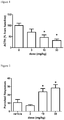

Classifications
-
- C—CHEMISTRY; METALLURGY
- C07—ORGANIC CHEMISTRY
- C07D—HETEROCYCLIC COMPOUNDS
- C07D405/00—Heterocyclic compounds containing both one or more hetero rings having oxygen atoms as the only ring hetero atoms, and one or more rings having nitrogen as the only ring hetero atom
- C07D405/14—Heterocyclic compounds containing both one or more hetero rings having oxygen atoms as the only ring hetero atoms, and one or more rings having nitrogen as the only ring hetero atom containing three or more hetero rings
-
- A—HUMAN NECESSITIES
- A61—MEDICAL OR VETERINARY SCIENCE; HYGIENE
- A61P—SPECIFIC THERAPEUTIC ACTIVITY OF CHEMICAL COMPOUNDS OR MEDICINAL PREPARATIONS
- A61P1/00—Drugs for disorders of the alimentary tract or the digestive system
- A61P1/04—Drugs for disorders of the alimentary tract or the digestive system for ulcers, gastritis or reflux esophagitis, e.g. antacids, inhibitors of acid secretion, mucosal protectants
-
- A—HUMAN NECESSITIES
- A61—MEDICAL OR VETERINARY SCIENCE; HYGIENE
- A61P—SPECIFIC THERAPEUTIC ACTIVITY OF CHEMICAL COMPOUNDS OR MEDICINAL PREPARATIONS
- A61P1/00—Drugs for disorders of the alimentary tract or the digestive system
- A61P1/08—Drugs for disorders of the alimentary tract or the digestive system for nausea, cinetosis or vertigo; Antiemetics
-
- A—HUMAN NECESSITIES
- A61—MEDICAL OR VETERINARY SCIENCE; HYGIENE
- A61P—SPECIFIC THERAPEUTIC ACTIVITY OF CHEMICAL COMPOUNDS OR MEDICINAL PREPARATIONS
- A61P1/00—Drugs for disorders of the alimentary tract or the digestive system
- A61P1/12—Antidiarrhoeals
-
- A—HUMAN NECESSITIES
- A61—MEDICAL OR VETERINARY SCIENCE; HYGIENE
- A61P—SPECIFIC THERAPEUTIC ACTIVITY OF CHEMICAL COMPOUNDS OR MEDICINAL PREPARATIONS
- A61P1/00—Drugs for disorders of the alimentary tract or the digestive system
- A61P1/16—Drugs for disorders of the alimentary tract or the digestive system for liver or gallbladder disorders, e.g. hepatoprotective agents, cholagogues, litholytics
-
- A—HUMAN NECESSITIES
- A61—MEDICAL OR VETERINARY SCIENCE; HYGIENE
- A61P—SPECIFIC THERAPEUTIC ACTIVITY OF CHEMICAL COMPOUNDS OR MEDICINAL PREPARATIONS
- A61P13/00—Drugs for disorders of the urinary system
-
- A—HUMAN NECESSITIES
- A61—MEDICAL OR VETERINARY SCIENCE; HYGIENE
- A61P—SPECIFIC THERAPEUTIC ACTIVITY OF CHEMICAL COMPOUNDS OR MEDICINAL PREPARATIONS
- A61P13/00—Drugs for disorders of the urinary system
- A61P13/10—Drugs for disorders of the urinary system of the bladder
-
- A—HUMAN NECESSITIES
- A61—MEDICAL OR VETERINARY SCIENCE; HYGIENE
- A61P—SPECIFIC THERAPEUTIC ACTIVITY OF CHEMICAL COMPOUNDS OR MEDICINAL PREPARATIONS
- A61P13/00—Drugs for disorders of the urinary system
- A61P13/12—Drugs for disorders of the urinary system of the kidneys
-
- A—HUMAN NECESSITIES
- A61—MEDICAL OR VETERINARY SCIENCE; HYGIENE
- A61P—SPECIFIC THERAPEUTIC ACTIVITY OF CHEMICAL COMPOUNDS OR MEDICINAL PREPARATIONS
- A61P25/00—Drugs for disorders of the nervous system
-
- A—HUMAN NECESSITIES
- A61—MEDICAL OR VETERINARY SCIENCE; HYGIENE
- A61P—SPECIFIC THERAPEUTIC ACTIVITY OF CHEMICAL COMPOUNDS OR MEDICINAL PREPARATIONS
- A61P25/00—Drugs for disorders of the nervous system
- A61P25/18—Antipsychotics, i.e. neuroleptics; Drugs for mania or schizophrenia
-
- A—HUMAN NECESSITIES
- A61—MEDICAL OR VETERINARY SCIENCE; HYGIENE
- A61P—SPECIFIC THERAPEUTIC ACTIVITY OF CHEMICAL COMPOUNDS OR MEDICINAL PREPARATIONS
- A61P25/00—Drugs for disorders of the nervous system
- A61P25/20—Hypnotics; Sedatives
-
- A—HUMAN NECESSITIES
- A61—MEDICAL OR VETERINARY SCIENCE; HYGIENE
- A61P—SPECIFIC THERAPEUTIC ACTIVITY OF CHEMICAL COMPOUNDS OR MEDICINAL PREPARATIONS
- A61P25/00—Drugs for disorders of the nervous system
- A61P25/22—Anxiolytics
-
- A—HUMAN NECESSITIES
- A61—MEDICAL OR VETERINARY SCIENCE; HYGIENE
- A61P—SPECIFIC THERAPEUTIC ACTIVITY OF CHEMICAL COMPOUNDS OR MEDICINAL PREPARATIONS
- A61P25/00—Drugs for disorders of the nervous system
- A61P25/24—Antidepressants
-
- A—HUMAN NECESSITIES
- A61—MEDICAL OR VETERINARY SCIENCE; HYGIENE
- A61P—SPECIFIC THERAPEUTIC ACTIVITY OF CHEMICAL COMPOUNDS OR MEDICINAL PREPARATIONS
- A61P25/00—Drugs for disorders of the nervous system
- A61P25/28—Drugs for disorders of the nervous system for treating neurodegenerative disorders of the central nervous system, e.g. nootropic agents, cognition enhancers, drugs for treating Alzheimer's disease or other forms of dementia
-
- A—HUMAN NECESSITIES
- A61—MEDICAL OR VETERINARY SCIENCE; HYGIENE
- A61P—SPECIFIC THERAPEUTIC ACTIVITY OF CHEMICAL COMPOUNDS OR MEDICINAL PREPARATIONS
- A61P25/00—Drugs for disorders of the nervous system
- A61P25/30—Drugs for disorders of the nervous system for treating abuse or dependence
-
- A—HUMAN NECESSITIES
- A61—MEDICAL OR VETERINARY SCIENCE; HYGIENE
- A61P—SPECIFIC THERAPEUTIC ACTIVITY OF CHEMICAL COMPOUNDS OR MEDICINAL PREPARATIONS
- A61P25/00—Drugs for disorders of the nervous system
- A61P25/30—Drugs for disorders of the nervous system for treating abuse or dependence
- A61P25/32—Alcohol-abuse
-
- A—HUMAN NECESSITIES
- A61—MEDICAL OR VETERINARY SCIENCE; HYGIENE
- A61P—SPECIFIC THERAPEUTIC ACTIVITY OF CHEMICAL COMPOUNDS OR MEDICINAL PREPARATIONS
- A61P3/00—Drugs for disorders of the metabolism
-
- A—HUMAN NECESSITIES
- A61—MEDICAL OR VETERINARY SCIENCE; HYGIENE
- A61P—SPECIFIC THERAPEUTIC ACTIVITY OF CHEMICAL COMPOUNDS OR MEDICINAL PREPARATIONS
- A61P3/00—Drugs for disorders of the metabolism
- A61P3/08—Drugs for disorders of the metabolism for glucose homeostasis
- A61P3/10—Drugs for disorders of the metabolism for glucose homeostasis for hyperglycaemia, e.g. antidiabetics
-
- A—HUMAN NECESSITIES
- A61—MEDICAL OR VETERINARY SCIENCE; HYGIENE
- A61P—SPECIFIC THERAPEUTIC ACTIVITY OF CHEMICAL COMPOUNDS OR MEDICINAL PREPARATIONS
- A61P3/00—Drugs for disorders of the metabolism
- A61P3/12—Drugs for disorders of the metabolism for electrolyte homeostasis
-
- A—HUMAN NECESSITIES
- A61—MEDICAL OR VETERINARY SCIENCE; HYGIENE
- A61P—SPECIFIC THERAPEUTIC ACTIVITY OF CHEMICAL COMPOUNDS OR MEDICINAL PREPARATIONS
- A61P5/00—Drugs for disorders of the endocrine system
- A61P5/10—Drugs for disorders of the endocrine system of the posterior pituitary hormones, e.g. oxytocin, ADH
-
- A—HUMAN NECESSITIES
- A61—MEDICAL OR VETERINARY SCIENCE; HYGIENE
- A61P—SPECIFIC THERAPEUTIC ACTIVITY OF CHEMICAL COMPOUNDS OR MEDICINAL PREPARATIONS
- A61P5/00—Drugs for disorders of the endocrine system
- A61P5/48—Drugs for disorders of the endocrine system of the pancreatic hormones
- A61P5/50—Drugs for disorders of the endocrine system of the pancreatic hormones for increasing or potentiating the activity of insulin
-
- A—HUMAN NECESSITIES
- A61—MEDICAL OR VETERINARY SCIENCE; HYGIENE
- A61P—SPECIFIC THERAPEUTIC ACTIVITY OF CHEMICAL COMPOUNDS OR MEDICINAL PREPARATIONS
- A61P7/00—Drugs for disorders of the blood or the extracellular fluid
-
- A—HUMAN NECESSITIES
- A61—MEDICAL OR VETERINARY SCIENCE; HYGIENE
- A61P—SPECIFIC THERAPEUTIC ACTIVITY OF CHEMICAL COMPOUNDS OR MEDICINAL PREPARATIONS
- A61P7/00—Drugs for disorders of the blood or the extracellular fluid
- A61P7/02—Antithrombotic agents; Anticoagulants; Platelet aggregation inhibitors
-
- A—HUMAN NECESSITIES
- A61—MEDICAL OR VETERINARY SCIENCE; HYGIENE
- A61P—SPECIFIC THERAPEUTIC ACTIVITY OF CHEMICAL COMPOUNDS OR MEDICINAL PREPARATIONS
- A61P7/00—Drugs for disorders of the blood or the extracellular fluid
- A61P7/04—Antihaemorrhagics; Procoagulants; Haemostatic agents; Antifibrinolytic agents
-
- A—HUMAN NECESSITIES
- A61—MEDICAL OR VETERINARY SCIENCE; HYGIENE
- A61P—SPECIFIC THERAPEUTIC ACTIVITY OF CHEMICAL COMPOUNDS OR MEDICINAL PREPARATIONS
- A61P7/00—Drugs for disorders of the blood or the extracellular fluid
- A61P7/10—Antioedematous agents; Diuretics
-
- A—HUMAN NECESSITIES
- A61—MEDICAL OR VETERINARY SCIENCE; HYGIENE
- A61P—SPECIFIC THERAPEUTIC ACTIVITY OF CHEMICAL COMPOUNDS OR MEDICINAL PREPARATIONS
- A61P9/00—Drugs for disorders of the cardiovascular system
-
- A—HUMAN NECESSITIES
- A61—MEDICAL OR VETERINARY SCIENCE; HYGIENE
- A61P—SPECIFIC THERAPEUTIC ACTIVITY OF CHEMICAL COMPOUNDS OR MEDICINAL PREPARATIONS
- A61P9/00—Drugs for disorders of the cardiovascular system
- A61P9/04—Inotropic agents, i.e. stimulants of cardiac contraction; Drugs for heart failure
-
- A—HUMAN NECESSITIES
- A61—MEDICAL OR VETERINARY SCIENCE; HYGIENE
- A61P—SPECIFIC THERAPEUTIC ACTIVITY OF CHEMICAL COMPOUNDS OR MEDICINAL PREPARATIONS
- A61P9/00—Drugs for disorders of the cardiovascular system
- A61P9/10—Drugs for disorders of the cardiovascular system for treating ischaemic or atherosclerotic diseases, e.g. antianginal drugs, coronary vasodilators, drugs for myocardial infarction, retinopathy, cerebrovascula insufficiency, renal arteriosclerosis
-
- A—HUMAN NECESSITIES
- A61—MEDICAL OR VETERINARY SCIENCE; HYGIENE
- A61P—SPECIFIC THERAPEUTIC ACTIVITY OF CHEMICAL COMPOUNDS OR MEDICINAL PREPARATIONS
- A61P9/00—Drugs for disorders of the cardiovascular system
- A61P9/12—Antihypertensives
-
- C—CHEMISTRY; METALLURGY
- C07—ORGANIC CHEMISTRY
- C07D—HETEROCYCLIC COMPOUNDS
- C07D487/00—Heterocyclic compounds containing nitrogen atoms as the only ring hetero atoms in the condensed system, not provided for by groups C07D451/00 - C07D477/00
- C07D487/02—Heterocyclic compounds containing nitrogen atoms as the only ring hetero atoms in the condensed system, not provided for by groups C07D451/00 - C07D477/00 in which the condensed system contains two hetero rings
- C07D487/08—Bridged systems
Definitions
- the present invention relates to novel substituted oxindole derivatives, pharmaceutical compositions comprising them, and compounds for use in the treatment of vasopressin-related disorders.
- Vasopressin is an endogenous hormone which exerts various effects on organs and tissues. It is suspected that the vasopressin system is involved in various pathological states such as, for example, heart failure and high blood pressure. At present, three receptors (V1a, V1b or V3 and V2) via which vasopressin mediates its numerous effects are known. Antagonists of these receptors are therefore being investigated as possible new therapeutic approaches for the treatment of diseases ( M. Thibonnier, Exp.Opin. Invest. Drugs 1998, 7(5), 729-740 ; T. Ryckmans, Current Opinion in Drug Discovery & Development 13 (2010), 538-547 ; G. Decaux et al., Lancet 371 (2008), 1624-1632 ; R. Lemmens-Gruber, M. Kamyar, Cell. Mol. Life Sci. 63 (2006), 1766-1779 ).
- 1-Phenylsulfonyl-1,3-dihydro-2H-indol-2-ones have previously been described as ligands of vasopressin receptors, for example in WO 2005/030755 , WO 2006/005609 , WO 2006/080574 , WO 2008/080970 , WO 2008/080971 , WO 2008/080972 , WO 2008/080973 , WO 2009/071687 , WO 2009/071689 , WO 2009/071690 , WO2009/071691 , WO 2009/083559 , WO 2010/009775 or WO 2010/142739 .
- vasopressin V1b receptor binding affinity for the vasopressin V1b receptor
- further properties may be advantageous for the treatment and/or prophylaxis of vasopressin-related disorders, such as, for example:
- the compounds were intended to have a high activity and selectivity, especially a high affinity and selectivity vis-à-vis the vasopressin V1b receptor.
- the substance of the invention was intended to have one or more of the aforementioned advantages 1.) to 8.).
- the invention relates to compounds I, wherein X 1 and X 2 are N or CH, with the proviso that X 1 and X 2 are not simultaneously N; X 3 is a bond, C 1 -C 4 -alkylene, C 1 -C 4 -haloalkylene or CO; X 4 is N or CH; X 5 is C-R 1 or N; R 1 , R 2 and R 3 , independently of each other, are selected from hydrogen, halogen, cyano, C 1 -C 3 -alkyl, fluorinated C 1 -C 3 -alkyl, C 1 -C 3 -hydroxyalkyl, C 1 -C 3 -alkoxy and fluorinated C 1 -C 3 -alkoxy; R 4 is selected from C 1 -C 3 -alkoxy; R 5 is selected from hydrogen and C 1 -C 3 -alkoxy; R 6 is selected from cyano and halogen; R 7 is selected from hydrogen,
- the present invention relates to compounds of the formula I (also "compounds I" hereinafter) and the N-oxides, stereoisomers and the pharmaceutically acceptable salts of the compounds I of the compounds I.
- the invention in another aspect, relates to a pharmaceutical composition
- a pharmaceutical composition comprising a therapeutically effective amount of at least one compound of formula I or an N-oxide, a stereoisomer or a pharmaceutically acceptable salt thereof, or comprising at least one compound as defined above or below wherein at least one of the atoms has been replaced by its stable, non-radioactive isotope, preferably wherein at least one hydrogen atom has been replaced by a deuterium atom, in combination with at least one pharmaceutically acceptable carrier and/or auxiliary substance.
- the invention relates to a compound of formula I or an N-oxide, a stereoisomer or a pharmaceutically acceptable salt thereof for use as a medicament.
- the invention relates to a compound of formula I or an N-oxide, a stereoisomer or a pharmaceutically acceptable salt thereof for the treatment and/or prophylaxis of vasopressin-related diseases, especially of disorders which respond to the modulation of the vasopressin receptor, in particular of the V1b receptor.
- the invention relates to the use of a compound of formula I or of an N-oxide, a stereoisomer or a pharmaceutically acceptable salt thereof for the manufacture of a medicament for the treatment and/or prophylaxis of vasopressin-related diseases; especially of disorders which respond to the modulation of the vasopressin receptor, in particular of the V1b receptor.
- the pharmaceutically acceptable salts of compounds of the formula I which are also referred to as physiologically tolerated salts, are ordinarily obtainable by reacting the free base of the compounds I of the invention (i.e. of the compounds I according to structural formula I) with suitable acids.
- suitable acids are listed in " Fort Whitneye der Arzneistoffforschung", 1966, Birkhäuser Verlag, vol.10, pp. 224-285 . These include for example hydrochloric acid, citric acid, tartaric acid, lactic acid, phosphoric acid, methanesulfonic acid, acetic acid, trifluoroacetic acid, formic acid, maleic acid and fumaric acid.
- Halogen in the terms of the present invention is fluorine, chlorine, bromine or iodine, preferably fluorine, chlorine or bromine and especially fluorine or chlorine.
- C 1 -C 3 -Alkyl is a linear or branched alkyl radical having 1 to 3 carbon atoms, such as methyl, ethyl, n-propyl or isopropyl.
- C 1 -C 4 -Alkyl is a linear or branched alkyl radical having 1 to 4 carbon atoms, such as methyl, ethyl, n-propyl, isopropyl, n-butyl, sec-butyl, isobutyl or tert-butyl.
- C 1 -C 4 -Haloalkyl is C 1 -C 4 -alkyl as defined above wherein at least one, e.g. 1, 2, 3, 4 or all of the hydrogen atoms are replaced by a halogen atom.
- 1, 2, 3, 4 or all of the hydrogen atoms are replaced by fluorine atoms, such as in fluoromethyl, difluoromethyl, trifluoromethyl, 1-fluoroethyl, (R)-1-fluoroethyl, (S)-1-fluoroethyl, 2-fluoroethyl, 1,1-difluoroethyl, 2,2-difluoroethyl, 2,2,2-trifluoroethyl, 1-fluoropropyl, (R)-1-fluoropropyl, (S)-1-fluoropropyl, 2-fluoropropyl, 3-fluoropropyl, 1,1-difluoropropyl, 2,2-difluoropropyl, 3,3-difluoropropyl, 3,3,3-trifluoropropyl, 2-fluoropropyl, 2-fluoro-1-methylethyl, (R)-2-fluoro-1-methylethyl,
- C 1 -C 4 -Hydroxyalkyl is C 1 -C 4 -alkyl as defined above wherein one of the hydrogen atoms is replaced by a hydroxyl group. Examples are hydroxymethyl, 1- and 2-hydroxyethyl, 1-, 2-and 3-hydroxy-n-propyl, 1-(hydroxymethyl)-ethyl and the like.
- C 1 -C 3 -Alkoxy is a linear or branched alkyl radical linked via an oxygen atom and having 1 to 3 carbon atoms. Examples are methoxy, ethoxy, n-propoxy and isopropoxy.
- C 1 -C 4 -Alkoxy is a linear or branched alkyl radical linked via an oxygen atom and having 1 to 4 carbon atoms. Examples are methoxy, ethoxy, n-propoxy, isopropoxy, n-butoxy, sec-butoxy, isobutoxy and tert-butoxy.
- C 1 -C 4 -Haloalkoxy is C 1 -C 4 -alkoxy as defined above wherein at least one, e.g. 1, 2, 3, 4 or all of the hydrogen atoms are replaced by a halogen atom.
- 1, 2, 3, 4 or all of the hydrogen atoms are replaced by fluorine atoms, such as in fluoromethoxy, difluoromethoxy, trifluoromethoxy, 1-fluoroethoxy, (R)-1-fluoroethoxy, (S)-1-fluoroethoxy, 2-fluoroethoxy, 1,1-difluoroethoxy, 2,2-difluoroethoxy, 2,2,2-trifluoroethoxy, 1-fluoropropoxy, (R)-1-fluoropropoxy, (S)-1-fluoropropoxy, 2-fluoropropoxy, 3-fluoropropoxy, 1,1-difluoropropoxy, 2,2-difluoropropoxy, 3,3-difluoropropoxy, 3,3,3-trifluoropropoxy, 2-fluoro-1-methylethoxy, (R)-2-fluoro-1-methylethoxy, (S)-2-fluoro-1-methylethoxy, 2,2-difluoro-1
- C 1 -C 4 -Alkylene is a divalent bridging group, such as CH 2 , CH 2 CH 2 , CH(CH 3 ), (CH 2 ) 3 , CH(CH 3 )CH 2 , CH 2 CH(CH 3 ), C(CH 3 ) 2 , (CH 2 ) 4 , CH(CH 3 )CH 2 CH 2 , C(CH 3 ) 2 CH 2 , CH 2 CH(CH 3 )CH 2 , CH 2 C(CH 3 ) 2 , CH 2 CH 2 CH(CH 3 ), CH 2 C(CH 3 ) 2 and the like.
- C 1 -C 4 -Haloalkylene is a divalent C 1 -C 4 -alkylene bridging group as defined above, wherein at least one, e.g. 1, 2, 3, 4 or all of the hydrogen atoms are replaced by a halogen atom.
- C 1 -C 4 -haloalkylene is fluorinated C 1 -C 4 -alkylene.
- Examples are CHF, CF 2 , CHFCH 2 , CF 2 CH 2 , CH 2 CHF, CH 2 CF 2 CF 2 CF 2 , CF(CH 3 ), CH(CF 3 ), CF(CF 3 ), CHFCH 2 CH 2 , CH 2 CHFCH 2 , CH 2 CF 2 CH 2 , CH 2 CH(CF 3 )CH 2 and the like.
- the compounds of the invention of the formula I and their N-oxides, stereoisomers and pharmacologically acceptable salts may also be present in the form of solvates or hydrates.
- Solvates mean in the context of the present invention crystalline forms of the compounds I or of their pharmaceutically acceptable salts which comprise solvent molecules incorporated in the crystal lattice.
- the solvent molecules are preferably incorporated in stoichiometric ratios.
- Hydrates are a specific form of solvates; the solvent in this case being water.
- the compounds I are preferably provided in the form of the free base (i.e. according to structural formula I) or in the form of their acid addition salts.
- R 1 , R 2 and R 3 independently of each other, are selected from hydrogen, fluorine, cyano, methyl, fluoromethyl, difluoromethyl, trifluoromethyl, methoxy, fluoromethoxy, difluoromethoxy and trifluoromethoxy. More preferably, R 1 , R 2 and R 3 , independently of each other, are selected from hydrogen, fluorine, cyano, methyl and methoxy.
- R 1 is selected from hydrogen, fluorine, methyl, fluoromethyl, difluoromethyl, trifluoromethyl, methoxy, fluoromethoxy, difluoromethoxy and trifluoromethoxy. More preferably, R 1 is selected from hydrogen, fluorine, methyl and methoxy.
- R 2 is selected from hydrogen, fluorine, cyano, methyl, fluoromethyl, difluoromethyl, trifluoromethyl, methoxy, fluoromethoxy, difluoromethoxy and trifluoromethoxy. More preferably, R 2 is selected from hydrogen, fluorine, cyano, methyl, methoxy, fluoromethoxy, difluoromethoxy and trifluoromethoxy; especially from hydrogen, fluorine, cyano, methoxy, fluoromethoxy, difluoromethoxy and trifluoromethoxy. In particular, R 2 is selected from hydrogen, cyano, methyl, methoxy and fluorine; more especially from hydrogen, cyano, methoxy and fluorine.
- R 3 is selected from hydrogen, fluorine, methyl, fluoromethyl, difluoromethyl, trifluoromethyl and hydroxyl, and more preferably from hydrogen, fluorine, methyl, fluoromethyl, difluoromethyl and trifluoromethyl.
- R 3 is selected from hydrogen, fluorine and methyl.
- R 3 is preferably bound in 3- or 5-position, relative to the 2- and 4-positions of R 1 and R 2 .
- R 4 is selected from methoxy and ethoxy, and is in particular methoxy, especially in case that X 4 is N. In an alternative preferred embodiment, R 4 is isopropoxy.
- R 5 is hydrogen or methoxy, and in particular hydrogen.
- R 6 is selected from cyano, fluorine and chlorine.
- R 7 is selected from hydrogen and fluorine.
- each R 8 is independently selected from halogen and C 1 -C 4 -alkyl, preferably from F, Cl and CH 3 , with the proviso that R 8 is not halogen if it is bound to a carbon atom in ⁇ -position to a nitrogen ring atom, or two non-geminal radicals R 8 form together a group -CH 2 - or -CH 2 CH 2 -, preferably -CH 2 -. More preferably, two non-geminal radicals R 8 form together a group -CH 2 -.
- the two non-geminal radicals R 8 forming together a group -CH 2 - are preferably bound in 2- and 5-positions, relative to the 4-position of X 1 .
- each R 9 is independently selected from halogen and C 1 -C 4 -alkyl, preferably from F, Cl and CH 3 , with the proviso that R 8 is not halogen if it is bound to a carbon atom in ⁇ -position to a nitrogen ring atom, or two non-geminal radicals R 9 form together a group -CH 2 - or -CH 2 CH 2 -, preferably -CH 2 -. More preferably, two non-geminal radicals R 9 form together a group -CH 2 -.
- the two non-geminal radicals R 9 forming together a group -CH 2 - are preferably bound in 2- and 5-positions, relative to the 1-position of X 2 .
- each R 10 is independently selected from halogen and C 1 -C 4 -alkyl, preferably from F, Cl and CH 3 , and is in particular CH 3 .
- X 1 is N and X 2 is CH.
- X 1 is CH and X 2 is N.
- X 1 is CH and X 2 is CH.
- X 3 is a bond or CH 2 .
- X 3 is a bond.
- X 4 is N or CH. Specifically, X 4 is N.
- X 5 is C-R 1 or N. Specifically, X 5 is C-R 1 .
- a is 0, 1 or 2, in particular 0 or 2.
- b is 0, 1 or 2, in particular 0 or 2.
- c is 0, 1 or 2, more preferably 0 or 1, in particular 0.
- the invention preferably relates to compounds of the formula I in which
- the invention more preferably relates to compounds of the formula I in which
- the invention more preferably relates to compounds of the formula I in which
- the invention more preferably relates to compounds of the formula I in which
- the invention particularly relates to compounds of the formula I in which
- the invention particularly relates to compounds of the formula I in which
- the invention particularly relates to compounds of the formula I in which
- the invention particularly relates to compounds of the formula I in which
- the invention particularly relates to compounds of the formula I in which
- Examples of preferred embodiment of the present invention are compounds of the formulae I.1 to I.84 and the N-oxides, stereoisomers and the pharmaceutically acceptable salts thereof, in which the radicals R 1 , R 2 , R 3 , R 6 and R 7 have one of the above general or preferred meanings, R 8a , R 8b , R 8c and R 8d are hydrogen or have one of the general or preferred meanings given above for R 8 , R 9a , R 9b , R 9c and R 9d are hydrogen or have one of the general or preferred meanings given above for R 9 , and R 10a , R 10b , R 10c and R 10d are hydrogen or have one of the general or preferred meanings given above for R 10 .
- preferred compounds are the individual compounds compiled in the tables 1 to 2520below.
- the meanings mentioned below for the individual variables in the tables are per se, independently of the combination in which they are mentioned, a particularly preferred embodiment of the substituents in question.
- R 3 The positions (e.g. 3-/5-/6-) of R 3 are relative to the 2- and 4-positions of radicals R 1 and R 2 and to the 1-position of the attachment point of the ring to the SO 2 group.
- the preferred compounds among the compounds I.1 to I.72 mentioned above are those of the formulae I.1 to I.6 and I.37 to 1.42, and especially compounds of the formulae I.1 to I.6. Particularly preferred are compounds of the formulae I.1 to I.3.
- the compounds I are selected from the compounds specified in the examples, either as a free base or in form of a pharmaceutically acceptable salt, an N-oxide or a stereoisomer or the racemate or any mixture of the steroisomers thereof.
- the compounds I of the invention have a center of chirality in position 3 of the 2-oxindole ring.
- the compounds of the invention may therefore be in the form of a 1:1 mixture of enantiomers (racemate) or of a nonracemic mixture of enantiomers in which one of the two enantiomers, either the enantiomer which rotates the plane of vibration of linearly polarized light to the left (i.e. minus rotation) (hereinafter (-) enantiomer) or the enantiomer which rotates the plane of vibration of linearly polarized light to the right (i.e.
- (+) enantiomer is enriched, or of substantially enantiopure compounds, that is to say of substantially enantiopure (-) enantiomer or (+) enantiomer. Since the compounds of the invention have a single center of asymmetry and no axis/plane of chirality, a nonracemic mixture can also be defined as a mixture of enantiomers in which either the R or the S enantiomer predominates. Substantially enantiopure compounds can accordingly also be defined as substantially enantiopure R enantiomer or substantially enantiopure S enantiomer.
- the compounds of the invention are in the form of substantially enantiopure compounds.
- Particularly preferred compounds have an enantiomeric excess of at least 85% ee, more preferably of at least 90% ee, even more preferably of at least 95% ee and in particular of at least 98% ee.
- the invention thus relates both to the pure enantiomers and to mixtures thereof, e.g. mixtures in which one enantiomer is present in enriched form, but also to the racemates.
- the invention also relates to the pharmaceutically acceptable salts of the pure enantiomers of compounds I, and the mixtures of enantiomers in the form of the pharmaceutically acceptable salts of compounds I.
- Preferred embodiments of the invention are compounds of the formula I as detailed above which are characterized in that they are in optically active form, and the enantiomer of the relevant compound of the formula I is the S-enantiomner, in the form of a free base, or a pharmaceutically acceptable salt thereof.
- preferred embodiments of the invention are compounds of the general formula I as detailed above which are characterized in that they are in optically inactive form, i.e. in the form of the racemate, or in the form of a pharmaceutically acceptable salt of the racemate.
- the compounds of the invention can be prepared by using methods described in WO 2005/030755 , WO 2006/005609 and the other references mentioned in the outset for synthesizing analogous compounds, and the preparation is outlined by way of example in synthesis scheme 1.
- the variables in these synthetic schemes have the same meanings as in formula I.
- the 3-hydroxy-1,3-dihydroindol-2-ones IV can be obtained by addition of metallated heterocycles III onto the 3-keto group of the isatins II.
- the metallated heterocycles such as, for example, the corresponding Grignard (Mg) or organyllithium compound, can be obtained in any conventional way from halogen or hydrocarbon compounds. Examples of methods are present in Houben-Weyl, Methoden der Organischen Chemie, vol. 13, 1-2 , chapter on Mg and Li compounds.
- the isatins II are either commercially available or were prepared in analogy to methods described in the literature ( Advances in Heterocyclic Chemistry, A.R. Katritzky and A.J. Boulton, Academic Press, New York, 1975, 18, 2-58 ; J. Brazil. Chem. Soc. 12, 273-324, 2001 ).
- the 3-hydroxyoxindoles IV can be converted into the compounds V which have a leaving group LG' in position 3, where the leaving group LG' is a conventional leaving group such as, for example, chlorine or bromide.
- the compounds V can subsequently be reacted with amines, such as, for example, ammonia, in a substitution reaction to give the amines VI.
- the compounds VI can subsequently be converted by treatment with sulfonyl chlorides VII after deprotonation with a strong base such as, for example, potassium tert-butoxide or sodium hydride in DMF into the sulfonylated product VIII.
- the sulfonyl chlorides VII employed can either be purchased or be prepared by known processes (for example J. Med. Chem. 40, 1149 (1997 )).
- the compounds VIII are then reacted with phenyl chloroformate in the presence of a base such as, for example, pyridine to give the corresponding phenyl carbamate IX.
- the compounds of the invention of the general formula I which have a urea group in position 3 can be prepared as described in WO 2005/030755 and WO 2006/005609 , and shown in synthesis scheme 1, by two different sequences:
- compound IX is first reacted with amine X, where appropriate at elevated temperature and with the addition of auxiliary bases such as, for example, triethylamine or diisopropylethylamine.
- PG is a protective group, typically Boc.
- compound IX is reacted with the amine XIV.
- the reaction is generally carried out in the presence of a base, such as triethylamine or diisopropylethylamine.
- the amines X can be either purchased or prepared by methods known from the literature.
- Compounds XIV wherein X 3 is a bond can be prepared by reacting a compound X with oxetan-3-one carrying c substituents R 10 in the presence of a reduction agent such as sodium triacetoxyhydroborate or cyanoborhydride.
- a reduction agent such as sodium triacetoxyhydroborate or cyanoborhydride.
- oxetane carrying in the 3-position a C 2 -C 4 -keto or aldehyde group e.g. a group CH 2 CHO, CH 2 CH 2 CHO, (CH 2 ) 3 CHO, CH 2 COCH 3 , CH 2 CH 2 COCH 3 etc.
- oxetanes are either commercially available or can be prepared by routine methods.
- oxetane-3-carbonylchloride carrying c substituents R 10 is used instead of the oxetan-3-one XIII.
- the above-described reactions are generally carried out in a solvent at temperatures between room temperature and the boiling temperature of the solvent employed.
- the activation energy which is required for the reaction can be introduced into the reaction mixture using microwaves, something which has proved to be of value, in particular, in the case of the reactions catalyzed by transition metals (with regard to reactions using microwaves, see Tetrahedron 2001, 57, p. 9199 ff. p. 9225 ff . and also, in a general manner, " Microwaves in Organic Synthesis", André Loupy (Ed.), Wiley-VCH 2002 .
- the acid addition salts of compounds I are prepared in a customary manner by mixing the free base with a corresponding acid, where appropriate in solution in an organic solvent, for example a lower alcohol, such as methanol, ethanol or propanol, an ether, such as methyl tert-butyl ether or diisopropyl ether, a ketone, such as acetone or methyl ethyl ketone, or an ester, such as ethyl acetate.
- an organic solvent for example a lower alcohol, such as methanol, ethanol or propanol, an ether, such as methyl tert-butyl ether or diisopropyl ether, a ketone, such as acetone or methyl ethyl ketone, or an ester, such as ethyl acetate.
- Routine experimentations including appropriate manipulation of the reaction conditions, reagents and sequence of the synthetic route, protection of any chemical functionality that may not be compatible with the reaction conditions, and deprotection at a suitable point in the reaction sequence of the preparation methods are within routine techniques.
- Suitable protecting groups and the methods for protecting and deprotecting different substituents using such suitable protecting groups are well known to those skilled in the art; examples of which may be found in T. Greene and P. Wuts, Protective Groups in Organic Synthesis (3rd ed.), John Wiley & Sons, NY (1999 ), which is incorporated herein by reference in its entirety. Synthesis of the compounds of the invention may be accomplished by methods analogous to those described in the synthetic scheme described hereinabove and in specific examples.
- an optically active form of a compound of the invention when required, it may be obtained by carrying out one of the procedures described herein using an optically active starting material (prepared, for example, by asymmetric induction of a suitable reaction step), or by resolution of a mixture of the stereoisomers of the compound or intermediates using a standard procedure (such as chromatographic separation, recrystallization or enzymatic resolution).
- an optically active starting material prepared, for example, by asymmetric induction of a suitable reaction step
- resolution of a mixture of the stereoisomers of the compound or intermediates using a standard procedure (such as chromatographic separation, recrystallization or enzymatic resolution).
- a pure geometric isomer of a compound of the invention when required, it may be obtained by carrying out one of the above procedures using a pure geometric isomer as a starting material, or by resolution of a mixture of the geometric isomers of the compound or intermediates using a standard procedure such as chromatographic separation.
- the present invention moreover relates to compounds of formula I as defined above, wherein at least one of the atoms has been replaced by its stable, non-radioactive isotope (e.g., hydrogen by deuterium, 12 C by 13 C, 14 N by 15 N, 16 O by 18 O) and preferably wherein at least one hydrogen atom has been replaced by a deuterium atom.
- stable, non-radioactive isotope e.g., hydrogen by deuterium, 12 C by 13 C, 14 N by 15 N, 16 O by 18 O
- the compounds according to the invention contain more of the respective isotope than this naturally occurs and thus is anyway present in the compounds I.
- Stable isotopes are nonradioactive isotopes which contain one additional neutron than the normally abundant isotope of the respective atom.
- Deuterated compounds have been used in pharmaceutical research to investigate the in vivo metabolic fate of the compounds by evaluation of the mechanism of action and metabolic pathway of the non deuterated parent compound ( Blake et al. J. Pharm. Sci. 64, 3, 367-391 (1975 )).
- Such metabolic studies are important in the design of safe, effective therapeutic drugs, either because the in vivo active compound administered to the patient or because the metabolites produced from the parent compound prove to be toxic or carcinogenic ( Foster et al., Advances in Drug Research Vol. 14, pp.
- Stable isotope labeling of a drug can alter its physico-chemical properties such as pKa and lipid solubility. These changes may influence the fate of the drug at different steps along its passage through the body. Absorption, distribution, metabolism or excretion can be changed. Absorption and distribution are processes that depend primarily on the molecular size and the lipophilicity of the substance. These effects and alterations can affect the pharmacodynamic response of the drug molecule if the isotopic substitution affects a region involved in a ligand-receptor interaction.
- Drug metabolism can give rise to large isotopic effect if the breaking of a chemical bond to a deuterium atom is the rate limiting step in the process. While some of the physical properties of a stable isotope-labeled molecule are different from those of the unlabeled one, the chemical and biological properties are the same, with one important exception: because of the increased mass of the heavy isotope, any bond involving the heavy isotope and another atom will be stronger than the same bond between the light isotope and that atom. In any reaction in which the breaking of this bond is the rate limiting step, the reaction will proceed slower for the molecule with the heavy isotope due to "kinetic isotope effect".
- a reaction involving breaking a C-D bond can be up to 700 percent slower than a similar reaction involving breaking a C-H bond. If the C-D bond is not involved in any of the steps leading to the metabolite, there may not be any effect to alter the behavior of the drug. If a deuterium is placed at a site involved in the metabolism of a drug, an isotope effect will be observed only if breaking of the C-D bond is the rate limiting step. There is evidence to suggest that whenever cleavage of an aliphatic C-H bond occurs, usually by oxidation catalyzed by a mixed-function oxidase, replacement of the hydrogen by deuterium will lead to observable isotope effect. It is also important to understand that the incorporation of deuterium at the site of metabolism slows its rate to the point where another metabolite produced by attack at a carbon atom not substituted by deuterium becomes the major pathway a process called "metabolic switching".
- Deuterium tracers such as deuterium-labeled drugs and doses, in some cases re-peatedly, of thousands of milligrams of deuterated water, are also used in healthy humans of all ages, including neonates and pregnant women, without reported incident (e.g. Pons G and Rey E, Pediatrics 1999 104: 633 ; Coward W A et al., Lancet 1979 7: 13 ; Schwarcz H P, Control. Clin. Trials 1984 5(4 Suppl): 573 ; Rodewald L E et al., J. Pediatr. 1989 114: 885 ; Butte N F et al. Br. J. Nutr.
- the weight percentage of hydrogen in a mammal indicates that a 70 kg human normally contains nearly a gram of deuterium. Furthermore, replacement of up to about 15% of normal hydrogen with deuterium has been effected and maintained for a period of days to weeks in mammals, including rodents and dogs, with minimal observed adverse effects ( Czajka D M and Finkel A J, Ann. N.Y. Acad. Sci. 1960 84: 770 ; Thomson J F, Ann. New York Acad. Sci 1960 84: 736 ; Czakja D M et al., Am. J. Physiol. 1961 201: 357 ).
- enrichment Increasing the amount of deuterium present in a compound above its natural abundance is called enrichment or deuterium-enrichment.
- the amount of enrichment include from about 0.5, 1, 2, 3, 4, 5, 6, 7, 8, 9, 10, 12, 16, 21, 25, 29, 33, 37, 42, 46, 50, 54, 58, 63, 67, 71, 75, 79, 84, 88, 92, 96, to about 100 mol %.
- the hydrogens present on a particular organic compound have different capacities for exchange with deuterium.
- Certain hydrogen atoms are easily exchangeable under physiological conditions and, if replaced by deuterium atoms, it is expected that they will readily exchange for protons after administration to a patient.
- Certain hydrogen atoms may be exchanged for deuterium atoms by the action of a deuteric acid such as D 2 SO 4 /D 2 O.
- deuterium atoms may be incorporated in various combinations during the synthesis of compounds of the invention.
- Certain hydrogen atoms are not easily exchangeable for deuterium atoms. However, deuterium atoms at the remaining positions may be incorporated by the use of deuterated starting materials or intermediates during the construction of compounds of the invention.
- Deuterated and deuterium-enriched compounds of the invention can be prepared by using known methods described in the literature. Such methods can be carried out utilizing corresponding deuterated and optionally, other isotope-containing reagents and/or intermediates to synthesize the compounds delineated herein, or invoking standard synthetic protocols known in the art for introducing isotopic atoms to a chemical structure.
- a further aspect of the present invention relates to a pharmaceutical composition
- a pharmaceutical composition comprising at least one compound of the general formula I and/or an N-oxide, a stereoisomer or a pharmaceutically acceptable salt thereof as detailed above, and a pharmaceutically acceptable carrier; or comprising at least one compound I wherein at least one of the atoms has been replaced by its stable, non-radioactive isotope, preferably wherein at least one hydrogen atom has been replaced by a deuterium atom, in combination with at least one pharmaceutically acceptable carrier and/or auxiliary substance.
- Suitable carriers depend inter alia on the dosage form of the composition and are known in principle to the skilled worker. Some suitable carriers are described hereinafter.
- the present invention furthermore relates to a compound I as defined above or an N-oxide, a stereoisomer or a pharmaceutically acceptable salt thereof for use as a medicament.
- the present invention also relates to a compound I as defined above or an N-oxide, a stereoisomer or a pharmaceutically acceptable salt thereof for the treatment of vasopressin-related diseases, especially of disorders which respond to the modulation of the vasopressin receptor and in particular of the V1b receptor.
- a further aspect of the present invention relates to the use of compounds of the formula I and/or of an N-oxide, a stereoisomer or of pharmaceutically acceptable salts thereof for the manufacture of a medicament for the treatment and/or prophylaxis of vasopressin-related diseases, especially of disorders which respond to the modulation of the vasopressin receptor and in particular of the V1b receptor.
- Vasopressin-related diseases are those in which the progress of the disease is at least partly dependent on vasopressin, i.e. diseases which show an elevated vasopressin level which may contribute directly or indirectly to the pathological condition.
- vasopressin-related diseases are those which can be influenced by modulating the vasopressin receptor, for example by administration of a vasopressin receptor ligand (agonist, antagonist, partial antagonist/agonist, inverse agonist etc.).
- Affective disorders have been related to excessive vasopressin function. Therefore, treatment with compounds targeting the vasopressin system, such as vasopressin antagonists are likely to benefit patients suffering from affective disorders (see for example Surget A., Belzung C., Involvement of vasopressin in affective disorders, Eur. J. Pharm. 2008, 583, 340-349 ).
- Affective disorders include depressive disorders, anxiety disorders, obsessive-compulsive and related disorders, trauma and stressor-related disorders as well as bipolar and related disorders.
- V1b antagonist have been shown to have anti-drug abuse effects and reduce drug withdrawal effect (see e.g.
- vasopressin antagonists are thought to be effective for treatment of Substance-Related and Addictive Disorders.
- V1b receptors play a role in a range of emotional responses such as aggression.
- Attenuating V1b receptor function genetically or with antagonist reduces aggressive behavior ( Blanchard R.J., Griebel G., Farrokhi C., Markham C., Yang M., Blanchard D.C., AVP V1b selective antagonist SSR149415 blocks aggressive behaviors in hamsters. Pharmacol. Biochem. Behav. 2005, 80, 189-194 ; Wersinger S.R., Ginns E.I., O'Carroll A.M., Lolait S.J., Young W.S., III, Vasopressin V1b receptor knockout reduces aggressive behavior in male mice. Mol. Psychiatry, 2002, 7, 975-984 ). Therefore, attenuating V1b antagonists functioning is likely to reduce aggression and agitation in disorders such as Alzheimer's disease and schizophrenia.
- the present invention relates to the use of compounds of the invention of the formula I or of an N-oxide, a stereoisomer or of pharmaceutically acceptable salts thereof for the manufacture of a medicament for the treatment and/or prophylaxis of diseases selected from diabetes, insulin resistance, nocturnal enuresis, incontinence and diseases in which impairments of blood clotting occur, and/or for delaying micturition.
- diabetes means all types of diabetes, especially diabetes mellitus (including type I and especially type II), diabetes renalis and in particular diabetes insipidus.
- the types of diabetes are preferably diabetes mellitus of type II (with insulin resistance) or diabetes insipidus.
- the present invention relates to the use of compounds of the invention of the formula I or of an N-oxide, a stereoisomer or of pharmaceutically acceptable salts thereof for the manufacture of a medicament for the treatment and/or prophylaxis of diseases selected from hypertension, pulmonary hypertension, heart failure, myocardial infarction, coronary spasm, unstable angina, PTCA (percutaneous transluminal coronary angioplasty), ischemias of the heart, impairments of the renal system, edemas, renal vasospasm, necrosis of the renal cortex, hyponatremia, hypokalemia, Schwartz-Bartter syndrome, impairments of the gastrointestinal tract, gastritic vasospasm, hepatocirrhosis, gastric and intestinal ulcers, emesis, emesis occurring during chemotherapy, and travel sickness.
- diseases selected from hypertension, pulmonary hypertension, heart failure, myocardial infarction, coronary spasm, unstable angina, PTCA (percutaneous translumina
- the compounds of the invention of the formula I or their N-oxides, stereoisomers or pharmaceutically acceptable salts or the pharmaceutical composition of the invention can also be used for the treatment of various vasopressin-related complaints which have central nervous causes or alterations in the HPA axis (hypothalamic pituitary adrenal axis), for example for affective disorders such as depressive disorders, anxiety disorders, obsessive-compulsive and related disorders, trauma and stressor-related disorders, and bipolar and related disorders.
- Depressive disorders include for example dysthymic disorders, major depression, seasonal depression, treatment-resistant depression disorders, disruptive mood dysregulation disorder, premenstrual dysphoric disorder, substance/medication-induced depressive disorder, depressive disorder due to another medical condition, bipolar disorders, or childhood onset mood disorders.
- Anxiety disorders include for example phobias, specific phobias, general anxiety disorders, panic disorders, drug withdrawal-induced anxiety disorders, separation anxiety disorder, selective mutism, social anxiety disorder, agoraphobia, substance/medication-induced anxiety disorder and anxiety disorder due to another medical condition.
- Obsessive-compulsive and related disorders include for example obsessive-compulsive disorder, body dysmorphic disorder, hoarding disorder, trichotillomania, excoriation disorder, substance/medication-induced obsessive-compulsive and related disorder and other specified obsessive-compulsive and related disorders.
- Trauma and stressor-related disorders include for example reactive attachment disorder, disinhibited social engagement disorder, post traumatic stress disorder, acute stress disorder, adjustment disorder and other specified trauma- and stressor-related disorders.
- Bipolar and related disorders include for example bipolar I disorder, bipolar II disorder, cyclothymic disorder, substance/medication-induced bipolar and related disorder, bipolar and related disorder due to another medical condition and unspecified bipolar and related disorder.
- Vasopressin-related complaints which have central nervous causes or alterations in the HPA axis are further cognitive disorders such as Alzheimer's disease, MCI (Mild Cognitive Impairment) and CIAS (Cognitive Impairment Associated with Schizophrenia).
- the compounds of the invention of the formula I and their N-oxides, a stereoisomers or pharmaceutically acceptable salts or the pharmaceutical composition of the invention can likewise be employed for the treatment of anxiety disorders and stress-dependent anxiety disorders, such as, for example, generalized anxiety disorders, phobias, specific phobias, post-traumatic anxiety disorders, panic anxiety disorders, obsessive-compulsive anxiety disorders, acute stress-dependent anxiety disorders, drug withdrawal-induced anxiety disorders, separation anxiety disorder, selective mutism, social anxiety disorder, agoraphobia, substance/medication-induced anxiety disorder and anxiety disorder due to another medical condition and social phobia.
- anxiety disorders and stress-dependent anxiety disorders such as, for example, generalized anxiety disorders, phobias, specific phobias, post-traumatic anxiety disorders, panic anxiety disorders, obsessive-compulsive anxiety disorders, acute stress-dependent anxiety disorders, drug withdrawal-induced anxiety disorders, separation anxiety disorder, selective mutism, social anxiety disorder, agoraphobia, substance/medication-induced anxiety disorder and anxiety disorder due to another medical condition and
- the compounds of the invention of the formula I and their N-oxides, a stereoisomers or pharmaceutically acceptable salts or the pharmaceutical composition of the invention can likewise be employed for the treatment of obsessive-compulsive and related disorders, including, for example, obsessive-compulsive disorder, body dysmorphic disorder, hoarding disorder, trichotillomania, excoriation disorder, substance/medication-induced obsessive-compulsive and related disorder and other specified obsessive-compulsive and related disorders.
- the compounds of the invention of the formula I and their N-oxides, a stereoisomers or pharmaceutically acceptable salts or the pharmaceutical composition of the invention can likewise be employed for the treatment of trauma and stressor-related disorders, including, for example, reactive attachment disorder, disinhibited social engagement disorder, post traumatic stress disorder, acute stress disorder, adjustment disorder and other specified trauma- and stressor-related disorders.
- the compounds of the invention of the formula I and their N-oxides, stereoisomers or pharmaceutically acceptable salts or the pharmaceutical composition of the invention can likewise be employed for the treatment and/or prophylaxis of social impairment, such as autism or social impairment related with schizophrenia.
- the compounds of the invention of the formula I and their N-oxides, stereoisomers or pharmaceutically acceptable salts or the pharmaceutical composition of the invention can likewise be employed for the treatment and/or prophylaxis of increased aggression in conditions such as Alzheimer's disease and schizophrenia.
- the compounds of the invention can furthermore also be employed for the treatment of memory impairments, Alzheimer's disease, psychoses, psychotic disorders, sleep disorders and/or Cushing's syndrome, and all stress-dependent diseases.
- a further preferred embodiment of the present invention relates to the use of compounds of the invention of the formula I or of an N-oxide, a stereoisomer or pharmaceutically acceptable salts thereof for the manufacture of a medicament for the treatment of affective disorders.
- the present invention relates to the use of compounds of the invention of the formula I or of an N-oxide, a stereoisomer or pharmaceutically acceptable salts thereof for the manufacture of a medicament for the treatment of anxiety disorders and/or stress-dependent anxiety disorders.
- the present invention relates to the use of compounds of the invention of the formula I or of an N-oxide, a stereoisomer or pharmaceutically acceptable salts thereof for the manufacture of a medicament for the treatment of memory impairments and/or Alzheimer's disease.
- the present invention relates to the use of compounds of the invention of the formula I or of an N-oxide, a stereoisomer or pharmaceutically acceptable salts thereof for the manufacture of a medicament for the treatment of psychoses and/or psychotic disorders.
- the present invention relates to the use of compounds of the invention of the formula I or of an N-oxide, a stereoisomer or pharmaceutically acceptable salts thereof for the manufacture of a medicament for the treatment of Cushing's syndrome or other stress-dependent diseases.
- the present invention relates to the use of compounds of the invention of the formula I or of an N-oxide, a stereoisomer or pharmaceutically acceptable salts thereof for the manufacture of a medicament for the treatment of sleep disorders.
- the present invention relates to the use of compounds of the invention of the formula I or of an N-oxide, a stereoisomer or pharmaceutically acceptable salts thereof for the manufacture of a medicament for the treatment of depressive disorders.
- depressive disorders specific mention is to be made of childhood onset mood disorders, i.e. depressive moods having their onset in childhood, but also of major depression, seasonal depression, bipolar and related disorders, dysthymic disorders, disruptive mood dysregulation disorder, premenstrual dysphoric disorder, substance/medication-induced depressive disorder, and depressive disorder due to another medical condition, and especially of major depression and seasonal depression as well as of the depressive phases of bipolar disorders.
- Bipolar and related disorders include for example bipolar I disorder, bipolar II disorder, cyclothymic disorder, substance/medication-induced bipolar and related disorder, bipolar and related disorder due to another medical condition and unspecified bipolar and related disorder.
- the invention also relates to compounds of the formula I or N-oxides, stereoisomers or pharmaceutically acceptable salts thereof for the manufacture of a medicament for the treatment of treatment-resistant depression disorders and for the use in an add-on therapy of depressive disorders.
- the present invention relates to the use of compounds of the invention of the formula I or of an N-oxide, a stereoisomer or pharmaceutically acceptable salts thereof for the manufacture of a medicament for the treatment of vasomotor symptoms and/or thermoregulatory dysfunctions such as, for example, the hot flush symptom.
- the present invention relates to the use of compounds of the invention of the formula I or of an N-oxide, a stereoisomer or pharmaceutically acceptable salts thereof for the manufacture of a medicament for the treatment and/or prophylaxis of drug or pharmaceutical dependencies and/or dependencies mediated by other factors, for the treatment of drug-use disorders, for the treatment and/or prophylaxis of stress caused by withdrawal of one or more factors mediating the dependence and/or for the treatment and/or prophylaxis of stress-induced relapses into drug or pharmaceutical dependencies and/or dependencies mediated by other factors.
- the present invention relates to the use of compounds of the invention of the formula I or of an N-oxide, a stereoisomer or pharmaceutically acceptable salts thereof for the manufacture of a medicament for the treatment and/or prophylaxis of substance-related and addictive disorders such as substance use disorder, substance-induced disorder, alcohol use disorder, alcohol intoxication, alcohol withdrawal, unspecified alcohol-related disorder, caffeine intoxication, caffeine withdrawal, unspecified caffeine disorder, cannabis use disorder, cannabis withdrawal, unspecified cannabis-related disorder, phencyclidine use disorder, other hallucinogen use disorders, phencyclidine intoxication, other hallucinogen disorders, hallucinogen persisting perception disorder, unspecified phencyclidine disorder, inhalant use disorder, inhalant intoxication, opioid use disorder, opioid withdrawal, sedative, hypnotic or anxiolytic use disorder, sedative, hypnotic or anxiolytic withdrawal, stimulant use disorder, stimulant intoxication, stimulant withdrawal, tobacco use disorder, tobacco withdrawal, unspecified tobacco
- the present invention relates to the use of compounds of the invention of the formula I or of an N-oxide, a stereoisomer or pharmaceutically acceptable salts thereof for the manufacture of a medicament for the treatment and/or prophylaxis of schizophrenia and/or psychosis.
- the present invention relates to the use of compounds of the invention of the formula I or of an N-oxide, a stereoisomer or pharmaceutically acceptable salts thereof for the manufacture of a medicament for the treatment and/or prophylaxis of pain, e.g. acute or chronic pain, preferably chronic pain, especially neuropathic pain.
- Chronic pain may be a complex regional pain syndrome, pain arising from peripheral neuropathies, post-operative pain, chronic fatigue syndrome pain, tension-type headache, pain arising from mechanical nerve injury and severe pain associated with diseases such as cancer, metabolic disease, neurotropic viral disease, neurotoxicity, inflammation, multiple sclerosis or any pain arising as a consequence of or associated with stress or depressive illness.
- a further aspect of the invention relates to a compound I or pharmaceutically acceptable salts thereof for use as a medicament, and to a compound I or an N-oxide, a stereoisomer or pharmaceutically acceptable salts thereof for the manufacture of a medicament for the treatment and/or prophylaxis of the above-defined diseases.
- a further aspect of the invention relates to compounds for use in a method for the treatment and/or prophylaxis of vasopressin-related diseases, in which an effective amount of at least one compound of the invention of the formula I or of an N-oxide, a stereoisomer or of at least one pharmaceutically acceptable salt thereof or of a pharmaceutical composition of the invention is administered to a patient.
- the compound for use in a method of the invention serves for the treatment and/or prophylaxis of disorders selected from diabetes, insulin resistance, nocturnal enuresis, incontinence and diseases in which impairments of blood clotting occur, and/or for delaying micturition.
- disorders selected from diabetes, insulin resistance, nocturnal enuresis, incontinence and diseases in which impairments of blood clotting occur, and/or for delaying micturition.
- the compound for use in a method of the invention serves for the treatment and/or prophylaxis of disorders selected from hypertension, pulmonary hypertension, heart failure, myocardial infarction, coronary spasm, unstable angina, PTCA (percutaneous transluminal coronary angioplasty), ischemias of the heart, impairments of the renal system, edemas, renal vasospasm, necrosis of the renal cortex, hyponatremia, hypokalemia, Schwartz-Bartter syndrome, impairments of the gastrointestinal tract, gastritic vasospasm, hepatocirrhosis, gastric and intestinal ulcers, emesis, emesis occurring during chemotherapy, and travel sickness.
- disorders selected from hypertension, pulmonary hypertension, heart failure, myocardial infarction, coronary spasm, unstable angina, PTCA (percutaneous transluminal coronary angioplasty), ischemias of the heart, impairments of the renal system, edemas, renal vasos
- compound for use in a method of the invention serves for the treatment and/or prophylaxis of affective disorders.
- the compound for use in a method of the invention serves for the treatment and/or prophylaxis of anxiety disorders and/or stress-dependent anxiety disorders.
- the compound for use in a method of the invention serves for the treatment and/or prophylaxis of memory impairments and/or Alzheimer's disease.
- the compound for use in a method of the invention serves for the treatment and/or prophylaxis of psychoses and/or psychotic disorders.
- the compound for use in a method of the invention serves for the treatment and/or prophylaxis of Cushing's syndrome.
- the compound for use in a method of the invention serves for the treatment and/or prophylaxis of sleep disorders in a patient.
- the compound for use in a method of the invention serves for the treatment and/or prophylaxis of depressive disorders.
- depressive disorders specific mention is to be made of major depression, seasonal depression, bipolar and related disorders, dysthymic disorders, childhood onset mood disorders, i.e. depressive moods having their onset in childhood, disruptive mood dysregulation disorder, premenstrual dysphoric disorder, substance/medication-induced depressive disorder, and depressive disorder due to another medical condition, and especially of major depression and seasonal depression as well as of the depressive phases of bipolar disorders.
- Bipolar and related disorders include for example bipolar I disorder, bipolar II disorder, cyclothymic disorder, substance/medication-induced bipolar and related disorder, bipolar and related disorder due to another medical condition and unspecified bipolar and related disorder.
- the method of the invention also serves for the treatment of treatment-resistant depression disorders and as an add-on therapy of depressive disorders.
- the compound for use in a method of the invention serves for the treatment and/or prophylaxis of vasomotor symptoms and/or thermoregulatory dysfunctions, such as, for example, the hot flush symptom.
- the compound for use in a method of the invention serves for the treatment and/or prophylaxis of drug or pharmaceutical dependencies and/or dependencies mediated by other factors, for the treatment of drug-use disorders, for the treatment and/or prophylaxis of stress caused by withdrawal of one or more factors mediating the dependence, and/or for the treatment and/or prophylaxis of stress-induced relapses into drug or pharmaceutical dependencies and/or dependencies mediated by other factors.
- the method of the invention serves for the treatment and/or prophylaxis of substance-related and addictive disorders such as substance use disorder, substance-induced disorder, alcohol use disorder, alcohol intoxication, alcohol withdrawal, unspecified alcohol-related disorder, caffeine intoxication, caffeine withdrawal, unspecified caffeine disorder, cannabis use disorder, cannabis withdrawal, unspecified cannabis-related disorder, phencyclidine use disorder, other hallucinogen use disorders, phencyclidine intoxication, other hallucinogen disorders, hallucinogen persisting perception disorder, unspecified phencyclidine disorder, inhalant use disorder, inhalant intoxication, opioid use disorder, opioid withdrawal, sedative, hypnotic or anxiolytic use disorder, sedative, hypnotic or anxiolytic withdrawal, stimulant use disorder, stimulant intoxication, stimulant withdrawal, tobacco use disorder, tobacco withdrawal, unspecified tobacco-related disorder, other (or unknown) substance use disorders, other (or unknown) substance intoxication, other (or unknown) substance withdrawal, other (or unknown) substance related disorder,
- the compound for use in a method of the invention serves for the treatment and/or prophylaxis of schizophrenia and/or psychosis.
- the compound for use in a method of the invention serves for the treatment and/or prophylaxis of pain, e.g. acute or chronic pain, preferably chronic pain, especially neuropathic pain.
- pain e.g. acute or chronic pain, preferably chronic pain, especially neuropathic pain.
- the compounds I and/or their pharmaceutically acceptable salts, N-oxides and their stereoisomers are distinguished by having a selectivity for the vasopressin V1b receptor subtype vis-à-vis at least one of the closely related vasopressin/oxytocin receptor subtypes (for example vasopressin V1a, vasopressin V2 and/or oxytocin).
- the compounds I and/or their pharmaceutically acceptable salts, N-oxides and a stereoisomers are distinguished by having an improved metabolic stability.
- the metabolic stability of a compound can be measured for example by incubating a solution of this compound with liver microsomes from particular species (for example rat, dog or human) and determining the half-life of the compound under these conditions ( RS Obach, Curr Opin Drug Discov Devel. 2001, 4, 36-44 ). It is possible in this connection to conclude from an observed longer half-life that the metabolic stability of the compound is improved.
- the stability in the presence of human liver microsomes is of particular interest because it makes it possible to predict the metabolic degradation of the compound in the human liver. Compounds with increased metabolic stability (measured in the liver microsome test) are therefore probably also degraded more slowly in the liver.
- the slower metabolic degradation in the liver may lead to higher and/or longer-lasting concentrations (active levels) of the compound in the body, so that the elimination half-life of the compounds of the invention is increased.
- Increased and/or longer-lasting active levels may lead to a better activity of the compound in the treatment or prophylaxis of various vasopressin-related diseases.
- an improved metabolic stability may lead to an increased bioavailability after oral administration, because the compound is subject, after absorption in the intestine, to less metabolic degradation in the liver (so-called first pass effect).
- An increased oral bioavailability may, owing to an increased concentration (active level) of the compound, lead to a better activity of the compound after oral administration.
- the compounds of the invention are effective after administration by various routes. Possible examples are intravenous, intramuscular, subcutaneous, topical, intratracheal, intranasal, transdermal, vaginal, rectal, sublingual, buccal or oral administration, and administration is frequently intravenous, intramuscular or, in particular, oral.
- the present invention also relates to pharmaceutical compositions which comprise an effective dose of a compound I of the invention and/or an N-oxide, a stereoisomer and/or a pharmaceutically acceptable salt thereof and suitable pharmaceutical carriers (drug carriers).
- These drug carriers are chosen according to the pharmaceutical form and the desired mode of administration and are known in principle to the skilled worker.
- the compounds of the invention of the formula I, their N-oxides, steroisomers or optionally suitable salts of these compounds can be used to produce pharmaceutical compositions for oral, sublingual, buccal, subcutaneous, intramuscular, intravenous, topical, intratracheal, intranasal, transdermal, vaginal or rectal administration, and be administered to animals or humans in uniform administration forms, mixed with conventional pharmaceutical carriers, for the prophylaxis or treatment of the above disorders or diseases.
- the suitable administration forms include forms for oral administration such as tablets, gelatin capsules, powders, granules and solutions or suspensions for oral intake, forms for sublingual, buccal, intratracheal or intranasal administration, aerosols, implants, forms of subcutaneous, intramuscular or intravenous administration and forms of rectal administration.
- the compounds of the invention can be used in creams, ointments or lotions for topical administration.
- the dose of the active ingredient can vary between 0.01 and 50 mg per kg of body weight and per day.
- Each unit dose may comprise from 0.05 to 5000 mg, preferably 1 to 1000 mg, of the active ingredient in combination with a pharmaceutical carrier. This unit dose can be administered once to 5 times a day, so that a daily dose of from 0.5 to 25 000 mg, preferably 1 to 5000 mg, is administered.
- a solid composition is prepared in the form of tablets, the active ingredient is mixed with a solid pharmaceutical carrier such as gelatin, starch, lactose, magnesium stearate, talc, silicon dioxide or the like.
- a solid pharmaceutical carrier such as gelatin, starch, lactose, magnesium stearate, talc, silicon dioxide or the like.
- the tablets can be coated with sucrose, a cellulose derivative or another suitable substance or be treated otherwise in order to display a sustained or delayed activity and to release a predetermined amount of the active ingredient continuously.
- a preparation in the form of gelatin capsules is obtained by mixing the active ingredient with an extender and including the resulting mixture in soft or hard gelatin capsules.
- a preparation in the form of a syrup or elixir or for administration in the form of drops may contain active ingredients together with a sweetener, which is preferably calorie-free, methylparaben or propylparaben as antiseptics, a flavoring and a suitable coloring substance.
- a sweetener which is preferably calorie-free, methylparaben or propylparaben as antiseptics, a flavoring and a suitable coloring substance.
- Water-dispersible powders or granules may comprise the active ingredients mixed with dispersants, wetting agents or suspending agents, such as polyvinylpyrrolidones, and sweeteners or masking flavors.
- Rectal or vaginal administration is achieved by using suppositories which are prepared with binders which melt at rectal temperature, for example cocoa butter or polyethylene glycols.
- Parenteral administration is effected by using aqueous suspensions, isotonic saline solutions or sterile and injectable solutions which comprise pharmacologically acceptable dispersants and/or wetting agents, for example propylene glycol or polyethylene glycol.
- the active ingredient may also be formulated as microcapsules or centrosomes, if suitable with one or more carriers or additives.
- compositions of the invention may, in addition to the compounds of the invention, comprise other active ingredients which may be beneficial for the treatment of the disorders or diseases indicated above.
- the present invention thus further relates to pharmaceutical compositions in which a plurality of active ingredients are present together, where at least one of these is a compound I of the invention, or salt thereof.
- the compounds of the invention can be prepared by various synthetic routes.
- the methods mentioned, as described accordingly in synthesis scheme 1, are explained in greater detail merely by way of example using the given examples without being exclusively restricted to synthesis route 1 or analogous methods.
- the compounds were either characterized via proton-NMR in d 6 -dimethylsulfoxide or d-chloroform on a 600 MHz NMR instrument (Bruker AVANCE), or by mass spectrometry, generally recorded via HPLC-MS in a fast gradient on C18-material (electrospray-ionisation (ESI) mode), or melting point.
- ESI electrospray-ionisation
- the magnetic nuclear resonance spectral properties refer to the chemical shifts ( ⁇ ) expressed in parts per million (ppm).
- the relative area of the shifts in the 1 H-NMR spectrum corresponds to the number of hydrogen atoms for a particular functional type in the molecule.
- the nature of the shift, as regards multiplicity, is indicated as singlet (s), doublet (d), triplet (t), quartet (q), quintet (quint.), multiplet (m), doublet of doublets (dd), doublet of doublet of doublets (ddd), doublet of triplets (dt), triplet of doublets (td), triplet of triplets (tt) or quartet of doublets (qd). See also below abbreviations.
- the compound was synthesized in analogy to a.), using however 1-boc-4-(piperazin-4-yl)-piperidine as starting amine compound and NaBH 3 CN / ZnCl as reduction agent.
- the compound was synthesized in analogy to a), using however benzyl [4,4'-bipieridine] - 1-carboxylate as starting amine compound.
- Enantiomers of the compounds I were prepared by using enantiomerically pure starting compounds.
- the compound was synthesized in analogy to Route A) using 4-(1-(term-butoxycarbonyl)piperidin-4-yl)piperazine as amine compound.
- the compound was prepared in analogy to route B of example 1, using however oxetane-3-carbaldehyde.
- test substances were dissolved in a concentration of 5 mM in 100% DMSO and further diluted to 5x10 -4 M to 5x10 -9 M. These serial DMSO predilutions were diluted 1:10 with assay buffer. The substance concentration was further diluted 1:5 in the assay mixture resulting in 2% DMSO in the mixture. All dilutions were performed in a Biomek NX automation workstation (Beckman)
- CHO-K1 cells with stably expressed human vasopressin V1b receptor were harvested and homogenized in 50 mM Tris-HCl and in the presence of protease inhibitors (Roche complete Mini # 1836170) using a Polytron homogenizer at intermediate setting for 2 x 10 seconds, and subsequently centrifuged at 40 000 x g for 1 h. The membrane pellet was again homogenized and centrifuged as described and subsequently taken up in 50 mM Tris-HCl, pH 7.4, homogenized and stored in aliquots frozen in liquid nitrogen at -190°C.
- the binding assay was carried out by the method based on that of Tahara et al. ( Tahara A et al., Brit. J. Pharmacol. 125, 1463-1470 (1998 )).
- the incubation buffer was: 50 mM Tris, 10 mM MgCl 2 , 0.1% BSA, pH 7.4.
- membranes (26 ⁇ g protein in incubation buffer) from CHO-K1 cells with stably expressed human V1b receptors (cell line hV1b_3H2_CHO) were incubated with 1.5 nM 3 H-AVP (8-Arg-vasopressin, PerkinElmer, NET 800) in incubation buffer (50 mM Tris, 10 mM MgCl 2 , 0.1% BSA, pH 7.4) (total binding) or additionally with increasing concentrations of test substance (displacement experiment). The nonspecific binding was determined with 1 ⁇ M AVP (Fluka 94836). All determinations were carried out as duplicate determinations.
- the binding parameters were calculated by nonlinear regression in SAS.
- the algorithms of the program operate in analogy to the LIGAND analysis program ( Munson PJ and Rodbard D, Analytical Biochem. 107, 220-239 (1980 )).
- the Kd of 3 H-AVP for the recombinant human V1b receptors is 0.4 nM and was used to determine the Ki.
- test substances were dissolved in a concentration of 5 mM M in DMSO. Further dilution of these DMSO solutions took place as described for V1b.
- CHO-K1 cells with stably expressed human vasopressin V1a receptor were harvested and homogenized in 50 mM Tris-HCl and in the presence of protease inhibitors (Roche complete Mini # 1836170) using a Polytron homogenizer at intermediate setting for 2 x 10 seconds, and subsequently centrifuged at 40 000 x g for 1 h.
- the membrane pellet was again homogenized in a High-Pressure-Homogenizer, Polytec 50K at 1500 PSI (Heinemann, Germany) and subsequently taken up in 50 mM Tris-HCl, pH 7.4, homogenized and stored in aliquots frozen in liquid nitrogen at -190°C.
- the binding assay was carried out by the method based on that of Tahara et al. ( Tahara A et al., Brit. J. Pharmacol. 125, 1463-1470 (1998 )).
- the incubation buffer was: 50 mM Tris, 10 mM MgCl 2 , 0.1% BSA, pH 7.4.
- membranes 40 ⁇ g protein in incubation buffer
- CHO-K1 cells with stably expressed human V1a receptors cell line hV1a_5_CHO
- 0.04 nM 125 I-A VP 8-Arg-vasopressin, PerkinElmer NEX 1278
- incubation buffer 50 mM Tris, 10 mM MgCl 2 , 0.1% BSA, pH 7.4
- total binding or additionally with increasing concentrations of test substance (displacement experiment).
- the nonspecific binding was determined with 1 ⁇ M AVP (Fluka 94836). Duplicate determinations were carried out.
- the binding parameters were calculated by nonlinear regression in SAS.
- the algorithms of the program operate in analogy to the LIGAND analysis program ( Munson PJ and Rodbard D, Analytical Biochem. 107, 220-239 (1980 )).
- the Kd of 125 I-AVP for the recombinant hV1a receptors was determined in saturation experiments.
- a Kd of 1.33 nM was used to determine the Ki.
- the substances were dissolved in a concentration of 5 mM in DMSO and diluted further as described for V1b.
- Confluent HEK-293 cells with transiently expressing recombinant human oxytocin receptors were centrifuged at 750 x g at room temperature for 5 minutes. The residue was taken up in ice-cold lysis buffer (50 mM Tris-HCl, 10% glycerol, pH 7.4 and Roche complete protease inhibitor) and subjected to an osmotic shock at 4°C for 20 minutes. The lyzed cells were then centrifuged at 750 x g at 4°C for 20 minutes, the residue was taken up in incubation buffer, and aliquots of 10 7 cells/ml were prepared. The aliquots were frozen at -80°C until used.
- ice-cold lysis buffer 50 mM Tris-HCl, 10% glycerol, pH 7.4 and Roche complete protease inhibitor
- the incubation buffer was: 50 mM Tris, 10 mM MgCl 2 , 0.1% BSA, pH 7.4.
- ghosts corresponding to 5x10 4 cells were incubated with 3H-oxytocin (PerkinElmer NET858) in incubation buffer (50 mM Tris, 10 mM MgCl 2 , 0.1% BSA, pH 7.4) (total binding) or additionally with increasing concentrations of test substance (displacement experiment).
- the nonspecific binding was determined with 1 ⁇ M A-797879 (AbbVie, Ludwigshafen, Germany). Duplicate determinations were carried out.
- the binding parameters were calculated by nonlinear regression analysis (SAS) in analogy to the LIGAND program of Munson and Rodbard (Analytical Biochem 1980; 107: 220-239 ).
- SAS nonlinear regression analysis
- the Kd of 3 H-oxytocin for the recombinant hOT receptors is 7.6 nM and was used to determine the Ki.
- the metabolic stability of the compounds of the invention was determined in the following assay.
- test substances were incubated in a concentration of 0.5 ⁇ M as follows:
- 0.4 mg/ml human liver microsomes are preincubated with the test substances to be investigated (0-20 ⁇ M), the CYP-specific substrates, in 0.05 M potassium phosphate buffer of pH 7.4 at 37°C for 10 min.
- the Cyp-specific substrate for CYP 2C9 is luciferin H
- for CYP 3A4 is luciferin BE.
- the reaction is started by adding NADPH. After incubation at RT for 30 min, the luciferin detection reagent is added, and the resulting luminescence signal is measured (modified from reference: Promega, Technical Bulletin P450-GLOTM Assays).
- microsomal protein human liver microsomes
- 0-10 ⁇ M (or 50 ⁇ M) test substance in 50 mM potassium phosphate buffer for 5 min.
- the reaction is started with NADPH. After 30 min 4 ⁇ M midazolam (final concentration) are added, and incubation is continued for 10 min. 75 ⁇ l of the reaction solution are removed after 10 min, and stopped with 150 ⁇ l of acetonitrile solution.
- microsomal protein human liver microsomes
- 4 ⁇ m midazolam final concentration
- 0-10 ⁇ M or 50 ⁇ M test substance
- 50 mM potassium phosphate buffer 50 mM potassium phosphate buffer
- the reaction is started with NADPH.
- 75 ⁇ l of the reaction solution are removed after 10 min and stopped with 150 ⁇ l of acetonitrile solution.
- the samples are frozen until the MSMS analysis (modified from references: Obdach, Journal of Pharmacology & Experimental Therapeutics, Vol 316, 1, 336-348, 2006 ; Walsky, Drug Metabolism and Disposition Vol 32, 6, 647-660, 2004 ).
- the solubility in water of the compounds of the invention can be determined for example by the so-called shake flask method (as specified in ASTM International: E 1148-02, Standard test methods for measurement of aqueous solubility, Book of Standards Volume 11.05 .).
- This entails an excess of the solid compound being put into a buffer solution with a particular pH (for example phosphate buffer of pH 7.4), and the resulting mixture being shaken or stirred until equilibrium has been set up (typically 24 or 48 hours, sometimes even up to 7 days).
- the undissolved solid is then removed by filtration or centrifugation, and the concentration of the dissolved compound is determined by UV spectroscopy or high pressure liquid chromatography (HPLC) by means of an appropriate calibration plot.
- HPLC high pressure liquid chromatography
- the results of the receptor binding investigations are expressed as receptor binding constants [K i (V1b)] or selectivities [K i (V1a)/K i (V1b)].
- the results of the investigation of the metabolic stability are indicated as microsomal clearance (mCl).
- the compounds of the invention show very high affinities for the V1b receptor in these assays (maximally 100 nM, or maximally 10 nM, frequently ⁇ 1 nM).
- the compounds also show high selectivities vis-à-vis the V1a receptor and a good metabolic stability, measured as microsomal clearance.
- mice Male NMRI mice (Janvier, Le Genest-St-Isle, France) were used for stress-induced Adrenocorticotropic hormone (ACTH) release.
- Adult male Wistar rats (175-220g body weight upon arrival) were obtained from Harlan Inc. (Indianapolis, IN).
- male Sprague Dawley rats (100-120 g body weight upon arrival) were obtained from Janvier (Le Genest-St-Isle, France).
- the animals were acclimatized to the animal facilities for at least one week before the start of the experimental procedures. Animals were maintained in a controlled environment on a 12:12 hour light dark schedule (lights on 06:00 h for rats in Vogel conflict test and 05:30 h for rats in forced swim test).
- Arginine vasopressin (AVP), a key regulator of the HPA axis, is a cyclic peptide that is synthesized in the hypothalamus. Vasopressin is released from the median eminence into the pituitary portal circulation where it activates HPA activity by stimulation of the pituitary V1B receptor. This results in an increased adrenocorticotropin (ACTH) release which in turn enhances the release of corticosterone in rodents and cortisol in humans from the adrenal glands. Dysregulation of the HPA axis is common in major depression including elevated AVP, increased responsiveness to AVP, as well as either increased or decreased overall HPA axis activity or responsiveness. Therefore, antagonism of the V1B receptor is a potential target for therapeutic intervention.
- AVP a key regulator of the HPA axis
- mice were subjected to single housing in Type II cages three days before the experiment. At least one day before the experiment they were transferred from the animal facility into the experimental room where they were housed in Scantainers (Type D, Scanbur Ltd., Demark) until the next day.
- the compound of example 21 or vehicle were applied intraperitoneally (i.p.) 1 hour before the animals were transferred into perforated transparent plastic tubes (diameter 2.5 cm) for a period of 15 minutes to expose them to restraint stress. Non-stressed control animals were left in their home cage for the same time. Thereafter the mice were anaesthetized with isoflurane and blood samples were taken by cardiac puncture. Immediately after blood sampling and still under anesthesia animals were sacrificed by cervical dislocation.
- the blood samples were collected in 1.3 mL blood sampling vials containing potassium EDTA (Sarstedt, Nümbrecht, Germany) and 10 ⁇ L aprotinin solution (saline solution, 3-7 TIU [trypsin inhibitor units] /mg protein; Sigma-Aldrich, Germany). The samples were centrifuged at 2500xg for 20 minutes to obtain the plasma.
- ACTH concentrations were measured by an ELISA (enzyme-linked immuno sorbent assay) for ACTH (IBL Hamburg, Germany). Prior to the ELISA, samples were diluted 2.5-fold with calibrator A (Zero Calibrator; IBL Hamburg, Germany) provided with the ELISA kit.
- the Vogel conflict test is a well-validated animal model to detect compounds with anxiolytic properties.
- water-deprived animals face the conflict of receiving a mild shock when they drink water from a metal spigot.
- Anxiolytic compounds tested in this model induce a significant increase in the number of punished responses.
- Rats were water-deprived for 48 h before testing. After 24 h of water deprivation, rats were habituated to the testing chambers (Coulbourn Instruments, Whitehall, PA) and allowed to drink for 15 min (training session), with an additional 15 min drinking in their home cages. Water deprivation then continued for another 24 h. On the test day, rats were placed in the chambers with access to the water spigot.
- the forced swim test has been developed to evaluate antidepressant compounds. Its usefulness is based on the observation that efficacy is seen with many different classes of antidepressant compounds as well as electroconvulsive shock. Forced swim tests are often used for the screening of new antidepressant drugs, but have also been used to investigate depressive-like behavior induced by drugs.
- the forced swim test consisted of a pre-test and a test swim. Rats were individually placed for 15 min into cylinders (height: 40 cm, diameter: 21.5 cm) containing 30 cm of water at 25°C. Following this pre-test swim, animals were removed and allowed to dry in a heated enclosure before returning to their home cages. Twenty-four hours later, rats were submitted to the test swim, in which they were placed again in the cylinder for 5 min. Test swims were recorded on videotape and subsequently used for analysis. Latency to immobility was taken as a measure of efficacy. The compound of example 21 was tested in the forced swim test at the doses of 3, 10 and 30 mg/kg i.p.. The compound was administered 24, 4 and 0.5 hours before testing, with the first injection given 15 minutes after the pre-swim session on Day 1.
- the asterisk (*) indicates a statistically significant difference compared to the control.
- Example 21 significantly blocked the stress response at 10 and 30 mg/kg.
Landscapes
- Health & Medical Sciences (AREA)
- Chemical & Material Sciences (AREA)
- Organic Chemistry (AREA)
- Engineering & Computer Science (AREA)
- Bioinformatics & Cheminformatics (AREA)
- Medicinal Chemistry (AREA)
- Chemical Kinetics & Catalysis (AREA)
- General Chemical & Material Sciences (AREA)
- Veterinary Medicine (AREA)
- Nuclear Medicine, Radiotherapy & Molecular Imaging (AREA)
- Pharmacology & Pharmacy (AREA)
- Life Sciences & Earth Sciences (AREA)
- Animal Behavior & Ethology (AREA)
- General Health & Medical Sciences (AREA)
- Public Health (AREA)
- Diabetes (AREA)
- Neurosurgery (AREA)
- Biomedical Technology (AREA)
- Neurology (AREA)
- Hematology (AREA)
- Psychiatry (AREA)
- Cardiology (AREA)
- Heart & Thoracic Surgery (AREA)
- Urology & Nephrology (AREA)
- Obesity (AREA)
- Endocrinology (AREA)
- Hospice & Palliative Care (AREA)
- Addiction (AREA)
- Vascular Medicine (AREA)
- Emergency Medicine (AREA)
- Anesthesiology (AREA)
- Pain & Pain Management (AREA)
- Otolaryngology (AREA)
- Gastroenterology & Hepatology (AREA)
- Pharmaceuticals Containing Other Organic And Inorganic Compounds (AREA)
- Plural Heterocyclic Compounds (AREA)
- Nitrogen Condensed Heterocyclic Rings (AREA)
Description
- The present invention relates to novel substituted oxindole derivatives, pharmaceutical compositions comprising them, and compounds for use in the treatment of vasopressin-related disorders.
- Vasopressin is an endogenous hormone which exerts various effects on organs and tissues. It is suspected that the vasopressin system is involved in various pathological states such as, for example, heart failure and high blood pressure. At present, three receptors (V1a, V1b or V3 and V2) via which vasopressin mediates its numerous effects are known. Antagonists of these receptors are therefore being investigated as possible new therapeutic approaches for the treatment of diseases (M. Thibonnier, Exp.Opin. Invest. Drugs 1998, 7(5), 729-740; T. Ryckmans, Current Opinion in Drug Discovery & Development 13 (2010), 538-547; G. Decaux et al., Lancet 371 (2008), 1624-1632; R. Lemmens-Gruber, M. Kamyar, Cell. Mol. Life Sci. 63 (2006), 1766-1779).
- 1-Phenylsulfonyl-1,3-dihydro-2H-indol-2-ones have previously been described as ligands of vasopressin receptors, for example in
WO 2005/030755 ,WO 2006/005609 ,WO 2006/080574 ,WO 2008/080970 ,WO 2008/080971 ,WO 2008/080972 ,WO 2008/080973 ,WO 2009/071687 ,WO 2009/071689 ,WO 2009/071690 ,WO2009/071691 ,WO 2009/083559 ,WO 2010/009775 orWO 2010/142739 . - Besides the binding affinity for the vasopressin V1b receptor, further properties may be advantageous for the treatment and/or prophylaxis of vasopressin-related disorders, such as, for example:
- 1.) a selectivity for the vasopressin V1b receptor compared with the vasopressin V1a receptor, i.e. the quotient of the binding affinity for the V1a receptor (Ki(V1a) (determined in the unit "nanomolar (nM)") and the binding affinity for the V1b receptor (Ki(V1b)) (determined in the unit "nanomolar (nM)"). A larger quotient Ki(V1a)/Ki(V1b) means a greater V1b selectivity;
- 2.) a selectivity for the vasopressin V1b receptor compared with the vasopressin V2 receptor, i.e. the quotient of the binding affinity for the V2 receptor (Ki(V2) (determined in the unit "nanomolar (nM)") and the binding affinity for the V1b receptor (Ki(V1b)) (determined in the unit "nanomolar (nM)"). A larger quotient Ki(V2)/Ki(V1b) means a greater V1b selectivity;
- 3.) a selectivity for the vasopressin V1b receptor compared with the oxytocin OT receptor, i.e. the quotient of the binding affinity for the OT receptor (Ki(OT) (determined in the unit "nanomolar (nM)") and the binding affinity for the V1b receptor (Ki(V1b)) (determined in the unit "nanomolar (nM)"). A larger quotient Ki(OT)/Ki(V1b) means a greater V1b selectivity.
- 4.) the metabolic stability, for example determined from the half-lives, measured in vitro, in liver microsomes from various species (e.g. rat or human);
- 5.) no or only low inhibition of cytochrome P450 (CYP) enzymes: cytochrome P450 (CYP) is the name for a superfamily of heme proteins having enzymatic activity (oxidase). They are also particularly important for the degradation (metabolism) of foreign substances such as drugs or xenobiotics in mammalian organisms. The principal representatives of the types and subtypes of CYP in the human body are: CYP 1A2, CYP 2C9, CYP 2D6 and CYP 3A4. If CYP 3A4 inhibitors (e.g. grapefruit juice, cimetidine, erythromycin) are used at the same time as medicinal substances which are degraded by this enzyme system and thus compete for the same binding site on the enzyme, the degradation thereof may be slowed down and thus effects and side effects of the administered medicinal substance may be undesirably enhanced;
- 6.) a suitable solubility in water (in mg/ml);
- 7.) suitable pharmacokinetics (time course of the concentration of the compound of the invention in plasma or in tissue, for example brain). The pharmacokinetics can be described by the following parameters: half-life (in h), volume of distribution (in l·kg-1), plasma clearance (in l·h-1·kg-1), AUC (area under the curve, area under the concentration-time curve, in ng·h·l-1), oral bioavailability (the dose-normalized ratio of AUC after oral administration and AUC after intravenous administration), the so-called brain-plasma ratio (the ratio of AUC in brain tissue and AUC in plasma);
- 8.) no or only low blockade of the hERG channel: compounds which block the hERG channel may cause a prolongation of the QT interval and thus lead to serious disturbances of cardiac rhythm (for example so-called "torsade de pointes"). The potential of compounds to block the hERG channel can be determined by means of the displacement assay with radio labelled dofetilide which is described in the literature (G. J. Diaz et al., Journal of Pharmacological and Toxicological Methods, 50 (2004), 187-199). A smaller IC50 in this dofetilide assay means a greater probability of potent hERG blockade. In addition, the blockade of the hERG channel can be measured by electrophysiological experiments on cells which have been transfected with the hERG channel, by so-called whole-cell patch clamping (G. J. Diaz et al., Journal of Pharmacological and Toxicological Methods, 50 (2004), 187-199).
- It was therefore an object of the present invention to provide compounds for the treatment or prophylaxis of various vasopressin-related diseases. The compounds were intended to have a high activity and selectivity, especially a high affinity and selectivity vis-à-vis the vasopressin V1b receptor. In addition, the substance of the invention was intended to have one or more of the aforementioned advantages 1.) to 8.).
- The object is achieved by compounds of the formula I

- X1 and X2 are N or CH, with the proviso that X1 and X2 are not simultaneously N;
- X3 is a bond, C1-C4-alkylene, C1-C4-haloalkylene or CO;
- X4 is N or CH;
- X5 is C-R1 or N;
- R1 and R2, independently of each other, are selected from hydrogen, halogen, cyano, C1-C3-alkyl, fluorinated C1-C3-alkyl, C1-C3-hydroxyalkyl, C1-C3-alkoxy and fluorinated C1-C3-alkoxy;
- R3 is selected from hydrogen, halogen, cyano, C1-C3-alkyl, fluorinated C1-C3-alkyl, C1-C3-hydroxyalkyl, C1-C3-alkoxy, fluorinated C1-C3-alkoxy and hydroxyl;
- R4 is selected from C1-C3-alkoxy;
- R5 is selected from hydrogen and C1-C3-alkoxy;
- R6 is selected from cyano and halogen;
- R7 is selected from hydrogen, halogen and cyano;
- R8 and R9, independently of each other and independently of each occurrence, are selected from halogen, C1-C4-alkyl, C1-C4-haloalkyl, C1-C4-alkoxy and C1-C4-haloalkoxy, with the proviso that R8 and R9 are not halogen, C1-C4-alkoxy or C1-C4-haloalkoxy if they are bound to a carbon atom in α-position to a nitrogen ring atom; or two non-geminal radicals R8 form together a group -(CH2)n-, where n is 1, 2, 3 or 4, where 1 or 2 hydrogen atoms in this group may be replaced a methyl group; or
- two non-geminal radicals R9 form together a group -(CH2)n-, where n is 1, 2, 3 or 4, where 1 or 2 hydrogen atoms in this group may be replaced a methyl group;
- each R10 is independently selected from halogen, C1-C4-alkyl and C1-C4-haloalkyl;
- a is 0, 1, 2, 3 or 4;
- b is 0, 1, 2, 3 or 4; and
- c is 0, 1, 2, 3 or 4;
- and N-oxides, stereoisomers and the pharmaceutically acceptable salts thereof, and the compound of the formula I, wherein at least one of the atoms has been replaced by its stable, non-radioactive isotope.
- In a particular embodiment, the invention relates to compounds I, wherein
X1 and X2 are N or CH, with the proviso that X1 and X2 are not simultaneously N;
X3 is a bond, C1-C4-alkylene, C1-C4-haloalkylene or CO;
X4 is N or CH;
X5 is C-R1 or N;
R1, R2 and R3, independently of each other, are selected from hydrogen, halogen, cyano, C1-C3-alkyl, fluorinated C1-C3-alkyl, C1-C3-hydroxyalkyl, C1-C3-alkoxy and fluorinated C1-C3-alkoxy;
R4 is selected from C1-C3-alkoxy;
R5 is selected from hydrogen and C1-C3-alkoxy;
R6 is selected from cyano and halogen;
R7 is selected from hydrogen, halogen and cyano;
R8 and R9, independently of each other and independently of each occurrence, are selected from halogen, C1-C4-alkyl, C1-C4-haloalkyl, C1-C4-alkoxy and C1-C4-haloalkoxy, with the proviso that R8 and R9 are not halogen, C1-C4-alkoxy or C1-C4-haloalkoxy if they are bound to a carbon atom in α-position to a nitrogen ring atom; or
two non-geminal radicals R8 form together a group -(CH2)n-, where n is 1, 2, 3 or 4, where 1 or 2 hydrogen atoms in this group may be replaced a methyl group; or
two non-geminal radicals R9 form together a group -(CH2)n-, where n is 1, 2, 3 or 4, where 1 or 2 hydrogen atoms in this group may be replaced a methyl group;
each R10 is independently selected from halogen, C1-C4-alkyl and C1-C4-haloalkyl;
a is 0, 1, 2, 3 or 4;
b is 0, 1, 2, 3 or 4; and
c is 0, 1, 2, 3 or 4;
and N-oxides, stereoisomers and the pharmaceutically acceptable salts thereof, and the compound of the formula I, wherein at least one of the atoms has been replaced by its stable, non-radioactive isotope. - Accordingly, the present invention relates to compounds of the formula I (also "compounds I" hereinafter) and the N-oxides, stereoisomers and the pharmaceutically acceptable salts of the compounds I of the compounds I.
- In another aspect, the invention relates to a pharmaceutical composition comprising a therapeutically effective amount of at least one compound of formula I or an N-oxide, a stereoisomer or a pharmaceutically acceptable salt thereof, or comprising at least one compound as defined above or below wherein at least one of the atoms has been replaced by its stable, non-radioactive isotope, preferably wherein at least one hydrogen atom has been replaced by a deuterium atom, in combination with at least one pharmaceutically acceptable carrier and/or auxiliary substance.
- In yet another aspect, the invention relates to a compound of formula I or an N-oxide, a stereoisomer or a pharmaceutically acceptable salt thereof for use as a medicament.
- In yet another aspect, the invention relates to a compound of formula I or an N-oxide, a stereoisomer or a pharmaceutically acceptable salt thereof for the treatment and/or prophylaxis of vasopressin-related diseases, especially of disorders which respond to the modulation of the vasopressin receptor, in particular of the V1b receptor.
- In yet another aspect, the invention relates to the use of a compound of formula I or of an N-oxide, a stereoisomer or a pharmaceutically acceptable salt thereof for the manufacture of a medicament for the treatment and/or prophylaxis of vasopressin-related diseases; especially of disorders which respond to the modulation of the vasopressin receptor, in particular of the V1b receptor.
- The pharmaceutically acceptable salts of compounds of the formula I, which are also referred to as physiologically tolerated salts, are ordinarily obtainable by reacting the free base of the compounds I of the invention (i.e. of the compounds I according to structural formula I) with suitable acids. Examples of suitable acids are listed in "Fortschritte der Arzneimittelforschung", 1966, Birkhäuser Verlag, vol.10, pp. 224-285. These include for example hydrochloric acid, citric acid, tartaric acid, lactic acid, phosphoric acid, methanesulfonic acid, acetic acid, trifluoroacetic acid, formic acid, maleic acid and fumaric acid.
- Halogen in the terms of the present invention is fluorine, chlorine, bromine or iodine, preferably fluorine, chlorine or bromine and especially fluorine or chlorine.
- C1-C3-Alkyl is a linear or branched alkyl radical having 1 to 3 carbon atoms, such as methyl, ethyl, n-propyl or isopropyl. C1-C4-Alkyl is a linear or branched alkyl radical having 1 to 4 carbon atoms, such as methyl, ethyl, n-propyl, isopropyl, n-butyl, sec-butyl, isobutyl or tert-butyl.
- C1-C4-Haloalkyl is C1-C4-alkyl as defined above wherein at least one, e.g. 1, 2, 3, 4 or all of the hydrogen atoms are replaced by a halogen atom. Preferably, C1-C4-haloalkyl is fluorinated C1-C4-alkyl. This is a straight-chain or branched alkyl group having from 1 to 4, in particular 1 to 3 carbon atoms (= fluorinated C1-C3-alkyl), more preferably 1 or 2 carbon atoms (= fluorinated C1-C2-alkyl), wherein at least one, e.g. 1, 2, 3, 4 or all of the hydrogen atoms are replaced by fluorine atoms, such as in fluoromethyl, difluoromethyl, trifluoromethyl, 1-fluoroethyl, (R)-1-fluoroethyl, (S)-1-fluoroethyl, 2-fluoroethyl, 1,1-difluoroethyl, 2,2-difluoroethyl, 2,2,2-trifluoroethyl, 1-fluoropropyl, (R)-1-fluoropropyl, (S)-1-fluoropropyl, 2-fluoropropyl, 3-fluoropropyl, 1,1-difluoropropyl, 2,2-difluoropropyl, 3,3-difluoropropyl, 3,3,3-trifluoropropyl, 2-fluoropropyl, 2-fluoro-1-methylethyl, (R)-2-fluoro-1-methylethyl, (S)-2-fluoro-1-methylethyl, 2,2-difluoro-1-methylethyl, (R)-2,2-difluoro-1-methylethyl, (S)-2,2-difluoro-1-methylethyl, 1,2-difluoro-1-methylethyl, (R)-1,2-difluoro-1-methylethyl, (S)-1,2-difluoro-1-methylethyl, 2,2,2-trifluoro-1-methylethyl, (R)-2,2,2-trifluoro-1-methylethyl, (S)-2,2,2-trifluoro-1-methylethyl, 2-fluoro-1-(fluoromethyl)ethyl, 1-(difluoromethyl)-2,2-difluoroethyl, 1-fluorobutyl, (R)-1-fluorobutyl, (S)-1-fluorobutyl, 2-fluorobutyl, 3-fluorobutyl, 4-fluorobutyl, 1,1-difluorobutyl, 2,2-difluorobutyl, 3,3-difluorobutyl, 4,4-difluorobutyl, 4,4,4-trifluorobutyl, etc.
- C1-C4-Hydroxyalkyl is C1-C4-alkyl as defined above wherein one of the hydrogen atoms is replaced by a hydroxyl group. Examples are hydroxymethyl, 1- and 2-hydroxyethyl, 1-, 2-and 3-hydroxy-n-propyl, 1-(hydroxymethyl)-ethyl and the like.
- C1-C3-Alkoxy is a linear or branched alkyl radical linked via an oxygen atom and having 1 to 3 carbon atoms. Examples are methoxy, ethoxy, n-propoxy and isopropoxy. C1-C4-Alkoxy is a linear or branched alkyl radical linked via an oxygen atom and having 1 to 4 carbon atoms. Examples are methoxy, ethoxy, n-propoxy, isopropoxy, n-butoxy, sec-butoxy, isobutoxy and tert-butoxy.
- C1-C4-Haloalkoxy is C1-C4-alkoxy as defined above wherein at least one, e.g. 1, 2, 3, 4 or all of the hydrogen atoms are replaced by a halogen atom. Preferably, C1-C4-haloalkoxy is fluorinated C1-C4-alkoxy. This is a straight-chain or branched alkoxy group having from 1 to 4, in particular 1 to 3 carbon atoms (= fluorinated C1-C3-alkoxy), more preferably 1 or 2 carbon atoms (= fluorinated C1-C2-alkoxy), wherein at least one, e.g. 1, 2, 3, 4 or all of the hydrogen atoms are replaced by fluorine atoms, such as in fluoromethoxy, difluoromethoxy, trifluoromethoxy, 1-fluoroethoxy, (R)-1-fluoroethoxy, (S)-1-fluoroethoxy, 2-fluoroethoxy, 1,1-difluoroethoxy, 2,2-difluoroethoxy, 2,2,2-trifluoroethoxy, 1-fluoropropoxy, (R)-1-fluoropropoxy, (S)-1-fluoropropoxy, 2-fluoropropoxy, 3-fluoropropoxy, 1,1-difluoropropoxy, 2,2-difluoropropoxy, 3,3-difluoropropoxy, 3,3,3-trifluoropropoxy, 2-fluoro-1-methylethoxy, (R)-2-fluoro-1-methylethoxy, (S)-2-fluoro-1-methylethoxy, 2,2-difluoro-1-methylethoxy, (R)-2,2-difluoro-1-methylethoxy, (S)-2,2-difluoro-1-methylethoxy, 1,2-difluoro-1-methylethoxy, (R)-1,2-difluoro-1-methylethoxy, (S)-1,2-difluoro-1-methylethoxy, 2,2,2-trifluoro-1-methylethoxy, (R)-2,2,2-trifluoro-1-methylethoxy, (S)-2,2,2-trifluoro-1-methylethoxy, 2-fluoro-1-(fluoromethyl)ethoxy, 1-(difluoromethyl)-2,2-difluoroethoxy, (R)-1-fluorobutoxy, (S)-1-fluorobutoxy, 2-fluorobutoxy, 3-fluorobutoxy, 4-fluorobutoxy, 1,1-difluorobutoxy, 2,2-difluorobutoxy, 3,3-difluorobutoxy, 4,4-difluorobutoxy, 4,4,4-trifluorobutoxy, etc
- C1-C4-Alkylene is a divalent bridging group, such as CH2, CH2CH2, CH(CH3), (CH2)3, CH(CH3)CH2, CH2CH(CH3), C(CH3)2, (CH2)4, CH(CH3)CH2CH2, C(CH3)2CH2, CH2CH(CH3)CH2, CH2C(CH3)2, CH2CH2CH(CH3), CH2C(CH3)2 and the like.
- C1-C4-Haloalkylene is a divalent C1-C4-alkylene bridging group as defined above, wherein at least one, e.g. 1, 2, 3, 4 or all of the hydrogen atoms are replaced by a halogen atom. Preferably, C1-C4-haloalkylene is fluorinated C1-C4-alkylene. Examples are CHF, CF2, CHFCH2, CF2CH2, CH2CHF, CH2CF2 CF2CF2, CF(CH3), CH(CF3), CF(CF3), CHFCH2CH2, CH2CHFCH2, CH2CF2CH2, CH2CH(CF3)CH2 and the like.
- The compounds of the invention of the formula I and their N-oxides, stereoisomers and pharmacologically acceptable salts may also be present in the form of solvates or hydrates. Solvates mean in the context of the present invention crystalline forms of the compounds I or of their pharmaceutically acceptable salts which comprise solvent molecules incorporated in the crystal lattice. The solvent molecules are preferably incorporated in stoichiometric ratios. Hydrates are a specific form of solvates; the solvent in this case being water.
- The statements made hereinafter concerning suitable and preferred features of the invention, especially concerning the radicals R1, R2, R3, R4, R5, R6, R7, R8, R9, R10, X1, X2, X3, X4, X5, a, b, c, and n in the compound I, but also concerning the features of the process of the invention and of the use according to the invention apply both taken on their own as well as preferably in any possible combination with one another.
- The compounds I are preferably provided in the form of the free base (i.e. according to structural formula I) or in the form of their acid addition salts.
- In a preferred embodiment, R1, R2 and R3, independently of each other, are selected from hydrogen, fluorine, cyano, methyl, fluoromethyl, difluoromethyl, trifluoromethyl, methoxy, fluoromethoxy, difluoromethoxy and trifluoromethoxy. More preferably, R1, R2 and R3, independently of each other, are selected from hydrogen, fluorine, cyano, methyl and methoxy.
- Preferably, R1 is selected from hydrogen, fluorine, methyl, fluoromethyl, difluoromethyl, trifluoromethyl, methoxy, fluoromethoxy, difluoromethoxy and trifluoromethoxy. More preferably, R1 is selected from hydrogen, fluorine, methyl and methoxy.
- Preferably, R2 is selected from hydrogen, fluorine, cyano, methyl, fluoromethyl, difluoromethyl, trifluoromethyl, methoxy, fluoromethoxy, difluoromethoxy and trifluoromethoxy. More preferably, R2 is selected from hydrogen, fluorine, cyano, methyl, methoxy, fluoromethoxy, difluoromethoxy and trifluoromethoxy; especially from hydrogen, fluorine, cyano, methoxy, fluoromethoxy, difluoromethoxy and trifluoromethoxy. In particular, R2 is selected from hydrogen, cyano, methyl, methoxy and fluorine; more especially from hydrogen, cyano, methoxy and fluorine.
- Preferably, R3 is selected from hydrogen, fluorine, methyl, fluoromethyl, difluoromethyl, trifluoromethyl and hydroxyl, and more preferably from hydrogen, fluorine, methyl, fluoromethyl, difluoromethyl and trifluoromethyl. In particular, R3 is selected from hydrogen, fluorine and methyl.
- R3 is preferably bound in 3- or 5-position, relative to the 2- and 4-positions of R1 and R2.
- Preferably, R4 is selected from methoxy and ethoxy, and is in particular methoxy, especially in case that X4 is N. In an alternative preferred embodiment, R4 is isopropoxy.
- Preferably, R5 is hydrogen or methoxy, and in particular hydrogen.
- Preferably, R6 is selected from cyano, fluorine and chlorine.
- Preferably, R7 is selected from hydrogen and fluorine.
- Preferably, each R8 is independently selected from halogen and C1-C4-alkyl, preferably from F, Cl and CH3, with the proviso that R8 is not halogen if it is bound to a carbon atom in α-position to a nitrogen ring atom, or two non-geminal radicals R8 form together a group -CH2- or -CH2CH2-, preferably -CH2-. More preferably, two non-geminal radicals R8 form together a group -CH2-. The two non-geminal radicals R8 forming together a group -CH2- are preferably bound in 2- and 5-positions, relative to the 4-position of X1.
- Preferably, each R9 is independently selected from halogen and C1-C4-alkyl, preferably from F, Cl and CH3, with the proviso that R8 is not halogen if it is bound to a carbon atom in α-position to a nitrogen ring atom, or two non-geminal radicals R9 form together a group -CH2- or -CH2CH2-, preferably -CH2-. More preferably, two non-geminal radicals R9 form together a group -CH2-. The two non-geminal radicals R9 forming together a group -CH2- are preferably bound in 2- and 5-positions, relative to the 1-position of X2.
- Preferably, each R10 is independently selected from halogen and C1-C4-alkyl, preferably from F, Cl and CH3, and is in particular CH3.
- In one embodiment, X1 is N and X2 is CH.
- In another embodiment, X1 is CH and X2 is N.
- In another embodiment, X1 is CH and X2 is CH.
- Preferably, X3 is a bond or CH2. Specifically, X3 is a bond.
- X4 is N or CH. Specifically, X4 is N.
- X5 is C-R1 or N. Specifically, X5 is C-R1.
- Preferably, a is 0, 1 or 2, in particular 0 or 2.
- Preferably, b is 0, 1 or 2, in particular 0 or 2.
- Preferably, c is 0, 1 or 2, more preferably 0 or 1, in particular 0.
- The invention preferably relates to compounds of the formula I in which
- R1, R2 and R3,
- independently of each other, are selected from hydrogen, fluorine, cyano, methyl and methoxy;
- R4
- is selected from methoxy, ethoxy and isopropoxy; in particular methoxy and ethoxy;
- R5
- is hydrogen or methoxy;
- R6
- is selected from cyano, fluorine and chlorine;
- R7
- is hydrogen or fluorine;
- each R8
- is independently selected from halogen and C1-C4-alkyl or two non-geminal radicals R8 form together a group -CH2- or -CH2CH2-;
- each R9
- is independently selected from halogen and C1-C4-alkyl or two non-geminal radicals R9 form together a group -CH2- or -CH2CH2-;
- each R10
- is independently selected from halogen and C1-C4-alkyl;
- X1
- is N or CH;
- X2
- is N or CH;
- X3
- is a bond or CH2;
- X4
- is N or CH;
- X5
- is C-R1 or N;
- a
- is 0, 1 or 2;
- b
- is 0, 1 or 2;
- c
- is 0, 1 or 2;
- The invention more preferably relates to compounds of the formula I in which
- R1
- is selected from hydrogen, fluorine, methyl and methoxy;
- R2
- is selected from hydrogen, cyano, methyl, methoxy and fluorine;
- R3
- is selected from hydrogen, fluorine and methyl;
- R4
- is selected from methoxy, ethoxy and isopropoxy;
- R5
- is hydrogen or methoxy;
- R6
- is selected from cyano, fluorine and chlorine;
- R7
- is hydrogen or fluorine;
- each R8
- is independently selected from F, Cl and methyl, or two non-geminal radicals R8 form together a group -CH2-;
- each R9
- is independently selected from F, Cl and methyl, or two non-geminal radicals R9 form together a group -CH2-;
- each R10
- is independently selected from F, Cl and methyl;
- X1
- is N or CH;
- X2
- is N or CH;
- X3
- is a bond or CH2;
- X4
- is N or CH;
- X5
- is C-R1 or N;
- a
- is 0, 1 or 2, preferably 0 or 2;
- b
- is 0, 1 or 2, preferably 0 or 2;
- c
- is 0, 1 or 2, preferably 0 or 1;
- The invention more preferably relates to compounds of the formula I in which
- R1
- is selected from hydrogen, fluorine, methyl and methoxy;
- R2
- is selected from hydrogen, cyano, methoxy and fluorine;
- R3
- is selected from hydrogen, fluorine and methyl;
- R4
- is selected from methoxy and ethoxy;
- R5
- is hydrogen or methoxy;
- R6
- is selected from cyano, fluorine and chlorine;
- R7
- is hydrogen or fluorine;
- each R8
- is independently selected from F, Cl and methyl or two non-geminal radicals R8 form together a group -CH2-;
- each R9
- is independently selected from F, Cl and methyl or two non-geminal radicals R9 form together a group -CH2-;
- each R10
- is independently selected from F, Cl and methyl;
- X1
- is N or CH;
- X2
- is N or CH;
- X3
- is a bond or CH2;
- X4
- is N or CH;
- X5
- is C-R1 or N;
- a
- is 0, 1 or 2, preferably 0 or 2;
- b
- is 0, 1 or 2, preferably 0 or 2;
- c
- is 0, 1 or 2, preferably 0;
- The invention more preferably relates to compounds of the formula I in which
- R1
- is selected from hydrogen, fluorine, methyl and methoxy;
- R2
- is selected from hydrogen, cyano and methoxy;
- R3
- is selected from hydrogen, fluorine and methyl;
- R4
- is selected from methoxy and ethoxy;
- R5
- is hydrogen;
- R6
- is selected from cyano, fluorine and chlorine;
- R7
- is hydrogen or fluorine;
- each R8
- is independently selected from F, Cl and methyl or two non-geminal radicals R8 form together a group -CH2-;
- each R9
- is independently selected from F, Cl and methyl or two non-geminal radicals R9 form together a group -CH2-;
- each R10
- is independently selected from F, Cl and methyl;
- X1
- is N or CH;
- X2
- is N or CH;
- X3
- is a bond or CH2;
- X4
- is N or CH;
- X5
- is C-R1 or N;
- a
- is 0, 1 or 2, preferably 0;
- b
- is 0, 1 or 2, preferably 0 or 2;
- c
- is 0, 1 or 2, preferably 0;
- The invention particularly relates to compounds of the formula I in which
- R1
- is selected from hydrogen, fluorine, methyl and methoxy;
- R2
- is selected from hydrogen, cyano, methyl, methoxy and fluorine;
- R3
- is selected from hydrogen, fluorine and methyl;
- R4
- is selected from methoxy, ethoxy and isopropoxy, in particular from methoxy and ethoxy, and is specifically methoxy;
- R5
- is hydrogen or methoxy, in particular hydrogen;
- R6
- is selected from cyano, fluorine and chlorine;
- R7
- is hydrogen or fluorine;
- R10
- is methyl;
- X1
- is N or CH;
- X2
- is N or CH;
- X3
- is a bond or CH2;
- X4
- is N or CH;
- X5
- is C-R1 or N;
- a
- is 0 or 2;
- b
- is 0 or 2;
- c
- is 0 or 1;
- The invention particularly relates to compounds of the formula I in which
- R1
- is selected from hydrogen, fluorine, methyl and methoxy;
- R2
- is selected from hydrogen, cyano and methoxy;
- R3
- is selected from hydrogen, fluorine and methyl;
- R4
- is selected from methoxy and ethoxy, in particular from methoxy;
- R5
- is hydrogen;
- R6
- is selected from cyano, fluorine and chlorine;
- R7
- is hydrogen or fluorine;
- X1
- is N or CH;
- X2
- is N or CH;
- X3
- is a bond or CH2;
- X4
- is N;
- X5
- is C-R1;
- a
- is 0 or 2;
- b
- is 0 or 2;
- c
- is 0;
- The invention particularly relates to compounds of the formula I in which
- R1
- is selected from hydrogen, fluorine, methyl and methoxy;
- R2
- is selected from hydrogen, cyano and methoxy;
- R3
- is selected from hydrogen, fluorine and methyl;
- R4
- is selected from methoxy and ethoxy;
- R5
- is hydrogen;
- R6
- is selected from cyano, fluorine and chlorine;
- R7
- is hydrogen or fluorine;
- X1
- is N or CH;
- X2
- is N or CH;
- X3
- is a bond or CH2;
- X4
- is CH;
- X5
- is C-R1;
- a
- is 0 or 2;
- b
- is 0 or 2;
- c
- is 0;
- The invention particularly relates to compounds of the formula I in which
- R1
- is selected from hydrogen, fluorine, methyl and methoxy;
- R2
- is selected from hydrogen, cyano and methoxy;
- R3
- is selected from hydrogen, fluorine and methyl;
- R4
- is selected from methoxy and ethoxy, in particular from methoxy;
- R5
- is hydrogen;
- R6
- is selected from cyano, fluorine and chlorine;
- R7
- is hydrogen or fluorine;
- X1
- is N or CH;
- X2
- is N or CH;
- X3
- is a bond or CH2;
- X4
- is N;
- X5
- is N;
- a
- is 0 or 2;
- b
- is 0 or 2;
- c
- is 0;
- The invention particularly relates to compounds of the formula I in which
- R1
- is selected from hydrogen, fluorine, methyl and methoxy;
- R2
- is selected from hydrogen, cyano and methoxy;
- R3
- is selected from hydrogen, fluorine and methyl;
- R4
- is selected from methoxy and ethoxy;
- R5
- is hydrogen;
- R6
- is selected from cyano, fluorine and chlorine;
- R7
- is hydrogen or fluorine;
- X2
- is N or CH;
- X2
- is N or CH;
- X3
- is a bond or CH2;
- X4
- is CH;
- X5
- is N;
- a
- is 0 or 2;
- b
- is 0 or 2;
- c
- is 0;
- Examples of preferred embodiment of the present invention are compounds of the formulae I.1 to I.84 and the N-oxides, stereoisomers and the pharmaceutically acceptable salts thereof, in which the radicals R1, R2, R3, R6 and R7 have one of the above general or preferred meanings, R8a, R8b, R8c and R8d are hydrogen or have one of the general or preferred meanings given above for R8, R9a, R9b, R9c and R9d are hydrogen or have one of the general or preferred meanings given above for R9, and R10a, R10b, R10c and R10d are hydrogen or have one of the general or preferred meanings given above for R10. In particular, preferred compounds are the individual compounds compiled in the tables 1 to 2520below. Moreover, the meanings mentioned below for the individual variables in the tables are per se, independently of the combination in which they are mentioned, a particularly preferred embodiment of the substituents in question.
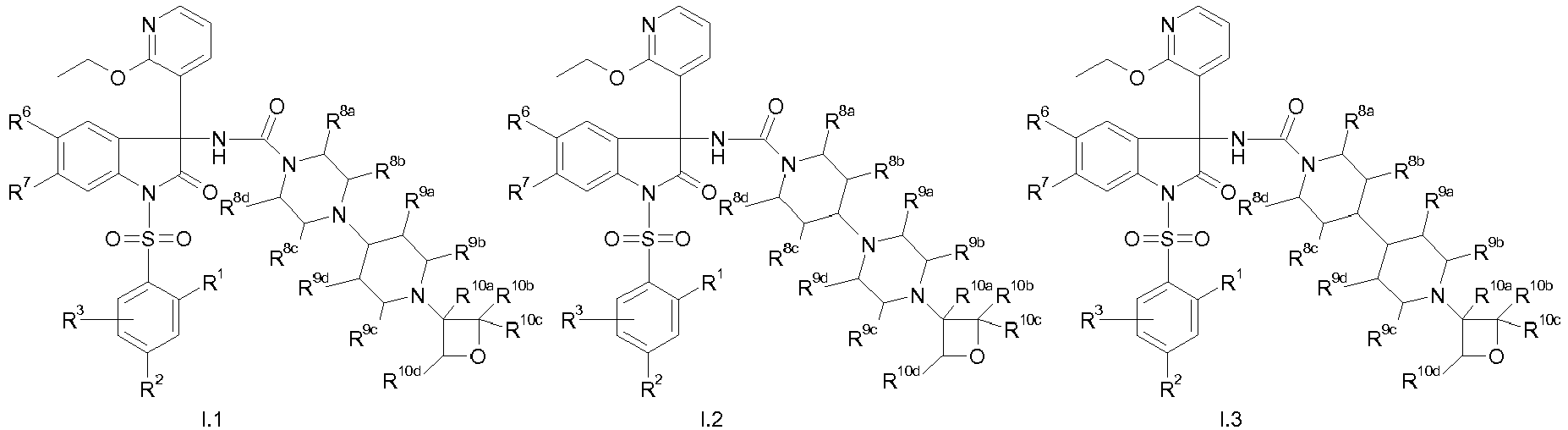


- Table 1 Compounds of the formula I.1 in which R8a, R8b, R8c, R8d, R9a, R9b, R9c, R9d, R10a, R10b, R10cand R10a are hydrogen, and R1, R2, R3, R6 and R7 for a compound corresponds in each case to one row of Table A
- Table 2 Compounds of the formula I.1 in which R8a is methyl, R8b, R8c, R8d, R9a, R9b, R9c, R9d, R10a, R10b, R10c and R10d are hydrogen, and R1, R2, R3, R6 and R7 for a compound corresponds in each case to one row of Table A
- Table 3 Compounds of the formula I.1 in which R8b is methyl, R8a, R8c, R8d, R9a, R9b, R9c, R9d, R10a, R10b, R10c and R10d are hydrogen, and R1, R2, R3, R6 and R7 for a compound corresponds in each case to one row of Table A
- Table 4 Compounds of the formula I.1 in which R8a and R8b are methyl, R8c, R8d, R9a, R9b, R9c, R9a, R10a, R10b, R10c and R10d are hydrogen, and R1, R2, R3, R6 and R7 for a compound corresponds in each case to one row of Table A
- Table 5 Compounds of the formula I.1 in which R8a and R8c are methyl, R8b, R8a, R9a, R9b, R9c, R9d, R10a, R10b, R10c and R10d are hydrogen, and R1, R2, R3, R6 and R7 for a compound corresponds in each case to one row of Table A
- Table 6 Compounds of the formula I.1 in which R8a and R8d are methyl, R8b, R8c, R9a, R9b, R9c, R9a, R10a, R10b, R10c and R10d are hydrogen, and R1, R2, R3, R6 and R7 for a compound corresponds in each case to one row of Table A
- Table 7 Compounds of the formula I.1 in which R8a and R8c form together a group -CH2-, R8b, R8a, R9a, R9b, R9c, R9d, R10a, R10b, R10c and R10a are hydrogen, and R1, R2, R3, R6 and R7 for a compound corresponds in each case to one row of Table A
- Table 8 Compounds of the formula I.1 in which R9a is methyl, R8a, R8b, R8c, R8d, R9b, R9c, R9d, R10a, R10b, R10c and R10d are hydrogen, and R1, R2, R3, R6 and R7 for a compound corresponds in each case to one row of Table A
- Table 9 Compounds of the formula I.1 in which R9b is methyl, R8a, R8b, R8c, R8d, R9a, R9c, R9d, R10a, R10b, R10c and R10d are hydrogen, and R1, R2, R3, R6 and R7 for a compound corresponds in each case to one row of Table A
- Table 10 Compounds of the formula I.1 in which R9a and R9b are methyl, R8a, R8b, R8c, R8d, R9c, R9d, R10a, R10b, R10c and R10d are hydrogen, and R1, R2, R3, R6 and R7 for a compound corresponds in each case to one row of Table A
- Table 11 Compounds of the formula I.1 in which R9a and R9c are methyl, R8a, R8b, R8c, R8d, R9b, R9d, R10a, R10b, R10c and R10d are hydrogen, and R1, R2, R3, R6 and R7 for a compound corresponds in each case to one row of Table A
- Table 12 Compounds of the formula I.1 in which R9a and R9a are methyl, R8a, R8b, R8c, R8d, R9b, R9c, R10a, R10b, R10c and R10d are hydrogen, and R1, R2, R3, R6 and R7 for a compound corresponds in each case to one row of Table A
- Table 13 Compounds of the formula I.1 in which R9a is fluorine, R8a, R8b, R8c, R8d, R9b, R9c, R9d, R10a, R10b, R10c and R10d are hydrogen, and R1, R2, R3, R6 and R7 for a compound corresponds in each case to one row of Table A
- Table 14 Compounds of the formula I.1 in which R9a and R9a are fluorine, R8a, R8b, R8c, R8d, R9b, R9c, R10a, R10b, R10c and R10d are hydrogen, and R1, R2, R3, R6 and R7 for a compound corresponds in each case to one row of Table A
- Table 15 Compounds of the formula I.1 in which R9a is chlorine, R8a, R8b, R8c, R8d, R9b, R9c, R9d, R10a, R10b, R10c and R10d are hydrogen, and R1, R2, R3, R6 and R7 for a compound corresponds in each case to one row of Table A
- Table 16 Compounds of the formula I.1 in which R9a and R9a are chlorine, R8a, R8b, R8c, R8d, R9b, R9c, R10a, R10b, R10c and R10d are hydrogen, and R1, R2, R3, R6 and R7 for a compound corresponds in each case to one row of Table A
- Table 17 Compounds of the formula I.1 in which R9a and R9c form together a group -CH2-, R8a, R8b, R8c, R8d, R9b, R9d, R10a, R10b, R10c and R10d are hydrogen, and R1, R2, R3, R6 and R7 for a compound corresponds in each case to one row of Table A
- Table 18 Compounds of the formula I.1 in which R8a and R9a are methyl R8b, R8c, R8d, R9b, R9c, R9d, R10a, R10b, R10c and R10d are hydrogen, and R1, R2, R3, R6 and R7 for a compound corresponds in each case to one row of Table A
- Table 19 Compounds of the formula I.1 in which R8b and R9b are methyl R8a, R8c, R8d, R9a, R9c, R9d, R10a, R10b, R10c and R10d are hydrogen, and R1, R2, R3, R6 and R7 for a compound corresponds in each case to one row of Table A
- Table 20 Compounds of the formula I.1 in which R10a is methyl, R8a, R8b, R8c, R8d, R9a, R9b, R9c, R9d, R10b, R10c and R10d are hydrogen, and R1, R2, R3, R6 and R7 for a compound corresponds in each case to one row of Table A
- Table 21 Compounds of the formula I.1 in which R10b is methyl, R8a, R8b, R8c, R8d, R9a, R9b, R9c, R9d, R10a, R10c and R10d are hydrogen, and R1, R2, R3, R6 and R7 for a compound corresponds in each case to one row of Table A
- Table 22 Compounds of the formula I.1 in which R10a and R10b are methyl, R8a, R8b, R8c, R8d, R9a, R9b, R9c, R9d, R10c and R10d are hydrogen, and R1, R2, R3, R6 and R7 for a compound corresponds in each case to one row of Table A
- Table 23 Compounds of the formula I.1 in which R10b and R10c are methyl, R8a, R8b, R8c, R8d, R9a, R9b, R9c, R9d, R10a and R10d are hydrogen, and R1, R2, R3, R6 and R7 for a compound corresponds in each case to one row of Table A
- Table 24 Compounds of the formula I.1 in which R10a, R10b and R10c are methyl, R8a, R8b, R8c, R8d, R9a, R9b, R9c, R9a and R10d are hydrogen, and R1, R2, R3, R6 and R7 for a compound corresponds in each case to one row of Table A
- Table 25 Compounds of the formula I.1 in which R10a, R10b and R10d are methyl, R8a, R8b, R8c, R8d, R9a, R9b, R9c, R9d and R10c are hydrogen, and R1, R2, R3, R6 and R7 for a compound corresponds in each case to one row of Table A
- Table 26 Compounds of the formula I.1 in which R8a, R9a and R10a are methyl R8b, R8c, R8d, R9b, R9c, R9d, R10b, R10c and R10d are hydrogen, and R1, R2, R3, R6 and R7 for a compound corresponds in each case to one row of Table A
- Table 27 Compounds of the formula I.1 in which R10a is fluorine, R8a, R8b, R8c, R8d, R9a, R9b, R9c, R9a, R10b, R10c and R10d are hydrogen, and R1, R2, R3, R6 and R7 for a compound corresponds in each case to one row of Table A
- Table 28 Compounds of the formula I.1 in which R10b is fluorine, R8a, R8b, R8c, R8d, R9a, R9b, R9c, R9d, R10a, R10c and R10d are hydrogen, and R1, R2, R3, R6 and R7 for a compound corresponds in each case to one row of Table A
- Table 29 Compounds of the formula I.1 in which R10a is chlorine, R8a, R8b, R8c, R8d, R9a, R9b, R9c, R9d, R10b, R10c and R10d are hydrogen, and R1, R2, R3, R6 and R7 for a compound corresponds in each case to one row of Table A
- Table 30 Compounds of the formula I.1 in which R10b is chlorine, R8a, R8b, R8c, R8d, R9a, R9b, R9c, R9d, R10a, R10c and R10d are hydrogen, and R1, R2, R3, R6 and R7 for a compound corresponds in each case to one row of Table A
- Table 31 Compounds of the formula I.2 in which R8a, R8b, R8c, R8d, R9a, R9b, R9c, R9a, R10a, R10b, R10cand R10d are hydrogen, and R1, R2, R3, R6 and R7 for a compound corresponds in each case to one row of Table A
- Table 32 Compounds of the formula I.2 in which R8a is methyl, R8b, R8c, R8d, R9a, R9b, R9c, R9d, R10a, R10b, R10c and R10d are hydrogen, and R1, R2, R3, R6 and R7 for a compound corresponds in each case to one row of Table A
- Table 33 Compounds of the formula I.2 in which R8b is methyl, R8a, R8c, R8d, R9a, R9b, R9c, R9d, R10a, R10b, R10c and R10d are hydrogen, and R1, R2, R3, R6 and R7 for a compound corresponds in each case to one row of Table A
- Table 34 Compounds of the formula I.2 in which R8a and R8b are methyl, R8c, R8d, R9a, R9b, R9c, R9d, R10a, R10b, R10c and R10d are hydrogen, and R1, R2, R3, R6 and R7 for a compound corresponds in each case to one row of Table A
- Table 35 Compounds of the formula I.2 in which R8a and R8c are methyl, R8b, R8d, R9a, R9b, R9c, R9d, R10a, R10b, R10c and R10d are hydrogen, and R1, R2, R3, R6 and R7 for a compound corresponds in each case to one row of Table A
- Table 36 Compounds of the formula I.2 in which R8a and R8d are methyl, R8b, R8c, R9a, R9b, R9c, R9d, R10a, R10b, R10c and R10d are hydrogen, and R1, R2, R3, R6 and R7 for a compound corresponds in each case to one row of Table A
- Table 37 Compounds of the formula I.2 in which R8b is fluorine, R8a, R8c, R8d, R9a, R9b, R9c, R9d, R10a, R10b, R10c and R10d are hydrogen, and R1, R2, R3, R6 and R7 for a compound corresponds in each case to one row of Table A
- Table 38 Compounds of the formula I.2 in which R8b and R8c are fluorine, R8a, R8d, R9a, R9b, R9c, R9d, R10a, R10b, R10c and R10d are hydrogen, and R1, R2, R3, R6 and R7 for a compound corresponds in each case to one row of Table A
- Table 39 Compounds of the formula I.2 in which R8b is chlorine, R8a, R8c, R8d, R9a, R9b, R9c, R9d, R10a, R10b, R10c and R10d are hydrogen, and R1, R2, R3, R6 and R7 for a compound corresponds in each case to one row of Table A
- Table 40 Compounds of the formula I.2 in which R8b and R8c are chlorine, R8a, R8d, R9a, R9b, R9c, R9d, R10a, R10b, R10c and R10d are hydrogen, and R1, R2, R3, R6 and R7 for a compound corresponds in each case to one row of Table A
- Table 41 Compounds of the formula I.2 in which R8a and R8c form together a group -CH2-, R8b, R8d, R9a, R9b, R9c, R9d, R10a, R10b, R10c and R10d are hydrogen, and R1, R2, R3, R6 and R7 for a compound corresponds in each case to one row of Table A
- Table 42 Compounds of the formula I.2 in which R9a is methyl, R8a, R8b, R8c, R8d, R9b, R9c, R9d, R10a, R10b, R10c and R10d are hydrogen, and R1, R2, R3, R6 and R7 for a compound corresponds in each case to one row of Table A
- Table 43 Compounds of the formula I.2 in which R9b is methyl, R8a, R8b, R8c, R8d, R9a, R9c, R9d, R10a, R10b, R10c and R10d are hydrogen, and R1, R2, R3, R6 and R7 for a compound corresponds in each case to one row of Table A
- Table 44 Compounds of the formula I.2 in which R9a and R9b are methyl, R8a, R8b, R8c, R8d, R9c, R9d, R10a, R10b, R10c and R10d are hydrogen, and R1, R2, R3, R6 and R7 for a compound corresponds in each case to one row of Table A
- Table 45 Compounds of the formula I.2 in which R9a and R9c are methyl, R8a, R8b, R8c, R8d, R9b, R9d, R10a, R10b, R10c and R10d are hydrogen, and R1, R2, R3, R6 and R7 for a compound corresponds in each case to one row of Table A
- Table 46 Compounds of the formula I.2 in which R9a and R9a are methyl, R8a, R8b, R8c, R8d, R9b, R9c, R10a, R10b, R10c and R10d are hydrogen, and R1, R2, R3, R6 and R7 for a compound corresponds in each case to one row of Table A
- Table 47 Compounds of the formula I.2 in which R9a and R9c form together a group -CH2-, R8a, R8b, R8c, R8d, R9b, R9d, R10a, R10b, R10c and R10d are hydrogen, and R1, R2, R3, R6 and R7 for a compound corresponds in each case to one row of Table A
- Table 48 Compounds of the formula I.2 in which R8a and R9a are methyl R8b, R8c, R8d, R9b, R9c, R9d, R10a, R10b, R10c and R10d are hydrogen, and R1, R2, R3, R6 and R7 for a compound corresponds in each case to one row of Table A
- Table 49 Compounds of the formula I.2 in which R8b and R9b are methyl R8a, R8c, R8d, R9a, R9c, R9d, R10a, R10b, R10c and R10d are hydrogen, and R1, R2, R3, R6 and R7 for a compound corresponds in each case to one row of Table A
- Table 50 Compounds of the formula I.2 in which R10a is methyl, R8a, R8b, R8c, R8d, R9a, R9b, R9c, R9d, R10b, R10c and R10d are hydrogen, and R1, R2, R3, R6 and R7 for a compound corresponds in each case to one row of Table A
- Table 51 Compounds of the formula 1.2 in which R10b is methyl, R8a, R8b, R8c, R8d, R9a, R9b, R9c, R9d, R10a, R10c and R10d are hydrogen, and R1, R2, R3, R6 and R7 for a compound corresponds in each case to one row of Table A
- Table 52 Compounds of the formula 1.2 in which R10a and R10b are methyl, R8a, R8b, R8c, R8d, R9a, R9b, R9c, R9d, R10c and R10d are hydrogen, and R1, R2, R3, R6 and R7 for a compound corresponds in each case to one row of Table A
- Table 53 Compounds of the formula I.2 in which R10b and R10c are methyl, R8a, R8b, R8c, R8d, R9a, R9b, R9c, R9d, R10a and R10d are hydrogen, and R1, R2, R3, R6 and R7 for a compound corresponds in each case to one row of Table A
- Table 54 Compounds of the formula 1.2 in which R10a, R10b and R10c are methyl, R8a, R8b, R8c, R8d, R9a, R9b, R9c, R9d and R10d are hydrogen, and R1, R2, R3, R6 and R7 for a compound corresponds in each case to one row of Table A
- Table 55 Compounds of the formula I.2 in which R10a, R10b and R10d are methyl, R8a, R8b, R8c, R8d, R9a, R9b, R9c, R9d and R10c are hydrogen, and R1, R2, R3, R6 and R7 for a compound corresponds in each case to one row of Table A
- Table 56 Compounds of the formula 1.2 in which R8a, R9a and R10a are methyl R8b, R8c, R8d, R9b, R9c, R9d, R10b, R10c and R10d are hydrogen, and R1, R2, R3, R6 and R7 for a compound corresponds in each case to one row of Table A
- Table 57 Compounds of the formula I.2 in which R10a is fluorine, R8a, R8b, R8c, R8d, R9a, R9b, R9c, R9d, R10b, R10c and R10d are hydrogen, and R1, R2, R3, R6 and R7 for a compound corresponds in each case to one row of Table A
- Table 58 Compounds of the formula I.2 in which R10b is fluorine, R8a, R8b, R8c, R8d, R9a, R9b, R9c, R9d, R10a, R10c and R10d are hydrogen, and R1, R2, R3, R6 and R7 for a compound corresponds in each case to one row of Table A
- Table 59 Compounds of the formula I.2 in which R10a is chlorine, R8a, R8b, R8c, R8d, R9a, R9b, R9c, R9a, R10b, R10c and R10d are hydrogen, and R1, R2, R3, R6 and R7 for a compound corresponds in each case to one row of Table A
- Table 60 Compounds of the formula I.2 in which R10b is chlorine, R8a, R8b, R8c, R8d, R9a, R9b, R9c, R9d, R10a, R10c and R10d are hydrogen, and R1, R2, R3, R6 and R7 for a compound corresponds in each case to one row of Table A
- Table 61 Compounds of the formula 1.3 in which R8a, R8b, R8c, R8d, R9a, R9b, R9c, R9a, R10a, R10b, R10cand R10d are hydrogen, and R1, R2, R3, R6 and R7 for a compound corresponds in each case to one row of Table A
- Table 62 Compounds of the formula I.3 in which R8a is methyl, R8b, R8c, R8d, R9a, R9b, R9c, R9d, R10a, R10b, R10c and R10d are hydrogen, and R1, R2, R3, R6 and R7 for a compound corresponds in each case to one row of Table A
- Table 63 Compounds of the formula I.3 in which R8b is methyl, R8a R8c, R8d, R9a, R9b, R9c, R9d, R10a, R10b, R10c and R10d are hydrogen, and R1, R2, R3, R6 and R7 for a compound corresponds in each case to one row of Table A
- Table 64 Compounds of the formula I.3 in which R8a and R8b are methyl, R8c, R8d, R9a, R9b, R9c, R9d, R10a, R10b, R10c and R10d are hydrogen, and R1, R2, R3, R6 and R7 for a compound corresponds in each case to one row of Table A
- Table 65 Compounds of the formula I.3 in which R8a and R8c are methyl, R8b, R8d, R9a, R9b, R9c, R9d, R10a, R10b, R10c and R10d are hydrogen, and R1, R2, R3, R6 and R7 for a compound corresponds in each case to one row of Table A
- Table 66 Compounds of the formula I.3 in which R8a and R8d are methyl, R8b, R8c, R9a, R9b, R9c, R9a, R10a, R10b, R10c and R10d are hydrogen, and R1, R2, R3, R6 and R7 for a compound corresponds in each case to one row of Table A
- Table 67 Compounds of the formula I.3 in which R8b is fluorine, R8a, R8c, R8d, R9a, R9b, R9c, R9d, R10a, R10b, R10c and R10d are hydrogen, and R1, R2, R3, R6 and R7 for a compound corresponds in each case to one row of Table A
- Table 68 Compounds of the formula I.3 in which R8b and R8c are fluorine, R8a, R8d, R9a, R9b, R9c, R9d, R10a, R10b, R10c and R10d are hydrogen, and R1, R2, R3, R6 and R7 for a compound corresponds in each case to one row of Table A
- Table 69 Compounds of the formula I.3 in which R8b is chlorine, R8a, R8c, R8d, R9a, R9b, R9c, R9d, R10a, R10b, R10c and R10d are hydrogen, and R1, R2, R3, R6 and R7 for a compound corresponds in each case to one row of Table A
- Table 70 Compounds of the formula I.3 in which R8b and R8c are chlorine, R8a, R8d, R9a, R9b, R9c, R9d, R10a, R10b, R10c and R10d are hydrogen, and R1, R2, R3, R6 and R7 for a compound corresponds in each case to one row of Table A
- Table 71 Compounds of the formula I.3 in which R8a and R8c form together a group -CH2-, R8b, R8d, R9a, R9b, R9c, R9d, R10a, R10b, R10c and R10d are hydrogen, and R1, R2, R3, R6 and R7 for a compound corresponds in each case to one row of Table A
- Table 72 Compounds of the formula I.3 in which R9a is methyl, R8a, R8b, R8c, R8d, R9b, R9c, R9d, R10a, R10b, R10c and R10d are hydrogen, and R1, R2, R3, R6 and R7 for a compound corresponds in each case to one row of Table A
- Table 73 Compounds of the formula I.3 in which R9b is methyl, R8a, R8b, R8c, R8d, R9a, R9c, R9d, R10a, R10b, R10c and R10d are hydrogen, and R1, R2, R3, R6 and R7 for a compound corresponds in each case to one row of Table A
- Table 74 Compounds of the formula I.3 in which R9a and R9b are methyl, R8a, R8b, R8c, R8d, R9c, R9d, R10a, R10b, R10c and R10d are hydrogen, and R1, R2, R3, R6 and R7 for a compound corresponds in each case to one row of Table A
- Table 75 Compounds of the formula I.3 in which R9a and R9c are methyl, R8a, R8b, R8c, R8d, R9b, R9d, R10a, R10b, R10c and R10d are hydrogen, and R1, R2, R3, R6 and R7 for a compound corresponds in each case to one row of Table A
- Table 76 Compounds of the formula I.3 in which R9a and R9d are methyl, R8a, R8b, R8c, R8d, R9b, R9c, R10a, R10b, R10c and R10d are hydrogen, and R1, R2, R3, R6 and R7 for a compound corresponds in each case to one row of Table A
- Table 77 Compounds of the formula I.3 in which R9a is fluorine, R8a R8b, R8c, R8d, R9b, R9c, R9d, R10a, R10b, R10c and R10d are hydrogen, and R1, R2, R3, R6 and R7 for a compound corresponds in each case to one row of Table A
- Table 78 Compounds of the formula I.3 in which R9a and R9d are fluorine, R8a, R8b, R8c, R8d, R9b, R9c, R10a, R10b, R10c and R10d are hydrogen, and R1, R2, R3, R6 and R7 for a compound corresponds in each case to one row of Table A
- Table 79 Compounds of the formula I.3 in which R9a is chlorine, R8a , R8b , R8c, R8d, R9b, R9c, R9d, R10a, R10b, R10c and R10d are hydrogen, and R1, R2, R3, R6 and R7 for a compound corresponds in each case to one row of Table A
- Table 80 Compounds of the formula I.3 in which R9a and R9d are chlorine, R8a, R8b, R8c, R8d, R9b, R9c, R10a, R10b, R10c and R10d are hydrogen, and R1, R2, R3, R6 and R7 for a compound corresponds in each case to one row of Table A
- Table 81 Compounds of the formula I.3 in which R9a and R9c form together a group -CH2-, R8a, R8b, R8c, R8d, R9b, R9d, R10a, R10b, R10c and R10d are hydrogen, and R1, R2, R3, R6 and R7 for a compound corresponds in each case to one row of Table A
- Table 82 Compounds of the formulae I.3 in which R10a is methyl, R8a, R8b, R8c, R8d, R9a, R9b, R9c, R9d, R10b, R10c and R10d are hydrogen, and R1, R2, R3, R6 and R7 for a compound corresponds in each case to one row of Table A
- Table 83 Compounds of the formula 1.3 in which R10b is methyl, R8a, R8b, R8c, R8d, R9a, R9b, R9c, R9d, R10a, R10c and R10d are hydrogen, and R1, R2, R3, R6 and R7 for a compound corresponds in each case to one row of Table A
- Table 84 Compounds of the formula I.3 in which R10a and R10b are methyl, R8a, R8b, R8c, R8d, R9a, R9b, R9c, R9d, R10c and R10d are hydrogen, and R1, R2, R3, R6 and R7 for a compound corresponds in each case to one row of Table A
- Table 85 Compounds of the formula I.3 in which R10b and R10c are methyl, R8a, R8b, R8c, R8d, R9a, R9b, R9c, R9d, R10a and R10d are hydrogen, and R1, R2, R3, R6 and R7 for a compound corresponds in each case to one row of Table A
- Table 86 Compounds of the formula I.3 in which R10a, R10b and R10c are methyl, R8a, R8b, R8c, R8d, R9a, R9b, R9c, R9d and R10d are hydrogen, and R1, R2, R3, R6 and R7 for a compound corresponds in each case to one row of Table A
- Table 87 Compounds of the formula I.3 in which R10a is fluorine, R8a, R8b, R8c, R8d, R9a, R9b, R9c, R9d, R10b, R10c and R10d are hydrogen, and R1, R2, R3, R6 and R7 for a compound corresponds in each case to one row of Table A
- Table 88 Compounds of the formula I.3 in which R10b is fluorine, R8a, R8b, R8c, R8d, R9a, R9b, R9c, R9d, R10a, R10c and R10d are hydrogen, and R1, R2, R3, R6 and R7 for a compound corresponds in each case to one row of Table A
- Table 89 Compounds of the formula I.3 in which R10a is chlorine, R8a, R8b, R8c, R8d, R9a, R9b, R9c, R9d, R10b, R10c and R10d are hydrogen, and R1, R2, R3, R6 and R7 for a compound corresponds in each case to one row of Table A
- Table 90 Compounds of the formula I.3 in which R10b is chlorine, R8a, R8b, R8c, R8d, R9a, R9b, R9c, R9d, R10a, R10c and R10d are hydrogen, and R1, R2, R3, R6 and R7 for a compound corresponds in each case to one row of Table A
- Tables 91 to 120 Compounds of the formula I.4 in which the combination of R8a, R8b, R8c, R8d, R9a, R9b, R9c, R9d, R10a, R10b, R10c and R10d is as defined in any of Tables 1 to 30, and R1, R2, R3, R6 and R7 for a compound corresponds in each case to one row of Table A
- Tables 121 to 150 Compounds of the formula I.5 in which the combination of R8a, R8b, R8c, R8d, R9a, R9b, R9c, R9d, R10a, R10b, R10c and R10d is as defined in any of Tables 31 to 60, and R1, R2, R3, R6 and R7 for a compound corresponds in each case to one row of Table A
- Tables 151 to 180 Compounds of the formula I.6 in which the combination of R8a, R8b, R8c, R8d, R9a, R9b, R9c, R9d, R10a, R10b, R10c and R10d is as defined in any of Tables 61 to 90, and R1, R2, R3, R6 and R7 for a compound corresponds in each case to one row of Table A
- Tables 181 to 210 Compounds of the formula I.7 in which the combination of R8a, R8b, R8c, R8d, R9a, R9b, R9c, R9d, R10a, R10b, R10c and R10d is as defined in any of Tables 1 to 30, and R1, R2, R3, R6 and R7 for a compound corresponds in each case to one row of Table A
- Tables 211 to 240 Compounds of the formula I.8 in which the combination of R8a, R8b, R8c, R8d, R9a, R9b, R9c, R9d, R10a, R10b, R10c and R10d is as defined in any of Tables 31 to 60, and R1, R2, R3, R6 and R7 for a compound corresponds in each case to one row of Table A
- Tables 241 to 270 Compounds of the formula I.9 in which the combination of R8a, R8b, R8c, R8d, R9a, R9b, R9c, R9d, R10a, R10b, R10c and R10d is as defined in any of Tables 61 to 90, and R1, R2, R3, R6 and R7 for a compound corresponds in each case to one row of Table A
- Tables 271 to 300 Compounds of the formula 1.10 in which the combination of R8a, R8b, R8c, R8d, R9a, R9b, R9c, R9d, R10a, R10b, R10c and R10d is as defined in any of Tables 1 to 30, and R1, R2, R3, R6 and R7 for a compound corresponds in each case to one row of Table A
- Tables 301 to 330 Compounds of the formula 1.11 in which the combination of R8a, R8b, R8c, R8d, R9a, R9b, R9c, R9d, R10a, R10b, R10c and R10d is as defined in any of Tables 31 to 60, and R1, R2, R3, R6 and R7 for a compound corresponds in each case to one row of Table A
- Tables 331 to 360 Compounds of the formula 1.12 in which the combination of R8a, R8b, R8c, R8d, R9a, R9b, R9c, R9d, R10a, R10b, R10c and R10d is as defined in any of Tables 61 to 90, and R1, R2, R3, R6 and R7 for a compound corresponds in each case to one row of Table A
- Tables 361 to 390 Compounds of the formula I.13 in which the combination of R8a, R8b, R8c, R8d, R9a, R9b, R9c, R9d, R10a, R10b, R10c and R10d is as defined in any of Tables 1 to 30, and R1, R2, R3, R6 and R7 for a compound corresponds in each case to one row of Table A
- Tables 391 to 420 Compounds of the formula I.14 in which the combination of R8a, R8b, R8c, R8d, R9a, R9b, R9c, R9d, R10a, R10b, R10c and R10d is as defined in any of Tables 31 to 60, and R1, R2, R3, R6 and R7 for a compound corresponds in each case to one row of Table A
- Tables 421 to 450 Compounds of the formula I.15 in which the combination of R8a, R8b, R8c, R8d, R9a, R9b, R9c, R9d , R10a, R10b, R10c and R10d is as defined in any of Tables 61 to 90, and R1, R2, R3, R6 and R7 for a compound corresponds in each case to one row of Table A
- Tables 451 to 480 Compounds of the formula 1.16 in which the combination of R8a, R8b, R8c, R8d, R9a, R9b, R9c, R9d, R10a, R10b, R10c and R10d is as defined in any of Tables 1 to 30, and R1, R2, R3, R6 and R7 for a compound corresponds in each case to one row of Table A
- Tables 481 to 510 Compounds of the formula I.17 in which the combination of R8a, R8b, R8c, R8d, R9a, R9b, R9c, R9d, R10a, R10b, R10c and R10d is as defined in any of Tables 31 to 60, and R1, R2, R3, R6 and R7 for a compound corresponds in each case to one row of Table A
- Tables 511 to 540 Compounds of the formula I.18 in which the combination of R8a, R8b, R8c, R8d, R9a, R9b, R9c, R9d, R10a, R10b, R10c and R10d is as defined in any of Tables 61 to 90, and R1, R2, R3, R6 and R7 for a compound corresponds in each case to one row of Table A
- Tables 541 to 570 Compounds of the formula I.19 in which the combination of R8a, R8b, R8c, R8d, R9a, R9b, R9c, R9d, R10a, R10b, R10c and R10d is as defined in any of Tables 1 to 30, and R2, R3, R6 and R7 for a compound corresponds in each case to one row of Table B
- Tables 571 to 600 Compounds of the formula I.20 in which the combination of R8a, R8b, R8c, R8d, R9a, R9b, R9c, R9d, R10a, R10b, R10c and R10d is as defined in any of Tables 31 to 60, and R2, R3, R6 and R7 for a compound corresponds in each case to one row of Table B
- Tables 601 to 630 Compounds of the formula I.21 in which the combination of R8a, R8b, R8c, R8d, R9a, R9b, R9c, R9d, R10a, R10b, R10c and R10d is as defined in any of Tables 61 to 90, and R2, R3, R6 and R7 for a compound corresponds in each case to one row of Table B
- Tables 631 to 660 Compounds of the formula I.22 in which the combination of R8a, R8b, R8c, R8d, R9a, R9b, R9c, R9d, R10a, R10b, R10c and R10d is as defined in any of Tables 1 to 30, and R2, R3, R6 and R7 for a compound corresponds in each case to one row of Table B
- Tables 661 to 690 Compounds of the formula I.23 in which the combination of R8a, R8b, R8c, R8d, R9a, R9b, R9c, R9d, R10a, R10b, R10c and R10d is as defined in any of Tables 31 to 60, and R2, R3, R6 and R7 for a compound corresponds in each case to one row of Table B
- Tables 691 to 720 Compounds of the formula I.24 in which the combination of R8a, R8b, R8c, R8d, R9a, R9b, R9c, R9d, R10a, R10b, R10c and R10d is as defined in any of Tables 61 to 90, and R2, R3, R6 and R7 for a compound corresponds in each case to one row of Table B
- Tables 721 to 750 Compounds of the formula I.25 in which the combination of R8a, R8b, R8c, R8d, R9a, R9b, R9c, R9d, R10a, R10b, R10c and R10d is as defined in any of Tables 1 to 30, and R2, R3, R6 and R7 for a compound corresponds in each case to one row of Table B
- Tables 751 to 780 Compounds of the formula I.26 in which the combination of R8a, R8b, R8c, R8d, R9a, R9b, R9c, R9d, R10a, R10b, R10c and R10d is as defined in any of Tables 31 to 60, and R2, R3, R6 and R7 for a compound corresponds in each case to one row of Table B
- Tables 781 to 810 Compounds of the formula I.27 in which the combination of R8a, R8b, R8c, R8d, R9a, R9b, R9c, R9d, R10a, R10b, R10c and R10d is as defined in any of Tables 61 to 90, and R2, R3, R6 and R7 for a compound corresponds in each case to one row of Table B
- Tables 811 to 840 Compounds of the formula 1.28 in which the combination of R8a, R8b, R8c, R8d, R9a, R9b, R9c, R9d, R10a, R10b, R10c and R10d is as defined in any of Tables 1 to 30, and R2, R3, R6 and R7 for a compound corresponds in each case to one row of Table B
- Tables 841 to 870 Compounds of the formula I.29 in which the combination of R8a, R8b, R8c, R8d, R9a, R9b, R9c, R9d, R10a, R10b, R10c and R10d is as defined in any of Tables 31 to 60, and R2, R3, R6 and R7 for a compound corresponds in each case to one row of Table B
- Tables 871 to 900 Compounds of the formula I.30 in which the combination of R8a, R8b, R8c, R8d, R9a, R9b, R9c, R9d, R10a, R10b, R10c and R10d is as defined in any of Tables 61 to 90, and R2, R3, R6 and R7 for a compound corresponds in each case to one row of Table B
- Tables 901 to 930 Compounds of the formula I.31 in which the combination of R8a, R8b, R8c, R8d, R9a, R9b, R9c, R9d, R10a, R10b, R10c and R10d is as defined in any of Tables 1 to 30, and R2, R3, R6 and R7 for a compound corresponds in each case to one row of Table B
- Tables 931 to 960 Compounds of the formula I.32 in which the combination of R8a, R8b, R8c, R8d, R9a, R9b, R9c, R9d, R10a, R10b, R10c and R10d is as defined in any of Tables 31 to 60, and R2, R3, R6 and R7 for a compound corresponds in each case to one row of Table B
- Tables 961 to 990 Compounds of the formula I.33 in which the combination of R8a, R8b, R8c, R8d, R9a, R9b, R9c, R9d, R10a, R10b, R10c and R10d is as defined in any of Tables 61 to 90, and R2, R3, R6 and R7 for a compound corresponds in each case to one row of Table B
- Tables 991 to 1020 Compounds of the formula I.34 in which the combination of R8a, R8b, R8c, R8d, R9a, R9b, R9c, R9d, R10a, R10b, R10c and R10d is as defined in any of Tables 1 to 30, and R2, R3, R6 and R7 for a compound corresponds in each case to one row of Table B
- Tables 1021 to 1050 Compounds of the formula I.35 in which the combination of R8a, R8b, R8c, R8d, R9a, R9b, R9c, R9d, R10a, R10b, R10c and R10d is as defined in any of Tables 31 to 60, and R2, R3, R6 and R7 for a compound corresponds in each case to one row of Table B
- Tables 1051 to 1080 Compounds of the formula I.36 in which the combination of R8a, R8b, R8c, R8d, R9a, R9b, R9c, R9d, R10a, R10b, R10c and R10d is as defined in any of Tables 61 to 90, and R2, R3, R6 and R7 for a compound corresponds in each case to one row of Table B
- Tables 1081 to 1110 Compounds of the formula I.37 in which the combination of R8a, R8b, R8c, R8d, R9a, R9b, R9c, R9d, R10a, R10b, R10c and R10d is as defined in any of Tables 1 to 30, and R1, R2, R3, R6 and R7 for a compound corresponds in each case to one row of Table A
- Tables 1111 to 1140 Compounds of the formula I.38 in which the combination of R8a, R8b, R8c, R8d, R9a, R9b, R9c, R9d, R10a, R10b, R10c and R10d is as defined in any of Tables 31 to 60, and R1, R2, R3, R6 and R7 for a compound corresponds in each case to one row of Table A
- Tables 1141 to 1170 Compounds of the formula I.39 in which the combination of R8a, R8b, R8c, R8d, R9a, R9b, R9c, R9d , R10a, R10b, R10c and R10d is as defined in any of Tables 61 to 90, and R1, R2, R3, R6 and R7 for a compound corresponds in each case to one row of Table A
- Tables 1171 to 1200 Compounds of the formula I.40 in which the combination of R8a, R8b, R8c, R8d, R9a, R9b, R9c, R9d, R10a, R10b, R10c and R10d is as defined in any of Tables 1 to 30, and R1, R2, R3, R6 and R7 for a compound corresponds in each case to one row of Table A
- Tables 1201 to 1230 Compounds of the formula I.41 in which the combination of R8a, R8b, R8c, R8d, R9a, R9b, R9c, R9d, R10a, R10b, R10c and R10d is as defined in any of Tables 31 to 60, and R1, R2, R3, R6 and R7 for a compound corresponds in each case to one row of Table A
- Tables 1231 to 1260 Compounds of the formula I.42 in which the combination of R8a, R8b, R8c, R8d, R9a, R9b, R9c, R9d, R10a, R10b, R10c and R10d is as defined in any of Tables 61 to 90, and R1, R2, R3, R6 and R7 for a compound corresponds in each case to one row of Table A
- Tables 1261 to 1290 Compounds of the formula I.43 in which the combination of R8a, R8b, R8c, R8d, R9a, R9b, R9c, R9d, R10a, R10b, R10c and R10d is as defined in any of Tables 1 to 30, and R1, R2, R3, R6 and R7 for a compound corresponds in each case to one row of Table A
- Tables 1291 to 1320 Compounds of the formula I.44 in which the combination of R8a, R8b, R8c, R8d, R9a, R9b, R9c, R9d, R10a, R10b, R10c and R10d is as defined in any of Tables 31 to 60, and R1, R2, R3, R6 and R7 for a compound corresponds in each case to one row of Table A
- Tables 1321 to 1350 Compounds of the formula I.45 in which the combination of R8a, R8b, R8c, R8d, R9a, R9b, R9c, R9a, R10a, R10b, R10c and R10d is as defined in any of Tables 61 to 90, and R1, R2, R3, R6 and R7 for a compound corresponds in each case to one row of Table A
- Tables 1351 to 1380 Compounds of the formula I.46 in which the combination of R8a, R8b, R8c, R8d, R9a, R9b, R9c, R9d, R10a, R10b, R10c and R10d is as defined in any of Tables 1 to 30, and R1, R2, R3, R6 and R7 for a compound corresponds in each case to one row of Table A
- Tables 1381 to 1410 Compounds of the formula I.47 in which the combination of R8a, R8b, R8c, R8d, R9a, R9b, R9c, R9d, R10a, R10b, R10c and R10d is as defined in any of Tables 31 to 60, and R1, R2, R3, R6 and R7 for a compound corresponds in each case to one row of Table A
- Tables 1411 to 1440 Compounds of the formula I.48 in which the combination of R8a, R8b, R8c, R8d, R9a, R9b, R9c, R9d, R10a, R10b, R10c and R10d is as defined in any of Tables 61 to 90, and R1, R2, R3, R6 and R7 for a compound corresponds in each case to one row of Table A
- Tables 1441 to 1470 Compounds of the formula I.49 in which the combination of R8a, R8b, R8c, R8d, R9a, R9b, R9c, R9d, R10a, R10b, R10c and R10d is as defined in any of Tables 1 to 30, and R1, R2, R3, R6 and R7 for a compound corresponds in each case to one row of Table A
- Tables 1471 to 1500 Compounds of the formula I.50 in which the combination of R8a, R8b, R8c, R8d, R9a, R9b, R9c, R9a, R10a, R10b, R10c and R10d is as defined in any of Tables 31 to 60, and R1, R2, R3, R6 and R7 for a compound corresponds in each case to one row of Table A
- Tables 1501 to 1530 Compounds of the formula I.51 in which the combination of R8a, R8b, R8c, R8d, R9a, R9b, R9c, R9a, R10a, R10b, R10c and R10d is as defined in any of Tables 61 to 90, and R1, R2, R3, R6 and R7 for a compound corresponds in each case to one row of Table A
- Tables 1531 to 1560 Compounds of the formula I.52 in which the combination of R8a, R8b, R8c, R8d, R9a, R9b, R9c, R9a, R10a, R10b, R10c and R10d is as defined in any of Tables 1 to 30, and R1, R2, R3, R6 and R7 for a compound corresponds in each case to one row of Table A
- Tables 1561 to 1590 Compounds of the formula I.53 in which the combination of R8a, R8b, R8c, R8d, R9a, R9b, R9c, R9d, R10a, R10b, R10c and R10d is as defined in any of Tables 31 to 60, and R1, R2, R3, R6 and R7 for a compound corresponds in each case to one row of Table A
- Tables 1591 to 1620 Compounds of the formula I.54 in which the combination of R8a, R8b, R8c, R8d, R9a, R9b, R9c, R9d, R10a, R10b, R10c and R10d is as defined in any of Tables 61 to 90, and R1, R2, R3, R6 and R7 for a compound corresponds in each case to one row of Table A
- Tables 1621 to 1650 Compounds of the formula I.55 in which the combination of R8a, R8b, R8c, R8d, R9a, R9b, R9c, R9d, R10a, R10b, R10c and R10d is as defined in any of Tables 1 to 30, and R2, R3, R6 and R7 for a compound corresponds in each case to one row of Table B
- Tables 1651 to 1680 Compounds of the formula I.56 in which the combination of R8a, R8b, R8c, R8d, R9a, R9b, R9c, R9d, R10a, R10b, R10c and R10d is as defined in any of Tables 31 to 60, and R2, R3, R6 and R7 for a compound corresponds in each case to one row of Table B
- Tables 1681 to 1710 Compounds of the formula I.57 in which the combination of R8a, R8b, R8c, R8d, R9a, R9b, R9c, R9d, R10a, R10b, R10c and R10d is as defined in any of Tables 61 to 90, and R2, R3, R6 and R7 for a compound corresponds in each case to one row of Table B
- Tables 1711 to 1740 Compounds of the formula I.58 in which the combination of R8a, R8b, R8c, R8d, R9a, R9b, R9c, R9d, R10a, R10b, R10c and R10d is as defined in any of Tables 1 to 30, and R2, R3, R6 and R7 for a compound corresponds in each case to one row of Table B
- Tables 1741 to 1770 Compounds of the formula I.59 in which the combination of R8a, R8b, R8c, R8d, R9a, R9b, R9c, R9d, R10a, R10b, R10c and R10d is as defined in any of Tables 31 to 60, and R2, R3, R6 and R7 for a compound corresponds in each case to one row of Table B
- Tables 1771 to 1800 Compounds of the formula I.60 in which the combination of R8a, R8b, R8c, R8d, R9a, R9b, R9c, R9d, R10a, R10b, R10c and R10d is as defined in any of Tables 61 to 90, and R2, R3, R6 and R7 for a compound corresponds in each case to one row of Table B
- Tables 1801 to 1830 Compounds of the formula I.61 in which the combination of R8a, R8b, R8c, R8d, R9a, R9b, R9c, R9d, R10a, R10b, R10c and R10d is as defined in any of Tables 1 to 30, and R2, R3, R6 and R7 for a compound corresponds in each case to one row of Table B
- Tables 1831 to 1860 Compounds of the formula I.62 in which the combination of R8a, R8b, R8c, R8d, R9a, R9b, R9c, R9d, R10a, R10b, R10c and R10d is as defined in any of Tables 31 to 60, and R2, R3, R6 and R7 for a compound corresponds in each case to one row of Table B
- Tables 1861 to 1890 Compounds of the formula I.63 in which the combination of R8a, R8b, R8c, R8d, R9a, R9b, R9c, R9d, R10a, R10b, R10c and R10d is as defined in any of Tables 61 to 90, and R2, R3, R6 and R7 for a compound corresponds in each case to one row of Table B
- Tables 1891 to 1920 Compounds of the formula I.64 in which the combination of R8a, R8b, R8c, R8d, R9a, R9b, R9c, R9d, R10a, R10b, R10c and R10d is as defined in any of Tables 1 to 30, and R2, R3, R6 and R7 for a compound corresponds in each case to one row of Table B
- Tables 1921 to 1950 Compounds of the formula I.65 in which the combination of R8a, R8b, R8c, R8d, R9a, R9b, R9c, R9d, R10a, R10b, R10c and R10d is as defined in any of Tables 31 to 60, and R2, R3, R6 and R7 for a compound corresponds in each case to one row of Table B
- Tables 1951 to 1980 Compounds of the formula I.66 in which the combination of R8a, R8b, R8c, R8d, R9a, R9b, R9c, R9d, R10a, R10b, R10c and R10d is as defined in any of Tables 61 to 90, and R2, R3, R6 and R7 for a compound corresponds in each case to one row of Table B
- Tables 1981 to 2010 Compounds of the formula I.67 in which the combination of R8a, R8b, R8c, R8d, R9a, R9b, R9c, R9d, R10a, R10b, R10c and R10d is as defined in any of Tables 1 to 30, and R2, R3, R6 and R7 for a compound corresponds in each case to one row of Table B
- Tables 2011 to 2040 Compounds of the formula I.68 in which the combination of R8a, R8b, R8c, R8d, R9a, R9b, R9c, R9d, R10a, R10b, R10c and R10d is as defined in any of Tables 31 to 60, and R2, R3, R6 and R7 for a compound corresponds in each case to one row of Table B
- Tables 2041 to 2070 Compounds of the formula I.69 in which the combination of R8a, R8b, R8c, R8d, R9a, R9b, R9c, R9d, R10a, R10b, R10c and R10d is as defined in any of Tables 61 to 90, and R2, R3, R6 and R7 for a compound corresponds in each case to one row of Table B
- Tables 2071 to 2100 Compounds of the formula I.70 in which the combination of R8a, R8b, R8c, R8d, R9a, R9b, R9c, R9d, R10a, R10b, R10c and R10d is as defined in any of Tables 1 to 30, and R1, R2, R3, R6 and R7 for a compound corresponds in each case to one row of Table A
- Tables 2101 to 2130 Compounds of the formula I.71 in which the combination of R8a, R8b, R8c, R8d, R9a, R9b, R9c, R9d, R10a, R10b, R10c and R10d is as defined in any of Tables 31 to 60, and R2, R3, R6 and R7 for a compound corresponds in each case to one row of Table B
- Tables 2131 to 2160 Compounds of the formula I.72 in which the combination of R8a, R8b, R8c, R8d, R9a, R9b, R9c, R9d, R10a, R10b, R10c and R10d is as defined in any of Tables 61 to 90, and R2, R3, R6 and R7 for a compound corresponds in each case to one row of Table B
- Tables 2161 to 2190 Compounds of the formula I.73 in which the combination of R8a, R8b, R8c, R8d, R9a, R9b, R9c, R9a, R10a, R10b, R10c and R10d is as defined in any of Tables 1 to 30, and R1, R2, R3, R6 and R7 for a compound corresponds in each case to one row of Table A
- Tables 2191 to 2220 Compounds of the formula I.74 in which the combination of R8a, R8b, R8c, R8d, R9a, R9b, R9c, R9a, R10a, R10b, R10c and R10d is as defined in any of Tables 31 to 60, and R1, R2, R3, R6 and R7 for a compound corresponds in each case to one row of Table A
- Tables 2221 to 2250 Compounds of the formula I.75 in which the combination of R8a, R8b, R8c, R8d, R9a, R9b, R9c, R9d, R10a, R10b, R10c and R10d is as defined in any of Tables 61 to 90, and R1, R2, R3, R6 and R7 for a compound corresponds in each case to one row of Table A
- Tables 2251 to 2280 Compounds of the formula I.76 in which the combination of R8a, R8b, R8c, R8d, R9a, R9b, R9c, R9d, R10a, R10b, R10c and R10d is as defined in any of Tables 1 to 30, and R2, R3, R6 and R7 for a compound corresponds in each case to one row of Table B
- Tables 2281 to 2310 Compounds of the formula I.77 in which the combination of R8a, R8b, R8c, R8d, R9a, R9b, R9c, R9d, R10a, R10b, R10c and R10d is as defined in any of Tables 31 to 60, and R2, R3, R6 and R7 for a compound corresponds in each case to one row of Table B
- Tables 2311 to 2340 Compounds of the formula I.78 in which the combination of R8a, R8b, R8c, R8d, R9a, R9b, R9c, R9d, R10a, R10b, R10c and R10d is as defined in any of Tables 61 to 90, and R2, R3, R6 and R7 for a compound corresponds in each case to one row of Table B
- Tables 2341 to 2370 Compounds of the formula I.79 in which the combination of R8a, R8b, R8c, R8d, R9a, R9b, R9c, R9d, R10a, R10b, R10c and R10d is as defined in any of Tables 1 to 30, and R1, R2, R3, R6 and R7 for a compound corresponds in each case to one row of Table A
- Tables 2370 to 2400 Compounds of the formula I.80 in which the combination of R8a, R8b, R8c, R8d, R9a, R9b, R9c, R9d, R10a, R10b, R10c and R10d is as defined in any of Tables 31 to 60, and R1, R2, R3, R6 and R7 for a compound corresponds in each case to one row of Table A
- Tables 2401 to 2430 Compounds of the formula I.81 in which the combination of R8a, R8b, R8c, R8d, R9a, R9b, R9c, R9d, R10a, R10b, R10c and R10d is as defined in any of Tables 61 to 90, and R1, R2, R3, R6 and R7 for a compound corresponds in each case to one row of Table A
- Tables 2431 to 2460 Compounds of the formula I.82 in which the combination of R8a, R8b, R8c, R8d, R9a, R9b, R9c, R9d, R10a, R10b, R10c and R10d is as defined in any of Tables 1 to 30, and R2, R3, R6 and R7 for a compound corresponds in each case to one row of Table B
- Tables 2461 to 2490 Compounds of the formula I.83 in which the combination of R8a, R8b, R8c, R8d, R9a, R9b, R9c, R9d, R10a, R10b, R10c and R10d is as defined in any of Tables 31 to 60, and R2, R3, R6 and R7 for a compound corresponds in each case to one row of Table B
- Tables 2491 to 2520 Compounds of the formula I.84 in which the combination of R8a, R8b, R8c, R8d, R9a, R9b, R9c, R9a, R10a, R10b, R10c and R10d is as defined in any of Tables 61 to 90, and R2, R3, R6 and R7 for a compound corresponds in each case to one row of Table B
- The positions (e.g. 3-/5-/6-) of R3 are relative to the 2- and 4-positions of radicals R1 and R2 and to the 1-position of the attachment point of the ring to the SO2 group.
- The preferred compounds among the compounds I.1 to I.72 mentioned above are those of the formulae I.1 to I.6 and I.37 to 1.42, and especially compounds of the formulae I.1 to I.6. Particularly preferred are compounds of the formulae I.1 to I.3.
- In a specific embodiment, the compounds I are selected from the compounds specified in the examples, either as a free base or in form of a pharmaceutically acceptable salt, an N-oxide or a stereoisomer or the racemate or any mixture of the steroisomers thereof.
- The compounds I of the invention have a center of chirality in
position 3 of the 2-oxindole ring. The compounds of the invention may therefore be in the form of a 1:1 mixture of enantiomers (racemate) or of a nonracemic mixture of enantiomers in which one of the two enantiomers, either the enantiomer which rotates the plane of vibration of linearly polarized light to the left (i.e. minus rotation) (hereinafter (-) enantiomer) or the enantiomer which rotates the plane of vibration of linearly polarized light to the right (i.e. plus rotation) (hereinafter (+) enantiomer), is enriched, or of substantially enantiopure compounds, that is to say of substantially enantiopure (-) enantiomer or (+) enantiomer. Since the compounds of the invention have a single center of asymmetry and no axis/plane of chirality, a nonracemic mixture can also be defined as a mixture of enantiomers in which either the R or the S enantiomer predominates. Substantially enantiopure compounds can accordingly also be defined as substantially enantiopure R enantiomer or substantially enantiopure S enantiomer. - "Substantially enantiopure compounds" means in the context of the present invention those compounds having an enantiomeric excess (ee; % ee = (R-S)/(R+S) x 100 or (S-R)/(S+R) x 100) of at least 80% ee, preferably at least 85% ee, more preferably at least 90% ee, even more preferably at least 95% ee and in particular at least 98% ee.
- In one embodiment of the invention, the compounds of the invention are in the form of substantially enantiopure compounds. Particularly preferred compounds have an enantiomeric excess of at least 85% ee, more preferably of at least 90% ee, even more preferably of at least 95% ee and in particular of at least 98% ee.
- The invention thus relates both to the pure enantiomers and to mixtures thereof, e.g. mixtures in which one enantiomer is present in enriched form, but also to the racemates. The invention also relates to the pharmaceutically acceptable salts of the pure enantiomers of compounds I, and the mixtures of enantiomers in the form of the pharmaceutically acceptable salts of compounds I.
- Preferred embodiments of the invention are compounds of the formula I as detailed above which are characterized in that they are in optically active form, and the enantiomer of the relevant compound of the formula I is the S-enantiomner, in the form of a free base, or a pharmaceutically acceptable salt thereof.
- Particularly preference is given to compounds of the general formula I and their pharmaceutically acceptable salts as detailed above in which the corresponding S-enantiomer is present in an optical purity (enantiomeric excess, ee) of more than 50% ee, particularly preferably of at least 80% ee, more preferably of at least 90% ee and even more preferably of at least 95% ee and in particular of at least 98% ee.
- Likewise preferred embodiments of the invention are compounds of the general formula I as detailed above which are characterized in that they are in optically inactive form, i.e. in the form of the racemate, or in the form of a pharmaceutically acceptable salt of the racemate.
- Examples of synthetic routes for preparing the oxindole derivatives of the invention are described below.
- The compounds of the invention can be prepared by using methods described in
WO 2005/030755 ,WO 2006/005609 and the other references mentioned in the outset for synthesizing analogous compounds, and the preparation is outlined by way of example in synthesis scheme 1. The variables in these synthetic schemes have the same meanings as in formula I. - The 3-hydroxy-1,3-dihydroindol-2-ones IV can be obtained by addition of metallated heterocycles III onto the 3-keto group of the isatins II. The metallated heterocycles, such as, for example, the corresponding Grignard (Mg) or organyllithium compound, can be obtained in any conventional way from halogen or hydrocarbon compounds. Examples of methods are present in Houben-Weyl, Methoden der Organischen Chemie, vol. 13, 1-2, chapter on Mg and Li compounds. The isatins II are either commercially available or were prepared in analogy to methods described in the literature (Advances in Heterocyclic Chemistry, A.R. Katritzky and A.J. Boulton, Academic Press, New York, 1975, 18, 2-58; J. Brazil. Chem. Soc. 12, 273-324, 2001).
- The 3-hydroxyoxindoles IV can be converted into the compounds V which have a leaving group LG' in
position 3, where the leaving group LG' is a conventional leaving group such as, for example, chlorine or bromide. The intermediate V with for example LG' = chlorine can be prepared by treating the alcohol IV with thionyl chloride in the presence of a base such as, for example, pyridine, in a suitable solvent such as, for example, dichloromethane. - The compounds V can subsequently be reacted with amines, such as, for example, ammonia, in a substitution reaction to give the amines VI. The compounds VI can subsequently be converted by treatment with sulfonyl chlorides VII after deprotonation with a strong base such as, for example, potassium tert-butoxide or sodium hydride in DMF into the sulfonylated product VIII. The sulfonyl chlorides VII employed can either be purchased or be prepared by known processes (for example J. Med. Chem. 40, 1149 (1997)). The compounds VIII are then reacted with phenyl chloroformate in the presence of a base such as, for example, pyridine to give the corresponding phenyl carbamate IX.
- The compounds of the invention of the general formula I which have a urea group in
position 3 can be prepared as described inWO 2005/030755 andWO 2006/005609 , and shown in synthesis scheme 1, by two different sequences: In the first variant, compound IX is first reacted with amine X, where appropriate at elevated temperature and with the addition of auxiliary bases such as, for example, triethylamine or diisopropylethylamine. PG is a protective group, typically Boc. Subsequent deprotection (for Boc typically treatment with trifluoroacetic acid in dichloromethane) yields compound XII, which is then reacted with the oxetan-3-one XIII to give compound I with X3 being a bond. The latter reaction is carried out in the presence of a suitable reduction agent, e.g. boron-based reduction agent, typically a boronic ester, such as sodium triacetoxyhydroborate, or cyanoborhydride. For obtaining compounds wherein X3 is CH2, oxetane-3-carbaldehyde optionally carrying c substituents R10 is used instead of oxetanone XIII. For obtaining compounds wherein X3 is CO, oxetane-3-carbonylchloride optionally carrying c substituents R10 is used instead of oxetanone XIII. - In the second variant, compound IX is reacted with the amine XIV. The reaction is generally carried out in the presence of a base, such as triethylamine or diisopropylethylamine.
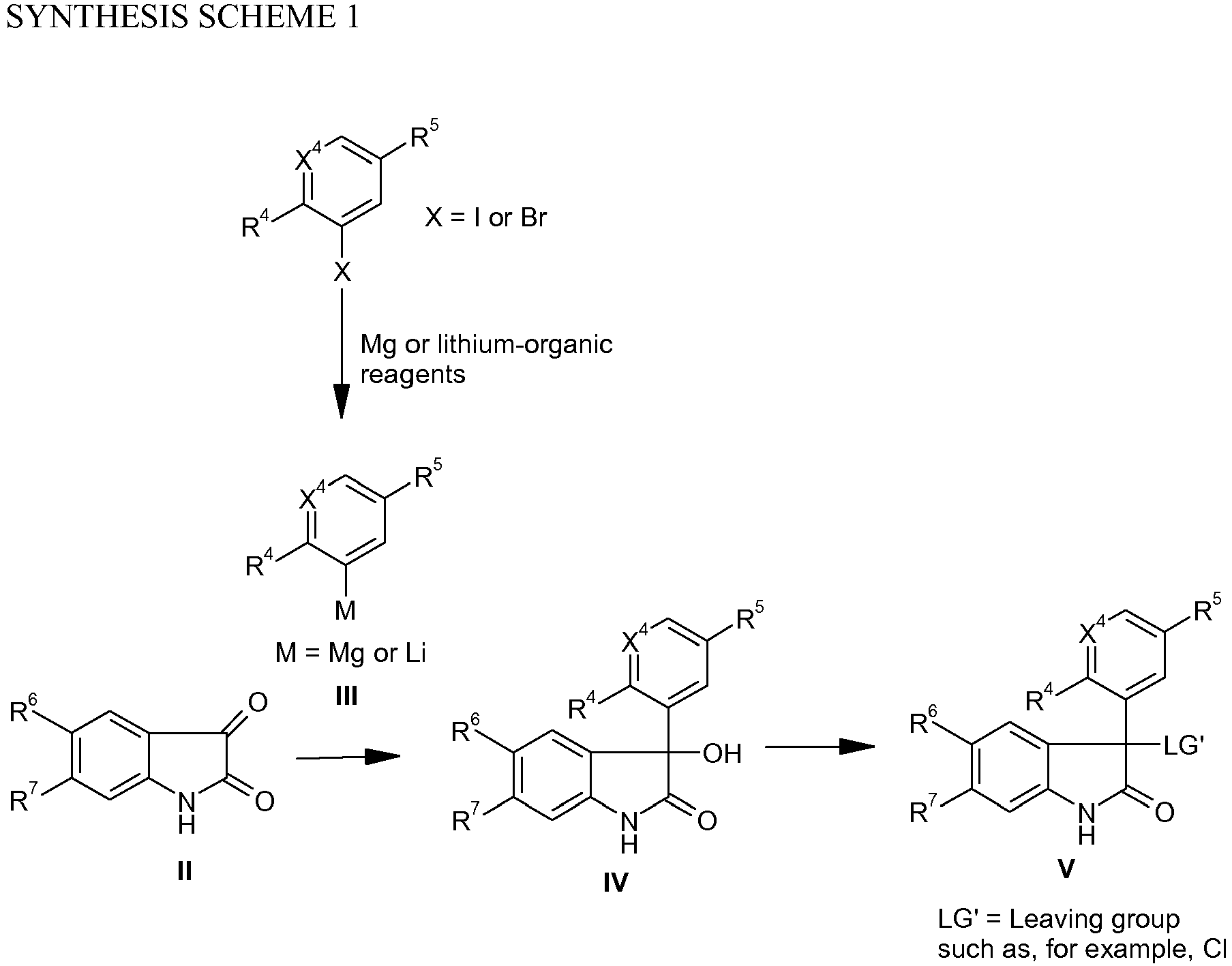


- The amines X can be either purchased or prepared by methods known from the literature.
- Compounds XIV wherein X3 is a bond can be prepared by reacting a compound X with oxetan-3-one carrying c substituents R10 in the presence of a reduction agent such as sodium triacetoxyhydroborate or cyanoborhydride. For obtaining compounds XIV wherein X3 is CH2, oxetane-3-carbaldehyde carrying c substituents R10 is used instead of the oxetan-3-one XIII. Analogously, for obtaining compounds XIV wherein X3 is C2-C4-alkylene, oxetane carrying in the 3-position a C2-C4-keto or aldehyde group (e.g. a group CH2CHO, CH2CH2CHO, (CH2)3CHO, CH2COCH3, CH2CH2COCH3 etc.) and carrying c substituents R10 is used instead of the oxetan-3-one XIII. Such oxetanes are either commercially available or can be prepared by routine methods. For obtaining compounds wherein X3 is CO, oxetane-3-carbonylchloride carrying c substituents R10 is used instead of the oxetan-3-one XIII.
- If not indicated otherwise, the above-described reactions are generally carried out in a solvent at temperatures between room temperature and the boiling temperature of the solvent employed. Alternatively, the activation energy which is required for the reaction can be introduced into the reaction mixture using microwaves, something which has proved to be of value, in particular, in the case of the reactions catalyzed by transition metals (with regard to reactions using microwaves, see Tetrahedron 2001, 57, p. 9199 ff. p. 9225 ff. and also, in a general manner, "Microwaves in Organic Synthesis", André Loupy (Ed.), Wiley-VCH 2002.
- The acid addition salts of compounds I are prepared in a customary manner by mixing the free base with a corresponding acid, where appropriate in solution in an organic solvent, for example a lower alcohol, such as methanol, ethanol or propanol, an ether, such as methyl tert-butyl ether or diisopropyl ether, a ketone, such as acetone or methyl ethyl ketone, or an ester, such as ethyl acetate.
- Routine experimentations, including appropriate manipulation of the reaction conditions, reagents and sequence of the synthetic route, protection of any chemical functionality that may not be compatible with the reaction conditions, and deprotection at a suitable point in the reaction sequence of the preparation methods are within routine techniques.
- Suitable protecting groups and the methods for protecting and deprotecting different substituents using such suitable protecting groups are well known to those skilled in the art; examples of which may be found in T. Greene and P. Wuts, Protective Groups in Organic Synthesis (3rd ed.), John Wiley & Sons, NY (1999), which is incorporated herein by reference in its entirety. Synthesis of the compounds of the invention may be accomplished by methods analogous to those described in the synthetic scheme described hereinabove and in specific examples.
- Starting materials, if not commercially available, may be prepared by procedures selected from standard organic chemical techniques, techniques that are analogous to the synthesis of known, structurally similar compounds, or techniques that are analogous to the above described schemes or the procedures described in the synthetic examples section.
- When an optically active form of a compound of the invention is required, it may be obtained by carrying out one of the procedures described herein using an optically active starting material (prepared, for example, by asymmetric induction of a suitable reaction step), or by resolution of a mixture of the stereoisomers of the compound or intermediates using a standard procedure (such as chromatographic separation, recrystallization or enzymatic resolution).
- Similarly, when a pure geometric isomer of a compound of the invention is required, it may be obtained by carrying out one of the above procedures using a pure geometric isomer as a starting material, or by resolution of a mixture of the geometric isomers of the compound or intermediates using a standard procedure such as chromatographic separation.
- The present invention moreover relates to compounds of formula I as defined above, wherein at least one of the atoms has been replaced by its stable, non-radioactive isotope (e.g., hydrogen by deuterium, 12C by 13C, 14N by 15N, 16O by 18O) and preferably wherein at least one hydrogen atom has been replaced by a deuterium atom.
- Of course, the compounds according to the invention contain more of the respective isotope than this naturally occurs and thus is anyway present in the compounds I.
- Stable isotopes (e.g., deuterium, 13C, 15N, 18O) are nonradioactive isotopes which contain one additional neutron than the normally abundant isotope of the respective atom. Deuterated compounds have been used in pharmaceutical research to investigate the in vivo metabolic fate of the compounds by evaluation of the mechanism of action and metabolic pathway of the non deuterated parent compound (Blake et al. J. Pharm. Sci. 64, 3, 367-391 (1975)). Such metabolic studies are important in the design of safe, effective therapeutic drugs, either because the in vivo active compound administered to the patient or because the metabolites produced from the parent compound prove to be toxic or carcinogenic (Foster et al., Advances in Drug Research Vol. 14, pp. 2-36, Academic press, London, 1985; Kato et al., J. Labelled Comp. Radiopharmaceut., 36(10):927-932 (1995); Kushner et al., Can. J. Physiol. Pharmacol., 77, 79-88 (1999).
- Incorporation of a heavy atom, particularly substitution of deuterium for hydrogen, can give rise to an isotope effect that could alter the pharmacokinetics of the drug.
- Stable isotope labeling of a drug can alter its physico-chemical properties such as pKa and lipid solubility. These changes may influence the fate of the drug at different steps along its passage through the body. Absorption, distribution, metabolism or excretion can be changed. Absorption and distribution are processes that depend primarily on the molecular size and the lipophilicity of the substance. These effects and alterations can affect the pharmacodynamic response of the drug molecule if the isotopic substitution affects a region involved in a ligand-receptor interaction.
- Drug metabolism can give rise to large isotopic effect if the breaking of a chemical bond to a deuterium atom is the rate limiting step in the process. While some of the physical properties of a stable isotope-labeled molecule are different from those of the unlabeled one, the chemical and biological properties are the same, with one important exception: because of the increased mass of the heavy isotope, any bond involving the heavy isotope and another atom will be stronger than the same bond between the light isotope and that atom. In any reaction in which the breaking of this bond is the rate limiting step, the reaction will proceed slower for the molecule with the heavy isotope due to "kinetic isotope effect". A reaction involving breaking a C-D bond can be up to 700 percent slower than a similar reaction involving breaking a C-H bond. If the C-D bond is not involved in any of the steps leading to the metabolite, there may not be any effect to alter the behavior of the drug. If a deuterium is placed at a site involved in the metabolism of a drug, an isotope effect will be observed only if breaking of the C-D bond is the rate limiting step. There is evidence to suggest that whenever cleavage of an aliphatic C-H bond occurs, usually by oxidation catalyzed by a mixed-function oxidase, replacement of the hydrogen by deuterium will lead to observable isotope effect. It is also important to understand that the incorporation of deuterium at the site of metabolism slows its rate to the point where another metabolite produced by attack at a carbon atom not substituted by deuterium becomes the major pathway a process called "metabolic switching".
- Deuterium tracers, such as deuterium-labeled drugs and doses, in some cases re-peatedly, of thousands of milligrams of deuterated water, are also used in healthy humans of all ages, including neonates and pregnant women, without reported incident (e.g. Pons G and Rey E, Pediatrics 1999 104: 633; Coward W A et al., Lancet 1979 7: 13; Schwarcz H P, Control. Clin. Trials 1984 5(4 Suppl): 573; Rodewald L E et al., J. Pediatr. 1989 114: 885; Butte N F et al. Br. J. Nutr. 1991 65: 3; MacLennan A H et al. Am. J. Obstet Gynecol. 1981 139: 948). Thus, it is clear that any deuterium released, for instance, during the metabolism of compounds of this invention poses no health risk.
- The weight percentage of hydrogen in a mammal (approximately 9%) and natural abundance of deuterium (approximately 0.015%) indicates that a 70 kg human normally contains nearly a gram of deuterium. Furthermore, replacement of up to about 15% of normal hydrogen with deuterium has been effected and maintained for a period of days to weeks in mammals, including rodents and dogs, with minimal observed adverse effects (Czajka D M and Finkel A J, Ann. N.Y. Acad. Sci. 1960 84: 770; Thomson J F, Ann. New York Acad. Sci 1960 84: 736; Czakja D M et al., Am. J. Physiol. 1961 201: 357). Higher deuterium concentrations, usually in excess of 20%, can be toxic in animals. However, acute replacement of as high as 15%-23% of the hydrogen in humans' fluids with deuterium was found not to cause toxicity (Blagojevic N et al. in "Dosimetry & Treatment Planning for Neutron Capture Therapy", Zamenhof R, Solares G and Harling O Eds. 1994. Advanced Medical Publishing, Madison Wis. pp.125-134; Diabetes Metab. 23: 251 (1997)).
- Increasing the amount of deuterium present in a compound above its natural abundance is called enrichment or deuterium-enrichment. Examples of the amount of enrichment include from about 0.5, 1, 2, 3, 4, 5, 6, 7, 8, 9, 10, 12, 16, 21, 25, 29, 33, 37, 42, 46, 50, 54, 58, 63, 67, 71, 75, 79, 84, 88, 92, 96, to about 100 mol %.
- The hydrogens present on a particular organic compound have different capacities for exchange with deuterium. Certain hydrogen atoms are easily exchangeable under physiological conditions and, if replaced by deuterium atoms, it is expected that they will readily exchange for protons after administration to a patient. Certain hydrogen atoms may be exchanged for deuterium atoms by the action of a deuteric acid such as D2SO4/D2O. Alternatively, deuterium atoms may be incorporated in various combinations during the synthesis of compounds of the invention. Certain hydrogen atoms are not easily exchangeable for deuterium atoms. However, deuterium atoms at the remaining positions may be incorporated by the use of deuterated starting materials or intermediates during the construction of compounds of the invention.
- Deuterated and deuterium-enriched compounds of the invention can be prepared by using known methods described in the literature. Such methods can be carried out utilizing corresponding deuterated and optionally, other isotope-containing reagents and/or intermediates to synthesize the compounds delineated herein, or invoking standard synthetic protocols known in the art for introducing isotopic atoms to a chemical structure. Relevant procedures and intermediates are disclosed, for instance in Lizondo, J et al., Drugs Fut, 21(11), 1116 (1996); Brickner, S J et al., J Med Chem, 39(3), 673 (1996); Mallesham, B et al., Org Lett, 5(7), 963 (2003);
PCT publications WO1997010223 ,WO2005099353 ,WO1995007271 ,WO2006008754 ;US Patent Nos. 7538189 ;7534814 ;7531685 ;7528131 ;7521421 ;7514068 ;7511013 ; andUS Patent Application Publication Nos. 20090137457 ;20090131485 ;20090131363 ;20090118238 ;20090111840 ;
20090105338 ;20090105307 ;20090105147 ;20090093422 ;20090088416 ;20090082471 , the methods are hereby incorporated by reference. - A further aspect of the present invention relates to a pharmaceutical composition comprising at least one compound of the general formula I and/or an N-oxide, a stereoisomer or a pharmaceutically acceptable salt thereof as detailed above, and a pharmaceutically acceptable carrier; or comprising at least one compound I wherein at least one of the atoms has been replaced by its stable, non-radioactive isotope, preferably wherein at least one hydrogen atom has been replaced by a deuterium atom, in combination with at least one pharmaceutically acceptable carrier and/or auxiliary substance. Suitable carriers depend inter alia on the dosage form of the composition and are known in principle to the skilled worker. Some suitable carriers are described hereinafter.
- The present invention furthermore relates to a compound I as defined above or an N-oxide, a stereoisomer or a pharmaceutically acceptable salt thereof for use as a medicament. The present invention also relates to a compound I as defined above or an N-oxide, a stereoisomer or a pharmaceutically acceptable salt thereof for the treatment of vasopressin-related diseases, especially of disorders which respond to the modulation of the vasopressin receptor and in particular of the V1b receptor.
- A further aspect of the present invention relates to the use of compounds of the formula I and/or of an N-oxide, a stereoisomer or of pharmaceutically acceptable salts thereof for the manufacture of a medicament for the treatment and/or prophylaxis of vasopressin-related diseases, especially of disorders which respond to the modulation of the vasopressin receptor and in particular of the V1b receptor.
- Vasopressin-related diseases are those in which the progress of the disease is at least partly dependent on vasopressin, i.e. diseases which show an elevated vasopressin level which may contribute directly or indirectly to the pathological condition. In other words, vasopressin-related diseases are those which can be influenced by modulating the vasopressin receptor, for example by administration of a vasopressin receptor ligand (agonist, antagonist, partial antagonist/agonist, inverse agonist etc.).
- Affective disorders have been related to excessive vasopressin function. Therefore, treatment with compounds targeting the vasopressin system, such as vasopressin antagonists are likely to benefit patients suffering from affective disorders (see for example Surget A., Belzung C., Involvement of vasopressin in affective disorders, Eur. J. Pharm. 2008, 583, 340-349). Affective disorders (mood disorders) include depressive disorders, anxiety disorders, obsessive-compulsive and related disorders, trauma and stressor-related disorders as well as bipolar and related disorders. V1b antagonist have been shown to have anti-drug abuse effects and reduce drug withdrawal effect (see e.g. Zhou Y., Leri F., Cummins E., Hoeschele M., Kreek M.J., Involvement of arginine vasopressin and V1b receptor in heroin withdrawal and heroin seeking precipitated by stress and by heroin. Neuropsychopharmacology, 2008, 33, 226-236). Therefore, compound targeting the vasopressin system, such as vasopressin antagonists are thought to be effective for treatment of Substance-Related and Addictive Disorders. V1b receptors play a role in a range of emotional responses such as aggression. Attenuating V1b receptor function genetically or with antagonist reduces aggressive behavior (Blanchard R.J., Griebel G., Farrokhi C., Markham C., Yang M., Blanchard D.C., AVP V1b selective antagonist SSR149415 blocks aggressive behaviors in hamsters. Pharmacol. Biochem. Behav. 2005, 80, 189-194; Wersinger S.R., Ginns E.I., O'Carroll A.M., Lolait S.J., Young W.S., III, Vasopressin V1b receptor knockout reduces aggressive behavior in male mice. Mol. Psychiatry, 2002, 7, 975-984). Therefore, attenuating V1b antagonists functioning is likely to reduce aggression and agitation in disorders such as Alzheimer's disease and schizophrenia.
- High cortisol levels have been correlated to reduced cognitive performance in elderly and AD (Alzheimer's disease) patients, and such correlations are more pronounced in subjects carrying the APOε4 allele, which is a risk factor for AD (see for example Lee B.K., Glass T.A., Wand G.S., McAtee M.J., Bandeen-Roche K., Bolla K.I., Schwartz B.S., Apolipoprotein e genotype, cortisol, and cognitive function in community-dwelling older adults. Am. J. Psychiatry 2008, 165, 1456-1464). Furthermore, increased plasma cortisol has been associated with more rapid disease progression in AD patients. Animal studies show an interaction between glucocorticoids and AD pathology, including amyloid precursor protein and tau accumulation (see for example Budas G., Coughlan C.M., Seckl J.R., Breen K.C., The effect of corticosteroids on amyloid beta precursor protein/amyloid precursor-like protein expression and processing in vivo. Neurosci. Lett., 1999, 276, 61-64). Cognitive performance can be impaired by stress or exposure to high doses of corticosterone in laboratory animals (for review see Roozendaal B., Systems mediating acute glucocorticoid effects on memory consolidation and retrieval. Prog. Neuropsychopharmacol. Biol. Psychiatry, 2003, 27, 1213-1223). Therefore, lowering cortisol by treatment with V1b antagonist may enhance cognition or prevent / slow down the pathology or cognitive decline Alzheimer's Disease patients and in patients with other cognitive impairment such as schizophrenia and depression.
- In a preferred embodiment, the present invention relates to the use of compounds of the invention of the formula I or of an N-oxide, a stereoisomer or of pharmaceutically acceptable salts thereof for the manufacture of a medicament for the treatment and/or prophylaxis of diseases selected from diabetes, insulin resistance, nocturnal enuresis, incontinence and diseases in which impairments of blood clotting occur, and/or for delaying micturition. The term "diabetes" means all types of diabetes, especially diabetes mellitus (including type I and especially type II), diabetes renalis and in particular diabetes insipidus. The types of diabetes are preferably diabetes mellitus of type II (with insulin resistance) or diabetes insipidus.
- In a further preferred embodiment, the present invention relates to the use of compounds of the invention of the formula I or of an N-oxide, a stereoisomer or of pharmaceutically acceptable salts thereof for the manufacture of a medicament for the treatment and/or prophylaxis of diseases selected from hypertension, pulmonary hypertension, heart failure, myocardial infarction, coronary spasm, unstable angina, PTCA (percutaneous transluminal coronary angioplasty), ischemias of the heart, impairments of the renal system, edemas, renal vasospasm, necrosis of the renal cortex, hyponatremia, hypokalemia, Schwartz-Bartter syndrome, impairments of the gastrointestinal tract, gastritic vasospasm, hepatocirrhosis, gastric and intestinal ulcers, emesis, emesis occurring during chemotherapy, and travel sickness.
- The compounds of the invention of the formula I or their N-oxides, stereoisomers or pharmaceutically acceptable salts or the pharmaceutical composition of the invention can also be used for the treatment of various vasopressin-related complaints which have central nervous causes or alterations in the HPA axis (hypothalamic pituitary adrenal axis), for example for affective disorders such as depressive disorders, anxiety disorders, obsessive-compulsive and related disorders, trauma and stressor-related disorders, and bipolar and related disorders. Depressive disorders include for example dysthymic disorders, major depression, seasonal depression, treatment-resistant depression disorders, disruptive mood dysregulation disorder, premenstrual dysphoric disorder, substance/medication-induced depressive disorder, depressive disorder due to another medical condition, bipolar disorders, or childhood onset mood disorders. Anxiety disorders include for example phobias, specific phobias, general anxiety disorders, panic disorders, drug withdrawal-induced anxiety disorders, separation anxiety disorder, selective mutism, social anxiety disorder, agoraphobia, substance/medication-induced anxiety disorder and anxiety disorder due to another medical condition. Obsessive-compulsive and related disorders include for example obsessive-compulsive disorder, body dysmorphic disorder, hoarding disorder, trichotillomania, excoriation disorder, substance/medication-induced obsessive-compulsive and related disorder and other specified obsessive-compulsive and related disorders. Trauma and stressor-related disorders include for example reactive attachment disorder, disinhibited social engagement disorder, post traumatic stress disorder, acute stress disorder, adjustment disorder and other specified trauma- and stressor-related disorders. Bipolar and related disorders include for example bipolar I disorder, bipolar II disorder, cyclothymic disorder, substance/medication-induced bipolar and related disorder, bipolar and related disorder due to another medical condition and unspecified bipolar and related disorder.
- Vasopressin-related complaints which have central nervous causes or alterations in the HPA axis are further cognitive disorders such as Alzheimer's disease, MCI (Mild Cognitive Impairment) and CIAS (Cognitive Impairment Associated with Schizophrenia).
- The compounds of the invention of the formula I and their N-oxides, a stereoisomers or pharmaceutically acceptable salts or the pharmaceutical composition of the invention can likewise be employed for the treatment of anxiety disorders and stress-dependent anxiety disorders, such as, for example, generalized anxiety disorders, phobias, specific phobias, post-traumatic anxiety disorders, panic anxiety disorders, obsessive-compulsive anxiety disorders, acute stress-dependent anxiety disorders, drug withdrawal-induced anxiety disorders, separation anxiety disorder, selective mutism, social anxiety disorder, agoraphobia, substance/medication-induced anxiety disorder and anxiety disorder due to another medical condition and social phobia. The compounds of the invention of the formula I and their N-oxides, a stereoisomers or pharmaceutically acceptable salts or the pharmaceutical composition of the invention can likewise be employed for the treatment of obsessive-compulsive and related disorders, including, for example, obsessive-compulsive disorder, body dysmorphic disorder, hoarding disorder, trichotillomania, excoriation disorder, substance/medication-induced obsessive-compulsive and related disorder and other specified obsessive-compulsive and related disorders. The compounds of the invention of the formula I and their N-oxides, a stereoisomers or pharmaceutically acceptable salts or the pharmaceutical composition of the invention can likewise be employed for the treatment of trauma and stressor-related disorders, including, for example, reactive attachment disorder, disinhibited social engagement disorder, post traumatic stress disorder, acute stress disorder, adjustment disorder and other specified trauma- and stressor-related disorders.
- The compounds of the invention of the formula I and their N-oxides, stereoisomers or pharmaceutically acceptable salts or the pharmaceutical composition of the invention can likewise be employed for the treatment and/or prophylaxis of social impairment, such as autism or social impairment related with schizophrenia.
- The compounds of the invention of the formula I and their N-oxides, stereoisomers or pharmaceutically acceptable salts or the pharmaceutical composition of the invention can likewise be employed for the treatment and/or prophylaxis of increased aggression in conditions such as Alzheimer's disease and schizophrenia.
- The compounds of the invention can furthermore also be employed for the treatment of memory impairments, Alzheimer's disease, psychoses, psychotic disorders, sleep disorders and/or Cushing's syndrome, and all stress-dependent diseases.
- Accordingly, a further preferred embodiment of the present invention relates to the use of compounds of the invention of the formula I or of an N-oxide, a stereoisomer or pharmaceutically acceptable salts thereof for the manufacture of a medicament for the treatment of affective disorders.
- In a further preferred embodiment, the present invention relates to the use of compounds of the invention of the formula I or of an N-oxide, a stereoisomer or pharmaceutically acceptable salts thereof for the manufacture of a medicament for the treatment of anxiety disorders and/or stress-dependent anxiety disorders.
- In a further preferred embodiment, the present invention relates to the use of compounds of the invention of the formula I or of an N-oxide, a stereoisomer or pharmaceutically acceptable salts thereof for the manufacture of a medicament for the treatment of memory impairments and/or Alzheimer's disease.
- In a further preferred embodiment, the present invention relates to the use of compounds of the invention of the formula I or of an N-oxide, a stereoisomer or pharmaceutically acceptable salts thereof for the manufacture of a medicament for the treatment of psychoses and/or psychotic disorders.
- In a further preferred embodiment, the present invention relates to the use of compounds of the invention of the formula I or of an N-oxide, a stereoisomer or pharmaceutically acceptable salts thereof for the manufacture of a medicament for the treatment of Cushing's syndrome or other stress-dependent diseases.
- In a further preferred embodiment, the present invention relates to the use of compounds of the invention of the formula I or of an N-oxide, a stereoisomer or pharmaceutically acceptable salts thereof for the manufacture of a medicament for the treatment of sleep disorders.
- In a further preferred embodiment, the present invention relates to the use of compounds of the invention of the formula I or of an N-oxide, a stereoisomer or pharmaceutically acceptable salts thereof for the manufacture of a medicament for the treatment of depressive disorders. In the case of depressive disorders, specific mention is to be made of childhood onset mood disorders, i.e. depressive moods having their onset in childhood, but also of major depression, seasonal depression, bipolar and related disorders, dysthymic disorders, disruptive mood dysregulation disorder, premenstrual dysphoric disorder, substance/medication-induced depressive disorder, and depressive disorder due to another medical condition, and especially of major depression and seasonal depression as well as of the depressive phases of bipolar disorders. Bipolar and related disorders include for example bipolar I disorder, bipolar II disorder, cyclothymic disorder, substance/medication-induced bipolar and related disorder, bipolar and related disorder due to another medical condition and unspecified bipolar and related disorder. The invention also relates to compounds of the formula I or N-oxides, stereoisomers or pharmaceutically acceptable salts thereof for the manufacture of a medicament for the treatment of treatment-resistant depression disorders and for the use in an add-on therapy of depressive disorders.
- In a further preferred embodiment, the present invention relates to the use of compounds of the invention of the formula I or of an N-oxide, a stereoisomer or pharmaceutically acceptable salts thereof for the manufacture of a medicament for the treatment of vasomotor symptoms and/or thermoregulatory dysfunctions such as, for example, the hot flush symptom.
- In a further preferred embodiment, the present invention relates to the use of compounds of the invention of the formula I or of an N-oxide, a stereoisomer or pharmaceutically acceptable salts thereof for the manufacture of a medicament for the treatment and/or prophylaxis of drug or pharmaceutical dependencies and/or dependencies mediated by other factors, for the treatment of drug-use disorders, for the treatment and/or prophylaxis of stress caused by withdrawal of one or more factors mediating the dependence and/or for the treatment and/or prophylaxis of stress-induced relapses into drug or pharmaceutical dependencies and/or dependencies mediated by other factors. To be more precise, the present invention relates to the use of compounds of the invention of the formula I or of an N-oxide, a stereoisomer or pharmaceutically acceptable salts thereof for the manufacture of a medicament for the treatment and/or prophylaxis of substance-related and addictive disorders such as substance use disorder, substance-induced disorder, alcohol use disorder, alcohol intoxication, alcohol withdrawal, unspecified alcohol-related disorder, caffeine intoxication, caffeine withdrawal, unspecified caffeine disorder, cannabis use disorder, cannabis withdrawal, unspecified cannabis-related disorder, phencyclidine use disorder, other hallucinogen use disorders, phencyclidine intoxication, other hallucinogen disorders, hallucinogen persisting perception disorder, unspecified phencyclidine disorder, inhalant use disorder, inhalant intoxication, opioid use disorder, opioid withdrawal, sedative, hypnotic or anxiolytic use disorder, sedative, hypnotic or anxiolytic withdrawal, stimulant use disorder, stimulant intoxication, stimulant withdrawal, tobacco use disorder, tobacco withdrawal, unspecified tobacco-related disorder, other (or unknown) substance use disorders, other (or unknown) substance intoxication, other (or unknown) substance withdrawal, other (or unknown) substance related disorder and gambling disorder.
- In a further preferred embodiment, the present invention relates to the use of compounds of the invention of the formula I or of an N-oxide, a stereoisomer or pharmaceutically acceptable salts thereof for the manufacture of a medicament for the treatment and/or prophylaxis of schizophrenia and/or psychosis.
- In a further preferred embodiment, the present invention relates to the use of compounds of the invention of the formula I or of an N-oxide, a stereoisomer or pharmaceutically acceptable salts thereof for the manufacture of a medicament for the treatment and/or prophylaxis of pain, e.g. acute or chronic pain, preferably chronic pain, especially neuropathic pain. Chronic pain may be a complex regional pain syndrome, pain arising from peripheral neuropathies, post-operative pain, chronic fatigue syndrome pain, tension-type headache, pain arising from mechanical nerve injury and severe pain associated with diseases such as cancer, metabolic disease, neurotropic viral disease, neurotoxicity, inflammation, multiple sclerosis or any pain arising as a consequence of or associated with stress or depressive illness.
- A further aspect of the invention relates to a compound I or pharmaceutically acceptable salts thereof for use as a medicament, and to a compound I or an N-oxide, a stereoisomer or pharmaceutically acceptable salts thereof for the manufacture of a medicament for the treatment and/or prophylaxis of the above-defined diseases.
- A further aspect of the invention relates to compounds for use in a method for the treatment and/or prophylaxis
of vasopressin-related diseases, in which an effective amount of at least one compound of the invention of the formula I or of an N-oxide, a stereoisomer or of at least one pharmaceutically acceptable salt thereof or of a pharmaceutical composition of the invention is administered to a patient. - Concerning the definition of vasopressin-related diseases, reference is made to the above statements.
- In a preferred embodiment of the invention, the compound for use in a method of the invention serves for the
treatment and/or prophylaxis of disorders selected from diabetes, insulin resistance, nocturnal enuresis, incontinence and diseases in which impairments of blood clotting occur, and/or for delaying micturition. Concerning the definition of diabetes, reference is made to the above statements. - In a further preferred embodiment, the compound for use in a method of the invention serves for the treatment
and/or prophylaxis of disorders selected from hypertension, pulmonary hypertension, heart failure, myocardial infarction, coronary spasm, unstable angina, PTCA (percutaneous transluminal coronary angioplasty), ischemias of the heart, impairments of the renal system, edemas, renal vasospasm, necrosis of the renal cortex, hyponatremia, hypokalemia, Schwartz-Bartter syndrome, impairments of the gastrointestinal tract, gastritic vasospasm, hepatocirrhosis, gastric and intestinal ulcers, emesis, emesis occurring during chemotherapy, and travel sickness. - In a further preferred embodiment, compound for use in a method of the invention serves for the treatment
and/or prophylaxis of affective disorders. - In a further preferred embodiment, the compound for use in a method of the invention serves for the treatment
and/or prophylaxis of anxiety disorders and/or stress-dependent anxiety disorders. - In a further preferred embodiment, the compound for use in a method of the invention serves for the treatment
and/or prophylaxis of memory impairments and/or Alzheimer's disease. - In a further preferred embodiment, the compound for use in a method of the invention serves for the treatment
and/or prophylaxis of psychoses and/or psychotic disorders. - In a further preferred embodiment, the compound for use in a method of the invention serves for the treatment
and/or prophylaxis of Cushing's syndrome. - In a further preferred embodiment, the compound for use in a method of the invention serves for the treatment
and/or prophylaxis of sleep disorders in a patient. - In a further preferred embodiment, the compound for use in a method of the invention serves for the treatment
and/or prophylaxis of depressive disorders. In the case of depressive disorders, specific mention is to be made of major depression, seasonal depression, bipolar and related disorders, dysthymic disorders, childhood onset mood disorders, i.e. depressive moods having their onset in childhood, disruptive mood dysregulation disorder, premenstrual dysphoric disorder, substance/medication-induced depressive disorder, and depressive disorder due to another medical condition, and especially of major depression and seasonal depression as well as of the depressive phases of bipolar disorders. Bipolar and related disorders include for example bipolar I disorder, bipolar II disorder, cyclothymic disorder, substance/medication-induced bipolar and related disorder, bipolar and related disorder due to another medical condition and unspecified bipolar and related disorder. The method of the invention also serves for the treatment of treatment-resistant depression disorders and as an add-on therapy of depressive disorders. - In a further preferred embodiment, the compound for use in a method of the invention serves for the treatment
and/or prophylaxis of vasomotor symptoms and/or thermoregulatory dysfunctions, such as, for example, the hot flush symptom. - In a further preferred embodiment, the compound for use in a method of the invention serves for the treatment
and/or prophylaxis of drug or pharmaceutical dependencies and/or dependencies mediated by other factors, for the treatment of drug-use disorders, for the treatment and/or prophylaxis of stress caused by withdrawal of one or more factors mediating the dependence, and/or for the treatment and/or prophylaxis of stress-induced relapses into drug or pharmaceutical dependencies and/or dependencies mediated by other factors. To be more precise, the method of the invention serves for the treatment and/or prophylaxis of substance-related and addictive disorders such as substance use disorder, substance-induced disorder, alcohol use disorder, alcohol intoxication, alcohol withdrawal, unspecified alcohol-related disorder, caffeine intoxication, caffeine withdrawal, unspecified caffeine disorder, cannabis use disorder, cannabis withdrawal, unspecified cannabis-related disorder, phencyclidine use disorder, other hallucinogen use disorders, phencyclidine intoxication, other hallucinogen disorders, hallucinogen persisting perception disorder, unspecified phencyclidine disorder, inhalant use disorder, inhalant intoxication, opioid use disorder, opioid withdrawal, sedative, hypnotic or anxiolytic use disorder, sedative, hypnotic or anxiolytic withdrawal, stimulant use disorder, stimulant intoxication, stimulant withdrawal, tobacco use disorder, tobacco withdrawal, unspecified tobacco-related disorder, other (or unknown) substance use disorders, other (or unknown) substance intoxication, other (or unknown) substance withdrawal, other (or unknown) substance related disorder and gambling disorder. - In a further preferred embodiment, the compound for use in a method of the invention serves for the treatment
and/or prophylaxis of schizophrenia and/or psychosis. - In a further preferred embodiment, the compound for use in a method of the invention serves for the treatment
and/or prophylaxis of pain, e.g. acute or chronic pain, preferably chronic pain, especially neuropathic pain. - The compounds of the general formula I and their pharmaceutically acceptable salts as detailed above can be prepared by a skilled worker with knowledge of the technical teaching of the invention in implementing and/or in analogous implementation of process steps known per se.
- The compounds I and/or their pharmaceutically acceptable salts, N-oxides and their stereoisomers are distinguished by having a selectivity for the vasopressin V1b receptor subtype vis-à-vis at least one of the closely related vasopressin/oxytocin receptor subtypes (for example vasopressin V1a, vasopressin V2 and/or oxytocin).
- Alternatively, or preferably in addition, the compounds I and/or their pharmaceutically acceptable salts, N-oxides and a stereoisomers are distinguished by having an improved metabolic stability.
- The metabolic stability of a compound can be measured for example by incubating a solution of this compound with liver microsomes from particular species (for example rat, dog or human) and determining the half-life of the compound under these conditions (RS Obach, Curr Opin Drug Discov Devel. 2001, 4, 36-44). It is possible in this connection to conclude from an observed longer half-life that the metabolic stability of the compound is improved. The stability in the presence of human liver microsomes is of particular interest because it makes it possible to predict the metabolic degradation of the compound in the human liver. Compounds with increased metabolic stability (measured in the liver microsome test) are therefore probably also degraded more slowly in the liver. The slower metabolic degradation in the liver may lead to higher and/or longer-lasting concentrations (active levels) of the compound in the body, so that the elimination half-life of the compounds of the invention is increased. Increased and/or longer-lasting active levels may lead to a better activity of the compound in the treatment or prophylaxis of various vasopressin-related diseases. In addition, an improved metabolic stability may lead to an increased bioavailability after oral administration, because the compound is subject, after absorption in the intestine, to less metabolic degradation in the liver (so-called first pass effect). An increased oral bioavailability may, owing to an increased concentration (active level) of the compound, lead to a better activity of the compound after oral administration.
- The compounds of the invention are effective after administration by various routes. Possible examples are intravenous, intramuscular, subcutaneous, topical, intratracheal, intranasal, transdermal, vaginal, rectal, sublingual, buccal or oral administration, and administration is frequently intravenous, intramuscular or, in particular, oral.
- The present invention also relates to pharmaceutical compositions which comprise an effective dose of a compound I of the invention and/or an N-oxide, a stereoisomer and/or a pharmaceutically acceptable salt thereof and suitable pharmaceutical carriers (drug carriers).
- These drug carriers are chosen according to the pharmaceutical form and the desired mode of administration and are known in principle to the skilled worker.
- The compounds of the invention of the formula I, their N-oxides, steroisomers or optionally suitable salts of these compounds can be used to produce pharmaceutical compositions for oral, sublingual, buccal, subcutaneous, intramuscular, intravenous, topical, intratracheal, intranasal, transdermal, vaginal or rectal administration, and be administered to animals or humans in uniform administration forms, mixed with conventional pharmaceutical carriers, for the prophylaxis or treatment of the above disorders or diseases.
- The suitable administration forms (dose units) include forms for oral administration such as tablets, gelatin capsules, powders, granules and solutions or suspensions for oral intake, forms for sublingual, buccal, intratracheal or intranasal administration, aerosols, implants, forms of subcutaneous, intramuscular or intravenous administration and forms of rectal administration.
- The compounds of the invention can be used in creams, ointments or lotions for topical administration.
- In order to achieve the desired prophylactic or therapeutic effect, the dose of the active ingredient can vary between 0.01 and 50 mg per kg of body weight and per day.
- Each unit dose may comprise from 0.05 to 5000 mg, preferably 1 to 1000 mg, of the active ingredient in combination with a pharmaceutical carrier. This unit dose can be administered once to 5 times a day, so that a daily dose of from 0.5 to 25 000 mg, preferably 1 to 5000 mg, is administered.
- If a solid composition is prepared in the form of tablets, the active ingredient is mixed with a solid pharmaceutical carrier such as gelatin, starch, lactose, magnesium stearate, talc, silicon dioxide or the like.
- The tablets can be coated with sucrose, a cellulose derivative or another suitable substance or be treated otherwise in order to display a sustained or delayed activity and to release a predetermined amount of the active ingredient continuously.
- A preparation in the form of gelatin capsules is obtained by mixing the active ingredient with an extender and including the resulting mixture in soft or hard gelatin capsules.
- A preparation in the form of a syrup or elixir or for administration in the form of drops may contain active ingredients together with a sweetener, which is preferably calorie-free, methylparaben or propylparaben as antiseptics, a flavoring and a suitable coloring substance.
- Water-dispersible powders or granules may comprise the active ingredients mixed with dispersants, wetting agents or suspending agents, such as polyvinylpyrrolidones, and sweeteners or masking flavors.
- Rectal or vaginal administration is achieved by using suppositories which are prepared with binders which melt at rectal temperature, for example cocoa butter or polyethylene glycols. Parenteral administration is effected by using aqueous suspensions, isotonic saline solutions or sterile and injectable solutions which comprise pharmacologically acceptable dispersants and/or wetting agents, for example propylene glycol or polyethylene glycol.
- The active ingredient may also be formulated as microcapsules or centrosomes, if suitable with one or more carriers or additives.
- The compositions of the invention may, in addition to the compounds of the invention, comprise other active ingredients which may be beneficial for the treatment of the disorders or diseases indicated above.
- The present invention thus further relates to pharmaceutical compositions in which a plurality of active ingredients are present together, where at least one of these is a compound I of the invention, or salt thereof.
- The invention is explained in more detail below by means of examples, but the examples are not to be understood to be restrictive.
- The compounds of the invention can be prepared by various synthetic routes. The methods mentioned, as described accordingly in synthesis scheme 1, are explained in greater detail merely by way of example using the given examples without being exclusively restricted to synthesis route 1 or analogous methods.
- The compounds were either characterized via proton-NMR in d6-dimethylsulfoxide or d-chloroform on a 600 MHz NMR instrument (Bruker AVANCE), or by mass spectrometry, generally recorded via HPLC-MS in a fast gradient on C18-material (electrospray-ionisation (ESI) mode), or melting point.
- The magnetic nuclear resonance spectral properties (NMR) refer to the chemical shifts (δ) expressed in parts per million (ppm). The relative area of the shifts in the 1H-NMR spectrum corresponds to the number of hydrogen atoms for a particular functional type in the molecule. The nature of the shift, as regards multiplicity, is indicated as singlet (s), doublet (d), triplet (t), quartet (q), quintet (quint.), multiplet (m), doublet of doublets (dd), doublet of doublet of doublets (ddd), doublet of triplets (dt), triplet of doublets (td), triplet of triplets (tt) or quartet of doublets (qd). See also below abbreviations.
-
- THF:
- Tetrahydrofuran
- DMSO:
- Dimethyl sulfoxide
- TFA:
- Trifluoroacetic acid
- p:
- pseudo (for example pt pseudo triplet)
- b or br.:
- broad (for example bs broad singlet)
- sym.
- symmetric
- s:
- singlet
- d:
- doublet
- t:
- triplet
- m:
- multiplet
- dd:
- doublet of doublets
- ddd
- doublet of doublet of doublets
- dt:
- doublet of triplets
- td
- triplet of doublets
- tt:
- triplet of triplets
- qd
- quartet of doublets
- In a 100 ml round-bottom flask 2 g (7.42 mmol) of 1-boc-4-(piperidin-4-yl)-piperazine and 1.07 g (14.85 mmol) of 3-oxetanone were dissolved in 30 ml of dichloromethane. 3.16 g (22.27 mmol) of sodium sulfate were added and the reaction was stirred for 10 min. Subsequently, 2.203 g (10.39 mmol) of sodium triacetoxyborohydride were added and the reaction was stirred for 5 min. pH was adjusted to 5-6 with acetic acid and the reaction was stirred over night. Then, 50 ml of water were added and the resulting two phases were separated. The organic phase was washed twice with water dried over MgSO4, filtered and evaporated. The resulting solid was digested in methyl-tert-butyl ether, filtered off, washed with 10 ml of methyl-tert-butyl ether and dried. Flash chromatography (silica gel / gradient from 0 to 20% methanol in dichloromethane) yielded 650 mg of the title compound as a yellowish solid.
- In a 100 ml round-bottom flask 1.63 g (5.01 mmol) of tert-butyl 4-(1-(oxetan-3-yl)-piperidin-4-yl)-piperazine-1-carboxylate were dissolved in 5 ml of dichloromethane. 3 ml (38.9 mmol) of trifluoroacetic acid were added and the reaction was stirred for 30 min. The solution was concentrated and digested in 40 ml of methyl-tert-butyl ether. The solid was filtered and washed with 20 ml of methyl-tert-butyl ether to yield 2.79 of the title compound as a white solid.
- The compound was synthesized in analogy to a.), using however 1-boc-4-(piperazin-4-yl)-piperidine as starting amine compound and NaBH3CN / ZnCl as reduction agent.
- The compound was synthesized in analogy to a), using however benzyl [4,4'-bipieridine] - 1-carboxylate as starting amine compound.
- 520 mg (1.45 mmol) of benzyl 1'-(oxetan-3-yl)-[4,4'-bipiperidine]-1-carboxylate was dissolved in 30 ml methanol and hydrogenated in the H-cube® flow hydrogenator using a 10 mol % Pd (C) cartridge at a flow rate of 1ml/min. The solvent was removed in vacuo providing 372 mg of the title compound which was used without further purification.
- Enantiomers of the compounds I were prepared by using enantiomerically pure starting compounds.
- In a 100 ml 3-necked flask, 100 mg (0.163 mmol) of (S)-phenyl (5-cyano-1-((2,4-dimethoxyphenyl)-sulfonyl)-3-(2-ethoxypyridin-3-yl)-2-oxoindolin-3-yl)-carbamate was stirred in THF for 5 min. 111 mg (0.195 mmol) of 1-(1-(oxetan-3-yl)piperidin-4-yl)-piperazine (used as trifluoroacetic acid salt) and 82 mg (0.814 mmol) of triethylamine were added and the reaction was stirred over night at room temperature. The solvent was removed, dichloromethane was added and the solution was extracted with water. The organic phase was washed with aqueous Na2CO3, dried over MgSO4 and the solvent was removed. The resulting crude product was subjected to flash chromatography (silica gel / dichloromethane : methanol = 90:10) to yield 98.2 mg (81%) of the title compound.
- The compound was synthesized in analogy to Route A) using 4-(1-(term-butoxycarbonyl)piperidin-4-yl)piperazine as amine compound.
- To a solution of 2.53 g (3.20 mmol) of (S)-tert-butyl 4-(4-((5-cyano-1-((2,4-dimethoxyphenyl)sulfonyl)-3-(2-ethoxypyridin-3-yl)-2-oxoindolin-3-yl)carbamoyl)piperazin-1-yl)piperidine-1-carboxylate in DCM (35 ml) was added 2.5 mL trifluoroacetic acid (32.4 mmol) and the reaction mixture was stirred overnight. The solvent was removed in vacuo and the residue was taken up in water/EtOAc (70ml/70ml). After neutralization with sat. aqueous NaHCO3¬ solution (20 ml), the organic phase was separated and the aqueous phase extracted with EtOAc. The combined organic layers werde washed with brine and dried (MgSO4). Purification by flash chromatography (silica, DCM/MeOH gradient 0-100% MeOH) provided 1g (36%) of the title compound as colorless solid.
- In a 100 ml 3-necked flask, 100 mg (0.145 mmol) of (S)-N-(5-cyano-1-((2,4-dimethoxyphenyl)sulfonyl)-3-(2-ethoxypyridin-3-yl)-2-oxoindolin-3-yl)-4-(piperidin-4-yl)-piperazine-1-carboxamide were stirred in 4 ml of dichloromethane.10.45 mg (0.145 mmol) of oxetan-3-one dissolved in 2 ml of dichloromethane were added and the mixture was stirred for 5 min. 30.7 mg of Na2SO4 were added and the mixture was stirred for another 5 min.17.41 mg of acetic acid were added and the reaction was stirred for another 30 min. 46.1 mg (0.217 mmol) of sodium triacetoxyhydroborate were added and the reaction was stirred overnight. 1 ml of 2N NaOH and then 7 ml of water were added and the mixture was extracted thrice with ethylacetate and water. The organic phase was died over MgSO4 and the solvent was removed. The resulting crude product was subjected to flash chromatography (silica gel / gradient from 0 to 5% methanol in dichloromethane) to yield 26.4 mg (24.4%) of the title compound.
ESI-MS [M+H+] = 746.3;
1H-NMR (600 MHz; DMSO-d6), δ [ppm]: 8.14-8.13 (m, 1H), 7.88 (d, 1H), 7.86 (d, 1H), 7.83-7.81 (m, 1H), 7.74-7.73 (m, 1H), 7.69 (s, 1H), 7.68 (d, 1H), 7.04-7.02 (m, 1H), 6.70-6.66 (m, 2H), 4.51-4.49 (m, 2H), 4.39-4.37 (m, 2H), 4.19-4.10 (m, 2H), 3.85 (s, 3H), 3.44 (s, 3H), 3.34-3.29 (m, 1H), 3.20 (m, 4H), 2.71-2.69 (m, 2H), 2.36-2.35 (m, 4H), 2.18-2.14 (m, 1H), 1.71-1.66 (m, 4H), 1.41-1.35 (m, 2H), 1.06 (t, 3H). - The compound was prepared in analogy to route B of example 1.
ESI-MS [M+H+] = 704.3;
1H-NMR (600 MHz DMSO-d6), δ [ppm]: 8.14-8.13 (m, 1H), 7.88 (d, 1H), 7.87 (d, 1H), 7.83 (m, 1H), 7.74-7.72 (m, 1H), 7.70 (s, 1H), 7.68 (d, 1H), 7.04-7.02 (m, 1H), 6.69-6.66 (m, 2H), 4.52-4.49 (m, 2H), 4.40-4.38 (m, 2H), 4.21-4.11 (m, 2H), 3.85 (s, 3H), 3.84-3.79 (m, 2H), 3.43 (s, 3H), 3.34 (m, 1H), 2.66-2.56 (m, 2H), 2.47-2.15 (m, 9H), 1.65-1.58 (m, 2H), 1.20-1.10 (m, 2H), 1.08 (t, 3H). - The compound was prepared in analogy to route A of example 1.
ESI-MS [M+H+] = 716.3;
1H-NMR (600 MHz; DMSO-d6), δ [ppm]: 8.13-8.12 (m, 1H), 7.98-7.94 (m, 3H), 7.86 (d, 1H), 7.82-7.81 (m, 1H), 7.73 (s, 1H), 7.61 (d, 1H), 7.16-7.13 (m, 2H), 7.08-7.06 (m, 1H), 4.51-4.49 (m, 2H), 4.39-4.37 (m, 2H), 4.10-4.06 (m, 1H), 4.02-3.97 (m, 1H), 3.84 (s, 3H), 3.34-3.28 (m, 1H), 3.17 (m, 4H), 2.71-2.69 (m, 2H), 2.35 (m, 4H), 2.19-2.15 (m, 1H), 1.71-1.67 (m, 4H), 1.41-1.35 (m, 2H), 0.98 (t, 3H). - The compound was prepared in analogy to route A of example 1.
ESI-MS [M+H+] = 686.1;
1H-NMR (600 MHz; DMSO-d6), δ [ppm]: 8.14-8.13 (m, 1H), 8.06-8.04 (m, 2H), 7.99-7.97 (m, 1H), 7.87 (d, 1H), 7.84-7.82 (m, 1H), 7.79-7.77 (m, 1H), 7.75 (s, 1H), 7.66-7.62 (m, 3H), 7.09-7.07 (m, 1H), 4.52-4.49 (m, 2H), 4.41-4.37 (m, 2H), 4.11-4.06 (m, 1H), 3.98-3.93 (m, 1H), 3.34-3.28 (m, 1H), 3.28 (m, 4H), 2.71-2.69 (m, 2H), 2.35 (m, 4H), 2.19-2.15 (m, 1H), 1.74-1.67 (m, 4H), 1.44-1.35 (m, 2H), 0.96 (t, 3H). - The compound was prepared in analogy to route A of example 1.
ESI-MS [M+H+] = 711.3;
1H-NMR (600 MHz; DMSO-d6), δ [ppm]: 8.18-8.13 (m, 5H), 8.08-8.06 (m, 1H), 7.92 (d, 1H), 7.85-7.84 (m, 1H), 7.77 (s, 1H), 7.60 (d, 1H), 7.13-7.10 (m, 1H), 4.51-4.49 (m, 2H), 4.39-4.37 (m, 2H), 4.11-4.07 (m, 2H), 3.34-3.30 (m, 1H), 3.09 (m, 4H), 2.71-2.69 (m, 2H), 2.32 (m, 4H), 2.19-2.17 (m, 1H), 1.71-1.66 (m, 4H), 1.41-1.37 (m, 2H), 1.05 (t, 3H). - The compound was prepared in analogy to route A of example 1.
ESI-MS [M+H+] = 734.0;
1H-NMR (600 MHz; DMSO-d6), δ [ppm]: 8.14-8.13 (m, 1H), 7.99-7.97 (m, 1H), 7.94-7.88 (m, 2H), 7.84-7.83 (m, 1H), 7.71 (s, 1H), 7.62-7.61 (m, 1H), 7.10-7.07 (m, 1H), 7.06-7.04 (m, 1H), 6.97-6.95 (m, 1H), 4.51-4.49 (m, 2H), 4.39-4.37 (m, 2H), 4.14-4.08 (m, 2H), 3.85 (s, 3H), 3.34-3.29 (m, 1H), 3.16-3.13 (m, 4H), 2.71-2.69 (m, 2H), 2.34 (m, 4H), 2.18-2.14 (m, 1H), 1.71-1.65 (m, 4H), 1.43-1.35 (m, 2H), 1.03 (t, 3H). - The compound was prepared in analogy to route A of example 1.
ESI-MS [M+H+] = 764.3
1H-NMR (600 MHz; DMSO-d6), δ [ppm]: 8.17-8.14 (m, 1H), 7.89 (d, 1H), 7.82-7.81 (m, 1H), 7.72-7.69 (m, 3H), 7.06-7.04 (m, 1H), 6.71-6.68 (m, 2H), 4.51-4.49 (m, 2H), 4.39-4.37 (m, 2H), 4.19-4.11 (m, 2H), 3.86 (s, 3H), 3.50 (s, 3H), 3.34-3.29 (m, 1H), 3.19 (m, 4H), 2.71-2.69 (m, 2H), 2.34 (m, 4H), 2.18-2.14 (m, 1H), 1.71-1.66 (m, 4H), 1.40-1.34 (m, 2H), 1.08 (t, 3H) - The compound was prepared in analogy to route A of example 1.
ESI-MS [M+H+] = 764.3;
1H-NMR (600 MHz; DMSO-d6), δ [ppm]: 8.15-8.14 (m, 1H), 7.87 (d, 1H), 7.82-7.81 (m, 1H), 7.71-7.69 (m, 3H), 7.06-7.04 (m, 1H), 6.71-6.68 (m, 2H), 4.51-4.49 (m, 2H), 4.39-4.37 (m, 2H), 4.19-4.11 (m, 2H), 3.86 (s, 3H), 3.51 (s, 3H), 3.35-3.30 (m, 1H), 3.19 (m, 4H), 2.71-2.69 (m, 2H), 2.35 (m, 4H), 2.18-2.14 (m, 1H), 1.71-1.66 (m, 4H), 1.41-1.35 (m, 2H), 1.08 (t, 3H). - The compound was prepared in analogy to route A of example 1.
ESI-MS [M+H+] = 764.0;
1H-NMR (600 MHz; DMSO-d6), δ [ppm]: 8.14-8.13 (m, 1H), 7.88 (d, 1H), 7.85-7.83 (m, 2H), 7.72-7.70 (m, 2H), 7.67-7.66 (m, 1H), 7.08-7.05 (m, 1H), 6.90 (d, 1H), 4.51-4.49 (m, 2H), 4.39-4.37 (m, 2H), 4.19-4.09 (m, 2H), 3.95 (s, 3H), 3.51 (s, 3H), 3.34-3.28 (m, 1H), 3.19 (m, 4H), 2.71-2.69 (m, 2H), 2.35 (m, 4H), 2.18-2.14 (m, 1H), 1.71-1.66 (m, 4H), 1.41-1.35 (m, 2H), 1.06 (t, 3H) - The compound was prepared in analogy to route A of example 1.
ESI-MS [M+H+] = 757.3;
1H-NMR (600 MHz; DMSO-d6), δ [ppm]: 8.15-8.12 (m, 1H), 7.87 (d, 1H), 7.66-7.62 (m, 3H), 7.37-7.34 (m, 1H), 7.01-6.99 (m, 1H), 6.70-6.66 (m, 2H), 4.51-4.49 (m, 2H), 4.39-4.37 (m, 2H), 4.21-4.13 (m, 2H), 3.86 (s, 3H), 3.48 (s, 3H), 3.34-3.29 (m, 1H), 3.20 (m, 4H), 2.70-2.69 (m, 2H), 2.35 (m, 4H), 2.18-2.14 (m, 1H), 1.71-1.66 (m, 4H), 1.41-1.35 (m, 2H), 1.10 (t, 3H). - The compound was prepared in analogy to route A of example 1.
ESI-MS [M+H+] = 755.5;
1H-NMR (600 MHz; DMSO-d6), δ [ppm]: 8.12-8.11 (m, 1H), 7.88 (d, 1H), 7.69 (d, 1H), 7.63 (s, 1H), 7.58-7.56 (m, 1H), 7.39-7.37 (m, 2H), 6.99-6.97 (m, 1H), 6.70-6.66 (m, 2H), 4.51-4.49 (m, 2H), 4.39-4.37 (m, 2H), 4.22-4.12 (m, 2H), 3.86 (s, 3H), 3.45 (s, 3H), 3.34-3.28 (m, 1H), 3.21 (m, 4H), 2.71-2.69 (m, 2H), 2.36 (m, 4H), 2.18-2.15 (m, 1H), 1.71-1.67 (m, 4H), 1.41-1.35 (m, 2H), 1.11 (t, 3H). - The compound was prepared in analogy to route A of example 1.
ESI-MS [M+H+] = 745.3;
1H-NMR (600 MHz; DMSO-d6), δ [ppm]: 8.14-8.11 (m, 1H), 7.88-7.87 (m, 2H), 7.83-7.80 (m, 1H), 7.72-7.71 (m, 1H), 7.68-7.64 (m, 2H), 7.04-7.00 (m, 1H), 6.70-6.68 (m, 1H), 6.66 (d, 1H), 4.52 (m, 2H), 4.41 (m, 2H), 4.21-4.11 (m, 2H), 3.85 (s, 3H), 3.83 (m, 2H), 3.48 (s, 3H), 3.35 (m, 1H), 2.71 (m, 2H), 2.57 (m, 2H), 1.70-1.52 (m, 6H), 1.17 (m, 3H), 1.07 (t, 3H), 1.02 (m, 1H), 0.93-0.90 (m, 2H). - The compound was prepared in analogy to route A of example 1.
ESI-MS [M+H+] = 711.3;
1H-NMR (600 MHz; DMSO-d6), δ [ppm]: 8.17-8.12 (m, 5H), 8.07-8.05 (m, 1H), 7.93 (d, 1H), 7.85-7.83 (m, 1H), 7.74 (s, 1H), 7.60 (m, 1H), 7.13-7.10 (m, 1H), 4.52-4.49 (m, 2H), 4.41-4.39 (m, 2H), 4.12-4.08 (m, 2H), 3.72-3.63 (m, 2H), 3.38-3.32 (m, 1H), 2.58-2.56 (m, 2H), 2.46-2.23 (m, 9H), 1.65-1.59 (m, 2H), 1.14-1.10 (m, 2H), 1.06 (t, 3H). - The compound was prepared in analogy to route A of example 1.
ESI-MS [M+H+] = 716.3;
1H-NMR (600 MHz; DMSO-d6), δ [ppm]: 8.14-8.12 (m, 1H), 7.97-7.93 (m, 3H), 7.87 (d, 1H), 7.82-7.80 (m, 1H), 7.73 (s, 1H), 7.62 (d, 1H), 7.15-7.13 (m, 2H), 7.08-7.06 (m, 1H), 4.51-4.49 (m, 2H), 4.40-4.38 (m, 2H), 4.12-4.07 (m, 1H), 4.04-3.99 (m, 1H), 3.84 (s, 3H), 3.77 (m, 2H), 3.34 (m, 1H), 2.61 (m, 2H), 2.47-2.22 (m, 9H), 1.65-1.60 (m, 2H), 1.17-1.12 (m, 2H), 1.00 (t, 3H). - The compound was prepared in analogy to route A of example 1.
ESI-MS [M+H+] = 756.3;
1H-NMR (600 MHz; DMSO-d6), δ [ppm]: 8.14-8.12 (m, 1H), 7.87 (d, 1H), 7.71-7.69 (m, 1H), 7.65 (s, 1H), 7.57-7.56 (m, 1H), 7.38-7.36 (m, 2H), 6.99-6.97 (m, 1H), 6.69-6.68 (m, 1H), 6.66 (d, 1H), 4.52-4.50 (m, 2H), 4.40-4.38 (m, 2H), 4.22-4.15 (m, 2H), 3.85 (m, 5H), 3.44 (s, 3H), 3.34 (m, 1H), 2.62 (m, 3H), 2.52-2.22 (m, 8H), 1.63 (m, 2H), 1.16 (m, 2H), 1.13 (t, 3H). - The compound was prepared in analogy to route A of example 1.
ESI-MS [M+H+] = 732.3;
1H-NMR (600 MHz; DMSO), δ [ppm]: 8.15-8.14 (m, 1H), 7.91-7.87 (m, 2H), 7.81-7.80 (m, 1H), 7.75-7.74 (m, 1H), 7.71-7.68 (m, 2H), 7.05-7.04 (m, 1H), 6.71-6.70 (m, 1H), 6.68 (m, 1H), 4.51-4.49 (m, 2H), 4.39-4.37 (m, 2H), 3.86 (s, 3H), 3.70 (s, 3H), 3.49 (s, 3H), 3.35-3.29 (m, 1H), 3.20 (m, 4H), 2.71-2.69 (m, 2H), 2.35 (m, 4H), 2.18-2.14 (m, 1H), 1.74-1.66 (m, 4H), 1.46-1.37 (m, 2H). - The compound was prepared in analogy to route A of example 1.
ESI-MS [M+H+] = 732.3;
1H-NMR (600 MHz; DMSO-d6), δ [ppm]: 8.15-8.14 (m, 1H), 7.90-7.87 (m, 2H), 7.81-7.79 (m, 1H), 7.73-7.68 (m, 3H), 7.05-7.03 (m, 1H), 6.70-6.67 (m, 2H), 4.52-4.49 (m, 2H), 4.40-4.38 (m, 2H), 3.86 (s, 3H), 3.83-3.81 (m, 2H), 3.72 (s, 3H), 3.48 (s, 3H), 3.34 (m, 1H), 2.64-2.61 (m, 2H), 2.50-2.23 (m, 9H), 1.61 (m, 2H), 1.16 (m, 2H). - The compound was prepared in analogy to route B of example 1.
ESI-MS [M+H+] = 758.3;
1H-NMR (600 MHz; DMSO-d6), δ [ppm]: 8.13-8.12 (m, 1H), 7.88-7.87 (m, 2H), 7.83-7.81 (m, 1H), 7.73-7.71 (m, 1H), 7.68 (d, 1H), 7.66 (m, 1H), 7.03-7.01 (m, 1H), 6.67-6.68 (m, 1H), 6.66-6.65 (m, 1H), 4.56-4.54 (m, 1H), 4.51-4.49 (m, 1H), 4.34-4.31 (m, 2H), 4.19-4.10 (m, 2H), 3.85 (s, 3H), 3.81-3.79 (m, 1H), 3.66 (m, 2H), 3.53 (m, 5H), 2.71 (m, 4H), 2.41 (m, 2H), 2.30 (m, 1H), 1.65 (m, 1H), 1.53 (m, 3H), 1.07-1.06 (m, 5H). - The compound was prepared in analogy to route A of example 1.
ESI-MS [M+H+] = 744.3;
1H-NMR (600 MHz; DMSO-d6), δ [ppm]: 8.15-8.14 (m, 1H), 8.08 (d, 1H), 7.86-7.85 (m, 1H), 7.83-7.81 (m, 1H), 7.79 (d, 1H), 7.75 (s, 1H), 7.68-7.67 (m, 1H), 7.07-7.05 (m, 2H), 4.51-4.49 (m, 2H), 4.39-4.37 (m, 2H), 4.19-4.09 (m, 2H), 3.89 (s, 3H), 3.35-3.30 (m, 1H), 3.22 (m, 4H), 2.71-2.69 (m, 2H), 2.39-2.36 (m, 7H), 2.19-2.15 (m, 1H), 2.09 (s, 3H), 1.71-1.66 (m, 4H), 1.41-1.35 (m, 2H), 0.98 (t, 3H). - The compound was prepared in analogy to route B of example 1, using however oxetane-3-carbaldehyde.
- ESI-MS [M+H+] = 686.3;
1H-NMR (600 MHz; DMSO-d6), δ [ppm]: 8.14-8.13 (m, 1H), 8.06-8.04 (m, 2H), 7.98-7.96 (m, 1H), 7.87 (d, 1H), 7.83-7.82 (m, 1H), 7.80-7.76 (m, 2H), 7.66-7.63 (m, 3H), 7.09-7.07 (m, 1H), 4.52-4.49 (m, 2H), 4.40-4.38 (m, 2H), 4.11-4.08 (m, 1H), 4.00-3.95 (m, 1H), 3.78-3.76 (m, 2H), 3.34 (m, 1H), 2.61 (m, 2H), 2.50-2.15 (m, 9H), 1.72-1.60 (m, 2H), 1.23-1.12 (m, 2H), 0.97 (t, 3H). - ESI-MS [M+H+] = 732.3;
1H-NMR (600 MHz; DMSO-d6), δ [ppm]: 8.15-8.14 (m, 1H), 7.90 (d, 1H), 7.87 (d, 1H), 7.81-7.80 (m, 1H), 7.75-7.73 (m, 1H), 7.71 (s, 1H), 7.68 (m, 1H), 7.05-7.03 (m, 1H), 7.71-7.69 (m, 1H), 6.67 (d, 1H), 4.51-4.49 (m, 2H), 4.39-4.37 (m, 2H), 3.86 (s, 3H), 3.70 (s, 3H), 3.49 (s, 3H), 3.34-3.29 (m, 1H), 3.20 (m, 4H), 2.71-2.69 (m, 2H), 2.35 (m, 4H), 2.18-2.14 (m, 1H), 1.71-1.66 (m, 4H), 1.41-1.36 (m, 2H). - ESI-MS [M+H+] = 757.3;
1H-NMR (600 MHz; DMSO-d6), δ [ppm]: 8.15-8.12 (m, 1H), 7.87 (d, 1H), 7.67-7.62 (m, 3H), 7.38-7.34 (m, 1H), 7.01-6.99 (m, 1H), 6.70-6.67 (m, 2H), 4.52-4.49 (m, 2H), 4.42-4.38 (m, 2H), 4.22-4.13 (m, 2H), 3.85 (s, 3H), 3.85-3.81 (m, 2H), 3.47 (s, 3H), 3.34 (m, 1H), 2.64-2.60 (m, 2H), 2.49-2.22 (m, 9H), 1.64-1.62 (m, 2H), 1.17-1.12 (m, 2H), 1.12 (t, 3H). - ESI-MS [M+H+] = 716.3;
1H-NMR (600 MHz; DMSO-d6), δ [ppm]: 8.13-8.12 (m, 1H), 7.97-7.94 (m, 3H), 7.87 (m, 1H), 7.82-7.81 (m, 1H), 7.79 (s, 1H), 7.61 (m, 1H), 7.17-7.14 (m, 2H), 7.08-7.06 (m, 1H), 4.51-4.49 (m, 2H), 4.39-4.37 (m, 2H), 4.11-4.06 (m, 1H), 4.01-3.98 (m, 1H), 3.84 (s, 3H), 3.17 (s, 3H), 2.71-2.69 (m, 2H), 2.35 (m, 4H), 2.19-2.15 (m, 1H), 1.71-1.67 (m, 4H), 1.41-1.33 (m, 2H), 1.26 (m, 2H), 0.98 (t, 3H). - ESI-MS [M+H+] = 716.3;
1H-NMR (600 MHz; DMSO-d6), δ [ppm]: 8.13-8.12 (m, 1H), 7.97-7.94 (m, 3H), 7.86 (m, 1H), 7.82-7.81 (m, 1H), 7.73 (s, 1H), 7.61 (m, 1H), 7.15-7.14 (m, 2H), 7.08-7.06 (m, 1H), 4.51-4.49 (m, 2H), 4.39-4.37 (m, 2H), 4.11-4.06 (m, 1H), 4.02-3.98 (m, 1H), 3.81 (s, 3H), 3.17 (s, 3H), 2.73-2.69 (m, 2H), 2.35 (m, 4H), 2.19-2.15 (m, 1H), 1.71-1.67 (m, 4H), 1.41-1.33 (m, 2H), 1.23 (m, 2H), 0.98 (t, 3H). - ESI-MS [M+H+] = 717.3;
1H-NMR (600 MHz; DMSO-d6), δ [ppm]: 8.41-8.40 (d, 1H), 8.16-8.15 (d, 1H), 8.14-8.13 (m, 1H), 7.94-7.92 (m, 2H), 7.85-7.83 (m, 1H), 7.73 (s, 1H), 7.66-7.64 (m, 1H), 7.62 (d, 1H), 7.08-7.06 (m, 1H), 4.51-4.49 (m, 2H), 4.39-4.37 (m, 2H), 4.10-4.02 (m, 2H), 3.91 (s, 3H), 3.34-3.29 (m, 1H), 3.15 (m, 4H), 2.71-2.69 (m, 2H), 2.35 (m, 4H), 2.20-2.15 (m, 1H), 1.71-1.67 (m, 4H), 1.42-1.36 (m, 2H), 1.02 (t, 3H). - ESI-MS [M+H+] = 734.3;
1H-NMR (600 MHz; DMSO-d6), δ [ppm]: 8.15-8.13 (m, 1H), 8.02-7.99 (m, 1H), 7.90-7.83 (m, 3H), 7.70 (s, 1H), 7.66 (d, 1H), 7.18-7.15 (m, 1H), 7.08-7.06 (m, 1H), 6.99-6.96 (m, 1H), 4.51-4.48 (m, 2H), 4.39-4.37 (m, 2H), 4.18-4.10 (m, 2H), 3.47 (s, 3H), 3.34-3.29 (m, 1H), 3.18 (m, 4H), 2.70-2.69 (m, 2H), 2.34 (m, 4H), 2.19-2.14 (m, 1H), 1.71-1.65 (m, 4H), 1.40-1.34 (m, 2H), 1.06 (t, 3H). - ESI-MS [M+H+] = 731.3;
1H-NMR (600 MHz; DMSO), δ [ppm]: 8.15-8.14 (m, 1H), 7.90-7.87 (m, 2H), 7.81-7.80 (m, 1H), 7.73-7.72 (m, 1H), 7.68-7.67 (m, 2H), 7.05-7.03 (m, 1H), 6.70-6.68 (m, 1H), 6.67 (d, 1H), 4.51-4.49 (m, 2H), 4.39-4.37 (m, 2H), 3.86 (s, 3H), 3.83 (m, 2H), 3.72 (s, 3H), 3.48 (s, 3H), 3.32-3.27 (m, 1H), 2.70-2.69 (m, 2H), 2.57-2.52 (m, 2H), 1.65-1.61 (m, 2H), 1.56-1.50 (m, 4H), 1.20-1.10 (m, 3H), 1.01-0.88 (m, 3H). - ESI-MS [M+H+] = 704.3;
1H-NMR (600 MHz; DMSO-d6), δ [ppm]: 8.15-8.14 (m, 1H), 8.12-8.08 (m, 2H), 8.04-8.02 (m, 1H), 7.91-7.90 (d, 1H), 7.84-7.82 (m, 1H), 7.75 (s, 1H), 7.61 (d, 1H), 7.51-7.47 (m, 2H), 7.11-7.09 (m, 1H), 4.51-4.49 (m, 2H), 4.39-4.37 (m, 2H), 4.12-4.01 (m, 2H), 3.35-3.28 (m, 1H), 3.14 (m, 4H), 2.71-2.69 (m, 2H), 2.34 (m, 4H), 2.19-2.15 (m, 1H), 1.71-1.66 (m, 4H), 1.41-1.35 (m, 2H), 1.01 (t, 3H). - ESI-MS [M+H+] = 703.3;
1H-NMR (600 MHz; DMSO-d6), δ [ppm]: 8.45 (m, 1H), 8.21-8.19 (d, 1H), 8.15-8.14 (m, 1H), 7.93-7.90 (m, 2H), 7.83-7.82 (m, 1H), 7.77 (s, 1H), 7.68-7.66 (m, 1H), 7.65 (d, 1H), 7.10-7.08 (m, 1H), 4.51-4.49 (m, 2H), 4.39-4.37 (m, 2H), 3.92 (s, 3H), 3.54 (s, 3H), 3.34-3.29 (m, 1H), 3.19 (m, 4H), 2.71-2.69 (m, 2H), 2.39-2.36 (m, 4H), 2.20-2.16 (m, 1H), 1.71-1.68 (m, 4H), 1.42-1.38 (m, 2H). - ESI-MS [M+H+] = 720.3;
1H-NMR (600 MHz; DMSO-d6), δ [ppm]: 8.16-8.15 (m, 1H), 8.05-8.02 (m, 1H), 7.89-7.87 (m, 2H), 7.83-7.81 (m, 1H), 7.73 (s, 1H), 7.68 (m, 1H), 7.19-7.17 (m, 1H), 7.10-7.08 (m, 1H), 7.00-6.97 (m, 1H), 4.51-4.49 (m, 2H), 4.39-4.37 (m, 2H), 3.70 (s, 3H), 3.52 (s, 3H), 3.34-3.29 (m, 1H), 3.19 (m, 4H), 2.71-2.69 (m, 2H), 2.34 (m, 4H), 2.16 (m, 1H), 1.71-1.65 (m, 4H), 1.39-1.36 (m, 2H). - ESI-MS [M+H+] = 732.3;
1H-NMR (600 MHz; DMSO-d6), δ [ppm]: 8.16-8.14 (m, 1H), 7.90-7.87 (m, 2H), 7.81-7.80 (m, 1H), 7.74-7.72 (m, 2H), 7.69-7.68 (m, 1H), 7.06-7.04 (m, 1H), 6.70-6.67 (m, 2H), 4.53-4.50 (m, 2H), 4.40-4.38 (m, 2H), 3.86 (s, 3H), 3.83-3.81 (m, 2H), 3.72 (s, 3H), 3.48 (s, 3H), 3.34 (m, 1H), 2.63-2.59 (m, 2H), 2.45 (m, 4H), 2.35-2.31 (m, 1H), 2.23 (m, 4H), 1.63-1.58 (m, 2H), 1.16 (m, 2H). - ESI-MS [M+H+] = 746.3.
- ESI-MS [M+H+] = 775.3;
1H-NMR (600 MHz; DMSO-d6), δ [ppm]: 7.88-7.86 (m, 2H), 7.80-7.78 (m, 1H), 7.68-7.67 (m, 1H), 7.63 (m, 1H), 6.91 (m, 3H), 6.69-6.67 (m, 1H), 6.64 (m, 1H), 4.51-4.49 (m, 2H), 4.39-4.38 (m, 2H), 3.97-3.92 (m, 1H), 3.85 (s, 3H), 3.79-3.74 (m, 1H), 3.70 (s, 3H), 3.45 (s, 3H), 3.34 (m, 1H), 3.17 (m, 4H), 2.71 (m, 2H), 2.36 (m, 4H), 2.17 (m, 1H), 1.70 (m, 4H), 1.39 (m, 2H), 1.12-1.09 (t, 3H). - ESI-MS [M+H+] = 702.3.
- ESI-MS [M+H+] = 763.3.
- ESI-MS [M+H+] = 701.3;
1H-NMR (600 MHz; DMSO-d6), δ [ppm]: 8.14-8.13 (m, 1H), 8.01-7.99 (m, 2H), 7.95-7.94 (m, 1H), 7.86-7.85 (m, 1H), 7.81-7.79 (m, 1H), 7.72 (s, 1H), 7.63-7.62 (m, 1H), 7.18-7.15 (m, 2H), 7.10-7.08 (m, 1H), 4.51-4.49 (m, 2H), 4.39-4.37 (m, 2H), 3.85 (m, 5H), 3.48 (s, 3H), 3.35-3.26 (m, 1H), 2.70-2.69 (m, 2H), 2.57 (m, 2H), 1.66-1.53 (m, 6H), 1.19-1.12 (m, 3H), 1.03-0.92 (m, 3H). - ESI-MS [M+H+] = 719.3;
1H-NMR (600 MHz; DMSO-d6), δ [ppm]: 8.16-8.15 (m, 1H), 8.04-8.02 (m, 1H), 7.90-7.88 (m, 1H), 7.87-7.86 (m, 1H), 7.83-7.81 (m, 1H), 7.69 (s, 1H), 7.68-7.67 (m, 1H), 7.19-7.16 (m, 1H), 7.10-7.08 (m, 1H), 6.99-6.96 (m, 1H), 4.51-4.49 (m, 2H), 4.39-4.37 (m, 2H), 3.82-3.80 (m, 2H), 3.71 (s, 3H), 3.50 (s, 3H), 3.31-3.27 (m, 1H), 2.70-2.68 (m, 2H), 2.52 (m, 2H), 1.65-1.61 (m, 2H), 1.56-1.50 (m, 4H), 1.18-1.10 (m, 3H), 1.00-0.89 (m, 3H). - ESI-MS [M+H+] = 758.3.
- ESI-MS [M+H+] = 702.3;
1H-NMR (600 MHz; DMSO-d6), δ [ppm]: 8.45-8.44 (m, 1H), 8.20-8.19 (m, 1H), 8.15-8.14 (m, 1H), 7.92-7.90 (m, 2H), 7.83-7.81 (m, 1H), 7.73 (s, 1H), 7.68-7.66 (m, 1H), 7.65-7.64 (m, 1H), 7.10-7.08 (m, 1H), 4.51-4.49 (m, 2H), 4.39-4.37 (m, 2H), 3.92 (s, 3H), 3.83-3.81 (m, 2H), 3.55 (s, 3H), 3.35-3.27 (m, 1H), 2.70-2.68 (m, 2H), 2.56 (m, 2H), 1.66-1.62 (m, 2H), 1.60-1.54 (m, 4H), 1.19-1.12 (m, 3H), 1.03-0.92 (m, 3H). - ESI-MS [M+H+] = 689.3;
1H-NMR (600 MHz; DMSO-d6), δ [ppm]: 8.16-8.12 (m, 3H), 8.03-8.00 (m, 1H), 7.90-7.88 (m, 1H), 7.82-7.81 (m, 1H), 7.75 (s, 1H), 7.64 (m, 1H), 7.53-7.49 (m, 2H), 7.13-7.11 (m, 1H), 4.51-4.49 (m, 2H), 4.39-4.37 (m, 2H), 3.81 (m, 2H), 3.52 (s, 3H), 3.35-3.27 (m, 1H), 2.70-2.68 (m, 2H), 2.55 (m, 2H), 1.66-1.62 (m, 2H), 1.59-1.53 (m, 4H), 1.19-1.11 (m, 3H), 1.02-0.91 (m, 3H). - ESI-MS [M+H+] = 750.3;
1H-NMR (600 MHz; DMSO-d6), δ [ppm]: 8.16-8.15 (m, 1H), 7.88-7.86 (m, 1H), 7.86-7.84 (m, 1H), 7.82-7.80 (m, 1H), 7.76-7.74 (m, 2H), 7.68 (m, 1H), 7.09-7.07 (m, 1H), 6.92-6.91 (m, 1H), 4.51-4.49 (m, 2H), 4.39-4.37 (m, 2H), 3.95 (s, 3H), 3.71 (s, 3H), 3.55 (s, 3H), 3.35-3.29 (m, 1H), 3.19 (m, 4H), 2.71-2.69 (m, 2H), 2.34 (m, 4H), 2.19-2.14 (m, 1H), 1.71-1.66 (m, 4H), 1.41-1.36 (m, 2H). - ESI-MS [M+H+] = 749.3;
1H-NMR (600 MHz; DMSO-d6), δ [ppm]: 8.16-8.15 (m, 1H), 7.88-7.87 (m, 1H), 7.84-7.80 (m, 2H), 7.75-7.73 (m, 1H), 7.70 (s, 1H), 7.68-7.67 (m, 1H), 7.09-7.07 (m, 1H), 6.92-6.90 (m, 1H), 4.51-4.49 (m, 2H), 4.41-4.37 (m, 2H), 3.95 (s, 3H), 3.85-3.80 (m, 2H), 3.72 (s, 3H), 3.54 (s, 3H), 3.33-3.27 (m, 1H), 2.70-2.68 (m, 2H), 2.56 (m, 2H), 1.65-1.61 (m, 2H), 1.57-1.51 (m, 4H), 1.20-1.10 (m, 3H), 0.98-0.89 (m, 3H). - ESI-MS: [M+H+] = 697.25;
1H NMR (CDCl3, 600 MHz), δ [ppm]: 8.22 (d, 2H), 8.18 (dd, 1H), 8.05 (d, 1H), 7.80 (d, 2H), 7.67 (dd, 1H), 7.53-7.54 (m, 1H), 7.33 (dd, 1H), 6.93 (m sym., 1H), 6.55 (s, 1H), 4.65 (t, 2H), 4.60 (t, 2H), 4.07 (s, 3H), 3.44 (qd, 1H), 3.15-3.22 (m, 2H), 3.12 (br. s., 2H), 2.80 (d, 2H), 2.47 (br. s., 4H), 2.30 (br. s., 1H), 1.73-1.85 (m, 4H). - ESI-MS: [M+H+] = 760.30.
- ESI-MS: [M+H+] = 686.20;
1H NMR (CDCl3, 600 MHz), δ [ppm]: 8.15 (dd, 1H), 7.99-8.02 (m, 3H), 7.61 (dd, 1H), 7.55 (d, 1H), 7.32 (d, 2H), 6.87 (dd, 1H), 6.59 (br. s., 1H), 4.63-4.66 (m, 2H), 4.60 (br. s, 2H), 4.05 (s, 3H), 3.44 (m sym., 1H), 3.24 (br. s., 2H), 3.20 (br. s., 2H), 2.81 (d, 2H), 2.48 (br. s., 3H), 2.42 (s, 3H), 2.31 (br. s., 1H), 1.76-1.83 (br. m., 4H). - ESI-MS: [M+H+] = 716.30;
1H NMR (CDCl3, 600 MHz), δ [ppm]: 8.14 (ddd, 1H), 8.09 (dd, 1H), 8.02 (d, 1H), 7.62 (t, 2H), 7.25-7.29 (m, incl. CHCl3), 7.22 (d, 1H), 7.22 (d, 1H), 6.85 (dd, 1H), 6.74 (s, 1H), 6.64 (br. m, 1H), 4.65 (t, 2H), 4.59 (br. s, 2H), 4.08-4.10 (m, 3H), 3.52-3.54 (m, 3H), 3.44 (br. m, 1H), 3.23 (br. s., 4H), 2.80 (d, 2H), 2.47 (br. s., 3H), 2.39-2.41 (m, 3H), 2.30 (br. s., 1H), 1.74-1.82 (m, 4H). - ESI-MS: [M+H+] = 715.20;
1H NMR (CDCl3, 600 MHz), δ [ppm]: 8.29 (t, 1H), 8.18 (dd, 1H), 8.10 (d, 1H), 7.68 (dd, 1H), 7.60 (dd, 1H), 7.56 (s, 1H), 7.46 (dd, 1H), 7.33 (dd, 1H), 6.93 (m, 1H), 6.52 (br. s., 1H), 4.64 (t, 2H), 4.59 (br. m, 2H), 4.07 (s, 3H), 3.44 (quint, 1H), 3.19 (br. s, 2H), 3.10 (br. s., 2H), 2.80 (d, 2H), 2.46 (br. s., 4H), 2.30 (br. s., 1H), 1.74-1.82 (m, 4H). - ESI-MS: [M+H+] = 708.20;
1H NMR (CDCl3, 600 MHz), δ [ppm]: 8.16-8.21 [m, 2H, incl. 8.17 (d, 1H)], 8.11 (d, 1H), 7.67 (dd, 1H), 7.56 (d, 1H), 7.30 (d, 1H), 7.04 (td, 1H), 6.89-6.93 (m, 2H), 6.57 (br. s., 1H), 4.63-4.66 (m, 2H), 4.58-4.62 (m, 2H), 4.07 (s, 3H), 3.44 (br. s., 1H), 3.23 (br. s., 2H), 3.14 (br. s., 2H), 2.80 (d, 2H), 2.46 (br. s., 3H), 2.29 (br. s., 1H), 1.73-1.81 (m, 4H). - ESI-MS [M+H+] = 701.3;
1H-NMR (600 MHz; DMSO-d6), δ [ppm]: 8.16-8.14 (m, 1H), 8.00-7.98 (m, 1H), 7.90-7.88 (m, 1H), 7.83-7.81 (m, 1H), 7.77-7.75 (m, 1H), 7.72-7.69 (m, 3H), 7.23-7.21 (m, 1H), 7.16-7.13 (m, 1H), 7.06-7.04 (m, 1H), 4.51-4.49 (m, 2H), 4.39-4.37 (m, 2H), 3.84-3.82 (m, 2H), 3.70 (s, 3H), 3.50 (s, 3H), 3.31-3.26 (m, 1H), 2.70-2.68 (m, 2H), 2.57-2.52 (m, 2H), 1.65-1.50 (m, 6H), 1.18-1.11 (m, 3H), 1.04-0.88 (m, 3H). - ESI-MS [M+H+] = 671.3;
1H-NMR (600 MHz; DMSO-d6), δ [ppm]: 8.14-8.13 (m, 1H), 8.10-8.08 (m, 2H), 7.99-7.98 (m, 1H), 7.88-7.86 (m, 1H), 7.82-7.78 (m, 2H), 7.75 (s, 1H), 7.68-7.66 (m, 2H), 7.64 (d, 1H), 7.11-7.09 (m, 1H), 4.51-4.49 (m, 2H), 4.39 (m, 2H), 3.86-3.84 (m, 2H), 3.43 (s, 3H), 3.32-3.27 (m, 1H), 2.70 (m, 2H), 2.59-2.55 (m, 2H), 1.64-1.54 (m, 6H), 1.17 (m, 3H), 1.01-0.92 (m, 3H). - ESI-MS [M+H+] = 760.4;
1H-NMR (600 MHz; DMSO-d6), δ [ppm]: 8.14-8.12 (m, 1H), 7.88-7.86 (m, 2H), 7.83-7.81 (m, 1H), 7.75-7.73 (m, 1H), 7.69-7.68 (m, 2H), 7.04-7.01 (m, 1H), 6.70-6.68 (m, 1H), 6.66 (m, 1H), 4.37-4.34 (m, 2H), 4.19-4.11 (m, 2H), 4.09-4.08 (m 2H), 3.85 (s, 3H), 3.44 (s, 3H), 3.20 (m, 3H), 3.13-3.12 (m, 2H), 2.55-2.53 (m, 2H), 2.35 (m, 3H), 1.17-1.13 (m, 1H), 1.99-1.95 (m, 2H), 1.67-1.66 (m, 2H), 1.39-1.35 (m, 2H), 1.23 (s, 3H), 1.07-1.04 (m, 3H). - ESI-MS [M+H+] = 746.2.
- ESI-MS [M+H+] = 746.4.
- ESI-MS [M+H+] = 761.2;
1H-NMR (600 MHz; DMSO-d6), δ [ppm]: 7.89 (d, 1H), 7.84 (d, 1H), 7.77 (dd, 1H), 7.65 (d, 1H), 7.61 (s, 1H), 7.03 (d, 1H), 6.91 (m, 2H), 6.68 (dd, 1H), 6,66 (d, 1H), 4.50 (t, 2H), 4.38 (t, 2H), 3.85 (s, 3H), 3.73 (s, 3H), 3.55 (s, 3H), 3.50 (s, 3H), 3.31 (m, overlapped with H2O), 3.18 (m, 4H), 2,70 (m, 2H), 2.37 (m, 4H), 2.15 (m, 1H), 1.68 (m, 4H), 1.38 (m, 2H). - ESI-MS [M+H+] = 760.2;
1H-NMR (600 MHz; DMSO-d6), δ [ppm]: 7.89 (d, 1H), 7.86 (d, 1H), 7.76 (dd, 1H), 7.64 (d, 1H), 7.58 (s, 1H), 7.13 (d, 1H), 6.94 (d, 1H), 6.89 (dd, 1H), 6,66 (dd, 1H), 6.65 (m, 1H), 4.50 (t, 2H), 4.38 (m, 2H), 3.83 (s, 3H), 3.82 (m, 2H), 3.73 (s, 3H), 3.57 (s, 3H), 3.49 (s, 3H), 3.29 (m, 2H), 2.69 (m, 2H), 2.53 (m, overlapped with DMSO) 1.63 (m, 2H), 1.53 (m, 4H), 1.09 - 0.89 (m, 3H). - The test substances were dissolved in a concentration of 5 mM in 100% DMSO and further diluted to 5x10⁻⁴ M to 5x10⁻⁹ M. These serial DMSO predilutions were diluted 1:10 with assay buffer. The substance concentration was further diluted 1:5 in the assay mixture resulting in 2% DMSO in the mixture. All dilutions were performed in a Biomek NX automation workstation (Beckman)
- CHO-K1 cells with stably expressed human vasopressin V1b receptor (clone 3H2) were harvested and homogenized in 50 mM Tris-HCl and in the presence of protease inhibitors (Roche complete Mini # 1836170) using a Polytron homogenizer at intermediate setting for 2 x 10 seconds, and subsequently centrifuged at 40 000 x g for 1 h. The membrane pellet was again homogenized and centrifuged as described and subsequently taken up in 50 mM Tris-HCl, pH 7.4, homogenized and stored in aliquots frozen in liquid nitrogen at -190°C.
- The binding assay was carried out by the method based on that of Tahara et al. (Tahara A et al., Brit. J. Pharmacol. 125, 1463-1470 (1998)).
- The incubation buffer was: 50 mM Tris, 10 mM MgCl2, 0.1% BSA, pH 7.4.
- In the assay mixture (200 µl), membranes (26 µg protein in incubation buffer) from CHO-K1 cells with stably expressed human V1b receptors (cell line hV1b_3H2_CHO) were incubated with 1.5 nM 3H-AVP (8-Arg-vasopressin, PerkinElmer, NET 800) in incubation buffer (50 mM Tris, 10 mM MgCl2, 0.1% BSA, pH 7.4) (total binding) or additionally with increasing concentrations of test substance (displacement experiment). The nonspecific binding was determined with 1 µM AVP (Fluka 94836). All determinations were carried out as duplicate determinations. After incubation (60 minutes at room temperature), the free radioligand was filtered off by vacuum filtration (Tomtec Mach III) through Wathman GF/B glass fiber filter plates (UniFilter, PerkinElmer 6005177). The liquid scintillation measurement took place in a Microbeta TriLux 12 (Wallac).
- The binding parameters were calculated by nonlinear regression in SAS. The algorithms of the program operate in analogy to the LIGAND analysis program (Munson PJ and Rodbard D, Analytical Biochem. 107, 220-239 (1980)). The Kd of 3H-AVP for the recombinant human V1b receptors is 0.4 nM and was used to determine the Ki.
- The test substances were dissolved in a concentration of 5 mM M in DMSO. Further dilution of these DMSO solutions took place as described for V1b.
- CHO-K1 cells with stably expressed human vasopressin V1a receptor (clone 5) were harvested and homogenized in 50 mM Tris-HCl and in the presence of protease inhibitors (Roche complete Mini # 1836170) using a Polytron homogenizer at intermediate setting for 2 x 10 seconds, and subsequently centrifuged at 40 000 x g for 1 h. The membrane pellet was again homogenized in a High-Pressure-Homogenizer, Polytec 50K at 1500 PSI (Heinemann, Germany) and subsequently taken up in 50 mM Tris-HCl, pH 7.4, homogenized and stored in aliquots frozen in liquid nitrogen at -190°C.
- The binding assay was carried out by the method based on that of Tahara et al. (Tahara A et al., Brit. J. Pharmacol. 125, 1463-1470 (1998)).
- The incubation buffer was: 50 mM Tris, 10 mM MgCl2, 0.1% BSA, pH 7.4.
- In the assay mixture (200 µl), membranes (40 µg protein in incubation buffer) from CHO-K1 cells with stably expressed human V1a receptors (cell line hV1a_5_CHO) were incubated with 0.04 nM 125I-A VP (8-Arg-vasopressin, PerkinElmer NEX 128) in incubation buffer (50 mM Tris, 10 mM MgCl2, 0.1% BSA, pH 7.4) (total binding) or additionally with increasing concentrations of test substance (displacement experiment). The nonspecific binding was determined with 1 µM AVP (Fluka 94836). Duplicate determinations were carried out.
- After incubation (60 minutes at room temperature), the samples were processed as described for V1b.
- The binding parameters were calculated by nonlinear regression in SAS. The algorithms of the program operate in analogy to the LIGAND analysis program (Munson PJ and Rodbard D, Analytical Biochem. 107, 220-239 (1980)). The Kd of 125I-AVP for the recombinant hV1a receptors was determined in saturation experiments. A Kd of 1.33 nM was used to determine the Ki.
- The substances were dissolved in a concentration of 5 mM in DMSO and diluted further as described for V1b.
- Confluent HEK-293 cells with transiently expressing recombinant human oxytocin receptors were centrifuged at 750 x g at room temperature for 5 minutes. The residue was taken up in ice-cold lysis buffer (50 mM Tris-HCl, 10% glycerol, pH 7.4 and Roche complete protease inhibitor) and subjected to an osmotic shock at 4°C for 20 minutes. The lyzed cells were then centrifuged at 750 x g at 4°C for 20 minutes, the residue was taken up in incubation buffer, and aliquots of 107 cells/ml were prepared. The aliquots were frozen at -80°C until used.
- The incubation buffer was: 50 mM Tris, 10 mM MgCl2, 0.1% BSA, pH 7.4.
- In the assay mixture (200 µl), ghosts corresponding to 5x10⁴ cells (HEK-293 cells expressing transiently human OT receptors) were incubated with 3H-oxytocin (PerkinElmer NET858) in incubation buffer (50 mM Tris, 10 mM MgCl2, 0.1% BSA, pH 7.4) (total binding) or additionally with increasing concentrations of test substance (displacement experiment). The nonspecific binding was determined with 1 µM A-797879 (AbbVie, Ludwigshafen, Germany). Duplicate determinations were carried out.
- After incubation (60 minutes at room temperature), the samples were processed as described for V1b.
- The binding parameters were calculated by nonlinear regression analysis (SAS) in analogy to the LIGAND program of Munson and Rodbard (Analytical Biochem 1980; 107: 220-239). The Kd of 3H-oxytocin for the recombinant hOT receptors is 7.6 nM and was used to determine the Ki.
- The metabolic stability of the compounds of the invention was determined in the following assay.
- The test substances were incubated in a concentration of 0.5 µM as follows:
- 0.5 µM test substance are preincubated together with liver microsomes from different species (from rat, human or other species) (0.25 mg of microsomal protein/ml) in 0.05 M potassium phosphate buffer of pH 7.4 in microtiter plates at 37°C for 5 min. The reaction is started by adding NADPH (1 mg/mL). After 0, 5, 10, 15, 20 and 30 min, 50 µl aliquots are removed, and the reaction is immediately stopped and cooled with the same volume of acetonitrile. The samples are frozen until analyzed. The remaining concentration of undegraded test substance is determined by MSMS. The half-life (T1/2) is determined from the gradient of the signal of test substance/unit time plot, it being possible to calculate the half-life of the test substance, assuming first order kinetics, from the decrease in the concentration of the compound with time. The microsomal clearance (mCl) is calculated from mCl = ln2/T1/2 / (content of microsomal protein in mg/ml) x 1000 [ml/min/mg] (modified from references: Di, The Society for Biomoleculur Screening, 2003, 453-462; Obach, DMD, 1999 vol 27. N 11, 1350-1359).
- 0.4 mg/ml human liver microsomes are preincubated with the test substances to be investigated (0-20 µM), the CYP-specific substrates, in 0.05 M potassium phosphate buffer of pH 7.4 at 37°C for 10 min. The Cyp-specific substrate for CYP 2C9 is luciferin H, and for CYP 3A4 is luciferin BE. The reaction is started by adding NADPH. After incubation at RT for 30 min, the luciferin detection reagent is added, and the resulting luminescence signal is measured (modified from reference: Promega, Technical Bulletin P450-GLO™ Assays).
- The assay consists of 2 parts. Firstly, the test substance is preincubated with the liver microsomes (with NADPH = preincubation, then addition of the substrate; in the second part the substrate and the test substance are added simultaneously = coincubation.
- 0.05 mg/ml microsomal protein (human liver microsomes) are preincubated with 0-10 µM (or 50 µM) test substance in 50 mM potassium phosphate buffer for 5 min. The reaction is started with NADPH. After 30 min 4 µM midazolam (final concentration) are added, and incubation is continued for 10 min. 75 µl of the reaction solution are removed after 10 min, and stopped with 150 µl of acetonitrile solution.
- 0.05 mg/ml microsomal protein (human liver microsomes) are preincubated with 4 µm midazolam (final concentration) and 0-10 µM (or 50 µM) test substance in 50 mM potassium phosphate buffer for 5 min. The reaction is started with NADPH. 75 µl of the reaction solution are removed after 10 min and stopped with 150 µl of acetonitrile solution. The samples are frozen until the MSMS analysis (modified from references: Obdach, Journal of Pharmacology & Experimental Therapeutics, Vol 316, 1, 336-348, 2006; Walsky, Drug Metabolism and Disposition Vol 32, 6, 647-660, 2004).
- The solubility in water of the compounds of the invention can be determined for example by the so-called shake flask method (as specified in ASTM International: E 1148-02, Standard test methods for measurement of aqueous solubility, Book of Standards Volume 11.05.). This entails an excess of the solid compound being put into a buffer solution with a particular pH (for example phosphate buffer of pH 7.4), and the resulting mixture being shaken or stirred until equilibrium has been set up (typically 24 or 48 hours, sometimes even up to 7 days). The undissolved solid is then removed by filtration or centrifugation, and the concentration of the dissolved compound is determined by UV spectroscopy or high pressure liquid chromatography (HPLC) by means of an appropriate calibration plot.
- The results of the receptor binding investigations are expressed as receptor binding constants [Ki(V1b)] or selectivities [Ki(V1a)/Ki(V1b)]. The results of the investigation of the metabolic stability are indicated as microsomal clearance (mCl).
- The compounds of the invention show very high affinities for the V1b receptor in these assays (maximally 100 nM, or maximally 10 nM, frequently < 1 nM). The compounds also show high selectivities vis-à-vis the V1a receptor and a good metabolic stability, measured as microsomal clearance.
- The results are listed in table C. The numbers of the compounds refer to the synthesis examples.
Table C Example Ki(h-V1b)* [nM] Ki(h-V1a) / Ki(h-V1b) 1 +++ +++ 2 ++ ++ 3 ++ 4 + 5 ++ 6 ++ +++ 7 +++ 7A +++ +++ 8 ++ +++ 9 ++ +++ 10 +++ +++ 11 +++ +++ 12 + ++ 13 + +++ 14 ++ ++ 15 ++ +++ 16 + 17 + ++ 18 + + 19 + +++ 21 + +++ 24 + +++ 25 ++ +++ 26 ++ +++ 27 +++ +++ 28 + +++ 29 ++ + 30 ++ +++ 31 + +++ 32 + +++ 33 ++ +++ 34 + ++ 35 ++ +++ 36 ++ +++ 37 +++ +++ 38 + +++ 39 +++ 40 ++ + 43 + + 44 ++ +++ 46 + +++ 47 + ++ 49 ++ +++ 50 + ++ 51 ++ +++ 52 ++ +++ 53 ++ ++ 54 +++ ++ 55 +++ + * h = human -
Ki(h-V1b) Ki(h-V1a) / Ki(h-V1b) + > 10 - 100 nM 10 - < 25 ++ 1 - 10 nM 25-75 +++ < 1 nM > 75 - Male NMRI mice (Janvier, Le Genest-St-Isle, France) were used for stress-induced Adrenocorticotropic hormone (ACTH) release. Adult male Wistar rats (175-220g body weight upon arrival) were obtained from Harlan Inc. (Indianapolis, IN). For the forced swim test, male Sprague Dawley rats (100-120 g body weight upon arrival) were obtained from Janvier (Le Genest-St-Isle, France). The animals were acclimatized to the animal facilities for at least one week before the start of the experimental procedures. Animals were maintained in a controlled environment on a 12:12 hour light dark schedule (lights on 06:00 h for rats in Vogel conflict test and 05:30 h for rats in forced swim test). Experimental procedures took place during the illuminated phase of the light/dark cycle. Food and water were available ad libitum, except for the Vogel conflict test, where the animals were submitted to a water deprivation regimen as described below. The experiments were performed in compliance with the German Animal Protection law (Tierschutzgesetz, Neufassung vom 25.05.1998), the EC directive 86/609 (J of the EC No. L358/1 dated 18 December 1986), Abbott's Institutional Animal Care and Use Committee and the National Institute of Health Guide for Care and Use of Laboratory Animals guidelines in facilities fully accredited by the Association for the Assessment and Accreditation of Laboratory Animal Care (AAALAC).
- The compound of example 21 was used in the below-described tests.
- Arginine vasopressin (AVP), a key regulator of the HPA axis, is a cyclic peptide that is synthesized in the hypothalamus. Vasopressin is released from the median eminence into the pituitary portal circulation where it activates HPA activity by stimulation of the pituitary V1B receptor. This results in an increased adrenocorticotropin (ACTH) release which in turn enhances the release of corticosterone in rodents and cortisol in humans from the adrenal glands. Dysregulation of the HPA axis is common in major depression including elevated AVP, increased responsiveness to AVP, as well as either increased or decreased overall HPA axis activity or responsiveness. Therefore, antagonism of the V1B receptor is a potential target for therapeutic intervention.
- Animals were subjected to single housing in Type II cages three days before the experiment. At least one day before the experiment they were transferred from the animal facility into the experimental room where they were housed in Scantainers (Type D, Scanbur Ltd., Demark) until the next day. The compound of example 21 or vehicle were applied intraperitoneally (i.p.) 1 hour before the animals were transferred into perforated transparent plastic tubes (diameter 2.5 cm) for a period of 15 minutes to expose them to restraint stress. Non-stressed control animals were left in their home cage for the same time. Thereafter the mice were anaesthetized with isoflurane and blood samples were taken by cardiac puncture. Immediately after blood sampling and still under anesthesia animals were sacrificed by cervical dislocation. Further processing of the blood samples to generate plasma and the determination of ACTH and corticosterone was performed.
The blood was collected in 1.3 mL blood sampling vials containing potassium EDTA (Sarstedt, Nümbrecht, Germany) and 10 µL aprotinin solution (saline solution, 3-7 TIU [trypsin inhibitor units] /mg protein; Sigma-Aldrich, Germany). The samples were centrifuged at 2500xg for 20 minutes to obtain the plasma. ACTH concentrations were measured by an ELISA (enzyme-linked immuno sorbent assay) for ACTH (IBL Hamburg, Germany). Prior to the ELISA, samples were diluted 2.5-fold with calibrator A (Zero Calibrator; IBL Hamburg, Germany) provided with the ELISA kit. - The Vogel conflict test is a well-validated animal model to detect compounds with anxiolytic properties. In this model, water-deprived animals face the conflict of receiving a mild shock when they drink water from a metal spigot. Anxiolytic compounds tested in this model induce a significant increase in the number of punished responses. Rats were water-deprived for 48 h before testing. After 24 h of water deprivation, rats were habituated to the testing chambers (Coulbourn Instruments, Whitehall, PA) and allowed to drink for 15 min (training session), with an additional 15 min drinking in their home cages. Water deprivation then continued for another 24 h. On the test day, rats were placed in the chambers with access to the water spigot. Every 20 licks, they received one shock (0.5 mA, 1 s duration) delivered through the drinking tube. The number of punished responses was automatically recorded for each rat during 5 min of testing. The compound of example 21 was tested at the doses of 3, 10 and 30 mg/kg i.p. It was administered once on the testing day, 30 minutes before the test.
- The forced swim test has been developed to evaluate antidepressant compounds. Its usefulness is based on the observation that efficacy is seen with many different classes of antidepressant compounds as well as electroconvulsive shock. Forced swim tests are often used for the screening of new antidepressant drugs, but have also been used to investigate depressive-like behavior induced by drugs.
- The forced swim test consisted of a pre-test and a test swim. Rats were individually placed for 15 min into cylinders (height: 40 cm, diameter: 21.5 cm) containing 30 cm of water at 25°C. Following this pre-test swim, animals were removed and allowed to dry in a heated enclosure before returning to their home cages. Twenty-four hours later, rats were submitted to the test swim, in which they were placed again in the cylinder for 5 min. Test swims were recorded on videotape and subsequently used for analysis. Latency to immobility was taken as a measure of efficacy. The compound of example 21 was tested in the forced swim test at the doses of 3, 10 and 30 mg/kg i.p.. The compound was administered 24, 4 and 0.5 hours before testing, with the first injection given 15 minutes after the pre-swim session on Day 1.
-
-
Figure 1 shows ACTH release dependent on the administered dose rate of the compound of example 21. -
Figure 2 shows punishment responses dependent on the administered dose rate of the compound of example 21. -
Figure 3 shows latency to immobility dependent on the administered dose rate of the compound of example 21. - In the figures, the asterisk (*) indicates a statistically significant difference compared to the control.
- As
figure 1 shows, injection of the compound of example 21 significantly blocked stress-induced ACTH release. Example 21 significantly blocked the stress response at 10 and 30 mg/kg. - As
figure 2 shows, application of the compound of example 21 resulted in dose dependent anxiolytic-like efficacy in Vogel conflict. The compound of example 21 showed significant effect at 10 and 30 mg/kg. - As
figure 3 shows, application of the compound of example 21 increased the latency to immobility in the forced swim test. The compound of example 21 showed a significant antidepressant-like effect at 10 mg/kg.
two non-geminal radicals R9 form together a group -CH2-;

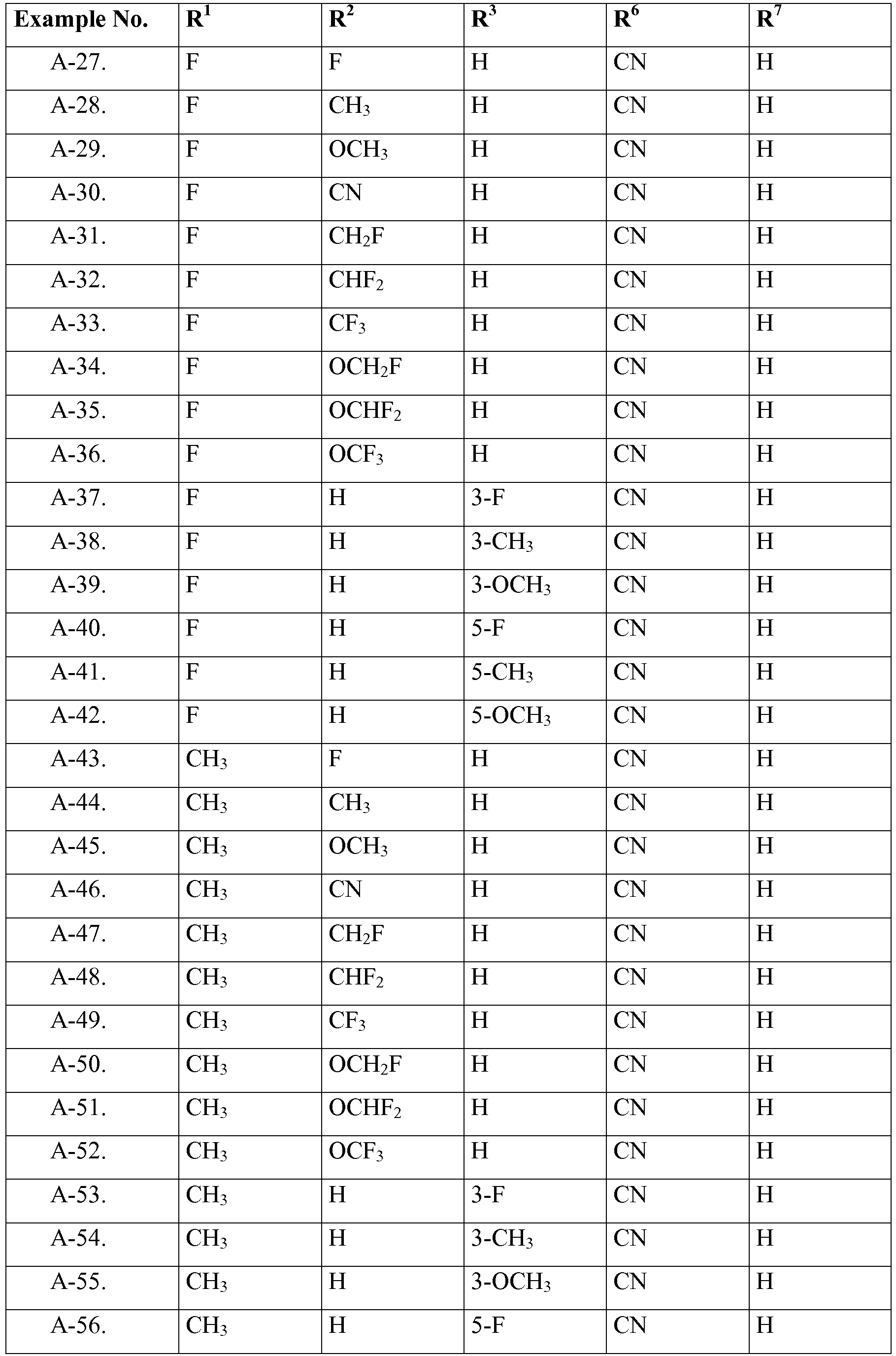


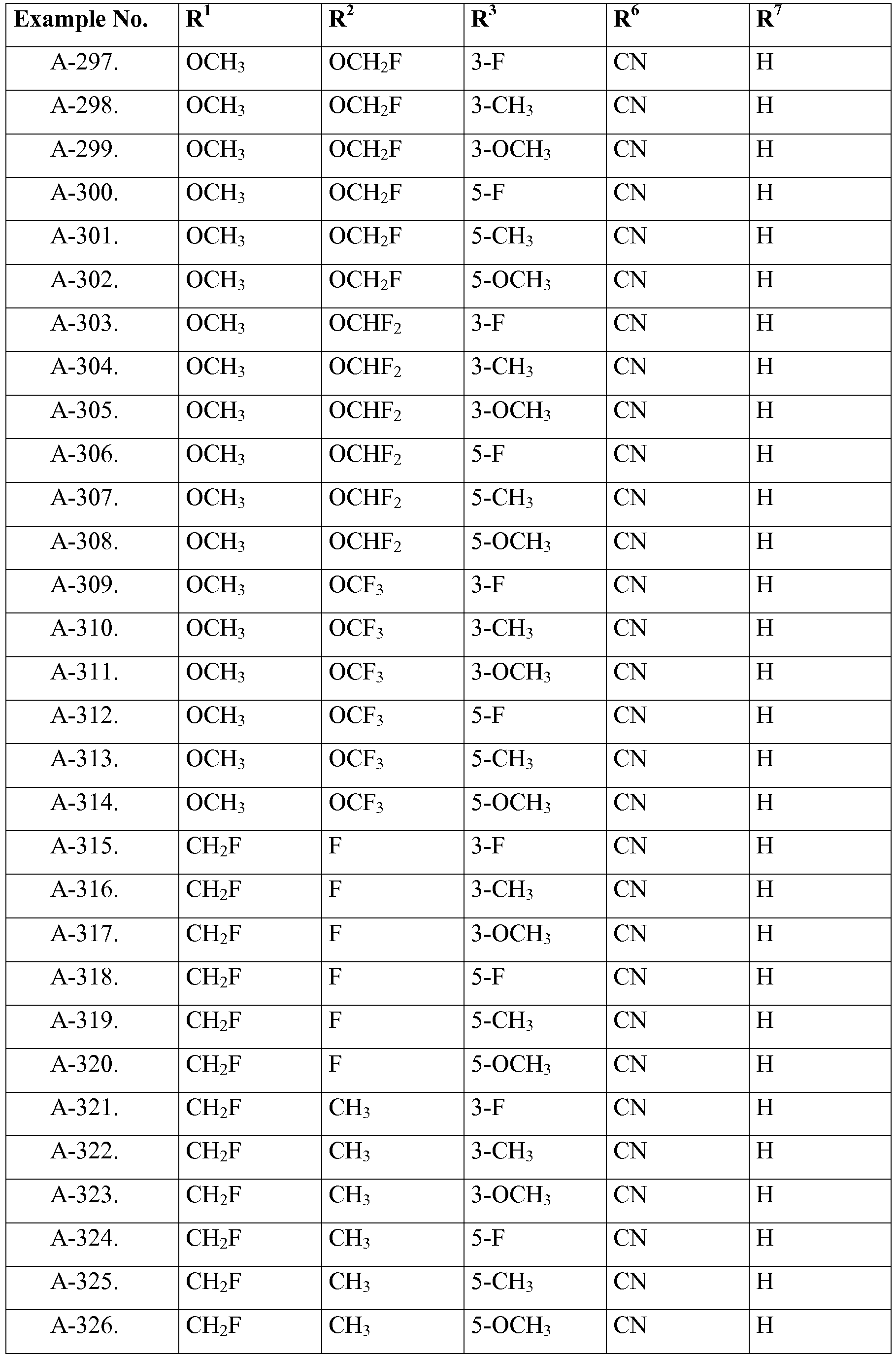


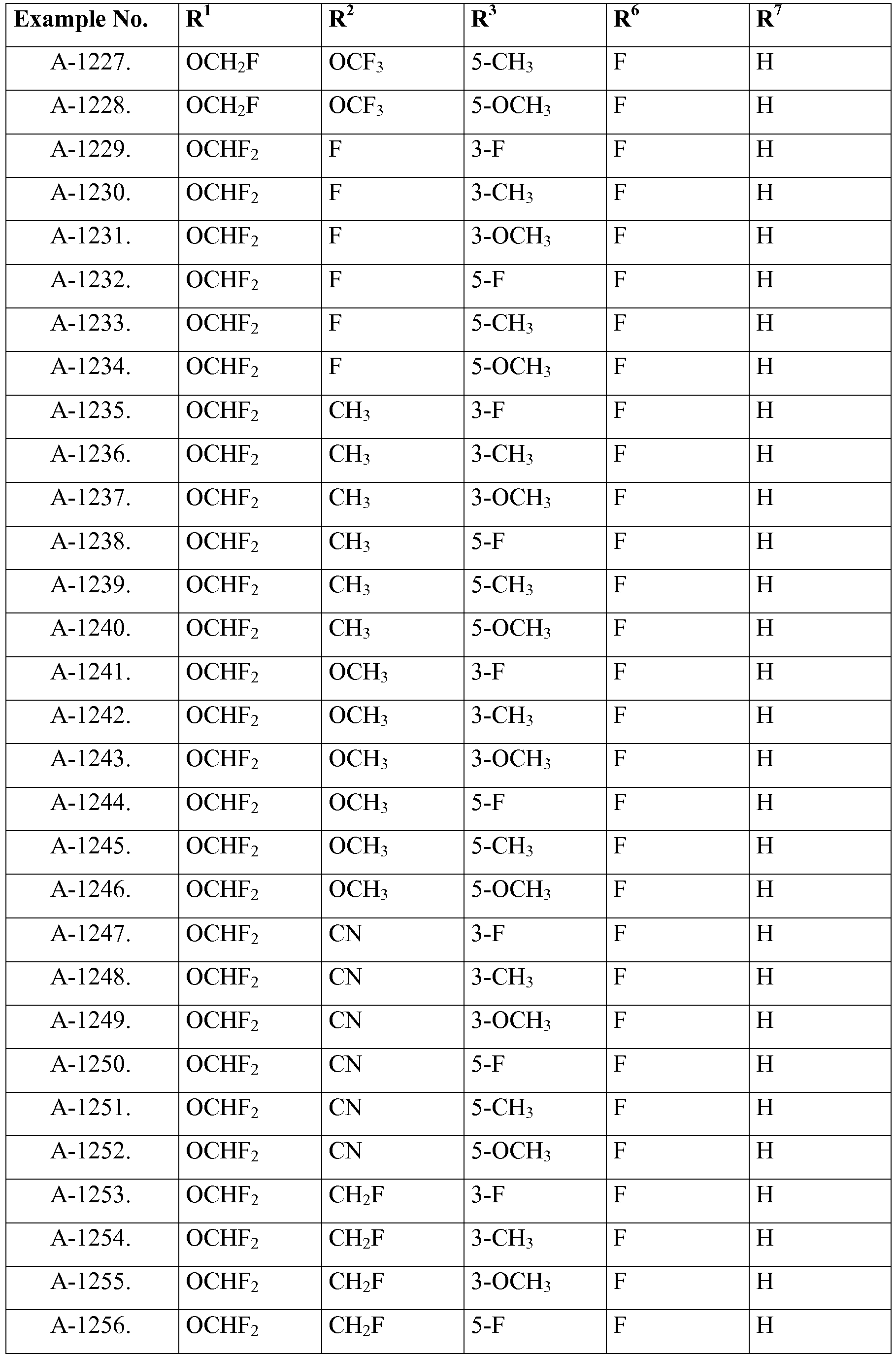


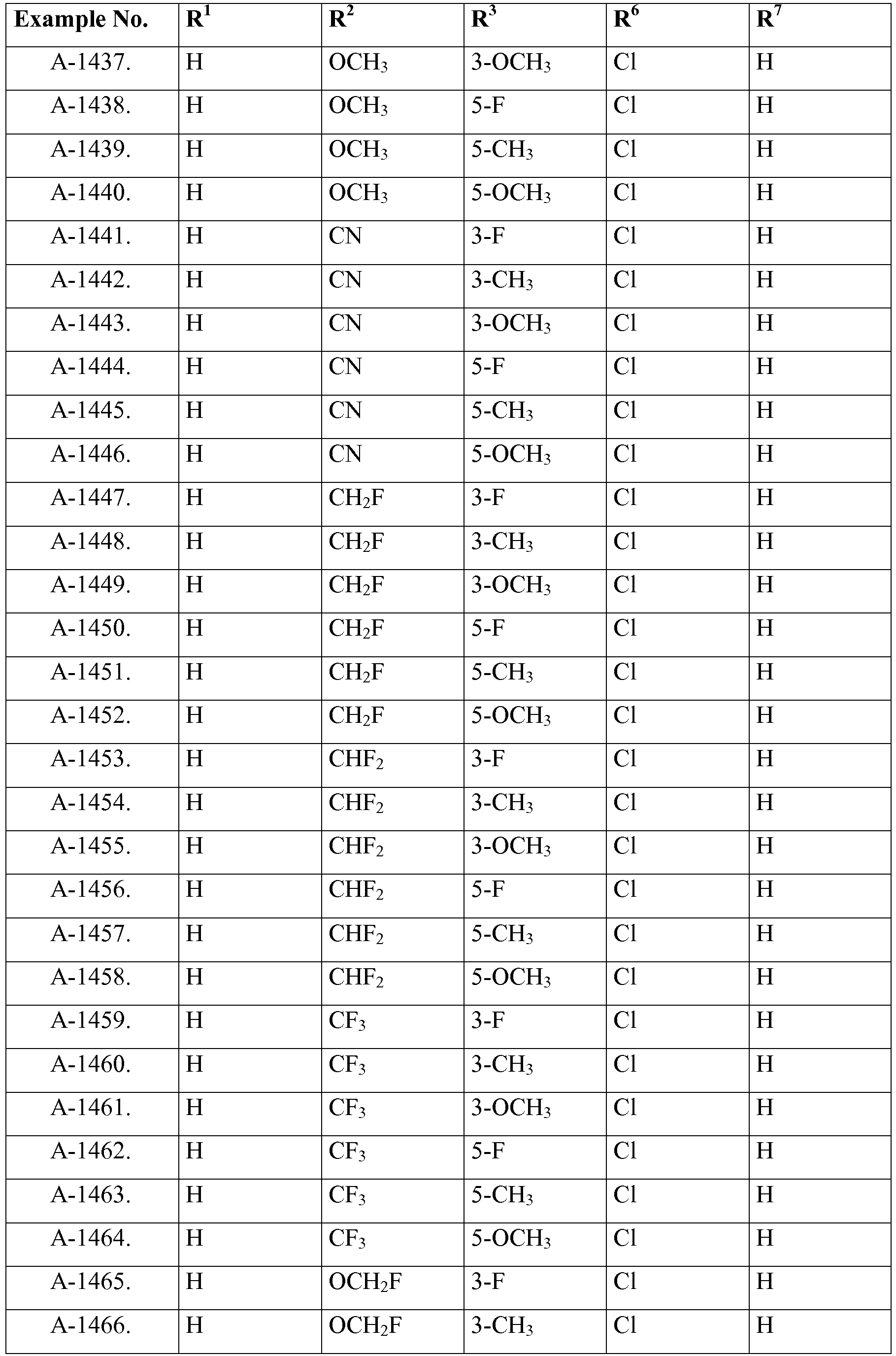
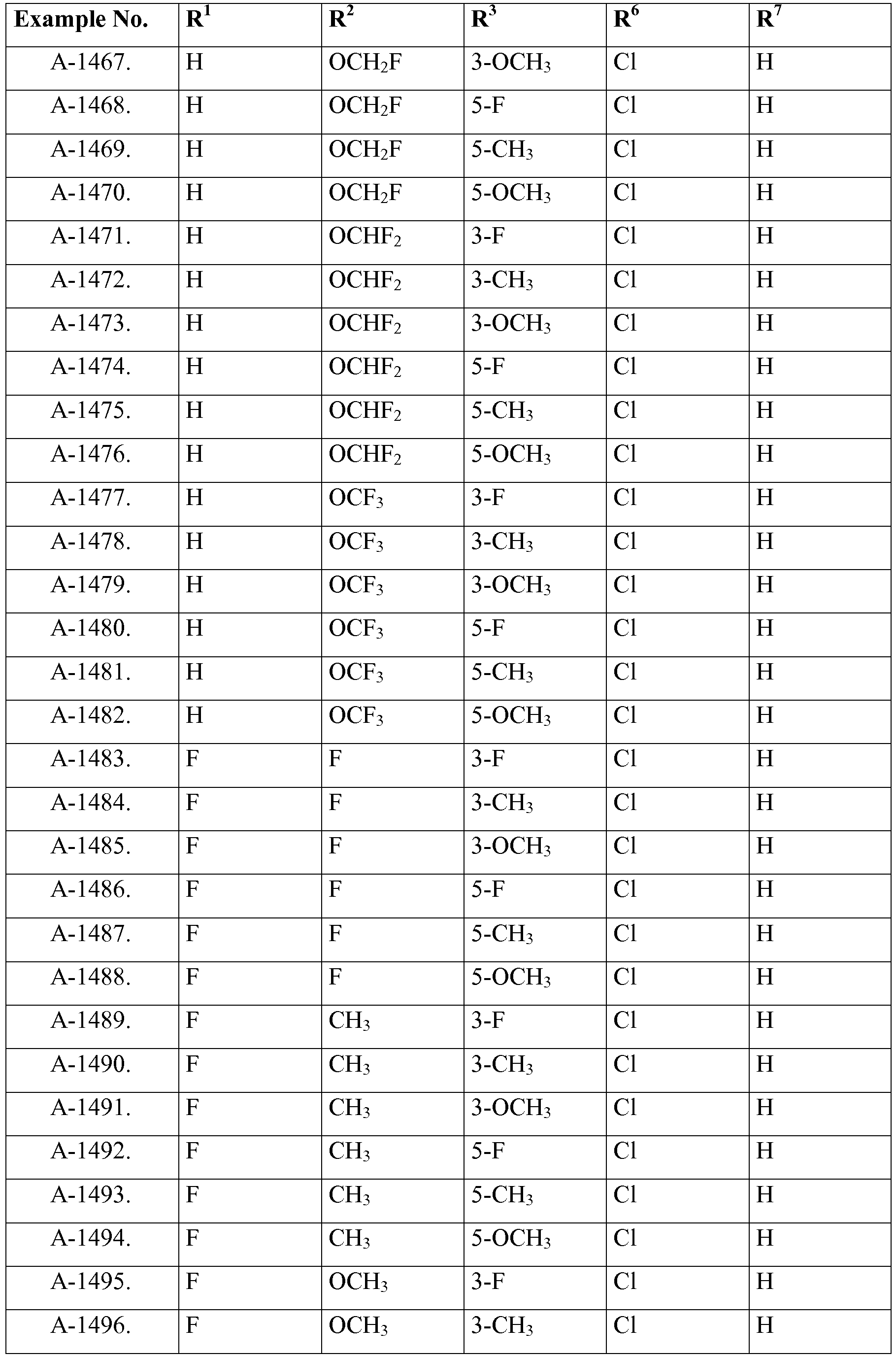


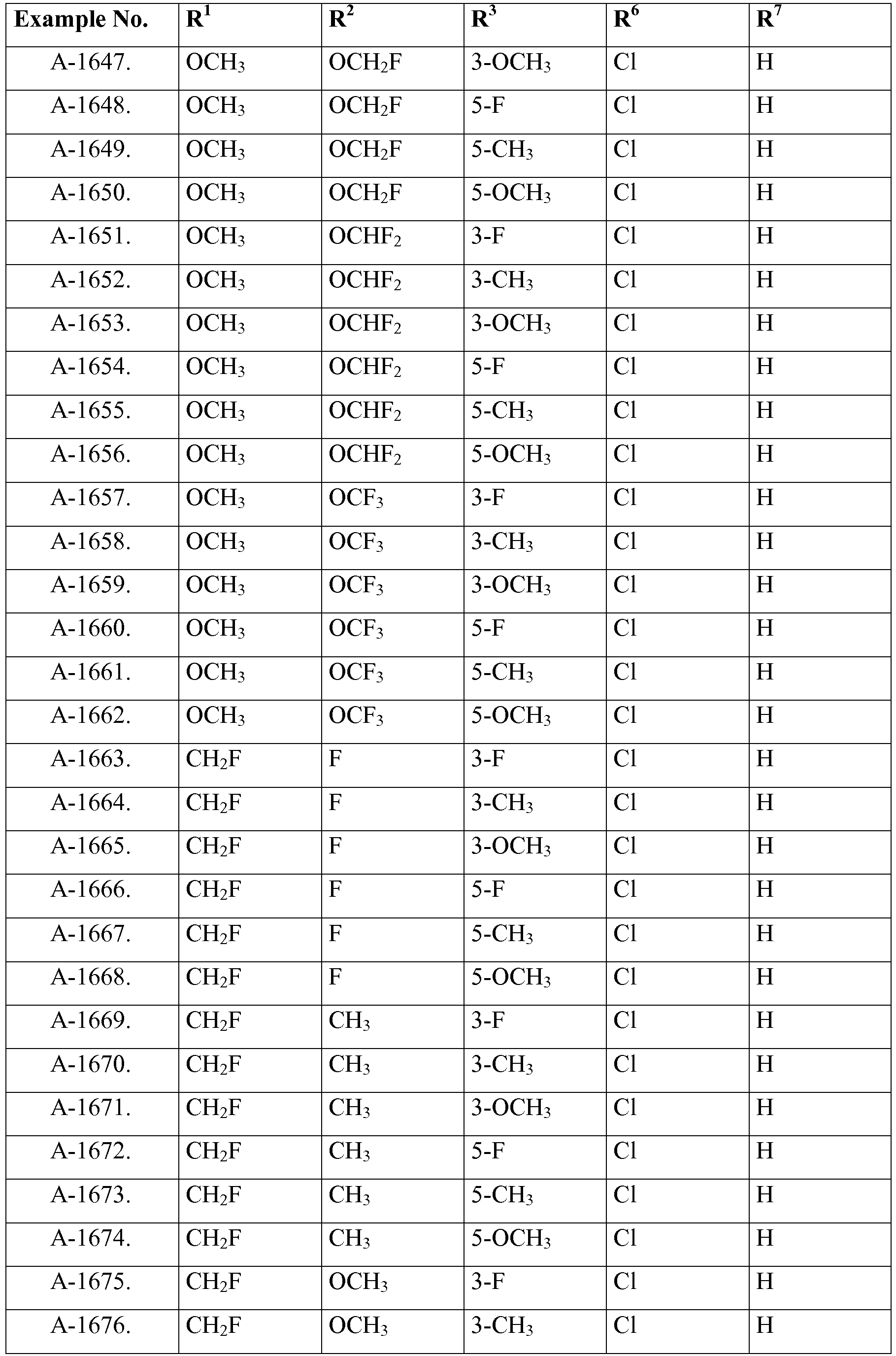
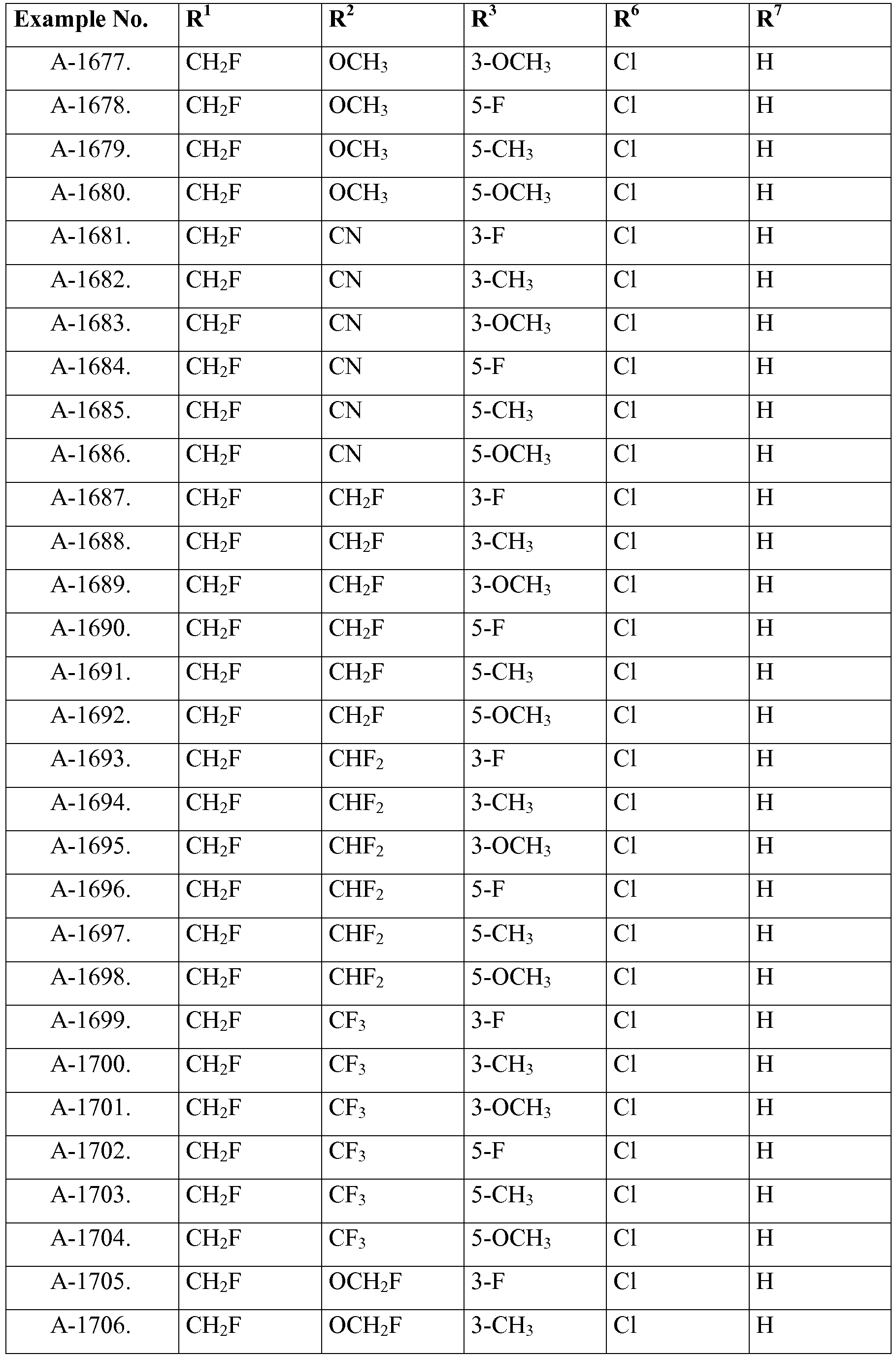

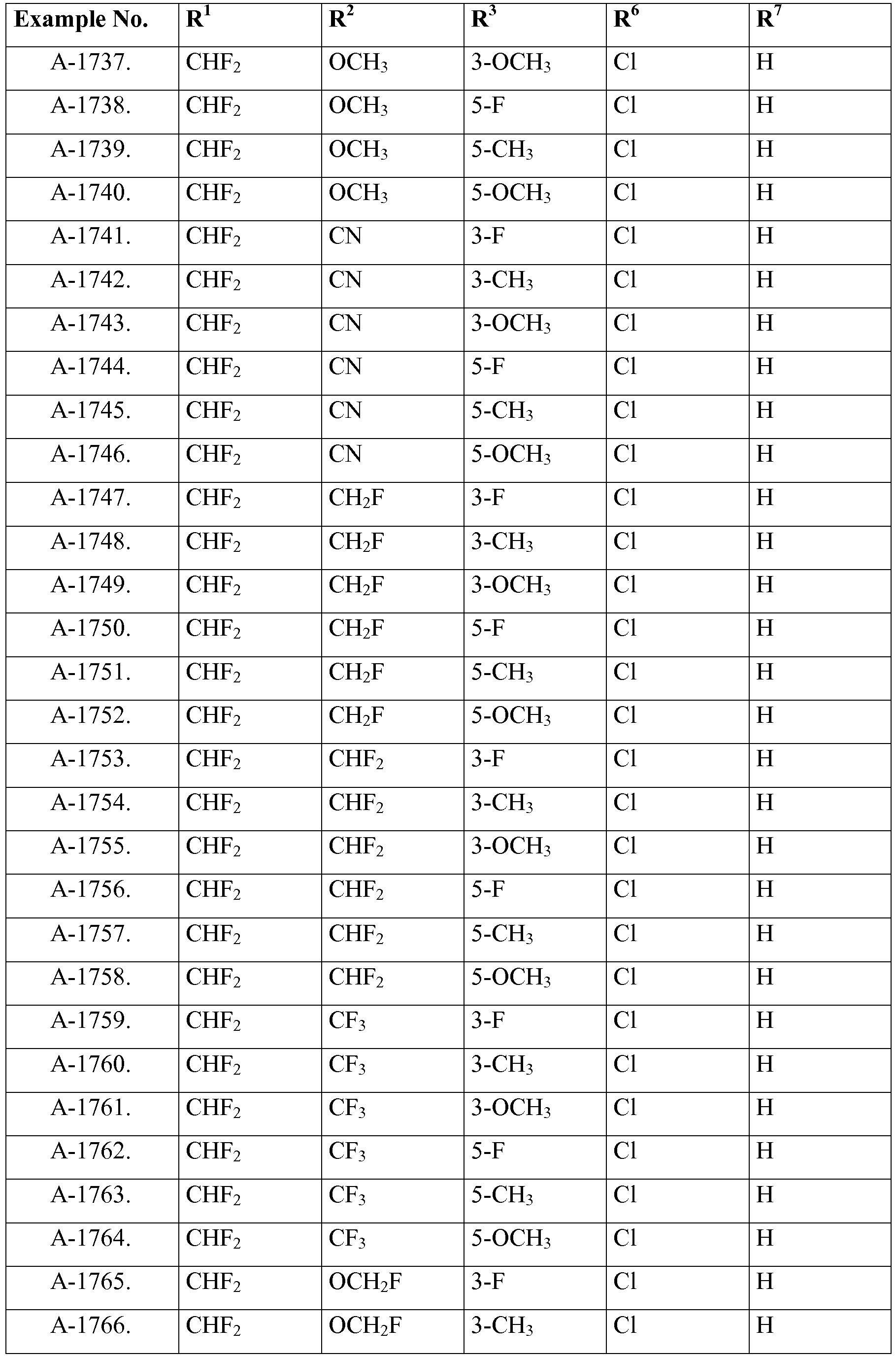
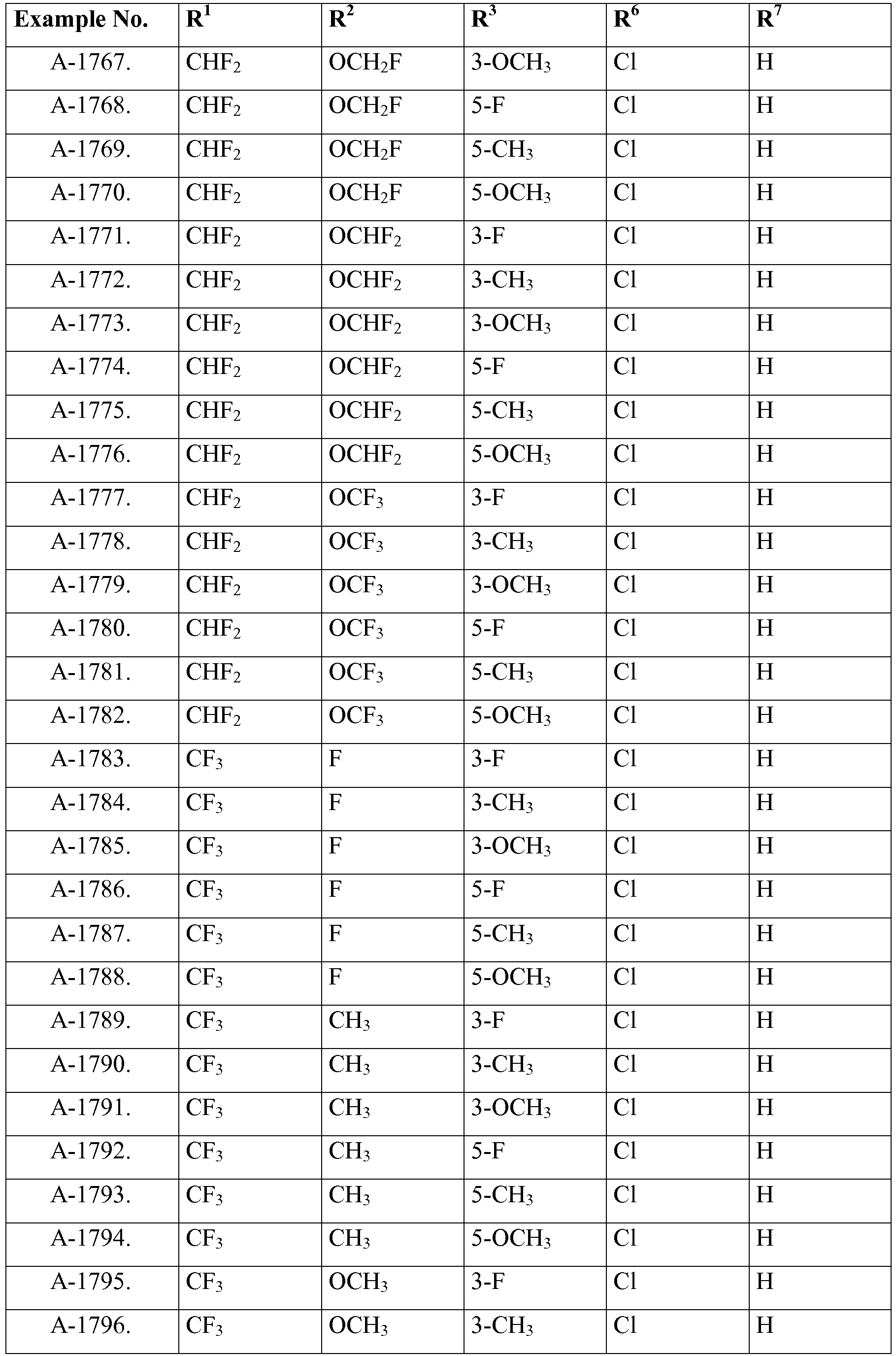


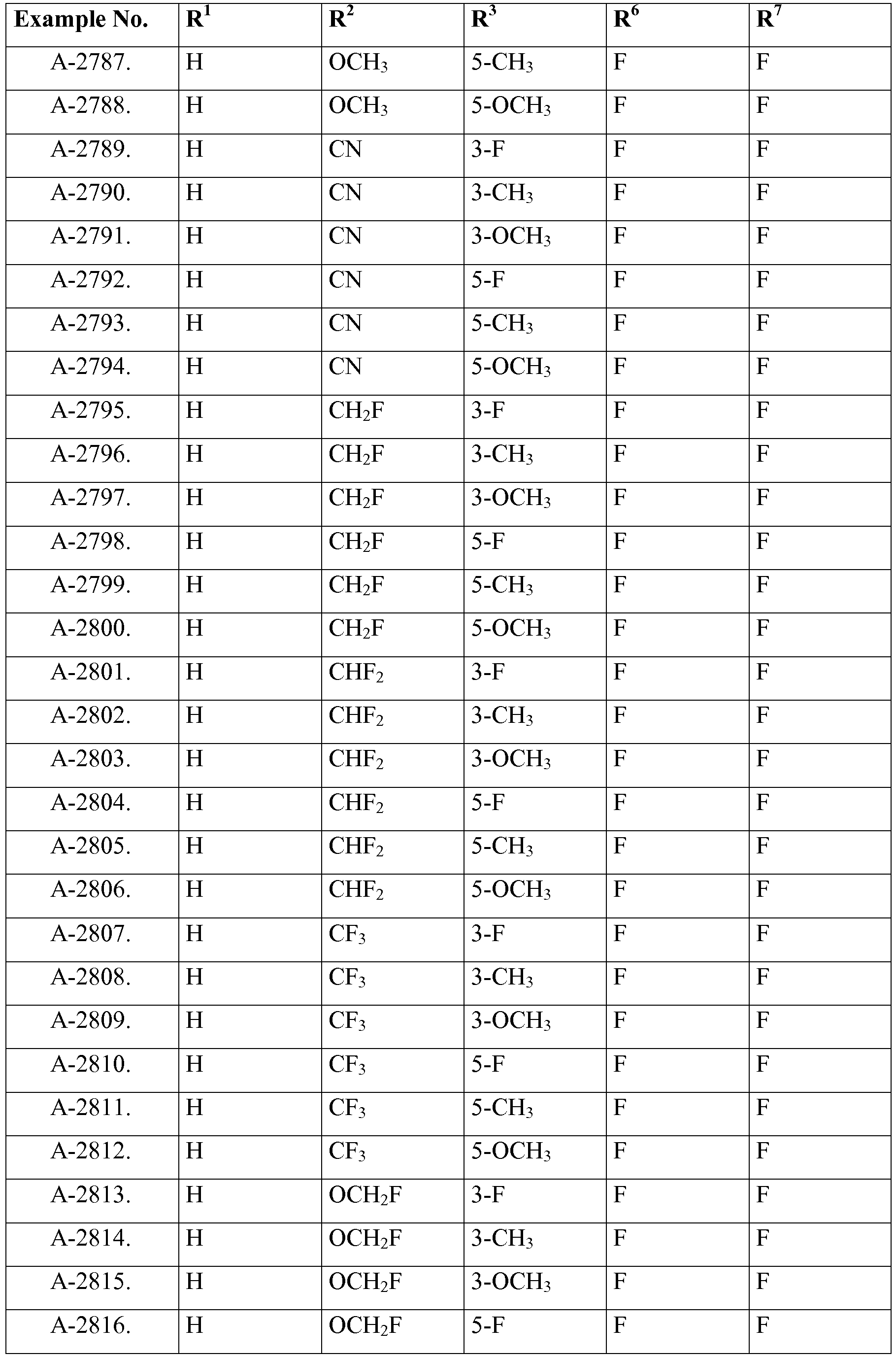
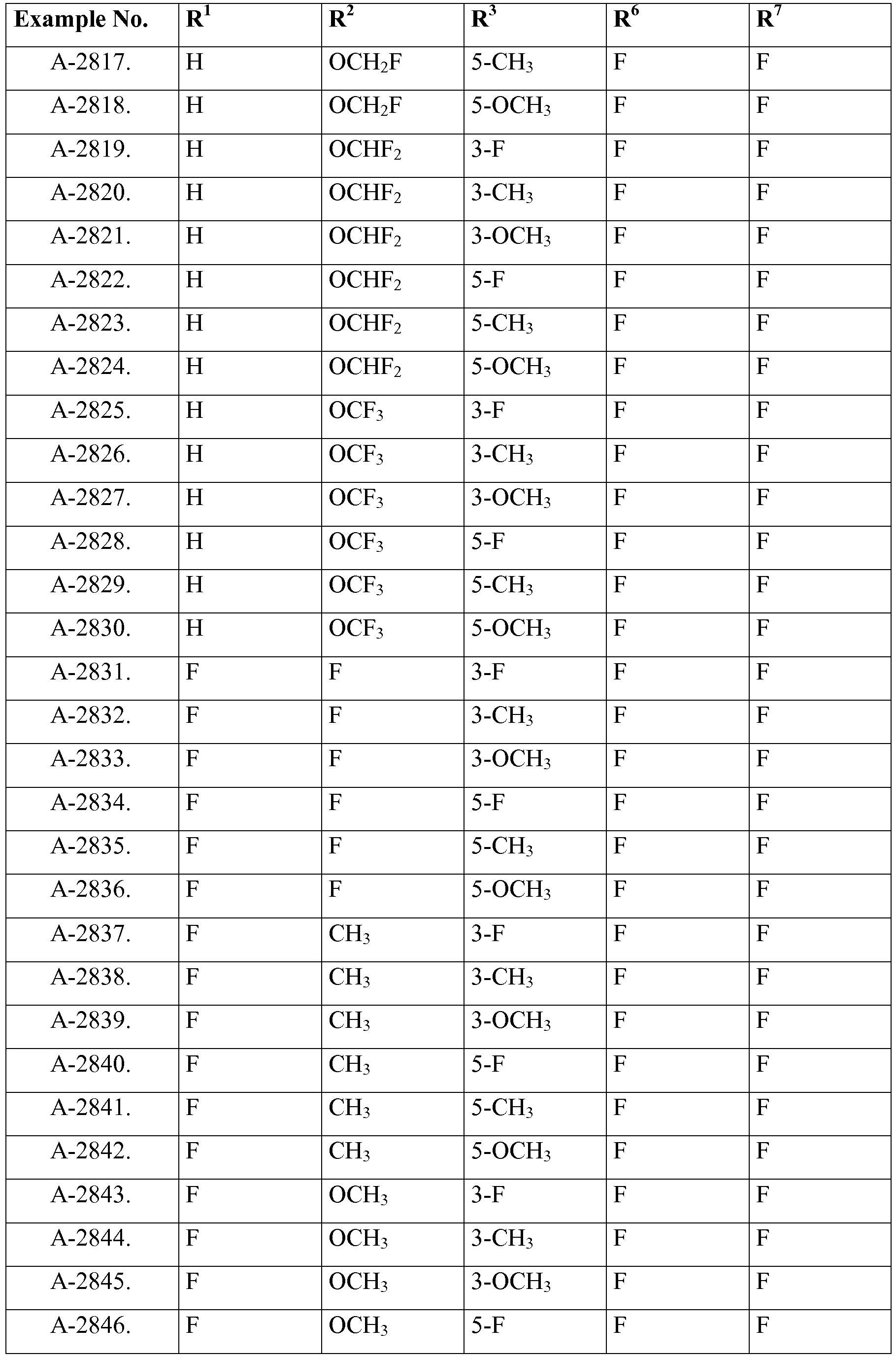


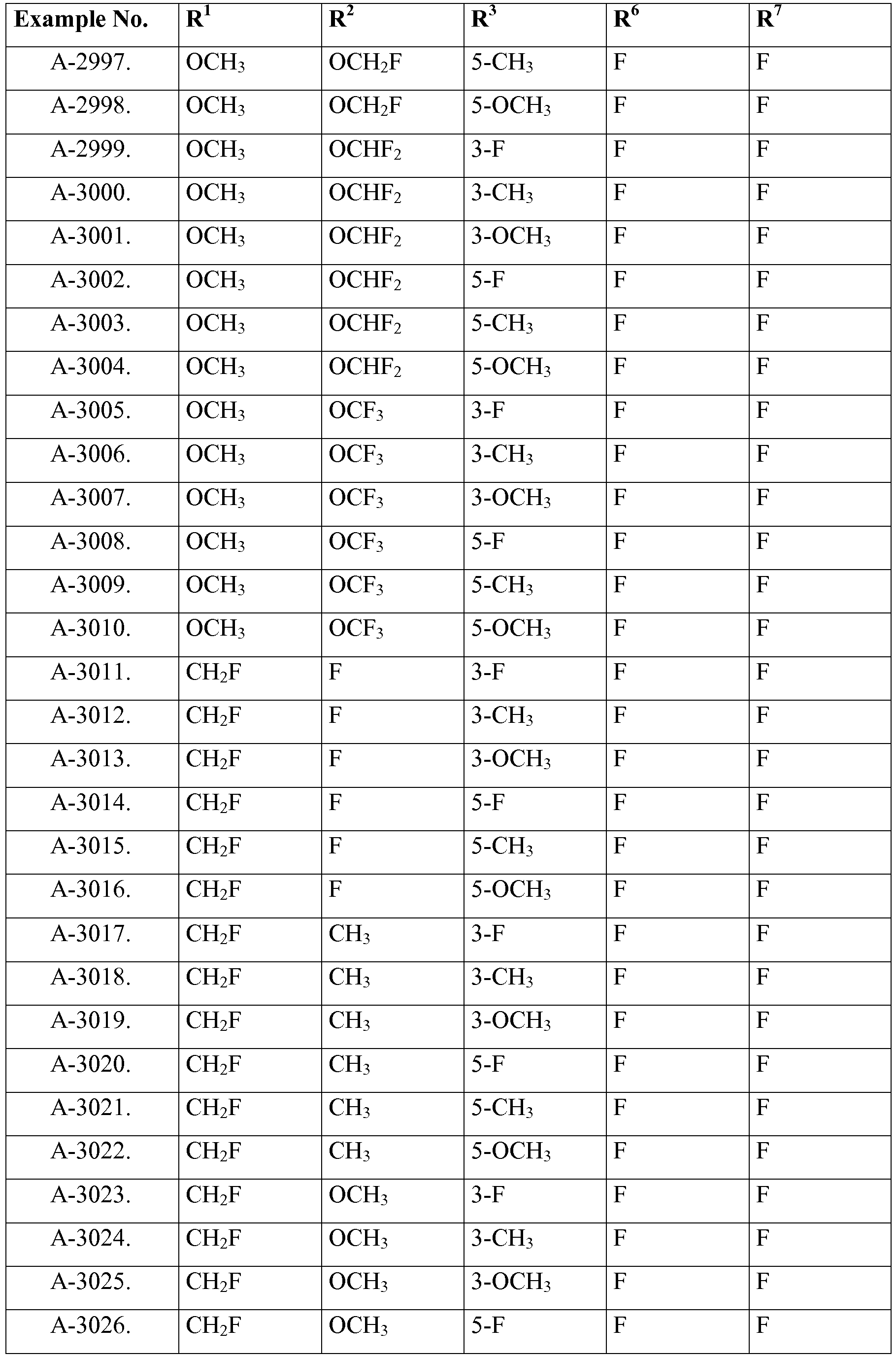


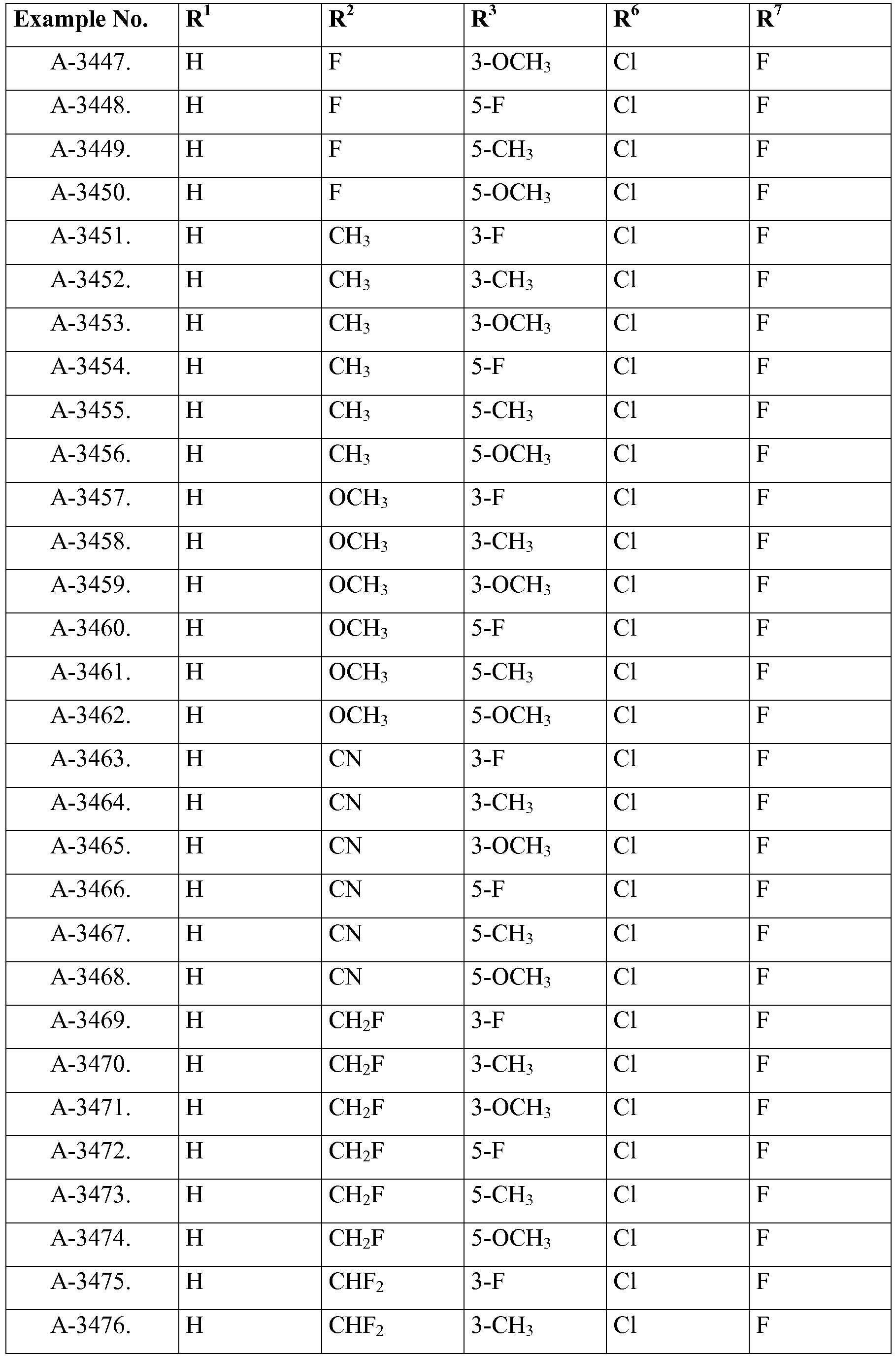
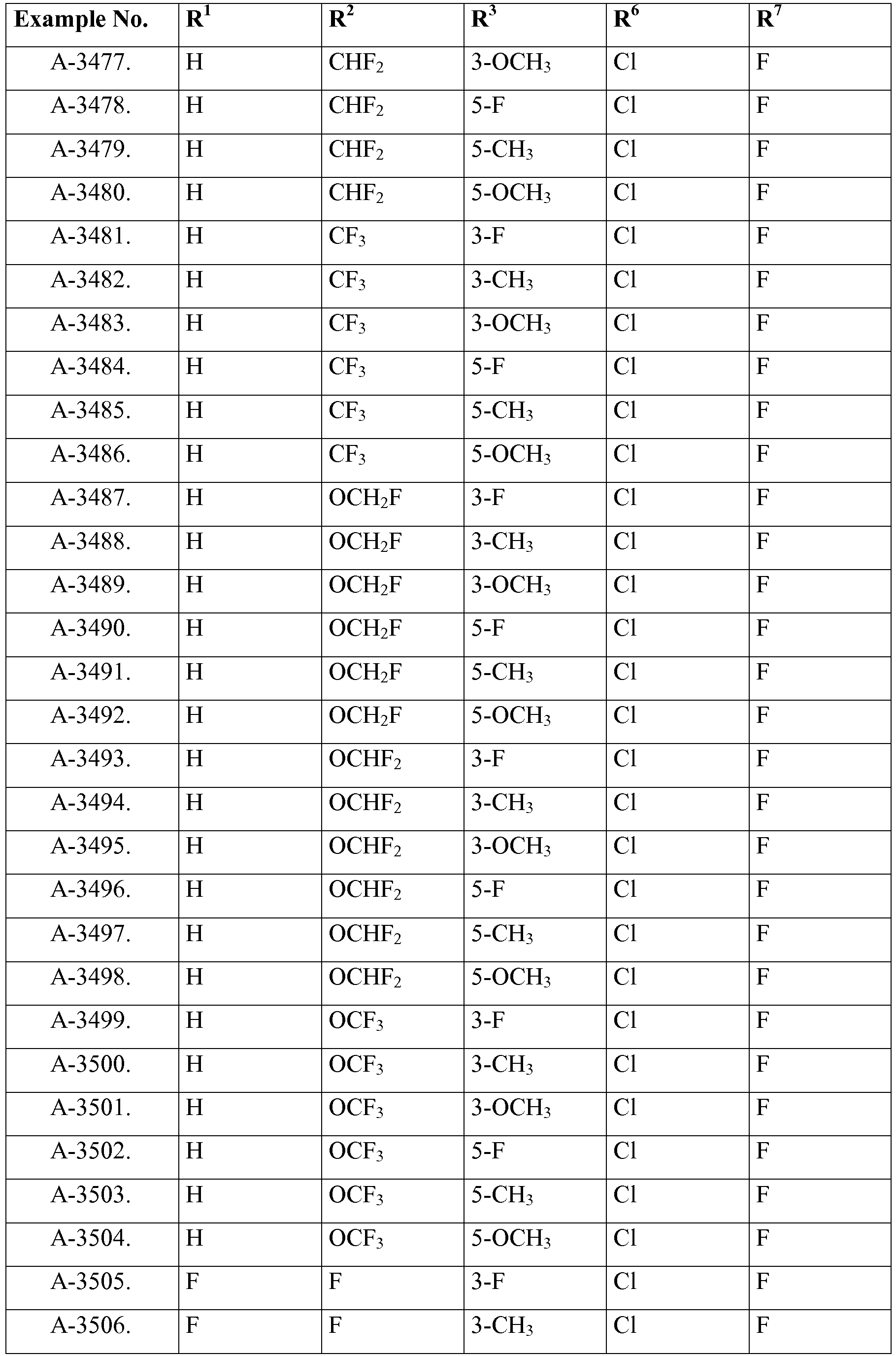


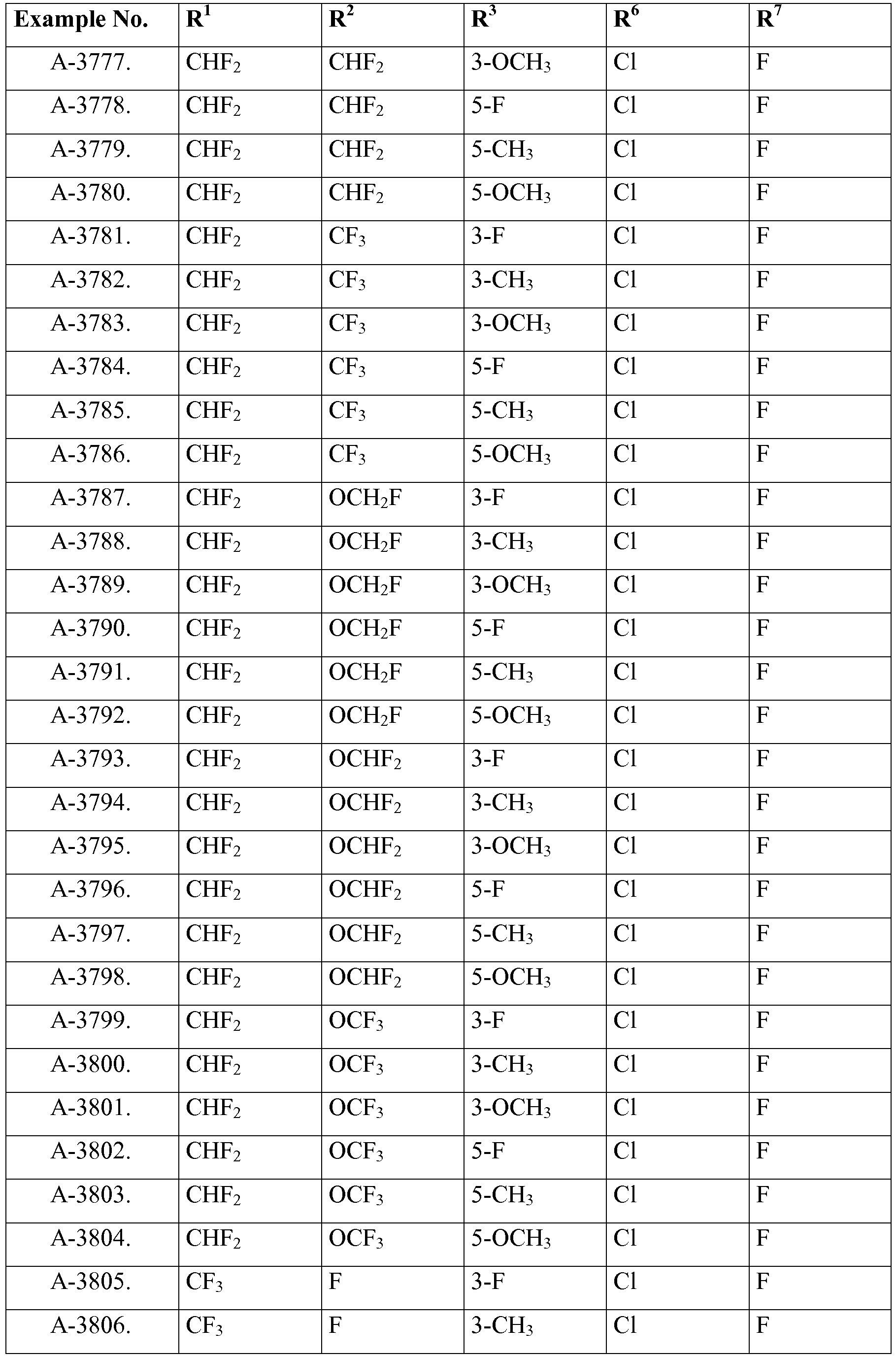


| Example No. | R2 | R3 | R6 | R7 |
| B-1. | H | H | CN | H |
| B-2. | F | H | CN | H |
| B-3. | CH3 | H | CN | H |
| B-4. | OCH3 | H | CN | H |
| B-5. | CN | H | CN | H |
| B-6. | CH2F | H | CN | H |
| B-7. | CHF2 | H | CN | H |
| B-8. | CF3 | H | CN | H |
| B-9. | OCH2F | H | CN | H |
| B-10. | OCHF2 | H | CN | H |
| B-11. | OCF3 | H | CN | H |
| B-12. | H | 3-F | CN | H |
| B-13. | H | 3-CH3 | CN | H |
| B-14. | H | 3-OCH3 | CN | H |
| B-15. | H | 5-F | CN | H |
| B-16. | H | 5-CH3 | CN | H |
| B-17. | H | 5-OCH3 | CN | H |
| B-18. | H | 6-F | CN | H |
| B-19. | H | 6-CH3 | CN | H |
| B-20. | H | 6-OCH3 | CN | H |
| B-21. | F | 3-F | CN | H |
| B-22. | F | 3-CH3 | CN | H |
| B-23. | F | 3-OCH3 | CN | H |
| B-24. | F | 5-F | CN | H |
| B-25. | F | 5-CH3 | CN | H |
| B-26. | F | 5-OCH3 | CN | H |
| B-27. | F | 6-F | CN | H |
| B-28. | F | 6-CH3 | CN | H |
| B-29. | F | 6-OCH3 | CN | H |
| B-30. | CH3 | 3-F | CN | H |
| B-31. | CH3 | 3-CH3 | CN | H |
| B-32. | CH3 | 3-OCH3 | CN | H |
| B-33. | CH3 | 5-F | CN | H |
| B-34. | CH3 | 5-CH3 | CN | H |
| B-35. | CH3 | 5-OCH3 | CN | H |
| B-36. | CH3 | 6-F | CN | H |
| B-37. | CH3 | 6-CH3 | CN | H |
| B-38. | CH3 | 6-OCH3 | CN | H |
| B-39. | OCH3 | 3-F | CN | H |
| B-40. | OCH3 | 3-CH3 | CN | H |
| B-41. | OCH3 | 3-OCH3 | CN | H |
| B-42. | OCH3 | 5-F | CN | H |
| B-43. | OCH3 | 5-CH3 | CN | H |
| B-44. | OCH3 | 5-OCH3 | CN | H |
| B-45. | OCH3 | 6-F | CN | H |
| B-46. | OCH3 | 6-CH3 | CN | H |
| B-47. | OCH3 | 6-OCH3 | CN | H |
| B-48. | CN | 3-F | CN | H |
| B-49. | CN | 3-CH3 | CN | H |
| B-50. | CN | 3-OCH3 | CN | H |
| B-51. | CN | 5-F | CN | H |
| B-52. | CN | 5-CH3 | CN | H |
| B-53. | CN | 5-OCH3 | CN | H |
| B-54. | CN | 6-F | CN | H |
| B-55. | CN | 6-CH3 | CN | H |
| B-56. | CN | 6-OCH3 | CN | H |
| B-57. | CH2F | 3-F | CN | H |
| B-58. | CH2F | 3-CH3 | CN | H |
| B-59. | CH2F | 3-OCH3 | CN | H |
| B-60. | CH2F | 5-F | CN | H |
| B-61. | CH2F | 5-CH3 | CN | H |
| B-62. | CH2F | 5-OCH3 | CN | H |
| B-63. | CH2F | 6-F | CN | H |
| B-64. | CH2F | 6-CH3 | CN | H |
| B-65. | CH2F | 6-OCH3 | CN | H |
| B-66. | CHF2 | 3-F | CN | H |
| B-67. | CHF2 | 3-CH3 | CN | H |
| B-68. | CHF2 | 3-OCH3 | CN | H |
| B-69. | CHF2 | 5-F | CN | H |
| B-70. | CHF2 | 5-CH3 | CN | H |
| B-71. | CHF2 | 5-OCH3 | CN | H |
| B-72. | CHF2 | 6-F | CN | H |
| B-73. | CHF2 | 6-CH3 | CN | H |
| B-74. | CHF2 | 6-OCH3 | CN | H |
| B-75. | CF3 | 3-F | CN | H |
| B-76. | CF3 | 3-CH3 | CN | H |
| B-77. | CF3 | 3-OCH3 | CN | H |
| B-78. | CF3 | 5-F | CN | H |
| B-79. | CF3 | 5-CH3 | CN | H |
| B-80. | CF3 | 5-OCH3 | CN | H |
| B-81. | CF3 | 6-F | CN | H |
| B-82. | CF3 | 6-CH3 | CN | H |
| B-83. | CF3 | 6-OCH3 | CN | H |
| B-84. | OCH2F | 3-F | CN | H |
| B-85. | OCH2F | 3-CH3 | CN | H |
| B-86. | OCH2F | 3-OCH3 | CN | H |
| B-87. | OCH2F | 5-F | CN | H |
| B-88. | OCH2F | 5-CH3 | CN | H |
| B-89. | OCH2F | 5-OCH3 | CN | H |
| B-90. | OCH2F | 6-F | CN | H |
| B-91. | OCH2F | 6-CH3 | CN | H |
| B-92. | OCH2F | 6-OCH3 | CN | H |
| B-93. | OCHF2 | 3-F | CN | H |
| B-94. | OCHF2 | 3-CH3 | CN | H |
| B-95. | OCHF2 | 3-OCH3 | CN | H |
| B-96. | OCHF2 | 5-F | CN | H |
| B-97. | OCHF2 | 5-CH3 | CN | H |
| B-98. | OCHF2 | 5-OCH3 | CN | H |
| B-99. | OCHF2 | 6-F | CN | H |
| B-100. | OCHF2 | 6-CH3 | CN | H |
| B-101. | OCHF2 | 6-OCH3 | CN | H |
| B-102. | OCF3 | 3-F | CN | H |
| B-103. | OCF3 | 3-CH3 | CN | H |
| B-104. | OCF3 | 3-OCH3 | CN | H |
| B-105. | OCF3 | 5-F | CN | H |
| B-106. | OCF3 | 5-CH3 | CN | H |
| B-107. | OCF3 | 5-OCH3 | CN | H |
| B-108. | OCF3 | 6-F | CN | H |
| B-109. | OCF3 | 6-CH3 | CN | H |
| B-110. | OCF3 | 6-OCH3 | CN | H |
| B-111. | H | H | F | H |
| B-112. | F | H | F | H |
| B-113. | CH3 | H | F | H |
| B-114. | OCH3 | H | F | H |
| B-115. | CN | H | F | H |
| B-116. | CH2F | H | F | H |
| B-117. | CHF2 | H | F | H |
| B-118. | CF3 | H | F | H |
| B-119. | OCH2F | H | F | H |
| B-120. | OCHF2 | H | F | H |
| B-121. | OCF3 | H | F | H |
| B-122. | H | 3-F | F | H |
| B-123. | H | 3-CH3 | F | H |
| B-124. | H | 3-OCH3 | F | H |
| B-125. | H | 5-F | F | H |
| B-126. | H | 5-CH3 | F | H |
| B-127. | H | 5-OCH3 | F | H |
| B-128. | H | 6-F | F | H |
| B-129. | H | 6-CH3 | F | H |
| B-130. | H | 6-OCH3 | F | H |
| B-131. | F | 3-F | F | H |
| B-132. | F | 3-CH3 | F | H |
| B-133. | F | 3-OCH3 | F | H |
| B-134. | F | 5-F | F | H |
| B-135. | F | 5-CH3 | F | H |
| B-136. | F | 5-OCH3 | F | H |
| B-137. | F | 6-F | F | H |
| B-138. | F | 6-CH3 | F | H |
| B-139. | F | 6-OCH3 | F | H |
| B-140. | CH3 | 3-F | F | H |
| B-141. | CH3 | 3-CH3 | F | H |
| B-142. | CH3 | 3-OCH3 | F | H |
| B-143. | CH3 | 5-F | F | H |
| B-144. | CH3 | 5-CH3 | F | H |
| B-145. | CH3 | 5-OCH3 | F | H |
| B-146. | CH3 | 6-F | F | H |
| B-147. | CH3 | 6-CH3 | F | H |
| B-148. | CH3 | 6-OCH3 | F | H |
| B-149. | OCH3 | 3-F | F | H |
| B-150. | OCH3 | 3-CH3 | F | H |
| B-151. | OCH3 | 3-OCH3 | F | H |
| B-152. | OCH3 | 5-F | F | H |
| B-153. | OCH3 | 5-CH3 | F | H |
| B-154. | OCH3 | 5-OCH3 | F | H |
| B-155. | OCH3 | 6-F | F | H |
| B-156. | OCH3 | 6-CH3 | F | H |
| B-157. | OCH3 | 6-OCH3 | F | H |
| B-158. | CN | 3-F | F | H |
| B-159. | CN | 3-CH3 | F | H |
| B-160. | CN | 3-OCH3 | F | H |
| B-161. | CN | 5-F | F | H |
| B-162. | CN | 5-CH3 | F | H |
| B-163. | CN | 5-OCH3 | F | H |
| B-164. | CN | 6-F | F | H |
| B-165. | CN | 6-CH3 | F | H |
| B-166. | CN | 6-OCH3 | F | H |
| B-167. | CH2F | 3-F | F | H |
| B-168. | CH2F | 3-CH3 | F | H |
| B-169. | CH2F | 3-OCH3 | F | H |
| B-170. | CH2F | 5-F | F | H |
| B-171. | CH2F | 5-CH3 | F | H |
| B-172. | CH2F | 5-OCH3 | F | H |
| B-173. | CH2F | 6-F | F | H |
| B-174. | CH2F | 6-CH3 | F | H |
| B-175. | CH2F | 6-OCH3 | F | H |
| B-176. | CHF2 | 3-F | F | H |
| B-177. | CHF2 | 3-CH3 | F | H |
| B-178. | CHF2 | 3-OCH3 | F | H |
| B-179. | CHF2 | 5-F | F | H |
| B-180. | CHF2 | 5-CH3 | F | H |
| B-181. | CHF2 | 5-OCH3 | F | H |
| B-182. | CHF2 | 6-F | F | H |
| B-183. | CHF2 | 6-CH3 | F | H |
| B-184. | CHF2 | 6-OCH3 | F | H |
| B-185. | CF3 | 3-F | F | H |
| B-186. | CF3 | 3-CH3 | F | H |
| B-187. | CF3 | 3-OCH3 | F | H |
| B-188. | CF3 | 5-F | F | H |
| B-189. | CF3 | 5-CH3 | F | H |
| B-190. | CF3 | 5-OCH3 | F | H |
| B-191. | CF3 | 6-F | F | H |
| B-192. | CF3 | 6-CH3 | F | H |
| B-193. | CF3 | 6-OCH3 | F | H |
| B-194. | OCH2F | 3-F | F | H |
| B-195. | OCH2F | 3-CH3 | F | H |
| B-196. | OCH2F | 3-OCH3 | F | H |
| B-197. | OCH2F | 5-F | F | H |
| B-198. | OCH2F | 5-CH3 | F | H |
| B-199. | OCH2F | 5-OCH3 | F | H |
| B-200. | OCH2F | 6-F | F | H |
| B-201. | OCH2F | 6-CH3 | F | H |
| B-202. | OCH2F | 6-OCH3 | F | H |
| B-203. | OCHF2 | 3-F | F | H |
| B-204. | OCHF2 | 3-CH3 | F | H |
| B-205. | OCHF2 | 3-OCH3 | F | H |
| B-206. | OCHF2 | 5-F | F | H |
| B-207. | OCHF2 | 5-CH3 | F | H |
| B-208. | OCHF2 | 5-OCH3 | F | H |
| B-209. | OCHF2 | 6-F | F | H |
| B-210. | OCHF2 | 6-CH3 | F | H |
| B-211. | OCHF2 | 6-OCH3 | F | H |
| B-212. | OCF3 | 3-F | F | H |
| B-213. | OCF3 | 3-CH3 | F | H |
| B-214. | OCF3 | 3-OCH3 | F | H |
| B-215. | OCF3 | 5-F | F | H |
| B-216. | OCF3 | 5-CH3 | F | H |
| B-217. | OCF3 | 5-OCH3 | F | H |
| B-218. | OCF3 | 6-F | F | H |
| B-219. | OCF3 | 6-CH3 | F | H |
| B-220. | OCF3 | 6-OCH3 | F | H |
| B-221. | H | H | Cl | H |
| B-222. | F | H | Cl | H |
| B-223. | CH3 | H | Cl | H |
| B-224. | OCH3 | H | Cl | H |
| B-225. | CN | H | Cl | H |
| B-226. | CH2F | H | Cl | H |
| B-227. | CHF2 | H | Cl | H |
| B-228. | CF3 | H | Cl | H |
| B-229. | OCH2F | H | Cl | H |
| B-230. | OCHF2 | H | Cl | H |
| B-231. | OCF3 | H | Cl | H |
| B-232. | H | 3-F | Cl | H |
| B-233. | H | 3-CH3 | Cl | H |
| B-234. | H | 3-OCH3 | Cl | H |
| B-235. | H | 5-F | Cl | H |
| B-236. | H | 5-CH3 | Cl | H |
| B-237. | H | 5-OCH3 | Cl | H |
| B-23 8. | H | 6-F | Cl | H |
| B-239. | H | 6-CH3 | Cl | H |
| B-240. | H | 6-OCH3 | Cl | H |
| B-241. | F | 3-F | Cl | H |
| B-242. | F | 3-CH3 | Cl | H |
| B-243. | F | 3-OCH3 | Cl | H |
| B-244. | F | 5-F | Cl | H |
| B-245. | F | 5-CH3 | Cl | H |
| B-246. | F | 5-OCH3 | Cl | H |
| B-247. | F | 6-F | Cl | H |
| B-248. | F | 6-CH3 | Cl | H |
| B-249. | F | 6-OCH3 | Cl | H |
| B-250. | CH3 | 3-F | Cl | H |
| B-251. | CH3 | 3-CH3 | Cl | H |
| B-252. | CH3 | 3-OCH3 | Cl | H |
| B-253. | CH3 | 5-F | Cl | H |
| B-254. | CH3 | 5-CH3 | Cl | H |
| B-255. | CH3 | 5-OCH3 | Cl | H |
| B-256. | CH3 | 6-F | Cl | H |
| B-257. | CH3 | 6-CH3 | Cl | H |
| B-258. | CH3 | 6-OCH3 | Cl | H |
| B-259. | OCH3 | 3-F | Cl | H |
| B-260. | OCH3 | 3-CH3 | Cl | H |
| B-261. | OCH3 | 3-OCH3 | Cl | H |
| B-262. | OCH3 | 5-F | Cl | H |
| B-263. | OCH3 | 5-CH3 | Cl | H |
| B-264. | OCH3 | 5-OCH3 | Cl | H |
| B-265. | OCH3 | 6-F | Cl | H |
| B-266. | OCH3 | 6-CH3 | Cl | H |
| B-267. | OCH3 | 6-OCH3 | Cl | H |
| B-268. | CN | 3-F | Cl | H |
| B-269. | CN | 3-CH3 | Cl | H |
| B-270. | CN | 3-OCH3 | Cl | H |
| B-271. | CN | 5-F | Cl | H |
| B-272. | CN | 5-CH3 | Cl | H |
| B-273. | CN | 5-OCH3 | Cl | H |
| B-274. | CN | 6-F | Cl | H |
| B-275. | CN | 6-CH3 | Cl | H |
| B-276. | CN | 6-OCH3 | Cl | H |
| B-277. | CH2F | 3-F | Cl | H |
| B-278. | CH2F | 3-CH3 | Cl | H |
| B-279. | CH2F | 3-OCH3 | Cl | H |
| B-280. | CH2F | 5-F | Cl | H |
| B-281. | CH2F | 5-CH3 | Cl | H |
| B-282. | CH2F | 5-OCH3 | Cl | H |
| B-283. | CH2F | 6-F | Cl | H |
| B-284. | CH2F | 6-CH3 | Cl | H |
| B-285. | CH2F | 6-OCH3 | Cl | H |
| B-286. | CHF2 | 3-F | Cl | H |
| B-287. | CHF2 | 3-CH3 | Cl | H |
| B-288. | CHF2 | 3-OCH3 | Cl | H |
| B-289. | CHF2 | 5-F | Cl | H |
| B-290. | CHF2 | 5-CH3 | Cl | H |
| B-291. | CHF2 | 5-OCH3 | Cl | H |
| B-292. | CHF2 | 6-F | Cl | H |
| B-293. | CHF2 | 6-CH3 | Cl | H |
| B-294. | CHF2 | 6-OCH3 | Cl | H |
| B-295. | CF3 | 3-F | Cl | H |
| B-296. | CF3 | 3-CH3 | Cl | H |
| B-297. | CF3 | 3-OCH3 | Cl | H |
| B-298. | CF3 | 5-F | Cl | H |
| B-299. | CF3 | 5-CH3 | Cl | H |
| B-300. | CF3 | 5-OCH3 | Cl | H |
| B-301. | CF3 | 6-F | Cl | H |
| B-302. | CF3 | 6-CH3 | Cl | H |
| B-303. | CF3 | 6-OCH3 | Cl | H |
| B-304. | OCH2F | 3-F | Cl | H |
| B-305. | OCH2F | 3-CH3 | Cl | H |
| B-306. | OCH2F | 3-OCH3 | Cl | H |
| B-307. | OCH2F | 5-F | Cl | H |
| B-308. | OCH2F | 5-CH3 | Cl | H |
| B-309. | OCH2F | 5-OCH3 | Cl | H |
| B-310. | OCH2F | 6-F | Cl | H |
| B-311. | OCH2F | 6-CH3 | Cl | H |
| B-312. | OCH2F | 6-OCH3 | Cl | H |
| B-313. | OCHF2 | 3-F | Cl | H |
| B-314. | OCHF2 | 3-CH3 | Cl | H |
| B-315. | OCHF2 | 3-OCH3 | Cl | H |
| B-316. | OCHF2 | 5-F | Cl | H |
| B-317. | OCHF2 | 5-CH3 | Cl | H |
| B-318. | OCHF2 | 5-OCH3 | Cl | H |
| B-319. | OCHF2 | 6-F | Cl | H |
| B-320. | OCHF2 | 6-CH3 | Cl | H |
| B-321. | OCHF2 | 6-OCH3 | Cl | H |
| B-322. | OCF3 | 3-F | Cl | H |
| B-323. | OCF3 | 3-CH3 | Cl | H |
| B-324. | OCF3 | 3-OCH3 | Cl | H |
| B-325. | OCF3 | 5-F | Cl | H |
| B-326. | OCF3 | 5-CH3 | Cl | H |
| B-327. | OCF3 | 5-OCH3 | Cl | H |
| B-328. | OCF3 | 6-F | Cl | H |
| B-329. | OCF3 | 6-CH3 | Cl | H |
| B-330. | OCF3 | 6-OCH3 | Cl | H |
| B-331. | H | H | CN | F |
| B-332. | F | H | CN | F |
| B-333. | CH3 | H | CN | F |
| B-334. | OCH3 | H | CN | F |
| B-335. | CN | H | CN | F |
| B-336. | CH2F | H | CN | F |
| B-337. | CHF2 | H | CN | F |
| B-338. | CF3 | H | CN | F |
| B-339. | OCH2F | H | CN | F |
| B-340. | OCHF2 | H | CN | F |
| B-341. | OCF3 | H | CN | F |
| B-342. | H | 3-F | CN | F |
| B-343. | H | 3-CH3 | CN | F |
| B-344. | H | 3-OCH3 | CN | F |
| B-345. | H | 5-F | CN | F |
| B-346. | H | 5-CH3 | CN | F |
| B-347. | H | 5-OCH3 | CN | F |
| B-348. | H | 6-F | CN | F |
| B-349. | H | 6-CH3 | CN | F |
| B-350. | H | 6-OCH3 | CN | F |
| B-351. | F | 3-F | CN | F |
| B-352. | F | 3-CH3 | CN | F |
| B-353. | F | 3-OCH3 | CN | F |
| B-354. | F | 5-F | CN | F |
| B-355. | F | 5-CH3 | CN | F |
| B-356. | F | 5-OCH3 | CN | F |
| B-357. | F | 6-F | CN | F |
| B-358. | F | 6-CH3 | CN | F |
| B-359. | F | 6-OCH3 | CN | F |
| B-360. | CH3 | 3-F | CN | F |
| B-361. | CH3 | 3-CH3 | CN | F |
| B-362. | CH3 | 3-OCH3 | CN | F |
| B-363. | CH3 | 5-F | CN | F |
| B-364. | CH3 | 5-CH3 | CN | F |
| B-365. | CH3 | 5-OCH3 | CN | F |
| B-366. | CH3 | 6-F | CN | F |
| B-367. | CH3 | 6-CH3 | CN | F |
| B-368. | CH3 | 6-OCH3 | CN | F |
| B-369. | OCH3 | 3-F | CN | F |
| B-370. | OCH3 | 3-CH3 | CN | F |
| B-371. | OCH3 | 3-OCH3 | CN | F |
| B-372. | OCH3 | 5-F | CN | F |
| B-373. | OCH3 | 5-CH3 | CN | F |
| B-374. | OCH3 | 5-OCH3 | CN | F |
| B-375. | OCH3 | 6-F | CN | F |
| B-376. | OCH3 | 6-CH3 | CN | F |
| B-377. | OCH3 | 6-OCH3 | CN | F |
| B-378. | CN | 3-F | CN | F |
| B-379. | CN | 3-CH3 | CN | F |
| B-380. | CN | 3-OCH3 | CN | F |
| B-381. | CN | 5-F | CN | F |
| B-382. | CN | 5-CH3 | CN | F |
| B-383. | CN | 5-OCH3 | CN | F |
| B-384. | CN | 6-F | CN | F |
| B-385. | CN | 6-CH3 | CN | F |
| B-386. | CN | 6-OCH3 | CN | F |
| B-387. | CH2F | 3-F | CN | F |
| B-388. | CH2F | 3-CH3 | CN | F |
| B-389. | CH2F | 3-OCH3 | CN | F |
| B-390. | CH2F | 5-F | CN | F |
| B-391. | CH2F | 5-CH3 | CN | F |
| B-392. | CH2F | 5-OCH3 | CN | F |
| B-393. | CH2F | 6-F | CN | F |
| B-394. | CH2F | 6-CH3 | CN | F |
| B-395. | CH2F | 6-OCH3 | CN | F |
| B-396. | CHF2 | 3-F | CN | F |
| B-397. | CHF2 | 3-CH3 | CN | F |
| B-398. | CHF2 | 3-OCH3 | CN | F |
| B-399. | CHF2 | 5-F | CN | F |
| B-400. | CHF2 | 5-CH3 | CN | F |
| B-401. | CHF2 | 5-OCH3 | CN | F |
| B-402. | CHF2 | 6-F | CN | F |
| B-403. | CHF2 | 6-CH3 | CN | F |
| B-404. | CHF2 | 6-OCH3 | CN | F |
| B-405. | CF3 | 3-F | CN | F |
| B-406. | CF3 | 3-CH3 | CN | F |
| B-407. | CF3 | 3-OCH3 | CN | F |
| B-408. | CF3 | 5-F | CN | F |
| B-409. | CF3 | 5-CH3 | CN | F |
| B-410. | CF3 | 5-OCH3 | CN | F |
| B-411. | CF3 | 6-F | CN | F |
| B-412. | CF3 | 6-CH3 | CN | F |
| B-413. | CF3 | 6-OCH3 | CN | F |
| B-414. | OCH2F | 3-F | CN | F |
| B-415. | OCH2F | 3-CH3 | CN | F |
| B-416. | OCH2F | 3-OCH3 | CN | F |
| B-417. | OCH2F | 5-F | CN | F |
| B-418. | OCH2F | 5-CH3 | CN | F |
| B-419. | OCH2F | 5-OCH3 | CN | F |
| B-420. | OCH2F | 6-F | CN | F |
| B-421. | OCH2F | 6-CH3 | CN | F |
| B-422. | OCH2F | 6-OCH3 | CN | F |
| B-423. | OCHF2 | 3-F | CN | F |
| B-424. | OCHF2 | 3-CH3 | CN | F |
| B-425. | OCHF2 | 3-OCH3 | CN | F |
| B-426. | OCHF2 | 5-F | CN | F |
| B-427. | OCHF2 | 5-CH3 | CN | F |
| B-428. | OCHF2 | 5-OCH3 | CN | F |
| B-429. | OCHF2 | 6-F | CN | F |
| B-430. | OCHF2 | 6-CH3 | CN | F |
| B-431. | OCHF2 | 6-OCH3 | CN | F |
| B-432. | OCF3 | 3-F | CN | F |
| B-433. | OCF3 | 3-CH3 | CN | F |
| B-434. | OCF3 | 3-OCH3 | CN | F |
| B-435. | OCF3 | 5-F | CN | F |
| B-436. | OCF3 | 5-CH3 | CN | F |
| B-437. | OCF3 | 5-OCH3 | CN | F |
| B-43 8. | OCF3 | 6-F | CN | F |
| B-439. | OCF3 | 6-CH3 | CN | F |
| B-440. | OCF3 | 6-OCH3 | CN | F |
| B-441. | H | H | F | F |
| B-442. | F | H | F | F |
| B-443. | CH3 | H | F | F |
| B-444. | OCH3 | H | F | F |
| B-445. | CN | H | F | F |
| B-446. | CH2F | H | F | F |
| B-447. | CHF2 | H | F | F |
| B-448. | CF3 | H | F | F |
| B-449. | OCH2F | H | F | F |
| B-450. | OCHF2 | H | F | F |
| B-451. | OCF3 | H | F | F |
| B-452. | H | 3-F | F | F |
| B-453. | H | 3-CH3 | F | F |
| B-454. | H | 3-OCH3 | F | F |
| B-455. | H | 5-F | F | F |
| B-456. | H | 5-CH3 | F | F |
| B-457. | H | 5-OCH3 | F | F |
| B-458. | H | 6-F | F | F |
| B-459. | H | 6-CH3 | F | F |
| B-460. | H | 6-OCH3 | F | F |
| B-461. | F | 3-F | F | F |
| B-462. | F | 3-CH3 | F | F |
| B-463. | F | 3-OCH3 | F | F |
| B-464. | F | 5-F | F | F |
| B-465. | F | 5-CH3 | F | F |
| B-466. | F | 5-OCH3 | F | F |
| B-467. | F | 6-F | F | F |
| B-468. | F | 6-CH3 | F | F |
| B-469. | F | 6-OCH3 | F | F |
| B-470. | CH3 | 3-F | F | F |
| B-471. | CH3 | 3-CH3 | F | F |
| B-472. | CH3 | 3-OCH3 | F | F |
| B-473. | CH3 | 5-F | F | F |
| B-474. | CH3 | 5-CH3 | F | F |
| B-475. | CH3 | 5-OCH3 | F | F |
| B-476. | CH3 | 6-F | F | F |
| B-477. | CH3 | 6-CH3 | F | F |
| B-478. | CH3 | 6-OCH3 | F | F |
| B-479. | OCH3 | 3-F | F | F |
| B-480. | OCH3 | 3-CH3 | F | F |
| B-481. | OCH3 | 3-OCH3 | F | F |
| B-482. | OCH3 | 5-F | F | F |
| B-483. | OCH3 | 5-CH3 | F | F |
| B-484. | OCH3 | 5-OCH3 | F | F |
| B-485. | OCH3 | 6-F | F | F |
| B-486. | OCH3 | 6-CH3 | F | F |
| B-487. | OCH3 | 6-OCH3 | F | F |
| B-488. | CN | 3-F | F | F |
| B-489. | CN | 3-CH3 | F | F |
| B-490. | CN | 3-OCH3 | F | F |
| B-491. | CN | 5-F | F | F |
| B-492. | CN | 5-CH3 | F | F |
| B-493. | CN | 5-OCH3 | F | F |
| B-494. | CN | 6-F | F | F |
| B-495. | CN | 6-CH3 | F | F |
| B-496. | CN | 6-OCH3 | F | F |
| B-497. | CH2F | 3-F | F | F |
| B-498. | CH2F | 3-CH3 | F | F |
| B-499. | CH2F | 3-OCH3 | F | F |
| B-500. | CH2F | 5-F | F | F |
| B-501. | CH2F | 5-CH3 | F | F |
| B-502. | CH2F | 5-OCH3 | F | F |
| B-503. | CH2F | 6-F | F | F |
| B-504. | CH2F | 6-CH3 | F | F |
| B-505. | CH2F | 6-OCH3 | F | F |
| B-506. | CHF2 | 3-F | F | F |
| B-507. | CHF2 | 3-CH3 | F | F |
| B-508. | CHF2 | 3-OCH3 | F | F |
| B-509. | CHF2 | 5-F | F | F |
| B-510. | CHF2 | 5-CH3 | F | F |
| B-511. | CHF2 | 5-OCH3 | F | F |
| B-512. | CHF2 | 6-F | F | F |
| B-513. | CHF2 | 6-CH3 | F | F |
| B-514. | CHF2 | 6-OCH3 | F | F |
| B-515. | CF3 | 3-F | F | F |
| B-516. | CF3 | 3-CH3 | F | F |
| B-517. | CF3 | 3-OCH3 | F | F |
| B-518. | CF3 | 5-F | F | F |
| B-519. | CF3 | 5-CH3 | F | F |
| B-520. | CF3 | 5-OCH3 | F | F |
| B-521. | CF3 | 6-F | F | F |
| B-522. | CF3 | 6-CH3 | F | F |
| B-523. | CF3 | 6-OCH3 | F | F |
| B-524. | OCH2F | 3-F | F | F |
| B-525. | OCH2F | 3-CH3 | F | F |
| B-526. | OCH2F | 3-OCH3 | F | F |
| B-527. | OCH2F | 5-F | F | F |
| B-528. | OCH2F | 5-CH3 | F | F |
| B-529. | OCH2F | 5-OCH3 | F | F |
| B-530. | OCH2F | 6-F | F | F |
| B-531. | OCH2F | 6-CH3 | F | F |
| B-532. | OCH2F | 6-OCH3 | F | F |
| B-533. | OCHF2 | 3-F | F | F |
| B-534. | OCHF2 | 3-CH3 | F | F |
| B-535. | OCHF2 | 3-OCH3 | F | F |
| B-536. | OCHF2 | 5-F | F | F |
| B-537. | OCHF2 | 5-CH3 | F | F |
| B-538. | OCHF2 | 5-OCH3 | F | F |
| B-539. | OCHF2 | 6-F | F | F |
| B-540. | OCHF2 | 6-CH3 | F | F |
| B-541. | OCHF2 | 6-OCH3 | F | F |
| B-542. | OCF3 | 3-F | F | F |
| B-543. | OCF3 | 3-CH3 | F | F |
| B-544. | OCF3 | 3-OCH3 | F | F |
| B-545. | OCF3 | 5-F | F | F |
| B-546. | OCF3 | 5-CH3 | F | F |
| B-547. | OCF3 | 5-OCH3 | F | F |
| B-548. | OCF3 | 6-F | F | F |
| B-549. | OCF3 | 6-CH3 | F | F |
| B-550. | OCF3 | 6-OCH3 | F | F |
| B-551. | H | H | Cl | F |
| B-552. | F | H | Cl | F |
| B-553. | CH3 | H | Cl | F |
| B-554. | OCH3 | H | Cl | F |
| B-555. | CN | H | Cl | F |
| B-556. | CH2F | H | Cl | F |
| B-557. | CHF2 | H | Cl | F |
| B-558. | CF3 | H | Cl | F |
| B-559. | OCH2F | H | Cl | F |
| B-560. | OCHF2 | H | Cl | F |
| B-561. | OCF3 | H | Cl | F |
| B-562. | H | 3-F | Cl | F |
| B-563. | H | 3-CH3 | Cl | F |
| B-564. | H | 3-OCH3 | Cl | F |
| B-565. | H | 5-F | Cl | F |
| B-566. | H | 5-CH3 | Cl | F |
| B-567. | H | 5-OCH3 | Cl | F |
| B-568. | H | 6-F | Cl | F |
| B-569. | H | 6-CH3 | Cl | F |
| B-570. | H | 6-OCH3 | Cl | F |
| B-571. | F | 3-F | Cl | F |
| B-572. | F | 3-CH3 | Cl | F |
| B-573. | F | 3-OCH3 | Cl | F |
| B-574. | F | 5-F | Cl | F |
| B-575. | F | 5-CH3 | Cl | F |
| B-576. | F | 5-OCH3 | Cl | F |
| B-577. | F | 6-F | Cl | F |
| B-578. | F | 6-CH3 | Cl | F |
| B-579. | F | 6-OCH3 | Cl | F |
| B-580. | CH3 | 3-F | Cl | F |
| B-581. | CH3 | 3-CH3 | Cl | F |
| B-582. | CH3 | 3-OCH3 | Cl | F |
| B-583. | CH3 | 5-F | Cl | F |
| B-584. | CH3 | 5-CH3 | Cl | F |
| B-585. | CH3 | 5-OCH3 | Cl | F |
| B-586. | CH3 | 6-F | Cl | F |
| B-587. | CH3 | 6-CH3 | Cl | F |
| B-588. | CH3 | 6-OCH3 | Cl | F |
| B-589. | OCH3 | 3-F | Cl | F |
| B-590. | OCH3 | 3-CH3 | Cl | F |
| B-591. | OCH3 | 3-OCH3 | Cl | F |
| B-592. | OCH3 | 5-F | Cl | F |
| B-593. | OCH3 | 5-CH3 | Cl | F |
| B-594. | OCH3 | 5-OCH3 | Cl | F |
| B-595. | OCH3 | 6-F | Cl | F |
| B-596. | OCH3 | 6-CH3 | Cl | F |
| B-597. | OCH3 | 6-OCH3 | Cl | F |
| B-598. | CN | 3-F | Cl | F |
| B-599. | CN | 3-CH3 | Cl | F |
| B-600. | CN | 3-OCH3 | Cl | F |
| B-601. | CN | 5-F | Cl | F |
| B-602. | CN | 5-CH3 | Cl | F |
| B-603. | CN | 5-OCH3 | Cl | F |
| B-604. | CN | 6-F | Cl | F |
| B-605. | CN | 6-CH3 | Cl | F |
| B-606. | CN | 6-OCH3 | Cl | F |
| B-607. | CH2F | 3-F | Cl | F |
| B-608. | CH2F | 3-CH3 | Cl | F |
| B-609. | CH2F | 3-OCH3 | Cl | F |
| B-610. | CH2F | 5-F | Cl | F |
| B-611. | CH2F | 5-CH3 | Cl | F |
| B-612. | CH2F | 5-OCH3 | Cl | F |
| B-613. | CH2F | 6-F | Cl | F |
| B-614. | CH2F | 6-CH3 | Cl | F |
| B-615. | CH2F | 6-OCH3 | Cl | F |
| B-616. | CHF2 | 3-F | Cl | F |
| B-617. | CHF2 | 3-CH3 | Cl | F |
| B-618. | CHF2 | 3-OCH3 | Cl | F |
| B-619. | CHF2 | 5-F | Cl | F |
| B-620. | CHF2 | 5-CH3 | Cl | F |
| B-621. | CHF2 | 5-OCH3 | Cl | F |
| B-622. | CHF2 | 6-F | Cl | F |
| B-623. | CHF2 | 6-CH3 | Cl | F |
| B-624. | CHF2 | 6-OCH3 | Cl | F |
| B-625. | CF3 | 3-F | Cl | F |
| B-626. | CF3 | 3-CH3 | Cl | F |
| B-627. | CF3 | 3-OCH3 | Cl | F |
| B-628. | CF3 | 5-F | Cl | F |
| B-629. | CF3 | 5-CH3 | Cl | F |
| B-630. | CF3 | 5-OCH3 | Cl | F |
| B-631. | CF3 | 6-F | Cl | F |
| B-632. | CF3 | 6-CH3 | Cl | F |
| B-633. | CF3 | 6-OCH3 | Cl | F |
| B-634. | OCH2F | 3-F | Cl | F |
| B-635. | OCH2F | 3-CH3 | Cl | F |
| B-636. | OCH2F | 3-OCH3 | Cl | F |
| B-637. | OCH2F | 5-F | Cl | F |
| B-638. | OCH2F | 5-CH3 | Cl | F |
| B-639. | OCH2F | 5-OCH3 | Cl | F |
| B-640. | OCH2F | 6-F | Cl | F |
| B-641. | OCH2F | 6-CH3 | Cl | F |
| B-642. | OCH2F | 6-OCH3 | Cl | F |
| B-643. | OCHF2 | 3-F | Cl | F |
| B-644. | OCHF2 | 3-CH3 | Cl | F |
| B-645. | OCHF2 | 3-OCH3 | Cl | F |
| B-646. | OCHF2 | 5-F | Cl | F |
| B-647. | OCHF2 | 5-CH3 | Cl | F |
| B-648. | OCHF2 | 5-OCH3 | Cl | F |
| B-649. | OCHF2 | 6-F | Cl | F |
| B-650. | OCHF2 | 6-CH3 | Cl | F |
| B-651. | OCHF2 | 6-OCH3 | Cl | F |
| B-652. | OCF3 | 3-F | Cl | F |
| B-653. | OCF3 | 3-CH3 | Cl | F |
| B-654. | OCF3 | 3-OCH3 | Cl | F |
| B-655. | OCF3 | 5-F | Cl | F |
| B-656. | OCF3 | 5-CH3 | Cl | F |
| B-657. | OCF3 | 5-OCH3 | Cl | F |
| B-658. | OCF3 | 6-F | Cl | F |
| B-659. | OCF3 | 6-CH3 | Cl | F |
| B-660. | OCF3 | 6-OCH3 | Cl | F |
Claims (21)
- A compound of formula I
 X1 and X2 are N or CH, with the proviso that X1 and X2 are not simultaneously N;X3 is a bond, C1-C4-alkylene, C1-C4-haloalkylene or CO;X4 is N or CH;X5 is C-R1 or N;R1 and R2, independently of each other, are selected from hydrogen, halogen, cyano, C1-C3-alkyl, fluorinated C1-C3-alkyl, C1-C3-hydroxyalkyl, C1-C3-alkoxy and fluorinated C1-C3-alkoxy;R3 is selected from hydrogen, halogen, cyano, C1-C3-alkyl, fluorinated C1-C3-alkyl, C1-C3-hydroxyalkyl, C1-C3-alkoxy, fluorinated C1-C3-alkoxy and hydroxyl;R4 is selected from C1-C3-alkoxy;R5 is selected from hydrogen and C1-C3-alkoxy;R6 is selected from cyano and halogen;R7 is selected from hydrogen, halogen and cyano;R8 and R9, independently of each other and independently of each occurrence, are selected from halogen, C1-C4-alkyl, C1-C4-haloalkyl, C1-C4-alkoxy and C1-C4-haloalkoxy, with the proviso that R8 and R9 are not halogen, C1-C4-alkoxy or C1-C4-haloalkoxy if they are bound to a carbon atom in α-position to a nitrogen ring atom; or
two non-geminal radicals R8 form together a group -(CH2)n-, where n is 1, 2, 3 or 4, where 1 or 2 hydrogen atoms in this group may be replaced a methyl group; or
two non-geminal radicals R9 form together a group -(CH2)n-, where n is 1, 2, 3 or 4, where 1 or 2 hydrogen atoms in this group may be replaced a methyl group;each R10 is independently selected from halogen, C1-C4-alkyl and C1-C4-haloalkyl;a is 0, 1, 2, 3 or 4;b is 0, 1, 2, 3 or 4; andc is 0, 1, 2, 3 or 4;and the N-oxides, stereoisomers and pharmaceutically acceptable salts thereof, and the compound of the formula I, wherein at least one of the atoms has been replaced by its stable, non-radioactive isotope. - The compound as claimed in claim 1, where R1, R2 and R3, independently of each other, are selected from hydrogen, halogen, cyano, C1-C3-alkyl, fluorinated C1-C3-alkyl, C1-C3-hydroxyalkyl, C1-C3-alkoxy and fluorinated C1-C3-alkoxy.
- The compound as claimed in claim 2, where R1, R2 and R3, independently of each other, are selected from hydrogen, fluorine, cyano, methyl and methoxy.
- The compound as claimed in any of the preceding claims, where R4 is selected from methoxy and ethoxy and in particular from methoxy.
- The compound as claimed in any of claims 1 to 3, where R4 is isopropoxy.
- The compound as claimed in any of the preceding claims, where R5 is hydrogen or methoxy, in particular hydrogen.
- The compound as claimed in any of the preceding claims, where R6 is selected from cyano, fluorine and chlorine.
- The compound as claimed in any of the preceding claims, where R7 is selected from hydrogen and fluorine.
- The compound as claimed in any of the preceding claims, where each R8 is independently selected from halogen and C1-C4-alkyl, preferably from F, Cl and CH3, with the proviso that R8 is not halogen if it is bound to a carbon atom in α-position to a nitrogen ring atom, or two non-geminal radicals R8 form together a group -CH2-, where the two non-geminal radicals R8 forming together a group -CH2- are bound in 2- and 5-position, relative to the 1-position of X1.
- The compound as claimed in any of the preceding claims, where each R9 is independently selected from halogen and C1-C4-alkyl, preferably from F, Cl and CH3, with the proviso that R9 is not halogen if it is bound to a carbon atom in α-position to a nitrogen ring atom, or two non-geminal radicals R9 form together a group -CH2-, where the two non-geminal radicals R9 forming together a group -CH2- are bound in 2- and 5-position, relative to the 1-position of X2.
- The compound as claimed in any of the preceding claims, where each R10 is independently selected from halogen and C1-C4-alkyl, preferably from F, Cl and CH3.
- The compound as claimed in any of the preceding claims, where X3 is a bond or CH2.
- The compound as claimed in any of the preceding claims, where a is 0, 1 or 2, preferably 0 or 2.
- The compound as claimed in any of the preceding claims, where b is 0, 1 or 2, preferably 0 or 2.
- The compound as claimed in any of the preceding claims, where c is 0, 1 or 2, preferably 0 or 1, in particular 0.
- The compound as claimed in claim 1, selected from- (S)-N-(5-cyano-1-((2,4-dimethoxyphenyl)sulfonyl)-3-(2-ethoxypyridin-3-yl)-2-oxoindolin-3-yl)-4-(1-(oxetan-3-yl)piperidin-4-yl)piperazine-1-carboxamide;- (S)-N-(5-cyano-1-((2,4-dimethoxyphenyl)sulfonyl)-3-(2-ethoxypyridin-3-yl)-2-oxoindolin-3-yl)-4-(4-(oxetan-3-yl)piperazin-1-yl)piperidine-1-carboxamide;- N-(5-cyano-3-(2-ethoxypyridin-3-yl)-1-((4-methoxyphenyl)sulfonyl)-2-oxoindolin-3-yl)-4-(1-(oxetan-3-yl)piperidin-4-yl)piperazine-1-carboxamide;- N-(5-cyano-3-(2-ethoxypyridin-3-yl)-2-oxo-1-(phenylsulfonyl)indolin-3-yl)-4-(1-(oxetan-3-yl)piperidin-4-yl)piperazine-1-carboxamide;- (S)-N-(5-cyano-1-((4-cyanophenyl)sulfonyl)-3-(2-ethoxypyridin-3-yl)-2-oxoindolin-3-yl)-4-(1-(oxetan-3-yl)piperidin-4-yl)piperazine-1-carboxamide;- (S)-N-(5-cyano-3-(2-ethoxypyridin-3-yl)-1-((2-fluoro-4-methoxyphenyl)sulfonyl)-2-oxoindolin-3-yl)-4-(1-(oxetan-3-yl)piperidin-4-yl)piperazine-1-carboxamide;- N-(5-cyano-1-((2,4-dimethoxyphenyl)sulfonyl)-3-(2-ethoxypyridin-3-yl)-6-fluoro-2-oxoindolin-3-yl)-4-(1-(oxetan-3-yl)piperidin-4-yl)piperazine-1-carboxamide;- (S)-N-(5-cyano-1-((2,4-dimethoxyphenyl)sulfonyl)-3-(2-ethoxypyridin-3-yl)-6-fluoro-2-oxoindolin-3-yl)-4-(1-(oxetan-3-yl)piperidin-4-yl)piperazine-1-carboxamide;- (S)-N-(5-cyano-3-(2-ethoxypyridin-3-yl)-1-((5-fluoro-2,4-dimethoxyphenyl)sulfonyl)-2-oxoindolin-3-yl)-4-(1-(oxetan-3-yl)piperidin-4-yl)piperazine-1-carboxamide;- (S)-N-(1-((2,4-dimethoxyphenyl)sulfonyl)-3-(2-ethoxypyridin-3-yl)-5,6-difluoro-2-oxoindolin-3-yl)-4-(1-(oxetan-3-yl)piperidin-4-yl)piperazine-1-carboxamide;- (S)-N-(5-chloro-1-((2,4-dimethoxyphenyl)sulfonyl)-3-(2-ethoxypyridin-3-yl)-2-oxoindolin-3-yl)-4-(1-(oxetan-3-yl)piperidin-4-yl)piperazine-1-carboxamide;- (S)-N-(5-cyano-1-((2,4-dimethoxyphenyl)sulfonyl)-3-(2-ethoxypyridin-3-yl)-2-oxoindolin-3-yl)-1'-(oxetan-3-yl)-[4,4'-bipiperidine]-1-carboxamide;- (S)-N-(5-cyano-1-((4-cyanophenyl)sulfonyl)-3-(2-ethoxypyridin-3-yl)-2-oxoindolin-3-yl)-4-(4-(oxetan-3-yl)piperazin-1-yl)piperidine-1-carboxamide;- (S)-N-(5-cyano-3-(2-ethoxypyridin-3-yl)-1-((4-methoxyphenyl)sulfonyl)-2-oxoindolin-3-yl)-4-(4-(oxetan-3-yl)piperazin-1-yl)piperidine-1-carboxamide;- (S)-N-(5-chloro-1-((2,4-dimethoxyphenyl)sulfonyl)-3-(2-ethoxypyridin-3-yl)-2-oxoindolin-3-yl)-4-(4-(oxetan-3-yl)piperazin-1-yl)piperidine-1-carboxamide;- N-(5-cyano-1-((2,4-dimethoxyphenyl)sulfonyl)-3-(2-methoxypyridin-3-yl)-2-oxoindolin-3-yl)-4-(1-(oxetan-3-yl)piperidin-4-yl)piperazine-1-carboxamide;- N-(5-cyano-1-((2,4-dimethoxyphenyl)sulfonyl)-3-(2-methoxypyridin-3-yl)-2-oxoindolin-3-yl)-4-(4-(oxetan-3-yl)piperazin-1-yl)piperidine-1-carboxamide;- N-((S)-5-cyano-1-((2,4-dimethoxyphenyl)sulfonyl)-3-(2-ethoxypyridin-3-yl)-2-oxoindolin-3-yl)-4-((1S,4S)-5-(oxetan-3-yl)-2,5-diazabicyclo[2.2.1]heptan-2-yl)piperidine-1-carboxamide;- (S)-N-(5-cyano-3-(2-ethoxypyridin-3-yl)-1-((4-methoxy-2,3-dimethylphenyl)sulfonyl)-2-oxoindolin-3-yl)-4-(1-(oxetan-3-yl)piperidin-4-yl)piperazine-1-carboxamide;- (S)-N-(5-cyano-1-((2,4-dimethoxyphenyl)sulfonyl)-3-(2-ethoxypyridin-3-yl)-2-oxoindolin-3-yl)-4-(1-(oxetan-3-ylmethyl)piperidin-4-yl)piperazine-1-carboxamide;- N-[(3S)-1-(benzenesulfonyl)-5-cyano-3-(2-ethoxy-3-pyridyl)-2-oxo-indolin-3-yl]-4-[4-(oxetan-3-yl)piperazin-1-yl]piperidine-1-carboxamide;- N-[(3S)-5-cyano-1-(2,4-dimethoxyphenyl)sulfonyl-3-(2-methoxy-3-pyridyl)-2-oxo-indolin-3-yl]-4-[1-(oxetan-3-yl)-4-piperidyl]piperazine-1-carboxamide;- N-[(3S)-1-(2,4-dimethoxyphenyl)sulfonyl-3-(2-ethoxy-3-pyridyl)-5,6-difluoro-2-oxo-indolin-3-yl]-4-[4-(oxetan-3-yl)piperazin-1-yl]piperidine-1-carboxamide;- N-[(3R)-5-cyano-3-(2-ethoxy-3-pyridyl)-1-(4-methoxyphenyl)sulfonyl-2-oxo-indolin-3-yl]-4-[1-(oxetan-3-yl)-4-piperidyl]piperazine-1-carboxamide;- N-[(3S)-5-cyano-3-(2-ethoxy-3-pyridyl)-1-(4-methoxyphenyl)sulfonyl-2-oxo-indolin-3-yl]-4-[1-(oxetan-3-yl)-4-piperidyl]piperazine-1-carboxamide;- N-[(3S)-5-cyano-3-(2-ethoxy-3-pyridyl)-1-[(5-methoxy-2-pyridyl)sulfonyl]-2-oxo-indolin-3-yl]-4-[1-(oxetan-3-yl)-4-piperidyl]piperazine-1-carboxamide;- N-[(3S)-5-cyano-3-(2-ethoxy-3-pyridyl)-1-(4-fluoro-2-methoxy-phenyl)sulfonyl-2-oxo-indolin-3-yl]-4-[1-(oxetan-3-yl)-4-piperidyl]piperazine-1-carboxamide;- N-[(3S)-5-cyano-1-(2,4-dimethoxyphenyl)sulfonyl-3-(2-methoxy-3-pyridyl)-2-oxo-indolin-3-yl]-4-[1-(oxetan-3-yl)-4-piperidyl]piperidine-1-carboxamide;- N-[(3S)-5-cyano-3-(2-ethoxy-3-pyridyl)-1-(4-fluorophenyl)sulfonyl-2-oxo-indolin-3-yl]-4-[1-(oxetan-3-yl)-4-piperidyl]piperazine-1-carboxamide;- N-[(3S)-5-cyano-3-(2-methoxy-3-pyridyl)-1-[(5-methoxy-2-pyridyl)sulfonyl]-2-oxo-indolin-3-yl]-4-[1-(oxetan-3-yl)-4-piperidyl]piperazine-1-carboxamide;- N-[(3S)-5-cyano-1-(4-fluoro-2-methoxy-phenyl)sulfonyl-3-(2-methoxy-3-pyridyl)-2-oxo-indolin-3-yl]-4-[1-(oxetan-3-yl)-4-piperidyl]piperazine-1-carboxamide;- N-[(3S)-5-cyano-1-(2,4-dimethoxyphenyl)sulfonyl-3-(2-methoxy-3-pyridyl)-2-oxo-indolin-3-yl]-4-[4-(oxetan-3-yl)piperazin-1-yl]piperidine-1-carboxamide;- N-[(3S)-5-cyano-3-(2-ethoxy-5-methoxy-phenyl)-1-[(5-methoxy-2-pyridyl)sulfonyl]-2-oxo-indolin-3-yl]-4-[1-(oxetan-3-yl)-4-piperidyl]piperazine-1-carboxamide;- N-[(3S)-5-cyano-1-(2,4-dimethoxyphenyl)sulfonyl-3-(2-ethoxy-5-methoxy-phenyl)-2-oxo-indolin-3-yl]-4-[1-(oxetan-3-yl)-4-piperidyl]piperazine-1-carboxamide;- N-[(3S)-5-cyano-1-(4-methoxyphenyl)sulfonyl-3-(2-methoxy-3-pyridyl)-2-oxo-indolin-3-yl]-4-[1-(oxetan-3-yl)-4-piperidyl]piperazine-1-carboxamide;- N-[(3S)-5-cyano-3-(2-ethoxy-5-methoxy-phenyl)-1-(4-fluoro-2-methoxy-phenyl)sulfonyl-2-oxo-indolin-3-yl]-4-[1-(oxetan-3-yl)-4-piperidyl]piperazine-1-carboxamide;- N-[(3S)-5-cyano-1-(4-methoxyphenyl)sulfonyl-3-(2-methoxy-3-pyridyl)-2-oxo-indolin-3-yl]-4-[1-(oxetan-3-yl)-4-piperidyl]piperidine-1-carboxamide;- N-[(3S)-5-cyano-1-(4-fluoro-2-methoxy-phenyl)sulfonyl-3-(2-methoxy-3-pyridyl)-2-oxo-indolin-3-yl]-4-[1-(oxetan-3-yl)-4-piperidyl]piperidine-1-carboxamide;- N-[(3S)-5-cyano-1-(2,4-dimethoxyphenyl)sulfonyl-3-(2-ethoxy-3-pyridyl)-2-oxo-indolin-3-yl]-5-[1-(oxetan-3-yl)-4-piperidyl]-2,5-diazabicyclo[2.2.1]heptane-2-carboxamide;- N-[(3S)-5-cyano-3-(2-methoxy-3-pyridyl)-1-[(5-methoxy-2-pyridyl)sulfonyl]-2-oxo-indolin-3-yl]-4-[1-(oxetan-3-yl)-4-piperidyl]piperidine-1-carboxamide;- N-[(3S)-5-cyano-1-(4-fluorophenyl)sulfonyl-3-(2-methoxy-3-pyridyl)-2-oxo-indolin-3-yl]-4-[1-(oxetan-3-yl)-4-piperidyl]piperidine-1-carboxamide;- N-[(3S)-5-cyano-1-(5-fluoro-2,4-dimethoxy-phenyl)sulfonyl-3-(2-methoxy-3-pyridyl)-2-oxo-indolin-3-yl]-4-[1-(oxetan-3-yl)-4-piperidyl]piperazine-1-carboxamide;- N-[(3S)-5-cyano-1-(5-fluoro-2,4-dimethoxy-phenyl)sulfonyl-3-(2-methoxy-3-pyridyl)-2-oxo-indolin-3-yl]-4-[1-(oxetan-3-yl)-4-piperidyl]piperidine-1-carboxamide;- N-[(3S)-5-cyano-1-(4-cyanophenyl)sulfonyl-3-(2-methoxy-3-pyridyl)-2-oxo-indolin-3-yl]-4-[1-(oxetan-3-yl)-4-piperidyl]piperazine-1-carboxamide;- N-[(3S)-5-cyano-1-(2,4-dimethoxyphenyl)sulfonyl-3-(2-isopropoxy-3-pyridyl)-2-oxo-indolin-3-yl]-4-[1-(oxetan-3-yl)-4-piperidyl]piperazine-1-carboxamide;- N-[(3S)-5-cyano-3-(2-methoxy-3-pyridyl)-2-oxo-1-(p-tolylsulfonyl)indolin-3-yl]-4-[1-(oxetan-3-yl)-4-piperidyl]piperazine-1-carboxamide;- N-[(3S)-5-cyano-1-(2-methoxy-4-methyl-phenyl)sulfonyl-3-(2-methoxy-3-pyridyl)-2-oxo-indolin-3-yl]-4-[1-(oxetan-3-yl)-4-piperidyl]piperazine-1-carboxamide;- N-[(3S)-5-cyano-1-(4-cyano-2-fluoro-phenyl)sulfonyl-3-(2-methoxy-3-pyridyl)-2-oxo-indolin-3-yl]-4-[1-(oxetan-3-yl)-4-piperidyl]piperazine-1-carboxamide;- N-[(3S)-5-cyano-1-(2,4-difluorophenyl)sulfonyl-3-(2-methoxy-3-pyridyl)-2-oxo-indolin-3-yl]-4-[1-(oxetan-3-yl)-4-piperidyl]piperazine-1-carboxamide;- (S)-N-(5-cyano-1-((2-methoxyphenyl)sulfonyl)-3-(2-methoxypyridin-3-yl)-2-oxoindolin-3-yl)-1'-(oxetan-3-yl)-[4,4'-bipiperidine]-1-carboxamide;- (S)-N-(5-cyano-3-(2-methoxypyridin-3-yl)-2-oxo-1-(phenylsulfonyl)indolin-3-yl)-1'-(oxetan-3-yl)-[4,4'-bipiperidine]-1-carboxamide;- (S)-N-(5-cyano-1-((2,4-dimethoxyphenyl)sulfonyl)-3-(2-ethoxypyridin-3-yl)-2-oxoindolin-3-yl)-4-(1-(3-methyloxetan-3-yl)piperidin-4-yl)piperazine-1-carboxamide;- (S)-N-(5-cyano-1-((2,4-dimethoxyphenyl)sulfonyl)-3-(2-methoxypyridin-3-yl)-2-oxoindolin-3-yl)-4-(1-(3-methyloxetan-3-yl)piperidin-4-yl)piperazine-1-carboxamide;- N-((S)-5-cyano-1-((2,4-dimethoxyphenyl)sulfonyl)-3-(2-methoxypyridin-3-yl)-2-oxoindolin-3-yl)-4-(1-(2-methyloxetan-3-yl)piperidin-4-yl)piperazine-1-carboxamide;- (S)-N-(5-cyano-3-(2,5-dimethoxyphenyl)-1-((2,4-dimethoxyphenyl)sulfonyl)-2-oxoindolin-3-yl)-4-(1-(oxetan-3-yl)piperidin-4-yl)piperazine-1-carboxamide;- (S)-N-(5-cyano-3-(2,5-dimethoxyphenyl)-1-((2,4-dimethoxyphenyl)sulfonyl)-2-oxoindolin-3-yl)-1'-(oxetan-3-yl)-[4,4'-bipiperidine]-1-carboxamide;and the N-oxides, stereoisomers, racemates and/or pharmaceutically acceptable salts thereof.
- A pharmaceutical composition comprising at least one compound of the formula I as defined in any of the preceding claims and/or an N-oxide, a stereoisomer or at least one pharmaceutically acceptable salt thereof and at least one pharmaceutically acceptable carrier.
- The compound as claimed in any of claims 1 to 16, for use as a medicament.
- The compound as claimed in any of claims 1 to 16, for use in the treatment and/or prophylaxis of vasopressin-related diseases.
- The compound as claimed in any of claims 1 to 16 or an N-oxide, a stereoisomer or pharmaceutically acceptable salts thereof for use in the treatment and/or prophylaxis of diseases selected from diabetes, insulin resistance, nocturnal enuresis, incontinence and diseases in which impairments of blood clotting occur, hypertension, pulmonary hypertension, heart failure, myocardial infarction, coronary spasm, unstable angina, PTCA (percutaneous transluminal coronary angioplasty), ischemias of the heart, impairments of the renal system, edemas, renal vasospasm, necrosis of the renal cortex, hyponatremia, hypokalemia, Schwartz-Bartter syndrome, impairments of the gastrointestinal tract, gastritic vasospasm, hepatocirrhosis, gastric and intestinal ulcers, emesis, emesis occurring during chemotherapy, travel sickness;
affective disorders;
anxiety disorders and stress-dependent anxiety disorders;
memory and cognitive impairments such as Alzheimer's disease, mild cognitive impairment and cognitive impairment associated with schizophrenia;
psychoses and psychotic disorders;
Cushing's syndrome and other stress-dependent diseases;
sleep disorders;
depressive disorders, such as major depression, seasonal depression, bipolar disorders, treatment-resistant depression, dysthymic disorders or childhood onset mood disorders;
vasomotor symptoms, thermoregulatory dysfunctions;
drug or pharmaceutical dependencies, dependencies mediated by other factors; stress caused by withdrawal of one or more factors mediating the dependence; stress-induced relapses into drug or pharmaceutical dependencies and/or dependencies mediated by other factors; drug-use disorders;
schizophrenia and psychosis;
and/or for delaying micturition. - The compound as claimed in claim 20, where the diseases are selected from depressive disorders, in particular major depression; anxiety disorders and stress-dependent anxiety disorders; drug or pharmaceutical dependencies, and dependencies mediated by other factors, in particular alcohol use disorder, alcohol intoxication, alcohol withdrawal and unspecified alcohol-related disorder.
Applications Claiming Priority (3)
| Application Number | Priority Date | Filing Date | Title |
|---|---|---|---|
| US201361781468P | 2013-03-14 | 2013-03-14 | |
| US201361862317P | 2013-08-05 | 2013-08-05 | |
| PCT/EP2014/054973 WO2014140186A1 (en) | 2013-03-14 | 2014-03-13 | Oxindole derivatives carrying an oxetane substituent and use thereof for treating vasopressine-related diseases |
Publications (2)
| Publication Number | Publication Date |
|---|---|
| EP2970229A1 EP2970229A1 (en) | 2016-01-20 |
| EP2970229B1 true EP2970229B1 (en) | 2017-02-08 |
Family
ID=50272644
Family Applications (1)
| Application Number | Title | Priority Date | Filing Date |
|---|---|---|---|
| EP14709694.5A Not-in-force EP2970229B1 (en) | 2013-03-14 | 2014-03-13 | Oxindole derivatives carrying an oxetane substituent and use thereof for treating vasopressine-related diseases |
Country Status (11)
| Country | Link |
|---|---|
| US (1) | US9657002B2 (en) |
| EP (1) | EP2970229B1 (en) |
| JP (1) | JP2016510789A (en) |
| CN (1) | CN105339366A (en) |
| AU (1) | AU2014230747A1 (en) |
| BR (1) | BR112015023016A2 (en) |
| CA (1) | CA2903141A1 (en) |
| MX (1) | MX2015012393A (en) |
| TW (1) | TW201444829A (en) |
| UY (1) | UY35443A (en) |
| WO (1) | WO2014140186A1 (en) |
Family Cites Families (35)
| Publication number | Priority date | Publication date | Assignee | Title |
|---|---|---|---|---|
| MY115155A (en) | 1993-09-09 | 2003-04-30 | Upjohn Co | Substituted oxazine and thiazine oxazolidinone antimicrobials. |
| PT1019385E (en) | 1995-09-15 | 2004-06-30 | Upjohn Co | AMINOARYL-OXAZOLIDINONE N-OXIDES |
| US20030220234A1 (en) | 1998-11-02 | 2003-11-27 | Selvaraj Naicker | Deuterated cyclosporine analogs and their use as immunodulating agents |
| GB9918037D0 (en) | 1999-07-30 | 1999-09-29 | Biochemie Gmbh | Organic compounds |
| US20050070718A1 (en) | 2003-09-30 | 2005-03-31 | Abbott Gmbh & Co. Kg | Heteroaryl-substituted 1,3-dihydroindol-2-one derivatives and medicaments containing them |
| PL1737850T3 (en) | 2004-04-19 | 2008-02-29 | Symed Labs Ltd | A novel process for the preparation of linezolid and related compounds |
| DE102004033834A1 (en) | 2004-07-13 | 2006-02-02 | Abbott Gmbh & Co. Kg | New 1-sulfonyl-2-oxo-dihydroindole derivatives are selective antagonists of vasopressin receptors useful e.g. for treating hypertension, cardiac insufficiency, unstable angina or affective disorders |
| WO2006008754A1 (en) | 2004-07-20 | 2006-01-26 | Symed Labs Limited | Novel intermediates for linezolid and related compounds |
| EP1804823A4 (en) | 2004-09-29 | 2010-06-09 | Amr Technology Inc | Novel cyclosporin analogues and their pharmaceutical uses |
| US8030499B2 (en) | 2005-01-28 | 2011-10-04 | Taisho Pharmaceutical Co., Ltd. | 1,3-dihydro-2H-indole-2-one compound and pyrrolidine-2-one compound fused with aromatic heterocycle |
| TW200716636A (en) | 2005-05-31 | 2007-05-01 | Speedel Experimenta Ag | Heterocyclic spiro-compounds |
| US7514068B2 (en) | 2005-09-14 | 2009-04-07 | Concert Pharmaceuticals Inc. | Biphenyl-pyrazolecarboxamide compounds |
| US8796267B2 (en) | 2006-10-23 | 2014-08-05 | Concert Pharmaceuticals, Inc. | Oxazolidinone derivatives and methods of use |
| UY30846A1 (en) | 2006-12-30 | 2008-07-31 | Abbott Gmbh & Amp | OXINDOL DERIVATIVES REPLACED, MEDICINES THAT UNDERSTAND AND USE THEMSELVES |
| ES2401908T3 (en) | 2006-12-30 | 2013-04-25 | Abbott Gmbh & Co. Kg | Substituted oxindole derivative and its use as a vasopressin receptor ligand |
| WO2008080972A1 (en) | 2006-12-30 | 2008-07-10 | Abbott Gmbh & Co. Kg | Substituted oxindole derivative and its use as a vasopressin receptor modulator |
| WO2008080971A1 (en) | 2006-12-30 | 2008-07-10 | Abbott Gmbh & Co. Kg | Substituted oxindole derivative and its use as a vasopressin receptor ligand |
| MX2009008465A (en) | 2007-02-15 | 2009-08-20 | Hoffmann La Roche | 2-aminooxazolines as taar1 ligands. |
| KR20100105802A (en) | 2007-04-19 | 2010-09-29 | 콘서트 파마슈티컬즈, 인크. | Deuterated morpholinyl compound |
| US7531685B2 (en) | 2007-06-01 | 2009-05-12 | Protia, Llc | Deuterium-enriched oxybutynin |
| WO2009035598A1 (en) | 2007-09-10 | 2009-03-19 | Concert Pharmaceuticals, Inc. | Deuterated pirfenidone |
| US20090118238A1 (en) | 2007-09-17 | 2009-05-07 | Protia, Llc | Deuterium-enriched alendronate |
| US20090088416A1 (en) | 2007-09-26 | 2009-04-02 | Protia, Llc | Deuterium-enriched lapaquistat |
| US20090082471A1 (en) | 2007-09-26 | 2009-03-26 | Protia, Llc | Deuterium-enriched fingolimod |
| US20090137457A1 (en) | 2007-10-02 | 2009-05-28 | Concert Pharmaceuticals, Inc. | Pyrimidinedione derivatives |
| EP2212298B1 (en) | 2007-10-18 | 2013-03-27 | Concert Pharmaceuticals Inc. | Deuterated etravirine |
| US20090105338A1 (en) | 2007-10-18 | 2009-04-23 | Protia, Llc | Deuterium-enriched gabexate mesylate |
| AU2008317375B2 (en) | 2007-10-26 | 2013-02-28 | Concert Pharmaceuticals, Inc. | Deuterated darunavir |
| EP2231643B1 (en) | 2007-12-07 | 2012-10-31 | Abbott GmbH & Co. KG | Amidomethyl-substituted oxindole derivatives and their use in the manufacture of a medicament for the treatment of vasopressin-dependent diseases |
| CN102026995B (en) | 2007-12-07 | 2014-10-29 | Abbvie德国有限责任两合公司 | 5,6-disubstituted oxindole derivatives and uses thereof |
| CN101952276B (en) | 2007-12-07 | 2014-10-22 | Abbvie德国有限责任两合公司 | 5-Halogen-substituted oxindole derivatives and their use for the treatment of vasopressin-dependent diseases |
| WO2009071691A2 (en) * | 2007-12-07 | 2009-06-11 | Abbott Gmbh & Co. Kg | Oxindole derivatives and the use thereof as a medication |
| US8703774B2 (en) | 2007-12-07 | 2014-04-22 | AbbVie Deutschland GmbH & Co. KG | Carbamate-substituted oxindole derivatives and use thereof for the treatment of vasopressin-dependent diseases |
| RU2487872C2 (en) | 2007-12-27 | 2013-07-20 | Эбботт Гмбх Унд Ко.Кг | Substituted oxindole derivatives and use thereof for treating vasopressin-dependent diseases |
| CA2763931A1 (en) | 2009-06-10 | 2010-12-16 | Abbott Gmbh & Co. Kg | Use of substituted oxindole derivatives for the treatment and prophylaxis of pain |
-
2014
- 2014-03-13 AU AU2014230747A patent/AU2014230747A1/en not_active Abandoned
- 2014-03-13 BR BR112015023016A patent/BR112015023016A2/en not_active IP Right Cessation
- 2014-03-13 WO PCT/EP2014/054973 patent/WO2014140186A1/en not_active Ceased
- 2014-03-13 CA CA2903141A patent/CA2903141A1/en not_active Abandoned
- 2014-03-13 CN CN201480024448.5A patent/CN105339366A/en active Pending
- 2014-03-13 MX MX2015012393A patent/MX2015012393A/en unknown
- 2014-03-13 EP EP14709694.5A patent/EP2970229B1/en not_active Not-in-force
- 2014-03-13 JP JP2015562155A patent/JP2016510789A/en active Pending
- 2014-03-14 US US14/214,264 patent/US9657002B2/en not_active Expired - Fee Related
- 2014-03-14 TW TW103109458A patent/TW201444829A/en unknown
- 2014-03-14 UY UY0001035443A patent/UY35443A/en not_active Application Discontinuation
Non-Patent Citations (1)
| Title |
|---|
| None * |
Also Published As
| Publication number | Publication date |
|---|---|
| EP2970229A1 (en) | 2016-01-20 |
| TW201444829A (en) | 2014-12-01 |
| JP2016510789A (en) | 2016-04-11 |
| MX2015012393A (en) | 2016-04-28 |
| US20140315918A1 (en) | 2014-10-23 |
| US9657002B2 (en) | 2017-05-23 |
| BR112015023016A2 (en) | 2017-07-18 |
| CA2903141A1 (en) | 2014-09-18 |
| WO2014140186A1 (en) | 2014-09-18 |
| UY35443A (en) | 2014-09-30 |
| CN105339366A (en) | 2016-02-17 |
| AU2014230747A1 (en) | 2015-09-10 |
Similar Documents
| Publication | Publication Date | Title |
|---|---|---|
| CA2770932C (en) | Substituted n-phenyl-1-(4-pyridinyl)-1h-pyrazol-3-amines | |
| RU2683245C1 (en) | 6-membered heterocyclic derivatives and pharmaceutical composition containing same | |
| TW200843781A (en) | Substituted pyrimidodiazepines | |
| ES2266171T3 (en) | AMIDA COMPOUNDS AND ITS USE. | |
| MX2008012529A (en) | Substituted bicyclic cyclic derivative and use thereof. | |
| WO2005113537A2 (en) | Urea antagonists of p2y1 receptor useful in the treatment of thrombotic conditions | |
| CA3228640A1 (en) | Protein tyrosine phosphatase targeting ligands | |
| KR20240007137A (en) | Sortilin activity modulator | |
| CN101522640A (en) | Pyrimidine compounds against pathogenic fungi and cancer | |
| JP2012526136A (en) | Substituted spirocyclic amines useful as antidiabetic compounds | |
| AU8249898A (en) | Compounds | |
| US9527856B2 (en) | Oxindole compounds carrying a CO-bound spiro substituent and use thereof for treating vasopressin-related diseases | |
| RS62357B1 (en) | Preparation of 2-([1,2,3]triazol-2-yl)-benzoic acid derivatives | |
| US9840495B2 (en) | Oxindole derivatives carrying a piperidyl-substituted azetidinyl substituent and use thereof for treating vasopressine-related diseases | |
| EP1054881A1 (en) | Novel sulfonamide substituted chroman derivatives useful as beta-3 adrenoreceptor agonists | |
| TW202413344A (en) | Methods and compounds for modulating inherited genetic diseases | |
| US9994568B2 (en) | Tricyclic quinoline and quinoxaline derivatives | |
| WO2014140186A1 (en) | Oxindole derivatives carrying an oxetane substituent and use thereof for treating vasopressine-related diseases | |
| CN102753536A (en) | Method for producing triazolinthione derivatives and intermediates thereof | |
| US20060258678A1 (en) | Novel indole derivatives | |
| CN1774439A (en) | Heterobicyclic compounds used as fungicides | |
| US9862704B2 (en) | Oxindole derivatives carrying an amine-substituted piperidyl-acetidinyl substituent and use thereof for treating vasopressine-related diseases | |
| WO2017002898A1 (en) | Striga germination regulator | |
| US9273036B2 (en) | Oxindole derivatives carrying an oxetane substituent and use thereof for treating vasopressine-related diseases | |
| HK1169656B (en) | Substituted n-phenyl-1-(4-pyridinyl)-1h-pyrazol-3-amines |
Legal Events
| Date | Code | Title | Description |
|---|---|---|---|
| PUAI | Public reference made under article 153(3) epc to a published international application that has entered the european phase |
Free format text: ORIGINAL CODE: 0009012 |
|
| 17P | Request for examination filed |
Effective date: 20150925 |
|
| AK | Designated contracting states |
Kind code of ref document: A1 Designated state(s): AL AT BE BG CH CY CZ DE DK EE ES FI FR GB GR HR HU IE IS IT LI LT LU LV MC MK MT NL NO PL PT RO RS SE SI SK SM TR |
|
| AX | Request for extension of the european patent |
Extension state: BA ME |
|
| DAX | Request for extension of the european patent (deleted) | ||
| GRAP | Despatch of communication of intention to grant a patent |
Free format text: ORIGINAL CODE: EPIDOSNIGR1 |
|
| INTG | Intention to grant announced |
Effective date: 20160812 |
|
| GRAS | Grant fee paid |
Free format text: ORIGINAL CODE: EPIDOSNIGR3 |
|
| GRAA | (expected) grant |
Free format text: ORIGINAL CODE: 0009210 |
|
| AK | Designated contracting states |
Kind code of ref document: B1 Designated state(s): AL AT BE BG CH CY CZ DE DK EE ES FI FR GB GR HR HU IE IS IT LI LT LU LV MC MK MT NL NO PL PT RO RS SE SI SK SM TR |
|
| REG | Reference to a national code |
Ref country code: GB Ref legal event code: FG4D |
|
| REG | Reference to a national code |
Ref country code: CH Ref legal event code: EP Ref country code: AT Ref legal event code: REF Ref document number: 866816 Country of ref document: AT Kind code of ref document: T Effective date: 20170215 |
|
| REG | Reference to a national code |
Ref country code: IE Ref legal event code: FG4D |
|
| REG | Reference to a national code |
Ref country code: DE Ref legal event code: R096 Ref document number: 602014006720 Country of ref document: DE |
|
| REG | Reference to a national code |
Ref country code: FR Ref legal event code: PLFP Year of fee payment: 4 |
|
| REG | Reference to a national code |
Ref country code: LT Ref legal event code: MG4D |
|
| REG | Reference to a national code |
Ref country code: NL Ref legal event code: MP Effective date: 20170208 |
|
| REG | Reference to a national code |
Ref country code: AT Ref legal event code: MK05 Ref document number: 866816 Country of ref document: AT Kind code of ref document: T Effective date: 20170208 |
|
| PG25 | Lapsed in a contracting state [announced via postgrant information from national office to epo] |
Ref country code: FI Free format text: LAPSE BECAUSE OF FAILURE TO SUBMIT A TRANSLATION OF THE DESCRIPTION OR TO PAY THE FEE WITHIN THE PRESCRIBED TIME-LIMIT Effective date: 20170208 Ref country code: GR Free format text: LAPSE BECAUSE OF FAILURE TO SUBMIT A TRANSLATION OF THE DESCRIPTION OR TO PAY THE FEE WITHIN THE PRESCRIBED TIME-LIMIT Effective date: 20170509 Ref country code: HR Free format text: LAPSE BECAUSE OF FAILURE TO SUBMIT A TRANSLATION OF THE DESCRIPTION OR TO PAY THE FEE WITHIN THE PRESCRIBED TIME-LIMIT Effective date: 20170208 Ref country code: NO Free format text: LAPSE BECAUSE OF FAILURE TO SUBMIT A TRANSLATION OF THE DESCRIPTION OR TO PAY THE FEE WITHIN THE PRESCRIBED TIME-LIMIT Effective date: 20170508 Ref country code: LT Free format text: LAPSE BECAUSE OF FAILURE TO SUBMIT A TRANSLATION OF THE DESCRIPTION OR TO PAY THE FEE WITHIN THE PRESCRIBED TIME-LIMIT Effective date: 20170208 |
|
| PG25 | Lapsed in a contracting state [announced via postgrant information from national office to epo] |
Ref country code: RS Free format text: LAPSE BECAUSE OF FAILURE TO SUBMIT A TRANSLATION OF THE DESCRIPTION OR TO PAY THE FEE WITHIN THE PRESCRIBED TIME-LIMIT Effective date: 20170208 Ref country code: ES Free format text: LAPSE BECAUSE OF FAILURE TO SUBMIT A TRANSLATION OF THE DESCRIPTION OR TO PAY THE FEE WITHIN THE PRESCRIBED TIME-LIMIT Effective date: 20170208 Ref country code: LV Free format text: LAPSE BECAUSE OF FAILURE TO SUBMIT A TRANSLATION OF THE DESCRIPTION OR TO PAY THE FEE WITHIN THE PRESCRIBED TIME-LIMIT Effective date: 20170208 Ref country code: PT Free format text: LAPSE BECAUSE OF FAILURE TO SUBMIT A TRANSLATION OF THE DESCRIPTION OR TO PAY THE FEE WITHIN THE PRESCRIBED TIME-LIMIT Effective date: 20170608 Ref country code: BG Free format text: LAPSE BECAUSE OF FAILURE TO SUBMIT A TRANSLATION OF THE DESCRIPTION OR TO PAY THE FEE WITHIN THE PRESCRIBED TIME-LIMIT Effective date: 20170508 Ref country code: SE Free format text: LAPSE BECAUSE OF FAILURE TO SUBMIT A TRANSLATION OF THE DESCRIPTION OR TO PAY THE FEE WITHIN THE PRESCRIBED TIME-LIMIT Effective date: 20170208 Ref country code: NL Free format text: LAPSE BECAUSE OF NON-PAYMENT OF DUE FEES Effective date: 20170208 Ref country code: AT Free format text: LAPSE BECAUSE OF FAILURE TO SUBMIT A TRANSLATION OF THE DESCRIPTION OR TO PAY THE FEE WITHIN THE PRESCRIBED TIME-LIMIT Effective date: 20170208 |
|
| PG25 | Lapsed in a contracting state [announced via postgrant information from national office to epo] |
Ref country code: SK Free format text: LAPSE BECAUSE OF FAILURE TO SUBMIT A TRANSLATION OF THE DESCRIPTION OR TO PAY THE FEE WITHIN THE PRESCRIBED TIME-LIMIT Effective date: 20170208 Ref country code: CZ Free format text: LAPSE BECAUSE OF FAILURE TO SUBMIT A TRANSLATION OF THE DESCRIPTION OR TO PAY THE FEE WITHIN THE PRESCRIBED TIME-LIMIT Effective date: 20170208 Ref country code: IT Free format text: LAPSE BECAUSE OF FAILURE TO SUBMIT A TRANSLATION OF THE DESCRIPTION OR TO PAY THE FEE WITHIN THE PRESCRIBED TIME-LIMIT Effective date: 20170208 Ref country code: EE Free format text: LAPSE BECAUSE OF FAILURE TO SUBMIT A TRANSLATION OF THE DESCRIPTION OR TO PAY THE FEE WITHIN THE PRESCRIBED TIME-LIMIT Effective date: 20170208 Ref country code: RO Free format text: LAPSE BECAUSE OF FAILURE TO SUBMIT A TRANSLATION OF THE DESCRIPTION OR TO PAY THE FEE WITHIN THE PRESCRIBED TIME-LIMIT Effective date: 20170208 |
|
| REG | Reference to a national code |
Ref country code: CH Ref legal event code: PL |
|
| REG | Reference to a national code |
Ref country code: DE Ref legal event code: R097 Ref document number: 602014006720 Country of ref document: DE |
|
| PG25 | Lapsed in a contracting state [announced via postgrant information from national office to epo] |
Ref country code: MC Free format text: LAPSE BECAUSE OF FAILURE TO SUBMIT A TRANSLATION OF THE DESCRIPTION OR TO PAY THE FEE WITHIN THE PRESCRIBED TIME-LIMIT Effective date: 20170208 Ref country code: PL Free format text: LAPSE BECAUSE OF FAILURE TO SUBMIT A TRANSLATION OF THE DESCRIPTION OR TO PAY THE FEE WITHIN THE PRESCRIBED TIME-LIMIT Effective date: 20170208 Ref country code: DK Free format text: LAPSE BECAUSE OF FAILURE TO SUBMIT A TRANSLATION OF THE DESCRIPTION OR TO PAY THE FEE WITHIN THE PRESCRIBED TIME-LIMIT Effective date: 20170208 Ref country code: SM Free format text: LAPSE BECAUSE OF FAILURE TO SUBMIT A TRANSLATION OF THE DESCRIPTION OR TO PAY THE FEE WITHIN THE PRESCRIBED TIME-LIMIT Effective date: 20170208 |
|
| PLBE | No opposition filed within time limit |
Free format text: ORIGINAL CODE: 0009261 |
|
| STAA | Information on the status of an ep patent application or granted ep patent |
Free format text: STATUS: NO OPPOSITION FILED WITHIN TIME LIMIT |
|
| REG | Reference to a national code |
Ref country code: IE Ref legal event code: MM4A |
|
| 26N | No opposition filed |
Effective date: 20171109 |
|
| PG25 | Lapsed in a contracting state [announced via postgrant information from national office to epo] |
Ref country code: LU Free format text: LAPSE BECAUSE OF NON-PAYMENT OF DUE FEES Effective date: 20170313 |
|
| REG | Reference to a national code |
Ref country code: FR Ref legal event code: PLFP Year of fee payment: 5 |
|
| PG25 | Lapsed in a contracting state [announced via postgrant information from national office to epo] |
Ref country code: CH Free format text: LAPSE BECAUSE OF NON-PAYMENT OF DUE FEES Effective date: 20170331 Ref country code: IE Free format text: LAPSE BECAUSE OF NON-PAYMENT OF DUE FEES Effective date: 20170313 Ref country code: LI Free format text: LAPSE BECAUSE OF NON-PAYMENT OF DUE FEES Effective date: 20170331 Ref country code: SI Free format text: LAPSE BECAUSE OF FAILURE TO SUBMIT A TRANSLATION OF THE DESCRIPTION OR TO PAY THE FEE WITHIN THE PRESCRIBED TIME-LIMIT Effective date: 20170208 |
|
| REG | Reference to a national code |
Ref country code: BE Ref legal event code: MM Effective date: 20170331 |
|
| PG25 | Lapsed in a contracting state [announced via postgrant information from national office to epo] |
Ref country code: BE Free format text: LAPSE BECAUSE OF NON-PAYMENT OF DUE FEES Effective date: 20170331 |
|
| PG25 | Lapsed in a contracting state [announced via postgrant information from national office to epo] |
Ref country code: MT Free format text: LAPSE BECAUSE OF NON-PAYMENT OF DUE FEES Effective date: 20170313 |
|
| PG25 | Lapsed in a contracting state [announced via postgrant information from national office to epo] |
Ref country code: HU Free format text: LAPSE BECAUSE OF FAILURE TO SUBMIT A TRANSLATION OF THE DESCRIPTION OR TO PAY THE FEE WITHIN THE PRESCRIBED TIME-LIMIT; INVALID AB INITIO Effective date: 20140313 |
|
| PG25 | Lapsed in a contracting state [announced via postgrant information from national office to epo] |
Ref country code: CY Free format text: LAPSE BECAUSE OF FAILURE TO SUBMIT A TRANSLATION OF THE DESCRIPTION OR TO PAY THE FEE WITHIN THE PRESCRIBED TIME-LIMIT Effective date: 20170208 |
|
| PG25 | Lapsed in a contracting state [announced via postgrant information from national office to epo] |
Ref country code: MK Free format text: LAPSE BECAUSE OF FAILURE TO SUBMIT A TRANSLATION OF THE DESCRIPTION OR TO PAY THE FEE WITHIN THE PRESCRIBED TIME-LIMIT Effective date: 20170208 |
|
| PG25 | Lapsed in a contracting state [announced via postgrant information from national office to epo] |
Ref country code: TR Free format text: LAPSE BECAUSE OF FAILURE TO SUBMIT A TRANSLATION OF THE DESCRIPTION OR TO PAY THE FEE WITHIN THE PRESCRIBED TIME-LIMIT Effective date: 20170208 |
|
| PG25 | Lapsed in a contracting state [announced via postgrant information from national office to epo] |
Ref country code: AL Free format text: LAPSE BECAUSE OF FAILURE TO SUBMIT A TRANSLATION OF THE DESCRIPTION OR TO PAY THE FEE WITHIN THE PRESCRIBED TIME-LIMIT Effective date: 20170208 Ref country code: IS Free format text: LAPSE BECAUSE OF FAILURE TO SUBMIT A TRANSLATION OF THE DESCRIPTION OR TO PAY THE FEE WITHIN THE PRESCRIBED TIME-LIMIT Effective date: 20170608 |
|
| PGFP | Annual fee paid to national office [announced via postgrant information from national office to epo] |
Ref country code: FR Payment date: 20210218 Year of fee payment: 8 |
|
| PGFP | Annual fee paid to national office [announced via postgrant information from national office to epo] |
Ref country code: GB Payment date: 20210311 Year of fee payment: 8 Ref country code: DE Payment date: 20210210 Year of fee payment: 8 |
|
| REG | Reference to a national code |
Ref country code: DE Ref legal event code: R119 Ref document number: 602014006720 Country of ref document: DE |
|
| GBPC | Gb: european patent ceased through non-payment of renewal fee |
Effective date: 20220313 |
|
| PG25 | Lapsed in a contracting state [announced via postgrant information from national office to epo] |
Ref country code: GB Free format text: LAPSE BECAUSE OF NON-PAYMENT OF DUE FEES Effective date: 20220313 Ref country code: FR Free format text: LAPSE BECAUSE OF NON-PAYMENT OF DUE FEES Effective date: 20220331 Ref country code: DE Free format text: LAPSE BECAUSE OF NON-PAYMENT OF DUE FEES Effective date: 20221001 |