EP2970205B1 - Jak2 and alk2 inhibitors and methods for their use - Google Patents
Jak2 and alk2 inhibitors and methods for their use Download PDFInfo
- Publication number
- EP2970205B1 EP2970205B1 EP14721083.5A EP14721083A EP2970205B1 EP 2970205 B1 EP2970205 B1 EP 2970205B1 EP 14721083 A EP14721083 A EP 14721083A EP 2970205 B1 EP2970205 B1 EP 2970205B1
- Authority
- EP
- European Patent Office
- Prior art keywords
- compound
- mmol
- cancer
- scheme
- pharmaceutically acceptable
- Prior art date
- Legal status (The legal status is an assumption and is not a legal conclusion. Google has not performed a legal analysis and makes no representation as to the accuracy of the status listed.)
- Active
Links
- IHZINNNXQJAQED-UHFFFAOYSA-N Cc(nc1-c2ccccn2)ccc1Nc1nc(Nc(cc2Cl)ccc2N2CCN(CCO)CC2)ncc1 Chemical compound Cc(nc1-c2ccccn2)ccc1Nc1nc(Nc(cc2Cl)ccc2N2CCN(CCO)CC2)ncc1 IHZINNNXQJAQED-UHFFFAOYSA-N 0.000 description 2
- 0 C*c1nc(N(*)c(cc2OC)cc(OC)c2F)ncc1 Chemical compound C*c1nc(N(*)c(cc2OC)cc(OC)c2F)ncc1 0.000 description 1
- XIRBCBGZVWSHJO-UHFFFAOYSA-N CN(CC1)CCN1c(c(F)c1)ccc1Nc1nc(Nc2cc(CC#N)ccc2)ccn1 Chemical compound CN(CC1)CCN1c(c(F)c1)ccc1Nc1nc(Nc2cc(CC#N)ccc2)ccn1 XIRBCBGZVWSHJO-UHFFFAOYSA-N 0.000 description 1
- TUPDXPPJUURDIL-UHFFFAOYSA-N CN(CC1)CCN1c(c(OC)c1)ccc1Nc(nc1)nc(Nc2c(-c3ccccn3)nccc2)c1OC Chemical compound CN(CC1)CCN1c(c(OC)c1)ccc1Nc(nc1)nc(Nc2c(-c3ccccn3)nccc2)c1OC TUPDXPPJUURDIL-UHFFFAOYSA-N 0.000 description 1
- GRXSLZFIDABTNG-UHFFFAOYSA-N CN(CC1)CCN1c(c(OC)c1)ccc1Nc1nc(Nc2cccc(C3(CC3)C#N)c2)ccn1 Chemical compound CN(CC1)CCN1c(c(OC)c1)ccc1Nc1nc(Nc2cccc(C3(CC3)C#N)c2)ccn1 GRXSLZFIDABTNG-UHFFFAOYSA-N 0.000 description 1
- HUQGQXGMDZXSJJ-UHFFFAOYSA-N Cc(nc1-c2ccccn2)ccc1Nc1ccnc(Nc(cc2OC)cc(OC)c2OC)n1 Chemical compound Cc(nc1-c2ccccn2)ccc1Nc1ccnc(Nc(cc2OC)cc(OC)c2OC)n1 HUQGQXGMDZXSJJ-UHFFFAOYSA-N 0.000 description 1
Images

Classifications
-
- C—CHEMISTRY; METALLURGY
- C07—ORGANIC CHEMISTRY
- C07D—HETEROCYCLIC COMPOUNDS
- C07D239/00—Heterocyclic compounds containing 1,3-diazine or hydrogenated 1,3-diazine rings
- C07D239/02—Heterocyclic compounds containing 1,3-diazine or hydrogenated 1,3-diazine rings not condensed with other rings
- C07D239/24—Heterocyclic compounds containing 1,3-diazine or hydrogenated 1,3-diazine rings not condensed with other rings having three or more double bonds between ring members or between ring members and non-ring members
- C07D239/28—Heterocyclic compounds containing 1,3-diazine or hydrogenated 1,3-diazine rings not condensed with other rings having three or more double bonds between ring members or between ring members and non-ring members with hetero atoms or with carbon atoms having three bonds to hetero atoms with at the most one bond to halogen, directly attached to ring carbon atoms
- C07D239/46—Two or more oxygen, sulphur or nitrogen atoms
- C07D239/48—Two nitrogen atoms
-
- A—HUMAN NECESSITIES
- A61—MEDICAL OR VETERINARY SCIENCE; HYGIENE
- A61K—PREPARATIONS FOR MEDICAL, DENTAL OR TOILETRY PURPOSES
- A61K31/00—Medicinal preparations containing organic active ingredients
- A61K31/33—Heterocyclic compounds
- A61K31/395—Heterocyclic compounds having nitrogen as a ring hetero atom, e.g. guanethidine or rifamycins
- A61K31/435—Heterocyclic compounds having nitrogen as a ring hetero atom, e.g. guanethidine or rifamycins having six-membered rings with one nitrogen as the only ring hetero atom
- A61K31/44—Non condensed pyridines; Hydrogenated derivatives thereof
-
- A—HUMAN NECESSITIES
- A61—MEDICAL OR VETERINARY SCIENCE; HYGIENE
- A61K—PREPARATIONS FOR MEDICAL, DENTAL OR TOILETRY PURPOSES
- A61K31/00—Medicinal preparations containing organic active ingredients
- A61K31/33—Heterocyclic compounds
- A61K31/395—Heterocyclic compounds having nitrogen as a ring hetero atom, e.g. guanethidine or rifamycins
- A61K31/495—Heterocyclic compounds having nitrogen as a ring hetero atom, e.g. guanethidine or rifamycins having six-membered rings with two or more nitrogen atoms as the only ring heteroatoms, e.g. piperazine or tetrazines
- A61K31/496—Non-condensed piperazines containing further heterocyclic rings, e.g. rifampin, thiothixene or sparfloxacin
-
- A—HUMAN NECESSITIES
- A61—MEDICAL OR VETERINARY SCIENCE; HYGIENE
- A61K—PREPARATIONS FOR MEDICAL, DENTAL OR TOILETRY PURPOSES
- A61K31/00—Medicinal preparations containing organic active ingredients
- A61K31/33—Heterocyclic compounds
- A61K31/395—Heterocyclic compounds having nitrogen as a ring hetero atom, e.g. guanethidine or rifamycins
- A61K31/495—Heterocyclic compounds having nitrogen as a ring hetero atom, e.g. guanethidine or rifamycins having six-membered rings with two or more nitrogen atoms as the only ring heteroatoms, e.g. piperazine or tetrazines
- A61K31/4965—Non-condensed pyrazines
- A61K31/497—Non-condensed pyrazines containing further heterocyclic rings
-
- A—HUMAN NECESSITIES
- A61—MEDICAL OR VETERINARY SCIENCE; HYGIENE
- A61K—PREPARATIONS FOR MEDICAL, DENTAL OR TOILETRY PURPOSES
- A61K31/00—Medicinal preparations containing organic active ingredients
- A61K31/33—Heterocyclic compounds
- A61K31/395—Heterocyclic compounds having nitrogen as a ring hetero atom, e.g. guanethidine or rifamycins
- A61K31/495—Heterocyclic compounds having nitrogen as a ring hetero atom, e.g. guanethidine or rifamycins having six-membered rings with two or more nitrogen atoms as the only ring heteroatoms, e.g. piperazine or tetrazines
- A61K31/505—Pyrimidines; Hydrogenated pyrimidines, e.g. trimethoprim
-
- A—HUMAN NECESSITIES
- A61—MEDICAL OR VETERINARY SCIENCE; HYGIENE
- A61K—PREPARATIONS FOR MEDICAL, DENTAL OR TOILETRY PURPOSES
- A61K31/00—Medicinal preparations containing organic active ingredients
- A61K31/33—Heterocyclic compounds
- A61K31/395—Heterocyclic compounds having nitrogen as a ring hetero atom, e.g. guanethidine or rifamycins
- A61K31/495—Heterocyclic compounds having nitrogen as a ring hetero atom, e.g. guanethidine or rifamycins having six-membered rings with two or more nitrogen atoms as the only ring heteroatoms, e.g. piperazine or tetrazines
- A61K31/505—Pyrimidines; Hydrogenated pyrimidines, e.g. trimethoprim
- A61K31/506—Pyrimidines; Hydrogenated pyrimidines, e.g. trimethoprim not condensed and containing further heterocyclic rings
-
- A—HUMAN NECESSITIES
- A61—MEDICAL OR VETERINARY SCIENCE; HYGIENE
- A61P—SPECIFIC THERAPEUTIC ACTIVITY OF CHEMICAL COMPOUNDS OR MEDICINAL PREPARATIONS
- A61P13/00—Drugs for disorders of the urinary system
- A61P13/08—Drugs for disorders of the urinary system of the prostate
-
- A—HUMAN NECESSITIES
- A61—MEDICAL OR VETERINARY SCIENCE; HYGIENE
- A61P—SPECIFIC THERAPEUTIC ACTIVITY OF CHEMICAL COMPOUNDS OR MEDICINAL PREPARATIONS
- A61P13/00—Drugs for disorders of the urinary system
- A61P13/12—Drugs for disorders of the urinary system of the kidneys
-
- A—HUMAN NECESSITIES
- A61—MEDICAL OR VETERINARY SCIENCE; HYGIENE
- A61P—SPECIFIC THERAPEUTIC ACTIVITY OF CHEMICAL COMPOUNDS OR MEDICINAL PREPARATIONS
- A61P17/00—Drugs for dermatological disorders
- A61P17/06—Antipsoriatics
-
- A—HUMAN NECESSITIES
- A61—MEDICAL OR VETERINARY SCIENCE; HYGIENE
- A61P—SPECIFIC THERAPEUTIC ACTIVITY OF CHEMICAL COMPOUNDS OR MEDICINAL PREPARATIONS
- A61P27/00—Drugs for disorders of the senses
- A61P27/02—Ophthalmic agents
-
- A—HUMAN NECESSITIES
- A61—MEDICAL OR VETERINARY SCIENCE; HYGIENE
- A61P—SPECIFIC THERAPEUTIC ACTIVITY OF CHEMICAL COMPOUNDS OR MEDICINAL PREPARATIONS
- A61P3/00—Drugs for disorders of the metabolism
- A61P3/08—Drugs for disorders of the metabolism for glucose homeostasis
- A61P3/10—Drugs for disorders of the metabolism for glucose homeostasis for hyperglycaemia, e.g. antidiabetics
-
- A—HUMAN NECESSITIES
- A61—MEDICAL OR VETERINARY SCIENCE; HYGIENE
- A61P—SPECIFIC THERAPEUTIC ACTIVITY OF CHEMICAL COMPOUNDS OR MEDICINAL PREPARATIONS
- A61P31/00—Antiinfectives, i.e. antibiotics, antiseptics, chemotherapeutics
- A61P31/10—Antimycotics
-
- A—HUMAN NECESSITIES
- A61—MEDICAL OR VETERINARY SCIENCE; HYGIENE
- A61P—SPECIFIC THERAPEUTIC ACTIVITY OF CHEMICAL COMPOUNDS OR MEDICINAL PREPARATIONS
- A61P35/00—Antineoplastic agents
-
- A—HUMAN NECESSITIES
- A61—MEDICAL OR VETERINARY SCIENCE; HYGIENE
- A61P—SPECIFIC THERAPEUTIC ACTIVITY OF CHEMICAL COMPOUNDS OR MEDICINAL PREPARATIONS
- A61P35/00—Antineoplastic agents
- A61P35/02—Antineoplastic agents specific for leukemia
-
- A—HUMAN NECESSITIES
- A61—MEDICAL OR VETERINARY SCIENCE; HYGIENE
- A61P—SPECIFIC THERAPEUTIC ACTIVITY OF CHEMICAL COMPOUNDS OR MEDICINAL PREPARATIONS
- A61P37/00—Drugs for immunological or allergic disorders
- A61P37/02—Immunomodulators
-
- A—HUMAN NECESSITIES
- A61—MEDICAL OR VETERINARY SCIENCE; HYGIENE
- A61P—SPECIFIC THERAPEUTIC ACTIVITY OF CHEMICAL COMPOUNDS OR MEDICINAL PREPARATIONS
- A61P43/00—Drugs for specific purposes, not provided for in groups A61P1/00-A61P41/00
-
- A—HUMAN NECESSITIES
- A61—MEDICAL OR VETERINARY SCIENCE; HYGIENE
- A61P—SPECIFIC THERAPEUTIC ACTIVITY OF CHEMICAL COMPOUNDS OR MEDICINAL PREPARATIONS
- A61P7/00—Drugs for disorders of the blood or the extracellular fluid
-
- A—HUMAN NECESSITIES
- A61—MEDICAL OR VETERINARY SCIENCE; HYGIENE
- A61P—SPECIFIC THERAPEUTIC ACTIVITY OF CHEMICAL COMPOUNDS OR MEDICINAL PREPARATIONS
- A61P7/00—Drugs for disorders of the blood or the extracellular fluid
- A61P7/06—Antianaemics
-
- A—HUMAN NECESSITIES
- A61—MEDICAL OR VETERINARY SCIENCE; HYGIENE
- A61P—SPECIFIC THERAPEUTIC ACTIVITY OF CHEMICAL COMPOUNDS OR MEDICINAL PREPARATIONS
- A61P9/00—Drugs for disorders of the cardiovascular system
-
- A—HUMAN NECESSITIES
- A61—MEDICAL OR VETERINARY SCIENCE; HYGIENE
- A61P—SPECIFIC THERAPEUTIC ACTIVITY OF CHEMICAL COMPOUNDS OR MEDICINAL PREPARATIONS
- A61P9/00—Drugs for disorders of the cardiovascular system
- A61P9/10—Drugs for disorders of the cardiovascular system for treating ischaemic or atherosclerotic diseases, e.g. antianginal drugs, coronary vasodilators, drugs for myocardial infarction, retinopathy, cerebrovascula insufficiency, renal arteriosclerosis
-
- C—CHEMISTRY; METALLURGY
- C07—ORGANIC CHEMISTRY
- C07D—HETEROCYCLIC COMPOUNDS
- C07D239/00—Heterocyclic compounds containing 1,3-diazine or hydrogenated 1,3-diazine rings
- C07D239/02—Heterocyclic compounds containing 1,3-diazine or hydrogenated 1,3-diazine rings not condensed with other rings
- C07D239/24—Heterocyclic compounds containing 1,3-diazine or hydrogenated 1,3-diazine rings not condensed with other rings having three or more double bonds between ring members or between ring members and non-ring members
- C07D239/28—Heterocyclic compounds containing 1,3-diazine or hydrogenated 1,3-diazine rings not condensed with other rings having three or more double bonds between ring members or between ring members and non-ring members with hetero atoms or with carbon atoms having three bonds to hetero atoms with at the most one bond to halogen, directly attached to ring carbon atoms
- C07D239/32—One oxygen, sulfur or nitrogen atom
- C07D239/42—One nitrogen atom
-
- C—CHEMISTRY; METALLURGY
- C07—ORGANIC CHEMISTRY
- C07D—HETEROCYCLIC COMPOUNDS
- C07D401/00—Heterocyclic compounds containing two or more hetero rings, having nitrogen atoms as the only ring hetero atoms, at least one ring being a six-membered ring with only one nitrogen atom
- C07D401/02—Heterocyclic compounds containing two or more hetero rings, having nitrogen atoms as the only ring hetero atoms, at least one ring being a six-membered ring with only one nitrogen atom containing two hetero rings
- C07D401/12—Heterocyclic compounds containing two or more hetero rings, having nitrogen atoms as the only ring hetero atoms, at least one ring being a six-membered ring with only one nitrogen atom containing two hetero rings linked by a chain containing hetero atoms as chain links
-
- C—CHEMISTRY; METALLURGY
- C07—ORGANIC CHEMISTRY
- C07D—HETEROCYCLIC COMPOUNDS
- C07D401/00—Heterocyclic compounds containing two or more hetero rings, having nitrogen atoms as the only ring hetero atoms, at least one ring being a six-membered ring with only one nitrogen atom
- C07D401/14—Heterocyclic compounds containing two or more hetero rings, having nitrogen atoms as the only ring hetero atoms, at least one ring being a six-membered ring with only one nitrogen atom containing three or more hetero rings
-
- C—CHEMISTRY; METALLURGY
- C07—ORGANIC CHEMISTRY
- C07D—HETEROCYCLIC COMPOUNDS
- C07D403/00—Heterocyclic compounds containing two or more hetero rings, having nitrogen atoms as the only ring hetero atoms, not provided for by group C07D401/00
- C07D403/02—Heterocyclic compounds containing two or more hetero rings, having nitrogen atoms as the only ring hetero atoms, not provided for by group C07D401/00 containing two hetero rings
- C07D403/12—Heterocyclic compounds containing two or more hetero rings, having nitrogen atoms as the only ring hetero atoms, not provided for by group C07D401/00 containing two hetero rings linked by a chain containing hetero atoms as chain links
-
- C—CHEMISTRY; METALLURGY
- C07—ORGANIC CHEMISTRY
- C07D—HETEROCYCLIC COMPOUNDS
- C07D403/00—Heterocyclic compounds containing two or more hetero rings, having nitrogen atoms as the only ring hetero atoms, not provided for by group C07D401/00
- C07D403/14—Heterocyclic compounds containing two or more hetero rings, having nitrogen atoms as the only ring hetero atoms, not provided for by group C07D401/00 containing three or more hetero rings
Definitions
- the present invention is generally directed to novel compounds having activity as inhibitors of ALK2 and/or JAK2 kinases and use of the same for treatment of various cancers.
- the Janus kinases are a family of kinases of which there are four in mammals (JAK1, JAK2, JAK3 and TYK2) that are integral in signaling from extracellular cytokines, including the interleukins, interferons, as well as numerous hormones ( Aringer, M., et al., Life Sci, 1999. 64(24): p. 2173-86 ; Briscoe, J., et al., Philos Trans R Soc Lond B Biol Sci, 1996. 351(1336): p. 167-71 ; Ihle, J. N., Semin Immunol, 1995. 7(4): p. 247-54 ; Ihle, J.
- non-receptor tyrosine kinases associate with various cytokine receptors and act to transduce the signal from extracellular ligand-receptor binding into the cytoplasm, by phosphorylating STAT (signal transducer and activator of transcription) molecules, which then enter the nucleus and direct transcription of various target genes involved in growth and proliferation (Briscoe, J., et al.; Ihle, J. N. (1995); Ihle, J. N. (1996); Rawlings, J. S., K. M. Rosier and D. A. Harrison, J Cell Sci, 2004. 117(Pt 8): p.1281-3 .).
- STAT signal transducer and activator of transcription
- JAK2 associates with cytokine receptors specific for interleukin-3 ( Silvennoinen, O., et al., Proc Natl Acad Sci U S A, 1993. 90(18): p. 8429-33 ), erythropoietin ( Witthuhn, B. A., et al., Cell, 1993. 74(2): p. 227-36 ), granulocyte colony stimulating factor ( Nicholson, S. E., et al., Proc Natl Acad Sci U S A, 1994. 91(8): p. 2985-8 ), and growth hormone ( Argetsinger, L. S., et al., Cell, 1993. 74(2): p. 237-44 ).
- interleukin-3 Silvennoinen, O., et al., Proc Natl Acad Sci U S A, 1993. 90(18): p. 8429-33
- erythropoietin Witt
- JAK2 The JAK family of enzymes has become a set of targets for various hematological and immunological disorders. JAK2 is currently under study as a viable target for neoplastic disease, especially leukemias and lymphomas ( Benekli, M., et al., Blood, 2003. 101(8): p. 2940-54 ; Peeters, P., et al., Blood, 1997. 90(7): p. 2535-40 ; Reiter, A., et al., Cancer Res, 2005. 65(7): p. 2662-7 ; Takemoto, S., et al., Proc Natl Acad Sci U S A, 1997. 94(25): p.
- Bone morphogenetic proteins are pleiotropic growth factors playing essential roles in coordinating tissue architecture throughout various organs in the body.
- BMP ligands interact with bone morphogenetic protein receptors (BMPRs), which belong to the transforming growth factor beta (TGF-b) superfamily of serine/threonine kinase receptors ( Ikushima, H. and K. Miyazono, Biology of Transforming Growth Factor-beta Signalin. Curr Pharm Biotechnol, 2011 ).
- TGF-b transforming growth factor beta
- Ikushima, H. and K. Miyazono Biology of Transforming Growth Factor-beta Signalin. Curr Pharm Biotechnol, 2011 .
- the ligands bind to type-II receptors, which then recruit type-I receptors forming a heteromeric complex.
- the type-II receptor phosphorylates the type-I receptor, which allows the type-I receptor to become active and phosphorylate downstream signaling molecules.
- the downstream effects of activating these receptors are primarily carried out by the SMAD family of proteins. SMADs become phosporylated and transduce the signal from the cell membrane to the nucleus where they function as transcription factors to regulated gene expression ( Massague, J., J. Seoane, and D. Wotton, Smad transcription factors. Genes Dev, 2005. 19(23): p. 2783-810 ).
- BMP signaling is constitutively activated leading to anemia.
- This condition is commonly referred to as anemia of chronic disease (ACD) and is a debilitating symptom associated with cancer patients ( Cullis, J.O., Diagnosis and management of anaemia of chronic disease: current status. Br J Haematol, 2011. 154(3): p. 289-300 ).
- Chronic anemia in cancer patients leads to extreme weakness and fatigue, which leads to a poor quality of life for these individuals.
- hepcidin reduces serum iron levels by promoting the degradation of the iron exporter, ferroportin, resulting in the increase of iron stored away in macrophages and other cell types and making the iron unavailable for hemoglobin and red blood cell (RBC) function.
- BMP signaling plays pivotal roles in the growth and metastasis of cancer cells, particularly in breast, prostate, and other cancers that frequently metastasize to the bone ( Ye, L., M.D. Mason, and W.G. Jiang, Bone morphogenetic protein and bone metastasis, implication and therapeutic potential. Front Biosci, 2011. 16: p. 865-97 ).
- BMPs and BMPRs are more highly expressed in metastatic breast cancer cells compared to less metastatic ones and also in prostate cancer cells that generate osteosclerotic bone metastases ( Bobinac, D., et al., Expression of bone morphogenetic proteins in human metastatic prostate and breast cancer. Croat Med J, 2005. 46(3): p.
- the BMP pathway has also been shown to influence the bone microenvironment.
- the cross-communication between cancer cells and the bone microenvironment via the BMP signaling pathway promotes the metastasis of the cancer cells to the bone.
- Studies have shown that the inhibition of BMP signaling significantly reduces bone tumor burden and osteolytic disease in a preclinical model of prostate cancer bone metastasis.
- a BMP inhibitor has the potential to treat multiple disease indications outside of cancer.
- ACD is a devastating condition that affects individuals suffering from other diseases, including rheumatoid arthritis, systemic lupus, chronic kidney disease, and many other inflammatory diseases.
- fibrodysplasia ossificans progressive FOP
- FOP fibrodysplasia ossificans progressive
- ALK2 fibrous tissue
- fibrous tissue muscle, tendon, ligament, etc.
- fibrous tissue muscle, tendon, ligament, etc.
- ALK2 fibrous tissue
- the present invention is directed to a compound having one of the following structures: or a pharmaceutically acceptable salt thereof.
- the present invention is directed to a pharmaceutical composition
- a pharmaceutical composition comprising the claimed compound, or a pharmaceutically acceptable salt thereof, and a pharmaceutically acceptable carrier, diluent or excipient.
- the present invention is directed to the claimed pharmaceutical composition for use in:
- the present specification discloses compounds having the following structure (I): or a stereoisomer, pharmaceutically acceptable salt, tautomer or prodrug thereof, wherein X, A, z, R 1 , R 2 , R 3 , R 4 , R 5 , R 6 , R 7 and R 8 are as defined herein.
- the present specification further discloses a pharmaceutical composition
- a pharmaceutical composition comprising a compound having structure (I), or a stereoisomer, pharmaceutically acceptable salt, tautomer or prodrug thereof, and a pharmaceutically acceptable carrier, diluent or excipient.
- the specification further discloses to use of the pharmaceutical composition for inhibiting ALK2 and/or JAK2 kinases in a mammal.
- the present specification further discloses a method for inhibiting ALK2 and/or JAK2 kinase in a mammal in need thereof is provided, the method comprising administering to the mammal an effective amount of a compound having structure (I), or a stereoisomer, pharmaceutically acceptable salt, tautomer or prodrug thereof.
- the method is for treatment of cancer.
- the method is for treatment of anemia and/or anemia realated conditions.
- the present specification further discloses the use of a compound of structure (I) for treatment of ALK2 and/or JAK2 kinase-related conditions, such as cancer, is also provided.
- the use is for treatment of anemia and/or anemia realated conditions.
- Amino refers to the -NH 2 radical.
- Niro refers to the -NO 2 radical.
- Alkyl refers to a straight or branched hydrocarbon chain radical consisting solely of carbon and hydrogen atoms, which is saturated or unsaturated ( i.e., contains one or more double (alkenyl) and/or triple (alkynyl) bonds), having from one to twelve carbon atoms (C 1 -C 12 alkyl), preferably one to eight carbon atoms (C 1 -C 8 alkyl) or one to six carbon atoms (C 1 -C 6 alkyl), and which is attached to the rest of the molecule by a single bond, e.g.
- an alkyl comprising one or more carbob-carbon double bonds is an alkenyl.
- An alkyl comprising one or more carbon-carbon triple bonds is an alkynyl. Unless stated otherwise specifically in the specification, an alkyl group may be optionally substituted.
- Alkylene or “alkylene chain” refers to a straight or branched divalent hydrocarbon chain linking the rest of the molecule to a radical group, consisting solely of carbon and hydrogen, which is saturated or unsaturated ( i.e., contains one or more double and/or triple bonds), and having from one to twelve carbon atoms, e.g., methylene, ethylene, propylene, n -butylene, ethenylene, propenylene, n -butenylene, propynylene, and n -butynylene.
- the alkylene chain is attached to the rest of the molecule through a single or double bond and to the radical group through a single or double bond.
- the points of attachment of the alkylene chain to the rest of the molecule and to the radical group can be through one carbon or any two carbons within the chain. Unless stated otherwise specifically in the specification, an alkylene chain may be optionally substituted.
- Alkoxy refers to a radical of the formula -OR a where R a is an alkyl radical as defined above containing one to twelve carbon atoms. Unless stated otherwise specifically in the specification, an alkoxy group may be optionally substituted.
- Alkoxyalkyl refers to a radical of the formula -R b OR a where R a is an alkyl radical as defined above containing one to twelve carbon atoms and R b is an alkylene radical as defined above. Unless stated otherwise specifically in the specification, an alkoxyalkyl group may be optionally substituted.
- Alkylamino refers to a radical of the formula -NHR a or -NR a R a where each R a is, independently, an alkyl radical as defined above containing one to twelve carbon atoms. Unless stated otherwise specifically in the specification, an alkylamino group may be optionally substituted.
- Alkylaminoalkyl refers to a radical of the formula -R b NHR a or -NR a R a where each R a is, independently, an alkyl radical as defined above containing one to twelve carbon atoms and R b is an alkylene radical as defined above. Unless stated otherwise specifically in the specification, an alkylaminoalky group may be optionally substituted.
- Alkylsulfone refers to a radical of the formula -S(O)2R a where R a is an alkyl radical as defined above containing one to twelve carbon atoms and R b is an alkylene radical as defined above. Unless stated otherwise specifically in the specification, an alkylsulfone group may be optionally substituted.
- Hydroxylalkyl refers an alkyl radical as defined above containing one to twelve carbon atoms which has been substituted by one or more hydroxyl groups . Unless stated otherwise specifically in the specification, hydroxylalkyl group may be optionally substituted.
- Thioalkyl refers to a radical of the formula -SR a where R a is an alkyl radical as defined above containing one to twelve carbon atoms. Unless stated otherwise specifically in the specification, a thioalkyl group may be optionally substituted.
- Aryl refers to a hydrocarbon ring system radical comprising hydrogen, 6 to 18 carbon atoms and at least one aromatic ring.
- the aryl radical may be a monocyclic, bicyclic, tricyclic or tetracyclic ring system, which may include fused or bridged ring systems.
- Aryl radicals include aryl radicals derived from aceanthrylene, acenaphthylene, acephenanthrylene, anthracene, azulene, benzene, chrysene, fluoranthene, fluorene, as -indacene , s -indacene, indane, indene, naphthalene, phenalene, phenanthrene, pleiadene, pyrene, and triphenylene.
- Aralkyl refers to a radical of the formula -R b -R c where R b is an alkylene chain as defined above and R c is one or more aryl radicals as defined above, for example, benzyl, and diphenylmethyl. Unless stated otherwise specifically in the specification, an aralkyl group may be optionally substituted.
- Cycloalkyl or “carbocyclic ring” refers to a stable non-aromatic monocyclic or polycyclic hydrocarbon radical consisting solely of carbon and hydrogen atoms, which may include fused or bridged ring systems, having from three to fifteen carbon atoms, preferably having from three to ten carbon atoms, and which is saturated or unsaturated and attached to the rest of the molecule by a single bond.
- Monocyclic radicals include, for example, cyclopropyl, cyclobutyl, cyclopentyl, cyclohexyl, cycloheptyl, and cyclooctyl.
- Polycyclic radicals include, for example, adamantyl, norbornyl, decalinyl, and 7,7-dimethyl-bicyclo[2.2.1]heptanyl. Unless otherwise stated specifically in the specification, a cycloalkyl group may be optionally substituted.
- Cycloalkylalkyl refers to a radical of the formula -R b R d where R b is an alkylene chain as defined above and R d is a cycloalkyl radical as defined above. Unless stated otherwise specifically in the specification, a cycloalkylalkyl group may be optionally substituted.
- Cycloalkoxy refers to a radical of the formula -OR a where R a is a cycloalkyl radical as defined above. Unless stated otherwise specifically in the specification, a cycloalkoxy group may be optionally substituted.
- Cycloalkoxyalkyl refers to a radical of the formula -R b OR a where R a is a cycloalkyl radical as defined above and R b is an alkyl radical as defined above containing one to twelve carbon atoms. Unless stated otherwise specifically in the specification, an cycloalkoxyalkyl group may be optionally substituted.
- fused refers to any ring structure described herein which is fused to an existing ring structure in the compounds of the invention.
- the fused ring is a heterocyclyl ring or a heteroaryl ring
- any carbon atom on the existing ring structure which becomes part of the fused heterocyclyl ring or the fused heteroaryl ring may be replaced with a nitrogen atom.
- Halo or halogen refers to bromo, chloro, fluoro or iodo.
- Haloalkyl refers to an alkyl radical, as defined above, that is substituted by one or more halo radicals, as defined above, e.g., trifluoromethyl, difluoromethyl, trichloromethyl, 2,2,2-trifluoroethyl, 1,2-difluoroethyl, 3-bromo-2-fluoropropyl, and 1,2-dibromoethyl. Unless stated otherwise specifically in the specification, a haloalkyl group may be optionally substituted.
- Heterocyclyl or “heterocyclic ring” refers to a stable 3- to 18-membered non-aromatic ring radical which consists of two to twelve carbon atoms and from one to six heteroatoms selected from the group consisting of nitrogen, oxygen and sulfur.
- the heterocyclyl radical may be a monocyclic, bicyclic, tricyclic or tetracyclic ring system, which may include fused or bridged ring systems; and the nitrogen, carbon or sulfur atoms in the heterocyclyl radical may be optionally oxidized; the nitrogen atom may be optionally quaternized; and the heterocyclyl radical may be partially or fully saturated.
- heterocyclyl radicals include dioxolanyl, thienyl[1,3]dithianyl, decahydroisoquinolyl, imidazolinyl, imidazolidinyl, isothiazolidinyl, isoxazolidinyl, morpholinyl, octahydroindolyl, octahydroisoindolyl, 2-oxopiperazinyl, 2-oxopiperidinyl, 2-oxopyrrolidinyl, oxazolidinyl; piperidinyl, piperazinyl, 4-piperidonyl, pyrrolidinyl, pyrazolidinyl, quinuclidinyl, thiazolidinyl, tetrahydrofuryl, trithianyl, tetrahydropyranyl, thiomorpholinyl, thiamorpholinyl, 1-oxo-thiomorpholinyl, and 1,
- N -heterocyclyl refers to a heterocyclyl radical as defined above containing at least one nitrogen and where the point of attachment of the heterocyclyl radical to the rest of the molecule is through a nitrogen atom in the heterocyclyl radical. Unless stated otherwise specifically in the specification, a N -heterocyclyl group may be optionally substituted.
- Heterocyclylalkyl refers to a radical of the formula -R b R e where R b is an alkylene chain as defined above and R e is a heterocyclyl radical as defined above, and if the heterocyclyl is a nitrogen-containing heterocyclyl, the heterocyclyl may be attached to the alkyl radical at the nitrogen atom. Unless stated otherwise specifically in the specification, a heterocyclylalkyl group may be optionally substituted.
- Heteroaryl refers to a 5- to 14-membered ring system radical comprising hydrogen atoms, one to thirteen carbon atoms, one to six heteroatoms selected from the group consisting of nitrogen, oxygen and sulfur, and at least one aromatic ring.
- the heteroaryl radical may be a monocyclic, bicyclic, tricyclic or tetracyclic ring system, which may include fused or bridged ring systems; and the nitrogen, carbon or sulfur atoms in the heteroaryl radical may be optionally oxidized; the nitrogen atom may be optionally quaternized.
- Examples include azepinyl, acridinyl, benzimidazolyl, benzothiazolyl, benzindolyl, benzodioxolyl, benzofuranyl, benzooxazolyl, benzothiazolyl, benzothiadiazolyl, benzo[ b ][1,4]dioxepinyl, 1,4-benzodioxanyl, benzonaphthofuranyl, benzoxazolyl, benzodioxolyl, benzodioxinyl, benzopyranyl, benzopyranonyl, benzofuranyl, benzofuranonyl, benzothienyl (benzothiophenyl), benzotriazolyl, benzo[4,6]imidazo[1,2-a]pyridinyl, carbazolyl, cinnolinyl, dibenzofuranyl, dibenzothiophenyl, furanyl, furanon
- N -heteroaryl refers to a heteroaryl radical as defined above containing at least one nitrogen and where the point of attachment of the heteroaryl radical to the rest of the molecule is through a nitrogen atom in the heteroaryl radical. Unless stated otherwise specifically in the specification, an N -heteroaryl group may be optionally substituted.
- Heteroarylalkyl refers to a radical of the formula -R b R f where R b is an alkylene chain as defined above and R f is a heteroaryl radical as defined above. Unless stated otherwise specifically in the specification, a heteroarylalkyl group may be optionally substituted.
- Nitrilylalkyl is an alkyl as defined above which comprises one or more -CN substitutions. Unless stated otherwise specifically in the specification, a nitrilylalkyl group may be optionally substituted.
- Netrilylcycloalkyl is a cycloalkyl as defined above which comprises one or more -CN substitutions. Unless stated otherwise specifically in the specification, a nitrilylcycloalkyl group may be optionally substituted.
- Netrilylcycloalkylalkyl refers to a radical of the formula -R b R d where R b is an alkylene chain as defined above and R d is a nitrilylcycloalkyl radical as defined above. Unless stated otherwise specifically in the specification, a nitrilylcycloalkylalkyl group may be optionally substituted.
- amino acid ester refers to an amino acid having an ester group in place of the acid group. Unless stated otherwise specifically in the specification, an amino acid esterl group may be optionally substituted.
- substituted means any of the above groups (i.e., alkyl, alkylene, alkoxy, alkoxyalkyl, alkylamino, alkylaminoalkyl, alkylsulfone, hydroxylalkyl, thioalkyl, aryl, aralkyl, cycloalkyl, cycloalkylalkyl, cycloalkoxy, cycloalkoxyalkyl, haloalkyl, heterocyclyl, N -heterocyclyl, heterocyclylalkyl, heteroaryl, N -heteroaryl, heteroarylalkyl, nitrilylalkyl, nitrilylcycloalkyl, nitrilylcycloalkylalkyl and/or amino acid ester) wherein at least one hydrogen atom is replaced by a bond to a non-hydrogen atoms such as: a halogen atom such as
- Substituted also means any of the above groups in which one or more hydrogen atoms are replaced by a higher-order bond (e.g., a double- or triple-bond) to a heteroatom such as oxygen in oxo, carbonyl, carboxyl, and ester groups; and nitrogen in groups such as imines, oximes, hydrazones, and nitriles.
- a higher-order bond e.g., a double- or triple-bond
- nitrogen in groups such as imines, oximes, hydrazones, and nitriles.
- R g and R h are the same or different and independently hydrogen, alkyl, alkoxy, alkylamino, thioalkyl, aryl, aralkyl, cycloalkyl, cycloalkylalkyl, haloalkyl, heterocyclyl, N -heterocyclyl, heterocyclylalkyl, heteroaryl, N -heteroaryl and/or heteroarylalkyl.
- Substituted further means any of the above groups in which one or more hydrogen atoms are replaced by a bond to an amino, alkylamino, cyano, hydroxyl, imino, nitro, oxo, thioxo, halo, alkyl, alkoxy, alkylamino, thioalkyl, aryl, aralkyl, cycloalkyl, cycloalkylalkyl, haloalkyl, heterocyclyl, N- heterocyclyl, heterocyclylalkyl, heteroaryl, N -heteroaryl and/or heteroarylalkyl group.
- each of the foregoing substituents may also be optionally substituted with one or more of the above substituents.
- Prodrug is meant to indicate a compound that may be converted under physiological conditions or by solvolysis to a biologically active compound of the invention.
- prodrug refers to a metabolic precursor of a compound of the invention that is pharmaceutically acceptable.
- a prodrug may be inactive when administered to a subject in need thereof, but is converted in vivo to an active compound of the invention.
- Prodrugs are typically rapidly transformed in vivo to yield the parent compound of the invention, for example, by hydrolysis in blood.
- the prodrug compound often offers advantages of solubility, tissue compatibility or delayed release in a mammalian organism (see, Bundgard, H., Design of Prodrugs (1985), pp. 7-9, 21-24 (Elsevier, Amsterd am)).
- prodrugs are provided in Higuchi, T., et al., A.C.S. Symposium Series, Vol. 14, and in Bioreversible Carriers in Drug Design, Ed. Edward B. Roche, American Pharmaceutical Association and Pergamon Press, 1987 .
- prodrug is also meant to include any covalently bonded carriers, which release the active compound of the invention in vivo when such prodrug is administered to a mammalian subject.
- Prodrugs of a compound of the invention may be prepared by modifying functional groups present in the compound of the invention in such a way that the modifications are cleaved, either in routine manipulation or in vivo, to the parent compound of the invention.
- Prodrugs include compounds of the invention wherein a hydroxy, amino or mercapto group is bonded to any group that, when the prodrug of the compound of the invention is administered to a mammalian subject, cleaves to form a free hydroxy, free amino or free mercapto group, respectively.
- Examples of prodrugs include acetate, formate and benzoate derivatives of alcohol or amide derivatives of amine functional groups in the compounds of the invention.
- isotopes that can be incorporated into the disclosed compounds include isotopes of hydrogen, carbon, nitrogen, oxygen, phosphorous, fluorine, chlorine, and iodine, such as 2 H, 3 H, 11 C, 13 C, 14 C, 13 N, 15 N, 15 O, 17 O, 18 O, 31 P, 32 P, 35 S, 18 F, 36 Cl, 123 I, and 125 I, respectively.
- radiolabelled compounds could be useful to help determine or measure the effectiveness of the compounds, by characterizing, for example, the site or mode of action, or binding affinity to pharmacologically important site of action.
- Certain isotopically-labelled compounds of structure (I) for example, those incorporating a radioactive isotope, are useful in drug and/or substrate tissue distribution studies.
- the radioactive isotopes tritium, i.e. 3 H, and carbon-14, i.e. 14 C, are particularly useful for this purpose in view of their ease of incorporation and ready means of detection.
- substitution with heavier isotopes such as deuterium, i.e. 2 H, may afford certain therapeutic advantages resulting from greater metabolic stability, for example, increased in vivo half-life or reduced dosage requirements, and hence may be preferred in some circumstances.
- Isotopically-labeled compounds of structure (I) can generally be prepared by conventional techniques known to those skilled in the art or by processes analogous to those described in the Preparations and Examples as set out below using an appropriate isotopically-labeled reagent in place of the non-labeled reagent previously employed.
- the specification disclosed herein is also meant to encompass the in vivo metabolic products of the disclosed compounds. Such products may result from, for example, the oxidation, reduction, hydrolysis, amidation, and esterification of the administered compound, primarily due to enzymatic processes. Accordingly, the specification discloses compounds produced by a process comprising administering a compound of this invention to a mammal for a period of time sufficient to yield a metabolic product thereof. Such products are typically identified by administering a radiolabelled compound of the invention in a detectable dose to an animal, such as rat, mouse, guinea pig, monkey, or to human, allowing sufficient time for metabolism to occur, and isolating its conversion products from the urine, blood or other biological samples.
- Solid compound and “stable structure” are meant to indicate a compound that is sufficiently robust to survive isolation to a useful degree of purity from a reaction mixture, and formulation into an efficacious therapeutic agent.
- “Mammal” includes humans and both domestic animals such as laboratory animals and household pets (e.g., cats, dogs, swine, cattle, sheep, goats, horses, rabbits), and non-domestic animals such as wildlife.
- Optional or “optionally” means that the subsequently described event of circumstances may or may not occur, and that the description includes instances where said event or circumstance occurs and instances in which it does not.
- optionally substituted aryl means that the aryl radical may or may not be substituted and that the description includes both substituted aryl radicals and aryl radicals having no substitution.
- “Pharmaceutically acceptable carrier, diluent or excipient” includes without limitation any adjuvant, carrier, excipient, glidant, sweetening agent, diluent, preservative, dye/colorant, flavor enhancer, surfactant, wetting agent, dispersing agent, suspending agent, stabilizer, isotonic agent, solvent, or emulsifier which has been approved by the United States Food and Drug Administration as being acceptable for use in humans or domestic animals.
- “Pharmaceutically acceptable salt” includes both acid and base addition salts.
- “Pharmaceutically acceptable acid addition salt” refers to those salts which retain the biological effectiveness and properties of the free bases, which are not biologically or otherwise undesirable, and which are formed with inorganic acids such as hydrochloric acid, hydrobromic acid, sulfuric acid, nitric acid, and phosphoric acid, and organic acids such as acetic acid, 2,2-dichloroacetic acid, adipic acid, alginic acid, ascorbic acid, aspartic acid, benzenesulfonic acid, benzoic acid, 4-acetamidobenzoic acid, camphoric acid, camphor-10-sulfonic acid, capric acid, caproic acid, caprylic acid, carbonic acid, cinnamic acid, citric acid, cyclamic acid, dodecylsulfuric acid, ethane-1,2-disulfonic acid, ethanesulfonic acid, 2-hydroxyethanesulfonic acid, formic acid, fumaric acid, galactaric
- “Pharmaceutically acceptable base addition salt” refers to those salts which retain the biological effectiveness and properties of the free acids, which are not biologically or otherwise undesirable. These salts are prepared from addition of an inorganic base or an organic base to the free acid. Salts derived from inorganic bases include the sodium, potassium, lithium, ammonium, calcium, magnesium, iron, zinc, copper, manganese, and aluminum salts. Preferred inorganic salts are the ammonium, sodium, potassium, calcium, and magnesium salts.
- Salts derived from organic bases include salts of primary, secondary, and tertiary amines, substituted amines including naturally occurring substituted amines, cyclic amines and basic ion exchange resins, such as ammonia, isopropylamine, trimethylamine, diethylamine, triethylamine, tripropylamine, diethanolamine, ethanolamine, deanol, 2-dimethylaminoethanol, 2-diethylaminoethanol, dicyclohexylamine, lysine, arginine, histidine, caffeine, procaine, hydrabamine, choline, betaine, benethamine, benzathine, ethylenediamine, glucosamine, methylglucamine, theobromine, triethanolamine, tromethamine, purines, piperazine, piperidine, N -ethylpiperidine, and polyamine resins.
- Particularly preferred organic bases are isopropylamine, diethyl
- solvate refers to an aggregate that comprises one or more molecules of a compound of the invention with one or more molecules of solvent.
- the solvent may be water, in which case the solvate may be a hydrate.
- the solvent may be an organic solvent.
- the compounds of the present invention may exist as a hydrate, including a monohydrate, dihydrate, hemihydrate, sesquihydrate, trihydrate, and tetrahydrate, as well as the corresponding solvated forms.
- the compound of the invention may be true solvates, while in other cases, the compound of the invention may merely retain adventitious water or be a mixture of water plus some adventitious solvent.
- a “pharmaceutical composition” refers to a formulation of a compound of the invention and a medium generally accepted in the art for the delivery of the biologically active compound to mammals, e.g., humans.
- a medium includes all pharmaceutically acceptable carriers, diluents or excipients therefor.
- Effective amount refers to that amount of a compound of the invention which, when administered to a mammal, preferably a human, is sufficient to effect treatment, as defined below, of cancer in the mammal, preferably a human.
- the amount of a compound of the invention which constitutes a “therapeutically effective amount” will vary depending on the compound, the condition and its severity, the manner of administration, and the age of the mammal to be treated, but can be determined routinely by one of ordinary skill in the art having regard to his own knowledge and to this disclosure.
- Treating covers the treatment of the disease or condition of interest in a mammal, preferably a human, having the disease or condition of interest, and includes:
- the compounds of the invention, or their pharmaceutically acceptable salts or tautomers may contain one or more asymmetric centers and may thus give rise to enantiomers, diastereomers, and other stereoisomeric forms that may be defined, in terms of absolute stereochemistry, as ( R )- or ( S ) - or, as (D)- or (L)- for amino acids.
- the present invention is meant to include all such possible isomers, as well as their racemic and optically pure forms.
- Optically active (+) and (-), ( R )- and ( S )-, or (D)- and (L)- isomers may be prepared using chiral synthons or chiral reagents, or resolved using conventional techniques, for example, chromatography and fractional crystallization.
- stereoisomer refers to a compound made up of the same atoms bonded by the same bonds but having different three-dimensional structures, which are not interchangeable.
- the present invention contemplates various stereoisomers and mixtures thereof and includes “enantiomers”, which refers to two stereoisomers whose molecules are nonsuperimposeable mirror images of one another.
- a “tautomer” refers to a proton shift from one atom of a molecule to another atom of the same molecule, for example, the conversion of a ketone to an enol via a proton shift.
- the present invention includes tautomers of any said compounds.
- a “chemotherapeutic agent” is a chemical which eradicates, stops or slows the growth of cancer cells.
- the present invention is directed to the compounds of claim 1.
- the present specification further discloses compounds having activity as ALK2 and/or JAK2 kinase inhibitors, the compounds having the following structure (I): or a stereoisomer, pharmaceutically acceptable salt, tautomer or prodrug thereof, wherein:
- R 5 is not H or neither of R 6 or R 7 is -CH 2 CN when X is NH and one of R 1 , R 2 or R 3 is 4-methylpiperazin-1-yl and another of R 1 , R 2 or R 3 is F.
- z is 1 and R 5 is H, halo, C 1 -C 6 alkyl, C 1 -C 6 alkoxy, C 3 -C 6 cycloalkoxy or -CN.
- R 8 is a heteroaryl selected from pyridyl, pyrrolyl and thiazolyl.
- R 6 is H, C 1 -C 6 alkyl, C 1 -C 6 nitrilylalkyl, C 3 -C 6 nitrilylcycloalkyl and R 7 is H, halo, C 1 -C 6 alkyl, C 1 -C 6 nitrilylalkyl or C 3 -C 6 nitrilylcycloalky.
- R 5 is H, halo, C 1 -C 6 alkyl, C 1 -C 6 alkoxy or -CN. In some of these embodiments, z is 0.
- R 8 is a heteroaryl selected from pyridinyl, pyrrolyl and thiazolyl.
- X is -NH-.
- Y is CH. In some more embodiments Y is N.
- R 1 is H. In some different embodiments R 1 is C 1 -C 6 alkoxy. In other embodiments, R 1 is methoxy.
- R 1 and R 2 are each C 1 -C 6 alkoxy.
- R 1 and R 2 are each methoxy.
- R 1 , R 2 and R 3 are each C 1 -C 6 alkoxy.
- R 1 , R 2 and R 3 are each methoxy.
- R 2 is halo.
- R 2 is F or Cl.
- R 2 is C 1 -C 6 alkoxy.
- R 2 is methoxy.
- R 3 is -NHCHR a R b and R a and R b join to form a heterocyclic ring.
- the heterocyclic ring is a substituted or unsubstituted piperazinyl ring.
- the substituted piperizinyl ring is an N-substituted piperizinyl ring, and the substituted is selected from C 1 -C 6 alkly, C 1 -C 6 carboxyalkylcarbonyl and C 1 -C 6 hydroxylalkyl.
- compounds wherein R 3 is unsubstituted piperazin-1-yl are excluded.
- R 3 is -NHCHR a R b and R a and R b join to form a heterocyclic ring and one or more of R 1 and R 2 are C 1 -C 6 alkoxy.
- R 3 is piperazinyl and R 1 is C 1 -C 6 alkoxy, for example methoxy.
- the piperazinyl is N-methylpiperazinyl.
- R 2 is H.
- R 3 is C 1 -C 6 alkoxy.
- R 3 is methoxy.
- the compound has one of the following structures:
- R 5 is H. In other embodiments R 5 is methyl. In more embodiments, R 5 is chloro or fluoroIn yet more embodiments, R 5 is nitrilyl. In other aspects, R 5 is methoxy.
- At least one of R 6 and R 7 is H.
- At least one of R 6 or R 7 is fluoro or chloro.
- At least one of R 6 or R 7 is C 1 -C 6 alkyl.
- the C 1 -C 6 alkyl is methyl.
- one of R 6 or R 7 is C 1 -C 6 nitrilylalkyl.
- the C 1 -C 6 nitrilylalkyl is -CH 2 CN.
- R 3 is piperazinyl.
- R 2 is halo, such as chloro or fluoro, and R 1 is H. It still other of these embodiments, R 3 is piperazinyl, R 2 is C 1 -C 6 alkoxy, such as methoxy, and R 1 is H.
- R 6 or R 7 is C 3 -C 6 nitrilylcycloalky.
- the C 3 -C 6 nitrilylcycloalky is
- A is phenyl
- R 6 is C 3 -C 6 nitrilylcycloalky
- R 2 is C 1 -C 6 alkoxy.
- R 3 is piperazinyl and R 1 is H.
- A is phenyl
- R 6 is C 3 -C 6 nitrilylcycloalky
- R 2 is halo, such as fluoro or chloro.
- R 3 is piperazinyl and R 1 is H.
- A is phenyl
- R 6 is C 3 -C 6 nitrilylcycloalky
- R 2 is C 1 -C 6 alkoxy, such as methoxy.
- R 3 and R 1 are each C 1 -C 6 alkoxy, such as methoxy.
- R 8 is H. In other embodiments, R 8 is heteroaryl. For example in some embodiments the heteroaryl is substituted or unsubstituted pyridinyl. In some of these embodiments A is heteroaryl, such as pyridinyl. In even other embodiments, A is pyridinyl, R 8 is pyridinyl and one or more, for example each, of R 1 , R 2 or R 3 is C 1 -C 6 alkoxy, such as methoxy.
- the compound has one of the following structures: or
- the compound is selected from a compound in Table 1.
- Table 1 Exemplary Compounds No. Structure Activity* JAK2 ALK2 1 + + 2 + + 3 + + 4 +++ ++ 5 +++ + 6 N/D N/D 7 +++ ++ 8 +++ ++ 9 ++ + 10 ++ ++ 11 + +++ 12 + +++ 13 + + 14 ++ + 15 + ++ 16 + ++ 17 + ++ 18 ++ ++ 19 ++ ++ 20 +++ ++ 21 +++ ++ 22 ++ ++ 23 N/D N/D 24 N/D N/D 25 N/D N/D 26 N/D N/D 27 N/D N/D 28 N/D N/D * IC 50 in nM, wherein: + is greater than 1,000 nM; ++ is 1,000 nM to 10 nM; and +++ is less than 10 nM
- any embodiment of the compounds of structure (I), as set forth above, and any of the specific substituents set forth herein (e.g., R 1 -R 9 ) in the compounds of structures (I) and (II), as set forth above, may be independently combined with other embodiments and/or substituents of compounds of structures (I) and (II) to form embodiments of the specification not specifically set forth above.
- substituents e.g., R 1 -R 9
- each individual substituent may be deleted from the particular embodiment and/or claim and that the remaining list of substituents will be considered to be within the scope of the specification. It is understood that in the present description, combinations of substituents and/or variables of the depicted formulae are permissible only if such contributions result in stable compounds.
- the compounds of the present invention can be prepared according to any number of methods known in the art, including those methods specifically described in the Examples below.
- the following General Reaction Scheme I illustrates a method of making compounds of this invention as defined in claim 1, i.e., compounds embraced by structure (I), wherein R 1 -R 8 , A and X are as defined above and LG and LG' are independently leaving groups.
- compounds of structures (i), (ii) and (iv) can be prepared according to methods known in the art (e.g., as exemplified in the Examples) or purchased from commercial sources. Reaction of (i) with (ii) under appropriate conditions (e.g., in the presence of a base) results in compounds of structure (iii). Further reaction of (iii) with (iv) under appropriate conditions (e.g., in the presence of a base) produces compounds of structure (I).
- starting components may be obtained from sources such as Sigma Aldrich, Lancaster Synthesis, Inc., Maybridge, Matrix Scientific, TCI, and Fluorochem USA, etc. or synthesized according to sources known to those skilled in the art (see, for example, Advanced Organic Chemistry: Reactions, Mechanisms, and Structure, 5th edition (Wiley, December 2000 )) or prepared as described in this invention.
- Suitable protecting groups for amino, amidino and guanidino include t- butoxycarbonyl, and benzyloxycarbonyl.
- Suitable protecting groups for mercapto include -C(O)-R" (where R" is alkyl, aryl or arylalkyl), p -methoxybenzyl, and trityl.
- Suitable protecting groups for carboxylic acid include alkyl, aryl or arylalkyl esters. Protecting groups may be added or removed in accordance with standard techniques, which are known to one skilled in the art and as described herein. The use of protecting groups is described in detail in Green, T.W. and P.G.M.
- the protecting group may also be a polymer resin such as a Wang resin, Rink resin or a 2-chlorotrityl-chloride resin.
- the present specification discloses a pharmaceutical composition
- a pharmaceutical composition comprising a compound of structure (I) or (II), or a stereoisomer, pharmaceutically acceptable salt, tautomer or prodrug thereof, and a pharmaceutically acceptable carrier, diluent or excipient.
- compositions of the present invention comprise a compound of structure (I) as defined in the claims and a pharmaceutically acceptable carrier, diluent or excipient.
- the compound of structure (I) is present in the composition in an amount which is effective to treat a particular disease or condition of interest - that is, in an amount sufficient to treat various cancers, and preferably with acceptable toxicity to the patient.
- JAK2 and/or ALK2 kinase activity of compounds of structure (I) can be determined by one skilled in the art, for example, as described in the Examples below. Appropriate concentrations and dosages can be readily determined by one skilled in the art.
- compositions of the invention can be prepared by combining a compound of the invention with an appropriate pharmaceutically acceptable carrier, diluent or excipient, and may be formulated into preparations in solid, semi-solid, liquid or gaseous forms, such as tablets, capsules, powders, granules, ointments, solutions, suppositories, injections, inhalants, gels, microspheres, and aerosols.
- compositions of the invention are formulated so as to allow the active ingredients contained therein to be bioavailable upon administration of the composition to a patient.
- Compositions that will be administered to a subject or patient take the form of one or more dosage units, where for example, a tablet may be a single dosage unit, and a container of a compound of the invention in aerosol form may hold a plurality of dosage units.
- composition to be administered will, in any event, contain a therapeutically effective amount of a compound of the invention, or a pharmaceutically acceptable salt thereof, for treatment of a disease or condition of interest in accordance with the teachings of this invention.
- a pharmaceutical composition of the invention may be in the form of a solid or liquid.
- the carrier(s) are particulate, so that the compositions are, for example, in tablet or powder form.
- the carrier(s) may be liquid, with the compositions being, for example, an oral syrup, injectable liquid or an aerosol, which is useful in, for example, inhalatory administration.
- the pharmaceutical composition When intended for oral administration, the pharmaceutical composition is preferably in either solid or liquid form, where semi-solid, semi-liquid, suspension and gel forms are included within the forms considered herein as either solid or liquid.
- the pharmaceutical composition may be formulated into a powder, granule, compressed tablet, pill, capsule, chewing gum, wafer or the like form.
- a solid composition will typically contain one or more inert diluents or edible carriers.
- binders such as carboxymethylcellulose, ethyl cellulose, microcrystalline cellulose, gum tragacanth or gelatin
- excipients such as starch, lactose or dextrins, disintegrating agents such as alginic acid, sodium alginate, Primogel, and corn starch
- lubricants such as magnesium stearate or Sterotex
- glidants such as colloidal silicon dioxide
- sweetening agents such as sucrose or saccharin
- a flavoring agent such as peppermint, methyl salicylate or orange flavoring
- a coloring agent such as carboxymethylcellulose, ethyl cellulose, microcrystalline cellulose, gum tragacanth or gelatin
- excipients such as starch, lactose or dextrins, disintegrating agents such as alginic acid, sodium alginate, Primogel, and corn starch
- lubricants such as magnesium stearate or Sterotex
- glidants such as colloidal silicon dioxide
- the pharmaceutical composition when in the form of a capsule, for example, a gelatin capsule, it may contain, in addition to materials of the above type, a liquid carrier such as polyethylene glycol or oil.
- a liquid carrier such as polyethylene glycol or oil.
- the pharmaceutical composition may be in the form of a liquid, for example, an elixir, syrup, solution, emulsion or suspension.
- the liquid may be for oral administration or for delivery by injection, as two examples.
- preferred composition contain, in addition to the present compounds, one or more of a sweetening agent, preservatives, dye/colorant and flavor enhancer.
- a surfactant, preservative, wetting agent, dispersing agent, suspending agent, buffer, stabilizer and isotonic agent may be included.
- the liquid pharmaceutical compositions of the invention may include one or more of the following adjuvants: sterile diluents such as water for injection, saline solution, preferably physiological saline, Ringer's solution, isotonic sodium chloride, fixed oils such as synthetic mono or diglycerides which may serve as the solvent or suspending medium, polyethylene glycols, glycerin, propylene glycol or other solvents; antibacterial agents such as benzyl alcohol or methyl paraben; antioxidants such as ascorbic acid or sodium bisulfite; chelating agents such as ethylenediaminetetraacetic acid; buffers such as acetates, citrates or phosphates and agents for the adjustment of tonicity such as sodium chloride or dextrose.
- the parenteral preparation can be enclosed in ampoules, disposable syringes or multiple dose vials made of glass or plastic.
- Physiological saline is a preferred adjuvant.
- a liquid pharmaceutical composition of the invention intended for either parenteral or oral administration should contain an amount of a compound of the invention such that a suitable dosage will be obtained.
- the pharmaceutical composition of the invention may be intended for topical administration, in which case the carrier may suitably comprise a solution, emulsion, ointment or gel base.
- the base for example, may comprise one or more of the following: petrolatum, lanolin, polyethylene glycols, bee wax, mineral oil, diluents such as water and alcohol, and emulsifiers and stabilizers.
- Thickening agents may be present in a pharmaceutical composition for topical administration.
- the composition may include a transdermal patch or iontophoresis device.
- the pharmaceutical composition of the invention may be intended for rectal administration, in the form, for example, of a suppository, which will melt in the rectum and release the drug.
- the composition for rectal administration may contain an oleaginous base as a suitable nonirritating excipient.
- bases include, without limitation, lanolin, cocoa butter and polyethylene glycol.
- the pharmaceutical composition of the invention may include various materials, which modify the physical form of a solid or liquid dosage unit.
- the composition may include materials that form a coating shell around the active ingredients.
- the materials that form the coating shell are typically inert, and may be selected from, for example, sugar, shellac, and other enteric coating agents.
- the active ingredients may be encased in a gelatin capsule.
- the pharmaceutical composition of the invention in solid or liquid form may include an agent that binds to the compound of the invention and thereby assists in the delivery of the compound.
- Suitable agents that may act in this capacity include a monoclonal or polyclonal antibody, a protein or a liposome.
- the pharmaceutical composition of the invention may consist of dosage units that can be administered as an aerosol.
- aerosol is used to denote a variety of systems ranging from those of colloidal nature to systems consisting of pressurized packages. Delivery may be by a liquefied or compressed gas or by a suitable pump system that dispenses the active ingredients. Aerosols of compounds of the invention may be delivered in single phase, bi-phasic, or tri-phasic systems in order to deliver the active ingredient(s). Delivery of the aerosol includes the necessary container, activators, valves, and subcontainers, which together may form a kit. One skilled in the art, without undue experimentation may determine preferred aerosols.
- compositions of the invention may be prepared by methodology well known in the pharmaceutical art.
- a pharmaceutical composition intended to be administered by injection can be prepared by combining a compound of the invention with sterile, distilled water so as to form a solution.
- a surfactant may be added to facilitate the formation of a homogeneous solution or suspension.
- Surfactants are compounds that non-covalently interact with the compound of the invention so as to facilitate dissolution or homogeneous suspension of the compound in the aqueous delivery system.
- the compounds of the invention are administered in a therapeutically effective amount, which will vary depending upon a variety of factors including the activity of the specific compound employed; the metabolic stability and length of action of the compound; the age, body weight, general health, sex, and diet of the patient; the mode and time of administration; the rate of excretion; the drug combination; the severity of the particular disorder or condition; and the subject undergoing therapy.
- Compounds of the invention, or pharmaceutically acceptable derivatives thereof, may also be administered simultaneously with, prior to, or after administration of one or more other therapeutic agents.
- Such combination therapy includes administration of a single pharmaceutical dosage formulation which contains a compound of the invention and one or more additional active agents, as well as administration of the compound of the invention and each active agent in its own separate pharmaceutical dosage formulation.
- a compound of the invention and the other active agent can be administered to the patient together in a single oral dosage composition such as a tablet or capsule, or each agent administered in separate oral dosage formulations.
- the compounds of the invention and one or more additional active agents can be administered at essentially the same time, i.e., concurrently, or at separately staggered times, i.e., sequentially; combination therapy is understood to include all these regimens.
- the therapeutically effective amount or dose can be estimated initially from cell culture assays. Then, the dosage can be formulated for use in animal models so as to achieve a circulating concentration range that includes the IC50 as determined in cell culture (i.e., the concentration of the test compound which achieves a half-maximal inhibition of the protein kinase activity). Such information can then be used to more accurately determine useful doses in humans.
- Toxicity and therapeutic efficacy of the compounds described herein can be determined by standard pharmaceutical procedures in cell cultures or experimental animals, e.g., by determining the IC50 and the LD50 (both of which are discussed elsewhere herein) for a subject compound.
- the data obtained from these cell culture assays and animal studies can be used in formulating a range of dosage for use in humans.
- the dosage may vary depending upon the dosage form employed and the route of administration utilized.
- the exact formulation, route of administration and dosage can be chosen by the individual physician in view of the patient's condition. (See, e.g., GOODMAN & GILMAN'S THE PHARMACOLOGICAL BASIS OF THERAPEUTICS, Ch. 3, 9th ed., Ed. by Hardman, J., and Limbard, L., McGraw-Hill, New York City, 1996, p.46 .)
- Dosage amount and interval may be adjusted individually to provide plasma levels of the active species which are sufficient to maintain the kinase modulating effects. These plasma levels are referred to as minimal effective concentrations (MECs).
- MEC minimal effective concentrations
- the MEC will vary for each compound but can be estimated from in vitro data, e.g., the concentration necessary to achieve 50-90% inhibition of a kinase may be ascertained using the assays described herein. Dosages necessary to achieve the MEC will depend on individual characteristics and route of administration. HPLC assays or bioassays can be used to determine plasma concentrations.
- Dosage intervals can also be determined using MEC value.
- Compounds should be administered using a regimen that maintains plasma levels above the MEC for 10-90% of the time, preferably between 30-90% and most preferably between 50-90%.
- the therapeutically effective amounts of compounds of the present invention may range from approximately 2.5 mg/m2 to 1500 mg/m2 per day. Additional illustrative amounts range from 0.2-1000 mg/qid, 2-500 mg/qid, and 20-250 mg/qid.
- the effective local concentration of the drug may not be related to plasma concentration, and other procedures known in the art may be employed to determine the correct dosage amount and interval.
- the amount of a composition administered will, of course, be dependent on the subject being treated, the severity of the affliction, the manner of administration, the judgment of the prescribing physician, etc.
- compositions may, if desired, be presented in a pack or dispenser device, such as an FDA approved kit, which may contain one or more unit dosage forms containing the active ingredient.
- the pack may for example comprise metal or plastic foil, such as a blister pack.
- the pack or dispenser device may be accompanied by instructions for administration.
- the pack or dispenser may also be accompanied by a notice associated with the container in a form prescribed by a governmental agency regulating the manufacture, use or sale of pharmaceuticals, which notice is reflective of approval by the agency of the form of the compositions or of human or veterinary administration.
- Such notice for example, may be of the labeling approved by the U.S. Food and Drug Administration for prescription drugs or of an approved product insert.
- compositions comprising a compound of the invention formulated in a compatible pharmaceutical carrier may also be prepared, placed in an appropriate container, and labeled for treatment of an indicated condition.
- Suitable conditions indicated on the label may include treatment of a tumor, inhibition of angiogenesis, treatment of fibrosis, and diabetes.
- the present specification discloses a method of inhibiting ALK2 kinase or JAK2 kinase, or combinations thereof, in a mammal in need thereof, the method comprising administering to the mammal an effective amount of any of the foregoing compounds (i.e., compounds of structure (I) or (II)) or a pharmaceutical composition of claim comprising the compound.
- the method is for inhibiting ALK2 Kinase. In other embodiments, the method is for inhibiting JAK2 kinase.
- the inhibition is for treatment of cancer. In more embodiments, the inhibition is for treatment of anemia of chronic disease, anemia of chronic inflammation, anemia of cancer or fibrodysplasia ossificans progressive.
- the present disclosure is directed to a method for treating cancer in a mammal in need thereof, the method comprising administering to the mammal an effective amount of any of the foregoing compounds (i.e., compounds of structure (I) or (II)) or a pharmaceutical composition of claim comprising the compound.
- the cancer is a myeloproliferative disorder, a lymphoma or a solid tumor.
- the myeloproliferative disorder is myelofibrosis, polycythemia vera or essential thrombocytosis.
- the solid tumor is a breast, prostate or pancreatic tumor.
- the cancer is prostate, ovarian or head and neck cancers.
- the invention also provides for treatment of various other cancers by administration of the compounds of structure (I) or (II) as described below
- the present compounds find utility in methods for treating and alleviating symptoms of cancer. Accordingly, in some embodiments a method for providing supportive care to a cancer patient (i.e, a subject, such as a human subject, diagnosed as having cancer) in need thereof, the method comprising administering to the patient an effective amount of any of the foregoing compounds (i.e., compounds of structure (I) or (II)) or a pharmaceutical composition of claim comprising the compound.
- a cancer patient i.e, a subject, such as a human subject, diagnosed as having cancer
- the method comprising administering to the patient an effective amount of any of the foregoing compounds (i.e., compounds of structure (I) or (II)) or a pharmaceutical composition of claim comprising the compound.
- the method is for treating anemia and fatigue associated with cancer.
- Such diseases may include by way of example and not limitation, cancers such as as hematological cancers (e.g., acute myelogenous leukemia (AML) and chronic myelogenous leukemia (CML)) lung cancer, NSCLC (non small cell lung cancer), oat-cell cancer, bone cancer, pancreatic cancer, skin cancer, dermatofibrosarcoma protuberans, cancer of the head and neck, cutaneous or intraocular melanoma, uterine cancer, ovarian cancer, colo-rectal cancer, cancer of the anal region, stomach cancer, colon cancer, breast cancer, gynecologic tumors (e.g., uterine sarcomas, carcinoma of the fallopian tubes, carcinoma of the endometrium, carcinoma of the cervix, carcinoma of the vagina or carcinoma of the
- the compounds and compositions of the invention can be used in methods for treating cancers such as hematological malignancies.
- cancers such as hematological malignancies.
- the compounds and compositions of the invention can be used in methods for treating acute myeloid leukemia (AML).
- AML acute myeloid leukemia
- Other methods include treatment of bladder cancer, or treatment of prostate cancer.
- the inventive compounds can be used in combination with one or more other chemotherapeutic agents.
- the dosage of the inventive compounds may be adjusted for any drug-drug reaction.
- the chemotherapeutic agent is selected from the group consisting of mitotic inhibitors, alkylating agents, anti-metabolites, cell cycle inhibitors, enzymes, topoisomerase inhibitors such as CAMPTOSAR (irinotecan), biological response modifiers, anti-hormones, antiangiogenic agents such as MMP-2, MMP-9 and COX-2 inhibitors, anti-androgens, platinum coordination complexes (cisplatin, etc.), substituted ureas such as hydroxyurea; methylhydrazine derivatives, e.g., procarbazine; adrenocortical suppressants, e.g., mitotane, aminoglutethimide, hormone and hormone antagonists such as the adrenocorticosterio
- alkylating agents examples include, without limitation, fluorouracil (5-FU) alone or in further combination with leukovorin; other pyrimidine analogs such as UFT, capecitabine, gemcitabine and cytarabine, the alkyl sulfonates, e.g., busulfan (used in the treatment of chronic granulocytic leukemia), improsulfan and piposulfan; aziridines, e.g., benzodepa, carboquone, meturedepa and uredepa; ethyleneimines and methylmelamines, e.g., altretamine, triethylenemelamine, triethylenephosphoramide, triethylenethiophosphoramide and trimethylolmelamine; and the nitrogen mustards, e.g., chlorambucil (used in the treatment of chronic lymphocytic leukemia, primary macroglobulinemia and non-Hodgkin's lymphoma),
- antimetabolite chemotherapeutic agents examples include, without limitation, folic acid analogs, e.g., methotrexate (used in the treatment of acute lymphocytic leukemia, choriocarcinoma, mycosis fungiodes, breast cancer, head and neck cancer and osteogenic sarcoma) and pteropterin; and the purine analogs such as mercaptopurine and thioguanine which find use in the treatment of acute granulocytic, acute lymphocytic and chronic granulocytic leukemias.
- methotrexate used in the treatment of acute lymphocytic leukemia, choriocarcinoma, mycosis fungiodes, breast cancer, head and neck cancer and osteogenic sarcoma
- pteropterin examples include, without limitation, folic acid analogs, e.g., methotrexate (used in the treatment of acute lymphocytic leukemia, choriocarcinoma
- Examples of natural product-based chemotherapeutic agents that the above method can be carried out in combination with include, without limitation, the vinca alkaloids, e.g., vinblastine (used in the treatment of breast and testicular cancer), vincristine and vindesine; the epipodophyllotoxins, e.g., etoposide and teniposide, both of which are useful in the treatment of testicular cancer and Kaposi's sarcoma; the antibiotic chemotherapeutic agents, e.g., daunorubicin, doxorubicin, epirubicin, mitomycin (used to treat stomach, cervix, colon, breast, bladder and pancreatic cancer), dactinomycin, temozolomide, plicamycin, bleomycin (used in the treatment of skin, esophagus and genitourinary tract cancer); and the enzymatic chemotherapeutic agents such as L-asparaginase.
- the vinca alkaloids
- COX-II inhibitors examples include Vioxx, CELEBREX (celecoxib), valdecoxib, paracoxib, rofecoxib, and Cox 189.
- MMP-2 and MMP-9 inhibitors are those that have little or no activity inhibiting MMP-1. More preferred are those that selectively inhibit MMP-2 and/or MMP-9 relative to the other matrix-metalloproteinases (i.e., MMP-1, MMP-3, MMP-4, MMP-5, MMP-6, MMP-7, MMP-8, MMP-10, MMP-11, MMP-12, and MMP-13).
- MMP inhibitors useful in the present invention are AG-3340, RO 32-3555, RS 13-0830, and compounds selected from: 3-[[4-(4-fluoro-phenoxy)-benzenesulfonyl]-(1-hydroxycarbamoyl-cyclopentyl)- amino]-propionic acid; 3-exo-3-[4-(4-fluoro-phenoxy)-benzenesulfonylamino]-8-oxa-bicyclo[3.2.1]octane-3-carboxylic acid hydroxyamide; (2R,3R) 1-[4-(2-chloro-4-fluoro-benzyloxy)-benzenesulfonyl]-3-hydroxy-3-methyl-piperidine-2-carboxylic acid hydroxyamide; 4-[4-(4-fluoro-phenoxy)-benzenesulfonylamino]-tetrahydro-pyran-4-carboxylic acid hydroxyamide; 3-[
- anti-angiogenesis agents other COX-II inhibitors and other MMP inhibitors, can also be used in the present invention.
- An inventive compound can also be used with signal transduction inhibitors, such as agents that can inhibit EGFR (epidermal growth factor receptor) responses, such as EGFR antibodies, EGF antibodies, and molecules that are EGFR inhibitors; VEGF (vascular endothelial growth factor) inhibitors; and erbB2 receptor inhibitors, such as organic molecules or antibodies that bind to the erbB2 receptor, such as HERCEPTIN (Genentech, Inc., South San Francisco, CA).
- EGFR inhibitors are described in, for example in WO 95/19970 (published Jul. 27, 1995 ), WO 98/14451 (published Apr. 9, 1998 ), WO 98/02434 (published Jan. 22, 1998 ), and U.S. Pat. No. 5,747,498 (issued May 5, 1998 ), and such substances can be used in the present invention as described herein.
- EGFR-inhibiting agents include the monoclonal antibodies C225 and anti-EGFR 22Mab (ImClone Systems, Inc., New York, NY), the compounds ZD-1839 (AstraZeneca), BIBX-1382 (Boehringer Ingelheim), MDX-447 (Medarex Inc., Annandale, NJ), and OLX-103 (Merck & Co., Whitehouse Station, NJ), and EGF fusion toxin (Seragen Inc., Hopkinton, MA).
- VEGF inhibitors for example SU-5416 and SU-6668 (Sugen Inc., South San Francisco, CA), can also be combined with an inventive compound.
- VEGF inhibitors are described in, for example, WO 01/60814 A3 (published Aug. 23, 2001 ), WO 99/24440 (published May 20, 1999 ), PCT International Application PCT/IB99/00797 (filed May 3, 1999 ), WO 95/21613 (published Aug. 17, 1995 ), WO 99/61422 (published Dec. 2, 1999 ), U.S. Pat. No. 5,834,504 (issued Nov. 10, 1998 ), WO 01/60814 , WO 98/50356 (published Nov.
- VEGF inhibitors useful in the present invention are IM862 (Cytran Inc., Kirkland, WA); anti-VEGF monoclonal antibody of Genentech, Inc.; and angiozyme, a synthetic ribozyme from Ribozyme (Boulder, CO) and Chiron (Emeryville, CA). These and other VEGF inhibitors can be used in the present invention as described herein.
- pErbB2 receptor inhibitors such as GW-282974 (Glaxo Wellcome plc), and the monoclonal antibodies AR-209 (Aronex Pharmaceuticals Inc., The Woodlands, TX) and 2B-1 (Chiron), can furthermore be combined with an inventive compound, for example, those indicated in WO 98/02434 (published Jan. 22, 1998 ), WO 99/35146 (published Jul. 15, 1999 ), WO 99/35132 (published Jul. 15, 1999 ), WO 98/02437 (published Jan. 22, 1998 ), WO 97/13760 (published Apr. 17, 1997 ), WO 95/19970 (published Jul. 27, 1995 ), U.S. Pat. No. 5,587,458 (issued Dec.
- ErbB2 receptor inhibitors useful in the present invention are also described in U.S. Pat. No. 6,284,764 (issued Sep. 4, 2001 ).
- the erbB2 receptor inhibitor compounds and substance described in the aforementioned PCT applications, U.S. patents, and U.S. provisional applications, as well as other compounds and substances that inhibit the erbB2 receptor, can be used with an inventive compound, in accordance with the present invention.
- An inventive compound can also be used with other agents useful in treating cancer, including agents capable of enhancing antitumor immune responses, such as CTLA4 (cytotoxic lymphocyte antigen 4) antibodies, and other agents capable of blocking CTLA4; and anti-proliferative agents such as other farnesyl protein transferase inhibitors, for example the farnesyl protein transferase inhibitors described in the references cited in the "Background" section, of U.S. Pat. No. 6,258,824 B1 .
- CTLA4 cytotoxic lymphocyte antigen 4
- anti-proliferative agents such as other farnesyl protein transferase inhibitors, for example the farnesyl protein transferase inhibitors described in the references cited in the "Background" section, of U.S. Pat. No. 6,258,824 B1 .
- the above method can also be carried out in combination with radiation therapy, wherein the amount of an inventive compound in combination with the radiation therapy is effective in treating the above diseases.
- scheme 1 compound 1 (5.0 g, 31.4 mmol) and scheme 1 compound 2 (70 mL, 628.0 mmol) was heated to 100 °C for 12 h in a sealed tube. After TLC showed the starting material was consumed completely, the reaction mixture was diluted with water (20 mL) and extracted with EtOAc (5 x 100 mL). The organic layer was dried over Na 2 SO 4 , filtered and concentrated to give scheme 1 compound 3 (3.0 g, 62% yield) as a yellow solid which was used without further purification.
- scheme 2 compound 1 (2.00 g, 11.68 mmol) and scheme 2 compound 2 (1.17 g, 11.68 mmol) in dry DMSO (5 mL) was heated to 120 °C for 12 h. After TLC showed the starting material was consumed completely, the reaction mixture was diluted with water (20 mL) and extracted with EtOAc (5 x 50 mL). The organic layer was dried over Na 2 SO 4 , filtered and concentrated to give scheme 2 compound 3 (2.00 g, 69% yield) as a brown solid which was used without further purification.
- scheme 4 compound 1 400 mg, 2.53 mmol
- scheme 4 compound 2 450 mg, 3.03 mmol
- Na 2 CO 3 536 mg, 5.06 mmol
- nBuOH 5 mL
- the reaction mixture was diluted with water (20 mL) and extracted with EtOAc (2 x 20 mL). The organic layer was dried over Na 2 SO 4 , filtered and concentrated to give a residue which was triturated with a combination of Et 2 O and n -pentane (20 mL, 1/4) to give scheme 4 compound 3 (300 mg, 44% yield) as an off-white solid.
- scheme 9 compound 1 400 mg, 2.53 mmol
- scheme 9 compound 2 (678 mg, 3.79 mmol) and Na 2 CO 3 (804 mg, 7.59 mmol) in n BuOH (10 mL) was heated to 100 °C for 16 h in a sealed tube. After TLC showed the starting material was consumed completely, the reaction mixture was diluted with water (20 mL) and extracted with EtOAc (2 x 20 mL). The organic layer was dried over Na 2 SO 4 , filtered and concentrated to give a residue which was purified by flash chromatography on neutral alumina (eluting with petroleum ether/EtOAc 100/0 gradually increasing to 60/40) to give scheme 9 compound 3 (180 mg, 27% yield) as an off-white solid.
- scheme 10 compound 1 400 mg, 2.33 mmol
- scheme 10 compound 2 410 mg, 2.80 mmol
- Na 2 CO 3 500 mg, 4.68 mmol
- n BuOH 5 mL
- the reaction mixture was diluted with water (20 mL) and extracted with EtOAc (2 x 20 mL). The organic layer was dried over Na 2 SO 4 , filtered and concentrated to give a residue which was purified by flash chromatography on neutral alumina (eluting with CH 2 Cl 2 /MeOH 100/0 gradually increasing to 80/20) to give scheme 10 compound 3 (320 mg, 48% yield) as an off-white solid.
- scheme 12 compound 1 400 mg, 2.33 mmol
- scheme 12 compound 2 502 mg, 2.80 mmol
- Na 2 CO 3 493 mg, 4.66 mmol
- n BuOH 5 mL
- the reaction mixture was diluted with water (20 mL) and extracted with EtOAc (2 x 20 mL).
- EtOAc 2 x 20 mL
- the organic layer was dried over Na 2 SO 4 , filtered and concentrated to give a residue which was purified by flash chromatography on neutral alumina (eluting with CH 2 Cl 2 /MeOH 100/0 gradually increasing to 80/20) to give scheme 12 compound 3 (200 mg, 27% yield) as a brown solid.
- scheme 13 compound 1 400 mg, 2.18mmol
- scheme 13 compound 2 (488 mg, 3.27 mmol)
- Na 2 CO 3 (462 mg, 4.36 mmol)
- n BuOH 10 mL
- the reaction mixture was diluted with water (20 mL) and extracted with EtOAc (2 x 20 mL).
- EtOAc 2 x 20 mL
- the organic layer was dried over Na 2 SO 4 , filtered and concentrated to give a residue which was purified by flash chromatography on neutral alumina (eluting with petroleum ether/EtOAc 100/0 gradually increasing to 60/40) to give scheme 13 compound 3 (230 mg, 35% yield) as an off-white solid.
- 6-Methyl-2,2'-bipyridin-3-amine (scheme 13 compound 1 ) was synthesized in a manner similar to scheme 11 compound 5 using 2-chloro-6-methyl-3-nitropyridine in the second step and was isolated as a brown solid (700 mg, 32% yield over 2 steps from scheme 11 compound 2) .
- scheme 14 compound 1 (420 mg, 2.87 mmol), scheme 14 compound 2 (640 mg, 4.31 mmol) and Na 2 CO 3 (608 mg, 5.74 mmol) in n BuOH (10 mL) was heated to 100 °C for 48 h in a sealed tube. After TLC showed the starting material was consumed completely, the reaction mixture was diluted with water (20 mL) and extracted with EtOAc (2 x 20 mL). The organic layer was dried over Na 2 SO 4 , filtered and concentrated to give a residue which was purified by flash chromatography on neutral alumina (eluting with petroleum ether/EtOAc 100/0 gradually increasing to 60/40) to give scheme 14 compound 3 (200 mg, 27% yield) as a brown solid.
- scheme 16 compound 1 700 mg, 4.79 mmol
- scheme 16 compound 2 (851 mg, 5.75 mmol) and Na 2 CO 3 (952 mg, 8.98 mmol) in n BuOH (5 mL) was heated to 80 °C for 48 h in a sealed tube. After TLC showed the starting material was consumed completely, the reaction mixture was diluted with water (20 mL) and extracted with EtOAc (2 x 20 mL). The organic layer was dried over Na 2 SO 4 , filtered and concentrated to give a residue which was purified by flash chromatography on neutral alumina (eluting with petroleum ether/EtOAc 100/0 gradually increasing to 70/30) to give scheme 16 compound 3 (350 mg, 47% yield) as an off-white solid.
- scheme 17 compound 1 (0.80 g, 4.45 mmol), Zn dust (1.12 g, 17.77 mmol) and NH 4 Cl (2.40 g, 44.5 mmol) in EtOAc/H 2 O (20 mL, 1/1) was heated to 80 °C for 4 h. After TLC showed the starting material was consumed completely, the reaction mixture was passed through a pad of celite and the solids were washed with EtOAc. The filtrate was concentrated under reduced pressure to give a residue which was purified by silica gel chromatography (eluting with petroleum ether/EtOAc 100/0 gradually increasing to 60/40) to give scheme 17 compound 2 (0.50 g, 72% yield) as a brown solid.
- scheme 17 compound 2 500 mg, 3.34 mmol
- scheme 17 compound 3 740 mg, 5.00 mmol
- Na 2 CO 3 708 mg, 6.68 mmol
- nBuOH 5 mL
- the reaction mixture was diluted with water (20 mL) and extracted with EtOAc (2 x 20 mL). The organic layer was dried over Na 2 SO 4 , filtered and concentrated to give a residue which was purified by silica gel chromatography (eluting with petroleum ether/EtOAc 100/0 gradually increasing to 50/50) to give scheme 17 compound 4 (280 mg, 32% yield) as an off-white solid.
- scheme 18 compound 1 500 mg, 3.12 mmol
- scheme 18 compound 2 925 mg, 6.25 mmol
- Na 2 CO 3 662 mg, 6.25 mmol
- nBuOH 10 mL
- the reaction mixture was diluted with water (20 mL) and extracted with EtOAc (2 x 20 mL). The organic layer was dried over Na 2 SO 4 , filtered and concentrated to give a residue which was purified by flash chromatography on neutral alumina (eluting with petroleum ether/EtOAc 100/0 gradually increasing to 50/50) to give scheme 18 compound 3 (200 mg, 24% yield) as an off-white solid.
- Biochemical assays to measure the inhibitory effects of the compounds were performed by the Drug Discovery and Development Services at Life Technologies (Madison, WI). JAK2 kinase assays were performed using Z'-LYTE® technology, while ALK2 inhibition was tested using a LanthaScreen® binding assay. Results are shown in Table 1 above.
- Hepcidin expression of HEPG2 cells treated with exemplary compounds of the invention was tested. Results are displayed in Figures 1-3 .
- HEPG2 hepatocellular carcinoma cells were treated with compound for 6 hours and then assayed for hepcidin expression by real-time RT-PCR (normalized to levels of ⁇ -actin).
- Hepcidin expression was lowered in a dose dependent manner. Hepcidin expression was inhibited by 90% at a 3 ⁇ M concentration of Compound 12.
- a second approach evaluated the ability of the compounds to inhibit hepcidin expression induced by BMP2.
- BMP2 induces hepcidin expression by binding to and activating ALK2.
- HEPG2 cells were treated with compound then with BMP2 at 100 ng/ ⁇ L. BMP2 addition caused hepcidin to increase by >20-fold.
- Compound 7 treated cells produced a 50% decrease in the induction when treated at 0.3 ⁇ M. As shown in Figure 3 , the ability to block BMP2 signaling is dose dependent.
- mice were treated orally with a single dose of test compound. After six hours, livers were removed from euthanized animals and RNA extracted. Hepcidin mRNA levels were determined by real-time RT-PCR as described above. As seen in Figure 4 , compounds 4 and 12 inhibit hepcidin expression to a greater extent than compound A at the tested dose (250 mg/kg).
- mice were treated with a single dose of test compound at 75, 150 or 300 mg/kg. Again liver hepcidin levels were measured as described above.
- Figure 6 shows results of dose response studies in a mouse model for compounds 4 and 12.
- Figure 8 shows the plasma levels at given time points for both the I.V. and the orally dosed rats (graph shows average of 3) and the pharmacokinetic parameters of the compound dosed orally. The data show that plasma concentration levels of Compound 4 remain high even after 24 hours. Table 2. Pharmacokinetic Profile of Compound No.
- Compound 12 pharmacokinetic properties were quantified in female rats.
- Figure 9 shows the plasma levels at given time points for both the IV and the orally dosed rats (graph shows average of 3) and the pharmacokinetic parameters of the compound dosed orally.
- Compound levels of Compound 12 remained high in the plasma even at 24hrs in the oral dose.
- the oral bioavailability of Compound 12 is exceptionally good at 95%.
Landscapes
- Health & Medical Sciences (AREA)
- Chemical & Material Sciences (AREA)
- Organic Chemistry (AREA)
- General Health & Medical Sciences (AREA)
- Public Health (AREA)
- Veterinary Medicine (AREA)
- Medicinal Chemistry (AREA)
- Animal Behavior & Ethology (AREA)
- Life Sciences & Earth Sciences (AREA)
- Pharmacology & Pharmacy (AREA)
- Nuclear Medicine, Radiotherapy & Molecular Imaging (AREA)
- Chemical Kinetics & Catalysis (AREA)
- General Chemical & Material Sciences (AREA)
- Bioinformatics & Cheminformatics (AREA)
- Engineering & Computer Science (AREA)
- Epidemiology (AREA)
- Diabetes (AREA)
- Hematology (AREA)
- Urology & Nephrology (AREA)
- Oncology (AREA)
- Cardiology (AREA)
- Immunology (AREA)
- Heart & Thoracic Surgery (AREA)
- Emergency Medicine (AREA)
- Obesity (AREA)
- Endocrinology (AREA)
- Communicable Diseases (AREA)
- Ophthalmology & Optometry (AREA)
- Dermatology (AREA)
- Vascular Medicine (AREA)
- Pharmaceuticals Containing Other Organic And Inorganic Compounds (AREA)
- Plural Heterocyclic Compounds (AREA)
Description
- The present invention is generally directed to novel compounds having activity as inhibitors of ALK2 and/or JAK2 kinases and use of the same for treatment of various cancers.
- The Janus kinases (JAKs) are a family of kinases of which there are four in mammals (JAK1, JAK2, JAK3 and TYK2) that are integral in signaling from extracellular cytokines, including the interleukins, interferons, as well as numerous hormones (Aringer, M., et al., Life Sci, 1999. 64(24): p. 2173-86; Briscoe, J., et al., Philos Trans R Soc Lond B Biol Sci, 1996. 351(1336): p. 167-71; Ihle, J. N., Semin Immunol, 1995. 7(4): p. 247-54; Ihle, J. N., Philos Trans R Soc Lond B Biol Sci, 1996. 351(1336): p. 159-66; Firmbach-Kraft, I., et al., Oncogene, 1990. 5(9): p. 1329-36; Harpur, A. G., et al., Oncogene, 1992. 7(7): p. 1347-53; Rane, S. G. and E. P. Reddy, Oncogene, 1994. 9(8): p. 2415-23; Wilks, A. F., Methods Enzymol, 1991. 200: p. 533-46). These non-receptor tyrosine kinases associate with various cytokine receptors and act to transduce the signal from extracellular ligand-receptor binding into the cytoplasm, by phosphorylating STAT (signal transducer and activator of transcription) molecules, which then enter the nucleus and direct transcription of various target genes involved in growth and proliferation (Briscoe, J., et al.; Ihle, J. N. (1995); Ihle, J. N. (1996); Rawlings, J. S., K. M. Rosier and D. A. Harrison, J Cell Sci, 2004. 117(Pt 8): p.1281-3.). The four JAK isoforms transduce different signals by being associated specifically with certain cytokine receptors, and activating a subset of downstream genes. For example, JAK2 associates with cytokine receptors specific for interleukin-3 (Silvennoinen, O., et al., Proc Natl Acad Sci U S A, 1993. 90(18): p. 8429-33), erythropoietin (Witthuhn, B. A., et al., Cell, 1993. 74(2): p. 227-36), granulocyte colony stimulating factor (Nicholson, S. E., et al., Proc Natl Acad Sci U S A, 1994. 91(8): p. 2985-8), and growth hormone (Argetsinger, L. S., et al., Cell, 1993. 74(2): p. 237-44).
- The JAK family of enzymes has become a set of targets for various hematological and immunological disorders. JAK2 is currently under study as a viable target for neoplastic disease, especially leukemias and lymphomas (Benekli, M., et al., Blood, 2003. 101(8): p. 2940-54; Peeters, P., et al., Blood, 1997. 90(7): p. 2535-40; Reiter, A., et al., Cancer Res, 2005. 65(7): p. 2662-7; Takemoto, S., et al., Proc Natl Acad Sci U S A, 1997. 94(25): p. 13897-902) as well as solid tumors (Walz, C., et al., J Biol Chem, 2006. 281(26): p. 18177-83), and other myeloproliferative disorders such as polycythemia vera (Baxter, E. J., et al., Lancet, 2005. 365(9464): p. 1054-61; James, C., et al., Nature, 2005. 434(7037): p. 1144-8; Levine, R. L., et al., Cancer Cell, 2005. 7(4): p. 387-97; Shannon, K. and R. A. Van Etten, Cancer Cell, 2005. 7(4): p. 291-3), due to its activation of downstream effector genes involved in proliferation. Because of its association with, and deregulation in, neoplastic and myeloproliferative disorders, small molecule JAK2 inhibitors for the treatment of human malignancies are of significant interest.
- Bone morphogenetic proteins (BMPs) are pleiotropic growth factors playing essential roles in coordinating tissue architecture throughout various organs in the body. BMP ligands interact with bone morphogenetic protein receptors (BMPRs), which belong to the transforming growth factor beta (TGF-b) superfamily of serine/threonine kinase receptors (Ikushima, H. and K. Miyazono, Biology of Transforming Growth Factor-beta Signalin. Curr Pharm Biotechnol, 2011). The ligands bind to type-II receptors, which then recruit type-I receptors forming a heteromeric complex. As a complex, the type-II receptor phosphorylates the type-I receptor, which allows the type-I receptor to become active and phosphorylate downstream signaling molecules. The downstream effects of activating these receptors are primarily carried out by the SMAD family of proteins. SMADs become phosporylated and transduce the signal from the cell membrane to the nucleus where they function as transcription factors to regulated gene expression (Massague, J., J. Seoane, and D. Wotton, Smad transcription factors. Genes Dev, 2005. 19(23): p. 2783-810).
- In individuals with chronic diseases, such as cancer and inflammation, BMP signaling is constitutively activated leading to anemia. This condition is commonly referred to as anemia of chronic disease (ACD) and is a debilitating symptom associated with cancer patients (Cullis, J.O., Diagnosis and management of anaemia of chronic disease: current status. Br J Haematol, 2011. 154(3): p. 289-300). Chronic anemia in cancer patients leads to extreme weakness and fatigue, which leads to a poor quality of life for these individuals. In these patients, BMP signaling through two BMP type-I receptors, ALK2 (also known as ACVR1) and ALK3 induces the hepatic expression of the peptide hormone, called hepcidin (Steinbicker, A.U., et al., Perturbation of hepcidin expression by BMP type I receptor deletion induces iron overload in mice. Blood, 2011. 118(15): p. 4224-30). Hepcidin reduces serum iron levels by promoting the degradation of the iron exporter, ferroportin, resulting in the increase of iron stored away in macrophages and other cell types and making the iron unavailable for hemoglobin and red blood cell (RBC) function. Supplementing a patient's intake of iron does not reverse ACD because the ingested iron simply is stored away due to the activated BMP pathway and high serum hepcidin levels. Currently, ACD in cancer is managed by limiting the physical activity of patients and blood transfusions are used in the most severe cases. Inhibition of BMP signaling in these patients has the potential to provide a real difference in their quality of life and ultimately, may positively impact how they respond to therapy, radiation, or surgery (Steinbicker, A.U., et al., Inhibition of bone morphogenetic protein signaling attenuates anemia associated with inflammation. Blood, 2011. 117(18): p. 4915-23; Coyne, D.W., Hepcidin: clinical utility as a diagnostic tool and therapeutic target. Kidney Int, 2011. 80(3): p. 240-4; Theurl, I., et al., Pharmacologic inhibition of hepcidin expression reverses anemia of chronic disease in rats. Blood, 2011).
- In addition to its function in ACD, BMP signaling plays pivotal roles in the growth and metastasis of cancer cells, particularly in breast, prostate, and other cancers that frequently metastasize to the bone (Ye, L., M.D. Mason, and W.G. Jiang, Bone morphogenetic protein and bone metastasis, implication and therapeutic potential. Front Biosci, 2011. 16: p. 865-97). BMPs and BMPRs are more highly expressed in metastatic breast cancer cells compared to less metastatic ones and also in prostate cancer cells that generate osteosclerotic bone metastases (Bobinac, D., et al., Expression of bone morphogenetic proteins in human metastatic prostate and breast cancer. Croat Med J, 2005. 46(3): p. 389-96). In addition to effecting the invasiveness and metastasis of cancer cells, the BMP pathway has also been shown to influence the bone microenvironment. The cross-communication between cancer cells and the bone microenvironment via the BMP signaling pathway promotes the metastasis of the cancer cells to the bone. Studies have shown that the inhibition of BMP signaling significantly reduces bone tumor burden and osteolytic disease in a preclinical model of prostate cancer bone metastasis. These results suggest that a BMP inhibitor may have application in preventing bone metastases in addition to its activity against anemia induced by chronic disease.
- Furthermore, a BMP inhibitor has the potential to treat multiple disease indications outside of cancer. ACD is a devastating condition that affects individuals suffering from other diseases, including rheumatoid arthritis, systemic lupus, chronic kidney disease, and many other inflammatory diseases. Additionally, a rare childhood genetic disease, called fibrodysplasia ossificans progressive (FOP) has been shown to be caused by activating mutations in the alk2 gene (Kaplan, F.S., et al., Investigations of activated ACVR1/ALK2, a bone morphogenetic protein type I receptor, that causes fibrodysplasia ossificans progressiva. Methods Enzymol, 2010. 484: p. 357-73). The mutation in ALK2 in this disease causes fibrous tissue (muscle, tendon, ligament, etc.) to be ossified when damaged. In other words, when patients with this condition experience injury to muscle or joint tissues, the repaired tissue is converted to bone causing joints to be permanently frozen in place. By the teenage years, these children have lost most of the function of their joints. Studies performed in animal models of FOP suggest that inhibiting ALK2 decreases the "flare-ups" associated with FOP and prevents the ossification of repaired tissue in the model. The medical and commercial benefits of a BMP inhibitor (i.e. ALK2) are quite broad and extend to multiple indications outside of cancer.
- While progress has been made in this field, there is a need for the design of specific and selective inhibitors for the treatment of cancer and other conditions that are mediated and/or associated with ALK2 and/or JAK2 (including JAK2 V617F) protein kinases. The present invention fulfills these needs and offers other related advantages.
- The present invention is directed to a compound having one of the following structures:


- In another embodiment, the present invention is directed to a pharmaceutical composition comprising the claimed compound, or a pharmaceutically acceptable salt thereof, and a pharmaceutically acceptable carrier, diluent or excipient.
- In another embodiment, the present invention is directed to the claimed pharmaceutical composition for use in:
- A) treating anemia of chronic disease, anemia of chronic inflammation, anemia of cancer or fibrodysplasia ossificans progressive, ;
- B) treating cancer in a mammal in need thereof;
- C) treating cancer in a mammal in need thereof, wherein the cancer is selected from a myeloproliferative disorder, a lymphoma or a solid tumor, preferably wherein the myeloproliferative disorder is myelofibrosis, polycythemia vera or essential thrombocytosis; or
- D) providing supportive care to a cancer patient in need thereof.
- Preferred embodiments are set forth in the subclaims.
- The present specification discloses compounds having the following structure (I):

- The present specification further discloses a pharmaceutical composition comprising a compound having structure (I), or a stereoisomer, pharmaceutically acceptable salt, tautomer or prodrug thereof, and a pharmaceutically acceptable carrier, diluent or excipient. The specification further discloses to use of the pharmaceutical composition for inhibiting ALK2 and/or JAK2 kinases in a mammal.
- The present specification further discloses a method for inhibiting ALK2 and/or JAK2 kinase in a mammal in need thereof is provided, the method comprising administering to the mammal an effective amount of a compound having structure (I), or a stereoisomer, pharmaceutically acceptable salt, tautomer or prodrug thereof. In some embodiments the method is for treatment of cancer. In other embodiments, the method is for treatment of anemia and/or anemia realated conditions.
- The present specification further discloses the use of a compound of structure (I) for treatment of ALK2 and/or JAK2 kinase-related conditions, such as cancer, is also provided. In other embodiments, the use is for treatment of anemia and/or anemia realated conditions.
- These and other aspects of the invention and the specification will be apparent upon reference to the following detailed description.
- In the figures, identical reference numbers identify similar elements. The sizes and relative positions of elements in the figures are not necessarily drawn to scale and some of these elements are arbitrarily enlarged and positioned to improve figure legibility. Further, the particular shapes of the elements as drawn are not intended to convey any information regarding the actual shape of the particular elements, and have been solely selected for ease of recognition in the figures.
-
Figure 1 presents hepcidin expression data. -
Figure 2 is a bar graph of hepcidin expression as a function of concentration of Compound No. 4 (left bars) and Compound No. 12 (right bars). -
Figure 3 shows hepcidin expression data in the presence and absence of BMP-2. -
Figure 4 is a bar graph showing hepcidin expression in mice for representative compounds and a comparative compound. -
Figure 5 shows in vivo hepcidin expression in the LPS-induced mouse model. -
Figure 6 presents dose response data for representative compounds. -
Figures 7A and 7B show IL-5 levels in vivo at different doses of comparative compound and representative compounds, respectively. -
Figure 8 presents pharmacokinetic data. -
Figure 9 is a graph showing plasma concentration levels of an exemplary compound as a function of time. - In the following description, certain specific details are set forth in order to provide a thorough understanding of various embodiments of the invention. However, one skilled in the art will understand that the invention may be practiced without these details.
- Unless the context requires otherwise, throughout the present specification and claims, the word "comprise" and variations thereof, such as, "comprises" and "comprising" are to be construed in an open, inclusive sense, that is as "including, but not limited to".
- Reference throughout this specification to "one embodiment" or "an embodiment" means that a particular feature, structure or characteristic described in connection with the embodiment is included in at least one embodiment of the present invention. Thus, the appearances of the phrases "in one embodiment" or "in an embodiment" in various places throughout this specification are not necessarily all referring to the same embodiment. Furthermore, the particular features, structures, or characteristics may be combined in any suitable manner in one or more embodiments.
- "Amino" refers to the -NH2 radical.
- "Cyano" or "nitrile" refers to the -CN radical.
- "Hydroxy" or "hydroxyl" refers to the -OH radical.
- "Imino" refers to the =NH substituent.
- "Nitro" refers to the -NO2 radical.
- "Oxo" refers to the =O substituent.
- "Thioxo" refers to the =S substituent.
- "Alkyl" refers to a straight or branched hydrocarbon chain radical consisting solely of carbon and hydrogen atoms, which is saturated or unsaturated (i.e., contains one or more double (alkenyl) and/or triple (alkynyl) bonds), having from one to twelve carbon atoms (C1-C12 alkyl), preferably one to eight carbon atoms (C1-C8 alkyl) or one to six carbon atoms (C1-C6 alkyl), and which is attached to the rest of the molecule by a single bond, e.g., methyl, ethyl, n-propyl, 1-methylethyl (iso-propyl), n-butyl, n-pentyl, 1,1-dimethylethyl (t-butyl), 3-methylhexyl, 2-methylhexyl, ethenyl, prop-1-enyl, but-1-enyl, pent-1-enyl, penta-1,4-dienyl, ethynyl, propynyl, butynyl, pentynyl, and hexynyl. An alkyl comprising one or more carbob-carbon double bonds is an alkenyl. An alkyl comprising one or more carbon-carbon triple bonds is an alkynyl. Unless stated otherwise specifically in the specification, an alkyl group may be optionally substituted.
- "Alkylene" or "alkylene chain" refers to a straight or branched divalent hydrocarbon chain linking the rest of the molecule to a radical group, consisting solely of carbon and hydrogen, which is saturated or unsaturated (i.e., contains one or more double and/or triple bonds), and having from one to twelve carbon atoms, e.g., methylene, ethylene, propylene, n-butylene, ethenylene, propenylene, n-butenylene, propynylene, and n-butynylene. The alkylene chain is attached to the rest of the molecule through a single or double bond and to the radical group through a single or double bond. The points of attachment of the alkylene chain to the rest of the molecule and to the radical group can be through one carbon or any two carbons within the chain. Unless stated otherwise specifically in the specification, an alkylene chain may be optionally substituted.
- "Alkoxy" refers to a radical of the formula -ORa where Ra is an alkyl radical as defined above containing one to twelve carbon atoms. Unless stated otherwise specifically in the specification, an alkoxy group may be optionally substituted.
- "Alkoxyalkyl" refers to a radical of the formula -RbORa where Ra is an alkyl radical as defined above containing one to twelve carbon atoms and Rb is an alkylene radical as defined above. Unless stated otherwise specifically in the specification, an alkoxyalkyl group may be optionally substituted.
- "Alkylamino" refers to a radical of the formula -NHRa or -NRaRa where each Ra is, independently, an alkyl radical as defined above containing one to twelve carbon atoms. Unless stated otherwise specifically in the specification, an alkylamino group may be optionally substituted.
- "Alkylaminoalkyl" refers to a radical of the formula -RbNHRa or -NRaRa where each Ra is, independently, an alkyl radical as defined above containing one to twelve carbon atoms and Rb is an alkylene radical as defined above. Unless stated otherwise specifically in the specification, an alkylaminoalky group may be optionally substituted.
- "Alkylsulfone" refers to a radical of the formula -S(O)2Ra where Ra is an alkyl radical as defined above containing one to twelve carbon atoms and Rb is an alkylene radical as defined above. Unless stated otherwise specifically in the specification, an alkylsulfone group may be optionally substituted.
- "Hydroxylalkyl" refers an alkyl radical as defined above containing one to twelve carbon atoms which has been substituted by one or more hydroxyl groups . Unless stated otherwise specifically in the specification, hydroxylalkyl group may be optionally substituted.
- "Thioalkyl" refers to a radical of the formula -SRa where Ra is an alkyl radical as defined above containing one to twelve carbon atoms. Unless stated otherwise specifically in the specification, a thioalkyl group may be optionally substituted.
- "Aryl" refers to a hydrocarbon ring system radical comprising hydrogen, 6 to 18 carbon atoms and at least one aromatic ring. For purposes of this invention, the aryl radical may be a monocyclic, bicyclic, tricyclic or tetracyclic ring system, which may include fused or bridged ring systems. Aryl radicals include aryl radicals derived from aceanthrylene, acenaphthylene, acephenanthrylene, anthracene, azulene, benzene, chrysene, fluoranthene, fluorene, as-indacene, s-indacene, indane, indene, naphthalene, phenalene, phenanthrene, pleiadene, pyrene, and triphenylene. Unless stated otherwise specifically in the specification, the term "aryl" or the prefix "ar-" (such as in "aralkyl") is meant to include aryl radicals that are optionally substituted.
- "Aralkyl" refers to a radical of the formula -Rb-Rc where Rb is an alkylene chain as defined above and Rc is one or more aryl radicals as defined above, for example, benzyl, and diphenylmethyl. Unless stated otherwise specifically in the specification, an aralkyl group may be optionally substituted.
- "Cycloalkyl" or "carbocyclic ring" refers to a stable non-aromatic monocyclic or polycyclic hydrocarbon radical consisting solely of carbon and hydrogen atoms, which may include fused or bridged ring systems, having from three to fifteen carbon atoms, preferably having from three to ten carbon atoms, and which is saturated or unsaturated and attached to the rest of the molecule by a single bond. Monocyclic radicals include, for example, cyclopropyl, cyclobutyl, cyclopentyl, cyclohexyl, cycloheptyl, and cyclooctyl. Polycyclic radicals include, for example, adamantyl, norbornyl, decalinyl, and 7,7-dimethyl-bicyclo[2.2.1]heptanyl. Unless otherwise stated specifically in the specification, a cycloalkyl group may be optionally substituted.
- "Cycloalkylalkyl" refers to a radical of the formula -RbRd where Rb is an alkylene chain as defined above and Rd is a cycloalkyl radical as defined above. Unless stated otherwise specifically in the specification, a cycloalkylalkyl group may be optionally substituted.
- "Cycloalkoxy" refers to a radical of the formula -ORa where Ra is a cycloalkyl radical as defined above. Unless stated otherwise specifically in the specification, a cycloalkoxy group may be optionally substituted.
- "Cycloalkoxyalkyl" refers to a radical of the formula -RbORa where Ra is a cycloalkyl radical as defined above and Rb is an alkyl radical as defined above containing one to twelve carbon atoms. Unless stated otherwise specifically in the specification, an cycloalkoxyalkyl group may be optionally substituted.
- "Fused" refers to any ring structure described herein which is fused to an existing ring structure in the compounds of the invention. When the fused ring is a heterocyclyl ring or a heteroaryl ring, any carbon atom on the existing ring structure which becomes part of the fused heterocyclyl ring or the fused heteroaryl ring may be replaced with a nitrogen atom.
- "Halo" or "halogen" refers to bromo, chloro, fluoro or iodo.
- "Haloalkyl" refers to an alkyl radical, as defined above, that is substituted by one or more halo radicals, as defined above, e.g., trifluoromethyl, difluoromethyl, trichloromethyl, 2,2,2-trifluoroethyl, 1,2-difluoroethyl, 3-bromo-2-fluoropropyl, and 1,2-dibromoethyl. Unless stated otherwise specifically in the specification, a haloalkyl group may be optionally substituted.
- "Heterocyclyl" or "heterocyclic ring" refers to a stable 3- to 18-membered non-aromatic ring radical which consists of two to twelve carbon atoms and from one to six heteroatoms selected from the group consisting of nitrogen, oxygen and sulfur. Unless stated otherwise specifically in the specification, the heterocyclyl radical may be a monocyclic, bicyclic, tricyclic or tetracyclic ring system, which may include fused or bridged ring systems; and the nitrogen, carbon or sulfur atoms in the heterocyclyl radical may be optionally oxidized; the nitrogen atom may be optionally quaternized; and the heterocyclyl radical may be partially or fully saturated. Examples of such heterocyclyl radicals include dioxolanyl, thienyl[1,3]dithianyl, decahydroisoquinolyl, imidazolinyl, imidazolidinyl, isothiazolidinyl, isoxazolidinyl, morpholinyl, octahydroindolyl, octahydroisoindolyl, 2-oxopiperazinyl, 2-oxopiperidinyl, 2-oxopyrrolidinyl, oxazolidinyl; piperidinyl, piperazinyl, 4-piperidonyl, pyrrolidinyl, pyrazolidinyl, quinuclidinyl, thiazolidinyl, tetrahydrofuryl, trithianyl, tetrahydropyranyl, thiomorpholinyl, thiamorpholinyl, 1-oxo-thiomorpholinyl, and 1,1-dioxo-thiomorpholinyl. Unless stated otherwise specifically in the specification, Unless stated otherwise specifically in the specification, a heterocyclyl group may be optionally substituted.
- "N-heterocyclyl" refers to a heterocyclyl radical as defined above containing at least one nitrogen and where the point of attachment of the heterocyclyl radical to the rest of the molecule is through a nitrogen atom in the heterocyclyl radical. Unless stated otherwise specifically in the specification, a N-heterocyclyl group may be optionally substituted.
- "Heterocyclylalkyl" refers to a radical of the formula -RbRe where Rb is an alkylene chain as defined above and Re is a heterocyclyl radical as defined above, and if the heterocyclyl is a nitrogen-containing heterocyclyl, the heterocyclyl may be attached to the alkyl radical at the nitrogen atom. Unless stated otherwise specifically in the specification, a heterocyclylalkyl group may be optionally substituted.
- "Heteroaryl" refers to a 5- to 14-membered ring system radical comprising hydrogen atoms, one to thirteen carbon atoms, one to six heteroatoms selected from the group consisting of nitrogen, oxygen and sulfur, and at least one aromatic ring. For purposes of this invention, the heteroaryl radical may be a monocyclic, bicyclic, tricyclic or tetracyclic ring system, which may include fused or bridged ring systems; and the nitrogen, carbon or sulfur atoms in the heteroaryl radical may be optionally oxidized; the nitrogen atom may be optionally quaternized. Examples include azepinyl, acridinyl, benzimidazolyl, benzothiazolyl, benzindolyl, benzodioxolyl, benzofuranyl, benzooxazolyl, benzothiazolyl, benzothiadiazolyl, benzo[b][1,4]dioxepinyl, 1,4-benzodioxanyl, benzonaphthofuranyl, benzoxazolyl, benzodioxolyl, benzodioxinyl, benzopyranyl, benzopyranonyl, benzofuranyl, benzofuranonyl, benzothienyl (benzothiophenyl), benzotriazolyl, benzo[4,6]imidazo[1,2-a]pyridinyl, carbazolyl, cinnolinyl, dibenzofuranyl, dibenzothiophenyl, furanyl, furanonyl, isothiazolyl, imidazolyl, indazolyl, indolyl, indazolyl, isoindolyl, indolinyl, isoindolinyl, isoquinolyl, indolizinyl, isoxazolyl, naphthyridinyl, oxadiazolyl, 2-oxoazepinyl, oxazolyl, oxiranyl, 1-oxidopyridinyl, 1-oxidopyrimidinyl, 1-oxidopyrazinyl, 1-oxidopyridazinyl, 1-phenyl-1H-pyrrolyl, phenazinyl, phenothiazinyl, phenoxazinyl, phthalazinyl, pteridinyl, purinyl, pyrrolyl, pyrazolyl, pyridinyl, pyrazinyl, pyrimidinyl, pyridazinyl, quinazolinyl, quinoxalinyl, quinolinyl, quinuclidinyl, isoquinolinyl, tetrahydroquinolinyl, thiazolyl, thiadiazolyl, triazolyl, tetrazolyl, triazinyl, and thiophenyl (i.e. thienyl). Unless stated otherwise specifically in the specification, a heteroaryl group may be optionally substituted.
- "N-heteroaryl" refers to a heteroaryl radical as defined above containing at least one nitrogen and where the point of attachment of the heteroaryl radical to the rest of the molecule is through a nitrogen atom in the heteroaryl radical. Unless stated otherwise specifically in the specification, an N-heteroaryl group may be optionally substituted.
- "Heteroarylalkyl" refers to a radical of the formula -RbRf where Rb is an alkylene chain as defined above and Rf is a heteroaryl radical as defined above. Unless stated otherwise specifically in the specification, a heteroarylalkyl group may be optionally substituted.
- "Nitrilylalkyl" is an alkyl as defined above which comprises one or more -CN substitutions. Unless stated otherwise specifically in the specification, a nitrilylalkyl group may be optionally substituted.
- "Nitrilylcycloalkyl" is a cycloalkyl as defined above which comprises one or more -CN substitutions. Unless stated otherwise specifically in the specification, a nitrilylcycloalkyl group may be optionally substituted.
- "Nitrilylcycloalkylalkyl" refers to a radical of the formula -RbRd where Rb is an alkylene chain as defined above and Rd is a nitrilylcycloalkyl radical as defined above. Unless stated otherwise specifically in the specification, a nitrilylcycloalkylalkyl group may be optionally substituted.
- "Amino acid ester" refers to an amino acid having an ester group in place of the acid group. Unless stated otherwise specifically in the specification, an amino acid esterl group may be optionally substituted.
- The term "substituted" used herein means any of the above groups (i.e., alkyl, alkylene, alkoxy, alkoxyalkyl, alkylamino, alkylaminoalkyl, alkylsulfone, hydroxylalkyl, thioalkyl, aryl, aralkyl, cycloalkyl, cycloalkylalkyl, cycloalkoxy, cycloalkoxyalkyl, haloalkyl, heterocyclyl, N-heterocyclyl, heterocyclylalkyl, heteroaryl, N-heteroaryl, heteroarylalkyl, nitrilylalkyl, nitrilylcycloalkyl, nitrilylcycloalkylalkyl and/or amino acid ester) wherein at least one hydrogen atom is replaced by a bond to a non-hydrogen atoms such as: a halogen atom such as F, Cl, Br, and I; an oxygen atom in groups such as hydroxyl groups, alkoxy groups, and ester groups; a sulfur atom in groups such as thiol groups, thioalkyl groups, sulfone groups, sulfonyl groups, and sulfoxide groups; a nitrogen atom in groups such as amines, amides, alkylamines, dialkylamines, arylamines, alkylarylamines, diarylamines, N-oxides, imides, and enamines; a silicon atom in groups such as trialkylsilyl groups, dialkylarylsilyl groups, alkyldiarylsilyl groups, and triarylsilyl groups; and other heteroatoms in various other groups. "Substituted" also means any of the above groups in which one or more hydrogen atoms are replaced by a higher-order bond (e.g., a double- or triple-bond) to a heteroatom such as oxygen in oxo, carbonyl, carboxyl, and ester groups; and nitrogen in groups such as imines, oximes, hydrazones, and nitriles. For example, "substituted" includes any of the above groups in which one or more hydrogen atoms are replaced with -NRgRh, -NRgC(=O)Rh, -NRgC(=O)NRgRh, -NRgC(=O)ORh, -NRgSO2Rh, -OC(=O)NRgRh, -ORg, -SRg, -SORg, -SO2Rg, -OSO2Rg, -SO2ORg, =NSO2Rg, and -SO2NRgRh. "Substituted also means any of the above groups in which one or more hydrogen atoms are replaced with -C(=O)Rg, -C(=O)ORg, -C(=O)NRgRh, -CH2SO2Rg, -CH2SO2NRgRh. In the foregoing, Rg and Rh are the same or different and independently hydrogen, alkyl, alkoxy, alkylamino, thioalkyl, aryl, aralkyl, cycloalkyl, cycloalkylalkyl, haloalkyl, heterocyclyl, N-heterocyclyl, heterocyclylalkyl, heteroaryl, N-heteroaryl and/or heteroarylalkyl. "Substituted" further means any of the above groups in which one or more hydrogen atoms are replaced by a bond to an amino, alkylamino, cyano, hydroxyl, imino, nitro, oxo, thioxo, halo, alkyl, alkoxy, alkylamino, thioalkyl, aryl, aralkyl, cycloalkyl, cycloalkylalkyl, haloalkyl, heterocyclyl, N-heterocyclyl, heterocyclylalkyl, heteroaryl, N-heteroaryl and/or heteroarylalkyl group. In addition, each of the foregoing substituents may also be optionally substituted with one or more of the above substituents.
- "Prodrug" is meant to indicate a compound that may be converted under physiological conditions or by solvolysis to a biologically active compound of the invention. Thus, the term "prodrug" refers to a metabolic precursor of a compound of the invention that is pharmaceutically acceptable. A prodrug may be inactive when administered to a subject in need thereof, but is converted in vivo to an active compound of the invention. Prodrugs are typically rapidly transformed in vivo to yield the parent compound of the invention, for example, by hydrolysis in blood. The prodrug compound often offers advantages of solubility, tissue compatibility or delayed release in a mammalian organism (see, Bundgard, H., Design of Prodrugs (1985), pp. 7-9, 21-24 (Elsevier, Amsterdam)). A discussion of prodrugs is provided in Higuchi, T., et al., A.C.S. Symposium Series, Vol. 14, and in Bioreversible Carriers in Drug Design, Ed. Edward B. Roche, American Pharmaceutical Association and Pergamon Press, 1987.
- The term "prodrug" is also meant to include any covalently bonded carriers, which release the active compound of the invention in vivo when such prodrug is administered to a mammalian subject. Prodrugs of a compound of the invention may be prepared by modifying functional groups present in the compound of the invention in such a way that the modifications are cleaved, either in routine manipulation or in vivo, to the parent compound of the invention. Prodrugs include compounds of the invention wherein a hydroxy, amino or mercapto group is bonded to any group that, when the prodrug of the compound of the invention is administered to a mammalian subject, cleaves to form a free hydroxy, free amino or free mercapto group, respectively. Examples of prodrugs include acetate, formate and benzoate derivatives of alcohol or amide derivatives of amine functional groups in the compounds of the invention.
- The specification disclosed herein is also meant to encompass all pharmaceutically acceptable compounds of structure (I) being isotopically-labelled by having one or more atoms replaced by an atom having a different atomic mass or mass number. Examples of isotopes that can be incorporated into the disclosed compounds include isotopes of hydrogen, carbon, nitrogen, oxygen, phosphorous, fluorine, chlorine, and iodine, such as 2H, 3H, 11C, 13C, 14C, 13N, 15N, 15O, 17O, 18O, 31P, 32P, 35S, 18F, 36Cl, 123I, and 125I, respectively. These radiolabelled compounds could be useful to help determine or measure the effectiveness of the compounds, by characterizing, for example, the site or mode of action, or binding affinity to pharmacologically important site of action. Certain isotopically-labelled compounds of structure (I), for example, those incorporating a radioactive isotope, are useful in drug and/or substrate tissue distribution studies. The radioactive isotopes tritium, i.e. 3H, and carbon-14, i.e. 14C, are particularly useful for this purpose in view of their ease of incorporation and ready means of detection.
- Substitution with heavier isotopes such as deuterium, i.e. 2H, may afford certain therapeutic advantages resulting from greater metabolic stability, for example, increased in vivo half-life or reduced dosage requirements, and hence may be preferred in some circumstances.
- Substitution with positron emitting isotopes, such as 11C, 18F, 15O and 13N, can be useful in Positron Emission Topography (PET) studies for examining substrate receptor occupancy. Isotopically-labeled compounds of structure (I) can generally be prepared by conventional techniques known to those skilled in the art or by processes analogous to those described in the Preparations and Examples as set out below using an appropriate isotopically-labeled reagent in place of the non-labeled reagent previously employed.
- The specification disclosed herein is also meant to encompass the in vivo metabolic products of the disclosed compounds. Such products may result from, for example, the oxidation, reduction, hydrolysis, amidation, and esterification of the administered compound, primarily due to enzymatic processes. Accordingly, the specification discloses compounds produced by a process comprising administering a compound of this invention to a mammal for a period of time sufficient to yield a metabolic product thereof. Such products are typically identified by administering a radiolabelled compound of the invention in a detectable dose to an animal, such as rat, mouse, guinea pig, monkey, or to human, allowing sufficient time for metabolism to occur, and isolating its conversion products from the urine, blood or other biological samples.
- "Stable compound" and "stable structure" are meant to indicate a compound that is sufficiently robust to survive isolation to a useful degree of purity from a reaction mixture, and formulation into an efficacious therapeutic agent.
- "Mammal" includes humans and both domestic animals such as laboratory animals and household pets (e.g., cats, dogs, swine, cattle, sheep, goats, horses, rabbits), and non-domestic animals such as wildlife.
- "Optional" or "optionally" means that the subsequently described event of circumstances may or may not occur, and that the description includes instances where said event or circumstance occurs and instances in which it does not. For example, "optionally substituted aryl" means that the aryl radical may or may not be substituted and that the description includes both substituted aryl radicals and aryl radicals having no substitution.
- "Pharmaceutically acceptable carrier, diluent or excipient" includes without limitation any adjuvant, carrier, excipient, glidant, sweetening agent, diluent, preservative, dye/colorant, flavor enhancer, surfactant, wetting agent, dispersing agent, suspending agent, stabilizer, isotonic agent, solvent, or emulsifier which has been approved by the United States Food and Drug Administration as being acceptable for use in humans or domestic animals.
- "Pharmaceutically acceptable salt" includes both acid and base addition salts.
- "Pharmaceutically acceptable acid addition salt" refers to those salts which retain the biological effectiveness and properties of the free bases, which are not biologically or otherwise undesirable, and which are formed with inorganic acids such as hydrochloric acid, hydrobromic acid, sulfuric acid, nitric acid, and phosphoric acid, and organic acids such as acetic acid, 2,2-dichloroacetic acid, adipic acid, alginic acid, ascorbic acid, aspartic acid, benzenesulfonic acid, benzoic acid, 4-acetamidobenzoic acid, camphoric acid, camphor-10-sulfonic acid, capric acid, caproic acid, caprylic acid, carbonic acid, cinnamic acid, citric acid, cyclamic acid, dodecylsulfuric acid, ethane-1,2-disulfonic acid, ethanesulfonic acid, 2-hydroxyethanesulfonic acid, formic acid, fumaric acid, galactaric acid, gentisic acid, glucoheptonic acid, gluconic acid, glucuronic acid, glutamic acid, glutaric acid, 2-oxo-glutaric acid, glycerophosphoric acid, glycolic acid, hippuric acid, isobutyric acid, lactic acid, lactobionic acid, lauric acid, maleic acid, malic acid, malonic acid, mandelic acid, methanesulfonic acid, mucic acid, naphthalene-1,5-disulfonic acid, naphthalene-2-sulfonic acid, 1-hydroxy-2-naphthoic acid, nicotinic acid, oleic acid, orotic acid, oxalic acid, palmitic acid, pamoic acid, propionic acid, pyroglutamic acid, pyruvic acid, salicylic acid, 4-aminosalicylic acid, sebacic acid, stearic acid, succinic acid, tartaric acid, thiocyanic acid, p-toluenesulfonic acid, trifluoroacetic acid, and undecylenic acid.
- "Pharmaceutically acceptable base addition salt" refers to those salts which retain the biological effectiveness and properties of the free acids, which are not biologically or otherwise undesirable. These salts are prepared from addition of an inorganic base or an organic base to the free acid. Salts derived from inorganic bases include the sodium, potassium, lithium, ammonium, calcium, magnesium, iron, zinc, copper, manganese, and aluminum salts. Preferred inorganic salts are the ammonium, sodium, potassium, calcium, and magnesium salts. Salts derived from organic bases include salts of primary, secondary, and tertiary amines, substituted amines including naturally occurring substituted amines, cyclic amines and basic ion exchange resins, such as ammonia, isopropylamine, trimethylamine, diethylamine, triethylamine, tripropylamine, diethanolamine, ethanolamine, deanol, 2-dimethylaminoethanol, 2-diethylaminoethanol, dicyclohexylamine, lysine, arginine, histidine, caffeine, procaine, hydrabamine, choline, betaine, benethamine, benzathine, ethylenediamine, glucosamine, methylglucamine, theobromine, triethanolamine, tromethamine, purines, piperazine, piperidine, N-ethylpiperidine, and polyamine resins. Particularly preferred organic bases are isopropylamine, diethylamine, ethanolamine, trimethylamine, dicyclohexylamine, choline and caffeine.
- Often crystallizations produce a solvate of the compound of the invention. As used herein, the term "solvate" refers to an aggregate that comprises one or more molecules of a compound of the invention with one or more molecules of solvent. The solvent may be water, in which case the solvate may be a hydrate. Alternatively, the solvent may be an organic solvent. Thus, the compounds of the present invention may exist as a hydrate, including a monohydrate, dihydrate, hemihydrate, sesquihydrate, trihydrate, and tetrahydrate, as well as the corresponding solvated forms. The compound of the invention may be true solvates, while in other cases, the compound of the invention may merely retain adventitious water or be a mixture of water plus some adventitious solvent.
- A "pharmaceutical composition" refers to a formulation of a compound of the invention and a medium generally accepted in the art for the delivery of the biologically active compound to mammals, e.g., humans. Such a medium includes all pharmaceutically acceptable carriers, diluents or excipients therefor.
- "Effective amount" or "therapeutically effective amount" refers to that amount of a compound of the invention which, when administered to a mammal, preferably a human, is sufficient to effect treatment, as defined below, of cancer in the mammal, preferably a human. The amount of a compound of the invention which constitutes a "therapeutically effective amount" will vary depending on the compound, the condition and its severity, the manner of administration, and the age of the mammal to be treated, but can be determined routinely by one of ordinary skill in the art having regard to his own knowledge and to this disclosure.
- "Treating" or "treatment" as used herein covers the treatment of the disease or condition of interest in a mammal, preferably a human, having the disease or condition of interest, and includes:
- (i) preventing the disease or condition from occurring in a mammal, in particular, when such mammal is predisposed to the condition but has not yet been diagnosed as having it;
- (ii) inhibiting the disease or condition, i.e., arresting its development;
- (iii) relieving the disease or condition, i.e., causing regression of the disease or condition; or
- (iv) relieving the symptoms resulting from the disease or condition, i.e., relieving pain without addressing the underlying disease or condition. As used herein, the terms "disease" and "condition" may be used interchangeably or may be different in that the particular malady or condition may not have a known causative agent (so that etiology has not yet been worked out) and it is therefore not yet recognized as a disease but only as an undesirable condition or syndrome, wherein a more or less specific set of symptoms have been identified by clinicians.
- The compounds of the invention, or their pharmaceutically acceptable salts or tautomers may contain one or more asymmetric centers and may thus give rise to enantiomers, diastereomers, and other stereoisomeric forms that may be defined, in terms of absolute stereochemistry, as (R)- or (S)- or, as (D)- or (L)- for amino acids. The present invention is meant to include all such possible isomers, as well as their racemic and optically pure forms. Optically active (+) and (-), (R)- and (S)-, or (D)- and (L)- isomers may be prepared using chiral synthons or chiral reagents, or resolved using conventional techniques, for example, chromatography and fractional crystallization. Conventional techniques for the preparation/isolation of individual enantiomers include chiral synthesis from a suitable optically pure precursor or resolution of the racemate (or the racemate of a salt or derivative) using, for example, chiral high pressure liquid chromatography (HPLC). When the compounds described herein contain olefinic double bonds or other centres of geometric asymmetry, and unless specified otherwise, it is intended that the compounds include both E and Z geometric isomers. Likewise, all tautomeric forms are also intended to be included.
- A "stereoisomer" refers to a compound made up of the same atoms bonded by the same bonds but having different three-dimensional structures, which are not interchangeable. The present invention contemplates various stereoisomers and mixtures thereof and includes "enantiomers", which refers to two stereoisomers whose molecules are nonsuperimposeable mirror images of one another.
- A "tautomer" refers to a proton shift from one atom of a molecule to another atom of the same molecule, for example, the conversion of a ketone to an enol via a proton shift. The present invention includes tautomers of any said compounds.
- A "chemotherapeutic agent" is a chemical which eradicates, stops or slows the growth of cancer cells.
- As noted above, the present invention is directed to the compounds of
claim 1. - The present specification further discloses compounds having activity as ALK2 and/or JAK2 kinase inhibitors, the compounds having the following structure (I):

wherein: - A represents a 6-membered aromatic ring or a 5 or 6-membered heteroaryl ring;
- X is -NH-, -O-, -S(O)m-, -CH2-, -CHOH- or -C(=O)-;
- R1 is H, halo, C1-C6 alkyl, C2-C6 alkenyl, C2-C6 alkynyl, C1-C6 haloalkyl, C1-C6 alkoxy, -S(O)m C1-C6 alkyl, C1-C6 hydroxylalkyl, -OCH2CH2R9, - (CH2)nNRaRb , or -CONRaRb;
- R2 is halo, C1-C6 alkyl, C2-C6 alkenyl, C2-C6 alkynyl, C1-C6 haloalkyl, C1-C6 alkoxy, -S(O)m C1-C6 alkyl, C1-C6 hydroxylalkyl, -OCH2CH2R9, -(CH2)nNRaRb, or -CONRaRb;
- R3 is halo, C1-C6 alkyl, C2-C6 alkenyl, C2-C6 alkynyl, C1-C6 haloalkyl, C1-C6 alkoxy, -S(O)m C1-C6 alkyl, C1-C6 hydroxylalkyl, -OCH2CH2R9, -(CH2)nNRaRb, -CONRaRb or -NHCHRaRb;
- R4 is H or C1-C6 alkyl;
- R5 is, at each occurrence, independently H, halo, C1-C6 alkyl, C1-C6 alkoxy, C3-C6 cycloalkoxy, -CN, C1-C6 nitrilylalkyl or C3-C6 nitrilylcycloalkyl;
- R6 and R7 are each independently H, halo,hydroxyl, C1-C6 alkyl, C1-C6 alkoxy, C3-C6 cycloalkoxy, C1-C6 nitrilylalkyl, C3-C6 nitrilylcycloalkyl, C3-C6 nitrilylcycloalkylalkyl or -(CH2)nNRaRb;
- R8 is H, halo, hydroxyl, C1-C6 alkyl, C1-C6 alkoxy, C3-C6 cycloalkoxy, C1-C6 nitrilylalkyl, C3-C6 nitrilylcycloalkyl, C3-C6 nitrilylcycloalkylalkyl, - (CH2)nNRaRb, aryl or heteroaryl;
- R9 is -H, -F, -Cl, C1-C4 alkyl, C2-C3 alkenyl, C2-C3 alkynyl, C3-C4 cycloalkyl, -CH2OH, -OCH3, -OCH2CH3, -S(O)mCH3, -CH2CN, -CH2OCH3, -CH2S(O)mCH3, -CN, -CHCH3CN, -C(CH3)2CN or

- Ra and Rb are each independently -H, C1-C6 alkyl, C1-C6 hydroxylakly, or Ra and Rb together with the nitrogen or carbon atom to which they are attached form an optionally substituted 5 or 6 membered saturated carbocyclic or heterocyclic ring;
- m is 0, 1 or 2; and
- n is 0, 1, 2 or 3.
- In certain embodiments of compound (I), R5 is not H or neither of R6 or R7 is -CH2CN when X is NH and one of R1, R2 or R3 is 4-methylpiperazin-1-yl and another of R1, R2 or R3 is F.
- In other embodiments of compound (I):
- either R5 is not H or none of R6, R7 or R8 are -CH2CN when X is NH, A is a 6-membered aromatic ring and one of R1, R2 or R3 is 4-methylpiperazin-1-yl and another of R1, R2 or R3 is F or CF3; and
- C1-C6alkoxy is not substituted with heterocyclyl.
- In still more embodiments, z is 1 and R5 is H, halo, C1-C6 alkyl, C1-C6 alkoxy, C3-C6 cycloalkoxy or -CN.
- In this regard, it is understood that embodiments which include one or more of the foregoing provisos do not include the specific compounds disclosed in
PCT Pub. No. WO 2008/106635 . - In other embodiments of compound (I), R8 is a heteroaryl selected from pyridyl, pyrrolyl and thiazolyl.
- The present specification further discloses a compound having the following structure (II):

- X is -NH-;
- Y is N or CH;
- R1 is H or C1-C6 alkoxy;
- R2 is halo or C1-C6 alkoxy;
- R3 is C1-C6 alkoxy or -NHCHRaRb;
- R4 is H;
- R5 is, at each occurrence, independently H, halo, C1-C6 alkyl, C1-C6 alkoxy, -CN or C1-C6 nitrilylalkyl;
- R6 and R7 are each independently H, halo, C1-C6 alkyl, C1-C6 nitrilylalkyl, C3-C6 nitrilylcycloalky;
- R8 is H or heteroaryl; and
- z is 0, 1 or 2.
- In some embodiments of the compound of structure (II) R6 is H, C1-C6 alkyl, C1-C6 nitrilylalkyl, C3-C6 nitrilylcycloalkyl and R7 is H, halo, C1-C6 alkyl, C1-C6 nitrilylalkyl or C3-C6 nitrilylcycloalky.
- In some other embodiments of the compound of structure (II), R5 is H, halo, C1-C6 alkyl, C1-C6 alkoxy or -CN. In some of these embodiments, z is 0.
- In certain embodiments R8 is a heteroaryl selected from pyridinyl, pyrrolyl and thiazolyl.
- In other embodiments of the foregoing, X is -NH-. In more embodiments, Y is CH. In some more embodiments Y is N.
- In yet other embodiments of the foregoing compounds of structure (I) or (II), R1 is H. In some different embodiments R1 is C1-C6 alkoxy. In other embodiments, R1 is methoxy.
- In some other embodiments, R1 and R2 are each C1-C6alkoxy. For example, in some embodiments R1 and R2 are each methoxy.
- In some other embodiments, R1, R2 and R3 are each C1-C6alkoxy. For example, in some embodiments R1, R2 and R3 are each methoxy.
- In still other embodiments of any of the foregoing compounds of structure (I) or (II), R2 is halo. For example, in some embodiments R2 is F or Cl. In other embodiments, R2 is C1-C6 alkoxy. For example, in some embodiments R2 is methoxy.
- In more embodiments of the foregoing compounds of structure (I) or (II), R3 is -NHCHRaRb and Ra and Rb join to form a heterocyclic ring. In some embodiments, the heterocyclic ring is a substituted or unsubstituted piperazinyl ring. For example, in some embodiments the substituted piperizinyl ring is an N-substituted piperizinyl ring, and the substituted is selected from C1-C6 alkly, C1-C6 carboxyalkylcarbonyl and C1-C6 hydroxylalkyl. In certain embodiments compounds wherein R3 is unsubstituted piperazin-1-yl are excluded.
- In more embodiments R3 is -NHCHRaRb and Ra and Rb join to form a heterocyclic ring and one or more of R1 and R2 are C1-C6alkoxy. For example, in some embodiments, R3 is piperazinyl and R1 is C1-C6alkoxy, for example methoxy. In certain embodiments the piperazinyl is N-methylpiperazinyl. In further embodiments of the foregoing, R2 is H.
- In still other embodiments of any of the foregoing compounds of structure (I) or (II), R3 is C1-C6 alkoxy. For example, in some embodiments R3 is methoxy.
- In other embodiments of any of the foregoing compounds, the compound has one of the following structures:


- In certain of the above embodiments, R5 is H. In other embodiments R5 is methyl. In more embodiments, R5 is chloro or fluoroIn yet more embodiments, R5 is nitrilyl. In other aspects, R5 is methoxy.
- In yet other embodiments of the foregoing compounds of structure (I) or (II), at least one of R6 and R7 is H.
- In more embodiments of any of the foregoing compounds of structure (I) or (II), at least one of R6 or R7 is fluoro or chloro.
- In other embodiments of any of the foregoing compounds of structure (I) or (II), at least one of R6 or R7 is C1-C6 alkyl. For example, in some embodiments the C1-C6 alkyl is methyl.
- In still more other embodiments of the foregoing compounds of structure (I) or (II), one of R6 or R7 is C1-C6 nitrilylalkyl. For example, in some embodiments the C1-C6 nitrilylalkyl is -CH2CN. In some of these embodiments, R3 is piperazinyl. In further embodiments, R2 is halo, such as chloro or fluoro, and R1 is H. It still other of these embodiments, R3 is piperazinyl, R2 is C1-C6alkoxy, such as methoxy, and R1 is H.
- In yet other embodiments of the foregoing compounds of structure (I) or (II), R6 or R7 is C3-C6 nitrilylcycloalky. For example, in certain embodiments the C3-C6 nitrilylcycloalky is

- In some other embodiments, A is phenyl, R6 is C3-C6 nitrilylcycloalky and R2 is C1-C6alkoxy. In further embodiments of the foregoing, R3 is piperazinyl and R1 is H.
- In some other embodiments, A is phenyl, R6 is C3-C6 nitrilylcycloalky and R2 is halo, such as fluoro or chloro. In further embodiments of the foregoing, R3 is piperazinyl and R1 is H.
- In some other embodiments, A is phenyl, R6 is C3-C6 nitrilylcycloalky and R2 is C1-C6alkoxy, such as methoxy. In further embodiments of the foregoing, R3 and R1 are each C1-C6alkoxy, such as methoxy.
- In some embodiments, R8 is H. In other embodiments, R8 is heteroaryl. For example in some embodiments the heteroaryl is substituted or unsubstituted pyridinyl. In some of these embodiments A is heteroaryl, such as pyridinyl. In even other embodiments, A is pyridinyl, R8 is pyridinyl and one or more, for example each, of R1, R2 or R3 is C1-C6alkoxy, such as methoxy.
- In various embodiments of the foregoing, the compound has one of the following structures:


- In other certain embodiments, the compound is selected from a compound in Table 1. The
compounds Table 1 Exemplary Compounds No. Structure Activity* JAK2 ALK2 1 
+ + 2 
+ + 3 
+ + 4 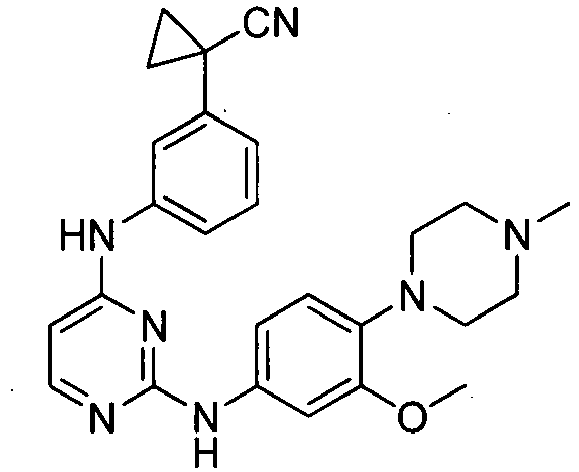
+++ ++ 5 
+++ + 6 
N/D N/ D 7 
+++ ++ 8 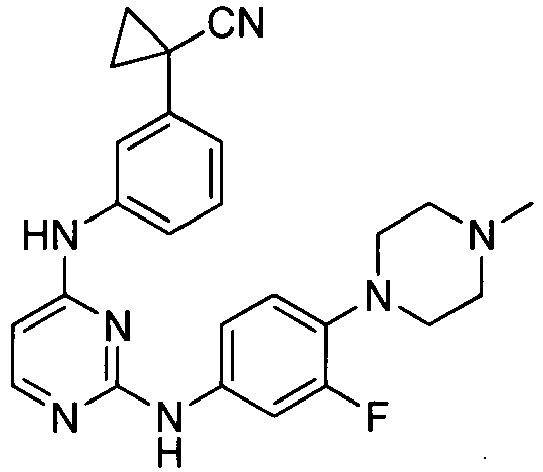
+++ ++ 9 
++ + 10 
++ ++ 11 
+ +++ 12 
+ +++ 13 
+ + 14 
++ + 15 
+ ++ 16 
+ ++ 17 
+ ++ 18 
++ ++ 19 
++ ++ 20 
+++ ++ 21 
+++ ++ 22 
++ ++ 23 
N/D N/D 24 
N/D N/D 25 
N/D N/D 26 
N/D N/D 27 
N/D N/D 28 
N/D N/D * IC50 in nM, wherein: + is greater than 1,000 nM; ++ is 1,000 nM to 10 nM; and +++ is less than 10 nM - It is understood that any embodiment of the compounds of structure (I), as set forth above, and any of the specific substituents set forth herein (e.g., R1-R9) in the compounds of structures (I) and (II), as set forth above, may be independently combined with other embodiments and/or substituents of compounds of structures (I) and (II) to form embodiments of the specification not specifically set forth above. In addition, in the event that a list of substituents is listed for any particular R group in a particular embodiment and/or claim, it is understood that each individual substituent may be deleted from the particular embodiment and/or claim and that the remaining list of substituents will be considered to be within the scope of the specification. It is understood that in the present description, combinations of substituents and/or variables of the depicted formulae are permissible only if such contributions result in stable compounds.
- The compounds of the present invention can be prepared according to any number of methods known in the art, including those methods specifically described in the Examples below. The following General Reaction Scheme I illustrates a method of making compounds of this invention as defined in
claim 1, i.e., compounds embraced by structure (I), wherein R1-R8, A and X are as defined above and LG and LG' are independently leaving groups.
- Referring to General Reaction Scheme I, compounds of structures (i), (ii) and (iv) can be prepared according to methods known in the art (e.g., as exemplified in the Examples) or purchased from commercial sources. Reaction of (i) with (ii) under appropriate conditions (e.g., in the presence of a base) results in compounds of structure (iii). Further reaction of (iii) with (iv) under appropriate conditions (e.g., in the presence of a base) produces compounds of structure (I).
- It is understood that one skilled in the art may be able to make these compounds by similar methods or by combining other methods known to one skilled in the art. It is also understood that one skilled in the art would be able to make, in a similar manner as described below, other compounds of structure (I) not specifically illustrated below by using the appropriate starting components and modifying the parameters of the synthesis as needed. In general, starting components may be obtained from sources such as Sigma Aldrich, Lancaster Synthesis, Inc., Maybridge, Matrix Scientific, TCI, and Fluorochem USA, etc. or synthesized according to sources known to those skilled in the art (see, for example, Advanced Organic Chemistry: Reactions, Mechanisms, and Structure, 5th edition (Wiley, December 2000)) or prepared as described in this invention.
- It will be appreciated by those skilled in the art that the order of steps illustrated in General Reaction Scheme I (as well as other modifications) can be made to arrive at compounds of structure (I). It will also be appreciated by those skilled in the art that in the process described herein the functional groups of intermediate compounds may need to be protected by suitable protecting groups. Such functional groups include hydroxy, amino, mercapto and carboxylic acid. Suitable protecting groups for hydroxy include trialkylsilyl or diarylalkylsilyl (for example, t-butyldimethylsilyl, t-butyldiphenylsilyl or trimethylsilyl), tetrahydropyranyl, and benzyl. Suitable protecting groups for amino, amidino and guanidino include t-butoxycarbonyl, and benzyloxycarbonyl. Suitable protecting groups for mercapto include -C(O)-R" (where R" is alkyl, aryl or arylalkyl), p-methoxybenzyl, and trityl. Suitable protecting groups for carboxylic acid include alkyl, aryl or arylalkyl esters. Protecting groups may be added or removed in accordance with standard techniques, which are known to one skilled in the art and as described herein. The use of protecting groups is described in detail in Green, T.W. and P.G.M. Wutz, Protective Groups in Organic Synthesis (1999), 3rd Ed., Wiley. As one of skill in the art would appreciate, the protecting group may also be a polymer resin such as a Wang resin, Rink resin or a 2-chlorotrityl-chloride resin.
- It will also be appreciated by those skilled in the art, although such protected derivatives of compounds of this invention may not possess pharmacological activity as such, they may be administered to a mammal and thereafter metabolized in the body to form compounds of the invention which are pharmacologically active. Such derivatives may therefore be described as "prodrugs".
- Furthermore, all compounds of the invention which exist in free base or acid form can be converted to their pharmaceutically acceptable salts by treatment with the appropriate inorganic or organic base or acid by methods known to one skilled in the art. Salts of the compounds of the invention can be converted to their free base or acid form by standard techniques.
- The present specification discloses a pharmaceutical composition comprising a compound of structure (I) or (II), or a stereoisomer, pharmaceutically acceptable salt, tautomer or prodrug thereof, and a pharmaceutically acceptable carrier, diluent or excipient.
- For the purposes of administration, the compounds of the present invention may be administered as a raw chemical or may be formulated as pharmaceutical compositions. Pharmaceutical compositions of the present invention comprise a compound of structure (I) as defined in the claims and a pharmaceutically acceptable carrier, diluent or excipient. The compound of structure (I) is present in the composition in an amount which is effective to treat a particular disease or condition of interest - that is, in an amount sufficient to treat various cancers, and preferably with acceptable toxicity to the patient. JAK2 and/or ALK2 kinase activity of compounds of structure (I) can be determined by one skilled in the art, for example, as described in the Examples below. Appropriate concentrations and dosages can be readily determined by one skilled in the art.
- Administration of the compounds of the invention, or their pharmaceutically acceptable salts, in pure form or in an appropriate pharmaceutical composition, can be carried out via any of the accepted modes of administration of agents for serving similar utilities. The pharmaceutical compositions of the invention can be prepared by combining a compound of the invention with an appropriate pharmaceutically acceptable carrier, diluent or excipient, and may be formulated into preparations in solid, semi-solid, liquid or gaseous forms, such as tablets, capsules, powders, granules, ointments, solutions, suppositories, injections, inhalants, gels, microspheres, and aerosols. Typical routes of administering such pharmaceutical compositions include, without limitation, oral, topical, transdermal, inhalation, parenteral, sublingual, buccal, rectal, vaginal, and intranasal. The term parenteral as used herein includes subcutaneous injections, intravenous, intramuscular, intrasternal injection or infusion techniques. Pharmaceutical compositions of the invention are formulated so as to allow the active ingredients contained therein to be bioavailable upon administration of the composition to a patient. Compositions that will be administered to a subject or patient take the form of one or more dosage units, where for example, a tablet may be a single dosage unit, and a container of a compound of the invention in aerosol form may hold a plurality of dosage units. Actual methods of preparing such dosage forms are known, or will be apparent, to those skilled in this art; for example, see Remington: The Science and Practice of Pharmacy, 20th Edition (Philadelphia College of Pharmacy and Science, 2000). The composition to be administered will, in any event, contain a therapeutically effective amount of a compound of the invention, or a pharmaceutically acceptable salt thereof, for treatment of a disease or condition of interest in accordance with the teachings of this invention.
- A pharmaceutical composition of the invention may be in the form of a solid or liquid. In one aspect, the carrier(s) are particulate, so that the compositions are, for example, in tablet or powder form. The carrier(s) may be liquid, with the compositions being, for example, an oral syrup, injectable liquid or an aerosol, which is useful in, for example, inhalatory administration.
- When intended for oral administration, the pharmaceutical composition is preferably in either solid or liquid form, where semi-solid, semi-liquid, suspension and gel forms are included within the forms considered herein as either solid or liquid.
- As a solid composition for oral administration, the pharmaceutical composition may be formulated into a powder, granule, compressed tablet, pill, capsule, chewing gum, wafer or the like form. Such a solid composition will typically contain one or more inert diluents or edible carriers. In addition, one or more of the following may be present: binders such as carboxymethylcellulose, ethyl cellulose, microcrystalline cellulose, gum tragacanth or gelatin; excipients such as starch, lactose or dextrins, disintegrating agents such as alginic acid, sodium alginate, Primogel, and corn starch; lubricants such as magnesium stearate or Sterotex; glidants such as colloidal silicon dioxide; sweetening agents such as sucrose or saccharin; a flavoring agent such as peppermint, methyl salicylate or orange flavoring; and a coloring agent.
- When the pharmaceutical composition is in the form of a capsule, for example, a gelatin capsule, it may contain, in addition to materials of the above type, a liquid carrier such as polyethylene glycol or oil.
- The pharmaceutical composition may be in the form of a liquid, for example, an elixir, syrup, solution, emulsion or suspension. The liquid may be for oral administration or for delivery by injection, as two examples. When intended for oral administration, preferred composition contain, in addition to the present compounds, one or more of a sweetening agent, preservatives, dye/colorant and flavor enhancer. In a composition intended to be administered by injection, one or more of a surfactant, preservative, wetting agent, dispersing agent, suspending agent, buffer, stabilizer and isotonic agent may be included.
- The liquid pharmaceutical compositions of the invention, whether they be solutions, suspensions or other like form, may include one or more of the following adjuvants: sterile diluents such as water for injection, saline solution, preferably physiological saline, Ringer's solution, isotonic sodium chloride, fixed oils such as synthetic mono or diglycerides which may serve as the solvent or suspending medium, polyethylene glycols, glycerin, propylene glycol or other solvents; antibacterial agents such as benzyl alcohol or methyl paraben; antioxidants such as ascorbic acid or sodium bisulfite; chelating agents such as ethylenediaminetetraacetic acid; buffers such as acetates, citrates or phosphates and agents for the adjustment of tonicity such as sodium chloride or dextrose. The parenteral preparation can be enclosed in ampoules, disposable syringes or multiple dose vials made of glass or plastic. Physiological saline is a preferred adjuvant. An injectable pharmaceutical composition is preferably sterile.
- A liquid pharmaceutical composition of the invention intended for either parenteral or oral administration should contain an amount of a compound of the invention such that a suitable dosage will be obtained.
- The pharmaceutical composition of the invention may be intended for topical administration, in which case the carrier may suitably comprise a solution, emulsion, ointment or gel base. The base, for example, may comprise one or more of the following: petrolatum, lanolin, polyethylene glycols, bee wax, mineral oil, diluents such as water and alcohol, and emulsifiers and stabilizers. Thickening agents may be present in a pharmaceutical composition for topical administration. If intended for transdermal administration, the composition may include a transdermal patch or iontophoresis device.
- The pharmaceutical composition of the invention may be intended for rectal administration, in the form, for example, of a suppository, which will melt in the rectum and release the drug. The composition for rectal administration may contain an oleaginous base as a suitable nonirritating excipient. Such bases include, without limitation, lanolin, cocoa butter and polyethylene glycol.
- The pharmaceutical composition of the invention may include various materials, which modify the physical form of a solid or liquid dosage unit. For example, the composition may include materials that form a coating shell around the active ingredients. The materials that form the coating shell are typically inert, and may be selected from, for example, sugar, shellac, and other enteric coating agents. Alternatively, the active ingredients may be encased in a gelatin capsule.
- The pharmaceutical composition of the invention in solid or liquid form may include an agent that binds to the compound of the invention and thereby assists in the delivery of the compound. Suitable agents that may act in this capacity include a monoclonal or polyclonal antibody, a protein or a liposome.
- The pharmaceutical composition of the invention may consist of dosage units that can be administered as an aerosol. The term aerosol is used to denote a variety of systems ranging from those of colloidal nature to systems consisting of pressurized packages. Delivery may be by a liquefied or compressed gas or by a suitable pump system that dispenses the active ingredients. Aerosols of compounds of the invention may be delivered in single phase, bi-phasic, or tri-phasic systems in order to deliver the active ingredient(s). Delivery of the aerosol includes the necessary container, activators, valves, and subcontainers, which together may form a kit. One skilled in the art, without undue experimentation may determine preferred aerosols.
- The pharmaceutical compositions of the invention may be prepared by methodology well known in the pharmaceutical art. For example, a pharmaceutical composition intended to be administered by injection can be prepared by combining a compound of the invention with sterile, distilled water so as to form a solution. A surfactant may be added to facilitate the formation of a homogeneous solution or suspension. Surfactants are compounds that non-covalently interact with the compound of the invention so as to facilitate dissolution or homogeneous suspension of the compound in the aqueous delivery system.
- The compounds of the invention, or their pharmaceutically acceptable salts, are administered in a therapeutically effective amount, which will vary depending upon a variety of factors including the activity of the specific compound employed; the metabolic stability and length of action of the compound; the age, body weight, general health, sex, and diet of the patient; the mode and time of administration; the rate of excretion; the drug combination; the severity of the particular disorder or condition; and the subject undergoing therapy.
- Compounds of the invention, or pharmaceutically acceptable derivatives thereof, may also be administered simultaneously with, prior to, or after administration of one or more other therapeutic agents. Such combination therapy includes administration of a single pharmaceutical dosage formulation which contains a compound of the invention and one or more additional active agents, as well as administration of the compound of the invention and each active agent in its own separate pharmaceutical dosage formulation. For example, a compound of the invention and the other active agent can be administered to the patient together in a single oral dosage composition such as a tablet or capsule, or each agent administered in separate oral dosage formulations. Where separate dosage formulations are used, the compounds of the invention and one or more additional active agents can be administered at essentially the same time, i.e., concurrently, or at separately staggered times, i.e., sequentially; combination therapy is understood to include all these regimens.
- For any compound used in the methods of the invention, the therapeutically effective amount or dose can be estimated initially from cell culture assays. Then, the dosage can be formulated for use in animal models so as to achieve a circulating concentration range that includes the IC50 as determined in cell culture (i.e., the concentration of the test compound which achieves a half-maximal inhibition of the protein kinase activity). Such information can then be used to more accurately determine useful doses in humans.
- Toxicity and therapeutic efficacy of the compounds described herein can be determined by standard pharmaceutical procedures in cell cultures or experimental animals, e.g., by determining the IC50 and the LD50 (both of which are discussed elsewhere herein) for a subject compound. The data obtained from these cell culture assays and animal studies can be used in formulating a range of dosage for use in humans. The dosage may vary depending upon the dosage form employed and the route of administration utilized. The exact formulation, route of administration and dosage can be chosen by the individual physician in view of the patient's condition. (See, e.g., GOODMAN & GILMAN'S THE PHARMACOLOGICAL BASIS OF THERAPEUTICS, Ch. 3, 9th ed., Ed. by Hardman, J., and Limbard, L., McGraw-Hill, New York City, 1996, p.46.)
- Dosage amount and interval may be adjusted individually to provide plasma levels of the active species which are sufficient to maintain the kinase modulating effects. These plasma levels are referred to as minimal effective concentrations (MECs). The MEC will vary for each compound but can be estimated from in vitro data, e.g., the concentration necessary to achieve 50-90% inhibition of a kinase may be ascertained using the assays described herein. Dosages necessary to achieve the MEC will depend on individual characteristics and route of administration. HPLC assays or bioassays can be used to determine plasma concentrations.
- Dosage intervals can also be determined using MEC value. Compounds should be administered using a regimen that maintains plasma levels above the MEC for 10-90% of the time, preferably between 30-90% and most preferably between 50-90%.
- At present, the therapeutically effective amounts of compounds of the present invention may range from approximately 2.5 mg/m2 to 1500 mg/m2 per day. Additional illustrative amounts range from 0.2-1000 mg/qid, 2-500 mg/qid, and 20-250 mg/qid.
- In cases of local administration or selective uptake, the effective local concentration of the drug may not be related to plasma concentration, and other procedures known in the art may be employed to determine the correct dosage amount and interval.
- The amount of a composition administered will, of course, be dependent on the subject being treated, the severity of the affliction, the manner of administration, the judgment of the prescribing physician, etc.
- The compositions may, if desired, be presented in a pack or dispenser device, such as an FDA approved kit, which may contain one or more unit dosage forms containing the active ingredient. The pack may for example comprise metal or plastic foil, such as a blister pack. The pack or dispenser device may be accompanied by instructions for administration. The pack or dispenser may also be accompanied by a notice associated with the container in a form prescribed by a governmental agency regulating the manufacture, use or sale of pharmaceuticals, which notice is reflective of approval by the agency of the form of the compositions or of human or veterinary administration. Such notice, for example, may be of the labeling approved by the U.S. Food and Drug Administration for prescription drugs or of an approved product insert. Compositions comprising a compound of the invention formulated in a compatible pharmaceutical carrier may also be prepared, placed in an appropriate container, and labeled for treatment of an indicated condition. Suitable conditions indicated on the label may include treatment of a tumor, inhibition of angiogenesis, treatment of fibrosis, and diabetes.
- The present specification discloses a method of inhibiting ALK2 kinase or JAK2 kinase, or combinations thereof, in a mammal in need thereof, the method comprising administering to the mammal an effective amount of any of the foregoing compounds (i.e., compounds of structure (I) or (II)) or a pharmaceutical composition of claim comprising the compound.
- In certain embodiments, the method is for inhibiting ALK2 Kinase. In other embodiments, the method is for inhibiting JAK2 kinase.
- In still more embodiments, the inhibition is for treatment of cancer. In more embodiments, the inhibition is for treatment of anemia of chronic disease, anemia of chronic inflammation, anemia of cancer or fibrodysplasia ossificans progressive.
- In another embodiment, the present disclosure is directed to a method for treating cancer in a mammal in need thereof, the method comprising administering to the mammal an effective amount of any of the foregoing compounds (i.e., compounds of structure (I) or (II)) or a pharmaceutical composition of claim comprising the compound.
- In certain embodiments of the foregoing method, the cancer is a myeloproliferative disorder, a lymphoma or a solid tumor. For example, in some embodiments the myeloproliferative disorder is myelofibrosis, polycythemia vera or essential thrombocytosis.
- In other embodiments, the solid tumor is a breast, prostate or pancreatic tumor.
- In still more embodiments, the cancer is prostate, ovarian or head and neck cancers.
- The invention also provides for treatment of various other cancers by administration of the compounds of structure (I) or (II) as described below
- Advantageously, the present compounds find utility in methods for treating and alleviating symptoms of cancer. Accordingly, in some embodiments a method for providing supportive care to a cancer patient (i.e, a subject, such as a human subject, diagnosed as having cancer) in need thereof, the method comprising administering to the patient an effective amount of any of the foregoing compounds (i.e., compounds of structure (I) or (II)) or a pharmaceutical composition of claim comprising the compound. For example, in some embodiments the method is for treating anemia and fatigue associated with cancer.
- As mentioned above, the compounds and compositions of the invention will find utility in a broad range of diseases and conditions mediated by ALK2 and/or JAK2 protein kinases. Such diseases may include by way of example and not limitation, cancers such as as hematological cancers (e.g., acute myelogenous leukemia (AML) and chronic myelogenous leukemia (CML)) lung cancer, NSCLC (non small cell lung cancer), oat-cell cancer, bone cancer, pancreatic cancer, skin cancer, dermatofibrosarcoma protuberans, cancer of the head and neck, cutaneous or intraocular melanoma, uterine cancer, ovarian cancer, colo-rectal cancer, cancer of the anal region, stomach cancer, colon cancer, breast cancer, gynecologic tumors (e.g., uterine sarcomas, carcinoma of the fallopian tubes, carcinoma of the endometrium, carcinoma of the cervix, carcinoma of the vagina or carcinoma of the vulva), Hodgkin's Disease, hepatocellular cancer, cancer of the esophagus, cancer of the small intestine, cancer of the endocrine system (e.g., cancer of the thyroid, pancreas, parathyroid or adrenal glands), sarcomas of soft tissues, cancer of the urethra, cancer of the penis, testicular cancer, prostate cancer (particularly hormone-refractory), chronic or acute leukemia, solid tumors of childhood, hypereosinophilia, lymphocytic lymphomas, cancer of the bladder, cancer of the kidney or ureter (e.g., renal cell carcinoma, carcinoma of the renal pelvis), pediatric malignancy, neoplasms of the central nervous system (e.g., primary CNS lymphoma, spinal axis tumors, medulloblastoma, brain stem gliomas or pituitary adenomas), Barrett's esophagus (pre-malignant syndrome), neoplastic cutaneous disease, psoriasis, mycoses fungoides, and benign prostatic hypertrophy, diabetes related diseases such as diabetic retinopathy, retinal ischemia, and retinal neovascularization, hepatic cirrhosis, angiogenesis, cardiovascular disease such as atherosclerosis, immunological disease such as autoimmune disease and renal disease.
- In some embodiments, the compounds and compositions of the invention can be used in methods for treating cancers such as hematological malignancies. For example, in some embodiments the compounds and compositions of the invention can be used in methods for treating acute myeloid leukemia (AML). Other methods include treatment of bladder cancer, or treatment of prostate cancer.
- The inventive compounds (i.e., compounds of structure (I) that are embraced by claim 1) can be used in combination with one or more other chemotherapeutic agents. The dosage of the inventive compounds may be adjusted for any drug-drug reaction. In one embodiment, the chemotherapeutic agent is selected from the group consisting of mitotic inhibitors, alkylating agents, anti-metabolites, cell cycle inhibitors, enzymes, topoisomerase inhibitors such as CAMPTOSAR (irinotecan), biological response modifiers, anti-hormones, antiangiogenic agents such as MMP-2, MMP-9 and COX-2 inhibitors, anti-androgens, platinum coordination complexes (cisplatin, etc.), substituted ureas such as hydroxyurea; methylhydrazine derivatives, e.g., procarbazine; adrenocortical suppressants, e.g., mitotane, aminoglutethimide, hormone and hormone antagonists such as the adrenocorticosteriods (e.g., prednisone), progestins (e.g., hydroxyprogesterone caproate), estrogens (e.g., diethylstilbesterol), antiestrogens such as tamoxifen, androgens, e.g., testosterone propionate, and aromatase inhibitors, such as anastrozole, and AROMASIN (exemestane).
- Examples of alkylating agents that the above method can be carried out in combination with include, without limitation, fluorouracil (5-FU) alone or in further combination with leukovorin; other pyrimidine analogs such as UFT, capecitabine, gemcitabine and cytarabine, the alkyl sulfonates, e.g., busulfan (used in the treatment of chronic granulocytic leukemia), improsulfan and piposulfan; aziridines, e.g., benzodepa, carboquone, meturedepa and uredepa; ethyleneimines and methylmelamines, e.g., altretamine, triethylenemelamine, triethylenephosphoramide, triethylenethiophosphoramide and trimethylolmelamine; and the nitrogen mustards, e.g., chlorambucil (used in the treatment of chronic lymphocytic leukemia, primary macroglobulinemia and non-Hodgkin's lymphoma), cyclophosphamide (used in the treatment of Hodgkin's disease, multiple myeloma, neuroblastoma, breast cancer, ovarian cancer, lung cancer, Wilm's tumor and rhabdomyosarcoma), estramustine, ifosfamide, novembrichin, prednimustine and uracil mustard (used in the treatment of primary thrombocytosis, non-Hodgkin's lymphoma, Hodgkin's disease and ovarian cancer); and triazines, e.g., dacarbazine (used in the treatment of soft tissue sarcoma).
- Examples of antimetabolite chemotherapeutic agents that the above method can be carried out in combination with include, without limitation, folic acid analogs, e.g., methotrexate (used in the treatment of acute lymphocytic leukemia, choriocarcinoma, mycosis fungiodes, breast cancer, head and neck cancer and osteogenic sarcoma) and pteropterin; and the purine analogs such as mercaptopurine and thioguanine which find use in the treatment of acute granulocytic, acute lymphocytic and chronic granulocytic leukemias.
- Examples of natural product-based chemotherapeutic agents that the above method can be carried out in combination with include, without limitation, the vinca alkaloids, e.g., vinblastine (used in the treatment of breast and testicular cancer), vincristine and vindesine; the epipodophyllotoxins, e.g., etoposide and teniposide, both of which are useful in the treatment of testicular cancer and Kaposi's sarcoma; the antibiotic chemotherapeutic agents, e.g., daunorubicin, doxorubicin, epirubicin, mitomycin (used to treat stomach, cervix, colon, breast, bladder and pancreatic cancer), dactinomycin, temozolomide, plicamycin, bleomycin (used in the treatment of skin, esophagus and genitourinary tract cancer); and the enzymatic chemotherapeutic agents such as L-asparaginase.
- Examples of useful COX-II inhibitors include Vioxx, CELEBREX (celecoxib), valdecoxib, paracoxib, rofecoxib, and Cox 189.
- Examples of useful matrix metalloproteinase inhibitors are described in
WO 96/33172 (published Oct. 24, 1996 WO 96/27583 (published Mar. 7, 1996 97304971.1 (filed Jul. 8, 1997 99308617.2 (filed Oct. 29, 1999 WO 98/07697 (published Feb. 26, 1998 WO 98/03516 (published Jan. 29, 1998 WO 98/34918 (published Aug. 13, 1998 WO 98/34915 (published Aug. 13, 1998 WO 98/33768 (published Aug. 6, 1998 WO 98/30566 (published Jul. 16, 1998 606,046 (published Jul. 13, 1994 931,788 (published Jul. 28, 1999 WO 90/05719 (published May 31, 1990 WO 99/52910 (published Oct. 21, 1999 WO 99/52889 (published Oct. 21, 1999 WO 99/29667 (published Jun. 17, 1999 PCT/IB98/01113 (filed Jul. 21, 1998 99302232.1 (filed Mar. 25, 1999 9912961.1 (filed Jun. 3, 1999 U.S. Pat. No. 5,863,949 (issued Jan. 26, 1999 ),U.S. Pat. No. 5,861,510 (issued Jan. 19, 1999 ), and European Patent Publication780,386 (published Jun. 25, 1997 - Some specific examples of MMP inhibitors useful in the present invention are AG-3340, RO 32-3555, RS 13-0830, and compounds selected from: 3-[[4-(4-fluoro-phenoxy)-benzenesulfonyl]-(1-hydroxycarbamoyl-cyclopentyl)- amino]-propionic acid; 3-exo-3-[4-(4-fluoro-phenoxy)-benzenesulfonylamino]-8-oxa-bicyclo[3.2.1]octane-3-carboxylic acid hydroxyamide; (2R,3R) 1-[4-(2-chloro-4-fluoro-benzyloxy)-benzenesulfonyl]-3-hydroxy-3-methyl-piperidine-2-carboxylic acid hydroxyamide; 4-[4-(4-fluoro-phenoxy)-benzenesulfonylamino]-tetrahydro-pyran-4-carboxylic acid hydroxyamide; 3-[[4-(4-fluoro-phenoxy)-benzenesulfonyl]-(1-hydroxycarbamoyl-cyclobutyl)- amino]-propionic acid; 4-[4-(4-chloro-phenoxy)-benzenesulfonylamino]-tetrahydro-pyran-4-carboxylic acid hydroxyamide; (R) 3-[4-(4-chloro-phenoxy)-benzenesulfonylamino]-tetrahydro-pyran-3-carboxylic acid hydroxyamide; (2R,3R) 1-[4-(4-fluoro-2-methylbenzyloxy)-benzenesulfonyl]-3-hydroxy-3-methyl-piperidine-2-carboxylic acid hydroxyamide; 3-[[(4-(4-fluoro-phenoxy)-benzenesulfonyl]-(1-hydroxycarbamoyl-1-methyl-ethyl)-amino]-propionic acid; 3-[[4-(4-fluoro-phenoxy)-benzenesulfonyl]-(4-hydroxycarbamoyl-tetrahydropyran-4-yl)-amino]-propionic acid; 3-exo-3-[4-(4-chloro-phenoxy)-benzenesulfonylamino]-8-oxa-bicyclo[3.2.1]octane-3-carboxylic acid hydroxyamide; 3-endo-3-[4-(4-fluoro-phenoxy)-benzenesulfonylamino]-8-oxa-bicyclo[3.2.1]octane-3-carboxylic acid hydroxyamide; and (R) 3-[4-(4-fluoro-phenoxy)-benzenesulfonylamino]-tetrahydro-furan-3-carboxylic acid hydroxyamide; and pharmaceutically acceptable salts and solvates of these compounds.
- Other anti-angiogenesis agents, other COX-II inhibitors and other MMP inhibitors, can also be used in the present invention.
- An inventive compound can also be used with signal transduction inhibitors, such as agents that can inhibit EGFR (epidermal growth factor receptor) responses, such as EGFR antibodies, EGF antibodies, and molecules that are EGFR inhibitors; VEGF (vascular endothelial growth factor) inhibitors; and erbB2 receptor inhibitors, such as organic molecules or antibodies that bind to the erbB2 receptor, such as HERCEPTIN (Genentech, Inc., South San Francisco, CA). EGFR inhibitors are described in, for example in
WO 95/19970 (published Jul. 27, 1995 WO 98/14451 (published Apr. 9, 1998 WO 98/02434 (published Jan. 22, 1998 U.S. Pat. No. 5,747,498 (issued May 5, 1998 ), and such substances can be used in the present invention as described herein. - EGFR-inhibiting agents include the monoclonal antibodies C225 and anti-EGFR 22Mab (ImClone Systems, Inc., New York, NY), the compounds ZD-1839 (AstraZeneca), BIBX-1382 (Boehringer Ingelheim), MDX-447 (Medarex Inc., Annandale, NJ), and OLX-103 (Merck & Co., Whitehouse Station, NJ), and EGF fusion toxin (Seragen Inc., Hopkinton, MA).
- These and other EGFR-inhibiting agents can be used in the present invention. VEGF inhibitors, for example SU-5416 and SU-6668 (Sugen Inc., South San Francisco, CA), can also be combined with an inventive compound. VEGF inhibitors are described in, for example,
WO 01/60814 A3 (published Aug. 23, 2001 WO 99/24440 (published May 20, 1999 PCT/IB99/00797 (filed May 3, 1999 WO 95/21613 (published Aug. 17, 1995 WO 99/61422 (published Dec. 2, 1999 U.S. Pat. No. 5,834,504 (issued Nov. 10, 1998 ),WO 01/60814 WO 98/50356 (published Nov. 12, 1998 U.S. Pat. No. 5,883,113 (issued Mar. 16, 1999 ),U.S. Pat. No. 5,886,020 (issued Mar. 23, 1999 ),U.S. Pat. No. 5,792,783 (issued Aug. 11, 1998 ),WO 99/10349 (published Mar. 4, 1999 WO 97/32856 (published Sep. 12, 1997 WO 97/22596 (published Jun. 26, 1997 WO 98/54093 (published Dec. 3, 1998 WO 98/02438 (published Jan. 22, 1998 WO 99/16755 (published Apr. 8, 1999 WO 98/02437 (published Jan. 22, 1998 WO 98/02434 (published Jan. 22, 1998 WO 99/35146 (published Jul. 15, 1999 WO 99/35132 (published Jul. 15, 1999 WO 98/02437 (published Jan. 22, 1998 WO 97/13760 (published Apr. 17, 1997 WO 95/19970 (published Jul. 27, 1995 U.S. Pat. No. 5,587,458 (issued Dec. 24, 1996 ), andU.S. Pat. No. 5,877,305 (issued Mar. 2, 1999 ). ErbB2 receptor inhibitors useful in the present invention are also described inU.S. Pat. No. 6,284,764 (issued Sep. 4, 2001 ). The erbB2 receptor inhibitor compounds and substance described in the aforementioned PCT applications, U.S. patents, and U.S. provisional applications, as well as other compounds and substances that inhibit the erbB2 receptor, can be used with an inventive compound, in accordance with the present invention. - An inventive compound can also be used with other agents useful in treating cancer, including agents capable of enhancing antitumor immune responses, such as CTLA4 (cytotoxic lymphocyte antigen 4) antibodies, and other agents capable of blocking CTLA4; and anti-proliferative agents such as other farnesyl protein transferase inhibitors, for example the farnesyl protein transferase inhibitors described in the references cited in the "Background" section, of
U.S. Pat. No. 6,258,824 B1 . - The above method can also be carried out in combination with radiation therapy, wherein the amount of an inventive compound in combination with the radiation therapy is effective in treating the above diseases.
- Techniques for administering radiation therapy are known in the art, and these techniques can be used in the combination therapy described herein. The administration of the compound of the invention in this combination therapy can be determined as described herein.
- The following examples are provided for purposes of illustration, not limitation. The examples are according to the invention insofar as they relate to
compounds -

- A mixture of
scheme 1 compound 1 (5.0 g, 31.4 mmol) andscheme 1 compound 2 (70 mL, 628.0 mmol) was heated to 100 °C for 12 h in a sealed tube. After TLC showed the starting material was consumed completely, the reaction mixture was diluted with water (20 mL) and extracted with EtOAc (5 x 100 mL). The organic layer was dried over Na2SO4, filtered and concentrated to givescheme 1 compound 3 (3.0 g, 62% yield) as a yellow solid which was used without further purification. 1H NMR (400 MHz, CDCl3): δ 8.09 - 7.71 (m, 2H), 6.90 (t, J = 8.8 Hz, 1H), 3.31 (dd, J = 5.9, 3.9 Hz, 4H), 2.73 - 2.52 (m, 4H), 2.35 (s, 3H). MS [ESI, MH+] = 240.15. - Pd/C (10%, 200 mg) was added to
scheme 1 compound 3 (1.0 g, 4.18 mmol) in ethanol (10 mL) and the resulting mixture was stirred under H2 atmosphere (balloon pressure) for 12 h. After TLC showed the starting material was consumed completely, the reaction mixture was passed through a pad of celite and the solids were washed with EtOAc (30mL). The filtrate was dried over Na2SO4, filtered and concentrated to give aniline A (600 mg, 69% yield) as a brown semi solid. 1H NMR (400 MHz, DMSO-d6): δ 6.75 (dd, J = 10.0, 8.3 Hz, 1H), 6.50 - 6.21 (m, 2H), 4.97 (s, 2H), 2.81 (t, J = 4.9 Hz, 4H), 2.41 (s, 4H), 2.19 (s, 3H). MS [ESI, MH+] = 210.13. -

- A mixture of
scheme 2 compound 1 (2.00 g, 11.68 mmol) andscheme 2 compound 2 (1.17 g, 11.68 mmol) in dry DMSO (5 mL) was heated to 120 °C for 12 h. After TLC showed the starting material was consumed completely, the reaction mixture was diluted with water (20 mL) and extracted with EtOAc (5 x 50 mL). The organic layer was dried over Na2SO4, filtered and concentrated to givescheme 2 compound 3 (2.00 g, 69% yield) as a brown solid which was used without further purification. 1H NMR (400 MHz, CDCl3): δ 7.87 (dd, J = 8.8, 2.6 Hz, 1H), 7.71 (d, J = 2.5 Hz, 1H), 6.90 (d, J = 8.8 Hz, 1H), 3.95 (s, 3H), 3.26 (d, J = 4.9 Hz, 4H), 2.61 (t, J = 4.9 Hz, 4H), 2.37 (s, 3H). MS [ESI, MH+] = 252.13. - A mixture of
crude scheme 2 compound 3 (1.00 g, 3.98 mmol), Fe (0.89 g, 15.93 mmol) and NH4Cl (2.70 g, 39.80 mmol) in EtOAc/H2O (20 mL, 1/1) was heated to 80 °C for 4 h. After TLC showed the starting material was consumed completely, the reaction mixture was passed through a pad of celite and the solids were washed with EtOAc (50 mL). The filtrate was evaporated under reduced pressure to give a residue which was purified by flash chromatography on neutral alumina (eluting with CH2Cl2/MeOH 99/1 gradually increasing to 80/20) to give aniline B (0.70 g, 79% yield) as a brown solid. 1H NMR (400 MHz, DMSO-d6): δ 6.60 (dd, J = 8.4, 2.0 Hz, 1H), 6.21 (d, J = 2.3 Hz, 1H), 6.06 (m, 1H), 4.71 (s, 2H), 3.67 (d, J = 2.0 Hz, 3H), 2.78 (s, 4H), 2.46 - 2.33 (m, 4H), 2.19 (d, J = 2.1 Hz, 3H). MS [ESI, MH+] = 222.16. -

- The title compound was synthesized in a similar manner as aniline B using 2-(piperazin-1-yl)ethanol in the first step. Aniline C was obtained as a brown solid (5.0 g, 34% yield over 2 steps). 1H NMR (400 MHz, DMSO-d6): δ 6.60 (d, J = 8.3 Hz, 1H), 6.22 (d, J = 2.4 Hz, 1H), 6.07 (dd, J = 8.3, 2.4 Hz, 1H), 4.73 (s, 3H), 3.68 (s, 3H), 3.53 (d, J = 27.0 Hz, 2H), 2.84 (s, 4H), 2.54 (s, 6H). MS [ESI, MH+] = 252.17.
-
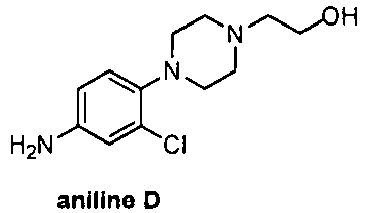
- The title compound was synthesized in a similar manner as aniline B using 2-chloro-1-fluoro-4-nitrobenzene and 2-(piperazin-1-yl)ethanol in the first step. Aniline D was obtained as a brown solid (1.5 g, 51% yield over 2 steps). 1H NMR (400 MHz, DMSO-d6): δ 6.91 (d, J = 8.6 Hz, 1H), 6.65 (d, J = 2.5 Hz, 1H), 6.51 (dd, J = 8.6, 2.5 Hz, 1H), 5.34 (s, 1H), 5.18 (s, 2H), 3.78 (d, J = 5.0 Hz, 2H), 3.52 (s, 2H), 3.15 (d, J = 46.2 Hz, 10H). MS [ESI, MH+] = 256.12.
-

- The title compound was synthesized following the procedure depicted in
scheme 3.
- Et3N (0.16 mL) was added to a mixture of
scheme 3 compound 1 (100 mg, 0.55 mmol) andscheme 3 compound 2 (76 mg, 0.57 mmol) in iPrOH (4 mL) and the resulting mixture was heated to 90 °C for 12 h. After TLC showed the starting material was consumed completely, the solvent was evaporated and the residue was purified by flash chromatography on silica get to givescheme 3 compound 3 (91 mg, 59% yield). - Et3N (0.5 mL) was added to a mixture of
scheme 3 compound 3 (50 mg, 0.179 mmol) and aniline A (49 mg, 0.234 mmol) in iPrOH (5 mL) and the resulting mixture was heated to 90 °C for 12 h in a sealed tube. After TLC showed the starting material was consumed completely, the solvent was evaporated and the residue was purified by flash chromatography on silica get to give Compound 1 (63 mg, 77% yield). MS [ESI, (M-CH3+H)+] = 438.16. -

- The title compound was synthesized in a similar manner as
Compound 1 using 2,4-dichloro-5-methylpyrimidine in the first coupling step.Compound 2 was obtained as a white solid (18 mg, 5% yield over 2 steps). MS [ESI, (M-CH3+H)+] = 418.29. -

- The title compound was synthesized in a similar manner as
Compound 1 using 2,4-dichloropyrimidine-5-carbonitrile in the first coupling step and reducing the temperature for this step to RT.Compound 3 was obtained as a white solid (47 mg, 39% yield over 2 steps). MS [ESI, (M-CH3+H)+] = 429.21. -
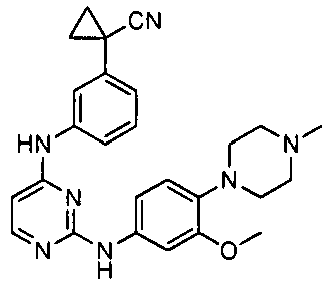
- The title compound was synthesized following the procedure depicted in
scheme 4. The preparation of 1-(3-aminophenyl)cyclopropanecarbonitrile (scheme 4 compound 1) is described below inscheme 5.
- A mixture of
scheme 4 compound 1 (400 mg, 2.53 mmol),scheme 4 compound 2 (450 mg, 3.03 mmol) and Na2CO3 (536 mg, 5.06 mmol) in nBuOH (5 mL) was heated to 100 °C for 16 h in a sealed tube. After TLC showed the starting material was consumed completely, the reaction mixture was diluted with water (20 mL) and extracted with EtOAc (2 x 20 mL). The organic layer was dried over Na2SO4, filtered and concentrated to give a residue which was triturated with a combination of Et2O and n-pentane (20 mL, 1/4) to givescheme 4 compound 3 (300 mg, 44% yield) as an off-white solid. 1H NMR (400 MHz, DMSO-d6): δ 10.15 (s, 1H), 8.19 (m, 1H), 7.78 - 7.47 (m, 2H), 7.49 - 7.23 (m, 1H), 7.14 - 6.92 (m, 1H), 6.77 (m, 1H), 1.79 (d, J = 5.0 Hz, 2H), 1.51 (t, J = 3.9 Hz, 2H). MS [ESI, MH+] = 271.05. -
Scheme 4 compound 3 (150 mg, 0.55 mmol) and aniline B (200 mg, 0.83 mmol) were dissolved in anhydrous dioxane (10 mL). To this mixture was added t-BuONa (160 mg, 1.66 mmol), X-PHOS (64 mg, 0.11 mmol) and Pd2(dba)3 (50 mg, 0.05 mmol, 5 mol%) under nitrogen atmosphere. The reaction mixture was stirred at 80 °C for 14 h. After TLC showed the starting material was consumed completely, the mixture was quenched with water (10 mL) and extracted with ethyl acetate (30 mL). The organic layer was washed with brine (10 mL) and dried over anhydrous Na2SO4 then filtered, concentrated to give a residue which was purified by prep-HPLC to give Compound 4 (70 mg, 28% yield) as an off-white solid. 1H NMR (400 MHz, CDCl3): δ 8.07 (d, J = 5.7 Hz, 1H), 7.43 (s, 1H), 7.40 - 7.27 (m, 2H), 7.16 (d, J = 2.4 Hz, 1H), 7.06 (m, 1H), 6.98 (m, 1H), 6.94 - 6.86 (m, 2H), 6.58 (s, 1H), 6.13 (d, J = 5.8 Hz, 1H), 3.80 (s, 3H), 3.07 (s, 4H), 2.63 (s, 4H), 2.36 (s, 3H), 1.72 (d, J = 5.0 Hz, 2H), 1.38 (d, J = 5.1 Hz, 2H). MS [ESI, MH+] = 456.20. -

- PBr3 (38.9 g, 270.7 mmol) was added dropwise to a cold (0 °C) solution of
scheme 5 compound 1 (55.0 g, 359.4 mmol) in Et2O (500 mL) and the reaction mixture was stirred for 2 h at 0° C. After TLC showed the starting material was consumed completely, the mixture was diluted with water (50 mL) and extracted with Et2O (2 x 200 mL). The organic layer was dried over Na2SO4, filtered and concentrated to givescheme 5 compound 2 (55.0 g, 71% yield) as an off-white solid which was used without further purification. 1H NMR (400 MHz, CDCl3): δ 8.27 (t, J = 2.0 Hz, 1H), 8.17 (dd, J = 8.6, 2.0 Hz, 1H), 7.74 (m, 1H), 7.55 (t, J = 8.0 Hz, 1H), 4.54 (s, 2H). MS [ESI, MH+] = 215.96. - To a solution of
scheme 5 compound 2 (55.0 g, 254.6 mmol) in MeOH/water (250 mL, 4/1) was added KCN (21.5 g, 331.0 mmol) and the reaction mixture was stirred at RT for 12 h. After TLC showed the starting material was consumed completely, the reaction mixture was diluted with water (50 mL) and extracted with EtOAc (200 mL). The organic layer was dried over Na2SO4, filtered and concentrated to give a residue which was purified by flash chromatography on silica gel (eluting with petroleum ether/EtOAc 100/0 gradually increasing to 40/60) to givescheme 5 compound 3 (38.0 g, 91% yield) as an light yellow solid. 1H NMR (400 MHz, CDCl3): δ 8.31 - 8.12 (m, 2H), 7.78 - 7.69 (m, 1H), 7.68 - 7.51 (m, 1H), 3.91 (s, 2H). MS [ESI, MH+] = 163.05. - A mixture of
scheme 5 compound 3 (20.00 g, 123.0 mmol) and 1,2-dibromoethane (23.08 g, 123.0 mmol) in DMSO/Et2O (60 mL, 1/2) was added dropwise to a solution of NaH (5.41 g, 271.4 mmol) in DMSO (20 mL) and the resulting mixture was stirred at RT for 1 h. After TLC showed the starting material was consumed completely, the reaction mixture was quenched with iPrOH (20 mL) followed by water (20 mL) and extracted with EtOAc (30 mL). The organic layer was dried over Na2SO4, filtered and concentrated to give a residue which was purified by flash chromatography on silica gel (eluting with petroleum ether/EtOAc 100/0 gradually increasing to 80/20) to givescheme 5 compound 4 (13.0 g, 56% yield) as an off-white solid. 1H NMR (400 MHz, CDCl3): δ 8.22 - 8.13 (m, 1H), 8.05 (t, J = 2.2 Hz, 1H), 7.75 (d, J = 7.9 Hz, 1H), 7.57 (t, J = 8.0 Hz, 1H), 1.88 (d, J = 2.7 Hz, 2H), 1.54 - 1.50 (m, 2H). MS [ESI, MH+] = 189.04. - A mixture of
scheme 5 compound 4 (10.0 g, 52.6 mmol), Zn dust (13.7 g, 210.5 mmol) and NH4Cl (28.1 g, 526.3 mmol) in EtOAc/H2O (60 mL, 1/1) was heated to 80 °C for 4 h. After TLC showed the starting material was consumed completely, the reaction mixture was passed through a pad of celite and the solids were washed with EtOAc (200 mL). The filtrate was evaporated to give a residue which was purified by flash chromatography on neutral alumina (eluting with petroleum ether/EtOAc 100/0 gradually increasing to 70/30) to givescheme 5 compound 5 (6.0 g, 71% yield) as a brown liquid. 1H NMR (400 MHz, DMSO-d6): δ 6.99 (t, J = 7.8 Hz, 1H), 6.57 (t, J = 2.1 Hz, 1H), 6.47 (dd, J = 8.0, 2.1 Hz, 1H), 6.39 - 6.34 (m, 1H), 5.21 (s, 2H), 1.66 (m, 2H), 1.36 (q, J = 4.7 Hz, 2H). MS [ESI, MH+] = 159.09 -

- The title compound was synthesized in a similar manner as
Compound 4 using 3,4,5-trimethoxyaniline in the final coupling step. -
Scheme 4 compound 3 (120 mg, 0.440 mmol) and 3,4,5-trimethoxyaniline (122 mg, 0.660 mmol) were dissolved in anhydrous dioxane (10 mL). To this mixture were added t-BuONa (126 mg, 1.320 mmol), X-PHOS (50 mg, 0.088 mmol) and Pd2(dba)3 (40 mg, 0.044 mmol, 10 mol%) under nitrogen atmosphere. The reaction mixture was stirred at 80 °C for 14 h. After TLC showed the starting material was consumed completely, the mixture was quenched with water (10 mL) and extracted with ethyl acetate (30 mL). The organic layer was washed with brine (10 mL) and dried over anhydrous Na2SO4 then filtered and concentrated to give a residue which was purified by prep-HPLC to give Compound 5 (120 mg, 66% yield) as an off-white solid. 1H NMR (400 MHz, CDCl3): δ 8.09 (d, J = 5.7 Hz, 1H), 7.50 (s, 1H), 7.44 - 7.28 (m, 2H), 7.03 - 6.88 (m, 2H), 6.85 (s, 2H), 6.56 (s, 1H), 6.15 (d, J = 5.7 Hz, 1H), 3.82 (d, J = 7.9 Hz, 9H), 1.74 (d, J = 5.1 Hz, 2H), 1.39 (d, J = 5.0 Hz, 2H). MS [ESI, MH+] = 418.15. -

- The title compound was synthesized following the procedure depicted in scheme 6.

- A mixture of scheme 6 compound 1 (2.0 g, 7.38 mmol), aniline C (2.2 g, 8.56 mmol) and pTsOH (1.2 g, 7.38 mmol) in 2-pentanol (40 mL) was heated to 90 °C for 4 h. After TLC showed the starting material was consumed completely, the reaction mixture was diluted with water (20 mL), neutralized with aqueous NaHCO3 (pH 8) and extracted with EtOAc (2 x 50 mL). The organic layer was dried over Na2SO4, filtered and concentrated to give a residue which was purified by flash chromatography on neutral alumina (eluting with CH2Cl2/
MeOH 100/0 gradually increasing to 90/10) to give Compound 6 (1.3 g, 36% yield) as an off-white solid. 1H NMR (400 MHz, DMSO-d6): δ 8.94 (s, 1H), 8.00 (d, J = 5.6 Hz, 1H), 7.90 (d, J = 8.1 Hz, 1H), 7.40 (t, J = 2.1 Hz, 1H), 7.32 - 7.19 (m, 3H), 6.91 (d, J = 7.7 Hz, 1H), 6.78 (d, J = 8.4 Hz, 1H), 6.18 (d, J = 5.7 Hz, 1H), 4.40 (s, 1H), 3.65 (s, 3H), 3.53 (s, 2H), 2.91 (s, 4H), 2.46 (s, 4H), 1.70 (d, J = 4.8 Hz, 2H), 1.42 (d, J = 4.7 Hz, 2H). MS [ESI, MH+] = 486.25. -

- The title compound was synthesized following the procedure depicted in
scheme 7.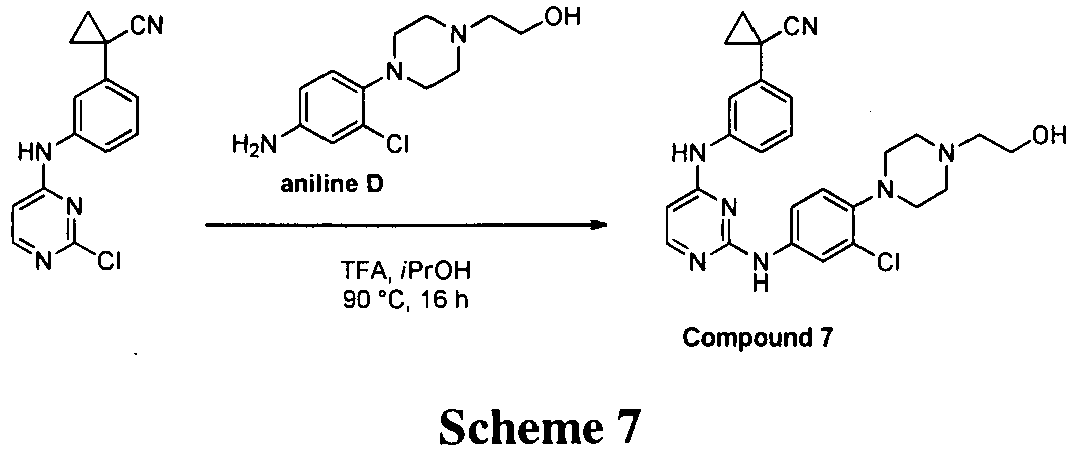
- A mixture of
scheme 7 compound 1 (50.0 mg, 0.185 mmol), aniline D (47.3 mg, 0.185 mmol) and TFA (0.5 mL) in iPrOH (10 mL) was heated to 90 °C for 16 h. After TLC showed the starting material was consumed completely, the solvent was removed under reduced pressure and the residue was purified by prep HPLC to give Compound 7 (7.6 mg, 22% yield). 1H NMR (400 MHz, CD3OD): δ 8.31 (s, 2H), 7.95 (d, J = 6.0 Hz, 1H), 7.81 (d, J = 2.4 Hz, 1H), 7.66 (d, J = 8.4 Hz, 1H), 7.49 (s, 1H), 7.46 (dd, J = 8.8, 2.4 Hz, 1H), 7.35 (t, 1H), 7.12 (d, J = 8.8 Hz, 1H), 7.05 (d, J = 7.6 Hz, 1H), 6.24 (d, J = 6.0 Hz, 1H), 3.92 (t, 2H), 3.45 (s, 4H), 3.28 (m, 6H), 1.67 - 1.64 (m, 2H), 1.42 - 1.38 (m, 2H). MS [ESI, MH+] = 490.2. -

- The title compound was synthesized following the procedure depicted in
scheme 8.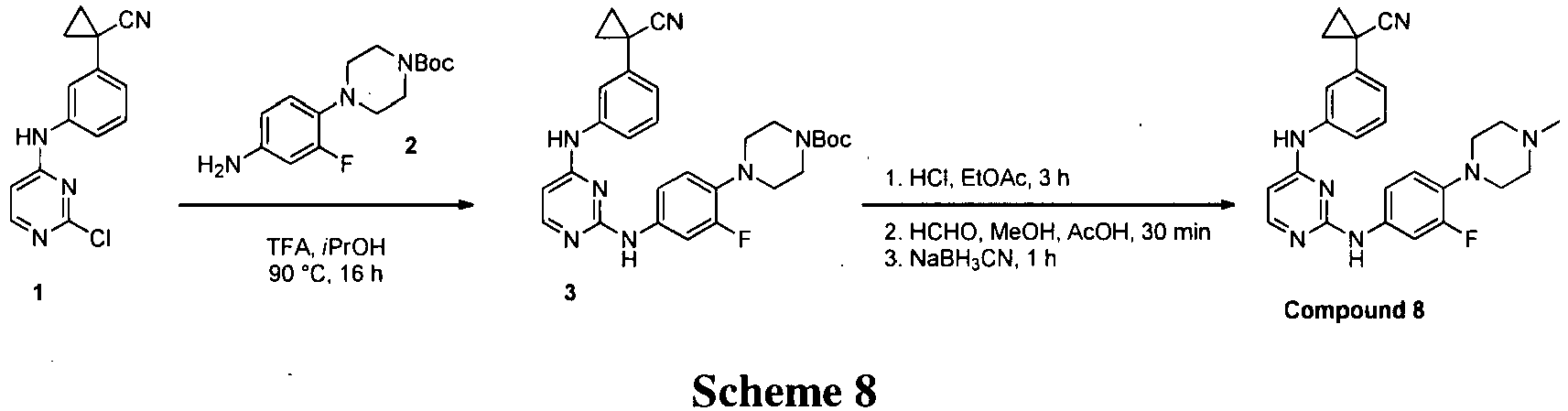
- A mixture of
scheme 8 compound 1 (50.0 mg, 0.185 mmol),scheme 8 compound 2 (54.6 mg, 0.185 mmol) and TFA (0.5 mL) in iPrOH (10 mL) was heated to 90 °C for 16 h. After LCMS showed the reaction was completed, the solvent was removed under reduced pressure to givecrude scheme 8 compound 3 (100 mg) which was used without further purification. MS [ESI, MH+] = 530.0. - To a solution of
scheme 8 compound 3 (100.0 mg, 0.19 mmol) in EtOAc (5 mL) was added HCl in EtOAc (10%, 5 mL) and the mixture was stirred at RT for 3 h. After LCMS showed the reaction was completed, the solvent was evaporated, the residue was dissolved in MeOH (5 mL) and HCHO (5.7 mg, 0.19 mmol) and AcOH (0.05 mL) were added. The mixture was stirred at RT for 30 min after which time NaBH3CN (15.7 mg, 0.25 mmol) was added and the stirring was continued at RT for 1 h. After LCMS showed the reaction was completed, the solvent was evaporated to give a residue which was purified by prep-HPLC to give Compound 8 (7.9 mg, 18 % yield). 1H NMR (400 MHz, CD3OD): δ ppm: 8.30 (s, 2H), 7.95 (d, J = 6.0 Hz, 1H), 7.63 - 7.57 (m, 2H), 7.52 (s, 1H), 7.34 (t, 1H), 7.24 (d, J = 8.0 Hz, 1H), 7.05 - 6.98 (m, 2H), 6.23 (d, J = 6.0 Hz, 1H), 3.30 (m, 8H), 2.87 (s, 3H), 1.68 - 1.64 (m, 2H), 1.43 - 1.39 (m, 2H). MS [ESI, MH+] = 444.2 -

- The title compound was synthesized following the procedure depicted in scheme 9.

- A mixture of scheme 9 compound 1 (400 mg, 2.53 mmol), scheme 9 compound 2 (678 mg, 3.79 mmol) and Na2CO3 (804 mg, 7.59 mmol) in nBuOH (10 mL) was heated to 100 °C for 16 h in a sealed tube. After TLC showed the starting material was consumed completely, the reaction mixture was diluted with water (20 mL) and extracted with EtOAc (2 x 20 mL). The organic layer was dried over Na2SO4, filtered and concentrated to give a residue which was purified by flash chromatography on neutral alumina (eluting with petroleum ether/
EtOAc 100/0 gradually increasing to 60/40) to give scheme 9 compound 3 (180 mg, 27% yield) as an off-white solid. 1H NMR (400 MHz, CD3OD): δ 8.96 (d, J = 8.6 Hz, 1H), 8.72 - 8.63 (m, 1H), 8.51 (d, J = 8.2 Hz, 1H), 7.96 (m, 2H), 7.42 (m, 1H), 7.28 (d, J = 2.3 Hz, 1H), 7.18 (d, J = 8.5 Hz, 1H), 7.08 (m, 1H), 6.95 (d, J = 8.6 Hz, 1H), 6.28 (d, J = 5.9 Hz, 1H), 3.79 (s, 3H), 3.15 (s, 4H), 2.93 (s, 4H), 2.56 (d, J = 8.0 Hz, 6H). MS [ESI, MH+] = 301.05. - A mixture of scheme 9 compound 3 (180 mg, 0.59 mmol), aniline D (183 mg, 0.72 mmol) and pTsOH (100 mg, 0.59 mmol) in 3-pentanol (10 mL) was heated to 100 °C for 16 h. After TLC showed the starting material was consumed completely, the reaction mixture was diluted with water (20 mL), neutralized with aqueous NaHCO3 (pH 8) and extracted with EtOAc (2 x 20 mL). The organic layer was dried over Na2SO4, filtered and concentrated to give a residue which was purified by flash chromatography on neutral alumina (eluting with CH2Cl2/
MeOH 100/0 gradually increasing to 90/10) to give Compound 9 (100 mg, 32% yield) as an off-white solid. 1H NMR (400 MHz, DMSO-d6): δ 8.96 (s, 1H), 8.85 (s, 1H), 8.02 (d, J = 8.0 Hz, 1H), 7.88 (d, J = 2.4 Hz, 2H), 7.54 (t, J = 2.0 Hz, 1H), 7.48 (m, 1H), 7.34 (t, J = 7.9 Hz, 1H), 7.05 - 6.97 (m, 2H), 4.41 (t, J = 5.3 Hz, 1H), 3.86 (s, 3H), 3.52 (d, J = 6.0 Hz, 2H), 2.89 (t, J = 4.6 Hz, 4H), 2.56 (s, 4H), 2.44 (t, J = 6.2 Hz, 2H), 1.72 (d, J = 4.9 Hz, 2H), 1.58 - 1.30 (m, 2H). MS [ESI, MH+] = 520.12. -

- The title compound was synthesized following the procedure depicted in
scheme 10. The preparation of 2,2'-bipyridin-3-amine (scheme 10 compound 1) is described below inscheme 11.
- A mixture of
scheme 10 compound 1 (400 mg, 2.33 mmol),scheme 10 compound 2 (410 mg, 2.80 mmol) and Na2CO3 (500 mg, 4.68 mmol) in nBuOH (5 mL) was heated to 80 °C for 24 h in a sealed tube. After TLC showed the starting material was consumed completely, the reaction mixture was diluted with water (20 mL) and extracted with EtOAc (2 x 20 mL). The organic layer was dried over Na2SO4, filtered and concentrated to give a residue which was purified by flash chromatography on neutral alumina (eluting with CH2Cl2/MeOH 100/0 gradually increasing to 80/20) to givescheme 10 compound 3 (320 mg, 48% yield) as an off-white solid. 1H NMR (400 MHz, DMSO-d6): δ 13.16 (s, 1H), 8.86 (dd, J = 8.4, 1.6 Hz, 1H), 8.82 - 8.76 (m, 1H), 8.53 (d, J = 8.2 Hz, 1H), 8.48 - 8.40 (m, 1H), 8.29 (d, J = 5.8 Hz, 1H), 8.07 (m, 1H), 7.65 - 7.49 (m, 2H), 7.13 (d, J = 5.9 Hz, 1H). MS [ESI, MH+] = 284.07. - A mixture of
scheme 10 compound 3 (150 mg, 0.53 mmol), aniline D (148 mg, 0.58 mmol) and TFA (2 mL) in nBuOH (5 mL) was heated to 80 °C for 4 h. After TLC showed the starting material was consumed completely, the reaction mixture was diluted with water (20 mL), neutralized with aqueous NaHCO3 (pH 8) and extracted with EtOAc (2 x 20 mL). The organic layer was dried over Na2SO4, filtered and concentrated to give a residue which was purified by flash chromatography on neutral alumina (eluting with CH2Cl2/MeOH = 100/0 gradually increasing to 90/10) to give Compound 10 (50 mg, 19% yield) as an off-white solid. 1H NMR (400 MHz, DMSO-d6): δ 12.88 (s, 1H), 9.39 (s, 1H), 9.14 (s, 1H), 8.88 - 8.73 (m, 1H), 8.58 (d, J = 8.2 Hz, 1H), 8.37 (dd, J = 4.4, 1.5 Hz, 1H), 8.15 (d, J = 5.6 Hz, 1H), 8.09 - 8.00 (m, 1H), 7.95 (d, J = 2.3 Hz, 1H), 7.61 - 7.38 (m, 3H), 7.11 (d, J = 8.7 Hz, 1H), 6.50 (d, J = 5.7 Hz, 1H), 5.76 (s, 1H), 4.43 (t, J = 5.3 Hz, 1H), 3.53 (d, J = 6.1 Hz, 2H), 2.93 (s, 4H), 2.58 (s, 4H), 2.47 (d, J = 9.4 Hz, 2H). MS [ESI, MH+] = 503.10. -

- nBuLi (1.6 M in hexane, 7.9 mL, 12.7 mmol) was added to a cold (-78 °C) solution of
scheme 11 compound 1 (2.00 g, 12.7 mmol) in dry THF (20 mL). Following 30 min of stirring, tributyltin chloride (4.14 g, 12.7 mmol) was added dropwise and the resulting solution was stirred for 1 h at -78 °C after which time it was allowed to warm to RT and stirred for an additional 1 h. After TLC showed the starting material was consumed completely, the reaction mixture was quenched with aqueous NH4Cl (20 mL) and extracted with Et2O (50mL) then dried over Na2SO4 and concentrated to give a residue which was purified by flash chromatography on neutral alumina (eluting with petroleum ether/EtOAc 100/0 gradually increasing to 80/20) to givescheme 11 compound 2 (3.20 g, 68% yield) as a brown liquid. 1H NMR (400 MHz, CDCl3): δ 8.73 (d, J = 4.7 Hz, 1H), 7.49 (m, 1H), 7.40 (d, J = 7.6 Hz, 1H), 7.16 - 7.04 (m, 1H), 1.56 (t, J = 7.7 Hz, 6H), 1.33 (d, J = 7.3 Hz, 6H), 1.18 - 1.08 (m, 6H), 0.88 (t, J = 7.3 Hz, 9H). MS [ESI, MH+] = 370.12. - PdCl2(PPh3)3 (27 mg, 0.04 mmol) was added to a stirred degassed solution of
scheme 11 compound 2 (1.56 g, 4.23 mmol),scheme 11 compound 3 (600 mg, 3.84 mmol) and CuI (7.3 mg, 0.038 mmol) in dry DMF (20 mL) and the resulting mixture was heated to 115 °C for 18 h in a sealed tube. After TLC showed the starting material was consumed completely, the reaction mixture was cooled to RT, quenched with 1 N aqueous KF (6mL) and stirred for 30 min. The solids were removed by filtration over a pad of Celite and washed with Et2O (20 mL). The filtrate was concentrated to give a residue which was purified by flash chromatography on neutral alumina (eluting with petroleum ether/EtOAc 100/0 gradually increasing to 50/50) to givescheme 11 compound 4 (400 mg, 52% yield) as a brown solid. 1H NMR (400 MHz, CDCl3): δ 8.84 (m, 1H), 8.70 - 8.52 (m, 1H), 8.08 (m, 2H), 7.89 (m, 1H), 7.49 (m, 1H), 7.37 (m, 1H). MS [ESI, MH+] = 202.06. -
Scheme 11 compound 4 (400 mg, 1.99 mmol), Fe (445 mg, 7.96 mmol) and NH4Cl (1.06 g, 19.90 mmol) were dissolved in EtOAc/water (20 mL, 1/1) and stirred at 80 °C for 3 h. After TLC showed the starting material was consumed completely, the reaction mixture was cooled to RT and filtered through a pad of celite. The solids were washed with EtOAc (20mL) and the filtrate was concentrated to give a residue which was purified by flash chromatography on neutral alumina (eluting with petroleum ether/EtOAc 100/0 gradually increasing to 0/100) to givescheme 11 compound 5 (260 mg, 77% yield) as an off-white solid. 1H NMR (400 MHz, DMSO-d6): δ 8.65 - 8.58 (m, 1H), 8.44 (d, J = 8.2 Hz, 1H), 7.91 (d, J = 3.9 Hz, 2H), 7.40 - 7.28 (m, 1H), 7.23 (s, 2H), 7.15 (m, 2H). MS [ESI, MH+] = 172.08. -

- The title compound was synthesized in a similar manner as
Compound 10 using 3-methoxy-4-(4-methylpiperazin-1-yl)aniline in the final coupling step. - A mixture of
scheme 10 compound 3 (150 mg, 0.543 mmol), aniline B (160 mg, 0.630 mmol) and TFA (1.5 mL) in nBuOH (5 mL) was heated to 80 °C for 12 h. After TLC showed the starting material was consumed completely, the reaction mixture was diluted with water (20 mL), neutralized with aqueous NaHCO3 (pH 8) and extracted with EtOAc (2 x 20 mL). The organic layer was dried over Na2SO4, filtered and concentrated to give a residue which was purified by flash chromatography on neutral alumina (eluting with CH2Cl2/MeOH 100/0 gradually increasing to 90/10) to give Compound 11 (60 mg, 24% yield) as an off-white solid. 1H NMR (400 MHz, DMSO-d6): δ 12.87 (s, 1H), 9.24 (d, J = 7.5 Hz, 1H), 9.18 (s, 1H), 8.79 (d, J = 4.4 Hz, 1H), 8.58 (d, J = 8.3 Hz, 1H), 8.36 (dd, J = 4.4, 1.6 Hz, 1H), 8.12 (d, J = 5.7 Hz, 1H), 8.04 - 8.08 (m, 1H), 7.55 (m, 1H), 7.40 - 7.30 (m, 1H), 7.27 (d, J = 8.8Hz, 1H), 6.84 (d, J = 8.3 Hz, 1H), 6.45 (d, J = 5.7 Hz, 1H), 3.72 (s, 3H), 2.98 (m, 4H), 2.67 - 2.55 (m, 4H), 2.36 (s, 3H). MS [ESI, MH+] = 470.25. -

- The title compound was synthesized in a similar manner as
Compound 10 using 3,4,5-trimethoxyaniline in the final coupling step. - A mixture of
scheme 10 compound 3 (150 mg, 0.53 mmol), 3,4,5-trimethoxyaniline (116 mg, 0.630 mmol) and TFA (1 mL) in nBuOH (5 mL) was heated to 80 °C for 4 h. After TLC showed the starting material was consumed completely, the reaction mixture was diluted with water (20 mL), neutralized with aqueous NaHCO3 (pH 8) and extracted with EtOAc (2 x 20 mL). The organic layer was dried over Na2SO4, filtered and concentrated to give a residue which was purified by flash chromatography on neutral alumina (eluting with CH2Cl2/MeOH 100/0 gradually increasing to 90/10) to give Compound 12 (50 mg, 22% yield) as an off-white solid. 1H NMR (400 MHz, DMSO-d6): δ 12.91 (s, 1H), 9.25 (d, J = 12.3 Hz, 2H), 8.79 (dd, J = 4.9, 1.8 Hz, 1H), 8.58 (d, J = 8.1 Hz, 1H), 8.36 (dd, J = 4.4, 1.6 Hz, 1H), 8.15 (d, J = 5.7 Hz, 1H), 8.06 (m, 1H), 7.55 (m, 1H), 7.40 (dd, J = 8.6, 4.4 Hz, 1H), 7.13 (s, 2H), 6.49 (d, J = 5.7 Hz, 1H), 3.72 (s, 6H), 3.63 (s, 3H). MS [ESI, MH+] = 430.18. -

- The title compound was synthesized following the procedure depicted in
scheme 12.
- A mixture of
scheme 12 compound 1 (400 mg, 2.33 mmol),scheme 12 compound 2 (502 mg, 2.80 mmol) and Na2CO3 (493 mg, 4.66 mmol) in nBuOH (5 mL) was heated to 80 °C for 48 h in a sealed tube. After TLC showed the starting material was consumed completely, the reaction mixture was diluted with water (20 mL) and extracted with EtOAc (2 x 20 mL). The organic layer was dried over Na2SO4, filtered and concentrated to give a residue which was purified by flash chromatography on neutral alumina (eluting with CH2Cl2/MeOH 100/0 gradually increasing to 80/20) to givescheme 12 compound 3 (200 mg, 27% yield) as a brown solid. 1H NMR (400 MHz, DMSO-d6): δ 13.95 (s, 1H), 9.20 (d, J = 8.4 Hz, 1H), 8.79 (d, J = 4.7 Hz, 1H), 8.60 (d, J = 8.1 Hz, 1H), 8.43 (d, J = 4.4 Hz, 1H), 8.08 (d, J = 6.8 Hz, 2H), 7.57 (dd, J = 8.0, 4.6 Hz, 2H), 4.10 (s, 3H). MS [ESI, MH+] = 314.08. - A mixture of
scheme 12 compound 3 (200 mg, 0.63 mmol), aniline D (178 mg, 0.70 mmol) and TFA (2 mL) in nBuOH (5 mL) was heated to 80 °C for 48 h. After TLC showed the starting material was consumed completely, the reaction mixture was diluted with water (20 mL), neutralized with aqueous NaHCO3 (pH 8) and extracted with EtOAc (2 x 20 mL). The organic layer was dried over Na2SO4, filtered and concentrated to give a residue which was purified by flash chromatography on neutral alumina (eluting with CH2Cl2/MeOH 100/0 gradually increasing to 90/10) to give Compound 13 (100 mg, 30% yield) as an off-white solid. 1H NMR (400 MHz, DMSO-d6): δ 13.48 (s, 1H), 9.48 (m, 1H), 9.17 (s, 1H), 8.95 - 8.65 (m, 1H), 8.70 - 8.48 (m, 1H), 8.38 (m, 1H), 8.08 (m, 1H), 7.99 (d, J = 2.5 Hz, 1H), 7.97 (s, 1H), 7.55 (m, 1H), 7.48 (m, 2H), 7.10 (d, J = 8.8 Hz, 1H), 4.43 (t, J = 5.3 Hz, 1H), 4.00 (s, 3H), 3.53 (d, J = 6.0 Hz, 2H), 2.92 (t, J = 4.5 Hz, 4H), 2.56 (d, J = 15.6 Hz, 4H), 2.45 (t, J = 6.3 Hz, 2H). MS [ESI, MH+] = 533.21. -

- The title compound was synthesized in a similar manner as Compound 13 using aniline B in the final coupling step.
- A mixture of
scheme 12 compound 3 (130 mg, 0.41 mmol), aniline B (125 mg, 0.49 mmol) and TFA (1.5 mL) in nBuOH (5 mL) was heated to 80 °C for 12 h. After TLC showed the starting material was consumed completely, the reaction mixture was diluted with water (20 mL), neutralized with aqueous NaHCO3 (pH 8) and extracted with EtOAc (2 x 20 mL). The organic layer was dried over Na2SO4, filtered and concentrated to give a residue which was purified by flash chromatography on neutral alumina (eluting with CH2Cl2/MeOH = 100/0 gradually increasing to 90/10) to give Compound 14 (40 mg, 20% yield) as an off-white solid. 1H NMR (400 MHz, DMSO-d6): δ 13.45 (s, 1H), 9.61 - 9.47 (m, 1H), 8.92 (s, 1H), 8.82 - 8.71 (m, 1H), 8.60 (d, J = 8.2 Hz, 1H), 8.37 (m, 1H), 8.07 (m, 1H), 7.93 (s, 1H), 7.55 (m, 1H), 7.43 (m, 1H), 7.34 (d, J = 2.4 Hz, 1H), 7.26 (m, 1H), 6.81 (d, J = 8.5 Hz, 1H), 3.99 (s, 3H), 3.74 (s, 3H), 2.92 (s, 4H), 2.46 (s, 4H), 2.22 (s, 3H). MS [ESI, MH+] = 499.13. -

- The title compound was synthesized following the procedure depicted in scheme 13. The preparation of 6-methyl-2,2'-bipyridin-3-amine (scheme 13 compound 1) is described below.

- A mixture of scheme 13 compound 1 (400 mg, 2.18mmol), scheme 13 compound 2 (488 mg, 3.27 mmol) and Na2CO3 (462 mg, 4.36 mmol) in nBuOH (10 mL) was heated to 100 °C for 16 h in a sealed tube. After TLC showed the starting material was consumed completely, the reaction mixture was diluted with water (20 mL) and extracted with EtOAc (2 x 20 mL). The organic layer was dried over Na2SO4, filtered and concentrated to give a residue which was purified by flash chromatography on neutral alumina (eluting with petroleum ether/
EtOAc 100/0 gradually increasing to 60/40) to give scheme 13 compound 3 (230 mg, 35% yield) as an off-white solid. 1H NMR (400 MHz, DMSO-d6): δ 12.88 (s, 1H), 8.75 (m, 1H), 8.69 (d, J = 8.5 Hz, 1H), 8.49 (m, 1H), 8.24 (d, J = 5.8 Hz, 1H), 8.05 (m, 1H), 7.52 (m, 1H), 7.40 (d, J = 8.6 Hz, 1H), 7.07 (d, J = 5.9 Hz, 1H), 2.54 (s, 3H). MS [ESI, MH+] = 298.08. - A mixture of scheme 13 compound 3 (200 mg, 0.67 mmol), aniline D (188 mg, 0.74 mmol) and TFA (2 mL) in nBuOH (5 mL) was heated to 80 °C for 4 h. After TLC showed the starting material was consumed completely, the reaction mixture was diluted with water (20 mL), neutralized with aqueous NaHCO3 (pH 8) and extracted with EtOAc (2 x 20 mL). The organic layer was dried over Na2SO4, filtered and concentrated to give a residue which was purified by flash chromatography on neutral alumina (eluting with CH2Cl2/
MeOH 100/0 gradually increasing to 90/10) to give Compound 15 (50 mg, 15% yield) as an off-white solid. 1H NMR (400 MHz, DMSO-d6): δ 12.62 (s, 1H), 9.35 (s, 1H), 8.97 (d, J = 8.4 Hz, 1H), 8.77 (d, J = 4.7 Hz, 1H), 8.55 (d, J = 8.2 Hz, 1H), 8.11 (d, J = 5.7 Hz, 1H), 8.04 (t, J = 7.7 Hz, 1H), 7.96 (d, J = 2.6 Hz, 1H), 7.51 (m, 2H), 7.32 (d, J = 8.6 Hz, 1H), 7.10 (d, J = 8.7 Hz, 1H), 6.45 (d, J = 5.8 Hz, 1H), 4.44 (t, J = 5.4 Hz, 1H), 3.54 (d, J = 6.0 Hz, 2H), 2.93 (s, 4H), 2.56 (d, J = 16.1 Hz, 7H), 2.46 (t, J = 9.0 Hz, 2H). MS [ESI, MH+] = 517.08. - 6-Methyl-2,2'-bipyridin-3-amine (scheme 13 compound 1) was synthesized in a manner similar to
scheme 11compound 5 using 2-chloro-6-methyl-3-nitropyridine in the second step and was isolated as a brown solid (700 mg, 32% yield over 2 steps fromscheme 11 compound 2). 1H NMR (400 MHz, DMSO-d6): δ 8.76 - 8.66 (m, 1H), 8.65 - 8.55 (m, 1H), 8.44 (d, J = 8.2 Hz, 1H), 8.40 (d, J = 8.1 Hz, 1H), 7.99 - 7.92 (m, 1H), 7.92 - 7.86 (m, 1H), 7.47 (m, 1H), 7.35 - 7.27 (m, 1H), 7.11 (d, J = 8.3 Hz, 1H), 7.05 (s, 2H), 7.01 (d, J = 8.4 Hz, 1H), 2.38 (s, 3H). MS [ESI, MH+] = 186.09. -

- The title compound was synthesized in a similar manner as
Compound 15 using aniline B in the final coupling step. - A mixture of scheme 13 compound 3 (90 mg, 0.30 mmol), aniline B (114 mg, 0.45 mmol) and TFA (1 mL) in nBuOH (5 mL) was heated to 80 °C for 12 h. After TLC showed the starting material was consumed completely, the reaction mixture was diluted with water (20 mL), neutralized with aqueous NaHCO3 (pH 8) and extracted with EtOAc (2 x 20 mL). The organic layer was dried over Na2SO4, filtered and concentrated to give a residue which was purified by flash chromatography on neutral alumina (eluting with CH2Cl2/
MeOH 100/0 gradually increasing to 90/10) to give Compound 16 (35 mg, 24% yield) as an off-white solid. 1H NMR (400 MHz, CD3OD): δ 8.96 (d, J = 8.6 Hz, 1H), 8.72 - 8.63 (m, 1H), 8.51 (d, J = 8.2 Hz, 1H), 7.96 (m, 2H), 7.42 (m, 1H), 7.28 (d, J = 2.3 Hz, 1H), 7.18 (d, J = 8.5 Hz, 1H), 7.08 (m, 1H), 6.95 (d, J = 8.6 Hz, 1H), 6.28 (d, J = 5.9 Hz, 1H), 3.79 (s, 3H), 3.15 (s, 4H), 2.93 (s, 4H), 2.56 (d, J = 8.0 Hz, 6H). MS [ESI, MH+] = 482.01. -

- The title compound was synthesized in a similar manner as
Compound 15 using 3,4,5-trimethoxyaniline in the final coupling step
A mixture of scheme 13 compound 3 (90 mg, 0.30 mmol), 3,4,5-trimethoxyaniline (55 mg, 0.30 mmol) and TFA (1 mL) in nBuOH (5 mL) was heated to 80 °C for 6 h. After TLC showed the starting material was consumed completely, the reaction mixture was diluted with water (20 mL), neutralized with aqueous NaHCO3 (pH 8) and extracted with EtOAc (2 x 20 mL). The organic layer was dried over Na2SO4, filtered and concentrated to give a residue which was purified by flash chromatography on neutral alumina (eluting with CH2Cl2/MeOH 100/0 gradually increasing to 90/10) to give Compound 17 (24 mg, 19% yield) as an off-white solid. 1H NMR (400 MHz, DMSO-d6): δ 12.67 (s, 1H), 9.19 (s, 1H), 9.07 (d, J = 8.4 Hz, 1H), 8.81 - 8.68 (m, 1H), 8.56 (d, J = 8.1 Hz, 1H), 8.12 (d, J = 5.7 Hz, 1H), 8.07 - 7.98 (m, 1H), 7.58 - 7.44 (m, 1H), 7.26 (d, J = 8.6 Hz, 1H), 7.12 (s, 2H), 6.44 (d, J = 5.6 Hz, 1H), 3.71 (s, 6H), 3.63 (s, 3H), 2.54 (s, 3H). MS [ESI, MH+] = 445.12. -

- The title compound was synthesized following the procedure depicted in scheme 14. The preparation of 2-(2-amino-5-methylphenyl)acetonitrile (scheme 14 compound 1) is described in
scheme 15 below.
- A mixture of scheme 14 compound 1 (420 mg, 2.87 mmol), scheme 14 compound 2 (640 mg, 4.31 mmol) and Na2CO3 (608 mg, 5.74 mmol) in nBuOH (10 mL) was heated to 100 °C for 48 h in a sealed tube. After TLC showed the starting material was consumed completely, the reaction mixture was diluted with water (20 mL) and extracted with EtOAc (2 x 20 mL). The organic layer was dried over Na2SO4, filtered and concentrated to give a residue which was purified by flash chromatography on neutral alumina (eluting with petroleum ether/
EtOAc 100/0 gradually increasing to 60/40) to give scheme 14 compound 3 (200 mg, 27% yield) as a brown solid. 1H NMR (400 MHz, DMSO-d6): δ 9.62 (s, 1H), 8.10 (d, J = 5.9 Hz, 1H), 7.47 - 7.00 (m, 3H), 6.53 (s, 1H), 3.90 (s, 2H), 2.34 (s, 3H). MS [ESI, MH+] = 259.07 - A mixture of scheme 14 compound 3 (180 mg, 0.69 mmol), aniline D (195 mg, 0.76 mmol) and TFA (2 mL) in nBuOH (8 mL) was heated to 80 °C for 6 h. After TLC showed the starting material was consumed completely, the reaction mixture was diluted with water (20 mL), neutralized with aqueous NaHCO3 (pH 8) and extracted with EtOAc (2 x 20 mL). The organic layer was dried over Na2SO4, filtered and concentrated to give a residue which was purified by prep-HPLC to give Compound 18 (50 mg, 15% yield) as an off-white solid. 1H NMR (400 MHz, DMSO-d6): δ 9.07 (s, 1H), 8.89 (s, 1H), 7.97 (d, J = 5.5 Hz, 1H), 7.79 (d, J = 2.7 Hz, 1H), 7.50 - 7.36 (m, 1H), 7.30 (d, J = 8.4 Hz, 2H), 7.20 (m, 1H), 6.94 (d, J = 8.7 Hz, 1H), 6.10 (d, J = 5.8 Hz, 1H), 4.44 (s, 1H), 3.90 (s, 2H), 3.52 (d, J = 5.8 Hz, 2H), 2.87 (s, 3H), 2.50 (d, J = 1.7 Hz, 6H), 2.35 (s, 3H). MS [ESI, MH+] = 478.10.
-

- To a cold (0 °C) stirred solution of
scheme 15 compound 1 (5.0 g, 27.6 mmol) in dry THF (20 mL) was added BH3.DMS (1M in THF, 110 mL, 110.0 mmol) dropwise and the reaction mixture was stirred at 80 °C for 2 h. After TLC showed the starting material was consumed completely, the reaction mixture was diluted with ice water (30 mL) and extracted with EtOAc (2 x 50 mL). The organic layer was washed with brine (20 mL), dried over Na2SO4 and concentrated to give a residue which was purified by flash chromatography on silica gel (eluting with petroleum ether/EtOAc 100/0 gradually increasing to 30/70) to givescheme 15 compound 2 (3.5 g, 76% yield) as an off-white solid. 1H NMR (400 MHz, DMSO-d6): δ 7.97 (d, J = 8.3 Hz, 1H), 7.65 (d, J = 2.3 Hz, 1H), 7.37 - 7.14 (m, 1H), 5.53 (s, 1H), 4.81 (s, 2H), 2.43 (s, 3H). MS [ESI, MH+] = 168.06. - To a cold (0 °C) stirred solution of
scheme 15 compound 2 (1.0 g, 5.98 mmol) in dry CH2Cl2 (10 mL) was added PPh3 (2.5 g, 9.76 mmol) and CBr4 (3.2 g, 9.76 mmol) and the reaction mixture was stirred at RT for 12 h. After TLC showed the starting material was consumed completely, the reaction mixture was concentrated under reduced pressure to give a residue which was purified by flash chromatography on silica gel (eluting with petroleum ether/EtOAc 100/0 gradually increasing to 60/40) to givescheme 16 compound 3 (900 mg, 69% yield) as a brown liquid. 1H NMR (400 MHz, CDCl3): δ 7.99 (d, J = 8.3 Hz, 1H), 7.35 (d, J = 1.9 Hz, 1H), 7.28 (d, J = 1.9 Hz, 1H), 4.83 (s, 2H), 2.45 (s, 3H). MS [ESI, MH+] = 229.98. - To a solution of
scheme 15 compound 3 (900 mg, 3.9 mmol) in MeOH/water (8 mL, 3/1) was added KCN (330 mg, 5.1 mmol) and the reaction mixture was stirred at RT for 4 h. After TLC showed the starting material was consumed completely, the reaction mixture was diluted with water (20 mL) and extracted with EtOAc (30 mL). The organic layer was dried over Na2SO4, filtered and concentrated to give a residue which was purified by flash chromatography on silica gel (eluting with petroleum ether/EtOAc 100/0 gradually increasing to 40/60) to givescheme 15 compound 4 (350 mg, 51% yield) as an off-white solid. 1H NMR (400 MHz, CDCl3): δ 8.13 (d, J = 8.4 Hz, 1H), 7.62 - 7.46 (m, 1H), 7.41 - 7.30 (m, 1H), 4.21 (s, 2H), 2.50 (s, 3H). MS [ESI, MH+] = 177.06. - A mixture of
scheme 15 compound 4 (350 mg, 1.98 mmol), Zn dust (297 mg, 4.54 mmol) and NH4Cl (607 g, 11.36 mmol) in EtOAc/H2O (10 mL, 1/1) was heated to 80 °C for 3 h. After TLC showed the starting material was consumed completely, the reaction mixture was passed through a pad of celite and the solids were washed with EtOAc. The filtrate was evaporated under reduced pressure to give a residue which was purified by flash chromatography on silica gel (eluting with petroleum ether/EtOAc 100/0 gradually increasing to 60/40) to givescheme 15 compound 5 (220 mg, 76% yield) as a brown solid. 1H NMR (400 MHz, DMSO-d6): δ 6.91 (d, J = 2.2 Hz, 1H), 6.84 (dd, J = 8.1, 2.1 Hz, 1H), 6.59 (d, J = 8.0 Hz, 1H), 4.93 (s, 2H), 3.73 (s, 2H), 2.15 (s, 3H). MS [ESI, MH+] = 147.09. -

- The title compound was synthesized in a similar manner as Compound 18 using aniline B in the final coupling step.
- A mixture of scheme 14 compound 3 (170 mg, 0.65 mmol), aniline B (125 mg, 0.78 mmol) and TFA (1 mL) in nBuOH (5 mL) was heated to 80 °C for 3 h. After TLC showed the starting material was consumed completely, the reaction mixture was diluted with water (20 mL), neutralized with aqueous NaHCO3 (pH 8) and extracted with EtOAc (2 x 20 mL). The organic layer was dried over Na2SO4, filtered and concentrated to give a residue which was purified by flash chromatography on neutral alumina (eluting with CH2Cl2/
MeOH 100/0 gradually increasing to 90/10) to give Compound 19 (25 mg, 9% yield) as an off-white solid. 1H NMR (400 MHz, CDCl3): δ 8.00 (d, J = 5.8 Hz, 1H), 7.34 (s, 1H), 7.19 (dd, J = 8.2, 1.8 Hz, 3H), 6.98 (dd, J = 8.4, 2.4 Hz, 1H), 6.92 - 6.79 (m, 2H), 6.28 (s, 1H), 5.80 (d, J = 5.7 Hz, 1H), 3.78 (s, 3H), 3.68 (s, 2H), 3.11 (s, 4H), 2.72 (s, 4H), 2.43 (s, 3H), 2.41 (s, 3H). MS [ESI, MH+] = 444.12. -

- The title compound was synthesized following the procedure depicted in
scheme 16. The preparation of 2-(5-amino-2-methylphenyl)acetonitrile (scheme 16 compound 1) is described below.
- A mixture of
scheme 16 compound 1 (700 mg, 4.79 mmol),scheme 16 compound 2 (851 mg, 5.75 mmol) and Na2CO3 (952 mg, 8.98 mmol) in nBuOH (5 mL) was heated to 80 °C for 48 h in a sealed tube. After TLC showed the starting material was consumed completely, the reaction mixture was diluted with water (20 mL) and extracted with EtOAc (2 x 20 mL). The organic layer was dried over Na2SO4, filtered and concentrated to give a residue which was purified by flash chromatography on neutral alumina (eluting with petroleum ether/EtOAc 100/0 gradually increasing to 70/30) to givescheme 16 compound 3 (350 mg, 47% yield) as an off-white solid. 1H NMR (400 MHz, DMSO-d6): δ 10.06 (s, 1H), 8.15 (d, J = 5.9 Hz, 1H), 7.60 (s, 1H), 7.52 (d, J = 8.4 Hz, 1H), 7.24 (d, J = 8.2 Hz, 1H), 6.74 (d, J = 5.9 Hz, 1H), 4.01 (s, 2H), 2.25 (s, 3H). MS [ESI, MH+] = 259.07. - A mixture of
scheme 16 compound 3 (200 mg, 0.77 mmol), aniline D (237 mg, 0.93 mmol) and TFA (2 mL) in nBuOH (10 mL) was heated to 80 °C for 4 h. After TLC showed the starting material was consumed completely, the reaction mixture was diluted with water (20 mL), neutralized with aqueous NaHCO3 (pH 8) and extracted with EtOAc (2 x 20 mL). The organic layer was dried over Na2SO4, filtered and concentrated to give a residue which was purified by flash chromatography on neutral alumina (eluting with CH2Cl2/MeOH 100/0 gradually increasing to 90/10) to give Compound 20 (66 mg, 18% yield) as an off-white solid. 1H NMR (400 MHz, DMSO-d6): δ 9.42 (s, 1H), 9.16 (s, 1H), 8.01 (d, J = 5.7 Hz, 1H), 7.90 (d, J = 2.6 Hz, 1H), 7.72 (d, J = 7.5 Hz, 1H), 7.59 - 7.51 (m, 2H), 7.18 (d, J = 8.3 Hz, 1H), 7.07 (d, J = 8.7 Hz, 1H), 6.21 (d, J = 5.7 Hz, 1H), 4.43 (t, J = 5.3 Hz, 1H), 3.97 (s, 2H), 3.53 (d, J = 6.0 Hz, 2H), 2.95 - 2.87 (m, 4H), 2.57 (s, 4H), 2.45 (t, J = 6.3 Hz, 2H), 2.26 (s, 3H). MS [ESI, MH+] = 478.12. - 2-(5-Amino-2-methylphenyl)acetonitrile (
scheme 16 compound 1) was synthesized in a manner similar toscheme 15compound 5 using 2-methyl-5-nitrobenzoic acid in the first step and was isolated as a brown solid (700 mg, 25% yield over four steps). 1H NMR (400 MHz, DMSO-d6): δ 6.91 (d, J = 2.2 Hz, 1H), 6.80 (s, 1H), 6.59 (d, J = 8.0 Hz, 1H), 4.93 (s, 2H), 3.80 (s, 2H), 2.25 (s, 3H). MS [ESI, MH+] = 147.05. -

- The title compound was synthesized in a similar manner as
Compound 20 using aniline B in the final coupling step. - A mixture of
scheme 15 compound 3 (150 mg, 0.58 mmol), aniline B (160 mg, 0.63 mmol) and TFA (1 mL) in nBuOH (5 mL) was heated to 80 °C for 4 h. After TLC showed the starting material was consumed completely, the reaction mixture was diluted with water (20 mL), neutralized with aqueous NaHCO3 (pH 8) and extracted with EtOAc (2 x 20 mL). The organic layer was dried over Na2SO4, filtered and concentrated to give a residue which was purified by flash chromatography on neutral alumina (eluting with CH2Cl2/MeOH 100/0 gradually increasing to 90/10) to give Compound 21 (20 mg, 8% yield) as an off-white solid. 1H NMR (400 MHz, CDCl3): δ 8.05 (d, J = 5.7 Hz, 1H), 7.53 (d, J = 8.8 Hz, 1H), 7.21 - 7.15 (m, 2H), 7.08 (dd, J = 8.5, 2.4 Hz, 1H), 6.92 (d, J = 8.5 Hz, 1H), 6.84 (s, 1H), 6.49 (s, 1H), 6.10 (d, J = 5.8 Hz, 1H), 3.83 (s, 3H), 3.65 (s, 2H), 3.09 (s, 4H), 2.66 (s, 4H), 2.38 (s, 3H), 2.32 (s, 3H). MS [ESI, MH+] = 444.12. -

- The title compound was synthesized following the procedure depicted in scheme 17

- A mixture of scheme 17 compound 1 (0.80 g, 4.45 mmol), Zn dust (1.12 g, 17.77 mmol) and NH4Cl (2.40 g, 44.5 mmol) in EtOAc/H2O (20 mL, 1/1) was heated to 80 °C for 4 h. After TLC showed the starting material was consumed completely, the reaction mixture was passed through a pad of celite and the solids were washed with EtOAc. The filtrate was concentrated under reduced pressure to give a residue which was purified by silica gel chromatography (eluting with petroleum ether/
EtOAc 100/0 gradually increasing to 60/40) to give scheme 17 compound 2 (0.50 g, 72% yield) as a brown solid. 1H NMR (400 MHz, DMSO-d6): δ 7.00 - 6.86 (m, 2H), 6.68 (m Hz, 1H), 5.05 (s, 2H), 3.79 (s, 2H). MS [ESI, MH+] = 151.02. - A mixture of scheme 17 compound 2 (500 mg, 3.34 mmol), scheme 17 compound 3 (740 mg, 5.00 mmol) and Na2CO3 (708 mg, 6.68 mmol) in nBuOH (5 mL) was heated to 100 °C for 48 h in a sealed tube. After TLC showed the starting material was consumed completely, the reaction mixture was diluted with water (20 mL) and extracted with EtOAc (2 x 20 mL). The organic layer was dried over Na2SO4, filtered and concentrated to give a residue which was purified by silica gel chromatography (eluting with petroleum ether/
EtOAc 100/0 gradually increasing to 50/50) to give scheme 17 compound 4 (280 mg, 32% yield) as an off-white solid. 1H NMR (400 MHz, CDCl3): δ 8.16 (d, J = 5.8 Hz, 1H), 7.33 (m, 2H), 7.20 - 7.12 (m, 1H), 6.81 - 6.72 (m, 1H), 6.20 (d, J = 5.9 Hz, 1H), 3.71 (s, 2H). MS [ESI, MH+] = 263.04. - A mixture of scheme 17 compound 4 (200 mg, 0.76 mmol), aniline D (213 mg, 0.85 mmol) and TFA (2 mL) in nBuOH (5 mL) was heated to 80 °C for 3 h. After TLC showed the starting material was consumed completely, the reaction mixture was diluted with water (20 mL), neutralized with aqueous NaHCO3 (pH 8) and extracted with EtOAc (2 x 20 mL). The organic layer was dried over Na2SO4, filtered and concentrated to give a residue which was purified by flash chromatography on neutral alumina (eluting with CH2Cl2/
MeOH 100/0 gradually increasing to 90/10) to give Compound 22 (45 mg, 12% yield) as a light yellow solid. 1H NMR (400 MHz, DMSO-d6): δ 9.11 (s, 1H), 8.96 (s, 1H), 8.00 (d, J = 5.7 Hz, 1H), 7.76 (s, 1H), 7.46 (m, 1H), 7.43 - 7.29 (m, 2H), 7.25 (m, 1H), 6.95 (d, J = 8.8 Hz, 1H), 6.13 (d, J = 5.7 Hz, 1H), 4.41 (d, J = 6.2 Hz, 1H), 3.96 (s, 2H), 3.52 (d, J = 6.0 Hz, 2H), 2.86 (s, 4H), 2.56 (s, 4H), 2.44 (d, J = 5.9 Hz, 2H). MS [ESI, MH+] = 482.03. -

- The title compound was synthesized in a similar manner as Compound 22 using aniline B in the final coupling step.
- A mixture of scheme 17 compound 4 (200 mg, 0.76 mmol), aniline B (229 mg, 0.91 mmol) and TFA (2 mL) in nBuOH (5 mL) was heated to 80 °C for 3 h. After TLC showed the starting material was consumed completely, the reaction mixture was diluted with water (20 mL), neutralized with aqueous NaHCO3 (pH 8) and extracted with EtOAc (2 x 20 mL). The organic layer was dried over Na2SO4, filtered and concentrated to give a residue which was purified by flash chromatography on neutral alumina (eluting with CH2Cl2/
MeOH 100/0 gradually increasing to 90/10) to give Compound 23 (60 mg, 17% yield) as a light yellow solid. 1H NMR (400 MHz, CDCl3): δ 8.03 (d, J = 5.7 Hz, 1H), 7.34 - 7.28 (m, 2H), 7.12 (d, J = 2.9 Hz, 2H), 6.98 (dd, J = 8.5, 2.4 Hz, 1H), 6.90 - 6.81 (m, 2H), 6.21 (s, 1H), 5.81 (d, J = 5.7 Hz, 1H), 3.79 (s, 3H), 3.71 (s, 2H), 3.09 (s, 4H), 2.69 (s, 4H), 2.40 (s, 3H). MS [ESI, MH+] = 448.02. -

- The title compound was synthesized following the procedure depicted in scheme 18. The preparation of 2-(6-amino-2,3-dimethylphenyl)acetonitrile (scheme 18 compound 1) is described below in scheme 19.

- A mixture of scheme 18 compound 1 (500 mg, 3.12 mmol), scheme 18 compound 2 (925 mg, 6.25 mmol) and Na2CO3 (662 mg, 6.25 mmol) in nBuOH (10 mL) was heated to 100 °C for 16 h in a sealed tube. After TLC showed the starting material was consumed completely, the reaction mixture was diluted with water (20 mL) and extracted with EtOAc (2 x 20 mL). The organic layer was dried over Na2SO4, filtered and concentrated to give a residue which was purified by flash chromatography on neutral alumina (eluting with petroleum ether/
EtOAc 100/0 gradually increasing to 50/50) to give scheme 18 compound 3 (200 mg, 24% yield) as an off-white solid. 1H NMR (400 MHz, CDCl3): δ 8.07 (d, J = 5.9 Hz, 1H), 7.56 (s, 1H), 7.16 (s, 2H), 6.48 (d, J = 5.9 Hz, 1H), 4.76 (s, 3H), 2.36 (s, 3H), 2.32 (s, 3H). MS [ESI, MH+] = 273.01. - Scheme 18 compound 3 (150 mg, 0.55 mmol), aniline D (168 mg, 0.66mmol) and TFA (1 mL) in nBuOH (5 mL) were heated to 80 °C for 3 h. After TLC showed the starting material was consumed completely, the reaction mixture was diluted with water (20 mL), neutralized with aqueous NaHCO3 (pH 8) and extracted with EtOAc (2 x 20 mL). The organic layer was dried over Na2SO4, filtered and concentrated to give a residue which was purified by flash chromatography on neutral alumina (eluting with CH2Cl2/
MeOH 100/0 gradually increasing to 90/10) to give Compound 24 (25 mg, 9% yield) as an off-white solid. 1H NMR (400 MHz, CDCl3): δ 7.99 (d, J = 5.7 Hz, 1H), 7.68 (d, J = 2.6 Hz, 1H), 7.26 - 7.24 (m,1H), 7.18 (d, J = 7.9 Hz, 1H), 7.09 (s, 1H), 6.96 (d, J = 8.80 Hz, 1 H), 6.76 (s, 1H), 6.05 (d, J = 5.7 Hz, 1H), 4.76 (s, 2H), 3.66 (t, J = 5.3 Hz, 2H), 3.03 (m, 4H), 2.71 (m, 4H), 2.64 (t, J = 5.3 Hz, 2H), 2.35 (s, 3H), 2.32 (s, 3H). MS [ESI, MH+] = 492.10. -

- NaNO2 (4.98 g, 72.28 mmol) in water (30 mL) was added dropwise to of a solution of scheme 19 compound 1 (10.00 g, 60.24 mmol) in AcOH (25 mL) and 6N HCl (30 mL) followed by NaHCO3 (30.00 g, 35.71 mmol) and toluene (25 mL) and the resulting mixture was stirred at 0 °C for 30 min. This solution was then added to a stirred mixture of KCN (31.30 g, 481.90 mmol) and CuCN (11.79 g, 132.50 mmol) in EtOAc (50 mL) and water (70 mL) at 0 °C and the reaction mixture was slowly warmed to RT over the course of 3 h. After TLC showed the starting material was consumed completely, the reaction mixture was diluted with EtOAc (60 mL). The organic layer was separated and dried over Na2SO4 then filtered and concentrated to give a residue which was purified by flash chromatography on silica gel (eluting with petroleum ether/
EtOAc 100/0 gradually increasing to 60/40) to give scheme 19 compound 2 (6.60 g, 62% yield) as a yellow solid. 1H NMR (400 MHz, DMSO-d6): δ 8.15 (d, J = 8.4 Hz, 1H), 7.76 (d, J = 8.4 Hz, 1H), 2.54 (s, 3H), 2.43 (s, 3H). MS [ESI, MH+] = 177.06. - A solution of scheme 19 compound 2 (6.60 g, 37.5 mmol) in water (60 mL), AcOH (60 mL) and H2SO4 (60 mL) was stirred at 160 °C for 6 h. After TLC showed the starting material was consumed completely, the reaction mixture was diluted with ice water (30 mL) and extracted with EtOAc (2 x 100 mL). The organic layer was washed with brine (20 mL), dried over (Na2SO4) and concentrated to give a residue which was dissolved in 25% aqueous H2SO4 and heated to 160 °C. NaNO2 (3.98 g, 56.7 mmol) in water (30 mL) was added dropwise to this solution which was allowed to cool to RT over the course of 4 h. After TLC showed the starting material was consumed completely, the reaction mixture was diluted with ice water (30 mL) and extracted with EtOAc (2 x 100 mL). The organic layer was washed with brine (20 mL), dried over (Na2SO4) and concentrated to give a residue which was purified by flash chromatography on silica gel (eluting with CH2Cl2/
MeOH 100/0 gradually increasing to 90/10) to give scheme 19 compound 3 (3.00 g, 55% yield) as an off-white solid. 1H NMR (400 MHz, DMSO-d6): δ 13.67 (s, 1H), 7.92 (d, J = 8.4 Hz, 1H), 7.47 (d, J = 8.4 Hz, 1H), 2.36 (s, 3H), 2.24 (s, 3H). MS [ESI, (M-H)-] = 194.07. - To a cold (0 °C) stirred solution of scheme 19 compound 3 (3.0 g, 15.38 mmol) in dry THF (30 mL) was added BH3.DMS (2M in THF, 30.7 mL, 61.53 mmol) dropwise and the reaction mixture was stirred at 80 °C for 2 h. After TLC showed the starting material was consumed completely, the reaction mixture was diluted with ice water (30 mL) and extracted with EtOAc (2 x 50 mL). The organic layer was washed with brine (20 mL) then dried over (Na2SO4) and concentrated to give a residue which was purified by flash chromatography on silica gel (eluting with petroleum ether/
EtOAc 100/0 gradually increasing to 30/70) to give scheme 19 compound 4 (2.5 g, 89% yield) as an off-white solid. 1H NMR (400 MHz, DMSO-d6): δ 7.52 (d, J = 8.2 Hz, 1H), 7.30 (d, J = 8.2 Hz, 1H), 5.18 (t, J = 5.4 Hz, 1H), 4.61 (d, J = 3.3 Hz, 2H), 2.33 (s, 3H), 2.31 (s, 3H). MS [ESI, MH+] = 182.05. - To a cold (0 °C) stirred solution of scheme 19 compound 4 (2.5 g, 13.81 mmol) in dry CH2Cl2 (25 mL) was added PPh3 (7.2 g, 27.62 mmol) and CBr4 (9.2 g, 27.62 mmol) and the reaction mixture was stirred at RT for 12 h. After TLC showed the starting material was consumed completely, the reaction mixture was concentrated under reduced pressure to give a residue which was purified by flash chromatography on silica gel (eluting with petroleum ether/
EtOAc 100/0 gradually increasing to 60/40) to give scheme 19 compound 5 (2.3 g, 67% yield) as a brown liquid. 1H NMR (400 MHz, DMSO-d6): δ 7.72 (d, J = 8.3 Hz, 1H), 7.41 (d, J = 8.3 Hz, 1H), 4.79 (s, 2H), 2.36 (s, 3H), 2.35 (s, 3H). MS [ESI, MH+] = 243.96. - To a solution of scheme 19 compound 5 (2.30 g, 9.23 mmol) in MeOH (20 mL) and water (6 mL) was added NaCN (0.59 g, 12.00 mmol) and the reaction mixture was stirred at RT for 4 h. After TLC showed the starting material was consumed completely, the reaction mixture was diluted with water (20 mL) and extracted with EtOAc (30 mL). The organic layer was dried over Na2SO4, filtered and concentrated to give a residue which was purified by flash chromatography on silica gel (eluting with petroleum ether/
EtOAc 100/0 gradually increasing to 40/60) to give scheme 19 compound 6 (1.10 g, 64% yield) as an off-white solid. 1H NMR (400 MHz, CDCl3): δ 7.79 (d, J = 8.4 Hz, 1H), 7.32 (d, J = 8.4 Hz, 1H), 3.96 (s, 2H), 2.43 (d, J = 1.9 Hz, 6H). MS [ESI, MH+] = 191.08. - A mixture of scheme 19 compound 6 (1.10 g, 5.78 mmol), Zn dust (1.51 g, 23.15 mmol) and NH4Cl (3.09 g, 57.8 mmol) in EtOAc/ H2O (20 mL, 1/1) was heated to 80 °C for 3 h. After TLC showed the starting material was consumed completely, the reaction mixture was passed through a pad of celite and the solids were washed with EtOAc. The filtrate was evaporated under reduced pressure to give a residue which was purified by flash chromatography on silica gel (eluting with petroleum ether/
EtOAc 100/0 gradually increasing to 60/40) to give scheme 19 compound 7 (0.60 mg, 65% yield) as a yellow solid. 1H NMR (400 MHz, DMSO-d6): δ 6.82 (d, J = 8.1 Hz, 1H), 6.47 (d, J = 8.0 Hz, 1H), 4.96 (s, 2H), 3.76 (s, 2H), 2.14 (s, 3H), 2.10 (s, 3H). MS [ESI, MH+] = 161.10. - Other compounds of structure (I) (or structure (II)) are prepared in a manner analogous to that described above.
- Biochemical assays to measure the inhibitory effects of the compounds were performed by the Drug Discovery and Development Services at Life Technologies (Madison, WI). JAK2 kinase assays were performed using Z'-LYTE® technology, while ALK2 inhibition was tested using a LanthaScreen® binding assay. Results are shown in Table 1 above.
- Hepcidin expression of HEPG2 cells treated with exemplary compounds of the invention was tested. Results are displayed in
Figures 1-3 . Reference: In PNAS vol 103no27 10289-10293 shows that in HepG2 cells, BMP2 induces hepcidin higher than IL-6, BMP4, and BMP9 at 100ng/µL. BMP2 and BMP4 bind to ALK2, ALK3, and ALK6. To observe the ability of the compounds to effect baseline hepcidin expression, HEPG2 (hepatocellular carcinoma) cells were treated with compound for 6 hours and then assayed for hepcidin expression by real-time RT-PCR (normalized to levels of β-actin). Hepcidin expression was lowered in a dose dependent manner. Hepcidin expression was inhibited by 90% at a 3 µM concentration ofCompound 12. A second approach evaluated the ability of the compounds to inhibit hepcidin expression induced by BMP2. BMP2 induces hepcidin expression by binding to and activating ALK2. HEPG2 cells were treated with compound then with BMP2 at 100 ng/µL. BMP2 addition caused hepcidin to increase by >20-fold. In contrast,Compound 7 treated cells produced a 50% decrease in the induction when treated at 0.3 µM. As shown inFigure 3 , the ability to block BMP2 signaling is dose dependent. - Hepcidin expression in the mice treated with
compounds Figure 4 ,compounds 
- Similar to the above study, compounds 4 and 12 were evaluated in an LPS-induced mouse model. LPS is commonly used in animal studies to elicit a cytokine-driven immune response with associated anemia. In this experiment,
compound Figure 5 . - To determine the in vivo activity of
compounds Figure 6 shows results of dose response studies in a mouse model forcompounds - In addition to lowering hepcidin levels, these compounds have also demonstrated promising activity at modulating cytokine levels in vivo. LPS was again used to induce a cytokine response and the test compounds were evaluated to determine if induced cytokine responses could be reversed or prevented by treatment with
compound Figure 7 compares modulation of IL-5 cytokine (as an example) bycompounds Compound 4 pharmacokinetic properties were determined in female rats.Figure 8 shows the plasma levels at given time points for both the I.V. and the orally dosed rats (graph shows average of 3) and the pharmacokinetic parameters of the compound dosed orally. The data show that plasma concentration levels ofCompound 4 remain high even after 24 hours.Table 2. Pharmacokinetic Profile of Compound No. 4 Parameter t1/2 Tmax Cmax AUC 0-inf F Unit (h) (h) (ng/mL) (ng/mL*h) (%IV) IV 9.2 0.0 996.2 1377.2 100.0 Free base 6.5 2.0 118.4 852.5 15.4 HCl 7.7 1.0 66.7 422.8 10.0 H2SO4 9.2 1.0 53.8 538.3 17.8 Tartaric 10.4 0.3 18.5 370.9 26.1 Mesylate 9.7 < 0.1 64.0 481.8 13.8 Acetate 5.8 0.5 176.8 1200.1 24.7 Maleate 8.5 8.0 34.2 484.8 12.1 Oxalate 7.3 0.5 81.9 721.2 17.3 Citrate 6.8 0.5 93.4 801.5 22.4 -
Compound 12 pharmacokinetic properties were quantified in female rats.Figure 9 shows the plasma levels at given time points for both the IV and the orally dosed rats (graph shows average of 3) and the pharmacokinetic parameters of the compound dosed orally. Compound levels ofCompound 12 remained high in the plasma even at 24hrs in the oral dose. The oral bioavailability ofCompound 12 is exceptionally good at 95%. - The various embodiments described above can be combined to provide further embodiments.
- The present specification further discloses the following 49 embodiments:
- 1. A compound having the following structure (I):

wherein:- A represents a 6-membered aromatic ring or a 5 or 6-membered heteroaryl ring;
- X is -NH-, -O-, -S(O)m-, -CH2-, -CHOH- or -C(=O)-;
- R1 is H, halo, C1-C6 alkyl, C2-C6 alkenyl, C2-C6 alkynyl, C1-C6 haloalkyl, C1-C6 alkoxy, -S(O)m C1-C6 alkyl, C1-C6 hydroxylalkyl, -OCH2CH2R9, - (CH2)nNRaRb, or -CONRaRb;
- R2 is halo, C1-C6 alkyl, C2-C6 alkenyl, C2-C6 alkynyl, C1-C6 haloalkyl, C1-C6 alkoxy, -S(O)m C1-C6 alkyl, C1-C6 hydroxylalkyl, -OCH2CH2R9, -(CH2)nNRaRb, or -CONRaRb;
- R3 is halo, C1-C6 alkyl, C2-C6 alkenyl, C2-C6 alkynyl, C1-C6 haloalkyl, C1-C6 alkoxy, -S(O)m C1-C6 alkyl, C1-C6 hydroxylalkyl, -OCH2CH2R9, -(CH2)nNRaRb, -CONRaRb or -NHCHRaRb;
- R4 is H or C1-C6 alkyl;
- R5 is, at each occurrence, independently H, halo, C1-C6 alkyl, C1-C6 alkoxy, C3-C6 cycloalkoxy, -CN, C1-C6 nitrilylalkyl or C3-C6 nitrilylcycloalkyl;
- R6 and R7 are each independently H, halo,hydroxyl, C1-C6 alkyl, C1-C6 alkoxy, C3-C6 cycloalkoxy, C1-C6 nitrilylalkyl, C3-C6 nitrilylcycloalkyl, C3-C6 nitrilylcycloalkylalkyl or -(CH2)nNRaRb;
- R8 is H, halo, hydroxyl, C1-C6 alkyl, C1-C6 alkoxy, C3-C6 cycloalkoxy, C1-C6 nitrilylalkyl, C3-C6 nitrilylcycloalkyl, C3-C6 nitrilylcycloalkylalkyl, - (CH2)nNRaRb, aryl or heteroaryl;
- R9 is -H, -F, -Cl, C1-C4 alkyl, C2-C3 alkenyl, C2-C3 alkynyl, C3-C4 cycloalkyl, -CH2OH, -OCH3, -OCH2CH3, -S(O)mCH3, -CH2CN, -CH2OCH3, -CH2S(O)mCH3, -CN, -CHCH3CN, -C(CH3)2CN or

- Ra and Rb are each independently -H, C1-C6 alkyl, C1-C6 hydroxylalkyl, or Ra and Rb together with the nitrogen or carbon atom to which they are attached form an optionally substituted 5 or 6 membered saturated carbocyclic or heterocyclic ring;
- m is 0, 1 or 2;
- n is 0, 1, 2 or 3; and
- z is 0, 1 or 2
- either R5 is not H or none of R6, R7 or R8 are -CH2CN when X is NH, A is a 6-membered aromatic ring and one of R1, R2 or R3 is 4-methylpiperazin-1-yl and another of R1, R2 or R3 is F or CF3; and
- C1-C6alkoxy is not substituted with heterocyclyl.
- 2. The compound of
embodiment 1, wherein the compound has the following structure (II):
- X is -NH-;
- Y is N or CH;
- R1 is H or C1-C6 alkoxy;
- R2 is halo or C1-C6 alkoxy;
- R3 is C1-C6 alkoxy or -NHCHRaRb;
- R4 is H;
- R5 is, at each occurrence, independently H, halo, C1-C6 alkyl, C1-C6 alkoxy, -CN or C1-C6 nitrilylalkyl;
- R6 is H, C1-C6 alkyl, C1-C6 nitrilylalkyl or C3-C6 nitrilylcycloalky
- R7 is H, halo, C1-C6 alkyl, C1-C6 nitrilylalkyl or C3-C6 nitrilylcycloalky;
- R8 is H or heteroaryl; and
- z is 0, 1 or 2.
- 3. The compound of any one of
embodiments - 4. The compound of any one of embodiments 1-3, wherein Y is CH.
- 5. The compound of any one of embodiments 1-3, wherein Y is N.
- 6. The compound of any one of embodiments 1-5, wherein R1 is H.
- 7. The compound of any one of embodiments 1-5, wherein R1 is C1-C6 alkoxy.
- 8. The compound of
embodiment 7, wherein R1 is methoxy. - 9. The compound of any one of embodiments 1-8, wherein R2 is halo.
- 10. The compound of embodiment 9, wherein R2 is F or Cl.
- 11. The compound of any one of embodiments 1-8, wherein R2 is C1-C6 alkoxy.
- 12. The compound of
embodiment 11, wherein R2 is methoxy. - 13. The compound of any one of embodiments 1-12, wherein R3 is -NHCHRaRb and Ra and Rb join to form a heterocyclic ring.
- 14. The compound of embodiment 13, wherein the heterocyclic ring is a substituted or unsubstituted piperazinyl ring.
- 15. The compound of embodiment 14, wherein the substituted piperizinyl ring is an N-substituted piperizinyl ring, and the substituted is selected from C1-C6 alkly, C1-C6 carboxyalkylcarbonyl and C1-C6 hydroxylalkyl.
- 16. The compound of any one of embodiments 1-12, wherein R3 is C1-C6 alkoxy.
- 17. The compound of
embodiment 16, wherein R3 is methoxy. - 18. The compound of any one of
embodiments 


- 19. The compound of any one of embodiments 1-18, wherein R5 is H.
- 20. The compound of any one of embodiments 1-18, wherein R5 is methyl.
- 21. The compound of any one of embodiments 1-18, wherein R5 is chloro or fluoro.
- 22. The compound of any one of embodiments 1-18, wherein R5 is nitrilyl.
- 23. The compound of any one of embodiments 1-18, wherein R5 is methoxy.
- 24. The compound of any one of embodiment 1-23, wherein at least one of R6 and R7 is H.
- 25. The compound of any one of embodiment 1-23, wherein at least one of R6 and R7 is fluoro or chloro.
- 26. The compound of any one of embodiments 1-23, wherein at least one of R6 and R7 is C1-C6 alkyl.
- 27. The compound of embodiment 26, wherein the C1-C6 alkyl is methyl.
- 28. The compound of any one of embodiments 1-27, wherein one of R6 or R7 is C1-C6 nitrilylalkyl.
- 29. The compound of embodiment 28, wherein the C1-C6 nitrilylalkyl is -CH2CN.
- 30. The compound of any one of embodiments 1-27, wherein one of R6 or R7 is C3-C6 nitrilylcycloalky.
- 31. The compound of
embodiment 30, wherein the C3-C6 nitrilylcycloalky is
- 32. The compound of any one of embodiments 1-31, wherein R8 is H.
- 33. The compound of any one of embodiments 1-31, wherein R8 is heteroaryl.
- 34. The compound of embodiment 33, wherein the heteroaryl is substituted or unsubstituted pyridinyl.
- 35. The compound of any one of embodiments 1-17 or 19-23, wherein the compound has one of the following structures:


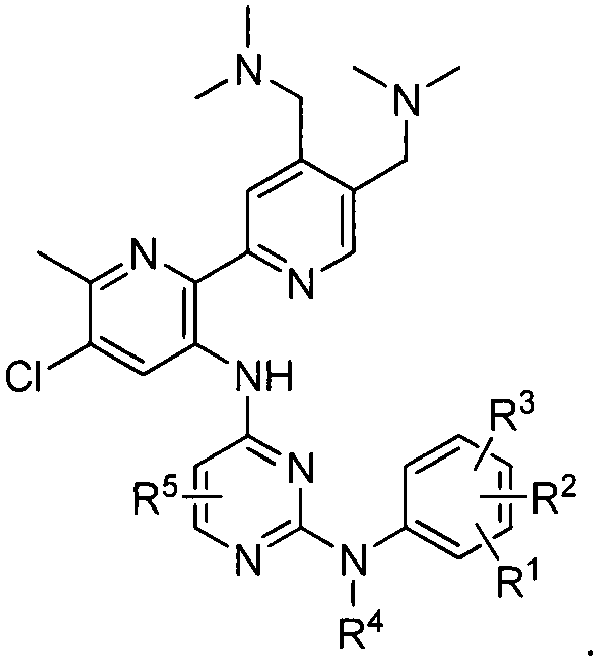
- 36. The compound of
embodiment 1, wherein the compound is selected from a compound in Table 1. - 37. A pharmaceutical composition comprising a compound of any one of embodiments 1-36, or a stereoisomer, pharmaceutically acceptable salt or prodrug thereof, and a pharmaceutically acceptable carrier, diluent or excipient.
- 38. A method of inhibiting ALK2 kinase or JAK2 kinase, or combinations thereof, in a mammal in need thereof, the method comprising administering to the mammal an effective amount of a compound of any one of embodiments 1-36 or a composition of embodiment 37.
- 39. The method of embodiment 38, wherein the method is for inhibiting ALK2 Kinase.
- 40. The method of embodiment 38, wherein the method is for inhibiting JAK2 kinase.
- 41. The method of any one of embodiments 38-40, wherein the inhibition is for treatment of cancer.
- 42. The method of any one of embodiments 38-40, wherein the inhibition is for treatment of anemia of chronic disease, anemia of chronic inflammation, anemia of cancer or fibrodysplasia ossificans progressive.
- 43. A method for treating cancer in a mammal in need thereof, the method comprising administering to the mammal an effective amount of a compound of any one of embodiments 1-36 or a composition of embodiment 37.
- 44. The method of embodiment 41 or 43, wherein the cancer is a myeloproliferative disorder, a lymphoma or a solid tumor.
- 45. The method of embodiment 42, wherein the myeloproliferative disorder is myelofibrosis, polycythemia vera or essential thrombocytosis.
- 46. The method of embodiment 42, wherein the solid tumor is a breast, prostate or pancreatic tumor.
- 47. The method of embodiment 41 or 43, wherein the cancer is prostate, ovarian or head and neck cancer.
- 48. A method for providing supportive care to a cancer patient in need thereof, the method comprising administering to the patient an effective amount of a compound of any one of embodiments 1-36 or a composition of embodiment 37.
- 49. The method of embodiment 48, wherein the method is for treating anemia, or fatigue associated with cancer.
Claims (16)
- A compound having one of the following structures:


- The compound of claim 1, having the following structure:

- The compound of claim 1, having the following structure:

- The compound of claim 1, having the following structure:

- The compound of claim 1, having the following structure:

- A pharmaceutical composition comprising a compound of claim 1, or a pharmaceutically acceptable salt thereof, and a pharmaceutically acceptable carrier, diluent or excipient.
- The pharmaceutical composition of claim 6, wherein the compound has the following structure:

- The pharmaceutical composition of claim 6, wherein the compound has the following structure:

- The pharmaceutical composition of claim 6, wherein the compound has the following structure:

- The pharmaceutical composition of claim 6, wherein the compound has the following structure:

- Pharmaceutical composition of claim 6 for use in:A) treating anemia of chronic disease, anemia of chronic inflammation, anemia of cancer or fibrodysplasia ossificans progressive;B) treating cancer in a mammal in need thereof;C) treating cancer in a mammal in need thereof, wherein the cancer is selected from a myeloproliferative disorder, a lymphoma or a solid tumor, preferably wherein the myeloproliferative disorder is myelofibrosis, polycythemia vera or essential thrombocytosis; orD) providing supportive care to a cancer patient in need thereof.
- Pharmaceutical composition for use according to claim 11, wherein the cancer is a brain stem glioma, breast cancer, lung cancer, colon cancer, kidney cancer, hepatocellular cancer or carcinoma of the endometrium.
- Pharmaceutical composition for use according to claim 11 or 12, wherein the compound has the following structure:
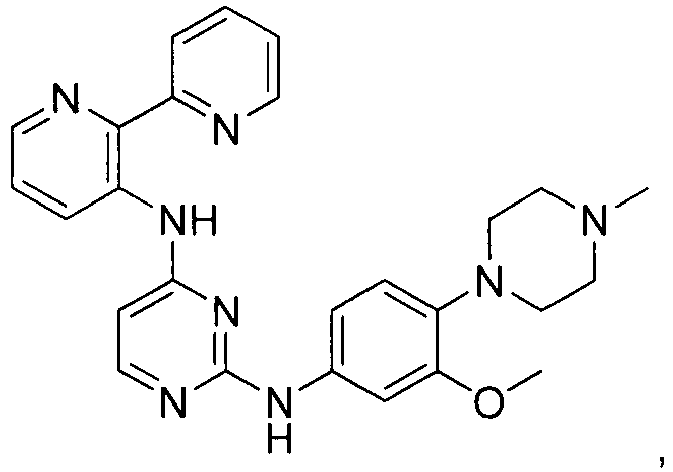
- Pharmaceutical composition for use according to claim 11 or 12, wherein the compound has the following structure:

- Pharmaceutical composition for use according to claim 11 or 12, wherein the compound has the following structure:

- Pharmaceutical composition for use according to claim 11 or 12, wherein the compound has the following structure:

Priority Applications (2)
| Application Number | Priority Date | Filing Date | Title |
|---|---|---|---|
| PL14721083T PL2970205T3 (en) | 2013-03-14 | 2014-03-13 | Jak2 and alk2 inhibitors and methods for their use |
| EP19173013.4A EP3590932B1 (en) | 2013-03-14 | 2014-03-13 | Jak2 and alk2 inhibitors and methods for their use |
Applications Claiming Priority (2)
| Application Number | Priority Date | Filing Date | Title |
|---|---|---|---|
| US201361785460P | 2013-03-14 | 2013-03-14 | |
| PCT/US2014/026595 WO2014151871A2 (en) | 2013-03-14 | 2014-03-13 | Jak2 and alk2 inhibitors and methods for their use |
Related Child Applications (1)
| Application Number | Title | Priority Date | Filing Date |
|---|---|---|---|
| EP19173013.4A Division EP3590932B1 (en) | 2013-03-14 | 2014-03-13 | Jak2 and alk2 inhibitors and methods for their use |
Publications (2)
| Publication Number | Publication Date |
|---|---|
| EP2970205A2 EP2970205A2 (en) | 2016-01-20 |
| EP2970205B1 true EP2970205B1 (en) | 2019-05-08 |
Family
ID=50631027
Family Applications (2)
| Application Number | Title | Priority Date | Filing Date |
|---|---|---|---|
| EP19173013.4A Active EP3590932B1 (en) | 2013-03-14 | 2014-03-13 | Jak2 and alk2 inhibitors and methods for their use |
| EP14721083.5A Active EP2970205B1 (en) | 2013-03-14 | 2014-03-13 | Jak2 and alk2 inhibitors and methods for their use |
Family Applications Before (1)
| Application Number | Title | Priority Date | Filing Date |
|---|---|---|---|
| EP19173013.4A Active EP3590932B1 (en) | 2013-03-14 | 2014-03-13 | Jak2 and alk2 inhibitors and methods for their use |
Country Status (19)
| Country | Link |
|---|---|
| US (4) | US10202356B2 (en) |
| EP (2) | EP3590932B1 (en) |
| JP (3) | JP6433974B2 (en) |
| KR (2) | KR102334260B1 (en) |
| CN (2) | CN108997225A (en) |
| AU (3) | AU2014236820B2 (en) |
| BR (1) | BR112015022993B1 (en) |
| CA (1) | CA2905993C (en) |
| CY (1) | CY1121867T1 (en) |
| DK (1) | DK2970205T3 (en) |
| ES (1) | ES2738493T3 (en) |
| HU (1) | HUE044558T2 (en) |
| IL (3) | IL241194B (en) |
| MX (2) | MX394360B (en) |
| PL (1) | PL2970205T3 (en) |
| PT (1) | PT2970205T (en) |
| RU (2) | RU2693480C2 (en) |
| TR (1) | TR201911151T4 (en) |
| WO (1) | WO2014151871A2 (en) |
Cited By (2)
| Publication number | Priority date | Publication date | Assignee | Title |
|---|---|---|---|---|
| US10752594B2 (en) | 2013-03-14 | 2020-08-25 | Sumitomo Dainippon Pharma Oncology, Inc. | JAK1 and ALK2 inhibitors and methods for their use |
| US11040038B2 (en) | 2018-07-26 | 2021-06-22 | Sumitomo Dainippon Pharma Oncology, Inc. | Methods for treating diseases associated with abnormal ACVR1 expression and ACVR1 inhibitors for use in the same |
Families Citing this family (29)
| Publication number | Priority date | Publication date | Assignee | Title |
|---|---|---|---|---|
| EP2734205B1 (en) | 2011-07-21 | 2018-03-21 | Tolero Pharmaceuticals, Inc. | Heterocyclic protein kinase inhibitors |
| KR102580225B1 (en) | 2013-06-11 | 2023-09-20 | 프레지던트 앤드 펠로우즈 오브 하바드 칼리지 | SC-β CELLS AND COMPOSITIONS AND METHODS FOR GENERATING THE SAME |
| ES2985135T3 (en) | 2014-12-18 | 2024-11-04 | Harvard College | Procedures for generating stem cell-derived ß cells and their uses |
| WO2016100930A1 (en) | 2014-12-18 | 2016-06-23 | President And Fellows Of Harvard College | Methods for generating stem cell-derived b cells and methods of use thereof |
| WO2016100898A1 (en) | 2014-12-18 | 2016-06-23 | President And Fellows Of Harvard College | Serum-free in vitro directed differentiation protocol for generating stem cell-derived b cells and uses thereof |
| CN105254764A (en) * | 2015-08-27 | 2016-01-20 | 上海康岱生物医药技术有限公司 | ACVR1-Fc fusion protein, and preparation method and application thereof |
| FI3442977T3 (en) | 2016-04-15 | 2023-09-26 | Blueprint Medicines Corp | Inhibitors of activin receptor-like kinase |
| JP7030776B2 (en) | 2016-07-20 | 2022-03-07 | ノバルティス アーゲー | Use as aminopyridine derivatives and their selective ALK-2 inhibitors |
| WO2018124001A1 (en) | 2016-12-27 | 2018-07-05 | 国立研究開発法人理化学研究所 | Bmp-signal-inhibiting compound |
| AR112027A1 (en) * | 2017-06-15 | 2019-09-11 | Biocryst Pharm Inc | ALK 2 KINASE INHIBITORS CONTAINING IMIDAZOLE |
| CN118497104A (en) | 2017-11-15 | 2024-08-16 | 沃泰克斯药物股份有限公司 | Islet cell preparation compositions and methods of use |
| EP3763386A4 (en) | 2018-03-05 | 2021-12-29 | Saitama Medical University | Pharmaceutical composition for treating or preventing heterotopic ossification |
| BR112020020246A8 (en) | 2018-04-05 | 2022-10-18 | Sumitomo Dainippon Pharma Oncology Inc | AXL KINASE INHIBITORS AND THEIR USE |
| CA3095580A1 (en) | 2018-04-13 | 2019-10-17 | Sumitomo Dainippon Pharma Oncology, Inc. | Pim kinase inhibitors for treatment of myeloproliferative neoplasms and fibrosis associated with cancer |
| EP3833365A4 (en) | 2018-08-10 | 2022-05-11 | Vertex Pharmaceuticals Incorporated | ISLET DIFFERENTIATION DERIVED FROM STEM CELLS |
| CN111362922A (en) | 2018-12-26 | 2020-07-03 | 上海喆邺生物科技有限公司 | 2,4-Diaminopyrimidine derivatives and uses thereof |
| CN111362928A (en) * | 2018-12-26 | 2020-07-03 | 上海喆邺生物科技有限公司 | 2, 4-diaminopyrimidine derivatives |
| JP2022517951A (en) * | 2019-01-10 | 2022-03-11 | スミトモ ダイニッポン ファーマ オンコロジー, インコーポレイテッド | ALK5 inhibitor for treating myelodysplastic syndrome |
| AU2020221247B2 (en) | 2019-02-12 | 2024-12-12 | Sumitomo Pharma America, Inc. | Formulations comprising heterocyclic protein kinase inhibitors |
| JP2022539208A (en) | 2019-07-03 | 2022-09-07 | スミトモ ファーマ オンコロジー, インコーポレイテッド | Tyrosine kinase non-receptor 1 (TNK1) inhibitors and uses thereof |
| JP2022549506A (en) | 2019-09-27 | 2022-11-25 | ディスク・メディシン・インコーポレイテッド | Methods for treating myelofibrosis and related conditions |
| BR112022009710A2 (en) * | 2019-11-22 | 2022-08-09 | Incyte Corp | COMBINATION THERAPY COMPRISING AN ALK2 INHIBITOR AND A JAK2 INHIBITOR |
| JP2023502264A (en) | 2019-11-22 | 2023-01-23 | スミトモ ファーマ オンコロジー, インコーポレイテッド | Solid dose pharmaceutical composition |
| AR121846A1 (en) * | 2020-04-16 | 2022-07-13 | Teijin Pharma Ltd | DERIVATIVE OF ARYL OR HETEROARYL |
| KR20230012539A (en) | 2020-05-13 | 2023-01-26 | 디스크 메디슨, 인크. | Anti-hemojuvelin (HJV) antibodies to treat myelofibrosis |
| CA3187767A1 (en) | 2020-06-16 | 2021-12-23 | Incyte Corporation | Alk2 inhibitors for the treatment of anemia |
| CN111777592B (en) * | 2020-06-22 | 2021-06-18 | 温州医科大学 | A kind of N4-(2,5-dimethoxyphenyl)-pyrimidinediamine targeting DDR1 inhibitor and its preparation and application |
| CN111793035B (en) * | 2020-06-22 | 2021-06-18 | 温州医科大学 | A kind of N4-(3-methoxyphenyl)-pyrimidinediamine targeting DDR1 inhibitor and its preparation and application |
| JP2026509318A (en) | 2022-10-31 | 2026-03-18 | スミトモ・ファーマ・アメリカ・インコーポレイテッド | PIM1 inhibitors for the treatment of myeloproliferative neoplasms |
Family Cites Families (187)
| Publication number | Priority date | Publication date | Assignee | Title |
|---|---|---|---|---|
| US2779780A (en) | 1955-03-01 | 1957-01-29 | Du Pont | 1, 4-diamino-2, 3-dicyano-1, 4-bis (substituted mercapto) butadienes and their preparation |
| GB8827305D0 (en) | 1988-11-23 | 1988-12-29 | British Bio Technology | Compounds |
| FI941572L (en) | 1991-10-07 | 1994-05-27 | Oncologix Inc | Combination and method of use of anti-erbB-2 monoclonal antibodies |
| WO1993016185A2 (en) | 1992-02-06 | 1993-08-19 | Creative Biomolecules, Inc. | Biosynthetic binding protein for cancer marker |
| US6177401B1 (en) | 1992-11-13 | 2001-01-23 | Max-Planck-Gesellschaft Zur Forderung Der Wissenschaften | Use of organic compounds for the inhibition of Flk-1 mediated vasculogenesis and angiogenesis |
| US5455258A (en) | 1993-01-06 | 1995-10-03 | Ciba-Geigy Corporation | Arylsulfonamido-substituted hydroxamic acids |
| EP0647450A1 (en) | 1993-09-09 | 1995-04-12 | BEHRINGWERKE Aktiengesellschaft | Improved prodrugs for enzyme mediated activation |
| IL112248A0 (en) | 1994-01-25 | 1995-03-30 | Warner Lambert Co | Tricyclic heteroaromatic compounds and pharmaceutical compositions containing them |
| US5521173A (en) | 1995-01-17 | 1996-05-28 | American Home Products Corporation | Tricyclic benzazepine vasopressin antagonists |
| US5863949A (en) | 1995-03-08 | 1999-01-26 | Pfizer Inc | Arylsulfonylamino hydroxamic acid derivatives |
| JP3053222B2 (en) | 1995-04-20 | 2000-06-19 | ファイザー・インコーポレーテッド | Arylsulfonylhydroxamic acid derivatives as MMP and TNF inhibitors |
| GB9508538D0 (en) | 1995-04-27 | 1995-06-14 | Zeneca Ltd | Quinazoline derivatives |
| US5747498A (en) | 1996-05-28 | 1998-05-05 | Pfizer Inc. | Alkynyl and azido-substituted 4-anilinoquinazolines |
| US5880141A (en) | 1995-06-07 | 1999-03-09 | Sugen, Inc. | Benzylidene-Z-indoline compounds for the treatment of disease |
| GB9520822D0 (en) | 1995-10-11 | 1995-12-13 | Wellcome Found | Therapeutically active compounds |
| GB9523675D0 (en) * | 1995-11-20 | 1996-01-24 | Celltech Therapeutics Ltd | Chemical compounds |
| GB9624482D0 (en) | 1995-12-18 | 1997-01-15 | Zeneca Phaema S A | Chemical compounds |
| ATE225343T1 (en) | 1995-12-20 | 2002-10-15 | Hoffmann La Roche | MATRIX METALLOPROTEASE INHIBITORS |
| AU1618697A (en) | 1996-02-06 | 1997-08-28 | Japan Tobacco Inc. | Novel compounds and pharmaceutical use thereof |
| ES2169355T3 (en) | 1996-03-05 | 2002-07-01 | Astrazeneca Ab | DERIVATIVES OF 4-ANILINOQUINAZOLINA. |
| JP3195756B2 (en) | 1996-07-04 | 2001-08-06 | 公子 吉水 | Lubrication auxiliary |
| EP0818442A3 (en) | 1996-07-12 | 1998-12-30 | Pfizer Inc. | Cyclic sulphone derivatives as inhibitors of metalloproteinases and of the production of tumour necrosis factor |
| EA199900021A1 (en) | 1996-07-13 | 1999-08-26 | Глаксо, Груп Лимитед | BICYCLIC HETEROAROMATIC COMPOUNDS AS PROTEINTHYROSINKINASE INHIBITORS |
| HRP970371A2 (en) | 1996-07-13 | 1998-08-31 | Kathryn Jane Smith | Heterocyclic compounds |
| DE69716916T2 (en) | 1996-07-13 | 2003-07-03 | Glaxo Group Ltd., Greenford | CONDENSED HETEROCYCLIC COMPOUNDS AS PROTEIN KINASE INHIBITORS |
| CA2260898C (en) | 1996-07-18 | 2002-05-14 | Pfizer Limited | Phosphinate based inhibitors of matrix metalloproteases |
| PL331895A1 (en) | 1996-08-23 | 1999-08-16 | Pfizer | Arylosulphonylamino derivatives of hydroxamic acid |
| ID18494A (en) | 1996-10-02 | 1998-04-16 | Novartis Ag | PIRAZOLA DISTRIBUTION IN THE SEQUENCE AND THE PROCESS OF MAKING IT |
| DZ2376A1 (en) | 1996-12-19 | 2002-12-28 | Smithkline Beecham Plc | New sulfonamide derivatives process for their preparation and pharmaceutical compositions containing them. |
| DE69730151T2 (en) | 1997-01-06 | 2005-08-04 | Pfizer Inc. | CYCLIC SULPHONE DERIVATIVES |
| AU721748B2 (en) | 1997-02-03 | 2000-07-13 | Pfizer Products Inc. | Arylsulfonylamino hydroxamic acid derivatives |
| CA2279863A1 (en) | 1997-02-07 | 1998-08-13 | Pfizer Inc. | N-hydroxy-beta-sulfonyl-propionamide derivatives and their use as inhibitors of matrix metalloproteinases |
| WO1998034918A1 (en) | 1997-02-11 | 1998-08-13 | Pfizer Inc. | Arylsulfonyl hydroxamic acid derivatives |
| CA2289102A1 (en) | 1997-05-07 | 1998-11-12 | Sugen, Inc. | 2-indolinone derivatives as modulators of protein kinase activity |
| JP2002501532A (en) | 1997-05-30 | 2002-01-15 | メルク エンド カンパニー インコーポレーテッド | Novel angiogenesis inhibitors |
| US5835420A (en) | 1997-06-27 | 1998-11-10 | Aplus Flash Technology, Inc. | Node-precise voltage regulation for a MOS memory system |
| ID23668A (en) | 1997-08-08 | 2000-05-11 | Pfizer Prod Inc | ARILOKSIARILSULFONILAMINO HYDROXAMAMIC ACID DEPOSIT |
| ATE368665T1 (en) | 1997-08-22 | 2007-08-15 | Astrazeneca Ab | OXINDOLYLQUINAZOLINE DERIVATIVES AS ANGIOGENESIS INHIBITORS |
| JP2001518470A (en) | 1997-09-26 | 2001-10-16 | メルク エンド カムパニー インコーポレーテッド | Novel angiogenesis inhibitors |
| WO1999024440A1 (en) | 1997-11-11 | 1999-05-20 | Pfizer Products Inc. | Thienopyrimidine and thienopyridine derivatives useful as anticancer agents |
| GB9725782D0 (en) | 1997-12-05 | 1998-02-04 | Pfizer Ltd | Therapeutic agents |
| RS49779B (en) | 1998-01-12 | 2008-06-05 | Glaxo Group Limited, | BICYCLIC HETEROAROMATIC COMPOUNDS AS PROTEIN TYROSINE KINASE INHIBITORS |
| GB9800575D0 (en) | 1998-01-12 | 1998-03-11 | Glaxo Group Ltd | Heterocyclic compounds |
| GB9801690D0 (en) | 1998-01-27 | 1998-03-25 | Pfizer Ltd | Therapeutic agents |
| GB2335781A (en) | 1998-03-24 | 1999-09-29 | Soho Soundhouse Limited | Method of selection of audio samples |
| JP4462654B2 (en) | 1998-03-26 | 2010-05-12 | ソニー株式会社 | Video material selection device and video material selection method |
| PA8469401A1 (en) | 1998-04-10 | 2000-05-24 | Pfizer Prod Inc | BICYCLE DERIVATIVES OF HYDROXAMIC ACID |
| PA8469501A1 (en) | 1998-04-10 | 2000-09-29 | Pfizer Prod Inc | HYDROXAMIDES OF THE ACID (4-ARILSULFONILAMINO) -TETRAHIDROPIRAN-4-CARBOXILICO |
| IL139934A0 (en) | 1998-05-29 | 2002-02-10 | Sugen Inc | Pyrrole substituted 2-indolinone derivatives and pharmaceutical compositions containing the same |
| UA60365C2 (en) | 1998-06-04 | 2003-10-15 | Пфайзер Продактс Інк. | Isothiazole derivatives, a method for preparing thereof, a pharmaceutical composition and a method for treatment of hyperproliferative disease of mammal |
| DK1004578T3 (en) | 1998-11-05 | 2004-06-28 | Pfizer Prod Inc | 5-oxo-pyrrolidine-2-carboxylic acid hydroxamide derivatives |
| IL143236A0 (en) | 1998-12-16 | 2002-04-21 | Warner Lambert Co | Treatment of arthritis with mek inhibitors |
| UA71945C2 (en) | 1999-01-27 | 2005-01-17 | Pfizer Prod Inc | Substituted bicyclic derivatives being used as anticancer agents |
| KR20010102073A (en) | 1999-02-11 | 2001-11-15 | 실버스타인 아써 에이. | Heteroaryl-substituted quinolin-2-one derivatives useful as anticancer agents |
| US6511993B1 (en) | 1999-06-03 | 2003-01-28 | Kevin Neil Dack | Metalloprotease inhibitors |
| CA2277654A1 (en) * | 1999-07-19 | 2001-01-19 | Luxell Technologies Inc. | Electroluminescent display packaging and method therefor |
| EP1081137A1 (en) | 1999-08-12 | 2001-03-07 | Pfizer Products Inc. | Selective inhibitors of aggrecanase in osteoarthritis treatment |
| GB9924862D0 (en) | 1999-10-20 | 1999-12-22 | Celltech Therapeutics Ltd | Chemical compounds |
| AR034118A1 (en) | 2000-02-15 | 2004-02-04 | Sugen Inc | COMPOUNDS OF 2-INDOLINONES REPLACED WITH PROTEINQUINASE INHIBITING PIRROLS; YOUR PHARMACEUTICAL AND INTERMEDIARY SYNTHESIS COMPOSITIONS |
| HUP0301117A3 (en) | 2000-02-17 | 2004-01-28 | Amgen Inc Thousand Oaks | Imidazole derivatives kinase inhibitors, their use, process for their preparation and pharmaceutical compositions containing them |
| US6440207B1 (en) | 2000-03-03 | 2002-08-27 | Bayer Corporation | Method for preparing organic pigments |
| US7163921B1 (en) | 2000-04-14 | 2007-01-16 | Nippon Shinyaku Co., Ltd. | Peptide derivatives and medicinal compositions |
| BR0111280A (en) | 2000-06-05 | 2003-06-10 | Dong A Pharm Co Ltd | New oxazolidinone derivatives and a process for their preparation |
| WO2002006213A2 (en) | 2000-07-19 | 2002-01-24 | Warner-Lambert Company | Oxygenated esters of 4-iodo phenylamino benzhydroxamic acids |
| US6995162B2 (en) | 2001-01-12 | 2006-02-07 | Amgen Inc. | Substituted alkylamine derivatives and methods of use |
| WO2002094766A1 (en) | 2001-05-18 | 2002-11-28 | Nihon Nohyaku Co., Ltd. | Phthalamide derivative, agricultural or horticultural insecticide, and use thereof |
| WO2003003009A1 (en) | 2001-06-29 | 2003-01-09 | 7Tm Pharma A/S | Use of metal-ion chelates in validating biological molecules as drug targets in test animal models |
| US6939874B2 (en) * | 2001-08-22 | 2005-09-06 | Amgen Inc. | Substituted pyrimidinyl derivatives and methods of use |
| JP5039268B2 (en) | 2001-10-26 | 2012-10-03 | アベンティス・ファーマスーティカルズ・インコーポレイテツド | Benzimidazoles and analogs and their use as protein kinase inhibitors |
| US6897208B2 (en) | 2001-10-26 | 2005-05-24 | Aventis Pharmaceuticals Inc. | Benzimidazoles |
| WO2003055477A1 (en) | 2001-12-21 | 2003-07-10 | 7Tm Pharma A/S | Method for the treatment of mc receptor related disorders with a chelate and/or a chelator |
| TWI329105B (en) | 2002-02-01 | 2010-08-21 | Rigel Pharmaceuticals Inc | 2,4-pyrimidinediamine compounds and their uses |
| RU2343148C2 (en) * | 2002-02-01 | 2009-01-10 | Райджел Фармасьютикалз, Инк | Compounds of 2,4-pyrimidindiamines and their application |
| US7799827B2 (en) | 2002-03-08 | 2010-09-21 | Eisai Co., Ltd. | Macrocyclic compounds useful as pharmaceuticals |
| TWI343377B (en) | 2002-03-13 | 2011-06-11 | Array Biopharma Inc | N3 alkylated benzimidazole derivatives as mek inhibitors |
| GB0206215D0 (en) | 2002-03-15 | 2002-05-01 | Novartis Ag | Organic compounds |
| GB0206860D0 (en) | 2002-03-22 | 2002-05-01 | Glaxo Group Ltd | Compounds |
| ES2307916T3 (en) | 2002-03-25 | 2008-12-01 | Nippon Kayaku Kabushiki Kaisha | NEW DERIVATIVE OF ALFA-AMINO-N- (DIAMINOFOSFINIL) LACTAMA. |
| AR039241A1 (en) | 2002-04-04 | 2005-02-16 | Biogen Inc | HETEROARILOS TRISUSTITUIDOS AND METHODS FOR ITS PRODUCTION AND USE OF THE SAME |
| AU2003231231A1 (en) * | 2002-05-06 | 2003-11-11 | Bayer Pharmaceuticals Corporation | Pyridinyl amino pyrimidine derivatives useful for treating hyper-proliferative disorders |
| AU2003254903B9 (en) | 2002-08-09 | 2008-08-21 | Taisho Pharmaceutical Co., Ltd. | Method for selective preparation of aryl 5-thio-beta-D-aldohexopyranosides |
| UA80295C2 (en) | 2002-09-06 | 2007-09-10 | Biogen Inc | Pyrazolopyridines and using the same |
| JP4608852B2 (en) | 2002-10-15 | 2011-01-12 | チッソ株式会社 | Liquid crystalline vinyl ketone derivatives and polymers thereof |
| AU2003287878A1 (en) | 2002-12-11 | 2004-06-30 | 7Tm Pharma A/S | Quinoline compounds for use in mch receptor related disorders |
| DE602004021472D1 (en) * | 2003-02-20 | 2009-07-23 | Smithkline Beecham Corp | Pyrimiidinverbindungen |
| BRPI0300660B8 (en) | 2003-02-28 | 2021-07-27 | Fapesp Fund De Amparo A Pesquisa Do Estado De Sao Paulo | method to quantify mitochondrial release of cytochrome c and kit to detect mitochondrial release of cytochrome c |
| GB0319227D0 (en) * | 2003-08-15 | 2003-09-17 | Novartis Ag | Organic compounds |
| GB0305929D0 (en) | 2003-03-14 | 2003-04-23 | Novartis Ag | Organic compounds |
| EP1636335B1 (en) | 2003-05-28 | 2012-07-11 | Mito Tek, LLC | Compositions and methods for inhibiting an isoform of human manganese superoxide dismutase |
| US20050070554A1 (en) * | 2003-08-27 | 2005-03-31 | Amgen Inc. | Substituted heterocyclic compounds and methods of use |
| BRPI0414544A (en) * | 2003-09-18 | 2006-11-07 | Novartis Ag | 2,4-di (phenylamino) pyrimidines useful in the treatment of proliferative disorders |
| WO2005082892A2 (en) | 2004-02-17 | 2005-09-09 | Dr. Reddy's Laboratories Ltd. | Triazole compounds as antibacterial agents and pharmaceutical compositions containing them |
| EP1737843B1 (en) | 2004-04-09 | 2011-02-23 | Merck Sharp & Dohme Corp. | Inhibitors of akt activity |
| EP1786802A1 (en) | 2004-08-31 | 2007-05-23 | Biogen Idec MA, Inc. | Pyrimidinylimidazoles as tgf-beta inhibitors |
| US7786153B2 (en) | 2005-03-02 | 2010-08-31 | Abbott Laboratories Inc. | Compounds that are useful for improving pharmacokinetics |
| US20060270694A1 (en) | 2005-05-03 | 2006-11-30 | Rigel Pharmaceuticals, Inc. | JAK kinase inhibitors and their uses |
| WO2006124874A2 (en) | 2005-05-12 | 2006-11-23 | Kalypsys, Inc. | Inhibitors of b-raf kinase |
| EP2295496A1 (en) | 2005-06-29 | 2011-03-16 | Saint-Gobain Abrasives, Inc. | High performance resin for abrasive products |
| US20070032514A1 (en) | 2005-07-01 | 2007-02-08 | Zahn Stephan K | 2,4-diamino-pyrimidines as aurora inhibitors |
| WO2007014011A2 (en) | 2005-07-21 | 2007-02-01 | Ardea Biosciences, Inc. | N-(arylamino)-sulfonamide inhibitors of mek |
| US7528143B2 (en) | 2005-11-01 | 2009-05-05 | Targegen, Inc. | Bi-aryl meta-pyrimidine inhibitors of kinases |
| US8133900B2 (en) | 2005-11-01 | 2012-03-13 | Targegen, Inc. | Use of bi-aryl meta-pyrimidine inhibitors of kinases |
| ZA200804083B (en) * | 2005-11-01 | 2009-09-30 | Targegen Inc | Bi-aryl meta-pyrimidine inhibitors of kinases |
| US8604042B2 (en) | 2005-11-01 | 2013-12-10 | Targegen, Inc. | Bi-aryl meta-pyrimidine inhibitors of kinases |
| BRPI0621027A2 (en) | 2006-01-13 | 2011-11-29 | Pharmacyclics Inc | compound, pharmaceutical composition |
| JO2660B1 (en) | 2006-01-20 | 2012-06-17 | نوفارتيس ايه جي | PI-3 Kinase inhibitors and methods of their use |
| CN101421250A (en) * | 2006-01-30 | 2009-04-29 | 埃克塞里艾克西斯公司 | 4-aryl-2-amino-pyrimidines or 4-aryl-2-aminoalkyl-pyrimidines as jak-2 modulators and pharmaceutical compositions containing them |
| KR20080110998A (en) | 2006-01-30 | 2008-12-22 | 엑셀리시스, 인코포레이티드 | As the BAX2 modulator, the aryl may be selected from the group consisting of ivaryl arylaminoaminopyrimidine or phenylarylaminoalkylpyrimidine and pharmaceutical compositions comprising the same. |
| JP2009528295A (en) | 2006-02-24 | 2009-08-06 | ライジェル ファーマシューティカルズ, インコーポレイテッド | Compositions and methods for inhibition of the JAK pathway |
| CA2652385A1 (en) | 2006-06-08 | 2007-12-21 | Eli Lilly And Company | Novel mch receptor antagonists |
| EP2054392A2 (en) | 2006-06-15 | 2009-05-06 | Boehringer Ingelheim International GmbH | 2-anilino-4-(heterocyclic)amino-pyrimidines as inhibitors of protein kinase c-alpha |
| PL2526933T3 (en) | 2006-09-22 | 2015-08-31 | Pharmacyclics Llc | Inhibitors of Bruton's tyrosine kinase |
| ES2555803T3 (en) | 2006-10-23 | 2016-01-08 | Cephalon, Inc. | Fusion of bicyclic 2,4-diaminopyrimidine derivatives as using ALK and c-Met inhibitors |
| ES2403546T3 (en) | 2006-11-03 | 2013-05-20 | Pharmacyclics, Inc. | Bruton tyrosine kinase activity probe and method of use |
| TW200902010A (en) | 2007-01-26 | 2009-01-16 | Smithkline Beecham Corp | Anthranilamide inhibitors of aurora kinase |
| ES2702362T3 (en) | 2007-01-31 | 2019-02-28 | Ym Biosciences Australia Pty | Compounds based on thiopyrimidine and uses thereof |
| AU2008221278A1 (en) * | 2007-03-01 | 2008-09-04 | Supergen, Inc. | Pyrimidine-2,4-diamine derivatives and their use as JAK2 kinase inhibitors |
| CN101657431A (en) | 2007-03-01 | 2010-02-24 | 休普基因公司 | Pyrimidine-2,4-diamine derivatives and their use as JAK2 kinase inhibitors |
| US7947698B2 (en) * | 2007-03-23 | 2011-05-24 | Rigel Pharmaceuticals, Inc. | Compositions and methods for inhibition of the JAK pathway |
| US7834024B2 (en) | 2007-03-26 | 2010-11-16 | Rigel Pharmaceuticals, Inc. | Compositions and methods for inhibition of the JAK pathway |
| US20120101113A1 (en) | 2007-03-28 | 2012-04-26 | Pharmacyclics, Inc. | Inhibitors of bruton's tyrosine kinase |
| WO2008124085A2 (en) | 2007-04-03 | 2008-10-16 | Exelixis, Inc. | Methods of using combinations of mek and jak-2 inhibitors |
| CA2682733A1 (en) | 2007-04-13 | 2008-10-23 | Supergen, Inc. | Axl kinase inhibitors |
| WO2008137605A1 (en) | 2007-05-04 | 2008-11-13 | Irm Llc | Pyrimidine derivatives and compositions as c-kit and pdgfr kinase inhibitors |
| WO2009010794A1 (en) | 2007-07-19 | 2009-01-22 | Astrazeneca Ab | 2,4-diamino-pyrimidine derivatives |
| AU2008298948B2 (en) | 2007-09-12 | 2014-09-04 | F. Hoffmann-La Roche Ag | Combinations of phosphoinositide 3-kinase inhibitor compounds and chemotherapeutic agents, and methods of use |
| EP2214675B1 (en) | 2007-10-25 | 2013-11-20 | Genentech, Inc. | Process for making thienopyrimidine compounds |
| WO2009080638A2 (en) * | 2007-12-20 | 2009-07-02 | Cellzome Limited | Sulfamides as zap-70 inhibitors |
| EP2300013B2 (en) * | 2008-05-21 | 2024-11-13 | Takeda Pharmaceutical Company Limited | Phosphorous derivatives as kinase inhibitors |
| EP2331526A2 (en) * | 2008-06-25 | 2011-06-15 | Irm Llc | Pyrimidine derivatives as kinase inhibitors |
| US8338439B2 (en) | 2008-06-27 | 2012-12-25 | Celgene Avilomics Research, Inc. | 2,4-disubstituted pyrimidines useful as kinase inhibitors |
| NZ603525A (en) | 2008-06-27 | 2015-02-27 | Celgene Avilomics Res Inc | Pyrimidine based compound and uses thereof |
| CA2730930C (en) | 2008-07-16 | 2015-01-13 | Pharmacyclics, Inc. | Inhibitors of bruton's tyrosine kinase for the treatment of solid tumors |
| CA2730749A1 (en) | 2008-07-18 | 2010-01-21 | Sanofi-Aventis | Novel imidazo[1,2-a]pyridine derivatives, method for the preparation thereof, use thereof as medicaments, pharmaceutical compositions and novel use in particular as met inhibitors |
| WO2010011349A2 (en) | 2008-07-25 | 2010-01-28 | Supergen, Inc. | Pyrimidine-2,4-diamine jak2 kinase inhibiting anti-inflammation use |
| RU2011108563A (en) | 2008-08-05 | 2012-09-10 | Таргеджен, Инк. (US) | THALASSEMIA TREATMENT METHODS |
| PL2389372T3 (en) | 2009-01-23 | 2016-02-29 | Rigel Pharmaceuticals Inc | Compositions and methods for inhibition of the jak pathway |
| JP2012517426A (en) | 2009-02-09 | 2012-08-02 | アステックス ファーマシューティカルズ インコーポレイテッド | Pyrrolopyrimidinyl AXL kinase inhibitor |
| US20120040955A1 (en) | 2009-04-14 | 2012-02-16 | Richard John Harrison | Fluoro substituted pyrimidine compounds as jak3 inhibitors |
| RU2595718C2 (en) | 2009-09-09 | 2016-08-27 | Селджен Авиломикс Рисерч,Инк. | Pi3-kinase inhibitors and use thereof |
| US9556426B2 (en) | 2009-09-16 | 2017-01-31 | Celgene Avilomics Research, Inc. | Protein kinase conjugates and inhibitors |
| CN102791697A (en) | 2009-10-12 | 2012-11-21 | 瑞科西有限公司 | Amino-pyrimidine compounds as inhibitors of TBKL and/or IKK epsilon |
| US7741330B1 (en) | 2009-10-12 | 2010-06-22 | Pharmacyclics, Inc. | Pyrazolo-pyrimidine inhibitors of Bruton's tyrosine kinase |
| CN102791690B (en) | 2010-01-29 | 2015-12-02 | 大塚制药株式会社 | As the disubstituted pyridines derivative of anticarcinogen |
| WO2011106168A1 (en) | 2010-02-24 | 2011-09-01 | Dcam Pharma Inc | Purine compounds for treating autoimmune and demyelinating diseases |
| WO2011121223A1 (en) | 2010-03-30 | 2011-10-06 | Sanofi-Aventis | 6-(alkyl- or cycloalkyl-triazolopyridazine-sulfanyl) benzothiazole derivatives: preparation, application as medicaments and use as met inhibitors |
| NZ772688A (en) | 2010-06-03 | 2022-09-30 | Pharmacyclics Llc | The use of inhibitors of bruton’s tyrosine kinase (btk) |
| CA2794731C (en) | 2010-06-18 | 2019-03-19 | Genentech, Inc. | Anti-axl antibodies and methods of use |
| US9249124B2 (en) | 2011-03-30 | 2016-02-02 | H. Lee Moffitt Cancer Center And Research Institute, Inc. | Aurora kinase inhibitors and methods of making and using thereof |
| EP3628665B1 (en) | 2011-04-01 | 2022-11-02 | University of Utah Research Foundation | Substituted n-phenylpyrimidin-2-amine analogs as inhibitors of the axl kinase |
| US8703767B2 (en) | 2011-04-01 | 2014-04-22 | University Of Utah Research Foundation | Substituted N-(3-(pyrimidin-4-yl)phenyl)acrylamide analogs as tyrosine receptor kinase BTK inhibitors |
| JP6001060B2 (en) | 2011-06-06 | 2016-10-05 | ユニバーシティ オブ アイオワ リサーチ ファウンデーション | Methods for inhibiting muscle atrophy |
| EA201490265A1 (en) | 2011-07-13 | 2014-12-30 | Фармасайкликс, Инк. | BLUTON TYROSINKINASE INHIBITORS |
| CN110801454A (en) | 2011-10-19 | 2020-02-18 | 药品循环有限责任公司 | Use of Bruton's Tyrosine Kinase (BTK) inhibitors |
| CN103087077B (en) | 2011-11-03 | 2016-05-18 | 上海希迈医药科技有限公司 | Thienopyrimidine and furans miazines derivative, its preparation method and in application pharmaceutically |
| US8377946B1 (en) | 2011-12-30 | 2013-02-19 | Pharmacyclics, Inc. | Pyrazolo[3,4-d]pyrimidine and pyrrolo[2,3-d]pyrimidine compounds as kinase inhibitors |
| US8501724B1 (en) | 2012-01-31 | 2013-08-06 | Pharmacyclics, Inc. | Purinone compounds as kinase inhibitors |
| WO2013173518A1 (en) | 2012-05-16 | 2013-11-21 | Pharmacyclics, Inc. | Inhibitors of bruton's tyrosine kinase |
| WO2013184572A1 (en) | 2012-06-04 | 2013-12-12 | Pharmacyclics, Inc. | Crystalline forms of a bruton's tyrosine kinase inhibitor |
| AU2013293087B2 (en) | 2012-07-24 | 2017-08-31 | Pharmacyclics Llc | Mutations associated with resistance to inhibitors of Bruton's tyrosine kinase (BTK) |
| US8703981B2 (en) | 2012-08-03 | 2014-04-22 | Xerox Corporation | Lignosulfonate compounds for solid ink applications |
| ES2733576T3 (en) | 2012-08-06 | 2019-12-02 | Acea Therapeutics Inc | New pyrrolopyrimidine compounds as protein kinase inhibitors |
| KR101446742B1 (en) | 2012-08-10 | 2014-10-01 | 한국화학연구원 | N2,N4-bis(4-(piperazin-1-yl)phenyl)pyrimidine-2,4-diamine derivatives or pharmaceutically acceptable salt thereof, and pharmaceutical composition for the prevention or treatment of cancer containing the same as an active ingredient |
| CN104812756A (en) | 2012-09-26 | 2015-07-29 | 曼凯德公司 | Multiple kinase pathway inhibitors |
| SG11201503842PA (en) | 2012-11-15 | 2015-06-29 | Pharmacyclics Inc | Pyrrolopyrimidine compounds as kinase inhibitors |
| US9561228B2 (en) | 2013-02-08 | 2017-02-07 | Celgene Avilomics Research, Inc. | ERK inhibitors and uses thereof |
| US10322125B2 (en) | 2013-02-22 | 2019-06-18 | Emory University | TGF-beta enhancing compositions for cartilage repair and methods related thereto |
| US9708326B2 (en) | 2013-02-25 | 2017-07-18 | Pharmacyclics Llc | Inhibitors of bruton's tyrosine kinase |
| US20160115167A1 (en) | 2013-03-04 | 2016-04-28 | The Brigham And Women's Hospital, Inc. | Bmp inhibitors and methods of use thereof |
| JP6433974B2 (en) | 2013-03-14 | 2018-12-05 | トレロ ファーマシューティカルズ, インコーポレイテッド | JAK2 and ALK2 inhibitors and methods of use thereof |
| EP2968341A4 (en) | 2013-03-14 | 2016-11-23 | Pharmacyclics Llc | Combinations of bruton's tyrosine kinase inhibitors and cyp3a4 inhibitors |
| US9745319B2 (en) | 2013-03-15 | 2017-08-29 | Araxes Pharma Llc | Irreversible covalent inhibitors of the GTPase K-Ras G12C |
| TW201524952A (en) | 2013-03-15 | 2015-07-01 | Araxes Pharma Llc | Covalent inhibitors of KRAS G12C |
| AU2014251028A1 (en) | 2013-04-08 | 2015-11-05 | Janssen Pharmaceutica Nv | Ibrutinib combination therapy |
| US9637487B2 (en) | 2013-07-02 | 2017-05-02 | Pharmacyclics Llc | Purinone compounds as kinase inhibitors |
| CA2925124A1 (en) | 2013-09-30 | 2015-04-02 | Pharmacyclics Llc | Inhibitors of bruton's tyrosine kinase |
| JP6559123B2 (en) | 2013-10-10 | 2019-08-14 | アラクセス ファーマ エルエルシー | Inhibitor of KRASG12C |
| JP6525236B2 (en) | 2014-09-01 | 2019-06-05 | 能美防災株式会社 | Dimming smoke detector |
| WO2016105529A1 (en) | 2014-12-23 | 2016-06-30 | Cephalon, Inc. | Methods for preparing fused bicyclic 2, 4-diaminopyrimidine derivatives |
| WO2016146651A1 (en) | 2015-03-16 | 2016-09-22 | Oncodesign Sa | Macrocyclic activin-like receptor kinase inhibitors |
| CA2982664A1 (en) | 2015-04-16 | 2016-10-20 | Merck Patent Gmbh | 3-(1h-benzimidazol-2-yl)-1h-pyridin-2-one derivatives |
| PL3298021T3 (en) | 2015-05-18 | 2019-11-29 | Tolero Pharmaceuticals Inc | Alvocidib prodrugs having increased bioavailability |
| FI3442977T3 (en) | 2016-04-15 | 2023-09-26 | Blueprint Medicines Corp | Inhibitors of activin receptor-like kinase |
| WO2018124001A1 (en) | 2016-12-27 | 2018-07-05 | 国立研究開発法人理化学研究所 | Bmp-signal-inhibiting compound |
| AR112027A1 (en) | 2017-06-15 | 2019-09-11 | Biocryst Pharm Inc | ALK 2 KINASE INHIBITORS CONTAINING IMIDAZOLE |
| BR112020020246A8 (en) | 2018-04-05 | 2022-10-18 | Sumitomo Dainippon Pharma Oncology Inc | AXL KINASE INHIBITORS AND THEIR USE |
| WO2020023910A1 (en) | 2018-07-26 | 2020-01-30 | Tolero Pharmaceuticals, Inc. | Methods for treating diseases associated with abnormal acvr1 expression and acvr1 inhibitors for use in the same |
-
2014
- 2014-03-13 JP JP2016502191A patent/JP6433974B2/en not_active Expired - Fee Related
- 2014-03-13 EP EP19173013.4A patent/EP3590932B1/en active Active
- 2014-03-13 CN CN201810830351.3A patent/CN108997225A/en active Pending
- 2014-03-13 HU HUE14721083 patent/HUE044558T2/en unknown
- 2014-03-13 US US14/776,392 patent/US10202356B2/en active Active
- 2014-03-13 PT PT14721083T patent/PT2970205T/en unknown
- 2014-03-13 EP EP14721083.5A patent/EP2970205B1/en active Active
- 2014-03-13 DK DK14721083.5T patent/DK2970205T3/en active
- 2014-03-13 AU AU2014236820A patent/AU2014236820B2/en not_active Ceased
- 2014-03-13 CN CN201480023826.8A patent/CN105308033B/en not_active Expired - Fee Related
- 2014-03-13 PL PL14721083T patent/PL2970205T3/en unknown
- 2014-03-13 MX MX2015012062A patent/MX394360B/en unknown
- 2014-03-13 RU RU2015143542A patent/RU2693480C2/en active
- 2014-03-13 TR TR2019/11151T patent/TR201911151T4/en unknown
- 2014-03-13 BR BR112015022993-0A patent/BR112015022993B1/en not_active IP Right Cessation
- 2014-03-13 KR KR1020157028751A patent/KR102334260B1/en not_active Expired - Fee Related
- 2014-03-13 ES ES14721083T patent/ES2738493T3/en active Active
- 2014-03-13 WO PCT/US2014/026595 patent/WO2014151871A2/en not_active Ceased
- 2014-03-13 KR KR1020217039060A patent/KR20210149232A/en not_active Ceased
- 2014-03-13 CA CA2905993A patent/CA2905993C/en active Active
- 2014-03-13 RU RU2019119893A patent/RU2019119893A/en unknown
-
2015
- 2015-09-06 IL IL241194A patent/IL241194B/en active IP Right Grant
- 2015-09-09 MX MX2021008356A patent/MX2021008356A/en unknown
-
2018
- 2018-11-02 AU AU2018256624A patent/AU2018256624B2/en not_active Ceased
- 2018-11-07 JP JP2018209308A patent/JP6703586B2/en not_active Expired - Fee Related
- 2018-12-19 US US16/226,605 patent/US10752594B2/en active Active
-
2019
- 2019-06-06 IL IL267161A patent/IL267161B/en active IP Right Grant
- 2019-08-07 CY CY20191100839T patent/CY1121867T1/en unknown
-
2020
- 2020-05-08 JP JP2020082354A patent/JP2020125354A/en active Pending
- 2020-07-15 US US16/930,261 patent/US20210070715A1/en not_active Abandoned
- 2020-08-27 AU AU2020223731A patent/AU2020223731B2/en not_active Ceased
- 2020-10-11 IL IL277917A patent/IL277917B/en unknown
-
2023
- 2023-10-23 US US18/492,605 patent/US20240083855A1/en not_active Abandoned
Non-Patent Citations (1)
| Title |
|---|
| None * |
Cited By (2)
| Publication number | Priority date | Publication date | Assignee | Title |
|---|---|---|---|---|
| US10752594B2 (en) | 2013-03-14 | 2020-08-25 | Sumitomo Dainippon Pharma Oncology, Inc. | JAK1 and ALK2 inhibitors and methods for their use |
| US11040038B2 (en) | 2018-07-26 | 2021-06-22 | Sumitomo Dainippon Pharma Oncology, Inc. | Methods for treating diseases associated with abnormal ACVR1 expression and ACVR1 inhibitors for use in the same |
Also Published As
Similar Documents
| Publication | Publication Date | Title |
|---|---|---|
| AU2020223731B2 (en) | JAK2 and ALK2 inhibitors and methods for their use | |
| DE69515898T2 (en) | 6-ARYL-PYRIDO [2,3-d] PYRIMIDINE AND -NAPHTHYRIDINE FOR INHIBITING PROTEIN-TYROSIN-KINASE CELL REPRODUCTION | |
| ES2415863T3 (en) | Substituted heterocycles as Janus Kinase inhibitors | |
| CN103483343B (en) | Suppress the compound of mitotic division | |
| TW202438497A (en) | Allosteric inhibitors of SHP2 phosphatase | |
| EP1636228B1 (en) | Novel pyridopyrazines and use thereof as kinase modulators | |
| CN113666914B (en) | Dihydropyrimidine compound and preparation method and application thereof | |
| US20090029982A1 (en) | Protein kinase inhibitors | |
| CN110407839B (en) | Preparation and application of triazole heterocyclic compound containing heteroaryl amide structure | |
| HK1218917B (en) | Jak2 and alk2 inhibitors and methods for their use | |
| HK40011518B (en) | Jak2 and alk2 inhibitors and methods for their use | |
| HK40011518A (en) | Jak2 and alk2 inhibitors and methods for their use | |
| EP1637532A1 (en) | Fused pyrimidine derivative | |
| CN122003417A (en) | NEK7 inhibitor, pharmaceutical composition and application thereof | |
| HK1090035A (en) | Fused pyrimidine derivative |
Legal Events
| Date | Code | Title | Description |
|---|---|---|---|
| PUAI | Public reference made under article 153(3) epc to a published international application that has entered the european phase |
Free format text: ORIGINAL CODE: 0009012 |
|
| 17P | Request for examination filed |
Effective date: 20151012 |
|
| AK | Designated contracting states |
Kind code of ref document: A2 Designated state(s): AL AT BE BG CH CY CZ DE DK EE ES FI FR GB GR HR HU IE IS IT LI LT LU LV MC MK MT NL NO PL PT RO RS SE SI SK SM TR |
|
| AX | Request for extension of the european patent |
Extension state: BA ME |
|
| DAX | Request for extension of the european patent (deleted) | ||
| REG | Reference to a national code |
Ref country code: HK Ref legal event code: DE Ref document number: 1218917 Country of ref document: HK |
|
| STAA | Information on the status of an ep patent application or granted ep patent |
Free format text: STATUS: EXAMINATION IS IN PROGRESS |
|
| 17Q | First examination report despatched |
Effective date: 20170516 |
|
| GRAP | Despatch of communication of intention to grant a patent |
Free format text: ORIGINAL CODE: EPIDOSNIGR1 |
|
| STAA | Information on the status of an ep patent application or granted ep patent |
Free format text: STATUS: GRANT OF PATENT IS INTENDED |
|
| INTG | Intention to grant announced |
Effective date: 20181113 |
|
| RIN1 | Information on inventor provided before grant (corrected) |
Inventor name: WARNER, STEVEN L. Inventor name: VANKAYALAPATI, HARIPRASAD Inventor name: MOLLARD, ALEXIS Inventor name: FLYNN, GARY A. Inventor name: BEARSS, DAVID J. |
|
| GRAS | Grant fee paid |
Free format text: ORIGINAL CODE: EPIDOSNIGR3 |
|
| GRAA | (expected) grant |
Free format text: ORIGINAL CODE: 0009210 |
|
| STAA | Information on the status of an ep patent application or granted ep patent |
Free format text: STATUS: THE PATENT HAS BEEN GRANTED |
|
| AK | Designated contracting states |
Kind code of ref document: B1 Designated state(s): AL AT BE BG CH CY CZ DE DK EE ES FI FR GB GR HR HU IE IS IT LI LT LU LV MC MK MT NL NO PL PT RO RS SE SI SK SM TR |
|
| REG | Reference to a national code |
Ref country code: GB Ref legal event code: FG4D |
|
| REG | Reference to a national code |
Ref country code: CH Ref legal event code: EP Ref country code: AT Ref legal event code: REF Ref document number: 1129961 Country of ref document: AT Kind code of ref document: T Effective date: 20190515 |
|
| REG | Reference to a national code |
Ref country code: DE Ref legal event code: R096 Ref document number: 602014046268 Country of ref document: DE Ref country code: IE Ref legal event code: FG4D |
|
| REG | Reference to a national code |
Ref country code: DK Ref legal event code: T3 Effective date: 20190724 |
|
| REG | Reference to a national code |
Ref country code: CH Ref legal event code: NV Representative=s name: BOVARD AG PATENT- UND MARKENANWAELTE, CH |
|
| REG | Reference to a national code |
Ref country code: SE Ref legal event code: TRGR |
|
| REG | Reference to a national code |
Ref country code: NL Ref legal event code: FP |
|
| REG | Reference to a national code |
Ref country code: PT Ref legal event code: SC4A Ref document number: 2970205 Country of ref document: PT Date of ref document: 20190826 Kind code of ref document: T Free format text: AVAILABILITY OF NATIONAL TRANSLATION Effective date: 20190807 |
|
| REG | Reference to a national code |
Ref country code: LT Ref legal event code: MG4D |
|
| REG | Reference to a national code |
Ref country code: CH Ref legal event code: PCOW Free format text: NEW ADDRESS: 3900 N TRAVERSE MOUNTAIN BLVD. SUITE 100, LEHI UT 84043 (US) |
|
| RAP2 | Party data changed (patent owner data changed or rights of a patent transferred) |
Owner name: TOLERO PHARMACEUTICALS, INC. |
|
| REG | Reference to a national code |
Ref country code: NO Ref legal event code: T2 Effective date: 20190508 |
|
| PG25 | Lapsed in a contracting state [announced via postgrant information from national office to epo] |
Ref country code: AL Free format text: LAPSE BECAUSE OF FAILURE TO SUBMIT A TRANSLATION OF THE DESCRIPTION OR TO PAY THE FEE WITHIN THE PRESCRIBED TIME-LIMIT Effective date: 20190508 Ref country code: HR Free format text: LAPSE BECAUSE OF FAILURE TO SUBMIT A TRANSLATION OF THE DESCRIPTION OR TO PAY THE FEE WITHIN THE PRESCRIBED TIME-LIMIT Effective date: 20190508 Ref country code: LT Free format text: LAPSE BECAUSE OF FAILURE TO SUBMIT A TRANSLATION OF THE DESCRIPTION OR TO PAY THE FEE WITHIN THE PRESCRIBED TIME-LIMIT Effective date: 20190508 |
|
| REG | Reference to a national code |
Ref country code: HU Ref legal event code: AG4A Ref document number: E044558 Country of ref document: HU Ref country code: HU Ref legal event code: HC9C Owner name: TOLERO PHARMACEUTICALS, INC., US Free format text: FORMER OWNER(S): TOLERO PHARMACEUTICALS, INC., US |
|
| PG25 | Lapsed in a contracting state [announced via postgrant information from national office to epo] |
Ref country code: RS Free format text: LAPSE BECAUSE OF FAILURE TO SUBMIT A TRANSLATION OF THE DESCRIPTION OR TO PAY THE FEE WITHIN THE PRESCRIBED TIME-LIMIT Effective date: 20190508 Ref country code: LV Free format text: LAPSE BECAUSE OF FAILURE TO SUBMIT A TRANSLATION OF THE DESCRIPTION OR TO PAY THE FEE WITHIN THE PRESCRIBED TIME-LIMIT Effective date: 20190508 Ref country code: BG Free format text: LAPSE BECAUSE OF FAILURE TO SUBMIT A TRANSLATION OF THE DESCRIPTION OR TO PAY THE FEE WITHIN THE PRESCRIBED TIME-LIMIT Effective date: 20190808 |
|
| REG | Reference to a national code |
Ref country code: ES Ref legal event code: FG2A Ref document number: 2738493 Country of ref document: ES Kind code of ref document: T3 Effective date: 20200123 |
|
| REG | Reference to a national code |
Ref country code: GR Ref legal event code: EP Ref document number: 20190402409 Country of ref document: GR Effective date: 20200122 |
|
| PG25 | Lapsed in a contracting state [announced via postgrant information from national office to epo] |
Ref country code: RO Free format text: LAPSE BECAUSE OF FAILURE TO SUBMIT A TRANSLATION OF THE DESCRIPTION OR TO PAY THE FEE WITHIN THE PRESCRIBED TIME-LIMIT Effective date: 20190508 Ref country code: EE Free format text: LAPSE BECAUSE OF FAILURE TO SUBMIT A TRANSLATION OF THE DESCRIPTION OR TO PAY THE FEE WITHIN THE PRESCRIBED TIME-LIMIT Effective date: 20190508 Ref country code: SK Free format text: LAPSE BECAUSE OF FAILURE TO SUBMIT A TRANSLATION OF THE DESCRIPTION OR TO PAY THE FEE WITHIN THE PRESCRIBED TIME-LIMIT Effective date: 20190508 |
|
| REG | Reference to a national code |
Ref country code: DE Ref legal event code: R097 Ref document number: 602014046268 Country of ref document: DE |
|
| PG25 | Lapsed in a contracting state [announced via postgrant information from national office to epo] |
Ref country code: SM Free format text: LAPSE BECAUSE OF FAILURE TO SUBMIT A TRANSLATION OF THE DESCRIPTION OR TO PAY THE FEE WITHIN THE PRESCRIBED TIME-LIMIT Effective date: 20190508 |
|
| PLBE | No opposition filed within time limit |
Free format text: ORIGINAL CODE: 0009261 |
|
| STAA | Information on the status of an ep patent application or granted ep patent |
Free format text: STATUS: NO OPPOSITION FILED WITHIN TIME LIMIT |
|
| 26N | No opposition filed |
Effective date: 20200211 |
|
| PG25 | Lapsed in a contracting state [announced via postgrant information from national office to epo] |
Ref country code: SI Free format text: LAPSE BECAUSE OF FAILURE TO SUBMIT A TRANSLATION OF THE DESCRIPTION OR TO PAY THE FEE WITHIN THE PRESCRIBED TIME-LIMIT Effective date: 20190508 |
|
| REG | Reference to a national code |
Ref country code: DE Ref legal event code: R081 Ref document number: 602014046268 Country of ref document: DE Owner name: SUMITOMO PHARMA ONCOLOGY, INC. (N.D.GES.D,STAA, US Free format text: FORMER OWNER: TOLERO PHARMACEUTICALS, INC., LEHI, UTAH, US Ref country code: DE Ref legal event code: R081 Ref document number: 602014046268 Country of ref document: DE Owner name: SUMITOMO PHARTNA ONCOLOGY, INC. (N. D. GES. D., US Free format text: FORMER OWNER: TOLERO PHARMACEUTICALS, INC., LEHI, UTAH, US Ref country code: DE Ref legal event code: R081 Ref document number: 602014046268 Country of ref document: DE Owner name: SUMITOMO PHARMA ONCOLOGY, INC. (N. D. GES. D. , US Free format text: FORMER OWNER: TOLERO PHARMACEUTICALS, INC., LEHI, UTAH, US Ref country code: DE Ref legal event code: R082 Ref document number: 602014046268 Country of ref document: DE Representative=s name: GRUENECKER PATENT- UND RECHTSANWAELTE PARTG MB, DE Ref country code: DE Ref legal event code: R081 Ref document number: 602014046268 Country of ref document: DE Owner name: SUMITOMO DAINIPPON PHARMA ONCOLOGY, INC. (A CO, US Free format text: FORMER OWNER: TOLERO PHARMACEUTICALS, INC., LEHI, UTAH, US |
|
| REG | Reference to a national code |
Ref country code: CH Ref legal event code: PFUS Owner name: SUMITOMO DAINIPPON PHARMA ONCOLOGY, INC., US Free format text: FORMER OWNER: TOLERO PHARMACEUTICALS, INC., US |
|
| REG | Reference to a national code |
Ref country code: LU Ref legal event code: HC Owner name: SUMITOMO DAINIPPON PHARMA ONCOLOGY, INC.; US Free format text: FORMER OWNER: BOSTON BIOMEDICAL INC. Effective date: 20200921 Ref country code: LU Ref legal event code: PD Owner name: BOSTON BIOMEDICAL INC.; US Free format text: FORMER OWNER: TOLERO PHARMACEUTICALS, INC. Effective date: 20200921 |
|
| REG | Reference to a national code |
Ref country code: NO Ref legal event code: CHAD Owner name: SUMITOMO DAINIPPON PHARMA ONCOLOGY, US |
|
| REG | Reference to a national code |
Ref country code: BE Ref legal event code: HC Owner name: SUMITOMO DAINIPPON PHARMA ONCOLOGY, INC.; US Free format text: DETAILS ASSIGNMENT: CHANGE OF OWNER(S), CHANGEMENT DE NOM DU PROPRIETAIRE; FORMER OWNER NAME: BOSTON BIOMEDICAL, INC. Effective date: 20200921 Ref country code: BE Ref legal event code: PD Owner name: BOSTON BIOMEDICAL, INC.; US Free format text: DETAILS ASSIGNMENT: CHANGE OF OWNER(S), FUSION; FORMER OWNER NAME: TOLERO PHARMACEUTICALS, INC. Effective date: 20200921 |
|
| REG | Reference to a national code |
Ref country code: NL Ref legal event code: HC Owner name: SUMITOMO DAINIPPON PHARMA ONCOLOGY, INC.; US Free format text: DETAILS ASSIGNMENT: CHANGE OF OWNER(S), CHANGE OF OWNER(S) NAME; FORMER OWNER NAME: BOSTON BIOMEDICAL, INC. Effective date: 20201021 Ref country code: NL Ref legal event code: PD Owner name: BOSTON BIOMEDICAL, INC.; US Free format text: DETAILS ASSIGNMENT: CHANGE OF OWNER(S), MERGE; FORMER OWNER NAME: TOLERO PHARMACEUTICALS, INC. Effective date: 20201021 |
|
| REG | Reference to a national code |
Ref country code: FI Ref legal event code: PCE Owner name: SUMITOMO DAINIPPON PHARMA ONCOLOGY, INC. |
|
| REG | Reference to a national code |
Ref country code: ES Ref legal event code: PC2A Owner name: SUMITOMO DAINIPPON PHARMA ONCOLOGY, INC. Effective date: 20201202 |
|
| REG | Reference to a national code |
Ref country code: AT Ref legal event code: PC Ref document number: 1129961 Country of ref document: AT Kind code of ref document: T Owner name: SUMITOMO DAINIPPON PHARMA ONCOLOGY, INC., US Effective date: 20201019 |
|
| REG | Reference to a national code |
Ref country code: HU Ref legal event code: FH1C Free format text: FORMER REPRESENTATIVE(S): DANUBIA SZABADALMI ES JOGI IRODA KFT., HU Representative=s name: DR. KOCSOMBA NELLI UEGYVEDI IRODA, HU Ref country code: HU Ref legal event code: GB9C Owner name: SUMITOMO DAINIPPON PHARMA ONCOLOGY, INC., US Free format text: FORMER OWNER(S): TOLERO PHARMACEUTICALS, INC., US; TOLERO PHARMACEUTICALS, INC., US |
|
| REG | Reference to a national code |
Ref country code: GB Ref legal event code: 732E Free format text: REGISTERED BETWEEN 20210121 AND 20210127 |
|
| PG25 | Lapsed in a contracting state [announced via postgrant information from national office to epo] |
Ref country code: MT Free format text: LAPSE BECAUSE OF FAILURE TO SUBMIT A TRANSLATION OF THE DESCRIPTION OR TO PAY THE FEE WITHIN THE PRESCRIBED TIME-LIMIT Effective date: 20190508 |
|
| REG | Reference to a national code |
Ref country code: DE Ref legal event code: R081 Ref document number: 602014046268 Country of ref document: DE Owner name: SUMITOMO PHARMA ONCOLOGY, INC. (N.D.GES.D,STAA, US Free format text: FORMER OWNER: SUMITOMO DAINIPPON PHARMA ONCOLOGY, INC. (A CORPORATION OF THE STATE DELAWARE), CAMBRIDGE, MA, US Ref country code: DE Ref legal event code: R081 Ref document number: 602014046268 Country of ref document: DE Owner name: SUMITOMO PHARTNA ONCOLOGY, INC. (N. D. GES. D., US Free format text: FORMER OWNER: SUMITOMO DAINIPPON PHARMA ONCOLOGY, INC. (A CORPORATION OF THE STATE DELAWARE), CAMBRIDGE, MA, US Ref country code: DE Ref legal event code: R081 Ref document number: 602014046268 Country of ref document: DE Owner name: SUMITOMO PHARMA ONCOLOGY, INC. (N. D. GES. D. , US Free format text: FORMER OWNER: SUMITOMO DAINIPPON PHARMA ONCOLOGY, INC. (A CORPORATION OF THE STATE DELAWARE), CAMBRIDGE, MA, US |
|
| PG25 | Lapsed in a contracting state [announced via postgrant information from national office to epo] |
Ref country code: MK Free format text: LAPSE BECAUSE OF FAILURE TO SUBMIT A TRANSLATION OF THE DESCRIPTION OR TO PAY THE FEE WITHIN THE PRESCRIBED TIME-LIMIT Effective date: 20190508 Ref country code: IS Free format text: LAPSE BECAUSE OF FAILURE TO SUBMIT A TRANSLATION OF THE DESCRIPTION OR TO PAY THE FEE WITHIN THE PRESCRIBED TIME-LIMIT Effective date: 20190908 |
|
| REG | Reference to a national code |
Ref country code: NO Ref legal event code: CHAD Owner name: SUMITOMO PHARMA ONCOLOGY, US |
|
| REG | Reference to a national code |
Ref country code: NL Ref legal event code: HC Owner name: SUMITOMO PHARMA ONCOLOGY, INC.; US Free format text: DETAILS ASSIGNMENT: CHANGE OF OWNER(S), CHANGE OF OWNER(S) NAME; FORMER OWNER NAME: SUMITOMO DAINIPPON PHARMA ONCOLOGY, INC. Effective date: 20220816 |
|
| REG | Reference to a national code |
Ref country code: LU Ref legal event code: HC Owner name: SUMITOMO PHARMA ONCOLOGY, INC.; US Free format text: FORMER OWNER: SUMITOMO DAINIPPON PHARMA ONCOLOGY, INC. Effective date: 20220801 |
|
| REG | Reference to a national code |
Ref country code: FI Ref legal event code: PCE Owner name: SUMITOMO PHARMA ONCOLOGY, INC. |
|
| REG | Reference to a national code |
Ref country code: BE Ref legal event code: HC Owner name: SUMITOMO PHARMA ONCOLOGY, INC.; US Free format text: DETAILS ASSIGNMENT: CHANGE OF OWNER(S), CHANGE OF OWNER(S) NAME; FORMER OWNER NAME: SUMITOMO DAINIPPON PHARMA ONCOLOGY, INC. Effective date: 20220725 Ref country code: ES Ref legal event code: PC2A Owner name: SUMITOMO PHARMA ONCOLOGY, INC. Effective date: 20220927 |
|
| REG | Reference to a national code |
Ref country code: HU Ref legal event code: HC9C Owner name: SUMITOMO PHARMA ONCOLOGY, INC., US Free format text: FORMER OWNER(S): TOLERO PHARMACEUTICALS, INC., US; SUMITOMO DAINIPPON PHARMA ONCOLOGY, INC., US; TOLERO PHARMACEUTICALS, INC., US |
|
| REG | Reference to a national code |
Ref country code: AT Ref legal event code: HC Ref document number: 1129961 Country of ref document: AT Kind code of ref document: T Owner name: SUMITOMO PHARMA ONCOLOGY, INC., US Effective date: 20221025 |
|
| REG | Reference to a national code |
Ref country code: DE Ref legal event code: R081 Ref document number: 602014046268 Country of ref document: DE Owner name: SUMITOMO PHARMA ONCOLOGY, INC. (N.D.GES.D,STAA, US Free format text: FORMER OWNER: SUMITOMO PHARMA ONCOLOGY, INC. (N. D. GES. D. STAATES DELAWARE), CAMBRIDGE, MA, US |
|
| REG | Reference to a national code |
Ref country code: DE Ref legal event code: R081 Ref document number: 602014046268 Country of ref document: DE Owner name: SUMITOMO PHARMA ONCOLOGY, INC. (N.D.GES.D,STAA, US Free format text: FORMER OWNER: SUMITOMO PHARTNA ONCOLOGY, INC. (N. D. GES. D. STAATES DELAWARE), MARLBOROUGH, MA, US |
|
| REG | Reference to a national code |
Ref country code: NO Ref legal event code: CHAD Owner name: SUMITOMO PHARMA ONCOLOGY, US |
|
| REG | Reference to a national code |
Ref country code: HU Ref legal event code: HC9C Owner name: SUMITOMO PHARMA ONCOLOGY, INC., US Free format text: FORMER OWNER(S): TOLERO PHARMACEUTICALS, INC., US; SUMITOMO DAINIPPON PHARMA ONCOLOGY, INC., US; SUMITOMO PHARMA ONCOLOGY, INC., US; TOLERO PHARMACEUTICALS, INC., US |
|
| REG | Reference to a national code |
Ref country code: LU Ref legal event code: HC Owner name: SUMITOMO PHARMA ONCOLOGY, INC.; US Free format text: FORMER OWNER: SUMITOMO PHARMA ONCOLOGY, INC. Effective date: 20230314 |
|
| P01 | Opt-out of the competence of the unified patent court (upc) registered |
Effective date: 20230523 |
|
| PGFP | Annual fee paid to national office [announced via postgrant information from national office to epo] |
Ref country code: GR Payment date: 20240327 Year of fee payment: 11 |
|
| REG | Reference to a national code |
Ref country code: AT Ref legal event code: UEP Ref document number: 1129961 Country of ref document: AT Kind code of ref document: T Effective date: 20190508 |
|
| PGFP | Annual fee paid to national office [announced via postgrant information from national office to epo] |
Ref country code: LU Payment date: 20240327 Year of fee payment: 11 Ref country code: NL Payment date: 20240326 Year of fee payment: 11 Ref country code: IE Payment date: 20240327 Year of fee payment: 11 |
|
| PGFP | Annual fee paid to national office [announced via postgrant information from national office to epo] |
Ref country code: AT Payment date: 20240221 Year of fee payment: 11 |
|
| PGFP | Annual fee paid to national office [announced via postgrant information from national office to epo] |
Ref country code: MC Payment date: 20240226 Year of fee payment: 11 |
|
| PGFP | Annual fee paid to national office [announced via postgrant information from national office to epo] |
Ref country code: HU Payment date: 20240222 Year of fee payment: 11 Ref country code: FI Payment date: 20240325 Year of fee payment: 11 Ref country code: DE Payment date: 20240327 Year of fee payment: 11 Ref country code: CZ Payment date: 20240227 Year of fee payment: 11 Ref country code: GB Payment date: 20240327 Year of fee payment: 11 Ref country code: PT Payment date: 20240227 Year of fee payment: 11 |
|
| PGFP | Annual fee paid to national office [announced via postgrant information from national office to epo] |
Ref country code: TR Payment date: 20240228 Year of fee payment: 11 Ref country code: SE Payment date: 20240327 Year of fee payment: 11 Ref country code: PL Payment date: 20240220 Year of fee payment: 11 Ref country code: NO Payment date: 20240228 Year of fee payment: 11 Ref country code: IT Payment date: 20240321 Year of fee payment: 11 Ref country code: FR Payment date: 20240325 Year of fee payment: 11 Ref country code: DK Payment date: 20240325 Year of fee payment: 11 Ref country code: BE Payment date: 20240327 Year of fee payment: 11 |
|
| PGFP | Annual fee paid to national office [announced via postgrant information from national office to epo] |
Ref country code: CH Payment date: 20240402 Year of fee payment: 11 |
|
| PGFP | Annual fee paid to national office [announced via postgrant information from national office to epo] |
Ref country code: ES Payment date: 20240401 Year of fee payment: 11 |
|
| PGFP | Annual fee paid to national office [announced via postgrant information from national office to epo] |
Ref country code: CY Payment date: 20240228 Year of fee payment: 11 |
|
| REG | Reference to a national code |
Ref country code: DE Ref legal event code: R119 Ref document number: 602014046268 Country of ref document: DE |
|
| PG25 | Lapsed in a contracting state [announced via postgrant information from national office to epo] |
Ref country code: PT Free format text: LAPSE BECAUSE OF NON-PAYMENT OF DUE FEES Effective date: 20250915 |
|
| PG25 | Lapsed in a contracting state [announced via postgrant information from national office to epo] |
Ref country code: FI Free format text: LAPSE BECAUSE OF NON-PAYMENT OF DUE FEES Effective date: 20250313 |
|
| PG25 | Lapsed in a contracting state [announced via postgrant information from national office to epo] |
Ref country code: MC Free format text: LAPSE BECAUSE OF NON-PAYMENT OF DUE FEES Effective date: 20250331 |
|
| PG25 | Lapsed in a contracting state [announced via postgrant information from national office to epo] |
Ref country code: CY Free format text: LAPSE BECAUSE OF NON-PAYMENT OF DUE FEES Effective date: 20250313 |
|
| PG25 | Lapsed in a contracting state [announced via postgrant information from national office to epo] |
Ref country code: CZ Free format text: LAPSE BECAUSE OF NON-PAYMENT OF DUE FEES Effective date: 20250313 |
|
| REG | Reference to a national code |
Ref country code: CH Ref legal event code: H13 Free format text: ST27 STATUS EVENT CODE: U-0-0-H10-H13 (AS PROVIDED BY THE NATIONAL OFFICE) Effective date: 20251023 |
|
| REG | Reference to a national code |
Ref country code: DK Ref legal event code: EBP Effective date: 20250331 |
|
| REG | Reference to a national code |
Ref country code: SE Ref legal event code: EUG |
|
| REG | Reference to a national code |
Ref country code: NL Ref legal event code: MM Effective date: 20250401 |
|
| PG25 | Lapsed in a contracting state [announced via postgrant information from national office to epo] |
Ref country code: HU Free format text: LAPSE BECAUSE OF NON-PAYMENT OF DUE FEES Effective date: 20250314 |
|
| REG | Reference to a national code |
Ref country code: AT Ref legal event code: MM01 Ref document number: 1129961 Country of ref document: AT Kind code of ref document: T Effective date: 20250313 |
|
| PG25 | Lapsed in a contracting state [announced via postgrant information from national office to epo] |
Ref country code: LU Free format text: LAPSE BECAUSE OF NON-PAYMENT OF DUE FEES Effective date: 20250313 |
|
| GBPC | Gb: european patent ceased through non-payment of renewal fee |
Effective date: 20250313 |
|
| REG | Reference to a national code |
Ref country code: BE Ref legal event code: MM Effective date: 20250331 |
|
| PG25 | Lapsed in a contracting state [announced via postgrant information from national office to epo] |
Ref country code: NL Free format text: LAPSE BECAUSE OF NON-PAYMENT OF DUE FEES Effective date: 20250401 |
|
| PG25 | Lapsed in a contracting state [announced via postgrant information from national office to epo] |
Ref country code: DE Free format text: LAPSE BECAUSE OF NON-PAYMENT OF DUE FEES Effective date: 20251001 |
|
| PG25 | Lapsed in a contracting state [announced via postgrant information from national office to epo] |
Ref country code: GB Free format text: LAPSE BECAUSE OF NON-PAYMENT OF DUE FEES Effective date: 20250313 |
|
| PG25 | Lapsed in a contracting state [announced via postgrant information from national office to epo] |
Ref country code: NO Free format text: LAPSE BECAUSE OF NON-PAYMENT OF DUE FEES Effective date: 20250331 |
|
| PG25 | Lapsed in a contracting state [announced via postgrant information from national office to epo] |
Ref country code: AT Free format text: LAPSE BECAUSE OF NON-PAYMENT OF DUE FEES Effective date: 20250313 |
|
| PG25 | Lapsed in a contracting state [announced via postgrant information from national office to epo] |
Ref country code: FR Free format text: LAPSE BECAUSE OF NON-PAYMENT OF DUE FEES Effective date: 20250331 Ref country code: IT Free format text: LAPSE BECAUSE OF NON-PAYMENT OF DUE FEES Effective date: 20250313 |
|
| PG25 | Lapsed in a contracting state [announced via postgrant information from national office to epo] |
Ref country code: GR Free format text: LAPSE BECAUSE OF NON-PAYMENT OF DUE FEES Effective date: 20251003 Ref country code: BE Free format text: LAPSE BECAUSE OF NON-PAYMENT OF DUE FEES Effective date: 20250331 |
|
| PG25 | Lapsed in a contracting state [announced via postgrant information from national office to epo] |
Ref country code: CH Free format text: LAPSE BECAUSE OF NON-PAYMENT OF DUE FEES Effective date: 20250331 |
|
| PG25 | Lapsed in a contracting state [announced via postgrant information from national office to epo] |
Ref country code: SE Free format text: LAPSE BECAUSE OF NON-PAYMENT OF DUE FEES Effective date: 20250314 Ref country code: IE Free format text: LAPSE BECAUSE OF NON-PAYMENT OF DUE FEES Effective date: 20250313 |
|
| PG25 | Lapsed in a contracting state [announced via postgrant information from national office to epo] |
Ref country code: DK Free format text: LAPSE BECAUSE OF NON-PAYMENT OF DUE FEES Effective date: 20250331 |
|
| REG | Reference to a national code |
Ref country code: ES Ref legal event code: FD2A Effective date: 20260504 |