EP2970097B1 - Methods for the synthesis of chiral kynurenine compounds - Google Patents
Methods for the synthesis of chiral kynurenine compounds Download PDFInfo
- Publication number
- EP2970097B1 EP2970097B1 EP14770640.2A EP14770640A EP2970097B1 EP 2970097 B1 EP2970097 B1 EP 2970097B1 EP 14770640 A EP14770640 A EP 14770640A EP 2970097 B1 EP2970097 B1 EP 2970097B1
- Authority
- EP
- European Patent Office
- Prior art keywords
- compound
- formula
- chloro
- amino
- afford
- Prior art date
- Legal status (The legal status is an assumption and is not a legal conclusion. Google has not performed a legal analysis and makes no representation as to the accuracy of the status listed.)
- Not-in-force
Links
- 238000000034 method Methods 0.000 title claims description 39
- 238000003786 synthesis reaction Methods 0.000 title description 12
- 230000015572 biosynthetic process Effects 0.000 title description 9
- YGPSJZOEDVAXAB-UHFFFAOYSA-N kynurenine Chemical class OC(=O)C(N)CC(=O)C1=CC=CC=C1N YGPSJZOEDVAXAB-UHFFFAOYSA-N 0.000 title description 7
- 150000001875 compounds Chemical class 0.000 claims description 53
- -1 acylated aniline compound Chemical class 0.000 claims description 32
- YXFVVABEGXRONW-UHFFFAOYSA-N Toluene Chemical compound CC1=CC=CC=C1 YXFVVABEGXRONW-UHFFFAOYSA-N 0.000 claims description 27
- FVAUCKIRQBBSSJ-UHFFFAOYSA-M sodium iodide Chemical group [Na+].[I-] FVAUCKIRQBBSSJ-UHFFFAOYSA-M 0.000 claims description 21
- PAYRUJLWNCNPSJ-UHFFFAOYSA-N Aniline Chemical compound NC1=CC=CC=C1 PAYRUJLWNCNPSJ-UHFFFAOYSA-N 0.000 claims description 14
- VDLXWVJCSVAOKZ-UHFFFAOYSA-N 1-(2-amino-4-chlorophenyl)-2-chloroethanone Chemical compound NC1=CC(Cl)=CC=C1C(=O)CCl VDLXWVJCSVAOKZ-UHFFFAOYSA-N 0.000 claims description 13
- RENMDAKOXSCIGH-UHFFFAOYSA-N Chloroacetonitrile Chemical compound ClCC#N RENMDAKOXSCIGH-UHFFFAOYSA-N 0.000 claims description 13
- ZOXJGFHDIHLPTG-UHFFFAOYSA-N Boron Chemical compound [B] ZOXJGFHDIHLPTG-UHFFFAOYSA-N 0.000 claims description 12
- 230000002152 alkylating effect Effects 0.000 claims description 12
- 229910052782 aluminium Inorganic materials 0.000 claims description 12
- XAGFODPZIPBFFR-UHFFFAOYSA-N aluminium Chemical compound [Al] XAGFODPZIPBFFR-UHFFFAOYSA-N 0.000 claims description 12
- 229910052796 boron Inorganic materials 0.000 claims description 12
- SBMIBRAEESOEIP-UHFFFAOYSA-N diethyl 2-acetamido-2-[2-(2-amino-4-chlorophenyl)-2-oxoethyl]propanedioate Chemical compound CCOC(=O)C(C(=O)OCC)(NC(C)=O)CC(=O)C1=CC=C(Cl)C=C1N SBMIBRAEESOEIP-UHFFFAOYSA-N 0.000 claims description 12
- 229910052783 alkali metal Inorganic materials 0.000 claims description 11
- PNPCRKVUWYDDST-UHFFFAOYSA-N 3-chloroaniline Chemical compound NC1=CC=CC(Cl)=C1 PNPCRKVUWYDDST-UHFFFAOYSA-N 0.000 claims description 10
- 108700023418 Amidases Proteins 0.000 claims description 10
- 102000005922 amidase Human genes 0.000 claims description 10
- 150000003839 salts Chemical class 0.000 claims description 10
- OVTRJMNZIRSECO-UHFFFAOYSA-N 2-acetamido-4-(2-amino-4-chlorophenyl)-4-oxobutanoic acid Chemical compound CC(=O)NC(C(O)=O)CC(=O)C1=CC=C(Cl)C=C1N OVTRJMNZIRSECO-UHFFFAOYSA-N 0.000 claims description 9
- 125000000217 alkyl group Chemical group 0.000 claims description 9
- 229910052736 halogen Inorganic materials 0.000 claims description 8
- 108010003977 aminoacylase I Proteins 0.000 claims description 7
- ISOLMABRZPQKOV-UHFFFAOYSA-N diethyl 2-acetamidopropanedioate Chemical compound CCOC(=O)C(NC(C)=O)C(=O)OCC ISOLMABRZPQKOV-UHFFFAOYSA-N 0.000 claims description 7
- 150000002367 halogens Chemical group 0.000 claims description 7
- 238000010438 heat treatment Methods 0.000 claims description 7
- 235000009518 sodium iodide Nutrition 0.000 claims description 7
- 239000012453 solvate Substances 0.000 claims description 7
- 125000000547 substituted alkyl group Chemical group 0.000 claims description 7
- 241000981399 Aspergillus melleus Species 0.000 claims description 6
- 230000000911 decarboxylating effect Effects 0.000 claims description 6
- 229910052739 hydrogen Inorganic materials 0.000 claims description 5
- 239000001257 hydrogen Substances 0.000 claims description 5
- LMBFAGIMSUYTBN-MPZNNTNKSA-N teixobactin Chemical compound C([C@H](C(=O)N[C@@H]([C@@H](C)CC)C(=O)N[C@@H](CO)C(=O)N[C@H](CCC(N)=O)C(=O)N[C@H]([C@@H](C)CC)C(=O)N[C@@H]([C@@H](C)CC)C(=O)N[C@@H](CO)C(=O)N[C@H]1C(N[C@@H](C)C(=O)N[C@@H](C[C@@H]2NC(=N)NC2)C(=O)N[C@H](C(=O)O[C@H]1C)[C@@H](C)CC)=O)NC)C1=CC=CC=C1 LMBFAGIMSUYTBN-MPZNNTNKSA-N 0.000 claims description 3
- HTSGKJQDMSTCGS-UHFFFAOYSA-N 1,4-bis(4-chlorophenyl)-2-(4-methylphenyl)sulfonylbutane-1,4-dione Chemical compound C1=CC(C)=CC=C1S(=O)(=O)C(C(=O)C=1C=CC(Cl)=CC=1)CC(=O)C1=CC=C(Cl)C=C1 HTSGKJQDMSTCGS-UHFFFAOYSA-N 0.000 claims description 2
- 125000001931 aliphatic group Chemical group 0.000 claims description 2
- 125000004122 cyclic group Chemical group 0.000 claims description 2
- FERIUCNNQQJTOY-UHFFFAOYSA-N Butyric acid Natural products CCCC(O)=O FERIUCNNQQJTOY-UHFFFAOYSA-N 0.000 claims 1
- 150000002431 hydrogen Chemical group 0.000 claims 1
- XLYOFNOQVPJJNP-UHFFFAOYSA-N water Substances O XLYOFNOQVPJJNP-UHFFFAOYSA-N 0.000 description 14
- YMWUJEATGCHHMB-UHFFFAOYSA-N Dichloromethane Chemical compound ClCCl YMWUJEATGCHHMB-UHFFFAOYSA-N 0.000 description 12
- LFQSCWFLJHTTHZ-UHFFFAOYSA-N Ethanol Chemical compound CCO LFQSCWFLJHTTHZ-UHFFFAOYSA-N 0.000 description 12
- XEKOWRVHYACXOJ-UHFFFAOYSA-N Ethyl acetate Chemical compound CCOC(C)=O XEKOWRVHYACXOJ-UHFFFAOYSA-N 0.000 description 12
- 239000000243 solution Substances 0.000 description 12
- HQLHZNDJQSRKDT-QMMMGPOBSA-N (2s)-2-amino-4-(2-amino-4-chlorophenyl)-4-oxobutanoic acid Chemical compound OC(=O)[C@@H](N)CC(=O)C1=CC=C(Cl)C=C1N HQLHZNDJQSRKDT-QMMMGPOBSA-N 0.000 description 11
- WMFOQBRAJBCJND-UHFFFAOYSA-M Lithium hydroxide Chemical compound [Li+].[OH-] WMFOQBRAJBCJND-UHFFFAOYSA-M 0.000 description 10
- 239000000203 mixture Substances 0.000 description 10
- IMNFDUFMRHMDMM-UHFFFAOYSA-N N-Heptane Chemical compound CCCCCCC IMNFDUFMRHMDMM-UHFFFAOYSA-N 0.000 description 8
- WYURNTSHIVDZCO-UHFFFAOYSA-N Tetrahydrofuran Chemical compound C1CCOC1 WYURNTSHIVDZCO-UHFFFAOYSA-N 0.000 description 8
- 238000004128 high performance liquid chromatography Methods 0.000 description 8
- HCZHHEIFKROPDY-UHFFFAOYSA-N kynurenic acid Chemical compound C1=CC=C2NC(C(=O)O)=CC(=O)C2=C1 HCZHHEIFKROPDY-UHFFFAOYSA-N 0.000 description 6
- 238000002360 preparation method Methods 0.000 description 6
- VEXZGXHMUGYJMC-UHFFFAOYSA-N Hydrochloric acid Chemical compound Cl VEXZGXHMUGYJMC-UHFFFAOYSA-N 0.000 description 5
- 238000001914 filtration Methods 0.000 description 5
- 239000012074 organic phase Substances 0.000 description 5
- 238000005406 washing Methods 0.000 description 5
- 0 *Nc1cc(Cl)ccc1C(CCl)=O Chemical compound *Nc1cc(Cl)ccc1C(CCl)=O 0.000 description 4
- HBAQYPYDRFILMT-UHFFFAOYSA-N 8-[3-(1-cyclopropylpyrazol-4-yl)-1H-pyrazolo[4,3-d]pyrimidin-5-yl]-3-methyl-3,8-diazabicyclo[3.2.1]octan-2-one Chemical class C1(CC1)N1N=CC(=C1)C1=NNC2=C1N=C(N=C2)N1C2C(N(CC1CC2)C)=O HBAQYPYDRFILMT-UHFFFAOYSA-N 0.000 description 4
- 102000004190 Enzymes Human genes 0.000 description 4
- 108090000790 Enzymes Proteins 0.000 description 4
- KFZMGEQAYNKOFK-UHFFFAOYSA-N Isopropanol Chemical compound CC(C)O KFZMGEQAYNKOFK-UHFFFAOYSA-N 0.000 description 4
- FAPWRFPIFSIZLT-UHFFFAOYSA-M Sodium chloride Chemical compound [Na+].[Cl-] FAPWRFPIFSIZLT-UHFFFAOYSA-M 0.000 description 4
- 239000008346 aqueous phase Substances 0.000 description 4
- 239000003153 chemical reaction reagent Substances 0.000 description 4
- 238000001816 cooling Methods 0.000 description 4
- 125000004435 hydrogen atom Chemical group [H]* 0.000 description 4
- 239000011541 reaction mixture Substances 0.000 description 4
- 239000000126 substance Substances 0.000 description 4
- QTBSBXVTEAMEQO-UHFFFAOYSA-N Acetic acid Chemical compound CC(O)=O QTBSBXVTEAMEQO-UHFFFAOYSA-N 0.000 description 3
- WEVYAHXRMPXWCK-UHFFFAOYSA-N Acetonitrile Chemical compound CC#N WEVYAHXRMPXWCK-UHFFFAOYSA-N 0.000 description 3
- HEMHJVSKTPXQMS-UHFFFAOYSA-M Sodium hydroxide Chemical compound [OH-].[Na+] HEMHJVSKTPXQMS-UHFFFAOYSA-M 0.000 description 3
- 239000002904 solvent Substances 0.000 description 3
- RYHBNJHYFVUHQT-UHFFFAOYSA-N 1,4-Dioxane Chemical compound C1COCCO1 RYHBNJHYFVUHQT-UHFFFAOYSA-N 0.000 description 2
- CPELXLSAUQHCOX-UHFFFAOYSA-M Bromide Chemical compound [Br-] CPELXLSAUQHCOX-UHFFFAOYSA-M 0.000 description 2
- VEXZGXHMUGYJMC-UHFFFAOYSA-M Chloride anion Chemical compound [Cl-] VEXZGXHMUGYJMC-UHFFFAOYSA-M 0.000 description 2
- DGAQECJNVWCQMB-PUAWFVPOSA-M Ilexoside XXIX Chemical class C[C@@H]1CC[C@@]2(CC[C@@]3(C(=CC[C@H]4[C@]3(CC[C@@H]5[C@@]4(CC[C@@H](C5(C)C)OS(=O)(=O)[O-])C)C)[C@@H]2[C@]1(C)O)C)C(=O)O[C@H]6[C@@H]([C@H]([C@@H]([C@H](O6)CO)O)O)O.[Na+] DGAQECJNVWCQMB-PUAWFVPOSA-M 0.000 description 2
- LRHPLDYGYMQRHN-UHFFFAOYSA-N N-Butanol Chemical compound CCCCO LRHPLDYGYMQRHN-UHFFFAOYSA-N 0.000 description 2
- ZLMJMSJWJFRBEC-UHFFFAOYSA-N Potassium Chemical class [K] ZLMJMSJWJFRBEC-UHFFFAOYSA-N 0.000 description 2
- 125000005073 adamantyl group Chemical group C12(CC3CC(CC(C1)C3)C2)* 0.000 description 2
- 238000004458 analytical method Methods 0.000 description 2
- 125000001246 bromo group Chemical group Br* 0.000 description 2
- 125000001309 chloro group Chemical group Cl* 0.000 description 2
- 238000004821 distillation Methods 0.000 description 2
- 230000002255 enzymatic effect Effects 0.000 description 2
- 238000001704 evaporation Methods 0.000 description 2
- 230000008020 evaporation Effects 0.000 description 2
- 125000001153 fluoro group Chemical group F* 0.000 description 2
- 150000004694 iodide salts Chemical class 0.000 description 2
- 125000002346 iodo group Chemical group I* 0.000 description 2
- 238000011031 large-scale manufacturing process Methods 0.000 description 2
- 238000004519 manufacturing process Methods 0.000 description 2
- 125000002496 methyl group Chemical group [H]C([H])([H])* 0.000 description 2
- 239000012071 phase Substances 0.000 description 2
- 229910052700 potassium Chemical class 0.000 description 2
- 239000011591 potassium Chemical class 0.000 description 2
- 238000000746 purification Methods 0.000 description 2
- 239000012070 reactive reagent Substances 0.000 description 2
- 238000010992 reflux Methods 0.000 description 2
- 229920006395 saturated elastomer Polymers 0.000 description 2
- 229910052708 sodium Inorganic materials 0.000 description 2
- 239000011734 sodium Substances 0.000 description 2
- 239000011780 sodium chloride Substances 0.000 description 2
- 239000000725 suspension Substances 0.000 description 2
- 231100000331 toxic Toxicity 0.000 description 2
- 230000002588 toxic effect Effects 0.000 description 2
- HQLHZNDJQSRKDT-UHFFFAOYSA-N 2-amino-4-(2-amino-4-chlorophenyl)-4-oxobutanoic acid Chemical compound OC(=O)C(N)CC(=O)C1=CC=C(Cl)C=C1N HQLHZNDJQSRKDT-UHFFFAOYSA-N 0.000 description 1
- MBVFRSJFKMJRHA-UHFFFAOYSA-N 4-fluoro-1-benzofuran-7-carbaldehyde Chemical compound FC1=CC=C(C=O)C2=C1C=CO2 MBVFRSJFKMJRHA-UHFFFAOYSA-N 0.000 description 1
- 229910015844 BCl3 Inorganic materials 0.000 description 1
- YABYXAWZGJPZLH-UHFFFAOYSA-N CCC(c(c(N)c1)ccc1Cl)=O Chemical compound CCC(c(c(N)c1)ccc1Cl)=O YABYXAWZGJPZLH-UHFFFAOYSA-N 0.000 description 1
- 229910021580 Cobalt(II) chloride Inorganic materials 0.000 description 1
- SNRUBQQJIBEYMU-UHFFFAOYSA-N Dodecane Chemical group CCCCCCCCCCCC SNRUBQQJIBEYMU-UHFFFAOYSA-N 0.000 description 1
- 101000610640 Homo sapiens U4/U6 small nuclear ribonucleoprotein Prp3 Proteins 0.000 description 1
- 101001110823 Saccharomyces cerevisiae (strain ATCC 204508 / S288c) 60S ribosomal protein L6-A Proteins 0.000 description 1
- 101000712176 Saccharomyces cerevisiae (strain ATCC 204508 / S288c) 60S ribosomal protein L6-B Proteins 0.000 description 1
- KEAYESYHFKHZAL-UHFFFAOYSA-N Sodium Chemical compound [Na] KEAYESYHFKHZAL-UHFFFAOYSA-N 0.000 description 1
- 102100040374 U4/U6 small nuclear ribonucleoprotein Prp3 Human genes 0.000 description 1
- PBCJIPOGFJYBJE-UHFFFAOYSA-N acetonitrile;hydrate Chemical compound O.CC#N PBCJIPOGFJYBJE-UHFFFAOYSA-N 0.000 description 1
- 125000004423 acyloxy group Chemical group 0.000 description 1
- 125000003545 alkoxy group Chemical group 0.000 description 1
- VSCWAEJMTAWNJL-UHFFFAOYSA-K aluminium trichloride Chemical compound Cl[Al](Cl)Cl VSCWAEJMTAWNJL-UHFFFAOYSA-K 0.000 description 1
- 230000001773 anti-convulsant effect Effects 0.000 description 1
- 239000001961 anticonvulsive agent Substances 0.000 description 1
- 229960003965 antiepileptics Drugs 0.000 description 1
- 239000007864 aqueous solution Substances 0.000 description 1
- 238000010533 azeotropic distillation Methods 0.000 description 1
- 125000001797 benzyl group Chemical group [H]C1=C([H])C([H])=C(C([H])=C1[H])C([H])([H])* 0.000 description 1
- 230000004071 biological effect Effects 0.000 description 1
- 210000004556 brain Anatomy 0.000 description 1
- 125000000484 butyl group Chemical group [H]C([*])([H])C([H])([H])C([H])([H])C([H])([H])[H] 0.000 description 1
- 150000003857 carboxamides Chemical class 0.000 description 1
- 238000001311 chemical methods and process Methods 0.000 description 1
- 108010062049 chirobiotic T Proteins 0.000 description 1
- KWTSZCJMWHGPOS-UHFFFAOYSA-M chloro(trimethyl)stannane Chemical compound C[Sn](C)(C)Cl KWTSZCJMWHGPOS-UHFFFAOYSA-M 0.000 description 1
- GVPFVAHMJGGAJG-UHFFFAOYSA-L cobalt dichloride Chemical compound [Cl-].[Cl-].[Co+2] GVPFVAHMJGGAJG-UHFFFAOYSA-L 0.000 description 1
- 239000000470 constituent Substances 0.000 description 1
- 238000002425 crystallisation Methods 0.000 description 1
- 230000008025 crystallization Effects 0.000 description 1
- 125000004093 cyano group Chemical group *C#N 0.000 description 1
- 125000000753 cycloalkyl group Chemical group 0.000 description 1
- 125000001995 cyclobutyl group Chemical group [H]C1([H])C([H])([H])C([H])(*)C1([H])[H] 0.000 description 1
- 125000000582 cycloheptyl group Chemical group [H]C1([H])C([H])([H])C([H])([H])C([H])([H])C([H])(*)C([H])([H])C1([H])[H] 0.000 description 1
- 125000000113 cyclohexyl group Chemical group [H]C1([H])C([H])([H])C([H])([H])C([H])(*)C([H])([H])C1([H])[H] 0.000 description 1
- 125000001511 cyclopentyl group Chemical group [H]C1([H])C([H])([H])C([H])([H])C([H])(*)C1([H])[H] 0.000 description 1
- 125000001559 cyclopropyl group Chemical group [H]C1([H])C([H])([H])C1([H])* 0.000 description 1
- 125000002704 decyl group Chemical group [H]C([H])([H])C([H])([H])C([H])([H])C([H])([H])C([H])([H])C([H])([H])C([H])([H])C([H])([H])C([H])([H])C([H])([H])* 0.000 description 1
- 238000004090 dissolution Methods 0.000 description 1
- 125000003438 dodecyl group Chemical group [H]C([H])([H])C([H])([H])C([H])([H])C([H])([H])C([H])([H])C([H])([H])C([H])([H])C([H])([H])C([H])([H])C([H])([H])C([H])([H])C([H])([H])* 0.000 description 1
- 125000001495 ethyl group Chemical group [H]C([H])([H])C([H])([H])* 0.000 description 1
- 238000002474 experimental method Methods 0.000 description 1
- 239000012065 filter cake Substances 0.000 description 1
- 239000000706 filtrate Substances 0.000 description 1
- 150000004820 halides Chemical class 0.000 description 1
- 125000005843 halogen group Chemical group 0.000 description 1
- 125000003187 heptyl group Chemical group [H]C([*])([H])C([H])([H])C([H])([H])C([H])([H])C([H])([H])C([H])([H])C([H])([H])[H] 0.000 description 1
- 125000004051 hexyl group Chemical group [H]C([H])([H])C([H])([H])C([H])([H])C([H])([H])C([H])([H])C([H])([H])* 0.000 description 1
- 238000001727 in vivo Methods 0.000 description 1
- 125000000959 isobutyl group Chemical group [H]C([H])([H])C([H])(C([H])([H])[H])C([H])([H])* 0.000 description 1
- 238000002955 isolation Methods 0.000 description 1
- 125000001449 isopropyl group Chemical group [H]C([H])([H])C([H])(*)C([H])([H])[H] 0.000 description 1
- 239000000463 material Substances 0.000 description 1
- 125000004108 n-butyl group Chemical group [H]C([H])([H])C([H])([H])C([H])([H])C([H])([H])* 0.000 description 1
- 125000000740 n-pentyl group Chemical group [H]C([H])([H])C([H])([H])C([H])([H])C([H])([H])C([H])([H])* 0.000 description 1
- 125000004123 n-propyl group Chemical group [H]C([H])([H])C([H])([H])C([H])([H])* 0.000 description 1
- 125000001971 neopentyl group Chemical group [H]C([*])([H])C(C([H])([H])[H])(C([H])([H])[H])C([H])([H])[H] 0.000 description 1
- 230000000324 neuroprotective effect Effects 0.000 description 1
- 125000000449 nitro group Chemical group [O-][N+](*)=O 0.000 description 1
- 125000001400 nonyl group Chemical group [H]C([*])([H])C([H])([H])C([H])([H])C([H])([H])C([H])([H])C([H])([H])C([H])([H])C([H])([H])C([H])([H])[H] 0.000 description 1
- 125000002868 norbornyl group Chemical group C12(CCC(CC1)C2)* 0.000 description 1
- 125000002347 octyl group Chemical group [H]C([*])([H])C([H])([H])C([H])([H])C([H])([H])C([H])([H])C([H])([H])C([H])([H])C([H])([H])[H] 0.000 description 1
- 125000006340 pentafluoro ethyl group Chemical group FC(F)(F)C(F)(F)* 0.000 description 1
- 125000001147 pentyl group Chemical group C(CCCC)* 0.000 description 1
- 230000000737 periodic effect Effects 0.000 description 1
- 239000002243 precursor Substances 0.000 description 1
- 238000002953 preparative HPLC Methods 0.000 description 1
- 239000000047 product Substances 0.000 description 1
- 125000006239 protecting group Chemical group 0.000 description 1
- 238000013341 scale-up Methods 0.000 description 1
- 125000002914 sec-butyl group Chemical group [H]C([H])([H])C([H])([H])C([H])(*)C([H])([H])[H] 0.000 description 1
- 238000000926 separation method Methods 0.000 description 1
- QDRKDTQENPPHOJ-UHFFFAOYSA-N sodium ethoxide Chemical compound [Na+].CC[O-] QDRKDTQENPPHOJ-UHFFFAOYSA-N 0.000 description 1
- 239000012312 sodium hydride Substances 0.000 description 1
- 229910000104 sodium hydride Inorganic materials 0.000 description 1
- 238000003756 stirring Methods 0.000 description 1
- 125000001424 substituent group Chemical group 0.000 description 1
- 230000002194 synthesizing effect Effects 0.000 description 1
- 125000000999 tert-butyl group Chemical group [H]C([H])([H])C(*)(C([H])([H])[H])C([H])([H])[H] 0.000 description 1
- YLQBMQCUIZJEEH-UHFFFAOYSA-N tetrahydrofuran Natural products C=1C=COC=1 YLQBMQCUIZJEEH-UHFFFAOYSA-N 0.000 description 1
- 125000005309 thioalkoxy group Chemical group 0.000 description 1
- FAQYAMRNWDIXMY-UHFFFAOYSA-N trichloroborane Chemical compound ClB(Cl)Cl FAQYAMRNWDIXMY-UHFFFAOYSA-N 0.000 description 1
- 125000002948 undecyl group Chemical group [H]C([*])([H])C([H])([H])C([H])([H])C([H])([H])C([H])([H])C([H])([H])C([H])([H])C([H])([H])C([H])([H])C([H])([H])C([H])([H])[H] 0.000 description 1
Classifications
-
- C—CHEMISTRY; METALLURGY
- C12—BIOCHEMISTRY; BEER; SPIRITS; WINE; VINEGAR; MICROBIOLOGY; ENZYMOLOGY; MUTATION OR GENETIC ENGINEERING
- C12P—FERMENTATION OR ENZYME-USING PROCESSES TO SYNTHESISE A DESIRED CHEMICAL COMPOUND OR COMPOSITION OR TO SEPARATE OPTICAL ISOMERS FROM A RACEMIC MIXTURE
- C12P13/00—Preparation of nitrogen-containing organic compounds
- C12P13/001—Amines; Imines
-
- C—CHEMISTRY; METALLURGY
- C07—ORGANIC CHEMISTRY
- C07C—ACYCLIC OR CARBOCYCLIC COMPOUNDS
- C07C227/00—Preparation of compounds containing amino and carboxyl groups bound to the same carbon skeleton
- C07C227/14—Preparation of compounds containing amino and carboxyl groups bound to the same carbon skeleton from compounds containing already amino and carboxyl groups or derivatives thereof
- C07C227/18—Preparation of compounds containing amino and carboxyl groups bound to the same carbon skeleton from compounds containing already amino and carboxyl groups or derivatives thereof by reactions involving amino or carboxyl groups, e.g. hydrolysis of esters or amides, by formation of halides, salts or esters
- C07C227/20—Preparation of compounds containing amino and carboxyl groups bound to the same carbon skeleton from compounds containing already amino and carboxyl groups or derivatives thereof by reactions involving amino or carboxyl groups, e.g. hydrolysis of esters or amides, by formation of halides, salts or esters by hydrolysis of N-acylated amino-acids or derivatives thereof, e.g. hydrolysis of carbamates
-
- C—CHEMISTRY; METALLURGY
- C07—ORGANIC CHEMISTRY
- C07C—ACYCLIC OR CARBOCYCLIC COMPOUNDS
- C07C221/00—Preparation of compounds containing amino groups and doubly-bound oxygen atoms bound to the same carbon skeleton
-
- C—CHEMISTRY; METALLURGY
- C07—ORGANIC CHEMISTRY
- C07C—ACYCLIC OR CARBOCYCLIC COMPOUNDS
- C07C227/00—Preparation of compounds containing amino and carboxyl groups bound to the same carbon skeleton
- C07C227/04—Formation of amino groups in compounds containing carboxyl groups
-
- C—CHEMISTRY; METALLURGY
- C07—ORGANIC CHEMISTRY
- C07C—ACYCLIC OR CARBOCYCLIC COMPOUNDS
- C07C229/00—Compounds containing amino and carboxyl groups bound to the same carbon skeleton
- C07C229/02—Compounds containing amino and carboxyl groups bound to the same carbon skeleton having amino and carboxyl groups bound to acyclic carbon atoms of the same carbon skeleton
- C07C229/34—Compounds containing amino and carboxyl groups bound to the same carbon skeleton having amino and carboxyl groups bound to acyclic carbon atoms of the same carbon skeleton the carbon skeleton containing six-membered aromatic rings
- C07C229/36—Compounds containing amino and carboxyl groups bound to the same carbon skeleton having amino and carboxyl groups bound to acyclic carbon atoms of the same carbon skeleton the carbon skeleton containing six-membered aromatic rings with at least one amino group and one carboxyl group bound to the same carbon atom of the carbon skeleton
-
- C—CHEMISTRY; METALLURGY
- C07—ORGANIC CHEMISTRY
- C07C—ACYCLIC OR CARBOCYCLIC COMPOUNDS
- C07C231/00—Preparation of carboxylic acid amides
- C07C231/12—Preparation of carboxylic acid amides by reactions not involving the formation of carboxamide groups
-
- C—CHEMISTRY; METALLURGY
- C12—BIOCHEMISTRY; BEER; SPIRITS; WINE; VINEGAR; MICROBIOLOGY; ENZYMOLOGY; MUTATION OR GENETIC ENGINEERING
- C12P—FERMENTATION OR ENZYME-USING PROCESSES TO SYNTHESISE A DESIRED CHEMICAL COMPOUND OR COMPOSITION OR TO SEPARATE OPTICAL ISOMERS FROM A RACEMIC MIXTURE
- C12P13/00—Preparation of nitrogen-containing organic compounds
- C12P13/04—Alpha- or beta- amino acids
-
- C—CHEMISTRY; METALLURGY
- C12—BIOCHEMISTRY; BEER; SPIRITS; WINE; VINEGAR; MICROBIOLOGY; ENZYMOLOGY; MUTATION OR GENETIC ENGINEERING
- C12Y—ENZYMES
- C12Y305/00—Hydrolases acting on carbon-nitrogen bonds, other than peptide bonds (3.5)
- C12Y305/01—Hydrolases acting on carbon-nitrogen bonds, other than peptide bonds (3.5) in linear amides (3.5.1)
- C12Y305/01014—Aminoacylase (3.5.1.14)
-
- C—CHEMISTRY; METALLURGY
- C07—ORGANIC CHEMISTRY
- C07B—GENERAL METHODS OF ORGANIC CHEMISTRY; APPARATUS THEREFOR
- C07B2200/00—Indexing scheme relating to specific properties of organic compounds
- C07B2200/07—Optical isomers
Definitions
- the present inventions relate to methods for synthesizing compounds of formula I including chiral kynurenine compounds and related compounds.
- Kynurenic acid is a metabolically related brain constituent with anticonvulsant and neuroprotective properties ( Stone, T.W.; Pharmacol. Rev. 1993, 45, 309-379 ).
- the biological activities of various derivatives of the kynurenic acid and their kynurenine precursors have been studied ( Camacho, E. et al. J. Med. Chem. 2002, 45, 263-274 ; Varasi, M. et al. Eur. J. Med. Chem. 1996, 31, 11-21 ; Salituro, F.G. et al. J. Med. Chem. 1994, 37, 334-336 ). Kynurenine compounds are converted to kynurenic acids in vivo.
- syntheses advantageously use commercially available reagents and avoid the use of toxic or highly reactive reagents or extensive purification techniques.
- syntheses are provided that are suitable for large-scale manufacture and that can produce compounds including the chiral kynurenines compounds and related compounds in high chemical purity and high chiral purity.
- the present disclosure provides a method of preparing a compound of Formula I or a pharmaceutically acceptable salt, polymorph, hydrate, solvate, tautomer, or stereoisomer thereof:
- the enzyme is acylase I from Aspergillus melleus .
- at least 10 g of the compound of Formula I is produced.
- at least 100 g of the compound of Formula I is produced.
- at least 500 g of the compound of Formula I is produced.
- the acylating step a) comprises adding the chloroacetonitrile to a toluene solution of the aniline compound II, the boron trihalide, and the aluminum trihalide at a first temperature of 0 to 10°C followed by heating to a second temperature of 55 to 60°C.
- the alkylating step b) is carried out in the presence of an alkali metal salt.
- the alkali metal salt is sodium iodide.
- the present disclosure provides a method of preparing a compound of Formula la: the method comprising:
- the enzyme is acylase I from Aspergillus melleus . In other embodiments, at least 10 g of the compound of Formula Ia is produced. In other embodiments, at least 100 g of the compound of Formula Ia is produced. In other embodiments, at least 500 g of the compound of Formula Ia is produced.
- the acylating step comprises adding the chloroacetonitrile to a toluene solution of the 3-chloroaniline, the boron trihalide, and the aluminum trihalide at a first temperature of 0 to 10°C followed by heating to a second temperature of 55 to 60°C. In other embodiments, the alkylating step is carried out in the presence of an alkali metal salt. In other embodiments, the alkali metal salt is sodium iodide.
- alkyl includes saturated aliphatic groups including straight-chain, branched-chain, cyclic groups, and combinations thereof.
- alkyl groups include, but are not limited to, groups such as methyl, ethyl, n-propyl, isopropyl, butyl, n-butyl, isobutyl, sec-butyl, t-butyl, pentyl, n-pentyl, hexyl, heptyl, octyl, nonyl, decyl, undecyl, dodecyl, neopentyl, cyclopropyl, cyclobutyl, cyclopentyl, cyclohexyl, and adamantyl.
- Cycloalkyl groups can consist of one ring, including, but not limited to, groups such as cycloheptyl, or multiple fused rings, including, but not limited to, groups such as adamantyl or nor
- Substituted alkyl includes alkyl groups substituted with one or more substituents including, but not limited to, groups such as halogen (fluoro, chloro, bromo, and iodo), alkoxy, acyloxy, amino, hydroxyl, mercapto, carboxy, benzyloxy, phenyl, benzyl, cyano, nitro, thioalkoxy, carboxaldehyde, carboalkoxy and carboxamide, or a functionality that can be suitably blocked, if necessary for purposes of the invention, with a protecting group.
- groups such as halogen (fluoro, chloro, bromo, and iodo), alkoxy, acyloxy, amino, hydroxyl, mercapto, carboxy, benzyloxy, phenyl, benzyl, cyano, nitro, thioalkoxy, carboxaldehyde, carboalkoxy and carboxamide, or a functionality that
- substituted alkyl groups include, but are not limited to, -CF 3 ,-CF 2 CF 3 , and other perfluoro and perhalo groups; -CH 2 -OH; -CH 2 CH 2 CH(NH 2 )CH 3 , etc.
- halogen includes the Group VIIa elements (Group 17 elements in the 1990 International Union of Pure and Applied Chemistry (IUPAC) Periodic Table, IUPAC Nomenclature of Inorganic Chemistry, Recommendations 1990) and includes fluoro, chloro, bromo, and iodo substituents.
- a compound of Formula I may be synthesized, or a pharmaceutically acceptable salt, polymorph, hydrate, solvate, tautomer, or stereoisomer thereof:
- any stereoisomer is within the scope of the invention.
- the corresponding (R) isomer is within the scope of the invention.
- the corresponding (D) isomer is within the scope of the invention.
- the corresponding (S) isomer is within the scope of the invention.
- the corresponding (L) isomer is with in the scope of the invention.
- the compound is L-4-chlorokynurenine (Ia), which also is referred to by the chemical name (S)-2-amino-4-(2-amino-4-chlorophenyl)-4-oxobutanoic acid:
- Some compounds of the present invention may exhibit polymorphism.
- the scope of the present invention includes a process for the synthesis of all polymorphic forms of the compound according to formula I of the invention.
- the enzyme is acylase I from Aspergillus melleus .
- acylase I from Aspergillus melleus .
- other acylase enzymes having similar functional, enzymatic activity would be known to persons skilled in the art.
- At least 10 g of the compound of Formula I is produced using the disclosed methods. In another embodiment, at least 100 g of the compound of Formula I is produced using the disclosed methods. In a particular embodiment, at least 500 g of the compound of Formula I is produced using the disclosed methods. Alternatively or additionally, the overall yield is at least 50% or more.
- the acylating step is carried out by adding chloroacetonitrile to a solution of aniline (II), boron trihalide, and aluminum trihalide in toluene at a temperature of about 0 to 10°C followed by heating the reaction mixture to a temperature of about 55 to 60°C.
- the alkylating step is carried out in the presence of an alkali metal salt.
- alkali metal salts are the chloride, bromide, and iodide salts of sodium or potassium.
- the alkali metal salt is sodium iodide.
- the enzyme is acylase I from Aspergillus melleus.
- acylase I from Aspergillus melleus.
- other acylase enzymes having similar functional, enzymatic activity would be known to persons skilled in the art.
- At least 10 g of the compound of Formula Ia is produced using the disclosed methods. In another embodiment, at least 100 g of the compound of Formula Ia is produced using the disclosed methods. In a particular embodiment, at least 500 g of the compound of Formula Ia is produced using the disclosed methods. Alternatively or additionally, the overall yield is at least 50% or more.
- the acylating step is carried out by adding chloroacetonitrile to a solution of aniline (IIa), boron trihalide, and aluminum trihalide in toluene at a temperature of about 0 to 10°C followed by heating the reaction mixture to a temperature of about 55 to 60°C.
- the alkylating step is carried out in the presence of an alkali metal salt.
- alkali metal salts are the chloride, bromide, and iodide salts of sodium or potassium.
- the alkali metal salt is sodium iodide.
- the methods allow for the production of compositions comprising compound of Formulas I or Ia in high purity, or in high enantiomeric excess.
- a the composition comprising the compound of Formulas I or Ia is provided in a range of about 95% to about 100% for both chemical purity and enantiomeric excess.
- a the composition comprising the compound of Formulas I or Ia is provided with about 70%, 75%, 80%, 81%, 82%, 83%, 84%, 85%, 86%, 87%, 88%, 89%, 90%, 91%, 92%, 93%, 94%, 95%, 96%, 97%, 98%, 99%, or 100% purity.
- compositions comprising the compound of Formulas I or Ia have a high enantiomeric purity of a desired enantiomer in about 70%, 75%, 80%, 81%, 82%, 83%, 84%, 85%, 86%, 87%, 88%, 89%, 90%, 91%, 92%, 93%, 94%, 95%, 96%, 97%, 98%, 99%, and 100% enantiomeric excess (ee).
- Ethyl acetate/THF 1:1 (15.5 L) was added at 20°C and the mixture acidified with 32% aqueous HCl (2.1 L). The layers were separated and the aqueous phase was filtered via a Zetacarbon and inline filter. The organic phase was extracted twice with 0.1 N HCl (2 x 11 L). The filtrate was extracted twice with ethyl acetate/THF (2 x 13.5 L). The aqueous layer was also filtered via a Zetacarbon and inline filter. Butanol (8.0 L) was added and the volume reduced to 7 L by azeotropic distillation at reduced pressure.
Landscapes
- Chemical & Material Sciences (AREA)
- Organic Chemistry (AREA)
- Life Sciences & Earth Sciences (AREA)
- Engineering & Computer Science (AREA)
- Zoology (AREA)
- Wood Science & Technology (AREA)
- Chemical Kinetics & Catalysis (AREA)
- Bioinformatics & Cheminformatics (AREA)
- Genetics & Genomics (AREA)
- General Health & Medical Sciences (AREA)
- General Engineering & Computer Science (AREA)
- Health & Medical Sciences (AREA)
- Biochemistry (AREA)
- Biotechnology (AREA)
- General Chemical & Material Sciences (AREA)
- Microbiology (AREA)
- Proteomics, Peptides & Aminoacids (AREA)
- Organic Low-Molecular-Weight Compounds And Preparation Thereof (AREA)
- Preparation Of Compounds By Using Micro-Organisms (AREA)
- Low-Molecular Organic Synthesis Reactions Using Catalysts (AREA)
Description
- The present inventions relate to methods for synthesizing compounds of formula I including chiral kynurenine compounds and related compounds.
- Kynurenic acid is a metabolically related brain constituent with anticonvulsant and neuroprotective properties (Stone, T.W.; Pharmacol. Rev. 1993, 45, 309-379). The biological activities of various derivatives of the kynurenic acid and their kynurenine precursors have been studied (Camacho, E. et al. J. Med. Chem. 2002, 45, 263-274; Varasi, M. et al. Eur. J. Med. Chem. 1996, 31, 11-21; Salituro, F.G. et al. J. Med. Chem. 1994, 37, 334-336). Kynurenine compounds are converted to kynurenic acids in vivo.
- An enantioselective synthesis described by Salituro et al. was used for the synthesis of gram quantities of L-4-chlorokynurenine (Salituro, F.G. et al. J. Med. Chem. 1994, 37, 334-336). This synthesis was not practical for scale up on a larger manufacturing scale due to the use of reagents such as trimethyl tin chloride, sodium hydride and tert-buthyllithium and the lack of availability of certain building blocks.
- A racemic synthesis of 4-chlorokynurenine was reported in Varasai et al. Eur.J. Med. Chem. 1996, 31, 11-21. However, experiments for the separation of the enantiomers by crystallization of diasteromeric salts were not successful, nor was preparative HPLC substantially successful, due to low solubility.
- There is a need for a convenient synthesis for chiral kynurenines and related compounds using commercially available reagents that does not require the use of toxic or highly reactive reagents or extensive purification techniques. There is a need for syntheses suitable for large-scale manufacture and that can produce chiral kynurenines and related compounds in high chemical purity and high chiral purity.
-
US 5,708,030 describes substituted kynurenic acid derivatives and a chemical process for their preparation. - Provided are methods for the synthesis of compounds including chiral kynurenine compounds and related compounds. In a specific embodiment, methods are provided for the synthesis of L-4-chlorokynurenine. In certain embodiments, the syntheses advantageously use commercially available reagents and avoid the use of toxic or highly reactive reagents or extensive purification techniques. In certain embodiments, syntheses are provided that are suitable for large-scale manufacture and that can produce compounds including the chiral kynurenines compounds and related compounds in high chemical purity and high chiral purity.
- In one embodiment, the present disclosure provides a method of preparing a compound of Formula I or a pharmaceutically acceptable salt, polymorph, hydrate, solvate, tautomer, or stereoisomer thereof:

- wherein each R is independently selected from the group consisting of hydrogen, halogen, alkyl, and substituted alkyl; and
- wherein n = 0 - 4;
- a) acylating an aniline compound of Formula II with chloroacetonitrile in the presence of aluminum trihalide and boron trihalide to afford an acylated aniline compound of Formula III:

- b) alkylating the acylated aniline compound of Formula III with acetamido diethyl malonate to afford a diethyl ester compound of Formula IV:

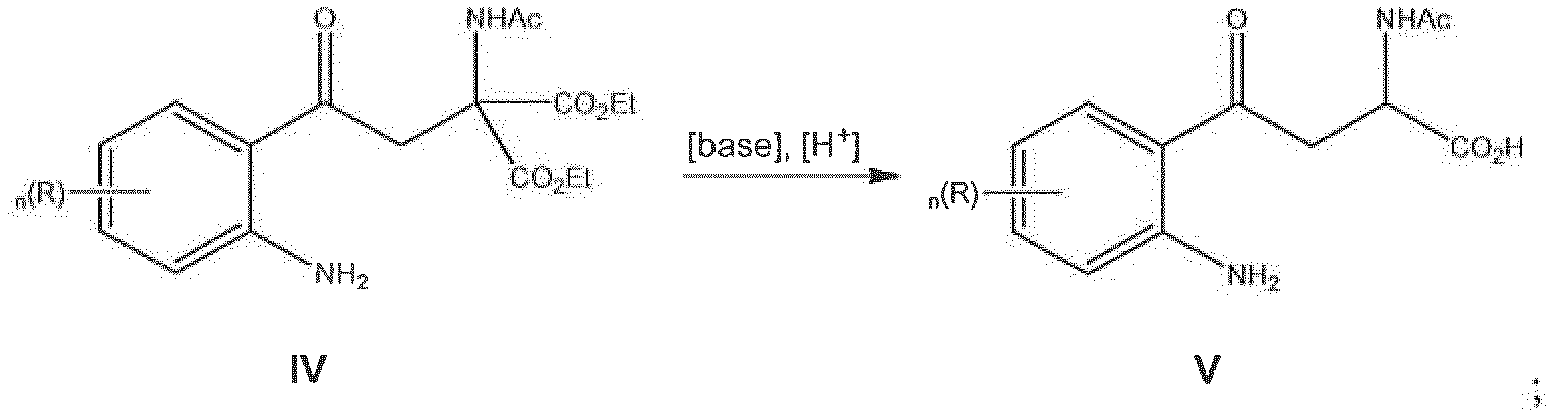
- c) decarboxylating the diethyl ester compound of Formula IV to afford an acylated kynurenine compound of Formula V:
- d) resolving the acylated kynurenine compound of Formula V with an acylase enzyme to;afford the compound of Formula I:

- In some embodiments, the enzyme is acylase I from Aspergillus melleus. In other embodiments, at least 10 g of the compound of Formula I is produced. In other embodiments, at least 100 g of the compound of Formula I is produced. In other embodiments, at least 500 g of the compound of Formula I is produced. In other embodiments, the acylating step a) comprises adding the chloroacetonitrile to a toluene solution of the aniline compound II, the boron trihalide, and the aluminum trihalide at a first temperature of 0 to 10°C followed by heating to a second temperature of 55 to 60°C. In other embodiments, the alkylating step b) is carried out in the presence of an alkali metal salt. In other embodiments, the alkali metal salt is sodium iodide.
- In another embodiment, the present disclosure provides a method of preparing a compound of Formula la:

- a) acylating 3-chloroaniline (IIa) with chloroacetonitrile in the presence of aluminum trihalide and boron trihalide to afford 1-(2-amino-4-chloro-phenyl)-2-chloro-ethanone (IIIa):

- b) alkylating 1-(2-amino-4-chloro-phenyl)-2-chloro-ethanone (IIIa) with acetamido diethyl malonate to afford 2-acetylamino-2-[2-(2-amino-4-chloro-phenyl)-2-oxoethyl]-malonic acid diethyl ester (IVa):

- c) decarboxylating 2-acetylamino-2-[2-(2-amino-4-chloro-phenyl)-2-oxo-ethyl]-malonic acid diethyl ester (IVa) to afford 2-acetylamino-4-(2-amino-4-chloro-phenyl)-4-oxo-butyric acid (Va):

- d) resolving 2-acetylamino-4-(2-amino-4-chloro-phenyl)-4-oxo-butyric acid (Va) with an acylase enzyme to the compound of Formula Ia:

- In some embodiments, the enzyme is acylase I from Aspergillus melleus. In other embodiments, at least 10 g of the compound of Formula Ia is produced. In other embodiments, at least 100 g of the compound of Formula Ia is produced. In other embodiments, at least 500 g of the compound of Formula Ia is produced. In other embodiments, the acylating step comprises adding the chloroacetonitrile to a toluene solution of the 3-chloroaniline, the boron trihalide, and the aluminum trihalide at a first temperature of 0 to 10°C followed by heating to a second temperature of 55 to 60°C. In other embodiments, the alkylating step is carried out in the presence of an alkali metal salt. In other embodiments, the alkali metal salt is sodium iodide.
- Provided are methods of preparing compounds of formula I as defined in claim 1, including chiral kynurenine compounds and related compounds.
- The term "alkyl" includes saturated aliphatic groups including straight-chain, branched-chain, cyclic groups, and combinations thereof. Examples of alkyl groups include, but are not limited to, groups such as methyl, ethyl, n-propyl, isopropyl, butyl, n-butyl, isobutyl, sec-butyl, t-butyl, pentyl, n-pentyl, hexyl, heptyl, octyl, nonyl, decyl, undecyl, dodecyl, neopentyl, cyclopropyl, cyclobutyl, cyclopentyl, cyclohexyl, and adamantyl. Cycloalkyl groups can consist of one ring, including, but not limited to, groups such as cycloheptyl, or multiple fused rings, including, but not limited to, groups such as adamantyl or norbornyl.
- "Substituted alkyl" includes alkyl groups substituted with one or more substituents including, but not limited to, groups such as halogen (fluoro, chloro, bromo, and iodo), alkoxy, acyloxy, amino, hydroxyl, mercapto, carboxy, benzyloxy, phenyl, benzyl, cyano, nitro, thioalkoxy, carboxaldehyde, carboalkoxy and carboxamide, or a functionality that can be suitably blocked, if necessary for purposes of the invention, with a protecting group. Examples of substituted alkyl groups include, but are not limited to, -CF3,-CF2CF3, and other perfluoro and perhalo groups; -CH2-OH; -CH2CH2CH(NH2)CH3, etc.
- The term "halogen," "halide," or "halo" as used herein includes the Group VIIa elements (Group 17 elements in the 1990 International Union of Pure and Applied Chemistry (IUPAC) Periodic Table, IUPAC Nomenclature of Inorganic Chemistry, Recommendations 1990) and includes fluoro, chloro, bromo, and iodo substituents.
- According to the present invention a compound of Formula I may be synthesized, or a pharmaceutically acceptable salt, polymorph, hydrate, solvate, tautomer, or stereoisomer thereof:

- wherein each R is independently selected from the group consisting of hydrogen, halogen, alkyl, and substituted alkyl; and
- wherein n = 0 to 4.
- Where a chiral center is shown, any stereoisomer is within the scope of the invention. Where an (S) isomer is disclosed, the corresponding (R) isomer is within the scope of the invention. Where an (L) isomer is disclosed, the corresponding (D) isomer is within the scope of the invention. Where an (R) isomer is disclosed, the corresponding (S) isomer is within the scope of the invention. Where a (D) isomer is disclosed, the corresponding (L) isomer is with in the scope of the invention.
- In a particular embodiment the compound is L-4-chlorokynurenine (Ia), which also is referred to by the chemical name (S)-2-amino-4-(2-amino-4-chlorophenyl)-4-oxobutanoic acid:

- Where a compound is described herein, all stereoisomers thereof are also contemplated, including diastereomers and enantiomers, as well as mixtures of stereoisomers, including, but not limited to, racemic mixtures.
- Some compounds of the present invention may exhibit polymorphism. The scope of the present invention includes a process for the synthesis of all polymorphic forms of the compound according to formula I of the invention.
- Methods of preparing a compound, for example of Formula I, or a pharmaceutically acceptable salt, polymorph, hydrate, solvate, tautomer, or stereoisomer thereof are provided:

- wherein each R is independently selected from the group consisting of hydrogen, halogen, alkyl, and substituted alkyl; and
- wherein n = 0 to 4.
- Also provided is a method of preparing a compound, for example of Formula I, or a pharmaceutically acceptable salt, polymorph, hydrate, solvate, tautomer, or stereoisomer thereof:

- wherein each R is independently selected from the group consisting of hydrogen, halogen, alkyl, and substituted alkyl; and
- wherein n = 0 - 4;
- a) acylating an aniline compound of Formula II with chloroacetonitrile in the presence of aluminum trihalide and boron trihalide to afford an acylated aniline compound of Formula III:

- b) alkylating the acylated aniline compound of Formula III with acetamido diethyl malonate to afford a diethyl ester compound of Formula IV:

- c) decarboxylating the diethyl ester compound of Formula IV to afford an acylated kynurenine compound of Formula V:

- d) resolving the acylated kynurenine compound of Formula V with an acylase enzyme to afford the compound of Formula I:

- The R enantiomers of the compounds of Formulas I are also contemplated.
- In one exemplary embodiment, the enzyme is acylase I from Aspergillus melleus. However, other acylase enzymes having similar functional, enzymatic activity would be known to persons skilled in the art.
- In another embodiment, at least 10 g of the compound of Formula I is produced using the disclosed methods. In another embodiment, at least 100 g of the compound of Formula I is produced using the disclosed methods. In a particular embodiment, at least 500 g of the compound of Formula I is produced using the disclosed methods. Alternatively or additionally, the overall yield is at least 50% or more.
- In another embodiment, the acylating step is carried out by adding chloroacetonitrile to a solution of aniline (II), boron trihalide, and aluminum trihalide in toluene at a temperature of about 0 to 10°C followed by heating the reaction mixture to a temperature of about 55 to 60°C.
- In another embodiment, the alkylating step is carried out in the presence of an alkali metal salt. Examples of such salts are the chloride, bromide, and iodide salts of sodium or potassium. In a preferred embodiment, the alkali metal salt is sodium iodide.
- In another embodiment, provided is a method of preparing a compound of Formula Ia or a pharmaceutically acceptable salt, polymorph, hydrate, solvate, tautomer, or stereoisomer thereof:

- a) acylating 3-chloroaniline (IIa) with chloroacetonitrile in the presence of aluminum trihalide and boron trihalide to afford 1-(2-amino-4-chloro-phenyl)-2-chloro-ethanone (IIIa):

- b) alkylating 1-(2-amino-4-chloro-phenyl)-2-chloro-ethanone (IIIa) with acetamido diethyl malonate to afford 2-acetylamino-2-[2-(2-amino-4-chloro-phenyl)-2-oxoethyl]-malonic acid diethyl ester (IVa):

- c) decarboxylating 2-acetylamino-2-[2-(2-amino-4-chloro-phenyl)-2-oxo-ethyl]-malonic acid diethyl ester (IVa) to afford 2-acetylamino-4-(2-amino-4-chloro-phenyl)-4-oxo-butyric acid (Va):

- d) resolving 2-acetylamino-4-(2-amino-4-chloro-phenyl)-4-oxo-butyric acid (Va) with an acylase enzyme to afford the compound of Formula la:

- The R enantiomers of the compounds of Formulas Ia are also contemplated.
- In one exemplary embodiment, the enzyme is acylase I from Aspergillus melleus. However, other acylase enzymes having similar functional, enzymatic activity would be known to persons skilled in the art.
- In another embodiment, at least 10 g of the compound of Formula Ia is produced using the disclosed methods. In another embodiment, at least 100 g of the compound of Formula Ia is produced using the disclosed methods. In a particular embodiment, at least 500 g of the compound of Formula Ia is produced using the disclosed methods. Alternatively or additionally, the overall yield is at least 50% or more.
- In another embodiment, the acylating step is carried out by adding chloroacetonitrile to a solution of aniline (IIa), boron trihalide, and aluminum trihalide in toluene at a temperature of about 0 to 10°C followed by heating the reaction mixture to a temperature of about 55 to 60°C.
- In another embodiment, the alkylating step is carried out in the presence of an alkali metal salt. Examples of such salts are the chloride, bromide, and iodide salts of sodium or potassium. In a preferred embodiment, the alkali metal salt is sodium iodide.
- In certain embodiments, the methods allow for the production of compositions comprising compound of Formulas I or Ia in high purity, or in high enantiomeric excess. In some embodiments, a the composition comprising the compound of Formulas I or Ia is provided in a range of about 95% to about 100% for both chemical purity and enantiomeric excess. In some embodiments, a the composition comprising the compound of Formulas I or Ia is provided with about 70%, 75%, 80%, 81%, 82%, 83%, 84%, 85%, 86%, 87%, 88%, 89%, 90%, 91%, 92%, 93%, 94%, 95%, 96%, 97%, 98%, 99%, or 100% purity. In other embodiments, compositions comprising the compound of Formulas I or Ia have a high enantiomeric purity of a desired enantiomer in about 70%, 75%, 80%, 81%, 82%, 83%, 84%, 85%, 86%, 87%, 88%, 89%, 90%, 91%, 92%, 93%, 94%, 95%, 96%, 97%, 98%, 99%, and 100% enantiomeric excess (ee).
- The invention will be further understood by the following non-limiting examples.
- Reagents and solvents were used as received from commercial suppliers. HPLC analyses were performed using a TSP-SpectraSYSTEM HPLC in a Water Symmetry Shield RP18, 75 x 4.6 mm. Solvents, water/acetonitrile/0.1 % TFA in water-acetonitrile (9:1); gradient, 80:10:10 to 0:90:10 in 12 min then 80:10:10; flow rate, 1 ml/min; wavelength, 230 nm. Enantiomeric excess was determined by TSP-SpectraSYSTEM HPLC on a Chirobiotic T, 250 x 4.6 mm. Solvents, water/ethanol 1:1; flow rate, 1 ml/min; wavelength, 230 nm; t R 6.13 for L-isomer and 15.60 min for D-isomer. HPLC analyses are reported in area %.
- At a jacket temperature of 0°C, 1 M BCl3 in dichloromethane (45 L, 45 mol, 1.1 equiv) was transferred into the reactor and toluene (13 L) was added. At -5 to 3°C a solution of 3-chloroaniline (IIa, 4.5 L, 42 mol) in toluene (39 L) was added over 38 min followed after 31 min by aluminum trichloride (5.8 kg, 43 mol, 1.0 equiv). After 3 min, a solution of chloroacetonitrile (3.4 L, 54 mol, 1.3 equiv) in toluene (3.4 L) was added at -4 to 6°C during 10 min. Heating to 65°C at a maximal jacket temperature of 100°C took 47 min, the mixture was stirred at 65°C overnight. The reaction mixture was added to IN aqueous HCl (81 L) over 41 min at 43°C and stirred for 30 min at 48°C. After cooling to 20°C, the phases were separated and the aqueous phase was extracted twice with dichloromethane (2 x 40 L). The combined organic phases were washed with water (20.5 L). Dichloromethane (75 L) was removed by distillation under reduced pressure (jacket temperature 45°C) and heptane (55 L) was added to the solution at 40°C. Cooling to 5°C, filtration, and washing with heptane (15 L) led to isolation of 1-(2-amino-4-chloro-phenyl)-2-chloro-ethanone (IIIa, 2.5 kg, 12 mol, 29% yield, 99.2 % a/a HPLC).
- To a solution of acetamido diethyl malonate (5.87 kg, 27.0 mol, 1.01 equiv) in ethanol (31.5 L) was added 21% sodium ethoxide in ethanol (12.1 L, 32.4 mol, 1.21 equiv) at 22°C. A mixture of 1-(2-amino-4-chloro-phenyl)-2-chloro-ethanone (IIIa, 5.44 kg, 26.7 mol), sodium iodide (0.60 kg, 4.0 mol, 0.15 equiv), ethanol (17 L), and tetrahydrofuran (THF, 17 L) was dosed into the reactor at 40°C and stirring was continued for 2 h at 45°C. Water (36 L) was added after evaporation of the reaction mixture to 45% of the original volume and the aqueous phase was extracted twice with dichloromethane (34.5 L, 20 L). The combined organic phases were washed with water (14 L). After removal of 25% of the original volume by distillation under reduced pressure, isopropanol (32 L) was added and 50% thereof distilled off. At 60°C, heptane (11 L) was added. Cooling the mixture to 5°C, filtration and washing with isopropanol/heptane 1:1 (15 L) afforded 2-acetylamino-2-[2-(2-amino-4-chloro-phenyl)-2-oxo-ethyl]-malonic acid diethyl ester (IVa, 5.86 kg, 15.2 mol, 57% yield, 99.5 % a/a HPLC).
- A solution of 2-acetylamino-2-[2-(2-amino-4-chloro-phenyl)-2-oxo-ethyl]-malonic acid diethyl ester (IVa, 5.80 kg, 15.1 mol) in water (3.8 L), dioxane (55 L) and 30% NaOH (7.7 L, 76.8 mol, 5.09 equiv) was heated to reflux at a jacket temperature of 110°C for 45 min. Acetic acid (12.0 L) was added at 65 - 70°C and the suspension was heated to reflux while maintaining a jacket temperature of 110°C for 1.5 h. Saturated aqueous NaCl (30 L) and ethyl acetate (54 L) were added at 20°C, the phases separated, and the aqueous phase was extracted with ethyl acetate/dioxane 1:1 (40 L). The combined organic phases were then washed with a saturated aqueous solution of NaCl (14.5 L). The organic phase was evaporated to dryness (the product crystallized prior to complete evaporation) and stripped with ethanol (15.5 L) to afford 2-acetylamino-4-(2-amino-4-chloro-phenyl)-4-oxo-butyric acid (Va, 3.65 kg, 12.8 mol, 85% yield, 92.7 % a/a HPLC).
- A solution of 2-acetylamino-4-(2-amino-4-chloro-phenyl)-4-oxo-butyric acid (Va, 3.57 kg, 12.6 mol) in water (52 L) and 0.1 M cobalt(II) chloride solution (108 mL, 0.01 mol) was heated to 35°C. Addition of 5 M LiOH in water (2.55 L, 12.8 mol, 1.02 equiv) gave a solution (pH = 8.5) to which Acylase I (0.79 kg) in water (3.0 L) was added (pH = 7.3). The pH was adjusted to 8.6 by addition of 5 M LiOH in water (0.21 L) and stirred for 19 h. Ethyl acetate/THF 1:1 (15.5 L) was added at 20°C and the mixture acidified with 32% aqueous HCl (2.1 L). The layers were separated and the aqueous phase was filtered via a Zetacarbon and inline filter. The organic phase was extracted twice with 0.1 N HCl (2 x 11 L). The filtrate was extracted twice with ethyl acetate/THF (2 x 13.5 L). The aqueous layer was also filtered via a Zetacarbon and inline filter. Butanol (8.0 L) was added and the volume reduced to 7 L by azeotropic distillation at reduced pressure. The pH was adjusted to 6.2 by addition of 5 M LiOH (3.7 L) and 32% aqueous HCl (0.5 L). Cooling to 5°C, filtration and washing with water (2 x 1.5 L) provided crude L-4-chlorokynurenine (Ia). Dissolution of L-4-chlorokynurenine (Ia) in water (4.0 L) and 5 M LiOH (1.4 L) at pH = 11 to 12, filtration of the residue, washing with 0.1 M LiOH (2 x 0.33 L) and readjusting the pH to 6.2 by addition of 32% aqueous HCl (0.8 L) led to a suspension. Filtration and washing the filter cake with water (2 x 1.0 L) and ethanol (1.0 L) afforded L-4-chlorokynurenine (la, 605 g, 2.49 mol, 19.8% yield, 98.8% a/a HPLC).
Claims (14)
- A method of preparing a compound of Formula I or a pharmaceutically acceptable salt, polymorph, hydrate, solvate, tautomer, or stereoisomer thereof:
 wherein each R is independently selected from the group consisting of hydrogen, halogen, alkyl, and substituted alkyl; andwherein n = 0 - 4, and wherein alkyl includes saturated aliphatic groups including straight-chain, branched-chain, cyclic groups, and combinations thereof;the method comprising:a) acylating an aniline compound of Formula II with chloroacetonitrile in the presence of aluminum trihalide and boron trihalide to afford an acylated aniline compound of Formula III:
 b) alkylating the acylated aniline compound of Formula III with acetamido diethyl malonate to afford a diethyl ester compound of Formula IV:
 c) decarboxylating the diethyl ester compound of Formula IV to afford an acylated kynurenine compound of Formula V:
 and d) resolving the acylated kynurenine compound of Formula V with an acylase enzyme to afford the compound of Formula I:
- The method of claim 1, wherein the acylase enzyme is acylase I from Aspergillus melleus.
- The method of claim 1, wherein at least 10 g of the compound of Formula I is produced.
- The method of claim 1, wherein the acylating step a) comprises adding the chloroacetonitrile to a toluene solution of the aniline compound II, the boron trihalide, and the aluminum trihalide at a first temperature of 0 to 10°C followed by heating to a second temperature of 55 to 60°C.
- The method of claim 1, wherein the alkylating step b) is carried out in the presence of an alkali metal salt.
- The method of claim 5, wherein the alkali metal salt is sodium iodide.
- The method of claim 1, wherein the compound of Formula I is a compound of Formula la or a pharmaceutically acceptable salt, polymorph, hydrate, solvate, tautomer, or stereoisomer thereof:
 a) acylating 3-chloroaniline (IIa) with chloroacetonitrile in the presence of aluminum trihalide and boron trihalide to afford I-(2-amino-4-chloro-phenyl)-2-chloro-ethanone (IIIa):
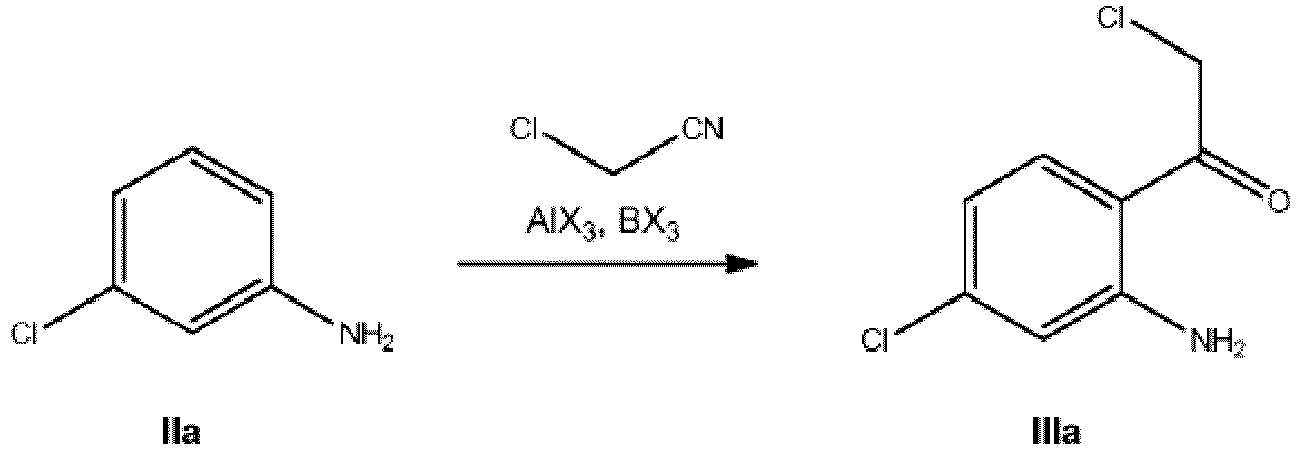 b) alkylating 1-(2-amino-4-chloro-phenyl)-2-chloro-ethanone (Ilia) with acetamido diethyl malonate to afford 2-acetylamino-2-[2-(2-amino-4-chloro-phenyl)-2-oxoethyl]-malonic acid diethyl ester (IV a):
 c) decarboxylating 2-acetylamino-2-[2-(2-amino-4-chloro-phenyl)-2-oxo-ethyl]-malonic acid diethyl ester (IVa) to afford 2-acetylamino-4-(2-amino-4-chlorophenyl)-4- butyric acid (Va):
 and d) resolving 2-acetylamino-4-(2-amino-4-chloro-phenyl)-4-oxo-butyric acid (Va) with an acylase enzyme to the compound of Formula la: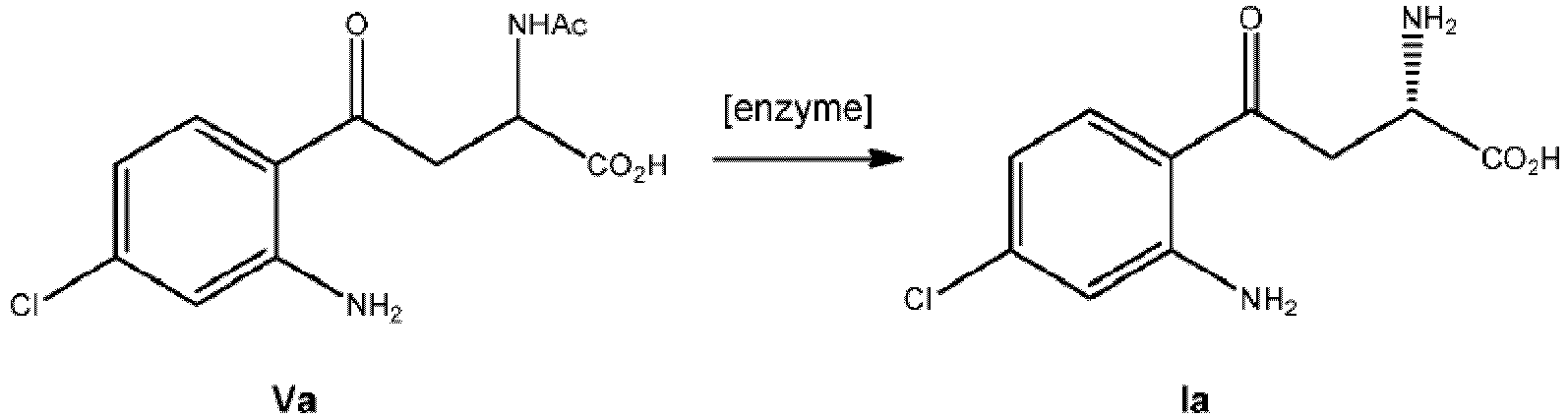
- The method of claim 7, wherein the acylase enzyme is acylase I from Aspergillus melleus.
- The method of claim 7, wherein at least 10 g of the compound of Formula la is produced.
- The method of claim 9, wherein at least 100 g of the compound of Formula la is produced.
- The method of claim 10, wherein at least 500 g of the compound of Formula la is produced.
- The method of claim 7, wherein the acylating step comprises adding the chloroacetonitrile to a toluene solution of the 3-chloroaniline, the boron trihalide, and the aluminum trihalide at a first temperature of 0 to 10°C followed by heating to a second temperature of 55 to 60°C.
- The method of claim 7, the alkylating step is carried out in the presence of an alkali metal salt, in particular in the presence of sodium iodide.
- 2-Acetylamino-4-(2-amino-4-chloro-phenyl)-4-oxo-butyric acid (Va).
Applications Claiming Priority (2)
| Application Number | Priority Date | Filing Date | Title |
|---|---|---|---|
| US201361785807P | 2013-03-14 | 2013-03-14 | |
| PCT/US2014/027694 WO2014152752A1 (en) | 2013-03-14 | 2014-03-14 | Methods for the synthesis of chiral kynurenine compounds |
Publications (3)
| Publication Number | Publication Date |
|---|---|
| EP2970097A1 EP2970097A1 (en) | 2016-01-20 |
| EP2970097A4 EP2970097A4 (en) | 2016-11-16 |
| EP2970097B1 true EP2970097B1 (en) | 2018-10-31 |
Family
ID=51581307
Family Applications (1)
| Application Number | Title | Priority Date | Filing Date |
|---|---|---|---|
| EP14770640.2A Not-in-force EP2970097B1 (en) | 2013-03-14 | 2014-03-14 | Methods for the synthesis of chiral kynurenine compounds |
Country Status (6)
| Country | Link |
|---|---|
| US (2) | US9834801B2 (en) |
| EP (1) | EP2970097B1 (en) |
| JP (2) | JP6340409B2 (en) |
| CN (2) | CN107417558A (en) |
| CA (1) | CA2941559A1 (en) |
| WO (1) | WO2014152752A1 (en) |
Families Citing this family (9)
| Publication number | Priority date | Publication date | Assignee | Title |
|---|---|---|---|---|
| WO2014152752A1 (en) * | 2013-03-14 | 2014-09-25 | Vistagen Therapeutics, Inc. | Methods for the synthesis of chiral kynurenine compounds |
| JP2018521007A (en) | 2015-05-22 | 2018-08-02 | ヴィスタゲン セラピューティクス、インコーポレイテッド | Therapeutic use of L-4-chlorokynurenine |
| CA2996308A1 (en) * | 2015-09-08 | 2017-03-16 | Cephalon, Inc. | Prodrugs of chlorokynurenines |
| US20190201360A1 (en) * | 2016-08-31 | 2019-07-04 | Ampio Pharmaceuticals, Inc. | Treatment of disease with n-acetyl kynurenine |
| WO2018180116A1 (en) | 2017-03-29 | 2018-10-04 | 富士フイルム株式会社 | Structure and optical sensor |
| EP3749638B1 (en) | 2018-02-09 | 2023-04-05 | Vistagen Therapeutics, Inc. | Synthesis of 4-chlorokynurenines and intermediates |
| CN113549662B (en) * | 2020-04-26 | 2022-06-03 | 赤壁市高质量发展研究院有限公司 | Method for efficiently preparing antidepressant prodrug L-4-Cl-kynurenine by using MOF enzyme-carrying technology and application thereof |
| CN113549661B (en) * | 2020-04-26 | 2022-08-30 | 赤壁生合元科技有限公司 | Method for synthesizing L-4-Cl-kynurenine or L-4-Br-kynurenine through biocatalysis and application |
| JPWO2024004580A1 (en) | 2022-06-30 | 2024-01-04 |
Family Cites Families (10)
| Publication number | Priority date | Publication date | Assignee | Title |
|---|---|---|---|---|
| US3702255A (en) * | 1970-08-21 | 1972-11-07 | Us Agriculture | Kynurenine derivatives as sweetening agents |
| US3766261A (en) | 1970-08-21 | 1973-10-16 | Us Agriculture | Process of producing kynurenine |
| US3765261A (en) * | 1973-01-02 | 1973-10-16 | Hurst Performance | Unitary stick transfer case shifter |
| US5519055A (en) | 1993-08-06 | 1996-05-21 | University Of Maryland At Baltimore | Substituted kynurenines and process for their preparation |
| US5789434A (en) * | 1994-11-15 | 1998-08-04 | Bayer Corporation | Derivatives of substituted 4-biarylbutyric acid as matrix metalloprotease inhibitors |
| GB9522615D0 (en) * | 1995-11-03 | 1996-01-03 | Pharmacia Spa | 4-Phenyl-4-oxo-butanoic acid derivatives with kynurenine-3-hydroxylase inhibiting activity |
| ITMI20041626A1 (en) | 2004-08-06 | 2004-11-06 | Roberto Pellicciari | QUINURENIN-AMINO-TRANSFERASE INHIBITORS |
| US7622495B2 (en) * | 2006-10-03 | 2009-11-24 | Neurim Pharmaceuticals (1991) Ltd. | Substituted aryl-indole compounds and their kynurenine/kynuramine-like metabolites as therapeutic agents |
| JP5232247B2 (en) * | 2008-12-11 | 2013-07-10 | 東洋紡株式会社 | L-succinylaminoacylase and method for producing L-amino acid using the same |
| WO2014152752A1 (en) | 2013-03-14 | 2014-09-25 | Vistagen Therapeutics, Inc. | Methods for the synthesis of chiral kynurenine compounds |
-
2014
- 2014-03-14 WO PCT/US2014/027694 patent/WO2014152752A1/en not_active Ceased
- 2014-03-14 CA CA2941559A patent/CA2941559A1/en not_active Abandoned
- 2014-03-14 CN CN201710718531.8A patent/CN107417558A/en active Pending
- 2014-03-14 JP JP2016502520A patent/JP6340409B2/en not_active Expired - Fee Related
- 2014-03-14 US US14/775,287 patent/US9834801B2/en active Active
- 2014-03-14 EP EP14770640.2A patent/EP2970097B1/en not_active Not-in-force
- 2014-03-14 CN CN201480023992.8A patent/CN105164100B/en not_active Expired - Fee Related
-
2017
- 2017-11-14 US US15/812,599 patent/US10294502B2/en active Active
-
2018
- 2018-05-14 JP JP2018093249A patent/JP6618569B2/en not_active Expired - Fee Related
Non-Patent Citations (1)
| Title |
|---|
| None * |
Also Published As
| Publication number | Publication date |
|---|---|
| CN107417558A (en) | 2017-12-01 |
| JP2016513709A (en) | 2016-05-16 |
| CN105164100A (en) | 2015-12-16 |
| US20180171372A1 (en) | 2018-06-21 |
| JP6618569B2 (en) | 2019-12-11 |
| EP2970097A1 (en) | 2016-01-20 |
| US9834801B2 (en) | 2017-12-05 |
| CN105164100B (en) | 2017-09-15 |
| CA2941559A1 (en) | 2014-09-25 |
| JP6340409B2 (en) | 2018-06-06 |
| US10294502B2 (en) | 2019-05-21 |
| JP2018139608A (en) | 2018-09-13 |
| HK1218414A1 (en) | 2017-02-17 |
| WO2014152752A1 (en) | 2014-09-25 |
| US20160032334A1 (en) | 2016-02-04 |
| EP2970097A4 (en) | 2016-11-16 |
Similar Documents
| Publication | Publication Date | Title |
|---|---|---|
| US10294502B2 (en) | Methods for the synthesis of chiral kynurenine compounds | |
| US20070185337A1 (en) | Process for the preparation of optically pure 4-hydroxy-2-oxo-1-pyrrolidine acetamide | |
| US8604241B2 (en) | Method for synthesis of (1S, 2R)-milnacipran | |
| US20090088577A1 (en) | Production of monatin enantiomers | |
| KR101036536B1 (en) | Synthesis of (S)-(+)-3- (aminomethyl) -5-methyl hexanoic acid | |
| CA2914381A1 (en) | An efficient process for separation of diastereomers of 9-[(r)-2-[[(r,s)-[[(s)-1-(isopropoxycarbonyl)ethyl]amino]-phenoxyphosphinyl] methoxy]propyl]adenine | |
| CN117886708A (en) | A kind of synthetic method of milobalin besylate | |
| WO2015145467A1 (en) | An improved process for preparing vildagliptin | |
| JP2008545683A (en) | Process for the dynamic resolution of (substituted) (R)-or (S) -mandelic acid | |
| KR102255357B1 (en) | A process for the preparation of 2-amino-1,3-propane diol compounds and salts thereof | |
| KR101304640B1 (en) | Novel n-methylbenzylamine salt of rosuvastatin and process for the preparation thereof | |
| JP2013173677A (en) | Method for producing (1r,2s)-1-amino-2-vinyl cyclopropane carboxylic acid ester | |
| JP2008115178A (en) | PRODUCTION METHOD OF DIPHENYLALANINE-Ni(II) COMPLEX | |
| JPWO2009063804A1 (en) | Process for producing N-carbamoyl-tert-leucine | |
| JP3902384B2 (en) | Method for purifying optically active α-methyl-bis-3,5- (trifluoromethyl) benzylamines | |
| HK1247605A1 (en) | Methods for the synthesis of chiral kynurenine compounds | |
| HK1218414B (en) | Methods for the synthesis of chiral kynurenine compounds | |
| US9828334B2 (en) | Process for preparing levomilnacipran | |
| WO2017019791A1 (en) | Synthesis of (s)-pregabalin | |
| JP4126921B2 (en) | Process for producing optically active β-phenylalanine derivative | |
| JP2014031327A (en) | Production method of optically active cis-2-amino-cyclohexane carboxylic acid derivative and precursor of the same | |
| CN103450066A (en) | Preparation method of Telaprevir intermediate | |
| JP2008115179A (en) | Production method of optically active 2-[(n-benzylprolyl)amino]benzophenone compound | |
| WO2010079605A1 (en) | Process for producing high-purity 1-benzyl-3-aminopyrrolidine | |
| JP2008260714A (en) | Process for producing optically active haloalcohols |
Legal Events
| Date | Code | Title | Description |
|---|---|---|---|
| PUAI | Public reference made under article 153(3) epc to a published international application that has entered the european phase |
Free format text: ORIGINAL CODE: 0009012 |
|
| 17P | Request for examination filed |
Effective date: 20151014 |
|
| AK | Designated contracting states |
Kind code of ref document: A1 Designated state(s): AL AT BE BG CH CY CZ DE DK EE ES FI FR GB GR HR HU IE IS IT LI LT LU LV MC MK MT NL NO PL PT RO RS SE SI SK SM TR |
|
| AX | Request for extension of the european patent |
Extension state: BA ME |
|
| DAX | Request for extension of the european patent (deleted) | ||
| RIN1 | Information on inventor provided before grant (corrected) |
Inventor name: BREITENMOSER, ROLAND, A. Inventor name: ABELE, STEFAN Inventor name: LAUE, KLAUS |
|
| A4 | Supplementary search report drawn up and despatched |
Effective date: 20161014 |
|
| RIC1 | Information provided on ipc code assigned before grant |
Ipc: C07C 207/00 20060101ALI20161007BHEP Ipc: C07C 205/00 20060101AFI20161007BHEP |
|
| STAA | Information on the status of an ep patent application or granted ep patent |
Free format text: STATUS: EXAMINATION IS IN PROGRESS |
|
| 17Q | First examination report despatched |
Effective date: 20170919 |
|
| GRAP | Despatch of communication of intention to grant a patent |
Free format text: ORIGINAL CODE: EPIDOSNIGR1 |
|
| STAA | Information on the status of an ep patent application or granted ep patent |
Free format text: STATUS: GRANT OF PATENT IS INTENDED |
|
| RIC1 | Information provided on ipc code assigned before grant |
Ipc: C07C 221/00 20060101AFI20180308BHEP Ipc: C07C 225/22 20060101ALI20180308BHEP Ipc: C07C 231/12 20060101ALI20180308BHEP Ipc: C07C 233/47 20060101ALI20180308BHEP Ipc: C12P 13/04 20060101ALI20180308BHEP |
|
| INTG | Intention to grant announced |
Effective date: 20180328 |
|
| GRAS | Grant fee paid |
Free format text: ORIGINAL CODE: EPIDOSNIGR3 |
|
| GRAJ | Information related to disapproval of communication of intention to grant by the applicant or resumption of examination proceedings by the epo deleted |
Free format text: ORIGINAL CODE: EPIDOSDIGR1 |
|
| GRAL | Information related to payment of fee for publishing/printing deleted |
Free format text: ORIGINAL CODE: EPIDOSDIGR3 |
|
| STAA | Information on the status of an ep patent application or granted ep patent |
Free format text: STATUS: EXAMINATION IS IN PROGRESS |
|
| REG | Reference to a national code |
Ref country code: DE Ref legal event code: R079 Ref document number: 602014035163 Country of ref document: DE Free format text: PREVIOUS MAIN CLASS: C07C0205000000 Ipc: C07C0221000000 |
|
| GRAP | Despatch of communication of intention to grant a patent |
Free format text: ORIGINAL CODE: EPIDOSNIGR1 |
|
| STAA | Information on the status of an ep patent application or granted ep patent |
Free format text: STATUS: GRANT OF PATENT IS INTENDED |
|
| INTC | Intention to grant announced (deleted) | ||
| RIC1 | Information provided on ipc code assigned before grant |
Ipc: C07C 225/22 20060101ALI20180801BHEP Ipc: C07C 231/12 20060101ALI20180801BHEP Ipc: C12P 13/04 20060101ALI20180801BHEP Ipc: C07C 221/00 20060101AFI20180801BHEP Ipc: C07C 233/47 20060101ALI20180801BHEP |
|
| INTG | Intention to grant announced |
Effective date: 20180814 |
|
| GRAA | (expected) grant |
Free format text: ORIGINAL CODE: 0009210 |
|
| STAA | Information on the status of an ep patent application or granted ep patent |
Free format text: STATUS: THE PATENT HAS BEEN GRANTED |
|
| AK | Designated contracting states |
Kind code of ref document: B1 Designated state(s): AL AT BE BG CH CY CZ DE DK EE ES FI FR GB GR HR HU IE IS IT LI LT LU LV MC MK MT NL NO PL PT RO RS SE SI SK SM TR |
|
| REG | Reference to a national code |
Ref country code: CH Ref legal event code: EP Ref country code: GB Ref legal event code: FG4D |
|
| REG | Reference to a national code |
Ref country code: AT Ref legal event code: REF Ref document number: 1059203 Country of ref document: AT Kind code of ref document: T Effective date: 20181115 |
|
| REG | Reference to a national code |
Ref country code: IE Ref legal event code: FG4D |
|
| REG | Reference to a national code |
Ref country code: DE Ref legal event code: R096 Ref document number: 602014035163 Country of ref document: DE |
|
| REG | Reference to a national code |
Ref country code: NL Ref legal event code: FP |
|
| REG | Reference to a national code |
Ref country code: LT Ref legal event code: MG4D |
|
| REG | Reference to a national code |
Ref country code: AT Ref legal event code: MK05 Ref document number: 1059203 Country of ref document: AT Kind code of ref document: T Effective date: 20181031 Ref country code: CH Ref legal event code: NV Representative=s name: SCHMAUDER AND PARTNER AG PATENT- UND MARKENANW, CH |
|
| PG25 | Lapsed in a contracting state [announced via postgrant information from national office to epo] |
Ref country code: PL Free format text: LAPSE BECAUSE OF FAILURE TO SUBMIT A TRANSLATION OF THE DESCRIPTION OR TO PAY THE FEE WITHIN THE PRESCRIBED TIME-LIMIT Effective date: 20181031 Ref country code: NO Free format text: LAPSE BECAUSE OF FAILURE TO SUBMIT A TRANSLATION OF THE DESCRIPTION OR TO PAY THE FEE WITHIN THE PRESCRIBED TIME-LIMIT Effective date: 20190131 Ref country code: HR Free format text: LAPSE BECAUSE OF FAILURE TO SUBMIT A TRANSLATION OF THE DESCRIPTION OR TO PAY THE FEE WITHIN THE PRESCRIBED TIME-LIMIT Effective date: 20181031 Ref country code: LT Free format text: LAPSE BECAUSE OF FAILURE TO SUBMIT A TRANSLATION OF THE DESCRIPTION OR TO PAY THE FEE WITHIN THE PRESCRIBED TIME-LIMIT Effective date: 20181031 Ref country code: AT Free format text: LAPSE BECAUSE OF FAILURE TO SUBMIT A TRANSLATION OF THE DESCRIPTION OR TO PAY THE FEE WITHIN THE PRESCRIBED TIME-LIMIT Effective date: 20181031 Ref country code: BG Free format text: LAPSE BECAUSE OF FAILURE TO SUBMIT A TRANSLATION OF THE DESCRIPTION OR TO PAY THE FEE WITHIN THE PRESCRIBED TIME-LIMIT Effective date: 20190131 Ref country code: IS Free format text: LAPSE BECAUSE OF FAILURE TO SUBMIT A TRANSLATION OF THE DESCRIPTION OR TO PAY THE FEE WITHIN THE PRESCRIBED TIME-LIMIT Effective date: 20190228 Ref country code: ES Free format text: LAPSE BECAUSE OF FAILURE TO SUBMIT A TRANSLATION OF THE DESCRIPTION OR TO PAY THE FEE WITHIN THE PRESCRIBED TIME-LIMIT Effective date: 20181031 Ref country code: FI Free format text: LAPSE BECAUSE OF FAILURE TO SUBMIT A TRANSLATION OF THE DESCRIPTION OR TO PAY THE FEE WITHIN THE PRESCRIBED TIME-LIMIT Effective date: 20181031 Ref country code: LV Free format text: LAPSE BECAUSE OF FAILURE TO SUBMIT A TRANSLATION OF THE DESCRIPTION OR TO PAY THE FEE WITHIN THE PRESCRIBED TIME-LIMIT Effective date: 20181031 |
|
| PG25 | Lapsed in a contracting state [announced via postgrant information from national office to epo] |
Ref country code: RS Free format text: LAPSE BECAUSE OF FAILURE TO SUBMIT A TRANSLATION OF THE DESCRIPTION OR TO PAY THE FEE WITHIN THE PRESCRIBED TIME-LIMIT Effective date: 20181031 Ref country code: AL Free format text: LAPSE BECAUSE OF FAILURE TO SUBMIT A TRANSLATION OF THE DESCRIPTION OR TO PAY THE FEE WITHIN THE PRESCRIBED TIME-LIMIT Effective date: 20181031 Ref country code: GR Free format text: LAPSE BECAUSE OF FAILURE TO SUBMIT A TRANSLATION OF THE DESCRIPTION OR TO PAY THE FEE WITHIN THE PRESCRIBED TIME-LIMIT Effective date: 20190201 Ref country code: SE Free format text: LAPSE BECAUSE OF FAILURE TO SUBMIT A TRANSLATION OF THE DESCRIPTION OR TO PAY THE FEE WITHIN THE PRESCRIBED TIME-LIMIT Effective date: 20181031 Ref country code: PT Free format text: LAPSE BECAUSE OF FAILURE TO SUBMIT A TRANSLATION OF THE DESCRIPTION OR TO PAY THE FEE WITHIN THE PRESCRIBED TIME-LIMIT Effective date: 20190301 |
|
| PG25 | Lapsed in a contracting state [announced via postgrant information from national office to epo] |
Ref country code: DK Free format text: LAPSE BECAUSE OF FAILURE TO SUBMIT A TRANSLATION OF THE DESCRIPTION OR TO PAY THE FEE WITHIN THE PRESCRIBED TIME-LIMIT Effective date: 20181031 Ref country code: IT Free format text: LAPSE BECAUSE OF FAILURE TO SUBMIT A TRANSLATION OF THE DESCRIPTION OR TO PAY THE FEE WITHIN THE PRESCRIBED TIME-LIMIT Effective date: 20181031 Ref country code: CZ Free format text: LAPSE BECAUSE OF FAILURE TO SUBMIT A TRANSLATION OF THE DESCRIPTION OR TO PAY THE FEE WITHIN THE PRESCRIBED TIME-LIMIT Effective date: 20181031 |
|
| REG | Reference to a national code |
Ref country code: DE Ref legal event code: R097 Ref document number: 602014035163 Country of ref document: DE |
|
| PG25 | Lapsed in a contracting state [announced via postgrant information from national office to epo] |
Ref country code: RO Free format text: LAPSE BECAUSE OF FAILURE TO SUBMIT A TRANSLATION OF THE DESCRIPTION OR TO PAY THE FEE WITHIN THE PRESCRIBED TIME-LIMIT Effective date: 20181031 Ref country code: EE Free format text: LAPSE BECAUSE OF FAILURE TO SUBMIT A TRANSLATION OF THE DESCRIPTION OR TO PAY THE FEE WITHIN THE PRESCRIBED TIME-LIMIT Effective date: 20181031 Ref country code: SM Free format text: LAPSE BECAUSE OF FAILURE TO SUBMIT A TRANSLATION OF THE DESCRIPTION OR TO PAY THE FEE WITHIN THE PRESCRIBED TIME-LIMIT Effective date: 20181031 Ref country code: SK Free format text: LAPSE BECAUSE OF FAILURE TO SUBMIT A TRANSLATION OF THE DESCRIPTION OR TO PAY THE FEE WITHIN THE PRESCRIBED TIME-LIMIT Effective date: 20181031 |
|
| PLBE | No opposition filed within time limit |
Free format text: ORIGINAL CODE: 0009261 |
|
| STAA | Information on the status of an ep patent application or granted ep patent |
Free format text: STATUS: NO OPPOSITION FILED WITHIN TIME LIMIT |
|
| 26N | No opposition filed |
Effective date: 20190801 |
|
| PG25 | Lapsed in a contracting state [announced via postgrant information from national office to epo] |
Ref country code: MC Free format text: LAPSE BECAUSE OF FAILURE TO SUBMIT A TRANSLATION OF THE DESCRIPTION OR TO PAY THE FEE WITHIN THE PRESCRIBED TIME-LIMIT Effective date: 20181031 Ref country code: SI Free format text: LAPSE BECAUSE OF FAILURE TO SUBMIT A TRANSLATION OF THE DESCRIPTION OR TO PAY THE FEE WITHIN THE PRESCRIBED TIME-LIMIT Effective date: 20181031 |
|
| PG25 | Lapsed in a contracting state [announced via postgrant information from national office to epo] |
Ref country code: LU Free format text: LAPSE BECAUSE OF NON-PAYMENT OF DUE FEES Effective date: 20190314 |
|
| REG | Reference to a national code |
Ref country code: BE Ref legal event code: MM Effective date: 20190331 |
|
| PG25 | Lapsed in a contracting state [announced via postgrant information from national office to epo] |
Ref country code: IE Free format text: LAPSE BECAUSE OF NON-PAYMENT OF DUE FEES Effective date: 20190314 |
|
| PG25 | Lapsed in a contracting state [announced via postgrant information from national office to epo] |
Ref country code: BE Free format text: LAPSE BECAUSE OF NON-PAYMENT OF DUE FEES Effective date: 20190331 |
|
| PG25 | Lapsed in a contracting state [announced via postgrant information from national office to epo] |
Ref country code: TR Free format text: LAPSE BECAUSE OF FAILURE TO SUBMIT A TRANSLATION OF THE DESCRIPTION OR TO PAY THE FEE WITHIN THE PRESCRIBED TIME-LIMIT Effective date: 20181031 |
|
| PGFP | Annual fee paid to national office [announced via postgrant information from national office to epo] |
Ref country code: GB Payment date: 20200327 Year of fee payment: 7 Ref country code: DE Payment date: 20200327 Year of fee payment: 7 Ref country code: NL Payment date: 20200326 Year of fee payment: 7 |
|
| PG25 | Lapsed in a contracting state [announced via postgrant information from national office to epo] |
Ref country code: MT Free format text: LAPSE BECAUSE OF NON-PAYMENT OF DUE FEES Effective date: 20190314 |
|
| PGFP | Annual fee paid to national office [announced via postgrant information from national office to epo] |
Ref country code: FR Payment date: 20200325 Year of fee payment: 7 |
|
| PGFP | Annual fee paid to national office [announced via postgrant information from national office to epo] |
Ref country code: CH Payment date: 20200401 Year of fee payment: 7 |
|
| PG25 | Lapsed in a contracting state [announced via postgrant information from national office to epo] |
Ref country code: CY Free format text: LAPSE BECAUSE OF FAILURE TO SUBMIT A TRANSLATION OF THE DESCRIPTION OR TO PAY THE FEE WITHIN THE PRESCRIBED TIME-LIMIT Effective date: 20181031 |
|
| PG25 | Lapsed in a contracting state [announced via postgrant information from national office to epo] |
Ref country code: HU Free format text: LAPSE BECAUSE OF FAILURE TO SUBMIT A TRANSLATION OF THE DESCRIPTION OR TO PAY THE FEE WITHIN THE PRESCRIBED TIME-LIMIT; INVALID AB INITIO Effective date: 20140314 |
|
| REG | Reference to a national code |
Ref country code: DE Ref legal event code: R119 Ref document number: 602014035163 Country of ref document: DE |
|
| REG | Reference to a national code |
Ref country code: CH Ref legal event code: PL |
|
| REG | Reference to a national code |
Ref country code: NL Ref legal event code: MM Effective date: 20210401 |
|
| GBPC | Gb: european patent ceased through non-payment of renewal fee |
Effective date: 20210314 |
|
| PG25 | Lapsed in a contracting state [announced via postgrant information from national office to epo] |
Ref country code: LI Free format text: LAPSE BECAUSE OF NON-PAYMENT OF DUE FEES Effective date: 20210331 Ref country code: CH Free format text: LAPSE BECAUSE OF NON-PAYMENT OF DUE FEES Effective date: 20210331 Ref country code: NL Free format text: LAPSE BECAUSE OF NON-PAYMENT OF DUE FEES Effective date: 20210401 Ref country code: DE Free format text: LAPSE BECAUSE OF NON-PAYMENT OF DUE FEES Effective date: 20211001 Ref country code: FR Free format text: LAPSE BECAUSE OF NON-PAYMENT OF DUE FEES Effective date: 20210331 Ref country code: GB Free format text: LAPSE BECAUSE OF NON-PAYMENT OF DUE FEES Effective date: 20210314 |
|
| PG25 | Lapsed in a contracting state [announced via postgrant information from national office to epo] |
Ref country code: MK Free format text: LAPSE BECAUSE OF FAILURE TO SUBMIT A TRANSLATION OF THE DESCRIPTION OR TO PAY THE FEE WITHIN THE PRESCRIBED TIME-LIMIT Effective date: 20181031 |