EP2968018B1 - A conformable medical dressing - Google Patents
A conformable medical dressing Download PDFInfo
- Publication number
- EP2968018B1 EP2968018B1 EP14711124.9A EP14711124A EP2968018B1 EP 2968018 B1 EP2968018 B1 EP 2968018B1 EP 14711124 A EP14711124 A EP 14711124A EP 2968018 B1 EP2968018 B1 EP 2968018B1
- Authority
- EP
- European Patent Office
- Prior art keywords
- slits
- dressing
- backing layer
- medical dressing
- support material
- Prior art date
- Legal status (The legal status is an assumption and is not a legal conclusion. Google has not performed a legal analysis and makes no representation as to the accuracy of the status listed.)
- Active
Links
Images
Classifications
-
- A—HUMAN NECESSITIES
- A61—MEDICAL OR VETERINARY SCIENCE; HYGIENE
- A61F—FILTERS IMPLANTABLE INTO BLOOD VESSELS; PROSTHESES; DEVICES PROVIDING PATENCY TO, OR PREVENTING COLLAPSING OF, TUBULAR STRUCTURES OF THE BODY, e.g. STENTS; ORTHOPAEDIC, NURSING OR CONTRACEPTIVE DEVICES; FOMENTATION; TREATMENT OR PROTECTION OF EYES OR EARS; BANDAGES, DRESSINGS OR ABSORBENT PADS; FIRST-AID KITS
- A61F13/00—Bandages or dressings; Absorbent pads
- A61F13/02—Adhesive bandages or dressings
- A61F13/023—Adhesive bandages or dressings wound covering film layers without a fluid retention layer
- A61F13/0236—Adhesive bandages or dressings wound covering film layers without a fluid retention layer characterised by the application/handling support layer
-
- A—HUMAN NECESSITIES
- A61—MEDICAL OR VETERINARY SCIENCE; HYGIENE
- A61F—FILTERS IMPLANTABLE INTO BLOOD VESSELS; PROSTHESES; DEVICES PROVIDING PATENCY TO, OR PREVENTING COLLAPSING OF, TUBULAR STRUCTURES OF THE BODY, e.g. STENTS; ORTHOPAEDIC, NURSING OR CONTRACEPTIVE DEVICES; FOMENTATION; TREATMENT OR PROTECTION OF EYES OR EARS; BANDAGES, DRESSINGS OR ABSORBENT PADS; FIRST-AID KITS
- A61F13/00—Bandages or dressings; Absorbent pads
- A61F13/02—Adhesive bandages or dressings
- A61F13/023—Adhesive bandages or dressings wound covering film layers without a fluid retention layer
-
- A—HUMAN NECESSITIES
- A61—MEDICAL OR VETERINARY SCIENCE; HYGIENE
- A61F—FILTERS IMPLANTABLE INTO BLOOD VESSELS; PROSTHESES; DEVICES PROVIDING PATENCY TO, OR PREVENTING COLLAPSING OF, TUBULAR STRUCTURES OF THE BODY, e.g. STENTS; ORTHOPAEDIC, NURSING OR CONTRACEPTIVE DEVICES; FOMENTATION; TREATMENT OR PROTECTION OF EYES OR EARS; BANDAGES, DRESSINGS OR ABSORBENT PADS; FIRST-AID KITS
- A61F13/00—Bandages or dressings; Absorbent pads
- A61F13/02—Adhesive bandages or dressings
- A61F13/023—Adhesive bandages or dressings wound covering film layers without a fluid retention layer
- A61F13/0243—Adhesive bandages or dressings wound covering film layers without a fluid retention layer characterised by the properties of the skin contacting layer, e.g. air-vapor permeability
Definitions
- the present disclosure relates to a conformable medical dressing comprising a backing layer and a support layer that comprises a plurality of slits for enabling better elasticity.
- Transparent film dressings are widely used as protective layers over wounds because they facilitate healing in a moist environment while acting as a barrier to contaminating liquids and bacteria.
- the films are also used as surgical drapes because of their barrier properties.
- Dressings and drapes fitting the above description are available under a number of trade names such as TEGADERM TM (3M Company, St. Paul, MN) and OP-SITE TM (Smith & Nephew, Hull, England).
- the polymeric films used in those dressings and drapes are conformable, i.e., the films are extremely thin, flexible and supple. They are typically supplied with a releasable protective liner covering the adhesive coated surface of the film. When the liner is removed, the adhesive coated film tends to wrinkle and adhere to itself, interfering with the smooth, aseptic application of the dressing to a patient's skin.
- Various delivery systems have been proposed to address this problem such as those disclosed in U.S. Patent No. 6,685,682 .
- the use of a removable carrier which does not require tearing of the film after it has been placed on the patient, avoids the problems described above.
- the carrier also aids in accurate placement of the dressing on a patient.
- Thin polymeric films that are flexible and resilient are beneficial when used on skin that flexes, stretches, and retracts.
- the high flexibility and resiliency of the thin polymeric film can cause too much movement of the secured medical device. Therefore, medical dressings have been developed that further incorporate areas having secured to the thin polymeric film, stiffer, less conformable materials such as adhesives, films, or fabrics.
- US Patent 5,088,483 discloses an adhesive composite that includes a conformable backing and a permanent adhesive reinforcement around the periphery of the adhesive composite.
- TEGADERM TM IV Advanced Dressing (3M Company, St. Paul MN).
- medical dressings are applied to a patient and remain in place for several days.
- the edge of the dressing can begin to peel away from the patient possibly resulting in contamination at the site or adhesive failure entirely.
- the use of less resilient materials to add stiffness and less flexibility to areas of the dressing can contribute to adhesive failure of the dressing on skin. When the skin flexes and stretches, but the less resilient material cannot, then the adhesive will pull away from the skin.
- WO 2012/150235 A1 relates to a wound care article, comprising at least one sheet-like layer.
- the sheet-like layer has at least two wings and a central region, the wings being arranged around the central region and the wings being joined to each other via the central region.
- US 2007/049859 A1 relates to a self-adherent window dressing including a fabric layer bounded by an edge.
- the fabric layer has an adhesive side, an opposite non-adhesive side, and an opening therein to allow for viewing therethrough.
- a reinforcement member is adhered to at least a portion of the fabric layer.
- a transparent film layer closes the opening and has first and second opposing sides.
- the film layer first side is non-adhesive and is mounted on the fabric layer adhesive side to close the opening in the fabric layer.
- the film layer second side has a skin adhering adhesive portion and an adhesive-free portion.
- the adhesive-free portion is disposed inwardly of the opening.
- the film layer adhesive-free portion is adapted not to stick to a wound, connector, or catheter disposed between the film layer adhesive-free portion and skin.
- US 2010/106121 A1 relates to a wound dressing comprising an absorbent pad, an adhesive layer, and a backing layer, along with a dressing support layer configured to retain and deliver the wound dressing to a wound, the dressing support layer having a radial configuration that forms a plurality of alternating covered and uncovered portions of the backing layer along the perimeter of the wound dressing.
- US 7 294 752 B1 relates to a window dressing with an integral anchor including a fabric layer having juxtaposed insertion site viewing and anchor member portions.
- the fabric layer has an adhesive side and an opposite non-adhesive side.
- the insertion site viewing portion is defined by an opening in the fabric layer.
- a transparent film layer having an adhesive skin-adhering side and an opposite non-adhesive side is adhered to the fabric layer adhesive side and closes the opening in the fabric layer.
- the anchor member portion includes a reinforcing structure disposed on the fabric layer.
- the reinforcing structure has an adhesive side and an opposite non-adhesive side.
- the non-adhesive side is adhered to the fabric layer adhesive side.
- a first removable securement device may be removably connected to the anchor member portion opposite the insertion site viewing portion, and a second removable securement device may be removably connected to the first removable securement device.
- the disclosed medical dressing is highly flexible and conformable over skin, while maintain strong adhesive securement to skin over extended periods of time.
- the dressing comprises a backing layer, support material, and a plurality of specifically placed slits in the support material, which allow for stretching and recovery of the backing layer.
- the medical dressing comprises a first major surface, second major surface, opposite the first major surface, and a perimeter, wherein the second major surface comprises an adhesive.
- the dressing comprises a backing layer that is elastic, a support material secured to the backing layer that is less elastic than the backing layer, a plurality of slits through the support material, wherein each slit is a long narrow through cut in the support material, and wherein each slit is spaced from an adjacent slit.
- Elastic means a material able to elongate and regain some or all of its original shape.
- Slit means a long, narrow through cut. In one embodiment, the slit has a length that is significantly longer that a width. In one embodiment, the slit has a length at least 5 times greater than a width. In one embodiment, the slit has a length at least 10 times greater than a width. In one embodiment, the slit has essentially no width.
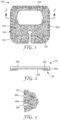
- FIG. 1 is a first embodiment of a medical dressing 100 comprising a plurality of slits 500.
- the medical dressing shown in FIG. 1 is a dressing used to cover the site of an inserted intravenous catheter.
- the medical dressing 100 has a first major surface 110 and second major surface 120, which is opposite the first major surface 110. At least a portion of the second major surface 120 comprises an adhesive 200.
- a perimeter 130 surrounds the medical dressing 100 and defines a dressing area 140.
- the medical dressing 100 has a backing layer 300 and a support material 400 that is secured to the backing layer 300. Through at least the support material 400 are a plurality of slits 500.
- the slits 500 are depicted as a relatively thick black line so as to clearly communicate the location of the slit 500 on the dressing 100. It is understood that the slit 500 can be simply a through cut and therefore not having the thickness as depicted in these images.
- FIG. 2 is a side sectional view of FIG. 1 through line 2-2.
- the backing layer 300 forms the first major surface 110.
- the support material 400 extends adjacent the entire perimeter 130, but is not continuous across the entire dressing area 140. As best seen in FIGS. 1 and 2 , the support material 400 is not located in a central window 150 of the medical dressing 100, while allows for a transparent window to view the inserted catheter. It is both the backing layer 300 and the support material 400 making up the second major surface 120.
- the adhesive 200 covers the entire second major surface 120.
- the adhesive 200 may cover only a portion of the second major surface 120.
- the adhesive 200 may cover only the portion of the second major surface 120 having the support material 400, which would be the portion adjacent the perimeter.
- FIG. 2 shows the backing layer 300 at the first major surface 110, while the support material 400 is at the second major surface 120.
- the support material 400 may be at the first major surface 110 and the backing layer 300 at the second major surface 120. It is understood that one or more additional layers may be included adjacent the backing layer 300, support material 400, between the backing layer 300 and support material 400.
- FIG. 2 The sectional view of FIG. 2 passes directly through slits 500.
- the slits 500 are only in the support material and extend from the perimeter 140 into a portion of the dressing area 140.
- the slit 500 does not entirely transverse the support material.
- Each slit 500 is separate from, and disconnected from another adjacent slit 500.
- the backing layer 300 is elastic and a sufficiently impermeable barrier to the passage of liquids and at least some gases, which protects the covered site from external contaminants. Being elastic allows for the backing layer 300 to expand, contract, stretch and recover as the underlying substrate, such as skin, moves.
- Elasticity can be measured in any number of commonly used means for evaluating stretch and recovery of a material.
- the backing layer 300 independent of the support material
- the backing layer 300 has an elongation to break of at least 200%.
- the backing layer 300 has an elongation to break of less than 500%.
- the support material 400 independent of the backing layer
- the support material 400 independent of the backing layer
- the support material 400 has an elongation to break less than 200%.
- Elasticity can be measured by an initial modulus of elasticity, which is the force require to apply a specified amount of stretch.
- the backing layer 300 has a modulus, at 10% elongation, of less than 2 Newtons. In one embodiment, the backing layer 300 has a modulus, at 10% elongation, of less than 1.5 Newtons. In one embodiment, when the support material 400 is secured with the backing layer 300 in the first portion with slits 500, the modulus at 10% elongation is less than 2 Newtons. In one embodiment, when the support material 400 is secured with the backing layer 300 in the first portion with slits 500, the modulus at 10% elongation is less than 1 Newton.
- the modulus at 10% elongation when the support material 400 is secured with the backing layer 300 in the second portion without slits, the modulus at 10% elongation is greater than 1 Newton and less than 6 Newtons. In one embodiment, when the support material 400 is secured with the backing layer 300 in the second portion without slits, the modulus at 10% elongation is greater than 2 Newton and less than 5 Newtons. In one embodiment, when the support material 400 is secured with the backing layer 300, the ratio of the modulus at 10% elongation of the second portion without slits to the modulus at 10% of the first portion with slits is at least 2:1.
- the ratio of the modulus at 10% elongation of the second portion without slits to the modulus at 10% of the first portion with slits is at least 4:1. In one embodiment, when the support material 400 is secured with the backing layer 300, the ratio of the modulus at 10% elongation of the second portion without slits to the modulus at 10% of the first portion with slits is at least 6:1.
- the support material 400 is secured to the backing layer 300, through adhesive, thermal bonding, lamination, or other commonly used securement techniques.
- the support material 400 provides structural strength to the medical dressing 100, and therefore, independently, is less elastic that the backing layer 300.
- the support material independently, has essentially no elasticity, such that is may be unable to stretch and/or it may be unable to recover from a stretch.
- the support material may be more elastic in one direction (machine direction) than in the cross direction (transverse direction), but overall is has less elasticity than the backing layer 300.
- FIG. 3 is an enlarged top view of the medical dressing 100 of FIGS. 1 and 2 , showing the stretching of the dressing 100 at several slits 500.
- the elastic backing layer 300 will stretch, but the less elastic support material 400 is less able to stretch or recover.
- the slits 500 allow the support material 400 to extend and therefore allow for elongation of the backing layer 300 at the slit, which can be seen in FIG. 3 .
- the elasticity of the backing layer 300 when recovering from the stretch, will also recover the attached support material 400, returning the dressing 100 much to the configuration as shown in FIG. 1 . Therefore, the slits allow for control of the stretch and recovery of discrete areas of the support material.
- the plurality of slits 500 are located along at least a portion of the perimeter 130 of the dressing 100.
- the slits 500 at the perimeter 130 begin directly at the perimeter 130 and extend partially in to the support material 400.
- the slits 500 are located along the entire perimeter 130.
- the slits 500 may have a variety of sizes or shapes, and it is understood that each slit can have a size and shape the same as or different from the other slits 500 on the dressing 100.
- the slits 500 are at least 1 mm in length. In one embodiment, the slits 500 are at least 5 mm in length. In one embodiment, the slits are less than 5 cm in length. In one embodiment, the slits are less than 1 cm in length.
- the slits 500 are a through cut in the support material and have essentially no width, meaning that no material was removed from the support material during cutting.
- the slits have a width less than 5 mm. In one embodiment the slits have a width less than 1 mm.
- the slits 500 at the perimeter 130 are shown extending in a straight line inward, generally perpendicular to the part of the perimeter 130 it is understood that any shape or placement of the slits 500 at the perimeter could achieve the same purpose of allowing expansion and contraction of the backing layer 300 at the perimeter 130.
- the slits 500 are only through the support material 400. It is understood that depending on the particular arrangement of layers or the particular application of the dressing the slit 500 may extend to both the backing layer and support material 400.
- Selectively placed slits 500 allow for some portions of the medical dressing 100 to have more elasticity than portions of the dressing 100 with the support material 400 that do not have the slits 500.
- the dressing area 140 has a first portion 145 adjacent the perimeter 130 with slits that have more elasticity that a second portion 147 of the dressing area 140 having support material 400 but without slits 500. This is desirable as underlying medical devices or tubing at the second portion 147 should not be allowed to stretch as much as portions of the dressing 100 at the perimeter 130.
- the support material 400 did not have slits, when the dressing 100 is subject to elongation, the elastic backing layer 300 will stretch, but the less elastic support material 400 is less able to stretch or recover. Therefore, if the underlying substrate, for example skin, continues to stretch beyond the ability of the support material 400 to stretch, then the adhesion between the adhesive 200 and the underlying substrate will begin to break. In some circumstances, more stretching occurs at the perimeter 130 of the dressing. When the adhesion breaks at the perimeter, then the edges of the dressing begin to lift away from the skin.
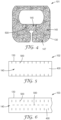
- FIG. 4 is a second embodiment of a medical dressing 101 comprising a plurality of slits 500 within in dressing area 140.
- the dressing area 140 includes a first portion 145 having the plurality of slits 500, and a second portion 147 with support material 400 without slits.
- the arrangement of slits 500 is generally radially outward from the first portion 145 so that there is a pocket that can form when the support material 400 and attached backing layer 300 are allowed to stretch.
- the location of the first portion 145 of the dressing area, containing the slits 500 coincides with the location of an underlying medical devices or tubing.
- the slits 500 allow for expansion of the support material, while the barrier layer stretches to better conform with the underlying medical device or tubing, while the strength of the support material still prevents excessive stretching and movement of the medical device or tubing.
- a single dressing may include one or more select areas may each have a plurality of slits 500.
- a single dressing may have an arrangement of slits 500 within the dressing area 140 such as shown in FIG. 4 and an arrangement of slits 500 at the perimeter 130 such as shown in FIG. 1 .
- FIG. 5 is a third embodiment of a medical dressing 102, specifically a tape, comprising a plurality of slits 500.
- the plurality of slits 500 extend along opposing portions of the longitudinally extending sides of the perimeter 130.
- the support material 400 covers the entire dressing area 140.
- each slit 500 is separate from an adjacent slit 500.
- the slits 500 at opposing portions of the longitudinally extending sides of the perimeter 130 may or may not align with one another. This arrangement of slits 500 allows for improved stretching and recovery in a direction along the longitudinally extending medical dressing 102.
- FIG. 6 is a fourth embodiment of a medical dressing 103, specifically a tape, comprising a plurality of slits 500.
- the plurality of slits 500 extend throughout the entire dressing area 140.
- the some slits 500 are arranged perpendicular to other slits. Therefore, this dressing will allow for improved stretching and recover in a direction along the longitudinally extending medical dressing 103, as well as perpendicular to the longitudinally extending medical dressing 103.
- the tape could be provided in a variety of shapes and sizes of precut tape sections or the tape may be an elongated, longitudinally extending tape that could be provided in roll form.
- the medical dressing disclosed may be made by conventional techniques (e.g., extrusion, solvent casting, calendaring, laminating, adhesive coating, and the like) which are familiar to those skilled in the art.
- US Patent 6,685,682 discloses constructions and methods for making medical dressings with backing layers and support material. It will be understood that the slits can be applied during the rotary converting process.
- the medical dressings are useful to provide an impermeable barrier to the passage of liquids and at least some gases.
- Representative barriers may include non-woven and woven fibrous webs, knits, films, foams polymeric films and other familiar backing materials.
- a transparent substrate is desirable to allow for viewing of the underlying skin or medical device.
- the substrate is an elastomeric polyurethane, polyester, or polyether block amide films. These films combine the desirable properties of resiliency, elasticity, high moisture vapor permeability, and transparency. A description of this characteristic of backing layers can be found in issued U.S. Patent Nos. 5,088,483 and 5,160,315 .
- backing materials may include the thin polymeric film backings sold under the trade names TEGADERM (3M Company), OPSITE (Smith & Nephew), etc. Many other backings may also be used, including those commonly used in the manufacture of surgical incise drapes (e.g., incise drapes manufactured by 3M Company under the trade names STERIDRAPE and IOBAN), etc.
- a relatively high moisture vapor permeable backing may not be required.
- some other potentially useful backing materials may include, e.g., metallocene polyolefins and SBS and SIS block copolymer materials could be used.
- the backing layer may be formed of polymeric films with a thickness of 200 micrometers or less, or 100 micrometers or less, potentially 50 micrometers or less, or even 25 micrometers or less.
- the support material provides strength to the thin, flexible backing layer.
- the support material therefore has more stiffness and less elasticity than the backing layer.
- the support material may be a coating, such as an adhesive, or may be a self-supporting substrate such as another film, woven, knitted, or nonwoven fabric.
- US Patent 5,088,483 discloses a permanent adhesive as a reinforcement that could be used as the support material.
- nonwoven for the support material is a high strength nonwoven fabric available from E. I. Dupont de Nemours & Company of Wilmington, Delaware under the trademark Sontara, including Sontara 8010, a hydroengangled polyester fabric.
- suitable nonwoven webs include a hydroentangled polyester fabric available from Veratec, a division of International Paper of Walpole, Mass.
- Another suitable nonwoven web is the nonwoven elastomeric web described in US Pat. 5,230,701 .
- Suitable adhesive for use in wound dressing articles include any adhesive that provides acceptable adhesion to skin and is acceptable for use on skin (e.g., the adhesive should preferably be nonirritating and non-sensitizing).
- Suitable adhesives are pressure sensitive and in certain embodiments have a relatively high moisture vapor transmission rate to allow for moisture evaporation.
- Suitable pressure sensitive adhesives include those based on acrylates, urethane, hyrdogels, hydrocolloids, block copolymers, silicones, rubber based adhesives (including natural rubber, polyisoprene, polyisobutylene, butyl rubber etc.) as well as combinations of these adhesives.
- the adhesive component may contain tackifiers, plasticizers, rheology modifiers as well as active components including for example an antimicrobial agent.
- the pressure sensitive adhesives that may be used in the wound dressings may include adhesives that are typically applied to the skin such as the acrylate copolymers described in U.S. Patent No. RE 24,906 , particularly a 97:3 isooctyl acrylate:acrylamide copolymer.
- Another example may include a 70:15:15 isooctyl acrylate: ethyleneoxide acrylate:acrylic acid terpolymer, as described in U.S. Patent No. 4,737,410 (Example 31).
- Other potentially useful adhesives are described in U.S. Patent Nos. 3,389,827 ; 4,112,213 ; 4,310,509 ; and 4,323,557 .
- Inclusion of medicaments or antimicrobial agents in the adhesive is also contemplated, as described in U.S. Patent Nos. 4,310,509 and 4,323,557 .
- the absorbent may include a hydrocolloid composition, including the hydrocolloid compositions described in U.S. Patent Nos. 5,622,711 and 5,633,010 .
- the hydrocolloid absorbent may comprise, for example, a natural hydrocolloid, such as pectin, gelatin, or carboxymethylcellulose (CMC) (Aqualon Corp., Wilmington, Del.), a semi-synthetic hydrocolloid, such as cross-linked carboxymethylcellulose (X4ink CMC) (e.g. Ac-Di-Sol; FMC Corp., Philadelphia, Pa.), a synthetic hydrocolloid, such as cross-linked polyacrylic acid (PAA) (e.g., CARBOPOL TM No. 974P; B.F. Goodrich, Brecksville, Ohio), or a combination thereof.
- Absorbent materials may also be chosen from other synthetic and natural hydrophilic materials including polymer gels and foams.
- An optional carrier may be included that covers all or a portion of the first major surface of the substrate, providing structural support if the dressing is thin and highly flexible.
- the carrier maybe removable from the first major surface once the adhesive dressing is placed on skin.
- the carrier can be constructed of a variety of materials such as fabric that are woven or kitted, nonwoven material, papers, or film.
- the carrier is along the perimeter of the first major surface of the dressing and is removable from the first major surface, similar to the carrier used the 3M Tegaderm TM Transparent Film Dressing, available from 3M Company, St. Paul, MN.
- An optional antimicrobial component may be included that is either separate from the adhesive dressing or may be integral with the dressing.
- the antimicrobial component is placed near or adjacent to the insertion site of the medical device to inhibit microbial growth in and around the insertion site.
- the antimicrobial component can be absorbent foam or gel, such as used in a 3M Tegaderm TM CHG I.V. Securement Dressing, available from 3M Company.
Landscapes
- Health & Medical Sciences (AREA)
- Engineering & Computer Science (AREA)
- Biomedical Technology (AREA)
- Heart & Thoracic Surgery (AREA)
- Vascular Medicine (AREA)
- Life Sciences & Earth Sciences (AREA)
- Animal Behavior & Ethology (AREA)
- General Health & Medical Sciences (AREA)
- Public Health (AREA)
- Veterinary Medicine (AREA)
- Dermatology (AREA)
- Materials For Medical Uses (AREA)
Description
- The present disclosure relates to a conformable medical dressing comprising a backing layer and a support layer that comprises a plurality of slits for enabling better elasticity.
- Transparent film dressings are widely used as protective layers over wounds because they facilitate healing in a moist environment while acting as a barrier to contaminating liquids and bacteria. The films are also used as surgical drapes because of their barrier properties. Dressings and drapes fitting the above description are available under a number of trade names such as TEGADERM™ (3M Company, St. Paul, MN) and OP-SITE™ (Smith & Nephew, Hull, England).
- The polymeric films used in those dressings and drapes are conformable, i.e., the films are extremely thin, flexible and supple. They are typically supplied with a releasable protective liner covering the adhesive coated surface of the film. When the liner is removed, the adhesive coated film tends to wrinkle and adhere to itself, interfering with the smooth, aseptic application of the dressing to a patient's skin. Various delivery systems have been proposed to address this problem such as those disclosed in
U.S. Patent No. 6,685,682 . The use of a removable carrier, which does not require tearing of the film after it has been placed on the patient, avoids the problems described above. The carrier also aids in accurate placement of the dressing on a patient. - Thin polymeric films that are flexible and resilient are beneficial when used on skin that flexes, stretches, and retracts. However, for some application, like when securing devices such as tubing, ports, and catheters, the high flexibility and resiliency of the thin polymeric film can cause too much movement of the secured medical device. Therefore, medical dressings have been developed that further incorporate areas having secured to the thin polymeric film, stiffer, less conformable materials such as adhesives, films, or fabrics. For example,
US Patent 5,088,483 discloses an adhesive composite that includes a conformable backing and a permanent adhesive reinforcement around the periphery of the adhesive composite. One example of a commercially available medical dressing with a reinforcement layers is TEGADERM™ IV Advanced Dressing (3M Company, St. Paul MN). - In some instances medical dressings are applied to a patient and remain in place for several days. When dressings are worn over time, the edge of the dressing can begin to peel away from the patient possibly resulting in contamination at the site or adhesive failure entirely. The use of less resilient materials to add stiffness and less flexibility to areas of the dressing can contribute to adhesive failure of the dressing on skin. When the skin flexes and stretches, but the less resilient material cannot, then the adhesive will pull away from the skin. A need remains for a medical dressing that can strongly secure to skin, while also being highly flexible and conformable over skin.
-
WO 2012/150235 A1 relates to a wound care article, comprising at least one sheet-like layer. The sheet-like layer has at least two wings and a central region, the wings being arranged around the central region and the wings being joined to each other via the central region. -
US 2007/049859 A1 relates to a self-adherent window dressing including a fabric layer bounded by an edge. The fabric layer has an adhesive side, an opposite non-adhesive side, and an opening therein to allow for viewing therethrough. A reinforcement member is adhered to at least a portion of the fabric layer. A transparent film layer closes the opening and has first and second opposing sides. The film layer first side is non-adhesive and is mounted on the fabric layer adhesive side to close the opening in the fabric layer. The film layer second side has a skin adhering adhesive portion and an adhesive-free portion. The adhesive-free portion is disposed inwardly of the opening. The film layer adhesive-free portion is adapted not to stick to a wound, connector, or catheter disposed between the film layer adhesive-free portion and skin. -
US 2010/106121 A1 relates to a wound dressing comprising an absorbent pad, an adhesive layer, and a backing layer, along with a dressing support layer configured to retain and deliver the wound dressing to a wound, the dressing support layer having a radial configuration that forms a plurality of alternating covered and uncovered portions of the backing layer along the perimeter of the wound dressing. -
US 7 294 752 B1 relates to a window dressing with an integral anchor including a fabric layer having juxtaposed insertion site viewing and anchor member portions. The fabric layer has an adhesive side and an opposite non-adhesive side. The insertion site viewing portion is defined by an opening in the fabric layer. A transparent film layer having an adhesive skin-adhering side and an opposite non-adhesive side is adhered to the fabric layer adhesive side and closes the opening in the fabric layer. The anchor member portion includes a reinforcing structure disposed on the fabric layer. The reinforcing structure has an adhesive side and an opposite non-adhesive side. The non-adhesive side is adhered to the fabric layer adhesive side. A first removable securement device may be removably connected to the anchor member portion opposite the insertion site viewing portion, and a second removable securement device may be removably connected to the first removable securement device. - The invention for which protection is sought is defined by the independent claim. The dependent claims concern particular embodiments.
- The disclosed medical dressing is highly flexible and conformable over skin, while maintain strong adhesive securement to skin over extended periods of time. The dressing comprises a backing layer, support material, and a plurality of specifically placed slits in the support material, which allow for stretching and recovery of the backing layer.
- In one embodiment, the medical dressing comprises a first major surface, second major surface, opposite the first major surface, and a perimeter, wherein the second major surface comprises an adhesive. The dressing comprises a backing layer that is elastic, a support material secured to the backing layer that is less elastic than the backing layer, a plurality of slits through the support material, wherein each slit is a long narrow through cut in the support material, and wherein each slit is spaced from an adjacent slit.
- "Elastic" means a material able to elongate and regain some or all of its original shape.
- "Slit" means a long, narrow through cut. In one embodiment, the slit has a length that is significantly longer that a width. In one embodiment, the slit has a length at least 5 times greater than a width. In one embodiment, the slit has a length at least 10 times greater than a width. In one embodiment, the slit has essentially no width.
- The words "preferred" and "preferably" refer to embodiments that may afford certain benefits, under certain circumstances. However, other embodiments may also be preferred, under the same or other circumstances. Furthermore, the recitation of one or more preferred embodiments does not imply that other embodiments are not useful, and is not intended to exclude other embodiments.
- As used herein, "a," "an," "the," "at least one," and "one or more" are used interchangeably. The term "and/or" (if used) means one or all of the identified elements or a combination of any two or more of the identified elements.
-
-
FIG. 1 is a first embodiment of a medical dressing comprising a plurality of slits; -
FIG. 2 is a side sectional view ofFIG. 1 through line 2-2. -
FIG. 3 is an enlarged top view of the medical dressing ofFIG. 1 , showing the stretching of the dressing at several slits; -
FIG. 4 is a second embodiment of a medical dressing comprising a plurality of slits; -
FIG. 5 is a third embodiment of a medical dressing, specifically a tape, comprising a plurality of slits; -
FIG. 6 is a fourth embodiment of a medical dressing, specifically a tape, comprising a plurality of slits. - While the above-identified drawings and figures set forth embodiments of the invention, other embodiments are also contemplated, as noted in the discussion. In all cases, this disclosure presents the invention by way of representation and not limitation. It should be understood that numerous other modifications and embodiments can be devised by those skilled in the art, which fall within the scope of this invention.
- The figures may not be drawn to scale.
-
FIG. 1 is a first embodiment of amedical dressing 100 comprising a plurality ofslits 500. The medical dressing shown inFIG. 1 is a dressing used to cover the site of an inserted intravenous catheter. Overall, themedical dressing 100 has a firstmajor surface 110 and secondmajor surface 120, which is opposite the firstmajor surface 110. At least a portion of the secondmajor surface 120 comprises an adhesive 200. Aperimeter 130 surrounds themedical dressing 100 and defines adressing area 140. - The
medical dressing 100 has abacking layer 300 and asupport material 400 that is secured to thebacking layer 300. Through at least thesupport material 400 are a plurality ofslits 500. InFIG. 1 and in the other images, theslits 500 are depicted as a relatively thick black line so as to clearly communicate the location of theslit 500 on thedressing 100. It is understood that theslit 500 can be simply a through cut and therefore not having the thickness as depicted in these images. -
FIG. 2 is a side sectional view ofFIG. 1 through line 2-2. In this embodiment, thebacking layer 300 forms the firstmajor surface 110. In this embodiment, thesupport material 400 extends adjacent theentire perimeter 130, but is not continuous across theentire dressing area 140. As best seen inFIGS. 1 and 2 , thesupport material 400 is not located in acentral window 150 of themedical dressing 100, while allows for a transparent window to view the inserted catheter. It is both thebacking layer 300 and thesupport material 400 making up the secondmajor surface 120. In this embodiment, the adhesive 200 covers the entire secondmajor surface 120. - It is understood that the adhesive 200 may cover only a portion of the second
major surface 120. For example, in the embodiment shown inFIG. 1-3 , the adhesive 200 may cover only the portion of the secondmajor surface 120 having thesupport material 400, which would be the portion adjacent the perimeter. -
FIG. 2 shows thebacking layer 300 at the firstmajor surface 110, while thesupport material 400 is at the secondmajor surface 120. In one embodiment, thesupport material 400 may be at the firstmajor surface 110 and thebacking layer 300 at the secondmajor surface 120. It is understood that one or more additional layers may be included adjacent thebacking layer 300,support material 400, between thebacking layer 300 andsupport material 400. - Generally, the
backing layer 300 will extend over theentire dressing area 140 as it is the portion of the dressing 100 that provides a barrier against external contamination to the underlying substrate. Thesupport material 400 is shown in the embodiment ofFIGS. 1-3 covering only a portion of thedressing area 140; however, in other embodiments thesupport material 400 may cover nearly theentire dressing area 140. - The sectional view of
FIG. 2 passes directly throughslits 500. As can be seen inFIG. 2 , theslits 500 are only in the support material and extend from theperimeter 140 into a portion of thedressing area 140. Theslit 500 does not entirely transverse the support material. Eachslit 500 is separate from, and disconnected from anotheradjacent slit 500. - The
backing layer 300 is elastic and a sufficiently impermeable barrier to the passage of liquids and at least some gases, which protects the covered site from external contaminants. Being elastic allows for thebacking layer 300 to expand, contract, stretch and recover as the underlying substrate, such as skin, moves. - Elasticity can be measured in any number of commonly used means for evaluating stretch and recovery of a material. In one embodiment, the backing layer 300 (independent of the support material) has an elongation to break of at least 200%. In one embodiment, the backing layer 300 (independent of the support material) has an elongation to break of less than 500%. In one embodiment, the support material 400 (independent of the backing layer) has an elongation to break of at least 20%. In one embodiment, the support material 400 (independent of the backing layer) has an elongation to break of at least 100%. In one embodiment, the
support material 400 has an elongation to break less than 200%. - Elasticity can be measured by an initial modulus of elasticity, which is the force require to apply a specified amount of stretch. In one embodiment, the
backing layer 300 has a modulus, at 10% elongation, of less than 2 Newtons. In one embodiment, thebacking layer 300 has a modulus, at 10% elongation, of less than 1.5 Newtons. In one embodiment, when thesupport material 400 is secured with thebacking layer 300 in the first portion withslits 500, the modulus at 10% elongation is less than 2 Newtons. In one embodiment, when thesupport material 400 is secured with thebacking layer 300 in the first portion withslits 500, the modulus at 10% elongation is less than 1 Newton. In one embodiment, when thesupport material 400 is secured with thebacking layer 300 in the second portion without slits, the modulus at 10% elongation is greater than 1 Newton and less than 6 Newtons. In one embodiment, when thesupport material 400 is secured with thebacking layer 300 in the second portion without slits, the modulus at 10% elongation is greater than 2 Newton and less than 5 Newtons. In one embodiment, when thesupport material 400 is secured with thebacking layer 300, the ratio of the modulus at 10% elongation of the second portion without slits to the modulus at 10% of the first portion with slits is at least 2:1. In one embodiment, when thesupport material 400 is secured with thebacking layer 300, the ratio of the modulus at 10% elongation of the second portion without slits to the modulus at 10% of the first portion with slits is at least 4:1. In one embodiment, when thesupport material 400 is secured with thebacking layer 300, the ratio of the modulus at 10% elongation of the second portion without slits to the modulus at 10% of the first portion with slits is at least 6:1. - The
support material 400 is secured to thebacking layer 300, through adhesive, thermal bonding, lamination, or other commonly used securement techniques. Thesupport material 400 provides structural strength to themedical dressing 100, and therefore, independently, is less elastic that thebacking layer 300. In one embodiment, the support material, independently, has essentially no elasticity, such that is may be unable to stretch and/or it may be unable to recover from a stretch. In one embodiment, the support material, may be more elastic in one direction (machine direction) than in the cross direction (transverse direction), but overall is has less elasticity than thebacking layer 300. -
FIG. 3 is an enlarged top view of themedical dressing 100 ofFIGS. 1 and 2 , showing the stretching of the dressing 100 atseveral slits 500. When the dressing 100 is subject to elongation, theelastic backing layer 300 will stretch, but the lesselastic support material 400 is less able to stretch or recover. However, theslits 500 allow thesupport material 400 to extend and therefore allow for elongation of thebacking layer 300 at the slit, which can be seen inFIG. 3 . The elasticity of thebacking layer 300, when recovering from the stretch, will also recover the attachedsupport material 400, returning the dressing 100 much to the configuration as shown inFIG. 1 . Therefore, the slits allow for control of the stretch and recovery of discrete areas of the support material. - In some circumstances, more stretching occurs at the
perimeter 130 of the dressing. Therefore, in the embodiment shown inFIG. 1 , the plurality ofslits 500 are located along at least a portion of theperimeter 130 of thedressing 100. Theslits 500 at theperimeter 130 begin directly at theperimeter 130 and extend partially in to thesupport material 400. In this embodiment, theslits 500 are located along theentire perimeter 130. Theslits 500 may have a variety of sizes or shapes, and it is understood that each slit can have a size and shape the same as or different from theother slits 500 on thedressing 100. - In one embodiment, the
slits 500 are at least 1 mm in length. In one embodiment, theslits 500 are at least 5 mm in length. In one embodiment, the slits are less than 5 cm in length. In one embodiment, the slits are less than 1 cm in length. - In one embodiment, such as shown in
FIG. 1 , theslits 500 are a through cut in the support material and have essentially no width, meaning that no material was removed from the support material during cutting. In one embodiment, the slits have a width less than 5 mm. In one embodiment the slits have a width less than 1 mm. - In one embodiment, the
slits 500 at theperimeter 130 are shown extending in a straight line inward, generally perpendicular to the part of theperimeter 130 it is understood that any shape or placement of theslits 500 at the perimeter could achieve the same purpose of allowing expansion and contraction of thebacking layer 300 at theperimeter 130. - In the embodiment shown in
FIGS. 1-3 theslits 500 are only through thesupport material 400. It is understood that depending on the particular arrangement of layers or the particular application of the dressing theslit 500 may extend to both the backing layer andsupport material 400. - Selectively placed
slits 500 allow for some portions of themedical dressing 100 to have more elasticity than portions of the dressing 100 with thesupport material 400 that do not have theslits 500. For example, in the embodiment shown inFIG. 1-3 , thedressing area 140 has afirst portion 145 adjacent theperimeter 130 with slits that have more elasticity that asecond portion 147 of thedressing area 140 havingsupport material 400 but withoutslits 500. This is desirable as underlying medical devices or tubing at thesecond portion 147 should not be allowed to stretch as much as portions of the dressing 100 at theperimeter 130. - If the
support material 400 did not have slits, when the dressing 100 is subject to elongation, theelastic backing layer 300 will stretch, but the lesselastic support material 400 is less able to stretch or recover. Therefore, if the underlying substrate, for example skin, continues to stretch beyond the ability of thesupport material 400 to stretch, then the adhesion between the adhesive 200 and the underlying substrate will begin to break. In some circumstances, more stretching occurs at theperimeter 130 of the dressing. When the adhesion breaks at the perimeter, then the edges of the dressing begin to lift away from the skin. - Reference to similar structural components from one embodiment to another will use the same reference numbers. Unless noted otherwise, description applicable from one embodiment has applicability to other similar embodiments.
-
FIG. 4 is a second embodiment of amedical dressing 101 comprising a plurality ofslits 500 within indressing area 140. In this embodiment, thedressing area 140 includes afirst portion 145 having the plurality ofslits 500, and asecond portion 147 withsupport material 400 without slits. The arrangement ofslits 500 is generally radially outward from thefirst portion 145 so that there is a pocket that can form when thesupport material 400 and attachedbacking layer 300 are allowed to stretch. The location of thefirst portion 145 of the dressing area, containing theslits 500 coincides with the location of an underlying medical devices or tubing. As described with respect toFIGS. 1-3 , theslits 500 allow for expansion of the support material, while the barrier layer stretches to better conform with the underlying medical device or tubing, while the strength of the support material still prevents excessive stretching and movement of the medical device or tubing. - It is understood that a single dressing may include one or more select areas may each have a plurality of
slits 500. For example, a single dressing may have an arrangement ofslits 500 within thedressing area 140 such as shown inFIG. 4 and an arrangement ofslits 500 at theperimeter 130 such as shown inFIG. 1 . -
FIG. 5 is a third embodiment of amedical dressing 102, specifically a tape, comprising a plurality ofslits 500. In this embodiment, the plurality ofslits 500 extend along opposing portions of the longitudinally extending sides of theperimeter 130. In this embodiment, thesupport material 400 covers theentire dressing area 140. As with other embodiments, each slit 500 is separate from anadjacent slit 500. Theslits 500 at opposing portions of the longitudinally extending sides of theperimeter 130 may or may not align with one another. This arrangement ofslits 500 allows for improved stretching and recovery in a direction along the longitudinally extendingmedical dressing 102. -
FIG. 6 is a fourth embodiment of amedical dressing 103, specifically a tape, comprising a plurality ofslits 500. In this embodiment, the plurality ofslits 500 extend throughout theentire dressing area 140. The someslits 500 are arranged perpendicular to other slits. Therefore, this dressing will allow for improved stretching and recover in a direction along the longitudinally extendingmedical dressing 103, as well as perpendicular to the longitudinally extendingmedical dressing 103. For either embodiment shown inFIGS. 5 and 6 , it is understood that the tape could be provided in a variety of shapes and sizes of precut tape sections or the tape may be an elongated, longitudinally extending tape that could be provided in roll form. - The medical dressing disclosed may be made by conventional techniques (e.g., extrusion, solvent casting, calendaring, laminating, adhesive coating, and the like) which are familiar to those skilled in the art.
US Patent 6,685,682 discloses constructions and methods for making medical dressings with backing layers and support material. It will be understood that the slits can be applied during the rotary converting process. - The medical dressings are useful to provide an impermeable barrier to the passage of liquids and at least some gases. Representative barriers may include non-woven and woven fibrous webs, knits, films, foams polymeric films and other familiar backing materials. In some embodiments, a transparent substrate is desirable to allow for viewing of the underlying skin or medical device.
- In one embodiment, the substrate has high moisture vapor permeability, but generally impermeable to liquid water so that microbes and other contaminants are sealed out from the area under the substrate. One example of a suitable material is a high moisture vapor permeable film such as described in
US Patents 3,645,835 and4,595,001 . In high moisture vapor permeable film/adhesive composites, the composite should transmit moisture vapor at a rate equal to or greater than human skin such as, for example, at a rate of at least 300 g/m2 /24 hrs at 37°C/100-10% RH, or at least 700 g/m2 /24 hrs at 37°C/100-10% RH, or at least 2000 g/m2 /24 hrs at 37°C/100-10% RH using the inverted cup method as described inU.S. Pat. No. 4,595,001 . Perforated substrates or films or pattern coated adhesives may be used to increase the moisture vapor transmission. In one embodiment, the substrate is an elastomeric polyurethane, polyester, or polyether block amide films. These films combine the desirable properties of resiliency, elasticity, high moisture vapor permeability, and transparency. A description of this characteristic of backing layers can be found in issuedU.S. Patent Nos. 5,088,483 and5,160,315 . - Commercially available examples of potentially suitable backing materials may include the thin polymeric film backings sold under the trade names TEGADERM (3M Company), OPSITE (Smith & Nephew), etc. Many other backings may also be used, including those commonly used in the manufacture of surgical incise drapes (e.g., incise drapes manufactured by 3M Company under the trade names STERIDRAPE and IOBAN), etc.
- Because fluids may be actively removed from the sealed environments defined by the medical dressings, a relatively high moisture vapor permeable backing may not be required. As a result, some other potentially useful backing materials may include, e.g., metallocene polyolefins and SBS and SIS block copolymer materials could be used.
- Regardless, however, it may be desirable that the backing be kept relatively thin to, e.g., improve conformability. For example, the backing layer may be formed of polymeric films with a thickness of 200 micrometers or less, or 100 micrometers or less, potentially 50 micrometers or less, or even 25 micrometers or less.
- The support material provides strength to the thin, flexible backing layer. The support material therefore has more stiffness and less elasticity than the backing layer. The support material may be a coating, such as an adhesive, or may be a self-supporting substrate such as another film, woven, knitted, or nonwoven fabric. For example,
US Patent 5,088,483 discloses a permanent adhesive as a reinforcement that could be used as the support material. - One example of nonwoven for the support material is a high strength nonwoven fabric available from E. I. Dupont de Nemours & Company of Wilmington, Delaware under the trademark Sontara, including Sontara 8010, a hydroengangled polyester fabric. Other suitable nonwoven webs include a hydroentangled polyester fabric available from Veratec, a division of International Paper of Walpole, Mass. Another suitable nonwoven web is the nonwoven elastomeric web described in
US Pat. 5,230,701 . - Suitable adhesive for use in wound dressing articles include any adhesive that provides acceptable adhesion to skin and is acceptable for use on skin (e.g., the adhesive should preferably be nonirritating and non-sensitizing). Suitable adhesives are pressure sensitive and in certain embodiments have a relatively high moisture vapor transmission rate to allow for moisture evaporation. Suitable pressure sensitive adhesives include those based on acrylates, urethane, hyrdogels, hydrocolloids, block copolymers, silicones, rubber based adhesives (including natural rubber, polyisoprene, polyisobutylene, butyl rubber etc.) as well as combinations of these adhesives. The adhesive component may contain tackifiers, plasticizers, rheology modifiers as well as active components including for example an antimicrobial agent.
- The pressure sensitive adhesives that may be used in the wound dressings may include adhesives that are typically applied to the skin such as the acrylate copolymers described in
U.S. Patent No. RE 24,906 , particularly a 97:3 isooctyl acrylate:acrylamide copolymer. Another example may include a 70:15:15 isooctyl acrylate: ethyleneoxide acrylate:acrylic acid terpolymer, as described inU.S. Patent No. 4,737,410 (Example 31). Other potentially useful adhesives are described inU.S. Patent Nos. 3,389,827 ;4,112,213 ;4,310,509 ; and4,323,557 . Inclusion of medicaments or antimicrobial agents in the adhesive is also contemplated, as described inU.S. Patent Nos. 4,310,509 and4,323,557 . - Silicone adhesive can also be used. Generally, silicone adhesives can provide suitable adhesion to skin while gently removing from skin. Suitable silicone adhesives are disclosed in
PCT Publications WO2010/056541 andWO2010/056543 . - The pressure sensitive adhesives may, in some embodiments, transmit moisture vapor at a rate greater to or equal to that of human skin. While such a characteristic can be achieved through the selection of an appropriate adhesive, it is also contemplated that other methods of achieving a high relative rate of moisture vapor transmission may be used, such as pattern coating the adhesive on the backing, as described in
U.S. Patent No. 4,595,001 . Other potentially suitable pressure sensitive adhesives may include blown-micro-fiber (BMF) adhesives such as, for example, those described inU.S. Patent No. 6,994,904 . The pressure sensitive adhesive used in the wound dressing may also include one or more areas in which the adhesive itself includes structures such as, e.g., the microreplicated structures described inU.S. Patent No. 6,893,655 . - Issued
U.S. Patent Nos. 3,645,835 and4,595,001 describe methods of making such films and methods for testing their permeability. Preferably, the film/adhesive composite should transmit moisture vapor at a rate equal to or greater than human skin. Preferably, the adhesive coated film transmits moisture vapor at a rate of at least 300 g/m2/24 hrs/37□C/100-10% RH, more preferably at least 700 g/m2/24 hrs/37□C/100-10% RH, and most preferably at least 2000 g/m2/24 hrs/37□C/100-10% RH using the inverted cup method as described inU.S. Patent No. 4,595,001 . - Different portions of the dressing may include different adhesives, such as disclosed in
U.S. Patent Application 61/664,246 filed June 26, 2012 - An absorbent material may also be used in conjunction with the medical dressings described herein. An absorbent material may be the same as the wound packing material (described below) or may be a separate element. The absorbent materials can be manufactured of any of a variety of materials including, but not limited to, woven or nonwoven cotton or rayon. Absorbent pad is useful for containing a number of substances, optionally including antimicrobial agents, drugs for transdermal drug delivery, chemical indicators to monitor hormones or other substances in a patient, etc.
- The absorbent may include a hydrocolloid composition, including the hydrocolloid compositions described in
U.S. Patent Nos. 5,622,711 and5,633,010 . The hydrocolloid absorbent may comprise, for example, a natural hydrocolloid, such as pectin, gelatin, or carboxymethylcellulose (CMC) (Aqualon Corp., Wilmington, Del.), a semi-synthetic hydrocolloid, such as cross-linked carboxymethylcellulose (X4ink CMC) (e.g. Ac-Di-Sol; FMC Corp., Philadelphia, Pa.), a synthetic hydrocolloid, such as cross-linked polyacrylic acid (PAA) (e.g., CARBOPOL™ No. 974P; B.F. Goodrich, Brecksville, Ohio), or a combination thereof. Absorbent materials may also be chosen from other synthetic and natural hydrophilic materials including polymer gels and foams. - An optional release liners may be included that covers all or a portion of the adhesives to prevent contamination of the adhesives. In one embodiment, the package that contains the adhesive dressing may serve as a release liner. Suitable release liners can be made of kraft papers, polyethylene, polypropylene, polyester or composites of any of these materials. In one embodiment, the liners are coated with release agents such as fluorochemicals or silicones. For example,
U.S. Pat. No. 4,472,480 describes low surface energy perfluorochemical liners. In one embodiment, the liners are papers, polyolefin films, or polyester films coated with silicone release materials. - An optional carrier may be included that covers all or a portion of the first major surface of the substrate, providing structural support if the dressing is thin and highly flexible. The carrier maybe removable from the first major surface once the adhesive dressing is placed on skin. The carrier can be constructed of a variety of materials such as fabric that are woven or kitted, nonwoven material, papers, or film. In one embodiment, the carrier is along the perimeter of the first major surface of the dressing and is removable from the first major surface, similar to the carrier used the 3M Tegaderm™ Transparent Film Dressing, available from 3M Company, St. Paul, MN.
- An optional antimicrobial component may be included that is either separate from the adhesive dressing or may be integral with the dressing. The antimicrobial component is placed near or adjacent to the insertion site of the medical device to inhibit microbial growth in and around the insertion site. The antimicrobial component can be absorbent foam or gel, such as used in a 3M Tegaderm™ CHG I.V. Securement Dressing, available from 3M Company.
Claims (14)
- A medical dressing (100, 101) comprising:a first major surface (110), second major surface (120), opposite the first major surface (110), and a perimeter (130), wherein the second major surface (120) comprises an adhesive (200);a backing layer (300) that is elastic;a support material (400) secured to the backing layer (300) that is less elastic than the backing layer (300);a plurality of slits (500) through the support material (400), wherein each slit is a long narrow through cut that does not result in removal of support material (400) and wherein each slit is spaced from an adjacent slit.
- The medical dressing of claim 1, wherein the adhesive (200) covers only a portion of the second major surface (120).
- The medical dressing of any one of the preceding claims, wherein the backing layer (300) is at the first major surface (110).
- The medical dressing of any one of the preceding claims, wherein the backing layer (300) taken independently has an elongation to break of at least 200% and the support layer (400) taken independently has an elongation to break of less than 200%.
- The medical dressing of any one of the preceding claims, wherein the ratio of the modulus at 10% elongation of a second portion without slits to the modulus at 10% elongation of a first portion with slits is at least 2:1.
- The medical dressing of any one of the preceding claims, wherein the slits are in the support material and backing layer.
- The medical dressing of any one of the preceding claims, wherein a first portion of the plurality of slits are parallel to one another and a second portion of the plurality of slits are parallel to one another but perpendicular to the first portion of the plurality of slits.
- The medical dressing of any one of the preceding claims, wherein the plurality of slits (500) are adjacent the perimeter (130) of the medical dressing (100).
- The medical dressing of any one of the preceding claims, wherein the plurality of slits (500) directly contact a portion of the perimeter (130) and extend from the perimeter (130) inward.
- The medical dressing of any one of the preceding claims, wherein the perimeter (130) forms a dressing area (140), and wherein the plurality of slits (500) are at a first portion (145) of the dressing area (140) and a second portion (147) of the dressing area (140) is free of slits.
- The medical dressing of any one of the preceding claims, wherein the plurality of slits at the first portion (145) of the dressing area (140) comprise slits extending radially from the first portion (145) of the dressing area (140).
- The medical dressing of any one of the preceding claims, further comprising an absorbent material recessed from the perimeter (130).
- The medical dressing of any one of the preceding claims, wherein the backing layer (300) is transparent.
- The medical dressing of any one of the preceding claims, wherein the backing layer (300) is generally impermeable to liquid and can transmit moisture vapor at a rate of at least 300 g/m2/24 hrs at 37°C/100-10% RH.
Applications Claiming Priority (2)
| Application Number | Priority Date | Filing Date | Title |
|---|---|---|---|
| US201361775805P | 2013-03-11 | 2013-03-11 | |
| PCT/US2014/020524 WO2014149718A1 (en) | 2013-03-11 | 2014-03-05 | A conformable medical dressing |
Publications (2)
| Publication Number | Publication Date |
|---|---|
| EP2968018A1 EP2968018A1 (en) | 2016-01-20 |
| EP2968018B1 true EP2968018B1 (en) | 2025-07-09 |
Family
ID=50290334
Family Applications (1)
| Application Number | Title | Priority Date | Filing Date |
|---|---|---|---|
| EP14711124.9A Active EP2968018B1 (en) | 2013-03-11 | 2014-03-05 | A conformable medical dressing |
Country Status (5)
| Country | Link |
|---|---|
| US (1) | US10940049B2 (en) |
| EP (1) | EP2968018B1 (en) |
| CN (1) | CN105188623B (en) |
| BR (1) | BR112015022312A2 (en) |
| WO (1) | WO2014149718A1 (en) |
Families Citing this family (80)
| Publication number | Priority date | Publication date | Assignee | Title |
|---|---|---|---|---|
| US11246760B2 (en) * | 2014-08-28 | 2022-02-15 | Mölnlycke Health Care Ab | Self-adhesive member |
| CN108136065A (en) | 2015-06-29 | 2018-06-08 | 3M创新有限公司 | Antimicrobial articles and its application method |
| CN108430524B (en) | 2015-11-13 | 2021-07-20 | 3M创新有限公司 | Antimicrobial products and methods of use |
| EP3373985B1 (en) | 2015-11-13 | 2021-03-17 | 3M Innovative Properties Company | Anti-microbial articles and methods of using same |
| US11141100B2 (en) | 2015-12-23 | 2021-10-12 | Coloplast A/S | Moisture assessment system and method for wound care |
| JP6785510B2 (en) * | 2016-04-15 | 2020-11-18 | 国立大学法人お茶の水女子大学 | Elasticity adjustment method of sheet material, force sensor, and sheet material |
| WO2018075259A1 (en) | 2016-10-19 | 2018-04-26 | 3M Innovative Properties Company | Anti-microbial articles |
| US20180289551A1 (en) | 2017-04-11 | 2018-10-11 | Johnson & Johnson Consumer Inc. | Extensible dressings |
| CN107049605A (en) * | 2017-06-08 | 2017-08-18 | 李茂香 | Puerpera's spontaneous labor special sterile is applied |
| JP7178372B2 (en) | 2017-06-22 | 2022-11-25 | スリーエム イノベイティブ プロパティズ カンパニー | Negative pressure wound care product with multiple features |
| GB201713511D0 (en) | 2017-08-23 | 2017-10-04 | Scapa Uk Ltd | Wound dressing |
| EP3681545B1 (en) * | 2017-09-15 | 2025-10-29 | Bard Access Systems, Inc. | Antimicrobial dressing with liner for a medical device |
| USD834201S1 (en) | 2017-10-09 | 2018-11-20 | 3M Innovative Properties Company | Medical dressing |
| EP3694457A1 (en) * | 2017-10-09 | 2020-08-19 | 3M Innovative Properties Company | Securement dressing with conformal border |
| WO2019087065A1 (en) | 2017-10-31 | 2019-05-09 | 3M Innovative Properties Company | Negative pressure wound therapy article |
| CN108078676A (en) * | 2017-12-12 | 2018-05-29 | 成都美益达医疗科技有限公司 | A kind of application for treating joint part wound |
| CN108078677A (en) * | 2017-12-12 | 2018-05-29 | 成都美益达医疗科技有限公司 | A kind of promotion regenerated sterile patch of abdominal wound |
| WO2019116279A1 (en) | 2017-12-14 | 2019-06-20 | 3M Innovative Properties Company | Negative pressure wound therapy article with features |
| EP3498242A1 (en) * | 2017-12-15 | 2019-06-19 | Mölnlycke Health Care AB | Medical dressing |
| WO2019120425A1 (en) | 2017-12-22 | 2019-06-27 | Coloplast A/S | Ostomy appliance system, monitor device, and method of monitoring an ostomy appliance |
| US10500084B2 (en) | 2017-12-22 | 2019-12-10 | Coloplast A/S | Accessory devices of an ostomy system, and related methods for communicating leakage state |
| JP7462558B2 (en) | 2017-12-22 | 2024-04-05 | コロプラスト アクティーゼルスカブ | Ostomy system and monitor device with angular leak detection - Patents.com |
| EP4180010A1 (en) | 2017-12-22 | 2023-05-17 | Coloplast A/S | Sensor assembly part of an ostomy system having a moisture sensor |
| WO2019120441A1 (en) | 2017-12-22 | 2019-06-27 | Coloplast A/S | Sensor assembly part and a base plate for an ostomy appliance and a method for manufacturing a sensor assembly part and a base plate |
| AU2018386861B2 (en) | 2017-12-22 | 2024-03-14 | Coloplast A/S | Ostomy appliance with angular leakage detection |
| US11534323B2 (en) | 2017-12-22 | 2022-12-27 | Coloplast A/S | Tools and methods for placing a medical appliance on a user |
| WO2019120442A1 (en) | 2017-12-22 | 2019-06-27 | Coloplast A/S | Sensor assembly part and a base plate for an ostomy appliance and a device for connecting to a base plate or a sensor assembly part |
| US11865029B2 (en) | 2017-12-22 | 2024-01-09 | Coloplast A/S | Monitor device of a medical system having a connector for coupling to both a base plate and an accessory device |
| LT3727240T (en) | 2017-12-22 | 2022-03-10 | Coloplast A/S | ADDITIONAL INSTALLATIONS AND ASSOCIATED TRANSMISSION METHODS FOR THE OSTOMY SYSTEM |
| LT3727227T (en) | 2017-12-22 | 2023-07-25 | Coloplast A/S | OSTOMY DEVICE BASE PLATE AND BASE PLATE SENSOR MOUNTING PART AND MANUFACTURING METHOD OF BASE PLATE AND SENSOR MOUNTING PART |
| EP4032510B1 (en) | 2017-12-22 | 2025-07-09 | Coloplast A/S | Base plate with selective sensor points and a method of its manufacture |
| US11627891B2 (en) | 2017-12-22 | 2023-04-18 | Coloplast A/S | Calibration methods for medical appliance tools |
| WO2019120452A1 (en) | 2017-12-22 | 2019-06-27 | Coloplast A/S | Coupling part with a hinge for an ostomy base plate and sensor assembly part |
| WO2019120451A1 (en) | 2017-12-22 | 2019-06-27 | Coloplast A/S | Base plate and a sensor assembly part for an ostomy appliance and a method for manufacturing a base plate and sensor assembly part |
| JP7472022B2 (en) | 2017-12-22 | 2024-04-22 | コロプラスト アクティーゼルスカブ | Base plate for ostomy appliance, monitor device and system for ostomy appliance |
| US10799385B2 (en) | 2017-12-22 | 2020-10-13 | Coloplast A/S | Ostomy appliance with layered base plate |
| US11439352B2 (en) | 2018-01-17 | 2022-09-13 | Medtronic Minimed, Inc. | Medical device with adhesive patch longevity |
| EP4631480A3 (en) | 2018-02-20 | 2025-12-10 | Coloplast A/S | Accessory devices of an ostomy system, and related methods for changing an ostomy appliance based on future operating state |
| US12208029B2 (en) | 2018-02-20 | 2025-01-28 | Coloplast A/S | Base plate having a mechanical and electrical connector |
| US11903728B2 (en) | 2018-03-15 | 2024-02-20 | Coloplast A/S | Methods of configuring medical notifications and related accessory devices |
| EP4079266B1 (en) | 2018-03-15 | 2024-06-05 | Coloplast A/S | Methods for managing remaining wear time of an ostomy appliance and related accessory devices |
| CN111885984B (en) | 2018-03-15 | 2023-08-04 | 科洛普拉斯特公司 | Apparatus and method for determining when to wear an ostomy appliance based on sensor data |
| WO2019174697A1 (en) | 2018-03-15 | 2019-09-19 | Coloplast A/S | Apparatus and methods for navigating ostomy appliance user to changing room |
| USD880705S1 (en) | 2018-04-11 | 2020-04-07 | Johnson & Johnson Consumer Inc. | Adhesive bandage with decorated pad |
| USD879973S1 (en) | 2018-04-11 | 2020-03-31 | Johnson & Johnson Consumer Inc. | Adhesive bandage with decorated pad |
| USD879972S1 (en) | 2018-04-11 | 2020-03-31 | Johnson & Johnson Consumer Inc. | Adhesive bandage with decorated pad |
| USD879974S1 (en) | 2018-06-27 | 2020-03-31 | Johnson & Johnson Consumer Inc. | Adhesive bandage with decorated pad |
| USD879975S1 (en) | 2018-06-27 | 2020-03-31 | Johnson & Johnson Consumer Inc. | Adhesive bandage with decorated pad |
| USD887563S1 (en) | 2018-06-27 | 2020-06-16 | Johnson & Johnson Consumer Inc. | Adhesive bandage with decorated pad |
| USD887564S1 (en) | 2018-06-27 | 2020-06-16 | Johnson & Johnson Consumer Inc. | Adhesive bandage with decorated pad |
| USD875953S1 (en) * | 2018-06-28 | 2020-02-18 | 3M Innovative Properties Company | Medical dressing |
| CN108836953A (en) * | 2018-07-30 | 2018-11-20 | 西藏奇正藏药股份有限公司 | A kind of island external patch paste that elasticity and gas permeability can be improved |
| CN108815139A (en) * | 2018-07-30 | 2018-11-16 | 西藏奇正藏药股份有限公司 | A kind of external patch paste can be improved elasticity and gas permeability |
| WO2020035121A1 (en) | 2018-08-15 | 2020-02-20 | Coloplast A/S | Accessory device of an ostomy system and related methods for issue identification |
| USD913507S1 (en) | 2018-12-10 | 2021-03-16 | Johnson & Johnson Consumer Inc. | Adhesive bandage with decorated pad |
| USD918398S1 (en) | 2018-12-10 | 2021-05-04 | Johnson & Johnson Consumer Inc. | Adhesive bandage with decorated pad |
| CN113165407A (en) | 2018-12-12 | 2021-07-23 | 3M创新有限公司 | Peelable article made from ink jet printed adhesive |
| CN113195662A (en) | 2018-12-12 | 2021-07-30 | 3M创新有限公司 | Stripping ink jet printing ink articles |
| US20220017784A1 (en) | 2018-12-12 | 2022-01-20 | 3M Innovative Properties Company | Release inkjet printing ink articles |
| US12558250B2 (en) | 2019-01-31 | 2026-02-24 | Coloplast A/S | Base plate and a sensor assembly part for an ostomy appliance |
| US12409074B2 (en) * | 2019-04-01 | 2025-09-09 | Solventum Intellectual Properties Company | Conformable dressing |
| EP3958801B1 (en) * | 2019-04-26 | 2024-08-21 | Coloplast A/S | A sensor patch for attachment to a base plate |
| EP3975955B1 (en) * | 2019-05-28 | 2023-11-01 | 3M Innovative Properties Co. | Medical dressing for securing a tubiform component of a medical device |
| WO2021019339A1 (en) | 2019-08-01 | 2021-02-04 | 3M Innovative Properties Company | An antimicrobial device for an insertion needle |
| USD921206S1 (en) | 2019-09-10 | 2021-06-01 | Medline Industries, Inc. | Window dressing |
| USD923182S1 (en) | 2019-09-10 | 2021-06-22 | Medline Industries, Inc. | Window dressing |
| USD921205S1 (en) | 2019-09-10 | 2021-06-01 | Medline Industries, Inc. | Window dressing |
| CN114502123A (en) | 2019-10-11 | 2022-05-13 | 3M创新有限公司 | Pipe fixing system |
| WO2021084382A1 (en) | 2019-10-29 | 2021-05-06 | 3M Innovative Properties Company | Tube securement tape |
| US12179472B2 (en) * | 2019-11-04 | 2024-12-31 | Solventum Intellectual Properties Company | Reinforced adhesive substrate |
| EP3818968B1 (en) | 2019-11-05 | 2024-01-17 | 3M Innovative Properties Company | Adhesive medical article having fluid management properties |
| EP3939555A1 (en) | 2020-07-14 | 2022-01-19 | 3M Innovative Properties Company | Adhesive eyelid closure article |
| EP4262655B1 (en) * | 2020-12-21 | 2025-12-10 | Solventum Intellectual Properties Company | Dual-sided adhesive tapes with on-demand adhesion |
| USD973888S1 (en) * | 2021-03-30 | 2022-12-27 | Taylor Radeloff | Pressure relieving intravenous dressing |
| CN113208815A (en) * | 2021-04-26 | 2021-08-06 | 惠州华阳医疗器械有限公司 | Dressing for preventing pressure injury |
| WO2023031697A1 (en) | 2021-09-01 | 2023-03-09 | 3M Innovative Properties Company | Anti-virus respirator and mask |
| EP4510980A1 (en) * | 2022-04-20 | 2025-02-26 | 3M Innovative Properties Company | Stretch to fit bandage |
| US20240350776A1 (en) * | 2023-04-21 | 2024-10-24 | Zachary RATTNER | Device and Method to Extend the Lifetime of a Venous Pathway for Catheter Access |
| WO2024226978A2 (en) * | 2023-04-26 | 2024-10-31 | Bard Peripheral Vascular, Inc. | Catheter dressing and management system and methods of use |
| WO2024233245A1 (en) * | 2023-05-05 | 2024-11-14 | Solventum Intellectual Properties Company | Article and sensor system |
Citations (3)
| Publication number | Priority date | Publication date | Assignee | Title |
|---|---|---|---|---|
| US20070049859A1 (en) * | 2005-08-23 | 2007-03-01 | Tri-State Hospital Supply Corporation | Window dressing |
| US7294752B1 (en) * | 2006-06-27 | 2007-11-13 | Tri-State Hospital Supply Corporation | Window dressing having integral anchor |
| US20100106121A1 (en) * | 2008-10-24 | 2010-04-29 | 3M Innovative Properties Company | Conformable wound dressing |
Family Cites Families (29)
| Publication number | Priority date | Publication date | Assignee | Title |
|---|---|---|---|---|
| USRE24906E (en) | 1955-11-18 | 1960-12-13 | Pressure-sensitive adhesive sheet material | |
| US4112213A (en) | 1964-09-28 | 1978-09-05 | Johnson & Johnson | Pressure sensitive adhesive tapes and method of making same |
| US3389827A (en) | 1967-04-10 | 1968-06-25 | Minnesota Mining & Mfg | Easy-open container and sealing tape |
| NO134790C (en) | 1968-07-09 | 1984-03-22 | Smith & Nephew | Kleber ,; PRESSURE SENSITIVE, WATERPUME-PERMEABLE PRODUCT FOR SKIN USE BY HUMANS. |
| US4323557A (en) | 1979-07-31 | 1982-04-06 | Minnesota Mining & Manufacturing Company | Pressure-sensitive adhesive containing iodine |
| US4310509A (en) | 1979-07-31 | 1982-01-12 | Minnesota Mining And Manufacturing Company | Pressure-sensitive adhesive having a broad spectrum antimicrobial therein |
| AU560088B2 (en) | 1982-04-08 | 1987-03-26 | Smith & Nephew Associated Companies Plc | Surgical adhesive dressing |
| US4472480A (en) | 1982-07-02 | 1984-09-18 | Minnesota Mining And Manufacturing Company | Low surface energy liner of perfluoropolyether |
| US4600001A (en) | 1984-08-15 | 1986-07-15 | The Kendall Company | Combined wound dressing and delivery means composite |
| US4737410A (en) | 1986-11-28 | 1988-04-12 | Minnesota Mining And Manufacturing Company | Polyalkyloxazoline-reinforced acrylic pressure-sensitive adhesive composition |
| US4867150A (en) | 1987-01-20 | 1989-09-19 | The B. F. Goodrich Company | Perforated elastomeric soft film and wound dressing made therewith |
| US5230701A (en) | 1988-05-13 | 1993-07-27 | Minnesota Mining And Manufacturing Company | Elastomeric adhesive and cohesive materials |
| US5088483A (en) | 1988-11-04 | 1992-02-18 | Minnesota Mining And Manufacturing Co. | Adhesive frame bandage |
| US5052381A (en) * | 1990-03-19 | 1991-10-01 | The B. F. Goodrich Company | Adhesive wound dressing and perforated shield |
| US5160315A (en) | 1991-04-05 | 1992-11-03 | Minnesota Mining And Manufacturing Company | Combined adhesive strip and transparent dressing delivery system |
| CA2104046C (en) | 1992-10-05 | 1998-09-15 | Yen-Lane Chen | Adhesive compositions, wound dressings and methods |
| US6685682B1 (en) | 1993-03-22 | 2004-02-03 | 3M Innovative Properties Company | Carrier delivered dressing and method of manufacture |
| US5616387A (en) | 1993-08-31 | 1997-04-01 | Minnesota Mining And Manufacturing Company | Perforated roll of elastic wrap |
| MXPA01012972A (en) | 1999-06-18 | 2002-09-02 | 3M Innovative Properties Co | Nonwoven sheets, adhesive articles, and methods for making the same. |
| US6994904B2 (en) | 2001-05-02 | 2006-02-07 | 3M Innovative Properties Company | Pressure sensitive adhesive fibers with a reinforcing material |
| US6893655B2 (en) | 2001-10-09 | 2005-05-17 | 3M Innovative Properties Co. | Transdermal delivery devices |
| US6838589B2 (en) | 2003-02-19 | 2005-01-04 | 3M Innovative Properties Company | Conformable wound dressing |
| US7399484B2 (en) * | 2004-06-30 | 2008-07-15 | Kimberly-Clark Worldwide, Inc. | System and method for providing therapy to an individual |
| US7858838B2 (en) * | 2006-08-10 | 2010-12-28 | 3M Innovative Properties Company | Conformable wound dressing |
| US9359529B2 (en) | 2008-10-29 | 2016-06-07 | 3M Innovative Properties Company | Electron beam cured silicone materials |
| EP2636705B1 (en) | 2008-10-29 | 2018-12-19 | 3M Innovative Properties Company | Electron beam cured, nonfunctionalized silicone pressure sensitive adhesives |
| DE202012101743U1 (en) * | 2011-05-02 | 2012-08-06 | Birgit Riesinger | Wound care |
| US9877872B2 (en) | 2011-07-14 | 2018-01-30 | Smith & Nephew Plc | Wound dressing and method of treatment |
| JP6373832B2 (en) | 2012-06-26 | 2018-08-15 | スリーエム イノベイティブ プロパティズ カンパニー | Medical care product with multiple adhesives |
-
2014
- 2014-03-05 WO PCT/US2014/020524 patent/WO2014149718A1/en not_active Ceased
- 2014-03-05 US US14/773,956 patent/US10940049B2/en active Active
- 2014-03-05 CN CN201480014246.2A patent/CN105188623B/en active Active
- 2014-03-05 EP EP14711124.9A patent/EP2968018B1/en active Active
- 2014-03-05 BR BR112015022312A patent/BR112015022312A2/en not_active IP Right Cessation
Patent Citations (3)
| Publication number | Priority date | Publication date | Assignee | Title |
|---|---|---|---|---|
| US20070049859A1 (en) * | 2005-08-23 | 2007-03-01 | Tri-State Hospital Supply Corporation | Window dressing |
| US7294752B1 (en) * | 2006-06-27 | 2007-11-13 | Tri-State Hospital Supply Corporation | Window dressing having integral anchor |
| US20100106121A1 (en) * | 2008-10-24 | 2010-04-29 | 3M Innovative Properties Company | Conformable wound dressing |
Also Published As
| Publication number | Publication date |
|---|---|
| EP2968018A1 (en) | 2016-01-20 |
| CN105188623B (en) | 2020-09-25 |
| CN105188623A (en) | 2015-12-23 |
| BR112015022312A2 (en) | 2017-07-18 |
| WO2014149718A1 (en) | 2014-09-25 |
| US10940049B2 (en) | 2021-03-09 |
| US20160015570A1 (en) | 2016-01-21 |
Similar Documents
| Publication | Publication Date | Title |
|---|---|---|
| US10940049B2 (en) | Conformable medical dressing | |
| JP7304868B2 (en) | Fixed dressings with compatible margins | |
| EP3946187B1 (en) | A conformable dressing | |
| EP2349154B1 (en) | Wound dressing | |
| CN104994817B (en) | Medical dressings with multiple adhesives | |
| EP3030207B1 (en) | A support device with a contained cushioning element | |
| US11246761B2 (en) | Conformable wound dressing and delivery system | |
| JP4867025B2 (en) | Catheter fixture | |
| US5052381A (en) | Adhesive wound dressing and perforated shield | |
| WO2015130608A1 (en) | Medical dressing | |
| JP7095195B2 (en) | Adhesive sheet and articles with adhesive sheet | |
| US20080312574A1 (en) | Dressing Provided With a Thin Film Applicator | |
| JP5282834B2 (en) | Skin patch for catheter fixation | |
| US20230277385A1 (en) | Conformable medical dressing | |
| WO2021084382A1 (en) | Tube securement tape | |
| US20210178056A1 (en) | Medical tubing organizer | |
| BR112019007011B1 (en) | MEDICAL ARTICLE UNDERSTANDING A WOUND DRESSING |
Legal Events
| Date | Code | Title | Description |
|---|---|---|---|
| PUAI | Public reference made under article 153(3) epc to a published international application that has entered the european phase |
Free format text: ORIGINAL CODE: 0009012 |
|
| 17P | Request for examination filed |
Effective date: 20150917 |
|
| AK | Designated contracting states |
Kind code of ref document: A1 Designated state(s): AL AT BE BG CH CY CZ DE DK EE ES FI FR GB GR HR HU IE IS IT LI LT LU LV MC MK MT NL NO PL PT RO RS SE SI SK SM TR |
|
| AX | Request for extension of the european patent |
Extension state: BA ME |
|
| DAX | Request for extension of the european patent (deleted) | ||
| STAA | Information on the status of an ep patent application or granted ep patent |
Free format text: STATUS: EXAMINATION IS IN PROGRESS |
|
| 17Q | First examination report despatched |
Effective date: 20180126 |
|
| RAP1 | Party data changed (applicant data changed or rights of an application transferred) |
Owner name: SOLVENTUM INTELLECTUAL PROPERTIES COMPANY |
|
| GRAP | Despatch of communication of intention to grant a patent |
Free format text: ORIGINAL CODE: EPIDOSNIGR1 |
|
| STAA | Information on the status of an ep patent application or granted ep patent |
Free format text: STATUS: GRANT OF PATENT IS INTENDED |
|
| INTG | Intention to grant announced |
Effective date: 20250226 |
|
| GRAS | Grant fee paid |
Free format text: ORIGINAL CODE: EPIDOSNIGR3 |
|
| GRAA | (expected) grant |
Free format text: ORIGINAL CODE: 0009210 |
|
| STAA | Information on the status of an ep patent application or granted ep patent |
Free format text: STATUS: THE PATENT HAS BEEN GRANTED |
|
| AK | Designated contracting states |
Kind code of ref document: B1 Designated state(s): AL AT BE BG CH CY CZ DE DK EE ES FI FR GB GR HR HU IE IS IT LI LT LU LV MC MK MT NL NO PL PT RO RS SE SI SK SM TR |
|
| REG | Reference to a national code |
Ref country code: GB Ref legal event code: FG4D |
|
| REG | Reference to a national code |
Ref country code: CH Ref legal event code: EP |
|
| REG | Reference to a national code |
Ref country code: IE Ref legal event code: FG4D |
|
| REG | Reference to a national code |
Ref country code: DE Ref legal event code: R096 Ref document number: 602014092119 Country of ref document: DE |
|
| REG | Reference to a national code |
Ref country code: NL Ref legal event code: MP Effective date: 20250709 |
|
| PG25 | Lapsed in a contracting state [announced via postgrant information from national office to epo] |
Ref country code: PT Free format text: LAPSE BECAUSE OF FAILURE TO SUBMIT A TRANSLATION OF THE DESCRIPTION OR TO PAY THE FEE WITHIN THE PRESCRIBED TIME-LIMIT Effective date: 20251110 |
|
| PG25 | Lapsed in a contracting state [announced via postgrant information from national office to epo] |
Ref country code: NL Free format text: LAPSE BECAUSE OF FAILURE TO SUBMIT A TRANSLATION OF THE DESCRIPTION OR TO PAY THE FEE WITHIN THE PRESCRIBED TIME-LIMIT Effective date: 20250709 |
|
| REG | Reference to a national code |
Ref country code: AT Ref legal event code: MK05 Ref document number: 1811143 Country of ref document: AT Kind code of ref document: T Effective date: 20250709 |
|
| PG25 | Lapsed in a contracting state [announced via postgrant information from national office to epo] |
Ref country code: IS Free format text: LAPSE BECAUSE OF FAILURE TO SUBMIT A TRANSLATION OF THE DESCRIPTION OR TO PAY THE FEE WITHIN THE PRESCRIBED TIME-LIMIT Effective date: 20251109 |
|
| PG25 | Lapsed in a contracting state [announced via postgrant information from national office to epo] |
Ref country code: NO Free format text: LAPSE BECAUSE OF FAILURE TO SUBMIT A TRANSLATION OF THE DESCRIPTION OR TO PAY THE FEE WITHIN THE PRESCRIBED TIME-LIMIT Effective date: 20251009 |
|
| REG | Reference to a national code |
Ref country code: LT Ref legal event code: MG9D |
|
| PG25 | Lapsed in a contracting state [announced via postgrant information from national office to epo] |
Ref country code: AT Free format text: LAPSE BECAUSE OF FAILURE TO SUBMIT A TRANSLATION OF THE DESCRIPTION OR TO PAY THE FEE WITHIN THE PRESCRIBED TIME-LIMIT Effective date: 20250709 |
|
| PG25 | Lapsed in a contracting state [announced via postgrant information from national office to epo] |
Ref country code: FI Free format text: LAPSE BECAUSE OF FAILURE TO SUBMIT A TRANSLATION OF THE DESCRIPTION OR TO PAY THE FEE WITHIN THE PRESCRIBED TIME-LIMIT Effective date: 20250709 |
|
| PG25 | Lapsed in a contracting state [announced via postgrant information from national office to epo] |
Ref country code: HR Free format text: LAPSE BECAUSE OF FAILURE TO SUBMIT A TRANSLATION OF THE DESCRIPTION OR TO PAY THE FEE WITHIN THE PRESCRIBED TIME-LIMIT Effective date: 20250709 |
|
| PG25 | Lapsed in a contracting state [announced via postgrant information from national office to epo] |
Ref country code: GR Free format text: LAPSE BECAUSE OF FAILURE TO SUBMIT A TRANSLATION OF THE DESCRIPTION OR TO PAY THE FEE WITHIN THE PRESCRIBED TIME-LIMIT Effective date: 20251010 |
|
| PG25 | Lapsed in a contracting state [announced via postgrant information from national office to epo] |
Ref country code: SE Free format text: LAPSE BECAUSE OF FAILURE TO SUBMIT A TRANSLATION OF THE DESCRIPTION OR TO PAY THE FEE WITHIN THE PRESCRIBED TIME-LIMIT Effective date: 20250709 |
|
| PG25 | Lapsed in a contracting state [announced via postgrant information from national office to epo] |
Ref country code: LV Free format text: LAPSE BECAUSE OF FAILURE TO SUBMIT A TRANSLATION OF THE DESCRIPTION OR TO PAY THE FEE WITHIN THE PRESCRIBED TIME-LIMIT Effective date: 20250709 |
|
| PG25 | Lapsed in a contracting state [announced via postgrant information from national office to epo] |
Ref country code: BG Free format text: LAPSE BECAUSE OF FAILURE TO SUBMIT A TRANSLATION OF THE DESCRIPTION OR TO PAY THE FEE WITHIN THE PRESCRIBED TIME-LIMIT Effective date: 20250709 Ref country code: PL Free format text: LAPSE BECAUSE OF FAILURE TO SUBMIT A TRANSLATION OF THE DESCRIPTION OR TO PAY THE FEE WITHIN THE PRESCRIBED TIME-LIMIT Effective date: 20250709 |
|
| PG25 | Lapsed in a contracting state [announced via postgrant information from national office to epo] |
Ref country code: RS Free format text: LAPSE BECAUSE OF FAILURE TO SUBMIT A TRANSLATION OF THE DESCRIPTION OR TO PAY THE FEE WITHIN THE PRESCRIBED TIME-LIMIT Effective date: 20251009 |
|
| PG25 | Lapsed in a contracting state [announced via postgrant information from national office to epo] |
Ref country code: ES Free format text: LAPSE BECAUSE OF FAILURE TO SUBMIT A TRANSLATION OF THE DESCRIPTION OR TO PAY THE FEE WITHIN THE PRESCRIBED TIME-LIMIT Effective date: 20250709 |
|
| PG25 | Lapsed in a contracting state [announced via postgrant information from national office to epo] |
Ref country code: SM Free format text: LAPSE BECAUSE OF FAILURE TO SUBMIT A TRANSLATION OF THE DESCRIPTION OR TO PAY THE FEE WITHIN THE PRESCRIBED TIME-LIMIT Effective date: 20250709 |
|
| PG25 | Lapsed in a contracting state [announced via postgrant information from national office to epo] |
Ref country code: DK Free format text: LAPSE BECAUSE OF FAILURE TO SUBMIT A TRANSLATION OF THE DESCRIPTION OR TO PAY THE FEE WITHIN THE PRESCRIBED TIME-LIMIT Effective date: 20250709 |
|
| PGFP | Annual fee paid to national office [announced via postgrant information from national office to epo] |
Ref country code: DE Payment date: 20260219 Year of fee payment: 13 |
|
| PG25 | Lapsed in a contracting state [announced via postgrant information from national office to epo] |
Ref country code: IT Free format text: LAPSE BECAUSE OF FAILURE TO SUBMIT A TRANSLATION OF THE DESCRIPTION OR TO PAY THE FEE WITHIN THE PRESCRIBED TIME-LIMIT Effective date: 20250709 |
|
| PGFP | Annual fee paid to national office [announced via postgrant information from national office to epo] |
Ref country code: FR Payment date: 20260219 Year of fee payment: 13 |
|
| PG25 | Lapsed in a contracting state [announced via postgrant information from national office to epo] |
Ref country code: CZ Free format text: LAPSE BECAUSE OF FAILURE TO SUBMIT A TRANSLATION OF THE DESCRIPTION OR TO PAY THE FEE WITHIN THE PRESCRIBED TIME-LIMIT Effective date: 20250709 |
|
| PG25 | Lapsed in a contracting state [announced via postgrant information from national office to epo] |
Ref country code: SK Free format text: LAPSE BECAUSE OF FAILURE TO SUBMIT A TRANSLATION OF THE DESCRIPTION OR TO PAY THE FEE WITHIN THE PRESCRIBED TIME-LIMIT Effective date: 20250709 Ref country code: EE Free format text: LAPSE BECAUSE OF FAILURE TO SUBMIT A TRANSLATION OF THE DESCRIPTION OR TO PAY THE FEE WITHIN THE PRESCRIBED TIME-LIMIT Effective date: 20250709 |
|
| PLBE | No opposition filed within time limit |
Free format text: ORIGINAL CODE: 0009261 |
|
| STAA | Information on the status of an ep patent application or granted ep patent |
Free format text: STATUS: NO OPPOSITION FILED WITHIN TIME LIMIT |