EP2966802A1 - Method for ciphering and deciphering digital data, based on an identity, in a multi-authorities context - Google Patents
Method for ciphering and deciphering digital data, based on an identity, in a multi-authorities context Download PDFInfo
- Publication number
- EP2966802A1 EP2966802A1 EP14306108.3A EP14306108A EP2966802A1 EP 2966802 A1 EP2966802 A1 EP 2966802A1 EP 14306108 A EP14306108 A EP 14306108A EP 2966802 A1 EP2966802 A1 EP 2966802A1
- Authority
- EP
- European Patent Office
- Prior art keywords
- group
- ciphertext
- elements
- digital data
- belonging
- Prior art date
- Legal status (The legal status is an assumption and is not a legal conclusion. Google has not performed a legal analysis and makes no representation as to the accuracy of the status listed.)
- Withdrawn
Links
- 238000000034 method Methods 0.000 title claims abstract description 120
- 238000004590 computer program Methods 0.000 claims description 5
- 230000001052 transient effect Effects 0.000 claims 1
- 230000008569 process Effects 0.000 description 47
- 230000006870 function Effects 0.000 description 22
- 230000009467 reduction Effects 0.000 description 14
- 239000013598 vector Substances 0.000 description 10
- 230000015654 memory Effects 0.000 description 9
- 230000008901 benefit Effects 0.000 description 8
- 238000004891 communication Methods 0.000 description 4
- 102100026446 Aldo-keto reductase family 1 member C1 Human genes 0.000 description 3
- 101000718028 Homo sapiens Aldo-keto reductase family 1 member C1 Proteins 0.000 description 3
- 230000004048 modification Effects 0.000 description 3
- 238000012986 modification Methods 0.000 description 3
- 230000007704 transition Effects 0.000 description 3
- 230000008859 change Effects 0.000 description 2
- 230000003287 optical effect Effects 0.000 description 2
- 230000009466 transformation Effects 0.000 description 2
- 102100024089 Aldo-keto reductase family 1 member C2 Human genes 0.000 description 1
- 101000690303 Homo sapiens Aldo-keto reductase family 1 member C2 Proteins 0.000 description 1
- 230000003044 adaptive effect Effects 0.000 description 1
- 238000010276 construction Methods 0.000 description 1
- 208000035790 developmental dysplasia of the hip 1 Diseases 0.000 description 1
- 208000033540 developmental dysplasia of the hip 2 Diseases 0.000 description 1
- 238000004377 microelectronic Methods 0.000 description 1
- 230000003068 static effect Effects 0.000 description 1
Images


Classifications
-
- G—PHYSICS
- G09—EDUCATION; CRYPTOGRAPHY; DISPLAY; ADVERTISING; SEALS
- G09C—CIPHERING OR DECIPHERING APPARATUS FOR CRYPTOGRAPHIC OR OTHER PURPOSES INVOLVING THE NEED FOR SECRECY
- G09C1/00—Apparatus or methods whereby a given sequence of signs, e.g. an intelligible text, is transformed into an unintelligible sequence of signs by transposing the signs or groups of signs or by replacing them by others according to a predetermined system
-
- H—ELECTRICITY
- H04—ELECTRIC COMMUNICATION TECHNIQUE
- H04L—TRANSMISSION OF DIGITAL INFORMATION, e.g. TELEGRAPHIC COMMUNICATION
- H04L9/00—Cryptographic mechanisms or cryptographic arrangements for secret or secure communications; Network security protocols
- H04L9/008—Cryptographic mechanisms or cryptographic arrangements for secret or secure communications; Network security protocols involving homomorphic encryption
-
- H—ELECTRICITY
- H04—ELECTRIC COMMUNICATION TECHNIQUE
- H04L—TRANSMISSION OF DIGITAL INFORMATION, e.g. TELEGRAPHIC COMMUNICATION
- H04L9/00—Cryptographic mechanisms or cryptographic arrangements for secret or secure communications; Network security protocols
- H04L9/06—Cryptographic mechanisms or cryptographic arrangements for secret or secure communications; Network security protocols the encryption apparatus using shift registers or memories for block-wise or stream coding, e.g. DES systems or RC4; Hash functions; Pseudorandom sequence generators
- H04L9/0618—Block ciphers, i.e. encrypting groups of characters of a plain text message using fixed encryption transformation
-
- H—ELECTRICITY
- H04—ELECTRIC COMMUNICATION TECHNIQUE
- H04L—TRANSMISSION OF DIGITAL INFORMATION, e.g. TELEGRAPHIC COMMUNICATION
- H04L9/00—Cryptographic mechanisms or cryptographic arrangements for secret or secure communications; Network security protocols
- H04L9/06—Cryptographic mechanisms or cryptographic arrangements for secret or secure communications; Network security protocols the encryption apparatus using shift registers or memories for block-wise or stream coding, e.g. DES systems or RC4; Hash functions; Pseudorandom sequence generators
- H04L9/0643—Hash functions, e.g. MD5, SHA, HMAC or f9 MAC
-
- H—ELECTRICITY
- H04—ELECTRIC COMMUNICATION TECHNIQUE
- H04L—TRANSMISSION OF DIGITAL INFORMATION, e.g. TELEGRAPHIC COMMUNICATION
- H04L9/00—Cryptographic mechanisms or cryptographic arrangements for secret or secure communications; Network security protocols
- H04L9/08—Key distribution or management, e.g. generation, sharing or updating, of cryptographic keys or passwords
- H04L9/0816—Key establishment, i.e. cryptographic processes or cryptographic protocols whereby a shared secret becomes available to two or more parties, for subsequent use
- H04L9/0838—Key agreement, i.e. key establishment technique in which a shared key is derived by parties as a function of information contributed by, or associated with, each of these
- H04L9/0847—Key agreement, i.e. key establishment technique in which a shared key is derived by parties as a function of information contributed by, or associated with, each of these involving identity based encryption [IBE] schemes
-
- H—ELECTRICITY
- H04—ELECTRIC COMMUNICATION TECHNIQUE
- H04L—TRANSMISSION OF DIGITAL INFORMATION, e.g. TELEGRAPHIC COMMUNICATION
- H04L9/00—Cryptographic mechanisms or cryptographic arrangements for secret or secure communications; Network security protocols
- H04L9/14—Cryptographic mechanisms or cryptographic arrangements for secret or secure communications; Network security protocols using a plurality of keys or algorithms
-
- H—ELECTRICITY
- H04—ELECTRIC COMMUNICATION TECHNIQUE
- H04L—TRANSMISSION OF DIGITAL INFORMATION, e.g. TELEGRAPHIC COMMUNICATION
- H04L9/00—Cryptographic mechanisms or cryptographic arrangements for secret or secure communications; Network security protocols
- H04L9/30—Public key, i.e. encryption algorithm being computationally infeasible to invert or user's encryption keys not requiring secrecy
- H04L9/3006—Public key, i.e. encryption algorithm being computationally infeasible to invert or user's encryption keys not requiring secrecy underlying computational problems or public-key parameters
- H04L9/3013—Public key, i.e. encryption algorithm being computationally infeasible to invert or user's encryption keys not requiring secrecy underlying computational problems or public-key parameters involving the discrete logarithm problem, e.g. ElGamal or Diffie-Hellman systems
-
- H—ELECTRICITY
- H04—ELECTRIC COMMUNICATION TECHNIQUE
- H04L—TRANSMISSION OF DIGITAL INFORMATION, e.g. TELEGRAPHIC COMMUNICATION
- H04L9/00—Cryptographic mechanisms or cryptographic arrangements for secret or secure communications; Network security protocols
- H04L9/30—Public key, i.e. encryption algorithm being computationally infeasible to invert or user's encryption keys not requiring secrecy
- H04L9/3066—Public key, i.e. encryption algorithm being computationally infeasible to invert or user's encryption keys not requiring secrecy involving algebraic varieties, e.g. elliptic or hyper-elliptic curves
- H04L9/3073—Public key, i.e. encryption algorithm being computationally infeasible to invert or user's encryption keys not requiring secrecy involving algebraic varieties, e.g. elliptic or hyper-elliptic curves involving pairings, e.g. identity based encryption [IBE], bilinear mappings or bilinear pairings, e.g. Weil or Tate pairing
-
- H—ELECTRICITY
- H04—ELECTRIC COMMUNICATION TECHNIQUE
- H04L—TRANSMISSION OF DIGITAL INFORMATION, e.g. TELEGRAPHIC COMMUNICATION
- H04L2209/00—Additional information or applications relating to cryptographic mechanisms or cryptographic arrangements for secret or secure communication H04L9/00
- H04L2209/12—Details relating to cryptographic hardware or logic circuitry
Definitions
- One embodiment of the disclosure relates to cryptography, and more specifically, to identity-based encryption, where any easy-to-remember identifier (such as a phone number) can serve as a public key in order to alleviate the need for digital certificates.
- any easy-to-remember identifier such as a phone number
- Identity-based encryption allows a sender to encrypt a message to a receiver using only the receiver's identity and a set of master public parameters publicized by a trusted authority (or TA), which is an electronic device that is supposed to be secure.
- a trusted authority or TA
- TA trusted authority
- any IBE scheme which is secure in the single authority setting is also secure in the multi-authority setting.
- the security bound in the random oracle model is linearly affected by the number n of distinct trusted authorities in a multi-TA setting.
- the number n of trusted authorities tends to linearly affect the security bound: if an adversary has advantage at most Adv 1 in the single authority setting, its advantage function can only be bounded by Adv n ⁇ n.Adv 1 in an environment with n trusted authorities. The reason is that, in the security proof, the reduction has to guess upfront (with probability 1/ n ) the trusted authority for which the adversary will ask the challenger to generate the challenge ciphertext.
- One goal of one embodiment of the disclosure is to propose an IBE scheme that provides both semantic security and receiver anonymity, with a security reduction that does not depend on the number n of trusted authorities in the system. More precisely, one goal of one embodiment of the disclosure is to provide an IBE scheme for which the reduction does not depend on the number n of distinct trusted authorities in the system, and to provide an IBE scheme that does not only hide the encrypted message, but also the receiver's identity and the trusted authority under which the ciphertext was generated.
- references in the specification to "one embodiment”, “an embodiment”, “an example embodiment”, indicate that the embodiment described may include a particular feature, structure, or characteristic, but every embodiment may not necessarily include the particular feature, structure, or characteristic. Moreover, such phrases are not necessarily referring to the same embodiment. Further, when a particular feature, structure, or characteristic is described in connection with an embodiment, it is submitted that it is within the knowledge of one skilled in the art to affect such feature, structure, or characteristic in connection with other embodiments whether or not explicitly described.
- the present disclosure is directed to a method for ciphering digital data M being an element of a group G T , said group G T being part of a bilinear group (G, ⁇ , G T ) of prime order p , the method being executed by an electronic device.
- the method is remarkable in that it comprises:
- the method for ciphering is remarkable in that said master public key comprises K ( K + 1) elements belonging to said group G, said K ( K + 1) elements being derived from said 2K generators.
- the method for ciphering is remarkable in that said integer value K is equal to one.
- the method for ciphering is remarkable in that said second part of said ciphertext of said digital data M is M .
- the method for ciphering is remarkable in that said integer value K is equal to two.
- such method for ciphering is remarkable in that said second part of said ciphertext of said digital data M is M.
- a method for deciphering a ciphertext comprising a first part and a second part.
- Such method for deciphering can be executed on an electronic device, and is remarkable in that it comprises:
- the method for deciphering is remarkable in that said integer value K is equal to one.
- the method for deciphering is remarkable in that said determining a product corresponds to obtaining D.e ( C z ,z ID ) .e ( C r ,r ID ) where the couple ( C z , C r ) is said first part of said ciphertext, and D is said second part of said ciphertext.
- the method for deciphering is remarkable in that said integer value K is equal to two.
- such method for deciphering is remarkable in that said determining a product corresponds to obtaining D.e ( C r ,r ID ). e ( C u , u ID ). e ( C z ,z ID ) where the triplet (C r , C u , C z ) is said first part of said ciphertext, and D is said second part of said ciphertext.
- the different steps of the method are implemented by a computer software program or programs, this software program comprising software instructions designed to be executed by a data processor of a relay module according to the disclosure and being designed to control the execution of the different steps of this method.
- an aspect of the disclosure also concerns a program liable to be executed by a computer or by a data processor, this program comprising instructions to command the execution of the steps of a method as mentioned here above.
- This program can use any programming language whatsoever and be in the form of a source code, object code or code that is intermediate between source code and object code, such as in a partially compiled form or in any other desirable form.
- the disclosure also concerns an information medium readable by a data processor and comprising instructions of a program as mentioned here above.
- the information medium can be any entity or device capable of storing the program.
- the medium can comprise a storage means such as a ROM (which stands for "Read Only Memory "), for example a CD-ROM (which stands for " Compact Disc - Read Only Memory ”) or a microelectronic circuit ROM or again a magnetic recording means, for example a floppy disk or a hard disk drive.
- ROM Read Only Memory
- CD-ROM Compact Disc - Read Only Memory
- microelectronic circuit ROM again a magnetic recording means, for example a floppy disk or a hard disk drive.
- the information medium may be a transmissible carrier such as an electrical or optical signal that can be conveyed through an electrical or optical cable, by radio or by other means.
- the program can be especially downloaded into an Internet-type network.
- the information medium can be an integrated circuit into which the program is incorporated, the circuit being adapted to executing or being used in the execution of the method in question.
- an embodiment of the disclosure is implemented by means of software and/or hardware components.
- module can correspond in this document both to a software component and to a hardware component or to a set of hardware and software components.
- a software component corresponds to one or more computer programs, one or more sub-programs of a program, or more generally to any element of a program or a software program capable of implementing a function or a set of functions according to what is described here below for the module concerned.
- One such software component is executed by a data processor of a physical entity (terminal, server, etc.) and is capable of accessing the hardware resources of this physical entity (memories, recording media, communications buses, input/output electronic boards, user interfaces, etc.).
- a hardware component corresponds to any element of a hardware unit capable of implementing a function or a set of functions according to what is described here below for the module concerned. It may be a programmable hardware component or a component with an integrated circuit for the execution of software, for example an integrated circuit, a smart card, a memory card, an electronic board for executing firmware etc.
- a step of obtaining an element/value in the present document can be viewed either as a step of reading such element/value in a memory unit of an electronic device or a step of receiving such element/value from another electronic device via communication means.
- an electronic device for ciphering digital data M being an element of a group G T , said group G T being part of a bilinear group (G, ⁇ , G T ) of prime order p .
- the electronic device is remarkable in that it comprises:
- an electronic device for deciphering a ciphertext comprising a first part and a second part
- the electronic device being characterized in that it comprises:
- Figure 1 discloses a flowchart which depicts some steps performed by an electronic device during a common setup generation process, according to one embodiment of the disclosure.
- the common setup generation process takes as input a security parameter ⁇ which corresponds to a bit-length.
- the electronic device chooses or selects or obtains a bilinear group (G, ⁇ , G T ) of prime order p > 2 ⁇ , with a efficiently computable isomorphism ⁇ : ⁇ ⁇ G.
- the electronic device obtains (or chooses) several random generators from the group G (in this embodiment, the number of random generators is equal to four): g z , g r , h z , h u ⁇ ⁇ R ⁇ G .
- the electronic device chooses an identifier associated to a hash function H: ⁇ 0,1 ⁇ * ⁇ ⁇ 3 , that is modeled as a random oracle in the security analysis.
- the electronic device then provides the common public parameters params to other electronic devices that either propagates it, or use it.
- Figure 2 discloses a flowchart which depicts some steps performed by an electronic device during a master key generation process, according to one embodiment of the disclosure.
- the master key generation process takes as input a common public parameters params as the one obtained via the execution of the process 100.
- the master secret key msk which is kept in a secure memory of an electronic device
- the master public key mpk which is then transmitted to other electronic devices.
- the master secret key msk is used only to perform a private key generation from a public identifier (or an identity).
- the master public key mpk is used in all other processes (i.e. the key generation process, the encryption or ciphering process, and the decryption or deciphering process).
- Figure 3 discloses a flowchart which depicts some steps performed by an electronic device during a private key generation process, according to one embodiment of the disclosure.
- the private key generation process takes as input a common public parameters params as the one obtained via the execution of the process 100, and the master secret key msk , as the one obtained via the execution of the process 200.
- the electronic device can obtain it from another electronic device.
- the electronic device provides the determined secret key d ID to the electronic device associated to the given identity ID, enabling it to perform ciphering as detailed in the Figure 4 .
- Figure 4 discloses a flowchart which depicts some steps performed by an electronic device during an execution of a method of ciphering, according to one embodiment of the disclosure.
- the method of ciphering takes as input a common public parameters params as the one obtained via the execution of the process 100, the master public key mpk, as the one obtained via the execution of the process 200, a message M to encrypt/cipher, and an identity ID (corresponding to the one of the receiver that is to decipher the output of the method of ciphering 400).
- the electronic device obtains, in a step referenced 401, random elements ⁇ 1 , ⁇ 2 belonging to the group Z p : ⁇ 1 , ⁇ 2 ⁇ ⁇ R ⁇ Z p .
- the electronic device performs several exponentiations and pairing computations in order to obtain:
- Figure 5 discloses a flowchart which depicts some steps performed by an electronic device during an execution of a method of deciphering, according to one embodiment of the disclosure.
- the method of deciphering takes as input a common public parameters params as the one obtained via the execution of the process 100, the master public key mpk, as the one obtained via the execution of the process 200, a ciphertext C to be decrypted, and a private key d ID associated to the given identity, as the one obtained via the execution of the process 300.
- d ID ( Z ID , r ID , u ID ).
- an IBE system (or scheme) is Al-secure in the multi-TA setting (or m-Al-ID-CPA secure) if no PPT (i.e. no polynomial) adversary A has non-negligible advantage in this game:
- TA anonymity The property of hiding the trusted authority (TA) that the receiver depends on is called TA anonymity in the article " Building Key-Private Public-Key Encryption Schemes", by K. Paterson , and published in the proceedings of the conference ACISP 2009. It was proved in this article that any TA-anonymous IBE scheme implies a keyprivate public-key encryption scheme which is secure against chosen-ciphertext attacks.
- Game 0 This is the real game captured by Definition 2. Throughout the game, all random oracle queries are answered by returning a uniformly random value in the appropriate range. Of course, the adversary A consistently receives the same answer when a given query is made more than once.
- the challenger invokes the random oracle H for itself in order to define the hash value H ( ID ) ⁇ ⁇ 3 if it has not been defined yet.
- the modification is that D * is computed using the private key, instead of the encryption exponents ⁇ 1 * , ⁇ 2 * ⁇ Z p
- Game 2 This game is identical to Game 1 with the following difference.
- the challenger B flips a biased coin v ID ⁇ ⁇ 0,1 ⁇ that takes the value 1 with probability1/( q + 1) and the value 0 with probability q /( q + 1).
- B considers the event E that either of the following conditions holds:
- Game 3 In this game, we modify the treatment of random oracle queries.
- the challenger B picks random group elements g ⁇ , f ⁇ , h ⁇ ⁇ ⁇ R ⁇ G ⁇ 3 .
- the challenger B picks random group elements g ⁇ , f ⁇ , h ⁇ ⁇ ⁇ R ⁇ G ⁇ 3 .
- each H- query involving an identity ID,B responds as follows:
- D * M . e ⁇ C r * r ID * - 1 . e ⁇ C u * u ID * - 1 . e ⁇ C z * z ID * - 1 , we see that D* can actually be written
- Game 5 In this game, we modify again the treatment of random oracle queries.
- the challenger B returns a completely random tuple H 1 H 2 H 3 ⁇ ⁇ R ⁇ G 3 , instead of a vector in a two-dimensional subspace.
- the challenge ciphertext C r * C u * C z * D * is generated as a random vector of G 4 , as in Game 4.
- the same arguments as in the transition from Game 2 to Game 3 show that this change should remain unnoticed as long as the DLIN assumption holds in ⁇ .
- Lemma 1 Under the DLIN assumption in ⁇ , Game 3 is computationally indistinguishable from Game 2. Indeed, the proof builds a simple DLIN distinguisher B from an adversary A that can tell apart Game 3 and Game 2.
- Lemma 2 can be proven as follows: towards a contradiction, let us assume that a PPT adversary A can cause the challenger to output 1 with noticeably different probabilities in Game 4 and Game 3.
- B answers all queries as in Game 3.
- Figure 6 discloses a flowchart which depicts some steps performed by an electronic device during a common setup generation process, according to one embodiment of the disclosure.
- the common setup generation process takes as input a security parameter ⁇ .
- the electronic device chooses or selects or obtains a bilinear group (G, ⁇ , G T ) of prime order p > 2 ⁇ , without an efficient isomorphism ⁇ : ⁇ ⁇ G.
- the electronic device obtains (or chooses) several random generators from the group G (in this embodiment, the number of random generators is equal to four): g z , g r ⁇ ⁇ R ⁇ G .
- the electronic device chooses an identifier associated to a hash function H : ⁇ 0,1 ⁇ * ⁇ ⁇ 2 , that is modeled as a random oracle in the security analysis.
- the electronic device then provides the common public parameters params to other electronic devices that either propagates it, or use it.
- Figure 7 discloses a flowchart which depicts some steps performed by an electronic device during a master key generation process, according to one embodiment of the disclosure.
- the master key generation process takes as input a common public parameters params as the one obtained via the execution of the process 600.
- the master secret key msk which is kept in a secure memory of an electronic device
- the master public key mpk which is then transmitted to other electronic devices.
- the master secret key msk is used only to perform a private key generation from a public identifier (or an identity).
- the master public key mpk is used in all other processes (i.e. the key generation process, the encryption or ciphering process, and the decryption or deciphering process).
- Figure 8 discloses a flowchart which depicts some steps performed by an electronic device during a private key generation process, according to one embodiment of the disclosure.
- the private key generation process takes as input a common public parameters params as the one obtained via the execution of the process 600, and the master secret key msk, as the one obtained via the execution of the process 700.
- the electronic device can obtain it from another electronic device.
- TA Trusted Authority
- the electronic device provides the determined secret key d ID to the electronic device associated to the given identity ID , enabling it to perform ciphering as detailed in the Figure 9 .
- Figure 9 discloses a flowchart which depicts some steps performed by an electronic device during an execution of a method of ciphering, according to one embodiment of the disclosure.
- the method of ciphering takes as input a common public parameters params as the one obtained via the execution of the process 600, the master public key mpk , as the one obtained via the execution of the process 700, a message M to encrypt/cipher, and an identity ID (corresponding to the one of the receiver that is to decipher the output of the method of ciphering 900).
- the electronic device obtains, in a step referenced 901, a random element ⁇ 1 belonging to the group Z p : ⁇ 1 ⁇ ⁇ R ⁇ Z p .
- the electronic device performs several exponentiations and pairing computations in order to obtain:
- the ciphertext C ( C z , C r , D ) determined by the electronic device is transmitted.
- Figure 10 discloses a flowchart which depicts some steps performed by an electronic device during an execution of a method of deciphering, according to one embodiment of the disclosure.
- the method of deciphering takes as input a common public parameters params as the one obtained via the execution of the process 600, the master public key mpk , as the one obtained via the execution of the process 700, a ciphertext C to be decrypted, and a private key d ID associated to the given identity, as the one obtained via the execution of the process 800.
- d ID ( z ID ,r ID ).
- the first advantage of the two schemes is to simultaneously provide: (i) semantic security and receiver anonymity in the sense of a strong definition, where ciphertexts are basically pseudorandom: they computationally hide both the receiver's identity and the master public key under which the message was encrypted; (ii) security proofs with tighter reductions (in the random oracle model) in the multi-authority setting: namely, the multiplicative gap between the adversary's advantage and the probability to break a decisional assumption does not depend on the number of authorities.
- the two schemes can easily be adapted to a setting with distributed authorities described in the article " Distributed Private-Key Generators for Identity-Based Cryptography” by A. Kate et al., published in the proceedings of the conference SCN 2010 .
- the master secret key can be shared in a t -out-of- n fashion.
- each TA is split into n distinct sub-authorities, each of which holds a share of the master secret key, so that users have to receive partial identity-based private keys from at least t sub-authorities to obtain an effective decryption key.
- security can only be proved against a static adversary, that chooses which parties it wants to corrupt at the beginning of the attack, before seeing the master public key.
- Figure 11 presents a device that can be used to perform one or several steps of methods disclosed in the present document.
- Such device referenced 1100 comprises a computing unit (for example a CPU, for " Central Processing Unit "), referenced 1101, and one or several memory units (for example a RAM (for " Random Access Memory ”) block in which intermediate results can be stored temporarily during the execution of instructions a computer program, or a ROM block in which, among other things, computer programs are stored, or an EEPROM (" Electrically-Erasable Programmable Read-Only Memory ”) block, or a flash block) referenced 1102. Computer programs are made of instructions that can be executed by the computing unit.
- Such device 1100 can also comprise a dedicated unit, referenced 1103, constituting an input-output interface to allow the device 1100 to communicate with other devices.
- this dedicated unit 1103 can be connected with an antenna (in order to perform communication without contacts), or with serial ports (to carry communications "contact”). Let's remark that the arrows in Figure 11 mean that the linked unit can exchange data through buses for example together.
- some or all of the steps of the method previously described can be implemented in hardware in a programmable FPGA (" Field Programmable Gate Array ”) component or ASIC (" Application-Specific Integrated Circuit ”) component.
- a programmable FPGA Field Programmable Gate Array
- ASIC Application-Specific Integrated Circuit
- some or all of the steps of the method previously described can be executed on an electronic device comprising memory units and processing units as the one disclosed in the Figure 11 .
- one embodiment of the disclosure proposes to use the linearly homomorphic signatures (as obtained through the technique described in the article “ Linearly Homomorphic Structure-Preserving Signatures and their Applications. Linearly Homomorphic Structure-Preserving Signatures and their Applications", by B. Libert et al., and published in the proceedings of the conference CRYPTO 2013 ) as private keys in an IBE system (recall that any IBE implies a signature scheme because IBE private keys can always be used as signatures, as noted in the article “ Identity-Based Encryption from the Weil Pairing", by D. Boneh et al., published in the proceedings of the conference CRYPTO 2001 ).
- msk i * will remain information-theoretically undetermined after a polynomial number of private key queries involving the i * -th authority.
Landscapes
- Engineering & Computer Science (AREA)
- Computer Security & Cryptography (AREA)
- Computer Networks & Wireless Communication (AREA)
- Signal Processing (AREA)
- Theoretical Computer Science (AREA)
- Computing Systems (AREA)
- Physics & Mathematics (AREA)
- General Physics & Mathematics (AREA)
- Algebra (AREA)
- Mathematical Analysis (AREA)
- Mathematical Optimization (AREA)
- Mathematical Physics (AREA)
- Pure & Applied Mathematics (AREA)
- Power Engineering (AREA)
- Storage Device Security (AREA)
Abstract


- applying a hash function to an identity associated to a recipient electronic device, delivering K + 1 elements, each element belonging to said group

- obtaining from common public parameters, shared by n trusted authorities servers, n being an integer value greater or equal to two, 2K generators of said group

- obtaining K random element(s) belonging to

- determining K + 1 elements belonging to said group

- determining a product of said digital data M with K + 1 elements belonging to said group


Description
- One embodiment of the disclosure relates to cryptography, and more specifically, to identity-based encryption, where any easy-to-remember identifier (such as a phone number) can serve as a public key in order to alleviate the need for digital certificates.
- This section is intended to introduce the reader to various aspects of art, which may be related to various aspects of the present disclosure that are described and/or claimed below. This discussion is believed to be helpful in providing the reader with background information to facilitate a better understanding of the various aspects of the present disclosure. Accordingly, it should be understood that these statements are to be read in this light, and not as admissions of prior art.
- Identity-based encryption (or IBE, which is a widespread acronym) allows a sender to encrypt a message to a receiver using only the receiver's identity and a set of master public parameters publicized by a trusted authority (or TA), which is an electronic device that is supposed to be secure. For systems involving a number n ≥ 1 of independent trusted authorities, it is known that any IBE scheme which is secure in the single authority setting is also secure in the multi-authority setting. Indeed, in the article " Security and Anonymity of Identity-Based Encryption with Multiple Trusted Authorities", by K. Paterson et al., published in the proceedings of the conference Pairing 2008, it was shown that, if an IBE system is secure and receiver-anonymous in the single authority setting, it is also secure and receiver anonymous in the multi-authority setting (where n > 1).
- However, the security bound in the random oracle model is linearly affected by the number n of distinct trusted authorities in a multi-TA setting. With the generic result of the previous mentioned article, the number n of trusted authorities tends to linearly affect the security bound: if an adversary has advantage at most Adv 1 in the single authority setting, its advantage function can only be bounded by Advn ≤ n.Adv 1 in an environment with n trusted authorities. The reason is that, in the security proof, the reduction has to guess upfront (with probability 1/n) the trusted authority for which the adversary will ask the challenger to generate the challenge ciphertext.
- So far, no IBE scheme that simultaneously provides semantic security, anonymity and TA-anonymity with security bounds that are independent of n is known.
- Therefore, there is a need to find out an IBE scheme with a tighter security proof (in the random oracle model) in the multi-authority setting, which is also independent of the number n. Indeed, obtaining a tighter security is interesting due to the fact that it has an impact on the size of the parameters: it enables a device to select smaller parameters which in turn improves the efficiency of the scheme.
- One goal of one embodiment of the disclosure is to propose an IBE scheme that provides both semantic security and receiver anonymity, with a security reduction that does not depend on the number n of trusted authorities in the system. More precisely, one goal of one embodiment of the disclosure is to provide an IBE scheme for which the reduction does not depend on the number n of distinct trusted authorities in the system, and to provide an IBE scheme that does not only hide the encrypted message, but also the receiver's identity and the trusted authority under which the ciphertext was generated.
- References in the specification to "one embodiment", "an embodiment", "an example embodiment", indicate that the embodiment described may include a particular feature, structure, or characteristic, but every embodiment may not necessarily include the particular feature, structure, or characteristic. Moreover, such phrases are not necessarily referring to the same embodiment. Further, when a particular feature, structure, or characteristic is described in connection with an embodiment, it is submitted that it is within the knowledge of one skilled in the art to affect such feature, structure, or characteristic in connection with other embodiments whether or not explicitly described.
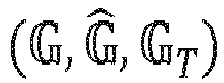
- The present disclosure is directed to a method for ciphering digital data M being an element of a group G T , said group G T being part of a bilinear group (G, Ĝ, G T ) of prime order p, the method being executed by an electronic device. The method is remarkable in that it comprises:
- applying a hash function to an identity associated to a recipient electronic device, delivering K + 1 elements, each element belonging to said group Ĝ, and K being an integer value greater than or equal to one;
- obtaining from common public parameters, shared by n trusted authorities servers, n being an integer value greater or equal to two, 2K generators of said group G;
- obtaining K random element(s) belonging to Z p ;
- determining K + 1 elements belonging to said group G via exponentiations of combinations of generators from said 2K generators, with exponents being said K random element(s), said K + 1 elements being a first part of a ciphertext of said digital data M;
- determining a product of said digital data M with K + 1 elements belonging to said group G T , each of said K + 1 elements belonging to said group G T being obtained via applying a pairing function on a combination of elements of a master public key associated to one of the n trusted authorities, said K random element(s) and output of said applying a hash function, delivering a second part of said ciphertext of said digital data M.
- In a preferred embodiment, the method for ciphering is remarkable in that said master public key comprises K(K + 1) elements belonging to said group G, said K(K + 1) elements being derived from said 2K generators.
- In a preferred embodiment, the method for ciphering is remarkable in that said integer value K is equal to one.
- In a preferred embodiment, the method for ciphering is remarkable in that said first part of said ciphertext of said digital data M is (Cz, Cr ) = (gz θ,gr θ) with gz and gr being said 2 generators of said group G, and θ is said one random element belonging to Z p.
- In a preferred embodiment, the method for ciphering is remarkable in that said second part of said ciphertext of said digital data M is M.

- In another embodiment, the method for ciphering is remarkable in that said integer value K is equal to two.
- In a preferred embodiment, such method for ciphering is remarkable in that said first part of said ciphertext of said digital data M is (Cr,Cu,Cz) = (gr θ
1 ,hu θ2 ,gz θ1 ·hz θ2) with gr , gz, hu and hz being said 4 generators of said group G, and θ1, θ2 are said two random elements belonging to Z p . - In a preferred embodiment, such method for ciphering is remarkable in that said second part of said ciphertext of said digital data M is M.


- In another embodiment, it is proposed a method for deciphering a ciphertext, said ciphertext comprising a first part and a second part. Such method for deciphering can be executed on an electronic device, and is remarkable in that it comprises:
- obtaining a bilinear group (G, Ĝ, G T ) of prime order p;
- obtaining a private key associated to an identity , said private key being a linearly homomorphic signature of a hash of said identity, and said private key comprising K + 1 elements of said group G, with K being an integer value greater than or equal to one;
- determining a product of said second part of said ciphertext with K + 1 elements belonging to said group G T , each element of said K + 1 elements belonging to said group G T being obtained via applying a pairing function on a combination of elements of said first part of said ciphertext with elements of said private key associated to said identity, said determining delivering deciphered digital data M.
- In a preferred embodiment, the method for deciphering is remarkable in that each element of said private key associated to said identity is equal to

- In a preferred embodiment, the method for deciphering is remarkable in that said integer value K is equal to one.
- In a preferred embodiment, the method for deciphering is remarkable in that said private key is

- In a preferred embodiment, the method for deciphering is remarkable in that said determining a product corresponds to obtaining D.e(Cz,zID ).e(Cr,rID ) where the couple (Cz, Cr ) is said first part of said ciphertext, and D is said second part of said ciphertext.
- In another embodiment, the method for deciphering is remarkable in that said integer value K is equal to two.
- In a preferred embodiment, such method for deciphering is remarkable in that said private key is

- In a preferred embodiment, such method for deciphering is remarkable in that said determining a product corresponds to obtaining D.e(Cr,rID ).e(Cu, uID ).e(Cz,zID ) where the triplet (Cr, Cu, Cz) is said first part of said ciphertext, and D is said second part of said ciphertext.
- It should also be noticed that the results described in the article " Building Key-Private Public-Key Encryption Schemes", by K.G. Paterson et al., published in the proceedings of the conference ACISP 2009, can be applied to at least one embodiment of the disclosure in order to generically construct a chosen-ciphertext-secure key private public-key encryption scheme with a tighter security proof in the multi-user setting, contrary to the results of Bellare et al., in the article "Public-Key Encryption in a Multi-user Setting: Security Proofs and Improvements", published in the proceedings of the conference Eurocrypt 00, that only consider semantic security and chosen-ciphertext security. In particular, they do not provide a method for building receiver-anonymous (a.k.a. key-private) chosen ciphertext-secure public-key encryption schemes where the security reductions are not affected by the number of users in the system.
- According to an exemplary implementation, the different steps of the method are implemented by a computer software program or programs, this software program comprising software instructions designed to be executed by a data processor of a relay module according to the disclosure and being designed to control the execution of the different steps of this method.
- Consequently, an aspect of the disclosure also concerns a program liable to be executed by a computer or by a data processor, this program comprising instructions to command the execution of the steps of a method as mentioned here above.
- This program can use any programming language whatsoever and be in the form of a source code, object code or code that is intermediate between source code and object code, such as in a partially compiled form or in any other desirable form.
- The disclosure also concerns an information medium readable by a data processor and comprising instructions of a program as mentioned here above.
- The information medium can be any entity or device capable of storing the program. For example, the medium can comprise a storage means such as a ROM (which stands for "Read Only Memory"), for example a CD-ROM (which stands for "Compact Disc - Read Only Memory") or a microelectronic circuit ROM or again a magnetic recording means, for example a floppy disk or a hard disk drive.
- Furthermore, the information medium may be a transmissible carrier such as an electrical or optical signal that can be conveyed through an electrical or optical cable, by radio or by other means. The program can be especially downloaded into an Internet-type network.
- Alternately, the information medium can be an integrated circuit into which the program is incorporated, the circuit being adapted to executing or being used in the execution of the method in question.
- According to one embodiment, an embodiment of the disclosure is implemented by means of software and/or hardware components. From this viewpoint, the term "module" can correspond in this document both to a software component and to a hardware component or to a set of hardware and software components.
- A software component corresponds to one or more computer programs, one or more sub-programs of a program, or more generally to any element of a program or a software program capable of implementing a function or a set of functions according to what is described here below for the module concerned. One such software component is executed by a data processor of a physical entity (terminal, server, etc.) and is capable of accessing the hardware resources of this physical entity (memories, recording media, communications buses, input/output electronic boards, user interfaces, etc.).
- Similarly, a hardware component corresponds to any element of a hardware unit capable of implementing a function or a set of functions according to what is described here below for the module concerned. It may be a programmable hardware component or a component with an integrated circuit for the execution of software, for example an integrated circuit, a smart card, a memory card, an electronic board for executing firmware etc.
- Let's also remark that a step of obtaining an element/value in the present document can be viewed either as a step of reading such element/value in a memory unit of an electronic device or a step of receiving such element/value from another electronic device via communication means.
- In another embodiment, it is proposed an electronic device for ciphering digital data M being an element of a group G T , said group G T being part of a bilinear group (G, Ĝ, G T ) of prime order p. The electronic device is remarkable in that it comprises:
- means for applying a hash function to an identity associated to a recipient electronic device, delivering K + 1 elements, each element belonging to said group Ĝ, and K being an integer value greater than or equal to one;
- means for obtaining from common public parameters, shared by n trusted authorities servers, n being an integer value greater or equal to two, 2K generators of said group;

- means for obtaining K random element(s) belonging to Z p ;
- means for determining K + 1 elements belonging to said group G via exponentiations of combinations of generators from said 2K generators, with exponents being said K random element(s), said K + 1 elements being a first part of a ciphertext of said digital data M;
- means for determining a product of said digital data M with K + 1 elements belonging to said group G T , each of said K + 1 elements belonging to said group G T being obtained via applying a pairing function on a combination of elements of a master public key associated to one of the n trusted authorities, said K random element(s) and output of said applying a hash function, delivering a second part of said ciphertext of said digital data M.
- In another embodiment, it is proposed an electronic device for deciphering a ciphertext, said ciphertext comprising a first part and a second part, the electronic device being characterized in that it comprises:
- means for obtaining a bilinear group (G, Ĝ, G T ) of prime order p;
- means for obtaining a private key associated to an identity , said private key being a linearly homomorphic signature of a hash of said identity, and said private key comprising K + 1 elements of said group G, with K being an integer value greater than or equal to one;
- means for determining a product of said second part of said ciphertext with K + 1 elements belonging to said group G T , each element of said K + 1 elements belonging to said group G T being obtained via applying a pairing function on a combination of elements of said first part of said ciphertext with elements of said private key associated to said identity, said determining delivering deciphered digital data M.
- The above and other aspects of the disclosure will become more apparent by the following detailed description of exemplary embodiments thereof with reference to the attached drawings in which:
-
Figure 1 discloses a flowchart which depicts some steps performed by an electronic device during a common setup generation process, according to one embodiment of the disclosure; -
Figure 2 discloses a flowchart which depicts some steps performed by an electronic device during a master key generation process, according to one embodiment of the disclosure; -
Figure 3 discloses a flowchart which depicts some steps performed by an electronic device during a private key generation process, according to one embodiment of the disclosure; -
Figure 4 discloses a flowchart which depicts some steps performed by an electronic device during an execution of a method of ciphering, according to one embodiment of the disclosure; -
Figure 5 discloses a flowchart which depicts some steps performed by an electronic device during an execution of a method of deciphering, according to one embodiment of the disclosure; -
Figure 6 discloses a flowchart which depicts some steps performed by an electronic device during a common setup generation process, according to one embodiment of the disclosure; -
Figure 7 discloses a flowchart which depicts some steps performed by an electronic device during a master key generation process, according to one embodiment of the disclosure; -
Figure 8 discloses a flowchart which depicts some steps performed by an electronic device during a private key generation process, according to one embodiment of the disclosure; -
Figure 9 discloses a flowchart which depicts some steps performed by an electronic device during an execution of a method of ciphering, according to one embodiment of the disclosure; -
Figure 10 discloses a flowchart which depicts some steps performed by an electronic device during an execution of a method of deciphering, according to one embodiment of the disclosure; -
Figure 11 presents a device that can be used to perform one or several steps of methods disclosed in the present document. -
Figure 1 discloses a flowchart which depicts some steps performed by an electronic device during a common setup generation process, according to one embodiment of the disclosure. - More precisely, the common setup generation process, referenced 100, takes as input a security parameter λ which corresponds to a bit-length.
- In a step, referenced 101, the electronic device chooses or selects or obtains a bilinear group (G, Ĝ, G T ) of prime order p > 2λ, with a efficiently computable isomorphism ψ: Ĝ → G.
- In a step referenced 102, the electronic device obtains (or chooses) several random generators from the group G (in this embodiment, the number of random generators is equal to four):

- In a step referenced 103, the electronic device chooses an identifier associated to a hash function H: {0,1}* → Ĝ3, that is modeled as a random oracle in the security analysis. The plaintext space is M := G T , and the ciphertext space is CT := G3 × G T .
- The electronic device then provides the common public parameters params to other electronic devices that either propagates it, or use it. The common public parameters params is defined as being params = ((G, Ĝ, G T), ψ, gz, gz, gr, hu, H, M, CT). It should be noted that the elements comprised in params can be transmitted either one by one in a sequentially way, or they can also be transmitted in a unique packet, or also they can be transmitted in parallel.
-
Figure 2 discloses a flowchart which depicts some steps performed by an electronic device during a master key generation process, according to one embodiment of the disclosure. - More precisely, the master key generation process, referenced 200, takes as input a common public parameters params as the one obtained via the execution of the
process 100. - In a step, referenced 201, the electronic device obtains 9 elements belonging to the group Z p . Indeed, for j = 1 to 3, the electronic device obtains

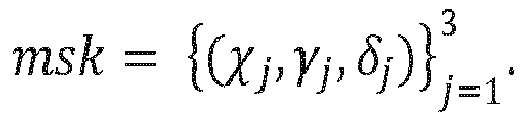
- Then, in a step referenced 202, it determines


- Then, it outputs the master secret key msk, which is kept in a secure memory of an electronic device, and the master public key mpk, which is then transmitted to other electronic devices. As described below, the master secret key msk is used only to perform a private key generation from a public identifier (or an identity). However, the master public key mpk is used in all other processes (i.e. the key generation process, the encryption or ciphering process, and the decryption or deciphering process).
-
Figure 3 discloses a flowchart which depicts some steps performed by an electronic device during a private key generation process, according to one embodiment of the disclosure. - More precisely, the private key generation process, referenced 300, takes as input a common public parameters params as the one obtained via the execution of the
process 100, and the master secret key msk, as the one obtained via the execution of theprocess 200. - In a step referenced 301, the electronic device, that could be a trusted authority (TA), determines from a given identity ID, a triple (H 1, H2, H 3) = H(ID) ∈ Ĝ3. In another embodiment, the electronic device can obtain it from another electronic device.
- Then, in a step referenced 302, the electronic device uses the components of the master secret


- The electronic device provides the determined secret key dID to the electronic device associated to the given identity ID, enabling it to perform ciphering as detailed in the
Figure 4 . -
Figure 4 discloses a flowchart which depicts some steps performed by an electronic device during an execution of a method of ciphering, according to one embodiment of the disclosure. - More precisely, the method of ciphering, referenced 400, takes as input a common public parameters params as the one obtained via the execution of the
process 100, the master public key mpk, as the one obtained via the execution of theprocess 200, a message M to encrypt/cipher, and an identity ID (corresponding to the one of the receiver that is to decipher the output of the method of ciphering 400). - The electronic device obtains, in a step referenced 401, random elements θ1,θ2 belonging to the group

- It also determines, in a step referenced 402, from the identity ID and the information related to the hash function H to be used, the value of H(ID) = (H 1, H 2, H 3) ∈ Ĝ3. Obviously, the order of execution of the
steps - Then, in a step referenced 403, the electronic device performs several exponentiations and pairing computations in order to obtain:
- a triplet (Cr, Cu, Cz ) = (gr θ1, hu θ2, gz θ1. hz θ2) that corresponds to a first part of the ciphertext C; and
- an element

-
Figure 5 discloses a flowchart which depicts some steps performed by an electronic device during an execution of a method of deciphering, according to one embodiment of the disclosure. - More precisely, the method of deciphering, referenced 500, takes as input a common public parameters params as the one obtained via the execution of the
process 100, the master public key mpk, as the one obtained via the execution of theprocess 200, a ciphertext C to be decrypted, and a private key dID associated to the given identity, as the one obtained via the execution of theprocess 300. - The electronic device parses, in a step referenced 501, the ciphertext C to be decrypted in the same way as an expected ciphertext obtained via the execution of the
method 400. Therefore we have C = (Cr, Cu, Cz, D). - It also parses, in a step referenced 502, the private key dID in the same way as an expected private key (or a decryption key) obtained via the execution of the
method 300. Therefore we have dID = (ZID, rID, uID ). - Then, the decrypted message M is obtained, in a step referenced 503, by determining D.e(Cr,rID ).e(Cu,uID ).e(Cz,zID ). Indeed, it is due to the fact that M = D.e(Cr,rID ).e(Cu,uID ).e(Cz,zID ). The correctness can be verified by observing that for a decryption key dID = (zID,rID,uID ) the two following relations are satisfied:



- The following scheme (comprising the methods of
Figures 1 to 5 ) is provably secure in the random oracle model assuming the DLIN (for "Decision Linear") assumption holds as it is detailed in the following section. The security proof relies on the use of a sequence of games as explained in the article " Sequences of Games: A Tool for Taming Complexity in Security Proofs" by V. Shoup. The general case (with the use of K > 3) is linked to the K - DLIN problem, which is a generalization of the linear problem, as explained in the article " A Cramer-Shoup Encryption Scheme from the Linear Assumption and from Progressively Weaker Linear Variants" by H. Shacham. - We can prove the following result, which shows that the exact security of the scheme does not depend on the number n of authorities in the system. It can also be remarked that, as a consequence of this result, ciphertexts are computationally indistinguishable from a sequence of random group elements in CT := G3 × G T . This implies that these ciphertexts computationally hide the message, the identity of the receiver and the specific master public key mpk under which they are generated.
- For reminders, an IBE system (or scheme) is Al-secure in the multi-TA setting (or m-Al-ID-CPA secure) if no PPT (i.e. no polynomial) adversary A has non-negligible advantage in this game:
- 1. The challenger generates global parameters through a common setup generation process, that are given to an adversary A;
- 2. The adversary A chooses an integer n ∈ poly(λ). The challenger generates n master key pairs

- 3. The adversary A interleaves the following kinds of queries:
- a. Corruption queries: A specifies an index i ∈ {1, ..., n}. The challenger returns the master secret key mski of the i-th TA and sets CTA := CTA ∪ {i};
- b. Private key queries: A chooses a pair (ID, i), where i ∈ {1, ..., n), and ID is an identity of A' s choice. The challenger responds with a private key dID generated through a private key generation process for identity ID, and sets Li ← Li ∪ {ID}.
- 4. When the adversary A decides that phase 3 is over, it chooses a message M*, an identity ID* and an index i* ∈ {1, ..., n}, such that i* ∉ CTA and The challenger flips a coin


- 5. The adversary A issues new queries as in stage 3. At the end of stage 5, it is required that i* ∉ CTA and ID* ∉ Li *;
- 6. The adversary A outputs a bit d' ∈ {0,1} and wins if d = d'. Adversary A's advantage is defined as the distance
- The above definition captures that ciphertexts should be indistinguishable from random elements of the ciphertext space, which is common to all authorities. As a result, ciphertexts computationally hide the identity of the receiver (and thus provide key-privacy in the identity-based setting) and the specific master public key that was used to create them.
- The property of hiding the trusted authority (TA) that the receiver depends on is called TA anonymity in the article " Building Key-Private Public-Key Encryption Schemes", by K. Paterson, and published in the proceedings of the conference ACISP 2009. It was proved in this article that any TA-anonymous IBE scheme implies a keyprivate public-key encryption scheme which is secure against chosen-ciphertext attacks.
- The idea of this article was simply to apply the Canetti-Halevi-Katz transformation (described in the article " Chosen-Ciphertext Security from Identity-Based Encryption " by R. Canetti et al., and published in the proceedings of the conference Eurocrypt 2004) to the underlying TA-anonymous IBE. As a consequence, any IBE scheme satisfying the above definition implies a chosen-ciphertext-secure key-private public-key encryption scheme.
- The following theorem can be stated: the scheme disclosed in
Figures 1 to 5 provides m AI-ID-CPA security in the random oracle model if the DLIN assumption holds in Ĝ. Concretely, for any m -AI-ID-CPA adversary A, there exists a DLIN distinguiher B such that - Adv m-AI-ID-CPA (A) ≤ 3. e. (q + 1). Adv DLIN (B), where e is the base for the natural logarithm and q is the maximal number of private key queries per authority.
- The proof of such statement can be done via the following sequence of games, which starts with a game where the challenger's hidden bit is d = 0 and ends with a game where d = 1. In each game i, Si denotes the event that the challenger outputs d' = 1.
- Game 0: This is the real game captured by Definition 2. Throughout the game, all random oracle queries are answered by returning a uniformly random value in the appropriate range. Of course, the adversary A consistently receives the same answer when a given query is made more than once. When A chooses to corrupt some authority i ∈ {1,...,n}, the challenger B hands over the master secret key

process 300. To answer such a query, the challenger invokes the random oracle H for itself in order to define the hash value H(ID) ∈ Ĝ3 if it has not been defined yet. At the end of the game, the adversary outputs a bit d' ∈ {0,1} and the challenger outputs 1if d' = 0. The latter event is noted S 0. - Game 1: In this game, the generation of the challenge ciphertext is modified C* =



- The ciphertext

- Game 2: This game is identical to Game 1 with the following difference. For each random oracle query H(ID), the challenger B flips a biased coin vID ∈ {0,1} that takes the value 1 with probability1/(q + 1) and the value 0 with probability q/(q + 1). At the end of the game, B considers the event E that either of the following conditions holds:
- For the target authority-identity pair(i*,ID*), the coin vID * flipped for the hash query H(ID*) was vID * = 0;
- There exists an identity ID ≠ ID*, suct that a private key query (i*, ID) was made for the target authority i* ∈ {1, ..., n} but for which vID = 1.
- Game 3: In this game, we modify the treatment of random oracle queries. At the outset of the game, the challenger B picks random group elements

- If vID = 0, the challenger B defines H(ID) = (H 1, H 2, H3 ) ∈ Ĝ3 as a vector living in the two dimensional space spanned by the vectors (ƒ̂, 1, ĝ) and (1, ĥ, ĝ). Namely, it returns (H 1, H 2, H3 ) = (ƒ̂ αID ,ĥ βID ,ĝ αID+βID ), for randomly chosen αID,

- If vID = 1, then H(ID) is defined to be a random vector of Ĝ3 as previously.
- Game 4: In this game, we bring another modification to the generation of the challenge ciphertext


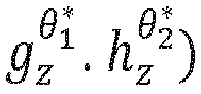


The message is thus blinded by a product of
 E of Game 2 occurs, we know that the vector (H 1*, H 2*,H 3*) = H(ID*) is uniformly random in Ĝ3 and thus linearly independent of all the vectors H(ID) = (H 1, H 2, H 3) ∈ Ĝ3 for which A makes private key queries of the form (i*,ID), during the game. It comes that these private key queries involving the target authority i* only provide A with redundant information about the master secret key

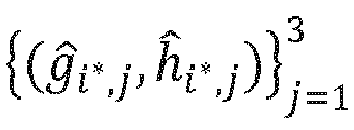 E, all private key queries (i*, ID) only allow A to obtain linearly homomorphic signatures on vectors living in Span((f̂, 1, ĝ), (1, ĥ, ĝ)), which does not contain (H 1*, H 2*, H 3*) = H(ID*). For the adversary, inferring



- Game 5: In this game, we modify again the treatment of random oracle queries. Here, at each hash query H(ID), the challenger B returns a completely random tuple


- Game 6: This game is identical to Game 5 with the difference that the challenger B does not abort any longer when event E occurs. We thus have Pr[S6] = e(q + 1). Pr[S5]. It is easy to see that Game 6 corresponds to the actual attack game of Definition 2 when the challenger's random bit is d = 1. When counting probabilities throughout the sequence of games, we find that the adversary's advantage in Definition 2 can be expressed as |Pr[S0] - Pr[S6]| ≤ 3.e. (q + 1).A dv DLIN (B).
Then, the following Lemma (noted Lemma 1) can be stated : Under the DLIN assumption in Ĝ, Game 3 is computationally indistinguishable from Game 2.
Indeed, the proof builds a simple DLIN distinguisher B from an adversary A that can tell apart Game 3 and Game 2. The reduction B receives as input a pair (ĝ, f̂,ĥ, f̂r,ĥs,T) and has to decide whether T = ĝ r+s or T ∈R G. To do this, algorithm B begins by generating params, and
- If υID = 0, B chooses ωID, µID ,

(H 1, H 2, H 3) = ((f̂r ) ωID .f̂µID , (ĥs ) ωID ·ĥνID , TωID · ĝ µID +ν ID )
and programs the random oracle so as to have H(ID) = (H 1, H 2, H 3) ∈ Ĝ3. Observe that, if T = ĝ r+s , the triple (H 1, H 2, H 3) has the same distribution as in Game 3 as it can be written (f̂ αID , ĥβID , ĝα.+βID ) wherea ID = rωID +µID and β ID = sωID+νID . In contrast, if T ∈R G, we can write T = ĝr+s+x for some random x ∈R Z p which is non-zero with overwhelming probability. In this case, we have
(H 1, H 2, H 3) = ((f̂αID , ĥβID , ĝ αID +βID +xωID ), so that (H 1, H 2, H 3) ∈ R Ĝ3. - If υ ID = 1, B draws

When A terminates, B output 1 if A outputs 0, and 0 otherwise.
Clearly, if T = ĝr+s , A's view is exactly the same as in Game 3. In contrast, if T is uniform in Ĝ, B is rather plaing the Game 2 with the adversary.
The following Lemma (noted Lemma 2) can be stated: under the DLIN assumption in Ĝ, Game 4 is computationally indistinguishable from Game 3. - Indeed, the Lemma 2 can be proven as follows: towards a contradiction, let us assume that a PPT adversary A can cause the challenger to output 1 with noticeably different probabilities in Game 4 and Game 3. Using A, we build a distinguisher B as follows. Algorithm B takes as input a DLIN instance (ĝ, f̂, ĥ,f̂θ1, ĥθ
2 , T) with the task of deciding T = ĝ θ1 +θ2 or T ∈ R Ĝ. To this end, algorithm B generates common public parameters being params = (gz , gr, hz , hu ) by setting gr = ψ ( f̂), hu = ψ (ĥ), as well as gz = ψ(f̂) µ· ψ(ĝ)ω and hz = ψ(ĥ) ν·ψ(ĝ)ω, for randomly chosen






1 +θ2 (resp. T ∈ R Ĝ), the challenge ciphertext is distributed as in Game 3 (resp. Game 4). - We remark that the scheme can also work without an efficiently computable isomorphism ψ: Ĝ → G. In this case, the security proof has to rely on the DLIN assumption in both G and Ĝ, and not only Ĝ. In order to secure the scheme against chosen-ciphertext attacks (where the adversary is granted access to a decryption oracle), several generic methods can be applied. For example, the Fujisaki-Okamoto transformation (described in the article " How to Enhance the Security of Public-Key Encryption at Minimum Cost" by E. Fujisaki et al., and published in the proceedings of the conference PKC 1999) immediately provides chosen-ciphertext security in the random oracle model and also preserves anonymity.
-
Figure 6 discloses a flowchart which depicts some steps performed by an electronic device during a common setup generation process, according to one embodiment of the disclosure. - More precisely, the common setup generation process, referenced 600, takes as input a security parameter λ.
- In a step, referenced 601, the electronic device chooses or selects or obtains a bilinear group (G, Ĝ, G T ) of prime order p > 2λ, without an efficient isomorphism ψ: Ĝ → G.
- In a step referenced 602, the electronic device obtains (or chooses) several random generators from the group G (in this embodiment, the number of random generators is equal to four):
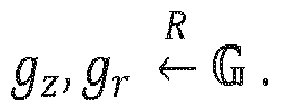
- In a step referenced 603, the electronic device chooses an identifier associated to a hash function H: {0,1}* → Ĝ2, that is modeled as a random oracle in the security analysis. The plaintext space is M := GT , and the ciphertext space is CT := G2 × GT .
- The electronic device then provides the common public parameters params to other electronic devices that either propagates it, or use it. The common public parameters params is defined as being params = ((G, Ĝ, G T ), ψ, g z' gr, H, M, CT). It should be noted that the elements comprised in params can be transmitted either one by one in a sequentially way, or they can also be transmitted in a unique packet, or also they can be transmitted in parallel.
-
Figure 7 discloses a flowchart which depicts some steps performed by an electronic device during a master key generation process, according to one embodiment of the disclosure. - More precisely, the master key generation process, referenced 700, takes as input a common public parameters params as the one obtained via the execution of the
process 600. - In a step, referenced 701, the electronic device obtains 4 elements belonging to the group Z p . Indeed, for j = 1 to 2, the electronic device obtains

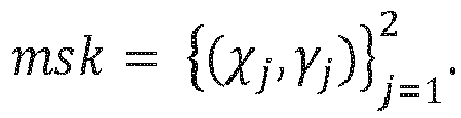
- Then, in a step referenced 702, it determines


- Then, it outputs the master secret key msk, which is kept in a secure memory of an electronic device, and the master public key mpk, which is then transmitted to other electronic devices. As described below, the master secret key msk is used only to perform a private key generation from a public identifier (or an identity). However, the master public key mpk is used in all other processes (i.e. the key generation process, the encryption or ciphering process, and the decryption or deciphering process).
-
Figure 8 discloses a flowchart which depicts some steps performed by an electronic device during a private key generation process, according to one embodiment of the disclosure. - More precisely, the private key generation process, referenced 800, takes as input a common public parameters params as the one obtained via the execution of the
process 600, and the master secret key msk, as the one obtained via the execution of theprocess 700. - In a step referenced 801, the electronic device, that is a Trusted Authority (TA), determines from a given identity ID, a triple (H 1, H 2) = H(ID) ∈ Ĝ2. In another embodiment, the electronic device can obtain it from another electronic device.
- Then, in a step referenced 802, the electronic device uses the components of the master secret key


- The electronic device provides the determined secret key dID to the electronic device associated to the given identity ID, enabling it to perform ciphering as detailed in the
Figure 9 . -
Figure 9 discloses a flowchart which depicts some steps performed by an electronic device during an execution of a method of ciphering, according to one embodiment of the disclosure. - More precisely, the method of ciphering, referenced 900, takes as input a common public parameters params as the one obtained via the execution of the
process 600, the master public key mpk, as the one obtained via the execution of theprocess 700, a message M to encrypt/cipher, and an identity ID (corresponding to the one of the receiver that is to decipher the output of the method of ciphering 900). - The electronic device obtains, in a step referenced 901, a random element θ1 belonging to the group

- It also determines, in a step referenced 902, from the identity ID and the information related to the hash function H to be used, the value of H(ID) = (H 1, H 2) ∈ Ĝ2. Obviously, the order of execution of the
steps - Then, in a step referenced 903, the electronic device performs several exponentiations and pairing computations in order to obtain:
- a triplet (Cz , Cr ) = (gz θ
1 , gr θ1 ) that corresponds to a first part of the ciphertext C; and - an element

- Then, the ciphertext C = (Cz , Cr, D) determined by the electronic device is transmitted.
-
Figure 10 discloses a flowchart which depicts some steps performed by an electronic device during an execution of a method of deciphering, according to one embodiment of the disclosure. - More precisely, the method of deciphering, referenced 1000, takes as input a common public parameters params as the one obtained via the execution of the
process 600, the master public key mpk, as the one obtained via the execution of theprocess 700, a ciphertext C to be decrypted, and a private key dID associated to the given identity, as the one obtained via the execution of theprocess 800. - The electronic device parses, in a step referenced 1001, the ciphertext C to be decrypted in the same way as an expected ciphertext obtained via the execution of the
method 900. Therefore we have C = (Cz , Cr , D). - It also parses, in a step referenced 1002, the private key dID in the same way as an expected private key (or a decryption key) obtained via the execution of the
method 800. Therefore we have dID = (zID,rID ). - Then, the decrypted message M is obtained, in a step referenced 1003, by determining D. e(Cz, ZID ). e(Cr, rID ). Indeed, it is due to the fact that M = D. e(Cz, ZID ). e(Cr, rID ). The correctness can be verified by observing that for a decryption key dID = (ZID,rID ), the following relation is satisfied:


- The following result can be proved in the same way as in the first embodiment.
- The following theorem can be stated: the scheme disclosed in
Figures 6 to 10 provides m AI-ID-CPA security in the random oracle model if the SXDH (for "Symmetric eXternal Diffie-Hellman") assumption holds in (G, Ĝ). It means that the DDH assumption (for decisional Diffie-Hellman assumption; see for example the article entitled " The Decision Diffie-Hellman Problem" by D. Boneh, published in the proceedings of the Third Algorithmic Number Theory Symposium, in 1998) is both intractable in G and in Ĝ. - Concretely, for any m -AI-ID-CPA adversary A, there exists a DDH distinguihers B 1 and B 2, in the groups G and Ĝ, respectively, such that
- Adv m-AI-ID-CPA (A) ≤ e. (q + 1). ( Adv DDH
1 (B 1) + 2. Adv DDH2 (B 2), where e is the base for the natural logarithm and q is the maximal number of private key queries per authority. - The first advantage of the two schemes is to simultaneously provide: (i) semantic security and receiver anonymity in the sense of a strong definition, where ciphertexts are basically pseudorandom: they computationally hide both the receiver's identity and the master public key under which the message was encrypted; (ii) security proofs with tighter reductions (in the random oracle model) in the multi-authority setting: namely, the multiplicative gap between the adversary's advantage and the probability to break a decisional assumption does not depend on the number of authorities.
- To our knowledge, the two constructions are the first IBE schemes that provably combine properties (i) and (ii).
- In addition, the two schemes can easily be adapted to a setting with distributed authorities described in the article " Distributed Private-Key Generators for Identity-Based Cryptography" by A. Kate et al., published in the proceedings of the conference SCN 2010. Using techniques from threshold cryptography described in the article " Threshold Cryptosystems" by Y. Desmedt et al., and published in the proceedings of the conference CRYPRO 1989, the master secret key can be shared in a t-out-of-n fashion. In order to avoid storing the entire master secret (which is a very sensitive piece of information in IBE systems) in one location, each TA is split into n distinct sub-authorities, each of which holds a share of the master secret key, so that users have to receive partial identity-based private keys from at least t sub-authorities to obtain an effective decryption key. This was already possible in the Boneh-Franklin IBE, for example. However, in distributed variants of our systems, we can prove security in an adaptive corruption setting, where the adversary can dynamically choose which sub-authorities it wants to corrupt. In existing threshold variants of the Boneh-Franklin IBE, security can only be proved against a static adversary, that chooses which parties it wants to corrupt at the beginning of the attack, before seeing the master public key.
-
Figure 11 presents a device that can be used to perform one or several steps of methods disclosed in the present document. - Such device referenced 1100 comprises a computing unit (for example a CPU, for "Central Processing Unit"), referenced 1101, and one or several memory units (for example a RAM (for "Random Access Memory") block in which intermediate results can be stored temporarily during the execution of instructions a computer program, or a ROM block in which, among other things, computer programs are stored, or an EEPROM ("Electrically-Erasable Programmable Read-Only Memory") block, or a flash block) referenced 1102. Computer programs are made of instructions that can be executed by the computing unit.
Such device 1100 can also comprise a dedicated unit, referenced 1103, constituting an input-output interface to allow thedevice 1100 to communicate with other devices. In particular, thisdedicated unit 1103 can be connected with an antenna (in order to perform communication without contacts), or with serial ports (to carry communications "contact"). Let's remark that the arrows inFigure 11 mean that the linked unit can exchange data through buses for example together. - In an alternative embodiment, some or all of the steps of the method previously described, can be implemented in hardware in a programmable FPGA ("Field Programmable Gate Array") component or ASIC ("Application-Specific Integrated Circuit") component.
- In an alternative embodiment, some or all of the steps of the method previously described, can be executed on an electronic device comprising memory units and processing units as the one disclosed in the
Figure 11 . - At last, to summarize, one embodiment of the disclosure proposes to use the linearly homomorphic signatures (as obtained through the technique described in the article " Linearly Homomorphic Structure-Preserving Signatures and their Applications. Linearly Homomorphic Structure-Preserving Signatures and their Applications", by B. Libert et al., and published in the proceedings of the conference CRYPTO 2013) as private keys in an IBE system (recall that any IBE implies a signature scheme because IBE private keys can always be used as signatures, as noted in the article " Identity-Based Encryption from the Weil Pairing", by D. Boneh et al., published in the proceedings of the conference CRYPTO 2001). In the IBE setting, we do not need the homomorphic property, which will be eliminated by hashing the identities before signing them in order to generate a private key for these identities. When proving the security of the scheme, we will take advantage of the fact that, in the security proofs of the linearly homomorphic signatures detailed in the article " Linearly Homomorphic Structure-Preserving Signatures and their Applications. Linearly Homomorphic Structure-Preserving Signatures and their Applications", by B. Libert et al., and published in the proceedings of the conference CRYPTO 2013, the reduction always knows the signer's private key. Since these signers' private keys will be used as authorities' master secret keys in the multi-authority setting, this will allow the reduction to correctly answer authority corruption queries made by the adversary. Since all master secret keys are known to the reduction at any time, the reduction can always consistently answer when the adversary adaptively decides to corrupt some authority.
- As detailed previously, the idea of the security proof is as follows. The reduction "programs" the random oracle in such a way that, for any identity ID for which private keys are obtained by the adversary from the target authority i*, the resulting hash value (H 1, H 2, H 3) ∈ Ĝ3 always falls in a two dimensional subspace: by doing so, it can be guaranteed that the adversary only obtains redundant information about the master secret key


Claims (19)
- Method for ciphering digital data M being an element of a group, said group
 being part of a bilinear group (G, Ĝ, G T ) of prime order p, the method being executed by an electronic device, and being characterized in that it comprises:
 - applying a hash function to an identity associated to a recipient electronic device, delivering K + 1 elements, each element belonging to said group Ĝ, and K being an integer value greater than or equal to one;- obtaining from common public parameters, shared by n trusted authorities servers, n being an integer value greater or equal to two, 2K generators of said group;
 - obtaining K random element(s) belonging to Z p ;- determining K + 1 elements belonging to said group G via exponentiations of combinations of generators from said 2K generators, with exponents being said K random element(s), said K + 1 elements being a first part of a ciphertext of said digital data M;- determining a product of said digital data M with K + 1 elements belonging to said group G T , each of said K + 1 elements belonging to said group G T being obtained via applying a pairing function on a combination of elements of a master public key associated to one of the n trusted authorities, said K random element(s) and output of said applying a hash function, delivering a second part of said ciphertext of said digital data M.
 - Method for ciphering according to claim 1, characterized in that said master public key comprises K(K + 1) elements belonging to said group G, said K(K + 1) elements being derived from said 2K generators.
- Method for ciphering according to any claims 1 to 2, characterized in that said integer value K is equal to one.
- Method for ciphering according to claim 3, characterized in that said first part of said ciphertext of said digital data M is (Cz , Cr ) = (gz θ , gr θ ) withgz and gr being said 2 generators of said group G, and θ is said one random element belonging to.

- Method for ciphering according to claim 4, characterized in that said second part of said ciphertext of said digital data M is

- Method for ciphering according to any claims 1 to 2, characterized in that said integer value K is equal to two.
- Method for ciphering according to claim 6, characterized in that said first part of said ciphertext of said digital data M is(Cr,Cu,Cz ) =(gr θ
1 , hu θ2 , gz θ1 . hz θ2 ) with gr , gz, hu and hz being said 4 generators of said group G, and θ1, θ2 are said two random elements belonging to Z p . - Method for ciphering according to claim 7, characterized in that said second part of said ciphertext of said digital data M is M.


j .hu δ j with j being equal to 1 or 2, χ j , γj and δ j being random elements belonging to Z p defining a master secret key, and e corresponds to said pairing function. - Method for deciphering a ciphertext, said ciphertext comprising a first part and a second part, the method for deciphering being executed on an electronic device, and being characterized in that it comprises:- obtaining a bilinear group (G, Ĝ, G T ) of prime order p;- obtaining a private key associated to an identity , said private key being a linearly homomorphic signature of a hash of said identity, and said private key comprising K + 1 elements of said group G, with K being an integer value greater than or equal to one;- determining a product of said second part of said ciphertext with K + 1 elements belonging to said group G T , each element of said K + 1 elements belonging to said group G T being obtained via applying a pairing function on a combination of elements of said first part of said ciphertext with elements of said private key associated to said identity, said determining delivering deciphered digital data M.
- Method for deciphering according to claim 9, characterized in that each element of said private key associated to said identity is equal to

- Method for deciphering according to claim 10, characterized in that said integer value K is equal to one.
- Method for deciphering according to claim 11, characterized in that said private key is

- Method for deciphering according to claim 12, characterized in that said determining a product corresponds to obtaining D. e(CZ,ZID ). e(Cr,rID ) where the couple (Cz , Cr ) is said first part of said ciphertext, and D is said second part of said ciphertext.
- Method for deciphering according to claim 10, characterized in that said integer value K is equal to two.
- Method for deciphering according to claim 14, characterized in that said private key is

- Method for deciphering according to claim 15, characterized in that said determining a product corresponds to obtaining D.e(Cr,rID). e(Cu,uID).e(Cz,ZID ) where the triplet (Cr , Cu , Cz ) is said first part of said ciphertext, and D is said second part of said ciphertext.
- A computer-readable and non-transient storage medium storing a computer program comprising a set of computer-executable instructions to implement a method for cryptographic computations, said instructions, when they are executed by a computer, being able to configure the computer to perform a method for ciphering of claims 1 to 8, and/or to perform a method for deciphering of claims 9 to 16.
- Electronic device for ciphering digital data M being an element of a group G T , said group G T being part of a bilinear group (G, Ĝ, G T ) of prime order p, the electronic device being characterized in that it comprises:- means for applying a hash function to an identity associated to a recipient electronic device, delivering K + 1 elements, each element belonging to said group Ĝ, and K being an integer value greater than or equal to one;- means for obtaining from common public parameters, shared by n trusted authorities servers, n being an integer value greater or equal to two, 2K generators of said group G;- means for obtaining K random element(s) belonging to Z p ;- means for determining K + 1 elements belonging to said group G via exponentiations of combinations of generators from said 2K generators, with exponents being said K random element(s), said K + elements being a first part of a ciphertext of said digital data M;- means for determining a product of said digital data M with K + 1 elements belonging to said group G T , each of said K + 1 elements belonging to said group G T being obtained via applying a pairing function on a combination of elements of a master public key associated to one of the n trusted authorities, said K random element(s) and output of said applying a hash function, delivering a second part of said ciphertext of said digital data M.
- Electronic device for deciphering a ciphertext, said ciphertext comprising a first part and a second part, the electronic device being characterized in that it comprises:- means for obtaining a bilinear group (G, Ĝ, G T ) of prime order p;- means for obtaining a private key associated to an identity , said private key being a linearly homomorphic signature of a hash of said identity, and said private key comprising K + 1 elements of said group G, with K being an integer value greater than or equal to one;- means for determining a product of said second part of said ciphertext with K + elements belonging to said group G T , each element of said K + 1 elements belonging to said group G T being obtained via applying a pairing function on a combination of elements of said first part of said ciphertext with elements of said private key associated to said identity, said determining delivering deciphered digital data M.
Priority Applications (2)
| Application Number | Priority Date | Filing Date | Title |
|---|---|---|---|
| EP14306108.3A EP2966802A1 (en) | 2014-07-07 | 2014-07-07 | Method for ciphering and deciphering digital data, based on an identity, in a multi-authorities context |
| US14/792,558 US20170061833A1 (en) | 2014-07-07 | 2015-07-06 | Method for ciphering and deciphering digital data, based on an identity, in a multi-authorities context |
Applications Claiming Priority (1)
| Application Number | Priority Date | Filing Date | Title |
|---|---|---|---|
| EP14306108.3A EP2966802A1 (en) | 2014-07-07 | 2014-07-07 | Method for ciphering and deciphering digital data, based on an identity, in a multi-authorities context |
Publications (1)
| Publication Number | Publication Date |
|---|---|
| EP2966802A1 true EP2966802A1 (en) | 2016-01-13 |
Family
ID=51257446
Family Applications (1)
| Application Number | Title | Priority Date | Filing Date |
|---|---|---|---|
| EP14306108.3A Withdrawn EP2966802A1 (en) | 2014-07-07 | 2014-07-07 | Method for ciphering and deciphering digital data, based on an identity, in a multi-authorities context |
Country Status (2)
| Country | Link |
|---|---|
| US (1) | US20170061833A1 (en) |
| EP (1) | EP2966802A1 (en) |
Cited By (1)
| Publication number | Priority date | Publication date | Assignee | Title |
|---|---|---|---|---|
| CN118282773A (en) * | 2024-05-29 | 2024-07-02 | 杭州海康威视数字技术股份有限公司 | Data privacy publishing and access control method, device and equipment |
Families Citing this family (21)
| Publication number | Priority date | Publication date | Assignee | Title |
|---|---|---|---|---|
| JP6006842B1 (en) * | 2015-07-22 | 2016-10-12 | 日本電信電話株式会社 | Secret computing device, method and program |
| GB2571367A (en) | 2016-02-23 | 2019-08-28 | Nchain Holdings Ltd | Tokenisation method and system for implementing exchanges on a blockchain |
| KR102777896B1 (en) | 2016-02-23 | 2025-03-10 | 엔체인 홀딩스 리미티드 | Blockchain-based exchange method using tokenization |
| JP6799061B2 (en) | 2016-02-23 | 2020-12-09 | エヌチェーン ホールディングス リミテッドNchain Holdings Limited | Secure multi-party loss resistant storage and transfer of cryptographic keys for blockchain-based systems combined with wallet management systems |
| JP6869250B2 (en) | 2016-02-23 | 2021-05-12 | エヌチェーン ホールディングス リミテッドNchain Holdings Limited | Methods and systems for efficient transfer of entities in peer-to-peer distributed ledgers using blockchain |
| KR102871871B1 (en) | 2016-02-23 | 2025-10-15 | 엔체인 라이센싱 아게 | Method and system for securing computer software using a distributed hash table and blockchain |
| JP6528008B2 (en) | 2016-02-23 | 2019-06-12 | エヌチェーン ホールディングス リミテッドNchain Holdings Limited | Personal Device Security Using Elliptic Curve Cryptography for Secret Sharing |
| US11347838B2 (en) | 2016-02-23 | 2022-05-31 | Nchain Holdings Ltd. | Blockchain implemented counting system and method for use in secure voting and distribution |
| KR102890466B1 (en) | 2016-02-23 | 2025-11-21 | 엔체인 라이센싱 아게 | Encryption method and system for secure extraction of data from blockchain |
| EP3420674B1 (en) | 2016-02-23 | 2021-03-24 | Nchain Holdings Limited | Blockchain-implemented method for control and distribution of digital content |
| EP3268914B1 (en) * | 2016-02-23 | 2018-06-20 | Nchain Holdings Limited | Determining a common secret for the secure exchange of information and hierarchical, deterministic cryptographic keys |
| SG11201806781SA (en) | 2016-02-23 | 2018-09-27 | Nchain Holdings Ltd | Registry and automated management method for blockchain-enforced smart contracts |
| EP3748903A1 (en) | 2016-02-23 | 2020-12-09 | Nchain Holdings Limited | Universal tokenisation system for blockchain-based cryptocurrencies |
| CN109314637B (en) | 2016-02-23 | 2021-09-10 | 区块链控股有限公司 | Method and apparatus for efficient transfer of cryptocurrency over a blockchain |
| WO2019043921A1 (en) * | 2017-09-01 | 2019-03-07 | 三菱電機株式会社 | Encryption device, decryption device, encryption method, decryption method, encryption program, and decryption program |
| WO2020152831A1 (en) * | 2019-01-24 | 2020-07-30 | 日本電気株式会社 | Information processing device, secret calculation method, and program |
| JP2021012339A (en) * | 2019-07-09 | 2021-02-04 | 株式会社 エヌティーアイ | Data processing equipment, data processing methods, and computer programs |
| US12099997B1 (en) | 2020-01-31 | 2024-09-24 | Steven Mark Hoffberg | Tokenized fungible liabilities |
| CN113489710B (en) * | 2021-06-30 | 2023-03-24 | 厦门熵基科技有限公司 | File sharing method, device, equipment and storage medium |
| JP2023153025A (en) * | 2022-03-30 | 2023-10-17 | エヌティーティー リサーチ インコーポレイテッド | Distributed multi-authority attribute-based inner product functional encryption |
| CN115801308B (en) * | 2022-09-16 | 2023-08-29 | 北京瑞莱智慧科技有限公司 | Data processing method, related device and storage medium |
-
2014
- 2014-07-07 EP EP14306108.3A patent/EP2966802A1/en not_active Withdrawn
-
2015
- 2015-07-06 US US14/792,558 patent/US20170061833A1/en not_active Abandoned
Non-Patent Citations (21)
| Title |
|---|
| "On the Exact Security of Full Domain Hash", PROCEEDINGS OF THE CONFERENCE CRYPTO, 2000 |
| A. DENT: "A Note On Game-Hopping Proofs", CRYPTOLOGY EPRINT ARCHIVE: REPORT, 2006, pages 260 |
| A. KATE ET AL.: "Distributed Private-Key Generators for Identity-Based Cryptography", PROCEEDINGS OF THE CONFERENCE SCN, 2010 |
| B. LIBERT ET AL.: "Linearly Homomor hic Structure-Preserving Signatures and their Applications. Linearly Homomorphic Structure-Preserving Signatures and their Applications", PROCEEDINGS OF THE CONFERENCE CRYPTO, 2013 |
| B. LIBERT ET AL.: "Linearly Homomorphic Structure-Preserving Signatures and their Applications. Linearly Homomorphic Structure-Preserving Signatures and their Applications", PROCEEDINGS OF THE CONFERENCE CRYPTO, 2013 |
| BELLARE ET AL.: "Public-Key Encry tion in a Multi-user Setting: Security Proofs and Improvements", PROCEEDINGS OF THE CONFERENCE EUROCRYPT 00 |
| BONEH D ET AL: "SHORT SIGNATURES FROM THE WEIL PAIRING", JOURNAL OF CRYPTOLOGY, SPRINGER, NEW YORK, NY, US, vol. 17, no. 4, 21 September 2004 (2004-09-21), pages 297 - 319, XP001221154, ISSN: 0933-2790, DOI: 10.1007/S00145-004-0314-9 * |
| BRENT WATERS ED - RONALD CRAMER: "Efficient Identity-Based Encryption Without Random Oracles", 22 May 2005, ADVANCES IN CRYPTOLOGY EUROCRYPT 2005, SPRINGER BERLIN HEIDELBERG, BERLIN, HEIDELBERG, PAGE(S) 114 - 127, ISBN: 978-3-540-25910-7, XP047029464 * |
| D. BONEH ET AL.: "ldentity-Based Encryption from the Weil Pairing", PROCEEDINGS OF THE CONFERENCE CRYPTO, 2001 |
| D. BONEH: "The Decision Diffie-Hellman Problem", PROCEEDINGS OF THE THIRD ALGORITHMIC NUMBER THEORY SYMPOSIUM, 1998 |
| DAN BONEH ET AL: "Identity Based Encryption From the Weil Pairing", INTERNATIONAL ASSOCIATION FOR CRYPTOLOGIC RESEARCH,, vol. 20011030:124849, 30 October 2001 (2001-10-30), pages 1 - 27, XP061000208 * |
| E. FUJISAKI ET AL.: "How to Enhance the Security of Public-Key Encryption at Minimum Cost", PROCEEDINGS OF THE CONFERENCE PKC, 1999 |
| H. SHACHAM, A CROMER-SHOUP ENCRYPTION SCHEME FROM THE LINEAR ASSUMPTION AND FROM PROGRESSIVELY WEAKER LINEAR VARIANTS |
| K. PATERSON ET AL.: "Security and Anonymity of Identity-Based Encryption with Multiple Trusted Authorities", PROCEEDINGS OF THE CONFERENCE PAIRING, 2008 |
| K. PATERSON: "Buildinq Key-Private Public-Key Encryptlon Schemes", PROCEEDINGS OF THE CONFERENCE ACISP, 2009 |
| K.G. PATERSON ET AL.: "Building Key-Private Public-Key Encryption Schemes", PROCEEDINGS OF THE CONFERENCE ACISP, 2009 |
| KENNETH G PATERSON ET AL: "Security and Anonymity of Identity-Based Encryption with Multiple Trusted Authorities", 1 September 2008, PAIRING-BASED CRYPTOGRAPHY - PAIRING 2008; [LECTURE NOTES IN COMPUTER SCIENCE], SPRINGER BERLIN HEIDELBERG, BERLIN, HEIDELBERG, PAGE(S) 354 - 375, ISBN: 978-3-540-85503-3, XP019103357 * |
| LIBERT BENOÎT ET AL LI XUE XUELIIOTATEE UQ EDU AU THE UNIVERSITY OF QUEENSLAND SCHOOL OF INFORMATION TECHNOLOGY AND ELECTRONIC ENG: "Linearly Homomorphic Structure-Preserving Signatures and Their Applications", 18 August 2013, LECTURE NOTES IN COMPUTER SCIENCE; [LECTURE NOTES IN COMPUTER SCIENCE], SPRINGER VERLAG, DE, PAGE(S) 289 - 307, ISSN: 0302-9743, XP047267915 * |
| R. CANETTI ET AL.: "Chosen- hertext Security from ldentity-Based Encryptlon", PROCEEDINGS OF THE CONFERENCE EUROCRYPT, 2004 |
| V. SHOUP, SEQUENCES OF GAMES: A TOOL FOR TAMINQ COMPLEXITY IN SECURITY PROOFS |
| Y. DESMEDT ET AL.: "Threshold Cryptosystems", PROCEEDINGS OF THE CONFERENCE CRYPRO, 1989 |
Cited By (1)
| Publication number | Priority date | Publication date | Assignee | Title |
|---|---|---|---|---|
| CN118282773A (en) * | 2024-05-29 | 2024-07-02 | 杭州海康威视数字技术股份有限公司 | Data privacy publishing and access control method, device and equipment |
Also Published As
| Publication number | Publication date |
|---|---|
| US20170061833A1 (en) | 2017-03-02 |
Similar Documents
| Publication | Publication Date | Title |
|---|---|---|
| US20170061833A1 (en) | Method for ciphering and deciphering digital data, based on an identity, in a multi-authorities context | |
| Castagnos et al. | Bandwidth-efficient threshold EC-DSA | |
| Bernstein et al. | Elligator: elliptic-curve points indistinguishable from uniform random strings | |
| US8184803B2 (en) | Hash functions using elliptic curve cryptography | |
| EP2860905A1 (en) | Method for ciphering a message via a keyed homomorphic encryption function, corresponding electronic device and computer program product | |
| Boyd et al. | Elliptic curve based password authenticated key exchange protocols | |
| US9356783B2 (en) | Method for ciphering and deciphering, corresponding electronic device and computer program product | |
| Jonsson et al. | On the Security of RSA Encryption in TLS | |
| US8705740B2 (en) | Elliptic curve-based message authentication code system and method | |
| US20100169658A1 (en) | Elliptic curve-based message authentication code | |
| EP2961095A1 (en) | Threshold cryptosystem, corresponding electronic devices and computer program products | |
| Cremers et al. | One-round Strongly Secure Key Exchange with Perfect Forward Secrecy and Deniability. | |
| Kaaniche et al. | A novel zero-knowledge scheme for proof of data possession in cloud storage applications | |
| EP3462668A1 (en) | Plaintext equivalence proof techniques in communication systems | |
| Smart | Public key encryption and signature algorithms | |
| Tang et al. | Robot: Robust Threshold BBS+ in Two Rounds | |
| Gerhart et al. | Security of Ibex | |
| Brown | Key agreement: security/division | |
| Yang et al. | An enhanced and secure protocol for authenticated key exchange | |
| MÍNGUEZ | Verifiable computation on encrypted data | |
| Gideskog | Viability of Post Quantum Digital Signature Algorithms on Field Programmable Gate Arrays | |
| Diko et al. | RSA & EXTENDED EUCLIDEAN ALGORITHM WITH EXAMPLES OF EXPONENTIAL RSA CIPHERS, RSA EXAMPLE SOLUTION WITH EXTENDED EUCLIDEAN ALGORITHM | |
| Dissanayake | Identification of Fake Messages Using Two PKCs | |
| WO2016048777A1 (en) | Identity-based xor homomorphic cryptosystems | |
| CHAU et al. | A SURVEY OF MATHEMATICAL CRYPTOGRAPHY |
Legal Events
| Date | Code | Title | Description |
|---|---|---|---|
| PUAI | Public reference made under article 153(3) epc to a published international application that has entered the european phase |
Free format text: ORIGINAL CODE: 0009012 |
|
| AK | Designated contracting states |
Kind code of ref document: A1 Designated state(s): AL AT BE BG CH CY CZ DE DK EE ES FI FR GB GR HR HU IE IS IT LI LT LU LV MC MK MT NL NO PL PT RO RS SE SI SK SM TR |
|
| AX | Request for extension of the european patent |
Extension state: BA ME |
|
| 17P | Request for examination filed |
Effective date: 20160712 |
|
| RBV | Designated contracting states (corrected) |
Designated state(s): AL AT BE BG CH CY CZ DE DK EE ES FI FR GB GR HR HU IE IS IT LI LT LU LV MC MK MT NL NO PL PT RO RS SE SI SK SM TR |
|
| 17Q | First examination report despatched |
Effective date: 20190205 |
|
| STAA | Information on the status of an ep patent application or granted ep patent |
Free format text: STATUS: THE APPLICATION HAS BEEN WITHDRAWN |
|
| 18W | Application withdrawn |
Effective date: 20190507 |