EP2964228B1 - Novel mixed agonist/antagonist opioid analgesics with reduced tolerance liabilities and uses thereof - Google Patents
Novel mixed agonist/antagonist opioid analgesics with reduced tolerance liabilities and uses thereof Download PDFInfo
- Publication number
- EP2964228B1 EP2964228B1 EP14759505.2A EP14759505A EP2964228B1 EP 2964228 B1 EP2964228 B1 EP 2964228B1 EP 14759505 A EP14759505 A EP 14759505A EP 2964228 B1 EP2964228 B1 EP 2964228B1
- Authority
- EP
- European Patent Office
- Prior art keywords
- umb
- morphine
- opioid
- receptor
- tolerance
- Prior art date
- Legal status (The legal status is an assumption and is not a legal conclusion. Google has not performed a legal analysis and makes no representation as to the accuracy of the status listed.)
- Active
Links
- 239000005557 antagonist Substances 0.000 title description 22
- 239000000556 agonist Substances 0.000 title description 17
- 229940005483 opioid analgesics Drugs 0.000 title description 12
- 230000002829 reductive effect Effects 0.000 title description 11
- 239000000014 opioid analgesic Substances 0.000 title description 8
- 150000001875 compounds Chemical class 0.000 claims description 26
- 208000002193 Pain Diseases 0.000 claims description 10
- 239000003814 drug Substances 0.000 claims description 8
- 230000036407 pain Effects 0.000 claims description 7
- BQJCRHHNABKAKU-KBQPJGBKSA-N morphine Chemical compound O([C@H]1[C@H](C=C[C@H]23)O)C4=C5[C@@]12CCN(C)[C@@H]3CC5=CC=C4O BQJCRHHNABKAKU-KBQPJGBKSA-N 0.000 description 128
- RGVIFSYVUWZDHY-BTPDRXCOSA-N CN1CC[C@]23c4c5O[C@@]2(CO)C(=O)C=C[C@@]3(O)[C@H]1Cc4ccc5O Chemical compound CN1CC[C@]23c4c5O[C@@]2(CO)C(=O)C=C[C@@]3(O)[C@H]1Cc4ccc5O RGVIFSYVUWZDHY-BTPDRXCOSA-N 0.000 description 77
- 229960005181 morphine Drugs 0.000 description 64
- 238000003556 assay Methods 0.000 description 42
- 101100244562 Pseudomonas aeruginosa (strain ATCC 15692 / DSM 22644 / CIP 104116 / JCM 14847 / LMG 12228 / 1C / PRS 101 / PAO1) oprD gene Proteins 0.000 description 39
- 108700023159 delta Opioid Receptors Proteins 0.000 description 39
- 102000048124 delta Opioid Receptors Human genes 0.000 description 39
- 230000003502 anti-nociceptive effect Effects 0.000 description 37
- 230000000694 effects Effects 0.000 description 26
- 102000051367 mu Opioid Receptors Human genes 0.000 description 25
- 108020001612 μ-opioid receptors Proteins 0.000 description 24
- 239000003446 ligand Substances 0.000 description 20
- 241000699670 Mus sp. Species 0.000 description 19
- HEDRZPFGACZZDS-MICDWDOJSA-N Trichloro(2H)methane Chemical compound [2H]C(Cl)(Cl)Cl HEDRZPFGACZZDS-MICDWDOJSA-N 0.000 description 18
- 230000027455 binding Effects 0.000 description 18
- 238000007920 subcutaneous administration Methods 0.000 description 18
- 239000002756 mu opiate receptor agonist Substances 0.000 description 17
- 238000012360 testing method Methods 0.000 description 17
- 239000000857 delta opiate receptor antagonist Substances 0.000 description 15
- HEDRZPFGACZZDS-UHFFFAOYSA-N Chloroform Chemical compound ClC(Cl)Cl HEDRZPFGACZZDS-UHFFFAOYSA-N 0.000 description 14
- FQXXSQDCDRQNQE-VMDGZTHMSA-N thebaine Chemical compound C([C@@H](N(CC1)C)C2=CC=C3OC)C4=CC=C(OC)C5=C4[C@@]21[C@H]3O5 FQXXSQDCDRQNQE-VMDGZTHMSA-N 0.000 description 14
- 230000008485 antagonism Effects 0.000 description 11
- 102000048260 kappa Opioid Receptors Human genes 0.000 description 11
- 239000000243 solution Substances 0.000 description 11
- 108020001588 κ-opioid receptors Proteins 0.000 description 11
- 108091003079 Bovine Serum Albumin Proteins 0.000 description 10
- WYURNTSHIVDZCO-UHFFFAOYSA-N Tetrahydrofuran Chemical compound C1CCOC1 WYURNTSHIVDZCO-UHFFFAOYSA-N 0.000 description 10
- 230000008484 agonism Effects 0.000 description 10
- 239000000203 mixture Substances 0.000 description 10
- 102000005962 receptors Human genes 0.000 description 10
- 108020003175 receptors Proteins 0.000 description 10
- MCMMCRYPQBNCPH-WMIMKTLMSA-N DPDPE Chemical compound C([C@H](N)C(=O)N[C@@H]1C(C)(C)SSC([C@@H](NC(=O)[C@H](CC=2C=CC=CC=2)NC(=O)CNC1=O)C(O)=O)(C)C)C1=CC=C(O)C=C1 MCMMCRYPQBNCPH-WMIMKTLMSA-N 0.000 description 9
- 239000006144 Dulbecco’s modified Eagle's medium Substances 0.000 description 9
- 238000011161 development Methods 0.000 description 9
- IJGRMHOSHXDMSA-UHFFFAOYSA-N Atomic nitrogen Chemical compound N#N IJGRMHOSHXDMSA-UHFFFAOYSA-N 0.000 description 8
- APSUXPSYBJVPPS-YAUKWVCOSA-N Norbinaltorphimine Chemical compound N1([C@@H]2CC3=CC=C(C=4O[C@@H]5[C@](C3=4)([C@]2(CC=2C=3C[C@]4(O)[C@]67CCN(CC8CC8)[C@@H]4CC=4C7=C(C(=CC=4)O)O[C@H]6C=3NC=25)O)CC1)O)CC1CC1 APSUXPSYBJVPPS-YAUKWVCOSA-N 0.000 description 8
- 238000001727 in vivo Methods 0.000 description 8
- FQXXSQDCDRQNQE-UHFFFAOYSA-N markiertes Thebain Natural products COC1=CC=C2C(N(CC3)C)CC4=CC=C(OC)C5=C4C23C1O5 FQXXSQDCDRQNQE-UHFFFAOYSA-N 0.000 description 8
- 229930003945 thebaine Natural products 0.000 description 8
- YJWDKWRVFJZBCJ-QVJDATKISA-N (4r,4as,7ar,12bs)-4a,9-dihydroxy-3-methylspiro[1,2,4,5,7a,13-hexahydro-4,12-methanobenzofuro[3,2-e]isoquinoline-6,2'-1,3-dihydroindene]-7-one Chemical compound C1C2=CC=CC=C2CC1(C([C@@H]1O2)=O)C[C@@]3(O)[C@H]4CC5=CC=C(O)C2=C5[C@@]13CCN4C YJWDKWRVFJZBCJ-QVJDATKISA-N 0.000 description 7
- LBLDMHBSVIVJPM-YZIHRLCOSA-N 4-[(R)-[(2S,5R)-2,5-dimethyl-4-prop-2-enyl-1-piperazinyl]-(3-hydroxyphenyl)methyl]-N,N-diethylbenzamide Chemical compound C1=CC(C(=O)N(CC)CC)=CC=C1[C@H](C=1C=C(O)C=CC=1)N1[C@@H](C)CN(CC=C)[C@H](C)C1 LBLDMHBSVIVJPM-YZIHRLCOSA-N 0.000 description 7
- 102000003840 Opioid Receptors Human genes 0.000 description 7
- 108090000137 Opioid Receptors Proteins 0.000 description 7
- 230000001154 acute effect Effects 0.000 description 7
- 238000000540 analysis of variance Methods 0.000 description 7
- RMRJXGBAOAMLHD-IHFGGWKQSA-N buprenorphine Chemical compound C([C@]12[C@H]3OC=4C(O)=CC=C(C2=4)C[C@@H]2[C@]11CC[C@]3([C@H](C1)[C@](C)(O)C(C)(C)C)OC)CN2CC1CC1 RMRJXGBAOAMLHD-IHFGGWKQSA-N 0.000 description 7
- 229960001736 buprenorphine Drugs 0.000 description 7
- 238000001647 drug administration Methods 0.000 description 7
- 125000002887 hydroxy group Chemical group [H]O* 0.000 description 7
- 229960004127 naloxone Drugs 0.000 description 7
- UZHSEJADLWPNLE-GRGSLBFTSA-N naloxone Chemical compound O=C([C@@H]1O2)CC[C@@]3(O)[C@H]4CC5=CC=C(O)C2=C5[C@@]13CCN4CC=C UZHSEJADLWPNLE-GRGSLBFTSA-N 0.000 description 7
- 230000004044 response Effects 0.000 description 7
- GRBMJAFKWFMAGW-XEKGUZQTSA-N (4r,4as,7as,12br)-4a-hydroxy-7a-(hydroxymethyl)-9-methoxy-3-methyl-1,2,4,13-tetrahydro-4,12-methanobenzofuro[3,2-e]isoquinoline-7-one Chemical compound O=C([C@]1(CO)O2)C=C[C@@]3(O)[C@H]4CC5=CC=C(OC)C2=C5[C@@]13CCN4C GRBMJAFKWFMAGW-XEKGUZQTSA-N 0.000 description 6
- HPZJMUBDEAMBFI-WTNAPCKOSA-N (D-Ala(2)-mephe(4)-gly-ol(5))enkephalin Chemical compound C([C@H](N)C(=O)N[C@H](C)C(=O)NCC(=O)N(C)[C@@H](CC=1C=CC=CC=1)C(=O)NCCO)C1=CC=C(O)C=C1 HPZJMUBDEAMBFI-WTNAPCKOSA-N 0.000 description 6
- 238000001644 13C nuclear magnetic resonance spectroscopy Methods 0.000 description 6
- 108700022182 D-Penicillamine (2,5)- Enkephalin Proteins 0.000 description 6
- OKKJLVBELUTLKV-MZCSYVLQSA-N Deuterated methanol Chemical compound [2H]OC([2H])([2H])[2H] OKKJLVBELUTLKV-MZCSYVLQSA-N 0.000 description 6
- YMWUJEATGCHHMB-UHFFFAOYSA-N Dichloromethane Chemical compound ClCCl YMWUJEATGCHHMB-UHFFFAOYSA-N 0.000 description 6
- 206010052804 Drug tolerance Diseases 0.000 description 6
- 241001465754 Metazoa Species 0.000 description 6
- OKKJLVBELUTLKV-UHFFFAOYSA-N Methanol Chemical compound OC OKKJLVBELUTLKV-UHFFFAOYSA-N 0.000 description 6
- KDLHZDBZIXYQEI-UHFFFAOYSA-N Palladium Chemical compound [Pd] KDLHZDBZIXYQEI-UHFFFAOYSA-N 0.000 description 6
- PGZRDDYTKFZSFR-ONTIZHBOSA-N U69593 Chemical compound C([C@@H]([C@H](C1)N2CCCC2)N(C)C(=O)CC=2C=CC=CC=2)C[C@]21CCCO2 PGZRDDYTKFZSFR-ONTIZHBOSA-N 0.000 description 6
- 230000000202 analgesic effect Effects 0.000 description 6
- 230000003042 antagnostic effect Effects 0.000 description 6
- 210000004978 chinese hamster ovary cell Anatomy 0.000 description 6
- OROGSEYTTFOCAN-DNJOTXNNSA-N codeine Chemical compound C([C@H]1[C@H](N(CC[C@@]112)C)C3)=C[C@H](O)[C@@H]1OC1=C2C3=CC=C1OC OROGSEYTTFOCAN-DNJOTXNNSA-N 0.000 description 6
- XYYVYLMBEZUESM-UHFFFAOYSA-N dihydrocodeine Natural products C1C(N(CCC234)C)C2C=CC(=O)C3OC2=C4C1=CC=C2OC XYYVYLMBEZUESM-UHFFFAOYSA-N 0.000 description 6
- 238000009826 distribution Methods 0.000 description 6
- 231100000673 dose–response relationship Toxicity 0.000 description 6
- 229940079593 drug Drugs 0.000 description 6
- OROGSEYTTFOCAN-UHFFFAOYSA-N hydrocodone Natural products C1C(N(CCC234)C)C2C=CC(O)C3OC2=C4C1=CC=C2OC OROGSEYTTFOCAN-UHFFFAOYSA-N 0.000 description 6
- 238000007912 intraperitoneal administration Methods 0.000 description 6
- 239000012528 membrane Substances 0.000 description 6
- 238000000034 method Methods 0.000 description 6
- DQCKKXVULJGBQN-XFWGSAIBSA-N naltrexone Chemical compound N1([C@@H]2CC3=CC=C(C=4O[C@@H]5[C@](C3=4)([C@]2(CCC5=O)O)CC1)O)CC1CC1 DQCKKXVULJGBQN-XFWGSAIBSA-N 0.000 description 6
- 229960003086 naltrexone Drugs 0.000 description 6
- 230000000144 pharmacologic effect Effects 0.000 description 6
- 239000002904 solvent Substances 0.000 description 6
- LENZDBCJOHFCAS-UHFFFAOYSA-N tris Chemical compound OCC(N)(CO)CO LENZDBCJOHFCAS-UHFFFAOYSA-N 0.000 description 6
- XOFLBQFBSOEHOG-UUOKFMHZSA-N γS-GTP Chemical compound C1=2NC(N)=NC(=O)C=2N=CN1[C@@H]1O[C@H](COP(O)(=O)OP(O)(=O)OP(O)(O)=S)[C@@H](O)[C@H]1O XOFLBQFBSOEHOG-UUOKFMHZSA-N 0.000 description 6
- 238000005160 1H NMR spectroscopy Methods 0.000 description 5
- 108700022183 Ala(2)-MePhe(4)-Gly(5)- Enkephalin Proteins 0.000 description 5
- QGWNDRXFNXRZMB-UUOKFMHZSA-N GDP Chemical compound C1=2NC(N)=NC(=O)C=2N=CN1[C@@H]1O[C@H](COP(O)(=O)OP(O)(O)=O)[C@@H](O)[C@H]1O QGWNDRXFNXRZMB-UUOKFMHZSA-N 0.000 description 5
- PMZURENOXWZQFD-UHFFFAOYSA-L Sodium Sulfate Chemical compound [Na+].[Na+].[O-]S([O-])(=O)=O PMZURENOXWZQFD-UHFFFAOYSA-L 0.000 description 5
- 239000007983 Tris buffer Substances 0.000 description 5
- 125000003118 aryl group Chemical group 0.000 description 5
- 230000001588 bifunctional effect Effects 0.000 description 5
- 229940098773 bovine serum albumin Drugs 0.000 description 5
- CAHCBJPUTCKATP-FAWZKKEFSA-N etorphine Chemical compound O([C@H]1[C@@]2(OC)C=C[C@@]34C[C@@H]2[C@](C)(O)CCC)C2=C5[C@]41CCN(C)[C@@H]3CC5=CC=C2O CAHCBJPUTCKATP-FAWZKKEFSA-N 0.000 description 5
- 229950004155 etorphine Drugs 0.000 description 5
- 239000012091 fetal bovine serum Substances 0.000 description 5
- 238000002825 functional assay Methods 0.000 description 5
- QGWNDRXFNXRZMB-UHFFFAOYSA-N guanidine diphosphate Natural products C1=2NC(N)=NC(=O)C=2N=CN1C1OC(COP(O)(=O)OP(O)(O)=O)C(O)C1O QGWNDRXFNXRZMB-UHFFFAOYSA-N 0.000 description 5
- 238000000338 in vitro Methods 0.000 description 5
- 230000003993 interaction Effects 0.000 description 5
- 239000012280 lithium aluminium hydride Substances 0.000 description 5
- -1 lithium aluminum hydride Chemical compound 0.000 description 5
- 238000003786 synthesis reaction Methods 0.000 description 5
- YLQBMQCUIZJEEH-UHFFFAOYSA-N tetrahydrofuran Natural products C=1C=COC=1 YLQBMQCUIZJEEH-UHFFFAOYSA-N 0.000 description 5
- 238000012549 training Methods 0.000 description 5
- TUCMKNSLNAOLIZ-UHFFFAOYSA-N 4a,9-dihydroxy-7a-(hydroxymethyl)-3-methyl-1,2,4,5,6,13-hexahydro-4,12-methanobenzofuro[3,2-e]isoquinoline-7-one Chemical compound OC1=CC=C2CC3C4(O)CCC(=O)C5(CO)OC1=C2C54CCN3C TUCMKNSLNAOLIZ-UHFFFAOYSA-N 0.000 description 4
- WIYUZYBFCWCCQJ-IFKAHUTRSA-N Naltrindole Chemical compound N1([C@@H]2CC3=CC=C(C=4O[C@@H]5[C@](C3=4)([C@]2(CC=2C3=CC=CC=C3NC=25)O)CC1)O)CC1CC1 WIYUZYBFCWCCQJ-IFKAHUTRSA-N 0.000 description 4
- 229920002873 Polyethylenimine Polymers 0.000 description 4
- 230000004913 activation Effects 0.000 description 4
- AFYNADDZULBEJA-UHFFFAOYSA-N bicinchoninic acid Chemical compound C1=CC=CC2=NC(C=3C=C(C4=CC=CC=C4N=3)C(=O)O)=CC(C(O)=O)=C21 AFYNADDZULBEJA-UHFFFAOYSA-N 0.000 description 4
- ILAHWRKJUDSMFH-UHFFFAOYSA-N boron tribromide Chemical compound BrB(Br)Br ILAHWRKJUDSMFH-UHFFFAOYSA-N 0.000 description 4
- 210000004027 cell Anatomy 0.000 description 4
- 238000012512 characterization method Methods 0.000 description 4
- 238000006243 chemical reaction Methods 0.000 description 4
- 238000004440 column chromatography Methods 0.000 description 4
- 230000003247 decreasing effect Effects 0.000 description 4
- WGLUMOCWFMKWIL-UHFFFAOYSA-N dichloromethane;methanol Chemical compound OC.ClCCl WGLUMOCWFMKWIL-UHFFFAOYSA-N 0.000 description 4
- 150000002009 diols Chemical class 0.000 description 4
- HGJTUFZSLIORPF-UHFFFAOYSA-N ethyl 7,9-dimethoxy-3-methyl-1,2,4,13-tetrahydro-4,12-methanobenzofuro[3,2-e]isoquinoline-7a-carboxylate Chemical compound CN1CCC23C(C(=O)OCC)(O4)C(OC)=CC=C2C1CC1=CC=C(OC)C4=C31 HGJTUFZSLIORPF-UHFFFAOYSA-N 0.000 description 4
- BRZYSWJRSDMWLG-CAXSIQPQSA-N geneticin Natural products O1C[C@@](O)(C)[C@H](NC)[C@@H](O)[C@H]1O[C@@H]1[C@@H](O)[C@H](O[C@@H]2[C@@H]([C@@H](O)[C@H](O)[C@@H](C(C)O)O2)N)[C@@H](N)C[C@H]1N BRZYSWJRSDMWLG-CAXSIQPQSA-N 0.000 description 4
- 125000001165 hydrophobic group Chemical group 0.000 description 4
- 239000004081 narcotic agent Substances 0.000 description 4
- 229910052757 nitrogen Inorganic materials 0.000 description 4
- 230000003040 nociceptive effect Effects 0.000 description 4
- YQNZUKAKYJMEFE-LMDOGRNLSA-N oxymorphindole Chemical compound N1C2=CC=CC=C2C(C[C@]23O)=C1[C@H](O1)[C@]42CCN(C)[C@@H]3CC2=CC=C(O)C1=C42 YQNZUKAKYJMEFE-LMDOGRNLSA-N 0.000 description 4
- 230000036961 partial effect Effects 0.000 description 4
- 229910052938 sodium sulfate Inorganic materials 0.000 description 4
- 238000010254 subcutaneous injection Methods 0.000 description 4
- 230000001225 therapeutic effect Effects 0.000 description 4
- MBCREQDZNVPNRN-UHFFFAOYSA-N (7,9-dimethoxy-3-methyl-1,2,4,13-tetrahydro-4,12-methanobenzofuro[3,2-e]isoquinoline-7a-yl)methanol Chemical compound COC1=CC=C2C(N(CC3)C)CC4=CC=C(OC)C5=C4C23C1(CO)O5 MBCREQDZNVPNRN-UHFFFAOYSA-N 0.000 description 3
- JKMHFZQWWAIEOD-UHFFFAOYSA-N 2-[4-(2-hydroxyethyl)piperazin-1-yl]ethanesulfonic acid Chemical compound OCC[NH+]1CCN(CCS([O-])(=O)=O)CC1 JKMHFZQWWAIEOD-UHFFFAOYSA-N 0.000 description 3
- NLXLAEXVIDQMFP-UHFFFAOYSA-N Ammonia chloride Chemical class [NH4+].[Cl-] NLXLAEXVIDQMFP-UHFFFAOYSA-N 0.000 description 3
- VHUUQVKOLVNVRT-UHFFFAOYSA-N Ammonium hydroxide Chemical compound [NH4+].[OH-] VHUUQVKOLVNVRT-UHFFFAOYSA-N 0.000 description 3
- IJVCSMSMFSCRME-KBQPJGBKSA-N Dihydromorphine Chemical compound O([C@H]1[C@H](CC[C@H]23)O)C4=C5[C@@]12CCN(C)[C@@H]3CC5=CC=C4O IJVCSMSMFSCRME-KBQPJGBKSA-N 0.000 description 3
- OIJXLIIMXHRJJH-KNLIIKEYSA-N Diprenorphine Chemical compound C([C@]12[C@H]3OC=4C(O)=CC=C(C2=4)C[C@@H]2[C@]11CC[C@]3([C@H](C1)C(C)(C)O)OC)CN2CC1CC1 OIJXLIIMXHRJJH-KNLIIKEYSA-N 0.000 description 3
- OGDVEMNWJVYAJL-LEPYJNQMSA-N Ethyl morphine Chemical compound C([C@H]1[C@H](N(CC[C@@]112)C)C3)=C[C@H](O)[C@@H]1OC1=C2C3=CC=C1OCC OGDVEMNWJVYAJL-LEPYJNQMSA-N 0.000 description 3
- OGDVEMNWJVYAJL-UHFFFAOYSA-N Ethylmorphine Natural products C1C(N(CCC234)C)C2C=CC(O)C3OC2=C4C1=CC=C2OCC OGDVEMNWJVYAJL-UHFFFAOYSA-N 0.000 description 3
- MHAJPDPJQMAIIY-UHFFFAOYSA-N Hydrogen peroxide Chemical compound OO MHAJPDPJQMAIIY-UHFFFAOYSA-N 0.000 description 3
- UQCNKQCJZOAFTQ-ISWURRPUSA-N Oxymorphone Chemical group O([C@H]1C(CC[C@]23O)=O)C4=C5[C@@]12CCN(C)[C@@H]3CC5=CC=C4O UQCNKQCJZOAFTQ-ISWURRPUSA-N 0.000 description 3
- 208000004756 Respiratory Insufficiency Diseases 0.000 description 3
- 206010038678 Respiratory depression Diseases 0.000 description 3
- VYPSYNLAJGMNEJ-UHFFFAOYSA-N Silicium dioxide Chemical compound O=[Si]=O VYPSYNLAJGMNEJ-UHFFFAOYSA-N 0.000 description 3
- FAPWRFPIFSIZLT-UHFFFAOYSA-M Sodium chloride Chemical compound [Na+].[Cl-] FAPWRFPIFSIZLT-UHFFFAOYSA-M 0.000 description 3
- 235000011114 ammonium hydroxide Nutrition 0.000 description 3
- 229940035676 analgesics Drugs 0.000 description 3
- 239000000730 antalgic agent Substances 0.000 description 3
- 230000015572 biosynthetic process Effects 0.000 description 3
- 239000012267 brine Substances 0.000 description 3
- 239000000872 buffer Substances 0.000 description 3
- 229960004126 codeine Drugs 0.000 description 3
- 229960000920 dihydrocodeine Drugs 0.000 description 3
- RBOXVHNMENFORY-DNJOTXNNSA-N dihydrocodeine Chemical compound C([C@H]1[C@H](N(CC[C@@]112)C)C3)C[C@H](O)[C@@H]1OC1=C2C3=CC=C1OC RBOXVHNMENFORY-DNJOTXNNSA-N 0.000 description 3
- 229950002494 diprenorphine Drugs 0.000 description 3
- 150000002148 esters Chemical class 0.000 description 3
- 229960004578 ethylmorphine Drugs 0.000 description 3
- LLPOLZWFYMWNKH-CMKMFDCUSA-N hydrocodone Chemical compound C([C@H]1[C@H](N(CC[C@@]112)C)C3)CC(=O)[C@@H]1OC1=C2C3=CC=C1OC LLPOLZWFYMWNKH-CMKMFDCUSA-N 0.000 description 3
- 229960000240 hydrocodone Drugs 0.000 description 3
- WVLOADHCBXTIJK-YNHQPCIGSA-N hydromorphone Chemical compound O([C@H]1C(CC[C@H]23)=O)C4=C5[C@@]12CCN(C)[C@@H]3CC5=CC=C4O WVLOADHCBXTIJK-YNHQPCIGSA-N 0.000 description 3
- 229960001410 hydromorphone Drugs 0.000 description 3
- 230000001404 mediated effect Effects 0.000 description 3
- BDAGIHXWWSANSR-UHFFFAOYSA-N methanoic acid Natural products OC=O BDAGIHXWWSANSR-UHFFFAOYSA-N 0.000 description 3
- VLKZOEOYAKHREP-UHFFFAOYSA-N n-Hexane Chemical compound CCCCCC VLKZOEOYAKHREP-UHFFFAOYSA-N 0.000 description 3
- 238000001543 one-way ANOVA Methods 0.000 description 3
- 239000001301 oxygen Substances 0.000 description 3
- 229910052760 oxygen Inorganic materials 0.000 description 3
- 229960005118 oxymorphone Drugs 0.000 description 3
- 238000013105 post hoc analysis Methods 0.000 description 3
- 230000003389 potentiating effect Effects 0.000 description 3
- 102000004169 proteins and genes Human genes 0.000 description 3
- 108090000623 proteins and genes Proteins 0.000 description 3
- 239000011541 reaction mixture Substances 0.000 description 3
- 230000009467 reduction Effects 0.000 description 3
- HPALAKNZSZLMCH-UHFFFAOYSA-M sodium;chloride;hydrate Chemical compound O.[Na+].[Cl-] HPALAKNZSZLMCH-UHFFFAOYSA-M 0.000 description 3
- 239000007787 solid Substances 0.000 description 3
- 239000007929 subcutaneous injection Substances 0.000 description 3
- 239000000126 substance Substances 0.000 description 3
- LLPOLZWFYMWNKH-UHFFFAOYSA-N trans-dihydrocodeinone Natural products C1C(N(CCC234)C)C2CCC(=O)C3OC2=C4C1=CC=C2OC LLPOLZWFYMWNKH-UHFFFAOYSA-N 0.000 description 3
- QGNXNTRNUFJAOB-UHFFFAOYSA-N 4a-hydroxy-7a-(hydroxymethyl)-9-methoxy-3-methyl-1,2,4,5,6,13-hexahydro-4,12-methanobenzofuro[3,2-e]isoquinoline-7-one Chemical compound O1C2(CO)C(=O)CCC3(O)C4CC5=CC=C(OC)C1=C5C23CCN4C QGNXNTRNUFJAOB-UHFFFAOYSA-N 0.000 description 2
- DLFVBJFMPXGRIB-UHFFFAOYSA-N Acetamide Chemical compound CC(N)=O DLFVBJFMPXGRIB-UHFFFAOYSA-N 0.000 description 2
- 241000699802 Cricetulus griseus Species 0.000 description 2
- QNAYBMKLOCPYGJ-UWTATZPHSA-N D-alanine Chemical compound C[C@@H](N)C(O)=O QNAYBMKLOCPYGJ-UWTATZPHSA-N 0.000 description 2
- 108091006027 G proteins Proteins 0.000 description 2
- 102000030782 GTP binding Human genes 0.000 description 2
- 108091000058 GTP-Binding Proteins 0.000 description 2
- TWRXJAOTZQYOKJ-UHFFFAOYSA-L Magnesium chloride Chemical compound [Mg+2].[Cl-].[Cl-] TWRXJAOTZQYOKJ-UHFFFAOYSA-L 0.000 description 2
- MZRVEZGGRBJDDB-UHFFFAOYSA-N N-Butyllithium Chemical compound [Li]CCCC MZRVEZGGRBJDDB-UHFFFAOYSA-N 0.000 description 2
- 239000007832 Na2SO4 Substances 0.000 description 2
- BRUQQQPBMZOVGD-XFKAJCMBSA-N Oxycodone Chemical compound O=C([C@@H]1O2)CC[C@@]3(O)[C@H]4CC5=CC=C(OC)C2=C5[C@@]13CCN4C BRUQQQPBMZOVGD-XFKAJCMBSA-N 0.000 description 2
- 230000001270 agonistic effect Effects 0.000 description 2
- 150000001336 alkenes Chemical class 0.000 description 2
- 238000004458 analytical method Methods 0.000 description 2
- QVGXLLKOCUKJST-UHFFFAOYSA-N atomic oxygen Chemical compound [O] QVGXLLKOCUKJST-UHFFFAOYSA-N 0.000 description 2
- 230000003542 behavioural effect Effects 0.000 description 2
- 238000004364 calculation method Methods 0.000 description 2
- 210000003169 central nervous system Anatomy 0.000 description 2
- 239000003153 chemical reaction reagent Substances 0.000 description 2
- 230000002860 competitive effect Effects 0.000 description 2
- 229940125898 compound 5 Drugs 0.000 description 2
- 239000013078 crystal Substances 0.000 description 2
- 235000021186 dishes Nutrition 0.000 description 2
- RIFGWPKJUGCATF-UHFFFAOYSA-N ethyl chloroformate Chemical compound CCOC(Cl)=O RIFGWPKJUGCATF-UHFFFAOYSA-N 0.000 description 2
- 238000002474 experimental method Methods 0.000 description 2
- PJMPHNIQZUBGLI-UHFFFAOYSA-N fentanyl Chemical class C=1C=CC=CC=1N(C(=O)CC)C(CC1)CCN1CCC1=CC=CC=C1 PJMPHNIQZUBGLI-UHFFFAOYSA-N 0.000 description 2
- 238000001914 filtration Methods 0.000 description 2
- 239000006260 foam Substances 0.000 description 2
- 230000005714 functional activity Effects 0.000 description 2
- 125000000524 functional group Chemical group 0.000 description 2
- 230000036541 health Effects 0.000 description 2
- 238000011534 incubation Methods 0.000 description 2
- 238000002347 injection Methods 0.000 description 2
- 239000007924 injection Substances 0.000 description 2
- 238000012417 linear regression Methods 0.000 description 2
- 238000012986 modification Methods 0.000 description 2
- 230000004048 modification Effects 0.000 description 2
- INAXVFBXDYWQFN-XHSDSOJGSA-N morphinan Chemical compound C1C2=CC=CC=C2[C@]23CCCC[C@H]3[C@@H]1NCC2 INAXVFBXDYWQFN-XHSDSOJGSA-N 0.000 description 2
- 239000003887 narcotic antagonist Substances 0.000 description 2
- 230000009871 nonspecific binding Effects 0.000 description 2
- JRZJOMJEPLMPRA-UHFFFAOYSA-N olefin Natural products CCCCCCCC=C JRZJOMJEPLMPRA-UHFFFAOYSA-N 0.000 description 2
- 239000003401 opiate antagonist Substances 0.000 description 2
- 239000012074 organic phase Substances 0.000 description 2
- 210000001672 ovary Anatomy 0.000 description 2
- 238000010149 post-hoc-test Methods 0.000 description 2
- 239000002243 precursor Substances 0.000 description 2
- 238000002203 pretreatment Methods 0.000 description 2
- 238000000746 purification Methods 0.000 description 2
- 238000011160 research Methods 0.000 description 2
- 238000005070 sampling Methods 0.000 description 2
- 239000011780 sodium chloride Substances 0.000 description 2
- 235000011152 sodium sulphate Nutrition 0.000 description 2
- 238000007619 statistical method Methods 0.000 description 2
- 230000002195 synergetic effect Effects 0.000 description 2
- 230000000451 tissue damage Effects 0.000 description 2
- 231100000827 tissue damage Toxicity 0.000 description 2
- 238000003828 vacuum filtration Methods 0.000 description 2
- XLYOFNOQVPJJNP-UHFFFAOYSA-N water Substances O XLYOFNOQVPJJNP-UHFFFAOYSA-N 0.000 description 2
- QONGLMDHKNFCDX-KBHMWOLSSA-N (4r,4ar,12bs)-1,2,3,4,4a,5,6,7,7a,13-decahydro-4,12-methanobenzofuro[3,2-e]isoquinoline Chemical class O1C2CCC[C@H]3[C@]4([H])NCC[C@]23C2=C1C=CC=C2C4 QONGLMDHKNFCDX-KBHMWOLSSA-N 0.000 description 1
- OSWFIVFLDKOXQC-UHFFFAOYSA-N 4-(3-methoxyphenyl)aniline Chemical compound COC1=CC=CC(C=2C=CC(N)=CC=2)=C1 OSWFIVFLDKOXQC-UHFFFAOYSA-N 0.000 description 1
- 238000012935 Averaging Methods 0.000 description 1
- 229910015845 BBr3 Inorganic materials 0.000 description 1
- 206010058019 Cancer Pain Diseases 0.000 description 1
- 208000000094 Chronic Pain Diseases 0.000 description 1
- 206010010774 Constipation Diseases 0.000 description 1
- 102100028188 Cystatin-F Human genes 0.000 description 1
- 101710169749 Cystatin-F Proteins 0.000 description 1
- LFQSCWFLJHTTHZ-UHFFFAOYSA-N Ethanol Chemical compound CCO LFQSCWFLJHTTHZ-UHFFFAOYSA-N 0.000 description 1
- 102000003688 G-Protein-Coupled Receptors Human genes 0.000 description 1
- 108090000045 G-Protein-Coupled Receptors Proteins 0.000 description 1
- WQZGKKKJIJFFOK-GASJEMHNSA-N Glucose Natural products OC[C@H]1OC(O)[C@H](O)[C@@H](O)[C@@H]1O WQZGKKKJIJFFOK-GASJEMHNSA-N 0.000 description 1
- 239000007995 HEPES buffer Substances 0.000 description 1
- ZDXPYRJPNDTMRX-VKHMYHEASA-N L-glutamine Chemical compound OC(=O)[C@@H](N)CCC(N)=O ZDXPYRJPNDTMRX-VKHMYHEASA-N 0.000 description 1
- 206010028817 Nausea and vomiting symptoms Diseases 0.000 description 1
- 108010093625 Opioid Peptides Proteins 0.000 description 1
- 102000001490 Opioid Peptides Human genes 0.000 description 1
- 239000004743 Polypropylene Substances 0.000 description 1
- 208000004550 Postoperative Pain Diseases 0.000 description 1
- 206010039897 Sedation Diseases 0.000 description 1
- QAOWNCQODCNURD-UHFFFAOYSA-N Sulfuric acid Chemical compound OS(O)(=O)=O QAOWNCQODCNURD-UHFFFAOYSA-N 0.000 description 1
- 102000004142 Trypsin Human genes 0.000 description 1
- 108090000631 Trypsin Proteins 0.000 description 1
- 238000010162 Tukey test Methods 0.000 description 1
- HHRFWSALGNYPHA-UHFFFAOYSA-N [N].C1CNCCN1 Chemical group [N].C1CNCCN1 HHRFWSALGNYPHA-UHFFFAOYSA-N 0.000 description 1
- APSUXPSYBJVPPS-YHMFJAFCSA-N ac1l3op1 Chemical compound N1([C@@H]2CC3=CC=C(C=4O[C@@H]5[C@](C3=4)([C@]2(CC=2C=3C[C@]4(O)[C@]67CCN(CC8CC8)[C@H]4CC=4C7=C(C(=CC=4)O)O[C@H]6C=3NC=25)O)CC1)O)CC1CC1 APSUXPSYBJVPPS-YHMFJAFCSA-N 0.000 description 1
- 229960000583 acetic acid Drugs 0.000 description 1
- XAGFODPZIPBFFR-UHFFFAOYSA-N aluminium Chemical compound [Al] XAGFODPZIPBFFR-UHFFFAOYSA-N 0.000 description 1
- 229910052782 aluminium Inorganic materials 0.000 description 1
- QGZKDVFQNNGYKY-UHFFFAOYSA-N ammonia Natural products N QGZKDVFQNNGYKY-UHFFFAOYSA-N 0.000 description 1
- 230000036592 analgesia Effects 0.000 description 1
- 150000001450 anions Chemical class 0.000 description 1
- 238000013459 approach Methods 0.000 description 1
- 239000008346 aqueous phase Substances 0.000 description 1
- 239000012298 atmosphere Substances 0.000 description 1
- 230000002238 attenuated effect Effects 0.000 description 1
- 230000008901 benefit Effects 0.000 description 1
- 229960000074 biopharmaceutical Drugs 0.000 description 1
- 230000015556 catabolic process Effects 0.000 description 1
- 238000009903 catalytic hydrogenation reaction Methods 0.000 description 1
- 210000000170 cell membrane Anatomy 0.000 description 1
- 230000001684 chronic effect Effects 0.000 description 1
- 230000000112 colonic effect Effects 0.000 description 1
- 238000010276 construction Methods 0.000 description 1
- 238000007405 data analysis Methods 0.000 description 1
- 230000034994 death Effects 0.000 description 1
- 231100000517 death Toxicity 0.000 description 1
- 230000003111 delayed effect Effects 0.000 description 1
- 238000010520 demethylation reaction Methods 0.000 description 1
- 230000005595 deprotonation Effects 0.000 description 1
- 238000010537 deprotonation reaction Methods 0.000 description 1
- 238000000586 desensitisation Methods 0.000 description 1
- 238000013461 design Methods 0.000 description 1
- IJKVHSBPTUYDLN-UHFFFAOYSA-N dihydroxy(oxo)silane Chemical compound O[Si](O)=O IJKVHSBPTUYDLN-UHFFFAOYSA-N 0.000 description 1
- 239000000539 dimer Substances 0.000 description 1
- 208000002173 dizziness Diseases 0.000 description 1
- 230000009977 dual effect Effects 0.000 description 1
- 239000003480 eluent Substances 0.000 description 1
- 238000011156 evaluation Methods 0.000 description 1
- 239000000284 extract Substances 0.000 description 1
- 238000000605 extraction Methods 0.000 description 1
- 235000013305 food Nutrition 0.000 description 1
- 235000019253 formic acid Nutrition 0.000 description 1
- 239000007789 gas Substances 0.000 description 1
- 230000005176 gastrointestinal motility Effects 0.000 description 1
- 210000001035 gastrointestinal tract Anatomy 0.000 description 1
- 239000012362 glacial acetic acid Substances 0.000 description 1
- 239000008103 glucose Substances 0.000 description 1
- 229910052736 halogen Inorganic materials 0.000 description 1
- 150000002367 halogens Chemical class 0.000 description 1
- 238000005984 hydrogenation reaction Methods 0.000 description 1
- 239000005457 ice water Substances 0.000 description 1
- 230000006872 improvement Effects 0.000 description 1
- 238000011065 in-situ storage Methods 0.000 description 1
- 208000014674 injury Diseases 0.000 description 1
- 238000005040 ion trap Methods 0.000 description 1
- 239000002618 kappa opiate receptor antagonist Substances 0.000 description 1
- 238000011813 knockout mouse model Methods 0.000 description 1
- 239000010410 layer Substances 0.000 description 1
- 229910003002 lithium salt Inorganic materials 0.000 description 1
- 229910001629 magnesium chloride Inorganic materials 0.000 description 1
- 238000001819 mass spectrum Methods 0.000 description 1
- 238000005259 measurement Methods 0.000 description 1
- 230000007246 mechanism Effects 0.000 description 1
- 238000002844 melting Methods 0.000 description 1
- 230000008018 melting Effects 0.000 description 1
- QSHDDOUJBYECFT-UHFFFAOYSA-N mercury Chemical compound [Hg] QSHDDOUJBYECFT-UHFFFAOYSA-N 0.000 description 1
- 229910052753 mercury Inorganic materials 0.000 description 1
- 230000002503 metabolic effect Effects 0.000 description 1
- 125000002496 methyl group Chemical group [H]C([H])([H])* 0.000 description 1
- 238000000329 molecular dynamics simulation Methods 0.000 description 1
- 230000009456 molecular mechanism Effects 0.000 description 1
- 229960004715 morphine sulfate Drugs 0.000 description 1
- GRVOTVYEFDAHCL-RTSZDRIGSA-N morphine sulfate pentahydrate Chemical compound O.O.O.O.O.OS(O)(=O)=O.O([C@H]1[C@H](C=C[C@H]23)O)C4=C5[C@@]12CCN(C)[C@@H]3CC5=CC=C4O.O([C@H]1[C@H](C=C[C@H]23)O)C4=C5[C@@]12CCN(C)[C@@H]3CC5=CC=C4O GRVOTVYEFDAHCL-RTSZDRIGSA-N 0.000 description 1
- 238000000655 nuclear magnetic resonance spectrum Methods 0.000 description 1
- 235000015097 nutrients Nutrition 0.000 description 1
- 239000003399 opiate peptide Substances 0.000 description 1
- 239000012044 organic layer Substances 0.000 description 1
- 230000003647 oxidation Effects 0.000 description 1
- 238000007254 oxidation reaction Methods 0.000 description 1
- 229960002085 oxycodone Drugs 0.000 description 1
- 239000004031 partial agonist Substances 0.000 description 1
- 239000008188 pellet Substances 0.000 description 1
- 210000001428 peripheral nervous system Anatomy 0.000 description 1
- 239000002831 pharmacologic agent Substances 0.000 description 1
- 239000004033 plastic Substances 0.000 description 1
- 229920002492 poly(sulfone) Polymers 0.000 description 1
- 229920001155 polypropylene Polymers 0.000 description 1
- 238000002360 preparation method Methods 0.000 description 1
- 238000003825 pressing Methods 0.000 description 1
- 108090000765 processed proteins & peptides Proteins 0.000 description 1
- 102000004196 processed proteins & peptides Human genes 0.000 description 1
- 238000000159 protein binding assay Methods 0.000 description 1
- 230000007115 recruitment Effects 0.000 description 1
- 238000004064 recycling Methods 0.000 description 1
- 230000001105 regulatory effect Effects 0.000 description 1
- 230000036280 sedation Effects 0.000 description 1
- 230000011664 signaling Effects 0.000 description 1
- 239000000741 silica gel Substances 0.000 description 1
- 229910002027 silica gel Inorganic materials 0.000 description 1
- 238000010898 silica gel chromatography Methods 0.000 description 1
- 238000004088 simulation Methods 0.000 description 1
- 238000013179 statistical model Methods 0.000 description 1
- 230000004936 stimulating effect Effects 0.000 description 1
- 230000000638 stimulation Effects 0.000 description 1
- 238000003756 stirring Methods 0.000 description 1
- 229960005322 streptomycin Drugs 0.000 description 1
- 125000001424 substituent group Chemical group 0.000 description 1
- 229940124597 therapeutic agent Drugs 0.000 description 1
- 230000008733 trauma Effects 0.000 description 1
- PBVNHDMBCZSEMD-CYCLDIHTSA-K trisodium;[[(2r,3s,4r,5r)-5-(2-amino-6-oxo-3h-purin-9-yl)-3,4-dihydroxyoxolan-2-yl]methoxy-oxidophosphoryl] phosphate Chemical compound [Na+].[Na+].[Na+].C1=2NC(N)=NC(=O)C=2N=CN1[C@@H]1O[C@H](COP([O-])(=O)OP([O-])([O-])=O)[C@@H](O)[C@H]1O PBVNHDMBCZSEMD-CYCLDIHTSA-K 0.000 description 1
- 239000012588 trypsin Substances 0.000 description 1
- 238000007492 two-way ANOVA Methods 0.000 description 1
Images


Classifications
-
- C—CHEMISTRY; METALLURGY
- C07—ORGANIC CHEMISTRY
- C07D—HETEROCYCLIC COMPOUNDS
- C07D489/00—Heterocyclic compounds containing 4aH-8, 9 c- Iminoethano-phenanthro [4, 5-b, c, d] furan ring systems, e.g. derivatives of [4, 5-epoxy]-morphinan of the formula:
- C07D489/06—Heterocyclic compounds containing 4aH-8, 9 c- Iminoethano-phenanthro [4, 5-b, c, d] furan ring systems, e.g. derivatives of [4, 5-epoxy]-morphinan of the formula: with a hetero atom directly attached in position 14
- C07D489/08—Oxygen atom
-
- C—CHEMISTRY; METALLURGY
- C07—ORGANIC CHEMISTRY
- C07D—HETEROCYCLIC COMPOUNDS
- C07D489/00—Heterocyclic compounds containing 4aH-8, 9 c- Iminoethano-phenanthro [4, 5-b, c, d] furan ring systems, e.g. derivatives of [4, 5-epoxy]-morphinan of the formula:
- C07D489/02—Heterocyclic compounds containing 4aH-8, 9 c- Iminoethano-phenanthro [4, 5-b, c, d] furan ring systems, e.g. derivatives of [4, 5-epoxy]-morphinan of the formula: with oxygen atoms attached in positions 3 and 6, e.g. morphine, morphinone
Definitions
- the present invention is based on the knowledge that delta opioid antagonists co-administered with mu agonists lessen the development of tolerance to the mu agonists (like morphine).
- the method comprises a new opioid analgesic (NCE) to which tolerance to analgesia develops less rapidly than morphine.
- NCE has an alcohol incorporated into the 5-position of oxymorphone to give a novel compound that has the profile of a single compound with a profile of a delta antagonist and a mu agonist, and demonstrated lower tolerance than morphine in mice.
- This NCE along with analogs of morphine, dihydromorphine, hydromorphone, codeine, dihydrocodeine, hydrocodone and ethylmorphine described herein, may become utilized as new analgesics with far fewer side effects than current employed opioids (morphine, oxycodone).
- the present invention relates to opioid narcotics used for the treatment of moderate-to-severe pain that primarily exert their analgesic effects through ⁇ receptors.
- opioid narcotics comprise 4a,9-dihydroxy-7a-(hydroxymethyl)-3-methyl-2,3,4,4a,5,6-hexahydro-1H-4,12-methanobenzofuro[3,2-e]isoquinolin-7(7aH)-one ( UMB 425 ) a 5,14-bridged morphinan-based orvinol precursor synthesized from thebaine.
- UMB 425 lacks ⁇ -specific motifs, conformationally sampled pharmacophore models for ⁇ and ⁇ receptors predict it to have efficacy similar to morphine at ⁇ receptors and similar to naltrexone at ⁇ receptors, due to the compound sampling conformations in which the hydroxyl moiety interacts with the receptors similar to orvinols.
- UMB 425 exhibits a mixed ⁇ agonist/ ⁇ antagonist profile as determined in receptor binding and [ 35 S]GPTP ⁇ S functional assays in CHO cells. In vivo studies in mice show that UMB 425 displays potent antinociception in the hot plate and tail-flick assays.
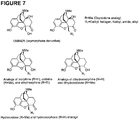
- UMB 425 has mixed ⁇ agonist/ ⁇ antagonist properties in vitro that translate to reduced tolerance liabilities in vivo even in the absence of ⁇ -specific motifs fused to the C-ring. Further described herein is the identification, design and characterization of novel opioid narcotics ( UMB 425 , analogs of morphine, dihydromorphine, hydromorphone, codeine, dihydrocodeine, hydrocodone and ethylmorphine). See, for example, Figure 7 .
- Opioid analgesics including morphine, are the traditional standards for individuals suffering from cancer pain, post-operative pain or pain from other severe trauma ( 1 ).
- the prescription of opioids has risen significantly since the early 1980's ( 2 ).
- opioids may be the standard for treating moderate-to-severe pain
- the side effects including respiratory depression, tolerance, physical/psychological dependence, constipation, sedation, nausea/vomiting and dizziness can be problematic ( 3 ).
- These severe side effects often lead to the under treatment of chronic pain and increase the possibility of death ( 4 ). Therefore, there is a pressing need to identify pharmacological agents that maintain potent analgesic properties, while eliminating the problematic side effects.
- Opioid receptors are G-protein coupled receptors ( 5 ) located in the central nervous system, peripheral nervous system and gastrointestinal tract ( 6 ). To date, three opioid receptor subtypes have been identified: mu ( ⁇ ) ( 7 ), delta ( ⁇ ) ( 8 ) and kappa ( ⁇ ) ( 9 ).
- Traditional opioid analgesics exert their pain-relieving properties through ⁇ receptors located within the central nervous system ( 10 ) .
- Opioid interactions at the ⁇ receptor have shown synergistic analgesic effects in combination with activation of the ⁇ receptor ( 11 ). However, research suggests that the activation of the ⁇ receptor may play a role in the side effect liabilities associated with chronic opioid use, including tolerance ( 12 ).
- Selective ⁇ antagonists can reduce tolerance when given in conjunction with the traditional ⁇ agonists, including morphine ( 12 , 13 ) and opioid peptides that display mixed ⁇ agonist/ ⁇ antagonist activity have reduced tolerance liabilities compared to traditional opioid analgesics ( 14 ).
- Bifunctional ligands are based on a single pharmacophore intended to target two binding sites with functional activity distinct for each of the respective sites ( 19 ), ideally circumventing the problematic characteristics associated with bivalent ligands.
- Such ligands include structural motifs that are seen in traditional ⁇ agonists as well as ⁇ antagonists.
- Bifunctional ligands depicting mixed ⁇ agonism/ ⁇ antagonism have displayed potent analgesic activity with reduced side effect liabilities, including tolerance ( 20 ). However, those developed are traditionally characterized in vivo by intracebroventricular administration, a method unsuitable for wide spread therapeutic use.
- the present invention includes the synthesis, modeling and pharmacological characterization of the novel opioid ligand, 4a,9-dihydroxy-7a-(hydroxymethyl)-3-methyl-2,3,4,4a,5,6-hexahydro-1H-4,12-methanobenzofuro[3,2-e]isoquinolin-7(7aH)-one ( UMB 425 ).
- UMB 425 was originally designed by the inventors as a precursor to a series of bifunctional 5,14-bridged morphinan-based orvinols.
- the compound has a novel and unique structure, such that it exhibits no ⁇ -specific motifs fused to the C-ring, and the 5'-hydroxymethyl substituent is the only functional group that distinguishes UMB 425 from the chemical structure of oxymorphone.
- CSP conformationally sampled pharmacophore
- UMB 425 may also interact with the receptors in a similar way as the orvinols, despite UMB 425's lack of the classical ⁇ antagonist motif on the C-ring. Indeed, in vitro and in vivo pharmacological characterization of UMB 425 show it to have high affinity and the desired ⁇ agonism and ⁇ antagonism profile in CHO cells, and to have antinociceptive effects with decreased development of tolerance in mice.
- novel opioid ligands with mixed ⁇ agonist and ⁇ antagonist activity has therapeutic potential for the treatment of pain with a lower side effect liability than commonly marketed opioid analgesics.
- Towards this goal a number of peptidic as well as bivalent and bifunctional non-peptidic ligands have been developed that achieve this desired pharmacological profile, but have inherent problems that limit their potential as therapeutic agents.
- the present invention includes UMB 425, a novel opioid that lacks a typical ⁇ -selective motif, yet exhibits mixed ⁇ agonist/ ⁇ antagonist activity, robust antinociceptive effects, and a reduced tolerance liability compared to morphine.
- ⁇ Agonism/ ⁇ Agonism Dual-Profile CSP Model Prediction of the efficacy of UMB 425 applied previously developed ⁇ agonism ( 21 ) and ⁇ agonism ( 22 , 23 ) CSP models, with the latter updated to include a larger number of non-peptidic opioid ⁇ ligands.
- CSP updated ⁇ model generation involved development of multiple individual models based on different pharmacophoric descriptors ( Figure S1, supporting information); the top five models of the updated ⁇ CSP are listed in Table 1, each with an R 2 greater than 0.90. The final CSP model is based on averaging the predicted efficacies from these top five models.
- N -substituent N -methyl for oxymorphindone and N -cyclopropylmethyl for naltrindole
- the present model did not include the N -substituent as a pharmacophoric descriptor because the length of the N -substituent is not as critical for the ⁇ receptor as it is for the ⁇ receptor.
- the weak partial agonism of oxymorphindole seems to be due to the short methyl N -substituent.
- the CSP models for the ⁇ and ⁇ receptor ligands were applied to UMB 425, as well as all ligands being developed as part of our ongoing research program.
- Predicted efficacy (%E max ) values for UMB 425 were 101 and 1.4 for the ⁇ and ⁇ receptors, respectively.
- the high efficacy at ⁇ receptors is consistent with the structural similarity of UMB 425 with morphine or oxymorphone, while the low efficacy at ⁇ receptors is consistent with the C-ring substituents of naltrexone.
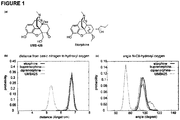
- Figure 1 shows N-O distance and N-C9-O angle probability distributions of three orvinols and UMB 425.
- Figure 1a two large distributions are present that are separated by around 1.5 ⁇ , although a small peak is noted in the UMB 425 distribution at 6.5 ⁇ that overlaps with that of the orvinols.
- the N-C9-O angle indicates the relative position of the hydroxyl group with respect to the plane of the aromatic A-ring.
- the hydroxyl group of UMB 425 is slightly above the A-ring plane while that of the orvinols is below; however, a small overlap between UMB 425 and the orvinols is observed ( Figure 1b ). While preliminary, these results indicate that UMB 425 can assume conformations in which its hydroxyl moiety participates in interactions with the receptors that are similar to those occurring with the orvinols.
- the recent availability of X-ray crystal structures of the ⁇ and ⁇ receptors will allow for future evaluation of the present model in the context of 3D interactions between UMB 425, as well as other ligands, and the receptors ( 30 , 31 ).
- UMB 425 demonstrates greater selectivity for the ⁇ receptor than either the ⁇ receptor or the ⁇ receptor.
- Agonist and antagonist activities for morphine and UMB 425 at each of the human opioid receptor subtypes overexpressed in CHO cells are summarized in Table 3.
- UMB 425 displayed no significant agonist activity through the ⁇ or ⁇ receptors, yet it did demonstrate antagonistic activity through the ⁇ receptor indicated by a corresponding pA 2 value of 6.12 (-0.91).
- Opioid Antagonism To corroborate opioid-induced antinociception, various antagonist pretreatments were given in conjunction with UMB 425 administration.
- UMB 425 demonstrated a significant reduction in tolerance liabilities compared to morphine itself, specifically a 2.6- and 4.9-fold reduction in respective ED 50 shifts for the hot plate and tail-flick assays.
- UMB 425 The pharmacological effects of UMB 425 seen in vivo are good. Further testing may assess other potential side effects including respiratory depression, decreased gastrointestinal motility, physical as well as psychological dependence. It is noteworthy that ⁇ antagonists and ⁇ opioid receptor knockout mice have been shown in earlier studies to attenuate the rewarding effects of morphine ( 35 , 36 ), reduce respiratory depression liabilities associated with fentanyl analogs ( 37 ) and promote colonic propulsion ( 38 ). In addition, mixed ⁇ agonist/ ⁇ antagonist analgesics have been shown to reduce physical dependence ( 33 ).
- UMB 425 is a novel opioid mixed ⁇ agonist/ ⁇ antagonist that possesses antinociceptive effects comparable to morphine with reduced tolerance liabilities. It has nanomolar affinity and efficacy for ⁇ receptors similar to morphine and moderate affinity for ⁇ receptors at which it exhibits antagonistic effects. UMB 425 is structurally similar to traditional ⁇ agonists, and CSP models suggest that its hydroxyl moiety assumes conformations that allow interactions similar to orvinols with mixed ⁇ agonist/ ⁇ antagonist effects. Together, the data suggest that traditional ⁇ selective motifs need not be added to a traditional ⁇ agonist pharmacophore to achieve ⁇ antagonism and reduce opioid-induced tolerance.
- reaction mixture was filtered through celite; the organic layer was separated, concentrated and purified by silica gel column chromatography (15:85 methanol-dichloromethane) to yield the pure product 5-(hydroxymethyl) thebaine 3 as a pale yellow solid (0.036g, 81% yield) with mp 169-171 °C.
- reaction mixture was filtered through celite, the solvent was evaporated and the residue was basified with aqueous ammonia prior to CHCl 3 extraction. Organic phases were combined, washed with brine, dried over anhydrous Na 2 SO 4 and the solvent was evaporated. The residue was subjected to column chromatography (7:93 methanol-dichloromethane) to give the pure olefin reduced compound 5 as white foam (0.0915g, 70%).
- CSP conformationally sampled pharmacophore
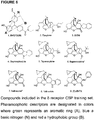
- the training set was limited to small non-peptidic opioids: BW373U86, etorphine, SIOM (7-spiroindanyloxymorphone), oxymorphindole, diprenorphine, buprenorphine, naltrexone, naltrindole and (E)-BNTX [(E)-benzylidenenaltrexone].
- Figure S1 of the supporting information shows the chemical structures of compounds used as the training set and their experimental efficacies measured in earlier reported [ 35 S]GPTP ⁇ S assays ( 29 ).
- the selected ligands were modeled using the CHARMM22/CMAP ( 42-44 ) and CHARMM General Force Field (CGenFF) ( 45 ) with Replica Exchange Molecular Dynamics (REX-MD) ( 46 , 47 ) for conformational sampling, as previously described ( 21 , 48 ).
- Pharmacophoric descriptors were designated for calculations of distances and angles between varying functional groups and are identified as an aromatic ring (A), a basic nitrogen (N) and a hydrophobic group (B) ( Figure SI, supporting information).
- BW373U86 was used as the reference compound for model development.
- mice Male, Swiss-Webster mice (21-30 g, Harlan, Indianapolis, IN; Frederick, MD) were housed in groups of five in polysulfone cages (Techniplast, Philadelphia, PA) with a 12:12-h light/dark cycle with food and water ad libitum. Animals were acclimated one week prior to experimental use and randomly assigned to treatment groups. All procedures were performed in accordance to the Institutional Animal Care and Use Committee at the West Virginia University Health Sciences Center.
- Dulbecco's modified Eagle's medium DMEM
- Dulbecco's modified Eagle's medium Nutrient Mixture F12 with Hepes 1:1 (DMEM:F12) were purchased from Fisher Scientific (Hanover Park, IL).
- Fetal bovine serum FBS
- Penicillin-streptomycin solution 10,000 units/ml
- trypsin-EDTA 0.05% trypsin
- G418 Geneeticin 50 mg/ml were purchased from Invitrogen (Carlsbad, CA).
- GTP ⁇ S lithium salt was obtained from Tocris Bioscience (Ellisville, MO).
- [ 3 H]DAMGO, [ 3 H]DPDPE, [ 3 H]U69,593 and [ 35 S]GPTP ⁇ S were purchased from Perkin Elmer (Shelton, CT).
- CHO cells stably transfected with and overexpressing the human ⁇ opioid receptor (hMOR-CHO), the human ⁇ opioid receptor (hDOR-CHO) or the human ⁇ opioid receptor (hKOR-CHO) were grown in 150-mm dishes (Fisher Scientific, Hanover Park, IL) in DMEM supplemented with 10% FBS, penicillin-streptomycin and G418 at 37 °C in a 5% CO 2 atmosphere.
- DMEM:F12 (1:1) with HEPES, L-Gln solution was used when preparing hMOR-CHO and DMEM 4.5 g/l glucose was used when preparing hDOR-CHO and hKOR-CHO.
- Membranes were incubated with 10-12 concentrations of drug (0.001-100,000 nM) and radiolabeled ligand in 50 mM Tris buffer, pH 7.7, at a final volume of 1 mL.
- ⁇ receptors were labeled using 1.3 nM [ 3 H] DAMGO.
- ⁇ receptors were labeled using 1.2 nM [ 3 H] DPDPE.
- ⁇ receptors were labeled using 1.7 nM [ 3 H] U69,593.
- Non-specific binding was determined using non-labeled equivalents at each receptor subtype: 10 ⁇ M DAMGO, 1 ⁇ M DPDPE and 10 ⁇ M U69,593.
- Exogenous guanosine diphosphate (GDP, 100 ⁇ L) was added to "Buffer A" per 96-well plate using a 10 mM stock that was made fresh daily. Basal activity was determined in the presence of exogenous GDP and in the absence of an agonist, while non-specific binding was determined in the presence of 10 ⁇ M unlabelled GTP ⁇ S. Following a 60 min incubation period, reactions were terminated via rapid vacuum filtration over Perkin Elmer Unifilter®-96, GF/B filters that were presoaked in a 1% BSA solution for 30 min.
- Antagonistic properties at ⁇ receptors were determined by constructing dose-response curves of DPDPE (0.01-1000 nM) in the presence and absence of UMB 425.
- UMB 425 concentrations were 1x (200 nM), 3x (600 nM), and 10x (2 ⁇ M) the estimated K i value obtained from binding studies.
- pA 2 values are indicative of antagonistic potency at a particular receptor subtype and were determined using a Schild plot, whereby the plot's x-intercept equals pA 2 .
- Corresponding slope values at or near -1 indicate competitive antagonism for the compound at that particular receptor subtype.
- potential antagonistic properties were determined. Mean ⁇ S.E.M. were determined by performing experiments in triplicates of duplicates.
- mice were placed within a plastic cylinder (10.8 cm ID) atop a black anodized, aluminum plate (27.9 cm x 26.7 cm x 1.9 cm) uniformly regulated at 53 °C (IITC Life Science Inc., Woodland Hills, CA).
- the latency to the first sign of excessive shaking, lifting and/or licking of the hind paws was determined and recorded as the behavioral endpoint.
- Two baseline latencies (BL) were recorded prior to drug administration, with an average BL within 8-10 sec needed for further testing.
- mice were then given subcutaneous injections of either morphine (0.1-20 mg/kg) or UMB 425 (0.1-20 mg/kg) and testing latencies (TL) for nociceptive responses were recorded at various time points thereafter.
- morphine 0.1-20 mg/kg
- UMB 425 0.1-20 mg/kg
- TL latencies
- Previous studies have reported that the higher doses of morphine will induce at or near full antinociceptive activity for thermal nociceptive assays ( 49 ).
- a similar dosing paradigm was used for UMB 425, since in vitro opioid binding and functional data for UMB 425 were comparable to morphine.
- the subcutaneous route of injection was chosen because of its common usage with antinociception regimens.
- a 30 sec cutoff latency (CL) was predetermined so as to not cause tissue damage.
- %MPE % Maximum Possible Effect
- Tail-Flick Antinociceptive Testing Mice were placed in restraints (2.5 cm ID x 10.2 cm length) and their tails were placed underneath an overhead halogen light source (IITC Life Science Inc., Woodland Hills, CA) whereby the latency to the first sign of a rapid tail flick was determined and recorded as the behavioral endpoint. Two BL values were recorded prior to drug administration, with an average BL within 2-4 sec needed for further testing. Animals were then administered test compound at dosages reported for hot plate antinociceptive testing and TL values recorded at various time points thereafter. A 10 sec CL was predetermined so as to not cause tissue damage. %MPE values were determined as described above.
- Antinociceptive testing was performed 30 min after subcutaneous administration of an ED 90 dose of morphine or UMB 425.
- the selected antagonist dosages and pretreatment time points have been shown to correspond with the intended opioid receptor subtype and peak antagonist effect ( 50, 51 ) .
- Tolerance Assay The tolerance regimen was performed using previously published methods, with some modifications ( 33 , 49 ). Mice were administered twice daily (8 AM and 8 PM) subcutaneous injections of a test compound at respective ED 90 doses for a five day period. On Day 6, animals were given varying doses of morphine (0.1-20 mg/kg) or UMB 425 (0.1-20 mg/kg) and antinociceptive activity was determined using both the hot plate and tail-flick assays to determine tolerance development. Respective ED 50 values determined during the tolerance assay were then compared to values obtained in the acute treatment paradigm.
- BCA bicinchoninic acid
- BL baseline latencies
- BSA bovine serum albumin
- BW373U86 ( ⁇ )-4-(( ⁇ - R *)- ⁇ -((2 S *,5 R *)-4-Allyl-2,5-dimethyl-1-piperazinyl)-3-hydroxybenzyl)- N , N -diethyl-benzamide
- CL cutoff latency
- CPM counts per minutes
- CSP conformationally sampled pharmacophore
- DAMGO [D-Ala 2 , N-MePhe 4 , Gly-ol]-enkephalin
- DMEM Dulbecco's modified Eagle's medium
- DPDPE [D-Pen 2,5 ]-enkephalin
- E)-BNTX [(E)-benzylidenenaltrexone]
- FBS fetal bovine serum
- GDP gua
- efficacy aX 1 + bX 2 + c.
- N represents the basic nitrogen
- A is the aromatic ring
- B is the hydrophobic group, as shown in Figure S1 of the supporting information.
- X 1 and X 2 are overlap integrals with respect to the reference compound, while a and b are coefficients for variables X 1 and X 2 and c is the y-intercept in the regression equations.
- R 2 is the goodness of fit, p-value the significance of models and correlation coefficients between X 1 and X 2 overlap coefficients. Table 2. Comparison between experimental and calculated efficacy values for compounds in training set.
- Receptor binding and [ 35 S]GTP ⁇ S functional activity for morphine and UMB 425 are summarized for studies performed in CHO cell membranes stably transfected and overexpressing the human ⁇ , ⁇ and ⁇ opioid receptors.
- Competition binding for compounds were performed in triplicate of duplicates and reported as mean K i values ⁇ S.E.M.
- Mean EC 50 and %E max values ⁇ S.E.M. for the [ 35 S]GPTP ⁇ S functional assays were performed in triplicate of duplicates.
- pA 2 is defined as the negative logarithm of antagonist concentration needed to shift the dose response curve by a factor of 2.
- a slope of at or near - 1 is indicative of competitive antagonism for the drug at the receptor.
- a Ref ( 32 ).
- mice were treated with the ED 90 dose of morphine (15 mg/kg, s.c.) or UMB 425 (15 mg/kg, s.c.) determined in the acute treatment paradigm, twice a day for five days.
- ED 50 values for the tolerance paradigm were obtained during a dose-response challenge on Day 6 of treatment, whereby latencies were determined 30 min after drug administration (tolerance columns). The shifts represent fold-shifts in the ED 50 determined in the acute vs. tolerance treatment paradigms.
Landscapes
- Chemical & Material Sciences (AREA)
- Organic Chemistry (AREA)
- Pharmaceuticals Containing Other Organic And Inorganic Compounds (AREA)
Description
- This invention was made with government support under grant DA 13583 awarded by the National Institutes of Health. The government has certain rights in the invention.
- Tolerance develops to clinically used opioids that lead to increased doses to keep the patient in a pain-free state. As dose increases, so do undesired side effects. The present invention is based on the knowledge that delta opioid antagonists co-administered with mu agonists lessen the development of tolerance to the mu agonists (like morphine). The method comprises a new opioid analgesic (NCE) to which tolerance to analgesia develops less rapidly than morphine. The NCE has an alcohol incorporated into the 5-position of oxymorphone to give a novel compound that has the profile of a single compound with a profile of a delta antagonist and a mu agonist, and demonstrated lower tolerance than morphine in mice. This NCE, along with analogs of morphine, dihydromorphine, hydromorphone, codeine, dihydrocodeine, hydrocodone and ethylmorphine described herein, may become utilized as new analgesics with far fewer side effects than current employed opioids (morphine, oxycodone).
- The present invention relates to opioid narcotics used for the treatment of moderate-to-severe pain that primarily exert their analgesic effects through µ receptors. Although, traditional µ agonists can cause undesired side effects, including tolerance, addition of δ antagonists can attenuate said side effects. The opioid narcotics comprise 4a,9-dihydroxy-7a-(hydroxymethyl)-3-methyl-2,3,4,4a,5,6-hexahydro-1H-4,12-methanobenzofuro[3,2-e]isoquinolin-7(7aH)-one (UMB 425) a 5,14-bridged morphinan-based orvinol precursor synthesized from thebaine. Although UMB 425 lacks δ-specific motifs, conformationally sampled pharmacophore models for µ and δ receptors predict it to have efficacy similar to morphine at µ receptors and similar to naltrexone at δ receptors, due to the compound sampling conformations in which the hydroxyl moiety interacts with the receptors similar to orvinols.
- In a related aspect, UMB 425 exhibits a mixed µ agonist/δ antagonist profile as determined in receptor binding and [35S]GPTPγS functional assays in CHO cells. In vivo studies in mice show that UMB 425 displays potent antinociception in the hot plate and tail-flick assays.
- In another related aspect, UMB 425 has mixed µ agonist/δ antagonist properties in vitro that translate to reduced tolerance liabilities in vivo even in the absence of δ-specific motifs fused to the C-ring. Further described herein is the identification, design and characterization of novel opioid narcotics (
UMB 425, analogs of morphine, dihydromorphine, hydromorphone, codeine, dihydrocodeine, hydrocodone and ethylmorphine). See, for example,Figure 7 . - Opioid analgesics, including morphine, are the traditional standards for individuals suffering from cancer pain, post-operative pain or pain from other severe trauma (1). The prescription of opioids has risen significantly since the early 1980's (2). While opioids may be the standard for treating moderate-to-severe pain, the side effects, including respiratory depression, tolerance, physical/psychological dependence, constipation, sedation, nausea/vomiting and dizziness can be problematic (3). These severe side effects often lead to the under treatment of chronic pain and increase the possibility of death (4). Therefore, there is a pressing need to identify pharmacological agents that maintain potent analgesic properties, while eliminating the problematic side effects.
- Opioid receptors are G-protein coupled receptors (5) located in the central nervous system, peripheral nervous system and gastrointestinal tract (6). To date, three opioid receptor subtypes have been identified: mu (µ) (7), delta (δ) (8) and kappa (κ) (9). Traditional opioid analgesics exert their pain-relieving properties through µ receptors located within the central nervous system (10). Opioid interactions at the δ receptor have shown synergistic analgesic effects in combination with activation of the µ receptor (11). However, research suggests that the activation of the δ receptor may play a role in the side effect liabilities associated with chronic opioid use, including tolerance (12). Selective δ antagonists can reduce tolerance when given in conjunction with the traditional µ agonists, including morphine (12, 13) and opioid peptides that display mixed µ agonist/δ antagonist activity have reduced tolerance liabilities compared to traditional opioid analgesics (14).
- The identification of non-peptidic opioid analgesics that display dual characteristics of µ agonism/δ antagonism could convey therapeutic advantages compared to peptides, with regards to ease of administration and delayed metabolic breakdown. Several approaches towards this goal have been undertaken, specifically the characterization of bivalent and bifunctional opioid ligands. Portoghese et al. introduced the concept of bivalent ligands, compounds that embody two specific pharmacophores connected via an optimized linker (15). Bivalent ligands containing both µ agonist and δ antagonist motifs were shown to exhibit greater analgesic effects, while also reducing tolerance and physical dependence liabilities (16). Recent evidence citing the existence of homo- and hetero-oligomeric opioid receptor complexes, including a µ-δ complex (17), suggest that bivalent opioid ligands are a viable therapeutic tool. Tuned-affinity bivalent ligands have been prepared which exhibit enhanced affinity at µ/δ opioid receptor heteromers as compared to δ homomers (52).
- However, certain pharmacological characteristics can be problematic for bivalent ligands, including high molecular weights and poor pharmacokinetic profiles (18).
- Bifunctional ligands are based on a single pharmacophore intended to target two binding sites with functional activity distinct for each of the respective sites (19), ideally circumventing the problematic characteristics associated with bivalent ligands. Such ligands include structural motifs that are seen in traditional µ agonists as well as δ antagonists. Bifunctional ligands depicting mixed µ agonism/δ antagonism have displayed potent analgesic activity with reduced side effect liabilities, including tolerance (20). However, those developed are traditionally characterized in vivo by intracebroventricular administration, a method unsuitable for wide spread therapeutic use.
- The present invention includes the synthesis, modeling and pharmacological characterization of the novel opioid ligand, 4a,9-dihydroxy-7a-(hydroxymethyl)-3-methyl-2,3,4,4a,5,6-hexahydro-1H-4,12-methanobenzofuro[3,2-e]isoquinolin-7(7aH)-one (UMB 425). UMB 425 was originally designed by the inventors as a precursor to a series of bifunctional 5,14-bridged morphinan-based orvinols. The compound has a novel and unique structure, such that it exhibits no δ-specific motifs fused to the C-ring, and the 5'-hydroxymethyl substituent is the only functional group that distinguishes
UMB 425 from the chemical structure of oxymorphone. Application of conformationally sampled pharmacophore (CSP) models of µ agonism and δ antagonism (21-23), with the latter updated as part of the present study, predicted mixed µ agonist/δ antagonist effects forUMB 425. Moreover, analysis of the conformations ofUMB 425 generated as part of the CSP protocol showed that the 5'-hydroxymethyl moiety can spatially overlap with the hydroxyl group linked to the C19 of orvinols. Since some orvinols, such as buprenorphine, act as mixed µ agonist/δ antagonists (24), it was hypothesized that UMB 425 may also interact with the receptors in a similar way as the orvinols, despite UMB 425's lack of the classical δ antagonist motif on the C-ring. Indeed, in vitro and in vivo pharmacological characterization of UMB 425 show it to have high affinity and the desired µ agonism and δ antagonism profile in CHO cells, and to have antinociceptive effects with decreased development of tolerance in mice. -
-
Figure 1 (a) . Images ofUMB 425 and etorphine with the hydroxyl oxgen highlighted in red. -
Figure 1 (b) . Probability distributions of the basic N to oxygen. -
Figure 1 (c) . The basic N-C9-oxygen angle from the simulations used in CSP model development for etorphine (solid line), buprenorphine (dashed line), diprenorphine (dashed line) and UMB 425 (dashed line). -
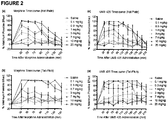
Figure 2 (a) . Dose- and time-response curves for s.c. morphine in the hot plate assay. -
Figure 2 (b) . Dose- and time-response curves for s.c. morphine in the tail-flick assay. -
Figure 2 (c) . Dose- and time-response curves for s.c. UMB 425 in the hot plate assay. -
Figure 2 (d) . Dose- and time-response curves for s.c.UMB 425 in the tail-flick assay. (Acute dose-and time-response curves for s.c. morphine andUMB 425 treatment for the hot plate and tail-flick assays. Male, Swiss-Webster mice were treated with morphine (0.1-20 mg/kg, s.c.) or UMB 425 (0.1-20 mg/kg, s.c.). Latencies were recorded 30 min after drug administration and every 20 min thereafter for 150 or 210 min). -
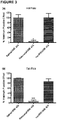
Figure 3 . Antagonism ofUMB 425 antinociception using various opioid antagonists. Male, Swiss Webster mice received a pre-treatment of the non-selective opioid antagonist, naloxone (1 mg/kg, i.p. t = -30 min) or the κ-selective antagonist, nor-BNI (30 mg/kg, i.p. t = -24 h) prior to an s.c. injection with an ED90 dose of UMB 425 (15 mg/kg). Latencies were determined 30 min afterUMB 425 administration. -
Figure 3 (a) . Antagonism ofUMB 425 antinociception in the hot plate assay by naloxone, but not nor-BNI.∗ p < 0.05. -
Figure 3 (b) . Antagonism ofUMB 425 antinociception in the tail-flick assay by naloxone, but not nor-BNI. ∗∗∗ p < 0.001. -
Figure 4 . Antinociceptive tolerance development for morphine andUMB 425 for the hot plate and tail-flick assays. Male, Swiss-Webster mice were given an ED90 dose of morphine (15 mg/kg, s.c.) or UMB 425 (15 mg/kg, s.c.) twice daily for a five day period. Latencies were determined 30 min after drug administration. -
Figure 4 (a) . Antinociceptive tolerance development in the hot plate assay. ∗∗ p < 0.01 vs.Morphine Day 1/UMB 425Day 1; # p < 0.05 vs.Morphine Day 4; ### p < 0.001 vs.Morphine Day 5. -
Figure 4 (b) . Antinociceptive tolerance development in the tail-flick assay. ∗ p < 0.05, ∗∗ p < 0.01 vs.Morphine Day 1; # p < 0.05 vs.Morphine Day 5. -
Figure 5 . Chemical synthesis ofUMB 425 from thebaine. -
Figure 6 . Compounds included in the δ receptor CSP training set. -
Figure 7 . Novel opioid narcotics:UMB 425, oxycodone analog, analogs of morphine, dihydromorphine, hydromorphone, codeine, dihydrocodeine, hydrocodone and ethylmorphine. - The development of novel opioid ligands with mixed µ agonist and δ antagonist activity has therapeutic potential for the treatment of pain with a lower side effect liability than commonly marketed opioid analgesics. Towards this goal a number of peptidic as well as bivalent and bifunctional non-peptidic ligands have been developed that achieve this desired pharmacological profile, but have inherent problems that limit their potential as therapeutic agents. The present invention includes
UMB 425, a novel opioid that lacks a typical δ-selective motif, yet exhibits mixed µ agonist/δ antagonist activity, robust antinociceptive effects, and a reduced tolerance liability compared to morphine. - Synthesis. A highly efficient method for the synthesis of
UMB 425 is summarized inFigure 5 . Briefly, deprotonation of thebaine (1) followed by in situ reaction of the anion with ethyl chloroformate yielded 5-carbethoxythebaine (2) (25). Reduction of the ester (2) with lithium aluminum hydride gave 5-(hydroxymethyl) thebaine (3) (26). By oxidation of 5-(hydroxymethyl) thebaine (3) with a mixture of formic acid and hydrogen peroxide at 4 °C (70 h), 5-(hydroxymethyl)-14-hydroxycodeinone (4) (27) was obtained, which was reduced by catalytic hydrogenation to obtain olefin reduced diol (5). O-demethylation of the diol (5) by using boron tribromide/chloroform gave 5-(hydroxymethyl)-14-hydroxymorphinone (UMB 425) at a 64% yield (28). - µ Agonism/δ Agonism Dual-Profile CSP Model. Prediction of the efficacy of
UMB 425 applied previously developed µ agonism (21) and δ agonism (22, 23) CSP models, with the latter updated to include a larger number of non-peptidic opioid δ ligands. CSP updated δ model generation involved development of multiple individual models based on different pharmacophoric descriptors (Figure S1, supporting information); the top five models of the updated δ CSP are listed in Table 1, each with an R2 greater than 0.90. The final CSP model is based on averaging the predicted efficacies from these top five models. From the model, overlap of the aromatic ring (A) to hydrophobic group (B) distance distributions was identified as the most important descriptor. AB distances of compounds showing agonism at δ opioid receptors had greater overlap with those of (±)-4-((α-R*)-α-((2S*,5R*)-4-allyl-2,5-dimethyl-1-piperazinyl)-3-hydroxybenzyl)-N,N-diethyl-benzamide (BW373U86) than antagonists; however, efficacy was explained not solely by the AB distance, but in combination with the relative position of the hydrophobic group with respect to the aromatic ring and basic N. Accordingly, overlap coefficients of angles ANB, BAN, and ABN were identified as important descriptors by the automated variable selection applied during model construction. - Calculated efficacies for the training set molecules are shown in Table 2 together with experimental values reported previously (29). The model predicts buprenorphine to be a weak partial agonist at δ receptors due to its resemblance to etorphine, particularly with respect to the AB distances. Oxymorphindole and natrindole were not differentiated by the model. The only difference between them is the N-substituent (N-methyl for oxymorphindone and N-cyclopropylmethyl for naltrindole) and the present model did not include the N-substituent as a pharmacophoric descriptor because the length of the N-substituent is not as critical for the δ receptor as it is for the µ receptor. However, the weak partial agonism of oxymorphindole seems to be due to the short methyl N-substituent.
- The CSP models for the µ and δ receptor ligands were applied to
UMB 425, as well as all ligands being developed as part of our ongoing research program. Predicted efficacy (%Emax) values forUMB 425 were 101 and 1.4 for the µ and δ receptors, respectively. The high efficacy at µ receptors is consistent with the structural similarity ofUMB 425 with morphine or oxymorphone, while the low efficacy at δ receptors is consistent with the C-ring substituents of naltrexone. - To better understand the contribution of the 5'-hydroxymethyl to efficacy, additional analysis was performed on conformations of
UMB 425 generated during CSP model development. Distances and angle distributions between the basic nitrogen and oxygen in the 5'-hydroxymethyl inUMB 425 or the 19-hydroxyl substituent in the orvinols were calculated and compared.Figure 1 shows N-O distance and N-C9-O angle probability distributions of three orvinols andUMB 425. InFigure 1a , two large distributions are present that are separated by around 1.5 Å, although a small peak is noted in theUMB 425 distribution at 6.5 Å that overlaps with that of the orvinols. The N-C9-O angle indicates the relative position of the hydroxyl group with respect to the plane of the aromatic A-ring. The hydroxyl group ofUMB 425 is slightly above the A-ring plane while that of the orvinols is below; however, a small overlap betweenUMB 425 and the orvinols is observed (Figure 1b ). While preliminary, these results indicate thatUMB 425 can assume conformations in which its hydroxyl moiety participates in interactions with the receptors that are similar to those occurring with the orvinols. The recent availability of X-ray crystal structures of the µ and δ receptors will allow for future evaluation of the present model in the context of 3D interactions betweenUMB 425, as well as other ligands, and the receptors (30, 31). - Opioid Receptor Binding Affinities.
UMB 425 demonstrates greater selectivity for the µ receptor than either the δ receptor or the κ receptor. Table 3 summarizes the binding ofUMB 425 and morphine at human µ, δ and κ opioid receptors stably transfected into and overexpressed in CHO cells. Consistent with previous reports, morphine has higher binding affinity for the µ receptor to that of the δ receptor and the κ receptor (δ/µ = 51; κ/µ = 41).UMB 425 also has high binding affinity for the µ receptor with preference for it compared to both the δ receptor and the κ receptor (δ/µ = 65; κ/µ = 66). - Functional Assays for Agonist and Antagonist Activity. Agonist and antagonist activities for morphine and
UMB 425 at each of the human opioid receptor subtypes overexpressed in CHO cells are summarized in Table 3. For the [35S]GTPγS functional assay,UMB 425 displayed comparable partial agonistic capabilities at the µ receptor to that of morphine (EC50 = 35 ± 3.7 and 38 ± 4.9 nM; %Emax = 73 ± 7.3 and 81 ± 2.3 nM forUMB 425 and morphine respectively). Unlike morphine, which is highly efficacious at the δ receptor (EC50 = 316.5 ± 4.9 nM; %Emax = 103 ± 7) (32),UMB 425 displayed no significant agonist activity through the δ or κ receptors, yet it did demonstrate antagonistic activity through the δ receptor indicated by a corresponding pA2 value of 6.12 (-0.91). - Acute Antinociceptive Effects. Subcutaneous injection of morphine or
UMB 425 demonstrated antinociceptive effects in mice in a time- and dose-dependent manner for the thermal nociceptive assays (Figure 2 ). Maximal antinociceptive responses were elicited at similar doses for both drugs. Table 4 summarizes respective ED50 values for morphine andUMB 425 from testing performed 30 min after drug treatment. The potency of the antinociceptive activity of UMB 425 (ED50 = 4.30 and 8.83 mg/kg for the hot plate and tail-flick assays, respectively) was similar to morphine (ED50 = 2.73 and 6.85 mg/kg for the hot plate and tail-flick assays, respectively). - Opioid Antagonism. To corroborate opioid-induced antinociception, various antagonist pretreatments were given in conjunction with
UMB 425 administration. One-way analysis of variance (ANOVA) indicated differences amongst mice pretreated with saline, naloxone and nor-BNI (F(2,12) = 8.88, p < 0.005; F(2,13) = 22.61, p < 0.0001 for the hot plate and tail-flick assays, respectively).UMB 425's partial agonistic effects through the µ receptor appear primarily responsible for the observed antinociceptive effects seen in vivo as naloxone significantly attenuated UMB 425-mediated antinociception (Figure 3 ; q = 4.55, p < 0.05; q = 8.48, p < 0.001 for the hot plate and tail-flick assays, respectively; Tukey's post-hoc). In contrast, pretreatment with the κ antagonist nor-BNI failed to significantly attenuate UMB 425-mediated antinociception (Figure 3 ; q = 0.01, n.s.; q = 1.39, n.s. for the hot plate and tail-flick assays, respectively; Tukey's post-hoc). Consistent with the lack of agonist activity observed in the [35S]GTPγS assay at κ receptors byUMB 425, the κ receptor does not appear to contribute significantly to the antinociceptive effects ofUMB 425. - Tolerance to Antinociceptive Effects. The results of administration of ED90 doses of morphine and
UMB 425 to mice twice daily for a period of five days, with test latencies determined 30 min after drug administration are summarized inFigure 4 . One-way repeated measures ANOVA demonstrated statistical differences amongst treatment days for morphine administration in both the hot plate (Figure 4a ; F(4,76) = 15.22, p < 0.0001) and tail-flick assays (Figure 4b ; F(4,76) = 8.52, p < 0.0001). Dunnett's post-hoc analysis revealed that morphine administration significantly decreased antinociceptive activity onDay Figure 4a ; q = 4.45, p < 0.01; q = 6.52, p < 0.01; respectively) and tail-flick assays (Figure 4b ; q = 2.72, p < 0.05; q = 5.12, p < 0.01; respectively). One-way repeated measures ANOVA also demonstrated statistical difference amongst treatment days forUMB 425 administration in the hot plate assay (Figure 4a ; F(4,84) = 9.32, p < 0.0001) but not for the tail-flick assay (Figure 4b , F(4,76) = 1.53, n.s.). Dunnett's post-hoc analysis revealed thatUMB 425 administration significantly decreased antinociceptive activity onDay Figure 4a ; q = 3.43, p < 0.01; q = 5.11, p < 0.01; respectively). - Two-way repeated measures ANOVA revealed statistical differences between morphine and
UMB 425 treatment in time points for both the hot plate (Figure 4a ; p < 0.0001) and tail flick assays (Figure 4b ; p < 0.0001). Bonferroni's post-hoc analysis demonstrated thatUMB 425 maintained statistically greater antinociceptive activity than morphine onDay Figure 4a ; t = 2.86, p < 0.05; t = 4.15, p < 0.001; respectively) and onDay 5 for the tail-flick assay (Figure 4b ; t = 2.88, p < 0.05). - Our tolerance paradigm involves thermal nociceptive testing on a daily basis to ensure that a statistical difference in antinociceptive activity is seen between morphine and
UMB 425 prior to a dose-response challenge. Table 5 summarizes respective ED50 values for morphine andUMB 425 from the dose-response challenge onDay 6 of the tolerance paradigm. UMB 425 (ED50 = 12.96 and 11.58 mg/kg for the hot plate and tail-flick assays, respectively) produced markedly less tolerance development than morphine (ED50 = 21.31 and 44.11 mg/kg for the hot plate and tail-flick assays, respectively), as evident by the respective rightward shifts in ED50 values (7.8- vs. 3.0-fold and 6.4- vs. 1.3-fold for morphine vs.UMB 425 in the hot plate and tail-flick assays, respectively). Respective ED50 shifts in the morphine-treated tolerance paradigm seen onDay 6 were comparable to tolerance paradigms previously performed using male ICR mice, despite variations regarding drug dosing, route of administration, number of injections per day as well as the time length of the paradigm (33) - The antagonistic potency of
UMB 425 through the δ receptor (pA2 = 6.12) is lower than previously highlighted µ agonist/δ antagonist analgesics, notably 17d (δ Ke = 0.091 ± 0.01 nM) (34), as well as the δ-selective antagonist naltrindole (pA2 = 10.92) (32). Yet,UMB 425 demonstrated a significant reduction in tolerance liabilities compared to morphine itself, specifically a 2.6- and 4.9-fold reduction in respective ED50 shifts for the hot plate and tail-flick assays. The recently reported mixed µ agonist/δ antagonist analgesic 17d was found to have a 5.6-fold decrease in respective A50 shifts compared to morphine itself in the warm-water tail-withdrawal assay (34). The respective shift-fold variations between the in vivo studies are thus quite comparable despite the lower affinity and antagonist potency ofUMB 425 compared to 17d for the δ receptor in vitro. Thus, equipotence at the µ and δ receptor does not seem required to improve tolerance liabilities of opioid analgesics. - The pharmacological effects of
UMB 425 seen in vivo are good. Further testing may assess other potential side effects including respiratory depression, decreased gastrointestinal motility, physical as well as psychological dependence. It is noteworthy that δ antagonists and δ opioid receptor knockout mice have been shown in earlier studies to attenuate the rewarding effects of morphine (35, 36), reduce respiratory depression liabilities associated with fentanyl analogs (37) and promote colonic propulsion (38). In addition, mixed µ agonist/δ antagonist analgesics have been shown to reduce physical dependence (33). - The molecular mechanisms surrounding opioid-induced tolerance are still not clear, although many efforts have been taken to discern the labyrinth of potential components involved. Morphine, a partial µ agonist, is unable to properly internalize the µ receptor upon activation, whereby desensitization and uncoupling of the G-protein potentially leads to the development of tolerance (39). δ receptor recruitment to the plasma membrane has been shown to increase with extended exposure to µ agonists (40). Furthermore, δ antagonists can provide synergistic effects in combination with µ agonists that enhances µ receptor binding and signaling in cells expressing µ-δ hetero-dimers, potentially through altered G-protein activation (41). It is conceivable that the µ agonist/δ antagonist interactions through
UMB 425 allow for proper internalization, driven by the δ receptor in the hetero-oligomeric complex, and subsequent µ receptor mediated recycling and resensitization thereby leading to reduced tolerance development. Further studies may delineate the underlying mechanisms through whichUMB 425 reduces the development of tolerance compared to morphine. - In summary,
UMB 425 is a novel opioid mixed µ agonist/δ antagonist that possesses antinociceptive effects comparable to morphine with reduced tolerance liabilities. It has nanomolar affinity and efficacy for µ receptors similar to morphine and moderate affinity for δ receptors at which it exhibits antagonistic effects.UMB 425 is structurally similar to traditional µ agonists, and CSP models suggest that its hydroxyl moiety assumes conformations that allow interactions similar to orvinols with mixed µ agonist/δ antagonist effects. Together, the data suggest that traditional δ selective motifs need not be added to a traditional µ agonist pharmacophore to achieve δ antagonism and reduce opioid-induced tolerance. - Chemical Synthesis. All reagents and solvents were purchased from Sigma-Aldrich, and used without further purification. NMR spectra were recorded on a Varian Mercury 400 system (400 MHz for 1H and 100 MHz for 13C NMR), using CDCl3 or CD3OD as a solvent. Mass spectra were determined using a Bruker Amazon X Ion Trap spectrometer. Melting points are uncorrected. Purification was performed by column chromatography over Whatman silica gel 60 (230-400 mesh) using dichloromethane and methanol. Reactions were monitored by TLC using dichloromethane/methanol (92:8).
-
Ethyl 7,9-dimethoxy-3-methyl-2,3,4,7a-tetrahydro-1H-4,12-methanobenzofuro[3,2-e] isoquinoline-7a-carboxylate (2): A solution of 1g ofthebaine 1 in 20 mL of tetrahydrofuran (THF) was placed in a flame-dried round-bottom flask, and 1.92 mL (1.5 equiv) of a 2.5 M solution of N-butyllithium in hexane was added while stirring at -78 °C under nitrogen. The mixture immediately turned deep wine-red and was stirred for 45 min at -78 °C. Ethyl chloroformate (0.36 mL, 1.2 equiv) was added and the mixture was stirred for 4 h at -78 °C. The color changed to orange-yellow. Saturated NH4Cl (5 mL) was then added per drop and most part of the solvent was removed under reduced pressure. The residual brown product was dissolved in chloroform, washed with brine solution, dried (Na2SO4) and concentrated. The residue was subjected to column chromatography on silica gel using dichloromethane-methanol (95:5) as the eluent to isolate 0.786g (64% yield) of 5-carbethoxythebaine 2 as a pale yellow foam. 1H NMR (CDCl3, 400 MHz): δ 6.67 d (1H, J = 8.6 Hz), 6.61 d (1H, J = 8.6 Hz), 5.2 d (1H, J = 6.2 Hz), 5.19 d (1H, J = 6.2 Hz), 4.44-4.33 m (1H), 4.28-4.16 m (1H), 3.85 s (3H), 3.66 d (1H, J = 6.2 Hz), 3.57 s (3H), 3.29 d (1H, J = 17.9 Hz), 2.87-2.74 m (1H), 2.7 d (1H, J = 7.0 Hz), 2.68-2.57 m (1H), 2.45 s (3H), 2.16 td (1H, J = 4.6, 12.5 Hz), 1.64 d (1H, J = 13.3 Hz), 1.30 t (3H, J = 7.0 Hz). 13C NMR (CDCl3, 100 MHz): δ 168.31, 152.64, 143.62, 142.66, 132.30, 130.56, 127.38, 119.86, 113.44, 112.09, 97.05, 95.42, 61.80, 61.26, 56.45, 55.27, 49.09, 45.49, 42.12, 31.01, 30.42, 14.21. MS (ESI): m/z 384.1 (M+1)+. - (7,9-dimethoxy-3-methyl-2,3,4,7a-tetrahydro-1H-4,12-methanobenzofuro[3,2-e]isoquinolin-7a-yl)methanol (3): Lithium aluminum hydride (LAH) (0.00496g, 0.13 mmol) was added to a stirred solution of 5-carbethoxythebaine 2 (0.050g, 0.13 mmol) in dry THF (2 mL) at 0 °C and allowed to warm to room temperature. After 2 h, the reaction mixture was quenched with saturated sodium sulfate solution and stirred for 30 min. The reaction mixture was filtered through celite; the organic layer was separated, concentrated and purified by silica gel column chromatography (15:85 methanol-dichloromethane) to yield the pure product 5-(hydroxymethyl)
thebaine 3 as a pale yellow solid (0.036g, 81% yield) with mp 169-171 °C. 1H NMR (CDCl3, 400 MHz): δ 6.62 d (1H, J = 7.8 Hz), 6.58 d (1H, J = 7.8 Hz), 5.57 d (1H, J = 6.2 Hz), 5.19 d (1H, J = 6.2 Hz), 4.26 d (1H, J = 10.9 Hz), 4.07 d (1H, J = 11.7 Hz), 3.79 s (3H), 3.66 d (1H, J = 6.2 Hz), 3.55 s (3H), 3.32 d (1H, J = 17.9 Hz), 2.90-2.79 m (1H), 2.78-2.66 m (2H), 2.53 td (1H, J = 4.6, 12.5 Hz), 2.46 s (3H), 1.8 d (1H, J = 12.5 Hz). 13C NMR (CDCl3, 100 MHz): δ 153.13, 143.21, 142.58, 133.86, 130.59, 126.59, 119.64, 113.08, 112.36, 98.34, 94.0, 61.68, 61.48, 56.08, 55.17, 47.19, 45.27, 41.63, 31.25, 28.32. MS (ESI): m/z 342.2 (M+1)+. - 4a-hydroxy-7a-(hydroxymethyl)-9-methoxy-3-methyl-2,3,4,4a-tetrahydro-1H-4,12-methanobenzofuro[3,2-e]isoquinlin-7(7aH)-one (4): An ice-cold mixture of 0.4 mL of 0.7% H2SO4, 0.125 mL of 88% HCO2H, and 0.251 mL of 30% H2O2 was added to 0.3g (0.879 mmol) of 5-(hydroxymethyl)
thebaine 3. The mixture was stirred at 0 °C until it became transparent (∼30 min). The resulting solution was kept for 70 h in a refrigerator (4 °C), then poured into 3 mL of ice water alkylated by the addition of concentrated ammonia solution. The mixture was extracted with five portions of chloroform and the organic extracts were combined, dried over sodium sulfate, and evaporated to obtain 0.184 g (61%) of 5-(hydroxymethyl)-14-hydroxycodeinone 4 as a white solid with mp 231-233 °C. 1H NMR (CDCl3, 400 MHz): δ 6.69-6.55 m (3H), 6.17 d (1H, J = 9.3 Hz), 4.19 d (1H, J = 10.1 Hz), 4.05 d (1H, J = 10.1 Hz), 3.78 s (3H), 3.22 d (1H, J = 17.9 Hz), 3.18-3.1 m (1H), 2.84-2.53 m (3H), 2.48 s (3H), 2.34-2.22 m (1H), 1.57 d (1H, J = 10.1 Hz). 13C NMR (CDCl3, 100 MHz): δ 198.06, 146.15, 143.18, 142.85, 134.36, 130.72, 124.2, 119.83, 114.77, 91.83, 67.57, 63.46, 60.15, 56.57, 47.6, 45.37, 42.3, 25.56, 22.4. MS (ESI): m/z 344.2 (M+1)+. - 4a-hydroxy-7a-(hydroxymethyl)-9-methoxy-3-methyl-2,3,4,4a,5,6-hexahydro-1H-4,12-methanobenzofuro[3,2-e]isoquinolin-7(7aH)-one (5): To a solution of 5-(hydroxymethyl)-14-hydroxycodeinone 4 (0.13g, 0.379 mmol) in 5 mL of 1:1 ethanol-glacial acetic acid Pd/C (10%, 15 mg) was added. The mixture was evacuated and filled with H2 gas in a hydrogenation flask and maintained under 275.8 KPa (40 psi) H2 pressure for 4 h. The reaction mixture was filtered through celite, the solvent was evaporated and the residue was basified with aqueous ammonia prior to CHCl3 extraction. Organic phases were combined, washed with brine, dried over anhydrous Na2SO4 and the solvent was evaporated. The residue was subjected to column chromatography (7:93 methanol-dichloromethane) to give the pure olefin reduced
compound 5 as white foam (0.0915g, 70%). 1H NMR (CDCl3, 400 MHz): δ 6.7 d (1H, J = 8.6 Hz), 6.65 d (1H, J = 8.6 Hz), 4.16 d (1H, J = 10.9 Hz), 4.01 d (1H, J = 11.7 Hz), 3.86 s (3H), 3.16 d (1H, J = 18.7 Hz), 3.07 td (1H, J = 5.4, 14.8 Hz), 2.96 d (1H, J = 5.4 Hz), 2.67-2.51 m (2H), 2.43 s (3H), 2.40-2.29 m (2H), 2.25-2.15 m (1H), 1.96-1.87 m (1H), 1.74-1.63 m (1H), 1.47 d (1H, J = 12.5 Hz). 13C NMR (CDCl3, 100 MHz): δ 210.47, 144.17, 142.88, 129.60, 124.43, 119.64, 114.49, 96.26, 70.29, 64.20, 61.74, 56.53, 50.58, 44.67, 42.65, 37.31, 31.21, 26.88, 21.91. MS (ESI): m/z 346.1 (M+1)+. - 4a,9-dihydroxy-7a-(hydroxymethyl)-3-methyl-2,3,4,4a,5,6-hexahydro-1H-4,12-methanobenzofuro[3,2-e]isoquinolin-7(7aH)-one (UMB 425): Compound 5 (0.104g, 0.3 mmol) was dissolved in 2 mL CHCl3 and cooled to -20 °C, followed by the slow addition of BBr3 solution (1 M in CHCl3, 1.5 mL). The mixture was stirred at -20 °C for 3 h, carefully quenched with ice and basified with ammonia solution. The resulting mixture was stirred for 30 min at 0 °C, the aqueous layer was separated and the aqueous phase was extracted with CHCl3 (3 x 10 mL). The organic phases were combined, washed with brine and dried over sodium sulfate and the solvent was evaporated. The residue was subjected to column chromatography (20:80 methanol-dichloromethane) to obtain 5-(hydroxymethyl)-14-
hydroxymorphinone UMB 425 as an off-white solid (0.0638g, 64%) with mp 193-195 °C. 1H NMR (CD3OD, 400 MHz): δ 6.6 d (1H, J = 8.1 Hz), 6.56 d (1H, J = 8.1 Hz), 5.46 br s (1H), 4.23 d (1H, J = 11.9 Hz), 4.0 d (1H, J = 11.9 Hz), 3.16 d (1H, J = 18.9 Hz), 3.12-3.01 m (1H), 2.97-2.9 m (1H), 2.62-2.49 m (2H), 2.41 s (3H), 2.4-2.33 m (1H), 2.25-2.13 m (2H), 1.91-1.83 m (1H), 1.69-1.59 m (1H), 1.33 d (1H, J = 12.4 Hz). 13C NMR (CD3OD, 100 MHz): δ 212.7, 144.6, 140.7, 130.9, 125.3, 120.8, 119.2, 99.20, 71.94, 65.92, 62.47, 52.62, 46.05, 42.89, 37.32, 33.49, 27.34, 23.01. MS (ESI): m/z 332.1 (M+1)+. - Quantitative conformationally sampled pharmacophore (CSP) models developed for µ and δ receptor ligands were used for studies herein (21, 22), with some modifications to the δ receptor model. Updating of the δ receptor model was performed prior to predictions of efficacy of
UMB 425. As this invention involved derivates of 4,5-epoxymorphinans, the training set was limited to small non-peptidic opioids: BW373U86, etorphine, SIOM (7-spiroindanyloxymorphone), oxymorphindole, diprenorphine, buprenorphine, naltrexone, naltrindole and (E)-BNTX [(E)-benzylidenenaltrexone]. Figure S1 of the supporting information shows the chemical structures of compounds used as the training set and their experimental efficacies measured in earlier reported [35S]GPTPγS assays (29). For updating the δ receptor CSP model, the selected ligands were modeled using the CHARMM22/CMAP (42-44) and CHARMM General Force Field (CGenFF) (45) with Replica Exchange Molecular Dynamics (REX-MD) (46, 47) for conformational sampling, as previously described (21, 48). Pharmacophoric descriptors were designated for calculations of distances and angles between varying functional groups and are identified as an aromatic ring (A), a basic nitrogen (N) and a hydrophobic group (B) (Figure SI, supporting information). BW373U86 was used as the reference compound for model development. Statistical models were trained using both agonists and antagonists to differentiate overlapping patterns between the two classes of compounds as well as develop a model that allows for quantitative estimations of efficacy. Changes with respect to the original δ receptor model, include: 1) for BW373U86, the center of mass of the two piperazine nitrogen groups was designated the N pharmacophoric descriptor, and 2) 1D overlap coefficients with respect to the reference compound were used to obtain multiple regression models with two independent variables; tests using three independent variables did not lead to significant improvements in the models. - Animals. Male, Swiss-Webster mice (21-30 g, Harlan, Indianapolis, IN; Frederick, MD) were housed in groups of five in polysulfone cages (Techniplast, Philadelphia, PA) with a 12:12-h light/dark cycle with food and water ad libitum. Animals were acclimated one week prior to experimental use and randomly assigned to treatment groups. All procedures were performed in accordance to the Institutional Animal Care and Use Committee at the West Virginia University Health Sciences Center.
- Chemicals. Dulbecco's modified Eagle's medium (DMEM) and Dulbecco's modified Eagle's medium: Nutrient Mixture F12 with Hepes 1:1 (DMEM:F12) were purchased from Fisher Scientific (Hanover Park, IL). Fetal bovine serum (FBS) was purchased from Atlanta Biologicals (Lawrenceville, GA). Penicillin-streptomycin solution (10,000 units/ml), trypsin-EDTA (0.05% trypsin) and G418 (Geneticin) 50 mg/ml were purchased from Invitrogen (Carlsbad, CA). Morphine sulfate, [D-Ala2, N-MePhe4, Gly-ol]-enkephalin (DAMGO), [D-Pen2,5]-enkephalin (DPDPE), N-methyl-2-phenyl-N-[(5R,7S,8S)-7-(pyrrolidin-7-yl)-1-oxaspiro[4.5]dec-8-yl]acetamide (U69,593), naloxone, norbinaltorphimine (nor-BNI), guanosine 5'-diphosphate sodium salt, polyethyleneimine (PEI) and Trizma® pre-set crystals were obtained from Sigma Aldrich (St. Louis, MO). GTPγS lithium salt was obtained from Tocris Bioscience (Ellisville, MO). [3H]DAMGO, [3H]DPDPE, [3H]U69,593 and [35S]GPTPγS were purchased from Perkin Elmer (Shelton, CT).
- Binding Studies. Chinese hamster ovary (CHO) cells stably transfected with and overexpressing the human µ opioid receptor (hMOR-CHO), the human δ opioid receptor (hDOR-CHO) or the human κ opioid receptor (hKOR-CHO) were grown in 150-mm dishes (Fisher Scientific, Hanover Park, IL) in DMEM supplemented with 10% FBS, penicillin-streptomycin and G418 at 37 °C in a 5% CO2 atmosphere. Specifically, DMEM:F12 (1:1) with HEPES, L-Gln solution was used when preparing hMOR-CHO and DMEM 4.5 g/l glucose was used when preparing hDOR-CHO and hKOR-CHO. At 80-90% confluency, cells were scraped from dishes and centrifuged at 2200 RPM for 12 min at 4 °C. Cell pellets were resuspended in 50 mM Tris buffer, pH 7.7, and homogenized using a polytron, then spun down twice more at 13500 RPM for 20 min at 4 °C. Membrane was suspended in 50 mM Tris buffer, pH 7.7, at protein concentrations of about 3 mg/mL for hMOR-CHO and hKOR-CHO and 4 mg/mL for hDOR-CHO. Membranes were aliquoted into polypropylene tubes and frozen at -80 °C for future use. Protein concentration was determined using bicinchoninic acid (BCA) reagent and bovine serum albumin (BSA) protein standard provided by the manufacturer (Pierce, Rockford, IL).
- Membranes were incubated with 10-12 concentrations of drug (0.001-100,000 nM) and radiolabeled ligand in 50 mM Tris buffer, pH 7.7, at a final volume of 1 mL. µ receptors were labeled using 1.3 nM [3H] DAMGO. δ receptors were labeled using 1.2 nM [3H] DPDPE. κ receptors were labeled using 1.7 nM [3H] U69,593. Non-specific binding was determined using non-labeled equivalents at each receptor subtype: 10 µM DAMGO, 1 µM DPDPE and 10 µM U69,593. Each concentration was tested in triplicates of duplicates with a total volume of 1 mL for each well. Following a 60 min incubation period, reactions were terminated via rapid vacuum filtration over Perkin Elmer Unifilter®-96, GF/B filters (Fisher Scientific, Hanover Park, IL) that were presoaked in 0.5% polyethyleneimine (PEI) for 30 min. After filtration, filters were washed three times with 1.5 mL of cold 50 mM Tris buffer, pH 7.7 and counted in 40 µL of Perkin Elmer Microscint 20 (Fisher Scientific, Hanover Park, IL). Mean Ki values ± S.E.M. were determined performing experiments in triplicates of duplicates and calculated using Kd values obtained during saturation binding assays and the Cheng-Prusoff equation.
- [35S]GPTPγS Functional Assays. Membrane preparation for [35S]GPTPγS binding was similar to the aforementioned opioid binding studies, with the exception that CHO cells expressing hMOR, hDOR and hKOR were resuspended in a final solution ("Buffer A") consisting of 100 mM NaCl, 10 mM MgCl2, 20 mM Hepes, pH 7.4. Membranes were incubated with 10-12 concentrations of drug and 1 nM [35S]GPTPγS in "Buffer A" at a final volume of 1 mL. Exogenous guanosine diphosphate (GDP, 100 µL) was added to "Buffer A" per 96-well plate using a 10 mM stock that was made fresh daily. Basal activity was determined in the presence of exogenous GDP and in the absence of an agonist, while non-specific binding was determined in the presence of 10 µM unlabelled GTPγS. Following a 60 min incubation period, reactions were terminated via rapid vacuum filtration over Perkin Elmer Unifilter®-96, GF/B filters that were presoaked in a 1% BSA solution for 30 min. After filtration, filters were washed three times with 1.5 mL of cold 50 mM Tris buffer, pH 7.7 and counted in 40 µL/well of
Perkin Elmer Microscint 20. Data are presented as the percentage of agonist stimulation (%Emax) of [35S]GTPγS binding normalized against maximal stimulating concentrations of 10 µM DAMGO, 1 µM DPDPE or 10 µM U69,593. %Emax values were determined using the equation: [(CPMbound-CPMbasal)/(CPMmax-CPMbasal)] x 100. Antagonistic properties at δ receptors were determined by constructing dose-response curves of DPDPE (0.01-1000 nM) in the presence and absence ofUMB 425.UMB 425 concentrations were 1x (200 nM), 3x (600 nM), and 10x (2 µM) the estimated Ki value obtained from binding studies. pA2 values are indicative of antagonistic potency at a particular receptor subtype and were determined using a Schild plot, whereby the plot's x-intercept equals pA2. Corresponding slope values at or near -1 indicate competitive antagonism for the compound at that particular receptor subtype. For compounds displaying %Emax < 50, potential antagonistic properties were determined. Mean ± S.E.M. were determined by performing experiments in triplicates of duplicates. - Hot Plate Antinociceptive Testing. Mice were placed within a plastic cylinder (10.8 cm ID) atop a black anodized, aluminum plate (27.9 cm x 26.7 cm x 1.9 cm) uniformly regulated at 53 °C (IITC Life Science Inc., Woodland Hills, CA). The latency to the first sign of excessive shaking, lifting and/or licking of the hind paws was determined and recorded as the behavioral endpoint. Two baseline latencies (BL) were recorded prior to drug administration, with an average BL within 8-10 sec needed for further testing. Mice were then given subcutaneous injections of either morphine (0.1-20 mg/kg) or UMB 425 (0.1-20 mg/kg) and testing latencies (TL) for nociceptive responses were recorded at various time points thereafter. Previous studies have reported that the higher doses of morphine will induce at or near full antinociceptive activity for thermal nociceptive assays (49). A similar dosing paradigm was used for
UMB 425, since in vitro opioid binding and functional data forUMB 425 were comparable to morphine. The subcutaneous route of injection was chosen because of its common usage with antinociception regimens. A 30 sec cutoff latency (CL) was predetermined so as to not cause tissue damage. Data obtained were reported as % Maximum Possible Effect (%MPE), which is indicative of antinociceptive activity associated with a particular compound. %MPE is determined using the following formula: %MPE= [(TL-BL)/(CL-BL)] x 100. - Tail-Flick Antinociceptive Testing. Mice were placed in restraints (2.5 cm ID x 10.2 cm length) and their tails were placed underneath an overhead halogen light source (IITC Life Science Inc., Woodland Hills, CA) whereby the latency to the first sign of a rapid tail flick was determined and recorded as the behavioral endpoint. Two BL values were recorded prior to drug administration, with an average BL within 2-4 sec needed for further testing. Animals were then administered test compound at dosages reported for hot plate antinociceptive testing and TL values recorded at various time points thereafter. A 10 sec CL was predetermined so as to not cause tissue damage. %MPE values were determined as described above.
- Antagonist Studies. To determine the opioid receptors involved in the antinociceptive effects of
UMB 425, mice were pretreated with the non-selective opioid antagonist naloxone (1 mg/kg i.p., t = -30 min) or the κ-selective antagonist nor-BNI (30 mg/kg i.p., t = -24 h). Antinociceptive testing was performed 30 min after subcutaneous administration of an ED90 dose of morphine orUMB 425. The selected antagonist dosages and pretreatment time points have been shown to correspond with the intended opioid receptor subtype and peak antagonist effect (50, 51). - Tolerance Assay. The tolerance regimen was performed using previously published methods, with some modifications (33, 49). Mice were administered twice daily (8 AM and 8 PM) subcutaneous injections of a test compound at respective ED90 doses for a five day period. On
Day 6, animals were given varying doses of morphine (0.1-20 mg/kg) or UMB 425 (0.1-20 mg/kg) and antinociceptive activity was determined using both the hot plate and tail-flick assays to determine tolerance development. Respective ED50 values determined during the tolerance assay were then compared to values obtained in the acute treatment paradigm. On Days 1-5, the order of the antinociceptive measurements were counterbalanced so that half the mice were assessed for hot plate latencies in the AM and tail-flick latencies in the PM; the other half were tested for tail-flick latencies in the AM and hot plate latencies in the PM. OnDay 6, animal test latencies were determined, first with the tail-flick assay followed 15 min later by the hot-plate assay. - Statistical Analysis. Graphpad Prism software (San Diego, CA) was used for all statistical analysis. Opioid binding and [35S]GTPγS binding data analysis was performed using a non-linear regression binding model. Ki, EC50, %Emax and pA2 values were determined as described above. For in vivo antinociceptive assays, agonist ED50 values were calculated using a non-linear regression model. For antagonist studies, a one-way analysis of variance (ANOVA) followed by Tukey's post-hoc tests were used to determine significance between groups. For the tolerance assay, repeated measures one-way ANOVA followed by Dunnett's post-hoc tests were used to determine significance between treatment days for test compound treatment. Repeated measures two-way ANOVA and Bonferroni's post-hoc tests were used to determine significance between groups. For all comparisons, p<0.05 was considered statistically significant.
- ANOVA, analysis of variance; BCA, bicinchoninic acid; BL, baseline latencies; BSA, bovine serum albumin; BW373U86, (±)-4-((α-R*)-α-((2S*,5R*)-4-Allyl-2,5-dimethyl-1-piperazinyl)-3-hydroxybenzyl)-N,N-diethyl-benzamide;CHO, Chinese hamster ovary; CL, cutoff latency; CPM, counts per minutes; CSP, conformationally sampled pharmacophore; DAMGO, [D-Ala2, N-MePhe4, Gly-ol]-enkephalin; DMEM, Dulbecco's modified Eagle's medium; DPDPE, [D-Pen2,5]-enkephalin; (E)-BNTX, [(E)-benzylidenenaltrexone]; FBS, fetal bovine serum; GDP, guanosine diphosphate; hDOR, human δ opioid receptor; hKOR, human κ opioid receptor; hMOR, human µ opioid receptor; i.p., intraperitoneal; LAH, lithium aluminum hydride; MPE, maximum possible effect; nor-BNI, norbinaltorphimine; Pd/C, palladium on carbon; s.c., subcutaneous; S.E.M:; standard error of the mean; SIOM, 7-spiroindanyloxymorphone; TL, testing latencies; THF, tetrahydrofuran; U69,953, N-methyl-2-phenyl-N-[(5R,7S,8S)-7-(pyrrolidin-1-yl)-1-oxaspiro[4.5]dec-8-yl]acetamide; UMB 425, 4a,9-dihydroxy-7a-(hydroxymethyl)-3-methyl-2,3,4,4a,5,6-hexahydro-1H-4,12-methanobenzofuro[3,2-e]isoquinolin-7(7aH)-one.
Table 1. Top five δ receptor conformationally sampled pharmacophore models that define the final predictive model. Model # a X1 b X2 c R2 p- value Correlation Coefficient 1 0.465 AB 0.514 BN 0.028 0.962 0.00005 0.815 2 0.730 AB 0.235 ANB -0.031 0.919 0.00054 0.519 3 0.760 AB 0.187 BAN -0.026 0.911 0.00071 0.442 4 0.749 AB 0.182 ABN -0.037 0.893 0.00121 0.603 5 1.094 BN -0.196 ANB 0.108 0.890 0.00133 0.797 - Multiple regression equations, efficacy = aX1 + bX2 + c. N represents the basic nitrogen, A is the aromatic ring and B is the hydrophobic group, as shown in Figure S1 of the supporting information. X1 and X2 are overlap integrals with respect to the reference compound, while a and b are coefficients for variables X1 and X2 and c is the y-intercept in the regression equations. R2 is the goodness of fit, p-value the significance of models and correlation coefficients between X1 and X2 overlap coefficients.
Table 2. Comparison between experimental and calculated efficacy values for compounds in training set. Relative %Emax Name Experimental Calculated BW373U86 1.00 0.96 Etorphine 0.36 0.36 SIOM 0.18 0.13 Oxymorphindole 0.12 0.04 Diprenorphine 0.08 0.01 Buprenorphine 0.00 0.13 Naltrexone 0.00 0.01 Naltrindole 0.00 0.04 (E)-BNTX 0.00 0.07 - Experimental data, except buprenorphine and naltrexone, is previously reported (29). Buprenorphine and naltrexone were experimentally designated %Emax = 0 values as both are classified as antagonists at the δ receptor (5, 24). BW373U86 = (±)-4-((α-R*)-α-((2S*,5R*)-4-Allyl-2,5-dimethyl-1-piperazinyl)-3-hydroxybenzyl)-N,N-diethyl-benzamide, SIOM = 7-spiroindanyloxymorphone, (E)-BNTX = [(E)-benzylidenenaltrexone].
Table 3. In vitro pharmacological profiles of morphine and UMB 425.Ki ± S.E.M. (nM) EC50 ± S.E.M. (nM) % Emax ± S.E.M. pA2 µ δ κ µ δ κ µ δ κ δ Morphine 1.7 ± 0.34 87 ± 6.6 69 ± 1.3 38 ± 4.9 316.5 ± 4.9 a 484 ± 213 a 81 ± 2.3 103 ± 7 a 62±7 a nd UMB 425 3.2 ± 0.14 208 ± 18 212 ± 21 35 ± 3.7 n/e n/e 73 ± 7.3 nd nd 6.12 (-0.91) - Receptor binding and [35S]GTPγS functional activity for morphine and
UMB 425 are summarized for studies performed in CHO cell membranes stably transfected and overexpressing the human µ, δ and κ opioid receptors. Competition binding for compounds were performed in triplicate of duplicates and reported as mean Ki values ± S.E.M. Mean EC50 and %Emax values ± S.E.M. for the [35S]GPTPγS functional assays were performed in triplicate of duplicates. pA2 is defined as the negative logarithm of antagonist concentration needed to shift the dose response curve by a factor of 2. A slope of at or near - 1 is indicative of competitive antagonism for the drug at the receptor. a Ref (32). n/e = no effect, nd = not determined.Table 4. ED50 values for morphine and UMB 425 in the acute treatment paradigm.ED50 (mg/kg) Morphine UMB 425 Hot Plate 2.73 4.30 Tail-Flick 6.85 8.83 - Summary of antinociceptive activity of acute morphine (0.1-20 mg/kg, s.c.) and UMB 425 (0.1-20 mg/kg, s.c.) treatment in Swiss, Webster mice for the hot plate and tail-flick assays. Respective ED50 values (in mg/kg, s.c.) were obtained at the 30 min time point after drug administration.
Table 5. ED50 values for morphine and UMB 425 in the tolerance treatment paradigms.Morphine UMB 425 ED50 (mg/kg) Tolerance Shift Tolerance Shift Hot Plate 21.31 7.8 12.96 3.0 Tail-Flick 44.11 6.4 11.58 1.3 - Summary of antinociceptive activity obtained for the tolerance paradigm for morphine and
UMB 425 for the hot-plate and tail-flick assays. Mice were treated with the ED90 dose of morphine (15 mg/kg, s.c.) or UMB 425 (15 mg/kg, s.c.) determined in the acute treatment paradigm, twice a day for five days. ED50 values for the tolerance paradigm were obtained during a dose-response challenge onDay 6 of treatment, whereby latencies were determined 30 min after drug administration (tolerance columns). The shifts represent fold-shifts in the ED50 determined in the acute vs. tolerance treatment paradigms. -
- 1. Stein, C. (1995) The control of pain in peripheral tissue by opioids, N Engl J Med 332, 1685-1690.
- 2. Caudill-Slosberg, M. A., Schwartz, L. M., and Woloshin, S. (2004) Office visits and analgesic prescriptions for musculoskeletal pain in US: 1980 vs. 2000, Pain 109, 514-519.
- 3. Benyamin, R., Trescot, A. M., Datta, S., Buenaventura, R., Adlaka, R., Sehgal, N., Glaser, S. E., and Vallejo, R. (2008) Opioid complications and side effects, Pain Physician 11, S105-120.
- 4. Manchikanti, K. N., Manchikanti, L., Damron, K. S., Pampati, V., and Fellows, B. (2008) Increasing deaths from opioid analgesics in the United States: an evaluation in an interventional pain management practice, .
- 5. Waldhoer, M., Bartlett, S. E., and Whistler, J. L. (2004) Opioid receptors, Annu Rev Biochem 73, 953-990.
- 6. Stein, C., Schafer, M., and Machelska, H. (2003) Attacking pain at its source: new perspectives on opioids, .
- 7. Wang, J. B., Johnson, P. S., Persico, A. M., Hawkins, A. L., Griffin, C. A., and Uhl, G. R. (1994) Human mu opiate receptor. cDNA and genomic clones, pharmacologic characterization and chromosomal assignment, FEBS Lett 338, 217-222.
- 8. Evans, C. J., Keith, D. E., Jr., Morrison, H., Magendzo, K., and Edwards, R. H. (1992) Cloning of a delta opioid receptor by functional expression, Science 258, 1952-1955.
- 9. Mansson, E., Bare, L., and Yang, D. (1994) Isolation of a human kappa opioid receptor cDNA from placenta, Biochem Biophys Res Commun 202, 1431-1437.
- 10. Matthes, H. W., Maldonado, R., Simonin, F., Valverde, O., Slowe, S., Kitchen, I., Befort, K., Dierich, A., Le Meur, M., Dolle, P., Tzavara, E., Hanoune, J., Roques, B. P., and Kieffer, B. L. (1996) Loss of morphine-induced analgesia, reward effect and withdrawal symptoms in mice lacking the mu-opioid-receptor gene, Nature 383, 819-823.
- 11. Horan, P., Tallarida, R. J., Haaseth, R. C., Matsunaga, T. O., Hruby, V. J., and Porreca, F. (1992) Antinociceptive interactions of opioid delta receptor agonists with morphine in mice: supra- and sub-additivity, Life Sci 50, 1535-1541.
- 12. Abdelhamid, E. E., Sultana, M., Portoghese, P. S., and Takemori, A. E. (1991) Selective blockage of delta opioid receptors prevents the development of morphine tolerance and dependence in mice, J PharmacolExp Ther 258, 299-303.
- 13. Hepburn, M. J., Little, P. J., Gingras, J., and Kuhn, C. M. (1997) Differential effects of naltrindole on morphine-induced tolerance and physical dependence in rats, J Pharmacol Exp Ther 281, 1350-1356.
- 14. Schiller, P. W., Fundytus, M. E., Merovitz, L., Weltrowska, G., Nguyen, T. M., Lemieux, C., Chung, N. N., and Coderre, T. J. (1999) The opioid mu agonist/delta antagonist DIPP-NH(2)[Psi] produces a potent analgesic effect, no physical dependence, and less tolerance than morphine in rats, J Med Chem 42, 3520-3526.
- 15. Portoghese, P. S. (1989) Bivalent ligands and the message-address concept in the design of selective opioid receptor antagonists, .
- 16. Daniels, D. J., Lenard, N. R., Etienne, C. L., Law, P. Y., Roerig, S. C., and Portoghese, P. S. (2005) Opioid-induced tolerance and dependence in mice is modulated by the distance between pharmacophores in a bivalent ligand series, Proc Natl Acad Sci USA 102, 19208-19213.
- 17. George, S. R., Fan, T., Xie, Z., Tse, R., Tam, V., Varghese, G., and O'Dowd, B. F. (2000) Oligomerization of mu- and delta-opioid receptors. Generation of novel functional properties, J Biol Chem 275, 26128-26135.
- 18. Morphy, R., and Rankovic, Z. (2005) Designed multiple ligands. An emerging drug discovery paradigm, J Med Chem 48, 6523-6543.
- 19. Li, T., Shiotani, K., Miyazaki, A., Tsuda, Y., Ambo, A., Sasaki, Y., Jinsmaa, Y., Marczak, E., Bryant, S. D., Lazarus, L. H., and Okada, Y. (2007) Bifunctional [2',6'-dimethyl-L-tyrosinel]endomorphin-2 analogues substituted at .
- 20. Ananthan, S., Khare, N. K., Saini, S. K., Seitz, L. E., Bartlett, J. L., Davis, P., Dersch, C. M., Porreca, F., Rothman, R. B., and Bilsky, E. J. (2004) Identification of opioid ligands possessing mixed micro agonist/delta antagonist activity among pyridomorphinans derived from naloxone, oxymorphone, and hydromorphone [correction of hydropmorphone], J Med Chem 47, 1400-1412.
- 21. Shim, J., Coop, A., and MacKerell, A. D., Jr. (2011) Consensus 3D model of mu-opioid receptor ligand efficacy based on a quantitative Conformationally Sampled Pharmacophore, J Phys Chem B 115, 7487-7496.
- 22. Bernard, D., Coop, A., and MacKerell, A. D., Jr. (2007) Quantitative conformationally sampled pharmacophore for delta opioid ligands: reevaluation of hydrophobic moieties essential for biological activity, J Med Chem 50, 1799-1809.
- 23. Bernard, D., Coop, A., and MacKerell, A. D., Jr. (2003) 2D conformationally sampled pharmacophore: a ligand-based pharmacophore to differentiate delta opioid agonists from antagonists, J Am Chem Soc 125, 3101-3107.
- 24. Lutfy, K., and Cowan, A. (2004) Buprenorphine: a unique drug with complex pharmacology, .
- 25. Gates, M., Boden, R. M., and Sundararaman, P. (1989) Derivatives of the Thebaine Anion. 2. 5-Methylmorphine, 5-Methylcodeine, 5-Methylheroin and Some Related Compounds, J. Org. Chem. 54, 972-974.
- 26. Woudenberg, R. H., Lie, T.-S., and Maat, L. (1993) Chemistry of opium alkaloids. 38. Synthesis of rigid morphinans doubly bridged at ring C, J. Org. Chem. 58, 6139-6142.
- 27. Lotfy, H. R., Schultz, A. G., and Metwally, M. A. (2003) Synthesis of 5-Methoxymethyl, 5-(2-Methoxyethyl), and 5-Allyl Thebaine, Codeinone, and Morphinone Derivatives, Russian Journal of Organic Chemistry 39, 1256-1260.
- 28. Rice, K. C. (1977) A rapid, high-yield conversion of codeine to morphine, .
- 29. Clark, M. J., Emmerson, P. J., Mansour, A., Akil, H., Woods, J. H., Portoghese, P. S., Remmers, A. E., and Medzihradsky, F. (1997) Opioid efficacy in a C6 glioma cell line stably expressing the delta opioid receptor, J Pharmacol Exp Ther 283, 501-510.
- 30. Granier, S., Manglik, A., Kruse, A. C., Kobilka, T. S., Thian, F. S., Weis, W. I., and Kobilka, B. K. (2012) Structure of the delta-opioid receptor bound to naltrindole, Nature 485, 400-404.
- 31. Manglik, A., Kruse, A. C., Kobilka, T. S., Thian, F. S., Mathiesen, J. M., Sunahara, R. K., Pardo, L., Weis, W. I., Kobilka, B. K., and Granier, S. (2012) Crystal structure of the micro-opioid receptor bound to a morphinan antagonist, Nature 485, 321-326.
- 32. Toll, L., Berzetei-Gurske, I. P., Polgar, W. E., Brandt, S. R., Adapa, I. D., Rodriguez, L., Schwartz, R. W., Haggart, D., O'Brien, A., White, A., Kennedy, J. M., Craymer, K., Farrington, L., and Auh, J. S. (1998) Standard binding and functional assays related to medications development division testing for potential cocaine and opiate narcotic treatment medications, NIDA Res Monogr 178, 440-466.
- 33. Wells, J. L., Bartlett, J. L., Ananthan, S., and Bilsky, E. J. (2001) In vivo pharmacological characterization of SoRI 9409, a nonpeptidic opioid mu-agonist/delta-antagonist that produces limited antinociceptive tolerance and attenuates morphine physical dependence, J Pharmacol Exp Ther 297, 597-605.
- 34. Ananthan, S., Saini, S. K., Dersch, C. M., Xu, H., McGlinchey, N., Giuvelis, D., Bilsky, E. J., and Rothman, R. B. (2012) 14-Alkoxy- and 14-Acyloxypyridomorphinans: mu Agonist/delta Antagonist Opioid Analgesics with Diminished Tolerance and Dependence Side Effects, J Med Chem 55, 8350-8363.
- 35. Chefer, V. I., and Shippenberg, T. S. (2009) Augmentation of morphine-induced sensitization but reduction in morphine tolerance and reward in delta-opioid receptor knockout mice, Neuropsychopharmacology 34, 887-898.
- 36. Shippenberg, T. S., Chefer, V. I., and Thompson, A. C. (2009) Delta-opioid receptor antagonists prevent sensitization to the conditioned rewarding effects of morphine, Biol Psychiatry 65, 169-174.
- 37. Su, Y. F., McNutt, R. W., and Chang, K. J. (1998) Delta-opioid ligands reverse alfentanil-induced respiratory depression but not antinociception, J Pharmacol Exp Ther 287, 815-823.
- 38. Foxx-Orenstein, A. E., Jin, J. G., and Grider, J. R. (1998) 5-HT4 receptor agonists and delta-opioid receptor antagonists act synergistically to stimulate colonic propulsion, Am J Physiol 275, G979-983.
- 39. Koch, T., and Hollt, V. (2008) Role of receptor internalization in opioid tolerance and dependence, Pharmacol Ther 117, 199-206.
- 40. Cahill, C. M., Morinville, A., Lee, M. C., Vincent, J. P., Collier, B., and Beaudet, A. (2001) Prolonged morphine treatment targets delta opioid receptors to neuronal plasma membranes and enhances delta-mediated antinociception, J Neurosci 21, 7598-7607.
- 41. Gomes, I., Jordan, B. A., Gupta, A., Trapaidze, N., Nagy, V., and Devi, L. A. (2000) Heterodimerization of mu and delta opioid receptors: A role in opiate synergy, .
- 42. Brooks, B. R., Brooks, C. L., 3rd, Mackerell, A. D., Jr., Nilsson, L., Petrella, R. J., Roux, B., Won, Y., Archontis, G., Bartels, C., Boresch, S., Caflisch, A., Caves, L., Cui, Q., Dinner, A. R., Feig, M., Fischer, S., Gao, J., Hodoscek, M., Im, W., Kuczera, K., Lazaridis, T., Ma, J., Ovchinnikov, V., Paci, E., Pastor, R. W., Post, C. B., Pu, J. Z., Schaefer, M., Tidor, B., Venable, R. M., Woodcock, H. L., Wu, X., Yang, W., York, D. M., and Karplus, M. (2009) CHARMM: the biomolecular simulation program, J Comput Chem 30, 1545-1614.
- 43. MacKerell Jr, A. D., Bashford, D., Bellott, Dunbrack, R. L., Evanseck, J. D., Field, M. J., Fischer, S., Gao, J., Guo, H., Ha, S., Joseph-McCarthy, D., Kuchnir, L., Kuczera, K., Lau, F. T. K., Mattos, C., Michnick, S., Ngo, T., Nguyen, D. T., Prodhom, B., Reiher, W. E., Roux, B., Schlenkrich, M., Smith, J. C., Stote, R., Straub, J., Watanabe, M., Wirkiewicz-Kuczera, J., Yin, D., and Karplus, M. (1998) All-Atom Empirical Potential for Molecular Modeling and Dynamics Studies of Proteins, The Journal of Physical Chemistry 102, 3586-3616.
- 44. Mackerell, A. D., Jr., Feig, M., and Brooks, C. L., 3rd. (2004) Extending the treatment of backbone energetics in protein force fields: limitations of gas-phase quantum mechanics in reproducing protein conformational distributions in molecular dynamics simulations, J Comput Chem 25, 1400-1415.
- 45. Vanommeslaeghe, K., Hatcher, E., Acharya, C., Kundu, S., Zhong, S., Shim, J., Darian, E., Guvench, O., Lopes, P., Vorobyov, I., and Mackerell, A. D., Jr. (2010) CHARMM general force field: A force field for drug-like molecules compatible with the CHARMM all-atom additive biological force fields, J Comput Chem 31, 671-690.
- 46. Sugita, Y., and Okamoto, Y. (1999) Replica-exchange molecular dynamics method for protein folding, Chemical Physics Letters 314, 141-151.
- 47. Zhou, R., Berne, B. J., and Germain, R. (2001) The free energy landscape for beta hairpin folding in explicit water, Proc Natl Acad Sci USA 98, 14931-14936.
- 48. Shim, J., and Mackerell, A. D., Jr. (2011) Computational ligand-based rational design: Role of conformational sampling and force fields in model development, .
- 49. Lowery, J. J., Raymond, T. J., Giuvelis, D., Bidlack, J. M., Polt, R., and Bilsky, E. J. (2011) In vivo characterization of MMP-2200, a mixed delta/mu opioid agonist, in mice, J Pharmacol Exp Ther 336, 767-778.
- 50. Heyman, J. S., Koslo, R. J., Mosberg, H. I., Tallarida, R. J., and Porreca, F. (1986) Estimation of the affinity of naloxone at supraspinal and spinal opioid receptors in vivo: studies with receptor selective agonists, Life Sci 39, 1795-1803.
- 51. Horan, P., Taylor, J., Yamamura, H. I., and Porreca, F. (1992) Extremely long-lasting antagonistic actions of nor-binaltorphimine (nor-BNI) in the mouse tail-flick test, J Pharmacol Exp Ther 260, 1237-1243.
- 52. Harvey, J.H., Long, D. H., England, P.M., Whistler, J.L. (2012) Tuned-affinity bivalent ligands for the characterization of opioid receptor heteromers, .
Claims (5)
- A chemical compound having formula UMB 425:
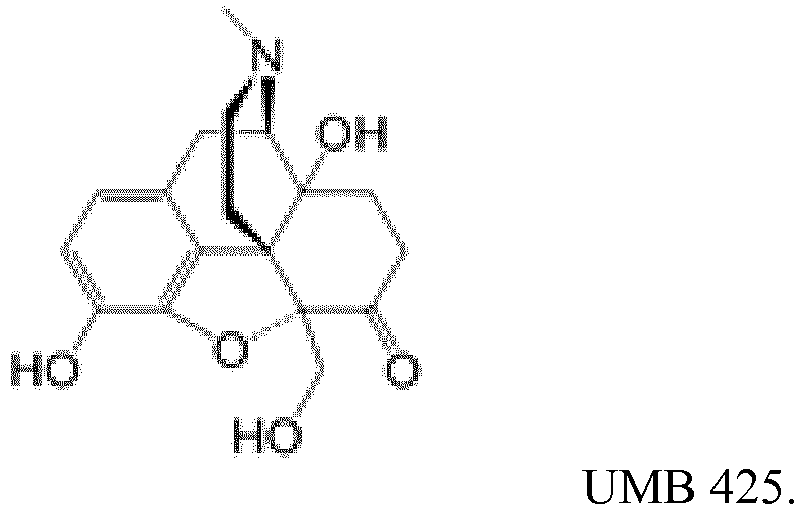
- A chemical compound according to the formula UMB 425 in claim 1 wherein the compound is:

- A compound according to claim 1 or claim 2 for use as a medicament.
- A compound according to claim 1 or claim 2 for use in the treatment of pain.
- A compound for use according to claim 4, wherein said pain is moderate-to-severe pain.
Applications Claiming Priority (2)
| Application Number | Priority Date | Filing Date | Title |
|---|---|---|---|
| US201361774128P | 2013-03-07 | 2013-03-07 | |
| PCT/US2014/021155 WO2014138378A1 (en) | 2013-03-07 | 2014-03-06 | NOVEL MIXED μ AGONIST/ δ ANTAGONIST OPIOID ANALGESICS WITH REDUCED TOLERANCE LIABILITIES AND USES THEREOF |
Publications (3)
| Publication Number | Publication Date |
|---|---|
| EP2964228A1 EP2964228A1 (en) | 2016-01-13 |
| EP2964228A4 EP2964228A4 (en) | 2016-09-07 |
| EP2964228B1 true EP2964228B1 (en) | 2019-05-08 |
Family
ID=51491946
Family Applications (1)
| Application Number | Title | Priority Date | Filing Date |
|---|---|---|---|
| EP14759505.2A Active EP2964228B1 (en) | 2013-03-07 | 2014-03-06 | Novel mixed agonist/antagonist opioid analgesics with reduced tolerance liabilities and uses thereof |
Country Status (5)
| Country | Link |
|---|---|
| US (1) | US9422302B2 (en) |
| EP (1) | EP2964228B1 (en) |
| AU (1) | AU2014225685A1 (en) |
| CA (1) | CA2911681A1 (en) |
| WO (1) | WO2014138378A1 (en) |
Family Cites Families (3)
| Publication number | Priority date | Publication date | Assignee | Title |
|---|---|---|---|---|
| US2178010A (en) * | 1937-02-03 | 1939-10-31 | Small Lyndon Frederick | Nuclear substituted derivatives of the morphine series and methods for their preparation |
| RS49982B (en) * | 1997-09-17 | 2008-09-29 | Euro-Celtique S.A., | SYNERGISTIC ANALGETIC COMBINATION OF ANALGETIC OPIATE AND CYCLOOOXYGENASE-2 INHIBITOR |
| DE10229842A1 (en) * | 2002-07-03 | 2004-02-05 | Helmut Prof. Dr. Schmidhammer | Morphinane derivatives and their quaternary ammonium salts substituted in position 14, production process and use |
-
2014
- 2014-03-06 US US14/772,592 patent/US9422302B2/en not_active Expired - Fee Related
- 2014-03-06 WO PCT/US2014/021155 patent/WO2014138378A1/en not_active Ceased
- 2014-03-06 AU AU2014225685A patent/AU2014225685A1/en not_active Abandoned
- 2014-03-06 CA CA2911681A patent/CA2911681A1/en not_active Abandoned
- 2014-03-06 EP EP14759505.2A patent/EP2964228B1/en active Active
Also Published As
| Publication number | Publication date |
|---|---|
| US20160016965A1 (en) | 2016-01-21 |
| US9422302B2 (en) | 2016-08-23 |
| CA2911681A1 (en) | 2014-09-12 |
| EP2964228A4 (en) | 2016-09-07 |
| AU2014225685A1 (en) | 2015-09-17 |
| EP2964228A1 (en) | 2016-01-13 |
| WO2014138378A1 (en) | 2014-09-12 |
Similar Documents
| Publication | Publication Date | Title |
|---|---|---|
| Chakraborty et al. | Oxidative metabolism as a modulator of kratom’s biological actions | |
| US11760758B2 (en) | Mitragynine analogs for the treatment of pain, mood disorders and substance use disorders | |
| CN105246897B (en) | Opium sample ketal compound and its purposes | |
| JP2014208640A (en) | Buprenorphine analogs | |
| Vekariya et al. | Synthesis and structure–activity relationships of 5′-aryl-14-alkoxypyridomorphinans: Identification of a μ opioid receptor agonist/δ opioid receptor antagonist ligand with systemic antinociceptive activity and diminished opioid side effects | |
| Harland et al. | Further optimization and evaluation of bioavailable, mixed-efficacy μ-opioid receptor (MOR) agonists/δ-opioid receptor (DOR) antagonists: balancing MOR and DOR affinities | |
| Spetea et al. | Recent advances in the development of 14-alkoxy substituted morphinans as potent and safer opioid analgesics | |
| Harland et al. | Effects of n-substitutions on the tetrahydroquinoline (thq) core of mixed-efficacy μ-opioid receptor (mor)/δ-opioid receptor (dor) ligands | |
| AU2015353414A1 (en) | Methods and compositions for potentiating the action of opioid analgesics using iboga alkaloids | |
| AU2006272773B2 (en) | 8-carboxamido-substituted-2 , 6-methano-3-benzazocines and 3 - carboxamido- substituted morphanes as opioid receptor binding agents | |
| EP4419523A1 (en) | Novel methods | |
| Dumitrascuta et al. | Synthesis, pharmacology, and molecular docking studies on 6-desoxo-N-methylmorphinans as potent μ-opioid receptor agonists | |
| WO2015099863A1 (en) | 6-substituted and 7-substituted morphinan analogs and the use thereof | |
| Li et al. | The pharmacological heterogeneity of Nepenthone analogs in conferring highly selective and potent κ-opioid agonistic activities | |
| Pasquinucci et al. | Evaluation of N-substituent structural variations in opioid receptor profile of LP1 | |
| WO2009070733A1 (en) | Peripheral phenolic opioid antagonist | |
| Spetea et al. | In vitro opioid activity profiles of 6-amino acid substituted derivatives of 14-O-methyloxymorphone | |
| Lattanzi et al. | Synthesis and biological evaluation of 14-alkoxymorphinans. 22. Influence of the 14-alkoxy group and the substitution in position 5 in 14-alkoxymorphinan-6-ones on in vitro and in vivo activities | |
| US9422302B2 (en) | Mixed μ agonist/ δ antagonist opioid analgesics with reduced tolerance liabilities and uses thereof | |
| Huang et al. | Design, Synthesis, and Structure–Activity Relationship Exploration of Alkyl/Phenylalkyl Piperidine Analogues as Novel Highly Potent and Selective μ Opioid Receptor Agonists | |
| Varghese et al. | A short history of the discovery and development of naltrexone and other morphine derivatives | |
| Harland et al. | Placement of hydroxy moiety on pendant of peptidomimetic scaffold modulates mu and kappa opioid receptor efficacy | |
| AU2018200102A1 (en) | Heterocycle-fused morphinans, use thereof and preparation thereof | |
| Zheng et al. | Identification and synthesis of norhydromorphone, and determination of antinociceptive activities in the rat formalin test | |
| US20250051332A1 (en) | Opioid receptor agonist and methods of use thereof |
Legal Events
| Date | Code | Title | Description |
|---|---|---|---|
| PUAI | Public reference made under article 153(3) epc to a published international application that has entered the european phase |
Free format text: ORIGINAL CODE: 0009012 |
|
| 17P | Request for examination filed |
Effective date: 20150828 |
|
| AK | Designated contracting states |
Kind code of ref document: A1 Designated state(s): AL AT BE BG CH CY CZ DE DK EE ES FI FR GB GR HR HU IE IS IT LI LT LU LV MC MK MT NL NO PL PT RO RS SE SI SK SM TR |
|
| AX | Request for extension of the european patent |
Extension state: BA ME |
|
| DAX | Request for extension of the european patent (deleted) | ||
| A4 | Supplementary search report drawn up and despatched |
Effective date: 20160808 |
|
| RIC1 | Information provided on ipc code assigned before grant |
Ipc: A61K 31/485 20060101AFI20160802BHEP Ipc: C07D 489/08 20060101ALI20160802BHEP Ipc: C07D 489/02 20060101ALI20160802BHEP |
|
| GRAP | Despatch of communication of intention to grant a patent |
Free format text: ORIGINAL CODE: EPIDOSNIGR1 |
|
| STAA | Information on the status of an ep patent application or granted ep patent |
Free format text: STATUS: GRANT OF PATENT IS INTENDED |
|
| RIN1 | Information on inventor provided before grant (corrected) |
Inventor name: COOP, ANDREW Inventor name: MATSUMOTO, RAE Inventor name: MACKERELL, ALEXANDER, D. |
|
| INTG | Intention to grant announced |
Effective date: 20181108 |
|
| RAP1 | Party data changed (applicant data changed or rights of an application transferred) |
Owner name: UNIVERSITY OF MARYLAND, BALTIMORE Owner name: WEST VIRGINIA UNIVERSITY |
|
| GRAS | Grant fee paid |
Free format text: ORIGINAL CODE: EPIDOSNIGR3 |
|
| GRAA | (expected) grant |
Free format text: ORIGINAL CODE: 0009210 |
|
| STAA | Information on the status of an ep patent application or granted ep patent |
Free format text: STATUS: THE PATENT HAS BEEN GRANTED |
|
| AK | Designated contracting states |
Kind code of ref document: B1 Designated state(s): AL AT BE BG CH CY CZ DE DK EE ES FI FR GB GR HR HU IE IS IT LI LT LU LV MC MK MT NL NO PL PT RO RS SE SI SK SM TR |
|
| REG | Reference to a national code |
Ref country code: GB Ref legal event code: FG4D |
|
| REG | Reference to a national code |
Ref country code: CH Ref legal event code: EP Ref country code: AT Ref legal event code: REF Ref document number: 1129104 Country of ref document: AT Kind code of ref document: T Effective date: 20190515 |
|
| REG | Reference to a national code |
Ref country code: IE Ref legal event code: FG4D |
|
| REG | Reference to a national code |
Ref country code: DE Ref legal event code: R096 Ref document number: 602014046335 Country of ref document: DE |
|
| REG | Reference to a national code |
Ref country code: NL Ref legal event code: MP Effective date: 20190508 |
|
| REG | Reference to a national code |
Ref country code: LT Ref legal event code: MG4D |
|
| PG25 | Lapsed in a contracting state [announced via postgrant information from national office to epo] |
Ref country code: PT Free format text: LAPSE BECAUSE OF FAILURE TO SUBMIT A TRANSLATION OF THE DESCRIPTION OR TO PAY THE FEE WITHIN THE PRESCRIBED TIME-LIMIT Effective date: 20190908 Ref country code: AL Free format text: LAPSE BECAUSE OF FAILURE TO SUBMIT A TRANSLATION OF THE DESCRIPTION OR TO PAY THE FEE WITHIN THE PRESCRIBED TIME-LIMIT Effective date: 20190508 Ref country code: ES Free format text: LAPSE BECAUSE OF FAILURE TO SUBMIT A TRANSLATION OF THE DESCRIPTION OR TO PAY THE FEE WITHIN THE PRESCRIBED TIME-LIMIT Effective date: 20190508 Ref country code: NL Free format text: LAPSE BECAUSE OF FAILURE TO SUBMIT A TRANSLATION OF THE DESCRIPTION OR TO PAY THE FEE WITHIN THE PRESCRIBED TIME-LIMIT Effective date: 20190508 Ref country code: FI Free format text: LAPSE BECAUSE OF FAILURE TO SUBMIT A TRANSLATION OF THE DESCRIPTION OR TO PAY THE FEE WITHIN THE PRESCRIBED TIME-LIMIT Effective date: 20190508 Ref country code: NO Free format text: LAPSE BECAUSE OF FAILURE TO SUBMIT A TRANSLATION OF THE DESCRIPTION OR TO PAY THE FEE WITHIN THE PRESCRIBED TIME-LIMIT Effective date: 20190808 Ref country code: LT Free format text: LAPSE BECAUSE OF FAILURE TO SUBMIT A TRANSLATION OF THE DESCRIPTION OR TO PAY THE FEE WITHIN THE PRESCRIBED TIME-LIMIT Effective date: 20190508 Ref country code: HR Free format text: LAPSE BECAUSE OF FAILURE TO SUBMIT A TRANSLATION OF THE DESCRIPTION OR TO PAY THE FEE WITHIN THE PRESCRIBED TIME-LIMIT Effective date: 20190508 Ref country code: SE Free format text: LAPSE BECAUSE OF FAILURE TO SUBMIT A TRANSLATION OF THE DESCRIPTION OR TO PAY THE FEE WITHIN THE PRESCRIBED TIME-LIMIT Effective date: 20190508 |
|
| PG25 | Lapsed in a contracting state [announced via postgrant information from national office to epo] |
Ref country code: GR Free format text: LAPSE BECAUSE OF FAILURE TO SUBMIT A TRANSLATION OF THE DESCRIPTION OR TO PAY THE FEE WITHIN THE PRESCRIBED TIME-LIMIT Effective date: 20190809 Ref country code: LV Free format text: LAPSE BECAUSE OF FAILURE TO SUBMIT A TRANSLATION OF THE DESCRIPTION OR TO PAY THE FEE WITHIN THE PRESCRIBED TIME-LIMIT Effective date: 20190508 Ref country code: BG Free format text: LAPSE BECAUSE OF FAILURE TO SUBMIT A TRANSLATION OF THE DESCRIPTION OR TO PAY THE FEE WITHIN THE PRESCRIBED TIME-LIMIT Effective date: 20190808 Ref country code: RS Free format text: LAPSE BECAUSE OF FAILURE TO SUBMIT A TRANSLATION OF THE DESCRIPTION OR TO PAY THE FEE WITHIN THE PRESCRIBED TIME-LIMIT Effective date: 20190508 |
|
| REG | Reference to a national code |
Ref country code: AT Ref legal event code: MK05 Ref document number: 1129104 Country of ref document: AT Kind code of ref document: T Effective date: 20190508 |
|
| PG25 | Lapsed in a contracting state [announced via postgrant information from national office to epo] |
Ref country code: DK Free format text: LAPSE BECAUSE OF FAILURE TO SUBMIT A TRANSLATION OF THE DESCRIPTION OR TO PAY THE FEE WITHIN THE PRESCRIBED TIME-LIMIT Effective date: 20190508 Ref country code: EE Free format text: LAPSE BECAUSE OF FAILURE TO SUBMIT A TRANSLATION OF THE DESCRIPTION OR TO PAY THE FEE WITHIN THE PRESCRIBED TIME-LIMIT Effective date: 20190508 Ref country code: AT Free format text: LAPSE BECAUSE OF FAILURE TO SUBMIT A TRANSLATION OF THE DESCRIPTION OR TO PAY THE FEE WITHIN THE PRESCRIBED TIME-LIMIT Effective date: 20190508 Ref country code: CZ Free format text: LAPSE BECAUSE OF FAILURE TO SUBMIT A TRANSLATION OF THE DESCRIPTION OR TO PAY THE FEE WITHIN THE PRESCRIBED TIME-LIMIT Effective date: 20190508 Ref country code: RO Free format text: LAPSE BECAUSE OF FAILURE TO SUBMIT A TRANSLATION OF THE DESCRIPTION OR TO PAY THE FEE WITHIN THE PRESCRIBED TIME-LIMIT Effective date: 20190508 Ref country code: SK Free format text: LAPSE BECAUSE OF FAILURE TO SUBMIT A TRANSLATION OF THE DESCRIPTION OR TO PAY THE FEE WITHIN THE PRESCRIBED TIME-LIMIT Effective date: 20190508 |
|
| REG | Reference to a national code |
Ref country code: DE Ref legal event code: R097 Ref document number: 602014046335 Country of ref document: DE |
|
| PG25 | Lapsed in a contracting state [announced via postgrant information from national office to epo] |
Ref country code: SM Free format text: LAPSE BECAUSE OF FAILURE TO SUBMIT A TRANSLATION OF THE DESCRIPTION OR TO PAY THE FEE WITHIN THE PRESCRIBED TIME-LIMIT Effective date: 20190508 Ref country code: IT Free format text: LAPSE BECAUSE OF FAILURE TO SUBMIT A TRANSLATION OF THE DESCRIPTION OR TO PAY THE FEE WITHIN THE PRESCRIBED TIME-LIMIT Effective date: 20190508 |
|
| PLBE | No opposition filed within time limit |
Free format text: ORIGINAL CODE: 0009261 |
|
| STAA | Information on the status of an ep patent application or granted ep patent |
Free format text: STATUS: NO OPPOSITION FILED WITHIN TIME LIMIT |
|
| PG25 | Lapsed in a contracting state [announced via postgrant information from national office to epo] |
Ref country code: TR Free format text: LAPSE BECAUSE OF FAILURE TO SUBMIT A TRANSLATION OF THE DESCRIPTION OR TO PAY THE FEE WITHIN THE PRESCRIBED TIME-LIMIT Effective date: 20190508 |
|
| 26N | No opposition filed |
Effective date: 20200211 |
|
| PG25 | Lapsed in a contracting state [announced via postgrant information from national office to epo] |
Ref country code: PL Free format text: LAPSE BECAUSE OF FAILURE TO SUBMIT A TRANSLATION OF THE DESCRIPTION OR TO PAY THE FEE WITHIN THE PRESCRIBED TIME-LIMIT Effective date: 20190508 |
|
| PG25 | Lapsed in a contracting state [announced via postgrant information from national office to epo] |
Ref country code: SI Free format text: LAPSE BECAUSE OF FAILURE TO SUBMIT A TRANSLATION OF THE DESCRIPTION OR TO PAY THE FEE WITHIN THE PRESCRIBED TIME-LIMIT Effective date: 20190508 |
|
| PG25 | Lapsed in a contracting state [announced via postgrant information from national office to epo] |
Ref country code: MC Free format text: LAPSE BECAUSE OF FAILURE TO SUBMIT A TRANSLATION OF THE DESCRIPTION OR TO PAY THE FEE WITHIN THE PRESCRIBED TIME-LIMIT Effective date: 20190508 |
|
| REG | Reference to a national code |
Ref country code: CH Ref legal event code: PL |
|
| REG | Reference to a national code |
Ref country code: BE Ref legal event code: MM Effective date: 20200331 |
|
| PG25 | Lapsed in a contracting state [announced via postgrant information from national office to epo] |
Ref country code: LU Free format text: LAPSE BECAUSE OF NON-PAYMENT OF DUE FEES Effective date: 20200306 |
|
| PG25 | Lapsed in a contracting state [announced via postgrant information from national office to epo] |
Ref country code: CH Free format text: LAPSE BECAUSE OF NON-PAYMENT OF DUE FEES Effective date: 20200331 Ref country code: IE Free format text: LAPSE BECAUSE OF NON-PAYMENT OF DUE FEES Effective date: 20200306 Ref country code: LI Free format text: LAPSE BECAUSE OF NON-PAYMENT OF DUE FEES Effective date: 20200331 |
|
| PG25 | Lapsed in a contracting state [announced via postgrant information from national office to epo] |
Ref country code: BE Free format text: LAPSE BECAUSE OF NON-PAYMENT OF DUE FEES Effective date: 20200331 |
|
| PGFP | Annual fee paid to national office [announced via postgrant information from national office to epo] |
Ref country code: FR Payment date: 20210325 Year of fee payment: 8 |
|
| PGFP | Annual fee paid to national office [announced via postgrant information from national office to epo] |
Ref country code: GB Payment date: 20210329 Year of fee payment: 8 Ref country code: DE Payment date: 20210329 Year of fee payment: 8 |
|
| PG25 | Lapsed in a contracting state [announced via postgrant information from national office to epo] |
Ref country code: MT Free format text: LAPSE BECAUSE OF FAILURE TO SUBMIT A TRANSLATION OF THE DESCRIPTION OR TO PAY THE FEE WITHIN THE PRESCRIBED TIME-LIMIT Effective date: 20190508 Ref country code: CY Free format text: LAPSE BECAUSE OF FAILURE TO SUBMIT A TRANSLATION OF THE DESCRIPTION OR TO PAY THE FEE WITHIN THE PRESCRIBED TIME-LIMIT Effective date: 20190508 |
|
| PG25 | Lapsed in a contracting state [announced via postgrant information from national office to epo] |
Ref country code: MK Free format text: LAPSE BECAUSE OF FAILURE TO SUBMIT A TRANSLATION OF THE DESCRIPTION OR TO PAY THE FEE WITHIN THE PRESCRIBED TIME-LIMIT Effective date: 20190508 Ref country code: IS Free format text: LAPSE BECAUSE OF FAILURE TO SUBMIT A TRANSLATION OF THE DESCRIPTION OR TO PAY THE FEE WITHIN THE PRESCRIBED TIME-LIMIT Effective date: 20190908 |
|
| REG | Reference to a national code |
Ref country code: DE Ref legal event code: R119 Ref document number: 602014046335 Country of ref document: DE |
|
| GBPC | Gb: european patent ceased through non-payment of renewal fee |
Effective date: 20220306 |
|
| PG25 | Lapsed in a contracting state [announced via postgrant information from national office to epo] |
Ref country code: GB Free format text: LAPSE BECAUSE OF NON-PAYMENT OF DUE FEES Effective date: 20220306 Ref country code: FR Free format text: LAPSE BECAUSE OF NON-PAYMENT OF DUE FEES Effective date: 20220331 Ref country code: DE Free format text: LAPSE BECAUSE OF NON-PAYMENT OF DUE FEES Effective date: 20221001 |